Primary Election
Utah GOP split on how to rebuild trust
Moore to face GOP primary against Lisonbee

Utah GOP split on how to rebuild trust
Moore to face GOP primary against Lisonbee

How Utah’s redistricting fight echoes a nationwide battle over congressional representation
By Brigham Tomco Deseret
The nation’s redistricting war reached a climax last month as yearslong legal battles, historic court rulings and political pressures empowered Republicans to rearrange state electoral boundaries, while Democratic efforts were less successful.
Beginning with Texas redrawing its maps last summer to net f ive additional GOP-leaning seats at the behest of President Donald Trump, f ive other red states have broken with the oncein-a-decade norm to benef it their party ahead of November.
Republicans have drawn 9-12 friendlier seats in Ohio, which had to redistrict by statute; Texas; Missouri; North Carolina; Florida; and Tennessee. These last two came after the Supreme Court in April ruled states cannot draw congressional lines based on race. California jumped into the fray in November, when voters approved a proposal to temporarily override the state’s independent redistricting commission to convert f ive seats into Democratic territory. But elsewhere, Democrats have not been so lucky.
A Virginia plan to forge four new Democratic seats was struck down by the state’s high court in May, and threats from Illinois and Maryland have gone unfulf illed. Meanwhile, Georgia and Louisiana might add two more seats to the Republican tally.
Lumped in with this mid-cycle mayhem, which could determine congressional control in the 2026 midterms, is Utah’s own battle over district boundaries that has resulted in a safe Democratic seat in Salt Lake County amid GOP opposition.
Utah’s messy legal showdown between the Legislature and activist groups has led to allegations of gerrymandering from both sides as voters remain divided over the underlying ballot initiative that removed f inal redistricting authority from lawmakers.
The old map, approved after legislators struck a compromise on Utah’s redistricting commission, appeared to intentionally “crack” the Democratic vote in Salt Lake City. Now, the new court-ordered map appears to “pack” the Democratic vote into one district.
Utah may have begun its redistricting brawl all the way back in 2018, but it has since become another player in the partisan pit f ight over maps.
Utah’s unique case also raises the same questions about what makes a good map and how gerrymandering can be prevented. Cox: New map is gerrymandered
Utah Gov. Spencer Cox took a combative tone at a Deseret News/Atlantic panel May 11 when asked whether he should have stopped his party from pushing through a self-serving map. The governor turned the criticism back onto the groups who advocated for a new map.
“We are a supermajority Republican state,” Cox said, noting that registered Republicans outnumber Democrats nearly 4-to-1. “I think the only way to get a Democratic district in this state is to gerrymander a Democratic district, which is what the courts did.”
In August, 3rd District Judge Dianna Gibson ruled that a 2020 law reforming Utah’s redistricting process, put in place through Proposition 4, was unconstitutional. She reinstated the original version of Proposition 4 and tossed out the state’s map, which she said violated it.
The old map had eliminated the state’s only competitive district, which a Democrat, Ben McAdams, won in 2018. Lawmakers instead drew four safe Republican seats by splitting up one neighborhood in Millcreek between the districts, signif icantly diluting Utah’s Democratic vote.
The new map — submitted by nonprof its, and selected by Gibson in November — drew a circle around the most Democratic part of the state, home to 40% of Utah’s actively registered Democrats, giving the party a 15-percentage point advantage, based on recent races.
The Utah Constitution gives map-drawing power to the Legislature, according to Cox, who said lawmakers rightly believe that a fair map can be drawn with GOP-majority seats.
Ultimately, Cox said, a focus on gerrymandering ignores the real issues in American politics.
“I hate the midterm redistricting. I will say that. I hate
By Eva Terry Deseret News
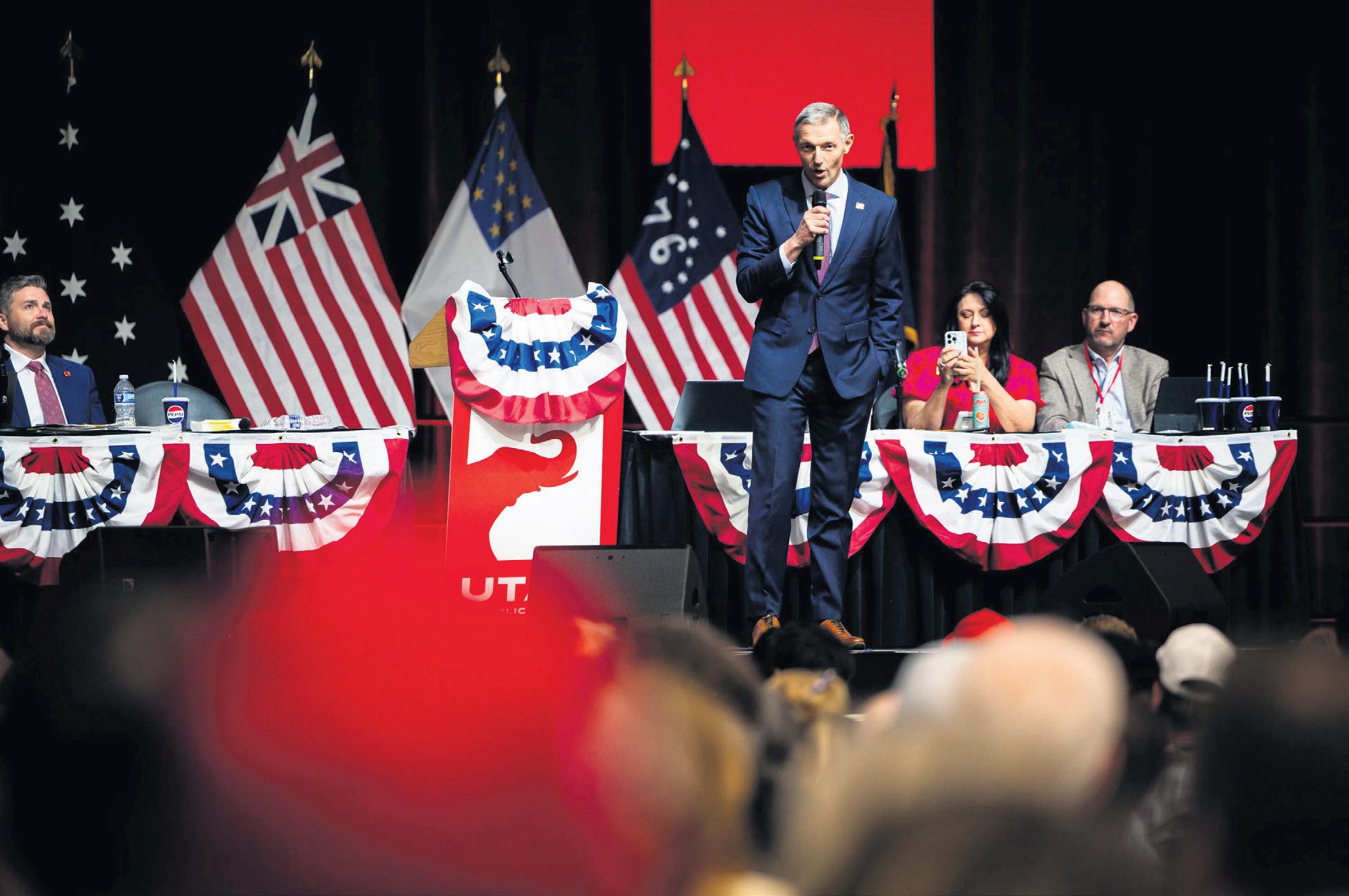
Incumbent Rep. Mike Kennedy will be the Republican nominee for Utah’s 4th Congressional District.
At the GOP State Convention at Utah Valley University on April 25, Kennedy won 78.7% of the delegates’ vote. Kennedy filled former Rep. John Curtis’ seat in the U.S. House of Representatives after Curtis announced a Senate run in 2024. “I’m a family doctor. I’ve done that for 25 years. I’m an attorney as well, and I was in the state Legislature for 10 years,” Kennedy said on April 25, after walking on stage to the “Rocky” theme song.
it. I absolutely hate it. I don’t think gerrymandering is what broke our country.
I don’t think it’s in the top 20,” Cox said. “It’s not the best thing for our country, but it’s not the reason we’re having all of these problems.”
How do you draw a fair map?
Gerrymandering can play an important role in exacerbating polarization, however, according to Harvard Law professor Nicholas Stephanopoulos, one of the top experts on redistricting in the nation, who helped develop gerrymandering metrics like the Eff iciency Gap.
Gerrymandering, def ined as making electoral boundaries with the intent and effect of benef iting the line-drawing side, distorts fair partisan representation of communities, Stephanopoulos said, making it less likely that Congress as a whole will reflect shifts in public opinion.
The Utah redistricting lawsuit found that the old map performed poorly on mathematical measures of partisan bias. And most computer simulations of compact, contiguous districts with few county splits produced one Democratic-leaning district in the state.
This made Utah “a relatively easy case” of gerrymandering, Stephanopoulos told the Deseret News. It is a pattern observed across the country, he said, of Republicans splitting urban areas into rural districts, and Democrats combing rural areas with urban districts.
Unlike the other redistricting battles taking place around the country, Utah is an instance of the political process producing more fair maps, according to Stephanopoulos. This may have angered the dominant party, “but that’s exactly the point,” Stephanopoulos said.
“The question is not whether Republicans like it,” he added. “The question is whether it’s good for systemic partisan fairness. And I think redrawing Utah’s map was good for systemic fairness, both on a Utah-specif ic level and also on a nationwide level.”
How to f ix the gerrymandering problem
Advocates of redistricting commissions, and judicial oversight of map drawing, forget partisan politics cannot be removed from the process, according to Hans von Spakovsky, a senior election law expert at Advancing American Freedom, a conservative think tank. Redistricting commissions often produce maps that are just as tilted toward one party or another, Spakovsky said, pointing to California’s commission, which implemented a congressional map with 42 Democratic and
He described himself as a “pragmatic conservative who’s thoughtful and civil.”
Kennedy has performed well at Republican conventions since he entered the political scene. In 2018, he edged out former Utah Sen. Mitt Romney 51% to 49%.
Since the congressional maps were finalized at the end of February, Kennedy said he called every delegate in his district.
“You have done a great job telling me about what’s going on in your lives, and in fact, I’ve introduced a bill to adopt some of the ideas you’ve given me,” Kennedy said. The congressman then referenced his recent PROTECT Act, which aims to curb H-1B visa misuse by removing financial incentives for employers to hire foreign labor.
7 Republican seats even though 40% of the state votes Republican.
Other blue states have taken gerrymandering to its extreme, Spakovsky said: Only one of Maryland’s eight representatives is Republican, even though one third of the state votes red. Only three of Illinois’ 17 representatives are Republican, but 40% of voters are.
“Everyone is talking as if the kind of partisan gerrymandering going on right now started in the past year,” Spakovsky told the Deseret News. “The Republicans didn’t initiate this. They’re just simply f inally adopting the tactics the Democrats have been practicing for years.”
Red states might be “catching up with” blue states, but Spakovsky thinks lawmakers should restrict themselves to compact maps that don’t split jurisdictions. Where Utah’s Proposition 4 went wrong, he said, was including ambiguous partisan fairness rules, opening the state up to lawsuits.
Eric McGhee, a fellow at the Public Policy Institute of California, who created the “eff iciency gap” metric, disagreed. He told the Deseret News legal standards for fair maps help prevent partisans from drawing districts to limit the effectiveness of the other party’s voters.
Utah Republicans are split on the issue.
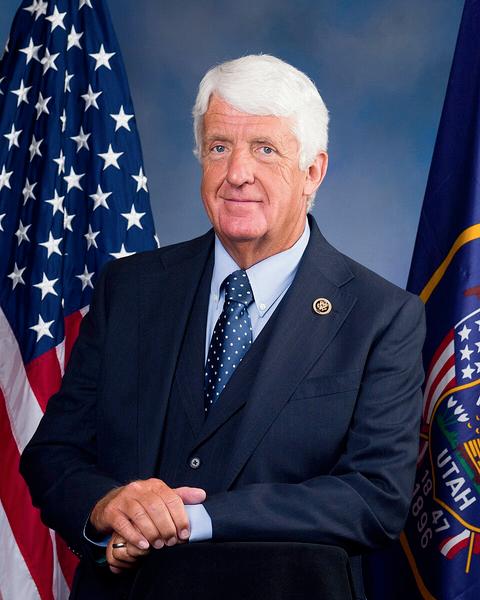
U.S. Rep. Blake Moore, who was an original sponsor of the Proposition 4 petition, told the Deseret News “every state should reckon with this.” He proposed all 50 governors should convene in 2030 to set nationwide redistricting standards to stop the spiral of mid-decade map-drawing by states.
Former Rep. Jason Chaffetz, who is eyeing a bid for Utah governor, told the Deseret News redistricting is the job of elected lawmakers, and not unaccountable judges. He said his focus is on how the status of birthright citizenship will impact the reapportionment of congressional seats.
The political implications of new congressional maps are clear.
Utah’s new 1st District will make Democratic primaries the center of attention for the f irst time in years, according to political consultant Marty Carpenter. But it could also spark widespread backlash against Proposition 4 if it is seen as producing a radically progressive candidate.
What Carpenter thinks is missing from the conversation is a little bit of generosity toward the map drawers.
“When you say ‘gerrymandering’ in a way that’s loaded with some kind of passion behind it, it’s that somebody’s putting their interests ahead of the public interest,” Carpenter told the Deseret News. “But the fact of the matter is, it’s just tougher to draw maps than most people realize.”
Kennedy has also passed legislation focused on social issues.
During his 10-year term in Utah’s Legislature, Kennedy said he “had the privilege to run the bill to ban transgender surgeries on minors in this state.”
“I will tell you right now, if there’s any federal legislation that’s going to jeopardize that bill, I will vote against it, and I have done that,” he said. “I have voted over and over to keep men out of women’s locker rooms, men out of women’s bathrooms and men out of women’s sports.”
He added, “I am proud to stand with you as a conservative.” The other candidates earned 204 votes from delegates. Scott Hatfield brought in 11%, Seth Steward brought in 5.2%, Isaiah Hardman brought in 3.8% and Tyrone Jensen brought in 1.4%.
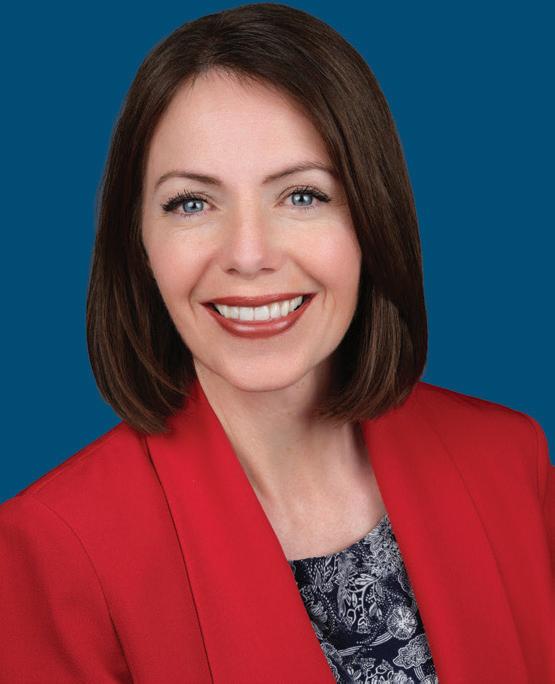
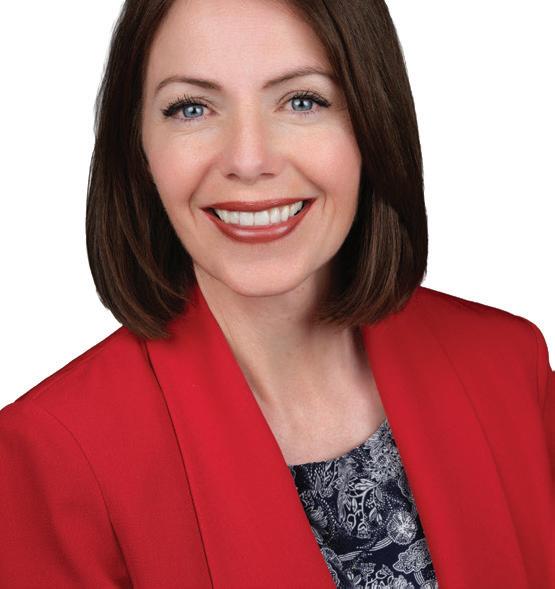














I chose to raise my family in Northern Utah. I love our community. I’ve served on the Syracuse city council and in the Utah House and I would be honored to represent you in Congress.
I will vote to cut wasteful spending and to balance the budget.
I will fight corruption and will never trade individual stocks while in office.
I will vote to end FISA’s warrantless surveillance of American citizens.
I will continue to defend the 2 Amendment. nd
I will maintain a 100% Pro-Life voting record.



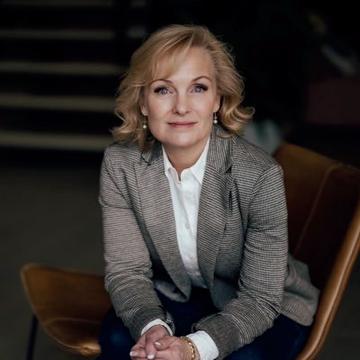
“I know how important it is to send a watchdog to Washington DC. Karianne Lisonbee is the candidate I trust to increase transparency and accountability, and eliminate fraud, waste, and abuse from federal programs. Join me in supporting Karianne for Congress!”



abortion in Utah with exceptions upon the overturning of Roe v.
regulatory and tax burdens from Utah businesses.
elective abortions due to a Down syndrome diagnosis. Shifts pre-trial burden of proof to the state, protecting law-abiding Utahns who act in self-defense.
Offender Detention
Required habitual offenders to be held until seeing a judge, limiting overcrowding-release loopholes.
State Custody Restrictions
gender-affirming care and required sex-based housing assignments for individuals in state custody.

“Karianne has been effective in the legislature during her tenure and always supportive of me while I served in Congress. Because Karianne was effective in the legislature, she has the skills to be a functional and effective member day one in a dysfunctional Congress.”

“Karianne is the right choice to represent Northern Utah in Congress. As her colleagues, we’ve witnessed firsthand her work ethic, integrity, and guiding principles. She’s a conservative champion who gets things done.”



By Brigham Tomco Deseret News
Utah Republican Party delegates heard two different visions of how to restore trust in the federal government at the GOP’s nominating convention on April 25. The party’s most active members were evenly split on the answer.
The choice was between incumbent Rep. Celeste Maloy’s message of incremental improvement in Congress, and former gubernatorial candidate, and election security crusader Phil Lyman’s promise of total transparency.
Maloy won 51% in the second round of voting. In his third appearance before delegates in two years, Lyman won 49%. Maloy already qualif ied for a primary by submitting 7,000 signatures. Lyman did not submit enough signatures.
Both candidates will advance to a party primary in June where they will have to make their case to reclaim conf idence in America’s legislative branch to all Republican voters in the district, which covers all of eastern and southern Utah.
For the next leg of the race, Maloy counts on $461,900 in cash on hand. Lyman has raised $4,200, according to his campaign.
But Maloy can expect a tough race given that she barely eked out a primary win in 2024 after a recount and that Lyman performed best in the region of the state covered by the 3rd District, winning in 11 of 18 counties against Gov. Spencer Cox.
What’s the truth about trust?
On April 25, Maloy touted her spot on the powerful Appropriations committee and Natural Resources committee, and her position as chair of the Western Caucus, which sets the agenda on energy, water and public lands policy.
Maloy marked her f irst full term in Congress with bills to speed up the federal permitting process and hours spent explaining her track record to voters. Doing this, with the perspective of American exceptionalism, is how you build trust, she said.
“Sometimes it’s hard to tell what you can trust and it’s easy to lose faith,” she said. “Let me make a case that America is still both good and great. ... As Americans, with the help of our Creator, we can mend whatever flaws we have in our system.”
Maloy, who served as chief legal counsel to former Rep. Chris Stewart, told delegates her experience made her a valuable asset. She vowed to work with President Donald Trump to secure $1 billion to “make the Great Salt Lake great again.”
This focus on problem solving over partisan signaling is what made Maloy the clear pick for Mike Vincent, a delegate from Washington County. He said she has accomplished more in one term than most representatives do in two or three.
“She has a much longer, broader perspective than what Phil Lyman is articulating,” Vincent said. “Celeste has got a big picture, and she
gets out and spends all her time that she can when she’s not in D.C., in the district, talking to people.”
Lyman hammers election security
The issue Lyman has curated his reputation around since losing the GOP primary in 2024 is addressing claims of corruption.
In 2024, after coming within 9 percentage points of beating Cox in the primary, Lyman launched a multifront attack on Utah’s election system. Lyman refused to accept the results and asked the courts to place him on the general election ballot.
Lyman has continued to accuse the state’s top elected off icials of “collusion” because they have not disclosed election records that Lyman has requested. On April 25, Lyman said the only path to increasing trust is increasing sunlight on the system.
“Our problem in Utah is not a lack of trust, it’s that we trust people who are not trustworthy,” Lyman told delegates. “In fact, there are people who make an expert practice of deception. And we’ve got something going on right now.”
Lyman criticized Maloy for voting to keep the government’s FISA warrantless surveillance authority intact. He called for the full release of all the f iles related to the business dealings of disgraced f inancier Jeffrey Epstein.
In his f inal appeal to delegates, Lyman
“ Our problem in Utah is not a lack of trust, it’s that we trust people who are not trustworthy.”
summed up his campaign as an opportunity for Republican voters to choose to send a message to the political establishment in Utah “that they do not control all the politics in Utah.”
Washington County delegate Stephanie Newbold referenced the same elements of Maloy’s voting record as Lyman did, arguing that this gave Maloy a low rating on some conservative congressional scorecards.
The most important characteristic a member of Congress can have to rebuild trust is independence, according to Newbold, who said she would prefer a candidate who elevated Utah’s concerns above party leadership.


“Transparency. I don’t necessarily want a candidate that’s going to be a ‘yes’ man,” Newbold said. “I want someone who’s going to protect Utah’s interests. Not necessarily my own all the time, and that is being transparent.”






“
I passed more individual pieces of legislation than anyone else in what will be President Trump’s most significant legislative achievement.
— Rep. Blake Moore
”
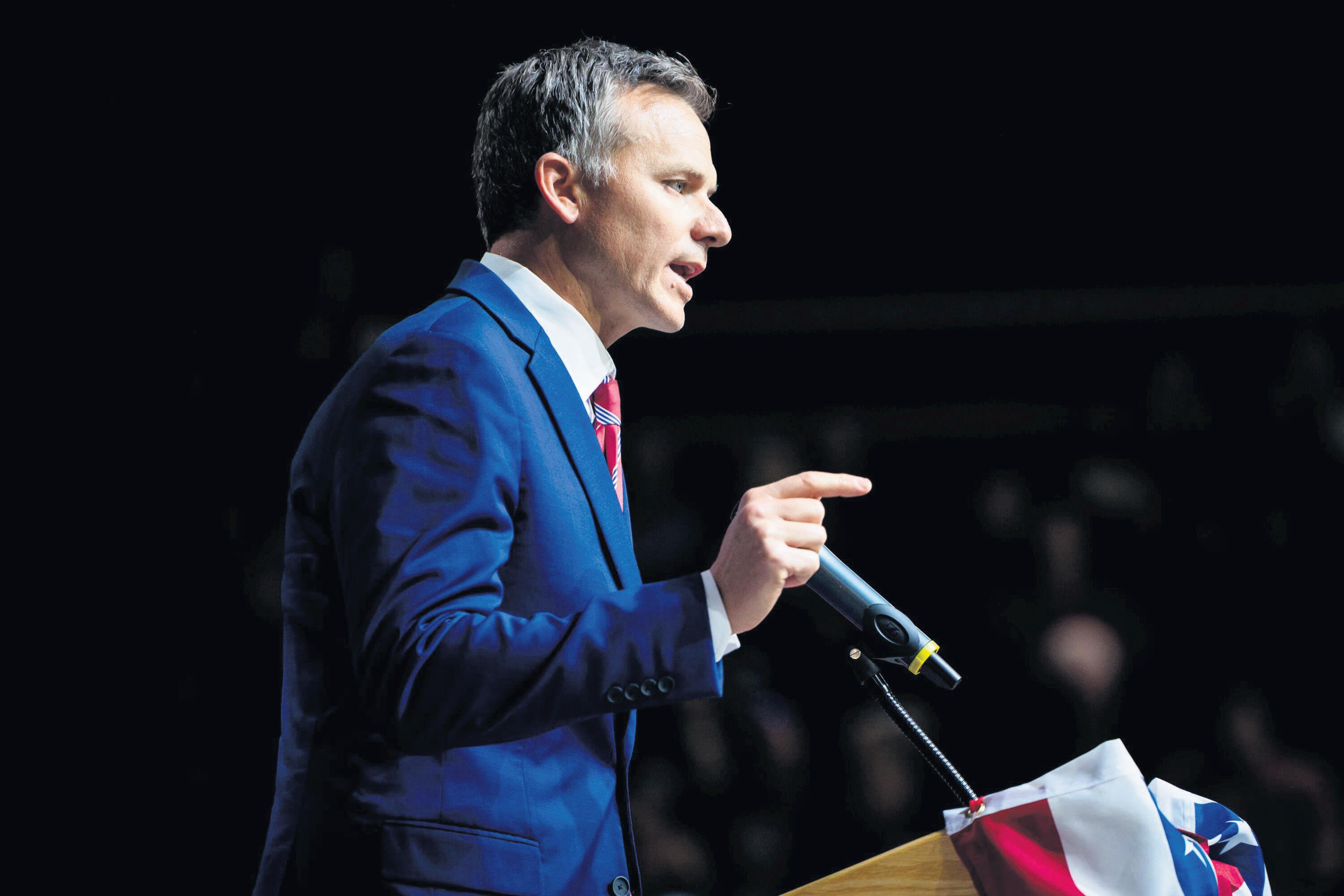
Moore touted his role in Trump’s tax cuts but faced criticism from Lisonbee over Proposition 4
By Brigham Tomco Deseret News
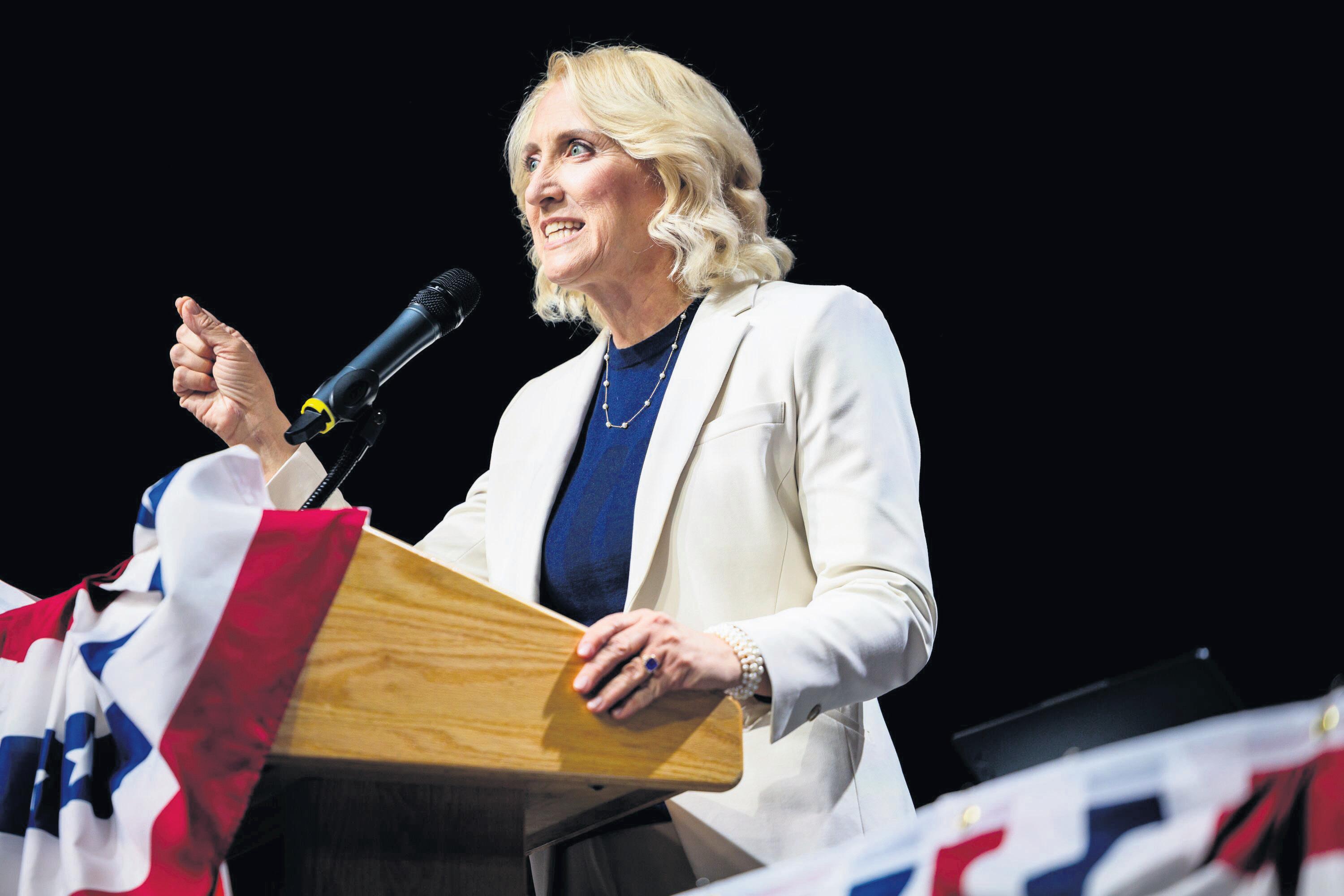
Utah Rep. Blake Moore, the fifth-ranked Republican in the U.S. House of Representatives, lost a party nomination vote among precinct delegates on April 25 but will continue to a primary election in June.
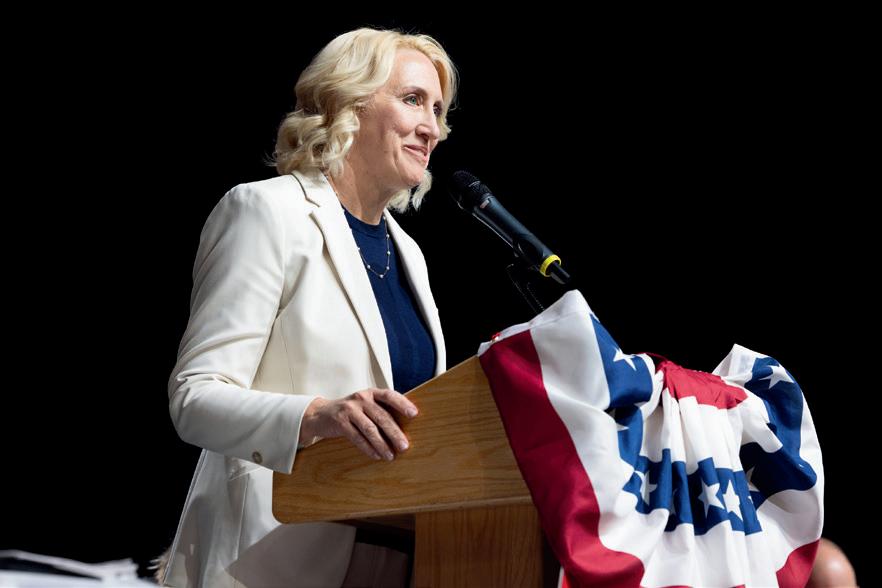
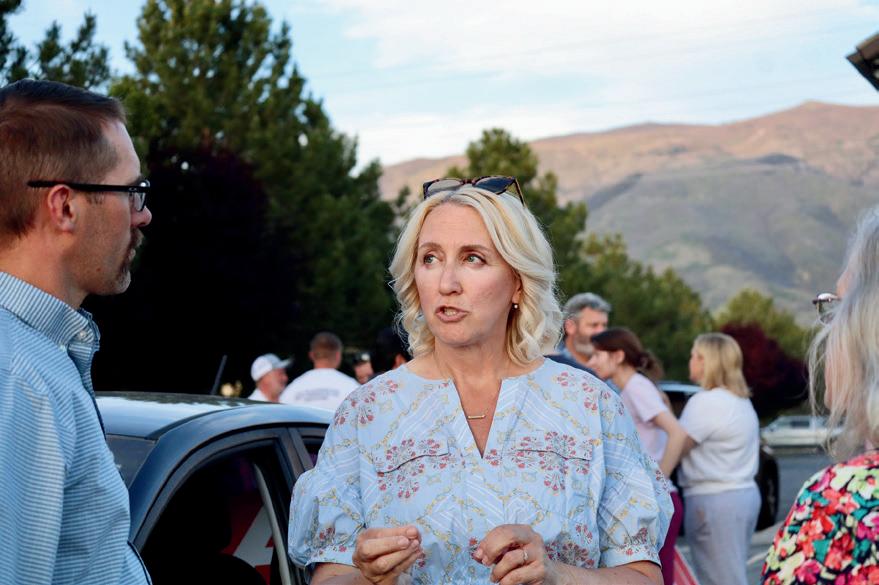
Delegates backed state Rep. Karianne Lisonbee, R-Syracuse, who targeted Moore’s support for a redistricting commission and dismissed his leadership positions as Congress has overseen a soaring national debt.
Lisonbee won 61.5% of the vote among the 1,000 delegates representing party precincts across the 2nd Congressional District in northern Utah. Moore got 33.7% and former
National Guardsman Colton Hatch got 4.8%.
Moore had already qualified for the primary ballot by submitting over 7,000 verified voter signatures. Lisonbee opted to forgo the signature option, relying on delegates to give her at least 40% of the vote to qualify.
Utah’s unique caucus-convention system often penalizes incumbents. In 2024, Moore lost by more than 10 percentage points at convention against a political newcomer. However, he later won by more than 40 points in the primary.
The April 25 vote reflected the deep antiestablishment sentiment of the GOP grassroots, even toward a candidate endorsed by President Donald Trump and responsible for some of the president’s biggest legislative wins.
Moore appeals to authority
Delegates welcomed Moore to the stage, and sent him off, with a chorus of boos. But the twoterm lawmaker plowed ahead with prepared remarks, tallying his list of high profile accomplishments since entering office in 2021. Moore highlighted his status as one of the only Utahns to ever serve in congressional leadership and the first Utahn to sit on the powerful Ways and Means Committee, which is the primary force behind tax policy in Washington, D.C. Moore’s time on the committee coincided with the passage of the One Big Beautiful Bill Act, which made Trump’s 2017 Tax Cuts and



Jobs Act, including expanded business tax breaks and child tax credits, permanent.
Moore played a role in shaping the tax cuts, and was also credited with drafting the legislation that became the “Trump Accounts” — a government-funded savings account for kids — earning Moore a shoutout from Trump.
“I passed more individual pieces of legislation than anyone else in what will be President Trump’s most significant legislative achievement,” Moore said.
As the first ever Utahn elected to House GOP leadership, Moore said he is in the best position to continue supporting Utah’s Sentinel nuclear launch silo sites and Hill Air Force Base’s F-35 maintenance programs.
Moore’s reelection campaign has also become a referendum on Utah’s new courtordered congressional district map, tapping into frustration among some state lawmakers over Moore’s support for Utah’s redistricting
commission.
One of Moore’s greatest advocates in the state, Senate President Stuart Adams, R-Layton, did not address this line of attack, but instead reiterated how Moore’s leadership role has delivered huge dividends for northern Utah.
Adams told the Deseret News he expects Moore to be elected as chair of the House Budget Committee in the fall. Moore has been a member of the committee since 2022 but has not announced a bid for committee chair.
“Leadership means everything, you’re making all the decisions,” Adams said. “When you’re the budget chair, everything runs through you. And that gives you the ability to be able to negotiate with other legislators. So it is everything for northern Utah.”
Support split by redistricting
However, Adams’ counterpart at the state Legislature gave an opposite prediction of Moore’s prospects.
Utah House Speaker Mike Schultz, R-Hooper,
told the Deseret News that he believes Moore’s involvement with the group behind Utah’s redistricting law could potentially have negative implications for his leadership positions.
Before running for elected office, Moore served as one of the original Republican chairs of Better Boundaries, and as one of the original signatories on the application to gather signatures to put Proposition 4 on the ballot.
Following a yearslong legal battle, advocacy groups successfully sued the state to toss out its 2021 map and to install one of their own design that created a Democratic-leaning district in Salt Lake County.
Schultz joined Lisonbee in blaming Moore for the original initiative that allowed groups to sue if they think lawmakers do not meet antigerrymandering rules. This law could determine the midterms and Moore’s future, Schultz said.
“That cost Utah a Republican seat, that’s going to possibly cost the majority in Washington, D.C.,” Schultz said. “That’ll be used against him very heavily in a leadership race. So I don’t see
“Government is too big, costs too much and has gone far beyond its purpose.”
— Rep. Lisonbee, R-Syracuse
Blake winning another leadership race.”
Met with big cheers, Lisonbee capitalized on her convention-only status and fiery condemnations of Moore. She lambasted her opponent for working “with Democrats to turn a reliably red Utah congressional seat deep blue.”
Lisonbee focused the remainder of her remarks on her record of spending cuts, immigration law enforcement, and culture war victories on banning elective abortions, restricting transgender access and affirming gun rights.
The nation has continued on an “unsustainable trajectory” with the national debt increasing by more than $10 trillion, and unfunded Social Security obligations doubling while Moore has been in office, Lisonbee said.
“That is not leadership. Fraud and corruption have seeped into our institutions. Government is too big, costs too much and has gone far beyond its purpose,” Lisonbee said. “Now, more than ever, we need real leadership.”


Is this Utah’s progressive moment?
By Emma Pitts Deseret News
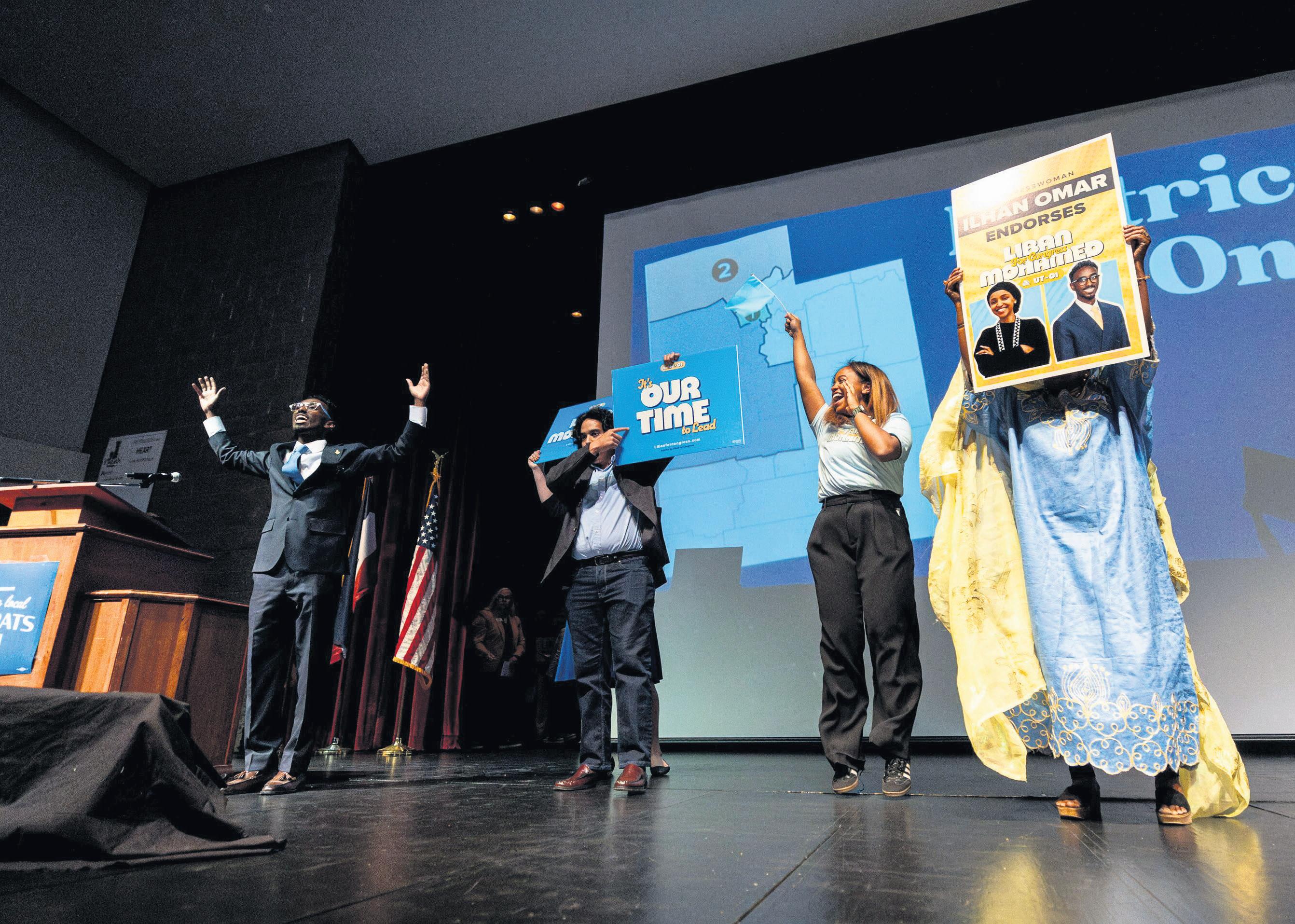
In a political upset, Liban Mohamed will be the Democratic Party’s top choice coming out of the convention for Utah’s newly created 1st Congressional District, gaining 51.18% of the votes at Utah’s Democratic Party Convention on April 25.
“It’s progressives’ time to lead. It’s the working class’ time to lead,” Mohamed told the press post-victory. “Today, we got the endorsement of the Democratic Party, but we also got the endorsement of Congresswoman Ilhan Omar, and it’s just the beginning. The support is growing as people get to know us.”
Former Salt Lake County mayor and U.S. Congressman Ben McAdams received 48.5% of the vote.
Fellow candidates state Sen. Nate Blouin and Michael Farrell will still appear on the June primary ballot with McAdams and Mohamed, having secured the required signatures despite not winning at convention.
Salt Lake City Council member and fellow 1st District Democratic candidate Eva Lopez Chavez did not receive enough signatures heading into the convention, so she will not be on the June primary ballot.
The candidate that wins the primary will go up against Republican Riley Owen in the November general election.
Is Utah getting its progressive moment?
Utah Democrats have an opportunity for a “Mamdani moment” in the state’s 1st Congressional District race, Angel Vice, chairwoman of the Utah Democratic Party Women’s Caucus, told the Deseret News.
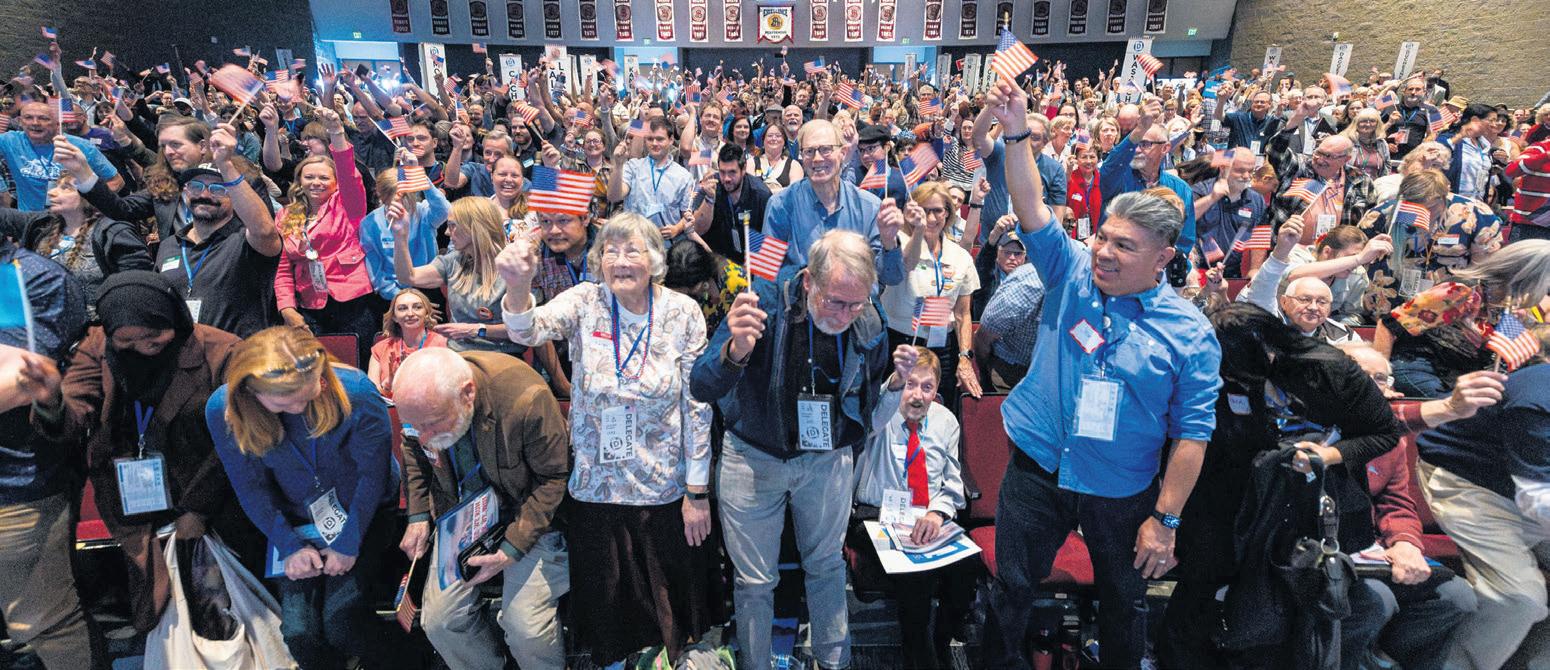
During the state’s Democratic Party Convention on April 25 at Jordan High School, multiple candidates gave speeches expressing their disdain for President Donald Trump and the Republican leadership currently in Congress.
Unif ied applause was met every time a candidate said they would abolish Immigration and Customs Enforcement, promise universal healthcare or end funding to U.S.-ally Israel, summed up in Farrell’s speech:
“Utahns deserve a representative who will tax the wealthy. A representative who will deliver universal healthcare and not settle for less. We will stand with our queer neighbors and pass the Equality Act. We will abolish ICE and defend our immigrant friends and neighbors, and we’ll end all, not just military, all aid to Israel.”
Since last year’s Democratic convention, two nonprof its redrew Utah’s congressional map, which was then approved by a judge after a lengthy legal struggle. As a result, in the 1st District, covering Salt Lake City, Democrats now see a genuine chance to challenge the state’s GOP leadership and expand their influence at the federal level.
It’s a race that’s “been 7½ years in the making,” Utah Democratic Party National Committee Member Brad Townley said ahead of the candidate speeches. “It’s one of the most-watched races in the state. One of the most watched races nationally.”
Progressive surge meets establishment caution in 1st District showdown
Vice said that Utah is “more progressive than our Legislature, and our media gives us credit.” Her vote was with Mohamed.
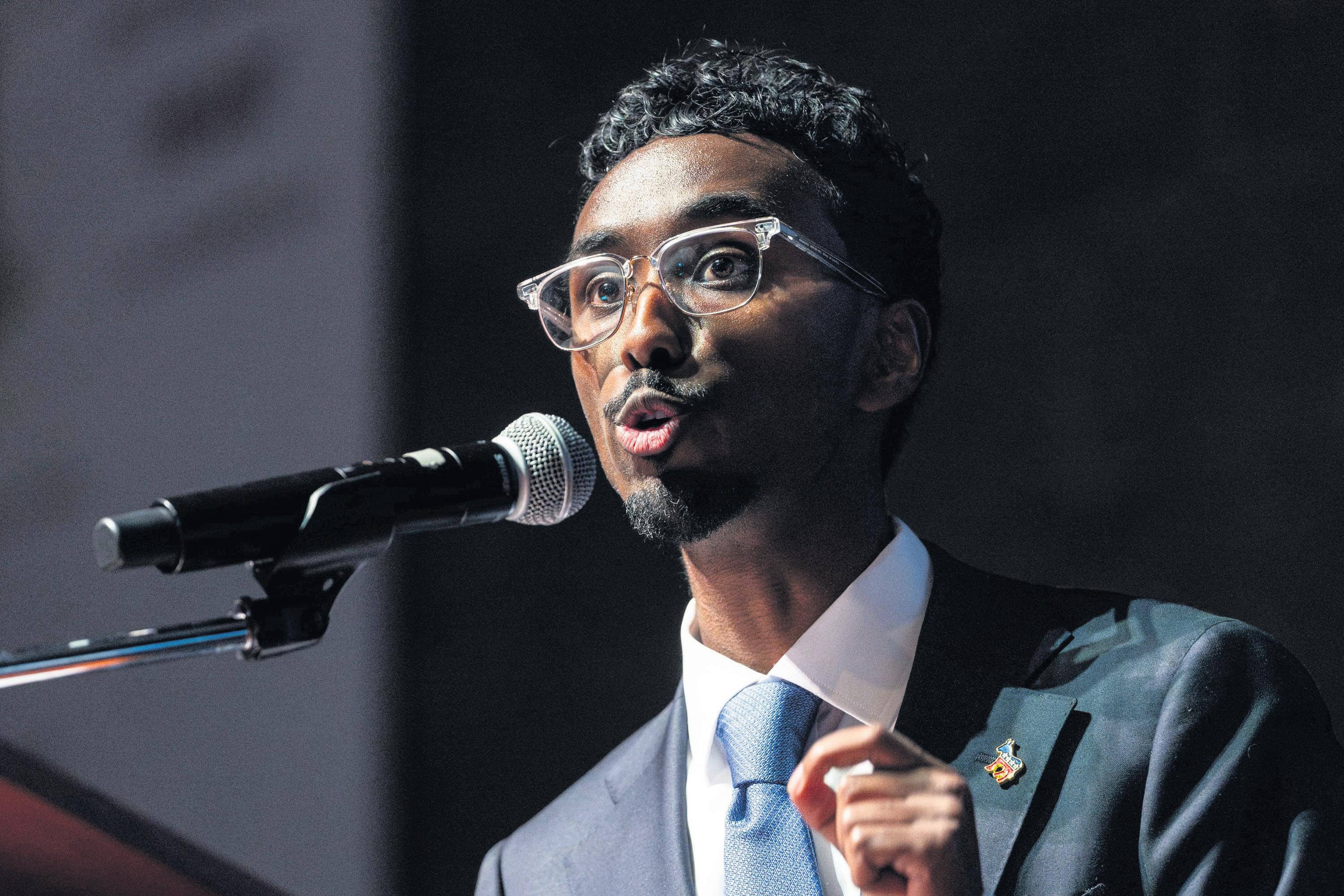
During the daylong convention, the young progressive was the f irst candidate to receive a standing ovation as he took the stage at Jordan High School, and arguably got the loudest support from the massive crowd inside.
Vice said when deciding her vote, she was looking at the bigger picture.
“Imagine, if you will, the message it sends to the world, if Utah sends a Somali Muslim progressive to Washington,” she said. Her fellow Mohamed supporter, Mia Hayes, added that when choosing between him and the other f irst district candidates, deciding was simple: “The minority status,” she told the Deseret News. “I’m done with, you know, the white male.”
Utah House Minority Leader Angela Romero stood on stage holding a poster endorsing Mohamed as he spoke. Her Democratic colleague, Sen. Kathleen Riebe, D-Cottonwood Heights, endorsed McAdams.
Both women previously denounced their colleague Blouin after social media posts were
uncovered last month, made by Blouin more than a decade ago, denigrating The Church of Jesus Christ of Latter-day Saints and making crude jokes about women and sexual assault.
“I believe that Ben has the latitude to move, whereas some of the other candidates are pegged so far to the left, that’s all they’re going to be,” Riebe told the Deseret News on April 25. “I want an adult to take the temperature down.”
In his speech, Blouin acknowledged his earlier remarks and the growth he’s experienced over the decade since. He told the Deseret News that not having support from his Legislature colleagues is due to him challenging power that is “acting in the wrong direction, regardless of what party it’s coming from, and that rubs some people the wrong way.”
“I’ve taken a different approach in the Legislature than many or any other people up there right now,” he said, “and I think it is important to have someone who is focused on accountability, on confronting bad behavior of
legislators again, whether it’s a Democrat or a Republican, let’s challenge that head on, and if that rubs some of the Democrats in the wrong way as well, then I’m OK with that.”
Blouin’s campaign was endorsed by progressive Vermont Sen. Bernie Sanders, he said, because he’s willing to f ight “the corporate power” and “the billionaire class that has really consolidated economic and political power in this country,” something he says McAdams will not do. Blouin, along with McAdams, was considered a top candidate heading into the convention. When asked how he felt about being considered the more centrist Democrat in the 1st District race, McAdams brushed it aside. “I think Utah needs someone who’s able to make progress ... progressive has to mean making progress,” he told the Deseret News. “I think voters need to know that I’m somebody who will work relentlessly to build common ground, to make progress on the issues that are most important to us, but I will stand my ground and stand up for what’s right.”
“It’s progressives’ time to lead. It’s the working class’ time to lead. Today, we got the endorsement of the Democratic Party, but we also got the endorsement of Congresswoman Ilhan Omar.”
The young conservative won the Utah GOP convention to become the Republican nominee for the 1st
By Eva Terry Deseret News
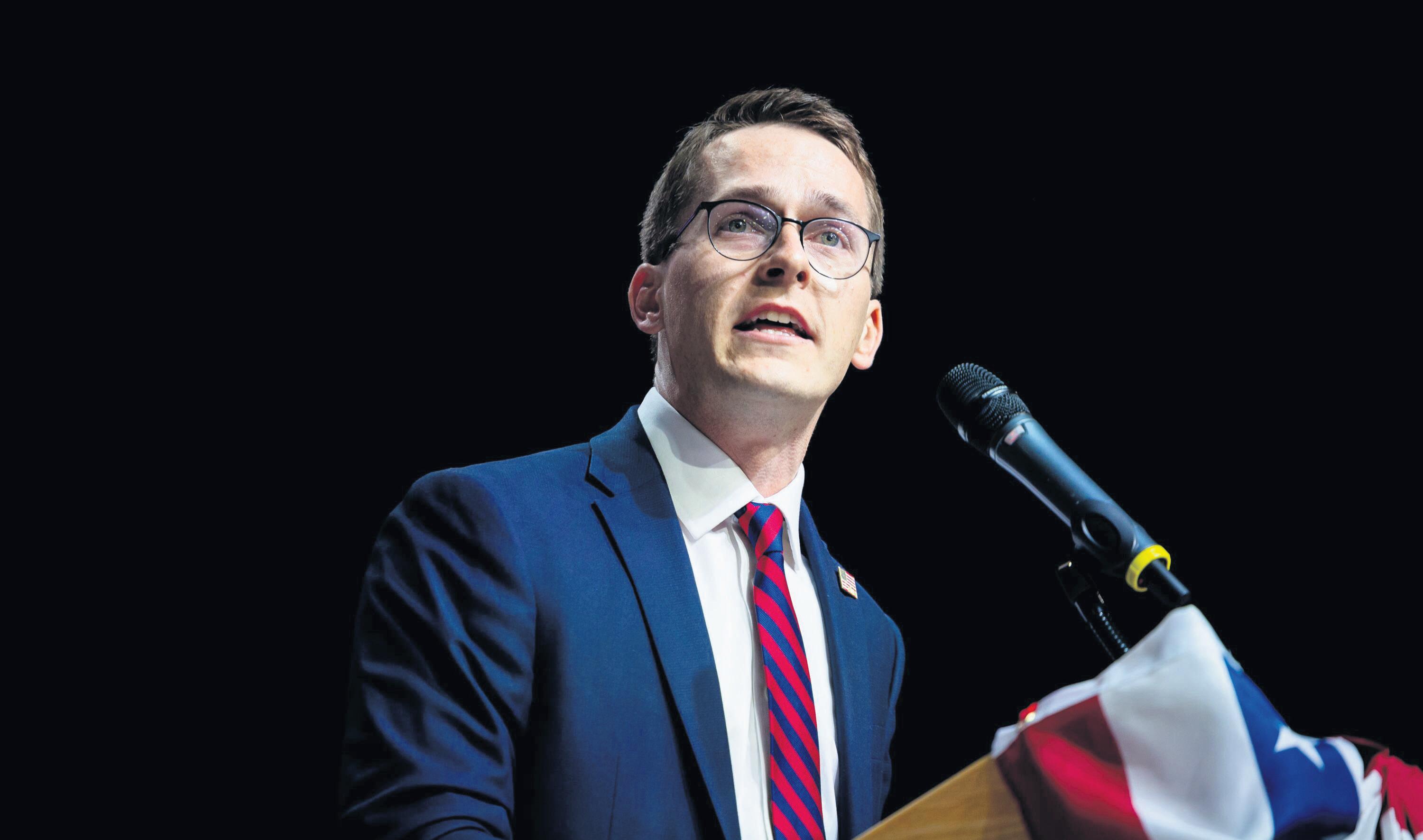
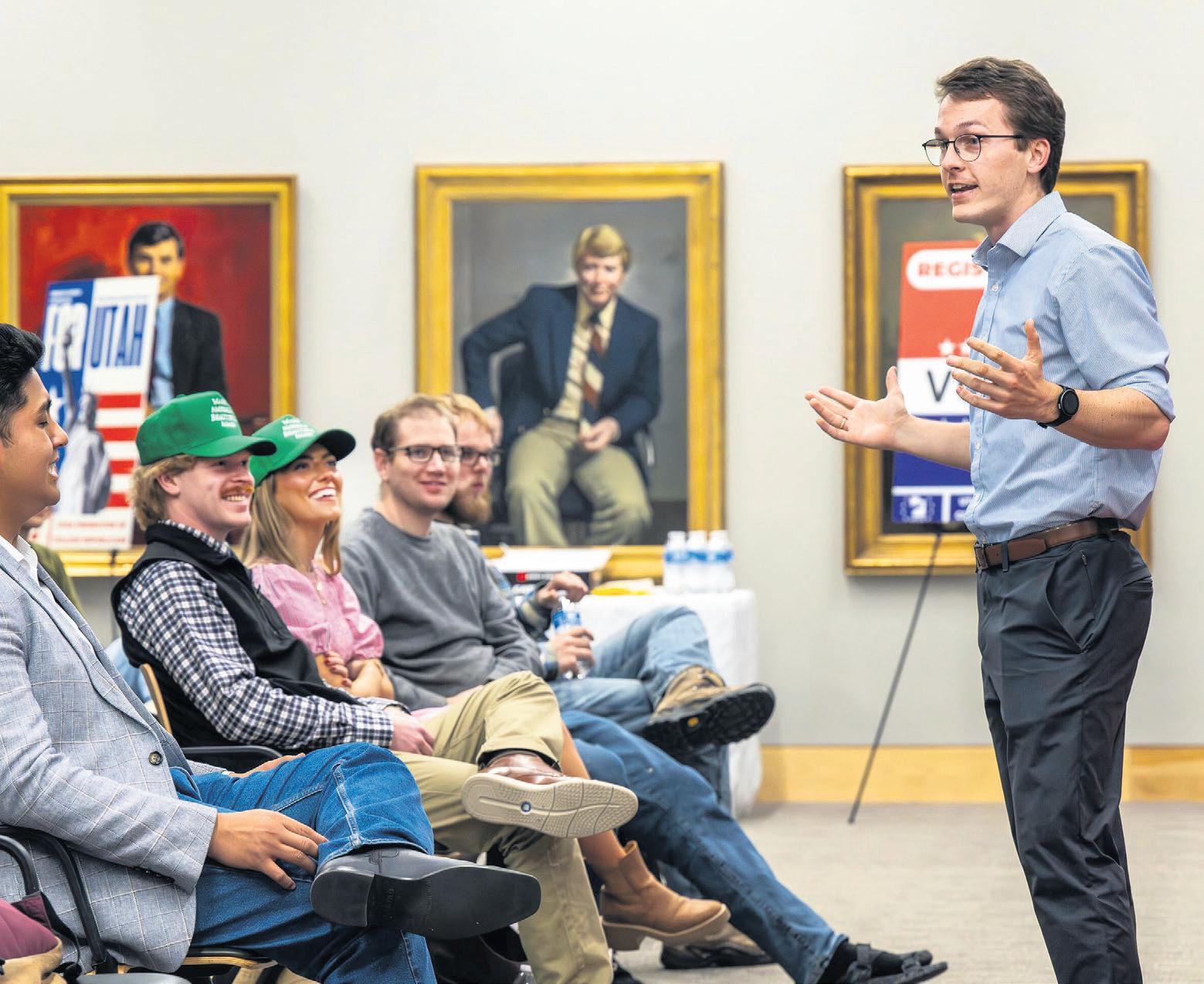
Riley Owen, 27, will be the Republican nominee for Utah’s newly created 1st Congressional District, having won 71.2% of the delegates’ vote at the state GOP convention on April 25 in Orem.
His Republican opponents, Dave Robinson and Stone Fonua, ran as convention-only candidates. Since Robinson and Fonua did not gather enough signatures to qualify for the primary, Owen will automatically advance to the general election in November.
The 1st District covers the northern two-thirds of Salt Lake County and leans Democrat. During the 2024 presidential election, Kamala Harris beat President Donald Trump by 23 percentage points in the district, as the Deseret News previously reported. However, delegates and candidates alike seemed optimistic that 1st District voters would consider policy over party aff iliation during their upcoming congressional elections.
Joshua Northrup, a 1st District delegate from Taylorsville, told the Deseret News that his neighbors are more concerned about affordability than anything else.
They “care about how it’s going to affect their bottom line, their paycheck, their grocery bill, their taxes. They care about that because that’s their life,” he explained. Who is Riley Owen?
Owen is a descendant of six generations of Utahns.
After earning degrees from Princeton and Oxford in international affairs and public policy, Owen worked as CEO of Doers Network, based in Salt Lake City. He currently serves as an intelligence off icer in the Navy Reserve.
After walking onstage to Billy Joel’s “We Didn’t Start the Fire,” Owen made a case for restoring traditional conservatism to Washington, D.C.
“I believe in America and the American dream that has fueled our prosperity for centuries, and I am not willing to let progressive ideologies dissolve that dream into a mere fantasy,” he said.
Owen has been endorsed by Utah Attorney General Derek Brown and President Donald Trump’s former national security adviser, Robert O’Brien.
What did delegates say about Owen?
Northrup said he started off skeptical of the 27-year-old, but after meeting him, Owen “totally changed my mind.”
“I met Riley, and I was like, this kid is awesome,” Northrup told the Deseret News.
Northrup appreciated Owen’s willingness to “pay attention to people he was meeting in those town halls.” He also said he appreciated that Owen periodically updated his website.
Based on his neighborhood in Taylorsville, Northrup said he believes a Republican could win a general election in November. His neighbors “care more about policy” than their political identity, Northrup said.
Cassandra Hodges, a delegate from Kearns, told the Deseret News she’d made her decision to vote for Owen based on previous interactions with him at town halls.
“He remembered my name after meeting me one time. And he was willing to come out to Kearns to get to know the other constituents in our area ... so Riley was a clear choice,” she said.
What did Fonua and Robinson say?
Robinson began his address to delegates at Utah Valley University’s UCCU Center by making a case against signature gathering.
Though Robinson declared intent to gather signatures, both he and Fonua did not certify any signatures.
“ I believe in America
the American dream that has fueled our
for centuries, and I am not willing to
progressive ideologies dissolve that dream into a mere
.”
“I believe signature gathering has changed the fabric of Utah and not for the better,” he said.
Robinson has served in various political capacities in Salt Lake City for about a decade.
In 2016, he ran against then-incumbent
Ben McAdams for Salt Lake County mayor. McAdams has qualif ied for the 1st District’s primary election by gathering signatures.
In his address to delegates, Robinson spoke in favor of securing and closing the border, removing illegal immigrants with a criminal record, and cutting back on social programs

“We have many issues that are 80-20 and 90-10,” he said.
Fonua focused his address to delegates on “love and peace.” He asked the audience to look to their left and smile, then look to their right and smile. Then he sang the hymn “Love at Home.”











By Lauren Irwin Deseret News
On the eve of America’s 250th birthday, patriotism in the United States is on the decline. It’s a symptom of a broader problem the United States is facing in 2026 and will not easily be reversed.
New Deseret News and the Hinckley Institute of Politics’ surveys of Utahns and voters nationwide, conducted by Morning Consult, f ind that there are very real partisan, gender and age differences around feelings of patriotism.
This comes ahead of a historic summer, as events and activities will take place in Washington, D.C., across the country and in Utah to honor the nation’s 250th birthday.
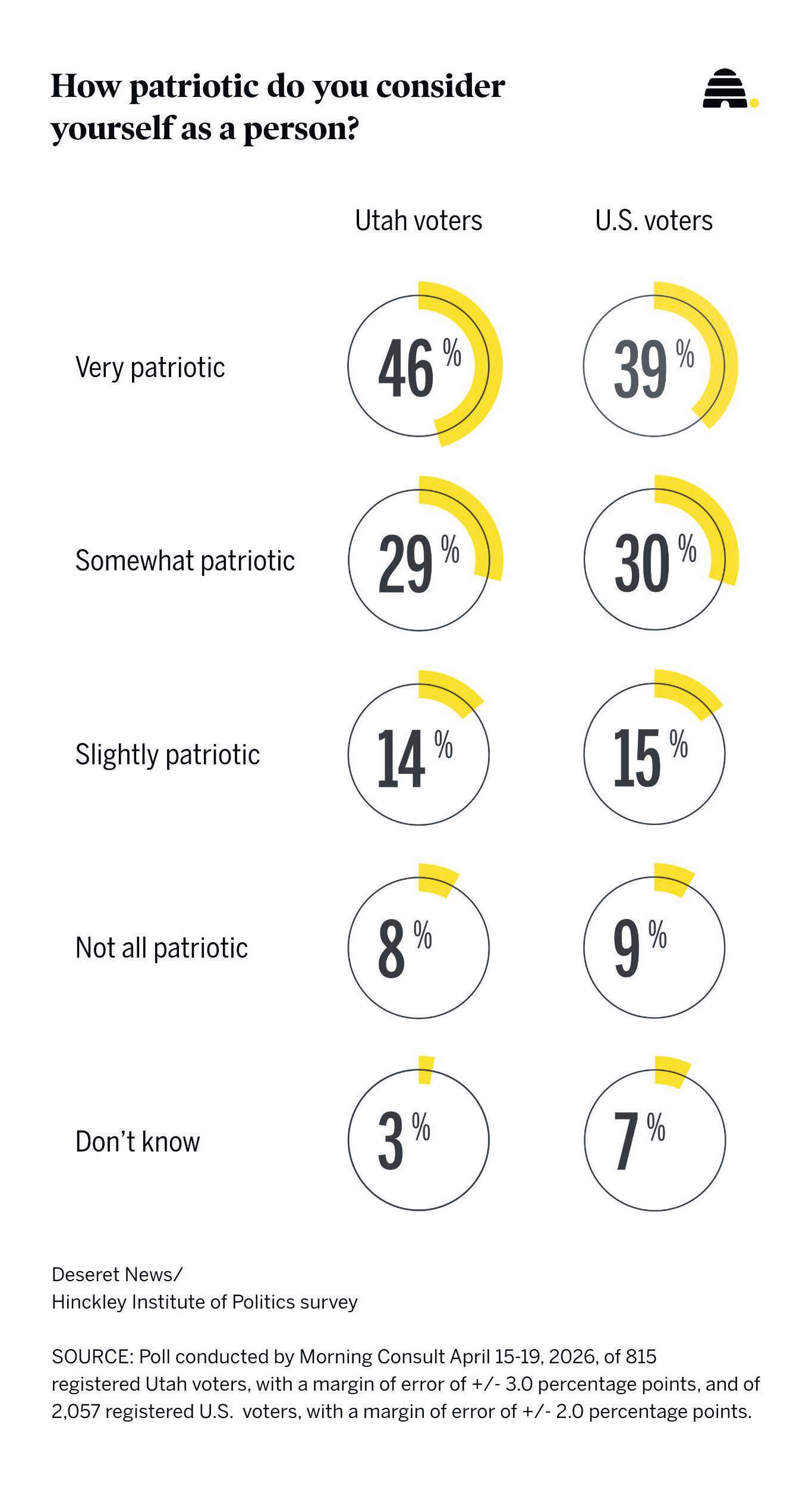
The survey found that Utahns are more likely than the general American public to say that they are either somewhat or very patriotic, with 75% of Utah respondents choosing those options. Nationally, that number is 69%.
Still, experts say that number is low. Matthew Wilson, an associate professor at Southern Methodist University, said it’s an “unfortunate development” that’s happened relatively recently.
Utah Democrats least likely of all to be patriotic
The f indings also found that Republicans are more likely to say they’re patriotic than independent voters or Democrats.
In Utah, 90% of Republican voters say they’re patriotic and nationally it’s 82%. In Utah, just 49% of Democrats — the lowest of any group in the survey data — say they’re patriotic. That number jumps at the national level to 61% of Democrats.
“Traditionally, we assumed that patriotism, love of and pride in the country, was a constant that cut across party lines, that Republicans and Democrats might have different visions of what America should be and how the country should move forward, but that they were united and consistent in their love for and pride in the country,” Wilson said. “And unfortunately, that is less true than it used to be.”
Wilson noted that when Republicans accuse Democrats of being less patriotic, the data show that they’re “not wrong.” But, patriotism is not solely related to who controls Washington, he argued.
The MAGA and patriotism pipeline
President Donald Trump has not only embraced patriotism in his campaigns and administrations, but has tried to portray patriotism and love of America as “largely synonymous with support for Donald Trump and the MAGA movement,” Wilson said.
To that extent, Trump has seen more support among male voters, which Wilson notes could be why more men in Utah and nationwide say they are patriotic than women. To the extent that women tend to be skeptical or not approve of Trump’s messaging, it “may bleed over” into skepticism about American patriotism generally.
The survey found that among men, 81% in Utah and 75% nationally say they are either somewhat or very patriotic. This drops among women to 70% in Utah and 64% nationally.
Hinckley Institute Director Jason Perry noted that the partisan gap, in addition to gender and age differences, shows that “people’s relationship with national identity” is being shaped more by politics than it used to be. He said it was “striking” that the same patterns continued to show up across multiple surveys.
The age gap
The survey found that in both Utah and nationwide, the younger generations are less likely to say they’re patriotic. In Utah, among respondents ages 18-34, 57% say they are very or somewhat patriotic. Nationally, it’s nearly equal at 56%.
For people ages 35-44, those saying they’re patriotic jumps to 71% in Utah and 61% nationally. For those 45-64, in Utah, 86% say they’re patriotic and 67% of the general population says the same. The oldest generation was the most likely to say they are somewhat or very patriotic with 92% of Utahns and 86% nationwide.
Wilson noted that the decline in patriotism seen among younger generations could be attributed to multiple things. Younger people are more likely to be “disillusioned” with the extreme political polarization they have been raised in, but changes in the country’s education system have also likely impacted the way younger Americans view their country — and their love or disdain for it.
“Older generations, certainly the Silent Generation, baby boomers, even Gen X, when they came up through the educational system, the predominant message in schools was America-positive. That is, there was an optimistic and laudatory narrative of America that dominated history and government instruction and that was an intentional part of political socialization in the school system was to cultivate patriotism,” Wilson said. “I think in the school system, as millennials and Gen Z have experienced it, that is much less the case.” Wilson argued that there have been signif icant changes in curriculum that have put more emphasis on the problematic, unfortunate aspects about America’s history and systems and their shortcomings. Younger Americans haven’t been socialized with the same sort of positive messaging as their parents or grandparents and Wilson said he thinks it shows up in the data, including in the Deseret News-Hinckley Institute surveys.
Part of the battle and tension around America’s messaging, both in schools and at museums, comes from the desire to paint the country in a positive light while still being factual, truthful and not shying away from some dark or diff icult topics, Wilson said.
Latter-day Saints’ unique relationship with patriotism
Wilson highlighted the unique relationship between patriotism and The Church of Jesus Christ of Latter-day Saints.
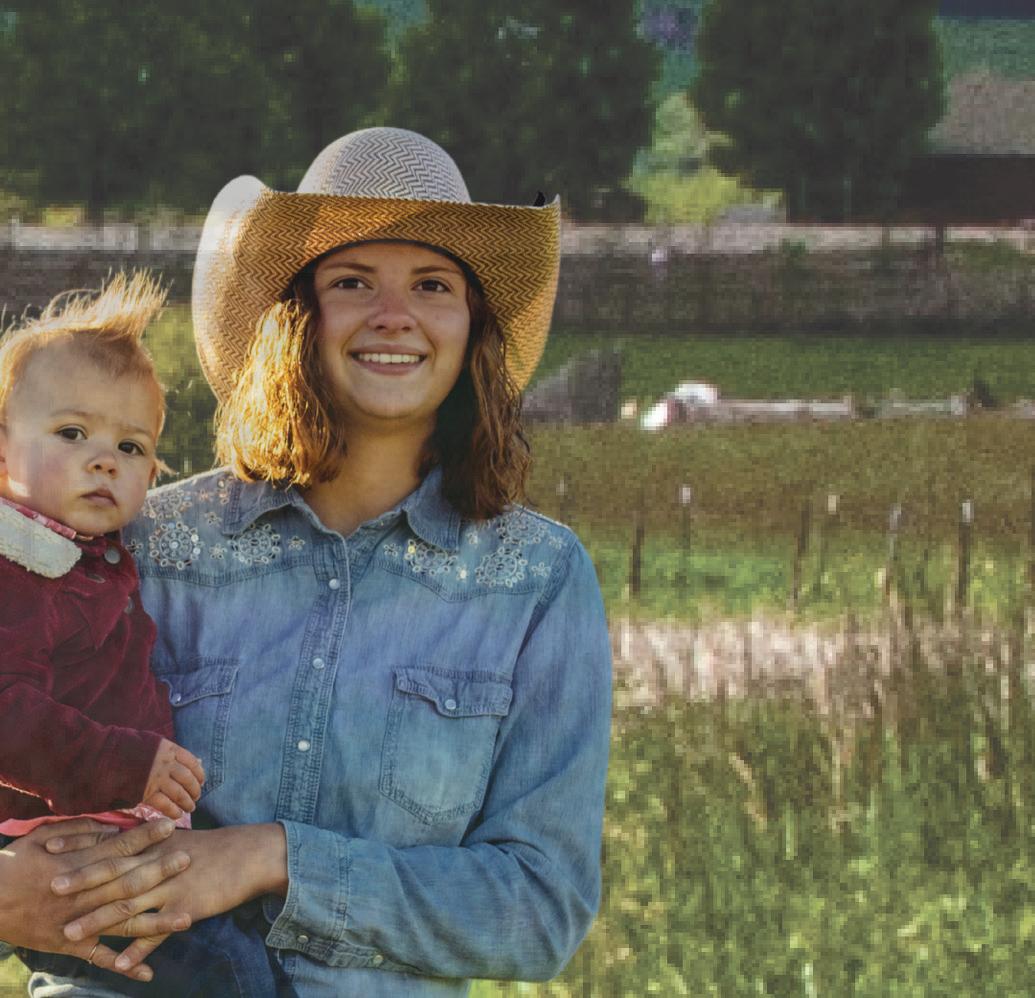
The survey found that 88% of Utah Latter-day Saints considered themselves patriotic.
Leaders in the church teach that America’s founding

documents are divinely inspired, including the Declaration of Independence and the U.S. Constitution.
Church President Joseph Smith in 1839 said the Constitution is a “glorious standard” and was “founded in the wisdom of God.” He said that the love of liberty inspired him and civil and religious liberty were “diffused into my soul by my grandfathers.
Utah Gov. Spencer Cox has spoken about how his faith informs his public service. He said the country needs to look beyond politics to solve the nation’s problems and believes there needs to be a “religious revival.”
Wilson said that for members of the church, the founding of America was not just historical, but theological. Church leaders and the Book of Mormon teach that God would raise up a free nation where his church could be restored. It’s why religious freedom and patriotism are core tenets of the faith, he said.
“There’s a kind of core LDS belief in the divinely guided nature of the American founding and so patriotism is kind of woven, in some ways, into Mormon religious DNA,” he said. “More than any other religion, it is completely interwoven with American patriotism.”
Perry agreed. Utahns are more likely than the rest of the country to say they’re patriotic and faith plays an “important role” in that.
“It speaks to Utah’s strong traditions of service, volunteerism, and community life,” Perry said. Patriotic acts past and present
The survey asked individuals about how they have expressed patriotism, including by voting, standing for the national anthem, saying the Pledge of Allegiance, flying an American flag, protesting and more.
While Utahns were more likely to say they have engaged in several patriotic activities, including 41% to the nation’s 17% that have participated in service, there are several issues where the two surveys line up.
For example, 79% of Utahns say they expressed patriotism by voting while nationally 72% say the same. Additionally, 17% of Utahns say they have made political statements online and 16% of the general public say the same.
Perry argued that an “encouraging” f inding from the data
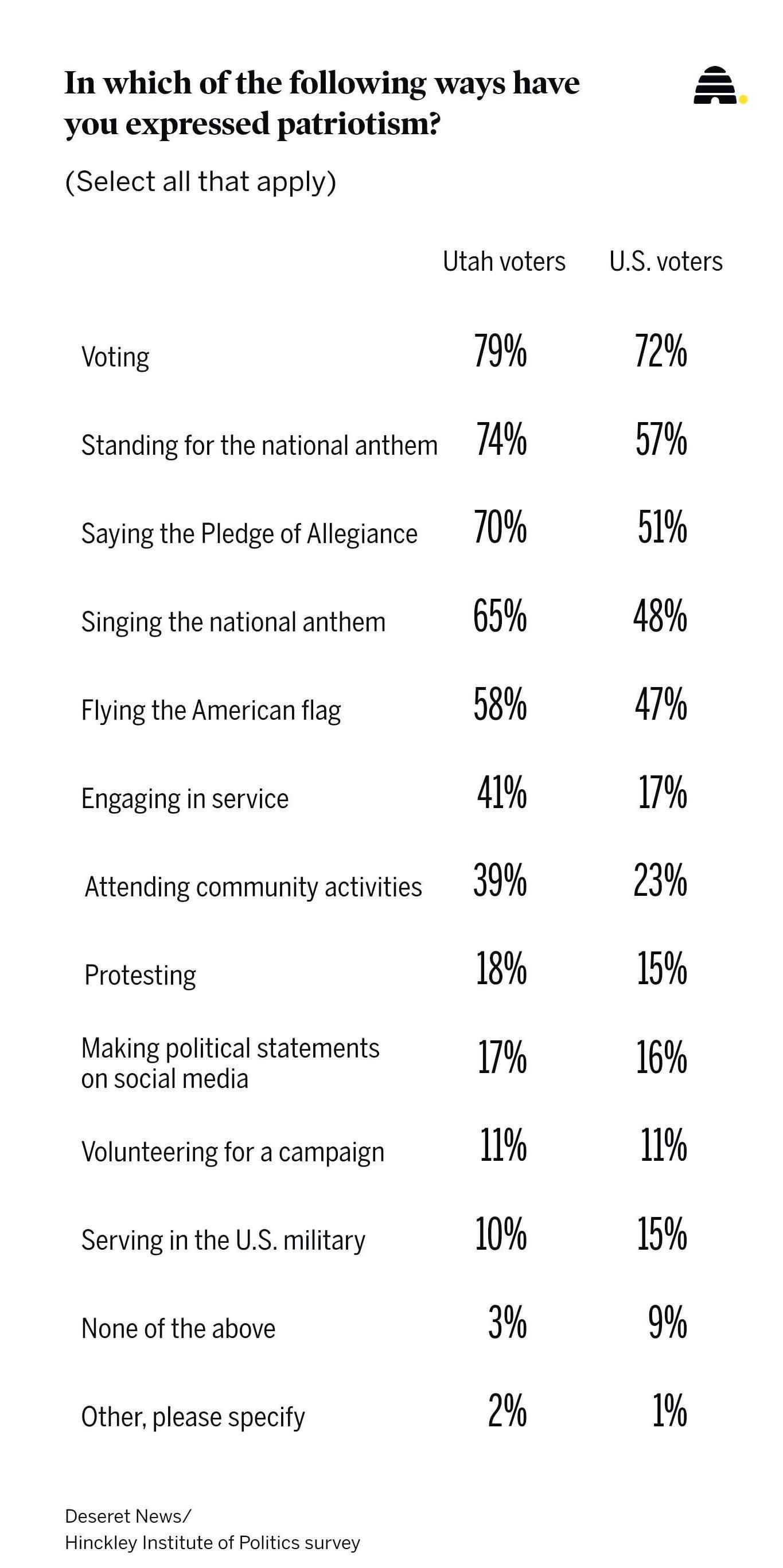

shows that Americans still broadly agree on what patriotic behavior is.
“Voting, military service, and civic participation continue to receive strong support across political lines,” he said. “Even when people disagree about the meaning of patriotism, there is still considerable agreement around the civic values behind it.”
Is there a f ix to falling levels of patriotism?
Wilson highlighted how over the last several decades, Americans have changed the way they identify with political parties. The polarization seen in the nation today is part of a phenomenon that is fueling the decline of patriotism.
“There are partisan gaps opening up in almost everything,” he said. “This deep division between people on the left and people on the right shows up in things from what television shows they watch, what cars they buy, what fast food or coffee places they patronize and it has shown up in whether and how they express their affection for and pride in the country.”
Wilson said he thinks the decline in Americans who say they are patriotic is a “symptom of broader social polarization.”
So, is there anything that can be done? Wilson said there’s not an easy or quick f ix.
“I do think that some correction of the highly critical America narratives that have pervaded education, that’s a part of restoring this balance, but a general decrease in social and political polarization would help as well,” he said.
For patriotism to evade being “partisan coded,” it will likely take work of an intentional, bipartisan yearslong project to change the way patriotism is viewed and acted upon in the country.
he

By Cami Mondeaux Deseret
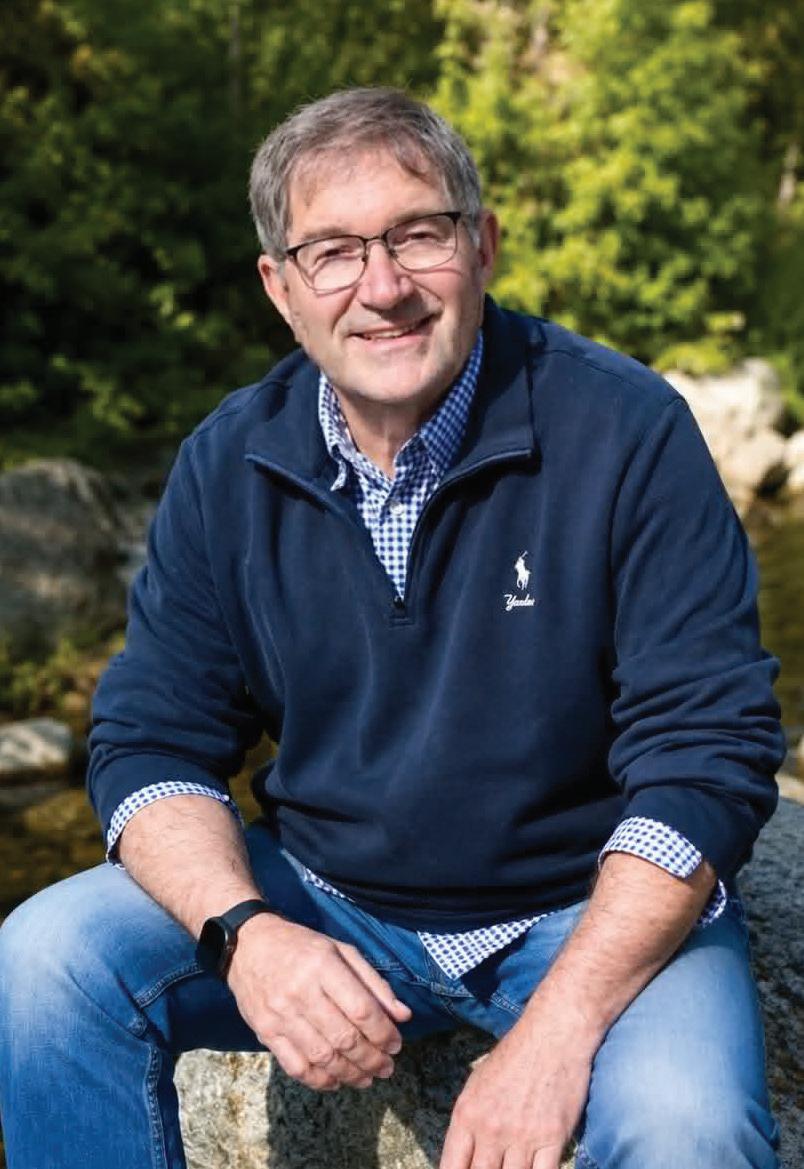
Nate Blouin says he will drop out of the race for Utah’s newly redrawn 1st Congressional District if he is not the leading progressive challenger against former Rep. Ben McAdams — but he urged the other progressive candidates to do the same if he is the top opponent.
Blouin announced that he would commission an independent poll in the new Democratic-leaning district and vowed to drop out of the race if he is not the top progressive candidate. But Blouin pressed his other opponents to do the same, arguing they should instead consolidate progressive support to defeat McAdams in the June primary.
“To beat Ben McAdams, which has been my goal all along, is to see a progressive win in a progressive district,” Blouin told the Deseret News in an interview. “We’ve seen in other races around the country where progressives have split and lost, and I am not interested in being responsible for that happening here.
“Whether that’s me or someone else, that is something I take very seriously, because I do not think we can afford to send the most conservative member of the Democratic Party in Congress back to Congress in a seat that is so progressive that Bernie Sanders, who has endorsed our campaign, has carried by very wide margins in the past.”
The petition comes one week before ballots are scheduled to be sent out for the June 23 primary.
Blouin hopes to release a poll by June 1, just one day before ballots will begin going out. It’s not entirely clear if the candidates’ names can be removed from the ballots before they are sent to voters because of the short time frame, and the Deseret News contacted the lieutenant governor’s off ice for comment.
Blouin acknowledged names would likely still be printed on the ballot even if some of them suspend their campaigns, telling the Deseret News it would be up to the candidates to inform voters who is still in the running.
“Progressives (would have to) rally behind the strongest candidate, and to make sure that voters know that that’s who is representing the progressive movement,” Blouin said. “It’s not going to be a perfect strategy, it’s not going to capture every vote from every other candidate, but certainly to have a trusted progressive on the ballot that people can believe in, I think is important, and hopefully we can send that message.”
Blouin said the poll will present the candidates side by side with just their names, omitting any written bios, campaign stances or additional context. More than 400 primary voters will be surveyed.
Other candidates reject Blouin’s strategy
Blouin said he initially planned to commission a poll in conjunction with the other progressive campaigns but that those plans experienced some delays.
“People want answers here because they want to rally behind a campaign that can win, and it’s pretty clear from everything we’ve seen that that’s not going to happen with
multiple progressives,” Blouin said. “I tried to bring others into the fold on this. It’s such a late juncture, there’s just not more time to wait. If you don’t have a strong campaign built out on the ground already like we do, it’s hard to imagine how you would be able to build that literally in several days before ballots go out.”
The other campaigns, though, appeared to reject Blouin’s strategy to consolidate the progressive vote against McAdams.
Liban Mohamed, who had a surprising upset over his challengers during the Democratic nominating convention in April, suggested Blouin should be the one to step aside without polling results.
“I welcome consolidation within the progressive movement behind the only campaign that has defeated Ben McAdams in a district-wide, representative contest: the Utah Democratic Convention,” Mohamed told the Deseret News in a statement. “The timing of this poll speaks for itself. It’s being pushed before the debate because Nate fears the trajectory of his candidacy once voters see us side-by-side, just as the delegates did at convention.”
Michael Farrell, the third progressive candidate in the race, told the Deseret News that Blouin was “unwilling to agree to anything but his own self-imposed deadlines” and rejected his and Mohamed’s request to wait until after the primary debate.
“Nate has been trying to bully Liban Mohamed and me into agreeing to a poll with an exploding deadline for the past few days now in a text thread,” Farrell said in a statement. “I am not surprised that Nate went ahead without either Liban or me being supportive or on board.”
Farrell accused Blouin of bullying the other progressive candidates and criticized his campaign — making it likely he wouldn’t back Blouin’s bid if he were the next highest polling candidate.
“Nate continues to think he is the best candidate in this race, but he has proven time and again that is not the case,” Farrell said. People aren’t looking for someone who couldn’t pass a single bill after four years in off ice, whose colleagues loathe him, who can’t read or understand the instructions on a f inancial disclosure report, and who spent his 20s (and I’d bet good money well into his 30s) posting online like a petulant child, insulting women, Mormons, those with intellectual disabilities, and so on.“
There hasn’t been much public polling for the Democratic primary over the last few months. The only survey that’s made headlines is an internal poll from Blouin’s campaign in March that saw McAdams as the clear front-runner.
However, that poll showed Blouin ahead of McAdams after answering questions about the candidates, although it’s unclear what information was shared with voters during the survey.
The poll follows the Democratic nominating convention in April, when Mohamed had a surprising upset over his challengers.
The candidates faced off in a four-way primary debate on Wednesday.
In response to Blouin’s call, McAdams’ campaign pointed to his most recent ad buy that launched on Tuesday highlighting his
vote to impeach President Donald Trump when he was in Congress. McAdams sought to keep his focus on how he would work against the Trump administration rather than name or attack his opponents.
“Donald Trump is destroying our democracy each and every day, and we need leaders in Congress who will stand up to
him for his corruption and his self-dealing, so that we can make government work for Utah families. I have a record of doing that, even when I knew it would cost me my seat in Congress,” McAdams said a statement. “In this moment, we need representatives who don’t just talk, but who act and do the right thing, even when it’s hard. Utah can count on me to always do just that.”








H a v e y o u b e e n H a v e y o u b e e n H a v e y o u b e e n










f e e l i n g f e e l i n g f e e l i n g l e f t l e f t l e f t


b e h i n d ? b e h i n d ? b e h i n d ? t ?


















Tr s o e t h n e w. Tr y o m e t h n e w.
Tr y s o m e t h i n g n e w. r
T h e U t a h D e m o c r a t i c r
P a r t y f i g h t s f o r t h e v a l u e s s u
c o m m u n i t y, a n d a m a
t h a t m a t t e r m o s t : f a m i l y, t
g o v e r n m e n t t h a t a c t u a l l y m
S o d o y o u . y





l i s t e n s . Yo u d o n ' t h a v e t o '
l e a v e y o u r b e l i e f s a t t h e e e
d o o r. U t a h d e s e r v e s b e t t e r. e
L e t ’ s b u i l d a f u t u r e w e c a n
a l l b e p r o u d o f . p o y a t r e a
n . l t U a b e d a o
S e e o u r v a l u e s . a l
o r v a p m
m i s s i o n .
o u r p l a t f o r m a n d r l f r m n d


L e a r n m o r e a b o u t






M e e t o u r
c a n d i d a t e s . S e e c . e
w h a t w e ' r e h ' r
f i g h t i n g f o r . f t d g n T
T h i s a d i s p a i d f o r b y t h e U t a h D e m o c r a t i c P a r t y
Lyman explains his pitch for Utah’s 3rd District
Maloy says distrust is biggest threat to America
Moore keeps fiscal priorities in closely watched primary
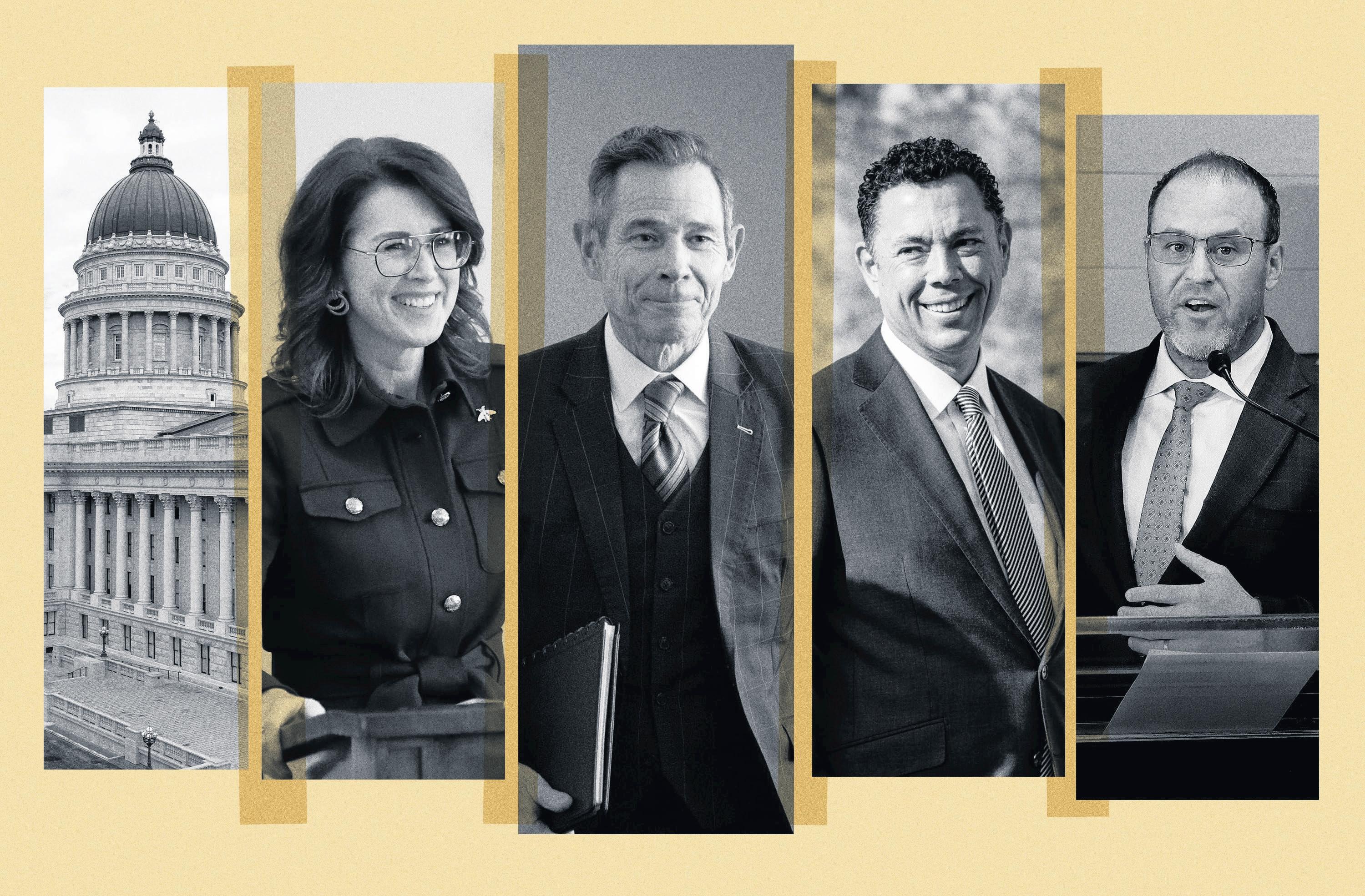
Fox News contributor
Jason Chaffetz confirmed he is considering a run for governor in an interview with the Deseret News
By Brigham Tomco Deseret News
The Republican race for Utah governor has already begun to take shape a full two years before the primary election, and at least a year before candidates would normally begin to consider making their announcements.
A behind-the-scenes bid by former Rep. Jason Chaffetz to frame himself as the presumptive nominee has sparked a premature “shadow primary,” four of the state’s top GOP consultants and donors told the Deseret News.
They all asked to remain anonymous so they could speak about the race freely.
Chaffetz conf irmed he is considering a run for governor in an interview with the Deseret News, but dismissed the claim he is actively seeking donors this early. There is still “an eternity” for election decisions to be made, he said.
The reason he has been traveling up and down the state, headlining Lincoln Day fundraising dinners and working the crowds at GOP nominating conventions, is to “garner support for conservatives,” the Fox News contributor said.
This is also why last year he transferred money from a federal political action committee to a state PAC, Chaffetz said, to support individuals like Salt Lake County sheriff candidate Shane Manwaring and local Republican parties.
“I’m actively doing those things,” Chaffetz said. “It takes money and resources. I’ve raised the money, but I’ve been handing it back out.”
As of mid-April, Chaffetz’s Utah Victory PAC had received nearly $60,000 in 2026 for a total of $427,000, after giving less than $9,000 to the GOP in Utah, San Juan, Sevier, Summit, Utah, Washington and Weber counties.
On May 12, Chaffetz said it is a “distinct possibility” he will run to replace Gov. Spencer Cox. He has teased his ambitions before: In 2016, he said he would “take a serious, serious look at running for governor” in 2020.
Who else is considering a bid?
The state’s most plugged-in politicos from across the conservative spectrum say Chaffetz is doing more than simply currying favor with the grassroots; he is going all in to make the 2028 race his to lose before it even begins.
“Jason’s running for governor. He’s basically told everyone he’s running for governor,” a top GOP donor, who has spoken directly with Chaffetz, told the Deseret News.
Other candidates considering the seat include House Speaker Mike Schultz, Lt. Gov. Deidre Henderson, Traeger Grills CEO Jeremy Andrus, serial entrepreneur Brad Bonham and Rep. Blake Moore, according to multiple sources.
Meanwhile, a group of longtime allies are trying to recruit Sen. John Curtis to leave his recently won position in the Senate because they feel he is the only viable candidate who can continue Cox’s brand of civility and compromise.
Underlying all these conversations is Chaffetz’s push to clear the way to the state Capitol by securing commitments from donors before most candidates have even started thinking about the gubernatorial election.
“Jason wants to make it a juggernaut, no question. And Jason works hard,” a veteran GOP consultant told the Deseret News.
The consultant believes Chaffetz’s easy-mannered tone coupled with his deeply conservative views could make him uniquely capable to bridge the widening gap between the right wing and the center right in Utah GOP politics.
The Fox News contributor’s momentum has spurred the state’s set of “Disagree Better”-style Republicans into action, with well-known influencers launching a campaign to pull another juggernaut into the 2028 shadow primary.
Will John Curtis enter the race?
Hoping to stem the tide of money tied up in promises
By Emma Pitts Deseret News
Editor’s note: The Deseret News has invited congressional candidates for the closely contested party primaries to visit with its editorial board. This story is one in a series of candidate previews on issues.
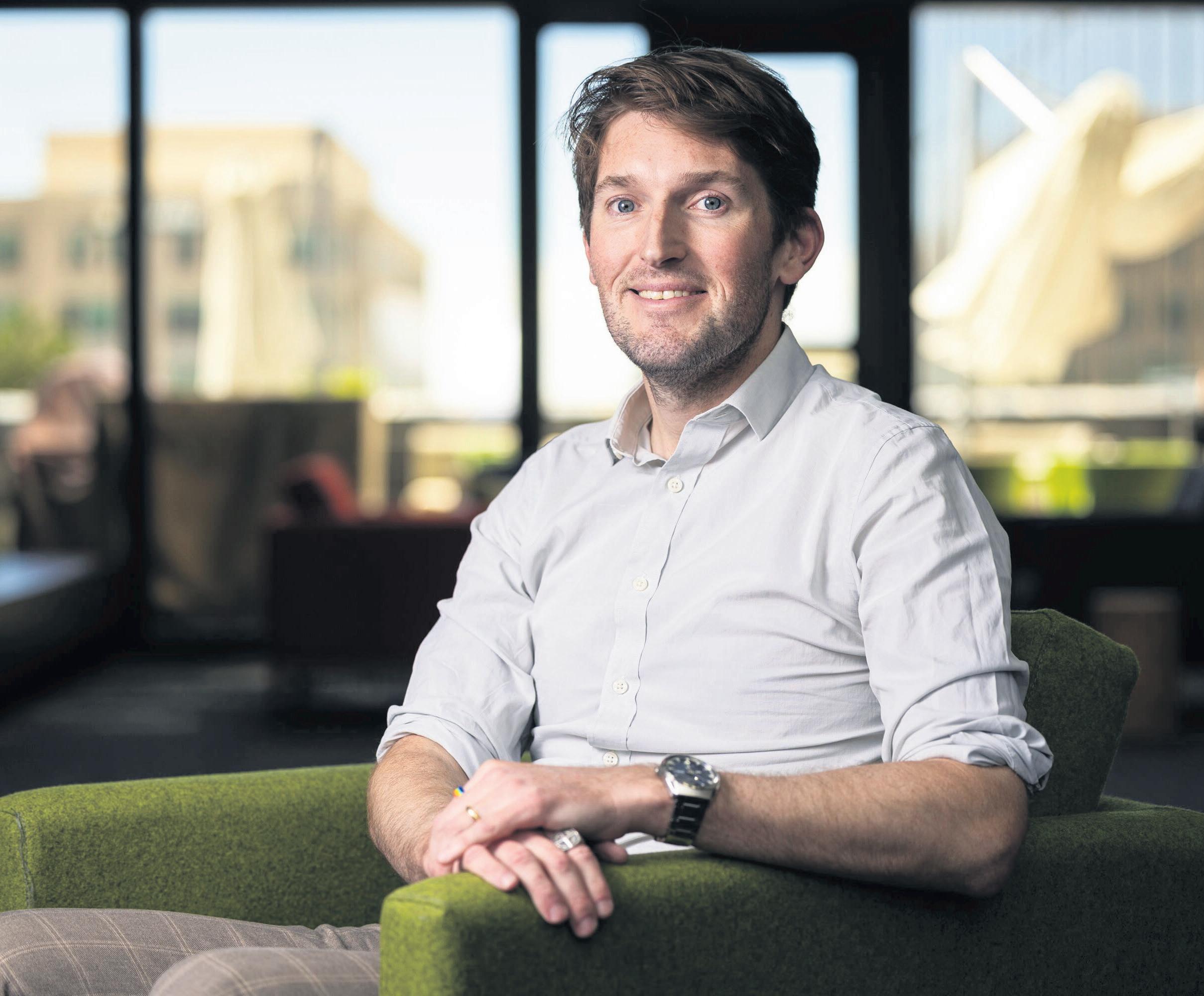
Nate Blouin believes the government should play a larger role in Americans’ lives.
A self-described progressive Democrat, he told the Deseret News and KSL editorial boards on May 19 that while he isn’t a member of the Democratic Socialists of America, he aligns politically with prominent f igures who are part of the democratic socialist movement, including New York City Mayor Zohran Mamdani and New York Rep. Alexandria Ocasio-Cortez (AOC).
As a Utah state senator, Blouin said his greatest achievement was moving the needle for Democrats in a Republicanled state. Now running for Utah’s 1st Congressional District in the Democratic primary, Blouin said if he won and found himself working alongside Utah’s GOPmajority congressional delegation, he would “f ight f ire with f ire.”
Compromise, he said, has weakened Democrats’ leverage in the state. He criticized his fellow Utah Democrats for being too moderate, too accommodating to the GOP majority, and too afraid to advocate aggressively for progressive policies.
Democrats believe they have a real opportunity to challenge the state’s GOP leadership and increase their federal influence after a judge struck down Utah’s congressional map and selected a new map with a heavily-Democratic district.
In a political upset last month, Liban Mohamed became the Democratic Party’s nominee coming out of the convention for Utah’s newly created 1st Congressional District, gaining 51.18% of the votes at Utah’s Democratic Party Convention. Mohamed, Blouin, former Rep. Ben McAdams and candidate Michael Farrell all qualif ied for the primary through signature gathering. The candidate who wins the June primary will go up against Republican Riley Owen in the November general election.
But Blouin said he believes the real race is between him and McAdams.
“I’m advocating for policies that would expand the scope of government that would allow people to get more resources who need it from the government,” Blouin said, mentioning universal healthcare, more subsidized housing, and even suggesting eminent domain to potentially acquire agricultural water rights for Great Salt Lake preservation efforts.
He rejected the former President Ronald Reagan’s famous line, “The nine most terrifying words in the English language are: ‘I’m from the government, and I’m here to help,’” instead aligning himself with Mamdani’s recent criticism of the quote, when he said, “I disagree. I think nine more terrifying words are actually, ‘I worked all day and can’t feed my family.’”
Taxing the rich
Blouin said his top priority is “unrigging the system.”
He criticized capitalism, arguing that it allows the wealthiest in the country to
hoard their money rather than reinvest it in society through government programs, a belief he shares with his endorser, Vermont Democratic Sen. Bernie Sanders.
Like Ocasio-Cortez, Blouin said he doesn’t believe self-made billionaires exist: “There’s only so much money someone can earn, and at some point that money is made off of our system, off of our infrastructure, off of working people who are getting screwed over or who aren’t getting paid the wages they deserve.”
When asked how he felt the contributions wealthy Americans make in places like Salt Lake City, including charitable giving, job creation, community investment and scholarship programs, Blouin said billionaires should be taxed more heavily instead of deciding themselves where money goes.
Blouin argued that government, not rich individuals, should decide how to spend money to help those in need.
“I would like to double some people’s tax rates,” he said. “I’m not talking about raising taxes on everyone, I think the vast majority do pay their fair share, but there’s an upper echelon where they are not ... there’s these loopholes, all these loopholes that people are exploiting, and you know, it may look like their rates are high, but they’re not.”
Blouin was not sure at what income level he would like to see taxes raised, saying
maybe for those making over $1 million, but also mentioning those who make several hundred thousand dollars a year.
Managing controversy
On May 14, Blouin went live with controversial online streamer Hasan Piker on Twitch.
A self-described Marxist, Piker has made comments suggesting Americans deserved the 9/11 attacks. Piker minimized the sexual assaults that took place during the Oct. 7 Hamas attack against Israel, saying it didn’t change his perspective on the matter, and gave praise to Hezbollah, a terrorist organization that openly promotes the killing of LGBTQ people.
Blouin acknowledged that some of Piker’s comments make him uncomfortable, but said it’s worth setting those aside for the opportunity to be platformed by Piker, who has more than 3.1 million followers.
“I think we need to be engaging with people who have a platform that can reach people who are otherwise, like disaffected and not engaging in the system, because I think when more people get engaged in the system, we get better outcomes,” he said. ”That does not mean that I agree with his comments and everything, but you know, I do agree with his perspectives on many things. But, like myself, he has said controversial things.”

Ahead of the Utah Democratic Convention last month, social media posts written by Blouin more than a decade ago were made public. In them, he labeled Latter-day Saints as “a bunch of bigoted (expletive)” and said the church was “DEFINITELY just a front for the largest US drug cartel.” The New Hampshire native also said church members were the worst part about living in Utah and that members were “quite oppressive and narrow-minded.”
Blouin publicly apologized after the comments were revealed.
On May 19, he said that if elected he would prioritize all of his constituents, including Latter-day Saints.
“I think there’s a very real place where religion can play a very positive role in people’s lives. And at that point in my life, I was frustrated because I felt like I had no path forward. I failed out of college, didn’t have good jobs, had a car that was barely running, felt like I’d lost my opportunity,” he said. “About the same time I got back into Salt Lake Community College and moved forward, those comments stopped appearing because I felt like I wasn’t taking my anger out at a group or at a religion or anything like that, and so that’s really been able to inform my perspective on things.”
The Democratic and Republican primaries are on June 23, with ballots being mailed to most voters several weeks before.
“I disagree. I think nine more terrifying words are actually, ‘I worked all day and can’t feed my family.’”
— Sen. Nate Blouin, D-Millcreek, referencing former President Ronald Reagan’s line about help from the government
Phil Lyman explains his pitch for Utah’s 3rd
Editor’s note: The Deseret News has invited congressional candidates for the closely contested party primaries to visit with its editorial board. This story is one in a series of candidate previews on issues.
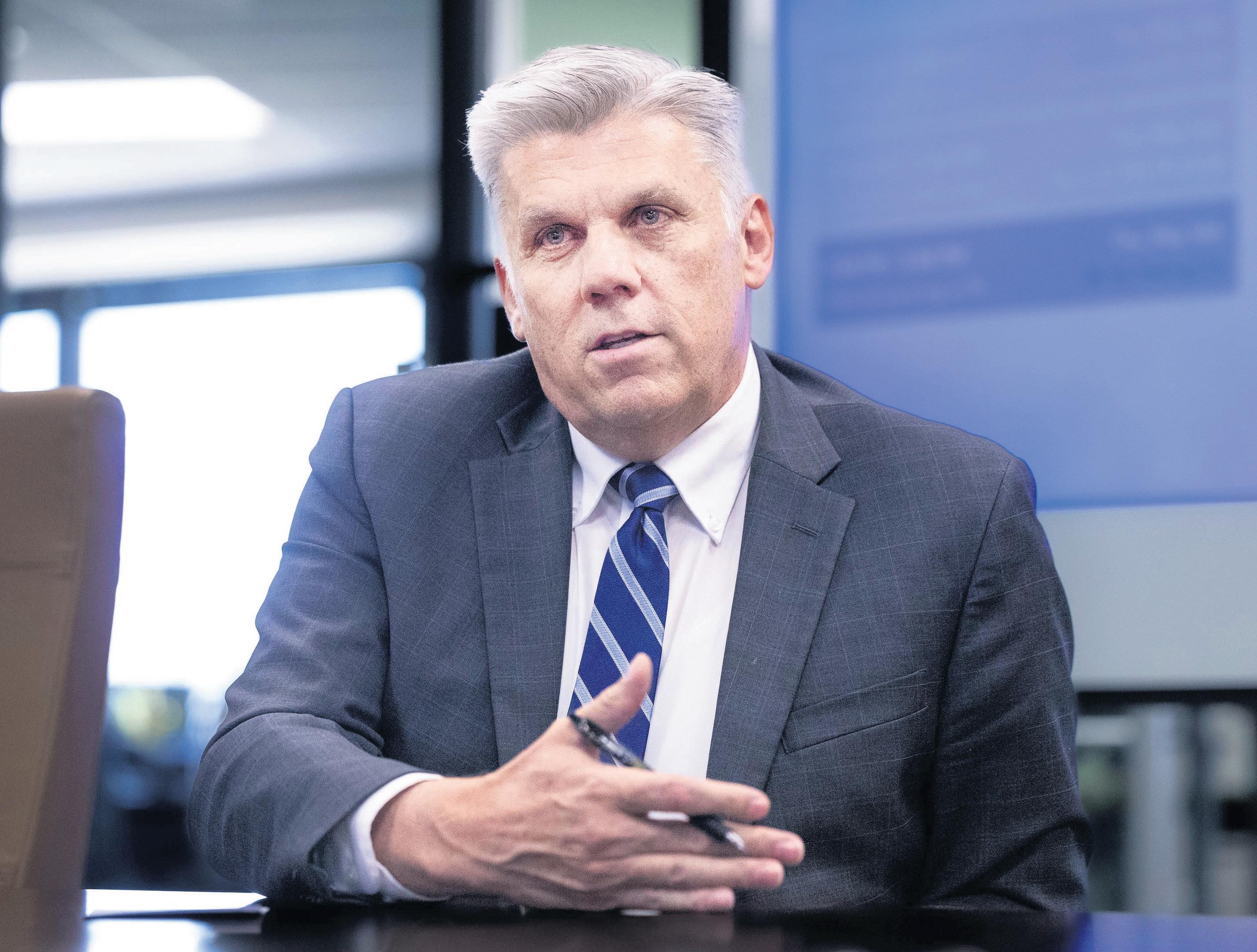
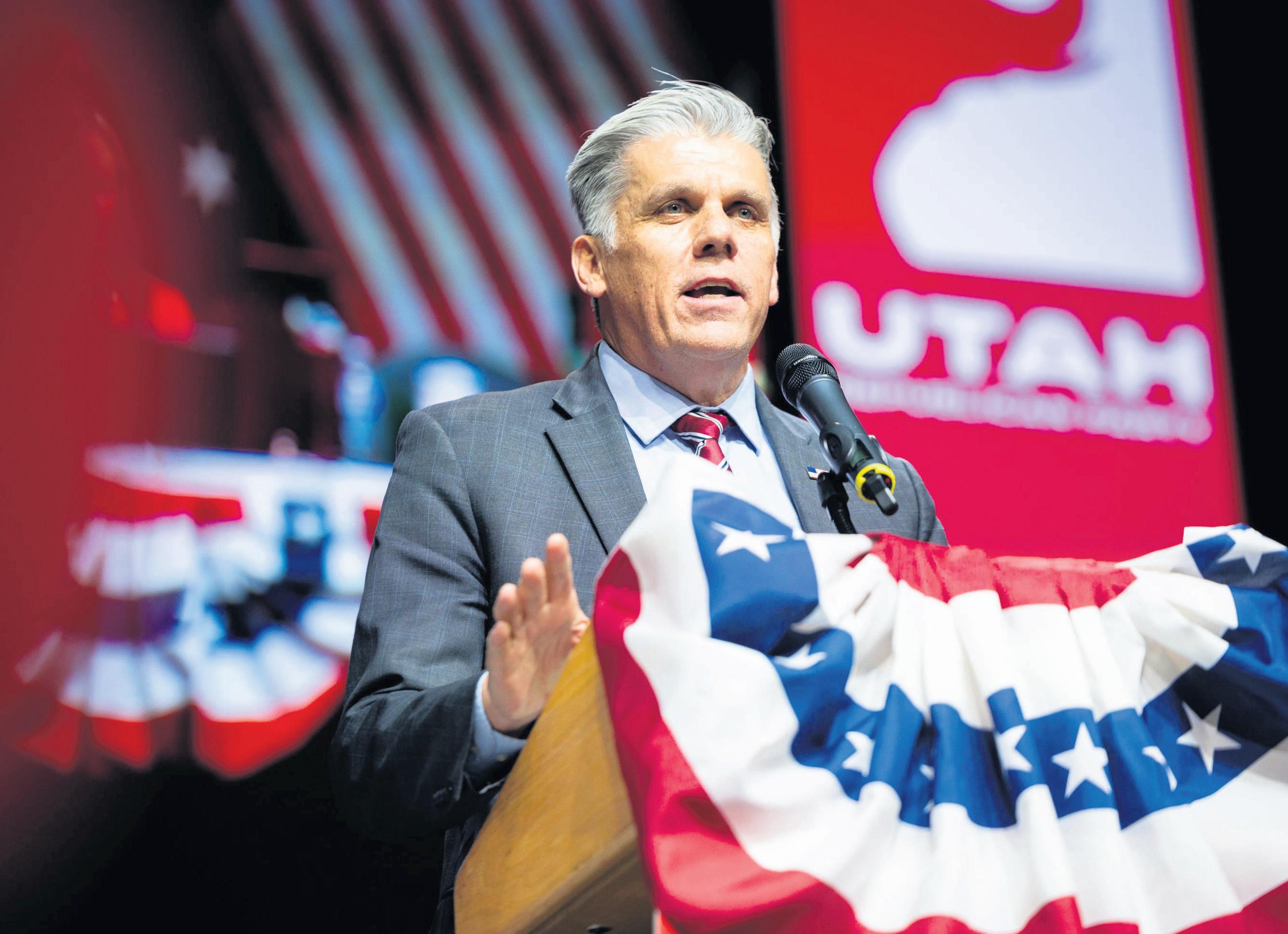
Phil Lyman — who is running against Rep. Celeste Maloy in the 3rd Congressional District primary after election losses in 2024 and 2025 — knows exactly where he f its into the Republican Party of 2026.
The GOP establishment in Congress represented by House Speaker Mike Johnson is too top-down, he said, while the “MAGA loyalists” are inconsistent in enforcing constitutional restraints on federal power.
Lyman frames himself as f itting squarely within the House Freedom Caucus, where he said he hopes to f ight, if elected, as the face of anti-establishment conservatism in the state of Utah.
“I save all my criticism for the Republicans because I see a willingness to go along with policies and operations that they should be standing up against,” Lyman told the Deseret News and KSL editorial boards on May 14. A crusade against the “go-along-to-getalong” GOP motivates Lyman’s latest bid to restore small-r “republicanism.” It also underlies his fundamental distrust in state democratic institutions.
After two years of disputing election outcomes, challenging electoral processes and hitting dead ends in court, Lyman has emerged more convinced than ever that the political system is rotten to the core. Trust is earned through transparency, and where it is denied, corruption can be assumed, according to Lyman, who believes def initively that the 2020 presidential election was stolen from President Donald Trump. Is Trump in control?
His worldview has convinced Lyman that Trump’s Iran foreign policy has been “hijacked” by deep-state actors in his Cabinet or military who want U.S. intervention to extend past the president’s initially limited goals.
While he said he supports preventing Iran from obtaining a nuclear bomb, Lyman said he would not vote to authorize further military action because he believes the battle over the Strait of Hormuz has turned into a “f iasco.”
“On one hand, I’d like to believe that Trump is in charge of those decisions. But on the other hand, it seems inconsistent with what he started, to then f ind himself in a quagmire of dysfunctional, bad policy,” Lyman said.
There are “penetration agents” in government working against America’s interests, Lyman said, pointing to former CIA Director John Brennan, who was involved in a 2017 report on Russian interference in 2016’s election.
Brennan continues to hold sway over the CIA, Lyman alleged, accusing the CIA of raiding Director of National Intelligence Tulsi Gabbard’s off ice allegedly to prevent the full release of f iles on President John F. Kennedy.
Rep. Anna Paulina Luna made similar claims this month, saying the CIA removed f iles related to JFK and the CIA’s Project MKULTRA. On May 13, Gabbard’s spokesperson said “This is false. The CIA did not raid the DNI’s off ice.”
This does not change Lyman’s view that
foreign policy is being shaped by “a massive propaganda operation underway at the federal level.” Lyman applies an equally dim prognosis to the nation’s spending problem.
It is impossible to recover from the $39 trillion in debt, Lyman said. Americans should distance themselves from a broken dollar by investing in digital currency, like Bitcoin, which Lyman said should not be regulated.
There should also be little to no federal regulation of public lands, according to Lyman, who often cites his arrest as a San Juan County commissioner in 2014 for protesting the government’s closure of an ATV trail.
Is Utah’s success a ‘facade’?
If elected to Congress, Lyman said he will help ensure Washington, D.C., acts on his priorities of land access, energy independence and water rights in a way that protects control by state and local leaders.
In reaction to recent congressional actions, Lyman said he would vote to protect American’s right to privacy from surveillance, to hold corporations accountable and to limit government control of their property.
The mentality that a class of well-known politicians and wealthy activists know what is best for the people is to blame for malfeasance at the capitols in Washington, D.C., and Salt Lake City, according to Lyman.
As a state lawmaker and candidate, Lyman lambasted public-private partnerships to renovate sports arenas, to grade offensive political speech and, more recently, to incentivize a massive AI data center in Box
Elder County.
“When government gets involved with that, then if those ideas fail, then the entire state is harmed,” Lyman said. “It’s not government by the people. It’s government by an oligarchy. It’s not conducive to liberty.”
Metrics that show Utah as having the top GDP increase, median household income, economic outlook and upward mobility in the country are “a facade” that do not reflect the experience of everyday Utahns, Lyman said.
Residents remain “overtaxed,” and “overregulated” and are right to hold current elected leaders responsible for the unaffordable housing market and controversial approaches to managing growth, Lyman said.
“The problem is not lack of trust,” Lyman said, repeating his phrase from April’s GOP nominating convention. “It’s trusting people who are not trustworthy. And trustworthy is a component of competence, reliability and honesty.”
Election skepticism
Lyman doubts all three when it comes to the election system. His skepticism is centered in the lieutenant governor’s refusal to provide him with a record of Gov. Spencer Cox’s 2024 primary signature petitions.
An investigation into fraud by signature gatherers working on a different race for the same f irm Cox contracted, and an audit f inding errors in verifying Cox’s signatures has persuaded Lyman that Cox did not qualify.
Ultimately, Cox won the race soundly, 55%45%. But Lyman did not concede, saying he needed to verify the election returns through an independent, third-party audit f irst. Lyman has never conceded the loss.
On May 14, Lyman did not say whether he would trust the results of his 3rd District primary race this year against Maloy. He will “verify the election results,” Lyman said, by looking at a “statistical analysis.”
In 2024, Lyman asked the Utah and U.S. high courts to reverse the election outcome and to place him on the general ballot. Lyman later dismissed the rulings against him, saying they were not decided on the merits. Lyman said he does not “challenge election results” unless there are indications of fraud, like he claims to have found in the 2024 primary. Lyman referenced that he accepted his loss in the GOP chair race last year.
“When I’m defeated, when I’m done I will go away. I’m a very good loser. I’m happy to lose in a fair f ight,” Lyman said. “It’s hard to walk away from something midstream mid-f ight when we’re making so much progress.”
After waging a historic write-in campaign in 2024, that saw more than 200,000 Utahns write in Lyman’s name for the general election, Lyman promised his supporters he would run for governor again in 2028.
That race proved his message of transparency “really resonated with people,” he said May 14. Lyman did not say if he still planned to run for governor. His current bid, he said, gives him “an opportunity to continue the f ight.”
“I save all my criticism for the Republicans because I see a willingness to go along with policies and operations that they should be standing up against.”
— Phil Lyman
‘The question of our time’
By Brigham Tomco Deseret News
Editor’s note: The Deseret News has invited congressional candidates for the closely contested party primaries to visit with its editorial board. This story is one in a series of candidate previews on issues.
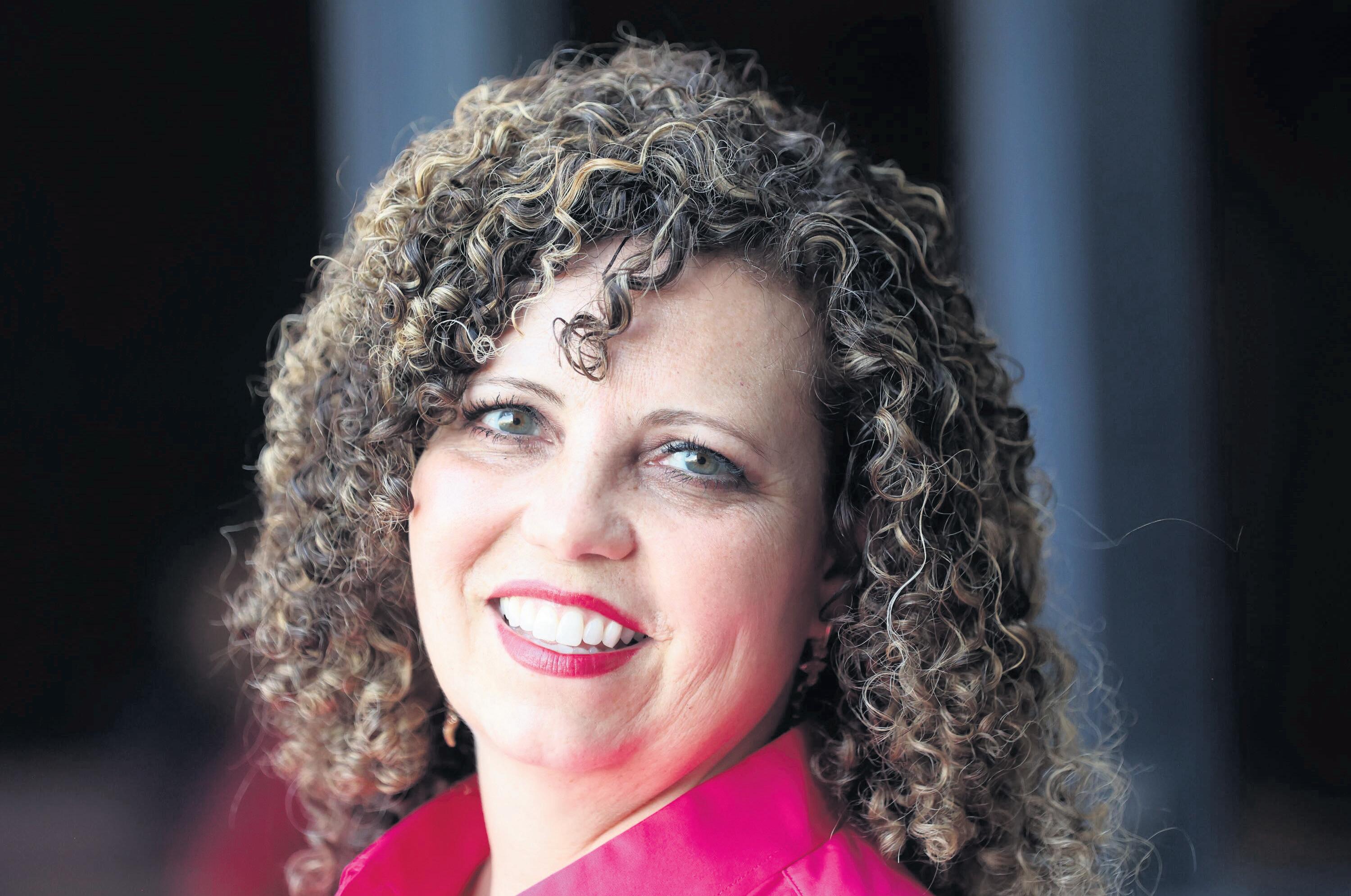
Utah Rep. Celeste Maloy took a step back from the news cycle this year when deciding what to put at the center of her third congressional campaign in three years.
Her message would not be curbing government overreach like it has been in the past — though she has built a track record defending Utah lands, mines and rural residents.
Nor would it be the pressing issues of wars, water and debt — though she has remained consistent that Congress needs to take a more proactive approach on all three.
It is the thing she thinks underlies all these voter concerns: a crisis of faith in the United States of America.
“My fear is that the American people are going to stop believing in the American system of government. And if that happens, none of the rest of this matters,” Maloy said. How to restore conf idence in American institutions is not just a good thought exercise, it is the central question “of our time,” Maloy told the Deseret News and KSL editorial boards on May 8.
Maloy is trying to provide the answer as she runs her Republican primary race against former gubernatorial candidate Phil Lyman in the new 3rd Congressional District.
The solution includes Congress members doing their constitutionally mandated job to budget, Maloy said, without giving in to incentives to tear down the other side.
A terrifying milestone
A congressional course correction on spending has never been more urgent. This month, the national debt surpassed the GDP for the f irst time since World War II.
This means that all of the income, investments and output of all Americans in a year, totaling $31.22 trillion, could not pay off the publicly held debt, which has hit $31.27 trillion.
The economic effects are already hitting the wallets of everyday people, said Brett Loper, the executive vice president of policy at the Peter G. Peterson Foundation.
To borrow more money, the government has to sell more Treasury bonds at higher interest rates — leading to higher rates on mortgages, credit cards and business loans.
Debt also makes inflation more likely as the government prints money to keep up with interest payments, which now eat up more of the budget than defense spending.
This is in addition to the coming insolvency of retirement programs like Social Security and Medicare — which drive the debt, making up more than one-third of the budget.
If Congress does nothing, Social Security benef its will automatically fall by 23% in 2033, impacting 71 million individuals by an average of $18,000 per retired couple.
“That’s a real call for action,” Loper said. “The challenge is it’s constantly used as a political piñata. ... The only way they’re going to address this is on a bipartisan basis.”
While some are quietly exploring consensus proposals to reduce spending and raise revenue, Loper sees “no indication either party is going to get this under control.” Incremental plan to save the budget
But Maloy sees things differently. House Speaker Mike Johnson is committed to lead the GOP caucus toward greater budget reform, according to Maloy.
The congresswoman pointed to last year’s budget process where House Republicans passed all 12 spending bills through committees in a partial return to “regular order.”
This rare accomplishment, which has been replaced in recent years by opaque omnibus bills, was paired with Medicaid and SNAP restrictions, Maloy said.
While the federal def icit has shrunk slightly, with President Donald Trump’s tariffs bringing in new revenue, Maloy recognizes these moves are just a drop in the bucket.
“Everything’s on the table,” Maloy said, regarding long-term reforms to stabilize Social Security, like slowly raising the retirement age or lifting the cap on taxable income.
As the only Utahn on the powerful House Appropriations Committee, Maloy is in a unique position to push these discussions along — and to prioritize Utah projects.
First is making sure as much of Trump’s $1 billion budget recommendation to help the Great Salt Lake makes it into next year’s budget bills, which are already being drafted.
To convince colleagues to carve out this much money for the Beehive State, Maloy said she is making the case that this is part of longterm water stability for the entire West.
Maloy’s f ive bills to become law have focused on keeping public roads accessible, bringing federal courts to southern Utah and letting Utah manage more of its public lands. Conf idence at 250
Since entering Congress, Maloy has repeated that one of the most important things Congress can do to reclaim trust is retake the authority it has abdicated to the president.
A GOP-led Congress has often deferred to Trump’s executive action, opting not to legislate their own policies on tariff rates, war powers or immigration status.
Maloy said media coverage in this area has been misleading: Republicans have taken votes to give Trump more leeway to negotiate
trade, military and deportation actions, she said.
But she acknowledged Congress must decide whether to authorize military force in Iran when they return from recess because Trump’s 60-day legal deadline has passed.
Besides showing more competence in their job, members of Congress can increase voter conf idence by not capitalizing on polarization by demonizing the other party, Maloy said.
“It gets a lot of clicks, it gets a lot of attention, but it undermines the foundation of who we are,” Maloy said on May 8. “You
can’t sink half a ship.” Trust in government to do the right thing has fallen to 17%, while Congress has the lowest conf idence of any branch of government, with just 7% of Americans having a great deal.
With this in mind, Maloy said she plans to devote her campaign to “making sure the American public sees the value in our institutions” on the country’s 250th birthday.
“That’s one of the reasons I don’t run angry campaigns,” Maloy said. “I think angry campaigns give people a short-term high, but a long-term problem.”

• Taken time to empower residents with accurate and true information with transparency efforts like the Davis Connector newsletter and live-streaming.
• Worked with County departments to make smart cuts and maintain service levels, creating a government that is better, not bigger.
• Built community-improving infrastructure like the Emergency Operations Center and the Western Sports Park without using any of your property tax dollars. Earned Sheriff Sparks' 2026 Appreciation Award for her support of the Sheriff's team. Worked with Davis' Health Department to create DavisLinks.org-acomprehensive FREE and LOW COST service directory for all residents.

By Cami Mondeaux Deseret News
Congressman Blake Moore, who represents Box Elder County, broke his silence on the proposed data center in a statement to the Deseret News on May 7.
His Republican primary opponent also spoke out amid public backlash over approval of the data center after concerns were raised about water consumption in a state in the midst of a drought.
In a statement to the Deseret News, Moore decried reports of recent threats targeting Box Elder County commissioners who approved the data center project earlier this week. Moore defended the local officials by saying they are “engaged in the process” to ensure the proposed center would benefit local residents.
“The acrimony, threats, and vitriol that have become commonplace against elected officials must stop. It’s nonsense that this is becoming our political discourse here in Utah,” Moore said. “(Officials) are trying to ensure that Box Elder County residents can experience the benefits of this development for future generations.” Moore did not outright endorse the data center, but appeared to support the county engaging in a project that developers say would help boost national security efforts. The Utah Republican also expressed hope that the project could be carried out while also protecting natural resources in the state.
“From transcontinental travel to launching society into space, and mastering our nation’s military superiority, Box Elder has demonstrated its ability to be a part of the solution,” Moore said. “Balancing stakeholder rights and responsibilities makes government very difficult. I am hopeful that with local collaboration this project will be able to balance responsible stewardship of natural resources and water, while continuing Northern Utah’s long legacy of being a critical component of our nation’s security.”
Lisonbee, Moore’s primary challenger, also responds to data center State Rep. Karianne Lisonbee, who is vying to unseat Moore in the Republican primary, cited concerns with the process in which the project
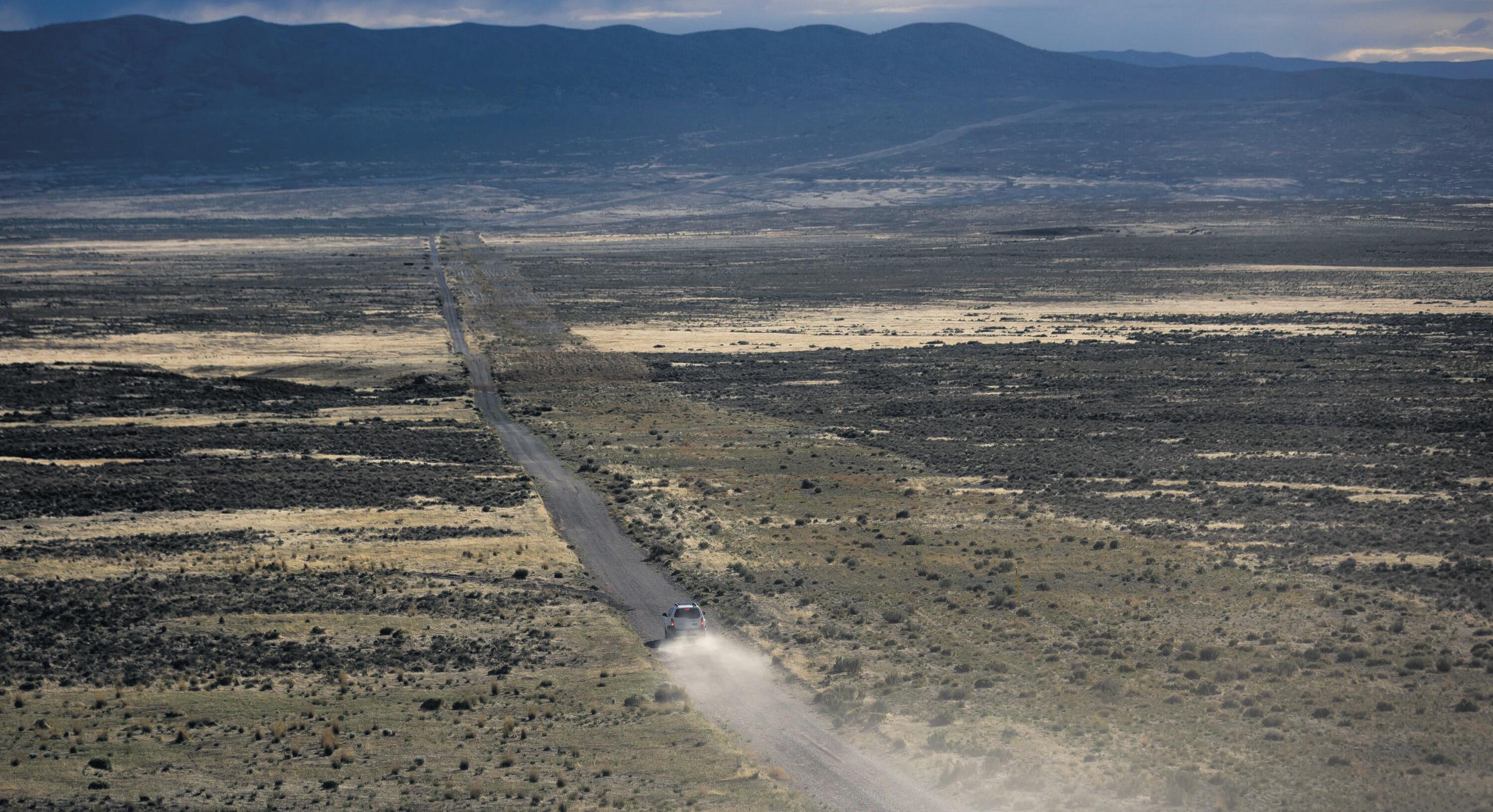
was approved, telling the Deseret News that voters in the district deserve more transparency.
“It took almost all of us by surprise, including the county commissioners,” Lisonbee told the Deseret News in a statement. “A public vote was held with many residents in attendance, yet no public comment was allowed. You cannot have public governance without the public’s voice.”
While not supporting nor opposing the project, Lisonbee noted there are still unanswered questions about the impact of the data center — saying other states that approved similar projects in the past “are only now realizing their data center tax incentives carry a high price tag.”
“We still have unanswered questions about the massive impact these data centers have on our water and natural gas prices,” Lisonbee said. “We must rethink how we give away tax dollars in Utah. The Legislature should address the issues I’ve highlighted.”
Lisonbee offered to host two public hearings with the Box Elder County Commission and the Military Installation Development Authority, the state authority backing the installation.
Lisonbee said the group has been given outsize
authority in the state.
Responses come after public backlash
It’s the first time either Moore or Lisonbee has publicly commented on the Box Elder data center since it’s been proposed.
Their responses come after public backlash has grown over the data center as opponents worry the facility would threaten water resources in the area, particularly with the shrinking Great Salt Lake. Protesters sought to interrupt the commissioners’ meeting earlier this week, but the officials ultimately approved the project.
Plans for the data center first came to light last month, sparking public debate over the environmental impacts it would have on the Great Salt Lake and the surrounding region. The center would take up about 40,000 acres across three plots of undeveloped land in the county.
The centers would then be powered by 9 gigawatts of power-generating capacity, likely from natural gas-fired plants — another element that has sparked concern about the proposal.
But developers say the center would boost the
U.S. military’s access to artificial intelligence and cloud-computing capabilities, therefore helping to counter attacks by adversarial nations.
The plan was put forward by Kevin O’Leary, a celebrity businessman, and O’Leary Digital.
“I’m the only developer of data centers on earth that graduated from environmental studies,” O’Leary said in a statement defending the project. “I’m pretty aware of what these concerns are. They are around air, water use, heat, noise pollution. So sustainability is at the heart of what we do in terms of all these proposals. We search for the best technology.”
Developers of the data center will be subject to new water reporting requirements enacted by the Utah Legislature this month — a law that was passed before the data center plan was approved but proposed by state lawmakers to address concerns around the Great Salt Lake water levels.
Great Salt Lake water levels have dramatically dropped over the last decade or so, placing it on the verge of collapse, according to warnings from local scientists and researchers. If the lake were to dry up, it would expose the Wasatch Front to toxic dust and pollutants.











By Eva Terry Deseret News
Editor’s note: The Deseret News has invited congressional candidates for the closely contested party primaries to visit with its editorial board. This story is one in a series of candidate previews on issues.
As the Republican primary for Utah’s 2nd Congressional District approaches, Rep. Blake Moore said he is focused on getting the U.S. back on the path to f iscal responsibility.
Moore has served as a U.S. representative since 2021 and currently sits on several committees, including the powerful Ways and Means Committee, which is the primary force behind tax policy in Washington, D.C. He is also the f ifth-highest ranking House Republican, serving as vice chair of the Republican Conference. This position, to which he was appointed by the GOP caucus, gives him a say in committee placements and legislation.
At the Utah Republican convention at the end of April, Moore lost the party’s nomination to state Rep. Karianne Lisonbee, R-Syracuse. Lisonbee criticized the incumbent lawmaker for his support of a redistricting initiative, which eventually led to the creation of a heavily Democraticleaning district.
Despite losing at convention, Moore gathered enough signatures to get on the ballot in the newly drawn 2nd District, which includes most of the Northern Utah counties in his current district.
In a meeting with the Deseret News and KSL editorial boards on May 11, Moore described his proudest accomplishments in the House so far and where he hopes to focus his efforts if reelected.
Moore’s legislation to help the debt crisis
The U.S. national debt surpassed $39 trillion in March; it is expected to reach $40 trillion by the fall.
While the Republican conference has cut some spending, and the def icit was lower in 2025 than 2024, Moore said they still have a lot of work to do.
Moore listed making the 2017 tax cuts permanent through the One Big Beautiful Bill Act as his proudest accomplishment of the past year. The tax cuts led to economic growth, bringing with them higher tax revenue, he said.
On the flip side, he described the exponentially increasing debt as a crisis.
“The numbers don’t work anymore, and we’ve got to be able to f ix it,” he said.
The reason the U.S. is in so deep, Moore believes, is because a high percentage of federal funding for government programs is never voted on by Congress.
“We’re not solving the debt unless we deal with mandatory spending,” he said.
Moore referenced two bills he’s sponsored to try to rein in federal spending — the Fiscal Commission Act and the Comprehensive Congressional Budget Act.
“We never vote on at least 75% of the expenditures, so the Fiscal Commission Act would give us a chance to vote and reform some of these programs that are continually growing so rapidly,” Moore said.
The bill would convene a bipartisan f iscal commission to draw up policies to stabilize spending and reduce the national debt,
including by looking at Social Security and other entitlement programs. The package of recommendations made by the commission would be delivered to the House and Senate for a required up-or-down vote. The act passed in committee last year, then never made it out of the House, Moore said, adding he believes it has a better chance in 2026.
Meanwhile, Moore’s Comprehensive Congressional Budget Act would make it so Congress would have to vote on all federal

expenditures every single year.
In the meantime, the House continues to try to cut spending where they can in order to try to bring down the def icit, Moore said.
When asked what he thought about President Donald Trump’s $1.5 trillion budget request for the Defense Department for 2027, Moore said, “It’s going to be tough to get to that number.”
‘My kids should not expect the same Social Security,’ Moore says Last spring, Moore proposed child investment accounts to the Ways and Means Committee, dubbed the “MAGA Act.” His legislation passed through committee and was folded into the One Big Beautiful Bill Act, which Trump signed into law last Fourth of July.
“My kids should not expect the same Social Security that my father is experiencing now,” Moore told the Deseret News. “That’s why I introduced the Trump Accounts.”
He continued, “We can start hedging for the next generation, because it’s going to be a different program. It has to be a different program. The numbers don’t work anymore, and we’ve got to be able to f ix it.”
Last December, the Michael & Susan Dell Foundation committed a $6.25 billion investment to seed Trump Accounts for 25 million American children.
Moore discusses experience as DOGE co-chairman
As Trump reentered off ice in 2025, the president enlisted DOGE, the Department of Government Eff iciency, a newly-created White House advisory body with no direct policymaking authority, to root out waste, fraud and abuse within the federal government.
The effort was initially headed by billionaire Elon Musk, who at one point promised to f ind $2 trillion that could be cut from the federal government.
“All of us on committees knew that was not the case,” Moore told the Deseret News. Moore served as co-chairman of the congressional DOGE caucus.
While DOGE “def initely shined a light on a lot of issues,” Moore believed the advisory body should have focused its energy differently.
“They focused too much on the workforce, like, ‘Let’s go cut X% from an agency,’ almost haphazardly,” Moore said.
If the federal government wanted to “get at the real issues,” they would focus on hospice fraud in California and Florida, and Medicaid fraud in Minnesota, he said. Does Moore believe the Iran war is
justif ied?
When asked if he supports the administration’s goals of a nuclear-free Iran and whether that goal was adequate justif ication for the war, Moore said, “Absolutely. We have to have a nuclear-free Iran.”
A nuclear-free Iran is “better for every single person in the region,” Moore said.
“It’s better for the Iranian people, it’s obviously better for Israel, and it’s better for the Arab states as well.”
“I would be very supportive of an AUMF (authorization for use of military force) drafted in the right way,” Moore said. He pointed to an AUMF drawn up by Rep. Tom Barrett of Michigan as something he’d support.
He also said he was very supportive of the current ceasef ire, adding he hopes it will lead to an agreement.
If Iran agreed to nuclear restraints, Moore said he believes the U.S. would be willing to ease sanctions on the country.
Moore also described the Abraham Accords — agreements made between Israel
and other Middle Eastern nations — as one of Trump’s biggest successes in his f irst term.
Moore discusses Utah’s new congressional districts
In 2018, prior to joining the House of Representatives, Moore was one of four cochairs for the anti-gerrymandering group Better Boundaries, which led the campaign for the state’s Proposition 4.
When asked if he had regrets about the proposition, Moore said, “It’s tough to do principled things in this job, but they’re still worth doing.”
He described the gerrymandering battles across the U.S. as a “race to the bottom” and added, “I want to be a part of it not existing.”
When asked for a solution to gerrymandering, Moore said he believes all 50 governors should convene in 2030 and agree to basic standards on how to draw districts in their states.
Moore will face Lisonbee in the Republican primary for Utah’s 2nd Congressional District on June 23.
“



















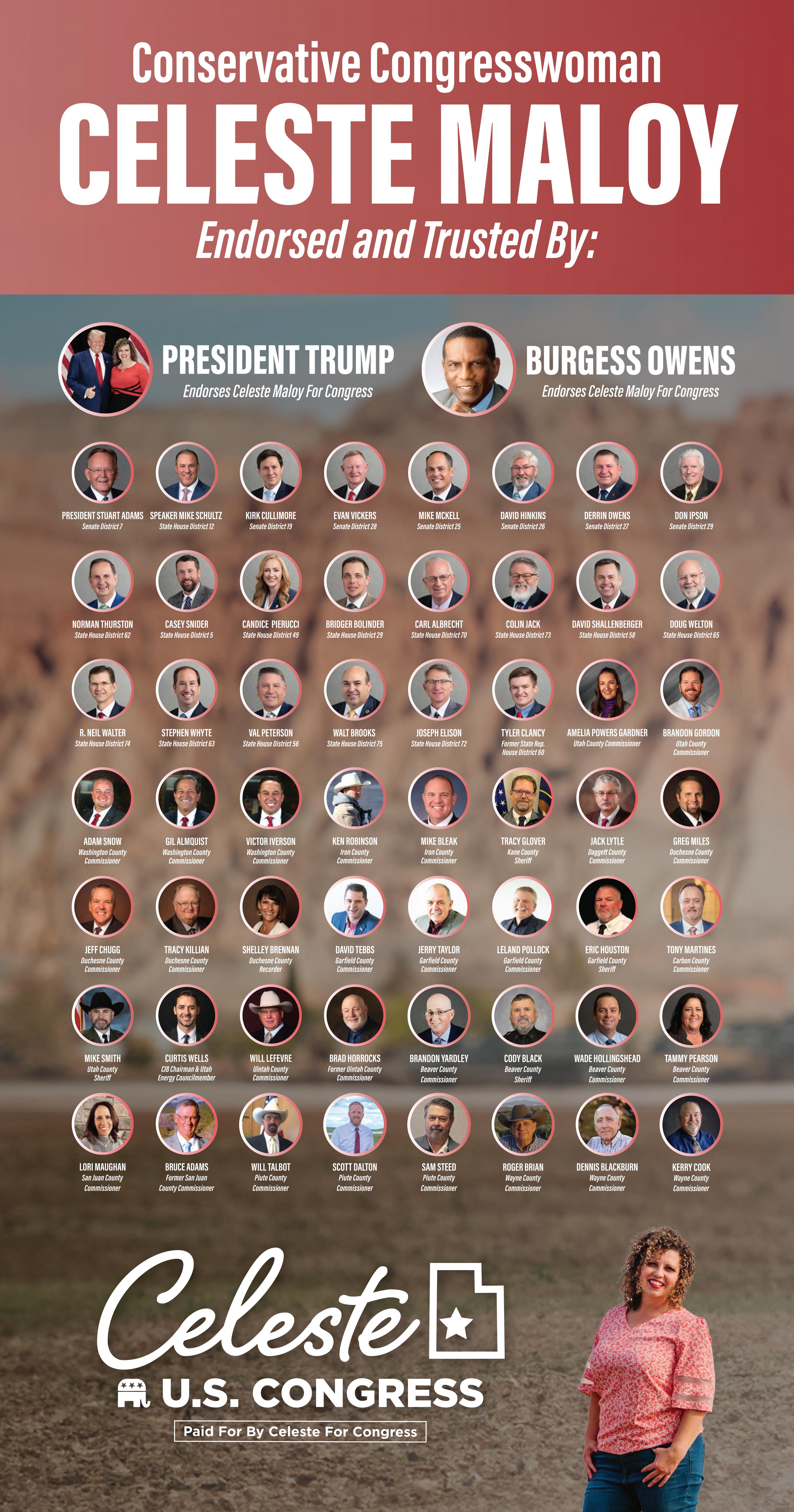
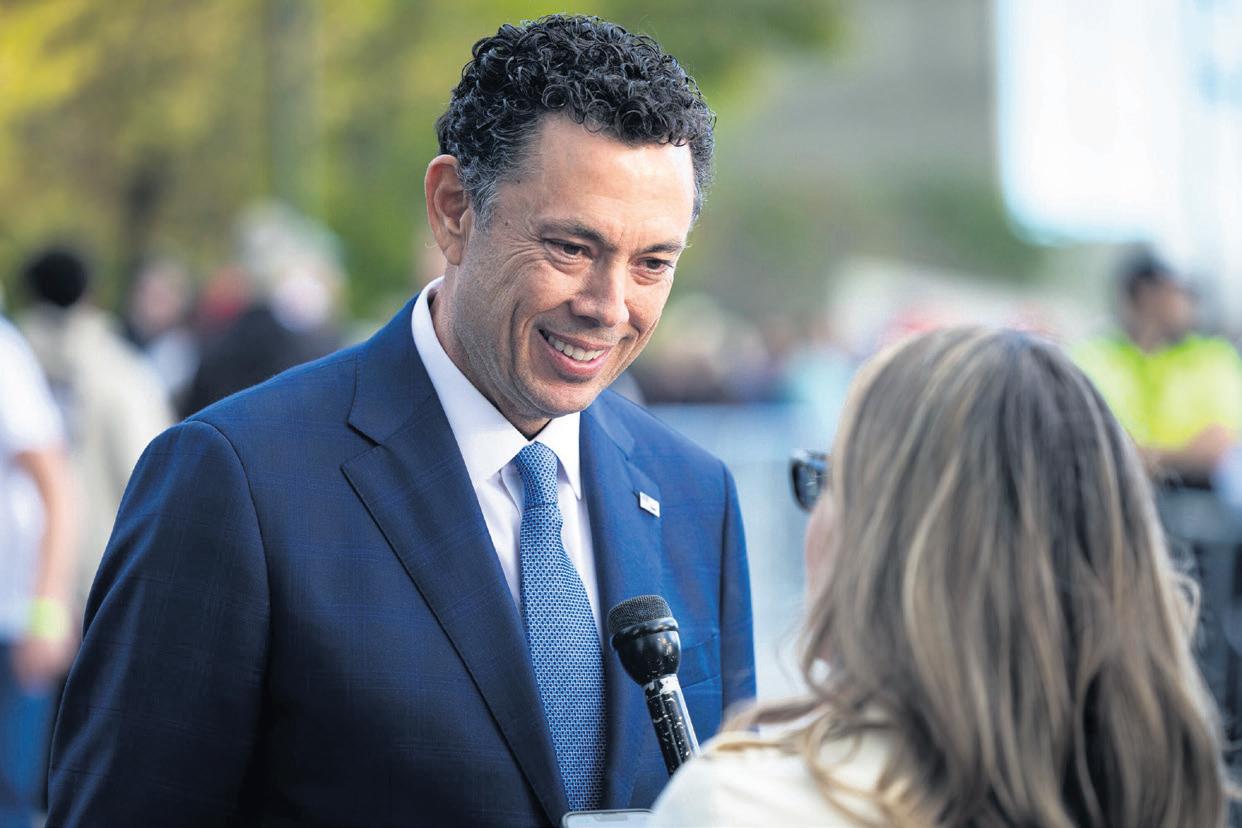
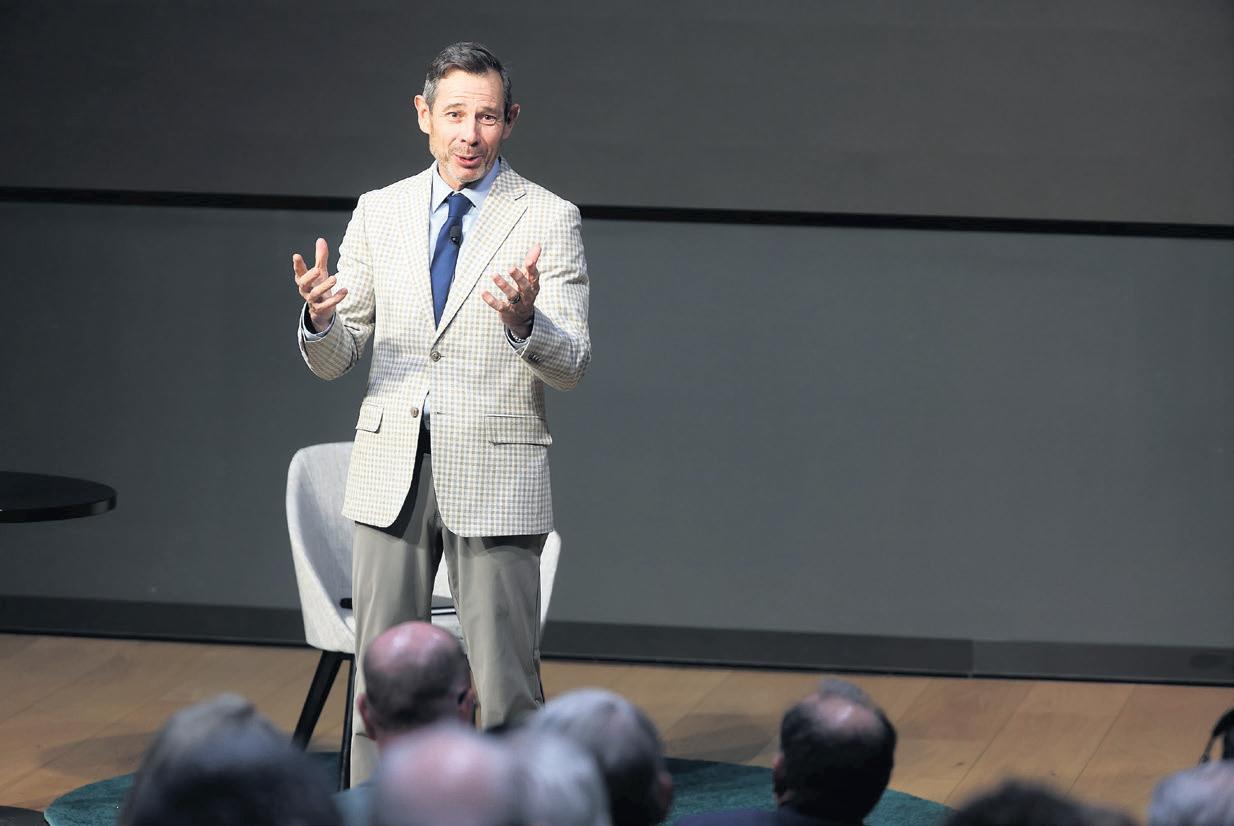
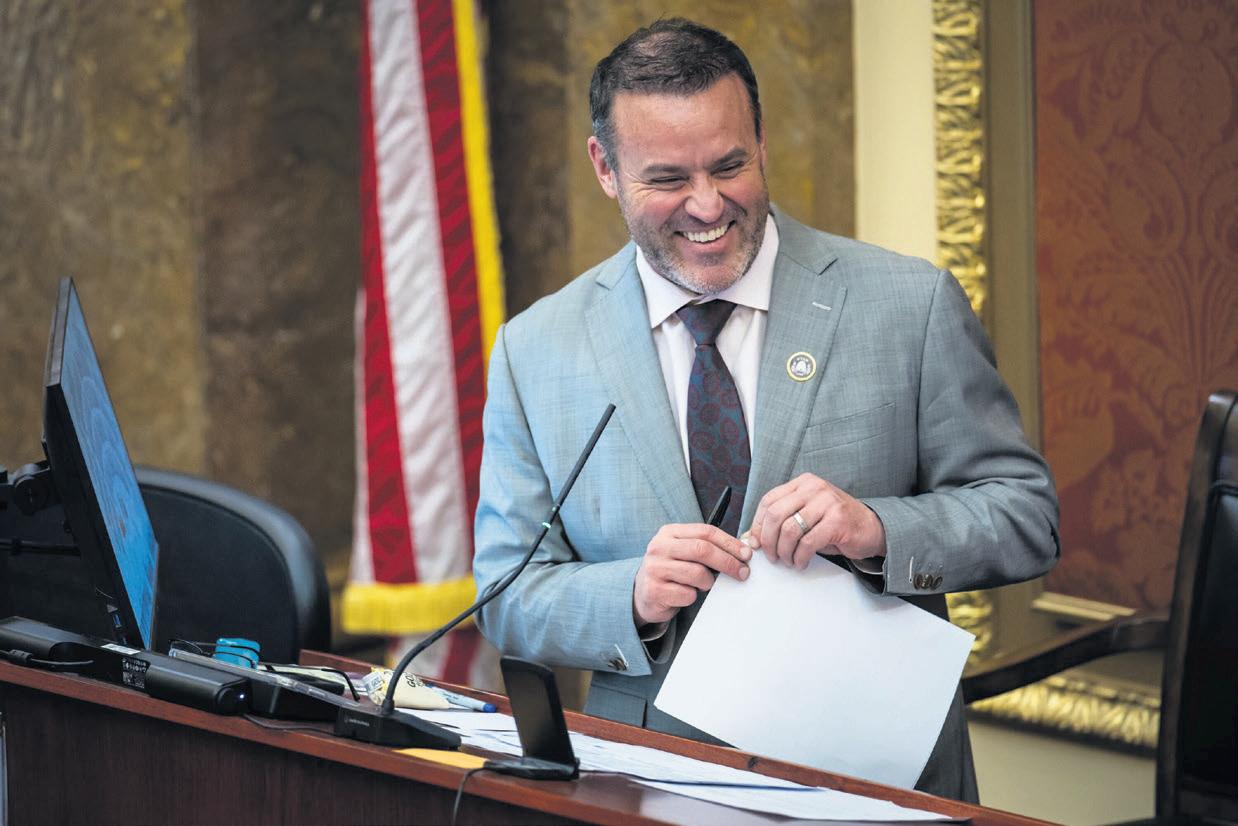
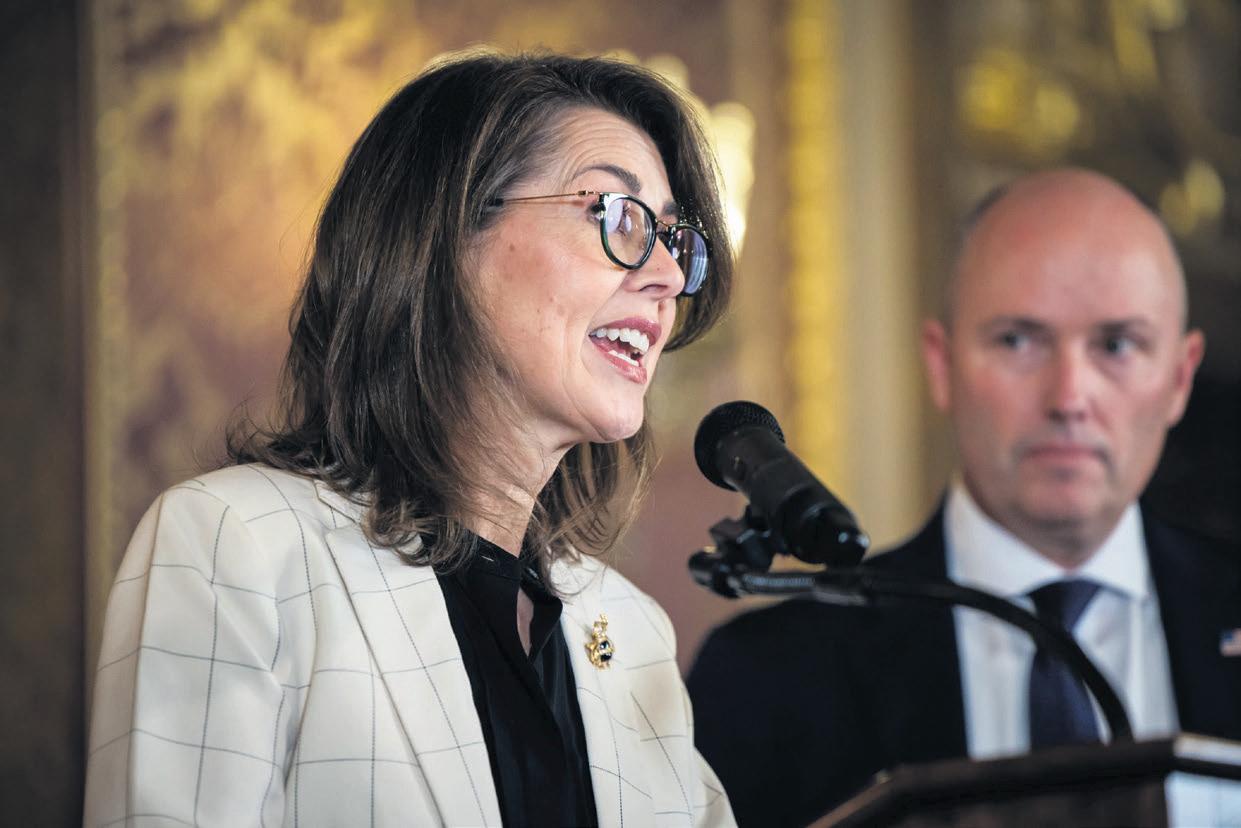
to Chaffetz, a group of Cox and Curtis backers spoke to Politico’s Samuel Benson, suggesting Curtis might want to swap his Senate seat to become the state’s chief executive.
Following the article’s release, Curtis told the Deseret News on May 12 he is not thinking about Utah’s gubernatorial race and disputed claims made in the piece, particularly that he is unsatisf ied with his work in Washington, D.C.
The news may still have had the intended effect of Curtis supporters. At least one top donor canceled a meet-and-greet scheduled with Chaffetz after learning Curtis might run, according to two sources familiar with the decision.
For months, Chaffetz has worked to craft a narrative that despite the extended timeline, the 2028 race is coming into focus with him as the front runner, said one Utah donor, who cannot remember another race rolling out this early.
“Chaffetz is running the most aggressive shadow primary campaign of anybody that I’ve seen in recent history in Utah,” the source said.
“That is the motion in the political market that is creating everything else that’s happening.”
Chaffetz’s pitch, according to the source is,
“Hey, it’s inevitable that I’m going to be the next governor. When I’m focused, I don’t lose. I’m going to lock up the support. I’m going to be the next governor, so you better get on board.”
It may be smart politics to try to scare away potential contenders, but the source said
Chaffetz’s victory is far from inevitable as Curtis’ name has already convinced dozens of donors to remain neutral until the primary draws closer.
Donors are frustrated the “shadow primary stage” started so early, according to another top GOP operative. And there is skepticism that Chaffetz, who has been out of off ice for eight years since resigning, is the best to govern the state.
Will Speaker Schultz or Lt. Gov. Henderson run?
Even with two years to go, it seems likely the 2028 race could become a two-way contest between Chaffetz and Curtis because they have the most important ingredient — name ID — which is hard to earn or buy, the operative said.
In an interview with the Deseret News, Schultz, R-Hooper, who has the wealth to potentially self-fund a campaign, said he is entirely focused on serving Utah in his current position, and will wait to make a decision about 2028.
“I have not even came close to making a decision,” Schultz said. “Honestly, it will depend on what the f ield looks like before I make that decision.”
Henderson, who ran against Curtis in the 2017 special election to replace Chaffetz, said she will “think about 2028 when it’s time to think about 2028” and that she did not accept the role as Cox’s lieutenant “to get a different one.”
While he rejected aspects of the Politico story that claimed he has prayerfully sought guidance about a gubernatorial bid, Curtis has become more open to it as people have reached out, sources close to the senator told the Deseret News.
This echoes the process that led Curtis to reverse his decision not to run for Senate in 2023, when his refusal was met with a fundraising campaign by some supporters of outgoing Sen. Mitt Romney to get Curtis to change his mind.
Curtis f inally entered the race in January 2024, long after former state Speaker Brad Wilson shored up support among donors, who eventually split between the candidates. That could happen again, the veteran consultant said.
“There may be some flip-flop fatigue on that,” the source said. “Politicians are very susceptible to having two people tell them ‘you should run,’ and feeling like it’s the Tabernacle Choir.”










































































Utah County deserves steady, experienced leadership focused on integrity, execution, and service to every voter. Administering elections isn’t about politics — it’s about process. Recent years have brought unnecessary controversy, state intervention, and operational missteps to our elections. Corey Astill will bring professional management, strong internal controls, and transparent operations back to the Clerk’s office.
Corey will restore Trust from Day One!
“I want to use my experience to give back - to serve and protect the values, community, and people that shaped my life.”
Small Business Owner, Success on the Spectrum
Own with my wife. We help families and individuals impacted by autism build real-world skills, confidence, and independence.
Vice President, Business Roundtable
Leading efforts to reduce regulation, intrusion in healthcare, and lower taxes with CEOs of America’s top companies.
Legislative Director, U.S. Senate
Led work including assessing Constitutionality of proposed legislation, evaluating issues, planning and implementing strategy.
Bachelor’s Degree, Brigham Young University Law Degree, Georgetown University Law
Administering elections isn’t about politics - it’s about process.














• Changed
• Protected Parents’
• Led the
Parent and Grandparent