Friday, October 9, 2026 | Deseret News Weekend
| D2
SPECIAL SECTION
DESERET.COM
D Election Guide
Poll shows top issues for voters heading into midterms
| D7
| D8
Owen, McAdams debate what comes after Trump
Maloy, Udell offer competing visions
VIBE CHECK
Eliza Anderson, Deseret News
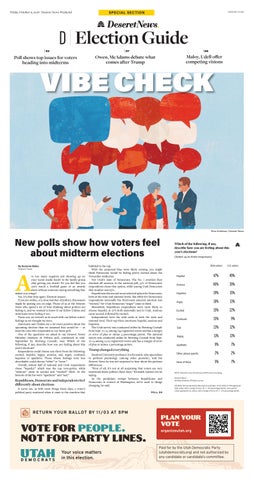
New polls show how voters feel about midterm elections By Suzanne Bates Deseret News
A
re too many negative ads showing up on your social media feeds? Is the family group chat getting you down? Do you feel like you can’t watch a football game or an awards show without someone saying something that makes you cringe? Yes, it’s that time again. Election season. If you are online, or a close watcher of politics, this season might be putting you on edge. Those of us at the Deseret News who spend a lot of time thinking about politics are feeling it, and we wanted to know if our fellow Utahns and Americans were feeling it too. Turns out, we weren’t as in touch with our fellow voters’ feelings as we thought we were. Americans and Utahns are a lot more positive about the upcoming election than we assumed they would be — at least the ones who responded to our latest poll. One of the questions we asked in our Deseret News/ Hinckley Institute of Politics poll, conducted in midSeptember by Morning Consult, was: Which of the following, if any, describe how you are feeling about this year’s elections? Respondents could choose any three from the following: excited, hopeful, happy, anxious, sad, angry, confused, hopeless or apathetic. Those whose feelings were less describable could choose “other” or “none.” Overall, almost half of national and Utah respondents chose “hopeful,” which was the top vote-getter, while “anxious” came in second and “excited” third. At the bottom of the list were “apathetic” and “sad.”
Republicans, Democrats and independents feel differently about elections It turns out, as with most things these days, a voter’s political party mattered when it came to the emotion that
bubbled to the top. With the projected blue wave likely coming, you might think Democrats would be feeling pretty excited about the November midterms. Not Utah’s slate of Democrats. The No. 1 emotion they checked off: anxious. In the national poll, 51% of Democratic respondents chose that option, while among Utah Democrats that number was 65%. Hopeful was the second-most selected option for Democrats, both at the state and national levels. But while for Democratic respondents nationally the third-most selected emotion was “excited,” for Utah Democrats “angry” came in third. Meanwhile, Republican respondents were most likely to choose hopeful, at 57% both nationally and in Utah. Anxious came second, followed by excited. Independents were the wild cards at both the state and national level. Their top three emotions: hopeful, anxious and hopeless. The Utah survey was conducted online by Morning Consult from Sept. 10-15, among 744 registered voters and has a margin or error of plus or minus 4 percentage points. The national survey was conducted online by Morning Consult from Sept. 10-14 among 2,102 registered voters and has a margin of error of plus or minus 2 percentage points.
Trump changed everything Stanford University professor Jon Krosnick, who specializes in political psychology (among other pursuits), told the Deseret News he was not surprised to hear about the partisan differences. “First of all, it’s not at all surprising that voters are very emotional about politics these days,” Krosnick started out by saying. As the pendulum swings between Republicans and Democrats in control of Washington, we’re used to things changing, he said. POLL D6
Friday, Oct. 9, 2026 | Deseret News Weekend
D2
DESERET.COM
Affordability top of mind for voters
Customers shop at Macey’s during its grand reopening in Lehi on Aug. 12. Utahns and voters nationwide say inflation will be a key issue when casting a ballot.
Laura Seitz, Deseret News
Poll shows top issues for voters heading into midterms By Lauren Irwin Deseret News
With just about four weeks to go until the 2026 November midterm elections, voters overwhelmingly say the issues most affecting their decision in the voting booth are inflation and the U.S. economy. According to a new Deseret News/Hinckley Institute of Politics survey, conducted by Morning Consult, the top issues in the upcoming election are related to affordability, both for voters in Utah and nationwide. Experts say that it’s largely unsurprising that voters say affordability issues are top of mind this year. While recent national trends show it to be a driving force in all elections, this year’s midterms come as the U.S. enters its seventh month of war with Iran, which led to sharp increases in the price of gas. Global oil supply has been constricted by limited passage through the Strait of Hormuz, causing gas prices to jump by more than 40% since the start of the war in late February. Mike Kofoed, an economics professor at the University of Tennessee, explained that high gas prices are a unique symbol about the war that Americans have felt repeatedly for months. “Housing is something I buy once, and then it kind of becomes my f ixed rent and I get adjusted to it,” he said. “The problem with oil and gas is I see that price every day as I drive down the road. I feel that cost every week … at the gas pump. Even though it’s not necessarily a huge share of a consumer’s budget, it becomes a constant pain point.” According to the American Automobile Association’s latest national average, gas sits at $4.47 per gallon. In Utah, the average per gallon is even higher at $4.97. It’s the highest prices have been since 2022 inflation caused an all-time record high of $5.01 per gallon. Kofoed explained that voters tend to have a short-term memory. They cast ballots based on issues that have impacted their lives in recent days, weeks or months, rather than policies enacted at the start of the year or months before. War is inflationary no matter which side your country is on, so it’s not surprising voters say they will vote to try and bring those costs down, Kofoed said. In Utah, 53% of voters said inflation and 51% said the economy and job creation are “extremely important” issues for them to consider when voting this fall. Nationally, it’s nearly the same, with 55% who say inflation and 54% who say the economy and jobs will influence their vote.
Affordability and Iran tied together While President Donald Trump has maintained since the start of the war that it was a necessary operation to stop Iran from obtaining a nuclear weapon, the data shows Americans are growing tired of the war in the Middle East and Trump’s inability to end it. For example, according to data from the Deseret NewsHinckley Institute surveys, Utahns have grown increasingly disillusioned with the president. In January, his approval rating among Utahns was at 51%. In September, it was at 43%. Kofoed argued that he thinks Americans are frustrated about the high prices seen at the gas pump and it feels like it might be a “self-inflicted wound.” Normally, when the country goes to war, there’s a run-up where Congress and the president prepare the American people for what they’re going to see happen. When Trump launched the military operation earlier this year, he claimed the excursion would last just a few weeks. The president has maintained the operation was necessary to stop Iran from obtaining a nuclear weapon, but experts say he’s deadlocked into a diff icult spot with Iranian leadership. Kofoed said he didn’t think there was much “salesmanship” done for justifying the war to the American people, which is why surveys show they’re souring on the conflict. “I think what is going on here is when we say we’re getting
into a military conflict with a country of 100 million people, whose capital is the size of Paris, it’s not going to be that we can annihilate them in two weeks,” he said. “And so, if we’re going to set that expectation, and then voters don’t see that expectation come to fruition, they’re going to say ‘Why am I paying this excess cost when I don’t see the benef it of this military excursion?’” While Utahns and voters nationwide were nearly equally likely to say that the economy and inflation were going to have the biggest impact on how they vote this November, who they say will do a better job to f ix the economy differs. According to the Utah survey, 44% of voters in the Beehive State say the Republican Party is best suited to do a better job with the economy and the cost of living, compared to 29% saying Democrats. Nationally, however, 40% of voters say they trust the Democratic Party to do a better job on the economy and cost of living, compared to 34% for Republicans. The same trend holds true when voters were asked if an election for a congressional seat in their district were held today, which candidate would they vote for. In Utah, voters were more likely to say they’d cast a ballot for the Republican candidate while nationally, voters say they’d rather vote for a Democratic candidate. Kofoed said Utah has always been an “interesting place politically.” The Republican Party in the state has been able
to differentiate itself from Trump and MAGA Republicans in many ways, with elected off icials who are willing to break from the party line. VOTERS D4
Friday, Oct. 9, 2026 | Deseret News Weekend
DESERET.COM
STANDING FOR UTAH FAMILIES The Democratic Party needs leadership with a spine. I am a Blue Dog Democrat. I will take the leadership skills the United States Marine Corps taught me to fight for every working family. Utah is built on community and stepping in when your neighbor needs it. That means working on the 90% we agree on instead of fighting over the 10% we don’t. It means affordable childcare for single parents and families, defending the dignity of working families and seniors so nobody lives in poverty or goes without affordable healthcare, supporting our farmers and ranchers, and fighting to keep our public lands in public hands. Utah deserves someone who will listen, someone who has not just heard about your struggles, but who has lived them. Paid For By Jonny Larsen For Congress
THE COMMITMENT STARTS HERE
VISIT JONNYLARSEN.COM OR SCAN THE QR CODE TO LEARN MORE
D3
D4
Friday, Oct. 9, 2026 | Deseret News Weekend
DESERET.COM
POLITICS
Utah Rep. Mike Kennedy breaks down the good and bad of Trump’s second term Rep. Mike Kennedy, R-Utah, talks to others after a leadership meeting at the Utah Capitol on Oct. 2 in Salt Lake City.
By Brigham Tomco Deseret News
Utah Republican Rep. Mike Kennedy said Oct. 2 the second term of President Donald Trump has been “unratable,” for better or for worse. While he is not sure of how to rate the past two years, he has no doubt that Trump will be remembered 50 years from now. “They are going to have to rate President Trump as one of the most notable presidents in the history of our country,” Kennedy said. “For one reason or another.” Kennedy, a staunch conservative who is running for reelection in the 4th Congressional District, entered off ice just a few weeks before Trump returned to the White House. Kennedy received a “MAGA” hat signed by Trump for his birthday last year. He said he plans to keep it as an “heirloom” because this is such a “remarkable time” for America.
Top Utah leaders meet On Oct. 2, Kennedy hosted his semiannual private meeting with Utah’s top elected off icials, including Utah Gov. Spencer Cox and Reps. Blake Moore and Celeste Maloy. The discussion touched on energy policy, water infrastructure, Olympics preparation — and transparency around data centers. Artif icial intelligence warehouses became a top political issue in Utah this year after a massive data center proposal sailed through a military economic development board with little public input. “We don’t ruin the people and we don’t ruin the technology,” Kennedy concluded. On top of hearing the needs of Utah off icials, Kennedy helped to translate the impactful decisions coming out of Washington, D.C. In an interview with the Deseret News, Kennedy explained why giving a simple rating for Trump’s second term is not so simple.
Deportations ‘good and bad’ On immigration, for example, Kennedy praises the president for cutting border crossings from their highest level in U.S. history, of up to 250,000 per month, down
Erin Hooley, Deseret News
to zero. But the impacts of the mass deportation of immigrants in the country illegally have been “good and bad,” according to Kennedy. While he applauds the expulsion of immigrants who are convicted criminals, which last year accounted for roughly 30% of deportations, the rest should be made on a “one-on-one basis.” Immigration and Customs Enforcement arrests hit highs this summer, according to The New York Times, as the administration engages in smaller raids while also expanding the pool of potential deportees. Advocates have hailed the crackdown as a way to lower crime and housing prices. Critics say deportations split families and shrink the labor pool.
Concern of noncitizens voting On election security, Kennedy shares
the Trump administration’s concern of noncitizens voting in the upcoming midterm elections. New Jersey off icials revealed last month that 6,600 noncitizens had been added to their voter registration rolls since 2023 due to a software error. About 340 voted, they said. In April of last year, Kennedy voted to pass the SAVE Act, a bill co-sponsored by Utah Sen. Mike Lee that would require verif ication of citizenship to vote in federal elections. The bill has failed to make progress in the Senate, despite Lee’s efforts, due to criticism it would centralize election administration. Kennedy worries about election procedures in Democratic-led states like California and Illinois that could make cheating easier.
Kennedy on Trump-Henderson spat But Kennedy sympathizes with Lt. Gov. Deidre Henderson in her recent back-and-
forth with the Department of Justice about whether Utah must provide sensitive voter information. The administration sued Utah in February, and later launched a personal investigation, after Henderson refused to hand over voters’ Social Security numbers and birth dates to the DOJ. Executive agencies say the information is necessary to vet voter rolls. Henderson argues there is no justif ication for states to abdicate their authority over election administration. “I want my voter records kept conf idential,” Kennedy told the Deseret News. He continued: “I appreciate the fact that our lieutenant governor is working to maintain security of the data that the federal government has on the citizens of our state.” The disagreement between the Trump administration and Henderson, Kennedy said, can play itself out in the courts.
Laura Seitz, Deseret News Joey C. gets gas in Salt Lake City on May 22. The average per gallon is $4.97 in Utah.
VOTERS FROM D2
The results show that Utahns generally still believe that the Republican Party knows how to handle the economy best and would earn their vote if a ballot had to be cast today. Kofoed said Utahns can see that Utah representatives are “different from Donald Trump” but voters nationally don’t have the “same story” which might be why more voters in the nationwide survey say they think Democrats are better suited to f ix the economy and earn their vote. Voters in the national survey showed dissatisfaction with the Trump administration and Republican Party more than Utah voters. It’s a trend that’s held true for incumbents in midterm elections. Historically, the party that controls Congress loses seats in the midterm elections. For example, during Trump’s f irst term, he lost a net of 40 seats in the House in the 2018 midterm races. It’s something Trump was hoping to avoid by kick-starting a nationwide redistricting f ight last year, but likely something he can’t outrun as Democrats see a f ighting chance to flip the House and Senate to their control. Trump and his team know that Democrats see a pathway to victory, so he and other top administration off icials like Vice President JD Vance have told voters to “pretend” he’s on the ballot. While Trump can’t run again, his agenda is still up for a referendum with voters and the GOP wants to keep its dominance on Capitol Hill. Kofoed said he doesn’t think the president’s strategy of telling voters to pretend he’s on the ballot will help Trump come November. The pains from the Iran war are already “baked in,” at least for the next four weeks before the midterms.
DESERET.COM
Friday, Oct. 9, 2026 | Deseret News Weekend
D5
Friday, Oct. 9, 2026 | Deseret News Weekend
D6
DESERET.COM
COVER STORY
In the age of Trump, emotions around elections are all over the map
Keep an eye on the independents
POLL FROM D1
But, “it all pales in comparison to the dramatic radical changes in government and the country that we’ve seen in the years since the Trump administration started,” Krosnick said. Some voters, including many Republicans, may see these changes as good, he pointed out, while others, including many Democrats, do not. And even as we approach an election where Democrats could see their power in Congress increase, that is unlikely to derail the president’s agenda, which has largely been achieved outside congressional channels. This, he said, is one reason why Republicans may be feeling more hopeful and Democrats more anxious. “(Republicans) are not worried about President Trump’s capacity to continue effortfully pushing forth his agenda. Very little has slowed him down, right?” Krosnick said. By using executive orders and other administrative levers, Trump has been able to reshape entire federal agencies, as well as long-standing policies. So while Democrats look likely to retake one or both chambers of Congress, “that’s not necessarily going to change the direction of policy,” he said.
While it’s tempting to see power in Washington split into the binary choice of Republicans versus Democrats, Krosnick argued who we should really be watching are the independents, who typically have the most power in general elections. Trump was elected because he was successful in getting independents to vote for him. “The real issue is, from election to election, what do the independents do?” Krosnick said. “They are the people who are actually determining who wins the election.” And they are not happy right now over the rising cost of living, he pointed out. That lined up with the f indings of the Deseret News/ Hinckley Institute poll — as independent voters were the only respondents who chose “hopeless” as one of their top three.
Are voters optimistic or pessimistic about the future of the country? Even though “hopeful” topped the list of feelings both in Utah and nationally, that doesn’t appear to be the general feeling about the direction the country is heading in. When respondents were asked whether they feel optimistic or pessimistic about the future of the country, both Utahns and
all Americans were more pessimistic than optimistic. Among U.S. voters, 43% expressed optimism compared to 48% who expressed pessimistic. In Utah, 41% said they were optimistic about the country’s future compared to 53% who said pessimistic. Nationally, independent respondents were less likely to say optimistic than Republicans or Democrats. On the flip side, respondents at both the state and national level were much more likely to say they were mainly voting for their chosen candidate or party, versus voting against the other party or candidate. “People tend to vote for candidates who make them happy, optimistic and proud,” Krosnick said. “And they tend not to vote for candidates who make them feel angry, fearful and frustrated.” He wanted to add a footnote to the conversation about today’s divisive politics potentially stirring up negative emotions. Research shows that people don’t necessarily shut down when they feel negative emotions, Krosnick said. It can actually help them become better listeners, and to pay closer attention to what’s happening around them. That should lead to more “thoughtful, attentive and wise” voters, he said.
2 amendments, 1 fight: What’s on Utah’s ballot this November By Reagan Campbell Deseret News
Two proposed constitutional amendments are headed to Utah voters this midterm season. While both will appear on the ballot, only one has sparked a campaign urging voters to reject it. On Nov. 3, Utah voters will decide whether Amendment A and Amendment B become part of the state Constitution. The first measure, Amendment A, would replace the Utah Constitution’s requirement that proposed constitutional amendments be published in newspapers in every county for two months prior to the vote. Instead, this amendment allows legislators to decide how they’re published, as long as it’s done 60 days before the election. Amendment B has drawn detractors since the launch of its opposition campaign on Sept. 28. This amendment would require a 60% voter approval, instead of a simple majority, for any citizen-initiated ballot measure that seeks to create, change or expand taxes. These amendments come after Amendment D was voided by the courts in 2024. That amendment would have given lawmakers power to amend or repeal voter-approved ballot initiatives.
A higher bar for tax-related initiatives On Jan. 21, 2025, Sen. Lincoln Fillmore, R-South Jordan, introduced Amendment B. The Utah Constitution states that legislation may be “submitted to the people for adoption upon a majority vote of those voting on the legislation.”
Fillmore said, “This is a fairly simple resolution. It asks the citizens of Utah to consider, ‘How easy do you want it to be to raise taxes on your neighbors?’” Amendment B would make more than a majority vote needed to “impose a new tax or to increase the rate of an existing tax or the amount of revenue collected.” The House GOP has listed cost of living as a top priority in 2026 policy. Fillmore said he wants to protect families from having their taxes raised by a slim majority. Opponents view Amendment B as another way to try to limit initiative power after Amendment D failed in 2024.
The case against Amendment B “Vote No on Amendment B” is an opposition campaign launched by Utahns Protecting Our Constitution, a political issues committee. The operation is run by Better Boundaries and led by Elizabeth Rasmussen. Their website states: “Don’t let Salt Lake insiders rewrite the Constitution to give themselves more control and make it harder for ordinary Utahns to push back.” Better Utah posted on X, calling for more democracy and to vote no on Amendment B. Opponents argue that amending the Constitution is a power grab and a nearly irreversible action. They also said that the measure could limit access to Medicaid and healthcare. Rasmussen said, “Amendment B makes an unnecessary, permanent change to our Constitution, taking power away from citizens and giving politicians more control over the rules.”
In 2018, Utah voters passed Proposition 3 — a citizen initiative that expanded Medicaid, funding it with a sales tax increase. This initiative gave around 150,000 people access to Medicaid, including adults with incomes up to 138% of the federal poverty level, according to Ballotpedia. It passed with a 53.3% majority. Under Amendment B, this proposition would not have passed. State Rep. Andrew Stoddard, D-Sandy, echoed the power-grab argument. He said Amendment B creates an unfair standard between legislators and voters because the Legislature is not required to meet the “60% supermajority” when enacting state tax changes.
The case for Amendment B Rep. Jason Kyle, R-Huntsville, House sponsor for Amendment B, said this measure “protects the initiative process while recognizing a simple principle: if you want to raise your neighbors’ taxes, you should have broad support from your neighbors.” He argued that the decision is ultimately up to Utah voters. Other supporters have argued that tax changes need to be widely approved at a time when cost of living is a major concern. The Kem C. Gardner Policy Institute at the University of Utah reported on Utah’s affordability. They found that 91% of renters can’t afford median home and it’s the 10th most expensive state for single-family homes. Fillmore believes this amendment will help to save Utah families money in taxes. He said, “The question here is very simple. Do the people of Utah want 50.1% of the
people in the state to be able to raise taxes on the other 49.9%? Or, when it comes to this type of a question, should there be a broader consensus?” Billy Hesterman, president of the Utah Taxpayers Association, said that a required supermajority vote on citizen-initiated Utah tax code would ensure the changes are supported and justified. Polling conducted by Noble Predictive Insights on Sept. 8 to 12 shows 50% of Utahns support Amendment B, while 21% oppose it.
The amendment nobody’s f ighting over Amendment A was introduced Feb. 11, 2025, and passed without opposition through the Utah House and Senate. There have been no opposition campaigns against this amendment. This amendment helps to fix the newspaper publication rule that stopped Amendment D from passing. In 2024, legislators tried to rush the amendment in a special session to be voted on in November. This did not give enough time to meet the newspaper deadline, which resulted in the court voiding it from the ballot. State Rep. Anthony Loubet, R-Kearns, said, “One thing we learned last year is that when it comes to constitutional amendments, our constitution has its own separate notice requirement. And that requirement requires two months’ publication in a newspaper, physical print.” He said, “Back in the day, that was a great way of communicating with people. People received their newspapers daily and that would be (a) good method of notification. Unfortunately nowadays that’s not true any longer.”
Friday, Oct. 9, 2026 | Deseret News Weekend
DESERET.COM
D7
POLITICS
McAdams offers a check on Trump. Owen offers a new kind of Republican By Brigham Tomco Deseret News
The debate on Sept. 29 to represent Utah’s new Democratic-leaning district fixated on the issues that will define the end of the Trump-era of U.S. politics — and possibly the next century of economic transformation. Former Rep. Ben McAdams, who secured the Democratic nomination in a landslide primary win against progressive opponents, acted the part of team player, repeating anti-Trump tenets his party has perfected over the past decade. The 1st Congressional District represents a key pick-up for Democrats, who hope to win a majority in the House in this year’s midterms, after Utah’s redistricting battle culminated in court-ordered electoral boundaries favoring Democrats by 14 percentage points. McAdams signaled exactly what his party planned to do with divided government in Washington, D.C.: halt military action in Iran, reverse tariffs implemented by President Donald Trump and root out misconduct in the administration. “We’ve never been more divided than we are right now,” he said. “Corruption is not the exception, it is the rule.” While McAdams provided few specifics for his agenda to oppose the Republican White House, GOP nominee Riley Owen, a Generation Z Navy intelligence officer, broke from Trump on issues of trade, immigration and artificial intelligence. Owen called for a default of free exchange with targeted tariffs on strategic industries, not a vacillating regime of global levies. Owen praised President Barack Obama’s focus on deporting dangerous criminals, not all illegal immigrants.
Stopping AI apocalypse On the issue of AI, McAdams and Owen were of the same mind: it must be kept in check through federal regulation. The president has largely ignored alarms from Silicon Valley about the chance that selfimproving artificial intelligence could take a catastrophic turn that compromises national security at best, and imperils humanity at worst. Congress has not done its job to make
Erin Hooley, Deseret News Candidates for Utah’s 1st Congressional District Republican Riley Owen, left, and Democrat Ben McAdams participate in a debate at Salt Lake Community College on Sept. 29 in Salt Lake City.
sure the coming AI disruption benefits all Americans, not just the billionaires who own the products, according to McAdams. This can only be achieved through “strong federal guardrails.” In one of the rare jabs of the hourlong event hosted by the Utah Debate Commission, Owen questioned McAdams’ credibility because of a million-dollar expenditure on his behalf by a pro-AI PAC funded by OpenAI’s co-founder. He did not request the money, McAdams rebutted, and it won’t affect his commitment to constrain the industry. As one of the few congressional nominees belonging to Gen Z, the 28-year-old Owen broadcast a distinctly anti-Big Tech platform that might remind voters of Utah Gov. Spencer Cox’s brand of “touch-grass populism.” He proposed prohibiting unlimited corporate PAC donations, requiring age verification for social media and putting locals first on the question of data centers — which exploded as a top political issue in Utah last spring. “My message to developers of data centers is very simple: pay your taxes, be water positive, be carbon negative, don’t ruin the grid, and don’t ruin our lands,” Owen said. “And my
message to Utahns is also very simple: your voice matters.” This was a point of bipartisan unanimity. McAdams said data center projects will come, but they should never take away from the Great Salt Lake watershed; they must contribute water to the system, and not rely on government subsidies.
Saving the Great Salt Lake McAdams criticized the state for not going far enough to rescue the saline lake from death by drought. The solution will require “hard choices” like serious efforts to acquire water rights to redirect the flow from rapid new growth. Federal funding is essential, Owen agreed. But he thinks the state is on the right track. State leaders must be more aggressive about modernizing water infrastructure, removing invasive plants and leasing water rights. In true Utah fashion, both candidates pledged support for a balanced budget. But neither stuck their neck out on what it will take to reverse the $40 trillion debt as the country quickly approaches the insolvency of major entitlement programs.
McAdams wants greater tax revenue, lifting the Social Security payroll cap for those making above $350,000. Owen suggested investing Social Security funds into the stock market, like pension systems in other countries. Neither proposed any cuts to the retirement benefits that are driving the country into fiscally uncharted territory. But Owen leaned into other unknowns of the next two years. The future identity of his party, he said, is up for grabs. “2028 is going to come and go, and President Trump’s going to finish his term, and there’s going to be a reckoning of what do we do next,” he said. “Yes, there’s an R next to my name, but I don’t think it needs to mean what it always has.” Like he did in the final days of the primary, McAdams also appealed to a different version of the Republican Party, one that he says is long gone in the age of “Make America Great Again” that he believes has alienated many Utah voters. McAdams acknowledged that he and Owen share similar positions on many of the top issues of the day. The most important distinction, McAdams told Republicans, is which candidate will be beholden to a president like Trump. “Does your party still represent you?” McAdams asked. “Where is your line? And when is enough enough?”
“
Yes, there’s an R next to my name, but I don’t think it needs to mean what it always has.”
— Riley Owen, candidate for Utah’s 1st Congressional District
RE-ELECT
SHERIFF ROSIE RIVERA SALT LAKE COUNTY SHERIFF LEADING THE WAY
DELIVERING RESULTS
PUTTING PUBLIC SAFETY FIRST
DELIVERING RESULTS
BUILDING ON PROVEN RESULTS
• Ended jail overcrowding releases • Restored full staffing • Implemented treatment and reentry services • Strengthened gang prevention
In my next term, I will continue working with the Salt Lake County Council and Mayor to meet long-term jail capacity needs, invest in prevention and treatment, and expand supervised, accountable alternatives for eligible nonviolent people. This balanced approach protects the public, reduces repeat offenses, and supports the deputies and staff who keep our communities safe.
VOTE TO RE-ELECT SHERIFF ROSIE RIVERA ON NOVEMBER 3RD
SCAN TO LEARN MORE
rosieforsheriff.com | Paid for by the Committee to Elect Rosie Rivera
Friday, Oct. 9, 2026 | Deseret News Weekend
D8
DESERET.COM
POLITICS
Maloy, Udell offer competing visions for Utah’s sprawling new 3rd District in St. George debate By Frizz Flake Deseret News
With access to water, housing costs and public lands shaping daily life across southern Utah, Rep. Celeste Maloy, a Republican, and her Democratic challenger Kent Udell took the stage Oct. 2 at Utah Tech University in St. George to make their case to voters in Utah’s newly drawn 3rd Congressional District. Ahead of the Nov. 3 election, the debate offered a preview of how the candidates would address issues facing the district. They debated the boundaries of Bears Ears National Monument, problems with water and drought, data centers, energy, wildf ire prevention, housing, Social Security and the national debt. Maloy argued for cutting federal red tape and giving state and local off icials more say, while Udell emphasized corporate accountability, protecting federal lands and investing in workers. The 3rd District in which Maloy and Udell are competing is new for 2026 and stretches from St. George to Park City to the Uinta Basin, making it an extremely diverse area both politically and geographically.
Different explanations for high costs The debate quickly turned to one of the most prominent topics on voters’ minds: cost of living. The candidates blamed high prices on different causes, and pointed to different ways to f ix the problem. Maloy said she is focused on lowering taxes so families keep more of their pay, while Udell said he wants to go after how companies set prices. According to Udell, corporations and the wealthy raised prices during the pandemic and never lowered them, even after supply chains recovered. “We feel that the system is rigged against us, that the money is coming from our pockets to the pockets of the large corporations and the billionaires,” Udell said. “There’s a lot of gouging going on.” Maloy referenced tax cuts on tips, overtime and Social Security that she voted for in Congress to keep more money with families. “I agree that Utahns should keep as much of their own money in their own pockets as possible. That’s why I voted for making the
Jud Burkett
Kent Udell, right, and Rep. Celeste Maloy during a 3rd Congressional District debate at Utah Tech University in St. George on Oct. 2.
tax cuts permanent from 2017,” Maloy said. “I listened to one of my colleagues tell a story the other day that she talked to a single mom who works for tips, and because of the tax changes, she was able to put one of her kids in braces and another one in private school.”
Housing and AI jobs test their plans for younger Utahns A Utah Tech student asked how the candidates would create good jobs as AI threatens young adults entering the workforce. Neither candidate named a specif ic policy. Instead, they focused on the attitude students should have toward AI. “You’re going to be the human intelligence behind the machines, and you’re going to have
a bright and beautiful future in this country,” Maloy said. “Don’t believe all the doom and gloom. People who are selling you that you don’t have a future have their own agenda.” Udell said that AI can provide knowledge but not wisdom, and urged young people to get real-world experience. “Focus on the experience and the wisdom,” Udell said. “Get the experiences that allow you to be able to make the right decisions in this AI world.” The conversation then shifted to housing and young Utahns expressing concern about their ability to someday buy a home. Both candidates support Gov. Spencer Cox’s push for starter homes but have different ways to get there.
“I love the idea of starter homes, and f inding ways of getting state, municipal and federal grants to be able to build these starter homes,” Udell said. “We need to get people out of the basement and into their homes.” Maloy pointed to a federal law she backed that cuts regulations on building homes. “I also love the idea of starter homes, and that’s why I supported the 21st Century Road to Housing Act,” Maloy said. “It’s actually passed in Congress and focused on making the inputs to housing less costly and cutting a lot of the red tape that drives up the cost of housing.” DEBATE D9
KENT STEWART UDELL FOR CONGRESS DISTRIC T 3
Utah voters have a choice in November KENT S. UDELL
CELESTE MALOY
50+ in 2026
NO IN PERSON TOWN HALL SINCE 2025
ACCEPTING CORPORATE PAC MONEY
NO
YES
MAJORITY OF DONORS UNDER $200
YES
NO
ACCEPTING AIPAC $
NO
YES
CALLING FOR MORATORIUM ON DATA CENTERS
YES
NO
PROTECT PUBLIC LANDS
YES
NO
SUPPORTS THE IRAN WAR
NO
YES
WANTS EVERYONE TO HAVE ACCESS TO AFFORDABLE HEALTHCARE
YES
?
DEEP PIONEER ROOTS IN UTAH
YES
NO
ENGINEER
LAWYER
HELD PUBLIC OPEN EVENTS
PROFESSION
BUILT BY T HE W EST. WOR K I NG FOR T HE FU T UR E . PAID FOR BY THE COMMITTEE TO ELECT KENT STEWART UDELL
scan the qr code and learn more at kentudell.com
Friday, Oct. 9, 2026 | Deseret News Weekend
DESERET.COM
Jud Burkett Rep. Celeste Maloy, R-Utah, answers a question during a 3rd Congressional District debate at Utah Tech University in St. George on Oct. 2. DEBATE FROM D8
Growth raises questions about infrastructure and data centers
Both candidates said paying for roads, water and other infrastructure is mostly a state and local job. Maloy said Washington’s role is to cut duplicate regulations so each dollar goes further, and Udell questioned where local property taxes are going, saying his doubled in one year. The candidates split sharply on policies involving data centers. Fast-growing areas like Washington County are struggling to pay for roads, water and schools, and data centers bring investment but raise other concerns. Udell said local off icials in Box Elder County ignored public input on a project, and called for a suspension on new data centers. “I look at data centers and I see billionaires that are playing Minecraft on how they’re putting these things together,” Udell said. “In Utah, we understand what it’s like to be driving on slick roads. This is a slippery slope we’re going on. And we know as Utahns that if we hit a slippery slope, we pump the brakes. We don’t hit an accelerator.” Maloy believes that states and localities should be the ones to make policies regarding new data centers, highlighting that Utah already passed a law requiring data centers to protect other energy customers and add power to the grid. “I think this is very much a state and local issue,” Maloy said. “Sometimes one size f its all doesn’t actually f it anybody.”
Energy and water expose different views of Utah’s future
Maloy and Udell also split sharply on which energy sources are best for Utah. Maloy pointed out that the appropriate kind of energy is whatever energy mix the market demands, which includes oil and gas that provide rural jobs in addition to geothermal and nuclear energy that are carbon-free and power AI. “I think we should have whatever mix the market is asking for,” Maloy said. “The reason to develop nuclear is because it’s reliable, it’s baseload, it’s dispatchable. It’s going to be the energy source of the future that doesn’t disappear ... it’s going to power the AI future.” Udell said he was an energy engineer and said nuclear energy is the most expensive power source, unproven in small reactors and uses large quantities of water. Udell expressed a strong preference for wind and solar energy instead. “Nuclear power is the most expensive way that we produce power in this country,” Udell said. “We have better options. We have wind and solar that doesn’t use water.”
Clash over monument boundaries and federal land The sprawling new district includes Bears Ears and Grand Staircase-Escalante, which were shrunk by a combined 3 million acres in July through a proclamation signed by President Donald Trump. Both candidates said a president shouldn’t decide monument boundaries alone, but disagreed over the government’s involvement in reducing the size of the monuments.
After 48 years on the west side and decades of community service, I’m ready to bring real representation to Magna, West Valley City, and Salt Lake City. Utah politics is drifting toward Washington-style dysfunction — and it’s time someone stood up and said enough.
I’m running to be that voice.
D9
Jud Burkett Democratic challenger Kent Udell answers a question during a 3rd Congressional District debate at Utah Tech University in St. George on Oct. 2.
“Utah is not for sale,” Udell said. “Our public lands, our federal lands, are not for sale, and they are not to be taken over by a state government. I do not want to see one square inch of that land being sold or to be taken away from federal and from public use.” Maloy supported the recent reduction of the parks and was in the Oval Off ice when it was announced. She has since introduced a bill to take away presidents’ power to create national monuments and leave it to Congress instead. “I think the people who live closest to the land are in the best position to make decisions about how it should be managed,” Maloy said. “I am okay with square inches of federal land being turned over to state and local governments when they’re necessary for transportation, for infrastructure, for qualify of life in Utah. We do not have room to grow.”
Wildf ire prevention brings the debate back to local impacts The debate ended with a conversation on the devastating wildf ires seen throughout Utah this past summer. Maloy argued that leaving dead trees in place feeds catastrophic f ires, and that forests should be thinned and the wood sold to mitigate wildf ire risk. “We need to manage our forests like they are an asset to the United States of America,” Maloy said. “We have sawmill operators who would love to go cut timber, reduce the fuels on our mountains, and turn that timber into a product, which is another thing that creates jobs in rural Utah.” Udell disagreed. “You’re right,” he said. “If we cut down all
the forests, we won’t have any forest f ires. Great idea. We can’t just say we’re going to cut them all down and that’s going to get rid of our forest f ires.” Maloy was given the opportunity for a rebuttal and quickly responded to Udell’s comment. “I am not in favor of cutting down every tree in the forest,” Maloy responded. “But what we have done is not cut down any trees, not reduce the fuels, and then let f ire burn it all down so that we don’t have a forest, and then we get floods. I’d rather see us making good ecological decisions.”
Candidates make their f inal case to voters In their closing remarks, Maloy and Udell made personal appeals to voters. Maloy urged young people to believe in the country’s future, and Udell drew on his Utah roots and pioneer legacy as he asked voters for support. “I will work for the people in this country because these are the people and the lands and the rivers that I love,” Udell said. “My roots go deep in this state. My great-grandfather ... founded Kanab. My other great-grandfather ... founded Santa Clara. That is my legacy. That’s what I’m bringing to this.” Maloy expressed her gratitude for the opportunity to represent the people she serves and called it an honor to stand on the stage and answer questions before her constituents. “I think part of my job also as a representative is to make sure I’m bringing back the good news,” Maloy said. “Look at how far we’ve come since 1776. I’m excited to see how far we go in the next 250 years.”
What I’ll Fight For: Protecting Our Freedom to Vote Our mail-in voting system is secure, convenient, and works for everyone. I will fight any effort to make it harder for you to cast your ballot. Affordability for West Side Families Housing, groceries, property taxes, and healthcare costs are crushing our families. I will fight for lower costs, defend fair wages, and ensure the west side remains a place where families can thrive. Defending the Constitution
Learn More
Politicians attacking our judges and ignoring our system of checks and balances threaten the very foundations of our freedom. I will always stand for an independent judiciary and a government that truly serves the people.
Paid for by Elect Michael Finch
Friday, Oct. 9, 2026 | Deseret News Weekend
D10
DESERET.COM
POLITICS
Data centers and affordability dominate Utah’s 2nd Congressional District race By Emily Walker Deseret News
As Election Day approaches in Utah’s 2nd Congressional District, Republican Rep. Blake Moore faces Democratic Utah State University professor Peter Crosby in the northern Utah district that has already seen political upheaval this year. The issues that are playing a signif icant role in voter decisions this year — in this district and across the country — are data centers and affordability. Utah’s 2nd District is home to the controversial Stratos data center, a massive proposed AI and cloud computing project in Box Elder County. A recent Deseret News-Hinckley Institute of Politics poll showed that 53% of Utah voters opposed the data center, and 7 in 10 voters said economic benef its of data centers don’t outweigh environmental impacts. The controversy surrounding the data center has produced ripple effects across Utah politics. The project was a prominent part of the primary campaign to oust state Senate President Stuart Adams, who lost against Stephanie Hollist after facing backlash as chairman of the agency that approved plans for the center. Moore and Crosby have both taken a stance on the project, seemingly on opposite sides of the issue, even though approval for the project happened entirely at the local level. Crosby has said he does not support the Stratos project because it fails to “adequately and transparently” address environmental concerns. Crosby believes decisions about data center construction should require community approval. Moore has signaled his support for the project, but added that conserving water “is paramount.” “We need to make sure we’re protecting that resource,” Moore said in a debate preceding the primary election in June. Moore has sponsored legislation to study the impacts of AI data centers on rural America. “As a leader in both tech and energy innovation, Utah is a prime location for data centers and AI infrastructure,” Moore said in a release concerning the legislation.
Scott G Winterton, Deseret News An image looking south toward the Great Salt Lake while media and other interested parties take a tour of the Hansel Valley and surrounding areas near the proposed data center in Box Elder County on July 13. The project is a key issue in the 2nd Congressional District race.
“Cementing our role as an innovation hub will require identifying rural areas ready for data expansion, streamlining permitting for new energy projects, and promoting the co-location of data centers with energy facilities.”
Moore and Crosby both campaign on improving affordability Besides the backlash to data centers, recent polling from the Deseret News-Hinckley Institute shows that affordability is one of the issues “top of mind” for midterm voters this year, in Utah and nationally. Both Moore and Crosby are campaigning on promises to improve affordability for Utahns in their district. While in off ice, Moore has supported
legislation to make housing and healthcare more affordable. Moore also supports instituting permanent tax cuts and “rein(ing) in” federal spending, according to the congressman’s website. Crosby has said that, if elected, he would push to improve the economy by ending tariffs, distributing SNAP benef its to Utah families that need them, building affordable housing, increasing incomes and instituting affordable healthcare.
Survey results show closer-than-expected race, but campaign funding is lopsided
Survey results published by the Utah Debate Commission at the Hinckley Institute of Politics, conducted by Lighthouse Research,
shows Moore is 5 percentage points ahead of Crosby among registered voters, with 39% for Moore and 34% for Crosby. Another 14% of voters are spread across three other candidates, while 11% say they’re undecided. The margin of error is 4.32%. Though the race seems close, Moore has a substantial lead in fundraising. According to FEC reports, Moore has raised almost $2.5 million in total contributions, more than 40 times the $60,000 received by Crosby’s campaign. The general election will be held on Nov. 3. Other candidates on the ballot include Independent American Party of Utah candidate Carlton Bowen, Libertarian candidate Daniel Cottam and unaff iliated candidate Robert Moesinger.
Your Voice for Salt Lake County shane4sheriff.com MAXIMIZING EVERY TAX T X DOLLAR TA
BUILDING PARTNERSHIPS
I will improve efficiency to maximize our taxpayer dollars. I will find ways to increase productivity, y reduce redundancies, and y, improve processes.
I am going to build partnerships throughout the criminal justice system and other government agencies. Working together is the only way to improve public safety.
EFFECTIVE & EQUITA EQUITABLE TA T BLE JAILS
SERVA SERVANT VA V NT LEADERSHIP
The most important thing we do at the Sheriff’s Office is to hold prisoners. We will do that while maintaining their dignity and respect.
As Sheriff, f I will set the example of servant f, leadership to foster a climate in which we recognize that we are public servants, here to serve and protect you and your family.
“During his command, Col. Manwaring was able to do what few leaders achieve - change a culture. He built an environment where soldiers thrived, opportunities were available to all, and diversity symbolized strength. He ensured that predators could find no refuge and brought justice to victims. Shane changed a hostile and pugnacious culture, where mistakes were criticized, into a domain where a blunder was an opportunity to learn. His leadership Brigadier General Kurt Davis brought lasting change to a troubled and toxic unit.” - Bri rig ri iga gadi d er Genera r l (R ra ((R) R) Ku R) K rt Davi vis vi is
PROUDLY L LY ENDORSED BY Paid for by Committee Shane 4 Sheriff
Rep. Burgess Owens
Carlos Moreno
Natalie Hall
Eric Barney
Congressman from om UT-4 UT
Salt Lake County Council
Mayor of Bluffdale
Former Mayor of Magna
Utah Fraternal Order of Police Lodge 2
Doers Network
Friday, Oct. 9, 2026 | Deseret News Weekend
DESERET.COM
D11
POLITICS
New map, open seat
Utah’s 4th District candidates vie for office By Reagan Campbell Deseret News
Utah’s 4th Congressional District looks a little different this year after maps were redrawn last November. For the f irst time this midterm cycle, the new dynamic will be put to the test. The 4th District now includes Tooele, Millard, Sanpete, Juab and Sevier counties and parts of Salt Lake and Utah counties. Incumbent Rep. Burgess Owens, R-Utah, announced in March that he would not seek reelection after the number of safe Republican districts in Utah dropped from four to three and the new map included a district drawn to favor Democrats. In a post on X, Owens expressed gratitude for the experience and for those who supported him. He said the “next chapter of my mission would be best pursued outside elected off ice.” Candidates running for the open seat are current 3rd District Rep. Mike Kennedy, Republican; Jonny Larsen, Democrat; Taylor Wright, Libertarian; and Steven Burt, unaff iliated.
Physician turned congressman After his f irst term serving Utah’s 3rd District, Kennedy will run in the 4th District. As a former family doctor, Kennedy is running on healthcare, seeking to ban transgender medical intervention for minors and reduce the medical billing burden on Native American patients. The University of Utah’s Hinckley Institute of Politics and the Sutherland Institute recently hosted a Q&A with Kennedy as a guest speaker. When a student asked him about the U.S. surgeon general position, he replied, “I’m warning you right now, that position shouldn’t be there. We don’t need a chief doctor.” Kennedy is also running on an issue that has impacted the nation, affordability. He said he has worked to cut taxes and lower the cost of living. His campaign site states he has voted against spending bills and “He will continue working to lower costs and make life more affordable.” Border control, energy production expansion and wildf ire prevention are also
Scott G Winterton, Deseret News The U.S. Capitol in Washington, D.C., on Sept. 18. Candidates from Utah’s 4th Congressional District aim to be the one to represent the state in Washington.
policies his campaign focuses on. On June 18, President Donald Trump endorsed Kennedy on social media. He wrote: “A Proven Leader, Mike has served his family well as a Family Physician, Lawyer, and Highly Respected State Legislator, prior to becoming a distinguished Congressman.”
Marine veteran runs as Blue Dog Democrat Next on the ballot is Marine veteran Larsen, who f irst f iled his candidacy on May 9, 2025. At 17, Larsen joined the Marine Corps, where he served as an infantry rifleman from 2000 to 2004. He explained what motivated
him to run for off ice: “The Marine Corps taught me what happens when you commit to something bigger than yourself.” Larsen’s campaign is focused on housing and cost of living, public land and data centers. A press release on Larsen’s campaign site expressed his concerns for a proposed data center in Box Elder County. He said, “The one down in Box Elder is going to increase the air temperature by 20 degrees Celsius.” He added, “We are in a drought and we cannot afford the water to spend to cool these things right now without further review. I just ask that we wait until we can establish the impact on all of that so that we can provide
water to our residents.” Larsen is also a cancer survivor, and because of that, his campaign focuses on healthcare.
What’s next? According to a Lighthouse Research poll of 4th District voters, commissioned by the Utah Debate Commission and released in September, 41.7% of respondents said they would vote for Kennedy, while 32.9% said Larsen, and 25.4% chose another candidate or were undecided. A debate between Kennedy and Larsen was held after press deadline on Oct. 8 at Snow College.
s r e t o V h a t U ? y d a e r e t Are you vo KNOW WHAT’S ON YOUR BALLOT GET INFORMED BEFORE YOU VOTE! Register or update your registration. Get personalized ballot information. Compare candidates & learn where they stand on the issues that matter to you. Find out how you can cast your ballot. And much more!
KEY ELECTION DATES: Oct. 13 General Election Ballots Mailed
Oct. 23 Last Day to Register & Receive By-Mail Ballot Nov. 3 Election Day, Ballots Due by 8 PM your Make an at g pl votin 11.org 4 VOTE
D12
Friday, Oct. 9, 2026 | Deseret News Weekend
Vote November 3rd
BETTER VISION. BETTER OUTCOMES.
VOTE FOR THE JOB. NOT THE LABEL.
PAID P PA ID FOR BY KENT DAVIS DAV A AVIS FOR DISTRICT ATTORNEY A TORNEY AT
DESERET.COM
Friday, October 9, 2026 | Deseret News Weekend
DESERET.COM
SPECIAL SECTION
E Election Guide | E2
‘Democratic socialism’ is gaining ground
| E5
Opinion: Utah’s lieutenant governor deserves applause
| E8
Where is the money going in midterm races?
The moderate money network
Eliza Anderson, Deseret News
A surprising coalition is building a new campaign engine at the local level. Who’s behind it? By Brigham Tomco Deseret News
A
n ecosystem of center-right nonprofit groups emerged in Utah over the past three years before quickly becoming one of the most influential forces in Republican politics, shaping campaigns for Congress and school boards alike. The organizations differ in approach, but share a mission of maintaining the politely pragmatic conservatism that has set the state apart over the past decade as President Donald Trump’s GOP adopted a doctrine of confrontation. One Republican megadonor has taken note. After blasting nearly $2.5 million into Utah’s 2024 Senate race on behalf of John Curtis, North Carolina clean energy philanthropist Jay Faison zeroed in on two Utah firms as models for remaking America in Curtis’ political image. Through his 501(c)(4), America Leads Inc., Faison donated $100,000 in May 2025 to Governing Group PAC, the election shop set up by former congressional candidate Becky Edwards to build a bench of moderate local officials. Up to this point, it was the biggest single donation made to the Governing Group PAC, comprising more than 40% of the contributions received that cycle. Later in 2025, Faison would invest in creating his own organization in the state. By November, Faison had teamed up with Owen Fuller, the founder of All In For Utah — a foundation supporting projects and politicians aligned with Gov. Spencer Cox’s “Disagree Better” brand — to bring America Leads to Utah. Now called Doers Network, Faison’s operation has already entrenched itself in Utah’s political landscape, attracting a host of Capitol insiders to its boards, while endorsing several of the same
candidates as Governing Group. The arrival of Doers Network, which follows the formation of All In For Utah and Governing Group in 2023, completes a new constellation of nonprofits providing a fundraising infrastructure to reinforce Utah’s distinct shade of red. But its ambitions extend beyond the Beehive State. From the beginning, Faison’s aim — shared to some extent by Edwards and Fuller — was to scale Utah-style politics to the national stage as the GOP faces a pivotal reckoning over what a post-Trump party will look like ahead of 2028. While the groups may diverge on how to navigate the money game of elections, these upstart political players are united in their vision of a “common sense conservatism” that they think Utah does better than anywhere else.
What is Doers doing? On Aug. 1, Doers Network held an America 250 celebration that doubled as a public introduction to its new state director, Zac Wilson, a 31-year-old former congressional candidate with a background in Republican youth outreach. Among the 200 or so in attendance were Curtis and Utah Reps. Blake Moore and Burgess Owens. Since taking the helm, Wilson has spread Doers’ support across a wide spectrum that has left some scratching their heads. Doers’ roster includes those recognized as the most conservative members of the Utah House GOP caucus, as well as the most middle-of-the-road. The rubric, Wilson said, prioritizes individual results over a rigid ideology. “Performance is easier than policymaking; clickbait ... is much easier than doing the hard work to pass legislation,” Wilson told the Deseret News. “We want to see more work and less drama — maybe making politics boring again.”
Endorsements are decided by “regional advisory boards,” occupied by community leaders organized into Davis, Salt Lake and Utah counties. Choices are not made by a central office, and certainly not by Faison, according to Wilson. Faison’s touch has not always been so light. Back in February 2025, Connor Child got a call from Fuller, his first boss out of college. The two were enmeshed in Utah’s software-as-a-service sector, and shared a longing for the Republican Party before the “MAGA movement.” Faison gave Child a sketch of what he wanted: apply the analytics of social media marketing to elections. Child called the application “campaign engine.” By systematizing races, Faison wanted to alter the identity of the GOP. “He really wants to see a pretty dramatic shift in where the Republican Party is going,” Child told the Deseret News. Utah was the ideal launching pad because it had largely avoided the Trumpification of the Republican Party nationwide, according to Child. “Like, a John Curtis and a Spencer Cox are electable candidates here,” Child said. Faison did not respond to requests for an interview. To lead as the public face of Doers Network, Faison and Fuller recruited Riley Owen, a young Ivy League graduate, and former White House staffer in the Trump administration, who worked as a Navy intelligence officer. With seed funding from Faison, Owen set out to identify, in the language of a tech startup, the “minimum viable product” to increase turnout in municipal and state elections and improve outcomes by 10% of the vote. “Your mayor and city council members often end up becoming who your state legislators are, and your MONEY E4
Friday, Oct. 9, 2026 | Deseret News Weekend
E2
DESERET.COM
‘Democratic socialism’
Eliza Anderson, Deseret News
Young Democrats are embracing ‘democratic socialism.’ Should you be worried? By Brigham Tomco Deseret News
Young, college-educated Democrats are driving a shift toward “democratic socialism” — the latest political buzzword that has carried congressional candidates to primary victories and catapulted New York Rep. Alexandria Ocasio-Cortez near the top of 2028 presidential preference polls. Just under two-thirds of Democratic voters nationwide — and almost three-quarters in Utah — have a favorable view of candidates and political leaders who describe themselves as “democratic socialists,” according to a new Deseret News/Hinckley Institute of Politics poll. Increasing openness to the term, which was considered taboo a decade ago when Vermont Sen. Bernie Sanders made it core to his White House campaign, stems from supermajority support among Democrats with a university degree, the Morning Consult survey found. Nationally, 7 in 10 Democratic voters with at least four years of college experience support democratic socialism as an economic system, compared to 52% of Democratic voters without. Both groups are signif icantly less eager to embrace socialism without the “democratic” modif ier. But this hesitancy regarding outright government ownership of industries and radical wealth redistribution seems to mostly disappear among the youngest generation of voters. More than 64% of Democratic voters ages 18-34 support “socialism” as an economic system. This share is roughly 20 percentage points larger than among older generations of Democrats. As Democrats try to retake seats in working-class battlegrounds, like Michigan, “democratic socialism” could become a liability. Americans remain deeply split over what it means, why it is gaining momentum and whether it will be constructive or catastrophic for American democracy.
What is democratic socialism? In a survey of 2,102 registered U.S. voters from Sept. 1014, respondents were spread almost evenly between what they thought best summarized the meaning of “democratic socialism.” Overall, 22% of voters said universal healthcare and a stronger social safety net. Another 22% said they didn’t know. The rest were divided, with less than 20% saying higher taxes and more government spending, government control of the economy, or greater economic equality. Republican voters were more likely to say the f irst thing that comes to mind when they hear the phrase is tax-andspend policies. Democrats focused their def initions on government services. For Harper West, a 30-year-old history major working in f inance and living in Salt Lake City, democratic socialism entails nothing short of revolution. After growing up “very conservative,” he joined the Democratic Socialists of America to support unionization at a local Starbucks in 2022. The self-described “democratic socialist” views capitalism as a “hyper-exploitative system” that empowers “a few hundred billionaires” to alienate workers from the fruits of their labor for corporate prof it. He clarif ied: democratic socialists want much more than a progressive party. “We’re moving away from a false choice between establishment Democrats and Republicans — between capitalism and more capitalism,” West told the Deseret News. “We represent a transformative program to change the fundamental structure of society.” Current or former DSA members who toppled incumbents during Democratic primaries in New York, Colorado and Michigan often cite Scandinavia, not the Soviet Union, as their model.
Countries like Denmark, Norway and Sweden fund their expansive healthcare, higher education and retirement benef its with tax-to-GDP ratios up to 20 points higher than in the U.S., with top personal income tax rates falling particularly on middle-class earners — not just the billionaires. While some point to New York City Mayor Zohran Mamdani’s agenda of public transportation and grocery stores as encapsulating democratic socialism, the leadership of DSA — of which Mamdani is a dues-paying member — characterize themselves as communists and Marxists.
The demographics of DSA Most voters still support the framework of private enterprise and free markets that has fueled America’s 250year metamorphosis into the most prosperous nation ever founded. A solid majority of 55% of U.S. voters support capitalism as an economic system; 29% oppose it, according to the poll, which has a margin of error of plus or minus 2 percentage points. This ratio is nearly flipped for socialism. But the survey suggests that this could change in the future. At 46%, a plurality of voters under 35 support socialism. While most voters are strongly opposed to communism, with just 15% supporting it and 71% opposing it, 30% of the
youngest cohort support it — more than double the share of any other age group. Demographics may underlie much of the leftward turn among Democrats. Over the past few decades, individuals with postgraduate degrees but lower household incomes have become the most-likely Democratic voting group in America, according to Cooperative Election Study data. Democratic socialists also tend to be white, and, based on a DSA member survey in 2021, most often report their occupation as a white-collar worker, teacher, nonprof it or public sector employee. The liberal slide among white, educated voters over the past 20 years has been dramatic, said Michael Barber, a professor of political ideology at Brigham Young University. However, Barber is reluctant to conclude that this means a pivot to the fringe for the Democratic Party. “From my perspective, it seems it’s almost like it’s a kind of rebranding of the same policies,” Barber told the Deseret News. “It’s a little puzzling to me.” SOCIALISM E4
Friday, Oct. 9, 2026 | Deseret News Weekend
DESERET.COM
Learn more, find a town hall, or volunteer
PeterCrosbyForCongress.org Hello Neighbor, I would like to introduce myself, and explain why I am asking for your vote. I am a husband, father, and educator rooted here in Northern Utah. My wife and I have lived in Cache Valley for nearly 20 years with our three daughters. I am deeply invested in ensuring the best interests of the community in which my family, and yours, live, work, and pay taxes. It is time we had a representative who can say the same. Public servants should listen and serve, not enrich themselves. They should put principle and the people they represent before power. I was raised in a military family where I was taught that honesty, integrity, and duty are more than just words. They are the foundation a person’s character depends on. Over the last 18 months, I have focused on listening. As I have walked our communities, made phone calls, held town halls, attended rallies, and just sat down to chat, the members of this community have made clear what I, as your representative, need to focus on. It is time for affordable housing, a healthcare system that works, and an economy that allows regular people to thrive, not just survive. We need to hold government accountable for its overreach and violation of our Constitution and defend the civil rights of all Americans. Finally, the Great Salt Lake must be saved. This is an existential crisis for Northern Utah and our water and land issues need real solutions for sustainability. Securing effective federal support is crucial to solving an issue impacting the health and economic well-being of every person here. I have worked hard over the last year and a half to demonstrate my commitment to show up and listen in Northern Utah – having held over 40 town halls throughout the district this past year. This campaign has assembled a network of over 400 registered volunteers, regular people who are actively showing up in your neighborhoods every day to listen and learn. I have built relationships with leaders and community members from the left, right, and center, wearing out both the soles of my shoes and the tread on my tires. Like most of you, I am not independently wealthy. I’m doing all of this while balancing a full-time job. Money should not drive politics, and I stand behind that with my commitment to not accept corporate or foreign-oriented PAC funding. This campaign is completely funded through individual support, one dollar and one person at a time. I am ready to represent Northern Utah in Washington, to fix broken systems, not just for us, but for our kids, our grandkids, and every generation that follows. When it comes time to vote, I hope I can earn yours. Peter
Experience for This Moment I’ve spent my career holding leadership positions in operations, working alongside both Fortune 500 companies and nationallyranked public and private universities to create operational efficiencies and fix broken systems. With a masters degree in Political Science, I have also taught courses on American Institutions, and now Emergent Technology as an adjunct faculty member at Utah State University for the past 13 years.
I understand how our system works, and I know we can fix it.
Affordability Utah families deserve an economy that focuses on communities—not corporate speculation. END ILLEGAL TARIFFS that increase grocery costs, raise utility expenses, and stifle entrepreneurs. PROTECT HEALTHCARE by ensuring rural access to clinics, lowering out-of-pocket prescription drug costs, and stopping federal safety-net slashes that shift financial burdens onto Utah taxpayers. INCREASE AFFORDABLE HOUSING with community builds and reformed qualification programs. VOTE TO END THE WAR IN IRAN that is driving international disorder and increasing global fuel prices. SUPPORT SERVICE MEMBERS at Hill Air Force Base with rational leadership, improved healthcare access, and fair wages.
Accountability
Service is a duty, not a shortcut to wealth. Politicians should listen to their neighbors, not corporate PACs. STAND UP FOR LOCAL FEDERAL EMPLOYEES like those anchored at IRS Ogden to ensure the job stability and livelihood protection they deserve. STOP CORRUPTION by banning stock trades, dark money, and initiating term limits. REFORM CORPORATE TAX CODE to avoid corporations’ “double dipping”. LISTEN TO YOU by holding regular in-person town halls and responding to constituents’ needs.
Stewardship Northern Utah is my neighborhood. I am rooted here, and deeply invested in the welfare of this district. Grassroots funded. Zero Corporate PAC dollars accepted.
Stewardship is holding in sacred trust our responsibility to future generations, and making sure they can enjoy with their kids what we have enjoyed with ours. PROTECT UTAH’S WATER by investing in real solutions to save the Great Salt Lake, keep community water in our wells, and safeguard local aquifers. OPPOSE DATA CENTER PROJECTS that provide water-draining subsidies and bypass local county zoning and public hearings. PROTECT PUBLIC LANDS from federal scalebacks that open the door to corporate mining projects and threaten our shared wilderness. Paid for and authorized by Peter Crosby for Congress
E3
Friday, Oct. 9, 2026 | Deseret News Weekend
E4
Scott G Winterton, Deseret News Becky Edwards, a former member of the Utah Legislature, talks about her political action committee, Governing Group, in Salt Lake City on Dec. 4, 2023. MONEY FROM E1
state legislators often end up becoming your congressmen and senators and your governors,” Owen told the Deseret News. Examples abound: Curtis entered office in 2010 when he was elected as mayor of Provo only to run for Congress in a 2017 special election. Likewise, Cox got his start as a Fairview City Council member and then as a state legislator. In February, Owen announced he would run as a Republican for Utah’s new Democraticleaning 1st Congressional District to “advance the vision” of Doers. Around the same time, Fuller also stepped away from the group. Under Wilson, Doers has already made a splash in the midterms. The group brought public polling to state legislative primaries — a rarity for Utah — and just last month donated $21,000 to candidates in tough districts. While fairly modest, this amount of money can move the needle at the legislative level. Before 2028, the group hopes to have a proof of concept they can imitate in other states, Wilson said, each with their own state director.
All in for what? As Doers finds its footing at the local level, All In For Utah is making an impact at the federal, spending $80,000 in the June primary to oppose Phil Lyman and Karianne Lisonbee, and support Reps. Moore and Celeste Maloy. In addition to sponsoring Disagree Better and The Pioneer Trail, All In For Utah expanded its outreach in April with a new state PAC run by Fuller, World Trade Center Utah CEO Jonathan
Freedman and consultant Dan Hemmert. While Doers’ political involvement has so far been largely self-funded, these efforts by All In For Utah have been primarily fueled by conservative business leaders in the state, like former Zions Bank CEO Scott Anderson. The goal of All In For Utah, according to its freshly hired 28-year-old director Nick Coleman, is to make sure the incentives for candidates align with regular Utah voters. This includes preserving the signature path to the ballot. “I’m worried about a version of Utah politics that I think we stand a chance to lose,” Coleman told the Deseret News. “Our mission is pretty simple and straightforward; it is to protect what has made the state of Utah work.” This comes down to a “political culture” of “common sense conservative leadership,” Coleman said, characterized by ethical behavior, including the ability of public servants to “disagree without hating each other,” and competency.
The ‘center-right’ network This is where the overlap is impossible to miss. Governing Group has articulated an almost identical mission through board members like Edwards, former Utah Gov. Gary Herbert, Dignity Index co-creator Tami Pyfer and Utah Women and Leadership Project Director Susan Madsen. The group has put its money where its mouth is, spending more than $666,000 in the past three years to support over 100 candidates with direct contributions as well as free consulting,
DESERET.COM
Megan Nielsen, Deseret News Zac Wilson speaks at the Utah Republican Party state nominating convention at the Salt Palace Convention Center in Salt Lake City on April 27, 2024. Wilson is now the Doers Network state director.
volunteers and leadership training. It is working: Around 25% of the state Legislature’s GOP caucus is composed of Governing Group candidates, according to Edwards. Another 17 candidates won their primaries in June, which will bring the ratio up to one-third. “What would happen if our political system rewarded elected officials for governing well, not just for winning the next election?” Edwards asked in a Deseret News interview. “We start to look at service differently.” In addition to donations from Edwards and Madsen, Governing Group receives significant support from “pro-democracy groups,” Edwards said, noting few red states have as much energy targeting these kinds of initiatives. This focus has placed diverse groups on the same page. Governing Group occasionally discusses how to support its endorsed candidates with groups like Equality Utah, an LGBTQ advocacy organization; and Better Boundaries, a coalition that supported Utah redistricting and other initiatives. It is “actually really healthy” to have some behind-the-scenes “collaboration” between groups, said Governing Group senior adviser Kyle Friant, who still coordinates campaigns while working as Provo deputy mayor. It is all part of an effort to create a network of moderates. “How do we replicate the structures ... in our politics for people who are more pragmatic?” Friant told the Deseret News. “The structures that exist really empower a lot of folks who may
be a little bit more extreme.” The informal collaboration between groups has jokingly been referred to as the “Wolf PAC,” Friant confirmed, based on a post from state school board candidate Nichole Isom, lamenting the primary loss of conservative candidates. “We are now the blue state in red clothing,” Isom said. “The PAC of wolves now surrounds us.” Before joining Governing Group, Friant worked as deputy director of Better Boundaries. He is also a member of LGBTQ+ and Allied Lawyers of Utah with members of the Equality Utah board — on which Edwards sits. One candidate for Salt Lake County council has seen the intersection firsthand. Mike Bird, who is a Governing Group board member, has the endorsement of Equality Utah, Doers Network and is waiting to hear from All In For Utah. This coalition of backers fits with Bird’s aspiration to be less extreme and more effective, he told the Deseret News, especially as heightened partisan polarization has seeped into even local elections across “the last decade or so.” “Utah is a unique state where no matter the national headlines we as people want good people representing us regardless of party,” Bird told the Deseret News. “We want people that are ethical and just all around good people.” That is the objective Utah’s newest political network shares in common. Any other overlap between the groups has likely arisen after the fact, Bird said. “I wouldn’t say that there’s big coordinating collaborative efforts on both ends.”
SOCIALISM FROM E2
Democratic socialists have found success in deepblue districts with popular proposals around healthcare and housing, Barber noted. But since that label is viewed favorably by just 39% of voters, it could be a drag in the general election, especially in swing states, he added.
What’s behind the momentum? More than one-third of U.S. voters attribute the growing prominence of democratic socialism in U.S. politics to the rising cost of housing and the cost of living, the poll found. This reason is particularly common among Democrats and voters under 45, with about 4 in 10 selecting it. A similar share of U.S. voters said growing inequality between the wealthy and everyone else was to thank for the trend. This was the explanation a whopping 68% of Utah Democrats relied on. Meanwhile, 32% of Utah Republicans blamed a misunderstanding of the benef its of capitalism. Between 15%-30% of all voters said that either frustration with both major political parties, struggles with employment, or social media influencers might also have something to do with it. But the poll may reveal more about f inancial stress than ideological conversion, according to Jason Perry, who serves as director at the University of Utah’s Hinckley Institute of Politics. “I don’t think we should necessarily interpret this as a rejection of capitalism,” Perry told the Deseret News. “It may tell us more about younger voters looking for ways to address the economic pressures they are experiencing, particularly housing, healthcare and the cost of living.” Utah Democrats stand out as being 15 percentage points more likely than national peers to embrace democratic socialism in the survey of 744 voters with a margin of error of plus or minus 4 points. This appears to contrast with the outcome of Utah’s f irst competitive Democratic congressional primary in years. In June, former Utah Rep. Ben McAdams, who was one of the most moderate Democrats in the House, defeated three democratic socialist-leaning opponents in a landslide. In an interview with the Deseret News, McAdams reaff irmed he is “not a democratic socialist.” Many voters may feel that the “system is not working for them,” but that does not mean capitalism is broken, he said. What the country needs is a “well-regulated free market.” “People are hurting,” he said. “We have cut taxes for billionaires and corporations at the expense of core social safety net provisions that are needed for people who are really struggling.”
Is democratic socialism a threat? With public opinion souring on GOP leadership, Republican representatives have done all they can to paint their Democratic counterparts as communists. President Donald Trump has led the way, making the Red Scare approach central to his midterm messaging strategy. But this framing might not be as hyperbolic as it f irst sounds, according to Salt Lake County Council member Carlos Moreno, who became a citizen in 2022 after fleeing from Venezuela where he was charged with treason by the government of then-dictator Nicolás Maduro. For Moreno, debates over the meaning of democratic socialism, and whether or not it represents a slippery slope to authoritarianism, are not academic; they were experienced. Forced nationalization of businesses, food shortages, a refugee crisis and a crackdown on civil liberties is not how socialism was originally sold to voters in Venezuela, Moreno told the Deseret News. It was billed as a way to achieve social
justice, equality and support for working families. “Sometimes the most ‘democratic’ part of socialism is how its advocates get into power,” he said. “Elections, democratic institutions and attractive promises can become the vehicle through which political power is obtained and then used to dramatically expand government control.” Young people may be more susceptible to arguments for socialism because they cannot remember dramatic failures of socialist systems during the 20th century, Moreno suspects. Capitalism is imperfect, Moreno said, but it provides freedom to innovate and improve itself.
There is a chance misinformation, paired with discouraging housing markets and missteps in healthcare policy, could cause young people to forget that, according to Moreno. “That is why the growing popularity of ‘democratic socialism’ in the United States concerns me,” he said.
Friday, Oct. 9, 2026 | Deseret News Weekend
DESERET.COM
E5
IN OUR OPINION
Utah’s lieutenant governor deserves applause Utah Lt. Gov. Deidre Henderson shakes hands with reporters before holding a roundtable to discuss the completion of the citizenship audit of Utah’s voter registration rolls at the Capitol in Salt Lake City on May 27.
By The Deseret News Editorial Board
We applaud Utah Lt. Gov. Deidre Henderson for forcefully defending the state’s voting laws against the meddlesome, domineering arm of Washington. And we are confused by the Trump administration’s desire to create a central voter registration list, complete with sensitive personal information. Surely, the administration understands the need for federalism, or states’ rights. Elections and election security in the United States belong to states, not Washington, regardless of which political party is in power.
Utahns want to vote by mail Also, the administration’s antipathy toward mail-in voting is misplaced. A poll last year by the Deseret News and the Hinckley Institute of Politics, conducted by HarrisX, found 50% of Utahns preferring mail-in voting to be the default voting method, with only 30% preferring to have to opt in to receive ballots in the mail. Only 11% said they do not want to allow any voting by mail. States should be allowed to adopt voting systems they prefer, so long as those systems are fair and secure. Utah adopted vote-by-mail in part to encourage voter participation, and that has been a rousing success. The Utah Foundation, an independent research group, said Utah went from 44th in the nation in terms of voter turnout to 13th in 2018. “This is likely due in part to Utah’s expansion of vote-by-mail,” a Foundation report said. In the 2012 presidential election, before mailin voting, turnout in Utah was 56.1% of eligible voters. In the 2020 election it jumped to 69.2%, according to Ballotpedia. It remained high at 64.2% in 2024. When it comes to voter security in the United States, one number is important to know — 3,144. That’s the total number of counties and county equivalents in the states. For the most part, each of these handles its own reckoning and totaling of ballots cast in each election. This disparate system makes widespread voter fraud much more difficult to orchestrate than would a centralized, national vote counting system. In Utah, these tallies are aided by computers that
Tess Crowley, Deseret News
are not connected to the internet. The second important number to remember is 51, the number of states plus the District of Columbia. Each of these has its own laws governing elections and voter registration rolls. States keep these databases and are responsible for updating and ensuring their integrity. On Sept. 14, the U.S. Supreme Court blocked a Trump administration plan to have the Postal Service screen mailed-in ballots and not deliver them to people whose names were not on a federal register of citizens. Following the ruling, Henderson tweeted, “As expected, the United States Supreme Court has upheld the injunction blocking the USPS mail ballot rule. Utahns can have confidence that the 2026 election will proceed as normal.” The American election system is run by governments that are closest to the people, ensuring accountability. In Utah, the lieutenant governor has primary responsibility for elections, and voters get to elect that office every four years.
The Civil Rights Division of the Justice Department sent a letter to Henderson recently, letting her know she is the subject of an investigation for refusing to provide Washington with full voter lists. Such a denial, it alleges, is against the law. Voter lists are indeed public, but personal information such as driver license and Social Security numbers are not. Henderson, who is a Republican, has taken what traditionally has been a classic Republican stance against federal incursions into Utah’s autonomy. Her office has responded to the administration’s threats by asserting “neither state nor federal law entitles the Department of Justice to collect private information on lawabiding citizens.” Both Gov. Spencer Cox and former Gov. Gary Herbert have supported and praised her position. On X, Cox posted, “It’s wrong for the DOJ to investigate or threaten the lieutenant governor for carrying out her responsibilities under Utah law.”
Utah’s election integrity The White House is right to be concerned about election integrity, but Utah has done a stellar job of tracking its voter registration lists. An audit of voter rolls last June found 27 registered voters were conf irmed noncitizens, with another 25 marked as likely noncitizens. Considering the state has more than 2 million registered voters, that is a 99.7% success rate. At worst, the number of noncitizens would not be enough to change the outcome of any recent election. The audit found another 5,007 voters whose citizenship could not be identif ied. Henderson told KSL many of these likely registered years ago before they were required to attest to their citizenship. Any program administered by humans is going to experience some problems. Utah’s voting system, however, has exhibited an extraordinarily clean system, certainly one that ought to be free from federal threat.
VOTE NOVEMBER 3, 2026
KATHLEEN ANDERSON
WE’RE UTAHNS. WE ASPIRE. WE OVERCOME. LIFE IS GOOD – BUT IT CAN BE BETTER WITH RESPONSIBLE GROWTH, REAL PUBLIC SAFETY AND LIVING WITHIN OUR MEANS.
FOR SALT LAKE COUNTY
COUNCIL AT LARGE SEAT A PUBLIC SAFETY. YOUR TAX DOLLARS. BOTH DESERVE BETTER. PAID FOR BY KATHLEEN4COUNCIL
DONATE
Friday, Oct. 9, 2026 | Deseret News Weekend
E6
DESERET.COM
POLITICS
Americans and Utahns willing to forgo jobs, national security amid opposition to data centers
Scott G Winterton, Deseret News
Workers at the GTS data center construction site in Eagle Mountain on Aug. 18.
A new Deseret News-Hinckley Institute poll shows opposition to data centers is strong in Utah and across the country By Leah Bowers Deseret News
It’s no secret that Utahns vocally oppose data centers: From Mona’s mega center to Box Elder County’s Stratos project, rural residents rush to community meetings to make their opinions known. Americans across the country feel pretty much the same way, as vulnerable candidates in this year’s midterm elections line up to denounce the continued construction of the centers. But what’s fueling the opposition? In a new Deseret News/Hinckley Institute of Politics poll fielded last month, Americans and Utahns showed most voters are resistant to arguments made by the pro-data center crowd — that they will bring jobs and help the United States maintain its AI edge. When asked to choose between two alternatives — building data centers to compete with China even if some are built near residential communities, or to protect communities from data centers “even if it slows America’s progress in competing with China” — 67% chose the latter. Opposition softened slightly — but only to 59% — when the question was reframed around economic growth. Nationally, a slightly larger percentage supported data centers in both questions, though the majority still opposed. The national poll was fielded among 2,102 registered U.S. voters from Sept. 10 to Sept. 14, and has a margin of error of plus or minus 2 percentage points. The Utah poll reached 744 registered voters from Sept. 10 to Sept. 15, and has a margin of error of plus or minus 4
percentage points. Both polls were conducted by Morning Consult.
The race to dominate artif icial intelligence Aaron Starks, president and CEO of 47G, an aerospace and defense organization, said the four major areas of AI capability are chips, data centers, electricity and talent. “China does energy and electricity very, very well,” he said. “Eighty percent of China is undeveloped. They have a lot of land. This is a top-down authoritarian regime that can build and electrify at their own pace.” The United States, on the other hand, doesn’t have that capability. “But what we do have is we have tremendous data compute capabilities,” Starks added. To catch up, he said the U.S. is trying to “gobble up space” wherever possible to build more data centers — increasingly depending on the Department of Energy to scope out future sites. Zach Boyd, director of the Office of Artificial Intelligence for the State of Utah, agreed that the U.S. does have a “lead” over China — depending on how you measure the race — and the nation should be able to maintain it for some time. Even still, he said: “I think it should be on people’s radar.” Boyd explained Utah’s part: Gov. Spencer Cox has called on the federal government to create more regulatory policy, though the state is considering creating additional legislation itself. “As these agents become more powerful, I think we are going to see definite benefits for society,” Boyd said, “but also the cases where they get out of hand will become more and more serious just because the AI agents are more
powerful.” Data centers and AI are not just a consumer or economic development challenge, Starks said, it’s a national priority. “And so it’s not really just about Utah, it’s about our national interests as a whole and whether or not Congress can properly determine and prioritize things, which they can’t,” he said. “They haven’t for many years.”
The promise of a better economy In the Deseret News poll, opposition to data center construction eased slightly when the question shifted to economic growth — though a majority of Americans and Utahns still said no. “Things are rough right now for a lot of people,” said Peter Crosby, Democratic nominee DATA E7
IT’S TIME FOR CHANGE Stephanie has a proven n record of: Opposing backroom Data Ce Center e nter deals that put our resources s at risk without transparency and pu u blic input public Supporting local governmen government, n t, working families and public servants Transparent T ransparent c campaign ampaign d donations onations Integrity and ethics - not allowing personal or special interests s to motivate decisions
Stephanie Hollist is a lifelong Utahn, a commonsense Republican, and as a mom with kids in our local schools, she has deep connections in our community. An experienced public-sector attorney, Stephanie will restore trust and accountability at the Capitol. She stepped up to run against Senator Adams because she is unafraid of pushing back on entrenched power and has the skills to solve the challenges our community faces - with YOUR input.
STEPHANIE CAN STAND UP TO STRONG LEADERS. BECAUSE SHE IS A STRONG LEADER.
Learn more: VoteStephanieHollist.com Republican ballots will be mailed the week of June 2.
Tess Crowley, Deseret News Aaron Starks, CEO and president of 47G, speaks at the 2025 Zero Gravity Summit hosted by 47G Utah Aerospace & Defense at the Salt Palace Convention Center in Salt Lake City on Nov. 4, 2025.
CALL OR TEXT STEPHANIE: 801-390-2829 GO TO THE POLLS ON JUNE 23. VOTE!! Ballots not received on or before June 23 will not be counted, regardless of postmark date.
PAID FOR BY STEPHANIE HOLLIST CAMPAIGN
DESERET.COM
DATA FROM E6
for Utah’s 2nd Congressional District. “So, if you tell me that this kind of economic development project is going to bring jobs, then I’m probably going to be more likely to say yes.” Also according to the Deseret News poll, young residents ages 18-34 were more likely to support data centers for job growth (33%) than those ages 35-44 (25%) — which might not come as a surprise, as the Harvard Institute of Politics found nearly half of young Americans say they are personally affected “a lot” by inflation (50%) in a study earlier this year. Another 45% say they are struggling to make ends meet or getting by with little financial security. “Especially right now with the state of the current economy, anything that suggests that it might give somebody a job is probably going to have a slightly more positive response,” Crosby added. The Governor’s Office of Economic Development projected the Creekstone Energy data center in Millard County — which is currently under construction — will produce 106 full-time jobs, averaging $160,000 per job. But not everyone buys those numbers. “Typically, you see a job buildout for about a year or two while the construction actually happens. But that may be a local
Friday, Oct. 9, 2026 | Deseret News Weekend
workforce — it may not,” said Crosby. “But once the center itself is set up, it takes a caretaker crew — you’re looking at 25, 50 folks maybe, because it’s just a warehouse with server banks.”
The next steps for Utah politicians Crosby is the Democratic nominee for Utah’s 2nd Congressional District — which includes Box Elder County, where the controversial Stratos Project launched. Earlier this year, developers were met with hundreds of angry residents who filled local meeting rooms, voicing their opposition. Recalling his experience attending one of those meetings, Crosby said: “We were asking the commissioners to vote not yet — to give us some more time, and they directly ignored the will of Box Elder residents. “From a campaign perspective, we’ve always taken a pretty clear stance that the people themselves in a community should be able to make this decision,” he added. “They should have all the information they need to make that decision, and then they should make that decision.” Rep. Blake Moore, the Republican candidate in the 2nd Congressional District, did not respond to a request for comment in time for publication. In the Deseret News poll, 66% of Utahns either “strongly” or “somewhat” opposed the 20,000-acre Stratos Project.
E7
But the poll suggests something deeper than opposition to any single project. More than rejecting a singular data center, Utahns reject being told why they should accept them. The more urgent the justification, the less Utahns wanted to hear it.
“
So, if you tell me that this kind of economic development project is going to bring jobs, then I’m probably going to be more likely to say yes.”
— Peter Crosby, candidate for Utah’s 2nd Congressional District
Friday, Oct. 9, 2026 | Deseret News Weekend
E8
DESERET.COM
POLITICS
Where parties are spending the most — and pulling away — in tight midterm races The 2026 midterms are on track to be the most expensive midterm cycle in history. Where is the money going? By Cami Mondeaux Deseret News
With less than a month to go until Election Day, both political parties are in a mad dash to boost their preferred candidates in the races that will determine the balance of power in Congress next year. The 2026 midterms, in which the House and Senate are both up for grabs, is on track to become the most expensive midterm cycle in history, according to political ad tracker AdImpact. The most recent projections predict a record $11.6 billion in total political ad spending, according to the group. Some races, such as the Senate races in Texas and Ohio, have even become some of the most expensive non-presidential races on record. With just four weeks left, it’s typical for political groups to begin assessing which races need more attention — and, in some cases, which races they can pull funding from to boost other candidates.
The most expensive races in midterm cycle The Ohio Senate race is shaping up to be the most expensive midterm race of 2026 in terms of advertising spending. As of Sept. 22, roughly $197 million has been spent on political ads in the Ohio Senate race so far, according to data from AdImpact. The Texas Senate race came in second with $140 million spent so far. In Ohio, Democratic nominee Sherrod Brown is listed as the highest spender as he vies for a political comeback to his old seat. By the end of September, he had spent about $37.5 million, according to AdImpact. One Nation, a nonprof it organization aligned with Senate Republicans, nearly spent the same amount. Meanwhile, the Texas Senate race has already shattered state spending records and is on track to be one of the most expensive races in history. Democratic nominee James Talarico has spent the most on ads so far, but
Supporters applaud as Democratic Ohio Senate candidate Sherrod Brown speaks at a campaign event in Akron, Ohio, on July 16.
several of Republicans’ top spending PACs — including those run by President Donald Trump — have been pouring money in. Both races are considered to be tossups, according to the nonpartisan Cook Political Report. According to the September data, the Maine Senate race, where Sen. Susan Collins is f ighting for reelection, is listed as the third most expensive midterm race so far. About $110 million had been spent there as of Sept. 22.
GOVERNMENT THAT WORKS FOR THE PEOPLE IT’S SUPPOSED TO SERVE.
* Championing affordable living for everyday Utah families. * Demands transparent, accountable government that works for you. * Will fight to fully fund Utah's public schools. * Over a decade serving our nation and fellow veterans.
The Senate races in North Carolina, Georgia, Michigan and Iowa are also on track to be in the top 10 most expensive midterm races. The latter two are deemed tossups while the others slightly favor Democrats. These numbers are all subject to change as parties make spending decisions in the f inal stretch.
Where parties are pulling spending — and where it’s going instead
Sue Ogrocki, Associated Press
to assess where their money will go the furthest — and where it might be better to pull away to boost elsewhere. This method, colloquially known as triage mode in political circles, entails diverting money away from races they view as too diff icult to win. Both parties began pulling money away from the North Carolina race over the last week after Senate Republicans’ top super PAC
As the election draws near, parties begin
SPENDING E9
VOTE JAMES MARTIN
for Utah State Board of Education James Martin has spent nearly three decades serving Utah's public schools — as a teacher, a principal, a union leader, a state specialist, and a community arts advocate. He's running for the Utah State Board of Education because he's lived the work, and he knows it can be done better.
UTAH’S STUDENTS DESERVE BETTER Protect the Arts and Arts Programming Promote Pro-Public School Policy Trust School Board Staff and Their Expertise Trust Teachers and Educators Focus on What Matters to Students, Teachers, and Families
COMMON SENSE SOLUTIONS, UTAH VALUES.
Support Quality Public Education, Pre-K Through 12th Grade
We can only achieve success in this campaign with your support.
Get Involved - dontate, volunteer, learn more. Paid for by Howells for Utah
VOTEJAMESMARTIN.COM PAID FOR BY VOTE JAMES MARTIN
Friday, Oct. 9, 2026 | Deseret News Weekend
DESERET.COM
E9
State Representative House District 61
REELECT
Julia Demaree Nikhinson, Associated Press Democratic U.S. Senate candidate Texas state Rep. James Talarico speaks during a television interview at a food drive at the Frederick Douglass Human Services and Justice Center on Sept. 9 in Dallas.
Kent Nishimura, AFP via Associated Press Republican Senate candidate Michael Whatley greets attendees before Vice President JD Vance arrives to speak at a rally at Koury Convention Center in Greensboro, N.C., on Sept. 21. SPENDING FROM E8
paused its ad spending to instead focus its attention in Kansas, which has become more competitive than expected. The Senate Leadership Fund, which supports Republicans, has since reserved up to $8.2 million in Kansas for political ads, according to AdImpact. Another GOP-aligned group, Old North Action, had pulled back funding from the North Carolina race just a week earlier. The pivot reflects a shifting Senate map as Republican nominee Michael Whatley lags behind former North Carolina Gov. Roy Cooper. Meanwhile, Kansas Sen. Roger Marshall has an unexpectedly competitive challenge from Democrat Adam Hamilton. On the House side, there are at least two races that Democrats are pulling funding — but for another reason. In the races they are beginning to divert funding from, their candidates are pulling ahead of their
Republican challenger. House Majority PAC, the main fundraising arm for House Democrats, has cut some planned ad buys in Nebraska’s 2nd District and California’s 48th District. The Congressional Leadership Fund, a Republican-aligned group, is also reportedly set to pull out of the Nebraska race. Both districts are open seats and slightly favor Democrats. The spending landscape could continue to change in the coming weeks. In fact, Republicans are reportedly planning to spend $5 million in the South Carolina Senate race to boost Sen. Darline Graham, according to Axios. Republicans described the investment to the outlet as an “insurance policy,” but it comes as Democratic challenger Annie Andrews has outraised the Republican incumbent. Recent polling has also deemed it a close race, which is rated as “likely Republican” by Cook Political Report.
L isa
SHEPHERD D Shows up p ffo forr yyo you! u! A common-sense conservative focused on the separation of powers, accountable and responsive government, and your constitutional liberties.
HHONEST ONEST AAPPROACHABLE PPROACHABLE GGENIUNE ENIUNE CCOMMON-SENSE OMMON-SENSE CCOLLABORATIVE OLLLAABORAATTIVE CCONSERVATIVE ONSERVVAAATTIVE PAID FOR BY LISA SHEPHERD FOR STATE HOUSE
THESYSTEMMATTERS. REJECTTHETWO-PARTY SYSTEM.
Evenifwesendagoodpersonto Washington, addingasoldierto theirrespectivepartytrench doesn'tfixourproblems. Ifthemachinekeepsbreaking, don'tblamethetools;fixthe system. Wecanrepairourdemocracy.
SendanEngineer toWashington.
ROBERT MOESINGERFORUSCONGRESS improveourelections.org
improve.our.elections
E10
Friday, Oct. 9, 2026 | Deseret News Weekend
DESERET.COM
POLITICS
Trump promised lower prices. Now GOP Senate candidates are struggling to win the debate By Brigham Tomco Deseret News
Election polls last month stoked Republican fears that GOP strongholds are at risk in the race for Senate control as candidates distinguish their message on affordability from the one coming out of the White House. Nonpartisan poll watchers declared Iowa and Texas “toss-up” seats for the U.S. Senate, opening up a realistic path for Democrats to take the chamber. President Donald Trump won both states by more than 13 percentage points in 2024. Even places like Kansas, which has not sent a Democrat to the Senate for nearly a century, were downgraded from “likely Republican” to “lean Republican” by both the Cook Political Report and Sabato’s Crystal Ball at the University of Virginia. GOP strategists largely dismissed early predictions in interviews with the Deseret News. Polling of GOP support has been unreliable in recent cycles, they pointed out, and most voters are only beginning to turn their attention to the general election. But other conservative commentators see the trends as representing a deep disconnect between the struggles voters are facing and the focus in Washington, D.C.
Rod Dreher: Trump supporters are ‘puzzled and angry’ A long-time advocate of Trump’s populist policies, columnist Rod Dreher told the Deseret News all he hears from fellow Trump supporters at home in Alabama are complaints about the president’s lack of concentration on alleviating high costs. “They are puzzled and angry that he seems that he doesn’t care about what they’re going through,” Dreher said. “It just astonishes me how completely cut off from the experience of ordinary people, in particular his own voters, this president has become.” Less than two years ago, Trump rode to victory on a campaign built on a promise to lower prices for everyday Americans. Now, a new Deseret News-Hinckley Institute of Politics poll suggests that cost-of-living concerns could determine the November midterms. More than 80% of voters report that the issues of inflation, and the economy and jobs are either “very” or “extremely” important to how they will vote, according to the national survey of 2,102 registered voters conducted by Morning Consult. Nearly 1 in 4 voters say inflation will have the single biggest impact on how they vote, followed by the economy and jobs, at 22%, making these the two most influential topics in the election. Corruption in government came in third with 17%.
Julio Cortez, Associated Press Republican Senate candidate Mike Rogers speaks at the Republican convention in Dallas on Sept. 10. He is running against Abdul El-Sayed.
GOP candidates split from Trump on Iran This focus could bode ill for Republicans with gas prices at an average of $4.50 per gallon, diesel near an all-time high of $6.50 per gallon and mortgage rates on the rise. The poll found 40% of voters trust the Democratic Party to do a better job addressing the economy and the cost of living, while 34% trust the Republican Party more. Military action in Iran has had a direct impact on many voters’ wallets. Traff ic through the Strait of Hormuz, an important oil route, has been bottlenecked for months amid failed negotiations with Iran, leading to a spike in crude oil prices which have tripled in the past year. Trump has suggested he will blockade Iranian ports, increase pressure through
Kristin Murphy, Deseret News Gas prices are posted at Smith’s Fuel Center in Salt Lake City on Aug. 11. Nearly 1 in 4 voters say inflation will have the single biggest impact on how they vote.
sanctions and continue with air strikes until Iran caves to his demands, which include giving up their nuclear enrichment program. The Deseret News-Hinckley Institute poll found only 36% of U.S. voters approve of Trump’s handling of the Iran war. The president has remained committed to his objectives in Iran despite public opinion. In May, he said “I don’t think about Americans’ f inancial situation” and “I don’t care about the midterms” when it comes to negotiating a resolution to the war.
But the GOP nominees for Senate who are caught in the political f ights of their careers are acknowledging how central the issue is to their prospective constituents. Former Rep. Mike Rogers, who is running against Democratic candidate Abdul ElSayed in Michigan, was an early supporter of Trump’s decision to attack Iran. Last month, he published a video stating the war “needs to end” to help bring down energy costs. Likewise, Rep. Ashley Hinson, the GOP nominee for Senate in Iowa, held a press
conference last month calling for an “immediate” stop to the conflict, despite voting in the House not to curtail the president’s ability to pursue military action. On Sept. 25, Ohio Republican Sen. Jon Husted reiterated that the nation must “bring the war to a close and get gas prices down.” Husted, Hinson and Rogers are all in coin-toss seats. To take control of the Senate, Democrats have to flip at least four GOP-held seats. GOP E11
“I think that voters should look at the progress that the president was making previous to the war in Iran.” — Dan Hauser, chief political strategist to Utah Sen. Mike Lee Julia Demaree Nikhinson, Associated Press President Donald Trump, far left, attends the dignified transfer of four U.S. service members recently killed in the Middle East, with others July 22 at Dover Air Force Base, Del. Some Republican candidates are calling for an end to the conflict as they prepare to face voters.
DESERET.COM
Friday, Oct. 9, 2026 | Deseret News Weekend
Rep. Ashley Hinson, R-Iowa, greets Sen. Joni Ernst, R-Iowa, left, during a campaign rally in West Des Moines, Iowa, on May 30.
GOP FROM E10
GOP politicos dismiss ‘blue wave’ worries
Dissent among GOP politicians on Iran should not come as a surprise, according to Dan Hauser, chief political strategist to Utah Sen. Mike Lee. But he said foreign policy disagreement should not overshadow the achievements of Trump’s second term. While former President Joe Biden pushed through enormous pieces of legislation that Republicans say led to rampant inflation, and increased energy costs, Trump has worked with Republican lawmakers to lower taxes and remove obstacles to energy production. “I think that voters should look at the progress that the president was making previous to the war in Iran,” Hauser told the Deseret News. “What he did previous to the war in Iran was have some great success in bringing the cost of living down.” Immigration law enforcement is also a cost-
saving measure, according to Hauser. A Federal Reserve working paper found illegal immigration accounted for roughly 30% of the growth in housing prices, and 20% of the growth of rental costs, under Biden. But analysts point out that Republican money speaks louder than words. Senate leadership’s political action committee, and the president himself, have rushed to dump tens of millions of dollars more than Democrats into campaign ads in Texas and Ohio. Some interpret this as a recognition that these seats are not safe. But Matt Whitlock, a former senior adviser to the National Republican Senatorial Committee, told the Deseret News it shows that the GOP, which is flush with cash, is “playing to win.” Messaging on affordability should not be a problem for Republicans, since many of their opponents, like El-Sayed in Michigan, have approved of green energy policies that would increase the cost of gas and cars in the past, according to Whitlock. Surveys in the same Senate races were off by
E11
Charlie Neibergall, Associated Press
significant margins in 2020. But that does not mean GOP candidates can dismiss voters’ concerns, Whitlock said. “You can’t hang your hat on polling error,” he said. “I would never suggest Republicans are going to coast on all the polls being wrong. They still have to work for it.” While Republicans are expected to almost certainly lose their majority in the House of Representatives, Veteran GOP consultant Spencer Stokes believes Republicans are likely to do better than what the media narrative, based on expert predictions, would suggest. Ultimately, Trump remains popular with his base, and is able to mobilize turnout — on both sides — in a way no Democratic spokesperson has been able to, Stokes said. In fact, that may be why Democrats are so intent on making the midterms all about him. “The Democrats are kind of hoping that Donald Trump is the wave that they’re going to ride because they haven’t created any other wave,” Stokes told the Deseret News.
Friday, Oct. 9, 2026 | Deseret News Weekend
E12
DESERET.COM
VOTE REPUBLICAN
GENERAL ELECTION · TUESDAY, NOVEMBER 3, 2026
SALT LAKE COUNTY OFFICES
COUNTY SHERIFF
DISTRICT ATTORNEY
COUNTY AUDITOR
shane4sheriff.com
davis4da.com
chris4auditor.com
Shane Manwaring
Kent Davis
Chris Harding
COUNCIL AT-LARGE
COUNCIL DISTRICT 3
COUNCIL DISTRICT 5
kathleen4council.com
electmikebird.com
traci4countycouncil.com
Kathleen Anderson
Mike Bird
Traci Crockett
Salt Lake County’s budget belongs to the families who fund it. Our county candidates will: • Keep county government transparent and accountable • Focus on essential services, from safe neighborhoods to a justice system that works
• Treat every tax dollar with respect • Audit spending line by line • Root out waste and fraud • Oppose tax hikes that squeeze household budgets Vote Republican for a county government that serves you – not itself.
U.S. CONGRESS
U.S. HOUSE DISTRICT 1
U.S. HOUSE DISTRICT 4
utahriley.com
mikekennedyforutah.com
Riley Owen
STATE SCHOOL BOARD
DISTRICT 4
Mike Kennedy
LeAnn Wood leann4utah.net
Washington’s spending problem is Utah’s problem, too. Our congressional candidates will fight to:
DISTRICT 7
Erin Longacre erin4utah.com
DISTRICT 8
Nicole McDermott
nicole4stateschoolboard
.com
DISTRICT 11
Tracy Nuttall
voteteamnuttall.com
Every Utah child deserves an excellent education, and every parent deserves a meaningful voice. The stated priorities of these State School Board candidates include:
• Rein in runaway federal debt • Eliminate waste and fraud in federal programs • Keep Washington’s hands out of Utah families’ wallets • Defend the constitutional liberties that allow Utahns to work, build, and raise their families as they see fit
• Prioritizing academic achievement • Strengthening reading, mathematics, and civics instruction • Keeping classrooms focused on learning • Directing more education funding toward classrooms and teachers
Send them to Congress to bring Utah common sense to Washington.
• Eliminating unnecessary administrative costs • Holding the public education system accountable for measurable results • Respecting the role of parents in their children’s education
UTAH STATE SENATE
DISTRICT 9
Thaddeus Evans
DISTRICT 11
Brooks Benson
brooksbenson4utah.com
DISTRICT 12
Deidre Tyler deidretyler.com
DISTRICT 13
Ryan Mahoney ryanmahoney4utah .godaddysites.com
DISTRICT 18
Doug Fiefia dougfiefia.com
DISTRICT 19
Kirk Cullimore kirkcullimore.com
The Utah Senate serves as an essential check on how state tax dollars are spent. The stated priorities of these Senate candidates include: • Maintaining balanced budgets and transparent accounting • Conducting audits to identify waste, fraud, and abuse • Returning surplus revenue to taxpayers
• Reducing unnecessary regulations on small businesses • Defending liberties guaranteed by the Utah and U.S. Constitutions • Keeping Utah prosperous and fiscally strong
UTAH HOUSE OF REPRESENTATIVES
DISTRICT 22
Char Varga
DISTRICT 32
Aileen Hampton voteforaileen.org
DISTRICT 42
Clint Okerlund electclint.com
DISTRICT 23
DISTRICT 24
Franklin Robinson Braeden Oswald votebraedenoswald.com
DISTRICT 33
Anna Reeves
DISTRICT 43
Steve Eliason
steveeliasonforutah.com
DISTRICT 35
Monique Ketcham monique4office.com
DISTRICT 44
Jordan Teuscher jordanteuscher.com
DISTRICT 25
DISTRICT 26
DISTRICT 27
electmattmacpherson.com
anthonyloubet.com
Richard Nowak Matt MacPherson Anthony Loubet
DISTRICT 36
Jim Dunnigan electdunnigan.com
DISTRICT 45
Tracy Miller
tracyforutah.com
DISTRICT 37
Casey Saxton caseysaxton.com
DISTRICT 46
Cal Roberts
votecalroberts.com
DISTRICT 38
Chris McConnehey wjchris.com
DISTRICT 47
Mark Strong strong4utah.com
DISTRICT 30
Dave Parke
electdaveparke.org
DISTRICT 39
Ken Ivory
voteivory.com
DISTRICT 48
Jake Hunsaker
jakehunsakerforutah.com
DISTRICT 31
Melody Jones melodyjones.org
DISTRICT 41
Darren Croft darrencroft.org
DISTRICT 49
Candice Pierucci votecandicepierucci.com
Utah’s AAA credit rating and strong economy didn’t happen by accident. They reflect years of balanced budgets and disciplined fiscal leadership. Our Utah House candidates will work to: • Require state programs to demonstrate measurable results • Root out waste and fraud • Reduce needless regulations on workers and businesses
• Protect Utahns’ freedoms to work, speak, and build • Keep Utah affordable for the next generation • Protect the environment and our Great Salt Lake with sensible, proven methods
They believe the money you earn belongs to you – and government should justify every dollar it spends. Paid for by the Salt Lake County Republican Party, PO Box 571058, Murray, UT, 84157 Not authorized by any candidate or candidate’s committee.
Donate to the Party