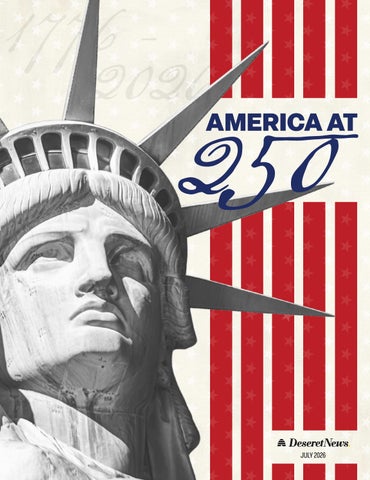
1776 2026
AMERICA AT
JULY 2026
©2026 Christie’s International Real Estate. All Rights Reserved. Each office is independently owned and operated. All information provided is deemed reliable but is not guaranteed and should be independently verified. Obtain the Property Report required by Federal law and read it before signing anything. No Federal agency has judged the merits or value, if any, of this property. All recreational facilities are privately owned and operated as a club with mandatory membership fees. This does not constitute an offer to sell or a solicitation of an offer to buy in any jurisdiction in which registration has not been fulfilled. All descriptions, depictions, pricing, and renderings are subject to change. Equal Housing Opportunity. ©2026 Red Ledges Land Development, Inc.
AWAKEN THE PIONEER WITHIN
A Utah State Park
2
Table of Contents
28
06
62
04 America at 250: A letter to the reader
Utah’s history seeking freedom, fairness and equity
18 Boston’s Freedom Trail:
A “revolutionary” walk — where it all started “Battle Hymn of the Republic”and the choir tied to it
54
42 Sacred Soul: Faith
58 Patriotism Today: How
46 Bicentennial Revisited:
62 10 Memorable U.S.
largest volunteer effort in U.S. history
06 Pioneering Patriotism:
28 America’s Soundtrack:
34 A Call to Serve: The
leaders, historians look at the heart of America
How Utahns have celebrated U.S. anniversaries
ommemoration or C Celebration? A Native American perspective Utahns and Americans look at patriotism Moments
68
10 Top U.S. Landmarks
PUBLISHED BY
EXECUTIVE EDITOR Doug Wilks
PUBLISHER Burke Olsen
PHOTO EDITOR Isaac Hale
EDITOR Sarah Jane Weaver
CHIEF FINANCIAL OFFICER Eric Teel
CONTRIBUTING EDITORS Steven Watkins
MANAGING EDITOR Scott Taylor
SENIOR VICE PRESIDENT SALES Trent Eyre
ART DIRECTOR Serina Nielson
VICE PRESIDENT MARKETING Emily Hellewell
GRAPHIC DESIGNER Allen Muy
VICE PRESIDENT SALES Sally Steed
Chris J. Miller Joel Randall Suzanne Bates
CONTRIBUTING WRITERS Lee Benson Jennifer Graham Christine Rappleye Aimee Cobabe Jacob Hess Chris J. Miller Darren Parry Lauren Irwin Joel Randall Valerie Jones
*Images provided by the Deseret News and The Church of Jesus Christ of Latter-day Saints, unless otherwise stated. Copyright ©2026 by the Deseret News. All rights reserved. No part of this publication may be reproduced in any format without consent of Deseret News.
T I M PA N O G O S S TO RY T E L L I N G F E S T I VA L
W H E R E A M E R I C A G AT H E R S T O L I S T E N E S T. 1 9 9 0 • S E P T E M B E R • L E H I , U T
Independence 4
Letter to the Reader
The United States of America at 250 — what started with one Declaration of Independence and 13 colonies 250 years ago has resulted in one U.S. Constitution, 27 amendments, 50 states and an estimated combined population of well over 600 million over that quarter-millennium period. America at 250 'then' is an ever-enlarging fabric comprised of many threads and many colors, stretching from a founding to the future, from a past to ongoing opportunity. And that fabric represents a collection of peoples, beliefs, languages, learnings, cultures, conflicts, resolutions, diversities and unities — all still a work in progress, even after 250 years. This commemorative magazine — America at 250 — provides an opportunity to remember and reflect. It’s a look back at how we got here, a glance at where we’re at and perhaps a glimpse of where we’re headed. Articles revisit the starting line of the American Revolution, the pioneering push in the Salt Lake Valley for territorial status and eventual statehood, and the republic’s patriotic hymn and the choir linked to it. Other pieces consider the development of the nation’s soul, a Native American perspective, and the status of patriotism today. Also included are a look at how America serves, a retrospective on the Bicentennial 50 years ago, and lists of landmarks and memorable moments in U.S. history. Enjoy “America at 250” today — and perhaps set it in a place where it can also be reviewed 50 years from now, when the United States reaches 300 years. Scott Taylor Managing Editor, America at 250 magazine
THIS SUMMER
AMERICAN MOSAIC Celebrating God, Country & Culture
CHRISTMAS SEASON 2026
For concert dates and details visit
SOULFILLMUSIC.ORG
EASTER SEASON 2027
Use code SOULFILL50 for 50% off any ticket during the 2026–2027 season.
West 6
By Lee Benson
Pioneering Patriotism
PIONEERING PATRIOTISM How Utah’s history — and that of Latter-day Saint faith — is a tale of compromise and concession in the quest for freedom, fairness and equity By Lee Benson
Pioneering Patriotism
O
n July 24, 1849, in what served as the first communitywide celebration since entering the Salt Lake Valley in 1847, some 5,000 Latter-day Saint pioneer settlers — along with hundreds of Forty-Niners heading to the gold fields of California and several dozen Native Americans passing through the territory — paused on the second anniversary of that arrival to hold a party. It was the first Pioneer Day. Everyone took the day off. People dressed up in their finest. Nine rounds of artillery fire at daybreak started the festivities. Then came a parade from Brigham Young’s house to the newly finished bowery on the temple lot. Behind Young marched 24 young Latter-day Saint men, each carrying a
By Lee Benson
7
copy of the Declaration of Independence in his right hand and a copy of the U.S. Constitution in his left hand. They were followed by 24 young Latter-day Saint women in redwhite-and-blue scarves carrying copies of the Bible and the Book of Mormon. At the bowery, one of the young men read aloud the Declaration of Independence. Then a massive 65-foot American flag hand-sewn for weeks by dozens of Latter-day Saint women — the Liberty Flag — was hoisted atop a 104-foot-tall liberty pole, and a sumptuous feast was rolled out for one and all. When Young was asked why the celebration had bypassed America’s birthday on the Fourth of July in favor of Utah’s birthday on the 24th, the prophet and president of The Church of Jesus Christ of Latter-day Saints joked that it was because “we needed 20 more days for the vegetables to mature.”
8
By Lee Benson
Pioneering Patriotism
Brigham Young, president of The Church of Jesus Christ of Latter-day Saints and governor of the Utah Territory beginning in 1851. | Deseret News archives
Pioneers travel through what is today Echo Canyon in Summit County, Utah. Photo is dated approximately 1867. | Deseret News archives
Any artist sketching the scene would have rendered a picture of Latter-day Saints — isolated in the middle of the Great Basin, 2,000 miles from the nation’s capital — who remained overwhelmingly devoted to their country. Separation and distance had obviously not stilled their allegiance and patriotism. And yet the reality — like so much else as the country set about what French diplomat and political philosopher Alexis de Tocqueville called “America’s great experiment in democracy” — was a whole lot more complicated than that. As the United States of America prepares to celebrate its 250th birthday on July 4, 2026, Utah’s history — and Latter-day Saint history, in particular — tells a tale of trial and error, push and shove, give and take, compromise and concession, as the quest for freedom, fairness and equality moved along its bumpy, twisty, neverending and never-perfect course.
FINDING REFUGE IN THE SALT LAKE VALLEY — MAYBE?
The truth was, by the time they settled down in Utah, members of The Church of Jesus Christ of Latter-day Saints were not thrilled with the land of the free — or even convinced that’s what it was. Did such a thing as religious freedom really exist? Or fair treatment of civil rights? Had they been the victims of a cruel hoax? Ever since the church was first organized in New York in 1830, Latter-day Saint leaders had been unwavering in proclaiming that America and the Church of Jesus Christ were following a parallel course ordained by God. It was all a historical procession of divine design. First came the Protestant reformers who left Europe for religious freedom in the New World. Next were the freedom fighters, the revolutionaries who declared war against King George.
They were followed by the framers of the Declaration of Independence and the Constitution, men and documents that were heavenly inspired. All of that set the stage — less than half a century since the firing of the American Revolution’s “Shot Heard Round the World” — for 14-year-old farmboy Joseph Smith to walk into a grove of trees in upstate New York and begin the restoration of the gospel of Jesus Christ back to the Earth. To the believers, it was God’s grand plan. America was the Promised Land. Christopher Columbus was God-sent, said the Book of Mormon. The Constitution was established “by the hands of wise men whom I raised up unto this very purpose,” said the Doctrine and Covenants. “Our national organization originated in the heavens,” declared Brigham Young. Ancestors of the Latter-day Saints certainly did their part to help prepare
Pioneering Patriotism
By Lee Benson
9
A pioneer wagon train travels near Burns, Wyoming. Photo is dated approximately 1867. | Deseret News archives
the way. Joseph Smith’s great-grandfather Samuel Smith Jr. was on the committee — some sources suggest he was the chairman — of the Boston Tea Party. Joseph’s grandfathers on both sides fought in the Revolutionary War, as did the grandfathers of Wilford Woodruff, Oliver Cowdery, Willard Richards, Heber C. Kimball, Orson and Parley Pratt and many other prominent Latter-day Saints leaders. Brigham Young’s father enlisted in George Washington’s Continental Army when he was 16 years old. Martin Harris, one of the Three Witnesses to the Book of Mormon, fought in the War of 1812, “the second revolutionary war.” Latter-day Saint history is packed with patriots. It was all part of a larger whole. For years, Joseph Smith stayed steadfast in declaring his loyalty to America. “The
Constitution of the United States is a glorious standard; it is founded in the wisdom of God,” he proclaimed in 1839. “It is a heavenly banner; it is to all those who are privileged with the sweets of liberty, like the cooling shades and refreshing waters of a great rock in a thirsty and weary land. We say that God is true; that the Constitution of the United States is true.” He was locked in the Liberty Jail in Missouri when he said it. But as the persecution persisted, as Joseph Smith ran for president in 1844 solely in an attempt to get the rights of the Saints recognized, and finally when he and his brother Hyrum were murdered in an Illinois jail later that year as lawmakers stood by doing nothing to stop it, members of the church Smith started began to wonder: just how free were they?
They’d escaped a government-issued extermination order in Missouri by fleeing to Illinois. Now, in the wake of their leaders’ martyrdom, they were fleeing Illinois, escaping in the dead of a cold February night in 1846 across the frozen Mississippi River. They were at wit’s end. They’d run out of country. Their destination: the wild and unsettled Great Basin, more than 1,000 miles away in the Rocky Mountains. It was a vast land only nominally controlled by Mexico, a young country that just 26 years earlier had won its independence from Spain, gaining in the process the expansive territory the Spanish laid claim to in North America. Mexico City, the Mexican capital, was 1,987 miles from the shores of the Great Salt Lake. Not a single Mexican citizen resided in the place the Saints were going.
America’s Favorite Blanket AMERICA250
12
By Lee Benson
Maybe they’d find refuge there. One can only imagine the reaction of those Saints when just three months into their trek westward they learned that the United States had declared war on Mexico. They were in Council Bluffs in Iowa Territory when Capt. James Allen of the U.S. Army delivered the news. He’d tracked down the migrating Saints with orders straight from U.S. President James K. Polk to see if they’d be willing to muster a battalion of men to join the war effort. It was an audacious ask. The Mormons were being recruited to fight for the very country they were running away from. But Brigham Young, Joseph Smith’s successor, could see advantages to the situation. He had sent an emissary to Washington to seek funds from the federal government as compensation for their civil rights that had been trampled. This, in a roundabout, self-serving way, was Polk’s answer. Any man who signed up would be paid soldiers’ wages. Nearly destitute, the Saints needed the money. Plus, even if that loyalty was lacking, supporting the war effort would at least outwardly display their loyalty to the United States. Brigham Young gave the nod to any able-bodied young man, and approximately 550 took him up on it.
Pioneering Patriotism
Members of the Mormon Battalion encampment pose for a photo in 1896 on the 50th anniversary of the creation of the 500-strong voluntary unit that served in the U.S. Army during the Mexican-American War. | Deseret News archives
The Mormon Battalion was formed. For the next six months, they marched from Council Bluffs, Iowa, to San Diego, California, a distance of 2,000 miles. They never saw the enemy, but every man was paid in full. Meanwhile, the main body of Latter-day Saints made their way to the Salt Lake Valley, which they found, as expected, devoid of permanent settlers and still, when they arrived in July of 1847, a part of Mexico … but six months later it wasn’t. The Treaty of Guadalupe Hidalgo, signed on Feb. 2, 1848, ended Polk’s War. Mexico relinquished over half of its territory to the U.S., including nearly all of what is now Utah, New Mexico, Arizona, Colorado, Oklahoma, Kansas, Wyoming, Nevada and California. A land mass almost as big as the Louisi-
ana Purchase — with the Latter-day Saints smack dab in the middle. For better or worse, they were American citizens once again. Assessing the situation, Brigham Young first applied for territorial status, seeking almost a quarter of the Mexican Cession. The proposed new territory, twice the size of Texas, would be called Deseret, a Book of Mormon name for honeybee. Then, seeing that Iowa and California were seeking statehood and recognizing it would be much better to be a sovereign state than beholden to the federal government (they’d seen how that turned out), Young quickly pivoted and sought statehood too. Such was the state of affairs when the celebration described at the beginning of this article took place on July 24, 1849. The gala was real. The 65-foot flag, the 104-foot liberty pole, those copies of the Constitution and Declaration of Inde-
Leaders of the Mormon Battalion Association pose in front of the Mormon Battalion Monument near the Capitol in Salt Lake City in July 1991. | Deseret News archives
Pioneering Patriotism
pendence the young men were carrying in the parade, all were genuine. But that huge flag covered a lot of lingering resentment. Wounds were still fresh from days when the government did not step in to protect and defend their religious and civil rights. The purpose behind the flag-waving wasn’t to display unalloyed patriotism; it was to send a message that Utah was ready, willing and able to be its own state. That was the hidden agenda: a move to get the federal government off their back. Those prospectors passing through to the California gold fields? Let them help spread the word about the agreeable, compliant Mormons.
4 DECADES AS A TERRITORY UNDER LONG-DISTANCE PARENTING
Great strategy. But it didn’t work. The United States Congress reduced the proposed borders of the Territory of Deseret to less than a fifth and changed the name of the territory to Utah, in recognition of the predominant Indian tribe in the area. Statehood was denied. The new territory became official in September 1850, and was under the purview of the federal government 2,000 miles away in Washington, D.C.
By Lee Benson
13
Long-distance parenting didn’t work that believed it was antithetical to Ameriany better then than it does now. For the can morals. In one of the ironies history is next 40 years, with Utah wary of a governfamous for, in 1854 the establishment of ment it generally considered corrupt and the Republican Party — the political party untrustworthy and the federal government now most championed by members of the believing the Latter-day Saint people and Latter-day Saint faith — was motivated by their desire for a theocracy to be un-Amera quest to rid the country of “the twin relican, the two coexisted mostly unpeacefulics of barbarism”: slavery and polygamy. ly. In 1859, Washington sent 2,500 troops Six times Utah applied for statehood — up to then the largest deployment in U.S. following that first try in 1849. Six times it Army history — to quell a supposed Utah was denied. Only after polygamy was offiuprising that proved to be unfounded. Most cially prohibited by a manifesto from church of the soldiers left the next year when the President Wilford Woodruff in 1890 did the Civil War began, but a number were left beapplication start to merit serious attention. hind to establish Fort Douglas (now part of On Jan. 4, 1896, Utah gained statehood, the University of Utah campus) to keep an No. 45 in the parade of 50 states. eye on what was going on, or wasn’t going on, in Utah. BELOW: The front page of the Deseret Evening News on Saturday, Jan. 4, 1896. | Over the course Deseret News archives of four decades, the Latter-day Saint belief in polygamy was a constant clash of wills between a church that believed it was a commandment from God and a government
BELOW: A July 24th parade in Washington City, Utah, believed to be the annual celebration in 1864. A horse-drawn float carried 24 young ladies dressed in white, with 24 young men on horseback. | Church History Library
14
By Lee Benson
Pioneering Patriotism
IN STRIDE WITH THE REPUBLIC WITH WHICH IT STANDS
In the 130 years since, Utah has been unwavering in its allegiance to and support of the United States of America, growing and progressing in stride with the republic with which it stands. While negotiating all the bumps and hurdles faced by all Americans, the state’s leaders through the years have consistently expressed their fidelity to the Constitution. As for the Latter-day Saints who got it all started — who now make up a little less than 60 percent of Utah’s population — their descendants have, as historian W. Paul Reeve says, “successfully made themselves over into apple-pie-eating, flag-waving, uber Americans. “I think it’s really solidified in the post-World War II period,” Reeve, a professor of history at the University of Utah and Simmons Chair of Mormon Studies, continues, “that’s when what it means to be an ideal Latter-day Saint matches with what it means to be an ideal American. The last leader of the church to be a polygamist died in 1945 — the same year the war ended — and LDS soldiers returned to marry monogamously, settle down and raise families that matched the American ideal. Polygamy, the thing that had branded Latter-day Saints as un-American, is gone, and they proceed to very successfully make themselves over into patriotic Americans.” And what would those 1840s Latter-day Saints think about that transformation?
A 1947 re-enactment of the pioneer trek experience on the 100th anniversary of the arrival of pioneers in the Salt Lake Valley. | Deseret News archives.
“That’s a little bit more complicated,” says Reeve. “The nation kept telling them ‘you’re not American because you believe in theocracy and you practice polygamy,’ and that was a very real challenge.” There’s a good quote from Annie Clark Tanner (one of those early Mormons) that I have my students read in Utah history, responding to the manifesto (the proclamation that ended polygamy). She said, basically, ‘I think this is a good thing. If we have anything to offer the nation and the world, then we have to let polygamy go.’ “Some might say the nation required too much, but I think most of those early pioneers would be satisfied with acceptance — and I think they always yearned to be accepted. In the 21st century, most LDS people aren’t aware of this history and the price that Latter-day Saints had to pay. People assume how it is in the present is how it’s always been, but there’s nothing wrong with telling a more complicated story. If you want a test of Constitutional principles and religious freedom, there’s no better place to look than the test case that Latter-day Saints provided the nation. What that ultimately meant for them was a departure from polygamy — and a willingness to negotiate the overlap between their religious and political leaders.” To celebrate America’s 250th birthday, The Church of Jesus Christ of Latter-day Saints is implementing yearlong plans, including the delivery of 250 semitruck loads of food to 250 foodbanks in all 50 states; calls for a nationwide fast on Sunday, July 5, 2026, “to express gratitude for religious liberty and pray for its strengthening worldwide”; and invitations to all members to par-
Ted Popkins, left, and Dick Popkins finish framing a circa 1897 oil-painted copy of a July 24th parade banner on Oct. 7, 1965. | Deseret News archives
Pioneering Patriotism
ticipate in service projects throughout the year, particularly those organized through JustServe and FamilySearch. In addition, a special video has been produced featuring President D. Todd Christofferson of the First Presidency and Elder Quentin L. Cook of the Quorum of the Twelve discussing the significance of the Declaration of Independence, the Constitution and the Restoration. (It is available on ChurchofJesusChrist.org.) It is the 2026 equivalent of that young Latter-day Saint man in 1849 standing in the bowery reading aloud the Declaration of Independence. But this time with no hidden agenda.
BELOW: Large bleachers are constructed for the thousands of parade watchers who would attend the Civil War veterans' parade in Salt Lake City on Aug. 10, 1909. The event, which took place 13 years after Utah gained statehood, as a windfall for the state. | Deseret News archives
By Lee Benson
15
River Tunnel by Gordon Huether
WE’RE ON OUR FINAL
APPROACH The New SLC is finishing up the final phase of construction and opening more gates and more concessions in October 2026. Passengers can look forward to an elevated travel experience including:
MORE FLIGHTS TO MORE DESTINATIONS MORE SHOPS AND RESTAURANTS MORE PLACES TO PLUG-IN
• 94 gates to 100 plus nonstop destinations such as Asia, Europe and South America • 100 plus restaurants and shops with new local favorites like Monarca, Moochie’s, Mr. Charlie’s Chicken Fingers and Swig • 3 national awards for North America’s best airport for departures, cleanest airport and most enjoyable airport The New SLC team is ready to welcome you to the Gateway to the World— we’re connecting people with places and bringing the global experience closer to home.
Download the new SLC mobile app today
MORE GATES
Trail STILL REVOLUTIONARY A stroll through American history along Boston’s Freedom Trail
By Jennifer Graham
Still Revolutionary
By Jennifer Graham
19
The State House on the Freedom Trail in Boston, Mass., on Friday, March 27, 2026. | Jeffrey D, Allred, for the Deseret News
20
By Jennifer Graham
Still Revolutionary
The Park Street Church on the Freedom Trail in Boston, Mass., on Friday, March 27, 2026. | Jeffrey D. Allred, for the Deseret News
B
OSTON — “Don’t get your history from poetry,” the tour guide says, explaining how Henry Wadsworth Longfellow miseducated generations of American children about Paul Revere’s famous ride. We are standing in the shadow of Revere, or rather the iconic bronze likeness of him created by Cyrus Edwin Dallin, the Utahborn sculptor best known to members of The Church of Jesus Christ of Latter-day Saints for his depictions of Brigham Young and the angel Moroni. Here in Boston, however, my tour guide, holding a flute and dressed in 18th-century garb, is prepared to set the record straight about the midnight ride that was a pivotal point in the American Revolution. Revere most likely didn’t say “the British are coming” or “one if by land, two if by sea,” as Longfellow wrote in “Paul Revere’s Ride.” Pretty much everyone in Boston in 1775 was British, and the redcoats — or
“regulars” — would be coming via the Charles River, not the Atlantic. Also, Longfellow left out some other significant details: There were three riders sounding the alarm that night, and only one of them made it to Concord — and it was not Revere, who was intercepted and detained by British soldiers. (The other riders, William Dawes and Dr. Samuel Prescott, didn’t get immortalized in poetry.) So yes, Rob Crean, tour guide by day and comedian by night, is right: Don’t get your history from poetry. Get it from walking the streets where the history was actually made. In his book “The American Revolution: A Concise History,” Boston historian Robert J. Allison recounts how his interest in history was piqued when his mother took him to see Gen. George Washington’s headquarters in Morristown, New Jersey. “Through a window, I caught a glimpse of a white wig and a Continental uniform as a mysterious figure rose from Washington’s desk, then vanished,” Allison wrote, adding, “Ever since, I have trailed that elusive phan-
tom, and thank many good park rangers — in New Jersey, Massachusetts, and points south and west — for bringing us closer.” And on the occasion of America’s 250th anniversary, there’s no better place to get closer to that history than the Freedom Trail, a 2.5-mile trek that explores 16 historic sites in the city where the revolution began. “Trail” is a bit of a misnomer. This excursion is, for the most part, a walk through noisy city streets that at times seem intent on distracting you from the purpose of being here. There are sirens and car horns and tired children in strollers and the shock of trendy chain restaurants amid some of the oldest buildings in America and centuriesold gravestones that are pocked from British soldiers using them for target practice. “Boston is not Colonial Williamsburg; it is a living city,” Allison said. “And having these sites in the midst of a bustling city, I think, enhances them.” Moreover, it can be hard to sustain a spirit of reverence when a tour guide who also works as a comedian is joking about drinking a Sam Adams beer in a bar across
Still Revolutionary
By Jennifer Graham
21
Faneuil Hall on the Freedom Trail in Boston, Mass., on Friday, March 27, 2026. | Jeffrey D.Allred, for the Deseret News
the street from the cemetery where Samuel Adams is buried. But if you think Boston is chaotic now, imagine the chaos when more than 1,000 people descended on Faneuil Hall (a Freedom Trail stop) to protest a shipment of tea; or when British soldiers, whose legal representation was provided by John Adams, fired on 11 people near the Custom House, killing five in what would later be known as the Boston Massacre. It’s easier to do so when you’ve stood on the site where it happened. This is one reason why the Driven 2 Teach initiative, underwritten by the Larry H. & Gail Miller Family Foundation and Zions Bank, sends teachers to visit the Freedom Trail and other historic sites. “You’ll teach differently. You’ll think about history differently by going to the sites,” said BYU history professor Matthew Mason, who accompanied a group of teachers to the Freedom Trail last summer. His BYU colleague Jay Buckley concurred, saying, “There’s just something magical that happens when you visit these
places.” Buckley has been accompanying Utah teachers to the Freedom Trail through Driven 2 Teach for two decades. “It’s got to be on the bucket list of every American to visit Boston and Philadelphia,” he says. Allison would argue that Boston should take precedence. “The revolution happened in Boston. Then they went to Philadelphia to fill out the paperwork,” he said in an interview. About 4 million visitors from all over the world walk the Freedom Trail each year, some listening to narration on a cellphone as they navigate the trail alone, others taking part in guided tours on foot. (There are also trolleys available for those who find it difficult to navigate all of the trail, some of which traverses uneven cobblestones.) There is a prescribed order to the trail, beginning at Boston Common and ending at the U.S.S. Constitution, and partial tours can be completed in less than two hours. But for those with enough time, it’s best to experience the trail over several days, both on your own and with a guide. The Freedom Trail’s 30 official guides,
or players, who double as historians and can bring a local’s perspective and point out other interesting things not on the trail but adjacent to it, such as the oldest continually operating restaurant in the United States, the Union Oyster House. But tour guides also tend to keep you moving. So if you want to, say, linger at Paul Revere’s grave (where it’s traditional to leave pennies on his marker) or linger outside Revere’s house (the oldest urban dwelling in the United States), it’s best to return to the sites that are most meaningful to you on your own time, following the red line marked in bricks that connect most of them. (The Bunker Hill Monument and the U.S.S. Constitution are in Charlestown, about a 20-minute walk from the last Freedom Trail stop in Boston’s North End, Copp’s Hill Burying Ground.) That approach also gives you a chance to sample the famous Italian restaurants of the North End, including Mason’s favorite, Regina Pizzeria. Allison, who teaches history at Suffolk University, said the U.S.S. Constitution is his favorite Freedom Trail site, which is saying
ADVENTURE THAT BUILDS AMERICA
DISCOVER SCOUTING NEAR YOU
BEASCOUT.ORG
C
M
Y
CM
MY
CY
CMY
K
SAVE 250 GALLONS TO CELEBRATE AMERICA’S 250TH
W ate
ry
our
la w n on e le
e m s s ti
e w a
. k e
24
By Jennifer Graham
Still Revolutionary
a lot, since his office overlooks the Granary Burying Ground. (The ship “technically wasn’t part of the American Revolution,” having been launched in 1797, but is the oldest commissioned warship in the country.) He quips that the Freedom Trail was created in the 1950s because Bostonians were tired of giving tourists directions, but he is gratified by the constant flow of visitors on the trail. “It’s certainly not chronological, but it tells a very important story,” Allison said. “Sometimes we Bostonians become complacent and find it annoying that there are so many people doing this, but it is a special thing that begins here, and it really is incumbent on us to celebrate the story, because it’s not just important to us, but it’s really important to the country and to the world.” The disparate stops of the Freedom Trail are just 16 threads in a larger tapestry of America’s origin story, but they are powerful strands. Here’s a snapshot of nine of the must-see stops along the trail: Boston Common: The oldest public park in America, these 44 acres have been a training ground and camp for British soldiers, a field for cattle to graze, and a place of celebration and demonstration going back to the 1600s. (One bit of history that doesn’t remain: the gallows used for public hangings, which were removed in 1817, and the frogs, the namesake for the Frog Pond, long since moved on.) Granary Burying Ground: “In this twoacre plot are the remains of more famous people than any other small graveyard in America,” says “The Complete Guide to Boston’s Freedom Trail.”
Arlington National Cemetery and Author’s Ridge at Sleepy Hollow Cemetery might beg to differ, but the Granary Burying Ground is remarkable, serving as the resting place of three signers of the Declaration of Independence (John Hancock, Samuel Adams and Robert Treat Paine), the five people who died in the Boston Massacre, Benjamin Franklin’s parents (Josiah and Abiah Franklin) and Revere. Old South Meeting House: This brick church, constructed in 1730, was the site of numerous gatherings during the revolution, including one that preceded what would eventually be known as the Boston Tea Party. During their siege of Boston, British troops desecrated the church by using it as a stable and bar, and parts were used for firewood. It was later restored and was among the first buildings preserved because of its history. Old State House: The oldest public building still standing in the eastern U.S., this was first the place where British officials conducted business and later became the home of the Massachusetts Assembly. Colonists gathered underneath the balcony on July 18, 1776, to hear the Declaration of Independence read for the first time, an event that is reenacted every Fourth of July. The building is now a museum, housing, among other things, a replica of the coat John Hancock wore to his gubernatorial inauguration and a British soldier’s gun found on the street after the Boston Massacre. Boston Massacre marker: Near the balcony of the Old State House is a circle of cobblestones commemorating the Boston Massacre — even though the firing by British soldiers into an unruly crowd occurred several yards away. (The original spot is now a safety hazard because of traffic; it’s been moved twice.) Three weeks after the deadly altercation, Paul Revere made an engraving based on an artist’s sketch and dubbed what happened a “Bloody
The Bunker Hill Monument on the Freedom Trail in Boston, Mass., on Friday, March 27, 2026. | Jeffrey D. Allred, for the Deseret News
Still Revolutionary
Massacre.” The name stuck, and the event became a catalyst that, according to the National Constitution Center, lit the fuse of the revolution. Old North Church: A public plaza known as Paul Revere Mall is flanked by two churches. At one end is St. Stephen’s Catholic Church, which has a bell that was cast by Paul Revere; at the other end is the Old North Church, where two lanterns were surreptitiously hung by the church sexton in the dark of April 18, 1775. The oldest standing church in Boston, it is an Episcopal house of worship today, and visitors are welcome to attend services. You can also take a virtual tour online. Copp’s Hill Burying Ground: The highest point in Boston’s North End, this cemetery is the resting ground of Cotton Mather, the Puritan minister whose writing led to the Salem witch trials, and Robert Newman, the North Church sexton who hung the lanterns for Revere to see. During the Revolution, British soldiers camped in the cemetery, sometimes using its gravestones for target practice, and they fired on the colonists from here during the Battle of Bunker Hill. The U.S.S. Constitution: This warship, nicknamed “Old Ironsides,” is the oldest commissioned warship still afloat in the world. Launched in 1797 to protect American merchant ships, it got its nickname because cannonballs bounced off the ship, which was made of live oak from islands off the coast of Georgia. She’s sometimes called Boston’s only undefeated team, having won every battle she’s been in, like the War of 1812, when she sank a British ship within 35 minutes. While still technically afloat because of significant renovations, the Constitution’s role in the Navy today is largely symbolic, but her crew still fires her cannons daily and sails to Castle Island every Fourth of July as part of Boston’s Independence Day festivities.
Bunker Hill Monument: While the first battles of the American Revolution were at Concord and Lexington, a turning point came at the Battle of Bunker Hill. That battle is marked by a 221-foot-tall granite obelisk that visitors can climb to the top of — if they’re capable of ascending 294 steps. (If you can’t, or would rather not, there’s a webcam that offers the same views.)
This battle is known for the legendary command “Don’t fire until you see the whites of their eyes,” and while officially a defeat for the colonists, “Bunker Hill had nevertheless proven that they could fight,” Allison wrote in “The American Revolution.” More than a thousand British soldiers were killed or wounded, compared to 441 of the colonists. (And yes, it’s true, most of the action was actually on Breed’s Hill, not Bunker Hill, but like the Longfellow poem and the Boston Massacre site, sometimes history takes little liberties.) From Boston Common to Bunker Hill, each stop on the Freedom Trail tells a story, and like any historic site, our commemoration of history, whether the preservation of a building or the creation of a monument, tells a secondary story, Mason says. The secondary story is what we value in continuing to preserve and recognize this part of history. At the Freedom Trail, that’s not hard to figure out. It’s all in the name.
A bronze of Paul Revere and the Old North Church on the Freedom Trail in Boston, Mass., on Friday, March 27, 2026. | Jeffrey D. Allred, for the Deseret News
By Jennifer Graham
25
28
By Christine Rappleye
Refrains of the Republic
REFRAINS OF THE
REPUBLIC
Faith Refrains of the Republic
By Christine Rappleye
29
The Tabernacle Choir and Orchestra’s rendition of ‘Battle Hymn of the Republic’ is figuratively and officially part of ‘America’s Soundtrack’ By Christine Rappleye
A
t the celebration after the 5,000th episode of the “Music & the Spoken Word,” former members of The Tabernacle Choir at Temple Square in the audience were invited to come to the front of the Conference Center of The Church of Jesus Christ of Latter-day Saints in Salt Lake City. The moment was an unplanned and impromptu invite. The choir members — both current and former — with the Orchestra at Temple Square performed two songs as the July 13, 2025, program concluded: “The Battle Hymn of the Republic” and the farewell song of “God Be With You Till We Meet Again.” Todd Russell, who sang tenor in the Tabernacle Choir for seven years and was released in May 2025, said being part of that moment helped him “understand what a legacy and how many shoulders we stand on to be part of this amazing choir.” “I saw what connects us all in certain pieces of music that I saw every former member of the choir sing. ‘Battle Hymn’ and ‘God Be With You’ are definitely special to all of us,” he said.
With its opening marching drum beats and trumpet call, “The Battle Hymn of the Republic” has been performed by the 360-voice Tabernacle Choir for decades and in concerts around the world. This year, the Tabernacle Choir and orchestra’s rendition of “Battle Hymn of the Republic” — arranged by Peter Wilhousky — is part of “America’s Soundtrack,” a national music collection created to commemorate the 250th anniversary. The soundtrack is on the America250 YouTube channel. “The music of the Tabernacle Choir inspires feelings of hope and peace,” Tabernacle Choir President Michael O. Leavitt said in the announcement of the choir’s inclusion in “America’s Soundtrack.” “Our mission is to help people feel a connection with the divine.” The choir’s single of “The Battle Hymn of the Republic” recorded with the Philadelphia Orchestra won a Grammy Award in 1959 for Best Performance by a Vocal Group or Chorus, and the choir was part of the first televised broadcast of the awards. “Winning a Grammy Award in 1959 for ‘Battle Hymn of the Republic,’ the choir established that it was not a force only on radio, in distant concert halls and at home in the Tabernacle, but also in the recording business,” wrote Heidi Swinton in “America’s Choir: A Commemorative Portrait of the Mormon Tabernacle Choir,” published in 2004.
30
By Christine Rappleye
PERFORMING ‘BATTLE HYMN OF THE REPUBLIC’
The choir’s performances of the Civil War-era march go back to the late 1940s when a recording of “Battle Hymn of the Republic” was made April 25, 1949, for the Acoustical Society of American Engineers convention in New York City, according to the choir’s chronologies. The “Battle Hymn of the Republic” was often sung as an encore on tour concerts, many times directed by a guest conductor, according to information from the choir. Those places include the Sydney Opera House in Australia; Nauvoo, Illinois; the St. Louis Gateway Arch in Missouri; West Point, New York; and at the Ginásio do Ibirapuera in São Paulo, Brazil. Also, the choir sang “Battle Hymn” at Mount Rushmore in South Dakota for the Telstar broadcast — first international satellite television program — on July 23, 1962. The choir has performed it for U.S. presidents, including in the Salt Lake Tabernacle when President John F. Kennedy visited Salt Lake City in 1963 and riding on a 110-foot float in the inauguration parade
Refrains of the Republic
for President Ronald Reagan in 1981. He dubbed the group “America’s Choir.” And the choir sang “Battle Hymn of the Republic” in general conference for the first time on Sunday, April 6, 1958, in the morning session. (An arrangement of the song for congregational singing is in The Church of Jesus Christ of Latter-day Saints’ “Hymns,” No. 60.) The tradition of singing it as an encore continues. On the choir and orchestra’s recent multicity, multiyear “Songs of Hope” tour, they sang it as an encore at National Auditorium in Mexico City, Mexico, in 2023; at the Mall of Asia in Manila, Philippines, in February 2024; and in the southeastern United States in Florida, and in two concerts in Georgia in September 2024. It was performed during an interfaith concert in Lima, Peru, in February 2025.
THE 2 A.M. PHONE CALL
The plan to include “Battle Hymn of the Republic” in the 1958 recording session with the choir and Philadelphia Orchestra took some convincing. In preparation for the choir’s “Grand America Tour” to the United States’ Midwest and East Coast, choir director Richard P. Condie and orchestra conductor Eugene Ormandy coordinated and planned which songs to perform and record together.
The Tabernacle Choir sings "Battle Hymn of the Republic" at the 1981 inauguration parade for President Ronald Reagan in Washington, D.C. | Deseret News archives
It was at 2 a.m. when Condie called Ormandy to tell him there was a song Condie would like to do. Condie “asked Ormandy to take a look at a score he thought would do well which the choir had already performed before, ‘Battle Hymn of the Republic,’” records Condie’s biography “Under My Baton: Richard P. Condie with the Mormon Tabernacle Choir” by Vicki Alder. Condie was named the choir’s director in 1957. “Ormandy called him back later and told him he was not that excited about the idea and was not sure it would be that good. However, at Condie’s encouragement, he relented and agreed to have it included in a recording,” as written in Condie’s biography. During the 1958 “Grand America Tour,” the choir and staff traveled by train to a dozen cities in 23 days in October and November 1958. The cities they sang in included Wichita, Kansas; St. Louis, Missouri; Columbus, Ohio; Washington, D.C.; Philadelphia, Pennsylvania; Boston, Massachusetts; New York City; Toronto, Canada; Detroit, Michigan; and Chicago, Illinois, reported the Church News about the tour. In each place, the media praised the choir’s performances.
The Tabernacle Choir sings at the base of Mount Rushmore for the July 1967 Telstar broadcast. | Deseret News archives
Refrains of the Republic
In Washington, D.C., choir members performed at Constitution Hall and at the White House for President Dwight D. Eisenhower. In New York City, they sang in Carnegie Hall and choir members were on the “Ed Sullivan” television show. The choir did the “Music & the Spoken Word” program away from the Tabernacle for three weeks, broadcasting from Washington, D.C.; Philadelphia and Detroit, reported the Church News. While in Philadelphia and New York City, the choir and orchestra recorded George Frideric Handel’s “Messiah” and other songs, including “Battle Hymn of the Republic.” In 1959, “The Battle Hymn of the Republic” was released on the album titled “The Lord’s Prayer” with Columbia records, and it was also released as a single 45 rpm. The song went on to be in the top 20 on Billboard’s charts and sold over 300,000 copies, according to information from the choir. “Battle Hymn of the Republic” was “quickly a favorite of millions who rarely buy a ‘classical’ recording. It was impossible to
avoid hearing it several times during a typical day of radio listening, as disc jockeys featured it in their top turn playlists,” wrote Charles Jeffrey Calman in “The Mormon Tabernacle Choir,” published in 1979. “The success of both recordings indicated the ability of the modern choir to attract a popular following while performing essentially sacred and classical music.” The choir got the chance to sing it onstage at the National Academy of Recording Arts & Sciences’ first televised Grammy Awards ceremony on Nov. 29, 1959.
BECOMING THE ‘BATTLE HYMN OF THE REPUBLIC’
The music for “Battle Hymn” goes back to the hymn “Say, Brothers, Will You Meet Us?” also known as “Glory Hallelujah,” often credited to William Steffe, but likely coming from a camp meeting spiritual, explains the “Civil War Music: The Battle Hymn of the Republic” on American Bat-
By Christine Rappleye
31
tlefield Trust at battlefields.org and on AmericanMusicPreservation.com. By the time of the Civil War, the tune was sung with “John Brown’s Body” that was identified with an abolitionist leader who was hanged in Virginia in December 1859. In November 1861, Julia Ward Howe was touring Union army camps near Washington, D.C., with her husband, Dr. Samuel Gridley Howe, who was a member of President Lincoln’s Military Sanitary Commission, and the Rev. James Freeman Clarke. The men in the camp began singing some of the popular songs, including “John Brown’s Body,” and Rev. Clarke suggested she write new lyrics to the song. The next morning, Julia Howe said, she “awoke ... in the gray of the early dawn, and to my astonishment found that the wishedfor lines were arranging themselves in my brain. I lay quite still until the last verse had completed itself in my thoughts, then hastily arose, saying to myself, ‘I shall lose this if I don’t write it down immediately.’” Her lyrics were published in the Atlantic Monthly in February 1862.
Current and former members of the Tabernacle Choir at Temple Square sing during the post-broadcast celebration of the 5,000th episode of "Music & the Spoken Word" at the Conference Center in Salt Lake City on July 13, 2025.| Rio Giancarlo, Deseret News
Elevate Your Life, Work, & Community with
USU Online
Utah State University’s 100% online programs fit your lifestyle, allowing you to advance your career and explore your passions. • Master of Aerospace Engineering • Master of Business Administration • Master of Sports Management • Bachelor’s in Human Experience Design & Interation • Bachelor’s in Speech & Hearing Sciences • Certificates in Data Analytics, Engineering, and Technologies • And more! Explore all programs and get started at online.usu.edu
THIS IS A PERSONAL BEST
P R E S E N T E D B Y:
S P O N S O R E D B Y: SHOW UP
SLRC
SALT LAKE RUNNING CO.
UNIFIED SPORTS
Service 34
By Aimee Cobabe
A Call to Serve
A CALL TO SERVE
‘Be part of the largest volunteer effort in U.S. history’ — from large-scale donations to neighbor helping neighbor By Aimee Cobabe
A truck carrying food donations from The Church of Jesus Christ of Latter-day Saints is loaded with goods outside the Bishops' Central Storehouse in Salt Lake City, Utah, on Wednesday, Nov. 12, 2025. | The Church of Jesus Christ of Latter-day Saints
A Call to Serve
By Aimee Cobabe
35
Elder G. Michael Ortiz, an Area Seventy with The Church of Jesus Christ of Latter-day Saints, greets volunteers and missionaries at a JustServe night at the Kansas City Royals game in Kansas City, Missouri, on April 19, 2026. | Valerie Anderson
I
n celebration of the signing of the Declaration of Independence in 1776, volunteers across the country have been invited to “be part of the largest volunteer effort in United States history.” Rosie Rios, chair of the America250 Commission and former treasurer of the United States, said service is an important part of the 250th celebration. “Service is how our country was founded,” she said. “Think about all the patriots who served in the American Revolutionary War. Think about all the veterans who have risked their lives on our behalf for us to enjoy the freedoms that we have today.” Many charitable organizations are taking part in the America Gives initiative to provide service opportunities throughout the year. JustServe is one of those partnering organizations. Developed and operated by
The Church of Jesus Christ of Latter-day Saints, JustServe is a free platform where community organizations list their service needs and where volunteers can find service opportunities around them.
A SHIFT IN THE COMMUNITY
In 2025, as the America250 celebration approached, JustServe specialists across the country were challenged to think of ways to get involved. Jess Whiting, a JustServe specialist in Meridian, Idaho, looked at the goal of the America Gives initiative and thought how her own state could get involved. She eventually came up with a goal for Idahoans to do 250,000 acts of service before July 4th and worked with state leaders to create the Idaho service challenge. “This is an active way to participate in America’s history and in its future,” Whiting said. Whiting said she’s seen “a little shift in our community” since the start of the year.
“I have noticed a subtle difference in our community and among all of our people here,” she said. “I feel like in a world where you don’t have a lot of control, and anger and polarity is happening like crazy, this is really neat to see we can make a difference.” Whiting has been collecting submissions of stories from Idahoans who have taken part in some way, ranging from large service projects to individual acts of kindness. In mid-May, the Idaho Service Challenge reached its goal of 250,000 acts of service. Here is a sampling of some of the submissions Whiting has received: From Blackfoot, Idaho: “I put a ramp in for my brother-in-law who has cancer. He is now in a wheelchair and couldn’t get out of his home. It makes it possible for my sister to help take him to doctor appointments without other help.” From Kuna, Idaho: “I donated $500 to Kuna School District to help pay outstanding lunch debt for children.”
36
By Aimee Cobabe
A Call to Serve
From Caldwell, Idaho: “I am 91 years old and wanted to knit hats for children that are underserved. I knitted 20 hats and gave them to children in a school clothing closet. The children didn’t have anything warm to put on their head, and this will help the children keep warm.” From Burley, Idaho: “I helped a lady whose insurance lapsed to obtain affordable insulin. She doesn’t drive and lives about 10 miles away from the pharmacy, and I brought it to her apartment for her.” Youth of the Coral Springs Florida Stake of The Church of Jesus Christ of Latter-day Saints prepare donated items in Fort Lauderdale, Florida, at the LifeNet4Families on Feb. 13, 2026. | Vernon Dickson
Members of the "Sons of the American Revolution" add their signatures to a replica of the Declaration of Independence at the Idaho State Capitol in Boise, Idaho, on Jan. 22, 2026. | Provided by Jessica Whiting
A Call to Serve
From Meridian, Idaho: “I went to Twin Falls with a group I’m in and fed people in homeless shelters. We also did a free food drive, where we made spaghetti boxes for people who don’t have food, and they could come pick it up for free.” From New Meadows, Idaho: “Ten members of the graduating class of 1962 from Payette, Idaho, got together and shopped for food, clothing, toys, etc. This group was formed in 2009 and has amassed more than $60,000 in donations. All the donations were spent on clothes, food, toys, backpacks, paper, notebooks, and donated back to the Payette School District.” From Eagle, Idaho: “I prepared and brought a meal to a couple. The husband is undergoing cancer treatment, and dinner was brought for a treatment day. They were extremely grateful. Juggling failing health and many doctors appointments makes just this one little thing something simple that lifts their burden.” Whiting said she has been “blown away by how positive and energizing the response has been.”
By Aimee Cobabe
37
“It is powerful,” she said. “The things that people are doing and the scope of which they’re serving one another is inspiring.”
BUILDING UNITY
Krystle Hoskin, a JustServe director in Fort Worth, Texas, said she’s seen more unity in her community as people have gotten involved — and excited — about serving those around them. Hoskin said that focusing on service with others across the country has also helped civic leaders in her community see that service is not something unique, but something that unites the whole country. “It doesn’t matter where we stand politically, because the goal is to help each other in the community,” she said. “And I just think there’s hope and joy and decreased contention as the community has started to serve more and more.” In one service project tied to the nation's 250th anniversary, a group of youth and young adults in Fort Worth helped put togeth-
Volunteers organize and sort a large shipment of food from The Church of Jesus Christ of Latter-day Saints at the Eastern Idaho Community Action Partnership in Rexburg, Idaho, on Wednesday, Jan. 21, 2026. | Brian Nicholson
38
By Aimee Cobabe
A Call to Serve
Nate Cooper, age 9, center, the son of Allie and Lee Cooper, left, gets a visit from Idaho Steelheads hockey players Nick Canade and Ty Pelton-Byce of the Idaho Steelheads hockey team at the St. Luke’s Children’s Hospital in Boise, Idaho, on March 10, 2026. | Provided by Jessica Whiting
er snack packs for school children who don’t have food on the weekends. In other projects, volunteers have helped spread gravel at a nonprofit, done yard work at parks and distributed food at food banks. “It brings people joy,” Hoskin said. “We’re seeing so many mental health challenges, and it won’t fix all of that, but I do believe it helps. I think it helps increase self-esteem and confidence. I think it decreases contention and it helps build bridges.”
CELEBRATING SERVICE WITH THE KANSAS CITY ROYALS
JustServe volunteers honored the 250th anniversary at a Kansas City Royals game on Thursday, April 9, 2026, with two service projects before the game.
For the first project, volunteers put together travel-sized wet wipes to donate to Kansas City Heroes to distribute to people living on the streets. Volunteers made 110 wet wipe bags. For the second project, volunteers put together dry bags for the homeless to keep personal items dry. Each gallon bag was packed with a 33-gallon bag, kitchen-size bags and quart-size bags. Volunteers made 110 of those too. Elder G. Michael Ortiz, an Area Seventy of The Church of Jesus Christ of Latterday Saints, threw the first pitch of the game and said he enjoyed seeing so many people taking part. “The evening was a powerful reminder of what can happen when a community unites around service,” he said. “It was
meaningful to recognize Kansas City Heroes for their commitment to strengthening and uplifting individuals in the area.”
FOOD TRUCK DONATIONS
As part of the America250 initiative, The Church of Jesus Christ of Latter-day Saints announced the donation of 250 truckloads of shelf-stable food to 250 food banks across the United States. The first of those donations left the Bishops’ Storehouse in Salt Lake City in November 2025 for food banks in Oregon, Arkansas, Texas, Missouri and Michigan. Elder Gerrit W. Gong of the Quorum of the Twelve Apostles said the historic 250year milestone is an opportunity to foster a spirit of unity, peacemaking and goodwill.
A Call to Serve
“The anniversary is an opportunity for all to come together, serve together and express gratitude for the freedoms that have allowed all faiths — including ours — to flourish,” he said. As those donations have arrived at food banks, volunteers — many of them JustServe volunteers — were there to help unload, sort and distribute the food.
Thirty-three thousand pounds of food arrived at the LifeNet4Families food bank in Fort Lauderdale, Florida, on Feb. 13, 2026, and youth from the Coral Springs Florida Stake arrived the next day to help sort donations, pack the food and clean the facility. “This generous support from the LDS Church will have an immediate and meaningful impact on the individuals and fam-
By Aimee Cobabe
39
ilies we serve,” said Denise Brown, president and CEO of LifeNet4Families. “Each truckload represents more than food and supplies — it represents dignity, stability and a community coming together to ensure our neighbors are not left behind.” After a similar donation of food to the MANNA FoodBank in Mills River, North Carolina, Asheville North Carolina Stake President Kyle Gillett said it was a “sacred opportunity to put faith into action through compassionate service.” “As members of The Church of Jesus Christ of Latter-day Saints, we believe Jesus Christ calls us to feed the hungry, care for those in need and love our neighbors,” President Gillett said. “We appreciate MANNA’s trusted work in this community and America250’s vision to commemorate our nation’s 250th anniversary through gratitude, unity and service.” Said Micah Chrisman, MANNA FoodBank director of marketing and communication: “At a time when many families across Western North Carolina are still feeling the strain of rising costs and ongoing recovery challenges, this generous food donation arrives as a powerful reminder that we are not alone.”
A volunteer pauses for a photo at a JustServe night at the Kansas City Royals game in Kansas City, Missouri, on April 19, 2026. | Valerie Anderson
Take the Next Step Earn your graduate healthcare degree at RMU • Physical Therapy • Physician Assistant • Optometric Medicine • Counseling • Health Sciences • Nursing • Occupational Therapy • Speech-Language Pathology
LEARN MORE
We believe in a world where every child can feel loved. Humanitarian support for orphaned and abandoned children in Latin America
Watch a video showing a day in the life
Reach out at info@ossocares.org or by calling/texting 801-214-8849
BEFORE UTAH WAS A STATE, UTAH HAD A FAIR. In 2026, the Utah State Fair celebrates 170 years of bringing people together. Since 1856, the Utah State Fair has celebrated the agricultu re, creativity, culture, competition, and community that helped shape our state. Today, the historic Utah State Fairpark continues that legacy year-round as one of Utah's gathering places for festivals , concerts, rodeos, markets, cultural celebrations, community events, and unforgettable September traditions. As America marks 250 years, we are proud to honor Utah's past, celebrate the people who continue to shape it, and welcome a new generation through the gates.
The Utah State Fair traces its roots to 1856, decades before Utah became a state. Utah officially became the 45th state on January 4, 1896. The Fair began as a celebration of agriculture, craftsmanship, industry, and community. Today, the Utah State Fairpark serves the people of Utah year-round with events, entertainment, culture, and celebrations. In 2026, the Utah State Fair celebrates 170 years of bringing Utah together.
GET YOUR TICKETS NOW FOR THE 2026 FAIR AT
UTAHSTATEFAIR.COM /TICKETS UTAH STATE FAIRPARK & EVENT CENTER
UTAHSTATEFAIR.COM
Testimony 42
By Jacob Hess
America's Sacred Soul
AMERICA’S SACRED SOUL
Across the quarter-millennium since America’s birth, founders, faith leaders and other inspired thinkers have borne testimony of something sacred they saw at the heart of the United States By Jacob Hess
O
pinions of America vary widely today, but that’s nothing new. Across more than 250 years since the nation’s birth, observers have written both laudatory and critical things about a republic that began with 13 war-weary states. From foreign policy controversies to profound domestic injustices, detractors have highlighted real and serious problems throughout the country’s history. Even those who believe in the nation’s promise often acknowledge its weaknesses while singing, “God mend thine every flaw.” Yet even amid well-known flaws, a quieter thread of voices since the nation’s founding has pointed to something higher — even holy — woven through its story. The role of faith and morality in the nation’s well-being has been a long-standing theme across two and a half centuries. We gather a small subset of these voices today — men and women, Black and white, living and dead, representing a diversity of beliefs. These individuals, joined by many others expressing similar sentiments today, form a kind of “cloud of witnesses” pointing to something enduring and aspirational in a nation whose “alabaster cities” and “purple mountain majesties” still gleam “from sea to shining sea.”
America's Sacred Soul
THE CAUSE OF ALL HUMANITY
“Of all the dispositions and habits which lead to political prosperity, religion and morality are indispensable supports. In vain would that man claim the tribute of patriotism, who should labor to subvert these great pillars of human happiness, these firmest props of the duties of men and citizens.” — President George Washington, Farewell Address, Sept. 19, 1796
LIKE A WHALE THROUGH A NET
43
THE FIRST OF AMERICAN POLITICAL INSTITUTIONS
“Our cause is the cause of all humanity; and we are fighting for their liberty in defending our own. God grant that not only the love of liberty, but a thorough knowledge of the rights of man, may pervade all the nations of the earth, so that a philosopher may set his foot anywhere on its surface, and say: This is my country.” — Founding Father Benjamin Franklin, in a Sept. 11, 1776, letter to Josiah Quincy III
INDISPENSABLE SUPPORTS AND FIRMEST PROPS
By Jacob Hess
“Religion in America must be regarded as the first of their political institutions.” — French diplomat and political philosopher Alexis de Tocqueville, “Democracy in America” (1835)
THE PEOPLE ARE NOT THE SOURCE OF SOVEREIGNTY
“The American system is the most perfect constitution of government ever devised by man. The sovereignty is in the people, but the people are not the source of sovereignty. All political authority is from God.” — Catholic political thinker Orestes Brownson, “The American Republic: Its Constitution, Tendencies, and Destiny” (1865)
“We have no government armed with power capable of contending with human passions unbridled by morality and religion. Avarice, ambition, revenge or gallantry would break the strongest cords of our Constitution as a whale goes through a net. Our Constitution was made only for a moral and religious people. It is wholly inadequate to the government of any other.” — President John Adams, letter to the officers of the First Brigade of the Third Division of the Militia of Massachusetts, Oct. 11, 1798
THE FOUNDATION OF THE STATE
“The home is the foundation of the State. … It is not possible that a nation shall be permanently prosperous when its homes are not pure.” — Protestant reformer and women’s suffragist Frances Willard, “Woman and Temperance” (1883)
44
By Jacob Hess
YEARNING TO BREATHE FREE
America's Sacred Soul
“Here at our sea-washed, sunset gates shall stand a mighty woman with a torch Mother of Exiles. ‘Keep, ancient lands, your storied pomp!’ cries she with silent lips. ‘Give me your tired, your poor, your huddled masses yearning to breathe free, the wretched refuse of your teeming shore. Send these, the homeless, tempesttost to me.’” — Jewish poet Emma Lazarus, “The New Colossus” (1883), a sonnet originally written to help fund the Statue of Liberty pedestal
A TRUTH ABOUT MAN
“The American Proposition is that there is a truth about man and that government is instituted to secure these rights.” — Jesuit priest and Catholic thinker John Courtney Murray, “We Hold These Truths: Catholic Reflections on the American Proposition” (1960)
EVERY AMERICAN AN HEIR
“When the architects of our republic wrote the magnificent words of the Constitution and the Declaration of Independence, they were signing a promissory note to which every American was to fall heir.” — American civil rights activist and Baptist minister Martin Luther King Jr., “I Have a Dream” speech, Aug. 28, 1963
NO SURVIVAL WITHOUT FAITH
“America has probably been the most successful experiment in history … built on a religious foundation. But spiritually, we have wandered far from the faith of our fathers. No nation that relegates the Bible to the background, that disregards the love of God and flouts the claims of the Man of Galilee, can long survive.” — American televangelist Billy Graham, “The Billy Graham Library,” sermons and writings from the 1960s and 1970s
PRECIOUS FREEDOMS CAN BE LOST
“It’s a great blessing to live in America to have the opportunity to enjoy the freedoms which are ours today. I have seen people, thousands of them, who have lost the freedom which is ours, where they can no longer meet … and express themselves as they see fit.” — Latter-day Saint leader Elder Ezra Taft Benson, address at Brigham Young University, Dec. 1, 1952
A COMPELLING INTEREST FOR AMERICAN DEMOCRACY
“If American democracy depends on the vibrancy of our civic life, and if our civic life depends at least in part on the contributions of religious communities, then it would seem self-evident that facilitating such participation is a compelling interest for American democracy. Let me remind you that the American tradition celebrates dissenters of all stripes.” — Muslim public intellectual and founder of “Interfaith America” Eboo Patel, from “Out of Many Faiths: Religious Diversity and the American Promise” (2018)
Celebrating
FROM A Spark TO A Sweeping VIEW
7 DECADES
PERSONAL | HOME | AUTO | BUSINESS CANYONVIEWCU.COM
FEDERALLY INSURED BY NCUA
The best vacati on for animal lovers
Visit beautiful Kanab, Utah, home to the nation’s most pet-friendly hotel and the largest no-kill animal sanctuary.
2025 PEOPLES CHOICE AWARD WINNER
SUMMIT CONTRACTORS SAVE THE DATE
AUGUST 28-30 AND SEPTEMBER 4 – 7, 2026 Many exquisite homes will be on display throughout the Park City area and Heber Valley, all within or in sight of the scenic mountain ranges that offer world-class skiing, hiking, biking, dining, and golf. These luxurious homes range from traditional mountain homes that use rustic logs, reclaimed wood and rock, to contemporary homes that incorporate exposed steel beams, large windows all with clean architectural lines. Every home, however, achieves a balanced harmony with its natural surroundings. Come get inspired and take in some of Utah’s most breathtaking views along the way!
PRESENTED BY:
FOR TICKETS AND INFO VISIT PCSHOWCASEOFHOMES.COM
Book your stay at 435-644-3400 or bestfriendsroadhouse.org
46
By Chris J. Miller
Bicentennial Revisited
A
BICENTENNIAL REVISITED How Utah celebrated the nation’s 200th birthday and previous key anniversaries By Chris J. Miller
The bicentennial sessions of Congress in Washington, D.C., opened on Jan. 19, 1976, to kick off a celebratory year. | United Press International file photo
Anniversary Bicentennial Revisited
T
he students in Mr. Miller’s junior high school history class likely had heard more than enough in the first few months of 1976 about the nation’s upcoming bicentennial to lose interest, but for many Americans, a birthday party of this size and fervor was a once-in-a-lifetime experience. For the 13- and 14-year-olds at Roy’s Sand Ridge Junior High School — and that includes this writer — 1976 was just another year in life’s journey, but also one that carried a unique designation as the 200th birthday of the United States of America. For most Utahns, the celebrations of 1976 outdid the Fourth of July pageantry of other years, as Americans paused to reflect on the past 200 years and look forward with hope. Now, as the nation prepares to celebrate the 250th birthday of the nation — specifically the anniversary of the signing of the Declaration of Independence — a look back also yields perspective. Jay Evensen remembers conversations he had with his own family around the dinner table in 1976.
Children in themed dress commemorate the U.S. bicentennial during a July Fourth parade in downtown Salt Lake City on July 3, 1976. | Deseret News archives
By Chris J. Miller
47
“We were emerging from an incredibly difficult time. It was a time when many people felt betrayed by politicians and were unsure of the nation’s place in the world. That was the conversation I heard in my house as a 17-year-old,” recalls Evensen, the opinion editor at the Deseret News, referring to the resignation of a U.S. president, the end of the Vietnam War and the ongoing Civil Rights Movement. Past Utahns knew that kind of uncertainty well. “I think of the pioneers who settled Utah,” Evensen said. “They considered themselves patriots, despite having been persecuted and killed by Americans in power. They, too, revered the aspirations and separated those from the foibles of human weakness.” Indeed, from the first days that pioneers settled in the Salt Lake Valley, celebrations were a part of frontier fabric. A look into Deseret News archives and other historical accounts reveals that despite humble beginnings and at times strained relations with national leaders, Utahns had always noted significant national events and holidays with a strong level of patriotism.
48
By Chris J. Miller
Bicentennial Revisited
AMERICA’S CENTENNIAL
In 1876, Americans celebrated the nation’s first 100 years with parades and musical performances. Here in Utah Territory — remember, Utah would not become a state for another 20 years — residents found ways to pay homage to the nation’s first 100 years. “Parties wishing to celebrate the glorious birthday of our nation in company with their family and friends, can obtain a sociable and pleasant day’s enjoyment by purchasing tickets for the LADIES’ CENTENNIAL EXCURSION to LAKESIDE and return on the July 4, 1876, leaving U.C.C.R. Depot at 8 a.m., returning by 7 p.m.,” read a short announcement in the Deseret Evening News of July 1, as recounted in the Deseret News book “Through Our Eyes.” “Speeches, dances, singing, bathing and old-fashioned games will be the order of the day.” Another news article indicated Centennial Fourth celebrations were planned in Ogden as well as Glendale Gardens, Lindsey’s Gardens, Fuller’s Hill, the Constitution Gardens and at Spring Lake Pleasure Grounds in the Salt Lake Valley. As a bit of historical context, these celebrations occurred just two weeks after the Battle of Little Bighorn in Montana Territory. Two years later, Utah bodyguard/ lawman Porter Rockwell died.
Two Utah women fill a bicentennial time capsule that was later sealed and placed in Salt Lake City's Memory Grove in early 1976. | Deseret News archives
Bicentennial Revisited
By Chris J. Miller
49
This human flag — representing the Stars and Stripes — was one attraction created in Salt Lake City at the 1909 Encampment of the Grand Army of the Republic, a national annual gathering of Civil War veterans. | Deseret News archives
THE NATION’S SESQUICENTENNIAL
Fifty years later, the U.S. found itself at the precipice of a Great Depression, but no one knew it. So for the nation’s sesquicentennial, Utahns celebrated with the traditional energy. “Children Garbed as Patriots March through Park; Thousands Rush into Cool Canyons,” read the top headline in the Deseret News on Monday, July 5, 1926, as Utahns
gathered on the 5th to enjoy the holiday. “Games, Fireworks Explosions and Open Air Picture Show Please: Ten Thousand Gathered on Lawns for Days’ Festivities.” So how did Utahns celebrate in 1926? According to the Deseret News coverage, children dressed as figures prominent in America’s history for the parade, flag displays and athletic events marked the day of “general jollification” and a “spirit of Amer-
icanism” to note the 150th birthday at Salt Lake City’s Liberty Park. Religious events were held on Sunday throughout the state. One news entry catches the eye: “Ten thousand people will be made glad this evening in the biggest motion picture show ever held in Salt Lake. A large projecting machine has been provided, and the fire department has strung wires especially for the big machine.”
50
By Chris J. Miller
HOW UTAH CELEBRATED THE BICENTENNIAL
The world’s attention was focused on Washington, D.C., New York Harbor and Philadelphia in early July 1976, but Utahns and those in the West had been celebrating the bicentennial throughout the year, and even before that. As the Deseret News noted, the state had leaned into numerous projects in 1975 and 1976, including: • Gov. Calvin Rampton’s “A Million Trees for a Million People” tree-planting project; • A bicentennial concert hall-art center in downtown Salt Lake City; • Renovation of the Capitol Theater; • Restoration of Willard’s pioneer cemetery;
Bicentennial Revisited
• New playground equipment in Hyde Park; • Restoration of the Union Pacific Railroad station in Ogden • And many more. Ron Fox is a public historian and education co-chair of Utah's America250 Commission, and his passion for this year’s activities is strong. His collection of 1976 memorabilia is extensive. Or as Fox puts it, “I am the collector of lots of useless stuff that only is of use every 250 years or so.” The funding and creation of Abravanel Hall in 1976 is a crown jewel that continues to benefit the state, Fox says. In the Beehive State, local groups and schools conducted essay contests
and staged musical performances, faith groups held nondenominational programs and events. Towns and cities gathered memories for time capsules. Students and other Utahns were invited to share their thoughts around the theme “What’s right with America.” KSL Television ran a short nightly promotional piece for much of the year, spotlighting the best entries. Fox said most towns, big and small, completed projects and identified beautification plans. In all, 252 communities, five colleges and two military installations completed nearly 300 projects. For example, a community group in Perry adapted a former Latter-day Saint chapel for drama and musical performances,
A float depicting a train locomotive travels the Fourth of July parade route in Salt Lake City in 1976. | Deseret News archives
Bicentennial Revisited
while a historic building in Redmond was restored as a town hall and youth center. Parks in Vernal and Moab were reshaped, while new senior citizen centers were built in Clearfield and Bountiful. A Pony Express station was preserved and restored at Simpson Springs, thanks to a collective effort by groups in Tooele County. Utah state parks presented programs designed to highlight the state’s history and regional events. Salt Lake City hosted the All-Indian National Rodeo Finals, as reported by the Utah American Revolution Bicentennial Commission. Many remember the Freedom Train, a moving museum created in 1947-48 to showcase historic documents as it moved coast to coast in special railroad cars. In 1975 and 1976, the train toured the continent again, stopping in Salt Lake City on Oct. 16, 1975. State and religious leaders participated in a ceremony with American astronauts in front of a large crowd. Fox has a very specific memory of the Freedom Train. “On Jan. 9, 1976, I boarded the Freedom Train in Orange County, California,” he said. “The next morning, I was married in the Los Angeles (California) Temple.” Parades that year kicked things up a notch, with women adorned in period dress atop the numerous floats, as well as historic patriots, color guards and more. In communities across the state, daily Revolutionary War-era activities were demonstrated. The U.S. Mint created commemorative coins. The Mormon Tabernacle Choir, now named the Tabernacle Choir at Temple Square, performed at the University of Utah’s Special Events Center. And oh, there were fireworks in every state in the nation and across the Beehive State.
With the nation's Capitol in the background, fireworks explode on the Mall in Washington, D.C., in July 1976. | Associated Press file photo
On July 5, 1976, after most of the celebrations had ended, Richard P. Sorensen, executive director of the Utah American Revolution Bicentennial Commission, observed in the Deseret News: “The activities of this year have reached into the lives of many Utahns. Bicentennial projects not only will improve the quality of life in Utah communities, but have involved people working together. We hope that spirit roused by the observance will continue to inspire people to work toward community unity.” Now more than ever, Evensen agrees. “Unlike almost every other nation, the United States is not based on ethnicity or race. It’s based on an idea and on the re-
By Chris J. Miller
51
alization that the Constitution is about as perfect a framework for protecting human liberties as any humans could devise. “Patriotism is recognizing those ideals that we want,” Evensen said. “We need to be aspirational. It was the same feeling of the values held by those pioneers who came to Utah. They were not treated well but they remained patriotic. That’s the spirit of American patriotism.” Fox calls 1976 a unifying moment. He hopes — and believes — this year will accomplish the same success. And as Mr. Miller taught during his 1976 history class, “That’s what’s right with America.”
HONORING THE LEGACY OF THE MORMON PIONEERS IN AMERICA’S 250-YEAR JOURNEY
Under Brigham Young’s leadership, tens of thousands of Latter-day Saints created a trail from Nauvoo to Salt Lake City. This route is now recognized as the Mormon Pioneer National Historic Trail, pivotal in shaping America’s westward expansion. Honored by the National Mormon Trails Association, this and other trails preserve the heritage and stories of those early pioneers. In 1846, 496 Latter-day Saint volunteers formed the Mormon Battalion, marching 2,000 miles from Iowa to California during the MexicanAmerican War, expanding America to the Pacific. The Mormon Battalion Association honors their courage and dedication to American history.
Celebrate America 250 by scanning the QR code for a FREE membership trial with both organizations.
250 Years Forward Starts with Smart Investing
Proud to serve Utah since 1914. Call Ashley or visit us online today! (By appointment only) 801-566-5559 • WasatchCredit.com 7324 Union Park Ave., Suite #100, Midvale 84047 Mon-Thur 9:30-3:00 Interest paid quarterly
For Utah residents only.
extension.usu.edu Utah State University is an affirmative action/equal opportunity institution and is committed to a learning and working environment free from discrimination, including harassment. For USU’s non-discrimination notice, see equity.usu.edu/non-discrimination.
Freedom never goes out of style SHOP.DESERET.COM
Perspective 54
By Darren Parry
Celebration or Commemoration?
CELEBRATION OR COMMEMORATION?
e
Celebration or Commemoration?
By Darren Parry
55
An Indigenous perspective: The story of the two fires is more about the future than the past By Darren Parry
T
here was a time when a new people arrived from across the great waters. They came with different knowledge, different tools and a different understanding of the world. The original people watched them carefully, not with fear at first, but with curiosity. So, a decision had to be made. Do we try to become like them? Do we ask them to become like us? Or do we find another way? The elders chose a different path. They said, “We will build two fires.” At one fire, the original people would sit. They would continue their ways, by speaking their language, holding their ceremonies, caring for the land as they had always done. At the other fire, the newcomers would sit. They would keep their ways, their knowledge and their beliefs. And between those fires, there would be space. Not empty space but relational space. A place where people could walk back and forth. A place where knowledge could be shared but never forced. A place where respect, not dominance, guided the relationship. The teaching was clear: “We will not try to make you into us. “And you must not try to make us into you. “But we will learn how to live together.” But something happened.
Over time, one fire grew larger. It began to take more wood, more land, more space. Instead of walking between the fires with respect, it began to pull the other fire toward it, trying to reshape it, rename it and sometimes even extinguish it. The space between the fires, the most important part, began to disappear. And when that space disappeared, so did balance. Now here we are, 250 years into a country that we call America. And the question is not what happened, but what do we do now? Because the teaching of the two fires was never meant to be a story of the past. It was a set of instructions for the future. So, what can we learn from this, 250 years later? We learn that coexistence is not assimilation. Difference is not a problem to be solved, it is a relationship to be honored. And the most important place is not your fire or my fire, but the space between. That space is where listening happens. That space is where respect is built. That space is where a different future becomes possible. So maybe the real question for America at 250 is this: Can we rebuild that space? Not by going backward, but by remembering forward. Not by erasing history, but by finally listening to it. Because when we begin to listen in this way, we start to see that the story of America has never been a singular event; it has always been shaped by tension,
56
By Darren Parry
by expansion and contraction, and by moments of inclusion and exclusion. American identity is not fixed; it grows and changes. It expands when liberty becomes more inclusive, when the circle of belonging widens, when we all do our jobs, and when the nation moves closer to its stated ideals. But it also contracts when liberty is hoarded, when access to rights and recognition is limited, and when difference is treated as a threat rather than a strength. This tension has shaped the nation from the beginning and continues to shape it today. The question is not whether it exists, but how we choose to respond to it. As we come to this moment of 250 years, the question before us is not just what we remember, but how we remem-
Celebration or Commemoration?
ber. Should this moment be framed as a celebration or a commemoration? For me, it will be a commemoration. Not because there is nothing to celebrate, but because celebration suggests a single, shared experience; a unified story that does not fully exist. Commemoration, on the other hand, makes room. It allows for multiple truths, for complexity, for reflection. It acknowledges that history is not one story, but many lived at the same time. Because the truth is, not everyone experienced the founding in the same way. For some, it meant independence, opportunity, the right to shape their future, a moment of possibility and self-governance. But for others, that same moment carried very different meanings. It marked an acceleration of dispossession, the loss of
land, the erosion of sovereignty, the disruption of lifeways that had existed long before the nation itself. For those enslaved, it meant continued bondage in a country that spoke of freedom while denying it. For many others, it meant exclusion from the systems that defined belonging. Commemoration allows us to hold these realities together, without forcing them into a single narrative. When we tell only the story that we are proud of, we leave out the parts that could teach us the most. From an Indigenous perspective, truth-telling is something to be valued. It is a sign of strength, not weakness. To speak honestly about the past is not to diminish a nation, but to deepen it. Robyn Peterson, 11, and Carlyle, 10, from a Nevada reservation, ride bikes together in September 1970 in Utah. | Deseret News archives
Celebration or Commemoration?
Honest reflection builds trust. It creates the possibility of belonging, because people can see themselves in the story, not erased from it. A nation confident enough to face its full history, including its contradictions, is capable of shaping a more just and inclusive future.
So, this year offers us a choice. We can choose myth over truth, nostalgia over maturity, denial over responsibility. Or we can choose something harder, and more meaningful. We can choose to commemorate. To remember together in a way that does not erase pain or inflate pride, but holds both with care and honesty. And in doing so, we make a shared commitment, not just to honor the past, but to learn from it, and to carry forward the work of creating a future where liberty is not divided, but truly shared.
By Darren Parry
57
Darren Parry is the former chairman of the Northwestern Band of the Shoshone Nation and teaches in the Environmental Humanities department at the University of Utah.
An undated photo of Native Americans in Monument Valley, Utah. | Deseret News archives
58
By Lauren Irwin
Patriotism Today
PATRIOTISM TODAY Survey results say Utahns see themselves as more patriotic than the U.S. public and that patriotism is higher with older respondents By Lauren Irwin
A
head of the United States of America’s 250th anniversary of its founding, Utahns tend to say they’re more patriotic than the general American public and are more likely to celebrate the anniversary through patriotic acts than the rest of the country. The findings are part of the Deseret News and the Hinckley Institute of Politics’ latest Utah and nationwide survey ahead of the summer, where events and
activities will take place in Washington, D.C., across the country and in Utah to honor the nation’s 250th. According to the survey, conducted April 15-20 by Morning Consult, 69% of respondents nationwide say they believe they are either “very” or “somewhat” patriotic. In Utah, 75% of respondents say the same. In the Beehive State, 22% of adults say they are either “slightly” patriotic or not at all patriotic. On the national level, 24% say they’re slightly patriotic or not patriotic at all. The surveys found that in both Utah and across the country, men are more
likely to say they’re patriotic than women, and there are major differences in how individuals view their own patriotism based both on their generation and party affiliation. Respondents ages 18 to 34 were the least likely to say they were very or somewhat patriotic, with 56% of respondents nationally and 57% in Utah. That number only increases with age, the findings show. People ages 65 and older overwhelmingly say they’re patriotic. In Utah, 92% of people 65 and older selected very or somewhat patriotic, and it wasn’t far off at 86% in the national survey.
Celebrate Patriotism Today
Additionally, political party affiliation plays a role in how Americans view patriotism. Perhaps unsurprisingly given the current Republican trifecta in the White House, Senate and House, respondents who identify themselves as Republican were more likely to say they were patriotic. Nationally, 82% of Republicans said they were either very or somewhat patriotic, compared to 90% of Utah Republicans. That number drops a bit for independent voters, to 60% nationally and 73% in Utah. Democrats, who have seen record-low morale in their party in recent years, weren’t as outwardly patriotic as their Republican counterparts. Nationally, 61% of Democrats say they were very or somewhat patriotic, but it’s even lower among Utah Democrats at 49%.
By Lauren Irwin
59
This year kicked off celebrations for the anniversary of America’s founding. Several organizations have been working in tandem for service and learning opportunities, parades and events in communities across the country. The goal for the year is to plan the largest commemoration of U.S. traditions and history to celebrate all that the country stands for upon the semiquincentennial. Trends were similar when the survey asked Americans and Utahns if they were going to celebrate the nation’s 250th birthday. Utahns, more than the national sample, said they were planning on celebrating the anniversary, and Republicans were far more likely than Democrats and independents to say they will be celebrating. The survey found that both in Utah and nationwide, the youngest age group, 18 to 34, were the least likely to say they would be celebrating. It is something of concern among democracy and history experts, who have been looking for ways to engage younger Americans in traditions, values and events that make the United States unique. At the Mount Vernon Women’s Leadership Summit earlier this year, experts spoke about the importance of getting young people and children interested in history and preservation. Parents need to utilize the tools before them, visit historic sites and teach their children about democracy and what it means to be American on this anniversary, panelists argued.
60
By Lauren Irwin
Patriotism Today
According to the surveys, just 15% of Americans say that to celebrate the anniversary they will visit a historical site, museum or landmark; 24% say they will read, watch or learn about American history; and 10% say they will volunteer in their community. Lindsay Chervinsky, the executive director of the George Washington Presidential Library, said in an interview with the Deseret News in March that the 250th is important since most republics don’t live longer than 300 years and it’s an accomplishment that the U.S. has made it this far. “The anniversary is an amazing time to say, what do we need to do as the next generation to uphold our institutions, to uphold our ideas and ensure we can keep going?” she said. It’s a sentiment similarly expressed by four of the living former U.S. presidents. Ahead of the anniversary, former presidents Bill Clinton, George W. Bush, Barack Obama and Joe Biden were asked about the state of U.S. democracy through their eyes as former commanders in chief. They each expressed having hope for the future on the eve of the 250th. Bush, interviewed by his daughter, “Today” host Jenna Bush Hager, recounted the aftermath of the Sept. 11, 2001, terror attacks and how the overwhelming volunteerism seen nationwide proved that Americans had an “outpouring of patriotism.” He said he hopes it doesn’t require another national crisis but believes the U.S. can “recapture” that patriotic fervor because it’s “still latent in the American soul.” Bush said he thinks the 250th anniversary is an opportunity for Americans to focus on the common good, the wonders and the history of the country. He said he’s not worried about the long-term health of the United States because he’s studied enough history to know that there were times of intense debate in the past, but argued the beauty of this democracy is that citizens can govern through casting their ballots. “The fact that you can worship freely without government telling you how to worship, the fact that you can speak in the public square without being jailed, the fact that we have a press that’s willing to hold the powerful to account. I mean, these are all things that should, and generally do, unite us,” Bush said. “My message is, consider yourself fortunate to be part of a great nation. Study our history so you have a better sense for what the future will be like, and be a citizen, not a spectator,” he added later. “And by that, I mean participate in the process, but also love a neighbor like you’d like to be loved yourself.” The surveys were conducted between April 15-19 among a sample of 815 Utah adults and 2,057 adults nationwide. The Utah survey has a margin of error of 3 percentage points, and the national survey has a 2-percentage-point margin of error.
LISTEN NOW
A NEW PODCAST FROM THE DESERET NEWS HOSTED BY MCKAY COPPINS AND JANE CLAYSON JOHNSON
DESERET.COM/PODCASTS
and on YouTube
Moments 62
By Joel Randall
Champion of the Impossible
CHAMPION OF THE IMPOSSIBLE: 10 MOMENTS THAT MADE AMERICA A UNION From a microscopic virus to global-scale wars, the United States of America has been defined not by its challenges but by how it’s gallantly overcome them By Joel Randall
T
he unlikely victory against a global empire, dynamic campaigns for equality, a round trip to the moon — it all sounds like something from a comic book. Yet that’s what America is: the red-white-and-blue champion of the impossible that has not only gone down in history but also risen up. When President John F. Kennedy publicly announced in 1962 that America would put a man on the moon, he asked, “Why choose this as our goal?” Answering his question, he said, “We choose to go to the moon in this decade and do the other things, not because they are easy, but because they are hard, because that goal will serve to organize and measure the best of our energies and skills, because that challenge is one that we are willing to accept, one we are unwilling to postpone, and one which we intend to win.” That’s America’s story: Despite the wars and injustices and economic collapses it’s seen, its citizens rose to the challenge and fought like generations depended on them — because they have. Here are 10 moments in particular that made America a union.
63
The painting "Declaration of Independence" by John Trumbull depicts the presentation of the document to Congress in 1776. | John Trumbull
THE AMERICAN REVOLUTION
The United States’ original 13 colonies were, for a time, content under British rule. Then with the Seven Years’ War — from 1756 to 1763 — Great Britain accumulated large debts. It decided to impose tax on the colonies, on anything from tea to playing cards to molasses. Colonists pushed back against the taxes, recognizing that since they had no representatives in Parliament, the British had no right to tax them. In response, Great Britain sent 4,000 troops to Boston, Massachusetts, by October 1768, comprising about a quarter of the residents. Tensions escalated when British soldiers fired into a crowd and killed five citizens March 5, 1770, termed the Boston Massacre. In the following months, colonists took up arms and fought against the British redcoats in battle.
On July 4, 1776, Congress formally adopted the Declaration of Independence — a proclamation that government power came from the consent of the governed, and if power was abused, the people had a right to institute a new government. The odds were against them — Great Britain was a global power, while the colonies had limited experience and resources. Yet America fought on with spies, strategic leadership, guerrilla tactics, fiery determination and support from France, Spain and the Netherlands. On Sept. 3, 1783, the Revolutionary War ended with the signing of the Treaty of Paris. The new country still had a Constitution to draft and a government to structure, but the Revolution gave them the freedom to do so.
THE CIVIL WAR
“Battle of Antietam” by Kurz & Allison depicts the September 1862 battle that had nearly 23,000 casualties in 12 hours. | Chromolithograph by Kurz & Allison, Library of Congress
Slavery had existed in the U.S. even before it became a country, but tensions grew highest in the American Civil War from 1861 to 1865. While the North invested in its industrial society, the South invested in its agriculture, including slaves to work on plantations for commercial crops. President Abraham Lincoln was elected in 1860, without a single electoral vote from the Southern states. They believed the new Republican president would abolish slavery. So, 11 states seceded from the nation within the next year and formed the Confederate States of America. Much bloodshed ensued over their right to secede. In early 1863, Lincoln signed the Emancipation Proclamation, which declared that “all persons held as slaves ... henceforward shall be free.” It would be difficult to enforce, however, until the Confederacy’s surrender. An estimated 620,000 soldiers died in the war, or about 2% of America’s population at the time. Although both sides experienced great loss, the North overpowered the South with more resources, weapons and soldiers. On April 9, 1865, Confederate Gen. Robert E. Lee surrendered his Army of Northern Virginia, the main and most successful Confederate army. This didn’t end the Civil War, but the surrender led other armies to surrender in the following months. That same year, the 13th Amendment abolished slavery.
64
By Joel Randall
Champion of the Impossible
WESTWARD EXPANSION
“Manifest destiny” was the 19th-century belief that the U.S. had a divine right to expand west. The land acquired in its westward expansion — whether through wars or purchase — would sketch the nation’s shape for years to come. Among the key acquisitions of land was the Louisiana Purchase in 1803, stretching from the Mississippi River to the Rocky Mountains. President Thomas Jefferson bought some 828,000 square miles from France for $15 million. Through the Oregon Treaty of 1846, which resolved a border dispute with Great Britain, the U.S. acquired the Oregon Territory. It comprised present-day Oregon, Washington and Idaho, with parts of Montana and Wyoming. In 1845, Texas — which had seceded from Mexico in 1835 — became a U.S. state. This led to the Mexican-American War from 1846 to 1848, since Mexico wouldn’t recognize Texas’ independence. In February 1848, the Treaty of Guadalupe Hidalgo ended the war. And for another $15 million, Mexico gave the U.S. all or part of 10 states, from Texas to California. Other acquisitions in America’s expansion included most of Florida in 1819, southern Arizona in 1853 and Alaska in 1867. Now with 50 states, the U.S. spans from sea to shining sea.
"American Progress" depicts the 19th-century belief of manifest destiny. | John Gast
MAJOR 20TH CENTURY WARS
World War I, from 1914 to 1918, stabilized the balance of power in Europe, fought between the Central powers and the Allied powers. It established the League of Nations, a forerunner to the present-day United Nations. World War II, from 1939 to 1945, collapsed the Nazi German regime, the Imperial Japanese Empire and the Fascist Italy government. It was fought between the Allied powers and the Axis powers. The Korean War, from 1950 to 1953, involved North Korea and China fighting against South Korea, the United Nations and the U.S. An armistice solidified the boundary between North Korea and South Korea and prevented the spread of communism into the south. The Vietnam War, from 1955 to 1975, aimed to stop the spread of communism from North Vietnam to South Vietnam. It resulted in North Vietnam’s victory and over 3 million casualties, including more than 58,000 American soldiers. The Gulf War, from 1990 to 1991, was a U.S.-led coalition of allies against Iraq, after Saddam Hussein invaded Kuwait. The war pushed Hussein’s forces back to Iraq and returned Kuwait’s governmentin-exile. Carrying full equipment, American assault troops move onto a beachhead codenamed Omaha Beach, on the northern coast of France on June 6, 1944, during the Allied invasion of the Normandy coast. | U.S. Army via Associated Press
Champion of the Impossible
By Joel Randall
65
WOMEN’S SUFFRAGE
After the Civil War ended in 1865, the ratifying of the 15th Amendment in 1870 allowed the right to vote regardless of race. It said nothing of a woman’s right to vote, though, which had previously been denied. In 1872, when suffragist Virginia Minor was refused voting registration, she took the Missouri election registrar to court. The case reached the U.S. Supreme Court, which ruled that while women were citizens, suffrage was not a right of citizenship. Efforts persisted to gain this right on the state level. Vital to those efforts was the National American Woman Suffrage Association, which grew to more than 2 million members. As U.S. president from 1913 to 1921, President Woodrow Wilson originally left women’s suffrage to individual states. Then in 1918 — the year WWI ended — he endorsed it for the federal government, saying, “This war could not have been fought ... if it had not been for the services of the women.” The 19th Amendment was finally ratified in 1920, declaring that “the right of citizens of the United States to vote shall not be denied or abridged by the United States or by any State on account of sex.” Women wearing "Votes for Women" sashes march in a suffrage parade in New York City on May 4, 1912. | Library of Congress
THE GREAT DEPRESSION
After recovering from WWI, which ended in 1918, the U.S. saw great economic prosperity and technological innovation in the “Roaring ’20s.” Americans were purchasing more expensive items like appliances and automobiles, often on credit. Popularity grew in buying stocks as well. Investors increasingly bought stocks with the hope they’d rise dramatically in value, even if they had to take out bank loans to buy the stocks. After the stock market crashed in October 1929, investors lost a combined billions of dollars. Banks with unpaid loans were forced to go out of business, losing the money of other depositors. This caused panic as people flocked to the banks to withdraw money, and banks without enough reserves failed. With less money circulating, spending decreased, leading to lower demand, which caused lower prices and ultimately mass layoffs. By 1933, 1 in 4 Americans was unemployed. Then, after President Franklin D. Roosevelt took office in March 1933, he created the New Deal, with government programs to help provide economic relief and employment. Although the Great Depression ended in 1939, government additions from the New Deal still exist today, including the Social Security Administration and Federal Deposit Insurance Corporation. Unemployed men line up outside a soup kitchen in Chicago, Illinois, in 1931, during the Great Depression. | National Archives and Records Administration
66
By Joel Randall
Champion of the Impossible
The Rev. Dr. Martin Luther King Jr., head of the Southern Christian Leadership Conference, speaks to thousands during his "I Have a Dream" speech in front of the Lincoln Memorial for the March on Washington for Jobs and Freedom in Washington on Aug. 28, 1963. Actor-singer Sammy Davis Jr. is at bottom right. | Associated Press
This July 20, 1969, file photo released by NASA shows astronaut Edwin E. "Buzz" Aldrin Jr. posing for a photograph beside the U.S. flag | Neil A. Armstrong, NASA via Associated Press
THE CIVIL RIGHTS MOVEMENT
THE MOON LANDING
Rights for Black Americans looked promising right after the Civil War. The 13th Amendment in 1865 abolished slavery, the 14th Amendment in 1868 gave equal protection under the law, and the 15th Amendment in 1870 granted the right to vote. But the Civil Rights Act of 1875 — which allowed access to public places regardless of race — was declared unconstitutional in 1883 by the Supreme Court. They ruled the 14th Amendment applied only to discrimination by state governments, not that of private businesses. In the late 1800s, Jim Crow laws segregated race on the local and state levels, with Plessy v. Ferguson calling for “separate but equal” in 1896. Brown v. Board of Education challenged this in 1954, and the Supreme Court ruled that “separate education facilities are inherently unequal.” The 1950s and ’60s were replete with heroic activists of equality. Rosa Parks, for instance, refused to give up her bus seat for a white man in 1955, leading to her arrest and a 381day bus boycott. Activism and tragedy raised public awareness and support of the movement, leading to government action like the Civil Rights Act of 1964, the Voting Rights Act of 1965 and the Fair Housing Act of 1968.
Among the out-of-this-world events on this list, there’s one that didn’t take place on planet Earth. What else would you expect from a country that reaches for the stars? On May 25, 1961, six weeks after the Soviet Union launched the first human into space, President John F. Kennedy addressed Congress with the goal to send an American to the moon before the end of the decade. This bold undertaking took off on July 16, 1969, when NASA launched three astronauts from Florida’s Cape Kennedy, now Cape Canaveral, in the Apollo 11 mission. Eagle, the lunar module carrying Neil Armstrong and Buzz Aldrin, landed on the moon July 20, 1969. Through a transmitted television signal, an estimated 650 million people watched Armstrong become the first human to walk on the moon. After the eight-day mission in space, the astronauts splashed down in the Pacific Ocean on July 24, 1969, some 900 miles southwest of Hawaii. The USS Hornet, an aircraft carrier, then retrieved them. An American flag they placed still resides on the surface today — a reminder of what America is capable of when it shoots for the moon.
Champion of the Impossible
By Joel Randall
67
Hijacked United Airlines Flight 175, which departed from Boston en route for Los Angeles, crashes into the South Tower of the World Trade Towers Sept. 11, 2001. The North Tower is shown burning after American Airlines Flight 11 crashed into the tower at 8:46 a.m. | Robert Clark, Associated Press
Microbiologists and lab technicians work with SARS-CoV-2 — the coronavirus that causes COVID-19 — samples in the infectious disease lab at Utah Public Health Laboratory in Taylorsville, Utah on Friday, Nov. 13, 2020. | Laura Seitz, Deseret News
9/11
COVID-19
At 8:46 a.m. on Tuesday, Sept. 11, 2001, a commercial airplane crashed into the World Trade Center’s North Tower in New York City. Horrified onlookers immediately tried to make sense of the catastrophe, many thinking it was an accident. But when a second plane hit the South Tower of the World Trade Center at 9:03 a.m., the American public knew something more nefarious was happening. Nineteen terrorists from al-Qaeda, an Islamist extremist group, had hijacked the planes. Two other planes would become their weapons: one crashed into the Pentagon at 9:37 a.m., and another in a field near Shanksville, Pennsylvania, at 10:03 a.m. Local rescue sprang into action, charging into the buildings to save lives. Not long after the crashes, the South Tower collapsed at 9:59 a.m., and the North Tower fell at 10:28 a.m. A total of 2,977 people died in the Sept. 11 attacks, including 343 heroic New York City firefighters. Now in the footprints of the World Trade Center resides a memorial and museum, memorializing the individuals who lost their lives and telling their stories, never to be forgotten.
This list ends with a microscopic enemy that locked America indoors. The ruthless virus SARS-CoV-2, a type of coronavirus, caused the COVID-19 disease and led to a pandemic. Though symptoms varied by carrier, common ailments spanned from coughing to fever to difficulty breathing. The older population and people with preexisting medical conditions were more at risk, and the affected could be contagious for a day or two before symptoms. The first cases were reported in Wuhan, China, on Dec. 12, 2019. The next month, the first case on American soil was found Jan. 20, 2020, in Washington state. The coronavirus spread as quickly as, well, a virus. On March 11, 2020, the World Health Organization declared COVID-19 a pandemic. President Donald Trump followed suit March 13, declaring the pandemic a national emergency. Until May 2023, the U.S. saw indefinite social-gathering limits, face-mask requirements, food insecurity, unemployment, work-from-home technology, economy-sustaining stimulus checks and the rapid development of vaccines. Around 110 million Americans were infected, and about 1.2 million died. Yet America persisted, adjusting to its “new normal.”
Landmarks 68
By Valerie Jones
U.S. Landmarks
SIGHTING THE MAGNIFICENT
10 PLACES THAT MAKE FOR AMERICAN LANDMARKS
America’s ‘sense of place’ includes historic buildings and locations, architectural marvels and scenic natural wonders
T
By Valerie Jones he history of the United States has always been tied to a sense of place, whether that’s to historic buildings like the White House or Independence Hall, architectural marvels like the Golden Gate Bridge and the Statue of Liberty, or natural wonders like the Grand Canyon and the wide open spaces of Yellowstone. Historic sites and national landmarks can be places where we not only learn about our nation’s history, but can experience it for ourselves. “Nothing can situate a person in history like being in the place where that history happened,” according to an article published by the National Park Service. So as America prepares to celebrate its 250th birthday, it’s worth looking back at some of the places that have shaped the nation into what it’s become today as well as the landmarks that continue to be symbols of American culture and freedom around the world. Here are 10 iconic U.S. landmarks that are spread across the country, “from sea to shining sea.”
s
U.S. Landmarks
By Valerie Jones
69
Miniature American flags flutter in wind gusts across the National Mall near the Capitol in Washington, D.C., on Nov. 10, 2025. | Scott Applewhite, Associated Press
WASHINGTON, D.C.
Head to the nation’s capital to find some of the country’s most iconic landmarks, many of them located within the span of just a couple of miles of each other along the National Mall. The National Mall is home to governmental buildings like the U.S. Capitol and the Supreme Court Building as well as the White House, which has been the home of every U.S. president since John Adams. There are also major memorials to U.S. presidents on the mall, like the Washington and Lincoln monuments, as well as monuments dedicated to honoring U.S. soldiers, like the World War II and Vietnam war memorials. D.C. also holds important pieces of U.S. history, including at the National Archives (which houses founding documents like the Declaration of Independence, the Constitution and the Bill of Rights) and the Library of Congress. The Smithsonian museums — dedicated to American history, American art, natural history, African American history, air and space travel, and more — also hold prominent places in the nation’s capital. Farther afield, other significant D.C. sites include the National Cathedral, the second-largest church building in the country, and Arlington National Cemetery, which is the resting place of over 400,000 service members and their families.
70
By Valerie Jones
U.S. Landmarks
MOUNT RUSHMORE
South Dakota Situated in the Black Hills of South Dakota, Mount Rushmore is a national memorial that features the sculpted heads of U.S. presidents George Washington, Thomas Jefferson, Theodore Roosevelt and Abraham Lincoln carved into the mountain’s face. Construction on the 60-foot sculptures began in 1927, with much of the carving done by dynamite. The sculptures were originally intended to depict the presidents to the waist, but lack of funding forced construction to stop with only the heads completed. Twenty-five miles away from Mount Rushmore, also located in the Black Hills, a memorial to Native American leader Crazy Horse has been under construction since 1948, which will be the world’s largest mountain carving when it’s completed.
The faces of Mount Rushmore National Memorial are seen Sept. 21, 2023, in Keystone, S.D. | David Zalubowski, Associated Press
INDEPENDENCE HALL AND LIBERTY BELL
Philadelphia, Pennsylvania Independence Hall is arguably where the American story began. This hall was where the Declaration of Independence was discussed, approved and signed by the Founding Fathers during the Second Continental Congress, as well as, several years later, the U.S. Constitution during the Constitutional Convention. Though the hall has been renovated multiple times during the 19th and 20th centuries, the shell of the building remains the original. Just a couple of blocks away, you can find the Liberty Bell. First installed in the 1750s and inscribed with the words “Proclaim Liberty Throughout All the Land Unto All the Inhabitants Thereof,” it has become a symbol through the centuries of American freedom. Shown is Independence Hall in Philadelphia, Wednesday, Jan. 6, 2021. | Matt Rourke, Associated Press
U.S. Landmarks
By Valerie Jones
71
In this June 2, 2009, file photo, the Statue of Liberty stands in New York Harbor. | Richard Drew, Associated Press
STATUE OF LIBERTY
New York City, New York Perhaps the most instantly recognizable symbol of America, the Statue of Liberty arrived in the U.S. by way of France, as a gift from the French government. Designed by French sculptor Frédéric Auguste Bartholdi, with the framework built by Gustave Eiffel, the creator of Paris’ iconic Eiffel Tower, the statue is inspired by the Roman goddess of liberty, Libertas. In her right hand, she holds a torch above her head, and in her left hand, she holds a tablet inscribed with the date July 4, 1776, to commemorate the Declaration of Independence. At her feet are a broken shackle and chain, honoring the abolition of slavery after the Civil War. Located near Ellis Island, the Statue of Liberty has become a symbol of the U.S., of freedom and of welcoming immigrants to the country.
72
By Valerie Jones
U.S. Landmarks
U.S. Landmarks
Geysers and other geothermal features emit steam at the Upper Geyser Basin of Yellowstone National Park, Sept. 25, 2023. | Hannah Schoenbaum, Associated Press
YELLOWSTONE NATIONAL PARK
Wyoming, Idaho and Montana As the first national park in the country — and the world — Yellowstone holds an important place in U.S. history and culture. The park was established in 1872 by President Ulysses S. Grant, though Native Americans have lived on parts of the land for around 11,000 years. Located in Wyoming and stretching into parts of Montana and Idaho, the park spans over 2.2 million acres and is home to half the world’s active geysers, including the iconic Old Faithful, and the largest free-roaming bison herd in the U.S. Yellowstone may have been the first national park, but it’s far from the last — the National Park Service now operates 63 national parks and 138 national monuments across the country.
U.S. Landmarks
By Valerie Jones
73
THE ALAMO
San Antonio, Texas Originally built as a Spanish mission by Catholic missionaries in the 17th century, the Alamo later became the site of the Battle of the Alamo during the Texas Revolution — and it remains an important symbol of Texan independence. American folk hero Davy Crockett was among the 100-200 Texans who were killed during the Battle of the Alamo in 1863, which was won by the Mexican army. Standing today in downtown San Antonio, the Alamo is recognized as the most visited tourist destination in Texas, where over a million visitors a year can “remember the Alamo.”
In this March 6, 2013, file photo, Dan Phillips, a member of the San Antonio Living History Association, patrols the Alamo during a pre-dawn memorial ceremony to remember the 1836 Battle of the Alamo and those who fell on both sides, in San Antonio, Texas. | Eric Gay, Associated Press
THE GRAND CANYON
Arizona The Grand Canyon has been a tourist site for over 100 years and was designated as a national park in 1919, but its history stretches back much further. Native American tribes have long called the area around the canyon home, and 11 tribes are still recognized as having historical connections to the land, including the Navajo, Hopi, Paiute and Havasupai, the last of whom live in the last remaining tribal village in the canyon. The longest canyon in the U.S., the Grand Canyon stretches across 277 miles in northern Arizona. Its exact age is unknown, but the canyon — which was largely carved by the path of the Colorado River — is considered to be at least 5 to 6 million years old, though some of the canyon’s rocks are over 1 billion years old. The Colorado River is visible flowing through the Grand Canyon as seen from the south rim in Grand Canyon National Park in Arizona on Monday, Oct. 10, 2022. | Spenser Heaps, Deseret News
74
By Valerie Jones
U.S. Landmarks
PEARL HARBOR
Oahu, Hawaii Now a national memorial, Pearl Harbor marks the site where 2,400 American lives were lost on Dec. 7, 1941, leading the U.S. to decide to enter World War II. The site features a memorial to the USS Arizona, which is set above the remains of the submerged battleship, as well as memorials to the USS Oklahoma and USS Utah. Located on the island of Oahu, Pearl Harbor is considered one of the most visited sites in Hawaii.
Sailors aboard the USS Carl M. Levin render honors while passing the USS Arizona Memorial and the sunken battleship the USS Arizona during the 83rd Pearl Harbor Remembrance Day ceremony, Saturday, Dec. 7, 2024, in Honolulu. | Mengshin Lin, Associated Press
GOLDEN GATE BRIDGE
San Francisco, California When the Golden Gate Bridge was completed in 1937, it was the tallest and longest suspension bridge in the world. Though both of those records have since been surpassed, it still remains an iconic symbol of California and the West. The bridge spans the Golden Gate, which is a 1-mile-wide strait that connects San Francisco Bay to the Pacific Ocean. It has been named one of the Seven Wonders of the Modern World by the American Society of Civil Engineers and is considered to be the most photographed bridge in the world.
The Golden Gate Bridge is seen in San Francisco, Thursday, Oct. 9, 2025. | Jeff Chiu, Associated Press
U.S. Landmarks
By Valerie Jones
75
The sun rises over the Gateway Arch and its new entrance below Thursday, June 21, 2018, in St. Louis. | Jeff Roberson, Associated Press
GATEWAY ARCH
St. Louis, Missouri Known as the “Gateway to the West,” Gateway Arch commemorates westward expansion of the United States, particularly Thomas Jefferson’s Louisiana Purchase, which widely expanded U.S. territory to the west of the Mississippi River. The arch also honors explorers and pioneers, including the Lewis and Clark expedition, which set off from just outside St. Louis in 1804 and culminated at the Columbia River and Pacific Ocean. The arch was opened to the public in 1967 and was built at the site where St. Louis was founded along the Mississippi River in 1764. At 630 feet tall, it is the world’s tallest human-made arch and the tallest monument in the Western Hemisphere.
250 YEARS. 1 SPECIAL EDITION.
LOCAL INNOVATION DELIVERING NATIONWIDE PROTECTION
GET YOUR COPY AT SHOP.DESERET.COM
Harnessing 250 years of American innovation to pioneer the future of safety and security.
LV T.COM