Aug 2026
T-AB
THAI-AMERICAN BUSINESS
INSIDE THIS ISSUE: THAILAND MANDATES ADVERTISER IDENTITY VERIFICATION FOR SOCIAL MEDIA PLATFORMS THE ENERGY SHIFT: HOW INSTABILITY IS RESHAPING THAILAND’S ENERGY FUTURE WHAT MUST STAY HUMAN: DESIGNING WORK IN THE AGE OF AI THAILAND - U.S. TRADE & INVESTMENT SUMMIT 2026
®, TM, © 2024 Jelly Belly Candy Company
Are you
BRAVE
ENOUGH?
NEW
Burnt Rubber or Licorice?
NEW
Wet Dog or Top Banana?
The latest edition of BeanBoozled® still features a mix of 10 great flavors and their weird and wild lookalikes. And now there’s two new flavor pairs to tickle or tackle the taste buds of BeanBoozled fans. Think you can tell the difference between Top Banana and Wet Dog? What about Licorice and Burnt Rubber? Are you brave enough?
7 JellyBelly.com
Kosher Certified
At Citi, we pride ourselves on being a reliable partner for our clients, offering financial services that help empower growth and contribute to economic progress. Citi’s global network stands as a fundamental asset, with a physical presence in more than 90 markets and a network serving clients in over 180 countries and jurisdictions. For over 200 years, we’ve navigated all types of market environments, positioning us to help build and support the world’s trade corridors. We are honored to be a strong supporter of the American Chamber of Commerce.
© 2026 Citigroup Inc.
Thai-American Business ISSN-T-A 0125-0191 Aug 2026
Contents LETTER 06
Executive Director
FEATURES
FOUNDATION 40
Student Story - Kanjanapon (Gift) Thurisut
AMCHAM HIGHLIGHT
08
What Must Stay Human: Designing Work in the Age of AI
42
12
The Flood and the Filter: Why Mass Content Is Devaluing the Creator Economy and What Thailand’s Businesses Should Do About It
EVENTS
14
The Energy Shift: How Instability Is Reshaping Thailand’s Energy Future
SPECIAL FEATURE 18
Freedom 250: Celebrating Partnership and Looking Ahead
IN FOCUS 20
Shaping the Future of the Creative Economy: Innovation, Leadership, and Policy
LEGAL UPDATES 24
Thailand Mandates Advertiser Identity Verification for Social Media Platforms
26
Thailand: Draft Act to Regulate Collective Rights Management Issued
SPECIAL UPDATE 30
A Letter from the Government Affairs Desk
GOVERNMENT ENGAGEMENTS 32
AMCHAM Thailand Participates in AAP Washington Doorknock 2026
33
Roundtable Meeting with Finance Vice Minister, Dr. Santitarn Sathirathai
34
Meeting with Thailand Trade Representative Nongnuth Phetcharatana
35
Working Meeting with the Office of Vocational Education Commission (OVEC)
36
Government Affairs Council: August 2026 Video Conference
IN THE SPOTLIGHT 38 4
Apinat (Obb) Siricharoenjit - Managing Partner/Line Producer of Living Films
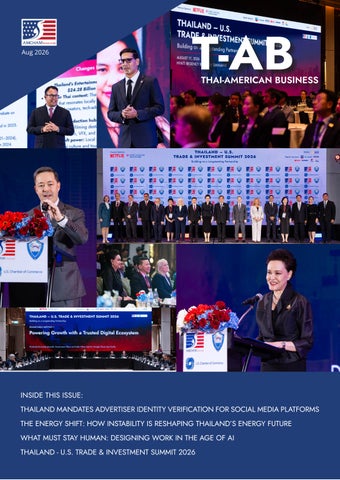
Thailand - U.S. Trade & Investment Summit 2026
44
Mentor Matchup - Connecting Young Professionals with Industry Leaders
45
Coffee and Tariffs
46
AI in Action – Practical Prompts for Business Workflows
47
AMCHAM New Member Brew & Buzz
48
RMA Automotive Factory Tour
INNOVATION 50
Introducing the First Sub-1 Nanometer Node Chip — the Smallest, Most Powerful Chip Technology in the World
MEMBER NEWS 52
Chevron Wins Four Leading Sustainability Awards in Asia
52
Bangkok Patana School Named in Spear’s Schools Index for Sixth Consecutive Year
54
Sindhorn Kempinski Hotel Bangkok Recognized by Tatler Best Thailand
54
Siam Premier Celebrates Its 36th Anniversary with a Refreshed Brand and Renewed Vision
55
The Robot Report Names AutoStore™ Winner of the 2026 RBR50 Robotics Innovation Awards
55
Grant Thornton in Thailand Introduces 24/7 Cyber Incident Response Services
NEW MEMBERS 56
Welcome New Members
DISCOUNT 58
AMCHAM Affinity Program
Letter from the Executive Director Dear Members, AMCHAM BOARD OF GOVERNORS 2026 PRESIDENT Chatit Huayhongtong, Chevron
VICE PRESIDENTS Sondra Sutton Phung, Ford Motor Company Raymond Deidrick, Ingredion Incorporated Norachet Saetang, Seagate Technology Philip Bernard, Western Digital
TREASURER Winnie Wong, Mastercard
SECRETARY Ririnda Tangtatswas, Betagro Group
GOVERNORS Wiyada Srinaganand, 3M Thailand Narumon Chivangkur, Citibank Sasathorn Phaspinyo, FedEx Thailand Anothai Wettayakorn, IBM Thailand Charles Blocker, IC Partners Asama (Prae) Dumrongmongcolgul, Meta Idara Huang, Mondelez International Mark Kuo, Pfizer Thailand
EXECUTIVE DIRECTOR Heidi Gallant T-AB Magazine is a publication by The American Chamber of Commerce in Thailand. 101 True Digital Park, Griffin Building, Level 12A, Unit No.12A-06, Sukhumvit Road, Bangchak, Phra Khanong, Bangkok 10260 Tel: +66 (0)2 119 3350 www.amchamthailand.com Editorial Advisory Board: Heidi Gallant Editors: Varsha Wadhwani Phenphitchaya Chapanon Any opinions expressed in articles in this magazine do not necessarily reflect the views of the Chamber. T-AB Magazine welcomes contributions from AMCHAM members. Articles may be reproduced with acknowledgement, except those taken from other sources.
One of the greatest privileges of AMCHAM’s work is hearing directly from our members and bringing your perspectives into conversations that matter for Thailand’s future. I am grateful for the energy, experience, and generosity that our members continue to share with the AMCHAM community. Your engagement strengthens our collective voice on issues affecting investment, competitiveness, innovation, and the people who power our businesses. This month’s T-AB highlights many of these themes - the future of work in the age of AI, the creative economy, energy transition, and the continued strength of the Thailand–U.S. partnership. These topics are closely connected and remind us that growth is not driven by any single policy, industry, or technology, but by the way business, government, and society work together to create an environment where ideas and investment can thrive. AMCHAM’s advocacy work remains central to this effort. Our councils translate member insights into constructive recommendations for policymakers, while continuing to deepen our engagement with government partners through roundtables, working meetings, and policy discussions. Though investing in the next generation of talent, our ongoing collaboration with the Office of Vocational Education Commission reflects a shared commitment to strengthening Thailand’s workforce by aligning vocational education with industry needs. AMCHAM Thailand Foundation’s scholarship and career development programs support students as they build confidence, skills, and professional networks for the future. August has also been a busy and encouraging month for connections across our community. I always enjoy seeing the conversations that begin at AMCHAM gatherings. I warmly encourage you to stay involved—join a council or committee, attend an upcoming event, share your company’s insights, or reach out to the AMCHAM team with issues that are important to your business. AMCHAM is strongest when members participate.
Sincerely, Heidi Gallant Executive Director
EXCLUSIVE TIER MEMBERS 2026 PLATINUM
GOLD
SILVER
FEATURE
What Must Stay Human: Designing Work in the Age of AI By Katie Watson, WD
AI is moving faster than certainty. As new tools and capabilities emerge almost daily, organizations are racing to keep up—keeping pace requires more than speed—it requires intention. Because the most important question is not what can we automate? It is what must stay human?
This time, it is different. AI can operate independently. It can make decisions and complete tasks without a human directly in the loop. We can no longer assume humans will naturally stay embedded in the process. So, we have to decide, intentionally, where humans belong—where we need judgment, creativity, context, and accountability, and where technology can take the lead.
This is not a technology shift—it is a workforce transformation Many organizations are approaching AI as a technology deployment challenge. However, this moment is fundamentally different from past waves of innovation. In previous transformations— from horses to cars, from books to the internet—technology changed how work was done, but humans remained at the center. Someone still drove the car. Someone still built the webpage. 8
If we do not define that, technology will define it for us.
We are not just implementing new tools. We are designing a deliberate combination of human and technology, where each is doing what it does best. That is workforce transformation. The Real Risk: Purpose Loss While much of the conversation focuses on job disruption, an immediate risk is something less visible: purpose loss. Purpose is what drives engagement, ownership, and performance. It is why people stay, grow, and contribute over time.
Traditional hiring models often prioritize direct experience and linear career paths. In a world where roles are continuously evolving, those signals become less predictive. Instead, we are placing greater emphasis on: •
Learning agility
•
Problem-solving ability
•
Comfort with ambiguity
•
The capacity to evolve alongside technology
At WD, we have seen this firsthand. With a workforce that includes decades of tenure, one thing is clear: people do not stay because work is easy. They stay because it matters—because they feel connected to what they are building.
In a world that keeps changing, what matters most is your ability to adapt, learn, and grow into what comes next. Blending AI and Human Judgment in Hiring
As AI reshapes work, preserving that sense of ownership becomes critical. If technology removes friction but also removes meaning, organizations can weaken. If it elevates human contribution, they can grow stronger. Rethinking Talent for a Constantly Evolving Workforce This shift is not just changing how we work—it is changing how we hire. At WD, we are evolving our approach to talent acquisition around a simple reality: we are no longer hiring for static roles. We are hiring for adaptability.
AI is already transforming how organizations identify and engage talent. It can help surface candidates faster, highlight transferable skills, and reduce friction in the hiring process. There is a clear value in that. It is equally important to define what must remain human: potential, judgment, culture, and connection. Hiring is not just about matching skills to a role. It is about understanding how someone will grow, contribute, and shape the organization over time. It is also about how we welcome them in— connecting them to our culture, our people, and what it truly feels like to be part of WD. That responsibility stays human. 9
FEATURE Building for Continuous Evolution The future of work will not be defined by static roles, it will be defined by continuous evolution. That is why we are investing in learning and development opportunities that prepare employees not just for today’s tools, but for whatever comes next. Our focus is not just on reskilling—it is on building the capacity to adapt.
The future of work is not something that happens to us. It is something we choose to build. It starts with a question: What must stay human?
You cannot redesign tomorrow’s work without developing the people who will perform it. Designing the Future—Intentionally The organizations that succeed in the AI era will not necessarily be the ones that deploy the most technology. They will be the ones that most effectively elevate human potential alongside it. That means defining where humans create the most value, designing systems that support that value, and investing in people so they can evolve with the work.
Katie Watson is Chief Human Resources Officer at WD, leading the company’s global people strategy. With 25+ years of HR leadership, she drives organizational transformation, talent, and culture to enable long-term business success.
Click here to register
INCLUSION COMMITTEE
REDEFINING COMPLIANCE
TURNING WORKPLACE INCLUSION INTO BUSINESS ADVANTAGE
PASSARAN BOONSIRISETH CHIEF HR OFFICER CITIBANK, N.A.
SEPTEMBER 4, 8 - 10 AM TRUE DIGITAL PARK, BOARDROOM
10
MATT MORAN DIRECTOR, ASEAN COMMUNICATIONS & IMG PRODUCT COMMUNICATIONS FORD
PATHANIN SORNCHANGWAT ASSOCIATE TILLEKE & GIBBINS
The drive behind AI AI computes fast, but data compounds faster.
11 © 2026 Western Digital Corporation. All rights reserved.
FEATURE
The Flood and the Filter: Why Mass Content Is Devaluing the Creator Economy and What Thailand’s Businesses Should Do About It By Jacob Holder, The Mobius Agency
The creator economy is one of the most dynamic parts of Thailand’s creative economy and also one of the most misunderstood, because the incentives are quietly breaking it. In Thailand, there are roughly nine million content creators, of which two million are full-time professionals. The creator economy was valued at 45 billion baht last year and continues to grow at an average rate of 25-30% annually. However, volume is not the same as value.
genuinely inform. The content is often hollow, but the numbers look impressive.
When Platforms Pay for Performance
Audiences are not oblivious. Gitnux found that 86% of consumers cite authenticity as a key factor when deciding which brands or creators to support yet authenticity is precisely what the current incentive architecture discourages.
Something significant shifted when major platforms began tying financial reward directly to engagement metrics. X’s Revenue Sharing Programme pays verified creators based on the impressions their posts generate, not their quality, accuracy, or genuine contribution to discourse. TikTok’s Creator Fund rewards views. YouTube pays per ad impression. The mechanic is straightforward: more engagement, more revenue. The result has been predictable. Creators, rational economic actors, optimize for what platforms reward. Feeds are now saturated with engagement bait: inflammatory takes, recycled “hot lists,” manufactured controversy, and threads engineered to trigger the share reflex rather than 12
This is engagement farming, the practice of producing content designed primarily to extract algorithmic reward rather than create genuine value. It is reshaping what the creator economy actually produces at scale. The Trust Deficit Is Already Showing
For brands and businesses, this creates a compound problem. Partnering with high-reach creators feels safe — the numbers are visible; the logic is straightforward. However, reach built on engagement farming often sits on a foundation of passive, disengaged audiences who scroll past branded content without registering it. Impression counts measure exposure. They do not measure trust. Thailand’s Creative Economy at a Crossroads Thailand’s digital and creative sectors have expanded considerably. The country’s digital economy now contributes an estimated 30% of GDP, and the influencer and content creator space has grown rapidly across TikTok, YouTube, and Instagram, where Thai creators have built substantial audiences both domestically and across Southeast Asia.
As the sector matures, the same dynamics playing out globally are taking root locally: content studios producing high volumes of templated material, creator accounts pivoting to whatever format the algorithm currently rewards, and marketing briefs still fixated on reach and engagement rates. All of this reflects the same incentive logic that is eroding content quality everywhere. The businesses that will build lasting positions in Thailand’s creative economy are not those producing the most content. They are those producing the most credible content. The Filter: What Cuts Through The deepest irony of the mass content era is that scarcity has returned — not scarcity of content, but scarcity of trust. In a feed full of noise, genuine expertise, a consistent point of view, and intellectual honesty are meaningful differentiators. For businesses, this has three practical implications. Depth over frequency. A single, well-researched perspective from a credible voice will consistently outperform a content calendar of surface-level posts. Quality compounds; volume depreciates. Creator selection beyond metrics. Engagement rate, follower count, and reach reveal how visible a creator is, not how trusted they are. The tone of comments, the nature of community interaction, and whether followers respond or merely scroll — these qualitative signals matter far more over time. Thought leadership as infrastructure. Brands that invest in genuine expertise — through research, industry commentary, and substantive insight — build an asset that persists beyond any individual campaign. In a market where the algorithm can be gamed, a reputation for substance cannot. The Case for Recalibration
The creator economy deserves better than the incentives currently shaping it. The platforms will continue to refine their monetization models. Creators will continue to adapt. Businesses that thrive will be those that resist equating noise with signal, and that understand the difference between paying for reach and earning trust. Thailand’s creative economy has the talent, the cultural richness, and the regional ambition to become a genuine powerhouse in this space. The question is whether the businesses investing in it will demand the quality that makes that possible or whether they will continue to measure success in impressions while trust quietly walks out the door. Sources Gitnux. Brand Authenticity Statistics. YouTube Official Blog (2024). YouTube by the Numbers. DEPA / NESDC (2024). Thailand Digital Economy and Society Development Plan. Bangkok Post. Thai Content Creators Form Trade Group.
Jacob Holder is Managing Director of The Mobius Agency (TMA). With deep roots in Thailand's marketing and media landscape, Jacob leads a team that works across brand strategy, PR, and creative communications. He is a recognized voice at the intersection of business, culture, and storytelling in Southeast Asia, and is an active contributor to Thailand's creative economy.
13
FEATURE
The Energy Shift: How Instability Is Reshaping Thailand’s Energy Future By Luca Bernardinetti, Mahanakorn Partners Group
Thailand’s energy strategy is entering a new phase. What was once framed primarily as a transition toward cleaner energy is increasingly becoming a broader question of national resilience, cost stability, and supply-chain security. The recent disruption to energy flows through the Strait of Hormuz has exposed the vulnerability of importdependent economies across Asia, including Thailand, where a significant share of crude oil and LNG imports is linked to Middle Eastern supply routes. The International Energy Agency has reported that the crisis removed close to 20% of global LNG supply from the market and triggered sharp price increases across key importing regions.
For Thailand, the implications are structural. Natural gas remains a major fuel source for electricity generation, while crude oil and LNG imports continue to play a central role in the country’s energy system. Krungsri Research estimates that Thailand imports approximately 0.3 million barrels of crude oil per day through the Strait of Hormuz, representing 58% of total crude imports, and approximately 2.2 million tonnes of LNG annually through the same route, equivalent to 24% of total LNG imports. More than 60% of Thailand’s electricity generation also depends on natural gas, making the power sector directly exposed to global gas price volatility.
Figure 2. Estimated Impact on the Thai Economy. Figure 1. Transmission Channels of the Middle East Conflict to the Economy. 14
This exposure is not merely an energy issue; it is also a business, inflation, and competitiveness
issue. Higher LNG and oil prices can feed into electricity tariffs, logistics costs, manufacturing expenses, and downstream pricing. For energyintensive industries, including petrochemicals, plastics, packaging, food processing, data centers, and advanced manufacturing, energy instability increasingly affects investment planning and operating margins. Regional analysis has also noted that LNG is less flexible than crude oil because of terminal compatibility, calorific specifications, and long-term offtake agreements, making rapid supply diversification more difficult during periods of disruption.
A particularly important indicator in this environment is the projected pressure on Singapore Gross Refinery Margins (GRMs), as illustrated in the accompanying chart. Unlike the 2022 Russia–Ukraine crisis—when strong post-pandemic demand and diesel shortages supported refinery profitability—the current environment is unfolding amid weaker global growth and softer energy demand. In a severe escalation scenario, refineries may be forced to purchase replacement crude at significantly higher prices while facing limited ability to pass these costs through to consumers due to slowing economic activity and retail price controls. This could materially compress refinery profitability across the region. The implications extend beyond the refining sector. Thailand’s power sector, which relies heavily on natural gas, remains directly exposed to supply disruptions and LNG price volatility, while downstream industries such as petrochemicals, plastics, packaging, and other energy-intensive sectors could face rising feedstock costs amid weakening demand and declining consumer purchasing power. Over time, this combination may place increasing pressure on industrial profitability, competitiveness, and long-term investment confidence.
Figure 3. Singapore Gross Refinery Margins (GRMs): Base-Case Scenario Impact. Against this backdrop, Thailand’s energy transition is being reframed. Renewable energy, energy efficiency, storage, grid modernization, and distributed generation are no longer only climate-policy instruments; they are becoming strategic tools for reducing exposure to imported fuel volatility. Thailand’s Alternative Energy Development Plan 2018–2037 targets renewable and alternative energy at 30% of final energy consumption by 2037, with renewable electricity generation capacity expected to reach 29,411 MW, including significant solar, biomass, wind, hydropower, and waste-to-energy components. The policy direction is also becoming more ambitious. Draft PDP 2024 discussions have pointed toward increasing the share of renewable power generation to approximately 51% by 2037, although the plan had not been finalized as of early 2026. This signals a clear direction of travel: Thailand is seeking a power mix that is cleaner, more diversified, and less exposed to imported fossil fuel shocks. For investors, this creates a more complex but attractive landscape. Energy projects increasingly sit at the intersection of regulatory policy, infrastructure planning, carbon strategy, industrial competitiveness, and foreign direct investment. Opportunities are likely to expand in utility-scale solar, floating solar, biomass, biogas, waste-to-energy, energy storage, smart grids, private power purchase agreements, and energy-efficiency solutions. Demand from data centers, EV supply chains, advanced manufacturing, and export-oriented industries will further increase the premium on reliable and low-carbon power. 15
FEATURE The legal and commercial implications are significant. Investors will need to assess licensing requirements, BOI promotion eligibility, power purchase structures, land and environmental approvals, grid connection issues, tax incentives, foreign ownership limitations, and long-term offtake arrangements. For industrial operators, energy strategies should also be integrated into broader compliance and risk-management frameworks, particularly where electricity cost volatility affects pricing, ESG commitments, or customer requirements under global supply-chain standards. Thailand’s energy shift should therefore be understood as both a defensive and an offensive strategy. Defensively, it reduces vulnerability to geopolitical shocks, fuel-price volatility, and maritime chokepoint disruption. Offensively, it positions Thailand to attract the next wave of investment in clean industry, digital infrastructure, sustainable manufacturing, and regional supplychain relocation. In this new environment, energy policy is no longer separate from industrial policy. Countries that can provide reliable, affordable, and increasingly clean
energy will be better positioned to attract capital, support exporters, and build resilient growth. For Thailand, the current instability may accelerate a necessary transition: from energy dependence toward energy resilience.
Luca Bernardinetti is the Chairman and Managing Partner of Mahanakorn Partners Group (MPG), where he leads the firm’s Banking & Finance practice. He advises multinational corporations, financial institutions, and sovereign clients on sophisticated legal and financial transactions across ASEAN.
Click here to register
HUMAN CAPITAL COMMITTEE
BEYOND THE BASICS
REDEFINING BENEFITS AS A WINNING STRATEGY
THIRA LAULATHAPHOL
Principal, Career Products Leader Mercer (Thailand)
SEPTEMBER 8, 10 AM - 12 PM TRUE DIGITAL PARK, CLASSROOM 7
16
17
SPECIAL FEATURE
Freedom 250: Celebrating Partnership and Looking Ahead By U.S. Embassy Bangkok
As America’s year-long Freedom 250 celebration continues, the U.S. Mission to Thailand is working with partners across the country to showcase American innovation, strengthen U.S.–Thai ties, and create new opportunities for collaboration. The Mission recently celebrated the United States’ 250th birthday alongside American and Thai friends at the Freedom 250 reception. We were honored to welcome Prime Minister Anutin Charnvirakul, government leaders and business leaders like you, and our partners whose participation reflected the enduring strength of the U.S.–Thai partnership. Freedom 250 has brought together partners from the public and private sectors across Thailand. Organizations such as the Bangkok Metropolitan Administration (BMA), Chao Phraya Express Boat, ONYX Hospitality Group, and Plan B Media have each contributed to the celebration in different ways. A nationwide communications campaign across digital screens, public transit, and MuvMi vehicles has further expanded Freedom 250’s reach, bringing stories of American innovation and leadership to audiences across Thailand. The Fourth celebration also featured the American Spectacular concert, presented in partnership with 18
the Thailand Philharmonic Orchestra at Prince Mahidol Hall, Mahidol University. Looking ahead, American Fairs in Hat Yai, Korat, Chiang Mai, and Bangkok in September and October create more opportunities to showcase American innovation, education, culture, and business. For more details, event updates, and how to be a partner please visit https://th.usembassy. gov/freedom-250/.
Drone Show at Freedom 250 Reception, Building light up at Bangkok City Hall, Freedom 250 wrap on Chao Phraya Express Boat and MuvMi Tuk-tuk, Freedom 250 wrap on BTS Sky Train
19
IN FOCUS
Shaping the Future of the Creative Economy: Innovation, Leadership, and Policy Nattabhorn Buamahakul is the Managing Partner and Co-Founder of Vero Advocacy. What qualities are most critical for navigating industries where creativity, technology, and policy intersect?
“The most important quality is bilingualism, not in the literal sense, but the ability to translate fluently between two very different worlds.” The most important quality is bilingualism, not in the literal sense, but the ability to translate fluently between two very different worlds. Creative and technology industries move fast and constantly in terms of user experience and product cycles. Policymakers, by contrast, think in terms of precedent, public interest, and risk. Leaders who can operate at this intersection need to genuinely understand both logics, not just negotiate between them.
tell quickly when an industry position is selfserving versus genuinely aimed at a workable outcome, and that credibility, once lost, is very hard to rebuild. Equally critical is patience paired with urgency. Policy timelines rarely match business timelines, and leaders who try to force alignment usually create friction instead of progress. The ones who succeed are those who can hold a long-term advocacy position steady over months or years, while still responding to near-term regulatory and market shifts as they arise. From my experiences, intellectual honesty matters too. Regulators can 20
As AI and digital technologies reshape the creative economy, what should industry leaders prioritize to remain competitive while fostering innovation? I would point to three priorities. First, get ahead of the definitional questions. A great deal of AI policy globally is being written right now around what counts as “creative work,” what counts as
“authorship,” and how value should be attributed when human and machine contributions blend together. Industries that engage early in shaping these definitions will have far more influence than those who wait for the definitions to be imposed on them. Second, invest in interoperability and standards, not just proprietary advantages. Fragmented approaches to data, IP, and content provenance slow down entire sectors and invite heavierhanded regulation. Third, and most importantly, put people first through workforce transition. The creative economy runs on individual practitioners as much as institutions, and leaders who ignore how AI is reshaping livelihoods for illustrators, musicians, writers, and performers will find it much harder to build public and political goodwill for their broader innovation agenda. Underlying all of this, it is worth remembering that AI is ultimately a tool. A lot of AI policy energy would be better spent on a simpler question: does a given use of it help people think more sharply, or does it make us collectively duller? Keeping that test in view tends to cut through much of the noise.
than commercial pressure.That distinction shapes how seriously regulators engage. It also helps enormously to bring evidence rather than assertions. Economic contribution studies, comparative regional case studies, and concrete examples of unintended consequences from poorly calibrated policy elsewhere all carry far more weight than statements of concern. Finally, sustained relationships matter more than moment-specific campaigns. The industry's voices that are heard consistently are the ones that show up in policy conversations long before there is a crisis, not just when a bill is already moving through parliament. What strategic actions will be most important to strengthen the creative economy over the next decade?
“Know your audience like a business, not just an artist.” I would want to see creative businesses treating themselves as commercial infrastructure, not a subsidized category waiting for government support. Three things matter most: Know your audience like a business, not just an artist. The creative businesses that scale understand exactly who consumes their work, where, and how it monetizes regional licensing patterns, streaming behavior, which markets pay for IP versus which just consume it. That market intelligence, built in-house, moves faster than waiting on a grant or export program.
What is the most effective approach to ensure that creative industry voices are heard in policy discussions? Coalition-building beats solo advocacy almost every time, particularly in a market like Thailand where policymakers are wary of being seen to favor any single company. When creative industry voices show up as a coordinated coalition spanning content creators, platforms, agencies, and cultural institutions with a shared, well-researched position, it reads as public interest advocacy rather
Stop treating "creative" as its own silo. The highest growth opportunities sit at the intersection — creative work embedded into tourism, retail, product design, and hospitality. A studio's real upside might be licensing its IP into a hotel brand or a product line, not just its next production. Creators who partner early with adjacent industries capture value that pure content plays miss. Set your own standards before someone else does. Licensing terms, content provenance, AI attribution - these are being decided now, either 21
IN FOCUS by the industry or by regulators reacting later. Studios and creator collectives that build clear norms early end up shaping the eventual rules instead of just complying with them, and it signals trust to the international partners deciding who to license from. The government's best role is removing friction — market access, IP enforcement, infrastructure — not steering what gets made. That is not something the sector should wait for. The businesses that treat the next decade as theirs to build, rather than theirs to be granted, are the ones that define it. What advice would you offer to young professionals who aspire to become leaders in the creative economy? As a public policy consultant, I would like to suggest that we should learn to read policy the way you would read about a market trend — as something with signals, cycles, and early indicators, not something that appears fully formed and finished. Too many talented creative and business professionals treat policy as background noise until it directly affects them, by which point the window to shape it constructively has often closed.
22
I would also encourage young professionals to build fluency across disciplines early, some grounding in law, economics, or public policy alongside creative or technical training pays off disproportionately over a career. Do not underestimate the value of relationships built outside our immediate professional bubble. Some of the most useful policy insight I have gained over the years has come from conversations with people well outside my own sector, simply because they saw the same problem from a completely different angle.
“We should learn to read policy the way you would read about a market trend — as something with signals, cycles, and early indicators.”
We Power Progress Driving Change. Delivering Impacts.
Vero Advocacy is a regional-native advisory specializing in government relations and public policy advocacy, with offices in Bangkok, Hanoi, and Kuala Lumpur. Our mission is to help clients achieve their goals while contributing to meaningful, long-lasting impact across society. Research and Intelligence Strategic Advisory Advocacy and Stakeholder Engagement One-Stop-Shop Policy Communications Experience
23
LEGAL UPDATE
Thailand Mandates Advertiser Identity Verification for Social Media Platforms By Athistha (Nop) Chitranukroh, Thammapas Chanpanich, Rada Lamsam, Karnravee Jitvilai, Tilleke & Gibbins
Thailand has introduced new requirements for online social media platforms to verify the identity of paying advertisers before publishing their advertisements. On May 5, 2026, the Electronic Transactions Commission published the Notification on Measures for Prevention of Technology Crime for Online Social Media (No. 2) in the Government Gazette. The notification, which aims to prevent technology crimes such as fraud and scams, takes effect 180 days after publication (i.e., on November 1, 2026). Mandatory Advertiser Identity Verification Online social media service providers must verify the identity of every advertiser before publishing an advertisement. Verification remains valid for up to one year from the most recent verification date. The notification requires social media providers to use either of the following methods when verifying advertisers: • 24
Document-based verification: Examine government-issued identity documents (for
example, national ID, passport, or juristic person registration certificate), cross-check the connection between the advertiser and the identity documents (for example, facial comparison with photo ID), and ensure that the identity documents are verifiable against reliable sources. •
Digital identity verification: Use an identity verification system with a level of assurance no lower than that prescribed by the Electronic Transactions Commission.
Advertiser Data Collection and Retention
Service providers must collect and retain certain data—including name, identification number, and contact details—from the start of the advertising service and for a minimum of 90 days after the end of the advertising service relationship. The same requirements apply where there is a third-party payer, such as an ad agency. Implications for Affected Businesses The notification raises two key areas of concern for affected businesses: •
Social media platforms must implement know-your-advertiser (KYA) onboarding as described above, including document upload and identity matching processes. The 180-day implementation window requires immediate technical and operational planning.
•
The collection and retention of national ID cards, passport copies, and other personal data triggers data protection obligations under Thailand’s Personal Data Protection Act, including requirements for lawful basis, purpose limitation, data security, and data subject rights. Platforms storing verification data outside Thailand must ensure adequate safeguards for international transfers of sensitive personal data.
Online platforms should assess whether they fall within the scope of “online social media service provider” and identify which categories of their advertisers are subject to the identity verification requirements. Affected platforms should evaluate their current advertiser verification capabilities, identify compliance gaps, and begin designing technical solutions and operational processes to meet the November 2026 effective date.
Nop Chitranukroh is a partner and director of Tilleke & Gibbins’ corporate and commercial group in Bangkok. She is widely recognized for her expertise in technology law in Southeast Asia.
Thammapas Chanpanich is a senior associate at Tilleke & Gibbins and is a key member of the firm’s technology industry group.
Rada Lamsam is an associate at Tilleke & Gibbins, where she advises companies on various technology and digital asset matters in Thailand.
Karnravee Jitvilai is an associate at Tilleke & Gibbins. She assists companies with a range of data protection, technology, and corporate matters.
25
LEGAL UPDATE
Thailand: Draft Act to Regulate Collective Rights Management Issued By Nont Horayangura, Yada Viseswongsa, and Pakaimas Wongwiwatwaitaya, Baker McKenzie
Thailand’s Department of Intellectual Property (DIP) has undertaken public consultations on the Draft Act on Collective Management Organizations for the Use of Copyright and Performers’ Rights B.E. ... (Draft Act). The Draft Act aims to address long standing deficiencies in Thailand’s music licensing and collective rights management system, including unclear licensing processes, duplicate or fraudulent royalty claims, and limited transparency. The Draft Act would introduce statutory roles, stronger oversight of collective management organizations (CMOs) and agents, and enhance protections for both rights holders and users. It would mark a significant step toward reforming Thailand’s copyright licensing framework while signaling renewed regulatory focus on the music sector.
for copyrighted works due to the absence of a centralized framework governing royalty collection. On the other hand, rights holders have encountered difficulties arising from unclear licensing structures and a lack of transparency in royalty collection and distribution.
In More Detail
Key Elements of the Draft Act
Under the current regime, users often face challenges navigating licensing procedures and identifying the relevant rights holders
•
26
On April 20, 2026, the DIP opened a second round of public consultations on the Draft Act as part of the Ministry of Commerce’s broader efforts to strengthen governance, transparency, and accountability in collective rights management. The Draft Act would introduce a licensing framework applicable to copyright operators, CMOs, agents, and users, supported by defined mechanisms for regulatory oversight, enforcement, and dispute resolution.
Regulated uses: The Draft Act would apply to specific categories of works and uses relating to both copyright and performers’ rights,
which will be further prescribed by Ministerial Regulations. Although the Draft Act does not yet specify the types of works covered, music-related works will be the initial focus of regulation. •
Licensing requirements: Copyright operators and CMOs engaged in royalty collection would need to obtain the required license and comply with regulatory requirements. Regulatory violations might result in license revocation, while unlicensed operations might attract administrative and criminal penalties.
•
Transparency obligations: Mandatory public disclosure of royalty rates, licensing terms, and royalty distribution methods, together with ongoing reporting to the DIP.
•
Extended Collective Licensing (ECL) system: The Draft Act proposes an ECL framework allowing authorized CMOs to grant licenses on behalf of both members and non-members. Non-member rightsholders would be treated the same as members in terms of licensing conditions, payment, and transparency, unless they agree otherwise.
•
Agent oversight: Sales agents would be required to notify competent officers of their activities, and litigation agents would be required to register before undertaking enforcement actions.
•
Committees and regulatory oversight: Matters relating to royalty collection under the Draft Act would be supervised by competent officials and a supervisory committee. Competent officials would play a key role in compliance and enforcement, including reviewing relevant documentation and issuing orders, written warnings, prohibition orders, and administrative penalties. In parallel, the supervisory committee would be empowered to adjudicate disputes concerning the collection and allocation of royalties.
•
Transitional provisions: Existing operators would be granted a 120-day transitional period from the date the relevant Ministerial Regulations come into force to apply for the
required licenses or registrations. During this transitional period, such operators would be permitted to continue their business operations without incurring any liability under the legislation. Impact on Stakeholders
In light of the proposed regulatory framework, the Draft Act is expected to have the following practical impacts on key stakeholder groups: Copyright Operators & CMOs For copyright operators and CMOs, the Draft Act would require a compliance uplift if enacted. Copyright operators and CMOs would be required to obtain a license from the DIP. Enhanced licensing, reporting, and governance obligations would be expected. At the same time, greater transparency and standardized practices are anticipated to strengthen market credibility and foster increased trust in the royalty collection system. Rightsholders The Draft Act is expected to provide rights holders with greater transparency and clearer visibility into how royalties are calculated, collected, and distributed. It would also strengthen participation through enhanced governance rights and a more active role for members within CMOs. In addition, the introduction of ECL frameworks may broaden access to royalty streams, including for non-members. However, rightsholders with the capacity to license directly may need to consider strategic trade-offs between maintaining independent control and benefiting from the efficiencies of collective management. 27
LEGAL UPDATE Users For users, including businesses and event organizers, the Draft Act would aim to provide greater certainty in the licensing process by clarifying the appropriate licensing entities, applicable royalty rates, and payment obligations. This is expected to reduce legal and commercial risks, including duplicate royalty claims, fraudulent demands, and unauthorized enforcement actions. Although collective or blanket licensing may simplify compliance, users may also need to consider its potential impact on pricing flexibility and overall licensing costs.
That said, the Draft Act currently adopts a broad approach in regulating copyright, raising important questions regarding its application. While it is anticipated that music-related works will be the initial focus, subject to the issuance of future Ministerial Regulations, it remains unclear whether, and to what extent, other creative sectors such as film, publishing and the visual arts will be subject to the same licensing framework and enforcement regime.
Key Takeaways and Outlook The Draft Act represents a significant step toward establishing a more transparent, efficient, and reliable collective management framework in Thailand. If enacted, it is expected to materially reshape Thailand’s royalty collection framework by strengthening compliance standards while enhancing transparency, user protection, and regulatory certainty.
Nont Horayangura is Head of Baker McKenzie’s Intellectual Property Practice Group in Bangkok. He advises multinational and local businesses on intellectual property, data privacy, technology commercialization, regulatory compliance, and emerging technologies, including artificial intelligence.
Yada Viseswongsa is a Senior Associate in Baker McKenzie’s Intellectual Property Practice Group in Bangkok. She focuses on intellectual property advisory and enforcement, digital media and copyright matters, data privacy, and advising technology companies on digital platform services.
Pakaimas Wongwiwatwaitaya is an Associate in Baker McKenzie's Intellectual Property Practice Group in Bangkok. She advises multinational and domestic clients on intellectual property strategy, brand protection, commercialization, enforcement, and disputes involving trademarks, copyright, patents, and trade secrets.
28
WHA : SHAPE THE FUTURE FOR THAILAND Discover Asia's Leading Industrial Destination
Trusted by 1,000+ Multinationals for Innovative and Sustainable Solutions
www.wha-group.com +66 (0) 2 719 9555
marketing@wha-group.com 29
SPECIAL UPDATE
A Letter from the Government Affairs Desk Dear Members, Behind every new growth opportunity is a policy framework that could either unlock momentum or hold it back. Over the past month, AMCHAM’s Councils submitted four advocacy letters. While the letters represent different sectors, they include one clear message: Thailand’s future competitiveness will depend on how effectively policy enables investment, innovation, collaboration, and creativity. The Healthcare Council Position Paper aims to advance a vision for Thailand to become a regional leader in healthy longevity and innovation-driven healthcare. It recommends improving access to innovative treatments, expanding the use of realworld evidence, and alternative financing models, while strengthening integrated medical and wellness services. The Recommendation Letter on the Draft Climate Change Act supports Thailand’s low-carbon transition and advocates for a clearer roadmap on carbon pricing, renewable energy procurement, grid modernization, carbon removals, and private sector consultation. The Recommendation Letter on Food and Beverage Marketing Affecting Children’s Health supports the Government’s public health objective to protect children’s health. It recommends clearer definitions, proportionate restrictions, and structured consultation with affected sectors. The White Paper on Creative Economy explores how Thailand can turn its cultural strengths, production capabilities, digital talent, and global appeal into lasting economic value. The creative economy is more than entertainment. Film, music, gaming, digital content, advertising, and tourismlinked services are now increasingly connected. Thailand has an opportunity to position itself not only as a destination for creativity, but as a 30
regional hub where ideas, investment, talent, and technology come together. International productions and globally distributed Thai content can bring investment into local communities, create skilled jobs, support SMEs, and generate demand across hospitality, logistics, post-production, and advertising. To build on this momentum, the white paper recommends competitive production incentives, faster permit approvals, stronger intellectual property protection, co-production opportunities, and responsible AI adoption. With several regulatory developments on the horizon, AMCHAM’s Councils will continue to understand concerns and translate business insights into constructive recommendations for policymakers. Napuck (Mai) Cherdchaiyapong Government Affairs Manager
AMCHAM Member-Get-Member We would like to say Thank You for growing our community! For every new member referred, AMCHAM would like to thank you with one 9,600-baht voucher redeemable for a eparture Carry-On uggage (The Original S – Matte Navy or Matte Champagne)
Scan QR code or contact membership@amchamthailand.com for more details. Terms & Conditions Apply.
31
GOVERNMENT ENGAGEMENT
AMCHAM Thailand Participates in AAP Washington Doorknock 2026 AMCHAM Thailand Executive Director Heidi Gallant attended the AmChams of Asia Pacific (AAP) Washington Doorknock from June 21–24 to strengthen U.S.–Thailand trade and investment ties. The annual advocacy mission provides an opportunity to engage with U.S. administration officials, congressional staff, leading think tanks, and policy experts to discuss key issues related to trade, investment, and regional economic priorities. It also serves as a platform to share insights on how U.S. legislation and policy decisions affect American business operating in Thailand.
32
Roundtable Meeting with Finance Vice Minister, Dr. Santitarn Sathirathai
On July 20, Philip Bernard, AMCHAM Vice President and Senior Vice President of Western Digital, led a delegation of AMCHAM Platinum members in a meeting with Dr. Santitarn Sathirathai, Vice Minister of Finance, and senior officials from the Ministry of Finance. The meeting provided a constructive exchange of views, during which Vice Minister Santitarn outlined the government’s priorities under the 5Ts framework: Targeting, Transition, Transformation, Transparency, and Together. AMCHAM welcomed the government’s commitment to public-private collaboration and initiatives such as FastPass, which facilitate investment and enhance Thailand’s competitiveness. AMCHAM reaffirmed its commitment to supporting policy dialogue and contributing thought leadership on fiscal measures that advance sustainable growth and economic transformation. 33
GOVERNMENT ENGAGEMENT
Meeting with Thailand Trade Representative Nongnuth Phetcharatana On July 24, AMCHAM Executive Director Heidi Gallant met with Thailand Trade Representative Ms. Nongnuth Phetcharatana to exchange views on the long-standing and mutually beneficial trade relationship between Thailand and the United States. Both parties discussed opportunities to further strengthen economic ties by promoting greater trade, investment, and business collaboration between the two countries. The discussion also explored potential areas of cooperation to enhance Thailand–U.S. relations beyond commerce, particularly in education and investment. The meeting reaffirmed the importance of continued collaboration between public and private sector stakeholders in advancing bilateral relations and creating new opportunities for growth and innovation between the two countries.
34
Working Meeting with the Office of Vocational Education Commission (OVEC) On July 31, AMCHAM Executive Director Heidi Gallant and the AMCHAM team met with Rangsan Thepmondhri, Director of the Public Sector Development Division, and OVEC officials to discuss a proposed Memorandum of Understanding (MOU) between AMCHAM and OVEC. The discussion focused on potential activities such as advancing the development of vocational curricula, students, and teachers through AMCHAM member companies' initiatives. Both parties also discussed plans for the MOU signing ceremony and the coordination under the partnership. The collaboration reflects the shared commitment of AMCHAM and the AMCHAM Thailand Foundation (ATF) to strengthening Thailand's vocational workforce by partnering with vocational institutions and OVEC to meet evolving industry demands.
35
GOVERNMENT ENGAGEMENT
Government Affairs Council: August 2026 Video Conference On August 11, The AMCHAM Government Affairs Council hosted a session featuring Dr. Arnunchanog Sakondhavat, Acting Senior Advisor at the National Economic and Social Development Council (NESDC), who shared an overview of Thailand’s draft 14th National Economic and Social Development Plan. Dr. Arunchanog covered the Plan’s five key pillars: sustainable economic growth, public sector reform, human capital development, environmental sustainability, and technology and innovation. He also welcomed AMCHAM’s feedback as the draft Plan continues to develop. The meeting was followed by discussions on advocacy initiatives on emerging government regulations and policies.
36
Forward Five F I V E I D EA S F O R TH A I L A ND T O I N CR E A S E FOR EII G N D I R E C T IN RE I N V E S TM T M E NT NT
Accelerate Simplified Inclusive Public Services and Procedures
Facilitate International Trade
Streamline Digital Regulations to Foster Innovation Improve Access to Labor and Implement Workforce Upskilling Incentives Enhance Green Initiatives for Sustainable Growth
37
IN THE SPOTLIGHT Apinat (Obb) Siricharoenjit is the Managing Partner/Line Producer of Living Films and serves as an AMCHAM Creative Economy Council Co-Chair. As a Co-Chair, how has this experience shaped your perspective on public-private collaboration in Thailand's film industry? This experience has proven that we are no longer starting from zero—the government already has promising policies, incentives, and frameworks in motion to support the industry. However, the real challenge lies in sustainability and execution continuity. In creative industries, policy cannot change every time there is a shift in leadership or administration. True public-private collaboration happens when the state does not just launch short-term initiatives, but commits to maintaining long-term, institutional support. The private sector brings market speed and creative innovation, while the public sector provides the legal safety net, infrastructure, and international diplomatic backing. What are the Council's top priorities this year to strengthen Thailand's film and creative content industry? The immediate priority is strengthening the domestic industry by making the ecosystem work better. Thailand already has talented creators and strong production capabilities, but the industry remains fragmented, with different sectors often operating in isolation. As a cross-industry engine, the creative content industry and the other industries are inherently interconnected. Strengthening these connections is essential to unlocking the industry's full potential. Rather than focusing on new initiatives alone, the emphasis should be on strengthening the policies that support the industry, identifying where the system is not serving creators or businesses effectively, and closing those gaps. A stronger policy framework creates greater certainty, encourages investment, improves access to opportunities, and ensures that growth benefits businesses of all sizes. How do you see emerging technologies transforming the way intellectual property (IP) is created and commercialized in the creative economy? Emerging technologies, especially Generative AI, are a double-edged sword, and we need to stop being naive about it. Let me be clear: AI must remain a tool in the creator’s hand, never a replacement for human soul, craft, and vision. Technology should streamline workflows, reduce production friction, and lower the barrier to entry for grand creative ideas. However, it must never erode human artistry or exploit original work. The biggest threat right now is technological exploitation, global platforms, and technology monopolies scraping local culture, art, and IP to train their models without compensation or consent. We must fiercely protect our IP and establish strict ethical and legal boundaries. We want Thailand to leap forward into the digital future, but we will not allow technology to strip our local artists of their livelihood or their rights. We embrace innovation to empower our creators, not to replace them. 38
28
th
Sept 5-Oct 17, 2026
39
FOUNDATION
Meet Kanjanapon (Gift) Thurisut Growing up in Nong Khai and raised by her grandparents, Kanjanapon (Gift) Thurisut learned resilience, responsibility, and determination from an early age. Through the AMCHAM Thailand Scholarship, she discovered not only financial support, but also confidence, career readiness, and the courage to shape her future - one meaningful step at a time.
“Through workshops on interview skills, LinkedIn, resume writing, and mock interviews, I gradually became more prepared for the professional world.”
Raised by my grandparents in Nong Khai, I grew up learning the values of responsibility, attention to detail, and always doing my best. As the oldest sister in the family, I naturally took on a caregiving role from a young age. My family consists of my mother, my younger sister, and me. My mother is a single parent and the sole provider for our family. She has always worked tirelessly to give us opportunities she never had and to help us escape the cycle of poverty she once experienced herself. Because of her sacrifices, I recently graduated with a Bachelor’s degree in English. Growing up, I understood that my family needed financial support. Around that time, information about the AMCHAM Thailand Scholarship was shared in my department’s group chat. At first, I thought the scholarship would help ease my mother’s financial burden. However, AMCHAM Thailand Scholarship gave me much more than financial assistance. My journey with AMCHAM Thailand Foundation (ATF) began at the AMCHAM Scholarship Orientation Camp, where I learned not only about career paths, but also valuable life attitudes and perspectives. One of the most unexpected yet memorable workshops was CPR training—I never imagined I would earn a certification from it. 40
Before graduating from the scholarship program, I also participated in the AMCHAM Career Camp. To be honest, I still had no clear idea about my future career at that time. Through workshops on interview skills, LinkedIn, resume writing, and mock interviews, I gradually became more prepared for the professional world. Although these activities did not directly lead me to my dream job, they equipped me with practical skills and confidence that continue to benefit me today. I learned how to build a resume, answer interview questions effectively, transform experiences into transferable skills, and tell my story in an engaging way. From being one of many scholarship applicants to becoming an AMCHAM scholar, ATF became a light at the end of the tunnel for me. It not only helped support my family financially but also encouraged me to become a better version of myself—in both mindset and life perspective. Finally, I hope my story can inspire others. I believe that success does not always begin with a big dream. Sometimes, it begins with simply trying to make each day meaningful. Small steps, taken consistently, can shape your future.
AMCHAM THAILAND FOUNDATION (ATF) ABOUT US Education has been a core value for AMCHAM since the very beginning of the Chamber. Over the last three decades, AMCHAM has provided over 3,200 scholarships and supported over 890 primary schools.
In 2004, AMCHAM formally registered the American Chamber of Commerce in Thailand Foundation (ATF) to carry out its charitable activities. The ATF is recognized by the Ministry of finance as a Public Charitable Organization (number 632) and donations are deductible in Thailand.
AMCHAM FOUNDATION SCHOLARSHIP PROGRAM Each year ATF enables disadvantaged Thai university and vocational students to complete their higher education studies through targeted scholarships. Our Community Engagement Council works directly with universities and vocational colleges to identify hard-working and motivated students enrolled in programs championed by AMCHAM member companies.
HOW YOU CAN SUPPORT THESE PROGRAMS Sponsor university scholarship. Provide speakers and goodie bag items for Orientation/Career Camp. Join the Community Projects Council.
For further information, contact foundation@amchamthailand.com. 41
AMCHAM HIGHLIGHT
Thailand-U.S. Trade & Investment Summit 2026 Brings Together U.S. Investors and Thai Leaders to Advance Trade and Investment
Against the backdrop of more than two centuries of Thailand-U.S. partnership, business and government leaders gathered at the Thailand-U.S. Trade & Investment Summit 2026 to turn longstanding ties into new opportunities for trade, investment, and innovation. The Summit set a forward-looking agenda for shared economic growth, bringing together voices from both countries to explore where collaboration can deliver the greatest impact. U.S. Ambassador to Thailand, Sean O’Neill, opened with a message on the power of U.S.-Thai cooperation. He highlighted the role of U.S. and Thai companies in driving investment, jobs, and growth across both markets. In her keynote address, Deputy Prime Minister and Minister of Commerce Suphajee Suthumpun positioned Thailand as a committed partner in a fast-changing regional economy. She also pointed to the Royal Thai Government’s focus on infrastructure, skills, innovation, and a transparent business environment, alongside more than 19 billion U.S. dollars in Thai investment in the United States. That focus carried into the Summit program, including the 9-9-9 Flash Briefing, where nine industry leaders shared nine market insights in nine minutes each. The fast-paced session highlighted emerging trends and opportunities across the Thailand-U.S. business landscape. The Thailand Trade Representative, Nongnuth Phetcharatana, framed Thailand’s role in this evolving landscape. Industry leaders from Citibank, Minor International, the Thai Pet Food Trade Association, AWS, Black & Veatch, SCG, Organon, and Netflix added perspectives on economic opportunities, tourism, agribusiness, the digital economy, sustainability, energy, healthcare, and the creative economy. Ruben Hattari, Netflix’s Director of Global Affairs for Southeast Asia, stated, “Thailand’s creative economy is one of the country’s strongest growth stories, contributing over 8% of GDP and supporting nearly a million 42
jobs. Netflix has been proud to be part of that story, investing 200 million U.S. dollars in Thai content from 2021 to 2024 and helping Thai stories reach hundreds of millions of viewing hours worldwide. We see real opportunity ahead as Thailand continues to build and expand the ecosystem infrastructure, incentives and skills that encourage Thai creators to bring more incredible stories to audiences around the world.” Mo Yasin, Country Lead from Organon shared, “Thailand’s sustained investment in healthcare sends a powerful message that health is a strategic priority and a foundation for future prosperity. By continuing to invest in preventive care and women’s health, Thailand can strengthen its workforce, support economic resilience, and advance its Medical and Wellness Hub ambitions,” The Summit closed with a clear message: in a time of global uncertainty, dialogue alone is not enough. Thai and U.S. leaders must translate shared priorities into practical opportunities for companies to invest, innovate, and grow across both markets.
43
EVENT Young Professionals Committee
Mentor Matchup - Connecting Young Professionals with Industry Leaders – Jun 23 Speakers: Wiyada Srinaganand of 3M; Papop Chaowanapreecha of Accenture Song; Winnie Wong of Mastercard; Axel Winter of Siam Piwat; and Suruswadee Jaimsuwan of Tilleke & Gibbins Organized by: Young Professionals Committee Event Highlights: The AMCHAM Young Professionals Committee hosted an interactive event that allowed young professionals to receive exclusive mentorship from executives and industry leaders across a wide range of industries. The participants had the opportunity to engage in intimate small-group discussions designed to spark new perspectives, meaningful connections, and practical career insights from mentors with remarkable career paths.
44
Customs & Excise Council
Coffee and Tariffs – Jul 16 Speakers: John Patrick Leonard of Kim & Chang and Paul Sumner of PricewaterhouseCoopers ABAS Organized by: Customs & Excise Council Event Highlights: The AMCHAM Customs and Excise Council hosted an in-person session on the U.S. trade and customs landscape. Discussions focused on the June 3 Executive Order, “Strengthening Customs Enforcement,” and the modernized Importer of Record (IOR) framework, highlighting traders’ Reasonable Care compliance obligations. The session explored how well-prepared companies can strengthen their competitive position with U.S. Customs and Border Protection and build long-term resilience in the U.S. market. Held ahead of the July 24 deadline for current tariff measures affecting Thailand, the session gave members an opportunity to exchange views on the outlook for U.S. tariffs, upcoming trade restrictions, and the anticipated scope of Section 301 measures.
45
EVENT Digital Innovation & Enablement Committee
AI in Action – Practical Prompts for Business Workflows – Aug 3 Speakers: Tee Vachiramon and Randy McGraw of Sertis Organized by: Digital Innovation & Enablement Committee Event Highlights: The AMCHAM Digital Innovation & Enablement Committee hosted a session on using artificial intelligence in everyday business workflows. The speakers introduced several AI tools and explained how they support different types of work. They also covered techniques for writing effective prompts and improving AI-generated responses. Three volunteer representatives presented workplace challenges from the manufacturing, marketing and public relations, and legal sectors. Using these real-world scenarios, the speakers demonstrated how refining prompts can produce greater accuracy and relevant AI-generated responses. Participants also explored practical workplace applications of AI through an interactive discussion with the speakers.
46
AMCHAM Signature Event
AMCHAM New Member Brew & Buzz – Aug 4 Event Highlights: AMCHAM recently hosted a Brew & Buzz coffee morning to welcome new members in a warm and delightful atmosphere. The event brought attendees together to connect with fellow professionals, expand their networks, and engage with business executives from various industries across Thailand. AMCHAM Council and Committee Co-Chairs also welcomed the new members, introduced opportunities for engagement, and fostered involvement in AMCHAM activities aligned with their interests.
47
EVENT Advanced Manufacturing Committee
RMA Automotive Factory Tour – Aug 7 Organized by: Advanced Manufacturing Committee Event Highlights: The AMCHAM Advanced Manufacturing Committee led an exclusive factory tour of RMA Automotive. Attendees were welcomed with an insightful introduction to the company’s operations before touring the facility. Participants explored the vehicle assembly and production processes, learned about RMA Automotive’s engineering, and engaged with the factory team throughout the visit.
48
FORD EVEREST PLATINUM
Including Ford Care Program
5-Year or 150,000 km Factory Warranty (whichever comes first)
49
INNOVATION
Introducing the First Sub-1 Nanometer Node Chip — the Smallest, Most Powerful Chip Technology in the World By IBM
It is the world’s first 0.7-nanometer chip technology. Powered by IBM’s new nanostack architecture, this innovation paves the way for more powerful and efficient chips for years to come. This is the architecture that will accelerate the angstrom era. When you boil down the last century of advances in computing, you are left with something that almost feels closer to alchemy. We learned to shoot lightning through sand until it could do math. Over the decades, we learned to purify the silicon in that sand and turn it into transistors. Since then, the computers they power have revolutionized every facet of our lives. So much of modern life is powered by these infinitesimally small silicon devices, which we have continually managed to shrink in size. The first transistor fit in the palm of your hand. Today, the phone in your pocket contains tens of billions of transistors in its central processor alone. As computing has advanced, so has the demand for computing power. AI and quantum computing are advancing at breakneck speed, forcing us to ask new questions about the devices we use. 50
That is why IBM is unveiling the smallest, most powerful computer chip technology in the world. These are the first sub-1 nanometer node chips, designed with transistor nodes that are just 0.7 nanometer, or 7-angstroms, wide. The team at IBM achieved this through breakthroughs in wafer bonding, SRAM scaling, and channel material innovation.
A TEM, or Transmission Electron Microscope, image of a single node in the 7a new chip architecture. To put this minuscule size into perspective, a human red blood cell is about 7,000 nanometers
wide, roughly 10,000 times larger than one of these new nodes. A 7-angstrom chip, the size of a fingernail, contains approximately 100 billion transistors. It is the first time in history that anyone has been able to pack so many transistors into such a small space.
autonomous machines that can do more on their own to monitoring devices that would have to be recharged far less frequently.
These new IBM sub-1 nanometer chips are either 70% more energy efficient or 50% more powerful than the 2-nanometer node chips IBM unveiled in 2021. Before today, those chips still remained the smallest process-node chips in the world.
The new 7-angstrom design is the result of years of research at IBM. Back in 2015, IBM Research unveiled the nanosheet, a new chip architecture that researchers believed would form the foundation of chip designs for years to come. That prediction proved accurate with the introduction of 3 nanometers, and eventually 2 nanometers, nodes.
The potential for 7-angstrom devices is enormous, particularly with AI. Today’s leading AI accelerators can produce about 1,500 TOPS (trillions of operations per second), and IBM researchers estimate that one using 7-angstrom technology could deliver roughly six times more, or around 9,000 TOPS. If 7-angstrom chips were used to train today’s frontier-model LLMs, they could reduce a typical training time from around three months to just a couple of weeks. These are just revolutions based on the technologies we use today. These 7-angstrom devices could unlock innovations that we have not imagined yet. Any task that would benefit from considerably more processing power or energyefficient chips could be on the table — from future
Nanostack: A New Architecture for Tomorrow’s Chips
There are still many years of evolution with nanosheet ahead. It will be closer to the end of the decade before we see widescale adoption of 2-nanometer devices, which will be followed by 1.4-nanometer and 1-nanometer devices after that. We see a path forward in which the Nanostack architecture could power multiple generations of transformative computing devices. This is the architecture that will accelerate the Angstrom era. The potential for the future of computing and the world is immense. Problems that seem intractable today could become routine for future computers built on this architecture.
AFFINITY PROGRAM Member-to-member Discounts
Amplify your brand's visibility through AMCHAM's Affinity Program by offering Member-to-Member discounts on your products and services. Contact membership@amchamthailand.com www.amchamthailand.com
51
MEMBER NEWS
Chevron Wins Four Leading Sustainability Awards in Asia energy company committed to balancing business growth with environmental stewardship and social responsibility. Held under the theme “AI, Energy & Transition: Resetting ESG in a New Economy,” the event brought together regional leaders to exchange perspectives on energy innovation, economic transformation, and environmental sustainability. Chevron Thailand Exploration and Production, Ltd. received four awards at the 18th Annual Global CSR & ESG Summit and Awards 2026, reflecting regional recognition for excellence in sustainability and corporate governance. The company received two Platinum awards for Best CEO and CSR & ESG Leadership, a Gold award for Best Community Program, and a Silver award for Best Environmental Excellence. The recognition highlights Chevron’s leadership as an
Chatit Huayhongtong, President of Chevron Thailand, said, “For more than 60 years in Thailand, Chevron has remained committed to protecting the environment, enabling human progress and leading with integrity at every stage to deliver safe, reliable and ever-cleaner energy. Receiving recognition from the Global CSR & ESG Summit and Awards reinforces our focus on continuously improving performance and delivering tangible outcomes for the economy, communities, and the environment, while supporting a more secure energy future for Thailand and the region.”
Bangkok Patana School Named in Spear’s Schools Index for Sixth Consecutive Year the Index draws on insights from a panel of international educational specialists and does not require schools to participate through advertising or paid inclusion.
For the sixth consecutive year, Bangkok Patana School has been included in the Spear’s Schools Index—a global guide to the world’s 100 leading private schools. Compiled independently, 52
This consistent recognition highlights Bangkok Patana’s strong academic, pastoral, and cocurricular offering, and its standing within the international education landscape. Bangkok Patana School is the only school in Thailand to have been included in the Spear’s Index for the past six years. This recognition comes as Bangkok Patana School approaches its 70-year anniversary in the next academic year.
The brightest minds help illuminate the way forward Pushing new ideas to solve energy challenges is progress at work. At Chevron, we’re applying technology in innovative ways to explore what’s possible. This includes developing cutting-edge software to analyze data more effectively, as well as partnering with universities and research institutions to help pioneer new solutions. All to fuel innovation that helps us meet the world's energy demands now and for many years to come. Learn more at Chevron.com CHEVRON, the CHEVRON Hallmark and THE HUMAN ENERGY COMPANY are registered trademarks of Chevron Intellectual Property L.L.C. © 2026 Chevron U.S.A. Inc.
53
MEMBER NEWS
Sindhorn Kempinski Hotel Bangkok Recognized by Tatler Best Thailand Sindhorn Kempinski Hotel Bangkok has received two prestigious accolades, recognizing excellence in hospitality: •
Tatler Best 20 Hotels in Thailand: Sindhorn Kempinski Hotel Bangkok
•
Tatler Best 20 Bars in Thailand: Firefly Bar
Thaddaeus Weiss, General Manager of Sindhorn Kempinski Hotel Bangkok, said, "This recognition is a true testament to our colleague’s relentless dedication in crafting exceptional guest experiences. It fills all of us at Sindhorn Kempinski with immense joy as we continue to lead in luxury hospitality."
Tatler Best Thailand 2026 celebrates outstanding achievements in the hotel, restaurant, and bar industries. Recipients of Tatler Best Thailand 2026 are also eligible for nomination at the regional Tatler Best of Asia awards later this year. Distinguished by its unique selection and comprehensive overview of Asia’s food and hospitality scene, the awards highlight the region’s commitment to excellence in tourism and service.
Siam Premier Celebrates Its 36th Anniversary with a Refreshed Brand and Renewed Vision Siam Premier celebrates its 36th anniversary, marking a new chapter of growth that builds on its legacy while reaffirming the values, commitments, and trusted relationships that have defined the firm since its inception in 1990. Siam Premier recently unveiled its refreshed brand. While the firm's name remains unchanged, it has introduced a new website and a revitalized visual identity that reflects who it is today and where it is headed. The refreshed brand embodies the pride, integrity, and excellence that have contributed to Siam Premier’s reputation as one of Thailand's leading and respected law firms. It reinforces the 54
connection between the firm’s people, its marketleading practices, and the diverse clients it serves, including multinational and domestic corporations, institutional clients, government agencies, and state enterprises. This brand refresh also reflects Siam Premier’s continued dedication to delivering high-quality legal services, practical solutions, and trusted counsel as clients navigate an increasingly dynamic and complex business environment.
The Robot Report Names AutoStore™ Winner of the 2026 RBR50 Robotics Innovation Awards AutoStore™ for extending its proven cube-based automation platform into agriculture, helping enable a new model for high-density, autonomous crop production that addresses persistent challenges in food supply chains.
AutoStore™ has won a 2026 RBR50 Robotics Innovation Award for its work on Opollo Farm, the world’s first vertical farm operated entirely by robots. The RBR50 Robotics Innovation Awards honors organizations leading the global robotics ecosystem with new technologies, business models, and use cases. The award recognizes
Opollo Farm adapts AutoStore™’s storage and retrieval technology to the movement and care of living plants instead of SKU-based picking. The system uses robots to precisely control airflow, irrigation, nutrient delivery, and lighting, while reducing manual handling throughout the production process. Parth Joshi, Chief Product Officer at AutoStore™ said, “This RBR50 recognition is a testament to what happens when a truly integrated platform meets a bold, unconventional use case, and we see tremendous opportunity ahead to bring that same innovation to problems the industry has not yet imagined.”
Grant Thornton in Thailand Introduces 24/7 Cyber Incident Response Services to the company’s global network of more than 950 cyber specialists
Grant Thornton Thailand introduces its Cyber Incident Response (IR) to help businesses respond to cyber incidents. The service provides 24/7 incident response support, with response times within 30 minutes, initiating investigations within four hours, and providing on-site support in Thailand within 24 hours where required. Support is delivered by the local team with access
The services cover three key areas: Digital Forensics and Incident Response, Managed Security Services, and Cyber Advisory and Assessment. These capabilities include investigating and containing cyber incidents, supporting recovery efforts, and strengthening long-term cyber resilience. The team works alongside businesses to prepare for evolving cyber threats.
55
NEW MEMBERS
Welcome New Members CORPORATE MEMBERS A global leader in warehouse automation, the company develops robotic storage and retrieval systems that improve efficiency, optimize space utilization, and order fulfillment. Its intelligent hardware and software solutions support industries including retail, e-commerce, logistics, and healthcare. With a manufacturing and operations facility in Rayong, it serves customers across Asia-Pacific region and beyond, helping businesses enhance productivity, scalability, and supply chain performance through advanced automation. With nearly four decades of experience, the firm provides strategic legal counsel to businesses, investors, and individuals across Thailand and Southeast Asia. Its expertise spans corporate and commercial law, intellectual property, employment, litigation, taxation, and technology. Supported by strong international networks, they deliver practical, cross-border legal solutions tailored to clients' commercial objectives.
Founded in 2013, the company is a global logistics and supply chain technology provider transforming international trade through a connected digital platform. Its integrated solutions combine freight forwarding, customs brokerage, fulfillment, and financial services with advanced AI to improve visibility, reduce costs, and enhance supply chain efficiency. Supporting businesses across Asia and beyond, the company enables seamless cross-border trade and helps organizations navigate increasingly complex global markets. Operating in more than 160 countries, the company is a leading global logistics and supply chain provider offering integrated freight forwarding, contract logistics, distribution, and supply chain solutions across diverse industries. Its advanced digital capabilities and local expertise help businesses improve supply chain efficiency, resilience, and sustainability while strengthening regional connectivity and enabling seamless global trade.
A global admissions consulting firm helping students gain acceptance to top universities through personalized guidance from former admissions officers, graduate coaches, and industry experts. Their holistic approach combines academic, extracurricular, and personal development with proprietary tools and tailored mentoring. With over a decade of experience, they have helped thousands of students achieve exceptional admissions outcomes at leading institutions worldwide. 56
August 2026 Headquartered in the United States, the company is a global provider of calibration, inspection, and testing services with more than 50 years of expertise. Through a network of ISO/IEC 17025-accredited laboratories, it delivers calibration, compliance testing, equipment repair, and asset management solutions. Its services help organizations maintain equipment accuracy, improve productivity, minimize downtime, and meet stringent quality and regulatory requirements across industries. The company is developing one of Thailand's largest mixed-use lifestyle communities, integrating residential, wellness, sports, education, and recreational facilities within a single destination. The project features luxury residences, a championship golf course, equestrian and cycling facilities, green spaces, and the KIS International School campus. Designed for both local and international residents, it promotes sustainable, balanced living while reflecting the growing demand for integrated lifestyle communities. Established in 1997, the company is a global leader in the lithium-ion battery industry, providing innovative energy solutions for electric vehicles and energy storage. Its expansion into Thailand strengthens their presence in Southeast Asia, enabling them to better serve regional demand while enhancing manufacturing capabilities and supply chain resilience. This investment supports the global energy transition and reinforces their long-term commitment to sustainable growth. Headquartered in the United States, the company is a global safety science organization with more than 125 years of experience in safety, quality, and sustainability. It provides independent testing, inspection, certification, and advisory services across diverse industries. Its expertise in sustainability, ESG, supply chain assurance, and product certification helps organizations meet international standards, improve environmental performance, and build trust in global markets.
Corporate Membership is available to all companies registered in Thailand. If you are interested in joining AMCHAM Community, please contact us at membership@amchamthailand.com.
57
AFFINITY PROGRAM
AMCHAM Member-To-Member Offers
Exc lusive Pr ef e r e nti a l Ra t e s for V is a & Wo rk Per m i t Ad mini s tr a ti v e Se r v ice s f ro m A d e cc o Co n su lt i ng
E xcl u s iv e U p t o 1 5% D i sc ou n t on D i n in g , S p a & L i f e st yl e Pr i v i l e g e s
Es c a p e t o P a ra d i s e wi th an Ex cl us iv e AM C H A M D a y P as s a t A va n i + Kh a o L a k R es ort
10% Disco unt on Foo d and No n-Al co ho l ic Beverag es
S peci al Privileges up t o 20% off fro m Ba ngkok Hospit al
E n j oy a R e l a xi n g E s ca p e a t C a p el l a Ba n g k ok wi t h a n E x cl u si v e 1 5% S a v i n g on W e ek d a y a n d W e e k en d Ra t e
20% O ff P r em i u m T a l e n t S o l u t i o n & Ult ra F ast 7 T a l e nt S o l u t io n
AM C HA M Me mber Ad v ant a ge: 1 5 % Trainin g Discou nt , F ree Co nsu lting & Priority Worksh op s
Ex cl usi ve 15% di sco unt on al l R ege n er at iv e & R ecov er y Tr ea tme nt s
P rem i u m U n iv e r si ty A d mi s si on s S u pp o r t Pa c ka g e
E n j o y 10 % D in i ng P r i vi l eg e s f o r A M CH A M M e m b er s
D ay P a s s & St a y P ri v ile ge s a t L e Mé ri d ie n P hu ke t B e a c h R e s or t
E xc l us i v e U p to 5 0 % D is c o u nt at t h e D i n i n g & B e a c h C l u b
B uy 4 Shi rt s Ge t 1 Co m pli me n tar y S hirt
58
E xc lu s iv e 30 % Disc ou n t a t th e ON Y X A f f ilia ted H o tels
S Ho tel s & Re s o r t s T ha i l a n d R e s i d e n t s R a t e Sp ec ia l
Ex clusi ve 1 5% di sc ount fr om STA R LUX Air line s
10% Disc ou nt on Me dicine & I n-House La b ( OPD & IPD ) & ICU a nd CC U R ooms 2 0% Disco u nt on Room Ra te ( IPD )
S p e c i a l 1 , 5 0 0 TH B D i s c o u n t f o r F er t il it y C h e c k - u p f o r A M CH A M M e m be r s
1 5% D i sc o u n t F o od an d B e ve r a ge fo r A M C H A M M e mb e r s !
Re ce i ve a Su i te o f P r em i u m B en e fi t s a t t h e W o r l d ’s F i n es t P ro pe rt i es f or A M C H A M M em be r s
15% Discount O n S h o rt - a n d L o n g -T e r m S t o r a g e S e r v ic e s In S a n t a F e R e lo c a t i o n S t o r a g e
E njoy 1 5 % A ' La r C ar te Di sh es, an d B e ve rag e
E n j o y e x c l u s i ve eye c a re p r iv i le g es wi th d is c o u n t s u p t o T H B 5 , 0 0 0 f or A MC H A M m em b er s
Jo i n u s ! fo r M emb e r- To - Me m be r Off e r s , a gre at o p po r tu n i ty to a mp l i fy y ou r b r a n d v i s i bi lit y. F u l l R egi st r at i on Fe e Wa ive r & 1 0% T ui ti o n Di s co un t a t X CL A SB Su kh um vi t f o r AMC HAM M e mb er s
Members must present AMCHAM member card to receive promotions or discounts. If you have not received your member card, please contact the AMCHAM office. For more information please visit www.amchamthailand.com. 59
AMPLIFY YOUR VOICE WITH AMCHAM!
Seeking Member Content AMCHAM is always seeking member submissions for the Thai-American Business (T-AB) magazine as well as the AMCHAM website.
Subject Guidelines Check with our communications team to learn about the theme for our next issue. AMCHAM also looks for legal and regulatory developments, knowledge sharing, and best practices.
Submission Guidelines An article is shared in an editable format. Supporting graphics are encouraged. Feature, Legal Update, and Interview: 800-1,000 words Member News: 150-180 words
Thought Leadership Articles should be on topics of general interest with original research or analysis. Articles should not be self-promotional or be company member news.
Connect with Members Authors are frequently approached regarding their expertise. Be sure to include an author headshot and a short biography (20-30 words) with article submissions.
Get in Touch For submissions and inquiries regarding thought pieces or marketing opportunities, do not hesitate to get in touch with the AMCHAM communication team at comm@amchamthailand.com