
REMUMERATION
What you need to know
Whatyou need to know
Remuneration comprises several components. They can be categorised as:
• Ordinary time earnings;
• Overtime;
• Allowances and Penalties;
• Superannuation; and
• Salary Packaging.
What are ordinary time earnings?
This is the amount you are paid for your ordinary hours of work. For a full time employee this will be 38 hours per week.
What are the current rates for ordinary time earnings?
Ordinary time earnings effective 1st July 2022
What is overtime?
Overtime is a payment made for the hours you work that are in excess of your ordinary hours.
At what rate is overtime paid?
Overtime is paid at time and a half (150%) of your ordinary hourly rate for the first two hours and then double time (200%) thereafter. However, all overtime worked on a Sunday is paid at double time (200%). Annual Fortnight Week Hour Intern $73,086.00 $2,801.36 $1,400.69 $36.86 1st Year Resident $85,668.00 $3,283.65 $1,641.82 $43.21 2nd Year Resident $94,244.00 $3,611.60 $1,805.80 $47.52 3rd Year Resident $106,717.00 $4,090.45 $2,045.23 $54.82 4th Year Resident $115,855.00 $4,440.71 $2,220.36 $58.43
Whatyou need to know
COMMENT
Overtime consists of rostered and unrostered overtime. Hospitals often don’t like paying unrostered overtime. However, don’t be fooled if a supervisor says, “the last registrar did all of this within 38 hours, why are you claiming overtime?” or “discharge summaries are prepared in your time not ours”. Remind them that you are in a training position, work diligently and by claiming these entitlements, it will make it easier for the hospital to undertake workforce planning.
What is a penalty rate and how much will I be paid?
If your ordinary hours are rostered at ‘unsociable times’ you are entitled to be paid a penalty rate on top of your ordinary time earnings such as hours worked between:
(i) 6.00 p.m. and midnight, Monday to Friday (+12.5% per hour)
(ii) Midnight and 7.00 a.m., midnight Sunday to midnight Friday (+25% per hour)
(iii) Midnight Friday and midnight Saturday (+50% per hour)
(iv) Midnight Saturday and midnight Sunday (+75% per hour)
What is an allowance?
This is a separate payment for you to undertake a particular activity or for agreeing to do specific things.
What allowances are available?
• Higher Duties Allowance
When you are acting in a more senior role.
• In Charge Allowance
When you are the in-charge medical officer for after-hours medial services.
• Higher Medical Qualification Allowance for Medical Officers who obtain an appropriate higher medical qualification subject to graduation.
• Meal Allowance
If you were authorised to work overtime and were not notified on, or prior to your previous shift of this requirement, you will be paid an allowance or will be provided with adequate meals in lieu of payments.
• On Call Allowance
When you remain available after leaving work to take calls and return to work.
- When you are on call and are recalled to the hospital outside your rostered hours – you will be paid for all time worked at the appropriate overtime rate, with a minimum of four hours at such rates.
Whatyou need to know
- Remote Clinical Appraisal - When on call and providing advice remotely (i.e. over the telephone), you will be paid for this work at the appropriate overtime rate, with a minimum payment of one hour at such rates.
• Uniform allowance
If you are required to wear a uniform and are not provided with a uniform that is laundered then a uniform allowance is payable.
• Kilometer allowance
When you are required to travel to another location for work.
• Travelling allowance
If you are seconded to another hospital you may be granted a daily travel allowance at the rate of the difference between the cost of travel by public transport to your normal place of employment and travel by public transport to the seconding hospital.
If you drive your own vehicle, you may be eligible for a mileage allowance, for the difference between the distance to your normal place of employment and the distance to the seconding hospital.
• Rotating to regional/rural locations
Doctors-in-training (other than interns) on rotation to one of the rural locations listed in Part C of the Medical Officers Award [same link], have their salary increased by one incremental step for the period they work at that hospital during the rotation.
• Rotating to metropolitan locations
Doctors-in-training (other than interns) rotating from their regional/rural hospital to a metropolitan hospital are entitled to the same allowance (paid via increment) as their colleagues rotating to regional/rural locations. A copy of the applicable Determination can be found here.
What is Superannuation?
Superannuation is a payment made by your employer on top of your ordinary time earnings placed into your nominated superannuation fund. The current superannuation guarantee is 9.5%.
What is Salary Packaging?
Salary packaging is a way for you to increase your take home pay by paying for approved personal expenses using your gross salary.
If you have any questions with regards to the information contained in this document or related to renumeration, please contact our Workplace Relations team on 9439 8822 or via workplace@amansw.com.au
Salary packaging allows you to use up to $9,009 of your pre-tax income each year towards an approved expense. This reduces your taxable income and therefore the amount of tax you pay.
Should I opt to Salary Package?
Prior to signing any salary packaging agreement, you are advised to obtain independent financial advice relevant to your particular circumstances. Click here to view HealthShare’s information on Salary Packaging.
AMA (NSW) DIT PAY GUIDE
The AMA (NSW) Doctors-in-Training Pay Guide aims to help you better understand what you should be paid and why. There is no denying it, your payslips are complicated! Who has the time to navigate the Award and check if you’re being paid correctly? We do. Click here to find out more.
1 Employee and payslip detailsEmployment information, dates of payment and the pay period.
2 Summary of earnings this payTotal earnings and deductions for this pay period.
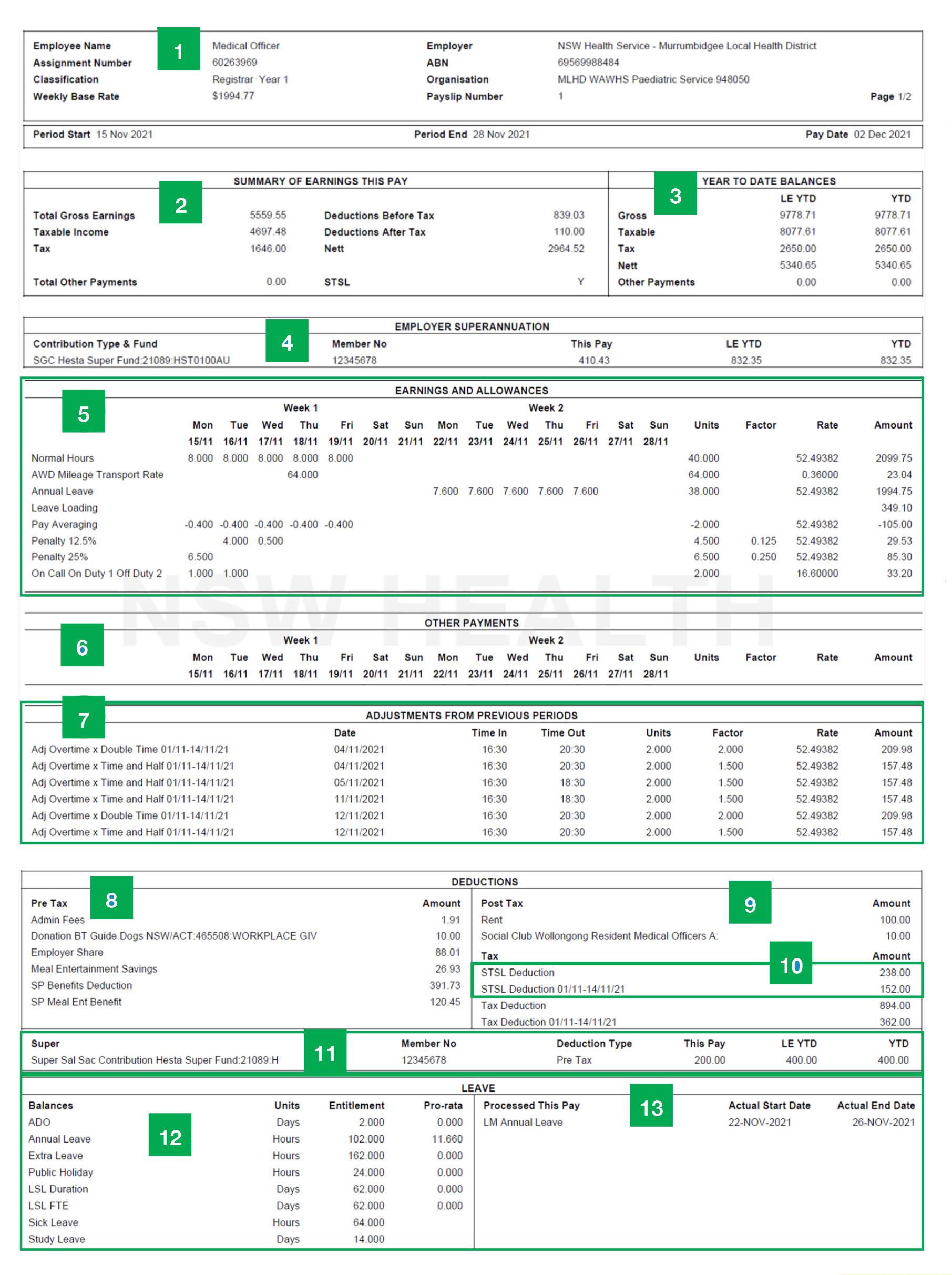
3 Year to date balances - Earnings and deductions year to date.
4 Employer SuperannuationYour super account details and the Superannuation Guarantee contributions.
5 Earnings and Allowances - Daily breakdown of your earnings and allowances for the pay period.

6 Other Payments - Payments outside earnings listed above. May include non-taxable allowances
7 Adjustments from Previous Periods - Changes made (additions or deductions) relating to previous pay periods.
8 Deductions – Pre Tax - Salary packaging, salary sacrifice etc
9 Deductions – Post TaxCharities, membership fees, regular payments etc.
10 Deductions – Tax - Tax, additional withholding tax where applicable, study or training loans etc
11 Deductions – Personal Super Contributions - Any additional super payments you make.
12 Leave – Balances - Leave balances to date.
13 Leave – Processed this PayAny leave taken within this pay period
AMA (NSW) DOCTORS-IN-TRAINING PAY GUIDE
MARCH 2022
The information included in this document was collated citing the Public Hospital Medical Officers (State) Award 2021, the Health Professional and Medical Salaries (State) Award 2021, and the NSW Health Policy Directive PD2019_027 - Employment Arrangements for Medical Officers in the NSW Public Health Service.
Australian Medical Association (NSW) Limited
AMA House, Level 6, 69 Christie St, St Leonards NSW 2065, Australia
PO Box 121 St Leonards NSW 1590 ABN 81 000 001 614
Phone: 02 9439 8822 or 1800 813 423 from outside of Sydney.
Fax: 02 9438 3760 or 1300 889 017 from outside of Sydney.
www.amansw.com.au
Workplace relations: workplace@amansw.com.au
Membership: members@amansw.com.au