

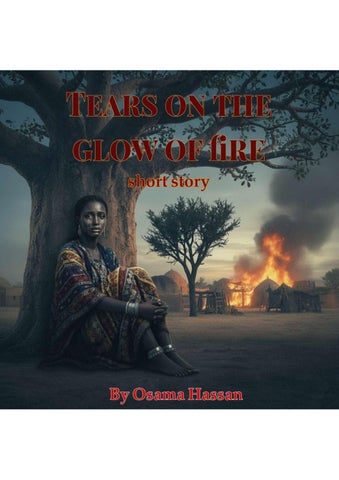
My mother was snatched by a fever when I was only three. I never saw my father; he was killed before my eyes ever opened to the world. He was returning from the city market, thirty miles north of our village, carrying a handful of pounds – the price of three sheep – when bandits ambushed him. He resisted, and they cut him down. My father died, and with him, my mother’s dreams.
I heard the story of my father's death from the lips of my uncles and my grandmother, etched deep into their memories. They were, by nature, vessels of unwritten history – of events, stories, and moments. My mother’s grief for my father was one of those tales. Four years passed, and the fever consumed my mother’s frail body. One rainy day, they carried her away. She cast a glance back at me and never returned. "May God protect you, my child," she whispered, the words torn from her depths, finished with great difficulty. I remember her pale face, her tear-filled eyes. At that day, I barely understood the reality of death, life, separation, sorrow, or pain. My world was simple, confined to the village and the playground. I thought the world ended at the baobab, sidr, and heglig trees on the village's edge, and that the sun rose only for us to wake and set for us to sleep, without any other of God's creatures.
My grandmother took care of me, giving me more than she gave my peers. Her features are still etched in my mind: thin legs, a cloth tied around her waist, a pierced nose adorned with a silver nose-ring, an anklet jingling with every step she took towards the kitchen or the sheep pen. Her habit was to wake early, light the fire, and carry a gourd bowl, its sides intricately etched with irregular burned patterns. The children's clamor filled the air. Sheikh Musa’s hermitage, the village market, where they called out their local produce: millet, corn, nabak, lalob, butter, chickens, milk, carefully woven baskets from doum palm fronds by wizened hands, acacia wood and fuel, local perfumes.
I turned five, and my grandmother departed in silence, leaving a vast emptiness in my life. My young aunt, not my father’s full sister, took me to her home. All the houses were of the same style: thatched roofs, curved branches, and an oval shape. The standards of women’s beauty were beads, anklets, and nose-rings. Their garments were quite similar, not so loose as to reveal every feature of a girl, or highlight the beauty of her breasts and waist.
I reached thirteen, and the signs of my beauty began to emerge clearly. We hadn't heard of something called adolescence, but we sensed physical changes occurring and a yearning to secretly chat with boys, unnoticed by others. My childhood friends and I would talk and spend evenings together, and we’d be terrified by talk of the wedding night, the "Dukhla," due to the exaggerations of those who had experienced it before us – girls close to our age. Yet, at the same time, they would
praise the pleasure after the Dukhla and the sweetness of conception and childbirth. The matter was mixed up in our minds, difficult to interpret. Nayla, Mansour’s second wife, would come at sunset to my aunt’s house to prepare herself for her husband. My eyes would not sleep from thinking and staying awake, making me hear their muffled screams and cooing. I later realized it was something inevitable, a passing tradition for the continuation of life, for procreation, and the fuel of love – the fetus within, unspoken of, forbidden in prevailing custom.
The marriage of girls in our societies, from a legal perspective, involved minors. The customs of the wedding night were strange, to the point of being rejected by a sane mind. The boys would build a house somewhat distant from the village. The bride would be paraded from her home before sunset. The procession would crawl slowly until midnight, with folk songs describing the girl's beauty from her toenails to the strands of her hair. We would compete to show our beauty, letting our hair loose, swaying right and left. The boys raced to prove their masculinity, their backs dripping with blood from the lashings of whips. "Concentrate, and his blood sprinkles me," was the song that ignited the boys' enthusiasm, making them compete and push their way into the center of the circle. The groom was crowned with silk and a crescent, and the scent of perfumes emanated from his body.
I remember the wedding day of Saroura, a fourteen-year-old, to her cousin. The procession would recede, leaving the groom's and bride's sisters in a nearby spot, where they would continue singing. The night was still, silent except for Saroura's terrifying screams and the trills of joy from the attendees. It was an event that instilled fear in the soul, and at the same time, awe and desire. Something deep within us pushed us to go through the experience and move to a new stage. My friends and I often pondered this matter, giving it much space in our evening talks, examining our bodies, caring for our beauty, and secretly looking at our boys' muscular bodies. We would go out with them to farm, burying millet and corn seeds in preparation for the rains, and chat with them in a playful manner, whispering among ourselves, evaluating their virility and manhood. The next morning, we carried breakfast dishes to visit Saroura, as was our custom on the second day of a wedding. We found her exhausted. The groom, as expected, had left early to join his friends for breakfast, consisting of grilled meat, honey, porridge, and butter. We eagerly awaited to talk to her about the first night, and she was shy to speak of it. Then, under our insistence, she said with difficulty, "It was like a knife." We laughed, and she burst into tears.
In our customs, a wife reveres her husband and hides her love, never declaring it openly, whether he is rich or poor. He has the right to marry two, three, or four women without objection from his wife or her family. Life is simple, without the costs of restaurants, elaborate clothing, or grand housing. The houses are similar, close, and face each other to such an extent that you can hear couples' quarrels
and their marital secrets. You can see, in broad daylight, some women betraying their husbands, and drunks staggering in the streets.
One morning, my uncle Abdul Hamid came and called my name. I answered him and called him "Aboy Abdul Hamid" – that's how we address our uncles and maternal uncles. "Hulaywa," they called me instead of Halima. "Hamad, my son, said he wants you." He paused for a moment. "What do you think?" "Whatever you see fit, Aboy." My aunt’s voice from inside: "The girl has a say." A mix of joy and sadness welled within me. I went into the room and threw myself onto a mat bed. I cried and cried, then sat on the edge of the bed, examining my body as if seeing it for the first time. My friends arrived when they heard the news of my engagement. From that moment, Hamad filled my thoughts. The harvest season, the wedding date. "Hamad is desired by all the girls in the village," the women of the village would say. I would meet him at my uncle's house, creating excuses, just as he did. Tall, handsome, muscular, dark-eyed, simple, and a man of few words, yet brave –bravery being a commendable trait in all aspects of social life. My dreams began to grow and expand, and Hamad grew in my eyes. Whenever I saw him, I felt something irresistibly drawing me towards him, something in my diaphragm, a deep gasp of longing. That's how my life transformed. Life moved on; the days counted down, and the harvest season was approaching. I looked at my body and its contours, sometimes finding myself a complete woman, other times a child not yet fourteen. "Hulaywa" was the sweetest melody Hamad called me, while my aunt and uncles called me Halima. The simple wedding preparations began with buying some utensils from my friends, aunts, maternal aunts, and the women of the village. My friends and I, inseparable since childhood, would stay up with me. Hamad was my whole thought, my entire world. My friends and I would consult with those who had experience, taking their advice: his drink, his food, his comfort, keep the house clean, don’t let him see you dressed poorly, your incense, your henna. Then they would whisper and laugh about intimate matters.
One morning, as was the custom of agricultural movement, the young men carried their harvest hoes along with their sheep. The women spread their local produce on the village paths under the rawakeb (shelters): baskets, butter, nabak, baobab.
A clamor filled the horizons. People ran everywhere. Warning shouts mixed with the screams of terrified women and children.
I froze in my place, then craned my neck out of the kitchen to see what was happening. Sounds of heavily armed vehicles shook the ground. Masked figures on their mud- and leaf-stained horses carried instruments of death, firing bullets everywhere. People fell. Houses burned. The smell of fear and death filled the streets. People ran everywhere, their lives crushed under the wheels. No one knew where they came from. We had heard of villages utterly annihilated, their women taken captive, and their remaining possessions looted as spoils. I used to think these were exaggerations, scare tactics. Racist insults and abuses poured from
their mouths like bullets from their rifles. Their faces were covered except for their eyes. They spread death and terror everywhere. Houses burned. They tossed children into the air, competing to shoot them, laughing. We didn't know who they were, or why they were killing us.
In the opposite street, everything was burning. The screams and wails of women mixed with the terror and cries of children, a terror born from the intensity of the flames, the fire, and the rising smoke. Their voices were like thunder, and their shapes, with hair leaping through their ears like devils' heads. I squeezed myself into a pile of dry straw and covered myself. Then their sounds faded, and they took what they took of cattle, women, and money. They set fire to what remained of the houses. I looked out and found my aunt's wife drowned in her own blood, struck in the head when she tried to jump over the fence to take shelter in her neighbor's house. I rushed out, running, my breath coming in gasps, until I reached the baobab tree that had witnessed my childhood playground and my friends. Some women who had survived the massacre were running everywhere. We didn't know who was killed and who remained alive. We walked all night until morning broke.
Cars with foreign letters on their doors arrived and took us to the Camp of Wailing. All the women wailed, lamented, and threw dust on their heads. They distributed a meal that tasted like bitter gourd, and we drank water, too exhausted to mind the taste. A foreign woman moved among the women, a desperate attempt to calm their terror. The camp resembled a ghost town, devoid of life. In the middle of the night, I would hear a woman's sobbing, a child's cry, or an old man's delirium, asking for forgiveness then sobbing in a hoarse voice.
Some young men came carrying papers, registering names, followed by a woman who looked at us with pity. Three months passed, and news reached us of so-andso's death. I later learned that Hamad had leaped onto one of the horses and plunged his knife into the back of its rider. The other man swiftly shot him, the bullet piercing his chest. I cried and cried until I fainted. I was sitting in a tent with a woman and her child whom I knew; she used to sell local butter near Daldoum's canteen.
She told me that Haj Daldoum had burned to death trying to save his children and his twenty-year-old wife, who was the most beautiful woman, though he was an old man. She was the talk of the young men and women, who spoke of her marriage to an old man. But she saw in this marriage a humanitarian purpose after the death of her aunt, Ghabsha, Daldoum’s first wife and his cousin, from a snakebite near the heglig tree. The herbalists’ attempts to neutralize the venom failed, and she surrendered her soul.
The aggressors took her as spoils, along with nine other women and underage girls. Some of their bodies were later found in the forest, gnawed by nocturnal creatures. I settled in this camp like the rest of the women and children.
Sometimes, visitors, calling themselves "the Committee," would come, carrying papers and pens, followed by foreign-looking men and women with yellowish hair and long noses, carrying devices. We would sometimes hear sounds of conversations in a language we didn't understand. From time to time, they would distribute meals whose taste we couldn't distinguish.
The young men of the Committee looked at our pale faces, our sorrows etched on our features, and our emaciated, exhausted bodies. Our eyes had not tasted sleep, and even if drowsiness briefly subdued us, worries and nightmares would startle us awake. One night intensified my sorrow and pain, and it was the end of my dreams and the dreams of every girl who lived in the displacement camp. When two masked young men entered our section and our tent, my aunt, as I loved to call her, tried to stop them and succeeded. Then I asked her, "Does this always happen here? Do they raid the girls' tents?" She answered, "Yes," and that some girls had become pregnant from such acts. I felt my heart almost ripped from its place by this deed. I thought of escaping, but to where? I couldn't return to my village to see the destruction and fire, and my buried memories. I couldn't bear to see Hamad's phantom moving through the village paths, or my aunt and the scene of blood and the screams of children amidst the fire, or the pile of straw I hid behind. I didn't want the echo of horses' hooves searching for survivors to take as captives, or the sound of the masked men and their hateful racist words to reach my ears. At the same time, I feared the consequences of staying in the camp, where there was no security or safety. Worries, suspicions, and tragedy turned my life into hell.
In the middle of the night, a woman's scream echoed from inside one of the tents. We rushed towards the sound, terrified, thinking it was an attack by masked men. Two women were trying to cut the cloth from the top of the tent pole, and the light was dim; we could barely make out what was happening, but it was too late. She had breathed her last, with an unknown father's fetus within her. A group of people gathered – children, women, and youngsters – in the dark of night and the dim lights. I glimpsed my uncle Yaqoub's face; he wasn't in his usual attire, nor was his cheerful face present. I ran to him, hugged him, and cried. He cried too until I lost consciousness. Then I came to in a large tent, surrounded by a foreign doctor –whom we called "the Hakim" – and nurses who resembled nuns in a monastery. My vision was blurry, and my head felt as if it had been torn from my body. Things around me were indistinct; I couldn't make them out. Sounds reached me as if I were in a deep, bottomless pit. The doctor called my uncle Yaqoub and whispered in his ear. I looked at my uncle Yaqoub, his face buried in his hands. Days later, I found myself in the "Bander," as we called it – a new page in my history. I then realized that all my dreams had been buried and died.
