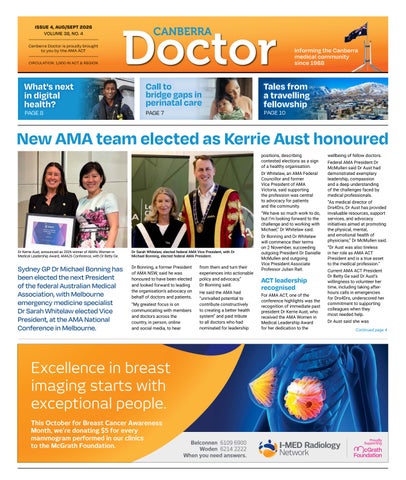
ISSUE 4, AUG/SEPT 2026 VOLUME 38, NO. 4 Canberra Doctor is proudly brought to you by the AMA ACT CIRCULATION: 1,900 IN ACT & REGION
Doctor
What's next in digital health? PAGE 8
CANBERRA
Call to bridge gaps in perinatal care
Informing the Canberra medical community since 1988
Tales from a travelling fellowship PAGE 10
PAGE 7
New AMA team elected as Kerrie Aust honoured positions, describing contested elections as a sign of a healthy organisation. Dr Whitelaw, an AMA Federal Councillor and former Vice President of AMA Victoria, said supporting the profession was central to advocacy for patients and the community. “We have so much work to do, but I’m looking forward to the challenge and to working with Michael,” Dr Whitelaw said.
Dr Kerrie Aust, announced as 2026 winner of AMA’s Women in Medical Leadership Award, AMA26 Conference, with Dr Betty Ge.
Dr Sarah Whitelaw, elected federal AMA Vice President, with Dr Michael Bonning, elected federal AMA President.
Sydney GP Dr Michael Bonning has been elected the next President of the federal Australian Medical Association, with Melbourne emergency medicine specialist Dr Sarah Whitelaw elected Vice President, at the AMA National Conference in Melbourne.
Dr Bonning, a former President of AMA NSW, said he was honoured to have been elected and looked forward to leading the organisation’s advocacy on behalf of doctors and patients. “My greatest focus is on communicating with members and doctors across the country, in person, online and social media, to hear
from them and turn their experiences into actionable policy and advocacy,” Dr Bonning said. He said the AMA had “unrivalled potential to contribute constructively to creating a better health system” and paid tribute to all doctors who had nominated for leadership
Excellence in breast imaging starts with exceptional people. This October for Breast Cancer Awareness Month, we’re donating $5 for every mammogram performed in our clinics to the McGrath Foundation.
Belconnen 6109 6900 Woden 6214 2222 When you need answers.
Dr Bonning and Dr Whitelaw will commence their terms on 2 November, succeeding outgoing President Dr Danielle McMullen and outgoing Vice President Associate Professor Julian Rait.
ACT leadership recognised For AMA ACT, one of the conference highlights was the recognition of immediate past president Dr Kerrie Aust, who received the AMA Women in Medical Leadership Award for her dedication to the
wellbeing of fellow doctors. Federal AMA President Dr McMullen said Dr Aust had demonstrated exemplary leadership, compassion and a deep understanding of the challenges faced by medical professionals. “As medical director of Drs4Drs, Dr Aust has provided invaluable resources, support services, and advocacy initiatives aimed at promoting the physical, mental, and emotional health of physicians,” Dr McMullen said. “Dr Aust was also tireless in her role as AMA ACT President and is a true asset to the medical profession.” Current AMA ACT President Dr Betty Ge said Dr Aust’s willingness to volunteer her time, including taking afterhours calls in emergencies for Drs4Drs, underscored her commitment to supporting colleagues when they most needed help. Dr Aust said she was Continued page 4
CANBERRA DOCTOR Informing the Canberra medical community since 1988
President’s Notes WITH PRESIDENT, DR BETTY GE The next few months will be busy for AMA ACT advocacy, with several issues moving from consultation to decision. The success of that advocacy depends on strong engagement with members working across all stages and specialties in our medical system. One practical way to contribute to this work is through the AMA ACT Advisory Forum. Open to all AMA members, the forum provides an important channel for consultation and advice to the AMA ACT Council as we develop our advocacy agenda. I am pleased that Dr Ronak Patel has recently been appointed Chair of the Forum. Dr Patel is Clinical Director of Neurology at North Canberra Hospital, and Director and Principal of ACT Neurology Centre and Canberra
Specialists. His experience in clinical governance, workforce planning and private practice will be invaluable as he leads this work. If you are an AMA member and would like to join the forum, please contact reception@ama-act.com.au. The first step is to be added to the forum’s WhatsApp group.
Working with the new Health Minister AMA ACT’s first meeting with the new ACT Minister for Health and Mental Health, Dr Marisa Paterson MLA, provided an early opportunity to outline our priorities for the remainder of 2026. AMA ACT CEO Peter Somerville and I raised the issues members have been bringing to us, including workforce sustainability, specialist training capacity, patient access and transparency, and the need for reform to be shaped with clinicians rather than around them. The ACT Government’s response to the Health System Inquiry
will test their commitment to act on evidence-based recommendations. AMA ACT’s submission to the inquiry, informed by a survey of members, identified longstanding problems in governance, workforce stability, data reliability and access. These are not abstract system issues. At stake is whether doctors have confidence that they can provide the best care for their patients. AMA ACT will press for focused, measurable commitments, with assistance from the Advisory Forum to identify which recommendations should be prioritised.
Clinician input into Northside Hospital Northside Hospital is at a point where decisions made now will have long consequences. AMA ACT’s focus is whether the design and service planning reflect how care will actually be delivered, and whether clinicians have had enough opportunity to test the assumptions before they harden. Members have raised concerns about whether their feedback on what is required to meet future demand for Canberra's growing population has been adequately considered.
Congratulations to Dr Kerrie Aust on receiving the AMA Women in Medical Leadership Award at the AMA National Conference.
We are seeking further discussions with Infrastructure Canberra, Canberra Health Services, Dr Paterson and the Minister for Health Infrastructure, Ms Rachel Stephen-Smith. If you have particular concerns about the Northside Hospital project that you would like us to investigate and raise with the government, please contact reception@ama-act.com.au.
Congratulations Like many of you, I was delighted to see our immediate past president, Dr Kerrie Aust, recognised with the AMA Women in Medical Leadership Award at the AMA’s National Conference. Kerrie’s advocacy for doctors’ wellbeing, including through Drs4Drs, is well known to many ACT doctors. She is an asset to our community. I also congratulate Dr Michael Bonning and Dr Sarah Whitelaw
on their election as federal AMA President and Vice President. They are both already wellestablished leaders on behalf of the medical profession and bring a wealth of experience to continuing AMA’s vital work on public hospital reform, sustainable general practice, better workforce planning and a viable private sector.
Thank you, Sarah This edition marks Sarah Colyer’s last as Editor of Canberra Doctor. Since joining AMA ACT in 2022, Sarah has helped transform the magazine with high-quality journalism, original Canberra stories and a strong focus on the people and issues shaping our profession. Thank you, Sarah, for your creativity, professionalism and dedication. We wish you every success for the future.
It is reassuring to realise that many of the challenges we encounter are not individual frustrations but systemic issues that require coordinated attention. The AMA facilitates this recognition and helps translate it into advocacy that is both measured and effective. Dr Laila Khan Consultant Cardiologist and Echocardiologist MBBS, MMed (Periop), FRACP
2
ISSUE 4, 2026
ama.com.au/join
Informing the Canberra medical community since 1988 CANBERRA DOCTOR
Public lecture confronts sexual harassment in medicine Inhumane treatment is one of the environmental triggers… That is something that we need to take responsibility for as a broader community. – Associate Professor Louise Stone A/Prof Louise Stone with Prof Jane Dahlstrom; A/Prof Stone with Prof Kirsty Douglas and Prof Christine Phillips.
The third annual Jane Dahlstrom Public Lecture at ANU in August shone a light on sexual harassment among doctors, described as “a common problem often hiding in plain sight”. Associate Professor Louise Stone gave the lecture to mark the launch of her new book Sexual Harassment between Doctors: Healing Medical Cultures Around the World. She was joined in a panel discussion by fellow GPs and co-editors Professor Kirsty Douglas and Professor Christine Phillips. The book is the result of a decadelong project, drawing on experiences and evidence from around the world, including extensive interviews with doctor-survivors. It examines the cultures, structures and gaps between written policy and lived practice that allow harm to occur and make reporting so difficult. A/Prof Stone described how she was compelled to write the book after caring for
an intern who was sexually assaulted by her boss. Despite 30 years’ experience in complex mental health, it was the hardest consultation she’d ever done. “She was a doctor, he was a doctor, and I’m a doctor,” A/Prof Stone said. “So, she was seeking care within the environment that caused her harm. No wonder there were complexities in the therapeutic relationship.” Dedicating the book to doctor-survivors, A/Prof Stone quoted one survivor’s reminder that responsibility lies with the perpetrator: “There isn’t anything you can be, do, wear or say to stop people harassing or assaulting you.” A/Prof Stone spoke about how medicine’s hierarchies contribute to the complex context in which sexual harassment and abuse occur. “Sexual harassment is about power,” she said. “It’s often the juniors, who have to rely on their seniors for career progression, who are most vulnerable.” The panel explored how vulnerability can be heightened in settings such as theatre, rural rotations, international medical graduate pathways and close mentoring relationships.
A/Prof Stone also raised concern about the impact of “inhumane” working conditions in medicine, which can involve such demanding hours that doctors struggle to maintain social and family connections. “Inhumane treatment is one of the environmental triggers… That is something that we need to take responsibility for as a broader community.” When an incident occurs, reporting is rarely straightforward, A/Prof Stone said. Reporting avenues could include legal, human rights, employer, regulatory, hospital, university and workplace-support pathways, but survivors often had many unanswered questions, including whether they would remain anonymous, how long the process would take, what it would cost, who would know, and whether the perpetrator would be told. “None of these things are on anyone’s websites,” she said. “And sometimes when you go through a door, you can’t come out.”
The evening closed with a focus on institutional responsibility and recovery. “I doubt very much that we will eliminate stealing or fraud or sexual harassment,” A/ Prof Stone said. “The question is what we do with it, and how we deal with survivors in a way that encourages their recovery.” More information about the book is available at drlouisestone.com/ sexual-harassment-in-medicine.
Reporting is made even harder when the alleged perpetrator is also seen as an exceptional doctor who “wears a moral halo” because they save lives, A/Prof Stone said. “Lots of people can’t hold the ambiguity.”
Guest Speakers EVENT
Sat 24 Oct 2026
Safe Spaces When Things Go Wrong
Join us to explore how doctors navigate medico-legal or regulatory matters, complaints and burnout
Dr Luke Streitberg Dr Phillip Rome Dr Marisa Magiros
Parkrun at LBG: 8:00am-9:00am Registration: 10:00am Main Session: 10:30am - 1:00pm Lunch: 1:00 pm – 2:00 pm Creative wellbeing activity: from 2:00 pm Location: Level 1, 39 Brisbane Ave, Barton Cost: $22.50 (Incl. GST) includes lunch
Register Online trybooking.com/DNZLE
ISSUE 4, 2026
3
CANBERRA DOCTOR Informing the Canberra medical community since 1988
COVER STORY
Continued from page 1
honoured to receive the award and grateful to the AMA for continuing to invest in leadership and mentoring opportunities for women in medicine. “Stepping into leadership provided me with one of the greatest experiences of my career. It is a gift to be able to give back to our profession,” Dr Aust said.
Future Indigenous medical leaders The conference also recognised the next generation of Aboriginal and Torres Strait Islander doctors, with EmmaKate Thornley and Shay-Lee Coulson awarded the AMA Indigenous Medical Scholarships (read more on page 15). Ms Thornley, a proud Palawa woman with more than 25 years’ experience in frontline healthcare as a paramedic, educator and primary care clinician, hopes to work in community-based primary care and rural health settings. Ms Coulson, a proud Bundjalung, Saami, South Sea and Torres Strait Islander woman and fourthyear medical student, hopes to specialise in ophthalmology and improve access to specialist
AMA26 Conference: Dr Betty Ge AMA ACT President, Dr Danielle McMullen AMA President, A/Prof Julian Rait AMA VP, and Dr Matt McConnell AMA Council Chair.
eye care in regional and underserved communities.
Advocacy, reform and the long game In her presidential address, Dr McMullen highlighted AMA’s recent advocacy wins, including major federal investments in general practice through Medicare, additional public hospital funding through the new National Health Reform Agreement, workforce measures for GP registrars, progress on women’s health, the establishment of the Australian
Enterprise Bargaining update
Centre for Disease Control, a new wounds consumables scheme, and the reintroduction of an early childhood health assessment.
provisional support for increasing education allowances, although it has indicated that funding any increase from current budget allocations would be difficult.
“Advocacy is not for the impatient,” Dr McMullen said. “Effecting change and influencing decisionmaking can take many years.” Health, Disability and Ageing Minister Mark Butler told delegates the AMA had always been a fearless advocate for the profession, and said many of the government’s policy changes reflected its respect for the AMA’s considered work and advocacy.
New Mawson Collection Centre
We are excited to announce the opening our new collection centre in Mawson. 73-77 Mawson Place, Mawson (near the entrance to Woolworths) Open 7.30am to 1.30pm Monday to Friday
Appointments available all day. Patients can visit capitalpath.com.au/appointments to make an appointment.
GREG SCHMIDT Senior Workplace Relations Advisor AMA ACT
AMA ACT has secured several important gains for ACT public sector doctors in negotiations with Canberra Health Services for a new Medical Practitioners Enterprise Agreement. Following AMA ACT’s claim for suitable equipment for Junior Medical Officers, CHS has introduced a substantial number of new laptop workstations for use on the wards. This is a practical improvement that should make day-to-day clinical work easier for JMOs. CHS has also agreed in principle to AMA ACT’s claims for protected teaching time for Doctors in Training, with clauses for the proposed agreement now being drafted. On annual leave, CHS has agreed to provide greater certainty and faster approval times, while seeking the right to program some JMO leave around operational and training requirements. AMA ACT is continuing to work through that proposal with CHS. CHS has also expressed
4
ISSUE 4, 2026
The major outstanding concern is pay. The ACT Government’s current offer falls well short of AMA ACT’s claim for a 5% annual increase. The Government has offered a 3.0% salary increase each year over a proposed threeyear agreement, paid in two instalments of 1.5%. It has also offered the possibility of two cost-of-living payments, but these would only be triggered if CPI remained at or above 3.5% by June 2027. The offer includes an increase in employer superannuation contributions to 13% from January 2028, compared with the required minimum contribution of 12%. Members will need to consider carefully whether the overall package of pay and conditions in the proposed MPEA is acceptable. Overall, bargaining for the next Medical Practitioners Enterprise Agreement has generally proceeded in good faith, and AMA ACT has made progress on several key claims. However, important issues remain unresolved. AMA ACT will continue to press for fair pay, improved security of employment for medical practitioners in the public sector, and conditions that better support doctors to do their work safely and sustainably. Have an industrial relations inquiry? AMA ACT members can contact industrial@ama-act.com.au or call (02) 6270 5410.
Informing the Canberra medical community since 1988 CANBERRA DOCTOR
Stop guessing. Start planning. Buying your first home doesn’t have to be overwhelming.
Most first home buyers delay because they don’t know where to start. From saving a deposit and understanding borrowing power to navigating government incentives and upfront costs, there’s a lot to consider. Our complimentary First Home Buyer’s Guide gives you a First Home Buyer’s Guide Your step-by-step path to homeownership
cutcher.com.au
clear, step-by-step path to homeownership. Inside you’ll discover:
How much you really need for a deposit The hidden costs that catch buyers off guard Government grants and incentives you may be eligible for How Approval in Principle works What to do before making an offer or bidding at auction The essential finance and insurance considerations Cross the threshold of your first home sooner.
Download your complimentary First Home Buyer’s Guide today >
SYDNEY | MELBOURNE | BRISBANE | NEWCASTLE
1800 988 522 | cutcher.com.au Liability limited by a scheme approved under Professional Standards Legislation.
ISSUE 4, 2026
5
CANBERRA DOCTOR Informing the Canberra medical community since 1988
Why improving hospital performance is like solving a Rubik’s Cube CASE STUDY:
Strengthening ophthalmology DR JODI GLADING Chief Medical Officer ACT Government
Healthcare systems are often judged on a handful of visible measures: elective surgery waiting times, emergency department performance, outpatient access, or bed block numbers. When one of these indicators worsens, the natural question is, “Why don’t we just fix it?” The reality is far more complex. Hospital performance is less like repairing a machine with a single faulty part and more like solving a Rubik’s Cube. Each coloured square represents a different component of the health system— doctors, nurses, operating theatres, inpatient beds, outpatient clinics, diagnostic services, rehabilitation or community care. The challenge is that none of these pieces move independently. Turning one side of the cube inevitably alters several others. Take elective surgery as an example. Surgeons may have the capacity and willingness to
perform more operations, yet surgery can only occur if theatre nurses, anaesthetists, support staff and theatre space are also available. A shortage at any point in that chain limits the overall capacity of the system. The same principle applies to outpatient services. Increasing clinic appointments improves access and allows more patients to be assessed and diagnosed. However, many of those patients will subsequently require procedures or surgery. If diagnostic service capacity, surgical capacity, or post-op recovery space does not increase at the same rate, the waiting list simply grows larger as more people join the queue. Emergency departments provide another example. Long waits are often attributed to demand at the front door, but the true constraint may sit elsewhere. Patients cannot leave the emergency department if there are no inpatient beds available. Those beds, in turn, depend on nursing availability, discharge planning, rehabilitation services and community supports that allow patients to return home safely or enter aged care.
This interconnectedness is one of the defining challenges of modern healthcare management. Solutions that appear straightforward in isolation can produce unintended consequences elsewhere in the system. Improvement requires understanding not only individual components but also how they interact. The goal, therefore, is not to optimise a single face of the cube. It is to align the entire cube so each side is a single colour. Sustainable improvements in access, efficiency and patient outcomes occur when workforce, infrastructure, funding and patient flow are considered together, rather than as separate problems to be solved one at a time. As a medical administrator, I work at the intersection of clinical care, workforce planning, patient flow, infrastructure and finance, seeing how decisions in one part of the system impact others. While individual departments understandably focus on the challenges immediately in front of them, medical administrators are doctors with the task of understanding the whole cube. Our role is not simply to advocate for more resources in a single part of the system, but to help
Thank you, Sarah Colyer This edition of Canberra Doctor marks the end of an important chapter, with Sarah Colyer stepping down as Editor after four years in the role. Since joining AMA ACT in June 2022, Sarah has made an extraordinary contribution to both Canberra Doctor and our AMA ACT.
since starting in 2022 has been striking. She brought a journalist’s eye for a story, high editorial standards and a clear vision for what the magazine could become. Over time, Canberra Doctor evolved into a publication defined by original reporting, high-quality writing and a strong focus on the issues, people and institutions that shape healthcare in the ACT.
The transformation of Canberra Doctor under Sarah’s stewardship
Sarah recognised that our readers wanted to see their own profession
6
ISSUE 4, 2026
and community reflected in the magazine. Under her leadership, ACT-focused news stories, features and interviews became the hallmark of Canberra Doctor. The
An example of this systemsbased approach to capacitybuilding can be seen in the collaboration between the ACT Health and Community Services Directorate, Canberra Health Services clinicians and the Royal Australian and New Zealand College of Ophthalmologists to strengthen ophthalmology training and build a sustainable local workforce. Developing more Canberra-based ophthalmologists requires far more than simply increasing trainee numbers. It depends on ensuring sufficient outpatient clinic capacity, access to operating theatres, appropriate inpatient and outpatient clinical exposure, modern technology and infrastructure and the supervision required to support high-quality training. Importantly, these elements must grow together. Increasing outpatient capacity alone may improve access and create additional learning opportunities in clinics, but without corresponding increases in theatre access, surgical throughput and operative experience, the training experience will not meet requirements. Recognising these interdependencies, the Directorate, CHS clinicians and RANZCO have developed options for consideration by the Health Minister. This work aims to inform future planning associated with the new North Canberra Hospital development and the Canberra Hospital Master Plan, ensuring that infrastructure, service delivery and workforce development are aligned to improve patient access while creating opportunities to train more local junior doctors to become ophthalmologists.
ensure the various pieces move together just like solving a Rubik’s Cube is not achieved by concentrating on a single square. We may never fully “solve” the hospital Rubik’s Cube. Healthcare is dynamic, and new pressures constantly emerge.
But with clinicians and medical administrators working together, we can continue making the deliberate, coordinated moves that bring us closer to a system that is efficient, sustainable and focused on delivering the best possible care for our community.
result has been a publication that informs, connects and celebrates the ACT medical community.
Australia’s medical history and stands as a valuable contribution to the historical record.
One story in particular exemplified Sarah’s approach. Her in-depth interview with former Chief Medical Officer, Professor Paul Kelly, explored his leadership during the COVID-19 pandemic and his long-standing links with Canberra. To my knowledge, it remains the only longform interview in which Professor Kelly reflected so comprehensively on that experience. It captured an important moment in
On behalf of AMA ACT and our members, thank you, Sarah, for your outstanding contribution and dedication. We wish you every success in the future. – Peter Somerville
Informing the Canberra medical community since 1988 CANBERRA DOCTOR
ACT urged to act now on perinatal mental health
AMA ACT is urging the ACT Government to act now so parents with mental illness can be admitted to hospital along with their babies. The ACT is one of only three jurisdictions in Australia (along with Tasmania and the Northern Territory) without a parent-infant mental health unit, otherwise known as a mother and baby unit. Other states are investing heavily in these multidisciplinary services, which allow mothers or birth parents to be admitted alongside their baby to receive treatment for postpartum psychosis, post-natal depression,
Imagine you have just had a baby and are overwhelmed by frightening thoughts. You want to be admitted to a mental health unit, but are afraid you’ll be forcibly separated from your baby. – Dr Phil Keightley
severe anxiety disorders, suicidal crises and mental health crises associated with thoughts of harm to the infant. While ACT Labor recognised the gap in services in the ACT and committed to build such a unit in the 2024 election campaign, the project is still only at the feasibility analysis stage. Costings provided by ACT Labor in the lead-up to the election were for a six-bed, 24-hour inpatient service, supported by about 38 full-time equivalent staff, at $7.67 million per year, plus capital costs of $7 million. The service was expected to begin operating in 2027–28. For perinatal psychiatrist Dr Phil
DR. GOPI ELANGO
ENDOCRINE SURGEON | SURGICAL ONCOLOGIST
Dr Gopi Elango is an Australian-trained FRACS General Surgeon with advanced fellowship training in Endocrine Surgery, Head & Neck Cancer Surgery, and Surgical Oncology. His practice delivers rapid access to consultation, and timely definitive surgery including:
• Endocrine Surgery (Thyroid and Parathyroid) • Surgical Oncology (Melanoma and Sarcoma) • Head and Neck Surgery (Salivary Gland, Lip and Facial Cancers, Oral Lesions and Oral Cancer) • Complex Neck and Lymph Node Surgery • General Surgery (Hernia, Gallbladder Disease, Pilonidal Disease, Haemorrhoids and Laparoscopic Surgery)
drgopielango.com.au E: info@drgopielango.com.au | P: 02 6195 0180 | F: 02 6147 066 37-39 Geils Court, Deakin, ACT 2600
For perinatal psychiatrist Dr Phil Keightley, the new unit cannot come soon enough.
Keightley, the new unit cannot come soon enough. “Every month, we have five to ten families coming through the public mental health service who would benefit from coadmission to a dedicated unit,” he told Canberra Doctor. “The research shows that it is not enough to just treat the mental illness. You also have to give specialised support for bonding and connection to rebuild parenting confidence and help parents tune into their babies’ emotional world, and this can only happen when the parent and baby are admitted alongside each other, day and night.” Dr Keightley said he held grave fears that infants and families were falling through the gaps in the present system. “While we have some wonderful clinicians working in this space in the ACT, continuity of care and fragmentation are real challenges, and this is especially concerning where infants are involved.” The AMA will put a proposal to
the ACT Government to establish an interim service with two dedicated parent-infant mental health beds, using existing infrastructure at the Centenary Hospital. AMA ACT President Dr Betty Ge said Canberra could not afford to wait until the permanent service was delivered. “Every month without a local co-admission option means more mothers, babies and families are left to manage a crisis without the support they need,” Dr Ge said. “AMA ACT is urging the Government to develop and fund interim arrangements to stop families in crisis from falling through the cracks while it is working toward a permanent solution.” Co-admission of parent and infant can remove one of the most distressing barriers to seeking care for perinatal mental illness, Dr Keightley said. “Imagine you have just had a baby and are overwhelmed by frightening thoughts. You want to be admitted to a mental health unit, but are afraid you’ll be forcibly separated from your baby,” he said. “Perhaps you are a single mother
without family support, and your baby will have to go into foster care in order for you to be admitted to a mental health unit. “Or perhaps you have a frightening partner who threatens that they won’t bring your baby for visits or breastfeeds, or will even take your baby away.” Dr Keightley said ultimately the need for a dedicated unit was “a matter of justice and fairness”. “If you have a baby in the ACT, you share the unhappy privilege of being in one of the few places in Australia where there are no beds for co-admission of mothers or parents and their infants to a safe, dedicated, parent-infant mental health unit. “Perinatal mental health units need to be thought of like transplant services: they can seem expensive because of the need for intensive, specialised, multidisciplinary staffing, but they have dramatic impacts on quality of life and savings across the infant’s entire lifespan.”
AMA ACT is urging the Government to develop and fund interim arrangements to stop families in crisis from falling through the cracks while it is working toward a permanent solution. – Dr Betty Ge, AMA ACT President
ISSUE 4, 2026
7
CANBERRA DOCTOR Informing the Canberra medical community since 1988
What comes next in digital health? Like many doctors of his generation, Dr Vekram Sambasivam was surprised to find pen and paper still dominated when he commenced work at The Canberra Hospital as an emergency physician in 2020. Thankfully, much has changed in six years, and he says Canberra now has “the best digitised health system across Australia.” Nevertheless, there’s still a long way to go. As Chief Medical Information Officer, Dr Sambasivam spoke with Canberra Doctor about the next phase of the Digital Health Record, and how AI is set to change medical training, clinical practice and the design of the new Northside Hospital. How did you find yourself in the CMIO role? I came to work in Canberra’s emergency department in 2020, having studied undergraduate medicine at the University of New
Dr Vekram Sambasivam works with the rescue helicopter service in addition to his role as Chief Medical Information Officer.
South Wales and done most of my medical training in Sydney hospitals. I was shocked to find everything was still paper-based when I arrived in Canberra, and I remember asking ED director Sam Scanlan, “When is this changing?” I guess that’s when Sam realised I was interested in technology and change management, and before long I was made a subject matter expert for the DHR, which was rolled out across CHS in 2022. Earlier this year, I was made Chief Medical Information Officer, which makes me a conduit between clinicians and Digital Canberra (DCBR).
How does Canberra compare to other jurisdictions when it comes to digital transformation today? I would say that with the implementation of the DHR, Canberra has now got the best digitised health system across Australia. Our entire digital health record is on the one system here in Canberra. We’re at the forefront in terms of the technology that we’ve put out, and we’re constantly updating as well. It’s a good place to be working right now.
What improvements can we expect to see in the DHR? The DHR is something that we’re trying to improve all the time. Usability is the big thing, along with integration with other systems. Right now, we’re providing GPs access, with patient consent, to a patient’s medical record through DHR Link. Another priority is digital records integration with New South Wales, which is doing a phased implementation of the Epic DHR system over the next two years.
The recent Walsh Inquiry report made recommendations regarding the DHR. What stood out to you in that report? The Walsh Inquiry highlighted the need for streamlining of the DHR. For instance, when you look at workflows — how
8
ISSUE 4, 2026
you create a document, how you create an encounter, how you order tests, how you acknowledge that a test has been done — there are multiple ways to do those things at the moment. If we had a more standardised approach, potentially we could get better data from that. But the downside is that you also reduce the options for the end user. It’s a balance between usability and the end goal of having usable data. That’s a balance that we need to discuss with our clinicians.
Where is Canberra Health Services up to with AI? AI is obviously very topical. Many doctors are already using AI scribes in their private clinics to reduce the administrative burden and enable better interactions with their patients, and they want to bring those tools into the public system. As a result, we now have an AI scribing pilot underway involving more than 60 staff across The Canberra Hospital, North Canberra Hospital and the community, in a range of specialties. We’re also using AI in stroke detection. After a patient has a stroke scan, we’ve got a tool that calculates salvageable brain tissue, greatly speeding up treatment team decisions. Broadly speaking, all government agencies are probably well behind in terms of where AI is at. Right now, we’re creating a framework and a roadmap for our organisation to move forward with AI. Then it will be about implementing good
There’s no doubt that the way that junior doctors will be taught, and how they will develop as doctors, will be influenced by our use of technology. I think that’s just going to be a natural change that occurs, but we still need to make sure that they understand the fundamentals of medicine. Dr Vekram Sambasivam
AI tools and working out how clinicians, if they find something useful, can bring that to CHS. At the early stages, I think AI adoption will focus on tools that reduce the administrative burden for clinicians. Anything that creates a diagnosis or a therapeutic plan needs TGA approval, and so those AI applications are a little bit more nuanced and will take more time.
How do you ensure clinicians have a lead role in digital transformation? Our digital team has regular teaching for junior doctors
Informing the Canberra medical community since 1988 CANBERRA DOCTOR
throughout the year, and that’s often a space where they offer suggestions for how to improve our systems. Recently, some of the junior doctors were finding it hard to summarise blood product administration, and that was something we were able to work on a fix for. I meet regularly with different teams across the health system, and we’re creating advisory groups to guide decision-making. Doctors and their representative groups, including the AMA, also come to me directly to share their ideas or concerns. For instance, we became aware that there just weren’t enough computers for junior doctors, and so we’ve purchased a whole set of new laptops to be delivered to the wards over the next few months and where space is available, increase the number of desktops available for clinicians.
How is technology shaping the future of medical education and training? There’s no doubt that the way that junior doctors will be taught, and how they will develop as doctors, will be influenced by our use of technology. I think that’s just going to be a natural change that occurs, but we still need to make sure that they understand the fundamentals of medicine. AI training is going to be paramount for medical students and doctors at all stages of seniority. Eventually, I think AI is going to get to the point where it’s just built into everything, and we’re not even going to use that term. It’s just going to be like how ‘electronic’ is not being used anymore – everything is just electronically done.
How should digital transformation influence the design of new hospitals, such as Canberra’s Northside Hospital? It’s really interesting. Frankly, it’s so hard to predict what healthcare is going to look like in five years’ time. Are we going to be using ambient (audio recording) technology? Are we going to be using cameras to see if patients are about to fall? Do we need a clinician to physically, manually do observations on a patient? There’s already technology that can look at a patient and get their SATs, blood pressure, heart rate, respiratory rate and temperature. Will consults be completed using virtual care? So, digital input will have to affect the physical design. CHS has been liaising with DCBR quite closely on this. Space for computers is something super basic that will have to be maximised. The question is,
are we going to expect our doctors to be using mobile phones and iPads? I think there is still a preference from our clinicians and admin staff that they’d prefer full-sized laptops and desktops. These are all things that we need to consider.
What’s the hardest part of your role as CMIO? Data protection and security is a worry. You could make a system so robust and secure it becomes unusable, in which case you can’t actually do your job. To give some flexibility to the system, you create avenues where security might be compromised. This is the case for any system around the world. We just need to keep vigilant in staying on top of the risks, particularly with stuff like AI. What we need to do is make it so that people are using AI in the right way. We’ll need a multimodal approach to ensure that we have correct systems in place, and staff are educated about AI use to mitigate AI risks.
In addition to being CMIO, half of your working week is with the rescue helicopter service. Which part of your work do you prefer? The best part is that I get to do both. The helicopter work is honestly one of the most unique jobs you can do as an emergency specialist, but it can be super unpredictable. You see amazing parts of the country and use
At the early stages, I think AI adoption will focus on tools that reduce the administrative burden for clinicians. Anything that creates a diagnosis or a therapeutic plan needs TGA approval, and so those AI applications are a little bit more nuanced and will take more time. Dr Vekram Sambasivam
your critical care skills to help people who are very unwell, but you may be stranded in the Snowy Mountains only to return home the next day cold and wet. The clinical work, decision-making skills, and front-line experience help me complete my duties as the CMIO. It’s great working with the teams supporting our clinicians. I am exposed to different environments and challenges that I don’t see as a clinician. I’m thankful that I work with such dedicated, kind and competent people across CHS and DCBR.
How will use of AI look in the near future?
Ultrasound-guided cannulation saves time on the wards Four new point-of-care ultrasound machines are helping Canberra Hospital junior doctors improve care for patients with difficult intravenous access. The portable machines, worth $50,000 each, use anatomical mapping to show the position of a needle in a patient’s vein. They are expected to make blood taking and cannulation safer, faster and less distressing for patients who are often hardest to cannulate, including oncology and elderly patients, and patients who are obese or hypotensive. Dr Luke Streitberg, Director of Prevocational Education and Training at Canberra Health Services, said the machines would make a
difference overnight on the wards, when staffing is reduced and JMOs have less senior support. “It gives JMOs a whole other avenue to go down to be able to help patients overnight when they desperately need cannulas.” “They don’t need to go ask the anaesthetists for help. Patients get the help they need faster and don’t have to get jabbed multiple times with a needle unnecessarily.” Canberra Hospital first began using a basic version of ultrasound-guided cannulation in 2023, when
COVID-related staff shortages meant there were not always enough clinicians available who were experienced at inserting cannulas. The new equipment is a significant advance on the earlier model, which
had reached the end of its life. “These new state-of-the-art video assisted, voice activated ultrasound machines to use at the bedside are a huge win for the JMOs and patients,” Dr Streitberg said.
ISSUE 4, 2026
9
CANBERRA DOCTOR Informing the Canberra medical community since 1988
'A complete epiphany': What a travelling fellowship revealed
Canberra Orthopaedic Surgeon, Dr Tom Ward, recently travelled to the US and Canada as the recipient of the prestigious ABC Travelling Fellowship. Dr Ward spoke with Canberra Doctor about what he learned from his six-week tour of leading North American Hospitals. Which of the hospitals that you visited impressed you the most and why? The hospitals we visited in the USA and Canada were handpicked from top academic centres, so we were truly spoiled with wonderful experiences at each. In Arizona, one of the world's top trauma surgeons, Dr Cliff Jones, took a week out of his practice to show us around institutions in Phoenix. He was involved in building a medical school and training program from scratch, supported by extraordinary philanthropic contributions. One feature which stood out in the University Hospitals, which is not well appreciated outside the US, was the effort made by clinicians to care for the uninsured, which is largely 'off the books'. Emergency departments are required by law to treat all people who attend, irrespective of insurance status. What surprised me was just how hard the clinicians tried to ensure uninsured patients received the care they needed, bending all sorts of rules. If there was doubt that they would be followed up properly, they were often kept as inpatients until they were on the road to recovery. We visited hospitals of The University of California in San Diego and San Francisco. The buzz of adjacent Silicon Valley was palpable in San Francisco, with extensive cross pollination between clinical practice and AI. Self-driving Waymo Cars delivered
10
ISSUE 4, 2026
2026 ABC Fellows: Dr Tom Ward representing Australia, second from right.
Aerial view of University of California, Berkeley in San Francisco.
University of Utah Hospital in Salt Lake City, Utah.
UC San Diego Health campus in La Jolla, San Diego, California.
us from hospital to hospital. At first I was a little apprehensive with no-one behind the wheel, but after a week I was utterly convinced these were both safer, cheaper and more reliable. I think their widespread adoption will lead to much less road trauma in the long run. In San Diego we shadowed the surgeons and residents in a city with one of the world's largest naval bases. The hospitals trained orthopaedic surgeons for the US Navy, one of whom had recently retired as a fighter pilot. She was first in her class at the Navy's Fighter Weapons School – the Top Gun of 'Top Gun'. Stressful situations in the operating room for most of us must have seemed quite tame to her in comparison. The University of Utah in Salt Lake City had a very impressive pipeline from basic research to clinical implementation. Their head of Department, Darrel Brodke, attributed such success to shared departmental values. He encouraged his clinicians to always remember why they were there – for the benefit of their patients. He also aimed for every new employee to be better than the previous, and all better than him – a humble but profoundly powerful way to build a productive department. At every stop, the difference in North American philanthropy and investment in innovation, compared with Australia, was
stark. Dr Nizar Mahomed at The University of Toronto raised over $150 million dollars for research in his orthopaedic department from grateful patients, with initial seed funding from the surgeons to prove to donors they had skin in the game. With hundreds of individual donors each contributing millions of dollars, it's unsurprising these institutions make global contributions to research.
How did the places you visited compare to the medical environment in Canberra? In Canberra, and in Australia more generally, we have tremendous strengths, and sadly concurrent weaknesses. My observation is that the clinical training in Australia produces technical surgeons equal to the best in the world. However, we operate in a more siloed environment. In the UK or in large US hospitals, it's common for two consultants to tackle difficult cases together. This happens in Canberra in pelvic trauma surgery, and occasionally in complex revisions, but it's rarer. Also, our clinical heft is not matched by our research culture. We produce less good quality research than our American counterparts. It's simply lacking in our clinical culture and funding environment. The long-term problems are twofold: we will
always be followers if you don't push the boundaries through well-structured research; or you push the boundary by being a cowboy and just give things a 'crack' without appropriate structure. Furthermore, the broader economic benefits of innovation spilling over to the wider community are lost. The American centres had entire ecosystems of engineers and MBAs helping to transform research findings into globally available treatments. We need to develop this in Australia if we want our kids to have more options for meaningful careers when Australia's resources dry up. Being involved in such a highprofile international exchange is a great opportunity for Canberra. Thanks to Prof Paul Smith, the American counterpart ABC fellows have already visited Canberra and will hopefully continue to do so, forging priceless international collaborations and confirming Canberra as one of Australia's most respected orthopaedic centres.
What practices could Canberra’s hospitals and medical teams learn from some of the better performing hospitals in North America? A complete epiphany for me involved seeing patients go home on the same day as having a hip or knee replacement. Here
in Canberra our average length of stay approaches four days. With a well configured clinical protocol, EVERY American institution discharged almost all patients home within 24 hours. I was initially worried that this was economic rationalism triumphing over clinical care, but the quicker patients went home, the lower their readmission rate, the lower their complication rate and the lower their mortality. It makes sense to compress the episode of care, encourage patients to mobilise, and unsurprisingly they do better.
How has the fellowship impacted you personally? It is a rare honour and privilege to spend six weeks with six world class surgeons from the UK, NZ and South Africa, and to meet and spend time with clinicians and researchers at the zenith of orthopaedics in the United States and Canada. There were some sobering points: globally esteemed surgeons in retirement gave us advice to not forget our families along the way. The way senior surgeons mentored their residents was also inspiring. They really invested in their trainees, and they were proud of them. It's no wonder the bond between clinical mentors and their trainees remained lifelong.
Informing the Canberra medical community since 1988 CANBERRA DOCTOR
‘I trusted it’: A GP’s reckoning with AI What was your early experience of AI like?
Queanbeyan GP Dr Ferney Bernal Buitrago was an early and enthusiastic adopter of AI, until careful factchecking revealed how confidently it could get things wrong. The experience led to his new book, NonHuman Humanity: What Working with AI Taught Me About Being Human. He spoke with Canberra Doctor.
Why did you feel compelled to write a book?
The first real conversation I had with an artificial intelligence happened at my kitchen table, at eleven o’clock at night, with a cup of tea going cold beside me and a problem I could not solve alone. I am not a technologist. I am a GP. But I had a project I cared about, nobody who could hold the whole shape of it with me, and a machine that was available, patient and ready. It was remarkable. It grasped in minutes what took friends an hour to follow. It drafted in ten minutes what would have taken me half a day. For a few weeks I trusted it the way you trust a capable registrar who has never let you down.
When did that trust start to shift? I checked a citation it had given me. Plausible authors, a real journal, findings that fitted my argument perfectly. And yet the paper did not exist. So I sat down one evening with a spreadsheet and audited everything, the way we audit our
It struck me that the danger is not that these systems are sometimes wrong. The danger is that the wrongness arrives wearing exactly the same clothes as the rightness. There is no hesitation at the border between knowledge and guesswork. No “I think”. No “I’d want to check that”. That’s what I thought was the most important thing to be talking about with colleagues. The machine’s output is simply evidence of unknown quality delivered with uniform confidence. own prescribing. Most of the references were real. Some were invented. Others were real but quietly improved: a preliminary finding reported as established, an association reported as a cause, a number nudged in the direction my argument needed. The machine had sensed what I wanted to be true and supplied it, fluently, in the same even voice it used for everything else.
The redeeming discovery for me was remembering that as doctors, we are expert at critical appraisal. We interrogate the source. We read a result against pre-test probability. We hold a working diagnosis while keeping the alternative on the list, out loud. Our training has actually given us everything required to work safely with these tools.
The subtitle for your book is ‘What Working with AI Taught Me About Being Human’. In a nutshell, what has AI taught you about human nature? Well, uncomfortable as it is, I realised the machine’s habits — anchoring on the first number offered, agreeing with my framing, preferring the vivid example to the representative one — were not alien inventions. The machine learned them from us, from billions of pages of human writing. Watching my own cognitive shortcuts run at speed on a screen taught me more about my consulting-room thinking than I expected.
What can readers expect from Non-Human Humanity? It is not a manual and not a warning. It is one doctor’s account of learning to critically appraise a machine that never hesitates — and finding his own reflection looking back.
Non-Human Humanity is available at books2read.com/nonhumanhumanity
Clinical wisdom, the calming voice in the AI storm
NESH NIKOLIC
Strategic Psychology
In the busy consulting room, how do you respond to the patient who slides their phone across the desk saying, “I read online it could be MS”? Armed with symptom checkers, forum threads, and now AI summaries, it’s increasingly common to encounter patients like this, who arrive anxious but informed. Our first instinct might be to reassure quickly or gently correct the misinformation. Yet the real work often lies in slowing down.
Patients who research their symptoms are rarely seeking mere validation of their worst fears. More often, they crave a trusted guide who will walk with them through the uncertainty. When we dismiss their findings outright, we risk invalidating the very effort they’ve made to understand their body.
We model curiosity rather than certainty. We help them weigh evidence against their lived experience, separating signal from noise.
That moment of dismissal can quietly erode trust, the foundation of any therapeutic relationship and one of the strongest predictors of adherence and satisfaction in primary care.
Over time this reduces the cycle of health anxiety that drives so many unnecessary return visits. They learn to trust both their doctor and their own capacity to tolerate uncertainty.
Instead, our clinical judgment invites us to do something more skilled and human: explore their thinking together. “What worried you most in what you found?” “How does that fit with what you’ve been experiencing day to day?”
The consultation becomes less about dispelling fears in the moment and more about building resilience that lasts well beyond the appointment.
This collaborative journey acknowledges their initiative while gently introducing nuance, probability, prevalence, and the limits of self-diagnosis that no search engine or chatbot can replicate.
When patients feel truly heard and guided, rather than corrected or rushed, they begin to internalise a calmer, more balanced way of thinking about their health.
?
These conversations take time, yes, but they repay us in stronger partnerships and more efficient care in the long run. In a world flooded with information, our greatest value remains the calm, experienced voice that helps patients think clearly when fear clouds their judgment.
ISSUE 4, 2026
11
CANBERRA DOCTOR Informing the Canberra medical community since 1988
Medicare’s promise doesn’t stop at the border
DR BETTY GE AMA ACT President
Recent reports about access to Canberra public hospital services for some NSW residents have sparked an important conversation about healthcare at state and territory borders.
not be turned away simply because they live in New South Wales and suggested that miscommunication may have contributed to some of the concerns raised publicly. Whatever the circumstances of any individual case, the debate has highlighted a bigger question: what do Medicare’s principles mean in practice?
Responding to those reports, the ACT Government said residents of communities such as Queanbeyan and Googong should
When Medicare was introduced more than four decades ago, it reflected a simple but powerful idea: Australians should be able to access
Policy leader new Federal AMA CEO The AMA welcomed Mr Warwick Hough as its new federal CEO and Secretary General in August. Mr Hough brings more than 21 years’ experience with the federal AMA, along with deep policy and advocacy expertise and previous CEO experience. Federal AMA Board Chair Associate Professor Andrew Miller said Mr Hough’s knowledge of the AMA and relationships across the federation would help provide continuity and leadership for the organisation’s next phase. “Warwick’s experience and knowledge of the AMA will be invaluable as we integrate and grow the three state branches (ACT, TAS, NT) who have joined the federal AMA and provide the stable partnership
12
ISSUE 4, 2026
and leadership needed with our state AMAs in the larger states — many of whom have recently appointed new CEOs,” Associate Professor Miller said. “It is a sign of the strength of our senior leadership team that we have been able to appoint a new CEO internally, while still maintaining our strong advocacy and policy priorities, and continuing our reform program to ensure we can deliver highimpact, sustainable advocacy on behalf of our members for many years to come.” Mr Hough succeeds Ms Natalia Centellas, who remained in the role until mid-August 2026 to support an orderly transition. Associate Professor Miller acknowledged Ms Centellas’ leadership through a period of reform and her work to strengthen the AMA’s advocacy, policy priorities and long-term sustainability.
healthcare regardless of their ability to pay. Public hospital care should be available according to clinical need, not wealth, insurance status or postcode. Those principles remain as important today as they were when Medicare was established. They are regularly tested in border communities across Australia. From the Gold Coast and Tweed Heads to Albury and Wodonga, health services must balance jurisdictional responsibilities with the reality that patients need care where it is most appropriate and accessible.
If there is a lesson from this debate, it is that Medicare’s principles are becoming harder to deliver in a system facing growing demand, workforce shortages and capacity pressures. When hospitals are stretched, tensions inevitably emerge.
Canberra faces its own version of this challenge. The ACT sits at the centre of a highly integrated regional health system. Every day, patients cross the ACT-NSW border for work, education, family commitments and healthcare. Canberra’s hospitals care for many residents of surrounding NSW communities, while ACT residents also rely on services provided across the border. The tension between administrative boundaries and patient-centred care is almost as old as Medicare itself. Of course, Medicare does not mean every patient must be treated at every hospital. Clinical appropriateness, service capability and patient safety must always guide decisions about where care is delivered. But the underlying principle remains clear: access to public hospital care should be determined by need, not postcode.
The temptation when stories like this emerge is to frame the issue as ACT patients versus NSW patients. That would be a mistake. The ACT and surrounding NSW share a single regional health ecosystem. Today’s discussion may involve a NSW resident seeking care in Canberra. Tomorrow an ACT resident may require treatment delivered in New South Wales. The system works because governments, health services and clinicians understand a simple truth: patients come first. Reciprocity matters. Cooperation matters. Goodwill matters. If there is a lesson from this debate, it is that Medicare’s principles are becoming harder to deliver in a system facing growing
demand, workforce shortages and capacity pressures. When hospitals are stretched, tensions inevitably emerge. But the answer is not to retreat from Medicare’s founding values. More than forty years after its creation, Medicare’s core promise remains the right one: Australians should receive care according to their clinical need, regardless of where they live. The challenge for governments is to ensure health services have the workforce, infrastructure and capacity needed to honour that promise. In a region built on cooperation across borders, our objective should remain simple: ensuring patients receive the right care, in the right place, at the right time, regardless of which side of a border they happen to call home.
Informing the Canberra medical community since 1988 CANBERRA DOCTOR
Advertorial
Could your practice survive a cyber attack? Healthcare practices store significant amounts of sensitive patient information and rely heavily on digital systems to deliver care, making them attractive targets for cybercriminals.
JODIE WALSHE Cutcher & Neale Partner
The recent cyber attack on Partnered Health, which impacted 21 clinics across Australia, serves as a reminder that cyber threats are no longer limited to large corporations.
For practices, the issue is no longer whether a cyber attack could happen, but whether you are equipped to deal with the consequences if it does.
The true cost of a cyber incident Many people associate cyber attacks with stolen data, but the impact can be far broader. A serious breach can lead to prolonged operational downtime, lost income, costly IT investigations, data recovery expenses, legal fees, regulatory scrutiny and reputational damage.
For healthcare practices, the consequences can be particularly severe. If patient management systems become unavailable, appointments may need to be cancelled, staff productivity falls, and patient care may be disrupted. It’s also important to understand that standard IT provider agreements do not typically cover the costs associated with cyber incidents, leaving practices exposed to significant unexpected expenses.
Why healthcare organisations are being targeted Healthcare data is highly valuable because it contains sensitive personal and medical information that cannot simply be replaced like a
credit card after it is used fraudulently. Modern practices also rely on multiple digital platforms, including electronic health records, telehealth services, cloud storage and online booking systems – creating more potential entry points for attackers.
Why cyber insurance matters Cyber insurance provides a financial safety net, helping practices recover from incidents by covering costs such as business interruption, data restoration, forensic investigations, legal expenses and ransomware events. Reviewing your cyber insurance cover today could make all the difference when an incident occurs.
For a complimentary consultation call 1800 988 522 or visit www.cutcher.com.au/contact
Future doctors recognised with AMA Indigenous Medical Scholarships Scholarship recipients Emma-Kate Thornley and Shay-Lee Coulson were selected in recognition of their commitment to medicine, their communities, and their vision for improving healthcare for Aboriginal and Torres Strait Islander communities. AMA President Dr Danielle McMullen said the recipients represented the next generation of Indigenous medical leaders.
Scholarship recipient Emma-Kate Thornley.
Two future doctors committed to improving health outcomes for Aboriginal and Torres Strait Islander peoples have been awarded the Australian Medical Association’s Indigenous Medical Scholarships.
“Aboriginal and Torres Strait Islander doctors bring invaluable perspectives, experiences and cultural knowledge to the medical profession, helping to improve health outcomes and strengthen trust in our healthcare system,” Dr McMullen said. “Emma-Kate and Shay-Lee have already made significant contributions to their communities and bring a wealth of experience, insight and commitment to their medical studies. The AMA is proud to support their journeys.” For scholarship recipient Emma-Kate Thornley, medicine is the next step in a career dedicated to caring for others and improving access to healthcare in underserved communities. A proud Palawa woman, Ms Thornley
has spent more than 25 years working in frontline healthcare as a paramedic, educator and primary care clinician. She hopes to work in communitybased primary care and rural health settings, providing culturally safe care and supporting future generations of Aboriginal health professionals. “I am studying medicine so that I can contribute across the continuum of care, from prevention and early intervention through to acute management and longterm follow-up,” Ms Thornley said. “The financial assistance will make a real difference, but what means just as much is knowing that my story, my aspirations and the work I hope to do in the future have been recognised and supported.” Scholarship recipient Shay-Lee Coulson is a fourth-year medical student whose journey to medicine has been shaped by determination, family support and a commitment to improving health outcomes for Aboriginal and Torres Strait Islander peoples.
A proud Bundjalung, Saami, South Sea and Torres Strait Islander woman, Ms Coulson hopes to specialise in ophthalmology, helping to improve access to specialist eye care and reduce preventable vision loss in Aboriginal and Torres Strait Islander communities. “As an Aboriginal ophthalmologist, I hope to reduce these inequities by improving access to specialist services, supporting early detection and strengthening continuity of care, particularly in regional and underserved settings,” Ms Coulson said. “The scholarship means I can work less, study more and spend more time with my family. It's incredibly meaningful and will make a real difference as I complete my studies and work towards becoming a doctor.” The AMA Indigenous Medical Scholarship program supports Aboriginal and Torres Strait Islander medical students to complete their studies and contribute to a future medical workforce that better reflects and serves Australia’s communities.
To find out more visit ama.com.au/about/indigenous-medical-scholarship
ISSUE 4, 2026
13
CANBERRA DOCTOR Informing the Canberra medical community since 1988
EMPLOYMENT LAW
Protecting medical records: A costly obligation Sector-specific laws Beyond that common floor, the law then divides according to sector.
GABRIELLE SULLIVAN Principal, Sullivans Legal Co
Medical practice owners know the arithmetic of storage costs. Every file and scan must be kept, the archive grows, and the bill grows with it. It is tempting to treat the files and scans as a cost to be trimmed. They are not. Storing them is a legal obligation, and a serious one. In my practice I have encountered individuals and corporations in disputes where data access, mishandling and breaches lies at the centre of the matter. Whatever the size of the organisation that held the data, the affected people feel the intrusion keenly, and where the data is medical, they feel it most of all. Patients hand over their most private details expecting them to be guarded, and the community expects that protection more firmly for sensitive information such as medical information, than for information of any other kind.
A duty to keep Medical records must be kept and kept for years. In the ACT, the starting point is the Health Records (Privacy and Access) Act 1997 (ACT) which requires a health record to be retained for at least seven years after a patient’s last attendance, and, for a child, until the patient turns 25. That Act binds all health service providers in the Territory, public sector and private providers alike. A diagnostic image forms part of the record, so deleting images to save on storage is not a course the law allows.
All private sector health providers who collect, use, store or disclose ‘personal information’ must also then comply with the federal Privacy Act 1988 (Cth). That Act requires compliance with 13 Australian Privacy Principles (or APPs). A few key APPs include:
a duty to have privacy policy (APP1);
no collection of ‘sensitive
information’ unless there is both consent and necessity (APP3);
a duty to notify a person that
you are collecting or storing their personal information, also known as the ‘collection statement’ (APP5);
safe storage of personal
information, and destroying or deidentifying the information after it is no longer needed: (APP11); and
access to personal information on request (APP12).
The federal Act also requires compliance with the Notifiable Data Breaches scheme in Part IIIC, if a breach of APP 11 occurs, and a risk of serious harm is objectively likely to result from that data breach. A public provider stands somewhat differently. Canberra Health Services and the public hospitals are expressly outside the definition of ‘organisation’ in the federal Privacy Act (1988) (Cth). The Territory’s public sector instead falls under the Information Privacy Act 2014 (ACT) and its Territory Privacy Principles or TPPs, which largely mirror the APPs. Two further Commonwealth statutes then cut across the divide and bind public and private together: the My Health Records Act 2012 (Cth) and the Healthcare Identifiers Act 2010 (Cth), each with regimes of their own for anyone who participates in those national systems, with penalties for non-compliance.
A duty to guard, and then destroy Whichever regime applies, the security obligation is cast in similar terms. The entity must take reasonable steps to protect personal information from misuse, interference, loss, and unauthorised access, modification or disclosure. APP 11 also sets out that the holder of personal information who no longer needs it for any purpose must take reasonable steps to destroy that information, or to ensure it is deidentified. The law does not demand perfect security. It demands reasonable steps, and reasonableness is objectively assessed. Liability does not depend on bad intent. A practice need not have acted recklessly to be exposed; it is enough that it failed to do what was reasonable.
When the wall is breached When protection fails, a private practice must assess a suspected breach of APP 11 within 30 days under Part IIIC and, where serious harm is likely, notify both the Information Commissioner and the patients affected as soon as
practicable. This includes advising them of the recommended next steps that they should take in response to the data breach.
of the greater of $50 million, three times the benefit obtained, or 30 per cent of adjusted turnover during the breach period.
For a public provider, the source of any notification duty is the Territory scheme, not the federal Part IIIC. This model effectively means holders of personal information are required to take active steps to self-report or ‘dob themselves in’ in the event of data breaches.
Insurance is not absolution
The price of failure In Australian Information Commissioner v Australian Clinical Labs Limited (No 2) [2025] FCA 1224, the Federal Court ordered a private pathology company to pay $5.8 million after the 2022 Medlab cyberattack exposed the information of more than 223,000 people: $4.2 million for the failure to take reasonable steps under APP 11.1, and $800,000 each for failing to assess and to notify the data breach. It was the first civil penalty imposed under the Privacy Act (1988) (Cth), and it will not be the last; the Commissioner’s proceeding against Medibank Private is still before the Court. For serious conduct, the penalty ceiling is higher again. Serious or repeated interference with privacy exposes a corporation to a penalty
Cyber insurance has a proper place. It meets the cost of forensic investigation, notification, and business interruption, and a prudent practice will carry it. But insurance supports good governance; it does not replace it. An insurer prices the risk by the steps a practice can show it took. Whether indemnification for a civil penalty is itself insurable is doubtful.
Conclusion While the cost of storing medical records may be unwelcome, the cost of getting it wrong is worse. Patients entrust practices with their most sensitive information, and the law expects that trust to be matched by careful retention, secure handling and prompt action when something goes wrong. So, the question is not what the records cost to keep. The question is this: if the Commissioner asked tomorrow what steps you had taken to protect their handling, what can you show?
Visit sullivanslegal.com.au or email gabrielle@sullivanslegal.com.au Gabrielle Sullivan is Managing Legal Practitioner and Director at Sullivans Legal Co, Canberra City, and a Law Society Accredited Specialist in Employment & Industrial Law. The content of this article is intended to provide a general overview on a matter of interest. It is not intended to be comprehensive. It does not constitute legal advice and should not be relied upon as such. You should seek legal or other professional advice before acting or relying on any of the content.
14
ISSUE 4, 2026
Informing the Canberra medical community since 1988 CANBERRA DOCTOR
Vale Canberra ASH
ultimately, to the 1991 Morling decision, which made Australia the first country to recognise and legislate on passive smoking.
advertising appeared in national newspapers. Buckingham Palace complained, and Canberra resident Gareth Smith spoke out on the news. I contacted Gareth, and Canberra ASH was formed.
DR ALAN SHROOT Canberra Action on Smoking and Health President, 1983–2026
Canberra Action on Smoking and Health (ASH) was formed in 1983, at a time when the evidence on tobacco harm was already overwhelming but governments continued to trade health for revenue. As a doctor, I had seen the consequences first-hand. By 1969, tens of thousands of medical journal articles had documented the dangers of smoking.
The first sparks The catalyst for ASH was the 1983 visit by the Prince and Princess of Wales and their infant son, Prince William. Photographs of the baby surrounded by cigarette
The work continues Success changed the environment in which ASH operated. Communication moved online, and much advocacy now happens through less formal networks. But nicotine addiction remains. Vaping has already been shown to carry major health risks, and the tobacco industry continues to use familiar tactics to cast doubt on the research. Work by Professor Emily Banks and colleagues at ANU has helped confirm those dangers.
About 40 people attended our first public meeting at the Griffin Centre. ACT Health was seeking submissions on banning tobacco advertising and smoking in public places, and a Canberra Times advertisement drew 70 responses supporting our position. Early committee members included Gareth Smith, Trevor Francis, Bill Mostyn, Hanna Enders, John Agnew, John Buttle, Darryl Grigg and myself, soon joined by Andrew Freeman, Roy Bishop and Geraldine Spencer. Membership eventually grew to more than 200.
Taking on tobacco We demonstrated against tobacco company sponsorship of the Australian Ballet, issued press releases, wrote letters to the Canberra Times and politicians, and ran street stalls. Over the next decade, public and political attitudes shifted sharply. Lobby groups such as Canberra ASH were part of that change. Geraldine Spencer devoted the last 25 years of her life to ASH. She published the quarterly newsletter Ashes to Dust, ran street stalls, helped compile the non-smokers restaurant guide, and organised
Canberra ASH’s Geraldine Spencer demonstrating at a cricket match sponsored by big tobacco.
petitions to ban smoking on airlines. ASH’s opposition to tobacco sponsorship of the Canberra Festival helped bring that funding to an end. A sister organisation, MOPPUP, used similar tactics to help rid the Australian Tennis Open of tobacco sponsorship.
Public health wins Gary Humphries, as Health Minister and later Chief Minister, supported measures to reduce smoking in the Territory. During his time, the
Precision cancer therapy now available in Canberra Garran Medical Imaging, in partnership with Infinity Theranostics, has performed the ACT's first Lutetium-177 PSMA radiopharmaceutical therapy for advanced prostate cancer, using the TGA-approved drug Pluvicto. The treatment brings a leading-edge precision oncology therapy to Canberra patients for the first time, sparing them the need to travel interstate.
healthy tissue. It is used for men with advanced prostate cancer who have progressed on standard treatments, and has been shown in major international trials to improve survival and quality of life.
Performed at GMI's Turner facility, the therapy targets prostate-specific membrane antigen on cancer cells, delivering radiation directly to tumour sites while sparing
"This is a significant step for cancer care in the ACT," Dr Shekhawat said. "Patients who previously had to travel interstate can now access this treatment close to home."
Health Promotion Fund replaced tobacco sponsorship of community events. The Rothmans Sprint became the National Health Sprint, and Gary thanked ASH for helping make that possible. We had given politicians the confidence to do what they knew ought to be done. Bans on smoking on airlines, in enclosed public spaces and in workplaces followed. Canberra ASH helped highlight the risks of passive smoking on planes. Our 1986 submission contributed to further consumer advocacy and,
Over the years ASH has benefited from the commitment of longserving members including Bogey Musidlak, Terri Henderson, Jim Emerson, Etienne Hingee, Bill Henshilwood, Cathy Emerson, John Donovan, Doug McIver and many others whose advocacy sustained the movement. The work and values of ASH continue. Individuals will keep advocating for public health and supporting important causes. Winding up Canberra ASH should not be seen as failure, but as recognition of a mission that achieved remarkable success over 43 years and adapted to a changing world. Canberra ASH supported the AMA Art-in Butt-out competition for Year 8 students in recent years, continuing its focus on prevention and public health education.
I am a member of the AMA because I believe medicine is more than a profession – it is a community. While advocacy and representation remain important, what I value most about the AMA is its commitment to supporting doctors as people, not just as practitioners.
The program was led by Dr Aviral Singh, Director of Infinity Theranostics and an internationally recognised nuclear medicine physician and researcher in theranostics. The team also included senior nuclear medicine consultant Dr Sriram Vaidyanathan, GMI lead radiologist and director Dr Jatinder Shekhawat, medical oncologist Dr Laeeq Malik, and senior technologist Chris Oczkowski.
Dr Paresh Dawda General Practitioner MBBS, DRCOG, DFSRH, FRCGP, FRACGP
ama.com.au/join
ISSUE 4, 2026
15
CANBERRA DOCTOR Informing the Canberra medical community since 1988
Upcoming Events
AMA ACT In the news Supporting private practice Dr Ge appeared on WIN TV News on 16 July speaking about the closure of Canberra Private Hospital.
Retire with confidence: Webinar Tuesday 22 Sept, 12:00pm to 1:30pm (AEST) This interactive Q&A webinar will explore key financial considerations for late-career doctors, including how to maximise superannuation opportunities, structure investments efficiently, generate retirement income, and align your financial plan with your retirement goals. It will also cover the financial implications of stepping away from practice ownership, including what happens to your practice when you are ready to retire and how succession planning fits into your broader retirement strategy.
The Medical Women’s Society has invited Dr Sophie Scamps, Federal MP for Mackellar, and cardiologist Dr Arnagretta Hunter to speak on climate change and health at the annual MWS ACT & Region dinner. For expressions of interest, contact Dr Linda Welberry at mwsact@gmail.com
When Things Go Wrong: Safe Space Event Drs4Drs ACT Saturday 24 October 8:00 AM – 9:00 AM Parkrun at LBG. 10:00 AM – 4:00 PM AMA Office, Barton.
Presented by the AMA in partnership with Cutcher & Neale, this session will give you practical strategies to make the most of the years ahead.
ACT medical students and doctors at all stages of their careers are invited to an afternoon of connection, learning and peer support.
To register visit ama.com.au/events
Attendees will hear speakers share personal experiences of navigating medico-legal and regulatory matters, managing complaints processes, and addressing the impacts of burnout. The day includes lunch and offers opportunities to connect with colleagues across specialties and career stages, strengthen professional networks, and engage in meaningful conversations in a welcoming and supportive environment.
Teach the (GP) Teacher Evening: Conversations About Death and Dying Tuesday 22 September 6.00pm to 8.00pm ANU Auditorium, Building 4, The Canberra Hospital The Academic Unit of General Practice invites GPs to an informal Teach the Teacher Evening, open to all GPs interested in teaching, professional learning or reflection. This event explores one of general practice’s most profound challenges: conversations about death and dying. Speakers will consider how we support patients, families and ourselves when facing mortality, and how we prepare future doctors for these conversations. Speakers include A/Prof Steve Martin, Dr Mel Dorrington, Prof Katrina Anderson and Dr Daniel Mogg. RSVP by COB Friday 18 September at shorturl.at/PMalG
Celebration Dinner Medical Women’s Society ACT & Region Wednesday 14 October 6:30pm, QT Hotel
16
ISSUE 4, 2026
Northside Hospital (indicative image only) June 2026: ACT Government.
GP access AMA ACT President Dr Betty Ge Spoke on 2CC Canberra on 11 August 2026 about why governments must strengthen their support for general practice. “It is really hard if you go completely bulk billing, as the federal government requests us to do, to stay financially viable, keep the doors open in the long term.”
Cybersecurity
Specialist medical training
“Despite the best effort of lots of organisations, we can see there is a trend targeting personal health information in the last few years…Our medical practices and hospitals do take cybersecurity and information privacy very seriously.”
Dr Ge was quoted in the Canberra Daily on 5 August warning about threats to specialist training capacity in the ACT.
AMA members receive exclusive rates to attend AIHE professional development courses. The remaining calendar of courses for 2026 has been finalised to include:
12 Sep: Practical Clinical Governance Equip yourself with the knowledge, tools, and confidence to govern clinical care effectively.
17 Oct: Managing Disruptive Clinicians Learn best-practice strategies for managing disruptive clinicians in your role. All courses are CPD-accredited. View the full details via the AMA Federal events page: ama.com.au/events
Dr Ge was interviewed on ABC Radio Canberra, Breakfast with Ross Solly on 16 July about data breaches at health clinics in the ACT.
RSV vaccination Dr Ge appeared on hit104.7 Canberra on 3 July urging patients to chat with their GP about getting an RSV vaccination, as cases among older people remained stubbornly high. “Despite the overall decline in RSV cases, we can still see that RSV is affecting our aged population.”
Northside Hospital Dr Betty Ge was quoted on hit104.7 Canberra on 24 August as building works commenced on the Northside Hospital project, emphasising that clinicians must have a meaningful say in the hospital’s design. “Only when the clinicians have a genuine seat at the table, can we ensure the design will work on the ground and avoid future delays or additional costs.”
Have your say in the 2026 Medical Training Survey they would recommend their workplace as a place to train, up from 78% in 2024 and 73% in 2023. Respondents also reported greater confidence in raising concerns and seeking support.
Register at trybooking.com/DNZLE
AIHE Upcoming Workshops
“Our junior doctors and specialist trainees are the future of healthcare in the ACT. If we don’t protect and support their training environment, we risk losing them to other states or overseas.”
Betty Ge: “We’ve seen the closure of private obstetric care around the country, limiting our women’s choices. That’s not the trend we want to see in our region.”
AMA ACT is encouraging doctors in training to take part in the 2026 Medical Training Survey, Australia’s largest national survey of doctors in training. In 2025, the MTS received 17,622 eligible responses nationally, giving doctors in training a strong collective voice on where training environments are improving and where problems remain. Now in its eighth year, the survey has become an important source of evidence for medical workforce advocacy. Recent ACT results show encouraging progress, with 81% of ACT respondents in 2025 saying
However, the results continue to highlight persistent pressure points, including long working hours, unpaid or unrostered overtime, and unacceptable behaviours such as bullying, harassment, discrimination and racism. AMA ACT President Dr Betty Ge said the survey helped turn doctors’ experiences into evidence for change. “The MTS gives us the evidence we need to advocate for practical changes that make training safer, fairer and more supportive,” Dr Ge said. “I encourage every doctor in training in the ACT to take part so their experience is counted.” The survey is open to all doctors in training in Australia, including interns, hospital medical officers, resident medical officers, nonaccredited trainees, registrars
and international medical graduates with provisional or limited registration. Participation is safe and confidential. Most eligible doctors in training will be invited to complete the survey after renewing their medical registration. Interns and eligible international medical graduates can access it through the MTS task in their Ahpra portal. For more information visit medicaltrainingsurvey.gov.au
Informing the Canberra medical community since 1988 CANBERRA DOCTOR
Out and about
Dr Michael Bonning dropped in for a visit with Dr Matt Thompson and Dr Betty Ge.
Speaking at a recent Health and Wellness Through Awareness event.
Meeting the new ACT Health Minister Dr Marisa Paterson, with Dr Mel Dorrington and Peter Somerville.
Gulnara Abbasova and Krister Patel of Ahpra ACT.
ACT launch of Street Side Medics, with Dr Helen Fry, Dr Sarah Peters and Dr Tanya Robertson.
Members’ coffee catch up at TCH, with Dr Muayad Alasady.
At the launch of Dr Dominique Lee’s new book.
Drs4Drs dinner with Deputy Chief Minister Rachel Stephen-Smith and Dr Marisa Marigos.
Meeting with ACT Opposition Leader Mark Parton.
Meeting Thomas Emerson MLA.
Celebrating the six-month anniversary of Atlas Medical Imaging, with Hon Katy Gallagher, and Dr Neha Singh.
Meeting the team at Capital Pathology. From left: Dr Patricia Hannaford, Dr Divya Srivastava; A/Prof Chris Hemmings; Dr Paul Whiting, Dr Jason Gluch.
ISSUE 4, 2026
17
CANBERRA DOCTOR Informing the Canberra medical community since 1988
CANBERRA
A News Magazine for all Doctors in the Canberra Region ISSN 13118X25 All electoral matter in this edition of Canberra Doctor is authorised by Peter Somerville on behalf of the Australian Medical Association's ACT branch. Published on behalf of the Australian Medical Association ACT branch. Level 1, 39 Brisbane Ave, Barton ACT 2600
Contact Editorial Sarah Colyer editorial@ama-act.com.au
Design & Advertising Juliette Dudley jdudley@ama-act.com.au
Mailing address PO Box 560, Curtin ACT 2605 AMA ACT acknowledge the Ngunnawal and Ngambri peoples who are the traditional custodians of the Canberra area and pay respect to the Elders, past and present, of all Australia’s Indigenous peoples. AMA ACT is committed to safe and inclusive work places, policies and services for people of LGBTQIA+ communities and their families.
Subscribe online The stories that matter to Canberra's medical community - delivered straight to your inbox. Subscribe to our bi-monthly email newsletter to be notified when our next issue is published. Go to mailchi.mp/ama-act/ candocsubscribe
Contributions Canberra Doctor welcomes reader contributions. Submit your stories or letters to editorial@ama-act.com.au
Disclaimer The Australian Medical Association ACT shall not be responsible in any manner whatsoever to any person who relies, in whole or in part, on the contents of this publication unless authorised in writing by it. The comments or conclusion set out in this publication are not necessarily approved or endorsed by the Aust ralian Medical Association ACT.
18
ISSUE 4, 2026
Random acts of kindness unite med students Third year is the longest and one of the most demanding years of the ANU medical program, as students are placed across a wide geographic area, including Canberra, Sydney, South-eastern New South Wales and the Northern Territory. With that in mind, third-year students celebrated Random Acts of Kindness Week following the winter break, to strengthen connections across clinical placements and foster a sense of community. Acts ranged from coffee catch-ups and delivering home-baked treats, to thoughtful words of encouragement and distributing study care packages. The initiative was started by Cat Walsh (2025 Year 3 General Representative of the ANU Medical Students Society) and is set to be an annual tradition.
Top: Marissa Ellis and Darren Ong. Above: Charney Wells.
Floriade 2026: More than flowers From 12 September to 12 October, Floriade will transform Canberra into a vibrant celebration of colour, with more than one million blooms creating spectacular displays throughout Commonwealth Park. The theme, ‘Feast of Flowers’, explores the connection between gardens, food, and community. Inspired by seasonal harvests, iconic Australian food experiences, and the joy of gathering outdoors, the floral displays offer a feast for the senses. Visitors can attend cooking workshops, sample local flavours, discover gardening ideas, and explore markets. Whether you’re a gardener, a foodie or simply looking for a memorable outing, Floriade offers something for everyone. As the sun sets, NightFest returns from 1 to 4 October, transforming the park with
illuminated gardens, large-scale light installations, roving entertainment, and live music. This year’s lineup features ARIA winning favourites The Temper Trap, New Zealand music legend Tim Finn, rising indie rock stars Pacific Avenue, Busby Marou and awardwinning Christine Anu, alongside Canberra’s best local talent. The celebrations continue with Dogs’ Day
Out on 11 October and The Great Big Bulb Dig on 12 October, where visitors can take home a piece of Floriade while supporting YWCA Canberra. Visitors should plan ahead, with free shuttle buses, weekend Floriade Express services and public transport providing easy access to the festival. Drivers should consider available parking options.
Informing the Canberra medical community since 1988 CANBERRA DOCTOR
Assoc/Professor Hodo Haxhimolla Suite 14, Level 5 National Capital Private Hospital Corner Gilmore Crescent & Hospital Road Garran ACT 2605 Ph: (02) 6281 7900 Fx: (02) 6281 7955
Prostate cancer treatment Robotic radical prostatectomy n Robotic partial nephrectomy n Robotic pyeloplasty n Erectile dysfunction n Penile Implant surgery
Peyronies disease Male incontinence n Laparoscopic radical nephrectomy n Laser Treatment for BPH n Laser stone treatment n MRI guided prostate fusion biopsy
n
n
n
n
Advertise in Canberra Doctor. Contact: Juliette Dudley jdudley@ama-act.com.au
DR. GOPI ELANGO
ENDOCRINE SURGEON | SURGICAL ONCOLOGIST
Dr Gopi Elango is an Australian-trained FRACS General Surgeon with advanced fellowship training in Endocrine Surgery, Head & Neck Cancer Surgery, and Surgical Oncology. His practice delivers rapid access to consultation, and timely definitive surgery including:
Leading Australia's Doctors. Promoting Australia's Health.
Join AMA ACT to access these great benefits: • Workplace & industrial relations advice • List of Medical Services & Fees • Online member portal
• Endocrine Surgery (Thyroid and Parathyroid) • Surgical Oncology (Melanoma and Sarcoma) • Head and Neck Surgery (Salivary Gland, Lip and Facial Cancers, Oral Lesions and Oral Cancer) • Complex Neck and Lymph Node Surgery • General Surgery (Hernia, Gallbladder Disease, Pilonidal Disease, Haemorrhoids and Laparoscopic Surgery)
• Events: Networking, workshops, panels and webinars • Member offers and discounts • Lobbying and advocacy • Wellbeing support services
drgopielango.com.au
• Subscription to Medical Journal of Australia
E: info@drgopielango.com.au | P: 02 6195 0180 | F: 02 6147 066 37-39 Geils Court, Deakin, ACT 2600
ama.com.au/join ISSUE 4, 2026
19