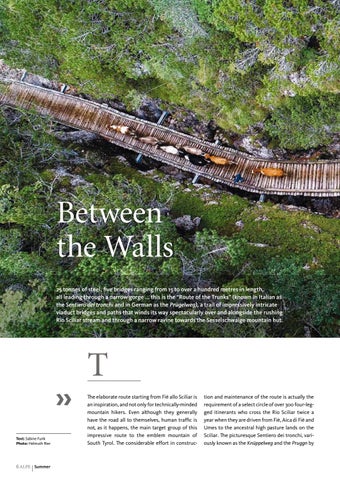
Between the Walls 25 tonnes of steel, five bridges ranging from 15 to over a hundred metres in length, all leading through a narrow gorge ... this is the “Route of the Trunks” (known in Italian as the Sentiero dei tronchi and in German as the Prügelweg), a trail of impressively intricate viaduct bridges and paths that winds its way spectacularly over and alongside the rushing Rio Sciliar stream and through a narrow ravine towards the Sesselschwaige mountain hut.
T Text: Sabine Funk Photo: Helmuth Rier
6 ALPE | Summer
The elaborate route starting from Fiè allo Sciliar is an inspiration, and not only for technically-minded mountain hikers. Even although they generally have the road all to themselves, human traffic is not, as it happens, the main target group of this impressive route to the emblem mountain of South Tyrol. The considerable effort in construc-
tion and maintenance of the route is actually the requirement of a select circle of over 300 four-legged itinerants who cross the Rio Sciliar twice a year when they are driven from Fiè, Aica di Fiè and Umes to the ancestral high pasture lands on the Sciliar. The picturesque Sentiero dei tronchi, variously known as the Knüppelweg and the Pruggn by
locals, is an indispensable part of the agricultural infrastructure for the livestock farmers of Fiè. Were it not for the elaborately secured stretches of this route between Peter Frag and Sesselschwaige mountain hut, the nourishing summer pastures would simply be inaccessible to the livestock.
While the convenient tourist route is considered the easiest access to the table-top mountain for human beings, this access, which detours across the Alpe di Siusi, would be all but impossible for the livestock. The rocky Schäufelesteig, the most direct old trail to the Sciliar from Fiè, would be too steep for the cattle. »
Summer | ALPE 7
»
8 ALPE | Summer
The Sentiero dei tronchi is, then, a fundamental part of the long history of pasture farming on the Sciliar and also of the tradition of the Fiè hay baths which originated here, both during the haymaking season on the high pastures and in later days, when the Sciliar hay was brought to the valley on rustic carts to supply the bathing centres with the precious raw material for their spa treatments. The management of the Sciliar mountain refuge huts was also highly dependent on the route, as it was used by the pack-mules to bring supplies along the route until the freight cable car was commissioned in 1969. In late spring, the cattle congregate on the Tuff Alm mountain hut or, depending on the hamlet of origin, on other pastures at a lower altitude, and proceed onwards to the Sciliar in early July. The ascent leads through all the way through the gorge, roughly one kilometre long and just a few metres wide, carved out of the rock by the Rio Sciliar as it coursed down to the valley. Depending on the food supply, which varies from year to year on both high and low pastures, the cattle are usually driven home again at the beginning to the middle of September.
A complex construction. The gorge was made accessible to hoofed fauna many years ago with the laying of the countless wooden logs across the river, to which the “Route of the Trunks” owes its various names. In the past, these logs were laid directly on the bottom of the ravine on the river bed, where they were exposed to the raging torrent from below and, in spring time, to the vast quantities of snow and boulders from above. Ongoing maintenance was unavoidable. For centuries on end the route was maintained and repaired for centuries by the farmers, each of whom had to contribute a specified amount of labour per head of cattle. In good years the damage was little and the work was manageable. However, many of the elderly people in Fiè still remember the winters of the 1950s and 1970s, when the road was all but completely devastated. In those times, over 500 farm animals spent the summer on the Sciliar. In 1994, the storm damage was so great that Office for Torrent and Avalanche Control began works on a full overhaul of the route. It was closed off completely for one year, and required a colossal effort: two walking excavators were brought into »
Oncoming traffic: at the end of september, you should first make sure that it is not the day of the downhill drive.
Summer | ALPE 9
Without the Sentiero dei tronchi, the alpine pastures on the Sciliar would simply be inaccessible to the livestock.
10 ALPE | Summer
The modern support structure (made of steel) is resistant against the high level of humidity in the gorge. The shape of the larch logs has a long tradition.
use for the task, and almost ten workers lived in containers below the Sesselschwaige mountain hut for the entire summer. In 1995, the year when the now raised Sentiero dei Tronchi was built, the gorge was impassable for the entire construction period and the cattle were driven along the alternative Zirmwaldsteig route, above the gorge to the right: a risky venture indeed, and one for which the trail was ill-equipped. The main change in this initial reconstruction was to raise the path from the bottom of the ravine to a height of two to three metres. Some features of the construction works were new, while others brought little change to the traditional appearance of the route. The raising of the trail required a load-bearing structure to be built, and a surface which could be walked by both humans and animals. The characteristic shape of the larch logs remains the same as those laid on the stream bed in earlier days, split along their length on-site using simple tools so that the sharp edge of the logs provides a non-slip surface. Some hikers feel that the jagged surface is hard on the knees, especially when walking downhill, but if the bridges were floored with round or smooth beams, the high level of humidity in the gorge would transform it into an out-and-out toboggan slope that would be all but impassable without risk. Just 15 years after the elaborate 300,000 euro reconstruction of the route, however, the first signs of deterioration were beginning to show in the bridges and tracks of the beautiful new trail: The ever-present damp in the gorge caused rapid decay and the outer layer of the supporting cross beams and longitudinal beams had rotted away, with the resultant risk of collapse at any moment. In the summers of 2011 and 2012, therefore, human intervention was called for once more and the Torrent Control Office undertook an even more radical second overhaul of the route. They focussed this time on the five bridges, four of which were reconstructed in wood, but laid this time on a steel support. It took almost 8,000 working hours for the expert torrent control workers to lay the route on a new, solid foundation of galvanised steel and larch wood. All the building materials, including a walking excavator - without which a construction project in terrain of this nature would be unthinkable - had to be flown in by helicopter. The logistics of the building site organisation was a mi-
nor work of art. The trail was closed to hikers for a whole summer once again, but, unlike the works of the 1990s, was provisionally opened for the cattle to travel up and down the gorge at pasture times in order to avoid the diversion along the hazardous Zirmwaldsteig trail. Nowadays, the Sentiero dei tronchi appears to be a solid, almost indestructible structure. In the design phase, great care was taken to ensure that the individual parts of the support structure can be replaced and repaired if necessary. Among traditionalists there was some degree of resistance to the use of building materials that were not sourced in the local area, such as the highly-visible steel which has replaced the romantic wooden support under the viaduct. But at the end of the day, despite its high aesthetic value and uniqueness, the Sentiero dei tronchi serves an agricultural purpose first and foremost, and should be viewed on a practical level. And it certainly doesn’t detract from the enjoyment of hiking on the Sciliar through the cool, shady gorge on a hot summer day. However, before you set off on a hike on Saturdays at the end of May and at the end of September, you should first make sure that it is not the day of the uphill or downhill drive. If you were to bump into a herd of hungry Tyrolean Greys or the equally beautiful Simmental cattle as they stampede along the route in their haste to get to the pasture, you would certainly wish that you’d left the trail to the four-footed itinerants and your own journey along the “Route of the Trunks” for another day, free of horned oncoming traffic. «
Summer | ALPE 11