Beekeeper Markus Pfeifer proudly shows his hive in Tires.
No life without bees In times gone by when people were still self-sufficient, practically every farm kept bees as before the days of mass sugar production honey was the main, and often the only, sweetener available.
T
Text: Katja Sanin Photos: Helmuth Rier
24 ALPE | Summer
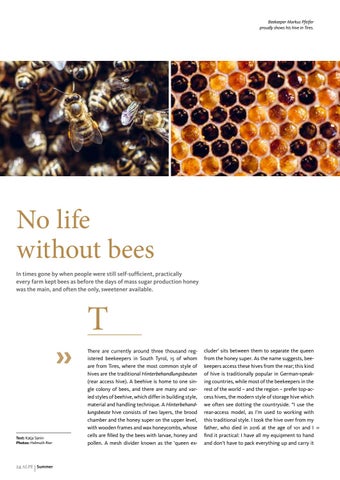
There are currently around three thousand registered beekeepers in South Tyrol, 15 of whom are from Tires, where the most common style of hives are the traditional Hinterbehandlungsbeuten (rear access hive). A beehive is home to one single colony of bees, and there are many and varied styles of beehive, which differ in building style, material and handling technique. A Hinterbehandlungsbeute hive consists of two layers, the brood chamber and the honey super on the upper level, with wooden frames and wax honeycombs, whose cells are filled by the bees with larvae, honey and pollen. A mesh divider known as the ‘queen ex-
cluder’ sits between them to separate the queen from the honey super. As the name suggests, beekeepers access these hives from the rear; this kind of hive is traditionally popular in German-speaking countries, while most of the beekeepers in the rest of the world – and the region – prefer top-access hives, the modern style of storage hive which we often see dotting the countryside. “I use the rear-access model, as I’m used to working with this traditional style. I took the hive over from my father, who died in 2016 at the age of 101 and I » find it practical: I have all my equipment to hand and don’t have to pack everything up and carry it
Summer | ALPE 25
26 ALPE | Summer
The Tires Beekeeping Association wants to raise public awareness on the importance of bees in order to safeguard their future.
around. I also like keeping an old tradition alive and I’m always happy when walkers are interested in the hive,” says Markus Pfeifer, chairman of the Tires Beekeeping Association.
Bees and the economy. The Tires Beekeeping Association was first referenced in a document dated 1897. Markus Pfeifer has been the chairman of the association for ten years, and tells us that there are an estimated twenty thousand species of bees around the world, of which only around ten species produce honey. Bees play an important role in the food chain as, according to UN reports, 71% of the 100 most important grain, fruit and vegetable crops, 90% of which are food crops, are pollinated by bees. This small insect is, therefore, an enormous factor for the economy and extremely important for agriculture. Bees are remarkably hard-working animals with a short life span: in summer, when they collect nectar, they live for only six weeks. They flit industriously from flower to flower, collecting pollen in the corbiculae ‘baskets’ in their hind legs, and transferring it to the other flowers in their area. Each year, a colony of bees needs around 20 to 40 kg of pollen, 60 to 70 kg of honey and, especially in spring and summer, roughly 200 grams of water each day. To yield one kg of honey, a bee has to fly out from the hive one hundred and fifty thousand times and visit up to six million flowers, covering a distance of forty thousand to one hundred and twenty thousand kilometres: that equates to around one to three times the Earth’s circumference. Pretty impressive, considering the honey bee only flies out from the hive to gather nectar in the last two weeks of its 6-week long existence. In the Sciliar-Catinaccio area, the blossoming season is over by the end of July as a rule, and this is when the beekeepers extract the honey. And this marks the start of the beekeeper’s year: they feed the colony of bees with liquid food throughout the winter months. During this season, the hive is colonised by winter bees, which live on until spring. A single winter colony consists of a few thousand bees, while the summer months count tens of thousands. The winter bees fill up all the cracks and crevices with propolis, and then winter peace reigns. The ‘bee glue’, as propolis is also
known, serves as preventative healthcare: the bees make this natural disinfectant from the sap of poplar, birch, willow or beech trees and use it to protect their hive from pathogens, as it inhibits the spread of bacteria, viruses and fungi. Even dead bees which are found in the hive are covered over with propolis disinfectant. A colony of bees will produce from 100 to 300 grams of propolis per year. Ancient Egyptians already knew of the preservative properties of propolis, and used it to embalm mummies. Queen bee, worker bees and drones. In spring, towards the end of February and beginning of March, when the days are drawing out and the first hazel, willow and heather blossom begins to appear, the queen bee starts to lay eggs. The winter bees gradually die off and as nature awakens, the colony transforms into its summer colony. As soon as dandelions and meadow flowers blossom and enough nectar is at hand, the young bees begin to build honeycombs. With the rapid increase in the size of the colony, the hives – especially rear-access hives – become too small and the bees begin to swarm. At this time, the old queen leaves the hive with a proportion of the colony and they settle on a branch or somewhere out in the open, where the beekeeper captures them. And this is how a new colony is created. There is only ever one queen for every hive, and she can live up to five years. She is the only fertile female of the colony, and her sole task is to reproduce. She can be identified by her long, thin abdomen and by the paint which beekeepers dot on her back in order to recognise her more easily and to keep track of her age, as they change queens every two to three years in order to maintain a high level of productivity. The queen comes from the same type of egg as every other bee, but is fed with royal jelly which the worker bees secrete into the queen cup. Unlike the considerably smaller cells of working bee larvae, the queen cup, or cell, is two to three centimetres long. The queen bee emerges after sixteen days, and is fertilised by a number of drones on what is known as the ‘nuptial flight’, after which she lays up to two thousand eggs a day. Drone bees are the product of unfertilised eggs, and their role in the hive is to mate with the queen, while bees emerge from the fertilised eggs after 21 days, begin work in the hive immediately, and continue with this task for »
Summer | ALPE 27
the first four weeks of their lives. They feed the young bees, clean the hive and produce wax for honeycombs, and only collect nectar in the last two weeks of their lives.
Beekeeper by passion: Markus Pfeifer dedicates a great deal of care and time to his bees.
28 ALPE | Summer
Making life better for bees. The UN is concerned about the worldwide bee mortality rate, which researchers have been studying with apprehension for years. In 2015 at the “Feeding the Planet” international expo in Milan, the United Kingdom‘s theme was dedicated to bees. The pavilion, a metal beehive-type structure, was accessed via a blossoming meadow. Causes of bee deaths are attributable, amongst other factors, to the Asian varroa mite, the use of poisonous pesticides in agriculture and gardens, and the decreasing number of flower meadows. Many beekeepers are actively involved in combating bee mortality. The Tires Beekeeping Association, together with the education board, designated 2016 the “Year of the Bee” and established a series of public awareness projects which included talks, workshops, visits to beehives and nature tours to illustrate the connections in the ecological circle and to show that everybody can do something to make life better for bees. Cooking and painting workshops were held on the theme of honey, a workshop on honey as ‘liquid gold’ for health and cosmetics, and another workshop for primary and secondary school pupils which involved building insect hotels which can be fixed to garden or balcony walls: by using cane, sunflower stalks or blackberry stems placed horizontally, these ‘hotels’ provide a natural nesting aid for bees. Another nesting aid comes in the form of the bee tree or Zeidler-tree, seldom seen these days, but a technique which is making a definite comeback. The term Zeidlerei refers to the Middle Age profession of gathering honey from wild or semi-wild colonies, whereby the Zeidler (tree beekeeper) hollowed out cavities in tree trunks to house the bees. This tradition has been preserved in the Ural Mountains in Russia, which means that today’s beekeepers and foresters can once again learn the age-old craft. The Zeidlerei profession disappeared gradually with the introduction of sugar cane, although even in the 17th century sugar was still so expensive that it was beyond the means of most. It only became affordable in the 19th century as a result of sugar beet cultivation, which supplanted honey as a sweetener. «