18 ALPE | Summer
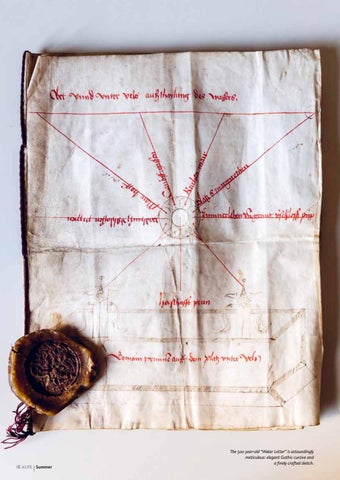
The 500 year-old “Water Letter� is astoundingly meticulous: elegant Gothic cursive and a finely crafted sketch.
Water courses over time Water has always been an important topic for Fiè allo Sciliar. 2017 is the 500th jubilee of the “Water Letter”, celebrating a long-documented history of this invaluable element, and most of all, the innovative spirit of the legendary Leonardo of Fiè.
2017 is an important jubilee for the community of Fiè allo Sciliar, whose history is so intertwined with that of Leonardo of Fiè. Leonardo the Elder (1458-1530), never to be forgotten Governor of the Adige and Burgrave of Tyrol, was an uncommonly energetic, resolute and successful individual who made his mark not only in the history of Fiè, but the entire lands and mountains of the Adige. While 2006 was the year that Fiè allo Sciliar commemorated the ignoble Fiè witch trials of 1506 and 1510, this year marks the achievements of Leonardo and the completion of the Prösels Castle renovations, which were commissioned by Leonardo and came to a close in 1517 with all the deco rous splendour of a Renaissance castle. At that time (around 1520), gothic renovations of the parish church also began; in Leonardo’s day, a great deal of ecclesiastical construction took place in the lands around Fiè, and it is also estimated that the Laghetto di Fiè lake, along with other water reservoirs, was also created in the first quarter of the 16th century. The main cause for celebration is that this was the year of the historic “Water Letter”: Governor of Tyrol, Leonardo of Fiè was a man of great vision and foresight. This was unequivocally confirmed in farback 1517, when he drafted a document unique for those times with plans for the regulation of the entire drinking water supply in the community of Fiè. The “Fountain Letter”, complete with sketches of the supply system and the fountain, survives to this day - right down to the wax seal – and is held in the Fiè parish archives. No other document dating to as far back in time exists. In elegant Gothic cursive, Leonardo outlines his intention to enlarge the existing fountain in the village square
with the addition of a new one; wooden pipelines, with a number of ramifications, were to convey the spring water from the Alpe Tuff at the foot of the Sciliar to the village square, with peripheral fountains to supply the outlying farms. The Fountain Letter. It was half a millennium ago that Leonardo planned the water supply line from Tuff down to Fiè village centre. This means that the village of Fiè has been furnished with a regulated supply and the very best of Sciliar water since 1517. In the centuries preceding, people could access water only from underground springs known as Ziggel and very few farms could boast their own spring and a fountain. During periods of drought, therefore, water was often in short supply in Fiè while at the foot of the Sciliar water was overflowing from the copious springs. An early-modern Lord of the Manor, Leonardo, member of the lesser nobility and later elevated to the station of Baron, was no newcomer to waterways. From 1491 to 1501, he was governor of the salt mines in Tyrol, where kilometre-long wooden brine pipes led to the saltpans in the pan house. The Hall salt mines were a lucrative business indeed, primarily for Emperor Maximilian but also for Leonardo and the town itself. The lack of good drinking water for people and animals in lower and upper Fiè, but also and especially the prospect of securing of the majority of the incoming water to both his family’s residence (today the Hotel Turm) and the planned manor house in the village centre would certainly have figured in Leonardo’s considerations in his decision to exploit his expertise from Hall in Tirol and begin works on a modern aqueduct to Fiè. As »
Text: Elisabeth Augustin Photos: Helmuth Rier
(cont. on page 22) Summer | ALPE 19
WHO WAS LEONARDO OF FIÈ? The Lords of Fiè are first mentioned in documents dating back to the 12th century. The northern tower of the parish church in the village centre is the oldest castle of the main line of the Lords of Fiè, while the most recent is the CASTRUM PRESIL (Prösels Castle), first referenced in documents dated 1279. The Lords of Fiè enjoyed almost exclusive feudal dominion in the mountains of Fiè and were responsible for a great deal of settlement expansion in the High Middle Ages.
500 years ago, Leonardo the Elder of Fiè was Governor of the Adige and Burgrave of Tyrol.
In Leonardo the Elder of Fiè, the Lords of Fiè reached the heights of the power and wealth, and the name of this indefatigable, multi-talented man will ever be linked with the town of Fiè. Driven by his own ambition, he was at time and a hard and ruthless taskmaster of his subjects, such that during the Peasants’ War of 1525, he was considered to be the main adversary of the farmers in his judicial district. Leonardo was also a diplomat and a soldier, and in 1487 he fought against the Venetians at Calliano. The Fiè aristocrat was wellknown to Maximilian I, King and Emperor of the German Empire. The Habsburgs often called on the services of the South Tyrolean nobleman, entrusting him with military and diplomatic responsibilities in northern Italy, in conflicts with the Republic of Venice, in Bavaria and in Tyrol. In 1498, Leonardo was declared State Governor and Burgrave of
20 ALPE | Summer
Tyrol, and thus the highest-ranking nobleman in the land. In 1499, he was temporary Commander in Chief against the Swiss Confederacy in Val Monastero and Val Venosta; in 1504 he fought in the Bavarian War of Succession, in 1508 in the war against Venice, and again in 1516 against Milan. The stone crest above the first tower door, dated 1517, suggests that Leonardo of Fiè inaugurated the newly renovated Prösels Castle, converted into a fortress with its two towers, in that year or in any case, would have been using a substantial part of it. In 1518, he was Head of the Commission for the repurchase of the mines in Tyrol. Leonardo was ever mindful to elevate his own status throughout the land, and to this end he expanded and augmented his estate through involvement in all and any enterprises. Leonardo’s three marriages to extremely wealthy noblewomen - Regina of Thun, Katharina of Firmian and Ursula of Montfort - were no doubt advantageous to these aims. A not inconsiderable share of the estate and the Prösels Castle grounds remained in the hands of the Lords of Fiè until the lineage died out in 1804, having suffered significant financial losses through unprofitable sales, dowries for the women of the family on marriage or entry into the Holy Order and, last but not least, donations to religious orders. The well-kept Prösels Castle is today
managed by a board of trustees and is well-known as a cultural centre far beyond regional borders. In 1520, Leonardo the Elder of Fiè was elevated to the title of Baron. Although evidence is scant, it appears that at around this time he received a letter of affiliation from the Roman admiral Marcantonio Colonna, thus entering the declining Colonna lineage, which allowed him to adopt their title and add the Colonna pillar to his coat of arms. The incredible heritage which Leonardo left to the local community is not without its darker side: one particularly bleak chapter in the annals of local history were the Fiè witch trials of 1506 and 1510. Leonardo’s ruthlessness is well-documented in the “Grievance Articles” submitted to the State Parliament of Merano by the farmers from Fiè in May 1525. They state that he had expropriated plots of land from farmers without lowering their rent, while in other cases he had raised rents with equally no justification. The farmers felt cheated in many ways and demanded the dismissal of the State Governor. Today, the residents of Fiè consider themselves fortunate in that the “Water Letter” was not destroyed during the many-week siege of Prösels Castle unlike so many other documents, and that this remarkable testimony to the history of the community remains with us to this day.
Leonardo of Fiè made his mark on PrÜsels Castle.
The historic Water Letter with its 500 year-old wax seal.
Summer | ALPE 21
SOURCES Franz Huter, “Völs am Schlern 888-1988”, Ein Gemeindebuch, 1988 (Fiè allo Sciliar 888-1988”, a community volume, 1988) Elmar Perkmann, “Völser Zeitung” newspaper, 1/2017 Drinking Water Cooperative of Fiè allo Sciliar, “Der Völser Wasserbrief von 1517” (The Water Letter of Fiè, 1517) Helmut Stampfer, Lecture “Die Herren von Völs und ihre Wappen” (The Lords of Fiè and their Coat of Arms), 2017
we can read in the “Fountain Letter” dated 1517: “… and I have made a personal commitment, together with the assistance of the entire judicial community, that good spring water shall be conducted from the mountains of Tuffrain over the lake above Woff to Upper Fiè and towards Lower Fiè to an orderly, abundant fountain, by means of wooden piping …”
The Fiè allo Sciliar village square and the fountain, commemorated this year, which has been dispensing fresh water for 500 years.
The fountain itself is divided in two shares: the right hand side was commandeered by Leonardo for the private manorial fountain as the “herschaffts prun”
22 ALPE | Summer
The “Fountain Letter” is, in several passages, astoundingly detailed, and the accompanying sketches of a fountain with two painstakingly drawn columns, replete with banners and two spouts with water shooting out are testimony to the artistic talents of a nameless scribe in Leonardo’s service. Across the reservoir of the fountain, we read the words “Gemain prunne auff dem platz unter Vels” (communal fountain in the square below Fiè).
(manor share), while the new, left-hand side of the fountain was allotted to the public. The “Water Letter” referred to a spring below Alpe Tuff which “at source, in a goodly trough” would be covered over with stone slabs and the water stocked in an orderly reservoir which would be sheltered from rainwater and dirt and, at the same time, ensure that dirt and sand would settle to the bottom and thus not pass through the pipelines. The water flowed along wooden pipelines from Tuff to the village centre, a distance of 3,200 metres in today’s measurements. Along the route, a few farms were also connected to Leonardo’s water supply network. In neighbourly spirit, the letter stated that any surplus water could be used for irrigation purposes by all those resident in the catchment area. And 500 years later, the people of Fiè and their numerous holiday guests greatly value the fact that the Fiè water still meets the most stringent of drinking water criteria. «