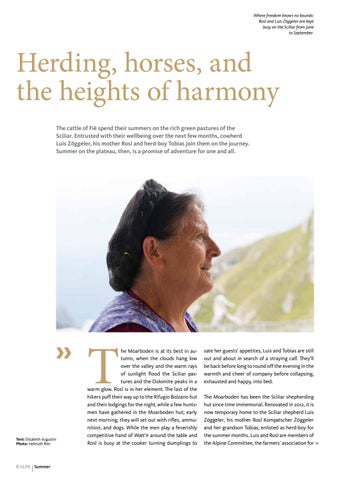
Where freedom knows no bounds: Rosl and Luis Zöggeler are kept busy on the Sciliar from June to September.
Herding, horses, and the heights of harmony The cattle of Fiè spend their summers on the rich green pastures of the Sciliar. Entrusted with their wellbeing over the next few months, cowherd Luis Zöggeler, his mother Rosl and herd-boy Tobias join them on the journey. Summer on the plateau, then, is a promise of adventure for one and all.
T Text: Elisabeth Augustin Photo: Helmuth Rier
6 ALPE | Summer
he Moarboden is at its best in autumn, when the clouds hang low over the valley and the warm rays of sunlight flood the Sciliar pastures and the Dolomite peaks in a warm glow. Rosl is in her element. The last of the hikers puff their way up to the Rifugio Bolzano hut and their lodgings for the night, while a few huntsmen have gathered in the Moarboden hut; early next morning, they will set out with rifles, ammunition, and dogs. While the men play a feverishly competitive hand of Watt’n around the table and Rosl is busy at the cooker turning dumplings to
sate her guests’ appetites, Luis and Tobias are still out and about in search of a straying calf. They’ll be back before long to round off the evening in the warmth and cheer of company before collapsing, exhausted and happy, into bed. The Moarboden has been the Sciliar shepherding hut since time immemorial. Renovated in 2012, it is now temporary home to the Sciliar shepherd Luis Zöggeler, his mother Rosl Kompatscher Zöggeler and her grandson Tobias, enlisted as herd-boy for the summer months. Luis and Rosl are members of the Alpine Committee, the farmers’ association for »
Summer | ALPE 7
8 ALPE | Summer
An idyllic place to work: the Moarboden hut has been home to the Sciliar cowherders since time immemorial.
the community of Fiè allo Sciliar. Tasked with the job of cattle herding, they have spent every summer since 2006 on the Sciliar. “In the past, we spent 20 years in the Duron Valley, and herded the whole valley between the Sciliar and the Fassa Valley” says Rosl. Having accompanied them since he was a babe in arms, son Luis is a cowherd to the bone.
The realm of the Sciliar. Cowherd Luis tends over 560 hectares of pastures and 350 head of cattle – calves, cows in calf, cows put out to pasture, oxen, and 20 horses. Luis rides Moni, his Haflinger, over the endless pastures every day. Luis, in his words, “travels”. Always on the go. His forebears “travelled” on foot so the high-spirited Luis, as the first horse-riding cowherd, is something of a novelty. There is no fear that the cattle will take fright; everybody is satisfied that they couldn’t be in better hands. Luis knows every single cow in his care and every single cow knows Luis. He counts his far-straying cattle every day, and if one is missing then it’s looked for until it’s found. The cattle are herded in mid-June at the latest through the Sciliar gully, along the Prügelweg trail and up to the Sciliar. Having left the confines of their byre at the end of winter, the cattle have already spent a month grazing the lower pastures of Fiè, Umes, Presule and Aica di Fiè. On the wide pastures of the Sciliar, the cattle are free to go their separate ways, although most of them prefer to stay in a herd, often up high on the
Monte Castello, whose 2,500m summit, pagan cult site at some point in the far distant past, leads to the Santner peak. “They all find their favourite spot sooner or later”, says Luis. When it snows in summer, no uncommon occurrence on the Sciliar, it’s not only the cattle but the cowherds themselves who are in difficulty. The farmers from Fiè rush up to the heights of the Sciliar to help round up the cattle so that none die of cold, plummet down the mountainside or go hungry. If an animal should fall down the precipices of the Sciliar or the edge of Monte Castello, as may well happen in inclement weather, the cowherd does everything in his power to find it. If at all possible, Luis climbs to the cow to save it; if his attempts should be in vain, he retrieves the ear tag. “I give it back to the farmers so that he can claim damages on his insurance” explains Luis. Every summer, unless there is a heavy lightning storm which can lead to greater fatalities, an average of five cattle is lost.
The day’s work on the Moarboden starts at just after 6 in the morning. Keeping Luis, Rosl and Tobias company for the summer are Moni and Bessy, the two horses, Bubi the dog, an assortment of hens and rabbits and three cows. After the cows have been milked, the cream is skimmed for butter. Well-breakfasted and set up for the day Luis and Tobias now ride up to the Rifugio Bolzano hut, where they pick up the salt, conveyed up from the valleys on the supply cable car, and divide it up be- »
Summer | ALPE 9
Even in the height of summer, snowstorms can threaten the safety of the cattle on the wide pastures of the Sciliar.
tween the salt troughs. While they’re at it, cowherd and herd-boy check the water troughs so the cattle don’t go thirsty. And if they find the time, Luis and Tobias put in a bit of practice on the pastures with the Haflingers to keep in training and to get ready for the big horse events of the year, like the Oswald von Wolkenstein Riding Tournament and the Skijoring races in winter. The Zöggelers are familiar faces in Haflinger circles. In the meantime, mother Rosl is holding the fort at the Moarboden hut, where she has to have something to offer if anybody happens to stop off for a bite to eat: farmers who have come to check on their cattle or hikers who, in the half hour’s walk down from the Rifugio Bolzano hut, fancy stopping off for a break. Rosl dispenses juice, wine and beer and, for hungry travellers, a “Schlern board” of speck, sausages and cheese or mouth-watering Kaiserschmarrn pancakes. Lamb stew and homemade schnapps are served up in mammoth quantities for the Patron Saint celebrations in August, while at weekends, when the Rifugio Bolzano hut is the destination for myriad locals and tourists, Rosl is ready and waiting to entice them in with sweet Fiè Krapfen. Their work in the pastures done for the day, Luis and Tobias head homewards to play host to their guests. And so the evenings pass in pleasant company. The last of the hikers have gone, and a heavenly peace reigns over the Moarboden. “When we sit in front of the hut, the Catinaccio glowing in front of us and we catch sight of the marmots, the deer and the chamois, the feeling of freedom is beyond words”, says Rosl, “it’s just lovely”. Up here in the mountains, one wants for nothing. In mid September, depending on the weather, the whole procession heads back down to the valley to a distinct air of festivity: the cowherds and farmers are delighted that their cattle have made it safe and sound through the summer. Luis and Rosl head back to Santa Caterina and the Kompatscher farm to lend a hand to the young farmer Peter in the winter months. 30 Haflingers, 70 cattle, 20 goats and 20 sheep need daily care on this large farm, which dates back to the 16th century. In the old Stube snuggery and in the hall, countless trophies confirm the successes of Grauvieh cattle, thoroughbred horse shows and horse races. One thing’s for sure: winter’s certainly not going to be dull for Luis and Rosl. And next summer on the Sciliar will come around again soon. n
10 ALPE | Summer