The little Neogothic style church as it is today with its vaulted ceilings, rose window and precious frescoes on the inner walls.
Taking a break in a wellspring of energy The little St. Valentine Church above Siusi allo Sciliar is a treasure trove of art and history.
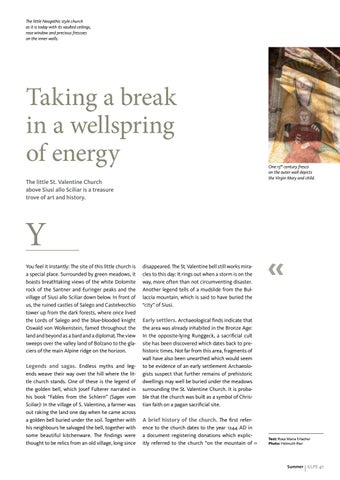
One 15th century fresco on the outer wall depicts the Virgin Mary and child.
Y You feel it instantly: The site of this little church is a special place. Surrounded by green meadows, it boasts breathtaking views of the white Dolomite rock of the Santner and Euringer peaks and the village of Siusi allo Sciliar down below. In front of us, the ruined castles of Salego and Castelvecchio tower up from the dark forests, where once lived the Lords of Salego and the blue-blooded knight Oswald von Wolkenstein, famed throughout the land and beyond as a bard and a diplomat. The view sweeps over the valley land of Bolzano to the glaciers of the main Alpine ridge on the horizon.
Legends and sagas. Endless myths and legends weave their way over the hill where the little church stands. One of these is the legend of the golden bell, which Josef Fulterer narrated in his book “Fables from the Schlern” (Sagen vom Sciliar): In the village of S. Valentino, a farmer was out raking the land one day when he came across a golden bell buried under the soil. Together with his neighbours he salvaged the bell, together with some beautiful kitchenware. The findings were thought to be relics from an old village, long since
disappeared. The St. Valentine bell still works miracles to this day: It rings out when a storm is on the way, more often than not circumventing disaster. Another legend tells of a mudslide from the Bullaccia mountain, which is said to have buried the “city” of Siusi.
Early settlers. Archaeological finds indicate that the area was already inhabited in the Bronze Age: In the opposite-lying Runggeck, a sacrificial cult site has been discovered which dates back to prehistoric times. Not far from this area, fragments of wall have also been unearthed which would seem to be evidence of an early settlement Archaeologists suspect that further remains of prehistoric dwellings may well be buried under the meadows surrounding the St. Valentine Church. It is probable that the church was built as a symbol of Christian faith on a pagan sacrificial site.
A brief history of the church. The first reference to the church dates to the year 1244 AD in a document registering donations which explicitly referred to the church “on the mountain of »
Text: Rosa Maria Erlacher Photo: Helmuth Rier
Summer | ALPE 41
ST. VALENTINE CHURCH The St. Valentine church above Siusi allo Sciliar is a 15-20 minute walk from Siusi bus station. To get there, head north-west on the pavement running alongside the main road, past the post office, to the junction of the trail leading to St. Valentin (trail no. 7). You cannot get to the church by car. There is an underground car park at the bus station in Siusi village centre.
The church is not usually open, but can be visited on the following dates: From June 27th to September 5th there is a guided tour of the church every Thursday. This begins at 4.30 pm at the Tourist Office in Siusi (book at the tourist office). On May 9th 2019, the spring hike to the church begins at 10.30 am at the Tourist Office in Siusi (Book at the tourist office). In September/October, there are also around three organised walks which include a trip to the church. The dates will be confirmed in the near future.
St. Valentine.” The early Romanesque tower of this church still towers up to the day and, with its two rows of arched windows, stands out in clear contrast to the rest of the building. In the centuries which followed, a number conversions and renovations were carried out to match the style of the times. The earliest frescoes, which were discovered under several layers of paint in the church, date to the 14th century when the church was still topped with a flat wooden ceiling in keeping with Romanesque custom. A letter of indulgence from 1475 confirms a reconstruction of the church, during which time the chancel was built.
The Onion Dome. According to records, the church housed two altars in 1594. The outer frescoes date to the 15th century, and the year 1532 has been engraved above the church door. The onion dome atop the octagonal tambour of the church tower is a landmark visible from far and wide, and dates to 1811. A variety of figures were used to create the valuable winged altar in the 19th century, which replaced the earlier two altars. During restoration works from 1962 until 1983, experts discovered several overlapping layers of paint, the last of which, painted in Danube style in 1530, was removed and affixed to the north wall on a canvas.
Beautiful outer frescoes. Given that the church is closed throughout the year except for special occasions such as weddings or the patron saint festival on February 14th, the following description is limited to the beautiful murals on the south and east walls, the work of artists from Bolzano in the 15th century. Thanks to skilled renovation works, the frescoes remain in good condition today; they depict images of St. Valentine the patron saint, and St. Christopher. At the time when Emperor Claudius II banned weddings, St. Valentine was Bishop of Temi and, disregarding the prohibition, continued to wed couples. This is why February 14th is the day of love. And it is also why the church of St. Valentine near Siusi is the church of choice for so many couples, particularly from abroad, to say their vows.
For art lovers. Other frescoes on the south wall depict the Madonna on a throne with the baby Jesus, the adoration of the three Magi,
42 ALPE | Summer
the veil of Veronica and parts of the crucifixion scene which have, unfortunately, been damaged by a window portal which was fitted in subsequent years. A closer examination of the frescoes reveals chalices, halos, crowns and clothing which were engraved in the wet fresco mortar. These would indicate that precious gold was applied there, which has most likely evaporated over the centuries. Amongst other features on the façade of the church, we see St. Catherine and, above, the Annunciation scene. “These mural paintings are the hallmark of a highly talented Bolzano artist who was inspired by the Verona school,” reveals art historian Karl Gruber in the book “Art in the Parish of Siusi” (“Kunst in der Pfarre Seis am Schlern”) with admiration. The inner frescoes were painted by the same artist, who applied them over the underlying, earlier frescoes.
Daytrip destination. With its fabulous location, amidst lush green meadows and backed by the Sciliar massif and the Santner peak, this church has become one of the most popular photo-destinations in South Tyrol. In days gone by, it was an important site for worshippers and for the farming people from the area, and today it is equally important as a tourism destination. You can only get to the church on foot, as there is no access for cars. Benches in front of the church provide a comfortable space for visitors to sit back, relax and enjoy the cool shade offered by the walnut tree. It is a restful haven and a true wellspring of power, a place where you can rest your soul and absorb the energy. «
Surrounded by green meadows, the little church is a scenic gem and boasts beautiful panoramic views.
Summer | ALPE 43