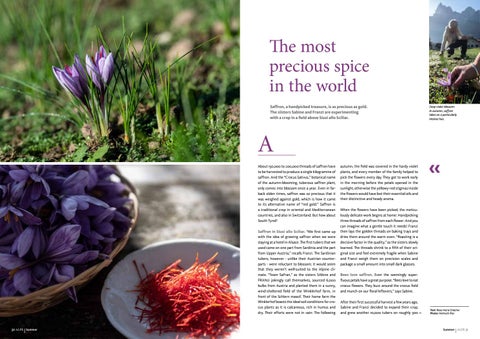
The most precious spice in the world Saffron, a handpicked treasure, is as precious as gold. The siisters Sabine and Franzi are experimenting with a crop in a field above Siusi allo Sciliar.
Deep violet blossom: In autumn, saffron takes on a particularly intense hue.
A About 150,000 to 200,000 threads of saffron have to be harvested to produce a single kilogramme of saffron. And the “Crocus Sativus,” botanical name of the autumn-blooming, tuberous saffron plant, only comes into blossom once a year. Even in farback olden times, saffron was so precious that it was weighed against gold, which is how it came to its alternative name of “red gold.” Saffron is a traditional crop in oriental and Mediterranean countries, and also in Switzerland. But how about South Tyrol?
Saffron in Siusi allo Sciliar. “We first came up with the idea of growing saffron when we were staying at a hotel in Alsace. The first tubers that we used came on one part from Sardinia and the part from Upper Austria,” recalls Franzi. The Sardinian tubers, however - unlike their Austrian counterparts - were reluctant to blossom; it would seem that they weren’t well-suited to the Alpine climate. “Team SaFran,” as the sisters SAbine and FRANzi jokingly call themselves, sourced 6,000 bulbs from Austria and planted them in a sunny, wind-sheltered field of the Winklerhof farm, in front of the Schlern massif. Their home farm the Winklerhof boasts the ideal soil conditions for crocus plants as it is calcareous, rich in humus and dry. Their efforts were not in vain: The following
30 ALPE | Summer
autumn, the field was covered in the hardy violet plants, and every member of the family helped to pick the flowers every day. They got to work early in the morning before the petals opened in the sunlight, otherwise the yellowy-red stigmas inside the flowers would have lost their essential oils and their distinctive and heady aroma. When the flowers have been picked, the meticulously delicate work begins at home: Handpicking three threads of saffron from each flower. And you can imagine what a gentle touch it needs! Franzi then lays the golden threads on baking trays and dries them around the warm oven. “Roasting is a decisive factor in the quality,” as the sisters slowly learned. The threads shrink to a fifth of their original size and feel extremely fragile when Sabine and Franzi weigh them on precision scales and package a small amount into small dark glasses.
Bees love saffron. Even the seemingly superfluous petals have a great purpose. “Bees love to eat crocus flowers. They buzz around the crocus field and munch on our floral leftovers,” says Sabine. After their first successful harvest a few years ago, Sabine and Franzi decided to expand their crop, and grew another 10,000 tubers on roughly 300 »
Text: Rosa Maria Erlacher Photo: Helmuth Rier
Summer | ALPE 31
Sabine and Franzi Schgaguler invest endless time and energy into their saffron crops at the Winklerhof above Siusi allo Sciliar.
square metres of arable land. The first planting takes place in late summer, and the saffron plants blossom around two months later. Then the fouryear vegetation cycle begins: The tubers sprout in spring and then the plants begin to garner their strength. In summertime all the green dies away, and does not reappear until autumn. “We do not use any fertiliser or chemicals, and for the most part, water the plants only when it is particularly dry in spring, but the weeds just keep growing,” moans Franzi. Picking the rampant weeds days after day is a lot of work, but not even the weeds can spoil their joy in their venture.
A sideline with a soul. “We’re still in the experimental phase,” says Sabine. Last summer, they treated a field with a layer of biodegradable cornstarch. “It was worth a try. Next year we’ll try sowing buckwheat or rye in the spring to try to
32 ALPE | Summer
keep the weeds down and create added value.” Growing saffron should continue to be a side business for the sisters that brings them joy and enthusiasm. Sabine works full time in a sports shop and Franzi runs the farm with her husband. The customers for their lovingly packaged saffron threads are local shops, including “South Tyrol Products” at the valley station of the Seiser Alm cable car and the grocery shop “Konsum” in Castelrotto. “We can’t produce enough to keep up with the demand”: The sisters are delighted with their success. Franzi often makes tea with a few infused saffron threads. “It’s a great pick-me-up,” she says. The saffron liqueur, which she has made is also delectable. Sabine, in similar vein, got herself a saffron recipe book and often tries out new dishes. Her greatest wish is to work together with local professional chefs as a saffron-grower. «
Summer | ALPE 33