By
upstream
SUPER YACHT
supplemento di www.superyacht24.it | 1 /2026
COVER STORY
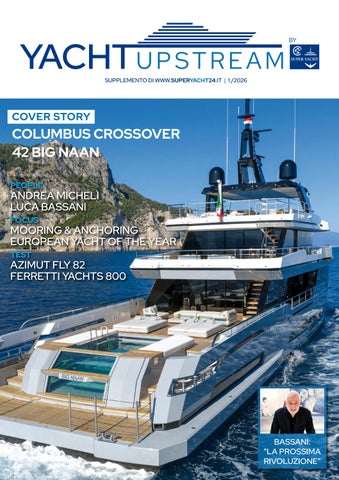
Columbus Crossover 42 Big Naan PEOPLE
Andrea Micheli Luca Bassani FOCUS
Mooring & anchoring European Yacht of the Year TEST
Azimut Fly 82 Ferretti Yachts 800
Bassani: “La prossima rivoluzione”
Editoriale / editorial Alberto Mariotti -
SWS-YACHTS.COM
-
Ben ancorati alla realtà
Firmly grounded in reality
Prima i numeri: secondo i dati diffusi da Confindustria Nautica il settore superyacht ha chiuso l’anno solare 2025 con il 50% delle aziende che prevede una crescita di fatturato rispetto all’anno orima e il 25% una stabilità. È confermata la normalizzazione dei tassi di crescita, con la metà dei cantieri che mantengono il proprio order book sugli stessi livelli di 12 mesi fa e un quarto di essi con dati in crescita. Il trend, spiega l’Associazione, è confermato dalle anticipazioni fornite da Boat International sul Global Order Book 2026, che, a fronte di una riduzione degli ordini mondiali da 1.138 a 978, vede la quota italiana in crescita di quasi 3 punti percentuali, al 53%. Con l’aumento costante di dimensioni e dislocamento dei superyacht anche gli impianti dedicati alle fasi di ormeggio e ancoraggio stanno subendo importanti evoluzioni. La parte di ormeggio beneficia della diffusione dei captive winch, grandi verricelli a tamburo che vengono installati in appositi vani tecnici e da tempo utilizzati nella vela per la gestione del piano velico. Il concetto è lo stesso ma cambiano materiali, peso e capacità di tiro permettendo una gestione più sicura delle cime di ormeggio, senza l’intervento manuale dell’operatore, e automatizzata grazie all’integrazione con i sistemi Plc, che possono variare l’ormeggio seguendo l’andamento di elementi vento, risacca e marea. Anche la classica molla si è evoluta e oggi esistono versioni a smorzamento idraulico con possibilità di integrare un sistema di acquisizione dati tramite sensori capaci di misurare sollecitazioni, frequenza dei movimenti correttezza dell’ormeggio e fornire informazioni a comandanti e marina. Bitte e verricelli da tonneggio diventano a scomparsa, per adattarsi meglio alle superfici piane di ponti di coperta e plancette di poppa. Riguardo i salpancora per l’ancoraggio le taglie crescono per tutti i produttori e le evoluzioni sono guidate dalle normative. Le innovazioni sono sottocoperta e riguardano soprattutto la componentistica, ad esempio con quadri elettrici aggiornati, motori elettrici asincroni Variable frequency drive per gestire con la massima precisione risalita e discesa della catena. Nel focus raccontiamo prodotti ed evoluzioni Harken, Posidonia, Seares, Vetus-Maxwell, Muir, Quick Group, Samos e Italwinch. Gennaio è anche il mese del boot Düsseldorf con l’annuncio delle barche vincitrici dell’European Yacht of the Year 2026 che SUPER YACHT 24 ha provato nel corso di un’edizione avvincente. Infine Yacht Upstream: ha compiuto un anno e nel 2026 torna con nuovi e interessanti focus tecnici. Nei prossimi numeri si parlerà ancora di refit, sempre più di moda; di vetri, dove l’Italia è protagonista mondiale; di stabilizzatori, perché non esiste più yacht che non ne abbia almeno un tipo a bordo; di luxury tender e service provider, entrambi sono vitali al successo e alla rivendibilità del superyacht. Yacht Upstream cresce rimanendo ancorato alla realtà e alle esigenze del mondo B2B.
First, the numbers: according to data released by Confindustria Nautica, the superyacht sector closed the 2025 calendar year with 50% of companies expecting revenue growth compared to the previous year, while 25% foresee stable results. The normalization of growth rates has been confirmed, with half of the shipyards keeping their order books at the same levels as 12 months earlier and a quarter reporting growth. The trend, the Association explains, is also confirmed by the early figures released by Boat International for the Global Order Book 2026 which, despite a drop in global orders from 1,138 to 978 units, shows Italy’s share rising by almost three percentage points, to 53%. With the steady increase in the size and displacement of superyachts, systems dedicated to mooring and anchoring operations are also undergoing significant evolution. On the mooring side, the spread of captive winches is playing a key role: large drum winches installed in dedicated technical compartments, long used in sailing for sail handling. The concept is the same, but materials, weight and pulling capacity change, allowing safer handling of mooring lines without manual operator intervention, and automated management thanks to integration with PLC systems, which can adjust mooring in response to wind, surge and tidal conditions. Even the traditional spring line has evolved, and hydraulic-damping versions are now available, with the option of integrating data acquisition systems via sensors capable of measuring loads, movement frequency and the correctness of the mooring setup, providing valuable information to captains and marinas. Bollards and mooring winches are increasingly becoming retractable, to better suit the flat surfaces of deck areas and aft platforms. As for anchor windlasses, sizes are increasing across all manufacturers, with developments driven by regulations. Innovations are mainly below deck and focus on components, such as updated electrical panels and asynchronous electric motors with variable frequency drives, enabling extremely precise control of chain lowering and retrieval. In this focus, we look at products and developments from Harken, Posidonia, Seares, Vetus-Maxwell, Muir, Quick Group, Samos and Italwinch. January is also the month of boot Düsseldorf, with the announcement of the winners of the European Yacht of the Year 2026, which SUPER YACHT 24 tested during a particularly engaging edition of the show. Finally, Yacht Upstream: it has just turned one year old and will return in 2026 with new and compelling technical focuses. In upcoming issues, we will continue to cover refit, an increasingly popular topic; glass, where Italy is a global leader; stabilizers, now an essential feature on every yacht; and luxury tenders and service providers, both vital to the success and resale value of a superyacht. Yacht Upstream continues to grow while remaining firmly grounded in reality and in the needs of the B2B world.
Project Management | Buyer's representative WE CUSTOMIZE OUR OWNERS EXPECTATIONS AND MAXIMIZE THEIR SATISFACTION TO IMPROVE THEIR LIFESTYLE IN THEIR PROPERTIES BEING THEM IN THE AIR, ASHORE OR AT SEA
Viareggio, Italy
sc@seamotion.com
+39 3406217504
gennaio | January 2026 [ 3 ]
Indice dei contenuti Table of contents 03 Editoriale | Editorial TECH 06 Superyacht Columbus Crossover 42 Big Naan 10 14 16 22 24 26 28
People
Andrea Micheli
People
Luca Bassani
test
Azimut Fly 82
test
Ferretti 800
news
European Yacht of the Year
news
Sailing Super Yacht Forum
News
The best from Metstrade Focus Mooring & anchoring
Emanuele Cecchini – Harken
Super Yacht 24 - ALOCIN MEDIA Piazza Roberto Baldini 4/66, 16149 Genova +39 010 9703071 | info@alocinmedia.it
Focus Mooring & anchoring
EDITOR IN CHIEF: Nicola Capuzzo | capuzzo.nicola@gmail.com | +39 334.788.9863
Focus Mooring & anchoring
CO-EDITOR IN CHIEF: Alberto Mariotti | mariotti@superyacht24.it | + 39 328.29.37.133
Focus Mooring & anchoring
Progetto grafico: Claudia Giorgini | claudiagiorgini@gmail.com
Giacomo Ardito – Posidonia Giulio Manno – Seares
D. Baldereschi & A. Dario – Vetus Maxwell
30 Luca Signorini – Muir Mooring & anchoring 32 Focus Lorenzo Cesari – Quick Group Mooring & anchoring 34 Focus Tomaso Lalla – Samos Mooring & anchoring 36 Focus Mario Candellari – Italwinch Focus Mooring & anchoring
38
44 46 48 52
Focus Mooring & anchoring
News
[ 4 ] gennaio | January 2026
Contributors: Cinzia Garofoli, Alberto Mariotti, Giuseppe Orrù Cover photo: Columbus Crossover 42 Big Naan ph. Giovanni Malgarini Advertising & Marketing: Per informazioni sulle opportunità di marketing, pubblicità e visibilità For information on marketing, advertising and visibility opportunities Sabrina Carozzino marketing@alocinmedia.it | + 39 350.071.6304 Emanuele Buffa di Perrero ebuffa@link-media.com | + 39 335.649.4152
Indice dei contenuti Table of contents 03 Editoriale | Editorial TECH 06 Superyacht Columbus Crossover 42 Big Naan 10 14 16 22 24 26 28
People
Andrea Micheli
People
Luca Bassani
test
Azimut Fly 82
test
Ferretti 800
news
European Yacht of the Year
news
Sailing Super Yacht Forum
News
The best from Metstrade Focus Mooring & anchoring
Emanuele Cecchini – Harken
Super Yacht 24 - ALOCIN MEDIA Piazza Roberto Baldini 4/66, 16149 Genova +39 010 9703071 | info@alocinmedia.it
Focus Mooring & anchoring
EDITOR IN CHIEF: Nicola Capuzzo | capuzzo.nicola@gmail.com | +39 334.788.9863
Focus Mooring & anchoring
CO-EDITOR IN CHIEF: Alberto Mariotti | mariotti@superyacht24.it | + 39 328.29.37.133
Focus Mooring & anchoring
Progetto grafico: Claudia Giorgini | claudiagiorgini@gmail.com
Giacomo Ardito – Posidonia Giulio Manno – Seares
D. Baldereschi & A. Dario – Vetus Maxwell
30 Luca Signorini – Muir Mooring & anchoring 32 Focus Lorenzo Cesari – Quick Group Mooring & anchoring 34 Focus Tomaso Lalla – Samos Mooring & anchoring 36 Focus Massimo Candellari – Italwinch Focus Mooring & anchoring
38
44 46 48 52
Focus Mooring & anchoring
News
[ 4 ] gennaio | January 2026
Contributors: Cinzia Garofoli, Alberto Mariotti, Giuseppe Orrù Cover photo: Columbus Crossover 42 Big Naan ph. Giovanni Malgarini Advertising & Marketing: Per informazioni sulle opportunità di marketing, pubblicità e visibilità For information on marketing, advertising and visibility opportunities Sabrina Carozzino marketing@alocinmedia.it | + 39 350.071.6304 Emanuele Buffa di Perrero ebuffa@link-media.com | + 39 335.649.4152
SUPERYACHT TECH Columbus Crossover 42 Big Naan
alberto mariotti
Gru rescue e piscina integrata le sfide maggiori
Rescue crane and integrated pool: the biggest challenges Il general manager Gianpaolo Lapenna racconta le soluzioni ingegneristiche che hanno richiesto i calcoli più complessi: la piscina vetrata integrata nello scafo e la gru certificata Solas nascosta nella pavesata, elementi chiave del progetto General Manager Gianpaolo Lapenna explains the engineering solutions that required the most complex calculations: the glass pool integrated into the hull and the Solas-certified crane hidden in the bulwark, both key elements of the project
B
ig Naan è la prima unità della linea Crossover di Columbus Yachts a scendere in acqua. Disegnato dallo studio Hydro Tec con interni firmati Hot Lab, Big Naan è un 42 metri compatto con una stazza lorda di 443 Gt. La propulsione è affidata a due Caterpillar C32 Acert da 742 kW ciascuno, in grado di spingere lo yacht oltre i 14 nodi di velocità massima, con una velocità di crociera di 12 nodi. L’autonomia supera le 5.500 miglia nautiche a una velocità economica di 10 nodi, grazie a serbatoi carburante da circa 60 m³. Big Naan è dotato inoltre di un sistema di riduzione catalitica selettiva che soddisfa gli standard di emissione Imo Tier III, consentendole di navigare all’interno delle aree marine protette. SUPER YACHT 24 ha intervistato il Gianpaolo Lapenna, general manager a capo della divisione tecnico-produttiva, per un
[ 6 ] gennaio | January 2026
approfondimento tecnico. Quali sono state le principali sfide ingegneristiche nella progettazione e costruzione dello yacht e in che modo le avete affrontate? “Tutto ruota intorno al design della poppa e alla gru per la movimentazione del tender. La poppa ha infatti un design originale, con una grande piscina e un pozzetto libero e aperto. Una soluzione che ha portato due sfide tecniche: la prima riguarda i vetri della piscina: è totalmente contornata da vetri che affacciano sul beach club per portare luce naturale e creare giochi di luce e d’acqua all’interno. I vetri rappresentano di fatto una parte dello scafo, senza la necessità di avere coperture, tipo le corazze per gli oblò, richiedendo quindi calcoli agli elementi finiti realizzati da uno specialista del vetro per presentare sia al registro di classificazione sia alla bandiera soluzio-
B
ig Naan is the first unit in the Crossover line by Columbus Yachts to hit the water. Designed by Hydro Tec with interiors by Hot Lab, Big Naan is a compact 42-metre yacht with a gross tonnage of 443 GT. Propulsion comes from two Caterpillar C32 Acert engines of 742 kW each, pushing the yacht beyond 14 knots at top speed, with a cruising speed of 12 knots. Its range exceeds 5,500 nautical miles at an economical speed of 10 knots, thanks to fuel tanks of around 60 m³. Big Naan is also equipped with a selective catalytic reduction system compliant with IMO Tier III emission standards, allowing it to navigate within marine protected areas. SUPER YACHT 24 interviewed Gianpaolo Lapenna, the general manager leading the technical-production division, for a
technical deep dive. What were the main engineering challenges in the design and construction of the yacht, and how did you address them? “Everything revolves around the stern design and the crane used to handle the tender. The stern has a distinctive layout, with a large pool and an open, uncluttered cockpit. This solution brought two technical challenges. The first concerns the pool’s glass panels: the pool is entirely surrounded by glass overlooking the beach club to bring in natural light and create reflections and water effects inside. These glass panels are effectively part of the hull, with no need for protective covers like porthole shields. This required finite element calculations carried out by a glass specialist to present valid mathematical and engineering solutions to both the
ni matematiche e ingegneristiche valide. Si tratta di un’installazione unica, perché la piscina dà su un locale che non è allagabile, ma stagno. È lo stesso approccio dei cosiddetti ‘Nemo saloon’ che si vedono sulle barche più grandi, soprattutto nord-europee, dove i salottini hanno il vetro subacqueo per vedere sottacqua. È stata una sfida tecnica e complessa”. E la gestione del tender? “L’altra sfida, ancora legata al design della poppa, è stata la gru, realizzata ad hoc da Sanguineti. All’interno della poppa trovano posto tender e jet ski, ma essendo una barca commerciale il tender dell’armatore è in realtà una rescue boat. La complicazione è nell’aver nascosto una gru all’interno della pavesata: non è una novità di per sé, ma la sfida tecnica deriva dal fatto che non è una gru normale, bensì una gru rescue, certificata Solas per operazioni di salvataggio, quindi con alti coefficienti di sicurezza e prerogative tipiche delle Lsa, Life saving appliances. Anche questo è stato un aspetto complesso da affrontare”. Quali caratteristiche rendono la soluzione così complessa? “Una gru rescue è un’attrezzatura necessaria per la salvaguardia della vita in mare. Le regolamentazioni
applicate sono diverse, più restrittive. Faccio un esempio: le operazioni di varo della rescue boat devono avvenire entro 5 minuti e devono essere possibili anche in condizioni di blackout. Per questo abbiamo ideato una moto centralina idraulica con motore diesel che mette l’olio in pressione nel caso venga a mancare la 400 V a bordo. La questione è soprattutto strutturale: invece di utilizzare i carichi di sicurezza normali — quelli di una gru che vara tender, jet ski o seabob — una Lsa richiede coefficienti di sicurezza molto maggiori e deve funzionare a diverse inclinazioni. Progettare una gru rescue diventa più oneroso e in questo caso la nostra, che è una parte di pavesata che fa anche da gru, ha rappresentato un’ulteriore sfida ingegneristica importante”. Per quanto riguarda la realizzazione dei vetri della piscina con chi avete lavorato e quali aspetti ingegneristici sono risultati più critici? “I vetri della piscina sono stati realizzati da Sovit, società con cui lavoriamo da 15/20 anni. Tuttavia la sfida non è nella realizzazione del vetro — che è un vetro a triplo stato, molto grosso — ma nella parte di ingegneria: sviluppare un modello matematico assimilabile a questa struttura
classification society and the flag authority. It’s a unique installation because the pool faces a compartment that cannot be flooded, but must remain watertight. It follows the same approach as the so-called ‘Nemo saloons’ found on larger yachts, particularly Northern European ones, where lounges feature underwater glass for viewing below the surface. It was a technical and complex challenge”. And what about tender handling? “The other challenge, again tied to the stern design, was the crane, custom-built by Sanguineti. The stern section houses both the tender and the jet ski, but since this is a commercial vessel, the owner’s tender is actually a rescue boat. The complication was hiding a crane inside the bulwark: not a novelty in itself, but the technical challenge came from the fact that this isn’t a standard crane. It’s a rescue crane, Solas-certified for lifesaving operations, which means high safety coefficients and the specific requirements typical of Lsa, Life Saving Appliances. This too was a complex aspect to tackle”. What features make this solution so complex? “A rescue crane is equipment designed to protect human life at
sea. The regulations that apply are different and much stricter. Here’s an example: launching operations for the rescue boat must be completed within five minutes and must be possible even during a blackout. That’s why we developed a hydraulic power unit with a diesel engine that pressurises the oil in case the 400 V power supply on board fails. The main issue is structural: instead of using the usual safety loads - those of a crane that simply launches tenders, jet skis or seabobs - Lsa equipment requires much higher safety coefficients and must operate at different inclinations. Designing a rescue crane becomes much more demanding, and in this case our crane, which is part of the bulwark and also acts as the crane itself, represented a further significant engineering challenge”. Regarding the construction of the pool’s glass panels, who did you work with and which engineering aspects proved most critical? “The glass panels were made by Sovit, a company we’ve been working with for 15 to 20 years. However, the real challenge wasn’t manufacturing the glass - which is triple-layered and very thick - but the engineering behind it: deve-
gennaio | January 2026 [ 7 ]
SUPERYACHT TECH Columbus Crossover 42 Big Naan fatta di acciaio e vetro e farne gli studi. Sovit ha inoltre realizzato anche tutti gli altri vetri presenti a bordo”. Quali motivazioni hanno portato alla scelta di uno scafo in acciaio abbinato a sovrastrutture in alluminio? “Per lo scafo abbiamo usato un classico acciaio di costruzione di grado A; per le sovrastrutture l’alluminio. La scelta ricade sul fatto che la barca è un explorer: uno scafo in alluminio sarebbe stato inutile, perché non si cercano prestazioni velocistiche ma range ampio, affidabilità e tenuta. Lo scafo in acciaio è il miglior compromesso. Le sovrastrutture in alluminio, come quasi tutti gli yacht dislocanti, consentono di tenere basso il baricentro e aumentare la stabilità”. Sul fronte della sostenibilità e dell’efficienza energetica qual è stato l’approccio? “È una domanda ampia. Oggi, tecnicamente, la risposta più concreta riguarda l’architettura navale: il modo più serio per migliorare la sostenibilità di un oggetto che naviga è farlo consumare poco. Se con lo stesso motore consumo meno perché l’architettura è stata ottimizzata, allora risparmio gasolio ed è lì che si genera sostenibilità. Abbiamo usato pannelli solari su altri progetti, ma rappresentano una parte marginale. Il nostro prodotto hybrid ha un concetto diverso di sostenibilità, ma non è stato impiegato su questo progetto. La vera sostenibilità è alla base: migliorare le prestazioni in termini di consumo di idrocarburi”. Dal punto di vista regolatorio, avete lavorato con gli enti certificatori fin dall’avvio del progetto? “Tutte le barche hanno un certificato di classe, quindi sì: si lavora con gli enti certificatori sin dalle prime fasi di progetto. Abbiamo lavorato con Rina per il certificato commerciale, ha una notazione di classe normale. Per quanto riguarda il Red Ensign Group, abbiamo lavorato fin dall’inizio con il Cayman Island Registry per ottenere lo Statement of Compliance per barche a uso commerciale”. Quali stabilizzatori avete scelto per questo modello e quali sono stati i motivi alla base della selezione? “Gli stabilizzatori sono quattro pinne elettriche LR70 di Cmc Marine: il vantaggio è evitare impianto d’olio ad alta pressione, semplificando costruzione e riducendo vibrazioni. I tubi idraulici in pressione portano vibrazioni che, se non gestite bene, possono essere percepite; con attuatori elettrici eliminiamo il problema alla fonte”. Nel considerare l’insieme dei sistemi di accesso e delle chiusure tecniche di bordo – dalle porte scorrevoli agli accessi esterni, fino alle porte stagne e tagliafuoco – quali fornitori avete selezionato? “Tutte le porte scorrevoli sono Opac
[ 8 ] gennaio | January 2026
video tour
Mare. Questa barca non ha portelloni perché non ha un garage: i tender sono sul ponte principale. Da lì deriva la scelta della gru integrata. Quindi no, nessun portellone. Per le porte incernierate stagne e tagliafuoco abbiamo Calistri. Tecnimpianti fornisce le porte stagne e incernierate mentre AP Marine (Advanced pneumatic marine, n.d.r.), azienda nordeuropea, realizza invece le porte scorrevoli stagne”. Riguardo invece ai sistemi di ormeggio e ancoraggio e luci di via? “Ancora un fornitore italiano, Italwinch; le bitte invece le realizziamo internamente. Abbiamo la nostra officina meccanica e produciamo tutti gli acciai. Per le luci di via utilizziamo la danese Lopolight, un classico del mondo superyacht”. Quali soluzioni avete adottato per la parte elettronica, la domotica di bordo e i sistemi di comunicazione? “Tutta la parte audio, video e It è di Videoworks; navigazione e comunicazioni sono Team Italia. La barca, essendo un explorer, punta al 100% sull’affidabilità”. Guardando alle principali dotazioni tecniche di bordo – dall’impiantistica per la produzione di acqua dolce ai gruppi elettrogeni e i cicli di verniciatura – quali soluzioni avete adottato sul Crossover 42? “I dissalatori sono Idromar, altro brand italiano. I generatori sono due Kohler da 100 kW. Le eliche sono svizzera, di Rolla mentre per la verniciatura abbiamo utilizzato un ciclo completo Jotun: dal primer agli stucchi, all’antivegetativa, fino alla pitturazione interna “. A parte poche eccezioni il progetto ha una forte vocazione al Made in Italy. “Sì, siamo molto attenti e posso dire che la qualità italiana non ha nulla da invidiare a quella nordeuropea. La differenza la fa poi il coordinamento del cantiere, che deve armonizzare tutto”.
loping a mathematical model that corresponds to this steel-andglass structure and carrying out all the related studies. Sovit also supplied all the other glass onboard”. What led you to choose a steel hull paired with aluminium superstructures? “For the hull we used classic Grade A shipbuilding steel; for the superstructures, aluminium. The choice is tied to the fact that this yacht is an explorer: an aluminium hull would have been pointless because performance in terms of speed is not the goal - what you want is range, reliability and seakeeping. A steel hull is the best compromise. Aluminium superstructures, as on almost all displacement yachts, help keep the centre of gravity low and improve stability”. In terms of sustainability and energy efficiency, what was your approach? “It’s a broad question. Today, technically, the most concrete answer lies in naval architecture: the most effective way to improve the sustainability of something that sails is to make it consume less. If I burn less fuel with the same engine because the design has been optimised, then I save diesel - and that’s where sustainability really happens. We’ve used solar panels on other projects, but they play a marginal role. Our hybrid product follows a different sustainability concept, but it wasn’t used on this project. Real sustainability starts at the foundation: improving performance in terms of fuel consumption”. From a regulatory standpoint, did you work with classification bodies from the start of the project? “All yachts have a class certificate, so yes: you work with classification bodies from the very early stages of design. For the commercial certificate we worked with RINA it has a standard class notation. As for the Red Ensign Group, we wor-
ked from the beginning with the Cayman Island Registry to obtain the Statement of Compliance for commercial-use vessels”. What stabilisers did you choose for this model, and what were the reasons behind the selection? “We chose four LR70 electric fins by CMC Marine: the advantage is that you avoid a high-pressure oil system, which simplifies construction and reduces vibrations. Pressurised hydraulic lines carry vibrations that, if not properly managed, can be noticeable; with electric actuators, we eliminate the issue at its source”. When considering all the access systems and technical closures on board - from sliding doors to exterior accesses, up to watertight and fire doors which suppliers did you select? “All the sliding doors are by Opac Mare. This yacht has no shell doors because it has no garage: the tenders are on the main deck. That led to the choice of the integrated crane. So no, no shell doors. For hinged watertight and fire doors we used Calistri. Tecnimpianti supplies the watertight and hinged doors, while AP Marine (Advanced Pneumatic Marine), a Northern European company, produces the sliding watertight doors”. And what about the mooring and anchoring systems and the navigation lights? “Another Italian supplier: Italwinch. The bollards, on the other hand, we make in-house. We have our own mechanical workshop and produce all our steel fittings. For navigation lights we use the Danish brand Lopolight, a classic in the superyacht world”. What solutions did you adopt for electronics, onboard domotics, and communication systems? “All the audio, video, and IT systems come from Videoworks; navigation and communication are handled by Team Italia. Since this is an explorer, reliability is the absolute priority”. Looking at the main technical systems on board - from freshwater production to generators and paint cycles what solutions did you adopt on the Crossover 42? “The watermakers are by Idromar, another Italian brand. The generators are two 100 kW Kohlers. The propellers are Swiss-made, by Rolla, and for the paintwork we used a complete Jotun cycle: from primer to fairing, antifouling, and even the interior coatings”. Apart from a few exceptions, the project has a strong Made in Italy identity. “Yes, we’re very focused on that, and I can say that Italian quality has nothing to envy from Northern Europe. The real difference is made by the shipyard’s coordination, which has to harmonise everything”.
CAPTIVE REEL WINCH FOR SAIL AND POWER MEGAYACHT MOORING CONTROL
The Mooring Reel Winch is Harken’s next-generation captive winch, engineered for the most demanding mooring operations. Built to manage loads up to 50 tons, it packs exceptional strength, reliability, and precision into a compact, fully integrated below-deck system. At its core lies Harken’s patented roller feeder, delivering unmatched smoothness and accuracy in line handling. The twin-screw feeder keeps the line perfectly aligned at all times, while the system’s smart adaptability allows quick, tool-free changes of line diameter—ready for any mooring scenario. Maintenance is equally effortless: single-side access minimizes downtime and keeps service simple while at sea. Hydraulic or electric. Powerful and precise. The Mooring Reel Winch gives you total control in every phase of mooring—no compromises.
People - Andrea Micheli | Southern Wind
alberto mariotti
“Capacità produttiva al massimo e dimensioni in evoluzione”
“Maximum production capacity and evolving dimensions” Southern Wind accelera sull’innovazione, ampliando la gamma e introducendo soluzioni tecniche derivate da nuove esigenze d’impiego. Andrea Micheli sottolinea la centralità di un approccio progettuale equilibrato, orientato a comfort e prestazioni Southern Wind is accelerating its push for innovation, expanding its range and introducing technical solutions developed in response to new usage needs. Andrea Micheli highlights the importance of a balanced design approach focused on comfort and performance
I
n un momento in cui la domanda di superyacht a vela cresce e si raffina, Southern Wind consolida il proprio posizionamento con una capacità produttiva ai massimi storici e una gamma con dimensioni e tecnologie in evoluzione. SUPER YACHT 24 ha intervistato il chief commercial officer e socio Andrea Micheli per un’analisi sullo stato del cantiere, le scelte tecnologiche e la strategia che comprende rebranding e una presenza più strutturata nel mondo di servizi post-vendita e
[ 10 ] gennaio | January 2026
refit. Partiamo dal rebranding, cosa significa e cosa cambia? “Il rebranding è stato un passaggio rilevante, compiuto al momento giusto. Non cercavamo un riposizionamento. Abbiamo affrontato l’analisi con serietà, verificando che eravamo esattamente dove volevamo essere. Volevamo consolidare ciò che stavamo facendo con un’immagine aggiornata. L’esercizio è stato utile perché, nel descrivere meglio chi siamo, ci siamo
A
t a time when demand for sailing superyachts is growing and becoming more sophisticated, Southern Wind is strengthening its position with record-high production capacity and a product range evolving in size and technology. SUPER YACHT 24 interviewed chief commercial officer and partner Andrea Micheli for an in-depth look at the shipyard’s current status, its technological choices, and a strategy that includes rebranding and a more structured presence in after-sales
services and refit. Let’s start with the rebranding - what does it mean and what changes? “The rebranding was an important step, taken at the right moment. We weren’t looking for a new market positioning. We approached the analysis seriously and confirmed that we were exactly where we wanted to be. What we wanted was to reinforce what we were already doing, with an updated image. It was a useful exercise because, in describing who we are more
chiesti cosa vogliamo fare di diverso e in cosa eccelliamo. Da qui è nato naturalmente il concetto di ‘Perfect Balance’ e i nostri punti di forza: la capacità di guidare il cliente in modo attento e customizzato e l’essere un partner affidabile. La moderazione è la nostra virtù. Ci sarà sempre una barca che naviga a latitudini più estreme, più veloce o più estrema, ma la nostra forza è nella capacità di fare una summa coerente, concreta ed onesta: dire quello che si fa e fare quello che si dice, senza dover stupire con soluzioni sempre nuove. Abbiamo scelto di definire la nostra moderazione come un valore e ne abbiamo fatto la guideline principale: il nostro approccio è opposto all’autoreferenzialità”. Qual è oggi lo stato dell’attività produttiva in termini di capacità produttiva e carico di lavoro? “Il cantiere sta operando al massimo storico della capacità produttiva: in questo periodo abbiamo la più elevata sovrapposizione di yacht in costruzione. Abbiamo appena varato il SW108 #3 Kalantis, cui seguirà il SW96 #6 in primavera, il primo 100X a ottobre 2026, il 123 #1 a fine febbraio 2027 e infine stiamo lavorando a un nuovo progetto
custom. Abbiamo 383 dipendenti contro i 312 di un anno fa, una crescita rapida che ora vogliamo stabilizzare mantenendo l’attuale ritmo produttivo. Il 96 rimane il modello d’ingresso della gamma, mentre il 123 rappresenta, al momento, il vertice”. Quali sono le innovazioni principali dell’ultimo 108? “È una barca ambiziosa per un giovane armatore già esperto di vela. È pensata per alternare regata e crociera in aree impegnative: da Capo Horn al Nord America fino a scenari come Passaggio a NordOvest e Svalbard. Abbiamo quindi dovuto conciliare performance da regata con esigenze di esplorazione in latitudini medio/alte. A poppa si distingue per la spiaggetta Seaside Lounge originalmente concepita per il SW100X: un grande portellone apribile (di quasi 8 mq) che dà accesso, o nasconde, un living a contatto con il mare, di altrettanti metri quadrati. Il tender, un modello custom di carbonio da 5,20 metri, viene alloggiato in una vasca dedicata a prua e rifinita in teak per trasformarsi in lounge quando il mezzo è in acqua. La vasca è strutturale e non protrude dentro la barca perché sfrutta lo spazio tra la coperta
clearly, we also asked ourselves what we want to do differently and what we truly excel at. That’s where the concept of ‘Perfect Balance’ naturally came from, along with our strengths: the ability to guide clients with care and customization, and being a reliable partner. Moderation is our virtue. There will always be a yacht that sails in more extreme latitudes, or faster, or more radical, but our strength lies in creating a coherent, concrete, and honest synthesis: saying what we do and doing what we say, without needing to impress with ever-new solutions. We chose to define our moderation as a value and made it our main guideline: our approach is the opposite of self-referential”. What is the current state of production in terms of capacity and workload? “The shipyard is operating at the highest production capacity in its history: right now, we have the largest overlap of yachts under construction. We’ve just launched SW108 #3 Kalantis, which will be followed by SW96 #6 in spring, the first 100X in October 2026, the 123 #1 at the end of February 2027, and we’re also working on a new custom project. We now have 383 employees, up from 312 a year ago - a rapid growth that we now want to stabilize while maintaining the current
production pace. The 96 remains the entry-level model in the range, while the 123 is currently the flagship”. What are the main innovations of the new 108? “It’s an ambitious yacht for a young owner who already has solid sailing experience. It’s designed to alternate between racing and cruising in demanding areas: from Cape Horn to North America, all the way to environments like the Northwest Passage and Svalbard. We therefore had to combine race-level performance with the needs of exploration in mid to high latitudes. A standout feature aft is the Seaside Lounge swim platform, originally conceived for the SW100X: a large opening hatch (almost 8 square meters) that reveals-or conceals-a sea-level living area of equal size. The tender, a custom 5.20-meter carbon model, is housed in a dedicated well at the bow, finished in teak so it can become a lounge once the tender is in the water. The well is structural and doesn’t intrude into the interior because it uses the space between the deck and the overhead panels”. Did the cruising program force you to adopt custom technical solutions? “Our yachts, as long as you don’t enter true ice conditions, are already designed with favorable characte-
gennaio | January 2026 [ 11 ]
People - Andrea Micheli | Southern Wind
e i cielini”. Il programma di navigazione vi ha costretto a soluzioni tecniche custom? “Le nostre barche, se non si entra nei ghiacci veri, nascono già con caratteristiche favorevoli. Il composito prevede di distanziare la pelle esterna da quella interna con un’anima in espanso a cellula chiusa: una scelta strutturale che garantisce anche un’eccellente coibentazione termica di scafo e coperta. Da questo punto di vista partiamo avvantaggiati rispetto all’alluminio che richiede coibentazioni aggiuntive. A livello impiantistico progettiamo già per navigazioni oceaniche: ridondanza per i sistemi strategici, un piano B per quelli meno critici. È lo stesso approccio che si adotterebbe per una barca pensata espressamente per operare in quelle aree. In coperta una sovrastruttura rigida migliorerebbe il comfort con nebbia e freddo, ma inciderebbe sulle performance. Puntiamo su protezioni rimovibili ed efficienti, pur non definitive. Con un tendalino esteso e l’accesso da poppa si ottiene un’impostazione quasi ideale anche per climi rigidi”. Il 100X rappresenta una nuova generazione di 100 piedi e il 123 sarà la vostra barca più grande, tra l’altro è ibrida. “L’armatore del 100X è già armatore di un nostro 100 piedi, confermando che il progetto ha centrato l’obiettivo di offrire continuità con la serie precedente dei SW100. Il 100X ha l’ambizione di essere una nuova icona, ha un’eredità importante da portare sulle spalle e il fatto che l’armatore sia già un nostro cliente lascia ben sperare che abbiamo fatto centro. Il 123 è un importante passo in avanti, ma è
[ 12 ] gennaio | January 2026
anche naturale dopo tanto consolidamento sulla taglia 105/108 piedi. Gli armatori hanno le idee chiarissime sull’utilizzo della barca e sono arrivati a Southern Wind tramite il charter pensando prima al 108 e solo successivamente al 123. Per noi è una soddisfazione quando un nuovo armatore si fida a tal punto da costruire la prima unità della barca più importante del cantiere. Testimonia che, a livello di fiducia con i clienti, stiamo lavorando nella direzione giusta”. Il refit è un’attività sempre più importante, avete novità al riguardo? “È strategico ma non abbiamo investito in una struttura ’hardware’ dedicata: investire in un cantiere nostro non sarebbe funzionale, le barche sono sparse in giro per il mondo e preferiamo supportare gli armatori nelle scelte giuste. Stiamo però investendo in un servizio legato al refit: una nuova società a Palma, hub fondamentale per il Mediterraneo, dove offriremo project management, supervisione tecnica e consulenza, in continuità con quanto già facciamo a Genova da tanti anni. Il focus rimane l’assistenza alle barche in garanzia e per mantenerle legate a Southern Wind anche dopo la fine del periodo di garanzia dobbiamo offrire valore aggiunto. Assistenza tecnica, yacht e charter management servono a mantenere i contatti con i clienti e continuare a servirli. Oggi, ad esempio, abbiamo due barche in refit da San Giorgio Marine a Genova: in entrambe siamo stati coinvolti nella scelta del cantiere, nella valutazione dei preventivi e nella supervisione dei lavori. La fiducia è la base di tutto e sapere che l’armatore ci vuole al suo fianco è un
ristics. The composite construction keeps the outer skin separate from the inner one with a closed-cell foam core: a structural choice that also provides excellent thermal insulation for hull and deck. From this perspective, we start with an advantage over aluminum, which requires additional insulation. In terms of systems, we already design for ocean passages: redundancy for critical systems and a Plan B for those that are less critical. It’s the same approach you would adopt for a yacht designed specifically for those regions. On deck, a rigid superstructure would improve comfort in fog and cold, but it would impact performance. We prefer removable, efficient protections-not permanent but effective. With an extended awning and aft access, you get an almost ideal setup even for harsh climates”. The 100X represents a new generation of 100-footers, and the 123 will be your largest yacht - and hybrid. “The owner of the 100X already owns one of our 100-footers, confirming that the project hit the target of offering continuity with the previous SW100 series. The 100X aims to become a new icon; it has a significant legacy to uphold, and the fact that the owner is already one of our clients is a good sign that we did things right. The 123 is a major step forward, but it’s also a natural evolution after so much consolidation in the 105/108foot size range. The owners have very clear ideas about how they will use the yacht, and they came to Southern Wind through chartering-initially considering the 108 and only later the 123. For us, it’s always gratifying when a new owner places enough trust in us to build the first unit of the shipyard’s most important yacht. It shows that, in terms of client trust, we’re moving
in the right direction”. Refit is becoming an increasingly important activity. What’s new on that front? “It’s strategic, but we haven’t invested in a dedicated hardware facility: owning our own yard wouldn’t be practical, as the yachts are scattered around the world, and we prefer to support owners in making the right choices. However, we are investing in a service focused on refit: a new company in Palma, a key hub for the Mediterranean, where we’ll offer project management, technical supervision, and consultancy, in continuity with what we’ve been doing in Genoa for many years. The focus remains on supporting yachts under warranty, and to keep them connected to Southern Wind even after the warranty ends, we need to offer added value. Technical assistance, yacht and charter management help us maintain direct contact with clients and keep serving them. For example, we currently have two yachts undergoing refit at San Giorgio Marine in Genoa: in both cases, we were involved in choosing the yard, evaluating estimates, and supervising the work. Trust is the foundation of everything, and knowing that the owner wants us by their side is a long-term investment”. Your relationship with San Giorgio Marine seems increasingly close, doesn’t it? “Our relationship with San Giorgio Marine is strengthening: they work well, they’re a young, talented team. They believe in yacht performance, sharing a DNA similar to ours; they come from the racing world but also have naval experience, so there are many common touchpoints. If you bring a yacht to a massive shipyard, inevitably you become a less significant client for them, and it’s difficult to create synergy. With San Giorgio,
investimento sul lungo periodo”. Il rapporto con San Giorgio Marine sembra sempre più stretto. “I rapporti con San Giorgio Marine si stanno consolidando: lavorano bene, è un team giovane, sono brillanti. Credono nelle prestazioni delle barche per un Dna simile al nostro, vengono dal mondo delle regate ma hanno esperienza del navale, quindi hanno molti punti di contatto con noi. Se porti una barca in un cantiere gigantesco inevitabilmente sei un interlocutore per loro meno significativo ed è difficile che si crei sinergia. Invece con San Giorgio l’obiettivo è proprio creare sinergia e sviluppare un rapporto privilegiato benché non esclusivo. Questa strategia riflette la nostra flotta che naviga in tutto il mondo se una barca è in Nuova Zelanda non riusciremo mai a convincerla a venire da noi a fare i lavori ed è bene che li faccia lì, con il nostro supporto quanto necessario”. Southern Wind non era ai saloni autunnali, perché? “La spinta all’acquisto di una barca a vela è emozionale. E questo non lo trasmetti stando in banchina, ma mostrando la barca in utilizzo: charter, regate, rendezvous, uscite in mare. Il limite strutturale dei saloni è proprio il distacco dal contesto reale d’impiego. Preferiamo puntare su presenze autentiche: l’impatto emotivo di una nostra barca vista in Polinesia o alle Svalbard vale più di vedere la stessa barca in mezzo a molte altre. Ancora più potente la possibilità di provare una barca ospite durante un evento. Il Palma International Boat Show a Palma di Maiorca, in Spagna, è diventato il nostro salone di riferimento: è l’hub naturale del nostro mercato e ha un rapporto costo/contatto sensato per un cantiere boutique come il nostro. Inoltre il valore del salone non è solo espositivo, ma anche di filiera. L’anno scorso è stata la prima edizione con una presenza coordinata di cantieri e fornitori. Per far crescere l’industria servono cultura e collaborazione: non può farlo un cantiere da solo. Palma è il luogo dove questa dinamica sta finalmente accadendo”. Quali forme di supporto si aspetta dalle amministrazioni locali e regionali per favorire lo sviluppo della nautica a Genova e in Liguria in generale? “Genova offre un retroterra industriale solido e un network storico legato alle operazioni navali, elementi che in parte funzionano già. L’ambito in cui le istituzioni potrebbero incidere maggiormente è nel facilitare l’interazione tra tutte le aziende del porto che forniscono servizi alla nautica: uno yacht, pur avendo un impatto dimensionale minore rispetto a una nave, genera un indotto rilevante in termini di equipaggi, manutenzioni e attività collaterali. È un beneficio diretto per città e regione.
A Palma di Maiorca gli spazi sono saturi e molte unità si spostano verso altri porti per i lavori, pur mantenendo lì la base perché l’ecosistema di servizi e competenze è fortissimo. Creare a Genova un contesto altrettanto favorevole sarebbe un vantaggio competitivo, perché gli yacht generano un indotto significativo”.
instead, the goal is exactly that: to build synergy and develop a privileged - although not exclusive - partnership. This strategy mirrors our fleet, which is spread all over the world. If a yacht is in New Zealand, we’ll never convince them to come to us for the work, and it’s right that it gets serviced there, with our support when needed”. Southern Wind wasn’t at the au-
tumn boat shows - why? “The motivation to buy a sailing yacht is emotional. And you don’t convey that by sitting on a dock, but by showing the yacht in use: charters, regattas, rendezvous, sea trials. The structural limit of boat shows is exactly their separation from the real context of use. We prefer to focus on authentic presence: the emotional impact of seeing one of our yachts in Polynesia or Svalbard is worth more than seeing the same yacht among many others. Even more powerful is the chance to test a yacht as a guest during an event. The Palma International Boat Show in Palma de Mallorca, Spain, has become our reference show: it’s the natural hub of our market and offers a sensible cost–to–client contact ratio for a boutique shipyard like ours. And the value of the show is not just exhibition - it’s also about the supply chain. Last year was the first edition with a coordinated presence of shipyards and suppliers. To grow the industry, you need culture and collaboration: a single yard can’t do it alone. Palma is where this dynamic is finally happening”. What kind of support do you expect from local and regional administrations to foster the development of the boating sector in Genoa and Liguria in general? “Genoa offers a solid industrial background and a historic network linked to naval operations - elements that already work to a certain extent. Where institutions could make the biggest impact is in facilitating interaction among all the companies in the port that provide services to yachting: a yacht, although smaller than a ship, generates significant economic activity in terms of crew, maintenance, and related services. It’s a direct benefit for the city and region. In Palma de Mallorca, space is saturated, and many yachts move to other ports for works, while keeping their base there because the ecosystem of services and expertise is extremely strong. Creating a similarly favorable environment in Genoa would be a competitive advantage, because yachts generate substantial economic value”.
gennaio | January 2026 [ 13 ]
People - Luca Bassani | Fondatore Wally
“La prossima rivoluzione? Sarà nelle ali, che siano in aria o in acqua” “The next revolution? It will be in the wings, whether in the air or in the water” Dagli alberi alle vele, fino a foil e piano di deriva. Luca Bassani traccia le linee evolutive del superyacht a vela nei prossimi anni: sicurezza, funzionalità e nuove soluzioni di rigging per una generazione di yacht pensati anche per ridurre i costi di manutenzione From masts to sails, all the way to foils and daggerboards. Luca Bassani outlines the evolutionary path of sailing superyachts in the coming years: safety, functionality, and new rigging solutions for a generation of yachts designed to reduce maintenance costs as well
V
isionario, anticipatore, spesso radicale nelle scelte progettuali: Luca Bassani continua a essere una delle voci più autorevoli quando si parla di evoluzione dei sailing yacht di grandi dimensioni. Con Wally ha imposto nuovi standard su piani velici, ergonomia dei ponti di coperta e integrazione tecnologica, aprendo la strada a un modo diverso di vivere la barca. SUPER YACHT 24 lo ha intervistato per capire le evoluzioni che plasmeranno i superyacht a vela nei prossimi anni. Guardando i prossimi dieci anni quali direttrici tecnologiche definiranno i superyacht a vela? “Credo che nel futuro ci saranno importanti evoluzioni. Negli ultimi trent’anni, da quando esiste Wally, già si sono fatti grandi passi in avanti e quando si presentano al mercato innovazioni intelligenti che permettono al prodotto di essere più fruibile, magari di costare meno, non come investimento ma come manutenzione, alla fine si generi anche più domanda. Secondo me i campi di maggior evoluzione saranno nel piano velico
[ 14 ] gennaio | January 2026
inteso come rigging, cioè albero, vele e sartiame. Dalla Coppa America abbiamo visto che ormai si usano le ali, e le tecnologie di oggi permettono anche ali riducibili, indispensabili per una barca da crociera che non può tenere una vela rigida su di notte, all’ancora o in porto. Ci saranno ulteriori evoluzioni anche sui piani di deriva e in generale su tutto ciò che considerata un’ala, che siano in aria o in acqua. Negli ultimi vent’anni prima abbiamo prima visto le canting keel, poi i vari timoni di prua, timoni di poppa e i foil, di cui si parla molto”. Vedremo i foil sulle barche a vela da crociera? “Per ora non credo che abbiano futuro in questo campo, sia per il peso elevato delle barche rispetto alla portanza che i foil possono avere, sia per una questione di sicurezza: i foil, per funzionare bene, devono essere controllati al centesimo di secondo da un computer. Basta un piccolo blackout o un problema e ti trovi con una barca che da 20 o 30 nodi di colpo passa a zero, una situazione molto pericolosa se ti trovi all’interno e non sai cosa sta
V
isionary, ahead of his time, and often radical in his design choices, Luca Bassani remains one of the most authoritative voices when it comes to the evolution of large sailing yachts. With Wally, he has set new standards in sail plans, deck ergonomics, and technological integration, paving the way for a new way of experiencing a yacht. SUPER YACHT 24 interviewed him to understand the developments that will shape sailing superyachts in the years ahead. Looking at the next ten years, which technological directions will define sailing superyachts? “I believe we will see major advancements in the future. Over the past thirty years, since Wally was founded, great progress has already been made, and when smart innovations enter the market-solutions that make the product easier to use and perhaps even cheaper, not in terms of purchase price but maintenance-demand naturally increases. In my opinion, the main areas of evolution will be in the sail plan, meaning the rigging: mast, sails, and
standing rigging. From the America’s Cup we’ve seen that wings are now commonly used, and today’s technology even allows for retractable wings, essential for a cruising yacht that can’t keep a rigid sail up at night, at anchor, or in port. Further advancements will also come in daggerboards and, more generally, in everything considered a wing, whether in the air or in the water. In the past twenty years we first saw canting keels, then various forward and aft rudders, and the foils everyone is talking about today”. Will we see foils on cruising sailboats? “For now, I don’t think they have a future in this segment, both because these boats are too heavy for the lift that foils can generate and for safety reasons: foils, to work well, must be controlled down to the hundredth of a second by a computer. A small blackout or a minor issue is enough to turn a boat doing 20 or 30 knots into a boat doing zero in an instant - a very dangerous situation if you’re inside and unaware of what’s happening outside”.
alberto mariotti accadendo fuori”. E riguardo i volumi interni? “Le barche rimarranno più o meno simili, i volumi sono quelli e le proporzioni non cambieranno molto”. Gli spazi interni si stanno cambiando per assecondare nuove esigenze? “Stanno evolvendo per dare sempre più comfort e maggiore funzionalità, anche per chi trascorre molto tempo a bordo lavorando. All’interno dello scafo però i gradi di libertà sono pochi: larghezza e volumi sono quelli e non si possono raddoppiare. Sul ponte invece si può intervenire, e Wally ha presentato un 110 piedi che cambia questo approccio. Quindi si lavorerà molto sul ponte e sulle tughe per avere barche belle e con maggiore funzionalità”. Ha accennato alla riduzione dei costi di manutenzione. Come si raggiunge l’obiettivo? “L’idea di ridurre la manutenzione ce l’ho fin dall’inizio di Wally: manovre semplificate, meno vele, meno verricelli, tutto ciò che riduce la complessità riduce anche la manutenzione. È vero che oggi abbiamo sistemi idraulici ed elettronici che una volta non c’erano, ma parliamo anche di barche molto più grandi. Trent’anni fa a una barca a vela di 24 metri servivano almeno 10 persone d’equipaggio solo per issare le vele e uscire dal porto; oggi una barca di 40-50 metri mette le vele con tre persone. E come in aerei, treni e automobili, l’elettronica è la strada giusta per ridurre i costi di manutenzione”. Quale sarà la prossima rivoluzione tecnologica che il settore ancora non vede arrivare? “La prossima rivoluzione tecnologica sarà sul piano velico: albero, attrezzatura, sartie, e poi ancora sulle derive, timoni e foil. Non parlerei dei motori, perché una barca a vela è l’unico mezzo che va col vento e con cui puoi fare il giro del mondo in modo sostenibile. Già oggi puoi far girare l’elica, perdere un po’ di velocità e ricaricare le batterie. Aspetti che miglioreranno
ancora, come sempre legati al rapporto peso-potenza, che riduce consumi e impatto ambientale”. C’è un sogno che vuole ancora realizzare? “Il mio grande sogno è che il mercato passi dall’attuale 90% di barche a motore e 10% di barche a vela a un 50-50. Vorrei che tutti capiscano che è meglio avere una barca a vela: l’importante non è solo arrivare, è anche navigare, e non c’è confronto in termini di sostenibilità e inquinamento. Il mio sogno è un mercato diviso metà vela e metà motore”. I marina italiani sono pronti ad accogliere superyacht a vela sempre più grandi? “Io credo che i marina di tutto il mondo non siano pronti: sono invecchiati rispetto alle nuove proporzioni delle barche, che oggi sono più lunghe e più larghe, e i posti costruiti 30, 40 o 50 anni fa sono troppo piccoli. In più ci siamo accorti che il concetto di marina non è così bello: i porti antichi erano dentro al villaggio, li vivevi. Le marine moderne invece sono parcheggi, noiosissimi. Bisognerà pensare a nuovi tipi di marine”. Se oggi potessi disegnare da zero la sua nuova barca, come sarebbe? “La mia nuova barca non sarebbe una barca sola ma una piccola flotta. È una cosa che ho imparato dall’avvocato Agnelli. Trovo inutile avere un’unica grande barca: meglio una flotta di barche più piccole. Una barca a motore dove dormire comodi, una barca a vela più divertente e sicura anche con brutto tempo, e magari una barca più piccola e veloce per i movimenti rapidi. Una flotta adatta a quello che hai voglia di fare quando hai il tempo e la possibilità”. Su quali concetti e idee si sta concentrando in questa fase? “Non ho mai parlato delle novità a cui sto pensando perché già mi copiano quando le presento, figuriamoci prima. E poi in questo momento sono in anno sabbatico, quindi la mia risposta - mi dispiace - non è soddisfacente”.
And what about interior volumes? “Boats will remain more or less the same; the volumes are what they are, and the proportions won’t change much”. Are interiors changing to meet new needs? “They’re evolving to offer more comfort and greater functionality, even for those who spend a lot of time on board working. Inside the hull, however, the degrees of freedom are limited: width and volume are fixed and cannot be doubled. On deck, instead, you can intervene, and Wally has presented a 110-footer that changes this approach. So we will see a lot of work on decks and deckhouses to create beautiful boats with enhanced functionality”. You mentioned reducing maintenance costs. How do you achieve that? “The idea of reducing maintenance has been with me since the beginning of Wally: simplified maneuvers, fewer sails, fewer winches everything that reduces complexity also reduces maintenance. It’s true that today we have hydraulic and electronic systems that didn’t exist before, but we’re also talking about much larger boats. Thirty years ago, a 24-meter sailing yacht needed at least ten crew members just to hoist the sails and leave the harbor; today, a 40–50-meter yacht can set sails with three people. And just like in airplanes, trains, and cars, electronics are the right path to reducing maintenance costs”. What will be the next technological revolution that the industry still doesn’t see coming? “The next technological revolution will be in the sail plan: mast, hardware, rigging, and then again in daggerboards, rudders, and foils. I wouldn’t talk about engines, because a sailboat is the only craft that moves with the wind and lets you sail around the world sustainably. Even today you can spin the propeller, lose a bit of speed, and recharge the batteries. These aspects will keep improving,
always linked to the weight-to-power ratio, which reduces consumption and environmental impact”. Is there a dream you still want to achieve? “My great dream is for the market to shift from today’s 90 percent motorboats and 10 percent sailboats to a 50–50 split. I’d like everyone to understand that having a sailboat is better: the important thing isn’t just arriving, it’s also sailing - and there’s no comparison in terms of sustainability and pollution. My dream is a market divided half sail, half motor”. Are Italian marinas ready to accommodate increasingly large sailing superyachts? “I don’t think marinas anywhere in the world are ready: they’ve aged compared to the new proportions of boats, which today are longer and wider, and the berths built 30, 40, or 50 years ago are too small. And we’ve also realized that the concept of the modern marina isn’t great: ancient ports were inside the village - you lived them. Modern marinas, instead, are parking lots, incredibly boring. We’ll need to imagine new types of marinas”. If you could design your new boat from scratch today, what would it be like? “My new boat wouldn’t be a single boat, but a small fleet. It’s something I learned from Mr. Agnelli. I find it pointless to have only one large boat: better a fleet of smaller ones. A motorboat where you can sleep comfortably, a sailing boat that’s more fun and safer even in bad weather, and maybe a smaller, faster boat for quick movements. A fleet suited to whatever you feel like doing when you have the time and opportunity”. What concepts and ideas are you focusing on right now? “I’ve never talked about the innovations I’m thinking about because they already copy me when I present them, let alone before. And at the moment I’m on a sabbatical year, so my answer - I’m sorry won’t be satisfying”.
Il marmo d’arte conquista i super yacht: la nuova frontiera della personalizzazione a bordo
gennaio | January 2026 [ 15 ]
The best from the Metstrade 2025
Giuseppe Orrù
Panic room, Lidar e sistemi antidrone: tecnologia per proteggere l’armatore Panic room, lidar and anti-drone systems: technology to protect the owner
Sangiorgio Marine: refitting in formato hi-tech
Sensoristica avanzata, gestione delle reti e allarmi antintrusione. Videoworks ha presentato una piattaforma completa che unisce sicurezza fisica e digitale per yacht nuovi e in refiT Advanced sensors, network management and anti-intrusion alarms. Videoworks has introduced a complete platform that combines physical and digital security for both new-build and refit yachts
A
msterdam (Olanda) – Videoworks ha presentato al Mets di Amsterdam una serie di sistemi pensati per alzare la soglia di protezione a bordo. Un approccio che combina controllo degli accessi, monitoraggio continuo, difesa digitale e una Panic Room sviluppata come ambiente indipendente, pensato per yacht sopra i 1.500 GT ma adattabile anche a misure inferiori. La base è la protezione della rete. L’azienda ha introdotto livelli di sicurezza progressivi, implementabili anche su impianti esistenti. “Il primo livello è sempre attivo su tutti i nostri progetti e copre i rischi più comuni, dalla segregazione delle reti al firewall – dice Giovanni Varone, direttore vendite Yachting di Videoworks –. Serve a evitare problemi causati da dispositivi collegati in porte sbagliate o da chi prova a entrare nella rete tramite il “ifi”. Il livello successivo introduce la ‘rete quarantena’: quando un dispositivo non autorizzato si collega, il sistema lo riconosce e lo isola. “Se un ospite stacca il cavo di rete dalla tv e lo collega al suo computer, il sistema vede che il Mac address non è autorizzato – spiega Varone – e lo manda in quarantena. Non può vedere nulla, resta bloccato con gli altri dispositivi isolati”. Ai livelli superiori compaiono trappole digitali e ridondanza hardware, con doppio core e doppio firewall in alta disponibilità per garantire continuità anche in caso di guasto. Accanto alla sicurezza digitale, Videoworks amplia la parte sensoristica. I nuovi sistemi includono Lidar a scansione 3D e sensori piezoelettrici sotto il ponte progettati e forniti dall’azienda toscana Marine Teknology. I Lidar permettono di mappare movimenti e masse senza usare telecamere, ideale su passerelle e aree esterne. “L’ospite non si sente osservato – dice Varone – e il sistema può disegnare aree virtuali, attivando allarmi solo quando serve. Nei corridoi laterali bastano due unità per capire se qualcuno prova a salire dal bordo nave”. I sensori sotto il ponte rilevano il passo di una
[ 16 ] gennaio | January 2026
persona e generano un allarme immediato, senza modificare l’estetica del ponte. Il sistema gestisce anche il tracking video automatico, collegando Lidar e Cctv. Il modulo antidrone è un altro tema forte. Per quello commerciale, usato spesso per scopi intrusivi (spesso dai paparazzi), il sistema riceve e decodifica i dati scambiati tra drone e radiocomando. La plancia può così vedere posizione, quota, direzione e velocità. “Così sai se un drone si sta avvicinando – spiega Varone – e puoi avvisare gli ospiti che prendono il sole all’aperto o far agganciare l’oggetto da una telecamera. Le contromisure dipendono dalla legislazione, per questo ci limitiamo al rilevamento”. Per casi più sensibili, come richieste di clienti mediorientali, il sistema può integrare radar in grado di individuare droni non commerciali fino a diverse miglia. La Panic Room è l’elemento più visibile del nuovo pacchetto. È una stanza progettata nella fase iniziale del layout e dotata di alimentazione autonoma, ventilazione indipendente, comunicazioni separate, accesso alle telecamere e comandi per disattivare motori e impianti. Al suo interno si trovano aree per dormire, scorte, kit medico, armeria e persino una ventilazione manuale in caso di blackout. “Non è un modulo da aggiungere dopo – sottolinea Varone –: va pensata con cantiere e designer. Gli armatori chiedono soluzioni diverse: una sola stanza, oppure spazi separati per famiglia, ospiti ed equipaggio”. L’obiettivo è integrare tutto in un’unica piattaforma, evitandone la frammentazione. Cantieri e armatore possono così avere un solo interlocutore per Av, It e sicurezza fisica, con possibilità di retrofit durante i lavori.
A
msterdam (Netherlands) – At the METS in Amsterdam, Videoworks presented a series of systems designed to raise the level of onboard protection. The approach combines access control, continuous monitoring, digital defense, and a Panic Room developed as an independent environment, intended for yachts over 1,500 GT but adaptable to smaller sizes as well. The foundation is network protection. The company has introduced progressive security levels that can also be implemented on existing systems. “The first level is always active on all our projects and covers the most common risks, from network segregation to the firewall - says Giovanni Varone, Videoworks’ Sales Director for Yachting - Its purpose is to prevent problems caused by devices connected to the wrong ports or by anyone trying to access the network through Wi-Fi”. The next level introduces the “quarantine network”: when an unauthorized device connects, the system detects it and isolates it. “If a guest unplugs the network cable from the TV and connects it to their computer, the system sees that the MAC address is not authorized - Varone explains - and it sends it into quarantine. It can’t see anything; it stays blocked together with the other isolated devices”. At higher levels, digital traps and hardware redundancy appear, with dual core and dual firewalls in high availability to ensure continuity even in case of failure. Alongside digital security, Videoworks is expanding the sensor component. The new systems include 3D scanning Lidar and piezoelectric sensors under the deck, designed and supplied by the Tuscan company Marine Teknology. The Lidars make it possible to map movements and
masses without using cameras, ideal for gangways and outdoor areas. “Guests don’t feel watched - says Varone - and the system can draw virtual areas, activating alarms only when needed. On side corridors, two units are enough to detect if someone tries to climb up from the ship’s edge”. The sensors under the deck detect a person’s footsteps and trigger an immediate alarm, without altering the deck’s appearance. The system also handles automatic video tracking, linking Lidar and CCTV. The anti-drone module is another major feature. For commercial drones, often used for intrusive purposes (frequently by paparazzi), the system receives and decodes the data exchanged between the drone and its remote controller. The bridge can therefore see the drone’s position, altitude, direction, and speed. “This way you know if a drone is approaching - Varone explains -and you can warn guests sunbathing outside or have a camera lock onto the object. Countermeasures depend on legislation, which is why we limit ourselves to detection”. For more sensitive scenarios, such as requests from Middle Eastern clients, the system can integrate radar capable of detecting non-commercial drones at several miles. The Panic Room is the most visible element of the new package. It is a room designed during the initial layout phase and equipped with independent power supply, standalone ventilation, separate communications, access to cameras, and controls to shut down engines and systems. Inside, it includes sleeping areas, supplies, a medical kit, an armory, and even manual ventilation in case of blackout. “It’s not a module you add later - Varone explains - It has to be planned together with the shipyard and the designer. Owners request different solutions: a single room, or separate spaces for family, guests, and crew”. The goal is to integrate everything into a single platform, avoiding fragmentation. Shipyards and owners can thus rely on a single point of contact for AV, IT, and physical security, with the possibility of retrofit during construction.
Il cantiere genovese nato con una forte vocazione per l’hi-tech e la costruzione racing e cruising in materiali compositi, affronta le sfide del refitting mettendo al suo servizio le proprie competenze ingegneristiche, costruttive e di management – con lo sguardo sempre teso all’avanguardia del composito Sangiorgio Marine nasce nel 2021 sulle banchine dell’Area Riparazioni Navali del Porto di Genova, portando, in un contesto fortemente legato al mondo del refit navale, la possibilità di affidarsi a professionisti della costruzione hi-tech in materiali compositi per la realizzazione di imbarcazioni racing e cruising. La costruzione di Alla Grande Pirelli, Class40 trionfatore in numerose regate transoceaniche, porta rapidamente alla ribalta il cantiere guidato da Edoardo Bianchi, che realizza successivamente altri sei esemplari di Class40 conquistando spazio e notorietà come eccellenza del Made in Italy anche nel mercato francese. Nascono poi sotto le campate di Sangiorgio Marine i due chaseboat - catamarani foiling alimentati a idrogeno - per i team di America’s Cup American Magic e L’Orient Express nell’edizione 2024 della competizione. Sempre per la Coppa America 2024, lo staff di Sangiorgio Marine realizza componenti fondamentali per il team britannico, infine vincitore, e a seguire anche il team di Gitana 18 si affida al cantiere di Bianchi per la costruzione delle appendici del prossimo esemplare del suo maxi trimarano. Sangiorgio Marine si offre al mercato della nautica racing e cruising quale punto di riferimento per la costruzione ed il refit ad alto contenuto tecnologico, proponendo ai suoi clienti un servizio a trecentosessanta gradi: dalla co-progettazione e engineering, alla realizzazione, ai servizi collaterali, di refitting e di aftersales. La sede operativa del cantiere è quindi dotata delle più moderne
attrezzature per la produzione di imbarcazioni e componenti in materiali compositi: all’interno dello stabilimento di Calata Gadda la facility comprende infatti una zona di laminazione (clean room) dotata di cella frigorifera e plotter di taglio, un’autoclave da 3mt per 9 per la cottura in pressione dei componenti, un forno modulare per le cotture di grandi dimensioni. A brevissimo sarà inaugurata anche un’area di fresatura in cui un braccio antropomorfo agirà su un’area utile di lavorazione da 3,5 mt per 7 per la fresatura degli stampi in materiale composito e la stampa 3D. In questo scenario anche il refit assume forme di avanguardia, e il cantiere vanta la realizzazione di prestigiose remises en forme come quella del Maxi 72’ Cannonball, “accorciato” a partire dalla poppa nella stagione 2024 per tornare alle dimensioni originarie; o quella che ha portato il VOR65 del team Austrian Ocean Racing a competere nell’edizione 2023 della Ocean Race come Team Genova. Al termine di quella regata anche la vincitrice, 11th Hours Racing, aveva scelto il cantiere di Bianchi per prepararsi a nuove sfide, e Alla Grande Pirelli tornava nel 2024 per un’importante riparazione a prua dopo una collisione in mare. Ma non solo racing: Sangiorgio Marine vanta oggi anche un’importante esperienza nel mondo del refit di prestigiose imbarcazioni cruising. È il caso di Zefira, Fitzroy da 163’ approdato in banchina nell’inverno 2024-25 per il quale il cantiere genovese ha eseguito importanti lavori necessari alla certificazione di classe dello yacht, toccando gli impianti meccanico, elettrico,
elettronico e idraulico; o dei diversi Southern Wind (72’, 80’, 95’ e 105’), che hanno scelto il cantiere del drago per le proprie necessità manutentive e di restyling, dallo scafo, al deck, e agli alberi. “Il progetto Zefira ha rappresentato certamente un lavoro diverso da quelli cui siamo solitamente abituati” – spiega Bianchi, “ed è stata una sfida estremamente affascinante che ci ha permesso non solo di approcciarci al mondo dei super yacht cruising, ma anche di mettere a disposizione del cliente il nostro know-how di ufficio tecnico.” Caso molto sfidante è stato anche quello di Tenderissimo, Wally Power 64’ per il quale il cantiere ha curato la progettazione e ingegnerizzazione di una nuova tuga in carbonio – realizzata anch’essa nello stabilimento di Calata Gadda – che ha dato nuovo lustro all’imbarcazione. I lavori di refitting rappresentano per Sangiorgio Marine anche un’importante occasione per scoprire e consolidare relazioni e collaborazioni con altre realtà vicine, alimentando così una rete di partner a Kilometro zero: “Viviamo all’interno di una storica area portuale genovese, quella delle Riparazioni Navali: un’area che ospita numerose realtà di grande valore e potenzialità, e i nostri progetti, soprattutto quelli di refit, ci permettono di consolidare o avviare importanti collaborazioni, alimentando una rete di fornitori e collaboratori ‘a kilometro zero’.” – spiega ancora Bianchi, non nascondendo la soddisfazione di essere a sua volta un partner di eccellenza per il mondo della nautica e del composito.
The best from the Metstrade 2025
Giuseppe Orrù
www.masegenerators.com Easy Tracker by Mase per monitorare i generatori da remoto
Easy Tracker è il nuovo modulo Mase Generators che porta il controllo dei generatori marini nel cloud. Il dispositivo, un box compatto con Sim integrata, invia in tempo reale i dati operativi, permettendo a armatori e tecnici di seguire lo stato del generatore anche a distanza. Dialoga con le centraline ComAp tramite RS232 e RS485 e integra sensori per temperatura, umidità e vibrazioni, utili per una diagnostica più precisa. L’installazione è semplice e compatibile con i generatori Mase. Il sistema consente anche la gestione digitale dei tagliandi e permette di estendere la garanzia di due anni. Per Mase è un passo verso una gestione più continua e preventivabile del gruppo elettrogeno
Driven by passion, powered by knowledge
Easy Tracker by Mase for remote generator monitoring
Easy Tracker is the new module from Mase Generators that brings marine generator control into the cloud. The device, a compact box with an integrated SIM, sends operational data in real time, allowing owners and technicians to monitor generator status remotely. It communicates with ComAp control units via RS232 and RS485 and includes sensors for temperature, humidity, and vibrations, useful for more accurate diagnostics. Installation is simple and compatible with Mase generators. The system also enables digital service tracking and allows the warranty to be extended by two years. For Mase, it represents a step toward more continuous and predictable generator management.
www.propspeed.com Foul-release Propspeed per componenti in materiali diversi
Propspeed presenta Foulfree Multi-Surface, una nuova protezione biocide-free pensata per superfici eterogenee. Il sistema aderisce a alluminio verniciato, plastiche, nylon, compositi, thruster, pinne stabilizzatrici e perfino tubolari dei rib, offrendo una barriera foul-release che impedisce alla vegetazione marina di attecchire. La finitura è trasparente e non altera l’estetica sotto la linea di galleggiamento. Disponibile in kit Small e Medium, include tutto il necessario per una posa rapida. Con una finestra di sovraverniciatura di 10 minuti e una cura completa in 12 ore, consente di tornare in acqua il giorno successivo. Il nuovo prodotto estende la protezione Propspeed oltre i metalli immersi, coprendo componenti che prima restavano scoperti o trattati con antivegetative tradizionali.
PRODUCTION
Foul-release Propspeed for components made of different materials
Propspeed introduces Foulfree Multi-Surface, a new biocide-free protective coating designed for heterogeneous surfaces. The system adheres to painted aluminum, plastics, nylon, composites, thrusters, stabilizer fins, and even RIB tubes, offering a foul-release barrier that prevents marine growth. The transparent finish does not alter the appearance below the waterline. Available in Small and Medium kits, it includes everything needed for quick application. With a 10-minute overcoating window and full curing in 12 hours, it allows boats to return to the water the next day. This new product extends Propspeed protection beyond submerged metals, covering components that previously remained untreated or were coated with traditional antifouling.
TELESCOPIC LIGHT MASTS HANDLING SYSTEMS AND DOOR KINEMATICS STERN DOORS, GARAGE DOORS, SIDE DOORS FOLDABLE BALCONIES SLIDING BULWARKS PANTOGRAPH DOORS A-FRAME CRANES OVERHEAD TENDER CRANES CARBON DAVITS (MAN-RIDING OR RESCUE) CARBON POLES AWNING SYSTEMS AUTOMATED RETRACTABLE AWNING SYSTEMS STERN AND LATERAL DOOR FENDERS FIXED AND REMOVABLE CARBON STANCHIONS CARBON DOORS CARBON HARD-TOPS CUSTOM CARBON PRODUCTS
www.razetocasareto.com Da F.lli Razeto & Casareto la maniglia per la vela
Il tema della leggerezza emerge nella maniglia Chrissie, disegnata da Christophe Chedal Anglay per F.lli Razeto & Casareto. Pensata soprattutto per le imbarcazioni performanti a vela, dove la riduzione del peso è un principio progettuale fondamentale, Chrissie interpreta l’essenzialità non come sottrazione ma come armonia tra forma e funzione. Le sue linee pulite e aerodinamiche la rendono adatta a contesti diversi, dalle cabine alle aree di servizio, confermando come la leggerezza possa tradursi in un linguaggio estetico che connette tecnologia, ergonomia e sensibilità visiva.
Handle for sailing yachts by F.lli Razeto & Casareto
Lightness is the theme behind Chrissie, the handle designed by Christophe Chedal Anglay for F.lli Razeto & Casareto. Created especially for high-performance sailing yachts, where reducing weight is a key design principle, Chrissie interprets essentiality not as subtraction but as harmony between form and function. Its clean, aerodynamic lines make it suitable for various onboard areas, from cabins to service spaces, showing how lightness can become an aesthetic language that links technology, ergonomics, and visual sensitivity.
www.osculati.com Il fermaporta di Osculati a scomparsa
A volte l’innovazione sta in pochi centimetri. Lo ha dimostrato Osculati, che al Mets ha presentato il suo nuovo fermaporta magnetico a scomparsa, già premiato all’Ibex. A differenza dei tradizionali fermi meccanici sporgenti, questo sistema utilizza un magnete in neodimio che solleva il perno di blocco solo all’avvicinarsi della porta, lasciando il pavimento libero da ostacoli quando l’anta è chiusa. Disponibile in ottone cromato o Inox AISI 316 lucidato a specchio, vanta una forza di tenuta notevole per le sue dimensioni: 4,1 kg per la versione standard e ben 7,5 kg per la versione Giant, ideali anche per porte pesanti in caso di rollio.
The retractable doorstop by Osculati
Sometimes innovation comes down to just a few centimeters. Osculati proved this at Mets by presenting its new retractable magnetic doorstop, already awarded at Ibex. Unlike traditional protruding mechanical stops, this system uses a neodymium magnet that lifts the locking pin only when the door approaches, leaving the floor completely obstacle-free when the door is closed. Available in chrome-plated brass or mirror-polished AISI 316 stainless steel, it offers impressive holding power for its size: 4.1 kg for the standard version and 7.5 kg for the Giant version, ideal even for heavy doors in case of rolling. [ 18 ] gennaio | January 2026
www.ams-italia.it info@ams-italia.it +39 071 9946104 Ancona (Italy)
ENGINEERING SERVICES SAILING AND MOTOR YACHTS SCANTLINGS FINITE ELEMENTS ANALYSIS STRUCTURAL DESIGN
The best from the Metstrade 2025
Giuseppe Orrù
www.seafend.it Sea Fend, “l’air bag” degli scafi Sea Fend introduce un sistema di galleggiamento interno che interviene quando lo scafo subisce una via d’acqua. Elementi gonfiabili si attivano manualmente o da remoto e generano la spinta necessaria a mantenere la barca in assetto, permettendo di gestire l’emergenza e rientrare. L’installazione è possibile su barche nuove o in refitting, senza modifiche invasive. Il sistema è affiancato da una piattaforma digitale che controlla stato, gps e avvisi automatici ai contatti di sicurezza. Per cantieri, flotte e armatori il vantaggio è la riduzione del rischio di perdita totale e delle conseguenze economiche e ambientali. La soluzione apre anche riflessioni sul piano normativo e assicurativo, perché introduce una ridondanza attiva che potrebbe influenzare future regole sulla sicurezza in mare. Sea Fend, the “airbag” for hulls Sea Fend introduces an internal buoyancy system that activates when the hull suffers a breach. Inflatable elements can be deployed manually or remotely, generating enough lift to keep the boat afloat, allowing the crew to manage the emergency and return to safety. It can be installed on new builds or during refits, without invasive modifications. The system is supported by a digital platform that monitors status, GPS, and sends automatic alerts to emergency contacts. For shipyards, fleets, and owners, the benefit lies in reducing the risk of total loss and the related economic and environmental consequences. The solution also raises regulatory and insurance considerations, as it introduces an active redundancy that could influence future safety rules at sea.
www.ams-italia.it Palo telescopico AMS: luce e design integrati Il palo telescopico AMS è progettato per super yacht oltre 50 metri, destinato a supportare luci di segnalazione e d’ancora sulla prua. Realizzato in fibra di carbonio epossidica, può essere composto da due o tre stadi che si estendono verticalmente e si ritirano completamente in un alloggiamento stagno, mantenendo il ponte libero e uniforme, ideale per imbarcazioni con eliporto o design minimalista. Il movimento è affidato a un sistema idraulico da 3 kW con pompa manuale di riserva, mentre un pannello elettronico IP55 consente il controllo locale o remoto. Il palo integra un sistema brevettato di irrigidimento interno e collegamento elettrico sigillato, eliminando tiranti e avvolgicavi, e un sistema antirotazione che mantiene perfettamente allineate le luci. Diametro 400 mm, peso da 400 a 750 kg a seconda del materiale. AMS telescopic pole: integrated light and design The AMS telescopic pole is designed for superyachts over 50 meters, intended to support navigation and anchor lights on the bow. Made of epoxy carbon fiber, it can consist of two or three stages that extend vertically and fully retract into a watertight housing, keeping the deck flush and obstruction-free—ideal for yachts with helidecks or minimalist design. The movement is powered by a 3 kW hydraulic system with a manual backup pump, while an IP55 electronic panel allows local or remote control. The mast features a patented internal stiffening system and sealed electrical connection, eliminating stays and cable winders, along with an anti-rotation system that keeps the lights perfectly aligned. Diameter 400 mm, weight from 400 to 750 kg depending on material.
www.opacgroup.com Opac porta luce e design a bordo Opac trasforma l’illuminazione in elemento funzionale e di stile per gli yacht, con soluzioni integrate in soft-top, hard-top a lamelle e tende a bracci. I soft-top apribili in tessuti performanti offrono comfort e protezione, con strisce Led invisibili da spente e regolabili in luminosità e temperatura colore. Le tende a bracci si aprono elettricamente e nascondono tela e meccanismi quando chiuse, con luci Led integrate per un’illuminazione uniforme. Gli hard-top a lamelle consentono di vivere le aree sottostanti anche di sera, grazie a faretti o strisce Led inserite tra le lamelle. Pali in carbonio leggeri e personalizzabili completano la gamma, con possibilità di illuminazione e fissaggi estetici e funzionali.
Opac brings light and design on board
Opac transforms lighting into both a functional and stylistic element on yachts, with solutions integrated into soft-tops, louvered hard-tops, and articulated awnings. The opening soft-tops in high-performance fabrics provide comfort and protection, with LED strips that are invisible when off and adjustable in brightness and color temperature. The articulated awnings open electrically and conceal the fabric and mechanisms when closed, with integrated LEDs for even illumination. The louvered hard-tops allow the spaces below to be enjoyed even at night, thanks to spotlights or LED strips installed between the slats. Lightweight, customizable carbon poles complete the range, with optional lighting and both aesthetic and functional mounting solutions.
The best of the Metstrade 2025 Leggi tutte le innovazioni che SUPER YACHT 24 ha visto al Metstrade 2025 Read all the innovationi that SUPER YACHT 24 saw at Metstrade 2025
[ 20 ] gennaio | January 2026
Focus Anchoring & mooring
Alberto Mariotti
“Ormeggio dinamico e sicurezza grazie ai Mooring reel winch Mrw” “Dynamic mooring and safety thanks to the Mooring Reel Winch MRW” I nuovi verricelli per superyacht a motore permettono di operare dalla plancia migliorando la gestione e adattandosi al variare delle condizioni di vento e marea The new winches for motor superyachts allow operation directly from the bridge, improving management and adapting to changing wind and tide conditions
A
l Mets Trade 2025 di Amsterdam Harken si è presentata con uno stand più grande e una parte dell’esposizione dedicata al mondo superyacht a motore. Un’evoluzione iniziata da tempo e che l’azienda americana (che sviluppa e produce tutti i winch nella sede italiana di Harken Italy) rende ancora più evidente con i Mooring reel winch e un ampliamento della gamma di prodotti Clr con nuove bitte e passacavi a scomparsa. SUPER YACHT 24 ne ha parlato con Emanuele Cecchini, Direttore Commerciale per Emea e Apac di Harken. Fra prodotti destinati ai superyacht, quali sono le principali novità? “Fra le novità spicca il Mooring reel winch Mrw, la prima gamma di captive Harken dedicata all’ormeggio di superyacht a motore. L’ormeggio ha caratteristiche di dinamicità e carichi diversi rispetto a quelle dei winch destinati alla gestione del piano velico degli yacht a vela. La struttura è stata progettata di conseguenza, considerando che nel mondo dei superyacht i fattori che guidano la scelta sono differenti dalla vela. Abbiamo inoltre introdotto accorgimenti tecnici per gestire situazioni di extra carico e di picco che possono verificarsi nell’ormeggio di queste navi. Il modello che presentiamo al Mets è il Mrw36T che ha un carico massimo di tenuta pari a 36 tonnellate”. La gamma Mooring reel winch da quanti modelli è composta? “Sono quattro modelli che partono da un carico massimo di 17 tonnellate e arrivano a 50: Mrw17T, Mrw25T, il già citato Mrw36T e il Mrw50T, tutti disponibili con alimentazione elettrica o idraulica. Sono le taglie di performance più richieste nei superyacht a motore”. Quali sono le differenze e le innovazioni rispetto ai sistemi tradizionali di ormeggio con le cime sulle bitte? “I captive winch possono gestire l’ormeggio in modo dinamico, interfacciandosi ai sistemi elettronici Plc della nave e regolare le cime in base a rotazioni e intensità del vento o variazioni di marea, direttamente dalla
[ 22 ] gennaio | January 2026
plancia, senza l’intervento manuale dell’operatore. La manovra è quindi più precisa e sicura”. Come è nata l’idea di sviluppare un winch dedicato all’ormeggio? È stata una richiesta dei cantieri o una vostra intuizione di mercato? “È partita da Harken: avevamo già intuito la possibilità di applicare la tecnologia dei captive winch alla gestione dell’ormeggio e renderla più sicura. L’ormeggio è una manovra potenzialmente pericolosa, anche su barche piccole: la gestione automatizzata della cima con un captive riduce rischi e semplifica l’operazione”. Quante gamme di captive winch ha oggi Harken? “La gamma si divide in tre famiglie: Cruising, Air e Mooring. I primi possono essere usati su barche a vela, gli Air solo per la vela, i Mooring principalmente su yacht a motore”. Quali sono le differenze tecniche tra i nuovi Mooring reel winch e un tradizionale captive per superyacht a vela? “Oltre alla struttura, che è progettata per un ‘heavy duty’ quindi per gestire picchi di carico imprevisti tipici dell’ormeggio, cambiano i rapporti di recupero: un captive winch per la gestione del piano velico deve recuperare molta più cima e più velocemente, mentre nell’ormeggio si recupera meno cima e con velocità inferiori. Inoltre il feeder ha due assi di scorrimento invece che uno proprio per resistere agli shock e ai picchi di carico che nell’ormeggio variano di frequente e i diametri delle cime sono diversi: è un concetto d’uso molto differente”. Ha parlato della gamma Air, in cosa si distinguono rispetto ai winch tradizionali? “Il captive winch Air è l’evoluzione del modello cruising. È una versione alleggerita, con una struttura che consente un importante risparmio di peso rispetto ai modelli classici. Il Captive Air è focalizzato sul mercato vela e non può essere usato per l’ormeggio. Lo abbiamo utilizzato su barche molto performanti che hanno esigenze di pesi sfidanti, alcuni esempi sono il Baltic 111 Raven o il Wally Bullit, in entrambe gestisco-
A
t METSTRADE 2025 in Amsterdam, Harken presented a larger stand and a section of the exhibition dedicated to the motor superyacht world. It’s an evolution long underway, and the American company- which designs and produces all its winches at Harken Italy- made it even more evident with the Mooring Reel Winch and an expanded range of CLR products, featuring new retractable cleats and fairleads. SUPER YACHT 24 discussed these developments with Emanuele Cecchini, Harken’s Commercial Director for EMEA and APAC. Among products intended for superyachts, what are the main innovations? “Among the new releases, the Mooring Reel Winch MRW stands out-the first Harken captive-winch range dedicated to mooring motor superyachts. Mooring involves different dynamics and loads compared to the winches used for sail handling on sailing yachts. The structure has therefore been designed accordingly, considering that in the superyacht world the factors guiding the choice differ from those in sailing. We have also introduced technical solutions to handle overload and peak-load situations typical of these vessels’ mooring operations. The model we are showcasing at METS is the MRW36T, which has a maximum holding load of 36 tonnes”. How many models make up the Mooring Reel Winch range?
“There are four models, starting from a maximum load of 17 tonnes and going up to 50: MRW17T, MRW25T, the already mentioned MRW36T, and the MRW50T, all available with electric or hydraulic power. These are the performance classes most in demand for motor superyachts”. What are the differences and innovations compared to traditional mooring systems using cleats and lines? “Captive winches can manage mooring dynamically by interfacing with the yacht’s PLC electronic systems and adjusting the lines based on wind direction and strength or tide variations-directly from the bridge, without requiring manual intervention. The manoeuvre is therefore more precise and safer”. How did the idea of developing a mooring-dedicated winch come about? Was it a request from shipyards or your own market intuition? “It originated from Harken: we had already seen the potential of applying captive-winch technology to mooring management and making it safer. Mooring is a potentially dangerous manoeuvre, even on small boats; automated line handling via a captive winch reduces risks and simplifies the operation.” How many captive-winch ranges does Harken have today? “The range is divided into three families: Cruising, Air, and Mooring. The first can be used on sailing yachts,
Emanuele Cecchini | Harken
no la scotta randa tramite joystick, eliminando la scotta manuale”. Avete collaborato con produttori di cime per sviluppare i Mooring reel winch? “No, abbiamo utilizzato cime fornite dai cantieri e le abbiamo testate. Le sollecitazioni di una cima d’ormeggio sono diverse da quelle di una cima che gestisce una vela: nell’ormeggio la reazione è diretta, senza elementi intermedi che assorbono il carico, le cime sono anche più elastiche proprio per assorbire maggiormente eventuali carichi dinamici, è un lavoro di ‘squadra’. Quando raggiunge un picco di carico il Mooring reel winch molla e accompagna il carico, assecondandolo. Nei modelli per la gestione del piano velico questo non succede quasi mai, perché si lavora entro un range di carico più stabile e progressivo”. Parliamo della gamma Clr, quali sono le novità? “La gamma di prodotti Clr (Compact Light Retractable) è composta dai Mooring Winch – verricelli a scomparsa per il tonneggio – ai quali oggi si aggiungono due nuovi articoli, sempre a scomparsa: Clr Bollard e Clr Fairlead. Il Clr Bollard è l’evoluzione della classica bitta ed è disponibile nelle taglie da 10, 20 e 30 tonnellate di carico. Clr Fairlead è invece un deviatore disponibile in un modello da 10 tonnellate di tenuta. Entram-
bi i prodotti sono realizzati in acciaio Aisi316 e sono personalizzabili con lo stesso materiale del ponte di coperta mentre il movimento up/down è gestito manualmente tramite l’utilizzo di una maniglia o trapano dotato di un terminale dedicato; per le taglie di bitta più grandi è prevista la movimentazione motorizzata elettrica o idraulica”. Tra le novità c’è anche il winch DynaDrive. “Sì, è una gamma di winch idraulici e elettrici epicicloidali ispirati ai cambi automatici a variazione continua: la trazione resta costante, e il rapporto si adatta al carico. Sono progettati con un design intelligente, che integra la trasmissione epicicloidale a due velocità e il motore posizionato maggiormente all’interno del winch, riducendo al minimo l’ingombro sottocoperta. La curva di coppia particolarmente ampia riduce al minimo la necessità di cambiare rapporto durante le manovre, garantendo progressione regolare e velocità di recupero elevate quando richieste: un perfetto equilibrio tra potenza e praticità per yacht di grandi dimensioni, a partire dalle 9 tonnellate di carico e destinati principalmente alla crociera. È inoltre un winch a bagno d’olio, quindi richiede una manutenzione più programmabile nel tempo quindi più facile da gestire per gli equipaggi”.
the Air is exclusively for sail handling, and the Mooring is mainly for motor yachts”. What are the technical differences between the new Mooring Reel Winches and a traditional captive winch for sailing superyachts? “In addition to the structure-designed for heavy duty, therefore able to handle unexpected load peaks typical of mooring-the gear ratios differ: a captive winch for sail handling must retrieve far more line and at higher speeds, while mooring requires retrieving less line and at lower speeds. Furthermore, the feeder has two sliding axes instead of one, specifically to withstand shocks and load peaks that vary frequently during mooring, and the line diameters differ as well. The use case is fundamentally different”. You mentioned the Air rangehow does it differ from traditional winches? “The Air captive winch is an evolution of the Cruising model. It is a lighter version, with a structure that offers significant weight savings compared to classic models. The Captive Air is designed for the sailing market and cannot be used for mooring. We have installed it on highly performance-oriented boats with demanding weight requirements; examples include the Baltic 111 Raven and the Wally Bullit. On both, it manages the mainsheet via joystick, eliminating manual sheet handling”. Did you collaborate with rope manufacturers in developing the Mooring Reel Winches? “No, we used ropes supplied by the shipyards and tested them. The stresses on a mooring line differ from those on a sailing line: in mooring, the reaction is direct, without intermediate elements to absorb load. Mooring lines are also more elastic to better handle dynamic loads-it’s a team effort. When a load peak occurs, the Mooring Reel Winch
releases and accompanies the load, following it. In winches designed for sail handling, this almost never happens because they operate within a more stable and progressive load range”. Let’s talk about the CLR rangewhat’s new? “The CLR (Compact Light Retractable) product range includes Mooring Winches-retractable winches for warping-to which we are now adding two new retractable items: CLR Bollard and CLR Fairlead. The CLR Bollard is the evolution of the classic cleat and is available in 10-, 20-, and 30-tonne load sizes. CLR Fairlead is a fairlead available in a 10-tonne holding model. Both products are made of AISI 316 stainless steel and can be customized with the same material as the deck. The up/down motion is manually operated using a handle or drill fitted with a dedicated adapter; for larger cleat sizes, electric or hydraulic motorized operation is available”. There is also the DynaDrive winch among the new products. “Yes, it is a range of hydraulic and electric epicyclic winches inspired by continuously variable automatic transmissions: traction remains constant and the ratio adapts to the load. They feature an intelligent design that integrates a two-speed epicyclic transmission and a motor positioned deeper inside the winch body, minimizing space below deck. Its particularly broad torque curve minimizes the need to change gear during manoeuvres, ensuring smooth progression and high retrieval speeds when required-an ideal balance of power and practicality for large yachts, starting from 9 tonnes of load and aimed primarily at cruising. It is also an oil-bath winch, which makes maintenance more predictable and therefore easier for crews to manage over time”.
WWW.GENOVAFIRESERVICE.COM Genova Fire Service S.r.l. Via Val Sugana 5H 16164 Genova (GE) Telefoni fissi: +39 010 8179389 +39 010 8179460 Mobile +39 393 453 9033
info@genovafireservice.com
gennaio | January 2026 [ 23 ]
Focus Anchoring & mooring
Giuseppe Orrù
“L’ancora è la prima cosa da progettare e l’ultima da installare” “The anchor is the first thing to design and the last to install” Giacomo Ardito, direttore vendite di Posidonia, presenta una panoramica sul ruolo dell’ancora nella progettazione, sulle richieste degli armatori, sui materiali e sulle innovazioni sviluppate per yacht, navi militari e da crociera Giacomo Ardito, Sales Director of Posidonia, offers an overview of the anchor’s role in yacht design, the demands of owners, the materials involved, and the innovations developed for yachts, military vessels, and cruise ships
A
msterdam (Olanda) – Posidonia è un’azienda con una storia lunga, nata nel secondo Dopoguerra e cresciuta seguendo l’evoluzione della cantieristica europea, in particolare quella olandese, dove nascono i gigayacht. Oggi è un punto di riferimento nella produzione e nella fornitura di ancore, catene e accessori di ormeggio per yacht, mezzi militari e navi commerciali. L’ancora sembra “un semplice pezzo di ferro”, ma è “la prima cosa a cui pensare quando si inizia un nuovo progetto e l’ultima da installare”. Infatti, influisce sul disegno della prua, sulla progettazione della cubia e sul comportamento dell’imbarcazione in navigazione. Con Giacomo Ardito, uno dei soci di Posidonia e direttore vendite, analizziamo le esigenze del mercato, i materiali, le innovazioni e il modo in cui si sta trasformando il rapporto tra cantieri, armatori ed enti di classifica. Giacomo Ardito, su quali unità troviamo le ancore Posidonia? “Il nostro lavoro parte dalle imbarcazioni speciali. Parliamo di pattugliatori, pilotine, mezzi costruiti in alluminio per trasportare la crew nei campi eolici e sulle piattaforme. Poi passiamo allo yachting dai 25 metri in su. L’Italia, che oggi ha oltre il 50% dell’order book mondiale degli yacht, resta un mercato molto importante. Per i giga yacht invece si lavora soprattutto in Olanda e Germania, dove ci sono cantieri che costruiscono unità da 100 metri in su. Dopo quella soglia iniziano le vere navi commerciali, e anche lì siamo presenti”. Come si distribuisce il vostro lavoro tra Italia ed estero? “Attualmente il 55% del fatturato è all’estero e il 45% in Italia. Il mercato italiano sta crescendo molto nel settore militare. All’estero i paesi principali sono Olanda e Germania, poi Croazia, Spagna, Finlandia. Ci sono anche mercati in rapida crescita come Vietnam e Taiwan, oltre a Singapore. E chiudiamo con l’Australia, dove ci sono cantieri specializzati in imbarcazioni veloci”. Voi parlate di ancore di alta qualità. Che cosa definisce la qualità
[ 24 ] gennaio | January 2026
di un’ancora? “L’ancora è un pezzo che il passeggero nemmeno vede, ma il cantiere deve occuparsene subito. Senza l’ancora non posso progettare la cubia. Serve conoscere peso, forma e ingombri per procedere con la costruzione dello scafo. Se si sbaglia l’ancora, c’è il rischio di dover rifare la prua. La qualità arriva dalla progettazione congiunta e dal materiale. Noi non usiamo la fusione. Preferiamo la lamiera saldata. La lamiera arriva da acciaierie certificate, è controllata, rullata, normalizzata. Le ancore di bassa qualità vengono realizzate attraverso la fusione, mettendo insieme più pezzi di metallo. Ma se, come dice in gergo, si cricca, non si può recuperare. Una lamiera invece permette di sostituire parti saldate e ripristinare l’ancora”. Che range di peso coprite? “Dai 12 kg fino a 21 tonnellate. La più grossa che abbiamo realizzato ha sfiorato le 21 tonnellate”. Al Mets presentate l’ancora Compact. Perché l’avete sviluppata? “È nata per risolvere un problema comune. Spesso le navi vengono allungate durante la loro vita. Cambia l’Equipment number e serve un’ancora più grande. Ma se la tasca è già fatta non si possono modificare le dimensioni senza complicazioni. Allora serve un’ancora compatta che entri nello spazio esistente ma che pesi di più. Abbiamo lavorato con un grande armatore per trovare la forma giusta. L’ancora ha marre corte e un fusto ridotto. È certificata Bureau Veritas. È già stata installata su un explorer di 110 metri. Il vantaggio è evidente: risolve un problema senza modificare la prua. Stesse dimensioni per una nave più grande”. Come stanno cambiando le esigenze degli armatori nel settore yacht? “L’armatore oggi pretende di ancorarsi in rada in zone molto affollate, pensiamo a una rada in Sardegna o in Grecia. Ha uno spazio ridotto, vuole restare fermo giorni interi, a volte con 30 o 35 nodi di vento. Ma il regolamento Iacs dice che l’ancora è per ancoraggi mo-
A
msterdam (Netherlands) – Posidonia is a company with a long history, born after World War II and evolved alongside the growth of the European shipbuilding industry, particularly in the Netherlands, where gigayachts are built. Today, it is a key player in the production and supply of anchors, chains, and mooring equipment for yachts, military craft, and commercial ships. An anchor may look like “a simple piece of iron,” but it is “the first thing to think about when starting a new project and the last to be installed.” It directly affects the bow design, the hawsehole engineering, and the vessel’s behavior underway. Together with Giacomo Ardito, one of Posidonia’s partners and its Sales Director, we explore market needs, materials, innovations, and the evolving relationship between shipyards, owners, and classification societies. Giacomo Ardito, on which vessels do we find Posidonia anchors? “Our work starts with special-purpose vessels. We’re talking about patrol boats, pilot boats, and aluminum craft built to transport crews to wind farms and offshore platforms. Then we move into yachting from 25 meters upward. Italy, which today holds over 50% of the global yacht order book, remains a very important market. For gigayachts, however, most of the work is in the Netherlands and Germany, where shipyards build vessels from 100 meters and up. Beyond that threshold, you enter the world of true commercial ships, and we are active there as well”. How is your work distributed between Italy and abroad? “Currently, 55% of our revenue comes from abroad and 45% from Italy. The Italian market is growing significantly in the military sector. Abroad, the main countries are the Netherlands and Germany, followed by Croatia, Spain, and Finland. There are also fast-growing markets like Vietnam and Taiwan, as well as Singapore. And finally Australia, where there are shipyards specializing in fast vessels”.
You talk about high-quality anchors. What defines the quality of an anchor? “The anchor is a component passengers never see, but the shipyard must deal with it right away. Without the anchor, you can’t design the hawsehole. You need to know its weight, shape, and volume before building the hull. If the wrong anchor is chosen, there’s a risk you’ll need to rebuild the bow. Quality comes from joint design work and from the material itself. We don’t use casting. We prefer welded steel plate. The plates come from certified steelworks; they’re inspected, rolled, and normalized. Low-quality anchors are made by casting multiple pieces of metal together. But if a cast anchor cracks, as we say, it can’t be repaired. Steel plate, on the other hand, allows you to replace welded sections and restore the anchor.” What weight range do you cover? “From 12 kg up to 21 tons. The largest we’ve produced was just under 21 tons”. At Mets you are presenting the Compact anchor. Why did you develop it? “It was created to solve a common problem. Ships are often lengthened during their lifespan. The Equipment Number changes, and a larger anchor becomes necessary. But if the anchor pocket is already built, you can’t change the dimensions without complications. So you need a compact anchor that fits the existing space but weighs more. We worked with a major owner to find the right shape. The anchor has short flukes and a reduced shank. It’s certified by Bureau Veritas and has already been installed on a 110-meter explorer. The advantage is clear: it solves the problem without modifying the bow. Same dimensions for a larger ship”. How are owners’ needs changing in the yacht sector? “Today’s owners expect to anchor in very crowded baysgthink of Sardinia or Greece. Space is limited, yet they want to stay still for days, sometimes with 30 or 35 knots of wind. But
Giacomo Ardito | Posidonia mentanei in aree riparate. C’è un divario tra ciò che prevedono i regolamenti e ciò che succede davvero. I comandanti devono accontentare l’armatore, ma devono anche garantire sicurezza. Questo crea situazioni nuove che vent’anni fa non erano state pensate”. Come reagiscono i cantieri di fronte a queste richieste? “Alcuni montano ancore più pesanti di quelle previste dalle tabelle. Altri ci chiedono soluzioni specifiche: ancore compatte, catene più lunghe o più spesse. Ma ci sono limiti. Il verricello può lavorare solo con un certo diametro. Sulla lunghezza invece si può intervenire, ma dipende dagli spazi. In molti casi serve un aggiornamento dei regolamenti per allinearli all’uso reale degli yacht”. Serve un cambiamento normativo? “Sì. Altrimenti il problema arriva in after sales. Gli enti di classifica dovrebbero ascoltare di più comandanti, cantieri e armatori. Le esigenze sono cambiate. Gli yacht oggi restano più a lungo in rada e lo fanno in condizioni di vento che anni fa erano considerate eccezionali”. Da dove arrivano i vostri materiali? “Principalmente da acciaierie europee. I dazi sulle lamiere cinesi, che sono molto alti, rendono l’acciaio europeo conveniente. Le nostre ancore sono realizzate per il 95% con acciaio di origine europea”. Nel settore militare avete introdotto prodotti amagnetici. A cosa servono? “Sono richiesti per i cacciamine e per alcune navi da sminamento. Abbiamo sviluppato un’ancora amagnetica e, soprattutto, la prima catena grado 3 amagnetica. Lo abbiamo fatto con un partner cinese. Il vantaggio è la riduzione della firma magnetica e un grande risparmio di peso. Su navi militari in vetroresina il peso è fondamentale.
Parliamo di tonnellate risparmiate”. Da dove nasce Posidonia? “L’azienda nasce come Neptunia dopo la guerra. Mio nonno e mio bisnonno si occupavano di ricertificare ancore e catene usate, provenienti dai cantieri di demolizione. Negli anni ’80, con la globalizzazione, abbiamo iniziato a importare catene dalla Cina. C’era un forte vantaggio economico e il mercato ha risposto bene. La nostra prima ancora è del 1979. È nata da un progetto olandese ottenuto in concessione. Da lì abbiamo costruito un legame molto forte con l’Olanda. Ancora oggi collaboriamo con lo stesso partner. È un rapporto che dura da decenni”. Oggi quanto conta questo legame? “Moltissimo. L’Olanda è uno dei centri più importanti per la costruzione di gigayacht. Essere presenti lì è fondamentale. Abbiamo un agente dedicato e una collaborazione tecnica storica che per noi è strategica”. Quali sono i vostri punti di forza? “La capacità di affiancare il cantiere nella fase di progettazione. Offriamo disegni, supporto tecnico e soluzioni mirate. L’altro punto è la qualità dei materiali. Infine l’innovazione: negli ultimi anni abbiamo introdotto soluzioni a scomparsa con piastre inox che riducono l’impatto visivo dell’ancora. La richiedono i cantieri che vogliono una prua pulita, soprattutto nel Nord Europa”.
Lorem est dolores aut tolo maximus alibust ex aspis
IACS regulations state that anchors are meant for temporary anchoring in sheltered areas. There’s a gap between what the rules say and what actually happens. Captains must satisfy the owner, but they also must guarantee safety. This creates new situations that weren’t envisioned twenty years ago”. How are shipyards reacting to these demands? “Some install heavier anchors than those required by the tables. Others ask us for specific solutions: compact anchors, longer or thicker chains. But there are limits. The windlass can only handle a certain diameter. Chain length can be increased, but it depends on available space. In many cases, regulatory updates are needed to align the rules with real-world yacht use”. Is regulatory change necessary? “Yes. Otherwise the problems show up in after-sales. Classification societies should listen more to captains, shipyards, and owners. Needs have changed. Yachts today stay at anchor longer and in wind conditions that were once considered exceptional”. Where do your materials come from? “Mainly from European steelworks. The tariffs on Chinese steel plates, which are very high, make European steel more competitive. Our anchors are made with 95% European steel.” In the military sector, you’ve introduced non-magnetic pro-
ducts. What are they for? “They’re required for minehunters and certain mine countermeasure vessels. We developed a nonmagnetic anchor and, above all, the first non-magnetic grade 3 chain. We did this with a Chinese partner. The advantage is reduced magnetic signature and significant weight savings. On fiberglass military vessels, weight is crucialgwe’re talking about tons saved”. Where does Posidonia come from? “The company began after the war as Neptunia. My grandfather and great-grandfather worked on recertifying used anchors and chains coming from demolition yards. In the 1980s, with globalization, we began importing chains from China. There was a major economic advantage, and the market responded well. Our first anchor dates back to 1979. It came from a Dutch project we obtained under license. From there, we built a very strong relationship with the Netherlands. We still work with the same partner today. It’s a decades-long relationship”. How important is this connection today? “Extremely important. The Netherlands is one of the world’s most important centers for gigayacht construction. Being present there is essential. We have a dedicated agent and a long-standing technical collaboration that is strategic for us”. What are your main strengths? “Our ability to support the shipyard during the design phase. We offer drawings, technical support, and tailored solutions. Another key strength is the quality of the materials. Finally, innovation: in recent years we’ve introduced retractable solutions with stainless steel plates that reduce the visual impact of the anchor. They are requested by shipyards that want clean, seamless bows, especially in Northern Europe”.
Bringing on the future of Sailing Yacht propulsion. With drives iC7-Marine you’re ready! gennaio | January 2026 [ 25 ]
Giuseppe Orrù
Focus Anchoring & mooring
Smorzamento idraulico e dati: la nuova frontiera dell’ormeggio Hydraulic damping and data: the new frontier of mooring La tecnologia Seadamp di Seares punta a stabilizzare yacht, pontili e breakwater con sistemi idraulici, moduli sensorizzati e recupero di energia. Una piattaforma destinata a evolversi verso smart mooring e applicazioni portuali avanzate Seares’ Seadamp technology aims to stabilize yachts, docks, and breakwaters through hydraulic systems, sensor-equipped modules, and energy recovery. A platform designed to evolve toward smart mooring and advanced port applications
A
msterdam (Olanda) – Le tecnologie per l’ormeggio stanno attraversando una fase di cambiamento profondo. Seares si è distinta per gli investimenti in sistemi di smorzamento idraulico applicabili non solo a imbarcazioni private, ma anche a pontili e infrastrutture galleggianti. Alla base dei loro prodotti c’è una piattaforma modulare che può integrare sensori, acquisizione dati e persino produzione di energia dal moto ondoso. Abbiamo incontrato Giulio Manno, responsabile marketing, per capire verso quali direzioni si muove l’R&D di Seares e quali effetti concreti queste tecnologie possono avere sul lavoro quotidiano di cantieri, comandanti e marina. Qual è l’innovazione tecnica alla base dei vostri sistemi di smorzamento? “Il nostro approccio si concentra sulla stabilizzazione di ogni elemento esposto al moto ondoso. Parliamo di imbarcazioni, pontili galleggianti, breakwater e strutture flottanti. Il cuore del sistema è lo smorzatore idraulico: invece di affidarsi solo all’elasticità delle molle, il circuito idraulico rallenta il rilascio dell’energia accumulata durante i movimenti dell’ormeggio. Il risultato è una linea d’ormeggio più stabile e uniforme, senza picchi di carico che spesso causano cedimenti di bitte, cime e attrezzature. Il principio è simile a quello dei sistemi di smorzamento in ingegneria civile, ma adattato alle esigenze del settore nautico, dove le sollecitazioni possono essere improvvise e variabili”. Quante versioni dei vostri sistemi esistono e quali problemi risolvono? “La nostra piattaforma prevede tre livelli. Il primo è lo smorzatore idraulico puro, semplice e immediato, ideale per chi vuole stabilità senza aggiun-
[ 26 ] gennaio | January 2026
gere sistemi complessi. Il secondo livello integra un sistema di acquisizione dati: i sensori misurano parametri come sollecitazioni, frequenza dei movimenti e correttezza dell’ormeggio, fornendo informazioni precise a comandanti e marina. Il terzo livello aggiunge un modulo meccatronico che recupera energia dal moto ondoso tramite una dinamo interna. L’energia prodotta alimenta sensori, luci o sistemi di monitoraggio. Non parliamo di grandi potenze, ma di un supporto concreto che trasforma il moto ondoso da problema a risorsa, rendendo più autonome alcune applicazioni e riducendo il carico energetico complessivo dell’impianto”. A quali fasce di imbarcazioni si applicano i vostri sistemi? “La gamma Seares copre imbarcazioni da 12-13 metri fino a 80-100 metri, includendo tutto il settore dei superyacht. Su queste imbarcazioni di grandi dimensioni la domanda è più forte: la massa elevata richiede stabilità superiore e controllo costante delle sollecitazioni. La piattaforma è progettata per adattarsi a linee d’ormeggio diverse, sia per le caratteristiche delle barche sia per le condizioni operative a cui sono esposte”. Come funziona l’intervento sui pontili galleggianti e sui breakwater? “Il principio è identico, ma su scala diversa. Possiamo intervenire su pontili leggeri o su impianti complessi in aree con moto ondoso significativo. Ogni intervento è spesso personalizzato, perché geometrie e condizioni variano da marina a marina. Un esempio è Marina Cala dei Sardi: i movimenti del breakwater erano problematici, e l’installazione di 80 Sea Damper ha stabilizzato l’intera linea d’ormeggio. Altro caso è lo Yacht Club de Monaco, con fondali profondi e sistemi di or-
A
msterdam (Netherlands) – Mooring technologies are undergoing a profound transformation. Seares has distinguished itself through investments in hydraulic damping systems that can be applied not only to private boats but also to docks and floating infrastructures. At the core of their products is a modular platform capable of integrating sensors, data acquisition, and even energy generation from wave motion. We met with Giulio Manno, Marketing Manager, to understand where Seares’ R&D is heading and what concrete effects these technologies may have on the daily work of shipyards, captains, and marinas. What is the technical innovation behind your damping systems? “Our approach focuses on stabilizing every element exposed to wave motion-boats, floating docks, breakwaters, and floating structures. The core of the system is the hydraulic damper: instead of relying solely on the elasticity of springs, the hydraulic circuit slows down the release of the energy accumulated during mooring movements. The result is a more stable and uniform mooring line, without load peaks that often cause failures in cleats, ropes, and equipment. The principle is similar to damping systems used in civil engineering, but adapted to the needs of the nautical sector, where stresses can be sudden and variable”. How many versions of your systems exist, and what problems do they solve? “Our platform includes three levels. The first is the pure hydraulic damper-simple and immediate, ideal for those seeking stability without adding complex systems. The second
level integrates a data acquisition system: sensors measure parameters such as stress, movement frequency, and mooring accuracy, providing precise information to captains and marinas. The third level adds a mechatronic module that recovers energy from wave motion through an internal dynamo. The energy produced powers sensors, lights, or monitoring systems. We are not talking about large outputs, but a concrete support that turns wave motion from a problem into a resource, making certain applications more autonomous and reducing the overall energy load of the facility”. Which categories of vessels can your systems be applied to? “The Seares range covers vessels from 12–13 meters up to 80–100 meters, including the entire superyacht sector. Demand is stronger on these larger boats: their significant mass requires superior stability and constant stress control. The platform is designed to adapt to different mooring lines, both according to the characteristics of the vessels and the operational conditions they face”. How does the system work on floating docks and breakwaters? “The principle is the same, but on a different scale. We can intervene on light docks or on complex infrastructures in areas with significant wave motion. Each project is often customized, because geometries and conditions vary from marina to marina. One example is Marina Cala dei Sardi: the movements of the breakwater were problematic, and installing 80 Sea Dampers stabilized the entire mooring line. Another case is the Yacht Club de Monaco, with deep seabeds and complex moo-
Giulio Manno | Seares meggio complessi: qui siamo riusciti a ridurre il movimento fino al 90% rispetto a una molla convenzionale, dimostrando l’impatto tecnico del sistema anche in contesti particolarmente esigenti”. Avete presentato una novità dedicata ai superyacht: il Seadamp T. Di cosa si tratta? “Seadamp T è pensato per le linee di traino dei superyacht, soggette a sollecitazioni elevate. Finora non esistevano dispositivi specifici per stabilizzare questo tipo di movimento. Questo modello applica lo stesso principio idraulico a masse importanti, controllando i carichi e riducendo i picchi di sollecitazione. La sua introduzione risponde a una richiesta concreta del mercato: non si tratta più solo di stabilizzare l’ormeggio statico, ma anche le operazioni di traino e assistenza”. State lavorando anche sulle boe e sui sistemi di smart mooring. Qual è l’obiettivo? “Le boe tradizionali spesso non garantiscono stabilità e richiedono controlli continui. Stiamo sviluppando boe stabilizzate capaci di acquisire dati sull’ormeggio e ridurre l’intervento umano. L’idea è creare boe sicure, prevedibili e facili da usare. La produzione di energia è un plus: può alimentare luci, sensori o moduli di comunicazione e, in futuro, trasmettere un identificativo digitale via smartphone, utile per gestire campi boe con alto traffico. La stabilità rimane il punto chiave: una boa stabile semplifica l’approdo e aumenta la sicurezza del campo boe”. È in corso anche un progetto con un’autorità portuale. Che tipo di sviluppo rappresenta? “Si tratta di un progetto innovativo che va oltre il settore leisure, per la gestione dei movimenti in ambito portuale. I porti sono ambienti complessi, con correnti, traffico e
condizioni meteo che influenzano le strutture galleggianti. La nostra tecnologia consente controllo preciso dei movimenti e raccolta dati avanzata, con un valore operativo concreto per l’autorità portuale”. Che materiali impiegate e quali vantaggi portano? “Le parti esterne sono in acciaio inox (316L, duplex o super duplex) a seconda della resistenza richiesta. Le componenti interne, immerse in un bagno d’olio, utilizzano acciai al carbonio, ottimizzando costi e prestazioni. Il bagno d’olio protegge le componenti, evita fenomeni corrosivi e consente movimenti fluidi della molla. La struttura stagna permette di controllare la risposta meccanica e adattarla alle diverse condizioni operative”. Qual è il vantaggio per comandanti e marina? “Per i comandanti significa ridurre stress sulle attrezzature e migliorare la sicurezza: linee più stabili riducono vibrazioni, usura e cedimenti. Per i marina, la raccolta dati consente gestione più precisa degli ormeggi e della manutenzione. Nei superyacht, con masse elevate, il sistema lavora costantemente e prevedibilmente, soprattutto in porti esposti. La piattaforma Seares nasce per rispondere a queste esigenze”. Come sta evolvendo oggi Seares? “Stiamo ampliando la piattaforma su tre fronti: stabilizzazione, acquisizione dati ed energia. La stabilizzazione resta la base; l’acquisizione dati è già realtà e sarà sempre più rilevante, mentre la produzione energetica offre nuove possibilità per sensori e monitoraggio. L’obiettivo è mantenere la tecnologia semplice, affidabile e integrabile. La richiesta di stabilità crescerà nei prossimi anni: il nostro lavoro è fornire strumenti concreti, con sistemi evoluti senza complicare il lavoro quotidiano in banchina”.
ring systems: there we managed to reduce movement by up to 90% compared to a conventional spring, demonstrating the technical impact of the system even in particularly demanding contexts”. You presented a new product dedicated to superyachts: the Seadamp T. What is it? “Seadamp T is designed for the towing lines of superyachts, which are subject to high loads. Until now, no specific devices existed to stabilize this type of movement. This model applies the same hydraulic principle to significant masses, controlling loads and reducing stress peaks. Its introduction responds to a concrete market demand: it is no longer just about stabilizing static mooring, but also towing and assistance operations”. Are you also working on buoys and smart mooring systems? What is the goal? “Traditional buoys often do not guarantee stability and require constant inspections. We are developing stabilized buoys capable of collecting mooring data and reducing the need for human intervention. The idea is to create buoys that are safe, predictable, and easy to use. Energy generation is a plus: it can power lights, sensors, or communication modules and, in the future, transmit a digital ID via smartphone-useful for managing busy mooring fields. Stability remains the key point: a stable buoy simplifies docking and increases the safety of the entire buoy field”. There is also an ongoing project with a port authority. What kind of development does this represent? “This is an innovative project that goes beyond the leisure sector, aimed at managing movements in port environments. Ports are complex settings, with currents, traffic,
and weather conditions affecting floating structures. Our technology enables precise motion control and advanced data collection, delivering concrete operational value to port authorities”. What materials do you use, and what benefits do they offer? “The external parts are made of stainless steel (316L, duplex, or super duplex), depending on the required resistance. The internal components, immersed in an oil bath, use carbon steels to optimize costs and performance. The oil bath protects the components, prevents corrosion, and allows smooth spring movement. The sealed structure enables controlled mechanical response and adaptation to different operating conditions”. What is the advantage for captains and marinas? “For captains, it means reducing stress on equipment and improving safety: more stable mooring lines reduce vibrations, wear, and failures. For marinas, data collection allows more precise management of moorings and maintenance. On superyachts, with their high mass, the system works constantly and predictably, especially in exposed ports. The Seares platform was created to address exactly these needs”. How is Seares evolving today? “We are expanding the platform along three fronts: stabilization, data acquisition, and energy. Stabilization remains the foundation; data acquisition is already a reality and will become increasingly important, while energy production opens new possibilities for sensors and monitoring. The goal is to keep the technology simple, reliable, and easy to integrate. Demand for stability will grow in the coming years: our job is to provide concrete tools-advanced systems that don’t complicate daily dockside operations”.
Velamania S.r.l.
Via Piani Nuovi di Rivarola, 4/a 16042 – Carasco – GE Tel. +39 0185 261688 www.velamania.it
gennaio | January 2026 [ 27 ]
Focus Anchoring & mooring
alberto mariotti
“Analisi Fea per progettare l’ancoraggio sui carichi reali” “Fea analysis to design anchoring systems based on real loads” L’impiego sistematico di analisi agli elementi finiti a partire dalle fasi iniziali consente di dimensionare con più cura l’impianto che, nei casi più complessi, può sfruttare roller dedicati e geometrie ottimizzate ai dislocamenti più importanti The systematic use of finite element analysis from the early stages makes it possible to size the system more accurately. In the most complex cases, this approach allows the use of dedicated rollers and geometries optimized for greater displacements
I
l general manager Davide Baldereschi e il responsabile commerciale superyacht division Alessandro Dario di Vetus Maxwell Italia raccontano a SUPER YACHT 24 come Fea e analisi funzionali siano diventati elementi centrali nello sviluppo dei sistemi di ancoraggio per yacht di grandi dimensioni. La progettazione basata su carichi dinamici reali permette di definire roller dedicati, geometrie ottimizzate e configurazioni custom pensate per le prue moderne e per dislocamenti sempre più elevati. A questo si affiancano le recenti innovazioni introdotte dal gruppo, che includono il miglioramento dei sistemi di controllo, l’ottimizzazione del chain management e soluzioni personalizzabili in funzione delle esigenze dei cantieri. In quale range operate e quali sono le principali innovazioni introdotte per migliorare performance, integrazione e sicurezza dei sistemi di ancoraggio? Davide Baldereschi: “Maxwell opera stabilmente nel segmento 24–120 metri, con una presenza crescente in progetti custom ed explorer. La nostra strategia negli ultimi anni si è concentrata su tre elementi: affidabilità meccanica, integrazione dei sistemi a bordo e supporto ingegneristico avanzato durante la fase di design. Le innovazioni più significative riguardano il miglioramento dei sistemi di controllo, l’ottimizzazione del chain management e l’introduzione di soluzioni personalizzabili in base alle geometrie sempre più complesse delle prue moderne”. L’aumento delle dimensioni e dei dislocamenti dei superyacht richiede sistemi di ancoraggio
[ 28 ] gennaio | January 2026
sempre più performanti. Come sta rispondendo Maxwell a queste sfide? Alessandro Dario: “Dal punto di vista tecnico questo trend richiede componenti più robusti, ma soprattutto sistemi progettati sulla base di carichi dinamici reali, non su semplici stime. Ecco perché utilizziamo in modo sistematico Fea e analisi funzionali già in fase preliminare. Nei casi più complessi la risposta è la personalizzazione: roller dedicati, geometrie ottimizzate e verricelli configurati per garantire controllo e sicurezza anche con dislocamenti importanti”. In che modo è evoluta negli ultimi anni la percezione del marchio nel segmento dei superyacht in Europa? DB: “Stiamo vivendo una crescita molto forte. Maxwell è sempre stato un riferimento tecnico a livello globale, ma in Europa negli ultimi anni il brand si sta posizionando come partner ingegneristico, non come semplice fornitore di salpa ancora. La percezione è cambiata perché oggi accompagniamo i cantieri fin dalle fasi di design, portando soluzioni, simulazioni e verifiche che riducono rischi e costi in cantiere. Questo valore aggiunto sta rafforzando molto la nostra reputazione nel mercato mediterraneo”. Quali sono le soluzioni tecniche che ritenete più distintive rispetto ai competitor? AD: “La forza di Maxwell sta nella robustezza meccanica dei riduttori, nell’affidabilità dei barbotain e nella qualità dei materiali. Ma ciò che ci distingue davvero è la capacità di creare soluzioni custom: musoni esten-
G
eneral Manager Davide Baldereschi and Superyacht Division Sales Manager Alessandro Dario of Vetus Maxwell Italia explain to SUPER YACHT 24 how FEA and functional analyses have become central elements in the development of anchoring systems for large yachts. Designing based on real dynamic loads makes it possible to define dedicated rollers, optimized geometries and custom configurations designed for modern bows and increasingly high displacements. Alongside this, the group has recently introduced several innovations, including improved control systems, optimized chain management and customizable solutions tailored to shipyard requirements. In which range do you operate, and what are the main innovations introduced to improve performance, integration and safety of anchoring systems? Davide Baldereschi: “Maxwell consistently operates in the 24-120 meter segment, with a growing presence in custom and explorer projects. Over the past years, our strategy has focused on three key elements: mechanical reliability, onboard system integration and advanced engineering support during the design phase. The most significant innovations involve the enhancement of control systems, the optimization of chain management and the introduction of customizable solutions based on the increasingly complex geometries of modern bows”. The increase in size and displacement of superyachts requires increasingly high-performance
anchoring systems. How is Maxwell responding to these challenges? Alessandro Dario: “From a technical standpoint, this trend requires more robust components, but above all systems designed on the basis of real dynamic loads, not simple estimates. This is why we systematically use FEA and functional analyses already in the preliminary phase. In the most complex cases, the answer is customization: dedicated rollers, optimized geometries and windlasses configured to ensure control and safety even with significant displacements”. How has the perception of the brand evolved in the European superyacht segment in recent years? DB: “We are experiencing very strong growth. Maxwell has always been a global technical reference, but in Europe in recent years the brand has been positioning itself as an engineering partner, not simply a windlass supplier. Perception has changed because today we support shipyards from the earliest design stages, providing solutions, simulations and checks that reduce risks and costs during construction. This added value is greatly strengthening our reputation in the Mediterranean market”. What technical solutions do you consider most distinctive compared to competitors? AD: “Maxwell’s strength lies in the mechanical robustness of its gearboxes, the reliability of its gypsies and the quality of its materials. But what truly sets us apart is our ability to create custom solutions:
D. Baldereschi + A. Dario | Vetus Maxwell sibili (bow roller) progettati ad hoc, sistemi integrati per prua e poppa, sistemi di ancoraggio sottomarino, configurazioni che risolvono problemi di chain wrap o limitazioni geometriche. Quando una barca presenta una sfida, in genere ci chiamano perché sappiamo trasformare quella sfida in una soluzione concreta”. C’è un caso recente che rappresenta bene la forza e capacità di un progetto Maxwell? AD: “Sì, recentemente abbiamo seguito un progetto su uno yacht di quasi 60 metri con importanti criticità nella gestione della catena: vibrazioni, perdita di contatto sul barbotain e un’usura anomala dei rinvii a rullo. Abbiamo riprogettato la geometria del roller e ottimizzato le distanze funzionali, verificando tutto tramite analisi strutturali. Il risultato è stato un sistema fluido, silenzioso e senza stress meccanici. Un esempio concreto di come l’ingegneria applicata possa trasformare un impianto problematico in un sistema affidabile”. Quali sono le priorità di Maxwell Italia per il prossimo futuro in termini di mercato, rete commerciale e servizi ai cantieri? State lavorando a nuovi prodotti o linee evolutive specifiche per il mercato mediterraneo? DB: “Le nostre priorità sono tre: rafforzare il supporto tecnico diretto ai cantieri con tempi di risposta ancora più rapidi; espandere la nostra presenza nel segmento 30–60 metri, dove vediamo la crescita più dinamica e migliorare la comunicazione del brand, affiancando ai prodotti un pacchetto di documentazione tecnica e commerciale più ricco. Stiamo anche lavorando a soluzioni evolutive pensate per le richieste tipiche del Mediterraneo: installazioni compatte, maggiore integrazione con i sistemi di bordo e roller ottimizzati per le geometrie molto tese delle
prue moderne”. In che modo la normativa e la classificazione si riflettono sulla progettazione dei vostri verricelli? AD: “In modo determinante. Ogni componente viene progettato considerando i requisiti delle principali società di classifica e delle normative applicabili – da Abs a Rina, da Lloyd’s a Dnv. Questo significa verificare carichi, fattori di sicurezza, materiali e processi produttivi con standard elevati. Nei progetti custom, inoltre, lavoriamo spesso a stretto contatto con i surveyor per garantire che ogni parte del sistema sia certificabile senza sorprese”. La sostenibilità incide anche su un prodotto così tecnico come un verricello? Dove si possono fare reali progressi? DB: “Assolutamente sì. La sostenibilità nei sistemi di ancoraggio non riguarda solo il consumo energetico, ma soprattutto la durabilità del prodotto. Un verricello che dura 20 anni senza sostituzioni importanti è, di fatto, un prodotto sostenibile. Abbiamo sempre lavorato e continuiamo a lavorare su materiali più longevi, su processi produttivi ottimizzati e su motori più efficienti. Ma l’aspetto forse più importante è l’ottimizzazione progettuale: un sistema che lavora correttamente genera meno usura, richiede meno manutenzione e riduce drasticamente gli sprechi nel ciclo di vita”.
extendable bow rollers designed ad hoc, integrated bow and stern systems, underwater anchoring solutions, configurations that solve chain-wrap issues or geometric constraints. When a yacht presents a challenge, we are usually the ones they call because we know how to turn that challenge into a concrete solution”. Is there a recent case that clearly represents Maxwell’s strength and project capabilities? AD: “Yes, we recently worked on a project for an almost 60-meter yacht that presented major issues in chain handling: vibrations, loss of contact on the gypsy and abnormal wear on the roller deflectors. We redesigned the roller geometry and optimized the functional distances, verifying everything through structural analysis. The result was a smooth, silent system with no mechanical stress. A concrete example of how applied engineering can transform a problematic setup into a reliable system”. What are Maxwell Italia’s priorities for the near future in terms of market strategy, commercial network and shipyard services? Are you working on new products or evolutionary lines specific to the Mediterranean market? DB: “Our priorities are threefold: strengthening direct technical support to shipyards with even faster response times; expanding our pre-
sence in the 30-60 meter segment, where we see the most dynamic growth; and improving brand communication by pairing our products with a richer set of technical and commercial documentation. We are also working on advanced solutions designed for typical Mediterranean requirements: compact installations, greater integration with onboard systems and rollers optimized for the very sharp geometries of modern bows”. How do regulations and classification standards influence the design of your windlasses? AD: “In a decisive way. Every component is designed considering the requirements of the major classification societies and applicable regulations-from ABS to RINA, from Lloyd’s to DNV. This means verifying loads, safety factors, materials and production processes according to high standards. In custom projects, we also often work closely with surveyors to ensure that every part of the system can be certified without surprises”. Does sustainability play a role even in a highly technical product like a windlass? Where can real progress be made? DB: “Absolutely. Sustainability in anchoring systems is not only about energy consumption but above all about product longevity. A windlass that lasts 20 years without major replacements is, in fact, a sustainable product. We have always worked, and continue to work, on longer-lasting materials, optimized production processes and more efficient motors. But perhaps the most important aspect is design optimization: a system that operates correctly generates less wear, requires less maintenance and drastically reduces waste over its life cycle”.
gennaio | January 2026 [ 29 ]
Focus Anchoring & mooring
alberto mariotti
“Dimensionamenti maggiorati e ridondanze integrate” “Enhanced dimensions and integrated redundancies” Per Luca Signorini di Tbs Marine e distributore di Muir, l’evoluzione passa da soluzioni meccaniche potenziate, materiali ad alte prestazioni e controlli avanzati che elevano affidabilità e continuità operativa sulle grandi unità For Luca Signorini of Tbs Marine and distributor of Muir, evolution comes t h r o u g h st r e n gt h e n e d m ech a n i c a l solutions, high-performance materials, and advanced controls that boost reliability and operational continuity on large vessels
L’
aumento delle dimensioni e delle complessità operative dei superyacht sta imponendo nuove esigenze ai sistemi di ormeggio e ancoraggio. In questo contesto Muir, rappresentata in Mediterraneo da Tbs Marine di Luca Signorini, sta aggiornando soluzioni, materiali e processi per rispondere agli standard richiesti dai cantieri e dagli enti di classifica. SUPER YACHT 24 ha intervistato Signorini per analizzare gli aspetti tecnici più rilevanti, dalle configurazioni meccaniche ai criteri di dimensionamento, fino ai temi di manutenzione e sostenibilità applicati ai progetti di ultima generazione. In quale gamma di yacht è specializzata Muir e quali sono le innovazioni più recenti? “Muir è conosciuta in tutto il mondo per i suoi sistemi installati su megayacht dai 60 metri in su, ma abbiamo sempre lavorato su tre macro-segmenti: mega, pleasure e commercial. Abbiamo introdotto di recente molte nuove funzionalità per riaffermare l’approccio proattivo dell’azienda nei confronti dei nostri clienti. Ad esempio, nell’area megayacht, vorrei menzionare il nostro nuovo modello HR20000 con un innovativo layout del verricello orizzontale per yacht con aree di ormeggio coperte. Questa soluzione minimizza i costi di installazione, l’occupazione di spazio e garantisce una manutenzione semplice. Nel segmento pleasure, abbiamo appena presentato al METS il modello Cougar HR1600 aggiornato, ora disponibile con una nuova finitura in acciaio inox AISI 316 spazzolato e carterature, che offre un’eccellente resistenza alla corrosione”. Come risponde l’azienda all’au-
[ 30 ] gennaio | January 2026
mento di dimensioni e dislocamento dei superyacht? “Muir ha una forte tradizione nelle grandi dimensioni di catena ed è in grado di produrre per catene fino a 54 mm U3 o 60 mm U2. Questo può essere adatto per imbarcazioni fino a 150 metri di lunghezza. Abbiamo aggiornato i nostri quadri elettrici per integrare sistemi soft-start e inverter Vfd anche sui tonneggi di poppa, per supportare meglio i ripetuti tiri ad alto carico tipici delle grandi imbarcazioni. Su tutti i verricelli da ancoraggio installiamo, come standard, il nostro sistema di protezione del riduttore a limitazione di coppia. Questo garantisce che, anche in situazioni indesiderabili come un’ancora incattivita, i componenti meccanici siano salvaguardati da sovraccarichi che potrebbero causare rotture”. Quali soluzioni tecniche considerate distintive dei prodotti Muir? “Muir si è sempre concentrata sulla totale affidabilità, quindi menzionerei innanzitutto la qualità degli elementi costruttivi, a partire dai materiali stessi: dall’acciaio selezionato per i tamburi e le gypsies (ruote di catena), ai componenti commerciali utilizzati nei nostri sistemi di trasmissione. Bonfiglioli, Cima 1915, WEG, per citarne alcuni, sono nostri partner di lunga data, garantendo affidabilità, durata e disponibilità globale dei ricambi. In secondo luogo, parlerei dei dimensionamenti generosi e delle ridondanze progettate per garantire la sicurezza. Come accennato in precedenza, questo include il sistema integrato di protezione del riduttore, gli alberi in SS431 di grande diametro, i nostri tendicatena su cuscinetti antigrippaggio, i rulli sovradimensionati, i
T
he growing size and operational complexity of superyachts is creating new demands for mooring and anchoring systems. In this context, Muir, represented in the Mediterranean by Tbs Marine’s Luca Signorini, is updating solutions, materials, and processes to meet the standards required by shipyards and classification societies. SUPER YACHT 24 interviewed Signorini to explore the most relevant technical aspects, from mechanical configurations to sizing criteria, as well as maintenance and sustainability considerations applied to the latest-generation projects. In which yacht segment is Muir specialized, and what are the most recent innovations? “Muir is known worldwide for its systems installed on megayachts from 60 meters and up, but we have always worked across three main segments: mega, pleasure, and commercial. We’ve recently introduced many new features to reaffirm the company’s proactive approach toward our clients. For example, in the megayacht segment, I’d like to mention our new HR20000 model with an innovative horizontal windlass layout designed for yachts with enclosed mooring areas. This solution minimizes installation costs, saves space, and ensures easy maintenance. In the pleasure segment, we just presented the updated Cougar HR1600 model at METS, now available with a new brushed AISI 316 stainless steel finish and coverings, offering excellent corrosion resistance”. How is the company responding to the increase in size and displacement of superyachts? “Muir has a strong tradition in large chain sizes and can produce equipment for chains up to 54 mm U3 or 60 mm U2. This can be suitable for vessels up to 150 meters in length. We’ve updated our electrical panels to integrate soft-start systems and VFD inverters even on stern capstans, to better support the repeated high-load pulls typical of large vessels. On all anchor
windlasses we install, as standard, our torque-limiting gearbox protection system. This ensures that even in unwanted situations such as a fouled anchor, the mechanical components are protected from overloads that could cause failures”. “Muir has always focused on total reliability, so I would first mention the quality of the construction elements, starting from the materials: the selected steel for drums and gypsies (chain wheels), and the commercial components used in our transmission systems. Bonfiglioli, Cima 1915, WEG, to name a few, have been our long-standing partners, guaranteeing reliability, durability, and global availability of spare parts. Secondly, I’d highlight our generous sizing and the redundancies engineered to ensure safety. As mentioned earlier, this includes the integrated gearbox protection system, large-diameter SS431 shafts, our chain stoppers with anti-seize bearings, oversized rollers, commercial-duty motors, and the positive engagement dog clutch system. Muir considers the product as a complete assembly, from welded flanges all the way to the super-mirror polishing of our stainless steel components”. Which yacht best represents Muir’s strength and capabilities? “M/Y Kensho is a fantastic example of a yacht equipped with Muir systems. We worked closely with the shipyard to ensure accurate design of the anchoring system, and we supplied VRC22000 windlasses, Low Profile Stoppers, and VC20000 capstans. These are heavy-duty systems suited to the demanding requirements of a Mediterranean charter vessel. The last thing you want is for your yacht to be stuck because the anchoring system isn’t working”. How do classification society requirements influence windlass design? “The sizing of anchoring systems is regulated by IACS member societies from the earliest stages of project development. Starting from
Luca Signorini | Muir motori commercial duty e il sistema di innesto positivo a dog clutch. Muir considera il prodotto come un assieme completo, dalle flange saldate fino alla lucidatura super-mirror dei nostri acciai inox”. Lo yacht che rappresenta la solidità e le capacità Muir? “M/Y Kensho è un esempio fantastico di uno yacht equipaggiato Muir. Abbiamo lavorato a stretto contatto con il cantiere per garantire un design accurato del sistema di ancoraggio e abbiamo fornito alcuni verricelli VRC22000, Low Profile Stoppers e tonneggi VC20000. Si tratta di sistemi heavy duty adatti ai requisiti impegnativi di un’imbarcazione da charter mediterraneo. L’ultima cosa che si desidera è che la propria imbarcazione sia ferma perché il sistema di ancoraggio non funziona”. In che modo i requisiti degli enti di classificazione influenzano il design dei verricelli? “Il dimensionamento dei sistemi di ancoraggio è regolato dalle società membri Iacs sin dalle primissime fasi di sviluppo del progetto. Partendo dalla specifica di outfitting, si determinano il tipo e la dimensione di ancore e catene, e questo calcolo si basa sulle regole di classificazione, che variano per ciascuna società, quindi siamo profondamente coinvolti in questo processo. Lo stesso vale per i test eseguiti sull’equipaggiamento nel nostro stabilimento, dove ospitiamo ispettori su base settimanale per assistere ai test delle attrezzature”. Quali sono le priorità in termini di mercato, rete vendita e servizi per i cantieri? “Muir mantiene da tempo un’ampia rete di partner e punti di assistenza in tutto il mondo. Noi di Tbs siamo orgogliosi di occuparci del mercato italiano e, più in generale, del Mediterraneo. Molto recentemente è stata fondata Koreax Srl – una società di service
www.onesails.com
controllata da Tbs Srl – che, attraverso officine mobili e la nostra sede centrale, è responsabile della manutenzione in tutto il bacino del Mediterraneo, rafforzando ulteriormente la vicinanza del brand ai propri clienti”. Dove si possono ottenere progressi in termini di sostenibilità? “Muir si impegna nella sua filosofia ‘Built to Last’, che viene considerata in tutto, dal nostro approccio alla progettazione, alla produzione e al supporto. Spesso scherziamo con i nostri partner di assistenza dicendo che la nostra attrezzatura è ‘too good’ perché non si rompe quasi mai e, se succede, può essere riparata invece che sostituita. Anche se questo potrebbe non essere l’approccio migliore per le vendite, dimostra il nostro impegno nel ridurre gli sprechi ed evitare una logica ‘usa e getta’ per le attrezzature. Siamo anche orgogliosi del nostro stabilimento produttivo situato in Tasmania, che vanta un’ampia rete idroelettrica e che, abbinata al nostro impianto solare sul tetto, significa che le nostre operazioni in Tasmania sono a zero emissioni di carbonio al 100%. Come leader di mercato in quest’area, riteniamo che si possano compiere grandi progressi attraverso la scelta di attrezzature che non richiedono sostituzioni regolari. È fondamentale considerare l’energia incorporata e il carbonio nei nostri sistemi quando costruiamo queste splendide imbarcazioni”.
the outfitting specification, the type and size of anchors and chains are determined, and this calculation is based on classification rules, which vary from one society to another. We are deeply involved in this process. The same applies to the tests carried out on the equipment at our facility, where we host inspectors on a weekly basis to witness equipment testing”. What are the priorities in terms of market, sales network, and services for shipyards? “Muir has long maintained an extensive network of partners and service points worldwide. At Tbs, we are proud to handle the Italian market and, more broadly, the Mediterranean region. Very recently, Koreax Srl was founded - a service company controlled by Tbs Srl - which, through mobile workshops and our headquarters, is responsible for maintenance throughout the entire Mediterranean basin, further strengthening the brand’s closeness to its clients”. Where can progress be made in
terms of sustainability? “Muir is committed to its ‘Built to Last’ philosophy, which is reflected in everything from our design approach to production and support. We often joke with our service partners that our equipment is ‘too good’ because it almost never breaks and, if it does, it can be repaired rather than replaced. Even though this might not be the best approach for sales, it shows our commitment to reducing waste and avoiding a ‘throwaway’ mentality when it comes to equipment. We’re also proud of our production facility in Tasmania, which benefits from a large hydroelectric network and, combined with our rooftop solar system, means that our Tasmanian operations are 100% carbon neutral. As a market leader in this area, we believe major progress can be made by choosing equipment that does not require regular replacement. It’s essential to consider the embedded energy and carbon in our systems when building these beautiful vessels”.
PERFORMANCE, DURABILITY AND SUSTAINABILITY After developing since 2013 the only truly sustainable sails in the world for both racing and cruising, OneSails is now proud to see its 4T technology taking center stage in the maritime transport sector by equipping the first cargo ship powered by sails.
THE NEXT GENERATION OF SAILS
gennaio | JanuaryCOMPOSITES 2026 [ 31 ]
Focus Anchoring & mooring
alberto mariotti
“Svilupperemo soluzioni per yacht fino a 80 metri” “We will develop solutions for yachts up to 80 metres” Lorenzo Cesari presenta l’estensione dell’offerta di Quick Group per superyacht con il salpancora XR9, il tonneggio TB9, la gamma Riviera di Sanguineti aggiornata e le ancore Olympic Shhp che arrivano a 160 kg per unità fino a 50 metri Lorenzo Cesari presents the expanded range of Quick Group solutions for superyachts, including the XR9 windlass, the TB9 capstan, the updated Riviera range by Sanguineti, and the Olympic Shhp anchors, which now reach 160 kg for vessels up to 50 metres in length
P
er Lorenzo Cesari, responsabile commerciale di Quick Group per la Superyacht Division, oggi la taglia commerciale delle navi da diporto è 50-52 metri con la prospettiva di salire a breve a 60 metri. Tra le novità le ancore Olympic di Quick nautical equipment e la gamma di equipaggiamenti di ancoraggio e ormeggio Riviera del brand Sanguineti Come avete risposto all’aumento dei dislocamenti nei superyacht? “Il gruppo ha risposto tre anni fa con l’XR9, un salpancora per catena 26 mm con traversino, e il tonneggio TB9. Prima con l’XR8 ci fermavamo alla catena da 22 mm con traversino. Cresciamo in parallelo con la taglia commerciale dei superyacht, che ormai è 50 metri. Sanguineti invece già copriva il settore catene fino a 26 mm con traversino: abbiamo ristilizzato la gamma mantenendo le stesse specifiche per fornire superyacht fino ai 55 mt che tra 3-4 anni diventeranno 60. Per questo stiamo sviluppando salpancora per imbarcazioni da diporto fino a 80 metri”. Come si sta evolvendo l’offerta per coprire le esigenze dei sistemi di ancoraggio e tonneggio dei superyacht? “Il nostro segmento di mercato arriva fino alle navi da diporto e professionali di 60 metri, quindi tutto ciò che riguarda richieste di salpancora con catene fino a 26 mm con traversino. Abbiamo rivitalizzato la gamma Riviera di salpancora e tonneggi Sanguineti, una novità importante: è una linea storica e di riferimento per cantieri, armatori e comandanti. Abbiamo anche la nuova linea di verricelli da tonneggio a scomparsa, di-
[ 32 ] gennaio | January 2026
sponibili con campane in acciaio inox Aisi316 oppure in alluminio anodizzato con varie finiture”. Sul fronte Quick, quali sono le novità più rilevanti? “La più importante sono le ancore inox Olympic, certificate Shhp, Super high holding power: hanno lo stesso potere ancorante di ancore non certificate con la metà del peso. La nostra gamma arriva fino a 160 kg e sono perfette per imbarcazioni veloci, sia da diporto sia militari, grazie anche alla grande stabilità laterale in ancoraggio”. Un’ancora da 160 kg a che fascia di yacht si adatta? “Direi a navi da diporto fino a 45-50 metri. Oltre i 90-100 piedi molte navi da diporto adottano configurazioni a doppio salpancora gemellati e quindi il peso va valutato caso per caso, insieme al dislocamento, all’Equipment number e alla forma della carena”. Queste soluzioni sono trasversali tra vela e motore? “Sì, ad esempio i verricelli da tonneggio a scomparsa, che si pensavano tipici per barche a vela sopra i 55 piedi, oggi sono molto richiesti anche nei motoryacht. I progettisti disegnano poppe sempre più pulite e flush, e il tonneggio a scomparsa si sposa bene: oggi ne forniamo più nel mondo motore che in quello vela. Abbiamo inoltre sviluppato bitte a scomparsa idrauliche, coerenti con la medesima filosofia estetica e funzionale”. Il salpancora è un prodotto che ha ancora margini di evoluzione? “In coperta l’hardware resta concettualmente lo stesso: asse, albero, barbotin e campana. L’innovazione è sotto coperta. Nel settore superyacht
F
or Lorenzo Cesari, Sales Manager of Quick Group’s Superyacht Division, the current commercial size of pleasure vessels is around 50-52 metres, with expectations to reach 60 metres soon. Among the latest developments are the Olympic anchors by Quick Nautical Equipment and the Riviera line of anchoring and mooring equipment by the Sanguineti brand. How have you responded to the increase in displacement in superyachts? “The group addressed this three years ago with the XR9, a windlass for 26 mm chain with crossbar, and the TB9 capstan. Previously, with the XR8 we capped at 22 mm chain with crossbar. We are growing in parallel with the commercial size of superyachts, which is now 50 metres. Sanguineti already covered the 26 mm chain segment with crossbar, and we redesigned the range while keeping the same specifications to supply superyachts up to 55 metres, which in three to four years will become 60. That’s why we are developing windlasses for recreational craft up to 80 metres in length”. How is the product offering evolving to meet the needs of superyacht anchoring and mooring systems? “Our market segment covers pleasure and professional vessels up to 60 metres, meaning everything involving windlass requirements with chains up to 26 mm with crossbar. We have revitalised the Riviera range of Sanguineti windlasses and capstans, which is an important update: it’s a historic line and a benchmark for shipyards, owners, and captains. We also have the new range of retractable moo-
ring winches, available with Aisi316 stainless steel drums or anodised aluminium with various finishes”. On the Quick side, what are the most significant new products? “The most important are the stainless steel Olympic anchors, Shhp certified, Super High Holding Power: they offer the same holding power as noncertified anchors at half the weight. Our range goes up to 160 kg, and they are perfect for fast boats, both leisure and military, thanks to their excellent lateral stability at anchor”. A 160 kg anchor is suited for what size of yacht? “I’d say for recreational vessels up to 45-50 metres. Beyond 90-100 feet, many pleasure boats use twin windlass configurations, so the weight must be evaluated case by case, along with displacement, Equipment Number, and hull shape”. Are these solutions applicable to both sail and motor units? “Yes, for example the retractable mooring winches, once considered typical for sailing yachts over 55 feet, are now in high demand on motoryachts too. Designers are drawing increasingly clean, flush sterns, and retractable mooring gear fits perfectly: today we supply more of them to the motor world than the sailing one. We’ve also developed hydraulic retractable cleats, consistent with the same aesthetic and functional philosophy”. Does the windlass still have room for evolution? “On deck, the hardware remains conceptually the same: shaft, spindle, gypsy, and drum. The innovation is below deck. In the superyacht sector, builders used to rely on three-phase asynchronous motors with double
Lorenzo Cesari | Quick Group prima si usavano motori asincroni trifase a doppio avvolgimento per avere due velocità di risalita e discesa della catena. Da dieci anni utilizziamo motori asincroni dotati di inverter e integrati in una rete Can per gestire risalita e discesa della catena al centimetro. L’inverter, o più tecnicamente Vfd, Variable frequency drive, modula la velocità del motoriduttore. Essendo produttori di contacatena, li integriamo nella stessa rete Can semplificando cablaggi e logiche di bordo” Quanto incidono le certificazioni? “Molto. Quest’anno forniremo salpancora e tonneggi certificati da Lloyd’s Register, Rina, Abs e Bureau Veritas. I type approval impongono specifiche tecniche rigide, quindi il margine creativo è limitato”. Quali sono i vostri principali punti di forza? “La completezza di gamma sia negli equipaggiamenti di coperta sia nei loro possibili accessori. Abbiamo molte soluzioni, anche per gli strozzacatena, che sono l’organo di coperta più importante in termini di sicurezza perché ad essi ci si affida per assicurare la nave alla catena e all’ancora durante l’ancoraggio. Inoltre pro-
duciamo tutto i componenti in Italia nelle nostre officine meccaniche, senza uso di componenti provenienti da fusioni ma solo con particolari ricavati dal pieno tramite macchine a controllo numerico, da barra o da lastra. È una scelta che ci distingue da sempre. Sanguineti ha 65 anni di storia e per molti comandanti è ancora “il salpancora” e spesso sono proprio i comandanti, owner’s representative e armatori a chiedere fortemente questo brand leggendario”.
winding to provide two chain retrieval and lowering speeds. For the last ten years, we’ve been using asynchronous motors equipped with inverters and integrated into a CAN network to manage chain retrieval and lowering down to the centimetre. The inverteror more technically the VFD, Variable Frequency Drive-modulates the speed of the gearmotor. Since we produce chain counters, we integrate them into the same CAN network,
simplifying cabling and onboard logic”. How important are certifications? “They are very important. This year we will supply windlasses and capstans certified by Lloyd’s Register, Rina, ABS, and Bureau Veritas. Type approvals impose strict technical specifications, so the creative margin is limited”. What are your main strengths? “The completeness of our range, both in deck equipment and in possible accessories. We offer many solutions, including for chain stoppers, which are the most important deck component in terms of safety because they are what you rely on to secure the vessel to the chain and anchor while at anchor. In addition, we manufacture all components in Italy in our mechanical workshops, without using cast parts—only solid pieces machined from billet or plate on CNC machines. This has always set us apart. Sanguineti has 65 years of history, and for many captains it is still the windlass; often it is captains, owners’ representatives, and owners themselves who strongly request this legendary brand”.
SOMETHING SPECIAL FOR CRUISERS ULTRA HI MODULUS PE TAFFETA + LINK STRUCTURE STIFF IN THE WIND SOFT IN YOUR HANDS gennaio | January 2026 [ 33 ] ventisails.com
Focus Anchoring & mooring
alberto mariotti
“Il vero progresso è il rendimento: stesso tiro, meno energia” “The real progress is efficiency: same pull, less energy” Tomaso Lalla di Samos spiega come l’ottimizzazione meccanica dei sistemi di ancoraggio dei superyacht consenta di ridurre l’assorbimento energetico mantenendo prestazioni elevate Tomaso Lalla of Samos explains how the mechanical optimization of superyacht anchoring systems makes it possible to reduce energy consumption while maintaining high performance
C
on una presenza consolidata nel segmento dei superyacht sopra i 35 metri, la società genovese Samos opera attraverso il suo marchio Opem Sistemi nello sviluppo di impianti dedicati alla manovrabilità e ai sistemi di ancoraggio. I prodotti comprendono argani a salpare e di tonneggio, timonerie e una serie di componenti integrati concepiti per rispondere a standard elevati di affidabilità operativa. Come spiega Tomaso Lalla di Samos: “La nostra gamma è calibrata per offrire un pacchetto completo che il cantiere acquista come insieme unico per risolvere, con un solo fornitore di provata esperienza e affidabilità, tutte le necessità relative a questi apparati fondamentali per sicurezza e comfort della navigazione. Siamo alla continua ricerca di soluzioni e innovazioni per migliorare performance, integrazione e soprattutto sicurezza dei sistemi di ancoraggio”. Quali sono le criticità principali di impianti del genere? “La sicurezza è una criticità specifica nell’ambito dei macchinari di ormeggio, in particolare nei salpancora. Le forze in gioco sono rilevanti e la presenza di personale nelle isole di manovra rappresenta un rischio elevato. Malgrado norme stringenti può accadere che condizioni atmosferiche, imprevisti o la necessità di manovrare al buio o molto velocemente portino gli operatori a procedure affrettate o al limite delle capacità tecniche, con componenti sollecitati al massimo della loro capacità”. Come si prevengono questi problemi a livello progettuale? “È importantissimo che, già dal progetto, cantiere e fornitore condividano il posizionamento di argano, arrestatoio, volantino freno e di tutti gli elementi dell’isola di manovra, così da evitare
[ 34 ] gennaio | January 2026
rotture e garantire che il personale operi sempre in aree sicure, definite e riportate nei disegni inclusi poi nel manuale operatore. Durante le prove in mare formiamo gli equipaggi all’utilizzo sicuro dei macchinari e realizziamo prodotti che superano di gran lunga i test richiesti dai regolamenti, applicando con rigore i coefficienti di sicurezza. Questo consente di avere performance superiori alle nominali e di sopportare stress non calcolati, come il tiro passivo della cima d’ormeggio sulla campana del verricello, che può superare il tiro attivo del motore elettrico quando, in ormeggio provvisorio, la cima viene data volta sulla campana generando strappi di entità anche molto superiore ai valori nominali”. Dove si possono fare reali progressi in termini di efficienza e sostenibilità? “Il verricello può sembrare un elemento immutabile e con margini di evoluzione limitati, ma la chiave è il ‘rendimento’. L’efficienza dei motori elettrici cresce, così come quella degli inverter dedicati alla gestione del tiro; di conseguenza il nostro contributo deve concentrarsi sulla parte meccanica per incrementare ulteriormente l’efficienza complessiva del sistema. Un aspetto significativo emerge già nelle specifiche tecniche che i clienti forniscono per le nuove costruzioni: peso e diametro della catena, tiro richiesto e potenza dei motori elettrici. Spesso tali parametri derivano da yacht analoghi già realizzati, talvolta equipaggiati con nostre macchine. Nella fase di offerta gli uffici tecnici notano che, pur garantendo il medesimo tiro nominale, la potenza del motore elettrico da noi indicata è inferiore sia a quella di concorrenti sia a quanto previsto per modelli equivalenti forniti anni prima. La riduzione non è legata a un com-
W
ith a solid presence in the superyacht segment above 35 meters, the Genoabased company Samos operates through its Opem Sistemi brand in the development of systems dedicated to maneuverability and anchoring. Its products include windlasses, mooring winches, steering systems, and a series of integrated components designed to meet high standards of operational reliability. As Tomaso Lalla of Samos explains: “Our range is calibrated to offer a complete package that shipyards can purchase as a single set, relying on one supplier with proven experience and reliability to address all needs related to these essential systems for safety and onboard comfort. We are constantly seeking solutions and innovations to improve performance, integration, and above all the safety of anchoring systems”. What are the main critical issues with systems of this kind? “Safety is a specific concern when it comes to mooring machinery, particularly windlasses. The forces involved are significant, and having crew members in the maneuvering areas poses a high risk. Despite strict regulations, weather conditions, unexpected situations, or the need to operate in the dark or very quickly can lead operators to rushed procedures or to work at the limits of technical capability, with components pushed to their maximum load”. How are these issues prevented at the design stage? “It is essential that, right from the design phase, the shipyard and supplier agree on the positioning of the windlass, chain stopper, brake handwheel, and all elements of the maneuvering area. This avoids failures and ensures that personnel always operate in safe, clearly defined areas, which are then documented in the drawings included in the operator’s manual. During sea trials, we train crews in the safe use of the equipment, and we build products that far exceed the tests required by regulations,
rigorously applying safety coefficients. This ensures performance above nominal values and the ability to withstand unforeseen stresses, such as the passive load exerted by the mooring line on the winch drum. This load can exceed the active pull of the electric motor when, during temporary mooring, the line is belayed on the drum, generating jerks significantly higher than the nominal limits”. Where can real progress be made in terms of efficiency and sustainability? “The winch may seem like an unchanging component with limited room for evolution, but the key lies in ‘efficiency’. Electric motors are becoming more efficient, as are the inverters used to manage pulling forces; consequently, our contribution must focus on the mechanical side to further increase the overall efficiency of the system. A significant point already emerges in the technical specifications clients provide for new builds: chain weight and diameter, required pulling force, and the power of the electric motors. Often these parameters are based on similar yachts already built, sometimes equipped with our machines. During the quotation stage, the technical departments notice that, while guaranteeing the same nominal pulling force, the motor power we propose is lower than what competitors indicate and lower than what was expected for equivalent models supplied years earlier. This reduction is not the result of a performance compromise, but of a mechanical optimization process that achieves the same result with lower energy consumption. The system delivers the required performance, and the power not used becomes a direct benefit in terms of energy efficiency. At the same time, we are developing more compact products to rationalize technical spaces. The acquisition of Energy – our long-standing supplier of electrical control and automation components – allows us to integrate more effectively with onboard systems and simplify
Tomaso Lalla | Samos promesso prestazionale, ma a un processo di ottimizzazione meccanica che consente di ottenere lo stesso risultato con un assorbimento energetico minore: il sistema garantisce le prestazioni richieste e la potenza non spesa diventa un beneficio diretto in termini di efficienza energetica. Parallelamente sviluppiamo prodotti più compatti per favorire la razionalizzazione degli spazi tecnici. L’acquisizione di Energy – nostro storico fornitore delle parti elettriche di controllo e automazione – ci permette inoltre di integrarci meglio con i sistemi di bordo e facilitare la gestione dell’energia. E non utilizziamo mai riduttori a vite senza fine, a causa del loro scarso rendimento”. In che modo normative e classificazioni si riflettono sui prodotti? “Le norme e gli enti di classifica, che vengono per lo più subiti, per noi rappresentano una linea guida e un riferimento imprescindibile per migliorare sempre. In alcuni casi siamo anche stati coattori con loro di evoluzione di normative, per esempio per le timonerie elettriche, per le quali le norme in vigore per le timonerie idrauliche non erano tutte trasferibili direttamente, come ad esempio la pompa a mano d’emergenza. Grazie a rapporti pluriennali consolidati Opem Sistemi è un partner privilegiato degli enti con i quali è in contatto costante”. Come si affronta l’aumento continuo di dimensioni e dislocamento? “Opem sistemi è cresciuta assieme ai clienti sviluppando gradualmente argani a salpare fino a modelli per catena calibro 46 mm. Parallelamente anche le nostre timonerie si sono evolute per seguire la crescita della dimensione dei megayacht costruiti. Si può dire che questa sfida della crescita delle dimensioni di super/giga yacht ci ha visto lavorare di concerto con i cantieri che hanno sempre ritenuto tecnologia e approccio costruttivo di Samos coerenti con la loro evoluzione dimensionale. Di fatto abbiamo partecipato
a tale crescita perché il concetto nativo dei nostri prodotti è sempre stato aperto e progettualmente coerente con dislocamenti molto maggiori”. Come state potenziando il servizio post-vendita e la rete di supporto globale? “Abbiamo sviluppato una rete di assistenza che, attraverso partner europei, americani e del sud-est asiatico, ci consente di coprire le necessità dei clienti in tutto il mondo. Abbiamo dato un forte impulso al post vendita per garantire ricambi e documentazione a supporto delle manutenzioni periodiche”. Quali yacht rappresentano bene la capacità di Opem Sistemi? “La reference list è composta da alcune centinaia di progetti/yacht ed è difficile elencarne uno specifico perché tutte le nostre realizzazioni hanno comportato sfide e soluzioni di successo. Mi piace citare Luminosity per le dimensioni, Dragon, dove – a causa di una tasca dell’ancora particolarmente alta – abbiamo dovuto progettare un percorso della catena che, per raggiungere il verricello, attraversava il cielo dell’isola di manovra, sopra il quale si trova l’helideck, una soluzione complessa che è poi diventata uno standard applicato anche su altri superyacht; oppure Okto, in cui abbiamo dovuto collocare due dei quattro tonneggi sulla spiaggetta di poppa in una posizione nella quale vivono immersi quasi sempre durante la navigazione. E ancora Masquenada, che sta navigando da alcuni anni intorno al mondo con la nostra timoneria elettrica Syes, oppure Amor A Vida che malgrado abbia argani nascosti vengono mostrati agli ospiti per la qualità dell’inox e della lucidatura. Potrei continuare con Regina d’Italia o Over the Rainbow, barca in legno dove tutto doveva essere funzionalità ed estetica; e senza dimenticare Attila, i cui i tonneggi fanno bella mostra di sé a poppa del main deck.
energy management. And we never use worm-gear reducers, because of their poor efficiency”. How do regulations and classification societies influence your products? “Regulations and classification societies, which are often seen as obstacles, are for us a guideline and an essential reference for continuous improvement. In some cases, we’ve even collaborated with them in the development of new rules. For example, for electric steering systems, many of the existing requirements for hydraulic systems weren’t directly transferable, such as the emergency hand pump. Thanks to long-standing relationships, Opem Sistemi is a privileged partner for these organizations and maintains constant contact with them”. How do you handle the continuous growth in size and displacement? “Opem Sistemi has grown alongside our clients, gradually developing windlasses up to models for 46 mm chain. At the same time, our steering systems have evolved to keep pace with the increasing size of megayachts being built. You could say that the challenge of scaling up super- and gigayacht dimensions has seen us work in step with shipyards, which have always considered Samos’ technology and construction approach to be consistent with their evolutionary path. In fact, we have contributed to this growth, because the design philosophy of our products has always been open and structurally aligned with much greater displacements”. How are you strengthening your after-sales service and global support network? “We have developed a service network that, through European, American, and Southeast Asian partners, allows us to meet our clients’ needs worldwide. We have significantly enhanced our after-sales department
to ensure spare parts and documentation are readily available to support scheduled maintenance”. Which yachts best represent Opem Sistemi’s capabilities? “Our reference list includes several hundred projects and yachts, so it’s difficult to single out just one, because all our works have involved challenges and successful solutions. I like to mention Luminosity for its size; Dragon, where—due to a particularly high anchor pocket—we had to design a chain path that reached the winch by passing through the ceiling of the maneuvering station, above which lies the helideck. It was a complex solution that later became a standard adopted on other superyachts. Then there is Okto, where we had to place two of the four mooring winches in the stern beach area, in a position where they are almost always submerged while underway. And Masquenada, which has been sailing around the world for several years with our Syes electric steering system. Or Amor A Vida, where even though the windlasses are hidden, they are shown to guests because of the quality of the stainless steel and the polishing. I could go on with Regina d’Italia or Over the Rainbow, a wooden yacht where everything had to be functional and aesthetically refined; not to mention Attila, whose mooring winches stand proudly at the stern of the main deck”.
®
WE EQUIP YOUR PASSION
| January 2026 [ 35 ] W W W . U B I M A I O R I T A L I A . C O gennaio M
Focus Anchoring & mooring Mario Candellari | Italwinch Group
“Il mercato chiede verricelli di taglie maggiori” “The market is demanding larger winches”
alberto mariotti
Italwinch amplia la gamma puntando su verricelli sempre più grandi e custom. Ogni progetto richiede soluzioni dedicate e un supporto tecnico diretto al cantiere Italwinch is expanding its range by focusing on increasingly large, custom winches. Every project requires dedicated solutions and direct technical support for the shipyard
I
talwinch, brand di MZ Electronics, è uno dei punti di riferimento italiani nella progettazione e produzione di sistemi di ancoraggio per superyacht, con una specializzazione per soluzioni custom fino a 90 metri. Con SUPER YACHT 24 l’ing. Mario Candellari, technical manager dell’azienda basata a Monza, approfondisce il ruolo sempre più tecnico dei verricelli, l’evoluzione delle esigenze dei cantieri e quindi della gamma e le criticità operative rilevate a bordo. Quali sono le principali innovazioni in arrivo? “Non si tratta di una vera innovazione: stiamo ampliando la gamma e, rispetto al prodotto standard, abbiamo introdotto novità strutturali significative. Stiamo collaborando con un cantiere italiano ad un novo modello che consegneremo a inizio anno e che sarà costruito a Monza, è un prodotto di concezione nuova, seguito in modo ingegnerizzato e più moderno. Abbiamo rivisto il layout ingegneristico, dedicato da quella taglia in su. Puntiamo ad avere prodotti sempre più grandi perché è ciò che richiede il mercato”. Qual è filosofia e gli elementi che distinguono l’azienda? “La nostra gamma di prodotti per l’ancoraggio è molto vasta: offriamo soluzioni per gommoni da 6 metri fino a yacht da 90 metri e a livello italiano siamo presenti praticamente in tutti i cantieri. Il mercato si divide tra prodotto da banco, più comune, e prodotto di alta gamma, elemento che distingue Italwinch. La nostra forza è adattare il prodotto alle esigenze del cliente, non esiste uno standard: ogni installazione, progetto e linea ha caratteristiche proprie e il prodotto viene customizzato per seguire le esigenze del cantiere. Un ulteriore punto di forza è il supporto che forniamo nella progettazione: spesso ci viene chiesto di posizionare i nostri prodotti su un prospetto 3D condiviso per verificare la parte tecnica, non sempre rientra nelle competenze dell’ufficio tecnico del cantiere. Un plus che i nostri competitor non hanno”.
[ 36 ] gennaio | January 2026
Avete una collaborazione con Posidonia, che realizza ancore. “Quando si fornisce un verricello, in caso di problemi la responsabilità è spesso poco chiara. Offrendo un pacchetto completo e collaudato garantiamo che l’abbinamento è già verificato e certificato. È una garanzia per il cantiere. Non sempre la catena viene acquistata tramite noi; i grandi cantieri preferiscono spesso rivolgersi direttamente a Posidonia. Il nostro obiettivo è garantire un pacchetto collaudato, testiamo il prodotto Posidonia sui nostri verricelli e garantiamo compatibilità e corretto funzionamento”. Come stanno cambiando le esigenze dei superyacht? “Purtroppo registriamo un decadimento delle competenze di bordo, aspetto complicato per un componente tecnico e potenzialmente pericoloso come un verricello che, se usato male, può causare danni sia alle persone sia allo scafo. Cerchiamo quindi di rendere il prodotto più sicuro introducendo sistemi di emergenza come controlli e blocchi. Oggi si verificano danni con frequenza maggiore e i cantieri ne sono consapevoli”. Il vostro prodotto principale? “Il verricello, solitamente collegato a un chain stopper. Sulle taglie importanti seguono sempre le certificazioni, con l’intero iter procedurale di verifica con tutti i registri. Il nostro punto di forza è la cooperazione con il cantiere, l’adattare e customizzare secondo le geometrie della barca e le linee definite dal cantiere. A questo si aggiunge l’assistenza post-vendita: prove in mare, primo avviamento, supporto in ogni fase della messa in opera delle nostre macchine, fino al service, dove siamo reattivi in qualsiasi parte del mondo”. Avete una base per seguire da vicino i cantieri? “La sede principale è a Monza, con assemblaggio e lavorazione meccanica. Abbiamo poi una base anche a Viareggio, nel cuore della produzione dei superyacht, dove gestiamo i verricelli più grandi e dove possiamo intervenire rapidamente”.
I
talwinch, a brand of MZ Electronics, is one of Italy’s key players in the design and production of anchoring systems for superyachts, specializing in custom solutions up to 90 meters. In this interview with SUPER YACHT 24, engineer Mario Candellari, the technical manager of the Monza-based company, discusses the increasingly technical role of winches, the evolution of shipyards’ needs and therefore of the product range, as well as the operational challenges found on board. Do you have any innovations on the way? “It’s not a real innovation: we’re expanding the range and, compared to the standard product, we’ve introduced significant structural updates. We’re working with an Italian shipyard on a new model that we’ll deliver at the beginning of the year and that will be built in Monza. It’s a newly conceived product, engineered and developed in a more modern way. We revised the engineering layout, dedicated from that size upward. We aim to produce increasingly large winches because that’s what the market is asking for”. What is the philosophy and whi ch elements set the company apart? “Our range of anchoring products is very broad: we offer solutions for 6-meter tenders up to 90-meter yachts and in Italy we’re present in practically every shipyard. The market is divided between off-the-shelf products, which are more common, and high-end products - the segment that distinguishes Italwinch. Our strength is adapting the product to the customer’s needs; there is no standard. Each installation, project, and line has its own characteristics, and the product is customized to follow the shipyard’s requirements. Another strong point is the support we provide during the design phase: we are often asked to position our products on a shared 3D model to check the technical aspects, something that doesn’t always fall within the shipyard’s technical office expertise. This is an added value that our competitors don’t offer”. How are the machines selected? “There’s an initial technical validation, but then the purchasing department gets involved - and unfortunately price still tends to prevail. From 25 to
35–40 meters, in the fiberglass sector everything is done economically. On steel hulls everything changes: there’s a clear leap in quality, and everything is managed with that in mind. That’s the segment that suits us best”. You collaborate with Posidonia, which produces anchors. What added value does this bring to the shipyard? “When supplying a winch, responsibility is often unclear in the event of problems. By offering a complete, tested package, we guarantee that the pairing has already been verified and certified. It’s an assurance for the shipyard. The chain isn’t always purchased through us; large shipyards often prefer to deal directly with Posidonia. Our goal is to provide a tested package: we test Posidonia’s product on our winches and guarantee compatibility and proper operation”. How are superyacht needs changing? “Unfortunately, we are seeing a decline in on-board skills, which is a complicated issue for a technical and potentially dangerous component such as a winch, which, if used incorrectly, can cause damage to both people and the hull. So we try to make the product safer by introducing emergency systems, controls, and safety stops. Damage occurs more frequently today, and shipyards are aware of this”. Your main product? “The winch, usually paired with a chain stopper. For large sizes, certifications always follow, with the entire verification process handled by all the registers. Our strong point remains cooperation with the shipyard - adapting and customizing according to the boat’s geometry and the lines defined by the yard. To this we add after-sales support: sea trials, first commissioning, support at every stage of installing our equipment, all the way to service, where we’re responsive anywhere in the world”. Do you have a base to closely support shipyards? “Our main headquarters is in Monza, with assembly and mechanical processing. We also have a base in Viareggio, in the heart of superyacht production, where we handle the largest winches and can intervene quickly”.
Focus Anchoring & mooring Massimo Candellari | Italwinch Group
“Il mercato chiede verricelli di taglie maggiori” “The market is demanding larger winches”
alberto mariotti
Italwinch amplia la gamma puntando su verricelli sempre più grandi e custom. Ogni progetto richiede soluzioni dedicate e un supporto tecnico diretto al cantiere Italwinch is expanding its range by focusing on increasingly large, custom winches. Every project requires dedicated solutions and direct technical support for the shipyard
I
talwinch, brand di MZ Electronics, è uno dei punti di riferimento italiani nella progettazione e produzione di sistemi di ancoraggio per superyacht, con una specializzazione per soluzioni custom fino a 90 metri. Con SUPER YACHT 24 l’ing. Massimo Candellari, technical manager dell’azienda basata a Monza, approfondisce il ruolo sempre più tecnico dei verricelli, l’evoluzione delle esigenze dei cantieri e quindi della gamma e le criticità operative rilevate a bordo. Quali sono le principali innovazioni in arrivo? “Non si tratta di una vera innovazione: stiamo ampliando la gamma e, rispetto al prodotto standard, abbiamo introdotto novità strutturali significative. Stiamo collaborando con un cantiere italiano ad un novo modello che consegneremo a inizio anno e che sarà costruito a Monza, è un prodotto di concezione nuova, seguito in modo ingegnerizzato e più moderno. Abbiamo rivisto il layout ingegneristico, dedicato da quella taglia in su. Puntiamo ad avere prodotti sempre più grandi perché è ciò che richiede il mercato”. Qual è filosofia e gli elementi che distinguono l’azienda? “La nostra gamma di prodotti per l’ancoraggio è molto vasta: offriamo soluzioni per gommoni da 6 metri fino a yacht da 90 metri e a livello italiano siamo presenti praticamente in tutti i cantieri. Il mercato si divide tra prodotto da banco, più comune, e prodotto di alta gamma, elemento che distingue Italwinch. La nostra forza è adattare il prodotto alle esigenze del cliente, non esiste uno standard: ogni installazione, progetto e linea ha caratteristiche proprie e il prodotto viene customizzato per seguire le esigenze del cantiere. Un ulteriore punto di forza è il supporto che forniamo nella progettazione: spesso ci viene chiesto di posizionare i nostri prodotti su un prospetto 3D condiviso per verificare la parte tecnica, non sempre rientra nelle competenze dell’ufficio tecnico del cantiere. Un plus che i nostri competitor non hanno”.
[ 36 ] gennaio | January 2026
Avete una collaborazione con Posidonia, che realizza ancore. “Quando si fornisce un verricello, in caso di problemi la responsabilità è spesso poco chiara. Offrendo un pacchetto completo e collaudato garantiamo che l’abbinamento è già verificato e certificato. È una garanzia per il cantiere. Non sempre la catena viene acquistata tramite noi; i grandi cantieri preferiscono spesso rivolgersi direttamente a Posidonia. Il nostro obiettivo è garantire un pacchetto collaudato, testiamo il prodotto Posidonia sui nostri verricelli e garantiamo compatibilità e corretto funzionamento”. Come stanno cambiando le esigenze dei superyacht? “Purtroppo registriamo un decadimento delle competenze di bordo, aspetto complicato per un componente tecnico e potenzialmente pericoloso come un verricello che, se usato male, può causare danni sia alle persone sia allo scafo. Cerchiamo quindi di rendere il prodotto più sicuro introducendo sistemi di emergenza come controlli e blocchi. Oggi si verificano danni con frequenza maggiore e i cantieri ne sono consapevoli”. Il vostro prodotto principale? “Il verricello, solitamente collegato a un chain stopper. Sulle taglie importanti seguono sempre le certificazioni, con l’intero iter procedurale di verifica con tutti i registri. Il nostro punto di forza è la cooperazione con il cantiere, l’adattare e customizzare secondo le geometrie della barca e le linee definite dal cantiere. A questo si aggiunge l’assistenza post-vendita: prove in mare, primo avviamento, supporto in ogni fase della messa in opera delle nostre macchine, fino al service, dove siamo reattivi in qualsiasi parte del mondo”. Avete una base per seguire da vicino i cantieri? “La sede principale è a Monza, con assemblaggio e lavorazione meccanica. Abbiamo poi una base anche a Viareggio, nel cuore della produzione dei superyacht, dove gestiamo i verricelli più grandi e dove possiamo intervenire rapidamente”.
I
talwinch, a brand of MZ Electronics, is one of Italy’s key players in the design and production of anchoring systems for superyachts, specializing in custom solutions up to 90 meters. In this interview with SUPER YACHT 24, engineer Massimo Candellari, the technical manager of the Monza-based company, discusses the increasingly technical role of winches, the evolution of shipyards’ needs and therefore of the product range, as well as the operational challenges found on board. Do you have any innovations on the way? “It’s not a real innovation: we’re expanding the range and, compared to the standard product, we’ve introduced significant structural updates. We’re working with an Italian shipyard on a new model that we’ll deliver at the beginning of the year and that will be built in Monza. It’s a newly conceived product, engineered and developed in a more modern way. We revised the engineering layout, dedicated from that size upward. We aim to produce increasingly large winches because that’s what the market is asking for”. What is the philosophy and whi ch elements set the company apart? “Our range of anchoring products is very broad: we offer solutions for 6-meter tenders up to 90-meter yachts and in Italy we’re present in practically every shipyard. The market is divided between off-the-shelf products, which are more common, and high-end products - the segment that distinguishes Italwinch. Our strength is adapting the product to the customer’s needs; there is no standard. Each installation, project, and line has its own characteristics, and the product is customized to follow the shipyard’s requirements. Another strong point is the support we provide during the design phase: we are often asked to position our products on a shared 3D model to check the technical aspects, something that doesn’t always fall within the shipyard’s technical office expertise. This is an added value that our competitors don’t offer”. How are the machines selected? “There’s an initial technical validation, but then the purchasing department gets involved - and unfortunately price still tends to prevail. From 25 to
35–40 meters, in the fiberglass sector everything is done economically. On steel hulls everything changes: there’s a clear leap in quality, and everything is managed with that in mind. That’s the segment that suits us best”. You collaborate with Posidonia, which produces anchors. What added value does this bring to the shipyard? “When supplying a winch, responsibility is often unclear in the event of problems. By offering a complete, tested package, we guarantee that the pairing has already been verified and certified. It’s an assurance for the shipyard. The chain isn’t always purchased through us; large shipyards often prefer to deal directly with Posidonia. Our goal is to provide a tested package: we test Posidonia’s product on our winches and guarantee compatibility and proper operation”. How are superyacht needs changing? “Unfortunately, we are seeing a decline in on-board skills, which is a complicated issue for a technical and potentially dangerous component such as a winch, which, if used incorrectly, can cause damage to both people and the hull. So we try to make the product safer by introducing emergency systems, controls, and safety stops. Damage occurs more frequently today, and shipyards are aware of this”. Your main product? “The winch, usually paired with a chain stopper. For large sizes, certifications always follow, with the entire verification process handled by all the registers. Our strong point remains cooperation with the shipyard - adapting and customizing according to the boat’s geometry and the lines defined by the yard. To this we add after-sales support: sea trials, first commissioning, support at every stage of installing our equipment, all the way to service, where we’re responsive anywhere in the world”. Do you have a base to closely support shipyards? “Our main headquarters is in Monza, with assembly and mechanical processing. We also have a base in Viareggio, in the heart of superyacht production, where we handle the largest winches and can intervene quickly”.
Focus Anchoring & mooring | NEWS
Giuseppe Orrù
www.inmare.net/it
SOLARIS UNCOMPROMISING SEAWORTHINESS AND COMFORT
Inmare: molle d’ormeggio e parabordi ad alte prestazioni
Inmare propone molle d’ormeggio in Tpu leggere, silenziose e altamente resistenti, progettate per non danneggiare gli scafi e poter restare sulle cime senza rischi. La gamma copre imbarcazioni da 2 fino a 30 tonnellate, con diametri delle cime da 12 a 26 mm; utilizzate in parallelo, le molle permettono di raddoppiare o triplicare il carico, gestendo fino a 120 tonnellate, con allungamento proporzionale al peso applicato. Completano l’offerta parabordi in Eva, materiale a cellula chiusa resistente ai raggi Uv, oli e agenti atmosferici, che mantiene il colore nel tempo e non macchia gli scafi. Le forme studiate combinano estetica e funzionalità, proteggendo sia le imbarcazioni sia le banchine. Il sistema Inmare garantisce affidabilità, durata e sicurezza, rendendolo ideale per armatori, cantieri e operatori di marina. Inmare: high-performance mooring springs and fenders Inmare offers lightweight, silent, and highly resistant TPU mooring springs designed not to damage hulls and to remain on the mooring lines without risk. The range covers boats from 2 to 30 tons, with line diameters from 12 to 26 mm; when used in parallel, the springs can double or triple the load capacity, handling up to 120 tons, with elongation proportional to the load applied. Completing the line are EVA fenders, made from a closed-cell material resistant to UV rays, oils, and weather, which retains its color over time and does not mark hulls. Their shapes are designed to combine aesthetics and functionality, protecting both boats and docks. The Inmare system ensures reliability, durability, and safety, making it ideal for owners, shipyards, and marina operators.
www.douglasmarine.com Dai 5 metri ai superyacht: le molle da ormeggio di Douglas Marine
Il Master Mooring di Douglas Marine è una molla da ormeggio che lavora in compressione su elementi elastomerici pensati per reggere 400mila cicli a fine corsa. La scelta di materiali e geometrie punta alla stabilità nel tempo e alla capacità di mantenere prestazioni costanti anche con forti variazioni di temperatura. Gli elastomeri sono infatti progettati per funzionare tra –50°C e 120°C, un dato utile per chi opera in banchina, dove l’esposizione diretta al sole porta spesso a condizioni più severe rispetto all’ambiente circostante. La gamma copre carichi da 7 a 900 tonnellate, abbastanza ampia da includere superyacht e imbarcazioni commerciali. Con le altre molle prodotte dall’azienda, Douglas Marine arriva però a servire anche unità molto più piccole, a partire dai 5 metri. From 5 meters to superyachts: Douglas Marine mooring springs Douglas Marine’s Master Mooring is a mooring spring that works in compression on elastomer elements engineered to withstand 400,000 full-stroke cycles. The choice of materials and geometries is aimed at long-term stability and consistent performance even under wide temperature swings. The elastomers are designed to operate between –50°C and 120°C, a useful specification for those working along the docks, where exposure to direct sunlight often creates harsher conditions than the surrounding environment. The range covers loads from 7 to 900 tons, broad enough for superyachts and commercial vessels. With its other spring models, Douglas Marine also serves much smaller units, starting from boats just 5 meters long.
NEW SOLARIS 55 WATERLINES INSPIRED BY ADVANCED OCEAN RACING FOR UNPRECEDENTED STABILITY AND SAFETY
www.sidermarine.com Le molle da ormeggio a tre stadi di Sidermarine Le molle Sidermarine lavorano in tre fasi progressive. La prima usa boccole in nylon caricato vetro che scorrono su ottone, evitando rumori e grippaggi tipici dell’inox. La seconda entra in gioco con l’elastometro centrale, che assorbe le sollecitazioni dopo la corsa iniziale. La terza attiva quattro ammortizzatori laterali pensati per condizioni estreme. Il sistema resta morbido in porto e stabile in mare aperto. La nuova serie Compact, sviluppata per la Protezione Civile, elimina molle esposte e protegge da impatti su banchine e alberi. Sei brevetti e dieci anni di sviluppo fanno di Sidermarine una soluzione solida per ormeggi silenziosi e progressivi.
A modern hull with lines inspired by and utilising the advancements
with full-width steering pedestals, significantly enhances the
in technology and design of modern ocean racing yachts.
forward visibility and helming experience both while sailing
The generous bow volumes make full use of the performance
and when mooring in port. This yacht, like all Solaris models,
and versatility of modern furling sails, ensuring stable and fast
is designed and built to sail for generations. Employing
sailing in all wind and sea conditions. The deck and below-
only the finest materials, components, and accessories,
deck spaces offer class leading livability, enabling solutions
every detail of the Solaris 55 reveals quality and luxury.
more typical of larger yachts, such as twin cockpit tables
The design and construction solutions meet the stringent
that facilitate central passage to the yachts companionway
standards of oceanic maxi yachts, where the complexity of
and a hydraulic transom designed to store the tender with an
construction and the study of systems require specific expertise
outboard motor in a fore and aft garage. The spacious cockpit,
and experience.
Sidermarine’s three-stage mooring springs Sidermarine springs work in three progressive phases. The first uses glass-filled nylon bushings sliding on brass, eliminating the noise and galling typical of stainless steel. The second phase engages the central elastomer, which absorbs loads after the initial travel. The third brings in four lateral shock absorbers designed for extreme conditions. The system stays soft in the marina and stable in open water. The new Compact series, developed for Civil Protection, eliminates exposed springs and protects against impacts on docks and trees. Six patents and ten years of development make Sidermarine a solid solution for silent, progressive mooring.
DÜSSELDORF BOOT GERMANY 17.01. - 25.01.2026
PALMA SUPERYACHT SHOW 29.04. - 02.05.2026
NEW
40
40 ST
SALONE NAUTICO VENEZIA 27.05 - 31.05.2026
NEW
44
50
55
CANNES YACHTING FESTIVAL 08.09 - 13.09.2026
NEW
60
74
GENOVA SALONE NAUTICO INTERNAZIONALE 01.10 - 06.10.2026
NEW
64 RS
74 RS
80 RS
SOLARIS YACHTS - T. +39 0431 91304 - INFO@SOLARISYACHTS.COM - www.SOLARISYACHTS.COM
[ 38 ] gennaio | January 2026
1 1 1 RS
Focus Anchoring & mooring | NEWS
Giuseppe Orrù Genoa Sea Service Shipyard
www.osculati.com/it Il passacavo Osculati che ‘pinza’ la cima
Per la gestione delle cime d’ormeggio, spicca il Crab, un passacavo in acciaio inox 316 con sistema di blocco a camme integrato. Progettato per cime da 20 a 30 mm, agisce come una “terza mano”: blocca temporaneamente la cima permettendo di trasferirla dal winch alla bitta, senza perdere tensione, un aiuto prezioso nelle manovre con equipaggio ridotto. Fondamentale per la salvaguardia del verricello è il nuovo fermacatena, studiato per scaricare il barbotin dai picchi di carico quando l’ancora è in tensione. Chiudono la rassegna i connettori di ancoraggio ad alto carico della serie Twist: per catene da 14 mm, questi giunti snodati garantiscono carichi di rottura fino a 15.000 kg, permettendo il corretto orientamento dell’ancora nella cubia senza costituire l’anello debole della linea d’ancoraggio.
GENOA SEA SERVICE SHIPYARD Sailing the Future
The Osculati fairlead that “grips” the line For mooring-line handling, the standout is the Crab, a 316 stainless steel fairlead with an integrated cam-locking system. Designed for lines from 20 to 30 mm, it acts like a “third hand”: it temporarily locks the line, making it easier to transfer it from the winch to the cleat without losing tension—an invaluable aid when maneuvering with a small crew. Essential for protecting the windlass is the new chain stopper, designed to relieve the gypsy from load spikes when the anchor is under tension. Completing the lineup are the high-load Twist anchor connectors: for 14 mm chains, these articulated links provide breaking loads up to 15,000 kg, ensuring proper anchor orientation in the hawse pipe without becoming the weak point in the anchoring system.
anchoright.co.uk Anchoright Stud-Link Marker: il segnacatena ecologico
L’azienda Anchoright ha presentato Stud-Link Chain Marker, la soluzione ingegnerizzata sviluppata in due anni per sostituire la vernice nella marcatura delle catene di ancoraggio. Il sistema si basa su collari durevoli applicabili direttamente al traversino (stud link) in soli 30 secondi, riducendo i tempi operativi del 90% rispetto alla marcatura tradizionale. La resistenza è garantita da una collaborazione con 3M, che ha fornito un primer specializzato e un nastro biadesivo di grado offshore. Per la sicurezza, i marcatori includono una banda riflettente Solas, protetta da 3M Helitape (utilizzato in aeronautica) contro l’abrasione. Questa innovazione ottimizza i costi di manutenzione e le ore-uomo, risolvendo l’importante problema ambientale delle microplastiche generate dalla vernice scrostata, offrendo un’alternativa duratura ed ecologica. CHI SIAMO Da oltre trent’anni, Genoa Sea Service è un punto di riferimento della nautica da diporto a Genova. Fondato nel 1988, il cantiere è cresciuto insieme al settore, distinguendosi per competenza tecnica, affidabilità e un’attenzione autentica verso ogni armatore. Ogni imbarcazione è unica: per questo la seguiamo con cura artigianale, ascolto e soluzioni su misura. La nostra storia è fatta di persone, sfide e un’evoluzione continua. Ogni giorno ci impegniamo nel miglioramento dei processi, convinti che il futuro della nautica sia ancora tutto da scrivere — e che anche noi possiamo contribuire a tracciarlo, passo dopo passo.
Anchoright Stud-Link Marker: the eco-friendly chain indicator The company Anchoright has introduced the Stud-Link Chain Marker, an engineered solution developed over two years to replace paint in the marking of anchoring chains. The system is based on durable collars that can be applied directly to the stud link in just 30 seconds, reducing operational time by 90% compared to traditional marking. Its durability is ensured through a collaboration with 3M, which supplied a specialized primer and an offshore-grade double-sided tape. For safety, the markers include a Solas reflective band protected by 3M Helitape (used in aerospace) against abrasion. This innovation optimizes maintenance costs and man-hours while addressing the significant environmental issue of microplastics generated by chipped paint, offering a long-lasting and ecofriendly alternative.
www.anchorguardian.com AnchorGuardian: allarmi e previsioni per ancoraggi sicuri AnchorGuardian introduce un monitoraggio dell’ancora basato su sensori e algoritmi che rilevano in tempo reale ogni variazione di posizione con precisione sub-metrica. Il sistema, distribuito in Italia da Saim, misura profondità, angolo di rollio, forze sull’ancora e movimento della catena, segnalando il momento in cui l’ancora tocca il fondo, eventuali derive e la fase di recupero. La piattaforma crea un dataset stabile della posizione assoluta e relativa dell’ancora, permettendo decisioni rapide e riducendo il rischio di trascinamento grazie ad allarmi e previsioni dedicate. Pensato per nuovi superyacht e refit, offre ai comandanti un controllo continuo lungo tutto il ciclo di ancoraggio, dal calumo allo stivaggio. AnchorGuardian: alarms and forecasts for safe anchoring AnchorGuardian introduces anchor monitoring based on sensors and algorithms that detect any change in position in real time with sub-meter accuracy. The system, distributed in Italy by Saim, measures depth, roll angle, forces on the anchor, and chain movement, indicating when the anchor touches the seabed, any drifting, and the recovery phase. The platform creates a stable dataset of the anchor’s absolute and relative position, enabling quick decisions and reducing the risk of dragging thanks to dedicated alarms and forecasts. Designed for new superyachts and refits, it provides captains with continuous control throughout the entire anchoring cycle, from pay-out to stowage.
[ 40 ] gennaio | January 2026
UN CANTIERE COMPLETO PER OGNI ESIGENZA DEL DIPORTO Oggi Genoa Sea Service opera su un’area di 5.600 m² e mette a disposizione infrastrutture moderne, progettate per gestire lavorazioni complesse in tempi efficienti. Tra le principali dotazioni: • travel lift da 140 tonnellate • gru Terex da 45 tonnellate e gru supplementare da 2 tonnellate • officine interne di carpenteria e meccanica • cabina di verniciatura high-tech (28 × 12 m) con inverter e abbattitore fumi • team interno di 28 professionisti specializzati Questa organizzazione ci permette di gestire refit strutturati, movimentazioni complesse e interventi di manutenzione su barche a vela e a motore fino a 30 metri, con rapidità e qualità costante. Il nostro punto di forza: una filiera interna completa. Senza intermediari, garantiamo tempi ridotti, controllo diretto delle lavorazioni e ottimizzazione dei costi.
+39 010543383 info@genoaseaservice.com
COSA FACCIAMO Dal refit completo alla manutenzione programmata Gestiamo quotidianamente riparazioni, aggiornamenti tecnici, migliorie estetiche e refit integrali. In particolare: refit in vetroresina, carbonio, metallo e acciaio inox rifacimento di teak e interventi di interior design verniciatura completa con prodotti AwlGrip, AlexSeal, DuPont e Lechler • officina meccanica ed elettrica interna • servizi dedicati a tender e imbarcazioni di supporto • installazione di bow e stern thruster • assistenza ufficiale per brand rinomati: Besenzoni, Castoldi, Yanmar, Williams, Dometic, Side Power, Max Power, Humphree • • •
La nostra filosofia è semplice: non ci limitiamo a riparare. Analizziamo, prevediamo, proponiamo alternative. Accompagniamo il cliente con trasparenza, spiegando perché un intervento è utile, come verrà eseguito e quali risultati garantirà. Il valore del cantiere nasce dalla capacità di far lavorare in armonia reparti diversi: carpenteria, meccanica, elettrico, verniciatura. Questo processo integrato assicura: • • • •
flussi operativi più efficienti tempi ridotti migliore controllo qualità un’esperienza cliente chiara, affidabile e senza imprevisti
UNO SGUARDO ALLA SOSTENIBILITÀ Genoa Sea Service e Genoa Yachts redigono dal 2023 un report di sostenibilità basato sul protocollo GHG delle emissioni e, dal 2024, hanno pubblicato il primo bilancio di sostenibilità, diventando il primo gruppo della nautica da diporto con una strategia NET ZERO definita. Il nostro impegno si traduce in investimenti continui in efficienza, sicurezza e sostenibilità. Il nuovo Polo della Nautica rappresenta un passo decisivo: un’infrastruttura moderna, tecnologica e a basso impatto, pensata per offrire un servizio ancora più completo alla città e ai diportisti. Il mare sta cambiando. Noi stiamo cambiando nella stessa direzione.
Focus Anchoring & mooring | NEWS
Giuseppe Orrù
www.datahidrolik.com Sistemi Data fino a 12 t e catene da 42 mm
La serie Data di Saim comprende verricelli e capstan per superyacht e imbarcazioni professionali, disponibili in versioni elettriche e idrauliche. I windlass verticali e orizzontali gestiscono catene fino a 42 mm stud-link e raggiungono capacità di tiro continuo fino a 12 tonnellate. I modelli elettrici utilizzano motori DC per le taglie piccole e motori trifase fino a 400 V per le potenze maggiori, con avviatori diretti o convertitori di frequenza per maggiore controllo. Le versioni idrauliche si integrano con HPU dedicate dotate di pompe a portata fissa o variabile, serbatoi di grande capacità e componentistica dimensionata per uso continuo. La gamma dei capstan copre forze da 500 a oltre 11.000 kg, con tamburi di vari diametri e opzioni di finitura in inox o bronzo. Tutti i sistemi prevedono frizioni, freni, chain stopper e dispositivi di rilascio rapido, con possibilità di certificazione e configurazioni su misura. Data systems up to 12 t and 42 mm chains The Saim Data series includes windlasses and capstans for superyachts and professional vessels, available in both electric and hydraulic versions. The vertical and horizontal windlasses handle stud-link chains up to 42 mm and deliver continuous pulling capacities of up to 12 tons. The electric models use DC motors for smaller sizes and three-phase motors up to 400 V for higher power, with direct starters or frequency converters for enhanced control. The hydraulic versions integrate with dedicated HPUs equipped with fixed- or variable-flow pumps, large-capacity tanks, and components sized for continuous duty. The capstan range covers forces from 500 to over 11,000 kg, with drums of various diameters and optional stainless-steel or bronze finishes. All systems include clutches, brakes, chain stoppers, and quick-release devices, with certification options and custom configurations.
www.bonominet.it Joy Bonomi, la galloccia che cambia l’ormeggio Fra le novità distribuite da Saim Marine per le attrezzature di coperta, Joy della milanese Bonomi, una galloccia autobloccante coperta da brevetto e pensata per facilitare le manovre di ormeggio, in quanto riduce lo sforzo di tirare le cime e, soprattutto, di doverle fissare sulla galloccia con le cima in tensione. Il sistema Joy integra da un lato una semplice puleggia che ruota liberamente e dall’altro una puleggia autobloccante, simile a quella di un verricello. Joy riunisce in un’unica attrezzatura tutte le funzioni richieste da una persona dell’equipaggio durante le manovre in porto. Joy, realizzata in acciaio inossidabile 316 L, è disponibile per capacità di tiro nominali di 80, 100, 300 e 400 Kg, con motore elettrico da 12V o 24V, per cime d’ormeggio da 15 a 35 mm, per barche da 30 a 95 piedi. Joy by Bonomi, the cleat that changes mooring Among the new deck equipment distributed by Saim Marine is Joy by the Milan-based company Bonomi, a patented self-locking cleat designed to simplify mooring maneuvers by reducing the effort required to haul lines and, above all, to secure them on the cleat while under tension. The Joy system features a simple freely rotating pulley on one side and a self-locking pulley on the other, similar to that of a winch. Joy brings together in a single piece of equipment all the functions required by a crew member during port maneuvers. Made of 316L stainless steel, Joy is available with nominal pulling capacities of 80, 100, 300, and 400 kg, with 12 V or 24 V electric motors, for mooring lines from 15 to 35 mm and for boats from 30 to 95 feet.
YOUR PARTNER IN TRUST
www.ams-italia.it Parabordi pieghevoli in carbonio by AMS
I parabordi pieghevoli Ams per y per ottenere rigidità, leggerezza e assorbimento degli urti. Il telaio in composito, con base ripiegabile, pesa circa 22 kg e si installa tramite un sistema di aggancio rapido in acciaio Aisi 316L. I tamponi in Eva ad alta resistenza sono disponibili in più colori e gestiscono l’impatto di tender fino a 13 tonnellate. Il braccio si sblocca con una semplice spina, permettendo di piegare il parabordo e ridurre l’ingombro quando non serve. Ogni unità è realizzata su misura per seguire la geometria del portellone, con finitura in carbonio lucido o opaco, oppure verniciata in tinta con lo yacht. Foldable carbon fenders by AMS AMS foldable fenders for yachts are engineered to deliver rigidity, light weight and effective shock absorption. The composite frame, featuring a fold-down base, weighs approximately 22 kg and is installed via a quick-release fastening system in AISI 316L stainless steel. The high-resistance EVA pads are available in multiple colours and are designed to manage the impact of tenders weighing up to 13 tonnes. The arm is released by a simple pin, allowing the fender to be folded away and overall bulk to be reduced when not in use. Each unit is custom-built to follow the geometry of the transom door, with a choice of gloss or matt carbon finish, or painted to match the yacht’s livery.
HULL INSURANCE - YACHT INSURANCE - P&I - CARGO INSURANCE - SHIPPING AGENCY - SHIP BROKING - FORWARDING & LOGISTICS
[ 42 ] gennaio | January 2026
Azimut Fly 82 - test
Vola a oltre 32 nodi e porta l’IA in plancia She flies at over 32 knots and brings AI to the helm In navigazione emergono la risposta progressiva dei motori, la stabilità su onda formata e l’effetto del nuovo Deck2Deck, che ridisegna la zona di poppa e amplia l’uso degli spazi esterni Under way, the progressive engine response, stability on formed waves, and the effect of the new Deck2Deck emerge, redefining the aft area and expanding the use of the outdoor spaces
C
annes (Francia) – Appena saliti a bordo del nuovo Azimut Fly 82 si viene accolti dal sistema Deck2Deck, uno dei più apprezzati accorgimenti proposti dal cantiere di Avigliana sulle sue ultime unità (per la prima volta su un modello della linea Fly), ovvero il prolungamento del cockpit di poppa che, a riposo, è la porta del garage; se alzato, permette di creare una terrazza sul mare che estende lo spazio per pranzare all’aperto prima di entrare nell’ampio salone dove a colpire è il baglio. La zona di poppa è configurabile come palestra o solarium. Interessante anche il flybridge dove, oltre alla seconda timoneria, ci sono spazi e arredi, al sole e protetti dall’hard top, per consentire a ognuno di godersi al meglio la navigazione, secondo i propri gusti. Proviamo Azimut Fly 82 in occasione del suo debutto mondiale al Cannes Yachting Festival, con la motorizzazione più potente tra le due disponibili, ovvero la tripletta di Volvo Penta D13 1350 da 1.000 cv ciascuno, con un carico notevole: 14 persone, il pieno di acqua (1.100 litri) e 3.750 litri di carburante, ma raggiungiamo (e superiamo) senza problemi i 32 nodi di velocità massima dichiarati dal cantiere. La navigazione si rivela molto piacevole con le manette reattive quanto basta, in grado di sprigionare la giusta accelerazione per un’unità che supera i 24 metri fuori tutto. Per raggiungere la planata, partendo da fermi, impieghiamo 10 secondi, mentre dopo 36 secondi siamo alla massima. Il minimo di planata, a calare, si registra a 1.500 rpm, a 14,5 nodi, con un consumo di 179 l/h. La velocità di crociera è di 25
[ 44 ] gennaio | January 2026
nodi, ovvero a circa 2000 rpm, con un consumo di poco più di 100 litri/ora a motore. Azimut Fly 82 è la prima imbarcazione al mondo ad aver installato in plancia Watchit Eye, un software che integra radar, cartografia e Gps all’intelligenza artificiale per fornire allarmi su target su cui esiste un reale rischio di collisione, in base alla velocità e alla distanza, con un’esperienza ispirata dall’automotive. Mentre ci avviciniamo all’ormeggio, il sistema entra in modalità Marina e segnala kayak, boe, materassini e toys ormeggiati alle plance di poppa delle unità in rada, che potrebbero interferire con la nostra rotta, senza però “disturbare” la manovra con allarmi eccessivi e soprattutto inutili. Oltre alle buone sensazioni in plancia, è un piacere anche godersi la navigazione da passeggero, con spazi adeguati per tutti e facilità di movimento a bordo. Ottimi i materiali utilizzati. L’Azimut Fly 82 introduce soluzioni tecniche pensate per aumentare funzionalità e vivibilità a bordo. Le linee esterne di Alberto Mancini seguono un’impostazione aerodinamica, con volumi scolpiti e sovrastruttura leggera che abbassa i pesi alti e migliora la stabilità. Il sistema Deck2Deck sfrutta il portellone di poppa basculante: una volta sollevato, si allinea al calpestio del pozzetto e crea una piattaforma continua che estende l’area di uso sociale. La soluzione non incide solo sulla fruibilità, ma anche sulla distribuzione dei flussi a bordo, perché sposta verso poppa il fulcro della vita all’aperto e lascia più spazio interno alla zona giorno.
C
annes (France) – As soon as you climb aboard the new Azimut Fly 82, you are welcomed by the Deck2Deck system, one of the major features introduced by the Avigliana shipyard on its latest models (and for the first time on a Fly line yacht). It is the extension of the aft cockpit which, when at rest, serves as the garage door; when raised, it creates a terrace over the sea that expands the outdoor dining area before entering the spacious saloon, where the impressive beam immediately stands out. The aft area can be configured as a gym or a sunbathing zone. The flybridge is also noteworthy: in addition to the second helm station, it offers spaces and furnishings-both in the sun and under the protection of the hardtop-to allow everyone to enjoy navigation to the fullest, according to their own tastes and needs. We test the Azimut Fly 82 during its world debut at the Cannes Yachting Festival, equipped with the more powerful of the two available engine options: three Volvo Penta D13 1350 engines, 1,000 hp each. Despite a considerable load-14 passengers on board, full water tanks (1,100 liters), and 3,750 liters of fuel-we reach (and exceed) the 32-knot top speed declared by the shipyard effortlessly. Navigation proves very pleasant, with throttles that are responsive enough to deliver the right acceleration for a yacht measuring over 24 meters overall. From a standstill, it takes 10 seconds to get on plane, and after 36 seconds we reach maximum speed. Minimum planing speed, when decelerating, is recorded at 1,500 rpm, at 14.5 knots, with a fuel consumption of
179 l/h. Cruising speed is 25 knots, at around 2,000 rpm, with consumption just above 100 liters per hour per engine. Azimut Fly 82 is the first yacht in the world to feature the Watchit Eye at the helm, a software system that integrates radar, chartplotter, and GPS with artificial intelligence to provide alerts for targets that present a real collision risk, based on speed and distance, offering an experience inspired by the automotive industry. As we approach the berth, the system switches to Marina mode and detects kayaks, buoys, inflatables, and toys moored to the swim platforms of nearby boats at anchor-objects that could interfere with our route-without, however, “disturbing” the maneuver with excessive or unnecessary alarms. Beyond the positive impressions at the helm, it is also a pleasure to enjoy the navigation as a passenger, with ample space for everyone and easy movement around the boat. The materials used are excellent. The Azimut Fly 82 introduces technical solutions designed to enhance onboard functionality and livability. The exterior lines by Alberto Mancini follow an aerodynamic approach, with sculpted volumes and a lightweight superstructure that lowers the center of gravity and improves stability. The Deck2Deck system makes use of the tilting aft hatch: once raised, it aligns with the cockpit deck, creating a continuous platform that extends the social area. This solution impacts not only usability but also the flow distribution on board, shifting the focal point of outdoor life toward the stern and leaving more interior space for the living area.
Giuseppe Orrù La coperta principale è organizzata con percorsi lineari e passavanti protetti, mentre la timoneria offre buona visibilità e una disposizione pulita degli strumenti. Il flybridge privilegia superfici libere, con arredi modulari che permettono configurazioni diverse a seconda dell’uso. Le murate alte proteggono gli spazi senza appesantire il profilo, grazie a inserti vetrati che aumentano luce e percezione del volume interno. Gli interni, firmati da Fabio Fantolino, seguono un’impostazione razionale: materiali leggeri, geometrie semplici e una palette che facilita la lettura degli ambienti. Il salone ruota attorno al tavolo rotondo, elemento che semplifica la gestione dello spazio e lascia corridoi liberi verso prua e verso la cucina. La scelta cromatica introduce un tono arancio-bruno, utilizzato per dare ritmo visivo senza caricare le superfici. La combinazione tra legni chiari, pelli tecniche e arredi a geometria morbida contribuisce a contenere il peso, a favore di consumi e assetto. La zona notte mantiene una distribuzione classica con cabina armatoriale a centro barca, sfruttando la massima larghezza. Le cabine ospiti sono organizzate con armadiature integrate e bagni compatti. La zona equipaggio è separata e accessibile da poppa. L’insieme propone una gestione razionale degli spazi, con attenzione a ergonomia, manutenzione e facilità d’uso.
dati | Specifications Lunghezza f.t. | Length o.a. 24,79 m Larghezza | Beam 5,87 m Pescaggio | Draft 1,70 m Dislocamento | Displacement max 63,2 t Carburante | Fuel 5.700 l Acqua | Water 1.100 l Motori | Engines std 3 x Volvo IPS1200 Motori | Engines test 3 x Volvo IPS1350 Design & concept Alberto Mancini Interni | Interiors Fabio Fantolino Carena | Hull Pierluigi Ausonio Naval Architect + Azimut Omologazione | Omologation CE A + Nmma
[ ] prestazioni
| performance
SCHEDA TECNICA Technical data
Cantiere | Shipyard Azimut, Avigliana (TO) azimutyachts.com/it
The main deck is arranged with linear pathways and protected side decks, while the helm station offers good visibility and a clean layout of the instruments. The flybridge emphasizes open surfaces, with modular furnishings that allow for different configurations depending on use. The high bulwarks protect the spaces without weighing down the profile, thanks to glass inserts that increase light and enhance the perception of interior volume. Designed by Fabio
Fantolino, the interiors follow a rational approach: lightweight materials, simple geometries, and a palette that makes the spaces easy to read. The saloon is arranged around a round table, an element that simplifies space management and keeps corridors clear both toward the bow and toward the galley. The chosen color scheme introduces an orange-brown tone, used to add visual rhythm without overwhelming the surfaces. The combination of light woods, technical lea-
thers, and soft-geometry furnishings helps keep weight down, improving efficiency and trim. The night area maintains a classic layout with the master suite amidships, making full use of the yacht’s maximum beam. The guest cabins are designed with integrated wardrobes and compact bathrooms. The crew quarters are separate and accessible from the stern. Overall, the yacht offers a rational organization of spaces, with attention to ergonomics, maintenance, and ease of use.
Quando l’affidabilità diventa un lusso visibile When Reliability Becomes a Visible Luxury I boccaporti in composito Solimar sono progettati per essere montati a filo e integrarsi perfettamente con la coperta, eliminando ogni possibile problema futuro: nessuna corrosione, nessuna infiltrazione, minima manutenzione. Espressione del più autentico stile italiano, uniscono resistenza, leggerezza e design. Nati per affrontare le condizioni marine più estreme, questi boccaporti rappresentano l’incontro perfetto tra tecnologia avanzata e cura artigianale. Disponibili in diverse configurazioni — con cerniere a vista o a scomparsa, vetro con mastra, full glass oppure chiuso per l’utilizzo nei gavoni — offrono soluzioni per ogni esigenza progettuale. Ogni componente è certificato CE, costruito interamente in Italia e pensato per durare decenni. Ogni dettaglio nasce da un dialogo costante con cantieri e progettisti, per rispondere con precisione alle richieste più ambiziose. Con oltre 45 anni di esperienza, Solimar è la scelta dei migliori cantieri e armatori, di chi non accetta compromessi e desidera un ponte pulito, elegante e funzionale. Per chi, semplicemente, pretende il meglio e non vuole più pensarci. Ma Solimar è molto più di questo: timonerie, cuscinetti, portlights, bitte, passacavi, pulpiti, candelieri, dodgers, oltre a componenti per barche classiche ed epoca e attrezzature in titanio.
Solimar composite hatches are designed to be flush-mounted and seamlessly integrated into the deck, eliminating any future issues: no corrosion, no leaks, minimal maintenance. The pure essence of Italian style, they combine strength, lightness, and refined design. Created to withstand the most extreme marine conditions, these hatches represent the perfect balance between advanced technology and craftsmanship excellence. Available in multiple configurations — with visible or concealed hinges, glass with frame, full glass, or solid versions for lockers — they offer versatile solutions for every design requirement. Each component is CE certified, entirely made in Italy, and engineered to last for decades. Every detail results from a constant dialogue with shipyards and designers, ensuring precise responses to the most ambitious requests. With over 45 years of experience, Solimar is the choice of leading shipyards and yacht owners who accept no compromises and want a clean, elegant, and functional deck. For those who simply demand the best — and never want to think about it again. But Solimar is much more than this: steering systems, bearings, portlights, bollards, fairleads, pulpits, stanchions, dodgers, as well as equipment for classic and vintage yachts, and titanium fittings.
gennaio | January 2026 [ 45 ]
Ferretti Yachts 800 - test
Stabilizzatori Sleipner e Seakeeper: smorzamento combinato Sleipner and Seakeeper stabilizers: combined damping Debutto a Cannes per il nuovo flybridge da 24 metri. Rispetto al suo predecessore, FY 780, si presenta con volumi aumentati, baricentro più basso. In sala macchine fino a 3.600 cv Debut in Cannes for the new 24-meter flybridge. Compared to its predecessor, the FY 780, it offers increased volumes and a lower center of gravity. In the engine room, up to 3,600 hp
C
annes (Francia) – La continua ricerca si spazi e volumi è la prima richiesta di un armatore che usa davvero la barca. Dopo aver venduto 64 scafi del predecessore 780, Ferretti Yachts ha presentato al Cannes Yachting Festival il Ferretti Yachts 800, un flybridge pensato per le lunghe navigazioni. Con un’area relax a prua di 40mq e un cockpit a poppa da 15 mq è quello che più si avvicina alle grandi imbarcazioni del cantiere romagnolo. Il cantiere ha spostato il baricentro più in basso, per aumentare il comfort di navigazione, affidando a Filippo Salvetti il design esterno e a Idea Italia gli interni, dove l’armatore può scegliere tra un legno scuro, più classico, e uno più chiaro, contemporaneo. Per la cronaca, l’armatore della prima unità ha scelto gli interni dalle tonalità chiare, ma al momento di scrivere sono già otto gli altri scafi di FY 800 in costruzione. Quello provato a Cannes è il primo scafo di Ferretti Yachts 800, varato a luglio 2025 a Cattolica e monta la motorizzazione optional, ovvero una coppia di Man V12 1800, da 1.800 cv ciascuno, mentre l’opzione base è di 1.500 cv, con cui raggiungere i 28 nodi di massima, considerando le nostre oltre 70 tonnellate di dislocamento, gli oltre 5mila litri di liquidi e le 12 persone imbarcate. In sala macchine sono in funzione un Seakeeper da 10 e uno da 18 e inoltre navighiamo [ 46 ] gennaio | January 2026
con le pinne elettriche a foil Sleipner in funzione. In plancia la strumentazione elettronica è Simrad. Con questa dotazione, la navigazione non può che rivelarsi più che stabile, piacevole e senza avvertire il mezzo metro d’onda. A bordo non si soffre di particolari turbolenze neppure quando attraversiamo le onde incrociate provocate da una virata a tutta barra, con cui riusciamo a chiudere un cerchio a stretto raggio, di circa due lunghezze, mantenendo comunque sempre l’unità stabile. A tutta manetta raggiungiamo la velocità massima di 28,1 nodi, consumando 702 l/h, qualche nodo meno rispetto ai 31 dichiarati dal cantiere, per via del numero di passeggeri e ai carichi. La velocità di crociera dichiarata è di 27 nodi; nel nostro caso l’andatura migliore tra velocità e consumi è intorno ai 24 nodi (500 l/h). Il flybridge, uno degli elementi più caratterizzanti, offre oltre 40 mq utili grazie al profilo arcuato della sovrastruttura. La disposizione prevede lounge di poppa con arredi freestanding, zona pranzo sul lato dritto e mobile bar a sinistra, oltre alla seconda postazione di comando. Il top può essere fisso o con lamelle regolabili. I suoi arredi (american bar, lettini prendisole, tavolo da pranzo, divanata da poppa a prua e timoneria) permettono di trascorrere in questa zona qualsiasi momento, al sole o all’ombra. L’hard top è installato tramite due
C
annes (France) – The constant pursuit of space and volume is the first request from an owner who truly uses the boat. After delivering 64 hulls of the previous 780 model, Ferretti Yachts unveiled the Ferretti Yachts 800 at the Cannes Yachting Festival, a flybridge designed for long-range cruising. With a 40-square-meter forward lounge area and a 15-square-meter aft cockpit, it is the model that comes closest to the shipyard’s larger yachts. The yard has lowered the center of gravity to improve navigation comfort, entrusting the exterior design to Filippo Salvetti and the interiors to Idea Italia. Owners can choose between a darker, more classic wood finish or a lighter, contemporary one. For the record, the owner of the first unit chose the light-toned interiors, and at the time of writing, eight more FY 800 hulls are already under construction. The Ferretti Yachts 800 we tested in Cannes is the first hull of the model, launched in July 2025 in Cattolica. It features the optional engines: a pair of MAN V12 1800s, delivering 1,800 hp each, while the standard option is 1,500 hp. With this setup, the yacht reaches a top speed of 28 knots, considering our displacement of over 70 tons, more than 5,000 liters of fluids on board, and 12 people aboard. In the engine room, both a Seakeeper 10 and a Seakeeper
18 were operating, and we were also cruising with Sleipner electric foil fins active. At the helm, the electronic equipment is Simrad. With this configuration, navigation is extremely stable and pleasant, and the half-meter waves are barely noticeable. There is no significant turbulence on board, even when we cross the confused waves generated by a hard-over turn, during which we manage to complete a tight-radius circle of about two boat lengths, all while maintaining excellent stability. At full throttle, we reach a top speed of 28.1 knots, with a fuel burn of 702 l/h-slightly below the 31 knots declared by the yard, due to the number of passengers and overall load. The declared cruising speed is 27 knots; in our case, the best balance between speed and fuel consumption is around 24 knots (500 l/h). The flybridge, one of the yacht’s most distinctive features, offers over 40 square meters of usable space thanks to the curved profile of the superstructure. The layout includes an aft lounge with freestanding furniture, a dining area to starboard, and a bar unit to port, along with the second helm station. The hardtop can be fixed or equipped with adjustable louvers. Its furnishings-American bar, sun loungers, dining table, a continuous sofa running from aft to forward, and the helm-make
Giuseppe Orrù montanti laterali a centro nave e un supporto a V a prua, al centro, con una soluzione esteticamente piacevole, che evita il ricorso ai quattro pali, uno a ogni angolo. Ferretti Yachts 800 introduce una piattaforma progettuale aggiornata, con scafo da 24,47 metri e baglio di 5,91 metri, sviluppata dal Comitato Strategico di Prodotto e dall’Engineering del gruppo. È prevista anche una versione con piattaforma più corta per rientrare sotto i 24 metri fuori tutto in aree con limiti di ormeggio. La carena mantiene impostazione da crociera veloce, mentre la sovrastruttura adotta linee degradanti verso poppa che riducono il parallellismo con lo scafo e generano un flybridge più ampio e aerodinamico. Le superfici vetrate laterali sono estese e contribuiscono a migliorare la visibilità interna, con possibilità di porta scorrevole sul lato di dritta del salone. Il main deck è organizzato per separare nettamente i percorsi tra equipaggio e ospiti: cucina con doppia apertura, collegamento diretto con la timoneria e accessi indipendenti dall’esterno. Il salone beneficia di finestrature continue e altezza interna di 2 metri, con tre configurazioni di arredo che non modificano i volumi strutturali. A prua, l’area esterna offre divano a C e prendisole integrato, con stivaggio per zattere sotto la seduta. Il ponte inferiore ospita quattro cabine: armatoriale full-beam al centro barca, Vip a prua e due ospiti laterali con letti scorrevoli. Quattro bagni en suite e altezza interna di 2 metri completano la zona notte. L’area equipaggio è a poppa, con tre cabine singole, bagno e accesso diretto alla sala macchine tramite porta stagna.
dati | Specifications Lunghezza f.t. | Length o.a. 24,47 m Lunghezza scafo | Hull length 23,51 m Larghezza | Beam 5,91 m Pescaggio | Draft 1,90 m Dislocamento | Displacement 74 t Carburante | Fuel 6.400 l Acqua | Water 1.200 l Desing ext Filippo Salvetti Design int Idea Italia Motori | Engines std 2 x Man V12 1.550 cv/hp Motori | Engines test 2 x Man V12 1.800 cv/hp Omologazione | Omologation CE A/20
[ ] prestazioni
| performance
SCHEDA TECNICA Technical data
Cantiere | Shipyard Ferretti Yachts, Cattolica (RN), Forlì (FC), Ravenna (RA) https://www.ferretti-yachts.com this area suitable for enjoying any moment of the day, whether in the sun or in the shade. The hardtop is supported by two lateral pillars amidships and a V-shaped forward bracket at the center, an aesthetically pleasing solution that avoids the need for four pillars, one at each corner. The Ferretti Yachts 800 introduces an updated design platform, featuring a 24.47-meter hull with a 5.91-meter beam, developed by the group’s Product Strategic Committee and Engineering team. A version with a shorter platform is also available to stay under 24 meters overall, suitable for areas with mooring restrictions. The hull maintains a fast-cruising configuration, while the superstructure features lines that taper toward the aft, reducing parallelism with the hull and creating a larger, more aerodynamic flybridge. The side glazing is extended, enhancing interior visibility, with the option of a sliding door on the starboard side of the main salon. The main deck is designed to
clearly separate crew and guest pathways: the galley has dual access, a direct connection to the helm, and independent exterior entrances. The salon benefits from continuous windows and a 2-meter interior headroom, with three furniture layout options that do not alter structural volumes. Forward, the exterior area features a C-shaped sofa and integrated sunpad, with storage for life
rafts beneath the seating. The lower deck houses four cabins: a full-beam master amidships, a forward VIP cabin, and two lateral guest cabins with sliding beds. Four en suite bathrooms and 2-meter headroom complete the sleeping area. The crew quarters are located aft, with three single cabins, a bathroom, and direct access to the engine room via a watertight door.
La trasformazione della nautica tailor made: come tecnologia, materiali avanzati e partnership stanno ridefinendo la produzione Non basta guardare insieme alla blue economy: è necessario collaborare per attuare la trasformazione Nel settore nautico è in atto una trasformazione profonda: processi tradizionalmente artigianali stanno lasciando spazio a modelli industriali più efficienti, replicabili e sostenibili. Aguacarbon si muove in questa direzione integrando materiali avanzati, design e manifattura intelligente, favorendo un approccio collaborativo tra brand, progettisti e cantieri. La richiesta di performance elevate e un uso più efficiente dei compositi sta portando nella nautica tecniche ereditate da automotive e aerospace, con modelli produttivi che garantiscono qualità costante, riduzione degli scarti e controllo strutturale avanzato, senza rinunciare alla personalizzazione. Un esempio concreto è la delfiniera Optimized Carbon Line per l’11.98 #170, sviluppata da Aguacarbon con Matteo Polli, progettista affermato nel panorama ORC/IRC. La collaborazione è stata determinante per definire i parametri strutturali, collegando esigenze agonistiche e criteri ingegneristici. In regata, ogni dettaglio incide: una delfiniera leggera migliora l’equilibrio dei pesi, una più rigida riduce dispersioni e rende la barca più efficiente nelle manovre di prua. L’integrazione tra progettazione, materiali ad alte prestazioni e processi industrializzati diventa così parte di un’evoluzione più ampia, in cui la blue economy si traduce in durabilità, riduzione degli sprechi e scelta consapevole dei materiali. La delfiniera è un esempio, ma il vero cambiamento riguarda i processi: industrializzare ciò che era artigianale per migliorare qualità, performance e sostenibilità. In questo percorso, la collaborazione resta la leva decisiva della trasformazione. gennaio | January 2026 [ 47 ]
Events - European Yacht of the Year
252 test in mare, cinque barche al vertice 252 sea trials, five boats at the top
alberto mariotti
TEST, VIDEO & GALLERY
Pure42
Wauquiez 55
First 30
Wauquiez 55, Excess 13, Dragonfly 36, First 30 e Pure 42 sono le barche che hanno vinto il premio. Al piccolo Woy 26 la menzione ‘One to watch’ Wauquiez 55, Excess 13, Dragonfly 36, First 30 and Pure 42 are the yachts that took home the awards. A ‘One to Watch’ mention went to the small Woy 26
S
ono serviti 252 test in mare per decretare le cinque imbarcazioni vincitrici dell’edizione 2026 dell’European Yacht of the Year: Wauquiez 55 per la categoria Luxury Cruiser, Excess 13 per la Family Cruiser, Dragonfly 36 e First 30 per le categorie Performance Multihull e Monohull e Pure 42 per la Bluewater. Tra gli Special Yachts nessun vincitore ma una menzione speciale per lo splendido Woy 26. Con oltre venti barche in prova l’edizione 2026 del premio organizzato dalla rivista tedesca Yacht, e al quale partecipano 12 riviste europee, è stata una delle più partecipate, e quindi combattute, degli ultimi anni. Le barche in nomination erano addirittura 23, poi ridotte a 21 a causa del forfait di Hanse 590 e Pogo RC. Quest’anno le prove si sono svolte a Ijmuiden, in Olanda, e a Port Ginesta, in Spagna ed entrambe le località hanno regalato condizioni meteo esaltanti. La prima tappa di metà settembre in Olanda è stata la più impegnativa da un punto di vista meteorologico, con le tre giornate di prove ridotte ad appena una e in condizioni al limite del proibitivo, con pioggia battente, vento con punte a oltre 30 nodi (erano 50 il giorno prima) e mare molto formato. A scendere in acqua nell’unica giornata che ha consentito di navigare sono state quattro imbarcazioni: Boreal 56, X-Yachts XR 41, Dragonfly 36 e Bénéteau First 30. A Port Ginesta le barche erano invece diciassette e le prove sono durate una settimana intera, a metà ottobre, in condizioni più variabili ma sempre nella parte alta della
[ 48 ] gennaio | January 2026
scala del vento, con una giornata, anche lì, di sosta forzata a terra per tempesta e solo una mattina di bonaccia. Numero di barche e condizioni meteo hanno trasformato l’edizione 2026 in una delle migliori di sempre. Anche quest’anno le categorie sono state assegnate dopo le prove in mare per evitare errori di valutazione ‘a freddo’ con barche che poi in prova rivelano doti e caratteristiche diverse da quelle sulla carta. La categoria più partecipata è stata la Family Cruisers con ben sette imbarcazioni a contendersi il titolo: quattro catamarani e tre monoscafi, tutti made in Francia tranne uno, il Leopard 46, che è costruito in Sudafrica dal cantiere Robertson and Caine. Da qualche anno i catamarani non hanno più una categoria dedicata, ma convivono con i monoscafi verso cui i clienti li confrontano di continuo rispecchiando meglio una dinamica di mercato molto attuale. La vittoria va al catamarano Excess 13, capace di abbinare prestazioni e comfort e un team progettuale rinnovato rispetto ai modelli precedenti che fanno parte della gamma: Marc Lombard Yacht Design per l’architettura navale e Piaton YD per gli interni. Il risultato è un mezzo dallo stile rinnovato, attento anche all’esperienza al timone dell’armatore (è tra i pochi ad avere la doppia timoneria, come i monoscafi). SUPER YACHT 24 lo ha provato proprio nelle due uniche ore di pochissimo vento, durante le quali la barca ha comunque dimostrato di preferire comunque le vele al motore. Tra i Luxury Cruisers la vittoria va
Dragonfly 36
I
t took 252 sea trials to determine the five winning yachts of the 2026 European Yacht of the Year: Wauquiez 55 in the Luxury Cruiser category, Excess 13 in Family Cruiser, Dragonfly 36 and First 30 in the Performance Multihull and Performance Monohull categories, and Pure 42 in Bluewater. No overall winner was named among the Special Yachts, but a special ‘One to Watch’ mention was awarded to the stunning Woy 26. With more than twenty boats tested, the 2026 edition of the award organised by the German magazine Yacht, with the participation of 12 European magazines, was one of the most heavily attended – and therefore most hotly contested – in recent years. There were as many as 23 yachts originally nominated, later reduced to 21 following the withdrawal of the Hanse 590 and Pogo RC. This year the trials took place in IJmuiden, in the Netherlands, and in Port Ginesta, Spain, and both venues delivered exhilarating weather conditions. The first stage, held in mid-September in the Netherlands, proved the most challenging from a meteorological point of view: the three scheduled days of testing were reduced to just one, and in near-prohibitive conditions, with driving rain, winds peaking at over 30 knots (they had reached 50 the day before) and very rough seas. Only four yachts took to the water on the single day that allowed sailing: Boreal 56, X-Yachts XR 41, Dragonfly 36 and Bénéteau First 30. In Port Ginesta there were instead seventeen boats, and the trials lasted a full week in mid-October, with
by Alberto Mariotti Excess 13 photo A. Lindlahr/B. Scheurer
more variable conditions but always in the upper range of the wind scale. There was also one day of enforced stop ashore due to a storm and just one calm morning. The number of boats and the weather conditions turned the 2026 edition into one of the best ever. Once again this year, the categories were assigned only after the sea trials, in order to avoid “cold” evaluations of boats that then reveal different qualities and characteristics once tested on the water. The most hotly contested category was Family Cruisers, with no fewer than seven yachts competing for the title: four catamarans and three monohulls, all French-built except for one, the Leopard 46, which is produced in South Africa by the Robertson and Caine yard. For a few years now, catamarans have no longer had a dedicated category, but compete directly with monohulls, mirroring a very current market dynamic in which customers constantly compare the two. The win went to the Excess 13 catamaran, which successfully combines performance and comfort and features a renewed design team compared to earlier models in the range: Marc Lombard Yacht Design for the naval architecture and Piaton YD for the interiors. The result is a yacht with a refreshed style, also focused on the owner’s helming experience (it is one of the few to feature twin helm stations, like monohulls). SUPER YACHT 24 tested it during the only two hours of very light wind, during which the boat nevertheless showed a clear preference for sailing rather than motoring.
al Wauquiez 55, un altro progetto dello studio Marco Lombard YD in collaborazione con quello di Roseo per gli interni. Lo yacht esprime un look moderno per uno stile di navigazione più nordico che mediterraneo, con quella tuga protetta da cui si controlla tutto il piano velico della barca senza dover uscire allo scoperto. Tra le nomination da segnalare il Cnb62, nuovo modello del cantiere recentemente passato di proprietà: dal Gruppo Bénéteau a Solaris. Suggestioni da giro del mondo nella categoria Bluewater, dove il premio va al primo modello del nuovo cantiere tedesco Pure Yachts, il Pure 42. Una barca dallo scafo in alluminio con prestazioni e look accattivanti su cui c’è stato poco da discutere. Lo yacht esprime un ottimo livello di qualità costruttiva, una carena dalle forme moderne, che ricordano i grande racer oceanici, e un piano velico funzionale e potente. Da segnalare, tra le nomination, la presenza della barca italiana Stem 50. Anche questa è la prima imbarcazione da diporto di un cantiere già attivo nel mondo professionale e che ha avuto il coraggio di proporre una barca di alluminio ben pensata e molto originale in un settore dominato dalla produzione francese. Nella categoria Performance sono due le barche che portano a casa il titolo, una tra i multiscafi, il trimarano Dragonfly 36, e una tra i monoscafi, il Bénéteau First 30. Le due prove si sono svolte in quella stessa impegnativa giornata a Ijmuiden. A impressionare, per entrambe le imbarcazioni (ma anche per le altre che poi non hanno vinto) qualità e pre-
parazione dell’equipaggio che hanno assicurato sicurezza in un mare che avrebbe spaventato in molti. E soprattutto la qualità stessa delle imbarcazioni, che hanno navigato con tutta randa e toccando picchi di velocità a due cifre senza riscontrare problemi. Ogni anno è proprio questa la categoria su cui la giuria si accanisce e si diverte di più. Infine la menzione ‘One to watch’ per il Woy 26, un daysailer in legno che abbina eleganza a prestazioni che hanno impressionato tutti, soprattutto visto il comportamento marino in condizioni meteo impegnative. Per una barca che nasce per il lago o comunque per acque più protette è un ottimo risultato. Il premio European Yacht of the Year è stato fondato nel 2003 dalla rivista tedesca Yacht e anno dopo anno è diventato uno dei più importanti del mercato europeo delle imbarcazioni a vela, assegnato da una giuria composta da dodici giornalisti delle più importanti riviste europee. Il premio è giunto quest’anno alla sue ventitreesima edizione e fonda la sua autorevolezza sulle prove in mare: è infatti uno dei pochi premi al mondo a eleggere i vincitori dopo aver testato tutte le imbarcazioni nominate con lo scopo di premiare i modelli che raggiungono meglio gli obiettivi per i quali sono stati progettati e costruiti. Tra le regole fondamentali quella che disciplina la votazione: i giornalisti non possono votare per le barche della propria nazione. I criteri con cui vengono nominate sono: prestazioni, vivibilità e comfort, caratteristiche costruttive, rapporto qualità/ prezzo, estetica e innovazione.
In the Luxury Cruisers category, victory went to the Wauquiez 55, another project by Marco Lombard Yacht Design in collaboration with the Roseo studio for the interiors. The yacht shows a modern look geared more towards a northern than a Mediterranean style of sailing, with a protected deckhouse from which the entire sail plan can be managed without having to venture out into the open. Among the nominations, worth mentioning is the CNB 62, a new model from the yard that has recently changed ownership, moving from the Bénéteau Group to Solaris. Round-the-world vibes dominate the Bluewater category, where the award went to the first model from the new German yard Pure Yachts, the Pure 42. An aluminium-hulled yacht with appealing performance and looks, it left little room for debate. The boat offers an excellent level of build quality, a hull with modern lines reminiscent of big ocean racers, and a functional, powerful sail plan. Also worth noting among the nominees is the presence of the Italian-built Stem 50. This too is the first leisure yacht from a yard already active in the professional sector, which had the courage to propose a well-thought-out and highly original aluminium yacht in a segment dominated by French production. In the Performance category, two yachts took home the title: one among the multihulls, the Dragonfly 36 trimaran, and one among the monohulls, the Bénéteau First 30. Both trials took place on that same demanding day in IJmuiden. What impressed the jury on both
boats (as well as on those that did not ultimately win) was the skill and preparedness of the crews, which ensured safety in conditions that would have intimidated many, and above all the quality of the yachts themselves. They sailed with full mainsail, reaching double-digit speed peaks without any issues. Every year, this is the category in which the jury is both toughest and has the most fun. Finally, the ‘One to Watch’ mention went to the Woy 26, a wooden daysailer that combines elegance with performance that impressed everyone, especially considering its behaviour in challenging weather conditions. For a boat designed for lake sailing or, in any case, more sheltered waters, this is an excellent result. The European Yacht of the Year award was founded in 2003 by the German magazine Yacht and, year after year, has become one of the most important prizes in the European sailing yacht market. It is awarded by a jury made up of twelve journalists from leading European magazines. This year the award reached its twenty-third edition and bases its authority on sea trials: it is in fact one of the very few awards in the world to select winners only after testing all the nominated yachts, with the aim of rewarding the models that best achieve the goals for which they were designed and built. One of the key rules governs the voting process: journalists may not vote for yachts from their own country. The nomination criteria are performance, liveability and comfort, build quality, value for money, aesthetics and innovation.
gennaio | January 2026 [ 49 ]
European Yacht of the Year
TEST E VIDEO DELLE BARCHE VINCITRICI TESTS AND VIDEOS OF THE WINNING BOATS
Luxury Cruiser Wauquiez 55
Performance Monohull First 30
Just like superheroes. Always by your side, ensuring a smooth yachting experience. Our experience. Your growth. RINA.ORG
Performance Multihull Dragonfly 36
Bluewater Cruiser Pure 42
Family Cruiser Excess 13
Special Mention Woy 26
[ 50 ] gennaio | January 2026
NEWS | Super Yacht 24 events
#1 Sailing Super Yacht Forum by SUPER YACHT 24
Il videoclip e le foto The video clip and photos
La registrazione integrale The full video
SUPER YACHT prestigiosa al mondo, in grado di garantirci una visibilità senza precedenti. Sul fronte normativo, il presidente ha ricordato l’impegno sul Ddl “Valorizzazione Risorsa Mare” per sburocratizzare il settore e il dialogo aperto con Dogane e Agenzia delle Entrate per rendere la Bandiera italiana più competitiva. Il successo del settore porta però
con sé la criticità della saturazione produttiva. Il tema è stato affrontato da Bruno Guglielmini, amministratore delegato di Amico & Co, che ha descritto il comparto Refit & Repair usando l’immagine del “bicchiere mezzo pieno”. Se da una parte si raccolgono i frutti di trent’anni di investimenti che hanno creato a Genova un polo d’eccellenza (80 imprese con
gious sailing competition, securing unprecedented visibility. On the regulatory side, the president highlighted ongoing work on the “Enhancement of the Sea Resource” bill to reduce bureaucracy and the active dialogue with Customs and the Revenue Agency to make the Italian flag more competitive. However, the success of the sector
also brings with it the critical issue of production saturation. This was addressed by Bruno Guglielmini, CEO of Amico & Co, who described the Refit & Repair segment using the image of a “half-full glass.” On one hand, Genoa is reaping the benefits of thirty years of investment that have created a center of excellence (80 companies with 3,150 direct and
A Genova la prima edizione dell’evento dedicato alla grande vela firmato Super Yacht 24. Istituzioni, cantieri, fornitori e operatori a confronto. Appuntamento di nuovo a Genova il 27 novembre 2026 per la seconda edizione The first edition of the event dedicated to large sailing yachts, organized by Super Yacht 24, took place in Genoa. Institutions, shipyards, suppliers, and industry professionals came together for discussion and exchange. The next edition is scheduled again in Genoa on November 27, 2026
S
i è svolta il 2 dicembre 2025 ai Magazzini del Cotone a Genova la prima edizione del Sailing Super Yacht Forum, l’evento ideato e organizzato da SUPER YACHT 24 per accendere i riflettori sulla vela di grandi dimensioni, un segmento d’eccellenza nel panorama nautico globale. Davanti a una platea di 200 addetti ai lavori, il direttore responsabile Nicola Capuzzo ha aperto i lavori guidando un dibattito che ha svelato le due facce del settore: da un lato una leadership culturale e produttiva indiscussa dell’Italia, dall’altro l’urgenza di affrontare sfide strutturali non più rimandabili. Dal confronto tra operatori e istituzioni il quadro che è emerso è quello di un’industria solida e innovativa, che però si trova a un bivio.
[ 52 ] gennaio | January 2026
Ad aprire il panel è stato Piero Formenti, presidente di Confindustria Nautica, che ha espresso un concetto centrale: l’alto di gamma non è più una nicchia, ma un asset strategico per il Paese, che detiene il 50% del global order book; il modello di sostegno pubblico deve quindi evolvere. Secondo Formenti, l’era delle sole partecipazioni alle fiere estere è ormai tramontata ed è tempo di puntare sull’incoming, portando i buyer direttamente in Italia. Gli strumenti ci sono: piattaforme globali come il Salone Nautico di Genova (che nel 2026 si sposterà a ottobre per allinearsi ai cicli produttivi) e partnership strategiche come quella siglata con l’America’s Cup, capace di creare un ponte diretto tra la nostra filiera e la competizione velica più
T
he first edition of the Sailing Super Yacht Forum took place on December 2, 2025 at the Magazzini del Cotone in Genoa. The event, conceived and organized by SUPER YACHT 24, put the spotlight on large sailing yachts, a top-tier segment in the global nautical landscape. In front of an audience of 200 industry professionals, editorin-chief Nicola Capuzzo opened the proceedings, leading a debate that revealed the two sides of the sector: on one hand, Italy’s undisputed cultural and manufacturing leadership; on the other, the urgency of addressing structural challenges that can no longer be postponed. From the exchange between operators and institutions, a picture emerged of a solid and innovative industry that now finds itself at a crossroads.
Opening the panel was Piero Formenti, president of Confindustria Nautica, who emphasized a key concept: the high-end segment is no longer a niche, but a strategic asset for the country, which holds 50% of the global order book. Public support models must therefore evolve. According to Formenti, the era of merely attending foreign boat shows is over; it is now time to focus on incoming strategies, bringing buyers directly to Italy. The tools already exist: global platforms such as the Genoa International Boat Show (which will move to October in 2026 to better align with production cycles) and strategic partnerships like the one signed with the America’s Cup, capable of creating a direct bridge between Italy’s supply chain and the world’s most presti-
gennaio | January 2026 [ 53 ]
NEWS | Super Yacht 24 events 3.150 addetti tra diretti e indiretti), dall’altra le aziende sono costrette a rifiutare commesse per mancanza di spazi. Una carenza infrastrutturale che rischia di regalare quote di mercato a competitor come Francia, Spagna e Germania, paesi con meno knowhow ma più spazi a disposizione. Un danno economico rilevante, considerando che l’indotto sul territorio vale cinque volte il fatturato della commessa. Il nodo cruciale, per il porto di Genova, resta il Piano Regolatore Portuale. Con cinque bacini pubblici e uno privato, lo scalo fatica a servire i moderni mega yacht. Matteo Paroli, presidente dell’Adsp del Mar Ligure Occidentale, ammettendo la congestione degli spazi, ha confermato la volontà dell’Autorità di razionalizzare le aree esistenti in attesa dei futuri ampliamenti, indicando nella nuova diga antemurale e nel recupero di banchine a Molo Giano le soluzioni in prospettiva. Il presidente ha anche aggiunto la promessa alle imprese di tempi certi nelle risposte dell’autorità per non bloccare gli investimenti. Parallelamente alle banchine, l’altra criticità che si registra nel settore è la mancanza di capitale umano. Il presidente della Regione Liguria, Marco Bucci, ha ribadito come la nautica sia ormai uno dei motori trainanti della Blue Economy, spesso inoltre anticipatrice di tecnologie innovative per l’intero shipping. Per sostenere questa crescita, Bucci ha annunciato l’istituzione della “Scuola delle professioni del mare”: un progetto genovese per preservare il “saper fare” artigiano, stimolare l’innovazione e colmare il ‘mismatch’ tra domanda e offerta di lavoro. Sulla stessa linea la sindaca Silvia Salis, che ha sottolineato la necessità di ridare dignità ai mestieri manuali, attraendo manodopera anche da fuori città e regione attraverso percorsi di riqualificazione. In chiusura, l’analisi tecnica di Stefano Pagani Isnardi dell’Ufficio Studi di Confindustria Nautica ha tracciato un quadro in chiaroscuro. Nonostante la crescita del new build, la vela vede restringersi la sua quota di mercato (dal 9% al 6%), polarizzandosi verso l’altissimo di gamma e tagliando fuori la classe media a causa dell’inflazione. Ma la vera sfida – ha detto Pagani Isnardi – è generazionale: con l’età media degli acquirenti in aumento e i giovani orientati al charter, il settore deve investire nell’educazione al mare per garantirsi un futuro, e ha inoltre ricordato in conclusione che ogni euro investito nella nautica ne genera ben 7,5 nell’intera filiera a beneficio della comunità. Il Sailing Forum è poi proseguito con il 1° panel dal titolo Il futuro
[ 54 ] gennaio | January 2026
GOLD SPONSOR
SILVER SPONSOR
Genoa Sea Service Shipyard
ELKA
Italian Design Marine Faucets
BRONZE SPONSOR
B U S I N E S S T R AV E L M A N A G E M E N T
S e a m o t i o n
alluminio di qualità
®
®
SUPPORTER
dei super yacht a vela fra innovazione, sicurezza e sostenibilità in cui sono intervenuti Andrea Micheli di Southern Wind, Edoardo Bianchi di San Giorgio Marine, Marco Massabò di Cantieri di Pisa, Emanuele Cecchini di Harken, Paolo Manganelli di Gurit, Matteo Berlingieri di Howden, Piercarlo Molta di Flexon Composites/One Sails, Giorgio Gallo di Rina e Luca Bassani in video. Il 2° panel Rotte condivise (?): dialogo fra comandanti, armatori, professionisti e fornitori è quello che ha maggiormente “acceso” il parterre forum. Al centro della discussione un punto spesso trascurato quando si parla di innovazione e grandi yacht a vela: il lavoro dell’equipaggio. Comandanti, armatori e professionisti hanno portato esperienze dirette, mostrando quanto il tema umano sia decisivo per sicurezza, gestione e qualità della vita a bordo. Il comandante Mattia Dzaja ha aperto con un richiamo netto. “Nessuno ha parlato degli equipaggi – ha esordito Dzaja –; noi portiamo in giro queste barche 365 giorni l’anno”. La distanza tra innovazione e uso reale è un punto sensibile: “Ok i foil, ma prova a fare un caffè mentre sei in planata. Serve più attenzione a chi vive davvero le barche”. L’armatrice Paola Trifirò ha ricordato quanto l’equipaggio sia parte della stessa esperienza di navigazione. “Per me la barca era il mare, il vento e l’equipaggio. Senza equipaggio, se vuoi girare il mondo, non puoi fare niente. Il
indirect employees). On the other, companies are forced to turn down projects due to lack of space. This infrastructural gap risks handing market share to competitors such as France, Spain, and Germany— countries with less know-how but more available space. The economic impact is significant, considering that the local economic spillover is worth five times the value of a single contract. For the Port of Genoa, the crucial issue remains the Port Master Plan. With five public basins and one private, the port struggles to serve today’s megayachts. Matteo Paroli, president of the Western Ligurian Sea Port Authority, acknowledged the congestion and confirmed the Authority’s intention to reorganize existing areas while awaiting future expansions. He pointed to the new breakwater and the recovery of quays at Molo Giano as long-term solutions. Paroli also promised companies guaranteed response times from the Authority to avoid blocking investments. Alongside quay availability, another critical issue in the sector is the lack of skilled labor. The president of the Liguria Region, Marco Bucci, reiterated that the nautical industry is now one of the driving forces of the Blue Economy, often anticipating technological innovations for the entire shipping sector. To support this growth, Bucci announced the creation of the “School of Maritime Professions”: a Genoa-based initiative aimed at preserving artisanal know-how, fostering innovation,
and bridging the mismatch between labor supply and demand. On the same note, mayor Silvia Salis stressed the need to restore dignity to manual professions, attracting workers from outside the city and region through retraining pathways. To conclude the event, the technical analysis by Stefano Pagani Isnardi from the Confindustria Nautica Research Office painted a mixed picture. Despite the growth in new builds, the sailing sector is seeing its market share shrink (from 9% to 6%), polarizing toward the ultra-high end and squeezing out the middle class due to inflation. But according to Pagani Isnardi, the real challenge is generational: with the average age of buyers rising and younger people leaning toward chartering, the industry must invest in sea education to secure its future. He also reminded the audience that every euro invested in the nautical sector generates 7.5 euros across the entire supply chain, benefiting the community. The Sailing Forum then continued with the first panel, titled The future of sailing superyachts between innovation, safety and sustainability, featuring contributions from Andrea Micheli of Southern Wind, Edoardo Bianchi of San Giorgio Marine, Marco Massabò of Cantieri di Pisa, Emanuele Cecchini of Harken, Paolo Manganelli of Gurit, Matteo Berlingieri of Howden, Piercarlo Molta of Flexon Composites/One Sails, Giorgio Gallo of Rina, and a video message from Luca Bassani. The Sailing Forum then continued with the first panel, titled The future of sailing superyachts between innovation, safety and sustainability, featuring contributions from Andrea Micheli of Southern Wind, Edoardo Bianchi of San Giorgio Marine, Marco Massabò of Cantieri di Pisa, Emanuele Cecchini of Harken, Paolo Manganelli of Gurit, Matteo Berlingieri of Howden, Piercarlo Molta of Flexon Composites/One Sails, Giorgio Gallo of Rina, and a video message from Luca Bassani. The second panel, Shared routes (?): a dialogue between captains, owners, professionals and suppliers was the one that most ‘sparked’ the forum audience. At the heart of the discussion was an issue often overlooked when talking about innovation and large sailing yachts: crew work. Captains, owners and professionals shared first-hand experiences, highlighting how the human factor is decisive for safety, management and quality of life on board. Captain Mattia Dzaja opened with a blunt remark. “No one has talked about crews - Dzaja began - we operate these boats 365 days a year”. The gap between innovation and real-life use is a sensitive point: “Foils are fine, but try making a coffee while planing. More attention is needed for those who actually live on these boats”.
godimento della barca e di scoprire il mare era sempre legato all’equipaggio. Forse serve una scuola anche per gli owner. Meno si impara e più è difficile, soprattutto dal punto di vista della sicurezza. Ma questo vale anche per il motore, basta vedere tutti i giorni gli interventi della Guardia costiera per i piccoli incidenti. La prevenzione dove la mettiamo?”. E per risolvere la carenza di formazione, Trifirò suggerisce: “Incentiviamo le scuole professionali per chi vuole lavorare su barche da 15-20 metri in su, ma anche per chi si vuole prendere una barchetta a vela ma non lo fa perché lo ritiene difficile. Imparare la prevenzione e avere equipaggi professionali. Un’altra cosa fondamentale a bordo è la cucina, perché tutti possano stare bene”. La comandante Camilla Rothe ha parlato della percezione del ruolo degli equipaggi. “Anche noi avremmo bisogno di responsabili marketing. Perché se ogni lavoro a terra prevede che permetta di generare un profitto superiore al proprio stipendio, noi siamo visti come un costo obbligato – dice Rothe –, che purtroppo bisogna sostenere. Però possiamo dare consigli utili anche ai progettisti, perché viviamo la barca”. La comandante ha auspicato una visione nuova del lavoro a bordo. Anche l’armatore e Timoniere dell’anno Alberto Rossi ha posto l’attenzione sulle persone. “In ambito commerciale comandanti e direttori di macchina sono la nostra ricchezza – dice Rossi, che è anche un armatore di traghetti –; indossando il cappello da appassionato armatore velista, ho sempre cercato barche con spazi equipaggio adeguati”. Dal mondo dei refit, Susanna Corsagni ha raccontato la nascita del suo lavoro. “Ho creato Seamotion per ascoltare le esigenze dell’armatore ma anche per far capire il valore di un comandante e di un engineer che sanno fare bene il loro lavoro”. Per lei il dialogo tra rappresentanti armatori ed equipaggi è essenziale. Il comandante Paolo Blaffard, presidente di A.Ma.Di, ha riportato il tema sulla formazione pratica. “Servono percorsi reali, non solo teorici: vorrei far stare un progettista per giorni negli alloggi equipaggio: certe barche non le rifarebbero più”. Ha poi sollevato il problema della burocrazia italiana: “Consegnare e mantenere un titolo è un dramma. Basta copiare dall’estero”. Dal fronte sportivo, Giorgio Benussi segretario generale e direttore sportivo dello Yacht Club Costa Smeralda ha descritto il rapporto fra circoli, cantieri ed equipaggi. “Ogni volta che dobbiamo far partire una regata, prima di parlare con l’armatore mi
confronto col comandante – dice Benussi –; la regata deve essere un ambiente gioioso». Ha ricordato due passaggi chiave del settore: l’impatto delle barche volute da Luca Bassani e il calo postCovid: “Dobbiamo tornare a rendere questi giochi più attrattivi”. Il comandante Luca Serra ha chiuso sottolineando come alcune scelte progettuali possano fare la differenza. “Sul nostro Swan 128 la zona equipaggio è la più grande della barca – dice Serra –; abbiamo seguito i lavori fin dall’inizio”. Il punto critico resta la gestione del personale: “Trovare cuochi, hostess e ruoli intermedi è complicato. E costa”. Anche il rapporto con l’armatore richiede equilibrio: “La parte più difficile è far capire fino a dove si può arrivare”. Innovazione, materiali e soluzioni sono importanti, ma senza equipaggi formati e valorizzati l’intero sistema si indebolisce. La rotta, per molti, passa da qui. Il forum si è quindi chiuso con il 3° panel Le nuove sfide nel mercato della vela entro e oltre i 24 metri con gli interventi di Carlo Cameli dello Yacht Club Italiano, Carlo Brevini di Garmin Italy, Claudio Miglio di Travel Desk, Alessandro Carbone di Cambiaso Risso Marine, Francesco Pelizza di Ams Advanced Mechanical Solutions, Valentina Gandini di Mylius Yachts, Vincenzo De Maria di Solaris Yachts e Nicolò De Angelis del cantiere Genoa Sea Service. La registrazione di tutti i panel è disponibile sulla pagina YouTube di SUPER YACHT 24 accessibile direttamente inquadrando il QRCode che trovate in questo servizio. Il Sailing Super Yacht Forum tornerà a Genova il 27 novembre 2026.
Owner Paola Trifirò recalled how crews are part of the same sailing experience. “For me, the boat was the sea, the wind and the crew. Without a crew, if you want to sail around the world, you can’t do anything. Enjoying the boat and discovering the sea was always linked to the crew. Perhaps we also need a school for owners. The less you learn, the harder it becomes, especially from a safety perspective. But this also applies to motor yachts: just look every day at the Coast Guard’s interventions for minor incidents. Where does prevention fit in?” To address the lack of training, Trifirò suggested: “Let’s encourage professional schools for those who want to work on boats from 15-20 metres upwards, but also for those who would like to own a small sailing boat but don’t because they consider it too difficult. Learning prevention and having professional crews. Another fundamental aspect on board is the galley, so that everyone can feel well”. Captain Camilla Rothe spoke about the perception of crew roles. “We would also need marketing managers. Because if every shore-based job is expected to generate a profit greater than its salary, we are seen as a mandatory cost - Rothe said that unfortunately has to be borne. Yet we can also provide valuable input to designers, because we live on the boat”. She called for a new vision of onboard work. Owner and Helmsman of the Year Alberto Rossi also focused on people. “In the commercial sector, captains and chief engineers are our real assets - said Rossi, who is also a ferry owner - wearing the hat of a passionate sailing yacht owner, I have always looked for boats with
adequate crew spaces”. From the refit world, Susanna Corsagni explained how her work came about. “I created Seamotion to listen to owners’ needs, but also to help them understand the value of a captain and an engineer who do their jobs well.” For her, dialogue between owners’ representatives and crews is essential. Captain Paolo Blaffard, president of A.Ma.Di, brought the focus back to hands-on training. “We need real pathways, not just theoretical ones: I would like to have a designer spend days in the crew quarters - certain boats would never be designed the same way again”. He also raised the issue of Italian bureaucracy: “Obtaining and maintaining a certificate is a nightmare. We just need to copy what is done abroad”. From the sporting side, Giorgio Benussi, secretary general and sporting director of the Yacht Club Costa Smeralda, described the relationship between yacht clubs, shipyards and crews. “Whenever we have to start a regatta, before speaking with the owner I talk to the Captain - Benussi said - the regatta must be a joyful environment”. He recalled two key moments for the sector: the impact of the boats commissioned by Luca Bassani and the post-Covid slowdown. “We need to make these games attractive again”. Captain Luca Serra closed the panel by underlining how certain design choices can make the difference. “On our Swan 128, the crew area is the largest space on the boat - said Serra - we followed the build from the very beginning”. The critical issue remains crew management: “Finding chefs, hostesses and midlevel roles is complicated. And it’s expensive”. The relationship with the owner also requires balance: “The hardest part is making people understand how far you can go”. Innovation, materials and solutions are essential, but without trained and valued crews the entire system weakens. For many, the course forward runs through this point. The forum concluded with the third panel, New challenges in the sailing market within and beyond 24 metres, featuring interventions by Carlo Cameli of the Yacht Club Italiano, Carlo Brevini of Garmin Italy, Claudio Miglio of Travel Desk, Alessandro Carbone of Cambiaso Risso Marine, Francesco Pelizza of AMS Advanced Mechanical Solutions, Valentina Gandini of Mylius Yachts, Vincenzo De Maria of Solaris Yachts and Nicolò De Angelis from the Genoa Sea Service shipyard. A recording of all panels is available on the SUPER YACHT 24 YouTube page, accessible by scanning the QR code shown on this article. The Sailing Super Yacht Forum will return to Genoa on November 27, 2026.
gennaio | January 2026 [ 55 ]
SAVE THE DATE AND SECURE YOUR PLACE AT OUR 2026 EVENTS!
FEBRUARY 17 #8 SUPER YACHT 24 FORUM IN PARTNERSHIP WITH
SANREMO, 3 P.M. | VICTORY MORGANA BAY
NOVEMBER 27 #2 SAILING SUPER YACHT FORUM GENOA, 3 P.M. | MAGAZZINI DEL COTONE
TO LEARN MORE, DROP US AN EMAIL OR VISIT OUR WEBSITE SEGRETERIA@ALOCINMEDIA.IT