Examine Large Specimens – Automated and Compatible with Clean Rooms
![]()

Examine Large Specimens – Automated and Compatible with Clean Rooms
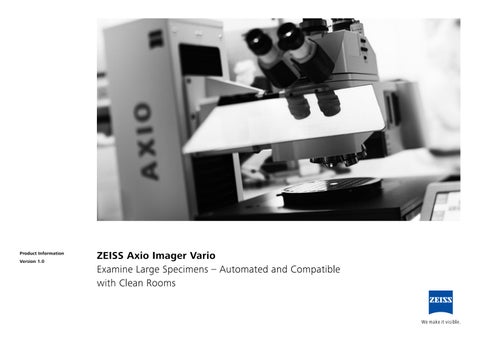
Axio Imager Vario brings out your research, development, and quality assurance specimens so that they are larger than life, regardless of whether you are working with tiny MEMS sensors or XXL wafers. On top of this, a maximum specimen size of 300 mm × 300 mm and an impressive maximum specimen height of 254 mm make sure that you will be able to analyze large specimens nondestructively. And all this supported by the stability provided by a column design. Examine your wafers in your clean room – Axio Imager Vario is DIN EN ISO 14644-1-certified and meets the requirements corresponding to clean room class ISO 5. Finally, a motorized Z-axis drive and the Hardware Auto Focus system ensure that you will always be able to automatically bring low-contrast, reflective specimens into perfect focus so that you will always get optimum results.

› In Brief
› The Advantages
› The Applications
› The System
› Technology and Details
› Service
More intelligent. More integrated.
Select from two manual and one motorized columns and take advantage of a maximum specimen size of 300 mm × 300 mm and an impressive maximum specimen height of 254 mm. Whether dealing with heavy specimens or working in combination with the LSM 700 laser scanning microscope – the sturdy column design provides reliable stability and prevents vibrations. In addition, you can expand your possibilities even further by selecting from various stages for reflected and transmitted light applications, as well as from various specimen holders.
Wafer and photomask inspections are subject to extremely strict requirements concerning cleanliness. This is why Axio Imager Vario is DIN EN ISO 14644-1-certified and, together with a clean room kit, meets the requirements corresponding to clean room class ISO 5. Moreover, extensive accessories, such as a seven-position objective turret with a guard designed to protect against foreign particles and a sneezing guard, ensure that your specimens will always remain perfectly clean. All of this, of course, with your components retaining all of their functionality and performance.
If you need to examine the surface of reflective, low-contrast specimens, you can simply equip Axio Imager Vario with the fast and efficient Hardware Auto Focus system. This system guarantees a high precision of up to 0.3 times the objective’s depth of field, and is well suited to both reflected light and transmitted light applications. The sensor detects changes in the focus position, any deviations are compensated automatically. This means that even large specimens will remain perfectly focused while being moved in the X- and Y-axis directions.


Examinations in the fields of research and industrial production (e.g. surface examinations of reflective, low-contrast specimens such as metallographic specimens and polished or textured wafers) require a fast focusing system that ensures high precision levels of max. 0.3 times the objective’s depth of field. This requirement can be easily met by combining your Axio Imager Vario with the Hardware Auto Focus system to benefit from fast and accurate focusing across a wide capture range of up to 12,000 µm. The Hardware Auto Focus system is designed to work with reflected light and transmitted light microscopy in brightfield, darkfield, polarized light, DIC, and oblique illumination applications.
The objective guides the structured light produced by an LED in the Auto Focus system’s sensor module onto the specimen, with the specimen’s surface reflecting it back. During this process, Auto Focus permanently analyses the properties of the reflected LED light and derives the appropriate control signals for the focus drive, to bring the surface into focus. The Auto Focus system comes with three different modes corresponding to different specimen characteristics (reflective/partially reflective/diffuse) and with three different precision levels (precision/balance/speed). The Auto Focus sensor detects changes and deviations in the focus position. These are then automatically compensated by the direct access of Auto Focus controller to the microscope’s Z-drive.

› In Brief
› The Advantages
› The Applications
› The System
› Technology and Details
› Service
Semiconductor device fabrication work and wafer inspection operations are performed in clean rooms in order to protect components from impurities that could have an impact on their operation. Accordingly, the use of clean rooms is accompanied by especially strict requirements concerning air quality. Clean rooms are categorized into various classes as per DIN EN ISO 14644-1, which relies on the amount and size of particles per cubic meter as defining criteria. Axio Imager Vario is certified for use in clean rooms in accordance with DIN EN ISO 14644-1 and, when used in conjunction with a clean room kit, meets the requirements of the ISO 5 clean room class, which is the one most frequently used; it corresponds to class 100 in the original FED STD 209E (1992) standard. This clean room kit comes with a special seven-position objective turret, as well as with guards providing protection against particles and sneezing. All components are delivered in double packaging, properly cleaned and airlock-ready.

› In Brief › The Advantages
› The Applications › The System › Technology and Details
› Service

The small manual column allows for specimen sizes of up to 200 mm × 200 mm in the X- and Y-axis plane and specimen heights of up to 254 mm.


The large manual column allows for specimen sizes of up to 300 mm × 300 mm in the X- and Y-axis plane and specimen heights of up to 254 mm. This track stand post is suitable for use with LSM 700.
The motorized column allows for specimen sizes of up to 300 mm × 300 mm in the X- and Y-axis plane and specimen heights of up to 254 mm, and features three-button controls as per industrial standards. This track stand post is suitable for use with LSM 700.
The Applications
ZEISS Axio Imager Vario and ZEISS LSM 700
Technology and Details
Combining Axio Imager Vario and LSM 700 opens up a new world of possibilities. In fact, specimens that need to be analyzed at high resolutions with no contact almost seem to have been made specifically for this combination. Extremely fine lateral fragments with sizes as small as approx. 120 nm (scribe line structure/width) can be optically resolved in great detail. And with LSM 700, you can detect the smallest surface defects (with a size of only a few nanometers) with extreme precision so that you can pinpoint their exact location. By using Axio Imager Vario in combination with LSM 700, you can obtain laser scribe topographies and thin-film solar cell surface topologies. You will be able to measure laser scribes and determine surface roughnesses with much greater precision. Another typical application is being able to obtain topographies of the silver paste in crystalline silicon solar cells in order to evaluate the quality of the corresponding print screen.

Typical Applications, Typical Specimens
Crystalline Silicon Solar Cells
Print Screen for Solar Cells
Thin-Film Solar Cells
Wafers
• Surface morphology analyses
• Metal contact dimensions (silver fingers, bus bars)
• Laser edge isolation scribe dimensions and continuity
• Height and width of holes on template
• Laser edge isolation scribe continuity
• Laser edge isolation scribe penetration depth
• Crystallographic distribution and orientation, stress and microcracks in the crystalline silicon thin film
• Checking for particles, scratches, pattern defects
Photomasks
TFT LCD Inspections (ISO 13406-2)
• Checking for extra chromium film and particles
• Particles on chromium film
Automotive Industry
Natural Resources
Aerospace Industry
• Checking for hot pixels (fault type 1)
• Checking for dead pixels (fault type 2)
• Checking for stuck pixels, hot (fault type 3)
• Checking for stuck pixels, dead (fault type 3)
• Composite material testing and development
• Weld quality inspections
• Checking for inclusions and cracks
• Determining particle sizes and detecting nonmetallic inclusions
• Texture and structure analyses
• Pore size analyses
• Fluorescence analyses
• 2-D and 3-D imaging
• Composite material testing and development
• Weld quality inspections
• Checking for inclusions and cracks
• Determining particle sizes and detecting nonmetallic inclusions
• Manual or motorized stage for reflected light
• Clean room kit
• Manual or motorized stage for reflected light
• Clean room kit
• Manual or motorized stage with glass carrier
• Transmitted light module
• Hardware Auto Focus
• Clean room kit
• Manual or motorized stage with wafer chuck
• Clean room kit
• Hardware Auto Focus
• Manual or motorized stage with photomask holder
• Clean room kit
• Transmitted light module
• Hardware Auto Focus
• Manual or motorized stage with glass carrier
• Transmitted light module
• Hardware Auto Focus
• Manual or motorized stage for reflected light
• Hardware Auto Focus
• Hardware Auto Focus › In Brief › The Advantages › The Applications › The System › Technology and Details › Service
• Manual or motorized stage with glass carrier
• Transmitted light module
• LSM 700
• Manual or motorized stage for reflected light
› In Brief
› The Advantages
› The Applications
› The System
› Technology and Details
› Service
Monocrystalline Silicon Solar Cell


› In Brief
› The Advantages
› The Applications
› The System
› Technology and Details
› Service


› In Brief › The Advantages › The Applications › The System
Technology and Details
Service


› In Brief
› The Advantages
› The Applications
› The System
› Technology and Details
› Service


Wafer with debris: reflected light, C-DIC, EC EpiplanAPOCHROMAT 50x/0.95

Pattern defects; reflected light, brightfield, EC EpiplanAPOCHROMAT 50x/0.95

Reticle
› In Brief
› The Advantages
› The Applications
› The System
› Technology and Details
› Service


› In Brief
› The Advantages
› The Applications
› The System
› Technology and Details
› Service

1 Microscopes
• Axio Imager.A2 Vario (manual, coded)
• Axio Imager.Z2 Vario (capable of being fully motorized)
• Axio Imager.Z2 Vario (without turret focus)
2 Objectives
• Reflected light: EC EPIPLAN, EC EpiplanNEOFLUAR, EC Epiplan-APOCHROMAT
• Transmitted light: N-ACHROPLAN, EC PlanNEOFLUAR, Plan-APOCHROMAT, C-APOCHROMAT, FLUAR
• Special purpose: LD EPIPLAN, LD EC EpiplanNEOFLUAR
3 Illumination
• 12 V 100 W halogen
• 100 W HBO
• microLED
4 Cameras
Recommended cameras:
• AxioCam HRc
• AxioCam MRc5
• AxioCam MRc
• AxioCam ICc 5
5 Software
• AxioVision, AxioVision LE
Recommended AxioVision modules:
• MosaiX (image acquisition, scanning stage)
• Graphite, Grains, Multiphase, NMI, Particle Analyzer, Comparative Diagrams, Online Measurement, Shuttle & Find (image analysis)
6 Accessories
• Hardware Auto Focus
• Linear sensor
• Stages: XY stage, reflected light/transmitted light, 200 × 200 R
XY stage, reflected light, 300 × 300 R
Scanning stage, 200 × 300 STEP
Scanning stage, 300 × 300 STEP
› In Brief
› The Advantages
› The Applications
› The System
› Technology and Details
› Service
› In Brief
› The Advantages
› The Applications
› The System
› Technology and Details
› Service
› In Brief
› The Advantages
› The Applications
› The System
› Technology and Details
› Service
Component ZEISS Axio Imager Vario
Maximum specimen height
0–254 mm (using reflected light, no stage)
0–112 mm (using reflected light, with stage)
0–91 mm (using transmitted light, with stage)
Objective turret focus stroke 5 mm
Maximum specimen depth
Maximum stage travel
Maximum transmitted light area
Microscope module dimensions
Microscope module weight
Base plate and column weight
Base plate dimensions
385 mm (optic axis to post)
300 mm × 300 mm
200 mm × 200 mm
180 mm × 260 mm × 420 mm (height × width × depth)
17.5 to 20 kg, depending on the specific equipment
Approx. 78 kg
700 mm × 574 mm (width × depth)
Eyepieces Field number: 23 or 25
Objective magnification
Objectives
Tubes
Stages
Illumination
Contrasting technique
1×–150×
Reflected light: EC EPIPLAN, EC Epiplan-NEOFLUAR, EC Epiplan-APOCHROMAT
Transmitted light: N-ACHROPLAN, EC Plan-NEOFLUAR, Plan-APOCHROMAT, C-APOCHROMAT, FLUAR
Special purpose: LD EPIPLAN, LD EC Epiplan-NEOFLUAR
Tube module without binocular view, binocular tubes, photo tubes, ergo tubes, and ergo photo tubes
Manual XY stages and motorized scanning stages for reflected light and transmitted light with travel ranges of 200 mm × 200 mm or 300 mm × 300 mm
12 V 100 W HAL, 100 W HBO, microLED
Reflected light: brightfield, darkfield, differential interference contrast, circularly polarized light differential interference contrast, simple polarized light, fluorescence
Transmitted light: brightfield, darkfield, differential interference contrast, polarized light, phase contrast
In Brief › The Advantages › The Applications › The System › Technology and Details › Service
Ambient conditions
Transportation (in packaging)
Permissible ambient temperature –40°C to +70°C
Operation
Permissible ambient temperature +10°C to +40°C
Permissible relative humidity Max. 75% at 35°C
Atmospheric pressure 800 hPa to 1,060 hPa
Altitude Max. 2,000 m
Pollution degree 2
Operating specifications for ZEISS Axio Imager Vario
Area of use
Protection type I
Closed spaces
Ingress protection rating IP 20
Electrical safety
Overvoltage category II
In accordance with DIN EN 61010-1 (IEC 61010-1) while considering CSA and UL standards
Radio interference suppression In accordance with EN 55011, class B
Interference immunity In accordance with DIN EN 61326
Power supply for external control box 100 to 127 V, 200 to 240 V ±10%
Converting the line voltage is not necessary!
Power frequency 50/60 Hz
Power consumption of Axio Imager.A2 Vario microscope module Max. 300 VA
Power consumption of Axio Imager.Z2 Vario microscope module Max. 260 VA
microLED add-on illuminator 400 to 700 nm, peak at 460 nm, LED risk group 1 in accordance with IEC 62471
CAN external power supply for HAL 100
Area of use
Protection class I
Closed spaces
Protection type IP 20
Power supply
Power frequency
VAC to 240 VAC
Hz
Power consumption Max. 260 VA
In Brief
The Advantages
The Applications
The System
Technology and Details
Service
(readable from computer)
motorized, ACR
Nosepiece turret 6-position, coded, POL Vario
6-position, coded, HD DIC Vario
6-position, motorized, POL Vario
6-position, motorized, HD DIC
7-position, motorized, HD
+ = Included in microscope module
O = Optionally available
= Not available
* = Light manager for manual Imager
** = Light manager for motorized Imager
*** = With additional 422610-9040-000 power supply
**** = With additional 422610-9060-000 power supply
› The Advantages
› The Applications
› The System
› Technology and Details
› Service
Because the ZEISS microscope system is one of your most important tools, we make sure it is always ready to perform. What’s more, we’ll see to it that you are employing all the options that get the best from your microscope. You can choose from a range of service products, each delivered by highly qualified ZEISS specialists who will support you long beyond the purchase of your system. Our aim is to enable you to experience those special moments that inspire your work.
Attain maximum uptime with your microscope. A ZEISS Protect Service Agreement lets you budget for operating costs, all the while reducing costly downtime and achieving the best results through the improved performance of your system. Choose from service agreements designed to give you a range of options and control levels. We’ll work with you to select the service program that addresses your system needs and usage requirements, in line with your organization’s standard practices.
Our service on-demand also brings you distinct advantages. ZEISS service staff will analyze issues at hand and resolve it – whether using remote maintenance software or working on site.
Enhance Your Microscope System.
Your ZEISS microscope system is designed for a variety of updates; open interfaces allow you to maintain a high technological level at all times. As a result you’ll work more efficiently now, while extending the productive lifetime of your microscope as new update possibilities come on stream.
Please note that our service products are always being adjusted to meet market needs and maybe be subject to change.


› In Brief
› The Advantages
› The Applications
› The System
› Technology and Details
› Service
The moment "I think" becomes "I know". This is the moment we work for.


Carl Zeiss Microscopy GmbH
07745 Jena, Deutschland Materials microscopy@zeiss.com www.zeiss.com/axioimagervario