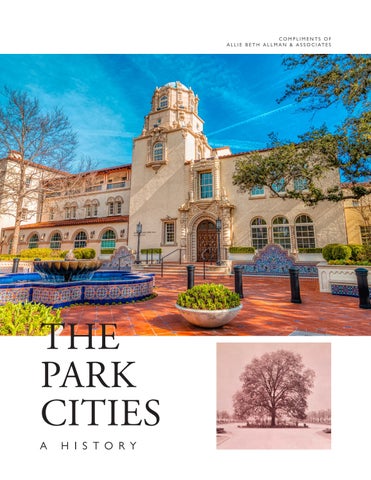
COMPLIMENTS OF A L L I E B E T H A L L M A N & A S S O C I AT E S
THE PARK CITIES A
H I S T O R Y
A
F O R E W O R D
PIERCE ALLMAN SHARES WRITINGS AND HISTORICAL COLLECTION
T
he City of Highland Park has been a wonderful place for Allie Beth and me. We have raised two wonderful daughters, Margaret Cowan and Amy Dean, here. Two of our grandchildren, Allie Beth and Mac, have also been part of the Park Cities since the day they were born. Like many of our friends, both our family and our business have thrived in one of Dallas’ premier neighborhoods. Growing up here, and attending SMU, I have seen the incredible story unfold into what is today’s Highland Park and University Park. This small booklet includes some of my archival collection of the history of the Park Cities. I also have included a few historical articles that have been published over the years. History is always part of the future. Please enjoy a look back so you can move forward. It has been so wonderful to be part of such a very special place with a great community spirit.
Pierce Allman
Written by Pierce Allman
01 T H E
F I R S T
H O M E
I N
T H E
P A R K
C I T I E S :
THE PARK CITIES HERITAGE HOUSE
I
n 1839 Tennessee lawyer John N. Bryan traveled from his farm in Arkansas to Three Forks on the Trinity, “La Santissima Trinidad”. He had tried to persuade his neighbor and good friend Joseph Dallas to accompany him. Bryan’s route south from the Red River was along an old Caddo Indian trace, later part of the Shawnee Trail from San Antonio to Sedalia, Missouri, still later to become Preston Road, first paved street in the Park Cities. Pleased with his findings, Bryan retraced his journey to Arkansas, returning to his Trinity site in 1841. At Bird’s Fort, west of Bryan’s cabin, General E. H. Tarrant and G. W. Terrell signed a peace treaty with representatives of nine Indian tribes in 1843 after negotiations with President Sam Houston. That year, Dr. John Cole of Virginia came to join Bryan’s settlement, bringing with him a large family and specimens of fruit trees. Cole originally settled near the Cedar Springs, along one of the main northern roads with its beginning at a Trinity ford just north of Bryan’s crossing. The Republic of Texas gave Cole 640 acres and he filed on parcels of land ranging from the Trinity five miles north, eventually amassing about 5,000 acres, roughly bounded by Abbott to Lomo Alto, Blackburn to Mockingbird. His eventual homesite was a log cabin off Preston, where the Trammell Crow home is today, with his orchard on the vacant lot occupied today by the Saxon home. His son Joe Cole nurtured the giant pecan tree at Armstrong Parkway. Will and Walt Caruth came to Dallas from Kentucky in 1848, opening one of the town’s first stores near today’s triple underpass. They, too, were interested in land and began buying cotton acreage north of town, a process that ultimately involved about 40,000 acres. Will Caruth actually developed Dallas’ first residential subdivision in 1854 north of Bryan’s half mile square village. Caruth’s Addition was bounded By Carondalet (Ross), Lamar, McKinney and Orange (Ervay). In 1862 the Caruths bought 492 acres from the Cole heirs, bounded by Armstrong, Preston, Mockingbird and Airline. (Airline was originally Air Line Wagon Road, a survey term, and was so named by Caruth for the road that ran from his farm directly to town; Mockingbird was named by Mrs. Henry Exall for the birds in profusion; Armstrong honors the memory of John Armstrong who conceived the idea for Highland Park; Preston was named for the army member who left a survey party to start Preston’s Bend at the Red River -Preston is now under Lake Texoma, but Preston’s Trail is the current highway). And in 1872 Walt acquired Will’s interest in the 492 acres that would become the first installment of Highland Park. In June, 1889, two Dallas businessmen, Col. J. T. Trezevant and Col. Henry Exall, were quoted in the Dallas Morning News (started in 1885) after a business trip to Philadelphia on “the necessity for parks in Dallas”, noting that the park commissioner in Philadelphia had just bought twelve miles of land along both sides of the river for a parkway. According to Trezevant: “Now Dallas can compete in the matter of parks. There is, along
Turtle Creek from the city waterworks (the old pump station now in renovation) northward, greater natural attractiveness than is found in Philadelphia. It could be a sylvan delight, the most beautiful drive in all this broad state.” Both men felt the greenbelt and parkway concept could extend as far north as “the Cole fairgrounds”, referring to John Cole’s property bounded by Cole, Fitzhugh, McKinney and Haskell. This site, near today’s North Dallas High School, held one of the two original State Fairs in 1886. (In 1887 the two merged into the present Fair and also agreed on the other location donated by Captain W. H. Gaston.John S. Armstrong was President of the State Fair in 1883, Henry Exall in 1889). Colonel J. T. Trezevant had been a Confederate officer and came to Dallas after the war, establishing the pioneer insurance firm of Dargan & Trezevant, later Trezevant & Cochran. In 1889 Trezevant was Vice President of the new City National Bank, capitalized that year for $100,000. Trezevant would also become President of the Southern Mortgage and Trust Company. Virginia-born Henry Exall moved to Lampasas, Texas from Kentucky in 1876 and relocated to Dallas in 1886. In 1889, Exall was Vice President of the North Texas National Bank, largest bank and building in Dallas, located on the north side of Main between Lamar and Poydras. The bank was capitalized in 1887 for $500,000. Exall invested with financier August Belmont in the early Belmont’s Addition, near today’s Greenville and Belmont. And, with his father-in-law John M. Dickson, Exall led other investors in acquiring three tracts of land totalling 834 acres north of town along Turtle Creek. (The name of Turtle Creek predates Dallas). The three blocks of Cedar Springs Road along Turtle Creek was the beginning of Dallas’ residential move north. Early in the 1900’s Trezevant committed to his “park place” concept and built his home called “Avalon”, today the Cipango Club, He was followed by banker E.O. Tenison’s home on the corner, today the Gulf Insurance building. Other mansions of the period were built by cotton merchants W. D. Felder, now the 3131 building, and Sheppard W. King, recently renovated as The Mansion on Turtle Creek. Oak Lawn Park, now Lee Park, and the original small golf course of the Dallas Golf Club, now the Dallas Country Club, blocked extension of Turtle Creek north. After Highland Park opened, the golf club moved to its present Preston site in 1910 and the park was cut through to allow Turtle Creek Drive’s progress to Armstrong. Since 1886, when streetcar lines were extended to outlying areas, following the awareness of north Dallas sparked by the twin fairs, outside capital interests were speculating in suburban land. Among the investors were the Texas Land and Mortgage Company of London; the Jarvis - Conklin Mortgage Trust Company of Kansas City; the George W. Baylor Real Estate Company representing interests from Liverpool, London, and New Orleans;
by Pierce Allman Pierre S. DuPont of Delaware, and the Philadelphia Place Land Association, an eastern syndicate headed by the banking firms of J.P. Morgan and Anthony Drexel. ln July, 1889, the 492 acre Caruth tract, together with three adjoining Exall tracts of 834 acres were sold to the Fidelity Union and Trust Company acting for the Philadelphia Place Land Association. Though the deal was overshadowed by the opening of the Indian Territory (Oklahoma), it received considerable attention in the newspapers of both cities. The Dallas Morning News described it as “the biggest single deal in suburban real estate ever made in Texas”. And the Philadelphia Inquirer listed the buyers as “prominent Philadelphia capitalists”. Investors from Philadelphia in the 1840’s had figured in the original Texas Emigration and Land Company of Louisville, Kentucky, better known as the Peters Colony company. It is of interest that George M. Dallas was from a socially prominent Philadephia family. Total price for the 1326 acres was $500,000, an average of $377 per acre, for the Mart Cole, Joe Cole, Isaac Carter and Caruth tracts, mostly land from the original John Cole survey. To put that half-million dollars in perspective, Dallas in 1889 had about 1700 businesses, 123 factories, eight national banks capitalized at $2,500,000, and three private banks with capitalization of about $500,000. The capital of the street railway system (43 miles) was almost as much as all the banks. The 1890 federal census gave Dallas 38,000 people, making it the largest city in Texas. The city expanded its limits as far north as Blackburn and Oak Lawn, almost trebling its size, and suburban land interest boomed. Real estate transfers rose from just under $6 million in 1888 to nearly $15 million by 1890. As the turn of the century approached, Dallas would get its Old Red courthouse, first city hall, first steamboat, the Texas League, the Dallas Lawn and Tennis Club, the Dallas Golf Club, the first football game, hand operated telephones, the first billiard parlor, first sewer line, first macadam paving, first traffic ticket, electric streetcars, the town of East Dallas and Oak Cliff. Henry Exall, acting as agent for the Philadelphia Place Association, was laying out gravel roads and damming Turtle Creek to form a lake, a favorite picnic spot for people who rode the Fairland Addition streetcar to Knox and hiked across the fields. But the national financial panic of 1893 slowed everything and everyone. Basically the slump started with the failure of the Philadelphia and Reading Railroad. Bank depositors reacted by demanding cash and hoarding gold. European countries feared that the U.S. was abandoning its gold standard and withdrew gold reserves, causing production of paper money to fill the gap. By July, banks began to fail - 158 national banks, 415 state and private banks went under. Dallas lost five banks, including the North Texas Bank. Cotton dropped to almost four cents a pound, and the city lost population of about 5,000. Exall used the acreage as his Lomo Alto (high land)
Stock Farm, raising blooded stock and trotting horses. Trotting and horse racing were the chief attractions at the State Fair. An ad in the 1900 city directory lists the farm as “4½ miles north of the post office (Main and Ervay) ... Electrite, Champion Sire of the World for 1897 ... also board city horses.” Exall’s residence at Ross and Harwood was near the W. H. Flippen family at Ross and Akard and the John S. Armstrongs at Ross and Pearl. John Armstrong, native of Tennessee, came to Dallas from Louisville, Kentucky in 1884 to establish a wholesale grocery business with Thomas L. Marsalis who began as a clerk in Corsicana. The two built a multimillion dollar business. In 1886, Marsalis and Armstrong formed the Dallas Land and Loan Company, bought two thousand acres south of the Trinity, named it Oak Cliff, after the trees and the setting, and began selling lots. The partnership dissolved in 1887, Marsalis retaining the land business and Armstrong the grocery portion. Armstrong then started the Dressed Beef and Packing Company. An entrepreneur of considerable talent, Armstrong created the Pan American Telephone Company, but it could not survive the patent victories of the new Bell company. He acquired an interest in the City National Bank, one of the forerunners of the First National, and served as its president. In 1906 he sold the packing company to the Armour interests and bought the 1,326 acres of the Philadelphia Place company. Armstrong and his wife Alice had two daughters - Minnie May and Johnetta. Johnetta married Hugh E. Prather and Minnie May married Edgar L. Flippen. The Prather family began with Captain William Harrison Prather from Columbia, Missouri, who arrived in Dallas after the Civil War as a wounded Confederate veteran. He married Anne Elizabeth Edmondson, daughter of William Terry Edmondson, who had brought his family by covered wagon from Tennessee and installed a grist mill in 1851 at the town of Cedar Springs. William Prather was president of the Fourth National Bank when it was capitalized in 1887 for $600,000 and later merged with City National. Hugh Prather started his real estate business about 1900. Edgar L. Flippen was the son of Judge William H. Flippen, an active partner with J. B. Adoue in the private banking firm of Flippen, Adoue and Lobit. Their bank in the late 1800’s was located on the southwest corner of Elm and Poydras and was known as the swankiest in town. Among the first lots designated in Highland Park were the two on Preston Road backing to Lakeside Drive where Flippen would build a replica of Mount Vernon (today the home of Governor and Mrs. Clements) and Prather would construct a traditional home with sweeping vista down to the lake (today the Black estate). Armstrong and son-in-law Prather went to Los Angeles in 1906 to hire the designer Wilbur David Cook, who was then laying out a community known today as Beverly Hills. Cook made one trip to Dallas and working largely from a topographic map, drew the master plan for Highland Park, setting aside twenty percent of the 2.2 square miles for parks - in keeping with the 1889 comments of Trezevant and Exall. Some basic engineering work was done by N. Werenskiold, who later laid out Highland Park West (west of Preston, opening in 1924 as “Country Club Estates, the Pasadena of the South”). Landscape architects working out successive sections also included L M. Jenny from Cleveland; George E. Kessler, creator of Dallas’ first master plan in 1910, and Hare & Hare of Kansas City. It was Kessler who reaffirmed the vision of the Turtle Creek greenbelt and who used the pecan tree as entry point to Armstrong Parkway. John Armstrong died in 1907, and development of the state’s first totally planned park city was carried out by
the Flippen-Prather firm and agents Hahn and Kendall. Better residential areas in the early 1900’s included the Cedars, bounded by South Akard, Corsicana, Ervay and Marilla; Ross Avenue from Lamar to beyond Hall; Maple Avenue from McKinney to the Katy Railroad; Munger Place; and Zangs Crystal Hill in Oak Cliff. Dallas’ population was about 42,000 when Highland Park began. 20th century Dallas was an exciting place. The new electric interurban was speeding to Fort Worth, Sherman and other points at thirty miles per hour while sparse auto traffic was limited to seven miles per hour; the first air show was held, but the only flying area was Caruth Field, near the Trinity bottoms; Union Station opened as the costliest project in Dallas history; Paderwreski, Pavlova, and Parsifal played the State Fair; the first public library opened; Elm was paved; the police got motorcycles; the first auto dealer and showroom opened; the first wireless messages were sent; the first motion picture theater opened; the city had its worst flood and a cash drought. The currency shortage in 1907 could be traced to failure of the Knickerbocker Trust in New York, causing call money to rise as high as 125%. Dallas banks were forced to restrict cash withdrawals and almost lost a 600,000 bale cotton crop. In 1907 Dallas established a commission form of government with S.J. Hay as mayor; the new Praetorian Building was the city’s first full-fledged skyscraper; and a young man who set shoe sales records at Sanger Brothers decided to go on his own, Herbert Marcus from Kentucky, backed by his sister, Carrie Neiman. The dip in Dallas’ economy did not deter plans for Highland Park, whose first advertising slogan was: “It’s Ten Degrees Cooler in Highland Park”, named for the high land and the park space. Another slogan was: “Beyond the City’s Dust and Smoke”. Remember that these were the days of dirt roads and wood stoves - and few bathtubs indoors. Smog wasn’t a problem yet, as there were only about 1000 cars in Dallas. One of the first was a six cylinder Locomobile, license 376, belonging to bachelor lawyer Joe Dickson, brother of Mrs. Henry Exall. Auto prices ranged from $375 for a Thomas Flyer to $485 for a Brush, while the luxury cars - Maxwell, Moline, Warren Detroit, Marmon, Hupmobile, Mason, or Studebaker Electric were in the· $1200 - $1500 range.
But the advent of the auto, coupled with electric streetcars, meant suburban living was no longer limited to the elite who had farms or country homes. Most of Highland Park’s earliest homes had carriage houses or stables, later converted to garages. Cars were kept downtown in central storage and brought to the home. Highland Park opened in an era when carpenters were $3 a day and you could stay in a boarding house for $16 a month while your $3000 - $5000 house was being built. The stores were still downtown, as was the barbershop with personal shaving mugs and Saturday night baths. The first installment of Highland Park was bounded by Armstrong, Abbott, Gillon, and Hackberry Creek part of the original Cole acreage dating to 1843. One of the first three people to move in was Michael Costello who started a 4000 foot frame prairie-style house at 3500 Lexington in 1907. Architect was H. A. Overbeck, who also designed the Linz Building, Katy Building and the St. Paul Hospital. His plans called for full-length two story framing studs, 10½ foot ceilings, front and back stairways, fireplaces in the parlor and dinmg rooms. Michael Costello of County Mayo, Ireland, landed in New York City in 1880 at age 21, working for the Eastern Railroad. He moved to Denver, helping railroad construction throughout the west and to Dallas in 1888, promoted to road superintendent for the Houston and Texas Central Railway. Before and after retirement in 1910, Costello gave freely of his unflagging energy to the village of Highland Park, according to former mayor Ben Critz, as the “city’s only administrative officer and manager.” Costello’s innate sense of pride and effective citizen participation set a pattern that has marked the Park Cities. He even served as fire marshal and city secretary. In 1911, he bought some property in the 4400 block of McKinney and moved the frame dwelling that was on it to the 4900 block of Abbott, where it served as the first school building. Costello was one of the first members of the new school board in 1914. By his own request, no school, park, or street bears his name. But his original house is still here. It has been carefully preserved and enhanced and, inside, the original glass and woodwork echo with the laughter of a big family through seven decades of change. As the oldest house in original form in the Park Cities, it is a living legacy of our unique and cherished residential tradition.
La Fiesta de las Seis Banderas La Fiesta is a non-profit organization supporting community beneficiaries and providing ongoing maintenance for the Park Cities Heritage House. It funds projects within the Park Cities of an educational, charitable, and civic nature and has gifted $9,680,000 since its founding in 1986. It originated as a benefit to save the oldest house in Highland Park from demolition by moving it to Dallas Heritage Village at Old City Park. The three founders, Lindalyn Adams, Jennie Reeves, and Pierce Allman, conceived a community-wide fund raising celebration based on Texas historical tradition and the heritage of the Park Cities. The first La Fiesta Presentation was held in Highland Park Village and included Duchesses from families living in Highland Park and University Park. Each Duchess wore a costume representative of one of the six flags of Texas.
02 1 0 0
Y E A R S
O F
G R E A T N E S S
THE HIGHLAND PARK CENTENNIAL Highland Park, which grew from an open prairie into an affluent bedroom community, celebrated its 100th birthday in 2013 with a year of events. “Pierce Allman planned the best Centennial Party. Serving as the chairman, he involved the whole town with town picnics, historical lectures, film festivals, and much more.”
0
03
A M E R I C A ’ S
F I R S T
S H O P P I N G
C E N T E R
HIGHLAND PARK VILLAGE
Highland Park Village is America’s first shopping center and the prototype for shopping centers all over the country. This unique Mediterranean Spanish-style development was constructed in 1931. According to the Urban Land Institute, Highland Park Village was the first planned shopping center in the United States with a unified architectural style and stores facing in toward an interior parking area, all built and managed under a single ownership.
04 E N T E R
T O
L E A R N ,
G O
F O R T H
T O
S E R V E
HPISD Highland Park ISD, grounded in tradition and with an unyielding commitment to excellence, academics, integrity, citizenship, and service, empowers each and every student to achieve post-secondary success.
Scottish folk like to stick together and they came from the highlands and lowlands of Texas, from Dallas, Fort Worth, Houston, Eagle Pass, Waco, Belton and San Antonio.
0
05 T H E
T R U T H
W I L L
M A K E
Y O U
SOUTHERN METHODIST UNIVERSITY
A nationally ranked private university located near the heart of Dallas, SMU is a distinguished center for global research with a liberal arts tradition. SMU’s more than 12,000 diverse, high-achieving students come from all 50 states and more than 80 countries.
When we consider the brief period of the life of SMU, it seems that, compared with the growth of other institutions, it has made very gratifying progress.
F R E E
06 T H E
P A S T
I S
O U R
F U T U R E
THE HISTORY OF HIGHLAND PARK
1839 1841
Warren Ferris surveyed a townsite to be called Warwick at the three forks of the Trinity.
1841
The Republic of Texas enters an agreement with a group headed by W.S. Peters to grant 640 acres to each family of settlers and 320 acres to single men over age 17.
1843
Dr. John Cole and family from Arkansas settled at Cedar Springs and claimed his 640 acres straddling the Turtle Creek watercourse. He bought around 5,000 acres north.
1844
Surveyor J.P. Dumas laid out the townsite bounded by Water Street (triple underpass), Young, Poydras and Calhoun (Munger) and Bryan named it Dallas. In 1846 Dallas County was officially established.
1848
William Caruth came from Kentucky followed by brother Walter in 1849, establishing a store on the banks of the Trinity river. They began buying land north of Bryan’s village.
1862 1871 1872
The Caruths bought 492 acres from the Cole family, land that would become the first installment of Highland Park.
1884 1886
John S. Armstrong moved to Dallas from Kentucky and formed a wholesale grocery partnership with T. L. Marsalis.
1887 1888 1889
Virginia-born Henry Exall moved to Dallas from near Lampasas, Texas, and helped organize a bank.
1890
Exall dammed Turtle Creek to create Exall Lake, a recreational area and water supply. He added gravel roads Abbott, Lomo Alto and Beverly, also adding a wooden bridge over Turtle Creek at Beverly.
1893
A national financial panic had effect in Dallas: Marsalis declared bankruptcy, Exall lost his bank, development stopped for Philadelphia Place and Exall used the land for his Lomo Alto (High Land) horse farm.
1905 1906
Munger Place, a 300 acre addition, opened as Dallas’ first northern suburb, bounded by Fitzhugh, Live Oak, Henderson and Columbia streets.
1907
The first ad for lot sales appeared in the Dallas Morning News, offering 100 front foot lots in “the Residence Show Grounds of Texas.” Lot prices ranged from $10-$30 per foot. The Flippen-Prather Company bought an additional 44 acres along Turtle Creek. Armstrong offered 100 acres west of Preston Road to the Texas Presbyterian University, an opportunity that would unfortunately never come to fruition.
1908
John Armstrong died and the development of Highland Park continued through its owners, the Flippen-Prather Realty Company. They began negotiations with the Dallas Golf and Country Club, then located on Welborn Street.
1909
The Dallas Country Club bought acreage along Turtle Creek. A plat for the First Installment was filed, 93 acres bounded by Abbott, Armstrong, Gillon and Hackberry Creek. New homes were to cost a minimum of $2,000. Streetcar tracks from downtown on Cole Avenue continued on Knox Street, crossed the MKT tracks and continued on Euclid Avenue almost to Highland Park Lake. E.L. Flippen and Hugh Prather began building homes on Preston Road overlooking Highland Park Lake.
1910
The Second Installment was filed, “Lakeside Addition,” 108 acres south of the country club, bounded by Beverly, Lakeside, Armstrong and Hackberry Creek. Alice Armstrong gave 100 acres of land north of Mockingbird for a new Methodist University.
1911
Dallas won the vote for a new Methodist school. Southern Methodist University began building Dallas Hall. Parents bought a frame building on McKinney Avenue and moved it to 4900 Abbott where it served as the community’s first school building.
John Neely Bryan came from Arkansas to the three forks of the Trinity River. He followed a faint road that became part of the Shawnee Trail, later known as Preston’s Trail, then Preston Road. Bryan may have come through Highland Park.
Thomas L. Marsalis moved to Dallas from Mississippi and established a wholesale grocery business. The first railroad came to Dallas, the Houston and Texas Central, a north-south route. Dallas becomes the first Texas city with a rail crossroads, adding the Texas and Pacific on an east-west route. Armstrong and Marsalis formed the Dallas Land and Loan Company, purchasing 2,000 acres south of the Trinity River for a development called Oak Cliff. The development partnership dissolved; Marsalis kept the Oak Cliff project and Armstrong bought a meat packing company. Exall had acquired three tracts of land from the Cole heirs totaling 834 acres, north of Dallas, along Turtle Creek. He sold the land to a group of Pennsylvania investors who simultaneously bought another former Cole tract from Walter Caruth of 492 acres. The cost was $377 an acre for the 1,326 acres to be developed as a residential community known as Philadelphia Place.
John Armstrong bought the Philadelphia Place acreage for $276 an acre, the land comprising original land grants from the Republic of Texas. Armstrong formed a realty company with sons-in-law Hugh Prather and Edgar Flippen. That fall, they went to California and hired a planner named Wilbur David Cook who had just laid out a community named Beverly Hills. Cook completed a master plan in six months, using 20% of the land for parks and green space. The new residential development was named Highland Park.
1912
The new Dallas Country Club opened and the Third Installment was filed, “Country Club Estates,” 73 acres bounded by Mockingbird, Drexel, Beverly and Fairfield. Later that year the Fourth Installment, “University Hills,” 238 acres from St. John’s to Airline, and Gillon to Mockingbird. Morgan School began building on Abbott at Euclid, to be known as Highland Park Academy.
1913
Incorporation was voted to become the Town of Highland Park. Speed limits were set at 20 miles per hour. The Highland Park Common School District petitioned the county to become the Highland Park Independent School District. Hugh Prather gave land for a school.
1914 1915
A local school system was established. Armstrong School opened. The first chief of police was named.
1916
Planner George Kessler extended Turtle Creek Parkway along Lakeside Drive to the new Armstrong Parkway, using land bought in 1907. Hugh Prather designed Armstrong Parkway with the big pecan tree as the focal point.
1917 1918 1919 1922
Average value of a home in Highland Park was $9,000.
1923
Highland Park West was announced, 306 acres with improvement costs at $3,210 per acre. No alleys were planned as they were in the prior development, but there were 10 foot utility reservations. The First Installment filed that year featured 132 lots of 100 front feet on 90 acres bounded by Preston, Westway, Armstrong and Belclaire. Cole Avenue was paved that year, still the direct route from downtown to Highland Park.
1924
Flippen-Prather Realty established a sales office at 4800 Preston Road. The Second Installment of Highland Park West composed of 206 lots on 56 acres, the “Country Club Section,” bounded by Mockingbird, Beverly, Preston and Armstrong. Two blocks were held back at the corner of Preston and Mockingbird. The first council meeting was held in the new Town Hall.
1925
The Third Installment of Highland Park West was 28 acres of luxury lots bounded by Beverly, Belclaire, Preston and Armstrong. Later that year the Fourth Installment included 178 lots from 50 to 80 front feet on 58 acres bounded by Armstrong to the Cotton Belt tracks, Mockingbird to Beverly.
1926 1928
John S. Bradfield School opened.
1929 1930 1937 1949 1951 1953 1958 1959 1970
Zoning ordinances were established.
1975 1995
Home Rule Charter was adopted, calling for a manager, mayor and five council members.
2009 2014 2015 2020
The Bush Center opened, home to the George W. Bush Presidential Library and Museum.
A.T. Lloyd bought a six acre lot at Beverly Drive and Preston Road for $22,500, the highest lot price in Dallas history. Southern Methodist University opened.
Dallas voted to annex Highland Park. The Town voted to pave its streets. Maplewood was the first street to be paved. The Town annexed the Mt. Vernon Addition, bounded by Turtle Creek Boulevard, Mockingbird, Key Street and the alley between Shenandoah and Binkley. The MKT railroad built a station at Abbott and Euclid. Highland Park High School, located on Normandy, opened.
The Fifth Installment of Highland Park West was south of Beverly between Armstrong and the Cotton Belt tracks called the “Central Section,” with 30 to 90 front foot lots. The Westpark Addition for duplexes and commercial, was from Rheims Place to Lemmon, Lomo Alto to the railroad. University Park School opened. Planning began for the Highland Park Village. A sales office opened on the site of Highland Park Village, the first shopping center of its kind. Highland Park High School, located on Emerson, opened. The former high school became Highland Park Junior High School. Robert S. Hyer School opened. Armstrong School, expanded in 1933 and 1939, burned. Armstrong School reopened. E.L. Flippen passed away. Hugh Prather, Sr. passed away. Highland Park Junior High School became Highland Park Middle School - the 6th grade moved to middle school and the 9th grade to high school. The school was renamed for Arch McCulloch in 1974. Highland Park Middle School, grades 7 and 8, and McCulloch Intermediate School, grades 5 and 6, opened in a unique shared campus building complex. Major renovations were completed at Highland Park Town Hall. HPISD community passed a bond election providing a fifth elementary school. Michael M. Boone Elementary school opened.
John S. Armstrong School, 1921
Lloyd Estate, 1913
White frame home overlooking Turtle Creek, 1930’s
Preston Road, 1941
YMCA, 1944
Highland Park Swimming Pool, 1923
Highland Park Methodist Church, 1915 Dallas Hall, 1915
McFarlin Auditorium, 1927
Highland Park Football, 1943 First commercial building in Highland Park, 1911
Pecan tree, 1924
University Park City Hall, 1953
Highland Park’s first fire truck, 1914
Missouri-Kansas-Texas Railroad Highland Park Station, 1922 Highland Park United Methodist Church
Preston Road, 1940
Gillon Avenue, 1900’s Dinky SMU Trolley, 1915
University Park City Hall, 1988
Exall Lake, 1900’s
Henry S. Miller. Co. president guides SMU students, 1988
Dallas Country Club, 1910
Lakeside Drive
Highland Park Town Hall, 1973 SMU vs TCU, 1926
Dallas Country Club, 1912
Change is the law of life. And those who look only to the past or present are certain to miss the future.” — J O H N
F .
K E N N E D Y