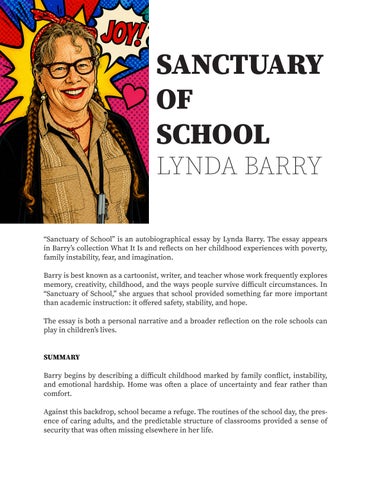

SANCTUARY OF SCHOOL LYNDA BARRY
“Sanctuary of School” is an autobiographical essay by Lynda Barry. The essay appears in Barry’s collection What It Is and reflects on her childhood experiences with poverty, family instability, fear, and imagination.
Barry is best known as a cartoonist, writer, and teacher whose work frequently explores memory, creativity, childhood, and the ways people survive difficult circumstances. In “Sanctuary of School,” she argues that school provided something far more important than academic instruction: it offered safety, stability, and hope.
The essay is both a personal narrative and a broader reflection on the role schools can play in children’s lives.
SUMMARY
Barry begins by describing a difficult childhood marked by family conflict, instability, and emotional hardship. Home was often a place of uncertainty and fear rather than comfort.
Against this backdrop, school became a refuge. The routines of the school day, the presence of caring adults, and the predictable structure of classrooms provided a sense of security that was often missing elsewhere in her life.
Barry recalls how school offered opportunities to read, draw, imagine, and learn. Teachers, librarians, books, and classroom activities opened doors to worlds beyond her immediate circumstances. Even seemingly ordinary school experiences became meaningful because they gave her a place where she felt recognized and valued.
Throughout the essay, Barry emphasizes that many educators may not realize the profound impact they have on students. A teacher may believe they are simply teaching a lesson, but for some children they are also providing safety, consistency, encouragement, and hope.
By the end of the essay, Barry suggests that schools function as sanctuaries—places where children can discover possibilities for themselves and imagine lives beyond the limitations of their current situations.
MAJOR THEMES
1. School as a Safe Haven
The essay’s central theme is that school can serve as a sanctuary.
For Barry, school was not merely a place to acquire academic skills. It was a refuge from the difficulties of home life. The predictable routines, rules, and expectations of school created a sense of stability.
The word sanctuary is significant because it suggests protection, safety, and shelter. Barry portrays school as a place where vulnerable children can find emotional security.
2. The Transformative Power of Education
Barry presents education as a force that can transform lives.
Through books, ideas, and creative activities, students gain access to experiences beyond their immediate environment. Education expands possibilities and encourages personal growth.
The essay argues that learning is not merely the accumulation of information. It is also the process of discovering new ways of understanding oneself and the world.
3. The Importance of Teachers
Teachers occupy a central role in Barry’s narrative.
She emphasizes that educators often underestimate their influence. Small acts of kindness, encouragement, and attention can have lasting effects on students.
For children facing challenges outside school, a teacher’s belief in their abilities may become an important source of confidence and resilience.
The essay suggests that teaching is both an intellectual and a human endeavor.
4. Imagination as Survival
A recurring theme in Barry’s work is the importance of imagination.
In “Sanctuary of School,” reading, drawing, storytelling, and creative thinking help Barry cope with difficult circumstances. Imagination becomes a means of survival rather than mere entertainment.
Creative activities allow children to envision alternatives to their present reality and to develop a sense of agency.
5. Childhood Resilience
Barry’s essay highlights the resilience of children.
Although she experienced significant hardships, she found ways to endure through learning, creativity, and supportive relationships. The essay recognizes both the vulnerability and the strength of young people.
SYMBOLISM
School:
School functions as the essay’s primary symbol.
It represents:
• Safety
• Stability
• Opportunity
• Community
• Hope
Rather than being portrayed solely as an educational institution, school becomes a symbol of possibility and refuge.
Books:
Books symbolize escape and discovery.
They allow Barry to travel beyond the limitations of her environment and encounter new ideas, people, and experiences.
Books represent both knowledge and freedom.
Classrooms:
Classrooms symbolize order and structure.
The routines of classroom life contrast sharply with the unpredictability Barry experiences elsewhere. This structure contributes to the sense of sanctuary that school provides.
LITERARY DEVICES
Personal Narrative
Barry uses autobiographical storytelling to communicate her ideas.
Rather than presenting an abstract argument about education, she shares specific memories and experiences. This approach makes the essay emotionally engaging and persuasive.
Anecdote
The essay relies heavily on anecdotes from childhood.
These stories illustrate broader themes about learning, safety, and personal development while helping readers connect with Barry’s experiences.
Imagery
Barry uses vivid details to recreate childhood experiences. Descriptions of classrooms, books, teachers, and school routines help readers understand the emotional significance of these environments.
Reflection
The essay alternates between remembered experiences and adult reflection.
Barry frequently steps back from her childhood memories to consider their larger meaning, allowing the essay to function as both memoir and commentary.
STYLE AND TONE
Style
Barry’s style is:
• Conversational
• Personal
• Reflective
• Accessible
• Emotionally honest
Her writing often resembles storytelling, making complex ideas feel immediate and relatable.
Tone
The tone shifts throughout the essay:
• Nostalgic when recalling childhood experiences
• Serious when discussing hardship
• Appreciative when describing teachers and schools
• Hopeful in its conclusions
Although Barry acknowledges pain and difficulty, the overall tone remains optimistic.
SOCIAL AND EDUCATIONAL SIGNIFICANCE
One reason the essay is frequently taught is that it challenges readers to think about education from a broader perspective.
Many discussions about schools focus on grades, testing, curriculum, and achievement. Barry reminds readers that schools also serve important social and emotional functions.
Her essay encourages educators to consider questions such as:
• What role does school play in students’ emotional well-being?
• How can teachers create environments where students feel safe and valued?
• What responsibilities do schools have beyond academic instruction?
The essay suggests that the impact of education often extends far beyond what can be
measured by tests or transcripts.
QUESTIONS TO CONSIDER (NOT TO FORMALLY ANSWER ANYWHERE)
1. Why does Barry describe school as a “sanctuary”?
2. How does the contrast between home and school shape the essay’s meaning?
3. What role do teachers play in Barry’s development?
4. Why is imagination important in Barry’s account of childhood?
5. How do books function as symbols in the essay?
6. What does Barry suggest schools provide beyond academic instruction?
7. How does the use of personal narrative strengthen the essay’s argument?
8. What responsibilities do educators have toward students facing difficult circumstances?
9. Do you think schools still function as sanctuaries for many students today? Why or why not?
10. What lessons can current educators draw from Barry’s experiences?
KEY TAKEAWAY
In “Sanctuary of School,” Lynda Barry argues that schools can provide far more than education. Through her reflections on a difficult childhood, she shows how teachers, books, creativity, and classroom routines offered safety, stability, and hope. The essay ultimately presents school as a place of refuge and possibility—a sanctuary where children can imagine larger futures and begin to discover who they might become.