Amy Tan’s “Mother Tongue”
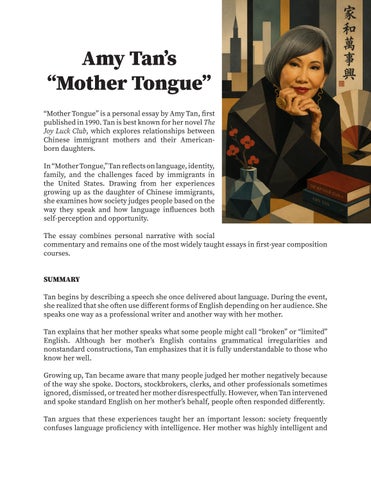
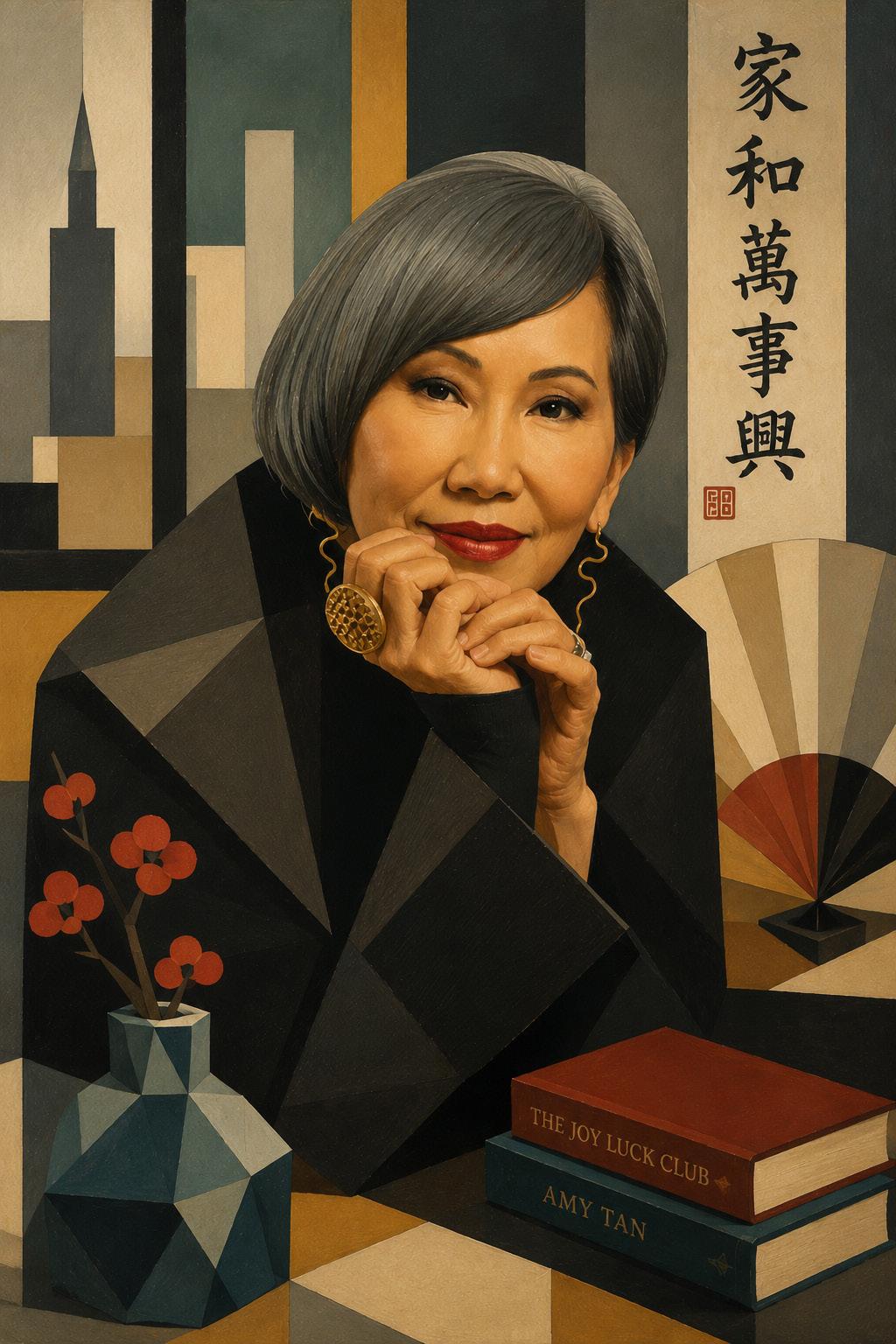
“Mother Tongue” is a personal essay by Amy Tan, first published in 1990. Tan is best known for her novel The Joy Luck Club, which explores relationships between Chinese immigrant mothers and their Americanborn daughters.
In “Mother Tongue,” Tan reflects on language, identity, family, and the challenges faced by immigrants in the United States. Drawing from her experiences growing up as the daughter of Chinese immigrants, she examines how society judges people based on the way they speak and how language influences both self-perception and opportunity.
The essay combines personal narrative with social commentary and remains one of the most widely taught essays in first-year composition courses.
SUMMARY
Tan begins by describing a speech she once delivered about language. During the event, she realized that she often use different forms of English depending on her audience. She speaks one way as a professional writer and another way with her mother.
Tan explains that her mother speaks what some people might call “broken” or “limited” English. Although her mother’s English contains grammatical irregularities and nonstandard constructions, Tan emphasizes that it is fully understandable to those who know her well.
Growing up, Tan became aware that many people judged her mother negatively because of the way she spoke. Doctors, stockbrokers, clerks, and other professionals sometimes ignored, dismissed, or treated her mother disrespectfully. However, when Tan intervened and spoke standard English on her mother’s behalf, people often responded differently.
Tan argues that these experiences taught her an important lesson: society frequently confuses language proficiency with intelligence. Her mother was highly intelligent and
capable, but others often underestimated her because of her accent and nonstandard English.
The essay then shifts to Tan’s experiences as a student and writer. She recalls that standardized tests and educational expectations often suggested that Asian American students should excel in math and science rather than writing. Despite these assumptions, Tan became a writer.
As a novelist, she consciously chose to include the rhythms and patterns of her mother’s speech in her work. She wanted to represent the richness and emotional depth of the language she grew up hearing rather than conforming exclusively to conventional expectations about literary English.
The essay concludes by reaffirming the value of her mother’s language and the importance of recognizing that communication and intelligence cannot be measured solely by adherence to standard grammar.
MAJOR THEMES
1. Language and Identity
The central theme of the essay is the connection between language and identity.
Tan demonstrates that language is more than a tool for communication; it shapes how people see themselves and how others perceive them. Her mother’s English becomes an important part of both family identity and cultural heritage.
The essay suggests that different forms of language can coexist within a single individual and that each serves a meaningful purpose.
2. The Power of Language
Tan illustrates how language affects people’s lives.
Because her mother speaks nonstandard English, she often encounters barriers in situations involving authority figures and institutions. Her experiences reveal how language can influence access to opportunities, respect, and resources.
The essay argues that language carries social power beyond its communicative function.
3. Prejudice and Stereotyping
A major concern of the essay is linguistic prejudice.
People often assume that speakers of nonstandard English are less intelligent, less educated, or less competent. Tan challenges these assumptions by showing that her mother possesses insight, wisdom, and intelligence despite speaking English differently.
The essay encourages readers to question judgments based on speech patterns.
4. Family Relationships
The essay also explores the relationship between Tan and her mother.
Language becomes a symbol of intimacy and connection. Tan’s understanding of her mother’s speech reflects a deep familial bond.
By defending and celebrating her mother’s language, Tan honors both her mother and her cultural background.
5. Cultural Identity and Assimilation
Tan examines the tension between immigrant cultures and mainstream American expectations.
Her mother’s English reflects her immigrant experience, while Tan’s mastery of standard American English reflects her upbringing in the United States. The essay demonstrates how children of immigrants often navigate multiple linguistic and cultural worlds.
SYMBOLISM
The Mother’s English:
The mother’s English functions as the essay’s central symbol.
It represents:
• Cultural heritage
• Family identity
• Immigrant experience
• Emotional connection
• Resistance to linguistic prejudice
Although others may view it as flawed, Tan presents it as meaningful and expressive.
Translation and Interpretation:
Tan’s role as interpreter symbolizes the experiences of many children of immigrants. She often serves as a bridge between her mother and the larger society, navigating both
linguistic and cultural differences.
This role highlights issues of power, responsibility, and identity.
Standard English:
Standard English symbolizes social authority and institutional power.
People who speak it fluently often receive greater respect and credibility. Tan uses this contrast to reveal inequalities based on language.
LITERARY DEVICES
Personal Narrative:
The essay is built around autobiographical experiences.
Tan’s personal stories make abstract ideas about language and prejudice concrete and relatable.
Anecdote:
Several anecdotes illustrate the challenges her mother faces because of her English.
These examples provide evidence for Tan’s broader argument about linguistic discrimination.
Repetition:
The phrase “mother tongue” and related references to language appear throughout the essay.
This repetition reinforces the essay’s focus on communication, identity, and family.
Reflection:
Tan combines storytelling with analysis.
She frequently pauses to consider the broader implications of her experiences, allowing the essay to function as both memoir and argument.
STYLE AND TONE
Style:
Tan’s style is:
• Conversational
• Reflective
• Accessible
• Personal
• Analytical She explains complex ideas in clear language while maintaining an engaging narrative voice.
Tone:
The tone is:
• Affectionate toward her mother
• Reflective about the past
• Critical of social prejudice
• Respectful toward linguistic diversity
• Thoughtful and persuasive
Throughout the essay, Tan balances personal emotion with intellectual analysis.
HISTORICAL AND CULTURAL CONTEXT
The essay emerged during a period of growing attention to multiculturalism and diversity in American education and literature.
As the daughter of Chinese immigrants, Tan experienced the complexities of navigating multiple cultures. Her essay reflects broader conversations about immigration, language diversity, educational expectations, and cultural representation.
The work challenges traditional assumptions that only standard English possesses value or legitimacy. Instead, Tan argues for recognizing the richness and validity of many forms of language.
CONSIDER THESE QUESTIONS
1. What does Tan mean by the term “mother tongue”?
2. How does society respond to Tan’s mother because of her English?
3. Why does Tan object to the phrase “broken English”?
4. How does language influence people’s perceptions of intelligence?
5. What role does Tan play as an interpreter for her mother?
6. How does the essay connect language and identity?
7. Why does Tan choose to incorporate elements of her mother’s speech into her writing?
8. What examples of linguistic prejudice appear in the essay?
9. How does the essay challenge conventional definitions of “good” English?
10. What relevance does Tan’s argument have in today’s multilingual society?
KEY TAKEAWAY
In “Mother Tongue,” Amy Tan argues that language is deeply connected to identity, family, and power. Through personal experiences with her mother’s nonstandard English, she demonstrates how society often judges people unfairly based on the way they speak. The essay challenges readers to recognize that intelligence, insight, and humanity cannot be measured by grammar alone and encourages greater respect for linguistic and cultural diversity.