AUGUST 2026
Bulletin Allegheny County Medical Society
FOR LIFE BETWEEN ROUNDS
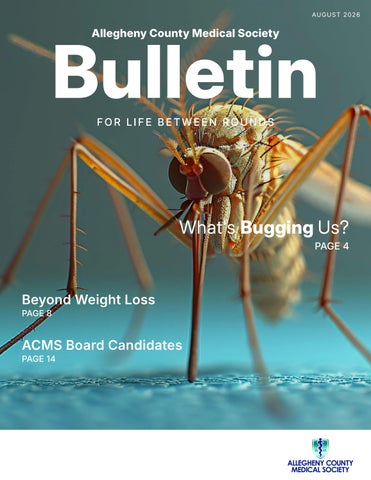
What's Bugging Us?
PAGE 4
Beyond Weight Loss PAGE 8
ACMS Board Candidates PAGE 14
inside W H AT ’S
4
WHAT'S BUGGING US?
6
AMA ANNUAL MEETING RECAP
8
BEYOND WEIGHT LOSS
10
WOMEN PHYSICIANS LEADERSHIP DINNER
12
Q2 MEMBERS & FRONTLINE GROUPS
14
ACMS BOARD CANDIDATES
16
ACMS NIGHT AT THE PIRATE GAME
17
SPECIALTY GROUP UPDATES
18
DISTINGUISHED AWARDS
20
ACMS FEATURED MEMBER
4
8
16 CHECK US OUT ONLINE: www.acms.org AlleghenyCountyMedicalSociety company/allegheny-county-medical-society alleghenycountyms
CHECK US OUT IN PERSON: Allegheny County Medical Society 412.321.5030 850 Ridge Avenue Pittsburgh, PA 15212
2
ACMS Bulletin //
AUGUST 2026
EDITORIAL/ADVERTISING OFFICES: Bulletin of the Allegheny County Medical Society, 850 Ridge Avenue, Pittsburgh, PA 15212; (412) 3215030; fax (412) 321-5323. USPS #072920. PUBLISHER: Allegheny County Medical Society at above address.
2026 EXECUTIVE COMMITTEE AND BOARD OF DIRECTORS
ADMINISTRATIVE STAFF
PRESIDENT
Sara Hussey, MBA, CAE shussey@acms.org
Kirsten D. Lin, MD PRESIDENT-ELECT
Richard B. Hoffmaster, MD SECRETARY
William F. Coppula, MD TREASURER
Alexander K. Yu, MD BOARD CHAIR
Keith T. Kanel, MD BOARD OF DIRECTORS TERM EXPIRES 2026
Michael M. Aziz, MD, MPH, FACOG Michael W. Best, MD Micah A. Jacobs, MD, FIDSA Kevin G. Kotar, DO Jody Leonardo, MD TERM EXPIRES 2027
David J. Deitrick, DO Sharon L. Goldstein, MD Prerna Mewawalla, MD Raymond J. Pan, MD Nicole F. Velez, MD TERM EXPIRES 2028
Amber R. Elway, DO Andrew Eller, MD Geoffrey F.S. Lim, MD Charles E. Mount III, MD Meilin Young, MD, FCCP
EXECUTIVE DIRECTOR
VICE-PRESIDENT OF MEMBER AND ASSOCIATION SERVICES
Nadine Popovich npopovich@acms.org MANAGER OF MEMBER AND ASSOCIATION SERVICES
Haley Thon hthon@acms.org MANAGER OF THE ACMS FOUNDATION
Melanie Mayer mmayer@acms.org MANAGER OF OPERATIONS AND FINANCE
Elizabeth Yurkovich eyurkovich@acms.org BULLETIN STAFF MANAGING EDITOR
Sara Hussey, MBA, CAE ACMS Executive Director shussey@acms.org BULLETIN DESIGNER
Victoria Gricks koonacreative@gmail.com 2026 BULLETIN EDITORIAL BOARD MEDICAL EDITOR
PAMED DISTRICT TRUSTEE James Latronica, DO, DFASAM
Natalie Gentile, MD acmsbulletin@acms.org
2026 BOARD COMMITTEES
Reshma Paranjpe, MD
BYLAWS
ADDITIONAL MEMBERS
EDITOR EMERITA
William F. Coppula, MD FINANCE
Alexander K. Yu, MD NOMINATING
Richard B. Hoffmaster, MD WOMEN’S COMMITTEE
Prerna Mewawalla, MD & Meilin Young, MD MEMBERSHIP TASK FORCE
Geoffrey F.S. Lim, MD ADVOCACY TASK FORCE
Lillian Emlet, MD Marsha Haley LoAlbo, MD Alexandra Johnston, DO Vinnie Kaschauer OMS-1 Anthony Kovatch, MD Timothy Lesaca, MD Najya Williams, MD PUBLICATION CREDITS FRONT COVER
The Bulletin of the Allegheny County Medical Society is presented as a report in accordance with ACMS Bylaws. The Bulletin of the Allegheny County Medical Society welcomes contributions from readers, physicians, medical students, members of allied professions, spouses, etc. Items may be letters, informal clinical reports, editorials, or articles. Contributions are received with the understanding that they are not under simultaneous consideration by another publication. Bulletin of the Allegheny County Medical Society reserves the right to edit all reader contributions for brevity, clarity and length as well as to reject any subject material submitted. The opinions expressed in the Editorials and other opinion pieces are those of the writer and do not necessarily reflect the official policy of the Allegheny County Medical Society, the institution with which the author is affiliated, or the opinion of the Editorial Board. Advertisements do not imply sponsorship by or endorsement of the ACMS, except where noted. Publisher reserves the right to exclude any advertisement which in its opinion does not conform to the standards of the publication. The acceptance of advertising in this publication in no way constitutes approval or endorsement of products or services by the Allegheny County Medical Society of any company or its products. Annual subscriptions: $60 Advertising rates and information available by calling (412) 321-5030 or online at www.acms.org. COPYRIGHT 2026: ALLEGHENY COUNTY MEDICAL SOCIETY POSTMASTER – Send address changes to: Bulletin of the Allegheny County Medical Society, 850 Ridge Avenue, Pittsburgh, PA 15212. ISSN: 0098-3772
Image created by Magnific
Richard B. Hoffmaster, MD
AUGUST 2026
// ACMS Bulletin
3
Image created by Magnific
What's Bugging Us? VECTOR-BORNE DISEASES ARE ON THE RISE IN ALLEGHENY COUNTY written by VIVIAN FENG, MPH Ticks and mosquitoes are vectors that can spread diseases like West Nile Virus and Lyme disease (vector-borne diseases) to humans. The Allegheny County Health Department's (ACHD) Infectious Disease Epidemiology Program conducts surveillance to monitor trends and risk factors associated with reportable vector-borne diseases in Allegheny County. ACHD’s Vector Control Program uses an integrated pest management approach, working closely with the Pennsylvania Department of Environmental Protection to monitor and control tick and mosquito populations in Allegheny County. Vector-borne disease cases are increasing in Allegheny County (Fig. 1). In 2025, there were 2,595 Lyme disease, 151 anaplasmosis, 10 babesiosis, and 6 West Nile virus cases reported among county
4
ACMS Bulletin //
residents. Reported cases of anaplasmosis have increased over the past 10 years (2016-2025) in Allegheny County, from 1 reported case in 2016 to 151 reported cases in 2025 (Anaplasmosis data, Allegheny County). While some mosquito-borne disease cases have been travel associated,
most West Nile virus cases were acquired locally in Allegheny County. Tick and mosquito surveillance data for Allegheny County have also shown an increase in percentage of collected specimens positive for specific pathogens (Fig. 2). In response to surveillance data, there were 7 adult mosquito control events conducted in and around the city of
Figure 1. Reported Vector-borne Cases, Allegheny County 2023-2025
MARCH 2026
Pittsburgh for the 2025 vector-borne disease season, which is April to October for Pennsylvania. Healthcare providers should consider testing for vector-borne diseases during vector season and when patients report recent travel to areas where vector-borne diseases are endemic, if clinical signs indicate a vector borne disease infection. ACHD strongly encourages precautions for residents, such as vector control around the home and personal protection strategies. More information can be found at Vectorborne Diseases. VIVIAN FENG, MPH Vivian Feng is an Applied Epidemiologist at the Allegheny County Health Department. They support a variety of Infectious Disease Epidemiology Program functions, including foodborne illness investigation and vectorborne disease surveillance.
Figure 2. Vector Specimen Surveillance, Allegheny County 2023-2025
CLICK THE RESOURCES BELOW TO ACCESS ADDITIONAL INFORMATION FOR HEALTHCARE PROVIDERS CDC | Diagnostic Testing Algorithm for Suspected WNV Disease CDC | Tickborne Diseases of the United States CDC | Tickborne Disease Continuing Education CDC | Travelers’ Health PADOH | Vector-Borne Disease – Provider information PADOH | Pennsylvania Health Network Alerts (PA-HAN)
AUGUST 2026
// ACMS Bulletin
5
AMA Annual Meeting Recap WHAT ALLEGHENY COUNTY PHYSICIANS NEED TO KNOW written by SARA HUSSEY, MBA, CAE – ACMS EXECUTIVE DIRECTOR HOLLY APPLEBERRY, DO – AMA ALTERNATE DELEGATE & ACMS MEMBER We recently returned from the AMA Annual Meeting in Chicago, where we spent several days immersed in policy debate, elections, advocacy strategy, and conversations about the issues shaping the future of medicine. Here’s the fast version of what happened and why we think it matters to physicians here in Allegheny County. LEADERSHIP Willie Underwood III, MD, was sworn in as the AMA’s 181st president. Sandra Adamson Fryhofer, MD, was elected president-elect and will take office next June. One of the proudest moments for Pennsylvania physicians came when Marilyn J. Heine, MD, an emergency medicine/hematology-oncology physician from Pennsylvania, was named chair-elect of the AMA Board of Trustees. Dr. Heine has been a strong voice for physicians across the Commonwealth, and we know she will welcome hearing directly from ACMS members. AI CAN'T BE THE FINAL WORD ON YOUR PATIENTS' CARE The House adopted policy requiring AI-driven coverage decisions to be evidence-based and physicianreviewed, explicitly rejecting autonomous AI as a substitute for physician judgment. It may feel like a no-brainer, but putting it into formal AMA policy matters. AI-informed denials should be appealable and reviewed by a physician in the same specialty, licensed in-state, with no financial
6
ACMS Bulletin //
incentive to deny care. As AI becomes increasingly integrated into utilization management and coverage decisions, physicians need clear safeguards protecting clinical judgment and patient care. INSURERS ARE BEING CALLED OUT BY NAME AND DOLLAR AMOUNT AMA leadership didn’t pull punches when discussing prior authorization. Insurers promised reform last year, yet physicians continue to report little meaningful improvement. The House directed the AMA to investigate and publicize insurer profits from prior authorization practices that delay care and payment. For physicians facing these challenges every day, greater transparency and accountability could become powerful advocacy tools. CORPORATE MEDICINE GUIDANCE GETS SPECIFIC The AMA adopted its most specific corporate-practice-of-medicine guidance yet, affirming physician ownership and independent clinical judgment while opposing contracts that allow non-licensed entities to control medical practices. The message was clear: regardless of the business structure surrounding a practice, medical decisions need to remain in the hands of physicians. "PHYSICIAN," NOT "PROVIDER" The House pushed the AMA to advocate more strongly for the
AUGUST 2026
use of the term “physician” rather than the catch-all “provider,” citing concerns about patient understanding and professional accountability. This is particularly relevant in our state, where similar questions about terminology, professional roles, and scope of practice continue to surface in Harrisburg. THE DATA THAT UNDERCUTS THE SCOP-CREEP ARGUMENT At the AMA’s Scope of Practice Summit, a closed-door session for state and specialty society leaders, one of the most notable data points of the week came from Florida. A 2020 law allowed nurse practitioners to practice without physician supervision, but only in primary care. New research showed that nearly 60% of Florida NPs are practicing elsewhere - most commonly in cosmetic/non-standard medical practices, emergency and urgent care, inpatient medicine, and cardiology. The researchers concluded that the findings provide evidence of NPs practicing outside the parameters established under the law and recommended stronger enforcement rather than additional flexibility. As Pennsylvania continues debating whether expanded scope is an answer to healthcare access challenges, this is exactly the type of data physicians and organized medicine need to bring into those conversations.
MEDICAID ISN'T ABSTRACT Nearly three-quarters of state medical societies identified Medicaid as a top 2026 priority, as federal funding changes threaten to further strain patient access. For Western Pennsylvania, this isn't an abstract policy discussion. Our region includes significant Medicaiddependent populations and safetynet providers that could feel these changes directly. If you are already seeing changes or challenges in your own practice, we encourage you to share those experiences with ACMS. Those stories are essential to effective advocacy, and Medicaid access is already an area the ACMS Advocacy Task Force is examining closely. BURNOUT STILL MATTERS Nearly 40% of medical societies identified physician burnout as a top priority, including continued efforts to remove inappropriate mental health questions from medical licensing applications. Pennsylvania has already made progress in this area, but the broader conversation reinforced something we heard repeatedly throughout the meeting: protecting the physician workforce requires addressing not only individual well-being, but also the systems and policies contributing to burnout. OUR TAKEAWAYS From Sara Hussey: AI accountability, insurer transparency, corporate medicine limits, and stronger data around scope of practice were among the issues that stood out most to me. Among state and county medical society executives, there was also significant discussion about our relationship with the AMA itself
- where collaboration is working and where we need greater transparency, communication, and support from the national organization. New AMA CEO Dr. John Whyte expressed a real commitment to strengthening those relationships and creating more open dialogue going forward. For ACMS, that matters. Our role is not simply to report what happens nationally, but to make sure Allegheny County physicians have a meaningful connection to those conversations - and that the concerns we hear locally make their way back up the advocacy chain. From Dr. Holly Appleberry: A common reason I hear from physicians who are hesitant to become involved in healthcare advocacy is, “I just want to take care of patients.” I understand that sentiment. Unfortunately, we have collectively reached a point where practicing medicine the way we want to requires physicians to engage beyond the exam room. The policies debated at the AMA House of Delegates are intended to facilitate healthcare reform in a systematic way. I was particularly struck by discussions around payment reform related to emergency department boarding, ERISA reform, and preserving patient choice between traditional Medicare and Medicare Advantage.
transformative. There is an energy in the room that is difficult to replicate elsewhere in our profession. Physicians from every specialty and every state come together to debate ideas, work through differences, and shape policies that can influence the future of medicine. It reinforced for me that our voices are far more powerful when they are unified. Meaningful change doesn't happen by chance. It happens because physicians choose to show up, engage, and lead. STAY ENGAGED We will keep ACMS members updated as these policies move from the House of Delegates into advocacy efforts and, potentially, legislation. More importantly, we hope more Allegheny County physicians will consider becoming part of that process. The AMA House of Delegates offers a unique opportunity to see firsthand how physician-led policy is debated, refined, and ultimately advanced at the national level. Contact Sara Hussey (shussey@ acms.org) to learn more about serving as a Delegate to the AMA.
I previously served as a Delegate to the American Osteopathic Association House of Delegates during the COVID-19 pandemic, when meetings were held virtually. That experience introduced me to policy development within a national healthcare organization, but attending the AMA House of Delegates in person this year as an Alternate Delegate was JUNE 2026
// ACMS Bulletin
7
Beyond Weight Loss HOW GLP-1 DRUGS ARE TRANSFORMING THE SCIENCE OF ADDICTION PSYCHIATRY written by TIMOTHY LESACA, MD As GLP-1 medications became more widely known beyond endocrinology clinics, people noticed more than a reduction in hunger. Alongside the expected decrease in appetite, many patients described something harder to measure but impossible to ignore: quieter persistent mental urges. "Food noise" faded, and some people reported fewer cravings for alcohol, nicotine, cannabis, gambling, or compulsive shopping. Initially, these were personal stories, but they prompted researchers to investigate further. Animal research, brain scans, health records, and clinical trials suggest that medications developed for metabolism may influence brain circuits involved in craving and reward. This doesn’t mean drugs like Ozempic, Wegovy, Mounjaro, or Zepbound are “cures” for addiction, but they may offer promising
8
ACMS Bulletin //
treatment options, particularly for people whose substance use is connected to health risks such as obesity or diabetes. [1-6] THE ALCOHOL DATA BECAME MUCH STRONGER IN 2026 This year, Klausen and colleagues published a 26-week randomized, double-blind, placebo-controlled trial in The Lancet. The study included 108 adults with moderate-to-severe alcohol use disorder and obesity seeking treatment. All received cognitive behavioral therapy; half also received semaglutide 2.4 mg weekly, and half received placebo.[1] Heavy drinking days fell in both groups, but the decrease was larger with semaglutide: 41.1 percentage points from baseline, compared with 26.4 points with placebo. The treatment difference was 13.7 percentage points. Semaglutide
AUGUST 2026
improved several secondary alcoholrelated and physical outcomes. Side effects were mainly transient gastrointestinal symptoms and occurred mostly with semaglutide.[1] The trial had limits. Participants had obesity, sought treatment, and received therapy. We cannot assume the same results in people with different health profiles or treatment needs. Still, this study moved GLP-1 drugs from case reports into serious addiction research. EARLIER TRIALS NOW LOOK LIKE CLUES, NOT NOISE The Lancet trial built on earlier work. In 2025, Hendershot and colleagues tested low-dose semaglutide in 48 adults with alcohol use disorder. The study did not improve every weekly drinking measure, but semaglutide reduced alcohol consumed during a laboratory session, drinks per
drinking day, and weekly craving.[2] An earlier exenatide trial had mixed overall results, yet it reduced brain responses to alcohol cues and appeared more helpful in participants with obesity.[3] A Swedish registry study later linked semaglutide and liraglutide use with fewer alcohol-related hospitalizations among people with alcohol use disorder and obesity or type 2 diabetes.[4] In some people, GLP-1 receptor activation may reduce the urge for alcohol enough to help behavioral treatment and recovery supports work better. WHY WOULD A DIABETES DRUG AFFECT CRAVING? The simple answer is that GLP-1 is more than a gut hormone. It is part of a system connecting the gut and brain. GLP-1 helps control insulin, slows stomach emptying, and signals fullness, but its receptors and related pathways also influence appetite, reward, motivation, stress, and habit learning.[5]
the experience not as constantly resisting temptation, but as no longer feeling intensely pulled toward it. That extra space between urge and action is where therapy, social support, sleep, nutrition, and new habits may become more effective. THE EVIDENCE IS EXPANDING BEYOND ALCOHOL Alcohol has the strongest clinicaltrial evidence, but it is not the only area of interest. A 2026 BMJ study examined more than 600,000 U.S. veterans with type 2 diabetes. Compared with people starting SGLT-2 inhibitors, those starting GLP-1 drugs had lower recorded risks of several substance use disorders. Among veterans who already had a substance use disorder, GLP-1 use was also associated with fewer emergency visits, hospitalizations, overdoses, and substance-related deaths.[6]
THE “FLAT LIFE” QUESTION There is also an important question: if a drug can reduce harmful cravings, could it dull healthy desires? A patient who is drinking less may still feel emotionally flat, disconnected, or less interested in ordinary pleasures. Current randomized evidence does not show a broad worsening of psychiatric outcomes with GLP-1 drugs and has generally found neutral or improved quality-of-life measures.[10] Even so, clinicians should ask more than “Are you drinking less?” They should also ask: • “How is your mood?” • “Are you enjoying life?” • “Are you staying connected to other people?” • “Are you finding replacements for addictive behavior?”
One way to explain this is the difference between “liking” and “wanting.” Liking is the pleasure a person gets from a substance. Wanting is what makes someone seek it, even after the pleasure is gone. In addiction, this can become amplified. A smell, a street, a text, or a stressful evening can trigger urgency that feels like an alarm.
Other studies report similar patterns. Semaglutide was associated with fewer new and recurrent cannabis use disorder diagnoses and lower opioid overdose risk among patients with type 2 diabetes and opioid use disorder.[7,8] These findings are encouraging but do not prove causation. People prescribed GLP-1 may differ from comparison groups in health habits, access to care, monitoring, motivation, or other unmeasured factors.
GLP-1 receptors are present in brain regions involved in reward, including the ventral tegmental area and nucleus accumbens. Early research suggests that GLP-1 medicines can dampen the motivational value of rewards and influence dopaminelinked pathways involved in drug seeking.[5] Put simply, a drug may not make a glass of wine taste bad, but it may make it less tempting. Many patients describe
The newest smoking trial is appropriately cautious. In 2026, a small, randomized study of 24 adults who smoked daily found that semaglutide did not significantly reduce cigarettes smoked per day or meet its main laboratory endpoints. It did reduce cigarette craving and body weight.[9] The nicotine effect is worth studying further, but semaglutide is not yet a proven smoking-cessation treatment.
WHAT CHANGES NOW For now, GLP-1 medicines remain promising but unproven addiction treatments. They should not replace established medications, therapy, harm reduction, recovery support, stable housing, or trauma and depression treatment. Evidence is strongest for alcohol use disorder in people with obesity, and even there, results need replication in larger, more diverse groups.[1,2] Addiction has long been viewed primarily through the lens of psychology or neurochemistry. GLP-1 research suggests that metabolism, inflammation, gutbrain signaling, and reward biology may be more interconnected than previously recognized. Whether these medications become standard addiction treatments or simply reveal new therapeutic pathways, they are already reshaping how researchers understand craving. Click here to view references.
AUGUST 2026
// ACMS Bulletin
9
Girls Just Wanna Have Fun An evening at Eleven Contemporary Kitchen brought women physician leaders from across Allegheny County together to connect, collaborate, and celebrate the growing community of women in medicine. The intimate dinner brought together current and emerging ACMS leaders and welcomed Lorraine Rosamilia, MD, Chair of the Pennsylvania Medical Society (PAMED) Board of Trustees, and Ashley Wilkerson, MD, Vice Chair of the PAMED Board of Trustees. Their visit provided a valuable opportunity for local physicians to connect directly with statewide leadership and discuss the experiences, opportunities, and challenges facing women in medicine. More than a formal program, the evening was designed to create space for candid conversation and relationship-building. Physicians representing a variety of specialties, career stages, and leadership roles shared perspectives on organized medicine, professional growth, mentorship, and the importance of creating stronger pathways for women physicians to become involved in leadership. The dinner reflects the continued growth of the Women Physicians of ACMS Committee and its commitment to fostering meaningful connections among women physicians throughout Allegheny County while strengthening ties between ACMS and PAMED.
10
ACMS Bulletin //
AUGUST 2026
Photos from top to bottom: Attendees gather and network at Eleven Contemporary Kitchen. Kirsten Lin, MD (ACMS President), Lorraine Rosamilia, MD (PAMED Chair of the BOT), Ashley Wilkerson, MD (Vice-Chair PAMED BOT) Meilin Young, MD (Co-Chair of Women Physician's Committee) and Haley Thon (ACMS Staff) Marissa Tremoglie-Barkowski, MD; Emily Scott, DO; Prerna Mewawalla, MD (Co-Chair of the ACMS Women Physician's Committee); Nicole Velez, MD Devon Ramaeker, MD; Maria Gioia, DO; Lorainne Rosamilia, MD; Kirsten Lin, MD; Marcela Bohm-Velez, MD; Nicole Velez, MD; Sara Hussey; Emily Scott, DO; Natalie Gentile, MD; Meilin Young, MD; Prerna Mewawalla, MD; Haley Thon; Ashley Wilkerson, MD; Rina Chabra, DO; Holly Appleberry, DO (not pictured, Marissa Tremoglie-Barkowski, MD). Rina Chabra, DO; Kirsten Lin, MD; Holly Appleberry, DO
Continuing Frontlines The ACMS is pleased to acknowledge the following Frontline Practice Groups that have joined or renewed their groups with a 100% membership commitment to ACMS and PAMED. We would also like to acknowledge all of our new ACMS members who joined in the second quarter of 2026. Thank you for your support of ACMS! FRONTLINE GROUPS AHN Bariatrics Jeferson Hills Specialists – Pleasant Hills AHN Cardiovascular & Thoracic Surgery – Park at Jefferson Medical Bldg AHN Nephrology AHN Radiation Oncology Allergy & Asthma Associates of Pittsburgh Associates in Ophthalmology Crossroads Counseling & Consulting Associates East Suburban Ophthalmic Associates Greenleaf Compassion HVMG Edgeworth Internal Medicine HVMG Heart & Vascular Center HVMG West Allegheny Healthcare Jules Kann & Malcolm Harris MD Macisaac Family Medicine Medical Rehabilitation Inc Mumtaz A Alvi MD PC Partners in Family Care PC Pittsburgh Ear Associates PC Romano Pontzer & Associates Ltd St. Clair Medical Group Vascular Surgery Suburban Urologic Associates PC PHYSICIANS Faisal Akbar, MD Casey Barry, MD Nicolas Brown, MD Ramiro De La Guerra, MD William Donaldson, MD Michael Drummond, MD Rajani Kondaveeti, MD
Spencer Murdock, MD Frederic Pugliano, MD Gary Swanson, MD Jean Tersak, MD Brian Thomas, MD Samer Tohme, MD Matthew Vasil, DO Johanna Vidal-Phelan, MD, MBA Karl Williams, MD Syed Yasin, MD RESIDENTS Perez Agaba, MD Ryan Andrew, DO Hasaan Ans, MD Einer Carlos Eduardo Arevalo Rios, MD Aya Awwad, MD, MS Lauren Baker, MD Cole Barker, MD Shruthi Basireddy, MD Amy Benson, MD Michael Bien, DO Sarah Blackwell, MD Morgan Bradford, MD Katherine Brito, MD Musa Khan Bungish, MD Armeen Butt, MD Katsiah Cadet, MD Sandra Catanzaro, MD Hannah Chin, MD Ali Choaib, MD Umar Iqbal Javid Choudhary, MD Amelia Collings, MD Nicole Conrad, MD Haley Corbin, MD Catherine Corey, MD Sophia Costan, MD Luqman Croal Abrahams, MD
Image created by Magnific
12
ACMS Bulletin //
AUGUST 2026
Joy Cui, DO Sahil Dadoo, MD Rachel Deitz, MD Lauren Dennis, MD Aishwary Desai, MD Akhil Dondapati, MD Kylie Dunn, DO Rebecca Easly-Merski, MD Razane El Hajj Chehade, MD Mohamed Elnouty, MD Ibrahim Farah, MD Erika Fish, MD Bryant Fisher, MD Lucas Gallo, MD Emily Germany, MD Apoorva Gomber, MD Josephine Gottsponer, MD Bassel Hammoud, MD Audrey Hao, MD Kaela Harvey, MD Michael Helkowski, MD Katherine Holste, MD Titus Hou, MD Xander Jacquemyn, MD Varun Jain, MD Mital Joshi, DO Kirtan Kadia, MD Christian Karam, MD Katherine Keever, DO Rachel Kennedy, DO Hassan Khalid, MD Phillip Khong, DO Barsun Kirkman, MD Justin Kosman, MD Vaidehi Kothari, MD Ami Kumordzie, MD Ian Lagerstrom, MD Maria Lampou, MD Gabrielle LeBlanc, MD Crystal Lee, MD Tiernan Leschner, Xiaoyun Li, MD Brendan Lynch, MD Talia Magoon, MD Sajia Mahjabin, MD Simran Mangwani Mordani, MD
Paige Matijasich, MD Lydia McKeithan, MD Kaitlyn McSurdy, MD Mark Means, MD Megan Melnyk, MD Diana Mendoza-Cervantes, MD Daayl Mirza, MD Stylianos Monos, MD Salman Naseem, MD Muhammad Asad Natique, MD Eniolahun Olakunle-Adesina, MD Saurav Panda, MD Tyler Paras, MD Terry Park, MD Kavin Parmar, MD Mary Paul, DO Anna Pleet, MD Tiarra Price, DO Nathan Quaye, MD Lama Quraiba, MD Daniel Ratushnyak, MD Isabel Reedy, MD Chanel Reid, MD Elsy Rivera, MD Erin Ross, MD Brian Ruiz, DO Harshavardhan Sai Sadineni, MD Chloe Schockling, MD Devon Scott, MD Cole Shafer, MD Hem Shah, MD Prateek Sharma, MD Youn Ju Shin, MD Sarah Silverman, MD Adrija Sircar, MD Damian Slifer, DO Faith Slinger, DO Kegan Smith, DO Samantha Stoner, DO Leon Su, MD Krithika Sundaram, MD Salsabeel Sweidan, MD George Tankosich, Neelimaprasanthi Theella, MD Joshua Torres, DO Alexandra Tsivitis, DO Lauren Uram, DO Waqas Usmani, MD Nidhi Vantair, MD Rodrigo Villalta Quezada, MD Rishva Vyas, MD Charles Walker, MD Jessica Walker, MD
Adam Watkins, MD Mason Winkie, MD Syeda Alisha Zehra, MD Meagan Zulfer, MD STUDENTS Ahmed Abbas Katherine Abraham Stephanie-Louise Agyemang Dania Alfroukh Julia Amstutz Aishwarrya Arivudainambi Angelica Arshoun Myra Arth-Oguguah Vivek Babu John Barnes Catherine Beamish Gabrielle Bell Vijay Bharti Rachel Bittner Emilienne Bolettieri Ryan Braun Christin Candela Carl Carlson Jordan Carter Madeline Cetlin Emily Christner Briana Christophers Jocelyn Coholich Alexa Conomikes Mesgana Dagnachew Dasanae Davis Mathew Dudich Jana El-Sayed Jacob Engel Chinemeh Eyiba Celena Fei Hanna Fischer Karlie Gambino Elizabeth Gammer Kacy Gao Nathalie Gijsbers Amanpreet Grewal Cooper Grove Emily Halbedl Anika Hendricks Delphine Huynh Dmytro Iovenko Akshara Kannan Faith Kehinde Kyle Kenyon Mohammed Khan Jill Koech
Rachana Kolli Michael LaRock John Philip Le Nicholas Lehman Rachel Lopes Fatima Madondo Meghana Malapaka Kaitlin McCarthy Thomas McNamara Kelem Mengesha Rishikesh Menon Ikroop Miglani Spencer Moavenzadeh Joseph Mullen Anastasia Murphy Leah Mushall Daniel Najafali Varun Nayar Katie Nichols Domenic Ochal Charlie Ortiz Mahi Pachgade Fiona Pashollari Ashna Patel Correggio Peagler Alexa Pearce Reese Petrosky Eitan Rabinovich Wyatt Ringo Danielle Romanowski Rachit Saggar Lauren Simonian Thomas Skoff Mariam Sleem Emily Smith Jorna Sojati Stephen Sokolosky Pranav Surti Rabyatou Sylla Jane Taylor Luke Tomczak Kaitlin Tortorete Bliss Uribe Robert Wallace Aquiel Warner Jenna Watts Cassidy Wesenberg Mirella Youssef Ying Mei Zeng Sydney Zhou Katrina Zientarski
AUGUST 2026
// ACMS Bulletin
13
Meet the Candidates Michael M. Aziz, MD
Sarahgene Gillianne DeFoe, MD Darlene Gabeau, MD, PhD
AHN
UPMC Hillman Cancer Center
UPMC Hillman Cancer Center
Dr. Aziz is an active member of the Allegheny County Medical Society, currently serving on the ACMS Board of Directors, the ACMS Awards Committee, and as a member of the ACMS delegation to the PAMED House of Delegates, where he previously served as Chair and Vice Chair. He also serves on the PAMPAC Board of Directors and as Vice Chair of the Society for Maternal-Fetal Medicine (SMFM) Membership Committee. He previously served as a member of the ACMS Advocacy Task Force.
Dr. DeFoe is a board-certified radiation oncologist, academic physician, and physician coach with leadership experience in clinical care, medical education, and physician wellness. She is a Clinical Assistant Professor at UPMC Hillman Cancer Center and formerly served as Chief of Radiation Oncology at the Veterans Affairs Pittsburgh Health System. As founder of The Time MD, she coaches physicians on time stewardship, burnout prevention, and professional fulfillment. A founding member of the ACMS Physician Wellness Program Advisory Committee, she also mentors medical learners, particularly those from underrepresented backgrounds, and has served on national committees advancing health equity, diversity, and inclusion.
Dr. Gabeau is a radiation oncologist and Regional Vice Chair of Radiation Oncology for UPMC Hillman Cancer Center, where she leads efforts to improve cancer care across Western PA. She has served as Medical Director of multiple cancer programs, chaired hospital cancer committees, led clinical trials, and held faculty appointments at Brown University and Albert Einstein College of Medicine. She has served on executive boards and national committees, including the Rhode Island Women’s Medical Association, ASTRO and the Association of Black Radiation Oncologists. She is an ACMS Alternate Delegate to the PAMED House of Delegates. She is committed to physician engagement, leadership development, and expanding access to innovative, evidence-based care.
*Currently Serving on the ACMS Board of Directors
14
ACMS Bulletin //
AUGUST 2026
The Allegheny County Medical Society Board Elections will be held electronically September 6–14, 2026. Eligible members will receive a ballot at their preferred ACMS/PAMED email address. Be sure to check your inbox and make your voice heard in shaping the future leadership of ACMS. The candidates below are running for six open seats on the ACMS Board of Directors. Five elected candidates will serve a three-year term (January 1, 2027–December 31, 2029), and one candidate will serve a one-year term (January 1, 2027–December 31, 2027). Click here to view the complete 2027 candidate slate.
Maria Gioia, DO
Micah Jacobs, MD
Kevin Kotar, DO
AHN
Romano, Pontzer and Associates
Preferred Primary Care Physicians
Dr. Gioia is a family medicine physician, Associate Program Director for the Forbes Family Medicine Residency, and Associate Professor at Drexel University College of Medicine. With more than a decade of residency faculty experience, she is dedicated to medical education, physician leadership, and advocacy. She serves on the ACMS Women Physicians Committee, co-chairs the AHN Women Physicians Employee Resource Group, and is a member of the Board of Directors of the Pennsylvania Academy of Family Physicians. As AHN Primary Care Institute Wellness Officer, she champions physician wellbeing while advancing mentorship, leadership development, and highquality patient care.
Dr. Jacobs is completing his first full term on the ACMS Board of Directors, where he currently serves on the Finance Committee and previously served on the Awards Committee. He has also served as a delegate to the PAMED House of Delegates. Dr. Jacobs is the incoming Board Chair of Community Day School. He is also the managing partner of a seven-physician private practice and serves in hospital leadership roles focused on infection control and antibiotic stewardship. Dr. Jacobs brings leadership experience in organized medicine, physician practice management, and healthcare quality improvement.
Dr. Kotar is an active member of the Allegheny County Medical Society, serving on the ACMS Board of Directors and as a delegate to the PAMED House of Delegates. He has also served on the ACMS Nominating Committee and currently serves on the ACMS Distinguished Awards Committee. Dr. Kotar serves as the membership point of contact for St. Clair Health, helping connect physicians with ACMS and its programs. *Currently Serving on the ACMS Board of Directors
*Currently Serving on the ACMS Board of Directors
AUGUST 2026
// ACMS Bulletin
15
While the Pirates may not have come home with the win – and we still haven't heard of any ACMS physicians snagging a coveted Dr. Robby bobblehead – it was a great night with our ACMS community. From our pre-game tailgate to cheering on the Bucs at PNC Park, the evening brought members together to connect and enjoy time outside the office. A special thank you to Babb, Inc. for letting us take over their Blitzburgh Hideaway and helping make the evening a success. We'd also like to thank Alan Witt for capturing the fun throughout the night. We can't wait to continue this annual tradition in 2027, so watch your inbox for next year's date! View the full photo gallery here.
16
ACMS Bulletin //
AUGUST 2026
Specialty Group Updates THIS MONTH’S UPDATES FROM YOUR ACMS SPECIALTY GROUPS ALLEGHENY COUNTY IMMUNIZATION COALITION 2026-2027 CHAIR: Kristal Ross, PharmD The ACIC is pleased to announce its upcoming fall 2026 events: • September 17 – ACIC General Membership Meeting, 9:00 to 11:00 a.m., held in a hybrid format. Roopali Sharma, BS, PharmD, Associate Director and Medical Advisor for US Medical Affairs, will present an update on respiratory vaccines and current considerations for healthcare, public health and community partners. • October 28 – 2026 ACIC Immunization Conference at the Regional Learning Alliance in Cranberry Township. The annual conference brings together professionals working across healthcare, public health, pharmacy, school health, community outreach and vaccine education. Registration and agenda details will be announced soon. AMERICAN COLLEGE OF SURGEONS SOUTHWESTERN PENNSYLVANIA CHAPTER 2025-2026 President: Richard Fortunato, DO, FACS Save the date for our next resident event! All surgeons are invited to join us for Resident Surgical Jeopardy on Wednesday, October 14, 2026, at Acrisure Stadium in the Press Box Room from 6:00–9:00 PM. This fun and lively event brings together residency programs from across the Pittsburgh region as they compete against one another in a fast-paced surgical knowledge competition.
The evening will provide an exciting opportunity for education, networking, and camaraderie among residents and attending surgeons alike. PENNSYLVANIA GERIATRIC SOCIETY WESTERN DIVISION 2026 President: Heather Sakely, PharmD, BCPS, BCGP Save the Date for Upcoming Programs: • Fall Program: October 29, 2026 Mark your calendar for the Pennsylvania Geriatrics Society – Western Division's annual Fall Program. Additional program, location, and registration details will be announced soon. • 35th Annual Clinical Update in Geriatric Medicine: April 1–2, 2027 Save the date for the Pennsylvania Geriatrics Society – Western Division's premier annual conference at the Sheraton Pittsburgh Hotel at Station Square. Planning is underway, with additional program and registration details to be shared soon. PITTSBURGH OPHTHALMOLOGY SOCIETY 2026 President: Laurie A. Roba, MD Laurie A. Roba, MD, President, and the POS Board of Directors are pleased to announce the 2026– 2027 Pittsburgh Ophthalmology Society Monthly Meeting Series. Five meetings will be held from September 2026 through January 2027 at the PNC Champions Club at Acrisure Stadium, followed by the Society's 62nd Annual Meeting on March 19, 2027.
Each meeting will feature a nationally recognized guest faculty member along with a Resident Case Presentation by a secondyear resident from the University of Pittsburgh Department of Ophthalmology. 2026–2027 Guest Faculty: • September 24 – John Hart, Jr., MD, FACS – Oakland University William Beaumont School of Medicine • October 15 – Mark Breazzano, MD – University of Rochester Medicine • November 5 – Prem Subramanian, MD, PhD – University of Colorado Anschutz • December 10 – Amanda K. Bicket, MD, MSE – University of Michigan • January 14, 2027 – Scott M. Goldstein, MD, FACS – University of Pennsylvania There will be no February meeting as POS prepares for The Society’s 62nd annual meeting, which is scheduled for March 19, 2027. Members will receive online registration information one month before each meeting. Advance registration is required. Registration for the September 24 meeting opens August 20. For questions about the meeting series or membership status, contact POS Administrator Nadine Popovich at npopovich@acms.org or 412-3215030, ext. 110.
AUGUST 2026
// ACMS Bulletin
17
AUGUST 2026
// ACMS Bulletin
19
Dr. Anita Leon-Jhong stands with her uncle, Dr. Anthony Kovatch, at the 2025 ACMS Distinguished Award.
Caring Beyond the Clinic HONORING OUR ACMS MEMBER OF THE MONTH, ANITA LEON-JHONG, MD interview and introduction by ANTHONY KOVATCH, MD COMING HOME TO SERVE THE HOMELESS When Dr. Anita (Lyons) LeonJhong decided to return home to Pittsburgh a decade ago for her internal medicine residency training at UPMC, there was considerable excitement throughout the North Hills, where she had graduated at the top of her class from North Hills High School as a National Merit Scholar before attending the University of Notre Dame and Penn Medical School. Never did I – her paternal uncle – imagine that her entry into medicine would also inspire two of my own children to follow in her footsteps. In 2022, Dr. Anita Leon-Jhong became medical director of the newly established UPMC Second Avenue Commons Health Center, where she provides comprehensive care to patients
20
ACMS Bulletin //
experiencing homelessness. She is also committed to teaching future physicians about the social determinants of health and supervises the “Healthcare Among Underserved Populations” elective for senior medical students. For these efforts and more, she received the 2025 ACMS Richard E. Deitrick Humanity in Medicine Award, which honors physicians who exemplify compassionate care, integrity, honesty and respect for human dignity. WITH YOUR STRONG ACADEMIC BACKGROUND, YOU COULD HAVE PURSUED MANY DIFFERENT PATHS. WHAT DREW YOU TO MEDICINE? I have always loved reading, learning and, particularly, problem-solving, which led me to study chemistry in college. But I quickly realized that
AUGUST 2026
basic science research was not for me. I missed working with people, who I can’t help but find infinitely more interesting than molecules! If you love working with people, you can’t go wrong with a career in medicine. It is challenging and fulfilling every day. AFTER SPENDING TIME AWAY, WHAT ULTIMATELY BROUGHT YOU BACK HOME TO PITTSBURGH? To be honest, I left for college not thinking much about coming back. I was excited to see new things. But after time away, including almost a year in El Salvador during medical school, I found that I finally missed my family and wanted to work in my own community - which is here in Pittsburgh. So, as many Yinzers do, I made my way back home, and I’m so glad to be here.
WHAT INSPIRED YOUR COMMITMENT TO CARING FOR PEOPLE EXPERIENCING HOMELESSNESS AND OTHER UNDERSERVED POPULATIONS? One of the first courses I took at Notre Dame focused on Catholic Social Teaching, which calls for a “preferential option for the poor and vulnerable” - the idea that those most in need should receive the best. I truly believe in that principle and am so grateful to have the opportunity to design a clinic that seeks to provide flexible, innovative and compassionate care to those experiencing homelessness. Many of our patients have had negative experiences with the healthcare system, so part of our mission is to provide a positive experience and an entryway back to connection. WHY MIGHT SOMEONE EXPERIENCING HOMELESSNESS CHOOSE NOT TO STAY IN A SHELTER, EVEN WHEN ONE IS AVAILABLE? Homelessness is an incredibly complicated issue, and every individual has their own story. Across the country and in our region, we are seeing homelessness increase - particularly, and concerningly, among seniors - as people are priced out of housing and face physical and mental health challenges compounded by trauma and cognitive decline. The shelters in our area are generally full. Most people don’t want to stay outside, but some may not feel comfortable in a crowded shelter. I would advocate for more affordable housing, programs that prevent homelessness in the first place, and improved access to mental healthcare as important steps toward making a difference in this very difficult area.
HOW DO YOU BALANCE THE DEMANDS OF MEDICINE WITH FAMILY LIFE - AND ARE YOU THE “FUN PARENT”? Haha, I don’t think so. I appreciate that my husband has a flexible work schedule. He is the one to stay home if one of the kids is sick or attend a middle-of-the-day school event. I try to keep us organized, but I’m usually dropping my son off a minute before school starts. We embrace a “creative” (aka messy) home and lifestyle. As a family, we like biking, walking and trying new things. COMPASSION FATIGUE AND BURNOUT AFFECT PHYSICIANS ACROSS SPECIALTIES. WHAT HELPS YOU STAY GROUNDED IN THIS WORK? That is something I struggle with at times, particularly when systems seem set up to fail our patients. It can make me wonder whether any impact is possible.
in South Philadelphia, serving Latino immigrants, and with Covenant House, a shelter for teens and young adults. I also spent time in rural El Salvador with Doctors for Global Health and completed a medical school rotation in Botswana. During residency, I participated in the “Global Health and Underserved Populations” track. Those experiences reinforced for me that inequitable access to healthcare and the impact of poverty on health transcend borders. I THINK THE HOMELESS OF PITTSBURGH WOULD AGREE: “A TRULY GREAT DOCTOR IS HARD TO FIND, DIFFICULT TO PART WITH, AND IMPOSSIBLE TO FORGET!”
I think finding joy in small victories or interactions is helpful. I love talking to people and hearing their stories. In our clinic, that alone can be therapeutic, even if we can’t fix the larger issues right away…or at all. Having a team working together with a shared mission is so important as well. I’m grateful to have wonderful colleagues at Second Avenue who inspire me when I’m feeling discouraged. WERE THERE EXPERIENCES EARLIER IN YOUR TRAINING THAT SHAPED YOUR COMMITMENT TO UNDERSERVED COMMUNITIES? During medical school, I volunteered with several organizations that had a significant impact on my commitment to practicing medicine in underserved communities. I worked with Puentes de Salud clinic AUGUST 2026
// ACMS Bulletin
21