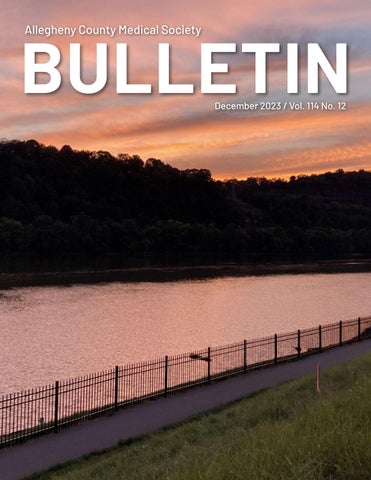
BULLETIN Allegheny County Medical Society
December 2023 / Vol. 114 No. 12
2
www.acms.org
BULLETIN Allegheny County Medical Society
December 2023 / Vol. 114 No. 12
Opinion Editorial
•T he Affirming Flame Deval (Reshma) Paranjpe, MD, MBA, FACS
Editorial
•W hat Would Bruce Do? Reflecting on the Legacy of Dr. Bruce W. Dixon Michael Lamb, MD
Editorial
•T hree Amigos Richard H. Daffner, MD, FACR
Society News
Articles
ACMS Year in Review
Legal Summary
2023 ACMS Foundation Annual Report
Materia Medica
•O ur Dynamic Year A Comprehensive Review of 2023 Achievements Matthew B. Straka, MD
2024 Election Report
•2 024 Medicare Physician Fee Schedule Highlights Michael A. Cassidy and Adam Appleberry — Tucker Arensberg •F ezolinetant (Veozah™): A New Agent in the Management of Menopausal Hot Flashes Sherma Ndum, Doctor of Pharmacy Candidate, Duquesne University of Pharmacy
Editorial
• Yes, Virginia... There is a Santa Claus...Yes, Miles, There was a Virginia Anthony L. Kovatch, MD
Cover Photo by William Poller, MD William Poller, MD specializes in Radiology, Breast Imaging ACMS Bulletin / December 2023
3
Bulletin Medical Editor Deval (Reshma) Paranjpe (reshma_paranjpe@hotmail. com) Associate Editors Douglas F. Clough
2023 Executive Committee and Board of Directors
PAMED District Trustee G. Alan Yeasted, MD
Richard H. Daffner (rhdaffner@netscape.net)
President Matthew B. Straka, MD
Committees
Kristen M. Ehrenberger (kricket_04@yahoo.com)
President-elect Raymond E. Pontzer, MD Secretary Keith T. Kanel, MD Treasurer William Coppula, MD
Bylaws Keith T. Kanel, MD Finance William Coppula, MD Nominating Raymond E. Pontzer, MD
Anthony L. Kovatch (kovatcha42@gmail.com) Joseph C. Paviglianiti (jcpmd@pedstrab.com) Andrea G. Witlin (agwmfm@gmail.com)
Board Chair Peter G. Ellis, MD
Directors Term Expires 2023 Michael M. Aziz, MD Micah A. Jacobs, MD Bruce A. MacLeod, MD Amelia A. Paré, MD Adele L. Towers, MD Term Expires 2024 Douglas F. Clough, MD Kirsten D. Lin, MD Jan B. Madison, MD Raymond J. Pan, MD G. Alan Yeasted, MD Term Expires 2025 Anuradha Anand, MD Amber Elway, DO Mark Goodman, MD Elizabeth Ungerman, MD Alexander Yu, MD
Administrative Staff Executive Director Sara Hussey (shussey@acms.org) Vice President - Member and Association Services Nadine M. Popovich (npopovich@acms.org) Manager - Member and Association Services Eileen Taylor (etaylor@acms.org)
Administrative & Marketing Assistant Melanie Mayer (mmayer@acms.org) Part-Time Controller Elizabeth Yurkovich (eyurkovich@acms.org) Bulletin Designer Victoria Gricks (victoria@thecorcorancollective.com)
ACMS Alliance Co-Presidents Patty Barnett Barbara Wible Recording Secretary Justina Purpura
Treasurer Sandra Da Costa Assistant Treasurer Liz Blume
Corresponding Secretary Doris Delserone
Improving Healthcare through Education, Service, and Physician Well-Being 4
EDITORIAL/ADVERTISING OFFICES: Bulletin of the Allegheny County Medical Society, 850 Ridge Avenue, Pittsburgh, PA 15212; (412) 321-5030; fax (412) 321-5323. USPS #072920. PUBLISHER: Allegheny County Medical Society at above address. The Bulletin of the Allegheny County Medical Society is presented as a report in accordance with ACMS Bylaws. The Bulletin of the Allegheny County Medical Society welcomes contributions from readers, physicians, medical students, members of allied professions, spouses, etc. Items may be letters, informal clinical reports, editorials, or articles. Contributions are received with the understanding that they are not under simultaneous consideration by another publication. Issued the third Saturday of each month. Deadline for submission of copy is the SECOND Monday preceding publication date. Periodical postage paid at Pittsburgh, PA. Bulletin of the Allegheny County Medical Society reserves the right to edit all reader contributions for brevity, clarity and length as well as to reject any subject material submitted. The opinions expressed in the Editorials and other opinion pieces are those of the writer and do not necessarily reflect the official policy of the Allegheny County Medical Society, the institution with which the author is affiliated, or the opinion of the Editorial Board. Advertisements do not imply sponsorship by or endorsement of the ACMS, except where noted. Publisher reserves the right to exclude any advertisement which in its opinion does not conform to the standards of the publication. The acceptance of advertising in this publication in no way constitutes approval or endorsement of products or services by the Allegheny County Medical Society of any company or its products. Annual subscriptions: $60 Advertising rates and information available by calling (412) 321-5030 or online at www.acms.org.
COPYRIGHT 2023: ALLEGHENY COUNTY MEDICAL SOCIETY POSTMASTER—Send address changes to: Bulletin of the Allegheny County Medical Society, 850 Ridge Avenue, Pittsburgh, PA 15212. ISSN: 0098-3772
www.acms.org
Editorial
The Affirming Flame By: Deval (Reshma) Paranjpe, MD, MBA, FACS “Ilsa, I’m no good at being noble, but it doesn’t take much to see that the problems of three little people don’t amount to a hill of beans in this crazy world. Someday you’ll understand that. Now, now. Here’s looking at you, kid.” - Rick Blaine, Casablanca What we are facing in our country, our profession and our lives pales in comparison to what our 1940s counterparts faced in WWII, but the quote still applies. Wars are raging in other nations and the bloodshed seems never-ending. Our own country is rife with bitter political conflicts as another election looms. The news is full of random violence inflicted upon the innocent. Our profession is feeling pressure from all sides. Independent physicians are seeing reimbursements drop; employed physicians realize that corporate medicine exerts stresses none of us ever imagined. Moral injury to physicians and patients is everywhere. Time is scarce and demands are continuously regenerating. We wonder what the future will be like for ourselves, our children, and our grandchildren. It is normal and human to be fearful in times of uncertainty and loss of physical, psychological, intellectual and moral safety. We keep our heads down and go to work, trying to do the
ACMS Bulletin / December 2023
best we can under the circumstances. But the worst part is the feeling of helplessness. What can one person do in the face of nations at war? The image of the lone unarmed protestor who faced down a tank in Tiananmen Square is seared into our collective consciousness as the ultimate in bravery. What can one person do to change policy and procedure to make the delivery of medical care kinder, better, easier and more humane to all involved in the process? One person alone may not be as effective as an organized effort, but each person exerts a crucial presence and contributes towards a critical mass. Each person contributes ideas. When one person falls or fails, others are there to carry the load and lift them up to try again. The momentum survives. Thank you for lending your support and presence to organized medicine by being an ACMS member. With your support, there is hope and momentum. What can we do as individuals in the face of stresses and problems in the broader world? Each of us can spread light, kindness and love in our own spheres of influence whether personal or professional— one interaction at a time. It’s a small thing, but it makes a difference. Many
mocked George Bush Sr’s speech and call for a “thousand points of light” years ago, but if each of us becomes a point of light in the darkness, the light is bound to coalesce and overcome. I leave you with the final stanzas from W.H. Auden’s poem “September 1, 1939”, which upon rereading is more timely than ever. All I have is a voice To undo the folded lie, The romantic lie in the brain Of the sensual man-in-the-street And the lie of Authority Whose buildings grope the sky: There is no such thing as the State And no one exists alone; Hunger allows no choice To the citizen or the police; We must love one another or die. Defenceless under the night Our world in stupor lies; Yet, dotted everywhere, Ironic points of light Flash out wherever the Just Exchange their messages: May I, composed like them Of Eros and of dust, Beleaguered by the same Negation and despair, Show an affirming flame. - W.H. Auden, “September 1, 1939” May we all endeavor to show that affirming flame. Happy Holidays and Happy New Year my friends.
5
Society News
Our Dynamic Year
A Comprehensive Review of 2023 Achievements By: Matthew B. Straka, MD -- 2023 ACMS President The Allegheny County Medical Society (ACMS) has navigated a transformative and eventful year in 2023, marked by strategic planning, innovative initiatives, and meaningful collaborations. As I wrap up my term as President of the ACMS, I wanted to share an overview of the key milestones and accomplishments that shaped the organization’s journey throughout the year. January - Setting the Stage for Progress: The year kicked off with the Bulletin Committee initiating discussions about the future of the Bulletin, symbolizing the society’s commitment to staying current. Additionally, notable events included the appointment of Liz Yurkovich as Part-Time Controller and hosting a Leadership Social for our 2023 Leadership Team and Delegates at Cioppino Restaurant. The society also strengthened member benefits, started the process of revamping its website, and explored new financial horizons with a transition from PNC/ Schwab to Hirtle Callaghan. February - Advocacy and Outreach: As the ACMS continues to elevate the voice of the Physician, I was pleased to address challenges facing physicians on the Rick Dayton radio show, setting the tone for the society’s engagement throughout the year. February showcased ACMS’s dedication to various aspects of
6
its mission, including physician advocacy, community engagement, technological innovation, and strategic planning for upcoming events. The diverse range of activities undertaken during this month reflects the society’s holistic approach to addressing the evolving needs of its members and the broader community. March - Specialized Focus and Strategic Planning: Specialty group meetings, including the Chandler Grant Annual Meeting and POS Annual Meeting, marked March’s focus on professional development. The Life Planning Fair stood out as a pioneering event, highlighting the society’s dedication to holistic healthcare. ACMS also delved into partnerships, collaborating with organizations like Duquesne University and actively participating in the Carnegie Science Center Science Fair. April - Honoring Excellence and Strategic Decisions: Preparations for ACMS Honors were underway in April. This event would replace the traditional ACMS Gala with a more casual atmosphere focused on honoring the future of the profession. The society engaged with key stakeholders, such as UPMC and AHN, fostering collaboration and information sharing. Strategic decisions, including a lease extension with Babb and the transfer of the
Indepractice trademark, showcased the society’s commitment to adaptability and foresight. May - Website Launch and Forward Planning: The launch of a new ACMS website marked a technological milestone in May, reflecting the society’s dedication to staying technologically relevant. ACMS engaged in regionalization efforts, submitting a grant application to PAMED to consider whether a regional medical society might be something worth pursuing as the organization and region continues to change and adapt to more employed physicians. The society also focused on fostering relationships with medical students, connecting with students at Pitt, and collaborating with the staff of the new medical school at Duquesne University. June - Community Engagement and Governance Enhancements: June emphasized community engagement, with ACMS attending events like Beverly’s Babies Formula Bank Ribbon Cutting Ceremony and collaborating with Duquesne University to help them plan for the Fritzky Family Summit. The team spent time working with our newest specialty group under our association management umbrella, the Allegheny County Immunization Coalition. Our team reworked the ACIC Governance to provide for more transparent and
www.acms.org
Society News effective leadership. July - Committees and Social Initiatives: The Women in Healthcare Committee held their first meeting in July, promoting inclusivity and diversity within the medical community. ACMS actively participated in healthcare summits, social determinants of health discussions, and hosted events like ACMS Night at the Pirates Game, demonstrating a holistic approach to healthcare and community involvement. August - Strategic Partnerships and Legislative Advocacy: ACMS continued to build partnerships and enhance its legislative advocacy in August. We started preparations for the House of Delegates. The society explored collaborations with Abridge AI, engaged in strategic planning for self-care in healthcare, and initiated discussions with Pittsburgh Group on Health. September - Focus on Physician Wellness and Legislative Preparedness: Selfcare in Healthcare Year 2 launched in September, with ACMS gaining significant media coverage for its efforts to raise awareness about physician suicide. The society actively prepared for the House of Delegates, with virtual testimony and a renewed commitment to legislative advocacy. Initiatives like Friday Thank You Notes to Physicians underscored the society’s dedication to recognizing and supporting its members. October - Data Enhancement and Foundation Contributions: October was a month of collaboration. The ACMS began a joint effort with PAMED to address data issues. The common goal was to help create a better understanding of membership
ACMS Bulletin / December 2023
and trends. The ACMS Foundation awarded significant grants to over 20 organizations, reflecting the society’s commitment to community welfare. The House of Delegates session in October marked a robust presence and active participation from ACMS members. November - Elections and Future Planning: ACMS finalized its elections in November, certifying new board and delegation members. The society continued to explore new partnerships, engaging with organizations for sponsorships in 2024. Strategic planning for the future was evident in the proposed 2024 budget, highlighting ACMS’s commitment to financial sustainability and growth.
December - Reflection and Strategic Planning: As the year approached its conclusion, ACMS took stock of its accomplishments and engaged in discussions about plans for 2024. The Allegheny County Medical Society’s 2023 Year in Review reflects a dynamic and proactive organization committed to innovation, advocacy, and community engagement. From pioneering events and strategic partnerships to technological advancements and governance enhancements, ACMS’s journey in 2023 showcases a multifaceted approach to addressing the evolving needs of its members and the broader healthcare community.
7
Editorial
What Would Bruce Do?
Reflecting on the Legacy of Dr. Bruce W. Dixon By: Michael Lamb, MD It’s been 10 years since Dr. Bruce Wayne Dixon died at age 74. Although his name invokes iconic images of “Batman”, those of us who knew him well, simply called him “Bruce”. To say he was an influential and legendary teacher of internal medicine and public health hardly seems an adequate description of his abilities. Bruce won many “golden apple” awards for outstanding teaching at UPMC and one during his stint at Duke University. My first encounter with Bruce was on teaching rounds as a medical student. He was bending over a patient intently listening to the man’s heart. Abruptly he turned towards the interns, residents and students crowded around the bedside and said, “No one told me this patient had left bundle branch block”. We were stunned. He had diagnosed left bundle branch block solely by auscultation! How had he done that? This was the first of many bedside diagnostic triumphs that Bruce delivered in the next six years of my medical training. Another notable example was when he diagnosed a patient as having recently had viral hepatitis by examining the patient’s fingernails. Dixon had noted Beau’s lines in the nail plates of all the fingers. He measured the distance to the line from the proximal nailbed and concluded that “roughly 3 months ago this patient had a serious
8
systemic illness and given his present problem with liver disease, it must have been hepatitis B.” Serologic testing confirmed this. Finally, there was a young man admitted with a diagnosis of diffuse lymphocytic lymphoma confirmed by a lymph node biopsy who was scheduled for induction chemotherapy. The astute hematology fellow, Dr. Frank Bontempo, noticed a faint macular rash on the man’s palms. Bontempo was concerned that maybe the patient didn’t have a lymphoma. Maybe he had secondary syphilis. Bruce knew more about syphilis than anyone on the Pitt faculty. He was contacted late at night and came in sometime after midnight to examine the patient. This was not unusual for Dr. Dixon; he would come in at any hour if the case was interesting or if the house staff really needed him. Bruce examined this young man and was sure he had secondary syphilis. He made the laboratory run stat RPR and FTA testing (these were usually not stat tests). They were strikingly positive. Bruce then requested the pathologist on the case to re-stain the biopsy with a Warthin Starry silver stain. This was done and the lymph node was found to be packed with spirochetes. The plan of treatment with toxic chemotherapy was abandoned and the patient’s ‘lymphoma’ was cured with penicillin.
Bruce Dixon grew up in Forrest Hills and Wilkinsburg, PA and graduated with honors from Wilkinsburg High School where he excelled on the track team and also got very interested in early rock and roll/rhythm and blues music. He recorded local as well as regional artists and formed his own record label, the “Dixon label”. According to his friend, legendary Pittsburgh DJ “Porky” Chedwick, Bruce Dixon eventually accumulated one of the best and most extensive collections of early R & B and rock and roll recordings in the country. Bruce obtained a scholarship to the University of Pittsburgh for Greek and Latin studies but switched to majoring in chemistry, graduating with honors in 1961. He completed his studies at the University of Pittsburgh Medical School in 1965, where he received the school’s prestigious “Memorial Prize” for academic achievement. Bruce did an internship in Internal Medicine at Duke University under the legendary Dr. Eugene Stead. He completed his residency at the University of Pittsburgh with Dr. Jack Meyers, another Internal Medicine icon. After 2 years as an air force physician in Vietnam, Bruce returned to Duke and served as chief medical resident. He taught at Duke for several years before returning to UPMC in 1975 as director of the medical residency program and a
www.acms.org
Editorial consultant in the STD clinic. Bruce had a huge impact on the residents he trained. The Dixon approach to medicine relied on a careful history and physical examination plus an extensive knowledge of general internal medicine. He wasn’t as interested in the latest journal article or randomized study. He stressed what was tried and true, things that would have medical permanence. Bruce claimed that the really good doctors could be easily separated from average ones. “The really outstanding physicians can take care of people who are really sick; people with a critical illness. They are good at diagnosing rare or unusual diseases. They are comfortable seeing lots of patients and they read a lot about their patients.” That was the Dixon formula. Those of us who trained under Bruce wanted to be outstanding like him. Part of being like Bruce included adhering to “Dixon’s rules”. These rules were never written down or numbered in order of importance. One of them inevitably came up on bedside rounds and was always referred to as “Dixon’s rule number 1”. Some of the prominent ones were 1) a Swan Ganz catheter almost never saves anyone’s life, 2) if there is no murmur there is no endocarditis, 3) ‘antibiotic roulette’ can be as dangerous as Russian roulette, 4) the patient usually has a pretty good idea about whether he or she is sick, and best of all 5) no one with an unclear but critical medical illness should die without an empiric trial of steroids (Dixon referred to corticosteroids as ‘magic medicine’)”. These rules had rare exceptions, but in my decades of medical practice they have turned out
ACMS Bulletin / December 2023
to be extremely useful, and at least three of my patients had their lives saved by empiric steroids. Bruce was also way ahead of the curve regarding the overuse of Swan Ganz catheters and their complications. He was incredibly knowledgeable about rare diseases and lesions. One association he was particularly fond of was occult GI bleeding and the blue rubber bleb nevus syndrome. After hearing about this for the fifth time on rounds and not ever having seen or heard of a case in my seven years at UPMC, I questioned him on the chances of any of us actually meeting up with such a patient in practice. His response was “well you never know”. Two years later while in the National Health Service Corps, I encountered a 62 year old woman with GI bleeding who did indeed have two classic blue rubber blebs on her back. As expected she also had similar lesions in her jejunum and surgical resection was curative. Bruce Dixon directed the Allegheny County Health Department from 1992 through 2012. Additionally, he became the head of the STD clinic. His influence on public health in Allegheny County was huge. One wonders what his approach to the Covid 19 epidemic would have been. Given his extensive experience in infectious disease and his superb medical judgement (measured by his penchant for common sense), it is very likely his approach to the epidemic would have been less draconian. He became an expert in bio-terrorism and published some salient articles on that topic, as well as STDs, and other public health issues. He also founded an outreach program to take care of prisoners in the county jail. My favorite Dixon essay was a book chapter on
Bruce on teaching rounds
venomous bites and stings. Years after I read it, I realized how it helped me take care of a critically ill man with rattlesnake bites. Medicine wasn’t his only interest. He refinished classic cars and owned a pristine 1960 Corvette which he drove only on weekends in perfect weather. His preferred daily transportation was an old Rambler station wagon that he affectionally referred to as “the truck” the back of which was filled with almost every tool imaginable. Bruce was good with his hands. We knew that because residents and interns would occasionally call him in to do a difficult spinal tap, place an IV line, or even once to insert a temporary pacemaker. What we didn’t know was how skilled he was as an auto mechanic, a carpenter, and a plumber. He was an expert on Victorian antiques and stained-glass windows. He was an accomplished pianist and organist. Every Halloween Bruce would play spooky Halloween music on the giant pipe organ in his Braddock mansion. Kids had to be brave to scoop up the treats he had left for them on his front porch. A lifelong bachelor, that mansion
9
Editorial probably qualified as the love of his life. Bruce bought the mansion from the Woodland Hills School district. It had been built by Andrew Carnegie’s right-hand man, the future president of Carnegie Steel, Charles W. Schwab. Dixon had a great aunt who had worked as a maid for Mr. Schwab. Bruce and his high school friend Rich Polino refinished the place back to its period style doing 90% of the work themselves. But he was never able to complete the restoration. It was about 75% finished when Bruce died. As a senior medical resident, I felt that I knew him well. We had dinner together several times, shared many cups of tea in the cafeteria, he fixed my 1982 Pontiac, we visited the mansion together several times, went to antique shows, and I even got a joy ride in his Corvette. Even so he was still able to surprise me. I was finishing hospital work late on a Friday afternoon and looking forward to a weekend off when Bruce asked me to join him for a cup of tea. He then invited me to accompany him to a forrest near Duke University where
he believed a very rare species of butterfly could be found. It was a type of “skipper” species that was said to be extinct since about 1865. Dixon was certain that this small area in the Duke Forrest was the perfect habitat for this butterfly. I had not known that Bruce was an expert on Lepidoptera, but he had actually published articles on the subject. Unfortunately, I had to decline his invitation. My idea of fun did not include chasing butterflies in North Carolina. Bruce found several examples of the “extinct” skippers on his excursion. He donated one to the Carnegie Museum of Natural History in Pittsburgh and two to the Smithsonian Museum. The curators at both museums were amazed. The most laudable of Dixon’s traits was his affinity for helping poor people, especially African Americans. His experiences in the segregated South had influenced him in this regard. He also took a special interest in mentoring African American medical students and residents. His rapport with black patients was excellent. This was
largely due to his knowledge of innercity neighborhoods, black culture, and his genuinely warm and friendly demeanor. He was well known and very respected in Pittsburgh’s black communities. Like many of my contemporaries, I often still think of Bruce walking through Oakland with his classic military crew cut, wire rim glasses, a plain black tie, his BWD monogramed white or light blue shirt, and his gray hush puppy shoes. He looked like one of a kind and he was exactly that, an unforgettable character. Those who were fortunate enough to be mentored under his tutelage benefited greatly from the experience. During more than 40 years of medical practice, whenever I was faced with a really difficult clinical problem, I would often ask myself; what would Bruce think about in this situation, what would Bruce do? Lots of us did that and we were all the better for it.
00
,0
0 62
$
$
7540 Kensington Point Breeze
“A True Professional In Every Way”
“Went Above and Beyond”
5717 Kentucky #1 Shadyside
00
00
,0
,0
0 35
00
,0
0 45
5 28
$
$
Julie Rost | Top 1% of All BHHS Agents $50+ Million in 2022 Sales More than 700 Satisfied Past Clients
julierost.com University Square #509 Oakland
10
Office: (412) 521-5500 Cell Phone: (412) 370-3711
The Regency #1C Shadyside
www.acms.org
Society News
Donation Levels Thank you to all of the 2023 ACMS Foundation donors! $5,000+ Dream Maker Mark Goodman, MD
$1,000-$4,999 Champion Peter Ellis, MD
Lawrence John, MD
$500-$999 Circle of Friends William Coppula, MD Linda Fried, MD, MPH Terence Starz, MD Drs. Robert & Lindsay Turner
Arvind Venkat, MD G. Alan Yeasted, MD Robert Eberley Marta Kolthoff, MD
Drs. Matthew & Michelle Straka Rajiv R. Varma, MD John Williams, MD
$100-$499 Advocate Edward Balaban, DO Patricia Dalby, MD Tajh Ferguson, MD Dottie Hostovich Sara & Patrick Hussey John Krah
Leanne Labriola Bruce MacLeod, MD Robert Pacek, MD Amelia Pare, MD Raymond Pontzer, MD Bert & Nadine Popovich
Sandy Radar Thomas Radomski, MD Marty Raniowski Philip Spina Dillon Stein, DO & Bethanie Stein
$1-$99 supporter Kesa Ahomana Ezz-Eldin Moukamal, MD Barry Tenenouser, MD Jaqueline Rizzo
James Latronica, DO Lauren Rossman, MD Deklerk Ngankam
In Memoriam Donations Mark Goodman, MD - In Memory of Carol Rose, MD
Looking to boost your year-end giving? The ACMS Foundation could use your support! Scan this QR Code to donate via Qgiv or visit acms.org/acms-foundation/donate/.
ACMS Bulletin / December 2023
11
Editorial
Three Amigos By: Richard H. Daffner, MD, FACR Throughout our life’s journey we have many acquaintances and make many friends. It is the rare individuals, however, for whom their friendships began in childhood and were maintained over the many ensuing decades. I have been blessed by having two such individuals, Maxim (Max) Cohen and Dr. James (Jimmy) Strosberg, (Fig. 1) as best friends. Our friendship began in grade school in our hometown of Troy, NY, the eastern-most part of New York State’s Capitol District (Albany, Schenectady, and Troy). Max and I were classmates at School 18 beginning in kindergarten in 1946. Jimmy lived across town and attended School 16. Max and I met Jimmy in Sunday School (and later in Hebrew School). Our friendship was bolstered by the fact that our parents were also good friends, all of whom were very active in our synagogue. My father, Max’s father Tommy, and Jimmy’s father Irv all served as congregational presidents. Jimmy’s father was also our family’s doctor. Our friendship solidified during our pre-teen years, when the three of us were excluded from the group of “cool kids”. That clique attended weekly parties as each member celebrated their Bar or Bat Mitzvah. We were not invited. And so, we made our own way. Jimmy’s house had a large, finished basement that contained a full-sized
12
pool table, and we soon became very accomplished pool players. In the summer months we frequently attended baseball games to watch the Albany Senators, a minor league affiliate of Pittsburgh. We were often invited to spend a weekend at the summer cabin on nearby Glass Lake that was owned by Jimmy’s aunt and uncle. In the winter we attended hockey games watching Rensselaer Polytechnic Institute (RPI) play. (RPI won the national championship in 1954.) Although I was the oldest of our triumvirate (by six months), Max was the first to have access to a car, an Oldsmobile 98 four door hard top. His father owned a junkyard, where the three of us learned to drive. Max’s father, Tommy, drove a pickup truck to work and the Olds was the family car. Fortunately for Max (and us) his mother did not drive at that time. Jimmy and I shared our love of music. Jim was an accomplished piano player who also played the tuba in his elementary school and the high school bands and the high school orchestra. I began playing the flute in fifth grade and joined Jimmy in the band and orchestra in high school. The only hiatus in my playing in organized ensembles were my two years in the Air Force and two years of the Covid 19 pandemic. Jimmy’s five children and his wife Margo
played in the “Strosberg Family Band.” He and Margo continue to play in a community orchestra in the Capitol District. Max had no interest in music, telling us he had inherited his family’s “tin ear”. During our teen years, Jimmy and I worked at a day camp for two summers. Then we both worked in my father’s pharmacy. Max, on the other hand, worked as a counselor at the same overnight camp he attended in his early years. It was there that he met his future wife, Joan. As our college years approached, the three of us embarked on different paths. I attended Albany College of Pharmacy, intending to join my father and uncle in their retail store. Jimmy, who wanted to follow in his father’s footsteps became a pre-med at Union College in nearby Schenectady. Max always had a mastery of math and numbers. I remember that when we took our dates to a restaurant, Max would divide the bill into each of our shares after just a quick glance. He attended Babson College, a private business school in Wellesley, Massachusetts, where he graduated with a degree in accounting. After graduation, in 1983, Max married Joan and started a family. He began working as a CPA at a large accounting firm in Schenectady. I decided to go to medical school and joined Jimmy at the then University
www.acms.org
Editorial of Buffalo (UB) (now the Jacobs School of Medicine of the University at Buffalo). We were roommates that first year. In 1965 I married my “childhood sweetheart”, Alva, who pursued a master’s degree in social work at UB. Alva introduced Jimmy to a classmate of hers, Margo. They married in 1966. In one respect, the three of us are “dinosaurs”. Jimmy and I have been married for over 58 years. Max and Joan had been married for 33 years, when Joan succumbed to cancer in 1998. In 2002, Max married his current wife, Jonnie, whom he’d met at a support group for widows and widowers. They have been together now for 22 years. Max and Joan had three children. Their son Dan was “adopted” by us when he attended Carnegie Mellon. Jimmy and Margo have five children, two of whom are Orthodox rabbis. Alva and I have two sons. Following our graduations from medical school in 1967, Jimmy and I were both straight medical interns in the old county hospital in Buffalo. After that I went into the Air Force and Jimmy joined the US Public Health Service, where he served on an Indian reservation in South Dakota1. Following our military service, I did my residency in Diagnostic Radiology at Duke and joined the Duke faculty
after a brief stint at the University of Louisville. Jimmy did an Internal Medicine residency and a fellowship in Rheumatology at Dartmouth and returned to open his rheumatology practice in Schenectady. He and Max were once again united. 1983 was a significant year for Maxim and me. I moved to Pittsburgh following a faculty purge at Duke2. Interestingly, Max was unhappy with his accounting practice and, after seeing me make a significant career change at age 42, decided to move to Tucson, Arizona, after doing some research on warm climate cities. Once in Tucson, he started a successful real estate business in an area that was rapidly growing. And so, once again, we were scattered, miles from each other. Or were we? In 1984, I conducted the first of what would turn out to be 25 annual CME programs on MSK disorders in Arizona. Most of the meetings were in Phoenix and the rest were in Tucson. Most years, I would take several additional days to visit Max in Tucson. My volunteer work with the American Board of Radiology as an “Item (question) Writer” entailed several visits to their headquarters in Tucson, which provided additional opportunities to visit Max. I was also a trustee for my alma mater, Albany
Figure 1: Maxim Cohen, Richard Daffner and Dr. James Strosberg
ACMS Bulletin / December 2023
College of Pharmacy, which required me to visit the Capitol District several times a year. During those visits, when I stayed with my parents, I also used the opportunities to visit with family and with Jimmy. Although my parents and most of my family are now deceased, I still take advantage of those opportunities to visit Jim and Margo. My late cousin Beverly owned a camp (local term for cabin) in the quiet village of Lake Luzerne, about an hour’s drive north of Albany. Every summer since I relocated to Pittsburgh, I would spend a week with her. After I retired, I extended the visit to two weeks. During these visits Jimmy and Margo would come up for a visit and enjoy Bev’s hospitality. Every summer Max would drive from Tucson to visit his oldest daughter, Laura, who lives in Washington DC, and Dan, who lives in Boston, as well as to attend the annual meeting of his “Cousin’s Club”. Somehow, Max’s visit would always coincide with my visit to Luzerne and so the three amigos were once again together. We were also fortunate to be able to meet several times at various vacation spots, as illustrated in figure 1. The Covid-19 pandemic put a halt to these activities. However, we were able to meet via Zoom or conference call every few months. Technology is wonderful. Most people are blessed with one lifelong best friend. I am grateful for having two for such a long time, going back to childhood. References: 1. Daffner RH. “Meatball Medicine”. ACMS Bulletin, Apr 2023, pp 12-14. 2. Daffner RH. The Purge. ACMS Bulletin, Aug 2022, pp 9-11.
13
In-Memoriam
Melih Gurgun, MD of Mt. Lebanon, peacefully passed away at the age of 94 on Wednesday, July 19, 2023 at his home, with his daughter by his side. Beloved Husband of the late Carla Gurgun; Father of daughter, Mine
14
Gurgun and son Dr. Mehmet Gurgun; son of the late Mustafa and Serif Gurgun. Dr. Gurgun also leaves behind friends and family members in Turkey. Dr. Gurgun was born in Ankara, Turkey and moved to the United States in 1957. Initially, he lived in Barberton, Ohio, where he did his residency and met his beloved wife. In 1966, they moved to Pittsburgh and settled in Mt. Lebanon. In Pittsburgh, Dr. Gurgun was a Radiologist and Chief of Radiology at Forbes Hospital. He was named an Honorary Member for Life of Service. He also worked at several Pittsburgh Hospitals. Dr. Gurgun was the first president of the Pittsburgh Turkish American Association and maintained his relationships and commitment to Turkey.
Dr. Gurgun was a man of great integrity, honesty, loyalty, and great judge of character. It was important for him to always do the right thing. His willfulness gave him the determination to fulfill his aspirations. He and his wife served others faithfully and gave their family a life of abundance, privilege, and protection. Dr. Gurgun was blessed with a bright mind and sharp wit to the end. He enjoyed travel taking long road trips in America or traveling to Turkey. He maintained interest in a breadth of diverse topics and was ahead of his time intellectually. Using his refined intuition and judgement, he had a sense of “knowing” that invariably led him to make decisions yielding in best outcomes.
www.acms.org
ACMS Bulletin / December 2023
15
2024 Allegheny County Medical Society Board of Directors and Delegates The Allegheny County Medical Society conducted its election from October 28, 2023, to November 12, 2023. The following are the official results of the election:
Chair / Immediate Past President Matthew B. Straka, MD
President
President-Elect
Secretary
Treasurer
Raymond E. Pontzer, MD
Keith T. Kanel, MD
Kirsten D. Lin, MD
William F. Coppula, MD
Elected to Board of Directors Three-Year Term (Term Expires in 2026) Michael M. Aziz, MD Michael W. Best, MD Richard B. Hoffmaster, MD Jody Leonardo, MD Micah A. Jacobs, MD
One-Year Term (Term Expires in 2024) David Deitrick, DO
Board Members Currently Serving Term Expires in 2024 Douglas F. Clough, MD Jan B. Madison, MD Raymond J. Pan, MD G. Alan Yeasted, MD
Term Expires in 2025 Anuradha Anand, MD Amber Elway, DO Mark Goodman, MD Elizabeth Ungerman, MD Alexander Yu, MD
2024 Peer Review Board – Last 3 Immediate Past Presidents Peter G. Ellis, MD (Chair) Patricia L. Bononi, MD William K. Johnjulio, MD *A member of the Peer Review Board cannot be an active member of the ACMS Board of Directors.
16
www.acms.org
Election Report: At A Glance Delegates Elected – Two-Year Term 2024-2025 Holly Appleberry, MD Alexandra Johnston, DO Kevin Kotar, DO Stacie McKnight, MD Devon Ramaeker, MD Dillon Stein, DO
Currently Serving (Not Up for Election) Michael M. Aziz, MD Vint R. Blackburn, MD William F. Coppula, MD Patricia L. Dalby, MD Amber R. Elway, DO Lawrence R. John, MD Joseph C. Paviglianiti, MD Michael M. McDowell, MD Angela M. Stupi, MD
Alternate Delegates Douglas Clough, MD* Richard B. Hoffmaster, MD Jasbir Kang, MD* Anthony Kovatch, MD Nadia Sundlass, MD Elected – One Year Term 2024 *Candidate for Delegate, moved to Alternate per Election Results
The ACMS Nominating Committee and 2023 Board of Directors congratulate all the newly elected officers, board members, and delegates. We look forward to your active participation as we continue our mission for the Society. Thank you for your dedication to our profession. — Raymond E. Pontzer, MD, Chair, Nominating Committee
2023 Nominating Committee Raymond E. Pontzer, MD — Nominating Committee Chair Amber L. Elway, DO Richard Hoffmaster, MD Ezz-Eldin Moukamal, MD Deval Reshma Paranjpe, MD Matthew B. Straka, MD G. Alan Yeasted, MD
ACMS Bulletin / December 2023
17
Editorial
Yes, Virginia...
There is a Santa Claus...Yes, Miles, There Was A Virginia By: Anthony L. Kovatch, MD Dear Miles, On Christmas Eve of 2015, when you were barely able to walk or talk, I wrote this personal letter because you—the boy with the luminous smile—were our first grandchild. Although we loved you more than anyone or anything else on this earth, I now realize that the author knew nothing much about being a grandparent. Additionally, there are people who have loved you even more than us and have been instrumental in your pursuit of happiness, people you will never meet. Now that you are 9 years old, essentially the same age as Virginia O’Hanlon, and halfway through your precious childhood, with a younger sister Mary who looks up to you, almost too-numerous-to-count younger cousins, and a pet bearded dragon as your BFF, I felt it was time for a reprise! You must have the same confusion about truth and reality as did Virginia at your age. Furthermore, although the world has changed drastically in your short lifetime and has recently been engulfed universally in hatred, bias, and war, the message of this little story is truer than at any time in the history of our civilization! I reiterate: In 1897, a confused 8-year-old girl named Virginia posed this question to her father Phillip, a doctor and
18
coroner’s assistant in Manhattan, NY: Is there a Santa Claus—does he really exist? Doctor O’Hanlon judiciously “punted” the question to a stranger, suggesting that she write to “The Sun” (a prominent New York City newspaper at the time) and assuring her that the truth would surely be revealed!
The iconic editorial of reassurance was provided by one Francis Pharcellus Church, a former correspondent during the Civil War who had witnessed great suffering and a lack of hope and faith in society. “Yes, Virginia, There is a Santa Claus” remains a century and a quarter later, the most reprinted editorial in any newspaper in the English language. This Bulletin will make no exception! https://en.wikipedia.org/wiki/Yes,_ Virginia,_there_is_a_Santa_Claus This is a link to Church’s original article in The Sun of September 21, 1897.
Circa 1895
However, my dear Miles, I must confess that for years I myself was skeptical. The arguments offered by Editor Church are not evidencebased, and we Americans—and all the rest of our fellow travelers on planet Earth—have suffered a serious “hit” to our collective morale and to the soul of democracy. Wrote Church: “They have been affected by the skepticism of a skeptical age. They do not believe except they see. They think nothing can be which is not comprehensible by their little minds.” My own little mind can only offer a memory—a tale of devotion and courage that I witnessed one Christmas Eve long ago. The story is sad, but like all sad stories, it must be told….
www.acms.org
Editorial In the 1960s in New Jersey, almost every household had a train set around the Christmas tree—some trains were electric, and some were imitation. Two bespeckled brothers of about 10-12 years of age were very fearful of what Christmas held in store for them. Their mother was slowly dying, and there was a lien on the house to pay for the medical bills. They prayed that they would be able to keep their parents’ favorite painting “Freedom from Fear,” which hung on the living room wall. The mother of the boys was named Virginia. She remained a proud, mind-strong woman despite her deteriorating physical and mental health and refused to see a superspecialist, a neurologist named Doctor Cooper, in New York City, who might be able to make a definite diagnosis of her genetic condition and therefore offer some hope of recovery. Her husband, a man of humble origins and limited means, promised Virginia a mink coat for Christmas if she would cooperate. The brothers were very skeptical that their father could afford such an extravagant present, being that there was a lien on the house due to the financial burden of keeping Virginia at home. They were fearful that an argument would erupt on Christmas Eve and that their father would leave them! The situation that evening worsened still when the highly nervous older brother accidentally stepped on the track of the electric train (that they had received as their “big” present) and rendered the system dysfunctional. The preoccupied, angry father put on his coat, bolted out of the house with the broken track, and took what likely was
ACMS Bulletin / December 2023
the last bus of the night to town in the heavy snow; there was no car in the family. The family fearfully believed that they would not see hide or hair of him that evening. The older brother who had absentmindedly fractured the train track could do nothing but cry behind his spectacles! However, almost miraculously, two hours later the father returned from town covered with snow holding a new replacement track. “I got to Sears and Roebuck just before they closed!” he heartily exclaimed. All were relieved, but the tension was far from over. Soon after settling down in bed for a “cold winter’s nap,” the brothers became aware of stirring in the living room. They sheepishly peered out from the adjacent hallway. Virginia’s husband was placing a brand new mink coat around her shoulders; as he kneeled at her feet in supplication, Virginia agreed that she would keep an appointment with Doctor Cooper, repeatedly shouting his name (in her dementia) as constituents do at a political rally. The brothers both came out of hiding, and the little family was very happy. It was one of the last times the boys would ever see Virginia happy. Years later, the nervous older brother would recollect that Christmas Eve as a miraculous interlude when he first read the conclusion of Fyodor Dostoevsky’s classic short story “The Heavenly Christmas Tree”: “This is Christ’s Christmas tree. Christ always has a Christmas tree on this day, for the little children who have no tree of their own...And he found out that all these little boys and girls were children just like himself who had died; and yet they were all here, and they were all like angels about Christ,
and He was in the midst of them and held out His hands to them and blessed them...And the mothers of these children stood on one side weeping; each one knew her boy or girl, and the children flew up to them and kissed them and wiped away their tears with their little hands, and begged them not to weep because they were so happy.” But Doctor Cooper could not save Virginia. She succumbed to the inevitable and died several years later in a hospice with her devoted husband at her side. Yes, he too died several months later of a ruptured heart—literally and figuratively. Both brothers were ultimately spared Virginia’s highly inheritable disease—and, therefore, so are your Mommy, Mary, and you! The mink coat was worn by young women of the extended family at special events until its whereabouts became unknown. The electric train probably lies in its fraying box in the far reaches of
a dusty attic; the fractured track is little more than a fleeting memory in the mind of the nervous lad who had stepped on it. However, “Freedom from Fear” still hangs on the living room wall, as it has done for over 60 years. To the family who has loved and worshiped it, the picture will always be their “Heavenly Christmas Tree.”
19
Editorial Yes, Miles, there is indeed a Santa Claus, and, as you may have guessed even at your young age, Virginia was your great grandmother. The husband of exceptional devotion, sacrifice, and love was your great grandfather. Santa Claus was indeed present that Christmas Eve, intervening in the lives of four desperate people, and bringing joy and gladness and peace (albeit fleeting) to a family who believed in everything that he stands for. I know that I am absolutely right because I witnessed it all through my own spectacles! Love, PapPap
Church finishes: “Ah, Virginia, in all the world there is nothing else real and abiding. No Santa Claus! Thank God! He lives, and he lives forever. A
thousand years from now, Virginia, nay ten thousand years from now, he will continue to make glad the heart of childhood.” This winter season may every one of us worldwide enjoy the freedom from fear he abides. Happy Holidays to all—both the living and the dead.
Miles and Mary: circa 2023
“Freedom from Fear” painted by American icon Norman Rockwell -- published in the Saturday Evening Post March 13, 1943
Tucker Arensberg Lawyers Have Experience in All Major Healthcare Law Issues Including: • Compliance • Reimbursement • Mergers & Acquisitions • Peer Review and Credentialing for Physicians • Employment Contracts and Restrictive Covenants • Tax & Employment Benefits
For additional information contact any of the following attorneys at (412) 566-1212 • Mike Cassidy - Compliance; Contracts, Peer Review, Stark/AKS • Jeremy Farrell - Labor & Employment and Commercial Litigation • Adam Appleberry - Mergers & Acquisitions and Physician Contracts • Jerry Russo - Criminal Defense and Investigations • Paul Welk - Mergers & Acquisitions
Visit our med law blog for the latest news and information for you and your medical practice: medlawblog.com
20
www.acms.org
Legal Summary
2024 Medicare Physician Fee Schedule Highlights By: Michael A. Cassidy and Adam Appleberry — Tucker Arensberg On November 2, 2023, CMS issued its Final Rule for the 2024 Medicare Physician Fee Schedule (PFS) for payments to be effective on or after January 1, 2024. The most impactful change is the increase to the “Conversion Factor,” reducing overall payment rates by 1.25%. CMS is also finalizing decreases in payment for primary care and other kinds of direct patient care. The final 2024 PFS conversion factor is $32.74, a decrease of $1.15 (or 3.4%) from $33.89 in 2023. The PFS was implemented in 1992. Each service was assigned 3 relative value components, i.e. work (WRVU), malpractice cost, and overhead cost. The units are added and multiplied by the conversion factor. The data below highlights the Final Rule. (E/M) Visits (to include Split or Shared E/M Visits): A separate add-on HCPCS code G2211 will be implemented to better account for the costs associated with E/M visits. For Split or Shared E/M Visits, a “substantive portion” shall now mean more than half the total time spent on the visit or making a substantive part of the medical decision making. Health-Related Social Need Services: Medicare will pay for Community Health Integration, Social Health Risk Assessment, and Principal Illness navigation services separately.
ACMS Bulletin / December 2023
Telehealth Services: Telehealth for well-being coaching services are being added to the list temporarily, and Social Determinants of Health Risk Assessments is being added permanently. Telehealth services are being expanded to include where and by whom the services can be conducted. For teaching physicians, there must be a physical presence to bill for services involving residents, with an exception for training sites located outside of a metropolitan statistical area. Part B Payment for Preventative Vaccine Administration Services: Medicare is continuing its in-home COVID-19 vaccine program and adding vaccines for pneumococcal, influenza, and hepatitis B. Behavioral Health Services (BHS): There are several expansions in the BHS, to include payment for marriage and family therapists and mental health counselors, in addition to addiction counselors or drug and alcohol counselors who meet the requirements and new HCPCS codes for the psychotherapy crisis services. FQHCs: There are several changes in the Rural Health Clinic (RHC) and FQHC space, to include extending payment for telehealth services and delaying in-person requirements for mental health visits, including marriage and family therapists and mental health counselors, an
alignment of enrollment policies for addiction, drug, or alcohol counselors, and a change to the required level of supervision for behavioral health services furnished “incident to” a physician or NPP’s services to allow general supervision rather than direct. Expanded Diabetes Screening: The enrolled Registered Dietician may bill for the entire Diabetes SelfManagement Training (DSMT) entity, regardless of which professional delivers each aspect of the services. Inflation Reduction Act Provisions for Drugs and Biologicals: Several provisions to affect payment limits for beneficiary out-of-pocket costs for certain drugs payable under Part B. Clinical Laboratory Fee Schedule: There are certain conforming changes to the data reporting and payment requirements for clinical diagnostic laboratory tests. Provider and Supplier Enrollment: Changes regarding enrollment to ease the burden on providers and suppliers and improve program integrity. Electronic Prescribing for Controlled Substances: CMS will continue the practice of issuing a prescriber notice of non-compliance as the non-compliance action for subsequent measurement years. The full description for each change mentioned above can be found on the CMS’s Fact Sheet at www.cms.gov.
21
Materia Medica
Fezolinetant (Veozah™):
A New Agent in the Management of Menopausal Hot Flashes By: Sherma Ndum, Doctor of Pharmacy Candidate, Duquesne University of Pharmacy, Pittsburgh, PA Background: Hot flashes, also known as vasomotor symptoms, are characterized by a sudden, intense feeling of warmth in the upper body often accompanied by sweating, a flushed face, and a rapid heartbeat. These symptoms occur in ~70% of menopausal women, and although we don’t know exactly what causes them, they may result from a change in hormonal levels, particularly a drop in estrogen levels and changes in the region in the brain crucial for temperature regulation (the hypothalamus).1 These sudden, intense waves of heat can disrupt sleep and daily life for many women. Approximately 10-20% of women describe vasomotor symptoms as nearly intolerable.1 Current Treatments for Hot Flashes: There are pharmacologic and non-pharmacologic ways to treat hot flashes including lifestyle modifications, hormonal therapies, and medications. Lifestyle modifications may involve avoiding triggers like caffeine, alcohol, and spicy food, maintaining a cool environment, doing relaxation exercises like yoga, maintaining a healthy weight, and use of dietary supplements like tofu and soy.2 Hormone therapy like estrogen and progesterone may be effective in the treatment of hot flashes but carry potential side effects. These
22
hormones steady the levels of estrogen and progesterone in the body and can also help with vaginal dryness, sleep, and maintaining bone density. Risks associated with hormonal therapies include increased risk of heart attack, stroke, blood clots, breast cancer, gallbladder disease, and dementia. These risks vary with age and history of a hysterectomy. Women who have an intact uterus are given estrogen and progesterone together to protect the uterus against cancer. This can also increase the risk of blood clots and stroke. Women who have had a hysterectomy can take estrogen alone. It is important to take these into consideration before using hormonal therapy to manage hot flashes. Non hormonal therapies like SSRIs can be prescribed to alleviate symptoms. Brisdelle® is a low dose form of paroxetine approved by the FDA to help treat hot flashes.3 Other antidepressants like venlafaxine, citalopram, and escitalopram have been used to treat hot flashes. Side effects associated with these medications include nausea, insomnia, weight gain, drowsiness, and dry mouth. Although these medications aren’t as effective as hormone therapy for treating hot flashes, they can be beneficial in women who cannot use hormone therapy.
Fezolinetant (Veozah™): Fezolinetant is the newest non hormonal drug which has been FDA approved for the treatment of hot flashes. This drug was approved in May 2023, and it is the first drug specifically designed to reduce the frequency and severity of flushing and sweating spells caused by a decrease in estrogen levels in women.4 Fezolinetant is a neurokinin-3 (NK3) receptor antagonist, specifically designed to modulate the activity of neurokinin B, a neuropeptide involved in regulating body temperature. Fezolinetant comes as a 45 mg tablet and can be taken once a day with or without food. For some women, this drug can start working as early as 1 week.5 Clinical Trials: The efficacy of fezolinetant for the treatment of moderate to severe vasomotor symptoms due to menopause was tested in 1022 women who received 1 of 2 doses (30 or 45 mg) in two 12-week, randomized, placebocontrolled, double-blind Phase 3 trials.6,7 The participants of these trials were all between the ages of 40-65 with a BMI ≤ 38 kg/m2 with a minimum average of 7 moderate to severe vasomotor symptoms per day. Both trials were able to show a statistically significant and clinically meaningful reduction (defined as reduction ≥ 2 hot flashes per day
www.acms.org
Materia Medica vs placebo) from baseline in the frequency and severity of moderate to severe vasomotor symptoms for fezolinetant compared to placebo at weeks 4 and 12. In Trial 1 (n = 522), after 12 weeks of fezolinetant 45 mg treatment, the average daily number of hot flashes dropped from 10.4 to 4.0, eliminating 2.5 more episodes than the placebo.6 And similarly in Trial 2 (n = 500), fezolinetant reduced the average daily number of hot flashes from 11.8 to 4.3 (eliminating 2.5 episodes compared to placebo) at 12 weeks.7 In both Trial 1 and 2, at weeks 4 and 12 the mean change from baseline in severity of vasomotor symptoms (scored as a daily mean and analyzed as a weekly average) was statistically significantly superior compared to placebo. The effect of fezolinetant on vasomotor symptom frequency and severity was evident by week 1. In each of these 2 trials, after the first 12 weeks, women on placebo were re-randomized to fezolinetant for a 40-week extension to evaluate safety for up to 52 weeks total exposure. There was no evidence of loss of effect through 52 weeks.8 Considerations: The FDA approval of fezolinetant represents an additional option in the pursuit of effective non-hormonal treatments for hot flashes. Despite this advancement, it is important to note that fezolinetant comes with side effects and considerations. The most common adverse reactions with fezolinetant, occurring in at least 2% of patients treated with the 45 mg dose and more frequently than with placebo, were abdominal pain, diarrhea, insomnia, back pain, hot flush, and hepatic transaminase elevation.6,7
ACMS Bulletin / December 2023
Fezolinetant is contraindicated in women with known cirrhosis, severe renal impairment or end-stage renal disease, and concomitant use with CYP1A2 inhibitors. Perform baseline bloodwork to evaluate for hepatic function and injury prior to fezolinetant initiation. If baseline hepatic transaminase evaluation is < 2x ULN and the total bilirubin is normal, fezolinetant can be started. Perform follow-up evaluations of hepatic transaminase concentration at 3, 6, and 9 months after initiation of therapy and when symptoms (such as nausea, vomiting, or jaundice) suggest liver injury. Fezolinetant should be stopped immediately if there are any symptoms of liver damage like jaundice, pain in the upper abdomen, nausea/vomiting. Continued research is crucial to grasp the long-term safety of this drug and identify other possible side effects that may be associated with its use. Conclusion: Fezolinetant, a NK3 receptor antagonist, has been shown to provide a safe and effective treatment of moderate to severe vasomotor symptoms associated with menopause. Its unique mechanism of action through the neurokinin B pathway offers a potential means for relieving vasomotor symptoms in women seeking relief without reliance on hormonal medications. Although no trial has evaluated fezolinetant directly against hormones for hot flashes, results from the clinical studies suggests that it may be similarly effective to hormonal therapy. Additional research would be beneficial to further define its place in therapy and determine its longterm safety profile. Its availability may be contingent upon regulatory approval in different areas as well.
References 1. Mutchler C. Menopause: What Causes Hot Flashes? 10 Causes You May Not Know. Verywell Health. Updated on October 03, 2023. Medically reviewed by Lauren Schlanger, MD. 2. Abraham C. An Ob-Gyn’s Top Tips for Managing Hot Flashes. American College of Obstetricians and Gynecologists (ACOG). Published: August 2023. Last reviewed: August 2023. 3. Pinkerton JV et al. Low-dose paroxetine (7.5 mg) improves sleep in women with vasomotor symptoms associated with menopause. J Midlife Health. 2015 Jan; 22(1):50–58. Doi: 10.1097/ GME.0000000000000311. PMID: 25137243; PMCID: PMC4274337. https://www.ncbi.nlm.nih.gov/pmc/ articles/PMC4274337/ 4. FDA Approves Novel Drug to Treat Moderate to Severe Hot Flashes Caused by Menopause. News Release. May 12, 202. FDA Approves Novel Drug to Treat Moderate to Severe Hot Flashes Caused by Menopause 5. Fezolinetant (Veozah™) [package insert]. Northbrook, IL. Astellas Pharma US, Inc.; 2023 6. Lederman et al. Fezolinetant for treatment of moderate-to-severe vasomotor symptoms associated with menoapause (SKYLIGHT 1): a phase 3 randomized controlled study. Lancet 2023;401:1091-1102. 7. Johnson KA et al. Efficacy and Safety of Fezolinetant in Moderate to Severe Vasomotor Symptoms Associated with Menopause: A Phase 3 RCT. J Clin Endocrinol Metab. 2023 Aug; 108(8):1981-1997. Doi: 10.1210/clinem/dgad058. PMID: 16454321. https://academic.oup.com/jcem/ article/108/8/1981/7025342 8. Wright AC, Beaudoin FL, McQueen RB, Yeung K, Moradi A, Herron-Smith S, Gutierrez E, Lin GA, Pearson SD. The effectiveness and value of fezolinetant for moderate-tosevere vasomotor symptoms associated with menopause: A summary from the Institute for Clinical and Economic Review’s Midwest Public Advisory Council. PMC (nih.gov) J Manag Care Spec Pharm. 2023 Jun; 29(6):692. doi: 10.18553/ jmcp.2023.29.6.692. PMID: 37276043; PMCID: PMC10387909.
Ms. Ndum is a Doctor of Pharmacy candidate at the Duquesne University School of Pharmacy. At the time of this writing, Ms. Ndum was on a clinical rotation at Allegheny Health Network, Allegheny General Hospital. For any questions concerning this article, please contact the Center for Pharmaceutical Care, Allegheny Health Network, Allegheny General Hospital, Pittsburgh, PA at (412) 359-3192 or email tucker.freedy@ahn.org.
23