













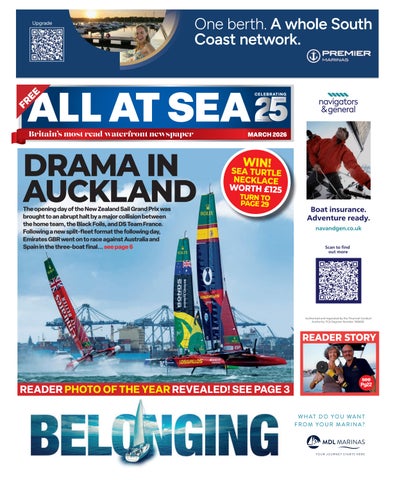
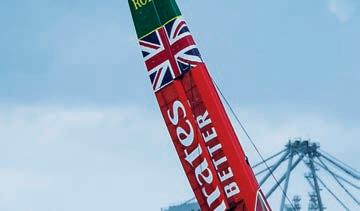
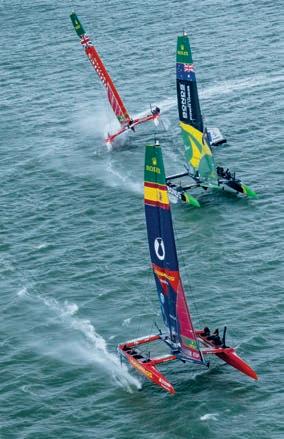
The opening day of the New Zealand Sail Grand Prix was brought to an abrupt halt by a major collision between the home team, the Black Foils, and DS Team France. Following a new split-fleet format the following day, Emirates GBR went on to race against Australia and Spain in the three-boat final... see page 6










Boat insurance experts since 1921, Navigators & General gives you complete peace of mind. With up to £1.25m agreed value, we provide specialist cover for yachts, dinghies, motor boats, day boats, RIBs and more. Get advice from our specialist team today:
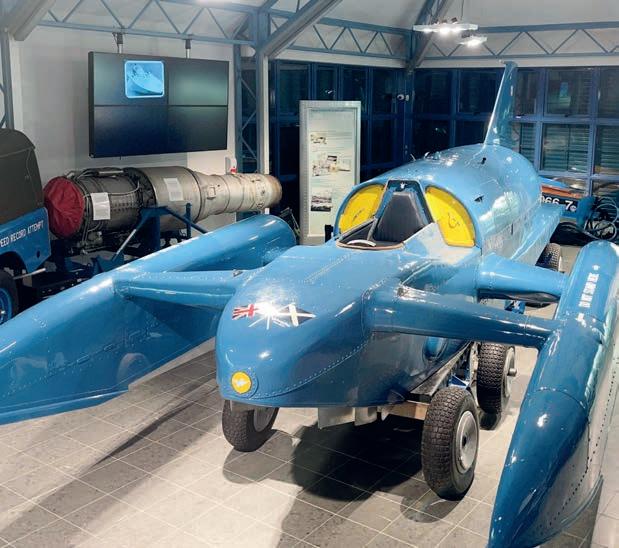
Further details about Bluebird K7 – The Festival (11 - 17 May), which celebrates Donald Campbell and his legendary hydroplane, have been announced.
Between 1955 and 1964 Donald Campbell broke the outright World Water Speed Record on seven separate occasions in Bluebird K7, four of them on Coniston Water in Cumbria. On 4 January 1967 Campbell made his final run in Bluebird intending to push his

existing World Water Speed record from 276mph to 300mph on Coniston Water, but tragically he died in the attempt.
The festival will see Bluebird running each day on Coniston Water (subject to weather conditions) piloted by Australian Dave Warby, son of Water Speed World Record holder, Ken Warby MBE.
The second pilot will be RAF pilot Flight Lt David-John Gibbs from Grantham, Lincolnshire.
A number of legendary bands and tribute groups will join the celebrations in a series of concerts in the village.
The first headline act, on 15 May, will be rock legend Suzi Quatro (pictured), supported by the ABBA tribute band FABBAGIRLS.
The Bootleg Beatles, who have been performing the Fab Four’s repertoire since 1980, will headline on 16 May with the Counterfeit Stones supporting.
The Bootleg Beatles said: “We are hugely honoured to be taking part in the K7 festival this year, bringing back memories of the 1960s when Bluebird and the Beatles were constantly breaking their own records, each having a massive impact on the culture of the day.”
Art pop icons 10cc are the headline act on 17 May, and they will be supported by SWEET.
Graham Gouldman, who fronts 10cc, said: “People of a certain age were captivated in their youth by the daring exploits of Donald Campbell and Bluebird’s breaking of several world
water speed records on Coniston, and so it is an honour to be performing as part of a festival celebrating his achievements and the work being done today.”
Tickets for the concerts start from £50, with more information available at bluebirdk7thefestival.co.uk. Tickets for the Park and Ride at the festival are available too.
Tracy Hodgson, Director of the Ruskin Museum, explained: “We are using park and ride to mitigate any congestion through Coniston and surrounding villages. It will make it easier for people to travel to the festival grounds. There will be no parking at the boating centre, where K7 will be displayed and launched.
“Public parking in Coniston will be very limited. Local people still have to get in and out of the village. Please help us keep the village clear by using the Park and Ride Scheme. For the safety of all visitors the end of Lake Road (just after the bridge) will be pedestrianised.”
Visitors will drive to their designated car park and board the bus; they will need to show their ticket on the bus.
The bus will take them into the centre of Coniston (next to The Ruskin Museum) and they have the option to walk down to the Boating Centre or there will be a shuttle bus, payable on the day.
Park and Ride tickets are £10 per person per day and under 5s are free, and there are seven-day tickets available too at £50 per person. The tickets are available via the event website.
Thank you to everyone who submitted a vote in our Reader
Photo of 2025 competition and, of course, to all the readers who sent in their wonderful photos.
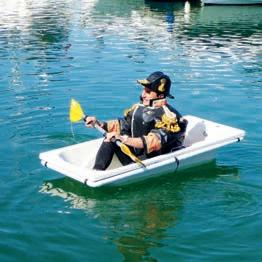
The winner, with almost half the votes, was the winning photo from July by James Long. In second place was Laura Smith’s photo from June, followed by October’s winner Steve Potten with his fun bath tub pic.
Turn to page 25 to see this month’s Photos of the Month and information about sending in your photos.
CAGLIARI COMING
The ‘Road to Naples 2027’ begins in Cagliari, Sardinia in the spring PAGE 5
SAILGP COLLISION
A major crash in Auckland led to the day’s racing being abandoned PAGE 6
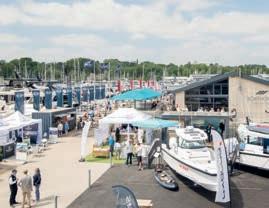
SHOWS & EVENTS
Packed with news about upcoming boat shows and events nationwide PAGES 8-10
Olympic sailing has seen an ever evolving programme as the International Olympic Committee looks for better gender balance and more dynamic racing and formats that present well to viewers.
As a result, the Olympic sailing events have significantly changed over time, although the programme for 2024 and 2028 did remain the same. Now, though, World Sailing is seeking feedback as part of its review of Olympic sailing events going forward.
The review is required under regulations which mandate that at least four Olympic events are placed under review every four years. At the 2025 World
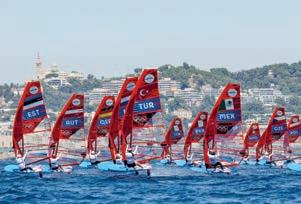
Sailing Annual Conference, the General Assembly voted to place the Men’s Kite, Women’s Kite, Mixed Dinghy and Mixed Multihull under review. Following the review, this year’s General Assembly will vote, deciding for each event to either:
n Retain the event and equipment
n Retain the event but evolve the equipment
n Retain the event but adopt entirely new equipment
n Replace with a new event (equipment to be determined)
Where there is a vote to evolve or change equipment, that will be subject to a further review for a final decision in 2027.









FB Imray, Laurie Norie & Wilson GmbH (FB Imray) has received an updated recognition letter from the Maritime and Coastguard Agency, formally acknowledging the company as a Private Chart Producer. This confirmation means that Imray charts continue to be o cially recognised as suitable for navigation.
For owners and operators of coded vessels – small commercial boats under 24m such as charter boats, training vessels and workboats – carrying Imray charts continues to meet the legal carriage requirements under UK law (specifically MGN 293). In practical terms, vessels that are required to carry approved charts may now do so using Imray products produced by the new company.
Imray charts are produced using o cial UK Hydrographic O ce data combined with additional small-craft details for which they are well-known,
such as specific marina layouts and local pilotage notes. This combination makes the charts particularly valuable for yachts, small craft and recreational sailors, who need both accuracy and practical detail afloat.
Carl Rauch, CEO of FB Imray, said: “This recognition from the MCA is an important milestone for FB Imray. It confirms that our charts meet the standards required for safe navigation and that our processes meet regulatory expectations. For sailors and commercial operators, this means they can continue to rely on Imray charts not only for their clarity and small-craft detail, but also for legal compliance at sea.”
In addition, FB Imray has received ISO 9001 certification, confirming that its quality management systems ensure consistent, reliable processes in the production of navigation charts and sailing publications.
TROPHY SUCCESS


Two teams celebrate after finishing their Jules Verne Trophy attempts PAGE 12


JAZZ HONOURED
Jazz Turner has been awarded the prestigious Duchess of Kent Trophy PAGE 14 ALL AT SEA’S 4 PAGES OF MARINA NEWS, LISTINGS AND PROFILES STARTING ON PAGE 33!

Thank you if you took the time to vote in our Reader Photo of the Year competition.
The standard, as usual, was very high, but there was a clear winner which you can discover on page 3. Now the voting is over I am allowed to say that it was my favourite photo too!
Think you can do better? As always, send you photo(s) in and we will include it in a future issue of the paper and very possibly our socials and newsletter too. However, it is not just Photos of the Month where we need your pics as you have probably noticed we began the new year with an extended Pets Afloat which is now a full page of furry cuteness.
Definitely not furry and probably not described as cute, we also welcome your fish photos for Me & My Catch. There is even a monthly prize for the best photo, kindly supplied by RAILBLAZA. You do not have to be an
expert angler to win, it is just about getting out there and having fun - and sharing your catch photo with us! You can see this month’s winning photo from Steve Whiteley on page 20.
Perhaps you are an angler who enjoys entering competitions. If so the Sea Angling Classic, in June, might already be on your calendar! There are some fantastic prizes up for grabs, but it is also a great opportunity to meet like-minded people and catch up with angling friends. We have news about this, and other upcoming events, starting on page 8.
One of those is the British Motor Yacht Show, which returns to Premier Marinas’ Swanwick Marina in May. This show, which operates an appointment-led format, is back for a 13th year. Expect another impressive line-up of luxury motor yachts and associated marine specialists.
Ahead of that show, though, in April we have not one but two BOATFESTS.
The first takes place in Exeter and is followed a couple of weeks later by another in Portsmouth (there will be a third in Cheshire in June). Each BOATFEST event will feature a variety of new and used boats, watersports gear, adventures, holidays, plus chandlery, equipment, services and much more.
Our annual events guide returns next month, so if you have a regatta,
club day, jumble and so on let us know and we will do our best to include it. Away from boating events, we have great features for you in this issue including an up-date on the restoration of Guide of Dunkirk, which you can read on page 21. She has a fascinating history and so it is wonderful to see her being so lovingly restored by Abbey Boat Builder.
A feature in this issue of a very di erent kind is that of Jude and Richard who are the subject of this month’s reader story. It is the tale of how a stormy day in France could so easily have ended up very badly. If you have a story to share as well we would love to hear it.
Lastly, congratulations to French skipper Thomas Coville and his teammates on their Jules Verne Trophy success and also to The Famous Project CIC who made history in women’s sport and sailing when they became the first all-female crew to complete this non-stop circumnavigation, onboard a maxi multihull! They are an inspiration to female sailors worldwide, as is Jazz Turner who has been awarded the prestigious Duchess of Kent Trophy by the Cruising Association. Enjoy the issue.
By Jane Hyde
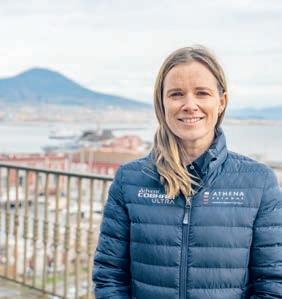
Athena Pathway’s Youth America’s Cup Programme, supported by Cobham Ultra, sits at the heart of the team’s highperformance development framework and is designed to identify, assess and develop British talent with the potential to compete in the Youth America’s Cup, while also supporting progression into professional maritime careers.
The programme focuses on developing the sailing, technical and teamwork skills required for AC40 race boat performance, while also acting as a genuine feeder into senior high-performance opportunities, including British Women’s and Senior America’s Cup teams and Emirates GBR SailGP Team.
Success stores from the last campaign include Youth Trimmer Matt Beck who is now part of the APP sailing operations, Youth Team Helm Nick Robins who is working as data analyst for America’s Cup and SailGP Teams and Ellie Aldridge who has been promoted to full-time member of the APP Women’s Team and development sailor for Emirates GBR SailGP Team.
Hannah Mills, Team Principal of Athena Pathway, said: “We are very excited to open the selection process for Athena Pathway Youth America’s Cup Programme, supported by Cobham Ultra. We came so close to the top of the podium for both the Women’s and Youth teams last time, and it definitely feels like unfinished business.
"We are looking forward to nurturing the next generation of British sailing talent and creating clear pathways into high-performance sailing both on and o the water.”
The Youth AC40 Programme operates at a high-performance level; many sailors selected through this process will already have experience racing at national or international championship level and/or have developed significant foiling experience.
However, Athena Pathway recognises that talented sailors do not always follow the same pathway. Sailors who have taken a non-linear or unconventional route, and who believe they possess the commitment, learning capacity and potential to contribute to a highperformance team environment, are strongly encouraged to apply.
Hannah concluded: “The America’s Cup’s renewed commitment to the Women’s and Youth events is hugely important for our sport.
"It helps create pathways for future generations of sailors, something we have championed through Athena Pathway over the last five years and it showcases that the top end of our sport is inclusive and forward-focused.”
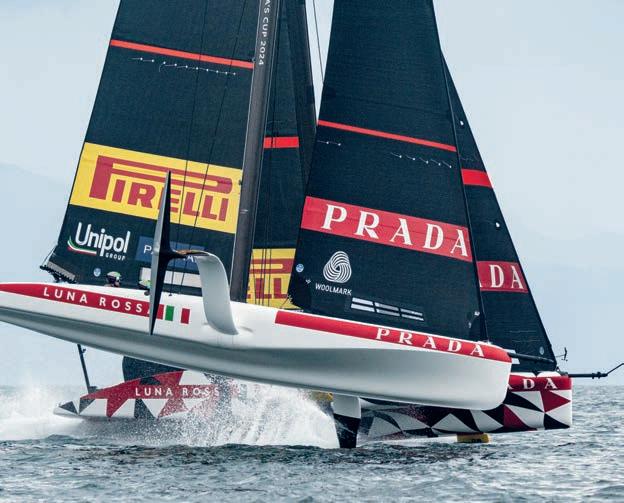
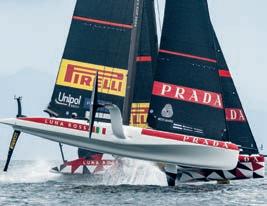
The ‘Road to Naples 2027’ begins in Cagliari, the home of Italy’s Luna Rossa, from 21 – 24 May with the opening Preliminary Regatta of the Louis Vuitton 38th America’s Cup.
Fans will see the first AC40s on the water from 16 May through to 20 May, which is the uno cial practice period. Racing then gets underway with four fleet races on 22 May, another four races on 23 May, and on the final day, 24 May, there will be three fleet races before the top two teams go through to the shootout final.
Each of the teams are allowed to field two AC40s with one of those boats being the primary team of sailors, and the second boat being crewed by a
combination of Youth and Women sailors from their squads. Everyone will be watching to see whether the Youth and Women’s sailors can take the big scalps o the primary teams.
Shoreside there will be a Race Village, while racing will take place in two alternative course areas of approximately 2km in radius close to the shoreline, making viewing along the front and up to the headlands accessible to all.
From the city and all along the waterfront up to the Lazaretto di Cagliari will be the AC Viewing Promenade with views out towards the race area and a large screen where, weather permitting, there will be ‘Try Sailing’ activities and more.
With exclusive footage from the Louis Vuitton 38th America’s Cup Teams Presentation in Naples, the new ‘Inside America’s Cup’ series - available as both a podcast and a vodcast - gets you closer to the action, the people, the rumours and the gossip. @americascup
Most wetsuits are burned or buried in landfill because neoprene, like many modern textiles, has never had an easy end-of-life solution. However, in a recent Clean Sailors podcast, Emma and Peter from Circular Flow, a team collecting, recycling and re-using old wetsuits to create a genuinely circular material, discuss why neoprene has been so hard to recycle and what it takes to build a closed-loop system. Available on Apple, Spotify or where you get your podcasts.
This time six years ago we were hearing about the cancellation or postponement of many boating events due to Coronavirus but, in the very early stages of what was to dominate our world for a long time to come, little did we realise quite how much our lives were about to change. Also in the issue we chatted with Kemp Sails’ Owen Peters and looked at the changing trends in boating holidays. Find past issues at www. allatsea.co.uk/all-at-sea-the-paper
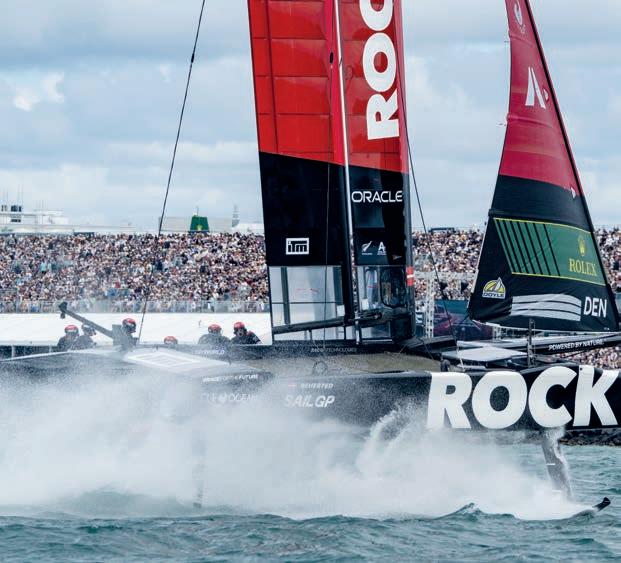
ROCKWOOL Racing SailGP Team has been acquired by sports investor and American Magic Co-Founder, Doug DeVos.
American Magic was supported on the acquisition by Miller Johnson and IKON Capital, the sports-focused investment and advisory platform, which also joins as a co-investor in the team.
American Magic will own and operate the team, with ROCKWOOL continuing as Title Partner until 2032. ROCKWOOL will remain central to the team’s identity and long-term vision, supporting performance, innovation and global brand growth within the championship. The team will continue to represent Denmark and will feature a minimum of three Danish athletes when fully-crewed, in line with SailGP nationality rules.
Doug DeVos said: “Partnering with SailGP and ROCKWOOL Racing brings together three organisations committed to high performance. SailGP has reshaped the sport through global competition, innovation and fan engagement, and ROCKWOOL Racing is already a highperforming team with a strong foundation. Together, we see a clear opportunity to build a winning team, deliver results on and o the water, advance elite talent and inspire the next generation of sailors, designers and boat builders.”
Earlier this year, SailGP launched its first long-term training base at the stateof-the-art American Magic Performance and Innovation Center in Pensacola, Florida, as part of the wider agreement between the two organisations.
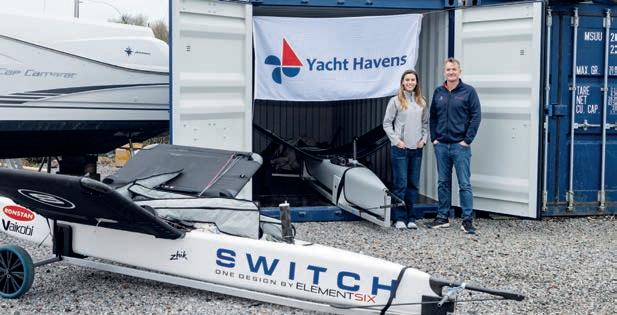
British sailor Hattie Rogers, 25, has secured a new base at Lymington Yacht Haven in her hometown of Lymington for the 2026 season as she prepares to build on a standout 2025 campaign.
Hattie will continue to compete on the international stage throughout the year, taking part in a full programme of International Moth events, culminating in the World Championships in Perth, Australia, in November.
Alongside her Moth campaign, Hattie will also continue racing in the foiling Switch class, maintaining her focus on high-performance foiling disciplines. Looking further ahead, she has her sights firmly set on the ambition of being selected for the British Team Puig Women’s America’s Cup squad for the 38th America’s Cup; in 2024 she was
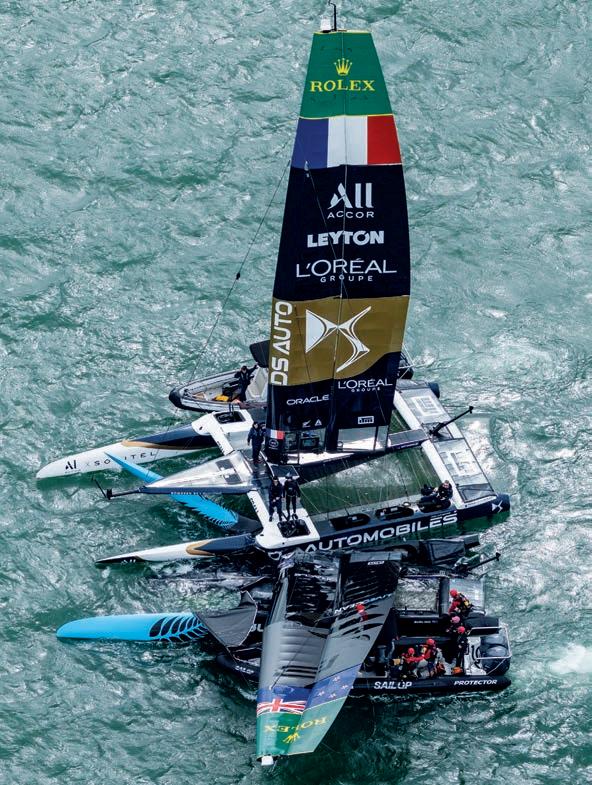
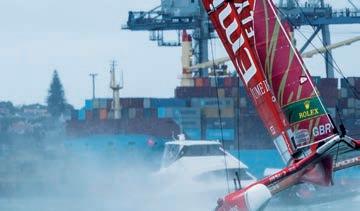
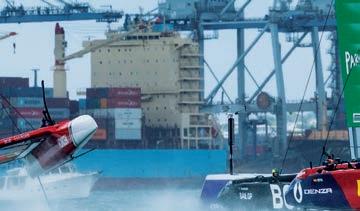
A major crash on day 1 of racing saw both New Zealand and France unable to continue in the New Zealand Sail Grand Prix in Auckland, which ultimately saw the Australians go on to take the victory.
Host nation Black Foils had returned to the start line of the Rolex SailGP Championship for the New Zealand SailGP following a dramatic collision in January in Perth. The damaged section of the team’s port hull – a roughly 2-metre structural segment sheared o in the impact with the Swiss – was fabricated from scratch at SailGP Technologies in the UK before being shipped to Auckland for final assembly.
Specialists from SailGP’s Tech Team had worked around the clock, integrating the new hull section, replating composite panels and meticulously aligning control systems to ensure the boat met both safety and performance thresholds.
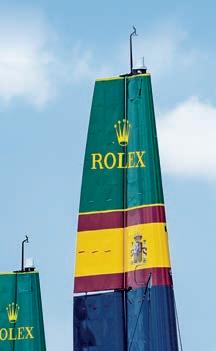
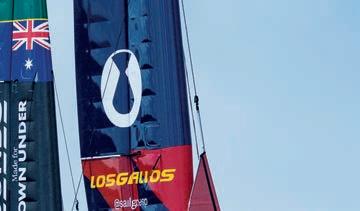
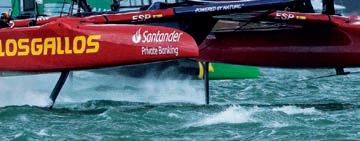
Los Gallos, representing Spain, also returned to the startline in Auckland following a crash in pre-season training which ruled the 2024 champions out of this season’s first event in Perth.
selected for the British squad competing in both the UniCredit Youth America’s Cup and the Puig Women’s America’s Cup. Sailing excellence runs deep in the Rogers family. Her grandfather founded Jeremy Rogers Limited, renowned for building the iconic Contessa yachts, while her uncle, Nick Rogers, is a double Olympic silver medallist.
“Through her growing sailing accomplishments as well as her close ties to the Jeremy Rogers business at Lymington, we have witnessed Hattie’s career grow enormously in recent years. It was therefore the perfect opportunity to provide Hattie with a long term base for her boats and training, providing her with a professional base to support her career,” said
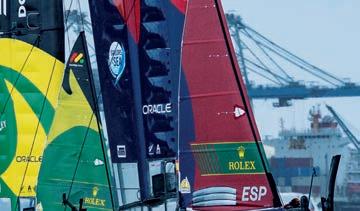
Practice racing on the Friday in Auckland was cancelled due to thunderstorms, before race day 1 saw 13 teams hit the startline for the first time in SailGP history – going head to head on one of the closest racetracks of the 2026 Season calendar in gusts up to 35km/h. Teams were equipped for top speeds with the 18-metre wingsail, high-speed titanium T-Foils and rudders.
A fast and furious day of racing saw Emirates GBR drop o their foils in the pre-start in race one and cross the line in ninth in challenging, shifty breeze conditions. Struggling for rhythm around the course, the team found themselves at the back of the fleet, finishing in 11th place. Race two
fault by the jury*, (so) they get their boat repaired as a priority and the Black Foils would be after that.”
Following the collision, SailGP debuted a split-fleet format on day 2. Emirates GBR started the day in fine form in their Group A fleet race, taking the win ahead of the NorthStar Canadian Team, Germany and Italy, followed by another win in their last fleet race to confirm their place in the Grand Final. All teams raced on the edge in the fleet races, narrowly escaping incident in the testing conditions. NorthStar hit a near record breaking speed of 102km/h at one point, just shy of SailGP’s all-time race speed record of 103.93km.
Meanwhile, in Group B, the BONDS Flying Roos dominated and qualifed for the Grand Final, followed by Spain, who out-hustled Artemis SailGP Team.
told a di erent story. GBR mounted an impressive fightback, picking through the fleet from seventh across the start line to secure a second-place finish.
In race three, GBR again impressed, leading o the line in dominant fashion, before racing was dramatically halted following a major collision between the New Zealand SailGP Team and the France SailGP Team, bringing an abrupt end to the day’s action.
The Bonds Flying Roos had initially picked up where they left o last season, racing to victory in the opening fleet race of the day. It was a strong start for Peter Burling’s Black Foils, who clocked two podium scores, much to the delight of cheering home fans, before their untimely crash.
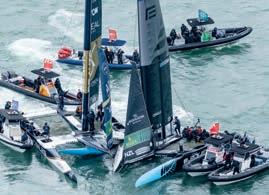
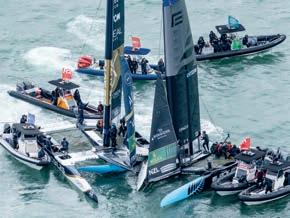
The crash occurred at the beginning of fleet race three. The Black Foils appeared to lose control before crashing into the French boat, whose driver Quentin Delapierre said afterwards that it happened too quickly for him to steer clear. The Black Foils F50 platform collapsed in the incident, as France’s F50 collided on top of the Kiwis’ hull.
Two athletes were taken to hospital, with all other crew members clear of injuries. Organisers later confirmed that Black Foils grinder Louis Sinclair sustained compound fractures to both legs. DS Automobiles Team France strategist Manon Audinet su ered abdominal bruising after being thrown forward on impact, breaking the boat's steering wheel.
The damage to both boats appears major and likely to require another big e ort from the UK based Technical Centre. Both teams have been ruled out of the next race weekend in Sydney with SailGP boss Russell Coutts saying Team France would be given priority for repairs over New Zealand explaining: “The French were not at fault, or were deemed not at
The Final - between Great Britain, Australia and Spain - saw the fastest racing of the day, with gusts of up to 45km/h propelling the league’s top teams to speeds in excess of 90km/h. Los Gallos nailed the start and led early, while Emirates GBR split from the pack in a bold tactical move and surged late – overhauling the Spanish team on the line to take second place behind Australia.
Emirates GBR driver Dylan Fletcher said: “The split fleet was the right call after yesterday’s incident and with the forecast in mind. It was great to see what the boats were capable of in these top-end conditions, it was certainly sporty and demanding. The final was frustrating, to be honest. I decided to back o at the start and protect the asset in those conditions, and we missed our timing on the swing to the start line. But in the back of my mind was the bigger picture, it is a long season.”
Australia now overtakes Emirates GBR on the overall standings, tied on points (17 each). The teams remain in the Southern Hemisphere for one more event, the KPMG Sydney Sail Grand Prix, on 28 February – 1 March.
*
Congratulations to January’s competition winners.
Jacqueline Donson, Cumbria, won a copy of Solent Cruising Companion (pictured is Poppy with Jacqueline’s prize) and Michael White, East Yorkshire, and Zoe Spinner, Essex, both won a copy of Ships’ Figureheads. This month’s competitions are on pages 14 and 29.
Dylan Fletcher MBE, Driver of the Emirates GBR SailGP Team and Helm for the GB1 America’s Cup Team, said losing his SailGP seat back in 2019 gave him “siege mentality” to go for gold and “prove everyone wrong”. Speaking to Georgie Ainslie on the Performance People Podcast, Dylan pinpointed the moment he was ousted from the British SailGP Team in Season 1 as the “defining moment” of his career. Listen to the episode by searching Performance People on your podcast platform or watch it on the Performance People YouTube channel.
FC Barcelona’s striker, and captain of the Poland national team, Robert Lewandowski has joined the Sunreef family of ambassadors. Widely recognised as one of the greatest strikers of all time, he also placed an order for an 80 Sunreef Power NEXT catamaran. The brand has previously worked with ambassadors in sport, including Fernando Alonso, who owns a Sunreef Power Eco 60, and Rafael Nadal, who owns a custom 80 Sunreef Power.
America’s Cup organisers have extended the deadline for entries by two months to the end of March, opening up the possibility of more teams sailing in next year’s event in Naples. Britain, France, Italy and Switzerland, along with defenders New Zealand, have so far confirmed teams. Riptide Racing, from the United States, are hoping to enter, as are rumoured teams from Australia and Italy.
The RORC Rating O ce has confirmed the calendar for the 2026 GBR IRC Championships and the IRC European Championship, setting out a busy and wide-ranging season of IRC racing from May through to September. With events taking place across the UK and surrounding waters, the programme once again reflects the depth and appeal of IRC racing at regional, national and international level.
Hosted from the RORC Cowes Clubhouse over the Easter Bank Holiday, the three-day Easter Challenge combines competitive racing, expert insight and a famously friendly atmosphere, along with the long-standing tradition of Easter eggs as prizes. As with all RORC events, the Easter Challenge welcomes a wide variety of sailors and boats. Entry fees start from under £500 for a 40ft boat (entries close 30 March).
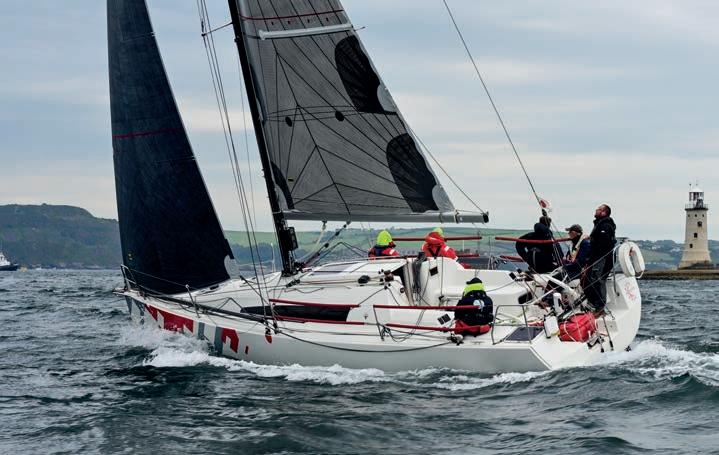
The Royal Western Yacht Club once again hosts the Plymouth Fastnet 500 race, this year on 16 August.
RWYC race director and Commodore, Adrian Gray said:
“We are really pleased to say that the 500 has started to gain popularity for sailors outside the South West. We are starting to see visiting yachts from the Solent and further afield who wish to take on this really challenging course.
“It is a navigator’s dream, with a straight run at the Fastnet rock and back with no huge tidal gates. It also starts and finishes from Plymouth, which makes logistics so much easier than the alternative race next year.”
The fleet will pass the first lighthouse, the Eddystone, to starboard. They then pass the Isles of Scilly whilst avoiding all the ‘no-go’ TSS zones and across the Irish Sea to set up for a port
rounding of the famous Fastnet Rock. On their return they will leave the Isles of Scilly to port and finish in Plymouth Sound, on the original Fastnet Race finish line at the breakwater.
Adrian went on to say: “The attraction of this race is clear, no logistics in getting kit from the start to the finish, no need for passports, less time o work, much cheaper berthing than the Solent yet it has all the thrills and key features of the ‘Fastnet Race’.
“We already have some great entries who are potentially up for the record. We cannot wait to see which local, national and international entries join them in what will no doubt be a permanent fixture for those who love their o shore racing but prefer a South West price tag.”
rwyc.org/plymouth-fastnet500-race/2026
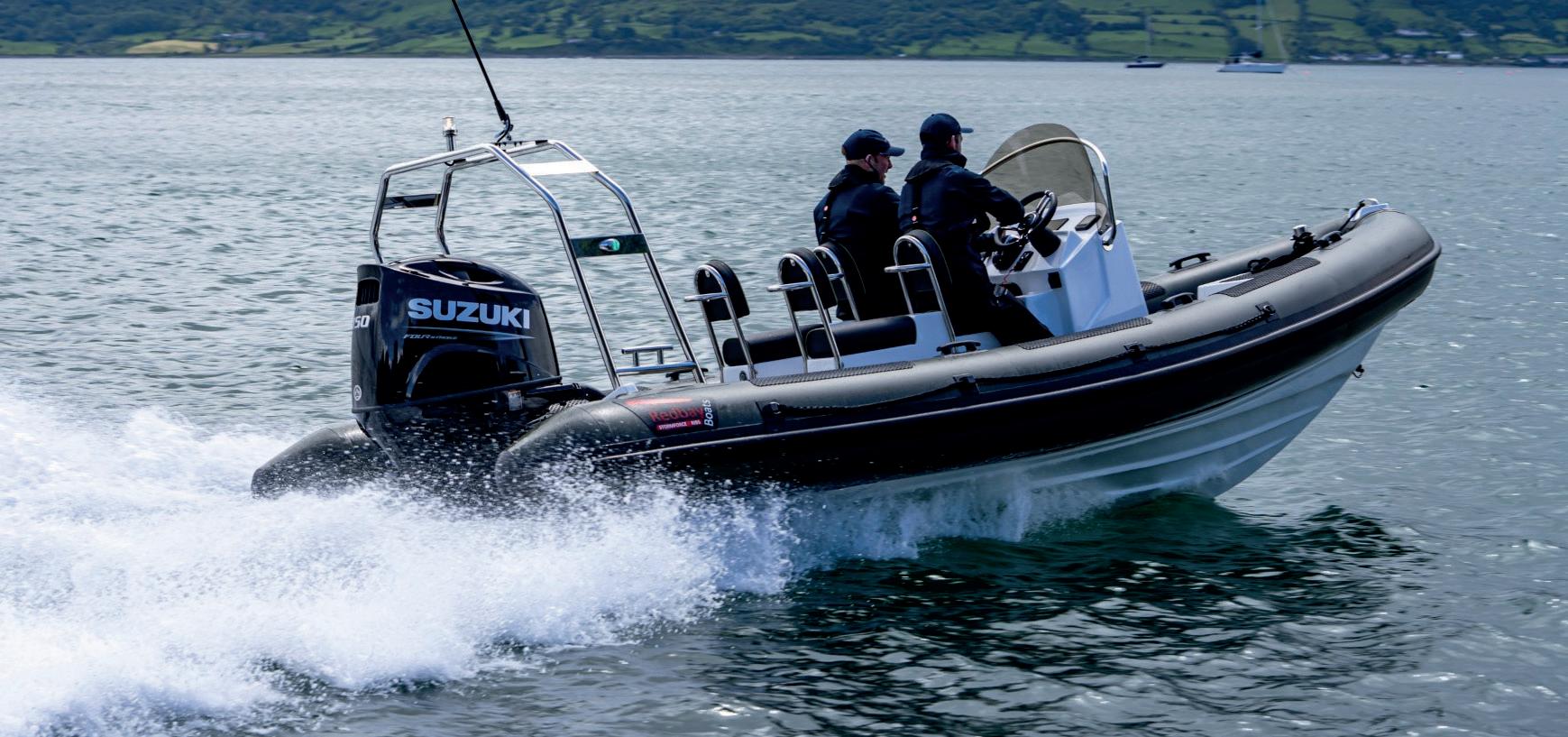
Pantaenius UK is one of the major sponsors for the RIB Rendezvous 2026, taking place from 2 – 3 May against the stunning backdrop of Scotland’s West Coast around Oban. This event brings together an adventurous community of owners and crews to explore the spectacular coastline and islands of the region.
Powered by Suzuki and led by Redbay, the 2026 event is expected to welcome more than 250 RIBs and several hundred participants, launching from a number of local harbours including Easdale, Oban, Ardoran and Dunsta nage.
As a Major Sponsor, Pantaenius UK will be on site throughout the weekend,
supporting the on-water programme and social elements, including hosting morning meet-up co ees and a dockside gathering at the end of Saturday’s main day on the water.
Simon Hedley of Pantaenius UK said: “The RIB Rendezvous captures everything we value – groups of likeminded boaters spending quality
This April, BOATFESTS 2026 presents two new boating and watersports events – one in Exeter, the other in Portsmouth, with a third BOATFEST event being held in Chester in June.
Each event will feature a huge variety of new and used boats, watersports gear, adventures, holidays, plus chandlery, equipment, services and much more. Whether you are looking for a RIB, sports boat, paddleboard, chandlery, cabin cruiser, outboard engine, sailing holiday, fishing boat or even an adventure on a Tall Ship, you will find it at BOATFESTS 2026.
BOATFEST WEST (EXETER) 2026
11 - 12 April: Exeter Racecourse, Exeter, Devon
The first event, BOATFEST WEST (Exeter) 2026, is being held at Exeter Racecourse, a stunning location overlooking the beautiful Devon countryside. With facilities that are perfect for a spring showcase of boating and water activities, this is a must-see event for boating, watersports and adventure fans in the West Country. Situated right next to the A38 Devon Expressway, this event is easily accessible from Exeter city centre and serves visitors from Cornwall, Devon, Somerset, Avon, Dorset and South Wales.
BOATFEST SOUTH (PORTSMOUTH) 2026
25 - 26 April: Lakeside North Harbour / Port Solent Marina, Portsmouth
Following on just two weeks later, BOATFEST SOUTH (Portsmouth) 2026 brings modern boating and watersports to the historic waterfront city of
time on the water, sharing adventures that make the memories they signed up for when they bought their boat. Supporting events like this allows us to stay truly connected to how people are really using their boats, the environments they operate in, as well as the risks and opportunities that come with that.” www.ribrendezvous.com
Portsmouth, known for its maritime heritage. The event takes place at Lakeside North Harbour, where the main festival is located, with more on-water boat displays at Port Solent, just a few minutes away. The twin venues are served by a complimentary shuttle bus. BOATFESTS events are aimed at all boating, watersports and adventure enthusiasts, with free visitor tickets for all those who register for tickets online ahead of the event, and just £10 for those wishing to get their tickets on-the-door, without registering. boatfests.com

























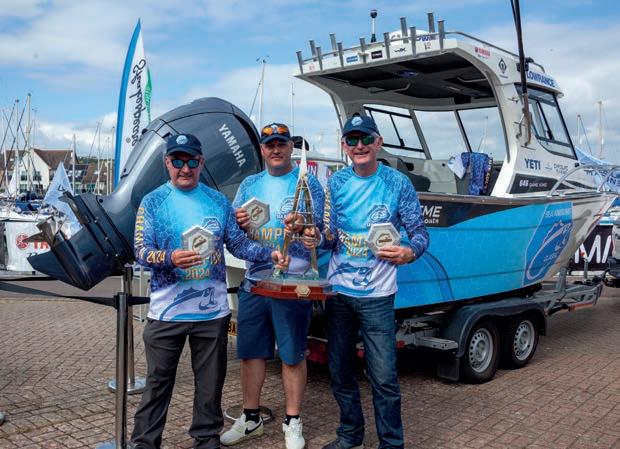
The Sea Angling Classic competition returns over 18 – 21 June at Premier Marina Port Solent with the winner from the last two years - Team Bluefin –returning to defend their title once again.
Participants are required to catch, photograph and release five di erent species of fish - tope, smoothhound, black bream, rays and bass. The longest three fish of each species will be combined for the winning score.
The overall champions receive the much coveted title, trophies and a bundle of sponsors’ prizes including a £10,000
cheque from Lowrance to purchase their equipment of choice and £4,000 cash.
The winner of the highest placed Yamaha powered boat will receive a new 3.1m YAM
Air V Inflatable (engine not included).
The Sea Angling Classic promotes UK angling and respect for marine life.
As such, the competition operates a shoreline cleanup programme, whereby all competing anglers need to undertake at least one local cleanup operation before registering their entry.
Registration is open: www.seaanglingclassic.com
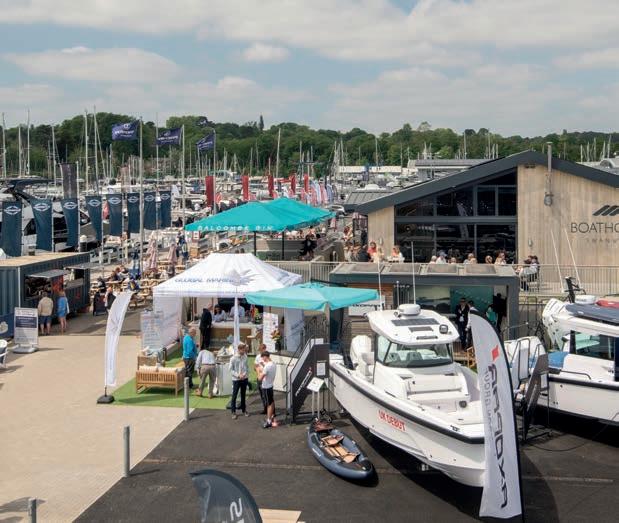
Registration is open for the British Motor Yacht Show, which returns to Premier Marinas’ Swanwick Marina on the River Hamble from 14 - 17 May.
Now entering its 13th year, the British Motor Yacht Show has earned a reputation as one of the UK’s most distinctive and respected events dedicated exclusively to luxury motor yachts. Positioned at the start of the European boating season, the show o ers a focused, appointment-led experience designed for serious buyers and industry professionals seeking time, space and meaningful engagement.
The appointment-led format allows visitors to pre-register and book private viewings in advance. This approach enables meaningful one-to-one conversations with manufacturers, brokers and specialists across finance, insurance and marine services.
Buyers can access expert guidance, ask informed questions and make considered decisions – whether purchasing, upgrading or planning future ownership.
Founded by Premier Marinas, Fairline, Princess Yachts and Sunseeker, from the outset the show's emphasis has been on craftsmanship, innovation and quality conversations over crowds. While the exhibitor line-up is yet to be announced, the show will once again o er some of the world’s most prestigious motor yacht brands, alongside a handpicked selection of specialist marine service providers.
A spokesperson for the show said: “As the show enters its 13th year, the continued support of CGI Finance and the welcome addition of Pelican Insured underline the strength of the British Motor Yacht Show as a trusted platform for serious buyers. Both partners share our commitment to expertise, professionalism and supporting informed decision-making in a relaxed, high-quality environment.”
Attendance at the British Motor Yacht Show is free of charge, but advance registration is required. To register and book appointments, visit BritishMotorYachtShow.com
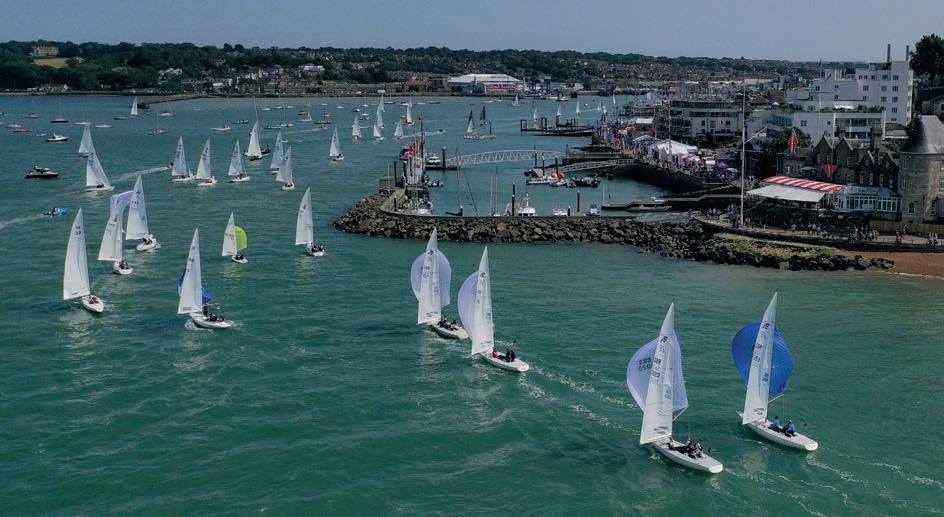
Entries are open for Cowes Week 2026, as one of Britain’s most iconic sporting events prepares to celebrate its 200th anniversary on the Solent.
Founded in August 1826, when seven cutters raced o Cowes Castle, Cowes Week has grown into the world’s largest and most famous Corinthian sailing regatta. Two centuries on, it continues to bring together sailors from across the globe for a unique blend of world-class racing, tradition, entertainment and summer social life on the Isle of Wight.
Racing takes place from 1 - 7 August, with entries invited across more than 37 classes, ranging from classic Solent one-designs to high-performance modern yachts. Alongside racing, plans are underway for a year of unforgettable bicentenary celebrations both on and o the water, bringing back old favourites and celebrating the regatta’s history through exhibitions.
Cowes Week has played a pivotal role in shaping modern yacht racing and remains accessible to crews from all walks of life – from first-time competitors and family teams to seasoned professionals and lifelong Corinthian sailors – united by a shared love of racing on the Solent.
Remarkably, the regatta has only been cancelled three times in its history, during the two World Wars and the COVID-19 pandemic, underlining its resilience and enduring appeal.
The bicentenary regatta is expected to attract a bumper fleet, following growing entry numbers in recent years. Organisers have confirmed that entry fees will remain frozen at 2025 levels, ensuring the 200th anniversary remains accessible to as many sailors as possible.
The event continues to rely on the dedication of around 200 volunteers from
nine yacht clubs, preserving the Corinthian spirit at the heart of the regatta.
Bob Trimble, Cowes Week Chairman, said: “The strength of Cowes Week has always come from its community – the sailors, volunteers, partners and clubs who make the regatta possible year after year. As we open entries for our 200th anniversary, we have held entry fees at 2025 rates so that we can mark this milestone with as many boats as possible, celebrating both the sporting excellence and the spirit of camaraderie that define Cowes Week.” Racing starts on 1 August, with the J70 class scheduled to be the first start from the Royal Yacht Squadron line at 10.30am. The final Prizegiving will take place on 7 August. Super Early Bird entries are open until 6 March, with Early Bird rates available until 3 May. Standard entries will remain open until 18 July.
www.cowesweek.co.uk
Haven Knox-Johnston announced its 2026 free webinar series, From The Helm, the first of which, Single-handed ocean crossing, took place in February.
The webinars cover a range of topics and reflect the company’s ongoing commitment to providing practical, realworld guidance for boat owners, cruising sailors and dinghy sailors, helping them make the most of their time on the water and take their boating to the next level.
As in previous years, the programme brings together experienced sailors and experts to share first-hand knowledge on destinations, boat preparation and alternative cruising challenges. Each session will include practical advice and a Q&A, giving attendees the opportunity to ask questions to the experts.
n 10 March: Cruising the Isles of Scilly (in partnership with the Cruising Association)
n 19 March: Wayfarer Cruising n On demand: Insurance is not a breakdown policy – how to maintain your boat, with Ben Sutcli e-Davies
All webinars are free to attend and open to boat owners and sailors of all experience levels. Those who are registered for the webinars, but unable to attend live will be sent a link to the recording after the event.
See All at Sea’s online news pages or Haven Knox-Johnston’s social pages for registration links. Each webinar will be recorded and uploaded to the Haven KJ YouTube Channel.
A man who crashed his speedboat into a 15-year-old kayaker near Milford Haven was sentenced to 12 months in jail, suspended for two years, in the first prosecution by the Maritime and Coastguard Agency under new watercraft safety legislation. The MCA led the prosecution with support from Dyfed Powys Police and Milford Haven Port Authority. Adam Russell (28), of Milford Haven, was sentenced at Swansea Crown Court over a life-threatening incident in August 2024 on the River Cleddau. In addition to the suspended prison term, Russell must complete 15 hours of required activity; 200 hours unpaid work; and pay his victim £1,676 in compensation for damage to property and personal injury, plus £3,000 prosecution costs.
It is the first prosecution under the Merchant Shipping (Watercraft) Order
2023, introduced in 2024 to empower prosecution of anyone who puts others at risk by using powered watercraft of any size in a dangerous manner, including small motorboats and jet skis.
Swansea Crown Court heard how the crash wrecked the teenage boy’s one-person kayak and left him with cuts and bruising to his arms and lower lip. He has not returned to watersports since, describing the experience in his witness statement as “terrifying”.
Moments before the impact, Russell had been seated steering a single-engine, duoprop speedboat, White Mischief, upstream at unsafe speeds of up to 25mph which lifted the bow and obscured his vision. He was carrying six passengers, including children. Coming in the opposite direction was the 15-year-old victim, in a group with his father and
friends in brightly coloured kayaks and wearing red personal floatation devices. The young kayaker spotted Russell’s vessel approaching near Rudders Boatyard, an area Russell was familiar with and which is known as a busy location for moorings and leisure activities. The teenager tried to paddle out of the way but, unable to see the danger, Russell changed course and struck the kayak, driving over the victim and throwing him into the water.
MCA Investigator Paul Atkins said: “This case shows the importance of keeping a proper lookout and operating safely. If circumstances had been only slightly di erent, there could have been a terrible tragedy. This prosecution, the first under new watercraft safety laws, sends a signal that people flouting the requirements that keep us all safe on the water are liable to be held accountable for their actions.”



























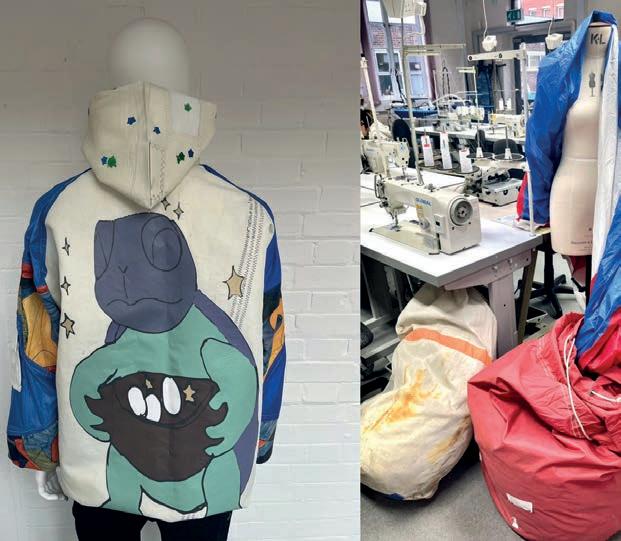
Cambridge School of Art, Anglia Ruskin University, is running its sail-based sustainable fashion project again this year, following a successful pilot delivered in partnership with Clean Sailors during the 2025 academic year.
The project sits within the Sustainable Design and Innovation module on the Fashion Design undergraduate programme and challenges first-year students to work with end-of-life sails as their primary textile; more than 97 per cent of sails are currently sent to landfill or incineration once they reach the end of their sailing life.
Students are asked to produce garments using zero-waste pattern-cutting techniques, while critically examining fashion’s environmental impact, material lifecycles and design responsibility.
Sarah Graham, Lecturer in Fashion Design at Anglia Ruskin University (ARU), said: “Meeting Holly and discovering the Clean Sailors platform gave our students valuable insight into the potential of alternative, sustainable materials.
"Working creatively with sail fabric encouraged them to consider both functional and aesthetic durability in their designs.
"We are excited to collaborate with Clean Sailors again this year to further explore the possibilities of this underused textile resource.”
Clean Sailors will again support the programme through material donations and student awards recognising both technical achievement and thoughtful use of reclaimed sail textile.
Haven Knox-Johnston and Yacht Havens have announced a new collaboration providing berth holders and trade tenants across the nine Yacht Havens marinas with boat and marine trade insurance o erings. Both businesses share deep family roots and decades of experience serving the marine industry, dating back to 1978 when Sir Robin Knox-Johnston was instrumental in transforming the inner basin of Troon into the marina you see today.
Haven Knox-Johnston clients will automatically enjoy a 10 per cent discount on policies when introduced through one of the Yacht Haven marinas, plus an additional 10 per cent discount as a UK marina berth holder.
Paul Knox-Johnston, Sales and Marketing Manager, said: “This partnership brings together two trusted brands, each with a strong reputation for exceptional customer service. By combining our expertise and shared commitment to excellence, we look forward to delivering even greater value and experiences for our customers.”
Furthermore, the Haven Knox-Johnston Specialist branch based in Plymouth relocated to the Yacht Haven Quay Plymouth site in January, bringing closer support and expertise to berth holders and marine businesses in the region.
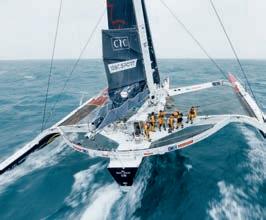
In completing their Jules Verne Trophy bid
The Famous Project became the first all-female crew to sail non-stop and unassisted around the world
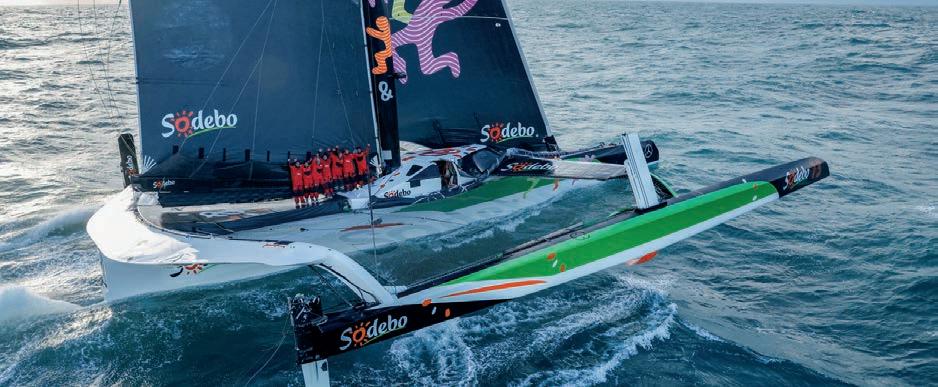
The Jules Verne Trophy is an accolade for the fastest non-stop circumnavigation of the world by any type of yacht - with no restrictions on the size of the crew - via the three Capes covering a minimum distance of 21,600nm. The Trophy sees teams starting and finishing from a line between Créac’h lighthouse (Isle of Ushant) and Lizard Point (England).
French skipper Thomas Coville with teammates Benjamin Schwartz, Frédéric Denis, Pierre Leboucher, Léonard Legrand, Guillaume Pirouelle and Nicolas Troussel has won the Jules Verne Trophy finishing after 40 days, 10 hours, 45 minutes and 50 seconds at sea on their 105ft Sodebo Ultim 3. The team sailed 28,315 miles nonstop at an average speed of 27.17 knots.
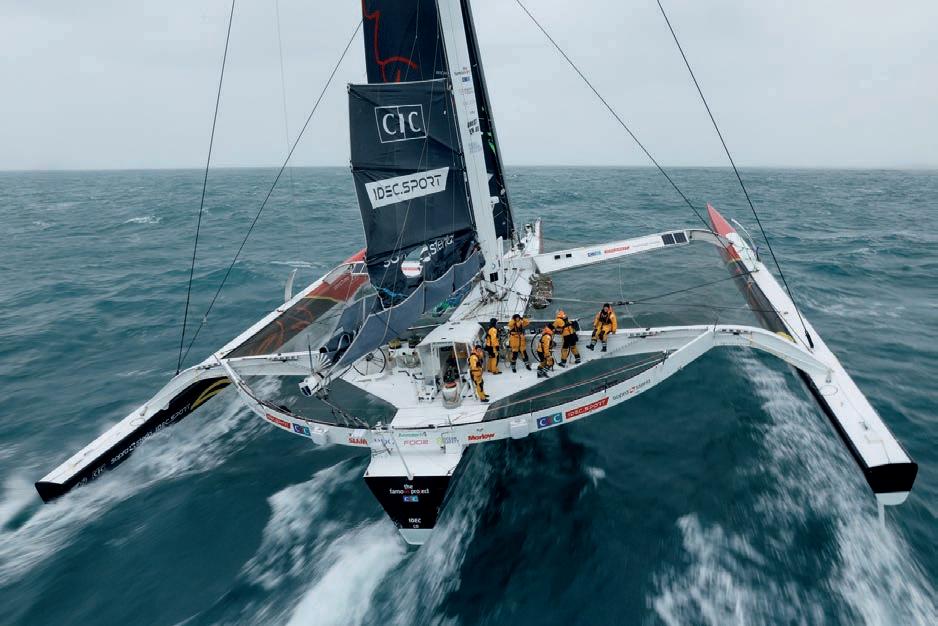
The previous record was 40 days, 23 hours, 30 minutes, 30 seconds, set in 2017 by another Frenchman, Francis Joyon on the 103ft trimaran IDEC Sport. It took nine years and 13 attempts, including three by Sodebo, for the o shore racing record to be broken.
One 45ft multihull berth fits eight ALMA Globe 580 one design adventure machines!
A day later The Famous Project CIC made history in women’s sport and sailing when they became the first all-female crew to complete this non-stop circumnavigation, onboard a maxi multihull.
The crew of The Famous ProjectAlexia Barrier, Dee Ca ari, Annemieke Bes, Rebecca Gmür Hornell, Deborah Blair, Molly LaPointe, Támara Echegoyen and Stacey Jackson – crossed the line onboard the IDEC SPORT maxi trimaran after 57 days, 21 hours and 20 minutes. They faced damage and winter storms that tested their resilience and determination right up to the last mile.
In completing the circumnavigation they also passed the exact location, o the coast of New Zealand, where 27 years earlier, the first all-female crew led by British sailor Tracy Edwards saw their historic round-the-world voyage come to an abrupt end when the mast of their catamaran, Royal & Sun Alliance, collapsed.
Dee Ca ari said: “After 57 days at sea, we are lucky to be back here in Brest, with all the spectators present and everyone who supported us. Of course, there were eight of us onboard, but this achievement is also shared with all those who accompanied us on this incredible adventure. Thank you to those who encouraged us around the world.
“The fact that Thomas Coville and Benjamin Schwartz presented us with a bouquet of flowers on the pontoon is very symbolic. They accomplished an extraordinary feat, but we certainly have not said our final word! In any case, what we have just accomplished lays the foundations to build the future.”
Fellow British sailor Deborah Blair added: “We shared wonderful moments on board, moments of intense joy. I think of the ‘Secret Santa’ we did at Christmas and our small gathering to celebrate the New Year… It was lovely, but I still plan to celebrate Christmas again with my loved ones as soon as I return to England!”
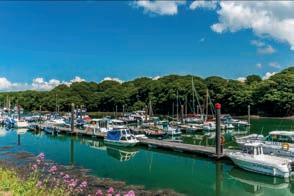
A new range of RYA courses is being o ered at Buckler’s Hard Yacht Harbour in partnership with Associated Marine Training.
Dates have been confirmed for theory courses in the new waterfront boatshed meeting rooms, as well as practical guidance on the Beaulieu River. The expert training opportunities are available for berth holders and visiting boaters to brush up on their skills, or try something new.
The crew at Buckler’s Hard Yacht Harbour have already been put through their paces to complete RYA Powerboat
Intermediate, Advanced and Radar courses for maritime safety and expertise. The investment ensures they are well prepared to manage a wide range of situations on the water.
Harbour Master Wendy Stowe said: “These are great opportunities to learn new skills in small groups of friendly, like-minded people in our stunning new boatshed facilities.
“Mooring your boat can become a struggle for some berth holders and our new tidal-berthing training will help remove that nervousness and enable customers to learn new skills in a small
group of friendly people in our new boatshed facilities.”
Rob McInally, Principal at Associated Marine Training, added: “We are delighted to work with Buckler’s Hard Yacht Harbour to provide this new range of courses. Helping boaters feel confident and safe on the water is essential to get the most from this unique environment.”
Courses, including RYA VHF and RYA Day Skipper Theory, start this month and continue into April and May. To find more and to book: www.associatedmarinetraining.com
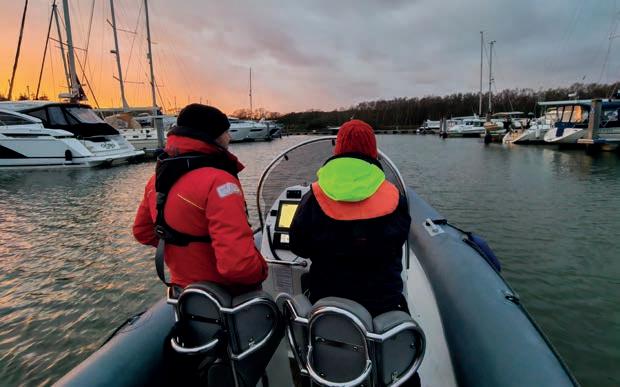
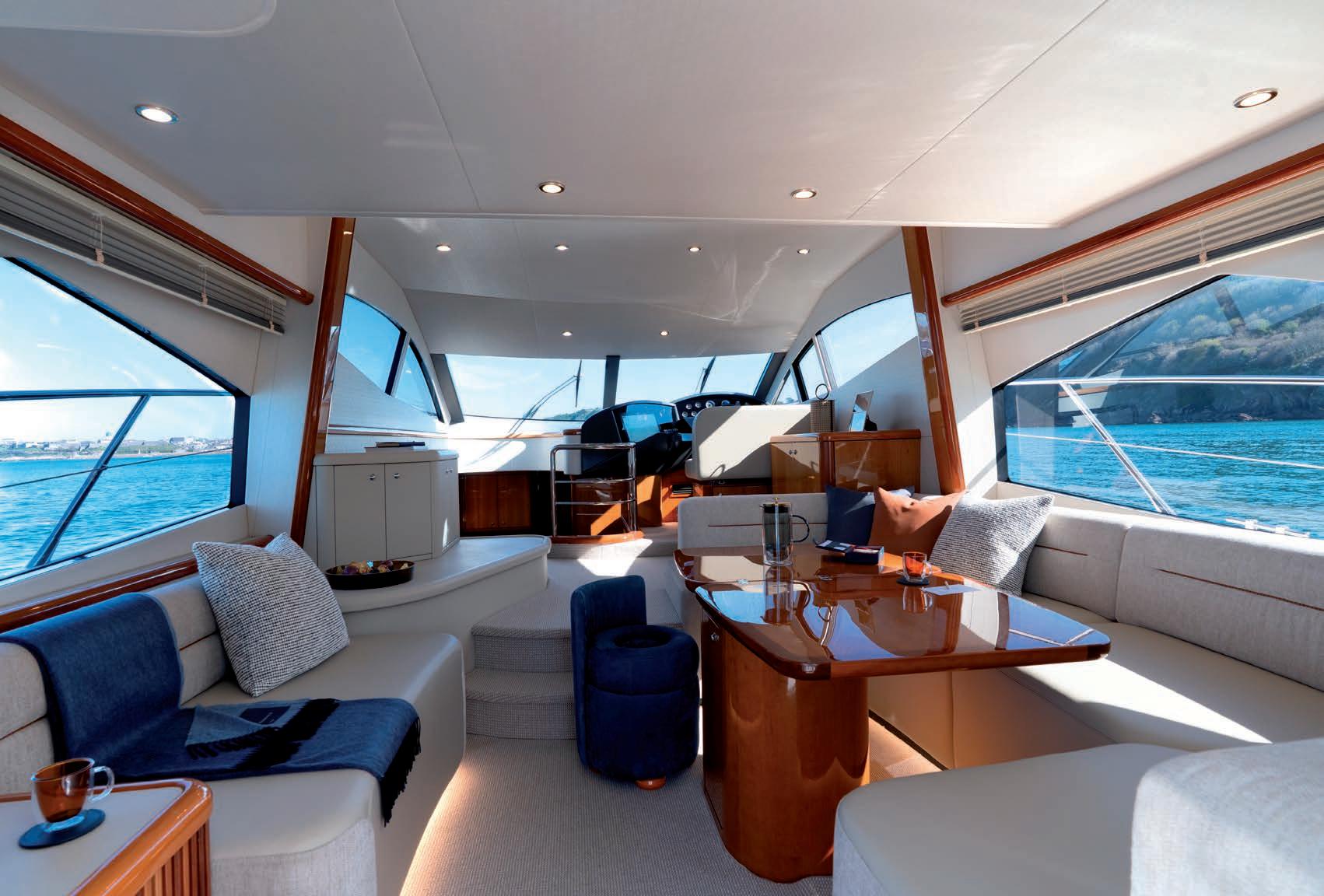
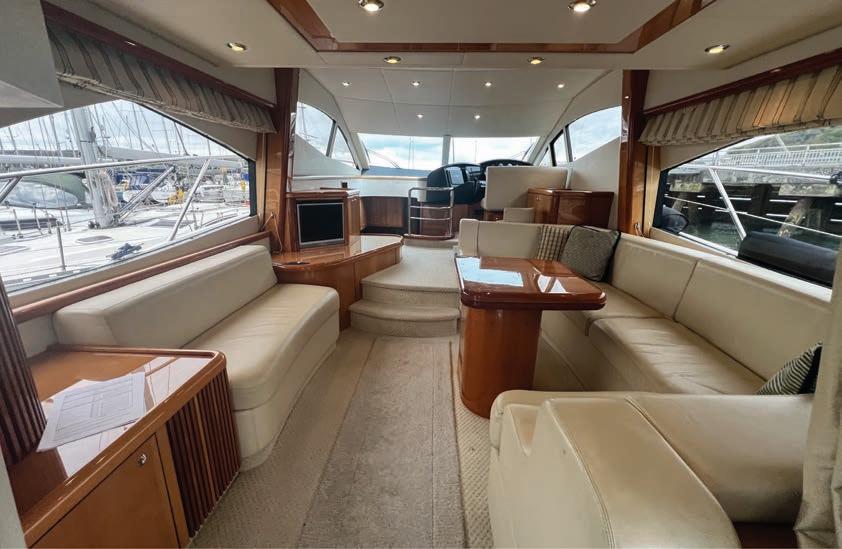
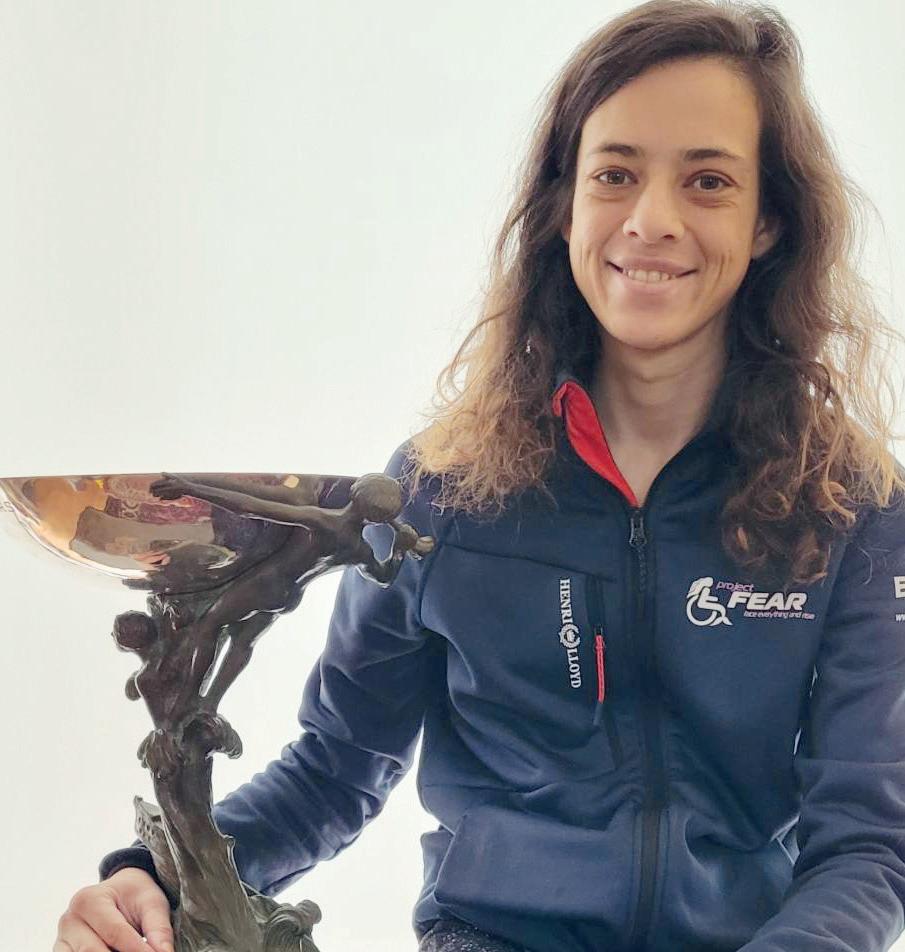
her recordbreaking solo, non-stop and unassisted circumnavigation of the UK and Ireland.
The Duchess of Kent Trophy is awarded to ‘any sailor, not necessarily a member, who has achieved something exceptional in or around small boats’. Jazz’s achievements embody this spirit, placing her among a distinguished list of past recipients, including
Aged 26, Jazz set o from Brighton Marina on 2 June 2025, sailing clockwise around the UK and Ireland. To prepare for her challenge, Jazz rebuilt her boat, FEAR (Face Everything And Rise) – a 1975 Albin Vega 27 – “from the ground up, total rewiring and everything else”. Jazz completed the 2,070-mile circumnavigation after 28 days and 50 minutes, sealing her name in history as the first woman and first disabled person
to complete the circumnavigation. Alongside the physical and mental demands of the voyage, Jazz also raised more than £50,000 for charity.
Jazz lives with Ehlers-Danlos Syndrome, a genetic, progressive condition which a ects connective tissue throughout the body and requires constant and careful medical management. The condition means Jazz is unable to bear weight on her legs, her joints are prone to dislocation and she faces ongoing risks, including fainting, seizures and allergic reactions.
Commenting on the award, Robin Baron, President of the Cruising Association, said: “Jazz’s courage, skill and determination represent a landmark moment for inclusive sailing. By pushing the limits of endurance and seamanship, she has inspired sailors everywhere to challenge assumptions about what is possible on the water and what can be achieved. Jazz is a true trailblazer, and the CA is immensely proud to celebrate her extraordinary accomplishment.”
As Jazz was unable to attend the presentation in person, Fiona Slay accepted The Duchess of Kent Trophy on her behalf, awarded by Sir Robin Knox-Johnston at the CA’s Flag O cers’ Lunch.
Fiona shared a message from Jazz, saying: “I am sorry I cannot be with you today, but my condition has worsened significantly since November. Completing the circumnavigation of the UK and Ireland was a massive challenge with many highs and lows, but it really made me realise that anything is possible with e ort, perseverance and support from family and the sailing community.
“We are now setting up The Jazz Turner Foundation, and all the money I raised not yet spent, will go into that charity, to help other disabled sailors.”
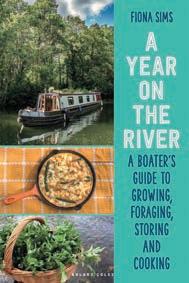
By Fiona Sims | £20 26 March 2026 www.bloomsbury.com
A seasonal guide to food and cooking, including over 40 delicious recipes, for all those who live on or near the water. The demands of a postage stamp galley are di erent to the home kitchen; you have to be organised and planning is key. But there is no need to continually reach for the can-opener. For anyone living with a tiny boat kitchen, but with an appetite for fresh, interesting and sustainable food, there is good news: it is all here.
A Year on the River takes you through each season and shows you:
n how to grow your own delicious produce on your boat or at your mooring
n the beauty of towpath foraging
n how to cook fresh, easy and delicious meals when short on space
n how to sensibly store your food and reduce waste
n how to buy local and seasonally where you are moored
All of this is interspersed with over 40 easy and appealing recipes, such as wild garlic pesto, banana pancakes with foraged blackberries and roasted chalk stream trout, making the most of your new-found skills in growing, sourcing, storing and foraging.
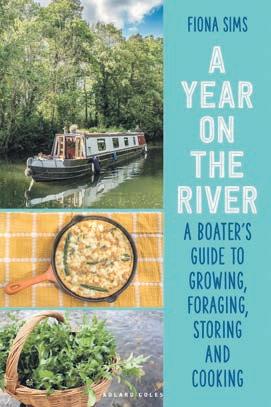
Beautiful photography and charming illustrations set the scene of river life, making this a practical yet beautiful book, brimming with ideas, tips and practices to transform your boating lifestyle.
For a chance to win this book enter at www.allatsea.co.uk or by email to editor@allatsea.co.uk with the subject header ‘A Year on the River’ Book Competition.
Q: A Year on the River includes a recipe for what kind of pesto? Closing date: 24/3/26. See competition T&Cs on page 4.
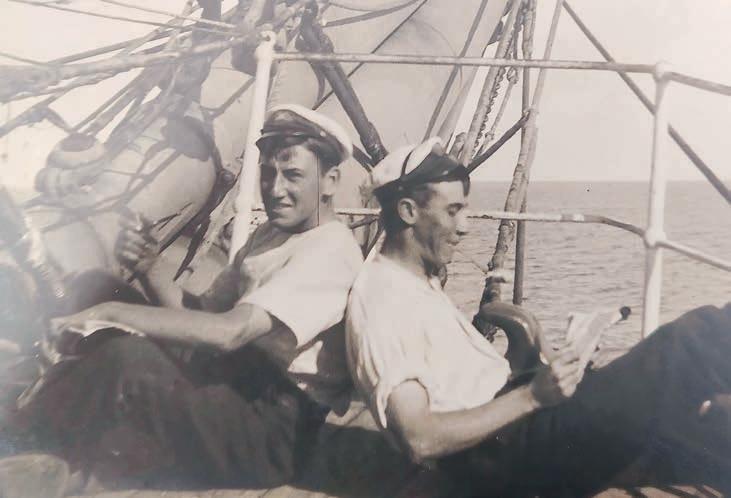
Running until 20 June, a powerful new exhibition exploring the stark contrast between life in harbour and out on the open sea is on show at the Scottish Maritime Museum (Denny Tank) in Dumbarton.
Harbour and Horizon brings together artworks, historical photographs and artefacts from the last two centuries held in the Scottish Maritime Museum’s nationally recognised collections to explore the lived experiences of sailors and their families.
Scotland’s harbours and ports have long inspired artists drawn by their bustling activity, shifting light and atmosphere and evocation of trade and travel. Exhibition artworks depict the safe haven at home, from the industrial energy of the River Clyde to the beauty of fishing harbours, often portrayed as idyllic communities.
The exhibition then reveals the dangers at sea beyond the harbour walls most strikingly through a series of photographs taken in 1909 by amateur photographer and sailor William Sinclair.
His photographs document the relentless hardships of early twentieth-century seafaring – from being becalmed in the Doldrums to battling in the Roaring Forties as well as the perilous passage around Cape Horn – one of the
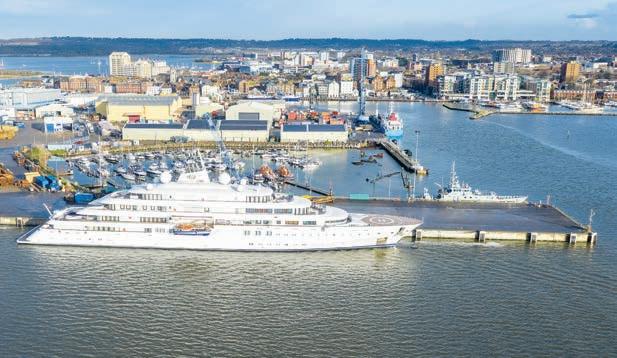
The Port of Poole has welcomed the superyacht Golden Odyssey, the largest superyacht to visit Poole Harbour to date, at 123.2m in length.
Built by German shipyard Lürssen and delivered in 2015, the yacht accommodates up to 30 guests and a crew of around 70. Beyond their design, many superyacht owners and operators are also actively involved in environmental research. They support scientific studies, adopt technologies that reduce environmental impact and participate in conservation initiatives.
Poole Harbour continues to attract superyachts from around the world thanks to its sheltered waters, accessible marina facilities and picturesque surroundings.
Captain Brian Murphy, CEO of Poole Harbour Commissioners, said:
“In addition to o ering excellent mooring and refuelling options, we have access to a strong local supply chain, including marine services, maintenance and provisions, which support both the vessels and their crews during their visits. This combination of natural beauty,
practical facilities and local expertise makes Poole Harbour a much soughtafter location for international superyachts.”
Richard Selby, Chief Executive O cer of British Superyacht, said: “It is exciting to see an increase in the number of superyachts engaging with ports and marinas along the South Coast over the last few years, particularly Poole which has so much to o er for owners, guests and crew. Their presence also benefits the local supply chains where the high quality and excellence of products and services resonates with many captains and yacht agents.”
world’s most dangerous sea routes. Together with ship logs and diaries from the collection, his photographs o er an unfiltered glimpse into life at sea.
Eva Bukowska, Exhibitions and Events O cer at the Scottish Maritime Museum, said: “We are particularly excited to share the photographs of William Sinclair, which come from a private collection held by Lawrie Sinclair, his grandson and Chair of the Scottish Maritime Museum Trust. The combination of artworks depicting harbours as places of safety, community and hard work alongside documentary photographs of sailors battling the elements creates a compelling dialogue that visitors of all ages will enjoy.”
Artefact highlights include an 1888 tribunal transcript investigating cargo lost in storm conditions aboard the Maggie built by Troon Shipbuilding Co. in 1883 and a collection of Maritime Protest Notes from Dundee (1987–2000). For centuries, these notarised statements have been produced when a ship enters port after a rough voyage to protect the ship’s charterer or owner from liability for damage to the cargo, the ship or to other ships in a collision caused by unavoidable events at sea.
The Harbour and Horizon exhibition is included in museum admission.
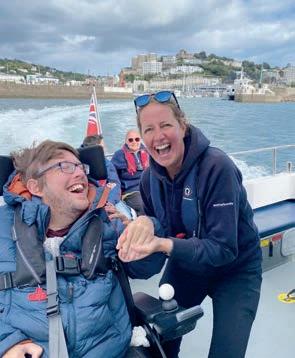
The aim is simple: to ensure that wherever someone lives in the UK, the freedom of the sea is within reach.
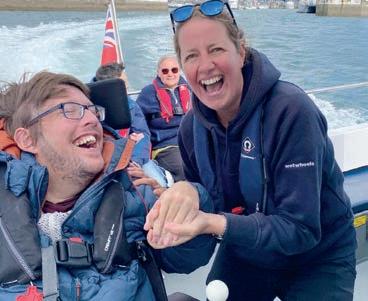
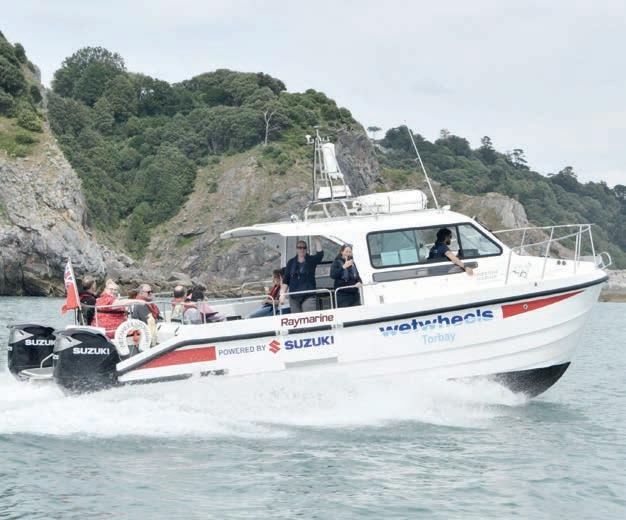
For most keen boaters, time on the water is part of life - a source of freedom, perspective and simple enjoyment. But for many disabled and disadvantaged people across the UK, access to the sea is far from straightforward. That is where Wetwheels is making a remarkable di erence. Wetwheels Foundation operates a fleet of fully accessible powerboats across the UK, providing barrier-free boating experiences that improve confidence, wellbeing and inclusion.
Founded by sailor and accessibility pioneer Geo Holt MBE DL, Wetwheels is a national charity dedicated to providing fully accessible powerboating experiences for people of all ages and abilities. Through a growing fleet of specially designed, wheelchair-accessible powerboats operating around the UK, the charity is opening up the sea to those who might otherwise never have the opportunity to experience it.
The impact is both immediate and lasting. In 2025 alone, Wetwheels welcomed a record 11,000 participants and their families, delivering more than 1,400 inclusive trips across the UK - the highest number in its history. For more than half, it was their first ever time on the water.
Each journey is about far more than simply getting afloat. Guests are encouraged to take the helm, learn about navigation and seamanship and experience the same sense of freedom and independence that draws so many of us to boating in the first place. For younger participants, it can be a confidence-building moment that sparks new ambitions; for older guests, including those living with dementia, it can rekindle memories and connections long thought lost.
Operating from eight locations across the UK, the charity works closely with local communities, schools, disability
groups and maritime organisations to ensure that access to the sea is as inclusive as possible. Behind every trip is a dedicated network of volunteers and trustees who together contribute more than 2,500 hours each year to keep the experiences safe and welcoming.
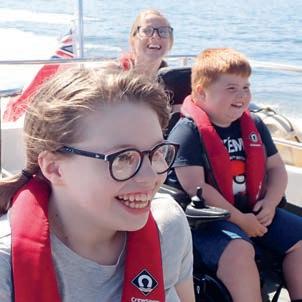
As demand continues to grow, so too do Wetwheels’ ambitions. The charity is now focused on expanding its reach further, with plans to establish new regional hubs in Wales and Northern Ireland. Each new boat represents thousands more opportunities for people to enjoy the wellbeing and freedom that time on the water brings - from coastal exploration and wildlife spotting to simply sharing time at sea with family and friends.
Wetwheels operates through a network of eight regional Community Interest Companies (CICs) around the UK and Channel Islands, each working closely with local charities, schools, businesses and volunteers to deliver experiences that reflect their own coastal communities. This local structure ensures that support stays rooted where it is needed most, while maintaining the national vision of making the sea accessible to all.







To achieve the next stage of growth, Wetwheels is actively fundraising and seeking support not only from the marine sector, but from philanthropic individuals, charitable trusts and businesses who recognise the value of giving more people access to the water. Support from local companies and
community partners plays a vital role in sustaining each regional hub and enabling future expansion.
For the boating community and beyond, supporting Wetwheels reflects the very best of life on the water - independence, resilience and the belief that the sea should be open to everyone.
Wetwheels’ impact continues to grow but so does demand. To help bring barrier-free boating to more communities across the UK, the charity is inviting donations and partnership support. To support Wetwheels or to make a donation, please visit: www.wetwheelsfoundation.org/donate
Local businesses, community partners and philanthropic supporters who would like to be part of Wetwheels’ future are warmly invited to get involved. Please contact Chair - Trevor Phillips - via the Wetwheels website to explore how you can support your local Wetwheels community: wetwheelsfoundation.org



















Solent based dinghy sailor David Henshall is a well known writer and speaker on topics covering the rich heritage of all aspects of leisure boating

“There is nothing – absolutely nothing – half so much worth doing as simply messing about in boats.”
There can be few literary quotations with a boating flavour that say as much about what makes us who we are than the above gem. It is said by that doyen of nautical rodents, the water rat, as he introduces his new friend the Mole to the delights of being afloat on the river.
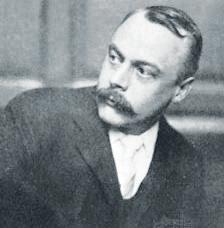
The quote itself appears in the book The Wind in the Willows, which was almost compulsive reading for generations of young but hopeful want to be sailors. Along with Erskine Childers’ The Riddle of the Sands, Kenneth Grahame’s charming story of Ratty, Mole, Badger and the near comical character of Mr Toad, the resident of Toad Hall, has held us in thrall now for over a century.
The book included a variety of other characters, more animals such as Otter and his son Portly, then there are the bad boys, with stoats, ferrets, weasels and foxes, but humans are few, notably the daughter of his jailer after Toad is thrown into prison for stealing a motor car.
Despite the cheerful warmth of the story, the background to The Wind in the Willows is steeped in sadness and tragedy. Kenneth Grahame had been born 166 years ago in Edinburgh. However, when he was only five-yearsold the family was hit by an epidemic of scarlet fever. Kenneth recovered (though he su ered for the rest of his life with chest infections), but his mother was not so lucky and would succumb to the disease. With his father unable to cope with the demands of a young family, Grahame and his three siblings were sent to stay with their grandparents in a big house bordering the River Thames at Cookham Dean. Despite the sadness in the circumstances, the first foundations of the book would be laid here as an
uncle took the children on boating expeditions out on the river, but sadly Cookham would not be a lasting home as by the time he was nine, Grahame was living at a boarding school. Holidays, though, were another matter, with more time spent around boats as he stayed with his uncle, a Naval Commander who lived in Portsmouth.
A successful student, both academically and on the sports field, Grahame would take the entrance exam to join the Bank of England in the City where he embarked upon an almost stellar career. Now settled and stable in his life, he started to pursue another interest, developing his own style when writing poetry and articles.
He was soon appearing regularly in various periodicals where his work attracted a good deal of positive interest. His first published book was a collection of short stories, followed by another, with a core theme being the lives of children being raised by aunts and uncles, in which Grahame’s
upbringing was clearly inspirational to his writing.
By now, in his late 30s, Kenneth Grahame was well known amongst the UK’s mainstream literary circles, with one friendship becoming even more special as Arthur Quiller Couch frequently invited him to stay at the family home in Fowey.
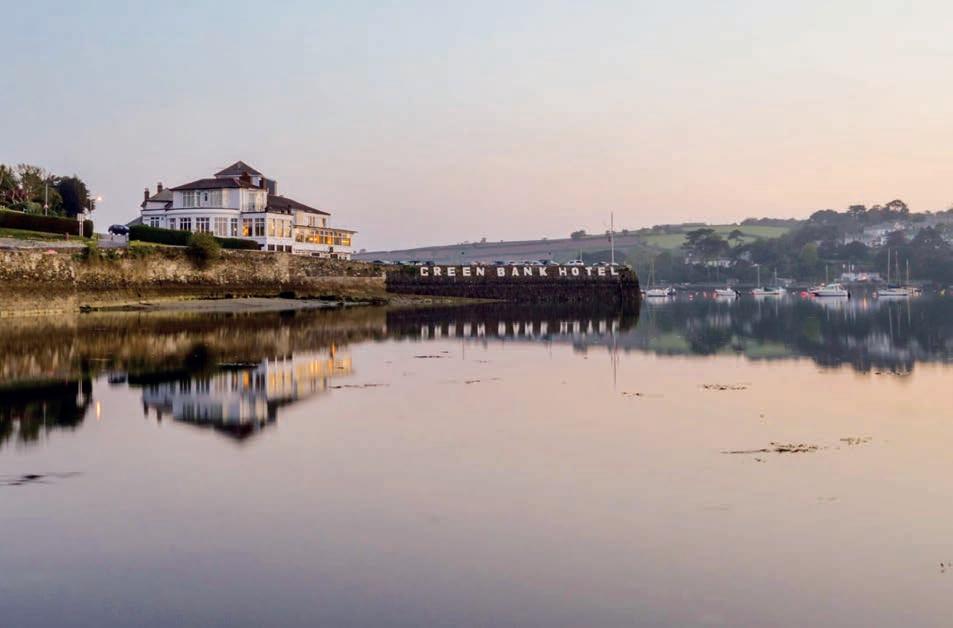
Cornwall would go on to play a big part in Grahame’s life, with him staying at the Greenbank Hotel in Falmouth, right on the edge of the harbour and next to the Royal Cornwall Yacht Club.
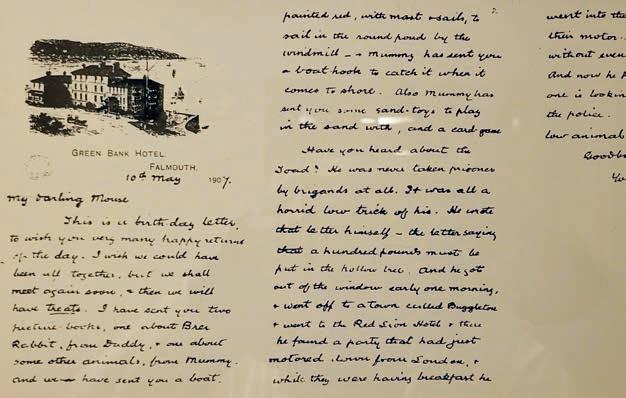

Any sailor visiting Falmouth should make the pilgrimage to the Greenbank Hotel, as the welcome is always warm, the food and drink a pleasure and on the walls they have framed originals of some of Grahame’s letters to his son, telling stories of a rat and toad, the very building blocks of what would become The Wind in the Willows.
Late on in the 1890s, Kenneth met another writer, Elsie Thomson, with the pair marrying down at Fowey, and the following year their son Alastair was born. What should have been a joyous time was again tinged with sadness as the birth was premature, leaving the baby with blindness in one eye. As Alastair grew, Grahame helped him in the evenings by drawing on his store of earlier tales, but now the cast of characters was increased as stories about a water rat and a toad started to take on a greater importance.
Young Alastair was staying with his nanny on the coast at Littlehampton in Sussex whilst his father was way further west at Falmouth, but the supply of bedtime stories would continue as Kenneth would write long letters back to his son telling tale after tale of the animals and life on the riverbank.
There would then be yet another tragedy when Grahame was attacked at work by a man firing a gun at him. Grahame’s assailant was committed to Broadmoor, but despite being unhurt, the attack left Kenneth with a legacy of nervous issues, forcing an early retirement.
This, however, left him free to complete the book he had been working on, one that pulled all those stories he had been telling his son into a single children’s novel. The Wind in the Willows was first published in 1908, but in a contrast to his earlier works, the initial reactions to the new book were far from favourable.
In particular, the review in The Times was brutal, calling The Wind in the Willows ‘monstrous’, adding that “children will hope, in vain, for more fun”. The reviewer would end up having to rethink his views as the general public loved the book.
So endearing is the story that Walt Disney produced a wonderful cartoon film in 1949 based around the Mr Toad character, and there have also been stage shows and musicals, whilst radio and TV have covered the story with great success.
Sadly, though, for the author the tragedies that had dogged his life would continue when his son Alastair died in unexplained circumstances on a railway line near Oxford. For a few years after Alastair’s death he and his wife Elsie travelled around Europe before returning to his beloved River Thames at Pangbourne, where he died in 1932 at the age of 73.
The inscription on his headstone says so much about the legacy he left us through that wonderful piece of work – ‘leaving childhood and literature through him the more blest for all time’.
As the time since then has shown, you could also add ‘and the lives of all those who like simply messing around in boats...’ n
Selling your yacht is a significant moment - it marks both the end of one chapter and the start of another. It’s also a process that can quickly become complex without the right guidance. From valuation to negotiation, every step requires precision and market knowledge.
That’s where a professional yacht broker comes in. At Ancasta, our role is to ensure your sale is efficient, secure, and ultimately rewarding. Here’s why working with qualified brokers like ours makes all the difference.
Setting the right asking price is one of the most crucial decisions in the selling process. Too high, and your yacht could linger on the market; too low, and you risk losing value. A broker uses detailed industry data, market trends, and buyer insights to establish an accurate valuation. This ensures your boat stands out in the listings while remaining attractive to serious buyers.
At Ancasta, our brokers draw on decades of combined experience and access to the latest industry figures and market reports, so you can list with confidence from day one.
A yacht sale isn’t just about listing online, it’s about reaching the right audience, in the right way. A professional broker creates a tailored marketing plan that can include high-quality photography, video tours, targeted digital campaigns, and exposure across global platforms.
Ancasta’s marketing plans span international boat shows, digital advertising, and exposure to a database of active buyers worldwide. Every strategy is designed to maximise visibility and achieve faster, stronger offers.
First impressions sell yachts. Brokers help you identify simple but impactful improvements that can elevate your boat’s appeal - from professional valeting and minor repairs to staging advice that highlights its best features.
Our team provides practical, experience-led recommendations that increase buyer interest and ensure your yacht looks its absolute best during viewings.
Negotiating the sale of a yacht involves far more than agreeing a price. A broker acts as an impartial intermediary, managing offers, counteroffers, and conditions with professionalism and tact. This prevents emotions from clouding decisions and ensures that both parties reach a fair, secure agreement.
With an Ancasta broker, you benefit from expert negotiation that protects your interests while maintaining buyer confidence - a balance that often leads to smoother, faster completions.
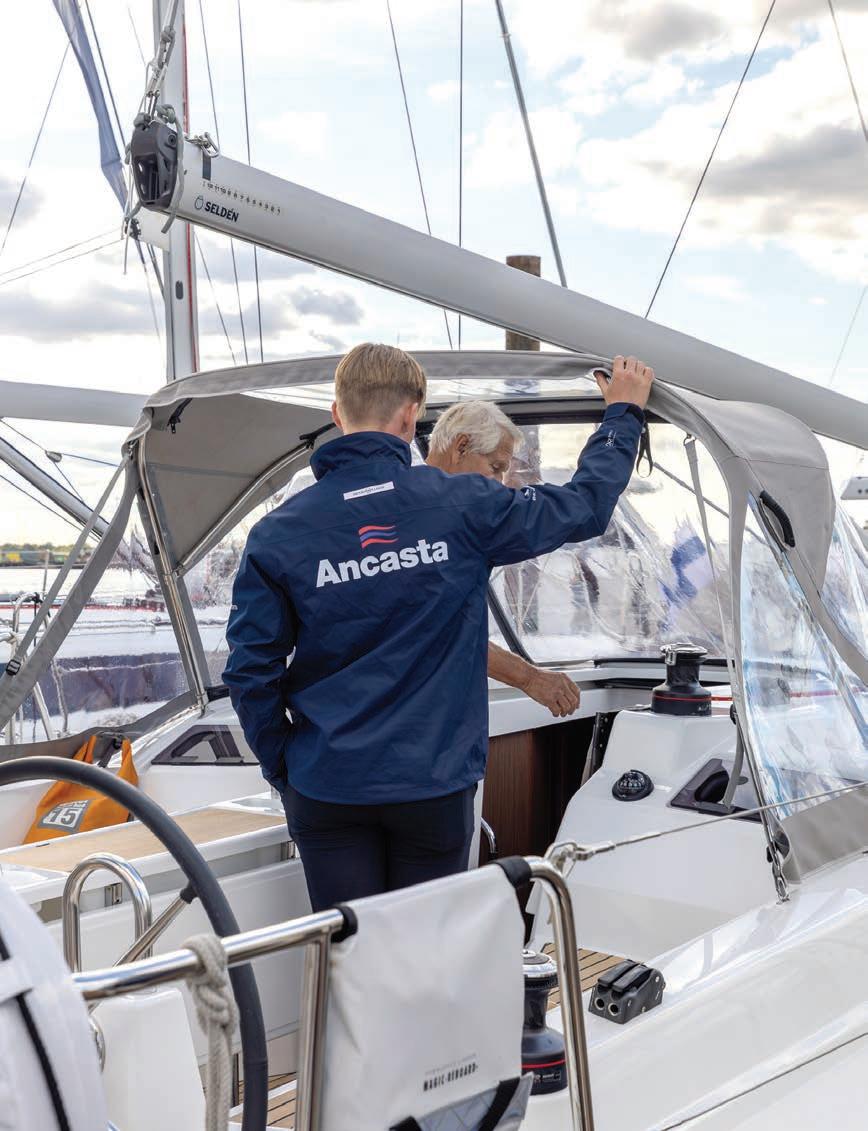
Selling a yacht involves significant documentation - from proof of ownership and VAT status to Bills of Sale and regulatory compliance. A broker ensures every detail is handled correctly, avoiding legal issues or delays.
Ancasta’s brokers are trained in international yacht transaction standards, so every form, signature, and certificate is in order before the sale completes.
Perhaps most importantly, a reputable broker safeguards your funds throughout the transaction. Client accounts protect both buyer and seller, ensuring transparent and secure financial management.
Ancasta’s dedicated client accounts mean your proceeds are always protected until the sale is finalised - giving you complete peace of mind.
Working with a professional yacht broker transforms the selling process from a potentially stressful task into a seamless experience. With expert valuation, global marketing, and secure management at every stage, you can move on to your next boating adventure knowing your yacht is in safe hands.
Ready to sell your yacht?
Contact the Ancasta team today and discover how our brokers can help you achieve the best possible result.





































































With pre-season maintenance in full-swing, two jobs rise to the top of every boat owner’s to-do list: antifouling the hull and checking or replacing sacrificial anodes.
While they may not be the most glamorous tasks, both are fundamental to protecting your boat’s hull and, in turn, its performance, e ciency and long-term health. With insight from Paul Hardy at Ancasta Yacht Services, we take a closer look at why these jobs matter - and how to approach them e ectively.
A clean hull is more than just a point of pride. While a freshly painted bottom certainly looks smart, appearance is only a small part of the story. Antifouling is, in fact, a critical line of defence against the marine life that will inevitably cling to any submerged surface.
Left unchecked, this growth creates significant drag, reducing speed and dramatically increasing fuel consumption. By contrast, a smooth, well-prepared hull coated with the correct antifoul helps your boat glide e ciently through the water, ensuring its performance remains uncompromised.
Beyond performance, marine growth also contributes to corrosion, especially on metal hulls or boats with underwater metal components. Antifouling creates a barrier that not only deters growth but reduces the exposure of the hull to corrosive elements.
“Reduced drag and a lower risk of corrosion means a boat’s structural integrity is preserved over time, increasing its lifespan and resale value,” says Paul.
HOW TO APPLY ANTIFOUL: A PRACTICAL GUIDE
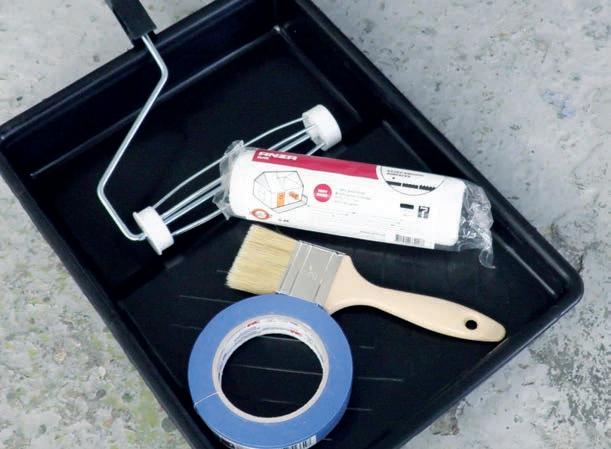
Antifouling can be labour-intensive, and many owners prefer to leave it to the professionals – especially as some antifouls are only available to professionals. But for those who want to take it on themselves, preparation and patience are key:
1. Prepare the boat - and yourself
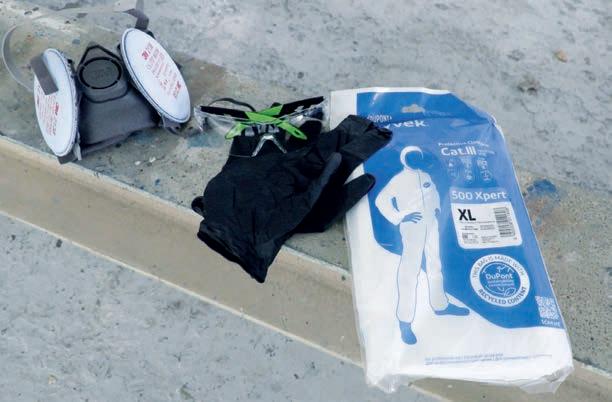
Start with a clean hull, removing any remnants of old paint or marine life. Wear gloves, goggles and a mask.
2. Surface preparation
Sand the hull using progressively finer sandpaper (80–220 grit). Wipe clean with a damp cloth and allow to dry fully.
3. Masking and protection
Tape o any areas that must not be painted, such as through-hull fittings or propellers.
4. Mix the paint
Antifoul should be stirred thoroughly according to the manufacturer’s instructions.
5. Application
Apply the paint evenly with a roller or brush, working from top to bottom. Most boats require at least two coats, sometimes three.
6. Clean-up
Wash brushes and trays, remove all masking and allow the hull to dry completely before relaunching.
“A carefully applied coating will protect your hull for the season ahead,” adds Paul. “But every antifoul is slightly di erent, so always follow productspecific guidance.”
There is also an important environmental consideration. Some species that attach themselves to yachts’ hulls are classified as invasive. Transporting them from one area to another can disrupt local ecosystems, so maintaining a well-protected hull helps prevent their accidental spread.
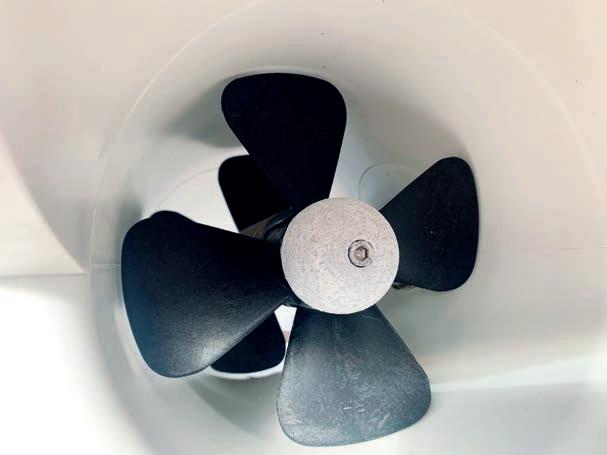
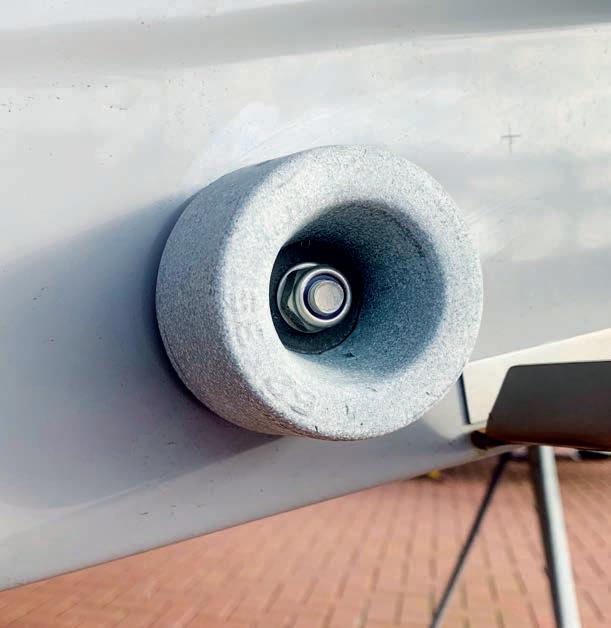
If antifouling protects the hull from marine growth, anodes defend the underwater metalwork from galvanic corrosion or electrolysis - one of the most destructive forces at play in the marine environment. Sometimes known as zinc anodes, sacrificial anodes are designed to corrode so that your valuable metal components do not.
Preparation and patience are key when antifouling
Paul comments: “Anodes deteriorate over time as they do their job. Left too long, they stop providing adequate protection, which puts propellers, shafts, drive legs and even engines at risk.”
Corrosion protection
Anodes are made from metals (zinc, aluminium and magnesium) that are more electrically active than the parts they protect. By corroding preferentially, they significantly reduce the risk of expensive damage caused by galvanic action.
Unchecked corrosion can strip material from propellers, pit a drive leg or compromise an engine casing. Replacing anodes regularly prevents deterioration that is time-consuming and costly to repair.
Though not often thought of as a safety item, well-maintained anodes help avoid unexpected mechanical failures that could occur at sea if a corroded component fails at the wrong moment.
Performance
A propeller compromised by corrosion cannot deliver optimal thrust, speed or manoeuvrability. E ective anode protection means mechanical parts continue to perform as they should.
Replacing anodes is relatively inexpensive. Replacing a corroded propeller or stern gear is not.
A well-maintained propulsion system performs more e ciently, reducing unnecessary fuel burn and limiting the environmental footprint of your boating.
WHEN TO REPLACE ANODES There is no set replacement schedule because wear rate depends on water type, temperature and usage. Regular inspection is essential. The winter haul-out provides the ideal opportunity: if an anode has significantly eroded, it is time to fit a new one.
Together, regular antifouling and timely anode replacement form the backbone of e ective hull care.
By protecting against marine growth and corrosion, these essential maintenance tasks keep your boat performing at its best, safeguard vital components and help ensure troublefree cruising for seasons to come. n
ancasta.com/yacht-services
Part of the Ancasta Group, Ancasta Yacht Services is a professional yacht refit, repair and services company with a team of highly skilled craftsman, with excellent facilities based in Hamble, Southampton. ancasta.com/yacht-services


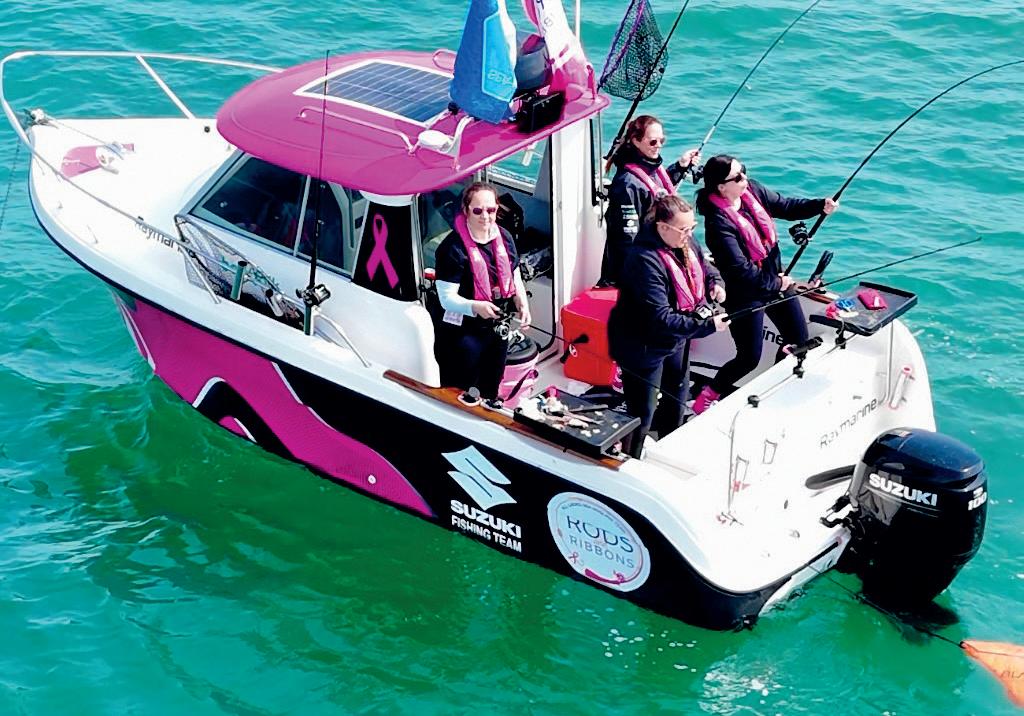
For generations, sea angling has been a man’s world — but the tides are changing. Cutting across the water in a gleam of pink, Rods & Ribbons are rewriting what it means to be an angler. Formed in 2024, this all-female sea angling team is not just competing; they are breaking barriers, raising over £26,000 for Cancer Research UK, and proving that women belong at the very heart of the sport.
At the helm is Gemma, a skipper who only began fishing in 2023. In just a short time, she has become a formidable competitor, winning Best Female Angler at the Sea Angling Classic twice and triumphing at the
Southampton International Boat Show Bass Event. Yet for Gemma, fishing is about more than trophies, it is about empowering other women to find confidence and joy on the water.
Her teammates, Hannah and Izzy, embody that spirit. Hannah rekindled a beloved childhood pastime, while Izzy, who had fished only once before joining, now proudly holds second place in the 2025 Bream Event at Sparkes Marina. Together, they show that skill, patience and resilience has no gender.
Their pink boat, supported by brands such as Suzuki, Raymarine, RAILBLAZA, Crewsaver and Yeti, is more than an
eye-catcher, it is a statement. Rods & Ribbons are not competing against men; they are fishing alongside them, earning respect cast by cast.
In every competition, and every journey o shore, they inspire. They fish for charity, for love of the sport and for every woman who has ever doubted she could. Out on the open sea, they remind us that strength is not defined by who holds the rod — but by the courage to cast it.
Support the ladies on their fundraising e ort by making a donation: fundraise.cancerresearchuk.org/ page/rods-and-ribbons-castingfor-a-cause-in-2025
Send in your best angling pics every month – you and your catch! If yours is the winning photo, you will receive a RAILBLAZA Rod Holder R and cap. Email your photo to editor@allatsea.co.uk including your name, fish species and where it was caught.

“Fishing takes us all over the UK and Europe throughout the year, often in tough conditions, especially during tuna season when the weather turns and the nights draw in,” says Darren from Squidward 3 and the Suzuki Fishing Team. “As a family, we are often up before first light and home in the dark, so we need kit that is comfortable as well as tough. We also compete in regular events, so you are out there whatever the forecast says. On a boat, everything takes a battering — especially your gear — but Taku just gets on with it.”
The fabric feels hard-wearing and built to cope with proper life on the water. The hood is a great size and can be pulled in tight when the weather really turns bad. The pockets are generous too — perfect for keeping your phone safe, your bait elastic ready, a spare lure ready to change over on the next cast and the odd protein snack for teammate Luke. My favourite feature has to be the neoprene cu s — there is nothing worse than ending up with a sleeve full of
Why are anglers such terrible liars?
Because their stories always get bigger every time you hear them.
I told my mate I was targeting bass o shore.
He said: “With your casting? You will be lucky to hook a passing ferry.”
Why do sea anglers always check the tide tables?
Not for the fish… just to blame something o cial.
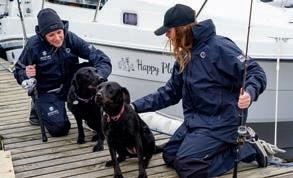
water when you are playing a decent fish. We also spend a lot of time on our knees in competitions measuring fish, so the padded knees are an absolute godsend.
The salopettes sit nice and high up on your chest, which really helps keep your kidneys and core warm on long, cold, windy days when you are out on deck fighting fish in all kinds of conditions. And little details make a big di erence, like the Velcro adjusters around the ankles that you can pull tight over your wellies and the waterproof zips that do what they are meant to do. It is proper fishing kit, built by people who understand life on the water — and when you are serious about fishing, this is the gear you want on your back.
Darren, Squidward III

The Savage Gear

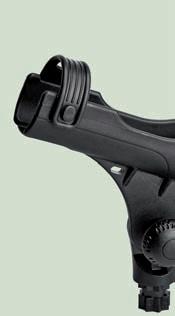

This month’s winner is fresh water angler Steve Whiteley with a common carp weighing in at 49lb 2oz caught at Napoleon Lakes, France. The runner-up is Sid Dean, 91, with a 7lb carp caught at Jack’s Lake, Barnet. See more of your catches at www.allatsea.co.uk.


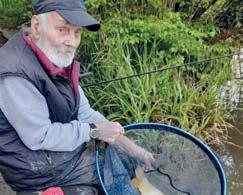
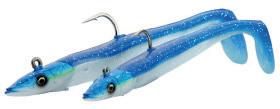
baitfish. March fish are becoming more active, so you can slightly increase retrieve speed compared to winter months.



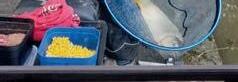





Send us your catch photo and you could win a prize from RAILBLAZA too!












Sandeel V2 is a highly e ective soft plastic lure designed to imitate one of the UK’s most important baitfish — the sandeel. As water temperatures begin to rise in March and baitfish activity increases, predators such as bass, pollack and codling start feeding more actively. The Sandeel V2’s slim profile and tight kicking tail create a realistic swimming action that perfectly matches early-season forage.
Why it’s great for March

Natural sandeel profile matches seasonal baitfish movements
Tight kicking paddle tail works well on steady retrieves

Pre-rigged and loose body options are available
E ective in both shallow estuaries and deeper coastal marks
How to fish
Fish the Sandeel V2 on light to medium jigheads, or use the pre-rigged version for convenience. Retrieve at a steady pace with occasional pauses to mimic an injured
Focus on estuary mouths, surf beaches, sandbanks and reef edges where baitfish are starting to gather. On brighter days, natural colours such as sandeel, khaki or white often produce; in coloured water, try brighter or UV options.
UK Retail Price: Approximately £6.49 – £9.99 depending on size (typically 10 – 14cm) at major UK tackle retailers including Fishing Lures Ltd and Lure Fishing for Bass — prices vary by size and rigging format.
Target Species: Sea bass, pollack, codling, coalfish, early-season mackerel
Typical Rigs: Jigheads 15 – 40g (depending on depth and tide strength)
Action: Slim profile with tight kicking paddle tail




Guide of Dunkirk is an important piece of English heritage. After spending her life on the water saving lives it is now time to save hers.
Guide of Dunkirk was commissioned by the Girl Guides for the grand sum of £5,000. She was one of the first self-righting lifeboats to be built, in Rowhedge, Essex, and shortly after she was launched was commandeered by the Royal Navy to take part in the Dunkirk evacuation in 1940.
Despite su ering severe shell fire damage from enemy planes she made two Channel crossings, rescuing stranded soldiers from the beaches of Dunkirk and returning them to their loved ones. Following her return from Dunkirk she went straight into service as a lifeboat, saving lives right up until 1963.
Abbey Boat Builder is a traditional wooden boatyard based in the heart of Norfolk Broadland. The highly skilled team work tirelessly preserving historic vessels and working together with clients to build the kinds of boats that make even the wildest dreams come true. This Norfolk boatyard has now become the home of Guide of Dunkirk.
When Abbey saw this important vessel come up for sale she knew she had to buy it. The complexities of the hull lines are nothing short of a work of art, combined with the historical importance and the countless lives this boat has saved, Abbey knew she had to save her.
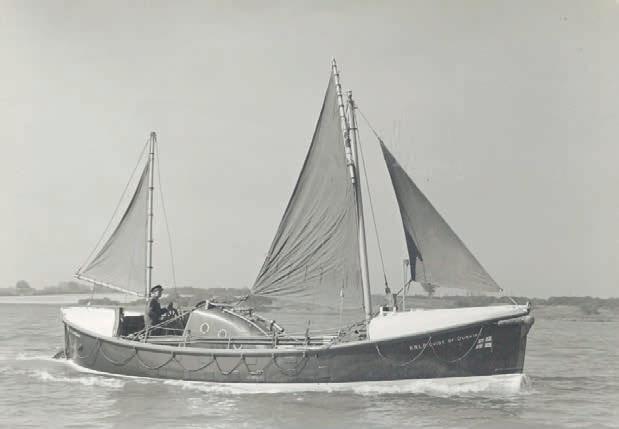
Restoring such an important vessel is not only about the build process but also about keeping the connection alive between the generations of people, old and new, who have a tale to tell or a memory of a loved one saved or lost whilst the boat served on the Cornish coastline for the RNLI.
Telling her story through social media (see box) is a great way to keep the community involved and the story of Guide of Dunkirk alive for generations to come, making sure her history is never forgotten.
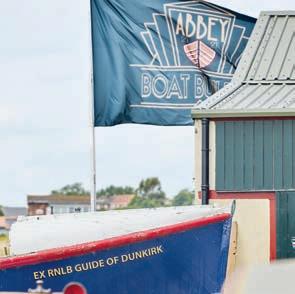
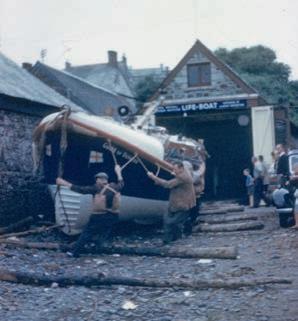
Throughout the restoration Abbey has made sure to be as sympathetic as possible in order to not loose the charm, history and character of Guide of Dunkirk. The cold moulded wheelhouse has had planks replaced following traditional methods by soaking them in the Broadland rivers before teasing them into complicated curved shapes as they wrap around the wheelhouse, which not only housed the engine but also provided shelter for the crew.
All of the original sole boards that make up the watertight decks have been painstakingly removed one at a time. The structural framework underneath has been replaced, even replicating the traditional 1930s half housed dovetail joints that were so commonly used when she was built. Each sole board has been remade using a mix of traditional and modern techniques to ensure she lasts for generations to come.
Abbey Molyneux owns and manages the boatyard and a team of eight sta . Her journey into boat building started as an apprentice on the East Coast where she gathered the basic knowledge needed to get her first job. From here she travelled to the River Thames and continued learning, working on over 80 classic boats a year as she honed her craft.
After seven years living and working on the river she eventually moved to Norfolk, the home of her boat building ancestors, with the dream of setting up her own yard and workshop.
The now thriving boatyard in Reedham, Norfolk has just completed the first new build wooden boat to be built on site in over 50 years and they are set to build another three new commissions before the end of 2026, making history and filling the old boatyard with the buzz of new industry and a real passion to breathe new life into the craft of boat building and all the important heritage that goes with it. The dusty sheds are stacked from wall to wall with classic boats, some nearing their 100th birthday. ■
SAVING GUIDE OF DUNKIRK
⚫ Guide of Dunkirk has a crowdfunding page, to enable donations from the maritime community to help preserve this important vessel: www.crowdfunder.co.uk/p/ saving-guide-of-dunkirk
⚫ Follow progress on Instagram or Facebook - @abbeyboatbuilder - or at www.abbeyboatbuilder.com
We







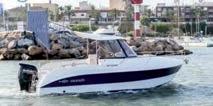
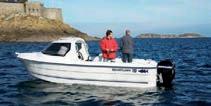
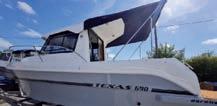
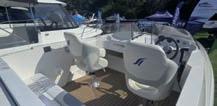
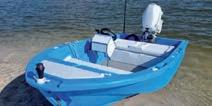
All at Sea reader Steve Payne shares this story about his friends, Jude and Richard. Life at anchor can turn in an instant – one afternoon in Villefranche-sur-Mer, teamwork, calm heads and one unlikely power tool kept the couple - and their boat - from catastrophe.
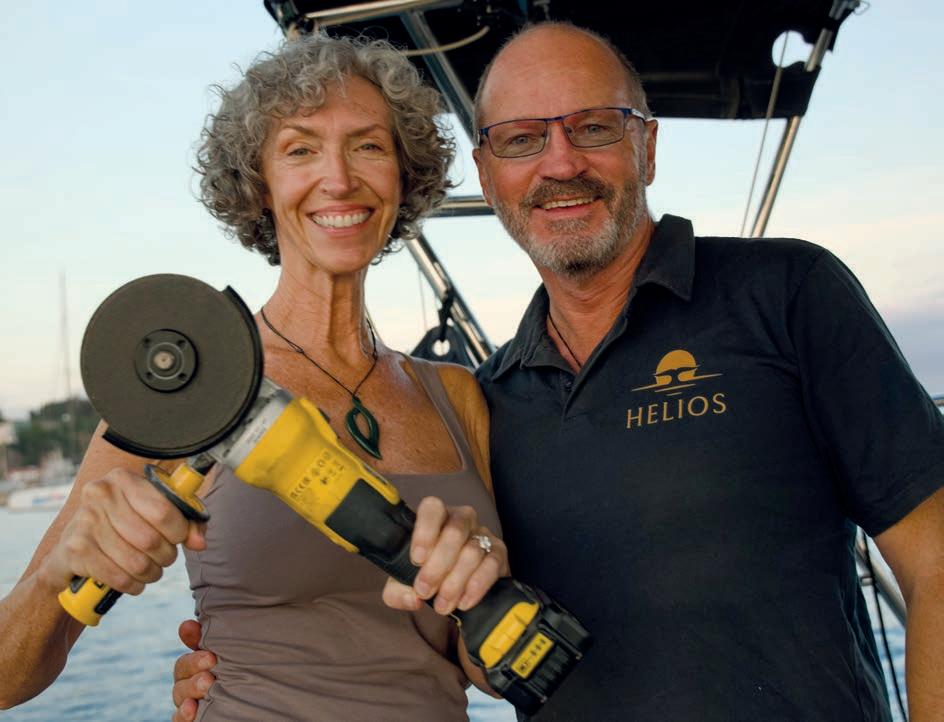
Living on the seas teaches you to respect the forces of nature; to stay alert and ready to respond to save your boat and your life at any time. One day in August in the idyllic bay of Villefranche-sur-Mer on the French Riviera, Richard and I stepped up as the perfect team to fight for our boat and our safety.
We were enjoying breakfast in the cockpit on a delightful August morning when our Aussie friends passed and waved goodbye, telling us a storm may be coming in the afternoon and they were seeking a safer harbour. We could not see it forecast, but we planned to investigate further.
That day we were going to make the train trip to Nice to pick up a parcel that was waiting for us. It was our replacement anchor windlass motor, which had been faltering. It was not far away and we would be back to the boat by early afternoon.
On our dinghy ride to land, we met some friends, Helge and Marlene, in their dinghy. They also mentioned a possible storm. Storms are very di cult to predict and forecasts can be unreliable, but we are generally cautious and will take precautions anyway. Helge said that only one of the weather models was predicting it, Arome, which may have seemed unlikely — but Arome was the only model that predicted the catastrophic storms o Corsica in August 2022. That made us take it seriously.
We decided to change plans — ditch the train trip to Nice to get the windlass motor and instead have a quick walk around the delightful town, grab a co ee and head back to prepare Helios for a storm. The storm was expected at 1700, should it even come at all.
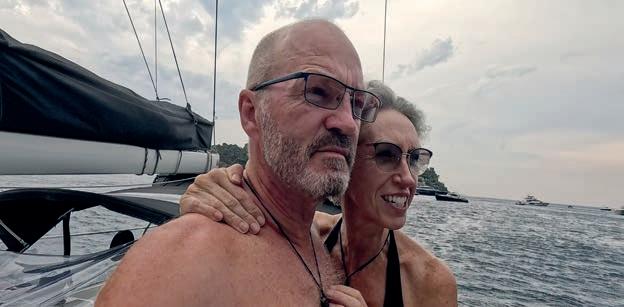
We live at anchor all summer, held by our 20kg Spade anchor, which we call Don after Richard’s late dad. Don has kept us safe for three summers now, so we have faith that Don will look after us.
Richard dived to check and saw that the chain disappeared amongst Posidonia (seagrass) but could not see Don, so figured it must be well buried. He did note the seabed was gravelly but did not think too much about it (mistake number one). He let out another 10 metres of chain for a total of 40 metres in seven metres of water depth. We hoisted the dinghy onto the deck and secured it, deflated the kayak and stowed it below, removed the boom tent and took all the cushions inside. We felt well prepared should a storm come and relaxed with a lovely late lunch.
Later in the afternoon clouds started to gather and, as predicted, just before 1700 the wind picked up to about 20 knots and turned us 180 degrees from where we were set.
We watched blow-up pink flamingos go flying, dinghies attached to their boats lift out of the water like kites and boom tents collapse. I have to admit we were a little smug as these boaters had brushed Helge o when he warned them of the coming storm. Then boats started to drag. Superyachts blasted their loud horns at boats drifting towards them. Some sailing boats lifted anchor and battled the winds to reposition or just get out of the bay. We sat tight.
“That day in Villefranche-sur-Mer could have ended very di erently, but with an angle grinder, quick thinking and trust in each other, Helios came out okay”
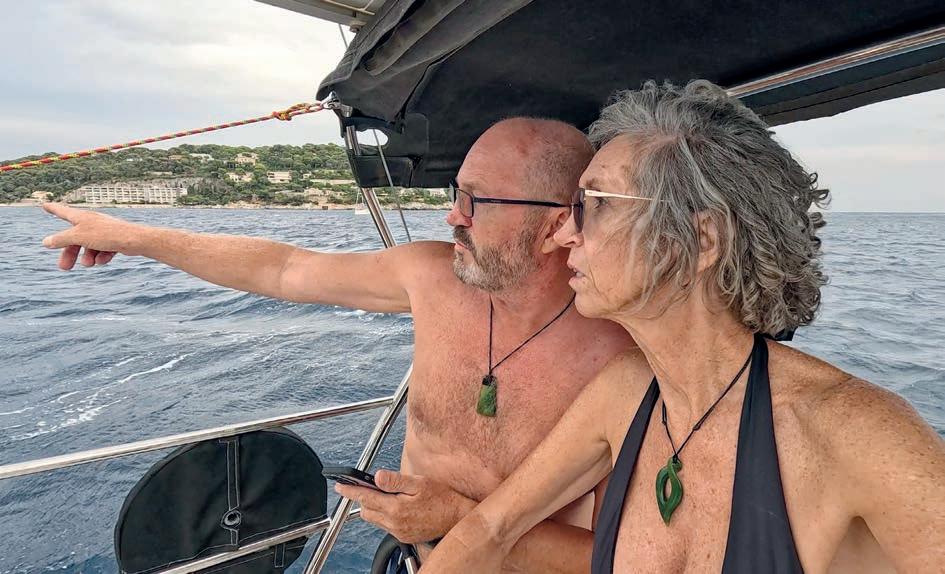
Then we realised we were dragging. Just slowly at first, so we were not sure, but when it was clear we had moved Richard sent me up to the bow to lift anchor while he drove forward into the wind. By this stage, the gusts were hitting the predicted 45 knots, our bow was constantly getting blown o and it was di cult to reduce the load on the windlass by much.
The windlass motor struggled to lift the chain, hindered by the extra force of the wind. Even with Richard motoring forward it struggled. Remember we were picking up a new motor for the windlass? That is because ours was starting to fail.
As we battled the conditions and the failing windlass motor for 20 minutes, we were slowly being forced back towards the rocks on the eastern side of the bay. The failing windlass motor tripped the breaker twice, then completely failed. At this point we still had 17 metres of chain out.
Fortunately, we had been blown into some deeper water, so our anchor was now just touching the bottom and Richard could drive forward and take us to the windward side of the bay.
We had an anxious moment as we passed across the bow of a very large superyacht, hoping our anchor would clear their chain. Thankfully we got past.
With nothing coming from the windlass motor, I figured we would need to do a manual lift, so I asked Richard to do it. I have never done it, and in those di cult conditions, with lots of noise, wind and movement, I did not feel confident (I need to practise manual lifts).
We slowly manoeuvred Helios into a position in the bay where we were happy to try a manual lift. It is surprisingly di cult to manoeuvre with 17 metres of chain and an anchor hanging o the bow. We were fighting the wind which was pushing us back towards the eastern side of the bay.
At this point, we could have got out of the bay and dealt with the problem in clear water, but that would have meant fighting the problem in ever-increasing seas while being blown o shore. We chose to remain in the somewhat sheltered bay.
Richard attempted to engage the ratchet which stops the chain dropping, but it was stuck firmly in place. Most likely salt crystals had locked it up (mistake number two – regularly check and service).
After a whack with a hammer and screwdriver, Richard was able to move the ratchet to its engaged position. He then undid the clutch, but the ratchet slipped which led to chain cascading down until it came to a crash – probably at the bottom of the sea.
We were in 50 metres of water at that point and 58 metres of chain was out. We were still drifting towards the cli face on the eastern shore even though we were driving into the wind with full power, and with all of that chain out, our ability to control the boat was negligible. The cli face was a couple of hundred metres away – putting us less than five minutes from foundering on the rocks.
Richard came back to the helm and said the words I had hoped he would never say: “Get the angle grinder.”
It is always stored with a full battery and easily accessible just for situations like this. I ducked inside to retrieve it, handing over as we swapped the helm again. Within one minute he had cut through the chain, dumping the chain and our reliable Don on the seabed.
We had immediate control of the boat and headed out to sea to wait for the storm to pass. Fortunately, Helge helped us get onto a mooring ball later that night so we were safe for the night until we could get a marina berth and sort out replacements.
Lessons from the Bay
I am pretty proud of us. We took a vague warning seriously and were well prepared. We remained calm and focused and made quick decisions to keep us safe. We keep emergency tools accessible and ready for use. Our communication was on point with clear information without emotion or panic. We can make hard decisions.
There are also some things we could have done better. We probably should have re-anchored to be sure we were in sand. We should check and practise anchoring manually – both of us. Richard does regular maintenance on the windlass but not the ratchet mechanism. This needs to be added to the schedule, and of course the regular practise of manual operation will help.
If we had re-anchored before the storm in a seabed we were sure of, then maybe this would not have happened. But our thoughts were that if we had a problem then we would lift anchor and deal with it.
The subsequent failure of the windlass motor and then the windlass ratchet
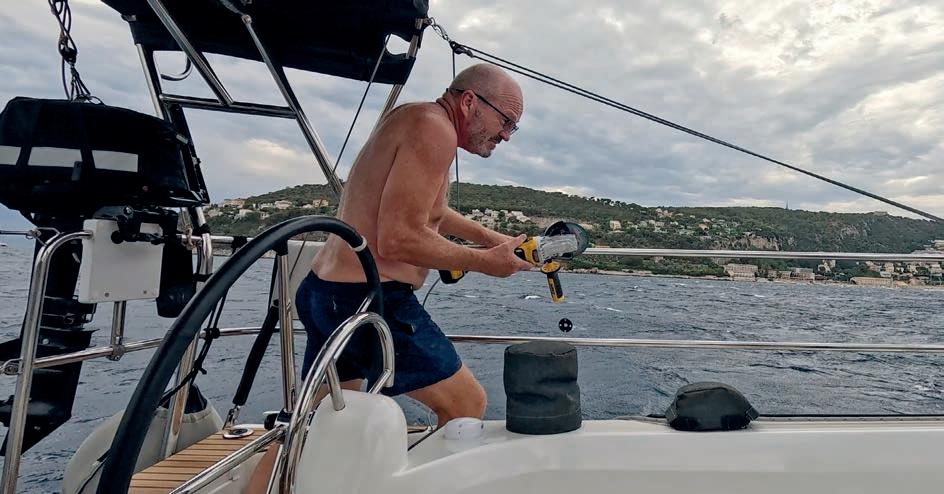
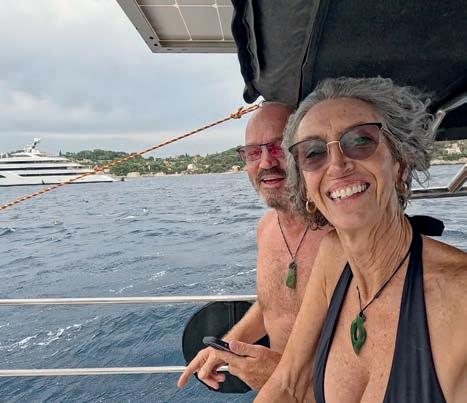
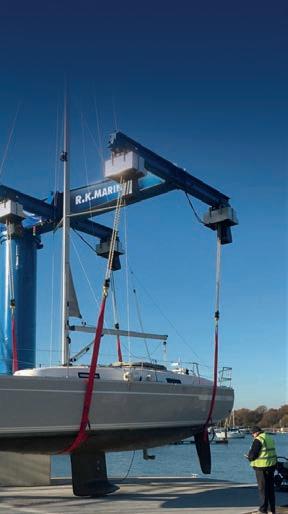
grinder!
compounded the impact of the decision. As is typical, when big problems happen it is normally the compounding of several smaller ones.
Know your anchor. We completely trusted our Spade anchor, but like all anchors there will be sea bottoms where they perform better. A gravel/pebble bottom is probably the weakest area for the Spade, and when it is surrounded by seagrass then the chances of resetting after a flip out are reduced. Sand is where it performs best, so we should have looked for this.
If you are not sure your ratchet is working well, do not trust it and find solutions to lift your anchor another way. Rather than attempt a manual lift with the windlass, we could have tied a line to the chain and brought it back to a winch at the stern. With a 12 metre boat, it would only have taken two runs to winch up the 17 metres. If we had done this rather than attempted to use the windlass for the manual lift we would not have dropped 50 metres of chain.
Reflections at Anchor
Sailing reminds us that preparation and practise are vital, but so too are calm heads and teamwork when things go wrong. That day in Villefranche-sur-Mer could have ended very di erently, but with an angle grinder, quick thinking and trust in each other, Helios came out okay. The sea will always test us and there is not much room for error because the consequences can be huge. n
Jude and Richard have a YouTube channel - Sailing Helios - where they document their life at sea.
Send your story to editor@allatsea.co.uk
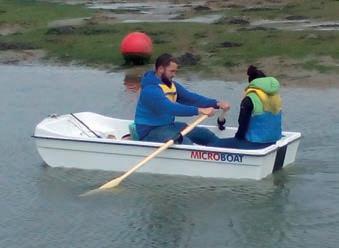

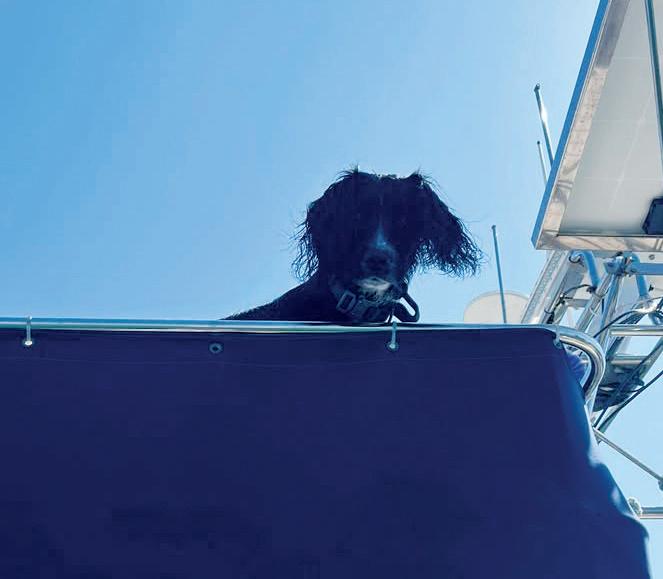
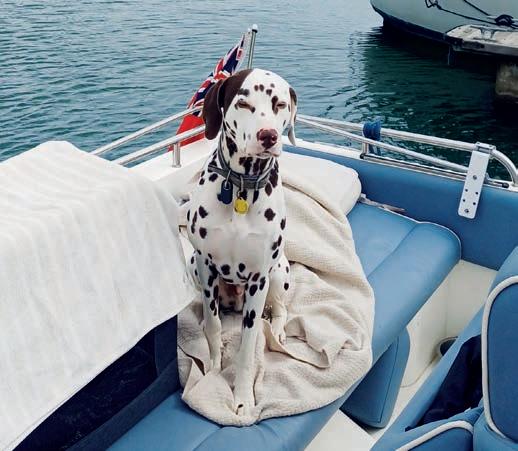
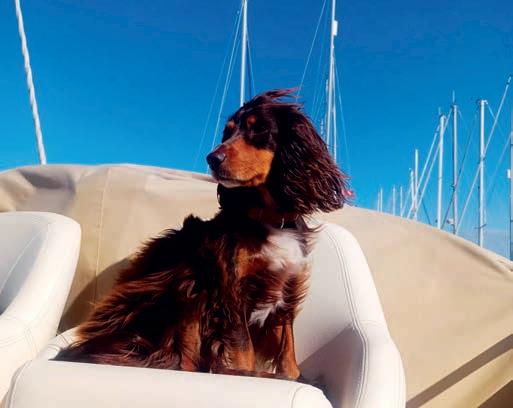
Flora the cocker spaniel enjoying the weather in Lymington and watching the swans.
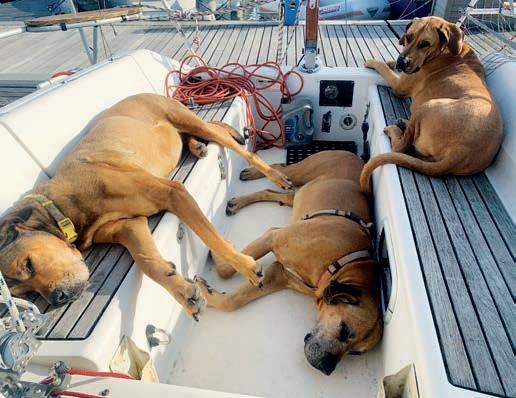
Liveaboards Matilda, Nelson and Kipper (mum, dad and daughter) have definitely found the best spots to chill.
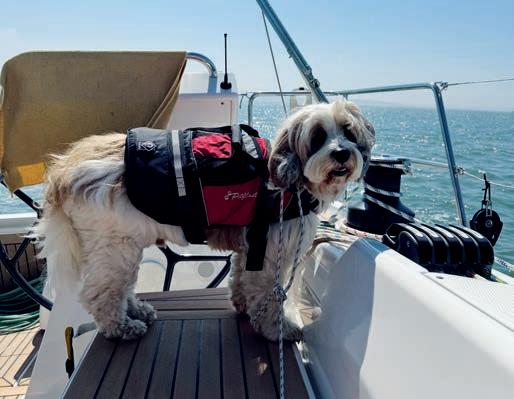
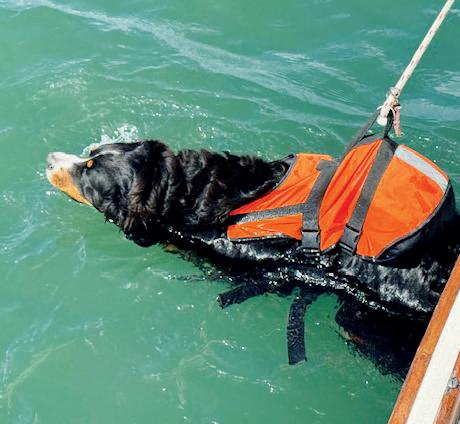
Svea the Bernese Mountain dog practising ‘Dog over Board’. You can check out Pete and Jen’s blog at www.dogsail.com.
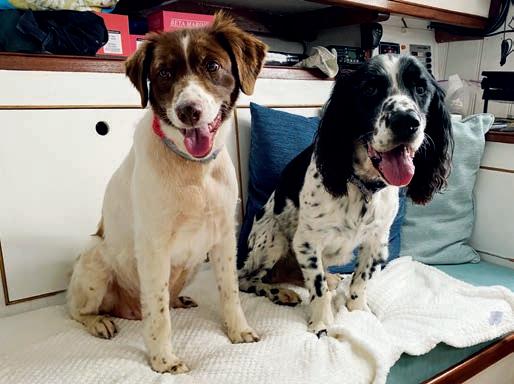
Our furry friends love spending time on the water as much as we do! Does your pet love the water too? Send us your photos! editor@allatsea.co.uk As well as featuring in the paper your pet might pop up on All at Sea’s
Send in your photos and you could be in All at Sea, on our social pages or in our weekly newsletter. Send entries, with a caption, to editor@allatsea.co.uk. Each month’s winning photo will be included in the Photo of the Year reader vote.
THIS MONTH’S WINNING PHOTO
Bottlenose Dolphins o the
INSET: Enjoying the early evening sunshine at
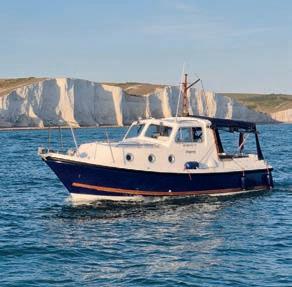


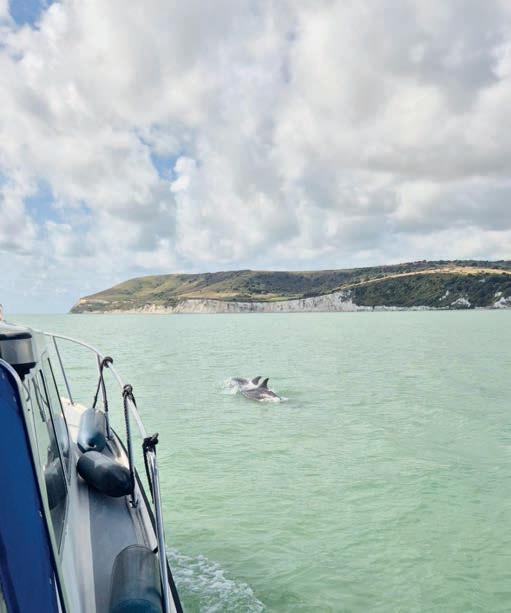

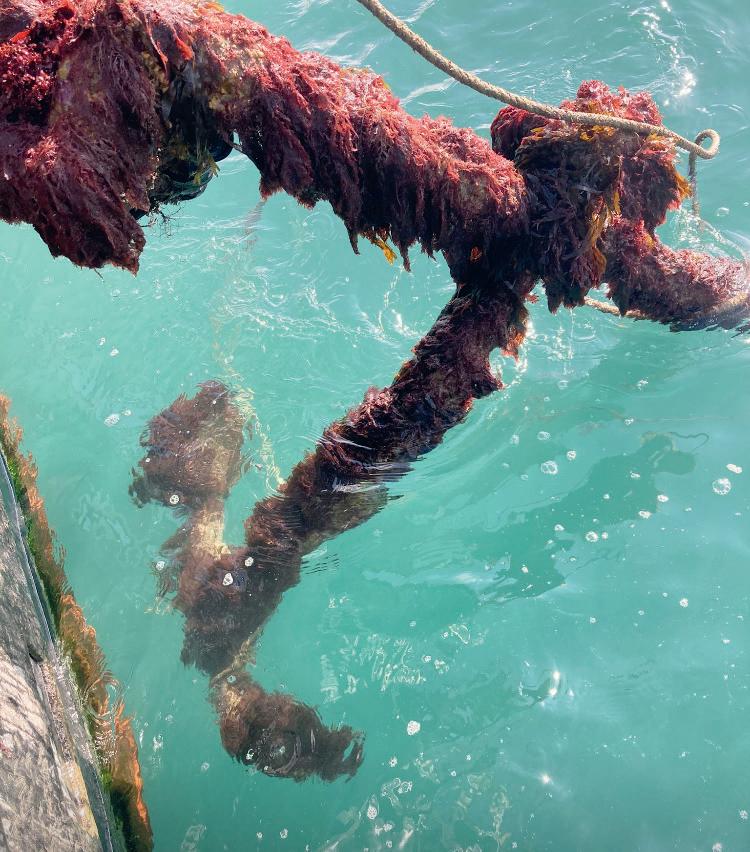
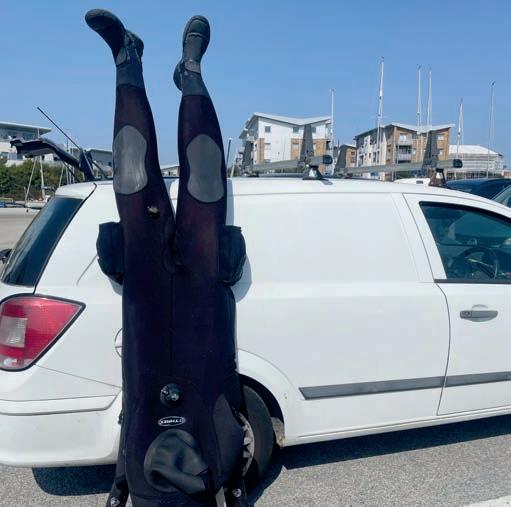
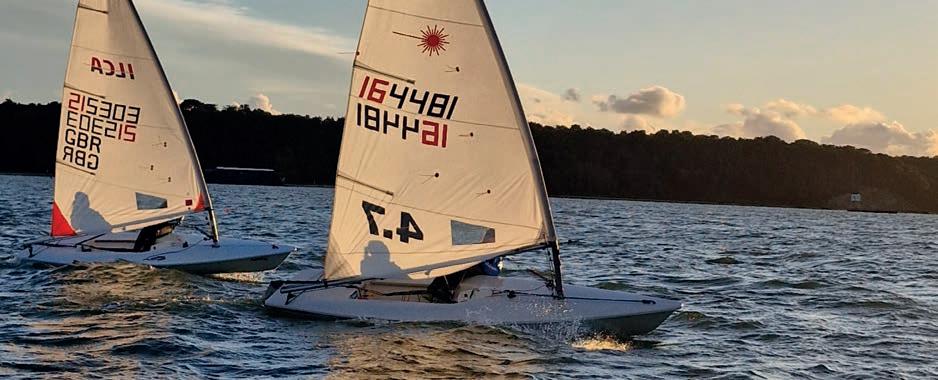
Amelie Ballantyne is a 15-year-old sailor from Devon who is a determined, and successful, dinghy sailor. This month Amelie discusses the important, and sometimes daunting, topic of transitioning to a new boat class.
Being a kid can be tough sometimes. There is school, homework, friendships and rules to follow. But when you are a sailing kid, there is another challenge: transitioning boat classes. At some point, the time will come to move on due to age, size, weight, and this change can be tough too. For some people it is exciting, but for others it can feel daunting. I want to share my experience of transitioning boat class and how it worked for me.
TOPPER TO ILCA
I decided to make the move at the end of the summer in 2024, after the Nationals. I had been sailing in the Topper class for a few years and chose to transition into the ILCA class due to my age. Looking back, I think the timing was right for me because it gave me the whole winter to train before the sailing season started. Even so, I was still nervous. I worried about what the class would feel like, what the training would be like, who I would be sailing with and knowing I would probably be nearer the
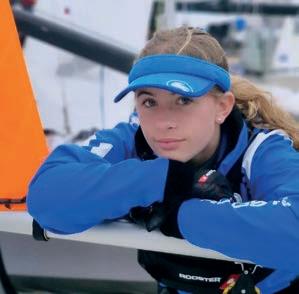
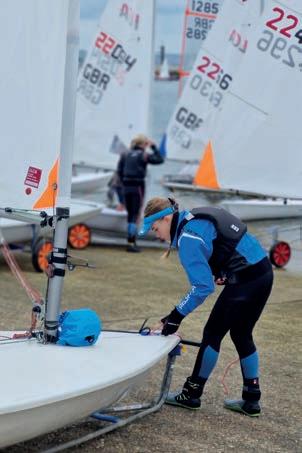
Last year Amelie transitioned from the Topper to ILCA class
back of the fleet at first. I had so many thoughts going through my head.
I also spent a lot of time thinking about which class I should move into. I am quite small and light, which would suit a double-handed boat best, but that also means dealing with a crew and I wanted to sail a single-handed boat so I could be my own boss.
I applied for the RYA ILCA 4 Transition Talent Academy and, after the selection process, I was on the programme for the year alongside other sailors who were also transitioning. I was happy to find out that two of my Topper friends, George and Charlie, were doing the same thing. That made the whole experience feel a lot less daunting. The Talent Academy has been a great option for me. From the very first day, however, training stepped up a gear!
One of the biggest di erences I noticed straight away was the level of expectation on us. We were treated like youth sailors and expected to be much more independent, especially with our boat preparation and learning. Not long after starting the Talent Academy, our coach suggested that we sign up for the ILCA National Opens at WPNSA. Most of us decided to go for it, even though secretly none of us really felt ready for it.
On the first day, I was extremely nervous. Looking around the dinghy park, I saw adults, Olympians and sailors I had always looked up to. The atmosphere felt very di erent from junior sailing; less chaotic, more chilled out and people just getting on with their own thing. There was no pushing at the tally board queue and far fewer parents and siblings present. I definitely felt a bit of imposter syndrome and assumed I would struggle.
Sailing with around 70 boats on my rig on the start line, heading out past the harbour wall for the first time ever, was a huge step up. The waves, the pace and the competition were intense. But when I came o the water, I felt absolutely buzzing. It was challenging for sure, but it was so amazing… and I did not come last! The ILCA class has been very welcoming and helpful to newbies like me.
My advice to anyone thinking about transitioning classes is to choose your timing carefully and not rush into it. It is a big step up from junior sailing, but if you feel ready, it can be incredibly rewarding. Think about what class would suit you carefully, and do not be afraid to feel nervous because that is completely normal. n
From a family of sailors Ali Baines, who is a member of Gra am Water Sailing Club and works in the outdoor education industry, shares the many ways young people – in this case her daughter Ellie – can grow and learn through sailing.
There is something magical about the moment a young sailor first takes the helmfeeling the wind in their hair, the boat responding to their touch and the thrill of gliding across the water and being away from any problems on land, which they can leave behind.
Sailing is not just a sport; it is an adventure, a challenge and a journey of discovery. And for children, it can be the start of a lifelong passion.
Youth sailing o ers a unique blend of fun and learning. It teaches practical skills like steering, rigging and reading the wind, while also building confidence, independence and resilience. On the water, children learn to make decisions, solve problems and work as a team - all while having a brilliant time outdoors.
One of Cambridgeshire’s young sailors, from Gra am Water Sailing Club, has done just that. At the age of eight Ellie Butler-Baines took part in last year’s Cambridgeshire Youth League events held at various sailing clubs throughout the county.
In the autumn Ellie competed in the final event, held at Hunts Sailing Club near St Ives. Ellie had been steadily building her experience on the water over the summer months. After finishing at the back of the fleet in her last two events, Ellie made a solid improvement this time, landing midtable - a testament to her determination and progress.
Ellie started sailing at a very young age as both parents sail themselves; she has been surrounded by boats since the day she was born. She started life sailing in her mum’s Mirror dinghy, progressing to crewing on dad’s Spitfire catamaran and, last year, sailing on her own in her Optimist, named ‘Smartie’.
STEPPING
The Youth League brings together young sailors from across the region, showcasing not just skill and competition, but the spirit of growth and resilience that defines this sport. Taking part in Youth League events is
a fantastic way to get started in the sport. It enables young sailors to not only improve their skills on the water but to feel part of a bigger team and make new friends, many of whom will last a lifetime.
Events like these are more than just races –they are stepping stones for young sailors to learn, grow and find their place in a vibrant community. This will not just be in Cambridgeshire; these events take place all over the UK, whether this be inland or by the sea, so are easy to reach from all corners of our wonderful country.
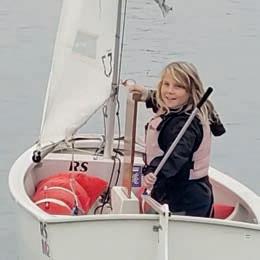
Ellie’s journey reminds us that progress in sailing, as in life, often comes in small but meaningful steps. With each race, she is gaining experience, learning from challenges and moving forward. We are excited to see where the wind takes her next.
So if your child is curious, energetic and loves being outdoors, why not give sailing a try? It might just be the start of something amazing. n
Cambridgeshire Youth Sailing League: csysa.org.uk/youthleague
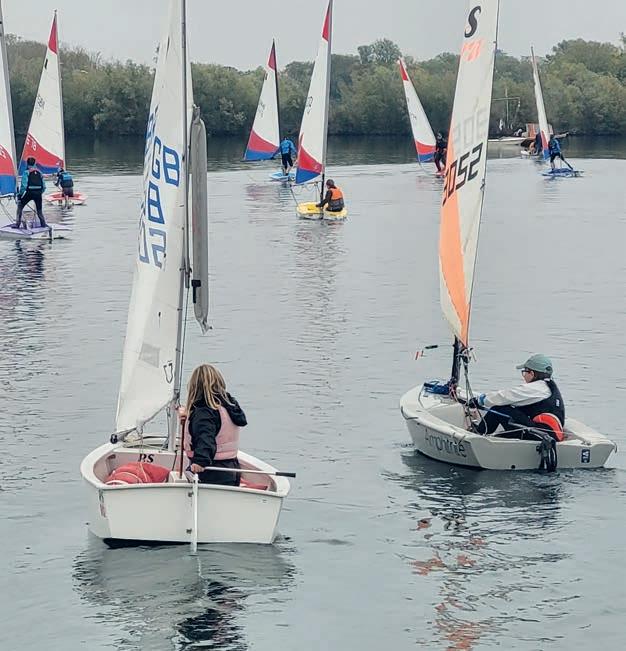

Chris Ho man, Director of Technology Strategy at safety and survival equipment specialist ACR Electronics, says it is time for regulators to re-evaluate the need for pyrotechnic devices, to embrace the modern alternatives and make electronic flares permissible.
Electronic flares are a safe and reliable addition to onboard safety kits
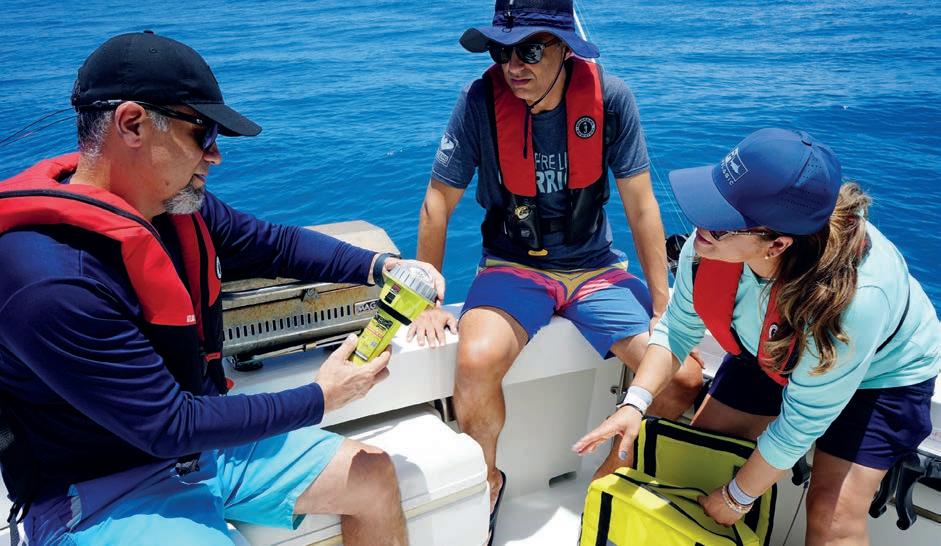
The sea will always be dangerous. Whether the cause is a storm, damage, equipment failure, accident or injury, the possibility of an emergency requiring swift rescue must be considered by all who venture out on the water.
Our tools for survival do not need to add to that risk. A ‘safety’ device should not put anyone in fear of injuring themselves or damaging the boat or liferaft.
Pyrotechnic flares exacerbate the risks at sea. Raising issues for user safety and the environment and creating problems on land with disposal, transportation and storage, pyrotechnics belong to a time when fire and smoke were the simplest ways to attract attention.
In today’s age, a formidable array of reliable electronic safety tools and advanced modern alerting and locating systems are available, including the logical alternative to pyrotechnic flaresElectronic Visual Distress Signal Devices (eVDSDs), or electronic flares.
Despite the accessibility of this advanced technology, the mandatory carriage of pyrotechnic flares persists. They are still Safety of Life at Sea (SOLAS) requirements and are mandated by the Maritime and Coastguard Agency (MCA) for all yachts over 13.7m.
Even for boats which do not by law have to carry flares or other life-saving equipment, pyrotechnic flares remain the recommended solution for distress signalling. Leisure boat owners can still face a potential fine in some countries if they have out-of-date flares onboard. Is it not time for regulators to embrace the alternatives and make eVDSDs permissible?
The problems with pyrotechnics provide proof that the maritime world is ready for the next transition. These drawbacks include:
Pyrotechnic flares burn at over 1,000°C, often emitting molten slag and sparks together with smoke and a flame – all of which can come back at the user in high winds. Many mariners can relate stories of burns, fires and close calls when trying to deploy them. Additionally, flares are one shot devices. There is no way to test them to be sure they work.
We discuss important topics with marine industry experts who share their opinions and top tips to help you get the most from your boating.
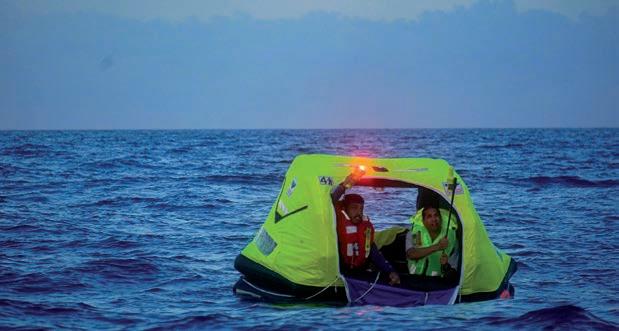
Automatic Identification System (AIS)
transponders: Broadcast a message and vessel position to every nearby ship equipped with AIS.
GMDSS DSC radios: Provide voice communication to coastguards and other vessels together with their location, while Survival Craft VHF radios, acting as GMDSS portable radios can be used to either call for help on VHF Channel 16 or talk to rescuers.
SARTs (Search and Rescue
Transponders): Create either a radar or AIS target, allowing searchers to home in precisely on a vessel or liferaft.
PLBs (Personal Locator Beacons) and AIS MOB (Man Overboard) devices: Include PLBs with Return Link Service (RLS) which means the beacon not only transmits a distress signal and precise GPS location via the global Cospas-Sarsat satellite network — it also sends a message confirming that the user’s distress alert and location have been received.
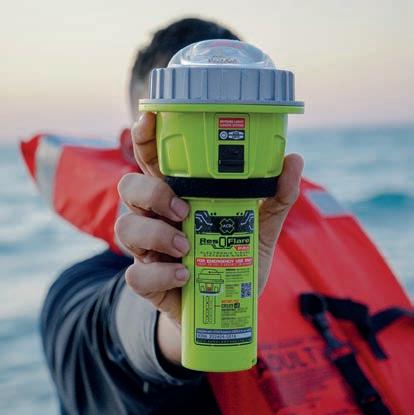
The ACR ResQFlare PRO electronic boat flare, which meets the requirements of RTCM 13200.0
Used in combination with these devices, eVDSDs emit bright strobing LED patterns visible for miles. They are compact, waterproof and rugged, and can operate continuously for hours. Many incorporate infrared strobes detectable by night-vision equipment worn by search and rescue personnel.
Unlike pyrotechnics, they can be tested safely, reused and either be recharged or fitted with new batteries. They do not expire with a three-year shelf life, do not produce toxic waste and do not risk setting a liferaft ablaze or potentially injuring the user or other crew.
Some eVDSDs have been specifically designed to comply with the requirements of the International Maritime Organisation (IMO) Convention on the International Regulations for Preventing Collisions at Sea, 1972, as amended (COLREGs) and act as a potential replacement for some pyrotechnic devices. eVDSDs that comply with Radio Commission for Maritime Services (RTCM) Standard 13200.0 are such devices.
Regulations related to the carriage of lifesaving appliances (LSA) on vessels at sea broadly fall into two areas: those subject to Conventions of the IMO, namely cargo and passenger vessels of 500 gross tonnage and over engaged on international voyages, and other vessels which are generally subject to national regulations.
For the IMO and the MCA, the task is simple: approve electronic flares as an equivalent carriage option so that they are recognised internationally as a distress signal, and then consider phasing out pyrotechnics over a defined period. Accordingly, it is time to establish an International Standard for eVDSDs that could be adopted by IMO and other maritime agencies, and to expedite changes to international conventions and national regulations that would allow the carriage of modern alternatives to pyrotechnic devices, including eVDSDs, instead of pyrotechnics.
Most red handheld and rocket flares rely on strontium nitrate and similar chemicals that are both toxic and environmentally persistent. The smoke can be full of fine particulate matter that can be inhaled into the lungs, while also irritating eyes, nose and throat.
Disposal
Once expired – usually after three years – they become hazardous waste. Coastguards and police forces across Europe and the UK have been overwhelmed by the demand for safe flare disposal, with some mariners resorting to hoarding old flares in sheds or illegally dumping them.
Reliability
Pyrotechnic flares can fail. They can get damp, be damaged in storage or simply not ignite when needed or, in rare cases, explode when ignited. Even when they function correctly, their window of e ectiveness is fleeting, with a red handheld burning for about a minute.
A rocket flare launches skyward, blazes for about 40 seconds, and then is gone.
Transportation and Storage
Flares contain explosives and are therefore classified as Class 1 dangerous goods which means shipping and transportation is di cult and expensive. The same rules and regulations apply to time-expired flares. Flare canisters clutter lockers and demand careful storage away from damp conditions and potential heat sources.
TODAY’S SAFETY TECHNOLOGY AND INNOVATIONS
The modern toolkit of safety encompasses a range of reliable devices, far superior to the brief flicker of a pyrotechnic flare’s flame. They are continuous, reliable and integrated into a global rescue infrastructure.
Emergency Position Indicating Radio Beacons (EPIRBs): Use satellite constellations like Cospas-Sarsat, GPS and Galileo to transmit a vessel’s position to rescue coordination centres anywhere on the globe.
Aside from the di erence in operating lifetime, the only other real distinction is that a pyrotechnic flare is always going to be brighter than an electronic flare. However, this no longer matters. Electronic flares provide a light that can be seen from several miles away, which is more than su cient when combined with other systems.
Encouragingly, the movement is already underway. RTCM has developed a performance standard for eVDSDs. The U.S. Coast Guard’s acceptance of these devices for recreational boats sets an international precedent. Manufacturers in Europe and Asia are pushing for parity, developing multi-colour strobes and eFlares.
Electronic flares are safer, cleaner, longer-lasting and already proven in service. With EPIRBs, AIS, GMDSS DSC radios, Survival Craft VHF radios and SARTs onboard, the arguments against pyrotechnics are overwhelming. n
Chris Ho man is the Director of Technology Strategy at ACR Electronics, Inc., where for more than 15 years he has led forward-thinking initiatives across ACR’s portfolio of 406 MHz emergency beacons including ELTs, EPIRBs and PLBs, along with next-generation aviation and marine safety technologies. He currently serves as Chairman of the Board for the Radio Technical Commission for Maritime Services (RTCM), a role he has held since May 2015. Beyond leading the Board, Chris chairs RTCM Special Committee 110 on Emergency Beacons and Special Committee 136 on Beacon Type Approvals. Widely recognised as a global authority on distress-alerting systems, he acts as the RTCM liaison to the Cospas-Sarsat Programme and contributes extensively to standards development through IEC, IMO, RTCA, EUROCAE and other international regulatory and technical organisations - advancing innovation and improving safety for mariners and aviators worldwide.
The CA was founded in 1908 specifically to meet the needs of cruising sailors and provides services, information, help and advice to thousands of members worldwide. For more information visit www.theca.org.uk.
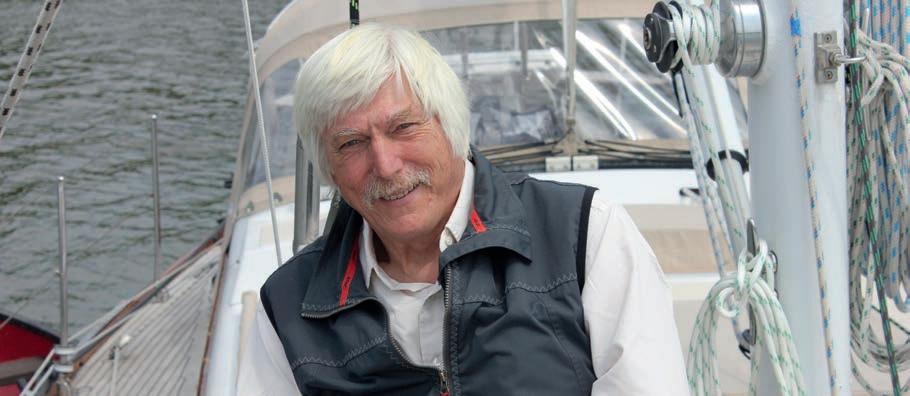

The Cruising Association will host Cruising Skills Week, 23 - 28 March, o ering a packed programme of free online evening sessions, culminating in a hybrid in-person and online all-day Go A ordable Boating Seminar on the Saturday at CA House, London. Designed for those new to cruising as well as anyone looking to build confidence and knowledge, Cruising Skills Week brings together expert speakers, practical advice and first-hand experience to help you get afloat.
Robin Baron, President of the Cruising Association, explains the focus of the week, saying: “Cruising Skills Week is about giving sailors the confidence to get out there and do it. Whether you are buying your first boat, planning a passage or simply wanting to sharpen your skills, you will find practical advice, honest experience and the sort of wisdom that makes all the di erence. Take part, ask questions and be prepared for your next step afloat.” Open to non-members and members, Cruising Skills Week is an opportunity to experience the depth of expertise and supportive community the CA is known for. If you are considering joining the CA, it o ers a clear introduction to how membership can support your cruising ambitionswhether under sail or power - at every stage of your journey. www.theca.org.uk/cruising-skills-week
To celebrate Cruising Skills Week, the CA is o ering non-members a 20 per cent discount on Full Membership. Use code CSW20 to join for £137.60 instead of the usual £172*, giving you full access to the resources, support and community that will help you take your cruising to the next level. www.theca.org.uk/join
From Monday to Friday, 23 – 27 March, a series of free, live Zoom talks will run each evening, covering everything from buying your first boat and cruising for beginners, to safety at sea, preparation for coastal cruising and much more. Each talk will last around 40 minutes and conclude with a 15-minute live Q&A. Simply pre-register and tune-in on the night:
n Monday 23 March: The Boat Buyer’s Survival Guide
1900-1955hrs / Buying your first boat: Pitfalls and Top Tips
2000-2100hrs / Boat Insurance: From Purchase to PolicyGetting It Right
n Tuesday 24 March:Let’s Go Cruising
1900-1955hrs / Cruising for Beginners: Preparing Yourself and Your Boat
2000-2100hrs / Rigging: Check it, Tune it, Trust it
n Wednesday 25 March: Confessions of a Cruising Correspondent
1900-2100hrs / Renowned author and journalist
Dick Durham will share a lifetime of sailing stories
n Thursday 26 March:Be Prepared, Stay Safe
1900-1955hrs / Safety and Skills: Emergency Procedures and Man Overboard
2000-2100hrs / Top Tips from the RNLI
n Friday 27 March:From Inland Adventures to Coastal Confidence
1900-1955hrs / Cruising Routes on the European Inland Waterways: Preparation, Routes and Planning
2000-2100hrs / Insights from the UK Harbour Masters Association: What Cruisers Need to Know
Cruising Skills Week concludes on 28 March with a full-day hybrid Go A ordable Boating Seminar focused on a ordable ways to get afloat. Hosted by sailor, author and raconteur Tom Cunli e, the day will explore practical and budget-friendly approaches to boating.
“You do not need a brand-new boat or a lottery win to go cruising. Some of the happiest sailors I have met have done it simply, sensibly and on a budget. The Cruising Association’s Go A ordable Boating Seminar is about cutting through the myths and showing you the reality of how to get afloat for less,” says Tom Cunli e.
Taking place at CA House, London, from 1000-1700hrs, tickets are £10 online | £28 in person (includes lunch and refreshments).
Alongside the talks, attendees can take part in Boat Chat Cafés, o ering the chance to discuss key topics with CA experts, ask questions and gain tailored advice. Video presentations by Practical Boat Owner will share insights on boating hacks and reader tips, and long-term cruiser and author Lu Heikell will discuss sailing on a shoestring budget – giving you practical strategies and clever cost-saving tactics.
With expert speakers, plenty of advice and networking, this is a great opportunity to acquire knowledge, gain confidence and discover numerous ways to reduce the cost of getting afloat. Cruise, Explore and Connect with the CA Cruising Skills Week. Find out more and book your place at www.theca.org.uk/cruising-skills-week
7 March / West Country Seminar
This one-day CA Seminar, taking place at Exe Sailing Club, will include a range of talks on cruising, electronics and getting afloat without owning a boat. Three varied talks will cover an introduction to the River Exe, including pilotage, moorings and local highlights; a personal perspective on starting cruising and how experienced sailors can support newcomers; and an expert-led overview of modern marine power and electronic systems, exploring emerging technologies and onboard trends.
14 March / Motorboat Section Seminar
Head to CA House, London, for this one-day seminar covering three practical sessions designed to build knowledge and confidence afloat.
‘Choosing the Right Motorboat’ covers purchase decisions, tax and paperwork, matching boat to cruising plans and living aboard. ‘Getting Underway’
focuses on trip planning, anchoring, weather tools and safety requirements. ‘Destinations’ explores inspiring routes including the Somme, non-tidal Thames, North Sea crossings and South West England.
21 - 22 March / Mediterranean Seminar
The annual Mediterranean Seminar o ers two days of expert insight into cruising in the Med. Topics include country regulations, VAT, 90-day rules, EES/ETIAS, Med weather, renewables, electronics, CAptain’s Mate and preparing for the Med. Country updates will focus on Greece, Albania, Tunisia and Malta. Attend one or both days and gain practical knowledge for future Mediterranean passages.
You can find out more about these seminars, which are open to nonmembers too, and book at www.theca.org.uk/events/all
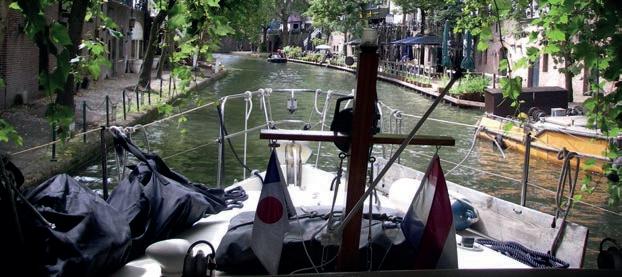
Save the date: 1900hrs, Wednesday 18 March
The Cruising Association’s Regulatory & Technical Services (RATS) Group hosts its sixth annual seminar, exploring the latest developments a ecting your cruising plans. RATS will examine current hot topics that could impact your upcoming voyages and provide practical, experience-led guidance. Non-members are welcome to attendeither free online via Zoom or in-person at CA House, London (ticketed event).
This year’s expert CA speakers will cover:
n Lithium Batteries: Power or peril?
n Staying Connected: Starlink and the future of onboard comms
n Lobster Pots: What is next?
n When Abroad: making sure your kit is legal
Find out more and book: www.theca. org.uk/events/rats-evening-2026
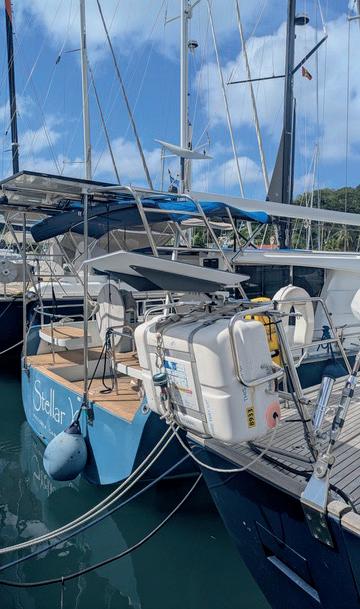
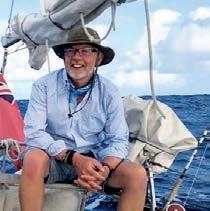
Every month Neil Chapman, founder of Boatshed.com, discusses important topics in the marine industry and o ers advice for buying and owning boats.
Boat ownership; a commitment, not investment.
Owning a boat is a terrible financial decision. It depreciates, leaks money, demands constant attention, punishes optimism, rewards preparation and converts disposable income into an ongoing obligation with remarkable e ciency. Anyone claiming otherwise is either selling boats or trying to justify owning one.
And yet people continue to buy them. Not because they are financially illiterate, but because boating was never meant to be rational in the first place.
The marine industry does itself and its customers a disservice by pretending boats should make financial sense. Phrases like ‘strong residuals’ and ‘holding value’ are repeated endlessly, as if the goal is to convince buyers that boats behave like property or equities. They do not.
Value
According to most market data, the average recreational boat loses 20 - 30 per cent of its value in the first three years, with steady depreciation thereafter, depending on use and maintenance. Annual running costs typically sit between 8 and 12 per cent of the boat’s value, and that is before unexpected repairs.
None of this is a secret. What is strange is how hard the industry works to deny it. The truth is simpler and far more interesting; boats are not investments, they are commitments to experience, trading money for moments that cannot be optimised.
You can spend more, but you cannot compress time on the water, outsource experience or shortcut learning. A weekend sail still takes a weekend; a mistake still takes a lesson. At sea, money does not buy leverage over time. Boats resist e ciency in a world obsessed with it, and that resistance is their value.
Character
At sea, decisions have consequences. Weather ignores confidence and maintenance cannot be indefinitely deferred. Preparation beats optimism every time and unlike many modern systems, boats do not cushion failure. This is why they expose character so quickly.
You can tell a great deal about someone by how they maintain a boat. Deferred jobs reveal avoidance, overcomplication indicates insecurity and clean logbooks evidence pride. Maintenance, however, is not really about personality, it is about systems thinking:
n Boats deteriorate continuously
n Maintenance is not optional, it is undertaken deliberately or paid for later
n Complexity increases maintenance burden
n Simple boats survive neglect better than complex ones
Denial
Selling behaviour reveals a clear story. Unrealistic pricing often has nothing to do with market ignorance and everything to do with emotional attachment masquerading as value. Boats that linger unsold for years are rarely victims of bad luck, they are usually victims of denial. And denial is expensive.
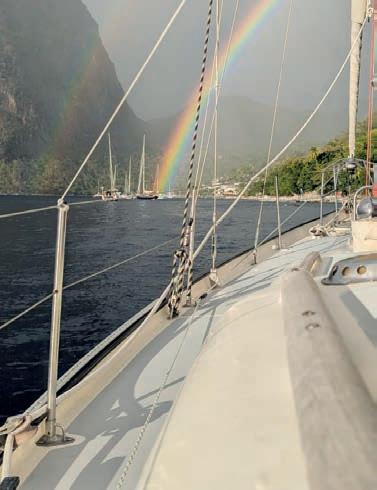
The industry quietly encourages this by flattering sellers, indulging price expectations and stretching listings long past their sell-by date. It keeps hope alive but reality at bay, with predictable consequences.
Owners feel trapped, costs continue, use declines and maintenance slips. Eventually, disengagement sets in. This is when a boat stops being an asset in any sense and starts becoming a problem.
Healthy culture
A healthier boating culture would be far more honest from the outset and should clearly state: ‘you are not buying a return, you are buying responsibility’.
Once this is accepted, boating will improve. People will buy boats that fit their lives rather than their egos. They will sail more, maintain better and sell sooner and more e ciently when the time comes. Ironically, it is these owners who typically lose less money, precisely because they were never trying to make money in the first place.
The most contented boat owners are rarely those chasing value retention; they are the ones chasing use - hours sailed, nights aboard and lessons learned the hard way.
Boating only becomes miserable when people expect it to behave like something it is not. This matters because financial denial feeds environmental failure. Owners who believe their boat ‘should’ be worth more, delay selling. Boats sit, systems decay, responsibility fades and abandonment creeps closer.
Realism
If the industry stopped pretending boats were rational purchases and started treating them as meaningful, demanding, sometimes unreasonable companions, owners would be better prepared for reality.
And the sea would be better o for it. Boats do not need to make financial sense to justify their existence, they need to be used and respected, and when the time comes, they need to be let go. Cleanly, honestly, without pretending they were ever something they weren’t. n
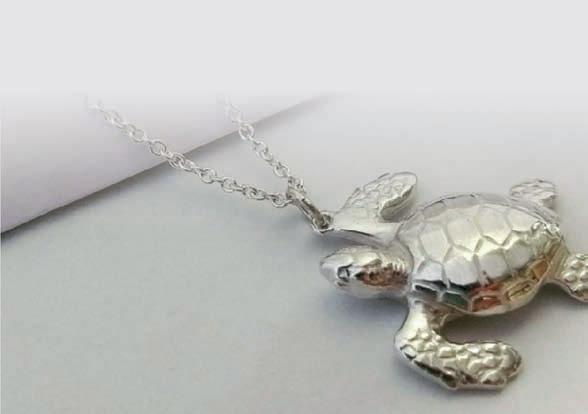
FOR MOTHER’S DAY! 15 MARCH
You can win a stunning handmade sea turtle necklace, worth £125, from ethical jewellery brand Jana Reinhardt. The pretty pendant is handmade from entirely recycled silver by master goldsmith Jana at the brand’s seaside headquarters in Sussex, and comes with a matching adjustable chain that can be worn at 41 or 46cm.
Beautifully detailed, this unique piece features a nely carved shell and tiny scales on his head and limbs, for an incredibly lifelike nish. Super tactile, the pendant is also the perfect reminder to take things that little bit easier, because turtles take things at their own pace, slow moving on earth, yet super fast and agile in water. Something most mums need to remember on Mother’s Day and all year round!
Founded in 2006, Jana Reinhardt jewellery is a husband-and-wife team of master goldsmiths who create sustainable jewellery collections

All at Sea has teamed up with Jana Reinhardt to give away a sustainably handmade sea turtle necklace worth £125.
with the very best cra smanship and attention to detail. The brand is committed to making their business as green as possible.
They always use recycled precious metals and all their packaging is entirely plasticfree, and they o set the carbon output from jewellery making by planting a tree with Ecologi for every sale.
Jana Reinhardt has also created 13 exclusive pieces intended to raise awareness and funds for charities that help animal welfare including The Sloth Conservation Foundation, OVAID, The Badger Trust and much more and have raised more than £20,000 so far.
Their full charity collection is here: www.janareinhardt.com/collections/ animal-charity-collection www.janareinhardt.com
To be in with the chance of winning this great prize enter below, at www.allatsea.co.uk or by email to editor@allatsea.co.uk with the subject header ‘Jana Reinhardt sea turtle necklace competition’. You can also enter via the All at Sea newsletter (sign up at www.allatsea.co.uk/aasnewsletter).
Q: In what year was Jana Reinhardt founded?
A:
NAME:
ADDRESS:
EMAIL:

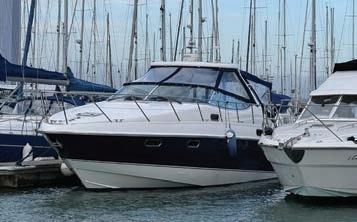
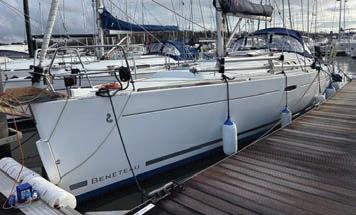
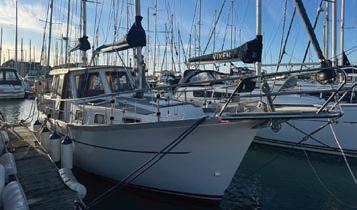
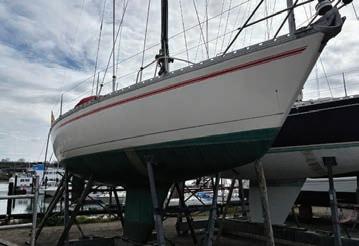
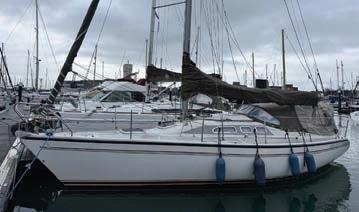
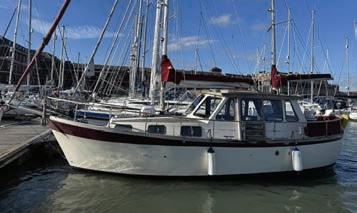
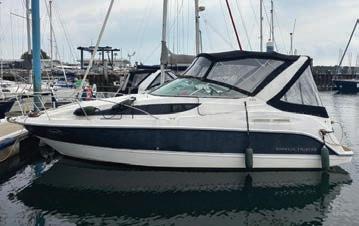
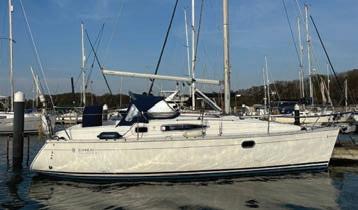
delphinium (8)
9 Capital of Rwanda (6)
10 Slip of a bodily organ from its normal position (8)
11 Flee (6)
12 Higher than average (5,3)
16 Woman with brown hair (8)
18 Comment (6)
21 George Lucas film of 1977 (4,4)
23 Extreme care in spending money (6)
24 B e earlier in time (8)
25 Ample (6)
2 Combine (5)
3 Port city of Japan (5)
4 Not showing proper seriousness (8)
5 Threesome (4)
6 Fe eling embarrassment (7)
7 Former communist country (6)
11 Lacking the ability to speak (4)
13 Go beyond, transgress (8)
14 Instrument of torture (4)
15 U nderwater breathing device (7)
17 Evaluation, placing (6)
19 Mrs Simpson, Bart Simpson’s mother (5)
20 Equip (a ship) with new parts (5)
22 Not at home (4)
Each letter of the alphabet has been given a di erent number. Substitute numbers for letters to make words to complete the puzzle. The check-box and letters either side of the grid may help you keep track.
Using the letters in the wheel, you have ten minutes to find as many words as possible of three or more letters, none of which may be plurals, foreign words or proper nouns.
Each word must contain the central letter and no letters can be used more than once per word unless they appear in di erent sections of the wheel.
There is at least one nine-letter word to be found. Nine-letter word(s):
Check
With over 500 Tonnes of chain in stock, as well as a huge selection of rope, shackles, swivels, buoys and other mooring products, BGD are able to help you with most of your mooring & anchoring requirements .
Titan HDG 6x18.5 DIN766
Titan HDG 7x22 DIN766
£3.45 per mtr
£4.56 per mtr
Titan HDG 8x24 DIN766 £6.95 per mtr
Titan HDG 10x28 DIN766 £9.36 per mtr
Titan HDG 10x30 ISO £9.36 per mtr
Titan HDG 12x36 ISO £12.24 per mtr
Titan HDG 13x36 DIN766 £13.80 per mtr

MF Solid Zinc 6x18.5 DIN766 £4.90 per mtr
MF Solid Zinc 7x22 DIN766 £6.30 per mtr
MF Solid Zinc 8x24 DIN766 £8.80 per mtr
MF Solid Zinc 10x28 DIN766 £12.50 per m
MF Solid Zinc 10x30 ISO £12.50 per m
MF Solid Zinc 12x36 ISO £16.30 per m
MF Solid Zinc 13x36 DIN766 £17.80 per m
Trefoil Anchor (Bruce Pattern)
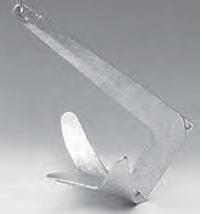
Channel Anchor

Tested Anchor Swivels
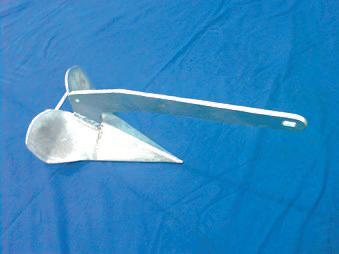
Anchor (Delta Type)
Titan 316 Stainless Chain
6x18.5mm DIN766 £9.96 per mtr 8x24mm DIN766 £17.50 per mtr 10x28 mm DIN766 £26.50 per mtr 10x30 mm ISO £26.50 per mtr 12x36 mm ISO £35.90 per mtr


DIN766 8x24, Grade 70 Windlass & Anchor Chain
MBL = 7000kg
HDG / Solid Zinc DIN766 Calibrated £12.50 mtr

tackle. From £15.00 mtr
Please call for details
Cruising Anchor (Danforth Style)
2.5kg £14.95
4.5kg £22.65
7kg £40.29
10kg £49.75
14kg £69.60
20kg £99.75
Anchor Straightener 316
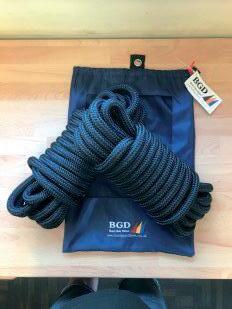
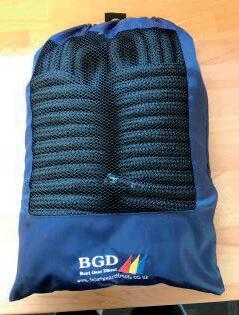
Polyester Mooring Lines
Ready spliced, braided black polyester with 15” soft eye & whipped end. Packed in pairs in a netted stowage bag.
16mm Diam x 10mts £35.71
16mm Diam x 15mts £50.47
18mm Diam x 8mts £33.41
18mm Diam x 10mts £40.13
18mm Diam x 15mts £56.93
20mm Diam x 8mts £42.65
20mm Diam x 10mts £51.50


Sturdy Tripod Open Base for Stability and Easy Storage
Polysteel Risers


Double Fixing Points for Storm Chains & Straps
316 S/S Trefoil Anchor
2k £69.00 5kg £124.95
7.5kg £182.40 10kg £299.00
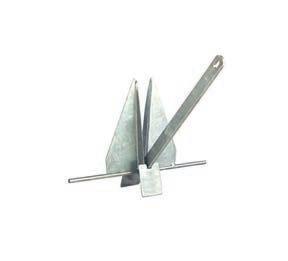
25kg £649.00
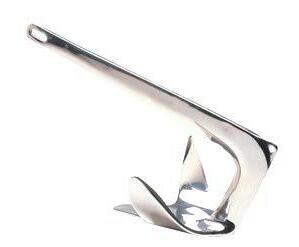

15kg £399.00 20kg £496.80
316 S/S Voyager Anchor (DeltaType)
2kg £69.20 5kg £139.00
10kg £240.00 16kg £384.00 20kg £480.00 25kg £625.00
Dock Bumpers
110cm x 25cm Now only £39.95
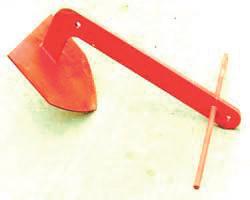
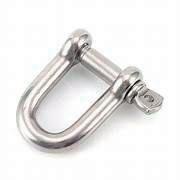
Zinc Anodes Hull &Skeg
4kg Lozenge ZN78
£39.00
Ever Popular! ‘Titan’ Heavy Duty Boat
250mm Threaded Bar for finer pad adjustment
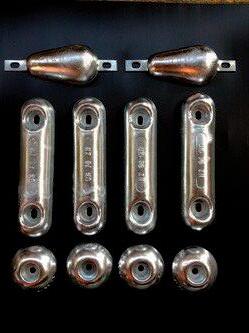
New Ball Joint assembly with easy to replace rubber pads
Ratchet Strap 6m x 5 Tonne
£9.95


For many boaters, the dream is simple: peaceful inland cruising when you want to slow the pace, and the thrill of coastal waters when adventure calls. Traditionally, those worlds have felt miles apart. But Tingdene Marinas are rewriting that narrative, offering a growing network of locations where inland waters and sheltered coastal horizons sit within easy reach of one another. From the reed-lined rivers of Norfolk to the tidal
sweep of the Severn, and north to the dramatic mountainbacked lochs of Scotland’s west coast, Tingdene’s Marinas are redefining what it means to choose a berth. These are a comfortable base where a weekend potter can become a coastal passage, and where inland cruising delivers far more than you might expect. It is a philosophy rooted in choice, flexibility and the simple pleasure of knowing that when you cast off, multiple cruising worlds lie ahead.
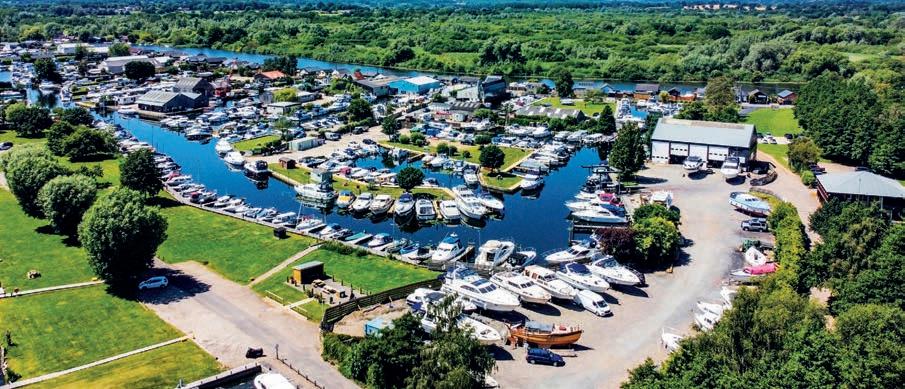
BRUNDALL BAY MARINA: BROADS TRANQUILLITY, COASTAL FREEDOM
Set on the River Yare in the heart of the Norfolk Broads, Brundall Bay Marina is an idyllic inland base. Life here moves to the gentle rhythm of tidal rivers, big skies and winding waterways, where days are measured in lock-free miles and evenings end with the clink of glasses on deck.

UPTON AND STOURPORT: THE SEVERN AS A GATEWAY TO THE SEA
Few rivers in Britain o er the sense of scale and drama found on the River Severn, and Tingdene’s marinas at Upton-upon-Severn and Stourport-onSevern place boaters right at its heart. From these well-established inland bases, the Severn unfolds as a genuine cruising highway. Southbound, the river broadens and becomes increasingly tidal, eventually leading to Sharpness and the Bristol Channel beyond. It is a route that rewards careful planning and respect for the tides, but for many it represents a thrilling step up from purely inland cruising.
Yet Brundall Bay o ers something more than classic Broads cruising. With Norwich just upstream and Great Yarmouth downstream, the North Sea is closer than many realise. A short and manageable journey takes boaters from sheltered inland waters to the open coast, opening up opportunities to cruise along the Norfolk and Su olk shoreline or venture further afield.

Upton Marina o ers a relaxed, community-focused base with easy access to Worcestershire’s towns and countryside, while Stourport combines historic canal connections with river cruising possibilities.
Together, they form stepping stones on a journey that can begin among gentle riverbanks and end with salt spray on the bow.
This blend of environments is what makes the Severn marinas so compelling. You can spend a season enjoying inland cruising, honing skills and confidence, then take advantage of weather windows and tides to experience true coastal waters – all without changing your marina berth.
For berth holders, this dual identity is key. Brundall Bay delivers all the charm and calm of inland boating, combined with the possibility of coastal exploration when conditions, and confidence, align. It is a marina that suits evolving ambitions, whether you are easing into longer passages or simply enjoy knowing that the sea is always an option.

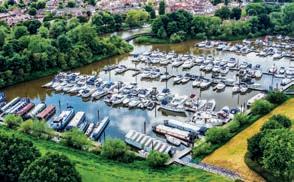
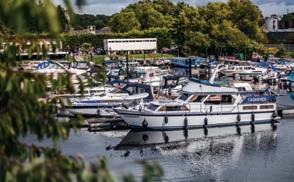
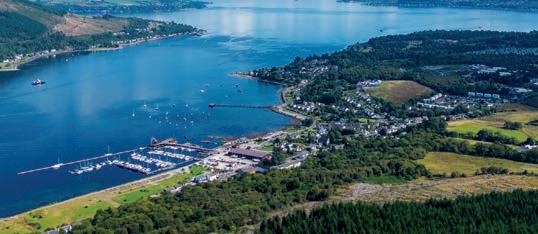
If Brundall Bay and the Severn marinas show how inland routes can lead to the sea, Holy Loch Marina demonstrates the reverse: a coastal marina that feels wonderfully protected.
Nestled on Scotland’s Cowal Peninsula, Tingdene’s newest marina, Holy Loch, sits directly on the Clyde Estuary, one of the UK’s most celebrated cruising grounds. Here, boaters are already on the coast, with immediate access to the Firth of Clyde, its islands, sea lochs and onward routes to the Inner Hebrides.
There is another layer to that sense of freedom for berth holders at both Upton Marina and Brundall Bay Marina. Included with their berth is complimentary membership of TransEurope Marinas, an international cruising network that opens the door to visitor berthing across Europe. From the canals of France and the Netherlands to marinas in Germany and beyond, members can enjoy free or discounted stays while cruising or holidaying abroad. It is a benefit that quietly expands the horizon even further, turning a UK home berth into a gateway to continental adventures, and reinforcing Tingdene’s belief that boating should never be limited.

What unites these marinas is Tingdene’s broader vision: creating a connected network that supports boaters at every stage of their journey. Inland, tidal and coastal waters are no longer separate choices, but part of a single, flexible boating lifestyle.
Through initiatives such as the Tingdene Privilege scheme, berth holders gain access to free visitor berthing across the network, making
Yet despite its coastal setting, Holy Loch is reassuringly sheltered. Surrounded by mountains and embraced by deep, calm waters, it o ers conditions that inspire confidence while still delivering big-water experiences. It is a place where coastal cruising feels accessible, without sacrificing comfort or security.
For Tingdene berth holders from inland marinas, Holy Loch also represents something more: a northern outpost within a familiar network, where coastal adventures can be paired with the reassurance of a trusted marina operator and a strong local community.
it easier to explore new waters with confidence. An inland boater from Norfolk can head west to the Severn, while a Clyde-based sailor can venture south knowing a warm welcome awaits.
It is about more than geography. Tingdene’s marinas share a focus on community, quality facilities and long-term investment, ensuring that wherever you moor, the experience feels consistent, supportive and welcoming.
Whether your ideal day afloat involves quiet river mornings, tidal challenges or coastal horizons, Tingdene Marinas o ers a rare opportunity to enjoy the best of both inland and coastal worlds - often from the same berth, with premium facilities and a warm community.

As boating ambitions evolve, having options matters. With marinas that turn inland cruising into coastal adventure, and coastal bases that still feel sheltered and secure, Tingdene Marinas are making it easier than ever to choose a home port that grows with you. To discover which marina could be your gateway to both riverbanks and open seas, contact Tingdene Marinas and start your next chapter on the water.







ST KATHARINE DOCKS
Manager: Paul Atkins
50 St. Katharine’s Way, London, E1W 1LA
T: 0207 264 5312
E: marina.reception@skdocks.co.uk
W: ww.skdocks.co.uk
PREMIER MARINAS FALMOUTH
Manager: Mark Evans
North Parade, Falmouth, Cornwall, TR11 2TD
T: 01326 316620
E: falmouth@premiermarinas.com
W: www.premiermarinas.com
PORT PENDENNIS MARINA
Manager: Mark Webster
Challenger Quay, Falmouth, Cornwall, TR11 3YL
T: 01326 211211
E: marina@portpendennis.com
W: www.portpendennis.com
MYLOR YACHT HARBOUR
Manager/contact: Culum Matheson
Mylor Churchtown, Falmouth, Cornwall, TR11 5UF
T: 01326 372 121
E: marina@mylor.com
W: www.mylor.com
FALMOUTH HAVEN
Contact: Daisy Gould
44 Arwenack Street, Falmouth, TR11 3JQ
T: 01326 310990
E: welcome@falmouthhaven.co.uk
W: www.falmouthhaven.co.uk
MAYFLOWER MARINA
Manager: Charles Bush
Plymouth, Devon, PL1 4LS
T: 01752 556633
E: info@mayflowermarina.co.uk
W: www.mayflowermarina.co.uk
PLYMOUTH YACHT HAVEN
Manager: Steve Cox
Shaw Way, Mount Batten, Devon, PL9 9XH
T: 01752 404231
E: plymouth@yachthavens.com
W: www.yachthavens.com
YACHT HAVEN QUAY, PLYMOUTH
Manager: Richard Brown
Breakwater Road, Plymouth, Devon, PL9 7FE
T: 01752 481190
E: boatyard@yachthavenquay.com
W: www.yachthavens.com
MDL QUEEN ANNE’S BATTERY
Manager: Alex Warner
Plymouth, Devon, PL4 0LP
T: 01752 671142
E: qab@mdlmarinas.co.uk
W: www.queenannesbattery.co.uk
SUTTON HARBOUR MARINA
Marina Manager: Mark Brimacombe
Sutton Harbour, Plymouth PL4 0DW
T: 01752 204702
E: marina@sutton-harbour.co.uk
W: www.suttonharbourmarina.com
KING POINT MARINA
Marina Manager: Mark Brimacombe
Brunel Way, Milbay, Plymouth, PL1 3EF
T: 01752 424297
E: marina@kingpointmarina.co.uk
W: www.kingpointmarina.co.uk
PREMIER MARINAS NOSS ON DART
Manager: Mike Smith Bridge Road, Kingswear, Dartmouth Devon, TQ6 0EA T: 01803 839087
E: noss@premiermarinas.com
W: www.premiermarinas.com
DOLPHIN BOATYARD
Galmpton Creek, Brixham, Devon T: 01803 842424
E: info@dolphinhaven.co.uk
W: www.dolphin-haven.co.uk
MDL BRIXHAM MARINA
Manager: Martyn Sherratt
Berry Head Road, Devon, TQ5 9BW T: 01803 882929
E: brixham@mdlmarinas.co.uk
W: www.brixhammarina.co.uk
MDL TORQUAY MARINA
Manager: Martyn Sherratt
Torquay, Devon, TQ2 5EQ
T: 01803 200210
E: torquaymarina@mdlmarinas.co.uk
W: www.torquaymarina.co.uk
WATCHET MARINA
Manager: Matt Driscoll Harbour O ce, Watchet, TA23 0AQ T: 01984 322230
E: watchetmarina@westernmarinas.co.uk
W: www.westernmarinas.co.uk
WEYMOUTH MARINA BY BOATFOLK
Manager: Neil Bedwell
Commercial Road, Weymouth Dorset, DT4 8NA
T: 01305 767576
E: weymouth@boatfolk.co.uk
W: www.boatfolk.co.uk
WEYMOUTH HARBOUR
Manager/contact - Ed Carter 13 Custom House Quay, Weymouth
T: 01305 838423
E: weymouthharbour@dorsetcouncil.gov.uk
W: www.weymouth-harbour.co.uk
PORTLAND MARINA BY BOATFOLK
Manager: Paul Swain
Osprey Quay, Portland, Dorset, DT5 1DX
T: 01305 866190
E: portland@boatfolk.co.uk
W: www.boatfolk.co.uk
LAKE YARD MARINA
Manager/contact - Jenny Burrows
Lake Drive, Hamworthy, Poole, Dorset, BH15 4DT

T: 01202 674531
E: o ce@lakeyard.com
W: www.lakeyard.com

PARKSTONE BAY MARINA
Manager: Henry Cobley
Turks Lane, Poole, Dorset, BH14 8EW
T: 01202 747 857
E: info@parkstonebay.com
W: www.parkstonebay.com
POOLE QUAY BOAT HAVEN
Manager: Kerrie Gray
Poole Town Quay, Poole,Dorset, BH15 1HJ
T/F: 01202 649488
E: info@poolequayboathaven.co.uk
W: www.poolequayboathaven.co.uk
PORT OF POOLE MARINA
Manager: Kerrie Gray
Poole Quay Boat Haven, Poole Town Quay, Poole, Dorset, BH15 1HJ
T/F: 01202 649 488
E: info@poolequayboathaven.co.uk
W: www.poolequayboathaven.co.uk
SALTERNS MARINA LTD
Manager: Robert Golden
40 Salterns Way, Lilliput, Poole, Dorset, BH14 8JR
T: 01202 709971
E: reception@salterns.co.uk
W: www.salterns.co.uk
MDL COBB’S QUAY MARINA
Manager: Kelly Trewern
Hamworthy, Poole, Dorset, BH15 4EL
T: 01202 674299
E: cobbsquay@mdlmarinas.co.uk
W: www.cobbsquaymarina.co.uk
LYMINGTON YACHT HAVEN
Manager: Rupert Wagsta
Kings Saltern Road, Lymington, Hampshire, SO41 3QD
T: 01590 677071
E: lymington@yachthavens.com
W: www.yachthavens.com
BUCKLER’S HARD YACHT HARBOUR
Harbour Master: Wendy Stowe
Harbour Master’s O ce, Buckler’s Hard Yacht Harbour, Hampshire, SO42 7XB
T: 01590 616200
E: harbour.o ce@beaulieu.co.uk
W: www.beaulieuriver.co.uk
HAVEN QUAY, LYMINGTON
Manager: Matt Toms
Haven Quay Dry Stack, Mill Lane, Lymington, Hampshire, SO41 9AZ
T: 01590 677072
E: havenquay@yachthavens.com
W: www.yachthavens.com
DEACONS MARINA BY BOATFOLK
Contact name: Julie Spensley-Corfield
Bursledon Bridge, Southampton,SO31 8AZ
T: 023 80 402253
E: deacons@boatfolk.co.uk
W: www.boatfolk.co.uk
MDL HYTHE MARINA VILLAGE
Manager: Debbie Scott
The Lock Building, Shamrock Way Hythe, Southampton, Hampshire, SO45 6DY
T: 023 8020 7073
E: hythe@mdlmarinas.co.uk
W: www.hythemarinavillage.co.uk
East Cowes Marina has joined the Premier Marinas South Coast network, marking the next stage in Premier Marinas’ programme to bring recently acquired boatfolk marinas into a single, high-quality network.
The addition of East Cowes is part Premier’s wider integration programme, with Weymouth, Portland and Deacons also set to complete their transition into the Premier network ahead of the 2026 season.
Andrew Lewis, Sales & Marketing Director at Premier Marinas, said: “For berth holders at East Cowes, joining the Premier network is about getting more from their berth from day one. More places to cruise, more consistency when they arrive and better value across the South Coast.”
Berth holders at East Cowes will be granted access to the Premier Advantage rewards and benefits scheme. Sta are fully trained to help customers make the most of their new
MDL OCEAN VILLAGE MARINA
Manager: Lauren McCann
Marina O ce, 2 Channel Way, Southampton, Hampshire, SO14 3TG
T: 023 8022 9385
E: oceanvillage@mdlmarinas.co.u
W: www.oceanvillagemarina.co.uk
MDL SHAMROCK QUAY
Manager: Barry Radband William Street, Northam, Southampton Hampshire, SO14 5QL
T: 023 8022 9461
E: shamrockquay@mdlmarinas.co.uk
W: www.shamrockquay.co.uk
MDL SAXON WHARF
Manager: Lauren McCann Lower York Street, Northam, Southampton, SO14 5QF
T: 023 8033 9490
E: saxonwharf@mdlmarinas.co.uk
W: www.saxonwharf.co.uk
MDL HAMBLE POINT MARINA
Manager: Dominic Brown School Lane, Hamble, Southampton Hampshire, SO31 4NB
T: 023 8045 2464
E: hamblepoint@mdlmarinas.co.uk
W: www.hamblepointmarina.co.uk
MDL PORT HAMBLE MARINA
Manager: Bertie Marsh Satchell Lane, Hamble, Southampton Hampshire, SO31 4QD
T: 023 8045 274,1
E: porthamble@mdlmarinas.co.uk
W:www.porthamblemarina.co.uk
TOWN QUAY MARINA
Associated British Ports, Town Quay, Southampton, SO14 2AQ
T: 023 8023 4397
E: info@townquay.com
W:www.townquay.com
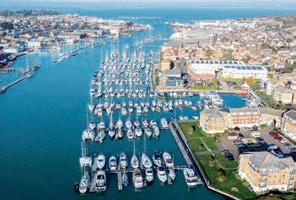
perks, including visitor nights across the Premier network and discounted fuel, while the MyPremier app and portal provide practical tools to plan and enjoy time on the water with confidence. Mike Townshend, Marina Manager at East Cowes Marina, said: This rebrand is not about changing what people value about East Cowes, it is about enhancing it. The marina remains a cherished local asset, and the team is ready to welcome the boating community for Cowes Week and the Round the Island Race in the same way we have always done.”
MDL MERCURY YACHT HARBOUR
Manager: Debbie Burns SatchellLane, Hamble, Southampton, Hampshire, SO31 4HQ T: 023 8045 5994 E: mercury@mdlmarinas.co.uk W: www.mercuryyachtharbour.co.uk
PREMIER MARINAS SWANWICK
Manager: Graham Bristowe Swanwick (on the Hamble) Southampton, Hants, SO31 1ZL T: 01489 884081
E: swanwick@premiermarinas.com W: www.premiermarinas.com
HAMBLE YACHT SERVICES
Port Hamble, Hamble,Southampton, Hampshire, SO31 4NN T: 02380 201501 E: info@hysgroup.co.uk W: www.hambleyachtservices.co.uk
PREMIER MARINAS UNIVERSAL
Manager: Martin Bowman Crableck Lane, Sarisbury Green, Southampton, Hampshire, SO31 7ZN T: 01489574272 E: universal@premiermarinas.com W: www.premiermarinas.com
PREMIER HASLAR MARINA
Manager: Ben Lippiett
Haslar Road, Gosport, Hampshire, PO12 1NU T: 023 9260 1201 F: 023 9260 2201
E: haslar@premiermarinas.com W: premiermarinas.com
PREMIER MARINAS GOSPORT
Manager: Jonathan Walcroft
Mumby Road, Gosport, Hampshire, PO12 1AH
T: 023 9252 4811
F: 023 9258 9541
E: gosport@premiermarinas.com W: www.premiermarinas.com

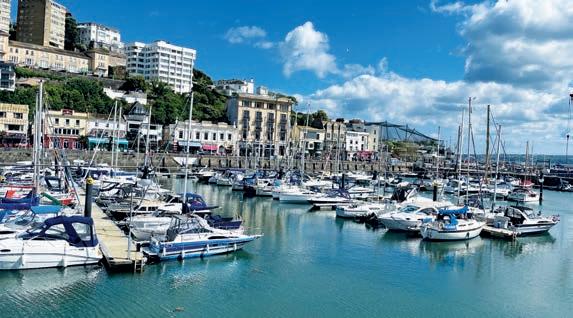
British Marine’s latest UK Marina & Moorings Market Report provides an in-depth snapshot of market conditions, business sentiment and structural challenges shaping the UK marina sector.
Based on survey responses from The Yacht Harbour Association member marinas representing around 60 per cent of UK berth provision, the report shows a sector that remains stable but increasingly cautious, as operators adjust to easing demand following the post-pandemic high.
Despite ongoing economic pressures and subdued consumer confidence, berth occupancy remains high across much of the sector, particularly in coastal locations, with many marinas continuing to operate close to capacity. Waiting lists, while easing slightly since 2022, remain a feature of high-demand regions, highlighting continued pressure on existing infrastructure and limited scope for expansion.
The findings suggest that future growth in the marina sector is more likely to be driven by operational optimisation, targeted investment and ongoing consolidation, rather than the development of new marina capacity.
Planning constraints continue to limit expansion, with very few new developments coming forward and investment instead concentrated on site upgrades and modernisation.
The report also identifies a notable decline in business confidence, with almost half of respondents expecting their local market to weaken over the next 12 months. Operators cited falling enquiries, a ordability challenges among an ageing customer base and increased competition in a constrained market as key concerns. And while residential berths and boatyard services continue to show relative resilience, performance in leisure berths and boat sales has softened.
Looking ahead, the research highlights a number of emerging and longer-term challenges facing the sector. Despite wider industry debate around decarbonisation, member feedback indicates that demand for electric charging and alternative fuels remains very low.
The report also points to the growing financial and operational burden of abandoned and end-of-life boats, with marina operators increasingly calling for a coordinated, government-led approach to disposal and recycling.
Two World War II bombs discovered in Devon - one dredged up in Exmouth Marina - led to local residents being advised to temporarily leave their homes. The bombs were moved out to sea and destroyed in controlled detonations.
Suntex has expanded its north Florida footprint with the acquisition of Two Georges Marina, rebranded as Shalimar Harbor Marina, a nod to its roots as the former Shalimar Yacht Basin and a tribute to the town of Shalimar where it has long served the local boating community.
Shoreham Port has launched the UK’s largest living seawall, at Southwick Reef. It incorporates three distinct habitat enhancement features: Vertipools, Reef Cubes and habitat panels. Together, these elements are designed to increase ecological complexity and support marine biodiversity along the Harbour Arm.
Marina Port Valencia has been named as the host venue for SailGP’s Valencia event for the coming years. The confirmation sees Valencia join a select group of global host cities for SailGP.
Marina Port de Mallorca will host the Superyacht New Build Hub at the 2026 edition of the Palma International Boat Show, which opens on 29 April. The hub will o er 20 premium berths for yachts ranging from 30 - 60m, alongside a shoreside exhibition area.
D-Marin has unveiled its new membership scheme ‘Latitude’. The scheme, for eligible annual customers, o ers a range of privileges, improving guests’ overall experience and connection with both their marina and fellow members. Read more marina news at www. allatsea.co.uk/category/marina-news
MDL Marinas has expanded its Otium loyalty programme with 12 new partners, taking the total number of partners to more than 50 and giving members access to an even wider range of boating products, services and lifestyle rewards.
“Otium has really gathered momentum over the last few years, and that is down to how much our members value the programme, and the partners involved,” said James Barnes, Managing Director, MDL Marinas.
“Our new partners give people even more choice in how they earn and use their points, whether that is for everyday boating needs or something a bit special.
AQUAVISTA ROYAL CLARENCE WATERSIDE & MARINA
Weevil Lane, Gosport, Hampshire, PO12 1AX
T: 023 9252 3523
E: royalclarence@aquavista.com
W: www.aquavista.com
PREMIER MARINAS PORT SOLENT
Manager: Ben Boardman
South Lockside, Port Solent, Portsmouth, Hampshire, PO6 4TJ
T: 023 9221 0765
F: 023 9232 4241
E: portsolent@premiermarinas.com
W: www.premiermarinas.com
PREMIER MARINAS SOUTHSEA
Manager: Dave Frey
Fort Cumberland Road
Portsmouth, Hampshire, PO4 9RJ
T: 023 9282 2719
F: 023 9282 2220
E: southsea@premiermarinas.com
W: www.premiermarinas.com
GUNWHARF QUAYS MARINA
Manager: Carl Jarmaine
Gunwharf Quays, Marina O ce Portsmouth, Hampshire, PO1 3TZ
T: 02392 836732
E: gwqmarina@incentive-fm.com
W: www.gunwharf-quays.com/marina
COWES YACHT HAVEN
Manager: Katy Ednay
Vectis Yard, High Street, Cowes, PO31 7BD
T: 01983 299975
E: berthing@cowesyachthaven.com
W:www.cowesyachthaven.com
VHF: Channel 80
PREMIER EAST COWES MARINA
Manager: Mike Townshend
Britannia Way, East Cowes, Isle of Wight, PO32 6UB
T: 01983 293983
F: 01983 299276
E: eastcowes@premiermarinas.com
W: premiermarinas.com
“We are always looking for ways to make Otium more useful and rewarding for our berth holders, and this expansion is a big step in that direction.”
Among the new partners joining Otium are Britannia Events, Clipper Marine, Compare Yacht Insurance, Fairview Sailing, Fox’s Yacht Sales, Powerboat & RIB, Royal Harwich Yacht Club, Sailing Logic and White Dot Sailing, alongside several Port Hamble and Woolverstone-based marine service providers.
Otium membership is free for MDL berth holders, who automatically earn points on purchases made across MDL marinas and boatyards. Points are redeemable against MDL services or with any Otium partner.
COWES HARBOUR SHEPARDS MARINA
Manager: Jock Ra erty
Medina Road, Cowes, Isle of Wight, PO31 7HT
T: 01983 297821
E: shepards.chc@cowes.co.uk
W: cowesharbourshepardsmarina.co.uk
ISLAND HARBOUR MARINA
Manager: Danie Erasmus Mill Lane, Newport, Isle of Wight, PO30 2LA
T: 01983 539994
E: info@island-harbour.co.uk
W:www.island-harbour.co.uk
BEMBRIDGE HARBOUR
Jack Miskin, Harbour Master The Duver, St Helens, PO33 1YB
T: 01983 872828
E: mail@bembridgeharbour.co.uk
W: www.bembridgeharbour.co.uk
YARMOUTH HARBOUR
Harbour O ce, The Quay, Yarmouth, Isle of Wight, PO41 0NT
T: 01983 760321
E: info@yarmouth-harbour.co.uk
W: www.yarmouth-harbour.co.uk
VHF: Ch 68 (harbour), Ch 15 (water taxi)
MDL NORTHNEY MARINA
Manager: Tom Ward Northney Road, Hayling Island, PO11 0NH T: 023 9246 6321
E: northney@mdlmarinas.co.uk
W: www.northneymarina.co.uk
MDL SPARKES MARINA
Manager: James Rizzi
38 Wittering Road, Hayling Island Hampshire, PO11 9SR
T: 023 9246 3572
E: sparkes@mdlmarinas.co.uk
W: www.sparkesmarina.co.uk
PREMIER MARINAS CHICHESTER
Manager: Andrew Collumbell Birdham (Chichester Harbour) West Sussex, PO20 7EJ T: 01243 512731
E: chichester@premiermarinas.com
W: www.premiermarinas.com
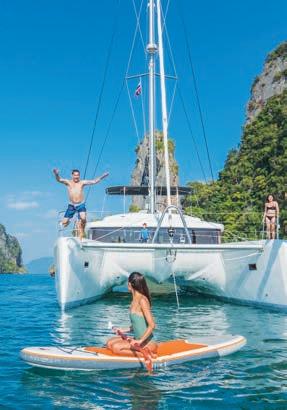
AQUAVISTA BIRDHAM POOL
WATERSIDE & MARINA
Chichester, West Sussex, PO20 7BG T: 01243 512310
E: birdhampool@aquavista.com W: www.aquavista.com
LITTLEHAMPTON MARINA
Berthing Manager: Darren Humphries
Ferry Road, Littlehampton, West Sussex, BN17 5DS T: 01903 713553 F: 01903 732264
E: sales@littlehamptonmarina.co.uk W: www.littlehamptonmarina.co.uk
LITTLEHAMPTON YACHT CLUB
Rope House, Rope Walk Littlehampton, West Sussex BN17 5DH T: 01903 732 926 F: 01903 725 911
E: fiona@littlehamptonyachtclub.co.uk W: www.littlehamptonyachtclub.co.uk
PREMIER MARINAS BRIGHTON
Manager: Mike Hatch
West Jetty, Brighton, East Sussex, BN2 5UP
T: 01273 819919 F: 01273 675082
E: brighton@premiermarinas.com
W: www.premiermarinas.com
PREMIER MARINAS EASTBOURNE
Manager: Dan Heckford
Sovereign Harbour, North Lockside, Pacific Drive, Eastbourne, BN23 5BJ T: 01323 470099 F: 01323 470077
E: sovereignharbour@premiermarinas.com
W: www.premiermarinas.com
SMALL BOATS WELCOME
NEWHAVEN MARINA
Manager/Contact: Russell Levett
Newhaven Marina, The Yacht Harbour, Fort Road, Newhaven, BN9 9BY
T: 01273 513 881
E: info@newhavenmarina.co.uk
W: www.newhavenmarina.co.uk
LADY BEE MARINA, SHOREHAM PORT
Manager: Julian Goldie
Lady Bee Marina and Chandlery, 138-140
Albion Street, Southwick, BN42 4EG T: 01273 591705
E: LBChandlery@shoreham-port.co.uk W:www.shoreham-port.co.uk/chandlery
GILLINGHAM MARINA
Manager: Chris Aldous
173 Pier Road, Gillingham, Kent ME7 1UB
T: 01634 280022
E: berthing@gillingham-marina.co.uk
W: www.gillingham-marina.co.uk
MDL CHATHAM MARITIME MARINA
Manager: Emma Powell
The Lock Building, Leviathan Way, Chatham Maritime, Kent ME4 4LP
T: 01634 899200
E: chatham@mdlmarinas.co.uk
W: chathammaritimemarina.co.uk
MEDWAY YACHT CLUB
Contact: Sue Bannister
Lower Upnor, Rochester, ME2 4XB
T: 01634 718399
W:www.medwayyachtclub.com
MDL PENTON HOOK MARINA
Manager: Benedict Moran Staines Road, Chertsey, Surrey KT16 8PY
T: 01932 568681
E: pentonhook@mdlmarinas.co.uk
MDL WOOLVERSTONE MARINA
Manager: Shane Cheshire
Woolverstone, Ipswich, Su olk IP9 1AS
T: 01473 780206
E: woolverstone@mdlmarinas.co.uk
W: www.woolverstonemarina.co.uk
LOWESTOFT BEACON MARINA
Manager: Lucy Edmonds School Road, Lowestoft, Su olk NR33 9NB
T: 01502 580300
E: lowestoftbeacon@abports.co.uk
W: www.beaconmarinas.co.uk
FOX’S MARINA & BOATYARD
Marina Manager: Lee Gilson
Fox’s Marina, Ipswich Su olk IP2 8SA
T: 01473 689111
E: foxs@foxsmarina.com
W: www.foxsmarina.com
FAMBRIDGE YACHT HAVEN
Manager: Danyal Adams Chelmsford, CM3 6LU
T: 01621 740370
E: fambridge@yachthavens.com
W: www.yachthavens.com
ABERYSTWYTH MARINA
Manager: Adam Knowles
NEYLAND YACHT HAVEN
Manager: James Cotton
Brunel Quay, Pembrokeshire SA73 1PY
T: 01646 601601
E: neyland@yachthavens.com
W: www.yachthavens.com
PORT DINORWIC MARINA
Dock Manager: Kevin Roberts
Y Felinheli, Gwynedd LL56 4JN
T: 01248 671500
E: sharon@portdinorwic.co.uk W: www.port-dinorwic.co.uk
BURRY PORT MARINA
Harbour Master: Robert Hockey
The Harbour O ce, Burry Port
Carmarthenshire
T: 01554 835 691
E: Info@themarinegroup.co.uk
W: www.themarinegroup.co.uk
BANGOR MARINA
Manager: Kevin Baird
Bangor, Co. Down
T: 02891 45329
E: bangor@boatfolk.co.uk
W: www.boatfolk.co.uk
CARRICKFERGUS MARINA
Harbour Master: Ryan Hack
Marina Manager: Karen Steelen
3 Quayside, Carrickfergus BT38 8BJ
T: 028 9336 6666
E: harbour.master@midandeastantrim.gov.uk
W: www.midandeastantrim.gov.uk
RHU MARINA
Contact: Suzanne Bell
Rhu, Helensburgh G84 8LH
T: 01436 820238
E: rhu@boatfolk.co.uk
W: www.boatfolk.co.uk
LARGS YACHT HAVEN
Manager: Dave Hewitt Irvine Road, Largs Ayrshire KA30 8EZ
T: 01475 675333
E: largs@yachthavens.com
W: www.yachthavens.com
TROON YACHT HAVEN
Manager: Stephen Bennie The Harbour, Troon Ayrshire KA10 6DJ T: 01292 315553
E: troon@yachthavens.com
W: www.yachthavens.com
MDL SANT CARLES MARINA
Manager: Nicolas Gonzalez Ctra Poble Nou s/n, Apartat de Correus 192, 43540 Sant Carles de la Ràpita, Spain
T: (0034) 9777 45153
T (UK): 023 8045 0227 enquiries@santcarlesmarina.com W: www.santcarlesmarina.com


MARINARA
Front Desk: Federica Civilla Via Marinara 11, Marina di Ravenna, 48122 Italy
T: (0039) 0544 531644
E: info@marinara.it W: www.marinara.it



Y Lanfa Aberystwyth, Trefechan SY23 1AS
T: 01970 611422
E: aberystwythmarina@westernmarinas.co.uk
W: www.westernmarinas.co.uk
CARDIFF MARINA
W: www.pentonhookmarina.co.uk
MDL WINDSOR MARINA
Manager: John Harris Maidenhead Road, Windsor Berkshire SL4 5TZ
T: 01753 853911
E: windsor@mdlmarinas.co.uk
W: www.windsormarina.co.uk
MDL BRAY MARINA
Manager: John Harris Monkey Island Lane, Bray Berkshire SL6 2EB
T: 01628 623654
E: bray@mdlmarinas.co.uk
W: www.braymarina.co.uk
AQUAVISTA GLASSON
WATERSIDE & MARINA
School Lane, Glasson Dock, Lancaster, Lancashire LA2 0AW
T: 01524 751491
E: glasson@aquavista.com
Manager: Andy Coles OBE
Watkiss Way
Cardi CF11 0SY T: 02920 396078
E: cardi marina@westernmarinas.co.uk
W: www.westernmarinas.co.uk
CONWY MARINA
Manager: Jon Roberts
Conwy Marina, Ellis Way LL32 8GU
T: 01492 593000
E: conwy@boatfolk.co.uk
W:www.boatfolk.co.uk
MILFORD MARINA
Manager or contact: Melanie Durney Milford Haven, Pembrokeshire SA73 3AF
Tel: 01646 696312
E: enquiries@milfordmarina.com
W: www.milfordmarina.com
PENARTH MARINA
PORTISHEAD MARINA
Manager: Simon Davis
Portishead, Bristol BS20 7DF
T: 01275 841941
E: portishead@boatfolk.co.uk W: www.boatfolk.co.uk
ROYAL QUAYS MARINA
Manager: Keeran Stephenson North Shields, Tyneside NE29 6DU T: 01912 728282
E: royalquays@boatfolk.co.uk
W: www.boatfolk.co.uk
AQUAVISTA HULL WATERSIDE & MARINA
Warehouse 13, Kingston Street, Hull
Yorkshire HU1 2DQ
T: 01482 609960
JACHTHAVEN BIESBOSCH
Manager: Maarten Voskuil Nieuwe Jachthaven 54924 BA, Drimmelen, NL
T: +31 (0)162 682249
E: info@jachthavenbiesbosch.nl W: www.jachthavenbiesbosch.nl

E: hull@aquavista.com W: www.aquavista.com
LIVERPOOL MARINA
Manager: Stuart Jones Penarth
Vale of Glamorgan F64 1TQ
T: 02920 705021
E: penarth@boatfolk.co.uk
W: www.aquavista.com

W: www.boatfolk.co.uk
Manager: Daniel O’Dea
Liverpool Marina, Coburg Wharf, L34BP
T: 0151 707 6777
E: reception@liverpoolmarina.com
E: manager@liverpoolmarina.com
W: www.liverpoolmarina.com

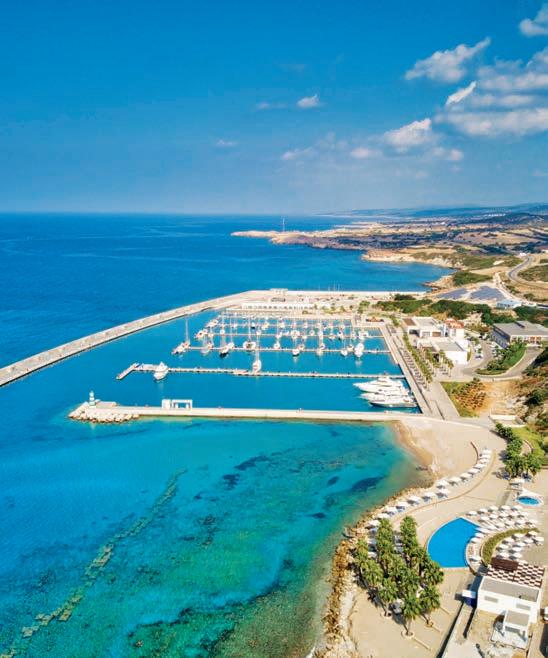
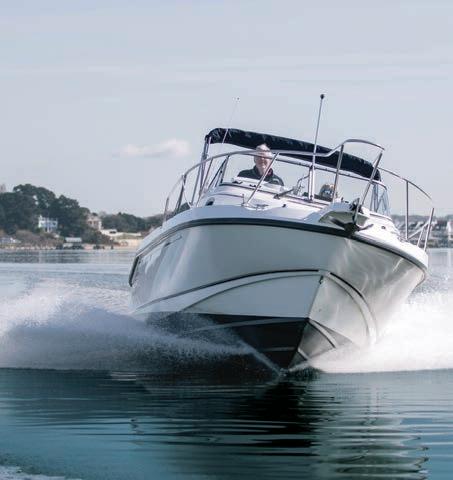












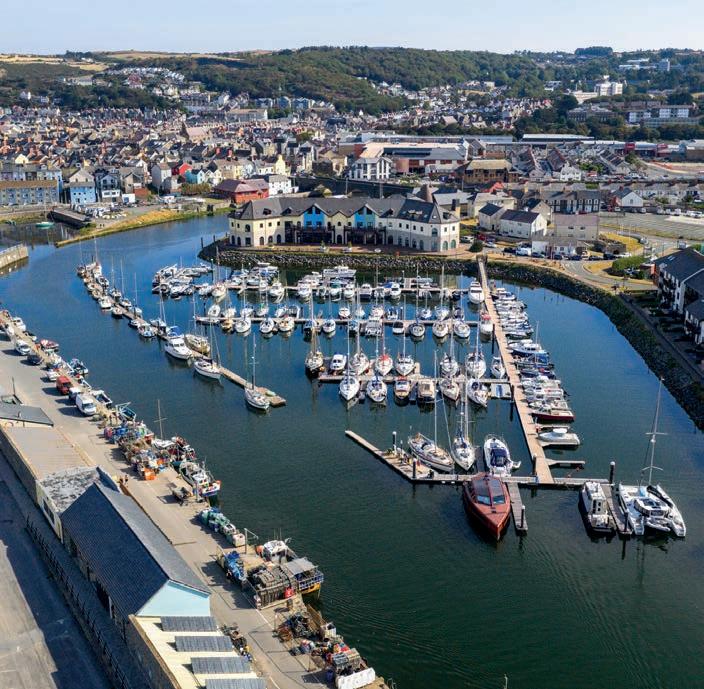
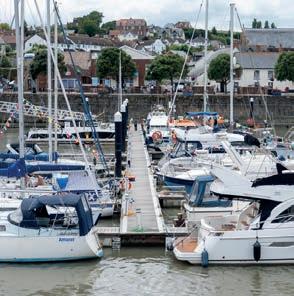



It is chilly outside – but jobs onboard still need to be done. To make sure the items on the to do list get ticked o , incentivise yourself by having something to look forward to at the end of the day. A well-deserved reward. And what better than a roast? I have always felt you need to earn a good roast dinner – especially if there is a large glass of something special to accompany it. Powerful, full-bodied reds lend themselves perfectly to be paired with a classic roast – but what to choose? Full disclosure – I am vegetarian but speaking to my carnivorous companions, who have done much practical research on the subject, I am confident my recommendations here will not disappoint.
BEST FOR BEEF
A juicy, dark fruited Argentinian Malbec complements beef beautifully. Known for its highquality beef, it is hardly surprising that Argentina has crafted something which matches so well – both big and intense, one does not overpower the other, while the plum, blackberry and black cherry flavours subtly contrast the beef’s savoury character.
Cabernet Sauvignon or a Bordeaux blend (Cabernet Sauvignon, Merlot and Cabernet Franc) are also good choices as the robust tannins cut through the richness of the beef.
If you opt for roast lamb or pork, look towards the French or Italian shelves in the supermarket.
A popular choice for both is a wine from the Rhone – whether that is a general Côtes du Rhône or a more specific Village or Cru will depend on how hard you feel you have worked and how much you deserve a treat!
Spicy, velvety and full-bodied, a Côtes du Rhône balances the richness of lamb and stands up to the wholesome depth of pork. Italian wines made from grapes that o er good acidity are also ideal
for either lamb or pork – cutting though the rich, fattiness of the various cuts and associated sauces. Sangiovese (Chianti), Nebbiolo (Barolo, Barbaresco) and Barbera are all excellent choices.
VEGGIE
Vegan or vegetarian? Nut roast, mushroom wellington, cauliflower cheese or a seitan roast ‘beef’, the meat free roast options are practically endless - as is the choice of reds to accompany them. And let’s not forget the roast veg –especially the roast potatoes.
All the previous suggestions would do splendidly. Argentinian Malbec specifically goes down exceptionally well with garlic and rosemary roast potatoes. It is certainly my go-to red wine whenever there is mention of a roast potato.
But you could also select something more delicate too. Lighter, earthy reds from Pinot Noir or the related, purple-skinned, Gamay grape (think Beaujolais) work brilliantly, as does a smooth, less tannic Merlot or a softer GSM (Grenache, Syrah, Mourvèdre) blend as the wine does not have to fight so hard to be appreciated with less rich fayre.
Whatever your dietary preferences, and whether you are making headway onboard or not, while it is not exactly roasting outside, treat your insides to a roast – or at the very least a large glass of red. n
“while it is not exactly roasting outside, treat your insides to a roast – or at the very least a large glass of red”

Not just a berth – a place that feels like home. People who know you. A marina you return to, season after season.
Across our collection of 19 marinas in prime locations, each features a distinct character, from our large flagship marina villages to charming smaller welcoming havens.
Explore the MDL Marinas collection and find the place where you belong at mdlmarinas.co.uk /explore








POOLE QUAY
BOAT HAVEN
POOLE QUAY BOAT HAVEN
POOLE QUAY
POOLE QUAY
BOAT HAVEN
BOAT HAVEN







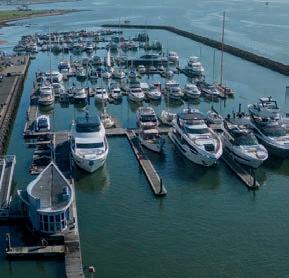





Relax with a glass of wine, on a sunny afternoon, on your own swinging mooring in Poole Harbour overlooking Brownsea Island. Away from the madding crowd, these offer you ultimate privacy, peace & tranquillity.
PORT OF POOLE
PORT OF POOLE
PORT OF POOLE MARINA
PORT OF POOLE

125 visitor berths all year for vessels up to 75m in length and up to 4.8m draft
On the Port estate we can accommodate vessels up to 210m in length with a maximum draft of 9m.