








300 + PAGES I HARDCOVER I LARGE FORMAT
120 STUNNING WHOLE FOOD RECIPES


Food, at its core, is beautifully simple. Good quality, whole ingredients can be transformed into something wild and magical when flavours collide. It awakens the senses, transports us through space and time, and turns the ordinary into the extraordinary. It taps into our deepest emotions and reminds us of who we are and how we love.
Choosing whole foods doesn’t mean going without. It means leaning in and getting curious. It means trading the processed and predictable for naturally delicious and playful. A chance to explore colour, texture, and flavour at their peak, alive with the taste of season and story.
A cut of meat you’ve never tried, a fruit rind you thought was trash, or a homemade sauce so good, it becomes your new signature. Cooking this way invites play and discovery, and it keeps your mind wildly aware and your connection to the natural world beautifully intact.
Find Nourish: Adventuring with Whole Foods at your local natural health retailer or scan for more information.
98


We’re empowering the next generation of soccer leaders through the TELUS She CAN Coach program, which recruits and trains women coaches, building confidence and leadership that extends both on and off the field.
By supporting more than 1,000 coaches in the first three years, we’re fostering a more inclusive culture and ensuring diverse voices shape the game, from local fields to the global stage.
Let’s raise the game, together. telus.com/soccer
11. INBOX
A Burnaby startup is turning taboo men’s health issues into a fastgrowing, quietly profitable business.
15. GO FIGURE
From job growth to apprenticeship rates, the numbers reveal where women stand in Canada’s trades—and how far there is to go.
16. BUSINESS CLIMATE
As AI demand surges, B.C. is weighing the economic promise of data centres against their massive energy footprint.
18. LAND VALUES
A wave of court-ordered sales is reshaping the real estate market— drawing in deep-pocketed developers and bargain hunters.
22. SMALL TOWN SUCCESS
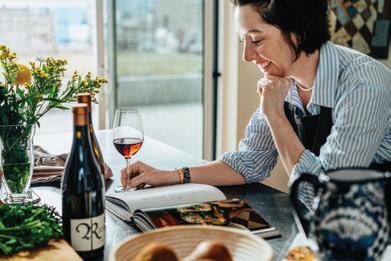
In the Okanagan, women are rewriting the rules of winemaking.
91. THE PIVOT
How a travel writer gave up her steady corporate marketing gig to chase stories around the world.
93. SOCIAL CUES
The Vancouver bedding brand flipping social media’s hustle culture on its head—one cozy post at a time.
94. INVENTORY
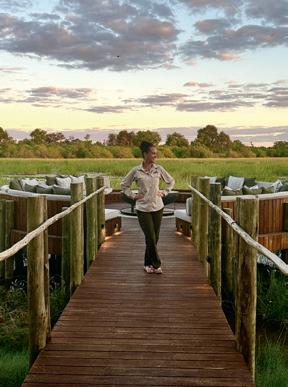
Cleaner homes, smaller footprints: six B.C. brands leading the natural home movement.
96. CARRY ON
A new generation of farmers is pairing hospitality with harvest in the Cowichan Valley.

24. ANCHORED INNOVATION
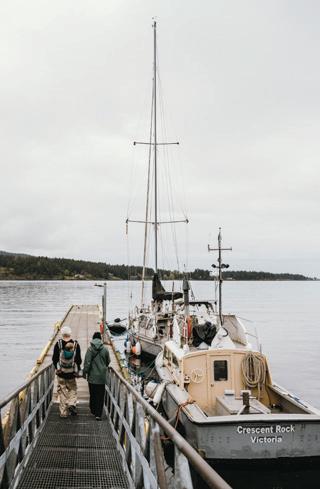
Inside the B.C. company transforming cruise ships into floating hotels for workers in the world’s most remote places—as well as here at home.
31.
THE PROSPECTING PARADOX
Prospectors drive discovery, yet delays and labour gaps are slowing the race for critical minerals in B.C.
38. FROM TIDE TO TARMAC
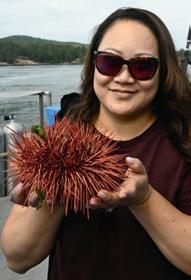
A fast-growing trade corridor is redefining B.C.’s seafood industry.
44.
WOMEN OF THE YEAR
Spanning industries and generations, our 7th annual Women of the Year celebrates 23 standout leaders in the province.
79.
GETAWAY GUIDE
From Sooke to Mayne Island and the Sunshine Coast: your curated guide to B.C.’s best low-stress escapes.
PLUS
98. MONEY MAKERS
Side hustles and smart trade-offs are helping one Gen Z arts and culture worker make it in Vancouver.

Graham Templeton is a Vancouver-based freelance science and tech writer. In this issue of BCBusiness, he speaks with B.C.’s mining entrepreneurs as they navigate an industry full of both promise and precarity— including one founder who took a job at a pet store while building a company with the potential to generate millions. As questions of national sovereignty and supply chain independence bring critical minerals into sharper focus, Templeton probes if B.C. is truly ready to meet the moment (p.31).

Kerri Donaldson is the assistant editor of sister publications Vancouver magazine and Western Living, where she covers arts, culture and design across Western Canada. For this issue, Donaldson got to know the remarkable women in our 2026 Women of the Year list (p.44)—from Tamara Vrooman, the steady force behind YVR, to Taylor Hui, supporting girls and non-binary youth, and BC Hydro CEO Charlotte Mitha, whose leadership story began at Nuffy’s in Vancouver’s Kitsilano neighbourhood.
CEO & GROUP PUBLISHER Ryan Benn
GROUP VP, PUBLISHING & OPERATIONS Nina Wagner
EDITORIAL
VICE PRESIDENT, CONTENT Anicka Quin
EDITORS-IN-CHIEF Darcy Matheson (BCBusiness), Stacey McLachlan (Vancouver magazine), Anicka Quin (Western Living)
SENIOR EDITOR Mihika Agarwal
MANAGING EDITOR, FOOD & CULTURE Kristi Alexandra
MANAGING EDITOR Dani Wright (on leave)
ASSISTANT EDITOR Kerri Donaldson WINE AND SPIRITS EDITOR Neal McLennan
CONTRIBUTING EDITORS Frances Bula, Melissa Edwards, Michael McCullough, Jennifer Van Evra, Riley Webster EDITORIAL INTERNS Gabe Liessi, Shanley Tran, Yashika Vahi, Saskia Wodarczak EMAIL bcb@canadawide.com
DESIGN
CREATIVE DIRECTOR Jenny Reed
ART DIRECTOR Stesha Ho (Vancouver magazine and BCBusiness)
DIGITAL
VICE PRESIDENT, DIGITAL Darcy Matheson
DIGITAL MARKETING MANAGER Rebekah Ho
BRAND PARTNERSHIPS & DIGITAL COPYWRITER Sandrine Jacquot
ADVISORY COUNCIL
Angus
Gary Pooni, Pooni Group; Audrey Plaskacz, Bosa Properties; Ken Tsui, Telus Originals; Greg Zayadi, Rennie
SALES REPRESENTATION
VICE PRESIDENT OF SALES Anna Lee
VICE PRESIDENT, CUSTOM PUBLISHING & AGENCY SERVICES Chad Brealey
SENIOR MEDIA SPECIALISTS Brianne Harper, Mira Hershcovitch, Cathy Huynh, Sheri Stubel EMAIL sales@canadawide.com
PRODUCTION/ADMINISTRATION
GROUP VP, EDUCATION AND ADMINISTRATION Jane Griffiths
OPERATIONS MANAGER Emily Heffring
DIRECTOR OF CIRCULATION Tracy McRitchie
EXECUTIVE ASSISTANT & EVENT PRODUCER Julie Fisher
EVENTS & OFFICE MANAGER Julia Jarman
PRODUCTION MANAGER/DIGITAL AD COORDINATOR Kim McLane
PRODUCTION ASSOCIATE Natasha Jayawardena
PRODUCTION SUPPORT TECHNICIAN Ina Bowerbank CUSTOMER SERVICE Kelly Kalirai
FINANCE
GROUP VP, FINANCE Conroy Ing, cpa, cma VP OF FINANCE Sonia Roxburgh, cpa, cga ACCOUNTING Terri Mason, Eileen Gajowski

ADDRESS Suite 130, 4321 Still Creek Drive, Burnaby, B.C. V5C 6S7 TEL 604-299-7311 FAX 604-299-9188 WEB bcbusiness.ca EMAIL sales@canadawide.com
Phone 604-299-7311; fax 604-299-9188.
For subscription info, call 604-299-1023 or email: bcbsubscriptions@canadawide.com. B.C.

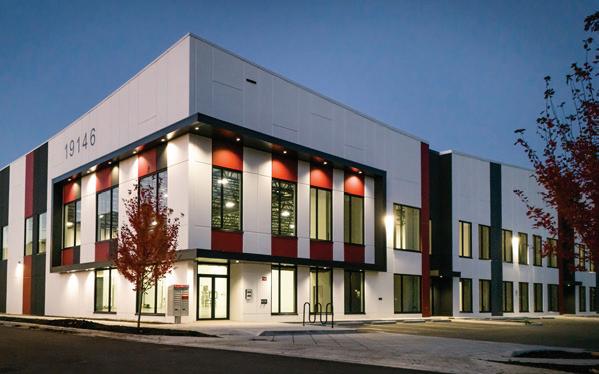
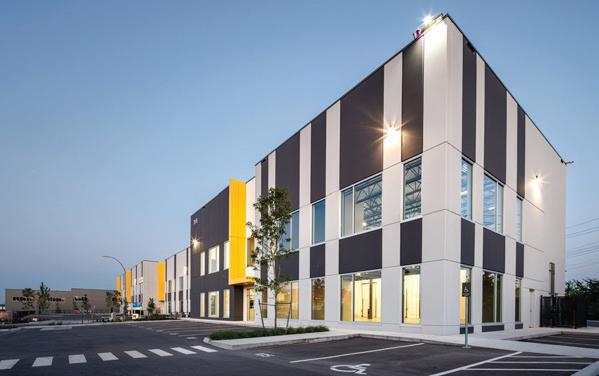
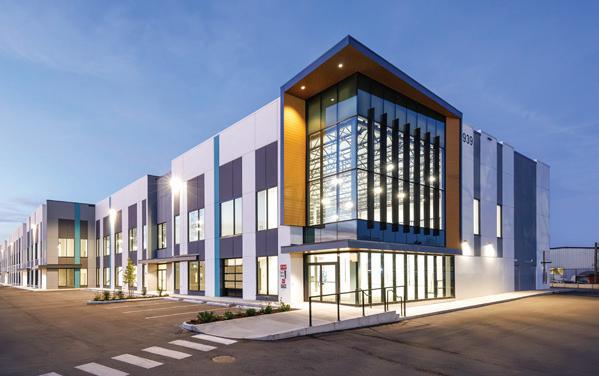
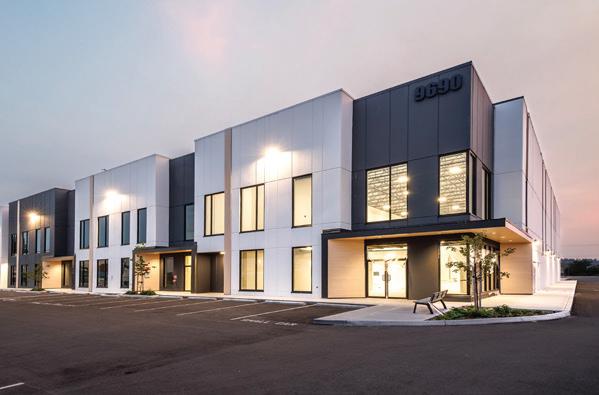
Your next business move starts in Surrey.
Beedie’s new industrial strata units in Newton and Port Kells are designed for efficiency and ready for occupancy. With premium warehouse spaces from 6,700 to 14,800 SF across four developments, these ownership opportunities offer the flexibility and location today’s modern businesses need to grow.
Whether expanding, relocating, or investing, now is the time to secure your spot along one of Metro Vancouver’s most active industrial corridors.
Jane Stoller recognized something that a lot of us do at some point in our mid-life: we just can’t (and probably shouldn’t) drink like we used to. Hangovers and disrupted sleep came quickly even after a few cocktails, she found, and the day-after jetlag feel just wasn’t worth it, especially in her high-stakes consulting career. That said, she still wanted to feel like she was celebrating and have something fun in her hands to drink when she was out for dinner, a charity event or a night on the town with pals. So that’s when the idea for her non-alcoholic sparkling wine was born.
Now roughly a year and a half in business, the Whistler founder’s de-alcoholized
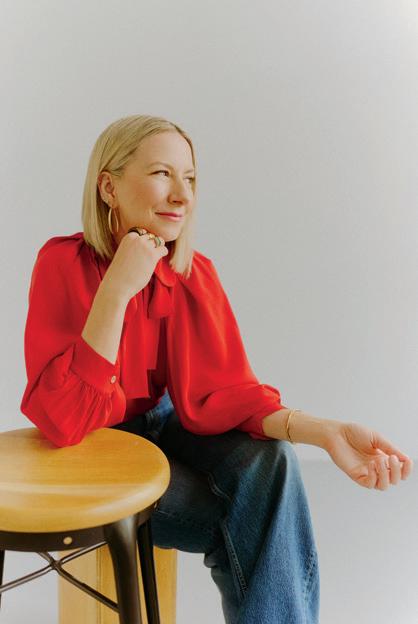
DARCY MATHESON Editor-in-Chief bcb@canadawide.com
chardonnay, Glimmer, has taken off. Besides the fact she’s entered the marketplace at a moment in time when the non-alcoholic category is absolutely launching into the stratosphere (check out the mocktail list at your favourite eatery these days if you need more evidence), Glimmer is now carried in 250 locations in B.C. and she just closed a $500,000 funding round in under two weeks, with fans and investors alike rabid to be a part of the movement.
Stoller is one of the 23 winners being honoured in this year’s BCBusiness Women of the Year list (coverage starts on page 44). Our 2026 cohort is as impressive as it is diverse: a leadership coach empowering women through their biggest life changes, a philanthropist behind a landmark project to house single mothers, an aviation pioneer, a finance guru and many more.
Since I took the helm of BCBusiness almost exactly a year ago, our Women of the Year program is what I’m most proud of. Being able to showcase the powerhouse women in our province making incredible moves and literally changing B.C. for the better isn’t just an honour (although it really is, truly), it’s awe inspiring for me—and it’s something I hope will inspire you, too, as you dive into the stories of these winners.
Admittedly, the list was not easy to put together. We had a record number of nominations from across the province—more than 200—and the competition was fierce. Our June event at Terminal City Club sold out before we could even put out a public invite (and, yes, we hear you: the 2027 venue will be larger so more people can attend). And if you know a rock star in the world of B.C. business, please nominate them next year—we’d love to share their story.
12,000
Kilometres that a Vancouver Island Fanny Bay oyster travelled to be sold at a high-end seafood market in Singapore. We dive into YVR’s growing role in the seafood export surge on page 38.
$750 million
Value of mining exploration in British Columbia last year. In the first of our threepart series on the booming industry, we look at the prospectors and junior mining firms that are the key to the province’s future resource extraction success, starting on page 31.
600
Workers being housed on the MV Isabelle X floating hotel— or floatel—at the Woodfibre LNG site in Squamish. On page 24, reporter Dee Hon tours the retrofitted cruise ship and takes a deep dive into Bridgemans’ accommodations, which are serving some of the world’s most remote work locations.
Premium workforce accommodations for the most challenging locations.
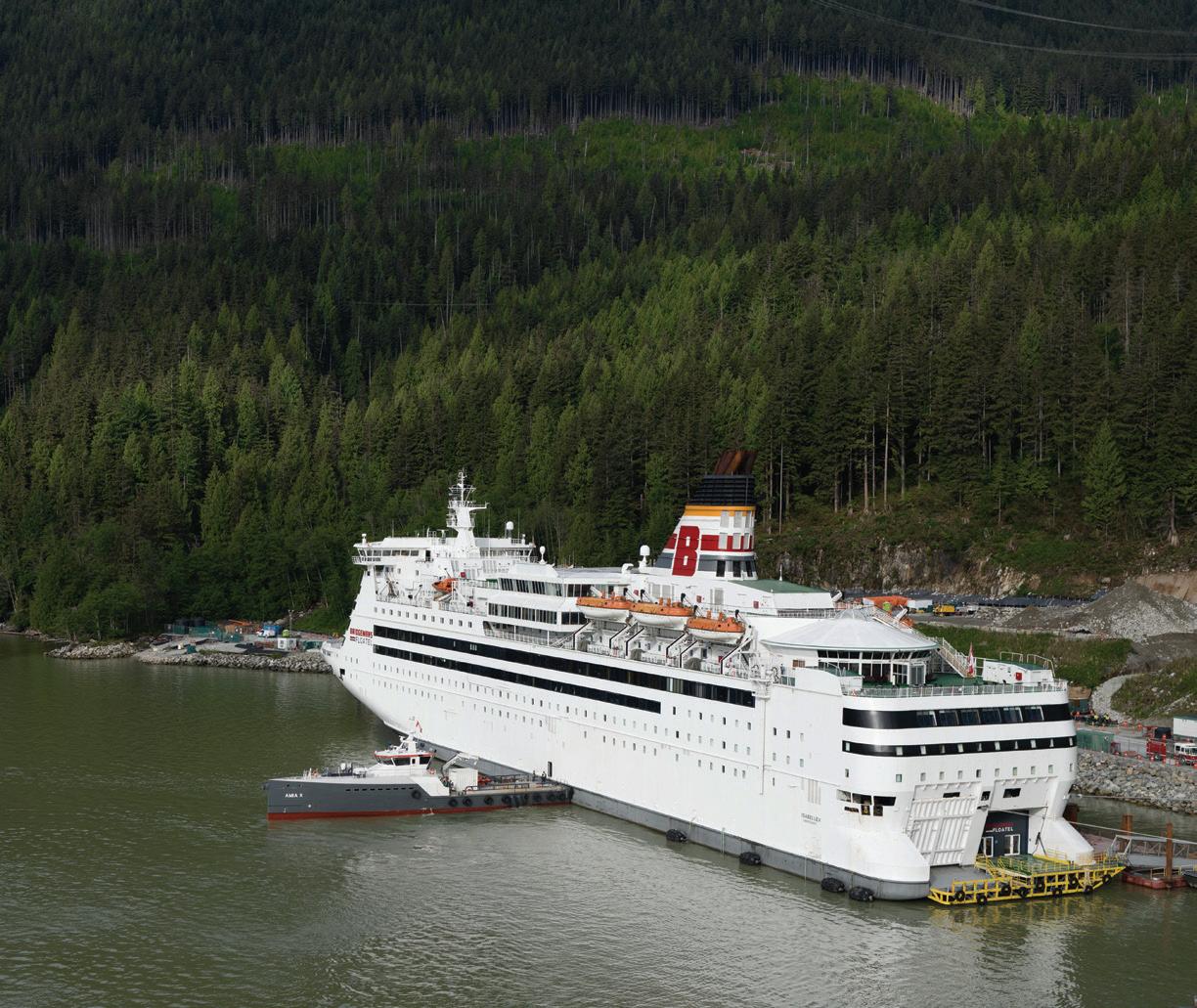
Bridgemans is the driving force behind your most ambitious marine projects. With deep industry experience and a hands-on approach, we provide a fully integrated system with three divisions: Bridgemans Floatels, Marine Services and Marine Construction.
With relentless attention to detail, Bridgemans Floatels are elevated in every aspect, customized to client specifications and held to the standards of a premium hotel. To expand our ability to deliver in even the most remote and challenging environments, our Marine Services and Marine Construction divisions provide marine transportation as well as construct docks, berths, breakwaters, and more. Bridgemans brings precision and an unwavering commitment to every project — Turning your ambition into real-world results.


Current and completed floatel projects.



























































GETTING “TESTE”
Mat Rezaei and Ramin Behzadi’s testosterone-replacement therapy operation does brisk business.
As stigma keeps many men silent about hair loss, erectile dysfunction and testosterone decline, Upguys is scaling a health business designed to bring those conversations—and treatments—into the mainstream.—
By Rob Shaw
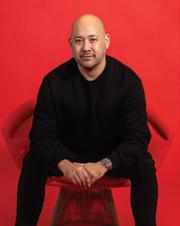
WHEN MAT REZAEI began approaching the age of 40, he noticed something odd: men were willing to whisper about hair loss, weight gain, challenges in the bedroom and testosterone loss, but few people were building a legitimate medical business to treat those issues.
At the time, for men, addressing their sexual health often meant trawling shady overseas websites and hoping the pills that arrived were real.
Rezaei, a Vancouver-based pharmacist, saw an opening to serve the roughly 50 percent of men 50 and over who have noticeable baldness and some degree of erectile dysfunction. He started working on a plan to merge what were then the relatively new areas of telemedicine and digital pharmacies into a new men’s health platform.
“The seed of the idea was combining a clinic, the best research, the lab results, as well as pharmacy technology, and come up with a solution for men,” he says. “Selfishly, I was thinking about myself.”
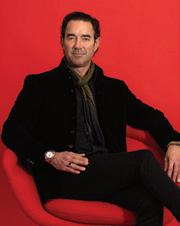
He partnered with entrepreneur Ramin Behzadi to figure out how to comply with all the byzantine medical licensing and privacy requirements of the different Canadian provinces, putting together a business model and technology platform that was ready to fly—just before COVID-19 hit.
Overnight, the pandemic ushered in a new frontier of digital medicine.
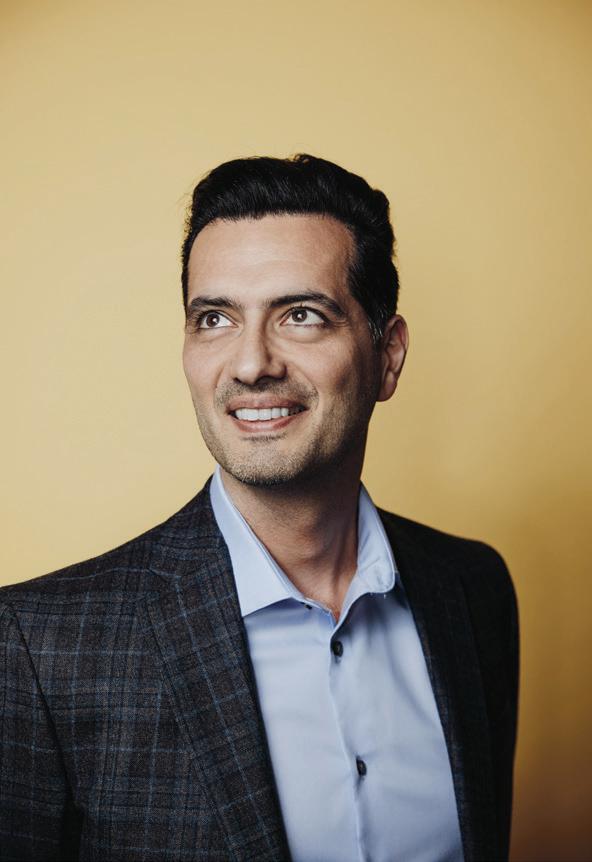
The seed of the idea was combining a clinic, the best research, the lab results, as well as pharmacy technology, and come up with a solution for men.
Selfishly, I was thinking about myself.”
MAT REZAEI , FOUNDER AND CEO, UPGUYS
And from it, Upguys was catapulted into launch.
The Burnaby-based business was positioned to get an early jump on what has since ballooned into a surging men’s health and wellness industry, one that’s estimated to reach $5 billion in Canada and $2.88 trillion (U.S.) globally by 2030.
Upguys now has more than 50,000 active patients in six provinces, more than $25 million in annualized revenue, two years of profitability under its
belt and a year-over-year growth rate of more than 50 percent.
Last year, the Globe and Mail ranked it second in the health-care category for fastest growing companies in Canada, with an impressive three-year revenue growth of 3,052 percent.
Upguys’ Burnaby headquarters sits in an unremarkable business park, wedged between an engineering consulting firm and a water purification business. Perhaps it is fittingly low-profile for a company built on discretion.
It also remains a lean operation, with around 50 employees. Upguys hasn’t had


































to go to the market to raise capital. Behzadi says it has a scalable model.
“So far our focus was to find and identify the eligible customers, bring them on board and cater to them,” he says. “Interestingly, there has been a huge growth factor coming from word of mouth from all these patients we’ve brought to the system.”
Online men’s health has become a crowded marketplace. In Canada, Phoenix, Rocky Health and Hims and Hers have a large online presence, while in the United States sites like BlueChew, Hims and Rex MD are visible major brands with large-scale marketing campaigns.
But unlike the many venture-backed telehealth startups that outsource prescribing and dispensing, Upguys owns two pharmacies, giving it control over margins, supply chain and compliance.
It has also pivoted into the fastest-growing segment of the market, testosterone replacement therapy (TRT), which can help men address the fatigue, libido, muscle mass loss and weight gain issues that can arise as the body gradually loses testosterone after 40.
A key selling point of Upguys, compared to its competitors, is that there are no monthly fees or per-appointment charges to speak to a doctor or health-care practitioner.
“The way that our pricing model works is we do not charge for anything until the medication is prescribed, and [we] only charge for the medications,” said Rezaei. “I don’t know any other platform doing that.”
For patients, it also means physician visits covered by MSP using Upguys’ medical partners, and lab work paid for under the public health-care system. There are phone calls from medical staff and follow-up appointments in-between regular testing, all without fees. It does not require a doctor’s referral, or for a patient to even have a family doctor. That’s key when many British Columbians, especially in rural areas, don’t even have a physician. In short, it’s not a one-and-done pill shipment service.

So far our focus was to find and identify the eligible customers, bring them on board and cater to them. Interestingly, there has been a huge growth factor coming from word of mouth from all these patients we’ve brought to the system.”
RAMIN BEHZADI , CO-FOUNDER, UPGUYS
There’s also a high rate of denials for people wanting to join—upwards of 40 percent, says Rezaei. That’s because acceptance to testosterone therapy requires actual test results to show that it’s needed.
“We are not talking about a supplement; we are talking about hardcore medications. Testosterone is one of the most effective medications for men,” says Rezaei.
“It is a high rate of denial for a reason: we are dealing with potential life-saving, life-changing medications and we need to make sure your body can tolerate that for the long-term.”
Upguys now runs offices in Vancouver and Toronto, with plans to open another space in Montreal later this year. But the headquarters will remain in Burnaby. “We live in B.C. and love B.C.,” says Rezaei.
The goals of the co-founders for 2026 are expanding brand awareness and scaling patient acquisition through broader marketing initiatives that explain how their health-care-first model is different from fly-by-night online operators. While their online campaigns have catchy slogans—with suggestive imagery of hands interlocked in passion—they lack the reach of competitors. Rezaei says adds that the company has historically relied on digital growth channels and product-led growth rather than on large traditional advertising campaigns.
Still, Upguys is already financially successful. For Rezaei, however, success also comes from normalizing men’s health for men in their 40s, like himself.
“The way I judge it is by the big difference we feel we are making in Canadian men’s lives,” he says. “I’m so disappointed in the [health] system that discourages testing for men in our case, but [also] for everyone. Why should we keep people in the dark?”
In an industry long driven by stigma, Upguys is betting that transparency is good medicine. And good business.
Despite the advances in management, leadership and technology showcased in this issue, women remain glaringly underrepresented in the skilled trades. Here we take a statistical snapshot of tradeswomen in B.C. and Canada.
By Michael McCullough
There are 1 0, 1 34 women in construction trades in B.C., representing 5.3% of the provincial industry workforce as of October 2025. Though small, this proportion is higher than the national average and reflects a year-over-year increase of 600 workers.
As of 2024, 2 1 8,200 women worked in Canada’s construction industry, accounting for 1 3.6% of the national industry workforce. Women tend to be clustered in administration and management, however, and occupy just 4% of skilled trades positions.
The B.C. government forecasts 83,000 new trades job openings over the next decade.
Percentage of registered apprentices in B.C. who are women
Sources: Statistics Canada, Government of B.C., B.C. Construction Association, LNG Canada, BuildForce Canada, Canadian Standards Association
Are data centres a boon for B.C., or overhyped energy hogs?
By Jennifer Van Evra

It’s not the kind of business many would expect to roll into a small logging town after the mill has closed down.
But when data centre company IREN goes looking for a new location, B.C. towns that used to host large sawmills and pulp mills tick a lot of boxes: they typically have available land, abundant renewable energy, the electrical infrastructure to support large industrial users, a population looking to work and a climate that’s well-suited to data centre operations.
“We’re able to come in and bring with us a lot of economic activity, because the construction of these facilities is very extensive, and you need a large number of people,” says Kent Draper, chief commercial officer of IREN, an Australian company that operates data centres in Prince George, Mackenzie and Canal Flats and has its North American headquarters in Vancouver. “And then [we’re] creating ongoing, permanent operational jobs in those communities that are to some extent future-proofed, because these are right at the bleeding edge of the IT world.”
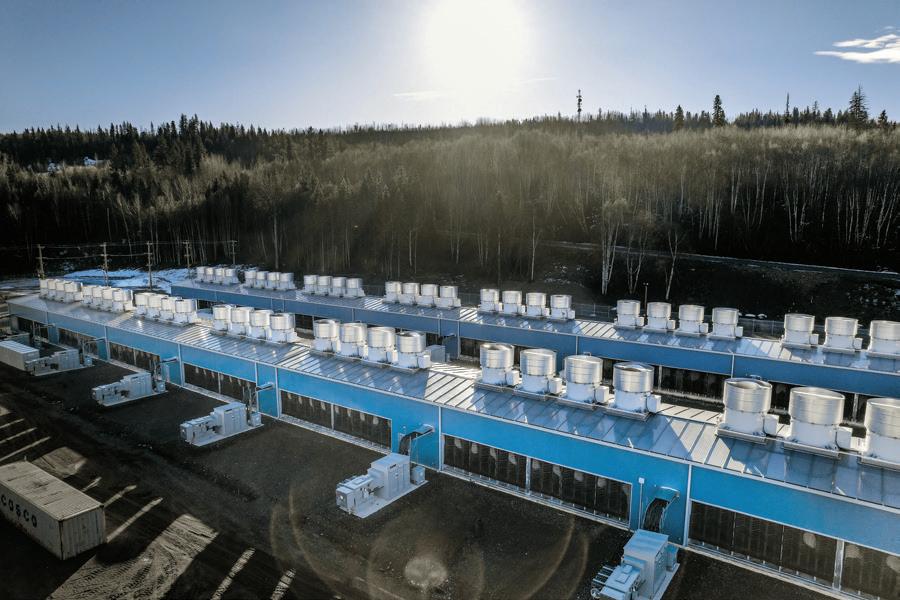
And they are. Until recently, the vast majority of “compute usage”—that is, computational resources used over a specific period—was driven by AI labs training large language models. Now, more and more people and businesses are running queries on those massive models, says Draper, which has sent compute demand into the stratosphere.
“You get these exponential growth curves in the digital world, and we had identified that the real-world infrastructure to support it was likely to lag behind,” says Draper. “So that’s all kind of playing out, which is nice to see—and probably faster than anyone ever expected.”
Still, there are headwinds. When it comes to electricity hogs, data centres are among the most ravenous: a 2025 report from the International Energy Agency shows that global electricity demand from data centres is set to more than double by 2030, with electricity demand for AI-optimized data centres projected to quadruple.
In the U.S., power consumption by data centres is expected to make up almost half the growth in electricity demand between now and 2030; at the same time, the U.S. is also on track to use more electricity for data processing than for all the manufacturing of aluminum, steel, cement and chemicals combined.
As a result, jurisdictions around the globe are starting to retract the red carpets they once rolled out for data centre companies, primarily due to concerns over grid stability, electricity prices and water usage.
In Ireland, where data centres accounted for a whopping 22 percent of power consumption in 2024, new centres face strict limits unless they can generate their own power, 80 percent of which must be renewable.
From 2019 to 2022, Singapore temporarily halted the development of new data centres over energy and land use concerns; now, new projects have to meet strict efficiency standards. After rapid hyperscale expansion, countries from the Netherlands to China are moving to rein in energy-hungry hubs.
In B.C. last year, Nanaimo residents made headlines when they spoke out against a proposed 200,000-squarefoot Maplecolo data centre over concerns the power and the water needed would impact local infrastructure and habitat. (That proposal is still in the works.)
B.C. isn’t constraining data centres as tightly as some other locales, but the provincial government recently passed legislation that put a firm lid on their energy usage. Then, in January, the government and BC Hydro launched a competitive process for new AI and data centre projects, and allocated up to 400 megawatts of power—more than a third of the total capacity of the Site C dam—for the first two years.
Adrian Dix, the province’s minister of energy and climate solutions, says the centres will be selected on merit—no longer first-come-first-served—and priority will be given to companies that are most competitive
“We want these industries. But the power concerns are real, and it’s different than, say, a mine that’s developed over eight to 10 years. We’re going to see a growth in demand, and we’re going to have to build a lot more electricity. And in this world that we’re in, it needs to be clean electricity.”
ADRIAN DIX , MINISTER OF ENERGY AND CLIMATE SOLUTIONS

on price, create jobs, keep data in Canada, involve First Nations and prioritize environmental measures such as heat recovery.
At the same time, the push to electrify everything from cars to home heating to industry is also ramping up, and that, along with population growth, is expected to significantly increase electricity demand. But Dix says data centres represent a big economic opportunity, and 10 new power projects that are likely to double the power of Site C will be brought online to help meet the growing demand.
“We want these industries. But the power concerns are real, and it’s different than, say, a mine that’s developed over eight to 10 years,” says Dix, explaining that data centre development happens at a much more rapid clip. “We’re going to see a growth in demand, and we’re going to have to build a lot more electricity. And in this world that we’re in, it needs to be clean electricity.”
UBC Sauder School of Business associate professor Werner Antweiler has been watching the worldwide proliferation of data centres, and he isn’t sold. “Everybody talks about AI, and everybody wants to experiment with it, but when it comes down to where you see it generating actual output and value, it’s pretty slim,” he says.
The centres offer limited job opportunities, he adds, and the power they gobble up could be used more effectively elsewhere.
What’s more, the equipment and servers are typically imported, and much of the data ends up outside Canada; there’s also no telling where the technology will go in the coming years, so data centres could be a technological flash in the pan.
Antweiler believes the provincial government’s 400 megawatt cap is generous, but he supports the move, as well as the province’s now-permanent ban on allowing crypto miners to connect to the BC Hydro power grid. Still, he says, he would like to see more environmental planning around waste heat, and he’s concerned about the water usage, which could drive water rates and scarcity as drought conditions worsen.
“AI data centres are proliferating everywhere because companies are throwing gazillions of dollars at this capacity, and there’s not much thought on the impact,” says Antweiler. Part of the problem, he adds, is that leaders think, “Everybody’s doing it, so we have to do it too,” when AI’s broad usefulness, and sustainability, have yet to be firmly established.
“It’s a new thing, and there’s a lot of hype. And when I look at AI, what does it really deliver? There are some actual solutions that work, like transcription and in some applications like chemistry,” he says, referring to pharmaceutical development. “But I think people have been watching too much science fiction. I read a lot of science fiction too, but we have to be mindful of what’s fiction and what’s reality.”
With all the uncertainty roiling the Lower Mainland’s real estate market, Gordon Wylie and his partner Jeff Brown at NorthStar Developments weren’t planning to take on another venture while they were still in the middle of building their six-storey Porthaven apartment building next to Port Coquitlam’s city hall.
But then a project nearby stalled after its developer—like many in the region over the last two years—ran into trouble and the site (where crews had gotten as far as building the parkade) was put up for a court-ordered sale.
NorthStar picked up Quarry Rock Development’s “The Met” property for an attractive $11.6 million—less than its assessed value and nowhere near the $23 million owed to 57 creditors.
While that was bad news for the bank that lent Quarry Rock its money and for the unpaid contractors who worked on the project, it meant that NorthStar could plan for housing that had a better chance of bringing a new level of affordability to Port Coquitlam. And it would also contribute to creating a noticeable urban centre for this small municipality.
“We realized there was a hole in downtown Port Coquitlam that had sat there for two years. It was not good for Poco or for downtown,” says Wylie.
Sales at their Porthaven project had gone well in the spring of 2024, with 70 percent of buyers being locals who wanted to stay local. Because of that, Wylie figured there was an appetite for more, but at even lower prices than Porthaven.
While that project was marketed at around $950 to $1,000 per square foot, the re-designed Met project, now renamed Livy, is being offered for less than that, with small studios going for as low as $299,000. Livy’s new concept echoes that of some of the hip new budget hotels appearing in Europe and North America—a small living space, with lots of communal extras in the building: co-working pods, on-floor storage, a wellness spa with a cold plunge pool and hot tub, a virtual golf lounge, to name a few.
As debt-plagued developments move into court-ordered sales, well-funded bargain hunters are circling, hoping to capitalize on a historic market downturn.
By Frances Bula
Sounds great, you’re thinking. Yay for the region’s beleaguered buyers, you’re thinking. Why not do that with the many sales of distressed development properties that are popping up throughout the region and finally get some cheaper housing onto the market?
Well, that is happening in some cases. But brokers are noting that even foreclosed-on sites that are being offered sometimes for significantly less than their presumed value have seen sales slow down in the last year. NorthStar bought the Livy property in November 2024 when there was some hope across the development industry that declining interest rates would bring buyers back to the market.
But 2025 was bleak, so bleak that even bargain-basement prices aren’t enough to entice the still-healthy developers off the sidelines. Bids are coming in below the debt levels on projects that have run into trouble in the last year. And there seems to be no end in sight.

“This is a monumental re-set,” says Mark Goodman, whose brokerage specializes in apartment and multi-family development sites. The company has a list of court-ordered sales on projects from Vancouver to Langley that it’s working on. “We’re going to see continuing pain and more distressed sales for at least two years. And the price is going to have to be significantly lower.”
At the Vancouver Colliers division that deals with foreclosures, court-ordered and desperation sales, it’s the same story.
“Until early 2025, we had several land sales in distress that resulted in multiple competing offers when presented to court for approval. In the early part of last year, there was greater optimism that the market would recover. This has stalled with uncertainty remaining on where pricing is going to land,” says Jennifer Darling, associate vice-president.
The two dozen or so well-capitalized Vancouver-area development companies that didn’t overextend themselves, didn’t have to rely on personal guarantees to get financing and didn’t get multiple lines of financing on the same property are definitely looking around at good deals, as always happens among the well-off during downturns. When the 2008 global financial recession hit the U.S. and Canada, for example, Vancouver developer Rob Macdonald made a point of hunting out attractive but half-built and in-trouble sites, especially in the U.S.
There weren’t a lot of foreclosures in Vancouver in 2008 and 2009 because the housing downturn lasted such a short time here. That’s not the case this time, where many developers are saying the current collapse of construction and sales is the worst they’ve seen in their lifetimes.
In spite of that, a few of the larger developers are still “out looking at opportunities, looking for the best deal,” says Darling. Those developers want to keep their construction teams intact and they’re doing what developers often do in a downturn—use the time to prepare for the inevitable upturn.
Among them is Landa Global Properties, which has been operating in Vancouver for about 15 years, building mostly smaller,
High‑stakes transactions demand clear judgment. When you need to buy, sell, or restructure a business, we provide strategic legal guidance grounded in commercial reality. From ambitious startups to established enterprises, we support confident decision‑making in select areas of business law:
• Commercial Real Estate & Development
• Corporate/Commercial
• Lending/Insolvency

• Litigation/Arbitration/Dispute Resolution
• Securities/Corporate Finance/Mergers & Acquisitions
• Tax/Trusts


CONDO COMEBACK
NorthStar Developments purchased “The Met” for less than half of what the development project owed to creditors, reimagining it as Livy.

luxury lower-rise apartment buildings, although it currently has a tower under construction at Alberni and Denman in Vancouver and another in Surrey.
Like NorthStar’s Wylie, Landa CEO Kevin Cheung (speaking to BCBusiness from a chairlift at Whistler) says that his company is acquiring distress properties strategically, sites that are either close to where they’ve been building already or have some other feature that makes them look viable.
“We have to deal with all the skeletons in any project,” says Cheung. Even if a project is partway built, “it takes the same amount of work” to get it to completion as something fresh off the drawing board.
Landa has acquired three distressed properties in the last year: Siena, with 38 apartments in a luxury low-rise building in Burnaby Heights; Park & Granville in South Vancouver, which consists of 17 upscale townhouses; and Theodore, a long-empty lot in Vancouver’s Kerrisdale neighbourhood, which will become a four-storey mixed use development.
This is a monumental re-set. We’re going to see continuing pain and more distressed sales for at least two years. And the price is going to have to be significantly lower.”
MARK GOODMAN , PRINCIPAL, GOODMAN COMMERCIAL INC.
Cheung, who grew up in Vancouver but whose father was a major developer in China, says his company is in a better position than some because it didn’t get overextended.
“The ones who are over-leveraged are the ones who got in trouble. We do not have mezz [mezzanine] debt or second mortgages.”
He’s not kidding himself that the current pain in the real-estate market—which has made buyers even more wary as they see pre-sale condo projects failing—is over.
“Right now, people have such a bad feeling about pre-sales,” he said.
In spite of that, there is still demand in certain neighbourhoods at certain prices, he believes.
As to when things will get better, Cheung and everyone else is still trying to guess at where the bottom is and not coming up with any solid predictions.

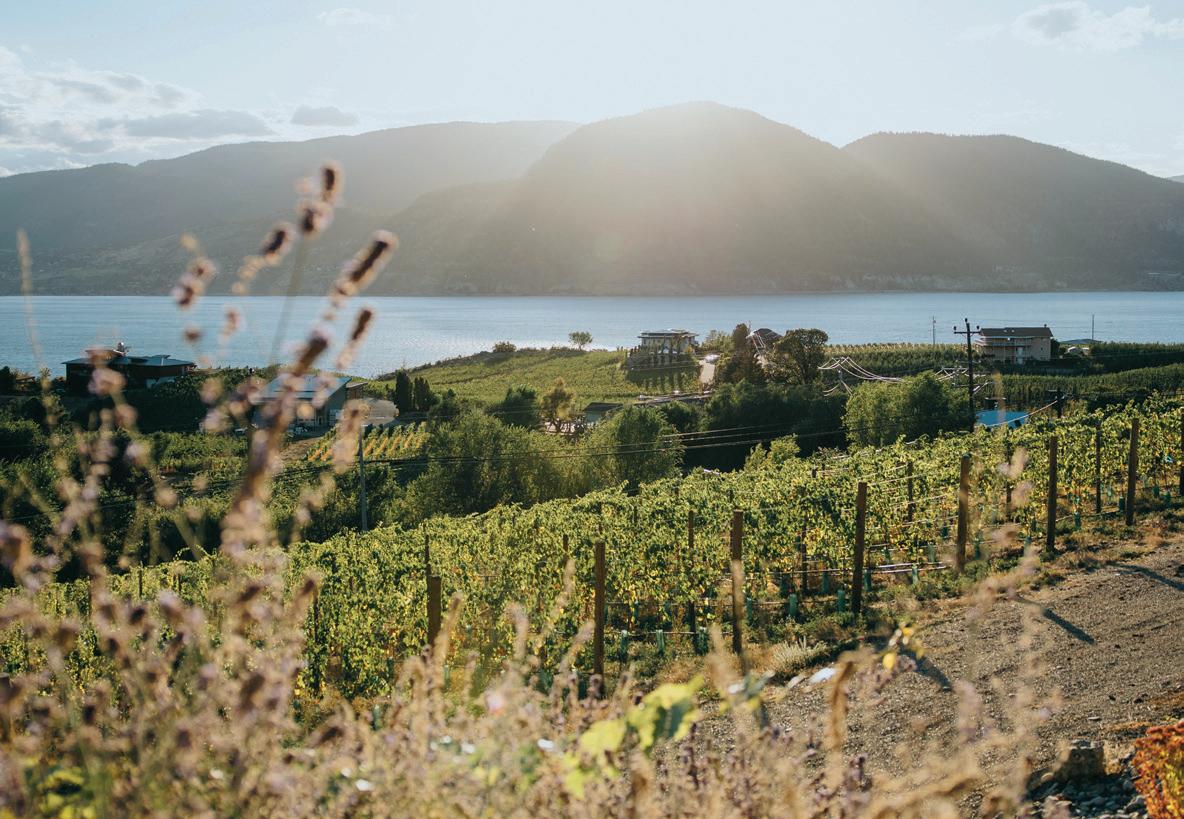
Climate pressure and generational change are reshaping the Okanagan wine industry—and a cohort of women is leading the response. Some draw on deep-rooted -family legacies; others have arrived via global cellars or hard pivots from entirely different careers. What unites them isn’t pedigree but pragmatism: a readiness to adapt, a bias toward collaboration and a determination to redefine what Okanagan wine can be.
By Riley Webster
Gina Fernandes Harfman grew up on her family’s orchard-turned-vineyard in Osoyoos, learning early that farming demands patience, hard work and respect for the land. In 2009, she tried winemaking for the first time, crafting a gewürztraminer and a merlot for a family event. “I used hand-pinstriped labels for 350 guests and something clicked,” she shares. “The blend of artistry and agriculture felt like home.”
That sparked an unexpected career pivot from airbrushing classic cars to becoming assistant winemaker at Oliver Twist Estate Winery. Soon after joining—at age 32 and with a newborn—she received an offer from the owners to buy the business and she accepted.
In 2021, she rebranded the operation as Nostalgia Wines, which was voted third-best small winery in the 2024 WineAlign National Wine of Awards of Canada. Harfman believes that success doesn’t always follow a linear path, and that passion, perspective and trust can turn a small business into something unique.
Roche Wines | PENTICTON
Coming from six generations of winemaking in Bordeaux, France, Pénélope Roche set out to build something from scratch. When she found the Okanagan, it felt “like possibility,” she says—“a place where the story wasn’t finished yet.”
Her early experiences there reminded her of Bordeaux decades ago: agricultural, humble and still defining itself. “It felt like a place where you could listen to the land and help shape the identity instead of inheriting one.”
At Roche Wines, which she runs with her husband Dylan, that philosophy translates into a commitment to organic farming and longterm thinking.
But climate volatility has made adaptability essential. “Every vintage feels like a negotiation,” she says. “Frost, smoke and heat domes force you to adapt quickly—creativity becomes survival.”
For Roche, the goal is collective: that one day, people will recognize a distinct Naramata Bench taste—one that they helped shape.
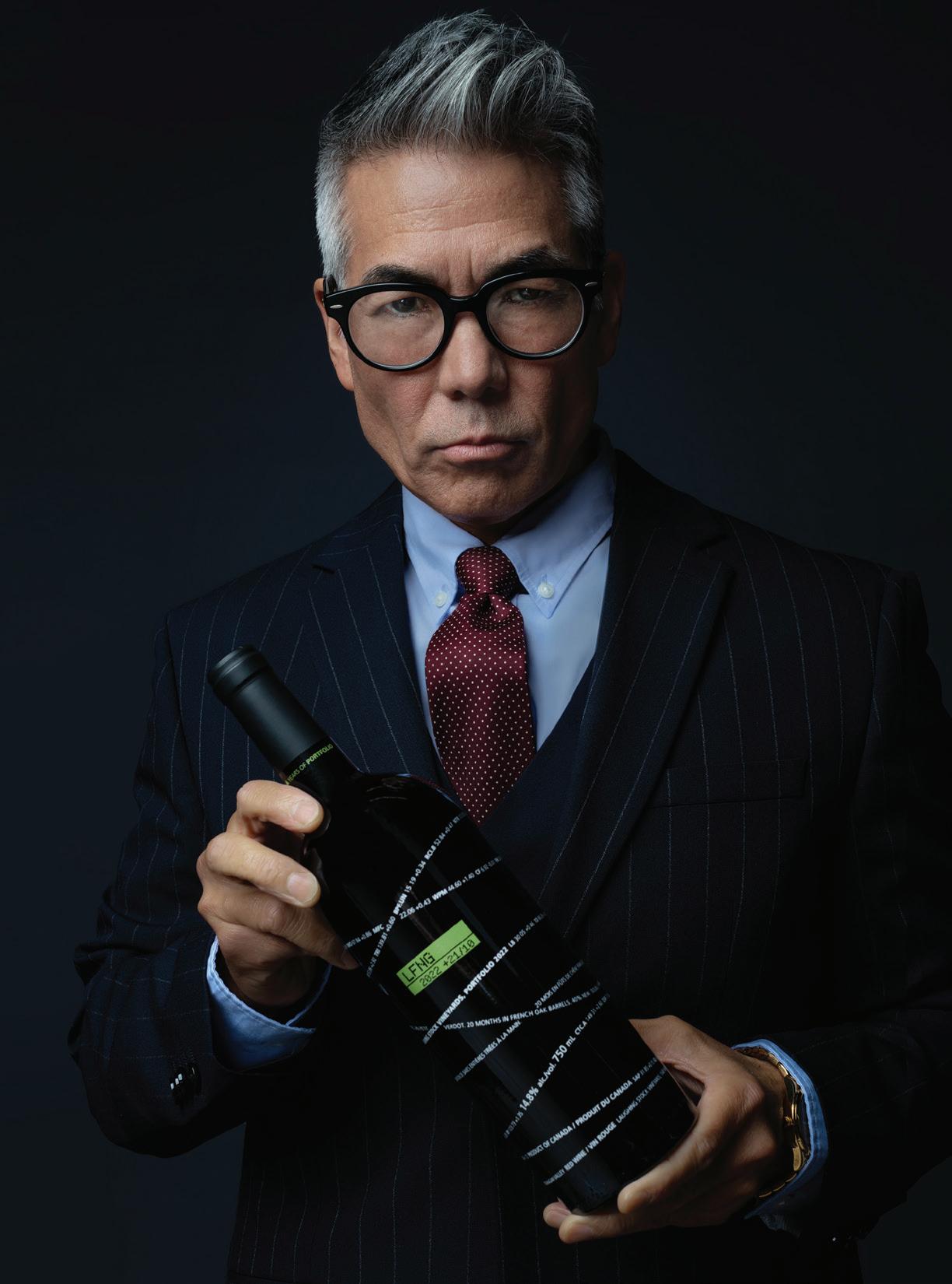
Laughing Stock Vineyards | NARAMATA
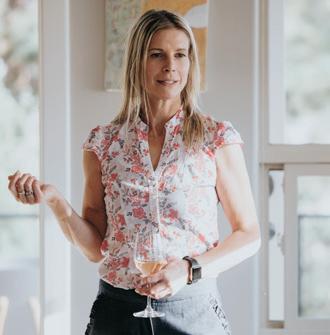
Sandy Leier didn’t expect to go into winemaking after getting her chemistry degree. But when she landed an assistant winemaker job fresh out of UBC, it turns out she was beginning a career spanning Australia, California, Chile and Argentina.
But B.C. wine is what she’s passionate about. Now as the winemaker at Laughing Stock Vineyards in Naramata, Leier faces the challenge of navigating the “drastically different” seasonal conditions that are changing the way winemakers grow grapes.
“The next chapter is about finding the grape varieties that can thrive in these conditions, developing our viticulture and winemaking techniques and making our current varieties more resilient,” shares Leier.
Beyond winemaking, Leier sees leadership and mentorship as vital to the future of the Okanagan wine industry. “I really want to help to get more women into winemaking in the Okanagan and be a support to them in continuing to build up our region,” she says.

INVEST IN QUALITY. HARVEST THE RETURNS.
#1 Small BC Winery from the 2025 WineAlign National Wine Awards of Canada
No infrastructure, no problem. A B.C. firm is deploying floating hotels to house and sustain workers in some of the most remote locations on the planet, and is scaling fast as the resource sector booms.
By Dee Hon

grey morning near the abandoned former mill town of Woodfibre on the western shore of Howe Sound. Families moved away from here in the 1960s, leaving their homes to be demolished. Western Forest Products Inc. shut its pulp mill down in 2006. But today, the ground reverberates again with the sound of heavy machinery as teams of workers construct an LNG terminal to one day ship liquefied natural gas to Asian ports.
Enormous modules of tubing and pipes rise skyward against the rainforest backdrop. A bald eagle casually supervises crews in hard hats and high-vis clothes. But Woodfibre is still a ghost town without any houses, restaurants or stores. Instead, workers for contractor McDermott International and various subcontractors eat, sleep, shower and relax after hours aboard one of two white ships anchored at the docks.
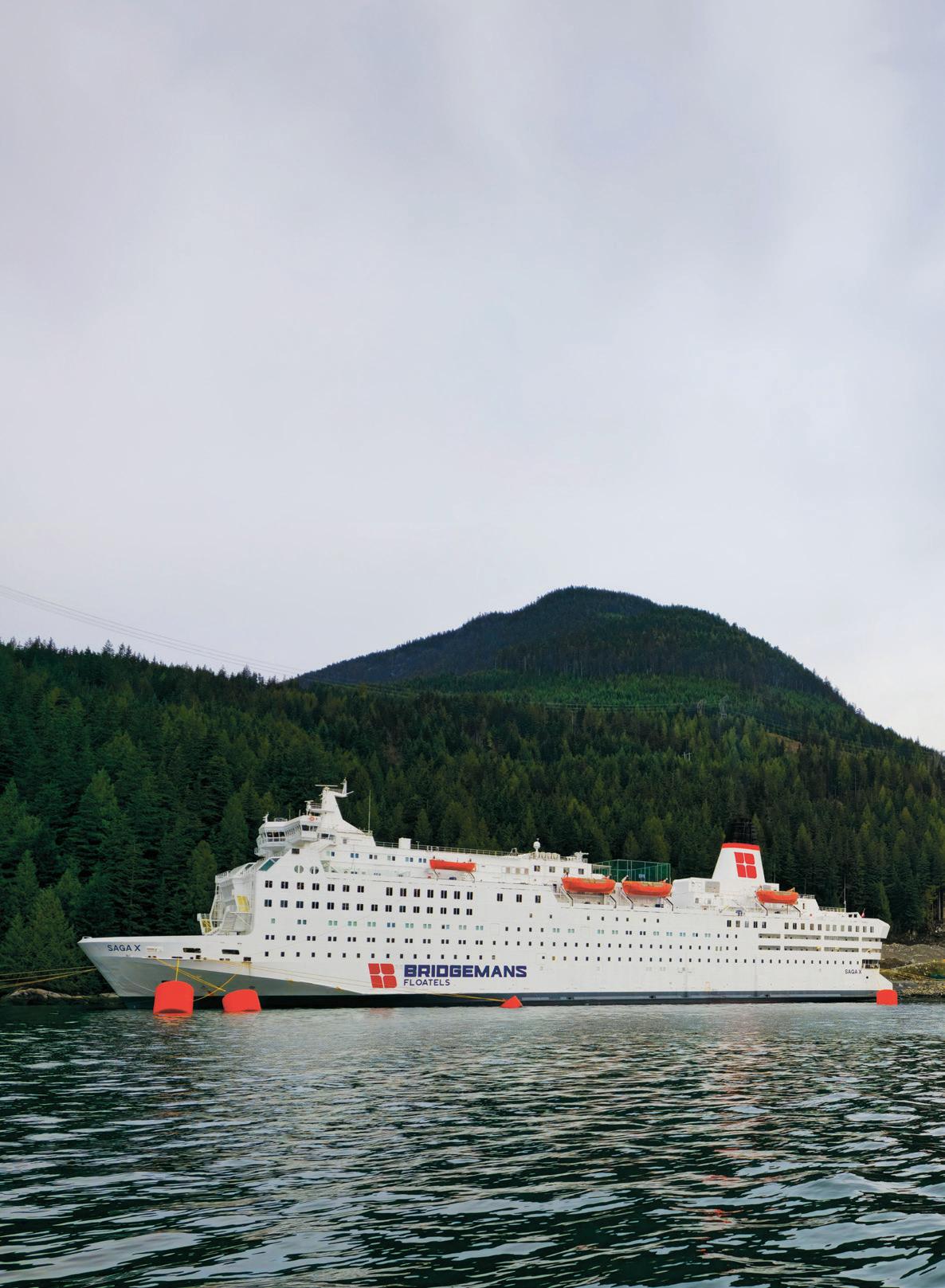
The MV Isabelle X and MV Saga X are floating hotels, or floatels, operated by Vancouver-based Bridgemans Services Group. Each is a former cruise ship that Bridgemans refitted to house near-shore workforces in remote locations—and refitted again specifically for Woodfibre. They’re towering boats that are built to accommodate more than 600 residents each, along with dozens of the ships’ crew members. They were originally constructed as luxury overnight ferries to take passengers and their cars between ports on the Baltic Sea. Guests onboard today won’t find vacation frivolities like water slides and night clubs, but they will enjoy comfortable cabins, restaurants and gyms equipped to forge Olympic teams.
These floatels are the realization of a vision Bridgemans founder, CEO and president Brian Grange had before he started the company in 2013. It’s also a homecoming for a company that spawned in B.C. waters but left to feed on opportunities around the world before returning for the start of Woodfibre LNG’s construction in the fall of 2023. But while many companies lose their culture and humanity as they expand, Bridgemans’ team members have only grown closer over their decade wandering the globe together. As he leads his company, Grange (who was on the cover of this magazine last fall as EY Entrepreneur of the Year 2025
Pacific overall winner) carries lessons imprinted on him from childhood summers spent working at his family’s fishing lodge in Haida Gwaii. Bridgemans is a fast-growing business with a global footprint and employees from around the world, but B.C.’s shores are still its home.
Grange grew up in Toronto, but spent his summers in B.C. His father Rick founded West Coast Fishing Club with partner Brian Legge in 1988. Grange was cleaning fish at age 11, then guiding clients by his early teens. “I’d spend 10 hours on the water in a little Boston Whaler, working,” Grange recalls from Bridgemans’ boardroom in Vancouver.
Those summers taught Grange to rely on his wits and to work hard, independently. “It was the Wild West,” he explains. Visitors then were still allowed to venture out on “self-guided” boats—which often meant unguided and lost in thick fog in the days before GPS. Grange would hop in a boat and rescue them. “I just had this really keen sense of geography and navigation,” he remembers. “That’s what really founded my sense of adventure and my sense of determination—anything’s possible and nothing’s impossible.”
Grange still has a hand in the family fishing business, but he always wanted to start a company of his own. He saw the potential for LNG development on the coast, and his years working with the community in Haida Gwaii gave him the insight and foundations to build what would become Bridgemans.
Nearly half the islands’ people have Haida ancestry, and see themselves as stewards of the land. Grange understood that any development on B.C.’s coast must start with good relationships and approval from local communities and First Nations (Bridgemans is currently partnered with Squamish Nation on LNG project development). He asked himself: “How do we create accommodation that can be floated in and floated out?” That would eliminate the need to build land camps in the forest, causing environmental disruption lasting longer than the time needed to get a project built?
The fishing lodge business also taught him how to operate in remote locations—albeit on a smaller scale. “I mean, we just had a small fishing lodge, but you would have to import all your goods in,” Grange explains.
He looked at businesses servicing oil fields development near Fort McMurray, Alberta. He saw opportunities to apply what he knew about relationships and logistics to the LNG boom when it arrived in B.C. Bridgemans, however, started out in a different sector—providing floatel services to the workers at Bechtel Group Inc. who were modernizing the Rio Tinto Alcan Inc. aluminum smelter in Kitimat from 2014 to 2015. The company secured a partnership with Haisla First Nation, and Grange thought it would be clear sailing for them from there. “Around 75 percent of that workforce was Haisla Nation members as our first project,” Grange recalls. “So we thought we had created the secret sauce. We’ve got this great floatel project available now. We’re going to be able to do that for all the LNG that was coming on the West Coast.”
The LNG projects didn’t materialize, however, at least not in B.C. Global petroleum prices plummeted, and business investment in the industry collapsed. Fortunately, Chevron Corporation contracted Bridgemans in 2014 to provide floatel services for the completion
of its Gorgon LNG plant in Western Australia. And so, the company began a global odyssey that would include projects housing workers for various industries in the Bahamas, Belgium, Estonia, Germany, Trinidad and Tobego, Eastern Africa, Norway and the Philippines.
FLOATELS OCCUPY AN ODD NICHE they’re cruise ships that seldom set sail, and their residents are onboard to work, not play. They require specialized ship crews, and vessels tailored to house workforces in remote areas. Even though a Bridgemans floatel might stay moored at one location for months, all crew members must be seafarers—they’ll have seafarer safety certifications and “passports” that facilitate travel and shore leave. Grange earned his seafarers papers in Estonia.
Seafarers also have special attributes and a culture of their own. They’re used to being away from home for long periods of time, and have to be able to enjoy living and working in close quarters with their colleagues.
That seafarer’s way of being is embedded in Bridgemans’ culture. The floatels’ crew members live and work aboard the same vessels as the client workforce. They eat in the same dining rooms. So Bridgemans works to make its floatels genuinely feel like home— environments where everyone can find a healthy work-life balance. “Creating that culture within the floatels is uber-important, because you want to be able to, one, keep the workforce happy, but also, two, retain your crew,” Grange explains. The company designs its living areas to be open and relaxed, while physically keeping the world of work at bay.
On this morning, Sergii Liaschenko, Bridgemans’ senior operations manager, is guiding a small group of prospective business partners through the Saga X. We enter on the former car deck, which is now lined with rows of custom-made, heated lockers. Moisture from sweat or rain clings to workers’ clothing in the cool, damp climate of B.C.’s coast, so Bridgemans outfitted the lockers with heat and ventilation for drying after the Saga completed its 18-month project in the Philippines.
Once Saga X residents enter this locker room, they leave their working life behind. They shed and deposit their helmets, boots and other work attire here or in the adjacent laundry. Then, they go upstairs—and they’re home. We emerge from an elevator onto a deck with a reception desk, along with a coffee lounge with plush chairs. The seats are all designed and arranged to kick back, relax and socialize—this isn’t a Vancouver laptop café. Only a few residents are onboard instead of at the worksite. They stroll by in jeans and flannels like dads on the weekend.
The cabins where residents sleep are comfortable, but compact. Vast lounge areas with pool and foosball tables, big-screen TVs and chess boards are far more inviting places to wind down. The lounges have even comfier chairs—the kind that are easier to plop into than get up from. Like the lounge, the games area is designed for people to be social, but there are also quiet nooks and a library for those who want time to themselves.
Liaschenko leads our group to the dining room. It takes up about a third of a deck in area, but is nearly empty at lunchtime.
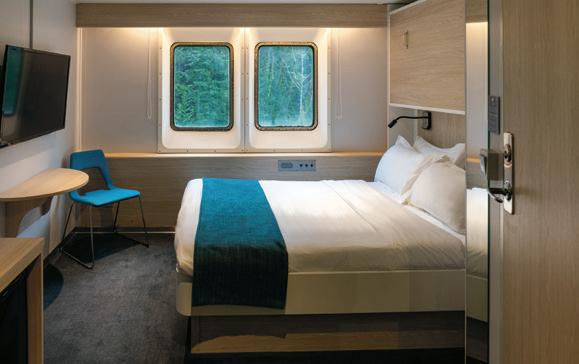
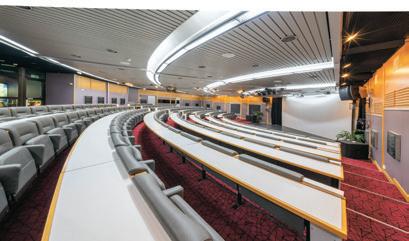
A typical worker room on board a Bridgemans ship offers privacy and comfort while stadium-style seating in a multi-purpose room pulls double duty for movie nights (below).
Today’s menu features Filipino specialties like beef nilaga and pancit canton, but most residents would have taken meals from the floatel’s Grab & Go café for their workday. There, they face a daunting assortment of options like pasta, chicken and waffles, and tuna sandwiches—all packed into reusable containers. Single-use packaging or bottles are notable by their absence; Bridgemans offers reusable bottles and filling stations instead. Hundreds of people live aboard, eating 1,800 meals a day, and neither garbage nor recycling trucks will be sailing across Howe Sound for pickup.
Every time Bridgemans signs on for a new project, it must figure out a fresh set of logistic details and client needs. Each new site will require finding new food suppliers. Bridgemans gives local farmers reusable crates for their vegetable deliveries, so there’s zero waste to manage. Different nationalities of workforces will want different menus and amenities on the ships.
Nobody knows the day-to-day details of Bridgemans floatels better than Liaschenko. As the person in charge of floatel operations, he’s responsible for both of the Woodfibre ships, plus another ship operating in Mozambique. But he also knows the company’s history and the culture of its seafaring crew. He started as a steward in the laundry room 10 years ago, and worked his way up and around the world on projects in Europe, Australia and the Philippines.
Liaschenko speaks in crisp, efficient sentences, like a man used to converting chaos into order. He is. He focuses on issues like




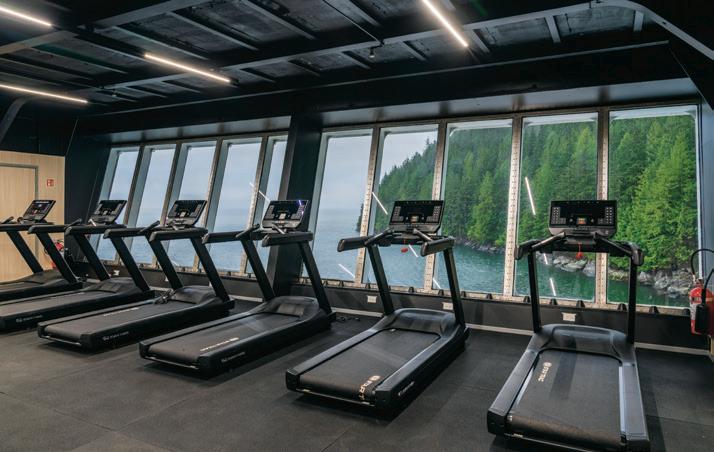
The fully kitted out onboard gym offers panoramic ocean views while lounge areas are set up for socializing (below).
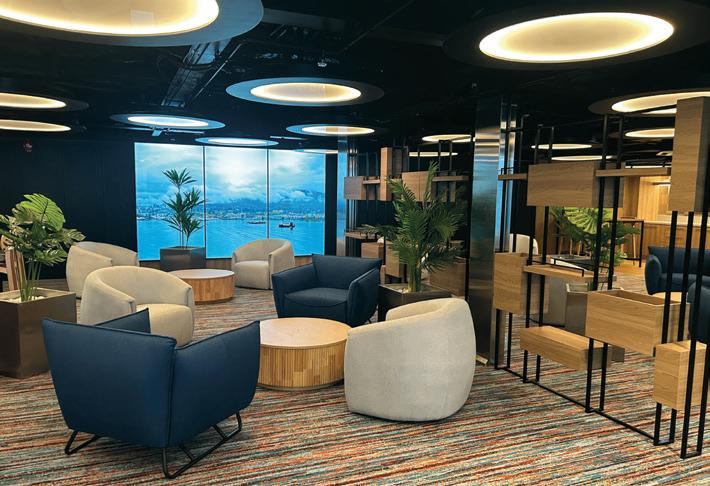
policy development and quality control now, but in his last role he managed day-to-day operations for a floatel in the Philippines. “Every two minutes you’re switching to a different subject,” Liaschenko explains when we talk again the following week. “You’re dealing with transportation, medivac, provisions, a uniform order not arrived, board delayed, VIP visitors coming, need to approve menu with client. You totally change the subject every five to seven minutes and you need to make the right decision.”
He pauses as if to take a breath, and smiles. He says he enjoyed the job because it was challenging—a constantly changing puzzle to be solved: “It’s easy if you have the skills; if your brain is set that way.”
Liaschenko grew up in Odessa, Ukraine, where he earned an engineering degree, then worked as a bank economist. His mother had been a seafarer in the military when she was young. She once asked her son if he’d ever consider a life at sea. He laughs as he recalls telling her, “Never! Never!” Back then, he couldn’t imagine life away from friends, or from a future family.
Politics destabilized Ukraine’s banking sector, with weakened banks collapsing after Russia annexed Crimea in 2014. Liaschenko found work as a cruise ship steward before deciding the partying lifestyle on those ships didn’t suit his calm personality.
He saw a job posting from Bridgemans, offering what looked to him like an opportunity for stability. Liaschenko is a man with education and skills—did he see the steward job as a stepping stone to something more? “No, no, no,” he says emphatically. He’s not the kind of person who chases status. “I just want to do what I like to do, and enjoy what I’m doing.”
Keeping everything nicely organized is one thing he likes. “That’s just my nature,” he confesses. “I cannot break it.” Brian Grange remembers being shocked by a laundry room that Liaschenko had organized when the new steward was working on Bridgemans’ now-retired MV Bluefort.
“The entire place was colour coded; all the sheets perfectly folded,” Grange recalls. “We were like, okay, well, you know, we’ve got to work with Sergii.” The next day, Bridgemans promoted Liaschenko to housekeeping supervisor. He had only been with the company for three months by then.
Liaschenko’s story represents how Bridgemans has grown as a tightly bound, multinational team. “Every time we went to a particular spot, we would find two or three individuals that would stand out amongst the local hires that we would have, and we would bring them with us to the next project,” Grange explains. The “base” of the company, he says, is this group of people who have been together for 10 to 15 years, collected from different communities all over the world. “They are all seafarers at the end of the day.”
Surely, after all these years of shared growth and adventures, Bridgemans must feel like a second family to Liaschenko. Does it?
“Not the second. It’s the first family,” Liaschenko asserts. “This is my family. These people who we work with through many years—different projects, different challenges—we are not just friends.”
Liaschenko emphasizes that the family culture at Bridgemans is about bringing people closer together, not keeping people out: “It’s not only about who is here longer— no way. We have some people who are here two years, but they become family, because you need to be a team player.”
BRIDGEMANS IS NOW working to add new family members from its home waters in B.C., especially from B.C. First Nations. The company operates a small-vessel fleet of various tugs and cargo transfer boats in addition to its floatels. It provides training opportunities for First Nations members to earn certifications toward seafaring and small-vessel captain careers. “We can’t hire enough people locally fast enough, because there’s just not enough people with their certificates,” Grange says, highlighting the worker pipeline issues that have become an increasing challenge for the firm. “So we’ve got a training program in place right now for the floatels to get everybody with their certificates locally, because there are not enough Canadian seafarers with qualifications to operate large passenger ships.”
Selena Basi is Woodfibre LNG’s vicepresident of corporate relations. She says her company looked at other housing options for its construction workers, but Bridgemans stood out for its commitment to the Squa mish First Nation and close relationships with its members.
For example, Basi cites Bridgemans’ will ingness to address the local community’s safety needs. Industrial work camps bring in labourers from outside the region, and historically, that’s put Indigenous women and girls at particular risk for harm. “So having a non-local workforce in the commu nity was something that was of concern to the Squamish Nation, and Bridgemans was right there with us to find ways to mitigate those concerns,” she explains.
Woodfibre LNG aims to begin shipping LNG near the end of 2027, and will no longer need floatels to house construction crews. But Basi notes that Bridgemans provides marine transport of materials and people to the site, and her company will always need those services: “There’s lots of opportunity for future collaboration.”
Grange says he’s excited to train new crews of locals and take them out into the world: “I’m really looking forward to the next adventures, for that reason alone— finally getting to bring our Canadians with us to new projects.”








Prospectors and junior mining firms are the industry’s risk-takers and discovery engines in the race for critical minerals. But permitting delays and labour uncertainties are putting that pipeline at risk.
BY GRAHAM TEMPLETON
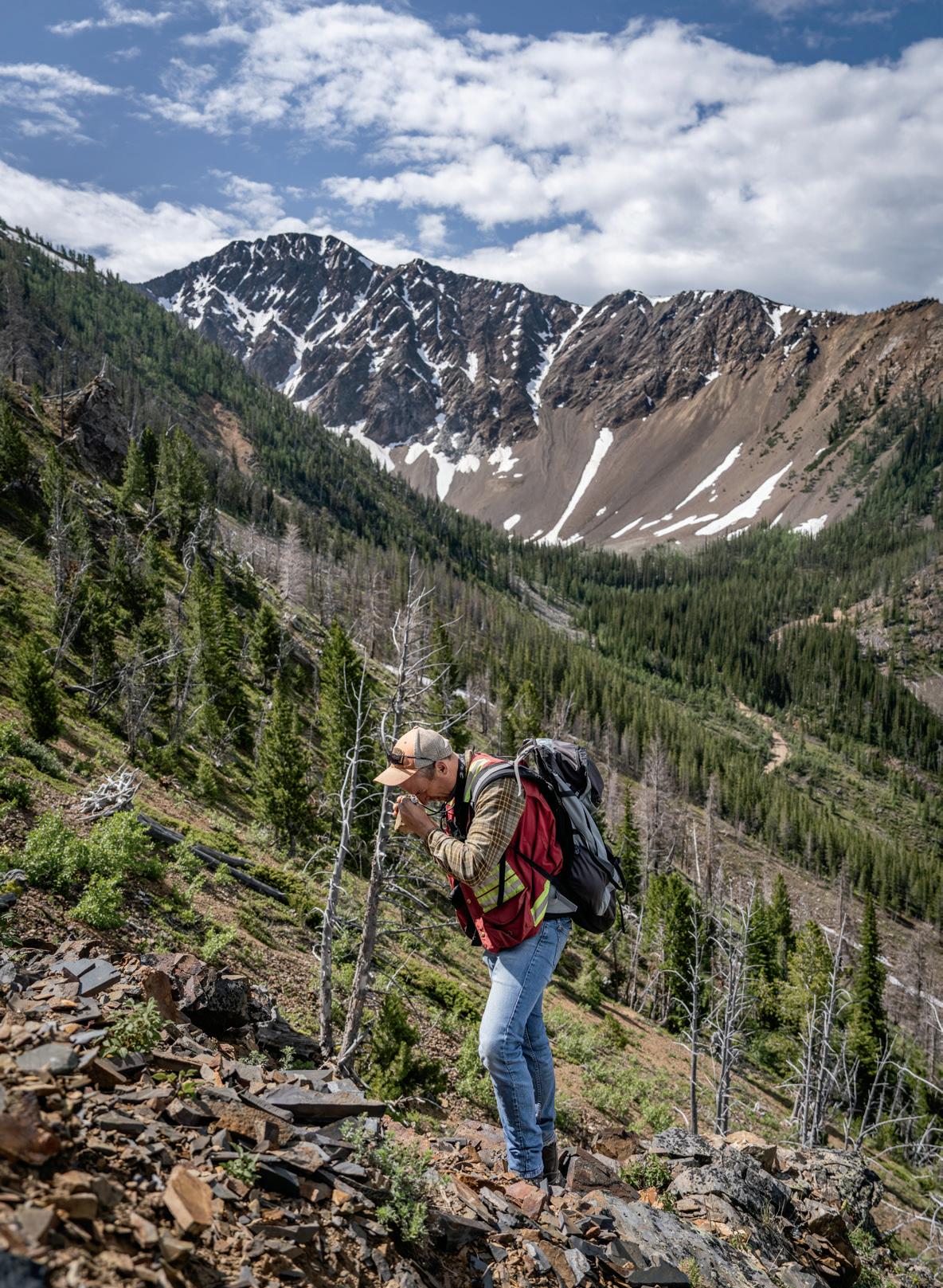
ROCK AND A HARD PLACE
Examining rock samples in the East Kootenays. B.C.'s mineral exploration industry faces a myriad of pressures as resource demand grows.
In February, Prime Minister Mark Carney laid out a new path for Canadian industry, one that would work to end dependence on outside nations while creating new, high-paying jobs throughout the country.
To hear Association for Mineral Exploration (AME) president Todd Stone tell it, though, there’s no guarantee that B.C. will be able to leverage its incredible resource wealth to support or even benefit from this plan.
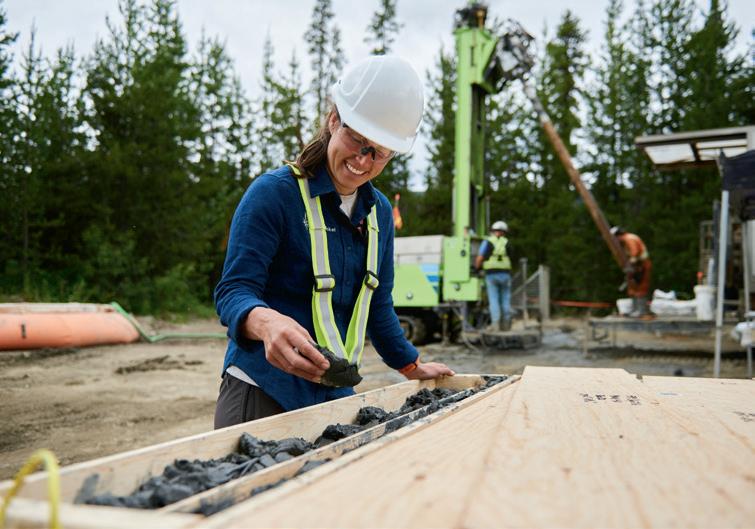
CRITICAL CRUNCH
A geologist inspects drill core samples at the FPX Baptiste Nickel Project in central British Columbia.
“We’re facing policy and regulatory challenges that hold us back from moving at the pace that Canadians are expecting,” he says of the mineral exploration sector. “If we’re going to be successful at building out the Canadian military, at supplying our allies in NATO and around the world, then we need to have a heightened sense of urgency here at home to get these critical resources out of the ground.”
It might seem like an odd perspective. After all, AME is an industry advocate organization with the aim of boosting mining on behalf of explorers, scientists, supply chain providers and more. As such, AME says that mining exploration in B.C. is a lucrative industry that brought in about $750 million in investment in 2025, up from around $550 million in 2024. The picture seems even rosier with respect to critical minerals like lithium, cobalt and the rare earth elements used in modern electronics; annual growth in critical minerals investment has been over 100 percent in recent years.
In fact, critical minerals have become so important to the province’s economic plans that in 2022 the Eby government struck a new Ministry of Mining and Critical Minerals; in 2025, the turn toward resource independence greatly increased that ministry’s importance. “B.C. has a big role to play,” says Jagrup Brar, the province’s minister for mining and critical minerals. “The Canadian list has 34 critical minerals. We have the capability to produce 22 of those in B.C.”
Already, both new technologies and global uncertainty have pushed B.C. to become the country’s largest producer of copper, and its only producer of the increasingly valuable element molybdenum. “The situation is sort of a perfect storm,” says Jean-Philippe Paiement, chief technology officer at mineral discovery software platform VRIFY. “It creates a rush to produce resources at home.”
Many have called it the beginning of a boom, especially in critical minerals, one that some expect will pay dividends for decades to come. But not everyone sees the same picture.
“Unfortunately,” says Stone, “there’s always a story behind the story. Those dollars are massively concentrated with a small
number of advanced projects, major ones that are close to the finish line.”
And the junior and mid-sized mining companies that generally take on riskier explorations and find unexpected new deposits? “They are really struggling,” he says.
One of the main causes, as admitted by all sides, is the permitting process. The issue isn’t the proportion of applications that are rejected, but rather the length of time that it takes for an application to be approved.
“Permitting is a thorn in everybody’s side,” says Andy Randell, CEO and principal geoscientist at geo-consulting firm SGDS Hive. “The theory was that it would be 30 days for the government to process it, 30 days for First Nations feedback, and then four to five days after that you would have the permit issued,” he says. “In reality, it was never happening like that.
“I’ve had applications that have taken over 18 months.”
The result has been an inability to plan for income or raise money, which in turn can lead to an inability to keep employees on payroll. At times, the backups can get so long they eventually impact people at every level of seniority. “I went and worked in a pet shop for a while,” Randell says with a smile. “I mean, I loved it. But that was not making use of my education.”









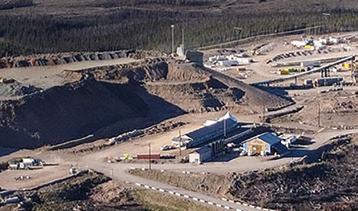
Our Story


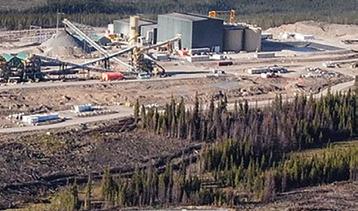


Artemis Gold's Blackwater Mine opened in spring of 2025, making it B.C.'s newest gold and silver mine. The company is headquartered in Vancouver and its largest shareholders are British Columbians.

Interested in working with us?
We are looking for engineers, heavy equipment operators, plant operators, Red Seal trades, and more!
artemisgoldinc.com/careers
Located in the Cariboo region, it is the first and only mine in B.C. to have a processing plant 100% powered by B.C.'s clean energy, significantly reducing its carbon footprint. We are now advancing an expansion that will increase production, create more jobs, and make Blackwater one of the 3 largest gold mines in Canada. We expect to contribute over $26 billion* in B.C. economic activity over the life of the mine. artemisgoldinc.com
We have diverse opportunities for B.C. businesses. Register in our business directory at the link below.
artemisgoldinc.com/businessdirectory
DIGGING DEEP
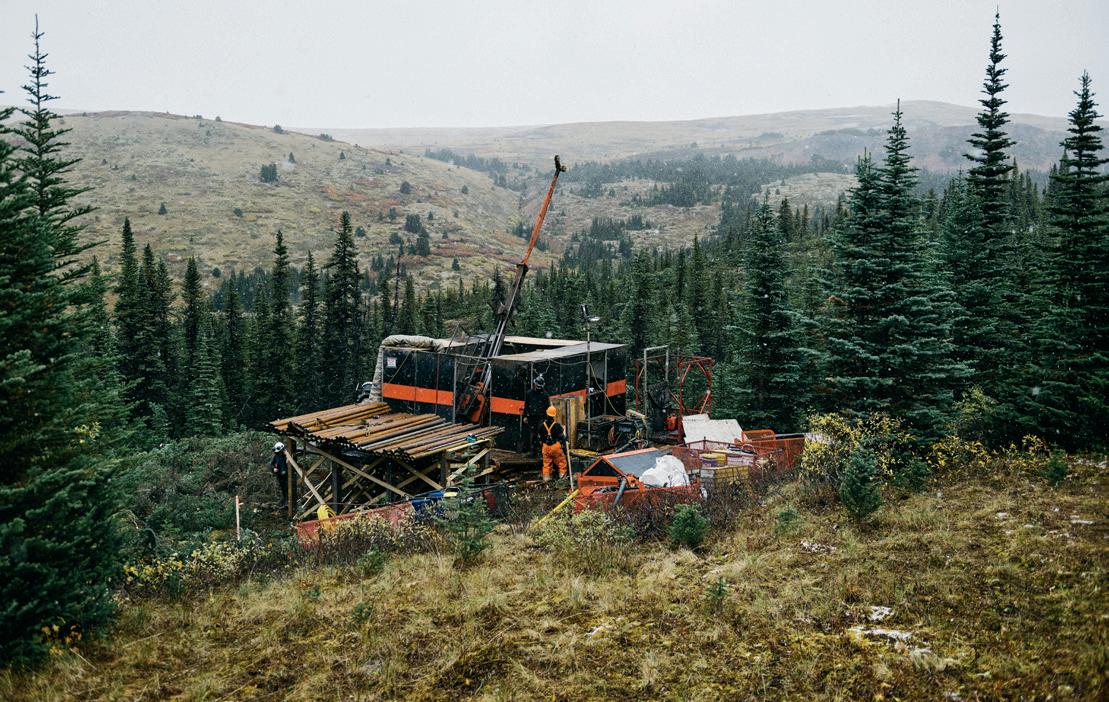
A drill rig at the Lawyer-Ranch precious metals project in the Toodoggone mining district in Northern B.C.
The province is certainly aware of the issue, with its 2026 budget increasing funding for hiring in the ministry’s chronically understaffed permitting department. Paiement does admit to having seen some improvements, and Randell notes that he was pleasantly surprised recently to see a theoretically 120-day application be returned in a mere eight months—still twice the allotted time.
“It’s clear that times need to come down, so that’s what we are doing,” Brar says. “We have reduced major permitting application timelines by 35 percent, which could be more than a year and half in savings of time.” This has translated to an almost one-to-one effect in the real world, with a 34 percent increase in exploration permits approved over the same period.
Still, new federal policy seems to call for a much larger increase in domestic capacity, with the federal Defence Industrial Strategy alone calling for a 240 percent increase in defence industry revenue. If it’s going to be achievable, that sort of increase in production will require massive amounts of critical minerals, and the federal government seems to know it. While it’s too early to know what the impact will be, new federal funding announced in March looks to provide a total of $127M to the various levels of B.C. mining. It’s debatable whether federal authorities
“I constantly struggle to find people. It’s a generational thing. The people who are being produced by the university system right now, they don’t want to work in this industry.”
—AndyRandell,CEOandprincipal geoscientist,SGDSHive
expect even this increase to allow Canadian sources to be capable of providing all the critical minerals needed, on any timeline; earlier this year, Canada established new “formal mechanisms for critical mineral cooperation” with Germany, Australia and Saudi Arabia, adding to existing deals with the U.K., the EU and more.
In the end, though, permitting and regulatory back-ups can only be blamed for so much of the gap between B.C.’s capacity and its output. And there is one more issue cited by all sides, one that could end up being much more difficult to address.
“I constantly struggle to find people,” Randell says. “It’s a generational thing. The people who are being produced by the university system right now, they don’t want to work in this industry.”
The trouble there seems to be a fear of the factors that often come along with the job of mineral prospecting, especially in more remote areas of the province: potential isolation, and the physical and psychological hardships of being away from home for extended periods of time.
“The generation that preceded mine,” Paiement says of the industry, “were brought up in the world where you had to spend three months in a tent, without a cell phone, sleeping on the ground. New graduates just aren’t attracted to that.”
Brar and others are well aware of this issue, and are working to mitigate it. In particular, B.C. has seen the introduction of $241M in funding for education to build out the workforce, and the continuation of the Centre of Training Excellence in Mining.

“The message to the mining and exploration sector is to build and grow,” Brar says. “We will ensure that there are skilled workers ready when they need them.”
If that’s going to work with the modern crop of university graduates, though, adjustments to the work itself are likely needed. The VRIFY platform uses AI to go through existing forms of survey data to highlight the likelihood of mineralization and refine drill targets, and to do it faster and more accurately than legacy systems. While technologies like this by no means do away with the need for fieldwork, they are helping to reduce the number of people required in the field, and the number of days they’ll need to stay there.
“Automation, remote work, remote driving,” Paiement says. “These things can help with that.”
Generational change, however, is affecting recruitment through larger attitudes about mining as well. Many are expressing worry that the push for increased exploration will lead to lowered environmental standards, and that it generally represents a move away from public consultation on major development projects.
“It’s often painted as a dirty industry and a lot of younger people don’t want to come into it because of that misconception,” Randell says. “But, coming into this industry, you don’t have to butt up against destroying the natural beauty of B.C. Most of us got into this career because we like the outdoors.”
He adds: “At the end of the day, it’s better to be an agent of change from within the industry, rather than to be outside of it, complaining.”
That seems to be the mentality in the industry right now: while there are problems, they must not overshadow the incredible potential of B.C.’s resources. The exploration portion of mining does the necessary work of generating leads, taking the early risks that allow later developments to deliver value to the industry, the province and the country.
Much of government policy is currently downstream of exploration, meaning that if it backs up, so too do the large-scale national projects. The mining exploration industry in B.C. seems more than ready to rise to the challenge set out in federal policy—if they’re given the freedom to do so.
WeBC is a not for profit organization that offers direct support to BC women to start, buy, and grow businesses. Working alongside our partners across the province, we provide:


















Portwood, EDGAR Development’s ambitious multi-phase community development in Port Moody, will soon start to welcome its first residents, from growing young families to empty nesters.
When Gabriel Grzybowski and his wife, Elizabeth, decided to buy their first home, they didn’t initially consider Port Moody.
The Vancouver-based couple wanted more space to accommodate working from home and the possibility of starting a family. “We’re currently in a one-bedroom, one-bathroom,” he says, “so it’s pretty tight.”
A friend referred the couple to Portwood, EDGAR Development’s multi-phase residential development in Port Moody. Coincidentally, Grzybowski’s godfather had done some architectural design for the project.
“When I talked to him, he was very confident in not just EDGAR, but also Axiom, the builder,” recounts Grzybowski, adding that other potential developments he and his wife visited in Vancouver and North Vancouver weren’t up to par with the quality they were looking for.
So, the couple decided to purchase a townhome in Umbra, the first phase of Portwood.
“It’s a three-bedroom concrete townhouse, and that’s extremely rare in Vancouver nowadays,” he says. “I thought, for the price point, this is a very good opportunity.”
The development has been a draw for many young families wanting to settle down in a safe neighbourhood with nature just outside the door, and with easy access to urban conveniences—all without paying city prices.
Now, Portwood’s first phase is set to begin welcoming residents later this year.
A PLACE TO PUT DOWN ROOTS
Umbra will be home to 219 residences and is one of five neighbourhoods that will make up the roughly 2,000 homes across Portwood’s 23 acres in the heart of Port Moody. The master-planned community will ultimately span 20 buildings that range
Gabriel Grzybowski and Elizabeth Hartwell bought a three-bedroom townhome in Umbra, the first phase of Portwood in Port Moody.

from six to 19 storeys, with both strata and rental housing.
One of the distinct features of the Portwood development is that the amenities will be built out right away so the community’s first residents can take advantage of the outdoor courtyard, gym, children’s playroom and social lounge. The Portwood community will also include a 12,300 square foot daycare, café and other boutique service retail.
“There’s going to be access to trails and hiking close by, as well as a daycare for
children, a huge incentive for people with kids, which we hope to have soon,” says Grzybowski. “It’s kind of like its own little community within Port Moody. Where we are right now in Vancouver is super busy and loud. It’s going to be quite a bit quieter, which will be nice.”
Green space and proximity to amenities were pull factors for Kara McCann and her mother as well. Nearly 70 percent of Portwood is green space, which includes







two parks, communal outdoor gathering places, bike paths and a 1.5-kilometre walking trail.
McCann currently lives in the U.S. but plans on returning to Canada after she retires to be closer to her mother, who’s in her 80s and currently lives in Port Moody.
“I wanted her to have access to whatever she might need without having to drive somewhere,” says McCann, referring to the retail amenities at Portwood. “My mom and I both wanted a place that was surrounded by nature, with more of a rural feel than a city feel,” she adds.
McCann purchased a one-bedroom unit on the top floor—the same floor as her mom’s unit—with vaulted ceilings and a spacious balcony facing the green belt. For McCann, this was ideal since the apartment would be a second home while her husband continued to work in the U.S.
“It had everything that I was looking for,” she says.
Another appeal for McCann: the Scandinavian design. Designed by Acton Ostry Architects, the low-carbon-emission build marries design, sustainability and quality. EDGAR has invested in higher-quality soundproofing for the townhomes and durable metal roofing.
Inside the units, buyers choose between a light or dark-toned palette, with imported Italian kitchens by Inform Projects, a primary bedroom with space for a king-sized bed, air conditioning and a roomy private deck to soak in the Port Moody surroundings.
“I love the natural, biophilic feel to the exterior, and the beautiful cabinetry and colour schemes on the interior,” says McCann. “I just thought it was very thoughtfully and beautifully done.”
Umbra, the first phase of Portwood, is 80 percent sold. The building is nearly completed, and the sales team is available for more information at the nearly 3,000-square-foot presentation centre. Hard hat tours are also available by appointment, so buyers can pick the right location and floor plan for them.
Book a tour at the presentation centre at 604-931-8096 or info@Portwood.ca Discover more at portwood.ca/umbra. Connect on: @portwoodliving | @Portwood Living

From Vancouver Island oyster beds to five-star restaurants in Asia, YVR’s air cargo network is turning B.C. seafood into a cornerstone of Canada’s IndoPacific trade growth. By Darcy Matheson
On a balmy 31-degree winter afternoon at Singapore’s Avant Marketplace, I’m standing in front of tanks filled with some of the world’s most coveted seafood: Australian rock lobsters, Alaskan king crab, Japanese Hokkaido scallops and oysters harvested just days earlier off Vancouver Island.
When my platter of freshly shucked Fanny Bay oysters arrives on the patio, they are sweet, briny and impossibly fresh. You would never guess they travelled nearly 12,000 kilometres to get here. These same B.C. oysters are a fixture across Singapore’s luxury dining scene, including on the raw bar at the Ritz-Carlton’s famed unlimited champagne brunch.
Shipments like this are increasingly routine as B.C.’s premium seafood flies across the Pacific through Vancouver International Airport, part of a fast-growing—and extremely lucrative—trade corridor linking Canada to Asia’s booming dining markets. But getting our local prized seafood onto diners’ plates halfway around the globe requires a carefully choreographed logistics chain involving fishing boats, refrigerated trucks, long-haul flights and two of the world’s most sophisticated airports.
At the centre of B.C.’s live seafood trade is YVR, where Tamara Vrooman, president and CEO, just committed to doubling air capacity cargo volumes over the next five years. It’s ambitious: Already Canada’s busiest hub for perishable exports, it handled a record volume of cargo in 2025, moving more than 365,000 tonnes of goods through its terminals (representing 7.4 percent yearover-year growth and the highest annual cargo volume in the airport’s history).
Unlike bulk commodities shipped by rail and container ship through the Port of Vancouver (which also just had a record year for shipping), the goods flying through YVR are much smaller in volume but far higher in value: electronics, medical devices, lab equipment, critical minerals and even gold
regularly pass through. There’s also a huge volume of time-sensitive exports, like Okanagan cherries and blueberries, premium seafood (like oysters and sea urchin) and live crab.
“A Dungeness crab can go from sea to plate in Asia in about 72 hours,” says Vrooman. “That’s the level of freshness those markets demand.”
Since the launch of Air Canada’s direct YVR-Singapore route, exports of live Dungeness crab skyrocketed from $1 million in 2017 to $3.3 million in 2024, with shipment volumes nearly tripling over the same period.
Vrooman believes Canada’s growing push to grow exports outside of America is reshaping how the country thinks about its trade infrastructure. “We are the gateway for the nation,” she says. “If Canada wants to grow exports to non-U.S. markets, this is where a lot of that work happens.”
Indeed, that growing export corridor through YVR is unfolding against Prime Minister Mark Carney’s aggressive and optimistic target to double Canada’s non-U.S. exports. Much of that growth is expected to come from the Asia-Pacific region.
Most export goods flowing through YVR are travelling in a place most passengers never think about. “Sometimes people see a plane that isn’t full of passengers and assume it wasn’t full,” Vrooman says. “Trust me—it was full. It was just full in the belly.”
Those aircraft bellies have quietly become crucial trade corridors for Canada’s exporters. Roughly 65 to 70 percent of cargo moving through YVR travels on passenger flights, meaning every longhaul route across the Pacific expands the country’s export capacity.
It’s also why Vrooman is so keen to see Canada initiate new bilateral agreements and tourism arrangements, and to have more direct long-haul flights from YVR.
“The more direct flights we have into Asia, the more opportunities Canadian companies have to get their products into those markets quickly,” Vrooman says, adding that

YVR contributes or enables $13.48 billion in GDP for British Columbia each year and generates nearly $25.27 billion in economic output. Nationally, YVR’s GDP impact is even greater, at $15.8 billion.
And Vrooman argues that the airport is already prepared to take on more growth, citing major investments during the pandemic to infrastructure, operational resilience and digitization: “We don’t need to spend billions to expand our capacity.”
That readiness could prove critical as Canadian businesses look to diversify trade beyond the United States, reaching deeper into Asia—from established markets like Japan and Korea to rapidly growing economies such as Vietnam, where Vrooman is pushing for a direct flight option. “The demand to use YVR as a trade gateway is growing,” she says.
Fanny Bay Oysters has been exporting to Singapore for more than a decade, the relationship born from “boots on the ground” work in Asia that educates potential buyers on the delicacies being harvested from B.C. waters. For many years, Brian Yip, vice president of parent company Taylor Shellfish Canada, has hit the government-sponsored seafood trade shows in Singapore twice a year, often with a chef in tow to prepare dishes (“You can talk and show pictures, but to put food into people’s mouths is the best thing”). The shows created the key introductions to Asian buyers that helped get their oysters into seafood markets and retail stores.
The five-star restaurants followed.
“Canada as a brand has a really good reputation in Singapore, particularly B.C.,” Yip explains, adding that, thanks to proximity, the Singapore trade shows are also key for meeting potential customers from the Philippines, Thailand and China.
Buyers are impressed, he says, by where the oysters are harvested: clean, protected waters, free from pollution and heavy industry.
From an export attractiveness standpoint for B.C., Singapore has a lot going for it. It’s politically stable, has one of Asia’s highest levels of GDP per capita and boasts an affluent population that has high levels of disposable income. (At $6 to $12 a piece in the consumer marketplace, those oysters aren’t cheap.)
After harvest on Vancouver Island farms, Fanny Bay’s oysters are sorted and processed at a Canadian Food Inspection Agency-certified facility before being packed into insulated wax boxes with gel packs to maintain the cold chain. Refrigerated trucks transport them overnight to Vancouver, where they catch pre-dawn flights across the Pacific. At peak season around Christmas, Yip says, the company can ship as many as four 1,500-kilogram containers per day. Freshness is everything. Some oysters are airborne less than 24 hours after being pulled from the water.
The PM’s challenge to double exports from Canada to non-U.S. nations was a hot topic at this spring’s Canada-in-Asia Conference in Singapore, where business leaders, diplomats and policymakers gathered to strengthen ties between Canadian exporters and Asian markets. Organized by the Asia Pacific Foundation of Canada—the country’s only dedicated organization focused on strengthening relationships with Asia—the event drew roughly 660 attendees from across the globe with about one-third travelling from Canada.
The goal is simple: create the networks Canadian companies need to operate in a
relationship-driven region—something CEO and president Jeff Nankivell, who spent 33 years in Canada’s foreign service, deeply understands about operating abroad. “There’s no substitute for being there in person,” Nankivell says. “If Canadian companies want to do business in Asia, they have to be in the room, building those relationships.”
Infrastructure plays a central role in that effort. “We need to continue expanding passenger capacity and air connections,” notes Nankivell. “When those flights grow, the cargo capacity grows with them.”
New trade agreements could accelerate that shift. Negotiations with India as well as the Association of Southeast Asian Nations, or ASEAN (which includes Indonesia, Malaysia, the Philippines, Singapore and Thailand), are expected to advance this year—deals that Nankivell says could unlock new flows of business travel, investment and high-value exports across the Pacific. Already, the ASEAN states together represent Canada’s fourth-largest merchandising trading partner, across sectors including raw critical minerals, clean tech, agriculture, financial services, aerospace and infrastructure. The impact is staggering: the Indo-Pacific represents Canada’s secondlargest regional merchandise export market after the U.S.—valued at $262 billion.
Export Development Canada is also seeing the shift firsthand. Scott Moore, the agency’s chief financial and operating officer, says the Asia-Pacific market has become one of the most important fronts in Canada’s push to diversify trade. In B.C. alone, EDC works with roughly 3,000 exporters representing about $10 billion in trade. “We used to have to explain why people would consider Asia. Now the conversation is, ‘Tell me more,’” Moore says.
According to Export Development Canada’s latest Trade Confidence Index, 65 percent of Canadian exporters plan to enter new international markets within the next two years, with Asia-Pacific among the top targets. The shift is already underway: the share of
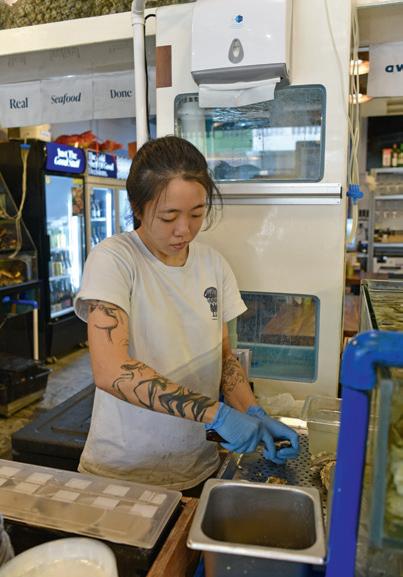
THE 12,000KM OYSTER Zeena Ong at Singapore’s Avant Marketplace shucks a Fanny Bay oyster, shipped from Vancouver Island just days before.
companies exporting exclusively to the U.S. has fallen from 62 percent a decade ago to 34 percent today, reflecting a growing push to diversify beyond Canada’s traditional primary market.
On the other end of the corridor sits Singapore’s Changi Airport, one of Southeast Asia’s largest logistics hubs. In this maze of warehouses, loading bays and service roads where forklifts zip between refrigerator trucks and workers in high-visibility vests, it takes us more than 10 minutes to drive end to end across the 8,000-square-metre cargo complex—a telling measure of its scale. Exports from Canada to Singapore through Changi are substantial, valued at $2.2 billion by the feds last tally.
During my two-hour tour, the variety of cargo I saw was striking: stacks of Samsung boxes from Korea, crates of New Zealand apples and even a very friendly golden retriever being gently guided toward its next flight to Thailand. Some of these goods trace surprising roots. While this is the
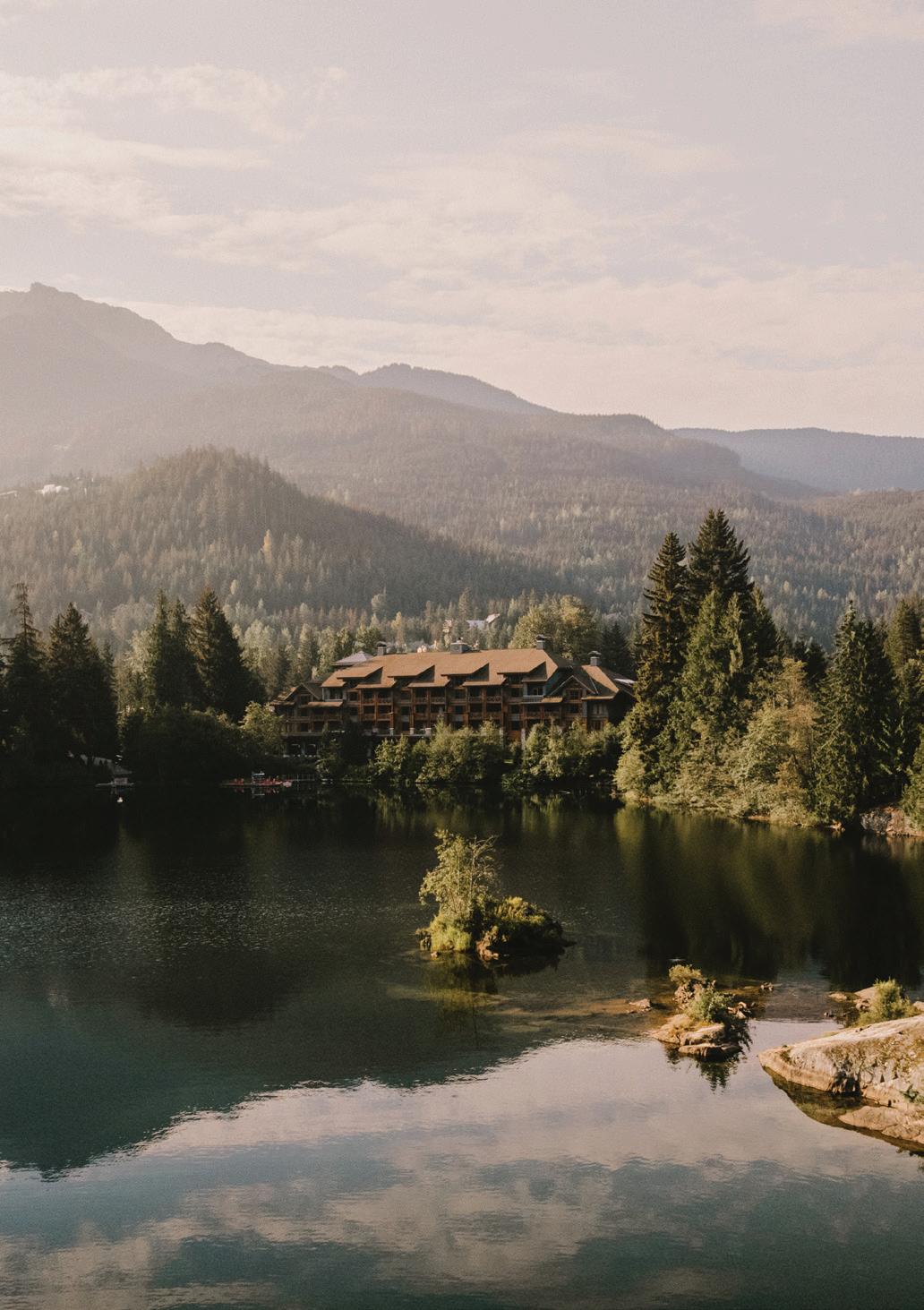


final stop for the Fanny Bay oysters, other Canadian exports, including geoduck and scallops, often pass through Changi before continuing on to the growing markets of Malaysia, Indonesia or Vietnam—a circuitous route that Canadian officials say is evidence of the growing need for more direct flight connections to make trade more efficient and to cut delivery times.
Eric Kim, Cathay Pacific’s area cargo manager for the Pacific Northwest, oversees the up to 17 cargo shipments out of YVR weekly, many packed with shellfish, fresh and frozen fish, pork, fruits, veggies and dairy, headed to Shanghai, Hong Kong and Singapore. He says moving seafood across oceans comes down to two critical things: “Timing, timing, timing—and temperature control.”
For many B.C. seafood companies, access to Asian markets determines the fundamental economics of their business. Organic Ocean founder Dane Chauvel has built an entire business model around shipping premium seafood by air. (He’s not alone: of the 170 seafood processing companies in B.C. more than 110 are in the Lower Mainland, with a concentration in Richmond and Delta.) From Organic Ocean’s Steveston facility, trucks can reach YVR’s cargo terminals in 20 minutes. “It can be easier to ship seafood to Asia than to Toronto,” Chauvel says.
Instead of sending large containers,
Organic Ocean ships smaller, high-value loads several times a week to destinations such as Singapore, Jakarta and Manila. “Our customers in Southeast Asia love that something that goes out today will get to them tomorrow,” he says.
Demand is strong, particularly for premium species like halibut, sablefish and spot prawns. But the economics of B.C.’s seafood trade often tilt toward Asia for another reason: price.
For manufacturers and wholesalers like Vancouver’s “seafood queen,” eatfish.ca CEO Jenice Yu, who supplies to high end restaurants, international markets frequently place a higher value on B.C. seafood than local buyers do. “In plain English, the local market doesn’t want to pay the price that international markets are willing to pay,” Yu says, using the examples of sea cucumber and geoduck.
But the global seafood trade is also increasingly tumultuous, given the current state of tariffs. Katie Lindsay, marketing manager with the Underwater Harvesters Association, says Asia remains the dominant market for some species, including sea cucumber and sea urchin (which is “having a moment” right now in the foodie world, with demand skyrocketing in Europe, says Lindsay). Roughly 90 to 95 percent of B.C.’s geoduck harvest is exported to China, where it’s a familiar delicacy. If you’ve ever seen a three-pound geoduck, you realize that the average person not familiar with it will not be purchasing the phallic-shaped giant clam on a whim at the grocery store.
(“It’s presentationally challenged,” says Lindsay.) “Trying to keep a little bit here, selling them piece by piece in the wholesale business locally, is just not as viable as shipping it all in a container and being done with it,” Yu explains.
Profit for geoduck dropped sharply last year—up to 50 percent—immediately after new trade restrictions were imposed. Lindsay notes that B.C. fisheries had little choice but to continue shipping at lower margins to finish their annual quota, but she is hopeful the next round of negotiations will open up their lucrative market once again. “We are so reliant on the Chinese market,” she says.
Back at Avant Marketplace in Singapore, manager and chef Zeena Ong is already looking ahead to B.C.’s next spot prawn season.
A short four-to-six-week commercial season combined with notoriously difficult shipping (spot prawns are extremely sensitive to temperature changes), these local gems are a hot commodity thanks to their scarcity—and delicacy (they are often eaten raw like sashimi because of their sweetness). Ong expects prices could reach $18 per prawn because of the premium import status. “People are willing to pay,” she grins.
So as long as aircraft keep leaving YVR’s runways bound for Asia, B.C. seafood will keep finding its way onto the world’s most expensive plates. “We’re ready,” says YVR’s Tamara Vrooman. And the world’s diners are waiting.






profiles by MIHIKA AGARWAL + KRISTI ALEXANDRA + KERRI DONALDSON + SANDRINE JACQUOT + DARCY MATHESON
photographs by KYRANI KANAVAROS
studio artwork by
hair + makeup by ANYA ELLIS
TARA LEE BENNETT + KARI KRISTENSEN Shot on location at Parker Street Studios, Vancouver
Across British Columbia, the pace of change is accelerating. From housing affordability pressures and the growing impacts of climate change to intense wildfire seasons and the rapid rise of AI, industries across the province are being forced to adapt—and, in many cases, reinvent themselves.
Now in its seventh year, our Women of the Year program captures the leaders stepping into—and owning—that moment. For 2026, we’re recognizing 23 winners whose work reflects both the challenges and the opportunities shaping B.C. today. Spanning ages, ethnicities and industries, this year’s cohort is one of our most diverse yet.
The range is expansive: a pioneer in Canadian aviation (p.46), Victoria’s first female police chief (p.48), a wildfire
technologist rethinking emergency response (p.56), a cannabis scientist revolutionizing a tightly regulated industry (p.62), a Dragons’ Den winner who invented healthier underwear for women (p.74) and a young AI entrepreneur (p.75).
Behind this list is a rigorous process: our editorial team pored over hundreds of nominations, alongside the insight of our all-female judging panel (p.76), to arrive at this year’s honourees.
Together, these women are shaping the systems B.C. relies on—running major institutions like BC Hydro and YVR, building global-facing companies, rethinking public safety and Indigenous education and creating products and platforms that are quietly scaling far beyond the province.
Meet our 23 women of the year.
CEO, KF AEROSPACE
As a child, Tracy Medve would go flying with her father in a two-seat Cessna 150 airplane over the countryside near her home in Prince Albert, Saskatchewan. “He was an insurance salesman, but all he loved was flying,” she recalls.
After graduating from law school in 1981, Medve got a job she wasn’t too fond of in Regina. So, she called a friend of her father, Albert Ethier, who owned a small air service in Saskatoon at the time called Norcanair. Medve begged him for a job. She started out at Norcanair knowing nothing about aviation, but she helped with legal work, tackling labour negotiations and aircraft transactions.
Medve rose through the ranks of the industry, moving to different leadership roles, including with Canadian North Airlines, and co-founding Calgary-based aerospace consulting firm C.T. AeroProjects. But it was in a 2012 meeting with Barry Lapointe, the founder of KF Aerospace, that she charted her course to B.C. Medve came on board as president in May 2013, then became CEO in 2021.
Under Medve’s leadership, KF Aerospace has seen significant growth. Medve led the expansion of the company’s engineering and maintenance, repair and overhaul (MRO) services when its cross-country courier services for Purolator and Canada Post ended in 2015. KF Aerospace still provides courier services in B.C. but has become the largest MRO and engineering company in Canada, with more than 1,200 employees across Kelowna, Vancouver, Hamilton, Ottawa and Portage la Prairie, Manitoba.
KF has also provided military pilot training since 2005. SkyAlyne, a joint venture between KF and CAE, was recently awarded a $11.2-billion, 25-year contract from the Canadian government for military pilot and crew training.
But the company isn’t just diverse in its operations: as of late 2025, women represent 25 percent of KF Aerospace’s workforce. “There’s still a lot of work to be done in the trades,” Medve says, adding that training women as pilots, aircraft maintainers and aerospace engineers is key, given that aviation plays a critical role in supporting the Canadian economy. “While the numbers are growing, it’s still nowhere near 50 percent—and it should be, because there’s a shortage of those skills.”
In 2025, Medve was also inducted into Canada’s Aviation Hall of Fame—the only woman out of four inductees that year. “I’m past the 65-retirement-age idea, so I guess I’ll stick around for a while longer, while it continues to be interesting,” she says.—S.J.

ONE MISCONCEPTION ABOUT HER INDUSTRY
“That the airlines have control over all the elements, so when your flight leaves or arrives late, it’s the airline’s fault.”
TAMARA VROOMAN
PRESIDENT AND CEO, YVR
+ A
Cleaning kennels at a veterinary clinic.
“Carry-on whenever possible, water only and skip the meal before a long flight.”
AISLE OR WINDOW? Window.
Most of us measure a good airport experience against the bare minimum: no delays, no lost luggage, no small personal unravelling at Gate C28. Tamara Vrooman is aiming higher. “Our role is to always leave things better than you found it,” says Vrooman. “If I can leave things better than I found it, then I’m doing the right work.”
It’s a philosophy she traces back to her grandmother, who taught her that, whether at school, on the playground or at work, her job is to improve things for the people coming next.
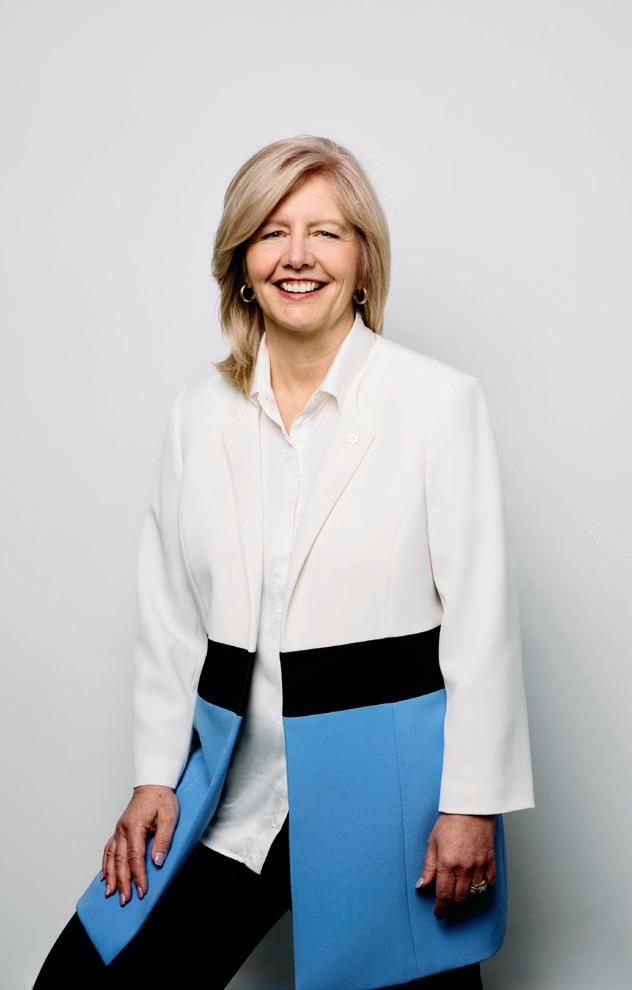
Vrooman has spent a career applying that idea to institutions that quietly shape daily life. Before taking the helm at YVR in 2020, she led Vancity for 13 years and earlier served as B.C.’s deputy minister of finance, the first woman and youngest person to hold the role. Across government, banking and aviation, the throughline is service. These are, she says, institutions “about providing service to people to strengthen our community and to strengthen our economy at the same time.”
At YVR, that mission plays out on a very big runway. In 2025, the airport welcomed a record 26.9 million travellers, moved the highest cargo volumes in its history, generated billions in GDP and supported over 100,000 jobs across the province (read the full figures in our feature on how YVR is supporting B.C.’s seafood export boom on page 38). In March 2026, YVR was named Best Airport in North America by Skytrax for a record 15th time and ranked 10th best airport in the world.
At a moment when our southern neighbours are watching their own aviation sector stumble on the global stage, what makes Vrooman one of this year’s Leaders is not just the scale of the institution she helms but also the steady, grounded way she guides it, something she is quick to credit to her team. Her view is that progress is never a solo act.
At YVR, that philosophy takes shape in the idea of “one YVR,” a reminder that everyone on site is working toward the same goal: “to safely and efficiently and empathetically move people and goods on their way.” Her kind of changemaking is less blue-sky than boots-on-thetarmac: make the system work better, make people feel better using it and leave it stronger than she found it.—K.D.

+ A
Her three kids.
That physical strength is the most important thing about being a police officer.
English breakfast tea.
At just four or five years old, Fiona Wilson was already tagging along on her mother’s volunteer rounds, knocking on doors and delivering Meals on Wheels to seniors who couldn’t leave their homes. For young Wilson, the visits offered an early glimpse into the power of community service—and the difference a simple act of care can make.
Today, Wilson boasts almost three decades of policing experience and a long list of accolades. She’s been widely recognized for her leadership in advancing responses to the mental health and substance use crises—work that began with groundbreaking research she led in 2007 while serving with the Vancouver Police Department.
At the time, officers were seeing a sharp rise in crisis-related calls, but little data existed to explain the shift. Wilson helped change that with her report Lost in Transition, which revealed that, in some parts of Vancouver, these incidents accounted for as many as half of all police calls.
The findings helped spur the expansion of the VPD’s dedicated mental health unit and new integrated partnership programs with Vancouver Coastal Health and Providence Health Care—an approach Wilson says reinforced a crucial lesson: police cannot respond to complex social issues alone. “We have to work with our partners, whether that’s health, housing, welfare—you name it,” she says.
Last year, Wilson made history as the first woman to lead the Victoria Police Department—“widely recognized as the oldest municipal police department west of the Great Lakes,” as she puts it. The milestone was meaningful, but complicated. “I’m very proud to be the first female chief,” she says. “But it’s also a bit disappointing that in 2025 we were celebrating something that should have happened long ago.”
Policing, she notes, has historically been “an organization built for and by men,” and women still face unique challenges in rising through the ranks. Part of her mission now is to widen the path for those coming behind her.
Her advice to women considering policing is simple: take the time to understand the profession and, if it resonates, pursue it with determination and passion. “When someone finds their place in policing, they quickly discover that the privilege of serving their community becomes the greatest reward of the work,” the veteran says.—M.A.
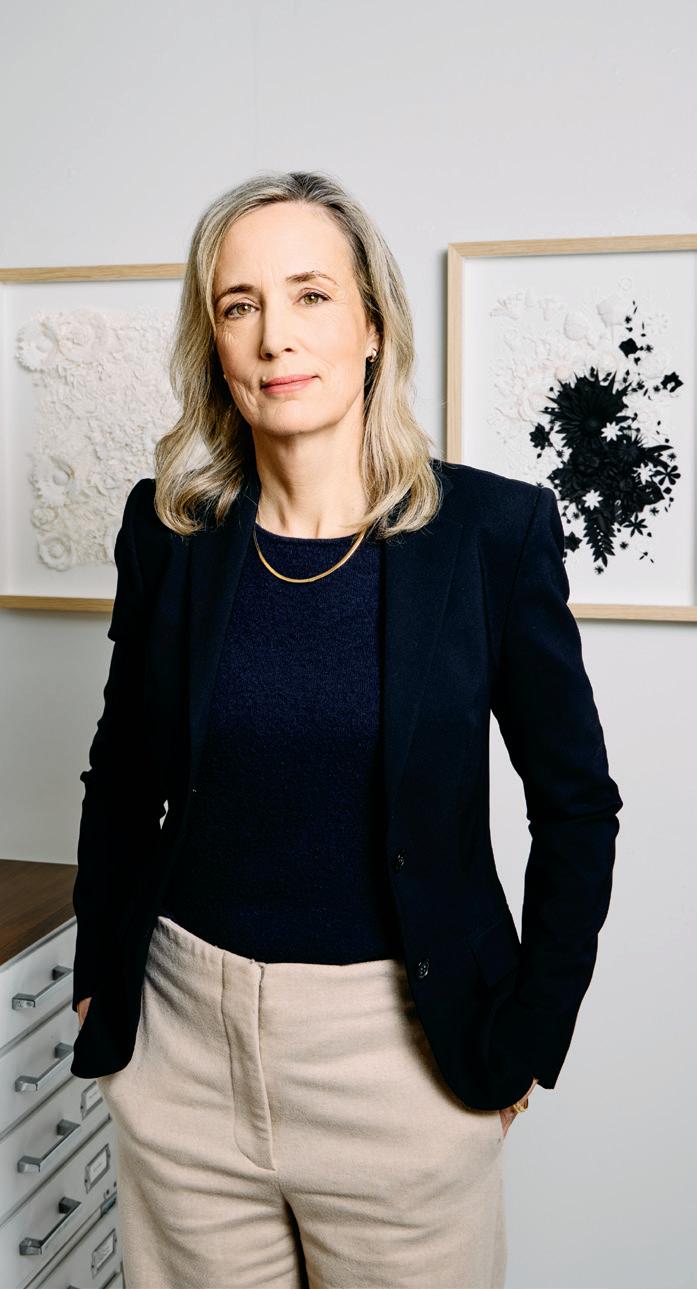
CHARLOTTE MITHA PRESIDENT AND CEO, BC HYDRO
FIRST JOB
Fresh in the role of president and CEO at BC Hydro in August 2025, Charlotte Mitha didn’t exactly inherit a quiet inbox. Instead, she stepped into one of the most consequential jobs in the province: leading the utility at a moment when B.C.’s ambitious energy goals were becoming logistical reality. A mechanical engineer by training, Mitha has been with BC Hydro since 2004—previous to taking the helm, she was serving as executive vice-president of operations and overseeing nearly 4,000 employees along with critical generation, transmission and distribution assets across the province.
For Mitha, the biggest revelation of the CEO role has been seeing just how deeply BC Hydro’s work touches everyday life. “When you look after an essential service, you have a role in people’s homes and in their aspirations and essentially their quality of life as well,” she says. Upholding that responsibility also depends on maintaining strong, long-term relationships across the province, including with First Nations. “We hold these relationships we have with First Nations very, very carefully,” says Mitha. Rather than treating engagement as a box to check, she says, BC Hydro works to build “long-term relationships and not just push a project through.”
The CEO is equally committed to making the industry more diverse. In 2024, Electricity Canada recognized Mitha for her work supporting women in the sector—highlighting BC Hydro initiatives like Taking the Stage, which has supported more than 700 women since 2015, alongside mentorship programs such as Mentorship Matters and dedicated forums for female field workers.
And the scale of the work is only growing. Electricity demand in B.C. is projected to rise about 15 percent by 2030, and BC Hydro is investing nearly $36 billion over 10 years in capital projects.
“You work in a world of trade-offs,” says Mitha, regarding the road ahead. Her answer is clarity, strong decision-making and, above all, transparency. “At the end of the day, you want trust,” she says. “You want people to understand your decision, even if they don’t agree 100 percent with it.” In uncertain times, a steady hand matters more than ever. And it would appear we have one.—K.D.

JILLIAN HARRIS
CO-FOUNDER AND CCO, THE JILLY BOX
Hailing from a family of entrepreneurs, Jillian Harris traces her instinct for curation back to helping in her mother’s gift shop as a youngster, where she learned early how to spot products that spark everyday joy. “I always come back to what gives me a warm, fuzzy feeling,” she says.
Three decades later, that instinct for creating meaningful—and luxurious—experiences is at the heart of The Jilly Box. Since launching her business in 2019, the Kelowna-based founder has grown the brand from a quarterly subscription offering to a B Corp-certified, multi-channel marketplace supporting Canadian, women-owned and purpose-led small businesses. Each drop of 20,000 units regularly sells out in under 24 hours, and is accompanied by a lengthy waitlist.
Q + A
“Learning the piano! I used to play when I was a kid, and now the entire family and I just started taking lessons together.
I love how it’s something that gets us off our devices.”
Brunette The Label.
“We’ve worked together for 10-plus years, and I admire Miriam as a fellow entrepreneur and lead of a Canadian/ women-owned business.”
Harris, who shot to fame as the first Canadian lead on The Bachelorette in 2009, has cultivated a deeply loyal following, in part, she believes, by turning down partnerships that don’t align with her values—and by keeping trust and authenticity at the centre of her decision making. “I knew I couldn’t do this long-term if people didn’t trust me,” she says.
The entrepreneur has emerged as a tastemaker with a modern-day Midas touch and her own kind of “Oprah Effect.” Products and brands featured—from clothing to housewares and accessories—see elevated sales and new devotees. (“Our customers want their money to go somewhere good. They want to support small local,” she says.) These local and women-led makers see huge gains—many picking up their own cult following.
The Jilly Box also quietly surpassed an impressive milestone recently: more than $1 million in donations to 80 or so local and national charities. And for Harris, that’s the metric that matters. Her team is given paid time off to volunteer— something she regularly joins, whether at the food bank or the community farm Helen’s Acres.
As for what’s next, a fast-growing e-commerce site is allowing Harris to support even more local makers and brands, especially those that can’t meet the volume demands of the subscription model. While she’s not looking to create her own products (“We could increase profits but that’s not as fun. It’s more fun when everybody wins”), her team is exploring new niche box product categories, including a men’s box launching later this year.
Harris is quick to credit her growing team (26 and counting) with helping to build a culture that saw the company named one of Canada’s top employers and fastest growing women-led businesses by the Globe and Mail—signifiers of an organization that prioritizes purpose alongside performance. “Without their commitment, there would be no award,” she says. “It’s a village.”—D.M.

Hand-engraved 18K gold necklace with silk-like finish. Experience its infinite styling possibilities.


Jane” Stoller holding a flute of her signature dealcoholized sparkling wine, it’s hard to believe she used to spend her days in steel-toed boots. It wasn’t that long ago, after all, that Stoller used to oversee operations at cement plants.
But today, the Whistler-based CEO and co-founder of Glimmer Wine, the fast-growing non-alc sparkling wine brand, has traded the grit of construction sites for the world of consumer brands, and is taking it by storm.
Within months of the official launch in October 2024 with co-founders Marina Billinghurst and Janet Helou, retailers were reordering and demand was accelerating. The company’s dealcoholized chardonnay is now already carried in 250 locations across B.C. (including top restaurants like Vancouver’s Maenam and Elisa and Whistler’s Wild Blue, to name a few) and expanding across Canada, as well as a number of wineries that want to offer a non-alc option to patrons.
Working on her family’s dairy farm, feeding the baby calves twice a day.
A MISCONCEPTION ABOUT HER INDUSTRY
That non-alcoholic wine is just grape juice. “The good ones are made with real wine and a lot of science.”
GO-TO RESET RITUAL
Reorganizing her closet.
To help scale the next phase of growth, Stoller recently closed a two-week, $500,000 funding round that will allow her to expand production runs, lower costs and bring in consumer packaged goods expertise. “It went really fast. People see the trajectory,” she says. Single-serve cans are on the horizon, as is international shipping.
The idea for Glimmer sparked around 2020, when Stoller began noticing a cultural shift: she and her friends were drinking less but still wanted the ritual and sophistication of wine or champagne. (“I saw the opportunity,” she says.)
Stoller’s background in operations and business strategy helped prepare her for entrepreneurship. She spent more than a decade in construction materials, managing major concrete plant and pipe operations in Vancouver and Edmonton before moving to Switzerland to consult on global plant operations. “I loved the work,” Stoller says. “But I always knew I would eventually build my own business.”
Her ambition now is to make Glimmer a household name. “We want Glimmer to be the bottle people reach for when they want to celebrate,” Stoller says. “Whether there’s alcohol in it or not.”—D.M.

TINA LEE CEO, T&T SUPERMARKET
Despite helming an international mega-grocer, CEO Tina Lee is all about homegrown family values. She’s both heiress and leader of the Richmond-born grocery chain T&T Supermarket, which was started by her parents, Cindy and Jack Lee, back in 1993.
Known for its fresh produce, Asian import goods and prepared meals—you’d be remiss not to notice the smorgasbord of ready-made baos and dim sum, sushi platters, hot lunch options and noodle trays, plus their expansive bakery with more than 150 different pastries and desserts, the most well-known being the mango cakes—T&T was originally a love letter to the Lee children.
T&T stands for Tiffany and Tina, Cindy and Jack’s daughters, who fondly remember sharing hot meals from the chain’s buffet in their childhood despite their retail tycoon parents’ demanding work schedules. From the founding of the grocery outlet onward, Lee recalls T&T’s ready-made meals on the dinner table, freshly steamed baos for lunch and cake from the bakery for breakfast.
“My mom started the business with three kids, and I think she just had a really great sense for what moms needed, and it removed the guilt from the kitchen,” says Tina, who took over the reins as CEO from her mother in 2014.
LAST BOOK SHE READ
Big Asian Energy by John Wang. (“A fellow Vancouverite.”)
A SKILL SHE’S WORKING ON Strength training.
A SMALL DAILY JOY
“My seven-year-old daughter’s running hugs.”
Under Tina Lee’s leadership, T&T has more than doubled its store count, opening over 20 new locations and employing about 9,000 employees across North America. That includes a groundbreaking entry into the U.S. market with two stores in Washington and five more locations announced in California.
“People in Vancouver might drive down [to the States] for a Trader Joe’s, but Americans drive up for a T&T, so it really does represent the next chapter of growth for us,” says Lee, who splits her time between Vancouver and Toronto.
The Asian grocer (now part of the Loblaws chain) continues to scale rapidly, now taking T&T goods sky-high—literally. T&T’s rice crackers now appear as the in-flight snack on Air Canada’s Asia-Canada routes (and in business class across the network). Not a bad place to land for a Richmond-born shop based on family values.—K.A.

STEPHANIE SIMMONS FOUNDER AND CHIEF QUANTUM OFFICER, PHOTONIC INC.
+ A
MOST-USED APP Teams.
“We
can learn a lot from everyone around us!”
When Stephanie Simmons was 16, the Institute for Quantum Computing changed the trajectory of her life. A newspaper article about the Ontario-based research hub introduced her to quantum technologies and their phenomenal potential. “From that point on, I focused my education and my career on learning all I could to figure out how to solve the challenges that stand in the way of creating these systems,” Simmons says.
Today, as founder and chief quantum officer of Photonic, the technologist is working to bring quantum computing out of the lab and into the real world—at scale. Founded in 2016, her company designs proprietary technology with the potential to unlock breakthroughs that are currently out of reach—from accelerating drug discovery to finding novel catalysts that would allow us to change the sustainability sector with new fuels or batteries.
Photonic’s approach stands apart in an often-theoretical field. Rather than chasing individual breakthroughs, the company is focused on building distributed, large-scale quantum computers and quantum networks that can integrate with existing telecom infrastructure. As Simmons explains, “We don’t just need quantum computers. We need scalable quantum computers.”
Now, the company is gaining serious momentum. In 2025, Photonic raised $180 million and was selected for both the Quantum Benchmarking Initiative at DARPA (the research arm of the U.S. Department of Defense) and Canada’s Quantum Champions Program— validation of its strategy to building reliable, large-scale quantum systems.
As co-chair of Canada’s Quantum Advisory Council, Simmons helps to maintain and increase the country’s quantum advantage in the global ecosystem. “Canada has demonstrated that not only are we contributing to the global quantum ecosystem—we’re shaping it,” she shares.
For Simmons, one of the biggest misconceptions about quantum computing is that it hinges on a single breakthrough moment. In reality, she says, progress comes from “systems, scale and decades of disciplined engineering.” When commercial quantum computers do arrive, they may appear to be an overnight success—but, like any transformative technology, they will be the result of years of careful design, iteration and collaboration.
“We’re at a pivotal moment,” she says, “and it’s an extraordinarily exciting time for those who understand what it’s taken to get here.”—M.A.
Pam, BC Women’s menopause patient with daughter, Sydney, born at BC Women’s

BC Women’s Health Foundation is redefining menopause for women today and for generations to come.
Through philanthropy, we helped fund the Complex Menopause Clinic at BC Women’s Hospital + Health Centre, the first of its kind in Western Canada. And with ongoing support from our donor community, we’re funding the Menopause + Midlife Program, which includes menopause research, care and provider education. Let’s be the generation to redefine menopause.
TO DONATE OR LEARN MORE, PLEASE VISIT
MELANIE BITNER CO-FOUNDER AND CMO, FIRESWARM SOLUTIONS
In the fall of 2023 —one of the worst wildfire seasons in Canadian history—a Rank 6 fire tornado tore through Gun Lake, B.C., destroying Melanie Bitner’s generations-old family home. “I watched it blow up before my eyes at about 4:30 in the morning,” Bitner shares, teary-eyed.
In the aftermath of the tragedy, Bitner and her family agonized over one question: what, if anything, could have been done differently to prevent it? She learned that aerial firefighting efforts are halted after sunset when the lack of visibility makes flying too dangerous. “We looked around the globe and thought there must be something out there that can support crews,” Bitner says. “We didn’t find it. So, we took a big swing.”
That same fall, Bitner co-founded FireSwarm Solutions. The deep-tech startup builds AI-enabled autonomous software and integrated hardware that enables ultra-heavy-lift drones to operate as coordinated swarms, delivering scalable support for wildfire response. Crucially, the technology is designed to operate at night, in low visibility and in conditions too risky for human pilots—filling a longstanding gap in emergency response.
While wildfire suppression remains its core focus, the platform is already being applied across a range of disaster scenarios, Bitner explains. It’s also gaining serious traction, both at home and on the international stage. FireSwarm was recently accepted into the 2026 NATO Defence Innovation Accelerator for the North Atlantic (DIANA) program, opening the door to potential deployment across member countries. Locally, the team has conducted integrated training exercises with the City of Kelowna and is working with partners including Strategic Natural Resource Group and Cheslatta Contracting (the economic development arm of the Cheslatta Carrier Nation), and is also in talks with B.C. and Alberta wildfire agencies, who continue to follow their progress.
Next up, Bitner is working to bridge the gap between innovation and early commercialization. So far, the team has been testing on both small and large drones to refine its technology, while lining up funding and contracts to scale to ultra-heavy-lift systems in the field. That next step, the founder-CMO says, will be critical for proving the concept in real-world conditions. In the process, the company is uncovering new ways to support crews beyond their original vision—from speeding up remote access to moving heavy equipment—with an eye toward building a global, safety-first operation.—M.A.
A SKILL SHE’S WORKING ON Rising to the challenge of her new position.
A B.C.-BASED BUSINESS SHE’S OBSESSED WITH SenseNet.
A SMALL DAILY JOY
“Trading silly Snapchat photos, messages and memes with my young adult kids.” Q + A
Wellness tourism is a significant economic opportunity in Western Canada, and there’s data to back it. Enter: the Wildwood Investment Fund.

Wellness travel is rapidly growing, becoming a major established force that’s reshaping the global tourism and hospitality industry. And it’s more than just a trend.
Global wellness tourism expenditures reached $894 billion USD in 2024, according to the 2025 Global Wellness Economy Monitor report from the Global Wellness Institute (GWI). That number is expected to surpass the trillion mark, reaching approximately $1.38 trillion USD by 2029. GWI also found that North America was the top-growing regional wellness market in the last five years, with millennials and Generation Z being key drivers of this growth.
The Canadian hospitality industry is responding to this opportunity. Albertabased hospitality group Basecamp Resorts, which operates 12 hotels and resorts across Western Canada, is expanding its Everwild wellness brand. In March, it announced three new Nordic Spa & Hotel destinations: Banff and Harmony (Calgary) in Alberta and Fernie in British Columbia.
three developments, Basecamp Resorts is expanding the Wildwood Investment Fund to $50 million after raising over $20 million to date, with over 280 investors.
“With Canmore performing strongly, these three new destinations allow us to thoughtfully grow the Everwild experience across Western Canada, while the expanded Wildwood Investment Fund provides the foundation to support that growth,” said Sky Mitchell, the founder and CEO of Basecamp Resorts, in a press release.

The original spa resort, Everwild Canmore, is a boutique hotel with a fully integrated Nordic spa, including thermal circuits, communal resting places, bespoke wellness rituals and a holistic culinary program—all under one roof and set against a desirable Western Canadian mountain backdrop.
This place-based spa destination concept—a full-day or multi-day experience rather than a 60- to 90-minute session—is seeing surging demand in North America. Everwild Canmore opened in November 2025 and is already operating ahead of projections, with revenue exceeding budget by 35 percent, 20 percent more direct bookings and a 48-percent profit margin on additional revenue.
The Everwild expansion to Banff, Fernie and Harmony continues this momentum, serving both destination travellers and local repeat visitors while supporting yearround tourism growth in high-demand, undersupplied markets. To support the
As wellness-driven travel continues to grow, the Wildwood Investment Fund provides accredited investors access to a diversified portfolio of premium Nordic spa and boutique hotel developments across Western Canada.
The Wildwood Investment Fund is a tangible, real estate-backed opportunity with a clear expansion strategy aligned with long-term growth trends. With a minimum investment of $50,000, investors gain exposure to multiple markets and development stages, creating geographic and seasonal diversification within a single, professionally managed fund. The fund is also eligible for RRSP and TFSA contributions, offering Canadian investors a tax-advantaged way to diversify.
With the fund’s early traction—and with the proven performance of the first Everwild location—projected returns for Wildwood Investment Fund investors look promising.
“Through the Wildwood Investment Fund, we’re able to grow the Everwild platform in a way that supports both local economies and the future of wellness hospitality in Western Canada and North America,” said Mitchell.

Q + A
A SMALL DAILY JOY
Tim Hortons coffee in the morning.
GO - TO RESET RITUAL
“Talking to my best friend on the commute from Vancouver to Surrey.”
A WORD SHE TENDS TO OVERUSE “Sorry.”
DIRECTOR OF BUSINESS INTEGRATION, BC ROYAL CANADIAN MOUNTED POLICE
Over Verna Mendes’s 25 years at the BC RCMP, she’s helped solve criminal investigations, implemented new drug testing methodologies and worked on highprofile cases that set legal precedents.
Her role in making major change when it comes to the law should be no surprise to anyone who grew up with her. She knew from a young age that she wanted to help unravel legal mysteries.
“When I was young, I was always into detective shows,” says Mendes. “I knew I wanted to solve crimes, but I also knew I would have to be a police officer, and in order to do that, you have to do a lot of break-up-the-bar-fights several years before you could get into being a detective. I thought: I really like science, I love biology and there’s this niche called forensic science.”
Armed with an undergrad degree in biology from SFU and in the midst of completing a master’s in forensic science from King’s College in England, she entered the BC RCMP in DNA analysis at their forensic lab in 2001 but was soon offered a job in toxicology due to her experience in alcohol analysis at Labatt Breweries. She eventually worked her way up to becoming the head of toxicology—then the entire forensic lab.
During the post, her work helped set the legal precedent for breathalyzer testing province-wide, even as she developed methodologies to help detect drugs “faster, better and more accurately” in the fentanyl drug crisis.
She also helped revamp the RCMP’s drug-testing methods, bringing in new instruments and creating a now-decadeplus collaboration with Health Canada so that labs could spot deadly new analogues.
“They’re seizing the drugs from the outside, and we’re analyzing the drugs that [resulted in fatality], so [I was] bridging that gap between another federal agency,” she says. “That collaboration remains to this day.”
In 2023, Mendes switched posts to become the director of business integration.
“When you have to build a new detachment, a new police station, we have to procure new police vehicles, new boats, all kinds of bulletproof vests,” she explains of her new department. “I call it the business side of keeping the police operational.”—K.A.

HEATHER RAY
For many years, Heather Ray was the only woman in the C-suite at her job. But in the 15 years she’s been at Mark Anthony Group, Ray has tried to set an example in the male-dominated beverage industry. “No matter whether I’m a manager, a director or at a different level, I have a role to play in helping support other women to see what’s possible,” she says.
The Vancouver-headquartered Mark Anthony Group is a diverse international collection of notable beverage brands, including estate wineries like Mission Hill, cooler brands like White Claw Hard Seltzer and spirits producers like Dillon’s Small Batch Distillers.
As chief transformation and people officer, Ray oversees the company’s people and organization strategy (think: communications and human resources), digital transformation and large-scale operational change.
Q + A
MOST-USED APP WhatsApp or Apple Music.
A BRAND SHE’S CURRENTLY OBSESSED WITH Glendalough Wild Botanical Gin from Ireland.
A WORD SHE TENDS TO OVERUSE
“Probably ‘culture.’”
CHIEF TRANSFORMATION AND PEOPLE OFFICER, MARK ANTHONY GROUP
Ray has been pivotal in supporting the company’s growth and employee transition. Since starting in 2011, she’s helped facilitate Mark Anthony Group’s expansion from roughly 600 employees to over 2,500 worldwide. Ray’s team has led the integration of nine acquisitions, reaching into the U.S., U.K., Ireland and Australia. They’ve launched new products in record time, built two U.S. plants during COVID and grown brands such as Olé Cocktails.
“One thing that has stuck with me is the power of seeing our people and team members as an absolutely integral stakeholder to accomplishing our strategy,” says Ray. “How do we focus, rally, set the vision and align every piece of the organization? Right people, right roles, right plans.”
Ray has also been a proponent of fostering an inclusive workplace. Over 10 years ago, she started including women’s leadership panels at the company’s national conference. Under her tenure, the company has increased female representation from 41 to 61 percent in Canada, and, in the last year, overall female representation in senior leadership has grown by 5 percent to reach 37 percent. “I’m by far not the only one anymore,” she says. “And I’m incredibly proud of that.”
Looking ahead, Ray wants to continue advancing women in leadership and supporting managers in their leadership development. The goal is “creating that environment where we’re lifting everybody up, providing opportunity and just being humans about it,” she says. “I think I lead with authenticity in my heart, and that seems to really resonate.”—S.J.

If there’s a local woman you know of who’s been awarded for their service to the community, it’s likely that Jen Murtagh helped put them there. On the committee for the Heart and Stroke Foundation and previously on the nomination committee for this very program—the BCBusiness Women of the Year Awards—Murtagh has made it her life’s mission to champion (and make visible) the work of women that often goes unnoticed.
“A lot of women do a good job of hiding, so they either play a bit small or tell themselves the story, ‘I haven’t done that much,’ or, ‘Who am I to nominate myself?’” Murtagh muses.
JEN MURTAGH CO-FOUNDER, MATURN
Alongside her own experiences with major life changes, it was the philosophy that women should be seen that led Murtagh to co-found Maturn—a leadership and development program that works with companies to provide support to women through the changing seasons of life at work—in 2021.
“We support women at work through key life stages. So we have to ask: how do we better support and how do we retain women through those very predictable life stages?” she says.
Maturn offers evidence-based programs that support women through four key career “exit points”—fertility, maternity leave, motherhood and perimenopause/menopause— including a maternity leave program and a three-month motherhood leadership coaching cohort focused on work-life balance, mental load and equity at home. They also train organizations and provide best-practice tools for workplaces to systemically support and retain women through those four life stages.
“I hope these conversations are more normalized, that they’re not seen as personal issues but as leadership workplace retention issues,” she says. “I hope it helps redesign how work-life is integrated and it’s not seen as support but as the status quo.”
Beyond her coaching work, Murtagh is also a staunch advocate for women’s heart health, helping to raise more than $1.5 million to expand the Leslie Diamond Heart Health Clinic at Vancouver General Hospital last year.
All because—simply—women need support, and Murtagh has made capacity for it.—K.A.

Exceptional women leaders are at the heart of Lawson Lundell’s success. We know that a diverse, inclusive team isn’t just a value — it’s the foundation of our market-leading service.
Visit our website to learn more about how we can empower your team.

+ A
GO-TO RESET RITUAL
“Being
GILLIAN VANDERMEIRSCH DIRECTOR OF RESEARCH, DEVELOPMENT AND LAB, VILLAGE FARMS INTERNATIONAL
Gillian Vandermeirsch wants us to think about cannabis the same way we think about wine. When buying a bottle, consumers typically don’t fixate on alcohol percentage—they might consider the grape, the region, the flavour profile and the overall experience.
Cannabis consumption, she argues, deserves the same level of sophistication.
Today, most cannabis products in Canada are sold with a single metric front and centre: THC percentage—the psychoactive compound responsible for the “high.”
“It’s created a dynamic where consumers can’t engage with the product directly—they’re relying on a single number to guide their decision,” Vandermeirsch explains.
In the process, much of what defines the product gets lost. Important qualities like the aroma, bud structure, stickiness and colour are flattened into a single percentage point. Two products with the same THC level, she notes, can produce entirely different experiences.
Vandermeirsch was among the first in Canada to challenge that system with data. In a 2025 peer-reviewed study, she and her team found that THC levels can vary significantly—not just between batches, but also within a single plant. The implication is simple but powerful: one number cannot accurately represent a biological product at scale.
Rather than leaving the finding in a journal, she brought it to market. At Pure Sunfarms (a subsidiary brand under Village Farms International), Vandermeirsch led the introduction of THC potency ranges on product labels— grounded in data from hundreds of batches—to give consumers a more accurate picture of what they’re buying. The shift isn’t just about transparency and education, it’s also about safety. Unlike alcohol, where people have a clearer sense of how much they can consume and still function, cannabis dosing is less intuitive—especially when the labelled percentage doesn’t always reflect the full range of potency. By introducing ranges, she says, consumers can better account for that variability and make more informed decisions.
Next, Vandermeirsch is focused on unpacking the science behind the “entourage effect”— the proposed theory that while THC drives the high, it interacts with other compounds in the plant, such as terpenes (important contributors to aroma and flavour) and minor cannabinoids (compounds other than THC and CBD) to shape the overall experience.—M.A.
At Heart & Stroke’s biennial gala in April, the organization raised a record $1.38 million to support life-saving research in women’s heart and brain health.

Robyn Jones-Murrell, senior vice president, Western Canada, at Heart & Stroke, on closing the women’s heart and brain health equity gap.
Heart conditions and stroke are the leading causes of premature death for women in Canada. Yet, for decades, most clinical research in this area focused on men. In British Columbia, researchers are working to better understand, prevent and treat heart and brain conditions as they affect women across their lives.
Robyn Jones-Murrell, senior vice president, Western Canada, at Heart & Stroke, says awareness of women’s unique risks for heart disease and stroke has improved, but many are still not being heard.
WHAT DISPARITIES DO WOMEN FACE WHEN IT COMES TO HEART AND BRAIN HEALTH?
Robyn Jones-Murrell: For a long time, medicine assumed that if a treatment or test worked for men, it would work the same way in women. We now know that isn’t always the case. We hear from many women who say they initially felt dismissed. They were told their symptoms were stress, anxiety or part of getting older. When symptoms don’t look like what clinicians expect to see, it can take

longer to reach a diagnosis. That delay can affect outcomes.
Women are also less likely than men to receive some diagnostic tests or evidencebased treatments, and they tend to have worse outcomes after a heart attack or stroke.
WHY DO WOMEN’S RISKS GET MISSED?
RJM: Women’s risks change across life stages and aren’t always well understood. Hormonal shifts during pregnancy, perimenopause and menopause can affect heart and brain health differently from men’s. Yet only 11 percent of women can name a risk factor specific to them. When women don’t know their risks—and when the health-care system isn’t designed to recognize them—it’s harder to spot warning signs, start conversations and get the care they need.
and juggling multiple responsibilities, and sometimes they dismiss their symptoms or delay getting help.
HOW DO SYMPTOMS SHOW UP DIFFERENTLY?
RJM: Chest pain and pressure are common symptoms for both men and women. But women are also more likely to experience feelings like jaw pain, back pain, nausea, shortness of breath, indigestion, extreme fatigue and migraines. These symptoms don’t always raise alarm bells, especially if clinicians are still looking for “classic” symptoms.
HEART & STROKE IS INVESTING $15 MILLION OVER FIVE YEARS IN THREE NATIONAL RESEARCH NETWORKS FOCUSED ON WOMEN’S HEART AND BRAIN HEALTH. WHAT ROLE DOES B.C. PLAY?
RJM: Researchers in B.C. are integrally involved. At the University of British Columbia, Dr. Lily Zhou is part of StrokeGoRed—a multi-year network studying why women often experience worse outcomes than men after stroke and how to improve care.
Another network includes work led by Dr. Jasmine Grewal at UBC and St. Paul’s Hospital, focused on cardiovascular complications during and after pregnancy and on reducing deaths and serious illness during that period.

Jones-Murrell,
WHAT CAN WOMEN DO TO BETTER UNDERSTAND THEIR OWN RISK?
RJM: Understanding personal risk is a good place to start. Heart & Stroke’s Risk Screen is an online tool that helps people understand their heart and brain health risks, including risks unique to women at different life stages. It’s designed to empower women to self advocate and have informed conversations with health-care providers.
For women entering perimenopause or menopause, pay attention to new or changing symptoms and report them to a health-care provider.
Many women also put their own health last. They’re caring for family, working
If something does not feel right, ask questions and advocate for yourself. Knowing what is normal for your body helps. And being persistent can make a difference.
To learn more, try Heart and Stroke’s Risk Screen at riskscreen.heartandstroke.ca Connect on: @heartandstroke | @heartandstroke | @heartandstroke @heartandstrokefdn

At just six years old, Jessie Williams was given a simple but weighty instruction from her grandfather. “You’re going to get the white man’s education and you’re going to use it to help our people,” he told a young Williams—words she still carries with her.
Today, as dean of Indigenous initiatives at Vancouver Community College, Williams works at the intersection of systems that haven’t historically worked for Indigenous learners and communities. A member of the Squamish Nation and the first in her immediate family to pursue post-secondary education, she has built a career focused on turning Indigenous inclusion from an add-on into built-in policy.
DEAN OF INDIGENOUS INITIATIVES, VANCOUVER COMMUNITY COLLEGE
“Living a balanced life.”
Nch’kay̓ Development Corporation.
“A beautiful walk along Ambleside Beach.”
At VCC, that means overseeing everything from student support to curriculum and community partnerships. “Indigenous student services is the heartbeat of the work that we do,” she says, pointing to gathering spaces, peer supports and cultural programming that aim to create “a home away from home” for students.
Much of her work is about relationships— how they’re built, maintained and honoured. Williams is deliberate about moving away from extractive models of engagement with Indigenous communities. “It’s more reciprocal, as opposed to transactional,” she explains, pointing to efforts like VCC’s annual Indigenous Partners Appreciation Luncheon, where knowledge keepers and community partners are invited, thanked and compensated for their contributions.
Before VCC, Williams held similar leadership roles at Simon Fraser University and New Relationship Trust, where she helped launch Indigenous-focused programs and expand community-driven education initiatives across B.C. She’s seen how post-secondary institutions are responding to the Truth and Reconciliation Commission’s Calls to Action—through new leadership roles, expanded programming and deeper engagement with Indigenous communities—but says the work is still evolving. “There’s a lot of work to do,” she says. “But I do see change.”
Across Williams’s many influential roles, her work has been guided by the Squamish teaching Nch’ú7mut, meaning “to be one, to be in unity.” Today, that principle applies to her view of her industry—perceiving education not merely as an institution, but as a place of belonging. “Education is a really special place to be,” Williams affirms. “It’s always been like a second community to me outside of my Nation, because it has been a constant.”—M.A.
+ A
FAVOURITE
Taste of Jamaica in Carrie’s Kitchen in Surrey.
“Prioritizing

When Nerissa Allen was growing up in Vancouver, she was often one of the only Black students in her class. A move to Barbados at age 11 changed that—and shaped the leader she would become.
“Going into a country where you are the majority and you don’t have that feeling of misplacement or displacement—you just feel a part of community—that was instrumental in building my confidence,” Allen says. By the time she returned to Vancouver at 21, she felt more grounded than many of her peers still trying to figure out their place.
After pursuing a double major in biology, Allen built a 20-year career with the Canadian Food Inspection Agency (CFIA), specializing in food, plant and animal regulatory compliance. But entrepreneurship had long been part of her life—from high-school business programs to side ventures in adulthood. When the COVID-19 pandemic shut down the wellness clinic she ran with her husband, she realized a glaring gap: B.C. lacked a business organization dedicated to supporting Black entrepreneurs.
The epiphany eventually became the Black Business Association of BC (BBABC), which Allen co-founded in 2020. What began as a grassroots response during the pandemic has grown into a nationwide ecosystem helping Black entrepreneurs start, scale and access new markets. To date, its programs have supported more than 2,000 businesses, secured $2.7 million in funding from Pacific Economic Development Canada to spearhead transformative programming and initiatives for businesses and helped companies secure opportunities with national retail chains and international markets.
BBABC’s flagship initiatives include the UEL Marketplace, a retail social enterprise on Vancouver’s Granville Island that gives Black-owned brands access to valuable shelf space; the Retail Readiness Accelerator, which prepares businesses for national distribution; and Afro World Expo, the Pacific Northwest’s largest showcase of Black-owned businesses.
Allen’s long-term goal: shifting the Black business ecosystem from primarily micro-businesses to thriving mid-sized companies capable of building generational wealth.
“If you want to build generational wealth,” Allen says, “you have to own—and ownership comes with entrepreneurship.”—M.A.
MOST-USED APP Spotify.
A SKILL SHE’S WORKING ON Being more present and patient.
An early-morning Peloton workout to house music.

CHANTELLE KRISH CEO, BIG SISTERS OF BC LOWER MAINLAND
Chantelle Krish has worked with the province’s former lieutenant governor and in the private sector, but her heart has always been in nonprofit. “Big Sisters really felt like coming home,” she says.
This June marks Krish’s fourth anniversary as CEO at Big Sisters of BC Lower Mainland. The organization is known for its signature mentorship program, which pairs young girls and gender-diverse youth aged seven to 17 with a Big Sister offering support and guidance.
Krish’s professional experience in gender equity advocacy goes back to her time at YWCA Vancouver from 2011 to 2019. There, she pushed for policy reform to support women experiencing intimate partner violence. Krish currently serves on the board of YWCA Canada and co-chairs its National Retreat for Women.
“Inclusion is about having a place, whether it’s a seat at the table, a voice in a room or being able to show up as your authentic self,” she says. “I really try to create spaces, cultures, organizations that embody that.”
In her four years at Big Sisters, Krish has expanded the organization’s programming, shifting the focus to long-term prevention and addressing systemic barriers facing young people.
In 2024, her team piloted an after-school gender-based violence prevention program to teach girls and gender-diverse youth life skills, financial literacy, human rights and self-advocacy. In 2025, after consulting over 300 stakeholders for the organization’s five-year strategic plan, Big Sisters launched a post-secondary support program and expanded its scholarship initiative to take a holistic approach in helping youth build sustainable pathways after they graduate.
Krish has also set an ambitious fundraising agenda. In 2023, Big Sisters launched Unleashing Potential, the organization’s first-ever multimillion-dollar philanthropy campaign. The initiative is fundraising to create B.C.’s first Mentorship HUB, as well as to establish a sustainable, long-term endowment.
“As a nonprofit, we are also running a business,” says Krish. “Our stakes are so much higher because we’re in the business of helping people.” In under three years, Big Sisters raised 75 percent of its $5-million goal. The organization has set a goal to reach more than double the number of youths it serves by 2029.
Last year, in recognition of her work, Krish was awarded the King Charles III Coronation Medal and the BC Achievement Community Award. But, for her, it all comes back to the people. “I’ve done so much work on the ground running programs—and that’s really motivating—but there are systems we need to look at,” she says. “How can we shift them? How can we work together?”—S.J.


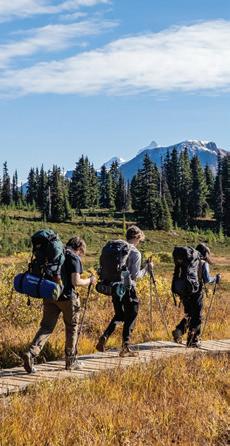






Pennie George made a big life gamble. Perhaps for someone who’d worked in the upper tier of the financial industry, it came with the territory.
“Twenty-five years ago, I was working in finance and there were way more men than women. Here I am back at UBC, and there are still more men than women going into this very rewarding career. I thought: Why is this still happening?” says the adjunct professor at UBC’s Sauder School of Business.
Returning to her alma mater, George is now the program director and founder of UBC SWIFT—Sauder Women in Finance Training—an extracurricular, cohort-based training and mentorship initiative at UBC Sauder
PENNIE GEORGE
PROGRAM DIRECTOR AND FOUNDER, UBC SWIFT
that selects a group of women and non-binary commerce students each year to learn investing through a hedge-fund-style paper portfolio, gain industry exposure and secure internships with finance employers.
A WORD SHE TENDS TO OVERUSE “Idiosyncratic.”
“People think business and finance people are greedy, but in my experience, they are very generous, especially philanthropically and with their time.”
Now integrated into George’s academic work at UBC, the SWIFT program is modelled after a program she herself was part of as a student back in the mid-’90s: the UBC Portfolio Management Foundation, a fund set up for students to practice investing. The original fund, which was seeded with $312,000 in 1986, has since reached $13 million, while the SWIFT program works on paper trades—simulated investing with a mock portfolio where students pretend to buy and sell stocks and track the performance as if it were real.
After graduating from UBC, George landed a job in securities at TD Bank in Toronto, then became senior vice-president at then-powerhouse investment bank Lehman Brothers in New York.
Then, the big gamble—George quit her job in New York and moved back to Vancouver to raise her family. It’s the classic story: a woman exiting her work life to rear children.
But, for George, it paid off—soon after she cashed out her stock in Lehman Brothers, the company went bankrupt—and she was able to comfortably bring up her kids while being a stayat-home mom. That is, until she was called back to UBC as professor, directing the same program she used to attend as a student.
At the end of March, George retired from her post—so perhaps her latest gamble is an aspirational one: pave the path for women coming after you so that they, too, can make smart risks cushioned by good investments.—K.A.
FIRST JOB
At a Bootlegger retail store.
A SMALL DAILY JOY
Cooking with vegetables from her own garden.
WHAT KEEPS HER GROUNDED
“My friends. I’ve had the same friend group for 25 years.”
CINDY BEEDIE EXECUTIVE DIRECTOR, BEEDIE FOUNDATION
It took Cindy Beedie seven and a half years to open her $50-million namesake housing project that many insisted, repeatedly, would not work. But despite being hit with financial, bureaucratic and municipal obstacles, she didn’t give up. “I don’t like being told no,” she says.
When she first began pitching a community housing project that would combine affordable homes for single mothers fleeing violence with on-site childcare, she assumed it would be simple to rally support. “I naively thought it was going to be easy, because I thought it was such a great idea,” she says.
Instead, it became a lesson in persistence. The YWCA hadn’t built a new daycare in 30 years, and Beedie was turned down by multiple municipalities. “It’s a lot to get in these rooms and share an idea you’re really excited about, and then hear, ‘That’s a great idea. Why don’t you build it in one of your husband’s buildings?’” she says.
With years of philanthropy and volunteering in the region (she and her husband, Ryan Beedie, regularly top Vancouver magazine’s Power 50 list for their $195+ million in community donations), Beedie felt inspired to uplift vulnerable families (“Some of these women don’t even have ID”) and create a safe space for mothers leaving unhealthy relationships. “I thought of the kind of generational change that that was going to make in their lives,” she says.
Now, that vision is reality. YWCA Cindy Beedie Place, a four-storey building with 56 affordable (and pet-friendly) homes, 37 childcare spaces and wraparound supports, opened in December 2025, on land leased from the City of Burnaby. The daycare opens its doors in June.
Beedie’s understanding of resilience is deeply personal. She points to her Ukrainian refugee grandmother, who rebuilt her life in Canada after profound loss (“She didn’t have much, but she just kept going”), and her mother, who raised three children largely on her own while her husband travelled extensively for work. Those examples continue to shape Beedie’s focus on supporting single mothers—and her willingness to step forward and be the public face of a project of this scale.
The development required a complex collaboration between BC Housing, the City of Burnaby and YWCA Metro Vancouver, along with years of fundraising and planning. Now open and fully occupied, it represents a long-term investment in stability and opportunity for the families who need it most. “This will be my legacy,” says Beedie.—D.M.
BOARD DIRECTOR, 2025 CO-CHAIR, PITCH FINALE ACTIVATION COMMITTEE, AND CHAIR OF STRATEGIC ENGAGEMENT, THE FORUM
Christina Brown had already built the kind of corporate career few women of her generation had access to. At Mackenzie Investments, she rose to senior vice-president—then, in 2007, a year after relocating to Boston with her family, she stepped away.
Q + A
LAST BOOK SHE READ
Signs: The Secret Language of the Universe by Laura Lynne Jackson.
The Jean Warehouse in Winnipeg.

A morning workout class at Turf in Vancouver with Ange Hartman.
A decade after moving, Brown returned to Vancouver with a different resumé: a nonprofit founder, a larger family and, by her own account, no shortage of ideas, energy or ambition.
Back in B.C., she reconnected with Christina Anthony, founder of The Forum—an organization Brown had engaged with years earlier, when it operated as the Forum for Women Entrepreneurs of British Columbia. The nonprofit helps women entrepreneurs access capital, mentorship and knowledge to scale their businesses.
Brown joined as a committee member supporting the Odlum Brown Forum Pitch, known as The Pitch. “Coming back to Vancouver,” she says, “I found women who were like me—motivated and wanting to get things done.”
The Pitch has since become a key engine for early-stage founders. The annual competition culminates in a high-profile fundraiser, where finalists receive funding to grow their ventures. In 2025, Brown co-chaired the finale activation committee, helping raise a record $1.3 million. Over the program’s 10-year run, participants have collectively raised $70 million and created more than 1,000 jobs across Canada.
Today, Brown serves as a board director and has spent the past two and a half years as chair of strategic engagement.
Her work extends beyond entrepreneurship. As a member of the curator’s council at the Vancouver Art Gallery, she supports the expansion of its permanent collection of works by women artists. She is also an executive member of the Young Presidents’ Organization (YPO) B.C. chapter, where, as Gold Spouse Learning Officer, she helped launch the inaugural 24-hour Spousal Summit. “The best communities are built with intention and generosity, but also some sparkle,” says Brown.
More recently, Brown has turned her attention to the next generation. She co-leads the Growing Leaders Forum, a cohort of 18 high school students from across the Lower Mainland who shadow The Pitch process from November through its April finale. “We’re trying to expose them to entrepreneurship, leadership and innovation through experiential learning,” she says.
For Brown, the throughline is clear: “When you’re supporting innovators, art institutions, schools and civic life, what you’re truly doing is supporting the future of our province.”—S.J.
CARA GARDNER MOREY
GENERAL MANAGER, VANCOUVER GOLDENEYES
Cara Gardner Morey wasn’t even being paid when she played in the original National Women’s Hockey League from 2002 to 2004.
“Watching leagues come and go and rise and fall has been a little bit frustrating. This league was long overdue,” she says, referring to the Professional Women’s Hockey League (PWHL), which was established in 2023. “They’re doing it the right way this time.”
Last year, the PWHL announced its expansion to Vancouver, soon after naming Gardner Morey as general manager. Taking on a role in something so new—both personally for Gardner Morey and for the Goldeneyes’ inaugural season—meant a lot to her. “At first it was exciting, but a little scary,” she admits.
Gardner Morey is responsible for selecting players, managing the coaching staff and overseeing the team’s development. Before joining the Goldeneyes, she held coaching roles, spending eight of her 14 years with Princeton’s women’s hockey team as head coach. The university’s women’s hockey program developed significantly under her guidance, winning an Ivy League championship, qualifying for two NCAA quarterfinals and setting a program record with 26 wins in a single season. Gardner Morey is the second-winningest coach in Princeton history.
On November 21 of last year, the Vancouver Goldeneyes played their first-ever home opener with a sellout crowd of nearly 15,000 at the Pacific Coliseum. “Seeing [the players] be introduced one at a time and getting to be on the bench looking at the response,” recalls Gardner Morey, “I actually teared up quite a bit because I definitely did not think I would see this in my lifetime.” She still gets goosebumps every home game.
Q + A
“Female sports are just for women and girls. We really are a product for everybody, and I think everybody feels included and welcome when they come to our games.”
Gardner Morey believes both the team and the league are inspiring the next generation of young girls who dream of a future in professional hockey. “It’s really near and dear to our players’ hearts,” she says. “During regular team meetings, we often talk about keeping the torch going and how we’re just a small part of this bigger story.”
Of course, Gardner Morey wants the Goldeneyes to win a championship. But her bigger mission is to create a lasting franchise and a legacy for women’s hockey in Vancouver, shaping an organization that is positively connected to the city and to all fans.
“People are showing up for female athletes and women’s sports,” she says. “I feel a real responsibility to make sure that we continue to have a great product and that we represent ourselves well so the fans keep coming.”—S.J.

TAYLOR HUI FOUNDER, BEAYOUTIFUL FOUNDATION
A WORD SHE TENDS TO OVERUSE “Empowering. (Proudly).”
A SKILL SHE’S WORKING ON Slowing down.
What’s more powerful than a woman who believes in herself? No overly apologetic emails, no deflecting compliments, no shrinking her own accomplishments. Just self-worth, loud and clear. As someone who experienced cyberbullying as a teen and watched friends struggle with anxiety, eating disorders and self-esteem, Taylor Hui understood how transformative that kind of confidence can be, and she set out to help build it, one girl at a time.
The BeaYOUtiful Foundation began the way many meaningful things do: a journal entry, a challenging experience and the gut-deep realization that support was missing for young women in her community. At 17, Hui launched her first pilot program at an inner-city school in Surrey, building the kind of support she wished had existed for her. “I just saw this need for support for young women to feel like they were seen, heard and valued,” says Hui.
Hui grew up in Surrey in her family’s business, 99 Nursery and Florist, which was founded by her grandparents after they immigrated from China. Working there alongside her family gave her an early education in leadership, community and what it means to build something from the ground up. Her grandparents, parents, brother and uncle continue to be her main source of inspiration.
More than a decade later, Hui’s teenage idea has grown into a registered Canadian charity supporting girls and non-binary children and youth through free confidence workshops, mental wellness programming, digital programming and the annual Inspired By HER conference. The event has already taken place in Vancouver, Toronto and Calgary, with Saskatoon joining the 2026 lineup. The organization says it has now connected with more than 6,300 girls and non-binary youth across Canada and built a network of 500-plus mentors nationwide, with plans to keep growing its reach and impact.
What makes Hui a rising star is not just that she started young, though our 30 Under 30 judging panel did name her to the list in 2024. It’s that she built something with real staying power. One of her proudest milestones, she says, is watching the work come full circle: girls she once mentored now return as volunteers, stepping into the role of Soul Sisters and helping guide the next generation. For Hui, confidence means “showing up wholeheartedly as you are” and knowing that “your worth is not defined by others.” That’s a powerful thing to pass on.—K.D.




WE HELP YOU RECOGNIZE AND APPRECIATE THE PEOPLE WHO MAKE IT POSSIBLE
Building a successful Canadian business is a testament to the collective vision and hear of your team and people. So how do you ensure that their contributions are recognized and appreciated?
At Eclipse Awards, we create the awards and plaques that convey your personalized messages of recognition and thanks. From design to elegant craftsmanship, we make it easy for you to create recognition awards that you can present with pride and con�dence.
Explore Our Awards & Plaque
Recognition Gallery
Awards are produced and delivered in 20 business days from Vancouver, BC. Rush services are available.


CEO, HUHA
Alexa Suter is a college dropout. And she’s also the CEO of Huha, a women’s underwear company focused on making skin-layer basics with comfort in mind. The idea itself was created out of Suter’s personal experience with recurring UTIs and discomfort from synthetic fabrics like nylon and polyester.
With sharp business instincts, Suter took the road less travelled—quitting her post-secondary program at 21 to build a career spanning real estate, fashion and marketing. She launched a skirt company called Sutie Skirts, founded her own digital marketing agency and emerged as an early adopter of influencer culture.
“I veered away from the traditional path. I left university and... got my business and negotiation skills through those couple of years,” she tells BCBusiness
Prior to that, she’d grown up on the manufacturing floor of a warehouse, watching her entrepreneurial father create mechanical goods on a major scale.
She took that entrepreneurial spirit all the way to Canadian reality TV show Dragons’ Den, where she pitched Huha—at that time reporting annual sales of $3.9 million—and scored a handshake deal with one of the show’s “dragons,” Arlene Dickinson: $400,000 for 5 percent of the company’s royalties.
That specific deal didn’t quite pan out—but with a little patience, Dickinson came in with something much better: a $20-million investment into Huha from her company, District Ventures Capital.
“I did crave mentorship, and I did want a partner,” says a now mid-30s Suter, “and I went with the investor that felt the most values aligned.”
If the sheer amount of undergarments sold are any indication (over four million units to date), the now-trademarked Mineral Undies enhanced with zinc oxide (which now come in a range of styles) filled a hole in the market for women looking to take care of themselves, starting with underwear.
Now Suter leads a team of 17 people, doing weekly check-ins with Dickinson after closing more than $45 million in annual sales in the 2025 fiscal year. How’s that for a college dropout?—K.A.

The moment that changed Anjali Dhaliwal’s career trajectory came in high school during an after-hours entrepreneurship class.
Dhaliwal had never imagined herself as an entrepreneur growing up. But her sudden exposure to passionate founders building businesses instilled a new drive in her. “It absolutely shifted what I thought was possible in the world,” she says.
In the years that followed, Dhaliwal launched several ventures, including Youth Helping Youth, a nonprofit supporting high-school students in their career and future planning. The initiative earned her a spot on BCBusiness’s 30 Under 30 list in 2022.
Four years later, empowering young people remains central to how Dhaliwal builds companies. Many of the early hires at her current startup, Gelee AI, came from the nonprofit networks she worked with in her teens. “I wanted to hire someone who wants to make a difference in this world and wants a lot of autonomy,” the 23-year-old says.
+ A
LAST BOOK SHE READ $100M Offers by Alex
MOST-USED APP LinkedIn.
Founded in 2025 and headquartered in Vancouver, Gelee AI helps B2B founders and CEOs turn LinkedIn into a tool for generating real business. The company refines their profiles, creates content that builds visibility and credibility and helps convert that attention into booked calls, clients and hires. Its AI also tracks trending topics so leaders can join the right conversations at the right time. More recently, Gelee has begun helping clients proactively reach potential customers on LinkedIn—similar to email outreach, but within the platform itself.
The idea for the company emerged after Dhaliwal exited a previous fintech startup that aimed to give users access to highly customized financial trading strategies. Following a co-founder split and buyout, she began helping founders grow their companies the same way she had grown her own—by building a personal brand online across platforms like X, Instagram and LinkedIn. Demand quickly snowballed. As she began building AI agents to help manage the work, Dhaliwal realized the service could become a business of its own.
In less than a year, she says, Gelee has helped clients generate more than $100 million in pipeline funding through LinkedIn-driven outreach. Dhaliwal’s long-term goal is straightforward: “I would love for every C-suite leader and founder, when they’re building their personal brands on LinkedIn, to make it the default to go with Gelee.”—M.A.
Erin Seeley (returning)

Erin Seeley is the CEO of YWCA BC, one of Canada’s largest multi-service charities supporting women and families, operating 21 transitional and permanent housing communities and five childcare centres, as well as employment, mentorship, youth education, violence prevention and advocacy programs.

Shauna Harper (returning)
Shauna Harper is CEO of WeBC. As a federally funded
Strehlke is CEO of Minerva BC, a registered charity dedicated to advancing leadership for women and girls. Strehlke also volunteers with Young Women in Business UBC and is a member of the Prosperity Project’s Rosie Initiative Advisory Group.
Tassan Sung (returning)

Tassan Sung is founder of SPOKEN Leadership and Education, a nonprofit amplifying thought leaders through speaker series, networking and workshops. She is a board director and former chair of the Dr. Peter Centre, and a director at Rise, supporting entrepre
porting over 2,000 women entrepreneurs annually with mentorship, education and access to capital.

Selena Woo (new)
Selena Woo is vice-president of private wealth – associates at Nicola Wealth, where she leads the strategy and development of the firm’s future advisor pipeline. With over 20 years in financial services, she holds CFP and CPA designations and is deeply committed to expanding access to opportunity and championing women and the next generation of talent.

For over 25 years, Minerva has worked to elevate the visibility, influence and contribution of women leaders. Today, that work includes helping businesses take meaningful action on pay equity.
LEARN MORE | COMPENSATION COLLECTIVE | MINERVABC.CA










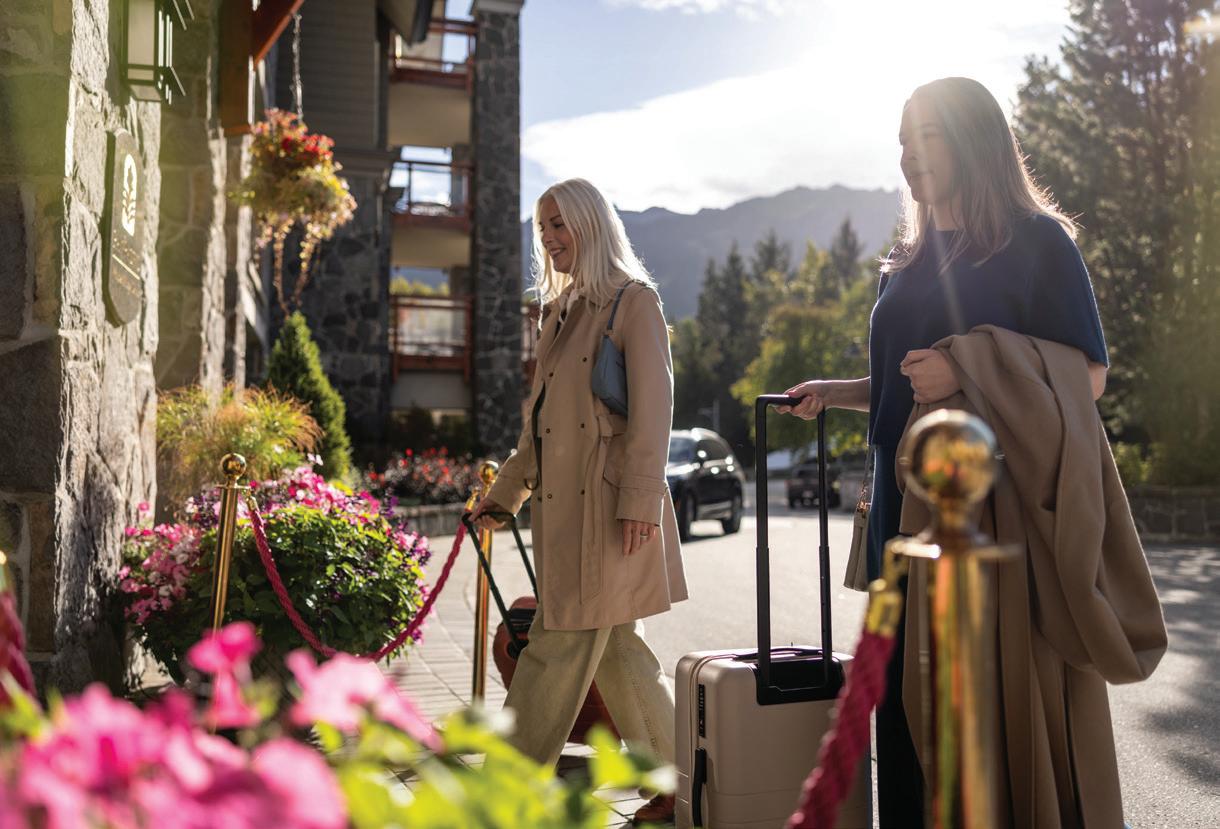






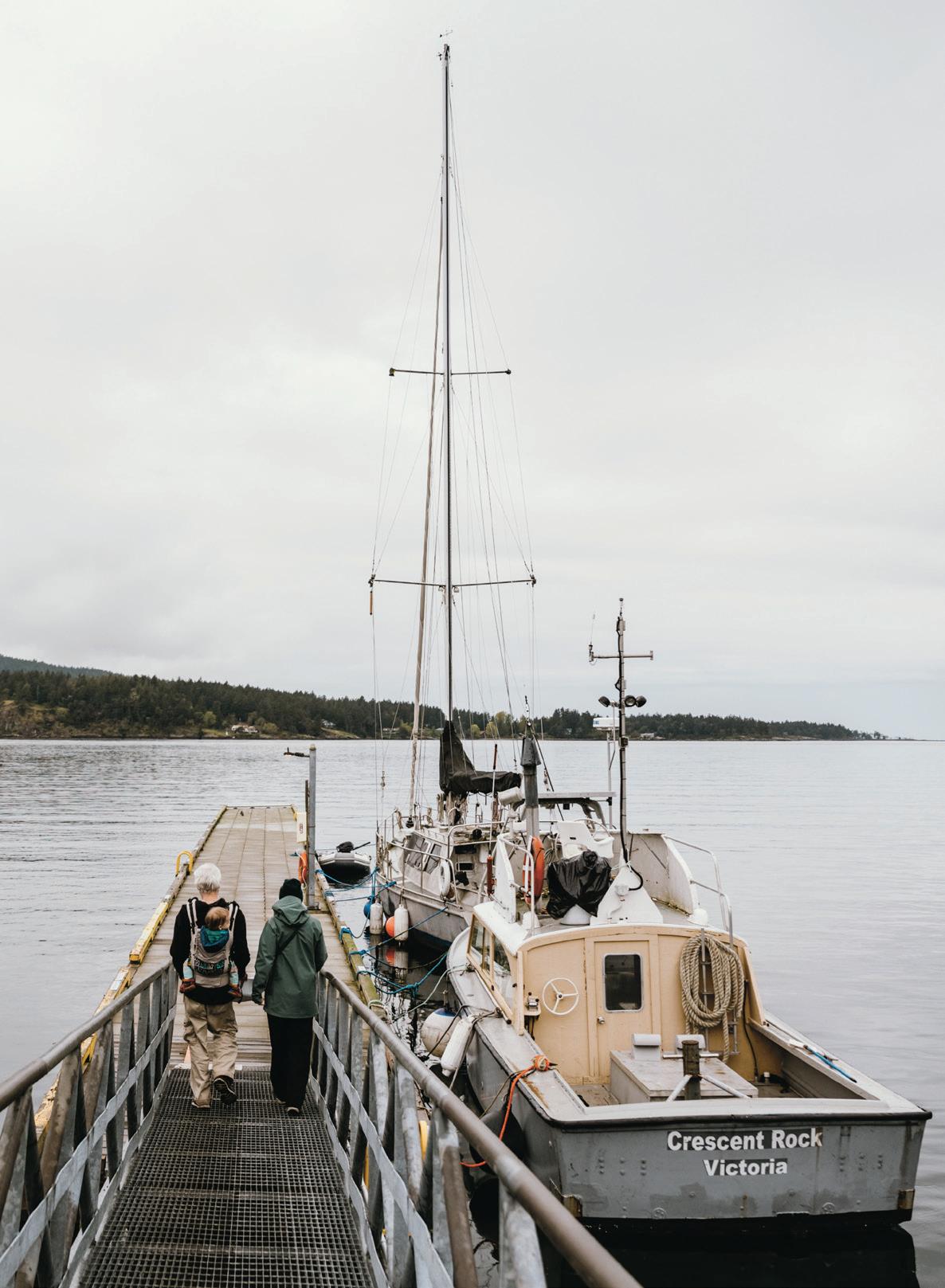
Slow down on one of the most charming Southern Gulf Islands.
By Darcy Matheson
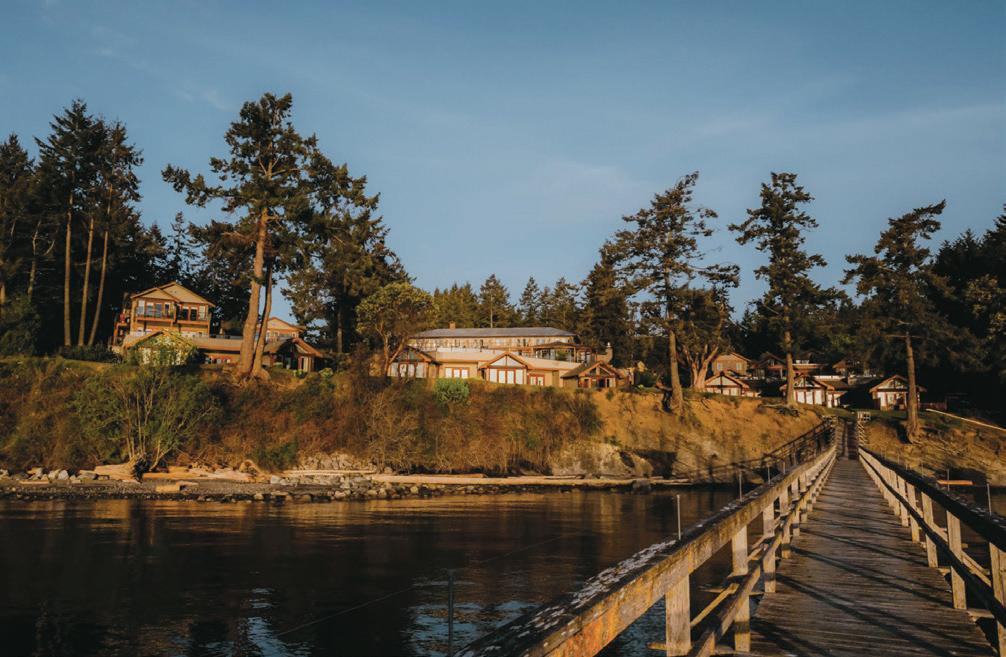
PLANNING FOR A LAIDBACK long weekend at a friend’s mid-century cabin on Mayne Island is a strange exercise in time management. There are great places to eat and shop and explore on this sleepy-yet-scenic Gulf Island, but thanks to what locals refer to as “island time,” you’ve got an extremely limited window in which to visit or you’re simply out of luck.
That’s how I find myself on a Saturday morning racing from the Village Bay ferry dock to the famed Mayne Island Thrift Store and “Store Next Door.” Open just three hours once a week, it’s totally worth planning a visit to the volunteer-run shop for its crammed aisles of vintage finds, including housewares, clothes, books and puzzles (a musthave for this slow-mo island visit). I pick up a few vintage board games for $1 each and wolf plates so gloriously weird they simply cannot be left behind (and are a steal at $2).
Just across the street, we duck into the Saturday market to browse artisanal gifts and pick up freshly baked cookies on the recommendation of one of the makers. And then one last stop: the Farm Gate Store, where lunch practically assembles itself. We grab veggie sandwiches on house-baked whole-grain bread with organic grilled peppers and Salt Spring Island Romelia cheese, topped with local shoots.
Back at the cabin—in all its cedar and glass and preserved-1960s glory—we settle into what a slow island weekend demands: staring dreamily at the Strait of Georgia, picking away at a 1,000-piece puzzle, and daily trips to the waterfront barrel sauna, pausing only to take reviving cold plunges into the Pacific.
With a population of only around 1,300 year-round residents, Mayne Island offers the kind of magic that is increasingly rare in travel: an experience that has not been smoothed for the benefit of tourists. Considered quiet even in comparison to its Southern Gulf Island neighbours, there’s no pressure to hit everything on a bucket list. Because there isn’t one.
Taking one last beach walk before catching the ferry home after a weekend of relaxing and exploring (there are, if you’re in the mood, quite a few things to do; find them on the facing page), I feel genuinely rested, versus needing another vacation. Chalk it up to that magical island time.

The Saturday market runs May through October in the Agricultural Hall, showcasing unique housewares, pottery, handmade soaps and candles, jewellery and (seriously) exceptional baked goods. 430 Fernhill Rd.
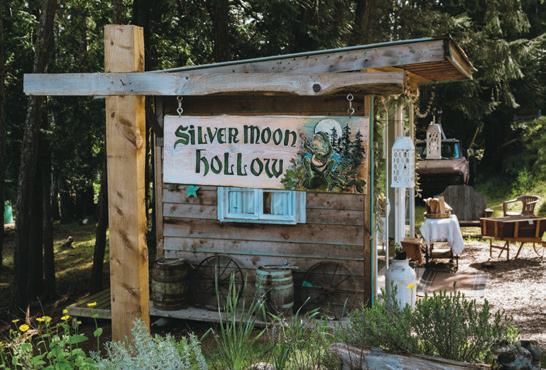

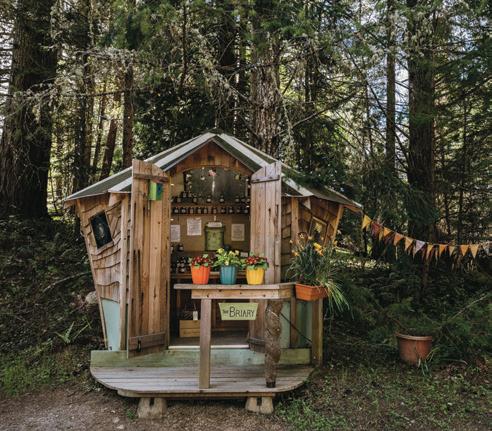
Give Pizza Chance serves up imaginative ’zas out of a trailer in Miners Bay. Try the Elvis Lives, with smoked ham, pineapple (naturally!), banana peppers and smoky BBQ sauce. It’s open 3 to 7 p.m., Wednesdays through Saturdays. 419 Fernhill Rd.
With quiet coves, sheltered beaches and uncrowded trails, Mayne is perfect for cycling, kayaking, hiking and bird watching. The 4.7-kilometre Mount Parke Loop is the most popular hike, where you’ll be rewarded at the summit with stunning panoramic views of Active Pass and the surrounding Gulf Islands.
Built in Dinner Bay Park to commemorate the early Japanese settlers who lived on the island and were interned during the Second World War, the Japanese Memorial Garden is a beautifully manicured stroll adorned with ornamental flowers, trees and ponds.
Accommodations aren’t plentiful, so book well in advance. Mayne Island Resort (494 Arbutus Dr.) offers rooms, villas and family-friendly cottages (some that are dog-friendly) with unobstructed water views starting at $209. Tent camping is also possible during summer and short-term rentals are available through VRBO and Airbnb.
Farm stands, where local purveyors sell everything from fresh-cut flowers to preserves and produce from the end of their driveway, are a mainstay here. Many are unmanned and operate on the honour system, so bring cash.
The Briary (639 Horton Bay Rd.) offers gourmet preserves that change seasonally, like rose jelly, strawberry-kiwi jam and garlic scapes infused in white balsamic vinegar. It’s a perfect stop on your way back to the ferry for loading up on extremely charming presents.
Stock up on seasonal organic veggies and local blooms at Hardscrabble Farm (45 Hardscrab-
, it’s an eclectic mix of seasonal plants and planters, spice blends, art cards and hand-knit toques.
After a day of exploring, dive into a flight of hand-crafted brews and a cheeky charcuterie board at the outdoor tasting room at Mayne Island Brewing Co. (open Friday through Sunday from 1 to 5 p.m.). Set in a wooded lot, the award-winning brewery (which supplies select restaurants in Vancouver and Victoria) produces seasonally crafted batches of ales and lagers. Must-tries include the Mayne Island Forager, a Belgian-style saison and the cocoa-infused Old Mayner brown lager. 490 Fernhill Rd.
BC Ferries provides year-round service to Mayne, but reservations are recommended. Seair seaplane flights from Richmond and Vancouver are available to Miners Bay.
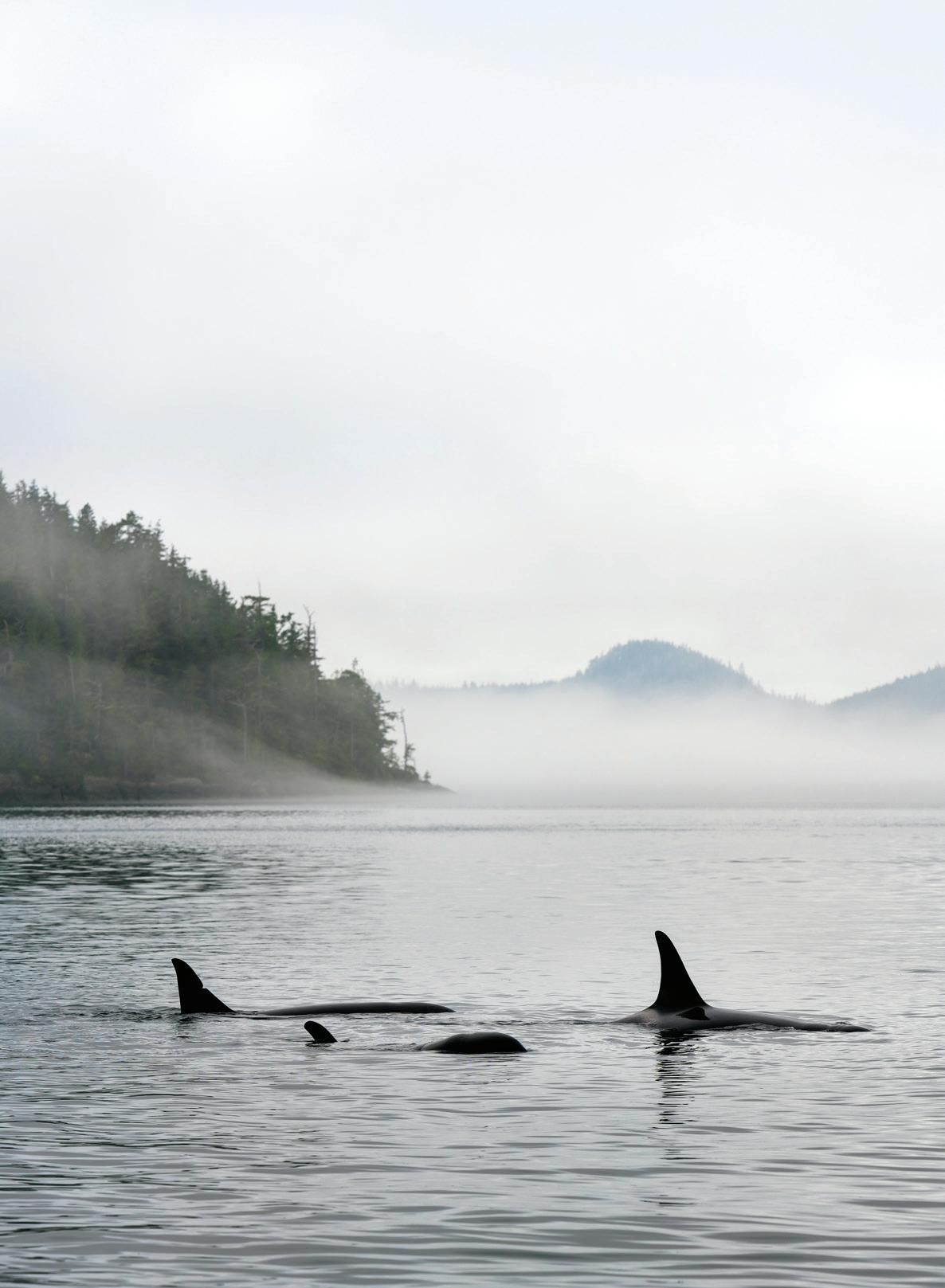
Scenic views, quiet luxury and an ensemble of hospitality pros make the newly renovated Sooke Harbour House a retreat for the senses.
By Kristi Alexandra
“I THINK I JUST SAW A WHALE!” exclaims my mom over the phone from her top-floor balcony.
The funny thing is, we’re both staring at the same patch of ocean—from separate balconies and separate rooms at the same resort—but I’ve yet to see one, as much as I’ve been yearning to spot an orca leaping out of the water.
Two days before, we’d landed at Victoria Harbour via helicopter, where a van picked us up and shuttled us over to a quieter part of the Island: Sooke, home to the legendary (and legendarily revitalized) Sooke Harbour House.
The town is a one-hour drive from downtown Vic, passing through Saanich and Langford. We asked our driver, Levi, if we could make a pit stop for a bottle of wine enroute. He asked us, casually, what we like—I’m partial to a sweet B.C. white and my mom is into a dry but juicy red—as if those notes would determine which liquor store close to Sooke we should stop at. Not so. Levi asked the question because, in addition to being our driver for that day, he is also Sooke Harbour House’s restaurant manager, and he’s got a quick line to the resort’s wine cellar.
Newly re-opened, the spot, now owned by Krystal Growth Partners and Vancouver-based Catalog Hospitality Group—the team behind Fred’s Restaurants, Sechelt Inn and Café Crema—has had a revival. It’s been open for just five months post-reno when I visit, after a nearly five-year closure between 2020 and 2025.
Levi and the hotel’s rooms division manager, Antoine, are both long-time employees of the luxury Pacific coastal resort—they stayed along for the ride when the property underwent a $14-million upgrade under its previous owners and then was sold to Krystal Growth Partners and Catalog.
The 28-room resort is a mansion of sorts, boasting large-format waterfront suites with decks. Winding corridors, butler’s staircases, hidden enclaves and gables that point every which way on the ocean-facing, 33,000 square-foot build remind me of what I think the house in The Secret Garden probably felt like: preserved heritage woodwork, English manor-style stacked storeys.
On the main level, just beyond the front doors, an entertaining room separates two different dining spaces: the casual Garden Café and Bar, where one can snag appies and cocktails in front of a roaring fireplace, and the more elegant Sooke Harbour House Restaurant dining room, with its heritage hardwood floors and 180-degree view of ocean and the Whiffin Spit, where locals and visitors go on nature strolls and walk their dogs. From this particular corner of Sooke, it feels like you’re at the edge of the world—nothing between your spot in the universe and infinite sea and sky.
Each of the palatial-feeling rooms is bespoke in design. The three-storey hotel boasts lofted suites on the top floor, each with their own aesthetic touches (think: stained glass, or polished branches running up the walls to mimic a tree).
(Helijet) Shutterstock/Ceri Breeze; (Sooke Potholes) Shutterstock/Russ Heinl; Sheringham Point Lighthouse) Shutterstock/Chase Clausen; (Mount Manuel Quimper) Shutterstock/Mark De Stephanis

Anyone flying commercial in coach with a toddler will know all too well the specific hell of being a parent in public—but I was relieved when my four-year-old kid was lulled into quiet snores, wedged between me and my own mom as we crossed the Georgia Strait via helicopter, getting an aerial view of Stanley Park and several small, rocky islands on our way to Vancouver Island. The comfort, views and 35-minute trip from shore-to-shore is worth the ticket price (and kids under 13 fly free with the purchase of an accompanying adult ticket).
$499 from Vancouver Harbour to Victoria Harbour
Sooke Potholes
Provincial Park
Locals use the millions-of-yearsold cavernous polished rock pools carved into bedrock as swimming holes during summer months, but the park also boasts hiking trails along the Sooke River.
Access via Sooke River Rd.
Sooke Harbour
Boardwalk at Ed MacGregor Park
Walk a 1,100-foot wooden boardwalk along the Sooke shoreline with woodland walking trails, access to a public pier and oceanfront green space (the last of which is host to many of the town’s local festivals and events).
6761 Sooke Rd.
Sheringham Point
Lighthouse
It’s 100 years old, and it can be reached by a short walk from the parking lot or by strolling its 3.4-kilometre trail.
1 Sheringham Point Rd., Shirley
Mount Manuel Quimper
Catch views from this mountain in the Sooke Hills via its summit hikes (coastal panoramas come into sight once you get to the top).
Trailhead at Harbourview Rd.


suite escape
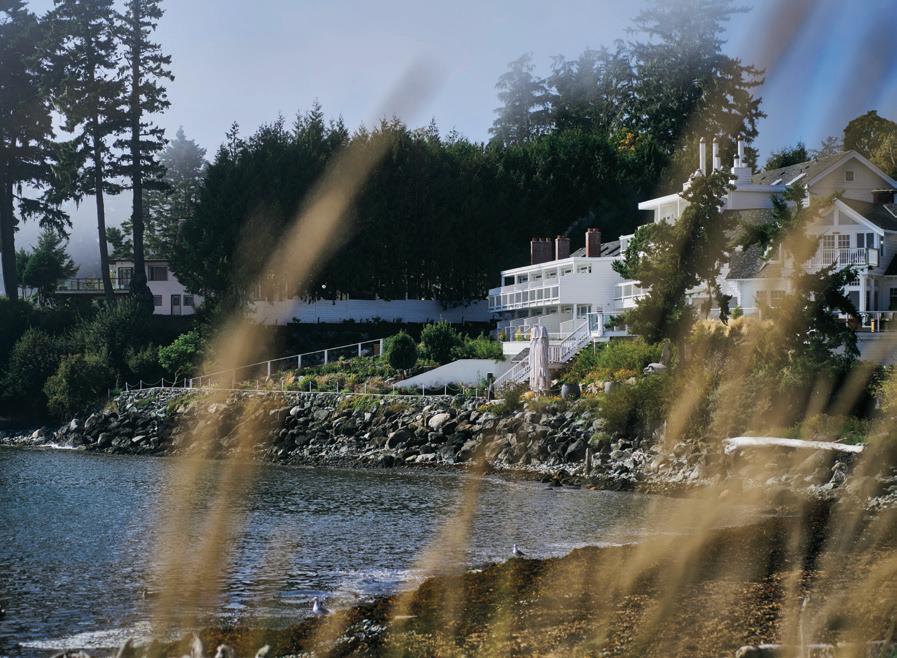
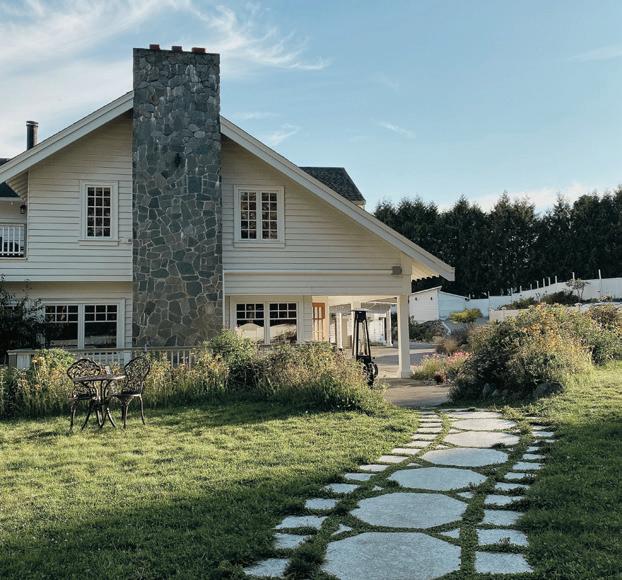

Me? I’m staying in the Victor Newman Deluxe Suite on the second floor: a breezy, spacious room designed in collaboration with local Kwakwaka’wakw artist Victor Newman, featuring a double-sided fireplace (fire logs for which you can snag at the front desk) and original carvings, including a carved formline baseboard that wraps the bottom of a mirror set in place beside an oversized inset soaker tub.
That tub, by the way, faces the double sliding doors to the patio, which overlooks the Juan de Fuca Strait (where one could—allegedly—spot orcas playing in the waters).
It’s not lost on me, the quiet luxury of being able to savour a coffee while I look out the window in search of seals and loons. Other times of the year, one might watch for storms with a glass of wine in hand.
But in here, I’m not sure if the luxury comes in gazing outside at the creations of nature, or gazing inside at the creations of humans. You could spend an entire long weekend here and not have to set foot outside the property once—food, wine, scenery, nature, stargazing and local art are all part of the program at Sooke Harbour House.
Upcoming plans for the three-acre property include an outdoor spa, but, for now, the property—like most things on the Island—remains a remote-ish escape from the city. It feels like a secret I’m in on—especially given that I’ve been allowed a peek at the basement wine cellar, which doubles as a private dining area. B.C. wines (among others) line the stone walls, and I spot a couple of the bottles Levi had handpicked for my mom and me the night before.
We’re here in November, but by summer, I imagine this place will be buzzing with locals and tourists alike, people dining on the outside patios and enjoying sips of wine from their double-wide balconies overlooking the ocean, hoping to spot orcas playfully jumping across the edge of the world.
For now, I’ll just enjoy the quiet beauty of this place.

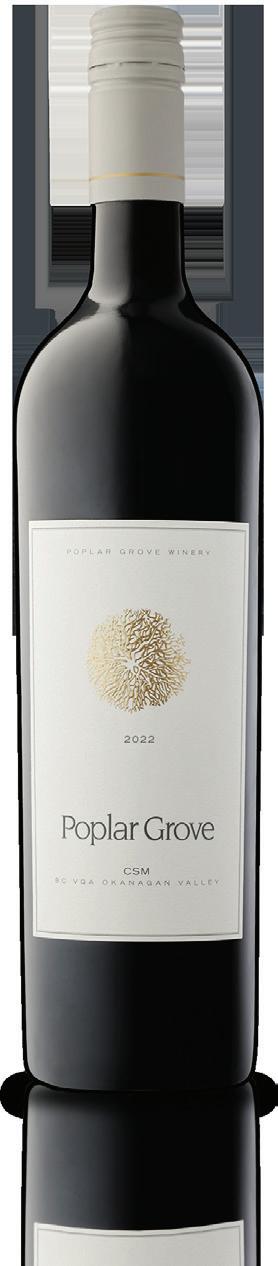

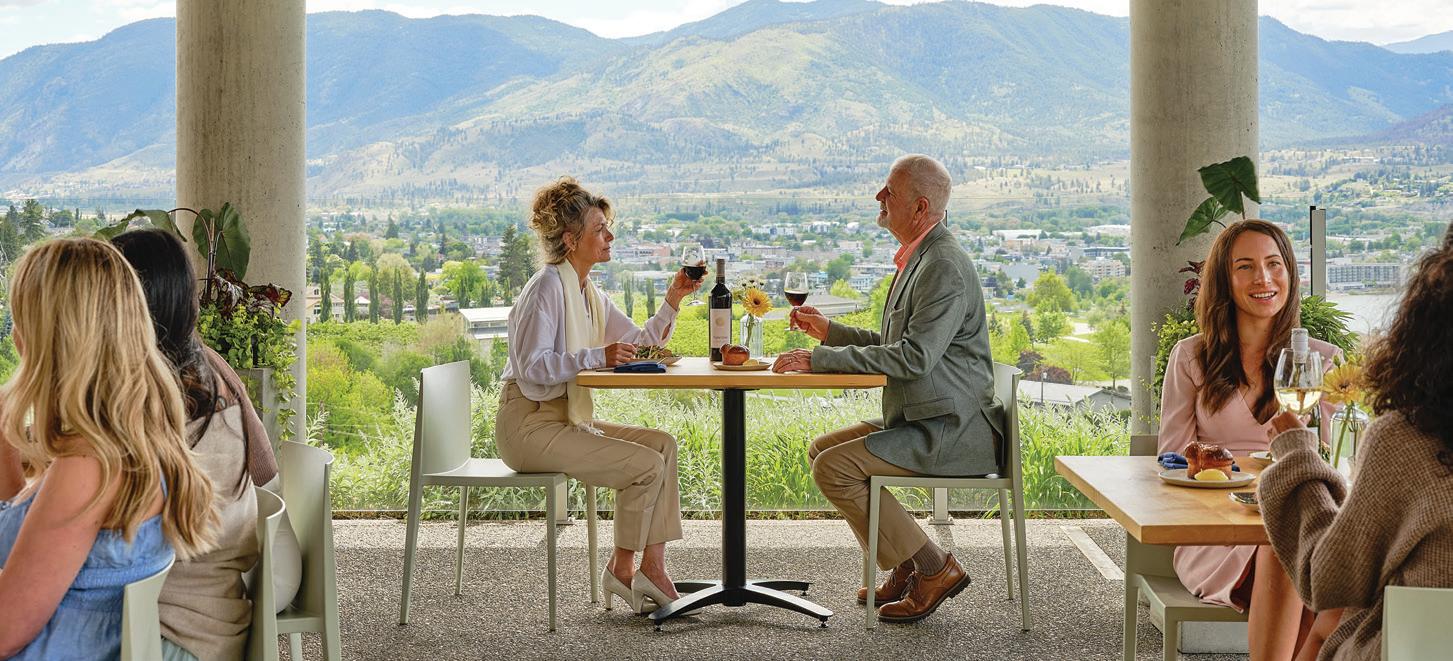

Mushroom foraging, a region-spanning studio crawl and a harbour-view spa stay turn the Sunshine Coast into a weekend that scrubs the city life right out of your system.
By Kerri Donaldson
BY THE TIME I’M TWO CIDERS DEEP at a picnic table in an apple orchard that looks suspiciously like a Mumford and Sons music video, trying to keep blue cheese from sliding off my pizza while a bluegrass band covers Taylor Swift and a flock of sheep stares from next door, it hits me: this so-called “art crawl” on the Sunshine Coast has quietly turned into a full reset.
Most people come here for the scenery. The Sunshine Coast stretches roughly 180 kilometres from Howe Sound to Desolation Sound, a boat- or plane-access strip of mainland with island energy: rainforest, sculpted shoreline, mountains at every angle. It sits on the traditional territories of the Skwxwú7mesh Úxwumixw, shíshálh, Tla’amin, Klahoose and Homalco Nations, whose histories shape the land you are here to hike, paddle and, as I learn, studio-hop through. The nature is a given. What this weekend reveals is the other thing the Sunshine Coast has in wild abundance: artists. The more art studios I step into, the more I start quietly auditioning myself for a different kind of life.
The trip starts in the car lineup at Horseshoe Bay. Forty minutes later the city skyline is gone and Howe Sound has taken over: green islands, low cloud and the occasional seal-shaped piece of driftwood that is never, tragically, a seal-shaped seal.
The town of Gibsons is the Sunshine Coast’s unofficial front door, a steep town pouring down to a harbour lined with cafés, taprooms, galleries and the yellow facade of Molly’s Reach (a treat for anyone, including my mother, who remembers the 1970s and ’80s CBC drama series The Beachcombers).
My first mission: meet a man named Shaggy Jack in the woods. Métis forager Jody “Shaggy Jack” Franklin teaches people how to safely identify and harvest wild mushrooms, working from knowledge passed down from his father rather than vague “forest vibes.” With a floor-dusting dreadlock and full forest-gnome beard, he looks exactly like central casting’s idea of a mushroom guide.
Soon I am in a coniferous forest near Roberts Creek, walking slower than I ever do in the city, eyes glued to moss and salal. I call out maybe-chanterelles while Shaggy Jack talks habitat, etiquette and why he shares his knowledge instead of guarding “secret spots” the way some foragers do. Turns out there are politics in mushroom hunting.
When we finally spot a lobster mushroom, it’s like finding a last-minute BC Ferries reservation on a long weekend—a small miracle. I’m not sure if the rush is from the find or from spending hours focused on one square metre of forest floor instead of my inbox. Either way, I leave with a sizeable bag of fungi, dirt under my nails and a brain that feels noticeably quieter. For the first time in a long time, my day has nothing to do with deadlines and everything to do with the forest deciding whether or not to share.
That night I carry on past Sechelt and Halfmoon Bay to Painted Boat Resort Spa and Marina in Madeira Park, where villas step down toward a quiet marina framed by Douglas fir and arbutus. Inside, there is a full kitchen, gas fireplace, deep tub and a balcony over the harbour. Somewhere in the dark, coyotes yip and someone barbecues salmon on a neighbouring deck.
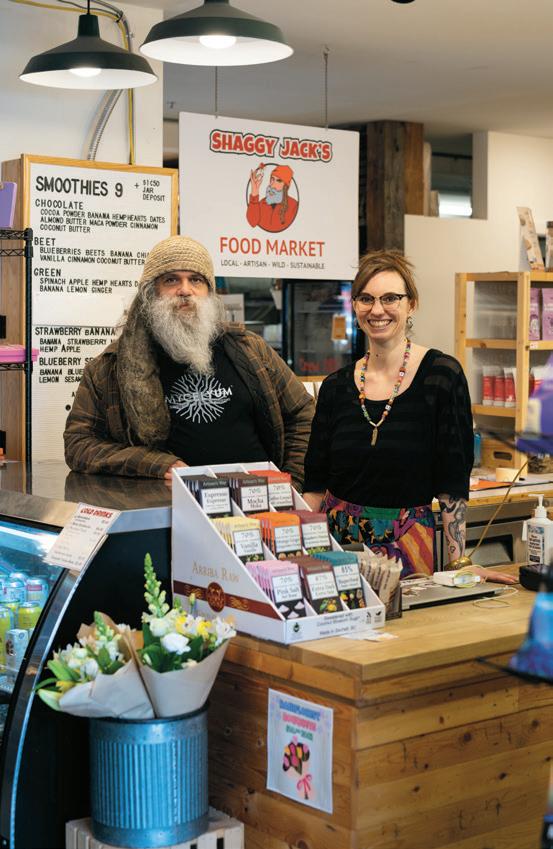
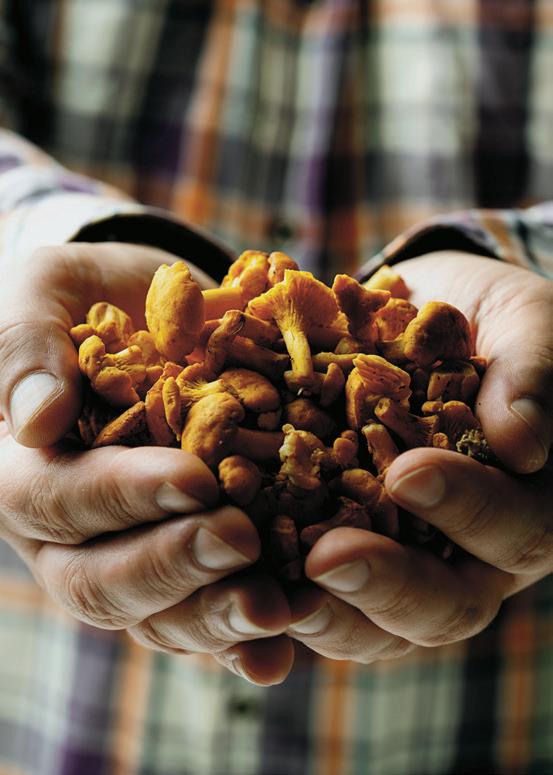
Is this my life now? With a glass of red on the balcony, I start plotting a coastal career pivot, ceramics maybe, despite never having touched a wheel. It’s the classic city fantasy: cash out of the nine-to-five, move to a small town, make beautiful things. The coastal air is intoxicating enough that it feels almost reasonable.
Dinner is at the Lagoon Restaurant on the dock, where the menu leans West Coast comfort. Pan-seared lingcod with risotto and grilled asparagus lives up to the front-desk’s must-try hype at check-in, and a pound of mussels in curry broth with fries is exactly the kind of “I have earned this” order that pairs with a day of forest bathing and low-stakes life planning.
Every October, the Sunshine Coast Art Crawl turns the shoreline into one long, three-day open studio. More than 180 venues from Langdale to Earls Cove and Egmont open their doors for a self-guided tour that feels part gallery hop, part sanctioned snooping through people’s very charming sheds.
Map downloaded from the Coast Cultural Alliance, I start in Sechelt and head north: potters in Halfmoon Bay, painters in Roberts Creek, carvers and printmakers down side roads. There is no fixed route, just clusters of studios strung along Highway 101, each one a little window into how someone traded a commute for a kiln or an easel. With every driveway I turn down, the fantasy in my head gets more specific: what if I wrote in the mornings, threw mugs in the afternoons and only opened my laptop to post studio hours?
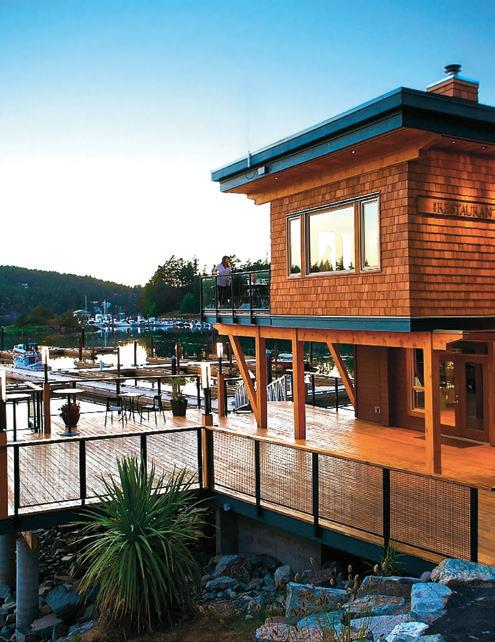
dine dockside
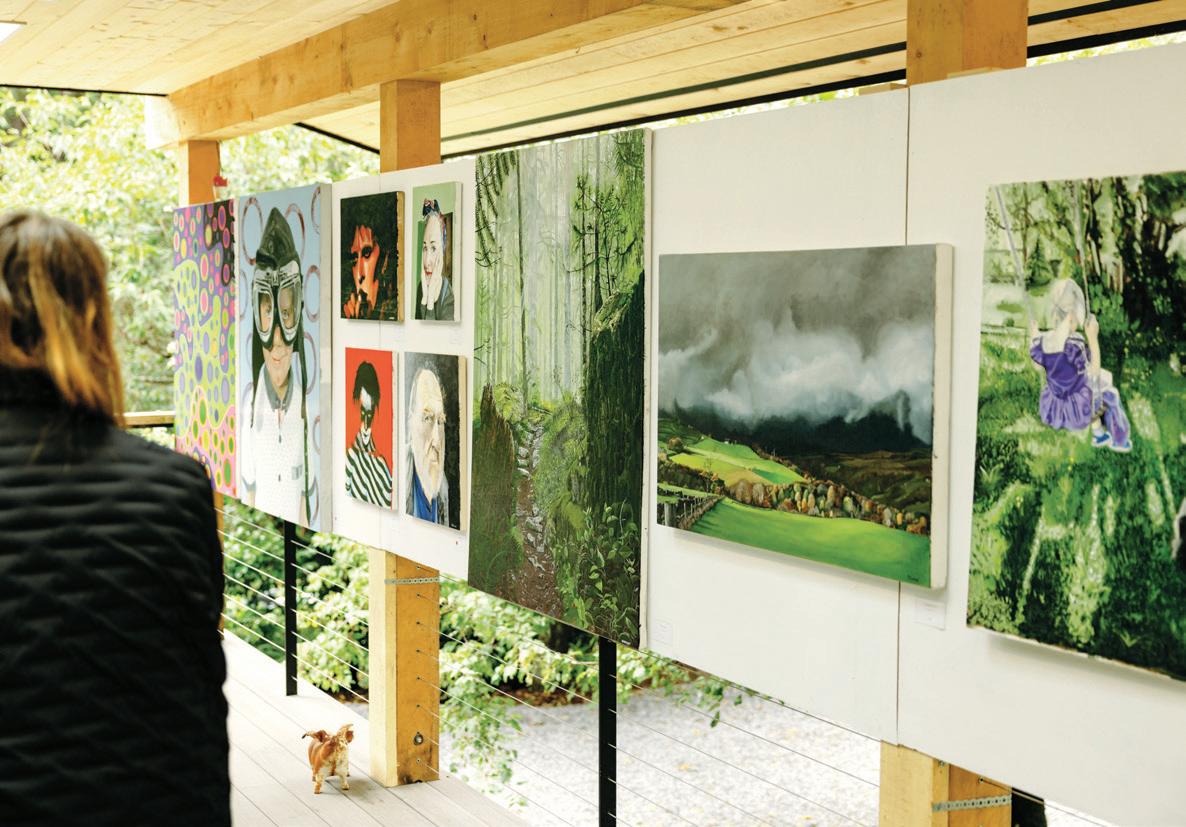
Taste
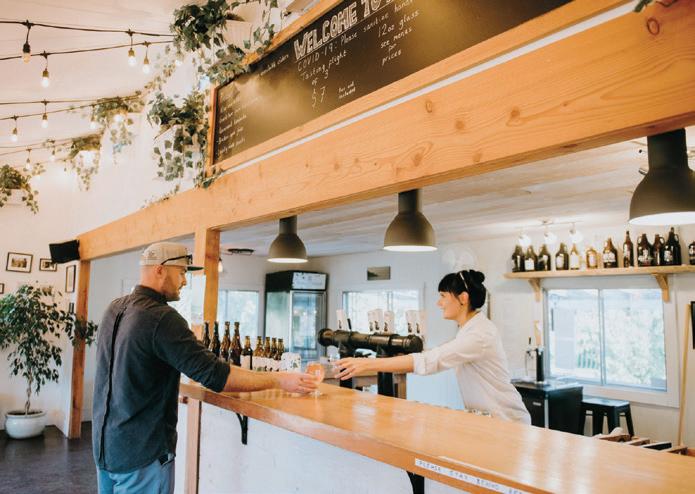
In Gibsons Landing, artist Coralie Swaney welcomes visitors into her basement-level Smiling Seagull Studio, where acrylic and polymer-clay pieces mix vintage dishware, art history and her childhood pet sheep into scenes that land somewhere between storybook and fever dream. Elsewhere there are fibre artists, sculptors, photographers, Indigenous carvers and mixed-media experimenters; the Coast Cultural Alliance directory lists dozens of Purple Banner studios and galleries from Langdale and Gibsons to Powell River and Lund.
The Sunshine Coast has one of the highest per-capita populations of artists and crafters in Canada, and it shows. The Crawl feels less like a pop-up and more like a reveal of an ecosystem that was already humming along, studios tucked behind cedar hedges and down gravel driveways, work inseparable from the place it is made. The same group runs the Purple Banner Tour year-round, with each participating studio marked by a tall purple flag.
Between clusters, snack breaks are built in: farmers market lunches in Sechelt, espresso and “for later” pastries at the general store in Halfmoon Bay, then pints and deep-fried pickles on Tapworks Brewing Company’s rooftop patio in Gibsons, harbour view and DJ optional. Is this tourism, or is it a weekend of trying on other people’s lives for size?
To keep the weekend firmly in retreat territory, I spend my last morning in Painted Boat’s Spa Serenity Garden. Tucked behind fencing and trees, the outdoor hydrotherapy loop is part Scandinavian spa, part secret forest pool: hot pool with a waterfall, warm salt-water float pool, sauna, glacial rain shower and a fireside nook for herbal tea. Two hours of rotating between hot and cold and my laptop neck finally gives up. For a brief moment, the only timeline I care about is how long I can stretch this out before returning to a desk.
On the drive south I make one last artful detour at the Bricker Cider Company in Sechelt, a family-run cidery on a three-acre orchard. Flights of core and seasonal ciders arrive with thin-crust pizza and build-your-own charcuterie from on-site kitchen The Shed. Kids run laps, dogs flop under benches, a bluegrass band tunes up under string lights. This is the picnic-table, pizza-balancing, sheep-nextdoor moment; Mumford-core in the best possible way and the final nudge in the “what if I just stayed” daydream.
The BC Ferries Langdale terminal is about a 10-minute drive from Gibsons, so, yes, you can sneak in one last lap.
Got 60 to 90 minutes?
Starlet Vintage
Curated vintage and at least one “this is either iconic or a cry for help” dress. 459 Marine Dr.
Reasons to Live Books and Records
VHS, vinyl, books and T-shirts that will emotionally blackmail you into buying them. 104–272 Molly’s Ln.

Got 30 to 60 minutes?
Lunitas Mexican Eatery
Waterfront tacos and a salt-rimmed margarita, a.k.a. the pre-ferry reset. 645 School Rd.
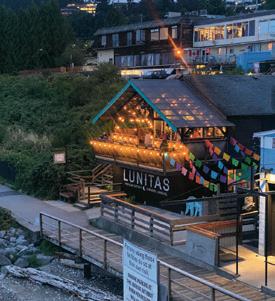
Got 15 to 30 minutes?
Pick one stop. Set an alarm for “leave for Langdale.” Do not become a ferry-line sprinter.
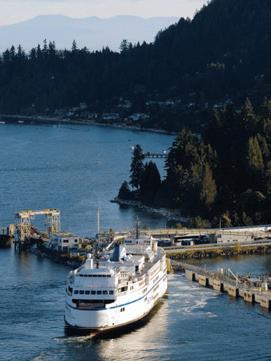

balance sheet that goes beyond the 9-to-5
THE PIVOT
Bianca Bujan traded her desk job for safari treks and river cruises—making a travel-writing career that balances adventure with a steady paycheque.
By Mihika Agarwal
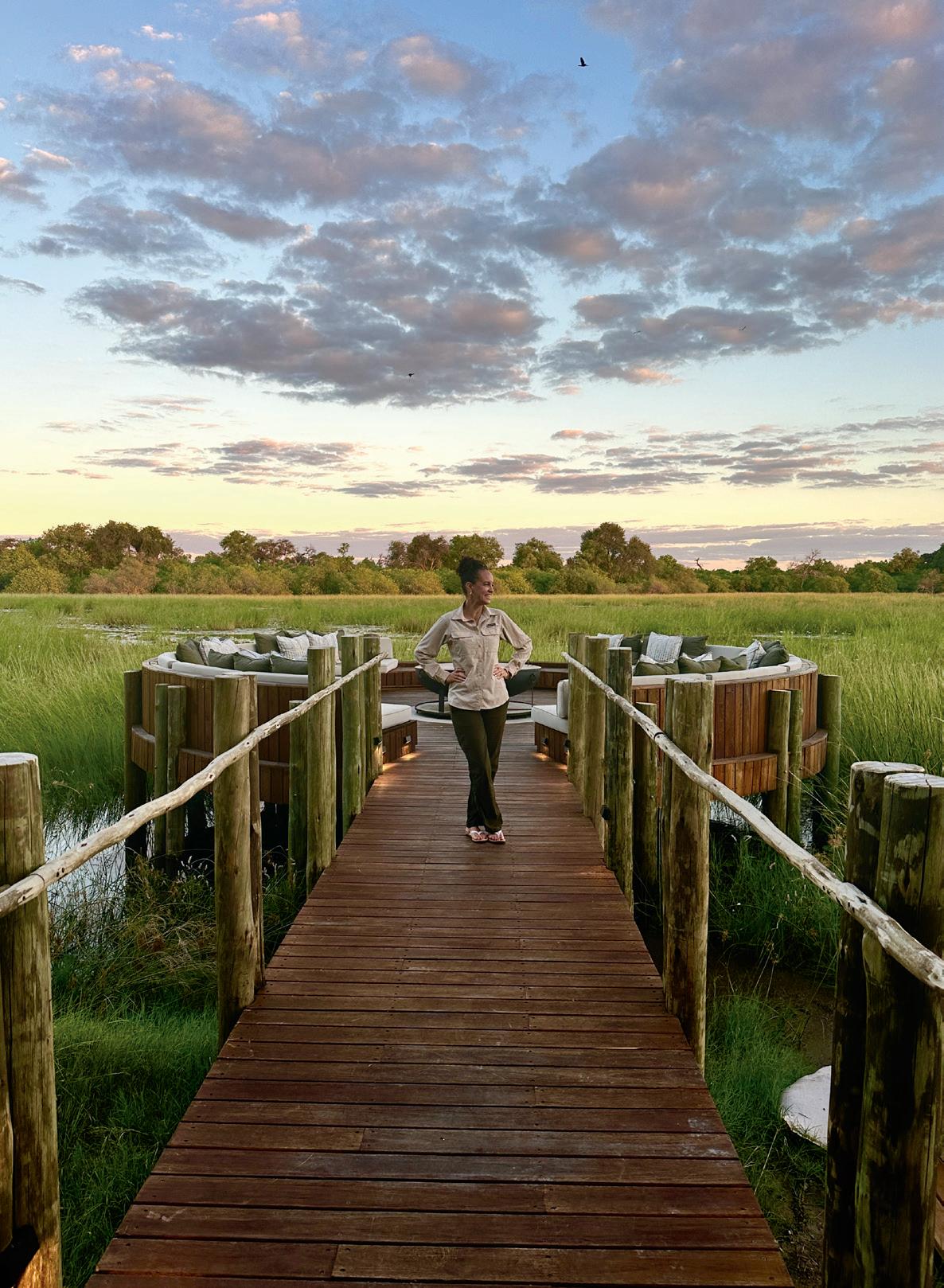
PASSPORT TO A SECOND ACT
Bianca Bujan on assignment in Botswana, part of a globe-spanning career she built after leaving corporate marketing.
BIANCA BUJAN DIDN’T GROW UP TRAVELLING. Her family, she says, simply didn’t have the means. Travel wasn’t formative or aspirational—it was something other people did.
Today, the North Vancouver based freelance writer files dispatches from places she once only saw in magazines: trekking alongside rhinos in Samburu, Kenya, embarking on an Arctic safari in search of polar bears and reconnecting with her ancestral roots in Rwanda. Later this year, she’ll head to Botswana for another safari and board a cruise through Portugal, Spain and Morocco, where Christmas markets shimmer along medieval waterfronts.
For Bujan, however, the route to this passport-stamped professional life was anything but linear.
Armed with an English literature degree and the experience from a short stint teaching ESL, she faced a fork in the road after graduation: pursue publishing or take the steadier paycheque in marketing. She chose stability.
Bujan joined Ticketmaster in the mid2000s, helping major Western Canadian clients fill arenas and stadiums with campaigns designed to move thousands of tickets at a time. The role eventually led her in-house to the Vancouver Canucks, where she spent four years overseeing marketing and partnerships during a period of rapid digital expansion. She worked on sponsorship integrations, in-arena promotions and the team’s early smartphone app.
At the same time, her life outside the arena was shifting. By the early 2010s, the marketing executive was raising two young children while managing a schedule built around game nights and deadlines.
The work was engaging, but it didn’t satisfy her interest in storytelling—and the hours left little room for flexibility. So, Bujan quietly started an anonymous parenting blog. Her platform gained traction quickly, earning recognition as one of Vancouver’s top mom blogs and gradually opening doors to paid editorial work.
Bujan then left the Canucks for a parttime role at Crisp Media, the company behind Vancouver Mom, using it as an anchor while she expanded her portfolio. A weekly parenting column for 24 Hours followed,
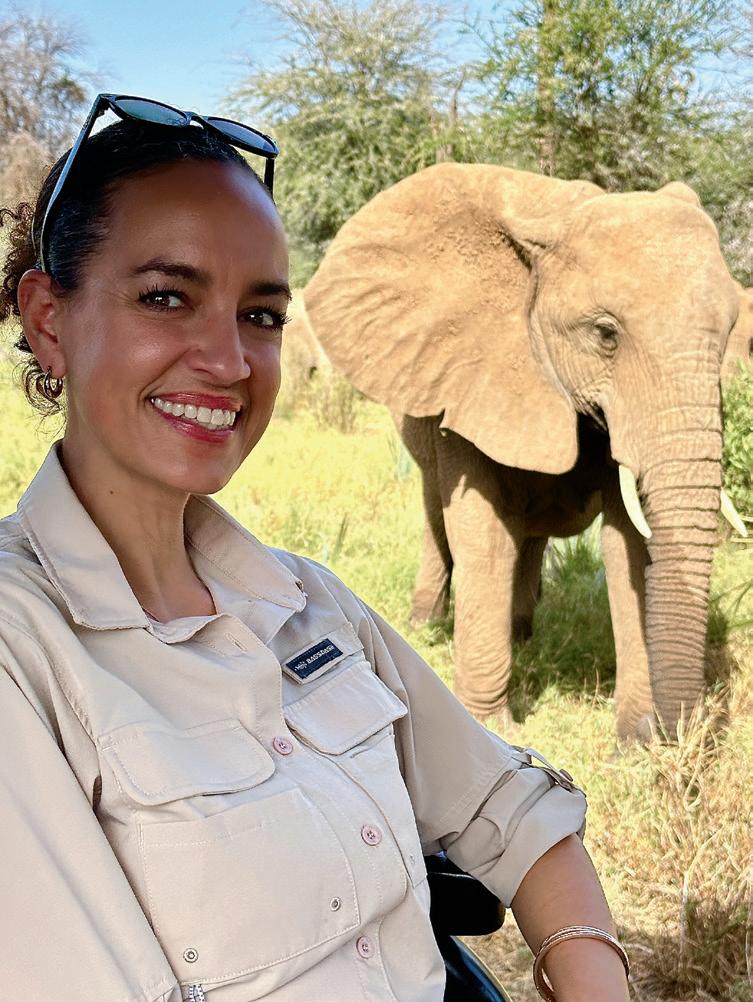
WORDS FROM THE WILD Bujan on an elephant safari in Kenya—one of 24-plus countries in her reporting portfolio.
I was like, is this an actual thing? People go on a free trip and then get paid to write about it?”
syndicated across Vancouver and Toronto and later picked up by Glacier Media. She then moved into magazine roles at WestCoast Families, first as assistant editor, then editor. Writing—once relegated to evenings—became central to her professional life.
Travel entered almost accidentally.
In 2015, a friend at BC Living asked if she’d cover a press trip to Big White Ski Resort. “I was like, is this an actual thing?” Bujan recalls. “People go on a free trip and then get paid to write about it?” She came back with a story about what to do at Big White if you’re not a skier, along with the realization that the one-off assignment might lead to something greater.
Her hunch, efforts and endless pitches to various travel editors paid off.
For National Geographic , Bujan reported on wildlife conservation in northern Kenya, spending days tracking endangered rhinoceroses across sunbaked terrain (“I didn’t realize how big and dangerous they are!”). For BC Living, she chased Bajan flavour around Barbados—pepperpot and rum punches by day, flying fish and conch fritters by the shore come evening. For Food & Wine, she spotlighted Steveston’s waterfront seafood scene, wandering Fisherman’s Wharf and sampling just-off-the-boat catches in the historic Fraser River fishing village.
Bujan’s passport now holds stamps from 24 countries and counting. Yet behind the glossy itineraries lies the reality of freelance work: fluctuating income, uncertain timelines and the constant need to hustle.
To counter that volatility, the writer shifted gears once again—this time diversifying her skillset and client base. Alongside editorial assignments, Bujan built a communications and marketing consultancy serving small businesses and nonprofits. Now, a long-term anchor client—Tire Stewardship BC—provides predictable income while still allowing her time to focus on her passion. “I’ve just always managed to figure out how to pivot,” Bujan reflects.
Her diversification skills proved especially critical during the pandemic, when global travel shut down overnight. Instead of waiting for borders to reopen, Bujan steered her focus toward local assignments, guidebook work and drivable destinations.
Looking back, the freelance travel writer resists the idea that her corporate years were time lost. If anything, they were stepping stones. The strong work ethic instilled through time-sensitive campaign launches, budget meetings and late-night game schedules taught her how to manage deadlines, negotiate contracts and think several moves ahead—skills she now applies to editors, itineraries and international logistics.
“I think working in those jobs helped me realize that it’s sometimes more important to do something you love than to try and have that flashy title,” she says. “I wouldn’t have fully understood that without experiencing it.”
Luxury linen company Wilet promotes snoozin’ on social.
Based on the brands 35K-plus followers, they’re earning future dreamers by the hordes.
By Kristi Alexandra
Vancouver-based luxury bedding company Wilet turns social media’s productivity-based nature on its head by filling its feed with the opposite of doing more. They invite you to stay in bed (with their super-soft sheets, quilts and duvets, of course) through a series of aspirational Instagram videos.



You can find them in the club.
Wilet heartily promotes JOMO (the joy of missing out) by setting the scene with a gorgeous bedside set up—jewellery holders, a carafe of water, an essential oil diffuser, books, under-eye collagen pads and, of course, a comfy bed complete with their signature linen sheets and duvet cover in muted colours. A cheeky text overlay touts coziness over clubbing.
1,650 views
Take back your time.
This social media manager wastes no time in letting followers know they can take back their own. On the eve of the (last ever in B.C.) end of daylight saving time, the company posted a video of said manager laying sheets on a bed, fluffing pillows and crawling under a duvet and captioned it: “Nothing says ‘falling back’ like a fresh set of sheets.”
1,600 views
Add in a bit of WFH humour. It’s easier to roll out of bed and get to work when your job is remote, so Wilet’s social media manager takes a humourous stab at those who do. With the words “Your WFH friend on a random Thursday” on the screen, the social media manager tosses and turns in a cozy-looking bed outfitted in Wilet sheets at 8:59 a.m.— then, a dramatic, sudden cut to her being alert and sitting up in bed with a laptop (in a change of clothes) at 9 a.m. sharp.
1,469 views
These six natural home goods companies will keep your nest nice and neat with a green clean.
By Kristi Alexandra


This green, mess-free answer to laundry pods and liquid detergent was created by a Port Moody dad who was appalled by the amount of plastic waste we use with our products each day. His solution: laundry “eco-strips” ($14.99 per 32 pack) that are free from parabens, phosphates, phthalates, dyes and chlorine bleach— and eliminate the need for single-use plastic packaging. ca.tru.earth
2. BE CLEAN NATURALLY
Squamish-based Be Clean

Naturally’s low-impact goods and refillable home products are also for those who’d rather buck single-use plastics. Its dish soap bars (starting at $12), for example, come sans-packaging and are made from saponified coconut and castor oil, and scented with essential oils like lemon, fir and lemongrass or rosemary and spearmint. becleannaturally.ca
3. ASPENCLEAN
Founded by a North Vancouver family in in 2004, AspenClean’s eco-certified line of home cleaning


products—which includes laundry detergents, dish soaps and bathroom cleaners—is made with coco glucoside, aspen bark and baking soda, making for a natural clean throughout the home. The company also offers a cleaning service that uses its own products, if you’d rather leave the scrubbing to the pros. aspenclean.com
This organic soap company hails from—you guessed it—Salt Spring Island, but they’ve expanded

their essential-oil infused goods beyond just soap. Their room sprays (like the Cypress Fir Room Spray, $24.95) keep the air smelling clean, too. saltspringsoapworks.com
You may recognize Nellie’s home cleaning products by its 1950s-style pop art design, but you’ll remember the North Vancouver brand for its innovative approach. Its waterless dish cubes ($10 for a 16pack), strip dish cleaners back to basics with the addition of essential oils. nelliesclean.ca
Comox, B.C.’s Wildflower Mercantile boutique is where you might go to get a bouquet of flowers or a kitschy, last-minute gift for a loved one, but the company also makes home-cleaning products such as a plant-based all-purpose cleaner ($16 per 473 ml refillable bottle) made with lemon, ylang ylang and spearmint essential oils that’ll have your home’s surfaces smelling like a romp through a flowering herb garden on a bluebird day. wildflowermercantile.ca

There’s something growing in the Cowichan Valley besides grapes and apples: agritourism.
—By Stacey McLachlan
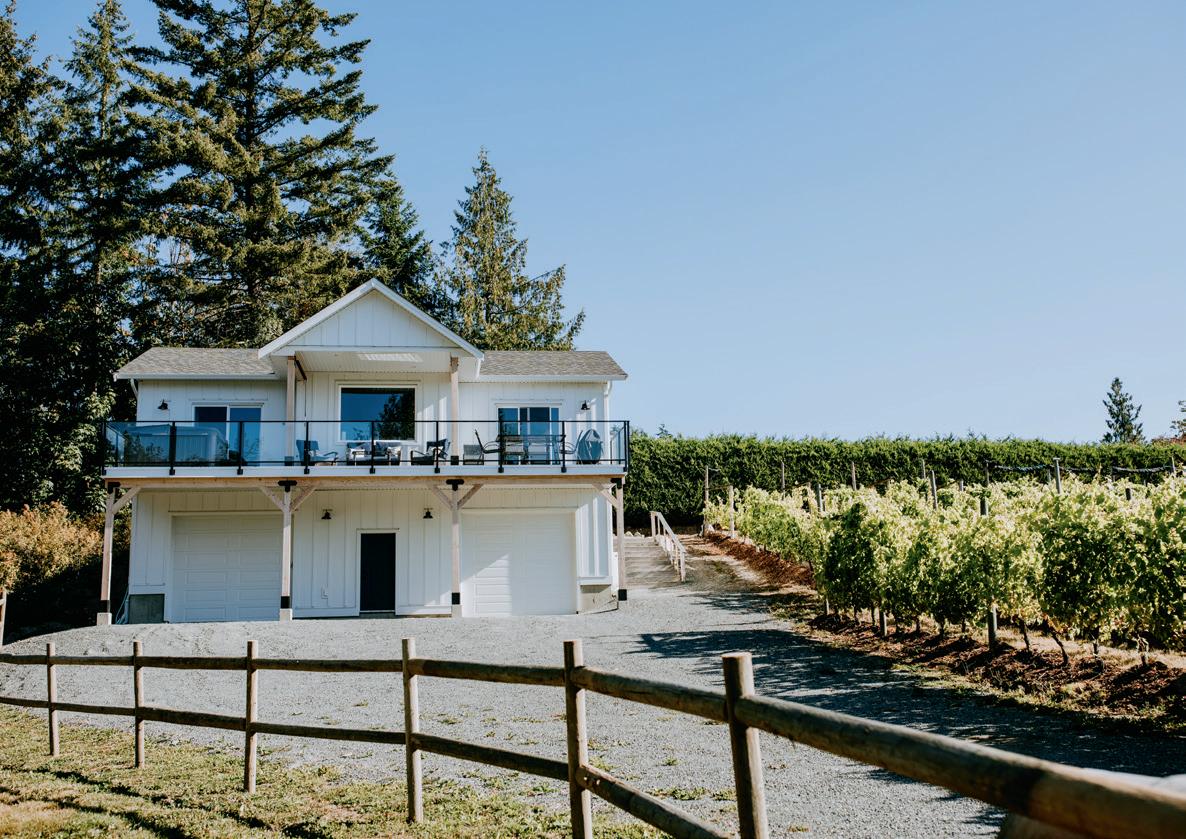
Vancouver Island isn’t short on hotels. Motels? Luxury resorts? Plenty of those, too. But there’s an intriguing alternative accommodation option out there for the adventurous traveller, should you find yourself hunkering down for the night on the South Coast: a sleepover on a working farm.
The Cowichan Valley region—encompassing a swath of charming communities from Ladysmith to Mill Bay— is known for having the warmest climate in Canada. These temperate conditions, as it turns out, are perfect for growing everything from grapes to tea leaves to pumpkins... and a booming agritourism business, too.
Here, you’ll find modern agri-accommodations that are anything but rustic. Farm guest houses offer all the comforts of a boutique hotel and the personal touch of a classic B&B, with rolling fields and winding country roads right outside the door.
Many of these offerings are the result of a new generation of winemakers and farmers that have flocked to the area—entrepreneurs who traded in gigs as engineers, teachers or construction workers to try living off the land. By embracing agritourism alongside traditional farm production, they’re diversifying their businesses and attracting attention to one of B.C.’s most beautiful places in the process.
If you’re ready to go country, here’s where to stay.
GUEST NEST (Top) Emandare Vineyard’s guest house is known as “The Tractor Shed” but its airy, farmhouse layout is so much more than a place to store machinery.
VINE REVIVAL (Right) Mike Nierychlo, a Lower Mainland native and early wine blogger, and his wife Robin transformed a derelict Duncan vineyard into Emandare, where minimal intervention wines flow.
The airy, farmhouse-inspired guest house (known as “The Tractor Shed”) is an adorable spot to hang your hat, but the tasting room and small, sunny garden patio are great for a visit even if you’re not spending the night. Owner Mike Nierychlo grew up in the Lower Mainland, blogging about wine on a blissful, pre-Zuckerberg internet, and in 2015, he and his wife Robin stumbled upon a derelict vineyard in Duncan. They rolled up their sleeves and got to work; today, their Emandare Vineyard produces 1,000 highly coveted cases a year of minimal intervention pinot noir and chardonnay with a distinct coastal minerality.


If the flagship sav blanc isn’t sold out, grab a bottle (or a case) and be rewarded with notes of orchard pear and ripe kiwi. It’s best enjoyed from the hot tub on the patio that overlooks the vine-covered hills that roll down to the water. 6798 Norcross Rd., North Cowichan, emandarevineyard.com
Rebecca and George Papadopoulos are the power couple behind Keating Farm, a historic property they’ve been reinvigorating over the past decade. Their house, lovingly restored to its 1888 glory, is host to indoor markets and long-table community dinners, but you’ll be staying in one of the rustic-chic guests suites (“The Grainery” and “The Creamery” are popular with bridal parties for the weddings frequently hosted in the hay barn). Cozy up by a woodfired stove, savour breakfast around a vintage dining table beneath a softly glowing iron chandelier or soak up the calming vibes from the clawfoot tub. 5250 Miller Rd., Duncan, keatingfarm.ca
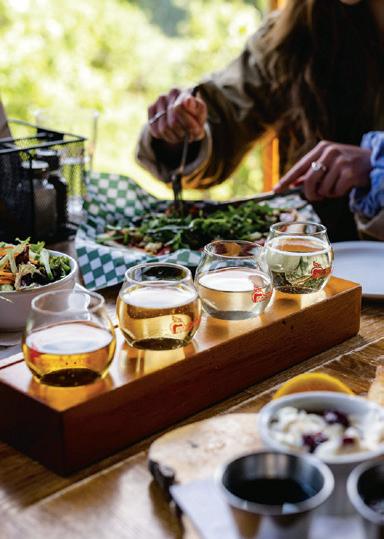
ORCHARD ESCAPE
(Top left and right) With orchard-side yurts (named after the heritage apples grown on the property) and rustic charm, Merridale feels like a hidden retreat where cider and nature share equal billing.
(Bottom left and right) Clawfoot tubs, “rustic-chic” suites and gathering spaces set in a working farm landscape make Keating Farm feel like a retreat and a community hub.
You could just pop in for a drink or a meal, but there’s enough to explore at the cidery to fill a whole afternoon, including a fairy-garden scavenger hunt for kids and distillery tours. If you plan on hitting the cider tasting hard, consider booking a stay at the surprisingly plush, orchard-side yurts. Each little hut is named after a heritage apple, like Yarlington and Tremlett. Catch a glimpse of the stars through the circular skylight above the king-sized bed, or from the 360-degree wooden patios that surround the comfortable canvas tents. 1230 Merridale Rd., Cobble Hill, merridale.ca
Real people. Real finances. From six-figure earners to side hustlers, we’re pulling back the curtain on how British Columbians make, spend and think about money—no filters, just facts.
At just 25, this Vancouver project coordinator is building a career in arts and culture— an industry she values for the opportunities it’s given her, but one she admits doesn’t always pay fairly for the workload or for the city’s high cost of living. Like many in Gen Z, she makes up the gap through side hustles and a mix of spreadsheets and intuition, defining financial success less by a number and more by the freedom to cover essentials and still afford meaningful experiences.
Still, she can’t ignore the contrast between her world and the high-paying tech jobs she admires—roles that combine strong paycheques with remote-work flexibility. For now, instead of splurging on luxury labels, she saves for what matters most: a plane ticket back to her home country. As an immigrant, family and travel always come first for her—a values-driven approach that reframes what it means to be “rich” in Vancouver.
Age: 25
Location: Vancouver
Industry: Arts and culture
Role: Project coordinator
Pronouns: She/her
Total Income: $50,000
Annual Salary: $45,000
Side/Freelance Income: $5,000
Benefits: Time in lieu for overtime shifts Diversify your
Biggest Splurge: Flight tickets home.
Hard Pass:
Expensive luxury labels.
How She Defines “Rich”:
Being able to invest in experiences and the people she loves.
Savings and Investments: $1,000




BDO helps businesses do more. Whatever your more is, discover how working with a true partner can help you get there.