Alison Schrag: Finding Wonder in Everyday Wild Encounters
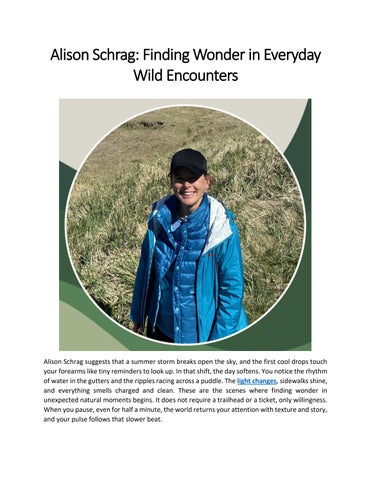
Alison Schrag suggests that a summer storm breaks open the sky, and the first cool drops touch your forearms like tiny reminders to look up. In that shift, the day softens. You notice the rhythm of water in the gutters and the ripples racing across a puddle. The light changes, sidewalks shine, and everything smells charged and clean. These are the scenes where finding wonder in unexpected natural moments begins. It does not require a trailhead or a ticket, only willingness. When you pause, even for half a minute, the world returns your attention with texture and story, and your pulse follows that slower beat.
Early mornings hold their own quiet theater. Coffee steam mingles with the chill near a cracked window as the neighborhood wakes. A single sparrow lands on a railing, head cocked, testing the air before offering a bright, decisive note. Behind it, the sun threads itself through leaves and window screens. Dust turns into a constellation. This is not a grand vista, yet it can feel grand enough. You are witnessing a natural signal that the day is about to begin. In these small, unscripted scenes, finding wonder in unexpected natural moments becomes a daily practice, like breathwork you can actually hear.
Commuters know the gift of light on concrete, a fleeting shimmer that appears between buildings for a minute and then is gone. Waiting at a crosswalk, you might notice dandelions forcing their way through a crack, those determined suns that do not ask permission. A breeze lifts, and the street carries a mix of bakery sweetness and damp stone. You listen for a distant siren, then pick up the soft clatter of a bicycle chain. The city is alive, and so is the patch of sky boxed by rooftops. The ordinary is not a barrier to nature; it is a frame.
Water has a way of returning attention to the present. A kitchen tap sings over a ceramic bowl. A park fountain tosses diamonds into the air. The shoreline, whether river or lake, collects driftwood and secrets. Kneeling to touch the surface, you feel how cool it slides into cold. Circles widen from your fingertip and reflect the clouds. In that slight distortion, you meet your own face as part of the scene, not apart from it. Finding wonder in unexpected natural moments can be as simple as tracing ripples, counting the beats between wind gusts, or watching a leaf boat spin.
Evenings invite another register of attention. As the sun lowers, the temperature falls, and scents sharpen. Cut grass, warm asphalt, pine resin, rain on metal. Streetlights flicker, and moths arrive like scraps of parchment come to life. You stand on a porch or sidewalk and watch silhouettes cross the last gold of the day. A passing dog shakes after a bath, sending perfect arcs of droplets through the light. The ordinary becomes cinematic without special effects. Your shoulders loosen, your jaw unclenches. Calm is not forced; it forms naturally in the space you make for it.
Technology can support this noticing rather than block it. Set a phone reminder to step outside for two minutes. Keep notes in a simple list, one line per moment, like “first cicada” or “moon like a lemon slice.” Teach your camera to wait by taking fewer photos and taking better ones, framing a single detail, a dew bead, or a twig shadow. Review these brief records when stress climbs. The list proves that wonder returns, and the pattern of your days becomes visible. Over time, your awareness sharpens, and your search terms expand from weather forecasts to the living forecast outside.
The most helpful shift is to treat attention like a muscle. You do not need a long hike to exercise; you need repetitions. Look for a cloud shape during lunch. Listen for the interval between waves from a passing boat. Name the colors in a sunset as if you were choosing paint chips. Finding wonder in unexpected natural moments turns routine into a field study, and you are the careful observer. The more you practice, the more you receive. Gratitude grows specific. Stress has somewhere to drain. And every day, the world you already live in becomes a little larger.