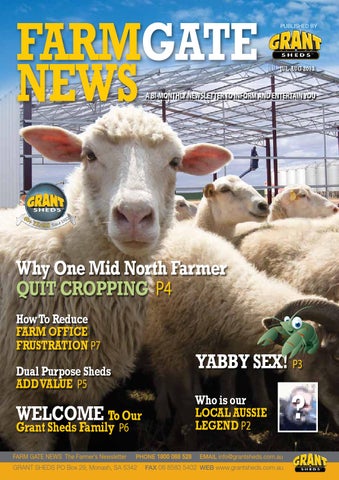
FARMGATE NEWS
PUBLISHED BY
JUL-AUG 2013
A BI-MONTHLY NEWSLETTER TO INFORM AND ENTERTAIN YOU
Why One Mid North Farmer QUIT CROPPING P4 How To Reduce FARM OFFICE FRUSTRATION P7
YABBY SEX! P3
Dual Purpose Sheds ADD VALUE P5
Who is our LOCAL AUSSIE LEGEND P2
WELCOME To Our Grant Sheds Family P6
FARM GATE NEWS The Farmer’s Newsletter
PHONE 1800 088 528
GRANT SHEDS PO Box 29, Monash, SA 5342
EMAIL info@grantsheds.com.au
FAX 08 8583 5402 WEB www.grantsheds.com.au
?
What Makes Country Life So Good? COMMUNITY
See You At The Field
Days
Riverland Field Days at Barmera, SA 18-19th Sept Wed-T hurs Yorke Peninsula Field Da ys at Paskeville, SA 24-26th Sep t Tue
s-Thurs
Local Aussie Legend Of The Year
If you’d like some help wit h your shed planning we are happy to assist. Or just call in for a chat. We’d love to see you.
Recipe
Chocolate Slice
Recipe Provided by “An Eyre Peninsula Reader.” A shy butterfly who preferred we didn’t include her name. Recipe Providers Comment: “I love your Farmers Newsletter and think the recipes are a good addition. Sending you a yummy Chocolate Slice.”
Local Aussie Legend Of The Year goes to ..... Drum roll ..... Danny Halupka, Grant Sheds co-owner, for getting his photo with the Adelaide Clipsal 500 pit girls for 2 editions in a row!! If you look back at our May-June 2013 edition of FARM GATE NEWS , page 3, he had a good-looker on the back of his Harley in the Driver’s Parade in 2013. Now, his wife Ali found this one on his phone from a few years ago!!! Lucky she’s a “Good Sort” ... Ali that is ... and is not offended by the photo.
Referrals/Beer Offer received. That beer is sent by post. We’ve done it quite a few times now and only 1 breakage in about 400 cartons posted so far. One bloke referred 12 farming friends and said he’ll be putting his 6 cartons of beer toward their end of year footy trip.
Thank you to everyone who referred their farming families and friends to receive a free subscription to this mini-magazine.
And Ash Corbett from Underbool who owns the CRT store there, wanted to share our FARM GATE NEWS magazine with his farming clients, so he referred 86 local farmers. He didn’t even want his beer in return so we made a large donation to his local Walpeup –Underbool Football & Netball Club.
Around 230 more people will be receiving FARM GATE NEWS as a result of your generosity. Perhaps you’ll even share your beer with them.
We are tickled pink that we can support country communities in this way ... Thanks Ash!
You remember, we promised you beer in return for referring people? Yes, it was a shameless bribe, and obviously well
Alison & Danny
Cheers for now & Our Grant Sheds Team
P2 FARM GATE NEWS: The Farmer’s Newsletter
Ingredients: 250g butter 2 tblsp chopped dates 2 Eggs 1 cup chopped almonds 1 cup sugar 2 cups chopped apricots 4 tspn vanilla 4 cups crushed sweet biscuits 2 tblsp cocoa Method: Melt butter in saucepan Add sugar and cocoa Add dates and apricots Remove from heat and add beaten eggs, vanilla, almonds and biscuits Stir well and press into greased pan Refrigerate. Suggestion: Spread chocolate icing on and sprinkle with almonds if desired. Ali’s comment: “Sounds like my kinda recipe ... Quick, simple and delicious.”
What Do You Know About YABBY SEXING? Yabby Shell Shedding We have a yabby in an aquarium at home. Well, really it’s me (Ali) who has it ... along with the tadpoles, frogs, silk worms and tiger worms that we’ve had from time to time. I love to have them for the grandkids so they can watch and learn about them! Anyway, we’ve had the yabby for about 2 years now. He’s a lovely big blue yabby. Well, I say “he” but we don’t actually know if it’s a girl or a boy. I’ve looked it up on line to see if I could find out, but I still haven’t been able to work it out. Perhaps you can help me - see below. A few weeks back I was sitting at our dining room table with the yabby aquarium behind me. I heard a noise of his claws ‘clacking‘ on the glass (which was not uncommon) along with a ‘flick, flick, flicky’ noise as though he was scooting backwards in shallow water. It only lasted a few seconds and when I looked around, he was three quarters of the way out of his shell, with only his old claws still inside his new ones. It was amazing how quickly he rid himself of the old shell. Over about the next 5-10 minutes, he’d rest for 2 minutes then flick again, repeating this until he was fully out of his claws. Then over the next few hours it seemed like he was almost dead as he seemed to have no strength. He’d fall over onto his back and be unable to set himself right way up again. Perhaps his new shell is still so soft that he can’t navigate with it. I don’t know. Perhaps someone reading this could enlighten me.
Can you help us learn whether this is a boy or a girl yabby?
Now I’m assuming that you know that yabbies shed their old shell when they grow too big for it. Ours has done it twice before but it was always overnight, never when we were there to see it. We usually just awake to find what looks like two yabbies in the tank, but in fact one is just an empty shell — all in one piece, virtually fully in tact. Then over the course of the next 7 days, the yabby eats his own old shell. I’m guessing that’s recycling the calcium in the shell or some such ... A bit like providing shell grit to caged birds and chooks to help their digestion and help make their egg shells hard. As kids, we used to catch yabbies in the irrigation channels in our district. When there was only a few inches of water left in the channel, we’d catch them in the mud with our hands.
Siphon: A concrete pit where an open, concrete water channel met a road. The water was taken under the road via concrete pipes which were lower than the base of the channel. Where the channel met these pipes, there was a ‘siphon’ each side of the road. Like a concrete pit I suppose. As the under-road pipes were lower than the base of the channel, the pipes and the siphons almost always had water in them, even if the channel itself was empty We’d love to hear from anyone who understands yabby life cycles, sexing of yabbies and how to breed yabbies in a home-aquarium. I’d love to try that so our grandkids can see the baby yabbies.
Or we’d lower a dip-tin attached to a rope, down into the siphons. A piece of meat was tied in the tin for bait. We’d leave it awhile and then pull it up fast before the yabbies escaped the tin. All great fun for country kids who didn’t have iPads, Smartphones and computer games to play with. But we had to be careful near the water. We’d been well-warned of the dangers of drowning. Dip Tin: A rectangular tin with a handle and lots of holes in the tin. Used for dipping grapes into caustic soda mixture for quicker drying.
Sexing Yabbies FARM GATE NEWS: The Farmer’s Newsletter P3
Mid North Farmers
QUIT CROPPING thinking, I used to be part of that. Why aren’t I out there? You feel a bit guilty, but it passes,” he laughs. “We just don’t have the headaches.” “We still have some headaches, but we haven’t got anywhere near as many. Even in dry years or lean years, we still have income. We just feed a bit more. That’s all there is to it. It’s easy. We like it.” “We’re just not going backwards. We don’t have any debt.”
“If we want to buy a shed, we go and buy it.”
k, SA concentrate on a sheep only farm Neil & Catherine Klingner of Crystal Broo cropping ten years ago. enterprise, having stopped
Making it look easy Not too many people would say that farming was easy, but Crystal Brook sheep farmer Neil Klingner believes that working a bit smarter now will make things a lot easier for the next generation. It’s 15 years since Neil took over running the family 2500 acre farm established by his grandfather nearly 90 years ago. “I’m third generation on this farm.” Neil says. “My father ran the farm until his retirement, and I’ve been doing it ever since. I’m a one-man band most of the time, but it can be done. I’m looking forward to the next generation learning what it’s about.” “My oldest boy is particularly good at listening, so he’s a delight to teach and I look forward to teaching him much more in the future.” Neil says that there’s nothing like learning things first hand and enjoys taking his two boys to farm field days. “The kids love it. There’s more to growing up than school and playing football or cricket,” he adds. Days off the farm are probably the exception to the rule for this farmer who runs his operation without even the help of a dog. “We’ve been without a dog now for probably 25 years,” he says.
Where’s the dog? Having had two good dogs come to grief, Neil decided that he would try to do manage without them and hasn’t really looked back. “I thought well, all this time and investment in training a
dog and you’re going to lose them. So I decided, we’ve got a motorbike. We’ll teach ourselves to do what the dog does.” “If you’ve got your yard set up properly and you’ve got your head screwed on, you don’t need a dog. They’re useful at times in yards, but the time we spend in sheep yards is a minority, and a good dog is just wasting away their talent. “ Neil says that mustering by motorbike in even quite steep country is relatively easy. “You just have to know where you can go and where you can’t go. Generally speaking, it’s no drama. The sheep generally know where you want them to go. They know that the bloke on the motorbike can’t be outrun. He always wins,” he laughs.
Simplifying the ‘business’ A bigger decision, when Neil took over the farm, was to give up cropping, to concentrate on his merino herd and minimise costs.
“We’ve been crop-free for a bit over a decade now, and we haven’t looked back,” he explains. “You go forwards because
Neil isn’t shy about spending money on infrastructure and firmly believes that in most cases it provides an asset which is a year round benefit. He built his first Grant shed, a 12m x 24m x 5.1m Machinery Shed in 2001 about the same time he decided to let cropping go, and was so pleased with the decision he then went ahead and built his workshop, the next year. Neil’s 12m by 12m x 5.1m Workshop is his pride and joy with a 12m x 3m mezzanine area which gives him stacks of room for storing spare parts , jigs and infrequently used tools.
No excuse for downing tools “It’s very airy, particularly in the summer months with the doors open. You get flow through ventilation. It’s reasonably comfortable in the winter time. We just shut all the doors and work all day. If you need to, you can work all night. You could go 24 hours a day if you wanted to. That’s how your workshop should be. It’s no excuse for downing tools. The days of having a bludge on a rainy day are gone. There’s always something out there that needs doing.”
Everything moves Neil has set things up so that everything is portable. Heavy tools are stored under the mezzanine area and moved using a pallet trolley,
you haven’t got that constant drain on your income. Your cropping is predominately making money to grow next year’s crop and pay for the machinery. If you get rid of your cropping, most of your income comes from your livestock.” He admits it was hard to let go, which he is reminded of during seeding time, when he’s comfortably tucked up at home enjoying his tea, while he can hear his neighbours’ tractors in the distance humming away into the night. “You’re
P4 FARM GATE NEWS: The Farmer’s Newsletter
The mezzanine level in Neil Klingner’s Farm Workshop provides plenty of storage space for his tools , spare parts and jigs.
Making Farming Tasks
QUICKER & EASIER
Racking for storage and overhead booms for chords make the workshop neat, efficient and safe. leaving the main floor clear. “It means you can use reasonably compact floor area for lots of machines without having them parked there for long periods of time. Everything else is on wheels, so you can bring it to where you want to work,” he explains.
A Farm Workshop Can Pay For Itself Quickly - Neil Klinger’s Farm Workshop is his pride and joy. “The value of the shed has been duplicated every year on the farm products I make in it,” says Neil, “like sheep yards, gates, ramps, etc.
Overhead booms carry power cords leave the floor clear of tripping hazards.
“It’s not hard to do. It just makes the shed more versatile.”
“It’s the second Grant shed we’ve built. It’s my favourite because every man’s got to have his shed, and I just love my workshop. It’s a top little spot.”
Making things look easy
A shearing shed for all seasons Neil’s next shed investment was his 12m x 21m x 4.2m ‘multipurpose’ Shearing Shed with a 4m leanto. Rather than sitting idle in the many months while they’re not shearing, Neil has designed it so that his let-go pens and wool bins can all be folded up against the wall. A lean-to area provides space where tractors, utes and trailers can be stored. He says it only takes him 40 minutes to move the machinery and get things set up for shearing and can shelter up to 600 sheep when the weather looks bad. A mezzanine area in the shed makes another handy storage area for spare building materials with a shearers’ kitchen area underneath. “So it’s a case of one shed, one roof, being used 24 hours a day, 7 days a week, 52 weeks a year, not just for shearing,” he says proudly. At the moment it’s a quiet time of year so it’s, being ‘subcontracted’ to a games room with table tennis, with the kids planning a badminton and basketball nets as well.” “I pride myself on making as much use of space as I can and use it over and over again. You don’t shear for the majority of the year. Rather than have space unused, I’ve made it in such a way that everything folds back when not in use. I’m maximizing that shed for the majority of the year.”
“My policy on the farm nowadays is any job, no matter if it’s shearing, crutching, or sheep handling, there’s no reason why it should be hard or take a long time. With a bit of thought, things can be made easy and quick. Quite often, the solution is out there. It’s just a matter of time assembling it.” It comes as little surprise that behind this successful farmer there stands one very good woman. “My wife Catherine’s very supportive and keen to participate,” he says proudly. “She’s involved with the drafting, drenching and sheep handling as much as possible, because it’s not hard. No one gets knocked around or knocked over. It’s quite a safe environment.”
“The boys can see that sheep handling doesn’t have to be hard or time consuming. It can be easy and be quick and can be safe. You just put your mind to it” “If they had to put up with some of the conditions I had to put up with when I started my sheep handling career; sheep not stopping when they’re supposed to, sheep getting out, getting over, not being able to do it on your own; it’s highly likely they wouldn’t be interested at all,” he says.
“The farm’s getting easier to run, and if the next generation, (which is an important aspect here), can see how easy a farm can be to run, the likelihood of them wanting to continue on it after I’ve stopped and given up, is bloody likely.” Other end of same Machinery Shed
Dual Purpose Adds Even More Value For Their Investment - The Klingner’s 12m x 24m x 5.1m ‘GRANT’ Machinery Shed protects their farm machinery and is also set up to provide sheep cover at shearing time or penning during on-farm sheep sales. The shearing shed is on the right, abutting the Machinery Shed.
FARM GATE NEWS: The Farmer’s Newsletter
P5
We Welcome New Members To Our
“GRANT SHEDS FAMILY” Wilpena Pound
Nundroo
Hawker
Ceduna Port Augusta
Wirulla
Streaky Bay Wudinna
Cummins
We Welcome New Coffin r u O o T Bay rs e b m e M ” y il m Fa “Grant Sheds
into our me the following people We are delighted to welco ers mb me ily fam our see can “Grant Sheds Family”. As you map e (se a a broad geographic are (shed buyers) come from re the d An es. typ e range of shed next page) and buy a wid nt Gra gh” Tou ssie “Au multiple are lots who have bought k rked those with a red asteris ma I’ve rs. yea the r ove Sheds we s yer -bu how many repeat *. It’s quite amazing to see port cerely for your ongoing sup sin you nk tha have and we at gre rts we put in to give you and appreciation of the effo te for our is t and strong sheds. Tha communications, service t. tha t e to do jus and we promise to continu
Kimba
Tumby Bay
Cowell
Minlaton
Port Lincon
Clare Valley Burra Clare
Port Wakefield
Yorke Peninsula
Gawler
Adelaide
Penneshaw
Kangaroo Island
Daniel Habermann Tanunda Machinery Shed 9m x 19.8m x 4m David McSkimming Minlaton Machinery Shed 12m x 24m x 6.3m Ron Hards * Yarrara, Vic Machinery Shed 9m x 12m x 4.8m David Williams Geranium Machinery Shed 12m x 18m x 5.1m Brian & Dianne Smith Nundroo (Ceduna) Machinery Shed 15mx 30m x 6.3m + 2 x 9m leantos Matthew Lovering D’Esereea Bay (KI) Machinery Shed 12m x 24m x 5.1m Jill & Murray Dunn Finniss Machinery Shed 12m x 18m x 4.2m Andrew Macleod Streaky Bay Garage 7.5m x 18m x 2.7m Scott & Caroline Grove Murray Bridge Machinery Shed 9m x 18m x 3.6m Bob Pahl Murrayville, Vic Machinery Shed 12m x 36m x 5.1m Marianne Wallis Pinnaroo Garage 7.5m x 10.8m x 2.7m Phillip Larwood Kimba Machinery Shed 12mx 30m x 6m Chris Litster * Minlaton Machinery Shed 18m x 36m x 5.6m Kym Campion* Pt Vincent Garage 6m x 9m x 2.7m Jeff Kew* Barmera Verandah Materials Glen Farr* Loxton Garage 6.6m x 7m x 2.7m Glen Farr* Loxton Garage 5m x 6m x 3m Ben Schutz (Amcor)* Eudunda Machinery Shed 12m x 21m x 4.5m Darren Shipard * Penong Lean-to 9m x 18m x 5.1m David Pocock Loxton Garage 9m x 12m x 3.6m Diana Van Meel Moorook Garage 6m x 12m x 2.7m George & Pat Gum Pinnaroo Garage 7.5m x 14.4m x 3m David Heinrich Freeling Machinery Shed 12m x 24m x 5.1m Nick Jamar Meningie Machinery Shed 12m x 27m x 4.5m Phil Laws Penong Garage 7.5m x 12m x 3m Ray Simon Monash Garage 7.5m x 12m x 3.6m Paul Theron Naracoorte Hay Shed 9m x 21.6m x 4.5m Helen Thomas Wanbi Garage 6m x 15m x 2.4m
P6 P6 FARM GATE NEWS
Peterborough
Whyalla Cleve
Elliston
Quorn Wilmington
VICTORIA
Eyre Peninsula
Flinders Ranges
Mildura
Kapunda Waikerie Tanunda
Barossa Loxton Murray River
Murray Bridge Tailem Goolwa Bend Meningie Victor Harbor
Pinnaroo
Yarrara Redcliffs
Murrayville Underbool
Keith Bordertown Padthaway
Limestone Coast
Jamie Gardner* Michael Beckwith Peter Gericke* Myles Mcclure Neil & Emily Byerlee* Fred Dawson* Stan Hayles* Ash Corbett * Ben Schmidt* Martin Harris Ron Wedding* Dean Helyar* Nathan Todd* Scott & Deb Sanders Tony Saler Sarah Michael Tim Rothe* Rob Broad Mid Murray Council* Jf & EA Girke Brian Southcott * Jamie Grieger Don Benbow Andrew Whitehorn* Brian Dominic Malcolm Bubner* Tony Payne Colin Penfold
Robe
Naracoorte
Frances Mildura, Vic Naracoorte Alice Springs Orroroo Red Cliffs, Vic Curramulka Underbool, Vic Nuriootpa Loxton Hamley Bridge Murray Bridge Tintinara Tintinara Laura Hayborough Berri Angaston Mannum Wellington Goolwa Yacht Club Lindsay Point Minlaton Koolunga Berri Wasleys Wynarka Robe
Machinery Shed 12m x 31.5m x 4.5m Garage 9m x 9m x 2.7m Machinery Shed 8m x 12m x 3.3m Garage 7.5m x 9m x 3m Machinery Shed 15m x 30m x 4.5m Machinery Shed 12m x 27m x 4.8m Sliding Doors Garage 9m x 9m x 3m Garage 7.5m x 15m x 2.5m Garage 10m x 13.5m x 3m Machinery Shed 12m x 18m x 5.1 Machinery Shed 2 x 12m x 24m x 5.1m Machinery Shed 15m x 12m x 5.1m Ext Garage 6m x 12m x 2.7m Garage 9m x 10.8m x 4.2m Garage 4.5m x 9m x 3.2m Industrial Shed 6m x 18m x 4.3m Machinery Shed 24m x 42m x 5.1m Garage 7.5m x 7.2m x 3.6m Ext Garage 9m x 15m x 4.2m Verandah 6m x 9m x 3m Machinery Shed 12m x 36m x 3.9m +6m LT Garage 7.5m x 9m x 3m Hay Shed 13m x 36m x 5.1m Garage 7.5m x 15m x 3m Machinery Shed 9m x 15m x 5.1m Machinery Shed 12m x 21m x 6.3m Machinery Shed 12m x 25.2m x 5.1m +6m LT
Good Office Systems
REDUCE FRUSTRATION Who Hates Office Work? Office work is usually the bane of almost every farmer’s life yet it is such an important and necessary part of running a successful business. Office administration should be built on good systems. Given that it is not your favourite task, every effort should be made to set up a workspace that is both functional and enjoyable to work in. The positioning of the office is usually poor. Most times it takes up part of one room in the house and no real effort has put into establishing a good productive environment in which to work. Office space is paramount and for people who prefer to work outside in the wide open spaces it is intriguing to see how some farmers try to work in such a confined office space. The orientation of the desk is quite often wrong as well which brings about poor use of natural lighting. I prefer to position my desk so I can have some view of the outside world and by doing so I feel less confined whilst in the office. The office chair must be on rollers to allow you to access files without leaving your seat. Two drawer filing cabinets are ideal when used in conjunction with the office desk; they are about the same height and are useful locations for printers and fax machines to sit. The filing system needs to be of such a nature that it can expand as time goes by but a good annual spring clean of files should not be overlooked. Two habits that I think need to be worked on are the taking of a five minute break every hour to freshen up, stretch the legs and keep the blood
flowing, the other is the keeping of a water bottle on the desk to keep yourself hydrated. The missing link when it comes to doing bookwork is the personal discipline. Office work should be a part of your normal daily schedule not done at night when you are tired and fatigued. Doing this sort of work at night means that you are again putting the business before your family and you are doing it at a time of day when you least efficient.
Most farmers are fowls, not owls. They get up early and are more productive in the morning. Maybe by doing the farm office work between the 6am to 8am would cut office time from 3 hours at night to 2 hours in the morning with fewer mistakes. The ultimate to having a good office is to have it detached from the family home with a separate phone number, by doing this most farmers would switch off better at night and be much more value to the rest of the family. Printed with approval of Ken Solly & Stock Journal newspaper
Ken Solly runs his own Agribusiness Consulting at Naracoorte in SA. He delivers training workshops, in farm management and sheep production, and runs several farm and stock management groups. Ken writes the feature article ‘Mind your Business’ for the Stock Journal newspaper. Coaching and mentoring young people in Agribusiness, in particular Nuffield Scholars, also gives Ken much job satisfaction. kensolly@rbm.com.au or 0427 620895
“Where’s That Bloody Invoice...?!”
Do you experience overwhelm, frustration and despair whenever you have to do your paperwork or whenever you go into your office? Are you in a constant state of anxiety because you can’t find anything in your messy office? Well... Understand it’s not your fault and you are not alone. From my experience with farmers over about 33 years, most farmers are a mess when it comes to their paperwork. There is mail to open, wages to pay, bills to sort out, bank statements and credit cards to organise, BAS statements to complete, invoices to file, spray diaries to complete...the list just goes on and on... Where are you supposed to find the time to sort it all out when you haven’t even got time to get through all your farming work and family commitments? It’s exhausting and you’ve learnt to HATE PAPERWORK! Am I right? For the easy solution to Farm Office Bill Filing, see this month’s flyer included with this newsletter.
Australian Working Dog Rescue deemed ready to become available for adoption. Once a dog has reached this stage they are then listed on our site and others in order to find them their ‘forever home’. Australian Working Dog Rescue is a nonprofit charitable organization whose primary function is to save working breed dogs from being euthanased in council pounds and shelters. We dedicate ourselves to finding them new homes, whether that be in an urban environments, a hobby farm or a true working property. We cover most states and territories within Australia. Once a dog is saved and vet checked it is then placed into either long or short-term foster care for assessment and rehabilitation before being
AWDRI has a network of dedicated volunteers and volunteer foster carers who are the life blood of our organisation. Foster carers take dogs and puppies into their own homes and care for them as if they were their own until a ‘forever home’ can be found. This can be a short time period for some and longer for others, especially some special needs dogs. Our foster carers are handled by regional co-ordinators who organise the rescue of dogs along with their vetting and transportation. At AWDRI, we work very hard at making sure we
match up dogs with new families. Filling out our Adoption Application on our website means that we can find you your new best friend. Alternatively you can have a look at all our available dogs on our website or PetRescue.com.au. Donate AWDRI has many donation options, from one-off amounts to recurring sponsorships. Every little bit helps! Become a Foster Carer Becoming a foster carer is a phenomenally rewarding experience. Foster carers are fully assisted during their time as volunteers and have access to a foster carer chat forum online. Please feel free to contact us, or fill out an adoption application on our website: www.workingdogrescue.com.au
FARM GATE NEWS: The Farmer’s Newsletter P7 P7
On the land Country Pics Now that’s a flockin lot of emus!!! This photo was taken recently near the SA/NSW border near Broken Hill.
An old straw thatched-roofed shearing shed.
Young vineyard in the Barossa
MONTHLY HUMOUR
WORD SEARCH
“Aussie Tough” Grant Sheds
Love In The Morning It’s all in the timing. She was standing in the kitchen, preparing our usual soft-boiled eggs and toast for breakfast, wearing only the ‘T’ shirt that she normally slept in. As I walked in, almost awake, she turned to me and said softly,” You’ve got to make love to me this very moment!” My eyes lit up and I thought, “I am either still dreaming or this is going to be my lucky day!” Not wanting to lose the moment, I embraced her and then gave it my all; right there on the kitchen table. Afterwards she said, “Thanks,” and returned to the stove, her T-shirt still around her neck. Happy, but a little puzzled, I asked, “What was that all about?” She explained, “The egg timer’s broken.”
“Quote”
how much People don’t care ey know you know until th re. how much you ca
GRANT SHEDS PO Box 29, Monash SA 5342 EMAIL info@grantsheds.com.au © Copyright New Horizons (SA) Pty Ltd, Trading as “Grant Sheds” No portion of this newsletter may be reproduced without the written permission of the publisher. This newsletter is distributed with the understanding that the publisher is not engaged in rendering any legal or professional advice of any kind. The publisher disclaims any personal liability for the information, advice, recommendations and/or strategies presented within. It is up to the reader to comply with any local, state or federal laws.
FARM GATE NEWS: The Farmer’s Newsletter
PHONE 1800 088 528
EMAIL info@grantsheds.com.au
GRANT SHEDS SA 5342 FAX 08 8583 Grant ShedsPO Box PO 29, BoxMonash, 29 Monash SA 5342 Fax: 08 5402 8583 WEB 5402www.grantsheds.com.au web: www.grantsheds.com.au