Was the Kababir Jamaat wrong to host President Herzog of Israel and how did it come about?
The Charter of Medina and Islam’s message of peace: 29th Jalsa Salana held in the Holy Land
Page 6
Page 7
A
Opening of London’s first mosque and message of Hazrat Khalifatul Masih II (1926)
45th Jalsa Salana held in Suriname
Page 8
Page 9
THE WEEKLY
www.alhakam.org AL HAKAM | Friday 9 October 2026 | Issue CDXLVII Ahmadiyya Archive & Research Centre (ARC), 22 Deer Park Road, London, SW19 3TL, UK info@alhakam.org | ISSN 2754-7396
Hadith-e-Rasul – Sayings of the Holy Prophet Muhammadsa
Allah’s right and His servants’ right
ُ َّ َ َ َ َ َ َ َﻋ ْﻦ ُ َ ﺑْﻦ اﻟﻨ ِ� ّ� ﺻﻠﻰ ﻗﺎل� ﻗﺎل،ﻣﻌﺎ ِذ ِ ﺟﺒﻞ َ ُ َ َ ٍ ّٰ َ أﺗ َ ْﺪري ﻣﺎ،ﺎذ ا��� �ﻠﻴﻪ وﺳﻠﻢ� �ﻳﺎ ُﻣﻌ ِ ُ ْ َ ّ ٰ ُّ َ َ َ ّٰ �ُ �ﺣﻖ ا�� ِ� َ�ﻠﻰ اﻟ ِﻌ َﺒﺎدِ؟� ﻗﺎل� ا�� ُ� َو َر ُﺳﻮ َ ُ ْ َ ُ ُ َ َ َ َ أ ْ�ﻠ ُﻢ� ﻗﺎل� �أ ْن ﻳ َ ْﻌ ُﺒﺪوه َو�� ﻳُ� ِ�ﻛﻮا ﺑِ ِﻪ َ ُ ُّ ّٰ َ َ ََْ ً َ �ُ �� أﺗﺪ ِري َﻣﺎ َﺣﻘ� ْ� َ�ﻠ ْﻴ ِﻪ؟� ﻗﺎل� ا،ﺷ ْﻴﺌﺎ ُ ّ َ َ َ َ َ َ ُ ���ْ �ََو َر ُﺳﻮ� ُ� أ ْ�ﻠ ُﻢ� ﻗﺎل� �أ ْن �� ﻳ ُ َﻌ ِﺬﺑ
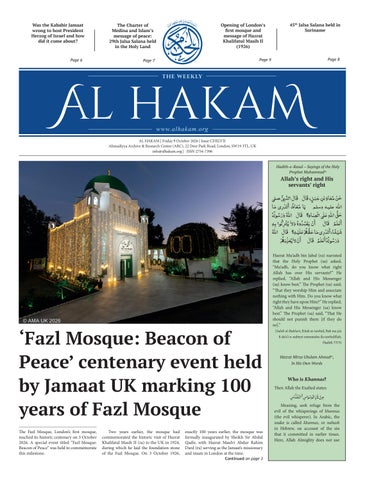
‘Fazl Mosque: Beacon of Peace’ centenary event held by Jamaat UK marking 100 years of Fazl Mosque The Fazl Mosque, London’s first mosque, reached its historic centenary on 3 October 2026. A special event titled “Fazl Mosque: Beacon of Peace” was held to commemorate this milestone.
Two years earlier, the mosque had commemorated the historic visit of Hazrat Khalifatul Masih II (ra) to the UK in 1924, during which he laid the foundation stone of the Fazl Mosque. On 3 October 1926,
exactly 100 years earlier, the mosque was formally inaugurated by Sheikh Sir Abdul Qadir, with Hazrat Maulvi Abdur Rahim Dard (ra) serving as the Jamaat’s missionary and imam in London at the time. Continued on page 3
Hazrat Mu‘adh bin Jabal (ra) narrated that the Holy Prophet (sa) asked, “Mu‘adh, do you know what right Allah has over His servants?” He replied, “Allah and His Messenger (sa) know best.” The Prophet (sa) said, “That they worship Him and associate nothing with Him. Do you know what right they have upon Him?” He replied, “Allah and His Messenger (sa) know best.” The Prophet (sa) said, “That He should not punish them [if they do so].” (Sahih al-Bukhari, Kitab at-tawhid, Bab ma ja’a fi du‘a’i n-nabiyyi ummatahu ila tawhidillah, Hadith 7373)
Hazrat Mirza Ghulam Ahmadas, In His Own Words
Who is Khannas? Then Allah the Exalted states:
َ� َ ۡ ۡ ۡ �َ ۡ اس ِ اس � اِلِخْن ِ ََِمَن َش ِِر اِلَوَْسَو
Meaning, seek refuge from the evil of the whisperings of khannas (the evil whisperer). In Arabic, the snake is called khannas, or nahash in Hebrew, on account of the sin that it committed in earlier times. Here, Allah Almighty does not use
Friday 9 October 2026 | AL HAKAM
2
This Week in History 9 - 15 October A glimpse into the rich history of the Ahmadiyya Muslim Jamaat
9 October 9 October 1883: On this day, the Promised Messiah (as) replied to a letter from Mir Abbas Ali Sahib of Ludhiana. In it, Hazrat Ahmad (as) shared that he saw a dream the night before, in which some persons, whom he did not recognise, were inscribing some verses over the door of Masjid Mubarak with green ink. Huzoor (as) soon realised that they were angels, who were carrying green ink with them and were writing some verses in calligraphy. Huzoor (as) started reading the verses, but only one of them remained in his memory, which was:
َْ ّ َلَا ََر �اَّد ِل َِفْض ِِله
(Tadhkirah [English], pp. 138-139) 9 October 1980: On this day, the foundation stone of the first mosque in Spain was laid by Hazrat Khalifatul Masih III (rh), who also delivered a short speech. The ceremony was extensively covered by the media, including TV, radio and newspapers. (Silsila-e-Ahmadiyya, Vol. 3, p. 638) 9 October 1987: On this day, Hazrat Khalifatul Masih IV (rh) laid the foundation of the new headquarters and the Baitur Rehman Mosque near Washington. (Silsila Ahmadiyya, Vol. 4, p. 843)
10 October 10 October 1927: On this day, Hazrat Mufti Muhammad Sadiq (ra) headed towards presentday Sri Lanka to spread the message of the Jamaat there. His tour continued until 6 November. (Al Fazl, 21 October 1927, p. 2) 10 October 1940: One of the sayings of the Holy Prophet (sa) states to teach one’s children swimming, archery and horse riding. Following the above-mentioned hadith, a swimming pool was built in Qadian and was inaugurated on this day by Hazrat Mirza Sharif Ahmad (ra). In his inaugural address, he commended the efforts of Talim-ul-Islam High School’s students in its
construction. With the efforts of Hazrat Mirza Sharif Ahmad (ra), this swimming pool was completed. (Tarikh-e-Ahmadiyyat, Vol. 8, p. 204)
11 October 11 October 2016: On this day, Hazrat Khalifatul Masih V (aa) inaugurated the Baitul Afiyat Mosque in Scarborough, Canada. A special distinction of this mosque was that Lajna Imaillah Canada funded the vast majority of the cost. (“Head of Ahmadiyya Muslim Community Inaugurates Baitul Afiyat Mosque in Scarborough” pressahmadiyya. com) 11 October 1983: On the final stage of the Far East tour, during his stay in Sri Lanka, Hazrat Khalifatul Masih IV (rh) visited the Buddhist centre in Kandy on this day. (Silsila Ahmadiyya, Vol. 4, p. 827)
12 October 12 October 1956: On this day, Hazrat Musleh-eMaud (ra) delivered a profound sermon shedding light on the delicate topic of apostasy. For more details, visit: www.alislam.org. 12 October 2012: On this day, Canada’s Minister for Citizenship, Immigration and Multiculturalism, Jason Kenney MP, visited Hazrat Khalifatul Masih V (aa) at the Fazl Mosque, London. (“Canada’s Government Minister calls on Head of Ahmadiyya Muslim Jamaat in London”, www.pressahmadiyya. com)
13 October 13 October 1905: On this day, the Promised Messiah (as) received a guest from Gujarat, Mr D Neel, headmaster at a mission school. This guest had the opportunity to ask some questions in writing. Hazrat Ahmad (as) spoke on different religions in the world, in light of the questions asked. The noble companions enjoyed this
informative sitting full of knowledge and wisdom, held before the Asr prayer. (Malfuzat [1988], Vol. 4, pp. 484-486) 13 October 1946: With the aim of spreading the message of Islam across Europe following WW II, three Ahmadi Muslim missionaries arrived in Switzerland on this day: Chaudry Abdul Latif Sahib, Sheikh Nasir Ahmad Sahib and Maulvi Ghulam Ahmad Bashir Sahib. To read more, see: ‘‘Pioneer Missionaries: Part 12 – Venturing Westward: Humble beginnings as missionaries set foot in Europe’’ at www.alhakam. org.
14 - 15 October 14 October 1955: On this day, Hazrat Musleh-eMaud (ra) gave two important instructions for the missions operating outside of Pakistan. Firstly, they should try to inculcate the habit of giving chanda in new converts. Secondly, to encourage students from outside countries to travel to the markaz in Pakistan and obtain education there. (Tarikh-e-Ahmadiyyat, Vol. 17, p. 120) 15 October 1946: On this day, Hazrat Maulana Jalal-ud-Din Shamss (ra) arrived back in Qadian after ten years. He was appointed to the England Mission and spent this whole decade away from his family whilst propagating Islam and serving the cause of Muslims at all possible levels. He arrived in the company of Syed Munir al-Hisni Sahib, president of the Ahmadiyya Jamaat in Damascus. (Al Fazl, 16 October 1946, p. 1) 15 October 1979: Dr Abdus Salam Sahib, famous Pakistani theoretical physicist, shared the 1979 Nobel Prize in Physics with Sheldon Glashow and Steven Weinberg for his contribution to the electroweak unification theory. He was the first Pakistani to receive a Nobel Prize in science and the second from an Islamic country to receive any Nobel Prize (after Anwar Sadat of Egypt). The announcement of his Nobel Prize was made on this day. (Al Fazl, 17 October 1979, p. 1)
AL HAKAM | Friday 9 October 2026
Continued from page 1
the name Iblis or Satan so that man is reminded of the trial he confronted in the very beginning, when Satan deceived his two ancestors. At that time, his name was khannas. Allah the Exalted employed this sequence so that man is reminded of past events and realises that just as Satan once deceived man, turning him away from obedience to God, he must not be allowed, in any future time, to make you rebel or turn away from obedience to the ruler of the time. In this way, man is moved to continuously scrutinise and judge the intentions and designs of the inner self to see the extent to which he is willing to obey their ruling king, and so that he
3
continues to strive positively in this regard, and continues to supplicate before God Almighty that may Satan not infiltrate him by any avenue. Hence, the commandment of obedience given in this chapter is obedience to God Almighty, for true obedience is due to Him. However, there is also an instruction to obey one’s parents, a spiritual mentor or guide, and the ruler of the time, because it is God Almighty Himself who has instructed man to show obedience to these people as well. The benefit of obedience will be that one will be saved from the grip of khannas. Therefore, man has been taught to seek refuge from the evil whisperings of khannas because a believer is not bitten
from the same hole twice. You must not fall prey to an affliction in which you have been entangled before. So, there is a clear indication in this chapter to obey the ruler of the time. The khannas (evil whisperer) has been invested with certain properties just as God Almighty has placed certain properties in trees, water, fire, and various other objects and elements. The Arabic word for ‘element’ is ( َعْنَصِرunsar), which is actually from َعَن �ِر (i.e. an-sir, literally meaning ‘from secret’). In Arabic the letter ( سseen) and ( صsaad) are sometimes interchangeable, so the meaning of this word would be ‘something from among the secrets of God.’ In actuality, this word refers to a point where human investigations can go no further. In short,
everything originates from God, whether they are single elements or compounds. It is a fact that by sending such rulers, God has saved us from a thousand hardships and has transformed our state. We have been pulled out of a burning furnace and brought into a garden with delightful plants, and running streams in every direction, along with cool and pleasant winds. How ungrateful, therefore, would one be if one was to neglect these favours. My community—to which God has granted insight and which is free from duplicity—ought to be a paragon of gratitude, especially because its members have forged a relationship with a man who is free from hypocrisy. (Malfuzat [English], Vol. 2, p. 199 - 200)
made by the women in the community that led to the creation of the mosque and she concluded by congratulating the Jamaat.
Continued from page 1
Street party The event started early in the morning with congregational Tahajjud prayer at 4:45 am. In the afternoon, a street party took place from 2:00 pm to 4:40 pm and both community members and neighbours were encouraged to attend. The street party featured a variety of activities organised in separate areas for men and women.
Keynote address by Hazrat Khalifatul Masih V (aa) The event took place at the historic mosque, where external guests and members of the Community gathered to commemorate this significant milestone. Hazrat Mirza Masroor Ahmad, Khalifatul Masih V (aa), delivered the keynote address from Islamabad, UK. The recorded video of the address was played at 20:15 GMT. A brief summary of Huzoor’s (aa) address is as follows:
External guests As the street party came to an end, the next programme commenced. Around 5 pm, external guests began arriving. Upon entering the complex, the guests were registered, received an overview of the programme and were led on a tour by guides. Light refreshments were served during this time. The guides provided a detailed introduction to the Jamaat and took the guests to an informative exhibition set up in Mahmud Hall.
Exhibition The exhibition was beautifully organised and explored the deep historical roots of the Fazl Mosque. New screens have been installed on either side of Mahmud Hall and some rare relics are also being displayed. For those who were unable to attend the event, you’ll be pleased to know that the exhibition will be open from 4 to 31 October 2026.
Main event The formal session commenced at approximately 7:15 pm with the recitation of the Holy Quran by Usman Shehzad Butt Sahib. The English translation was presented by Bilal Atkinson Sahib. Rafiq Hayat Sahib, Amir Jamaat UK, welcomed the guests and introduced the event. He spoke about the significance of the mosque and the history of the complex. He highlighted the contributions of Sir Chaudhary Zafrulla Khan Sahib (ra) to the mosque, particularly the construction of the Mahmud Hall. He described how the mosque transformed with the arrival of Hazrat Khalifatul Masih IV (rh) and how the role of the building evolved, including the establishment of MTA. He noted that Hazrat Khalifatul Masih V (aa) was elected as the Khalifa in this
A true mosque
very mosque in 2003 and resided here until moving to Islamabad, Tilford, in 2019. The mosque has been the centre of 150 branches in the UK, each stemming from this building and has served as a hub for dialogue long before any similar space existed. He concluded by expressing gratitude to the neighbours, guests, council members and volunteers. Amir Sahib read a message from the Prime Minister and a message from King Charles’s office. This was followed by a video showcasing the history of the mosque. The first guest speaker was Colleen Harris, MVO DL, the Deputy Lieutenant of Greater London. She spoke on the mosque’s role in uniting people. Stating that the mosque was a reminder that Islam and muslims have been a part of British life for generations. Additionally, she highlighted that King Charles had spoken many times of the importance of understanding between different faiths. She ended by saying that may the London Mosque continue for another 100 years to be a house of prayer, learning and friendship. The second guest was Councillor Emmeline Owens, the Mayor of Wandsworth. She expressed her delight that the council had recently recognised the history of the mosque by awarding it the Green Heritage Plaque. The Mayor then highlighted the various humanitarian services provided by the members of the community, reflecting the community’s
motto: “Love for all, hatred for none.” She concluded by thanking the Jamaat on behalf of Wandsworth. The third speaker, Dhruv Patel, OBE, CVE, serves as the High Sheriff of Greater London. He holds a non-political office; one of its modern purposes is to recognise contributions made quietly by individuals and organisations. Mr Patel awarded the High Sheriff Special Recognition Award to the Ahmadiyya Muslim Community, which was received by Amir Rafique Hayat Sahib. Luke Taylor MP, the fourth speaker from the Liberal Democrat Party, emphasised the importance of defending the rights of others. He highlighted the persecution faced by the Jamaat Pakistan and described how the mosque has served as a refuge for those fleeing oppression. He also shared his opportunity to meet Hazrat Kahlifatul Masih V (aa) in Islamabad. Additionally, he spoke about Huzoor’s (aa) message of peace, justice and compassion and expressed gratitude to the Jamaat for its contributions. The final speaker was Dame Siobhain McDonagh, DBE, MP, the Member of Parliament for Mitcham and Morden. She reflected on the challenges and achievements of establishing a mosque in this part of London 100 years ago. This ties into the rich history, particularly as her own church is approaching its 60th anniversary, prompting thoughts about all those who have played a role, including family and loved ones. She emphasised that it was the sacrifices
Huzoor (aa) drew attention towards the history of the mosque and how, 100 years ago, there were certain reservations in relation to Muslims. Regrettably, after a century, such fears about Islam and Muslims have only increased. “This is a source of grief and deep regret for true Muslims, because the purpose of a mosque is simply to serve as a place where people can gather to worship God Almighty and draw closer to Him. A mosque inspires those who enter its doors to serve others and fulfil the rights of all mankind. Consequently, rather than being a source of conflict, a true mosque is built to foster peace and harmony in the local community and the wider world ”
True teachings of Islam Huzoor (aa) recalls how allegations are made against Islam for being a religion of extremism and terrorism. Critics allege that early Muslims fought battles to achieve their interests. However, the true historical context is lacking. Highlighting the history of the early Muslims, Huzoor (aa) relates how they were brutally persecuted and had to migrate after many years to worship in peace. The persecutors pursued the Muslims and it was only then that Allah permitted the Muslims to fight back against the aggressors. God Almighty granted this permission since the aggressors desired to eliminate Islam and end religious freedom for all. The Quran states that had the Muslims not defended themselves, no mosque, church or
Friday 9 October 2026 | AL HAKAM
4
Huzoor (aa) highlighted that when we build mosques, we do so with the intention of fostering peace and mutual sympathy in the local community. We believe that, irrespective of differences, people should live with respect and understanding. The Holy Quran states: “There should be no compulsion in religion.” (Surah al-Baqarah, Ch.2: V.257) The 100-year history of the Fazl Mosque bears witness to this fact and so does all of our mosques. This spirit of openness is inherent to who we are. Huzoor (aa) then gave the example of the Jalsa Salana, a 3-day convention that takes place once a year in Hampshire. The Jalsa breaks down the barriers between people and fosters peace.
True peace
Rights of our children
Delving into the rights of a believer, Huzoor (aa) spoke about how Muslims are taught to respect all religions and to defend all faiths and beliefs. True peace cannot be established without acting upon the principles of all major religions. Every prophet, Prophet Moses (as), Prophet Jesus (as) and the Holy Prophet Muhammad (sa), brought a message of peace to the world. Huzoor (aa) again expressed his profound respect for all religions and our belief that all people should have the right to worship and practice their religious teachings Hazrat Khalifatul Masih II (ra) stated regarding the Fazl Mosque: “That any person who desired to worship God was permitted to do so in the Fazl Mosque as long as they did not violate the rules of the premises or did not seek to interfere with the religious worship of those who had built the mosque.” synagogue would have been safe. “No true mosque can ever be a source of harm or disorder. Any mosque used to spread extremism or fuel intolerance directly violates Islam’s teachings and is to be condemned in the strongest possible terms.” Huzoor (aa) relates how a mosque-like structure was established in early Islam to incite division and rebellion in society.
That building was demolished by the Holy Prophet (sa).
The Ahmadiyya Muslim Community Hazrat Amirul Momineen (aa) spoke about the Ahmadiyya Muslim Community and how we always sought to spread peace. These efforts are not limited to words, as we have been friendly with all nations and
The spirit of our mosques
faiths around the world. “Islam teaches us that religion and belief is a matter of the heart. No one has the right to force or coerce another person to adopt their faith, beliefs or values.” Huzoor (aa) continued that we believe in the right to worship for all religious people and, as such, will always be grateful to the people of this nation for allowing us to open mosques in various towns and cities. The first of these mosques is the Fazl Mosque, where you are gathered today. Upon laying the foundation of the mosque in 1924, the second Khalifa of our Community reiterated that: “All mosques are built for the worship of the one God and expressed his hope that the love of God Almighty would infuse the hearts of those who entered its doors.”
World War Huzoor (aa) then reminded people of the looming world crisis and how people have forgotten the horrors of the first two world wars. “With all my heart, I pray that instead of hurtling toward such a calamitous war, the world governments and leaders see sense before it is too late and do whatever they can to bring about peace.”
Regrettably, many world leaders are taking the world towards destruction. Remember the horrors of the previous world wars and how they came to an end. Given technological advancement, one can not estimate the level of suffering and bloodshed if conflicts were to escalate. “Today we must not think only of fulfilling our objectives or desires, but we must consider and prioritise the rights and needs of our children and future generations.” Followers of all religions should seek to follow their original teachings, since all prophets of God sought to bring mankind towards peace and tolerance.
Fazl Mosque Huzoor (aa) then reiterated that all of our mosques, be it in any part of the world, are a symbol of peace and compassion. “With the grace of God, for the past century, the Fazl Mosque has always manifested peace and compassion and, God willing, shall forever continue to reflect these noble values.” Huzoor (aa) then reminded the Ahmadis to conduct themself in a way that testifies to Islam’s teachings. At the end, attendees were led in silent prayer, after which dinner was served. (Report prepared by Al Hakam)
AL HAKAM | Friday 9 October 2026
5
peace and international relations. It is much better to let Palestine alone than to attempt to enforce a solution which will bear bitter fruit.” The resolution to partition Palestine was nonetheless passed, and Israel was created.
Current status of the Jamaat in Haifa
Was the Kababir Jamaat wrong to host President Herzog of Israel and how did it come about? The visit of President Herzog of Israel to the mosque of the local Ahmadiyya Muslim Jamaat in Kababir, Haifa, has raised alarm about why Ahmadis are meeting with an Israeli leader overseeing a state that is waging a war against the Palestinians and is responsible for the widespread killing of thousands of women and children. Most of this outrage stems from a few social media posts that don’t show the full picture or context. Social media is a reactive and emotion-driven platform, only giving us a snippet of what really happened. This event has indeed raised questions about the true nature of the Kababir Jamaat’s relationship with Israel and whether it condones its government. The Jamaat has also long been accused of being “Israeli
agents” and this incident has resurfaced such claims. But let us look at the history, context and the facts.
History of Ahmadiyyat in Palestine The Ahmadiyya Muslim Jamaat has been in the Holy Land since 1928, long before Israel was created. That fact alone is sufficient to disprove claims of the Jamaat being “Israeli agents” or working for Israeli interests. If such a conspiracy were true, we would try to conceal Herzog’s visit rather than publicise it. Conspiracies don’t happen in plain sight. The Jamaat also has a history of standing up for Palestinian rights. Prominent
Ahmadis like Sir Zafrulla Khan (ra) have been outspoken for the Palestinian cause in the past. As Pakistan’s first Foreign Minister, he spoke at the United Nations in 1947 when the partition of Palestine was under discussion. He said: “Since the start of the Jewish persecution in Nazi Germany, Palestine has taken almost three hundred thousand Jewish refugees. This does not include illegal immigrants who could not be counted. One has observed that those who talk of humanitarian principles, and can afford to do most, have done the least at their own expense to alleviate this problem. But they are ready – indeed, they are anxious – to be most ‘generous’ at the expense of the Arab […] Partition will create a dozen new problems dangerous to
We must remember that the Jamaat in Haifa is under the governance of the state of Israel. Whether one considers it legitimate or illegitimate, it is the ruling government. Around 1.8 million Muslims live in Israel. They work and engage in public life in the country. This includes MPs, healthcare workers, teachers and businessmen. The Haifa Jamaat is not the only Muslim group living in Israel and engaging with its current leadership and society. Citizens may disagree with a state’s leadership, but they must comply with it as far as is practically possible, especially if it does not interfere with their religious freedoms; otherwise, there would be chaos and more bloodshed. We must also understand the circumstances in which Palestinian citizens live. Engagement is not an abstract political exercise; it is part of a necessity of daily life. If speaking directly to someone in authority can alleviate even a small amount of suffering for their people, then doing so is a great service. Only through engagement can change happen. For Palestinians who live with these realities every day, there is also a deeper purpose. Israeli society has developed profound fear and suspicion towards Palestinians. Simply increasing hostility will not remove that fear. One means of breaking down prejudice is direct human engagement: reminding people that Muslims and Jews have lived alongside one another for centuries and confronting injustice without abandoning dialogue. And so, across the world, the Jamaat often hosts political and civic leaders from across society and the political spectrum. The Haifa Jamaat follows this model like other jamaats around the world. On this occasion, the president Herzog expressed
Friday 9 October 2026 | AL HAKAM
6
word, even to a cruel ruler.
Speech of Sharif Odeh Sahib
Historic image of Mahmud mosque, Kababir, Haifa
his desire to attend the event, which was actually the Jalsa Salana. This wasn’t an event specially created to host him. The Jamaat in Haifa is not dependent upon the Israeli government, or indeed any worldly government or power. Whatever progress it has made has come through the sacrifices and efforts of its own members and, above everything else, through the blessings of Allah. It neither seeks nor requires worldly favour in return for speaking to anyone. So the purpose of such engagement was never to gain political favour. It was to preach Islam, defend the honour of the Holy Prophet (sa), speak truth directly to those in positions of influence, advocate for people who are suffering, challenge prejudice and attempt to open a path towards peace. The Jamaat’s position has always been to wage a non-violent Jihad by resorting to prayer, patience and dialogue, not rebellion and violence, since violence will breed more violence. This was the practice of the Holy Prophet (sa) in his early ministry in Mecca.
Precedent from the Holy Quran If we look beyond social media optics and online outrage, we find that the Jamaat in Haifa is only following the practice and teachings of the prophets. In the Holy Quran, we read that Allah instructed Moses (as) and Aaron (as): “Go, both of you, to Pharaoh, for he has transgressed all bounds. But speak to him a gentle speech that he might possibly heed or fear.” (Surah Ta Ha, Ch.20: V.43-44) Pharaoh was a tyrant of the highest order. He would kill newborn infants and enslave the people of Moses (as). The Quran describes it: “And remember the time when We delivered you from Pharaoh’s people who afflicted you with grievous torment, slaying your sons and sparing your women; and in that there was a great trial for you from your Lord.” (Surah al-Baqarah, Ch.2: V.50) So Allah didn’t just instruct Moses (as) to go to Pharaoh; He told him to speak gently or kindly, as this may have a greater chance of being heard and taken seriously. Emotive, angry language rarely bears fruit and is seen as a threat rather than advice that will be heeded.
Example of the Holy Prophet Muhammad (sa) The Holy Prophet (sa) said: The greatest Jihad is speaking a word of truth to a tyrant ruler. He further stated that if you see an injustice, you should stop it with your hands; if you cannot with your hands, then you should stop it with your tongue. If you cannot even do that, then you should at least revile it in your heart, but that would be the lowest form of faith. He also taught that when a representative or leader of a people comes to you, he should be treated with due respect. If they are a noble and well-respected person of their nation, they should be given respect. Showing someone courtesy does not mean endorsing everything they have done or everything their government represents. Hospitality and disagreement can coexist. We also find the following incident during the life of the Holy Prophet (sa), which was narrated by Hazrat Aisha (ra) and is reported in Sahih al-Bukhari: “A man sought permission to come in to the Prophet (sa). When he saw him, he said, ‘What an evil brother of the tribe, and what an evil son of the tribe!’ When the man sat down, the Prophet (sa) met him with a cheerful countenance and spoke with him freely and without formality. When the man had left, Hazrat Aisha (ra) said to him, ‘O Messenger of Allah! When you saw this man, you said such and such about him, and then you met him with a cheerful countenance and spoke with him freely and without formality.’ The Messenger (sa) of Allah said, ‘Aisha! When have you ever known me to depart from high morals? On the Day of Resurrection, the worst of people in rank in the sight of Allah will be the one whom people abandon to protect themselves from his evil.’” (Sahih al-Bukhari, Kitab al-Adab, Hadith 6032) A meeting is not an endorsement of policies or character. Rather, only through meeting those you are hostile to or disagree with can you make your viewpoint known and invite them to Islam. Did the Holy Prophet (sa) not try his utmost to reform his worst enemies and those who wanted to murder him? Did he not continue to invite them to Islam and speak to them right till the end? Many converted because of his kindness and forgiveness. Hence the wisdom in Allah teaching us to speak a kind
At the event, the President of the Ahmadiyya Muslim Jamaat in the Holy Land, Sharif Odeh Sahib, declined to raise the Israeli flag or sing the Israeli national anthem. We may have dialogue with those we disagree with, but our principles never waver. Those accusing the Jamaat of collusion with Israel or criticising it for hosting Herzog did not pay attention to the speech of Muhammad Sharif Odeh Sahib. As Herzog sat there, Sharif Odeh Sahib said directly to him, quoting the Holy Prophet Muhammad (sa): “The human being is the edifice of God, cursed is one who destroys it.” He further said: “Blood ties are not enough [to lay claim to the Holy Land], Mr President, because God says in the Psalms of David: ‘My righteous servants shall inherit the land and dwell in it forever’. The Quran says, My covenant does not apply to the evildoers, those who do wrong, commit crime, the wicked.” He went on to add that Jews previously had been expelled from the Holy Land for doing wrong and the same fate would await them if they continue. Many people have also questioned why Sharif Odeh Sahib embraced the Israeli President. This was initiated first by Mr Herzog and not by Odeh Sahib. In a public moment like this, it would create more resentment towards Palestinians and Muslims if Odeh Sahib were to withdraw from this embrace. Sometimes, for the sake of the protection of Arab Muslims inside of Israel, it is required to keep a level of basic manners and relationship with those to whom you are opposed. Further, this was a side hug and not a hug indicative of any approval or intimate friendship at all. Others have questioned why Herzog’s speech and other clips of his attendance were promoted so much by the Haifa Jamaat. In response, Odeh Sahib explained that the community in Haifa has nothing to hide and its interfaith efforts for dialogue and peace are well known. If they hadn’t posted it, someone else would have, and people would start assuming Haifa Jamaat was hiding something or a conspiracy was taking place. By being open and upfront, the local Jamaat sought to remove any such opportunity for further criticism or suspicion. The intention of publicising Herzog’s visit was to highlight the local Jamaat’s efforts towards peace and an end to warfare and bloodshed.
Praise by opponents President Herzog also praised the Ahmadiyya Muslim Jamaat, which drew further criticism from the naysayers. However, this is no surprise either. It’s telling when even those with whom you have fundamental disagreements praise you. There’s no greater testimony of your goodness. The opponents of the Holy Prophet (sa), despite torturing his Companions (ra), despite killing his loved ones, despite inflicting the worst cruelties on him and his Companions (ra), would fear lest he prayed against them. They were fully cognizant that the Holy Prophet (sa) was near to Allah and a righteous man. They would testify that he had never lied before and was given the label of the “Truthful
and Trustworthy” by the people who later opposed him. If an opportunity arises to educate non-Muslims about Islam and deliver the message of the Holy Prophet (sa) to a ruler, what Muslim would reject such a fundamental duty of every Muslim? This is why, when the opportunity arose to host the Israeli President, the Jamaat in Haifa used it to explain to him that injustice never leads to prosperity. Within Israeli society, Muslim leaders themselves recognise the work being done by the Jamaat in defending Islam and the honour of the Holy Prophet (sa) in the Hebrew language. Representatives of various Islamic movements have publicly expressed appreciation for this. The President was not the only person present; people from academia, the military and other influential parts of Israeli society were also there. The opportunity was therefore used to tell people directly, in their presence, what is wrong and what must change. Muslim political figures themselves have mentioned that Sharif Odeh Sahib may be among the few people capable of bringing different sides together around one table.
What is the Muslim contribution to the Palestinian cause? Muslims living in Europe or America strongly disagree with many policies of their governments. Major Western powers are complicit in Israel’s war on Gaza and bombed Iraq, Libya, Afghanistan and Iran, killing thousands of Muslims. Many are now implementing burqa bans and attempting to create anti-Muslim policies. Do Muslims in Western nations not speak to their political leaders? Do they not air their disapproval? They live as citizens and meet their leaders. So why should the Ahmadis of Haifa be expected to do something different? After all, Ahmadis were there long before Israel was created; the Israeli government was imposed on them. The non-Ahmadi Muslims who have criticised the Jamaat for hosting Herzog should be asked: how often do they condemn the relationship of wealthy Muslim countries with Israel? Despite the massacre in Gaza, many Arab states are continuing to trade with Israel and even increasing diplomatic relations. They occasionally condemn Israel to appease their own citizens, but in practice, they continue to cooperate with it. Those who are in uproar about Herzog attending an event hosted by the Ahmadiyya Muslim Jamaat should consider: what have they done for the Palestinian cause? Could they host an event that the president would attend, where he would listen attentively as the message of Islam is delivered to him and the words of the Holy Quran are spoken to him? Did the Holy Prophet (sa) not recite the Quran to the disbelievers? Dialogue, therefore, should not be confused with approval. Sometimes the easiest thing is simply to shout from a distance. The harder task is to sit across from someone, look them in the eye and tell them clearly and courageously that injustice is taking place. The Ahmadiyya Muslim Jamaat has always been standing up for human rights and justice and delivering the message of Islam – even to those we strongly disagree with.
AL HAKAM | Friday 9 October 2026
7
NEWS The Charter of Medina and Islam’s message of peace: 29th Jalsa Salana held in the Holy Land Imaduddin Al Masri Missionary, Kababir Jamaat-e-Ahmadiyya in the Holy Land held its 29th Jalsa Salana in Kababir, Haifa, on 1718 September 2026. Around 1,300 people attended the two-day convention, including guests and delegations from Israel, the West Bank, Jordan and other countries. The central theme of this year’s Jalsa was “The Charter of Medina: A Model of the Holy Prophet’s (sa) Relationship with the Jews”, examining the principles established by the Holy Prophet Muhammad (sa) in Medina and their relevance to contemporary societies. Among the distinguished guests were the President of the State of Israel, the Mayor of Haifa, members of the Knesset, former mayors of Haifa, religious scholars, academics, cultural and social figures, ambassadors and other international guests.
The Charter of Medina and the question of citizenship The Hebrew-language session was a highlight of the first day’s programme. Following a recitation from the Holy Quran, two addresses spoke about the historical background of the Charter of Medina and its relevance in the modern world. The first address presented the Charter as a model of shared citizenship, examining its historical foundations and the principles through which different communities could live together within a common social framework.
A strong reminder The second address was delivered by Muhammad Sharif Odeh Sahib, Amir Jamaat-e-Ahmadiyya in the Holy Land. His address explored the Charter’s principles in relation to peace, justice and coexistence between Muslims and Jews. He began by asking whether another war could truly bring peace and security and whether violence, injustice and the denial of rights merely perpetuate cycles of hatred and destruction. He distinguished between a temporary peace imposed through force and a lasting peace founded upon mutual trust and justice. Quoting the Holy Quran, he reminded the audience: “Let not a people’s enmity incite you to act otherwise than with justice. Be [always] just; that is nearer to righteousness.” (Surah al-Ma‘idah, Ch.5: V.9) Amir Sahib then turned to the example of the Holy Prophet Muhammad (sa) in Medina. He emphasised that the Holy Prophet (sa) did not establish a religious state in which belief was imposed upon others, drawing attention to the Quranic principle, “There should be no compulsion
in religion.” (Surah al-Baqarah, Ch.2: V.257) He further cited the Quranic declaration, “Wherefore let him who will, believe and let him who will, disbelieve” (Surah al-Kahf, Ch.18: V.30), stressing that no individual has the right to impose his beliefs or way of life upon another. He explained that the Islamic concept of citizenship is rooted in the recognition of the equal dignity of human beings. Citing the Holy Prophet’s (sa) teachings against racism and his declaration that human beings are equal, he connected these principles with the Ahmadiyya Muslim Jamaat’s slogan: “Love for All, Hatred for None.” Amir Sahib also emphasised that justice is only the beginning. Beyond justice lies a higher moral standard in which a person may relinquish his own right for the sake of peace and ultimately show mercy without expecting anything in return. He illustrated this through the unconditional love of a mother for her child.
A message to both Muslims and Jews Amir Sahib then spoke about the question of the land. Drawing upon the account of Abraham (as) in the Torah and the Quran, he argued that the question cannot be reduced simply to blood ties or ancestry. He pointed out that Abraham (as) was promised the land at a time when he had neither Ishmael (as) nor Isaac (as) and therefore both branches of his progeny are connected to the Abrahamic heritage. Yet, he stressed, blood ties alone are not sufficient. He cited the Biblical teaching that the righteous shall inherit the land (Psalm 37:29), alongside the Quranic declaration that God’s covenant does not extend to the wrongdoers. (Surah al-Baqarah, Ch.2: V.125) Amir Sahib then addressed the Jewish audience directly, referring to Surah Bani Isra‘il and its prophecy concerning the gathering of the Children of Israel in the Latter Days. He presented the fulfilment of this prophecy as a sign that the Islamic scripture itself recognises the return of the Children of Israel to the land. His message to Muslims was equally direct: opposing what he described as God’s decree through continued violence would only bring further suffering and loss. He then turned to the responsibilities accompanying the blessings of the land. Referring to the Torah, Amir Sahib noted that the Children of Israel are repeatedly warned concerning the treatment of the stranger. He quoted its command not to wrong or oppress the stranger, reminding the audience that the Israelites themselves had once been strangers in Egypt. (Exodus 22:20) He further quoted the Torah’s teaching
concerning “a full and just measure”, linking justice with the promise of long life upon the land. (Leviticus 19:35-36) He then placed this alongside the Quranic teaching: “And already have We written in the Book of David, after the exhortation, that My righteous servants shall inherit the land.” (Surah al-Anbiya’, Ch.21: V.106) Amir Sahib stressed that the question of the Holy Land was also connected with responsibilities of justice, righteousness and the treatment of others.
The President addresses the Jalsa The President of the State of Israel also addressed the gathering, speaking about the importance of meeting people of different faiths and commending the Ahmadiyya Muslim Jamaat’s efforts to promote peace, tolerance and Jewish-Muslim dialogue. He described the gathering as an example of people coming together despite differences and highlighted the value of dialogue that respects disagreement while seeking to bring people closer together. His participation presented an opportunity for the Islamic message presented at the Jalsa to be heard directly by a broad audience from Israeli public life.
Voices from across Israeli society The programme also brought together speakers from different religious and social backgrounds. Haifa Mayor Yona Yahav spoke about Haifa as a city where coexistence is not merely discussed but experienced as part of everyday life. Sheikh Tawfiq Halabi described the members of the Ahmadiyya Muslim Jamaat as a “bridge of peace and hope”, while India’s Ambassador to Israel, JP Singh, highlighted the Jamaat’s slogan and referred to the Jamaat’s historic roots in India. A panel, titled “From Faith to Shared Responsibility: The Role of Religion in Establishing Peace”, brought together Muslim, Jewish and Christian religious figures. It was moderated by Professor Uriel Simonsohn of the University of Haifa. The panel discussed the responsibility of religious communities to protect human life and maintain dialogue during times of conflict.
A message beyond the historical example The Jalsa’s concluding message clarified that the Charter of Medina was not being presented as a ready-made political formula to be mechanically imposed upon contemporary circumstances. Rather than viewing it as merely a historical document, its principles of justice, religious freedom and shared responsibility were discussed in relation to the challenges facing society
today. The speakers also stressed that coexistence does not mean agreeing on everything. People may disagree, but those disagreements should not lead to conflict. The discussions focused on how people with very different views can still live together with justice and mutual respect.
Impressions from guests Several guests later shared their impressions of the Jalsa. Dr Kamal Abdel-Malek, who had studied the Charter of Medina at McGill University in Canada, reflected on its contemporary relevance. He wrote: “We studied this document at McGill University in Canada. How much our contemporary world needs such elevated teachings that call for coexistence and cooperation among human beings.” Mahmoud Darwish of Palestine particularly appreciated the way Amir Sahib brought together Islamic and Jewish scripture in presenting universal moral principles. He wrote: “You succeeded, as usual, in using texts from the Holy Quran, the Old Testament and the Psalms to establish the values of justice, mercy and human equality and to affirm the rejection of compulsion in religion.” He also noted that the reference to Haifa itself strengthened the address: “Citing the city of Haifa and the model of coexistence among its different communities added vitality and realism to the presentation.” He further praised the emphasis on “Love for All, Hatred for None” and the concept of lasting peace founded upon mutual trust rather than force. Dr Abdullah Kumail, Governor of Tulkarm in Palestine, offered a particularly direct response to the message, writing: “This is the correct approach. I agree with every word. I listened to it twice.” Dr Muhammad Abu Rashid focused on the scale and organisation of the event and on the spirit with which it was conducted. Reflecting on its wider purpose, he expressed the hope that the effort would contribute “to easing tension and hatred between people and to helping us all choose the path of life, development and building a better future for all people.” For filmmaker and television director Murad Nassar, the experience of the Jalsa extended from the smallest details of hospitality to the intellectual and spiritual content of the programme. He was particularly struck by the conduct of the volunteers, writing: “What I saw can best be described as a divine organisation and providential care […] a complete system providing a genuine service without any mistakes, in complete calm, without showing any signs of fatigue or complaint from the team.” He also praised the intellectual programme for its “organisation, order, calm, valuable information, transparency and complete freedom to ask questions.” His reflection concluded with a broader appreciation of the spiritual character he perceived in the gathering: “You are an
Friday 9 October 2026 | AL HAKAM
8
extraordinary phenomenon, giving lessons in your relationship with God and reliance upon Him.”
Bringing the message of Islam Ahmadiyyat to Arabs The second day included a dedicated tabligh session for Arab guests. Speakers presented the beliefs of the Ahmadiyya Muslim Jamaat and the status of the Promised Messiah (as), followed by an extensive question-and-answer session which continued until the evening.
Media coverage in several languages The Jalsa also received broad coverage from local television, radio and print media.
Various outlets reported on the activities of the convention and conducted interviews with Muhammad Sharif Odeh Sahib and the missionary. Television coverage included Makan, i24NEWS, Musawa, Kan and Hala TV, with coverage in Arabic, English, Hebrew and French. Newspapers and news websites including Haipo, Walla, Kul AlArab, Bukra, Panet, News of Haifa and the North and Davar1 also covered the Jalsa and its activities. Radio coverage included AshShams, An-Nas and Kan 11. The coverage appeared in several languages, allowing the message and activities of the Jalsa to reach audiences across different linguistic and social communities.
Health Fair held at the Mahdi Mosque in Jamaica Misbah Anmol Tariq Jamaica Correspondent Jamaat-e-Ahmadiyya Jamaica once again opened the doors of the Mahdi Mosque in Old Harbour, as the mosque hosted its Fourth Health Fair in August 2026. Events like this give members of the
community a chance to see professionals such as dentists, doctors and nurses for preventative measures or health concerns that need to be addressed but may otherwise be unaffordable. The event was organised by the Providence Benevolent Society and began with an opening prayer led by Tariq Azeem
From Kababir to the wider society The Jalsa concluded with addresses on the Promised Messiah’s (as) love for his master, the Holy Prophet Muhammad (sa), the institution of Khilafat, contemporary challenges and the role of the Ahmadiyya Muslim Jamaat in promoting peace and security. For the Ahmadiyya Muslim Jamaat in the Holy Land, however, the significance of the 29th Jalsa Salana extended beyond its two days. The gathering demonstrated how an Islamic convention can become a forum in which Muslims, Jews, Christians and people of other backgrounds meet without requiring uniformity of belief. The Charter of Medina provided the historical starting point. The central message was that justice, human dignity, freedom of religion, mutual Sahib, President of Jamaat Jamaica. He also welcomed everyone to the Mahdi Mosque and highlighted the importance of service in Islam. The event offered a range of essential healthcare services, with more than 200 people benefiting from free consultations and services provided by doctors, dentists and other health professionals. Educational booths also provided visitors with
respect and shared responsibility remain essential principles for societies seeking to live together despite profound differences. In the Holy Land, where questions of religion, identity, citizenship and belonging are deeply intertwined, the Ahmadiyya Muslim Jamaat sought to place these principles before a diverse audience – not merely as historical teachings, but as subjects worthy of serious discussion in the present day. The Jalsa thus became an occasion to present the message of Islam from the Holy Land itself: a message that calls for faith without compulsion, justice without discrimination, dialogue without surrendering conviction and peace founded upon respect for the dignity of every human being.
information on healthy living and disease prevention. The Jamaat supported the event by providing the venue and assisting with preparations and setup. Khuddam also helped throughout the day to facilitate the programme and ensure its smooth running. Through programmes such as this, our Jamaat remains committed to serving humanity.
45th Jalsa Salana held in Suriname Laiq Ahmed Mushtaq Missionary, Jamaat Suriname Jamaat-e-Ahmadiyya Suriname held its 45th Jalsa Salana on 28-30 August 2026. This year’s convention also incorporated celebrations marking the 70th anniversary of the establishment of the Ahmadiyya Muslim Jamaat in Suriname. The first day began with congregational Tahajjud and Fajr prayers. At 9 am local time, attendees listened to the live Friday Sermon of Hazrat Khalifatul Masih V (aa), after which breakfast was served. After lunch, Jumuah and Asr prayers were offered. This was followed by the flag-hoisting ceremony. The formal programme commenced with a recitation from the Holy Quran, followed by a poem and the reading out of Huzoor’s (aa) special message by Shamsher Ali Sahib, President Jamaat Suriname. Hamid Karim Mahmood Sahib presented extracts from the writings of the Promised Messiah (as) on the aims and objectives of Jalsa Salana. Naseer Siddiqui Sahib, a guest from the Netherlands, spoke on “Connection with Allah”, while my humble self, spoke on “Jalsa Salana: A Living Sign of the Truthfulness of the Promised Messiah (as)”. The session concluded with silent prayer, followed by refreshments. The remainder of the day was dedicated to Lajna Imaillah. The programme opened with a recitation from the Holy Quran, followed by a poem and speeches on “Women’s Economic Independence and Property Rights: A Historical Overview” by Farzana Mahjabeen Sahiba, “Women’s Economic Status in Islam: Justice, Dignity and Financial Independence” by Sarina Chiragh Ali Sahiba and “The Law of Inheritance for Women in Islam” by Sarah Hasil Sahiba.
Four guest women representing social and religious organisations were then invited to speak, including Member of Parliament and former Defence Minister, Krishna Hussain Ali Sahiba and psychologist, Dr Amirani Jagbandhan Sahiba. The guest speakers expressed appreciation for the rights accorded to women in Islam, the articulation of women’s role within societal values and the hospitality extended to them. Moreover, 12 students received certificates of merit and cash prizes in recognition of outstanding academic performance. The session concluded with silent prayer. The attendance at the ladies’ side was 100. The second day also began with congregational Tahajjud and Fajr prayers. The session started with a recitation from the Holy Quran, followed by a poem and a speech on the objectives of Jalsa Salana by Dr Farooq Deen Muhammad Sahib. This was followed by more speeches by Sahir Hasil Sahib on “The Need for Imam Mahdi”, by Shariq Mahmood Sahib on “The Reality of the Finality of Prophethood”, by Asfand Suleman Sahib on “Observance of Prayer: The Hallmark of a True Muslim”, by Maqsood Ahmed Mansoor Sahib on “The Adverse Effects of Social Media and Its Positive Use” and by Farid Jaman Bakhsh Sahib on “The 70-Year History of the Jamaat in Suriname”. The guest speakers were then invited to the stage. They included Ms Janira, VicePresident of the local council; Ms Rayita Jamrati, a professor at the University of Suriname and Dean of the Sociology Department; political leader Mr Dharm Mungra; and Ms Andrea Christian, representing the Amerindian delegation. Ten students received certificates and cash prizes for outstanding academic
results, while primary school children were presented with packages containing school supplies. Following the concluding prayer, a meal and refreshments were served. Attendance on the second day exceeded 200 people. The third day began with congregational Tahajjud and Fajr prayers. The session started with a recitation from the Holy Quran, followed by a poem and a speech by Irfan Makram Sahib on “The Holy Quran: A Guiding Light for Humanity.” This was followed by speeches by Sohaib Asad Sahib, Shamsher Ali Sahib and Hamid Karim Mahmood Sahib. The guest speakers included Mr Rylem Emer, Director at the Ministry of Sports and representative of the Minister of Sports and Youth Affairs; Mr Suleman, representing the Indian delegation and the president of a local mosque. Muhammad Sohaib Asad Sahib read congratulatory messages received from the Chairman of the National Assembly, various ministers and dignitaries from abroad. The Jamaat President thanked all attendees, after which I led the silent prayer. The attendance on the third day was 225. Total attendance over the three days exceeded 350 and, for the first time, guests from five countries participated in the event. Special preparations were made this year for an exhibition on the translations of the Holy Quran in various languages. The exhibition also included Jamaat literature published in various languages. A special booklet was prepared for the Jalsa compiling sayings of the Promised Messiah (as) and his Khulafa on the objectives, significance and blessings of Jalsa Salana, as well as the global nature of the institution. A pamphlet entitled Refuting the Divinity of Christ and a folder titled Ahmadiyya Muslim Community and Service to Humanity were also produced
and distributed among participants. The Jalsa received extensive media attention. A press conference was held at the venue on the afternoon of 28 August, attended by the three visiting missionaries, the local Jamaat President and the Afsar Jalsa Salana. The missionaries explained the organisation and traditions of Jalsa Salana, while the President and Afsar Jalsa Salana outlined the activities of the Suriname Jamaat. A question-and-answer session followed and the press conference lasted more than half an hour. Coverage of the press conference and convention was broadcast the following day on a national television channel. In addition, news about the Jalsa was published on several news websites. Before and after the event, leading national outlets including Suriname Herald, ABC News, Times of Suriname and Dagblad Suriname published reports accompanied by photographs. ABC News also shared more than 20 photographs on its Facebook page, generating substantial public engagement. On 31 August, Apintie Media broadcast a live interview of more than half an hour with the visiting missionaries from Guyana, Trinidad & Tobago and the Netherlands. They discussed Jamaat activities in their respective countries and explained the beliefs of the Ahmadiyya Muslim Jamaat. Guests from outside the Jamaat, including local council members and men and women associated with Sanatan Dharma and the social organisation Cultural Uni Suriname, also shared photographs and expressions of appreciation on Facebook. Dr Amirani, a psychologist who attended the Lajna programme as a guest, likewise praised the event and the Jamaat’s hospitality. Collectively, these activities significantly extended the public visibility of the Jalsa and the Jamaat’s message.
AL HAKAM | Friday 9 October 2026
9
ago...
100 years
Opening of London’s first mosque and message of Hazrat Khalifatul Masih II (1926) Opening ceremony of London’s first mosque A Christian journalist writes: In the presence of a distinguished company, whose remarkable composition testified to the occasion’s unusual interest, the first London Mosque was formally opened at Melrose Road, Southfields, on Sunday, 3 October [1926].
A dignified opening The simple ceremony, which was marked by the dignity of true reverence, was performed by Khan Bahadur Honourable Sheikh Abdul Qadir, who was formerly a minister of the Punjab Government and is now a member of the Indian Delegation to the League of Nations.
A historic moment From the flower-bordered terrace that stands slightly higher than the ground upon which the mosque is built, the assembly witnessed an act which must prove of deep significance in the history of Islam. Members of the Ahmadiyya Community resident in Great Britain were, of course, present in strength; but this “cloud of witnesses” also included the adherents of many other creeds, whose sympathetic interest in the proceedings afforded the best possible proof of the tolerance and general goodwill that characterise the Ahmadiyya Community’s outlook.
Distinguished guests attend Followers of the Prophet [Muhammad, peace be upon him], who belong to other sects were there; India’s non-Muslims were fitly represented by the dignified presence of the Maharajah of Burdwan; the well-known features of Sir Michael O’Dwyer were a silent reminder of the peace Islam enjoys under the British Raj; and the attendance of several members of the Imperial Parliament suggested what was, indeed, the truth – that the occasion was of far greater than merely parochial importance.
The standard of Islam planted in London In effect, at the opening of the mosque the standard of Islam was formally planted in the Empire’s capital, a portent and a sign of the Prophet’s [sa] increasing influence.
Formal proceedings The actual ceremony was of brief duration. Standing on one side of the door of the mosque, the imam (Maulvi Abdul Rahim Dard [ra]) chanted verses from the Quran, his clear voice rising in a stillness that was otherwise broken only by the slash of the fountain in the Pool of Ablution – followed the reading of the following message from the Ahmadiyya Community’s leader.
The message of Hazrat Khalifatul Masih II (ra) The [following] message of the head of the Ahmadiyya Community [was] sent by cable from India and read at the occasion of the opening ceremony of the mosque by AR Dard (the imam of the mosque): In the name of Allah the Most Beneficent and the Most Compassionate We praise Him and invoke His blessings on His Prophet, the Exalted One With the grace and mercy of God – He
alone is the Helper First of all, I thank God Who has, out of His mercy, awakened us after a deep sleep of centuries and granted us the power to erect this sacred house in the greatest centre of the West and thus enabled us to pay back the great good which the West did us by holding aloft the torch of knowledge during the period of our heavy sleep. After this, I thank our noble guest Khan Bahadur Shaikh Abdul Qadir in particular and others in general who, by taking the trouble of coming here from far and near, have stretched out to us the hand of cooperation and sympathy on the completion of this our humble effort in the cause of Islam. Then I avail myself of this opportunity by requesting those present and, through the courtesy of the Press, all peoples of the world to understand the purpose of their creation and through collective efforts try to obtain the object for which the best men of the world have laid down their lives. I particularly address the people of England and of the West who have covered the face of the earth with monuments in memory of their heroes and I ask them in what manner have they kept alive the memories of the holy messengers of God? Is it not a matter of regret that people do not nowadays care to raise any monument in memory of these brilliant stars of the spiritual heavens? These holy persons came into the world to establish the unity of God, love of the Creator, piety of the soul, loftiness of morals, true sympathy for the poor, real protection of the rights of men and the union and true equality of mankind. And these are the virtues which people are nowadays sadly neglecting. And this is the ideal to which the House of Allah invites us: the call to prayers, sounded from the mosque, drawing our attention to the Oneness of God, congregation to the blessings of union, rows of worshippers to the teachings of equality, the imam to the benefits of organisation and the last words, viz., “Peace be with you,” to the spread and establishment of peace. Hence, if we build mosques in the name of God, we should manifest those lofty teachings of which the mosque is the outward symbol. We should try to cultivate the love of God in our hearts, should reform our morals, establish the freedom of conscience, bring about union and equality,
10
“
Friday 9 October 2026 | AL HAKAM
Brethren, the world of today is a sorrowful scene of polytheism, irreligiousness, neglect of God, enmity between countries, hatred between nations and tension between classes. Hence, it is the duty of every honest man who loves his God, to wake from his sleep and make houses consecrated in the name of God, strongholds of His unity and centres of union, instead of making them places of irreligiousness and means of disunion. and should look after the poor and the needy. It was for the fulfilment of this object that God raised in the present age the Promised Messiah, Hazrat Mirza Ghulam Ahmad of Qadian, peace be upon him, and it is this mission of his which the Ahmadiyya [Muslim] Community is trying to fulfil by sending out missionaries of Islam to the West, and this mosque also has been erected to achieve the same end. When I laid the foundation stone of this mosque in October 1924, I had nothing in view but the propagation of the abovementioned teachings which the Master Prophet of God, Hazrat Muhammad [sa], may my soul be a sacrifice in his cause, brought into the world. We do not cherish feelings of enmity towards Christianity, but look upon Jesus Christ, peace be upon him, as a true and great prophet of God and we believe that the coming of the Holy Prophet [sa] of Islam was in fulfilment of his prophecies, and that God revealed through the Holy Founder [sa] of Islam the final guidance which will hold true till the end of the world, so much so, that the great reformer of the present age, the Promised Messiah [as], the Founder of the Ahmadiyya Movement, who also came in fulfilment of the prophecies of Jesus Christ [as], was raised only to serve and establish the truth of this final guidance and the hidden treasures thereof. Our object therefore will be to spread the worship of the One Living and Powerful God in this centre of unity with love and sincerity, and to establish the love of the Creator in the hearts of men. We will try to remove the feelings of hatred and enmity from betwixt the followers of different religions and will do our best to create the true spirit of search. We will try to reform morals and efface wrongs and transgressions. We will try to create feelings of sincerity and true equality which recognises the legitimate differences of grades and to engender feelings of brotherhood and mutual sympathy and cooperation. And I avail myself of this opportunity by appealing to the Christian people that they also should not look upon Islam with feelings of enmity; and instead of trying to find faults with the Islamic teachings, should search for its beauties, because the truth of a religion is not manifested by finding faults
with others, but by proving the excellence of its own teachings. Brethren, the world of today is a sorrowful scene of polytheism, irreligiousness, neglect of God, enmity between countries, hatred between nations and tension between classes. Hence, it is the duty of every honest man who loves his God, to wake from his sleep and make houses consecrated in the name of God, strongholds of His unity and centres of union, instead of making them places of irreligiousness and means of disunion. Come! And let us all be united and establish the unity of God upon which all agree. Come, that we should try to create in men the spirit of honest research, and by freeing ourselves from all prejudices which form the greatest hindrance in the way of truth, should seek after the will of our Maker and be prepared to accept it in whichever religion it may be found. We should not bow before the god who is the creation of our own brains, because whatever name we may give him, he is no better than an idol, but we should bow before God the Almighty, Maker of the Universe, Whose glory is manifested in the tiniest particles of creation and Who has always been exhibiting His living powers through His holy messengers; and after making firm our belief in this, the One Lord of the East and the West, we should try to establish peace and harmony so that there should be tranquility in the internal affairs of countries as well as friendliness in relations between different countries and nations. Our greatness should not lie in subduing others with our wealth and power, nor in dispossessing others of their lawful rights through force of our numbers, but our greatness should lie in showing mercy to the weak and giving men their lawful rights and privileges. O Lord God! May Thy glory be manifested in the world and may this mosque erected by Thy humble servants prove a means of exaltation of Thy name and a means of creating in the hearts of Thy servants feelings of love and sincerity. Amin. – Mirza Mahmud Ahmad, Khalifatul Masih, the Head of the Ahmadiyya Community, Qadian, India. (Transcribed and edited by Al Hakam from the original English, published in the October 1926 issue of The Review of Religions)
AL HAKAM | Friday 9 October 2026
11
Friday Sermon Mubarak Mosque, Islamabad, UK
11 September 2026
The Prophet’s (sa) legacy of tawakkul: Prayers of tawakkul After reciting the tashahhud, ta’awwuz and Surah al-Fatihah, Hazrat Khalifatul Masih V (aa) stated: In the previous Friday sermon, I mentioned the level of trust the Holy Prophet (sa) had in Allah the Almighty. I will carry on discussing this topic today as well. Guiding the believers with regard to placing their trust in Allah, Hazrat Abu Darda (ra) has related that the Holy Prophet (sa) said: “Whoever recites the following seven times in the morning and evening:
ّ� ْ� َ َ �ٰ ْ ْ ّ ََح ْْس ِِبَیَ الّٰل ُُہ َلَا ِِاٰلٰ ََہ ِِاَّلا ُُھَوَ ََعَل ْْی ِِہ َتَوََّک ّْل ُُت ََو ُُھَوَ ََر �ُّب اْل ََع ْْر ِِش اْل ََع ِِظ ْْی ِِم
“‘Allah is sufficient for me. There is none worthy of worship except Him. I have placed my trust in Him, and He is the Lord of the mighty throne,’ Allah will be sufficient for him against anything that grieves him, whether he is truthful or untruthful in [reciting] this.” (Sunan Abi Dawud, Kitab aladab, Abwab an-nawm, Bab ma yaquli idha asbaha, Hadith 5081) How did the Holy Prophet (sa) pray for himself in relation to placing his trust in Allah? We find a narration by Jabir bin ‘Abdullah in this regard, saying that when the Holy Prophet (sa) went into ruku‘ [bowing posture during prayer], he would supplicate in the following manner:
َ َ ّ �ٰ َ َ َ َ َْ ْ� َ َ َ ْ َ َالّٰلُھ �َُّم َلََک ََرَک ْْع ُُت ََو ِِبَک ٰٰا ََمْن ُُت ََوَلََک َا ْْسَل ْْم ُُت ََو ََعَل ْْیَک َتَوََّک ّْل ُُت َاْن ََت ْ �ٰ َ َ َ ََرِّب ّ� ْْی َخَشَع ََس ْْم ِِع ْْی ََوَبَ ََص ِِر ْْی ََو ََدِم ِ ْْی ََوَل َ ْْح ِِم ْْی ََو ََعْظ ِِم ْْی ََو ََع ََص ِِب ْْی ِلِّٰل ِِہ ََر ّ�ِّب ْ ْ اْل ََعاَل َ ِِمْی ََن
“O Allah! I bow before You, I believe in You, I submit before You and I place my trust in You. You are my Lord. My hearing, my sight, my blood, my flesh, my bones and my every fibre are humbled before Allah, the Lord of the Worlds.” (Sunan an-Nasa‘i, Kitab at-tatbiq, Bab naw‘un akhar, Hadith 1051) Then, in another narration, Hazrat Abu Hurairah relates that the Holy Prophet (sa) said: “Whenever I was distressed by a matter, Gabriel would appear before me and say, O Muhammad, say:
ْ ّ� ْ� َ � ْ َ � �ٰ ْ ُ َتَوََّک ّْل ُُت ََعَلی اْل ََح ّ�ِّی اَّل ِِّذ ْْی َلَا َیَُمُْوُْت ََواْل ََح ْْم ُُد ِلِّٰل ِِہ اَّل ِِّذ ْْی َل َ ْْم َیََّت ّ ِِخْذ � � ْ َ ْ َ َ ْ ْ ٌَ َ ً َ َ ْ َ ْ � ٗ َ ٌْک ُکُْن َّل ّٗٗہ ََوِل ِ �ٌّّی �ِّّم ََن الُّذ ّ �ِّل َوَلًدا َوَلْم َیُکُْن َّل ّٗہ َش ِِرْی ِفِی اْلُمُْل ِِک َوَلْم َی ْ ْ َ �َ ََوَکِّب ّْْر ُُہ َتْک ِِبْی ًًرا
“‘That I place my trust in the living [God], Who does not die. All praise belongs to Allah Who has not taken a son, nor has He any partner in His kingdom, nor has He any protector because of weakness. And glorify Him in with all your strength.’” (AlMustadrak ala Sahihain, Kitab ad-du‘a’i wa t-takbiri wa t-tahlili wa t-tasbihi wa z-zikr, Hadith 1876, Vol. 1, Dar Al-Kotob AlIlmiyah, Beirut, p. 689) Tawus relates that he heard Hazrat Ibn Abbas (ra) say that when the Holy Prophet (sa) would wake up at night to offer the
Tahajjud prayer [voluntary predawn prayer], he would supplicate the following. It is a lengthy prayer and its translation is as follows: “O Allah! All praise belongs to You. You are the Sustainer of the heavens and the earth and all that is therein and all praise belongs to You. To You belongs the kingdom of the heavens and the earth and all that is contained within them and all praise belongs to You. You are the Light of the heavens and the earth and all therein and all praise belongs to You. You are the King of the heavens and the earth and all that is therein and all praise belongs to You. You are the Truth, Your promise is true, the final reckoning with You is true, Your word is true, Paradise is true, Hell is true, all the Prophets are true, Muhammad (sa) is true and the Hour is true. “O Allah! I have submitted myself to You, believed in You, placed my trust only in You, turned only towards You and only for your sake have I taken up this dispute (or only with Your help have I confronted my opponents) and I have sought judgement only from You. Forgive me my earlier and latter sins, as well as those that I have concealed and those that I have disclosed. You are the One Who hastens and You are the One Who delays. There is none worthy of worship but You.” It is also narrated that he would say: “There is no God besides You.” This is a narration found in Sahih al-Bukhari. (Sahih al-Bukhari, Kitab attahajjud, Bab at-tahajjudi bi l-layl, Hadith 1120) It is narrated by Hazrat Ibn Abbas (ra) that the Holy Prophet (sa) would say: “O Allah, I obey You and believe in You. I place my trust in You, and I turn towards You. With Your help alone do I contend. O Allah, I seek refuge in Your honour lest You should declare me misguided. There is none worthy of worship except You. You are the Ever-Living, upon Whom death shall never come, while the jinn and mankind shall die.” (Sahih Muslim, Kitab az-zikri wa d-du‘ai wa t-tawbati wa l-istighfar, Bab at-ta‘awwuzi min sharri ma ‘amala wa min sharri ma lum ya‘mal, Vol. 14, Hadith 4880, Noor Foundation, p. 91) The Holy Prophet (sa) always kept his attention fixed upon Allah the Almighty. Describing this quality of his at its highest standard, Hazrat Musleh-e-Maud (ra) has written; rather, he stated in his address: “The Holy Prophet (sa) placed such complete trust in Allah the Almighty that whenever he faced any difficulty or hardship, he looked only towards God and turned his attention away from everything besides Him. “There is no doubt that he was not one
who abandoned the means, as some of the Sufis of today do (that is, those Sufis who say that there is no need to use the means and that only trust in God is necessary). He made use of the means, because abandoning the means is, in effect, to dishonour the creation of Allah the Almighty and to regard His creation as purposeless. However, after making all the necessary arrangements, he placed his complete trust in Allah the Almighty. Although he made use of the [available] means, he never placed his reliance and trust in them. Rather, he always remained hopeful of the grace of Allah alone.” Hazrat Ibn Abbas (ra) relates that whenever the Holy Prophet (sa) felt distressed, he would say:
ّ � َلَا ِِاٰلٰ ََہ ِِاَّل�ّا ال ٰ�ّٰل ُُہ ََر �ُّّب اْل ْ ََع ْْرِش اْل ْ ََع ِِظ ْْیِم َلَا ِِاٰلٰ ََہ ِِاَّل�ّا ال ٰ�ّٰل ُُہ ََر �ُّّب الَّس ّٰٰم ٰٰو ِِت ََو ََر �ُّب َْ ِ ْ ّ ِ َْْ …ِض ََو ََر �ُّب اْل ََع ْْرش اْلَکرْیْ ِِم ِ اْلَاْر
“There is none worthy of worship except Allah, the Lord of the Mighty Throne. There is none worthy of worship except Allah, the Lord of the heavens and the Lord of the earth and the Lord of the Honourable Throne.” (Siratun Nabi [sa], Anwar-ul-Ulum, Vol. 1, pp. 496-497) In other words, he placed his complete reliance and trust in Allah the Almighty alone. It is narrated by Hazrat Ibn Abbas (ra) that the words:
�ٰ َ ْ ََح ْْسُبَُنا الّٰل ُُہ ََوِنِ ْْع ََم اْلَوَِک ِْْی ُُل
“Sufficient for us is Allah and an excellent Guardian is He” – were uttered by Prophet Abraham (as) when he was cast into the fire. The Holy Prophet Muhammad (sa) also uttered these same words when the people said to him, “These people have made great preparations against you (that is, the disbelievers), so you should fear them.” According to the commentators of the Hadith, these words were uttered on the occasion of the Battle of Uhud, or Hamra’ al-Asad, or perhaps the Battle of the Ditch. This only increased their faith and they said:
�ٰ َ ْ ََح ْْسُبَُنا الّٰل ُُہ ََوِنِ ْْع ََم اْلَوَِک ِْْی ُُل
“Sufficient for us is Allah and an excellent Guardian is He.” This narration is found in Sahih alBukhari. (Sahih al-Bukhari, Kitab at-tafsir, Bab qawluhu ‘allazina qala lahumu n-nas […]’, Hadith 4563; Fath al-Bari, Vol. 8, Qadimi Kutub Khanah Muqabil Aram Bagh, Karachi, p. 290; Ibn Kathir, Tafsir al-Quran al-Azim, Surah Aal-e-Imran, verse 174, Vol. 2, Dar Al-Kotob Al-Ilmiyah, Beirut, pp. 149-150; Tafsir al-Mazhari, Surah al-Ahzab, verse 10, Vol. 5, Dar Al-Kotob Al-Ilmiyah, p. 487; Tafsir al-Baghwi, Ma’alim al-Tanzil,
Vol. 1, Surah Aal-e-Imran, verse 174, Idarah Talifat Ashrafiyah, Multan, p. 374) On various occasions, the idolaters of Mecca made offers to the Holy Prophet (sa), presenting him with different kinds of temptations, but the Holy Prophet (sa) displayed unparalleled reliance upon Allah the Almighty while responding to them. What events transpired? Ibn Ishaq has mentioned one such occasion. One day, the leaders of the Quraish were sitting in a gathering while the Holy Prophet (sa) was sitting alone in Masjid al-Haram. ‘Utbah bin Rabi‘ah said, “O people of the Quraish, shall I go to Muhammad (sa) and speak to him? I will put forward some proposals before him; perhaps he will accept one of them. We will fulfil his wishes and he will desist from his preaching against us.” This was at a time when Hazrat Hamza (ra) had accepted Islam, and the Quraish were observing that the Companions of the Holy Prophet (sa) were increasing day by day. So the Quraish said, “Certainly, O Abu al-Walid. You should go and speak to him.” Thus, Utbah came to the Holy Prophet (sa), sat down near him and said, “Nephew, you know very well that within your family, you hold a high rank and position. You are of noble descent. However, you have brought before your people such a great matter that it has torn their unity apart. You have declared their intellects deficient, spoken ill of their idols and religion, and declared their forefathers who have passed away to be disbelievers. Now listen carefully to a few things I have to say. I shall put some proposals before you. Perhaps you may accept one of them.” The Holy Prophet (sa) said, “Speak, Abu al-Walid. I am listening.” Utbah said, “Nephew, if the purpose of this call of yours is to acquire wealth, then we will gather our wealth and give you so much that you will become the wealthiest among us. If you desire honour and leadership, we will make you our leader and will not make any decision without consulting you. If you desire kingship, we will accept you as our king. And if some spirit or jinn has overcome you – one which you are unable to drive away from yourself (as was customary among these people, because they were superstitious, they would think that perhaps a jinn had taken possession of a person) – we will have you treated by the best physicians and spend our wealth on your treatment until you have made a complete recovery. Because sometimes such a condition overcomes a person that requires treatment.” Utbah finished speaking and the Holy Prophet (sa) continued listening to him. He then said, “O Abu al-Walid, have you
Friday 9 October 2026 | AL HAKAM
12
finished what you had to say?” He replied, “Yes.” The Holy Prophet (sa) said, “Then listen to what I have to say.” He replied, “Certainly, I am listening.” Upon this, the Holy Prophet (sa) recited the following verses of Surah Ha Mim as-Sajdah:
� الَّر ّۡۡح ٰٰمِن � الَّر ِِّح ۡۡیِم ٰٰح ٓٓم َتَۡنِۡزِۡیٌۡلٌ �ِّّم ََن � الَّر ّۡۡح ٰٰمِن � ِب ۡۡسِم ال ٰ�ّٰل ِِہ الَّر ِِّح ۡۡی ِِم ِکِ ٰٰت ٌٌب ِ ِ ِ َ � َ � َ ً ۡ ٗ ٰ ٰ ۡ َِ � ِ َ ۡ َ ََۡ ُقُۡر ٰٰاًنا َع ََر ِِب �ًّّیا ِّل َّقۡوۡ ٍٍم َّی ّۡۡعَلُمُۡوۡ ََن َبَ ِِشۡی ًًرا �َّوَّن ِِذۡیۡ ًًرا َفَاۡع ََرَض ُفُِّصَّلۡت ٰاٰیُتُٗہ ۤ َ ۡ ۡ َ ّ� � ّ� َ ۤ�َ ۡ َ ۡ َ ۡ َ َ ۡ َ ۡ َ َ َ ۡ ۡ َ ۤۡی َاۡکَثُرُُہُۡم َفُہُۡم َلا َیۡسَمُعُۡوَن َوَقاُلُۡوا ُقُُلُۡوُبَُنا ِف ِ َاِکَِّن ٍٍۃ ِّمَّّما َتۡدُعُۡوَنۤا …ِِاَل َ ۡۡی ِِہ
“In the name of Allah, the Most Gracious and Ever Merciful, I recite. (The attributes of the Praiseworthy and the Lord of Honour have been mentioned in this chapter.) This Quran is a revelation from the Gracious and Merciful God. It is a book whose verses have been expounded in great detail and it is a book that will be recited extensively. It is in a language that clearly explains its own meaning, but this book benefits only those who possess spiritual knowledge. It gives glad tidings to the righteous and warns those who are evil. Yet most of them turned away, and they are not even prepared to listen to it. They said, ‘Our hearts are under coverings against that to which you call us.’” That is, it cannot have any effect upon our hearts. The Holy Prophet (sa) continued reciting these verses, while Utbah remained silent and listened with complete attention. He placed both his hands behind himself and continued listening intently to the Quran. When the Holy Prophet (sa) reached the verse of prostration, he performed the prostration. He then said to Utbah, “O Abu al-Walid, you have heard everything that you needed to hear. Now the decision is in your hands. I have heard what you had to say, and you have heard what I had to say. Now you decide as you wish.” The perfect certainty and complete reliance upon Allah the Almighty possessed by the Holy Prophet (sa) manifested itself in a new manner every day. History tells us that when the Holy Prophet (sa) gave this reply to ‘Utbah, he remained steadfast upon his stance. After giving his answer, he did not say that he would change. Rather, he told Utbah to change himself and then decide for himself. He continued to spread the religion of Allah and invite people towards Him. Then all the disbelievers went together to Abu Talib as a group and said to him, “We had requested you to restrain your nephew, but you have not stopped him. Either we will prevent him from speaking against us in this manner, or we will confront him and you, until one of the two parties is destroyed.” When the Quraish said this to Abu Talib, he sent for the Holy Prophet (sa) and said to him, “O son of my brother, do not place upon me a burden that I cannot bear.” The Holy Prophet (sa) thought that his uncle was going to withdraw his support and hand him over to the Quraish. He said, “Dear uncle, by God, even if these people were to place the sun on my right and the moon on my left, I would not desist from my duty. I shall continue with my task until God fulfils it, or I perish in the attempt.” Then, the Holy Prophet (sa) stood up and began to leave. Abu Talib called out to him and said, “O my nephew, say whatever you wish. By Allah, I shall never hand you over to them, whatever they may offer in return.” (Ibn Hisham, Al-Sirah al-Nabawiyyah, Dar Al-Kotob Al-Ilmiyah, 2001, pp. 200-201 and 220)
Hazrat Musleh-e-Maud (ra) has mentioned these incidents – which are historical and accurate events – in the following manner: “When the Holy Prophet (sa) began to exhort people regarding the Unity of Allah and started refuting idolatry, the people of Mecca found this extremely untenable. Eventually, one day, after reaching an agreement among themselves, they came as a delegation to the Holy Prophet’s (sa) uncle, Abu Talib and said to him: “‘You are the chief of our people. We hold you in great respect and out of consideration for you, we have not said anything to your nephew. But the matter has now exceeded all bounds. We have come to you so that you may convey our final message to him on our behalf.’ “They then repeated the same things that ‘Utbah had said to the Holy Prophet (sa), namely, the temptation of marriage into a noble family and to the most beautiful woman, the temptation of money, wealth and kingship. They said, ‘Tell him at least to show this much consideration to not speak ill of our idols. We are not asking him to accept our idols. We are only asking him not to speak against them. If he does not accept even one of these requests, then withdraw your support from him. We shall deal with him ourselves.’ “Abu Talib was a very pious man and had great love for the Holy Prophet (sa), but he also cherished his own position of leadership. He sent for the Holy Prophet (sa) and said: “‘Members of your tribe came to visit me today. They said that they are considerate toward me and out of regard for me, they have not said anything to my nephew until now. But the matter has gone beyond all limits. If he will not accept any other request, then he should at least be told not to speak ill of our idols. We are prepared to make him our king. If he wants wealth, we are ready to give him wealth, so that no one in Arabia will remain wealthier than him. We are prepared to provide whatever he desires. If he wants a beautiful wife, we are ready to marry him to the most beautiful woman. In short, whatever demand he makes, we are prepared to fulfil it. He should only refrain from speaking ill of our idols.’ “Abu Talib had conferred great favours upon the Holy Prophet (sa). He had brought him up with immense love and affection from childhood and had stood by him through every hardship and difficulty. When the Holy Prophet (sa) saw the condition of his uncle, he remembered his favours and tears came to his eyes. However, he said: “‘Dear uncle, I am not asking you to support me. You may certainly support your people and leave me. By God, even if these people were to bring the sun and place it on my right, and bring the moon and place it on my left, I would still never desist from proclaiming the message of God.’ “Look at the extent of his certainty and conviction in the Being of Allah the Almighty. The movement of the sun from its place is such a great miracle that, were it to occur, a person would be left utterly astonished. Yet the Holy Prophet (sa) said: “‘Even if they were to move the sun from its place and put it beside me and even if they were to move the moon from its place and put it beside me, I would still possess such certainty and conviction in the Being of Allah the Almighty that I
would regard these things as mere sorcery. I would continue to object to their idolatry and would never desist from my mission.’” (Uswah-e-Hasanah, Anwar-ul-Ulum, Vol. 17, pp. 105-106) This level of certainty in Allah the Almighty and complete reliance upon Him is not found elsewhere. While mentioning this incident, the Promised Messiah (as) states: “When the verses [of the Holy Quran] were revealed condemning the pagans as an abomination, polluted, and the worst of creation, and as ignorant and the progeny of Satan, and that their idols will be the fuel of fire and will be castigated into Hell, Abu Talib sent for the Holy Prophet (sa) and said to him: ‘Son of my brother, the people are much provoked by your abuses and are bent on killing you and me too. You have labelled their wise men as fools and have called their ancestors the worst of creation and have named their revered gods the firewood of hell and fuel for fire and have generally described all of them as an abomination, progeny of Satan, and impure. As your wellwisher, I advise you to control your tongue and stop all these insults; otherwise, I would have no power to protect you against the wrath of the people.’ “The Holy Prophet (sa) answered: ‘Uncle, I have uttered no abuse. All that I have said is a fact and is entirely relevant to the situation. This is what I have been sent for. If this should involve my death, I would gladly welcome such death for myself. My life is dedicated to this purpose and I cannot refrain from expressing the truth for fear of death. Uncle, if you are apprehensive on account of your own weakness and on account of the trouble in which may befall you, withdraw your protection from me. By God, I am in no need of you. I shall never refrain from conveying the Divine message. I hold the commandments of my Lord dearer than my life. Should I be killed in this cause, I would wish to be restored to life so that each time I should die in the cause of Allah. I am not affected by fear. Rather, I consider it most delightful to suffer in this cause.’ “While the Holy Prophet (sa) was speaking, his face shone with the light of truth. When he concluded, Abu Talib – perceiving the light in his face and overcome by emotion – said: ‘I was not aware of this exalted condition of yours. You hold a unique distinction and honour. Go and continue as you wish. So long as I am alive, I shall support you with the utmost power within me.’” (Izalah-e-Auham, Part 1, Ruhani Khazain, Vol. 3, pp. 110-111) There is also the incident of the Holy Prophet’s (sa) trust in Allah on his return from Taif. He had left alone to preach to the chiefs of Taif, but they subjected him to the most extreme cruelty. When he returned, there seemed to be no apparent way for him to even enter Mecca. One of his followers was with him, and that follower anxiously wondered what would happen next. But the Holy Prophet (sa) had complete trust in his Lord. That very servant, Hazrat Zaid bin Harithah (ra), relates that he submitted, “O Messenger of Allah (sa), how will you enter Mecca when they have expelled you?” With extraordinary trust in Allah, the Holy Prophet (sa) replied: “O Zaid, you will see that Allah the Almighty will surely open a way. Allah is the Helper of His religion, and He will certainly grant victory
to His Prophet.” Accordingly, the Holy Prophet (sa) sent messages to the chiefs of the Quraish, asking them to grant him protection and arrange for his entry into Mecca. All the chiefs refused. Eventually, a noble chief, Mut‘im bin Adi, announced that he would take the Holy Prophet (sa) under his protection and escort him into Mecca. (Al-Tabaqat al-Kubra, Zikr Sabab Rasulullah [sa] ila al-Taif, Vol. 1, Dar AlKotob Al-Ilmiyah, 1990, p. 165; Subul alHuda wa al-Rashad, Vol. 2, Dar Al-Kotob Al-Ilmiyah, p. 440) At the time of the Holy Prophet’s (sa) migration, he exhibited extraordinary examples of trust in Allah. When God granted the Holy Prophet (sa) permission to migrate, the Holy Prophet (sa) informed Hazrat Ali (ra) of his plan and entrusted him with a task requiring supreme devotion. That night he was to sleep in the blessed bed of the Holy Prophet (sa), wrapped in the same green – or, according to one narration, red – Hadrami cloak which the Holy Prophet (sa) himself used when sleeping. This was a cloak from Yemen since it originated from that region, it was known as Hadrami. In any case, Hazrat Ali (ra) was told to lay down wrapped in that very cloak. Reassuring this devoted and self-sacrificing servant of Divine support and help, the Holy Prophet (sa) said, “Do not worry. Sleep peacefully in my bed. The enemy will not be able to harm you in the slightest.” Moreover, since the truthful and trustworthy Messenger of God (sa) was deeply conscious of the trusts which the people of Mecca had placed in his care, he instructed Hazrat Ali (ra) to return those trusts to their owners and then join him after having done so. Thereafter, the Holy Prophet (sa) came out of his house. Outside, the chosen warriors of Mecca stood on guard, alert and ready, swords in hand, their eyes aflame with bloodlust. They were waiting for the night to darken so that they might launch a sudden attack and, God forbid, kill the Holy Prophet (sa) in a single blow. Abu Jahl, who was their ringleader, was saying with great arrogance and mockery, “Muhammad says that if you follow him, you will become kings over the Arabs and non-Arabs. Then, after your death, you will be raised again and gardens like the gardens of Jordan will be prepared for you. But if you do not do so, then killing and bloodshed will break out among you.” The Holy Prophet (sa) stepped out to depart and said, “Yes, that is exactly what I say.” Then, reciting these verses of Surah Ya Sin, he passed by them:
ّ َ ٰ َ َ ۡ َ ۡ ۡ َ َ َ ّ� ۡ َ ۡ ٰ ۡ ُ ۡ َ ٓ ٰ اٍط �ُّم ۡۡس ََت ِِق ۡۡی ٍٍم ٍ ٰی ۡٓس َواۡلُقۡرٰا ِِن اۡلَح ِِکۡی ِِم ِِاَّنَک َل ِِمَن اۡلُمُۡرَس ۤ ِِلۡیَن َعٰلی ِِصَر ۡ ۡ � ۡ َۡ َ ۡ َ َُہُۡم ٰٰغ ِِفُلُۡوَۡن ۡ ُُہُۡم ََف ۡ ُِتُۡن ِِذ ََر ََقۡوۡ ًًما �َّمّۤا ُاُۡن ۡ ِِذ ََر ٰٰاَبَآُؤ َتۡنِزِۡیَل اۡلَعِزۡیِز الَّر ِِّحۡیِم ِل ّ َ ۡ َ ۡ َ ِ ۤ َ َُ َ ۡ َ �ّ ِ ۡ َ ِ ُۡل ۤ�ُہُۡم َلَا ُیُ ۡۡؤِمُنُۡوۡ ََن ِاَّن�ا ََج ََع ۡۡل ََنا ِفۤۡی ۡ َلَقۡد َحَّق اۡلَقۡو َعٰۤلی َاۡکَثِرِ ِِہۡم َف ِ ِ ِۡ ۡ ّ ۡ َ َ َۡۡ َ َ َ ًَٰۡۡ َ َۡ َۡ ُہُۡم �ُّمۡق ََمُحُۡوۡ ََن ََو ََج ََعۡلَنا ِِم ۢۢۡن َبَۡی ِِن اِن َف ِ َاۡعَناِقِ ِِہۡم َاۡغٰلًلا َف ِِہَی ِِاَلی اۡلَاۡذَق َُرُۡوَن ۡ ُیُۡب ِِص ۡ ُہُۡم ََف ۡ َاَۡیۡ ِِدۡیِۡہ ۡۡم ََس �ًّّدا �َّو ِِّم ۡۡن ََخ ۡۡل ِِفِہ ۡۡم ََس �ًّّدا ََفَاَ ۡۡغ ََش ۡۡی ٰٰن ۡ ُہُۡم َلَا ِ ِ The translation is: “O Perfect Leader! By the Quran, full of wisdom, Thou art indeed [one] of the Messengers, On a right path. [This is] a revelation of the Mighty, the Merciful, That thou mayest warn a people whose fathers were not warned, and so they are heedless. Surely the word has proved true against most of them, for they believe not. We have put round their necks, chains reaching unto the chins, so that their heads are forced up. And We have set a barrier before them and a barrier behind them, and have covered them over, so that they cannot
AL HAKAM | Friday 9 October 2026 see.” (The Holy Quran, 36:2-10) He passed in front of them, reciting this and casting dust upon their heads, yet, by the power of God, none of them was able to see him as he departed. Rather, from time to time they would peer inside and satisfy themselves that Muhammad (sa) was still lying upon his bed. (Ibn Hisham, Al-Sirah al-Nabawiyyah, Bab Hijrah al-Rasulullah [sa], Dar Al-Kotob Al-Ilmiyah, 2001, p. 342; Muhammad Rasulullah Wallazina Ma’ahu, Vol. 3, Bab al-Hijrah, Egypt, p. 74; Ibn Sa’d, Al-Tabaqat al-Kubra, Vol. 1, p. 176; Imam Badr al-Din al-’Aini, Nakhb al-Afkar fi Tanqih Mabani al-Akhbar fi Sharh Ma’ani alAthar, Vol. 6, Wizarat al-Auqaf wa al-Shu’un al-Islamiyyah, Qatar, 2008, p. 111) Describing the migration of the Holy Prophet (sa) and his complete trust in God Almighty, Hazrat Musleh-e-Maud (ra) has related the following in light of historical accounts: “When the Holy Prophet (sa) received the command from Allah Almighty to migrate, he took Hazrat Abu Bakr (ra) with him and proceeded towards Mount Thaur, which is situated some six or seven miles from Mecca, and concealed himself in a cave at the summit of the mountain. In the morning, when the disbelievers discovered that he was no longer in his house and that Muhammad had successfully escaped despite every kind of guard having been placed, they immediately set out in search of him. They took with them some of the finest trackers of Mecca, who possessed great expertise in recognising footprints. They followed the trail all the way to Mount Thaur and said, ‘If Muhammad, (the Messenger of Allah [sa]), is to be found anywhere, then this is the place. There are no footprints beyond this point.’ “At that time, the situation was such that the enemy had reached the very top of the cave. The mouth of the cave was not narrow or difficult to peer into; rather, it had a wide and open entrance, through which it could easily be ascertained whether or not someone was sitting inside. Yet even in such circumstances, Muhammad, (the Messenger of Allah [sa]), felt no fear. Rather, through the blessing of his spiritual power, the heart of Hazrat Abu Bakr also remained steadfast. He did not say, as the companions of Moses had said, ‘We have surely been caught.’ Rather, if he said anything, it was this: ‘O Messenger of Allah! The enemy has come so close that if they were to lower their gaze even slightly, they could see ٰ us.’ But the Holy ُ َ � َ ْ ْ َ ْ ُُا Prophet (sa) said: اِن الّٰل ُُہ َثاِل ُِثُھ ََُما۔ ِ ْْسُکُْت َیَا َاَبَاَبَْک ٍٍر ِِاْثَن ‘Quiet, O Abu Bakr. We are not two at this time; there is a third with us and that is God. How, then, can they see us?’ “And so this is what transpired; despite the enemy having reached the very top of the cave, they were not granted the opportunity to move forward and look inside. They turned back from that point, lamenting and exclaiming, ‘Destruction! Destruction!’ and futile words such as these. “In short, one aspect of this incident is that the companions of Moses, overcome by fear, said, ‘O Moses, we have surely been caught.’ In other words, they included Moses in their own predicament and thought that they would all now fall into the grasp of Pharaoh. However, the trust in God Almighty demonstrated by Muhammad,
13
the Messenger of Allah (sa), had such an effect upon his Companion that even he did not utter the words, ‘We have been caught.’ Rather, he merely said that the enemy had come so close that, if they wished to see them, they could do so. “But Muhammad, the Messenger of Allah (sa), would not even tolerate this apprehension or thought. He said, ‘Do not entertain such a thought. We are not two at this time; there is another Being with us, and He is our God.’” (Tafsir-e-Kabir, 2023, Vol. 9, pp. 416-417) Whilst mentioning the migration of the Holy Prophet (sa) and his utmost trust in Allah the Almighty and his courage, the Promised Messiah (as) states: “The truth and sincerity of Abu Bakr Siddiq (ra) came to light as a fire was ablaze around him, at a time when the Holy Prophet, peace and blessings of Allah be upon him, was surrounded by his assailants. Although some of them were of the opinion that he should merely be banished from Mecca, most of them actually sought to put an end to his life. It was at that hour that Hazrat Abu Bakr Siddiq (ra) demonstrated his sincerity and loyalty, which will shine as an example until the end of time. In this trying hour, the very selection of the Holy Prophet, peace and blessings of Allah be upon him, is a powerful argument in favour of the excellence and supreme loyalty of Hazrat Abu Bakr Siddiq (ra).” The Promised Messiah (as) is also mentioning the qualities of Hazrat Abu Bakr (ra) as well. “This is also the case with the selection of the Holy Prophet, peace and blessings of Allah be upon him. At that time, the Holy Prophet (sa) had 70 or 80 Companions, and even Hazrat Ali (ra) was with him, but from all of these Companions, the Holy Prophet (sa) chose none other than Hazrat Abu Bakr (ra). What is the secret in this? The fact is that a Prophet sees through the eye of God Almighty, and his insight comes from God Almighty. Therefore, Allah the Exalted had informed the Holy Prophet, peace and blessings of Allah be upon him, by means of vision and revelation that the best and most appropriate person for this task was Hazrat Abu Bakr Siddiq (ra). “Hazrat Abu Bakr, may Allah be pleased with him, accompanied the Holy Prophet (sa) in this difficult hour. This was a time of perilous trial. When a similar time dawned upon the Messiah (as), his disciples abandoned him and fled, and one of them even stood before him and cursed him. But each and every one of the noble Companions of the Holy Prophet (sa) demonstrated complete loyalty. “Therefore, Hazrat Abu Bakr Siddiq (ra) stood by the Holy Prophet (sa) and gave him full support, and when they reached a cave known as the Cave of Thaur, they both took refuge in the cave. The evil disbelievers who had conspired to harm the Holy Prophet (sa) were led to this cave in their search. Hazrat Abu Bakr Siddiq (ra) submitted to the Holy Prophet (sa): ‘Now, these people are upon us, and if any one of them looks down even slightly, they will be able to see us, and we shall be apprehended.’ “At that time, the Holy Prophet (sa) said:
َ �ٰ ّ ْ َ َلَاَتْح ََز ْْن ِِا �َّن الّٰل ََہ ََم ََعَنا
“Meaning, do not fear in the least, for Allah the Exalted is with us. Reflect on these words. The Holy Prophet, peace and blessings of Allah be upon him, joins Hazrat Abu Bakr Siddiq (ra) with himself and states: ‘Verily, Allah is with us.’ The Arabic words ma‘ana refer to both of them, i.e. ‘with you and I.’ Allah the Exalted placed the Holy Prophet, peace and blessings of Allah be upon him, on one side and Hazrat Abu Bakr Siddiq (ra) on the other. At that time, both of them were in a state of trial. For it was at this point in time that the foundation of Islam was either going to be secured or brought to an end. “The enemy stood at the mouth of the cave and various opinions were being voiced. Some said that the cave ought to be searched because the footprints ended at the cave, while others pointed out that it was impossible for a person to pass through here and enter the cave, as a spider had woven a web at the mouth of the cave and a dove had laid its eggs. These discussions could be heard from within the cave and the Holy Prophet (sa) could also hear them clearly. In this state of affairs, the enemy had come to kill them both and had set out with immense vigour to complete their task, but just observe the remarkable courage of the Holy Prophet (sa), who says to his true
friend:
َ �ٰ ّ ْ َ َلَاَتْح ََز ْْن ِِا �َّن الّٰل ََہ ََم ََعَنا
“[‘Grieve not, for Allah is with us.’] “These words evidently demonstrate that the Holy Prophet (sa) said the aforementioned phrase with his tongue, because such words could only be expressed with a voice and not through sign language. The enemy stood outside consulting amongst themselves, and inside the cave, both servant and master are also engaged in discourse. The Holy Prophet (sa) had no concern that the enemy would hear his voice and this is proof of his remarkable faith and his insight into Allah the Exalted. It demonstrates that he had full trust in the promises of God Almighty.” (Malfuzat, Vol. 2, pp. 91-92) During the migration of the holy Prophet (sa), there are many other incidents which demonstrate his utmost trust in Allah the Almighty and they will, insha-Allah, be narrated in the future. O Allah, bless Muhammad and the people of Muhammad, and bestow upon them Your blessings and peace. Surely, Thou art Praiseworthy, Glorious. (Official Urdu transcript published in the Daily Al Fazl International. Translated by The Review of Religions.)
Editor-in-Chief: Qaasid Muin Ahmad | Associate Editor: Aqeel Ahmed Kang | Current Affairs Editor: Romaan Basit | Faith & Religion Editor: Jazib Mehmood | Science & Technology Editor: Qamar Ahmed | Society & Lifestyle Editor: Ataul Fatir Tahir | Proofreaders: Ata-ul-Haye Nasir, M Adam Ahmad | Design: Jalees Ahmad, Tahmeed Ahmad | Research: Awwab Saad Hayat | Jamaat News: Ata-ul-Haye Nasir | Social Media: Romaan Basit, M Adam Ahmad | © Al Hakam 2026