Discretion: While the comedian referenced in this article is known for using language and humour that may be deemed inappropriate or offensive, it is important to clarify that we do not condone or endorse such language or behaviour. His example has been used solely to highlight a relevant and timely issue, drawing attention to themes of empathy, compassion and humanity.
Nearly 10 million views in just five days. Dave Chappelle, hailed as one of the greatest comedians of all time, once again delivered his signature blend of humour and thought-provoking commentary in a recent monologue. As one YouTube commenter aptly remarked, “He makes you laugh, think, and cry. This man is a genius with his words.”
Among the topics he explored in his latest special, one stood out for its sobering resonance: the public’s reaction to the recent Los Angeles fires. Chappelle spotlighted a troubling trend: people revelling in the misfortune of others. Social media became a hub for posts declaring victims of the fires “deserved it”, a disturbing display of vindictive pleasure and a stark reminder of our collective moral challenges.
One glaring example was actor James Woods, who was forced to evacuate his home during the blaze. Understandably,
Woods was emotional while recounting his ordeal. However, the online community was quick to resurface his past controversial tweets supporting Israel’s actions against Palestinians. The response? A flurry of callous remarks: “He had it coming”, and, “Now he knows how it feels.”
While theories about the fires spread like wildfire, threatening to smolder and choke the actual tragedy, this piece does not aim to delve into those speculations. Instead, it raises a crucial question:
Is it ever morally justifiable to rejoice in the suffering of others, no matter how grievous their actions may have been?
It’s tempting, isn’t it? When wronged, the desire to see someone face karma and “get what they deserve” can feel like poetic justice. But what do we do in these moral dilemmas? Do we let vengeance guide us, or do we seek a higher path?
The Holy Quran provides a timeless principle to navigate such situations:
“Repel [evil] with that which is best. And lo, he between whom and thyself was enmity will become as though he were a warm friend.” (Surah Ha Mim al-Sajdah, Ch.41: V.35)
In recent months, we’ve witnessed
unimaginable tragedies – many streamed live for the world to see. The heartbreak, frustration and helplessness have been overwhelming. What worsens this pain is the inability of some to unequivocally condemn the killing of children or recognise evil for what it is. Yet, it’s essential to remember that history is replete with examples of people who endured similar, if not far greater, brutality for months, nay years. How did they respond?
The life of Prophet Muhammadsa serves as an eternal beacon of guidance. The persecution he and his Companionsra endured is well-documented – from being brutally attacked to losing unborn children. Despite these atrocities, the Prophetsa exemplified grace and nobility.
One incident, in particular, stands out. After 13 years of persecution, the Prophetsa and his followers returned to Mecca as
Continued on page 4
‘Shall I not be a grateful servant?’
It is narrated by Hazrat Mughirahra that the Prophetsa would stand [in supererogatory prayer] so long that his feet became swollen. Someone said to him, “Allah has forgiven you – past and future.” He responded, “Shall I not then be a grateful servant?”
(Sahih al-Bukhari, Kitab at-tafsir, Bab ‘li yaghfira laka Allahu ma taqaddama
The prime objective of the Ahmadiyya Community
Our community must remember that this is not a minor thing and the actual purpose is not to repeat these words like a parrot. In fact, this is an effective and faultless recipe that transforms an individual into the most excellent of people. One ought to keep this objective in mind as though it were an amulet.
The verse just mentioned is a supplication which seeks to beg for four classes of excellence. If man attains these four categories of excellence, he shall, as if, do justice to this prayer and in fact do justice to the purpose of his very own creation. Furthermore, in this way, man shall also fulfil his responsibility in making use of the abilities and faculties that have been given him.
(
[English], Vol. 2, p. 70)
min dhanbika wa ma ta’akhkhara wa yutimma ni‘matahu ‘alayka wa yahdiyaka siratan mustaqiman’, Hadith 4836)
Malfuzat
Hazrat Mirza Ghulam Ahmadas, In His Own Words
Image: Pixabay
This Week in History
7 February
7 February 1994: On this day in Rabwah, the editor of the Jamaat’s central newspaper Al Fazl, Naseem Saifi Sahib; its publisher and manager, Agha Saifullah Sahib; and its printer, Qazi Munir Ahmad Sahib, were arrested, along with the editor of the monthly Ansarullah magazine, Muhammaduddin Naz Sahib, and its publisher, Chaudhry Muhammad Ibrahim Sahib, reportedly due to their publications amid the ongoing persecution of Ahmadis in Pakistan. On 22 February, they were presented in a local court in handcuffs. Hazrat Khalifatul Masih IVrh urged prayers for them. Following legal proceedings, they were released on 8 March. (Silsila Ahmadiyya, Vol. 4, p. 877)
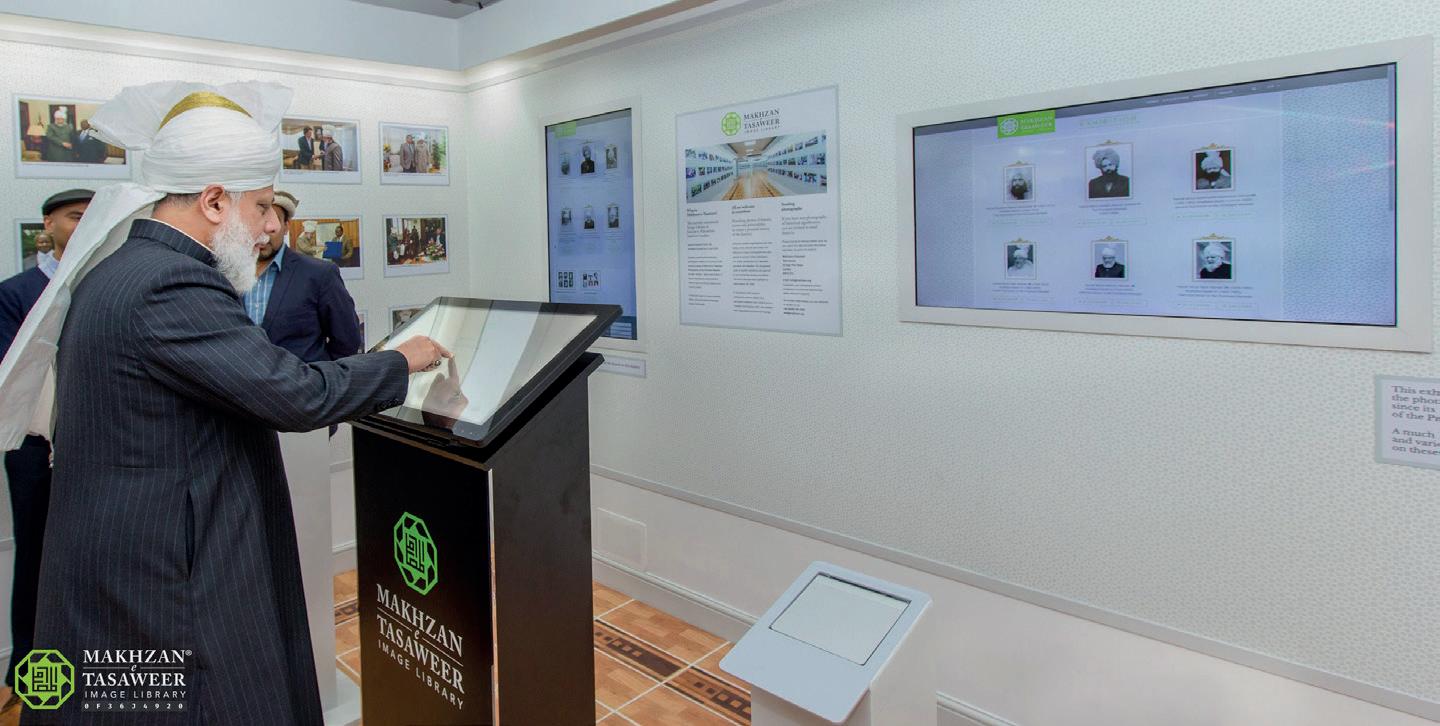
7 February 2016: On this day, Hazrat Khalifatul Masih Vaa inaugurated and launched the new Makhzan-e-Tasaweer website (www. makhzan.org) and the exhibition, located at the Tahir House complex in South West London. Makhzan-eTasaweer is working to collect and archive historical images of the Ahmadiyya Muslim Jaamat.
(“World Head of Ahmadiyya Muslim Community inaugurates new Makhzan-e-Tasaweer website,” www.pressahmadiyya.com)
8 February
8 February 1974: On this day, Hazrat Khalifatul Masih IIIrh announced a spiritual plan centred on prayers in preparation for the Centenary Jubilee of Jamaat. This plan emphasised acts of worship, including offering nawafil (voluntary prayers), fasting, and engaging in the remembrance of Allah through specific supplications.
Huzoorrh affirmed that every step of the Ahmadiyya Muslim Jamaat is advancing towards the global triumph of Islam. (Khutbat-e-Nasir, Vol. 5, pp. 413–425)
8 February 1984: On this day, Hazrat Khalifatul Masih IVrh urged members of the Jamaat to make financial sacrifices for the purchase of 500 additional cooking cauldrons to accommodate the growing needs of Jalsa Salana. This appeal was made in response to the expanding arrangements and the anticipated arrival of a large number of guests. (Silsila Ahmadiyya, Vol. 4, p. 829)
9 February
9 February 1945: On this day, the National College Lahore hosted an event highlighting the importance and need for unity between Sikhs and Muslims. Giani Wahid Hussain Sahib, an Ahmadi orator, presented key points for consideration on the matter. (Tarikh-e-Ahmadiyyat, Vol. 9, p. 559)
10 February
10 February 1900: Amidst the ongoing war in South Africa, British
forces faced great difficulties against the local Boer commandos. In response to the situation, the Promised Messiahas issued an appeal for funds to support orphans, widows, and the wounded. On this day, 500 rupees were immediately collected and sent to the chief secretary of the Punjab Government. Later, the lieutenant governor expressed gratitude to the Promised Messiahas on behalf of the government for this donation. (Life of Ahmad by AR Dardra, 2008, pp. 720-721)
10 February 1925: On this day, Hazrat Musleh-e-Maudra initiated a special fund to expand tabligh efforts in Europe and invited Jamaat members to donate 100,000 rupees towards this cause. Ahmadis contributed the required amount within three months. (Tarikh-eAhmadiyyat, Vol. 4, p. 515)
11 February
11 February 1955: On this day, a delegation representing Jamaate-Ahmadiyya UK met the Prime Minister of Ceylon in London and presented him with a copy of the English translation of the Holy Quran. The Birmingham Post and other newspapers reported on this event. (Tarikh-e-Ahmadiyyat, Vol. 17, p. 312)
12 February
12 February 1946: On this day, the Arya Samaj’s Delhi chapter convened an interfaith conference where Hazrat Maulana Abul Ata Jalandharira also delivered a speech. Tej newspaper published a summary of his speech. The title for this conference was “My religion is not an obstacle to the development of the country.” (Tarikh-e-Ahmadiyyat, Vol. 9, p. 619)
12 February 1988: On this day, Hazrat Khalifatul Masih IVrh delivered the Friday sermon at Saltpond, Ghana, during his visit to Africa. In his sermon, Huzoorrh highlighted the history of Ghana, advised the people of Ghana on economic self-reliance, and assured them of the Jamaat’s support and cooperation. (Khutbate-Tahir, Vol. 7, pp. 83-90)
13 February
13 February 1966: The Taleemul-Islam College Basketball Club Rabwah organised the All-Pakistan Basketball Tournament under its auspices. The competition was held in two sections, the club section and the college and school sections, which began on February 10. On this day, Hazrat Khalifatul Masih IIIrh graced the final match of the club section and had a meeting with the players. (Tarikh-e-Ahmadiyyat, Vol. 23, p. 709)
13 February 1983: On this day, during his visit to Karachi, Hazrat Khalifatul Masih IVrh delivered a speech at the joint meeting of the Karachi Jamaat, its auxiliary organisations, and the Engineers’ Association. (Silsila Ahmadiyya, Vol. 4, p. 821)
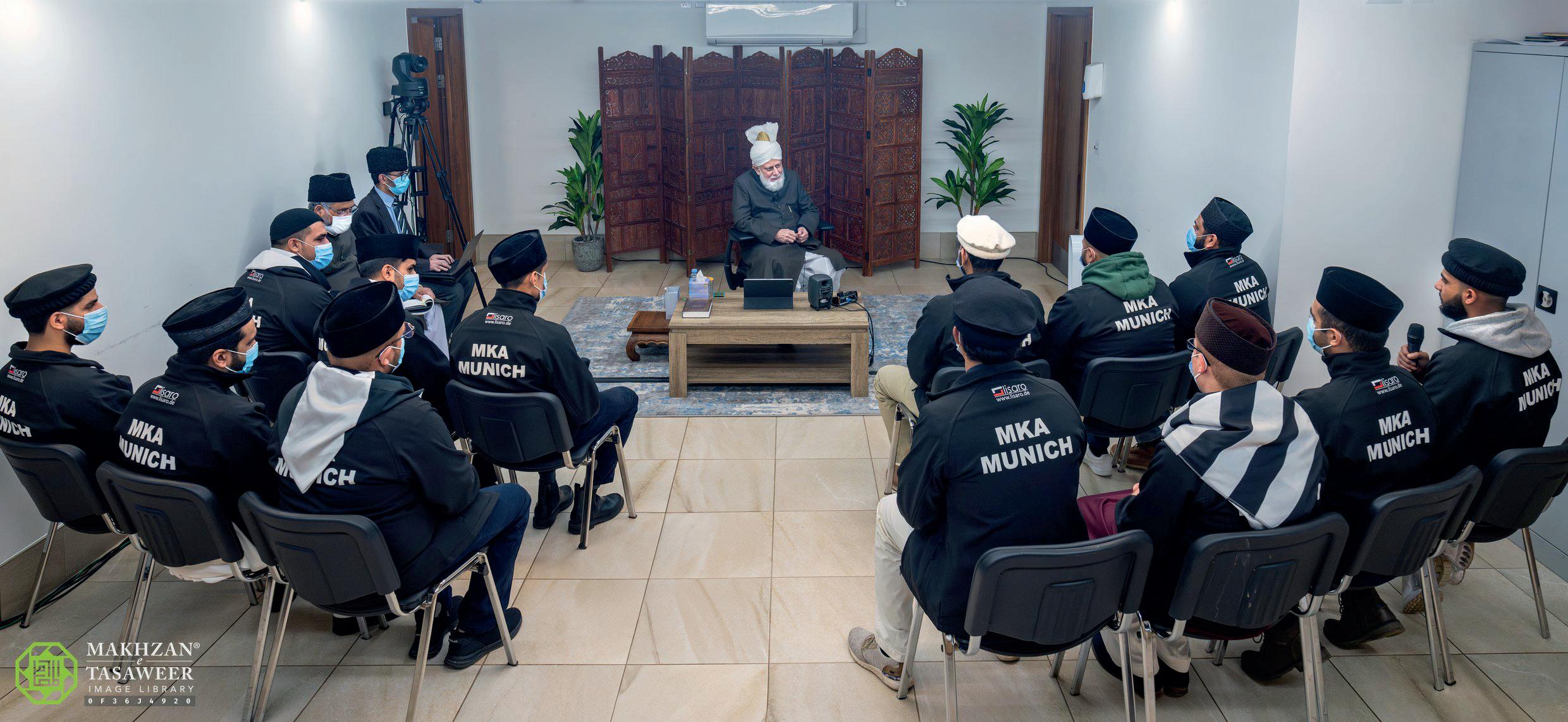
‘Elevate the standard of your salat’ Khuddam from Munich, Germany, meet Huzoor From the markaz
Saturday, 25 January 2025, Islamabad, UK: Khuddam from Munich, Germany, were blessed with the opportunity to have a mulaqat with Hazrat Mirza Masroor Ahmad, Khalifatul Masih Vaa, at Islamabad, UK.
Upon arrival, Huzooraa greeted the attendees and took his seat. The missionary, accompanying the group, informed Huzooraa about the khuddam and mentioned that they had some questions to ask. Huzooraa then asked each khadim to introduce themselves, enquiring about their family backgrounds, studies, and careers, etc.
The khuddam then had the opportunity to ask questions and seek guidance from Huzooraa
Coping with the loss of a martyred family member
One khadim mentioned that his fatherin-law had been martyred, and his wife remained worried and sorrowful. He sought guidance from Huzooraa on how to comfort her.
Huzooraa emphasised the importance of prayer and remaining steadfast in virtuous deeds to find comfort and solace. Huzooraa said:
“Pray for him. Pray for his forgiveness. He has indeed attained the lofty status of martyrdom. So, I am certain and I hope that he has attained the pleasure of Allah the Exalted.
“Just yesterday I narrated an incident of a Companion who saw a dream that was interpreted by Hazrat Abu Bakrra, and he said, ‘Glad tidings, for you shall embrace martyrdom.’ We find such incidents in the past. The rank of martyrdom is very lofty.
“One should always pray that Allah the Exalted may continue to elevate his status [in paradise] and enable you, who are his children, to remain steadfast in virtues. It should not be the case that the wrong actions of his progeny waste his sacrifice. Such a sacrifice is never wasted as such, but you may be deprived of its reward [on account of your own actions].
“Thus, you ought to pray for yourself that Allah the Exalted may grant you patience and steadfastness; elevate his status in paradise; enable you to remain consistent in performing virtuous deeds; and grant you peace and tranquillity. This is how Allah the Exalted grants one comfort. Pray in your salat.”
Jalsa Salana Germany 2025
When asked about his attendance at Jalsa Salana Germany, Huzooraa stated that “Allah knows best.” He remarked with a smile that if he was unable to attend, the khadim could always visit the UK again, just as he had on this occasion.
Islamic inheritance laws
A khadim enquired about the application of Islamic inheritance laws in various family structures and conditions. Huzooraa instructed him to submit the query in writing for a more detailed response and recommended studying the book Islam Ka Warathati Nizam by Professor Abdul Rashid Ghani Sahib, which provides a comprehensive understanding of the subject.
Fulfilling the obligations of Waqfe-Nau
The discussion then turned to the responsibilities of those who are part of the Waqf-e-Nau scheme and how they can effectively fulfil their commitments.
Huzooraa outlined the essential qualities of a true waqif-e-nau, stressing the need for personal spiritual development, commitment to service, and active involvement in tabligh and Jamaat activities. Huzooraa said:
“One should dedicate one’s life. If the Jamaat says that it does not require one’s services as waqif at present, then one may work outside for the time being and give their spare time to the Jamaat. Give time [to the Jamaat] on the weekends and engage in tabligh activities.
“First and foremost, endeavour to better yourself. One should not simply be content with the title of ‘Waqf-e-Nau’; rather, one should also have a relationship with God Almighty. Safeguard your salat, elevate the standard of your salat, recite the Holy Quran, read the translation of the Holy Quran, understand the commandments found therein and act upon them. Then a person would be a true embodiment of Waqf-e-Nau. Then, spread that teaching to
others as well.
“Come forward for tabligh activities to fulfil your obligations. Even if you are working outside, give time to the Jamaat on the weekends for tarbiyat- and tablighrelated activities so that you may morally train others as well. Teach others what you have learned yourself. Furthermore, do tabligh and spread the message of Islam Ahmadiyyat to others.”
Extraterrestrial life in Islamic literature
A khadim asked whether the Holy Quran mentions extraterrestrial life.
Huzooraa addressed the topic of extraterrestrial life within Islamic teachings, stating that the possibility of multiple universes exists, as inferred from certain Quranic interpretations. While no specific verse lays out in detail what extraterrestrial life may be exactly, the vastness of creation suggests that life beyond Earth could be a possibility. Huzooraa encouraged the khadim deeper reflection on the subject, urging the individual to ponder over it carefully and share their insights, especially given their background in physics.
Overcoming distance from the mosque
A khadim mentioned that the khuddam in Munich faced challenges in attending congregational prayers due to living far from the mosque and sought guidance on how to address this issue.
Huzooraa provided practical guidance on how khuddam could establish congregational prayers despite the distance from the mosque. He said:
“Tell them to at least come [to the mosque] to offer one prayer, unless there is a
person who is extremely impoverished and cannot afford it, or the journey is too long.
“You may request a few khuddam who live relatively close to each other to designate a centre for themselves in one of their homes where they can offer their salat in congregation if it is difficult for them to come to the mosque. You should draw their attention towards offering prayers in congregation. If they live far away, then the people who live closer to each other should form their own groups and offer their prayers together in congregation.”
Huzooraa explained that in some places, mosques are established in various localities to ensure ease of access for worshippers. While such an arrangement may not be possible in the West, he advised that khuddam could create their own designated salat centres to facilitate congregational prayers.
Worship for those with severe health restrictions
A khadim enquired about the religious obligations of a family member facing severe health restrictions that limited their ability to perform acts of worship in the usual manner.
Huzooraa provided reassurance, explaining that individuals in such circumstances are only expected to do what they can within their capacity, as Islam’s teachings do not place burdens beyond one’s ability. (Surah al-Baqarah, Ch.2: V.287) He further conveyed that those facing such difficulties are granted ease in their religious responsibilities.
Conclusion
As the mulaqat concluded, the khuddam had the honour of having a group photo with Huzooraa
(Summary prepared by Al Hakam)
Continued from page 1
victors. Among the many who had opposed Islam was Abu Sufyan, a staunch adversary who had led numerous campaigns against the Muslims. Under the protection of Hazrat Abbasra, Abu Sufyanra watched as the Muslims reclaimed the city from which they had been exiled.
During this moment of triumph, Saadra bin Ubadah, a prominent Ansari chieftain, passed by Abu Sufyan with his armed forces and passionately declared:
“Today is the day of battle and struggle; today is the day to uphold the greatness of the Ka‘bah.”
When Prophet Muhammadsa heard these words, he immediately dismissed Saadra from his command, recognising the potential harm such sentiments could cause. (Sirat Ibn Hisham, Vol. 4, p. 9)
For any ordinary person, Saad’sra declaration might have seemed justifiable, even natural. Yet the Prophetsa urged his people to rise above the pettiness of vengeance, and maintain dignity, composure and justice – even in moments of overwhelming emotion. Forgiveness and magnanimity prevailed, a testament to his unparalleled leadership and moral fortitude.
Whether it was the death of one foretold by the Almighty Allah Himself, or a natural disaster prophesied ahead of time, the Promised Messiahas, Hazrat Mirza Ghulam Ahmadas would not celebrate the misfortune and suffering of others. Instead, he would express his sorrow and pray that people might be saved so that a strong army of God’s servants be formed from among those people. (Sirat Masih-e-Maud, Part 3, Hazrat Sheikh Yaqub Ali Irfanira; Siraj-e-Munir, Ruhani Khazain, Vol. 12, p. 28)
The ninth article in the Conditions of Bai‘at outlined by Hazrat Mirza Ghulam Ahmadas stipulates that a true Muslim is one who keeps themselves “occupied in the service of God’s creatures for His sake only, and shall endeavour towards the beneficence of mankind to the best of his/her God-given abilities and powers.”
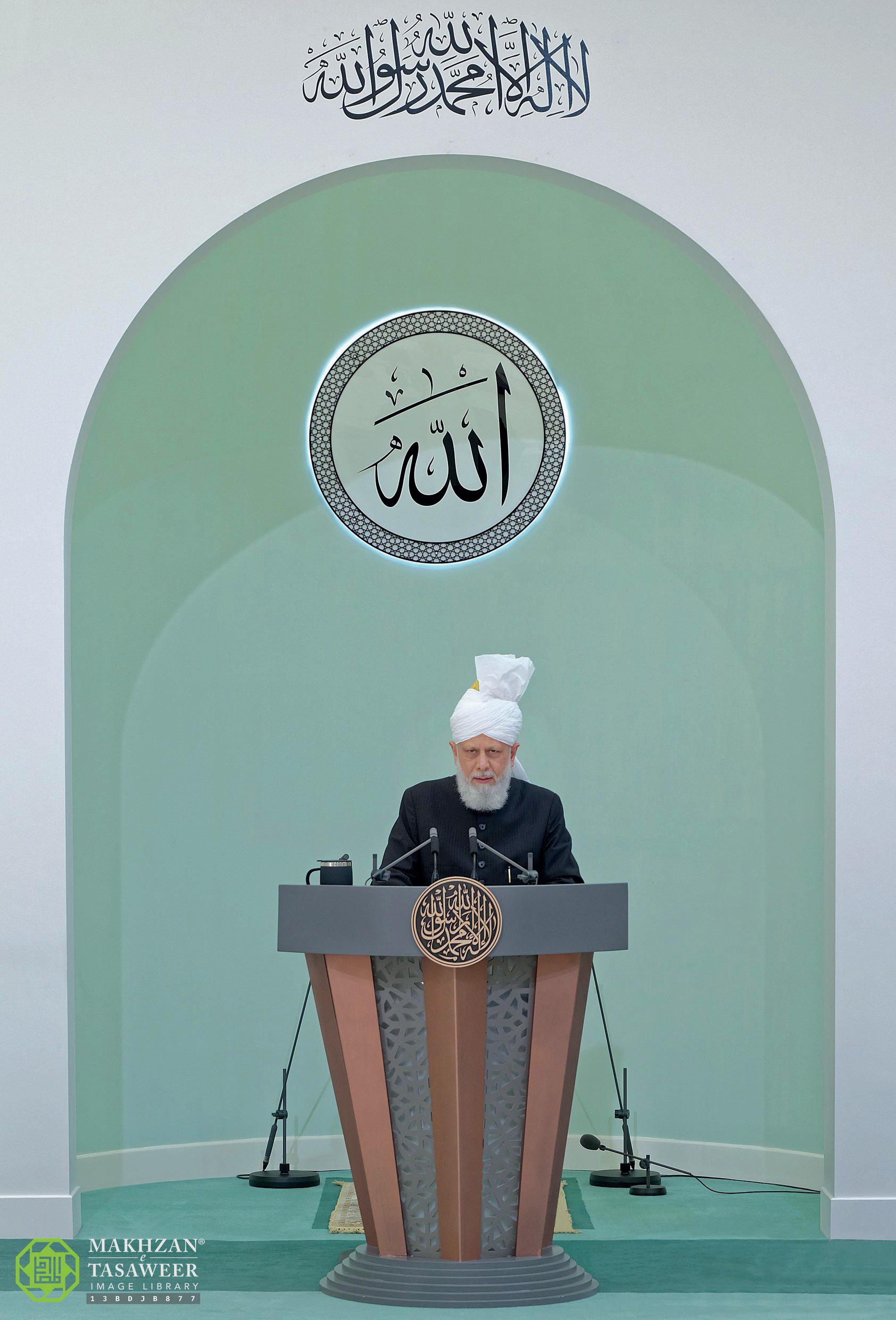
In our own time, Hazrat Mirza Masroor Ahmadaa, the Fifth Khalifa of the Promised Messiahas, continues to exemplify this ethos. Recently, a delegation of youth from the USA met with His Holiness. As the meeting concluded, he inquired about the welfare of those affected by the fires.
Did he express condemnation, or suggest the victims deserved such suffering? Not at all! His words radiated compassion and empathy, inspiring those present and watching to uphold humanity in every circumstance.
Dave Chappelle’s monologue captured the essence of this sentiment perfectly:
“Do not forget your humanity. And please, have empathy for displaced people, whether they’re in the Palisades or Palestine.”
The lives of the Prophets and their devoted followers teach us a profound lesson: they found no joy in the downfall of others, but instead stood ready to uplift those in need. In a world burdened by pain and suffering, our purpose must be to embody this spirit of compassion – offering our shoulders for others to lean on and our hands to wipe away the tears of the downtrodden.
(Qasim Choudhary, Missionary, Marshall Islands)
Can Trump bring about the ‘golden age’ of America in his second term?
Danial Ahmed Butt Virginia, USA
After a historic win during the 2024 election cycle, Donald Trump and J.D. Vance have officially been sworn in as the President and Vice President of the United States, respectively. The presidential inauguration was held on 20 January, coinciding with the federal holiday of Dr Martin Luther King Jr Day, which commemorates the nation’s civil rights leaders.
President Trump’s speech announced several executive orders he will immediately put into place, and committed to many
within a day of the inauguration. The executive orders mainly revolved around immigration, national security, and the economy. Many of these executive orders follow up on Trump’s promises during his presidential campaign. (“Tracking Trump’s executive orders: What he’s signed so far”, www.axios.com)
Much debate has arisen among legal experts and citizens alike as to whether these executive orders will achieve Trump’s goals throughout his presidency. Trump himself proclaimed that these executive orders will reinvigorate the United State’s role as a world superpower, stating that “the
Golden Age of America begins right now.” (“Trump Proclaims ‘The Golden Age of America Begins Right Now’”, www.wsj.com, 20 January 2025)
As his second term begins, here are some of the key issues and solutions Trump announced during his inauguration speech and first day in office.
Immigration and the US-Mexico border
When it came to addressing immigration, much of Trump’s rhetoric took a militaristic tone, declaring a national emergency at the US-Mexico border. Deporting millions of “criminal aliens” has always been one of the hallmarks of Trump’s politics and the new presidential term will be no different.
Following the inauguration, the Immigration and Customs Enforcement (ICE) is now no longer restricted from raiding places of worship, schools, and hospitals where undocumented immigrants may be located. The “Remain in Mexico” policy from Trump’s previous term was reinstated where asylum seekers cannot enter the US until they are scheduled to appear before US immigration judges.
Furthermore, troops are to be sent to the border to, as Trump puts it, “repel the disastrous invasion of [the] country.” To be clear, Trump’s border policy is not a far cry from Biden’s, but it is nevertheless intent on making ICE a more powerful agency. (“How Trump’s plans for mass deportations and ICE raids are playing out”, www.nbcnews. com, 21 January 2025)
While Trump said during his inauguration speech that he would end wars and prevent new ones, much concern grew as he also spoke of designating the Mexican cartels as a foreign terrorist organisation. While this executive order is not declaring war, many have been concerned that the United States is effectively setting a precedent for authorising the use of military force in a sovereign nation.
Moreover, designating an enemy group as a terrorist organisation has historically been reserved for those following a political ideology. The Mexican cartels sharply contrast with such enemies in that the cartels are solely driven by profit. (“Trump’s bid to label Mexican cartels ‘foreign terrorists’ poses risks to companies, migrants”, www. reuters.com, 21 January 2025)
Expanding the US territory and economy
The President’s concerns over the region were not limited to Mexico’s land territories, but also the Gulf of Mexico and Panama Canal. For the former, the President has signed an executive order to rename the Gulf of Mexico to the Gulf of America. The same executive order renamed Mount Denali in Alaska back to its previous legal name of Mount McKinley. (“Trump renames Gulf of Mexico to Gulf of America. But is it really that easy?”, www.usatoday.com, 21 January 2025)
Both name changes are symbolic in nature of restorative justice and American expansionism. The same rings true for the President’s plans for the Panama Canal. Trump plans to “take back” the Panama
Image by Gerd Altmann from Pixabay
Photo by David Everett Strickler on Unsplash
The ideal woman: A caring mother, a loving wife
Mujitaba Hibbatul Khaliq Student, Kwara State University, Nigeria
In Islam, or in fact, in any given community, women play a vital role in shaping the fabric of society, and in the realm of faith and spirituality, the role of women is pivotal particularly within the sacred institution of the family. Thus, unlike popular misconceptions, Islam – a faith that champions equality, justice and compassion – accords women a position of dignity and honor.
In today’s world, where family values are often eroded and women’s roles are redefined, let it be known that Islam, since its inception, offers a very refreshing and empowering vision with regards to the status of women, placing great emphasis on their spiritual growth and development, especially by pointing out some unique aspects like the equal spiritual potential, as well as education and knowledge.
The status of women in Islam
In Islamic teachings, unlike many other faiths in the world, women are considered equal partners in faith and spiritual growth, sharing identical obligations and rewards.
The Holy Quran declares:
“But whoso does good works, whether male or female, and is a believer, such shall enter Heaven, and shall not be wronged even [as much as] the little hollow in the back of a date-stone.” (Surah an-Nisa, Ch.4: V.125)
The Holy Quran and ahadith are full of teachings regarding women’s rights, dignity and responsibilities, particularly in their roles as mothers and wives, emphasising their critical role in shaping the next generation. The central theme of this is the fact that: The status of women is not inferior to that of men. Rather, women have been given rights and responsibilities which although different, are equal with that of men.
The caring mother
In Islam, motherhood is revered as a sacred institution, and the Holy Quran emphasises the importance of mothers in nurturing the next generation. It states:
his full maturity and reaches [the age of] forty years, he says, ‘My Lord, grant me [the power] that I may be grateful for Thy favour which Thou hast bestowed upon me and upon my parents, and that I may do such good works as may please Thee. And make my seed righteous for me. I do turn to Thee; and, truly, I am of those who submit to [Thee].’” (Surah al-Ahqaf, Ch.46: V.16)
At another place, we read:
“And say, ‘My Lord, have mercy on them even as they nourished me in [my] childhood.’” (Surah Bani Isra’il, Ch.17: V.25)
In recognition of the toil of mothers in the upbringing of their children, the Holy Prophetsa commands that men should in turn revere their mothers. Thus, it was narrated that once, a companion came to ask him who is most worthy of his goodness and kindness. The Holy Prophetsa replied: “Your mother.” He asked again and he received the same answer. Upon asking for the third time, the Holy Prophetsa told him: “Your father.” This is a testament to the status of mothers in Islam. (Sahih Muslim, Kitab albiri wassilati wal adaab, Hadith 2548)
The Holy Prophetsa is also reported to have said that paradise lies under the feet of mothers. (Sunan an-Nasa’i, Kitab al-Jihad, Hadith 3104)
In regards to this subject matter, it is often said that the mother is the first teacher of the child. This means that the initial behaviours of a child are those which he has learnt from his mother. Therefore, mothers should instill in their children the love of God and of the Holy Prophetsa and raise their children in a way that they become useful members of the society.
The
Islamic paradigm of a wife
In Islam, marriage is considered a sacred bond between a man and a woman. The Quran and hadith emphasise the importance of mutual love, respect and cooperation in marriage. We read in the Holy Quran:
until her last breath. As a result of her devotion, her example became timeless. A figure that cannot be forgotten in the history of humanity.
The same example is seen in the life of Hazrat Aishara and the other wives of the Holy Prophetsa, as well as Hazrat Syeda Nusrat Jahan Begumra (the wife of the Promised Messiahas). However one should not be deceived into thinking that they attained such excellence because they were wives of Prophets, for even the wife of Pharaoh attained such excellence whilst the wives of Prophet Noahas and Prophet Lotas didn’t. The reality therefore is that the attainment of such elevated status is as a result of individual actions and the blessings of God. Allah the Almighty states:
“And as for those who strive in Our path – We will surely guide them in Our ways. And verily Allah is with those who do good.” (Surah al-Ankabut, Ch.29: V.70)
Let us strive, then, to embody the Islamic ideals of womanhood embracing our roles as caring mothers and loving wives. May we inspire future generations to uphold these values, fostering a harmonious and righteous society.
Conclusion
To conclude, below is a description of a woman in light of the Bible, which grants women great honour.
“And We have enjoined on man to be good to his parents. His mother bears him with pain, and brings him forth with pain. And the bearing of him and his weaning takes thirty months, till, when he attains
“And mothers shall give suck to their children for two whole years; [this is] for those who desire to complete the suckling. And the man to whom the child belongs shall be responsible for their (the mothers’) food and clothing according to usage. No soul is burdened beyond its capacity. The mother shall not make [the father] suffer on account of her child, nor shall he to whom the child belongs make [the mother] suffer on account of his child.” (Surah al-Baqarah, Ch.2: V.234)
We also read:
“And We have enjoined on man concerning his parents – his mother bears him in weakness upon weakness, and his weaning takes two years – ‘Give thanks to Me and to thy parents. Unto Me is the [final] return.” (Surah Luqman, Ch.31: V.15)
All these are efforts and favours of the mother upon her children which the Holy Quran acknowledges, and in appreciation of all these, commands the children to in turn pray for their parents thus:
“And [one] of His Signs [is this], that He has created wives for you from among yourselves that you may find peace of mind in them, and He has put love and tenderness between you. In that surely are Signs for a people who reflect.” (Surah ar-Rum, Ch.30: V.22)
On this same subject, the Holy Prophetsa also says: “Women are counterparts of men.” (Sunan Abu Dawood, Kitab al-Tahara, Hadith 236).
Combining this prophetic saying with the above cited verse, we get the clear picture of the importance of women in the sight of God. As if to say that without women, the world wouldn’t be the same. This is also proven from the story of Adamas and Eve in the book of Genesis when God recognised Adam’s need for a companion. (Genesis, 2:18)
Similarly, in the annals of Islamic history as well, we read that the first person to believe in the Holy Prophetsa was a woman – his wife, Hazrat Khadijara. (Ibn Ishaq, The Life of Muhammad [Al-Sirah alNabawiyyah], 2004, p. 111)
She not only gave her husband the comfort and support he needed the most at the time of extreme fear and terror, but also stayed by him as the mother of believers
“Who can find a virtuous woman? for her price is far above rubies. The heart of her husband doth safely trust in her, so that he shall have no need of spoil. She will do him good and not evil all the days of her life. She seeketh wool, and flax, and worketh willingly with her hands. She is like the merchants’ ships; she bringeth her food from afar. She riseth also while it is yet night, and giveth meat to her household, and a portion to her maidens… Strength and honour are her clothing; and she shall rejoice in time to come. She openeth her mouth with wisdom; and in her tongue is the law of kindness. She looketh well to the ways of her household, and eateth not the bread of idleness. Her children arise up, and call her blessed; her husband also, and he praiseth her… Favour is deceitful, and beauty is vain: but a woman that feareth the Lord, she shall be praised. Give her of the fruit of her hands; and let her own works praise her in the gates.”
(Proverbs, 31:10-31)
Final Thoughts
I wonder, what greater honor could there be than being a God-fearing woman? As a daughter, her father attains paradise through her. As a wife, she is the principal source of comfort for her husband. And as a mother, the paradise of her children lies right under her feet.
Photo by Mihai Surdu on Unsplash
The sweet cure? New insights on cancer and honey
Nusrat Jahan Idrees, PhD candidate in Oncology
United Kingdom
In many Muslim households, honey isn’t just honey. Got a sore throat? Honey. Trouble sleeping? Honey in warm milk. Need a breakfast boost? Drizzle some on your paratha. Whether mixed into ginger tea for digestion or combined with black pepper for a stubborn cough, honey has always been more than just food – it’s a sweet miracle potion passed down through generations.
What’s truly fascinating, though, is how honey, celebrated in the Quran for over 1,400 years, is now gaining the scientific recognition it deserves. What our ancestors embraced through faith is now being validated by researchers worldwide.
Honey in the Quran and hadith
The Quran beautifully highlights honey’s healing properties in Surah an-Nahl, Ch.16:
V.69-70:
“And thy Lord has inspired the bee, saying, ‘Make thou houses in the hills and
in the trees and in the trellises which they build. Then eat of every kind of fruit, and follow the ways of thy Lord that have been made easy for thee.’ There comes forth from their bellies a drink of varying hues. Therein is cure for men. Surely, in that is a Sign for a people who reflect.”
This verse underscores the divine wisdom behind honey as a source of healing. Similarly, in a hadith it is narrated:
“If there is any good in your medicines, then it is in a gulp of honey…” (Sahih alBukhari, Hadith 5702)
In another narration, the Prophetsa said:
“You should take the two that bring healing: Honey and the Quran.” (Sunan Ibn Majah, Hadith 3452)
These teachings encourage Muslims to view honey as both nourishment and medicine – a tradition that modern science is now reinforcing.
Science catching up
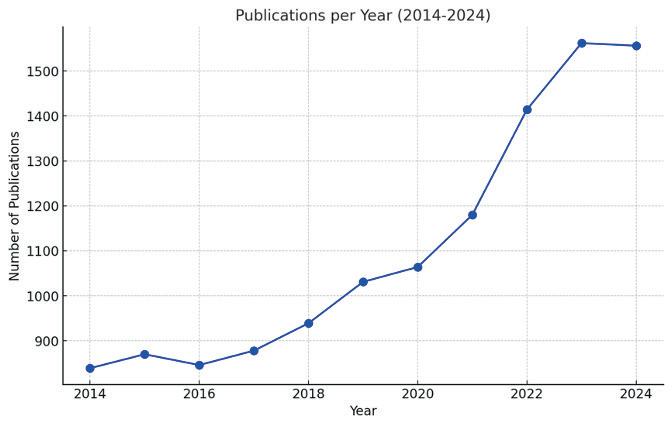
Fast forward 1,400 years, and science is beginning to uncover honey’s vast potential. A review of research published on PubMed between 2014 and 2024 reveals a growing interest in honey as a medicinal agent. Researchers worldwide are exploring its role in combating infections, reducing inflammation, and, most notably, fighting cancer.
One type of honey that has garnered particular attention is Manuka honey, a special variety from New Zealand known for its high antibacterial and therapeutic properties.
Latest research: Manuka honey and breast cancer
In a ground-breaking 2024 study conducted at UCLA, Manuka honey demonstrated remarkable potential in inhibiting the progression of oestrogen receptor (ER)positive breast cancer. Researchers found that Manuka honey reduced tumour growth by an astonishing 84% in preclinical models, without harming normal breast cells. (Márquez-Garbán DC, Yanes CD, Llarena G, Elashoff D, Hamilton N, Hardy M, Wadehra M, McCloskey SA, Pietras RJ. Manuka Honey Inhibits Human Breast Cancer Progression in Preclinical Models. Nutrients. 2024 Jul 22;16(14):2369)
The study highlighted several mechanisms behind this anti-cancer effect:
• Apoptosis (Cancer Cell Death): Manuka honey promoted programmed cell death in cancer cells while sparing healthy ones.
• Regulation of Molecular Pathways: It suppressed key cancer-promoting pathways, such as AMPK/AKT/ mTOR and STAT3, responsible for tumour growth and survival.
• Synergy with Chemotherapy: When combined with conventional treatments like tamoxifen, Manuka honey enhanced therapeutic outcomes while reducing side effects.
These effects are linked to honey’s antioxidant and anti-inflammatory properties, which help protect cells from oxidative stress – a major factor in cancer development.
But before rushing to stock up on jars of Manuka honey, here’s a reality check: As Dr. Diana Márquez-Garbán, associate professor of medicine at the David Geffen School of Medicine at UCLA, explains, “It’s important that people don’t think this honey could be a substitute for standard therapy. A lot of patients seek out alternative therapies, so it’s important to reassure people that the standard therapies that have been assessed in clinical trials and are known to work are the ones they should take.”
Bridging faith and science
Islam’s timeless wisdom about honey as a healing substance resonates deeply when viewed through the lens of modern science. For Muslims, it is heartening to see ancient teachings validated by current research, offering not only spiritual comfort but also scientific potential.
Today is world cancer day (4 February) - and as the scientific community delves deeper into honey’s role in cancer therapy, it reaffirms what was revealed centuries ago: honey is more than just a sweetener; it is a divine gift with unparalleled healing potential. From its mention in the Quran to its spotlight in cancer research, honey continues to bridge the gap between faith and science.
So, next time you reach for a jar of honey, remember: you’re holding centuries of tradition, a treasure trove of health benefits, and perhaps even a key to future cancer therapies. Sweet, isn’t it?
For further reading: Honey: A cure for mankind?
Photo by pmv chamara on Unsplash
The Promised Messiah’s daughter responds to Allama Iqbal’s poem
Ahmad Al Hakam
The name Allama Iqbal, formally known as Sir Muhammad Iqbal, is undoubtedly familiar in the realm of poetry. He was renowned as a distinguished Muslim writer and philosopher, and celebrated as Pakistan’s national poet, despite his demise before the inception of Pakistan.
Born in Sialkot during the British Raj era, Muhammad Iqbal was granted the title Sha’ir-e-Mashriq, known as the Poet of the East. His writings are known worldwide, and he is considered one of the best Urdu and Persian poets of the 20th century. Even today, his poetry continues to be remembered, quoted, posted on social media and shared widely.
His poems covered many topics, from societal issues to the teaching of tasawwuf [Islamic mysticism], and Indian Muslims much liked his motivational poetry. Hardly in any poetry society will one find Allama Iqbal’s name not mentioned.
It is often said that his genius of poesy can ignite dormant feelings and emotions within the reader, often awakening sentiments the reader may not have been aware of or had kept deeply concealed. However, we shall let the poets and experts of this era decide if this statement is valid.
In one of his famous poems, “kabhi aye haqeeqat-e-muntazir nazar aa, libaase-majaaz mein”, Allama Iqbal expressed his desire for God to manifest Himself:
This means that God – in this persona poem from the perspective of God – is saying to the seeker, referring to them as “talib-e-muntazir”, that if they had even an iota of sincerity, they could perceive His manifestation in a physical form. It suggests, as an invitation to the seeker, to perceive God’s presence through a metaphorical or symbolic way – through the things Allah has created.
Reading this, one is reminded of the verse that speaks about how Allah, being the Creator of all things, invites people to reflect upon the creation of the universe. (Suah Aal-e-‘Imran, Ch.3: V.192)
Hazrat Syeda Nawab Mubaraka Begumra goes on to write:
As the seeker, through the nazm, is told that God’s manifestation is present at all times and places, they are further told to look within and to search for Him in the longing of the heart, and at times in the voice of nightingales, or the beauty of flowers. His manifestations can be perceived in autumn and spring, meaning that God’s manifestation can be seen, observed, and felt in all climates and seasons.
Thus, the Divine is not confined to a single season; rather His manifestation is also reflected in the changing cycles of nature.
In this verse, Iqbal pleads with God to reveal Himself in a physical, human form; he states that many of his prayers – which in the verse are symbolised by prostrations – are eagerly awaiting fulfilment in their supplication. Iqbal addresses God as haqeeqat-e-muntazir. When seen separately, “haqeeqat” relates to truth or reality; and “muntazir” relates to waiting for or anticipating.
A fun little anecdote about this poem, which is commonly known in poetry society, is that once when Allama Iqbal visited Lucknow, he recited this well-known ghazal. After listening to the entire poem, it was jokingly said: “Now please recite a ghazal in Urdu too!” Iqbal found this comment so funny that he often shared the story with his friends, enjoying the humour.
In response to Iqbal’s poem, Hazrat Syeda Nawab Mubaraka Begumra, the daughter of Hazrat Mirza Ghulam Ahmadas, the Promised Messiah, penned a poem titled “Nishan-e-haqeeqat ki arzu”, employing the technique of a persona poem from the perspective of God, referred to as “ba zubaan-e-khuda”.
Hazrat Syeda Nawab Mubaraka Begumra effectively and eloquently responds to Iqbal’s nazm. She starts by writing:
Here, it is as if the poet is saying that God’s manifestation is within the heart of the person, and the person’s “sar” (head) is metaphorically described as Mount Tur itself; Mount Tur being the place where Allah revealed Himself to Moses.
The second line highlights that divine light is present in the person’s eyes; and then asks, “Who says I am far?” As if to say that from where did this belief emerge that God is far away? The third line plays on the idea that if one does not see or perceive His manifestation, then instead of saying that God is far, it is well nigh possible that there is a fault in one’s spiritual vision.
Then, Hazrat Syeda Nawab Mubaraka Begumra states:
These lines further address the seeker to see God’s manifestation at the peak of the mountain; and in the lowliness of the valley. This implies that Allah is not limited to specific places or states but can be found in both high and low circumstances. As man often goes through highs and lows or ups and downs, at all times, no matter what the circumstances are, God’s manifestation can be observed.
As we continue to read the poem, we find that the seeker is told to “see Me in the helplessness of the poor; see Me in the power of the king.” This further reinforces the notion – or fact I shall say – that the Divine is not confined to any particular social status or condition but is omnipresent across all situations; and goes on to say that if, even then, He is not apparent to the seeker, then one shall consider that there might be a fault in their spiritual vision and lens.
Hazrat Syeda Nawab Mubaraka Begumra further writes:
The seeker has been told to observe how the Divine’s light is represented in the crescent moon and its beauty is found in the perfection of the full moon, which shows and reminds the seeker to look at the creation of the Universe and not just that but also how the Universe operates.
The second line further expands on the nature of the divine. It encourages and urges the seeker and observer to see the divine in various manifestations, emphasising how the divine can be perceived and experienced in diverse ways.
Then, the third line introduces a metaphorical closeness, stating that the divine is closer than the jugular vein. This alludes to the verse of the Holy Quran: “And assuredly, We have created man and We know what his [physical] self whispers [to him], and We are nearer to him than [even his] jugular vein.” (Surah Qaf, Ch.50: V.17)
So, after telling the seeker to find God, it signifies an intimate and immediate connection with the divine, transcending physical distances. The question at the end prompts the reader to consider in whose thoughts their heart resides, implying that the divine is intimately linked to one’s consciousness and awareness. It encourages the reader to look within, to look at who resides in their heart.
Jalsa Khilafat held by Majlis Khuddam-ul-Ahmadiyya Canada
Syed Mukarram Nazeer
Canada Correspondent
Majlis Khuddam-ul-Ahmadiyya Canada held its National Jalsa Khilafat on 18 January 2025, at Aiwan-e-Tahir. Amer Safir Sahib, Chief Editor of The Review of Religions, attended as the Markaz representative. The Baitul Islam Mosque served as the overflow area, with special arrangements made for elders and individuals unable to sit on the floor. A Special Educational Needs and Disability (SEND) area was designated for members with special needs.
The proceedings were broadcast live on social media in three languages – English, Urdu and French – enabling members across Canada and beyond to partake in this blessed occasion.
The main session commenced after the Zuhr and Asr prayers. Sadr Majlis Khuddam-ul-Ahmadiyya Canada, Sharukh Rizwan Abid Sahib, delivered the opening address, followed by an address from Amir Jamaat-e-Ahmadiyya Canada, Lal Khan Malik Sahib. In his speech, Amer Safir Sahib highlighted various incidents from the life of Hazrat Amirul Momineenaa. The session
was enriched by a gift of “salaam” from Huzooraa to members of Canada Jamaat. The proceedings included Urdu and Arabic poems. 2,791 members attended the Jalsa in person at Aiwan-e-Tahir. In the western regions, the proceedings were held in the cities of Vancouver, Calgary, Edmonton, Lloydminster, Saskatoon, Regina and Winnipeg.
The Jalsa reached a global audience through social media, with 9,600 unique viewers. The average online attendance was approximately 24,000 members worldwide, allowing them to benefit from the Jalsa regardless of their location.
Jalees
Photo by Pierre Bamin on Unsplash
The handshake debate
Analysing a ‘controversial’ gesture in cultural and religious contexts
Iftekhar Ahmed Ahmadiyya Archive & Research Centre
While the refusal to shake hands with the opposite gender for religious or cultural reasons has been recognised as a legitimate expression of individual freedom in some contexts, such as the Muslim woman in Sweden who was awarded a hefty amount of compensation after being refused a job due to her refusal to shake hands with the male boss, it is met with incomprehension and criticism in other contexts. (“Sweden Muslim woman who refused handshake at job interview wins case”, www.bbc.com, 16 August 2018)
The most recent example is when the new Syrian ruler Ahmed al-Sharaa declined to shake hands with German Foreign Minister Annalena Baerbock during her visit to Damascus. He did, however, choose to shake hands with French Foreign Minister Jean-Noël Barrot. (“Handshake-gate in Syria”, www.politico.eu, 4 January 2025)
This has once again raised the question of the extent to which cultural and religious practices are to be tolerated, and the extent to which adaptation to supposedly Western customs can be expected.
A completely justified objection that can, may and – in my opinion – should be raised is the question of what the assumption that the handshake is indispensable is based on.
A brief history of the handshake
It is often said that the handshake is from the common non-verbal greetings and farewell rituals that have been practised for centuries and would take place regardless of social status, gender, or other personal characteristics of the people involved.
In truth, according to studies by Prof Dr Dmitri Zakahrine, a German professor with a teaching qualification in cultural sociology and modern history, very little is known about the spread and function of the handshake greeting in the historical context of Europe. Until the 16th century, this gesture was only used sporadically. Until the 18th century, the handshake was known in Europe as a gesture of contract and promise, and, since the Renaissance, the handshake has been depicted relatively frequently in the West when concluding contracts and reconciliation. Furthermore, even in the 19th century, illustrations much more frequently depicted the handshake being used for contract scenes than greeting scenes. Before the 19th century, hardly any depictions exist in which the handshake appears as a clear gesture of greeting. Even in etiquette manuals from the 16th to 18th century, greeting by shaking hands is barely mentioned. Thus, the handshake up until the 19th century remained primarily a sporadic, emblematic gesture of peace, agreement, or reconciliation, and not a
routine technique of greeting. (Dmitri Zakharine, Von Angesicht zu Angesicht. Der Wandel direkter Kommunikation in der ostund westeuropäischen Neuzeit, pp. 566-568, Konstanz: UVK Verlagsgesellschaft, 2005)
The English writer William Howitt (d. 1879) wrote to his British readers in 1842: “The Germans [...] do not shake hands; and we advise all English gentlemen, on first going to Germany, to be careful not to shock the feeling of the ladies [...] with offering their hands.” (William Howitt, The Rural and Domestic Life in Germany, p. 213, London: Longman, Brown, Green, and Longmans, 1842)
The English studies scholar Prof Thomas Finkenstaedt (d. 2017) writes about Great Britain that it was not until the 19th century that the handshake became the standard greeting there. (Thomas Finkenstaedt, I like kissing people: Handshakes are abhorrent – Zu Gruß und Gebärde in England, in: Aspekte der Kultursoziologie, p.33, Berlin: Reimer, 2005, Justin Stagl [ed.])
Prof Herrman Roodenburg, ethnologist and sociologist, states: “It seems, then, that in the sixteenth and seventeenth centuries and probably for a good deal of the eighteenth century, shaking hands had a very different meaning from the ritual act we know today. It looks as if the gesture was not part of any greeting or parting behaviour at all but that it had quite different connotations which centred around such concepts as friendship, brotherhood, peace, reconciliation, accord, or mutual agreement. [...] It seems quite likely, then, that one of our most popular salutations was still unknown before 1800.” (Herman Roodenburg, The ‘Hand of Friendship’ – Shaking Hands and other Gestures in the Dutch Republic, in: A Cultural History of Gesture – From Antiquity to the Present Day, pp. 174-176, Cambridge, UK: Polity Press, 1991, Jan N. Bremmer; Herman Roodenburg)
This supposed centuries-old practice of shaking hands is also just one of many practices that are even thousands of years old. It was not so long ago that European
this does not necessarily signal rejection or disinterest; you may simply have got too close to the person. It is important not to generalise here, as individual characteristics also play a key role in distancing behaviour. I would like to illustrate something below using the example of the social kiss. Depending on space and time, the view of how high the degree of familiarity must be and who is allowed to kiss whom has been and still is subject to sometimes radical change. Today, in some places, men and women greet each other with a kiss on the cheek, even if they don’t know each other very well. In many places, however, the social kiss between men and women is only customary if they are related or friends, for example. So if a man tries to kiss a woman in greeting, even if it is the kiss on the hand which was customary until the Second World War, is she obliged to endure this just because it goes back to some centuries-old tradition? Not at all!
The same can be said for the shaking of hands. Nobody has to put up with or endure any greeting ritual that they perceive as an invasion of their privacy because of some tradition. It must always, and everywhere, be within the individual’s freedom to decide on such things.
society was still a rather traditional one in which there were sometimes strong hierarchies, not only between the classes but also between the sexes, which was also reflected in greeting rituals such as bowing, curtsying, etc., being the order of the day. However, non-hierarchical practices such as bowing the head and hugging have also been around for a long time in Europe. What is often overlooked in such considerations is the fact that the meaning and prevalence of non-verbal gestures in interaction change constantly over time. (Edith BroszinskySchwabe, Interkulturelle Kommunikation – Missverständnisse – Verständigung, pp. 164-166, Wiesbaden: VS Verlag für Sozialwissenschaften, 2011)
According to a survey conducted in 2003, 70 per cent of East Germans tended to shake hands with their friends as a greeting, compared to only 40 per cent in the West. In contrast to shaking hands with friends, only 51 per cent in the East and 27 per cent in the West tended to shake hands with their colleagues. (“Der wahre deutsche Gruß”, www.welt.de, 28 February 2020)
Proxemics and distance zones
In this context, the research field of proxemics should be mentioned, which deals with the amount of space people feel necessary to set between themselves and others. For example, a distinction is made between the distance zones: (1) intimate zone, (2) personal zone, (3) social zone, and (4) public zone. For example, it measures what, where and when is perceived as an intimate zone reserved only for the closest confidants. Unauthorised intrusion into the private or even intimate sphere is always perceived as an unauthorised boundary violation. If others fall below this minimum distance without permission, this triggers a release of adrenaline and an increase in heart rate, for example, it can even lead to atmospheric disturbances in the relationship and it is not uncommon for a lack of distance to turn into antipathy. For example, if you take a step back or refuse to shake hands,
According to a study by the German Federal Anti-Discrimination Agency, unwanted touching and even unwanted staring in the workplace are recognised by the vast majority of respondents as forms of sexual harassment. (Antidiskriminierungsstelle des Bundes, “Leitfaden für Beschäftigte, Arbeitgeber*innen und Betriebsräte”, www. antidiskriminierungsstelle.de, April 2024, p. 7)
To the astonishment of many, the idea that rituals of greeting between men and women should be limited to gestures without physical contact can still be found in our time. In particularly distinguished circles, for example at royal courts, a slight bow is still required for boys and men, while girls and women are content with a curtsy.
Equal rights between men and women
One point that is often raised in the public debate about refusing to shake hands is the equality of men and women. But is refusing to shake hands really a sexist act?
The impression that women are not regarded as equal and of equal value by those men who do not shake hands with them for religious or cultural reasons, thereby undermining a supposed basic social behaviour, is erroneous, because this religious commandment transcends gender, as even women who adhere to this belief do not shake hands with other men. Gender equality or the equality of women is therefore the very last of the arguments that could reasonably be put forward against this behaviour.
What many religions and cultures teach is not that men should not shake hands with women because they are women, or that women should not shake hands with men because they are men, but because they are the opposite sex. Men and women are biologically different. In this respect, it can be argued that a distinction and separation according to gender does not constitute discrimination per se. For example, most public toilets are segregated by gender. This
is a generally recognised practice. Following this logic, it is unjustified to assume that a person who refuses to shake hands with the opposite sex does so out of dislike for one sex or favouritism towards the other.
The fact that many people do not shake hands with the opposite sex for religious or cultural reasons, i.e., for reasons of chastity, modesty and decency, affects both men and women; it is not just a matter of male attitudes towards women. The reasons why some religious men do not socialise with women outside their immediate family should not be reduced to misogyny. Refusing to have physical contact with women is not in the least equivalent to refusing to recognise that women have professional and intellectual skills.
Fundamentalist and Salafist?
This behaviour has been described as supposedly fundamentalist and even Salafist, especially in the context of Islamism, with reference to the organisation Hayat Tahrir ash-Sham (HTS) to which Ahmed al-Sharaa belongs.
However, labelling someone as fundamentalist simply because they follow religious practices confuses two different things: who a person is, i.e., their identity, and what they do, i.e., their behaviour. It also wrongly assumes that being devoutly religious, i.e., following religious practices carefully, is the same as being a religious fundamentalist, i.e., holding extreme or intolerant religious views.
Firstly, it is necessary to understand what it means to be religiously devout. On an intuitive level, religious piety can most simply be defined as a person’s devotion to the teachings of their religion.
Something like refraining from shaking hands with strangers of the opposite sex, which may be perceived by some nonMuslims as a rather strict interpretation of Islamic sources, does not indicate fundamentalism, but merely piety. The view that religious piety correlates positively with religious fundamentalism, that fundamentalism is caused by religiosity, and that therefore a counterweight to religious orthodoxy must be created to eliminate fundamentalism, is absolutely wrong. There are no correlations between piety and fundamentalism, or at least there is no evidence of a clear link between religious piety and religious fundamentalism.
What does emerge from studies, however, is that fundamentalism does indeed originate from less pious people rather than the more pious ones. There is a clear negative correlation between piety and fundamentalism; fundamentalist tendencies, such as religious intolerance and religiously motivated violence, find greater support among less pious people than among those who are more pious. (“The World’s Muslims: Religion, Politics and Society”, www.pewresearch.org, 30 April 2013)
This conclusion confirms the position advocated by French political scientist Prof Olivier Roy, that the current phenomenon of religious radicalism is not caused by the “radicalisation of Islam” but by the “Islamisation of radicalism”. (“Who are the new jihadis?”, www.theguardian.com, 13 April 2017)
This means that the root cause of
Islamist fundamentalism does not lie in religious beliefs, but in the intolerant and violent tendencies and behaviours that existed and developed before these religious beliefs. Roy’s research shows that it is a typical characteristic of radicalised religious youths that they do not operate in a particularly religious environment. Their knowledge of Islamic teachings is generally very simplistic and is just enough to legitimise intolerance and violence. Religious piety is therefore anything but the common denominator of all those Muslims who display fundamentalist behaviour.
Understanding all this is important to dispel the stereotype that those who are pious are more prone to fundamentalist behaviour.
Let’s move on to the second attribution: that this behaviour is Salafist. While Muslim scholars often disagree on many religious matters, they are largely united on one point: traditional Islamic theology, across all its major branches (Sunni, Shia, and smaller groups like the Ibadis), agrees that physical contact between unrelated men and women is not allowed.
If the strongly pejorative term Salafist were to stand and be accepted, this attribute would have to be ascribed to the overwhelming majority of all Muslims around the world, lumping them all together and adopting a negative attitude towards them.
Furthermore, a simple scenario refutes the argument and simply exposes it as a one-sided restriction of Muslim religious freedom. If someone of the Jewish faith were to refuse to shake hands for religious reasons, there would certainly be no consequences, especially not in Germany – just think of the circumcision debate and the debate about kosher slaughter.
Religion and culture
It should also be noted that this is not solely an Islamic practice, but that most other established religions also regulate physical contact between the sexes to some degree. For some, this also includes greetings.
For example, religiously conscious Hindu women do not usually shake hands with men. (Mary Murray Bosrock, Asia: A Fearless Guide to International Communication and Behavior, p. 251, Saint Paul: International Education Systems, 1994)
In Sikhism, it is also common practice for men and women to shake hands only with members of their own gender. (“The Sikh Culture”, archives.evergreen.edu, 23 September 1996)
Followers of Daoism, an ancient Chinese religion, use a gesture called zi wu to greet each other. (“How Daoists Say ‘Hi’”, www.daoistgate.com, 29 May 2020)
In Buddhism, the anjali mudra is common – i.e., pressing the palms together. (“Anjali Mudra is a Universal Buddhist Greeting”, www.buddhaweekly.com, 4 September 2016)
In the Jewish equivalent of Islamic Sharia, the Halacha, there is the concept of negia, according to which, just as in Islamic norms, touching strangers of the opposite sex is not permitted. (“Shomer Negiah, the Prohibition on Touching”, www. myjewishlearning.com, 2 April 2009)
These are just a few examples – there are
many more examples from various religious, ethnic and cultural groups.
The categorical error that must not be made here is to equate culture on the one hand with religion on the other. There are fundamental differences between a cultural norm and a religious commandment. Cultural practices can be changed easily, but religious beliefs are much harder to modify. When someone changes their cultural behaviour to fit in with a different society, they can do so while keeping their sense of self intact. However, if someone goes against their deeply held religious beliefs, they can do so only by compromising their core identity and personal dignity.
Ideology of cultural hegemony
Tolerance, as one repeatedly gets told, is considered an inalienable good in the West. Can such a great good be outweighed by any cultural peculiarities? Refusing to shake hands, for whatever reason, must at least be tolerated in our societies. This is particularly true in a diplomatic context, where we should be aware of cultural differences.
Instead of admitting and establishing the correct and important concepts of cultural pluralism and multiculturalism, it would be completely wrong to orientate
7
oneself by hook or by crook to a concept such as cultural universalism, which is rather part of the new-right spectrum. Then, using this universalism as a cover to reject and discriminate against specific groups of people.
I am in favour of naming the handshake for what it is, namely just one form of greeting in a series of greetings. It is difficult to explain logically how it should be fundamentally different from the others. The rather strange notion that social coexistence presupposes a prescribed special way of social interaction and co-operation contradicts everything that makes a liberal state liberal.
If the state or even diplomacy forces people to adhere to local customs and traditions and thus imposes a certain lifestyle on them, it is blatantly interfering with the personal rights of the individual. You can either restrict the concrete realisation of coexistence or, in my opinion, the right step would be to enable social coexistence and social participation on a broad front. Civil decency and open-minded gestures towards people you meet in everyday life are essential. However, there must be a variety of ways in which these can be practised. What is at stake is the freedom of the individual to choose his or her own ideological, cultural and religious values.
The village of Ekrawfu holds an important place in the history of Jamaat-e-Ahmadiyya Ghana. This is the famous town whose chief, Mahdi Apa requested Hazrat Muslehe-Maudra to send an Ahmadi preacher to them. On this request, in February 1921, Huzoorra sent Hazrat Maulana Abdur Rahim Nayyarra to bring the teachings of Islam to the righteous souls of Africa.
The old mosque of Ekrawfu, built in 1921, was still made out of mud and that year, 1952, the local Jamaat members converted the mosque into a rm and magni cent mosque at the cost of 5,000 pounds. On 7 February 1952, the newly built concrete structure of the Ahmadiyya Mosque in Ghana was inaugurated by Hazrat Maulana Nazir Ahmad Mubashir Sahib. More than 3,000 people were invited to the event. (Tarikh-e-Ahmadiyyat, Vol. 14, p. 418) Visit our
100 years ago...
Efforts, obstacles and resilience of Islam Ahmadiyyat in West Africa
Hazrat Maulvi Abdur Rahim Nayyarra (1883-1948)
The Ahmadiyya Jamaat in West Africa, by the grace of God, remains secure and robust despite various challenges and opposition.
As Mr Ade, General Secretary of Lagos, Nigeria, states:
“Their jamaat is progressing with steadiness and strength.”
Furthermore, the consolidation of newly acquired land is being strengthened. Missionaries are diligently engaged in their duties with firm commitment.
New office bearers
Brother Zakariya Tambo, who has been elected as the amir majlis in place of the late Muhammad Yaqub Sahib, is performing his duties with dedication and earnest effort. To assist him, Mr Beda, a sincere and capable individual, has been appointed as naib amir majlis. Both have assumed their respective responsibilities after pledging obedience to Khilafat, in accordance with the rules and regulations of the Ahmadiyya Jamaat West
Return
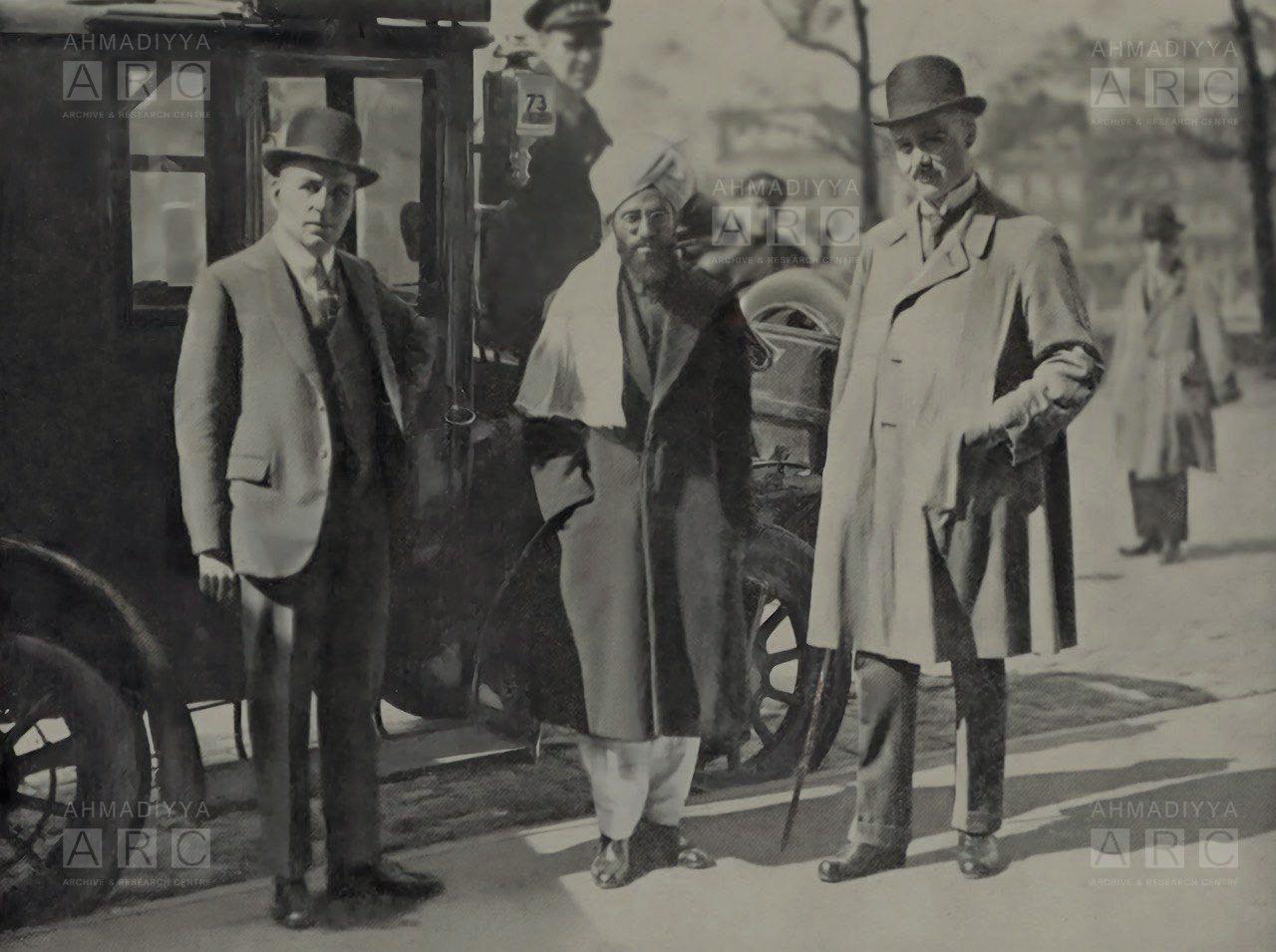
of pilgrims after meeting Hazrat Khalifatul Masih[ra]
The pilgrims, Abubakar Oshodi and Ahmad Giwa, who had the honour of meeting Hazrat Khalifatul Masih[ra] in London upon their return from the sacred land of Hejaz, arrived home safely. They conveyed firsthand accounts of Hazrat Khalifatul Masih[ra] and also shared his message of condolence regarding the demise of the late president of the jamaat. The profound emotional response of the devoted members can be best understood through the heartfelt words of the General Secretary, [Lagos, Nigeria]:
“When the pilgrims, particularly Brother Al-Haj Abubakar Oshodi, shared their experiences from their stay in London, my heart was overwhelmed with longing. I wish I could have travelled to London during Hazrat Khalifatul Masih’s[ra] stay in England. May God Almighty bless the journey of our beloved leader to London abundantly.” Amin
Woking
The political significance of London in today’s world requires no elaboration, and its influence on West Africa can be understood by looking back to the situation of India 50 years ago. At that time, a barrister returning from London was regarded with extraordinary respect, and their voice was considered synonymous with the voice of civilisation, culture, and progress.
pursue education in various disciplines in England. However, we have not yet found candidates who meet our expectations. Some students are preparing and, God willing, will travel to London within the next year or two. For now, a friend is studying for the Bar, and I am confident that, by God’s grace, he will prove to be a worthy substitute for the fallen twigs. His name is Gabrial Martins.
He writes: “I intend to sit for the final Bar examination this year, aiming to achieve First-Class Honours. It is a challenging task but, God willing, not impossible.”
Friends are requested to pray for this young man’s success and well-being.
Mr Martins is deeply devoted to the Ahmadiyya Jamaat. When Khwaja Kamaluddin Sahib’s non-Ahmadi son, the current imam of Woking, described his father’s faith as Hanafi in the Islamic Review and disparaged the Promised Messiahas by referring to him as “a certain Mirza Ghulam Ahmad,” Mr Martins challenged him to a debate. He asserted that, through the personal writings of Khwaja Nazir Ahmad Sahib’s father, it could be proven that he was indeed an Ahmadi who gradually turned away from his faith.
In conclusion, despite the opposition from non-Ahmadis in Woking, the work of Allah continues and, God willing, will persist. If anyone turns away from the faith of God, He will surely provide a worthy substitute. We once again request prayers for the success of our dear friend, Mr Martins.
Africa. May Allah the Almighty be their helper and supporter. Amin
Building of Talim-ul-Islam School
A piece of land near the seaport, graciously granted to the Ahmadiyya Community by the government, is the site of the construction of a magnificent new building for the Talim-ul-Islam School. Thus far, around 20,000 rupees have been expended. Although there is a noticeable shortage of funds, the jamaat is determined to complete this project with the blessings of God. Observing the sacrifices and resolve of the Lagos Jamaat, Hazrat Khalifatul Masih II[ra] has promised a grant of 3,000 rupees from the central funds.
A significant portion of the jamaat comprises individuals of modest means, many of whom have yet to recognise the importance of education fully. Consequently, the burden of financial contributions largely falls on the educated segment, who continue to demonstrate remarkable dedication and sacrifice.
Since there are no Muslim barristers, doctors, professors, or high-ranking government officials in West Africa, the educated class had their hopes pinned on Mr …, a young man who went to London as an Ahmadi student. However, the influence of Woking severely impacted his faith. He converted to the faith of Khwaja Kamaluddin Sahib while still in London and secretly established connections with non-Ahmadis, information that reached me while I was in Lagos.
Upon his return to West Africa, he attempted to divert the jamaat from the straight path and announced Khwaja Kamaluddin Sahib’s visit to Lagos. However, God thwarted his efforts, just as He did with his like-minded associates in India. He later tried to form a separate group but failed again. Eventually, he openly joined the nonAhmadis, declaring his new affiliation in their mosque, much like some unfortunate individuals in India who severed ties with Qadian, aligned with Lahore, [i.e., the Lahori Group], and ultimately abandoned the Ahmadiyya Jamaat.
This opposition posed a significant trial for the Jamaat [Lagos], but God provided His support. Recent reports indicate that the opposition continues, yet, by the grace of Allah the Almighty, there is no cause for fear.
A worthy substitute and a request for prayers
I am striving to encourage young men from distinguished families in West Africa to
Support for West Africa
In his display of knowledge and keenness for the service of Islam, Maulvi Muhammad Ali published a treatise named Split. This Split was extensively distributed for free in West Africa. While it had little to no impact on Ahmadis, it did provide an opportunity for non-Ahmadis to challenge us. NonAhmadi youths began presenting Maulvi Muhammad Ali’s book in debates against Ahmadi missionaries, and as a result, many individuals refrained from embracing Ahmadiyyat due to the bad influence of this book.
To counter this harmful influence, Hazrat Khalifatul Masih II[ra] authored a book titled Aina-e-Sadaqat, which has now been translated into English and published under the title Truth about the Split. I aspire to see this book widely distributed, free of charge, throughout West Africa. However, financial constraints limit this effort.
Therefore, I appeal to those friends who possess a sincere passion for the spread of true Islam to assist West Africa in combating the detrimental effects of Maulvi Muhammad Ali’s work. Kindly support this cause by purchasing as many copies of Truth about the Split as possible and sending them to me. I will ensure their distribution to relevant individuals. The price of the book is 3 rupees per copy.
(Translated by Al Hakam from the original Urdu, published in the 7 February 1925 issue of Al Fazl)
The
True Revolution – Part 14
Islam’s revival, global unity, and enduring superiority
English translation of Inqilab-e-Haqiqi
An address by Hazrat Mirza Bashir-ud-Din Mahmud Ahmadra, Khalifatul Masih II, al-Musleh al-Mau‘ud
The time of divine ordinance
This indicates that the period, as per the divine ordinance, would span over three centuries, followed by a thousand years of decline, after which Islam was to progress once again. It was as if Islam was to be resurrected 1300 years after the advent of the Holy Prophetsa. Thus, the words
(‘Say, ‘For you is the promise of a day.’) hint at the ‘day’ mentioned in Surah as-Sajdah. Islam was to undergo a thousand years of decline, before advancing once more and spreading throughout different communities and nations. This would be the period of the completion of the spread of Islam. This verse indicates as much:
Delivered at Jalsa Salana Qadian on 28 December 1937
[He it is Who has sent His Messenger with the guidance and the Religion of Truth, that He may cause it to prevail over all religions. Surah as-Saff, 61:10 (Publishers)]
The Meaning of the
(promise of the day)
The ‘promise of the day’, means the one thousand years of the decline of Islam prior to the advent of the Promised Messiahas Following this, Islam was destined to once again experience great growth and progress.
The Limitations of the Message of Jesusas
At this, some Christians argue that this teaching is not exclusive [to Islam]. They contend that Christian writings speak of the need to spread the message of Jesusas throughout the whole world as well and that Jesusas was not raised for a particular people but for all mankind.
I have already addressed in an old essay this [aforementioned] claim made by the Christians and, through numerous references from the Bible, have shown that Jesusas of Nazareth was not meant for the entire world but came only for the Children of Israel. In the Gospels, he is quoted as saying, ‘I was sent only to the lost sheep of the house of Israel.’2 This was also [the belief and] the practice of his followers. But today, I will disprove this Christian claim from a new perspective. Had God said that Jesusas was sent for the whole world in order to unite the people under one banner, His words ought to have been fulfilled. Since this teaching would have been revolutionary in nature with the aim to unite the whole world and weaken the nationalist loyalties; therefore, one should see whether Christianity managed to fulfil this purpose.
No doubt that Christians spread throughout Europe, China, Japan, India and other such far-flung places [of the world] where Muslims have yet to reach. But the question is, has the teachings [of Christianity] achieved this purpose? The purpose of the teachings was to get rid of any thoughts of dissension, weaken the [sentiments of] nationalism and gather people under the banner of equality. If God had said to Jesusas that through him differences between nations would come to an end and the world would become one, then this revolution should have happened through Christianity. But if God said this to the Holy Prophetsa, then world unity should have emerged through Islam. But the truth is that no other ideology has promoted nationalist ideologies more than Christianity, and you cannot point to a single country in the world where Christianity has established [true] equality. On the contrary, there is no country that, after having been influenced by Islam, has not become more equal and tolerant. Today the British are the enemies of the Germans and the Germans are the enemies of the British. They are ready to cut each other’s throats. As a result of this hostility, both countries have armed
themselves with fighter planes, invented cannons and created innovative longrange missiles. But despite this, a British Christian would never be able to form the same relationship with an Indian Christian that he is able to develop with a German atheist. If God established Christianity for the whole world, why has it failed to achieve this purpose? Furthermore, European Christians do not even extend equality to [the Jews] who are their brothers in faith by divine decree.3 One need only look at the Christian persecution of the Jews in Germany and various other countries. Who are these, if not their brothers [in faith] by divine decree? Yet they fail to show them any semblance of equality.
As opposed to this, the Holy Prophetsa established such a sense of equality that if an ignorant, underprivileged or even dishonest Arab goes anywhere in the world, Muslims greet them with such joy as if one of their esteemed elders has risen from the dead and returned to earth. [Out of utmost respect], they repeatedly call them ‘Arab Sahib’ until their mouths are made dry. Thus, the act of God contradicts the claims of the Christians and testifies that it was the Holy Prophetsa who brought about this revolution and was the recipient of this teaching [to unify the world]. If such a teaching had been given to Jesusas, God Almighty would also have made him work towards it.
Winds bearing glad tidings of a true reformer begin to blow before his advent. Therefore, the good news of the advent of the Holy Prophetsa was revealed in the time of Jesusas. Allah the Exalted informed Jesusas that the world was about to unite under a magnificent prophet who would be the chief of all the other messengers and unite the world under one banner. However, Christians misunderstood this to mean that the time of the fulfilment of this promise was close at hand. But just as a stolen piece of clothing does not fit its thief, [the teachings they were given did not suit the circumstances Christians had envisioned]. The act of God has shown that Muslims and not Christians were the intended recipients [of this promise].
The Islamic Revolution
Thus, in keeping with the principle of reformation, Islam brought great changes to the sciences, thought, philosophy, emotions, religion, politics, morals, civilisation, economics and culture of people. The world
Photo by Sam Riz on Unsplash
was transformed. [Through Islam,] the Holy Prophetsa gave birth to a new heaven and a new earth.
The Advent of The Promised Messiahas
The Reason for the Apparent Similarities between the Teachings of Islam and Those of Other Religions
Today the apparent similarities between the teachings of Islam and other world religions are not because these similarities were already present in those religions, but as a result of other faiths having interacted with Islam and adopting certain Islamic principles. Even beyond the world of religion, European intellectuals have been known to plagiarise whole books written by Muslim [scholars] and present them as their own work. Recently, a number of books have been published in Europe that have exposed this [intellectual] theft. Not too long ago, I ordered a book from England in which it was argued that Europeans stole a great wealth of musical knowledge from the works of Spanish Muslims. The writer discloses the secret that he can produce exact references to texts that Europeans have plagiarised. Furthermore, he calls it unfortunate and cites a book that includes a letter to a priest, which is housed in the British Museum. In the letter, a Christian gentleman writes to a priest that the musicianship of the Muslims is magnificent and the European art of music pales significantly in comparison. He expresses his desire to translate these musical texts, but fears that by doing so, he will be declared a heretic [by the church]; therefore, he asks the priest for his advice. He further writes that it is important these works be copied as it would greatly benefit the church. In response, the priest writes that the musical knowledge [of the Muslims] may be reproduced. However, he asked him to be careful in terms of quoting the original sources, as people would become aware of their Arab origin and consequently realise the greatness of Islam. Therefore, these works may be reproduced but without being accredited so that the people might assume it to be his original work. According to the writer, both these letters can be found in the British Museum. Until 1840 the philosophy of Ibn Rushd was taught in Parisian [centres of learning] under a pseudonym in order to conceal the fact that he was a Muslim. What’s intriguing is that in Roman universities it was once decided that following advancements in philosophical thought, a new philosophical treatise should be taught in place of what was current at the time. But the church opposed such a move and passed an edict against it, calling it an act of heresy. Thus, after a number of years, people had even forgotten the fact that this treatise was written by a Muslim and many people considered it a Christian work and were unwilling to accept the teaching of any other form of philosophy in its place, deeming it an act of heresy.
As a result of their ignorance, many of our own people say that we have taken certain things from Christians. The reality is that the Muslims as a community have not taken anything from Christian culture, but the Christian community as a whole has
acquired a great wealth of knowledge from Muslims. But because of the intellectual decline of the Muslims and the fact that Christians have not only safeguarded all the knowledge they have accumulated but have also made great strides in the field of learning and transformed it over time to such an extent that the Muslims no longer recognise them. The Muslims have become so unmindful of their current plight that they have failed to retain any semblance of religion, morals, civilisation, society, politics and culture. They are completely daubed by the hue of Western culture and it has become their entire way of life. The teachings of the Holy Qur’an which once led the Muslims to greatness, are still present. The Muslims of today can still achieve the glories [of the past]. But they have turned away from the Holy Qur’an and look towards Western ideas in the same way a [hungry] sparrow searches the skies for its returning mother.
The example of today’s Muslims is like that of the Persian king who heard praise of the mangoes grown in India and longed to taste them. He sent one of his ambassadors to India to bring him [sack of] the fruit. However, his ambassador arrived once the season was over, but the king of Delhi – mindful of the fact that he was the representative of the king of Persia and had travelled from afar – searched for any remaining mangoes in the city and the
“
Until 1840 the philosophy of Ibn Rushd was taught in Parisian [centres of learning] under a pseudonym in order to conceal the fact that he was a Muslim. What’s intriguing is that in Roman universities it was once decided that following advancements in philosophical thought, a new philosophical treatise should be taught in place of what was current at the time. But the church opposed such a move and passed an edict against it, calling it an act of heresy. Thus, after a number of years, people had even forgotten the fact that this treatise was written by a Muslim and many people considered it a Christian work and were unwilling to accept the teaching of any other form of philosophy in its place, deeming it an act of heresy.
surrounding area. After extensive effort, a solitary, out of season and sour mango was found. The king of Delhi presented it before the Persian emissary and told him that although it retained the shape of a ripened and sweet mango, it had long since lost its flavour. He further told the dignitary to taste it so as to report the true nature of the fruit to his king on his return. The dignitary tasted it and found it unsavoury and sour. When he returned, the king enquired from him about the mango. He replied that the fruit had left him questioning the intellect of the people of India. The king asked why. He said that they sing the praises of the mango, and although the king of Persia had explicitly sent him to India to bring a sample of it, the fruit he had tasted was unworthy [of any form of tribute]. With this, he presented the sample before the king in a bowl filled with some water and tamarind pulp. The king was astonished by the account and expressed [disbelief] at how Indians could praise such a miserable fruit.
The current state of the Muslims is the same. They are completely estranged from the disciplines [and teachings] of the Holy Qur’an. To them, the Holy Qur’an has
Continued from page 4
Canal which, unlike Trump’s order regarding Mexican Cartels, has directly involved the threat of military force. (“Trump’s ambition to retake the Panama Canal could have a heavy cost”, www.cnn.com, 21 January 2025)
On multiple occasions, Trump has also expressed his desire to take control of Greenland in the interests of “international security” and although Greenland and Denmark have both rejected the idea, Trump does not seem to be deterred. (“Trump repeat of need to take control of Greenland raises concerns, stirs debate”, www.voanews.com, 21 January 2025)
Moreover, Trump’s inaugural speech called upon the ideal of Manifest Destiny to expand the US territorial reach onto Mars. Manifest Destiny itself is widely debated in the United States’s history as it follows the notion that Americans were destined to expand westward into decolonised lands in the name of civilisation, all at the expense of indigenous peoples living there.
Additionally, Trump announced the establishment of new government agencies such as the Department of Government Efficiency (DOGE) and the External Revenue Service (ERS). The goals of DOGE and ERS respectively are to curb inflation by reducing government spending and collecting tariffs from foreign nations.
The latter is particularly striking since tariffs are paid by American consumers. Trump announced a 25% tariff rate for Canada and Mexico which will be imposed from 1 February. Like many other policies, this was considered an active threat to the US’s neighbours. Trump also announced plans for a 60% tariff rate on China and a 20% rate on the rest of the world. Many economists warn of a possible trade war and worse inflation rates should Trump’s tariffs backfire. (“Trump threatens 25% tariffs on Mexico and Canada on Feb. 1, punting Day 1 pledge”, www.cnn.com, 21 January 2025)
become [spiritually] dead. The scripture they see today is as different from the true teachings of the Holy Qur’an as the taste of a ripe, seasonal mango differs from dissolved tamarind. Although, [in truth], all beauty and virtues lie in Islam, the Europeans have drawn and extracted all their learning and knowledge from Islam and its followers. But because the Muslims are not aware of this fact, they have become infatuated with the West.
Endnotes:
1. Surah Saba, 34:31 [Publishers]
2. Matthew New Revised Standard Version Updated Edition, 15:24 [Publishers]
3. Both religions share religious and historical foundations such as the Hebrew Bible (known as the Old Testament in Christianity). Many of the same texts, including the Torah (the first five books of the Bible), are central to both traditions. In this sense, they are considered brothers in faith. [Publishers]
To be continued...
(Translation by Fazl-e-Umar Foundation, English Section)
How should American Muslims react?
For many Americans, Trump’s re-election will undoubtedly be a quintessential change to day-to-day life. While his executive orders have received mixed reactions, many are hopeful that the President will improve peace and security.
No matter the case, the Holy Quran guides us to look past relying on world leaders. The Holy Quran states, “And put thy trust in Allah, and Allah is sufficient as a Guardian.” (Surah al-Ahzab, Ch.33: V.4) No worldly leader alone can ever hope to safeguard anyone’s interest save by the grace of Allah Almighty. Muslim Americans must pray for our leaders to uphold their duties with justice.
Similarly, we must pray for the peace and security of our fellow Americans and the wider world. We must do our job in taking part in the political process and do our most to keep our leaders accountable. We cannot act out of bias or mere opportunism.
Hazrat Mirza Masroor Ahmadaa, Khalifatul Masih V, is the worldwide Head of the Ahmadiyya Muslim Community. He has stated:
“Islam teaches that a Muslim’s first loyalty must always be to the truth and so a person must never hide the facts or give false testimony. A person should not be governed by his own personal desires, as this leads to bias and prejudice and takes a person away from what is fair and what is right. This enlightened principle is the means to solve the problems of the world and to transform all forms of hatred into peace, tolerance and mutual respect.” (“Muslim leader says justice is a pre-requisite to conflict resolution”, www.pressahmadiyya.com, 25 October 2016)
Ultimately, the outcome of the upcoming Trump administration can depend on our prayers and actions. In due time, we will see whether it will learn from the previous administration or repeat its shortcomings.
Friday Sermon
Mubarak Mosque, Islamabad, Tilford, UK
10 January 2025
Muhammadsa: The Great Exemplar
After reciting the tashahhud, ta‘awwuz, and Surah al-Fatihah, Hazrat Khalifatul Masih Vaa stated:
In the sermon two weeks ago, accounts relating to the expeditions and battles from the time of the Holy Prophetsa were being discussed; among them was the Expedition of the Banu Fazara. With regard to the expedition against the Banu Fazara, an incident is recorded in history that relates to the killing of Umm Qirfa. The manner in which some historians have recorded it clearly demonstrates that it is a fabrication. In Al-Tabaqat al-Kubra, it is recorded that in the sixth year after migration, Hazrat Zaid bin Harithahra travelled to Syria for trade. He was carrying the goods of the Companions of the Holy Prophetsa with him. When he reached near Wadi’ul-Qura’, he encountered some people from the Banu Badr tribe, who were a branch of the Banu Fazara. They beat him and his comrades and seized their belongings. When Hazrat Zaidra recovered, he went to the Holy Prophetsa and informed him of the incident. The Holy Prophetsa sent him towards these people, i.e., towards those who attacked him. The Muslims would hide by day and travel by night. However, Banu Badr came to know of their [movements]. As such, Hazrat Zaidra and his comrades reached them in the morning, raising slogans of “Allahu Akbar” [Allah is the greatest] and surrounded everyone that was present. They captured Umm Qirfa, whose real name was Fatimah bint Rabiyya bin Badr and her daughter, Jariyah bint Malik bin Hudhaifa bin Badr. Hazrat Salama bin Akwara captured Jariyah and gave her to the Holy Prophetsa. Thereafter, the Holy Prophetsa gave her to Hazn bin Abi Wahab.
As I mentioned, in some books of history, this incident of the killing of Umm Qirfa has been presented in a strange manner, which, in light of Islamic teachings and practices, is impossible to accept. Nevertheless, in some books of history, it is recorded that Qais bin Muhassir headed towards Umm Qirfa. She was an elderly lady
and Qais killed her brutally. He tied both of her legs to two separate camels. He then made the camels run in opposite directions, thus tearing this woman into pieces. Qais killed two other men as well. When Hazrat Zaidra returned from this expedition and knocked on the door of the Holy Prophetsa, he pulled over his cloak, stood beside Zaidra, hugged and kissed him and enquired about his well-being. Upon this, Zaidra informed him of these incidents and that Allah the Almighty had granted them victory. (AlTabaqat Al-Kubra, Vol. 2, Dar Al-Kotob Al-Ilmiyah, Beirut, p. 69; Kitab-ul-Maghazi, Waqdi, Vol. 2, Dar Al-Kotob Al-Ilmiyah, Beirut, p. 61)
In this narration, it is mentioned that this woman was torn to pieces. However, Hazrat Mirza Bashir Ahmad Sahibra has related this incident in an exceptional manner and with compelling arguments. He writes:
“In place of the above-mentioned expedition of Hazrat Abu Bakrra, Ibn Sa‘d has mentioned an expedition wherein Zaid bin Harithahra was the commander. In other words, Ibn Sa‘d mentions Zaid bin Harithahra as the commander of this expedition instead of Hazrat Abu Bakrra. Moreover, differing in details as well, he writes that this expedition was to discipline the Banu Fazarah, who resided near the Wadi’ul-Qura’ and who had attacked a trade caravan of the Muslims, stealing all of its wealth and goods. The driving force behind this mischievous group was an old lady, named Umm Qirfah, who was a staunch enemy of Islam. When this lady was captured, a man named Qais from the party of Zaid killed her. Moreover, Ibn Sa‘d describes the story of this murder such as both of her feet were tied to two different camels and then these two camels were driven in opposing directions, due to which this lady was literally torn in two pieces. After this, her (the elderly lady’s) daughter was entrusted to Salama bin Akwa‘ra. It is
this story, which, to some extent, has also been mentioned by Ibn Ishaq with brevity, abridgement and variation.
“On the basis of this narration, Sir William Muir, (an orientalist), who is accustomed to providing more details than most European historians, very enthusiastically makes this occurrence the highlight of his book as an example of the ‘barbaric spirit’ of the Muslims. As a matter of fact, Sir William Muir wrote that the very reason he included this in his book was because the Muslims committed a cruel deed in this expedition. As such, Mr. Muir wrote:
“‘There were several unimportant raids this year for which the Muslims had to leave Medina, but they hardly require mention, (he continues) but I must not omit one for the cruel deed perpetrated by the Muslims.’”
This is what William Muir wrote. In the analysis of this, Hazrat Mirza Bashir Ahmad Sahibra writes:
“A historian who gives preference to one occurrence over another merely on the basis that it furnishes proof of the brutality and ruthlessness of a people and makes it the highlight of his book, is in actuality not worthy of being referred to as an unbiased researcher. (He wrote himself that he would omit the other incidents but focus solely on this one. This shows that he was biased and not prone to doing full research.) This is because it can never be expected that such an individual (who is biased) would pay attention to investigating whether this occurrence of brutality and ruthlessness was even true or not, because in doing so, a proof in his favour is lost to him. In any case, Mr Muir has written this account in his book with special enthusiasm. However, as shall now become evident, this occurrence was completely erroneous and categorically baseless. Furthermore, both in terms of record and rationality, this narration is vindicated as being fabricated.
“In terms of rationality, it should be known that to imprison a lady who is not convicted of murder and then to kill her in cold blood and then to kill her in the manner which is related in this narration, is something quite untenable. Islam strongly prohibits even killing women in the very field of battle and we have already mentioned the instructions of the Holy Prophetsa, (wherein he forbade the killing of women on several occasions) [...] As such, it is mentioned in a hadith that on one occasion, a woman of an enemy tribe was found dead in the field of battle and even though it was not known which circumstances and by whose hand she had been killed, upon seeing this, the Holy Prophetsa was very displeased. The Holy Prophetsa emphatically stated to his Companions that this should never happen again (no woman should be killed). Similarly, it has also been mentioned that whenever the Holy Prophetsa would send off an army, in addition to all other advice, one instruction which he would give to his Companions was not to kill women and children.
“In the existence of these fundamental instructions, to think that the Companions and among them, Zaid bin Harithahra, who was like the family of the Holy Prophetsa, killed or had a lady killed in the manner described by Ibn Sa‘d, cannot be accepted at all. Undoubtedly, in this narration, although the deed of killing has not been attributed
to Zaidra, rather, it has been attributed to another Muslim, since this instance occurred under the command of Zaidra, either way, the ultimate responsibility would fall on him. Moreover, regarding Zaidra, to think that he allowed for something of this nature to occur under his watch, knowing full well the teaching of the Holy Prophetsa cannot be accepted in the slightest. Invariably, if a woman commits a crime, she will receive the punishment of that crime and the sharia of no religion, nor the law of any country, excludes a woman from the punishment of a crime. Moreover, occurrences of the punishment of women, or rather, even executions for the punishment of murder, are printed on a daily basis. However, killing a woman merely on account of religious enmity and more so, to kill her in the manner described in this narration, is such an action as is clearly rejected by the fundamental instruction of the Holy Prophetsa and the whole of Islamic history.
“Furthermore, if it is stated that this lady was a criminal and, as mentioned in various narrations, she conspired to assassinate the Holy Prophetsa and for this reason, the sentence of murder could be lawfully issued against her, then this is correct. But the question is: if the Companions of the Holy Prophetsa did not kill severer and more vicious criminals than Umm Qirfah – and male enemies at that – in this manner, then to think that an elderly lady was treated in this way under the watch of a well-informed Companion the like of Zaid bin Harithahra, is completely unacceptable. Hence, from a rational perspective, the falsehood and fabrication of this story are evident and clear and no impartial individual could find room to doubt this.
“Now remains the aspect of narration. Hence, firstly, Ibn Sa‘d or Ibn Ishaq have not provided authentication for this narration and without a reliable source, a narration of this kind, which is contradictory to the clear instruction of the Holy Prophetsa and the common and well-known practice of the Companions, cannot be accepted at all. Secondly, this very account has been mentioned in Sahih Muslim and Sunan Abi Dawud, which are two very authentic books of Hadith, but the mention of Ummi Qirfah being killed has not been mentioned at all. Furthermore, in various other details, this account differs from that of Ibn Sa‘d and others. Moreover, sahih ahadith are definitely and universally accepted as far more reliable and worthy of preference. For this reason, the narration of Ibn Sa‘d and others have no weight in comparison to that of Sahih Muslim and Sunan Abi Dawud. This distinction becomes further evident when we bear in mind that where Ibn Sa‘d and Ibn Ishaq have mentioned their narrations without any authentication, on the other hand, Imam Muslim and Abu Dawud have furnished complete authentication for their narrations. Either way, in comparison to the caution practised by the muhaddithin, who worked very prudently, the general narrations of historians possess no value.
“The manner in which this account has been recorded in Sahih Muslim and Sunan Abi Dawud […] there is not even mention of the killing of Ummi Qirfah. Invariably, in the narration of Muslim and Abu Dawud, the name of Ummi Qirfah is not mentioned and the name of the commander is also recorded as Abu Bakrra instead of Zaidra
Regardless, we cannot imagine that this expedition was another one altogether, as the rest of the significant details are the same in their totality. For example:
1. It is described in both these narrations that this expedition was against the Banu Fazarah.
2. It is mentioned in both these narrations that the chieftain of the Banu Fazarah was an elderly lady.
3. Both narrations mention the imprisonment of this lady.
4. It is mentioned in both of these narrations that this lady had a daughter, who was also imprisoned with her.
5. Both narrations mention that this girl was given to the lot of Salama bin Akwa‘ra
“Additionally, there are similarities in other facts as well. Now contemplate, in the presence of these significant and fundamental commonalities, is it possible for an individual to imagine that these were two different accounts? However, we do not rest on this rational argumentation alone; rather, researchers of the past have clearly written that the account of Sahih Muslim and Sunan Abi Dawud is the same one which Ibn Sa‘d has recorded in another manner. As such, ‘Allamah Zurqani, Imam Suhaili and ‘Allamah Halabi have clearly written that this is the same account which Ibn Sa‘d and Ibn Ishaq have erroneously mentioned in the story of Umm Qirfah. However, more than this, proof of the fact that this is the same account is that Tabari has mentioned both these narrations side by side (alongside one another) and clearly written that both these accounts are but one and the same thing.
“Therefore, it is completely undeniable that in the narration of Salama bin Akwa‘ra recorded by Muslim and Abu Dawud, the very same account has been mentioned, which Ibn Sa‘d and Ibn Hisham have erroneously recorded by the name of ‘Expedition of Umm Qirfah’. Moreover, the narration of the Sihah (i.e., the narrations of the six authentic books of Hadith) which has been mentioned with authentication and is narrated by one who participated in the event, is in any case, worthy of precedence to the unauthenticated narration of Ibn Sa‘d and Ibn Hisham. For this reason, there is no room for doubt in the fact that the account of the ‘barbaric murder’ of Umm Qirfah is a completely false account without foundation, which, due to the ‘favour’ of a hidden enemy of Islam or a hypocrite, has found its way into some historical narrations. The truth is that the verity of this expedition is nothing more than what Muslim and Abu Dawud have mentioned. It is not surprising for an erroneous account to be recorded in history, because such examples are found in the history of every country and nation. It is surprising, however, for a man like Sir William to give this erroneous account a place in his book without any investigation and to openly confess that the purpose of his recording it was merely as an example of a cruel deed of the Muslims was found in it.”
(Sirat Khatam-un-Nabiyyeen, pp. 717-721)
In any case, this incident is fabricated, and it never took place in this manner.
There is mention in history of the Expedition of Abdullah bin Atik towards Abu Rafi‘. Ibn Sa’d has narrated that this
expedition took place in Ramadan 6 AH. (Al-Tabaqat Al-Kubra, Vol. 2, Dar Al-Kotob Al-Ilmiyah, Beirut, p. 70)
In light of his research from various books of history, Hazrat Mirza Bashir Ahmad Sahibra has written in regard to this as follows:
“There is a disagreement amongst narrations with regard to the killing of Abu Rafi‘. While following Zuhri, Bukhari has simply mentioned it as having occurred after the killing of Ka‘b bin Ashraf, without specifying a date, which is true either way. Perhaps both these accounts have been mentioned together (both have been narrated side by side) since their nature is identical. Tabari has put it in 3 AH, after the occurrence of Ka‘b bin Ashraf. Waqidi
“
A historian who gives preference to one occurrence over another merely on the basis that it furnishes proof of the brutality and ruthlessness of a people and makes it the highlight of his book, is in actuality not worthy of being referred to as an unbiased researcher. (He wrote himself that he would omit the other incidents but focus solely on this one. This shows that he was biased and not prone to doing full research.) This is because it can never be expected that such an individual (who is biased) would pay attention to investigating whether this occurrence of brutality and ruthlessness was even true or not, because in doing so, a proof in his favour is lost to him.
has mentioned it in 4 AH. Referring to Ibn Ishaq, Ibn Hisham has simply recorded it as being after the Ghazwah of Banu Quraizah, which took place towards the end of 5 AH and in this manner, it can be considered as having occurred in the beginning of 6 AH. However, Ibn Sa‘d has specifically recorded it in 6 AH and most historians have taken the stance of Ibn Sa‘d. Allah knows best.” (Sirat Khatam-un-Nabiyyeen, p. 726)
Ibn Ishaq narrated that after the Battle of Ahzab and the matter of Banu Quraizah was concluded, Salam bin Abu al-Huqaiq, also known as Abu Rafi‘, was among those who had gathered forces against the Holy Prophetsa. The tribe of Aus had already killed Ka‘b bin Ashraf, a Jewish man, before the Battle of Uhud due to his enmity towards the Holy Prophetsa and his incitement against him. Thus, the tribe of Khazraj sought permission from the Holy Prophetsa to kill Salam bin Abu al-Huqaiq, who was in Khaybar at the time, and he granted them permission.
These two tribes, Aus and Khazraj, would compete with each other in serving the Holy Prophetsa like two racing camels. When the tribe of Aus would accomplish something for the Holy Prophetsa, the Khazraj would say, “By this deed, they will gain more excellence than us in the eyes of the Holy Prophetsa and in Islam.” And so they would not rest until they performed a similar deed. Likewise, when Khazraj did something noteworthy, Aus would seek to match it.
When the Aus killed Ka‘b bin Ashraf due to his hostility towards the Holy Prophetsa, the Khazraj declared, “By Allah, the tribe of Aus shall never surpass us because of this!” They competed in deeds that would bring them closer to Allah the Almighty and His Messengersa. They contemplated who might be equal to Ka‘b bin Ashraf in enmity towards the Holy Prophetsa, and they remembered Ibn Abi al-Huqaiq, who was in Khaybar or the land of Hijaz.
Ibn Sa‘d reports that the Khazraj said Abu Rafi‘ bin Abi al-Huqaiq had gathered the tribe of Ghatafan and the surrounding polytheists, establishing a substantial stipend for them to fight against the Holy Prophetsa. So the Khazraj sought permission from the Holy Prophetsa to kill him, and he granted it.
Thus, five men of the Khazraj tribe from amongst Banu Salama set out: Abdullah bin Atiq, Mas‘ud bin Sinan, Abdullah bin Unais Johani – who was a confederate of the Ansar – Abu Qatadah Harth bin Rib‘i, and Khuza‘i bin Aswad. According to Muhammad bin Umar and Ibn Sa‘d, it was Aswad bin Khuza‘i who was a confederate of the Ansar from the tribe of Aslam. Bara bin Azib added Abdullah bin Utbah, as mentioned in Sahih Bukhari, making them six. Ibn Uqbah and Suhayli added Asad bin Haram, bringing the total to seven. The Holy Prophetsa appointed Abdullah bin Atiq as their leader and forbade them from killing women and children. (Subul Al-Huda Wa Al-Rishad, Vol. 6, Dar Al-Kotob Al-Ilmiyah, Beirut, p. 102)
Even here, the Holy Prophetsa unequivocally stated not to kill women and children.
In Sahih Bukhari, the details of Abu Rafi‘s killing are narrated thus: Bara bin Azib reported that Abu Rafi‘ used to cause great harm to the Holy Prophetsa and would
aid his enemies. He lived in his fortress in the land of Hijaz. When they approached, the sun had set and people had returned with their herds. Abdullah bin Atiq told his companions, “Stay in your places while I go ahead and try to find a way around the gatekeeper so I can enter.” He went and approached the gate, then wrapped himself in his cloak as if answering the call of nature, and everyone had gone inside. In one narration, Abdullah bin Atiq said that he began devising a plan to enter the fortress, seeking some pretext.
In the meantime, the people in the fortress realised one of their donkeys was lost and so they took a lantern and set out in search for it. He says, “I was afraid that they might recognise me.” This Companion said, “I covered my head so as to make it seem as if I was answering the call of nature (this is according to a narration of Bukhari). The gatekeeper called out and said, ‘O servant of God, if you wish to enter, then come through as I wish to close the door.’ I entered and then hid once I was inside.”
It is recorded in another narration, “I entered and hid inside the donkey pen inside the fortress by the door. When the people entered, he closed the door and hung the keys on a nail.” He said, “I got up and went towards the keys. I took them and opened the door.” Another narration states, “When the voices quieted down and I no longer heard any movement, I emerged.” He said, “I saw the gatekeeper put the keys to the fortress on a small shelf (this is also a narration of Bukhari). People used to sit and have conversations with Abu Rafi‘ at night (he would have sittings) while he was on the upper level.” He says, “When the people who were speaking with Abu Rafi‘ left […]” he says he had been watching and when those who were speaking with him left and according to another narration, the people had dinner with Abu Rafi‘ and they continued having conversations until a portion of the night had passed, “[…] then they all returned to their quarters (this is also a narration from Bukhari). I started ascending towards him and every door I opened, I would close from the inside. I told myself that even if people did hear me, they would not be able to reach me before I killed him. Ultimately, I reached him.” According to another narration, he said, “I moved towards the doors to his quarters and closed them from the outside. I then climbed some stairs and reached Abu Rafi‘.”
This is also a narration from Bukhari. He says, “I found him lying in the dark amongst his family and I could not tell where he was in the room. I said, ‘O Abu Rafi‘!’ He replied, ‘Who is it?’ I moved towards the direction of the voice. I struck him with my sword. I was frightened (he was nervous) and so my blow did nothing and he screamed (his blow did not properly land and Abu Rafi‘ started raising a clamour). I left the room. Then I waited just for a short while and then went back to him as if I had arrived to help him and said, Abu Rafi‘ what is the matter?’ as I changed my voice. Abu Rafi‘ said, ‘May your mother be ruined; just a short while ago, a man came into the room and attacked me with his sword.’”
Hazrat Abdullah bin Atiq says, “When I heard his voice, I struck him, which caused him to become covered in blood but I was not able to kill him. Then I stuck the tip of my sword into his abdomen until it reached
his back.” Another narration mentions his second attack as follows: “Then I lunged at him again and struck him again but it was of no use. He screamed, which caused his family to wake up.” He says, “Then I returned and changed my voice and went towards the person who was shouting (the second time he came, he changed his voice). I found him lying alert on his back. I put my sword upon his stomach and then bent down until I could hear his bones breaking. (These are also narrations from Bukhari). I knew I had killed him. Then I opened the doors one by one until I reached the final step.
I placed my foot and thought that I had reached the floor, but I fell.” It was not the last stair; rather, two or three stairs remained, so he fell down the stairs. “So in that full-moon night, my calf was fractured.” Another narration says, “My ankle was dislocated.” [He continues] “I tied it with my turban, then began walking and sat down near the door. I began thinking that I would not leave tonight until I knew for sure that I had killed him. When the roosters crowed in the morning, (i.e., when the roosters began crying out in the morning to start the day, as they usually do); then the one who announces a death, stood atop the fortress wall and began saying, ‘I bring news of the death of a merchant from among the people of Hijaz.’ So I began travelling to my companions. I said to them, ‘Freedom! Allah has killed Abu Rafi‘.’ Then I reached the Holy Prophetsa and informed him. He said to me ‘put your foot forward,’ I put my foot forward and he passed his hand over it. Behold, it was as if I never felt pain in the first place after he passed his hand over it.”
Another narration says that Abdullah bin Atiq states, “I came limping to my companions. I told them, ‘Go and give the good news to the Holy Prophetsa, because I will not be able to leave until I hear the voice of the one who announces a death.’ When morning neared, the announcer climbed up and said, ‘I give news of the death of Abu Rafi‘.’”
Abdullah bin Atiq states, “When I stood up to walk, I didn’t feel any pain. I caught up with my companions before they reached the Holy Prophetsa.” So this is another narration saying his pain was already gone and he had sprained his ankle. (Sahih al-Bukhari, Kitabul-Maghazi, Hadith 4039, 4040)
Imam Bukhari narrates this incident through Hazrat Bara bin Aazib. It states that Abdullah bin Atiq killed Abu Rafi‘ himself. However, Ibn ‘Uqba, Ibn Ishaq, Muhammad bin Umar, and Ibn Sa’d, etc. have narrated that all the Companions alongside Abdullah bin Atiq killed him [Abu Rafi‘] together. (Subul Al-Huda Wa Al-Rishad, Vol. 6, Dar Al-Kotob Al-Ilmiyah, Beirut, pp. 104-105)
Hazrat Mirza Bashir Ahmad Sahibra has also presented his analysis of this incident and writes:
“The mischief-making and instigation of the Jewish chieftains resulted in the dangerous conflict of the Battle of Ahzab against the Muslims in 5 AH. Among them, Huyaiy bin Akhtab had already met his end along with the Banu Quraizah. However, Sallam bin Abi al-Huqaiq, whose appellation was Abu Rafi‘, was still engaged freely in his mischief-making as before, in the region of Khaibar. Rather, the humiliating failure of Ahzab and the terrible end of the Banu Quraizah had only further increased his animosity. Since the settlement of the tribes
of Ghatafan was situated near Khaibar and the Jews of Khaibar were as if neighbours to the tribes of Najd, for this reason, Abu Rafi‘ who was a very affluent and influential merchant, had made it a custom to incite the barbaric and warmongering tribes of Najd against the Muslims. In his animosity towards the Holy Prophetsa, he was the like of Ka‘b bin Ashraf. As such, during that era, which we are mentioning now, he had given the Ghatafani people very significant financial aid in order to launch an assault against the Holy Prophetsa. (He gave them a large sum of money.) Furthermore, it is proven by history that the Jews of Khaibar, who were creating disorder under the watch of Abu Rafi‘, were also behind the threat which emerged against the Muslims by the Banu Sa‘d in the month of Sha‘ban for the defence of which an army was sent from Medina under the leadership of Hazrat ‘Alira
“However, Abu Rafi‘ did not suffice with this, and his enmity was thirsty for Muslim blood and the person of the Holy Prophetsa was a thorn in his eye. Therefore, ultimately, the plan which he employed was that, in the likeness of the Battle of Ahzab, he once again began to tour the Ghatafan tribes and other tribes, and began to gather a grand army to destroy the Muslims. (After the Battle of Ahzab, he began to amass another army in order to attack them.) When the state of affairs reached this extent and the scenes of Ahzab once again began to appear before the eyes of the Muslims, a few Ansar from the Khazraj tribe presented themselves before the Holy Prophetsa and said, ‘Now, the solution to this turmoil is nothing but to put an end to the mastermind of this unrest;’ (i.e., to kill Abu Rafi‘.) Considering the fact that the elimination of a single mischief-maker and seditious person was more preferable to mass bloodshed throughout the land, the Holy Prophetsa granted permission to these Companions. He sent four Companions from the Khazraj under the leadership of ‘Abdullah bin ‘Atik Ansarira towards Abu Rafi‘. However, as he sent them, he emphasised, ‘Look here; do not at all kill any woman or child.’ (He reiterated this point; how could it be then that the aforementioned woman was killed?) Therefore, in the month of Ramadan 6 AH, this party set off and returned after very skilfully completing its mission. In this manner, these clouds of calamity dispersed from the sky of Medina. The details of this account as mentioned in Bukhari, which is the most authentic in this regard, have been recorded as such, (as I have mentioned already. Hazrat Mirza Bashir Ahmad Sahib has written in his own way):
“‘Bara’ bin ‘Azib narrates that the Holy Prophetsa sent a party of his Companions to kill Abu Rafi‘ the Jew, and appointed ‘Abdullah bin ‘Atik as their leader. The story of Abu Rafi‘ is that he would inflict great grief on the Holy Prophetsa and would incite and help people against the Holy Prophetsa. When ‘Abdullah bin ‘Atik and his companions reached near the fort of Abu Rafi‘ and the sun had set, ‘Abdullah bin ‘Atik left his companions behind and proceeded to the gate of the fort. He covered himself with his mantle and sat down as if answering the call of nature. When the gatekeeper approached the entrance of the fort, he called out to ‘Abdullah bin ‘Atik and said, “You there, enter if you wish, for I am about to close the gate.” Still covered in his
mantle, ‘Abdullah bin ‘Atik quickly entered the gate and hid on one side of the castle. The gatekeeper closed the gate, hung the key on a nearby peg and left.
“After this, the narration of ‘Abdullah bin ‘Atik himself begins. He says, “First and foremost, I got up and opened the lock on the gate, so that a swift and easy exit was possible if needed. At the time, Abu Rafi‘ was in a room of his, (he was on his terrace of his house, in his room) and many people were seated around him in a night assembly talking to each other. When these people dispersed and it became silent, I climbed the stairs to the home of Abu Rafi‘. I was careful that whenever I came to a door, I would enter it and close it from behind. When I reached the room of Abu Rafi‘, he had put out the lantern and was preparing to fall asleep. The room was pitch dark. I called out the name of Abu Rafi‘ to which he responded, ‘Who is there?’ So I sprung towards the source of the voice and made a single and powerful strike of the sword. However, it was very dark, and due to my perplexity, I missed him. Abu Rafi‘ cried out, upon which I left the room. After some time, I entered the room again, and changing my voice, enquired, ‘O Abu Rafi‘ what is this noise?’ He could not recognise my changed voice and said, ‘May your mother forsake you; someone has just now attacked me with a sword.’ Upon hearing this voice, I sprung towards him again and struck him with the sword. This time, my strike was on point but he was still not dead, upon which I attacked him a third time and killed him. After this, I quickly opened the doors one by one till I reached outside of the home. However, when I was descending the stairs, there were still a few steps left, and I thought I had reached the ground, due to which I fell down and broke my leg (and in another narration, it is mentioned that the leg was dislocated). However, I tied it with my turban and dragged myself out, but I
said to myself that until I am fully satisfied that Abu Rafi‘ is dead, I shall not leave. Therefore, I hid in a place near the fort. The next morning, I heard the voice of someone from inside the castle saying, Abu Rafi‘, the merchant of Hijaz, has died. Thereupon, I got up, and slowly but gradually met with my companions. Upon arriving in Medina, we informed the Holy Prophetsa of the death of Abu Rafi‘. Upon listening to the entire account, the Holy Prophetsa said, ‘Stretch out your broken leg.’ I stretched out my leg and the Holy Prophetsa rubbed his blessed hand upon it while praying, and I felt as if I had never had any ailment whatsoever.’”
“In another narration, it is mentioned that when ‘Abdullah bin ‘Atikra attacked Abu Rafi‘, his wife began to scream loudly, upon which he became worried that others might be alerted by her noise and clamour. Upon this, he raised his sword to kill her, but then he remembered that the Holy Prophetsa had prohibited the killing of women and therefore he refrained from doing this.”
This is the same matter again, that since it was prohibited to kill women, he refrained from doing so, even though he was in a very dangerous position.
“At this point, we need not enter a discussion on the justification for killing Abu Rafi‘. The bloodthirsty undertakings of Abu Rafi‘ are an open page of history [...] Fundamentally, the following points should be remembered:
“Firstly, during that era, the Muslims were in a very weak state, surrounded by adversity from all directions and the fire of enmity was ablaze all throughout the land. It was as if the entire land was uniting to annihilate the Muslims.
“Secondly, in these delicate times, Abu Rafi‘ was fuelling the fire which had been inflamed against the Muslims. Furthermore, through his power, influence and wealth, he was inciting the various tribes of Arabia
against Islam. Also, in the likeness of the Ghazwah of Ahzab, he was preparing to unite the barbaric tribes of Arabia to again launch an assault against Medina.
“Thirdly, during that era, there was no government in Arabia whereby justice could be administered. Instead, every tribe was free and independent. Therefore, there was no other option other than to employ a strategy for self-protection.
“Fourthly, the Jewish tribes were already at war with Islam and at that time there existed a state of war between the Muslims and Jews.
“Fifthly, at that time, the state of affairs was such that if forces were openly mobilised against the Jews, there would have been a substantial loss of lives and wealth. It was possible that the fire of war would take on the form of mass destruction throughout the land.
“In these circumstances, whatever the Companions did was absolutely correct and prudent. Moreover, in a state of war, when a nation is passing through life or death, strategies of this kind are completely permissible. Furthermore, as required, every nation and every community has employed such tactics in all eras. However, it is unfortunate that in this era of moral deterioration, emotions of sympathy towards criminals have increased to such an unlawful extent that even a tyrant becomes a hero.
“(This is even seen today; oppressors become heroes and the punishment that ought to be meted out to them owing to their crimes is rescinded owing to the sympathies of the general public.) The punishment which he receives, results in attracting the sympathies of the common people (or the sympathy of selfish individuals) and his crimes are forgotten. However, as far as Islam is concerned, we confess that it is pure of such false emotions. It refers to a
criminal as a criminal and considers his punishment as a mercy to the country and society. It teaches that a putrid body part should be amputated and does not wait for a rotten body part to destroy the healthy ones. Now remains the manner in which the punishment was administered. Regarding this, as has been mentioned, considering the circumstances of Arabia at the time and taking into account the state of war which existed between the Muslims and Jews, the method that was employed was best and most appropriate for the peace of society […] With regards to the healing of the leg of ‘Abdullah bin ‘Atik, it is not clarified in the narration of Bukhari as to whether this healing occurred immediately in a supernatural manner or whether it slowly and gradually followed its natural course of healing. In the latter case, this would be considered a normal occurrence. The affect of the prayer of the Holy Prophetsa would be understood inasmuch that by the blessings of his prayer, this injury did not take on a permanent effect and no negative result came about. Rather, the leg of ‘Abdullah was ultimately restored to its original and full strength and the effects of the injury disappeared completely. However, if this healing took place immediately in a supernatural manner, then most certainly this occurrence would be a miracle especially decreed by God Almighty, which He manifested as a result of the prayer and blessings of his Messengersa.’” (Sirat Khatamun-Nabiyyeen, pp. 721-725)
Nonetheless, these were the incidents related to this event; there are some further incidents, which will be related in the future, insha-Allah.
(Official Urdu transcript published in the Daily Al Fazl International, 31 January 2025, pp. 2-6. Translated by The Review of Religions.)