How looking at a singular point at the place of prostration helps increase focus in prayer
The young Yaqub Ali’s encounter with the Nur-i-Afshan’s editor in 1889, before joining Ahmadiyyat
Page 4
Page 6
A
Opposition and progress: Islam Ahmadiyyat in Damascus and Sumatra (1926)
Opinion: Learning to love the Jamaat through its history
Page 8
Page 5
THE WEEKLY
www.alhakam.org AL HAKAM | Friday 28 August 2026 | Issue CDXLI Ahmadiyya Archive & Research Centre (ARC), 22 Deer Park Road, London, SW19 3TL, UK info@alhakam.org | ISSN 2754-7396
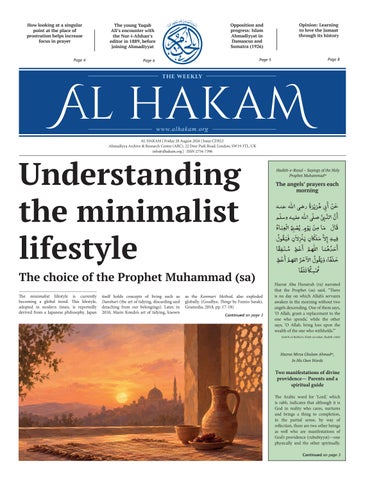
Understanding the minimalist lifestyle
The choice of the Prophet Muhammad (sa) The minimalist lifestyle is currently becoming a global trend. This lifestyle, adopted in modern times, is reportedly derived from a Japanese philosophy. Japan
itself holds concepts of living such as Danshari (the art of tidying, discarding and detaching from our belongings). Later, in 2010, Marie Kondo’s art of tidying, known
as the Konmari Method, also exploded globally. (Goodbye, Things by Fumio Sasaki, Gramedia, 2018, pp. 17-18) Continued on page 3
Hadith-e-Rasul – Sayings of the Holy Prophet Muhammadsa
The angels’ prayers each morning
َ ُ َ َ ّٰ ﻋ ْﻦ أ�ِ� ﻫ َﺮﻳْ َﺮة رﺿﻰ ا��� ﻋﻨﻪ ّ ّ ٰ ّ َ َّ َّ َ اﻟﻨ ِ� ّ� ﺻﻠﻰ ا��� �ﻠﻴﻪ وﺳﻠﻢ أن َ َ ُ ﺎل� َﻣﺎ ِﻣ ْﻦ ﻳ َ ْﻮم ﻳ ُ ْﺼ� ُ� اﻟْﻌ َﺒ ﻗ ﺎد ِ ِ ٍ َ َ َ ّ ُ ُ َ َ ْ ﺎن ﻳَ� ِ��� ِن ﻓ َﻴﻘﻮل ِ �ِﻓﻴ ِﻪ ِإ�� َﻣﻠ ً ْ َ َّ ّ ٰ ُ ُ َ �ﻢ أﻋ ِﻂ ُ� ْﻨ ِﻔﻘﺎ ��أ َﺣﺪﻫ َﻤﺎ ا ُ ُ ًَ َ َ ْ َ َّ ا���ﻢ أﻋ ِﻂ َوﻳَﻘﻮل ا��ﺧ ُﺮ،ﺧﻠﻔﺎ ًَ َ ً ُ ��� ْ ِﺴ�ﺎ ﺗﻠﻔﺎ Hazrat Abu Hurairah (ra) narrated that the Prophet (sa) said, “There is no day on which Allah’s servants awaken in the morning without two angels descending. One of them says, ‘O Allah, grant a replacement to the one who spends,’ while the other says, ‘O Allah, bring loss upon the wealth of the one who withholds.’”
Hazrat Mirza Ghulam Ahmadas, In His Own Words
Two manifestations of divine providence— Parents and a spiritual guide The Arabic word for ‘Lord,’ which is rabb, indicates that although it is God in reality who cares, nurtures and brings a thing to completion, in the partial sense, by way of reflection, there are two other beings as well who are manifestations of God’s providence (rububiyyat)—one physically and the other spiritually. Continued on page 3
Friday 28 August 2026 | AL HAKAM
2
This Week in History
1 September 1 September 1927: On this day, Hazrat Musleh-e-Maud’s (ra) 20-point memorandum was published that outlined his proposals for the establishment of peace and harmony between Hindus and Muslims. The text of this important piece was later published in Al Fazl as an appendix on 16 September 1927. The memorandum was sent to the leaders of both parties. On this day, a meeting also took place between Hazrat Musleh-e-Maud (ra) and the then Viceroy of India, Lord Irwin, at the Viceregal Lodge. (Al Fazl, 13 September 1927, p. 1)
28 August - 3 September A glimpse into the rich history of the Ahmadiyya Muslim Jamaat
29 August 29 August 1947: On this day, Hazrat Musleh-e-Maud (ra) delivered a Friday sermon from Masjid Mubarak, Qadian, which proved to be his last address in this blessed mosque. During his sermon, Huzoor (ra) drew the attention of Jamaat members towards particular topics and instructed them to pray for them regularly and profusely. (Khutbat-e-Mahmud, Vol. 28, pp. 266276)
28 August 28 August 1901: Al Hakam reports that the Promised Messiah (as) said on the morning of this day, “My opponents are of two types: Muslim maulvis and European Christians. Both of them, respectively, extend their opposition to me and their unfair attacks upon Islam incessantly. Today, I was shown a scene of both of these people and a state of revelation was experienced, the details of which I do not recall. “About the Christians, an impression was conveyed that many of them would value the truth; but with regard to the maulvis, I conceived the impression that most of them would be rendered helpless.” (Tadhkirah, p. 555) 28 August 1992: On this day, during his Friday sermon, Hazrat Khalifatul Masih IV (rh) spoke about the arrogance of Western nations and the plight of oppressed countries. Huzoor (rh) announced the establishment of a global humanitarian organisation under the administration of the Jamaat, known as “Humanity First.” This charity organisation was formally founded in the following years. (Khutbat-e-Tahir, Vol. 11, p. 593) 28 August 2016: Hazrat Khalifatul Masih V (aa) laid the foundation stone of the first Ahmadiyya mosque in the small German town of Pfungstadt in the state of Hesse on this day. (“Head of Ahmadiyya Muslim Community lays foundation stone for new Mosque in Pfungstadt, Germany,” www. pressahmadiyya.com)
29 August 1980: On this day, during his visit to Ghana, Hazrat Khalifatul Masih III (rh) travelled from Accra to unveil the memorial plaque of the Baitul Zikr mosque, which was under construction. Following this, after arriving at Salt Pond in the afternoon, Huzoor (rh) inaugurated the Khuddam-ul-Ahmadiyya Ijtema of Ghana by hoisting the flag of Ahmadiyyat and then delivered the Friday sermon. When Huzoor (rh) made his way back, he prayed at the grave of the pioneering Ghanaian Ahmadi, Chief Mahdi Apa in Ekrawfu and then met with the president of Ghana. On this day, during his journey, Huzoor (rh) also unveiled a memorial plaque on the newly constructed building of an Ahmadiyya secondary school. (Silsila Ahmadiyya, Vol. 3, p. 634)
30 - 31 August 30 August 2016: On this day, Hazrat Khalifatul Masih V (aa) laid the foundation stone of the “Noor Mosque”, the first Ahmadiyya mosque in the German town of Frankenthal in the state of Rhineland-Palatinate. (‘‘Head of Ahmadiyya Muslim Community lays foundation stone for new Mosque in Frankenthal, Germany’’ at www.pressahmadiyya.com) 31 August 1955: On this day, Hazrat Musleh-e-Maud (ra) delivered a lecture in Zurich, Switzerland, about the spirit of religion and its basic principles. According to volume 16 of Tarikh-e-Ahmadiyyat, this lecture was given in English.
1 September 2006: During his Friday sermon on this day, Hazrat Khalifatul Masih V (aa) mentioned Master Munawar Ahmad Sahib, who had been martyred in Gujrat, Pakistan. Huzoor (aa) said that members of the Jamaat should remember the sacrifices of martyrs of Ahmadiyyat, since “any sacrifice for the cause of Ahmadiyyat can never go in vain.”
2 September 2 September 1898: On this day, the Promised Messiah (as) shared his love and care while replying to a letter of Hazrat Haji Seith Allah Rakha Abdur Rahman (ra). Huzoor (as) stated that it is most likely that when he falls asleep, Huzoor (as) remains occupied in praying for him. (Maktubat-e-Ahmad, Vol. 2, p. 374) 2 September 1904: The Promised Messiah (as) was residing in Lahore. On the blessed day of Friday, after Jumuah prayer, the Promised Messiah (as) delivered a lecture. On the same day, a Bahai by the name of Hakim Mirza Mahmud Zarkani sent the Promised Messiah (as) a challenge to a debate; the Promised Messiah (as) gave him a full response. (Tarikh-e-Ahmadiyyat, Vol. 2, p. 356)
3 September 3 September 1904: The Promised Messiah (as) was in Lahore. At 7:30 am on this day, a lecture of the Promised Messiah (as) was read out entitled, “Modern religions in this country and Islam”. It was read out by Hazrat Maulvi Abdul Karim Sialkoti (ra) in the presence of the Promised Messiah (as). After it was read out, the Promised Messiah (as) briefly addressed the audience. (Tarikh-e-Ahmadiyyat, Vol. 2, p. 351) To read the text of this lecture, see: alislam.org. 3 September 1947: On this day, Liwa-e-Ahmadiyyat, the flag of Ahmadiyyat, was transported to Lahore from Qadian after the partition of British India. Mirza Abdul Ghani Sahib discharged this blessed and historic duty. (Tarikh-e-Ahmadiyyat, Vol. 10, p. 39) For more details, see: “Flying high the standard of Islam – Liwa-e-Ahmadiyyat – the flag of the Jamaat” at alhakam.org (2 August 2019, pp. 6-9).
AL HAKAM | Friday 28 August 2026
Continued from page 1
In the physical sense there are parents, and in the spiritual sense, a spiritual mentor and guide. In another instance, Allah the Exalted states in greater detail the following :
ً ۡ ُ َ � ۤ َ � ۤۡ ُ ُ ۡ َ َ � َ َ ُ � َ ٰ َ َ اَہ َو ِﺑالوَال ٌَِدۡیۡ ِِن ِا ۡﺣ َﺴاﻧا وﻗ�ٌّي رﺑﻚ اَلۤا �ﻌﺒٌدوا ِاَلۤا ِاۡی
Thy Lord has commanded, “Worship none but Him, and show kindness to parents.” Meaning, God desires that you worship no one else and treat your parents with kindness. Truly, what a remarkable sort of providence it is that when a human being is a child and has no power whatsoever, a mother renders invaluable service, and during this time, just observe how a father supports the efforts of the mother. It is merely out of
Continued from page 1
Thus, it can be understood that the minimalist lifestyle currently being embraced by global society is heavily influenced by Japan. Simultaneously, this lifestyle serves as a form of resistance against the maximalist lifestyle, which has a significant impact on increasing global waste. However, long before minimalism became a modern trend, our beloved Prophet Muhammad (sa), was a person worthy of the title “true minimalist.” He had already taught and adopted minimalism as a way of life. In Islam, several concepts of simple living were taught long ago, such as zuhd (detaching oneself from worldly attachments), qana‘at (feeling content and grateful for whatever sustenance Allah provides), iqtisad (a balanced lifestyle – neither stingy nor wasteful) and anti-tabzir (avoiding excess). What is interesting to explore is how the Prophet (sa) so deeply enjoyed his life without obsessing over material objects. In fact, from the very beginning, he consciously chose to live life as a “traveller”, i.e. someone who does not hold onto material things. This is reflected in his prayer recorded in a hadith: Abu Hurairah (ra) narrated: “The Messenger of Allah prayed: ‘O Allah, provide the family of Muhammad with a simple [sufficient] sustenance.’” (Sahih al-Bukhari, Book 48, Hadith 44) This clearly illustrates how the Prophet (sa) asked Allah for simple sustenance. He did not desire abundant or luxurious wealth; he only wanted what was sufficient. This shows that for him, simplicity was enough. After reading the book Goodbye, Things by Fumio Sasaki, I learned many things. Merely through the act of letting go and reducing possessions, there are so many positive effects that not only impact the spaciousness of a home but also influence the personality of the one practising it. Understanding this allows us to better
3
His grace that God Almighty has created two agents to support His weak creation and has made them to reflect the light of His own love. However, it ought to be remembered that the love of parents is partial, while the love of God is true in essence. Until hearts are inspired by Allah the Exalted, no human being, not even a friend, neither equal nor a ruler, can love anyone; and it is a mystery of God’s boundless providence that a mother and father love their children to such an extent that they will happily bear all sorts of pain to care for them. So much so that parents will not even hesitate in laying down their own lives to save their children. Hence, in order to perfect the higher morals of man, in the words rabb-in-nas (the Lord of Mankind), God Almighty has alluded to parents and spiritual guides, so that thankfulness for the system that is
comprehend how simplicity became the choice of the Holy Prophet (sa). A simple life brought him (sa) happiness. It also freed him from unproductive time that might otherwise be spent thinking about possessions. Objects do not just take up space in a house; they also occupy the owner’s attention and mind to manage or use them. We find a narration of Hazrat Aisha (ra) that illustrates the lifestyle of the Prophet (sa) and his family: Narrated Aisha (ra), a complete month would pass by during which we would not make a fire (for cooking) and our food used to be only dates and water unless we were given a present of some meat. (Sahih al-Bukhari, Book 81, Hadith 47) This is why the Prophet (sa) was so fond of giving charity. Beyond being an expression of love for his people, charity freed him from thinking about the items in his home. This demonstrates his complete lack of attachment to material and worldly things. He gave so easily that even when he possessed only one garment – the one he was wearing – if a child asked for it, he would give it without a second thought. That was how empty material value was in his eyes. In fact, he would give his clothes to any companion who asked for his garment: I heard Sahl bin Sa‘d saying, “A woman brought a Burda (i.e. a square piece of cloth having edging). I asked, ‘Do you know what a Burda is?’ They replied in the affirmative and said, “It is a cloth sheet with woven margins.” Sahl went on, “She addressed the Prophet (sa) and said, ‘I have woven it with my hands for you to wear.’ The Prophet (sa) took it as he was in need of it and came to us wearing it as a waist sheet. One of us said, ‘O Allah’s Messenger (sa)! Give it to me to wear.’ The Prophet (sa) agreed to give it to him. The Prophet (sa) sat with the people for a while and then returned (home), wrapped that waist sheet and sent it to him. The people said to that man, ‘You haven’t done well by asking him for it when you know that he never turns down anybody’s request.’
apparently observed in the figurative sense may lead a person to show gratitude to the True Lord and Guide. This is the key that unlocks the secret as to why this blessed chapter begins with rabbin-nas (the Lord of Mankind), and not ila-hin-nas (the God of Mankind). Since a spiritual guide undertakes the spiritual upbringing of people in accordance with the will of God Almighty, and through the ability and guidance given by Him, a spiritual guide is also implied in these words. The second part is malik-in-nas (the King of Mankind), i.e. seek refuge with God Who is your King. This is another hint that seeks to enlighten human beings about the principles of civil order, and that they themselves may become civilised. In essence, it is Allah Almighty Who is the true King, but this indicates that by way of reflection, there are kings on earth as
“
well. It is for this reason that these words also imply that one must watch over the rights that are due to the ruler of the time. On this instance, no distinction is made between a king who is a disbeliever, idolator or a believer in God’s Oneness; in fact, the statement is general— the king may be of any faith. Religion and belief are separate matters. In the Holy Quran, wherever God has alluded to a benefactor, He has made no stipulation of Muslim or monotheist, or of belonging to a certain order. As a matter of fact, God speaks of a benefactor in general terms without mentioning any religion. As Allah the Exalted states:
ُ آء اَلۡۤا ۡﺣ َﺴان اَل�َۤا اَلۡۤا ۡﺣ َﺴ َ ان ِ ِ ِ ِ ُ ﻫ ُّۡل َﺟ َﺰ
Meaning, can the recompense of goodness be anything other than goodness? (Malfuzat [English], Vol. 2, pp.189 - 190)
Be in this world as if you were a stranger or a traveller”.
The man replied, ‘By Allah, I have not asked him for it except to use it as my shroud when I die.’” Sahl added, “Later it (i.e. that sheet) was his shroud.” (Sahih al-Bukhari, Book 34, Hadith 46) The Prophet’s (sa) time was used very effectively because there were few items in his house and few clothes in his possession, allowing the time spent thinking about material “things” to be cut down significantly. Consequently, he had more time for worship, preaching and educating his people. Furthermore, he had no desire to be seen as an elite or wealthy individual, rather his simplicity served as a benchmark for gratitude. He lived simply purely by choice, because he wanted to live minimally and felt completely fulfilled by that lifestyle. The Prophet’s (sa) following statement sums up this perfectly: “Be in this world as if you were a stranger or a traveller”. (Sahih alBukhari, Book 81, Hadith 5) A lack of food did not make him anxious, for he had complete trust in Allah. If there was no food that day, there was the option to fast – which is also healthy. He focused on his mission of preaching because of his perfect conviction in the Oneness of Allah, giving him extraordinary courage in facing various trials and challenges as Allah’s messenger. He was indifferent to the views, mockery or accusations of the Quraish idolaters because he had released his attachment to the world and relied solely on Allah. Even
after experiencing physical cruelty in Ta’if, he did not stop preaching. He continued his mission, despite being deeply saddened by the treatment of the people of Ta’if: It is narrated in a hadith that once Hazrat Aisha (ra) asked the Holy Prophet (sa), “Have you ever experienced a day more difficult than the day of Uhud?” He replied, “Aisha, I have faced very severe moments at the hands of your people.” He then related the circumstances of the journey to Ta’if and said that upon returning from there, the angel of the mountains came to him and said, “Allah has sent me to you so that, if you command, I may cause these two mountains on either side to fall upon these people and destroy them.” (That is, I shall cause the mountains to the right and left side of them to fall upon them and destroy them.) The Holy Prophet (sa) said, “No, no. I hope that Allah the Almighty will bring forth from among these very people those who will worship the One God.” (Life and Character of the Seal of Prophets, Vol. 1, pp. 252-255) A simple life and a minimalist lifestyle open up many new perspectives on happiness, freedom and gratitude. Living simply is a path not only to self-discovery but also to self-improvement – becoming a better person day by day. It provides tranquillity for both the soul and the mind. It is no wonder that the Prophet (sa) could remain so happy, even though his life was exceptionally simple. (Lisa Aviatun Nahar)
Friday 28 August 2026 | AL HAKAM
4
How looking at a singular point at the place of prostration helps increase focus in prayer Yusuf Tahir Abubakar Student, Jamia Ahmadiyya International Ghana The Islamic prayer, Salat, is a spiritual act that shows an expression of humility, submission and devotion before Allah. Established within its physical form and spiritual guidance lies a deep understanding of human psychology. One example of this is the practice of the Holy Prophet Muhammad (sa) to keep his eyes open during prayer and to fix one’s gaze upon the place of prostration. (Al-Mustadrak ala al-Sahihayn, Kitab as-saum, Hadith 1761, Dar al-Kutub al-‘Ilmiyyah, 1990, Vol. 1, p. 652) He also strongly advised Muslims not to let their eyes wander upwards during prayer. (Sahih al-Bukhari, Kitab al-adhan, Hadith 650) Far from being merely a correct method of prayer, this guidance reveals a deep insight into the nature of attention, concentration and the human mind – an insight that modern science has only recently discovered.
The problem of the wandering mind One of the greatest challenges faced during prayer is the loss of concentration through wandering thoughts. Despite sincere intention, the mind often drifts towards worries, memories of events or external stimuli. These are all part of natural human difficulties and Islam addresses them practically. Hazrat Mirza Bashir-ud-Din Mahmud Ahmad (ra), Khalifatul Masih II, explains that when one of the senses is completely focused, the other senses become disengaged. (Remembrance of Allah, p. 91) Hazrat Musleh-e-Maud (ra) analysed the human senses to explain why sight is a tool for achieving concentration in prayer. He explains that the senses of hearing and smell are often involuntary. A person cannot easily control what they hear, just as smell is dependent on external conditions and if people or objects with different scents are in one’s vicinity, attention could be diverted. (Ibid.)
“
Prayer requires complete
concentration. [...] the customs and teachings of Islam have disapproved of the presence of anything in the worshipper’s environment that draws his attention towards itself. Sight, however, is fundamentally different. A person can intentionally direct their gaze, withdraw it from what they do not want to see and fix it upon a single point. This makes vision the most controllable and disciplined sense. Thus, the sense of sight is one of the means through which concentration in prayer can be achieved. (Ibid.)
Clearing distractions Keeping this in mind, it is necessary to look deeper into the life of the Holy Prophet (sa) to understand how he employed this method. For example, the Holy Prophet (sa) once offered prayer wearing a cloak that had patterns on it. He glanced at its patterns once and when he had finished the prayer, he asked for a plain cloak without patterns since it had proven to be a distraction. The Holy Prophet (sa) said, “I kept seeing its patterns while I was in prayer, and I feared that it might take place in trial.” (Sahih al-Bukhari, Kitab as-salat, Hadith 373) Hazrat Khalifatul Masih V (aa) recently explained this in a Friday Sermon as well. Huzoor (aa) stated that even clothing should be simple and free from such adornment that diverts attention by distracting the eyes. Huzoor (aa) said: “Prayer requires complete concentration. (That is, prayer can only truly be counted as a prayer when a person is wholly absorbed in it and offers it with full concentration.) Therefore, the customs and teachings of Islam have disapproved of the presence of anything in the worshipper’s environment that draws his attention towards itself. From this, it becomes clear how deeply and attentively the Holy Prophet (sa) wished to worship Allah Almighty – to the extent that even the slightest glance at anything that could divert attention from Allah was not tolerated. “Accordingly, various ahadith mention that there should be no pictures, no clothing with images in front of a person, and no curtains bearing images, because all such things can become a cause of distraction
in prayer. For this reason, they have been prohibited. While offering prayer, there should be no curtains or images in front of a person that divert attention by facing them, and such things should not be in the direction of the Qiblah.” (Sahih alBukhari [Urdu translation], Vol. 1, p. 479; Friday Sermon 6 February 2026)
Modern science and visual attention Modern neuroscience strongly supports this practice of the Holy Prophet (sa). Research on attention shows that the brain possesses limited cognitive resources. (“The Restless Mind”, Psychological Bulletin, November 2006, 132(6):946-958) When visual attention is tightly focused, fewer resources remain available for unrelated thoughts. This reduces activity in brain networks associated with mind-wandering and idle thinking. (Christoff, K et al., “Mind wandering and attention networks during focused meditation”) In cognitive science, this phenomenon is often described as attentional capture or sensory gating – where focused sensory input suppresses competing mental processes. (Desimone, R & Duncan, J, “Neural mechanisms of selective visual attention”) Fixing the gaze at one point stabilises attention, quiets internal noise and enhances mental presence. (Christoff, K et al.) In effect, the eyes act as an anchor for the mind. Modern findings in environmental psychology show that minimalistic environments support sustained attention and reduce cognitive overload. (Kaplan, R & Kaplan, S, The Experience of Nature: A Psychological Perspective, 1989) By fixing the eyes, other senses gradually become suppressed. As external distractions reduce, irrelevant thoughts decrease and one’s mind begins to become stable. Concentration is no longer forced or distracted but controlled naturally through sensory discipline.
AL HAKAM | Friday 28 August 2026
5
ago...
100 years
Opposition and progress: Islam Ahmadiyyat in Damascus and Sumatra (1926) Hazrat Maulana Jalaluddin Shams (ra) (1901-1966)
Islam Ahmadiyyat and Arabs The notion that the [Arab] people will readily accept our message is not correct, except what Allah the Almighty wills. The Promised Messiah (as) states in his book, Nur-ul-Haqq: “O brothers! Know that the work of publishing books in the Arab world and conveying the profound knowledge contained in my books to the Arabs is no trivial matter; rather, it is a tremendous task. Only those who are qualified can accomplish it, for these obscure issues – over which I have been labelled a disbeliever and accused of lying – are no doubt difficult for the Arab ‘ulama in the way that they are difficult for the ‘ulama of this country. In particular, the people of the desert – who neither know the subtleties of the Faith nor ponder in the way they ought to – their understanding is superficial and their hearts are hasty, save a few of them, whose natures Allah has illumined, but they are rare.” [Nur-ul-Haqq (The Light of Truth Parts 1 & 2), p. 33]
Scholars of Damascus The scholars here are more prejudiced than the Indian scholars because they believe that the Promised Messiah will descend here in Damascus. A tract entitled Shai’un min ‘Aqa’id al-Jama‘at al-Ahmadiyya was written, to which a certain Sheikh – who appears to be the very likeness of Maulvi Muhammad Husain Batalvi – published a reply, in which he freely indulged in abusive language. I quote one line in which he addresses me:
َ ْ ٌ َ� َ ٌ ْ ُ ٌ� ُ َ ٌ ْ ُ ٌ َ ْ ُ ْ ْ َ ُ� ُ ، ُُمْفَت ٍٍر،اٌب َكَّذ، ُمْش ِِرٌك، َمُجو ِِسٌّي، ُمْل َ ِِحٌد،ٍص ِِمْنُكْم َكاِفٌِر ٍ ُكُّل َشْخ َ َ � ٌ ٌ َأَّفاٌك َأ ِِث يٌم۔
“Every one of you is a disbeliever, an atheist, a Magian, a polytheist, a liar, a fabricator, a great slanderer and a sinner.” Upon reading this line, the following verse of the Promised Messiah (as) spontaneously came to my lips:
اکرفودحلموداجلںیمہےتہکںیہ انمایکایکمغتلمںیمراھکایمہےن “They call us disbelievers, atheists and the Antichrist; what names have we not borne for the sake of the grief of the nation.” [Durr-e-Sameen, p. 16]
Challenges in Syria Hazrat Khalifatul Masih II [ra] also stated that our contest in Syria would take place and would be severe, but, insha-Allah, the eventual success would also be very great. However, owing to the prevailing circumstances, there has not yet been an adequate opportunity to carry out the work
of tabligh [preaching] to the fullest extent, such that the message could be conveyed comprehensively to every individual. Such an opportunity can arise only in conditions of peace.
Tracts and books The tracts that were printed before the imposition of martial law are still being distributed. The books that Syed Zain-ulAbidin Waliullah Shah Sahib [ra] made great efforts to have printed are likewise being distributed. To the extent possible, efforts are also being made to convey the message through personal meetings with people.
Preaching through correspondence Through correspondence, I am also conveying the message in places outside Damascus. This has already borne fruit. A prominent scholar in Homs has expressed his willingness to accept the invitation of the Promised Messiah (as). He has requested books and tracts on two occasions and these have been sent to him. He has also given them to other friends to read. He has stated that they are spreading this message discreetly and that they also respond to those who raise objections. Similarly, correspondence was being maintained with Al-Sayyid Ahmad Faiq al-Sa‘aqi in Nazareth. He is a righteous young man. He came to Damascus and
took bai‘at [pledged allegiance] before returning to Nazareth. From there, he sent letters of bai‘at from four people, two of whom are merchants. He has written that the remaining individuals are also desirous that we come there and explain the detailed matters to them.
religious scholars. When they were unable to provide arguments in response, they resorted to abuse. Witnessing their helplessness, some people of sound and sincere disposition have been astonished, asking why their religious scholars are unable to provide proper answers.
New members in Damascus
Dialogue with a Christian missionary
In Damascus itself, Allah the Almighty has enabled two women to enter the fold of Islam Ahmadiyyat. Friends are requested to pray for the steadfastness of all these [new converts and supporters]. – Jalal-ud-Din, Damascus
Al Fazl, 10 August 1926 Opposition and tabligh in Sumatra Although the religious scholars have issued a decree that Ahmadi books and writings should neither be read nor listened to and are making every possible effort to conceal the truth, the Ahmadiyya Muslim Community, by the grace of Allah the Almighty, continues to progress day by day. Thus far, nearly 200 individuals across various regions have joined Islam Ahmadiyyat. Some of them are very enthusiastic about spreading the message of Islam, while others are publishing articles about the Jamaat in various newspapers.
Encounters with religious scholars This week, I met and spoke with several
I also spoke with a Christian missionary. When he was unable to respond and became deeply embarrassed, he said, “You are not even Muslims, because all the Muslims have issued a decree declaring you disbelievers.” At that moment, however, my responses had made an impression upon the Muslims present and they all said, “No, he is a Muslim.” After the Christian missionary had left, I said to the Muslims: “Look at how these people are trying to extinguish the radiance of Islam. Is it still not time for all of you to unite in the service of Islam and enter into the servitude of the Promised Messiah (as)? For no one except the Ahmadis can answer them.” Friends are requested to pray that Allah the Almighty may open the hearts of the people of this country to accept the truth. Amin. – Rahmat Ali, Padang (Translated by Al Hakam from the original Urdu, published in the 6 and 10 August 1926 issue of Al Fazl)
Friday 28 August 2026 | AL HAKAM
6
form the
Archives
The young Yaqub Ali’s encounter with the Nur-i-Afshan’s editor in 1889, before joining Ahmadiyyat Ata-ul-Haye Nasir Ahmadiyya Archive & Research Centre Recently, the Ahmadiyya Archive & Research Centre came across an old postcard – dated 29 January 1894 – from Rev Hassan Ali Safir, Editor of Nur-i-Afshan. This Ludhianabased Christian newspaper had left no stone unturned in opposing Hazrat Mirza Ghulam Ahmad (as). Upon searching Rev Safir’s name in the Jamaat’s literature, we found that he is mentioned by Hazrat Sheikh Yaqub Ali Irfani (ra) in an account recorded in Tarikh-eAhmadiyyat and also in Hayat-e-Ahmad. It was interesting to learn that the young Yaqub Ali (ra), during his school days, had an encounter with Rev Hassan Ali Safir – then Assistant Editor of Nur-i-Afshan. It must be noted that the young Yaqub Ali (ra) had seen1 Barahin-e-Ahmadiyya in 1887 through Maulvi Ghulam Mohiyuddin Sahib – his teacher and headmaster at the Vernacular Middle School – and even met Hazrat Mirza Ghulam Ahmad (as) in 1889. However, he had not done the bai‘at until February 1892.2 It was in 1889 when Hazrat Mirza Ghulam Ahmad (as) established Jamaat-e-Ahmadiyya and took bai‘at (pledge of allegiance) in Ludhiana, the town where Nur-i-Afshan was based and the young Yaqub Ali (ra) was studying. In March 1889, Nur-i-Afshan mentioned Hazrat Ahmad’s (as) visit to Ludhiana and his announcement to take bai‘at from those who wished to join his Jamaat. In
one of its articles, the newspaper questioned the Muslims as to what was the need to pledge allegiance to Hazrat Ahmad (as).3 The Nur-i-Afshan published more comments in the coming issues and used foul language against Hazrat Ahmad (as).4 Without going into details of that episode, this article only intends to narrate the young Yaqub Ali’s (ra) encounter with Rev Hassan Ali Safir, the subsequent interaction with Nur-i-Afshan and the response from the Christian missionaries.
Who was Rev Hassan Ali Safir? Rev Munshi Hassan Ali Safir was originally a Muslim from the Alwar State in the Rajputana area of British India. He was well-versed in various languages, such as Urdu, Arabic, Persian and English. He later converted to Christianity and actively preached the Christian faith in the Rajputana areas alongside Rev Dr Colin S Valentine.5 He was well-versed in poetry, as evident from various issues of Nur-i-Afshan. A compilation of his ghazals was published entitled Guldastae-Safir.6 Rev Imad-ud-Din Lahiz, in the appendix of his paper for the 1893 Parliament of the World’s Religions, has included Safir’s name among the prominent clergy in Punjab Missions as follows: “Sayad Hassan Ali, Safir. Baptized, American Presbyterian Mission, Lahore. A Christian poet, a descendant of Mohammed, Editor of The Nur Afshan; American Presbyterian Mission, Ludhiana.”7 Mentioning the missionary activities in the Rajputana areas, John Robson DD has written about the conversion of Hassan Ali Safir in the 1860s. He wrote that the first convert at the Nasirabad Mission, named Lachman, was “not a man of brilliant parts”, however, “the next convert was quite a contrast. His name was Hassain [sic.] Ali; he was a Mohammedan, of considerable genius and force of character. His conversion and baptism produced a great sensation in the native community.”8 John Robson DD continued by stating that Hassan Ali Safir “did good service with his pen even more than with his word. Some of the most poetic and literary of the hymns sung by the native Christians throughout the north-west are ‘ghazals’ (a species of Urdu poem) composed by him.”9 Hassan Ali Safir’s early connection with the Nasirabad Mission is evident from Nur-i-Afshan’s 2 March 1876 issue, wherein he has been associated with the said Mission while publishing his ghazal. John Robson DD further mentioned that in Jaipur, Rev Dr Colin S Valentine was joined by Hassan Ali Safir10 and thereafter, in Alwar State, Rev Henry D St Dalmas “gathered a few native converts, and organised school and other missionary work” where “his chief coadjutor” was Hassan Ali Safir.11 Rev Hassan Ali Safir had been stationed at the Ajmer Mission House,12 before joining the Nur-i-Afshan as the
AL HAKAM | Friday 28 August 2026
7
Assistant Editor in October 1889.13 He passed away on 12 August 1895.14 Upon his demise, it was expressed by a Christian writer that “it seems difficult for the newspaper to retain its status after Hazrat Safir.”15
Young Yaqub Ali (ra) and Rev Hassan Ali Safir Narrating about how he developed an interest in reading the newspapers and writing articles, Hazrat Sheikh Yaqub Ali Irfani (ra) states in his account – recorded in Tarikh-eAhmadiyyat – as follows: “It was due to the editor of Nur-i-Afshan, Mr Hassan Ali Safir, that I grasped a great opportunity to read newspapers.”16 He has explained this point with more detail in Hayate-Ahmad, where he states: “There was an editor of Nur-i-Afshan, namely Hassan Ali Safir. He was around 60 years of age and a very wellversed poet and writer. Once an article was published about him in Manshur-i-Muhammadi. I took that issue to him and asked, ‘Are you the same Safir Sahib who has been mentioned here or someone else?’ He felt a bit embarrassed [mahjub] and said, ‘Sahibzada! You seem to be fond of reading newspapers. I receive many newspapers here, so you may take them [to read].’ In this way, I built some frankness with him and hence, I submitted to him a question to be published [in Nur-i-Afshan].”17
A series of correspondence in Nur-i-Afshan Mentioning the question, Hazrat Sheikh Yaqub Ali Irfani (ra) did not state the date of Nur-i-Afshan’s issue which published it, however, further research revealed that it was the 26 December 1889 issue. The wording of the question, as published in the newspaper, was as follows:
�ال � �� � �� � �� وا�ں � �ت �� ای �؟ � �� اول �ورت�ا���ا�����اوراُن��تاکایک�ل��؟ ��را�ا “Question: “Will those who believe in Tawhid [Oneness of God] attain salvation or not? If the answer is ‘yes’, there is no need to believe in the Trinity; if the answer is ‘no’, then what will be the status of the previous Prophets prior to Masih [Jesus (as)] and their salvation? “Author, an inquirer.” We can make an estimate of the time frame as to when that encounter between the young Yaqub Ali (ra) and Rev Hassan Ali Safir may have taken place. Rev Hassan Ali Safir took charge as the Assistant Editor of Nur-i-Afshan in October 1889 and the question was published on 26 December 1889, so the meeting might have taken place between early October and 25 December 1889. Interestingly, there was an announcement on the same page about an incident at the Municipal Board High School Ludhiana, sent by a student named “Muhammad Yaqub Ali”. It is evident from the autobiography of Hazrat Sheikh Yaqub Ali Irfani (ra) that after passing the Vernacular Middle School in 1888, he joined the “Board School of Ludhiana” in 1889.18 Coming back to his question, we learn from Hazrat Sheikh Yaqub Ali Irfani (ra) the following: “This question got published which initiated a debate in the newspaper. Rahmat Masih Waiz [1857-1935] of Narowal had started a magazine Mubashar [originally started by him entitled ‘Mubashar Injeel’ as a supplement to Nur-i-Afshan and later published separately from Batala as “Mubashar”19], wherein he began publishing articles of Ishaq Kindi which contained a debate on Tawhid. “Therefore, he posed a question in response to my question as to ‘what kind of Tawhid you believe in?’ My response to it got published [...]. At last, Reverend [EP] Newton [Superintendent of Nur-i-Afshan] compelled Munshi Hassan Ali Safir to halt the series [of correspondence].”20
Now, there is no mention of the date on which the response from Rahmat Masih Waiz was published. However, upon looking at the subsequent issues, we find that a response from the said Christian was published in the 9 January 1890 issue, which stated: “In the previous year’s 26 December issue of Nuri-Afshan, an inquirer asked whether or not the believers of Tawhid will attain salvation? The inquirer is kindly requested to elaborate as to what he means by believing in Tawhid? In your view, what is meant by believing in Tawhid? [...] As long as these points are not explained in detail, this question would be deemed inappropriate. If you explain it, I will be ready to answer.”21 This was followed by an article by Boota Singh Peter from RP Mission Roorkee, who mentioned the question by the young Yaqub Ali (ra) and while answering it, he asserted that “in my view, anyone who believes in Tawhid and rejects Trinity has not truly recognised God.” He concluded by saying that since the beginning of this world, “all those who have attained salvation were believers of the Trinity.”22 In the 13 February 1890 issue, Rahmat Masih Waiz published an article, entitled “Ba-Jawab Khat Muhammad Yaqub Ali, Mut‘allam Board High School Ludhiana” (lit., In response to a letter from Muhammad Yaqub Ali, a student at the Board High School Ludhiana). Rahmat Masih first mentioned his earlier response to the young Yaqub Ali’s (ra) question about salvation and then stated that he had received a letter from Yaqub Ali (ra). According to Rahmat Masih’s statement, the letter stated that a response was sent to the editor of Nur-i-Afshan, however, the editor returned it without publishing due to prejudice and opposition against Islam. Rahmat Masih quoted a part from that alleged letter and then wrote that the letter did not define Tawhid, rather, it just says that the Muslims believe in the same Tawhid which was believed by Abraham (as). Rahmat Masih wrote that it is not what he had asked, but rather, he needs to know that in view of Yaqub Ali (ra), what is the definition of Wahid (One) and in what way God is Wahid. Rahmat Masih concluded his article by saying that once the answer is received, he will request the editor to publish it; however, he has no time to continue this debate back and forth in the personal correspondence.23 The Christian missionaries and their leading newspaper Nur-i-Afshan hesitated in answering the question raised by a 14-year-old Muslim student and – according to the statement of Hazrat Sheikh Yaqub Ali Irfani (ra) – Rev EP Newton instructed Rev Hassan Ali Safir to discontinue the correspondence. The young Yaqub Ali (ra) later pledged allegiance to the Promised Messiah (as) in 1892 and after a few years, served as the founding editor of the Jamaat’s first-ever newspaper, Al Hakam.
The official records (year 1912) of the Home Department of the British Indian Government, provide a detailed introduction of Hazrat Sheikh Yaqub Ali Irfani (ra) in the following words: “Yakub Ali, Sheikh, Torab, son of Sheikh Muhammad Ali. He passed his Entrance Examination as a private student in 1893. His father was a subordinate teacher in the Adampur Vernacular Middle School. Resident of Ludhiana, now of Qadian. Worked as a candidate for a Zilladarship in the Irrigation Department. Got employment as a Patwari in that Department, but resigned. In 1894 commenced work as Editor in Amritsar of the Riaz-i-Hind, Feroz, Ahluwalia Gazette, Jahan Numa and Punjab. In 1896 was selected as a special Police Officer to supervise Muharram arrangements. In 1897 started the Hakam [sic.] newspaper in Amritsar, and in 1898 transferred it to Qadian. Was for some time [a] translator in the Paisa Akhbar Office. Age 36 years.”24
Endnotes 1 2 3 4 5 6 7
Maktubat-e-Ahmad, 2008, Vol. 2, p. 499 Tarikh-e-Ahmadiyyat, Vol. 18, pp. 637-639 Nur-i-Afshan, 14 March 1889, p. 6 Ibid., 21 March 1889, 4 April 1889 and 18 April 1889 Ibid., 20 March 1896, p. 6 Ibid., 9 October 1890, p. 3 The Church Mission Intelligencer, Vol. XLIV, London, 1893, p. 585 8 Missions of the United Presbyterian Church, Edinburgh, 1896, Offices of United Presbyterian Church, p. 86 9 Ibid. 10 Ibid., p. 100 11 Ibid., pp. 113-114 12 Nur-i-Afshan, 22 August 1889 13 Ibid., 9 January 1890, p. 3 14 Ibid., 23 August 1895, p. 11 15 Ibid., 13 September 1895, p. 5 16 Al Fazl, 6 May 1958, p. 4 17 Hayat-e-Ahmad, Vol. 3, pp. 213-214, footnote 18 Al Fazl, 6 May 1958, p. 4 19 Nur-i-Afshan, 15 January 1891, p. 5 20 Hayat-e-Ahmad, Vol. 3, pp. 213-214, footnote 21 Nur-i-Afshan, 9 January 1890, p. 12 22 Ibid., 23 January 1890, pp. 5-6 23 Ibid., 13 February 1890, pp. 5-6 24 National Archives of India, Home Department, Political, 1912
Friday 28 August 2026 | AL HAKAM
8
Opinion: Learning to love the Jamaat through its history Rahma Roshadi Indonesia Why should we study history? It is a question that once occupied my mind. After all, history seems to belong entirely to the past – to people who are no longer with us, events that have long since concluded and stories that can never be rewritten. In a world that is constantly moving forward, it often seems more sensible to devote our attention to the future rather than turning back the pages of the past. At least, that was how I used to think. Everything changed in 2022 when I was entrusted with the responsibility of researching and documenting the history of Lajna Imaillah Indonesia, during the centenary celebrations of Lajna Imaillah. At first, I regarded the task as little more than documentation. It involved reading old reports, verifying dates, tracing reliable sources and compiling them into a coherent historical record. I assumed it would be an exercise of the mind more than the heart.
Gradually, however, my perspective began to change. Behind every report I read lay sacrifices I had never imagined. Behind faded black-and-white photographs were men and women who had devoted themselves to the betterment of the Jamaat. Some remained steadfast despite opposition. Others spent their entire lives serving quietly, never seeking recognition yet becoming pioneers of initiatives whose benefits continue to this day. As my work continued, so did my journey. What began with documenting the history of Lajna Imaillah eventually expanded into researching the history of the Indonesian Jamaat itself. With every page I turned, my admiration deepened. I came across names that had once meant nothing to me – individuals who had made remarkable contributions in their own time, yet whom I came to know only through the lasting fruits of their sacrifices. It was then that I realised something I feel is rather profound. I was not merely studying history – I was learning how to
love the Jamaat.
We come to know someone through their story As I reflected further, I began to notice a familiar pattern. Often, we grow to love our own families because of the stories we inherit from them. They are stories of shared joys and sorrows, of hardships endured together and of sacrifices made for one another. Some families preserve these memories through old photographs. Others pass them down through conversations, as grandparents recount the lives of those who came before them. Such stories are not told merely for the sake of nostalgia but so that each new generation understands where it came from. Imagine a child listening to stories about his grandfather – how he built a life from almost nothing, worked tirelessly to provide for his family or remained steadfast in his principles despite countless hardships. The grandchild never witnessed any of these events. In fact, he may have been born many
years after they had taken place. Yet when the story comes to an end, he often says with quiet admiration, “My grandfather was an extraordinary man.” Nothing about the child has changed in that moment. Yet everything about the way he sees his family has. He now realises that he belongs to something far greater than himself. Perhaps this is true of everything we genuinely come to love. The more deeply we know something, the more naturally our appreciation and affection for it grow. Should this not also be true of the Jamaat? The Jamaat is far more than an organisation through which we receive spiritual guidance. It is a spiritual family, built upon prayers, sacrifices and unwavering devotion across generations. If we truly wish to appreciate the value of this blessed Jamaat, we must first become acquainted with the lives of those who devoted themselves to nurturing and strengthening it. The same principle applies to our love for the Holy Prophet Muhammad (sa). How is it that we love someone who lived more than 14 centuries ago? We discover the answer through studying his blessed life. We journey alongside him through its pages – witnessing his courage, his unwavering obedience to Allah, his moments of grief, his unmatched patience and ultimately his triumph as the greatest guide of mankind. Perhaps this is one of the ways in which Allah the Almighty nurtures love for His chosen servants. None of us has ever seen
AL HAKAM | Friday 28 August 2026 the Holy Prophet (sa) with our own eyes. Yet who can read of the anguish of Ta’if without feeling sorrow? Who can reflect upon the hijrah or the sacrifices of the Companions (ra) at Badr without being deeply moved? Our love has grown through the stories faithfully preserved and passed down from generation to generation.
History as a means of tarbiyat The longer I spent researching the history of the Jamaat, the more I realised that I was not merely reading history. In many ways, history was reading me. Every account I came across seemed to pose questions that were not easily answered. Had I lived in their time, would I have shown the same steadfastness in the face of opposition? Would I be willing to sacrifice my time, my comfort and my personal ambitions for the progress of the Jamaat? Could I have served sincerely without ever expecting my name to be remembered by future generations? These questions have never been fully answered. Yet perhaps that is precisely where the value of history lies. It does not merely tell us who our predecessors were; it quietly invites us to reflect upon who we are today. Perhaps this is why the Holy Quran repeatedly recounts the lives of the Prophets and the experiences of earlier peoples. These narratives are far more than historical records. They serve as mirrors, inviting every reader to ask, “Had I been in their place, how would I have responded?” Allah the Almighty states: “Assuredly, in their narrative is a lesson for men of understanding.” (Surah Yusuf, Ch.12: V.112) The Quran does not present these accounts simply to preserve the memory of the past. Rather, it describes them as ibrah – lessons that awaken the heart, inspire reflection and guide one’s actions. The same divine method of spiritual training continues to this day through the
9
institution of Khilafat. How often have we listened to the Friday Sermons of Hazrat Khalifatul Masih V (aa) and found ourselves revisiting the blessed life of the Holy Prophet (sa), the extraordinary sacrifices of his Companions (ra) or the inspiring incidents from the life of the Promised Messiah (as)? Upon reflection, one realises that Huzoor (aa) is not merely recounting history. Through every incident, he gently directs our attention towards a more important question: How should we embody these noble examples in our own lives today? History, therefore, never remains a collection of stories from the past. It becomes a means of tarbiyat – a living source of guidance that continues to shape our faith, our character and our service to the Jamaat.
establish, the initiatives they pioneered and the generations whose faith they helped nurture. It was then that I came to understand that history is far more than a record of past events. It is a testimony to love expressed through sacrifice. And perhaps that is its greatest lesson. Loving the Jamaat does not always begin with extraordinary acts of
NEWS
Nasirat and waqifaat-e-nau from Looking back to move forward An arrow can only move forward if the bow Australia hold a is first drawn back. The greater the pull, the farther the arrow will fly toward its target. cooking camp. History works in much the same way. To look back is not to dwell in the past. Rather, by understanding the sacrifices and struggles of those who came before us, we gain a clearer sense of direction as we continue the journey of the Jamaat today. When we realise how this Jamaat was built – through countless sacrifices, heartfelt prayers and unwavering devotion – we no longer regard it as something that has always existed. Instead, we begin to appreciate that the blessings we enjoy today are the fruits of prayers offered, sacrifices made and steadfastness shown by those who came long before us. Perhaps that is why, whenever I open old archives now, I no longer search merely for names or dates. I search for traces of love for the Jamaat and almost every page bears witness to it. Many of the names recorded there may no longer be widely known. Yet their sacrifices continue to live on through the mosques they helped
service. More often, it begins by knowing those who loved it before us. Today, I no longer see the archives as stacks of ageing documents. Instead, I see a collection of stories about men and women whose sincere sacrifices helped build and strengthen this beloved Jamaat. Perhaps that is where every journey of love begins: by first taking the time to know the story.
Saima Fazeel Secretary Nasirat, Lajna Imaillah Australia Jamaat-e-Ahmadiyya Australia held a Cooking Day Camp for nasirat and waqifate-nau on 12 July 2026, with an attendance of 82 nasirat and under-15 waqifat. The event was designed to teach essential culinary and life skills in a hands-on environment whilst also focusing on fostering spiritual growth, personal confidence and sisterhood among the participants. The day began with registration and recitation of the Holy Quran, followed by a read-aloud of eating etiquette by a group of nasirat and a self-serve breakfast. The participants then rotated through three interactive culinary stations in smaller groups, learning to prepare rotis, tea, dessert trifles, bread, etc. In the afternoon, girls attended
a presentation by National Secretary Tarbiyat on the etiquette of salat, before joining together in congregation. The nasirat then spent some time with farm animals, allowing them to appreciate Allah’s creation. Later, a presentation on kitchen tools was conducted, allowing the nasirat to learn about the uses of different utensils. Afterwards, an interactive session on cupcake decoration was held with guided instructions on various decorative techniques, allowing the nasirat to decorate their own cupcakes. Towards the end of the day, the girls enjoyed a bonfire with hot chocolate and casual talks. The purpose of the event was to provide nasirat and waqifat with a deeper understanding of the significance of the Langar established by the Promised Messiah (as), while fostering an appreciation for the blessings of food and the dedication, effort and hard work involved in its preparation. The camp also aimed to equip participants with valuable kitchen and cooking skills that will benefit them throughout their lives. These objectives were achieved through a well-organised, enjoyable and interactive learning experience that encouraged teamwork, responsibility and a spirit of service.
42nd Ijtema held by MKA Kenya Tahir Ahmad Machengo Kenya Correspondent The 42nd National Ijtema of Majlis Khuddam-ul-Ahmadiyya Kenya and 13th Ijtema of Majlis Atfal-ul-Ahmadiyya Kenya were held on 14-16 August 2026 in Nairobi, under the theme “Khilafat: The Key to Lasting Peace.” A total of 483 participants attended, representing 16 regions and majalis nationwide. After the Jumuah and Asr prayers, members had lunch and thereafter, they gathered in the mosque to watch the Live Friday Sermon of Hazrat Khalifatul Masih V (aa). After the flag hoisting ceremony and silent prayer, all members proceeded to the Ahmadiyya Hall for the opening session, which began with a recitation from the Holy Quran, followed by the MKA Pledge, a Swahili poem and the opening address by Sadr MKA Kenya. The highlight of the Ijtema was the special message from beloved Huzoor (aa). Sadr Sahib led a silent prayer and the session ended. After this, academic competitions were
held, followed by the Maghrib and Isha prayers. The next day started with the Tahajjud and Fajr prayers, followed by Dars-ulQuran. After breakfast, preliminary sports events were held. The first session of sports went on until the Zuhr and Asr prayers, followed by lunch. Then commenced the second session of sports, continuing until the Maghrib and Isha prayers. A Rishta Nata session was organised till dinner was served. Just like the previous day, the members woke up for Tahajjud, Fajr and Dars-ulQuran. After breakfast, all members were involved in various activities.Having finished both sports and academic competitions, all members gathered in the Ahmadiyya Hall for the closing of the Ijtema. The session was chaired by Amir and Missionary-In-Charge Jamaat Kenya, Nasir Mehmood Tahir Sahib. The session began with a recitation from the Holy Quran, followed by the MKA Pledge, a Swahili poem and the Annual Report by the Sadr Majlis. After the awards session, Amir Sahib closed the Ijtema with his concluding remarks.
Friday 28 August 2026 | AL HAKAM
10
Friday Sermon Mubarak Mosque, Islamabad, UK
31 July 2026
Jalsa Salana UK 2026: Highlights, insights and reflections After reciting the tashahhud, ta’awwuz and Surah al-Fatihah, Hazrat Khalifatul Masih V (aa) stated:
By the grace of Allah the Almighty, the three-day Jalsa Salana UK concluded successfully last Sunday, garnering the blessings of Allah. Preparations for the Jalsa take months; in fact, they begin immediately after the Jalsa concludes. The intensity of the preparations increases several weeks prior to the Jalsa, and it reaches its peak one or two weeks before the Jalsa. During the days of the Jalsa, thousands of volunteers – girls, women, children, men, elders and youths – serve tirelessly to the best of their abilities and with the utmost sincerity. They not only provide comfort to Ahmadi guests, but along with catering for the needs of nonAhmadi and non-Muslim guests who attend
from countries around the world; they also portray the true image of Islam. And in doing so, they engage in a silent form of preaching. As such, every volunteer who serves in any department of the Jalsa deserves our gratitude. May Allah the Almighty grant them the best reward for their service. Similarly, besides those volunteers who served directly at the Jalsa, there are the workers of MTA, many of whom are volunteers. They too deserve our gratitude as they made every possible effort to broadcast the proceedings of the Jalsa to every corner of the world in an excellent manner. This too is a powerful means of
tabligh [propagating the message of Islam]. Likewise, the Press and Media departments played their role in disseminating news [about the Jalsa]. This includes both the Central Press Department and the UK Press Department. This managed to reach millions of people. Men and women alike contributed towards this. As in previous years, many volunteers from Majlis Khuddam-ul-Ahmadiyya Canada came to assist the workers, who helped with dismantling and winding up the Jalsa after its conclusion. And now, volunteers from Australia have also started coming. They are working with great diligence, and they too deserve our
gratitude. May Allah the Almighty reward them as well. The impression that is left upon nonAhmadi guests by the workers presents before them the true image of both the Jamaat and Islam, and they are deeply moved. They send countless sentiments and also express their gratitude. At present, I mention some of those sentiments from what I have selected. It may not be possible to present all of them; however, I will at least present some of them. Similarly, I would personally like to express my heartfelt gratitude to all the male and female volunteers as well, who rendered such selfless service. At the same time, they
AL HAKAM | Friday 28 August 2026 should remember that they themselves ought to be grateful to Allah the Almighty for granting all of them the opportunity and ability to serve the guests of the Promised Messiah (as). The expressions of gratitude you receive from others should make you even more humble, submit even more before Allah the Almighty and be grateful to Him. May Allah the Almighty enable you to do so. As I mentioned, I will present some of the guests’ impressions [that have been shared]. The first one, which is before me at present, is that of Mr Lamin Jabbi Sahib, Gambia’s Minister for Communications and Digital Economy. He says: “Having witnessed the Jalsa Salana, I was deeply astonished by the profound reality before me. This is a great global event which is founded upon a spirit of selfless service and a silent, unwavering sacrifice. It is deeply moving to learn that such a vast gathering began in Qadian with only 75 people, and in terms of its organisation, it has taken the form of a remarkable feat. It is broadcast via satellite to 200 countries around the world. I was also amazed that no police are required for the arrangements. There is no material incentive involved. “Corporate executives, doctors and young people set aside their worldly positions and voluntarily cleaned the floors, cooked food over fires and directed traffic. Then, when the call to prayer was given, this enthusiastic gathering, comprising people of different nationalities, immediately fell into complete silence – so much so that one could not even hear the sound of a pin drop. “To witness this living reality of such immense discipline and spirituality is seldom seen in today’s materialistic world.” He further says, “Taking part in the international Bai‘at whereby thousands of people who were filled with fervent emotions formed a chain and connected with their Imam, made this an unbelievable reality of such a unique bond. “My lasting impression is that the great global influence of the Jamaat is not the result of material wealth or any political reasons. Rather, it is the fruit of a commitment to perfect righteousness and a sincere, practical message of peace.” From Nigeria, a king named Oba Kehinde Gbadewole, who administers approximately half of a state, says: “When I departed to attend the Jalsa Salana UK, I had absolutely no idea that I was about to become part of such a magnificent, organised and spiritual gathering that would leave such a profound impression upon my life. “Upon arriving here, I witnessed not only an extraordinary example of discipline, brotherhood and service to humanity, but also people from different countries and nationalities bound together by love, respect and brotherhood. We were received with exceptionally sincere hospitality, which will always remain a cherished part of our memories. “I had the opportunity to learn a great deal here, but the most memorable moment was meeting the Imam of the Jamaat and listening to his addresses, from which I learnt many lessons. I also heard a report about the worldwide progress of the Ahmadiyya Muslim Jamaat, which was truly astonishing.” He then says, “Your motto, ‘Love for All, Hatred for None’, is not merely a slogan; it is
11
the practical identity of the Ahmadiyya Muslim Jamaat. If the world were to adopt this spirit of love, tolerance and respect for humanity, then without doubt the world could become a cradle of peace.” He continues, “The live programmes being broadcast in different languages around the world also greatly amazed me.” His wife, who is a princess, expressed similar sentiments. She said: “What surprised and pleased me most were the exemplary arrangements made for women and the respect, freedom and dignified environment provided for them. Seeing thousands of women arriving and departing in such an organised manner and participating in the Jalsa with complete dignity changed many of my perceptions about Islam. “I felt that the Ahmadiyya Muslim Jamaat had presented, in practical form and in accordance with Islamic teachings, the respect owed to women and their rights.” There was a guest from Senegal, Mr Alioune Badara Samb, a former governor of Saint-Louis. He says: “What impressed me most was the excellent organisation. Despite the very large number of participants, it was clear that the Jalsa had been organised with the utmost efficiency. The system of transport was also excellent. The volunteers were courteous and always available. I listened attentively to all the speeches.” Now even non-Ahmadi guests do not merely sit through the speeches – they say that they listened to them attentively. “The arrangements for different languages were also excellent, enabling us to understand all the speeches and messages clearly. Throughout the Jalsa, the message that repeatedly stood out was the message of love, peace and brotherhood.” Similarly, Mr Radu Duta, a lawyer and barrister from Luxembourg, attended the Jalsa for the first time with his son. He says: “The three days of the Jalsa became some of the most important days of my life. For the first time, I witnessed such a large, organised and dignified Islamic gathering. Despite the enormous number of people, the entire event was being managed by volunteers in an exceptionally efficient manner. “I felt as though the people who had come from different countries were members of one family. Every volunteer was engaged in serving the guests with a smile. Every worker on duty treated each guest with such love, respect and attention, as though that individual were the most important and honoured person there.” Witnessing the global Bai‘at ceremony usually has a profound impact on the guests. He says, “The sight of the international Bai‘at was also deeply moving and unforgettable for me. Seeing thousands of people from different countries pledge allegiance at the hand of a single Imam and pray before Allah the Almighty with the utmost humility was a faith-inspiring and spiritual experience that left a profound impression upon my heart.” He then says, “I also had the opportunity to meet the Imam of the Jamaat. At first, I was nervous, but after meeting him, my nervousness disappeared. There were certain thoughts and feelings in my heart that I wanted to ask him about, yet without my even asking, he himself raised those very
matters with me and explained them.” There is also a new convert, Elijah Gabourel, who says: “Before accepting Islam, I was a Christian. We were always taught that faith is tied to music (and this has indeed become widely prevalent in the world today: the idea that music is essential), but I was never able to find genuine spiritual peace or closeness to God through that approach. Even after becoming Muslim, I would pray, but I never found the ability to weep and supplicate from the heart. But when the opportunity came to take the pledge of allegiance at the Jalsa Salana, a spiritual state came over me that I cannot express in words. I continued in a state of remorse over my sins, seeking forgiveness without pause. I kept making supplications, and tears flowed from my eyes beyond my control. A spiritual connection was established with Khilafat, and a spiritual connection was established with Allah the Almighty. After that, it was time for prayers, and this spiritual state continued to stay with me throughout the prayer. I walked out of the Jalsa Gah in that very state, and I did not even notice that I had forgotten to put my shoes on. I walked to the washrooms in that same condition, and a volunteer standing there noticed that I was barefoot; he took off his own shoes and handed them to me, saying: “Please wear these, as you will hurt yourself going in without shoes.” That small incident strengthened my faith even further – that this is truly a divinely established community, where one person is always ready to help their brother. Thus, Ahmadi volunteers and workers who look after the guests in this way also become a means to strengthen people’s faith. A professor from the Czech Republic, Professor Jaroslav Franc, attended the Jalsa along with another professor, Marek Cejka Sahib. They said: “We were so moved by the Jalsa Salana that we cannot adequately express our feelings. On returning to the Czech Republic, the only thing we will be able to tell our students and fellow professors is that they must come here themselves and experience this magnificent gathering – one that was filled with spirituality and completed with the finest arrangements.” They further said: “People from different corners of the world had gathered in one place in a spirit of love, peace, and brotherhood. The experience of meeting people after the prayers was extremely pleasant and deeply moving. It was a joy to see how a single faith is binding people from across the world in a bond of love, peace, and unity. Through the address of the Khalifa of the time, we gained a true understanding of Islam and taqwa [righteousness]. We acquired a deep comprehension and knowledge of the subject.” They also said that the coverage through MTA reaching across the world was equally remarkable. Saule Sahiba attended the Jalsa from Kazakhstan. She says: “It was a spiritually uplifting and memorable Jalsa that left a deeply pleasant and lasting impression upon my heart. The addresses of the Leader of the Jamaat and the other speakers shed light on important themes such as faith, high moral standards, peace, mutual harmony, family values, the upbringing of youth, and service to society. What moved me most was the atmosphere of brotherhood among people from different nations and the conversations
centred on peace and goodwill.” Professor Dr Brett Scharffs, a professor of law from the United States, also attended. He says: “I have had the opportunity to attend various international conferences and conventions around the world, but the experience of the Jalsa Salana UK has been unique among them all. I had the chance to meet guests from over a hundred countries, from different faiths, nationalities, and walks of life – and every single one of them shared the same view: that the atmosphere of love, respect, peace, and mutual brotherhood found here is truly extraordinary. Humanity First and the various academic and historical exhibitions left a deep impression on me. It was heartening to see that the Jamaat, with its own resources, is serving those in need across the world – regardless of their religion or nationality. Highly qualified people – doctors, engineers, lawyers and other professionals – were carrying out voluntary service with remarkable humility, and that had a lasting impression on me.” Television reporter Eric Portella from Brazil says: “I cannot help but say that I was left astonished at the sheer scale and breadth of this event – particularly the size of the Langar Khana [community kitchen] and all the areas where food is prepared; they were modern, spacious, organised, and immaculately clean. To witness the dedication, refinement, and commitment of every volunteer is a truly beautiful experience that fills my heart with peace and joy.” Professor Yousuf Morales came from the Philippines with his wife, Professor Sherima Morales. He has accepted Islam after previously being a Christian and has also served as Chairman of the National Commission of Muslim Filipinos. He is not yet an Ahmadi. He said: “Although the official attendance was stated to be around 50,000, when I saw the vastness of the Jalsa site and the scale of the arrangements, I felt that this gathering was far larger than that. I was especially astonished by the efforts of the thousands of volunteers who give their time and service to establish an entire temporary city, where accommodation, food, transport, cleanliness and other facilities are provided for tens of thousands of people. “Despite being financially well-off, the volunteers render service in simple and physically demanding roles with great humility. These are the very qualities that can build a peaceful and harmonious society. I saw young children serving water. Similarly, there were two boys, perhaps 14 or 15 years old, on food duty; the responsibility with which they were running about and serving food to 300 people was astonishing. “After coming here, I also learned that Sir Muhammad Zafrulla Khan Sahib was an Ahmadi. I also came to know more about the achievements of Dr Abdus Salam Sahib. Likewise, the addresses of the Imam of the Jamaat greatly impressed me. In a short span of time, he covered many subjects and presented each topic in a detailed yet simple and easily understandable manner.” A guest from El Salvador, Saul Edgardo, who is a representative of El Salvador in the Central American Parliament, also attended. He said: “This was my first Jalsa Salana UK, and it
Friday 28 August 2026 | AL HAKAM
12
gave me the opportunity to see the Ahmadiyya Muslim Jamaat up close. The most important thing I learned was how we ought to live our daily lives. The central message was that just as a branch, once separated from the tree, dries up because the tree was the source of its life, in the same way, if we become distant from Allah the Almighty, it results in our spiritual death. “What the Khalifa, the Imam of the Jamaat, said about tending to seek God only when we are in difficulty was absolutely true. Similarly, the guidance he gave regarding the relationship between husband and wife was such that, if we act upon it and practise lowering our gaze, many marital issues can be avoided.” Thus, if non-Ahmadis can understand this message, Ahmadis must strive to understand it even more. He further said: “I was deeply impressed by the extraordinary arrangements. My meeting with the Imam of the Community was very brief, and I wished I could have had more time. Yet even in that short time, he noticed everything and spoke with me. After the meeting, I became convinced that the Khalifa of the time possesses deep knowledge about his Jamaat; its standing in various places. He had a profound interest in all these matters.” A new convert from Belize, Mosique Mariano Sahiba, said: “We belong to a very small country. The population of our town is only 50,000. Quarrels break out even if just a hundred people gather, but there was an extraordinary sense of peace throughout the Jalsa, and people were meeting one another in a beautiful manner. “It is not possible for me to express my emotions in words. I now feel joy in calling myself an Ahmadi Muslim. My husband was granted the opportunity to attend Jalsa Salana last year, and at that time the Khalifa of the time told him to convey the message of Ahmadiyyat to his wife as well. By the grace of Allah, today I say with complete certainty and pride that I am an Ahmadi Muslim.” Svilen Penkov from Bulgaria, Secretary General of the Ministry of Labour and Social Policy, said: “I have attended Jalsa Salanas held in various cities of Germany several times, but the experience of the Jalsa Salana UK was unique and unparalleled in its scope, organisation and high standards. What impressed me was the extraordinary expanse of the Jalsa site and the temporary city established there. All the basic facilities had been provided in an excellent manner, and more than 50,000 people were gathered there. “The speeches delivered at the Jalsa were very informative, scholarly and of a high standard. The speakers presented religious and scientific subjects in an excellent manner, increasing the knowledge and understanding of the audience. The various exhibitions impressed me immensely. They had been arranged in a highly professional manner in keeping with modern standards. There were also educational programmes and exhibitions for children. These are the kinds of things that are beneficial for the training of the next generation.” Ahmadou Ba Sahib from Senegal, who belongs to the Tijaniyya faith and is a
religious leader in his area, said: “The excellent organisation and arrangements of this Jalsa have deeply impressed me. The manner in which this Jalsa was held; the excellent security arrangements; the high morals of the attendees, their wisdom, good conduct, and especially the noble character of the members of the Ahmadiyya Jamaat, have left a profound impression upon my heart. “Previously, I had only heard about the Ahmadiyya Jamaat. But today, seeing with my own eyes a Jamaat that is so organised, so sincere, and so fully obedient to the guidance of its Khalifa has brought me immense happiness. “I already knew that you do a great deal for the service of humanity through donations, water wells, mosques, hospitals, relief work and other welfare projects. But today, after seeing your efforts for human values and human progress, your wisdom, your promotion of basic education and your educational institutions, especially through the exhibitions, I have been even more deeply impressed. I sincerely pay tribute to you from the depths of my heart.” He also said that his meeting with the Imam of the Jamaat gave him a great opportunity to understand the Jamaat. Similarly, from Senegal, Mourmane Kaba Diakhaté Sahib, a Member of Parliament, said: “I saw with my own eyes that service to the public, dignity, courage and resolve are among your prominent qualities. Beyond words, I saw Islam expressed through service. I saw hands that give, hearts that forgive, and doors that are always open for others.” Professor Dr Halil Ibrahimi Sahib from Kosovo is a distinguished academic, researcher and university professor, and is held in great respect in Kosovo for his scholarly work and research. He said: “The practical image of discipline, cooperation and sacrifice that I witnessed in every department was truly enviable. Alongside this, the love, sincerity, respect and generous hospitality I received from every person made this experience unforgettable for me. “During these days, I had the opportunity to listen to various speeches, especially the address of the Imam of the Jamaat. I also had a meeting with him. What impressed me most was the continuous and extraordinary emphasis upon peace, interfaith harmony, human equality, mutual respect, and the concept of taking every member of society along together. In our time, when religious misunderstandings, extremism and intolerance have become serious challenges in many parts of the world, these messages felt extremely timely, hope-inspiring, and capable of providing guidance for humanity.” Juan Antonio Reyes, the Mayor of Pedroabad, from Spain, says: “The Jalsa Salana gave us the opportunity to witness that this gathering is not merely a celebration of ideology, but an extraordinary demonstration of coexistence among people from different countries, cultures, and walks of life, united by the shared values of peace, respect, and brotherhood. Through the various exhibitions and informational programmes, I also came to learn about the services rendered by the Ahmadiyya Muslim Jamaat across different fields.”
Two guest lawyers from Australia, Kerolin Sahiba and Hanna Sahiba, attended the Jalsa. They said: “We consider it our good fortune to have attended the Jalsa Salana. The arrangements left us astonished. There was an atmosphere of peace everywhere. I looked around both inside and outside the Jalsa venue, and there was no quarrelling or noise. People this peaceful and calm simply do not exist elsewhere in the world. Everyone was ready to help one another. It was a joy to see children giving water to people, and I attended the human rights meeting. The Jamaat’s commitment to spreading peace throughout the world and upholding the rights – not only of Ahmadis but of every oppressed person – and raising its voice for all who are wronged, is something remarkable, and I was deeply moved by it.” Indeed, she was so moved that she took a promise from her missionary that he would bring her back again next year. Guider Guillen, a journalist from Bolivia, attended the Jalsa. He says: “Attending the Jalsa Salana of the Ahmadiyya Muslim Jamaat was a magnificent experience for me. I was greatly moved by the speeches – and particularly by the address of the Head of the Jamaat. It was a gathering that will remain imprinted on our lives forever, and will show us the path to drawing closer to our Lord and attaining His mercy.” May Allah grant that they too come to accept the message of Islam. He says: “I personally had the opportunity to see for myself that the propaganda that has been spread for years – that Muslim women are oppressed and live under duress – is an outright lie. On the contrary, I was deeply impressed by the honour, protection, and importance accorded to women in Islam.” Avni Jashari from Kosovo, who is the Chief of the Cabinet of Baldianijan, says: “I had the opportunity to hear the address of the Leader of the Community, and before the Jalsa began, he had counselled the volunteers to regard the service of guests as a great responsibility and to carry it out with love, humility, sincerity, and the finest conduct. (This was on Thursday evening.) At the time, I found this counsel admirable, but I had no idea that the very next day, I would witness its practical embodiment before my own eyes. I suddenly fell ill. I began feeling dizzy, I felt unwell, and I began vomiting. The first aid team immediately attended to me, and six doctors gathered around me. It felt as though I were in my own home. In that moment, I realised that the directives of the Khalifa were not merely words – they were a living part of every volunteer’s daily life.” Hiroyuki Iwamoto Sahib from Japan says: It was a truly memorable journey for us. We found the atmosphere of the Jalsa to be filled with love and spirituality. The spirit of the serving workers, the manner in which the children went about giving water, the bond of the Jamaat with Khilafat, and the longing to see you [the Khalifa] – it was a truly powerful experience.” Another guest, originally from Lebanon and a resident of Belgium, says: “Since I work in the diplomatic corps, I travel to various places around the world where major meetings are held – whether in Qatar, Brussels, or other larger places – but
nowhere have I seen a programme as elevated and as well-organised as this Jalsa, where more than 50,000 people are present and not a single person is jostling another, not a harsh word is spoken. Everyone is meeting each other with dignity, respect, and love. I have seen here, in practice, the Islamic teaching of brotherhood. Likewise, at this Jalsa, I have witnessed the practical ۤ manifestation of the Quranic teaching of َلَۤا ۡ � َ الِّدۡیۡ ِِن ِ “[ ِِاۡک ََراَہ ِفِیThere shall be no compulsion in religion.” (Surah al-Baqarah, Ch.2: V.257)]: people of other faiths are here, living among us, being treated with full courtesy and respect, and moving about freely and happily. Sergio Rubin from Argentina also attended. He is the Chief Editor for Religious Affairs at Clarín, one of the country’s most important national newspapers. He says: “Before coming, when I informed my newspaper of my intention to attend this Jalsa, many of my colleagues advised me to reconsider my decision owing to the general prejudices against Islam that are prevalent. In any case, when I observed the atmosphere of the Jalsa firsthand, it became clear that the finest proof that Islam is a religion of peace is your Jamaat itself and the peaceful atmosphere of your Jalsa. Despite such a vast and large gathering, there was an atmosphere of peace and tranquillity everywhere.” On the final day of the Jalsa, he broadcast a live transmission of the proceedings on television channel TN, so that the viewers might also see this atmosphere. He emphasised that Islam is a religion of peace, and he presented the Jamaat as a living testimony of this. He is himself a Catholic. He further says: “I very much appreciated the Khalifa’s inaugural address at the Jalsa, in which he spoke of righteousness – the essence of every religion. As a Christian, this gave me a tremendous opportunity to expand my own knowledge and understanding in this regard. Mrs Svetlana Markeviciene from Lithuania says: “At the Jalsa Salana, I had the opportunity to live among Muslims and observe their ways and customs in close proximity, and I learned a great deal that was new to me. “Hearing the Leader of the Jamaat’s address to the women cleared up many of my misconceptions about the place of women in Islam. It was a joy to learn that Islam teaches women’s dignity, protection, and their fundamental rights. The address was thoroughly balanced, well-reasoned, and deeply moving and gave me the opportunity to think about Islam in a more positive light.” Giulia Pratesi, a United Nations Human Rights Consultant from Switzerland, says: “It was a unique experience for me and by attending the gathering, I had the opportunity to closely observe and understand a religious community about which my knowledge had previously been limited. The hospitality, warmth, and helpfulness of the volunteers and participants made a very strong impression on me. Everyone met me with a cheerful and open manner, answered my questions, and was always ready to respond to whatever I asked – and this gave me a much better opportunity to understand the history, traditions, and core values of the Ahmadiyya Muslim Jamaat. She also praised the various
AL HAKAM | Friday 28 August 2026 exhibitions, saying they were very engaging and that they presented the history, the humanitarian service projects, and the Jamaat’s contributions across different fields in a compelling and effective manner. The exhibition on the role of women was particularly informative for me, as it gave me the opportunity to understand this subject from the Jamaat’s own perspective.” Professor Federica Sona Sahiba from Turin, Italy, says “At the Jalsa Salana I witnessed a beautiful harmony of wisdom and spirituality. From a rational perspective, what struck me most was the remarkable efficiency and grace with which the entire event was organised and conducted. Everything appeared to function so naturally and seamlessly like a natural flow of the wind. “From the youngest volunteer assigned to serve water to the senior-most workers, everyone shared the same qualities of sincerity, hospitality, courtesy and a warm smile. “Speaking from an emotional perspective, I felt as though I was being welcomed into one large international family. Every guest was received with genuine joy and treated with care and affection.” She further relates, “I met many men, women, and children who greeted me with smiles; helped me find my way; and shared accounts of their lives – some painful, some joyful and others inspiring and enlightening.” Referring in particular to the spiritual and subtle aspects of her experience, she says, “I was deeply impressed by accounts shared by some members of the Jamaat regarding experiences such as future events through clear dreams.” She concludes by saying, “This Jamaat is one large and united family that transcends geographical boundaries.” Cenap Aydin Sahib, a scholar of the sociology of religion based in Rome, says: “The first thing that captures one’s attention is the gathering of so many different nationalities, languages and cultures in one place. The ceremony in which the flags of various countries are flown alongside the flag of the Jamaat beautifully illustrates this international unity – a small world, as it were, where diverse peoples live together without losing their individual identities.” He further says, “As a student of the sociology of religion, the Jalsa gave me the opportunity to observe how a religious community can successfully uphold both local identities and a shared global unity.” He also expressed high appreciation for the hospitality extended to the guests and warmly commended the dedication of the volunteers. Reverend Tony Snow Sahib of the Stoney Nakoda First Nation, Canada, says: “Witnessing such a large gathering was a fascinating experience for him. Excellent arrangements had been made, and every individual was striving to contribute to the best of his or her ability to ensure the smooth running of the event.” He further adds, “Organising an event of this scale is by no means an easy task, and I
13
was deeply impressed by the spirit of dedication with which all the work was being carried out.” Professor Metin Bozan from Türkiye, a non-Ahmadi guest, is Professor and Head of the Department of the History of Islamic Religions at Dicle University. Under his supervision, students have also completed academic theses on the Ahmadiyya Muslim Jamaat. He says, “Every aspect of the Jalsa’s organisation and every activity was carried out with exemplary discipline.” He further states, “Our principled position is that anyone who professes belief in Allah, His Messenger (sa), and the Hereafter and fulfils the essential requirements of faith and Islam is a Muslim. We therefore do not consider it permissible to declare such a person to be a disbeliever. Accordingly, in our view, Ahmadis are also Muslims.” Only if the Ulema [religious scholars] of Pakistan would come to understand this as well. He further remarked, “I greatly appreciate the Jamaat’s efforts to promote international peace and security.” He also observed that, on every occasion, separate arrangements had been made for men and women, leading him to conclude that the Jamaat places particular emphasis on observing the Islamic injunctions regarding purdah [veil]. Thierry Valle Sahib from France, President of the Coordination of Associations and Individuals for Freedom of Conscience, says, “The arrangements were flawless, the atmosphere was peaceful, and a profound sense of tranquillity prevailed. The concluding address of the Head of the Ahmadiyya Muslim Jamaat was truly inspiring and a great beacon of guidance. It reminded us of the high moral standards that every individual should strive to uphold and of the peaceful world that all people should work together to build.” He further expressed, “I express my heartfelt gratitude as this visit enabled me to witness first-hand the practical manifestation of the Ahmadiyya Muslim Jamaat’s message of peace, love and brotherhood. Seeing people from more than 100 countries gathered together like a beautiful bouquet allowed me to experience its fragrance for myself.” A journalist from Belgium says, “I have attended the Jalsa before; however, this year I was particularly impressed by the address delivered by the Head of the Ahmadiyya Muslim Jamaat to the Lajna (women’s) gathering. In his address, he encouraged women not only to acquire religious knowledge, but also to pursue secular education and to strive for excellence in every field of life.” Professor Minesaki Hiroko Sahiba from Japan, who has researched the Ahmadiyya Muslim Jamaat and authored a book on this, also shared her impressions. As part of her research, she visited Rabwah, Qadian and several other places and has developed a profound understanding of the Jamaat. She relates: “I met a young German man at the Jalsa who had taken Bai‘at earlier that very day.
When I asked what had inspired him to join the Ahmadiyya Muslim Jamaat, he replied that it was the atmosphere of the Jalsa and the spirit of brotherhood and mutual love among Ahmadis that had drawn him to accept Ahmadiyyat.” She also highly praised the work of the volunteers. Archie Sahib, an Indonesian who lives in Greece with his Greek wife, a non-Ahmadi convert to Islam, says, “When I received the invitation to attend the Jalsa, I regarded it as a spiritual journey that would bring me closer to Allah the Almighty. With this hope, I travelled from Greece to attend the convention. The addresses of the Khalifa of the Time left a profound impression upon me, and I was equally moved by the selfless spirit of service displayed by the volunteers.” Normunds Boluzs Sahib from Latvia, who holds a Master’s degree in Political Science. His academic dissertation focused on the persecution and injustices faced by Ahmadis in Pakistan. He attended the Jalsa and says, “During the course of the convention I found answers to all of the questions I had regarding Islam and Ahmadiyyat.” Then there was a lady among the delegation from Greece. She says, “It was a wonderful experience. Every one of the volunteers was extremely friendly and helpful towards the guests. The exhibitions were excellent, particularly The Review of Religions exhibition on the history of Islam. I wished I could have spent many hours there. I was also told about the archaeological exhibits.” After mentioning this praise, she mentioned one point which she did not like. She said, “There is one thing that I did not like; that some women were not properly observing the Islamic dress code, i.e., purdah, and some men were also showing weakness in lowering their gaze.” This was despite the fact that I had particularly drawn attention to this matter. Therefore, we should reflect upon this and use such negative comments for our own reformation. Thus, those who have been careless should remember that non-Ahmadis observe us very closely, and we should never give them any opportunity that might tarnish the true image of Islam. In fact, during the Jalsa addresses, I also read a quotation of the Promised Messiah (as), in which he said that we should not give others any opportunity to point a finger at us. (Malfuzat, 2022, Vol. 3, p. 143) From Poland, there was Professor Wojciech Lamentowicz – the name is somewhat difficult. In any case, he is a professor of human rights and has also served as a university chancellor. He teaches law. He says, “I was deeply impressed by the arrangements, and as for my meeting with the Imam of the Community, I do not have the words to express my sentiments and emotions.” He further says that after speaking with him, he was greatly impressed. He then says, “What I have learnt here, I will now convey to my students so that they may come to understand the true meaning of the teachings of Islam.” I selected a few incidents, and from among them I have narrated only a few.
As I mentioned, during these days the Press and Media, as well as the UK press, provided extensive coverage. The Times, which is one of Britain’s leading newspapers, gave prominent news coverage. There was also coverage by other sections of the press. The media coverage included 16 print articles, with a readership of 10 million. There were 35 radio programmes, which is an increase of 10 compared to last year. There were six television programmes, with an estimated audience of 7.2 million. On social media, there were 530,000 views, and the UK section also has a report in which the figures reach into the tens of millions. Altogether, through the press and media, the coverage reached 52.8 million people. Around 12 different newspapers and television channels covered the Jalsa, including well-known national television channels and newspapers. Among the journalists’ impressions, one lady journalist said after witnessing the Bai‘at ceremony on the final day, “I am deeply moved. My eyes filled with tears. This is a scene that I have never witnessed anywhere in the world, and I do not think that anyone else in the world could ever organise such an event or provide such an experience. It was a breathtaking sight, and I was completely captivated by it.” There were many similar impressions from others as well. MTA Africa is also carrying out tremendous work. 20 journalists participated here, and they sent 157 reports. Their reports reached more than 63 million households with news of the Jalsa. Throughout Africa, news and addresses from Jalsa Salana were broadcast live on more than 18 channels, and the estimated reach of these broadcasts exceeded 35 million people. Sentiments of non-Ahmadi viewers in Africa were as follows: Pastor George from the village of Tentafour in Sierra Leone says, “By profession I am a teacher, and I live in the village of Tentafour in Sierra Leone. I am not an Ahmadi Muslim. During all three days of Jalsa Salana UK, the thing that impressed me the most was the profound love that Ahmadi Muslims have for Khilafat and the way they expressed peace, love, loyalty and respect for the whole of mankind, regardless of whichever country they belonged to.” He says, “I was supposed to go to church on Sunday, but instead I decided to go to the mosque to watch the International Bai‘at ceremony. What I witnessed there was completely different from what I had imagined. I now understand why the Ahmadiyya Muslim Jamaat is spreading so rapidly throughout the world.” Likewise, there are many other pastors and educated people who have sent their impressions. May Allah the Almighty guide these people and incline them towards Ahmadiyyat, the true Islam, just as He ensures the blessed effects of this Jalsa to remain established upon all members of the Jamaat. (Official Urdu transcript published in the Daily Al Fazl International, 21 August 2026, pp. 2-7. Translated by The Review of Religions.)
Editor-in-Chief: Qaasid Muin Ahmad | Associate Editor: Aqeel Ahmed Kang | Current Affairs Editor: Romaan Basit | Faith & Religion Editor: Jazib Mehmood | Science & Technology Editor: Qamar Ahmed | Society & Lifestyle Editor: Ataul Fatir Tahir | Proofreaders: Ata-ul-Haye Nasir, M Adam Ahmad | Design: Jalees Ahmad, Tahmeed Ahmad | Research: Awwab Saad Hayat | Jamaat News: Ata-ul-Haye Nasir | Social Media: Romaan Basit, M Adam Ahmad | © Al Hakam 2026