Striving for true Tawhid, love for the Holy Prophet Muhammadsa and prayers for the Muslim Ummah
Analysing the Iran war through the lens of Islamic morality
Page 3
Page 8
Answers to Everyday Issues Part 104
The power of voluntary prayer (nawafil): Maximising the last ten nights of Ramadan
Page 10
Page 4
THE WEEKLY
A
www.alhakam.org AL HAKAM | Friday 20 March 2026 | Issue CDXVIII Ahmadiyya Archive & Research Centre (ARC), 22 Deer Park Road, London, SW19 3TL, UK info@alhakam.org | ISSN 2754-7396
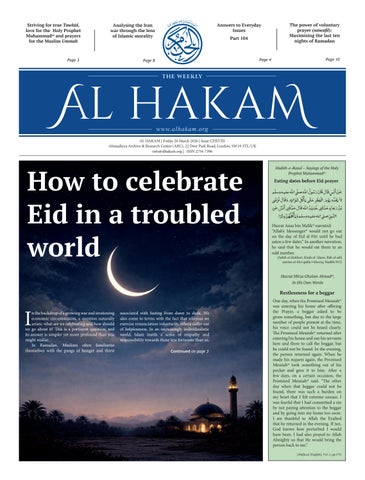
How to celebrate Eid in a troubled world
Hadith-e-Rasul – Sayings of the Holy Prophet Muhammadsa
Eating dates before Eid prayer
� َ َ ََ ْ َ �ٰ � �ٰ ُ َ َ � ال اَن ََر ُُسْول الّٰلِہ ﺻَلى الّٰلِہ ْعَلْیﻪ َوُسَلَّم ﺲﻗ ٍ �ﻋْن أ َ� َ ُ َ َ َ َ َ ُ ْ َ َ� َ ْ ْ َ ْ َ ُ ْ َ َ َ َ َوﻗال ��ﺟى.ات ٍ ��ْل� ﻳْغِدَو ﻳْوم اْل مﻔﻄ مﺮ َحَتى ﻳﺄ�ﻞ ﺗ َ ٌ َ َ َ َ� َ َ َ � ٰ ُ ْ َ ُ َ َ� َ َ َ ُ ْ َّبْن َرﺟا ٍء َحِدﺛ م�� ﻋﺒْیِد الّٰلِہ ﻗال َحِدﺛ م�� أ�ﺲ ﻋ مْن َ� ْ َ ُُْ .اْلَن م� م�� ﺻَلى الّٰلِہ ْعَلْیﻪ َوُسَلَّم ََوﻳَﺄ�َل َُھ �ْن مَوﺗ ًﺮا Hazrat Anas bin Malikra narrated: “Allah’s Messengersa would not go out on the day of Eid al-Fitr until he had eaten a few dates.” In another narration, he said that he would eat them in an odd number. (Sahih al-Bukhari, Kitab al-‘idayn, Bab al-akli yawma al-fitri qabla l-khuruj, Hadith 953)
Hazrat Mirza Ghulam Ahmadas, In His Own Words
Restlessness for a beggar
I
n the backdrop of a growing war and straitening economic circumstances, a question naturally arises: what are we celebrating and how should we go about it? This is a pertinent question, and its answer is simpler yet more profound than you might realise. In Ramadan, Muslims often familiarise themselves with the pangs of hunger and thirst
One day, when the Promised Messiahas was entering his home after offering the Prayer, a beggar asked to be given something, but due to the large number of people present at the time, his voice could not be heard clearly. The Promised Messiahas returned after entering his house and ran his servants here and there to call the beggar, but he could not be found. In the evening, the person returned again. When he made his request again, the Promised Messiahas took something out of his pocket and gave it to him. After a few days, on a certain occasion, the Promised Messiahas said: “The other day when that beggar could not be found, there was such a burden on my heart that I felt extreme unease. I was fearful that I had committed a sin by not paying attention to the beggar and by going into my home too soon. I am thankful to Allah the Exalted that he returned in the evening. If not, God knows how perturbed I would have been. I had also prayed to Allah Almighty so that He would bring the person back to me.”
associated with fasting from dawn to dusk. We also come to terms with the fact that whereas we exercise renunciation voluntarily, others suffer out of helplessness. In an increasingly individualistic world, Islam instils a sense of empathy and responsibility towards those less fortunate than us. Continued on page 3
Continued on page 3
(Malfuzat [English], Vol. 2, pp.173)