Falling in ‘love’: A possible love triangle with Satan?
Algorithms of pride: Kibr in the era of personal branding
Page 4
Page 5
A
MKA Norway hosts Nordic Tournament 2026
Observations of Irfani: A meteor stuns the whole of England (1926)
Page 7
Page 6
THE WEEKLY
www.alhakam.org AL HAKAM | Friday 16 October 2026 | Issue CDXLVIII Ahmadiyya Archive & Research Centre (ARC), 22 Deer Park Road, London, SW19 3TL, UK info@alhakam.org | ISSN 2754-7396
Hadith-e-Rasul – Sayings of the Holy Prophet Muhammadsa
Generosity of the Holy Prophet (sa)
َ َْ ْ َ ّٰ ���ﻋ ِﻦ اﻟ ِﻤ ْﺴ َﻮ ِر ﺑْ ِﻦ �� َﺮ َﻣﺔ ـ رﺿﻰ ا َّ َ َ ْ َ َ َ َ اﻟﻨ ِ� ِّ� ﺻﻠﻰ ﻋﻨﻬﻤﺎ ـ ﻗﺎل ﻗ ِﺪﻣﺖ �ﻠﻰ َ َ َ َ ٌ َ َْ ّٰ �ِ�ا��� �ﻠﻴﻪ وﺳﻠﻢ أﻗ ِﺒﻴﺔ ﻓﻘﺎل �ِ� أ َ َ ْ َ ْ ُ َْ َ �� َﺮ َﻣﺔ اﻧﻄ ِﻠﻖ ﺑِ َﻨﺎ ِإﻟ ْﻴ ِﻪ ﻋ َﺴﻰ أ ْن َ َ َ ََ ً ْ َ َ ْ َ َ ُْ ﺎم أ�ِ� َ�ﻠﻰ ﻳﻌ ِﻄﻴﻨﺎ ِ�ﻨﻬﺎ ﺷﻴﺌﺎ� ﻓﻘ ّٰ ُ َّ َ َ َ َ َ َّ َ َ َ َْ ���اﻟﻨ ِ� ّ� ﺻﻠﻰ ا ﻓ��ف،ﺎب ﻓﺘ�ﻠﻢ ِ اﻟﺒ ُ َّ َ َ َ َ ُ َ ْ َ اﻟﻨ ِ� ّ� ﺻﻠﻰ �ﻠﻴﻪ وﺳﻠﻢ ﺻﻮﺗﻪ ��ﺮج َ ّٰ ُ ٌ َ ُ ََ َ ﺎء َوﻫ َﻮ ا��� �ﻠﻴﻪ وﺳﻠﻢ وﻣﻌﻪ ﻗﺒ َ ُ ُ ُ ُ ْ َ ََ ﺎﺳ َﻨﻪ َوﻫ َﻮ ﻳَﻘﻮل� �ﺧ َﺒﺄت ِ �� ﻳ ُ ِﺮﻳ ِﻪ َ َ َ َ ُ ْ َ َ َ َ َ َ �� ﺧﺒﺄت ﻫﺬا ﻟﻚ،ﻫﺬا ﻟﻚ
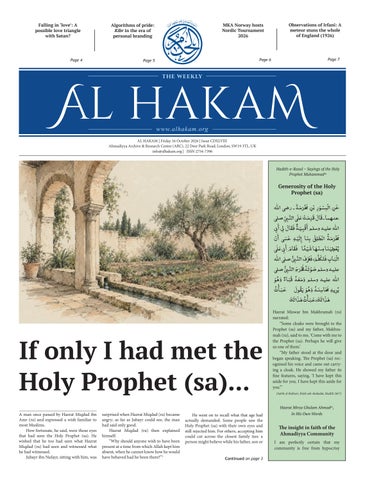
If only I had met the Holy Prophet (sa)...
Hazrat Miswar bin Makhramah (ra) narrated: “Some cloaks were brought to the Prophet (sa) and my father, Makhramah (ra), said to me, ‘Come with me to the Prophet (sa). Perhaps he will give us one of them.’ “My father stood at the door and began speaking. The Prophet (sa) recognised his voice and came out carrying a cloak. He showed my father its fine features, saying, ‘I have kept this aside for you. I have kept this aside for you.’” (Sahih al-Bukhari, Kitab ash-shahadat, Hadith 2657)
Hazrat Mirza Ghulam Ahmadas,
A man once passed by Hazrat Miqdad ibn Amr (ra) and expressed a wish familiar to most Muslims. How fortunate, he said, were those eyes that had seen the Holy Prophet (sa). He wished that he too had seen what Hazrat Miqdad (ra) had seen and witnessed what he had witnessed. Jubayr ibn Nufayr, sitting with him, was
surprised when Hazrat Miqdad (ra) became angry; as far as Jubayr could see, the man had said only good. Hazrat Miqdad (ra) then explained himself: “Why should anyone wish to have been present at a time from which Allah kept him absent, when he cannot know how he would have behaved had he been there?”1
He went on to recall what that age had actually demanded. Some people saw the Holy Prophet (sa) with their own eyes and still rejected him. For others, accepting him could cut across the closest family ties: a person might believe while his father, son or
Continued on page 3
In His Own Words
The insight in faith of the Ahmadiyya Community I am perfectly certain that my community is free from hypocrisy
Friday 16 October 2026 | AL HAKAM
2
This Week in History 16-22 October A glimpse into the rich history of the Ahmadiyya Muslim Jamaat
16 October
18 October
16 October 1903: The Promised Messiah’s (as) book, Tadhkiratush-Shahadatain (The Narrative of Two Martyrdoms), was published on this day.
18 October 1980: On this day, Hazrat Khalifatul Masih III (rh) inaugurated the Southall mission house, UK.
This book comprises two sections – one in Urdu and the other in Arabic – and was written and published in October 1903. The Urdu section gives heart-rending details about how Hazrat Sahibzadah Abdul Latif Shaheed (ra) was charged and stoned to death, while the other portion in Arabic is in three parts, each dealing with important spiritual issues. (Tarikh-e-Ahmadiyyat, Vol. 2, pp. 337-338)
18 October 2013: On this day, Hazrat Khalifatul Masih V (aa) officially opened the Khilafat Centenary Hall, built next to the Baitul Huda Mosque in Sydney, with the keynote address at an inauguration reception. The event was attended by more than 200 non-Muslim dignitaries and guests, including a range of Federal and State Parliamentarians. (‘‘Head of Ahmadiyya Muslim Community Inaugurates ‘Khilafat Centenary Hall’ in Sydney’’ www.pressahmadiyya.com)
16 October 1909: On this day, Hazrat Khalifatul Masih I (ra) delivered an Eid-ul-Fitr sermon in which he spoke about the institution of Khilafat. (Khutbat-e-Nur, pp. 411-422) To read more about the re-establishment of Khilafat, see “The birth of Khilafat-e-Ahmadiyya – Bai‘at at the hand of Hazrat Khalifatul Masih I” at alhakam.org. (22 May 2020, pp. 7-8).
17 October 17 October 1925: On this day, Ahmadi, a Banglalanguage magazine, commenced publication in Kolkata (formerly Calcutta), India, to spread the message of the Jamaat. Initially launched as a monthly, it later transitioned to a fortnightly schedule. Maulvi Ghulam Samdani Sahib served as its first editor, alongside joint editor Maulvi Daulat Ahmad Khan, BA and assistant editor Maulvi Abdul Hafiz Sahib. (Tarikh-e-Ahmadiyyat, Vol. 4, pp. 551-557) 17 October 1975: On this day, the Gambian ambassador to the UK met Hazrat Khalifatul Masih III (rh) in London. (Al Fazl, 5 November 1975, p. 6)
19 October 19 October 1924: Hazrat Musleh-e-Maud (ra) laid the foundation stone of the Fazl Mosque in London on this day. The ceremony was attended by 200 guests. (Tarikh-e-Ahmadiyyat, Vol. 4, p. 456) 19 October 1999: On this day, Hazrat Khalifatul Masih IV (rh) laid the foundation of the Baitul Futuh Mosque in London, UK. (Silsila Ahmadiyya, Vol. 4, p. 900)
20 October 20 October 1891: On this day, the Promised Messiah (as) went to Delhi’s main mosque sitting in a light carriage. There was a large gathering of people chanting slogans against him, so Huzoor (as) had to come back in the protection of a police vehicle because the local clerics incited masses against the Promised Messiah (as) after their complete failure in the field of argument and logic. More than 5,000 people gathered on
that day in the mosque. Hazrat Maulana Abdur Rahim Dard (ra) has recorded the dreadful events of this day in his book, Life of Ahmad.
21 October 21 October 1956: On this day, Hazrat Muslehe-Maud (ra) directed Jamaat members to mark a day to be celebrated annually as Khilafat Day. Hence, 27 May was chosen for this purpose. (Tarikh-e-Ahmadiyyat, Vol. 18, pp. 153-155) 21 February 2003: On this day, Hazrat Khalifatul Masih IV (rh) announced the establishment of a fund for the marriage of underprivileged girls. In his Friday sermon of 28 February, Huzoor (rh) named it the “Maryam Shadi Fund”. (Al Fazl, 25 February 2003, p. 1)
22 October 22 February 1935: On this day, Hazrat Musleh-eMaud (ra) graciously donated 500 rupees towards the fund for the construction of Gurdwara Patna Sahib. The local press lauded this act of generosity. (Tarikh-e-Ahmadiyyat, Vol. 7, p. 281) 22 February 2014: On this day, Hazrat Khalifatul Masih V (aa) addressed the delegates of the European Annual Symposium of the International Association of Ahmadi Architects and Engineers (IAAAE). During his address, Huzoor (aa) congratulated the members of the IAAAE for their continued commitment to selflessly serving humanity. Huzoor (aa) said the Association had now installed or rehabilitated thousands of water pumps in Africa that were providing clean drinking water to thousands of deprived people. ‘‘Report: Hazrat Mirza Masroor Ahmad Addresses Concluding Session of Annual IAAAE Symposium’’ www.pressahmadiyya.com.
AL HAKAM | Friday 16 October 2026 Continued from page 1
and in establishing a bond with me, their understanding has not erred. For in actuality, I am that very person who was destined to be accepted by those possessing insight in faith. God Almighty is a Witness and knows that I am the same truthful, trustworthy and promised one whose advent was foretold by the blessed tongue
Continued from page 1
brother did not. We encounter that history differently. We already know the names. We know who Hazrat Abu Bakr (ra) was. We know who Abu Jahl was. We know how Badr ended, how Mecca was conquered and how Islam spread across Arabia. From fourteen centuries away, the choices can look clearer
3
of our Chief and Master, the Truthful, the Honest, the Holy Prophet, peace and blessings of Allah be upon him. Those who have not forged a relationship with me are deprived of this bounty. Insight is something of a miracle. The word for ‘insight’ is ��ِاَسَت, which can be pronounced ‘farasat’, with the vowel sound ‘a’ denoted by a fathah over the letter ‘f ’; and can also
be read ‘firasat’, with the vowel sound ‘i’ represented by the diacritic kasrah under the letter ‘f ’. With a fathah over the letter ‘f ’, the word farasat means to mount a horse. A true believer mounts the steed of his inner self and tames it like an expert rider. Such a one finds their way by the light granted to them from God. It is for this reason that the Messenger of Allah, peace
and blessings of Allah be upon him, said:
than they must have felt to the people who had to make them. Hazrat Miqdad (ra) was not telling his listener that it was wrong to love the Holy Prophet (sa) or to wish that he had seen him. His warning was against assuming that, had we lived then, we would certainly have recognised the Holy Prophet (sa) and stood by him. That distinction between admiring the
past and answering for ourselves is also reflected in the Holy Quran: “Those were a people that have passed away; for them was what they earned and for you is what you earn.” (Surah al-Baqarah, Ch.2: V.135) The lives of those who came before us can teach and inspire us, but each generation still has to answer for itself.
the promised Mahdi and prayed that Allah might bring him into his presence and enable him to follow and serve him.5 Shah Waliullah Dehlawi (rh) expressed a “great longing” to reach the age of Ruh Allah – Hazrat Isa (as) – and to convey the Holy Prophet’s (sa) salam. If he did not live to see that time, he urged whichever of his descendants or followers reached it to cherish the same desire.6 For them, that promised future was not history yet. They could only hope that they might live to see it. Hazrat Khalifatul Masih V (aa) drew attention to this same longing in his concluding address at the Majlis Khuddamul-Ahmadiyya UK National Ijtema on 27 September 2026. Speaking of the advent of the Promised Messiah and Mahdi (as), Huzoor (aa) said: “During those many centuries of moral decline and especially as the appointed time for the advent of the Messiah and Mahdi drew near, countless pious people fervently prayed and desperately searched for him so that they may accept him and serve his mission. Yet they came and left this world without finding what their hearts yearned for. “Yet we Ahmadis, with the grace of Allah, are those fortunate people who have recognised the one foretold in these prophecies and have pledged our allegiance to him.”7 We Ahmadis live in that era of the Promised Messiah and Mahdi (as) that Muslims of earlier centuries could only await. Huzoor (aa) then turned from this good fortune to what it demands of us: “At the same time, this immeasurable blessing carries a profound responsibility.” (Ibid.) He spoke of giving precedence to faith over worldly matters, fulfilling the rights of Allah and mankind, striving for righteousness and obeying the commands of Allah, His Messenger (sa) and the Promised Messiah (as). So, our test is what we do with that blessing.
A good wish and another question It is entirely understandable that a Muslim should wish to have seen the Holy Prophet (sa). He himself spoke of Muslims who would come long after him and love him with extraordinary intensity: “Among those of my Ummah who love me most intensely will be people who come after me, any one of whom would wish to see me even at the cost of his family and wealth.”2 So the longing itself is not the problem. Reading the lives of the Companions (ra), a person may imagine what it would have been like to hear the Holy Quran directly from the lips of the Holy Prophet (sa), to pray behind him, to sit in his company or to stand beside those who sacrificed everything for Islam. Such thoughts can come from sincere love. But the wish can also carry an assumption: I know what I would have done. Psychologists have long observed a related tendency. Once people know how an event turned out, they can overestimate how obvious or predictable that outcome was beforehand. This is usually called “hindsight bias”.3 Once we know the ending, earlier decisions can appear easier than they were. The people living through the beginning of Islam did not experience it as a completed chapter of history. They had families, friendships, reputations, livelihoods, habits and fears. They had to recognise the truth while ordinary life continued around them. Perhaps, then, instead of asking what I would have done in the past, I should ask myself: How do I respond when faith calls upon me today?
When Muslims looked forward We often look back to the time of the Holy Prophet (sa), yet Muslims before us also looked forward, hoping to reach another blessed age: the era of the Promised Messiah and Mahdi (as). Hazrat Abu Hurairah (ra) once expressed the hope that, if his life were prolonged, he might live to encounter Hazrat Isa ibn Maryam (as). If he died first, he asked that whoever did encounter him convey his salam.4 Centuries later, the renowned Hanafi scholar Mulla Ali al-Qari wrote concerning
َ� ُ ُ ْ َ� َ ْ َ َ َ ُ َ� ِاَسَة ِاَل ُُم ْﺆ َِم ِِن َف ِﺈَّن ُﻪ ْیََّن� ُ� ِِبَّنْوَرِ ِالّٰل ُِہ �ِ� ِاُتﻘْوِا
Meaning, beware of the insight of a believer, for he sees with the light of Allah. Therefore, the greatest proof of the true insight of our community is that they have recognised the light of God. (Malfuzat [English], Vol. 2, p. 200 - 201)
The field is still open The Promised Messiah (as) wrote: “Rejoice and be happy that the field of achieving nearness to God is vacant.”8 The surrounding passage makes clear what such an opportunity demands. The Promised Messiah (as) urges his followers to turn wholly towards Allah, establish His greatness in their hearts and profess His Unity not merely with their tongues but through their conduct. He tells them to Continued on page 5
Friday 16 October 2026 | AL HAKAM
4
Falling in ‘love’: A possible love triangle with Satan?
Syed Taha Anwar Principal, Jamia Ahmadiyya Indonesia
For many young people today, dating is viewed as the natural way to get to know a prospective spouse. Some Ahmadis may therefore wonder whether, because young Ahmadis study and work alongside nonAhmadis, supervised opportunities should be created within the Jamaat for young men and women to meet and explore possible compatibility. They may regard this as preferable to unsupervised relationships outside the Jamaat and may ask whether the Jamaat’s guidance on purdah and its rishta nata system should be reconsidered. Suggestions might include supervised social gatherings, picnics or co-educational Ahmadiyya schools. Before adopting such proposals, however, we should examine the spiritual and practical assumptions behind them.
Affection, attraction and readiness for marriage In many education systems, pupils complete secondary school in their late teens, when they may not yet be ready for marriage. Some pursue higher education; others need time to establish employment. If early social contact develops into a romantic relationship, the couple may remain emotionally involved for years without a clear route to marriage. An engagement can express a serious intention, but it does not make pre-marital intimacy lawful in Islam. Young people can also mistake attraction or desire for durable love. Feelings may change, and a relationship built primarily on physical attraction may not provide
the spiritual, emotional and practical foundations required for marriage. This is why vocabulary matters. The phrase “falling in love” can make every attraction sound natural, harmless and beyond moral scrutiny. Love is not itself sinful, but Islam requires desire to be governed rather than obeyed without limits. What is celebrated as love may at times be infatuation or lust, and following it can lead a person towards sin. The Quran frames worldly desire with balance: “Beautified for men is the love of desired things – women and children, and stored-up heaps of gold and silver, and pastured horses and cattle and crops. That is the provision of the present life; but it is Allah with Whom is an excellent home.” (Surah Al-e-Imran, Ch.3: V.15) The Arabic word hubb ( )حبmeans love. The verse mentions desire for women, children, wealth, horses, cattle and crops. These are not all forbidden; many are blessings when sought and enjoyed within the limits established by Allah. The lesson is that loving something does not make it good for us in every form or circumstance. Even a lawful desire must be pursued in line with the teachings of Islam and the guidance of the Holy Prophet (sa). When desire is detached from those limits, it can become a path towards sin.
When Satan becomes the third Islamic teaching therefore draws boundaries around private intimacy and seclusion before marriage. The Holy Prophet (sa) warned: “Behold! A man is not alone with a woman but the third of them is Satan.” (Jami at-Tirmidhi, Hadith 2165)
This hadith concerns khalwah – seclusion between a man and a woman who may lawfully marry one another. It does not imply that every necessary interaction between men and women is forbidden; Ahmadis may need to study or work together. It does warn against deliberately cultivating private, emotionally intimate relationships outside marriage. If a young man and woman sustain such a relationship for years, secrecy and unchecked desire can gradually weaken the boundaries they intended to maintain. Even if classmates later marry, a permissive culture can create further difficulties. Former attachments can become subjects of gossip, comparison or mistrust. Old messages and private confidences may resurface, placing strain on later marriages. Marriage requires honesty, discretion and respect; communities should not cultivate settings that normalise emotional entanglements with several people before marriage. Moving an interaction online does not automatically remove the risk. Private messages can create secrecy and emotional intimacy even when two people rarely meet. Necessary work or study interactions can instead be kept purposeful, courteous and professional. The same moral principles apply whether the other person is an Ahmadi or a non-Ahmadi.
The promises Ahmadis make The second condition of bai‘at states: “That he/she shall keep away from falsehood, fornication, adultery, trespasses of the eye, debauchery, dissipation, cruelty, dishonesty, mischief and rebellion; and will
not permit himself/herself to be carried away by passions, however strong they might be.” (“Conditions of Initiation (Bai‘at)”, alislam. org, n.d.) This promise does not mean that every feeling is chosen. It means that our conduct should not be governed by passion, however strong the feeling may be. A pre-marital relationship sustained by secrecy and unchecked desire risks allowing passion to direct decisions that should be guided by faith, responsibility and prayer. The pledge of Khuddam includes the following words: “I solemnly pledge that I shall always be ready to sacrifice my life, wealth, time and honour for the sake of my faith, country and nation. Likewise, I shall be ready to offer any sacrifice for guarding the institution of Khilafat-e-Ahmadiyya.” (“Honouring our Pledge: What, Where, When and Why?”, tariqmagazine.org, 2 November 2021) Members of Lajna Imaillah similarly pledge: “I affirm that I shall always be ready to sacrifice my life, property, time and children for the cause of faith and nation. I shall always adhere to truth and shall always be prepared to make every sacrifice for the perpetuation of the Ahmadiyya Khilafat, insha-Allah.” (“Our Pledge”, lajna.org.uk, n.d.) These pledges call Ahmadis to place faith and duty above personal desire. A relationship driven by secrecy or unchecked passion can make sacrifice difficult because decisions begin to revolve around immediate emotional needs. What the Jamaat needs is spiritually mature men and women who can establish trusting homes, raise sincere generations and serve Islam. The guidance of purdah and the rishta nata system should be understood in this light: their purpose is not to deny affection but to help direct it towards dignified, serious and lasting marriage. This does not mean that every proposal made through the Rishta Nata Department will succeed, or that young people should marry without meaningful consultation and informed consent. Compatibility matters. Families and office-bearers should listen respectfully, preserve confidentiality, avoid coercion and give both individuals space to make a free decision within Islamic boundaries. So let us be precise. Not every experience described as “falling in love” is love, and love itself is not sin. The danger lies in allowing attraction to become a secret or unbounded relationship that draws us away from divine guidance. If Satan is allowed to become the third partner, the relationship cannot provide the secure foundation we seek. Love worthy of marriage is expressed through responsibility, patience, sacrifice and obedience to Allah.
AL HAKAM | Friday 16 October 2026 Continued from page 3
abandon rancour, show true compassion towards humankind and pursue every path of goodness, because one does not know through which act one may find acceptance before God. After speaking of this open field, he speaks of trials. He explains that such trials are necessary to show who is truthful in the claim of bai‘at and who is not. The opportunity and the test belong together. Imam al-Ghazali (rh) makes a similar point through the image of a farmer who is blessed with a piece of fertile land. A man who works good soil, sows sound seed, waters it and clears away the weeds can rightly hope for a harvest; one who merely expects a crop without properly tending the field is, he says, not really hoping at all but deceiving himself.9 It is easy to imagine ourselves ready for something dramatic in another century or millennium. The tests before us are often quieter: getting up for prayer when staying in bed would be easier, keeping a promise that could quietly be forgotten, serving when somebody else receives the credit or controlling resentment when we feel wronged. Sometimes it is a matter of giving some of our time, ability or wealth when each feels limited.
5
The same applies to the age in which we live. To have reached the era of the Promised Messiah (as) is itself a blessing, but the opportunity bears fruit only if we respond to it.
The day we were given Imam al-Ghazali (rh) approaches the matter from the scale of a single day. At the beginning of a new day, he tells a person to address his own soul and remember that Allah has granted another day of life. Had death already come, he says, one would have wished to return to the world for just one day in which to do good. So he tells the soul: “Imagine that you have died and then been returned. Take care – take the greatest care – not to waste this day, for every breath is a priceless jewel.”10 We often imagine the day we wish we had been given: If only I had lived then. If only I had seen him. If only I had been among them. Imam al-Ghazali (rh) asks us to imagine the reverse: that today is the day we had begged to be given back. Hazrat Miqdad (ra) could not tell the man before him what he would have done had he lived in another time. None of us can know the answer to that question about ourselves either.
Allah did not place us in seventhcentury Mecca. He placed us here. Here there are prayers to offer. There are promises of bai‘at to honour. There are parents, spouses, children, neighbours and strangers whose rights are due. There are abilities that can be put to use in the service of the Jamaat and humanity. There is a living Khilafat to which we claim attachment. And, in the words of the Promised Messiah (as), the field for attaining nearness to Allah still lies open. Perhaps, then, the wish “If only I had been there” need not disappear. It only needs another question beside it: Now that I am here, what will I do?
Endnotes 1. Al-Bukhari, Al-Adab al-Mufrad, Kitab ri‘ayati l-awlad, Bab al-waladu mabkhalatun majbanatun, Hadith 87. 2. Muslim ibn al-Hajjaj, Sahih Muslim, Hadith 2832. 3. Baruch Fischhoff, “Hindsight ≠ Foresight: The Effect of Outcome Knowledge on Judgment Under Uncertainty”, Journal of Experimental Psychology: Human Perception and Performance, Vol. 1, no. 3 (1975), pp. 288-299; Neal J. Roese and Kathleen D. Vohs, “Hindsight Bias”,
Algorithms of pride: Kibr in the era of personal branding that innocent prompt triggers a dopamine rush, pushing us to compete with others across the globe over who can be the loudest. This isn’t a design flaw or an oversight; it is exactly what these platforms were built to do.
How attention works
Otapo Fareedah Omolara France It is mostly exhausting when you realise that you’ve been acting more like a character
than a real person for the last few hours, watching the notifications pile up. Every social platform asks us the same simple question every single day: “What’s on your mind today?” But before you even realise it,
At their core, social media algorithms are designed to maximise engagement. They do not distinguish whether content is humble, arrogant or performative; their sole metric is keeping users scrolling. Tech platforms operate on what former Google design ethicist Tristan Harris terms the “attention economy.” Because revenue relies on user watch time, algorithms actively favour high-arousal emotions like vanity and outrage over quiet reflection. This mechanism relies heavily on what psychologist BF Skinner identified as “intermittent variable rewards.” Much like a slot machine, social feeds deliver
Perspectives on Psychological Science, Vol. 7, no. 5 (2012), pp. 411-426. 4. Ahmad ibn Hanbal, Musnad Ahmad, ed. Shu‘ayb al-Arna’ut et al. (Mu’assasat al-Risalah, 2001), Vol. 13, Hadith 7978, p. 358. 5. Mulla Ali al-Qari, Al-Mashrab al-Wardi fi Madhhab al-Mahdi, ed. Mahir Adib Habbush, in Majmu‘ Rasa’il al-‘Allama al-Mulla Ali al-Qari (Istanbul: Dar al-Lubab, 2016), Vol. 6, p. 63. 6. Shah Waliullah Dehlawi, “Al-Maqalah al-Wadiyyah fi n-Nasihah wa l-Wasiyyah”, in Majmu‘ah Wasayah Arba‘ah, trans. Muhammad Ayyub Qadiri (Hyderabad, Sindh: Shah Waliullah Academy, 1964), p. 84. 7. Hazrat Mirza Masroor Ahmad (aa), concluding address, Majlis Khuddam-ulAhmadiyya UK National Ijtema, 27 September 2026, MTA International, official YouTube video and English subtitles, approx. 30:39-34:29: www. youtube.com/watch?v=dx7lV2--C9A. 8. Hazrat Mirza Ghulam Ahmad (as), AlWasiyyat, in Ruhani Khazain, Vol. 20, pp. 308-309; official English translation, The Will– Al-Wasiyyat (Farnham: Islam International Publications Ltd, 2023; repr. 2024), p. 11. 9. Abu Hamid al-Ghazali, Ihya’ Ulum al-Din (Beirut: Dar al-Ma‘rifa, n.d.), Vol. 4, p. 143. 10. Ibid., pp. 394-395. (Aqeel Kang, Al Hakam)
unpredictable hits of validation through likes and comments, spiking dopamine far more than predictable rewards and conditioning users to compulsively check for feedback. A 2021 study published in Science Advances confirmed this dynamic, demonstrating how social media feedback loops systematically train users to amplify moral outrage over time. What sociologist Erving Goffman described as “impression management” – performing a curated self for an audience – becomes codified into daily behaviour. We begin posting not merely to state a truth, but to signal status to our peers. You do not need to be inherently vain to act vain online; the feedback loop conditions the behaviour. This structural reality shifts how we understand moral responsibility. Traditionally, warnings against kibr (arrogance) and riya’ (showing off) targeted internal spiritual states. Today, those warnings also apply to digital systems engineered to exploit human weaknesses at scale. Islamic ethical teachings consider kibr among the most serious heart ailments. The Messenger (sa) of Allah said: “No one will enter Paradise who has even a mustardseed’s weight of arrogance in his heart and no one will enter Hell who has even a mustard-seed’s weight of faith in his heart.” (Sunan Ibn Majah, Vol.1, Book 1, Hadith 59) It is not that enjoying beauty is evil, but that arrogance distorts one’s relationship
Friday 16 October 2026 | AL HAKAM
6
with truth. In a narration by Abdullah ibn Mas‘ud (ra), the Prophet Muhammad (sa) stated that anyone with even a speck of arrogance in their heart would not enter Paradise. When asked if enjoying fine clothes or footwear constituted arrogance, the Prophet explained that Allah is beautiful and loves beauty, defining arrogance specifically as rejecting the truth and looking down on others (Riyad as-Salihin, Introduction, Hadith 611). Kibr is not about visual presentation; it is about self-exaltation and immunity to correction. This distinction is crucial for modern creators. Producing high-quality work, photography or writing does not inherently constitute kibr. Traditional ethics do not demand mediocrity or selfeffacement. Instead, they demand internal accountability: evaluating whether a creator has begun feeling superior to others, refusing criticism or manufacturing outrage purely to drive metrics. Riya’ represents a parallel spiritual hazard. It occurs when the intention behind an act shifts toward a desire for public recognition. The Prophet (sa) expressed fear over “minor shirk”, defining it explicitly as riya’, which means performing good deeds to seek human praise. He warned that on Judgment Day, such individuals would be instructed to seek their reward from the audiences they performed for, as no reward remains with God. Hazrat Mahmud bin Labid (ra) narrated that the Messenger (sa) of Allah said: “The thing I fear most for you is the lesser shirk (polytheism), showing off (of good deeds).” (Bulugh-ul-Maram, Book 16, Hadith 1527) Digital feeds operate on this exact dynamic. Sharing reflections or grief is not inherently riya’. It becomes riya’ when visibility becomes the primary motivation. The algorithm acts as a continuous observer, measuring and rewarding performances optimised for public consumption.
Living publicly without living for the public None of this is an argument for just
disappearing. The scholars who warned most strongly against riya’ were often teachers, preachers and public figures themselves, people whose work required them to be visible. The danger was never about being seen. The danger was needing to be seen, structuring the act itself around the audience’s gaze rather than genuine sincerity, until that gaze became the foundation everything rested on. A few honest questions can act like a spiritual check-up for anyone who creates, teaches or writes publicly, whether they have thousands of followers or just a small group of readers: Would this post still feel worth making if it got zero engagement? When your work gets criticised, does it feel like useful information or like a personal attack? These are not questions an algorithm can answer, because algorithms don’t have access to intentions, only outcomes. And it’s in that gap that a believer’s private accountability to God has to do the work that public metrics can’t. Performative outrage, in particular, has a way of disguising itself as righteous concern, but structurally, it works a lot like riya‘: it’s the appearance of moral seriousness, put on for an audience and adjusted based on what will get praised, not necessarily on what’s true or important to say. Genuine concern doesn’t need a spectacle to be real. And a tradition that saw private charity, given so quietly that, as the Prophet (sa) said, the left hand wouldn’t know what the right hand gave as a spiritual pinnacle (Bulugh-ul-Maram, Book 4, Hadith 652), has very little patience for outrage that exists mainly to be witnessed. Algorithms reward loudness because loudness is something a machine can easily understand; sincerity isn’t understandable by the machine. That imbalance isn’t going away and these platforms aren’t suddenly going to start prioritising humility. What’s still available to a believer is the older practice the tradition has always encouraged: to build, to write, to teach, to create visibly, even beautifully, while keeping the real transaction private, between yourself and God, no matter who else happens to be watching.
3 etiquettes of the recitation of the Holy Quran Read the full article at: www.alhakam.org
NEWS MKA Norway hosts Nordic Tournament 2026 Abdul Hadi Masood Missionary, Norway On 11-13 September 2026, Majlis Khuddam-ul-Ahmadiyya Norway hosted the annual Nordic Tournament, with teams participating from Finland, Denmark, Sweden and Norway. The tournament is held every year in a different Nordic country and this year MKA Norway had the responsibility of hosting the other three countries. The tournament began on Friday with
the opening session at the Baitun Nasr Mosque. During the opening session, Missionary-In-Charge Norway, Musawer Ahmad Shahid Sahib, delivered an address in which he emphasised the importance of strength, unity and brotherhood. He also explained the purpose behind organising sporting tournaments within the Jamaat. Following the opening session, the first competition was Padel, which was held at Nordic Padel Økern. A total of 32 players took part, divided into 16 teams.
On Saturday, the tournament continued at Vallhall Arena, where both football and cricket competitions were held. After a full day of competitions, Saturday concluded with dinner. On Sunday, the teams gathered at Slorahallen for the final day of the tournament. The competitions included volleyball and tug of war. The volleyball tournament consisted of eight teams, with two teams representing each of the four Nordic countries. After the competitions, the final session
was held at the Baitun Nasr Mosque and was presided over by Zahoor Ahmad Chaudhry Sahib, Amir Jamaat Norway. In his address, he highlighted the purpose of organising sporting tournaments and reminded the participants that there is more to take away from such events than simply the results of the competitions. Across the three days, a total of 135 khuddam registered for the tournament, of whom 103 participated in the sporting competitions.
AL HAKAM | Friday 16 October 2026
7
ago...
100 years
Observations of Irfani: A meteor stuns the whole of England (1926) Hazrat Sheikh Yaqub Ali Irfani (ra) (1875-1957)
Suicide and its causes Cases of suicide are becoming increasingly common here and the causes vary. In most instances, they arise from failure in conjugal relationships, financial disappointments and the prolonged effects of illness. I have studied these circumstances and discussed their causes and consequences with learned individuals here. Although such incidents may appear trivial on the surface, they are, in reality, driven by the forces of cowardice and despair. This is the consequence of a lack of faith in God Almighty. There is no doubt that the law prohibits suicide and classifies it as a criminal offence. However, those who commit it are not deterred by the prospect of legal punishment. They know that their ultimate objective is to end their lives and that, after death, no law of this world can have any effect upon them. Sometimes, matters proceed only as far as an attempted suicide. In such cases, the outcome of legal proceedings is often a ruling that the individual was suffering from a temporary mental disturbance, following which they are sent to an institution where they can receive treatment. Such is the state of affairs. The learned individuals with whom I have discussed this matter have acknowledged that, in reality, despair and cowardice are the underlying causes of suicide. Both these afflictions can be overcome only through faith in the hidden powers of God Almighty.
Islam’s teaching on the sanctity of human life Islam was the first to teach the world that a human being does not possess such an absolute right over their own person as to be entitled to destroy it. Even when a person takes their own life, they are to be regarded as a murderer. Rather, they have certain duties and responsibilities towards the preservation and continuance of their own life, as expressed in the principle: “Your own self has a right over you.” [Sunan Abi Dawud, Hadith 1369] Moreover, among the various forms of human excellence and moral virtue, there are some that cannot manifest themselves unless a person confronts different kinds of hardship and suffering. Difficulties are essential to the cultivation of courage, high resolve and steadfastness, which are common moral virtues.
Those who idolise Western philosophy consider climbing to the summits of mountains an easy undertaking. Plunging into the sea or risking their own lives to rescue others from raging flames may, at times, seem perfectly easy to them. Yet they may find themselves unable to confront an ordinary difficulty that arises in their lives. The former acts are sometimes the result of sheer recklessness, whereas the latter inability stems from a deficiency of faith.
The decline of faith and the need for divine guidance As faith in the existence of God Almighty diminishes day by day, incidents of this kind continue to increase. I read accounts of these suicides and the proceedings of the courts of inquiry investigating them and I sit with my head in my hands, deeply distressed by the extent to which these people stand in need of our help. We believe in God Almighty and worship a living God. We have witnessed His fresh and continuing signs, yet we have been unable to convey this glad tidings to these people. They possess an inner yearning and may turn towards the truth with sincere longing, but we lack the necessary resources.
The need for literature on the existence of God During these days, I have been corresponding with a Jewish couple. Neither of them believes in the existence of God
Almighty. I am endeavouring to help them find the right path, but we have no substantial body of literature devoted specifically to this subject that we can place in the hands of people such as them. Will any learned and capable writer take up this subject and write about it in English? If nothing else, a booklet could be prepared by translating, in an expanded form, Hazrat Khalifatul Masih II’s [ra] essay on the existence of God Almighty. Would some friend come forward to have it published?
The opening of the Fazl Mosque The time is approaching when the mosque whose foundation was laid by Hazrat Khalifatul Masih II [ra] on 19 October 1924, at four o’clock in the afternoon, will soon be opened. The exact date of the opening has not yet been fixed. It is expected to take place on the anticipated date, or at least by the time this article is published. Among the countless favours bestowed by Allah the Almighty upon Irfani is the blessing that he was present when the foundation of the mosque was laid. When excavation work began, Allah the Almighty also granted this humble one the honour and privilege of participating personally in the work. It had been expected that the mosque would be completed and opened by May [1926]. However, strikes and seasonal holidays delayed its completion until July [1926]. Despite my financial difficulties, I did not abandon my resolve, for I had been
granted the opportunity solely through the grace of Allah the Almighty and I was determined not to forgo it. I remain hopeful of His mercy that I shall be able to attend the opening ceremony.
A manifest sign of Divine grace By the grace of Allah the Almighty, this mosque is one of His magnificent signs. I am fully aware of the circumstances in which its construction began. At the time, the financial difficulties surrounding the project were immense and there appeared to be no means by which its construction could be undertaken. Yet Allah the Almighty brought about the necessary arrangements from the unseen, in such a manner that only those of us present here can fully appreciate this manifestation of His power. Our opponents left no stone unturned in employing whatever means they could to obstruct the construction of this mosque. When some people questioned one of them about it, they dismissed the matter by claiming that no mosque was being built and that the reports were merely publicity. Others referred to some imaginary or illusory mosque, claiming that construction was taking place there. Despite all these circumstances, the construction of the mosque continued and the calls of Allahu Akbar resounded from the site.
The honour of giving the first call to prayer Irfani wishes to be the first to give the call to prayer at the mosque. However, I understand that, following a request or suggestion from our respected Malik Ghulam Farid Sahib [ra], permission has been granted to him to deliver the first azan and Hazrat Khalifatul Masih II [ra] has expressed the wish that Irfani should proclaim the first takbir. I appreciate every gesture of my master and cherish every instruction he gives. Should I be granted this privilege, I shall cherish it throughout my life and my children shall continue to take pride in it even after my death.
The carpeted floor We also needed carpeting for the floor of the mosque. Readers of Al Fazl will know that Allah the Almighty granted Khan Bahadur Seith Ahmad Alauddin Sahib the distinction of providing the carpet for the very first mosque in this centre of materialism. The carpet has now been laid in the mosque. Whenever we behold this beautiful flooring, our hearts spontaneously
Friday 16 October 2026 | AL HAKAM
8
Sahib. He left behind a son so capable and devoted to the service of the Jamaat. May Allah Almighty bestow similar blessings upon his other children and upon my own children as well, amin.
A striking manifestation of the blessed influence of Hazrat Khalifatul Masih
offer prayers for Seith Ahmad Sahib. Every prostration performed upon this carpet, as worshippers bow before [the Divine threshold in the Ahmadiyya mosque], will surely bring its share of reward to Seith Sahib as well. Insha-Allah, Irfani, who initiated this undertaking and the friends who helped bring it to fruition, Seith Ibrahim Bhai and Abdullah Bhai, will also receive their share of the reward.
The arrangements needed to maintain the mosque It is impossible to convey the extent of our anxieties concerning the opening of the mosque. We were fully conscious of our own inadequacy and weakness, yet we remained confident that Allah the Almighty would, through His unseen means, bring about the necessary arrangements. My friends often describe me as a man given to making proposals. I regard such appellations as an honour, for many of the proposals for which I laid the initial groundwork eventually culminated in the construction of buildings. I have therefore never been afraid to put forward proposals. In my view, a person is needed on a permanent basis to maintain the mosque, ensure its cleanliness and attend to its other requirements. This individual should also serve as the muezzin [a person who makes the call to prayer] and keep the mosque in good order. Someone should always be available to receive visitors, provide them with information about the mosque and, while doing so, convey the message of the Jamaat. This is not a responsibility ordinarily assigned to missionaries, but one of them would have to devote himself exclusively to this task. People visit the mosque to see it and the need for such an arrangement is undeniable. On the other hand, the Jamaat’s growing expenditure may not permit it to bear the additional cost of employing another person. In any case, this expense would
amount to no less than fifteen hundred to two thousand [rupees] annually. I therefore appeal to the readers to pray that Allah the Almighty may create the necessary means for this purpose.
Congratulations to the Jamaat and tribute to Maulana Abdur Rahim Dard From England, I extend my congratulations to the Jamaat on the successful completion of this magnificent undertaking. It would be unjust, however, not to acknowledge the tireless efforts and laborious work of Maulana Dard [ra]. I have witnessed how he has devoted himself almost to the point of becoming consumed by the construction of this mosque. He has experienced, in practice, the taste of the following couplet of the Promised Messiah (as):
اتہندویاہندشموہشایندمہبرسم اےونجںرگدوترگدمہکہچااسحنرکدی “Until I became consumed by madness, the truth was not revealed to me. O Madness! May I be sacrificed for thee! What a tremendous favour thou hast bestowed upon me.” Dard Sahib [ra] is indeed fortunate in a manner worthy of envy – not that I envy him, for Allah the Almighty granted me a share in this blessed undertaking and the opportunity to participate in it. The construction of the mosque was accomplished through his efforts and this was achieved at a time when clouds of financial difficulty hung overhead. I had already savoured the fragrance of this success on the very day Hazrat Khalifatul Masih II [ra], with his own hands, handed Dard Sahib [ra] the key. I regard his success with immense joy. I also pray for the elevation of the spiritual station of my beloved, dear friend and brother, the late Master Qadir Bakhsh
Those who claim that places and times possess no special influence or spiritual attraction are foolish. Allah the Almighty has declared Safa and Marwah to be among His signs. The blessings and spiritual benefits of Mecca and Medina have not diminished. If we fail to make use of our own capacities, the deficiency lies with us. The blessings of Qadian are not confined to Qadian alone. I have personally experienced the blessed and holy influences here in London as well and Dard Sahib [ra] has expressed this very sentiment in one of his sermons. Hazrat Khalifatul Masih II [ra] arrived here in late August and remained until late October. The extent of the Jamaat’s efforts in tabligh and spreading the message of Islam during those days and the degree to which Huzoor [ra] and his companions were occupied in these endeavours, are beyond the descriptive power of even the most gifted writer. A remarkable consequence of this blessed influence is that, even now, events continue to occur during this same period that generate particular circumstances and sentiments conducive to the tabligh and spread of the Jamaat’s message. In 1924, Hazrat Khalifatul Masih II [ra] himself was present here. During the corresponding period in 1925, the incidents involving the Star newspaper’s cartoons, among other instances, took place and construction of the mosque commenced. In the same period of 1926, there is tremendous enthusiasm for the mosque’s inauguration, while circumstances conducive to the Jamaat’s spread are arising almost of their own accord. I would describe these developments in detail were it not for the fact that some people might exploit the information for improper purposes. I shall therefore content myself with these observations. My personal experience of the past three years is that exceptionally encouraging work took place here during this period. As for the future, my conviction has now become firm and complete. Allah the Almighty has enabled us to undertake and complete the construction of the mosque.
A remarkable coincidence Readers of Al Fazl will recall that when the proposal to construct this mosque was first put forward, probably in [1920], Hazrat Khalifatul Masih II [ra] was staying in the hills of Dalhousie. I was in Hyderabad at the time, but my respected brother, Abdul Rahman Sahib, wrote to me describing the proceedings of that gathering, which was apparently held at Dainkund. A poetry recital had been organised on the occasion, devoted to the construction of the mosque. I request the editor of Al Fazl to publish those poems again, for they have now proved to be a prophecy fulfilled. Hazrat Khalifatul Masih II [ra] had asked everyone present to contribute something in verse. Now, as the mosque has been
constructed and is about to open, Hazrat Khalifatul Masih II [ra] is once again staying in Dalhousie. What was then seemingly no more than a dream is now being realised. All praise belongs to Allah for this! By the grace of Allah the Almighty, we are all alive to witness its fulfilment. All praise belongs to Him once again for this blessing.
A magnificent meteor In recounting the early days of his divine mission, the Promised Messiah (as) wrote that numerous stars had fallen from the sky during that period. If I am not mistaken, he discussed this phenomenon in considerable detail in Aina-e-Kamalat-e-Islam [The Mirror of the Excellences of Islam]. I was only a child at the time, but I witnessed this spectacle in the sky while I was conscious enough to remember it. I distinctly recall that everyone in our household was saying that the Imam Mahdi would now appear. It was not merely my family; people in general were saying the same thing. In short, the Promised Messiah (as) identified meteors as precursors to certain momentous events. Although they occur according to natural causes and circumstances, the divine practice is such that they may be appointed as signs preceding certain great events.
A meteor stuns the whole of England During the night between Monday, 6 and 7 September 1926, at approximately 9:45 pm, a magnificent meteor streaked across the sky, leaving the whole of England astonished. The Daily Express, in its issue dated 8 September [1926], reported: “The whole of England is engaged in discussing the mystery of the luminous phenomenon that traversed the country on Monday night at 9:45 pm, passing from northern Yorkshire to South London.” The phenomenon appeared in various colours, generally red, white, green and blue. Its dazzling light persisted for several seconds. In the northern region, it was accompanied by a tremendous sound that frightened people and caused certain buildings to shake. Various opinions and theories were put forward concerning the phenomenon. However, Sir Frank Dyson, the Astronomer Royal and other experts stated that a very large meteor had fallen.
Anticipating a great religious transformation In any case, a more detailed account of this event may be given later, should the need arise. What is certain is that a very large meteor streaked across the sky. In connection with this phenomenon, it appears that, insha-Allah, a great religious transformation is about to take place in England, one that will prove blessed for us. Thousands of souls are quietly preparing themselves within. The tablets of their hearts have been cleansed through the influence of devotion. The imprint of Islam can now be engraved upon them with the greatest ease, provided that the sons of Islam unite their efforts for this purpose. (Translated by Al Hakam from the original Urdu, published in the 8 October 1926 issue of Al Fazl)
AL HAKAM | Friday 16 October 2026
9
Friday Sermon Mubarak Mosque, Islamabad, UK
18 September 2026
The Prophet’s (sa) unwavering trust in Allah After reciting the tashahhud, ta‘awwuz and Surah al-Fatihah, Hazrat Khalifatul Masih V (aa) stated:
In the previous sermon, whilst mentioning the Holy Prophet’s (sa) trust in Allah the Almighty, I related accounts with regard to his migration from Mecca. There are some further details relating to this journey as well. They are recorded in history, and they reveal yet another magnificent aspect of the Holy Prophet’s (sa) trust in Allah. It is narrated that on the occasion of this migration, Suraqah bin Malik intended to pursue the Holy Prophet (sa) out of greed for the [promised] reward. Suraqah bin Malik later became a Muslim, and after accepting Islam, he himself related this incident. He says, “The messengers of the disbelievers of Quraish came to us. They had fixed a blood-money for the person who would kill or capture the Holy Prophet (sa) and Hazrat Abu Bakr (ra).” Suraqah says: “I was sitting in a gathering of my
people, the Banu Mudlij, when someone came to us. He stood in front of us whilst we were all sat, and he said, ‘O Suraqah! I have just seen some shadows from the coast of the sea’, or he said, ‘I have seen a caravan consisting of three people, and I believe that it is Muhammad [sa] and his companion.’” Suraqah bin Malik says: “I knew that it must be the caravan of Muhammad (sa), but I did not want anyone else to share the bounty with me. As such, I immediately took control of the delicate situation and signalled with my eye to the person who brought this news to remain quiet, and I said, ‘No, it cannot be the caravan of Muhammad (sa). In fact, the people you are referring to have just passed in front of us and belong to such and such tribe, who are searching for their lost camels.’” Suraqah says: “I remained in the
gathering for some time so that no one would become suspicious. I then told one of my maids to take my swift horse and stand with it at a particular place behind the house and wait for me.” He also arrived there after some time and further relates: “I cast lots, which turned out to be against this journey. However, I showed no concern, urged on my horse and swiftly set off. I pursued the caravan at great speed, as I believed that it was indeed the caravan of Muhammad (sa).” Suraqah says: “Covering one stage after another, I soon drew close to the caravan. When I was only a short distance away, my horse stumbled in an unusual manner, causing me to fall from it. I then got back up and cast lots again, and once again, it turned out against my intention. However, I was determined to take Muhammad (sa) back with me and obtain the reward of 100 she-
camels. I got up and mounted my horse, and this time, I had reached so close that I had not only recognised that it was Muhammad (sa) and Abu Bakr (ra), but I could also hear Muhammad (sa) reciting the Holy Quran. He was not looking around, whereas Hazrat Abu Bakr (ra) would frequently turn around and look behind him.” Hazrat Abu Bakr (ra) was most probably looking around in all directions to protect the Holy Prophet (sa). He further relates: “Just then, my horse stumbled again and its legs became stuck in the sand, causing me to fall from it. “I then rebuked the horse and stood up. She was unable to pull her legs out of the ground. Finally, when she stood upright, dust rose from both her legs and spread through the air like smoke. I then cast lots with the arrows once again, and the result was the same one that I disliked.
Friday 16 October 2026 | AL HAKAM
10
“I called out from there, assuring safety and protection, and said, ‘No harm will come to you from my side.’ Upon this, the Holy Prophet (sa) said to Hazrat Abu Bakr (ra), ‘Ask him what he wants.’ I replied, ‘I am Suraqah, and I wish to speak with you.’ Upon this, they stopped.” Suraqah began to explain that the people of Mecca had offered a reward of 100 camels for capturing them, dead or alive, and that it was this temptation that had led him to pursue them. However, after what had happened to him, he had become convinced that pursuing them was not the right course. He also offered the Holy Prophet (sa) provisions and other supplies for the journey (saying that they might take whatever food and other necessities they needed). However, the Holy Prophet (sa) did not accept them. He simply said, “Do not tell anyone about us.” Suraqah promised to do so, and also said, “I am certain that you will one day attain kingship. Give me a written pledge that when I come to you at that time, I will be treated with honour and respect.” According to some narrations, he requested a written guarantee of safety. Accordingly, at the command of the Holy Prophet (sa), Hazrat Abu Bakr (ra) wrote it for him, while according to another narration, it was written by Amir bin Fuhairah. Suraqah took the document and returned. (Sahih al-Bukhari, Kitab manaqibi l-ansar, Hadith 3906; Subul al-Huda wa al-Rashad, Vol. 3, Dar Al-Kotob Al-Ilmiyah, Beirut, 1993, p. 248; Muhammad Rasool Allah Walazeena Ma’ahu, Vol. 3, Maktabah Misr, pp. 64-65) This was the degree of the Holy Prophet’s (sa) trust in God. He had no fear whatsoever and continued on his journey while reciting the word of Allah. His conviction was so strong that he knew nothing could befall him. Thus, when Suraqah asked him to give him a written guarantee of safety, he granted it to him. Suraqah had the thought that the Holy Prophet (sa) would ultimately achieve victory, while the Holy Prophet (sa) himself had even greater certainty that victory would indeed be his. That is why he even gave him the written guarantee of safety. According to another narration, as he was returning, the Holy Prophet (sa) addressed him and said, “Suraqah, what will your condition be when the bangles of Chosroes will be on your hands?” Suraqah turned back in astonishment and asked, “Chosroes, son of Hormuz?” He said, “Yes, that very Chosroes, son of Hormuz.” Thus, when the bangles of Chosroes, along with his crown and girdle, were brought during the Khilafat of Hazrat Umar (ra), Hazrat Umar (ra) called Suraqah and said, “Raise your hands.” He then placed those bangles on his hands and said, “Say: ‘All praise belongs to Allah, Who has taken these two from Chosroes, son of Hormuz, and granted them to us.’” (Muhammad Rasulullah Wallazina Ma‘ahu, Abdul Hameed, Vol. 3, Maktabah Misr, p. 65) Hazrat Musleh-e-Maud (ra) has also related the incident of this journey in his own words. He says: “The event of the migration was an extraordinary and terrifying one. All of Arabia was opposed to the Holy Prophet (sa) and thirsty for his blood, yet the Holy Prophet (sa) set out for Madinah with only one companion. “All along the route lived such tribes
who, because of their opposition to his religion, were constantly seeking to kill him. They had remained silent only out of fear of the Quraish. But now the time had come when the Quraish themselves were intent upon killing the Holy Prophet (sa), and all the tribes of Arabia were reassured that if they killed this man, there would be no reason for the Quraish to be displeased with them. “Not only was there no longer any fear of opposition from the Quraish, but the Quraish, upon finding that the Holy Prophet (sa) had left Mecca, had announced a reward for his capture and informed all the tribes settled along the route to Medina that whoever brought the Holy Prophet (sa) and Hazrat Abu Bakr (ra), dead or alive, would receive a reward of 100 camels for each of them. “The Arab tribes, whose very lives revolved around plunder and who were already burning with the fire of jealousy, could hardly let such an opportunity slip away. The search for the Holy Prophet (sa) began everywhere. It was as though with every step he took, there was the fear that he might encounter some bloodthirsty enemy. “On such occasions, it has often been observed that even the bravest of people lose heart and become incapable of making their final effort. Even if there is an exceptionally courageous and strong-hearted person, fear can nevertheless become so overwhelming (i.e. overpowering) that it manifests itself in every movement.” Hazrat Musleh-e-Maud (ra) further writes, “I have read the accounts of those who displayed great courage and bravery in history, but their condition in circumstances such as these cannot even be compared with the incident of the Holy Prophet (sa). “Historians know what happened to Napoleon as he fled and what clear signs of anguish were visible upon his face. They also know how Humayun, who was the king of India, repeatedly became ready to surrender himself into the hands of his enemies, and had there not been several exceptionally loyal generals with him, he might perhaps even have done so. “Likewise, many other great and courageous generals have passed through history who faced difficult times. When the enemy surrounded them on all sides in search of them, they became frightened. “But the Holy Prophet (sa) was not like these worldly people. His gaze was not fixed upon the world; rather, his eyes were raised towards God. Worldly means were not before him. He did not think, ‘What can I do at such a time, all alone with only one companion? If the enemy comes upon us on this dangerous route, what resources do I have with which to confront them?’ “Rather, he saw that God was with him – the God Who had always protected His righteous servants, and against Whose decree no enemy could prevail. “That God was the God of Noah (as), the God of Abraham (as), the God of Moses (as), the God of Jonah (as), the God of Job (as), the God of David (as), the God of Solomon (as) and the God of the Messiah (as). He was the same God Who was his God. His powers never diminish, nor is He ever heedless even for a moment. “Suraqah bin Jusham, driven to madness by greed and enmity, came upon them and, seeing the Holy Prophet (sa) from a distance,
spurred his horse towards him. “Hope surged through his heart like a river. He not only wished to satisfy his burning heart by staining his hands with the blood of the one whom he considered to have insulted his religion, but he also hoped to receive the reward of 200 camels (100 camels for the Holy Prophet (sa) and 100 for Hazrat Abu Bakr (ra). He said 200 camels, but in the other narration, it was 100, i.e., 100 for each. This would be sufficient to raise him to a position of great honour among his people. “His courage was further heightened. Just as a hunter rushes towards his prey upon sighting it, he rushed towards the Holy Prophet (sa). With a bow and arrow in his hands, he intended to strike him. “He was not alone in the sense that he could have summoned thousands of men around him with a single cry. (Had he called out, people from the surrounding tribes might have come to his aid.) “Because the Holy Prophet (sa) was passing through his region at the time. But what does the Holy Prophet (sa) do at that moment? Does he flee? Does he become frightened and surrender himself to him? Do his legs begin to shake? Do his senses fail him? Does he intend to kill him and then flee from the scene? (He was so close and was alone, that the Holy Prophet [sa] could have shot an arrow and killed him.) No – that man who placed his complete trust in God did not do a single one of these things, nor did he show Suraqah even as much concern as one would show towards a bull. Despite Hazrat Abu Bakr’s (ra) courage and bravery, despite the faith and conviction he possessed, and despite the trust and reliance upon Allah that was found in him, he kept looking back repeatedly to see how close Suraqah had now come to them. But the Holy Prophet (sa) did not pay him any attention whatsoever. Far be it from him to become frightened or run away, or even show any sign of fear or alarm; he did not turn his face towards him even once. This left Suraqah utterly astonished and opened his eyes to the kind of man he was pursuing. He could never erase this sight from his memory for the rest of his life. “Rather, this extraordinary incident made such an impression upon his heart that he would always recount it. He would say, ‘I continued riding my horse until I came so close to the Holy Prophet (sa) that I could hear the Holy Prophet (sa) reciting the Quran, and I saw that the Holy Prophet (sa) did not look to his right or left at all. But Hazrat Abu Bakr (ra) kept looking back repeatedly.’ Allah be praised! What extraordinary trust in God Almighty! The enemy had ridden his horse so close that his voice could reach the Holy Prophet (sa), and he had come within range of an arrow. Yet the Holy Prophet (sa) remained completely composed. Far from showing any sign of fear or alarm, he continued reciting the Holy Quran. Meanwhile, Hazrat Abu Bakr (ra) repeatedly looked back to see how close the enemy had now come. Can any other example of such complete reliance and trust be found? Is there any human being who, at such a dangerous moment, displayed such complete indifference and disregard? If the Holy Prophet (sa) had even considered making use of worldly means, then at the very least, he should have either attempted to attack Suraqah at that moment, or tried
to move away from there as quickly as possible. But he adopted neither of these two options. He neither increased his pace nor intended to somehow kill Suraqah; rather, with complete tranquillity and without showing the slightest fear or alarm, he continued on at his original pace whilst reciting the Holy Quran. What was it that strengthened his heart so greatly at that moment? What power raised his courage to such heights? What spirit brought about such extraordinary life within him? These were the miracles of placing one’s trust in God – these were the results of relying upon Him. He knew that worldly means could not harm him. The powers of the world could not destroy him, because there was a God in heaven Who was watching him, and Who was the Creator of all these means. Thus, the worldly means cannot prevail against the Creator of those very means. This trust was not wasted; rather, God fulfilled it, and Suraqah – who had come out of greed for the reward of 200 camels – asked the Holy Prophet (sa) for forgiveness and turned back. And Allah cast such awe into his heart that he realised that his safest option was to quietly return home. He even caused the other pursuers to turn back. This is the kind of trust in God that cannot exist within a liar, and cannot be housed within a deceitful heart. This is a level of trust for which no parallel can be found in the world. “An example of this kind of reliance is also found on one occasion regarding Prophet Moses (as), but that example is far inferior to this one. The reason is that when the companions of Prophet Moses (as) saw the people of Pharaoh, they said:
َ� ُ ِِاَّنا َل َ ُُم ْْد ََرُکْوْ ََن
“‘We shall surely be overtaken.’ Upon this, Prophet Moses (as) replied:
َ ِِا �َّن ََم ِِعَیَ ََرِّب ّ� ْْی ََس ََی ْْھ ِِدْیْ ِِن
“[‘My Lord is with me. He will direct me aright.’] “However, the trust of the Holy Prophet (sa) was so complete and perfect that it also had an effect upon his companion, and Hazrat Abu Bakr (ra) – unlike the companions of Prophet Moses (as) – did not become frightened and say, ‘Surely, we shall be captured.’ Rather, even while sitting inside the cave, he said that if they looked down, they would be able to see them. This faith was the result of the light of prophethood that was being cast upon his heart at that time. Furthermore, Prophet Moses (as) had an army with him, and there was certainly a place ahead to which they could flee. But the Holy Prophet (sa) had neither a group of people with him nor any other route ahead of him.” (Sirat-un-Nabi, Anwar-ul-Ulum, Vol. 1, pp. 491-496) Thus, such was the lofty rank of his reliance upon Allah. It is essential to make proper use of every available means, and then place one’s trust in Allah the Almighty. While speaking of the Holy Prophet’s (sa) trust in God, Hazrat Musleh-e-Maud (ra) explained this principle as follows: “A person who truly believes in Allah, and who is equally convinced that God has created him for a particular purpose, can never abandon effort. On the contrary, such a person will be the most active of all in making efforts [...] “The actions of the Holy Prophet
AL HAKAM | Friday 16 October 2026 Muhammad (sa) were rooted in his faith. A person who believes that there is a God, and that God has created him for a particular purpose, will naturally strive to fulfil that purpose. Observe how, in the Cave of Thaur, the Holy Prophet (sa) reassures Hazrat Abu Bakr (ra), saying, ‘Abu Bakr, do not fear; God is with us, and He is our Protector.’ Yet at the same time, in every other matter connected with the faith, he laboured day and night with such intensity that it seemed as though the affairs of the whole world had been placed upon his shoulders. “Thus, on the one hand, he possessed absolute certainty that God exists and helps His servants; on the other, he never put God to the test. He did not say, ‘Since God has promised me victory, I shall sit idly. What need is there for me to make any effort? Allah will grant victory in fulfilment of His promise.’ That was not his way. Rather, he took every practical step towards victory. He trained people in military skills, organised armies to combat the enemy, arranged mounts and transport, acquired weapons and provided food and accommodation for the soldiers. Only after making all such preparations would he set out to confront the enemy. And when the Muslims were few and the opposing force was large, he would still say with complete certainty, confidence and faith, ‘though we are few, victory will be ours.’ “So far as human effort could go, the Holy Prophet (sa) employed every possible means; beyond that, he placed his trust in Allah. His faith was therefore not the faith of ignorance or indolence. It was a faith born of certainty and experience. Such faith belongs to the person who combines trust in God with action – who holds effort and reliance upon Allah together at the same time.” (Uswah Hasanah, Anwar-ul-Ulum, Vol. 17, pp. 97-98) The Promised Messiah (as) states: “During the period of trials in Makkah, which extended over thirteen years, the Holy Prophet, peace and blessings of Allah be upon him, demonstrated in practice all the high qualities which a perfectly righteous person should exhibit at such a time, such as trust in God, perfect serenity under sufferings, steady and eager carrying out of duties and fearless courage. Observing his steadfastness, many of the disbelievers believed in him and thus testified that it is only the one who has complete trust in God who can display such steadfastness and endurance of suffering.” (Islami Usul Ki Falasafi [The Philosophy of the Teachings of Islam], Ruhani Khazain, Vol. 10, p. 447) While placing his trust in God, the Holy Prophet (sa) also took every necessary precaution. As I have already mentioned, there are many incidents illustrating this. One such account is found in a Hadith narrated by Hazrat Ubayy bin Ka‘b (ra). He relates that when the Holy Prophet (sa) and his companions arrived in Medina, and the Ansar [residents native to Medina] gave them refuge, the surrounding Arabs united against them. The Muslims were in such a state that they would neither pass the night without their weapons nor rise in the morning except with their weapons beside them. (Al-Mustadrak ala al-Sahihayn, Vol. 2, Kitab at-tafsir, Tafsir Surah an-Nur, Hadith 3512, Dar Al-Kotob Al-Ilmiyah, Beirut, 2002, p. 435) They kept them close at all times,
11
sleeping and waking. They trusted in Allah, but they also understood that an attack could come at any moment; therefore, they had to remain vigilant and take measures for their own protection. Hazrat Aisha (ra) provides further detail in another narration. She relates that after the Holy Prophet (sa) had arrived in Medina, there was one night when he remained awake. He then said, “If only a righteous man from among my companions would stand guard for me tonight.” Hazrat Aisha (ra) says that while they were in this state, they suddenly heard the sound of weapons. The Holy Prophet (sa) asked, “Who is there?” The reply came, “I am Sa‘d bin Abi Waqqas.” The Holy Prophet (sa) asked, “What has brought you here?” He replied, “A concern arose in my heart for your safety, and so I came to stand guard for you.” The Holy Prophet (sa) prayed for him, and then slept peacefully. In another narration of the same incident, Hazrat Aisha (ra) states that when she heard the sound of weapons and the Holy Prophet (sa) asked who was there, the reply was that Sa‘d and Hudhaifah had come. Two men are mentioned in this account, and they had come to guard him. The Holy Prophet (sa) then slept until Hazrat Aisha (ra) could hear the sound of his rapid breathing, the type of breathing that would occur whilst he was receiving divine revelation. At that time the following verse was revealed:
َ� َ َ ُ ْ َ ُ �ٰ َ اِس ِ َوالّٰلُہ َیْع ِِصُمَک ِِمَن الَّن
“And Allah will protect thee from men.” The Holy Prophet (sa) put his head out from the tent and said, “O people, you may now go. Allah the Almighty Himself has undertaken my protection.” (Al-Jami’ Li Ahkam al-Quran [Tafsir al-Qurtubi], Surah al-Ma‘idah, V. 68, Dar ibn Hazm, p. 1104) Before there was such a Divine assurance, and before there had been any specific promise from Allah, the Holy Prophet (sa) arranged for guards. Once Allah the Almighty Himself gave him this reassurance, he told them that they could go, saying that Allah would protect him. When the Holy Prophet (sa) sent letters inviting various rulers to Islam, the Persian emperor, Chosroes, in his arrogance, tore the Holy Prophet’s (sa) letter to pieces. When this was reported to him, the Holy Prophet (sa), with complete trust in Allah, said, “May God Himself tear their kingdom to pieces.” Chosroes had already sent orders, through the governor of Yemen, for two soldiers to arrest the Holy Prophet (sa). They arrived carrying a letter demanding that he surrender himself to them immediately. Faced with such an apparently grave threat, the Holy Prophet (sa) showed no fear. He simply told the envoys, “Remain here tonight. Tomorrow I shall give you my answer.” The following morning he said to them, “Return to your master, the governor of Yemen (as the message had been sent through the governor of Yemen), and tell him that my Lord has killed his master, Chosroes, during the night.” The envoys were stunned. They returned, and it later became known that on that very night, Khusrau Parvez had indeed been killed by his own son, Siroes. (Sirat Khatamun-Nabiyyin, pp. 815-816) This extraordinary event stands as a manifestation both of Allah the Almighty’s miraculous protection and of the
unparalleled trust in God displayed by the Holy Prophet (sa). The Holy Prophet (sa) would go forth to participate in the battles with complete reliance upon Allah the Almighty and with His permission. When setting out, he would also supplicate. Hazrat Anas (ra) relates that when the Holy Prophet (sa) would set out for a battle, he would say:
َُ َ ُ ْ َ َ �ٰ َ ْ َ َْ َالّٰل ُُھ �َّم َاْن ََت ََعُض ِِد ْْی ََوَاْن ََت َن ِِصْیِرِ ْْی ََو ِِبَک ُاَقا ِِت ُُل
“O Allah, You are my support, and You are my Helper, and through You I fight.” (Sunan at-Tirmidhi, Abwab ad-da‘wat, Hadith 3584) The Promised Messiah (as) states: “Although a person naturally experiences anxiety in times of difficulty, he should never relinquish reliance upon Allah. The Holy Prophet (sa) became extremely anxious at the time of the Battle of Badr. He would supplicate:
َ َْْ َ َ ُْ ْ َ َ َ َ َ ْ ٰ َ ْ َ َْ ْ � َ َ ِض َاَبَ ًًدا ِ َیا َر ِّّب ِِاْن َاْھَلْکَت ٰھ ِِذ ِِہ اْل ِِعَصاَبَة َفَلْن ُتْعَبَد ِفِی اْلَاْر
“‘O my Lord, if You destroy this group, You will never be worshipped on the earth again.’ “However, the anxiety of the Holy Prophet (sa) was merely a natural human response, because, on the other hand, he never allowed his reliance upon Allah to leave him. His gaze was turned towards the heavens, and he was certain that Allah the Almighty would never let him fail. He did not allow despair, hopelessness or despondency to come near him. “The occurrence of such anxiousness is necessary for the completion of human morals and spiritual stages, but a person should never allow despair to come near him, because despair, that is, hopelessness and despondency, is a characteristic of the disbelievers. A person experiences all kinds of thoughts that cast anxiety and doubts into his mind, but faith drives these doubts away. Human nature experiences anxiety, while faith dispels it.” (Malfuzat, 2022, Vol. 4, pp. 271-272) Then there is the famous incident demonstrating reliance upon Allah the Almighty, when an enemy found the Holy Prophet (sa) alone and drew his sword against him. Yet, without displaying any anxiety, he said, “Allah the Almighty will save me from you.” (Sahih al-Bukhari, Kitab al-maghazi, Hadith 4135 [Translation], Vol. 8, pp. 293-294) While describing this incident, Hazrat Musleh-e-Maud (ra) also explains the Holy Prophet’s (sa) utmost reliance upon Allah in the following manner: “Such was the state of his reliance upon Allah that when a person found him alone, raised a sword against him and asked, ‘Who can save you from me now?’ Despite the fact that the Holy Prophet (sa) was unarmed and, because he was lying down, was unable to move, he replied with complete composure and tranquillity, ‘Allah.’ “This word emerged from his lips with such certainty and conviction that even the heart of that disbeliever could not help but acknowledge the greatness of his faith and the perfection of his conviction. The sword fell from his hand, and the man who had come to kill him stood before him like a guilty criminal.” (Dibacha Tafsir-ul-Quran, Anwar-ul-Ulum, Vol. 20, p. 386) During the Battle of the Confederates, the Muslims faced extremely difficult
circumstances. The decision had been made to confront the enemy while remaining within Medina. This was not due to any fear or lack of reliance upon Allah, but was a matter of military strategy. A trench was dug around Medina so that the Muslims might be protected from a sudden and immediate attack by the enemy. The Muslims were in such difficult circumstances that many of them were poor and earned their daily bread through their labour. Despite this hardship, they all joined together in digging the trench so that they could be protected from these attacks. Those who were unable to work each day would go hungry. At that time, many tribes from throughout Arabia had united and launched an attack. Different narrations give different figures for their number. In any case, the minimum number mentioned is 10,000; elsewhere it is 15,000 and elsewhere 24,000. Even 10,000 was an enormous number in comparison with the population of Medina. For this small city, it was a very significant size of an army. (Sirat Khatamun-Nabiyyin, p. 574) Nevertheless, despite their difficult and impoverished circumstances, and despite being small in number, the Muslims became prepared to confront such a large army. Their strategy was that, because they were few in number, they should confront the enemy from within the city. This too was a favour of Allah the Almighty, and Allah had already informed them of what was to come. The faith of the Muslims had also become strengthened. They were not overcome with anxiety upon seeing the enemy’s vast numbers. Rather, the Holy Prophet’s (sa) reliance upon Allah made the Muslims even stronger in their trust in Allah during that time. Despite hearing the words of the hypocrites, their courage did not falter. Observe the arrangements Allah the Almighty made as a result of their steadfastness and reliance upon Him. A storm and violent wind terrified the disbelievers, causing them to flee. They fled in such confusion that they left behind much of their equipment, provisions and other belongings, which subsequently became useful to the Muslims. This was the result of reliance upon Allah the Almighty. During the Battle of the Confederates, there is also the incident in which a small amount of food proved sufficient for an entire army. This indeed was a miracle, but it was also a magnificent example of reliance upon Allah the Almighty. It is narrated by Hazrat Jabir bin ‘Abdullah Ansari (ra) that “On the day of the Battle of the Trench, while we were digging the earth, a very hard rock appeared before us. We went to the Holy Prophet (sa) and said, ‘A rock has appeared in the trench.’ He said, ‘I will come down,’ meaning, ‘I will come and break it.’ “He stood up, and there was a stone tied around his stomach. Because their stomachs were empty, they would tie stones around their stomachs in those days to provide support. We had not tasted anything for three days. Such was the severity of the hunger. “The Holy Prophet (sa) took a pickaxe and struck the rock with it. It crumbled and became like a heap of loose sand. I said, upon seeing the condition of the Holy Prophet (sa), ‘O Messenger (sa) of Allah, permit me to go home.’
Friday 16 October 2026 | AL HAKAM
12
“I went and said to my wife, ‘I have noticed something about the Holy Prophet (sa) that I cannot bear to see. I saw that, because of hunger, he had tied a stone around his stomach. Do you have any food?’ “She replied that they had some grains and a small goat. I therefore slaughtered the goat, and while she milled the grains, we placed the meat in the stone cooking pot. Then I came to the Holy Prophet (sa). By that time, the flour had been kneaded and had risen, and the pot was on the stove, nearly ready. “I said, ‘O Messenger (sa) of Allah, I have some food. O Messenger (sa) of Allah, please come and bring one or two men with you so that you may eat.’ He asked, ‘How much food is there?’ “I told him the quantity. The Holy Prophet (sa) said, ‘It is plenty. There is the meat of a goat and a little barley. It is enough. It is plenty, and it is good. Then he said, ‘Tell your wife not to remove the pot from the stove, nor take the bread out of the oven, until I arrive.’ “Then the Holy Prophet (sa) said to the Companions (ra) to come with him. The Muhajirin and the Ansar stood up. When Hazrat Jabir (ra) went to his wife, he said, ‘May you be blessed! The Holy Prophet (sa) has come with the Muhajirin and the Ansar and all those who are with them.’ “His wife said, ‘Did the Holy Prophet (sa) ask you anything?’ “I replied, ‘Yes.’ “She then said, ‘What did he ask?’ “I told her what had happened, including what he had asked about how much food there was and what I had told him. “The Holy Prophet (sa) then took the Companions (ra) with him and said, ‘Enter. But do not crowd together,’ meaning that there was no need to rush; they should sit down calmly inside the house. “He began breaking pieces of bread, placing meat upon them and giving them to the Companions (ra). The bread was covered with a cloth. He would break off a piece, take it out and place a little broth upon it, then give it to the Companions. Whenever he took something from the pot or the oven, he would cover it again. He continued in this manner until the Companions had eaten their fill. Everyone’s stomach was satisfied, and some food still remained. The Holy Prophet (sa) said to Hazrat Jabir’s (ra) wife, ‘Take this and eat it yourself, and also send some as a gift, for the people are very hungry.’” (Sahih al-Bukhari, Kitab al-maghazi, Hadith 4101, [Translation], Vol. 8, pp. 240-241) This incident demonstrates the reliance upon Allah, together with a prayer for blessings, and blessings were indeed bestowed upon the food. Then, it is narrated that a person asked Hazrat Bara bin ‘Azib (ra), “Did you flee, leaving the Messenger (sa) of Allah behind, during the Battle of Hunain?” He replied, “Yes, but the Messenger (sa) of Allah did not leave the battlefield. The people of Hawazin were skilled archers, and when we confronted them, we attacked them, and they were defeated. The Muslims then began gathering the spoils of war, but they started shooting arrows at us from the front. The Messenger (sa) of Allah did not move from
his position. I saw that he was mounted upon his white mule, while Abu Sufyan bin Harith bin Abdul Muttalib was holding its reins and the Holy Prophet (sa) was reciting the following couplet:
َ� َ َ َ َاَناالَّن ِِب �ُّیُ َلَاَک ِِذ ْْب َ� ْ ْ َ َاََن ااْب ُُن ََع ْْب ِِداْل ُُمَّط ِِلب
“‘I am the Prophet whose advent was foretold – there is no falsehood in this; I am the son of Abdul Muttalib.’” (Sahih alBukhari, Kitab al-jihadi wa s-siyar, Hadith 2864, [Translation], Vol. 5, p. 226) Hazrat Musleh-e-Maud (ra) has also mentioned this incident and explained it in some detail. He states: “When the Holy Prophet (sa) said, ‘I am the son of Abdul Muttalib,’ it did not mean that, at that moment, when the enemy’s attack was so intense and 4,000 archers were raining down arrows upon him, his advancing forward in such circumstances was something beyond the capacity of human beings and that he had no fear. Rather, the Holy Prophet (sa) recited this couplet so that no one would be deceived by this and think that he possessed some divine power. He was merely the son of Abdul Muttalib and a human being. The only support he had was the help of Allah the Exalted, which was with him by virtue of his being a prophet.” (Khauf Aur Umeed Ka Darmiyani Rasta, Anwar-ul-Ulum, Vol. 19, p. 47) Such was his reliance upon Allah the Exalted that when Allah the Exalted had promised him success, He would grant him success even amidst this rain of arrows. Another example of reliance upon Allah the Exalted and having firm faith in His promises is found in the following incident. If we look at the incidents from the beginning and then at those towards the end, we find examples of the same spirit of reliance upon Allah. The incident just mentioned relates to Hunain, whereas this is an incident from the Battle of Badr, the first battle. In Medina, there was a very strong and brave man named Habib bin Yasaf. At that time, the Muslims were in a very weak state. This man belonged to the Khazraj tribe and had not accepted Islam by the time of the Battle of Badr. Nevertheless, he set out for the battle along with his people, the Khazraj, in the hope that should they win the battle, he would receive a share of the spoils of war. The Muslims were very pleased that he was also joining them in the battle. However, the Holy Prophet (sa) told him, “Only he who follows our faith shall go to battle with us.” According to another narration, the Holy Prophet (sa) said to him, “Go back; we do not wish to seek the assistance of a polytheist.” Habib bin Yasaf came to the Holy Prophet (sa) a second time, but the Holy Prophet (sa) again sent him back. Finally, when he came for the third time, the Holy Prophet (sa) asked him, “Do you believe in Allah and His Messenger (sa)?” He replied in the affirmative, after which he accepted Islam and fought with great bravery. (AlSirah Al-Halabiyyah, Vol. 2, Dar Al-Kotob Al-Ilmiyah, Beirut, 2002, p. 204) Thus, despite these unfavourable circumstances and despite the dire need, the Holy Prophet (sa) did not accept the
assistance of this man while he was in a state of disbelief. This was because to seek assistance from someone else would have been contrary to having faith in the promises of Allah the Exalted and placing one’s trust in Him. The Promised Messiah (as) states: “According to the wise people of this age, it is a mistake to make someone your enemy, but if you ask for the truth, this is also proof of godliness. The Holy Prophet, may peace and blessings of Allah be upon him, did not worry about anyone; indeed, he made everyone his enemy. (He spoke the truth and people did not want to accept what he was saying, so naturally people were going to oppose him). According to these people, he made – God forbid – a mistake, but to make enemies simply for the sake of God is manifest evidence of his veracity by which the strength of his faith can be seen […] On the one hand, look at [Jesus] the Messiah (as); that from his teaching which is found in the Gospels. (Some people question why he raised an objection against Jesus [as], however, the Promised Messiah [as] stated that he was stating this in reference to the teachings found in the gospels) It is clear that his intention was never to offend anyone.
“The Jews were told that I have not come to change even an iota of the Torah. Contrary to this, if the teachings of the Holy Prophet, may peace and blessings of Allah be upon him, are seen, it will be found that no sect or religion on the face of the earth was left that was not invited [to embrace Islam] and whose errors he did not point out (and then he also made the claim that he would be victorious and triumphant). Not only did he highlight their errors and challenge them, but he also proclaimed that owing to his utmost trust and conviction in Allah the Almighty, he would triumph, by the will of God, for I have come from Him. Therefore, tell me how someone can do this unless he has complete trust and faith in God?” (Malfuzat, 2022, Vol. 7, p. 39)
َ َ َ �ٰ َ َ َ� � ْ َ َ َالّٰل ُُہ �َّم ََص ّ �ِّل ََعٰلٰی ُُم ََح �َّم ٍٍد �َّو ََعٰلٰی ٰٰا ِِل ُُم ََح �َّم ٍٍد �َّوَبَاِرِْک ََو ََسِّل ّْْم ِِاَّنَک ََح ِِم ْْی ٌٌد َ �َّم ِِج ْْی ٌٌد۔
[O Allah, send Your blessings upon Muhammad and upon the family of Muhammad, and bless them and grant them peace. Indeed, You are Praiseworthy, Glorious.] (Official Urdu transcript published in the Daily Al Fazl International, 9 October 2026, pp. 2-8. Translated by The Review of Religions.)
Editor-in-Chief: Qaasid Muin Ahmad | Associate Editor: Aqeel Ahmed Kang | Current Affairs Editor: Romaan Basit | Faith & Religion Editor: Jazib Mehmood | Science & Technology Editor: Qamar Ahmed | Society & Lifestyle Editor: Ataul Fatir Tahir | Proofreaders: Ata-ul-Haye Nasir, M Adam Ahmad | Design: Jalees Ahmad, Tahmeed Ahmad | Research: Awwab Saad Hayat | Jamaat News: Ata-ul-Haye Nasir | Social Media: Romaan Basit, M Adam Ahmad | © Al Hakam 2026