Cosmic cycles and creation: A fresh look at Revelation, Rationality, Knowledge and Truth
The neuroscience of prayer: How prayer rewires our brain
Page 4
Page 6
A
Delegation of Jamaat Niger meets the President of the Islamic Association of Niger
My struggle with Umrah: How everyone experiences spirituality differently
Page 3
Page 7
THE WEEKLY
www.alhakam.org AL HAKAM | Friday 10 April 2026 | Issue CDXXI Ahmadiyya Archive & Research Centre (ARC), 22 Deer Park Road, London, SW19 3TL, UK info@alhakam.org | ISSN 2754-7396
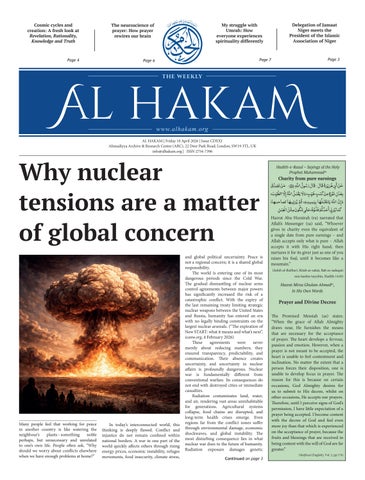
Why nuclear tensions are a matter of global concern
Many people feel that working for peace in another country is like watering the neighbour’s plants – something noble perhaps, but unnecessary and unrelated to one’s own life. People often ask, “Why should we worry about conflicts elsewhere when we have enough problems at home?”
In today’s interconnected world, this thinking is deeply flawed. Conflict and injustice do not remain confined within national borders. A war in one part of the world quickly affects others through rising energy prices, economic instability, refugee movements, food insecurity, climate stress,
and global political uncertainty. Peace is not a regional concern; it is a shared global responsibility. The world is entering one of its most dangerous periods since the Cold War. The gradual dismantling of nuclear arms control agreements between major powers has significantly increased the risk of a catastrophic conflict. With the expiry of the last remaining treaty limiting strategic nuclear weapons between the United States and Russia, humanity has entered an era with no legally binding constraints on the largest nuclear arsenals. (“The expiration of New START: what it means and what’s next”, icanw.org, 4 February 2026) These agreements were never merely about reducing numbers; they ensured transparency, predictability, and communication. Their absence creates uncertainty, and uncertainty in nuclear affairs is profoundly dangerous. Nuclear war is fundamentally different from conventional warfare. Its consequences do not end with destroyed cities or immediate casualties. Radiation contaminates land, water, and air, rendering vast areas uninhabitable for generations. Agricultural systems collapse, food chains are disrupted, and long-term health crises emerge. Even regions far from the conflict zones suffer through environmental damage, economic shockwaves, and global instability. The most disturbing consequence lies in what nuclear war does to the future of humanity. Radiation exposure damages genetic Continued on page 3
Hadith-e-Rasul – Sayings of the Holy Prophet Muhammadsa
Charity from pure earnings
َّ ُ َ َ َ َ َ ُ َ َ َ َّ َ � َﻣ ْﻦ ﺗ َﺼﺪق: ﻗﺎل َر ُﺳﻮل ا�� ِ� ﷺ:ﻋ ْﻦ أ�ِ� ﻫ َﺮﻳْ َﺮة ﻗﺎل َّ َّ َّ ُ ْ َ َ َ َ ْ ، َو�� ﻳَﻘ َﺒﻞ ا�� ُ� ِإ�� اﻟﻄ ِّﻴ َﺐ،ﺑِ َﻌﺪ ِل ﺗ ْ� َ� ٍة ِﻣ ْﻦ ﻛ ْﺴ ٍﺐ ﻃ ِّﻴ ٍﺐ َ ّ ﺛ ُ َّﻢ ﻳ ُ َﺮﺑ،َوإ َّن ا��َّ َ� ﻳ َ َﺘ َﻘ َّﺒﻠ ُ َﻬﺎ ﺑ َﻴﻤﻴﻨﻪ ،ﻴﻬﺎ ﻟﺼﺎﺣﺒﻬﺎ ِ ِ ِ ِ ِ ِ ْ َ ْ َ ُ َ َّ َ ُ َّ ُ َ ْ ُ ُ َ َ ّ ُ َ َ َ َ َ �� ﺣﺘﻰ ﺗ��ن ِﻣﺜﻞ ا��ﺒ ِﻞ،ﻛﻤﺎ ﻳﺮ�ِ� أﺣﺪ�ﻢ ﻓ��ه Hazrat Abu Hurairah (ra) narrated that Allah’s Messenger (sa) said, “Whoever gives in charity even the equivalent of a single date from pure earnings – and Allah accepts only what is pure – Allah accepts it with His right hand, then nurtures it for its giver just as one of you raises his foal, until it becomes like a mountain.” (Sahih al-Bukhari, Kitab az-zakat, Bab as-sadaqati min kasbin tayyibin, Hadith 1410)
Hazrat Mirza Ghulam Ahmadas, In His Own Words
Prayer and Divine Decree The Promised Messiah (as) states: “When the grace of Allah Almighty draws near, He furnishes the means that are necessary for the acceptance of prayer. The heart develops a fervour, passion and emotion. However, when a prayer is not meant to be accepted, the heart is unable to feel contentment and inclination. No matter the extent that a person forces their disposition, one is unable to develop focus in prayer. The reason for this is because on certain occasions, God Almighty desires for us to submit to His decree, whilst on other occasions, He accepts our prayers. Therefore, until I perceive signs of God’s permission, I have little expectation of a prayer being accepted. I become content with the decree of God and feel even more joy than that which is experienced on the acceptance of prayer, because the fruits and blessings that are received in being content with the will of God are far greater.” (Malfuzat [English], Vol. 2, pp.174)