
Stronger Bones - Vol. 6, Issue 1 (LEA)

Page 1


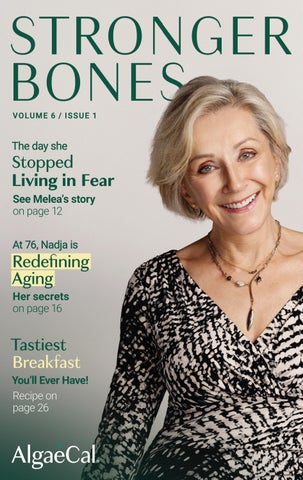
See Melea’s story on page 12 The day she

At 76, Nadja is Stopped Living in Fear Living

Redefining Aging

Her secrets on page 16

Tastiest Breakfast

You’ll Ever Have!

Recipe on page 26
Aging Is Inevitable. Frailty Isn’t.

March has arrived. And with it, International Women’s Day. A moment to celebrate women who refuse to let the world tell them what aging should look like.

You’ve heard the old line before. Frailty is just part of getting older. But you didn’t buy it. You made a different choice. A braver one. You chose to believe that your best years aren’t behind you. They’re still ahead of you!

And in this issue of Stronger Bones, you’ll meet one of those rare women who proves it. Her name is Nadja. She’s the kind of person who makes you rethink everything you thought you knew about aging . She refused to shrink her life to fit other people’s expectations. Her story is one of the most electrifying we’ve ever featured. And on page 16, she’s agreed to share the secret behind her youthful strength.

You’ll also hear from our own Dr. Emma Gasinski, who unpacks The Science of Strong Aging. And why strength isn’t a luxury after 50. It’s a lifeline!

Because after all, we believe that life is for living. And we’re here to help you live it to the fullest.

Thanks for letting us take care of you.

The Science of Strong Aging

Aging well isn’t luck. It’s learnable. Dr. Gasinski shows how training your body and mind can make youthful aging surprisingly predictable.

Physical therapist, certified yoga teacher and CrossFit trainer with a Doctorate in Physical Therapy from Rocky Mountain University of Health Professionals.

A strange thing happens when you turn fifty. People start lowering their expectations of you. You’re told to “slow down,” “take it easy,” “be careful.” As if your body has silently crossed a threshold after which everything goes downhill.

But step away from these cultural assumptions and into the actual science, and an entirely different picture emerges. It turns out that muscle and bone remain profoundly adaptive tissues well into your sixties, seventies, and even eighties. They respond to stimulus. They remodel. They repair. They even grow stronger when challenged appropriately.

Aging doesn’t shut these systems off. It simply changes the instructions your body needs to thrive. And once you understand those instructions, the path to “strong aging” becomes not only possible, but predictable.

Adaptation, Not Decline

For decades, aging was framed as “wear and tear.” A slow erosion. A mechanical fraying of parts that could never be replaced. But modern biology tells a very different story.

Muscle fibers don’t vanish simply because of time. Bones don’t hollow out because of birthdays. Decline happens when stimulus disappears. When the signals that once told your tissues to grow are no longer present in the same magnitude.

Mechanobiology, the science of how cells respond to physical forces, has shown that your body is listening, constantly. Osteocytes inside your bones measure microscopic strain and use that information to trigger rebuilding. Satellite cells around your muscles wait for a reason to activate. Even your nervous system, balance, coordination, reaction speed, remains “plastic,” and able to reorganize through practice.

In other words...Aging isn’t the absence of ability. It’s the absence of stimulus. Change the stimulus, and you change the trajectory.

The Most Underrated Longevity Organ

If there’s one biological asset most women underestimate, it’s muscle. Not in the aesthetic sense, but in the metabolic, neurological, and structural sense.

Muscle is, quite literally, a longevity organ. It’s your body’s largest reservoir for glucose disposal. It stabilizes joints. It protects bones from fracture. It communicates with your brain through chemical messengers called myokines. Those are the small proteins that influence inflammation, cognition, and even mood!

Yet starting in midlife, most people stop sending their muscles the signals required to keep them strong.

Research consistently shows that older adults can regain muscle mass, power, and coordination at rates that rival, or sometimes exceed, younger athletes.

And heavy load isn’t the only path. Slow, controlled strength training, using resistance bands, dumbbells, machines, even body weight, can activate fast-twitch fibers that preserve the ability to catch yourself if you stumble. That single adaptation can change the outcome of a fall from a fracture to a shrug.

At AlgaeCal, we hear this from women constantly: “I thought it was too late. Then I started strength work...and within weeks I felt different. Not younger. Just stronger.” The distinction matters.

Your Bones Are Listening

A lot of people think bone is inert. It isn’t. In reality, bone is one of the most dynamic tissues in your body. Your skeleton remodels itself constantly through two opposing forces: osteoclasts breaking down old bone, and osteoblasts building new bone. In your younger years, the system tilts toward building. After menopause, it tilts toward breakdown. But the machinery remains fully operational.

The key is understanding what drives it. Bones don’t grow because you want them to. They grow because they’re needed. And your body determines “need” by measuring strain.

The result? You get ‘old’ before your time. What’s surprising is that muscle actually responds faster after 50 than most people expect. That’s because when you begin resistance training later in life, your body interprets it as a brand-new stimulus. CONTINUED ON PAGE 6

The right kind of mechanical load, lifting heavy weights, impact exercise, even jumping, sends a signal to your osteoblasts

CONTINUED FROM PAGE 5

to lay down more mineral. It’s why athletes in their seventies still maintain exceptional bone density. Their bodies aren’t defying age; they’re responding to stimulus.

The Longevity Skill Almost No One Trains

People think fractures happen because bones become fragile. But often, fractures happen because balance declines.

Balance is a skill. A neurological one. And without training, your brain gradually loses the precise coordination between your inner ear, eyes, feet, and proprioceptive sensors. The result is subtle: hesitation on stairs, a wider walking stance, less confidence stepping off curbs.

But here’s the encouraging part: Balance is 100% trainable. Simple drills, single-leg stands, heel-to-toe walking, foot-strength exercises, light agility work, reawaken dormant neural circuits. This rewiring improves stability faster than strength training alone, and for many women is the missing ingredient between “I hope I don’t fall” and “I know I can catch myself.”

The people who avoid injuries in later years aren’t always the strongest. They’re the most stable.

Nutrition: The Signals That Allow Adaptation to Happen

Nutrition is often presented as a list: calcium, vitamin D, magnesium, protein. But the deeper science is about signaling...giving

your body the biochemical permission it needs to adapt to training.

For example, protein isn’t just fuel; it’s a molecular cue. When leucine-rich protein reaches a certain threshold, it triggers muscle-protein synthesis through the mTOR pathway. The older you are, the louder that signal needs to be, which is why higher protein intake becomes more important after 50.

Minerals and vitamins are similar too! This is one reason women who pair resistance training with full-spectrum bone nutrition, like the minerals and collagens used in AlgaeCal formulas, see measurable improvements. Training is the spark. Nutrition is the oxygen. One without the other doesn’t burn brightly.

Mindset and Stress

But even with perfect training and nutrition, one factor can undermine progress: chronic stress.

That’s because high cortisol narrows your body’s repair window. It inhibits osteoblasts. It blunts muscle growth. It disrupts sleep, which is when most tissue repair actually happens.

But stress isn’t just biochemical. It’s psychological. Your beliefs about aging influence your behaviour more than any nutrient. People who believe strength is possible after 70 train differently. They eat differently. They view setbacks differently. Compliance improves. Progress follows.

This is why one quiet truth keeps showing up in research: Self-efficacy is a biological intervention. Your brain is part of your physiology. Where it aims, your body follows.

The Compounding Effect

We tend to overestimate what we can do in a week, and wildly underestimate what we can do in five years.

A small yearly increase in bone density compounds. A steady gain in strength compounds. Improvements in balance compound. Better sleep compounds.

The goal isn’t to halt aging. The goal is to build capacity faster than time erodes it. Something well within reach for anyone willing to train, nourish, and recover with intention.

Many AlgaeCal customers tell us that the moment everything changes is not when they get a scan result—but when they first feel stronger. When a jar opens easily. When stairs feel lighter. When fear steps aside and confidence steps in.

That shift is not cosmetic. It is metabolic. Structural. Neurological. It marks the moment a woman stops trying to “avoid decline” and starts building her future.

The Most Hopeful Truth in Modern Aging Science

Here is the conclusion the science keeps pointing to: Your body never stops responding. Not at 50. Not at 60. Not at 80.

• Every rep you lift is a message.

• Every nutrient you give your cells is a signal.

• Every night of deep sleep is a vote for your future strength.

• Every moment you challenge a limiting belief, you expand the boundaries of what aging can look like.

Strong aging isn’t luck. It’s literacy. Learning the language your body speaks, and using it to write the next chapter of your life with intention.

And the newest science makes one promise worth holding onto: It’s never too late to get stronger.

Easy Exercises to Improve Your Balance

Simple living-room exercises that retrain your core, steady your steps, and turn a bad stumble into nothing more than a story you laugh about later.

Seated Ab Hold (figure

1)

Sit tall on the edge of your chair, arms crossed over your chest or extended forward. Lean back until your abdominals engage, keeping a long spine and a slight tailbone tuck. Breathe and hold for up to 60 seconds. To make it harder, lift both legs or one knee for 30 seconds, then switch to the other for 30 seconds.

(figure 1)

Forearm Plank

(figure 2)

Start on your forearms with palms facing up, knees on the floor. Drop your hips, tuck your tailbone, and squeeze your belly so your core engages. Press your forearms into the mat as if pulling it together, then extend one or both legs and push your heels back. Hold 20 seconds, breathing. Rest 20 seconds, then repeat, keeping back flat. 2

3

Table Top March

(figure 3)

Lie on your back and imagine a small piece of paper under your lower spine. Gently press your back down to “smush” it and feel your abdominals engage. Lift your legs, knees bent over hips, arms up. Straighten one leg and the opposite arm, then return and switch sides. Keep your back pressing down and alternate for up to one minute.

(figure 2)

3)

(figure

(figure 4)

S tanding Side Bend

(figure 5)

Stand tall with your arms by your sides and a slight bend in your knees. Lean straight to one side, then the other, engaging the outer abdominal muscles without bending forward or back. Pull your belly button up and in, moving only as far as comfortable. For a challenge, hold light weights. Continue alternating side to side for up to one minute.

Standing March

(figure 4)

Stand beside your chair and hold it for support. Lift one knee toward your chest and lower it, working your core as you move. Do this for up to one minute, pulling your belly button up and in. To make it harder, lift your arms and avoid swaying your hips. Stay strong in your torso. This simple move also helps improve your balance.

(figure 5)

Modified Bird Dog

(figure 6)

Start in a plank-like position with your forearms on a stable surface. Lift one leg, then lower it and lift the other, keeping your body steady and your spine from arching. You can also lift one arm and the opposite leg if you feel stable. Hold or repeat the move for one minute, staying strong through your core.

(figure 6)

Cat Buckley, BS, PGDip, is a certified yoga instructor specializing in osteoporosis. She leads movement classes for The AlgaeCal Community, helping people regain strength, balance, and body awareness—without the pressure of a typical fitness routine. Her approach is steady, practical, and rooted in science—designed to build confidence from the ground up, one pose at a time.

Scan for More!

Scan here to access more gentle, bone-safe workouts designed to improve balance, build strength, and support your bones, all from the comfort of home.

I Was Living My Life in Fear...

At 70, Melea was afraid to walk on the beach near her home. But just one year later, it’s a very different story.

Name: Melea Dillworth

Location: Florida, United States

Testimonial Date: July 2025

When you meet Melea Dillworth from Bradenton, Florida, you wouldn’t expect fear to be part of her daily life. She’s warm, articulate, and calm. The kind of woman whose presence makes you feel taken care of.

Maybe that’s because she spent her career taking care of others. As a former operating room nurse, Melea knows what health looks like, and what it costs when it slips away.

But in 2018, during a routine DEXA scan, she learned something that shook

her more than she let on. Her bone density was low.

“I needed more calcium-rich foods and weight-bearing exercise...and I meant to stay on top of it. But life got busy. And the thing about bone loss is, you don’t feel it happening.”

So she tucked that result away. Promised herself she’d deal with it later. Years passed quietly. And then came her 2024 scan. And with it, a moment she’ll never forget.

A Diagnosis No One Sees Coming

“When I saw the results, I was in for a big surprise. And not a good one,” she says. Her bone density had dropped sharply. The kind of drop that makes a doctor lean forward, lower his voice, and insist on immediate action. He wanted her to start a prescription drug right away, a medication with a long list of known side effects. For many patients, that conversation is difficult. For Melea, it was more than that. She has a genetic condition that makes tolerating certain medications nearly

impossible. “I needed something natural,” she says. “I couldn’t risk the side effects.”

She went home unsettled. Not panicked, but deeply aware that the ground had shifted. Bone loss was no longer an abstract concern; it had become a real limitation, shaping her decisions in ways she didn’t like.

“I

stopped walking on the beach...I stopped taking my granddaughter into the yard. I was afraid of uneven ground. Afraid of falling. Afraid of breaking a bone.”

This is the part of bone loss that few people talk about...the quiet contraction of a life. The shrinking of one’s world to surfaces that feel safe.

A Pamphlet, a Shared Diagnosis, and a Glimmer of Hope

Around that time, her sister, facing her own disappointing bone scan results, mentioned something unexpected. At her doctor’s office, they had handed her a pamphlet about AlgaeCal.

For someone with Melea’s clinical background, that mattered.

“I spent years as an operating room nurse,” she says. “If a medical office is giving out information about a natural supplement, it means something. They believe it helps people.”

The sisters compared notes. Both wanted a natural approach. Both were uneasy about medications they might not tolerate. Both

were, in their own ways, searching for a natural solution.

So they made a decision to begin the AlgaeCal Bone Builder Pack. Not as an experiment, but as a commitment.

A Different Kind of Surprise

In early 2025, Melea returned for her next DEXA scan. This time, she walked into the appointment with a hopeful expectation. Not optimism, exactly, but a readiness to know if AlgaeCal was working.

When the results arrived, she felt something she hadn’t felt in years: relief. She had gained bone!** A 5.1% increase in her total left femur, and a 4.2% increase in her total right femur.

“It was joy,” she says simply. “Just joy. It meant I was no longer losing ground.”

In the world of bone health, progress is not abstract. A percentage point can translate into years of mobility, independence, and confidence. For Melea, it meant something more personal: she could begin to trust her body again.

Her Mother’s Daughter

If this journey feels emotional to her, it’s because she’s lived through the consequences of bone loss before.

Her mother had severe bone loss. She fell. She fractured. And those fractures changed the trajectory of her life.

“She lost her independence,” Melea says. “She couldn’t drive. She couldn’t live

alone. I watched her struggle, and I didn’t want that to be me.”

That’s why Melea paid such close attention to her numbers. It’s why she felt fear walking on grass with her granddaughter. And it’s why bone gain, even modest bone gain, felt like a turning point.

Learning to Read Her Own Scans

One detail Melea mentions repeatedly is how difficult DEXA reports can be to interpret.

“Have you ever tried to read one? It’s like a foreign language,” she says. “And your doctor often doesn’t have time to go through everything.” But the Bone Health Consultants at AlgaeCal did!

“They took the time to explain the results, the trends, what everything meant. They were incredibly supportive.”

In a healthcare landscape where patients often feel rushed or unheard, having

someone slow down and help translate the story inside a medical chart can be transformative.

“I Don’t Live Like That Anymore.”

When people ask Melea why she chose AlgaeCal, she doesn’t complicate it. “I had nothing to lose,” she says. “And everything to gain. And that gain is bone gain. That’s a wonderful thing!”

No hype. No exaggeration. Just a woman who was losing bone...and then wasn’t. A woman who feared the future, and now walks toward it with confidence. A woman who watched her mother lose her independence...and decided that her story would not end the same way.

Because today, at 70, Melea isn’t shrinking her world to stay safe. She’s expanding it. Reclaiming it. Living in it fully again. And her bones, her stronger bones, are carrying her every step of the way.

“Thank you,” she says simply. “AlgaeCal has given me my confidence back.”

**Real Customer. Verified Results. Thank you gift provided post review. Individual vs Clinical Results may vary.

Visit algaecal.info/melea-dillworth or scan the QR code to read her full story.

Melea Got These Results With the Bone Builder Pack

It’s our most popular option, and here’s why: It’s the ONLY supplement clinically supported to INCREASE bone density.*‡

It’s guaranteed. If your bone density doesn’t increase in 6 months, you get every cent back.*

No gimmicks, no fine print. Just stronger bones or your money back. Scan the QR code below to learn more, or visit algaecal.info/bonebuilderpack

Trials

AlgaeCal’s Bone Health Consultants provide exceptional support over the phone, offering personalized guidance to help you navigate your bone health journey. Whether you have questions about bone health, the benefits of AlgaeCal’s products, or how to incorporate them into your daily routine, our team will take the time to listen to your specific needs and provide tailored recommendations.

Aging On Her Own Terms

This 76-Year-Old Is Making Everyone Rethink What Getting Older Looks Like

By the time most of us hit our seventies, we’ve been told the same story so many times we almost believe it. Slow down. Be careful. Expect less. Then you meet someone like Nadja Piatka.

At 76, she lifts weights three times a week, walks in a weighted vest, does barre and Pilates “for fun.” And around half a million people follow her on Instagram for one reason: she makes aging look not only possible, but exciting!

She jokes that when she reaches the pearly gates, she won’t be pushing a walker. “I’ll be wearing high heels,” she smiles.

But the version of Nadja the world sees today—confident, funny, glowing—began her journey far from a camera. It began under a kitchen table, hiding from a bill collector with her young daughter.

This is the story of how a woman who lost everything, rebuilt her life, her health, and eventually her bones, and why she believes the best years don’t have to be behind us.

The Day Everything Fell Apart

For twenty years, Nadja was married, raising two young children, living a comfortable life. Then one day, the marriage was over. Her husband had met someone else. The financial shock came fast. “We lost the big house. We lost the Mercedes. And we ended up in a small house my children were embarrassed to invite their friends to.”

I thought, “Well, I’ll just go and get a job.” Except I was completely out of touch. I couldn’t even turn on a computer. I did about 30 applications and got one interview. I remember sitting there, totally unqualified, feeling it slip away. You can tell when they’re not going to hire you. And my advice to anyone reading this is: don’t cry in an interview. It does not help! So I walked out and thought, the only person who is going to hire me...is me.

Meanwhile, the bills were piling up. One day, a collector came to the house at lunchtime. My daughter Veronica was home. We had a table under the front window, so when he walked around the house peering in, we ducked under it.

She was saying, “Mum, I’m going to be late for school,” and I was saying, “We have to stay here until he goes away.”That was my lowest point.

Later, I told that story on Oprah and laughed about it. But at that moment, it wasn’t funny. It was humiliating. As a mother, hiding with your child because you can’t pay your bills–that stays with you.

But rock bottom, she learned, is often the cleanest foundation for reinvention. That afternoon, I decided: no one is ever going to make me feel like this again. I wanted to write down a set of goals for myself, but couldn’t even find proper paper. So I took the cardboard insert from a pair of pantyhose and wrote my goals on it:

I will have a national company. I will write a best-selling book. I will have a newspaper column. I will become a public speaker. I will have my own TV show. I will bring value to other people’s lives.

She hid the cardboard, certain that anyone reading it would think she’d lost her mind. Within a year, every goal except the TV show came true.

CONTINUED ON PAGE 18

CONTINUED FROM PAGE 17

$100 and A Muffin Recipe

Her reinvention began in the simplest place: her kitchen. Food had always been her refuge. She grew up over a restaurant. She had struggled with her weight when she was younger, which forced her to teach herself a healthier way to cook. She loved desserts (still does) and learned how to make them lighter, less sugary, more forgiving.

“I

thought maybe other people might want the same.”

With $100 of ingredients and a healthy muffin recipe, she baked her first batch and delivered them to a friend’s tiny restaurant

in Edmonton. They sold out. She baked more. Soon other cafés were calling.

Suddenly she was waking at 4 a.m., baking in the dark, delivering warm trays across the frozen highways of Alberta. In her rear-view mirror were the headlights of huge transport trucks. She fantasized they were carrying her muffins across Canada. A year later, McDonald’s was.

She teamed up with two other women to form Three Blondes and a Brownie. Their muffins became the top-selling muffin at McDonald’s Canada.

The stay-at-home mom who couldn’t land a job interview was now a national supplier.

“I learned something then... Your circumstances don’t decide what you can become. Your belief does.”

The Second Reinvention: Finding Purpose at 75

After years of running companies, writing books and speaking across the world, Nadja eventually retired. Everyone told her she’d love it. She didn’t.

“I kept waiting to wake up and feel content. Instead I felt...lost. I thought, ‘What am I going to do with the years I have left? So I wrote down the words ‘Show me. Lead me. Guide me.’” That simple moment became a turning point in her life. “God answered and opened an amazing new chapter for me. A reminder that finding your purpose has no age limit!”

And God’s answer? It came in the form of an idea from her husband, Doug. He suggested doing something with social media. At the time, Nadja didn’t even have an account.

She started posting what she knew— simple meals, fitness tips, mindset advice, her approach to aging. In her first month she had 85 followers. She wondered whether anyone cared.

Doug brought her flowers and reminded her of a story she loved from Think and Grow Rich, about miners who quit a gold mine just two feet from the main vein. “Maybe you’re two feet from gold,” he said. She kept posting.

Then it happened: 2,000 new followers a day. Then 5,000. Posts went viral. Women began stopping her in public saying, “Thank you. You made me feel like it’s not too late for me.”

“That’s the line that means the most,” she says. I’m so glad I found you.

It is the modern-day version of the last goal she wrote on the pantyhose cardboard: bring value to other people’s lives.

Younger women began messaging her too, saying, “Before I found you, I was afraid of getting old. Now I’m not.” It’s a sentiment she hears often. Simply seeing an older woman lifting weights, cooking vibrant meals and living with purpose makes aging feel less like decline and more like expansion. But aging has a way of presenting new tests, even to the most resilient...

The Diagnosis She Tried to Ignore

Years earlier, before her social media success, Nadja had been given troubling news: her bones were thinning.

A DEXA scan showed low density. Her doctor warned her it would get worse. She felt fine, so she did what many women do, she avoided getting another scan.

But in 2022, she couldn’t avoid it any longer. The result was stark: full osteoporosis, with a T-score around –3.2.

Women often talk about that moment, when a number on a medical report suddenly defines them. Nadja remembers staring at the T-score on the page, feeling a strange disconnect. “How could my bones be failing me,” she thought, “when I still felt so alive?”

The diagnosis carried another weight: the assumption that decline was inevitable. That bones go only in one direction. That aging is something that happens to you, not something you influence. “It was the first time I felt old,” she says quietly. “And I didn’t like that feeling.”

The doctor prescribed a bisphosphonate: “That’s the only way to stop it.” The prescription was called in before she’d agreed.

At home, she and Doug looked up the risks—the jaw issues, the dental warnings, the long-term effects. Something in her resisted.

CONTINUED ON PAGE 20

CONTINUED FROM PAGE 19

“I’ve always had a David vs Goliath side,” she says. “I thought: before I get scared into this, let me look for another option.”

Their research led them to AlgaeCal: plant-based calcium, no frightening sideeffect list, and—just as importantly—stories of women who’d actually improved their bone density.

Her expectations were modest. “I told Doug, I don’t care if my bones improve. If this just stops the loss, I’ll take it for the rest of my life.”

Instead, her bones improved. Then improved again. And again.

“I saved every DEXA report. I showed my girlfriends. My daughter started taking it too. As a mother, that meant everything...I wasn’t just helping myself. I was helping the next generation of women in my family.”

The real test came unexpectedly: stepping off a café curb, Nadja missed the edge and went down hard on the concrete. At 76, most women would expect a fracture. She got up, dusted herself off, and went inside for dinner. “To me,” she says, “that was proof. My age is not determining the condition of my bones. I am.”

The Real Secret to Aging Well

If there’s a philosophy behind Nadja’s life, from muffins to mindset to bone health,

it’s this: Be specific about what you want, and then move toward it.

Nadja loves a line from Goethe: that once you commit clearly, “providence moves too.” She’s seen it again and again. Clarity creates momentum, and momentum attracts opportunity.

The moment she gets specific, whether it’s a business goal, a partner, or the kind of health she wants in her seventies—people appear, opportunities align, and the path reveals itself. “But you have to decide first,” she says. “Life won’t decide for you.”

Not vague wishes. Not silent hopes. Clear intentions, backed by action. When she wanted a partner, she didn’t write “someone nice.” She tore out a photo of Barbra Streisand and James Brolin from a magazine—“the way he looked at her”— and put it in her travel bag. Shortly after, she met Doug.

When she felt lost in her seventies, she didn’t wait for inspiration to strike. She created an Instagram account and documented her life—awkwardly at first, confidently later—until it resonated with millions.

And when she wanted to age well, she didn’t rely on luck. She built habits:

• Resistance training three times a week.

• Walking whenever possible, often with a weighted vest.

• Barre and Pilates for strength, balance and posture.

• High-protein, high-fibre eating with very few ultra-processed foods.

No single magic fix. Just exercise, nutrition, mindset, and supplementation working together.

“You don’t need three hours in the gym...You just need consistency. Anyone can do this.”

On her website, she now shares free “mix and match” exercise videos—upper body, lower body, balance, core, stretching—so women can build their own routines at home. No perfect bodies. No judgment. Just progress.

Cooking, Reinvented

If muffins were the beginning of Nadja’s reinvention, her cookbooks became the through-line. The thread stitching together the woman she was at 40, at 50, and

now at 76. Food has always been her language: comforting, practical, generous. It’s no surprise that after rebuilding her life, one of her earliest achievements was a bestselling cookbook and a regular newspaper column, both devoted to helping women eat well without giving up the pleasure of dessert.

Now, three decades later, she’s doing it again. Her newest book, Nadja Eat. Move. Glow, arrives this year. A collection of the healthy, high-protein, high-fibre recipes she shares with her online community. The project brings her full circle: she hired the same graphic designer who once worked on Martha Stewart’s cookbooks, a small but symbolic sign that the girl who grew up above a restaurant is still very much at the centre of her story.

“It’s funny...I started by baking in my kitchen because I couldn’t get a job. And now, at 76, I’m publishing another cookbook because I want women to know they can still evolve.”

It’s not about recipes, really. It’s about proof. Proof that creation doesn’t belong to the young. Reinvention doesn’t expire. And purpose—like good food—is something we can return to again and again.

Writing the Next Chapter

When asked how she wants to be remembered—online, in life, in the community— she pauses.

CONTINUED ON PAGE 22

CONTINUED FROM PAGE 21

“I hope people say, ‘I’m so glad I found you.’ Because that means I helped. That means we connected.”

Then she adds something more practical, more urgent:

“Taking care of yourself is the best investment you’ll ever make. The results are guaranteed. If you eat better, you feel better. If you move, you get stronger. If you train your muscles, you keep your independence. And if you care for your bones, you protect your future.”

In a culture that worships youth, women in their seventies are often spoken about in the past tense. As if their stories are already written. Nadja refuses to accept that script. She believes aging is not a narrowing, but a widening: of perspective, of priorities, of confidence. Strong bones matter because they protect the freedoms that make life worth living—travel,

movement, independence, joy. “I’m not here to fade away,” she says. “I’m here to expand.”

In true Nadja fashion, she offers no grand finale, no pitch, no perfect ending. Just a simple reminder that lands with the weight of experience:

“We don’t expire. We evolve. And in our seventies—especially in our seventies—we still get to write the next chapter.”

And then, as if to prove the point, she smiles and says it again: “This is 76.”

Moni is AlgaeCal’s Senior Partnerships Leader, a former Team Canada soccer star, and a busy mom of two active boys. Watch

Ready to see what 76 can look like? Scan the QR code.

Interviewed

When it Comes to Collagen, Numbers Matter

Backed by 109 PhDs in 25 Clinical Trials

Boost Skin Elasticity in 8 Weeks*‡

Smooth Out Wrinkles in 4 Weeks*‡

Less Cellulite in 26 Weeks*‡

Greater Joint Mobility in 24 Weeks*‡

Ease Joint Pain in 12 Weeks*‡

Improves Bone Density by 8.19%*‡

Thicker Hair in 16 Weeks*‡

42% Fewer Broken Nails*‡

* These statements have not been evaluated by the Food and Drug Administration. This product is not intended to diagnose, treat, cure, or prevent any disease.‡ Results consistent with Clinical Trials on individual ingredients. Results may vary.

Scan the QR code or visit

Grilled Citrus Thyme Chicken

Big citrus, fresh thyme, hit of lemongrass—this is how you make chicken thighs taste like they’ve been fussed over for hours, in just half an hour.

PREP: 15 MIN COOK: 15 MIN

8 boneless, skinless chicken thighs

2 Tbsp fresh thyme, chopped

1 tsp lemongrass, minced

2 garlic cloves, minced

1 lime, zested and juiced

2 Tbsp avocado oil

½ tsp salt

½ tsp pepper

1. Combine all ingredients into a bowl or container with a lid. Mix thoroughly, ensuring the thighs have “unfolded” and the marinade has coated all sides of the thighs. Refrigerate overnight.

2. Heat grill to 450°F. Spray grill with a non-stick cooking spray, or brush it with oil.

3. Place chicken thighs on a hot open grill. Grill chicken for 2-3 minutes on each side, or until chicken easily releases from the grill.

4. Serve chicken with your favourite grilled vegetables or side dish.

MAKES 4 SERVINGS per serving   Calories: 408  |  Fat: 23 g  |  Protein: 44 g  |  Sugar: 0 g  |  Carbs: 4 g  | Fiber: 1 g  |   Sodium: 784 mg  |  Cholesterol: 215 mg  |  Potassium: 633 mg  | Vitamin A: 390 IU  |   Vitamin C: 12 mg  |  Calcium: 58 mg  |  Iron: 3 mg  |

Dairy Free
Gluten Free

Egg Bites

Cottage cheese for creaminess, gruyere for depth, bacon for bite. These airy egg cups are the kind of breakfast you batch once and thank yourself for all week.

PREP: 30 MIN COOK: 30 MIN

6 large eggs

1½ cup full fat cottage cheese

3 oz gruyere or emmental cheese, shredded

1 tsp tamari

1 tsp hot sauce

4 slices turkey bacon, cooked and chopped

¼ cup red peppers, diced

¼ cup chopped scallions

Non-stick cooking spray, optional

1. Preheat the oven to 275°F. Place a rimmed baking sheet with ¼” boiling water into the oven on the middle rack. Spray a non-stick muffin pan with non-stick cooking spray.

2. In a blender, combine eggs, cottage cheese, shredded cheese, salt, pepper, tamari and hot sauce.

3. Blend until smooth. The goal is to create a creamy texture. If you see bubbles, allow the mixture to settle a couple of minutes.

4. Pour the egg mixture into the 12 muffin tins. Top with turkey bacon, red peppers and scallions.

5. Place muffin tin in the baking sheet. Bake for 30 minutes on the middle rack, until the eggs are set. You may see your eggs rise like a souffle and that is okay! They will slowly deflate and be a beautiful rich egg bite.

6. Remove the egg bites from the oven and allow to cool for 5 minutes before serving. Egg bites can be stored in the fridge for up to three days.

MAKES 12 SERVINGS

per serving   Calories: 106  |  Fat: 7 g  |  Protein: 9 g  |  Sugar: 1 g  |  Carbs: 2 g  | Fiber: 0.1 g  |

Sodium: 308 mg  |  Cholesterol: 99 mg  |  Potassium: 96 mg  | Vitamin A: 341 IU  |

Vitamin C: 5 mg  |  Calcium: 108 mg  |  Iron: 1 mg  |

Gluten Free

Ask Our Experts

Have questions about your bone health? Get them answered in the AlgaeCal Community. Our bone health experts are here to support your bone building journey every step of the way.

Dr. Liz Lipski

PHD, CNS, FACN, IFMP, BCHN, LDN

Professor and Director of Academic Development, Nutrition programs in Clinical Nutrition at Maryland University of Integrative Health. Author of Digestive Wellness

Dr. Emma Gasinski

PT, DPT, RYT

Physical therapist, certified yoga teacher and CrossFit trainer with a Doctorate in Physical Therapy from Rocky Mountain University of Health Professionals.

Lara Pizzorno

MDIV, MA, LMT

Best-selling author of Health Bones Healthy You! And Your Bones; Editor of Longevity Medicine Review, and Senior Medical Editor for Integrative Medicine Advisors

A: Q:

This question is for Lara Pizzorno. You’ve recommended melatonin in the past for sleep and bone health. I just saw a study suggesting it might increase heart problems. What is your opinion?

This is an area where careful, science-based context really matters. First, a Cochrane review in older adults found no difference in adverse events between long-term melatonin and placebo. The authors did not propose any plausible mechanism by which melatonin would cause heart failure, while many known mechanisms suggest potential benefit for cardiovascular health and inflammation. There’s also emerging evidence that phytomelatonin may offer advantages over synthetic forms, with good long-term safety data. I prefer to rely on the preponderance of high-quality research rather than one weak observational study. Personally, I’ve taken melatonin nightly for more than 30 years. I began taking it for breast cancer prevention after my mother was diagnosed with breast cancer and also to promote better sleep. After seeing the research showing melatonin supports bone health by decreasing osteoclast activity and promoting osteoblast function, I'm even more convinced of melatonin's, particularly phyto-melatonin's, importance for my health. I'm now 77, and given age-related declines in melatonin, will continue to take it nightly.

A:

I’m 62, postmenopausal, active, but now get injured easily and can’t lift more than 8–12 lb. Is this normal?

This is very common after menopause. Hormonal changes affect tendons, joints, and recovery. Your weights are reasonable; focus on slow, controlled form, rest, gradual progress, and consult a PT if pain persists.

Dr. Liz Lipski

I’m 80. My dietitian says not to diet because I could lose muscle or bone, not fat, and to eat sensibly. Is that right?

Jenny C. AlgaeCal Community Member

Yes. At 80, focus on strength, not thinness. Avoid strict dieting. Eat protein-rich meals, mostly whole foods, walk daily, and do light strength training.

Dr. Emma Gasinski

Ask Your Question

Reach out to our experts today in the AlgaeCal Community!

The AlgaeCal Community is an exclusive Facebook group for AlgaeCal customers. It’s made up of over 45,000 women and men who are working toward renewed bone health. It’s a friendly, supportive space where you can ask questions, join live exercise classes and bone-health lectures, share frustration and successes, and make new friends. Join for free by scanning the QR code below.

Here’s what you get…

• Direct Access to Doctors, Physiotherapists, & Bone Health Experts

Get answers to your toughest questions, fast.

• Physio-Led Exercise Classes

Strengthen your bones safely with exercises designed by leading fitness experts.

• Join a Group of 45,000+

Share wins, get support, and feel the encouragement of others on the same journey.

• Exclusive Monthly Product Giveaways Yes, you could win free products every month. ...and much more!

Upcoming Events:

3-Part Progressive Balance Exercise Series with Dr. Emma

Dr. Emma will guide you through simple, progressive exercises that improve stability, posture, and confidence. Perfect for anyone wanting safer movement, fewer stumbles, and stronger, more responsive muscles.

#AskDrLiz – Protein and Bone Health

Dr. Liz breaks down exactly how much protein you really need for strong bones, especially as you age. She’ll explain practical targets, easy meal ideas, and why protein is essential for maintaining muscle, metabolism, and mobility.

Turn static files into dynamic content formats.

Create a flipbook