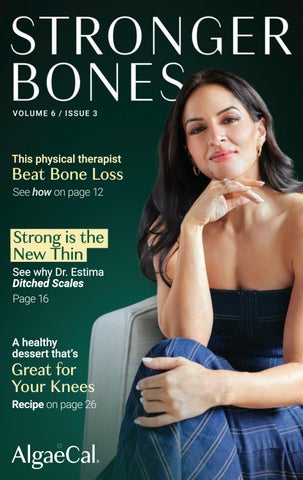
VOLUME 6 / ISSUE 3
This physical therapist
Beat Bone Loss See how on page 12
Strong is the New Thin See why Dr. Estima Ditched Scales Page 16
A healthy dessert that’s
Great for Your Knees
Recipe on page 26
S T R ONG ER BO NES
Keep Moving, Keep Living Summer has a way of reminding us what strong bones and comfortable joints are really for. Longer walks. Time in the garden. Trips with family. Getting up, getting out, and saying yes to more of the life you love. That’s why this issue takes a closer look at joint health and inflammation. Because when your joints feel stiff or uncomfortable, it can affect how freely you move. And movement is one of the simplest, most important ways to support your bones. I’m also excited to introduce our newest addition to the AlgaeCal family—AlgaeCal Restore.™ It’s formulated to support joint comfort, mobility, and recovery, so you can keep moving with confidence, this summer and beyond. Because at AlgaeCal, we’ve never believed we’re just in the bone business. We’re in the life business. Your life. And we’re thrilled to help you keep living it fully. If questions come up as you read, or if you’d like to talk something through, we’re here. You can reach us anytime at 1-855-519-8540 (USA/Canada). Thanks for letting us take care of you. With warmth and gratitude,
Dean Neuls | CEO & Co-Founder AlgaeCal Inc.
2
Discover more at algaecal.com
Contents 4
Is Joint Pain Just
8
Build Stronger Legs
Part of Getting Older?
12
and Hips at Home
12 “My Scan Said:
Very Low for My Age”
Strong Is the New Thin 16 Chili Salmon Bites 24 Berry Sorbet 26
28
16
Ask Our Experts
24
Call us at 1-855-519-8540
3
S T R ONG ER BO NES
Is Joint Pain Just Part of Getting Older? According to Lara Pizzorno, stiff, aching joints may have less to do with age than the biology of inflammaging.
Reviewed By:
Lara Pizzorno mdiv, ma, lmt
Clinical nutritionist and internationally recognized expert in bone health and integrative nutrition. She is the author of Healthy Bones, Healthy You! and has spent decades helping people understand the biology behind increasing bone density
4
Joint pain has been so thoroughly woven into our idea of aging that many people no longer question it. A stiff knee on the stairs. A hip that feels slower and less cooperative in the morning. These symptoms are often dismissed with a kind of cultural shrug: of course, that happens with age. But that explanation is too simple. Osteoarthritis and age-related joint pain are no longer understood as a simple story of joints “wearing out.” Recent scientific reviews describe osteoarthritis as a whole-joint disease involving pain, inflammation, metabolic factors, and structural changes across cartilage, bone, and synovial tissue. In other words, the biology is active, not passive. Yes, joints change over time. Tissues recover more slowly. The balance between stress and repair can become less efficient. But that is very different from saying pain is inevitable, or that aching joints are merely the price of getting older. That’s why studies published in the past two years increasingly connect age-related joint symptoms to inflammatory and metabolic processes, not just mechanical mileage. In many cases, what people describe as “aging joints” reflects a gradual shift in the internal environment of the joint itself. Low-grade inflammation lingers longer. Recovery slows. Cartilage and surrounding tissues are less well protected. Ordinary movement begins to feel more costly than it should. That distinction matters. Because once pain is interpreted as normal aging, people tend to stop asking better questions. They adapt around it. They move less.
Discover more at algaecal.com
I S J O I N T PA I N J U S T PA R T O F G E T T I N G O L D E R ?
They avoid stairs, long walks, gardening, lifting, kneeling. They begin to organize life around discomfort rather than investigate why that discomfort is there in the first place. This is one of the great mistakes in how joint pain is understood. Common does not mean inevitable. And widespread does not mean harmless. Joint pain may become more common with age, but that does not make it biologically insignificant. Often, it is the first sign that the joint environment has shifted in ways that deserve attention.
More Than Wear and Tear For a long time, joint pain was explained with a mechanical metaphor: the joint had simply worn down. That idea is still common. It is also incomplete. A 2025 review on knee adipose tissue in osteoarthritis found cartilage damage is not the whole story, and that what we often call osteoarthritis involves active crosstalk between cartilage, surrounding fat, inflammation, and other joint tissues. In other words, the joint is not just being used up. It is participating in a biological process. That matters because “wear and tear” suggests something simple and final. Mileage. Friction. Age. But painful joints are often shaped by a much more dynamic environment. Cartilage may be less well maintained. Synovial tissues may become more reactive. The tissues around the joint may begin releasing signals that promote irritation rather than recovery. A 2024 study on the infrapatellar fat pad—the small pocket of fat within the knee joint—helps make this point even clearer. Rather than acting as inert
padding, this tissue can release both pro-inflammatory and protective factors, helping shape whether the joint environment becomes more hostile or more resilient over time. For women, this biology can be even more specific. A 2025 study on aging and estrogen in osteoarthritis found estrogen deficiency may contribute to cartilage matrix degradation, inflammatory signaling, and altered tissue homeostasis, helping explain why joint symptoms often become more noticeable after menopause. So yes, age matters. But not because joints simply wear out like old machinery. They change because the internal environment of the joint becomes less protective, less balanced, and less able to recover from ordinary stress. And that is a much more useful way to understand why movement can begin to hurt.
The Slow Burn of Inflammaging One reason joint pain is so often misunderstood is that the process driving it is rarely dramatic. It does not always arrive with obvious swelling, redness, or a clear injury. More often, it builds slowly. A little more stiffness after rest. A little more soreness after activity. Recovery that no longer feels complete. What many people describe as “just getting older” can, in fact, reflect a slower biological process now often described as inflammaging: chronic, low-grade inflammation that lingers longer
CONTINUED ON PAGE 6
Call us at 1-855-519-8540
5
S T R ONG ER BO NES
CONTINUED FROM PAGE 5
than it should and gradually alters how tissues function. In joints, that matters because inflammation is not simply a side effect of damage. It can help shape the environment in which damage either resolves or continues. A 2025 study on inflammaging and osteoarthritis argues that age-related changes in immune signaling, the microbiome, and the innate immune system may all contribute to the slow progression of osteoarthritis in human patients. Primary studies point in the same direction. A 2024 study in The Knee Journal found that people with early knee osteoarthritis had a different inflammatory marker profile from matched asymptomatic controls, suggesting that measurable inflammatory changes are present even before disease becomes advanced. That is why stiffness should not be dismissed too casually. It may be common, but it is not meaningless. Often, it is the outward sign of a joint environment that has become more irritable, less resilient, and slower to recover than it once was. Aging may set the stage. But inflammaging helps explain why the performance begins.
Movement Still Matters Pain often makes people do the most understandable thing in the world: move less. They take the shorter walk. Skip the stairs. Avoid kneeling, squatting, lifting, reaching. In the short term, that can feel sensible. In the long term, it usually makes the problem worse. 6
Discover more at algaecal.com
Joints need movement. Circulation helps deliver oxygen and nutrients to the tissues trying to recover. When movement drops, stiffness tends to rise, strength falls, and pain gets worse. That does not mean every joint needs punishing workouts. It means joints usually do better with regular, intelligent use than fearful avoidance.
Support the Biology Beneath the Pain If joint pain is not just “age,” but a sign of slower repair, low-grade inflammation, and reduced resilience inside and around the joint, then support has to go deeper than temporary relief. It has to help rebalance the biology beneath the pain. That is the logic behind AlgaeCal’s newest formula—AlgaeCal Restore.™ Not simply to blunt discomfort for a few hours, but to support the processes that help joints stay more comfortable over time: healthy inflammation balance, cartilage support, and better recovery in the muscles and tissues surrounding the joint. Because healthier joints rarely come from doing less. They come from supporting the tissues that make movement possible.
A Better Way to Think About Aging Joints Joint pain may become more common with age. But that does not make it trivial. And it does not make it inevitable. Pain is a signal. The better response is not resignation, but support: for the biology, the movement, and the tissues that keep us doing the things we love.
Joint Pain? AlgaeCal Restore™ is guaranteed to help your joints feel comfortable, flexible, and ready for life again.*† Clinically shown to support:
joint pain 67% Less vs placebo *‡
joint 28% Less stiffness *‡
joint 30% Better function *‡
cartilage 17% Less breakdown *‡
muscle 55% Greater endurance *‡
COMING SOON Scan the QR code to get priority access to AlgaeCal Restore™
These statements have not been evaluated by the Food and Drug Administration. This product is not intended to diagnose, treat, cure, or prevent any disease. ‡Results consistent with Clinical Trials. Results may vary. † Terms & Conditions apply
*
S T R ONG ER BO NES
Build Stronger Legs and Hips at Home Easy, at-home exercises to activate your hips, build strength, and improve stability.
1
Hip CARs (Controlled Articular Rotations) (figure 1) Start on your hands and knees in a tabletop position, with your hands under your shoulders and knees under your hips. Keep your back flat and your core gently engaged. Slowly lift one knee out to the side, then draw a controlled circle with your hip. Keep your torso as still as possible and avoid shifting your weight too far to one side. Reverse the motion, then return to the start. Move slowly and stay in control. Perform 5–8 circles in each direction per side to gently warm up and improve hip mobility.
(figure 1)
8
Discover more at algaecal.com
B U I L D S T R O N G E R L E G S A N D H I P S AT H O M E
2
Banded Glute Bridge (figure 2) Lie on your back with knees bent and a resistance band just above your knees. Press your feet into the floor and lift your hips, squeezing your glutes at the top. Keep your ribs down and avoid arching your lower back. Gently press your knees outward against the band as you lift. Lower with control. Perform 10–12 repetitions to activate the muscles that support your hips and pelvis.
(figure 2)
3
(figure 3)
Banded Sit-To-Stand (figure 3) Place a resistance band above your knees and sit on a sturdy chair. Lean slightly forward, press your feet into the ground, and stand up while keeping your knees tracking outward against the band. Sit back down slowly with control. Keep your chest lifted and your weight evenly distributed through your feet. Perform 10–12 repetitions to build strength in your hips and thighs for everyday movements.
Call us at 1-855-519-8540
9
S T R ONGER BONES
4
Weighted Squat (3×8) (figure 4) Stand with feet shoulder-width apart and toes slightly turned out. Hold a weight at your chest or use support if needed. Brace your core, then sit down by bending your hips and knees together. Keep your chest lifted and your knees tracking in line with your toes. Lower as far as comfortable, then press through your whole foot to stand. Perform 3 sets of 8 repetitions with control. (figure 4)
Emma Gasinski, PT, DPT, RYT, is a physical therapist, certified yoga teacher and CrossFit trainer with a Doctorate in Physical Therapy from Rocky Mountain University of Health Professionals.
Scan for More! Scan here for more guided, bone-safe workouts designed to strengthen your hips, improve stability, and help you move with confidence every day.
10 Discover more at algaecal.com
You Could Earn Rewards Points To Save on Your Next Order Earn Rewards Points in multiple ways—by making purchases, following us on social media, and participating in AlgaeCal promotions or events. Don’t pay full price ever again. Here’s how it works:
1. JOIN
2. EARN
3. REDEEM
Sign up today at www.algaecal.com
Collect points with every AlgaeCal purchase
Every 100 points gets you $5 OFF your next purchase
Earn Points. Save Money.
1 POINT PER $1 Earn 1 point per $1 spent on AlgaeCal Products
PLUS
REDEEM Every 100 points gets you $5 OFF your next purchase
Earn 10 points per platform when you follow us on Facebook, YouTube, Instagram, and TikTok.
Refer a Friend Give your friend $20. Get $20 for yourself. Here’s how it works: Go to www.algaecal.com/rewards or scan the QR code below and enter your friend’s email. When they place their first order of $75 or more, they’ll get $20 OFF—and you’ll earn $20 in Rewards Points too. It’s our way of saying thanks for spreading the word, because bone loss is beatable. 11 Discover more at algaecal.com
Call us at 1-855-519-8540
11
S T R ONG ER BO NES
“My Scan Said: Very Low for My Age” At 53, Wendy’s bone density was getting worse. One year later, her numbers and her mindset took a very different direction.
Name: Wendy James Location: Wilmington, NC Testimonial Date: Feb 24, 2026 Wendy wasn’t expecting bad news. At 53, she felt healthy. Active. Capable. The kind of person who assumed her body was doing what it was supposed to do. But bone loss doesn’t always come with symptoms. And when Wendy first decided to get a DEXA scan at age 46, it was more precaution than concern. “I just wanted a baseline,” she says. “My grandmother had osteoporosis, so I thought it was the
12 Discover more at algaecal.com
responsible thing to do.” What came back surprised her. Her lumbar spine and hip scores placed her in the osteopenia range. Not severe, but not ideal either. Especially not at 46. Still, the guidance she received was simple. Take vitamin D. So she did. For the next several years, Wendy stayed consistent. No shortcuts. No missed days. But when she retested four years later, the results hadn’t meaningfully changed. “They improved by about two-tenths of a point,” she says. “Which sounds like something. But I was still in the same category.” She asked again what else she could do. The answer didn’t change. Keep taking vitamin D. So she did. Another three years passed. And during that time, something started to shift—not just in her numbers, but in how she felt about them. “I wanted to be more proactive,” she says. “But I didn’t really have a plan. I didn’t have something I felt confident in.” Then came the scan at age 53. And this time, there was no ambiguity. Her bone density had worsened. Her lumbar spine dropped from -1.4 to -2.1. Her hip followed the same downward trend. But
MY S C A N S A I D: V E RY LO W F O R MY AG E
it wasn’t just the numbers that hit her. It was the language in the report.“With a T-score of -2.1, the patient has very low bone mineral density for her age and sex. Causes of secondary bone loss should be investigated.” “I was devastated,” Wendy says. Not just because of what it meant, but because of what she knew. Wendy is a physical therapist. She’s seen what happens when bone loss progresses. “I’ve worked with patients after hip fractures, spinal fractures,” she says. “I’ve seen how quickly someone can lose their independence. And I didn’t want that future for myself.” This wasn’t abstract anymore. It was personal. So she did what she often advises her patients to do. Research. A colleague of hers, also a physical therapist, had mentioned AlgaeCal. She had used it herself and seen improvements. “That got my attention,” Wendy says. “Because I trust her. And I knew she wouldn’t recommend something without a reason.” So Wendy looked into it. She read through the research. Reviewed the product. Looked at the structure of the program. And for the first time in years, something felt different.
“It wasn’t just ‘take this and hope for the best’...It was a complete plan. Something designed specifically for bone density.” She ordered a six-month supply of the Bone Builder Pack. And she followed the protocol exactly. Two capsules in the morning. Two in the evening. Strontium at night. Day after day.
No shortcuts. No experimenting. Just consistency. “I told myself I’d give it a full year,” she says. And she did. What’s notable is what she didn’t do. She didn’t overhaul her life. Didn’t suddenly start an intense workout program. Didn’t stack a dozen new supplements. “I kept it very simple,” she says. “The only real change I made was adding daily walks about six months in. A few miles most days. That’s it.” But something else changed during that time. Her mindset.
“When you’re watching your numbers go in the wrong direction, you feel powerless... like you’re just waiting for something bad to happen.” That feeling began to fade. “For the first time, I felt like I was actually doing something to build bone,” she says. “Not just maintaining. Not just watching. Building.” One year later, she returned for her next DEXA scan. This time, she walked in with a different kind of expectation. Not certainty. But hope. And when the results came back, they confirmed it. Her lumbar spine improved from -2.1 to -1.6. A 6.7% increase in bone density.** Her left femoral neck improved from -1.4 to -0.8. Nearly a 10% increase.** “I was thrilled,” she says. “Because it showed that what I was doing was working.” But more than that, it changed how she saw her future. “I’m not just hoping my bones don’t get worse anymore,” she says. CONTINUED ON PAGE 14
Call us at 1-855-519-8540
13
S T R ONG ER BO NES
“Bone density isn’t just a number... It’s your independence. Your ability to keep doing the things you love.”
CONTINUED FROM PAGE 13
“I feel like I’m actively working toward stronger bones.” That shift, from passive to proactive, is something Wendy doesn’t take lightly. Because she knows what’s at stake.
And at 54, she’s not interested in waiting to see what happens. “I feel like I’m still young,” she says. “And I want to stay strong. I want to protect my future.” When people ask her what she would say to someone in a similar position, her answer is straightforward. “Don’t wait until your numbers get worse,” she says. “If you’re watching them decline, take action.” Because she’s lived both sides of that equation. The waiting. And the doing. “For years, I felt like I didn’t have a clear plan,” she says. “Now I do. And that’s made all the difference.” She pauses, then adds one final thought. “I’m genuinely thankful I found this when I did.” Because today, Wendy isn’t sitting back and hoping for the best. She’s in control of her bone health and, finally, facing the future without fear of fracture.
Real Customer. Verified Results. Thank you gift provided post review. Individual vs Clinical Results may vary.
**
See How Wendy Turned Bone Loss Into Measurable Progress on a DEXA Scan. Visit algaecal.info/wendy-james or scan the QR code to read her full story.
14 Discover more at algaecal.com
Wendy Got These Results With the Bone Builder Pack It’s our most popular option, and here’s why: 1 2
It’s the ONLY supplement clinically supported to INCREASE bone density.*‡ It’s guaranteed. If your bone density doesn’t increase in 6 months, you get every cent back.†
No gimmicks, no fine print. Just stronger bones or your money back. Scan the QR code below to learn more, or visit algaecal.info/bonebuilderpack These statements have not been evaluated by the Food and Drug Administration. This product is not intended to diagnose, treat, cure, or prevent any disease. ‡Results consistent with Clinical Trials. Results may vary. †Terms apply.
*
Got Questions About Your Bone Health? You Can Call Us! AlgaeCal’s Bone Health Consultants provide exceptional support over the phone, offering personalized guidance to help you navigate your bone health journey. Whether you have questions about bone health, the benefits of AlgaeCal’s products, or how to incorporate them into your daily routine, our team will take the time to listen to your specific needs and provide tailored recommendations.
Call Our Toll Free Number: 1–855–519–8540 Monday–Friday: 5:00am–4:00pm (PST) | Weekends: 6:00am–4:00pm (PST)
S T R ONG ER BO NES
Strong is the New Thin According to Dr. Stephanie Estima, the women who age best are not the thinnest, but the strongest. For years, the formula seemed simple enough. Eat less. Move more. Keep your weight in check. If your jeans felt tight, you cut back for a week. Then midlife arrives, and something changes. The same effort no longer produces the same result.
16 Discover more at algaecal.com
STRONG IS THE NEW THIN
A woman can be eating less, training harder, and somehow feeling worse: weaker in the gym, more tired in the afternoon, less steady in her own body. It is easy to assume the problem is discipline. But Dr. Stephanie Estima sees something else entirely. A specialist in female physiology, metabolism, and body composition, she believes many women are not failing in midlife. They are simply following a strategy that was never designed for the hormonal reality of a female body, especially after forty. The female body is not a spreadsheet of calories in and calories out. It is a living system shaped by hormones, stress, sleep, recovery, insulin sensitivity, and years of under-eating and over-exercising in pursuit of thinness. By the time a woman reaches perimenopause, that history starts to show. Dr. Estima points to a pattern she sees often. A woman has spent years trying to stay small. She cuts calories. She adds cardio. She prides herself on restraint. But when those habits continue into midlife, they can begin to backfire. The body adapts. It conserves. Digestion slows. Training output drops. Recovery becomes harder. Muscle, the very tissue that supports metabolic health, strength, and resilience, begins to erode. This, Dr. Estima argues, is where many women have been misled. They have been taught to think of success as a smaller number on the scale. What they were rarely taught to ask was what kind of tissue they were losing to get there, or what it might cost them later. And later, in midlife, is when the bill often comes due.
Why “Eat Less, Move More” Stops Working For decades, women have been handed the same instruction with the confidence of settled truth: eat less, move more. It sounds sensible. Clean. Almost mathematical. If weight goes up, calories must come down. If the body changes, the answer must be more effort. Dr. Estima does not dispute the arithmetic. But she is clear that arithmetic is not the same thing as physiology.
“Eat less, move more is physics...but it doesn’t really take into account physiology or the different hormonal environments that a woman will go through over the course of or over the arc of her life.” That is the part many women were never taught. On paper, calories in and calories out can look like a tidy system. In a real female body, especially after forty, that equation gets filtered through something far more complex: fluctuating estrogen, shifting progesterone, rising stress, poorer sleep, and changes in insulin sensitivity. Add to that what Dr. Estima describes as “often years of under-eating and overexercising,” and the old formula begins to look far less reliable. In fact, for many women, it does more than stop working. It starts to backfire. CONTINUED ON PAGE 18
Call us at 1-855-519-8540
17
S T R ONG ER BO NES
CONTINUED FROM PAGE 17
Dr. Estima points to a process called metabolic adaptation. When food intake drops, the body does not simply surrender stored fat on command. It adjusts. It preserves. “When you start eating less,” she explains, “your body starts to spend less.” Spontaneous movement falls. Training output drops. Recovery worsens. Digestion slows. The body becomes, in her words, “more efficient at surviving on less.”
This is one reason so many women in midlife find themselves in a frustrating bind. They are doing more, eating less, and somehow feeling worse. Not lighter, but flatter. Not stronger, but more depleted. And when they are told to move more, the advice often leads in exactly the wrong direction. More cardio. Rarely more muscle. That matters because muscle is not cosmetic spare tissue. It is one of the body’s great protective assets. It supports metabolic health, physical resilience, and, crucially, the strength needed to age well. Yet under the old model, it is often the very thing women sacrifice first. Midlife also adds more “noise,” as she calls it, to the scale itself. Water shifts. Sleep disruption. Stress. Hormonal volatility. A woman may see changes in body weight that have very little to do with fat loss at all. Which means the metric she is using to judge progress may be the
18 Discover more at algaecal.com
least trustworthy. That is what makes the old advice so damaging. It reduces a complicated transition to a simple failure of discipline. It tells women to push harder into a strategy that may already be costing them the very things they will need most in the years ahead—muscle and strength.
The Scale Is the Wrong Scoreboard If the old strategy begins to fail in midlife, the next problem is often the tool women use to measure whether it is working. The scale has long been treated as a verdict. A lower number suggests progress. A higher one can feel like proof that something has gone wrong. For many women, it has shaped not only how they eat, but how they think about themselves. Dr. Estima is deeply wary of that relationship. “I often counsel women to just stop using it,” she says. If that feels too extreme, her alternative is still restrained: “At the most, you can use it every two weeks. And my preference is just once a month.” Her concern is simple. Body weight tells us too little, with far too much emotional force. The scale, she says, is “just a blunt instrument,” measuring “a messy mix of muscle, fat, water, inflammation, the contents of your gut, and hormonal shifts.” It cannot tell a woman whether she has gained muscle, retained water, or genuinely added fat. It simply gives her a number and leaves her to interpret it. In midlife, that becomes even less useful. Hormonal changes, stress, sleep
STRONG IS THE NEW THIN
disruption, and even a hard week of training can all affect weight without saying much about real progress. “It’s just inaccurate,” Dr. Estima says, “especially if we are doing this day in, day out.” More troubling still, the scale trains women to chase “the lightest version of themselves,” rather than “the most strong, most capable, most metabolically resilient version of themselves.” So what should matter more? Dr. Estima prefers metrics that reflect capacity and trajectory: waist circumference, progress photos, strength over time, balance, grip strength, sleep, blood sugar, blood pressure, resting heart rate. Where possible, scans such as DEXA or InBody can add useful context. But even without them, the larger shift is clear. In midlife, the better question is no longer just, “What do I weigh?” It is: what kind of body am I building?
Thinness Can Make a Woman More Fragile One of the most persistent myths in women’s health is that smaller automatically means safer. If you weigh less, your body must be under less strain. But that’s not how the body works. Dr. Estima’s concern is not simply that women are being encouraged to lose weight. It is that they are often losing the wrong tissue to get there. “You can lose weight,” she says, “and you can lose the wrong kind of weight.” And the tissue she worries about most is not fat. It is muscle, bone, and the connective structures that make movement possible.
When the body is chronically under-fuelled, muscle becomes harder to maintain. Strength drops. Joint stability worsens. Recovery slows. Movements that once felt easy begin to feel less secure. As Dr. Estima explains, when women lack muscle mass, or are “chronically under-fueled,” they tend to have “less joint stability, less tendon and ligament support.” Those losses matter. Tendons and ligaments take longer to recover than muscle, and when the body does not have the resources to repair them properly, they begin to break down faster. There is another problem too. Muscle does not only help a woman move. It helps her stop. It helps her catch herself. Dr. Estima describes this as “lower force absorption capacity” when muscle is missing, particularly the fast-twitch fibres that become more important with age. That loss can turn a small mistake into a serious injury. Bone belongs in this conversation too. “If you’re not loading the muscle and the bone appropriately,” Dr. Estima says, “and not giving the bone and muscle the appropriate precursors or substrate, which comes from our food to remodel and build, you’re going to lose those things.” That is why the pursuit of a lighter body can become so deceptive. A woman may feel she is improving her health CONTINUED ON PAGE 20
Call us at 1-855-519-8540
19
S T R ONG ER BO NES
CONTINUED FROM PAGE 19
because she is getting smaller, when in fact she may be stripping away the very tissue that protects her joints, steadies her balance, and lowers her fracture risk later on. Dr. Estima is careful not to shame women for this.
“If that’s been you your whole life... where your worth is measured by your jean size or what have you, it’s okay. That’s what we’ve all been taught.” But midlife asks for a different standard. “This is the great unlearning,” she says. Because when a woman loses muscle, tendon support, and bone density, the cost is no longer abstract. It shows up in sore joints, poorer recovery, shakier balance, and a body that feels less capable than it did before. And capability, not thinness, is what will matter most in the years ahead.
What to Measure Instead Dr. Estima prefers metrics that reveal something more useful than weight alone. “I really love metrics that measure capacity, maybe resilience and even trajectory,” she says. Waist circumference is one of the simplest tools she recommends. It is low-tech, inexpensive, and often more informative than the scale. “If your waist circumference is getting larger and larger,” she says, “that’s a problem, right? Even if your weight is the same.” In other words,
20 Discover more at algaecal.com
a stable weight does not always mean a stable body composition. A woman may weigh no more than she did six months ago, while quietly carrying more fat and less muscle. Where possible, Dr. Estima says tools such as a DEXA or InBody scan can add useful context by estimating lean mass and fat mass. But she is practical about this too. These scans are not always available, and they are not essential for every woman. The larger point is not to become obsessed with more data. It is to collect better data. Strength itself is another far more meaningful metric. Is a woman able to do more reps at the same weight? More volume? Better range of motion? Is she applying progressive overload, whether by lifting more or simply doing more with the same load? These are not cosmetic wins. They are signs that the body is becoming more capable. And capability, for Dr. Estima, is the real point. She also points to measures that say something about long-term resilience: balance, grip strength, fasting glucose, HbA1c, blood pressure, resting heart rate, and sleep quality. None of these carry the emotional charge of a weigh-in. But all of them tell a deeper story about how well the body is functioning. That is the crucial distinction. The scale asks only whether a woman is lighter. These other metrics ask whether she is stronger, steadier, more metabolically healthy, and better equipped for the years ahead. In midlife, that is the better question. Because the goal is no longer just to weigh less. It is to build a body that does more.
STRONG IS THE NEW THIN
Eat Like You’re Building Something “Strong women don’t eat like birds,” says Dr. Estima. For years, women have been taught to eat lightly, to distrust hunger, to order the salad, skip the starch, and treat restraint as a virtue. In youth, that approach may seem to work, at least for a while. But in midlife, when the goal is no longer just to be smaller but to stay strong, it begins to show its limits. Dr. Estima’s argument is not that women should stop caring about how they look. It is that if they want strength, muscle, and resilience, they have to start fueling those outcomes.
“If you are pivoting from skinny to strong...you want to start fueling like an athlete.”
That does not mean eating recklessly. It means eating with purpose. Protein, in her view, is non-negotiable. Dr. Estima generally recommends somewhere between 0.7 grams and 1 gram of protein per pound of ideal body weight, depending on the woman, her goals, and her tolerance. More important still, she notes, is spreading that protein across the day, so the body gets repeated opportunities to stimulate muscle protein synthesis. “You’re not a bird,” she says. “You eat like you’re building something.” And that, in the end, is the point. Midlife asks women to stop fueling for thinness and start fueling for what the body will need ten, twenty, thirty years from now.
CONTINUED ON PAGE 22
Call us at 1-855-519-8540
21
S T R ONG ER BO NES
CONTINUED FROM PAGE 21
The Real Payoff
Interviewed By:
Monica Straith BS, BA
Moni is AlgaeCal’s Senior Partnerships Leader & Brand Ambassador. She is a former Team Canada soccer star, and a busy mom of two active boys.
Dr. Estima is open about the fact that she first got into weight training for aesthetic reasons. “I got into weight training decades ago because I wanted to look better,” she says. There is no apology in that. Nor should there be. Many women begin there. But that is not why they stay. Over time, the rewards of strength training become less cosmetic and more fundamental. A woman may start by wanting to look better in clothes. She keeps going because she realizes the deeper return is function. Dr. Estima puts it plainly. Years from now, muscle is what helps a woman become “the woman who gets off the floor without thinking.” It is what allows her to travel without anxiety, keep her independence, lower her fracture risk, and trust that her body will respond when she needs it to. That is why she compares muscle to a retirement account. “You either invest a little bit now and you watch the compounding grow over time, or you pay for it later.” For years, women have been told that aging well means staying small. Dr. Estima’s argument is that aging well means strength.
Watch the Full Interview Scan the QR code to watch the full interview and discover why the women who age best are not the thinnest, but the strongest.
22 Discover more at algaecal.com
The NEW AlgaeCal Community The AlgaeCal Community has a new home. Now it’s easier than ever to find expert guidance, bone-safe exercises, helpful resources, and heartfelt support from people who understand what you’re going through. Scan the QR code to learn more.
Call Call us us at at 1-855-519-8540 1-855-519-8540
23 23
S T R ONG ER BO NES
Chili Salmon Bites Fast, high-heat salmon with chili, garlic, and ginger—rich in protein and omega-3s for a simple, satisfying dish that comes together in minutes.
PREP: 10 MIN
Dairy Free
Gluten Free
COOK: 5 MIN
1 lb wild-caught salmon, skin removed, cubed 1 Tbsp avocado oil 2 tsp sriracha 1 tsp smoked paprika 1 tsp chili powder 1 tsp rice vinegar 3 garlic cloves, minced 1 tsp ginger, grated 2 Tbsp avocado mayo 1 Tbsp sriracha ½ Tbsp rice vinegar 1 tsp honey
1. In a medium bowl, combine avocado oil, sriracha, smoked paprika, chili powder, rice vinegar, garlic, and ginger. Add salmon and toss until evenly coated. 2. In a separate bowl, mix avocado mayo, sriracha, rice vinegar, and honey until smooth. 3. Heat a non-stick skillet over medium-high heat. Once the pan is hot, add salmon in a single layer. Sear for about 1 minute per side, turning gently until lightly crisped and just cooked through. Avoid overcrowding the pan to ensure even browning. 4. Transfer salmon to serving dishes. Spoon over the mayo sauce and finish with scallions and Thai chili if using. Serve immediately while warm and crisp.
1 bunch scallions, sliced 1 thai chili, sliced (optional)
MAKES 4 SERVINGS
per serving Calories: 250 | Fat: 15 g | Protein: 23 g | Sugar: 2 g | Carbs: 3 g | Fiber: 0.4 g | Sodium: 231 mg | Cholesterol: 62 mg | Potassium: 596 mg | Vitamin A: 448 IU | Vitamin C: 4 mg | Calcium: 21 mg | Iron: 1 mg
24 Discover more at algaecal.com
OUR GUIDE TO PROTEIN & BON E HEALT H
Call us at 1-855-519-8540
25
S T R ONG ER BO NES
Berry Sorbet Frozen berries blended with a touch of honey create a naturally sweet, refreshing dessert rich in vitamin C and antioxidants.
Dairy Free
Gluten Free
Vegetarian
TOTAL TIME: 45 MIN
4 cups frozen mixed berries ¼ cup honey ½ cup warm water
1. Add frozen berries and honey to a food processor or high-speed blender. Pulse to break down the fruit, then slowly add warm water while blending until the mixture becomes smooth but still thick. 2. Transfer the mixture to a freezer-safe container, spreading it evenly. Freeze for 30–40 minutes until it reaches a scoopable texture. 3. If freezing longer or overnight, allow the sorbet to sit in the fridge for 45–60 minutes before serving to soften slightly. 4. For variation, substitute berries with peaches or mango. If using sweeter fruits, add 1–2 teaspoons of fresh lemon juice to balance the flavor. MAKES 4 SERVINGS
Scan for simple recipes designed to make an anti-inflammatory diet feel easy and enjoyable.
26 Discover more at algaecal.com
OUR GUIDE TO PROTEIN & BON E HEALT H
per serving Calories: 143 | Fat: 1 g | Protein: 3 g | Sugar: 8 g | Carbs: 36 g | Fiber: 4 g | Sodium: 2 mg | Cholesterol: 0 mg | Potassium: 95 mg | Vitamin A: 71 IU | Vitamin C: 30 mg | Calcium: 14 mg | Iron: 0.4 mg
Call us at 1-855-519-8540
27
S T R ONG ER BO NES
Ask Our Experts Have questions about your bone health? Get them answered in the AlgaeCal Community. Our bone health experts are here to support your bone building journey every step of the way. Dr. Liz Lipski
phd, cns, facn, ifmp, bchn, ldn
Professor and Director of Academic Development, Nutrition programs in Clinical Nutrition at Maryland University of Integrative Health. Author of Digestive Wellness
Dr. Emma Gasinski
pt, dpt, ryt
Physical therapist, certified yoga teacher and CrossFit trainer with a Doctorate in Physical Therapy from Rocky Mountain University of Health Professionals.
Lara Pizzorno
mdiv, ma, lmt
Best-selling author of Health Bones Healthy You! And Your Bones; Editor of Longevity Medicine Review, and Senior Medical Editor for Integrative Medicine Advisors
28 Discover more at algaecal.com
ASK OUR EXPERTS
Q:
Lara, I can get a Trabecular Bone Score this year, but it would be on a different DEXA machine than the one I’ve used for the past three years. Is it worth switching machines to get TBS? And should I stay with that machine next year? Lorrie R. AlgaeCal Community Member
A:
This is a tricky decision, but I would lean toward switching to a facility that offers both DEXA and TBS, especially if you can continue using that same facility in future years. DEXA is useful, but it mainly measures the quantity of minerals in your bones. It does not reveal much about the quality of your bone. That is where TBS can be helpful. TBS uses the lumbar spine DEXA image to give added insight into bone microarchitecture, which may improve fracture-risk assessment when used alongside DEXA. The downside is that results from different DEXA machines are not always directly comparable. Different manufacturers, software, scan modes, and technician positioning can affect the numbers. So if you switch, I would ask whether the new facility can compare prior scans appropriately, and then try to stay with the same machine going forward.
Lara Pizzorno
Join the Community Now! Scan the QR Code or search “The AlgaeCal Community” in your app store today to join and unlock your exclusive bone-health benefits.
Call us at 1-855-519-8540
29
S T R ONG ER BO NES
Q: A:
Lara, how do I find a Pilates instructor specially trained in Pilates for osteoporosis? Judy P. AlgaeCal Community Member
Start by asking whether they’ve trained with Pilates Therapeutics, which offers advanced education on osteoporosis-safe Pilates. You can also share the Pilates section from Your Bones, 2nd edition, which includes safe exercises that strengthen key fracture-risk areas.
Lara Pizzorno
Q: A:
Dr. Liz, I have lower-back degenerative disc disease and low bone density. I’ve been told to lose weight, but isn’t weight loss bad for bones? Valerie, AlgaeCal Community Member
Weight loss can be bone-friendly if it’s slow. Aim for modest loss, plenty of protein at each meal, whole foods, walking or swimming if comfortable, and strength work guided by your doctor or physical therapist.
Dr. Liz Lipski
30 Discover more at algaecal.com
ASK YOUR Q UESTIO N
Ask Your Question Reach out to our experts today in the NEW AlgaeCal Community app! When you hear the words bone loss, something shifts. Suddenly you’re questioning your workouts, your balance, even simple everyday movements. You want to do the right things for your bones—you just don’t always know what those right things are. That’s exactly why we created the NEW AlgaeCal Community. What You Get When You Join • A Community That Understands Connect with a community of people who understand the challenges of protecting and strengthening their bones. • Clear Guidance Ask questions and get direct support from a dedicated team of medical, nutritional, and fitness experts. • Education That Explains Why Access an on-demand library of expert talks and trainings covering a wide range of bone-health topics.
Upcoming Events: Dr. Emma: Glute & Hamstring Join physical therapist Dr. Emma Gasinski for a targeted workout focused on strengthening your glutes and hamstrings while supporting hip and pelvis bone density. Dr. Lipski: Mindful Eating Join Dr. Liz Lipski as she shares how mindful eating can support stronger bones and better digestion.
• Exercise Instruction Follow guided, bone-safe exercise classes that focus on strength, balance, and stability.
Join the Community Now! Scan the QR Code or search “The AlgaeCal Community” in your app store today to join and unlock your exclusive bone-health benefits.
Call us at 1-855-519-8540
31
S T R ONG ER BO NES
Stronger Bones V O LU M E 6 / I S S U E 3
Follow us on social to get more content @algaecal
+1·855·519·8540 (USA/Canada) +1·510·584·3856 (International) 32 Discover more at algaecal.com
Monday–Sunday: 6 am to 4 pm