R O U G H B R E A K S
P O E M S B Y J O H N
L E E C L A R K
D E S I G N B Y
A L E X F A L L A W
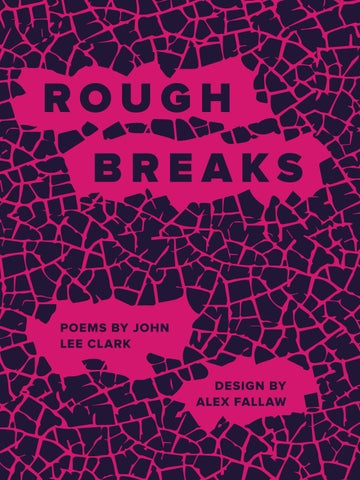
R O U G H B R E A K S
P O E M S B Y J O H N
L E E C L A R K
D E S I G N B Y
A L E X F A L L A W
Rough Breaks
A Chapbook, Copyright © 2024 by Alex Fallaw Developed in artd 444 Typographic Systems
Molly C. Briggs, Instructor
Spring 2024
School of Art & Design
University of Illinois at Urbana-Champaign
Rough Breaks is an original typographic re-setting of “To Ask” and “An Honest Man.” from How to Communicate: Poems, Copyright © 2023 by John Lee Clark. New York: W. W. Norton.
John Lee Clark is an award-winning poet, essayist, historian, and translator. He is also a deafblind activist in the Protactile movement. His acclaimed How to Communicate: Poems, 2023, reflects on the subjective nature of communication through a variety of poetic forms including haiku, prose poems, “erasures,” and more.
John Lee Clark’s poems about relationships really got stuck in my brain, and for a long while I couldn’t quite put my finger on why. There’s a degree of raw honesty in them, exposing wounds of betrayal and loss as they examine the role of partners in people’s lives.
“To Ask” tells a story where Clark is undeniably a terrible boyfriend, where the unflinching details of the argument doesn’t allow the reader to leave the moment. In contrast, “An Honest Man’s” beauty is in its withholding of detail, leaving the reader to finish the sentence themselves, which makes the emotional gut punch hit that much harder. I’ve titled this resetting of these poems “Rough Breaks,” as both of these poems are about ways relationships end that are messy and painful.
I used wide breaks after paragraphs to draw “To Ask” out, making the poem seem longer and trapping the reader in that space until it felt suffocating. I left the spacing in “An Honest Man” more conservative, maintaining the direct nature of the poem with nothing to cushion the emotional gut-punch.
She was a wonderful girlfriend
She didn’t have to but she started to learn Braille
I say started because she didn’t finish
She didn’t finish because I was the worst boyfriend imaginable
She was studying the Braille book she had ordered from the Hadley School for the Blind
Braille has a simple version called Grade One and an advanced version called Grade Two and she naturally started with Grade One
She asked me about a passage
I read it and it said See Spot run
I said stupid book kiddies and tore it in half
She said hey my book
I said SEE I Is The WaS SPOT run Ing run eD duh duh and tore it into more halves
She gave Braille up and almost gave me up
Almost
She went on to learn Gaelic French Japanese Danish Spanish and became a pioneer in written ASL
Braille she never touched again
It took years and being kicked out and finally being separated for two years but I learned to be a good husband
During the two years I was alone I read and read and read
The ASL words Braille and Forgive are almost the same so it was like I was saying forgive me while brushing my fingers over the dots
Forgive me forgive me forgive me
I was wrong
She did master Braille
The hardest most advanced kind
My best friend, a sweet man, drove all the way from Mankato when my wife left me. At the door he stood as tall as I and we hugged. Then he said, “Look good you. How manage? Can’t imagine. If my wife left for sure gunmyheadshoot will.” I gave him a don’t-be-silly shove. Before he left, I could feel him looking at me. He said that seeing me alone made him cherish his wife. He did, but his wife left him anyway and—well, he did.
Designed by Alex Fallaw for Molly Briggs’s artd 444 class.
Printed in the Digital Output Lab at the University of Illinois at UrbanaChampaign.
The text face is Georgia, designed by Matthew Carter, issued by Microsoft, Redmond, Washington, in 1996.
The titles are set in Proxima Nova, designed by Mark Simonson and released through FontHaus in 1994. This version was licensed through Adobe Fonts.