THE
alestle
ACCESS to install Carve out some time Men’s soccer takes evac chairs for people for fun at these back top spot in OVC with mobility issues local pumpkin patches after 3-0 shutout PAGE 2
PAGES 6-7
PAGE 12
Southern Illinois University Edwardsville
Thursday, October 22, 2026 Vol. 80 No. 3
THE student voice since 1960
National Corn-to-Ethanol Research Center to use $17 million investment to increase research capacity KATY ARTERBURN reporter The National Corn-to-Ethanol Research Center, which specializes in developing and commercializing biotechnology, will receive a combined investment of $17 million dollars from the Illinois state government and the IL Corn Growers Association. The research center plans to use these funds to expand its facility and workforce to accept more commercial contracts.
Plans to expand
At a basic level, NCERC can transform plants into bioproducts, according to SIUE Director of Government and Community Relations Emma Pieper. She said the facility tests those bioproducts to determine whether they are viable for commercialization. “Part of what makes NCERC so special is its partnership with industry,” Chancellor
James T. Minor said. “If company X is working on a … new biorenewable product and wants to commercialize that product … the testing and proof of concept research happens at NCERC.” “NCERC was started [about] 20 years ago,” Pieper said. “The building hasn’t changed since then, but the equipment has. The people have. It’s long overdue to expand it, because being at capacity means we’ve had to turn away certain contracts.” NCERC Executive Director Praveen Vadlani said the investment will help NCERC become a world-class digitalized biomanufacturing center with the latest automation equipment, artificial intelligence technology and analytical techniques. He said construction plans are also in the works. “We have been planning for some time that if funding was
see NCERC on page 3
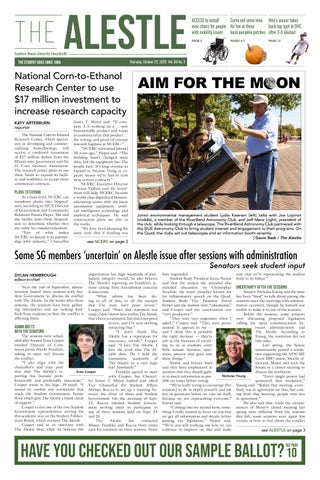
AIM FOR THE MOON
Junior environmental management student Lydia Kweram (left) talks with Joe Lopinot (middle), a member of the RiverBend Astronomy Club, and Jeff Menz (right), president of the club, while looking through a telescope. The RiverBend Astronomy Club partnered with the SIUE Astronomy Club to bring student interest and engagement to their programs. On the Quad, the clubs set out telescopes and an information booth recently. | Gavin Rask / The Alestle
Some SG members ‘uncertain’ on Alestle issue after sessions with administration
Senators seek student input
organization has high standards of journalistic integrity overall, he also believes The Alestle’s reporting on Franklin’s acNear the end of September, admin- tions raising First Amendment concerns istration hosted three sessions with Stu- is inaccurate. dent Government to discuss its conflict “What admin has been dowith The Alestle. In the weeks after these ing in all of this, in all the receipts sessions, the senators have been gather- that I’ve read, isn’t prior review,” ing information and are seeking feed- Cooper said. “Since that statement was back from students on how the conflict is made, I don’t know how within The Alestle affecting them. that’s been scrutinized, but that’s not prior review, and I’ve seen nothing Admin meets retracting that.” with the senators “I don’t think The The sessions were schedAlestle has a reputation for uled after Senator Evan Cooper inaccuracy overall,” Cooper emailed Director of Comsaid. “I love The Alestle. I munications Nicole Franklin, love the work that The Alasking to meet and discuss estle does. Do I hold the the conflict. journalistic standards of “I also align with the The Alestle to a very high chancellor’s and your posibar? Absolutely.” tion that The Alestle’s reEvan Cooper Franklin agreed to meet porting has become probwith Cooper, but Chancellematically and predictably inaccurate,” lor James T. Minor replied and asked Cooper wrote in his Sept. 19 email. “I Vice Chancellor for Student Affairs intend to combat any resolutions that Miriam Roccia to set up a meeting bereach the Student Government Senate tween the three of them and Student floor which give The Alestle a blank check Government. On the morning of Sept. of support.” 22, Roccia emailed Student GovernCooper is also one of the two Student ment inviting them to participate in Government representatives serving for any of three sessions held on Sept. 23 this academic year on the Student Publica- and 25. tions Board, which oversees The Alestle. The Alestle has contacted Cooper said in an interview with Minor, Franklin and Roccia three times The Alestle that, while he believes the each for comment on these sessions. None
DYLAN HEMBROUGH editor-in-chief
have responded. sure that we’re representing the student Student Body President Jenna Nestor body to its fullest.” said that the session she attended also included discussion on Christopher Uncertainty after the sessions Svochak, the street preacher known for Senator Nicholas Young said the issue his inflammatory speech on the Quad. has been “hard” to talk about among the Student Body Vice President David senators since the meetings with adminisFerrier said the sessions were “educational,” tration occurred, though he himself was and Cooper said the conversation was unable to make it to any of the sessions. “very productive.” Before the sessions, some senators “They were very responsive when I were discussing proposed legislation asked,” Cooper said. “They were pretty calling for open communication beneutral. It appears to me — tween administration and and I think this is probably The Alestle. According to the right decision — they’re Young, the resolution did not not in the business of unveiltake sides. ing to us as students every Last spring, the Senate little minute decision, operunanimously passed a resoluation, process that goes into tion supporting the AFSCME these things.” Local 2887 union. Shortly afNestor and Ferrier both terward, Minor met with the said they have emphasized to Senate in a closed meeting to senators that they should gathdiscuss the resolution. Nicholas Young er as much information as pos“Every single person had sible on issues before voting. sponsored that resolution,” “We’re really trying to encourage [the Young said. “Before that meeting, everysenators] to do in-depth research and ask body was in agreement on that, but comlots of questions before we vote on stuff, ing from that meeting, people were less because we are representing everyone,” in agreement.” Ferrier said. He also said that, while the circum“Coming into my second term, some- stances of Minor’s closed meeting last thing I really wanted to focus on was that spring were different from the sessions we get all information and details before this fall, some senators were again less passing any legislation,” Nestor said. certain of how to feel about the conflict “We’re just still working out how we can continue to improve on that and make see ALESTLE on page 3
PAGE 2
Thursday, 10.22.26
alestlelive.com
ACCESS to install evac chairs, work with students to improve campus accommodations LYN DIXON reporter Efforts to provide quality accommodations on campus continue as students and ACCESS alike strive for improvement, working on providing better emergency evacuations for those with disabilities, help with mobility and better accessibility for those who are hard of hearing and visually impaired. Dominic Dorsey, the director of ACCESS, said he strives to provide better accommodations to SIUE students. “My philosophy is that even though we’ve got the Americans with Disabilities Act as an unfunded mandate, compliance is the absolute floor,” Dorsey said. “We’re always seeking the ceiling of accessibility and to go above and beyond how we can.” In this mission, ACCESS is working to bring new accommodations to campus, one example being the recent addition of NaviLens for visually impaired students. Dorsey said they are also discussing the possibility of providing more bus stations or covered seating areas around University Drive. There is also an effort to provide better evacuation options for emergency situations. ACCESS has been trying to push for the installation of emergency evacuation chairs since 2018. They have since succeeded and now have a bank of evac chairs that will be installed soon,
according to Dorsey. Evacuation chairs are an accommodation option for people with mobility issues, helping them down stairs during emergency building evacuations. Right now, the protocol is for those with mobility issues to wait in designated areas until they can be helped. With evac chairs they would be able to leave the building at the same rate as everyone else. “I’ve always been very sensitive to the fact that individuals with disabilities and mobility challenges have to go to an area of rescue while everyone else is able to immediately evacuate,” Dorsey said. “So, having something available where they can leave at the same time as everyone else is very important to us.” Still, students notice where accessibility is lacking, and they push for improvements to be made. Viola Stangle is a senior ecology student and the president of Chronic Connections, a campus organization dedicated to providing a welcoming environment to those with disabilities and their supporters. Stangle said that there are a lot of negatives regarding accommodations on campus. “I think it’s kind of sad that SIUE prides itself on being very inclusive, and they say they’re very accommodating towards persons with disabilities and chronic illnesses, but from my experience as someone with celiac [disease] and speaking with
people in my club, it’s really not like that at all,” Stangle said. Freshman special education student Gabriel Gregson has noticed positives and negatives of accessibility as someone who is visually impaired. One of these negatives, Gregson said, is Center Court in the MUC. “It’s kind of chaotic down there, and navigating the lines is scary,” Gregson said. “It’s scary from a blind person’s perspective, because I’m often getting bumped and tripped and pushed out of the way.” Senator for Students with Disabilities Brynna Allen said one issue facing hard-of-hearing students and faculty is orders in the Dining Hall being called out verbally. “For those who have hearing impairments, they don’t know when their order is being called out, so they have to constantly go up to the counter and ask,” Allen said. “That is in progress, looking for a solution for that.” Allen said a large problem for accessibility is snow removal, as ice and snow often block pivotal pathways, especially from housing. “Facilities Management does have snow routes in place. However, for some of the dorm halls, some of these routes are inconvenient. They’re not necessarily direct lines to certain buildings or back to the dorm halls,” Allen said. “We have a few visually impaired students who have struggled, especially with the ice. Some of them have slipped and fallen because they can’t see the ice.”
There have also been efforts to work with ACCESS’ Campus Companions program, which is an effort to help people get around campus by providing aid with carrying items, light transportation aid and navigation assistance. However, it relies on volunteers. “We need more volunteers for that, because it relies on just a couple of people right now to assist others. So, that’s something that needs to be worked on, is getting more people to volunteer and just know about Campus Companions,” Allen said. Allen also said students should report accommodation issues when found to aid in the improvement of accessibility on campus. “I’ve been encouraging students to use the Disability Access Response Tool, which is through ACCESS. If you go through ACCESS’ website, there is a form you can fill out called the DART form,” Allen said. “You can fill it out anywhere on campus if something is inaccessible. Even if you aren’t disabled, it’s a great tool to use, because inaccessibility affects everybody.” “We’re making positive steps,” Allen said. “The unfortunate thing about so much of this is it takes so much time to actually make the changes.”
Trump administration rescinds 2024 Title IX regulations; SIUE policy remains unchanged KATY ARTERBURN reporter On Sept. 28, the U.S. Department of Education formally rescinded the Biden administration’s Title IX regulations. The rescission officially returns regulations from President Donald Trump’s first term into current law, leaving LGBTQ+ people without explicit Title IX protections. The law also changes legal definitions regarding sexual harassment. SIUE’s Non-Discrimination and Non-Harassment Policy remains unchanged. The original Title IX of the Education Amendments of 1972 prohibits sex-based discrimination in educational programs and activities that receive financial assistance. According to the Department of Education’s website, the reinstated policy “once again aligns Title IX’s sex-based protections with biological reality, not ideological fantasy.” The renewed regulations became legally enforceable in January 2025. “One of the most immedi-
ate outcomes of [these changes] was that [the Trump administration was] going to use the investigative powers Title IX gave them, not to investigate any kind of wrongdoing against the trans community, including assault, but rather to investigate and prosecute any schools … that might allow transgender athletes to play on the team that most clearly identifies with their own identification,” Mass Communications Professor Gary Hicks said. The New York Times wrote that in April, Trump had terminated multiple settlements concerned with equal educational opportunities for transgender students. The administration has launched over 40 civil rights investigations into institutions providing protections for transgender students. According to Politico, the reinstated policy also impacts aspects of sex-based harassment. The regulations require colleges to address Title IX complaints with “courtroom-like” hearings, which can include cross-examination of survivors. This policy alters the defi-
nition of university sex-based harassment to mean the conduct was “so severe, pervasive and objectively offensive” that it denied the recipient equal access to education programs and activities. The Biden-era regulation said the harassment must be “so severe or pervasive” that it “results in a limitation” of participation in educational programs or activities. This effectively raises the standard of proof required in university harassment hearings. “We’ve always had a problem with not believing victims. I think stricter policies or punishments need to be put in place. [Some of] the Cornell Seven [had] to write an essay,” junior psychology student Bella Knuffman said. “People say, ‘Oh, we don’t want to ruin these gentlemen’s lives,’ or whatever, [but] a girl’s life was ruined, and she’s going to live with that for the rest of her life.” In an Oct. 13 email to The Alestle, Director of Equal Opportunity, Access and Title IX Coordination Mary Zabriskie wrote that SIUE’s Non-Discrimination and Non-Harassment Policy would remain the
same, prohibiting discrimination based on sex, sexual orientation, gender expression and gender identity. Zabriskie wrote that SIUE is committed to the rights of all students. “As long as SIUE continues to keep policies that protect everyone and are inclusive, especially vulnerable populations such as the LGBTQ+ community … I think they are doing a good job,” Knuffman said. While the current Title IX regulations do not include any changes to the legal definition of gender and sex, proposed legislation aims to modify Title IX to reflect the definition of sex in Executive Order 14168. Executive Order 14168 defines “sex” as “an individual’s immutable biological classification as either male or female,” and says that “‘sex’ is not a synonym for and does not include the concept of ‘gender identity.’” “[It] is my great fear that … the demonization of people who are not like others will continue to lead to more legislative rollbacks — judicial failings,” Hicks said.
“Throwback Thursday” is a monthly print-exclusive column featuring noteworthy, impactful or downright silly events throughout SIUE’s history. Information for this column was obtained by Editor-in-Chief Dylan Hembrough from past issues of The Alestle.
OCTOBER
1966 (60 years ago) Starting in October and running through January, a series of polls is held over the naming of The Alestle. 1968 (58 years ago) Several Black students storm a table where supporters of George Wallace are seated in protest of Wallace’s segregationist policies. The Alestle refuses to condemn the students for their actions. 1971 (55 years ago) The Fuller Dome is completed, then known as the Religious Center. 1973 (53 years ago) The position of student trustee is created. 1976 (50 years ago) Student Senator Bill Tope earns much negative attention from the Student Senate after using Student Government-owned stationery to write a letter. 1981 (45 years ago) Student Body President John Mosser writes a letter to the editor calling for the resignation of Editor-in-Chief Nancy Weil. He accuses her of “prostituting” The Alestle to members of former Student Body President John S. Rendleman’s administration. This is just one of Mosser’s many attacks on The Alestle. 1983 (43 years ago) Former Athletic Director Ed Bigham files a $6 million lawsuit against SIU President Earl Lazerson for his firing. Bigham was fired after he admitted he knew some student-athletes were skipping classes for training. 1985 (41 years ago) Kyna, the live cougar mascot, undergoes surgery after eating a soccer ball. 1986 (40 years ago) A devastating flood hits the East St. Louis campus, promoting donation drives from the Edwardsville campus student organizations. 2002 (24 years ago) Somebody steals the Rock. 2012 (14 years ago) Extremist pastor Keith Darrell is driven off campus by students.
Thursday, 10.22.26
alestlelive.com
PAGE 3
State government, farmers invest in biofuel research on campus NCERC | COVER
made available, we would already have plans developed for potential expansion,” Minor said. “We’re well into the planning phase, which will be exciting. It will shorten the distance from the investment to actually realizing the expansion.”
Support from elected officials and farmers
Minor said elected officials like Deputy Governor for Budget and Economy Andy Manar, U.S. Representative Nikki Budzinski, State Senator Doris Turner and Illinois State Representatives Katie Stuart and Jay Hoffman were instrumental in bringing the investment to SIUE. Pieper said $15 million of the $17 million investment came from the state government. The IL Corn Growers invested $2 million. “This announcement will usher in a new era for SIUE, for student researchers, for our corn growers and for the future of the bioeconomy here in Illinois. With this $15 million investment, they will be able to expand research and training capacity and give businesses the skilled talent they need to grow,” Budzinski said in a statement relayed by her communications director, Josie Lionetti. According to Minor, NCERC creates a secondary market for Illinois farmers who provide the crops necessary for bioproducts. Minor said these crops can be transformed into products like sustainable aviation fuel. He said for every dollar invested in NCERC, the facility returns almost $5 into the Illinois economy. “The Illinois Corn Growers were re-
ally the champions of this and leading the efficacy piece of it. [It was] the SIU System, our campus, corn growers and our state representatives — Katie Stuart filed a bill for us,” Pieper said. “Everyone was advocating for this expansion.” “I’m proud to continue supporting NCERC back in Washington, as co-chair of the Biofuels Congress,” Budzinski said. “This year, I submitted an additional federal funding request that will hopefully boost this already robust investment. Ultimately, this funding will help propel NCERC forward and allow them to expand on the groundbreaking work they are doing right in our district.”
NCERC offers opportunities for SIUE students
“NCERC allows graduate students and interns to work firsthand on this cutting-edge research here in our facility. We have graduate students, we have interns, and they get the opportunity to work alongside these researchers to gain this industrial-esque experience that they wouldn’t get in a classroom or a lab,” Rebecca Damuth, NCERC’s publicity and promotion associate, said. In an Oct. 16 email, Damuth wrote that she estimates over 250 students have been trained at NCERC. This includes students studying chemistry, biology, environmental science, mechanical engineering, communications and business. Operations Manager Jared Burns said NCERC looks for candidates with chemistry backgrounds, instrumentation knowledge and mechanical engineering experience to help with research and operations.
Operating Coordinator Andrew Platto (left) and research fellow Mingjun Ma work at the National Corn to Ethanol Research Center. | Courtesy of NCERC
Student Government gathering different perspectives, student input on conflict between admin, The Alestle ALESTLE | COVER
than beforehand. Nestor, Ferrier and Cooper all said they did not feel the Senate was being pressured by administration to lean one way or the other. In his Sept. 19 email to Franklin, Cooper referenced the union resolution, saying he now believes the Senate acted “in an ignorant manner.” “I think that there is an insistence from all of the people above us … that we be careful with what we do. There is an insistence that we be measured in our behavior,” Cooper said in his interview with The Alestle. “What I know now about what was happening with the union [last year] … is distinctly different than what I knew when that resolution was passed.” “Would I have voted ‘yes’ on that resolution having known everything that I know today? I don’t know,” Cooper said. “But the fact that I didn’t know, and the fact that all of those facts were out there, but I still voted ‘yes’ on the resolution without knowing the facts, shows me I acted out of ignorance.” According to Cooper’s Oct. 12 senate report, the proposed resolution on the admin-Alestle conflict lost momentum after the sessions with Minor, Franklin and Roccia. “I now feel that, for the first time, I have a good perspective of both viewpoints on the issue,” Cooper wrote. “That being said, the resolution that was being pushed through on this issue has now happily fallen away, and we as a Student Government are focusing on more creative, effective ways to bring good, well-informed student reporting back to campus.”
one, but if each of the Student GovernNestor and Ferrier said the next step ment members were to reach out, that for the Senate is to figure out what the would be something.” Nestor and Ferrier said they would student body thinks of the conflict. “I’d say be patient on it. I think it be available to support the senators in has been a pretty busy couple weeks with whatever way they choose to survey the homecoming, midterms [and] all that,” student body. “In previous years, we’ve had a lot of Ferrier said. “It’s not forgotten. We’re still working to gather info, and especially that success in student outreach through tabling and stuff. I know we student perspective side have a few senators that of things.” are big on surveys and Cooper said he things of that nature,” wants to eliminate Ferrier said. “However as much bias as posWe’re really trying the Senate wants to apsible in gathering to do what’s best proach it, me and Jenna student opinions. for the student are here to support it.” “Typically when you “We have a great get responses from stubody and get all group of senators this dent surveys and stuff, information before year, and we’re really tryyou’re getting responsing to do what’s best for es from people who are we come to any the student body and get active,” Cooper said. conclusions all information before we “I wanna know what ourselves.” come to any conclusions the student who lives in ourselves,” Nestor said. O’Fallon and commutes Jenna Nestor “We all really believe in every day sees of this, Student Body President truthful media and makif they see it to begin ing sure that all informawith. If you see it, what do you think? We’re underrepresented tion is being spread fairly and as evenly when it comes to student opinion on a lot as possible.” of things.” Young said that, while focus groups Pushing toward action Young believes the Senate must take are helpful for more “niche” issues, he believes that every senator needs to talk with action on the issue. He was a co-author on their constituents directly to get an accu- the initial proposed resolution, but now rate view of how the student body feels. feels that it would not have been very use“From my perspective, the students ful in finding a solution. in general in the grad school and the “The initial resolution as it was writstudents in general in psychology, they ten would probably not accomplish much. believe that this is an issue and they are It would be a nice sentiment, and I do concerned,” Young said. “That’s good, think it represents student voices in a fairbut what is Nursing saying? What is CAS ly decent way, but I think it’s important saying? Different students are gonna have we are actively part of the solution and different answers. We can’t get every- increasing communication,” Young said.
Gathering student perspectives
“
“The student voice is not telling us to be quiet.” “If we can have meetings with admin and we can have meetings with The Alestle, how can we then use our position to make that work so that these two bodies can find that compromise and common ground, where a stronger foundation can be built for the betterment of students?” Young said. Senator Mauri Johnson addressed the Senate at their Oct. 12 meeting, saying that he had observed “very concerning recurring behaviors among [his] Student Government peers” in relation to the SIUE-Alestle conflict. “Conversations mention fears, concerns and if-then statements about what other student organizations, individuals or staff [and] faculty might feel about what we as Student Government have to say or how we act,” Johnson said. “I find this to be so dangerous, because said behaviors and conversations have and will continue to lead to stalled progress, indefinite inaction and decisions guided by outside pressure rather than our own judgment.” “Inaction is indifference,” Johnson said. “Not taking a stance is no different than giving in.” Cooper believes that, whatever the solution, the university should support student outcomes and foster a learning environment. “At the end of the day, these are students trying to learn journalism, and I think we should facilitate them trying to learn journalism,” Cooper said. “As we push towards resolving this issue, it’s imperative that both parties are able to say, ‘We goofed on this.’ Nobody gets anywhere if somebody’s stuck their heels in the ground.”
PAGE 4
alestlelive.com
Thursday, 10.22.26
Senators address ‘festering’ issues on campus, deny funding for club’s card tournament
DYLAN HEMBROUGH editor-in-chief Senators Mauri Johnson and Michael Kraft read their reports to the Student Senate at their Monday, Oct. 12 meeting, to speak on issues facing the SIUE student body. The Senate also approved two new clubs and denied funding for cards for a Magic: The Gathering tournament. Johnson’s report centered on the “behaviors” he said had led to “indefinite inaction” on the part of the Senate, both broadly and as relates to the “very serious and actively festering conflict pertaining to The Alestle, SIUE administration and freedom of expression.” “Over my short few weeks in Student Government, I have witnessed what I believe to be very concerning recurring behaviors among my Student Government peers. Conversations mention fears, concerns and if-then statements about what other student organizations, individuals or staff [and] faculty might feel about what we as Student Government have to say or how we act,” Johnson said. “I find this to be so dangerous, because said behaviors and conversations have and will continue to lead to stalled progress, indefinite inaction and decisions guid-
ed by outside pressure rather than our own judgment.” Johnson said his report was not meant to call for a specific solution to the conflict between administration and The Alestle, but to “address the broader issues” he said he saw in the Senate. “We must be willing to acknowledge the situation and determine how we, as representatives, should respond. We must continue to work tirelessly for our people, even when doing so requires difficult decisions,” Johnson said. “Inaction is indifference. Not taking a stance is no different than giving in.” Kraft again reported on his constituents’ feelings on the rebranding efforts at the Alton dental campus. Johnson asked what the dental students’ next steps were and what the Senate could do to support them. “I’m speaking with our student body tonight … on next steps,” Kraft said. “Most likely, we’ll be reaching out to central administration and asking for a formal mandate.” “So far, your support right now is incredibly appreciated,” Kraft said. “If we don’t end up getting the answer or at least the compromise we’re trying to look for, we would love for Student Government to sponsor a resolution supporting us.” The Senate only heard one program request at the Oct. 12 meeting. Magic The Gathering at SIUE requested $565 in funding for their upcoming Reality Fracture Draft card tournament, with $510 of that funding going to buying cards.
Representing Cougar pride: Alumni who made it big ASHTON STANBERRY copy editor Since SIUE’s founding in the 1950s, it has graduated thousands of successful alumni. So, let’s take a moment to talk about a few of the greatest.
Thelma Mothershed-Wair
Thelma Mothershed-Wair was a member of the group of nine Black students, known as the “Little Rock Nine,” who pioneered the integration effort in Little Rock, Arkansas, by enrolling in Central High School in 1957. Despite constant harassment by members of the community and school and efforts to keep the students from receiving their diplomas, Mothershed-Wair graduated high school after taking credits outside of Little Rock. Mothershed-Wair received her bachelor’s in home economics in 1964 from SIU Carbondale, and then came to SIUE for her master’s in guidance and counseling. She graduated from SIUE in 1970 and also completed an administrative certificate in education in 1972. She went on to teach in East St. Louis until 1994 and won several awards for her contributions to the community, including an Honorary Doctor of Humane Letters degree in 2016. Mothershed-Wair died on Oct. 19, 2024, in her hometown of Little Rock.
Gib Singleton
Gilbert “Gib” Singleton was born on a farm in Kennett, Missouri, and was a passionate artist from childhood. He received his bachelor’s in art education at SIUE in 1967 and went on to study at the Art Institute of Chicago, where he earned a Fulbright Scholarship that allowed him to study Renaissance art in Florence, Italy. Singleton worked on art restoration in a Vatican workshop, restoring many important art pieces, including Michelangelo’s Pietà. Afterwards, he returned to the United States and worked on his own art. He is regarded as a master of bronze sculpture and specialized in bibli-
cally-themed and Western art. The Gib Singleton Gallery opened in Vail, Colorado, in 2012, just two years before Singleton died in 2014. It features many of his sculptures and artwork from other artists that “complement and expand upon the sculptural tradition at the heart of the space,” according to the Gib Singleton Gallery website.
Peter Maer
Peter Maer grew up in Granite City and worked at a local radio station during high school before attending SIUE as a member of the very first class of mass communications students. He graduated with a master’s in mass communications in 1970. Maer spent over three decades from 1977 to 2015 as a White House correspondent and covered presidential campaigns, visits to other countries and significant political events. He has won several awards, including five Merriman Smith Awards from the White House Correspondents’ Association. Maer formally retired from journalism in 2015, but came back to CBS News as a news contributor during the 2016 elections. In May 2026, he published a book titled “Chasing the Story: A Reporter’s Journey to the White House.”
Robert Seguso
Robert Seguso was born in Minnesota and played tennis for SIUE, where he was an NCAA Division II singles finalist in 1982 and a Division I doubles finalist in 1983. After college, Seguso started playing tennis professionally, focusing on his doubles career alongside his SIUE teammate Ken Flach. He won four Grand Slam doubles titles and a doubles gold medal at the 1988 Olympics. The U.S. team also won the World Team Cup in 1985 while he was a member. Seguso was ranked No. 1 in doubles in the world by 1985. By the time he retired in 1999, he had won nearly 29 doubles titles.
“It sounds to me like we’re just buying their cards for their card game,” Senator Evan Cooper said. “How is this impactful for campus?” “To my knowledge, the cards are tradeable or sellable,” Student Body President Jenna Nestor said. “Is there protocol to prevent this?” Senator Yasmine-Ayanna Bryant, who presented the program request to the Senate, said the aim of the tournament is to “foster a sense of community” for those who play the game and that, though the club said the cards would be SIUE property, they could only be used for casual play — never again in any future tournament. The motion failed as 11 senators voted against providing funding. Nine voted in favor, and two abstained. SIU System President Dan Mahony also addressed the Senate to explain his role and the function of a university system. Mahony’s appearance before the SIUE Student Senate followed a similar presentation in Carbondale. Mahony said a new funding formula is moving through the state legislature that, if passed, will change how SIUE receives state funding. “Most other funding formulas are either enrollment-based … or they are performance-based. I am not a fan of the performance-based models, because they tend to advantage the institutions that are already rich and have the students with the least amount of need and the best high school achievement,” Mahony said.
“What would be most equitable would be to look at where there are equity gaps in going to college [and] retaining students, and [the state] will give more money to institutions that have students in those groupings.” “It advantages institutions a little bit more who take in more students who have Pell Grants or are first-generation,” Mahony said. The Senate approved both the National Alliance on Mental Illness on Campus and Cougars in Tech, an organization dedicated to software engineering. The Senate also approved a constitutional revision for the Mock Trial club. Nestor also announced that she has appointed Cooper to be this year’s fee commissioner. The fee commissioner, along with the Fee Commission consisting of senators and non-senator student representatives, looks over proposed fee reviews and provides a recommendation to the Senate. The Senate then votes on whether or not to recommend the proposals to the Board of Trustees. “I think that Evan has done a great job in his two years in Senate,” Nestor said. “He has just been a very reliable and organized person. He has an important skill of being able to just look at the facts and analyze them and make unbiased suggestions.” External Affairs Officer Maggie Moeller was absent without an excuse. The next Senate meeting will be 6 p.m. Monday, Oct. 26, in the Mississippi/Illinois Room of the MUC.
No sweatshirts, no bookbags: Testing Center policy updates to keep in mind LILY BERKENBILE reporter On Oct. 5, the ACCESS Testing Center updated their policies and procedures to explicitly prohibit jackets, coats and sweatshirts, as well as backpacks, purses and tote bags. The clarifications can be found under the ACCESS Testing Center’s General Guidelines in sections four and five. “Hooded sweatshirts, heavy coats, parkas, windbreakers and denim/leather etc. jackets are prohibited in the testing space, as are hats and head wraps. Exception: Religious head coverings and medical headwear are allowed but are subject to visual security inspection. Cubbies are available for storage of these and other small convenience items.” “Backpacks, purses, tote bags and other general carry-all devices should be stored in a cubby. Once testing has begun, you are NOT permitted access to bags and large personal items in the Testing Center. The Testing Center is not responsible for personal belongings or lost items.” According to Director of ACCESS Dominic Dorsey, there was no particular instance of cheating or any specific event that brought about the policy clarification. Rather, the changes were made to ensure that the ACCESS Testing Center remains in uniformity with guidelines at other universities’ testing centers. “[These clarifications] will bring us into alignment with other testing centers nationwide, both in university settings as well as licensure exams,” Dorsey said. The guidelines prior to Oct. 5
already prohibited items such as baggy clothing. The rewritten portion of the guidelines works to add specificity for an incoming student so they know what they can and cannot have. It also alleviates any presumption that a student could be cheating, according to Dorsey. “This is just an opportunity to remove any doubt [and] allow students to come and take their exams without anyone perceiving or assuming … that they’re engaged in any sort of academic dishonesty,” Dorsey said. “If there’s ever a concern about [cheating], having those items not on their person … will allow us to exonerate any students that might be otherwise perceived to have been engaging in those types of activities.” Additionally, Dorsey said the clarified policies ensure a more efficient use of time for the students testing and the faculty overseeing it. “Other centers might pat students down or ask them to turn out pockets and things of that nature — that’s time consuming and invasive. We just really want to provide students an opportunity to take an exam with their accommodations,” Dorsey said. These policies were not implemented without proper accommodations. ACCESS offers cubbies to place any prohibited items in. According to Dorsey, students’ belongings are kept in a specific, organized location in view of the Testing Center. This is meant to remove concern of theft or loss of the items while the student takes their test. Students interested in the full policy can read it on the ACCESS Testing Center webpage.
THE ALESTLE WILL PUBLISH NEXT IN PRINT 11/19.
lifestyles
contact the editor: lifestyles@alestlelive.com (618) 650-3528
alestlelive.com
Thursday, 10.22.26
Counseling receives $453,200 grant to continue mission of student service LILY BERKENBILE reporter
This past year, SIUE Counseling and Health Services received a grant from the Illinois Board of Higher Education’s Mental Health Early Action on Campus Act for $453,200 for the 2027 fiscal year. The funds will help to continue fulfilling its mission to “deliver compassionate, inclusive, comprehensive medical and behavioral health services that support student well-being, promote resilience, and limit interruptions in academic pursuits.” “This funding allows us to build on the progress we’ve made in expanding access to mental health services and continue strengthening the support available to our students,” Executive Director of Student Health and Well-Being and Medical Chief Amanda Pittman wrote in an Oct. 16 email to The Alestle. The grant comes from the IBHE’s Mental Health Early Action on Campus Act. It’s a competitive grant program that was enacted on July 1, 2020, to help campuses across the state meet the mental health service needs of the students. “[The Mental Health Early Action on Campus Act] is a statewide initiative focused on making mental health care more accessible to college students,” Pittman wrote. “At its core, it’s about recognizing that mental health is an important part of student success and that colleges and uni-
versities have a responsibility to help students access the support they need.” The process of obtaining the grant required the submission of an implementation and utilization plan by Counseling and Health Services to the IBHE. Pittman wrote that the process for making these plans was reliant upon being responsive to student wants and needs across the board. “A lot of that planning comes from listening to our students, understanding what they’re experiencing and looking at both our own data and national trends in college student mental health,” Pittman wrote. “We want to make sure the decisions we’re making reflect what our students actually need.” The services currently offered by SIUE Counseling and Health Services run on a “stepped care” model. According to South Western Sydney Primary Health Network, stepped care in mental health revolves around understanding the person and tailoring the intensity level of their care to their needs. “Stepped care is a model of evidence-based mental healthcare delivery where the service intensity is matched to individual need [or] severity of the mental illness … The ideal intervention is the least intensive and least intrusive,” according to the South Western Sydney Primary Health Network. “The continuum of care is self-correcting, requiring monitoring of patient outcomes so that
PAGE 5
Counseling and Health Services offers a variety of resources for students to use during their time at SIUE. | Gavin Rask / The Alestle step-up or step-down may be implemented as appropriate.” Counseling and Health Services’ stepped care model can be viewed on their website. According to Pittman, their services aim to meet students where they are. “We want students to know they don’t have to be in crisis to seek help, and they don’t have to know exactly what kind of support they need before reaching out. Whether they’re feeling overwhelmed or facing something more serious, we want them to know there’s a place to start and
people who genuinely care about helping them,” Pittman wrote. Any student can walk in for an appointment for any reason. If further treatment is deemed necessary, then the stepped care model comes into place. The more a student needs, the more resources the Counseling and Health Services will draw from within their power to accommodate them. Their services include behavioral health consults, individual and group counseling, psychological assessments, psychiatric consultations, skill sessions and psy-
cho-educational workshops. Peer support and self-help resources are also available. The length and regularity of appointments is based upon the student needs. “We’re not just addressing mental health concerns. We’re helping students through some of the most challenging moments in their lives so they can stay connected to their education, recognize their own strengths and continue working toward the future they envision for themselves,” Pittman wrote.
SIUE’s Belleville campus offers hands-on experience in project development DYLAN HEMBROUGH editor-in-chief The old Lindenwood-Belleville campus is now occupied by the Southwestern Illinois Justice and Workforce Development Campus. Originally founded with criminal justice and forensic science in mind, the scope of the campus’s projects has grown considerably over the past few years. The campus houses the Institute for Community Justice and Racial Equity. Dennis Mares, a criminal justice professor and the director of this program, said he pitched the idea for a criminal justice-focused campus to administration around the same time as its future home became available. “We work directly with students hands-on … on a project basis,” Mares said.
Mares also said that, over the past few years, the kind of work done at the Belleville campus has had to expand as federal grants for criminal justice programs became less reliable. “We started out originally as a criminal justice-focused entity, but as grants dried up as a result of the current federal administration, we ended up getting into how we can stay relevant as a research center [and] how we can integrate the public safety mission alongside other projects,” Mares said. “We see all these sorts of needs in criminal justice fields, but they’re oftentimes mirrored in other fields as well,” Mares said. “I think that’s a natural evolution, though [grants] have certainly had us looking for more avenues to stay relevant as a unit.” One of these projects is a
virtual reality simulation for dental students at the Alton campus, led by senior computer science students Braden Kapp and Andrea Klostermann. Their goal is to create a simulated, anatomically-accurate human head for dental students to practice on in virtual reality. Kapp is designing the model itself, while Klostermann is in charge of setting up the necessary infrastructure for the program to run smoothly. “I set up a menu for controlling the model so you can toggle layers. I did all the scripting for that,” Klostermann said. “For example, there’s a muscle layer, there’s a skin layer, there are buttons to toggle those off so you can see what it looks like when it’s just a skull.” “There’s a lot of different features to it, because we have a whole human face model,” Kapp
said. “They could have one specific part of the nervous system they want added … A lot of that has to be pretty exact for it to actually be educational.” Kapp and Klostermann both said their experiences with this hands-on work has provided opportunities beyond what they could do in a typical classroom setting. “The ability to just experience a wide range of parts of computer science that I wasn’t even originally familiar with, and to have people believe in you and trust you with responsibility every step of the way, it’s made me feel a lot better about myself as a programmer and made my experience here at SIUE a lot more worthwhile,” Kapp said. Mares said this pivot toward project development will be central to the campus’s story. “We’re becoming more
and more an engineering shop … than we are a policy practice shop, and that’s the tension we’re in now,” Mares said. “Which direction are we gonna head in? Are we gonna keep everything? Are we gonna focus more on the software and engineering parts? That’s our challenge for the future.” Despite the uncertainty about the campus’s direction, Mares said he believes the campus will come into its own as it grows. “I’m really grateful for the support … It’s quite a challenge to set up a whole new satellite campus, and it’s a tough challenge when you’re half an hour away from the main campus in some respects,” Mares said. “But I think as this place grows … I do see it turning into a pretty vibrant campus overall in the next few years.”
alestlelive.com
PAGE 6
Thursday, 10.22.26
Braeutigam Orchards: Free, fun, family owned AUDREY O’RENIC sports editor
Audrey O’Renic / The Alestle
Braeutigam Orchards in Belleville offers a fun fall experience at no cost. The highlight of Braeutigam is its apple orchards and pumpkin patch. I took a complimentary tractor ride out to the pumpkin patch, which was vast and beautiful. The patch is easy to walk through, and the selection goes beyond the traditional orange pumpkin, with a wide variety of pumpkins and squash in different colors, shapes and sizes. Beyond the orchards, Braeutigam has chickens, pigs, goats and bunnies all available to pet and feed. I love animals, so that was hands down my favorite part. They also have a reasonably sized children’s play area that has activities like a mini hay bale maze.
Orange ff5400
Braeutigam has its Pink own bakery best Dc0073 known in the area for their apple cider doTeal nuts. The orchard also features local food 98b9ab vendors on-site. Blue 6665ddan assortment The farm market offers Purple of products, including homemade ketchup, 841f7a jam, pasta sauce, honey, potatoes, tomatoes, pickled goods, syrup and barbecue sauce. I purchased an apple cider slush and a jar of peach salsa for just over $11. Braeutigam is open from 9 a.m. to 5 p.m. on Sunday, 8 a.m. to 6 p.m. Monday through Friday and 8 a.m. to 5 p.m. on Saturday. Although very popular, I really like that Braeutigam does not feel commercialized and still has that true, family-owned feel. It’s free to enter, and prices are affordable for it being a small business. I had a great experience and I will definitely be back.
Pumpkins are plentiful at Rinkel Pumpkin Farm Orange ff5400
JAIYLA OWENS online editor
Jaiyla Owens / The Alestle
Rather secluded, but charming, Rinkel Pumpkin Farm is located on Old Troy Road, about 15 minutes from SIUE. Once I parked on what looked like a flattened cornfield, I noticed many families had decided to spend their Sunday afternoon at the farm. Admission cost me $8, and I purchased a small cup of animal feed for an extra dollar, bringing my total to $9 and some change. All stops were pulled out for the petting zoo. The variety of animals was probably the most shocking part of my experience at the farm. I decided to give the feed I purchased to a couple of goats, but there were seven other kinds of animals to visit. I came to Rinkel Pumpkin Farm for the pumpkins, so naturally I went to the pumpkin patch next. Even at the end of the weekend, there was no shortage of pumpkins. Although I believe they were a bit overpriced, as well as some of the items at the country store, the availability and variety was very
For more Metro East Eats, visit alestlelive.com or scan this QR code:
good. There was also a smaller patch with Pink smaller pumpkins in whatDc0073 appeared to be the activity hub. I’d assume those pumpTeal 98b9ab but it was all kins were for smaller children, very cute. Blue Something else that shocked me about 6665dd this pumpkin patch was the number of acPurple tivities offered. On top of841f7a the petting zoo and the mini pumpkin patch, there was also a playground and several classic games out to play. Flower picking was also an option, as well as a train ride for the kids. Most of these activities were self-service. I also noticed some practical things while I was out at the farm. Outdoor bathrooms were provided, along with hand-washing stations. There was also a pavilion strategically placed near the concession stand for patrons to sit and eat. The concessions were probably the most reasonably priced items, with only one item on the menu exceeding $10. Looking back, I definitely should’ve brought my family with me when I visited Rinkel Pumpkin Farm. I didn’t purchase anything, but I had a lot of fun just walking around and enjoying the activities.
Check out Metro East Markets, visit alestlelive.com or scan this QR code:
TO ADJUS FILE > PA > CUSTO
MULTIPLY ORIGINAL DIMENSIO FOR HIGH QUALITY
DRAG HA OVER BL FOR HAL
“TOTAL”, AND STAR GRAPHIC LIKELY N CHANGE RATING
GOLD CO DARK YE
BLUE CO LIGHT BL
CONVER HEX AND CUSTOM PICKER
DO NOT E TEMPLAT
TO ADJUS FILE > PA > CUSTOM
MULTIPLY ORIGINAL DIMENSIO FOR HIGH QUALITY
DRAG HA OVER BLU FOR HALF
“TOTAL”, R AND STAR GRAPHIC LIKELY NE CHANGED RATING
GOLD CO DARK YEL
BLUE CO LIGHT BL
CONVERT HEX AND CUSTOM PICKER
DO NOT E TEMPLAT
alestlelive.com
Thursday, 10.22.26
PAGE 7
Relleke Pumpkin Patch gives state fair experience DYLAN HEMBROUGH editor-in-chief
Dylan Hembrough / The Alestle
Orange ff5400
tasted amazing. Pink We bought $20 worth of tickets after Dc0073 of them riding a Pumpkins are fun and all, but have that, and I spent eightTeal 98b9ab it was fun and you ever ridden a camel? If that sounds camel — a little steep, but We then spent six like your kind of Sunday afternoon, look worth it for the novelty.Blue around the farm, no further than Pontoon Beach’s Relleke tickets on a wagon ride6665dd where we saw families out looking for the Pumpkin Patch. Purple 841f7a home. We spent My wife grew up in Granite City and perfect pumpkin to bring has told me all about Relleke’s, so I was ex- five more tickets on cups of sliced carrots cited to visit. I was not disappointed — I to feed to the animals, including baby was expecting some pumpkins and a corn goats, a pig and a very fluffy alpaca. We maze, but there was so much more. Be- kept our last ticket as a souvenir. While we didn’t end up buying a tween a pumpkin-launching cannon, vendors selling homemade crafts, a pit full of pumpkin, we did look at them and take corn seeds and a petting zoo with turtles, pictures with them. Their selection up there truly was something for all ages here. front was very neat and organized, and We walked around the area first to see they looked reasonably priced. There was what it had to offer. I was struck by how a large variety of sizes and colors, as well as much they managed to fit in such a small wooden baskets full of gourds. We finished the day with a hot dog area. There was live music you could hear farm, the on and two lemonade shake-ups for $17. from pretty much anywhere and there was a huge variety of activities. While I did leave with my pockets quite We decided to eat first, so we got a funnel a bit lighter, the cool weather and relaxed cake and some nachos and cheese to share. yet vibrant atmosphere made for a fun and Unfortunately, this alone was $15, but it memorable afternoon.
Pumpkins, pizza and plenty of fun at Boonies Farm DESTINY ALBRECHT lifestyles editor
Destiny Albrecht / The Alestle
Located just 20 minutes outside of Edwardsville, Boonies Farm in Worden offers a variety of outdoor activities for visitors looking to enjoy the fall season. Admission was $17.94 per ticket when purchased online, including fees, compared to $19.95 at the gate. There were plenty of people visiting during my trip, but the spread-out layout of the attractions kept the park from feeling too overcrowded. The staff were also very welcoming and attentive when we needed something. There was plenty to do throughout the property, including a petting zoo, pumpkin picking, a corn maze, a zipline and a giant slide. Visitors can also shoot pumpkins and gourds out of a cannon, jump on an inflatable pillow and listen to live music. My boyfriend and I even found a cozy spot next to a fire pit where we could sit, talk and enjoy our food between activities. The
Orange ff5400
variety made it a great date spot, but it could Pink also be an especially fun outing Dc0073 for families with young children. Teal The food was another 98b9ab highlight, as we split the meat pizza with Blue red sauce, mozzarella, sausage, pepperoni6665dd and bacon for $16.75 from their on-site Purple restaurant Good 841f7a News Brewing Company. Although it was delicious, I thought the price was a bit high for the portion size. The kettle corn was also a great snack to bring home after a few hours of festivities. One thing I noticed was that most of the property consisted of grass, which could make navigating the park difficult for some visitors with disabilities. I also observed that the advertising and posters appeared to use AI-generated content, which was disappointing when local artists could have been given the opportunity to create their graphics. Overall, Boonies Farm was clean, entertaining and welcoming. Despite a few areas of improvement, I had a great time and would recommend it for a fun outing.
Goats at Grant’s Farm: Animals and acres MADISON STEFFEN opinion editor
Madison Steffen / The Alestle
When looking for an interactive fall activity, Grant’s Farm is a St. Louis hot spot. Grant’s Farm hosts a menagerie of creatures on its over 280 acre-land, including camels, various kinds of goats and Highland cows. Visitors can feed, ride and pet animals while also enjoying Dippin’ Dots and Circus Harmony. For adults, there are bites and beverages to be enjoyed in the Bauernhof Courtyard. A three-car tram takes you on a ride through the historic land, allowing visitors to view the houses on the property from a distance. A private tour may provide a closer look, though it remains one of the attractions that requires payment. Beyond specialized tours, the park retains free entry for general admission before 5 p.m. for all visitors, with an $18 park-
Orange ff5400
ing pass to be bought in advance, or for Pink $27 on-site. Dc0073 On the other side of the parking lot is Teal the pop-up “Fall Fest,” which 98b9ab is run in collaboration with BudweiserBlueClydesdale. This is where visitors can take 6665dd hayrides, navigate Purple a corn maze and participate in more fall-cen841f7a tered activities. This side of the park, however, is open exclusively on weekends and closes at 5 p.m., or at 4 p.m. after October, but many things at the farm are open at different times depending on the event. Overall, Grant’s Farm is a fun, family-friendly activity for autumn lovers, but if you’re looking for the typical pumpkin patch experience, it is probably not the place for you. The hours are confusing, attractions divided and ability to pick pumpkins lacking. Grant’s Farm remains an excellent option for an all-day activity, but as a pumpkin patch, you will be underwhelmed.
TO ADJU FILE > PA > CUSTO
MULTIPLY ORIGINA DIMENSI FOR HIG QUALITY
DRAG HA OVER BL FOR HAL
“TOTAL”, AND STA GRAPHIC LIKELY N CHANGE RATING
GOLD CO DARK YE
BLUE CO LIGHT BL
CONVER HEX AND CUSTOM PICKER
DO NOT E TEMPLAT
TO ADJUS FILE > PA > CUSTOM
MULTIPLY ORIGINAL DIMENSIO FOR HIGH QUALITY
DRAG HA OVER BLU FOR HALF
“TOTAL”, R AND STAR GRAPHIC LIKELY NE CHANGED RATING
GOLD CO DARK YEL
BLUE COL LIGHT BL
CONVERT HEX AND CUSTOM PICKER
DO NOT E TEMPLAT
TO ADJUS FILE > PA > CUSTO
MULTIPLY ORIGINAL DIMENSIO FOR HIGH QUALITY
DRAG HA OVER BL FOR HAL
“TOTAL”, AND STAR GRAPHIC LIKELY N CHANGED RATING
GOLD CO DARK YE
BLUE CO LIGHT BL
CONVERT HEX AND CUSTOM PICKER
DO NOT E TEMPLAT
THE ALESTLE WILL PUBLISH NEXT IN PRINT 11/19.
OPINION alestlelive.com
PAGE 8
Share your thoughts: opinion@alestlelive.com (618) 650-3527
Thursday, 10.22.26
DYLAN HEMBROUGH Editor-in-Chief
GAVIN QUINLAN Managing Editor
DESTINY ALBRECHT Lifestyles Editor AUDREY O’RENIC Sports Editor
JAIYLA OWENS Online Editor MADISON STEFFEN Opinion Editor
GAVIN RASK Multimedia Editor
SAM MUREN Podcast Producer
CHLOE WOLFE Video News Producer
Katy Arterburn Lily Berkenbile Lyn Dixon Joyce Woodard Reporters
Ashton Stanberry Matthew Wolden Copy Editors Marie McCarvey Illustrator Tammy Merrett Program Director
HAVE A COMMENT?
Let us know by scanning here: Campus Box 1167
Edwardsville, Illinois 62026-1167
LETTERS TO THE EDITOR POLICY:
The editors, staff and publishers of The Alestle believe in the free exchange of ideas, concerns and opinions and will publish as many letters as possible. Letters may be submitted to: The Alestle Morris University Center Room 0311 All hard copy letters should be typed and double-spaced. Letters should be no longer than 500 words. Include phone number, signature, class rank and major. We reserve the right to edit the letter for grammar and content. Care will be taken to ensure that the letter’s message is not lost or altered. Letters to the editor will not be printed anonymously except under extreme circumstances. We reserve the right to reject letters.
The name Alestle is an acronym derived from the names of the three campus locations of Southern Illinois University Edwardsville: Alton, East St. Louis and Edwardsville. The Alestle is published bi-weekly, alternating between print and online-exclusive issues during the fall, spring and summer semesters. Publication dates in summer are on Wednesdays. For more information, call 618-650-3527 For advertising, email advertising@alestlelive.com
THE ALESTLE STAFF editorial board “Phone-free” concert experiences have been on the rise over the last few years, with artists like Harry Styles and Bruno Mars jumping on the bandwagon. Most recently, singer-songwriter Phoebe Bridgers launched an entire tour strictly prohibiting any devices. While some fans are annoyed by these rules, the benefits outweigh the inconveniences. Concerts should be screen-free, and more artists should limit phone usage during their shows. The reason for this decision comes back to a common practice that anyone who’s been to a concert in the 21st century has observed: recording during concerts. When viewing something like a concert through your phone screen, as often happens
view:
when you’re trying to capture a good photo or video, you are experiencing that thing the same way you would at home. But you probably paid a couple hundred dollars more for it. In a time where concert prices are the highest they’ve ever been, getting a ticket, especially to a bigger artist or band, is a big deal. Even the highest seats in the nosebleeds are often sold for hundreds of dollars. If you get a ticket, not only are you paying for the experience of watching that artist live, you’re paying for exclusivity. Are you taking advantage of it? Answers vary. Some say being able to replay moments from a special experience preserves them and lets you experience the emotions you felt over and over again. It makes sense that people want that — but being so obsessed with preserving those memories for the future
Put down your phone and enjoy the show can actually make it harder to remember the details of the event. What’s the point of rewatching a song or looking at a picture if you don’t even know what it was like when you were there? Another disadvantage of the presence of phones during concerts, whether they’re used for recording or for anything else, is that it can affect the set and overall aesthetics of the event. Some people don’t think it is disruptive to take a few quick pictures or a clip of their favorite song, but when thousands of people are in the same place, even the light emitted from a fraction of their phones can be enough to alter the set or distract both the artist and other fans. It can be hard to keep your eyes on the stage when there’s a phone on both sides of you and in front of your face. Some people argue that posting concert footage online is
in the best interest of everyone, that exclusivity is overrated. But when your favorite artist plays a surprise song, brings in a guest or shares a unique anecdote, it is supposed to feel special. The point of performers making a concert unique is to make your experience personal — a feeling that can already be hard to curate when that performer has millions of fans. When a special experience like that is posted online before the concert’s even over, all semblance of a “personal” experience is lost. Everyone’s experiences are everyone else’s. Whether the intention is to keep a video for yourself or share it online, the ephemerality of your concert experience may be what makes it so sweet. Before pulling out your phone, enjoy the moment. It’s what you paid to do.
about one party having more control than the other, it’s about how Americans will be affected by the decisions of lawmakers. Midterms also allow voters to vote on their state and local government, which affects Americans in an even more direct way. I’ve encountered people in my personal life who make the argument that their one vote doesn’t matter, so they don’t vote, and I think that’s a big problem. Because people don’t see their own views reflected within the government, they don’t see the value in voting. When more people vote, there is a better chance of seeing the changes voters want to be considered or implemented. The 2024 presidential election was the first time I voted, and I remember feeling so disappointed afterwards for so many reasons. While the end result
of the election contributed to my disappointment the most, what was equally as disappointing was discovering that a lot of people did not vote. Whether it was people I knew personally or people online, so many people didn’t vote because they believed neither candidate was a good option. It’s been refreshing to see how many people are urging other people to vote in the midterm election. This election feels like it’s the last chance we have as Americans to make a difference, and we can not take that opportunity for granted. The only way change can be made is if we use our voices, and the time is now. Research the candidates, especially in your state and local offices, and make a plan to vote on Nov. 3.
Young voters should realize the importance of voting JOYCE WOODARD reporter
On Nov. 3, the 2026 midterm election will take place, and young voters have been more vocal than ever. As the midterm election nears, I’ve seen so many people emphasize the importance of voting and sharing valuable information like voting locations and background on candidates. Before I was able to vote, I always thought the presidential election was the only one that really mattered. It wasn’t until this year that I took the time to learn why we have midterm elections and the purpose they serve. Midterms take place halfway through the four-year presidential term. Midterm elections are intended to maintain democracy and balance within our government. This election will essen-
tially determine which party will control the U.S. House of Representatives for the rest of the presidential term. During the midterm election, citizens are voting for all 435 House seats, 35 Senate seats and 36 gubernatorial seats in addition to state and local offices. While you are not voting for the president during this election, your vote matters just as much, if not more. This election will determine who is deciding which laws and bills get passed. Currently, the majority of Congress is occupied by the Republican Party, but not by very much. I’ve noticed so many leftwing Gen Z voters encouraging others to vote. If more seats are won by Democrats, the views of left-wing voters would be better reflected in the government. Midterm elections are not just
Thursday, 10.22.26
PAGE 9
alestlelive.com
LETTER TO THE EDITOR: Former opinion editor shares perspective on admin-Alestle conflict The Alestle’s podcast, “Alestle After Hours,” featured an interview with Chancellor James T. Minor this month. As a former editor for The Alestle, I am writing with gratitude for Minor’s willingness to speak publicly — and in collaboration with The Alestle — about the relationship between university figureheads and the newspaper. Chancellor Minor indicates that administrative employees of the university are wary of how The Alestle might spin a story to be “negative.” I believe I contributed to this wariness during my tenure at the paper. There were many instances where I had to make a choice to celebrate the university I cherished or prioritize accountability by seeking out underrepresented perspectives. I wrote the first story about
SIUE’s record-high enrollment sive increase in enrollment that in Fall 2025. I approached it criti- Chancellor Minor mentions as a cally, highlighting the harmful im- point of pride for SIUE. pact this had on first-year gen ed I am reassured knowing that course instructors it is not the job and programs. of a student paI interviewed per to do the Director of “marketing” for U n d e r g r a d u - The Alestle is not the university. ate Admissions But, I know I Samantha Ray an outlet for the failed to advoand used her in- university’s cate for news terview as the coverage that “ u n i v e r s i t y ” desired narrative.” celebrated this stance. work, choosing, I received Brandi Spann instead, to write numerous compli- Former Opinion Editor the story that ments from firstfelt “harder.” year program facThis deciulty indicating that my approach sion was not intentionally miswas impactful to them, but I have leading or misrepresentative of the always had a strange feeling in my university. It is, actually, indicative gut about how this article failed to of the need for more student jourcover the work that Ray’s depart- nalism through financial support ment did to stimulate the impres- and administrative engagement.
Had we been financially capable of publishing weekly, our staff would have dedicated time to writing another story that dove into the formidable efforts that Undergraduate Admissions has performed in recent years. The Alestle is not an outlet for the university’s desired narrative. However, the decision that I made, and decisions that student journalists continue to make, have absolutely contributed to the rift in cooperation between the two entities. I witnessed this divide accelerate, and healing distrust is the necessary first step in moving forward. My colleague Sam Muren has accomplished this with his initiative in organizing this episode of “Alestle After Hours.” As Gary Hicks and Tom Atwood outline in the episode, student journalists are actively
learning. As I reflect on the decisions I made as a student journalist, I am able to identify areas where I could have improved my reporting. This is due, greatly, to the guidance and leadership of faculty at SIUE who stand uncompromisingly in their support of critical journalism. I stand with The Alestle and note that the decisions of university leadership play an equal role in the clash between administration and The Alestle. On that same note, the reality of the perspective Chancellor Minor offers is an essential learning moment for student journalists.
DYLAN HEMBROUGH editor-in-chief
totalitarian tactics used by Iran and Afghanistan. The U.S. faced condemnation from the United Nations and bipartisan political outrage within the government. Even Trump, who reportedly was unaware that Secretary of Defense Pete Hegseth was planning this, was seemingly uneasy about it and ultimately canceled the livestream himself. It’s important to note that the military execution itself has not been called off. Military executions on their own are highly unusual in modern American history — the last one was six and a half decades ago. And, really, the death penalty is an outdated and barbaric punishment as it is, let alone by firing squad. The death penalty has been
And a public execution by firing squad puts a twisted American spin on the idea, as it plays into the gun-worshipping culture that’s so entrenched here. “Firing squads can be a quicker, cleaner, more precise way to execute a prisoner,” Professor Brenner Fissell at Villanova Law said. “I don’t think that’s what’s motivating this. There’s a perceived masculinity and military-ness to firing squads that is part of the aura Hegseth is trying to emphasize — the ‘lethality culture.’” There is also an argument to be made that reneging on the most outrageous Plan A in favor of the still-outrageous Plan B is a tactic to normalize horrors like military execution. I would agree
with that argument, and it is absolutely a conversation that needs to enter the national discourse. It’s also fair to acknowledge that, in this situation, the result is still horrific and messed up regardless of whatever small victory may have been won. There’s no real argument against that — if anything, it shows just how messed up the system is at this point. But that should serve as a stark reminder that we cannot allow these things to become normalized. In a time when optimism feels elusive and hope seems dim, any victory is worth celebrating. And every victory, no matter how small, should serve as impetus to keep pushing forward.
A live military execution is unthinkable in the U.S. — at least, it was until earlier this month. In early October, the Pentagon announced that Nidal Hasan, who shot and killed 13 people at Fort Hood in 2009, would be executed by firing squad on a livestream. Naturally, the idea that the United States would hold a live, public, state-sponsored execution was horrifying, even to some in President Donald Trump’s administration. According to Amnesty International, in 2025, there were 17 live, public executions around the world. The United States views itself as a bastion of freedom, but moves like this endorse the same
“
The people shouted down a live execution — what can we do next?
LETTER TO THE EDITOR: LONG LIVE COUGAR LANES For years, the lower level of the MUC had a bowling alley called Cougar Lanes. It was a great place for SIUE students to hang out and have fun. Today, that space is used for Textbook Service. This change took away an important place for students to relax on campus. MUC and Student Success Center Director Kelly Jo Hendricks recently shared that the university plans to move Textbook Service in the future. She said this will allow them to bring back recreation spaces, including Cougar Lanes. However, the university says this plan could take several
BRANDI SPANN SPRINGFIELD, IL
years. If we want the bowling alley back before we graduate, students need to speak up. The university changes things when they know students really want it. If you want more fun spaces on campus, please help students tell Student Government, MUC leaders and campus administration. Let’s show them that we want Cougar Lanes back now, not years from now.
CARTER McFARLAND EDWARDSVILLE, IL
called into question over situations like this and the botched execution of Christa Pike. Pike, who beat and stabbed a classmate more than 30 years ago, survived a lethal injection with serious and painful injuries. It doesn’t matter how heinous the crime was. The death penalty is never a humane option, and abolishing it would do away with problems like botched executions and the autocratic spectacle of public firing squads. And that’s exactly what a public execution is: spectacle. There is no other reason for a public execution than to send a bone-chilling message to the people. No matter how benevolent the state, no matter how heinous the crime, public executions are never a reasonable option.
MADISON COUNTY
PAGE
10
- CANDIDATES -
FEDERAL
IL HOUSE
For U.S. Senator for Illinois
For Illinois Representative 112th Representative District
Juliana Stratton Democrat Don Tracy Republican Whitfield Harrington Jr. American Center For U.S. Representative 13th Congressional District Nikki Budzinski Democrat Jeff Wilson Republican
STATE For Governor of Illinois JB Pritzker Democrat Darren Bailey Republican Collin Corbett Independent For Lieutenant Governor of Illinois Christian Mitchell Democrat Aaron Del Mar Republican Carolyn Schofield Independent
Katie Stuart Democrat Jimmy Ford Republican
JUDICIAL For Appellate Court Judge Illinois 5th District
For County Board Member County Board District 2 Zachary Sandefer Democrat Ronald D. Simpson Republican
For County Board Member County Board District 3 Jeffrey A. Hurst Democrat Frank Dickerson Republican
For Appellate Court Judge Illinois 5th District Thomas Welch vacancy
For County Board Member County Board District 4 Robert C. Hubbard Democrat Bobby Ross Republican
Amy Sholar Republican For Circuit Judge Illinois 3rd District Circuit Court, 2nd Subcircuit Steven Stobbs vacancy
Marc Parker Democrat Patrick G. King Republican For At-Large Judge Illinois 3rd District Circuit Court
For County Board Member County Board District 5 Michael Krewson Democrat Mick Madison Republican
Alexi Giannoulias Democrat Diane Harris Republican
Dennis R. Ruth Nonpartisan For At-Large Judge Illinois 3rd District Circuit Court
For County Board Member County Board District 6 Valerie Doucleff Republican
For County Board Member County Board District 8 Michael Holliday Sr. Democrat
Amy Maher’s seat
For Attorney General of Illinois Kwame Raoul Democrat Bob Fioretti Republican
For Illinois Comptroller Margaret Croke Democrat Bryan Drew Republican For Illinois Treasurer Mike Frerichs Democrat Max Solomon Republican
Amy Maher Nonpartisan
For County Board Member County Board District 9 Bill R. Stoutenborough Democrat
COUNTY
Michael A. Smith Republican
For County Clerk and Recorder Rachelle Nicole Bauerle Democrat Linda A. Andreas Republican
For County Board Member County Board District 10 Shawndell Wilson Democrat
For County Sheriff
Jeff C. Connor Republican
For County Treasurer
Mike Babcock Republican
IL SENATE
COUNTY BOARD
For Illinois Senator 56th Senate District
For County Board Member County Board District 1
Erica Harriss Republican
Barbara Hosto-Marti Democrat
Marsia Geldert-Murphey Democrat
Jennifer Korte Republican
Robert T. Meyer Republican For County Board Member County Board District 17 Yolanda Crochrell Democrat For County Board Member County Board District 18
For County Board Member County Board District 19 Angelia Gower Democrat Justin Warren Republican For County Board Member County Board District 20 Denise Wiehardt Republican For County Board Member County Board District 21 Jeremy D. Haston Democrat
Dennis Ruth’s seat
For Illinois Secretary of State
Amy M. Mohme Democrat
Alison Lamothe Democrat
John Barberis’ seat
John B. Barberis Jr. Nonpartisan
For County Board Member County Board District 16
For County Board Member County Board District 11 Rachel King Democrat Dalton Gray Republican
For County Board Member County Board District 14 Marc A. Bargiel Democrat Christina Wiley Republican
John Eric Foster Republican
SANITARY DISTRICT For At-Large Trustee Rosewood Heights Sanitary District Steve Brazier Nonpartisan Billie D. Jacobs Nonpartisan Anthony Kravanek Nonpartisan For At-Large Trustee Holiday Shores Sanitary District Jay Schmidt Nonpartisan
EDUCATION For Regional Superintendent Regional Office of Education 41 Nancy Werden Republican
The information for this sample ballot was obtained from Ballotpedia.
contact the editor: sports@alestlelive.com (618) 650-3528 Thursday, 10.22.26
sports
THE ALESTLE WILL PUBLISH NEXT IN PRINT 11/19. PAGE 11
alestlelive.com
Women’s soccer closes out last home game with senior day draw against USI
DESTINY ALBRECHT lifestyles editor
Women’s soccer recognized six seniors before its regular-season home finale Sunday at Ralph Korte Stadium, where SIUE played the University of Southern Indiana to a scoreless draw. The Cougars established their defensive presence early, limiting the Screaming Eagles to three shots in the first half while taking 10 of their own. SIUE came close to scoring twice when the shots struck the crossbar. Both teams entered halftime tied 0-0. The match became more physical in the second half, with each team continuing to challenge for possession. SIUE maintained its pressure, finishing with nine shots on goal and six corner kicks. By the end of the game, despite outshooting Southern Indiana 19-10, SIUE was unable to turn its scoring opportunities into a goal. Head coach Derek Burton said he was pleased with the team’s performance against a difficult opponent, regardless of the lack of scoring. “Hard to be disappointed with the performance. It was really good,” Burton said. “We battled really well
against a really tough team [and] we created some really good chances.” Sophomore midfielder Claire Nieroda led all players with nine shots, including four on goal. Junior forward MaryClaire Imig recorded two shots, while freshman midfielder Mckenna Wigfield and sophomore forward Amanda Dean each finished with two shots and one on goal. Freshman goalkeeper Baylor Lynch recorded two saves, earning her second shutout of the season. Before kickoff, the Cougars recognized seniors Audrey Roberts, Tavey Duncan, Mackenzie Hayes, Sarah Bozeman, Marin Vines and Taylor Babb for their contributions to the program. The ceremony marked a transition for the six players as they reach the end of their college soccer careers. Roberts said the everyday routines of being part of the team are what she’ll miss most after leaving SIUE. “I think it’s really easy to take for granted when we come to practice, when we go to lift,” Roberts said. “It’s like, ‘Oh, I just saw you guys a couple hours ago,’ but really, I think that’s what makes it special.” Bozeman said the connec-
tions she developed with the other goalkeepers will be a lasting part of her experience. “The goalkeeper group here is just absolutely insane,” Bozeman said. “We’re just really close, and it’s something that I will forever cherish — all those friendships will carry on after soccer.” Burton said the seniors had an “unbelievable” commitment to the sport. “My appreciation for all their hard work, their dedication, the type of teammates and people that our seniors are is unbelievable,” Burton said. “[I’m] super, super proud of them, and we’re not done yet.” The Cougars have two regular-season matches remaining, and Burton said the team will continue focusing on the approach that has created scoring opportunities in the past. “Like I said, if we keep playing this way, I think we’ll be fine — we’ll get the ball in the back of the net. We haven’t gone this long without a goal in a while, so nothing pressing [but] just stick to what we’re doing and the results will come,” Burton said. SIUE will play Lindenwood University at 1 p.m. this Sunday at Hunter Stadium in St. Charles, Missouri.
Sophomore forward Amanda Dean attempts a shot during Sunday’s matchup against USI. The game resulted in a score of 0-0. | Jaiyla Owens / The Alestle
SIUE Cougars need a fellow cat to play ball as a rivalry team SAMUEL MUREN podcast producer Before recording “Alestletics” Episode 43, women’s soccer player Carson Bohnenstiehl shared that her former team, Southeastern Missouri State University, did not see SIUE sports as a sport. This sentiment should be an eyebrow raiser to everyone in the SIUE athletics department. Why doesn’t SEMO see us as equal competition, and why should we want them to? Rivals are important for all sports teams. They generate intensity and competition between players, coaches, fans and organizations as a whole. Programs that share a healthy rivalry engage in more spirited battles on the field or court. Intense competition puts fans in seats and creates more engagement for these games. They also provide competition off the field, inspiring schools to push to be the best team in the
conference. Additionally, these rivalries can provide opportunities for unique promotional and collaborative efforts. SIUE should want a rival team — someone that will push them to be a better organization even if just to beat their rival to beat their rival. The big question remains: Who should fill that rivalry void for the Cougars? It’s up to SIUE to field rosters that drive competition. They’ll need to make big claims and remind these teams in the OVC that they have championship pedigrees. These habits, along with backdoor communication and proper marketing, may draw in Lindenwood University or Eastern Illinois University to want to be our rivals as well. The candidates line out the door for SIUE. A reasonable first pick would be SIUC, since they are our sister school in the SIU System. While an established history makes for a good
foundation, the Cougars and the Salukis don’t play each other frequently enough. SIUC plays in the Missouri Valley Conference, while SIUE plays in the Ohio Valley Conference. They do see each other in non-conference, which just lowers the stakes. These matchups are enjoyable, but the non-conference factor just takes the breath out of what could be a fantastic rivalry. A similar logic can be applied to other schools like Saint Louis University or bigger schools like University of Illinois Urbana-Champaign. While SIUE does face both schools in exhibition and a big stage like the Bronze Boot, they don’t compare with SIUE across multiple programs. Both are in more esteemed conferences and may just look down at SIUE as a “little brother nuisance.” SIUE needs a team that they are capable of going toe-to-toe with in every matchup, across every sport.
Bohnenstiehl established why SEMO is already a non-starter for rivals. A rivalry should be a shared interaction between the two schools. They need to have reciprocal distaste for one another. SEMO, not willing to play ball, takes them out of the equation for our rivals. Two real candidates for SIUE demonstrated traits for a good rivalry, those being Lindenwood and Eastern. Lindenwood’s proximity and cross-state presence presents competition for dominance in the greater St. Louis region. Eastern brings the in-state competition to the table. They are also an established OVC team since 1996. While they aren’t the closest to SIUE, they are technically the closest Illinois team in the OVC. Both teams bring unique traits to the rivalry. A similarity the schools share is that both teams have met SIUE in high-competition games through various sports.
Eastern has given the Cougars trouble in softball and baseball. Lindenwood has kicked men’s and women’s soccer through the years. SIUE has returned the favor in similar fashion in recent history too. Either team would be a worthy rival, and perhaps both could be. Past seasons have proven that each sport finds their own rival through current rosters. Teams may gravitate to intense games with other schools, even to the extent of outside the conference. These relationships are great for competition, and the dynamics will change as players change and competitive levels vary. SIUE should establish itself as a school that can compete with organizations more indepth. Lindenwood and Eastern may be opponents that set the bar for the Cougars to try and grab, or there may be a sleeper team that pulls the Cougars’ tail down the road.
PAGE 12
Thursday, 10.22.26
alestlelive.com
Men’s soccer blanks UTRGV 3-0, takes back top spot in conference AUDREY O’RENIC sports editor
Men’s soccer shut out the University of Texas Rio Grande Valley 3-0 in the teams’ first-ever matchup on Sunday at Ralph Korte Stadium. The 2026-27 athletic season marks the first year the UTRGV Vaqueros are competing in the Ohio Valley Conference. The Cougars put on pressure straight from kickoff. In less than a minute of play, junior midfielder Grant Locker sent a corner kick to the middle of the box, where junior midfielder Ben Perkins headed it in for a 1-0 lead. “I’m really happy for Ben,” head coach Cale Wassermann said. “Set pieces are a large part of the game. So, even just to earn a corner kick in the first minute is something that we were happy with, and then to get the goal was the icing on the cake. Really good start for our guys.” Locker secured a goal of his own around six minutes later — his first for the Cougars. Junior forward Amos Boum Nlend made a quick break down the field and slid a pass across the box to Locker, who quickly knocked it in. “[Boum Nlend] was excel-
lent at fighting for that loose ball and then playing that ball across the field,” Wassermann said. “But Grant had a lot to do still. It was a bouncing ball, and he took it with a volley. I’m glad to see Grant get rewarded with the goal, because he’s played big minutes for us and been really good.” The Cougars finished the first half 2-0. “We scored the two [goals] and then got a little tired at the beginning of the first half,” Wassermann said. “We knew that they were gonna be aggressive, so the message at halftime [was that] we can’t let our foot off the gas.” Junior forward Ryley Gibbs added the final goal to the board around the 67-minute-mark, when he knocked in a pass from sophomore midfielder Michael Lay. With a final score of 3-0, junior goalkeeper Louis Krueger recorded five saves in his first career shutout. “We want to make sure that we have a couple goalies ready for the conference tournament, as we don’t know what’ll happen with injuries or form. So, we wanted to make sure Louis had a couple games under his belt,” Wassermann said. “He made a couple big saves, was decent in distribution, so I think he earned the
Junior defender Hayden Beier passes a ball during Sunday’s game against UTRGV. The Cougars defeated the Vaqueros 3-0. | Jaiyla Owens / The Alestle opportunity to start today and took advantage of it.” SIUE took back its lead in the OVC after losing it briefly to Lindenwood University in a tough 4-0 loss on Oct. 15. The Cougars are tied with the University of the Incar-
nate Word, both now 4-2-1 in the OVC. “Against Lindenwood, we were a little direct and just hit a lot of long balls,” Wassermann said. “We made a couple changes in the lineup today, and we took a little more risk
with the ball early in the game. Our guys were excellent, sharp and technical.” The Cougars will hit the road this weekend to take on the University of Southern Indiana at 7 p.m. on Saturday in Evansville, Indiana.
SIUE Ultimate player to represent Illinois in Ultimate Frisbee National Team tryout KATY ARTERBURN reporter
Hector Chaidez celebrates after scoring against LSU in the 2025 Huck Finn Tournament hosted in Edwardsville. | Courtesy of SIUE Ultimate
Editor’s Note: Hector Chaidez is a former photographer for The Alestle. SIUE Ultimate player Hector Chaidez was the only Illinois athlete selected to try out for the USA Ultimate Frisbee Under-24 National Team in Salinas, California. On Nov. 7 and 8, Chaidez will compete for a spot on the open or mixed team. If selected, he will compete in Kamisu City, Japan, in the 2027 WFDF World Under-24 Championships. Chaidez was one of 219 top Ultimate athletes in the United States chosen for the tryout. Following tryouts, the USA Ultimate coaches will choose 24 players for the open male team and 12 men for the mixed team. “I feel like one of the biggest qualities that allowed me to be chosen over others is that I can be an all-around, well-rounded player,” Chaidez said. “When I jump up — when I throw out the disc — I know how to use my length. I’m fast. I can change direction. I know how to throw … I know how to be smart with the disc.” Chaidez said he will execute drills and in-game sce-
narios for coaches looking for the skills athletes described in their application. He said he will leave for California on Nov. 6, play through Nov. 8 and return that night to attend school on Monday. Ultimate Frisbee Club President Jesse Zawitkowski said Chaidez is one of the team’s best players and one of the most deserving of the tryout. Zawitkowski said the SIUE Ultimate team is lesser known, so no one on the team expected USA Ultimate to choose one of their players. “When we got the news that one of us actually made it, a lot of us were shocked. It lit a fire under some people on the team,” Zawitkowski said. “It’s like, ‘Oh, now that we’re actually becoming a more recognized school and our name might be getting out there, we need to work harder to maintain that.’” Senior offensive-line cutter Dillon McGinnis said he and Chaidez are team captains. “The main figures of authority are the captains who [do] all the work behind the scenes,” McGinnis said. “We try to create a culture that makes people work hard.” “[Determination] can only take you so far,” Chaidez said.
“Discipline is what is going to get you further. That’s the reason that I’ve stuck to this sport for so long. I’ve been motivated a lot, but [I have] the discipline and determination to become a better person.” Zawitkowski said Chaidez is a leader on and off the field and that he is always open to questions and giving advice. “That’s been his biggest contribution: being a very good player, but on top of that being a good voice for the team,” Zawitkowski said. Chaidez began playing for the Edwardsville High School Ultimate team as a junior. He has now coached the high school’s junior varsity team for the last two years, serving as head coach for the latter year. “It’s been a really great opportunity to develop these young minds the way I was developed,” Chaidez said. “There have been so many people who show appreciation for how I was as a coach, and that itself just feels like I’m doing something right.” Chaidez said he hopes his tryout brings awareness to Ultimate and that it encourages more students to try out the sport and show their support.