THE
alestle
Marketing unveils new Exhibits to muse on: Women’s soccer takes SIUE brand guidelines Find the best museums a draw, manages to in online booklet in the Metro East stay undefeated PAGE 3
PAGES 6-7
PAGE 12
Southern Illinois University Edwardsville
Thursday, August 27, 2026 Vol. 80 No. 1
THE student voice since 1960
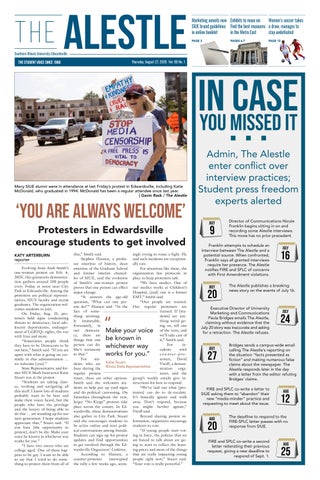
Many SIUE alumni were in attendance at last Friday’s protest in Edwardsville, including Katie McDonald, who graduated in 1994. McDonald has been a regular attendee since last year. | Gavin Rask / The Alestle
‘YOU ARE ALWAYS WELCOME’ Protesters in Edwardsville encourage students to get involved
KATY ARTERBURN reporter Evolving from Andi Smith’s one-woman protest on Feb. 4, 2025, this grassroots demonstration gathers around 150 people every Friday at noon near City Park in Edwardsville. Among the protesters are political representatives, SIUE faculty and recent graduates. The organization welcomes students to join. On Friday, Aug. 21, protesters held signs condemning threats to democracy, local adolescent deportations, endangerment of LGBTQ+ rights, the war with Iran and more. “Sometimes people think they have to be Democrats to be out here,” Smith said. “If you are upset with what is going on currently in this administration … we welcome [you].” State Representative and former SIUE Math Instructor Katie Stuart was at the protest. “Students are taking classes, working and navigating all this stuff. I know lots of students probably want to be here and make their voices heard, but the people who have the privilege and the luxury of being able to do this … are standing up for our next generation. I hope students appreciate that,” Stuart said. “If you have [the opportunity to protest], don’t be shy. Make your voice be known in whichever way works for you.” “I have two nieces who are college-aged. One of them happens to be gay. I want to be able to say that I tried to do something to protect them from all of
this,” Smith said. ingly trying to rouse a fight. He Stephen Hansen, a profes- said such incidents are exceptionsor emeritus of history, dean ally rare. emeritus of the Graduate School For situations like these, the and former interim chancel- organization has protocols in lor of SIUE, said the evolution place to keep protesters safe. of Smith’s one-woman protest “We have medics. One of proves that one person can effect our medics works at Children’s major change. Hospital, [and] one is a former “It answers the age-old EMT,” Smith said. question, ‘What can one per“Our people are trained. son do?’” Hansen said. “In the Our regular protesters are face of sometrained. If [stuthing seemingdents] see anyly immutable, thing weird gofortunately, in ing on, tell one our democraof the vests, and cy, there are we’ll take care of things that one it,” Smith said. person can do. For inShe’s testimony cidents with to that.” cou nter-proFor stutesters, David dents who are Katie Stuart Vitoff, a demonIllinois State Representative busy during the stration orgaregular protest nizer, said the times, there are other options. group’s weekly emails give inSmith said she welcomes stu- structions for how to respond. dents to help put up yard signs “We’ve laid out what [proand do political canvassing. On testers] can do to de-escalate. Saturdays throughout the year, It’s basically ignore and walk larger “No Kings” protests take away. Don’t respond, because place across the county. In Ed- you might further agitate,” wardsville, these demonstrations Vitoff said. also gather in City Park. Stuart Beyond sharing protest insaid she encourages students to formation, organizers encourage be active online and start polit- students to vote. ical conversations among friends. “If young people start votStudents can sign up for protest ing in force, the policies that we updates and find opportunities are forced to talk about are goto get involved through the Ed- ing to start to reflect the houswardsville Organizers’ Linktree. ing prices and more of the things According to Hansen, a that are really impacting young counter-protester interrupted people right now,” Stuart said. the rally a few weeks ago, seem- “Your vote is really powerful.”
“
Make your voice be known in whichever way works for you.”
Director of Communications Nicole Franklin begins sitting in on and recording some Alestle interviews. This move has no prior precedent. Franklin attempts to schedule an interview between The Alestle and a potential source. When confronted, Franklin says all granted interviews require her presence. The Alestle notifies FIRE and SPLC of concerns with First Amendment violations. The Alestle publishes a breaking news story on the events of July 16.
Executive Director of University Marketing and Communications Paula Bridges emails The Alestle, claiming without evidence that the July 20 story was inaccurate and asking for a retraction. The Alestle refuses. Bridges sends a campus-wide email calling The Alestle’s reporting on the situation “facts presented as fiction” and making numerous false claims about the newspaper. The Alestle responds later in the day with a letter from the editor refuting Bridges’ claims. FIRE and SPLC co-write a letter to SIUE asking them to “abandon” their new “media-minder” practice and requesting to meet about the issue. The deadline to respond to the FIRE-SPLC letter passes with no response from SIUE. FIRE and SPLC co-write a second letter reiterating their previous request, giving a new deadline to respond of Sept. 1.
PAGE 2
Thursday, 08.27.26
alestlelive.com
LETTER FROM THE EDITOR: Let’s get you caught up from the summer DYLAN HEMBROUGH editor-in-chief If you aren’t caught up with the events of this summer, then a few things in this issue may not make much sense. Let’s bring you up to speed with SIUE administration’s actions over the past few months. On July 9, Director of Communications Nicole Franklin began sitting in on and recording some of The Alestle’s interviews. After consulting with the Student Press Law Center and the Foundation for Individual Rights and Expression, The Alestle refused Franklin’s presence during its interviews on July 16. After a tense email exchange, Franklin made it clear that interviews “require” her presence and falsely claimed that she had been sitting in on The Alestle’s interviews for a long time already. SPLC and FIRE took issue with Franklin’s actions, and The Alestle published a breaking story on the aforementioned events on July 20. At the end of that week, on July 24, Executive Director of University Marketing and Communications Paula Bridges
emailed The Alestle requesting ness with which The Alestle that the story be taken down on addresses such requests. The list account of several alleged “false of inaccuracies Bridges cited over claims.” After examination, the past couple of years were all Bridges’ arguments did not hold taken care of long ago. up, and The Alestle refused to The Alestle responded to retract the story. this open letter with a letter So, on July 27, Bridges sent from the editor to set the record a campus-wide straight. Addiemail disparagtionally, SPLC ing and spreadand FIRE ing misinformasent a letter to tion about The administration Alestle. In this on Aug. 12 No one at The Alestle email, which was asking them to wants SIUE to fail — published as a abandon their one of the reasons we letter to the edispeech-stif ling report critically is to tor on our webpractices. The help this campus site to provide for deadline to republic comment, spond to that improve and better Bridges wrote letter passed on serve its students, that The Alestle Aug. 20 with no faculty and staff.” had published response from “fiction preSIUE. A secsented as facts” ond letter was Dylan Hembrough and possessed sent, and that Editor-in-Chief a “disregard” brings us to of The Alestle for accuracy. the present. Much of This sort what Bridges of behavior may cited to support her argument, in seem surprising to new students, reality, actually contradicted her but there is a lot of context over statements. Bridges claimed that the past couple of years that will correction requests are slow to help you understand the history occur, if ever, but the emails she and the buildup to this moment. linked demonstrate the prompt- Between controversial financial
“
and curricular decisions and a seeming refusal to consider constituents’ feedback, Chancellor James T. Minor and his administration have built up a reputation of opacity over the past few years. If you are a new student here, welcome! College is the best place to explore who you are and what you care about, and any good university will encourage critical thinking and advocacy. The current situation is not at all what I expected when I came to SIUE four years ago, and it is tough at times, but sometimes a trial by fire isn’t a bad thing. No one at The Alestle wants SIUE to fail — one of the reasons we report critically is to help this campus improve and better serve its students, faculty and staff. We also welcome feedback on our reporting from our readers — positive, negative and neutral. Feel free to submit a letter to the editor if you have thoughts on our reporting or opinions on campus happenings you want to express. You can also email us or stop by our office in the basement of the MUC. Welcome to SIUE, and best of luck on your college career!
SIUE starts offering optional tuition insurance MATTHEW WOLDEN copy editor SIUE is offering a new protection for students’ tuition in case of emergencies, such as medical or financial, through GradGuard. Director of Bursar Operations James Burgdorf said GradGuard can help students who might have a situation come up while attending SIUE. Students who need to leave classes can get reimbursement from GradGuard to drop their classes without financial worry. “It comes down to students having to make a decision to take a break from school — what they mentally need or physically need or illness, whatever,” Burgdorf said. “If they had taken out this insurance in advance, they would have a way to resolve that financial burden.” GradGuard can cover injury, illness, chronic illness, mental health issues, loss of employment for the tuition payer and bereavement as long as a student withdraws from the class according to Burgdorf. University Cashiering Operations Manager Karen Straube said that this service is optional. Straube said you have to opt in to the plan in order to get the tuition protection, so you do not have to worry about an extra fee in your tuition. “[Students] have the options for each of the terms to either say yes or no,” Straube said. “So, if they don’t do it one semester, they can do it the next one or vice versa. When you go in on our page of Pay My Bill and do the student login, [GradGuard] is one of the first things that
pops up. It asks if you would want more information about it, if you would like to be a part of it or not.” According to Dean of Students Mindy Dilley, the cost for GradGuard’s protections is 1.2 percent of the tuition you want to cover. For example a tuition of $14,000 would cost $168 to cover. Straube said that the costs come from how much money you want to be insured for during the semester. She said it works out well this way, as student cost varies by person. “[The student] gets to actually state how much they wanna be insured for. Every student has a different amount that they owe, whether they are a commuter student or whether they are here on campus, their tui-
tion, their housing, their cost may look different for every student,” Straube said. Dilley said that the Office of the Dean of Students has seen this happen often. “One thing that our office oversees is the medical leave of absence process, and so that is actually where we have seen the lack of tuition insurance negatively impact students,” Dilley said. You can pay for the service around the start of the billing process, but the payment window ends shortly after the start of the semester. “That will open each semester at the beginning of the term when we start our billing process and it will go a little bit into the start of the semester before it is closed off, so this one happens to
be Sept. 4,” Straube said. Students have said that they can see the value in it. While some do not use it, they do see this option as a positive and useful one. “I personally didn’t have a use for it, but I thought that it was a pretty useful thing that they introduced,” sophomore secondary English education student Jamie Postlewait said. “I figured [it would be useful for] someone who has a health issue, that they would expect something to get in the way of school ... But I don’t really foresee that happening to me.” “It’s a good thing,” senior mass communication Josh Simpson said. “I like how it’s coming through for all the students and helping them out, especially the ones in need.”
“Throwback Thursday” is a monthly print-exclusive column featuring noteworthy, impactful or downright silly events throughout SIUE’s history. Information for this column was obtained by Editor-in-Chief Dylan Hembrough from past issues of The Alestle.
AUGUST 1971 (55 years ago) Did you know SIUE used to have a yearbook? It was called Muse, and, in its yearbook form, ran from 1960-1971. It was converted into a student features magazine after its award-winning run as a yearbook. 1973 (53 years ago) Before the Vadalabene Center, SIUE had the inflatable Bubble Gym. The Bubble Gym would go on to weather many storms, and it wouldn’t survive a couple of them. This was the year it was first inflated. 1979 (47 years ago) By this time, the famous Mississippi River Festival had been transferred into a new owner’s hands, causing an outrage on campus. This year, the Student Senate encouraged students to boycott the festival. 1981 (45 years ago) Student Senator Michael D. Markovitch leads the vote to veto funding for the Women for Women organization on campus. Markovitch is denounced as sexist by the group, defending himself by noting that he married a woman. 1998 (28 years ago) The Alestle becomes part of the Department of Mass Communications. The Alestle’s editor-in-chief at this time, Danielle Belton, served as editor-in-chief of HuffPost from 2021-2025. 2007 (19 years ago) Andrew Spainhour is removed from his post as student body vice president for missing two consecutive executive board meetings. 2009 (17 years ago) Lightning strikes Building 529 in Cougar Village, setting in on fire and rendering it uninhabitable.
The Alestle Archives
Thursday, 08.27.26
alestlelive.com
PAGE 3
Marketing and Communications announces new brand guidance, $10,000 fine for violations DYLAN HEMBROUGH editor-in-chief University Marketing and Communications is solidifying the transition from the old logo to the new with brand-new guidance released earlier this week. The 54-page booklet is available online and covers the purpose of a unified SIUE brand, specifies requirements and restrictions on display of the logo and implements a $10,000 fine for “unauthorized or improperly displayed” material bearing the SIUE brand, all effective immediately. The guidance covers “all communication materials representing SIUE,” including but not limited to apparel, websites, social media, print materials, signage, advertising, digital communications, marketing materials and promotional items. Marketing and Communications must approve all uses of university insignia before publication, distribution or public display. “It’s also worth being clear: University Marketing and Communications has always been the approving authority for SIUE’s signature marks and logos, so this isn’t a new layer of oversight,” Director of Communications Nicole Franklin wrote in an Aug. 26 email. “It’s a reaffirmation of a standard that’s already in place.” According to the new guidance, the SIUE brand should feel “confident, welcoming, professional, authentic and forward-looking.” Communications should be “clear, direct, human and optimistic.” “SIUE’s new branding standards build on the university’s 2023 brand revision, its first refresh in 16 years, designed to give SIUE a strong, consistent visual identity,” Franklin wrote. “Since then, University Marketing and Communications has worked hard to support that
shift through guidelines, consultations and design help, but outdated and unauthorized logo use has continued to show up, including in high-visibility moments when SIUE is representing itself to the outside world.” “To help close that gap, a fine now applies to unauthorized or improper use of SIUE’s brand, effective immediately, with proceeds going toward a great cause: student travel support for URCA and conference presentations,” Franklin wrote. The Alestle reached out to the marketing departments at Southern Illinois University Carbondale, Saint Louis University, University of Missouri–St. Louis and Washington University to ask if they impose fines for violations of their brand guidelines, but none were available to comment. Student organizations are allowed to create an “organizational identity” as long as it does not include unauthorized usage of the SIUE brand. Franklin said that materials produced by student organizations that cause concern will be reviewed on a case-by-case basis, with “next steps” determined by campus leadership. The guidance also includes a section on AI art, noting its utility in “creative exploration” but prohibiting its inclusion in any final products. Franklin said material produced before the new guidance was released is exempt from the fine. “Anything previously approved is fully in the clear and isn’t subject to the new fine,” Franklin wrote. “Going forward, we’re simply asking staff, faculty and the campus community to lean into promoting the most current, approved materials whenever the opportunity arises, so SIUE’s identity stays sharp, unified and recognizable everywhere it shows up.”
Summer brings new faces to SIUE administration GAVIN QUINLAN managing editor
School of Engineering Dean Liang Cheng
Liang Cheng stepped up as dean of the School of Engineering on Aug. 19. Cheng was previously a professor and chair of the electrical engineering and computer science department at the University of Toledo and served as a tenured professor of computer science and faculty senator at Lehigh University before that. He has led more than 20 sponsored research projects, including projects for the Department of Transportation and Department of Energy. Cheng was appointed after the retirement of Dean Emeritus Cem Karacal.
Associate Vice Chancellor for Human Resources Amanda Duval Norwood
Amanda Duval Norwood previously worked in leadership roles at five different colleges across the country, as well as in retail, healthcare, senior living and for the Franciscan Sisters of Chicago. Norwood oversees labor relations, employee engagement, payroll, benefits and worker’s compensation.
SIUE hired several new administrators over the summer, each with decades of experience in their respective fields. From directing communications for an NFL team to directing human resources at a convent, here are some new faces on campus and the experience they bring with them.
Associate Vice Chancellor for Administration Dzenana Mruckovski
Dzenana Mruckovski first settled in St. Louis in 1994 as a refugee from the Bosnian War and has worked in public services since, obtaining a degree in civil engineering from Washington University and the University of Missouri–St. Louis. She previously worked in similar roles for the cities of St. Louis and Crestwood. Her office oversees Facilities Management, environmental health and safety, parking, records and Freedom of Information Act Requests and more.
Director for Web Strategy Keith Harris
Keith Harris was appointed as Director for Web Strategy for SIUE Marketing and Communications on June 29. Harris has worked in leadership and marketing positions for organizations such as Staples, First Bank and the Los Angeles Rams. Harris also founded Koncepts Integrated Marketing Solutions, a web design and marketing consulting firm that serves clients such as Jack Daniel’s and AT&T.
PAGE 4
Thursday, 08.27.26
alestlelive.com
Cancer drug research at SIUE receives national grant to continue work
LILY BERKENBILE reporter
In early July, SIUE’s Schober & Patel Laboratories received a $578,000 grant from the National Institutes of Health to continue their ongoing cancer research, according to Professor of Pharmaceutical Sciences Joseph Schober. It is the second grant the laboratories have gotten from NIH for their research. Schober & Patel Laboratories has been doing cancer research since 2021. The team closely monitors the certain proteins in cancer cells and experiments to develop inhibitors to block them. These proteins both interact with one another during the translation of mRNA to protein. According to Assistant Professor of Pharmaceutical Sciences Bhargav Patel, the interaction and the excess build-up of these proteins in a cell often makes that cell become cancerous. By examining cancer cells and designing inhibitors to stagnate or stop that build-up, Patel and Schober hope to develop a drug that will effectively stave off the disease. Schober & Patel Laboratories has been doing cancer research since 2021. The
team is currently comprised of two faculty members and six student researchers. “A lot of researchers around the world have tried, and there hasw not been a lot of success in these fields. That’s why it’s exciting for us. There is currently no drug that is approved in the fields that we are working on, so this is at the forefront,” Patel said. “The team is formidable, goal-driven and passionate. There are times we have to work harder towards a certain deadline … Above all, all the mentors in the team ensure that they drive us to become the best version of ourselves,” Magdalene Eno Udobi, a PhD student in medicinal chemistry with a background in biochemistry, said. She has been working with Schober & Patel Laboratories for seven months now. Schober and Patel run a project each, both working toward this common goal, in labs under their individual names. This year’s NIH grant went to the Schober Lab. According to Patel, the research in Schober Lab focuses on limiting excess amino acids — building blocks for the aforementioned proteins — that might be available to a potentially cancerous cell. Schober said that the
grant’s funds will be used for lab supplies and hiring student researchers. “That money really allows us to hire students as a research assistantship … [and pays for] the supplies. I mean, there’s tons of consumables … to make these compounds,” Schober said. “It’s
“
There is currently no drug that is approved in the fields that we are working on, so this is at the forefront.” Bhargav Patel Assistant Professor of Pharmaceutical Sciences
a pretty big price tag to bring in all the materials that we use in our labs.” The last NIH grant received by Schober & Patel Laboratories was worth $722,500 and, according to Schober, is now in its last year. The previous grant was provided to the Patel Lab, which experiments to produce a drug molecule that will
prevent the build-up of the a forementioned protein. “We make these molecules in our lab which are not known or which don’t exist. We come up with a new structure, we design them and we make them. Then we test [them] in cancer cells,” Patel said. Both scientists said that their work has produced notable discoveries. With the help of NIH funding, they’ve been able to engineer and test a few new chemical compounds on the cancer cells. However, they also said that these discoveries are still in the beginning stages and require rigorous research. “We have a few molecules in both projects that are showing promising activity. But for any project to go further, what we always need to do is to test them in a variety of experiments … and if it shows activity in all of those, then we can move further,” Patel said. “We hope that we can renew both of these grants … and then carry out and then move these new [compounds] forward into doing some cell studies and see how effective they are in cancer cells,” Schober said. According to Schober, the NIH grants are also used to present their work at the American Chemical Society and the Amer-
ican Society for Pharmacology and Experimental Therapeutics. The original NIH grant and funds received from the School of Pharmacy over the years have ensured that nearly every current student researcher working in their lab has gotten the chance to be involved with a presentation at these conventions by covering travel expenses. Noah Landers, Sumon Roy and Chibuike Okafor, all master’s students in pharmaceutical sciences doing student research with Schober & Patel Laboratories, have presented at ACS. Amrita Talukder Mohini and Alicia Pitkin, a PhD student candidate studying pharmacology and student lab assistant respectively, have presented at ASPET. Roy gave his first national-level presentation in Washington D.C. at the ACS Fall 2025 convention. It covered the research he did at Schober & Patel Laboratories with discovering drugs that could hinder the protein build-up. “I was amazed by the depth of ongoing research and the diverse opportunities in this field,” Roy said. “[It] was an inspiring experience to engage with experts, exchange ideas and see the broader impact of drug discovery.”
THE ALESTLE WILL PUBLISH ONLINE 9/10.
lifestyles alestlelive.com
Thursday, 08.27.26
contact the editor: lifestyles@alestlelive.com (618) 650-3528
Mass communications students, alumni produce short film on campus in 48 hours
give you some direction. If you became professionals … and then just get a bunch of people in we usually try to bring a coua room and say, ‘Write a short ple new students in every time,” Students, alumni and facul- film,’ where do you even start?” Byers said. “It’s had more of a churn over time.” ty gathered in Lovejoy Library Byers said. Alex Trepka, a mass comThough the team is not offion Aug. 14 to brainstorm ideas munications alumnus and procially attached to SIUE, the film and write a script for a short film. fessional actor, has participated was made by a team of students Two days later, their film was in the comand alumni who ready for the movie screen. petition with served as actors, The effort, led by Mass SIUE since videographers, Communications Tier II In2008. He said directors and structor Cory Byers, resulted in that the expemore, with Byers a short film called “Circulation,” Over the years, rience of the an entry into the St. Louis 48 editing the film. we’ve accumulated team and their Byers has Hour Film Project competition. equipment participated in The St. Louis competition is one a lot of these “elevates” the the 48 Hour of more than 130 cities across the accolades from SIUE team Film Project for world hosting the competition. beyond other 15 years. He The best films from each city the [project]. I participants. are then screened at the interna- said that his first would like to think “We have experience with tional film festival Filmapalooza top-of-the-line the competition each March. that our reputation cameras … and Every year, the competition was mainly stuwe’re shooting but precedes us.” gives its participants required el- dent-led, in 4K,” Trepmore professionements at the beginning of a 48ka said. “I can als were involved hour time frame. By the end of Alex Trepka remember over time. the time frame, participants must Mass Communications from years in “When we turn in a four- to seven-minute Alumnus & the past where first started, short film following the specific Professional Actor we would rent it was me and elements they were given. Their cameras from some students, work is then screened in a local the SIUE mass comm departand then I worked with the same movie theater, where anyone ment because they have cameras core group almost every year. can watch. Once I graduated, available to students, but over the Teams are given genres, they started working years, people in the crew have … props, character names and in the industry and purchased their own equipment, dialogue that are required and usually that stuff is miles ahead to be in the film. This year, of some of the more student-level SIUE’s team had to work with production things.” the genres of science fiction Trepka, an actor in the short and food film, which were film, said that the team at SIUE pulled at random. Byers has won various awards for their said the film is about projects in the past, including “what happens ones for best prop use, best writwhen you don’t ing and best cinematography. follow the rules in “Over the years, we’ve accuthe library.” mulated a lot of these accolades “The good from the [project],” Trepka said. thing about the “I would like to think that our [competition] is, reputation precedes us and peoyou have these Mass Communications Student Noah Kull ple are like, ‘They put on good elements that
GAVIN QUINLAN managing editor
“
work.’ We really do.” This year is senior mass communications student Cameron Hesse’s fifth time participating in the project. Hesse said he started after finding out about it through a similar assignment Byers gives in MC 333: Advanced Video Production. He said the bonding and teambuilding was hisfavorite part of the project. “[Byers] helps us create a bond in class that I’ve never really felt, especially in college,” Hesse said. “It builds good teamwork, and it forces you to work with people that you may not always work with.” Hesse, a photographer and actor for the project, said that its challenges have also strengthened his skills. “To have a successful career in production or really ina n y creative field, you have to know how to go with the ebbs and flows of it,” Hesse said. “It helps when you can think creatively and openly about things outside of a box.” Ashlyn Smith, an alumna of the Department of Mass Communications, has been involved in the project since 2020 and represented the team this year at the kickoff event in St. Louis, where prompts were revealed to teams. Smith said that this aspect of the project facilitates networking. “It was a lot of fun, and I think it’s a good way to mingle and meet other filmmakers in the city,” Smith said. “If you have a project that you’re wanting to work on, you could reach out to other people who might be able
PAGE 5
to help you out.” Smith and Trepka both said that the 48 Hour Film Project gives a greater opportunity for creativity than their jobs generally do.
“My job now is very cut-anddry analytical … whereas this is where I get to actually be creative and brainstorm and be out on the field, and I do miss that a lot,” Smith said. “I love having a diverse background. I can say I can run a camera, I can run audio, I can edit, I can do all these individual things. … I think it gives me a leg up in other positions.” Hesse and Trepka both said that they recommend the experience to any student interested in production. “Whether you just get a group of your buddies together and try to make something in 48 hours, or you join a legit team like this with a bunch of classmates and a professor guiding you,” Hesse said. “If production interests you, if writing interests you, if editing interests you, even audio … then you probably have a place on a 48 hour film team.” “Circulation” will be screened alongside other 48Hour Film Project submissions at 7 p.m. Monday, Aug. 31, at Galleria 6 Cinemas in St. Louis. After the screening, it will be released on Vimeo.
On-campus jobs at SIUE provide many varied opportunities MADISON STEFFEN opinion editor Working on your college campus provides many opportunities to get to know your university in a whole new way. On-campus job opportunities at SIUE can be found on Cougar Jobline, where departments from all across the university post available positions specifically for students. While some have prerequisite requirements for their potential applicants, there are many jobs open to all students. Examples include food service — which comprise the vast majority of
positions in the MUC — working as a cashier at either the Cougar Store or Union Station, or helping students and professors at the library. All of these jobs have regular openings at the beginning of each semester, and hire all ages and studies. All on-campus positions pay a minimum wage of $15, although jobs that require more credentials and training, such as lifeguarding, may go higher. According to the Student Employment Office, the university “pays approximately 1,200 students each payroll for work performed on-campus.” Junior electrical engineer-
ing student Howard has held six on-campus jobs in her time at SIUE. Currently, she works as a library supervisor, admissions intern and campus tour guide. Howard said other benefits of working on campus include the flexibility of the jobs and the social aspect. Working part of a shift before class and then returning to work afterwards can be convenient for student schedules. There are also additional chances for students to socialize when working on campus together rather than off, which can help create friendships and stronger communities on campus.
“I think it’s an opportunity that everyone should explore at least once,” Howard said. According to Howard, one of the major reasons why students may not want to work on campus are the varying levels of workload and demands from different jobs offered through the campus jobline. While some jobs only require an average of four hours per week, others can ask as many as 20 hours. Along with the differing time spans, domestic students are only able to work a total of 28 hours per week, no matter how many positions they hold. International students can
work up to 20 hours per week. Office jobs are some of the less physically-demanding careers, as students are sitting at desks and may even have time to do homework. But, there are also more labor-intensive positions available, including janitorial staff and fitness instructors. Like any job, on-campus hiring opportunities still necessitate time commitments, diligent work effort and self-motivation. Although the balance is much easier to manage than in other positions that may be less accommodating as a student-worker job or that may be further away.
alestlelive.com
PAGE 6
Thursday, 08.27.26
A St. Louis classic: Exploring Gateway Arch National Park Orange ff5400
LILY BERKENBILE reporter
Lily Berkenbile / The Alestle
The Gateway Arch National Park is the smallest national park in the United States at 91 acres of museums and nature, making it one of the easiest to explore for a great day out. I found myself most transfixed by the Old Courthouse. The building itself is quite lovely, and the exhibits feel intentional, offering a lot of information on very specific topics. The staff there proved to be dedicated to their work. I stopped to talk to them when I could and was amazed by how knowledgeable they were. The Museum at the Gateway Arch had far more to explore than the Old Courthouse. It was a little too loud for my taste, but I was delighted to see how many people were willing to take advantage of the
free museum. Pink While there, I finally Dc0073 caved to my curiTeal for a ride to the osity and spent roughly $20 98b9ab top of the Arch. Blue The engineering expertise 6665dd to make that happen, the upbeat staffing and the vantage Purple point of the Arch made 841f7a it worth the $20. That said, actually being up there and waiting in a line to do it was not particularly exciting to me. It’s worth doing once just to say you’ve done it, but if you’re on a budget or time crunch, it doesn’t need to be the make-or-break of your trip. Once you’re done exploring the museums, I’d highly recommend taking the time to meander around the park grounds. Seeing the Arch so close was a unique experience, and they happened to be having the Blues at the Arch Festival when I went, which really made my day. My only regret is not staying longer. Bring good walking shoes.
Missouri History Museum brings STL history to life AUDREY O’RENIC sports editor
Audrey O’Renic / The Alestle
Located in Forest Park, the Missouri History Museum offers a unique look at St. Louis history through interactive and engaging exhibits. Parking is free and easily accessible from all around the building, which was a huge relief for me. I went alone on a Sunday afternoon, and there were a decent amount of people there. As soon as I walked in, I was greeted by the front desk worker and given a map. The staff were super helpful and answered any questions I had. The building’s architecture is beautiful enough to visit on its own. The museum only had three exhibits, however, because the upper level was under construction. The exhibits themselves were incredibly interactive, which
For more Metro East Eats, visit alestlelive.com or scan this QR code:
Orange ff5400
made the experience all the Pink more interesting. For example, the museumDc0073 displayed tactile Teal reproductions of a lot of artifacts for people 98b9ab to actually touch. The layout of the exhibits Blue were also visually appealing6665dd and drew me in Purple right away. 841f7a In addition to the main exhibits, the museum offers a “History Clubhouse” gallery for kids, live performances and tours. The museum is closed Mondays, and open 10 a.m. to 5 p.m. Tuesday through Sunday, with extended hours until 8 p.m. on Thursdays. While I walked in not expecting much, I walked out with a whole new perspective on history museums, and I definitely recommend everyone go at least once. My favorite part was how interactive the exhibits were.
Check out Metro East Markets, visit alestlelive.com or scan this QR code:
TO ADJUS FILE > PA > CUSTO
MULTIPLY ORIGINAL DIMENSIO FOR HIGH QUALITY
DRAG HA OVER BL FOR HAL
“TOTAL”, AND STA GRAPHIC LIKELY N CHANGE RATING
GOLD CO DARK YE
BLUE CO LIGHT BL
CONVER HEX AND CUSTOM PICKER
DO NOT E TEMPLAT
TO ADJUS FILE > PAG > CUSTOM
MULTIPLY ORIGINAL DIMENSIO FOR HIGH QUALITY
DRAG HAL OVER BLU FOR HALF
“TOTAL”, R AND STAR GRAPHIC LIKELY NE CHANGED RATING
GOLD COL DARK YEL
BLUE COL LIGHT BLU
CONVERT HEX AND I CUSTOM C PICKER
DO NOT E TEMPLATE
alestlelive.com
Thursday, 08.27.26
PAGE 7
National Great Rivers Museum: Flowing with fun for everyone KATY ARTERBURN reporter
Katy Arterburn / The Alestle
Along the Great River Road on the Mississippi River stands the colossal Melvin Price Lock and Dam. Most people who have driven through Alton recognize it. The National Great Rivers Museum sits in its shadow, but its exhibits are hard to outshine. With ecological facts, barge simulators, Indigenous history and cultural references, the museum offers activities for all visitors. The museum has excellent ambiance. You can learn about the geologic and ecological history of the Mississippi River with a small recreation of an Illinois bluff. You can pretend to steer a river barge in a virtual simulator. You can even learn what “mark twain” means in the steamboat industry. The museum is colorful and draws visitors in with interactive exhibits and local fun facts. As a U.S. Army Corps of Engineers museum, nonprofit and public funds maintain
Orange ff5400
the facility. While that means Pink admission is free, there was only one Dc0073 employee when Teal I visited. If more people were available to 98b9ab answer questions and welcome visitors, Blue the atmosphere would feel 6665dd more inviting, but I understand how a tight budget Purple 841f7a creates limitations. Overall, the museum had a great variety of experiences for almost every type of visitor. Besides the science, history and cultural exhibits, there was a fish tank, a gift shop and Lock and Dam tours to keep even the museum haters entertained. My favorite part of the museum was a timeline of the Mississippi River’s history that ran along the ceiling. It listed events like the formation of the waterway millions of years ago, the beginning of the Indigenous Cahokia settlement in A.D. 850 and the Great Flood of 1993. That timeline was a great reminder of the power of rivers — a power that can sustain and destroy.
Saint Louis Art Museum makes fine art accessible to everyone LEILA BROWN copy editor
Destiny Albrecht / The Alestle
Orange ff5400
sandwich and significant American and Pink Indigenous collections. Dc0073 Maps are available at A visit to the Saint Louis Art Museum Tealthe service desks, 98b9ab experibut I prefer to walk the museum freely. in Forest Park is always a pleasant medieval Japanese ence. It houses original sculptures, collec- At one point, I studiedBlue 6665dd tions of Indigenous art and paintings from statues of Buddha, and as I continued Purple through the space, it transitioned to disaround the world. 841f7a The entrance to the museum oversees playing contemporary Japanese art, offerArt Hill with its many attendants lounging ing me a chance to compare how the culon picnic blankets, flying kites and model ture’s art has evolved. I stayed until the museum closed at 5 airplanes, riding boats across the lake and jogging on the trails. It’s one of the most p.m., which I think is too early for summer, and was ushered out by the security beautiful, unifying sights in St. Louis. seaguards into the sculpture garden. After The grand lobby changes exhibits sonally. Currently featured are a few rough- being in the dry, controlled museum for ly 30-foot-tall paintings from “Becoming so long, the sculpture garden and its walkthe Sea by Anselm Keifer,” which articu- ways provide a breath of fresh air and light. Overall, this art museum is invaluable late the spiritual power of the Mississippi, Missouri and Rhine Rivers. The museum for its dedicated staff, beautiful collection also houses a collection of art from high and free entry, offering St. Louisans an acschoolers across the metro area, a the- cessible way to consume fine art. My favorite part was the whole thing! ater room that loops current film exhibsalad chicken good I love every bit of the Art Museum. really a its, a cafe with
St. Louis Science Center: Enchanting and educational Orange ff5400
ASHTON STANBERRY copy editor
Ashton Stanberry / The Alestle
Located on the outskirts of Forest Park, the St. Louis Science Center beckons to visitors who are excited to learn about the science of the world around them. Upon entering, the Science Center was staggering. The museum is sectioned by types of science — like biology or engineering — and within those sections, there are tons of hands-on exhibits that focus on different aspects of that field, often showing the history and science behind a certain subject area, fun facts and modern applications. Some of the simulations were more complex, with detailed instructions and explanations behind them, and some were more straightforward. There were also a couple of areas specifically designated for children around Pre-K age. Younger children who aren’t yet able to fully grasp the science behind the activities don’t have to do so in order to have fun, but older kids and adults who do understand are
equally likely to enjoy theirPinktime there. The Dc0073 museum certainly did not feel exclusively engineered towards children. Teal 98b9ab The Science Center was very accommodating. There were many elevators and ramps Blue around the building, and 6665dd wheelchairs and strollers available to rent forPurple free. Their OM841f7a NIMAX Theater, which shows movies with scientific themes, has hearing-assisted options and closed captioning available. They also provide sensory bags for free and have “Quiet Zones” indicated by signage. On Sundays from 9:30 to 11:30 a.m., the entire center engages in Sensory Friendly Science Time. Some of the more special exhibitions, like the theaters and some parts of the planetarium, require paid tickets, but the majority of the museum was free to enjoy. I did not feel like I had missed out by skipping the paid exhibits. My favorite part of the museum was the “GROW” section, which features an outdoor pavilion and greenhouse with lots of plants, a chicken coop, an educational water area and more. The chickens were adorable!
TO ADJUS FILE > PAG > CUSTOM
MULTIPLY ORIGINAL DIMENSIO FOR HIGH QUALITY
DRAG HAL OVER BLU FOR HALF
“TOTAL”, R AND STAR GRAPHIC LIKELY NE CHANGED RATING
GOLD COL DARK YEL
BLUE COL LIGHT BLU
CONVERT HEX AND I CUSTOM C PICKER
DO NOT E TEMPLATE
TO ADJUS FILE > PA > CUSTOM
MULTIPLY ORIGINAL DIMENSIO FOR HIGH QUALITY
DRAG HA OVER BLU FOR HALF
“TOTAL”, R AND STAR GRAPHIC LIKELY NE CHANGED RATING
GOLD CO DARK YEL
BLUE COL LIGHT BL
CONVERT HEX AND CUSTOM PICKER
DO NOT E TEMPLAT
TO ADJUST FILE > PAG > CUSTOM
MULTIPLY ORIGINAL DIMENSION FOR HIGHE QUALITY
DRAG HAL OVER BLU FOR HALF-
“TOTAL”, R AND STAR GRAPHIC W LIKELY NEE CHANGED RATING
GOLD COL DARK YELL
BLUE COLO LIGHT BLU
CONVERT HEX AND IN CUSTOM C PICKER
DO NOT ED TEMPLATE
PAGE 8
alestlelive.com
Budgeting isn’t your enemy, it’s your friend MADISON STEFFEN opinion editor
Despite its aid in financial awareness and literacy, budgeting is still uncharted waters among many college students. One of the many misconceptions about budgeting is that it acts as a list of lifestyle restrictions: the number of movies you see, the number of times you go on dinner dates with friends, even the cups of coffee you can buy. In truth, the purpose of creating a budget is to identify what aspects of your life are priorities, versus just features of it. Priorities are designated tasks that must be taken care of first, rather than being given the same level of importance as any other task. If drinking three cups of coffee a day is incredibly important to someone, then it can be considered a priority — as long as it is then accounted for financially. One of the most common beginner forms of budgeting is called the “50/30/20 Budget.” It’s considered eas-
ier to manage, especially for those who don’t want to assign individual dollars to specific categories. This plan is used frequently enough that there are guides for hyper-specific percentage breakdowns. The method is simple: 50 percent of one’s total income, either per month or per paycheck, goes to “needs,” 30 percent to “wants” and 20 percent to savings or long-term payments. The categories may contain whatever the budgeter decides, as long as the finances line up. Typically, needs are expenses such as rent or mortgages, utilities, groceries, forms of insurance and minimum payments for loans or debts. However, needs can and will vary from person to person, and not everyone will need to dedicate the same amount of money to these items. There is also the possibility that saving for a specific goal is the purpose of budgeting. In that case, percentages can be altered so savings receive a higher amount per income deposit. Another easy way to begin budgeting
is to preemptively remove potential spending money before it reaches your checking account. Many online banking and payroll systems allow users to allot percentages of their incomes to various accounts, so if someone has committed to saving 20 percent of their finances every paycheck for a new car, then the money will automatically be put into a savings account. After that, everything else can be spent how the spender wishes. If the goal is to save, rather than to better handle money, then it would be beneficial to place those savings into highyield accounts, such as the American Express High Yield account or Capital One 360 Performance. Forbes keeps updated analyses on these savings accounts on a day-by-day basis. Finally, if you are looking to keep exact numbers when budgeting, then zero-based budgeting might be a good strategy. Expenses are subtracted from total income until it equals zero. The money may be distributed any way the budgeter
Thursday, 08.27.26
wants, as long as the final balance is zero by the end of every month, after which the budget resets. The most successful way to execute this method is through advance planning and diligent tracking of one’s finances throughout the month. Budgeting is ultimately a simple concept that is made difficult by the complications of taxes, unexpected expenses and marketing campaigns meant to convince the amateur spender that they need experts and accountants to make sense of it for them. In actuality, all the beginner budgeter needs to begin saving for their future is a goal and a plan for how to get there. There are countless apps, guides and spreadsheets that make budgeting as a college student an easy habit to get into, as well as enough different ways to practice it that personalization is a natural part of the process. If none of these methods feel right, there are many others recommended by financial advisers and planners, as well as books and media dedicated to becoming more financially literate.
Foundation and why change is humanity’s life force GAVIN QUINLAN managing editor Isaac Asimov’s seminal science fiction novel “Foundation” made me more and more uncertain about how much I appreciated its themes and plot as I read on. The ride was bumpy and the ending was lacking in entertainment value, but the thematic value of “Foundation” makes up for most of its shortcomings. The novel — five short stories stacked in a trenchcoat — doesn’t have a smooth and cohesive plot with a satisfying end, but it does offer many themes about humanity, religion, politics and technology. In the end, the themes combine into a single subtle message that brings them full circle: creativity and constant change are the life force behind humanity. Hari Seldon is the inventor of psychohistory, a form of math that can be used to predict the future of society. The plot begins when Seldon uses this to predict the imminent fall of an empire due to “a rising bureaucracy, a receding initiative, a freezing of caste [and] a damming of curiosity.” Seldon establishes the titular Foundation to delay the destruction of the empire. This theme is obvious in the first two
sections, which follow the rise of the Foundation as an apolitical institution dedicated to the creation of encyclopedias and the promotion of academia. Both sections portray bureaucracies hostile to the Foundation’s intentions: the leadership of the Empire, who are too proud to accept Seldon’s prediction, and Terminus, the planet where the Foundation is based, whose growing population demands more political action than what they can provide. The first two sections contrast well to portray a similar message. A government cannot survive without an educated and civilized society, and academia cannot exist without political activity and self-advocacy. The rest of the novel is a political thriller drawn out across more than a century, wherein religion and trade become the Foundation’s strongest diplomatic tools. By the third section, the Foundation has evolved into much more than an academic institution, and its leaders study societal phenomena as tools to manipulate people with. Salvor Hardin, the first mayor of Terminus, uses an artificial religion developed in the Foundation’s population to keep them under his control, which manifests in him using interstellar zealots to prevent an invasion from a neighboring kingdom due to their perceived heresy. Likewise, Hober Mallow, a powerful
trader in the Foundation, rises through the ranks and shuts down his political opponents through tactful trade with foreign leaders in the novel’s fifth and final section. It isn’t until the fifth section that the overarching theme of creativity and change is evident, which recontextualizes the rest of the novel’s plot. The Empire crumbles due to a lack of education in its citizenry, the Foundation is susceptible to subjugation due to its lack of political power, religion is introduced as a tool for social control and trade takes its place after religion loses its potency in the population. Over centuries and different leadership in the Foundation, different needs arise demanding different delicate solutions, and maintaining one strict political system causes stagnation and weakness. Likewise, the issues of today are different from the issues of yesterday and tomorrow, and the changes of leadership in the Foundation reflect the benefit of changes in real-world societal systems. For example, it’s frequently pointed out that the American education system is outdated and doesn’t properly prepare students for the modern workforce. The World Economic Forum even claims that 65 percent of children entering elementary school now will work in a field that doesn’t even exist yet. The world has changed substantially since our current education system
stagnated, but we continue to leave new members of the workforce with diminishing returns year after year rather than prepare them based on what the world requires of them. Similarly, capitalism is often criticized as an outdated economic system that has overstayed its welcome, with some calling for a transformation of the system or a completely new one to deal with the grievances it has racked up over time. Hari Seldon said that stagnation and inaction would lead the Empire to its demise. Similarly, the United States will not survive if it can’t find a new system to provide for the people who were failed under the current one. Most importantly, though, Asimov’s message can save even a single person. Just because something has worked for you in the past doesn’t mean it will always work for you. Your body may not let you stay on the same diet forever, your friends will expect different behavior out of you depending on the circumstances and just because you didn’t study last year doesn’t mean you’ll have automatic straight As this year. If you take anything from the grandiose and intense political drama of “Foundation,” remember not to let yourself stagnate, or you might fall victim to an issue you don’t even know about yet. “Foundation” isn’t for every reader, but I recommend it for political thriller fans.
Thursday, 08.27.26
PAGE 9
MEET THE ALESTLE STAFF: FALL 2026 Hello! I’m Gavin Quinlan, managing editor of The Alestle. I’m majoring in English with a minor in creative writing. My dream career is one where I get to work with words and serve my community, and what better opportunity is there to start that than a newspaper? In my free time, I love drawing, reading, riding my bike and playing video games. I’m looking forward to serving the SIUE community again for the new year!
Hello! I’m Dylan Hembrough, and this is my fourth year as editor-in-chief of The Alestle. I’m a third-year pharmacy student and plan to specialize in psychiatric pharmacy. I just got married to the love of my life a few months ago, and we live with our two cats, Maple and Tobias. In my very limited free time, I write even more. I’m looking forward to this year at The Alestle, and I hope you are too! GAVIN QUINLAN MANAGING EDITOR
DYLAN HEMBROUGH EDITOR-IN-CHIEF
DESTINY ALBRECHT LIFESTYLES EDITOR
Hi! My name is Destiny Albrecht, and I’m the lifestyles editor for The Alestle. I’m going into my senior year at SIUE majoring in mass communications with minors in creative writing and psychology. I joined the paper to show my creativity through art and writing. I love that I’m able to share others’ stories, review different forms of media, hand-draw graphics and form connections through real-world experience. Outside of school and work, I enjoy reading, traveling, spending time with my friends and family and playing with my two kittens!
AUDREY O’RENIC SPORTS EDITOR
Hello! My name is Madison Steffen, and I am the current opinion editor at The Alestle! I am a criminal justice major with a Spanish minor, and it is my second year here at SIUE. Beyond working at The Alestle, I love to read, bake and watch movies in my spare time. Be sure to check out our latest editions!
MADISON STEFFEN OPINION EDITOR
SAM MUREN PODCAST PRODUCER
GAVIN RASK MULTIMEDIA EDITOR
Hello everyone! My name is Samuel Muren, and I am The Alestle’s podcast producer! I’m tuning in for my fourth year at SIUE. I’m currently in the process of earning my master’s degree in media studies. This is my second full year overseeing two podcasts as the host and producer. My hope is to create media centered on deep stories for all to enjoy. Each podcast episode is something I hope every student, faculty and staff member can relate to their own personal SIUE experience.
CHLOE WOLFE VIDEO NEWS PRODUCER
Hello! My name is Katy Arterburn. This is my first year at The Alestle and my second year at SIUE. I am studying environmental science with a concentration in environmental health and a minor in literature. I like watching documentaries, playing outside and listening. Whether it’s music, stories or wildlife, listening helps me understand the people and environment around me a little better. I hope The Alestle can help you do that too. KATY ARTERBURN REPORTER
LILY BERKENBILE REPORTER
Hi! My name is Joyce Woodard, and I am a reporter for The Alestle. I am a senior majoring in mass communications with a concentration in journalism and minoring in Black studies. I have been working at The Alestle for about five months now. Outside of work, I enjoy listening to music, hanging out with friends and building Lego sets. Writing has allowed me to connect with people, and I plan to continue. JOYCE WOODARD REPORTER
ASHTON STANBERRY COPY EDITOR
HECTOR CHAIDEZ PHOTOGRAPHER
I’m Audrey O’Renic, the sports editor for The Alestle. I am a mass communications major with a minor in theater and dance, and ultimately, I would love to go into broadcasting! Over the past four years, The Alestle has allowed me to meet a diverse range of people, build connections with the community and gain new experience. I also co-created and co-host the “Alestletics” podcast, SIUE’s first sports podcast. Besides sports, I love cats, music, thrifting and Dr Pepper! Hi! I’m Gavin Rask, the multimedia editor for The Alestle. This will be my second year in this position and third year with The Alestle. I am studying exercise science at SIUE, but I’ve always been passionate about photography and video, so I am lucky to be able to express it through my work. This semester, I am especially excited to bring stories to life by focusing on video coverage. Besides The Alestle, I also work as a personal trainer and am involved with Rock Steady Boxing, a boxing program for individuals with Parkinson’s disease. When I’m not taking photos, you can usually find me at the gym or out hiking. Hi, my name is Chloe, and I am The Alestle’s brand new video news producer! I am, however, not new to The Alestle. I stepped down as the lifestyles editor last semester to help create this position. I am currently in grad school working towards my degree in media studies in the Department of Mass Communications, and I also work as a teaching assistant for the department. Last semester, I founded our new broadcast “Alestle Live,” which is basically The Alestle in video format and is run by mass communications students. Hello! My name is Lily Berkenbile, one of The Alestle’s newest reporters. Covering stories where the people involved are obviously passionate about what they do is one of my favorite things. So far, I have a little over half a dozen articles published with The Alestle and can’t wait to write more! In the meantime, I’m working towards a bachelor’s in English and a business minor. When I’m on campus, I can almost always be found tucked away in a study spot or at the side of a friend in the MUC.
Hi! I’m Leila Brown, an English major with concentrations in Black literature and women’s studies. I’m coming from St. Louis. In my free time, I like to crochet, study divination, read and take long walks. If you’re reading this and you haven’t already, get a library card!
LEILA BROWN COPY EDITOR
Hi! My name is Ashton Stanberry, and this is my first year as a copy editor for The Alestle. I am a sophomore this year, and I am majoring in English and minoring in Spanish. I also work at the library on campus! I love reading books, playing my guitar and going on adventures. I think that awareness and connection in a community like SIUE’s is incredibly important, and The Alestle is a great way to promote that. I can’t wait to learn and grow at The Alestle this year!
Hi! My name is Hector Chaidez, and I’m a photographer for The Alestle. I’m beginning my second year in this role, and I’m looking forward to all the new assignments I get! Outside of The Alestle I work as a server and play lots of ultimate year-round. In the spring, I also coach ultimate at Edwardsville High School for the junior varsity team. If you see another person who looks like me, that may be my identical twin brother Victor — or it’s me with a haircut.
Hi, I am Matthew Wolden, a copy editor at The Alestle. I am in my final year here as a computer science and electrical engineering major. While this will be my last year here, I hope to learn more about as much as I can and get a few more college memories. I like to spend my time listening to music, playing games or hanging out with friends. I am looking forward to this last year with The Alestle. MATTHEW WOLDEN COPY EDITOR
JAIYLA OWENS PHOTOGRAPHER
Hi! I’m Jaiyla Owens, and I’m a photographer at The Alestle. I am entering my junior year as a civil engineering student, and I’ve been working at The Alestle since January. I also work as a resident assistant for University Housing. Some hobbies of mine include listening to music, reading, rollerskating and trying new recipes. I’m enjoying my time at The Alestle, and I’ve met all kinds of people, had new experiences and learned so much. I look forward to whatever this year may bring!
OPINION
THE ALESTLE WILL PUBLISH ONLINE 9/10.
Thursday, 08.27.26
alestlelive.com
PAGE 10
Share your thoughts: opinion@alestlelive.com (618) 650-3527
DYLAN HEMBROUGH Editor-in-Chief
GAVIN QUINLAN Managing Editor
DESTINY ALBRECHT Lifestyles Editor AUDREY O’RENIC Sports Editor
MADISON STEFFEN Opinion Editor GAVIN RASK Multimedia Editor
SAM MUREN Podcast Producer
CHLOE WOLFE Video News Producer
Katy Arterburn Lily Berkenbile Joyce Woodard Reporters Leila Brown Ashton Stanberry Matthew Wolden Copy Editors
Hector Chaidez Jaiyla Owens Photographers Tammy Merrett Program Director Destiny Albrecht Front Desk Circulation
HAVE A COMMENT?
Let us know by scanning here: Campus Box 1167
Edwardsville, Illinois 62026-1167
view Gen Z’s online trend highlights a bigger literacy THE ALESTLE STAFF editorial board A new social media trend has highlighted Gen Z’s lack of general knowledge. Videos of young people being asked history, geography or math questions have been circulating on TikTok and Instagram, drawing lots of attention and criticism. These videos typically consist of someone approaching a group of people, usually at a mall, on the street or even on a college campus and asking them questions such as, “Who
The editors, staff and publishers of The Alestle believe in the free exchange of ideas, concerns and opinions and will publish as many letters as possible.
All hard copy letters should be typed and double-spaced. Letters should be no longer than 500 words. Include phone number, signature, class rank and major. We reserve the right to edit the letter for grammar and content. Care will be taken to ensure that the letter’s message is not lost or altered. Letters to the editor will not be printed anonymously except under extreme circumstances. We reserve the right to reject letters.
The name Alestle is an acronym derived from the names of the three campus locations of Southern Illinois University Edwardsville: Alton, East St. Louis and Edwardsville. The Alestle is published bi-weekly, alternating between print and online-exclusive issues during the fall, spring and summer semesters. Publication dates in summer are on Wednesdays. For more information, call 618-650-3527 For advertising, email advertising@alestlelive.com
tion of whether being able to answer questions correctly reflects someone’s general knowledge. You can’t make a full judgment of how smart someone is based on a few questions, but it is a bit alarming that high school students are struggling to read common words like “silhouette” when asked. These types of videos don’t just consist of general questions. Some also include the interviewee being asked to spell words or read sentences outloud. A high school student faced potential expulsion after posting a video in which he asked his classmates to
read sentences with more complex words for a video. These repeated mistakes point to a larger literacy crisis in the United States. Only a minority of high school seniors are reading at or above a proficient level. These videos are supposed to be lighthearted, but they highlight a much more serious issue. Regardless of how someone answers a question that people view as basic information, it is unfair to make assumptions about their intelligence based off of that answer.
‘Fahrenheit 451’ asks: Are you happy?
LETTERS TO THE EDITOR POLICY:
Letters may be submitted to: The Alestle Morris University Center Room 0311
was the first president of the United States?” or, “How many days are in a year?” While most would probably assume these are questions with straightforward answers, viewers have been surprised to find that some people genuinely don’t know them. Feedback has been mixed. Some viewers find incorrect answers funny, while others find them concerning. Not everyone agrees that being unable to answer the questions correctly is cause for concern, and some argue that most people wouldn’t know the answers to some of the questions. This raises the ques-
LILY BERKENBILE reporter “Fahrenheit 451” by Ray Bradbury is well known for having created a world where its people are kept dull and distracted. From sunrise to set, they are constantly staring at screens, listening to a jumble of news and mindless adverts and moving too fast to think. Connection with other humans and nature is sparse and punished since society is no longer built to facilitate it. Toward the beginning of the book, Guy Montag, the protagonist, is asked if he is happy. He does not have a straightforward answer at first, but he soon comes to the conclusion that he is not. Because society was no longer built for connection to other humans and nature, Montag was subsequently lacking that connection. Because it was not made for him to think, he was not growing as a person. Worse yet, as a firefighter by this book’s definition, he was actively destroying one of the very things that can lead to growth and connection — books and knowledge. Montag opts to try to make changes in himself and the world around him. He does this at first
by protecting knowledge through the preservation of books. The choice slowly brought him a better community and personal growth, but in order to do that, he destroyed his prior connections and turned his life entirely upside down. Reaching for happiness turned out to be an arduous undertaking. Toward the end of the book, it felt like his efforts had surmounted to nothing -– the city he once lived in was gone, after all. But he came to the realization that the time he had on Earth was going to pass one way or the other. It’s better spent rebuilding slowly than destroying quickly. Ask yourself if you’re happy — frequently. If you’re not, don’t dwell in a state of inaction. Think it through, then make the change you need to make, even if it hurts. Consider it a cycle, something that you do like clockwork to make sure you’re still up and running to your full potential. There are plenty of people who do not. I have met them. Only a handful lacked the faculties to internally reflect on their emotional state. The rest know full well they’d be happier if they finally had a hard conversation, chased a dream, set aside an addiction or made the move. The
list stretches beyond the bounds of my knowledge. Montag, although an example of someone making a change, is a great example of why the people in my life have not yet made the same jump. In his pursuit for happiness, he loses everything — his friends, his wife, his house, his city. Becoming a new person required gutting the old. For those in my life who really have something to lose when things change, getting into Montag’s situation without ever having a “bounce back” is a real concern. However, “Fahrenheit 451” does a fine job of portraying the results of this inactivity. The horror of it is quieter than you’d expect. Many of the characters in the book are numb, fully willing to act with disregard to those around them and burn themselves out on mindless tasks. They stop experiencing the joys of life to avoid the pains. It’s supposed to make life easier, but it’s implied that it drives the people toward suicide, accidental or intentional, instead. Admitting there’s a problem means that they have to face their unhappiness head-on. In fiction, it’s difficult. In reality, it’s absolutely harrowing. People go on
clueless to their own misery — or pretending to be — so that nothing has to change. I’ve born witness to this too much to sugarcoat how dangerous that can be. The people in my life who will not or cannot make this change have been wallowing in their sorrows for months, years and decades. They’ve become a myriad of things: toxic, bitter, enraged, depressed, hopeless, passive. At least two have seen permanent early deaths, while others likely cannot recognize the husk of themselves they’ve become. Most are not dealing with anything as precarious as they make it out to be, but if they continue in a state of denial or inaction, then they’ll be almost similar to Montag — they will lose everything. Then they will lose themselves, the only thing you are guaranteed to keep if you change for the better. I cannot speak for everyone’s situation, but it’s usually a kindness to yourself to admit you’re not doing well and to try to resolve or make peace with the feelings. Time will pass whether you do or don’t. That time is better used when you are seeking better.
Thursday, 08.27.26
PAGE 11
GUEST COLUMN: Alestle alumna urges SIUE to revisit history for path forward NANCY WEIL guest columnist A press conference after one particular SIU Board of Trustees meeting early in my career turned testy when a secondary question was asked. It was the same as the first question, only phrased a little differently, regarding a budget deficit that was larger than anticipated. At the time, I was the SIU beat reporter for The Southern Illinoisan daily newspaper in Carbondale. Experience covering the SIU board when I was editor-in-chief of The Alestle, in the 1981-82 academic year, helped land me the post-graduate job. The other reporter that day, an SIUC broadcast journalism graduate, was with WCIL, a Carbondale-based pop-music radio station with an exceptional news team. While neither of us can remember the date — sometime in the mid-1980s — we both vividly recall what happened, because we’ve talked about it over the years, so the salient parts of the memory never dimmed. As I follow the ongoing public feud between The Alestle and the current university administration, that day some 40 years ago resonates. Technically, we were competitors, but the radio reporter and I soon realized the utility in double-teaming the SIU Board of Trustees when they weren’t being forthcoming at press conferences. Because we’d had a fair bit of practice by then, a routine had emerged. Back and forth we went, asking the same question in different ways, refusing to capitulate, even though it was clear that then-Chairman Harris Rowe was not going to provide a satisfactory answer. After trying yet again and striking out, the other journalist, who was sitting to my right, turned to me and signaled: “You’re up.” Frustrated, I took the blunt approach. “We’re going to keep asking the same question until you answer, so why don’t you do that and then we can move on to other questions?” Rowe’s reply was swift: “Where did you two learn to be so rude?” Kenneth “Buzz” Shaw, the system chancellor at the time, who appeared bemused throughout the exchange, answered on our behalf. “We taught them. Nancy went to Edwardsville and [he] went to Carbondale,” Shaw said. “We should be proud of them and how they do their jobs.” Recent history suggests that SIUE’s current administration would be well-served to revisit Shaw’s legacy as a teacher, mentor and manager. Two years ago, Editor-in-Chief Dylan Hembrough and other Alestle staff members reached out to former editors and staffers to develop a network with us. They also wanted to compile a history of the newspaper and asked for our help. I’d perused
the paper on occasion over the years before then, and found myself drawn to their curiosity, impressed by their journalism, work ethic and dedication, so have become a regular reader since. Therefore, I am aware of the controversies the newspaper has dealt with and that the administration has a long list of grievances with The Alestle, which they seem to need to remind the newspaper and the community about on the regular. I know that SIUE Chancellor James T. Minor has publicly accused the newspaper of “poor, inaccurate and incomplete” reporting. These assertions were repeated in an open letter from Executive Director of University Marketing and Communications Paula Bridges to the SIUE community, published July 27 in The Alestle, denouncing the newspaper and demanding a retraction of reporting that was, in fact, accurate. We know this because the newspaper published the full email chain involved in the incident in question as part of its reporting — email that is subject to Illinois sunshine laws, so the public has a right to see it. In her open letter, Bridges established her bona fides as an Emmy Award-winning veteran journalist, doing the same for Nicole Franklin, the director of communications, who reports to Bridges. Credentials noted, Bridges went on to write that, as a consequence of The Alestle’s reporting, Franklin has “become the subject of public criticism based on a claim that was never true. The misinformation has caused significant harm to her professional reputation and, by extension, to the institution she represents.” But The Alestle’s reporting was correct. The misinformation was not on the part of the student journalists, as the email chain shows. I won’t recount the saga here — anyone who wishes to may read it themselves. If the fallout from The Alestle’s reporting was so grievous for a veteran journalist such as Franklin, with a well-established career and impressive resume, who seemingly would be well-accustomed to weathering public criticism by now, then by logical extension, the effects from enduring ongoing, withering public criticism for months on end would be especially pernicious for the student journalists, who are just starting out, not yet graduated, their resumes thin, their careers ahead of them. They have been publicly chastised for allegedly shoddy journalism by the SIUE chancellor, who has nontrivial authority and power over them and The Alestle, as well as by the top two people in marketing and communications. No matter what the accusations are against the student journalists, the imbalance is hideous on its face. To justify the presence of Marketing and Communications staff at Alestle interviews, Franklin wrote in the email chain, and Bridges reiterated in her open
letter: “the students will go on to post-graduation/off-campus work as journalists to see this is common practice with organizations. The director of communications, public relations professionals or communication teams are present for interviews — even sometimes taking the pre-interview before the subject is introduced to the conversation.” In fact, the vast majority of journalism graduates who actually manage to land one of the scarce entry-level reporting jobs in the field will go on to “post-graduation/off-campus work” that proves the age-old mantra, “all news is local.” They will cover city councils, city halls, “cop shops,” county government, school boards, sewer boards, community groups, festivals, fairs and fried food on a stick — most of which will be in smaller towns, where communications, marketing or PR professionals tend to be rare. Journalists deal far more often with sources who will, at best, have a single assistant to field calls and help coordinate appointments. That’s why students are taught early, and often, to develop sources who are assistants, receptionists, anybody and everybody whose job is to answer phones and pass along messages, along with bailiffs, custodians, cooks — all of the people who keep things running, because they know what’s going on. Even those of us who go on to larger newspapers or broadcast outlets often stay deep in the local-news trenches. One of the smallest towns I covered was at the newspaper now known as the Tampa Bay Times, which then had a daily circulation of more than 500,000 across its regional editions. I spent a lot of time fielding calls urging me to write about how bad a particular hog farm smelled. Downwind could make for tough living. In the instances when communications, marketing or PR people have been present at interviews during my career, they have not been there to “ensure accuracy” on the part of the journalist. Franklin wrote in the email chain that her intention in attending the interview was to make sure that the resulting story was accurately written by The Alestle journalist. The stated purpose for communications, marketing or PR professionals to sit in on interviews has always been, every time in my career, to ensure accuracy on the part of the interviewee — the person they represent, who is not me. They are there to make sure the interviewee does not misspeak. Or, if the interviewee doesn’t know an answer, the PR pro will try to track it down by deadline, if they don’t know it already. Sometimes, they keep the coffee flowing and offer snacks. Besides the expense of maintaining communications, marketing or PR professionals on staff or retainer, it’s simply not practical, or cost-effective, to have to involve multiple people in coordinating schedules and interview appointments as a
common course of business practice. As the email chain indicates, it can be more of a hassle and take longer to sort out than the interview itself. You know what is common? Practical and cost effective, too? Beat reporters who have good relationships with sources they stay in touch with, call directly, email and meet up with — sometimes with a specific story in mind but more often with no story at all. Because that’s how journalism should be done. Working at The Alestle prepared me, more than any class I took, for how to do the job. We were an inarguably rowdy newspaper staff the year I was editor. Among other incidents, we inadvertently set off the fire alarm in our student center office on a night when the SIU Board of Trustees was meeting in executive session. I dashed out of the office into the second-floor hallway, to find SIUE President Earl Lazerson running full steam, suit coat flapping, toward me, his face plastered with sweat and worry. When he saw me, he shouted over the alarm’s screech: “Is everybody okay?” Once assured there was no emergency, he and I had a few words about the situation before he went back to the meeting. He did not raise his voice, after yelling over the alarm to make sure there was no emergency. He seemed more worried than anything else — after all, he’d run toward where the fire was thought to be, to make sure we weren’t in danger, instead of out of the building. “No fire, no harm, no foul, but let’s not do this again, please,” was the message he conveyed. Even though smoking was permitted inside back then, we had a nice balcony off the newsroom, he observed, so maybe that was a better place for multiple people to smoke at once. And that was it. The episode never came up again between us — though it remains a fond Alestle tale for others of us, to be sure. He was patient, tactful, kind. He always listened. When we made mistakes, he helped us to do better. He never would have torn down our journalism in public and, by extension, us as students, no matter what we did. I struggle to imagine him doing so in private. We were allowed to be exasperating, to push limits, test boundaries, set off the occasional alarm, as part of our SIUE experience. Sometimes, the administration had issues with how we reported news or disagreed with editorials. At times, we’d argue our case and stand by our reporting. Other times, we’d issue corrections or apologies. We weren’t always as careful as we should have been, not intentionally or maliciously, but simply because we were learning how to do a very difficult job that matters to the core of democracy. That’s a big task for anyone, let alone teenagers and young adults. The learning curve is long. We had one epic screwup in which an entire issue had to be
removed from circulation — one of the toughest lessons learned that year, though the story about why the issue had to be pulled is hilarious. Even at the time, we laughed through the tears. And then we all moved on. Nobody kept score of the mistakes, whatever they were. I’d go so far as to say that we were encouraged to make mistakes, given that nobody stopped us at times that we were clearly about to make one. Some ideas don’t stand the test of time from conception to print the next day. Some stories need more reporting or better editing or just to be deleted entirely. This brings me to the question that I cannot shake. How is it that the current administration has allowed the situation to deteriorate to the point that they’ve lost the capacity to behave, first and foremost, as educators, as mentors and guides, but have instead chosen — it is a choice — to pit the campus newspaper and its journalists as the opposition? In that regard, these many months must have produced a chilling effect on campus, not only at The Alestle — other students, faculty and staff who’ve paid attention to the situation must have, at some level, conscious or otherwise, absorbed that the university chancellor and other top-ranking officials are perfectly willing to berate students publicly. If they’d do that to the tuition-and-fee payers, the ones for whom the place exists in the first place, what does that say about the institution? One thing we could always trust when I was at The Alestle, as a reporter, as sports editor and as editor-in-chief, was that the university administration, whatever they thought about our work, was there to guide and support us. Our faculty adviser was not second-guessed or pulled into conversations he had no need to be part of. All these years later, the only stretch of any SIU Board of Trustees press conference that I can distinguish from any other is when I learned that the leader of the entire system was proud of the journalism programs and of the work graduates did to hold feet to the fire, even when it was SIU in danger of catching flames as a result. While my testy exchange with Harris Rowe pales in comparison to the testy exchanges Alestle journalists have had of late, perhaps as they continue to navigate this prolonged rough stretch, with strained relationships complicating matters greatly, they’ll find solace in another old journalism saying: If you haven’t offended anybody lately, you’re not doing the job right.
Nancy Weil is a writer, writing coach, editor, photographer, percussionist and cat herder, currently based in Providence, Rhode Island. She got hooked on journalism in the 7th grade when she was asked to report and write the class section for the school newspaper.
contact the editor: sports@alestlelive.com (618) 650-3528 PAGE 12
sports alestlelive.com
THE ALESTLE WILL PUBLISH ONLINE 9/10. Thursday, 08.27.26
Women’s soccer remains undefeated after draw with IU Indianapolis on Sunday DESTINY ALBRECHT lifestyles editor
SIUE women’s soccer surrendered a two-goal lead in the second half Sunday, settling for a 2-2 draw with Indiana University Indianapolis at Korte Stadium. The Cougars took control early, scoring twice within the opening 15 minutes. Junior forward Tori Bockstadter and junior forward MaryClaire Imig each found the net as SIUE took an early advantage into halftime. SIUE held an 8-5 edge in shots during the first half and continued to generate opportunities throughout the match, finishing with a season-high of 13 corner kicks. This surpassed their previous high of 11 that was set last Thursday against Austin Peay State University. The Cougars also maintained their offensive pressure throughout the game despite the Jaguars finishing with more total shots. The Jaguars responded after halftime, cutting the deficit at 61:44 when their forward Keilah Muldrow scored. Despite several saves from senior goalkeeper Sarah Bozeman, they continued to pressure the Cougars until another goal from forward Hannah Rob-
Senior goalkeeper Sarah Bozeman dives for a save during Sunday’s matchup against Indiana University Indianapolis. The Cougars and The Jaguars ended the game with a tie, 2-2. | Hector Chaidez / The Alestle erson 10 yards out equalized the score. “[IU Indy] had a little bit more than us in the second half, to be honest,” head coach Derek Burton said. “So, it’s a growing moment.” SIUE’s fouls were heavy
this game, resulting in one red card for senior defender Taylor Babb. Regardless, the Cougars remained unbeaten through four matches, moving to 2-02 on the season, while the Jaguars moved to 0-2-1. That result provided an
opportunity for SIUE to address its consistency as the season continues. “As frustrating as it is for our long-term, as long as we use it to learn and grow moving forward, we’ll be alright,” Burton said. “It can be a men-
tality issue with a younger team, [but] as long as this doesn’t become a trend, we’ll be in good shape.” The Cougars will play against Drake University’s Bulldogs at 1 p.m. next Sunday in Des Moines, Iowa.
Volleyball gains new fighting spirit for upcoming season MATTHEW WOLDEN copy editor
Junior right-side hitter Karli Mann jumps to spike the ball during Saturday’s exhibition game against Saint Louis University. SLU defeated SIUE 3-2. | Hector Chaidez / The Alestle
Despite a loss at the Cougar Rally exhibition game against Saint Louis University this past Saturday at the First Community Arena, SIUE volleyball is ready to take on the season with determination and fight. “We are fighters this year. We are scrappy, we are gonna [want to] win and we have a lot of new people this year,” junior outside hitter Teagan Sullivan said. “Expect a new team, a new energy from our team and fighting no matter what.” “I would expect a lot of back and forth [and] a lot of dog fights [this season]. A lot of it comes down to the last two, three, four, five points,” senior setter Paige Bernstein said. “I think every game is gonna be a fight and every game is gonna be a battle.” This energy was seen represented within the Cougar Rally itself. The Billikens and Cougars were back and forth during the first set that the Cougars took at the end with a score of 25-23. While the Cougars put up a fight
in the second and third sets, the Billikens ended up taking the lead and won the next two sets 25-17 each. SIUE was able to make a comeback in the fourth set, winning 25-17. The last set was a long battle between the two teams, as both constantly tied points up until SLU eventually took the lead and the game with a score of 15-11, with SIUE losing 3-2. As a returner, Sullivan said she was impressed with the drive the newcomers brought to the team. “[The newcomers] came [on the] first day, and [it] was like they were already on this team for three years.” Sullivan said. “They came in knowing their place, that they were good enough to be here and that they are going to fight.” Head coach Kendall Paulus said she is excited for the season as the team is showing that they want to win while having fun. “I think we are just like a bunch of competitors,” head coach Kendall Paulus said. “This is a really fun team that supports each other, and they take a lot of pride in that.”