SENATE SCOOP THE
Senators debate dissolution of Diversity Council, other constitutional revisions
DYLAN HEMBROUGH editor-in-chief
The Student Senate debated extensively over a proposed set of revisions to their constitution and bylaws at their Monday, Jan. 12 meeting. If passed, these reforms would downsize the Senate and eliminate the Diversity Council.
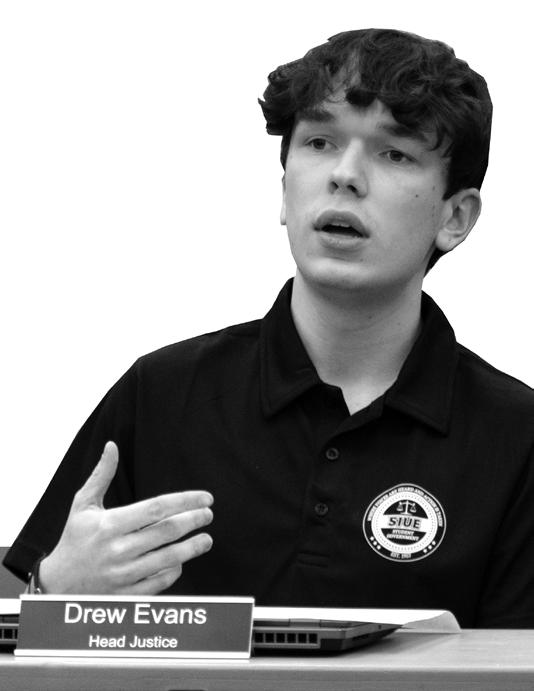
The revisions to the constitution and bylaws were only discussed at this meeting — they cannot be voted on until the next meeting at the earliest. Head Justice Drew Evans said the reforms aim to make the Senate more effective and more representative of the student body.
“Over the past few years, Student Government has been facing two obstacles which have led us to the position we’re in now. These obstacles are low engagement in elections and then less-than-ideal leader engagement and responsibility.” Evans said.
“By creating a smaller Student Government, our goal is to create more competition leading to a higher quality of senators, people who are more emotionally invested in these seats.”
The reforms would shrink the Student Senate to a total of 24 senators. Currently, there are 31 senator positions, with 21 of them filled. Five of these seats make up the Diversity Council, which, under these reforms, would be dissolved. Instead, Evans said, all senators will be tasked with upholding DEI ideals.
“Diversity, equity and inclusion are important values of the Student Government, and to reflect that, our amendment includes the mirroring of institutional values of diversity and belonging,” Evans said. “Additionally, we have included language to ensure senators will still continue to advocate for diversity and belonging in the best interests of their constituency.”
What is the manosphere, and why does it matter for our society?

Union members protest at chancellor’s office as faculty contract negotiations continue
GAVIN QUINLAN reporter
At 8:30 a.m. on Jan. 21, the SIUE Faculty Association continued contract negotiations with administration as members of the AFSCME Local 2887 and Illinois Education Association unions protested outside of the Office of the Chancellor in Rendleman Hall.
Faculty Association Chief Negotiator Ed Navarre said that efforts to begin contract negotiations began in August and bargaining started in October. According to Navarre, administration had not offered a response until the negotiation session on Jan. 21. As of the time of publication, Director of Communications Nicole Franklin has not given a comment on the situation.
Members of AFSCME Local 2887, which represents office support specialists among other campus employees, gathered in solidarity with the Faculty Association to protest staff shortages and increased workloads.
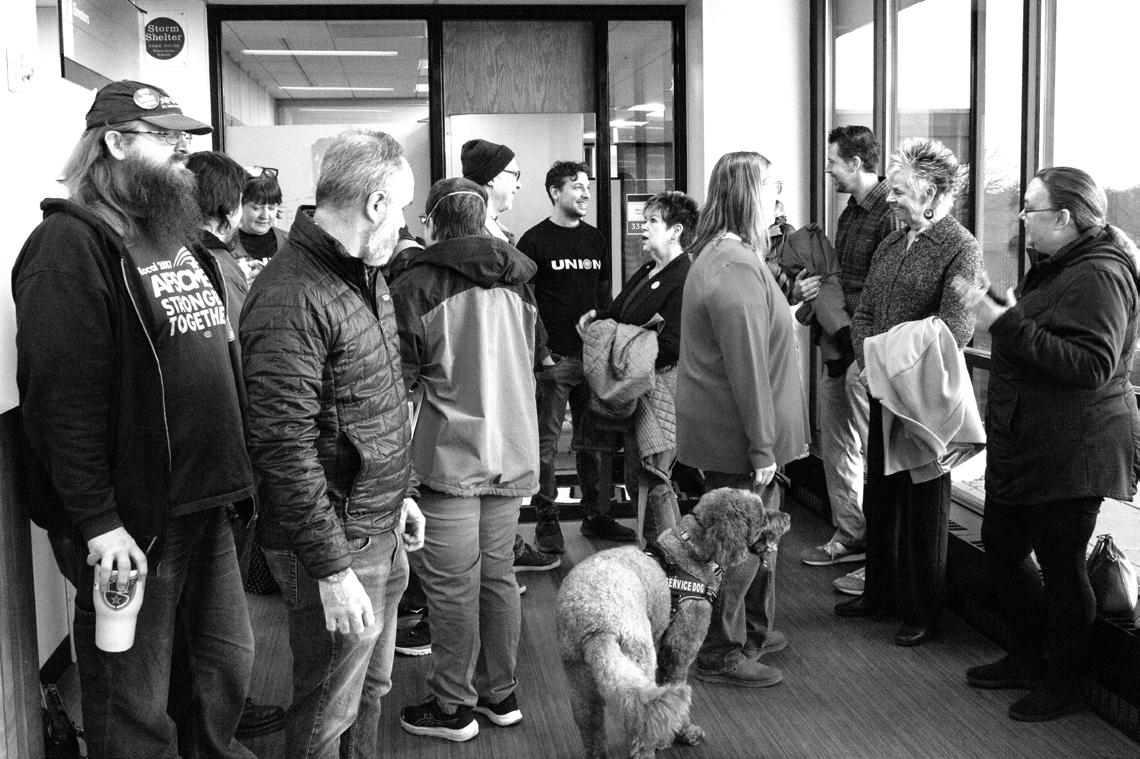
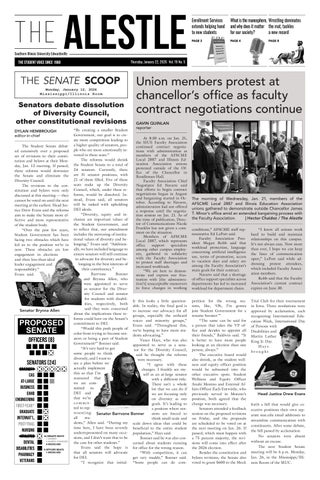
The morning of Wednesday, Jan. 21, members of the AFSCME Local 2887 and Illinois Education Association unions gathered to demonstrate outside Chancellor James T. Minor’s office amid an extended bargaining process with the Faculty Association. | Hector Chaidez / The Alestle
conditions,” AFSCME staff representative Ed LaPort said.
“I know all unions work hard to build and maintain relationships on this campus. It’s not always easy. Now more than ever, I hope we can keep the lines of communication open,” LaPort said while addressing protest attendees, which included Faculty Association members. Robb said that the Faculty Association’s current contract expires on June 30. Monday,
Barrvone Bonner and Brynna Allen, who were appointed to serve as senator for the Diversity Council and senator for students with disabilities, respectively, both said they were concerned about the implications these reforms could have on the Senate’s commitment to DEI.
“Would this push people of color from trying to become senators or being a part of Student Government?” Bonner said.
“It’s very hard to get some people to think diversely, and I want to see a plan before we actually implement this so that I’m reassured that we are committed to DEI and that we’re committed to representing all students,” Allen said. “During my time here, I have been severely underrepresented on many occasions, and I don’t want that to be the case for other students.”
“We are here to demonstrate and express our frustration with [the administration’s] unacceptable maneuvers to force changes in working
ly this looks a little questionable. In reality, the final goal is to increase our advocacy for all groups, especially the unheard voices and minority groups,” Evans said. “Throughout this, we’re hoping to have more students advocating.”
Vance Hays, who was also appointed to serve as a senator for the Diversity Council, said he thought the reforms were necessary.
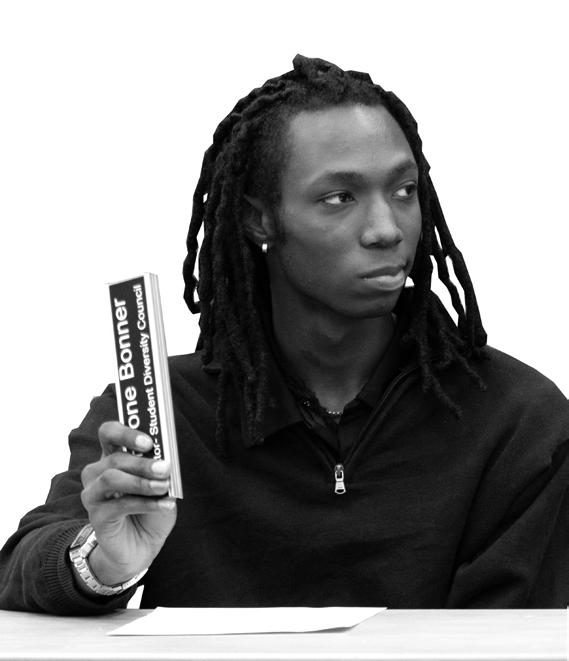
Senator Barrvone Bonner
“I agree with these changes. I frankly see myself as an at-large senator with a different title. There isn’t a whole lot that we can do if we are focusing only on diversity as our goals. It’s leading to a position where senators are forced to think small-scale and scale down ideas that could be beneficial to the entire student population,” Hays said.
Evans said the hope is that all senators will advocate for DEI.
“I recognize that initial-
Bonner said he was also concerned about students running for office for the wrong reason.
“With competition, it can get very muddy,” Bonner said. “Some people can do com-
Faculty Association President Megan Robb said that workload protection, language concerning artificial intelligence use, terms of promotion, access to vacation days and salary are among the Faculty Association’s main goals for their contract.
Navarre said that a shortage of office support specialists across departments has led to increased workload for department chairs.
petition for the wrong reasons, like, ‘Oh, I’m gonna join Student Government for a resume booster.’”
“The same can be said for a person that takes the VP office and decides to appoint all their friends,” Baldwin said. “It is better to have more people looking at an election than one person, always.”
The executive board would also shrink, as the student wellness and equity officer position would be subsumed into the other executive spots. Student Wellness and Equity Officer Anahi Moreno and External Affairs Officer Zach Entwistle, who previously served in Moreno’s position, both agreed that the change was necessary.
Senators attended a feedback session on the proposed revisions on Friday, and the proposals are scheduled to be voted on at the next meeting on Jan. 26. If passed, which must happen with a 75 percent majority, the revisions will come into effect after the 2026 election.
Besides the constitution and bylaws revisions, the Senate also voted to grant $600 to the Mock
Trial Club for their tournament in Iowa. Three resolutions were approved by acclamation, each recognizing International Education Week, International Day of Persons with Disabilities and Martin Luther King Jr. Day. Hays brought
forth a bill that would give executive positions their own separate siue.edu email addresses to streamline communication with constituents. After some debate, the bill passed by acclamation. No senators were absent without an excuse.
The next Student Senate meeting will be 6 p.m. Monday, Jan. 26, in the Mississippi/Illinois Room of the MUC.
Head Justice Drew Evans
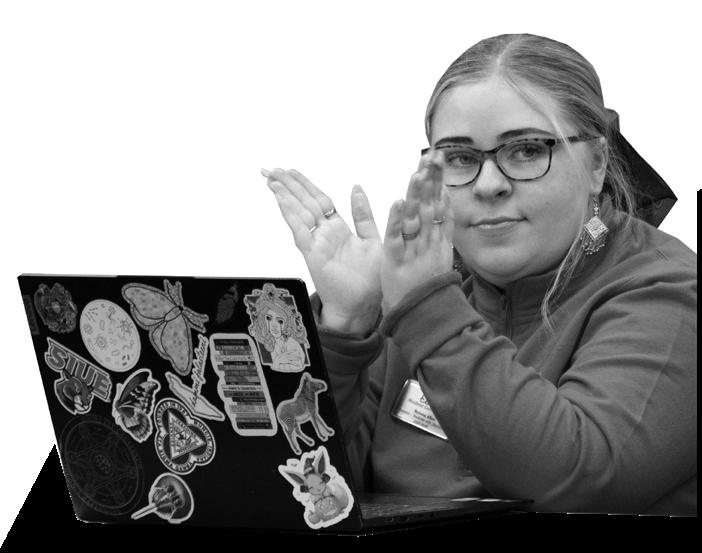
Senator Brynna Allen
Centralized Enrollment Services provides spot for enrollment needs
GAVIN QUINLAN reporter
From Jan. 8-14, staff were available to assist students with their beginning-of-semester needs on the upper level of the MUC.
Introduced at the start of the Fall 2025 semester, Centralized Enrollment Services was created by Enrollment Management to give students easier and more efficient access to admissions, financial aid, registration, Cougar Cards, transfer services and more at the start of each semester.
“We’re trying to break down any barriers or roadblocks that exist for students,” Vice Chancellor for Enrollment Management Andy Benoit said. “Part of the reason we’re doing that is as a response to the horrific stories that you get sometimes, where there are lines stretching out the building in Rendleman [Hall] and we can’t get enough [staff] … I don’t want anybody in lines.”
Director of Enrollment Communications Joanna Beilfuss said that its location in the MUC was an important aspect of Centralized Enrollment Services.
“Putting it in the [MUC] means that we were trying to make ourselves available in the most familiar places possible,” Beilfuss said. “Students go to those spaces [and] they’re familiar with those spaces. Rendleman Hall is kind of scary sometimes … Most people don’t know a ton about Rendleman.”
Beilfuss said that Centralized Enrollment Services helped approximately 100 stu-
dents with registration and more than 50 students with financial aid and admissions this semester.
“If we have something like that, and one student shows up and gets help, then it makes me happy,” Benoit said.
Financial Aid Coordinator
Daniel Klein said that Spring 2026 is the first semester Financial Aid staff have been present. Klein said that it benefits different kinds of students and staff.
“It’s for two types of students. The first one is students who are very, very new, who don’t really know their way around administrative areas, but know that [the MUC] is where they eat. This is where a lot of students congregate, and they’ll be able to see us here and get some advice,” Klein said. “The other type of student is students who don’t tend to have a lot of time. They might not have the time to go off to the office on the second floor of a separate hall, and this might be kind of through where they’re going.”
“Overall, it promotes a lot of inter-office collaboration,” Klein said. “I think this really helps us understand what each other’s roles are and helps us give the best student experience. Students can get their questions answered and go back to what they’re here for and study.”
Benoit said that Centralized Enrollment Services is just one example of different offices and divisions across campus collaborating to provide for students.
Enrollment Management has been working to strengthen their partnerships with other offices and organizations on campus.
“What we’re trying to do is

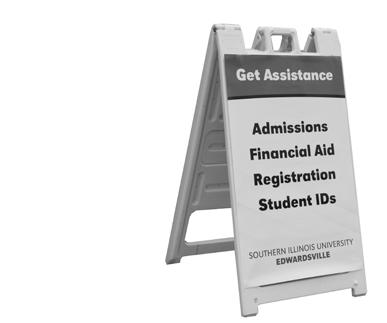
Centralized Enrollment Services was introduced at the beginning of the Fall 2025 semester. Amanda Reinhardt and Hope Trisler, answered questions related to fnancial aid to new and returning students. | Gavin
make a seamless process for students from initial recruitment to graduation,” Benoit said. “The folks in the Kimmel [Belonging and Engagement Hub] and Student Affairs have been really great partners. We’ve got a lot of great ideas that have been shared with us from the Student Government.”
Centralized Enrollment Services isn’t the only initiative Enrollment Management has used to meet the needs of a growing student population.
Benoit said that the university is “challenging” prospective students to make their decision earlier and opening applications and online services earlier.
“The orientation portal is going to open about a month early, so that when [National College Decision Day] comes, we have a pretty good idea how many students are coming. We can make educated decisions,” Benoit said. “At the same time, one of the things we are con-
scious of as an institution [is that] we do not want to sacrifice service … It hurts me whenever a student comes through the process and they are not given the assistance that they need to be successful.”
Centralized Enrollment Services is available during the first week of each fall and spring semester, as well as the week prior, with more days available in the fall.
Metro East municipalities decide to keep one percent grocery tax
CHLOE WOLFE lifestyles editor
On Jan. 1, the Illinois state one percent grocery tax expired after Governor JB Pritzker signed legislation eliminating the tax. However, Alton, East Alton, Bethalto, Collinsville and Edwardsville all voted to pass an ordinance establishing a similar tax.
The grocery tax, which has been in place since 1990, affects “food for human consumption that is to be consumed off the premises where it is sold (other than alcoholic beverages, food consisting of or infused with adult use cannabis, soft drinks, candy and food that has been prepared for immediate consumption).”
The tax did not benefit the state fund. Instead, the funds went directly to the municipalities or counties where they were collected. The new legislation gave the power to local municipalities and counties to establish their own grocery tax.
In Edwardsville, the City Coun-
cil voted to enact its own tax on May 20, 2025. The city reported the tax generates $1.2 million for the city’s general fund, which is 11 percent of the total sales tax revenue.
Edwardsville’s general fund helps to maintain city infrastructures such as grounds, emergency services and disaster, public works and streets, as well as providing funding to the city police and fire departments and salaries for city employees.
On May 27, 2025, the Glen Carbon City Council voted to maintain the tax, reporting that the loss of funds would amount to $1 million.
Glen Carbon’s general fund goes to funding public services and infrastructure, such as the police department, streets, building maintenance and more. The tax also helps pay salaries, overtime pay and workers’ compensation.
In order to enact a grocery tax at the turn of the year, ordinances had to be filed before Oct. 1, 2025. For more information about the changes made by the state, visit the Illinois Department of Revenue website.


Rask / The Alestle
Deborah Milton shops at the local Edwardsville Dierbergs. Edwardsville is one of the cities in Illinois that voted to enact their own grocery tax in 2025. | Gavin Rask / The Alestle
Dear Readers,
THE ALESTLE
ROOM 0311, MORRIS UNIVERSITY CENTER EDWARDSVILLE, IL 62025
Thank you to everyone who filled out the Trust Project form. Your answers were insightful and eye-opening, and we received many good questions. As promised, below are the answers to your questions:
Q: Who is in charge of reporting? How are stories chosen? If there’s pushback about a story and its contents, who gets the final say and why?
A: The editor-in-chief and section editors, all of whom are students at SIUE, are in charge of all reporting and editorial content at The Alestle, and reporters are given the responsibility of interviewing sources and writing these stories. Every time we prepare for a new issue, everyone on staff submits a pitch form with ideas for stories and an explanation of why those stories are relevant to the SIUE community. The editor-in-chief and section editors meet to decide which stories to pursue based on their newsworthiness and relevance to the campus community, and these stories are then assigned to reporters at our periodic staff meetings.
If there is pushback about a story idea, the editors debate the pitch with a final decision from the editor-in-chief. If there is pushback on a story after it has been submitted, such as if the story is low-quality or inaccurate, the editor-in-chief consults the managing editor and section editor(s) to make a final decision.
Q: How are students and professors chosen for quotes? How are their statements fact-checked?
A: The Alestle’s reporters are tasked with interviewing anyone relevant to a particular story and at least as many people as necessary to capture all sides of the story. Sometimes, we want to include general feelings from the campus community about a subject, and in those cases reporters are instructed to interview people around campus with an emphasis on capturing all sides of the story and are expected to turn in factually solid work. The copy editors are the ones who do the initial fact-checking during our editing process, followed by a section editor and the editor-in-chief.
Q: Are you limited on topics you can write about?
A: The Alestle is editorially independent, so in that regard, there are no limitations on what we can write about. We are limited in our scope — primarily SIUE and the surrounding community — and by our capacity, which has decreased significantly over the past couple of years.
Q: How does The Alestle gather their information?
A: Gathering ideas for stories is a very grassroots process — staff members are encouraged and expected to keep their eyes and ears open and to talk to members of the community. Some community members submit ideas to us as well, and if the editors decide the pitch is relevant enough to the SIUE community, we will pursue it. Additionally, each staff member is assigned to a “beat,” a topic they become the resident expert on. Beats are spread all across campus to try to cover as much as possible. Part of this process is building professional relationships with those relevant to the beat.
Q: How can we give you leads or information about issues that could be brought to the public eye by The Alestle?
A: Email us, or stop by our office! Our email addresses are on The Alestle’s website and monitored for pitch submissions. We are all students, but we do try to respond as quickly as possible.
Q: Who is in charge of what?
A: The editor-in-chief is in charge of all editorial processes at The Alestle, as well as managing staff. The section editors are in charge of their respective sections. The
lifestyles editor oversees the lifestyles section, and the sports editor oversees the sports section, for example. The managing editor oversees the news section, but also assists the editor-in-chief in managerial duties. The copy editors are responsible for evaluating each story for accuracy and quality. The reporters are responsible for interviewing and writing stories. The photographers are responsible for multimedia content. Every staff member is listed in the staff box on the opinion page.
Q: Are reporters paid? Can any student be a reporter?
A: Yes, all staff members are paid. Reporters, copy editors and photographers are paid minimum wage, section editors are paid $15.25 per hour, the managing editor is paid $15.50 per hour, and the editor-in-chief is paid $15.75 per hour. These figures do not include additional 10-cent bonuses offered to all employees of the MUC for every 500 hours worked.
Any student can work any editorial position at The Alestle. You don’t have to be a mass communications student either. In fact, of our current staff of 14, six are not studying mass communications, including three of the editors. Reporters, copy editors and photographers are typically hired to fill entry-level positions, and we rely mostly on internal promotion to fill editor positions. Occasionally, we will hire externally for an editor position.
Q: Who decides what opinions are included?
A: The opinion editor and the editor-in-chief decide which opinions are included.
Q: What’s the motivation behind reporting all negative news?
A: The Alestle does not report only “negative” news. Some issues may contain more negative stories than neutral or positive ones, but the overall distribution of positive, neutral and negative stories is roughly even. Negative stories generally focus on things not working as they should and why. This tends to require more investigation and fact-checking, so they tend to be longer and more in-depth. Event coverage, which tends to be more “positive,” has become more rare on account of being out of date by publication or simply because we no longer have the staff or resources to devote to it and continue publishing high-quality in-depth stories.
Q: Why is it so personal? It seems like you think the university is out to “silence” you. It’s happened over years of time. I know it used to be just a couple of administrators who are not here anymore, but now it’s just a general bad relationship. It has never looked to me like the Alestle is being silenced, it does look like people don’t want to talk to you because when someone does, you go after them. It is clear the bridges are burned and you need to build up some trust with the university. How are you going to build back some relationships?
A: The Alestle’s reporters don’t target specific people to report negatively about. It is true that administrators generally do not speak to The Alestle anymore, but when an administrator is relevant to a story, The Alestle still reaches out to them for comment just like any other source. The Alestle has also never claimed that SIUE is silencing it, but we have reported on actions that administration has taken that have led to a decrease in our capacity to report and publish.
Additionally, if there are concerns about our accuracy, we take them very seriously and address them as quickly as possible. The Alestle also sends our accuracy surveys to sources interviewed for our stories to evaluate how accurately the reporter portrayed the source and the facts of the story.
Again, thank you for taking the time to fill out our form. We take all responses and concerns seriously, and they will be taken into account in discussions shaping the future of The Alestle’s reporting.
— Sincerely, the EIC
(618) 650-3528

Man sphere c nsequential t y ung men, culture at large
BRANDI SPANN opinion editor
If you’ve been on social media in the past decade, you’ve likely heard the term “manosphere” — a play on the term “blogosphere” that refers to communities of young men online who encourage male empowerment through the disempowerment of women.
Members of the manosphere hold the belief that men experience societal prejudice and oppression at the hands of the feminist movement.
“The manosphere is an online subcommunity that is an insular echo chamber for misogynistic men to validate each other and to further their own ideology,” Associate Professor of Sociology Ezra Temko said. “The internet has allowed people to have much more segmented lives to ignore views that they don’t already align with.”
Though they are insular, these digital spaces have real-world implications that play an exceedingly consequential role in culture and politics.
“One tendency is often to treat things like the manosphere as this thing that is separate from our society. That is not the best way to tackle them,” Temko said. “There is an interesting relationship between the manosphere and the rest of society, because our society as a whole is patriarchal, and there are lots of sexist beliefs that we see outside of the manosphere.”
Temko cited Donald Trump’s use of the word “piggy” as an insult towards a woman reporter as an example of this real-world impact. He also mentioned Lawrence Summers, a previous president of Harvard University, who claimed that women had less of a biological capacity for math and science.
According to UN Women, “Experts are finding that the popularity of extreme language in the manosphere not only normalizes violence against women and girls, but has growing links to radicalization and extremist ideologies.”
Students have had discussions about the manosphere in Gurfinkel’s classes. The conversations address the harm both women and men experience at the hands of the manosphere.
“We had a collective, very lively discussion about the harm it does to young women and to young men, probably even more so,” Gurfinkel said. “I am relieved that these are primarily keyboard warriors, because the entitlement to male attention unfortunately very often turns to violence.”
Gurfinkel pointed to Elliot Rodger, a 22-year-old man who killed six people and injured 14 others in 2014 in an attempt to punish women — a violent rampage that resulted from his feelings of societal isolation and sexual entitlement.
more money — and then they will see miracles happen in terms of interacting with a woman.”
Participants in the
on social media through content creators like Andrew Tate, Candace Owens and Sneako. He finds that young viewers are vulnerable to the authority of
“It was very concerning to me because I have a younger brother who kind of based some of his thoughts on [the manosphere] at the time. He would say stuff to me, and I was like, ‘Oh, that’s not Anderson said.
“The statements attack and target women but hide behind being supportive of men.”
One thing we need broadly in society is a focus on humanizing each other.”
“People who are in digital subcommunities are also in the real world,” Temko said. “They’re carrying beliefs around normalized violence, around sexism, around gender superiority into their relationships and communities.”
Ezra Temko Assistant Professor Department of Sociology “
Professor of English Helena Gurfinkel studies masculinities and cultural perceptions of gender. She has found that men participating in the manosphere tend to want to undo feminism, or believe that women should return to the domestic sphere and submit to men.
Gurfinkel also mentioned self-proclaimed “incel” Alek Minassian, a 22-year-old man who rammed a rental van into a crowd in Toronto killing 10 people and injuring 16 others.
Gurfinkel said that one of the main themes of the manosphere is the belief that women are not interested in the “nice guy.” These are men who, in reality, exhibit charm only with the expectation of sexual reward rather than demonstrating authentic goodwill.
“[The manosphere is] giving men ideas online about how to manipulate women into dating them and telling them they’re entitled to any woman,” Gurfinkel said. “It’s also how to enhance their conventional masculinity — go to the gym, get more muscles,

attractive and wealthy.
Freshman mechanical engineering student Colton Silva served in the Marine Corps, where he observed the manosphere as “all-consuming” when it comes to body-building, aggression and comparison among male counterparts.
“I think it’s absolutely harmful. The manosphere is affecting everybody — especially younger men — in very bad ways,” Silva said. “It’s making young men insecure about themselves. There’s no benefit to it.”
Junior geography student Keaton Anderson discovered the manosphere’s “alpha mentality”
“People join and stay in these groups because they have social needs,” Temko said.
“People perceive themselves as victims, and they are looking for scapegoats — in this case, the manosphere is scapegoating women — and they’re looking for community, purpose and validation. One thing we need broadly in society is a focus on humanizing each other.”
Temko said that there is a cultural discomfort with progress and challenging tradition. He said that progress will not be linear, but having conversations about the future is a result of progress and that we must maintain hope.
REVIEW: ‘With Heaven On Top,’ A journey through memories
SOPHIE HAWKINS online editor
On Jan. 9, Zach Bryan released his sixth studio album “With Heaven On Top,” which recounts his past through the places he’s been, discovering meaning in a life of fame.

Written and produced by Bryan, the album is a vulnerable window, using markers like Byron Bay and New York City to divulge the highs and lows of Bryan’s life. His vulnerability mixed with the unique sound that Bryan has crafted throughout the years makes this a solid album, though not necessarily a standout among the rest of his discography.
With a 25-song tracklist and only a year between albums, “With Heaven On Top” seems a bit underdone, with some of the songs blending together and becoming forgettable, presenting itself in a collection of unfinished stories.
However, the album does have a natural flow. With the addition of the traveler theme, this album is great to put on in the background of your next road trip.
The album begins with a spoken word introduction, similar to his fifth studio album “The Great American Bar Scene,” recounting a dream he had in his New York City apartment after a conversation
with its previous owner. The dream slowly melts into a recounting of the memories of life that flow like a stream around him.
Bryan’s private life has been in the headlines throughout the past couple years. News of his breakup with girlfriend Brianna LaPaglia, altercation with country music singer Gavin Adcock and a new marriage have been circulating the internet and are possibly alluded to in this album.
“Skin,” rumored to be about his break-up with LaPaglia, highlights Bryan’s infamous intimate vulnerability. He sings about “taking a blade to my old tattoo,” emphasizing the relational disconnection in a way that is raw and intentional.
The track “Santa Fe” takes a turn on the emotional album to be fun and upbeat, becoming more experimental in genre with rock undertones mixed with a strong horn section.
“Miles,” a track on the back half of the album, feels like a shadow of Bryan’s
older music as he describes miles spent on the highway of life with a feeling of restlessness between the yellow lines of the road.
The album ends its descent with its namesake, a familiar acoustic dive into the idea of going through the complexities of life yet coming out on top.
“With Heaven On Top” exists in two versions, with Bryan releasing the acoustic variant of the album three days after the original. Improving some songs and hindering others, the acoustic version is unnecessary and blends with songs that were already fading into the background of the album.
Though not his strongest work, Bryan has traveled a long way since his first album. Now experimenting with mixing different genres and unveiling another layer of his life through song, this album is a ride through the past with a hope of going into the future with heaven on top.

SOPHIE HAWKINS online
editor
We listened to what you were listening to in 2025… and then made a playlist of our favorites.
This playlist is a collection of SIUE students’ top songs from 2025.
“Actually Romantic,” Taylor Swift
This pop track from Swift’s latest album, “The Life of a Showgirl,” is perfect for dancing while ignoring a bitter ex.
Students’ top songs of 2025
“Wi$h Li$t,” Taylor Swift
From the same album but with a much different meaning, “Wi$h Li$t” sets the priorities for the year, trading dreams of yacht life for a driveway with a basketball hoop.
“Les,” Childish Gambino
Portraying young love on the Lower East Side of New York City, this song’s witty lyricism is a catchy critique on dating in modern culture.

AIDAN KARSTEN intern
Lovejoy Library is introducing a new weekly program designed to help international students improve their English skills while building community through reading and discussion.
The book club will run from Feb. 4 through April 22, and will meet every Wednesday from 1-3 p.m. located on the second floor of Lovejoy Library. The book club will be held from 1-2 p.m., followed by the conversation hour from 2-3 p.m. Students are welcome to attend either session or both, depending on their interests and availability.
Simone Williams, the founder and diversity and engagement librarian, wanted to better support international students who may struggle with adjusting to a new language in the academic setting. With that, she created the club in order to reduce anxiety by building confidence through the discussion and interaction of peers.

OLIVIA WHITLOCK
copy editor
2025 was a fantastic year in all facets. Each month, I learned more and grew more in my understanding of film. I now wince a little at how I used to pronounce “cinephile” or “Scorsese.”
I’ve picked up more technical language since I first started writing this column.
It’s interesting to see my journey through movies reflected in my reviews, in how I talk about them and in how my tastes have shifted in such a short time. I still have a lot to learn, but that’s kind of the point.
For one final time, here are my favorite watches of the year — from me to you.
Please visit websites such as “Does the Dog Die?” to check for potential triggers and sensitive topics before viewing any movie on this list.
“Folded,” Kehlani
This single uses folding both metaphorically and literally to describe contradicting feelings and actions in a relationship.
“OPM BABI,” Playboi Carti
A hyper song, “OPM BABI” is an experimental ode to Opium Babi, who co-founded the Opium record label with Playboi Carti.
“Novacane,” Frank Ocean Ocean uses R&B to push the feeling of wanting to numb the pain of a relationship.
“Right Now,” PARTYNEXTDOOR

This contemporary R&B song illustrates a man trying to convince a girl to leave “them lames” and get with him for the night.
“Mile High,” James Blake ft. Travis Scott and Metro Boomin
This smooth song uses Blake’s unique style of R&B with electronic undertones to convey the details of a passionate relationship.
“Feel It,” Young Thug
This song explores the intimacies of a romantic relationship, with Young Thug looking for a deep bond with his partner.
“Emergence,” Sleep Token
This British rock band’s song describes a dark transformation of self, portrayed through changing rhythm and volume.
Find this playlist and more on The Alestle’s Spotify.
New program uses literature, discussion to support international students
“Why don’t we start a book club to help them learn English even faster,” Williams said.
By offering a consistent space where students can meet weekly, she hopes participants will feel more comfortable engaging with others and sharing their perspectives.
The book club portion of the program focuses on reading and discussing literature together, while the conversation hour provides a more structured opportunity to practice spoken English.
“It’s intended to be much more informal so international students can practice their English speaking skills without feeling pressure,” Williams said. “Sometimes, students think this is a classroom setting and they have to be perfect, but at the book club you don’t have to be perfect.”
That emphasis on flexibility and encouragement is central to the program’s mission. Students are not graded or evaluated, and mistakes are treated as a normal part of the learning process. This approach will help participants feel more confident using English in academic, professional
and social settings.
The selected book for the semester is “The House on Mango Street” by Sandra Cisneros. The book was chosen for its accessible language and style, which makes it easier for readers to engage with the text and participate in discussion, according to Williams.
To encourage participation and remove financial barriers, Lovejoy Library will provide a free copy of the book to each participant. Free snacks will also be available during the conversation hour.
Although the program is geared toward international students and English as a second language learners, it is open to everyone. Domestic students are encouraged to attend. Mixed participation can enhance discussion and promote cross cultural understanding across campus according to Williams.
The International Student Book Club and Conversation Hour will also connect with other Lovejoy Library events throughout the semester. From March 2324, the library will host the Mobile Memory Lab, an interactive exhibit that allows
participants to explore storytelling and personal history through digitization and reflection according to Williams. The event will officially be announced in the coming weeks.
More information on The International Student Book Club and Conversation Hour will be available in the coming weeks. Updates will be posted on the Lovejoy Library website.

I watched 300 movies in 2025 — here are my top five picks
‘Irma Vep’ (1996)
Director Olivier Assayas
I have been waiting to use this word in one of my corners. This film is in the truest sense very much cinéma vérité — a movie about making a movie, dominantly filmed handheld, mixing different film aesthetics and approaches.
It captures the stresses, the uncoordinated moments, failures, bonding, frustrations and reality-blurring that come with a production.
‘The Holdovers’ (2023)
Director Alexander Payne
This was my first watch of the year, and I knew immediately it would end up on this list.
I suppose I have a soft spot for movies with authentic-feeling characters who are dealing with adversity. The story is strong, the character development is good and it’s an overall well-crafted movie — wholesome and sweet.
There are a few small anachronisms, which in a period piece would usually leave me beyond frustrated, but they’re so minor you’ll blink and miss them.
‘Midnight Cowboy’ (1969)
Director John Schlesinger
I don’t particularly care for films with lots of special effects. I appreciate good camera work and using everyday elements to create something special. In this movie, in particular, that is done, and some real magic happens in post-production.
The film uses a fragmented montage technique to build moments and create a crescendo through auditory and visual flashbacks. The fast-paced cuts feel like nightmares or dream sequences, almost psychedelic at times. I found them extremely impressive — unlike anything I can recall seeing before. The montages create disorientation, euphoria and anxiety.
“Midnight Cowboy” would have been ahead of its time on story alone, but its artistic style is what cemented its place in film history.
‘The Code’ (2024) Director Eugene Kotlyarenko
Kotlyarenko has a unique ability unlike any other director I’ve seen. He’s able to do hyper-realistic media consumption commentary — and do it properly. He seems very in tune with the digital world in a way most productions are not. The film is overwhelming, fast and funky with a whole bunch of found footage.
I always let out the biggest sigh and eye roll when I’m watching a movie or TV show that inserts some kind of media sequence, like social media or texting, because it almost never looks like it’s supposed to or when they throw in modern-day slang or trends. But Kotlyarenko makes it feel natural and intentional.
If I tell you about the plot — a documentarian and her “canceled” boyfriend, who’s working on a non-fungible token, rents a house during the pandemic — you’d probably expect even more sighs and eye rolls. Yet it’s not out of touch; it’s a clever, fun social observation about some of the nonsense happening nowadays.
2025 had major heavy hitters in the box office. I’d say this was probably the most enjoyable cinema experience I had, with “Marty Supreme” (2025) a close second. What makes this movie stand out is its genre-bending approach, which sets it apart from much of what’s out there, even though it may fall short in some other areas. While most films involving the Black South only focus on suffering or trauma, this one balances nuance and joy with supernatural and horror elements.
The film is praised for its visuals, and for a good reason. The cinematography is wonderful, very rich in color and the shifting of aspect ratios was a standout decision that added to the experience rather than distracting from it. Additional favorites of 2025: “Sorry, Baby” (2025), “Sanctuary” (2022), “To Wong Foo, Thanks for Everything! Julie Newmar” (1995), “Superman” (1978), “On Swift Horses” (2024).
‘Sinners’ (2025) Director Ryan Coogler










HAVE A COMMENT?
Let us know by scanning here: Campus Box 1167 Edwardsville, Illinois 62026-1167
LETTERS TO THE EDITOR POLICY:
The editors, staff and publishers of The Alestle believe in the free exchange of ideas, concerns and opinions and will publish as many letters as possible.
Letters may be submitted to: The Alestle Morris University Center Room 0311
All hard copy letters should be typed and double-spaced. Letters should be no longer than 500 words. Include phone number, signature, class rank and major. We reserve the right to edit the letter for grammar and content. Care will be taken to ensure that the letter’s message is not lost or altered.
Letters to the editor will not be printed anonymously except under extreme circumstances. We reserve the right to reject letters.

Practicing mindfulness can benefit health, no matter the circumstances
THE
ALESTLE STAFF editorial board
Regardless of the severity of your challenges — or even the absence of them — therapy can improve mental health, decision-making and communication skills.
A common misconception regarding therapy is that you must have some sort of mental health issue to receive treatment. However, therapy is a great resource to use to strengthen personal abilities, especially when it comes to resolving problems and establishing a daily routine to keep your

DYLAN HEMBROUGH editor-in-chief
mind and body at its healthiest.
According to HealthCore Clinic, several specifc advantages include improved communication and relationships, enhanced self-esteem, increased productivity and the development of coping strategies. Therapy can also help individuals set and achieve personal goals related to both physical and mental health.
While one-on-one counseling is most common, other forms of therapy include creative arts therapy, family therapy, animal-assisted therapy, exposure therapy and many more.
People may avoid therapy due to feeling like their prob-
lems weren’t troubling enough or that they could solve them on their own. While these beliefs are understandable given existing stereotypes around mental health care, they can damage your overall growth and longterm well-being.
Cost is another major barrier. For SIUE students however, counseling services are available at no additional cost. Services range from individual and psychological assessments to group sessions and workshops. To set up an appointment or speak with a provider, visit Counseling and Health Services in the Student Success Center Room 0222 or
email them.
While sharing personal thoughts and experiences with a stranger can feel uncomfortable, therapists offer an outside, unbiased perspective that a friend may not be able to provide. They are trained to tailor evidence-based strategies to each individual’s specifc needs.
Therapy can be intimidating, but it’s often well worth the effort if it leads to a healthier mindset and the ability to become the best version of ourselves — even for those who may not feel they are struggling.
ICE killing of Renee Good is culmination of toxic masculinity
Renee Nicole Good’s murder by Immigration and Customs Enforcement Offcer Jonathan Ross shows exactly what happens when toxic masculinity is allowed to fester.
Toxic masculinity is a caricature of traditional male gender roles — it takes ideas of dominance, power and toughness to a harmful extreme. Men who fall into this line of thinking are more likely to be aggressive,
homophobic and misogynistic. What he did to Good was murder — there are videos proving it. These videos, one of which was taken by Ross himself, reveal the cruel intent behind this killing.
Ross is on video approaching Good, yelling at her and, after
shooting her, can be heard saying, “Fucking bitch.” Good’s last words to Ross were, “I’m not mad at you,” before she tried to drive away. Good wasn’t a threat, and Ross — who was already reaching for his gun — was upset she didn’t
BRANDI SPANN Opinion Editor
MICHAL KATE REYNOLDS Managing Editor
DYLAN HEMBROUGH Editor-in-Chief
AUDREY O’RENIC Sports Editor
CHLOE WOLFE Lifestyles Editor
Gavin
GAVIN RASK Multimedia Editor
SOPHIE HAWKINS Online Editor
SAM MUREN Graphics Manager
submit to his authority.
Ross is just a symptom of the much more pervasive issue of misogyny. Combined with the “manosphere” further isolating young men and cultivating their hatred of women, it shouldn’t be surprising that these kinds of men are attracted to positions where they can wield ultimate power with absolute impunity.
ICE deliberately promotes this kind of conduct. Their recruitment ads use war
language — literally calling their campaign “wartime recruitment” — to attract young men and incite them against anyone and everyone deemed a “threat.”
And with people as high up as Vice President JD Vance defending these actions, it is, again, easy to see how young men who have been isolated by the manosphere are attracted to this. They have been told in online spaces that they’re hated for who they are, and agen-
cies like ICE give them their chance at unfettered retribution.
It’s important to remember that Good was not the frst victim of ICE. Hundreds have disappeared in ICE custody, and more than 30 are confrmed to have died in 2025. But this situation was in broad daylight, carried out against a nonviolent U.S. citizen and immediately defended by Secretary of Homeland Security Kristi Noem with a host of lies. And, most rele-
vant to this piece, it is clear between ICE’s target audience and Ross’ own words immediately after the killing that misogyny plays a vital role.
As toxic masculinity becomes more normalized in our society, it is critical that we call it out and help steer young men away from these harmful ideas. What happened to Renee Good is just another step up on the long stairway of normalized masculine aggression.
Politicians aren’t celebrities, don’t let them distract you from holding them accountable
CHLOE WOLFE lifestyles editor
As politicians seek to capitalize on social media trends, the lines between entertainment and politics are beginning to blur, reshaping how we view politics and the people we vote to represent us.
From the 2024 elections, with Kamala Harris’ “brat” theme and Donald Trump’s campaign usage of right-wing podcast infuencers, such as Joe Rogan, to New York City’s newest mayor, Zohran Mamdani’s Instagram and TikTok-focused social media campaigns that mobilized a city, the last few election cycles have shown a shift in how successful campaigns are run.
With these changes, the celebrity-like treatment of politicians is shifting how we interact with our representatives.
Modern celebrity culture is not necessarily new to politics, as several politicians initially got their start as celebrities. Ronald Reagan was an actor prior to running for any political position. Even Arnold Schwarzenegger moved into politics in the 2000s.

HECTOR CHAIDEZ photographer
“A Matter of Opinion” is an opinion column that features a personal, anecdotal account of an experience relevant to college students. Each edition, a staff member will write about something important to them in order to share advice, start conversations and invite our readers to connect with one another.
Mobility and exercise are more important than you might think. The benefts are countless. Some of these benefts, like weight loss, healthier joints and increased discipline, are all achieved with consistency. You can acquire these benefts and more, just as I did, all with a little discipline.
Exercise and activity are key to maintaining a healthy, long life. The act of moving is exactly what the human body was created to do. Your fexible spine, joints and ligaments are meant to be used —
Aside from celebrities becoming politicians, many “traditional” politicians have used the celebrity model of fame and infuence to gain legitimacy in political spheres. But the rise of social media and near-constant access to political information for voters, which allows for high access and infuence for politicians, has exacerbated this tactic.
Before the social media era of politics, political scientists found that voters in the general public relied on the fow of information from the press to friends, family or acquaintances — also known as opinion leaders — to develop voting patterns and beliefs.
If voters wanted to fnd out more information about their representatives, they had to do their own research, which promoted more critical thinking and higher criticism. Now that political information is spoon-fed to Americans through highly individualized algorithms and echo chambers, we are slowly losing our ability to think critically about the information we are consuming about our politicians.
If we only see the surface-level information about our politicians, they will not be held accountable for the job they
were voted in to do. The United States is a democratic republic, and our government functions under the idea that we — the people — choose representatives to enact our will.
This lack of accountability can also be seen in the productivity of our representatives. Congress has become less productive. Of course, there are other infuences on this trend — if the different political parties control the different branches of the legislature and executive branches, more negotiations and compromises are expected to slow down the political process. But that is not the case for the current congressional session. The 119th House of Representatives has seen fewer bills become laws than any other in the past two decades.
While the low productivity is a problem, we must also take into account that this session has not ended yet — we may see more productivity in 2026 — and we must also remember the 2025 government shutdown, which halted any productivity for 43 days. Questions still arise about these politicians’ dedication to the voters who voted for them to pass legislation.
And if we feel that our politicians are
Staying physically
doing the job we elected them to do, that’s also no reason to praise them. They should be seen as an example for how other politicians fulfll their duty, but there should also be constant scrutiny to ensure they continue to do their job.
We can and should be doing more in-depth research on our representatives and politicians. Read beyond what comes across your “For You” page or timeline. Stop worshiping the politicians you only see in 30-second TikTok clips. Actively seek out their voting patterns and stances on topics important to you and who funds them.
Stop viewing them as superior people who aren’t accountable to the very constituents who gave them their jobs. They can and should be voted out if they are not doing their job as they promised voters they would.
Our democracy only works if we are active participants in the process. Hold your representatives accountable for their actions, and stop viewing them as beyond authority. Nobody is perfect — especially politicians — so stop treating them like they are.
active beneficial,
necessary for a healthy life
not for remaining in a seated position for hours at a time.
With technology growing and more lives revolving around their computers, hours at a desk have become the norm. Are these jobs and positions important? Absolutely. However, your body is just as important, if not more.
When I began learning about the importance of exercise, I learned about Ogie Shaw. He is a highly respected individual in the world of physical ftness, and he taught me a very important idea: physical ftness does not have to be complicated.
Before Shaw, I had always thought of exercise as pushing my body to the limits, sweating until my clothes changed to darker shades. I also thought that I would need to be in the gym all day or join a ftness group like CrossFit. However, Shaw taught me otherwise.
During a TED Talk, Shaw discussed the benefts of working out for 20 minutes or less a day. These short workouts
help you keep active, the chance of injury decreases and you build consistency and discipline. Shaw also said this type of exercise increases the number of healthy brain cells your body creates, lowers your blood pressure and offers a range of additional health benefts.
Daily workouts don’t have to be 20 minutes of intense training or diffcult cardio. Simple resistance training and moderate fast-paced walks can be more than adequate. I am an example of this approach working, as it has granted me a much healthier lifestyle.
Five years ago, I was introduced to the sport of ultimate Frisbee. I was overweight, slightly athletic and lazy as a rock. I decided to make a change, and I began working out once in a while and tried to watch what I ate.
With time and effort, I lost weight and began improving, but I still wanted to elevate my ftness. I entered college confdent that I could further my transformation.
These last two years, I fnally began working out every day, and I have reached a physical ftness that I never thought I could obtain. With extra weight lost, my knees stopped hurting, my conditioning has improved, I’ve gained more muscle and my overall attitude towards my ftness has skyrocketed.
If you are active daily and continue to fnd ways to exercise, keep going. If you struggle with fnding the time or the motivation to stay active, know that I struggled with it once too. Many people are in the same position. You are not alone, and with a little discipline, your goals are within reach.
Many of you may read this and think “I’m going to fnally do it! I’ll start next week, or maybe this weekend.” However, you cannot keep pushing it off. Procrastination only delays progress. I’ll leave you with my favorite quote popularized by Dwayne “The Rock” Johnson, one that has pushed me since the beginning of my journey: “One day? Or day one?”
650-3528
Wrestling dominates with decisive wins, new record
SOPHIE HAWKINS online editor
Wrestling moves into the tail end of the season with a 2-0 Mid-American Conference record and 8-1 season record, giving the Cougars the most dual meet wins in a season since 1986-87.
With MAC Conference wins against Ohio University and Pennsylvania Western University at Edinboro and a win over No. 14 nationally ranked University of Arkansas at Little Rock, the Cougars moved their season record to 8-1 and solidified themselves as a top team in the MAC Conference.
Associate head coach Daryl Thomas said these last few wins have given the Cougars momentum to continue competing at this high level.
“We expected this year to be a year where we hopefully all put it together at the same time, and they’re starting to do that. So, I think a lot of it is just validation of what we believed … and it’s all coming to fruition,” Thomas said.
Along with a winning record, the Cougars have three nationally-ranked wrestlers with redshirt junior Marcel Lopez at No. 23 in the 133-lbs division, redshirt senior Caleb Tyus at No. 3 in 149-lbs, and junior Brock Woodcock at No. 30 in 165-lbs and a team rank at No. 20, according to FloWrestling.
Head coach Jeremy Spates said the goal is to keep players in the nation-
al rankings to qualify for the NCAA tournament.
“We’ve had three [national qualifiers] in the past, but we want to have more than that,” Spates said. “We want to beat that, have four or five qualifiers, and then we want to have an All-American or a national champion, and right now, Caleb Tyus is ranked third and he’s put himself in that conversation.”
Last year, the Cougars did not have any national qualifiers, making it one of the only years that they haven’t, and they’re hoping to change that this season.
“We feel like we can compete against all teams, even when we wrestled Oklahoma earlier, our only loss. We were right in there in a number of the weight classes to give ourselves a chance to win, so we feel like we can win against any team,” Spates said. “We have really been stressing the way we compete and trying to dictate the action and control as much of the matches as possible so that we can give ourselves chances to win.”
SIUE took the chance to win against Ohio with seven wrestlers winning in their weight, including major decisions for Marcel Lopez over Ryan Meek for Ohio and redshirt junior Bryson Buhk over Ohio’s Wyatt Schmitt. Woodcock also took a decisive 15-0 decision against Ohio’s Jack Lledo.
In the dual meet against Edinboro and Little Rock, SIUE had five wrestlers re-
double wins in Marcel Lopez, Caleb Tyus, Dominic Lopez, Deron Pulliam and Bryson Buhk.
“I feel like as a team, we’re just continuing to get better, do the things that we do in practice and training. As far as guys that stood out, we had several guys go 2 and 0,” Thomas said.
Pulliam recorded a ranked win over Edinboro’s Jared McGill in his first match coming off of an injury. He had been out with a broken hand for about two months.
Overcoming injury and
having a successful season has come in part due to the team’s mindset.
“We do a lot before practice, trying to talk through things and make sure that they are in the best mindset possible, and then just trying to push them at practice. Luckily we have a great group of guys right now that we don’t have to push them that hard, because they do it themselves. We have got a great coaching staff too that we are able to help those guys,” Spates said.
As for the rest of the season, the team’s goals remain
the same: to compete in the MAC West Conference Championship overall title, get four or five wrestlers to the national tournament and produce an All-American.
“Obviously, those are the goals. We don’t necessarily talk about that being the goals every day, but we set those goals at the beginning of the year, or we set those goal four or five years ago,” Thomas said. “But we just focus on the process of getting better and taking it one week at a time, trying to give our best effort and let the chips fall where they may.”
COUGAR COMMON GROUND: Table Tennis Club seeks competitive players amid sport popularity
GAVIN QUINLAN reporter
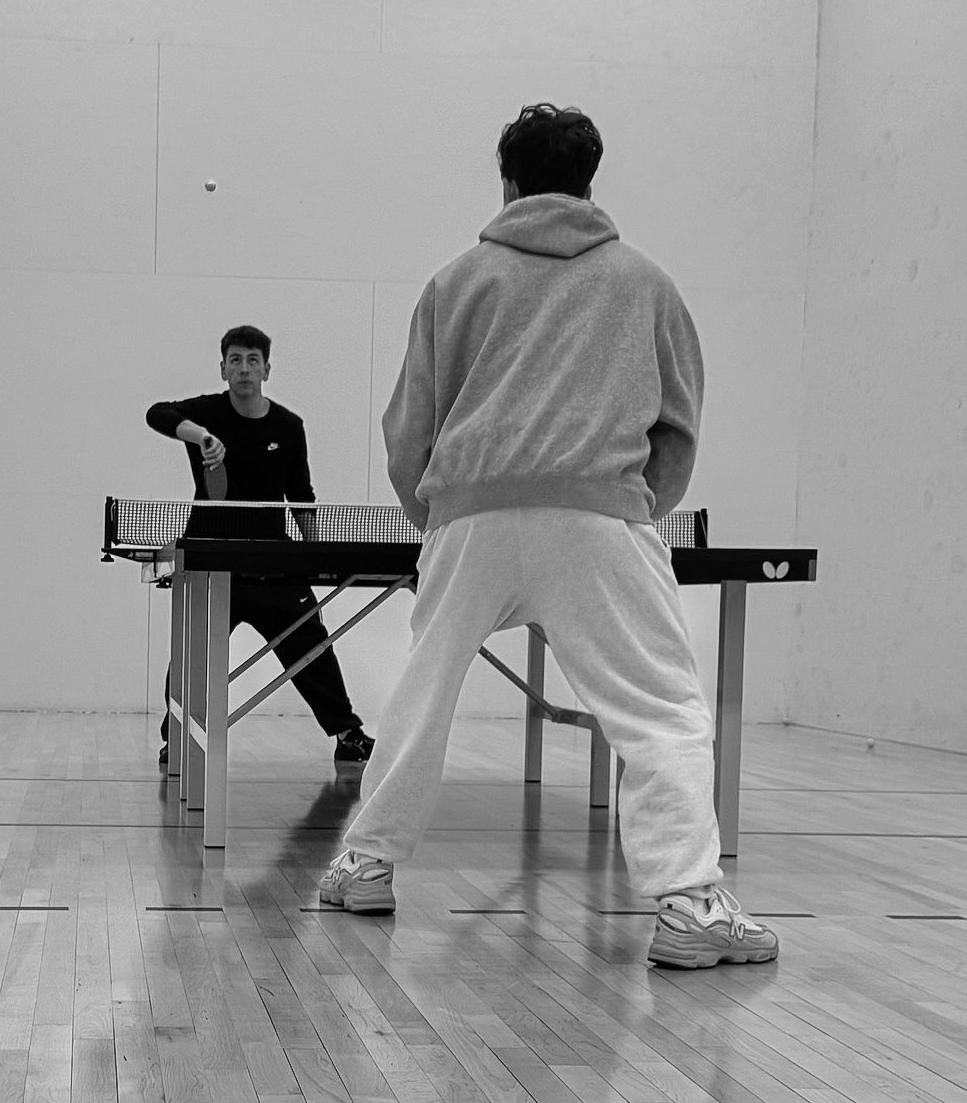
SIUE’s Table Tennis Club,
a group for students to play casual or competitive table tennis, has the paddles, the balls and the table. All they need is more players.
Junior nutrition student Andrew Bonham joined the Table Tennis Club as a casual player his freshman year. Now, he plays competitively against other schools.
This year, the Table Tennis Club was unable to participate in the National Collegiate Table Tennis Association Lower Midwest Divisional due to low numbers.
The tournament occurs every fall and spring semester, but only allows singles in the spring. Other schools to participate include Saint Louis University, University of Illinois Urbana-Champaign and
Washington University.
“Mainly we’re just looking for more players. I think it started off really well. The past semester we had a lot of interest,” Bonham said. “We had some people join, but as the semester went on, it kind of dwindled down to just the competitive players.”
Bonham said that the club has helped build his leadership and organization skills.
Junior nursing student Michael Chavez said that the club has helped him develop patience and a better understanding of his strengths and weaknesses.
“Ping-Pong is just you, the paddle and the ball. Your mistakes are on you,” Chavez said.
“If you hit it just the slightest way wrong, it’ll go off the table. It can be frustrating at times, so learning how not to do that is rewarding.”
With the recent popularity of table tennis spurred by the
release of “Marty Supreme,” a film following fictional professional table tennis player Marty Mauser, Bonham and Chavez said that now is a good time for beginners to try it out.
“I saw a lot of people on the internet getting more interested in the sport after [the film released] — buying tables for their basements and stuff. It’s good to see more interest [in] the game overall,” Bonham said.
“It’s a specific niche. I don’t think everyone wants to go to Ping-Pong right away,” Chavez said. “I would say, give it a chance now that it’s popular, and it could be really rewarding.”
The club will practice in the Student Fitness Center every Tuesday this semester. They will next play in the NCTTA Divisional at William Woods University on Feb. 7.
cord
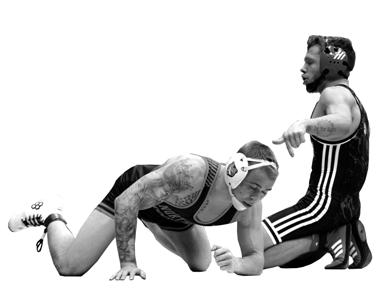
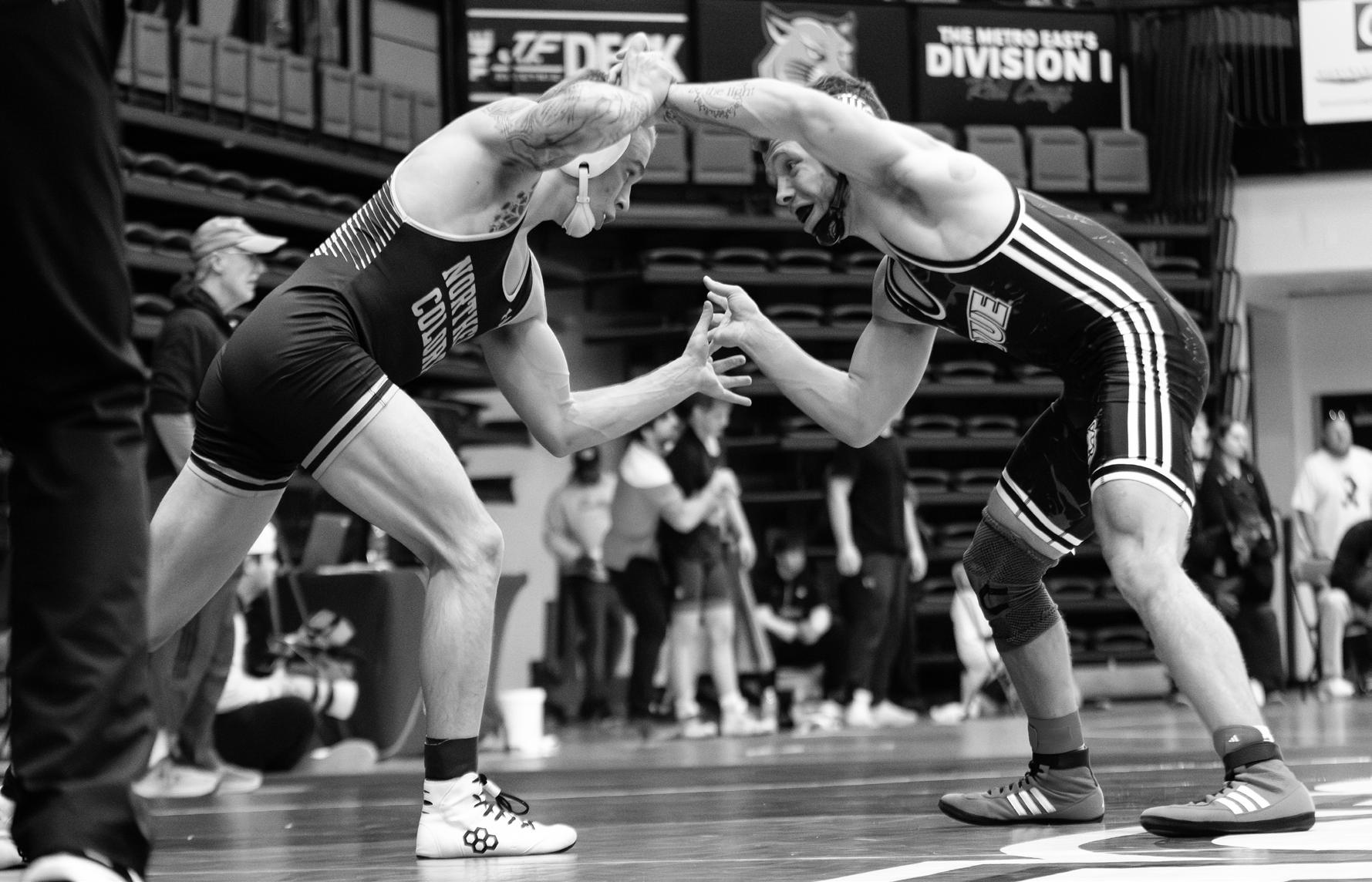
Caleb Tyus takes on Northern Colorado’s Brady Hankin in the first round of SIUE’s Cougar Clash tournament on Dec. 7. Tyus won first place in the 149-lbs weight class.
| Gavin Rask / The Alestle
| Courtesy of Andrew Bonham