

‘THEY CONTROL THE NARRATIVE’


Housing employees speak out against restrictive media ‘policy’
DYLAN HEMBROUGH editor-in-chief
University Housing employees are bound by department policy to direct all media inquiries to Director of University Housing Mallory Sidarous. Some employees have chosen to speak out against the policy, calling it a violation of their rights as American citizens.
policy or practice?
Sidarous said the policy, which she actually referred to as “department practice,” is meant to present accurate information to outside sources.
“It’s been in place since before I was the director,” Sidarous said. “I think it’s in alignment with a lot of media relations policies, where we speak as one voice as a department, and where we make sure we have the correct subject matter.”
According to Sidarous, the practice only applies to employees when asked to speak from the perspective of their position.
“If somebody wants to speak on behalf of themselves as an individual, that is different from speaking on behalf as an employee,” Sidarous said. “Let’s say Joe
is a music major, and you want to write an article about Joe’s concert that he was in as a percussionist. That’s not related to his role as a resident assistant.”
“If it is … that would go through us,” Sidarous said. “They may not be the most qualified person to answer those questions.”
However, on Aug. 19, resident assistants in Bluff Hall received an email from Bluff Hall Community Director Elijah Zagorski reminding them of the practice. The communication originally came from Associate Director of Residence Life Rex Jackson, who referred to the practice as a policy and specified that it did extend beyond work-related media inquiries.
“If The Alestle (or any news organization) reaches out … [employees] cannot talk to them from the perspective of their position without Mallory’s approval,” Jackson wrote. “Even if they are being asked to talk from outside of their Housing position, [it is] always good practice for them to check with us first.”
Jackson also said that Housing employees who are contacted by the media must notify their supervisors, who will re-
lay it up the chain of command to Sidarous.
If an employee were to violate this practice and be caught, Sidarous said there is no set disciplinary protocol.
“It would be specific to the situation and, potentially, that student, and maybe the status that they are in as a student employee,” Sidarous said. “It’s hard to give specifics.”
Sidarous said she has never heard of any complaints against the practice.
Employees speak up
Aside from the Aug. 19 email, the practice is rarely referenced or enforced in writing, and it doesn’t appear in any employee contracts. Sidarous said it is written down as department practice, but no documents were offered to back this up.
Two Housing employees, both of whom wished to remain anonymous due to disciplinary concerns, said the practice had only ever been communicated to them verbally.
“I think [Sidarous] is smart enough to know not to put something like that in writing, because that would be pretty damning,” the first
employee said.
This employee also said that, in addition to violating his rights as an American citizen, the practice prevents some necessary work from being done to improve campus.
“My intention was to get our stuff working for the safety of our community out here,” the employee said. “I’ve got certain things out here I battle on a daily basis to get resolved, and I will use whatever resources I can to try to make that happen.”
The first employee said that, to a point, they understand why Housing would institute such a practice, but that their reasons aren’t good enough justification for enforcing it.
I think it’s in alignment with a lot of media relations policies, where we speak as one voice as a department.”
Mallory Sidarous Director of University Housing
The second anonymous employee said they believe this practice gives Housing power that has the potential to be abused.
“They control the narrative,” the second employee said. “I think it’s mixed — good and bad. Sometimes, you don’t want people’s specific names to fall into situations, but other times, more details on a situation need to come out.”
“I can totally understand their point of view, trying to do damage control in the public’s eye. It could be detrimental to their operations here if word got out about something they didn’t want out, so I can understand them wanting to control the narrative,” the employee said.
“At the same time, something as innocuous as talking to someone about a safety concern, I don’t think there’s any reason we need to have a gag order.”
Despite disagreeing with the practice, the first anonymous employee said they don’t believe their coworkers will speak up.
“I think most people were
Stipend delay, lack of communication on backpay causes headaches for frustrated union members
CAMELA SHARP reporter
BRANDI
SPANN opinion editor
AFSCME Local 2887 members waited nearly two weeks for backpay and stipends from the university without prior notice of the delay. They received their overdue payments only after filing a grievance.
Timeline of Events
On Feb. 26, after 606 days without a contract, AFSCME Local 2887 and the university reached an agreement. The final step for the union was a membership vote to ratify the new agreements. AFSCME held meetings on all three SIUE campuses to reach as many members as possible. By March 19, they had a 99 percent ratification vote and informed the university of their decision that very night.
Chancellor James T. Minor did not sign the agreement until June 11. President Dan Mahoney signed on June 12.
pay: one on July 16 and another on July 31. Members who were employed between July 1, 2022, and June 30, 2023, were meant to receive a stipend of $1,800 on July 16. Some people who did not fall into this category also received the payment. Union leadership also discovered that five people were still receiving bi-weekly instead of bi-monthly pay.
Amy Bodenstab is president and chief steward for AFSCME Local 2887, as well as the office manager in the Department of Teaching and Learning. She reached out to Human Resources and asked for those members to be paid at the same time as everyone else.

There would be two payments providing union members with stipends and back-
According to Bodenstab, she was informed that payroll was understaffed and could not do anything special because the AFSCME contract was taking up their time.
Then, on July 31, members of the union did not receive their backpay at all. Union leadership was informed by payroll that there was an error in uploading the payments. When asked for a solution to the issue, payroll said that they would have to wait until the next pay period to properly provide the payment.
“You rely on your employer to have a degree of integrity from the things that they tell you. So if you rely on that and then it doesn’t come, that definitely does affect people,” Ariel Kallisto, the people chair for AFSCME Local 2887 and an office support specialist in the Department of Teaching and Learning, said.
Consequences for Union Members
Not receiving the payment on the last day of the month caused issues for union members.
“For a lot of people, that’s the day before mortgage, [or] before rent, [or] before utilities and things [are] due. So if somebody thought … ‘I’ll use this part of my paycheck that I was going to [use for] mortgage [on] my car, or I’ll take care of this thing for my kids,’ and then that money doesn’t show up that next day … that causes problems for people,” Kallisto said.
Michelle Nickerson is an ACCESS of-
fice administrator and a union steward for AFSCME Local 2887.
Nickerson had set up appointments for both of her vehicles and for her glasses knowing that this money would finally be paid to her in the upcoming weeks. The first paycheck came through properly and her vehicles were taken care of, but her glasses ended up costing an extra $500.
“My thought was, ‘we’re getting our second check on payday. I can afford that.’ [I went] ahead and I [paid for] it. So, I technically spent the money before I had it. Payday came and the money wasn’t there,” Nickerson said.
Bodenstab not only had to face financial setbacks of her own but, as president, she was informed of many others affected by the delay.
“One woman said she had a payment that was due, and she was counting on this money to make that payment. [We’re living lives where] if anything goes wrong, we’re getting a loan, [or] asking for somebody to give us money. We’ve got to pay that stuff back, and we’ve got to pay it back with interest, so it costs us more to survive,” Bodenstab said.
Bodenstab wants those not in the union
see BACKPAY on page 2
COUGAR VILLAGE
EVERGREEN
RAs work to serve students with the best Welcome Week
AUBREE NOLES reporter
The start of the school year can be difficult for many students, but resident assistants on campus help ease the transition. RAs play a key role in various activities in the early part of the year.
“Welcome Weekend” and “Cougar Welcome” take place within the first week of school, and first-year students are encouraged to attend events on campus to meet new people and learn more about SIUE. On these nights, RAs gather their residents together and lead them to the campus events. This is just one of the many tasks that RAs have at the beginning of the
school year.
Joey Gallo, a senior engineering student and first-year RA at Prairie Hall, said the first week was filled with more questions than he anticipated.
“ There’s been a lot of activties you can go to, so that’s been fun.”
Zoe Laird Freshman
Gallo spent the first week going door-to-door and introducing himself to the students that reside on his floor. Overall, Gallo said he felt positive about his interactions with residents. Now, when he sees them on campus, they exchange greetings. He also explained how he was currently enforcing the rules of the dorms with his residents. He wanted to be sure they were clear of the expectations, since they are
freshmen, to prevent any issues arising in the future.
“[There was] a little bit of policy enforcement. I mean, I was a little lenient, but other than that, real simple stuff,” Gallo said.
Britney Wallace, a senior nursing major and second-year RA at Evergreen Hall, the upperclassman hall, explained some of her responsibilities during the first few weeks.
“I am responsible for picking a theme and decorating my hall in that theme, making sure all the residents have a name tag on their door, as well as a living guide,” Wallace said.
On top of doing this, Wallace was also responsible for making a bulletin board in her hallway that included information about the school.
Another task that Wallace mentioned was the community meeting and social that the RAs have to hold at the beginning of the year.
“We are also responsible for
doing our social, which is just like a program that gets residents to come over and interact and meet the new RAs. We also have a community meeting, which again just goes over the rules in [university] housing,” Wallace said.
Wallace said she was excited for the year after holding the first community meeting for her floor, where she received some feedback from her residents.
“In my hallway, I had a lot of positive feedback about my theme. I was able to engage with residents moving in, and then we had our first community meeting, and we had over 50 students show up which is really, really good. I think it’s been pretty successful so far,” Wallace said.
These efforts do not go unnoticed and make direct impacts on students.
Zoe Laird, a speech pathology and audiology major, is a freshman student who resides in Woodland Hall. She said her RA has made her feel comfortable
here at SIUE.
“She’s been really nice and welcoming. The first night I got there, she came in and introduced herself to everybody in the dorms,” Laird said.
Laird also attended the “Welcome Weekend” events on campus and said she had a great time.
“There’s been a lot of activities you can go to, so that’s been fun,” Laird said.
Sophomore Colin Tisdale, a history education major, said his experience with the RA on his floor at Prairie Hall has been good as well.
“So far, my RA has been really good, really nice. She’s not been too over the top, like a hawk. I’ve talked to her a few times, and each time she’s been very respectful and very understanding,” Tisdale said. “‘Welcome Week’ was really good. Everything went really smoothly.”
Housing media policy called toquestion by employees
HOUSING | COVER
to really speak out about it,” the first employee said. “I think people would rather just keep their head down. This is a good job … and I don’t think anybody wants to put their job in jeopardy by becoming a troublemaker.”
The Alestle attempted to contact five other current or former Housing employees. Two of the RAs who were contacted for comment on this story turned down an interview on account of not feeling “comfortable” speaking or being “too afraid.”
A third RA, who was originally contacted for a story about the recent ceiling collapse in Cougar Village’s Building 405, requested that their quotes be removed from the story before publication.
“I was informed that I’m
not supposed to talk to y’all since I work in Housing … and I don’t wanna get in trouble, so [I’m not going to] say anything else,” the RA said. The other two employees did not respond for comment.
A n expert’s perspective
Anne Marie Tamburro, a student press counsel with the Foundation for Individual Rights and Expression, said that while practices like these are common, they are not appropriate.
“I see these kinds of policies and practices at higher ed institutions across the country … in the perceived best interest of university administrators to keep control over university press and the way that they’re reporting about issues and controversies
on campus,” Tamburro said.
Tamburro said thinking about this issue as a practice does not make it better than if it were a written policy.
“This practice is a little more insidious, because administrators can pick and choose when to apply it,” Tamburro said. “The fact that these decisions can be made spontaneously … makes them dangerous.”
Tamburro framed the issue as an infringement both of employee rights and the rights of an independent publication such as The Alestle.
“Public employees have the right to speak to the press on matters of public concern in their private capacity,” Tamburro said. “This is the virtue of looking for appropriate expert sources — to speak to their own experiences.
Naturally, if you’re writing a story about issues in university housing, you’re gonna want to turn to housing staff.”
An employee who sets themselves up as “an expert on the university’s viewpoint” would not be protected, according to Tamburro, but employees still have the right to speak to their own experiences on the job.
“Sharing an opinion on a university policy or practice is not speaking for the university,” Tamburro said. “This is a pervasive issue at institutions across the country. This is a public concern. Any sort of action the university would consider taking against them is entirely inappropriate.”
In addition, Tamburro said policies and practices such as these tend to backfire in their

initial aim.
“You’re trying to avoid negative press, but garnering negative press in the process,” Tamburro said.
Tamburro said the Foundation for Individual Rights and Expression deals with policies and practices like this on a regular basis and does advocacy work for those affected by it.
“I would be happy to do some advocacy work … to fight against this policy,” Tamburro said. “Sometimes [administrators] are just uninformed. We can come in and be the mature experts in the room.”
Members feeling left in dark on stipend payments
BACKPAY | COVER
to understand just how serious the conditions that this delay and these low wages have forced its employees to experience.
“When I have people calling me up, going, ‘I am being priced out of my house,’ ‘I’m not going to be able to afford where I live,’ ‘I’m struggling to find someplace else to live,’ and then [HR responds with] ‘I don’t know,’ what does that mean? That’s not an answer,” Bodenstab said.
“Nineteen dollars an hour doesn’t cover what I actually do here, let alone what I do at my other two jobs and at home,” Bodenstab said.
Grievances with Communication
Kallisto said that, to her knowledge, no one was informed about the payment issue until after the paycheck was deposited and the amount was different from what was promised.
“Yeah, mistakes happen, but communication needs to happen and, ideally, some sort of outreach to try to fix the problem should be happening … Bills aren’t going to wait two weeks,” Kallisto said.
Nickerson said that the lack of communication about the
payment is what really left a bad impression on employees who were expecting their pay.
“To me, that speaks volumes about where we rank. We don’t. There’s no way I would work here without being in the union,” Nickerson said.
Bodenstab said that payroll is not at fault for their lack of staff, and that the union does not have negative feelings towards them.
“We’re not upset with them. We don’t have any qualms with them. They’re trying,” Bodenstab said. “How is it their fault if they don’t have enough people to do the work?”
Bodenstab received a response that HR payroll has been understaffed, but she has yet to see any job postings available to fill those positions.
“We keep hoping they’ll show up, because it would mean that people would get paid appropriately on time. If those postings aren’t up, that’s not payroll’s fault. That’s not our fault,” Bodenstab said. “There’s a very small group of people who are in authority over that situation.”
Nickerson said that Carl Chambers, the director of Human Resources, has a say in mak-
ing sure things of this nature are communicated and that this payment issue doesn’t happen again. The Alestle attempted to contact Chambers via email, but he did not respond.
Undervalued Employees
As of July 2023, AFSCME
Local 2887 was 92 percent female. Nickerson said that the fact that the union membership is mostly women definitely impacted the 606 days of negotiations.
“Women aren’t supposed to make waves. They’re not supposed to stand up for rights. They’re just supposed to take what they’re given and say thank you. Being 92 percent women has everything to do with it,” Nickerson said.
“I don’t want to cast any aspersions, but it definitely follows a pattern,” Kallisto said. “A lot of people in our union are the ones who are building out the processes that make the university run,” Kallisto said.
According to Bodenstab, on average, the union does not receive the acknowledgement or proper treatment it deserves — so much that many people are leaving their jobs earlier than they had originally planned.
“The kind of overarching disrespect for the people that make things happen here is becoming really prevalent and stomach-churning for a lot of people,” Bodenstab said. “It’s very unwise to continue to ignore the group that actually makes the place function.”
Bodenstab also conducted research to see how much her expertise is worth elsewhere, finding that she really should be getting paid more.
“If I took off a third to a half of my job duties and then went out into the world and looked for jobs — entry level, not all my experience, but entry level — is $70,000 a year,” Bodenstab said. “With my raise, I’m making almost $37,000 — something like that. I haven’t done all the math yet, but that’s a huge discrepancy.”
Support from union leadership
Kallisto said it’s important to note that AFSCME leadership was immediately contacted by members after the incorrect paychecks were distributed and that they took action to contact the university and get answers.
“I think that people can see that they’re being fought for. And I think that people can
see [that] this is why we have a union — so that you know if something goes wrong, you have people that are there to back you up,” Kallisto said.
Bodenstab said issues like this only strengthen her and others’ resolve to take action, as it’s the union’s responsibility to speak up and protect employees from being wronged.
“It proves to me that unchecked power corrupts. I don’t know if that’s the case here, but I know that it keeps people from doing what they’re supposed to do in a timely fashion and with ethical integrity,” Bodenstab said.
Bodenstab said that, due to the union’s activism, others have been inspired to speak up for themselves in the workforce and join them.
“People see [our] response, and they [say], ‘I want to be able to tell them that they have to treat me correctly, too,’ [and], ‘I want to know that somebody’s at least going to say something when bad things happen to me,’” Bodenstab said.
The rest of the backpay payments were distributed to union members on Aug. 16.
One decade later: How Ferguson boosted the Black Lives Matter movement
CHLOE WOLFE lifestyles editor
DYLAN HEMBROUGH editor-in-chief
Following the fatal shooting of 18-year-old Michael Brown Jr. in 2014, the community of Ferguson, Missouri — less than 30 minutes from SIUE’s main campus — erupted in protest, reinvigorating the young Black Lives Matter movement across the nation. 10 years later, the impact of the protests is still felt in the Metro East.
Tensions rose as the community gathered around the police barricade set up around Brown, whose body remained in the street for four hours, according to the Department of Justice report. The protests began on Aug. 10, the day after Brown — who was unarmed — was fatally shot by police officer Darren Wilson.
On the ground in Ferguson
Theresa Pauli, SIUE’s current mass communications broadcast engineer, worked for Fox 2 at the time of the protests and was on assignment the morning after Brown was shot. While there, she was asked to
“ It felt like I was in a little bit of a twilight zone”
Christian Lee
Former
Alestle
Photo Editor
cover the upcoming press conference that was being held at the Ferguson Fire Department.
As they were setting up to record outside the station, Pauli said a crowd suddenly appeared and asked her to convince the people in charge of the conference to hold it outside.
“They said, ‘They won’t let us in the firehouse. Tell them they’ve got to do it outside.’ And I said, ‘They’re not gonna listen to me.’ So they said, ‘Well, how are we gonna get to ask questions? How are we gonna be heard?’” Pauli said. “And I looked at my camera, and I put it on my shoulder, and I said, ‘I’ve got a camera.’ And [the crowd] just erupted.”
Pauli said she realized at this point that the situation was bigger than she usually encountered. She said by the time the conference started, she and the reporter had been out there for a few hours.
“I was trying to get home, but [I] lingered and [I] knew,” Pauli said. “I remember I called back to the station and I said, ‘This is different, this is just different.’ We’ve been to shootings, police shootings, riots, protests and such in the past. By the time I left that day, we literally sat out there for hours with nobody really around us, and by the time I left there were hundreds of people in the street.”
Christian Lee was majoring in mass communications and working as The Alestle’s photo editor at the time the protests broke out. Lee covered the unrest from the initial protests to the acquittal of Wilson.
Lee said that a photo he remembers being the most impactful to him was a photo he took of a member of the community outside of the QuikTrip gas station that had been burned down during the protests.
“There was this Black guy, he was mad at the protesters because they had burnt the gas station where his grandmother came to get groceries. He was mad,he was saying, ‘Now my grandma gotta go further,’”
Lee said. “I think that was an interesting position within this conversation, [it was portrayed in the media that] everybody just wanted to burn the community down. But it was this one

person that was saying, ‘Look, are y’all not looking at this? If you burn this down, we don’t have these businesses within our community.’’’
Lee also took photos at Greater Saint Mark Missionary Baptist Church when civil rights activist Al Sharpton addressed the community Aug. 12, 2014. Pauli was also there and said the coverage she remembers most vividly was the choir singing “Better Days.”
“You’re seeing the rioting that was going on, and I knew my co-workers and my friends were there,” Pauli said. “But then you’d have a day like that, where we were sitting waiting for Al Sharpton … You see the other side of the community, you see the hope, you see the fear in a church service. It just was heartbreaking and heartwarming at the same time. We all go home and these folks were in the mid-

dle of it, and still to see that spirit and that coming together.”
During the first wave of protest, Lee said that it was difficult to go from existing on campus to what he described as a “warzone.”
“It felt like I was in a little bit of a twilight zone, I would go to classes with people whose life was A-okay, who didn’t have a problem in the world, who were just going about their day. Then I would go and get pepper sprayed and gassed and have rubber bullets shot at me. [I’m watching] police cars being flipped up. I’m hearing ammunition. I’m hearing business windows getting crashed into,” Lee said. “To go to Ferguson, where it seemed like all hell was breaking loose, to SIUE, where I was back in good old suburban America … It felt like I would enter one world and go to a completely different world where people were uninterested, or unconcerned or unaware of what was going on in the world around them.”
SIUE’s reaction to the protests
The Alestle documented a town hall meeting called by then-Chancellor Julie FurstBowe. Vice Chancellor of Institutional Diversity and Inclusion Venessa Brown opened the meeting by addressing the protests.
“The chancellor requested this meeting to be convened to allow discussion of the recent events in Ferguson, Missouri, and to provide an opportunity for faculty and staff to share concerns related to our students, our community and how we might be a part of rebuilding Ferguson … More importantly, how we might be a model of change for the region, the nation and the world,” Brown said.
The university also hosted a candlelight vigil for Brown on Sept. 16, 2014. Held in the Stratton Quadrangle, the vigil was sponsored by the Black Student Union, Campus Activities
Board, Kimmel Student Involvement Center, National Pan-Hellenic Council, Student Government and We Are One.
Attendees such as then-Student Government President Nasir Almasri said that the protests were more deeply seeded than what was being portrayed and that the community needed to know that.
“I think it’s important to highlight that this is not an isolated [issue]. This is a deep-seeded issue with a misunderstanding of racism in the United States,” Almasri said in the article. “At the university, it’s our job to be proactive. We shouldn’t need a Ferguson to help us band together to stop some of the racism, misunderstanding and stereotypes within this country, and I think this event brought light to that.”
Following the protests after Brown’s death, students continued to show support for the BLM movement. Jan. 20, 2015 — the day after Martin Luther King Jr. Day — the Black Student Union, in collaboration with Black Girls Rock! and other organizations, hosted a march across campus, a four-minute “die-in” followed the march. The Alestle’s coverage at the time characterized the demonstration as being held in solidarity with police shooting victims such as Brown, Eric Garner and Tamir Rice.
Participants marched around the Quad wearing name tags with the victims of police brutality written on them and black tape over their mouths symbolizing peaceful protest before ending in the Goshen Lounge with the die-in, a protest where participants simulate being dead.
SCAN HERE FOR MORE ABOUT AFTERSHOCKS AND THE BLACK LIVES MATTER MOVEMENT
Students participate in silent protests lead by Black Student Union and Black Girls Rock! in the Goshen Lounge on Tuesday Jan. 20, 2015.
| Christian Lee / The Alestle Archives
Tons of Mike Brown supporters appear at vigil in St. Louis in 2014.
| Christian Lee / The Alestle Archives
Cougar Cupboard rehomed to lower level of the MUC
CAMELA SHARP
reporter
The Cougar Cupboard has moved to Room 0012 of the lower level of the MUC, providing more space for storage and a refrigerator for perishable items.
The Cougar Cupboard is a nonprofit where you may find food, drinks, clothing, self-care and housing items.
The move downstairs also places the cupboard in an area with more foot traffic for visitors to see, but it is still in a corner allowing for privacy.
Lealia Williams, student care and advocacy coordinator, oversees the Cougar Cupboard in order to support students and student parents with basic needs.
“I like serving,” Williams said. “I like making sure that students have the items
that they need, resources that they need, so they can be successful students.”
Freshman mechatronics and robotics major Sean Dias said it’s important for students experiencing these struggles to feel involved and included.
“I think it’s really good because it facilitates the aid of a lot of people. These people who feel vulnerable … They feel very excluded from everybody else,” Dias said. “Cougar Cupboard bridges that gap and makes these people feel like they can be part of society. I love how they do it. They make it known to everyone so that nobody should ever feel bad for going to Cougar Cupboard.”
Williams explained that food insecurity is common, and Cougar Cupboard has provided more awareness of the issue.
“Students are struggling trying to feed themselves and have food. I’m glad that we have the Cougar Cupboard. I’m glad that we have the mini Cougar Cupboards around campus so they’re able to get different items, like just a snack, because they need to snack,” Williams said. “If you haven’t eaten, then you can’t be productive.”
Freshman psychology major Grant Smith said people should take the help that Cougar Cupboard is offering.
“There’s nothing wrong with accepting help,” Smith said. “That’s what the Cougar Cupboard is there for.”
Smith believes that in order to make people more aware of Cougar Cupboard, it should be on the first floor and there should be more posters around.
“It should be on the first
floor of the MUC, just because it’s so out of the way,” Smith said. “I [understand] if people want to be discreet, but people don’t know about it. I’ve been over there once, but I would not have known about it if I didn’t need to go to the bathroom.”
Dias said that it’s okay to feel embarrassed, but it’s not okay to allow embarrassment to keep you from getting the things that you need.
“Nobody’s really going to look at you. Everybody’s just living their own lives. You need to understand that at the end of the day, it’s more about how you’re feeling and your well-being, and not about what other people think of you,” Dias said.
Food, clothing, self-care items and financial donations are always accepted. According to Williams, it takes $1,000 to fully
stock the Cougar Cupboard for a month. People can also sponsor a shelf where they can donate items or money to cover certain items. In October, there will be a clothing and shoe giveaway in the Goshen Lounge as well.
Anyone is welcome to shop at Cougar Cupboard as long as they have an e-ID number. There is a limit as to how much you can shop for in a day, but everyone is welcome back any day during their hours. They are open Monday, Wednesday and Friday from 11 a.m. to 2 p.m., Thursday from 3 p.m. to 6 p.m., and they are closed on Tuesday.
Those interested in volunteering can go to the Cougar Cupboard website to find the SignUpGenius link. Volunteers must go through a training process before being accepted.
Madison County community honors Mississippi River Festival
BRANDI
SPANN opinion editor
Following a two-month display about the Mississippi River Festival at the Madison County Historical Society Museum & Archives, the community gathered for a closing reception on July 31.
The Mississippi River Festival was a defining music, theater and dance festival held on SIUE’s Edwardsville campus from 1969 to 1980. The hills on the north end formed a natural amphitheater, and performances used to draw crowds between 8,000 and 20,000 people. The MRF returned to the Metro East this year in Alton on June 22.
Lyle Ward, the original stage manager for the Mississippi River Festival at SIUE, worked alongside his wife, Shirley Ward, to organize the exhibit at the Madison County History Museum with the photographs, letters, tent scraps and original meeting minutes that they have collected over the years.
Honoring the festival, the walls were lined with photographs of James Taylor, Ella Fitzgerald, the Eagles and many other legendary performers who

08.24.24
Officer responded to an active fire alarm. Officer advised alarm was activated due to shower steam. No smoke, no fire, no damage.
08.26.24
Officer took a report from a subject allegedly receiving possibly threatening messages through text. Investigation continues.
08.26.24
Officer responded to an active carbon monoxide alarm in Cougar Village. Edwardsville Fire Department discovered a small gas leak from the water heater and shut off the gas. Housing maintenance was informed and will fix issue.
graced the MRF stage. The museum provided food and live music and gave guests leftover ticket stubs from the original performances as memorabilia.
Ward said he was thrilled by the turnout, as the recep-
“
I
promise you, it’s in good hands with REX Productions. We’re not going to let any of this die.”
Nick Bifano MRF Director
tion hosted around 200 visitors in collaboration with the SIUE Alumni Association.
Ward said that hearing people share their stories about the festival is what he enjoys about setting up the museum. He was present at least once a week throughout the summer to greet guests and hear their memories.
Ralph Harris attended the MRF in 1977 and 1979. He saw The Allman Brothers Band, the Eagles and The Marshall Tucker Band.
“You used to be able to take your own coolers and
your own booze,” Harris said. “Yeah, it was… it was a lot of fun back then.”
Harris said it didn’t matter if you were sitting under the main tent or on the hill — partying with 15,000 made it fun no matter where you were.
“You go to a concert then, it was $6.50. Now, you wanna see the Eagles, it’s $4,000,” Harris said.
Ward said he appreciated being invited to speak at the opening of the revival of the festival this year on June 22 in Alton.
“I think they’re doing just the right thing,” Ward said.
Nick Bifano was the festival director for the revival of the MRF at Liberty Bank Alton Amphitheater.
“There’s still a lot of excitement about MRF. [For] a lot of folks, this was their childhood. It was such a special thing for folks of this generation,” Bifano said. “We realized that the name had some staying power.”
Bifano said that he knows that the magic of the original festival cannot be recreated, but that’s not the intent. He said that he wanted to immerse himself in the history of the MRF.
“We had a team of five or six of us that would just dream
about how we could do this with integrity. How can we honor the legacy of this while taking the same intent into the music industry in this day and age?” Bifano said. “I’ve been in the music industry for 15 years now, and we just began to be historians. We wanted to learn everything we could about those 11 years.”
Bifano said that hearing from Ward and the stories that people share about their time at the festival has inspired him to want to bring back the magic that music had for his kids.
“It’s just something special that a new generation of music lovers can attach to,” Bifano said.
“I get that moving from the iconic location to the riverfront is a little bit of a daunting task for people to accept that change,” Bifano said. “But this thing has sat relatively dormant for 30 [or] 40 years. I promise you, it’s in good hands with REX Productions. We’re not going to let any of this die.”
The original logo was brought back this year and will continue to be used in the future. Bifano said that they wanted the logo to be recognizable and to bring back powerful memories to folks who attended
LETTER FROM THE EDITOR:
the original festival.
“The moon and waves, to me, are incredibly iconic. It’s awesome. I couldn’t see a scenario where we completely get rid of that, because that’s just timeless, and that’s how the music feels to me. It’s timeless,” Bifano said.
The Mississippi River Festival will likely take place next June over multiple days. Bifano said that they have already spoken to acts for next year that have expressed interest.
“We certainly do have intent to bring back acts that played at the original festival,” Bifano said. “[They] remember this and love the story behind it.”
Bifano said that around the time that The Who performed at the MRF, they had just released their album “Who’s Next.” They hadn’t yet been immortalized as the band that they are today. A lot of festival attendees hadn’t heard of Poco before their MRF performance, but the festival birthed lifelong fans.
“I don’t ever want to negate giving artists who are on the rise or right in the middle of their career opportunities, and then also giving local bands the opportunity to perform as well,” Bifano said.
The Alestle will see some big changes this school year
HEMBROUGH
DYLAN
editor-in-chief
Since its inception, The Alestle has been publishing at least twice a week during the regular school year. Unfortunately, we’re having to make some alterations.
This is my third year with The Alestle and second as editor-in-chief, and I have had the unparalleled privilege of leading an amazing staff that has proven their worth and capabilities time and time again.
We’ve been on top of breaking news throughout the year, published thorough investigations and done some intense self-reflection as a staff to be as efficient as possible. Last year, we were even National Pacemaker Award finalists for the first time in decades, which
is a big deal in the student journalism world. However, due to budgetary pressures that are out of our control, The Alestle is being forced to make some drastic changes. New content is going to come out on a much less frequent basis than in the past, and we have had to cut both our print and online publications quite a bit. Many of our big plans for the coming year have had to be reevaluated.
As unfortunate as that is, we still have big plans and will do what we can to execute them. Our print publication, though less frequent, will sometimes be larger and contain more content per issue when it does come out.
We also have plans for more reader interaction. We piloted this with our word searches over the summer, and we hope to or-
ganize a student photography contest sometime this semester.
We are also launching a second podcast, “Alestletics,” that will focus on SIUE’s athletic scene.
Making difficult decisions on budgetary matters doesn’t mean we have to compromise on quality. Like I said, this is a unique and talented staff dedicated to The Alestle and journalism as a whole. Each one of them is crucial to the success of this news organization. By the same token, each one of you are crucial to the success of this news organization as well. A newspaper without readers isn’t much of a newspaper. We are the students’ voice, and we take pride in that. It doesn’t cost you any money to pick up a paper or send in a letter to the ed-
itor — we welcome all feedback, both positive and negative. These cutbacks are not ideal, but I’m hopeful they are temporary. In the meantime, we’ll power through and continue to deliver the quality news you deserve.

MEET THE ALESTLE STAFF: FALL 2024
There are 15 editorial staff members of The Alestle this semester: eight editors, two reporters, three copy editors and two photographers. Every single one of these staffers has at least one thing in common they have a true passion for bringing the truth to the public.


Hello, readers! I’m Dylan Hembrough, the editor-in-chief of The Alestle. I’m originally from Sherman, Illinois, a suburb of Springfield. This is my third year at SIUE and The Alestle and my first year as a student in the School of Pharmacy. I live with my fiancée and our calico cat, Maple, here on campus. I can’t seem to get away from the writing scene — my hobbies include writing novels, short stories and poetry. The Alestle keeps me pretty busy though, as will my second job at Cardinal Glennon Children’s Hospital when I assume my role as a pharmacy intern there.
Hi, my name is Chloe Wolfe, and I’m the lifestyles editor for The Alestle. I am currently in my junior year here at SIUE, and I’m double majoring in mass communications and political science with a minor in women’s studies. I’ve been at The Alestle for almost two years and have watched every single one of my co-workers dedicate so much of their time to publishing great content for every edition. I can’t wait to continue our work this semester!
My name is Michal Kate L. Castleman, and this is my third semester as the online editor of The Alestle. I am a third year mass communications student with a focus in journalism and a minor in business. I love working for The Alestle because I am gaining real experience within my field. I also enjoy running our social media pages and being able to interact with the SIUE community — both online and through the story writing process. In my free time, I love to visit local coffee shops and bookstores.
I’m Hannah Ledford, and I have been producing The Alestle’s podcast, “Alestle After Hours,” for over a year. I am a senior mass communications student with a focus in media production. In addition to my work with The Alestle, I work at Walmart and am currently interning at “The Real Monica Adams” talk show in St. Louis. Some of my hobbies include binge-watching “Vanderpump Rules” and spending time with my boyfriend, Paul.
I am Camela Sharp, a reporter for The Alestle. I am from Lebanon, Illinois, where I wrote for my junior high and high school’s newspapers. I had my own opinion column where I mostly wrote advice pieces. At The Alestle, I mostly just conduct interviews and write stories. I enjoy the opportunities my job gives me to meet new people I otherwise would have never encountered and the ability to dive into a variety of topics. I love being tasked with traveling to an event to cover it and take pictures. Working at The Alestle has been an educational and beneficial journey.
Hey, I’m Gavin Rask. This is my first semester as a photographer for The Alestle. I have done photography and video work for different productions and companies over the past three years. I am excited to further my skill and love of photography through The Alestle and to enhance their visual aid and storytelling. Besides photography, I enjoy boxing and different martial arts, as well as training dogs.
I am Matthew Wolden, a copy editor for The Alestle. I am a computer science major working here to learn something new. I like to do as many things as I can do and feel bored if I am not doing anything. I like to play games, learn new things and hang out with people. If I ever do too much at once, I do like to randomly scroll through my phone and just chill out.
My name is Tori Waters, and I am a secondary English education major. I love to write and peer review papers, and in my position as a copy editor, I get to do just that — I look at nearly every piece before it hits print. Along with that, I can also provide insight or direction to a story. It’s such a fun job that I truly enjoy. Being a copy editor has taught me a lot of skills I want to incorporate into my future career as a teacher and as a person in general. Lastly, I love the Alestle staff to pieces. They are all so supportive and are some of my best friends.

This is my second year here at SIUE and The Alestle. Aside from school and work, I usually spend most of my time with family and friends or cheering on the St. Louis Blues. My dream is a career in broadcasting journalism, and during my time here in Edwardsville, I hope to obtain all the necessary skills in broadcasting to help bring the truth and entertainment to the world around me.



I’m Audrey O’Renic, and this is my second year as the sports editor for The Alestle. I am a mass communications major with a minor in theater and dance, and ultimately, I would love to go into broadcasting! Over the past three years, The Alestle has allowed me to meet a diverse range of people, build connections with the community and gain new experience. I also co-created “Alestletics,” The Alestle’s first sports podcast, which is something I never imagined I would be able to do. Besides journalism, I love cats, music, thrifting and Dr Pepper.
Hi! I’m Opinion Editor Brandi Spann. I’m an English literature major minoring in creative writing and women’s studies. I love words, and I think that telling stories is essential to who we are as people. That’s what our newspaper is for! I’m a big fan of indie pop music, allegorical movies and women’s fiction novels, and I’ve recently been enjoying Caprese salad. I sought out a position here to get real experience writing and editing. As a result, my passion for talking to people in the community and writing about our lives has increased threefold. I really do believe that we all have a story to tell.
My name is Tahzive Avi Islam. As the multimedia editor for The Alestle, I’m passionate about creating engaging and impactful visual stories. Originally from Bangladesh, I’m an international student here at SIUE. I completed my undergraduate degree in mass communications and am currently pursuing a master’s in marketing communication. With a background in fashion photography, ad filmmaking and video documentary work, I blend creative storytelling with strategic thinking. I’m dedicated to enhancing the multimedia experience at The Alestle and telling stories that resonate with you all.
My name is Aubree Noles, and I am a reporter for The Alestle. I recently started working for The Alestle because of my love for writing and learning about the world around me. I am a member of the Alpha Phi sorority on campus. I enjoy spending time with my friends and family. I am so excited to be able to do something I love as a career.
I’m Pedro, a photographer at The Alestle. My role takes me to various events, where I capture the best SIUE moments and then edit those photos to bring out their full story. What I love most about my job is the chance to meet new people every day; it adds fresh, intriguing and exciting experiences through multiculturalism. Outside of my photography work, I’m usually playing soccer or diving into content creation. Combining my passion for visual storytelling with my enthusiasm for sports and social media keeps me busy all day.
Hello! I’m Olivia Whitlock. I am majoring in mass communications and minoring in criminal justice. This will be my first full year at The Alestle. While I am a copy editor on staff, I also write a column called “Olivia’s Corner” that is primarily movie-focused. I couldn’t be more excited for this upcoming year and look forward to bringing you more movie recommendations!

DYLAN HEMBROUGH EDITOR-IN-CHIEF
SAM MUREN MANAGING EDITOR
CHLOE WOLFE LIFESTYLES EDITOR
AUDREY O’RENIC SPORTS EDITOR
MICHAL KATE CASTLEMAN ONLINE EDITOR
BRANDI SPANN OPINION EDITOR
HANNAH LEDFORD PODCAST PRODUCER
TAHZIVE AVI ISLAM MULTIMEDIA EDITOR
AUBREE NOLES REPORTER
CAMELA SHARP REPORTER
TORI WATERS COPY EDITOR
OLIVIA WHITLOCK COPY EDITOR
MATTHEW WOLDEN COPY EDITOR
PEDRO HENRIQUE
GONZÁLEZ-MORO PHOTOGRAPHER
GAVIN RASK PHOTOGRAPHER

Artwork by T. Weltzin
As the semester starts to pick up, students begin to stay up later working on homework. It is important to take breaks though, and there’s no better way to do that than stopping by your local gas station... and getting a slice of gooey heaven! We reviewed all types of pizza at convenience stores from Edwardsville to St. Louis. While the pizza is the most important component, the perfect slice comes with friendly service and a good price. We rank based on taste, experience, price.
Rush to Speedway to get a cheap slice of heaven

Speedway gas station pizza is luxurious in comparison to other gas station pizzas.
The Speedway in Pontoon Beach is only 10 minutes from campus and looks nice, clean and well-organized on the inside. They have a wide variety of slushies — the widest I’ve seen. They have well-organized food options, including pizza.
They offer breakfast pizza and regular

pizza. You could get two slices of regular pizza for $4. I bought one slice for $3.78. I was able to go in and grab a pre-sliced, partially packaged slice of cheese pizza out of their pizza heater.
They provided cute, thin little cardboard boxes that fit one slice. The pizza was a huge, very warm and very fresh slice that tasted like all of those things for the most part. The part of the pizza that I enjoy the most is the crust, and for gas station pizza, it was okay. I enjoyed the 10 minutes that I had with that Speedway pizza.
Tower Grove East 7-Eleven’s pizza is mediocre at
best
CHLOE
WOLFE
lifestyles editor
Although they’re known for quick snacks, the pizza at the 7-Eleven convenience store in Tower Grove East was mediocre at best.
Before making the trip back to Edwardsville after studying in a coffee shop all day, my friend and I decided to stop by a nearby 7-Eleven for a quick snack.
As soon as we entered the store,
the workers greeted us kindly. I asked for a slice of pizza and was given what I assume was the meat lover’s. The pizza was unlabeled, and I was not able to choose my slice.
I paid for the slice, which was only $2, and I was out the door after spending less than five minutes in the store.
The pizza itself was mediocre, as it tasted like it had been fresh the day before and reheated. If I were to go back, I probably wouldn’t get the pizza again.
Convienent and delicious, QuikTrip is
hard to beat


TAHZIVE AVI ISLAM multimedia editor
On a recent trip to QuikTrip in Edwardsville, I decided to give their x-large cheese pizza a try. Priced at $10.99, I added chicken for just an extra dollar, turning it into a chicken cheese pizza.
I was pleasantly surprised by the quality — the crust had a nice crunch, the cheese was gooey and the chicken added just the right amount of flavor. For a gas
station pizza, it was pretty solid. What made the experience even better was the convenience. I could fuel up and grab a decent meal all in one stop.
Visiting at 8 p.m. the store was quiet, and the dimmed lighting added a moment of serenity and calmness, making the meal feel unexpectedly fulfilling. The store was clean, and the atmosphere was hassle-free.
For a quick bite on the go, it’s hard to beat.
BRANDI SPANN opinion editor
The Circle K in Maryville made me a fresh sausage personal pizza at my request for only $5. They were out of single slices when I arrived in the early afternoon, but the employees were quick to heat up the oven when I asked. They only have two options: sausage or pepperoni.
It took about 10 minutes for them to
make the pizza, which I spent perusing the convenience shelves looking at Vitaminwater and various ice cream sandwiches. It was clean, spacious and well-stocked.
The pizza itself was a thick slab of bread with light tomato sauce, shredded mozzarella and sausage clumps. It tasted like something a person could make at home. For only $5, it was worth the experience, but it’s not the first place I would go looking for cheap pizza.
CAMELA SHARP reporter
Camela Sharp / The Alestle
Tahzive Avi Islam / The Alestle
Brandi Spann / The Alestle
Wally’s — friendly atmosphere, convenient pizza slice
SAM MUREN managing editor
Over the weekend, my family and I had to make a stop at Wally’s in Fenton, Missouri, to fill up our tank.
On our way to watch a little cousin’s volleyball game, my family decided to stop and get some gas and food.
As we walked inside, the smell of popcorn wafted through the air. I almost thought we had walked into a movie theater instead.
Immediately upon entry, there were many directions to go. It was a very open space filled with lots of things to look at — including a Wally’s-themed RV.
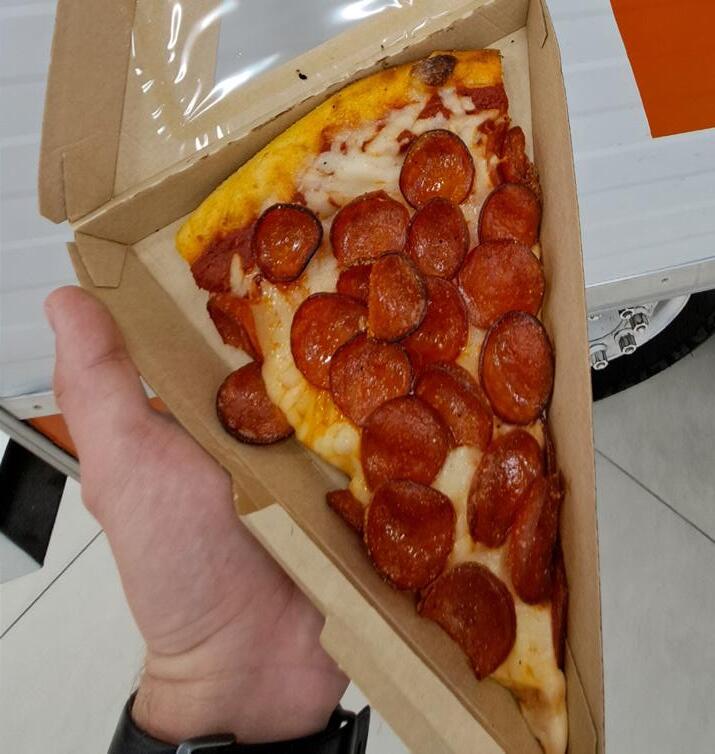
Gas station pizza was on my mind, so I walked to the very back and got in line. The attendant was very nice and offered to heat up my slice of pepperoni pizza, which I kindly accepted.
After everyone got their food, we continued on our trip and ate along the way. My pizza was a bit over-seasoned, but overall it had a really good flavor, and the crust tasted amazing. The pepperoni was my favorite part though because I liked how crispy it was.
I don’t think the slice was worth $4, but I could definitely see myself making a stop there for food again.
Pilot Flying J lands a delicious slice with their pizza

AUDREY O’RENIC sports editor
Located right off Highway 15 in Alorton, Pilot Flying J offers homestyle pizza for a gourmet meal on the go.
As a commuter from Belleville, I take this highway every day to get to school. So, before my first class, I decided to grab a quick slice of pizza.
The store was fairly large and had drinks, hot meals, clothing and even a Cinnabon restaurant. Despite its size, it was clean, well-organized and I was out and on my way to school in
less than five minutes.
PJ Fresh, Flying J’s food brand, has a variety of pizza options including Mega Meat, supreme and classic pepperoni. Each slice is made fresh in-store with a hand-braided crust, and is priced at around $4.
I ordered the pepperoni. It tasted fresh, unlike other gas station options I had tried before. My favorite part was the crust — it was doughy and breadstick-like. For such a cheap price and great taste, I will definitely stop there more often.
Casey’s Pizza: Convenient, cheap and very greasy

MICHAL KATE CASTLEMAN online editor
I ventured over to the Glen Carbon Casey’s location to grab a slice of pizza. The store has two methods of purchasing their pizza — a grab-and-go station and through traditional ordering. I opted to buy my pizza from the grab-and-go station.
Casey’s had the typical gas station atmosphere with many convenience store options for customers. When I went in-
side, I walked straight to the rotating pizza station and selected my slice of pepperoni pizza.
The singular slices in the grab-andgo station are larger than their traditional pizza slice, so customers get more food for less. The singular slice was around $3.29.
Casey’s pizza single slices are nice and warm, but they are incredibly greasy. I ended up laying napkins in my lap to eat the slice to prevent a mess. Otherwise, I enjoyed my slice of pizza.

Sam Muren / The Alestle
Audrey O’Renic / The Alestle
Michal Kate Castleman / The Alestle
By Cougars, for Cougars: SIUE student-owned businesses
AUBREE NOLES reporter
Small businesses are what make communities strong and unique, and you’d be surprised how many students are running their own ventures all while balancing academic life.
Here are some students who balance a social life, school and their own business.
Shaelin Kennedy, Shae K Photo
Shaelin Kennedy is a freshman majoring in business marketing and management who runs a photography business by the name of “Shae K Photo.”
She said that while photography started as a hobby, it changed when people began contacting her to have their photos taken. Kennedy specializes in high school senior portraits, but also photographs couples and families.
“It’s a super safe space,” Kennedy said. “We can do whatever you want.”
Kennedy said she en joys being able to make her own schedule and have fexible hours.
“You can tell people what you’re available for and what you’re not,” Kennedy said. “[Photo Shoots] mostly week-
ends and weeknights.”
She said her photography is currently for fun, but she has bigger plans for the future.
“With my degree, I would like it to kick into a full business at some point,” Kennedy said.
For more information on Kennedy, visit her Instagram @shaekphoto.
Eva Woodfall
Eva’s Cookie Jar
Eva Woodfall is a senior psychology major who runs her own cookie business, Eva’s Cookie Jar.
She started her business in 2020 with her mom, during the pandemic. Woodfall wanted to create her business as a way for the patrons of the country club she worked at to have something to do during a time when there was nothing.
“It originally started off with, ‘Here’s the icing, here’s the cookies, you guys decorate them,’” Woodfall said. “People started asking us, ‘Can you

After that, her business grew. When she moved to Edwardsville, more people started asking for cookies. Woodfall said that running her own business has helped with her
time management skills.
“My freshman year of college, honestly, I had no time management skills. Then, once I moved into my college apartment and started getting into cookie decorating, it taught me a lot more — how to time things out, when to do my homework [and] when I should decorate the cookies,” Woodfall said.

Recently, Woodfall had a big order for The Social Edwardsville. She made four dozen cookies for The Social Edwardsville’s annual welcoming of new tenants.
More information on Eva’s Cookie Jar can be found on her Instagram @evascookiejar.
Emma Brown
Emma Jane Jewelry
Emma Brown, a junior business marketing major, started her jewelry business during the COVID-19 pandemic. She makes her jewelry from scratch, starting with a wire that she sodders with a torch. Brown also offers permanent jewelry, which is welded on so it doesn’t fall off.
“I was really bored, and I actually saw this video on
Instagram of this girl doing this [making her own jewelry], and I was like, ‘I need to try that.’” I actually asked for all the supplies for my birthday,” Brown said.
She continued making jewelry until she ran out of space in her room and her mom told her that she needed to fgure out something to do with it.
“I started selling it in local stores, and then I actually registered my business,” Brown said.
Since then, Brown has had great success with her business. She’s also learned how to manage her time and stay on top of her daily tasks.
“You have to stay really, really organized, to the point like I plan out every second of my day,” Brown said.
More information on Emma Jane Jewelry can be found on her Instagram @emma.jane.jewelry.
David Sides
Side Effect STL
David Sides is a freshman construction management major who runs his own clothing business with his twin brother.
It’s called Side Effect St. Louis, which is a play on their last name according to Sides.

Gavin Hegland Junior Finance major

“Not talking to people and getting the semester over with ... [Also] meeting new people.”


The two started working at a screen printing and embroidery store and saw how people were starting their own clothing brands and making money, so they wanted to get in on the action.
They started their business with a Juneteenth shirt that they said sold really well for them.
“We sold these Juneteenth shirts. We put a little embroidered heart on the front with an African fag with a 19 on the back,” Sides said.
Sides plans on taking weekends and days that he doesn’t have many classes to devote time to working on his business. He keeps up with their social media regularly to maintain their presence.
The brothers use their profits to help pay for school, as well as putting some back into their business.
“We want to get bigger, locally,” Sides said.
The brothers said that if there’s anyone in the area in need of apparel, to “hit them up.”
More information on Side Effect STL can be found on their Instagram @sideeffect_stl.

OLIVIA WHITLOCK
copy editor
Film and TV review aggregator website Rotten Tomatoes created a list of “The 100 Worst Movies of All Time.” I fgured it was my duty as a cinema connoisseur to see if the movies on this list were truly as bad as their Tomatometer score suggests.
Please visit websites such as “Does the Dog Die?” to check for potential triggers and sensitive topics before viewing any movie on this list.
‘Simon Sez’ (1999)
Director Kevin Alyn Elders Tomatometer score: 0%
Not even fve minutes in, I knew this movie was doomed.
Dennis Rodman plays an Interpol agent gathering information on a local weapons trade in Europe until he bumps into an old classmate, played by Dane Cook, who needs help with a case of his own.
So, where did they go wrong? The real question is, where did they go right? The acting and writing was fat out awful and cheesy. Cook’s character was loud and obnoxious. Rodman, while easy on the eyes, is far too tall and lanky to convincingly play an action star.
Five of Rotten Tomatoes’ worst movies of all time — watch them ... or maybe don’t
What really sealed the deal for me was the strobe light bedroom scene, the villains’ minions who wore clown-esque face paint and the effects that looked like they were made using Windows 95.
‘London Fields’ (2018)
Director Mathew Cullen Tomatometer score: 0%
I saw a comment on an article about this movie that said, “[This is] like some Guy Ritchie gangster flm meets an Estée Lauder commercial,” and I think that visually describes this flm pretty well.
Based on the novel of the same name, this neo-noir movie features a clairvoyant femme fatale, played by Amber Heard, who has an affair with three different men — Billy Bob Thornton, Theo James and Jim Sturgess. While all of these characters seem like normal men, she has a premonition that one of them will murder her.
I’m sure this movie had potential in regard to the book, but I’m honestly not quite sure what I watched, as it was a bit confusing. The movie seemed pretentious and was self-aware that Heard’s character was very one-dimensional and appealed to the male fantasy, which left me puzzled as to what the intended message was.
‘Movie 43’ (2013), Various Directors Tomatometer score: 5%
How is it possible for a flm to have 12 directors, feature the most high-profle actors in Hollywood and yet still end up a mind-numbing, monumental failure of shock humor?
This anthology movie consists of several sketches directed by different flmmakers and, surprisingly, is not from the minds of a group of 13-year-old boys.
The movie begins with “The Catch.” Kate Winslet goes on a date with Hugh Jackman, who has, let’s say, an unusual appendage hanging from his neck. Another segment, “iBabe,” features Richard Gere, who plays the head of a tech company that produces a music player shaped like a human woman with a dangerous manufacturing error.
The only positive thing about this movie is that it would be wildly fun to watch with a group of friends because of how unnecessarily foul and senseless it is.
‘Getaway’ (2013)
Director Courtney Solomon Tomatometer score: 3%
Back to School
Ethan Hawke and Selena Gomez drive fast and get chased by police for an hour because an anonymous man kidnapped Hawke’s character’s wife.
That’s pretty much it.
The sequences are nothing special and drone on at some points. The dialogue falls short, as it really is just “answer” and “…or your wife is dead” intertwined with cursing and sassy remarks. It also seems like they tried to set up the ending for a second movie, but that obviously didn’t happen.
Now, was this the best action movie I’ve seen? No, not by a long shot. Was it the worst? Not at all. I can think of a handful of action movies specifcally that would better fll the “worst” spot on this list.
‘Epic Movie’ (2007)
Director Jason Friedberg Tomatometer score: 2%
I did not need to watch this movie before writing this list. It is engraved into my brain after renting it from Blockbuster every week alongside “White Chicks” (2004) for a year straight when I was 5 years old.
“Epic Movie” follows four orphan adults as they embark on an adventure and encounter various spoofs of plots and characters from popular flms.
Whoever put this movie on a list of the worst movies of all time is a hater! It has a fantastic soundtrack, great casting and appearances and the parodies are done with the perfect amount of accuracy and humor.
BACK TO SCHOOL WORD SEARCH

NEXT WEEK: DOES MUSIC REALLY HELP YOU STUDY?


Entrees menu is too small, inconveniences people ordering food
THE ALESTLE STAFF editorial board
Entrees displays their menu on a TV screen in a font size that is too difficult for people to read.
The design appears to have undergone an update this semester. The background image has darkened and the typeface
has shifted to give the menu a classier look, but the fact remains that people approach the screen squinting to get a look at the options.
The dining hall fills up quickly during lunch time, and the lines for each of the dining options can get quite long. Navigating between those lines can


This election cycle has been quite a ride, and Vice President Kamala Harris just turned it on its head.
After President Joe Biden flubbed his debate performance in June, there was a distinct pessimism among the American left. The Republican National Convention took place, Donald
cause a traffic jam.
People often walk to the front of the Entrees line to peer at the food in order to know what is being offered that day. This is an inconvenience and a deterrent for people who might decide to default to the other consistent, reliable options available from dining services.
The other dining places, such as Sammiches, Kamayan and Boss Burgers, display their options in big, bold text. Though these options often remain the same day after day, people never have to wonder what they have available because the options are easy to read and clear from a distance.
Entrees is one of the only lines in the dining hall that shifts its options daily. From the entrance to the dining hall, patrons should be able to clearly read what they are serving, alongside the prices and the gluten and vegan options.
The menu is digitally changed multiple times a day. The font size could easily be
increased without confusing or crowding the menu.
For people with low vision or other visual impairments, squinting at the menu is frustrating and ultimately makes the menu inaccessible. It can be intimidating to attempt to order food without knowing what the options are beforehand.
Sometimes, the menu displayed on the TV is inaccurate altogether. The food being offered might not actually be what’s written out on the screen. The best way to know what you might be able to order is to walk to the front of the line and scope out the food for yourself.
Entrees provides a variety of options at a reasonable price. It would be a shame for someone to miss out on what they are serving because they weren’t aware of the menu for the day.
Dining Services does provide the menu online, though sometimes the options listed are inaccurate. Visit SIUE’s Nutrislice website for an online version of the menu.
The Harris-Walz campaign
is like no other
Trump picked his vice presidential candidate and Biden withdrew from the race.
Though it was rumored for several weeks beforehand, Biden dropping out of the race was still unprecedented. Naturally, he picked Harris as his endorsement for the presidency.
Fighting the memories of an unpopular campaign in 2020, Harris brought the Democratic Party together in a way no one
could have predicted.
Doug Sosnik, an adviser for the Clinton administration, said it best:
“She looks joyful. She looks like a happy warrior, and there’s a real ease about her,” Sosnik said. “It’s quite appealing.”
Harris is campaigning on joy and hope, a refreshing change from the doom-and-gloom of the previous iteration of
the race.
Not only did Harris turn the left from melancholy to optimism, but she also put the Republican Party on the defensive. The Trump-Biden debate was a perfect representation of the way things had been for years: Trump would tell a blatant lie, and Biden wouldn’t address it. The average viewer can’t be blamed for assuming Trump’s lies were true if they were
BRANDI SPANN Opinion Editor
MUREN Managing Editor
DYLAN HEMBROUGH Editor-in-Chief
AUDREY O’RENIC Sports Editor
ISLAM Multimedia Editor
DYLAN HEMBROUGH editor-in-chief
SIUE dining hall staff ready for the lunch rush with the options displayed on the menu
| Tahzive Avi Islam / The Alestle
never refuted.
It’s different now. Through tactful advertising and focused attacks on Republican talking points, the Harris campaign has pulled the rug out from under Trump’s feet. She’s leaning into the “prosecutor vs. felon” arc, and it’s doing wonders for her.
Harris’ vice presidential pick, Minnesota Governor Tim Walz, was probably one of the best choices her campaign has made yet — and that’s a high bar. Walz was relatively unknown in the political
scene, but it’s clear he brings an extra boost to the campaign.
Walz is the originator of the “weird” line being used to refer to Republicans and their policies, a unique pivot from harping on the danger of the party, and he is redefining what it means to be the party of family values. His son, Gus, recently made headlines when he burst into tears of joy at his father’s success.
Walz is also relatable to the average Midwesterner — a crucial advantage, seeing that much of the Midwest ends
up deciding elections. He was a football coach and a high school teacher, and he took an active role in supporting his high school’s Gay-Straight Alliance as their faculty adviser.
Harris is also tapping into a previously-off-limits demographic: Generation Z. According to Tufts’ CIRCLE, the pool of potential voters will increase by 8 million by November 2024. That’s a lot of first-time voters who will have a voice in what may be the most consequential election of their lives.
Harris’ social media campaign is a wonder of its own, and it’s probably part of the reason Gen Z is so energetic about this election. Her rallies have the support of music icons like Beyoncé and Charli XCX, and she has expertly tapped into the medium TikTok provides.
The Harris-Walz campaign is different, and it’s a breath of fresh air for America. If this momentum can keep up, we may have a “Madam President” by January — and that’s an exciting prospect.
SHOULD I STAY OR SHOULD I GO?

Point: Home Sweet Home — the social and financial benefits of staying home for college
MICHAL KATE CASTLEMAN online editor
Making the big decision to move away from home for college may lead to positive experiences. However, staying within the familiar comforts of home can be an equally great way to spend your college years.
College represents a bundle of significant life changes usually related to venturing away from your home and family and gaining newfound independence. This move can be beneficial to those who are not comfortable at home.
For some, joy is rooted in family and is central to their lives. Staying with family means you are surrounded by people who know you best and are closest to you.
A life at home has routine and structure that you cannot find moving hours away to go to college. Moving to a faraway university will completely shake up your daily routines and your family dynamic.
Instead of walking into a room next door to talk to your sibling or other relatives, you have to resort to inferior video calls and text messaging. You miss out on family dinners, quality time with your pets, game nights, traditions and the milestones of your family members.
On top of being away from your family, you then have to face creating new relationships and social circles.
Depending on how far away you are from home, your entire social climate will change upon moving to college. You could end up hours away from home with no one familiar to you at all, which is discouraging and often lonely. The lack of connections is scary for those who have social anxiety or struggle to meet new people.
Staying home means you also save money since you would not have to pay for on-campus living accommodations. Instead of paying hundreds or thousands of dollars for a dorm room or an apartment, you can continue to stay in a home you are accustomed to.
You also do not have to throw away money on new decorations, laundry, furniture and other supplies since it is all already in your home.
Moving away from home for college completely changes every aspect of your day-to-day life. The departure forces you to uncomfortably make adjustments from your bedroom to the community around you. Staying at home allows you to stick to a secure and cheaper lifestyle… and you get to stay with your loving pets.
Staying home for college vs. moving out
Counterpoint: If you want to go far, you need to go far for college
TORI WATERS copy editor
The world is waiting for you to explore all it has to offer. Step out of your comfort zone and make that change to an unfamiliar, exciting new place.
The cessation of high school ignites the flame of college decisions. Some may choose to stay close to home, while others decide to travel across the country. Though there is no correct answer of where to go, I urge you to escape your hometown.
Leaving home encourages new experiences you could never attain by staying home.
Living away from your parents’ care can be frightening, but it is so exhilarating to find your own identity. Parents tend to raise their children by their own set of values, and that becomes all they know, but being away from biased opinions grants the freedom of individuality.
Moving out also guarantees a fresh new start with lots of new friends and adventures.
Living in the same place for about 18 years of life can be exhausting and repetitive, and in those 18 years, you change as an individual. Packing your bags and heading off to college is the next best way to find new people with the same interests and philosophies as you.
While it might be cheaper to stay at home, there are many ways to afford housing. You can apply for scholarships, make a budget or split payments with roommates, which is a fun, exhilarating way to live, rather than being isolated. If you start renting as a college student, it is an easy way to build credit.
Family members being left behind might steer individuals away from moving out, but visiting is always an option. You can make regular calls, FaceTime calls, and if you’re missing family game night, there are ways to stay connected online with your family and friends.
The most thrilling aspect of moving away from home is building newfound independence. You get to decide how your room looks, what you like, what you don’t like and you can even pick out what food you want to eat, without a parental figure telling you no.
Leaving home is scary but exhilarating. It is exciting to know that life doesn’t have to be stagnant and that there is more to life than your hometown. There are so many unforgettable life experiences and friendships that come with moving away. Your hometown will always be right where you left it, but the world will not wait for you. Go out, have fun, explore, find yourself and enjoy life while you’re still able.
From Rock the Vote to TikTok — pop culture’s political influence
F. WILLIS JOHNSON
The Fulcrum (TNS)
In 1992, a young Bill Clinton tried to connect with Generation X by joking around and soulfully playing the sax on “The Arsenio Hall Show.” It was a game-changer that forever shifted how presidential candidates court younger voters.
Nowadays, it’s not about late-night talk shows but about getting attention on social media platforms like TikTok. The relationship between pop culture and politics has evolved with each generation, keeping pace with the changing times and new technologies. It’s crucial to understand this evolution and what it means for how future generations will engage with politics.
Rock the Vote burst onto the scene when I was coming of age. This nonpartisan organization aimed to educate young folks about their rights and get them involved in politics. Its message hit home with a generation that felt disillusioned
with the system. The 1992 Clinton-Gore campaign tapped into this energy, aligning with famous figures like Madonna and Aerosmith.
Still, hip-hop had a complicated relationship with the Clintons and other political characters in its early days. Some artists subtly expressed interest, while others, like the late Tupac Shakur, offered critical commentary, reflecting the mixed views of the community on the candidates and their policies.
Fast forward to 2008, and the landscape shifted again. Barack Obama’s campaign savvily used social media to connect with young voters. Hip-hop, by then a major cultural force, rallied behind his candidacy. Endorsements from artists like Jay-Z, Beyoncé and will.i.am carried credible weight. The “Yes We Can” music video featuring a star-studded cast reciting Obama’s speech went viral, capturing the campaign’s energy. Unlike politicians of the 1990s, Obama wasn’t just trying to seem cool; he made genuine in-roads to the hip-hop community and showed an understanding of its influence.
In 2024, the intersection of pop culture and politics has evolved. While pop culture is undoubtedly still influential, its interaction with politics has become more nuanced and sophisticated. Artists like Charli XCX and Taylor Swift embody this shift, using their massive platforms to endorse candidates and speak out on specific issues that resonate with their audiences. For example, Swift’s social media post about the Equality Act sparked way more attention and discussion than any traditional political ad could.
Social media personalities and pop culture icons have considerable influence in the political sphere, shaping the discourse and bringing important issues to the forefront. Moreover, their efforts reflect a generational shift, with young people becoming increasingly interested in specific policies and their real-world impacts rather than unquestioningly supporting a particular party. It’s an encouraging sign of a more informed, engaged and politically aware generation with the potential to shape the nation’s future through active participation and
passionate advocacy.
So, the question for the weeks and election cycles ahead is: How will candidates meaningfully connect with this new electorate of politically savvy young civic citizens?
It won’t cut it to have a TikTok account or score an endorsement from a famous artist. Next-generation voters will demand substantive answers on the issues that matter most to them — climate change, racial justice and economic inequality. This next generation uses their vast digital audiences to hold candidates accountable, amplify marginalized voices and build movements beyond traditional party lines.
The future of the intersection of pop culture and politics depends on how the political system and leaders adapt to this ever-changing reality. The need for substantive engagement from political leaders is urgent, and it’s up to citizens to demand it. The empowerment of this cycle’s electorate and future ones is not just a sign of change but a signal of hope for a more inclusive and informed political future.
SIUE Athletics adds new diversity and inclusion designee, two assistant athletic trainers
AUDREY O’RENIC sports editor
With the great success seen within the past year, SIUE Athletics is adding new staff to further its support for student-athletes.
Director of Athletics Andrew Gavin highlighted the importance of athletics staff in a beginning-of-the-year letter addressing his goals for the 2024-25 season.
“The addition of new staff, assistant coaches and graduate assistants means new energy and talent is joining our squad as we start 2024-25 and double down on the character, abilities and
work ethic of our people,” Gavin said.
Athletics adds new Diversity and inclusion Designee
Olivia White is joining Athletics as the assistant director of student-athlete success and athletics diversity and inclusion designee. In her new position, White will work alongside Assistant Athletic Director for Student-Athlete Success Ashley Beaton Simpson to further the development of student-athlete success and diversity and inclusion programs.
White comes to SIUE after two years as an assistant complex coordinator at the
University of Texas at Austin.
In the last year, she was a lead teaching assistant and the executive assistant to Shauna T. Sobers, the Texas Director of student-athlete development.
Earlier this year, White earned a master’s in educational leadership and policy from Texas. In 2022, she received her bachelor’s degree in marketing from Michigan State University.

Two assistant trainers join sports medicine staff
Assistant Athletic Trainers Kevin To and Jaylynn Javens are joining the sports medicine staff, making seven total trainers to better tend to students’ needs.
This year, To will aid the Cougars in supporting the volleyball and baseball teams.
After To received his bachelor’s in kinesiology and exercise science from California State University, Fullerton, he earned his master’s in athletic training from California Baptist University.
To brings a variety of experience to SIUE, having previously worked as an assistant athletic
trainer for New Mexico Highlands University and Elmhurst University, and interned at the University of California, Los Angeles, where he assisted the UCLA athletic training team.
On the other hand, Javens will focus her support on women’s soccer and softball.
She previously attended Purdue University, where she worked as an athletic training student in D1 collegiate athletics. After receiving a bachelor’s in exercise science there, she pursued a master’s in kinesiology at The University of Toledo. Javens comes to SIUE after most recently serving as an assistant athletic trainer at College of Wooster.
Paris 2024 Olympics: Athletes’ health at risk amid concerns over living conditions
AVA GALBAN reporter
As the world’s top athletes united in Paris for the 2024 Summer Olympics, concerns about their well-being were publicly brought to light. Despite the excitement surrounding the games, reports of inadequate living conditions, including a lack of air conditioning, subpar food and uncomfortable cardboard beds raised alarms about the impact on athlete performance and health.
One of the most glaring issues reported by athletes is the absence of air conditioning in their rooms.
Paris, known for its warm summers, has experienced particularly high temperatures during the early days of the games, with daily highs reaching around 95 degrees Fahrenheit.
In such conditions, the lack of air conditioning is not just an inconvenience but a potential health hazard. Athletes are expected to perform at their peak, and a proper rest environment is crucial for recovery and preparation.
However, many have found it difficult to sleep and relax in the stifling heat, leading to concerns about the impact on their overall performance. The risks of heat exhaustion and dehydration are prominent, particularly for athletes who are already pushing their bodies to the limit in competition.
Some teams have resorted to makeshift solutions, such as portable fans and cooling towels, but these are far from adequate in providing the necessary relief.
The decision to forgo air
conditioning was reportedly made as part of an effort to keep the games environmentally friendly, prompting questions about the balance between sustainability and the well-being of the athletes.
Another point of contention was the food provided to athletes in the Olympic Village. Nutrition plays a critical role in
ing them as bland, repetitive and lacking in nutritional diversity.
“I don’t think it’s very good, at least what we’re having in the dining hall,” United States Olympic gymnast Hazly Rivera said. “I definitely think French food is good, but what we’re having in there, I don’t think it’s the best. But it gets the job done.”
For many athletes, especial-
and fiber, which are essential for muscle repair and energy replenishment.
Complaints about the portion sizes were also prevalent. Some teams supplemented their diets with food brought from home or sourced from outside the Village, adding an extra layer of complexity to their already demanding routines.

an athlete’s performance, and the quality and variety of food available can directly affect their energy levels, recovery and overall health.
However, numerous athletes have expressed dissatisfaction with the meals offered, describ-
ly those with specific dietary requirements or those coming from cultures with distinct culinary traditions, the food options were disappointing. Some have reported that the meals were heavy on carbohydrates but lacked sufficient protein
The Paris 2024 organizers have defended the food offerings, stating that they worked with nutritionists to ensure that the meals meet the basic dietary needs of all athletes. However, the feedback from those on the ground suggests that the imple-
mentation may have fallen short of expectations.
Later, committee members of the Paris Olympics reviewed the meal plans and altered them to better fit the needs of athletes.
“Regarding the food we’ve had to make some adjustments, which is normal in operations that size,” Paris 2024 CEO Etienne Thobois said at a press conference.
Perhaps the most controversial aspect of the living arrangements in the Paris Olympic Village was the use of cardboard beds.
Marketed as an eco-friendly alternative to traditional beds, these cardboard structures were designed to be recyclable and sturdy enough to support the weight of an average athlete. However, they have become a focal point of criticism from athletes, who found them uncomfortable and impractical.
Athletes have reported back pain and stiffness after sleeping on the cardboard beds, raising concerns about their ability to recover fully between events.
“The beds suck ... but we are getting mattress toppers, so hopefully it’ll get better,” Team U.S.A. gymnast Simone Biles wrote in a reply on TikTok.
Given the intense physical demands of Olympic competition, even a slight disruption in sleep quality can have a significant impact on performance.
While the games were meant to celebrate human achievement and bring the world together, these issues have cast a shadow over the event, prompting calls for better consideration of athlete welfare in future Olympic planning.
Courtesy of Bo Zhang / Unsplash