THE


Around 48 percent of Muslim Americans have experienced discrimination, according to a 2010 poll — and young Muslims are not immune to it. These three Muslim students wish to change that, acting as ambassadors to their faith and culture.
Yassine Ndiaye, a sophomore chemistry major who spent a portion of her life in Senegal, said she has worn hijab her whole life because the women in her life who she looked up to all did.
“People knew me as Yassine, the one who wore the hijab,” Ndiaye said. “In a sense, we believe that our hair is part of the woman’s beauty. It’s a gem. You won’t find diamonds on the surface — you have to dig deeper down to see them.”
Menna Elmokashfi said she has not always worn hijab, which “concealed” her identity as a Muslim unless she talked about it. Despite this, she said she still faced Islamophobia from religious and secular backgrounds alike.
“I’d have to tell people that I’m Muslim,” Elmokashfi said. “There was this one girl in particular, she would tell me that I should read the Bible and that I’m wrong, and all that good stuff. This boy in particular kept saying, ‘You work for ISIS.’”
Elmokashfi said when she made the conscious decision to start wearing hijab in her freshman year at Springfield High School in Springfield, Illinois, even more insensitive questions and remarks were thrown her way.
“[One girl’s] demeanor towards me changed. We were not on bad terms at all, but she started acting very rude to me,” Elmokashfi said. “She was like, ‘Why do you wear that?’”
According to a 2011 Gallup poll, 52 percent of Muslim Americans report feeling disrespected by Western society. Another poll from 2009 reported that, from a number of Muslim-majority nations around the world, 57 percent of those surveyed said they feel that Muslims are not treated equally to other citizens in the West.

Rahmat Salau, a graduate student, said her parents were worried for her safety when
she left Nigeria to attend college in the U.S. due to the negative views of Muslims held by much of the American populace.
“It’s per- vasive in the media. We see it all the time even not living in the U.S.,” Salau said. “If you’re ever stopped by a cop, just be calm. So to my
parents that meant keeping a low head, go to school, do your work, mind your business and move on.”
Salau served as student body president last year, and said she was often approached with questions about her faith.
“I meet people who are generally curious about the religion,” Salau said.
“When we were doing Ramadan last year, when we fast … I had some student government members try to fast. Sometimes it can be a fun conversation about who the prophet Muhammad was.”
However, Salau said being a Muslim in a prominent, visible position was a “double-edged sword” due to societal expectations about what a leader looks like in Western society.
“I’ve had moments when I’ve had to explain my position, where I have to explain that I earned my position and I deserve to be here,” Salau said. “It’s not intentional, but there are undertones [of Islamophobia].”
Ndiaye also said she had the conversation about xenophobia with her family before she decided to move back to the U.S.
“I had that conversation with my uncles and aunts,” Ndiaye said. “When I decided to move back home, my uncle was like, ‘It’s a mind game — they try to beat you psychologically. Just keep your head up.’”
Elmokashfi said she does not remember 9/11, but she said much of her family was directly impacted by the aftermath of it.
“[My cousin] went to an Islamic school, and a week or two after 9/11, the place was completely destroyed,” Elmokashfi said. “A lot of them were scared to even go out and get something from Walmart because of how bad it was. I think 9/11 was the reason why some of my relatives moved back to Sudan.”

Even with the tangible risk of discrimination and ignorant comments and actions, Elmokashfi, Ndiaye and Salau all said they take pride in wearing hijab.
“The strongest women in my life wore hijab, and they were my biggest role models,” Elmokashfi said. “When I started wearing hijab my freshman year, it made me realize who my real friends were [and] see ISLAMOPHOBIA on page 2
The second student senate meeting of the fall semester met Monday, Sept. 11, in the Goshen Lounge.
A representative of Lovejoy Library, Interim Associate Dean Marlee Graser, asked student government for help in reaching out to students as the library undergoes a restructuring to accommodate the John Martinson Honors Program. This expansion is still in the preliminary phases
of planning, according to Graser.

Eight new senators were sworn in as part of last year’s initiative to better represent the student constituencies.
Student government also voted on a proposed bylaw revision. The changes are to do with the executive board and their attendance at the semiweekly senate meetings in order to better accommodate the influx of new senators, according to President Kenzie Richards. The vote failed with eight in favor, two against, and seven abstentions.
LAUREN CLASON CQ-Roll Call (TNS)A Food and Drug Administration advisory panel on Tuesday unanimously concluded that oral phenylephrine, the decongestant found in many common cold medications, is ineffective.
Phenylephrine is used in a broad array of over-the-counter medications like Sudafed PE and Dimetapp. The drug brought in nearly $1.8 billion in sales in 2022, according to an FDA briefing document, a number that is likely an undercount.
Phenylephrine is different from pseudoephedrine, which is found in cold medications that are kept behind the pharmacy counter.
The Nonprescription Drugs Advisory Committee voted 16-0 that the drug was ineffective, clearing the way for the agency to potentially remove the drug from store shelves following years of studies that show it has no benefit.
“It’s amazing the amount of dollars being spent on something that really has no efficacy,” said William Figg, a committee member and chief of the National Cancer Institute’s Clinical Pharmacology Program.
The Consumer Healthcare Products Association defended the drug in front of the panel, arguing the FDA has “repeatedly concluded the ingredient is
safe and effective.”
“Simply put, the burdens created from decreased choice and availability of these products would be placed directly onto consumers and an already-strained U.S. healthcare system,” the group said in a statement, “which is why CHPA encourages the panel to consider the real-world experience and needs of consumers when making decisions that will have such broad implications.”
CHPA also argued that pseudoephedrine is not a sufficient alternative, given the purchase restrictions that prevent its sale on convenience store shelves.
“This poses unequal burdens for consumers living in areas with limited access to traditional retail options based on geography, schedules or socioeconomic factors,” the group said.
But the advisers were not swayed.
“I feel that this drug in this oral dose should have been removed from the market a long time ago,” said patient representative Jennifer Schwartzott, a member of the committee. “The patient community requires and deserves medications that treat their symptoms safely and effectively, and I don’t believe that this medication does that.”
The FDA did not respond to a request about timing on a decision to potentially remove the product from stores.
people started ‘taking me seriously.’ It was just an eye-opener for a lot of things.”
Salau also said the hijab designates her as someone who is willing to speak about Islam.
“In a country where Islam is not celebrated, I’m proud to wear hijab because it makes me a representative of Islam wher-
ever I go,” Salau said. “That goes a long way in changing the topic around Islamophobia. When people meet me, they meet Islam.”
Elmokashfi said a common source of confusion is misinterpreting culture as religion, and vice versa.
“You just need to be aware of what’s culture and what’s religion,” Elmokashfi said. “People
mix those two, and tend to be closed-minded about it. Don’t assume, don’t judge. Muslims, the ones I’m around, are mostly open-minded. They’ll answer almost anything.”
Salau said these questions — if they are asked respectfully — are crucial to changing the West’s negative perception of Muslims.
“A lot of people know Is-
09.08.23
An officer responded to a report of loud music at a party in a Cougar Village volleyball court. The music was turned down.
09.09.23
An officer responded to a report that a group of people in Cougar Village were telling others that they were going to beat someone up.
09.10.23
The Edwardsville Fire Department stopped a small gas leak in a Cougar Village apartment after the smell was reported by the inhabitants.
lam based on rules and [requirements] they hear, like Muslims don’t drink, or Muslims have to pray five times a day, but they don’t understand the context behind what we believe in,” Salau said. “Just ask. Asking respectful questions goes a long way in bridging the gaps between Muslims and non-Muslims out there in society.”
VINNY VELLA ROB TORNOE
The Philadelphia Inquirer (TNS)
Danelo Cavalcante, the convicted murderer who escaped Chester County Prison on Aug. 31, was caught and taken into custody by Pennsylvania State Police Wednesday.
Cavalcante had been on the run for 14 days and disrupted life across Chester County and forced the closure of schools and businesses.
“The capture of Cavalcante ends the nightmare of the past two weeks,” Chester County Commissioners Marian Moskowitz, Josh Maxwell, and Michelle Kichline said in a joint statement.
Pennsylvania State Police Lt. Col. George Bivens said at a news conference that the path to the capture began when a burglar alarm at a residence near Prizer Road went off Tuesday
evening within the search perimeter. Officials picked up a heat signature around 1 a.m. west of Route 100, and tactical teams converged, he said.
A thunderstorm forced a DEA fixed-wing airplane that had been tracking Cavalcante to depart the area, so tactical teams secured that inner perimeter throughout the storm, Bivens said. On Wednesday morning around 8 a.m., the search resumed and took Cavalcante by surprise.
“Cavalcante did not realize he was surrounded until that had occurred,” Bivens said. “That did not stop him from trying to escape. He began to crawl through the thick underbrush, taking his rifle with him as he went.”
Bivens said a dog from a customs and border control team out of El Paso, Texas, was released and subdued Cavalcante, wounding him in the process.
Police moved in, and Cavalcante continued to resist and was taken into custody. Bivens said it took about five minutes to bring Cavalcante into custody.
Cavalcante has been taken to the State Police station in Avondale for processing, and from there will be sent to a state prison to begin to serve his life sentence, Bivens said.
“The scope of this manhunt was extremely impressive,” Bivens said. “The brave men and women who went out there every single day are our heroes. And I am proud to be a part of this collective team of people who worked around the clock to bring this man to justice during this monumental challenge.”

Pennsylvania Governor Josh Shapiro celebrated the capture of Cavalcante, crediting “extraordinary work” from law enforcement officials.
Cavalcante was convicted last month of killing his ex-girl-
friend, Deborah Brandao, outside of her home in Schuylkill Township in 2021. He was sentenced to life in state prison and was awaiting transfer to a more secure, state-run correctional facility when he escaped.
He is a native Brazilian who authorities say was in the United States illegally after a warrant was issued for his arrest for murder in his native country in 2017.
Cavalcante first traveled to Puerto Rico, where he obtained a fake ID, according to evidence presented during his trial. Cavalcante settled in Chester County, where he had a sister and friends who arrived ahead of him, he later told police.
Cavalcante worked for a while in construction and other trades, prosecutors said, and rented a storage trailer that he parked at a lot in East Pikeland Township.
MOROCCO
An earthquake has devastated Morocco, with a reported death toll reaching into the thousands as many are forced to live in makeshift shelters.
LIBYA
Flooding has struck the coastal city of Derna, wiping out a quarter of the city and leaving thousands dead and many more missing.
RUSSIA
North Korean Leader Kim Jong Un travelled to Russia to meet President Vladimir Putin in what many believe to be a possible arms deal between the two countries.
FRANCE
A French official has been held in Niger by security forces since Sept. 8, resulting in France’s foreign ministry to demand their immediate release.
A Parliament researcher has been accused of being a spy for China, to which he has denied. The incident has caused a stir within the government.
Information courtesy of Reuters / CNN
With over 30 years of work in the communications world and several awards to show for it, Nicole Franklin started a new phase of her career this week as the Director of Communications for the Department of Marketing and Communications.
Originally from St. Louis, Franklin traveled across the country working for NBC and CBS while filming documentaries and teaching at four different universities.
Franklin was introduced to journalism at a young age, as her father was the second Black journalist to work for the St. Louis Post-Dispatch. She decided to go to college at the University of Illinois Chicago to get her degree in mass communications with a minor in English. Franklin said that it only took her three years to do.
“It was just very nice to be there,” Franklin said. “We had a quarter system there. So, I said, ‘You know what, I think I want to just really start working in television right away.’”
While studying there, Franklin worked for the student newspaper, the UIC Today, before she and a few friends decided to start their own newspaper —The Campus Chronicle, or “C-squared.”
“We helped launch a new

radical newspaper; it was a rebellious move. We felt that we were giving the students more indepth stories,” Franklin said. “I had the more lighthearted fare. Me and my best friend — she’s Polish and I’m African American — had a column called ‘Salt and Pepper, Spice of your Life.’”
After graduating at an accelerated pace, Franklin returned to St. Louis, where she worked at KPLR for around seven months before she moved to Los Angeles, where she worked for five years.
Franklin then moved to the East Coast to work for NBC and, later, CBS. She won three Daytime Emmy awards during her tenure for her work on the CBS Sunday Morning news team.
While working for major broadcast stations, Franklin said she also spent time as an adjunct teacher at New York University Tisch School of the Arts, Bloomfield College and Long Island University Brooklyn. She also taught as an assistant professor at Hofstra University.
During her time at Bloomfield College, the vice chancellor told her that if she wanted to become an instructor, she needed to get her master’s degree.
“I said, ‘But I have all this experience, I’ve worked on CBS Sunday Morning for years and I’ve worked at NBC Nightly News and the Today show,’” Franklin said. “They were like,
‘That’s great but you need your grad degree. That’s how we keep our accreditation.’ And so I said, ‘Well, I cannot go for television and storytelling to get a grad degree. I will be bored to tears.’”
So Franklin went for her master’s degree in liberal arts at Ramapo College of New Jersey where she “read and wrote about the world.”
“I was taking one course per semester. That’s all I could handle,” Franklin said. “As a new teacher still working on CBS News on the weekend, it was crazy. I had also started a film series at that point.”
While Franklin was working in news and teaching, she was also producing, writing, directing and editing her own documentaries. She said she has done stories about subjects like the culture behind Double Dutch jump roping to the story of a Black opera singer in one of the first American operas.
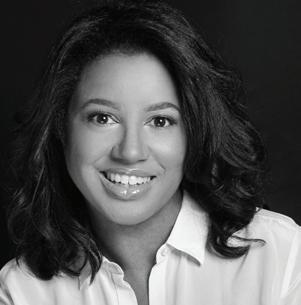
“I think the thread is that I do films on Black women’s joy,” Franklin said. “I did do a series called ‘Little Brother’ about young Black boys between the ages of 9 and 13 and their concept of what love is because we weren’t seeing that. That was Black women’s joy: to talk about their sons.”
Franklin also made a film about Title VII of the 1964 Civil Rights Act.
“We did this intense, very indie film, and it’s gotten an interesting reaction,” Franklin said. “Some people really love
it and some people are like, ‘What is this?’ … But I’m very proud of it.”
During the COVID-19 pandemic, Franklin decided to move back to St. Louis.
She began working as a public information officer for the City of St. Louis, where she was in charge of nine districts, including police, fire and neighborhood stabilization. She said her job was to ensure that the public was informed about what was happening in these different districts.
“That was very important to me because it needed a strong foundation to set it up so that the information channel was clear,” Franklin said. “‘Who do I report to,’ you know. The statements that are given to the media can’t just be, ‘No comment.’ That was not allowed by Mayor Tishaura Jones’s communication team. They actually do want to give information.”
While working for the City of St. Louis, Franklin found the open position at SIUE, which she took up.
“I knew with the City of St. Louis, I was there to set something up. I wasn’t there to stay,” Franklin said. “When this [job] opened up, it was six months into my tenure with the City of St. Louis. But I read the job description and it was a lot of, ‘Help start this,’ because this department is expanding.”
Franklin said she was so excited about getting an opportunity to work at SIUE because of
the impact it has on the community she grew up in.
“I mean WSIE, come on, that’s been out there as a radio station forever,” Franklin said. “I grew up listening to it and my mother went here for her master’s in music. Apparently, I was along for the ride. It’s been such a guiding light — this institution. So, when the job opened up, I was like, ‘Wow, I hope I get this.’”
As the new director, Franklin said she is hoping to “build the newsroom” and get more information about SIUE’s “experts” to the public. She also said she wants these experts to be comfortable with being interviewed to ensure that they can get the most media coverage possible.
“I want to continue to help the school promote all of the exceptional programs that are here,” Franklin said. “Each department seems to have something they’re dedicated to as far as advancing knowledge and I want to help promote that.”
Some of Franklin’s daily tasks will be to write university news articles and general media relations. She also said she could occasionally write speeches for Chancellor James Minor.
“My goal is to get the world talking about SIUE because we are an international campus,” Franklin said. “... That would be awesome to me, because I’ve traveled in my work and my films. It would be really cool to see something right here in the Midwest, to just be a beacon for them.”
NEXT WEEK: THE ALESTLE WILL BE ON BREAK. WE WILL BE BACK ONLINE 9/26 AND IN PRINT 9/28
Like any other form of social media, shared SIUE Snapchat stories bolster the ability for students to connect while simultaneously stirring up arguments and drama that have the potential to harm the campus community.
According to Snapchat, “Campus Stories” are shared public Snapchat stories on which anyone who has been on or near a college campus in the past 24 hours can post and view images and videos.
Snapchat first launched the feature in 2014 on a select few campuses and later expanded the feature in 2015 to include more campuses such as SIUE.

Since then, many SIUE students, such as sophomore art history major Virginia Shelton, have viewed and engaged with these stories to stay up to date with campus events, student organizations and gossip.
“I watch them daily,” Shelton said. “This morning I saw someone posting about the SIUE disability club, and I didn’t know that existed, so that was really cool. I think the drama is stupid but it’s also entertaining. It’s a drama I don’t need to know about but I get to learn about it.”
Junior geography major Dylan Stout also said he views the shared stories daily and had similar thoughts about both the negative and positive sides to this Snapchat feature.
“They’re laughable a lot of the time, but people are helpful. Recently, I have been seeing a lot [of story posts] for the Change.org petition for the meat statue,” Stout said. “For the most part, there is a lot of good. There are some people that will post on there just random things that don’t make too much sense.”
According to freshman English major Owen Lockett, who frequently posts on the stories under the username “Oven,” it is all about how people use the stories that makes them either a positive or negative feature.
“I hate saying this word, but I’m kind of famous on the story. I post really dumb jokes on there every day. I’ve been recognized in person because of it — it’s kind of weird,” Lockett said.
With such ease of access for students on campus, connectivity has become a lot easier. At any point, a student can make a story post asking for a study group or giving details to an event they’re a part of.
Amanda Jane, a graduate student in sociology, said the stories are able to foster connections between students, but in a restricted capacity.
“I do think these stories are a good way for people to connect, but I think there’s a limit to it,” Jane said. “People get to see others’ Snapchat stories, but are people genuinely making friends from these college stories or making plans? I’m not so sure.”
Jane added that connecting with other students at SIUE is difficult, so the story does alleviate some of the problems students may have when interacting with others.
“There’s not a huge or exciting student life on campus aside from fraternities, sororities and sports,” Jane said. “So, I think a lot of people who attend SIUE end up going through it without ever talking to students outside their classes. These Snapchat stories are a good way to foster communication between students where you otherwise may not have it.”
Jane said that the stories help students feel like they’re a part of something.
“I think that Snapchat stories like these help students feel like they are one conglomerate society rather than a bunch of individuals that just so happen to be in the same place,” Jane said.
Mackenzie Richards, a senior and Student Body President, similarly said the Snapchat stories can be a benefit when it comes to informing students about community events.
“I’ve seen a lot of people who will post events that are going on and I’ve seen ones that even I don’t know about,” Richards said. “I think it can be positive because it is a way you can promote events.”
Richards also said that, since any student can post to the stories, it can often get derailed or become tangled up in pointless conversations.
“Sometimes people can be annoying with them,” Richards said. “Some people post there unnecessarily. You’re seeing people having full conversations; it’s stuff that could be put in a group chat and not to everyone. When people keep it relevant and are genuinely asking good questions, it’s a good tool.”
Barrett Larkin, a junior and the organization relations officer for student government, believes that organizations shouldn’t use social media as much as they do to promote events.
“If an organization came to me looking to promote an event, I am going to be a little bearish on social media because I think it’s oversaturated,” Larkin said. “I just don’t think a Snapchat story would be the best way to promote an event because they disappear after 24 hours.”
Larkin said it would be best if student organizations on campus would use more official social media to promote their events.
“I don’t mean to be controversial, but we have some organizations and Greek life [groups] that are not staying up to date on GetInvolved, which is a form of social media they should actually be using,” Larkin said.
Larkin said that if the groups were to use any other form of social media, he would prefer it be Instagram over Snapchat, as the Snapchat stories are mixed when it
comes to good and bad content.
Richards said student government will be looking into posting on the Snapchat stories, though not in an official manner.
“Posting things like open senate positions and promoting events could be really good,” Richards said. “Even if we don’t as an organization officially do that, I know that we’ve had people on student government post those of their own volition.”
GRACE GENTEMANN reporter
The River Bluff Review allows students’ work across all mediums to be published and viewed.
For 31 years, the River Bluff Review has been a student literary journal that showcases a variety of student works in the arts. Students may submit any works of their choosing including poetry, short stories and paintings. Students have the option to upload four submissions a year. Anyone can access the online journal database.
The literary journal is connected with a class taught by Valerie Vogrin, an accredited author and professor at SIUE. Literary editing is a semester-long class that works to create the journal each year. Students who choose to take this course become editors and go through each submission anonymously to find those they would like to spotlight for the year.
“[Literary Editing class is] a hands-on learning tool where students would be responsible for putting [the River Bluff Review] out, [and] where they also explore the bigger idea of the literary publishing world while at the same time being SIUE’s journal,” Vogrin said.
Vogrin said this kind of duality allows for the River Bluff Review to be a learning opportunity for students and an achievement for those who are selected.
major Olivia Knoedler, a student in the literary editing class, said the journal is something for students to take pride in.
“It is cool knowing that other students validate your work … and that your work obviously had an impact and someone else found the beauty in it that you find,” Knoedler said.
The class itself tasks students with many different responsibilities. Miles Eschmann, a senior English major, was selected for the journal last year and is now joining the class as an editor.
“We are all kind of designing the magazine itself. We are working on making the aesthetic all work out and then eventually deciding what pieces will go into the magazines and what pieces will not,” Eschmann said However, unselected student pieces do not go unrecognized. Even if a submitted piece is not selected, students will
receive a letter including some feedback and thanking them for their time and work. The point of this is not to discourage students from submitting pieces but instead encouraging them to keep trying.

After COVID-19, the literary journal was able to be uploaded online, which opened up more opportunities for submissions. This way, students could upload short films or photographs that would not have been available in print.
Knoedler also stated the importance of the journal promoting students’ other works that may be viewed on social media.
“We are going to advertise [students] on social media and see what other work they have done,” Knoedler said.
Vogrin said having your work published in the journal is a great honor that students can be proud of and can be
used on their resume for even further recognition.
Vogrin also said that those who may be pursuing various degrees not involving art or literature can use the journal to express their talents and be accredited for it.
Vogrin said as time goes on they would like to encourage more students across all sectors of campus to contribute their talents to the journal.
Knoedler said that, essentially, the journal is meant to be for students to showcase all the talents they may have aside from their majors, or hobbies. The journal is meant to allow students to have this opportunity to make and show something they are passionate about.
To view last year’s journal or upload submissions for this year, visit the River Bluff Review website. The submission deadline is Sep. 15.
BRUCE DARNELL
managing editor
After recovering members from a brutal COVID-19 dropoff, SIUE’s English Honor Society Sigma Tau Delta has set its sights on doing more community events as well as making some new leadership changes.
Jill Anderson, the program director for Secondary Education and fiscal officer for the group, said the change comes as she has more responsibilities to do.
“Professor [Valerie] Vogrin and Associate Professor [Joshua] Kryah are the co-sponsors now,” Anderson said. “We’re having a little bit more of a switch-over so that more
faculty are involved.”
Anderson had been the sponsor of Sigma Tau Delta since it was formed at SIUE in 2017. She said the group was in the process of being formed in 2016, though it wasn’t finalized until she arrived.
“I was the Interim Chair of the English Department,” Anderson said. “A group of students came up to me and said that the previous chair that left had started getting this organized. We had a really dynamic group of students that wanted to start this group.”
Jerrica Asbeck, a junior English major focusing on secondary education and president of the group, said the group is great as a spot for English majors
to gather and to not feel left out.
“As an English Education major, you often feel so separated from the other English majors, especially once you start the education program,” Asbeck said. “You’re not in as many English classes and you’re not with many English majors, so it’s nice to have a spot where we can be surrounded by English majors.”
Valerie Vogrin, a professor of English and the current faculty co-advisor to the group, said there is a mutual respect between members.
“Sometimes the things that English majors are into, like literature, creating literature or just the study of literature isn’t something that is necessarily mainstream or something that
people respect,” Vogrin said.
Asbeck also said some of the events that the group has done in the past and is planning to do again in the future.
“We do the open mic nights, which were really big last year,” Asbeck said. “[Sigma Tau Delta] has a national book club that we participate in as a group. Last year, we did a banned book event and paired with the Cougar Store during their banned book fair, where they only sold banned books.”
Asbeck said they want the group to continue growing and, ideally, to grow separately from faculty recruitment.
“It doesn’t have to just be faculty letting people know about things now,” Asbeck said. “We as


members can bring more people in… We want to have more outreach with other departments, but also want to bring more people in from outside SIUE to our events.”

Anderson said that anyone interested in English should get involved with the group.
“We’re really open,” Anderson said. “Some of the students haven’t taken the required English classes so they can’t join the national group yet, but it’s also a social membership, so you don’t have to be a national member to do things with the group.”
Anyone wishing to join the national Sigma Tau Delta organization needs to have taken at least two 200-level English courses, maintain a B average and not be a freshman.

‘Woodland,’ The Paper Kites
CHLOE WOLFE opinion editor
As summer transitions to fall, it’s a lot easier to just go sit outside and daydream. Sometimes this is a bad thing as it is only the fourth week of school and we are already drowning in work. But, it’s also important to give yourself a break and find some magic.
So here are some songs to escape reality with. Pretend you live in a magical world of fairies and nymphs.
Wading in Waist-High WaterSolstice Version,’ Fleet Foxes
This song is for when you’re walking through the forest and looking for fun little rocks to add to your much-too-big collection.
Another one for the forest fairies. This is a whimsical folk song that makes you want to spin in circles. Go crazy with the pinecones.
‘White Winter Hymnal,’ Fleet Foxes
Another Fleet Foxes appearance, this is a fun little song about the French Revolution for prancing around the field.
‘Les Fleurs,’ Minnie Riperton
Instead of being a fairy, what if you chose to be a flower? Minnie Riperton answers all your questions about what you might do, so you don’t have to worry about that anymore.
‘A Song for the Hills and You,’ Croix Du Nord
After a long day of hiking
through the hills with your fairy friends, this song is for when you’re watching the sunset with a cup of tea or cider.
‘Would That I,’ Hozier
This song is for when you and your girlies are dancing in the forest just like Anne.
‘invisible string,’ Taylor Swift
For all the Swifties, this song is for at the end of the night when you and your friends are deep in the forest eating dinner by the fireside and someone brings out a guitar.
‘Otherside,’ Avi Kaplan
This song is for when you need to let go of all your woes in the deep, deep forest and maybe never come back – but that’s up to you.
‘Scarborough Fair / Canticle,’ Simon & Garfunkel
The original whimsy song, sung by choirs all over the world, this song is made for wandering through a magical ren faire.
‘Mykonos,’ Fleet Foxes
This song is destined to be in a high-fantasy story. So go ahead, pretend you’re there — wherever that might be.
‘Kingdom Dance,’ Alan Menken
The perfect song for putting on a fun outfit and twirling around with your lover.
‘New Slang,’ The Shins
This song is for when you’re napping in the middle of a flower field after playing in the nearby creek.


‘There Beneath,’ The Oh Hellos
The most whimsical group to exist, this song is about learning about the world around you from underneath a gorgeous willow tree. Take a moment to sit underneath a tree and take a look around.
‘Call for Soldiers,’ Poor Man’s Poison
After a day of frolicking in the woods, this song is ideal for dancing through a castle ruins with this playing in the background.
‘The Mollusk,’ Ween
For the water nymphs lazing on the rocks by the lake as the calming water stills.
‘The Water Is Fine,’ Chloe Ament
This is for my ethereal fairies walking along the side of a fast-moving river.
Find this playlist and more on The Alestle Spotify.
WINTER RACINE
Online Editor



Madison Sample Grace Gentemann
Tyson Hicks Reporters
Matthew Wolden

Brandi Spann Copy Editors

Hannah Ledford Podcast Producer



Maximilian Lenhart Photographer
Thea Weltzin Illustrator
Rameshwar Gundem Circulation Manager

Meghan Fosnock
Damon Fowler Front Desk Clerks
Tammy Merrett Program Director
Angie Trout Office Manager
HAVE A COMMENT?
Let us know! opinion@alestlelive.com
Campus Box 1167 Edwardsville, Illinois 62026-1167
LETTERS TO THE EDITOR POLICY:

The editors, staff and publishers of The Alestle believe in the free exchange of ideas, concerns and opinions and will publish as many letters as possible.



Letters may be submitted to:
The Alestle Morris University Center, Room 0311
e-mail: opinion@alestlelive.com
All hard copy letters should be typed and double-spaced. Letters should be no longer than 500 words. Include phone number, signature, class rank and major.
We reserve the right to edit letter for grammar and content. Care will be taken to ensure that the letter’s message is not lost or altered.
Letters to the editor will not be printed anonymously except under extreme circumstances. We reserve the right to reject letters.
Thursday, 09.14.23


As students and staff fork over the money to buy expensive parking passes, the scarcity of convenient spaces raises serious questions about the value of these passes.
SIUE, like most other college campuses in the United States, charges students and staff to be able to park on campus. Parking at SIUE, whereas less expensive than at UIUC or ISU, is still a significant hidden cost for students and staff.
Parking Services offers nine different types of parking passes, each varying in cost and each allowing buyers to park in different lots. According to Parking Services, the cheapest pass for students is the red pass, which costs $158 per year, and the cheapest for faculty and staff is the blue pass at $174 per year.
With even the cheapest passes costing more than $100 each year, and pay-to-park costs adding up quickly, this can have a major negative impact on those already struggling to afford the ever-increasing cost of living.
Many students, faculty and staff do not have a choice when it comes to parking on campus. SIUE is secluded from the greater Edwardsville area, therefore people are forced to either drive to campus or to take Madison County Transit. The latter has limited accessibility based on where individuals live.
Students who live off campus and who cannot afford the more expensive parking passes are forced to purchase a red pass and make the sizable trek between their vehicles and academic buildings in all weather conditions, including snow, thunderstorms and heat advisories.
Students living on campus must buy a yellow residential pass and walk to and from their residential hall and classes each day. Residents living in Cougar Village must either take the Cougar Shuttle each day, or park in a red lot or other yellow residential lot.
Staff and faculty whose job is to come to campus and work still must pay out of their own pockets each year to park at their workplace. Even then, if they are unable to afford a more expensive pass, they must make
the long walk from the blue lots and back each day.
With costs for parking passes being as high as they are, the bare minimum Parking Services should provide is a guaranteed, accessible and convenient parking space for everyone who purchases a parking pass.
However, this isn’t the case, particularly this fall.
During the first several weeks of the semester, students parking in red lots were met not only with the long walk to their classes in the extreme heat, but also with overcrowded parking lots.
Many students struggled to find an available parking space, making them late to class and increasing the already high beginning-of-the-semester stress.
Similarly, residential students living in Evergreen and Woodland Halls struggled to find parking in their lots as students from other halls and Cougar Village were forced to take up the already limited parking spaces.
The university has blamed construction and the delay of the opening of the green permit lotteries as reasons for this overcrowding, but has done little to
address the problem.
The red lots should be expanded, but there should also be something done that solves the overcrowding problem. Accessibility issues of the more distant parking lots should also be addressed — perhaps building a parking garage on the edge of campus and providing a shuttle service similar to the Cougar Shuttle.
It is not acceptable for a car-reliant university to charge students for expensive permits to park in overcrowded, inconvenient and inaccessible parking spaces on top of ever-increasing tuition and student fees. It is also not acceptable for staff and faculty who are already not paid enough to then be forced to pay to park in problematic parking lots.
Whereas paying for parking is, unfortunately, a necessary evil for most of the SIUE community, students and staff should make their opinions and concerns known to Parking Services by emailing.
There is power in numbers, and if enough people speak up about these issues, then changes — such as expanded, convenient and accessible parking for all — might be made.
The name Alestle is an acronym derived from the names of the three campus locations of Southern Illinois University Edwardsville: Alton, East St. Louis and Edwardsville.
The Alestle is published on Thursdays in print and on Tuesdays online during the fall and spring semesters. A print edition is available every other Wednesday during summer semesters.
For more information, call 618-650-3528
For advertising, email advertising@alestlelive.com

If the new 283 retention campaign succeeds, more students would have to choose to live off-campus.
During its early years, SIUE was a commuter college. Prior to the 1980s, there was no on-campus housing. Most of the students here were also working.
As time progressed, campus housing was made available
to students. Currently, there are 2,750 students living on-campus, according to the Director of University Housing, Mallory Sidarous. Today, as there are over 13,000 students enrolled at the university, off-campus living is the only alternative. Mind you, rent in Edwardsville is astronomical at $1,598 per month, according to RentCafe.
On-campus housing has many issues to be addressed.
“I lived in both Cougar
Village and Prairie Hall. I realized that the conditions are not worth it, since it is a lot of money. Instead, living at Parc at 720 [Axis Apartments], I feel like I am getting what I paid for,” Rachel Alley, a junior, said.
Making new friends is important whether you choose either on- or off-campus housing. There are many students who have had one kind of disturbance or another with their roommates, or perhaps the apartment
or room maintenance.
“[I am] not able to live on-campus housing, because of bad roommates. Housing has been a bad experience for many,” Alley said.

Roommates are not the only factor causing students to want to live off-campus.
If the university wants us

HOUSING | PAGE 6
to live on campus, all our living situations should have a kitchen instead of forcing students to buy a meal plan, which contributes to the unaffordable nature of on-campus housing. Furthermore, having in-house laundry is definitely a game changer.
“I lived at Evergreen, and now I live at Parc. I liked living at Evergreen — we had a kitchen and living room. The only thing that bothered me was the four of us were to share one bathroom,” Eva Lundahl, a junior, said.
Choosing to stay in off-campus housing will also help differentiate college or career and personal life.
“I feel like an adult having to drive to and from campus. I am less stressed because campus life and personal life are separated now,” Lundahl said.
Even if you are looking for options to live within 30 minutes
of Edwardsville, legal restrictions on apartment capacity may make it difficult for roommates who split bills to pay off rent.
“I would love to live on-campus because it is more secure and easy to commute to campus. If there is anything that is stopping me from living on-campus, it is a bit expensive for an individual,”
Navya Mallela, a graduate student, said. The university should provide subsidized housing options for students, irrespective of on-campus and off-campus, to accommodate one’s financial concerns. The current housing scholarship of $1,000 is not enough, and it is only offered to those who choose to live on campus. Students take loans to meet their needs. Every student must be provided with a decent amount of housing scholarship. The university needs to find a way to make housing affordable.



Will the campus Snapchat stories start a fight?
Hannah Ledford
Winter Racine
Chloe Wolfe
As I see it
“
[I am] not able to live in on-campus housing, because of bad roommates. Housing has been a bad experience for many.”
Rachel Alley, junior history and secondary education majorMATTHEW WOLDEN copy editor
SIUE volleyball bested two out of three schools during the Cougar Classic tournament this past weekend.
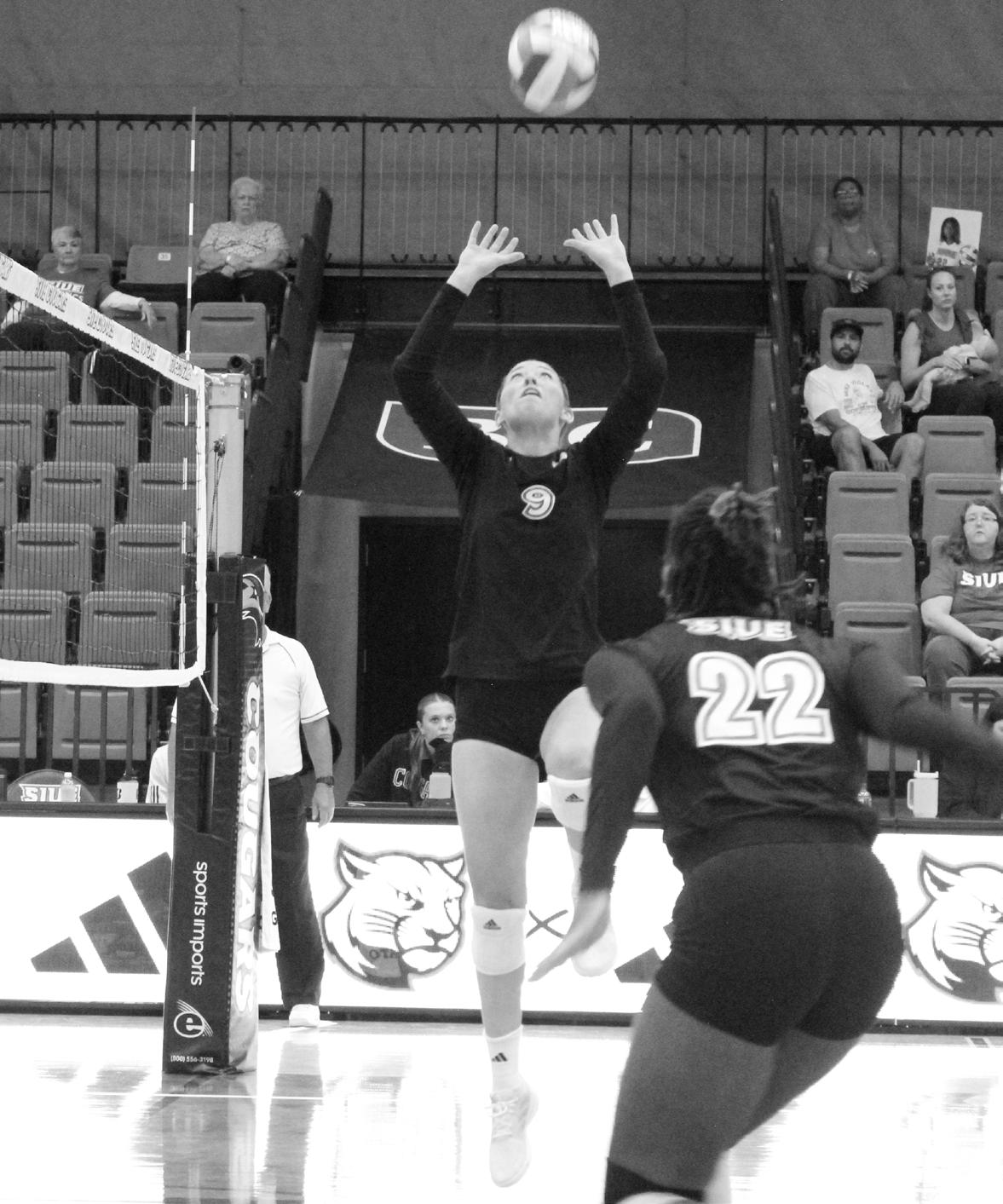
The Cougars competed in three games across two days. SIUE secured a 3-0 win in the first game played against the University of Idaho. SIUE also won against University of Wisconsin-Milwaukee in four sets in the second game.
SIUE took a fall in a riveting game against Western Illinois University lost in the fifth set with SIUE winning two of the sets.
Head Coach Kendall Paulus said she was content with how the season was progressing and with how the team was performing in the games.
“We are finding some momentum,” Paulus said. “I’ve been very proud of our effort.”
Paulus said she was impressed with how the team could shake off one loss of a set and move right into the next set with a firm resolve.
“I also loved the way we responded to lost sets. I thought
we really went to the next play,” Paulus said.
Paulus also said she was happy that other teams were watching the team play and trying to prepare for their match.
Following the SIUE Cougar Classic tournament, four student-athletes were named to the All-Tournament Team with one coming from SIUE. The team had an amazing performance from junior middle blocker Priscilla Jones leading her to be named as a part of the All-Tournament team.
Jones had 39 kills and .515 hit percent throughout the weekend games. While Jones played well, she said that volleyball is a team based game and gave credit to her teammates for how well they worked during the tournament.
“We’ve really come together and started playing as a unit, you know, there is a lot of new people on our team this year,” Jones said. “It’s been a little difficult throughout preseason trying to get everyone on the same rhythm so it’s nice finally getting on the same rhythm with each other.”
Even though the team even-
tually found their rhythm, some players admitted to being nervous. Abigail Banitt, a freshman libero, said that before the game, she was nervous. However, once she was on the court, she started feeling more at home.
“As soon as you step on the court, new mentality, new game. It’s just you and the [team],” Banitt said.
Banitt also hopes that this momentum will carry throughout the rest of the season.
“I think we have a really good start here at this home [game], and I hope that it will translate to our away games too,” Banitt said.
Paulus said more people out there in the audience cheering the team on from the bleachers really encourages the volleyball team and gives the game a spirited atmosphere.
“When people come and get involved and dance and cheer it really gives us momentum, helps us want to perform,” Paulus said.
Paulus also said the team is still getting better and are yet to reach their full potential.
To see the SIUE volleyball team’s schedule, visit the Cougars Athletics website.

Within the exhilarating highs and lows of college athletics is a dedicated group of student athletes dedicated to enhancing the overall experience of college sports for their peers.
The Student Athlete Advisory Committee serves as a vital bridge between administration and student athletes. The group confronts a multitude of challenges facing student athletes. One of the most important goals the committee wishes to accomplish is to give student athletes a voice.
The committee executive board is compose entirely of student athletes at SIUE and
Sept. 22
Men’s soccer will battle against Webster University at 7 p.m. at Ralph Korte Stadium. This will be the first time in history that the men’s team has played against
spearheaded by President Alexis Hutchins, Vice President Taylor Spiller, Communications Representative Gabby Horton and Secretary Cameron Woodard.
Hutchins, president of the committee and a member of the track and field team, said athletes are claiming power over their perspectives.
“This is what we are working towards for student athletes,” Hutchins said. “How do we make student athletes feel like they have a voice? Because we know we have a voice, but we do not know how to use that voice efficiently.”
Woodard, secretary and part of both the cross country and track teams, said the committee has a lot of power in
its position.
“SAAC actually has a lot of power. We have a lot more power than even coaches can have,” Woodard said. “Because the athletes are the core of the NCAA, it really matters what the athletes want and need.”
Woodard also said a committee like the SAAC is important.
“[Student Athletics] are the ones who constantly have to experience the systems that are being implemented,” said Woodard.
Hutchins said there are levels to which information can be passed to each level of sports. The board can get in contact with the Ohio Valley Conference (OVC) and the
National Collegiate Athletic Association.
“We report directly to the OVC and the OVC reports to us, and anything brought to the OVC [if needed] can be brought to the NCAA and then it trickles down,” Hutchins said.
Weekly meetings with the members of the committee also address any issues and allow for open discussion with regard to the OVC, SIUE or plans for the future.
Another important role the committee plays is holding events for all sports across campus, allowing for collaboration and connections to be made. Hutchins said that this had been something they had not been able to do since COVID-19.
One of the most prominent events is the end-of-year celebration, Cougar Choice Awards. This is an award show for student athletes put on by the committee. Hutchins said the most prestigious award is the Cougar Cup, a great honor for the team who acquires it.
The athletes may obtain this award by attending the most student athletic events. This award is a way to showcase pride for athletic events and SIUE as a whole, making athletics more community-oriented.
Hutchins said that in the future, they hope for more resources and knowledge to let student athletes know what committee is and what it can provide for them.
Webster.
Women’s softball will kick off its exhibition game against McKendree University at 5 p.m. on the Cougar Field.
Women’s tennis will be-
gin the SIUE Invite tournament and conclude the next day. The team will compete against Lindenwood University, University of Missouri - St. Louis, and University of Southern Indiana on the SIUE tennis courts.
Sept. 24
Women’s soccer will compete against Lindenwood University as part of the second game in their Ohio Valley Conference season at 2 p.m. in Ralph Korte Stadium.
Sept. 29
Women’s volleyball will set off a game against Southeast Missouri University as part of the Ohio Valley Conference at 6 p.m. in the First Community Arena.