U pcoming e vent S
ALAS Field Trip
Green Bay
Sunday, March 29 7 A.M.
Join us for a fun filled morning exploring the Green Bay Area! We will explore various spots on the bay searching for migrant waterfowl and other early spring arrivals! We are also fortunate enough to have local experts that will explain conservation efforts and research projects that are taking place on the west shore! You won’t want to miss out, please RSVP on the ALAS website. We will rendezvous at Artist and Fare in Plover at 7:00 AM and start at Bay Beach Wildlife Sanctuary between 8:30 AM and 8:45 AM. For questions, contact email Rob Pendergast at acadiantigerheron@gmail.com (preferred) or call/text at (715)498-4885.
ALAS Field Trip
Prairie Chickens on the Buena Vista
Wednesday, April 29 or Thursday, April 30
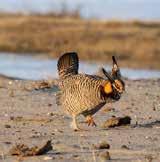
ALAS invites you to join us on Wednesday, April 29 or Thursday, April 30, as we take a short journey to witness the spectacular breeding display of the Greater Prairie-Chicken. At one time, these birds occupied every county in the state, but with development and loss of grassland habitat numbers have declined. Modern populations only occupy a few grasslands in central Wisconsin, and are listed as a state threatened species.
Buena Vista Grasslands is a 12,700-acre property located just south of Plover and east of Wisconsin Rapids. The property has been managed for Greater Prairie-Chicken habitat since the 1950s.
We will be getting to the blinds before sunrise and sitting/standing quietly until after the Greater Prairie Chickens have dispersed from the lekking grounds. With that in mind, make sure you dress appropriately by layering warm clothing and footwear. Also remember that bathroom breaks will be very limited, so make sure to utilize them before we head into the blinds and hydrate in moderation. Don’t forget your cameras and optics!
Reservations are required, and there are ONLY 8 spots LEFT! This is an experience you won’t want to miss!
If you have any questions, feel free to call or text Brad Baum at 715-3474570 or email at brad.a.baum34@gmail.com
Bringing People Together for Wisconsin’s Environment
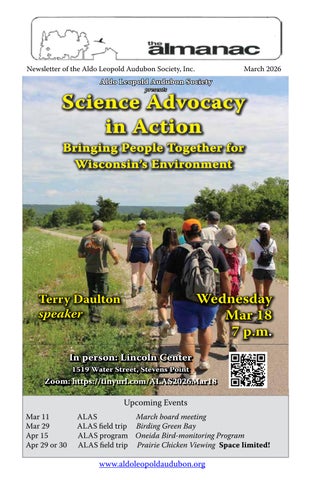
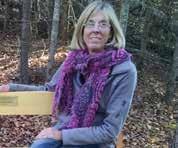
Bill Nye (the Science Guy) calls science “the best idea we ever had.” Wisconsin’s Green Fire (WGF) takes that idea to heart. WGF is an organization dedicated to promoting science as a tool in natural resource public policy in Wisconsin. Changes in long standing federal laws like the Endangered Species Act, Clean Water Act, and National Environmental Policy Act will impact all of us in Wisconsin. Terry Daulton, founding board member of WGF, will share examples of important science that need to inform decision making at federal, state, and local levels. She will also propose ways we can try to bridge the gap between people with differing political views to protect Wisconsin ecosystems, economics and cultural values.
Terry Daulton was the founding board chair for Wisconsin’s Green Fire, and currently works on their federal issue-response team, board, and chairs two committees. Her background includes over 30 years in environmental education, policy and research from studying loons on northern Wisconsin lakes, and leading art/science collaborations at the Trout Lake Limnology Station. She has held positions with the National Park Service, Sigurd Olson Environmental Institute, North Lakeland Discovery Center, US Geological Survey, Wisconsin DNR, and UW-Madison to name a few. She currently lives in Bayfield, Wisconsin.
Join us for Terry’s presentation as she explains how we can bring people together for Wisconsin’s environment. ALAS programs for the 2025-26 season will continue to be hybrid, with the in-person presentation held at the Lincoln Center (1519 Water St., Stevens Point, Wisconsin) and remotely live via Zoom on March 18, 2026. To view via Zoom, register at https://tinyurl.com/ALAS2026Mar18 Find this link on our website under the Events-Presentation tab.
Aldo Leopold Audubon programs and field trips are free and open to the public.
Dates are correct as of press time. Always be sure to check the ALAS website before you leave!
delightfUl BirdS i hAve Known
Semipalmated Plover (Charadrius semipalmatus)
Alan Haney
allaboutbirds.org
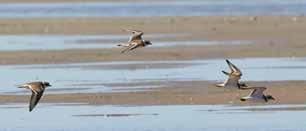
The Semipalmated Plover is an easily identified wading bird that migrates through central Wisconsin on its way to the Arctic after wintering on shores around the Caribbean. If you have spent even a brief time on a southern beach during winter months and paid any attention to the “peeps” that frequent the damp sand, often running to chase an insect or avoid a wave washing ashore, you have likely seen this bird, probably in company with sandpipers, and maybe a Killdeer.
ver located at the mouth of the Plover River takes its name from the river. According to Rosholt, migrating Semipalmated Plovers routinely stopped to feed on gravel bars and mudflats in the vicinity of where the Plover joins the Wisconsin River.
Northward migration for the Semipalmated Plover begins in April, when they might be seen anywhere in United States on mud flats, in muddy fields, around sewage lagoons, or on the edge of almost any kind of water, pond, lake, or river. They arrive back in the Arctic in May, and the male stakes out a small territory along a promising shore. The male will make a small shallow scrape in fine material, sand, silt, or partially decomposed organic residues. He then attempts to attract a female by flying high above, using slow wing-beats, and calling chu-weep. When a female lands to check out his territory and nest, he pursues her with fanned tail, lowered head and a sputtering call. Pair bonding is usually monogamous for the season, and sometimes for longer. Other males are chased from the territory.
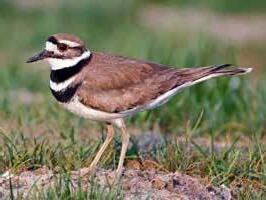
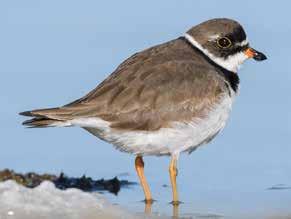
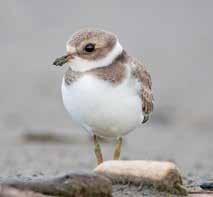
The Semipalmated Plover resembles our familiar Killdeer, but the plover has a single black band around its neck and black around the eyes. Adults have conspicuously orange-yellow legs. Also note the orange base of the plover beak, if it is an adult, whereas the Killdeer beak is all black, and also longer. The “semipalmated” refers to the plover’s partially webbed feet, which would not be visible without having one in hand. Plovers sometimes will land for a brief time in open fields to forage, but most often are seen on open shores with little vegetations. They often wade and even swim in their pursuit of aquatic prey. Killdeers more often forage in dry, open sites, also preferred for nesting.
Those of us in central Wisconsin have a special connection to the Semipalmated Plover. It was the namesake of the Plover River according to Malcom Rosholt in his book, Our County, Our Story, and the village of Plo-
The female lays 2-5 eggs and parents share incubation over 23-25 days. If intruders cannot be intimidated by the male, a broken-wing behavior will be used in an attempt to draw away the threat. Chicks are precocious and join the parents in feeding on nearby damp shorelines for almost any kind of small invertebrate they can find. Adults also will consume small berries or other fruit. By August, young are ready to fly and join other plovers, and sometimes other small wading species, to begin the long flight to southern shores for the winter.
As they move south, Semipalmated Plovers might again be seen anywhere in the Lower 48 where they can forage on damp, open sites. They will pass through Wisconsin sometime in late August or early September. Might be worth a trip down to the mouth of the Plover River in late April or early September. Wouldn’t it be cool to see the bird that gave us the name of the river and the town?
Semipalmated Plover. Photo courtesy
Killdeer. Photo courtesy allaboutbirds.org
Semipalmated Plover (juvenile). Photo courtesy allaboutbirds.org
Avian Kids’ Corner
Scott Reilly
Ah, March! So much happens this month as it comes “in like a lion and out like a lamb”. The Spring Equinox in a few weeks perhaps gets you thinking of warmer days, more sunshine, the return of flowers and green. As spring begins and all life begins to return, you and your family can help local wildlife, including birds, feel more at home in your yard.
One of the best things that you can do is attract more insects to your yard, and lure more birds too! The National Wildlife Foundation’s “Native Plant Finder” is an amazing resource!
● Plant Trees - According to NWF, not all trees are the same, some attract more insects (and birds) than others! The best to plant are oak trees, willow trees, cherry, birch, and aspen are some of the best.
● Flowers & Grasses - Insects also need plants that are low to the ground and not lawn. These plants can give insects places to hide, build chrysalis, lay eggs, and more. Different types of goldenrod are really beneficial to insects, as are sunflower species.
But birds and other animals don’t just need living things in your yard to make it attractive. A few non-living features can make your yard incredibly enticing for many!
● Add some large rocks, make a creative rock garden with lots of nocks for hiding, perches for seeing.
● Old logs make for great places for many insects and other animals to hide beneath or around, for keeping eggs protected, and more!
A final way to make your yard really exciting for animals is to add water! It can be simple like a birdbath with stones along the bottom for insects and birds to perch on. Or, it can be a pond or waterfall, but the presence will be really exciting for animals and draw them to your yard.
Ah, spend your spring with so many others taking advantage of all the great habitat that your yard has to offer!
Feathered Friend’s Recommend:
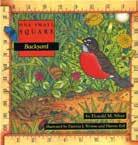
One Small Square Backyard by Donald M. Silver (Acorn Naturalists) is a lovely book that explores just what it says, your backyard. See what is there, and make a plan for improving your own yard!
Susan Schuller
Changing the name of an organization can be both a symbolic and practical decision, often reflecting evolving values, missions, or community expectations. However, when there is disagreement with the change, the process becomes more complex, as it has been for the two-year journey ALAS has been on. ALAS’s journey started in January 2024 when we held a visioning meeting. This is the closest to a strategic planning meeting we have done since I joined the board 7 years ago. During this meeting it was asked “Should our chapter explore the possibility of a name change, similar to what national and other chapters have done?” Of the 12 people in attendance, 9 responded “yes.”
We know and acknowledge that Aldo Leopold Audubon Society’s name carries history, identity, and emotional significance. For longstanding members, the name may represent decades of shared experiences, accomplishments, and personal investment. It can serve as a link to founding principles and traditions that shaped ALAS’s culture. When a proposal to change the name was announced, some members expressed concern that something will be lost or the organization’s legacy will be diminished. And some members feel it is the wrong decision. These concerns are valid and often rooted in loyalty and sincere reverence for the name and organization.
At the same time, organizations do not exist in isolation from societal change. Names, such as Audubon, that once felt appropriate or neutral may, over time, no longer reflect current values or may unintentionally exclude or alienate certain groups. The idea of changing our name is driven by a desire to be more inclusive, relevant, and representative of the organization’s mission and the communities it serves today and in the future. For some, updating the name is an opportunity for growth, outreach, and long-term sustainability—the belief that a name change will engage more people in our organization and be an arm to grow membership.
The process is just as important as the decision, so let me share how the board came to this decision. After conversations at board meetings and informal discussions with some members from January 2024 to January 2025, it was decided the best approach would be to form a special subcommittee that would dedicate 6 months (which actually turned out to be 9 months) to gathering data and surveying members and the community. We solicited nominations and voted, as a board, on the subcommittee members. In the end, our subcommittee was made up of the most diverse
representation of perspectives that we could, based on the nominations received.
Data collection consisted of meetings with other Audubon organizations who had already explored the issue. We researched National Audubon Society’s process for examining the issue, interviewed the BIPOC Birding Club, Southern Wisconsin Bird Alliance, Milwaukee Audubon, and Northeastern Wisconsin Bird Alliance. We held focus groups with high school students, college students, and long-term members of ALAS including former board members.
All along, a dedicated page on our website shared resources, text, and recommended readings on this topic. ( www.aldoleopoldaudubon.org/ subcommittee ) We posted an online survey to the website and sent a hard copy to every ALAS member. Several articles were published in the newsletter to keep members updated on this process. The subcommittee wanted to create multiple opportunities for members and stakeholders to share their views, ask questions, and express concerns. It was important to be thorough when it came to such an important issue.
The work of the subcommittee resulted in over 50 pages of information, documents, and raw data. Mind you, they were all volunteers. The information gathered gave us insight as to how our membership and community feel about the name Audubon. It provided guidance on where we are as a chapter and where we should go. That information has guided the decision.
After thoughtful consideration and an open discussion by our board members, it was decided at the February 11, 2026 board meeting in a vote of 11 to 1 of those board members present to change the name.
We recognize this comes with opposition from some members. We feel that just because there is some disagreement, we do not need to create a divisive organization. These differing opinions show a deeply engaged membership that cares about the organization’s future.
Regardless of what our future name might be, I think we can all agree that we remain united on the mission and dedicated to the conservation and protection of birds and their environments. The ALAS board of directors appreciates everyone and all voices who provided input into this process. What started January 2024 leads us to this decision that sets the organization’s long-term mission in mind.
In the coming months, we will have opportunities for members to weigh in on a new name. Stay tuned for that.
What You Missed: Sax-Zim Bog
Brad Baum
A group of 20 birders, including 7 ALAS board members, made the journey to the Sax-Zim Bog in northern Minnesota. Our eclectic flock of birders was quite diverse! We ranged in experience from beginners to avid birders; spanning in age over 50 years from youngest to oldest group participants.
Our group was able to remain in constant communication via twoway radios as our caravan of eight vehicles made stops throughout the diverse habitats. The area is dominated by black spruce and tamarack bog with partitions of open sedge meadows, scrubland, agricultural fields, and mixed aspen/hardwood forests. These habitats had us hoping to see northern bird species on their southern wintering grounds.
The temperature at our first stop on Saturday morning was a chilly -18F, however, as the day went on, the sun came out and so did the birds!!! By the end of the day, we had experienced a 40° temperature swing!
While most of our time was spent birding from the road, in or by our vehicles. We did stretch our legs with a short hike on the Bub Russell Boardwalk during the warm, sunlit hours of Saturday afternoon. Over the weekend, we managed to see 30 total bird species, with most participants being able to add new species to their life bird list!
Here is our full species list for the trip: Canada Goose, Harlequin Duck, Common Goldeneye, Barrow’s Goldeneye, Red-breasted Merganser, Rock Pigeon, American Herring Gull, Glaucous Gull, Bald Eagle, Red-tailed Hawk, Snowy Owl, Northern Hawk-Owl, Black-backed Woodpecker, Downy Woodpecker, Hairy Woodpecker, Pileated Woodpecker, Canada Jay, Blue Jay, Black-billed Magpie, American Crow, Common Raven, Blackcapped Chickadee, Boreal Chickadee, White-breasted Nuthatch, Redbreasted Nuthatch, European Starling, Bohemian Waxwing, Evening Grosbeak, Pine Grosbeak, and Redpoll.
A special thanks to Rob Pendergast for creating a wonderful itinerary that even the birds were kind enough to follow! Another special thanks to everyone that participated and helped make our group experience one of the most fun and unforgettable birding memories!
If this trip sounds like something you would enjoy, keep your eye out for upcoming ALAS trips so they don't become “What You Missed!”
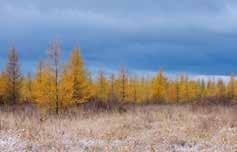
Sax Zim bog. Photo courtesy saxzims.org
Officers
President
Susan Schuller 715-340-4877
Vice-President
Brad Branwell-Zinda 715-570-9587
Secretary
Willow Pingel 715-387-1398
Treasurer
Janet Smith 715-630-6951
Committee Chairs & Directors
Bird Seed Sale
Midge & Steve Hall 937-608-0864
Christmas Bird Count
Karen Dostal 715-592-4706
Gerald Janz 715-340-3834
Conservation Rob Pendergast 715-498-4885
715-824-3978
715-252-8903
Your dues support local chapter activities and environmental projects exclusively in Central Wisconsin. You will receive The Almanac newsletter and invitations to ALAS programs, field trips, and educational events. ALAS will notify you when your annual membership is due.
$25/year Supporter Local Chapter Membership.
$50/year Sustainer Local Chapter Membership.
The date your Local membership expires is on the back cover!
I’ll help conserve resources, protect the environment, and save postage! Please send my newsletter via email.
Name:
Address:
City: State: Zip:
Email:
Join/renew online: Go to our secure website and click on “Ways to Give”
www.aldoleopoldaudubon.org
Join/renew by mail: Please make check payable to: Aldo Leopold Audubon Society Mail this form and check to: Aldo Leopold Audubon Society Membership PO Box 928 Stevens Point WI 54481-0928
More Ways to Give
We appreciate your additional donations supporting the work of ALAS.
$__________ ALAS Endowment Fund. Managed by the Community Foundation of Central Wisconsin.
$__________ ALAS Chapter Operations Fund.
ALAS will not distribute your contact information to any other organization. ALAS and the Community Foundation are 501(c)(3) organizations. Your donation will be tax-deductible to the extent permitted by law.
Please remember ALAS in your estate planning!
Aldo Leopold Audubon Society
The mission of the Aldo Leopold Audubon Society is to foster appreciation and concern for all living things, and to protect and preserve their ecosystems.