Newsletter of the Aldo Leopold Audubon Society, Inc.
January 2026
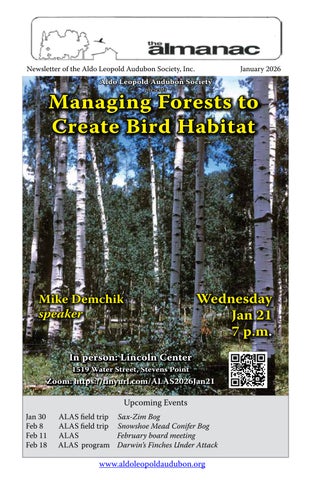
Aldo Leopold Audubon Society presents
Managing Forests to Create Bird Habitat
Wednesday Jan 21 7 p.m.
Mike Demchik speaker In person: Lincoln Center 1519 Water Street, Stevens Point
Zoom: https://tinyurl.com/ALAS2026Jan21
Upcoming Events Jan 30 Feb 8 Feb 11 Feb 18
ALAS field trip Sax-Zim Bog ALAS field trip Snowshoe Mead Conifer Bog ALAS February board meeting ALAS program Darwin’s Finches Under Attack
www.aldoleopoldaudubon.org 1
U pcoming E vents Aldo Leopold Audubon Society presents
ALAS Goes to Sax-Zim Bog in 2026
January 30February 1
M anaging F orests to C reate B ird H abitat
ALAS Field Trip Sax-Zim Bog, Minnesota Friday, January 30-Sunday, February 1
Michael Demchik is a professor of forestry at the University of Wisconsin-Stevens Point. He teaches a wide range of courses at UWSP and is involved in research that addresses using silviculture to reach landowner goals. He is particularly obsessed with developing methods to teach students to mark timber better, faster, and with more confidence in their decisions. He has had several jobs across federal, state, and private natural-resource management in West Virginia, Pennsylvania, Maryland, Minnesota, and Wisconsin.
Did you enjoy the presentation on Sax-Zim Bog by Sparky Stensaas in November? See it for yourself! We are leading a special overnight field trip to the Sax Zim Bog located in northern Minnesota this month.
The Sax Zim Bog is a 300 square-mile area in northern Minnesota with a unique boreal forest ecosystem that hosts an eclectic mix of northern wildlife. Particularly captivating are the owls of the bog, the Great Gray Owl and Northern Hawk-Owls being most iconic. A total of 237 species of bird has been recorded in this area, even in the coldest winter days there are special birds to be found such as Boreal Chickadees, Black-backed Woodpecker, irruptive finches, and Canada Jays. RSVP please call or text Brad Baum 715-347-4750
Photo by Gerry Janz
Aldo Leopold Audubon Society welcomes you to join us. The field trip will be held Saturday, January 31 through Sunday, February 1. Explore the captivating beauty of the bog with us as we search for the hidden wonders that call this place home. Drive up Friday, January 30 as we will have an early start from Duluth on Saturday.
Please RSVP on our website (www.aldoleopoldaudubon.org/event-details/owls-and-winter-birds-at-sax-zim-bog) to help us plan for the group. Make your own bookings for accommodations for both nights. We recommend staying in Duluth. This will help us coordinate the group Saturday morning when we start our journey! There will be an informational meet-and-greet for those that have RSVP’d, so please watch your email for an announcement. While we will spend a significant amount of time in vehicles, we highly recommend bringing plenty of layers to stay warm. It is pretty common to see temperatures and wind chills frequently plummet below zero in this area. While layers are important, make sure you don’t forget to pack your optics! If you have a camera, make sure to bring a spare battery to keep in the warm vehicle to swap out when the other gets too cold! You won’t want to miss out! If you have any questions, please call or text Brad Baum at (715)347-4570. We look forward to seeing you out there! Videos of Sax-Zim Bog from Sparky Stensaas can be found at www.youtube.com/@ SparkyStensaas 2
Join us at Michael explains how to better manage forests to create bird habitat through timber harvest. ALAS programs for the 2025-26 season will continue to be hybrid, with the in-person presentation held at the Lincoln Center (1519 Water St., Stevens Point, Wisconsin) and remotely live via Zoom on January 21, 2026. To view via Zoom, register at https://tinyurl.com/ALAS2026Jan21 Find this link on our website under the Events-Presentation tab. Aldo Leopold Audubon Society presents
Snowshoe the
Mead Conifer Bog
ALAS Field Trip Snowshoe Mead Conifer Bog Sunday, February 8 8 a.m.
Come join us Sunday, February 8 at 8:00 AM for a snowshoe hike and explore a small island of boreal habitat in our own backyard! We will hike into the Mead Conifer Bog State Natural Area, Sunday, which is part of the larger Mead State Wildlife February 8 8 a.m. Area. Dominated by black spruce, the bog can host an interesting mix of wintering birds and other wildlife. Golden-crowned Kinglets, Common Ravens, redpolls, and other species utilize this habitat most winters. If we’re really lucky, we may even happen across White-winged Crossbills. Snowshoes are available to borrow at the Mead Visitor Center. RSVP online at www.aldoleopoldaudubon.org/event-details/snowshoe-winter-hikeat-the-mead or contact Rob Pendergast at acadiantigerheron@gmail.com or (715)498-4885 for details. For more information: Rob Pendergast 715 498 4885 Please RSVP online
Stevens Point Weekly Bird Walk Schedule
Please visit https://www.aldoleopoldaudubon.org/weeklywalks 3
As Seasons Come and Go Alan Haney As the posting time for the next almanac approached, it occurred to me that one of my favorite days of the year was also coming…the winter equinox on the twenty-first of December. No, I’m not fond of the shortness of that day, or the beginning of winter, but I relish that for the next 182 days, each will have more light than the previous.
Virtually all life is tied directly or indirectly to the sun, or more precisely, the energy from the sun. As Earth orbits the sun, the axis remains more or less tilted at 23.4 degrees (there is a small wobble in the tilt that contributed to past changes in climate, but that is a subject for another time), pointing most directly toward the sun on our longest day, and most directly away on the winter solstice, resulting in the minimum number of daylight hours. The daylength, called photoperiod, changes throughout the year, more at higher latitudes and least at the equator. Seasons are directly tied to photoperiod, of course, and therefore photoperiod, especially at higher latitudes, is a matter of survival for organisms that live directly in contact with nature. It’s a long list of biological activities the timing of which determines survival of the fittest: beginning or breaking dormancy, hibernation, flowering, migrating, sexual activity, nesting, and more. Many of these biological processes require some time to complete, and even anticipation to begin in a timely way. Young eagles, for example, are fed by parents for around 70 days before they can begin to forage on their own, so completing the entire reproductive process, including incubating eggs, might take over three months. Passerines are much quicker, closer to one month. Birds living in locations where there are significant seasonal differences are sensitive to photoperiod, triggered by hormones produced in their pituitary gland. The relative lengths of day and night are sensed in organisms by specialized proteins called photoreceptors, such as 4
cryptochrome or phytochrome. Photoreceptors serve organisms as their circadian clock, which, in turn, is coupled to the various metabolic functions. Without conscious thought, these functions are activated or deactivated as photoperiod reaches critical duration; organisms whose genetic and metabolic chemistry is poorly responsive to proper photoperiod-length are less likely to survive the changing seasons. Measuring time by photoperiod is a bit more complicated for longdistance migratory birds. As days grow shorter, migratory birds grow more restless. Those heading to the southern hemisphere will depart as days are growing shorter, but when they arrive south of the equator, days are growing longer. In the northern hemisphere, lengthening daylight had triggered the beginning of their nesting period, but doesn’t trigger nesting for most species arriving in the southern hemisphere. In ways not well understood, long-distance migrants have evolved mechanisms that trigger nesting behavior only with longer days in the northern hemisphere. For all birds, particularly those that specialize on few seasonally abundant items, seasonal timing is critical for foraging opportunities. This is most obvious for the roughly 90% of birds dependent upon insects. Some insects, such as monarch butterflies, have photoreceptors and respond to photoperiod, but weather, especially temperature, rather than photoperiod, regulates their behavior more than it does that of birds. Consequently, unusual cold or rainy weather can cause insect activity to be out of synchronization with food resources required by the birds. Long-distance migrants are especially vulnerable, given the energy they require to migrate, complete change in habitats, and go from where they have been hatched and grown to Africa or South America, where they simply need to feed, not only in their winter habitat but also in stop-over habitats along the way. What happens as climate changes? As we continue to dump climatealtering gases into the atmosphere, climates around the world are experiencing greater extremes in temperature and precipitation, but also changes in temperature patterns, whereas photoperiods remain relatively unchanged. Problems arise as temperatures becomes less consistent with photoperiods that have guided evolution over hundreds, or thousands of generations. Scientists now predict that as many as one-third of global species could be threatened with extinction because of climate change. Twothirds of North American birds are threatened, in part, because seasonal climates are shifting relative to photoperiods. Messing with Mother Nature has consequences. 5
Avian Kids’ Corner Scott Reilly
Happy New Year young birders!
Here is the start of my son’s first bird journal entry for 2026! What will you draw?
As 2026 starts, I ask “What was the first bird you saw or heard in 2026?” For me it was a familiar favorite, a black-capped chickadee. The first is easy for me to remember, but what about the second, third, fourth of the year? Over the coming year, will you be recording your observations? How? Would you be willing to start a journal to observe the birds you see? Journals can have so many benefits for us. Your journal can be simple or complex, but some key pieces to add to your journal should be: 1. Date & Location - What is the day/time of the observation? Where are you located? Can you describe the area? 2. Bird Species - What are you watching? Give your best guess if you are not certain! 3. Behaviors - What is your bird doing? Where is your bird? How is your bird acting? 4. Drawing/Sketch - What does your bird look like? What colors do you see? Are you going to sketch a drawing, paint a picture, use color? 5. Sounds - What is your bird saying? What do you hear from your bird? By writing down what we see and hear, we can become more familiar with the species in our neighborhood. There is so much more that we can learn about the different species of birds who share our area, gain familiarity with them, and become better, more confident birders! I included some sketches of my first bird of the year in my journal, and my son’s first bird too! You do not need to be an artist! Happy Birding! Here is the start of my son’s first bird journal entry for 2026! 6
Feathered Friend’s Podcast Recommend: Radiolab’s Terrestrials: The Trio is an unusual story about bald eagles on Mississippi River and their unique story. A fun show, this is one episode specifically about birds, but many other episodes exist too! You can find the show by looking for “Terrestrails: The Trio.” 7
W hat Y ou M issed ! Brad Baum At 7:30 Am on Saturday, November 8, a group of eight made their way west to the Mississippi River for the fall waterfowl migration. This was a unique group for this trip; consisting of two parents, 5 fifth- and sixth-grade boys, and myself. Arriving in La Crosse around 10 AM, our group made our way to several scenic overlooks from there to Brownsville, MN. These scenic overlooks typically provide good opportunities to see large numbers and species of waterfowl, and even increase accessibility by providing permanent spotting scopes and waterfowl ID boards Wayalusing State Park. for use by the public. This was the warmest it has ever been on this trip since I’ve been going, and unfortunately, that may have influenced the birds as well, as we seemed to be about a week or two off from peak migration. We did, however, see plenty of Tundra Swans, American White Pelicans, Ring-billed Gulls, Bald Eagles, Canada Geese, Northern Pintails, Mallards, American Widgeons, as well as several Double-crested Cormorants, Green-winged Teal, Northern Shovelers, and a single pair of Wood Ducks. Other honorable mentions included a few American Kestrels, a Downy Woodpecker, and several whitetailed deer, including a white deer and a couple large bucks. While we didn’t see any Ospreys as one boy was hoping, we did have a ton of fun, talked a bunch about birds and learned a lot! Continued from page 9.
threats from a myriad of issues. We work hard to raise awareness of these threats and engage membership to take action. We need to lift our voices on these issues for the protection of birds, and all species. ALAS will be entering 2026 continuing our mission of fostering appreciation, preserving lands, and doing what we can to protect our avian neighbors; we plan to build our membership bring in more people to join this mission. We will continue our work of offering monthly programs in the field and through guest speakers. We will bring attention to changing laws and regulations that could have devastating effects on the protection of birds. There is a lot of work to be done. Thank you for your continued support with this ambitious mission and organization. 8
F rom the P resident Susan Schuller
As we turn the page on a new year, my thoughts turn to reflection and planning. I work to replace worry with hope, and to balance concern with action. That responsibility weighs on me as president: how do we sustain this organization for the next 40 years, and how do we connect with and inspire the next generation to carry forward the work of conservation? Taking the three action words out of the mission of this organization, we exist to foster appreciation, preserve, and protect. The context for Aldo Leopold Audubon Society work is focused on birds. Yes, we care about all species, but as our recent survey showed, when people think of this organization, they affiliate it directly with birds. Great, I love birds and I believe you do too. Fostering an appreciation of birds is one of my greatest joys, whether I’m working with children or adults. Birds are among the most familiar and captivating creatures on Earth, woven deeply into human culture, ecosystems, and everyday life. That shared presence gives us a powerful way to connect with our community. Through the joy of birds, we can cross political lines, relate to people halfway around the world, and find common ground in shared curiosity and wonder. By offering field trips and programs, ALAS creates opportunities to come together, meet new people, and build community through shared experiences of observing and learning about birds. Preserving critical lands for the protection of birds and other biodiversity is a cornerstone of our mission. We do this by supporting habitat conservation, advocating for responsible land use, and partnering with local and regional organizations to safeguard the places birds need to survive. These efforts ensure that healthy ecosystems endure—not only for birds, but for all species that depend on them. We are committed to the Erickson Natural Area, located on McDill Pond adjacent to Koziczkowski Park in Stevens Point. This 5.5-acre site is owned by the City of Stevens Point. Each spring we do volunteer days to help keep invasive-plant species like garlic mustard out of the prairie. Protection is the third action in our mission. There are 10,000 avian species worldwide, occupying nearly every habitat, from arid deserts and dense forests to city parks and backyard feeders. Birds display an astonishing diversity of size, color, and behavior. We can think globally, but we must act locally for the protection of these birds, which are experiencing Continued on page 8.
9
Karen Dostal This year, we had 25 folks driving roads and 11 watching feeders for a total of 36 participants. Together, participants drove over 425 miles and walked just under 6 miles in all. Feeder watchers at seven different sites observed for a total of nearly 17 hours. Strong winds and limited open water likely contributed to a lower-than-average total of 3567 individual birds, compared to our 10-year average of 4863. Despite the lackluster conditions, our group still managed to observe 40 different species overall, 25 of which were spotted at feeders. A few highlights this year were three Eastern Bluebirds seen in Section 4, and one White-throated Sparrow and two White-crowned Sparrows in Section 3. To the best of my knowledge, these White-crowned Sparrows are a new addition to our list. Dark-eyed Juncos won the day with a total of 739 individuals observed, representing roughly 20% of all birds counted. While this continues to be an irruption year for many finch species, disappointingly no redpolls, grosbeaks, or crossbills made an appearance.
Education Bob Lane 715-824-3978 Field Trips Brad Baum 715-347-4750 Membership Amiee Wetmore 920-213-4264 Newsletter Lora Hagen Programs Karen Dostal 715-630-8864 Bob Lane 715-824-3978 Publicity Willow Pingel 715-387-1398 Website Anthony Martynski 920-544-3182 Scott Reilly Emily Ritter
Luke Trittelwitz Sarah Wood 318-332-4208 Emeritus Directors Bob Freckmann 715-344-0686 Anne Graham 715-344-0968 Larry Graham 715-344-0968 Ned Grossnickle 715-693-6095 Alan Haney 715-592-6949 Bob Juracka 715-824-5339 John Munson 715-341-1208 Nancy Stevenson 715-341-0084 Jen Zach 715-252-8903
920-636-6299 570-229-2618
Christmas Bird Count
Aldo Leopold Audubon Society Officers President Susan Schuller 715-340-4877 Vice-President Brad Branwell-Zinda 715-570-9587 Secretary Willow Pingel 715-387-1398 Treasurer Janet Smith 715-630-6951 Committee Chairs & Directors Bird Seed Sale Midge & Steve Hall 937-608-0864 Christmas Bird Count Karen Dostal 715-592-4706 Gerald Janz 715-340-3834 Conservation Rob Pendergast 715-498-4885
Your dues support local chapter activities and environmental projects exclusively in Central Wisconsin. You will receive The Almanac newsletter and invitations to ALAS programs, field trips, and educational events. ALAS will notify you when your annual membership is due.
$25/year Supporter Local Chapter Membership. The date your Local membership $50/year Sustainer Local Chapter Membership. expires is on the back cover! I’ll help conserve resources, protect the environment, and save postage! Please send my newsletter via email.
Name:
This year June Turner, aged 8, became the newest birder to join the Amherst Circle. She had a great time and even enthusiastically agreed to come along next year—a huge success in my book!
Address: City:
State:
Zip:
Email:
Join/renew online: Go to our secure website and click on “Ways to Give” www.aldoleopoldaudubon.org
Join/renew by mail: Please make check payable to: Aldo Leopold Audubon Society Mail this form and check to: Aldo Leopold Audubon Society Membership PO Box 928 Stevens Point WI 54481-0928
More Ways to Give
Dates are correct as of press time. Always be sure to check the ALAS website before you leave! Aldo Leopold Audubon programs and field trips are free and open to the public.
We appreciate your additional donations supporting the work of ALAS. $__________ ALAS Endowment Fund. Managed by the Community Foundation of Central Wisconsin. $__________ ALAS Chapter Operations Fund.
ALAS will not distribute your contact information to any other organization.
The editor is grateful for the work of all those who contributed to and made distribution of the almanac possible in 2025. Thank you!
ALAS and the Community Foundation are 501(c)(3) organizations. Your donation will be tax-deductible to the extent permitted by law.
10
11
Please remember ALAS in your estate planning!
12
The mission of the Aldo Leopold Audubon Society is to foster appreciation and concern for all living things, and to protect and preserve their ecosystems.
In this issue: Creating Bird Habitat As Seasons Come and Go Avian Kids’ Corner ...and more
Aldo Leopold Audubon Society P.O. Box 928 Stevens Point WI 54481-0928