

Issue 03CONTENTS
80
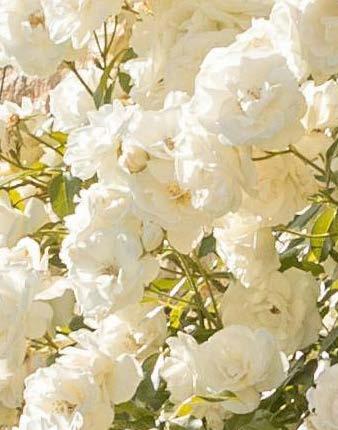
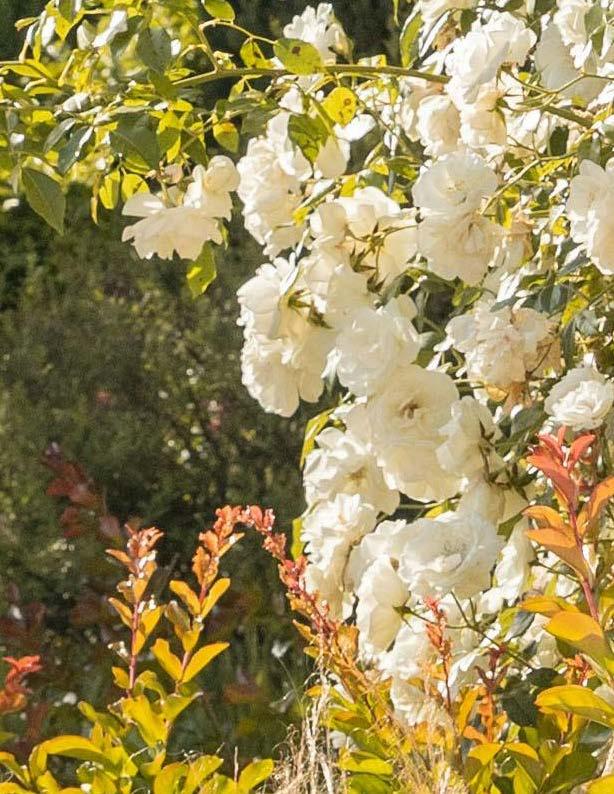
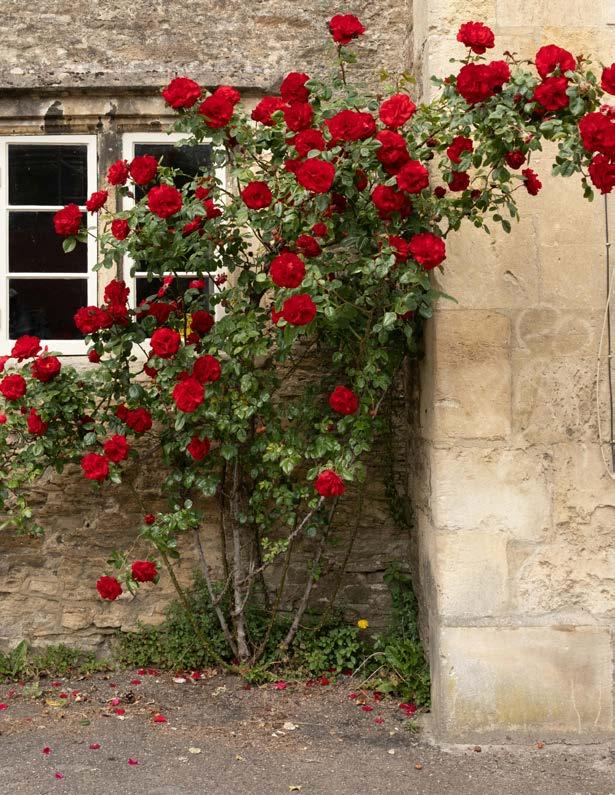
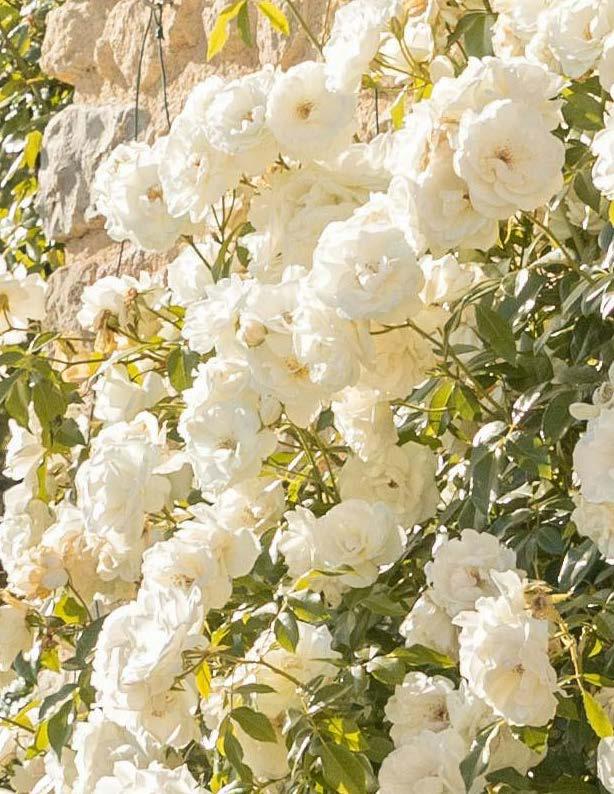
On the cover and here: a climbing white rose left to do exactly as it likes against old stone, in the South of France. The same detail opens this issue’s plant section.
Photography: Ryan Klaus
FIND ALCOVE
Web alcovemagazine.com
Instagram @alcove.magazine
Pinterest @alcovemagazines
08| MEET THE TEAM The gardeners and contributors behind this issue, from London to Connecticut.
10| EDITOR’S LIST Four objects that earn their place before anything is planted in them.
12| GARDEN INSIDER Ten minutes with David Chicoine on what living inside a Provençal garden teaches you about the ones you’ve admired from afar.
14| THE DESIGNER’S EYE Diane Samways on the ground plane — why the floor is the first decision, not the last.
18| DESIGN Bringing the Mediterranean courtyard home: five elements, five traditions, one feeling.
30| THE DESIGNER’S EYE The internet told her to rip out the gravel. Here’s why that was almost entirely wrong.
32| A MOROCCAN COURTYARD IN LONDON Anatolia built a garden she never has to leave — and proof that home has nothing to do with geography.
48| ON A VINE-COVERED PATIO Heather’s husband built a pergola without knowing what one was. It turned out to be exactly right.
60| A GARDEN STILL BECOMING Bev moved thirty-five years of gardening to a porch with no walls, and started again.
72| YOU CAN’T TAKE THE GARDEN Pom crossed an ocean, planted an orchard, and found her way back to her grandmother.
80| PLANT THE FEELING What to plant for the Mediterranean feeling — and why the role a plant plays matters more than its passport.
98| BOOK NOOK The reading list behind this issue.
“What I kept coming back to was how simple it all was”

Iturned fifty in the South of France.
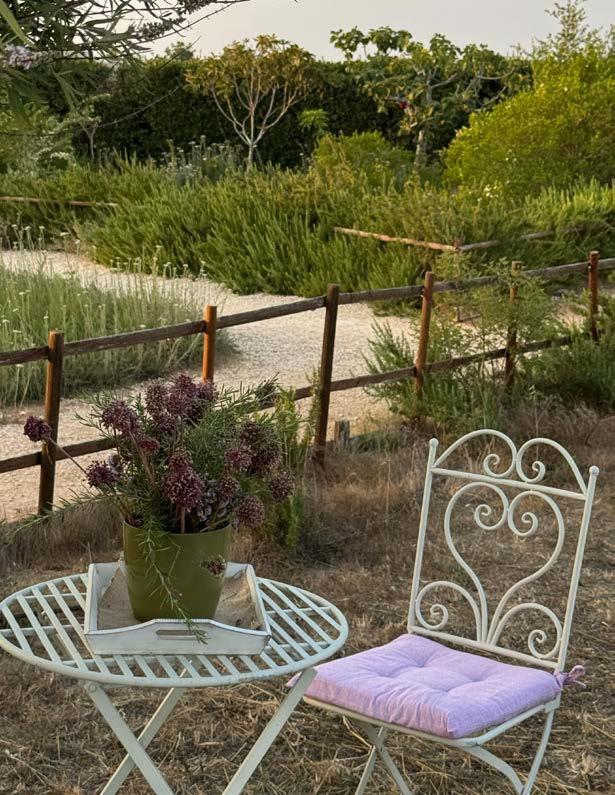
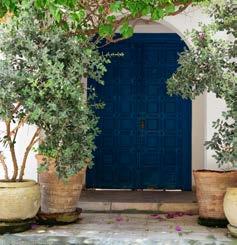
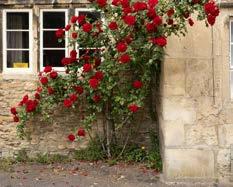
My husband and I had been moving slowly through the region for a few days with no agenda worth following when I started paying attention to the small things. Not the grand gestures or the famous architecture or the landmark squares, but a door painted a vibrant shade of green so deliberate it made me stop, or a single climbing rose against a wall of old stone left to do exactly what it wanted, or a bistro table in a gravel courtyard with two chairs pulled out as if someone had just gone inside for a moment.
I have been a landscape designer for over twelve years, and yet standing in front of a courtyard in Valencia or a walled garden in Provence, I felt the same thing I think you feel when you save a photograph at midnight and can’t entirely explain why. What I kept coming back to was how simple it all was — not simple as in easy, but simple as in intentional. One color chosen and committed to, one plant placed where it would do the most, a hard surface that had been there long enough to belong. Nothing extra, nothing trying too hard.
Beauty can be made anywhere. It doesn’t require a different climate or a different century. It requires a decision.
Working on this issue brought a lot of that trip back to me. The Mediterranean courtyard looks like a style but is actually a set of principles — and once you understand the principles, you can apply them anywhere you happen to garden. Inside you’ll find five traditions decoded for what they actually do and how to bring them home, a conversation with David Chicoine who will tell you plainly that you can get closer than you think, four real gardens from London to Connecticut, and a plant section that finally answers not what to plant but what each plant is actually doing — and what to grow instead when your winters are real.
This issue is for the gardener who has stood in a space like that and felt something shift, and then gone home and spent years trying to understand why.


Founder and Editor-In-Chief
NIXON
Cover Photography RYAN KLAUS
CONTACT US
Alcove Magazine
Email | hello@alcovemagazine.com
Web | www.alcovemagazine.com
Alcove Magazine is a digital garden magazine for the gardener who knows what she wants and is figuring out how to get there. Available at www.alcovemagazine.com.
All rights reserved. No part of this publication may be reproduced, distributed, or transmitted in any form or by any means without prior written permission from the publisher, except for brief quotations in digital and print reviews.
Copyright © 2026 Alcove Magazine
DASHAN
Issue 03 CONTRIBUTORS

ANATOLIA ELAMRADI
@my_dolce_casa
A London-based digital creator whose colourful home and Moroccan-influenced courtyard garden earned her UK Kitchen of the Year in 2022. She gardens the way she decorates — with confidence, colour, and a very clear sense of what home should feel like.

BEV GREENWELL
Illinois Gardener
A gardener with thirty-five years of hard-won plant knowledge and a new garden still becoming what she wants it to be. She is proof that starting over is not the same as starting from scratch.

@provencallife
A foreigner living in Provence since 2019, photographing the beauty and the ordinary of daily life in the south of France. What began as a personal photo journal to stay connected with family has grown to 107,000 followers and a body of work that represents Provence as authentically as possible — from the inside, as a guest.

@dianesamwaysgardendesign
A story-led garden designer based in Somerset and Bath whose work appeared on the cover of Alcove’s debut issue. She designs gardens for the life that’s ready to be lived — and thinks about what goes underfoot before almost anything else.

@heatherhereshegrows
Garden writer and YouTube creator gardening a small suburban lot in the Chicago area. She writes about what she grows and why it matters — not as instruction, but as an ongoing conversation with the living world just outside her door.

POM SHILLINGFORD
@english_garden_grown
An English gardener who spent thirteen years building a traditional garden 3,500 miles from home in northwest Connecticut. She grows seasonal flowers and writes about her gardens — past and present — with the clarity that comes from having built something real and then had to leave it behind.
DIANE SAMWAYS
DAVID CHICOINE
HEATHER VARKALIS
photo by: Clare Foster
by
photo
Diane Samways

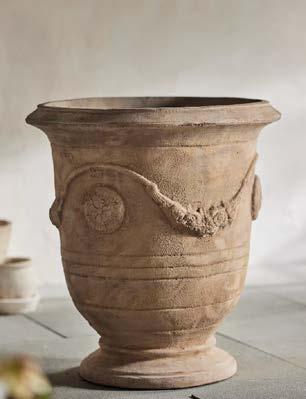
ANDUZE PLANTER
The Anduze urn is one of the oldest forms in the French garden tradition — made in the same style since the 17th century. This one earns its place before anything is planted in it.
—www.shopterrain.com
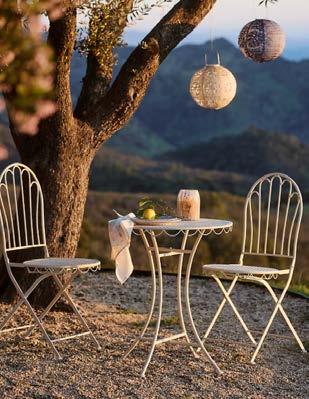
CLASSIC FOLDABLE BISTRO
Two chairs, a small table, gravel underfoot. This is the whole idea, folded flat for winter and back out again in May. The French have been sitting at this exact set for two hundred years.
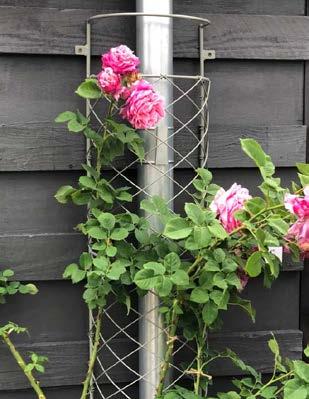
DOWNSPOUT TRELLIS
A climbing rose needs something to climb. This trellis works with the architecture of the house rather than against it — the downspout becomes part of the design rather than something to hide.
—www.agriframes.us
—www.anthropologie.com
ANTIQUE COPPER WATERING CAN

This aged copper watering can is the kind of object that earns its place in a garden long after it stops being useful. Leave it beside a pot, hang it on a wall, set it on a step. It will look better every year.
—www.chezpluie.com
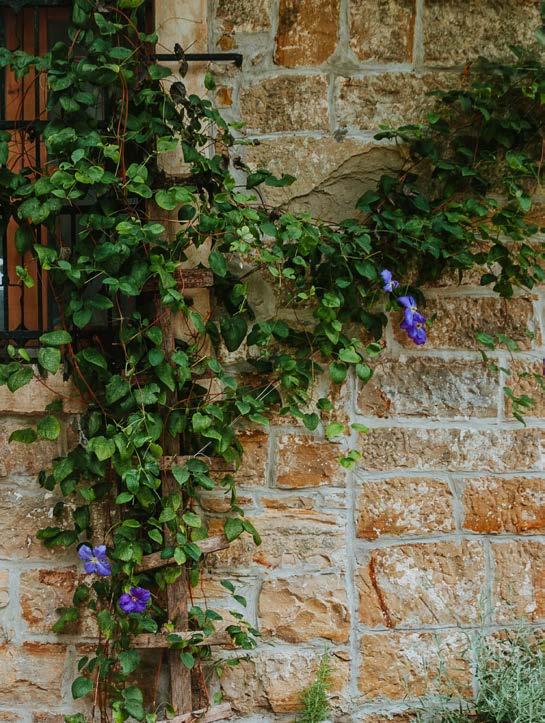
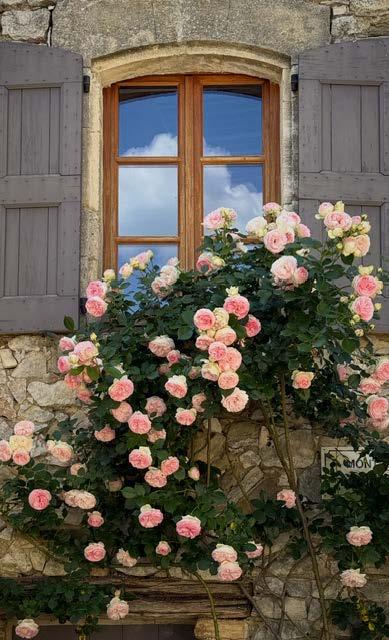

photo by David Chicoine
10 Minutes With A Provençal Transplant
Alcove spent 10 minutes with David Chicoine, creator of @provencallife, to hear what living inside a Mediterranean garden actually teaches us about the gardens we’ve always admired from a distance.
You can get closer than you think
— David Chicoine
What’s the one thing you’d tell someone who wants to bring this feeling home?
Provence gardens are shaped by a sunny, dry climate and the nearness of the Mediterranean. To bring the feeling home, stay close to what grows here naturally — olive, lavender, cypress, oleander. Add weathered pottery, Anduze urns, a natural palette, unfussy furnishings. And a climbing rose on a rustic wrought iron trellis.
What do you notice now that you didn’t notice before you moved?
I expected the gardens here to be more formal, it being France. But the South is informal, and the lifestyle reflects the heat: afternoon naps in the shade, a dip in the pool or the sea. The gardens are the same, free-flowing and relaxed. They follow the rhythm of the day rather than imposing one.
Was there anything that surprised you about the way people here relate to their outdoor spaces?
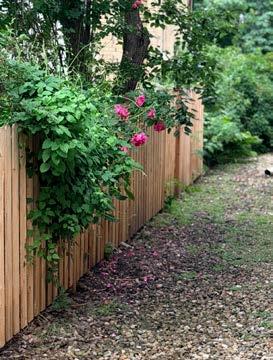
The French love for gardens and flowers charmed me from the start. Even a windowsill will have potted plants — there is always an effort to bring beauty to the threshold. And the climbing roses here were beyond what I expected. Often planted beside a door or window so they encircle it, add whimsy. The rose color frequently chosen to complement the shutters or the door. So pretty.
Is there something about Provençal gardens that can’t be translated — something that only comes with time or place?
There is something special about Provence and its ancient history. The name itself derives from its time as a province of Rome, so there are ruins, and everything seems imbued with patina and experience. That can’t be recreated. But the climate is not so different from parts of the world where gardeners are already working. I have seen California gardens that remind me of Provence. The style is worth aiming for. You can get closer than you think. ■
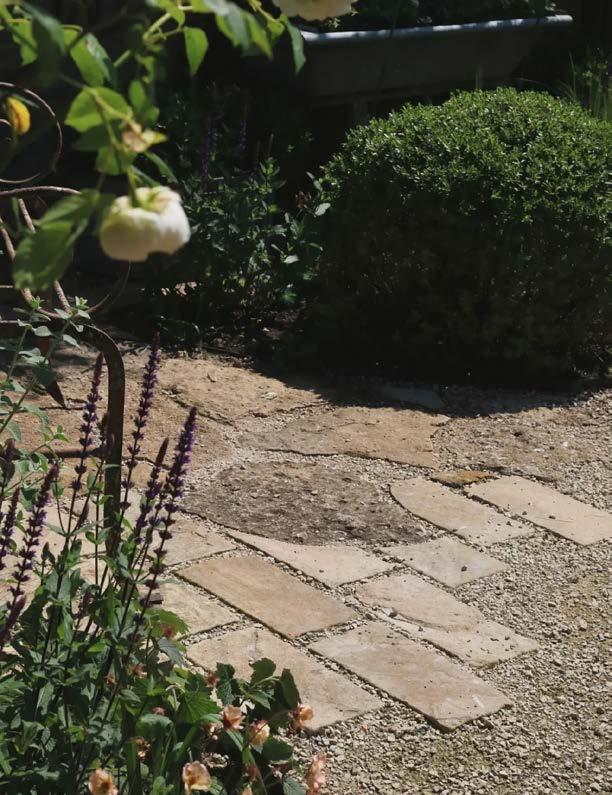
photo by DIANE SAMWAYS
THE DESIGNER’S EYE
10 Minutes With A Designer
THE DESIGNER
Diane Samways
@DIANESAMWAYSGARDENDESIGN
Diane Samways is a landscape designer whose work appeared on the cover of Alcove’s debut issue. Her gardens are grounded in restraint, long-term thinking, and the belief that the most beautiful outdoor spaces begin with honest choices about what goes underfoot.
IN HER WORDS
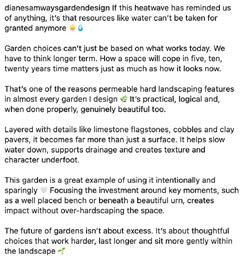
“The future of gardens isn’t about excess. It’s about thoughtful choices that work harder, last longer and sit more gently within the landscape.”
— DIANE SAMWAYS
TAKE
The floor that thinks ahead
Diane noticed something during this summer’s heat. The gardens holding up best weren’t the most elaborately planted. They were the ones where the ground plane had been designed to work harder than it looks.
Every garden has a ground plane. Most of us don’t think about it until something goes wrong — water pooling after a storm, gravel washing into the beds, a paved surface cracking after the third hard winter. By then the decisions have already been made. This piece is about what to do next.
Diane thinks about the ground plane before almost anything else. In her practice, permeable hard landscaping features in almost every garden she designs — not as a sustainability checkbox but because it is, as she puts it, practical, logical, and when done properly, genuinely beautiful.
What she’s describing is the same system that built the Mediterranean courtyard floors you’ve been saving to your phone and wondering how to recreate. Gravel to slow water down. Clay pavers to channel it. Limestone flagstones placed at a transitional moment — under a beautiful urn
DIANE’S
ORIGINAL POST, May 28
THE TRANSLATION FOR YOUR GARDEN
In a four-season climate, the ground plane decisions that feel minor in summer reveal themselves in spring — when the ground thaws, the rains arrive, and every surface shows whether it was chosen with the next decade in mind. The same logic that built those Provençal courtyards applies here.
or beside a well-positioned bench. Not a uniform surface but a layered one, where each material is doing a specific job and the whole reads as texture, character, and intention under your foot. Diane’s point about focusing the investment around key moments is the most useful thing she says. You don’t need to repave your entire garden to apply this principle. You need to identify the two or three places where you actually want to be — and give those places a floor that earns its place there.
THREE WAYS TO START
THE SEATING CIRCLE
Replace the patch of struggling grass beneath your patio furniture with a gravel circle, six inches deep with a proper base and edged with steel or stone. Place your table and chairs on it. Notice what changes about how the space feels — and how it drains after the next summer storm. This is the most accessible entry point and the one most likely to make you want to go further.
THE TRANSITIONAL PAVER
Lay three or four larger flagstone pieces at the threshold between a stone pathway and a gravel lounging area. Diane uses these to signal a change in space — your eye reads it as one room ending and another beginning.
THE FOCAL POINT FLOOR
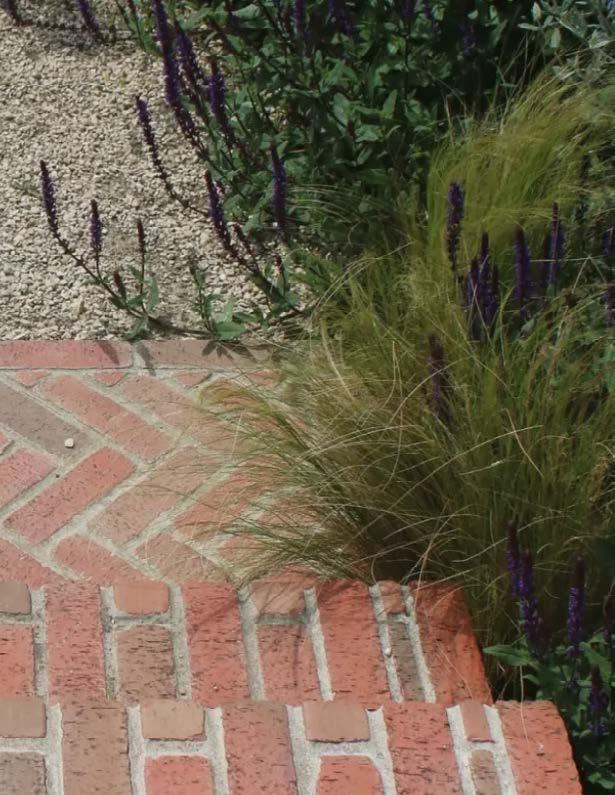
Wherever you place a significant container, urn, or garden ornament, give it a base of clay pavers set in a simple pattern — running bond or herringbone. It elevates the object. It creates a moment of deliberate surface in an otherwise informal ground plane. And it tells the eye: something worth seeing is here. This is the move Diane means when she talks about focusing the investment. Small area, maximum impact.
The gardens that last aren’t the ones that looked most impressive on install day. They’re the ones where someone thought about what would happen underfoot in five years, ten years, twenty — and made a choice accordingly. ■
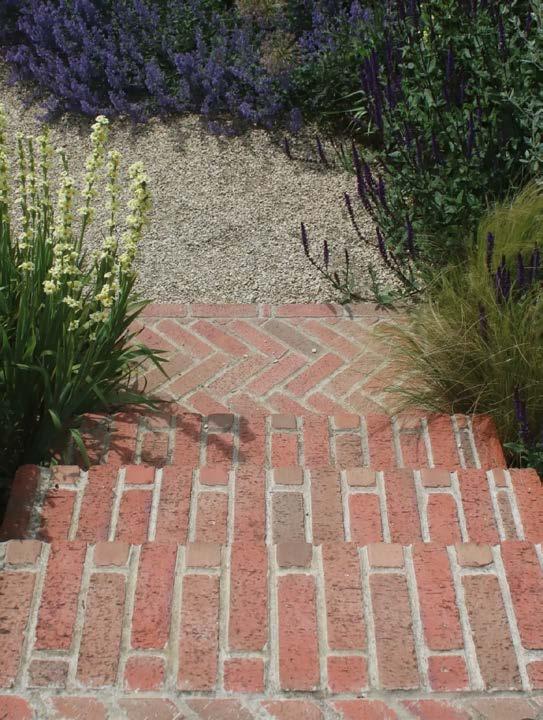
photo by DIANE SAMWAYS
DESIGN
Bringing the Mediterranean Courtyard Home
Five elements, five traditions, one feeling
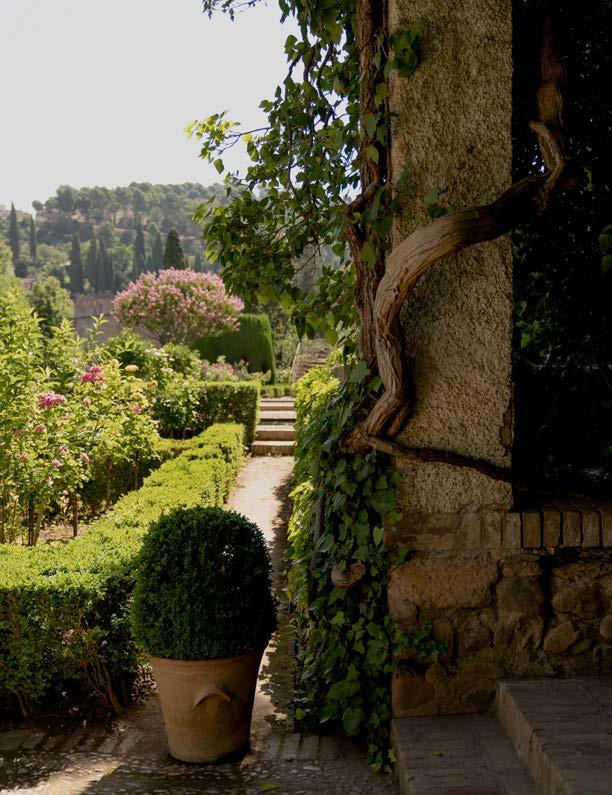
Walk through enough Mediterranean courtyards and something begins to stand out — a pattern underneath the regional differences, the tile choices, the plant names and the quality of the light. The Provençal garden, the Córdoba patio and the Moroccan riad look nothing alike on the surface, but they are all doing the same five things.
Every one of them encloses. Not with a suggestion of a boundary but with a wall, a hedge, a structure that says: this space is separate from everything outside it. The enclosure is not incidental. It is the first decision, and everything else follows from it.
Every one of them commits to a hard surface under your foot. Gravel, stone, tile, brick — something that does not grow or require tending, and does not apologize for being there. The ground plane is chosen before the plants are selected, and it sets the tone for all of them.
Every one of them has a focal point. One thing the eye moves toward — a fountain, an urn, a
single well-placed tree. Not several things. One. The restraint is deliberate and it is what keeps the space from becoming a collection.
Every one of them reaches upward. A cypress, a climbing rose, a pergola draped in vine — something that gives the space a vertical dimension and draws the eye above the horizontal plane. Without it, a courtyard is a floor. With it, it becomes a room.
And every one of them is fragrant. Lavender, jasmine, rosemary, citrus blossom — something that arrives before you see it and stays after you leave. Fragrance is the element most often forgotten and the one most deeply remembered.
Five elements. The traditions that follow each express them differently — the palette changes, the materials shift, the mood moves from the spare restraint of Provence to the saturated intensity of Andalusia. But the structure beneath each one is the same. Learn these five and you will be able to read any Mediterranean courtyard you encounter — and begin to build your own.
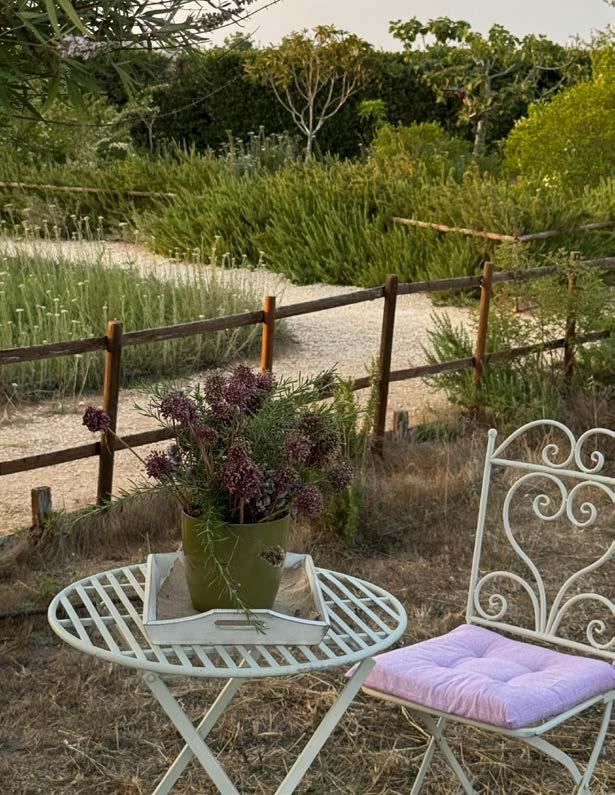

01 FRENCH PROVENCAL
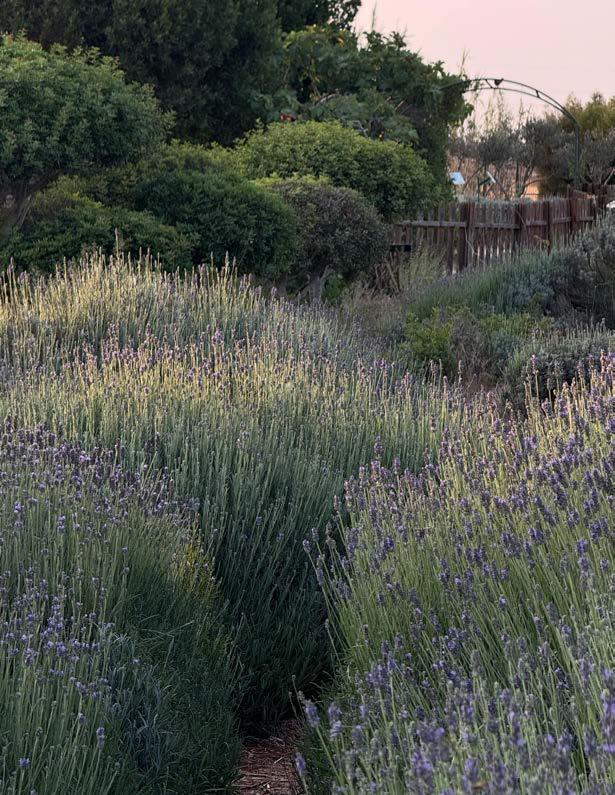
The feeling comes from ease, not formality. Most people expect a French garden to be structured — clipped, symmetrical, controlled. Provence is something else entirely. The heat shapes everything here. The garden follows the rhythm of the day rather than imposing one: silver foliage moving in the afternoon breeze, gravel warm underfoot, lavender gone soft at the edges, a table set in the shade and left there.
The palette is narrow — stone, silver-grey, dried grass, the occasional burst of rose or poppy that seeds itself without asking. The structure is loose but not careless. Restraint is still the discipline, but it wears it lightly.
BRING IT HOME: Swap lawn for gravel. Choose silver-leaved plants. Let the edges soften.
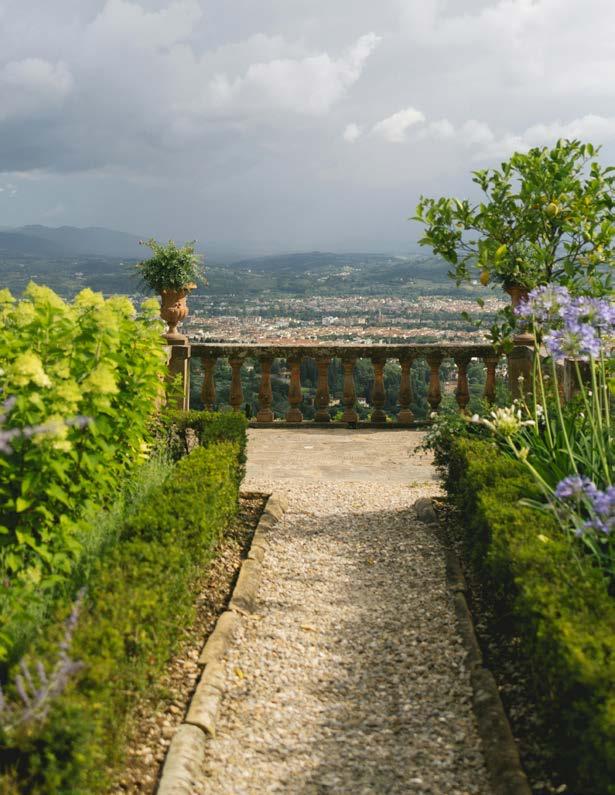

02 ITALIAN TERRACE
The feeling comes from elevation and the view beyond. The Italian terrace is designed to be looked from — the balustrade, the stone urn, the clipped evergreen are all framing devices for the landscape that lies beyond them. Emotion lives in the borrowed view, not in the planting.
The structure is architectural before it is horticultural: stone steps, balustrade, topiary that marks the boundary between cultivated space and open sky. The palette is green-on-green, cool and formal. The vista does the rest.
BRING IT HOME: Frame your longest sightline. Add one elevated focal point. Let the view finish the composition.
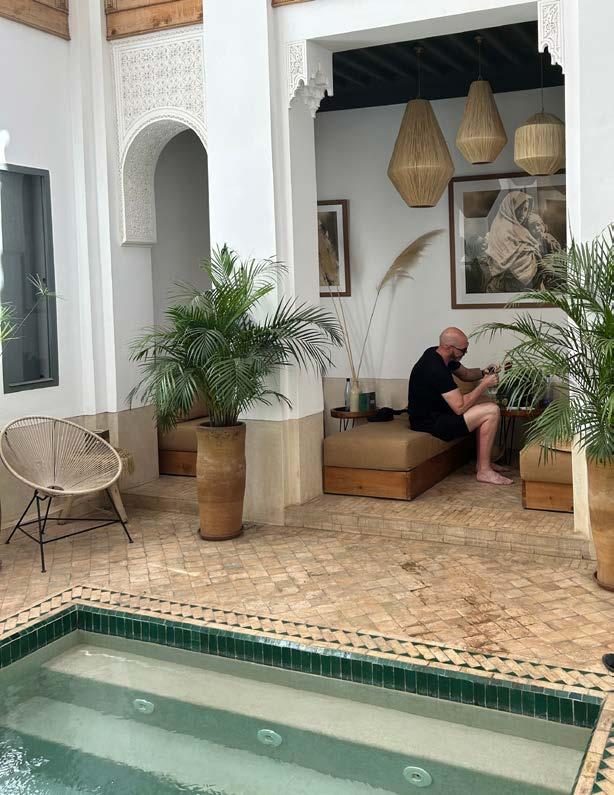

03 MOROCCAN RIAD
The word riad means garden — not a garden in the European sense of something cultivated outside, but a paradise garden turned inward, concentrated at the center of the home while the street is left behind entirely.
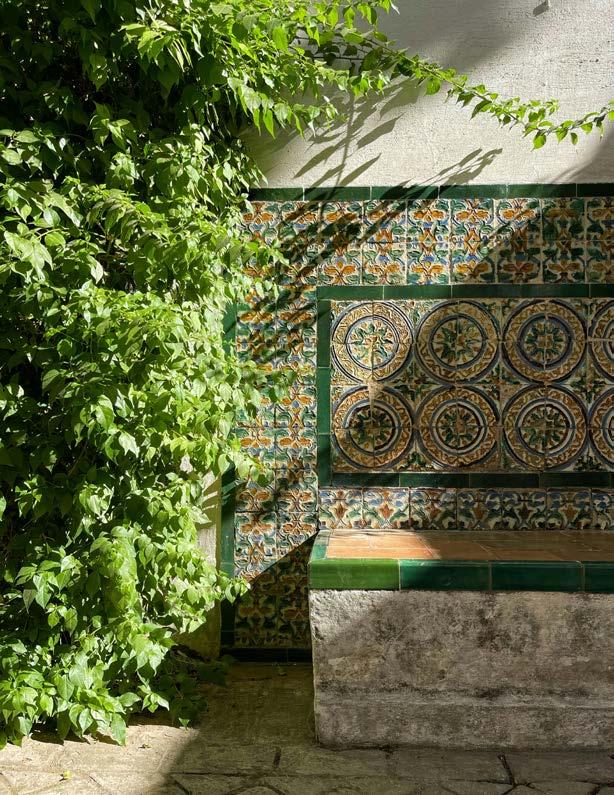
The riad presents a plain face to the world. Nothing outside signals what lies within. Step through the threshold and the logic reverses: symmetry, zellige tilework, citrus in terracotta, a central fountain whose sound reaches every room before you see it. The tiles carry the palette — deep geometric patterns in cobalt, green, white and terracotta — and the plants punctuate it. Color here is architectural, not horticultural, so the tiles do the work that flowers do elsewhere.
Enclosure here is total and intentional. The outside world is not borrowed — it is excluded. What exists inside the walls is entirely its own world.
BRING IT HOME: Create a threshold. Define the center with water or geometry. Let the pattern do the work before you add a single plant.
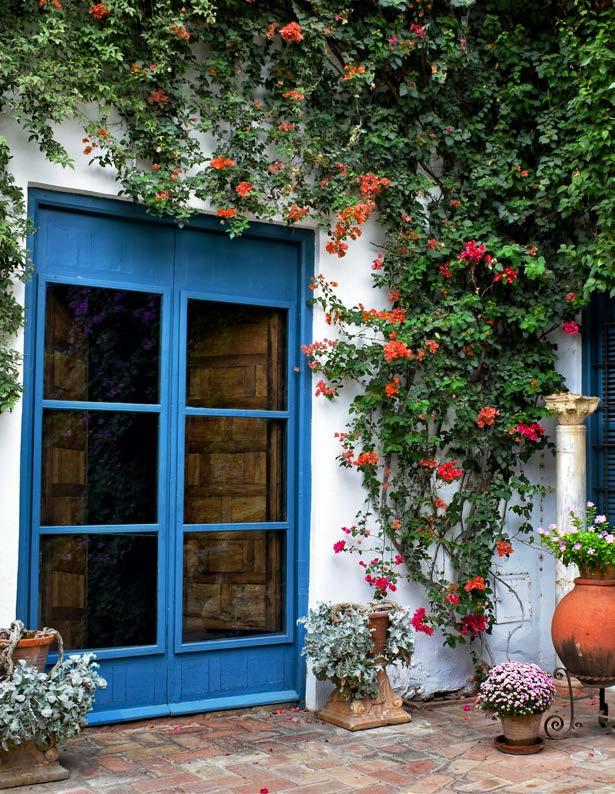
04
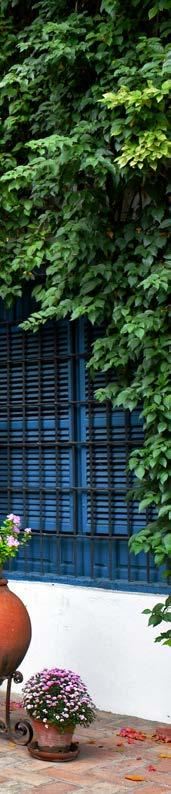
SPANISH/ANDALUSIAN
The Andalusian patio grew from the same Moorish roots as the riad — inward-facing, enclosed, centered on water. But where the riad turns inward for privacy and restraint, the Andalusian patio turned outward for celebration. In Córdoba, these courtyards are thrown open to neighbors and strangers every spring. The enclosure is the same. The instinct is the opposite.
The feeling comes from intensity within that enclosure. The Córdoba tradition takes a small space and saturates it — geraniums massed in pots, walls washed white or terracotta, vivid tile, and often a fountain at the center, always the sound of water somewhere nearby. Sound is part of the atmosphere. The water is not decorative; it is functional presence.
Nothing here is understated. Color is pushed to its limit and then repeated. The discipline is not restraint — it is commitment. Every surface, every pot, every wall is doing deliberate work.
BRING IT HOME: Choose one dominant color and repeat it in mass. Add moving water, however small. Fill the pots completely.
05 GREEK ISLAND
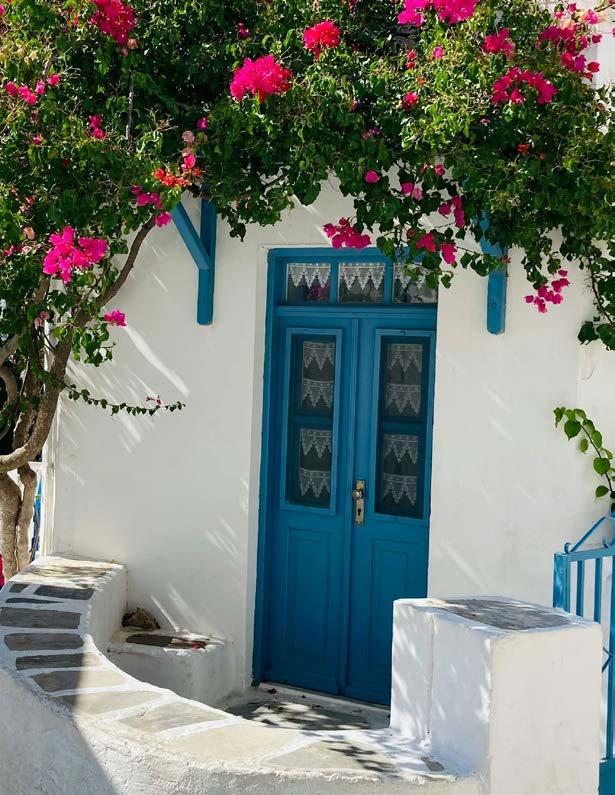
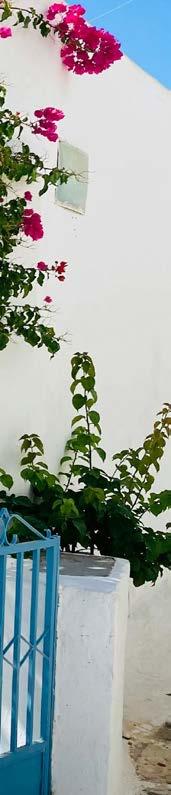
The feeling comes from subtraction. The Greek courtyard is the least planted of the Mediterranean traditions — the architecture carries everything. Whitewashed walls, a blue door or gate, one bougainvillea or trailing vine, terracotta underfoot. The palette is three colors. The intensity of the light does what a dozen plants could not.
Nothing competes. There is no layering, no abundance, no complexity. The power is in the contrast — white against blue, shadow against bleached stone, one vivid climbing plant against a wall that asks for nothing else.
BRING IT HOME: Start with the wall color. Add one climbing plant. Stop there.
THE DESIGNER’S EYE
10 Minutes With a Designer
THE SPACE IN QUESTION
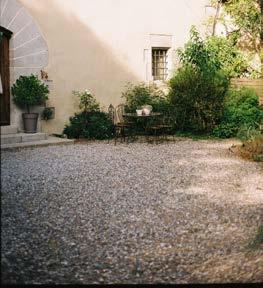
Posted to a popular gardening forum
“We really like the Mediterranean style — lighter stones, olive trees, fig trees. We’re rather minimalist. It shouldn’t be too cluttered. What can we make of this courtyard?”
The internet’s verdict
Nearly every response said the same thing: the gravel has to go. Replace it with lawn. Add more beds. The space was called a concrete wasteland, a prison yard, a gravel desert. The advice was unanimous and, in my opinion, almost entirely wrong.
“Get rid of the gravel.” — approximately everyone
DASHAN’S TAKE
The gravel is the point
When a space gets misread, the advice that follows is almost always about what to add. The better question is always: what is this space already doing well?
A homeowner posted photographs of her enclosed courtyard to a popular gardening forum. She wanted a Mediterranean feeling — lighter stones, an olive tree, somewhere to sit with her husband. She was minimalist by nature. She didn’t want clutter. She wanted to know what to do with the four corner beds she was considering reducing to one.
The responses were swift and nearly unanimous. The gravel was the problem. Get rid of it. Put in lawn, or tiles, or more planting. One commenter called it a concrete wasteland. Another compared it to a prison exercise yard.
MY READ
She already has the most important element of a Mediterranean courtyard. She just doesn’t know it yet.
WHAT I’D ACTUALLY DO
Gravel is the ground plane of most Mediterranean courtyard. It manages heat, it drains well, and it ages into something better than it started. The gardens in Provence, Catalonia, and the Balearic Islands that you’ve that you’ve saved to your phone, they are almost all built on gravel. The people telling this woman to rip hers out are reacting to bad gravel installations they’ve seen elsewhere. This is not a gravel problem, this is an everything-else problem. What this courtyard is missing has nothing to do with its
floor. It’s missing three things that turn any space into a room.
GIVE IT A CEILING
A simple pergola — timber or minimal steel — with one climbing vine beginning to find its way across it. A grape vine is the most Mediterranean reading and gives you shade by midsummer. A climbing rose works if you want fragrance. The overhead plane will change this space more than any other single move. Without it, you’re sitting on a surface. With it, you’re sitting in a room.
SOFTEN THE WALLS
The walls are already there — that’s a gift most gardens don’t have. Train one climbing vine against the longest wall, loosely, not clipped. Star jasmine if your winters are mild. Climbing hydrangea if they’re not. What you’re after is the feeling that the wall has been inhabited for
years, not decorated last Tuesday.
ONE REASON TO STAY AFTER DARK
Two low chairs, a small table, a fire pit placed slightly off-center. Not pushed against a wall — in the space, giving the space a reason to exist past seven o’clock. The fire pit is the evening anchor. It’s what makes a courtyard a place you return to, not just a surface you walk through.
She didn’t need to start over. She needed someone to read what she already had.
MOROCCAN COURTYARD IN LONDON
In a garden that has grown alongside thirty years of living, Anatolia has built something that cannot be designed from scratch — a space where two worlds become one, and where the feeling of home has nothing to do with geography
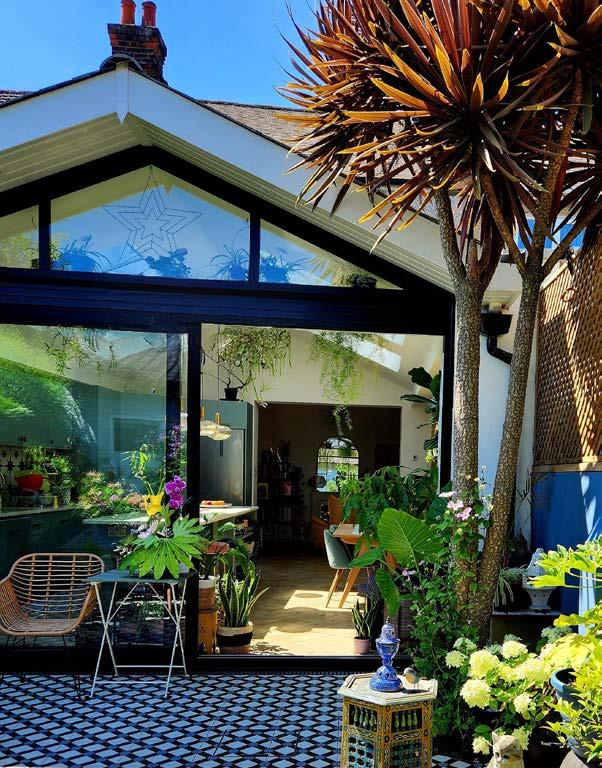
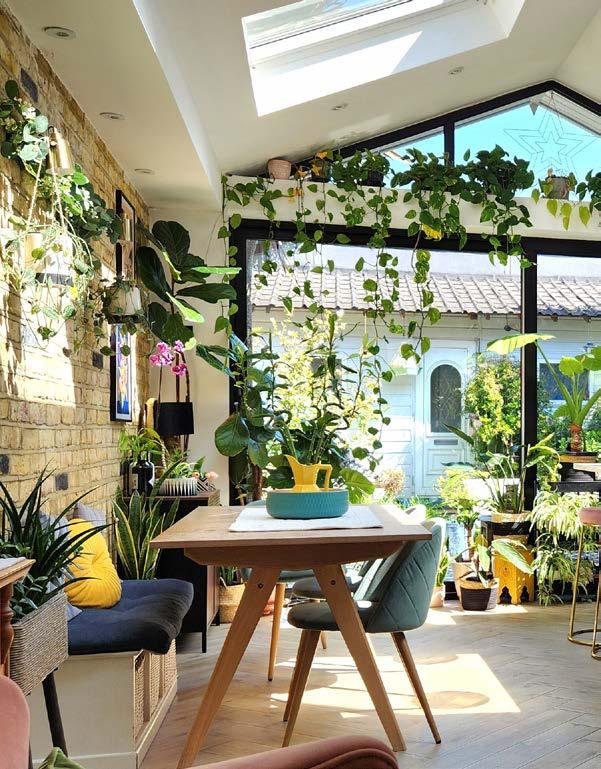
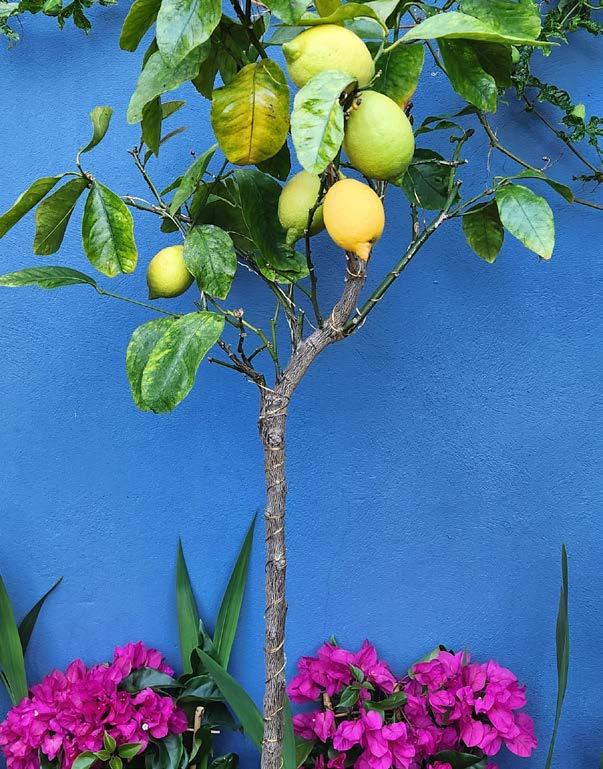
She is sitting at the dining table, looking through the glass. Outside, birds are gathered at the feeder. The cordyline holds its shape against the blue wall. The lemon tree in its pot catches the morning light. She has not stepped outside yet — it is London, and the morning may not invite it — but the garden is already with her, already part of the day.
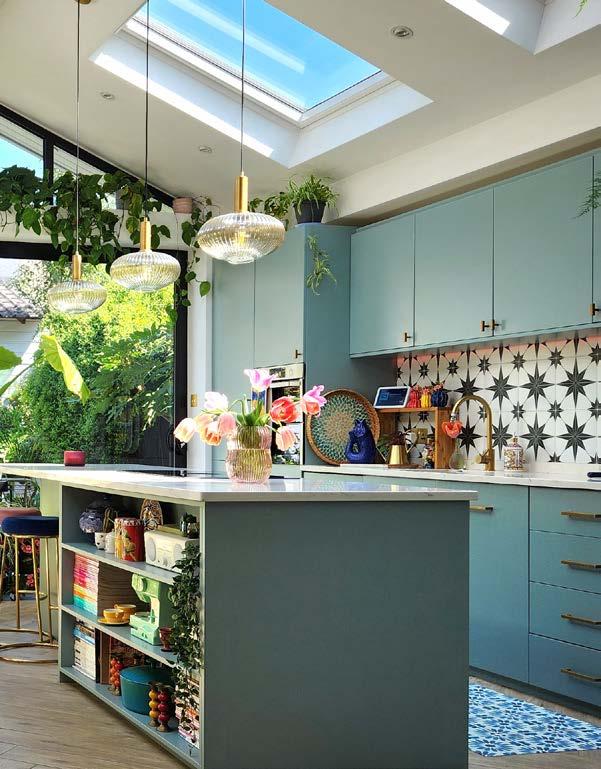
This is what Anatolia designed for. Not a garden you visit. A garden you live with. She and her husband have lived in their terraced house for nearly thirty years, and the garden has changed alongside them the entire time. But the most significant change came five years ago, when they undertook a substantial renovation — replacing an older kitchen extension with a larger one that would better suit the way they wanted to live. The project came
at a cost. To gain interior space, they surrendered a significant portion of the garden.
What remained was small. A simple, intimate, enclosed square.
“When the extension was completed, it felt quite strange at first,” Anatolia says. “The garden had become smaller and I had to get used to the change in scale.” She didn’t have a clear plan immediately. She knew she wanted the space to feel warm and full of life rather than minimal or overly structured, but the exact direction came more gradually. “Over time, I started to focus more on how I wanted to use the space day to day and how it felt from inside the kitchen looking out. That’s really when it began to take shape.”
The very first thing she added was the tile.
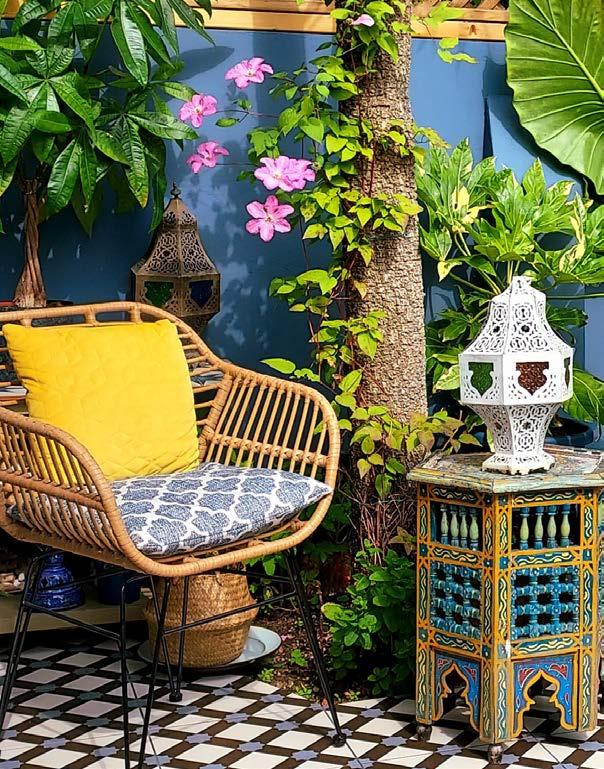
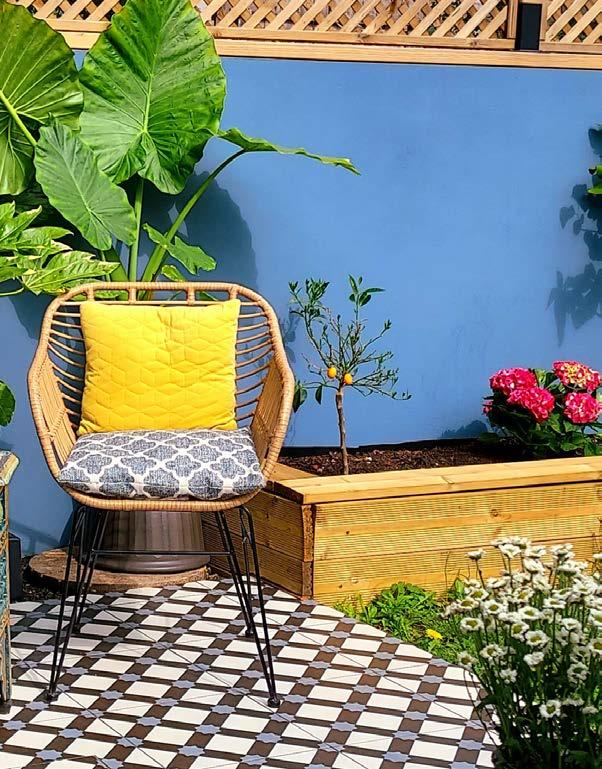
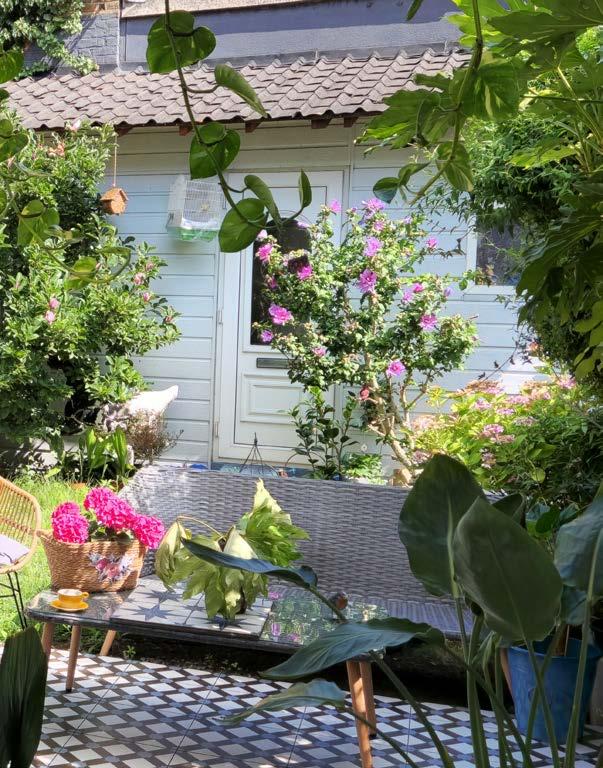
“I always knew I wanted something with a Mediterranean feel,” she says. Black and white geometric tile with a small blue star detail — Moroccan in its geometry, confident in its scale. It runs the full width of the patio and it set the tone for everything that followed. From the ground up, the garden had a point of view.
A DIFFERENT MEDITERRANEAN
For most gardeners, the word Mediterranean immediately conjures Provence — lavender, gravel, clipped boxwood, pale stone warmed by the sun. Anatolia’s garden belongs to a different branch of that family tree entirely.
Its influences are Moorish and Moroccan, filtered through the Andalusian courtyard tradition of southern Spain. Think Córdoba rather than Provence. Here, enclosure matters
more than openness. Color does the work that planting does elsewhere. Tile, plaster, and carefully chosen objects create atmosphere long before a single flower blooms.
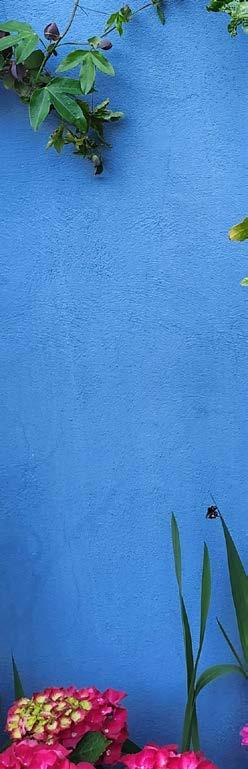
The blue wall is the clearest expression of this. It runs the full length of one side of the garden — a deep, saturated blue that Anatolia describes as inspired by the sea, by Mediterranean life, and by the Jardin Majorelle in Marrakech. “It became a really joyful backdrop,” she says, “giving a strong contrast to the colourful tulips in spring and gladioli in summer, but also feeling uplifting even in the winter light.” Against it, every leaf appears sharper and every pot warmer.
This matters for anyone who has looked at a Mediterranean garden and thought the style

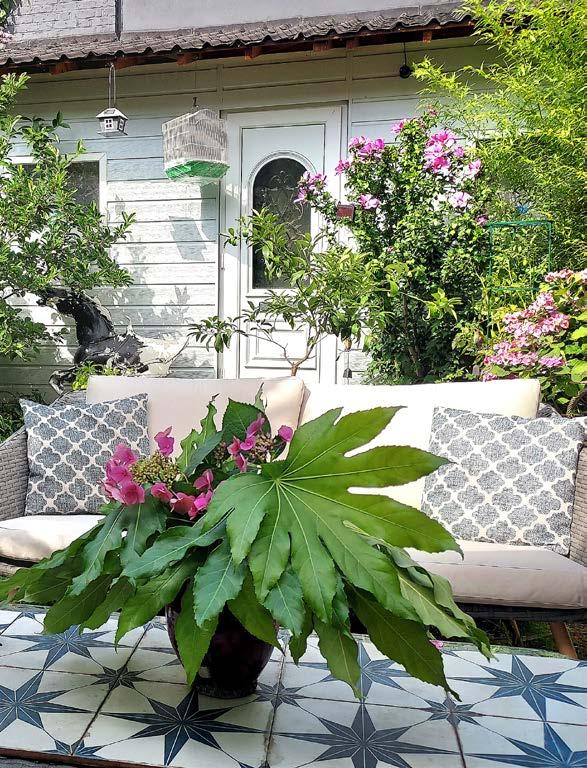
required a different climate or a different scale. It does not. What it requires is a commitment to surface, color, and enclosure — an architectural decision made before any plants are chosen. The investment is structural before it is horticultural. And in a cold climate, where plants come and go with the season, that architecture is what holds the garden together through the months when nothing is blooming.
Anatolia’s garden earns its place in February.
That is the real measure of a garden designed to be lived with rather than merely admired.
THE LAYERS THAT CANNOT BE RECREATED
There is something else at work in this garden that no design guide can fully account for: time.
These are not things that can be sourced or specified. They are the accumulated weight of a life lived in one place, and they give the garden a quality that no amount of good design can manufacture: the sense that it belongs to someone, completely and irreversibly.
“a friend said it felt like being on holiday — but for me that holiday feeling is really about feeling at home”
At the far end of the courtyard stands a small cottage-style shed that Anatolia designed and her brother built twelve years ago. Along the borders grow a magnolia she has tended for over sixteen years and a hibiscus that has been there for twenty-five. Near the patio, a tall cordyline stands exactly where it always has — because during the renovation, when the foundations came close to its roots, Anatolia fought to keep it. “I was so relieved when the builders managed to preserve it,” she says.
“It’s those layers of memory, colour, and time that make the garden feel like home to me,” Anatolia says. Her husband is from Morocco. She is from Sicily. The blue wall, the geometric tile, the Moroccan lantern on the ornate table — these are not decorative choices made from a moodboard. They are a reconstruction of something familiar, a way of bringing two versions of home into a square of London ground.
“A friend said it felt like being on holiday,” she says. “But for me that holiday feeling is really about feeling at home.”
DESIGNED FOR DAILY LIFE
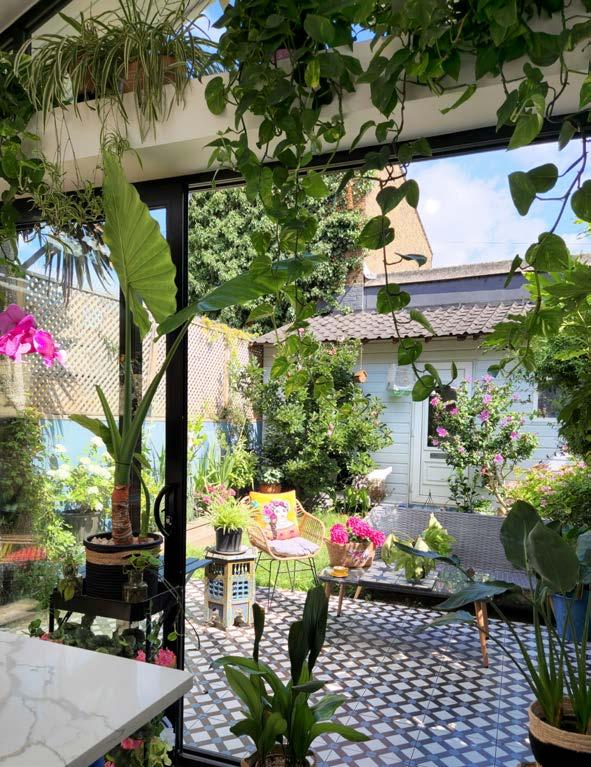
A full wall of glass links the kitchen and courtyard. Even on London’s greyest mornings, the garden is present — light moving across the tile, the cordyline shifting in the breeze, the birds at the feeder. Before anyone steps outside,
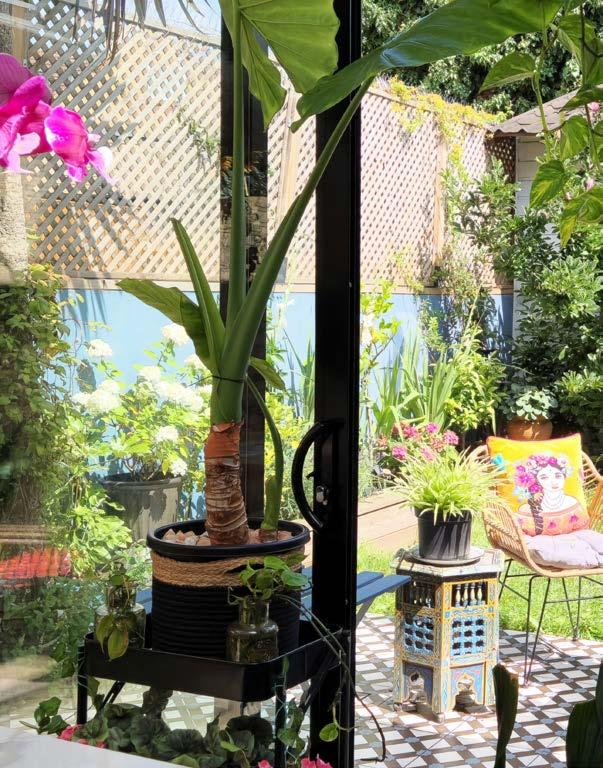
the garden has already entered their day. “I wanted the garden to feel like part of the home, even when you’re inside,” Anatolia says. “Even when I’m not outside, the garden is still part of the atmosphere, the light, and the feeling of the space.”
From May through October the courtyard becomes the household’s favorite room. Morning coffee first, then quick lunches, then friends gathered long into the evening. Given the choice, she says, they would rather sit outside than in.
But the garden earns its place even when that choice isn’t available. That may be the most valuable lesson it offers — not just for London gardeners, but for anyone gardening in a climate that allows outdoor living for only part of the year. Design the garden to be seen before you design it to be used. Make it a view worth returning to on the days you cannot cross the threshold.
The borders contain seasonal planting — tulips, gladioli, lavender — that changes through the year and supplies the house with cut flowers. The lemon tree in its pot is as much sculptural as it is horticultural. The seating area at the heart of the patio is where life actually happens: “It just feels like the heart of the garden for me,” Anatolia says. “The mornings are probably my favourite time, having coffee there when everything feels quiet and the light is soft. It’s a very simple moment, but it feels like mine.”
WHERE SHE RETURNS
Other magazines have come to ask about the kitchen — the extension, the glass roof, the renovation. Nobody, until now, had thought to ask about the
garden.
She seemed surprised by that. She shouldn’t be.
This is the garden that held its ground when the builders arrived. That survived in smaller form and became, in that smaller form, more itself. That carries a brother’s handiwork, a quarter century of hibiscus blooms, a magnolia that has outlasted several versions of this family’s life here. That looks, from the kitchen table on a February morning, like somewhere worth returning to.
Not occasionally. Every day.
That is what Anatolia built, in thirty years, in a square of London ground: a garden so woven into the rhythm of the house that returning to it requires no decision at all. You simply look up, through the glass, and there it is.
She brought the Mediterranean home. It took thirty years to arrive. And it was worth every one of them. ■
ABOUT ANATOLIA: Anatolia Elamradi
is a Sicilian-born gardener living in London, where she has spent thirty years turning a small terraced courtyard into something that feels entirely like home — because it is. Find her at @my_dolce_casa.
ON A VINE COVERED PATIO
Her husband built it without knowing what a pergola was. It turned out to be exactly right.

WHERE IT BEGAN
Heather grew up in Harvey, Illinois, in a family that didn’t have much. A garden wasn’t part of their life in any practical sense. But her mother planted a clematis.
One plant. A Jackmanii, with deep purple flowers, positioned exactly where her mother could see it from the kitchen window while she stood at the sink doing dishes. Morning sun, roots kept cool by a few low junipers nearby. Placed not randomly but with intention — not for the garden, but for herself. A small, deliberate act of putting beauty into the middle of an ordinary day.
It’s such a specific thing to do. To know that you will stand at that window every day, and to decide that what you see from it should be worth seeing.
This is something her mother understood, in her own way, at her own kitchen window. That a garden, even a view of one plant, gives you something to return to when the day is long and the sink is full and what you really need is just one thing that is beautiful, alive and entirely yours.
Heather has been making that same choice ever since.
WHAT THE GARDEN BECAME
When Heather’s younger daughter became ill, the garden became something more urgent than it had been.
She began growing food deliberately, not as a hobby but as an act of care. What she could put into her daughter’s body mattered to her in a new way, and the garden became the source of it. She planted, harvested, brought what she grew into the kitchen. It was one of the few things she could actually do.
“As I planted, fertilized and harvested,” she says, “I felt my body relax, the anxiety subside and my lungs fill fully.”
The garden gave her somewhere to put her hands when everything else felt impossible. It gave her a place to be useful in the middle of a season when being useful was the only thing that helped.
WHAT SHE PASSED ON
Her daughters are twenty-four and twentythree now. They still come in to announce when something interesting has turned up in the garden like a hummingbird or a giant bumblebee they want her to see.
Years ago, their kindergarten teacher asked at a parent-teacher conference whether the girls had attended a Montessori preschool. Heather asked why. The teacher said their familiarity with the birds and insects flying around during recess was unlike anything she usually saw in children that age. Their curiosity and the fact that they had no fear of any of it.
“The garden gave them curiosity,” Heather says.
“It allowed them to wonder. I believe it fostered in them the realization that their actions, good or bad, always affect others. And not just people. Every living thing.”
She didn’t set out to teach them that. It came from growing up in a home where the garden was part of daily life, the way her mother’s clematis had been part of hers. These things pass through families not as lessons but as habits, as a particular way of paying attention to the living world just outside the door.
TWO KINDS OF SPACE
Out in the garden beds, among the vegetables and the perennials and everything she has planted and tended, Heather sees what needs doing. She can’t help it. Her eye moves and her hands follow.
The patio though is different.
Her husband built the pergola for her, which
be outside, with a ceiling but no walls, open to the garden without being absorbed by it.
Under the pergola, Heather can settle into a chair and be still. The garden is still out there, still full of things that need doing, and she lets it stay out there. The work she does in the beds every day is one kind of presence in her garden. This is another kind, equally necessary, and for a long time harder to give herself permission to have.
WHY A CEILING CHANGED EVERYTHING
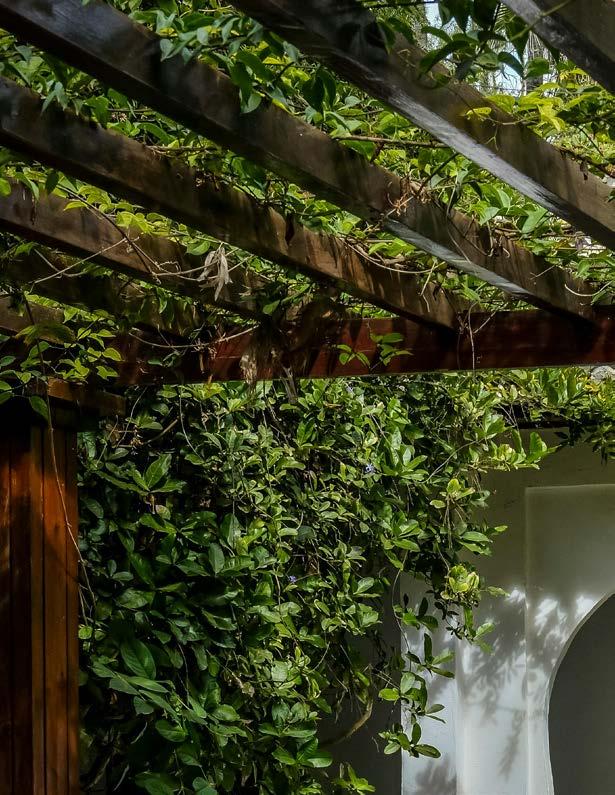
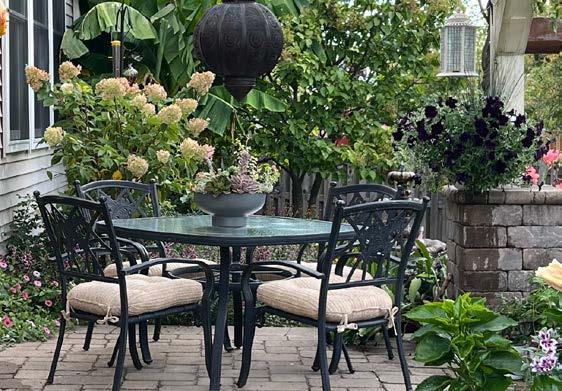
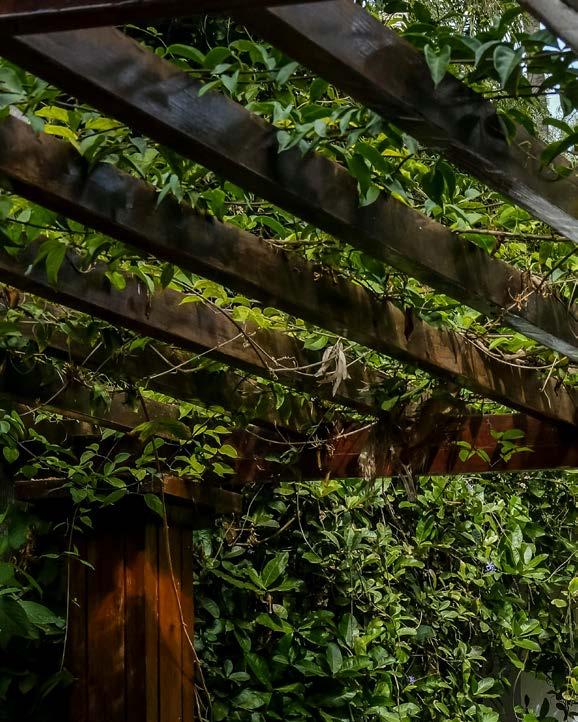
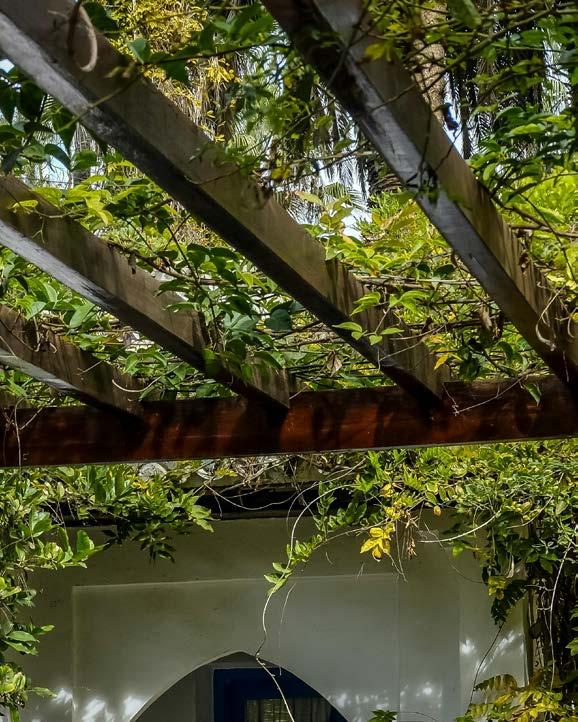
The pergola does what a courtyard wall does in Provence or a vinecovered ceiling does in Tuscany — it gives the space a boundary, and boundaries are what make outdoor rooms feel like rooms rather than leftover space attached to the back of a house.
“But here under the pergola, as the heat passes and the light shifts and Sam Cooke plays softly, she will leave it for tomorrow”
is notable because he had never built one before and wasn’t entirely sure what one was. She described what she wanted. He went to his drafting table and figured it out. What he came back with was beautiful.
The patio gets a southern exposure that makes it unbearable during the day, which is why evenings are when the space comes alive. The heat passes, the light shifts, and someone pulls a chair out. And the space becomes what it was always meant to be — a room that happens to
Without the pergola, the patio is just a surface.
Exposed, belonging to no particular moment of the day, offering nowhere specific to be. With it, the space becomes somewhere. You’re sheltered without being enclosed. You’re in the garden without being in the middle of all its demands. The ceiling changes the quality of being there, in a way that is difficult to explain until you’ve felt it and then immediately obvious once you have.
Heather’s husband built this in suburban Chicago without a vocabulary for any of it. He just built what she described, and it worked.
The principle it demonstrates is the same one at work in every outdoor space that pulls people back to it every evening without them quite knowing why.
THE TRADITION CONTINUES
Sam Cooke plays softly. Her husband sits beside her. When their daughters visit, they share the stories of their day.
“I can think of no better way to spend time,” Heather says.
Her mother stood at a kitchen window and chose to put something worth seeing just outside it. Heather took that instinct and built a garden around it, then a patio, then a pergola, then a place her family returns to every evening without needing a reason. Her daughters grew up knowing that the living world just outside the door was worth paying attention to. They will take that somewhere, the same way Heather took her mother’s clematis somewhere.
This is what gardens do when they become part of daily life. They don’t stay in one generation.
IF YOU’VE BEEN THINKING ABOUT THIS FOR YOURSELF
You don’t need a full pergola to create this feeling. A shade sail, a market umbrella, a simple timber frame with a climbing plant, or a shade tree will do the same work. What matters is the overhead plane — something that tells your nervous system that you are somewhere specific, not just outside in a general way.
Site it where the evening light is best, not the middle of the day. Put one chair under it before you add anything else and sit in it. Notice what


changes. That moment, when you feel the difference between being outside and being somewhere outside, is the whole point.
This season, Heather has a new two-tier fountain going in. Birds will come. The sound of water will move through the evenings. There will be more reasons to stay a little longer.
And somewhere nearby, the garden will keep growing and the beds will keep needing things and the list will keep adding to itself. It will be there when she gets back to it.
But here, under the pergola, as the heat passes and the light shifts and Sam Cooke plays softly, she will leave it for tomorrow. ■
ABOUT HEATHER Heather Varkalis is a garden writer, and the creator behind Here She Grows. She gardens in the Chicago suburbs in Zone 6A, where she has spent years turning a small suburban lot into something layered, alive, and entirely her own. She writes about what she grows and why it matters — not as instruction, but as an ongoing conversation with the living world just outside her door. Find her @heatherhereshegrows.
A PORCH STILL BECOMING
Not every garden has a courtyard wall. But every gardener who has ever stood in one and felt something has been trying to find their way back. This is one woman’s version of that search.
Bev and Jim had been looking for the right house for years. One level was non-negotiable at this stage of life, and it had to be something worth moving thirty-five years of accumulated living for. Most of what came on the market was easy to pass.
Then one day, their daughter spotted a house that had just gone on the market and called them to come see it immediately.
The house was unusual, well built with good bones and full of character. It sat on the same southeast corner orientation as the garden Bev had spent thirtyfive years learning at her previous home. She already knew that light and what grew in it. They made an offer the same day.
I have known Bev and Jim for
years — they were previous clients, where we designed a courtyard garden together at their former home. It was enclosed, very private, and layered with climbing plants and a Japanese maple tree that anchored the whole space.
Where the previous house offered privacy and a courtyard tucked away from view, this one offered something else entirely. Both the front and side gardens face public walkways. There is no tucking away. And for a woman who had
“I
find happiness in their enjoyment of the landscape”
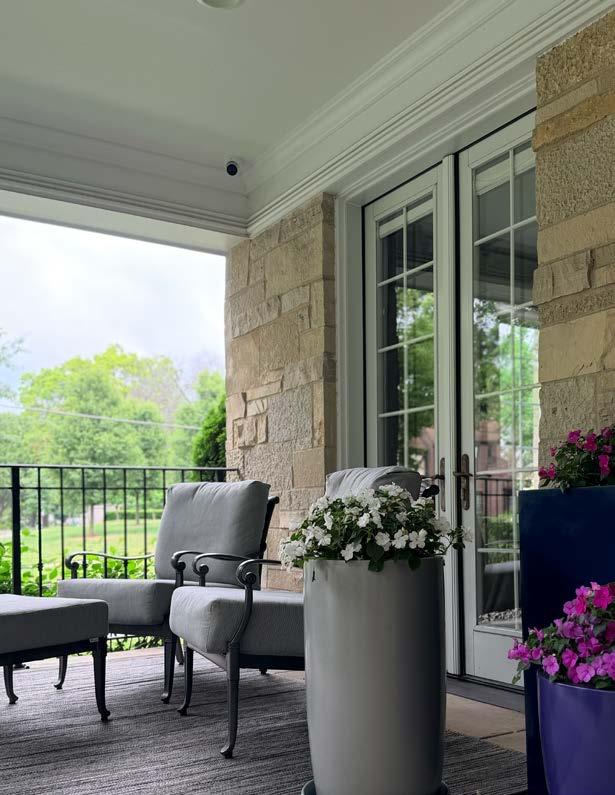
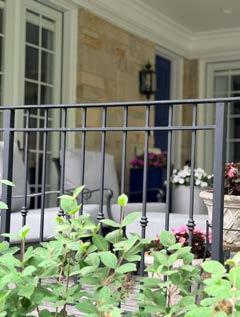
always imagined her outdoor life as something contained and private, that was not a small thing. There was, however, the porch. Actually, two of them. One wide, beautiful, and accessible through French doors directly from the house. It was the space Bev had always wanted. The kind of porch you actually sit on with your husband and makes a house feel like a home worth arriving to. The only thing missing was the enclosure that she’s been waiting on for the last four years. The other porch is smaller and a bit more secluded, accessible from the kitchen off the side of the house.
We sat down with Bev to talk about the garden she inherited, the one she’s building, and the privacy plant she should have kept.
You’ve been gardening for over thirty-five years. What did you see when you first walked the property?
I loved my garden at our previous house. This house was situated at the same southeast corner of an intersection so I imagined I could reproduce a similar garden and I already had experience with plants that grew well at this exposure. The house had very good bones, was quality built, and needed a complete update. But I could see what it wanted.
What were you working with when you started?
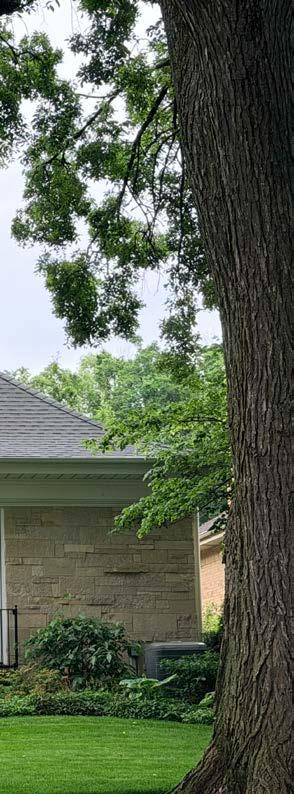
There’s a huge, over one-hundred-year-old American Elm tree on the front parkway. Between the shade and the years of roof wash — the house had never had gutters — growing grass is a mission. We added soil during the renovation and planted along the front


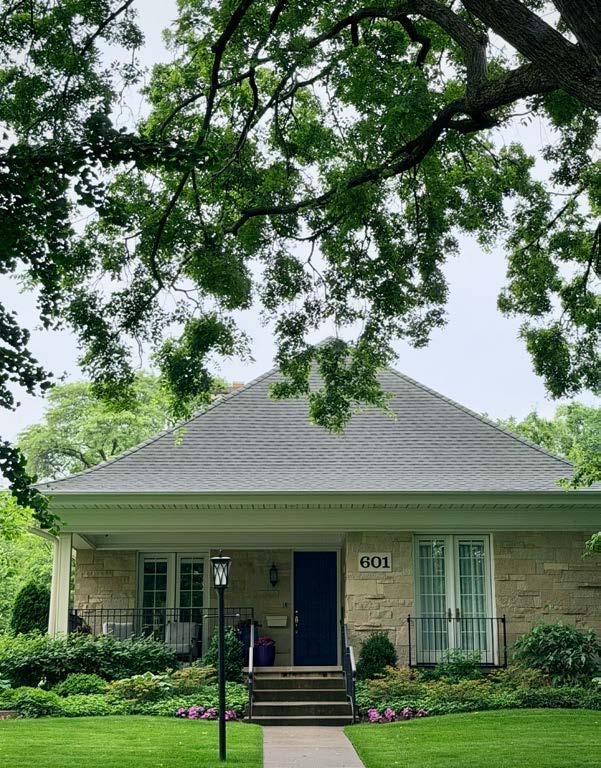
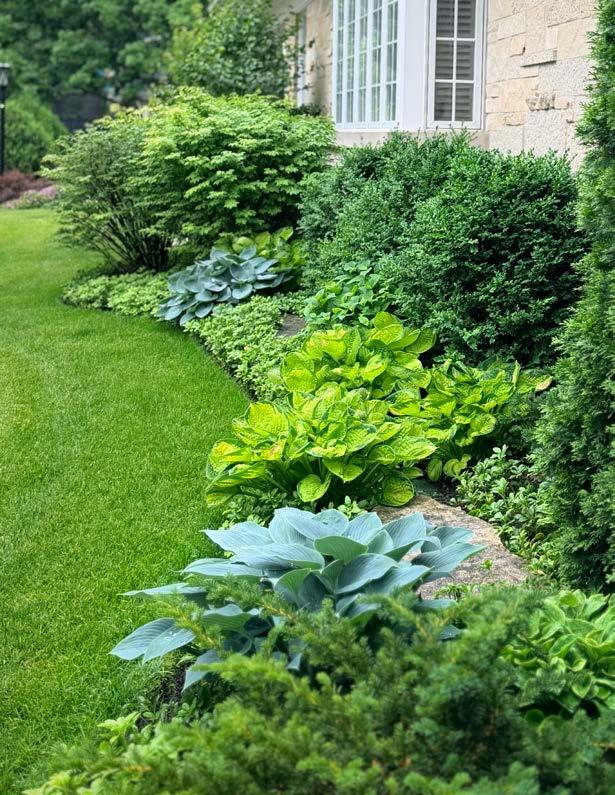
of the house. Mixed taller plantings at the foundation, lower azaleas, boxwoods, astilbe and hostas mixed in with pachysandra as filler. There are several areas of outcropping stone in the front that I like for interest.
The back porch area is probably my favorite. It’s dense and there is some color most of the season. The blue spruce on either side of the stairs are original to the house. I’ve added hostas and ground cover to fill in the areas. It’s the part of the garden I would change the least.
Is there a part of the garden that has given you the most trouble?
The back area under the beautiful huge sugar maple has always been a problem. The soil under the tree is dense with roots — even difficult to dig into. It was originally planted with pachysandra which has never done well there. Last year I began planting shade plants — hostas, astilbe, coral bells varieties — anything I could find to fill in between the struggling pachysandra. This spring I’m going to concentrate on making that area look like a shade garden photograph I showed my gardener. That’s the goal for it.
CREATING ENCLOSURE ON A SITTING PORCH
The goal isn’t total privacy. It’s shelter — the feeling of being contained by a space while still being able to see the views and activity beyond it. That distinction matters when you’re choosing plants for a porch you’ll actually spend time on.
START WITH MEASUREMENT NOT
A PLANT. Sit down in your porch chair and note where your eye level falls. The enclosure you’re after sits just below that point. High enough to create a sense of shelter, low enough to preserve the view and the feeling of being connected to the world beyond. That measurement tells you which plants will work before you ever visit a nursery — whether you need something that tops out at four feet or something that reaches seven.
CHOOSE SOMETHING THAT GIVES
BACK. Since this is a space you’ll spend time in, choose shrubs that flower for your enjoyment — or better yet, something fragrant. In spring, consider a flowering viburnum or dogwood. For summer blooming, consider hydrangeas. Just know that you’ll be sacrificing some privacy during the winter months when they lose their leaves. If you have room and yearround privacy matters, layer evergreens behind or between your deciduous shrubs for an added layer of privacy and interest. Finish the space from the inside. Layered planted pots bring seasonal color and one more point of privacy closer to where you sit. On a small balcony, tall planters with large shrubs or climbing vines — a climbing hydrangea is particularly good for this — will help blur the outside world and reinforce your own little alcove. Add smaller planters for seasonal color. The porch stops feeling like an exposed ledge and starts feeling like a room.

What would you do differently if you could go back?
The lilacs. When we bought the house the only good plantings were a group of lilacs along the west side porch. They were deep green and dense and just covered the bottom of the porch. I thought that would be a great frame around the side and front of the porch even though I knew they wouldn’t bloom without the sun. I was talked into Judd Viburnum instead and I have regretted it. If I had my druthers I’d replace them with the lilacs. I was right the first time.


What does the porch feel like to sit on now?
“It doesn’t feel uncomfortable — maybe a little more exposed. There are a lot of walkers in this neighborhood and everyone stops to talk or tip their hats. If the area doesn’t fill in well by this — its fourth season — and I had my druthers, I’d replace the Judd Viburnum for the lilac. I’d replace the Maggie Daley astilbe for a prettier variety. I’d replace the taller bushes on the right of the stairs for a better variety.”
You also have a flower garden along the driveway. How is that coming along?
That’s a work in progress. It gets the most sun on the property, which is wonderful, but many of the original plantings did not make it. I tend to move plants there that have not done well in other areas. I would like it to be a true cottage garden. I need to work on that.
You have a pretty good relationship with your neighbor that has included some unusual garden decisions. How did that connection begin?
“I think I was being sensitive to running over the property lines when our stuff was being installed — and there we were, both interested in gardens and both with beds of pachysandra in front. I asked her if she’d mind me running them together and she thought it was a great idea. She and her son are so happy to have friendly neighbors — they don’t object to much.”
What has that friendship become?
“Just delightful. Flowers and our dogs. I admire her attitude, her plant knowledge, and her stamina. She’ll be ninety in May and
is out there as soon as the weather breaks. I absolutely love sitting at my craft desk and looking at what’s in bloom in her yard. Just outside my window.”
You’ve mentioned this neighborhood is different from your previous one in how people engage. Can you elaborate on that? “People here are genuinely friendly, open, interested and take the time to stop for a chat if I’m out. Much is about the house itself — how they’ve long admired the structure — but also about the garden and the plants. Two people have asked me if I’m a designer and would I please come over to do their houses.”
What do you want your new neighbors to feel?
I’d like people to feel that the folks who live here appreciate the architecture and uniqueness of the house enough to enhance it with a beautiful landscape. I’d like them to feel that what we do is for their benefit too. When I’m in the house and watch people as they pass by, I find happiness in their enjoyment of the landscape — seeing them look at it, maybe pointing and talking to each other about something they’re seeing. When I’m out for a walk myself, my appreciation for well tended yards reflects not only the plants but the people who live there.
You’ve been chosen to participate in the upcoming garden walk. What plans do you have for your property for this upcoming event?
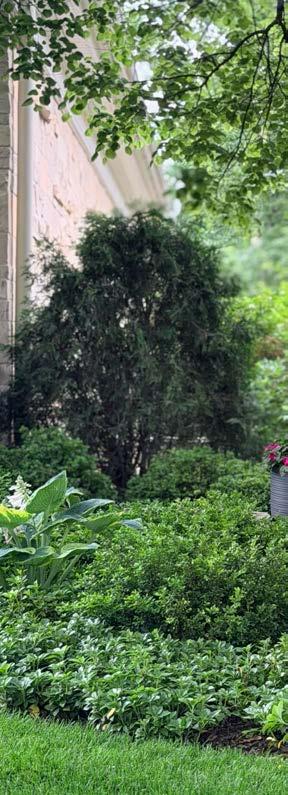
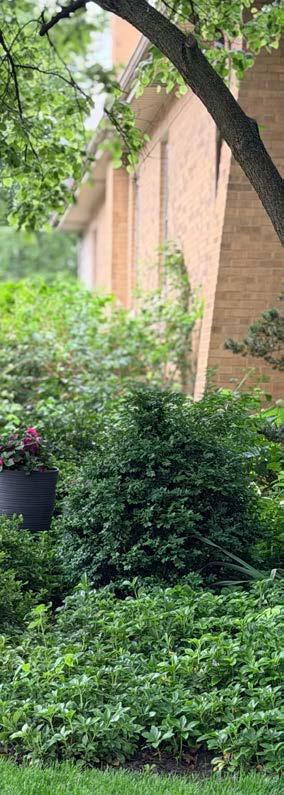
“Because my gardener Luis had worked so hard to have the grass come up in the front last spring, the property looked pretty darn good. We entered for the beautification award and were one of five houses chosen. Through that, the garden club member in charge of the walks approached me about being on the annual walk. Then she asked Jeneane to participate. Jeneane asked me if it was okay — she didn’t want to steal my thunder. I assured her I had no thunder to steal and I’d love to pair up with her. I’m thinking about the gate in her fence that opens between us — having people access each of us through that. Maybe we can do something neighborly around it. Have people move from one garden to the next through that opening.”
You’re stepping away from the garden for a couple of weeks this summer. What happens to it while you’re gone?
Jim will water. He doesn’t speak garden the way she does, but he knows what matters to her and he’ll show up for it. She’ll come back to find everything more or less alive and probably one thing she didn’t expect. That’s Jim.
After all these years of gardening, what still surprises you?
How much there is yet to do every year. Areas I’m unhappy with. Impatience with how long it’s taking for the bushes and shrubs to grow together. Trial and error in the flower garden. I had thirty-five years to get the last garden where I wanted it. I’d like to have this one done now.■
YOU CAN’T TAKE THE GARDEN
But You Can Take What It Meant
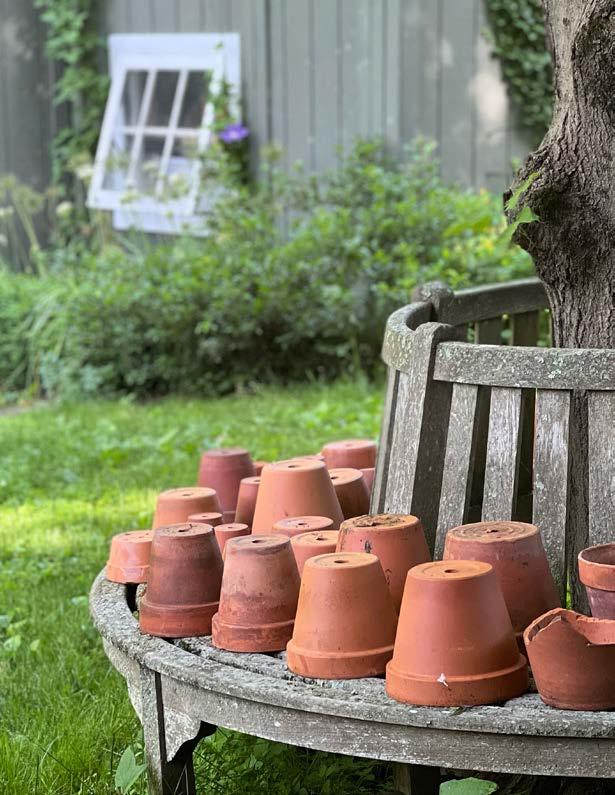
How one gardener crossed an ocean, planted an orchard, and discovered that what she was really growing was a way back to her grandmother.
When I asked Pom Shillingford what part of her garden she returned to most, she didn’t hesitate.
“The orchard.”
Not the terrace. Not the borders she had spent years refining. Not the areas closest to the house where everything was more controlled. The orchard. And she said it in that way people do when the answer isn’t up for debate.
I first came to know Pom through her Instagram account, @english_garden_grown. What drew me in wasn’t just the garden but the way she talked about it — honest, and very clear that none of it came easily. Our first conversation came just months after she had left behind thirteen years of building, planning, planting, adjusting, and reworking a garden she had called her fourth child. One final walk through it, the gate latching behind her. She admitted there were parts of it she and her husband — the Silver Fox — were more than happy not to repeat. That balance, love and relief in the same sentence, tells you a lot about how she gardens.
The orchard, though, was different.
WHERE IT BEGAN
Long before Connecticut, before the move out
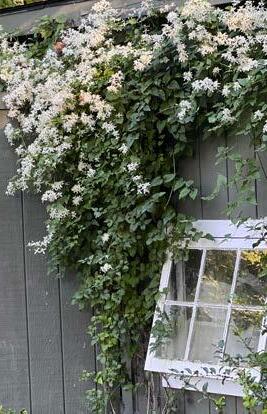
of Manhattan, there was her grandmother’s garden in England.
Her grandmother had created and nurtured that garden for sixty years. Sixty years. A number I keep thinking about — not because it’s remarkable, though it is, but because it reframes what Pom was actually reaching toward when she began digging up three flat acres in Connecticut. She wasn’t recreating a childhood memory. She was reaching toward a sixty-year devotion. The kind of relationship with a place that most of us have only ever glimpsed in someone else.
The orchard was at the heart of it. Pom talks about it not in design terms but in the language of being inside something — running through mown paths in long grass, climbing trees that weren’t planted for climbing but worked perfectly anyway, hiding in the hedgerow. There was a pet graveyard too, which she describes with a mix of humor and curiosity: the kind of thing that feels slightly strange as an adult but completely natural when you’re a child moving through a garden like that.
That was the reference point. Not something
she was trying to copy exactly, but something she understood inside herself.
PUTTING DOWN ROOTS
When Pom moved to the United States in the late 1990s, she was struck by how differently Americans related to outdoor space. People had yards they wanted to keep under control, or simply ignore — so unlike the gardens she had grown up with in England — and she went the other direction entirely.
She spent the first winter staring out the kitchen window at bare ground. The formal terrace, the perennial borders, the yew-lined rooms, and beyond all of it, at the back of the property: the orchard.
PLANTING THE ORCHARD
Planting it was as Pom tells it, a comedy of miscalculations.
The trees were small, half-inch calipers, so there was no question of hiring anyone. Just Pom, her husband, two shovels, a pickaxe, and ground that turned out to be largely rock. What she had estimated would take a couple of hours stretched across three full weekends, in unseasonable heat. A friend eventually appeared — less out of enthusiasm, she suspects,
There was a pet graveyard too, which she describes with a mix of humor and curiosity...
and more out of concern for the state of their marriage.
It’s funny now. It probably wasn’t at the time.
In 2012, after fifteen years of living in Manhattan, Pom and her husband made the leap to a small town in the northwest corner of Connecticut — a place where they knew not a soul, drawn by a wreck of an historic house set on three completely flat bare acres. Those acres acted like a siren call. If she was putting down roots in America, she wanted to do it literally.
Sixteen trees went in — apples, pears, peaches, plums. Thousands of pheasant-eye narcissi pressed into the same unyielding soil. A bench placed at the edge of the woods along a stream, looking back toward the house, where hellebores slowly multiplied over the years into a carpet of early spring flowers.
The orchard was enclosed on three sides —
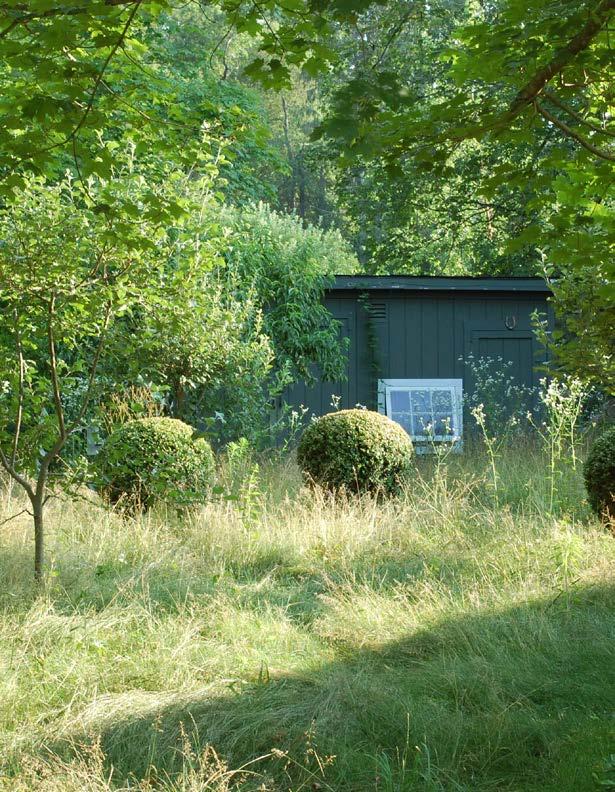
trees and shrubs backing onto the stream, an old chicken coop, and the yew hedge to the barn gardens. In winter it felt open and light, the morning sun moving through the bare branches. By summer, once everything leafed out, it became almost a secret garden at the back of the property — in full shade by late morning, Pom says, offering the most wonderful respite once the temperatures started to rise.
WHAT THE ORCHARD BECAME
In winter, her husband took over — pruning the trees was his particular task, his own relationship to the same ground. In spring, the narcissi came up in their thousands around Mother’s Day. Wild violets appeared, then wild garlic, then fleabane spread from a single patch through the whole orchard, flowering like an ethereal forest in July. From April to mid-May the orchard felt almost composed — trees perfectly pruned, blossoms neat, bulbs in their rows. Then the grass grew up, the weeds arrived, and it became, as Pom puts it, a wild party. That’s when she stepped back and handed the reins to Mother Nature.
Of all the parts of the garden she built, the orchard was the most successful. Other areas didn’t always cooperate — roses struggled, the long tapestry of spring bulbs that English gardens enjoy from February simply wasn’t possible in a New England climate. But in the orchard, she says, it felt like being teleported home.
The trees produced quickly — pears, peaches,
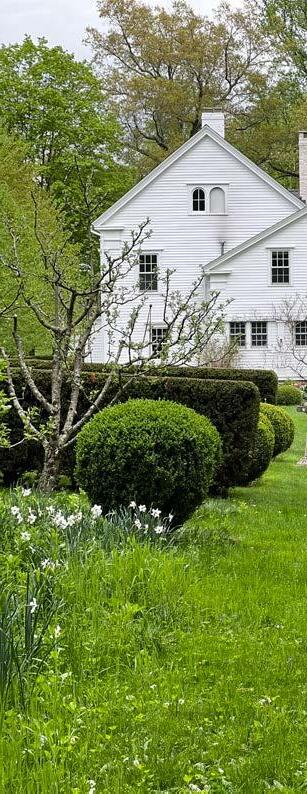
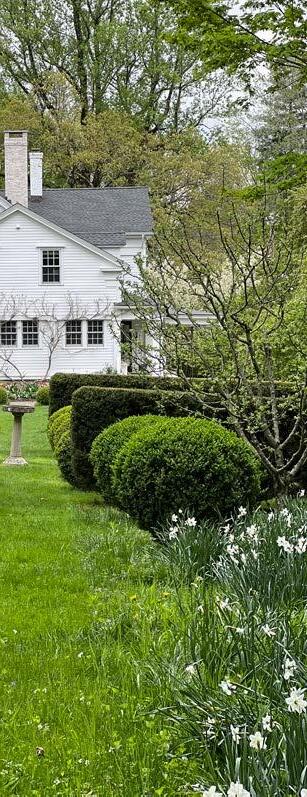
plums within two years. The apples never did. Not once in thirteen years.
It was never really about that.
She had created a space that contained something beyond itself.
The same narcissi her grandmother had grown. The pet graveyard, tended with the same devotion. The bench where she would sit in the shade and talk, she says simply, to someone on the other side. The orchard worked not only because it was beautiful, or wild, or productive. It worked because it was weighted with meaning. And meaning is what calls us back when design alone cannot.
This is what a garden becomes when it works at its deepest level, not just a beautiful space, but a place that holds something alive in you. You can’t manufacture it, but you can create the conditions for it. You can plant with intention and then let something larger move in.
WHAT SHE CARRIED OUT
When the time came to leave this garden behind, she took almost nothing.
She left the trees, fully mature now — a decade of growth fought for in rocky ground. She left the naturalized narcissi, thousands of them. She left the bench, the shade, the hellebore carpet, the wild party of July.
The one thing she carried out was a few of the mature hellebores from the back woods.
At her new house, they will go into a shade garden — the same plants, continuing their
slow spread in new ground, carrying the memory forward physically into the next chapter.
For a while, she was emotional about leaving the connection with her grandmother. But she discovered something in the leaving: it was never the garden itself she had been tending. It was the essence of her grandmother’s garden — the feeling of it, the logic of it, the way it called her back. And that, she found, travels.
If you wanted to bring even a small version of this feeling into your own garden — whatever its size — Pom’s advice is simple. Plant one tree, a spring-flowering one, and underplant it with bulbs. You’ll have color, scent, height, and something that changes with every season. You’ll have a reason to return.
You can’t take the orchard.
But what the orchard meant? That goes with you wherever you go. ■
ABOUT POM: Pom Shillingford is an English gardener rooted now in New England, who spent thirteen years turning three flat acres in Connecticut into a garden she called her fourth child. She gardens the way she lives: honestly, with difficulty, and with great love for the process. She grows seasonal flowers in Connecticut and writes about her gardens — past and present — with the kind of clarity that comes from having built something real and then had to leave it behind. Find her at @english_garden_grown.
PLANT THE FEELING
The Mediterranean Garden
What to plant — and why it works
You have probably already bought the plants. The lavender, the olive in its pot, maybe a young cypress. And the garden still doesn’t feel the way the photograph did. That isn’t because you chose wrong. It’s because the feeling was never living in the plants themselves — it was living in the jobs they were doing.
A Mediterranean courtyard is not a collection of Mediterranean plants. It’s a small number of effects — a vertical line here, a silver haze there, something fragrant by the chair, something spilling over a wall — repeated with restraint until the whole space reads as calm. That’s the part no one tells you. The plants are the cast. The feeling is the play.
Every gesture below can be made with a plant that thrives where you actually live. What matters is the role it plays, not its passport.
THE VERTICAL LINE
The exclamation point. One slim, dark, upright evergreen does more for the Mediterranean feeling than any flower — it gives the eye a place to rest and the garden a sense of punctuation and rhythm. Repeat it three times down a path and the space suddenly looks composed rather than planted.
THE CLASSICS
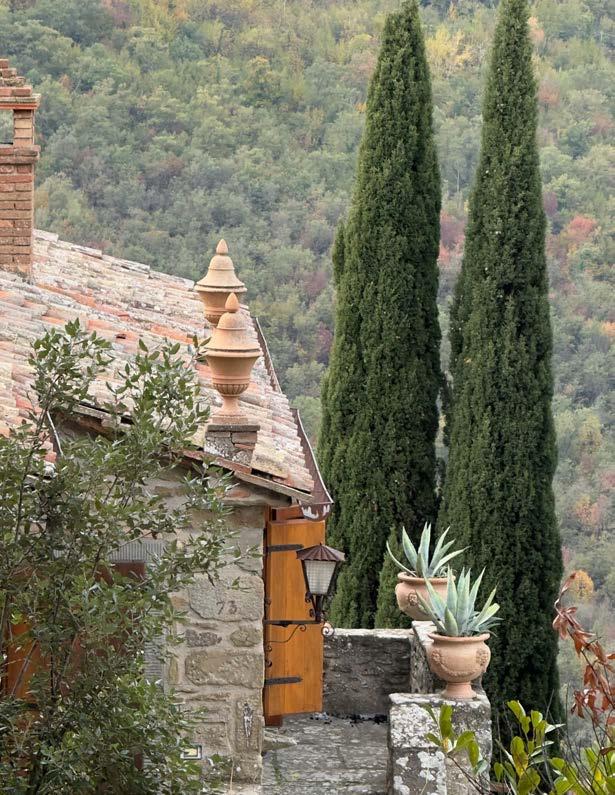
Italian cypress. The silhouette most associated with Provence and Tuscany. Always repeat in odd numbers for rhythm.
WHERE WINTER BITES
‘Sky Pencil’ holly, columnar juniper (‘Taylor’ is a nearperfect stand-in), Irish yew, slim arborvitae like ‘Emerald Green.’


THE SILVER HAZE
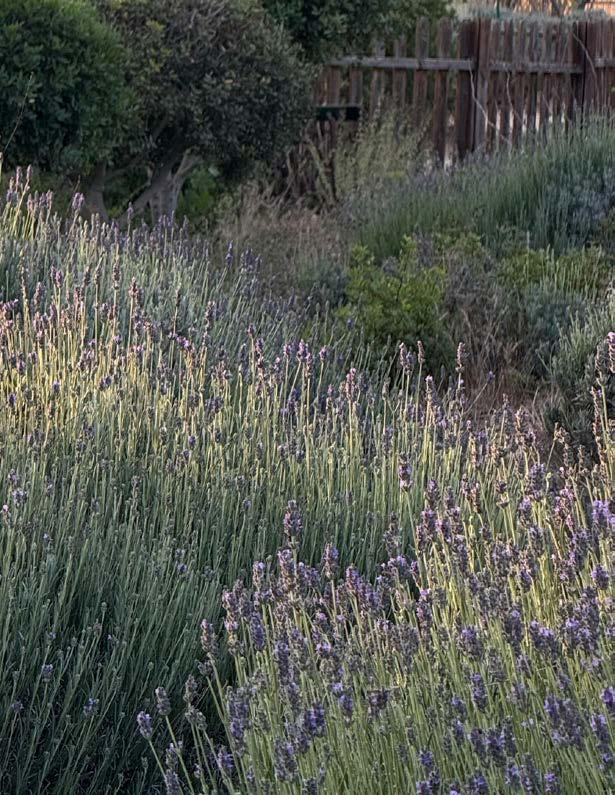
The big secret most beginners miss entirely: that sunwashed, dusty softness you’re chasing is mostly greygreen foliage, not bloom. Silver leaves are what make a Mediterranean garden look bleached by light even on an overcast morning — and what make it glow at the nightcap hour, when low sun catches the pale leaves and the whole space seems lit from within.
THE CLASSICS
Lavender, santolina, artemisia, olive foliage, cardoon (the silver-leafed giant — think ornamental artichoke).
WHERE WINTER BITES
Russian sage, catmint, lamb’s ear, hardy salvias. English lavender is tougher than people think — damp kills it more reliably than cold.
THE CLOTHED WALL
A bare wall is a backdrop. A wall with something flowering up and over it is a room. This is the rose-around-thedoorway that charms everyone who has ever walked a French village — the softening of hard stone, a little romance, a little whimsy.
THE CLASSICS
Climbing rose, star jasmine, wisteria, bougainvillea, a grapevine.
WHERE WINTER BITES
Hardy climbing roses, climbing hydrangea (takes shade), honeysuckle, clematis — the Jackmanii on a cold wall is doing the exact job bougainvillea does in Marrakech.


THE THING YOU SIT UNDER
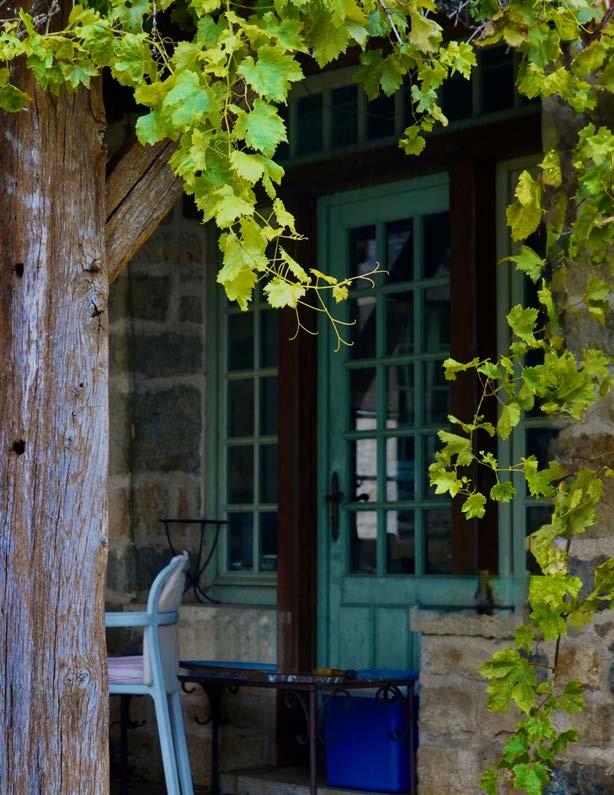
Enclosure from above is what turns a seat into a sanctuary. The canopy between you and the open sky is the reason the morning-coffee chair feels like somewhere rather than simply outside. (See Heather’s pergola, earlier in this issue, for the same idea built rather than grown.)
THE CLASSICS
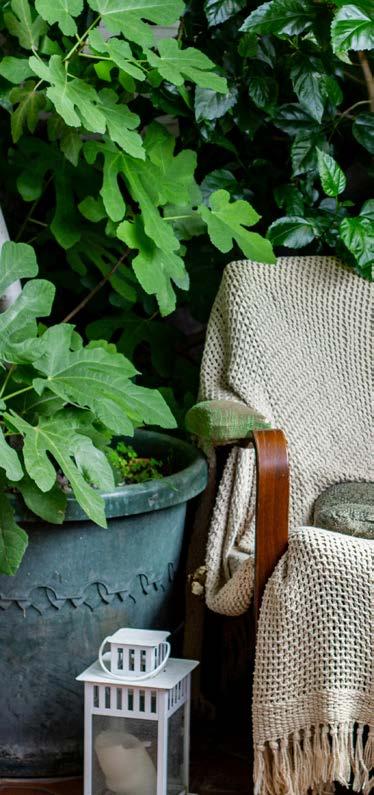
Fig, a grapevine trained over a pergola frame, citrus in warmer zones.
WHERE WINTER BITES
Grapevine (hardier than its reputation). Multi-stem serviceberry for a loose shade tree. Or build the frame and let a hardy climber clothe it.
THE FRAGRANCE LAYER
The most overlooked, and the most purely felt. Scent is what fixes a place in memory — it’s why a single afternoon in a Tuscan garden stays with you for twenty years. Ask the practical question: what does your seven a.m. coffee actually smell like? Plant the answer within arm’s reach of the chair.
THE CLASSICS
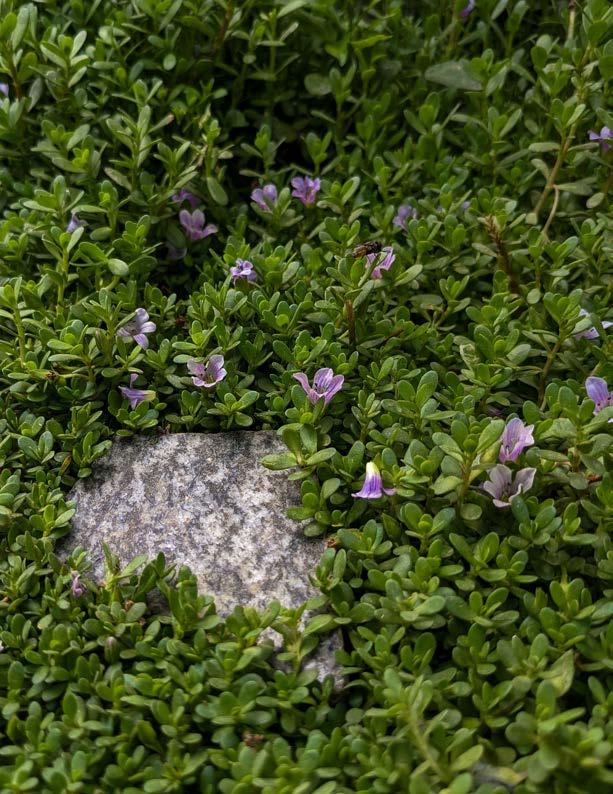
Rosemary, creeping thyme between the paving stones, lavender, citrus blossom, myrtle. Note: this is not a new list — it’s a quality to build into plants already chosen for other roles.
WHERE WINTER BITES
Thyme is genuinely hardy and scents underfoot. Hardy rosemary (‘Arp’). Sweet box for winter perfume. Mock orange or lilac for the heady spring note citrus brings further south.


THE POTS AT THE THRESHOLD
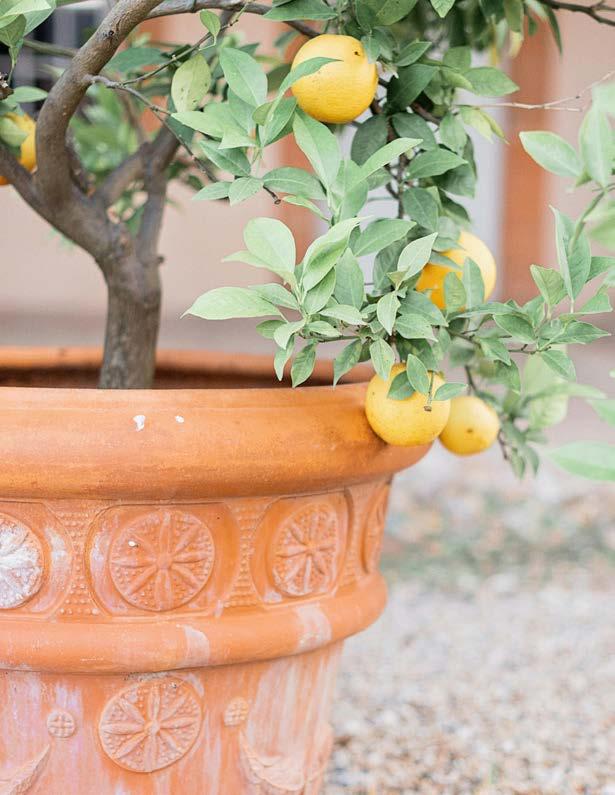
Pots bring beauty right to the entrance — geraniums on a sill, a clipped bay in a weathered urn, a lemon tree by the door — and signal welcome before anyone steps through the gate. They are also the cold-climate cheat code, worth saying plainly: anything that won’t survive your winter, grow in a pot and bring inside. That single move is how Anatolia keeps a Moroccan courtyard alive through a London February.
THE CLASSICS
Pelargoniums, potted citrus, a potted olive, clipped bay or box in an Anduze urn.
WHERE WINTER BITES
All of the above, lifted into a cool bright room from autumn to spring. The pot is not a limitation. It is the permission slip.
THE RELAXED SPRAWL
The final ingredient is the willingness to let things spill, seed, and soften the edges — the not-too-perfect that David called “free-flowing.” A few airy, self-sowing plants drifting through gravel and frothing over path edges are what keep a Mediterranean garden from looking like a showroom. The wispy golden grass on this issue’s cover is doing exactly this job.
THE CLASSICS
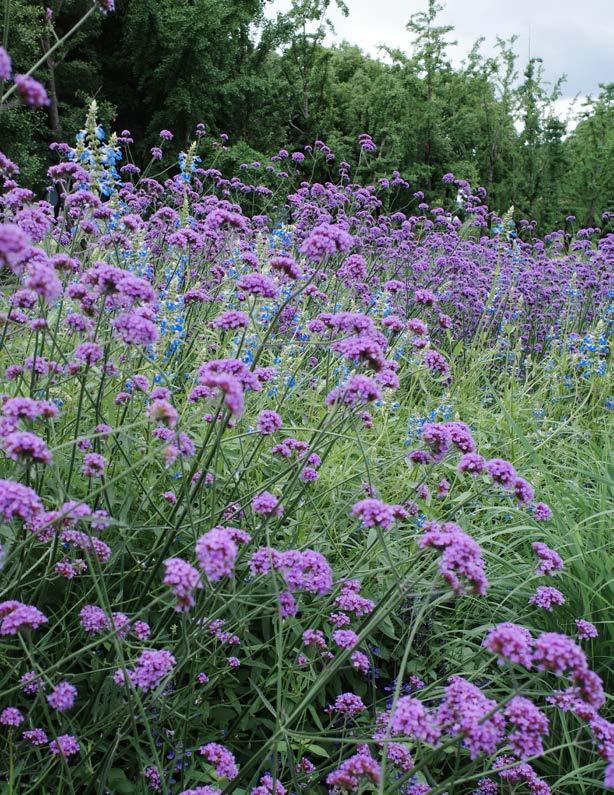
Mexican fleabane in the paving cracks, verbena bonariensis, bronze fennel, valerian self-seeding in the steps.
WHERE WINTER BITES
Grow verbena and Mexican fleabane as cheerful selfseeding annuals. Hardy geraniums, gaura, and wispy ornamental grasses for the same loose, sun-struck movement.

TWO THINGS THAT MATTER MORE THAN ANY SINGLE PLANT
PLANT FEWER KINDS, MORE TIMES
If your garden has fallen short before, this is almost certainly why: the beginner’s instinct is one of everything. The Mediterranean feeling comes from the opposite. Five lavenders in a row read as calm and deliberate; one lavender, one salvia, one rose, and one grass read as a sample tray. Repetition is the serenity. When in doubt, buy three of something instead of three different things.
BONES
BEFORE BLOOMS
These gardens feel composed all year because most of what you see is evergreen structure, not seasonal flower. Lead with the upright greens, the clipped shapes, the silver foliage — the plants that look like something in February — and let the flowers be the grace notes on top. Get the bones right and the garden is calm even before anything blooms.
IF YOU ONLY DO THREE THINGS
1. One vertical line — a single slim evergreen, repeated if you have room.
2. One drift of silver — a row of lavender, catmint, or Russian sage where the evening light will catch it.
3. One clothed wall or overhead — a climber on the wall behind your chair, or something growing over the spot where you sit.
That’s a Mediterranean courtyard in miniature: a place enclosed from above, soft and silver at eye level, and grounded by one calm green line. Everything else is just more of the same feeling
THE READING L I S T B E H I ND THIS ISSUE book nook


Reading the Garden
My recommendations
BRINGING THE MEDITERRANEAN INTO YOUR GARDEN
Olivier Filippi
The most rigorous book on this subject. Filippi is a French nurseryman who has spent decades studying drought-adapted plants, and his argument is simple and radical: stop fighting your climate and start working with it. This is the book that explains why Mediterranean gardens look the way they do from the ground up — the soil, the water, the plant selection. If you only read one book on this list, read this one.
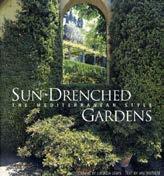
SUN-DRENCHED GARDENS: THE MEDITERRANEAN STYLE
Jan Smithen & Lucinda Lewis
Twenty-five Mediterranean-style gardens across California, the south of France, Italy, and Spain — photographed in the particular quality of light that makes this style so difficult to describe and so easy to recognize. Less prescriptive than Filippi, more atmospheric. The kind of book you leave open on a table and return to when you need to remember what you’re working toward.

FRENCH BLOOMS
Sandra Sigman
A book about the flowers of French gardens — the cutting garden, the market stall, the farmhouse arrangement — rather than garden design specifically. It belongs on this list because it captures something the design books miss: the loose, seasonal, impermanent beauty that makes French gardens feel lived in rather than installed. The feeling is in the flowers as much as the structure.
The Tree That Taught Me Everything
On growing fruit in a small space — and why it’s worth every bit of the effort
Six years ago we planted a peach tree.
The tag said it would reach twelve feet tall and twelve feet wide. It lied. That tree is well over twenty feet in both directions and still going. If you’re planning a small orchard of any kind, write this down first: plant tags are guidelines, not promises. Buy the dwarf variety. Read three sources before you dig the hole. And then add a few feet to whatever they tell you.
But here’s what the tag didn’t mention — and couldn’t have. That peach tree would become one of the most engaging, frustrating, rewarding, and honestly humbling relationships in my garden. Six years in and it still surprises me every single season.
Year one. Thirty peaches. Zero harvested. We planted it in a good spot. Full sun, good drainage. That first summer it produced thirty peaches — I counted them. I was thrilled. The squirrels were thrilled too.
By the end of summer every single peach was gone. We hadn’t even realized they were disappearing until there were almost none left. The squirrels had been systematic about it in a way that felt almost personal. Years two and three — same story. A beautiful tree. Zero fruit. Just squirrels, living their best lives at our expense.
Year four. The bags.
We discovered mesh fruit protection bags on Amazon. Large ones. The kind you tie off at the bottom around individual branches. That year we covered sections of the tree and got over two hundred peaches. Delicious, sweet, worth every minute of wrestling those bags onto branches in the April wind. We have it down to a science now.
Late March or early April we start with fungicide and horticultural oil. Then we prune — peach trees are fast growers and need it. Then the bags go on before the buds emerge. That last part matters. If you wait until the buds are already coming out you’ll lose half of them in the process of getting the bags on. Is it the most beautiful thing? No. A tree wrapped in mesh bags is not the garden image I had in mind when we planted it. But there was one year — a late cold snap dropped to negative eight degrees and killed the buds entirely. No fruit that year. But no bags either. And I stood in the garden that spring and just looked at the tree in full bloom, unencumbered, and thought — oh. There you are. That was a gift I didn’t expect.
What a fruit tree gives you that other plants don’t
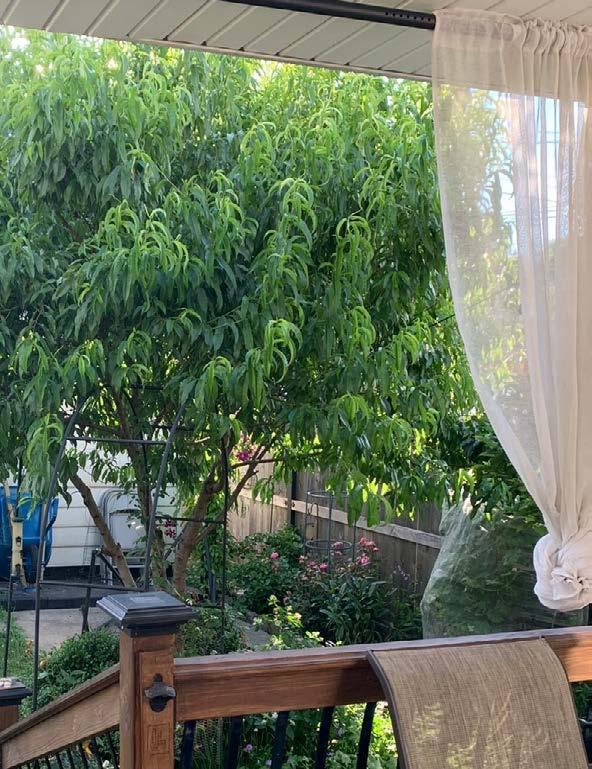
A fruit tree creates a relationship. It asks something of you every season — pruning, spraying, protecting, harvesting — and in return it gives you something to return to all year long. In late winter you’re watching for the first signs of life. In spring you’re covering branches and counting buds. In summer you’re harvesting. In fall you’re cleaning up. In winter you’re pruning and dreaming about next year.
There is always a reason to go back. But before the fruit comes the blossom. And that alone is worth the price of the tree. A peach tree in full bloom in early spring — clouds of soft pink against bare branches before a single leaf has appeared — is one of the most quietly spectacular things a small garden can offer. And in fall, as the leaves turn and drop, the tree gives you one last moment of color before it rests. A fruit tree earns its space in every season, not just the one when it produces.
That’s what makes a fruit tree an alcove in the truest sense. Not a finished thing you admire from a distance. A living relationship that requires your presence and rewards it.
You don’t need a yard
This is the part I want you to hear.
You do not need three acres in Connecticut. You do not need a yard at all.
Dwarf fruit trees grow beautifully in large containers — half wine barrels, oversized ceramic planters, deep galvanized troughs. A single dwarf peach, apple, pear or cherry in a container on a balcony or patio can produce real fruit with the right care. Columnar apple varieties grow in a narrow upright form — some reaching only two feet wide — and can be grown in a pot or against a fence or wall. Espalier is another option worth knowing. Training a fruit tree flat against a fence or wall — arms
extending horizontally in tiers — is one of the most beautiful things you can do in a small garden. It takes patience. But the result is a living wall that produces fruit and stops every visitor in their tracks.
For a small space starting point, consider: A dwarf peach, cherry or pear in a large container — minimum 15 to 20 gallons, deep enough for the root system. Good potting mix amended with compost. Full sun — at least six hours. Water consistently. Feed in early spring. Prune in late winter before the buds break.
One tree. One large container. One bench nearby. That’s an alcove.
The bench matters more than you think Pom placed her bench at the edge of her orchard looking back toward the house. It wasn’t decorative. It was intentional. A bench placed within a planting — not outside looking in, but inside looking out — changes the entire experience of a space. You’re not observing the garden from that bench. You’re in it.
For a container orchard on a balcony or patio, a small bench or even a single chair placed close to the tree — close enough to touch it, close enough to notice the buds breaking or the first fruit forming — does something that no amount of design can manufacture.
It gives you a reason to sit in that specific spot. To return to it. To pay attention to what’s happening there.
That spot becomes yours.
A few things worth knowing before you plant
Most fruit trees need a pollinator — a second tree of a compatible variety nearby in order to produce fruit. Some dwarf varieties are self-fertile, meaning one tree can pollinate itself. If you’re working with limited space, look specifically for self-fertile varieties. Your local nursery can point you in the right direction.
Container grown fruit trees need repotting every
few years as the roots fill the container. They also dry out faster than trees in the ground — consistent watering through the growing season is essential. And the squirrels. I cannot promise you anything about the squirrels.
The tree we didn’t plan for What I didn’t expect when we planted that peach tree six years ago was what it would give me beyond fruit.
It gave me a reason to be outside in late March when everything else is still dormant. It gave me a project that carries across every season. It gave me two hundred peaches in a single summer and the satisfaction of having fought for every one of them. And it gave me that one spring morning standing under a tree in full bloom with no bags, no squirrels, no fruit to worry about. Just the tree doing what it does. And me, standing there, grateful to be in its presence.
That’s what a fruit tree gives you. Plant one. Tend it. Go back to it.
It will give you more reasons to return than you can count.
Have a fruit tree story of your own? Hit reply and tell me about it.