How AI can prevent ship and whale collisions
United. Inspired.
United. Inspired.
How AI can prevent ship and whale collisions
United. Inspired.
United. Inspired.
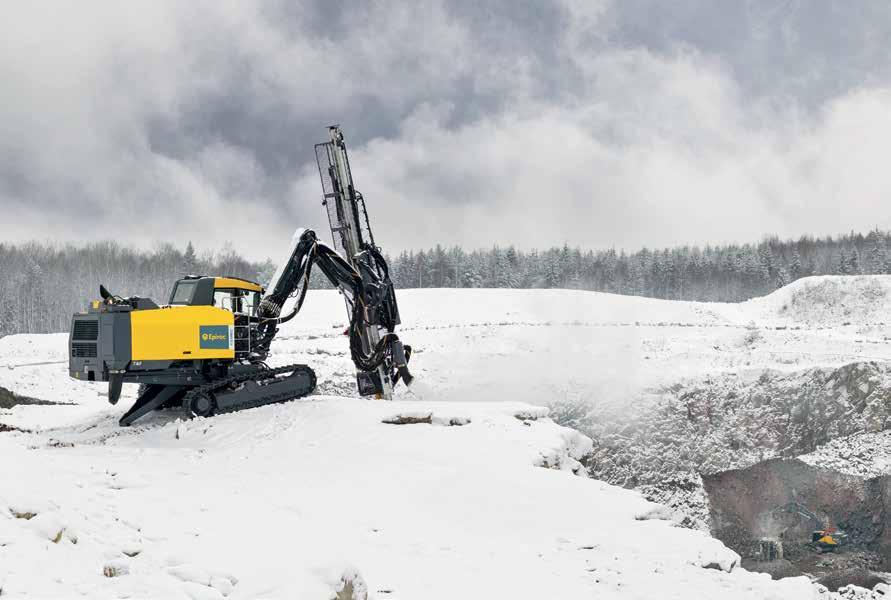
Construction Machinery Industrial and Epiroc
In the World – The best construction equipment technology. In Alaska – The best sales and product support lineup. In Your Corner – The Winning Team.
Surface Rigs - ··Underground Rigs ·- Drill bits - ·Steel


Anchorage (800) 478-3822
Juneau (907) 802-4242

Fairbanks (907) 931-8808
Ketchikan (907) 247-2228





Alaska schools face unique challenges. GCI is built to meet them with Alaska’s most advanced network, backed by local expertise.

















































































8 INSURANCE
Apartments Together
The challenges of insuring multi-family property By Tracy
Barbour
16 MILITARY
Forts and Needful Buildings
A roundup of US Army Corp of Engineers projects in Alaska By Nancy Erickson
74 TRANSPORTATION
It’s a Balloon, It’s a Turboprop,
It’s a Jet…
It’s evolving air fleets By Scott Rhode
86 ALASKA NATIVE
Chin’an Gaming Hall
One year in, everyone is winning By Tasha Anderson 90 LEADERSHIP
Doing Good by Being Good: Rigidity
Hail to the King Alaska’s largest crab scuttles back onto its throne
By Amy Newman

30 NONPROFIT
How Cookies Crumble
Logistics of Girl Scout sales By Gretchen Wehmhoff





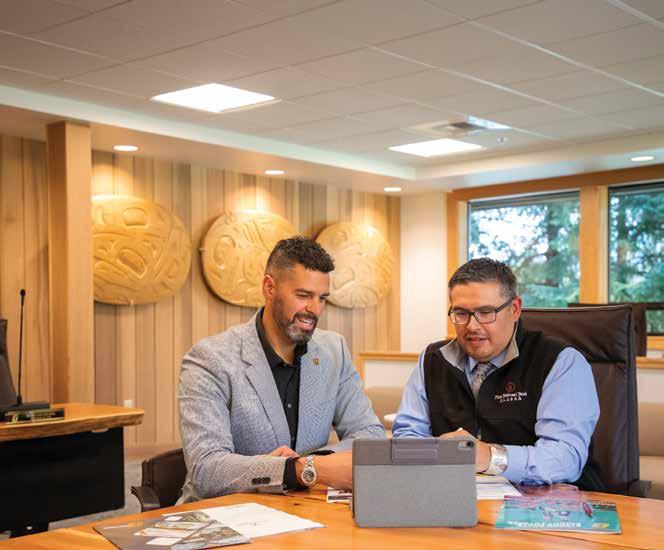

“I trust First National’s expertise and financing solutions to help us achieve our mission: To deliver economic success for our Alaska Native owners and the communities we serve.”
–
McHugh Pierre
PRESIDENT
& CEO GOLDBELT, INC.
Alaska Native businesses like Goldbelt drive economic growth benefiting both shareholders and their communities. First National Bank Alaska delivers the One Solution — a comprehensive suite of financial tools — to help them succeed, all backed by the experience of Alaska’s largest community bank.
Discover how shared values fuel Goldbelt’s growth and relationship with First National Bank Alaska.
SHAPE YOUR TOMORROW
40 CETACEAN CONSERVATION AUTOMATION
INNOVATION
Matson deploys enhanced tech to avoid whales
By Tracy Barbour
58 MEAT FOR MARKET
Fish and reindeer processing in Savoonga
By Rachael Kvapil
62 WAINWRIGHT STEERING COMMITTEE
Community collaboration on the Chukchi Sea coast
By Terri Marshall
68 FROZEN FOUNDATIONS
North Slope’s landfills expand with two projects
By Jamey Bradbury
46 DEEPWATER ARISING
Modifying the Port of Nome into an Arctic gateway
52 OFFSHORE UNICORN
Narwhal’s magic formula for
By Scott Rhode
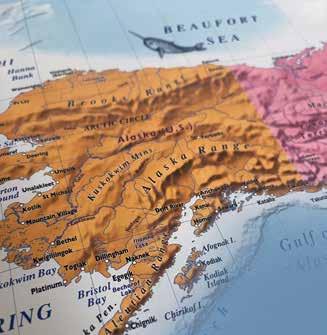
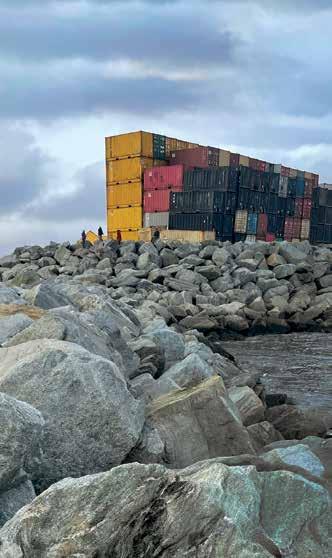
Alaskans share the state’s waters with the world’s largest mammals. Orcas, gray whales, sperm whales, and North Pacific right whales are among the most common. Two species can be legally hunted for subsistence: belugas and bowheads.
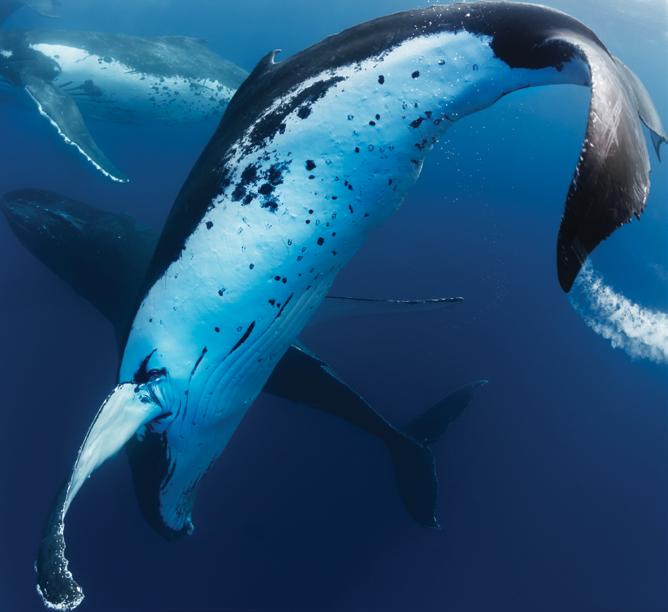
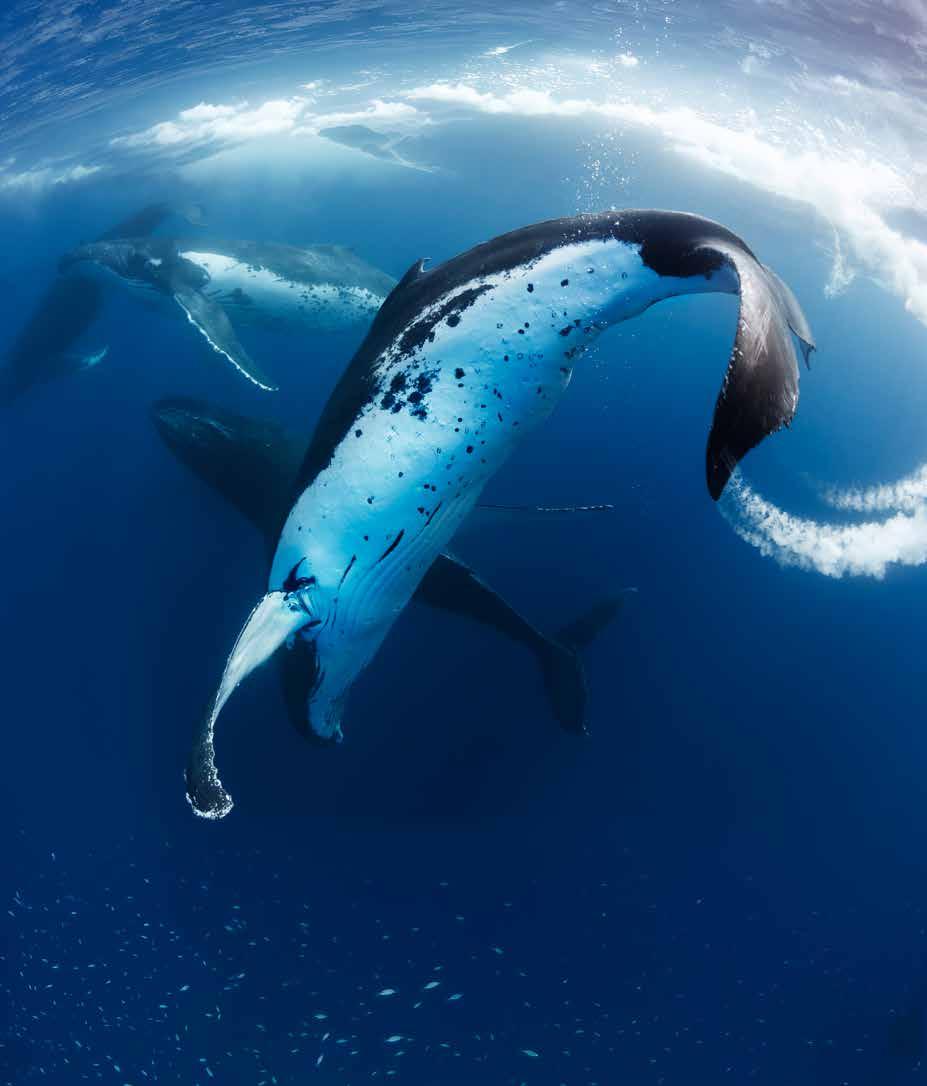
The subject of this issue’s cover, the humpback whale, breeds in the tropics and migrates to Alaska in the spring to feed, congregating around Southeast, Prince William Sound, Kodiak Island, and the Aleutian Islands. They have even been spotted in the Arctic Ocean. As good neighbors to this endangered species, mariners are deploying AI-driven tools to avoid disturbing them, detailed in Tracy Barbour’s article “Cetacean Conservation Automation Innovation.”
Tasha Anderson, Managing Editor
Scott Rhode, Senior Editor
Rindi White, Associate Editor
Emily Olsen, Editorial Assistant
Monica Sterchi-Lowman, Art Director
Fulvia Caldei Lowe, Production Manager
Patricia Morales, Web Manager
Billie Martin, President
Jason Martin, VP & General Manager
James Barnhill, Accounting Manager
Charles Bell, VP Sales & Marketing 907-257-2909 | cbell@akbizmag.com
Chelsea Diggs, Account Manager 907-257-2917 | chelsea@akbizmag.com
Weston Giliam, Account Manager 907-257-2911 | wgiliam@akbizmag.com
Tiffany Whited, Marketing & Sales Specialist 907-257-2910 | tiffany@akbizmag.com
akbizmag.com | 907-276-4373
Press releases: press@akbizmag.com
Billing: billing@akbizmag.com
Subscriptions: circulation@akbizmag.com
alaska-business-monthly
akbizmag
AKBusinessMonth
AKBusinessMonth
Alaska Business (ISSN 8756-4092) is published monthly by Alaska Business Publishing Co., Inc. 501 W. Northern Lights Boulevard, Suite 100, Anchorage, Alaska 99503-2577; Telephone: (907) 276-4373. © 2026 Alaska Business Publishing Co. All rights reserved. No part of this publication may be reproduced without written permission from the publisher. Alaska Business accepts no responsibility for unsolicited materials; they will not be returned unless accompanied by a stamped, self addressed envelope. One-year subscription is $39.95 and includes twelve issues (print + digital) and the annual Power List. Single issues of the Power List are $15 each. Single issues of Alaska Business are $4.99 each; $5.99 for the July & October issues. Send subscription orders and address changes to circulation@akbizmag.com. To order back issues ($9.99 each including postage) visit simplecirc.com/back_issues/alaska-business.
For the March issue I had one new goal, and it was a simple one: ask for photo credit information early. This seems like a no-brainer, but I had gotten into the habit of waiting until the end of our proofing process to reach out to writers or sources to ask for or confirm photo credit information. My new system for the March issue: as soon as a photo landed in my inbox, I immediately asked for credit information.
When it comes to the end product—the March issue you’re holding in your hands or reading on an electronic device—the change was nonmaterial. But for the Alaska Business editorial and production teams, this change led to fewer last-minute questions, emails, and loose threads to tidy up.
Fewer, but not none. Nothing I can rationally do would eliminate all of the last-minute work that takes place before we put a magazine to print. Some things are uncontrollable.
In the Arctic, the uncontrollable is front and center: polar bears travel as they will, sea ice melts—or doesn’t—on its own schedule, and inclement weather asks no one for permission to complicate transportation, construction, research, rescue, or other activities. Residents and businesses operating in the Arctic learned the lesson long ago that early and comprehensive planning are critical to success. They schedule the delivery of materials far ahead of breaking ground, educate and train employees on all manner of worksite conditions, and ensure polar bear guards are on site.
Living and working in the Arctic requires foresight, flexibility, and resilience, and these are the stories that we’ve gathered for the Arctic special section this year. They certainly inspired me, in my own small way, to control what I can so I have more bandwidth for the surprises.


Tasha Anderson Managing Editor, Alaska Business
By Tracy Barbour
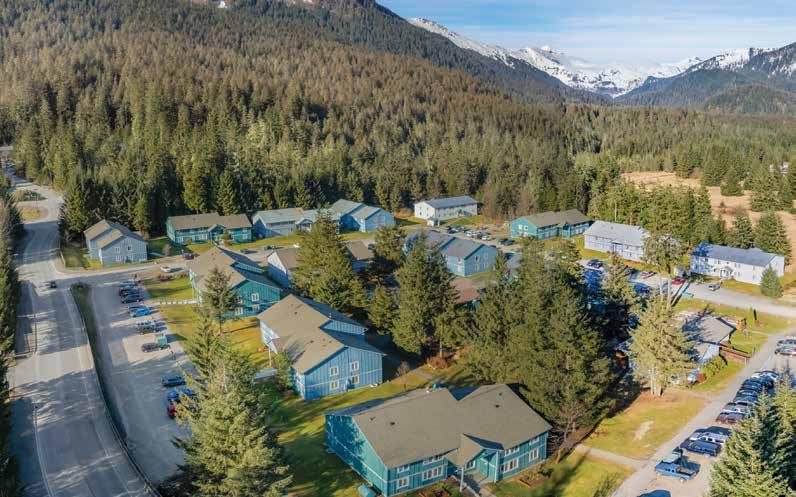
Ha bitational insurance, also known as landlord insurance, is critical for owners of apartments, condominiums, and other types of multi-family housing. This specialized type of commercial insurance protects property owners against claims stemming from third-party injuries and losses due to fire, weather-related storms, criminal activity, and other potential hazards.
But the habitational insurance market is under considerable strain due to significant losses incurred by major insurance carriers. Severe weather events—wind and hailstorms, wildfires, hurricanes, and tornadoes—have caused a surge in claims. In Alaska, the difficulties with the habitational insurance sector are exacerbated by the conditions of
aging buildings desperately needing repairs and infrastructure upgrades.
Many insurance carriers are reevaluating their coverage offerings and tightening underwriting requirements. Some are increasing premiums; others are opting not to insure certain properties based on their age, location, and required renovations. As a result, property owners have fewer habitational insurance options and face stricter standards to secure coverage.
“We know carriers that pulled out of this market this year because they nonrenewed entire books of business, which isn’t a normal practice,” says Christopher Pobieglo, president of Business Insurance Associates, an Anchorage-based independent commercial insurance and surety brokerage firm. “And the ones who
still write it are severely restricted or have tightened up their underwriting guidelines.”
According to Pobieglo, many of the carriers that became more restrictive or chose not to renew habitational insurance policies are “preferred markets”—state-admitted insurance companies, which usually have the best rates and best coverage. However, if coverage is not available on the admitted market, rental property owners have another option: excess and surplus lines insurance. This specialty market offers coverage for unique, high-risk, or complex situations that standard, stateadmitted insurers typically won’t cover. While excess and surplus carriers have the flexibility to provide
insurance for non-standard exposures, the coverage is often less comprehensive and more costly than standard insurance. “They’ll write almost anything for enough money— but the coverage gets reduced and the price goes, in some cases, double,” Pobieglo says.
Some insurers are exiting Alaska’s habitational insurance market due to financial concerns. Insurance carriers are focused on managing their exposure to losses and ensuring their financial stability amid persistent market difficulties. “These kinds of properties are seeing a lot of liability claims and property claims,” Pobieglo explains. “They weigh the risk and claims paid out versus the premium they take in, and for a lot of carriers this is just not a profitable line of business.”

The challenges plaguing the habitational insurance market are not Alaska-specific; Alaska Division of Insurance Director Heather Carpenter says it’s a nationwide issue. And the issue also applies to all types of properties, not just commercial habitational structures. “The Alaska legislature has grappled with such policy decisions that would impact building codes or other insurance availability, but solving for one problem can often create affordability or other problems as a consequence,” she says.
Carpenter emphasizes that insurers set rates based upon the risk they anticipate, and they underwrite based
upon information and factors that determine the likelihood of a claim. For instance, insurers approach insuring older structures with caution. “Older structures are subject to wear, may not have been maintained, and may not meet current building codes or been upgraded, including being rated to withstand earthquakes or other natural catastrophic disasters that occur in Alaska,” Carpenter explains. “Older structures are also more likely to be damaged by weather, have greater damage, and have structural issues.”
With higher likelihood of damage comes higher cost of repairs. Carpenter says, “The cost of building materials and the physical labor to make repairs remains high. Overall, commercial habitational properties present multiple risk factors that are
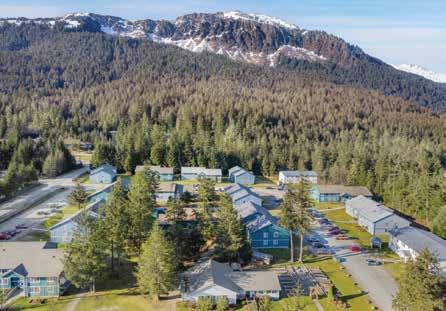
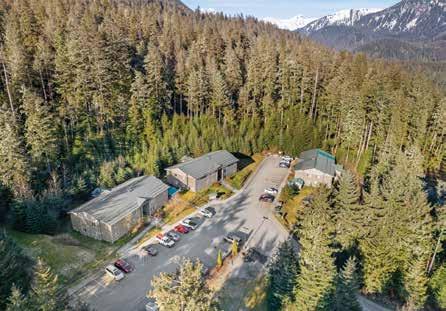
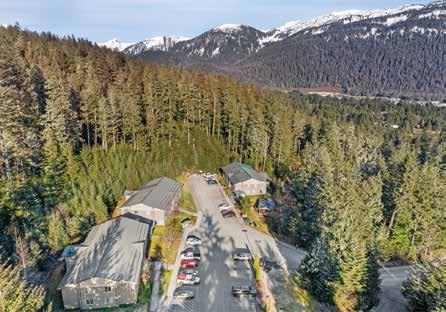
difficult or impossible for an insurer to control or mitigate.”
Increasingly, insurance carriers require more information up front to assess property risks before providing coverage. In the past, carriers commonly ordered an inspection only after the policy had been written. Typically, carriers— many of whom are located outside of Alaska—would include an inspection fee of approximately $350 in the initial quote. Then they would contract local firms to conduct the inspection.
Now insurers are requesting inspections prior to writing a policy. “This practice of wanting to see inspections on the front end is new,” Pobieglo says. “I think a lot of it is because of the state of the housing market and a lot of the older buildings in Anchorage.”
Therefore, it’s more critical for property owners to be able to demonstrate that upgrades and maintenance have been done on the main building systems, especially on older buildings. “You’re not going to be able to get any type of quality insurance if you’re not doing these upgrades and maintenance,” Pobieglo says.
Due to the stricter underwriting requirements, insurance brokers are adjusting their approach to writing policies in what has become an increasingly tough insurance segment. They’re asking more questions about the properties, requiring extra documentation, and being more selective when issuing policies. “We know the insurance companies are going to require, in many cases,
photos and copies of inspections [for quotes], so we kind of prequalify that property,” Pobieglo explains. “And, honestly, we’re not looking to broker bad risks. So even though we don’t technically do the underwriting at the broker level, we’re still qualifying clients for who we want to work with and who we don’t. And if we don’t want to work with someone, it could just be because we feel that the property is in poor condition or just wouldn’t be a good risk for us to present to companies.”
Beyond requiring more information for quotes, more carriers are covering property for actual cash value instead of replacement cost, depending on its age, location, and other factors. However, having cash value coverage can cause property owners to pay outof-pocket costs if they have a claim. That’s why Pobieglo notes, “Any time we submit property, we’re trying to get our client replacement costs.”
While core coverage includes property damage and general liability coverage, other types of coverage include equipment breakdown, loss of rental income, environmental cleanup, vandalism/theft, and ordinance or law insurance. With property insurance, owners have three options to cover perils: basic, which covers only specific, named perils; broad, which covers all the perils listed in basic plus some common pitfalls; and special, which covers all risk unless specifically excluded. In Alaska’s current environment, insurers are more apt to provide basic protection for
“This practice of wanting to see inspections on the front end is new… I think a lot of it is because of the state of the housing market and a lot of the older buildings in Anchorage.”
Christopher Pobieglo, President, Business Insurance Associates
Innovative, cost effective housing with all the comforts of




“If we find a market willing to place the risk, they reduce coverage to a basic form…
With the pullout of Allstate and State Farm on a lot of the Fairbanks properties, the markets cannot keep up with the underwriting or the resources to do a proper inspection.”
President
habitational properties in Anchorage, according to Pobieglo.
David Hale, president of Hale and Associates, is also seeing this underwriting trend unfold in Fairbanks. Hale and Associates—a Trucordia business—is licensed in fifty states and offers coverages for commercial insurance, surety bonds, risk management, and life insurance. Hale says the condition of local residential rental properties has significantly influenced carriers’ practices in Fairbanks, where weatherrelated issues are also a key factor.
“If we find a market willing to place the risk, they reduce coverage to a basic form,” he says. “In heavy snow areas, this is a problem as weight of snow and ice is not covered… With the pullout of Allstate and State Farm on a lot of the Fairbanks properties, the markets cannot keep up with the underwriting or the resources to do a proper inspection.”
which are older, potentially hazardous electrical cables].”
In addition to wires, pipes might disqualify a property. Carpenter says, “Plumbing systems are reviewed for materials and condition and should not typically include older galvanized or plastic piping, and prior water losses may require a mitigation plan. Older boilers or furnaces (generally, thirty years or more) should be regularly inspected.”

Carpenter notes that the Division of Insurance cannot require an insurer to offer property and casualty coverage, which protects the insured from financial losses related to physical assets and legal liabilities for damage or injury caused to others. Insurers use underwriting to identify high risks and either charge higher rates or decline to insure. For example, she says the division is aware that at least one property and casualty insurer will not underwrite structures with knob-and-tube electrical wiring, an obsolete type of wiring largely abandoned in the ‘40s and ‘50s.
“While knob-and-tube electrical wiring is not illegal in existing structures and is not required to be replaced, it is not used in new construction,” Carpenter says. “Insurers will approach older buildings and underwriting for specific update standards to core systems, including the roof, heating equipment, electrical, and plumbing. In addition to knob-and-tube wiring, this could also include aluminum, or VIR/TRS [vulcanized Indian rubber and tough rubber sheathed wiring,
For commercial habitational properties specifically, one insurer— Umialik Insurance Company— requires carbon monoxide detectors and smoke detectors, according to Carpenter. “Smoke detectors must be hard-wired for all new business submitted, and if carbon monoxide detectors are battery-operated, a documented maintenance plan is required,” she says. “These are reasoned safety measures for occupants of these buildings.”
The exodus of companies from Alaska’s habitational insurance market impacts all property owners. “If the carrier says we’re not going to write this segment of business anymore, that means they’re not going to write the 1950s apartment complex—but they’re also not going to write the apartment complex built in 2024,” Pobieglo explains. “They’re making a companywide decision not to write that line of business, so in a way, everybody loses out.”
That’s basically what happened with Alaska Housing Development Corporation (AHDC), a Juneau-based nonprofit that develops, owns, and manages affordable housing. AHDC
owns and manages 136 units in Juneau. Therefore, having adequate general liability, property, umbrella, and other insurance is critical for the organization’s ability to do business, according to Tamara Rowcroft, executive director of AHDC, a longtime client of Business Insurance Associates.
In 2024, AHDC was nonrenewed for coverage when the insurer it had been with for twenty-five years, Alaska National Insurance Company, ceased writing habitational exposures. The change in appetite by Alaska National—owned by Phoenix, Arizonabased CopperPoint Insurance—left AHDC scrambling to find a suitable replacement. The availability of stateadmitted insurance companies for commercial property in Alaska is extremely limited, so it was stressful Alaska Owned & Operated Since 1979


www.chialaska.com info@chialaska.com
ph: 907.276.7667





“I think there are a number of us up here who are trying hard, and it would be great if we could get some more carriers to look at this market and consider doing business up here.”
Tamara Rowcroft, Executiv e Director Alaska Housing Development Corporation
when AHDC was waiting to hear if it would procure another carrier, Rowcroft says.
“We were fortunate that we were able to find another carrier [Umialik], but it concerns me when I hear there are carriers pulling out and not continuing to do business in Alaska,” Rowcroft says. “I think there are a number of us up here who are trying hard, and it would be great if we could get some more carriers to look at this market and consider doing business up here.”
Rowcroft feels that everyone in the rental business gets lumped in with all other kinds of rental property across the state. Yet many property owners in Alaska are committed to maintaining their rentals. AHDC, for example, keeps its units in “very good” condition, and they consistently score well on inspections, she says. “We spend quite a bit of money each year on maintaining the physical condition of our properties, including boilers and
all the interiors,” Rowcroft elaborates. “It’s a huge job. We have a preventative maintenance program that we follow.”
Property owners can use a variety of tactics to maintain habitational insurance and keep their premiums as low as possible. Some general riskreduction areas that landlords can focus on are preventing fires, water damage, and slip, trips, and falls, along with promoting swimming pool, playground, and general safety.
onsite can catch maintenance issues early. “Whether it’s the owner or property management company, regularly inspecting properties to resolve anything that is problematic can help,” he says.
Not only can ongoing property maintenance help from an insurance standpoint, but it can enable property owners to avoid local code violations and unnecessary expenses related to noncompliance. For example, in October 2025, the Municipality of Anchorage passed AO 2025-93, which requires landlords to provide financial support to tenants when units are deemed uninhabitable by officials due to life safety issues.

David Hale Hale and Associates
Hale offers this advice to help property owners improve their chances of obtaining and retaining insurance coverage: “Make sure your electrical, plumbing, and roof are in good condition and updated. And make sure the building and surrounding area is free of trees and debris.”
Carpenter says upgrading and maintaining older buildings is the most effective way to reduce premiums and keep commercial habitational insurance. “Unfortunately, this may require an outlay of funds by the owner in advance of obtaining coverage,” she says.
Pobieglo emphasizes that proper property maintenance begins with allocating enough funds from the start for long-term costs like roof replacements and ongoing upkeep. Prequalifying tenants can also be advantageous because it reduces liability risks. In addition, having a superintendent present and active
Specifically, the ordinance mandates that landlords must provide displaced tenants with financial support equal to twice their monthly rent, along with refunds for any deposits or prepaid rent, within seven days of receiving the order to vacate. And in the most serious cases where landlords demonstrate deliberate neglect and repeatedly force tenants to live in unsafe conditions in violation of an order to repair or vacate the property, inspectors have the authority to refer these landlords to the municipal prosecutor for potential criminal charges.
The issue, Pobieglo says, boils down to keeping properties in better condition to optimize their functionality, safety, and insurability. The older the property is, the more critical it is for landlords to do proper maintenance. “If you don’t, you might find yourself having an extremely hard time finding coverage or at minimum finding decent coverage at a decent rate,” he says.

By Nancy Erickson

Th e US Army Corps of Engineers (USACE)–Alaska District functions as one of more than forty districts worldwide, with a portfolio of projects that have significant impacts for the state and regional economies, national security, and human health and safety. USACE has a global workforce
of approximately 37,000 mostly civilian personnel.
Cameron McLeod, a public affairs specialist with USACEAlaska District, says the district’s mission areas include emergency management, military construction, environmental services, regulatory, international, and interagency services, and civil works and planning.
USACE–Alaska District provides a full range of engineering, science, technical, and construction support services in peacetime and war to strengthen national security, energize the economy, and reduce risk from disaster in the state, according to its website.
Established in 1946, USACE–Alaska District has served as the nation’s leader in Arctic engineering and construction, forging an influential role in development of the “Last Frontie r” vision.
Following is a handful of USACE–Alaska District’s most recent projects, starting with public works projects completed in the third or fourth quarters of 2025 and e arly 2026.
Contract Cost: $9.5 million
Location: Unalaska/Dutch Harbor, a major US fishing hub
Purpose/Scope: Deepen harbor entrance channel to -58 feet mean lower low water (MLLW) to provide safe navigation into and out of the harbor. The project involved dredging an entrance channel to that depth to create a channel
approximately 600 feet long and 600 feet wide into Dutch Harbor, which has an interior controlling depth of -45 feet MLLW.
Contractor: JE McAmis, a heavy civil marine contractor with a corporate office in California and several satelli te offices
Completion: A ugust 2025
Contract Cost: $1.1 million, plus diving inspection and surveys o f $700,000
Location: Unalaska/Du tch Harbor
Purpose/Scope: Repair degraded mooring chains and connections for floating breakwate r modules.
Contractor: General contractor YOY Inc. (d.b.a. Verdis) with substantial subcontracting efforts by Kenmore, Washington-based Crux Diving and Resolve Marine. Verdis bills itself as the nation’s only 8(a)-certified, woman-owned, full-service civil engineering, land use planning and construction managemen t company.
Challenges/Innovation: Full diving inspection with underwater assessment and repairs in deep water, performed quickly as an emergency effort. Also, procurement and transport of repair materials required long lead times, which were especially challenging for domestically sourced chain and connections. Furthermore, Unalaska/Dutch Harbor is accessible only by air or water.
Completion: September 12, 2025, ahead of a required completion date of Octobe r 21, 2025
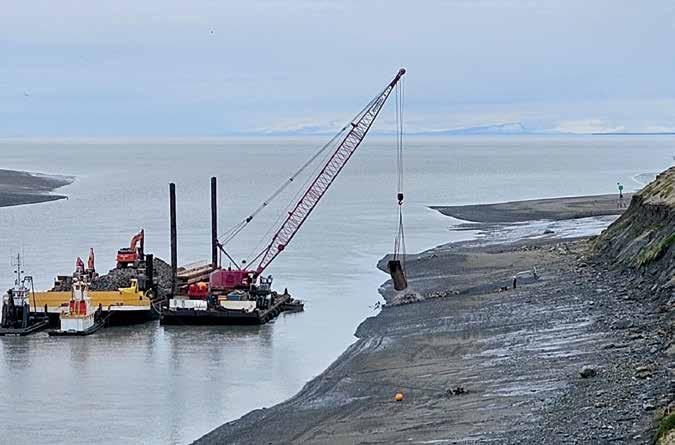
Contract Cost: $23 million
Location: City of Kenai, on the north bank of the Kenai River
Purpose/Scope: Construction consisted of approximately 5,000 linear feet of coastal rock revetment to alleviate erosion of the bluff to protect infrastructure. A revetment is a sloped, permeable layer composed of rock or riprap that dissipates wave energy, thus protecting against erosion. The recently completed revetment is designed to shield the lower portion of the bluff from storm damage and prevent erosion along the newly protected shoreline. The revetment required placing 25,325 cubic yards of armor rock, 14,425 cubic yards of core rock, and 12,380 cubic yards of bed ding rock.
Contractor: Western Marine
Challenges/Innovation: Rock production, transport, and placement amidst extreme tidal fluctuations with short duration intervals and relatively small project footprint. No “in-water” work was allowed and staging areas were condensed, keying in on environmental sensitivities, such as the historic Russian Orthodox Church and cabins on the bluff in the Old Town district. Avoiding critically endangered Cook Inlet beluga whales was also a challenge. The whales frequent the Kenai River primarily for feeding.
Completion: October 10, 2025
Contract Cost: $110 million
Location: Chena River, 17 miles east of Fairbanks
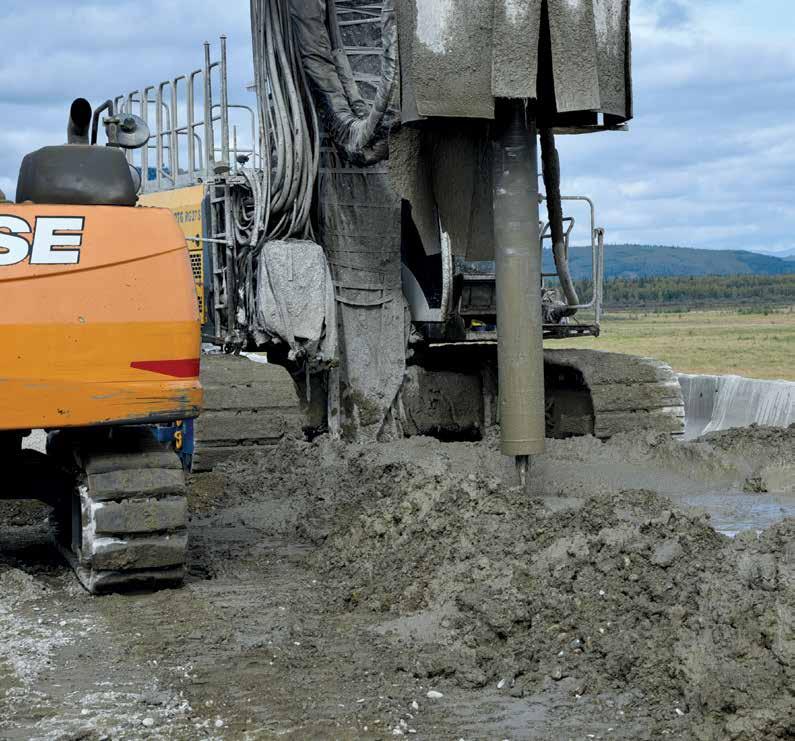
Purpose/Scope: Dam modification to address unacceptable risk, primarily the installation of a barrier wall to prevent seepage. The Moose Creek Dam is the main component of the Chena River Lakes Flood Control Project, a 7.5-mile-long earth fill structure that functions as a dry dam and provides flood damage reduction for North Pole, Fairbanks, and Fort Wainwright. The recently completed project installed a mix-in-place barrier wall through the centerline of the dam embankment to address the uncontrolled seepage and piping in the dam f oundation.
Contractor: Florida-based BAUER Founda tion Corp.
Challenges/Innovation: A novel approach of single-column mixing was utilized to produce the barrier wall. A series of refinements were


Use your savings at any eligible university, college, vocational school, apprenticeship, or even K–12 expenses.
Answer “Yes” to the Alaska 529 question on the PFD application to contribute half of a PFD into an Alaska 529 account, and you will be automatically entered to win a $25,OOO scholarship account.*
Go online to request a Plan Disclosure Document, which includes investment objectives, risks, fees, expenses, and other information. You should read the Plan Disclosure Document carefully before investing O ered by the Education Trust of Alaska. T. Rowe Price Investment Services, Inc., Distributor/Underwriter. *Certain restrictions apply; visit Alaska529plan.com for complete rules.
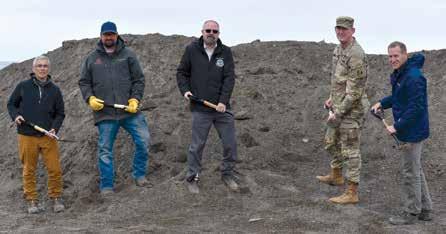
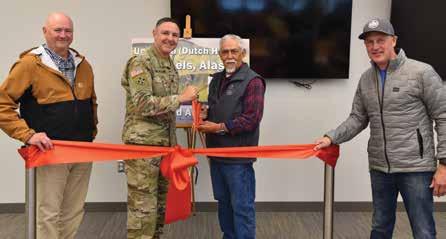
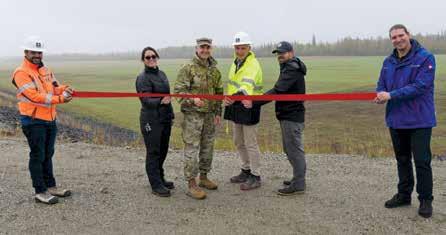
made to the soil mixing technique, dramatically increasing production while maintaining good quality. This method was a first for USACE for barrier and cutoff wall construction, according to its website. The dam had been built following a disastrous 1967 flood that caused more than $80 million damage
(worth nearly ten times as much in today’s dollars) and displaced about 7,000 people. USACE began work on the Chena River Lakes Flood Control Project in 1973 and completed it six years later. Today, major components include Moose Creek Dam, a floodway, and the Tanana River Levee and drainage channels.
Together, these features stand as the largest federal civil works project in the state, according to the USAC E website.
Completion: Janua ry 6, 2026
Below are some USACE-Alaska District projects scheduled to begin constructio n in 2026.
Skagway River Levee
Rehabilitation
Contract Cost: $23 million
Location: Skagway, on the Alaska Panhandle
Purpose/Scope: Repair the Skagway River Levee to restore its function to pre-disaster conditions from damage sustained as a result of significant flooding. The levee is located along the southeast bank of the Skagway River starting at the Klondike Highway Bridge in Skagway. The levee protects public infrastructure as well as commercial and historical properties. The aim of the project is to rebuild the levee toe and damaged side slopes.
Contractor: Hamilton
Construction, a heavy civil contractor since 1939 headquartered in Portland, Oregon, and with an Alaska division office in Sutton
Challenges/Innovation: In-water work, environmental windows, remote location, coordination challenges with airport operations and onsite quarry. Skagway is home to gold-rush-era buildings preserved as part of the Klondike Gold Rush National Historical Park. A popular tourist destination, the town’s population more than doubles during summer months.
Completion: Estimated July 2027



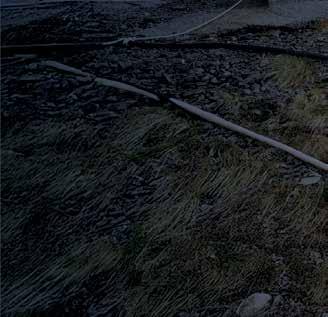



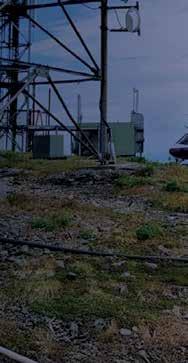



































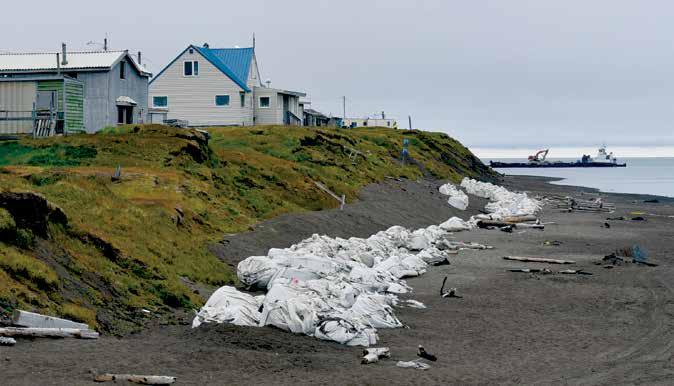
Significant coastal erosion in Utqiaġvik; a USACE contractor barge is off-shore in the background.
Contract Cost: Approximately $400 million awarded in August 2025 for Phase 1A
Location: Nome, on the southern Seward Peninsula coast
Purpose/Scope: Provide an Arctic deep draft port with berthing at -40 feet and more than 2,500 feet of additional dock face. Build a new deepwater basin by extending the existing west breakwater by approximately 3,122 feet to a depth of -40 feet MLLW. Make outer basin modifications consisting of removing the existing breakwater stub (spur) from the south end of the existing west breakwater and extending the breakwater to deep water, removing the existing east breakwater and replacing it with a new 3,900-foot east breakwater that extends to approximately -25 feet MLLW. Increase the outer basin channel entrance width to approximately 670 feet and deepen
the outer basin from -22 feet to -28 feet.
Contractor: Kiewit, one of North America’s largest construction and engineering companies
Challenges/Innovation: Remote logistics, short construction seasons, and large equipment that must be transported in by barge in summer. Nome has a subarctic climate with long, cold winters and short, cool summers.
Completion: Estimated 2032
Contract Cost: Approximately $66 million for initial task order awarded in May 2025
Location: Utqiaġvik, the borough seat and largest city of the North Slope Borough
Purpose/Scope: Provide approximately 5 miles of shore protection. The community experiences frequent and severe coastal storms, resulting in flooding
and erosion that threatens public health and safety, the economy of the community, critical infrastructure valued at more than $1 billion, access to subsistence areas, and cultural resources. The project will reduce the risk of storm damage along the coastline by building a rock revetment at the bluff area, creating a protective berm and raising Stevenson Street.
Contractor: Brice Civil Constructors Inc., with offices in Fairbanks and Anchorage
Challenges/Innovation: Remote Arctic location and complex logistics required to transport material with limited construction season. Located 330 miles north of the Arctic Circle and bordered on three sides by the Arctic Ocean, Utqiaġvik’s climate is cold and dry. Flat tundra stretches approximately 200 miles to the south, with no wind barriers or protected valleys where dense cold air can settle.
Completion: Estimated 2033














Alaska’s largest crab scuttles back onto its throne
By Amy Newman
Am ong all the species of seafood in Alaska waters, i t’s good to be king.
“King crab represents Alaska and is iconic for its size, taste, and rarity,” says Jamie Goen, executive director of Alaska Bering Sea Crabbers, a trade association for independent crab harvesters. “It’s massive compared to other popular crabs, like Dungeness, snow crab, or blue crab from the East Coast. Plus, it tastes d elicious.”
In 2024, Alaska’s total commercial king crab harvest was valued at $109.1 million, or 73 percent of the value of all Alaska crab harvested, says Greg Smith, communications director for the Alaska Seafood Marketing Institute. That represented a 14 percent increase over 2023 harvest values. The king crab fishery accounted for 8 percent of Alaska’s total seafood harvest value in 2024 , he adds.
Not a true crab, king crabs are Anomura: decapods with eight visible legs and a ninth and tenth hidden near the gills. Alaska boasts four species—golden, blue, scarlet, and red—but it’s the latter that most often come s to mind.
Since 1980, the red king crab fishery as a whole has struggled. Declining populations in different regions have meant limited harvests and closures to allow the fishery to stabilize; some have collapsed and never recovered. Rather than a single factor, those in the industry point to an amalgam of reasons for the decline as they actively work to find solutions to help stabilize populations and sustain th e fishery.
“Red king crab fisheries went from an exploratory state in the ‘50s to an incredible economic boom in the ‘60s and ‘70s,” says Mike Litzow, program manager of the Shellfish Assessment Program at the National Oceanic and Atmospheric Administration’s Alaska Fisheries Scien ce Center.

Red king crab has historically been Alaska’s top shellfish fishery. Between 1975 and 2018, fishermen harvested nearly 854 million pounds of red king crab, valued at $2.5 billion, from Alaska waters, according to the Alaska Department of Fish and Game (ADF&G). At its peak in 1980, the Bristol Bay red king crab harvest was nearly 130 million
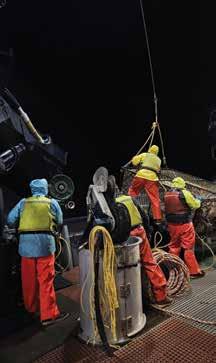
pounds. In 1965, the Kodiak Island fishery peaked at 94 million pounds.
The boom eventually went bust.
“The Kodiak red king crab population collapsed in the 1980s and hasn’t really recovered,” says ADF&G Fisheries Scientist Katie Palof.
Southeast Alaska’s fishery “has been struggling, probably the last twenty to twenty-five years,” and opened in November 2025 for the first time since 2017.
In Norton Sound, the summer and winter fisheries were both closed in 2020 and 2021, says Janis Ivanoff, president and CEO of the Norton Sound Economic Development Corporation.
Bristol Bay’s king crab fishery, the state’s largest by volume, closed from 2021 to 2023 for the first time in more than twenty-five years, Goen says. Though it rebounded enough to reopen, its numbers remain far less than at the fishery’s peak; the total allowable catch for the 2025–2026 season was just 2.68 million

pounds, a 97.9 percent decrease from 1980.
The decline leaves federal and state managers working to balance the livelihoods of fishermen with the need to keep the population sustainable. The federal government, through the National Oceanic and Atmospheric Administration and the North Pacific Fishery Management Council, and the State of Alaska jointly manage the Bristol Bay and Norton Sound fisheries. The state manages the Southeast Alaska fishery. Each has slightly different criteria for determining whether a fishery can be opened and, if so, what the annual harvest level should be.
Litzow says the federal government’s “foundation of management is the concept of maximum sustainable yield, or the largest long-term average catch that can be taken from available mature crab.”
ADF&G takes a more conservative approach and places a greater
emphasis on the female population when determining harvest levels, Palof says. The differing determinations can sometimes create conflicting decisions regarding whether to open a fishery; the state cannot exceed the federal government’s recommendations, but it can set a smaller limit. Palof points to the two-year closure of Bristol Bay as an example, when the federal government said numbers supported a small fishery but the state chose to close it.
“We focus more on females; the federal government focuses on males,” Palof says. “In those two years, the female threshold fell below our state statute. At the state level, we take into account all portions of the population, and there are regulations that if the female population is depressed, it’s a warning sign that something is going on.”
The declines and fishery closures have, of course, negatively impacted those whose livelihood depends on the fishery. Ivanoff called the
two-year closures in Norton Sound “devastating.”
“For fishers, this meant forgoing any income from the fishery,” she says. “Those years also meant reduced employment opportunities for seafood plant workers and reduced economic activity in area communities that are impacted by the fishery.”
Fisheries scientists say the decline in the king crab population is due to an interplay of reasons rather than a single cause. The fishery has seen low levels of recruitment, or the entry of young crabs into the fishery, but scientists are unsure why.
“We don’t have a clear answer for the lack of recruitment, but that’s definitely the place that we’re just not seeing those crab enter the adult population,” Palof says. “There is a sufficient number of females and males during mating season. We see females with healthy eggs and fertilized, so we believe that part is sufficient.”
But because those young crabs don’t appear on surveys for five to seven years, it is difficult to know what is happening between fertilization and their eventual entry into the population. The Bristol Bay fishery, for example, hasn’t had a large group of young king crab enter the population since the early 2010s, Litzow says. It’s “almost certainly due to a combination of factors,” but data that could help provide answers is scarce.
Changes in climate and the overall ecosystem are also likely contributing factors, but again, the exact effect is unclear.


“The colder ecosystem state of the 1960s and 1970s supported much larger king crab populations than we see today… But understanding causality and the mechanisms behind this pattern is challenging.”
M ike Litzow
Shellfish Assessment Progr am Manager NOAA Alaska Fisheries Scie nce Center
“The colder ecosystem state of the 1960s and 1970s supported much larger king crab populations than we see today,” Litzow says. “But understanding causality and the mechanisms behind this pattern is challenging.”
Scientists are also learning more about the effects ocean acidification has on shell formation during early stages of king crab development, which could leave the juveniles vulnerable and decrease their chance of survival to adulthood, Goen says. Adding to the difficulty of identifying reasons for the decline is the disparate impact that various conditions can have within the population, Palof says.
“What we are kind of lacking is what would cause a crab population to go up or down, and
how does that all interact with the different life stages,” Palof says. “Increasing temperatures might be bad for young crab, but okay for older crab, so it’s hard to know how they all interact. It’s not as linearly related, and I think that’s something that gets lost in the general message.”
Despite the recent challenges, there is optimism for the fishery ’s future.
“Thankfully, there are signs of recovery and hope for Alaska’s iconic king crab as the stock stabilizes,” Goen says. “The fishery appears to have stabilized in recent years, in part due to managers lowering the exploitation rate on how many crabs can be harvested at a given population site.”
Ex-vessel prices—the average statewide price paid at the point of landing or unloading—for red king crab have steadily increased. In 2013, the per-pound price of red king crab was $6.75, the lowest for the period 2013–2024; in 2024, it had almost tripled to $19.94 per pound.
Litzow says that “current indicators for the Bristol Bay red king crab fishery are positive, with survey estimates of abundance for mature males and mature females up 50 percent and 120 percent, respectively, over the last four years.”
But Palof cautions against relying too heavily on predictions.
“Some of the collapses we’ve seen in the past hadn’t been predicted by our projections,” she says. “We try as much as possible to stick with the most recent year, what do we know
about the stock right now, because those projections are difficult.”
Research into causes of the decline also continues. Ivanoff says the Norton Sound Economic Development Corporation has financially supported crab-tagging projects to better understand the movement of Norton Sound king crab and has provided ADF&G with additional funding to support trawl survey efforts. Other activities include research aimed at understanding where crabs settle and what they need to survive, research examining the effect other commercial fisheries may have on king crab populations, and a proposed hatchery in the Pribilof Island village of St. Paul that will grow fertilized king crab eggs to about the size of a quarter before releasing them into Bristol Bay, Goen says.
Fisheries managers will continue to use “the best available science” to ensure fisheries remain sustainable long-term, Litzow says. And with so many aspects of the fishery outside their control, Palof says they’ll continue to use the leverage they have to keep the fisheries viable.
“The leverage we have when it comes to fisheries management is we can reduce the amount of crab that we take out of the water,” she says. “Or if there’s an area that we know is important for a nursery, we can go through the process of trying to protect this area from other fishing or other gear and maybe produce more crab.”
Beyond those management measures, the king crab population rules itself.
In 2025, UIC surpassed $1 billion in revenue and achieved record profit, a milestone built on disciplined strategy and a diversified portfolio. This achievement is a foundation for what’s next: growth with purpose, stronger partnerships, and opportunities that honor our heritage while creating meaningful value for shareholders and communities.
THE JOURNEY IS JUST BEGINNING.

RBy Gretchen Wehmhoff
y en joined Girl Scouts as a Daisy in kindergarten. Now, in the 4th grade and entering Girl Scout cookie season, she is an experienced cookie saleswoman with a goal and a plan.
Last year Ryen sold 430 boxes of cookies. This year the Fairbanks scout plans to sell 500 boxes, a challenge in the Farthest North Girl Scout Council (FNGSC), where winter temperatures drop well below 0°F during cookie season—which starts with presales in January and continues into April with booth sales.
Ryen follows a tradition of cookie sales that goes back to the 1910s with bake sales held by early Girl Scout troops.
In 1922, Girl Scouts of the USA published a sugar cookie recipe in its publication American Girl. Troops and volunteers across the country baked the cookies at home, packaged them in wax paper bags, and sold them for $0.25 to $0.35 per dozen. Alaska troops in Seward held bake sales in the ‘20s—one in conjunction with a local Boy Scout troop. An ad in the Seward Daily Gateway touts, “Both Scout troops need uniforms and equipment and are giving this BAKE SALE as a means to swell the treasury coffers.”
By the ‘30s, local councils started working with commercial bakers.
During World War II, Girl Scouts turned to selling calendars instead of cookies as the country dealt with shortages of butter, flour, and sugar. But by 1948, Girl Scouts of the USA had twenty-nine bakers licensed to produce Girl Scout cookies. Three cookies made the first lineup with
shortbread (Trefoils), sandwich, and chocolate mints (Thin Mints).
These days, two baking companies supply the trademark cookies to councils: ABC Bakers and Little Brownie Bakers (LBB), once owned by Kellogg’s, now part of Italian confectionary conglomerate Ferrero. Both companies use the official Girl Scout packaging.
The bakers provide a variety of Girl Scout cookie products, but the core requirements are Thin Mints, Peanut Butter Sandwich/Do-si-dos, and shortbread Trefoils. The popular
Samoas from LBB are called Caramel DeLites at ABC. Peanut Butter Patties from ABC are also known as Tagalongs from LBB. Both bakers have offered gluten-free, sugar-free, and vegan options over the years. All cookies are kosher and halal certified. Both Alaska councils purchase cookies from LBB.
LLB bakes cookies year-round and ships them across the nation from December through April. LBB ships nearly 77 million packages of cookies to the fifty-nine Girl Scout Councils they supply.

GSAK CEO Hilary Patterson says the goal for the 2026 cookie sale is 360,000, an increase of nearly 19 percent over 2025.







-














“Little Brownie Bakers ships cookies via land, sea, and air to best support the needs of our Girl Scout Councils,” says Christine Dhondt, LLB director of marketing communications.
Girl Scouts of Alaska (GSAK), one of Alaska’s two Girl Scout councils, serves girls south of the 63rd parallel, which includes Southeast, Southcentral, Southwest, and the Aleutian Chain.
Last year the council sold 303,173 packages. GSAK CEO Hilary Patterson says the goal for the 2026 cookie sale is 360,000, an increase of nearly 19 percent over 2025.
Each box sells for $6 with all proceeds staying in the council. GSAK troops earn $0.75 per box and another $0.05 to $0.10 if they participate in early registration and the Troop Readiness program. In some cases, girls choose to forgo proffered incentive packages so they or their troop can earn as much as $1 per box. GSAK receives $3.62 per box before the council’s cost of incentives.
Setting its own rates, troops in the FNGSC earn $0.85 per box.
The incentives that the councils offer vary and may include patches, accessories, sweatshirts, fun kits, and credit toward camp or in the Girl Scout store through the Cookie Dough incentive.
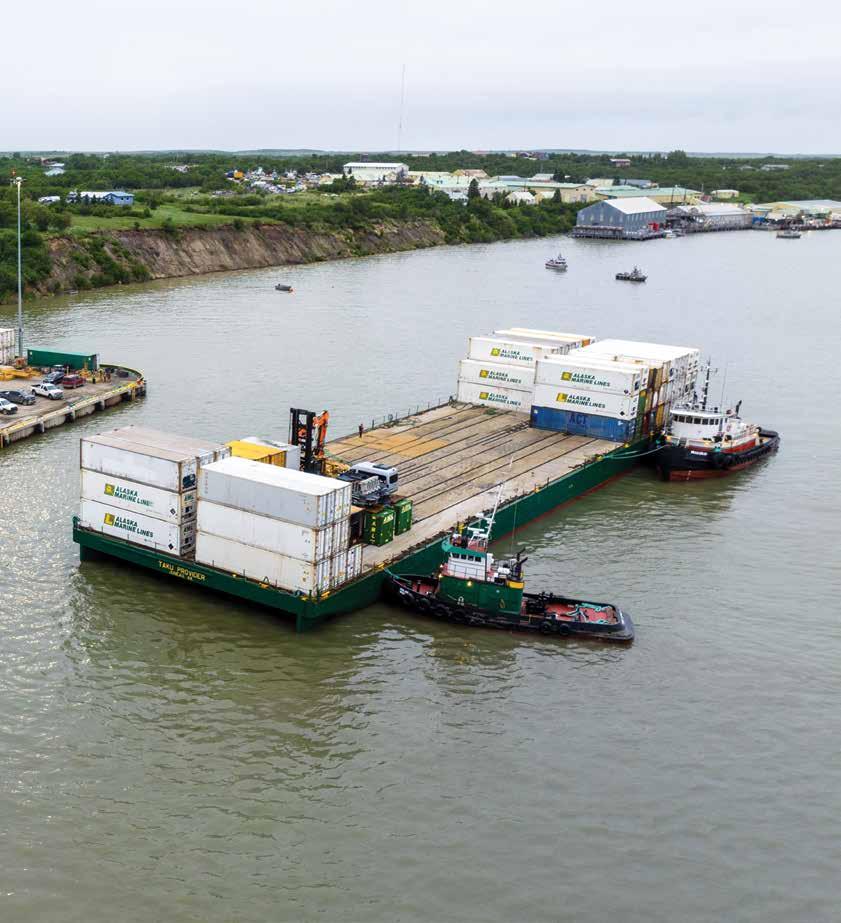
To get from LBB’s ovens to Alaska troops, Ferrero trucks the cookies from Kentucky to Lynden in Fife, Washington; to Alaska Marine Lines in Seattle; and to Span Alaska in Seattle.
Lynden Transport arranges for cookies to get to Southcentral and Southwest addresses. “We unload their trucks, put the cookies on pallets, and transfer them to our trailers,” says Jeff Denney, Lynden Transport regional sales manager.
Lynden takes their trailers over to their shipping partner, TOTE Maritime Alaska. Trailers are barged across the Gulf of Alaska to Anchorage, arriving at the Don Young Port of Alaska. There, Denney says, “We bring our trucks from our service center in Anchorage down to the Port of Anchorage, hook onto our trailers from the ship, and bring them back to the service center.”
Once at the Anchorage service center, Lynden employees sort cases based on “pick tickets” or an invoice from Ferrero onto new pallets headed for different destinations within the GSAK council area. GSAK has distribution venues in Mat-Su, South Anchorage, Eagle River, Kenai, Juneau, Bethel, and Togiak. Lynden arranges transportation to each distribution spot.
Each location has a one-day window for troops and service units to pick up cookies. GSAK calls the effort a “cookie toss” involving volunteers and staff who help pick and load up the orders for each troop.
Cookies come in cases of twelve boxes. The heaviest cookie package weighs nine ounces, making the case weight just shy of seven pounds. The cost of shipping such large cargo could dig into profits, so TOTE ships the cookies as an in-kind donation. According to Lisa Simmons, marketing and communications manager for TOTE, the ocean portion of the trip
The ocean portion of the trip donated by TOTE to GSAK includes five to seven 53-foot trailers of cookies each year.




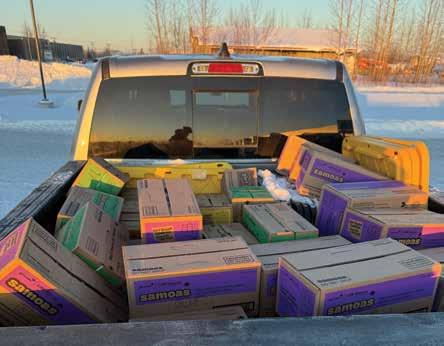
donated by TOTE to GSAK includes five to seven 53-foot trailers of cookies each year.
Cookies going to Southeast (a part of GSAK) travel via a Lynden family company, Alaska Marine Lines, directly from the Port of Seattle. In Juneau, the cookies are sorted by volunteers and disseminated to troops and service units in the region.
GSAK operates Cookie Cupboards out of its main offices in Anchorage and in Juneau. These serve as the depot where troops can order additional cookies and trade unopened cases.
This year’s flavors for GSAK include Thin Mints, Samoas, Tagalongs, Lemon-Ups, Toffee-tastic, Trefoils, Dosi-dos, Adventurefuls, and new this year, Exploremores.
Cookies headed to Fairbanks for FNGSC are shipped with Span Alaska. FNGSC provides for girls north of 63°N latitude, with troops in Tok, Healy, Nome, Kaktovik, and Utqiaġvik. Ferrero delivers cookies bound for FNGSC to Span Alaska in Washington, which arranges for shipping from the Port of Tacoma to Anchorage.
“From Anchorage they get parceled out depending where they’re going,” says FNGSC Director of Operations René Cornelius. “The bulk of our membership is in the greater Fairbanks area, Fairbanks and North Pole.”
Cookies bound for Nome and Utqiaġvik leave Anchorage via air, cookies for delivery along the Richardson and Alaska Highways travel via truck, and the remainder of the shipment is unloaded in the SPAN Alaska warehouse in Fairbanks.









of Girl Guides and Girl Scouts' five international World Centers: Nuestra Cabaña (also known as Our Cabaña) in Cuernavaca, Mexico.
Ryen’s preference is the sleepover kit. It includes a comfy pillow and a sleep mask. She knows she will use the mask when camping in the summer.
Girls who sell 500 or more boxes become part of the 500 Club in FNGSC, and those girls vote on next year’s incentives.

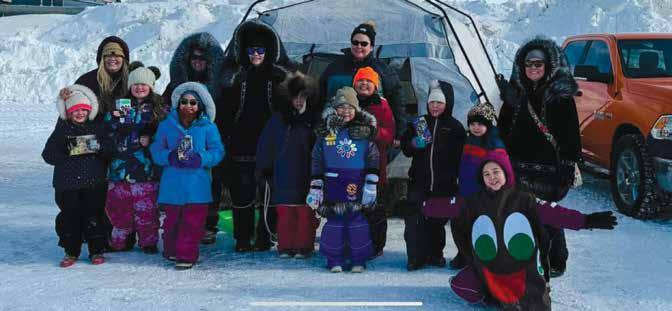
Both Alaska councils assist troops with arranging booth sales at locations such as Carrs, Fred Meyer, Lowes, and Walmart stores. Several troops in Anchorage, Eagle River, and Mat-Su have established drive-up booths in key locations.
More than desserts and snacks, Girl Scout cookies stand as the largest girl-led entrepreneurial program in the world.
Troop leaders and scouts attend online and in-person training before embarking on sales. Councils and service units hold Cookie Rallies in January. FNGSC offered a Cookie CEO training where girls who are in fourth grade and up make a sales pitch to local business leaders. Through product sales, girls learn business ethics, goal setting, money management, and people skills.
According to a report by the Girl Scout Research Institute, “Today’s girls are already thinking like entrepreneurs. They possess many traits we know are linked to entrepreneurial success and are socially conscious problem-solvers.”
The study also states, “Although girls express confidence in their ability to be entrepreneurs, they also identify key challenges to getting started, including a fear of risk and gender stereotypes.”
As girls get older, their interest in being an entrepreneur decrease slightly (85 percent of girls between the ages of 14 and 17 versus 91 percent of girls between the ages of 8 and 10) and they are less likely to feel like society supports women in entrepreneurship. The study found that while six out of ten girls had an entrepreneurial mindset, three in four girls believe they would have to work harder to succeed in entrepreneurship roles because of their gender.
Providing these entrepreneurial opportunities is important.
Cookie sales fund the program at the troop level, with the girls setting the budget.
“Our troops are earning their own way to travel overseas. They're earning their own money to buy their badges. They're earning their own money to do community service projects.
They're earning their own money to do all of these things. They're very selfsufficient. And we're very proud of that work,” says Cornelius.
Cornelius continues, “We are here to provide opportunities for girls in communities that may not have lots of opportunities. So, we have Girl Scouts who live in rural villages to Girl Scouts who live in town. We try to provide something for them that they can learn real life skills, something for them where they can build their courage and have a safe place.”
“I think now more than ever, it's very important for girls to have a safe space to be girls and on the flip side, I think it's incredibly important for our older girls to have a place where they can be vulnerable and be themselves,” says Cornelius.
As for Ryen, she’ll be selling cookies for years to come. She’s looking forward to growing with Girl Scouts. Her troop meets every Wednesday, and some of her favorite things to do with Girl Scouts are camping, getting out on the lake, and archery—but right now, she has 500 boxes of cookies to sell and deliver.



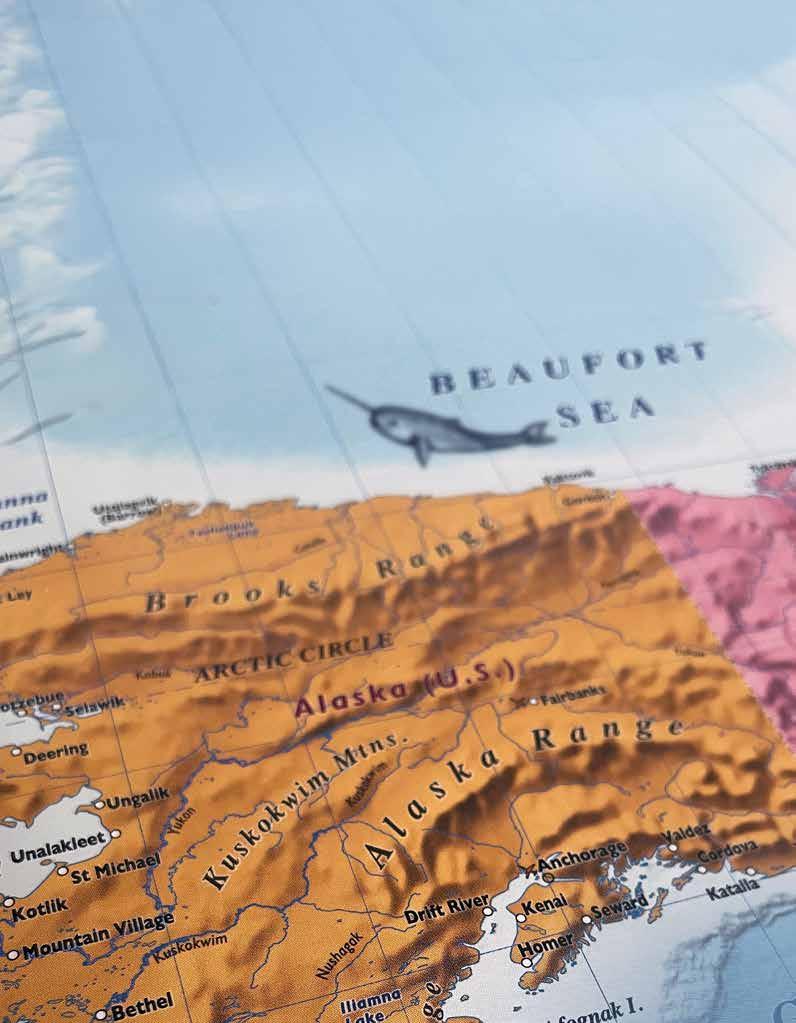
Al aska is an Arctic state, but not all of the state is Arctic. The line of 66° 34' north latitude crosses just south of Kotzebue and Fort Yukon. Nearly thirty settlements north of that line experience the astronomical reality of polar night and midnight sun. Climate and distance def ine their existence.
For this special section, anywhere north of Fairbanks shares the Arctic lifestyle, including the Bering Sea communities of Savoonga and Nome. Capital








By Tracy Barbour
Wh ales are safer in their ocean home thanks to Matson and its high-tech collaborations. The Hawai'i-based provider of ocean transportation and logistics services is using AI-driven technology on containerships to detect and avoid marine mammals. The company is leveraging its historic collaboration with Woods Hole Oceanographic Institution (WHOI) in Massachusetts, the world’s leading independent nonprofit dedicated to ocean science, technology, education , and communication.
In 2023, Matson awarded WHOI a $1 million research grant and provided access to company vessels and crews to facilitate the development of a system designed to make oceans safer for both
whales and maritime personnel. By 2024, this collaboration advanced from the research phase to commercial application, resulting in the launch of WhaleSpotter, a company co-founded by WHOI scientist Daniel Zitterbart and Sebastian Richter, co-developer of the AI detection algorithm. Richter is chief technology officer while industry veteran Shawn Henry, a former executive at equipment tracking tag manufacturer Humatics, serves as WhaleSpot ter’s CEO.
Last year, WhaleSpotter deployed its first fifty commercial production units. The company manufactures camera units domestically under an exclusive technology license from WHOI and intends to expand deployments globally across
a variety of commercial and researc h vessels.
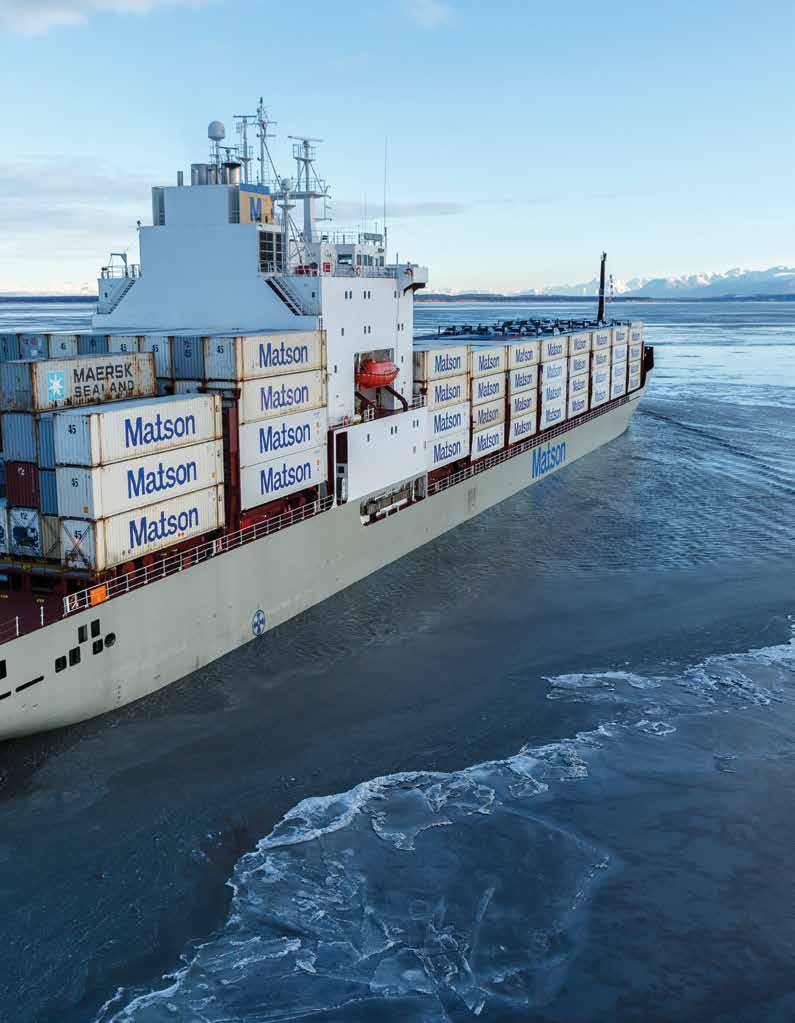
Matson is currently testing WhaleSpotter’s technology on three ships, according to Matson CEO Matthew Cox. One of them, Matson Kodiak, serves Alaska exclusively. The company has three containerships dedicated to its Alaska service, carrying cargo from Tacoma, Washington, to Anchorage and to Kodiak twice a week and once a week to Dutch Harbor. The other two ships equipped with WhaleSpotter camera systems are deployed in its Hawai'i service. Matson also has four more camera systems on order for installation this year, including on its other two Ala ska ships.


“Unfortunately, whale strikes are not uncommon in our industry, so it was important to us to try to find a practical way to avoid collisions with whales. Our hope is that one day all ships will have this technology.”
M atthew Cox Chairm an and CEO Matson
Matson has contributed extensively to the research and development of WhaleSpotter’s system. “This has been a very collaborative project with WHOI,” Cox says. “It’s the first time they have tried this new technology on large containerships, so our vessels have served as test beds, and our crews have been involved in the process, from providing input on fabrication to where to install the cameras, integration of data systems, and refining the user i nterface.”
Matson’s shipping operations extend across the US West Coast, Hawai'i, Alaska, Guam, China, Japan, and South Pacific islands. The company has a longstanding record of adjusting ship speeds and routes to ensure maximum whale safety for its fleet of ships across the Pacific, particularly along its Alas ka routes.
“Environmental stewardship is one of Matson’s long-standing core values, and we’ve invested many years to reduce our impact on the environment,” Cox says. “We were first in our industry to adopt a zero-solid-waste discharge policy in the early 1990s, for example. Unfortunately, whale strikes are not uncommon in our industry, so it was important to us to try to find a practical way to avoid collisions with whales. Our hope is that one day all ships will have this te chnology.”
Globally, tens of thousands of whales are injured or killed each year after being struck by ships, particularly the large container vessels that ferry 80 percent of
the world’s traded goods across the oceans, according to global conservation organization Ocean Wise. The risk of strikes is higher in busy shipping lanes and migration routes, with major hot spots in the North Atlantic, Pacific Coast, and Mediterranean Sea. However, slowing ships from speeds greater than 10 to 14 knots down to 10 knots or less greatly reduces the chances and severity of ship strikes on marine mammals, with some studies reporting an 80 to 90 percent decrease in death risk, according to the National Oceanic and Atmospheric Administration. At slower speeds, whales have more time to detect and evade oncoming vessels, while ship captains have better maneuverability and reac tion time.
WhaleSpotter is uniquely positioned to help protect vulnerable marine mammals. The company’s innovative detection system integrates a thermal imaging camera, proprietary AI algorithms, and human intelligence to identify whales in real time. These advanced heat-sensing cameras operate continuously, scanning the ocean’s surface day and night. The cameras can discern heat signatures from whale spouts or body warmth, which stand out against the cooler temperature of the surroundi ng ocean.
Once a potential whale is identified, a vital human verification process takes place. The system’s neural network analyzes the data, comparing against millions of samples for accuracy, and remote experts review the possible whale
detections within seconds, doublechecking the AI findings to further ensure accuracy and re liability.
With a WhaleSpotter unit installed, vessel strike risk is significantly reduced. “Over 90 percent of the time, whales are detected soon enough to allow the captains to take evasive action,” Henry says. “No other whale detection technology can provide that level of protection, and WhaleSpotter’s unique longrange detection technology empow ers this.”
The creation of WhaleSpotter’s system was driven by operational necessity. According to Zitterbart, it arose out of the need to provide effective whale detection technologies during maritime activities, such as geophysical research, that create underwater noise. “During the last decade, the need for scalable technology that allows for vessel strike mitigation increased, spurring the development of the current version of WhaleSpotter, ” he says.
In shaping the design and usability of the technology, Matson played a critical role as an early adopter and partner for WhaleSpotter, according to Henry, such as by hosting WhaleSpotter personnel aboard its ships during the technology testing phase.
“Understanding how the bridge crew uses their suite of marine electronics in conjunction with the WhaleSpotter led to many nuanced product changes,” Henry observes, “such as being able to dim the
screen further at night to avoid ruining night-vision of the crew, placement of the WhaleSpotter tablet on the bridge, and choosing an audible alert that is recognizable but not annoying.”
Matson was an active participant with WHOI in the research and development process. “We first provided input on fabrication and
materials for iterations of the camera housing to protect these highly sensitive cameras against the harsh marine environment,” Cox recalls. “Then our engineering department developed mounting brackets and a cabling plan that could be used on each ship. Meanwhile, our IT and fleet professionals worked with the WHOI
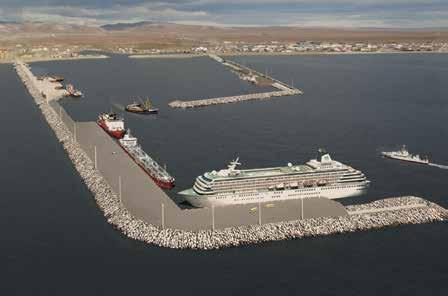
• Upgrades infrastructure with expanded dock face and depths to minus 40-foot.
• Supports national security, life safety, and resource development in the Arctic.
• Expands Port of Refuge capability and positioning of spill response assets to protect the environment and improve food security.
• Opens new commercial opportunities and strengthens regional and national supply chains.
• Facilities built for scale designed to withstand Bering Sea storms.
• Arctic gateway for commercial fisheries, energy, tourism, and scientific exploration across Western Alaska and the U.S. Arctic.
UNLOCKS ACCESS FOR VESSELS UNABLE TO CALL AT NOME BEFORE $400M PHASE 1A AWARDED AUGUST 2025

Harbormaster: 907-304-1906 | Port Director: 907-304-1905 nomealaska.org
“Over 90 percent of the time, whales are detected soon enough to allow the captains to take evasive action… No other whale detection technology can provide that level of protection.”
S hawn Henry CEO Wh aleSpotter
team to integrate the systems that enable communication of data. And our crews provided additional input on the user interface display.”
The first installation involved extensive research and development and took four months to become operational. “We learned a lot and improved the process with each installation, such that our last camera took four days to become operational: two days to install and two additional days to commission, which entails synchronizing systems and testing,” Cox says.
opposite direction of the marine mammal detection. Smaller vessels can either slow or stop to avoid.”
Matson, for example, relies heavily on ship captains to employ the system based on the situation. Cox explains, “Since the location and distance of each encounter are unique, it’s up to our captains to decide the best course of action to reduce the risk of a c ollision.”
Cox says crewmembers at Matson have been “impressed” that the WhaleSpotter system not only detects whale spouts at night but can also distinguish whale spouts from white caps. “We are very happy with the system so far, and our crews like having this new tool that can help them protect whales, ” he says.

Matthew Cox Matson
So how does whale detection technology work in a real-world scenario? WhaleSpotter’s built-in thermal camera and AI capabilities meticulously capture images and identify marine mammals. Each time this happens, the image gets forwarded to a human verification network for validation. “This ensures we don’t miss any marine mammals, and we don’t provide any false alerts,” Zitterbart explains. “Validated images are then forwarded to our captain’s interface as a detection within thirty to sixty seconds. The captain’s interface shows a radar-like view, showing the captain where the validated detection appears relative to the vessel.”
From there, a decision on how to avoid the animal is in the captain’s hands. Zitterbart says, “For large vessels, this is normally a small course correction, steering in the
For the future, Henry envisions a world where every ship navigating waters frequented by whales is equipped with a WhaleSpotter unit. Once enough vessels have a unit installed, it will create a network effect. An interconnected fleet would enable near real-time tracking of whale distributions in highly trafficked regions. “This information can be shared in realtime with vessels that do not have a WhaleSpotter on board or do not provide sufficient elevation for long detection ranges (below 15-foot mast height),” Henry explains. Through this collaborative approach, the network would extend the benefits of advanced whale detection to a wider range of ships, helping safeguard marine mammals throughout the region.

By Christi Foist
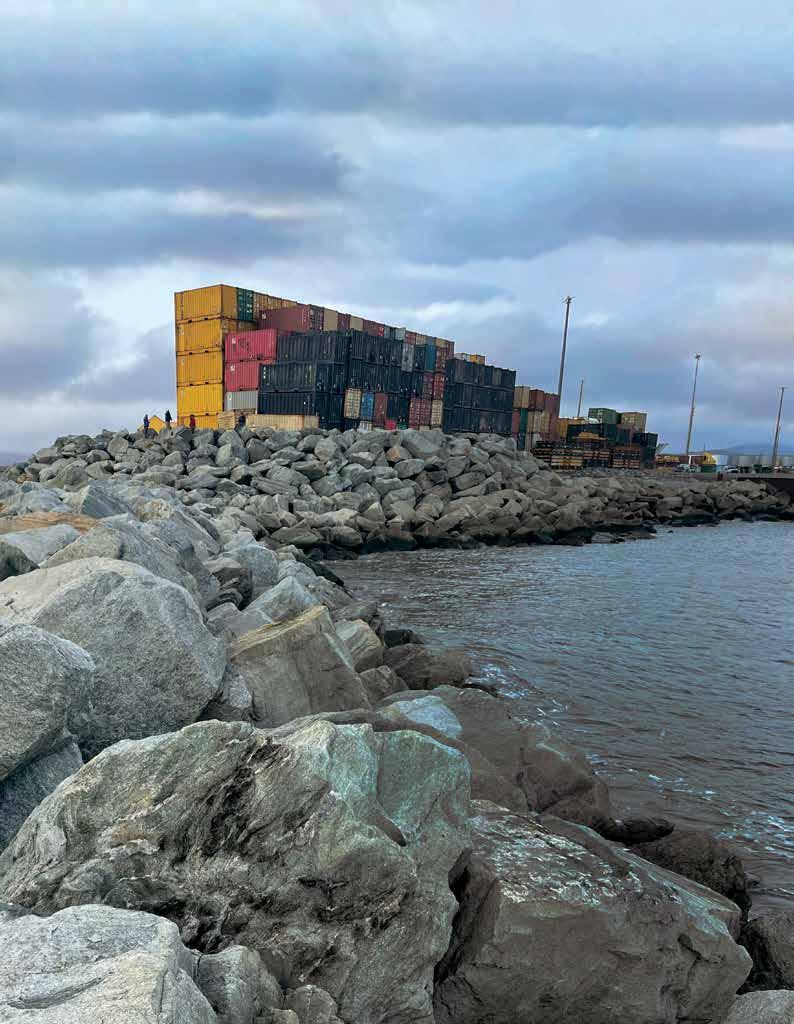
Years in the making, construction of the first deepwater port in the US Arctic starts this spring. Last August, the US Army Corps of Engineers–Alaska District (USACE) awarded a $400 million Phase 1A contract to Kiewit Infrastructure West Co. for the Port of Nome Modification Project.
“There’s been a great deal of effort by a large number of people and agencies and project development team members to get us to this point,” says Port of Nome Director Joy Baker. “We are ecstatic.”
Baker is understandably excited. She was Nome’s harbormaster from 1993 to 2013, then became the city’s port director in 2015. She announced her intent to retire in 2023—a decision that coincided with the ramp-up to the Port of Nome Modification Project. The city kept her on as project manager through May 2024, when she officially retired. But the city lured her back in September 2024, and she is once again port director.
Pat Harrison, Kiewit’s Alaska area manager and director of the Nome
port project, says the company hopes to complete Phase 1A by fall 2029. After USACE cancelled the initial call for bids in late 2024, engineers split the original Phase 1 West Causeway expansion into two parts. Under the reconfigured work plan, Kiewit, which bid on the project both times and has a long history in the region, will now extend the causeway 1,200 feet and add roughly 600 feet of dock face.
Harrison says the 2026 work season will cover four main areas: 1) mine armor stone from the Cape Nome Quarry; 2) transport and store the rock near the causeway; 3) build a temporary 180-person work camp; and 4) demolish and remove the “spur” that currently ends the causeway.
“This is going to be a construction gold rush for Nome,” says US Senator Dan Sullivan, who’s worked for most

of his two terms in Congress on the project. Over the years, the Alaska congressional delegation has worked to insert funding in multiple bills. They also won more favorable funding terms. Under Nome’s agreement with USACE, the city covers 10 percent of costs while the federal government covers 90 percent. Sullivan says the cost split used to be 70/30.
Baker also credits Nome’s state legislators, Senator Donny Olson and Representative Neal Foster, in helping to appropriate state funding for the port project. “That was essential,” says Baker. “Without that, we would not be where we are with constructing Phase 1.”
Multiple factors contributed to the many years it’s taken to reach the


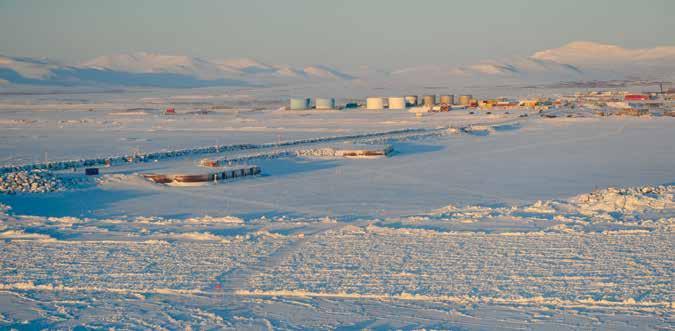
start of construction. When USACE released its 2015 draft report Alaska Deep-Draft Arctic Port System Study , the rationale for such a port focused on economic reasons such as support for resource extraction. The report mentioned “spill” or “oil spills” thirtyfour times and “national security” only six times.
Later that year, Shell ended its Arctic Ocean exploration campaign, which changed the calculus for the Port of Nome. “When I came to the Senate, this project was essentially dead,” Sullivan recalls. He’d been in office less than a year when Shell announced its change in plans.
Meanwhile, Arctic shipping traffic continued to grow. From 2013 to 2024, total Arctic shipping traffic increased 37 percent, according to data from Protection of the Arctic Marine Environment (PAME), an Iceland-based working group of the Arctic Council intergovernmental forum. Over that time, PAME’s Arctic Ship Traffic Data program found the number of unique ships transiting the region increased from 1,298 to 1,781.
General cargo ship traffic increased 40 percent, from 134 unique ships in 2013 to 187 in 2024. Updated in January 2025, PAME’s report The Increase in Arctic Shipping 2013–2024 shows that most cargo ships traverse the Northern Sea Route along Russia’s northern coast. That pattern could change, especially once Nome has a deepwater port that can accommodate larger ships’ refueling and other needs.
Shorter routes from East Asia to Europe via the Arctic have such potential economic significance that the mayor of Busan, South Korea, visited Anchorage and Nome early this year. Mayor Park Heong-joon sought to explore what the port expansion could mean for exports from Korea’s maritime industrial hub.
In an AI-translated press release on Busan’s website, Park says an Arctic shipping route could reduce the distance from his city to Europe by more than 30 percent. It would also avoid the perils of the Suez Canal. The release says, “Nome is considered a key mandatory stopover for vessels
once Arctic shipping routes become more active.”
At the same time, Russian and Chinese activity near and sometimes inside Alaska waters and airspace has increased. This has run the gamut from joint military patrols near the Aleutian Islands to what Sullivan calls “aggressive military actions” in the Arctic.
“The United States is going to have to up its ante in terms of what it’s doing, defense-wise, in that region,” says Cameron Carlson, dean for the College of Business and Security Management at UAF.
National security was always part of the Port of Nome project’s motivation, Baker says, but “over the years it has elevated higher up the list of reasons to build this and has become… the paramount reason.”
Even before the first dirt is turned, the Port of Nome Modification has begun to affect the city and the broader region’s economy. “The project… should provide meaningful
jobs—not only in Nome, but also surrounding villages,” says Larry Pederson, vice president of in-region services for Bering Straits Native Corporation (BSNC).
Shareholders of the Nome-based Alaska Native regional corporation will benefit even if they don’t get jobs tied to port construction. Pederson says the port is one of two projects that will significantly increase the quarry’s rock production over the next few years.
In a typical year, the quarry produces 50,000 tons of material for various projects. If the quarry gets awarded the rock contract for all phases of both the Port of Nome expansion and the Utqiaġvik seawall project that broke ground last year, the quarry could provide 3 million tons of rock over five to seven years—a nearly tenfold increase in production.
Under the Alaska Native Claims Settlement Act, BSNC owns subsurface rights at the quarry, which bring royalty payments that scale based on production. Sitnasuak Native Corporation, the Nome village corporation, owns the surface rights and provides access to the rock. Pederson says the Utqiaġvik seawall could require about 1 million tons of rock, and the port project about 2 million tons. Of that, Phase 1A should account for about 875,000 tons.
Prior to the USACE award of the Phase 1A contract, BSNC signed an agreement with Kiewit for rock extraction. Pederson says corporation leadership made a strategic decision to contract out the rock production work due to equipment costs. The two parties signed the agreement in 2024, and Kiewit began work onsite in 2025.

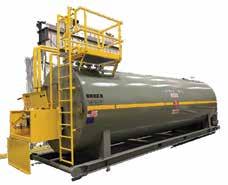


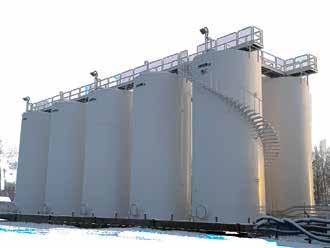





Harrison says the quarry contract made sense for two reasons: first, Kiewit’s then-forthcoming bid on the port project, and second, the Nebraskabased construction firm’s long history of major Alaska projects. “We originally developed that quarry in the mid1980s for the first Nome causeway that was built, so we have extensive history operating in that quarry,” says Harrison.
While Kiewit is bringing some workers from Outside, Harrison “absolutely” wants to hire locally when possible. “It’s important to the local community there and the economy associated with that,” he says. “That’s an important component to ensure that we’re providing an opportunity for the local residents.”
BSNC has taken several steps to help shareholders capitalize on the opportunity presented by Port of Nome construction. Pederson says that, a year or two ago, the corporation created a new full-time workforce development position. Among other things, this role supports setting up a job and training center for shareholders, tribal members, and region residents.
The workforce developer is currently focused on commercial driver license (CDL) trainings, to help residents of Nome and surrounding villages qualify for jobs hauling rock 13 miles from quarry to port. “There’s gonna be a huge uptick in CDL positions,” Pederson says. “We’re planning to provide as much as we can through a contract with Kiewit.”
BSNC is also collaborating this spring with its nonprofit affiliate Kawerak
and the UAF Northwest Campus on a welding class. The corporation also hosted outreach meetings with unions to help people learn about requirements for project jobs. A November public meeting had both an in-person and online component so residents of surrounding villages could learn about opportunities.
BSNC purchased a former camp facility to provide housing. In the short term, the sixteen-person structure will mostly house Kiewit staff. Long term, though, Pederson says BSNC wants the building to support workers who come to Nome from surrounding areas.
“Nome is considered a key mandatory stopover for vessels once Arctic shipping routes become more active.”
Park Heong-joon Mayor Busan, S outh Korea
The city is also preparing to support long-term changes that a deepwater port will bring. The June 2025 draft of the Port of Nome’s strategic development plan includes ten different projects to develop the adjacent waterfront. Conceptual cost estimates for these projects total just over $100 million.
In 2025, the Snake River Moorage Facility (described in the strategic development plan as the Snake River Floats) won a $13.2 million
grant through the US Department of Transportation’s Rebuilding American Infrastructure with Sustainability and Equity program, matched by the City of Nome. The project will improve seasonal small boat storage, adding about 1,700 feet of floating dock that should reduce crowding in the main harbor. The moorage project is currently in the permitting and design phase, Baker says.
Baker says the other ancillary improvements will require various funding sources and separate contracts. One, the offshore Causeway Cruise Terminal, depends on part of the port-expansion work. Other projects, such as a harbor walk, might happen more iteratively. Each of the ten projects serves different needs and users of the area.
The Harbormaster Uplands piece would significantly expand office space, improve a gravel parking lot, and add services such as a “comfort” facility with laundry and showers. The Belmont Point project would add a boat launch to improve access and safety, along with facilities to support recreation and subsistence activities like fish and seal cleaning. Other elements of the plan would support salmon fishing on the Snake River, improve some barge-related tasks, and create a River Street Visitor Facility to serve the influx of tourist traffic Nome anticipates.
It’s too early to tell what ships might visit Nome once the third and final phase of the port expansion concludes. But the project big enough to bring Baker out of her retirement stands to keep Nome and its neighbors as busy as they want to be for the foreseeable future.
Northrim’s banking experts live and work across the state, serving the communities we call home. We understand Alaska’s industries, and the unique challenges and opportunities that come with doing business here.
From personalized lending to everyday banking, we deliver local expertise and Superior Customer First Service to help Alaska businesses achieve more.
By Scott Rhode
Li ke its tusked namesake, Narwhal is a unique beast. The affiliate of Dallas, Texas-based EE Partners Corporation is exploring for oil and gas in the Arctic Ocean, a feat that few have attempted. In 2024, the Alaska Department of Natural Resources approved the company’s request to designate its leases in West Harrison Bay, northwest of the Prudhoe Bay Unit, as its own offshore unit named Narwhal.
Part of the area had been unitized before, when Shell acquired leases to 88,000 acres. Narwhal adds 77,848 acres encircling those West Harrison Bay leases that Shell relinquished earlier in 2024.
Throughout 2024 and 2025, the plan of exploration committed Narwhal to filing for critical permits, evaluating rigs, and continuing geophysical assessments toward selecting a drilling location. The company also had to conduct marine hazard surveys, reprocess 3D seismic data of shallow sediments, contract for field services and equipment, and then mobilize those assets before drilling this winter.
By sinking as many as five exploration wells, Narwhal becomes the first company to drill in West Harrison Bay. The shallow inlet of the Beaufort Sea lies within state waters, which extend 12 nautical miles (about 13.8 miles) f rom shore.
Beyond that jurisdiction, the federal government has more ambitious plans for the Arc tic Ocean.
As the only state with coastlines on two oceans, Alaska is doubly affected by the Trump administration’s goal to open nearly all federal waters to resource development. In November, the US Department of the Interior released a draft plan for oil and gas leasing on the East Coast, West Coast, and all the waters around Alaska. Only the upper Cook Inlet and Bristol Bay, where the state conducts lease sales, are off the table.
By sinking as many as five exploration wells, Narwhal becomes the first company to drill in West Harrison Bay.


During the first Trump administration in 2018, a plan for lease sales covered just the Beaufort and Chukchi seas and Cook Inlet. The Bering Sea and Gulf of Alaska were off the table, as advocates for offshore development had requested.



The map shows winning bids in 2024 for tracts in West Harrison Bay, offshore from the National Petroleum Reserve Alaska, by EE Partners Corporation in teal and Juneau Oil & Gas in orange. Alaska Department of Natural Resources
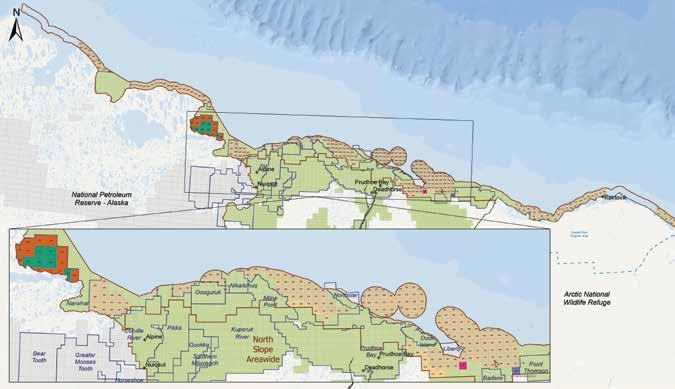
Compared to federal waters, however, West Harrison Bay seems a less risky proposition. A string of discoveries in the same oil play, the Nanushuk sands formation, suggest they may extend into tidewater.
This, the eleventh five-year plan, sees the first lease sale in federal waters happening this year in the Beaufort Sea, on Alaska’s northeast coast. The northwest coast of the Chukchi Sea would follow in 2028. Both areas would be offered again in 2030 along with the Hope Basin and Norton Basin on the north and south sides of the Seward Peninsula, as well as Navarin Basin and St. George Basin in the central Bering Sea. That year would also see lease sales along the entire Gulf of Alaska coast, from the tip of the Alaska Peninsula to the entire Panhandle, putting both previously out-of-bounds areas back in action.
The offerings in 2030 would also include a newly proposed lease area. The US Bureau of Ocean Energy Management reconfigured boundaries in the northernmost US territorial claims as the High Arctic planning area. The boundaries now include a wedge of the outer continental shelf which lies north of the Beaufort and Chukchi seas and points toward the north pole.
The High Arctic would be the twenty-seventh planning area in US Bureau of Ocean Energy Management’s outer continental shelf jurisdiction. The bureau manages approximately 12 million acres nationwide, with 469 leases currently
producing oil and gas out of more than 2,200 tracts leased. The draft plan has two more rounds of review before final approval.
The eleventh leasing plan would replace the current tenth program, which includes just three sales through 2029, all in the Gulf of Mexico. In Alaska, a lease sale was held in 2022 for Cook Inlet, but a federal judge voided the result after finding the US Department of the Interior had not fully considered the noise impact on beluga whales.
Shell Shocked
Inviting companies to lease tracts in Alaska waters is one thing; whether








In its five-year exploration plan, EE Partners commits to drilling two exploration wells in 2026. The goal is to evaluate any connection to the Nanushuk formation or, pending deeper drilling, the underlying Torok formation.
they’ll show up is another question. Experience has shown that even large, experienced explorers can come up dry.
Shell’s last attempt at Arctic offshore exploration ended abruptly in September 2015. By 2020, the company filed pro forma exploration plans to preserve its options before exiting West Harrison Bay—and Alaska completely by 2024 (notwithstanding its branded gas stations).
Shell bought its first Beaufort Sea leases in 2005. More followed in 2007, and then in 2008 the company spent $2.1 billion to acquire leases in the Chukchi Sea off Alaska’s northwest coast, in federal waters.
The 2012 exploration campaign was so disappointing that the Obama administration conducted a highlevel review to determine what went wrong. Shell tried again in 2015 with a submersible rig 149 feet beneath the Chukchi Sea, drilling the Burger J well to a depth of 6,800 feet. Again, no payoff. Within weeks, Shell turned its back on Burger J and relinquished all other frontier leases in Alaska. The $7 billion exploration program between 2012 and 2015 was a total loss.
Compared to federal waters, however, West Harrison Bay seems a less risky proposition. A string of discoveries in the same oil play, the Nanushuk sands formation, suggest they may extend into tidewater. The same geology underlies the Willow and Pikka units being developed by ConocoPhillips and Santos, respectively. Furthermore, West Harrison Bay is much closer to onshore pipelines and
other infrastructure, and the shallower water is subject to less severe ice conditions.
The exploration manager and chief operating officer of Narwhal used to work for Shell, and the smaller company tried to cooperate with the multinational oil major after Shell acquired the West Harrison Bay leases in 2016. However, Shell declined to team up on exploratory drilling or take any action on its leases, leading to public complaints from Narwhal.
In 2024, EE Partners won six tracts in the middle of the bay, but it was outbid on other tracts by Juneau Oil & Gas, a Texas company managed by Brad Juneau, co-founder of mining company Contango Ore. Together, EE Partners and Juneau Oil & Gas paid $9 million for leases in the bay, including Shell’s former tracts.
In its five-year exploration plan, EE Partners commits to drilling two exploration wells in 2026. The goal is to evaluate any connection to the Nanushuk formation or, pending deeper drilling, the underlying Torok formation.
Two more exploration wells are planned in 2027, based on results from the 2026 wells, including 3D seismic data as needed. In 2028, EE Partners is scheduled to compile the results and submit an initial plan of development for the Narwhal unit.
The small company is just dipping its toe into Arctic offshore waters. Success in the next couple of years could inspire others to dive in, just as more waters are opened to development.



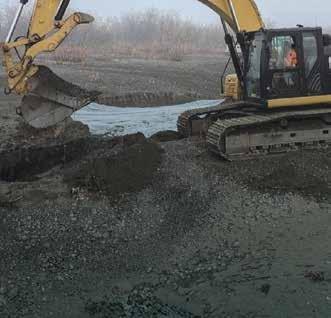






By Rachael Kvapil
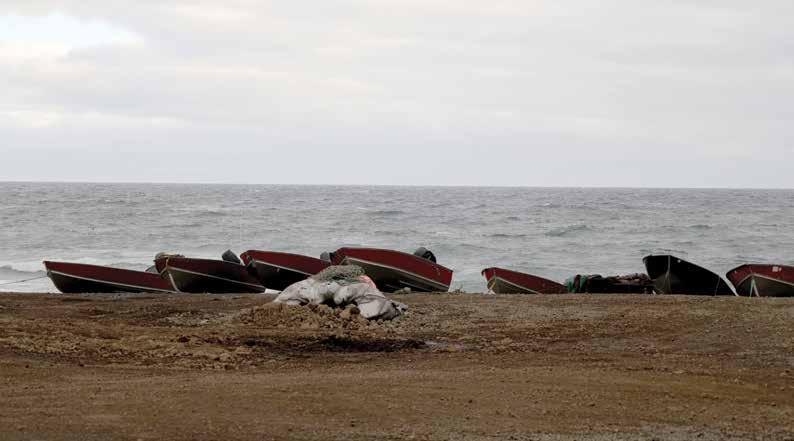
In habited for more than 2,000 years, St. Lawrence Island near the Bering Strait sustains a population of more than 1,400 mostly Siberian Yupik people with its local bounty of seabirds, marine mammals, fish, and imported ungulates. Archaeologists have uncovered signs of ancient famines, however, as a record of the island’s precarious food security. Savoonga, the largest community on the island, is taking steps to strengthen its food independence.
An upgraded fish processing plant in Savoonga is on track to start services this summer. Norton Sound Economic Development Corporation (NSEDC) began replacing the thirtyyear-old halibut plant in June 2025 after modules arrived from Finland. Fish processing provides economic opportunities for commercial and resident fishers as well as employment within the community.
Fish processing in Savoonga dates to the early ‘90s. In 1993, the first year of the experimental commercial halibut fishery off St. Lawrence Island, NSEDC worked with Savoonga residents to build an ice delivery system and a buying station in the community. In 1996, the corporation further collaborated with the City of Savoonga to expand the operation to include a small processing plant in a building donated by the city government. This building, along with a converted shipping container that served as the processing area and other smaller support structures, formed the plant that has served the fishery from 1996 through the summer of 2025. However, this facility is nearing the end of its useful life.
“While the local manager and his team have done an amazing job at maintaining the facility, nothing lasts forever, and the time has
come to upgrade our infrastructure in Savoonga,” says NSEDC COO Tyler Rhodes.
Rhodes says discussions about replacing the seafood plant had been underway for a couple of years when the Native Village of Savoonga and its associated reindeer herding operations were awarded funds to build a processing plant of its own. This development helped catalyze progress on the halibut plant, as the two similar projects could potentially benefit from being built at the same time.
Following the lead of the reindeer project, NSEDC also selected Kometos, a Finnish designer and builder of modular food production facilities, to develop the halibut plant. Kometos was founded in 1991, during a deep economic crisis in Finland that was worsened by a warm winter that left reindeer carcasses rotting in field slaughterhouses. Company founder
Raimo Niemi developed a mobile meat processor that could be set up with as few as two technicians.
Work in Savoonga had commenced by late 2025, when Niemi passed away, leaving his company to the next generation of management.
Kometos built both the halibut and reindeer plants at its facility in Kauhajoki, Finland, in modular sections that were shipped to Savoonga and assembled on site.
Design work for the building site, utilities, and foundation was provided by Coffman Engineers, which also provided construction management services. TBI Construction Company, based in Wasilla, provided the sitework, foundation, and utility extensions for the project. Most of the project was completed in October 2025, with only a few small items left to complete before the facility goes into service this summer.
“The new plant will function much as the existing plant in terms of processing,” says Rhodes. “The halibut are delivered by local fishers already gutted. The plant cleans and packs the fish for shipment to Nome, where they are either prepped for further shipment as headed-andgutted product or filleted for local retail markets.”
The number of fish delivered fluctuates from year to year, but in recent years, total deliveries to the plant have ranged from 10,000 to 30,000 pounds. While the scale of the fishery is small in Savoonga, it has an outsized impact on residents, given the relatively few opportunities to earn income on St. Lawrence Island.
Likewise, this fishery is unique in that fishers use open skiffs with longline gear and pull their catch onboard by hand. The resident fishers who deliver to the plant operate independently from NSEDC, yet without NSEDC’s infrastructure in place, they would have no outlet to sell their harvests.
“Each pound delivered by these fishers is hard-earned,” says Rhodes.

The fishery has a ripple effect through related activities, such as fuel sales to fishers and to the plant. Fishers who pay for their vessels through halibut fishing can also use them for subsistence hunting and fishing, providing critical, healthy nutrition for residents. The construction of the plant also provided an economic boost for



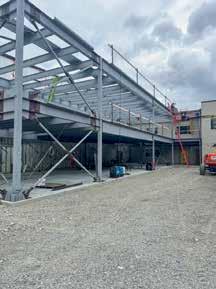
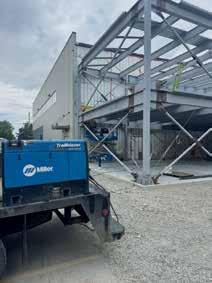


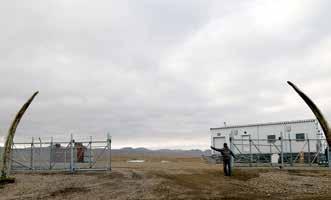
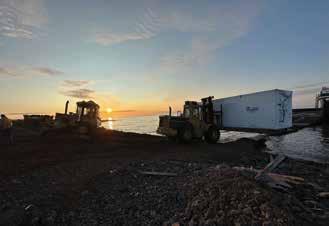
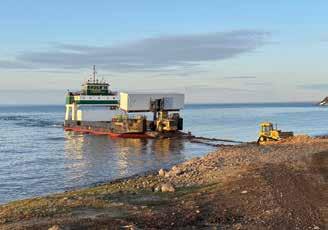
the community, as most construction positions were held by local residents. The gravel for the project was locally sourced, and lodging, food, and supply sales all increased to support the specialty workers who came to the island to work on the project.
In the past thirty years, NSEDC has established markets for Savoonga halibut and other fish shipped to Nome. The halibut is primarily sold domestically in the Lower 48 and in local and regional markets in Alaska.
The Savoonga processing plant was funded by NSEDC, a private, nonprofit organization that is the northernmost of Alaska’s six Community Development Quota groups. NSEDC serves fifteen member communities and their residents in the Norton Sound/ Bering Strait region, including Savoonga. NSEDC’s funding comes from ownership and participation in the major Bering Sea commercial fisheries, primarily in groundfish and crab species. Revenue from these activities supports an array of projects and programs that improve the quality of life for member communities and residents.
According to its mission statement, NSEDC participates in the Bering Sea fisheries to provide economic development to its member communities through education, employment, training, and financial assistance while protecting subsistence resources. In addition to programs focused on grants, scholarships, training, and research, its regional seafood operations are a major component of NSEDC’s mission, which supports and provides a market to the regional resident fleet while also creating employment opportunities for residents throughout the region.
In addition to halibut from the sea, the land supports reindeer, first introduced in 1900 by missionary Sheldon Jackson. With federal funding awarded in 2022, Savoonga Reindeer Commercial Company organized plans for a processing plant next door to the seafood plant. Once certified by the US Department of Agriculture, that plant will be in business in 2026 as well.
Together, the processed reindeer and halibut not only secure the local food supply on St. Lawrence Island but they are products sold for cash to strengthen economic ties.


By Terri Marshall
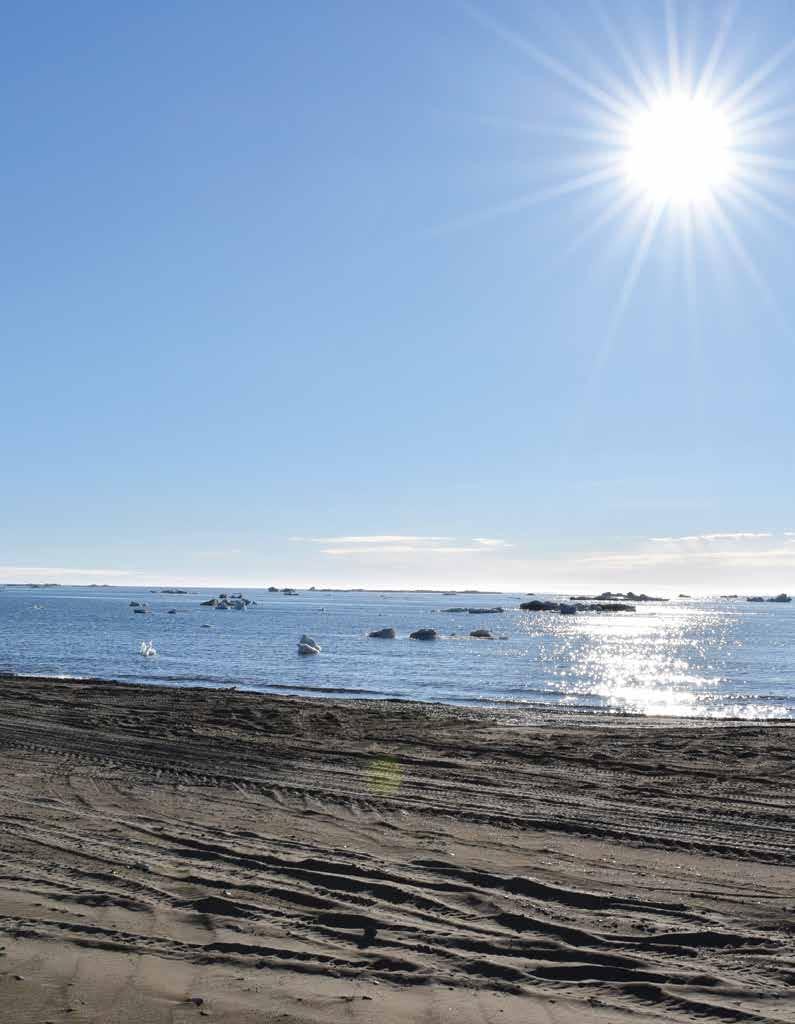
Situated on the coast of the Chukchi Sea, Wainwright is among the northernmost communities in the United States. With a primarily Iñupiat population of more than 600 people, the village known locally as Ulguniq integrates longstanding subsistence practices with an expanding presence in Arctic logistics, energy initiatives, and regional development efforts.
The Wainwright Steering Committee (WSC) is an umbrella organization to coordinate among local government, tribal leaders, corporate partners, and community organizations from the Village of Wainwright, the City of Wainwright, and Olgoonik Corporation. The committee helps set priorities for community planning, infrastructure,
workforce development, and social services. Its work ensures that major projects match local needs and long-term goals. By providing a space for collaboration and accountability, the WSC is key to managing change, overcoming challenges, and ensuring that Wainwright’s development benefits the community rather than creating problems.
The City of Wainwright, a secondclass city within the North Slope Borough, oversees municipal services such as the boat harbor, community center, playgrounds, ice cellars, and cemeteries. The city government is supported by state funding, grants, and donations.
The Village of Wainwright, a federally recognized tribe, stewards and develops tribal lands and resources in accordance with tribal, customary, and federal law while safeguarding the cultural and social interests of its members. In addition to engaging in government-to-government relations and securing public and private grants, the Village operates essential community services, including the food bank, tribal records, and the local childcare center.
Olgoonik Corporation is the Alaska Native village corporation overseeing lands and assets owned by its 1,680 shareholders, all of whom have a direct lineal connection to Wainwright. Olgoonik Corporation operates worldwide as a federal contractor and locally with community-serving enterprises that anchor the village. As steward of roughly 175,000 acres of surface estate surrounding Wainwright, the corporation manages land for traditional use and future economic development opportunities adjacent to the Chukchi Sea and the National Petroleum Reserve-Alaska.
Olgoonik also manages several key businesses in town, including the OC Store and washeteria, the fuel station, and the OC Service Center, which offers heavy equipment and carpentry services, as well as vehicle rentals and camps for workers on local projects. Olgoonik also manages the OC Hotel and Restaurant, which offers catering and a private conferencing facility with videoconferencing capabilities. These assets not only create jobs and deliver essential services to this isolated Arctic community but also position Olgoonik as




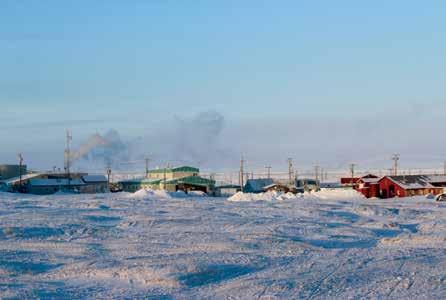
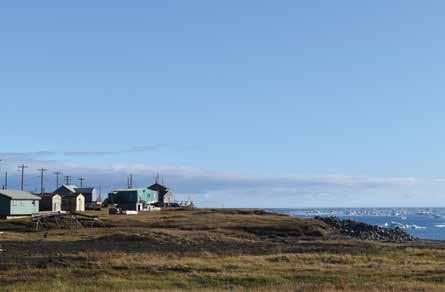
says Moire Bockenstedt, chief administrative officer at Olgoonik.
“The three individual entities who collaborate as committee members [the City of Wainwright, the Native Village of Wainwright, and Olgoonik Corporation] have been important decision-makers in the community for much longer—more than fifty years in most cases.”
The WSC meets regularly and rotates chairing responsibilities among all participating entities. Any entity can invite an outside group or individual to speak to the committee. Also, outside groups and individuals may request time before the committee to discuss issues important to Wainwright residents. Last year, they featured speakers from universities conducting Arctic research, federal agency representatives conducting surveys in the Chukchi Sea, North Slope Borough representatives providing updates on local projects, and State of Alaska groups providing updates and soliciting input on regional projects.
“Most of the 600-plus residents in our community are affiliated with all three entities—city residents, tribal members, and corporation shareholders,” explains Bockenstedt.
“For issues with broad community impact, the WSC founders decided it would be helpful to establish a central forum where representatives from each entity could hold joint discussions and hear from individuals interested in doing business in or near our community.”
“The most important thing, in my opinion, is coming together at the same table,” says Olgoonik Corporation board chair Oliver Peetook.
Peetook is a lifetime resident of Wainwright, a subsistence hunter, and an Iñupiaq drummer and dancer. He has served in community leadership roles for many years. His father, Rossman Peetook, was also a noted leader and elder in the community before he passed away a few years ago. Peetook is a proud husband and dad and, in the last couple of years, became a proud grandfather. He has a vested interest in making his home village the best it can be for current and future generations.
One important task WSC came together to achieve in 2025 was the North Slope Borough Capital Improvement Program priority list. Following meetings among its members, the WSC reconciled its community priorities for 2026, with the top three being the North Slope Borough’s investment in coastal erosion mitigation, a new landfill, and another snow fence to protect infrastructure from windblown drifts.
“Our landfill is really close to the coast, and with coastal erosion happening so fast, it’s a matter of time before the dumps we have now will be in the ocean. We need to get the landfill away from the ocean,” says Peetook.
Local leaders are working together to plan adaptation responses, such as the relocation of waste facilities farther inland and studying seawalls or other erosion-mitigation structures as part of long-term community planning.
An additional snow fence is another priority for the community, situated on a narrow spit between the ocean and an inlet. “On the north end of

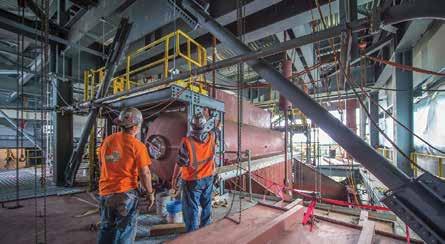










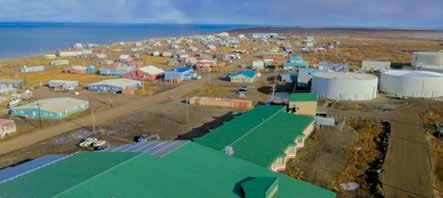
“When all the different entities and leaders in the community gather together at the same table and use the resources we are in charge of to do what the tribe, corporation, and municipality needs—progress is possible.”
Oliver Peetook, Board Chairman, Olgoonik Corporation
town, we’re protected by the snow fence that builds up the snow drifts so they’re not coming into town,” explains Peetook. “We also need a fence on the south end of town. I live at the south end, and three or four years ago, we had a bad snowstorm. Overnight, my F-250 truck was completely buried all the way to the top!”
Another priority Peetook would like to see in Wainwright involves the creation of a municipal cellar reserve. The shared reserve would support households, especially elders and young families, in creating and maintaining ice cellars that safely store harvested whale, seal, fish, and other subsistence foods, even as permafrost and weather patterns continue to change.
“A municipal cellar reserve in the city, a small plot where our community members can build ice cellars for their families, is especially important in our community,” says Peetook. “When you have an ice cellar for your family,
it shows that you’re building roots in that community. You can set your family up for generations.”
Virtually an island to itself, more than fifty miles from its nearest neighbors, Wainwright supports regional oil and gas operations, transportation corridors, and emerging infrastructure projects. It plays this role in the Arctic economy while maintaining a strong local workforce through organizations such as Olgoonik Corporation and the North Slope Borough. As investment increases across the Arctic from energy to broadband to climateresilient construction, Wainwright is positioning itself as a service hub that can support remote operations while anchoring economic benefits locally.
Equally important is Wainwright’s commitment to sustainable growth rooted in culture and community.
Subsistence hunting, fishing, and whaling remain central to local life, reinforcing food security and cultural continuity while shaping how development is approached. For businesses seeking to operate in the Arctic, Wainwright demonstrates how Indigenous leadership, environmental responsibility, and economic opportunity can advance together in one of the world’s most demanding and promising frontiers.
The key to maintaining the balance of priorities lies in the collaborative efforts of community leaders. “When all the different entities and leaders in the community gather together at the same table and use the resources we are in charge of to do what the tribe, corporation, and municipality needs— progress is possible,” says Peetook. “At the end of the day, we all serve the same people and have a lot of the same interests. Working together makes the most sense and produces the same fruit.”
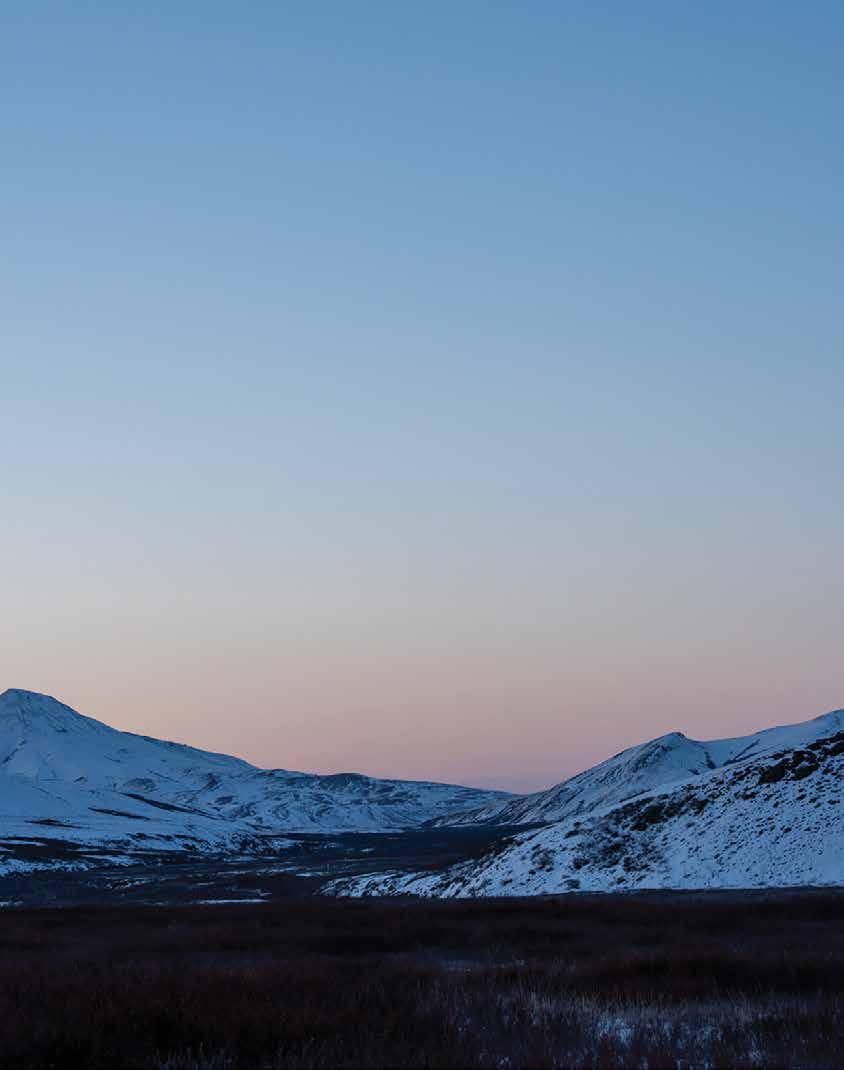
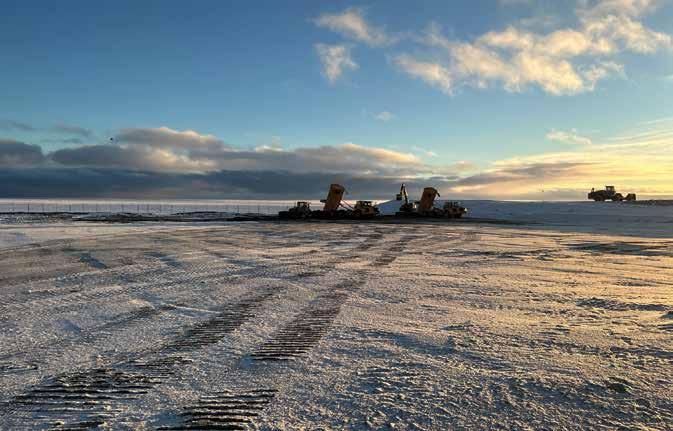
By Jamey Bradbury
Th e word “landfill” conjures up unglamorous images: garbage pits, trash heaps. In the North Slope Borough, though, landfills rely on engineering approaches found almost nowhere else in the United States, making use of the region’s natural environment.
Two major landfills—the Oxbow Landfill near Deadhorse and the Barrow Landfill near Utqiaġvik—are undergoing expansion and upgrades as part of a long-term strategy to keep pace with both community and industrial waste streams. Both
projects reflect how Arctic conditions shape infrastructure decisions— and how permafrost itself becomes a design feature rather than an obstacle.
While both facilities sit atop permanently frozen ground, they serve distinct but complementary purposes.
The Barrow Landfill, operated by the North Slope Borough, is largely dedicated to municipal solid waste from Utqiaġvik and surrounding areas, with limited construction
debris allowed by permit. Each of the landfill’s cells has a finite lifespan, so the borough periodically expands the site to ensure continued service for residents and local businesses.
Phase 5 of the Barrow expansion, now underway, adds a new working pad and upgrades older cells to keep pace with the needs of the North Slope’s largest town.
Work on the Barrow Landfill expansion began last fall and will finish before the next freeze-up. UMIAQ Design, a subsidiary of locally owned Ukpeaġvik Iñupiat Corporation
(UIC), performed the engineering. Gravel is sourced from nearby pits owned by UIC Arctic Operations and Development and placed through a joint effort of ASRC Construction and UIC Construction, with support from the North Slope Borough.
Meanwhile, the Oxbow Landfill serves as the region’s industrial workhorse. A disposal facility closely tied to the oil and gas activity across the central and eastern North Slope, it accepts a regulated range of industrial wastes, including construction debris, drilling-related materials, and other non-hazardous byproducts generated by exploration and production operations.
For oil companies operating far from population centers, Oxbow is not optional; it is a logistical necessity.
As one contractor notes, in a place with no road system connecting communities and industrial sites to the rest of Alaska, you can’t just truck waste in and out. Every module change-out at a drill site, every camp renovation, every pipeline maintenance job generates waste that must go somewhere.
In recent years, disposal cells at Oxbow steadily approached capacity. In response, the North Slope Borough pursued permit modifications and a fourth expansion to add a new waste cell and accommodate the volume of waste arriving from industrial and municipal sources. The borough applied to the Alaska Department of Environmental Conservation for a lateral expansion of the Oxbow
“We’re getting more settling now than we’ve ever gotten in the past, just due to the half a degree warmup that we’ve seen and how fragile the permafrost really is.”
R obbie Lynn Gener al Manager UIC Co nstruction
facility, effectively increasing its permitted footprint and extending its usable life as the primary disposal site for Prudhoe Bay area waste.
ASRC Construction is leading the Oxbow expansion with its subsidiary, ASRC Builders.
In the Arctic, says UIC Construction General Manager Robbie Lynn, you don’t just “dig a hole in the ground like a typical landfill, like in Anchorage.” Instead, contractors take advantage of the region’s frozen ground and place the landfill above ground.
Traditional landfills in temperate climates are designed as sites where trash is buried; groundwater is protected and waste is safely isolated using clay or synthetic liners, leachate ponds, and methane collection wells.
On the North Slope, nature provides the liner.
Freezeback landfills like the Oxbow and Barrow sites depend on subzero ground to immobilize liquids and prevent draining. Instead of digging a hole for waste, trash at facilities like the Oxbow Landfill sits on the frozen ground, gradually forming a mound as it accumulates. Monitoring wells allow for close observation of the ground temperature to ensure no leachate leaks into the surface. Landfill scientists use thermistors to keep tabs on the permafrost to guard against ground contamination.
As part of the expansion at the Barrow Landfill, contractors completed initial dirt work in November 2025 and then allowed the ground to settle. They will return in April to drill piles for the monitoring wells. A survey will tell UIC Construction crews whether more gravel—sourced from UIC Arctic Operations and Development— is needed.
“That’s what we’re worried the most about. [Ground settling] just requires more gravel, which is additional cost for the contractor,” Lynn says.
Later, when a landfill cell enters the end of its service life, contractors return to cap the cell with gravel, then revegetate it.
“Essentially, we put mounds of trash up, then cover it,” Lynn describes. “The last one was finished in about […] 2022, and we’re just getting the grass to grow, which is obviously very difficult in Barrow.
When you get done, it’s just a small, revegetated mound, and all the debris is frozen inside of it.”
Solid waste infrastructure on the North Slope doesn’t operate in a vacuum. For projects like this
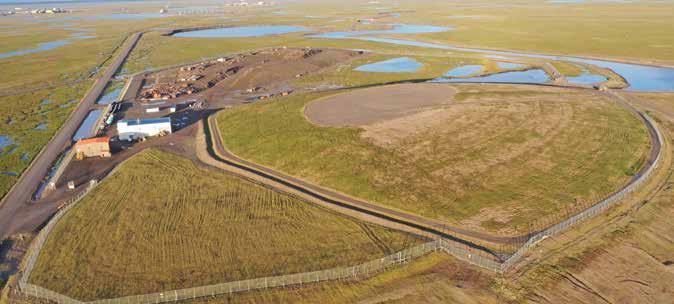
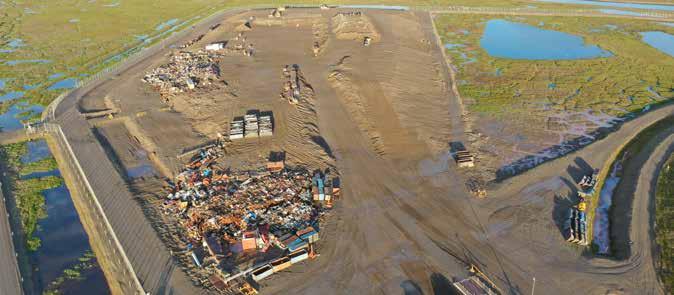
one, regulators require detailed monitoring and permits. The Barrow Landfill Phase VI project, for example, was authorized by the US Army Corps of Engineers for placement of more than 26,000 cubic yards of fill into wetlands to construct Cell 5, with a completion deadline of 2029. Oxbow’s expansion underwent a similar state review to ensure protection of the Putuligayuk River corridor.
The expansions come at a moment when Arctic communities are rethinking infrastructure for a
changing climate. Shifting wildlife patterns, earlier thaws, and more intense storms—such as Typhoon Halong, which devastated western Alaska late last year—all affect how landfills are built and operated.
“The storms are becoming more severe, and the sea ice isn’t freezing back as fast, and it’s not staying frozen as long,” Lynn says. “As we witnessed this year in Kotzebue—it flooded again, and it was a record flood. And then last year there was [also] a record flood. We have the same issue up in Barrow. The ground is not staying frozen for
as long, so it’s thawing out earlier in the spring and not freezing up until later in the summer, which is causing settling for all of these civil projects.”
Even small climate shifts have measurable effects on infrastructure. “We’re getting more settling now than we’ve ever gotten in the past, just due to the half a degree warmup that we’ve seen and how fragile the permafrost really is,” says Lynn.
To deal with these conditions, UIC Construction builds thick gravel berms—more like dikes
than walls—to contain snowmelt and storm water as the climate becom es wetter.
Standing water was one of the barriers to starting work on the Barrow Landfill in the first place. UIC Construction had to pump out as much as possible before initiating work on the site; what couldn’t be pumped was left to freeze, then the ice was scraped off the ground where the new cell would go.
A somewhat more surprising effect of climate change on the project, though, was the polar bears.
“We don’t really think of polar bears being that far inland,” Lynn admits. “[The landfill] is a mile from the ocean, but they smell the residential waste. They’re running out of sea ice to hunt off of, so they get hungry and look for food. And the landfill is easy picking for them when we’re not running equipment.”
Some of UIC Construction’s crew found themselves “stuck” in their truck for an afternoon, he says, when one polar bear refused to leave the landfill. B ear guards had to be summoned to deter the bears so the contractors could get bac k to work.
While no one has had a face-toface encounter with polar bears yet, the presence of the bears is another marker of the North Slope’s changing climate. As conditions continue to evolve, it will be crucial for maintenance crews on landfills like Oxbow and Barrow to continue monitoring the durability of the permafrost to guard against the effects of an ever-warming A rctic.

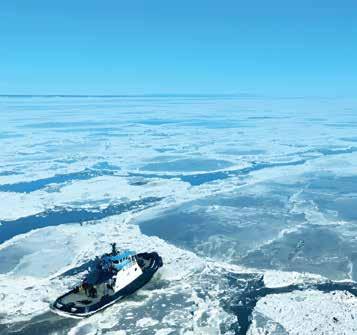






By Scott Rhode
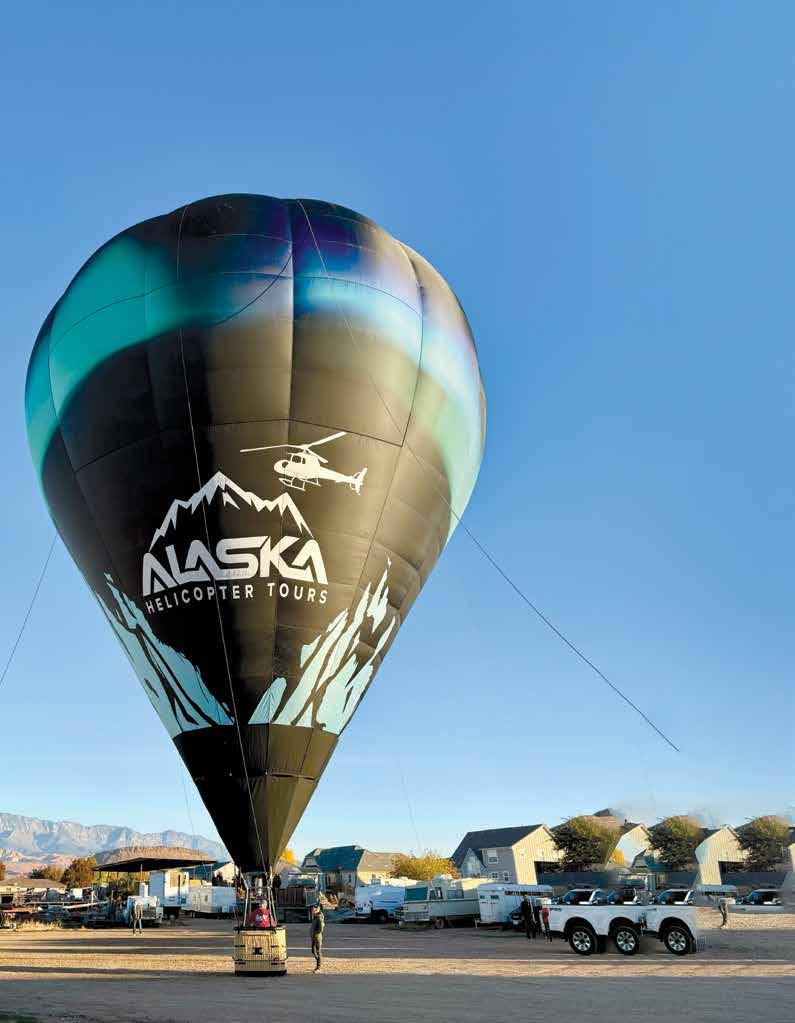
Je ts of flame warm the interior of a bulbous nylon envelope, lofting passengers above Delaney Park Strip for a bird’s-eye view of Fur Rendezvous festivities in Downtown Anchorage. The hot air balloon is the newest addition to the Alaska Helicopter Tours (AHT) fleet, unveiled for select rides on February 28. Hot air balloons have been absent from the Anchorage skyline for nearly forty years. They were a common sight for about a decade until the late ‘80s, when urban sprawl limited the open acreage where freewheeling balloonists could land. The hobby also became associated with drug-fueled recklessness. By 1987, the Anchorage Daily News reported that insurance companies would no longer cover the risk, so balloons were grounded.
AHT, which bills itself as Southcentral’s premier veteranowned helicopter adventure company, figured out how to surmount this obstacle. “We already have the aviation expertise, safety standards, and insurance infrastructure in place,” says Sage Dudick, AHT communications and creative director. “Ballooning naturally fits our mission of delivering unique aerial experiences, and operationally it’s a seamless addition.”
AHT operates a fleet of Robinson R-44 helicopters from bases north of Anchorage, in Palmer, and in Seward. Most flights center on glacier flightseeing and landings, with additional offerings for ice climbing, heli-hiking, and specialty weddings. A hot air balloon diversifies the fleet for customers craving a more leisurely pace.
More colorful skies are in store, thanks to AHT’s balloon revival. While debuting at Fur Rendezvous, “it’s intended as an additional flightseeing experience long-term, available to both visitors and locals as part of our broader offering,” says Dudick.
AHT CEO Mike Neely adds, “Hot air balloon experiences are few and far between in Alaska, so we are thrilled
to be able to offer that experience to guests in the future.”
To assist in the training of pilots, AHT is relying on the expertise of Mike Bauwens, credited with bringing the first hot air balloon to Anchorage in 1976. When the hobby declined in Alaska, he moved to Utah and became one of the country’s top balloon pilot instructors.
In addition to tours, the balloon can serve as a flying billboard. AHT is accepting advertising contracts from clients who can attach large logos to the balloon with velcro.
Dudick notes that Neely has had ballooning in mind for some time. “The timing aligns with our continued focus on honoring Alaska’s rich aviation history while expanding the ways people can experience the state from the air in new and memorable ways,” Dudick says.
More speed is the need for airborne healthcare provider Guardian Flight, and now it can deliver with the fastest turboprop aircraft in Alaska. The company, part of Global Medical Response Solution, is adding eight Beechcraft King Air 350 aircraft to its statewide operations, including two configured for long-range operations.
Guardian Flight already has Learjet 45s in its fleet, and while those are faster than the turboprop, they aren’t as adaptable to Alaska airstrips.
“Our terrain, weather, and vast distances demand aircraft that can perform at the highest level,” says Matt Philbrick, regional director for Alaska.
Four of the King Air 350s are currently in service, part of Guardian Flight’s fleet of nineteen medically equipped aircraft, including six King Air • 375’ Barge Dock (-20’ depth at MLW)
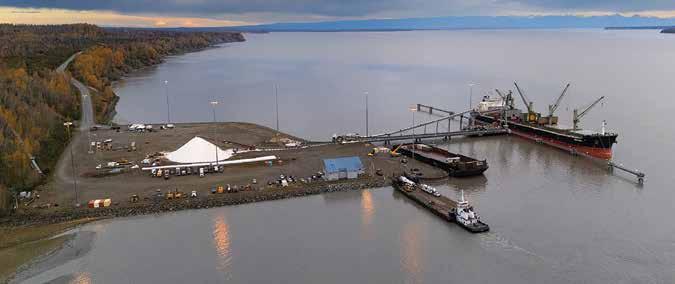
1,200’ Deep Draft (-60’ depth at MLW)
Bow Ramp Berth
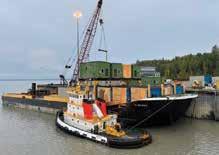
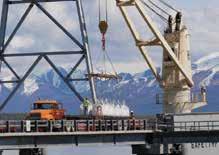
Standard for Guardian Flight (excluding rotorcraft), each King Air 350 can carry two patients, if necessary, loaded via a special sliding ramp.
Guardian Flight

King Air turboprops are considered the gold standard for medevac operations, able to land on short, unpaved, or gravel runways, which is critical for rural villages.
Guardian Flight

One reason for fleet expansion, says Jared Sherman, is the need for more cost-effective equipment as Medicaid reimbursements shrink.
Guardian Flight

200 planes, three Learjet 45s, a Cessna Caravan, and one H125 helicopter.
Compared to the King Air 200, the 350 adds 2,500 pounds to maximum gross takeoff weight, flies about 20 knots faster, and extends range by roughly 700 miles. Advanced de-icing systems ensure reliability in harsh conditions, and the King Air 350 can land on short, unpaved, or gravel runways where Learjets can’t go.
“They’re kinda the Ferrari,” says Jared Sherman, Global Medical Response vice president of operations, of Learjets. “But they couldn’t land on shorter airstrips. Then we have the 200, which is kind of the pickup truck of Alaska when it comes to medevac, but it’s not that fast.” By combining the best qualities, the King Air 350 is a nimbler tool.
When integrated into the fleet, six will be in service and two will be backup. Four are currently stationed in Anchorage, Juneau, Ketchikan, and Sitka. Another will be based in Deadhorse, outfitted with a gravel kit.
The new aircraft are replacing older types that are being retired, Philbrick explains. “So we’re outfitting this base utilizing the same crew members,” he says. Sherman adds that Guardian Flight used to operate a single King Air 350 some years ago, “so there’s some mechanics who still have that knowledge.”
Faster turnaround times for refueling and maintenance mean quicker deployments. “Every minute matters in an emergency,” Sherman emphasizes. “The King Air 350’s faster turnaround times and optimized design mean we can respond more quickly and keep our crews ready for the next call.”

“This fleet investment builds on the strong foundation Alaska has created to support steady, scalable, and sustained growth… These planes will fuel our expansion to more destinations across the globe and ensure our guests travel aboard the newest, most fuelefficient and stateof-the-art aircraft.”
Ben Minicucci CEO Alaska Air Group
Efficiency is key, as well, for fuel costs. Turboprops get better mileage than jets, so the King Air 350 offers a balance of speed, range, and fuel economy. Those qualities justified procuring the new aircraft in a batch.
“We gain consistency by moving the aircraft through in a structured process,” says Philbrick, “as opposed to having a one-off here, a one-off there, and repeating the process. That consistency lends to efficiency.” He adds that the investment demonstrates that Guardian Flight is committed to Alaska.
A similar rationale could be heard in the C-suite of Alaska Airlines. The state’s namesake carrier began the year by executing an option to order 105 new Boeing 737-10 narrowbody airliners and five new widebody 787s. The order represents the largest in the airline’s history and secures delivery slots from Boeing while extending the fleet delivery stream through 2035.
“This fleet investment builds on the strong foundation Alaska has created to support steady, scalable, and sustained growth,” says Alaska Air Group CEO Ben Minicucci. “These planes will fuel our expansion to more destinations across the globe and ensure our guests travel aboard the newest, most fuel-efficient and state-of-the-art aircraft. We are incredibly proud to be partnering with Boeing, a Pacific Northwest neighbor and a company that stands as a symbol of American innovation and manufacturing.”
Alaska Airlines flies the youngest fleet of all US airlines, including narrowbody 737-9 and 737-8. The
company welcomed its first Boeing 737-8 in late 2023 and anticipated adding about 20 new aircraft every year through 2027. The new order brings Alaska Airlines’ total to 245 Boeing aircraft, in addition to 94 of the 737 MAX aircraft currently operating.
The five additional 787 widebody aircraft support the Alaska Accelerate strategic plan for Alaska Airlines to fly a dozen long-haul international routes from Seattle by 2030. Those international flights will be flashing a new aurora-themed livery, unveiled in January.
While the traditional “Chester” character will continue to smile from the tail of aircraft flying in North America, international flights carry a design interpreting the company’s Seattle-inspired colors of midnight blue and emerald green as the northern lights.
Utilizing a new aircraft painting technique, it took artists nearly 1,000 hours across thirteen days to paint the aircraft exterior from nose to tail.
Minicucci says, “As we transform into the country's fourth largest global airline, we are proud to introduce a new global livery for the Alaska brand. The design is a tribute to Alaska’s rich history and a reflection of our bold vision for international growth and our commitment to connect the Pacific Northwest to the world.”
Whether the goal is to jet off to an international destination, trust a medical team to expeditiously transport a loved one for medical treatment, or take in Alaska’s splendor via the wicker basket of a hot air balloon, aviation companies are enhancing their fleets to provide travelers with an array of options.

By Vanessa Orr

Wh en The Wildbirch Hotel officially opened in June 2025, it signaled an era of revitalization in Downtown Anchorage. As the boutique property now nears full completion, the 200,000-square-foot hotel has become a catalyst for growth on surrounding blocks.
Construction was not without its challenges, however. When former US Senator Mark Begich and former Alaska Department of Revenue Commissioner Sheldon Fisher (partnering as MASH LLC) bought the property in 2020, it was at the beginning of the COVID-19 pandemic. Before the hotel could be renovated, the partners needed to raise funds for the purchase; and before guests could enjoy the accommodations, people displaced by the pandemic had to move
out of the property, a former Holiday Inn then known as the Aviator Hotel.
“When we bought the building in mid-2020, people told us not to do it, but we saw an opportunity,” says Begich. “It had potential. It had good bones.”
The building’s previous owner decided to sell the property as he couldn’t raise the capital needed to take it to the next level. He also faced the challenge of the hotel’s site in a less desirable area on C Street— across the “imaginary line” that Begich says people rarely cross when staying Downtown.
“In any other city, this would be a great location,” he says of the centrally located venue.
The 252-room, extended-stay hotel already had thirty people in residence, yet Begich says it was lucky to have 10
percent occupancy during the winter months. Despite these drawbacks, the new owners decided to move ahead with the vision of creating a boutique property that would attract visitors and residents alike to a revitalized neighborhood.
While the world basically shut down during the pandemic, MASH LLC continued to raise money for the new hotel, landing approximately twenty-five investors, of whom 95 percent are Alaskan, Begich points out. As construction began, however, the team was approached by the Municipality of Anchorage, which asked for twenty-five rooms for people who had been displaced by the pandemic.
“People were unemployed, fishing had shut down, so we said we would focus on having a certain amount of rooms available to help,” says Begich, who served as the general contractor on the guest room portions of the building. “That number continued to grow.”
At one point, approximately 250 unhoused people stayed in the older rooms on the property as construction went forward on renovating rooms in a different area of the building. “You could go down the hall and see thirty completed rooms, then walk through a solid-core, insulated door on the far wing where the remainder of these people were staying,” says Begich.
“Everything was under construction at one point,” he adds. “We had a temporary lobby, no restaurant, no conference rooms, no storage, and
no kitchen. It was pretty wild, to say the least.”
Begich says it was important that the hotel provide shelter for those in need until the building could be completed. “My partner and I made a value judgement that this is something we could and would do,” he said. “The HUD [US Department of Housing and Urban Development] Region 10 secretary visited during this time and was very impressed; he gave us lots of kudos.”
The hotel’s affiliated company, JdV by Hyatt, wasn’t sure about this housing arrangement, and Downtown neighbors were confused as well. “It may have hurt us a bit at the beginning because they didn’t know if it was a hotel or a homeless shelter,” Begich says. “But once we opened, we used social media to spread the word,
and by the end of summer, there were times when we were oversold.”
It takes a lot to turn a semidilapidated building into a luxurious, modern hotel, but the partners had a lot of help.
“The City worked with us unbelievably well; they wanted this building renovated for a lot of reasons,” says Begich, a former mayor of Anchorage. “Not only was it in disrepair, but they knew that a new hotel would contribute to the revitalization of this area of downtown Anchorage.”
The approximately $50 million project is the largest single-hotel investment from a renovation or new-build standpoint since 2000, Begich notes. Architects and design companies working on the guest room

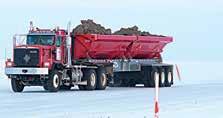
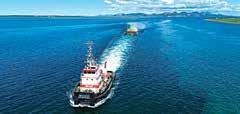
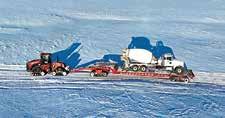
spaces included Anchorage-based KPB Architects (Buildings A and B) and 61northarchitects (Buildings C and D). California-based EDG Design was hired for the design of the entire complex.
UNIT Company, overseen by Fisher, built the public areas, such as the lobby, bar, restaurant, and conference rooms. Both the interior and the exterior of the building were completely reimagined.
“The outside is dramatically different; it went from a 1970s look to a 2025 look,” says Begich. “We also doubled the landscaping space to add a lot of color; five years from now, we want it to look like what visitors who come to Alaska expect to see.”
The renovation included additional insulation and triple-paned, commercial-size windows for heating and sound protection. The building now also co-generates its own energy through a combined heat and power system.
According to Begich, a natural gas turbine provides back-up power, and its waste heat can be harnessed for other systems, such as heating water. “This hot water is used for a variety of purposes, including domestic hot water, building heat, and, in our case, we even heat our sidewalks during the winter to prevent a build-up of snow and ice,” he explains.
Andrew Garsha, project manager for UNIT Company, likens the demolition and renovation of the hotel to a treasure hunt, as many of the “as-built” conditions of the original building weren’t what was expected.
“Areas that were supposed to be masonry walls turned out to be
structural steel beams with infill framing,” he says. “We were able to make the windows on the south and west sides taller because what was supposed to be masonry wasn’t.
“There were a lot of mysteries from years of previous renovations,” he adds, noting that the building had many different iterations during its lifetime. “While this is not uncommon during remodels, you never know what you’ll find in a building from the ‘70s. Things get buried.”
“It was basically a homeless shelter when we started, which we were trying to turn into a four- or five-star hotel… It took a lot of planning and coordination between multiple trades to come up with a logical phasing plan.”
Andrew Garsha, Project Manager, UN IT Company
Of course, things also must be added. When building the new employee locker room and break room, the UNIT Company crew first had to remove a large quantity of soil before installing underground utilities, new slabs, and retaining walls to support the interior.
“We had to cut new penetrations, redo the entire HVAC and plumbing system, as well as perform abatement” of hazardous materials, says Garsha. “A lot of times it was a complete gut.”
Because of the number of variables, UNIT Company shifted from a firm fixed-price contract, originally negotiated for replacing the entire roof, to a cost-plus contract to complete the commercial wing. About twenty-five crew members worked on the hotel during construction, which UNIT Company commenced in 2023.
“It was basically a homeless shelter when we started, which we were trying to turn into a four- or five-star hotel,” says Garsha. “It took a lot of planning and coordination between multiple trades to come up with a logical phasing plan.”
Logic dictated a top-down approach. “For example, the lobby ceiling would normally have been the last thing we did; instead, it became the first one,” Garsha explains. Also, “Before we built the kitchen, we had to lift the pizza oven through a window on the second floor and then build the kitchen around it.”
Adding to the difficulty was the need to work around guests staying at the hotel once the first renovated rooms were completed.
“We wanted to meet the client’s needs to get it up and running and at least partially functioning, in order to get a revenue stream going,” says Garsha. “But we also had to respect the people staying there, so we couldn’t start making noise until 9 a.m. It was a challenge trying to retain a nice ambience for hotel guests.”
Part of the solution was to create temporary walls throughout the hotel to keep construction work out of sight. UNIT Company also set up barriers and built temporary walkways so that workers could enter and exit the hotel while keeping areas safe for guests and staff.
As part of the renovation, conference and meeting spaces were reconfigured and expanded, as was the lobby, which now opens on Fourth Avenue. The hotel includes a 135-seat conference room upstairs, a 125-seat conference room downstairs, and two smaller meeting rooms that can fit sixteen to twenty people.
Rooftops were converted to create north-facing outdoor decks, and original Alaska art, designed by young, modern Alaskan artists, decorates the public spaces on both a permanent and rotating basis, with some art available for purchase.
All 252 guest rooms have been renovated from “skin” to interior, and Begich attests that everything within the rooms is custom designed, from the leather furniture to the bathroom tile. Although modern, the rooms were designed to radiate rustic warmth through the use of soft colors, medium-hued wood, and dimmable lights.
“We really wanted to bring the warmth… without hanging a bear rug in the room,” Begich says with a laugh. “These rooms have a very different feel; you can tell that we brought quality to the table.”
Garsha agrees. “The firm that came up with the interior design elements had really great ideas and a lot of





creative design concepts,” he says. “The hotel contains so many unique elements; nothing in there is standard.”
Special amenities include headboards featuring Denali in topographical relief, easy-to-access electrical plugs, and little red retrostyled refrigerators in every room. Begich even designed TV mounting boards that could be used universally throughout the hotel, resulting in easier maintenance.
“As the first boutique hotel in Anchorage, it’s a unique property,” says Begich. “It’s got that Alaska feel, but it’s not overkill.”
Even before construction was complete, Expedia rated The Wildbirch Hotel as the #1 hotel in Downtown Anchorage, and it also placed fifth in the “Best New Hotel” category of USA TODAY ’ s “10BEST Reader's Choice Awards 2026,” published in January.
In January, just three steps were left before the hotel would be considered complete: crews needed to finalize four suites, complete a fitness center, and wrap up work on a microbrewery called Undertap, set to open on April 1.
“This was a three-dimensional construction project, with a ballet going on at each level,” says Begich. “At one point, we had six different trades working at the same time while still not interfering with the guest rooms that were already opened.”
Although supply chain issues did cause a few hold-ups during the COVID-19 pandemic—especially for electrical components and some glass and metal orders—Begich says the hotel ordered numerous furnishings in advance, which turned out to be a smart move.
“We were lucky because we own the building next door, which was the old Post Office Mall,” says Begich. “This gave us warehouse space so we could order whatever we needed from overseas before the pandemic really took hold.” And, he adds, procuring materials early let MASH LLC avoid last year’s import tariffs.
Since opening, The Wildbirch Hotel has attracted a lot of attention, as well as a lot of traffic to the “other side” of C Street, across the “imaginary line” that divides the Downtown core from its eastern periphery.
“There’s more going on here—we’re seeing more long-term development,” says Begich. “People are talking about how there’s more activity downtown, and we’re happy to be contributors to that. We’re proud to be a part of this community.”
The Wildbirch Hotel has also been named as the new headquarters for the 2026 Iditarod; a fact that Begich expects will attract its own unique visitors.
“There’s no better place to stay for the Iditarod, which starts on the street in front of us,” he says. “You can be in a third-floor room or attending a conference and watch the ceremony. We also have parking for 200 behind the hotel, which is a huge advantage because we can fit all the trailers and dogs.”
Between C Street and the Iditarod starting line on D Street, another Fourth Avenue property is gearing up for new life. MASH LLC is in the process of renovating the 88,000-square-foot Post Office Mall and is working on raising another round of equity. The
$25 million makeover will feature fifteen residential loft-style condos on the top floor, as well as an open-market concept in the former mall storefronts.
A supermarket and pharmacy is still part of the plan. Permitting is complete and demolition has begun on the second and third floors.
Begich anticipates action on the market phase by this spring, but by
January a general contractor had not yet been announced.
It certainly could be UNIT Company again. Garsha is looking forward to further revitalization. He says, “What they created is a huge improvement for the Anchorage Downtown area, and I hope it turns out to be really successful. It makes the city I live in a better place.”


By Tasha Anderson

Between its invitation-only soft opening on January 20, 2025 and January 1, 2026, the Chin’an Gaming Hall paid out more than $16 million in jackpot prizes. But to Native Village of Eklutna (NVE), the true value of the Chin’an Gaming Hall is just starting to be realized—and it’s already spreading the wealth, strengthening the tribal and surrounding community.
NVE has been working toward the construction of a gaming facility for about twenty-five years, according to President Aaron Leggett, who has been leading the NVE Tribal Council since 2018. The latest effort, he says, kicked off about ten years ago. For most of that time, the odds seemed against NVE. In 2021, a court decision against NVE once again put a gaming facility on hold. But in February 2024, NVE’s luck began to change.
Half a century ago, the Alaska Native Claims Settlement Act created Alaska Native regional, village, and urban corporations, granting them land and money while extinguishing claims to aboriginal title. However, the act neither eliminated tribal governments nor impacted their sovereignty. In a 2017 letter to then-Governor Bill Walker, then-Attorney General Jahna Lindemuth explained at length the current status of Alaska’s tribal governments, detailing that a 1993 US Bureau of Indian Affairs issued a list of 229 federally recognized tribes in Alaska intended to “eliminate any doubt” to their sovereignty and assert that they have “the same inherent and delegated authorities available to other tribes.” This decision was subsequently confirmed by Congress. Lindemuth further explained, “Tribes and tribal governments exist regardless of the status of tribal lands.” But land status is central when it comes to
projects like the Chin’an Gaming Hall, and this was the essential factor that ultimately allowed for its construction. As Leggett explains, “In February 2024 there was a new opinion from the Solicitor for the Department of the Interior basically saying Native tribes in Alaska should be treated the same as tribes in the Lower 48, with regard to Native allotments in certain limited factual circumstances, which is what we had been arguing the whole time in court.”
With that decision, NVE—a sovereign Tribal government planning to build on an NVE members-owned Native allotment—requested federal gaming approval from the National Indian Gaming Commission. NVE received final approval from the National Indian Gaming Commission for the Chin’an Gaming Hall on January 16, 2025, and within four days it (and everyone involved) was up and running.
How was such swift action possible? Wanting to open as quickly as possible if approval was granted, the current Chin’an Gaming Hall is a temporary structure that was partially assembled nearby and then moved to the allotment when NVE got the green light. “It was a mad dash of finishing,” recalls Chin’an Gaming Hall General Manager Ryan Walker. When the joined modular sections were moved, many interior finishes and all the furnishings needed to be completed quickly. “[For example,] every chair in the building came in a box, so it was just a big revolving door of materials going in and out to get things going,” Walker recalls. The gaming hall had been decades in the making, “so we wanted to assure it moved from dream to reality as fast as possible,” said Leggett.
In a matter of days the Chin’an Gaming Hall was open to invited guests, and on February 3, 2025 it opened to the general public—except for NVE members, who are not allowed to game at the facility. According to Leggett, this decision was based on observations from Lower 48 gaming facilities and to avoid the appearance of unfairness if in fact a Tribal member were to hit a big jackpot.
Even with that restriction, the Chin’an Gaming Hall has been popular. Soon after opening to the public, the Chin’an Gaming Hall was populating waitlists with those who wanted to enjoy the facility but could not, since it was already at capacity. By May 2025, the Chin’an Gaming Hall saw its first addition, which allowed for more space and 50 more gaming machines.
At present, the Chin’an Gaming Hall has 135 electronic bingo machines and
serves a modest selection of snacks and non-alcoholic beverages. It is a Class II operation under the Indian Gaming Regulatory Act, which limits the types of games the Chin’an Gaming Hall can offer. A Class III casino, the kind abundant in Las Vegas with a variety of games such as slot machines or roulette, would require an agreement with the State of Alaska, an option that NVE is not currently pursuing.
Including Walker as the manager, the Chin’an Gaming Hall has thirtytwo employees, approximately half of whom are tribal members (including NVE and other tribes). Of those, six are NVE members. The facility will continue creating much-needed jobs for Tribal members and others from the region seeking opportunities, although hiring more NVE members at the operation’s present size is challenging, as gaming regulations prevent employees from supervising their own family members. “We have to be strategic in the placement of those positions,” Walker says. “Even still, right now we’re at 50 percent, and our goal is to have the majority [of our employees] be tribal members—not necessarily Alaskan or NVE, but tribal members.”
That goal will have an even more widespread effect if NVE accomplishes its ultimate vision for the Chin’an Gaming Hall.
“What we look forward to is in the neighborhood of a 50,000- to 60,000-square-foot, permanent structure on the allotment,” says Leggett. “Up to 800 or 900 machines, restaurants—a really high quality product.” The larger facility would employ approximately 200 people, not including twice that many additional jobs during construction. “We see it
as a major driver for the Anchorage economy,” Leggett says. “When you look around Anchorage, there’s not too many things like this that are on the horizon.” I was shocked this fall when I saw a crane in Downtown Anchorage; I don’t know the last time I’d seen a crane in Downtown.”
The Chin’an Gaming Hall is already drawing talent. Walker is an example: he’s a transplant from the Lower 48 who was attracted to the opportunity to build a historic project from the ground up. His experience with the gaming industry extends back to when he was 12 years old and his parents opened one of the first commercial casinos in Deadwood, South Dakota, shortly after gaming was legalized there. His career eventually took him to Nevada for many years, then California and his introduction to tribal gaming in the Coachella Valley.
That experience was a boon when Walker communicated with a local bank, which was naturally curious about this new-to-Alaska business model. “The bank was meticulous,” Walker says, asking questions about the number of accounts needed, types of deposits, and other details. “I went down to the bank in person and met with their executive compliance manager to familiarize her with transactions that are standard in the casino industry,” he says.
Other business partners are already working in concert with the Chin’an Gaming Hall. Since it is a temporary mobile structure, it has a self-contained water and septic system, both of which require daily service from local vendors, and other businesses are also seeing increased opportunities. “[The Chin’an Gaming Hall] just lifts all ships in this little area of Chugiak/Birchwood,” says Walker. “This is probably the economic

stimulus that’s going to make lives in this area better not just for [NVE] but for everybody that lives and makes their living here.”
The economic benefits are good. But what matters is the people.
“We’ve watched Anchorage grow, and although we’ve had a little bit of success, we feel that we’ve given up a lot,” explains Leggett of NVE. “Ninety percent of Anchorage’s drinking water comes from Eklutna Lake; 3 percent of Anchorage’s power and 6 percent of the Matanuska Valley’s power are generated from the Eklutna River that cut off our historic salmon runs; we’ve given easements (through our village corporation, Eklutna, Inc.) across our lands; we’ve given back to the Anchorage School District; we sold, against our policy of selling land, a piece of property to the Anchorage Police Department for their tactical training center.”
NVE has given a lot and has simultaneously struggled to find the level of income that would better benefit
Chin’an Gaming Hall
its members and community. “Because we’re not rural, we were cut out from a lot of federal funding,” Leggett explains, which limited the NVE’s ability to launch several projects. “We took years and years of scrimping and saving to build our own little clinic. We currently don’t have a building that we own that’s big enough to hold all of our Tribal members to meet and gather as a Tribe.”
The Chin’an Gaming Hall, in its current temporary phase and in future iterations, is a long-dreamt opportunity to change that trend. “We really believe that it will empower our people and create opportunities and good, highpaying jobs near Eklutna for our Tribe and the broader region,” Leggett says. “It will build an overall sense of pride.”
It will simultaneously build community.
“We accumulated debt during our endeavor,” Leggett says. “Because of the uncertainties with this [project], we really wanted to retire that debt as fast as possible just to give us some certainty.”
But even with that temporary priority, funds have already been
allocated to directly benefit NVE’s members and neighbors. For example, NVE has built new bus shelters in the village; it is expanding its food bank (which is open to all community members, not just the Tribe); and money is being earmarked for nutrition, housing, and employment assistance, as well as a long-awaited community gathering center.
“The plans for the gathering center had been in the works for many decades but really got kicked into high gear in 2023.” During the COVID-19 pandemic, NVE received CARES Act funding, some of which it was able to set aside for the architectural blueprints and other design work. The plan to fund the rest was federal grants.
Then the federal administration, and the grant environment, changed dramatically in early 2025. “It became very clear… that the way things had worked in the past are not how they’re going to work in the future,” Leggett says. “The Tribe had a National Endowment for the Humanities grant for an endangered language project that was cancelled our third year into
the project. So we had to pivot… so revenues coming in as we speak are going to be dedicated to building the gathering center. Our people remain unselfish in their individual needs and have been steadfast in their collective focus on a facility serving the whole Tribe and the local community.”
“Chin’an” means “Thank You” in Dena’ina Athabascan, and in that spirit—even as NVE looks forward—it is working now to spread gratitude throughout the Anchorage area.
NVE and its partners have donated more than $100,000 to local charities that support a range of community services in the Anchorage area and across the state.
NVE directed funds last year to the Mountain View Community Center. The money filled a monthlong gap in funding for a program that feeds children in one of the most economically disadvantaged areas in Anchorage. “It was really kind of a nobrainer,” Leggett says.
In late 2025 NVE donated $25,000 to the Municipality of Anchorage to support public safety to ensure that the Western Alaskan refugees displaced by Typhoon Halong felt safe in their new community and had sufficient transportation resources.
NVE donated $5,000 to Alaska Public Media in support of its statewide news coverage, particularly vital in rural and underserved areas of the state. It has also donated to the First Alaskans Institute and the Anchorage YWCA.
Late in 2025 it participated in the Toys for Tots drive and was able to donate twenty-eight gifts to teenagers in foster care in Eklutna and sixty-one
toys for distribution throughout the rest of Anchorage. “It shows you the giving nature of the people who work here,” says Walker.
The Chin’an Gaming Hall is a community project generations in the making that has finally been brought to life. The allotment on which it sits was originally secured by Leggett’s great grandmother in the early ‘60s.
She wanted to protect the land and her family, who had lived in the area since the ‘30s, so no one could force them out. Speaking about his grandmother who grew up on the allotment, “I wish she was here to see it,” Leggett says, adding with a laugh, “I am glad that I did not have to break the news to her that she would not be able to game here.”







By Lincoln Garrick
Ev ery Alaskan knows that a bush pilot who’s “rigid” about their destination— regardless of incoming fog or shifting winds—is a dangerous one. Clinging to a predetermined course in the face of clear warning signs isn’t just stubborn, it is reckless disregard, inviting catastrophe. This same survival logic applies in the boardroom. As savvy leaders navigate the “economic weather” of 2026—marked by volatile interest rates, labor shortages, and uncertain global economics—the stakes have never been higher. Leaders should not mistake blind stubbornness for strength; they should embrace agile and flexible leadership.
A classic, and often cited, example of business rigidity is the story of Kodak and its failure to fully embrace the digital photography revolution. Kodak engineer Steve Sasson invented digital camera technology in the company’s labs in the ‘70s. Sasson is quoted in a May 2008 New York Times article saying, “It was filmless photography, so management’s reaction was, ‘That’s cute—but don’t tell anyone about it.’”
Hindsight is 20/20, and it’s easy to criticize Kodak for being deeply wrong about digital cameras because the company was too entrenched in its hugely profitable film and photo-chemical business at the time, unwilling to commit to a new
technology. This is the risk of rigidity: becoming too ingrained in “that’s the way we’ve always done it” thinking. It leads to not rewarding employee innovation as courageous and therefore missing opportunities. This generally happens in organizations that focus on cumbersome approval processes and siloed budgets, with the belief that experiments are not efficient.
Rigidity does not necessarily have to exist in highly regulated or policyinformed organizations. It sprouts from a mix of 1) individual leader bias, 2) an organization with a culture of fear, and 3) market pressures indicating a need for adaptation. A leader’s past successes can create a blind spot. Instead of watching
the horizon, leaders often cling to familiar routes and ignore warning signs of market shifts. This personal resistance can then be amplified when a corporate culture of fear and micromanagement prevails, as that stifles innovation. Finally, when faced with external threats, the organization retreats into “threat rigidity”—responding with commandand-control tactics, doubling down on inflexible routines rather than choosing innovation and adapting to a new reality. Organizations that do not invest in creativity and flexibility will find that innovation is no longer a strategic option when they need it.
In the Lower 48, a rigid business leader may be viewed as an annoyance—a bottleneck that is irritating but survivable within an organization that has resources to work around them. However, in Alaska, rigidity comes with a significantly higher price tag. Alaska’s small economy is especially sensitive to forces that are often entirely beyond its borders, ranging from global oil prices and environmental shifts affecting fishing to federal land management to global trade policies. In this landscape, a leader who refuses to pivot isn’t showing strength; they are failing to read the terrain.
Current research indicates that the best leaders are “ambidextrous,” meaning they can successfully balance two opposite goals at the same time, which is often needed to handle unpredictable environments.
This approach demands the openness to pursue high-level innovation, such as automation breakthroughs, while maintaining the closeness or discipline to strictly manage operational costs. The risks of acting with just one hand is that open-only leaders create a chaos trap—lots of great ideas with nothing getting done—and closed-only leaders create a success trap of being profitable but eventually obsolete. An ambidextrous leader ensures that every forwardthinking exploration is anchored to fiscal responsibility and practical utility. This isn’t easy and requires knowing when to open the team for creative chaos and when to close tightly and focus on flawless execution.
To achieve this balance, a leader must be like glacier ice: presenting a visible, steady surface that provides the organization with a vital sense of security. While this solid exterior offers predictable values and clear direction, the leader remains strategically fluid beneath the surface, adapting to the shifting currents of a volatile economy. By acting as a “malleable solid,” they remain firm enough to inspire trust yet agile enough to pivot whenever internal or external conditions change.
There is truth to the sentiment, “The most dangerous thing is a flawless first draft.” True organizational agility requires humility to dismantle your own ideas before the competition does it for you. Avoiding the “rigidity trap” is
“One way we have incorporated a tolerance for smart risks is through team debriefs following project completions. Because we focus on learning instead of where to assign blame, missteps are opportunities to gather new information and insights.”
tough and requires effort, especially for those with a long track record of success. Few Alaskans understand the danger of a “flawless first draft” better than Shauna Hegna, president of Koniag, the Alaska Native corporation for the Kodiak Island region, who has spent decades dedicated to flexible thinking. In a recent sit-down, Hegna shared how she keeps one of Alaska’s largest corporations nimble.
Q: Let’s get right to the meat of it. How do you stay flexible as a business leader?
Hegna: First comes fostering an organizational culture where flexibility is celebrated. Change is constant in business, from the market and the customers to the competition and the regulatory environment. I look for ways to do things differently to respond to that change, and I look for people who think differently from me to get that additional perspective. It doesn’t mean it all gets adopted, but that alternative thinking informs my decision-making.
I’ve worked with people who instantly knew that things wouldn’t work. While avoiding contrasting views can be tempting, I’ve learned to seek out that contrarian voice. I share with them, “I’m thinking of doing XYZ,” and they explain all the ways it will not work. That’s a gift. When you can bring together various perspectives to explore every possibility, the team can plan for a wider range of market contingencies and come up with innovative solutions that might have otherwise been overlooked. As a leader, the challenge is to be open to different
“We honor our past by learning how past practices shaped today’s methods, while identifying how to incorporate new tools, people, and influences. By removing unneeded steps from the process, we ‘right-size’ our operations to fit the modern moment.”
Sh auna Hegna Preside nt, Koniag
ways of thinking and doing, and understand others’ viewpoints.
Q: What organizational traits, structures, or pressures have you seen that make leaders more rigid?
Hegna: Hands down, it’s bureaucracy. Overreliance on policies and procedures prevents innovation and limits growth. People tend to become more rigid when there’s a lack of trust at any level of the company. A strong organization, where your employees trust each other and leadership, is a collaborative, flexible, and innovative
place able to meet challenges when they inevitably pop up.
At Koniag, we have adopted six core values that define us: Sharing the catch, being open and honest, having pride in our work, honoring our heritage and culture, embracing diversity, and planning for the long term. When we adopted these, everyone in the organization, from front-line staff on up, developed the behaviors we expect of ourselves and others to reflect these values.
Q: How do you challenge a deeply ingrained, but failing, “This is the way we’ve always done it” view?
Hegna: We practice this in a lot of ways at Koniag. One of my favorite approaches is to bring everyone together to map out our existing processes step-by-step. We honor our past by learning how past practices shaped today’s methods, while identifying how to incorporate new tools, people, and influences. By removing unneeded steps from the process, we “right-size” our operations to fit the modern moment, ensuring that every team member has a voice in setting the new standard. This transparency creates a space where creativity can flourish. Ultimately, cultivating tolerance for change requires resilience and a commitment to leading with core values.
Q: What steps do you take to foster a culture where teams are comfortable suggesting and running low-risk experiments (prototypes), even if they might fail?
Hegna: I tell people all the time we employ humans. As humans, we make mistakes. Growth comes from learning from missteps, developing
plans to fix them, and moving on.
One way we have incorporated a tolerance for smart risks is through team debriefs following project completions. Because we focus on learning instead of where to assign blame, missteps are opportunities to gather new information and insights. By keeping communication open, the dynamic develops where it is not just safe to share ideas without expectation of judgment, but errors can be discussed without expecting reprimand.
Q: What do you think about the agile leadership style?
Hegna: The ability to adapt depends on agility. One of the ways we remain focused on solutions is by not allowing arbitrary boundaries to limit us from finding the right response to the present challenge. One of
the benefits of having a relatively lean corporate staff size is that it allows us to challenge ourselves to think outside of rigid roles and try different combinations of ideas and approaches that meet employees at the intersection where their talent, interest, and need come together.
Is there a place for rigid and closed leadership? Arguably yes, when the goal is known, the path is set, or in situations where standardization is the aim or safety/regulation requires it. However, adapting to change, innovating, or making new strategy choices is very difficult if rigid thinking is the only tool in the toolbox.
Modern Alaskan leaders may benefit by transitioning away from command-
and-control models toward a more fluid, agile, and flexible leadership approach. Hold on to your core values with a vise grip, but keep your tactics as flexible as a bush pilot’s flight plan. Join us next month as we explore disconnectedness.
Lincoln Garrick is an associate professor, MBA director, and alumnus at Alaska Pacific University. He has decades of experience in business, marketing, and communications fields, providing public affairs and strategy services for national and Alaska organizations.

Throughout 2026, Garrick’s leadership series is exploring different ways for leaders to align their values with ethical conduct and create lasting positive impact.

By Brian Walch
Al askans know that what works in other places doesn’t always work here. Local knowledge is required to successfully adapt to Alaska’s extremes, and those who have spent time learning what works and what doesn’t have invaluable insights.
Your organization faces the same reality. The local knowledge within an organization must be leveraged to ensure the business continues to evolve and grow. Mentoring is an effective tool for passing on knowledge, developing leaders, strengthening relationships, and building your workforce.
But only when you understand how to use it.
Mentoring isn’t a silver bullet, and it isn’t without its pitfalls. Mentoring comes laden with expectations to solve loosely defined problems:
• “We need to build a stronger culture.”
• “We are trying to reduce training costs.”
• “We want to improve teamwork.”
Mentoring holds promise, but too often organizations underestimate the work required to make it successful. When the program fails, it can be worse than if it had never started.
Those assigned a mentor feel let down because their expectations weren’t met, and those tapped to mentor others feel unsuccessful. Employees become cynical and disenchanted, leading to lower job satisfaction and higher stress. Managers who are already stretched thin feel frustrated that yet another corporate initiative didn’t pan out.
Considering all of that, should organizations promote mentoring? Is the risk of failure worth the reward?
The mentoring concept is straightforward: someone with more knowledge and experience helps someone less experienced excel and succeed. Organizations that foster this should expect to strengthen their culture, improve retention, and increase performance, but only if mentoring is part of a thoughtful and comprehensive approach.
Mentoring does not work with a quick-fix mentality, and expectations must be managed.
For instance, it may help people come up to speed quickly and improve
retention, but only when narrowly scoped, well-supported, actively managed, and sustained over time.
Similarly, there is little evidence that mentoring serves as a primary driver of company culture; however, it can build trust, foster psychological safety, and improve knowledge sharing, which leads to more collaborative behaviors, and behavior is what defines culture.
Mentoring isn’t a one-size-fits-all solution. Implementations span a spectrum from informal and ad hoc to formal and structured, and the required investment and expected outcomes vary accordingly.
It is okay to start small with mentoring, but as it grows, so will the work required to support it. Approaches that succeed informally in small settings often fail when they are scaled up without a corresponding increase in attention, structure, and ownership.
Managers should consider the options available to them to make deliberate decisions about implementing and supporting mentoring to achieve positive results. Here are three approaches to consider:
• Nurture informal mentoring: The manager shapes behaviors that promote ad hoc mentoring rather than launching initiatives.
• Facilitate mentoring: Mentoring becomes a tool for the manager to use selectively.
• Formal mentoring: A system that must be fully resourced to be effective. Let’s explore these approaches in more detail.
Informal mentoring happens in most organizations. Employees help each other, ask questions, and share what they know. It is part of the way they work, not a separate program.
The manager’s role is to nurture these behaviors, not name or codify them. Otherwise, if the activities get labeled, everybody's expectations
change. Employees will want guidelines, management will demand metrics, and what was voluntary and positive now becomes evaluated and forced.
Instead, managers should nurture mentoring by noticing and reinforcing behaviors that promote collaboration and development. When someone solves a problem well, ask them to walk a teammate through their approach. When someone has expertise, create space for others to ask questions. Encourage the team to use each other to solve problems.
Nurturing mentoring is active management and requires a reasonable level of functional, trusting relationships. The manager must pay attention, protect time for learning, and reinforce the behaviors they want to see, even when there’s no program to point to.
This approach allows the manager to shape an environment in which people help each other grow, without asking mentoring to carry more weight than it can support.
Sometimes informal mentoring isn’t enough. The team has a skills gap, or a new employee needs to come up to speed quickly. Managers can use mentoring to address these needs directly, without initiating a formal program.
The manager isn’t the mentor, but they identify a need, introduce the relationship, and create a structure for success. The purpose should be clear, have a limited scope, and be grounded in real-world challenges.
This might look like a project manager mentoring a junior colleague
In Alaska, connection looks a little different. Distance, terrain, and weather all shape how people communicate, and that’s part of why print still resonates especially strong here. Printed materials reach places and people that digital never fully can, especially in rural and Alaskan Native communities where a printed magazine, as it travels hand by hand and feels personal and trusted.
A printed ad isn’t just advertising. It’s presence. It’s a handshake when you can’t be there in person. It builds familiarity and keeps your name top of mind long after an online impression disappears.
When someone picks up a copy of Alaska Business, it is an experience
miles away from a quick online scroll. It’s a pause. A break in the day where your brand has a reader’s full attention. Alaska Business magazines live on desks, in lobbies, and in jobsite trailers; real spaces where decisions actually happen.
I’ve worked in print and marketing for more than twelve years, and what I’ve seen is that the most effective campaigns blend both worlds. You need reach and you need roots. Digital gets attention and print earns trust.
In a state where relationships drive business, trust matters more than any metric on a dashboard. People take pride in seeing their stories, their companies, and their communities in print. It represents permanence, something they can hold and share.
Print has always been about connection; and in Alaska, connection still means everything. Invest in print to build trust and lasting connections.

Weston Giliam is an Alaska-raised sales and marketing professional who understands the value of real connection in a relationship-driven business environment. He helps clients build effective campaigns across the state and holds a marketing degree with hands-on experience.

WESTON GILIAM 907-257-2911 | weston@akbizmag.com
on design skills, a new employee paired with a mentor for their first few months, or a senior leader mentoring a new manager through their first year of strategic responsibility.
When I ran system implementation projects, I used facilitated mentoring to support user adoption. We would select a user who was well respected and invested in the system’s success. We would train them, and then they would train the rest of the staff and serve as onsite support. This trainthe-trainer approach was facilitated mentoring, and it worked well for everyone.
People vary in their ability to mentor and to be mentored, so outcomes will differ based on skill, commitment, and fit. The variability in results is not a flaw in the approach but a reflection of a people-based system. It does mean, though, that facilitated mentoring cannot be generalized or imposed. Otherwise, people will become resentful.
This is not a tool to compensate for weak management or to fix performance problems. It should be used selectively and actively managed so managers can address development needs without creating expectations that the organization cannot sustain.
When development needs to be scaled consistently across teams, informal and manager-facilitated mentoring may not be enough. If the company’s leadership pipelines need strengthening at scale or if mentoring is tied to broader goals such as succession planning or diversity, a formal program can produce meaningful results.
This option represents a fundamentally different level of ambition and risk, and the organization must treat it as a system rather than an initiative. Starting a mentoring program creates expectations about fairness, quality, outcomes, and follow-through. The program must be narrowly scoped to an achievable goal, with success criteria defined upfront.
The organization must be willing to invest time, training, and attention over an extended period. A human resources department cannot meet these expectations alone. It requires managers to make time, reinforce participation, and connect mentoring to real work and development conversations. If HR or senior leadership wants the program more than managers do, it will fail.
If done poorly, this approach has the greatest downside risk. Many organizations fall into the trap of believing a formal program can’t hurt. In reality, under-resourced mentoring programs can leave the organization worse off than before. Managers disengage, participants feel abandoned, mentoring becomes perfunctory, and cynicism grows.
Since managers are central to the success of a proposed program, they must understand its implications and the choices involved. If an organization isn’t committed to making the required investment, then managers should focus on nurturing the environment and facilitating targeted mentoring opportunities. These aren’t compromises; they are better choices.
Formal mentoring can work—but only when ambition is matched with ownership, resources, and sustained commitment.
Mentoring isn’t all or nothing. When managers understand the options for mentoring and their role in the process, they become more confident in choosing the right approach.
Managers can feel confident that they can nurture informal mentoring without feeling pressured to name it or turn it into a program. When someone needs targeted development, managers can facilitate mentoring relationships that meet a specific need. If the organization proposes a formal program, managers will understand what it takes to make it work, acknowledge the consequences if it doesn’t, and commit to supporting it.
Alaskans know that learning from each other isn’t optional. In extreme conditions, local knowledge keeps people safe and helps them succeed. Organizations face the same reality, and workforce challenges aren’t getting easier. When knowledge and experience are effectively transferred, the organization becomes stronger.
Mentoring matters because Alaska needs leaders who know how to develop people without wasting time on initiatives that won’t work. Get it right, and we build the workforce Alaska needs.
Brian Walch is an executive coach, consultant, and speaker on leadership development. He uses his extensive experience in people and systems to provide tools and services to empower managers to lead themselves, their teams, and their organizations. Learn more at shiftfocus.com.

Professional Services
Advertising Agency
Bank/Credit Union
Cargo/Logistics Provider
Construction Supplier
Engineering Firm
General Contractor
IT/Cybersecurity Firm
Law Firm
Printing Services Provider
Staffing Agency
Swag Supplier
Telecommunications Provider
Wealth Management Firm
Retailers
Bookstore
Boutique
Cannabis Retailer
Gun/Ammo Shop
Jewelry Store
Plant Shop
Venues
Conference Venue
Hotel
Health & Activity
Animal Hospital/Clinic
Hospital
Pharmacy
Yoga Studio
Dining & Drinks
Bakery/Dessert Spot
Brewery or Distillery
Catering Service
Coffee Spot
Food Truck
International Cuisine
Tacos
Cross Industry
Customer Service
Place to Work 1-250 Employees
Place to work 250+ Employees
Influencer
Startup Business (2025)
Editor's Choice
Corporate Citizen
To



A merger with Dolly Varden Silver plugs Contango Ore, with several Alaska exploration projects in development, into a direct shipping ore business model. Reconfigured as Contango Silver & Gold, the merged company will continue to work on the Manh Choh gold mine near Tok while developing prospects in Hatcher Pass and near Lake Clark. “We had a good five-year plan, and now we’ve got a good twenty-year business,” says Contango CEO Rick Van Nieuwenhuyse. contangoore.com
NANA Regional Corporation completed the acquisition of substantially all assets of Drake Construction, a Kotzebue-based general contractor. Founded in 1968, Drake Construction built a reputation for delivering high-quality projects in Western Alaska, including airports, roads, water and sewer systems, and marine infrastructure. NANA says the acquisition enhances the Kotzebuebased Alaska Native regional corporation’s ability to serve energy, commercial, natural resources, and federal markets. nana.com
Ukpeaġvik Iñupiat Corporation
Ukpeaġvik Iñupiat Corporation (UIC) acquired a majority interest in Northbank Civil and Marine, Inc., a Vancouver, Washington–based construction firm. “This acquisition
is part of UIC’s strategy to provide one-stop services across three core areas: heavy civil construction, marine construction, and dredging services,” says UIC COO Jeevan Pokharel, who spearheaded the acquisition. Pokharel adds that the investment aligns with UIC’s expansion strategy in the Pacific Northwest, which has included ownership stakes in Johansen Construction, Highmark Concrete Contractors, and HME Construction. uicalaska.com
Seattle-based logistics conglomerate Saltchuk is folding Naniq Global Logistics into Carlile, giving the Alaska trucking company a beachhead in Hawai'i for the first time. The integrated operation includes warehousing in Kapolei on O'ahu and four air gateway locations across O'ahu, Kaua'i, and the Big Island. The combined Carlile organization now has around 870 employees, with 260 in Hawai'i and 480 in Alaska. carlile.biz
Sour cherry and honeyberry bushes sold at Common Ground Alaska farm in Big Lake had to be imported from Canada, but not anymore. The family farm obtained a license to propagate hybrids directly rather than distributing plants grown by the inventors at the University of Saskatchewan. Co-owner Tandy Hogate says she had been seeking a license for a while until someone
noticed on social media that Common Ground Alaska was selling honeyberry (also known as haskap) and recruited the farm to propagate the hybrids.
commongroundalaska.com
The Alaska Department of Natural Resources authorized selling 1,400 million cubic feet of state-owned natural gas to Cook Inlet Energy, a subsidiary of Glacier Oil and Gas, to maintain oil operations at its Kustatan Production Facility. That oil goes to Marathon’s Kenai refinery, the only in-state producer of gasoline and the primary supplier of jet fuel to Anchorage. Without the one-year contract for “royalty in-kind gas,” state officials say refinery operations could be disrupted. Separately, Glacier Oil and Gas is partnering with Cook Inlet LNG, a subsidiary of Gardes Holdings, to bring a floating storage and regasification unit to the inlet, to be moored alongside the Osprey platform, about 5 miles offshore from the Kustatan facility.
glacieroil.com
A subsidiary of Arctic Slope Regional Corporation won a contract from the US Defense Logistics Agency to continue managing the supply chain for ChemPOL III, the chemicals and packaged petroleum oils and lubricants performance 3rd generation program. ASRC Federal, through its subsidiary ASRC Federal
Facilities Logistics, has supported this program since its inception in 2007.
The extension, valued at up to $2.3 billion, has a five-year base period with three-year and two-year option periods. ASRC Federal will service more than 5,000 US installations worldwide with approximately 17,000 delivery orders per month. asrcfederal.com
A “pizza theater” lets customers at the new Domino’s Pizza in North Pole watch the pie-making process. The newest franchise location opened December 20 on Santa Claus Lane. The nearest Domino’s Pizza locations had been two in Fairbanks; the North Pole restaurant is the thirteenth in Alaska. North Pole already has Pizza
Hut and Great Alaska Pizza Company outlets. Franchise owner Bryan Dobb says, “We’re excited to bring even more cheer to the area, through the magic of pizza.” pizza.dominos.com
After a year that saw Credit Union 1 (CU1) open three new branches in Kotzebue, Skagway, and Wasilla, 2026 begins with plans for its sixteenth full-service branch in Homer. The branch at 475 East Pioneer Avenue is scheduled to open in mid-summer.
“CU1’s decision to open a branch in Homer was inspired by the city council’s 2045 Homer Comprehensive Plan and the community’s clear commitment to thoughtful growth, strong neighborhoods, and a thriving local economy,” says CU1 President and CEO Mark Burgess. cu1.org
The top choice of investors at the 2025 Alaska Angel Conference, and the winner of a $100,000 prize, is apparel brand SWOOP. The designer of functional women’s underwear, stylish tunics, and playful fleece overalls outperformed high-tech contenders at the culmination of a twelve-week process that trained investors to identify companies with potential. “Winning the Alaska Angel Conference is both humbling and affirming,” says founder Virginia Lynn Peterson. “It gives us the ability to scale with intention while staying true to our Alaska roots.” wearswoop.com
Complete wellness encompasses more than a whole and healthy body, but relaxing massage is still part of the program. Crystal Garrett learned therapeutic massage techniques in her home state of Alabama before moving to her mother’s native state and establishing Arctic Dawn Massage & Wellness. “Dawn” comes from her middle name; she chose “Arctic” to tie her business in the Great Land. With her training in holistic, traditional, therapeutic, and clinical modalities, Garrett has grounded Arctic Dawn in slow, attentive, supportive, nervoussystem work, less of a spa and more of a soothing environment for longterm, place-rooted care. And she plans to grow from there.


· Upon the promotion of Art Dahlin to Vice President of Commercial for Saltchuk’s major shipping arm TOTE, there’s a new boss at TOTE Maritime Alaska. Corey Nichols is appointed Vice President and Alaska General Manager, responsible for operations, customer engagement, safety, and community relations throughout the state. Nichols earned a bachelor’s degree in environmental studies and an MBA from American Public University. He was previously an operations manager for Amazon in California and most recently held leadership roles with Walmart in Alaska and Hawai'i.

· Having served as a master brewer, COO, and vice president of production, Jaime Jurado was promoted to General Manager of Alaska Pacific Beverage Company, the production facility for Northern Hospitality Group brands 49th State Brewing, Arctic Roots Cider, and Frontier Alaska Soda. In more than forty years of brewing and distilling, Jurado authored numerous technical papers and book chapters and holds a patent pending for an innovative extraction technique. He is also a past president of the Master Brewers Association of the Americas.
· Michael R. Koy, a former mineral economist with BP in Anchorage, returns to Alaska as the CFO for the HEX family of companies. He reports directly to President and CEO

John Hendrix while overseeing the finances of HEX Cook Inlet, Furie Operating Alaska, Cornucopia, and Corsair. Koy most recently served as CFO for DJR Energy and Vesta Energy. He holds a bachelor’s degree in mechanical engineering from Purdue University and a master’s degree in mineral economics from the Colorado School of Mines.

· Matanuska Electric Association gained a new CFO with the new year. Kim Henkel is the successor for Matt Reisterer, who transitioned to a new part-time role as Senior Advisor to the CEO. Henkel joined the Palmer-based power utility in 2018 and held leadership positions such as senior manager of strategic implementation and energy supply manager. Henkel previously worked with ENSTAR Natural Gas Company and First National Bank Alaska. A certified public accountant, Henkel earned bachelor’s degrees in accounting and finance from UAA and holds an MBA with a concentration in business intelligence and data analytics.
Mt. McKinley Bank shored up its leadership with promotions and a key addition to its management team.

· Kristie Dickerson is promoted to Senior Vice President and Mortgage and Construction Loan Manager. Dickerson joined Mt. McKinley Bank eighteen years ago as a consumer loan originator and now oversees the mortgage, construction, and loan servicing departments.

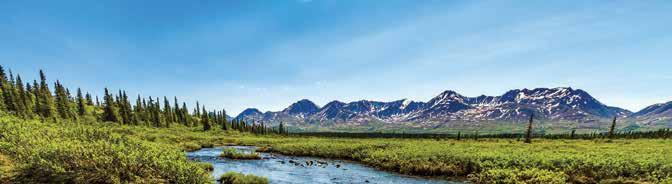

· Lisa Smeltzer becomes Assistant Vice President and Loan Servicing Manager. Since joining the bank in 2020, Smeltzer has played an essential role in loan servicing, and she is a graduate of Mt. McKinley Bank’s Leadership Development Program.

· Evan Wilken is now Assistant Vice President and Mortgage Lending Officer. Wilken began his career with Mt. McKinley Bank in 2022 as a credit analyst in the Commercial Loan Department. Wilken holds a bachelor’s degree in economics, and he enjoys coaching sports.

· Mt. McKinley Bank also welcomes back Annie Scott as Assistant Vice President and Branch Manager. Scott originally served at Mt. McKinley Bank from 2002 to 2011 in roles such as relationship banker and bank secrecy act specialist. She stepped away to run Spruce Tree Montessori School.

· To support business lending services that Credit Union 1 launched in 2025, the co-op created a new leadership role. The first person hired as Vice President of Business Services is Danicia Shiryayev, responsible for unifying CU1’s business deposit and lending functions while overseeing the business lending and account services departments. Shiryayev studied business administration and management at UAS and serves on the boards of the Alaska Chamber and Junior Achievement of Alaska. In October, she began a term as board chair of the Anchorage Chamber of Commerce.
· Eagle River-based MBA Consulting Engineers brings aboard Beau Counts as a Senior Electrical Engineer.

Counts is a US Army veteran and a graduate of Montana State University. He is a licensed professional engineer and a registered communications distribution designer, certified with expertise in data infrastructure. The new position prepares Counts to step up as chief electrical engineer when Edward W. Carlson retires from the firm in a few years.

· Cathodic Protection Specialist, or CP4, is the highest certification level awarded by the Association for Materials Protection and Performance (formerly known as NACE), and Eric Jones of Coffman Engineers has earned it. “Eric is the go-to for challenging jobs,” says Cynthia Cacy, principal and manager of Coffman’s Corrosion Control Engineering team in Anchorage. “His positive attitude, hours of hard work, and extensive travel throughout Alaska during his eleven years at Coffman are greatly appreciated.”

· The nonprofit contracted by the Municipality of Anchorage to operate the Alaska Center for the Performing Arts (better known as the PAC) has a new boss. With the departure of Codie Costello, who served as President and COO for seven years, the organization selected Kathy Cronen to be in charge on an interim basis. She also takes on Costello’s duties as General Manager of Broadway Alaska, the partnership with Nederlander that suspended its season a year ago. A patron of the arts, Cronen has served on many nonprofit boards, including the Anchorage Opera.














In 1917 a group of engineers surveying for the Alaska Railroad decided to bet on when the ice on the Nenana River would break up. That first winner’s pot was $800 and launched a community guessing game that’s continued for more than 100 years. Today, it costs $3 to participate in the Nenana Ice Classic, and interested parties can view the state of the ice via webcam instead of tromping out in the cold to inform their guesses.
The nature of the organization has also changed. The informal pool amongst peers is now a nonprofit corporation, and proceeds from ticket sales are not all reserved for the winner: some are distributed to nonprofit partners, such as the American Cancer Society and the Nenana Public Library, among others.
That is just one of the requirements for organizations in Alaska that organize gaming opportunities. Not all games of luck are legal in Alaska, but for those that are, their regulation isn’t left up to chance. The information comprising Alaska Trends this month is split between what’s permitted and how much money is on the table.
SOURCES: Nenana Ice Classic (nenanaakiceclassic.com) | Alaska Department of Revenue Tax Division “Charitable Gaming 2024 Annual Report”
A for-profit business licensed to conduct gaming activities on behalf of a permittee.
A for-profit business that sells pull-tabs on behalf of a permittee, from a location licensed by the Alcoholic Beverage Control Board.
The State collected nearly $3M from the Charitable Gaming Program in taxes and fees in 2024.
A municipality or qualified organization that holds a permit to conduct gaming activities.
Multiple-Beneficiary
Permittee
2 to 6 municipalities or qualified organizations that jointly obtain a permit to aggregate prize limits.
The average net proceeds margin across all organizations is 11%.
Charitable
Civic or Service
Dog Mushers' Association
Educational
Fishing Derby Association
Fraternal
Native
Labor
Village
Municipality
Nonprofit Trade Association
Police or Fire Department
Political
Religious
Veterans
The Fishing Derby Associations demonstrated the highest efficiency, with net proceeds being 27% of their gross receipts, while the Police or Fire Department category reported the lowest net proceeds percentage at 7% of gross receipts, indicating a larger proportion of their revenue was consumed by costs.
Gaming generated $40,920,725 in net proceeds in 2024.
Net proceeds must be spent within 1 year.
Net proceeds from gaming activities are limited to political, educational, civic, public, charitable, patriotic, or religious uses.
• Raffle
• Lottery
• Bingo
• Pull-tab
• Rain, Goose, Mercury & other classics
• Salmon & King Salmon classics
1,000+ vendors hold pull-tab permits.
Animal Classic (Rat)
Calcutta Pool
Contest of Skill
Ice Classic
Fish Derby
Special Draw Raffle
What book is currently on your nightstand?
I read a lot. Let me tell you about a book I just finished, which I can’t stop talking about: Lincoln in the Bardo by George Saunders.
What charity or cause are you passionate about?
Anchorage Park Foundation.
What’s the first thing you do when you get home after a long day at work?
Say hi to my husband, eat dinner… and then we usually relax, and we almost always sit in the hot tub every night.
What vacation spot is on your bucket list?
Machu Picchu.
If you could domesticate a wild animal, what animal would it be?
A lemur because they’re so stinking cute.

Photos by Kerry Tasker
Military information support
operations (also called psyops) are a bit like industry advocacy. “It’s all about understanding what motivates other people to think the things that they think,” says Alaska AFL-CIO President Joelle Hall. “The objective in psyops is always to get them to surrender, so how am I gonna persuade you?”
Hall went through US Army Airborne training because psyops specialists sometimes enter hostile territory to confront the enemy. She further augmented her skills by learning Spanish, Russian, and Korean at UAF. These days, her primary weapon is a masterful command of English, and her territory is usually the capitol in Juneau.
“Meeting the needs of employers who’ve banded together for the purpose of training their own workforce: that’s what a union is,” she explains.
Alaska Business: What do you do in your free time?
Joelle Hall: I like to hike… My husband and I just got back from doing the Camino… from Porto, Portugal, to Santiago, Spain.
AB: Is there a skill you’re currently developing or have always wanted to learn?
Hall: I’ve always wanted to learn to play the piano; I don’t know that I ever will.
AB: What’s the most daring thing you’ve ever done?
Hall: US Army Airborne School.
AB: What are you superstitious about?
Hall: One should absolutely put up your Christmas tree the day after Thanksgiving.
AB: What’s your favorite local restaurant?
Hall: I’m going to plug my favorite meal in Anchorage: miso halibut at Crush.
AB: Dead or alive, who would you like to see perform live in concert?
Hall: The Band.
AB: What’s your greatest extravagance?
Hall: Oh. [She laughs.] My hot tub.
AB: What’s your best attribute and worst attribute?
Hall: [Long pause.] I think the answer to both of those questions is patience.
AgWest Farm Credit 25 agwestfc.com
Airport Equipment Rentals 107 airportequipmentrentals.com
Alaska Business 95 akbizmag.com
Alaska Business 97 akbizmag.com
Alaska Business ............................... 106 akbizmag.com
Alaska Chadux Network ...................... 72 alaskaosro.org
Alaska Dreams Inc .............................. 93 alaskadreamsinc.com
Alaska School Activities Association ..... 33 asaa.org
Altman, Rogers & Co. .......................... 13 altrogco.com
Anchorage Chamber of Commerce ...... 37 anchoragechamber.org
Anchorage Convention Centers ........... 89 anchorageconventioncenters.com
Arctic Encounter................................. 45 arcticencounter.com Arcticom............................................ 21 arcticom.com
ASTAC - Arctic Slope Telephone Assoc... 35 astac.net
Avis Rent-A-Car .................................. 77 avisalaska.com
Bering Straits Native Corp ................... 57 beringstraits.com
Chugach Alaska Corporation ............... 65 chugach.com
Conrad-Houston Insurance Agency...... 13 chialaska.com
Construction Machinery Industrial ........ 2 cmiak.com
Cook Inlet Tug & Barge Inc 71 cookinlettug.com
Craig Taylor Equipment ....................... 53 craigtaylorequipment.com
Cruz Companies ................................. 81 cruzconstruct.com
Denali Commercial 15 denalicommercial.com
Doyon, Limited 13 doyon.com
First National Bank Alaska..................... 5 fnbalaska.com
Fountainhead Development ................ 85 fountainheadhotels.com GCI 3 gci.com
Greer Tank ......................................... 49 greertank.com
Haskell Corporation ............................ 65 haskellcorp.com
HDR Inc 83 hdrinc.com
JD Steel Co Inc 59 jdsteel.com
Joint Base Elmendorf-Richardson......... 23 jberlife.com
Landye Bennett Blumstein LLP
lbblawyers.com
lynden.com
materialflow.com
Housing Inc. ................................. 11 mthousing.net
C Machinery.................................... 61 ncmachinery.com



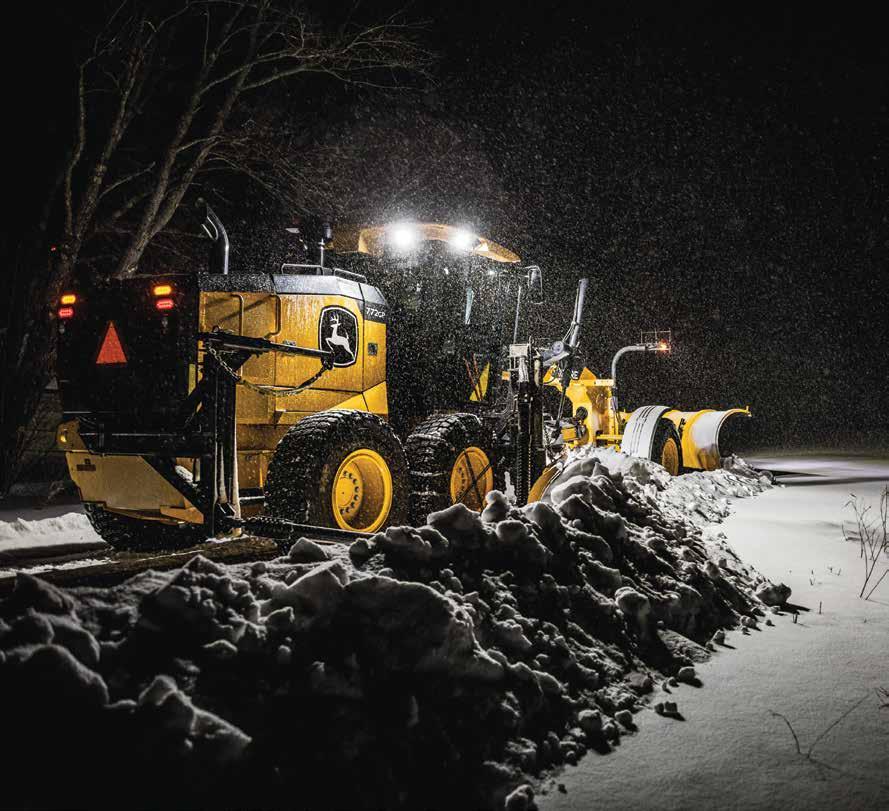
MADE TO GRADE AND LEAD THE WAY
Over the past six decades, John Deere motor graders have built a reputation for outstanding machine control and effortless grading precision. Its optimized machine specs, reliable capability, and updated cab amenities that put operator comfort front and center can help take your productivity to the next level.