


Kirk Currey Sales Rep. Anchorage Branch
Rober t Brossow Sales Rep.
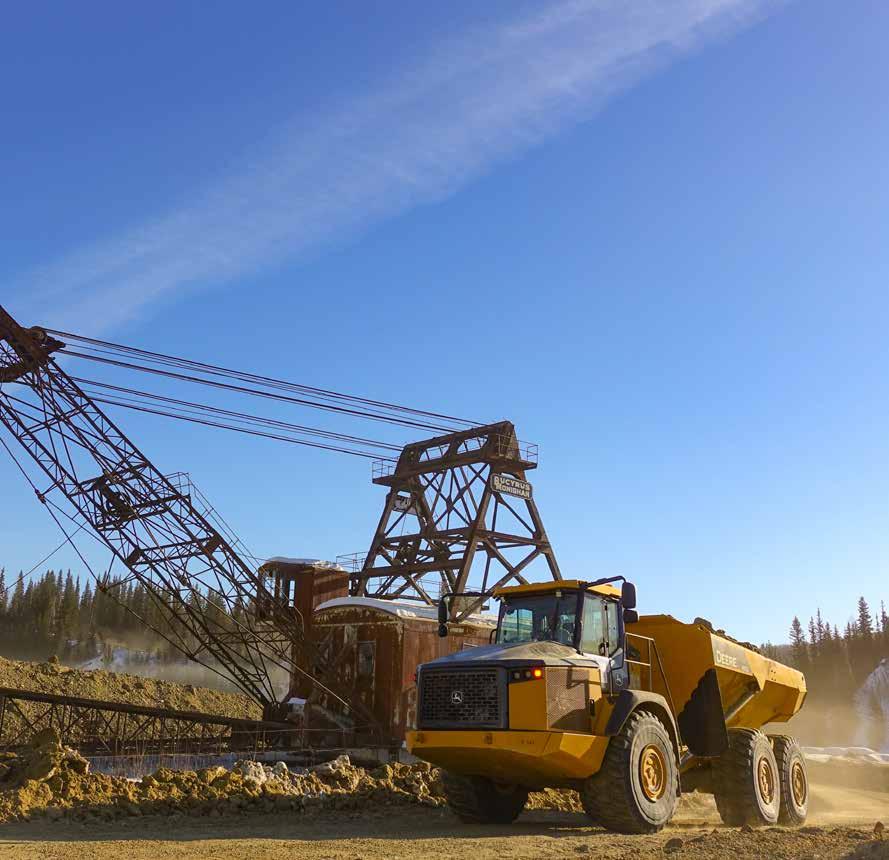
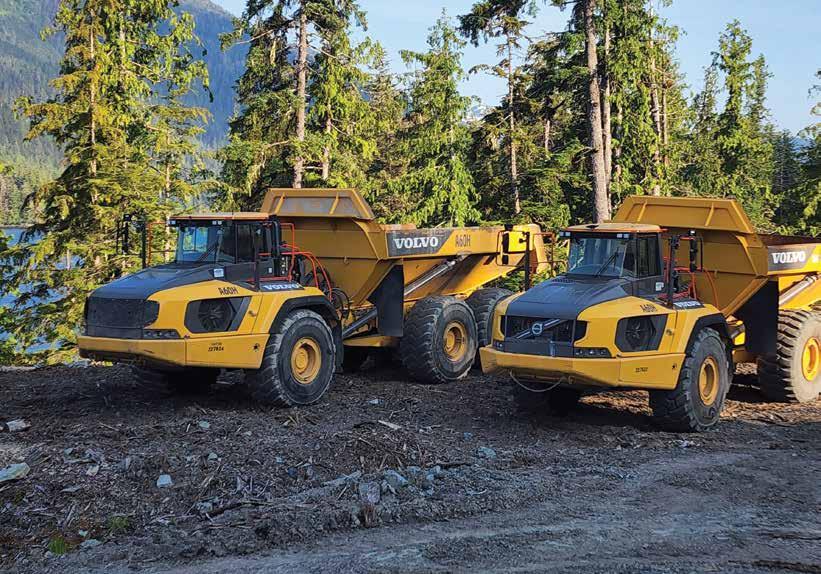
Volvo A60 Ar ticulated Truck Prince of Wales, Alaska
Volvo L120 Tok, Alaska






18 ALASKA NATIVE
What Happens in Vegas
The Reservation Economic Summit
By Charles Fedullo
30 SMALL BUSINESS
Under Renew Management
Fitness franchise flexes with new owner
By Katie Pesznecker
70 TOURISM
Cruise for a Cause
What makes The Boat Company more than a company
By Vanessa Orr
76 CONSTRUCTION
Fluid Power
The high-pressure business of Motion and Flow Control Products
By Amy Newman
80 MINING
Donlin Gold’s Moment Out of exploration, poised for development
By Alexandra Kay
86 LEADERSHIP
Doing Good by Being Good: Recklessness
By Lincoln Garrick
10 ENVIRONMENTAL
Resurrecting Hope
Kinross and Trout
Unlimited collaborate on abandoned mine restoration
By Tracy Barbour
24 FISHERIES
Holding Fast Seaweed farms seek broader market base as grant funding withers
By Christi Foist
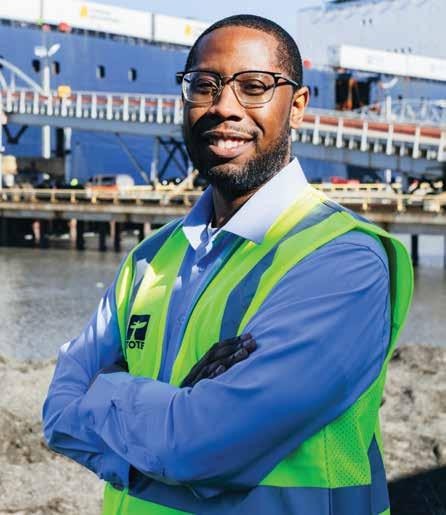
At first glance, Corey Nichols is standing in a common warehouse. But the rings secured to the floor give away his actual location: one of TOTE Maritime’s massive vessels specially designed for roll on/roll off service, which can accommodate a flatbed or trailer up to 53 feet long, as well as vehicles, other boats, and hazardous materials. The rings, of course, secure cargo while the ship is in transit. Nichols is VP and Alaska General Manager for TOTE, a role he took on near the end of 2025. While he’s new to TOTE, he has a long history in supply chains and logistics, which he shares with us this month. Thanks to TOTE for hosting the Alaska Business team temporarily aboard M/V North Star.


“First National helps us overcome the seasonal swings of Alaska’s hospitality industry.”
– Kevin and Stacey Lane, Owners of The
Cookery
Discover how The Cookery stays open year-round in Seward with help from First National Bank Alaska.
At The Cookery, shaping tomorrow means building something that lasts. That’s why they trust First National Bank Alaska for personalized expertise and a banker who keeps pace with their goals. Through our One Solution approach, we deliver comprehensive tailored services to meet all The Cookery’s financial needs – helping them move forward with confidence, backed by the strength of Alaska’s largest community bank. FNBAlaska.com
By Jamey Bradbury

Tasha Anderson, Managing Editor
Scott Rhode, Senior Editor
Rindi White, Associate Editor
Emily Olsen, Editorial Assistant
Monica Sterchi-Lowman, Art Director
Fulvia Caldei Lowe, Production Manager
Patricia Morales, Web Manager
Billie Martin, President
Jason Martin, VP & General Manager
James Barnhill, Accounting Manager
Charles Bell, VP Sales & Marketing 907-257-2909 | cbell@akbizmag.com
Weston Giliam, Account Manager 907-257-2911 | wgiliam@akbizmag.com
Tiffany Whited, Marketing & Sales Specialist 907-257-2910 | tiffany@akbizmag.com
akbizmag.com | 907-276-4373
Press releases: press@akbizmag.com
Billing: accounts@akbizmag.com
Subscriptions: circulation@akbizmag.com alaska-business-monthly
akbizmag
AKBusinessMonth
AKBusinessMonth
Alaska Business (ISSN 8756-4092) is published monthly by Alaska Business Publishing Co., Inc. 501 W. Northern Lights Boulevard, Suite 100, Anchorage, Alaska 99503-2577; Telephone: (907) 276-4373. © 2026 Alaska Business Publishing Co. All rights reserved. No part of this publication may be reproduced without written permission from the publisher. Alaska Business accepts no responsibility for unsolicited materials; they will not be returned unless accompanied by a stamped, self addressed envelope. One-year subscription is $39.95 and includes twelve issues (print + digital) and the annual Power List. Single issues of the Power List are $15 each. Single issues of Alaska Business are $4.99 each; $5.99 for the July & October issues. Send subscription orders and address changes to circulation@akbizmag.com. To order back issues ($9.99 each including postage) visit simplecirc.com/back_issues/alaska-business.
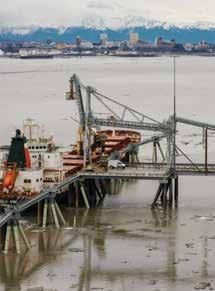
Although located in the Matanuska-Susitna Borough, Port MacKenzie is only two miles from Anchorage, as the crow flies. Our readers can see that for themselves in the beautiful opening photo of the article “A New Ballgame” by Rindi White, which takes a look at the buildup of capabilities and activities at Port MacKenzie. The photo, taken by the incredible Kerry Tasker, shows the downtown Anchorage skyline, recognizable but just askew from the well documented and iconic view often photographed from Point Woronzof.
Port MacKenzie is undergoing a transition, evolving from being a viable alternative into, in certain circumstances, a port of preference.
For decades, the Don Young Port of Alaska has dominated the import of marine cargo into the state, in large part because, following the 1964 Good Friday Earthquake, it was believed that Anchorage was invulnerable to tsunamis like those that wrecked other Alaska ports. While we know today a tsunami at the Port of Alaska is possible, it remains unlikely.
Just across the inlet, Port MacKenzie of course shares this advantage. But from there, the advantages and disadvantages of Port MacKenzie differ from the Port of Alaska, to everyone’s benefit. The growth of Port MacKenzie improves and increases transportation and logistics options in Cook Inlet, allowing shippers moving goods and services to choose the best facility for their needs.
The development of Port MacKenzie will not shift the course of an entire industry; instead it broadens the channel in which that industry can operate.
It is, to me, a specific example of what Alaska needs more broadly. Many times Alaskans are drawn to what has worked in the past, which is no surprise considering how many of the state’s projects have altered its economy and communities in incalculable ways. Discarding the success of the yesteryear would be shortsighted.
But sometimes we have blinders on to even minor adjustments that could diversify economic activity and strengthen the economic environment for individuals and businesses alike. For instance, Alaska does not need to abandon oil to pursue solar; we do not need to stop mining to safeguard our fish; we do not need to suspend logging to maintain a robust tourism season. Nor should we pursue oil, mining, or logging to the detriment of other viable projects and industries.
Alaska cannot set anchor and expect to ride out the storm. The only way forward is to move. And while course corrections can carry risk, they can also prevent a ship from running aground.


Tasha Anderson Managing Editor, Alaska Business
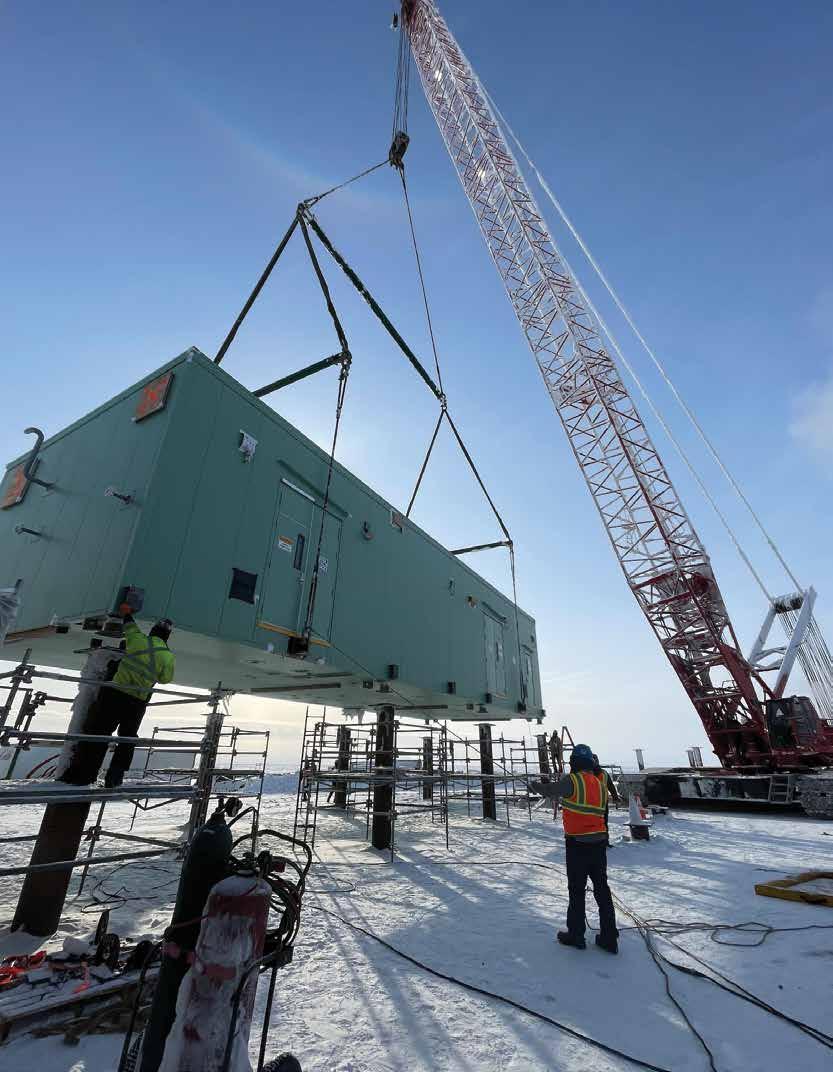
We’re a full-service construction and fabrication firm serving industrial clients of all sizes in the petroleum, gas processing and energy project sectors. Our strong leaders and skilled craftsmen work safely to overcome challenges and deliver exceptional finished projects.
By Tracy Barbour
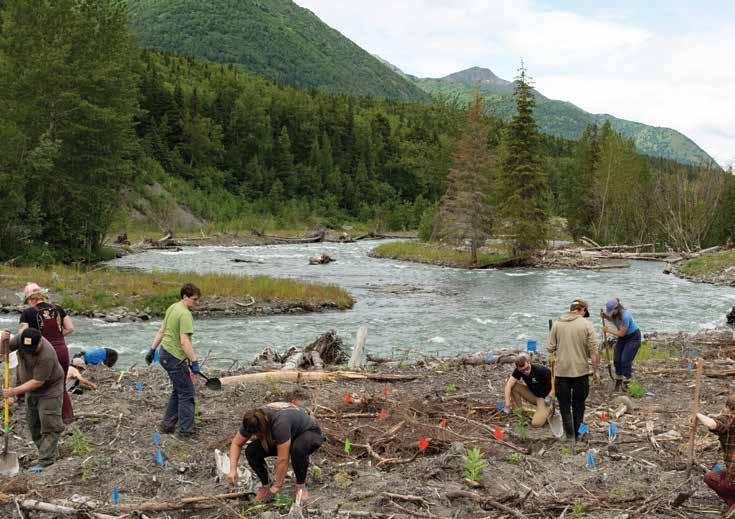
Am ultinational mining corporation and a nongovernmental fish advocacy group might seem like strange partners—but not in Alaska.
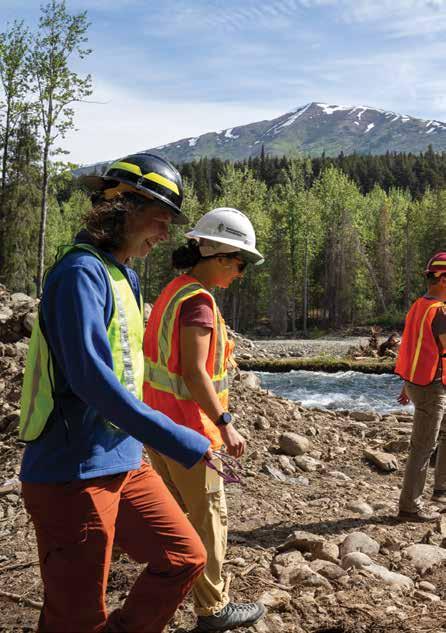
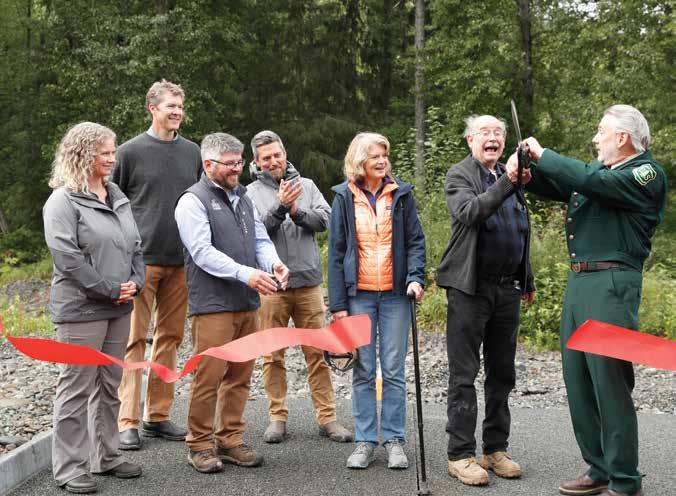
Kinross Alaska, the operator of Fort Knox gold mine north of Fairbanks, has worked with Trout Unlimited to take military veterans and active members of the armed forces fishing for several years, and now the organizations are collaborating to reclaim historic mining sites in the Turnagain Arm area under the Alaska Abandoned Mine Restoration Initiative. The inaugural project focuses on Resurrection Creek in Hope. The multi-year undertaking has been progressing since 2021
and is scheduled for completion th is summer.
The historic project brings together mining companies, conservation organizations, the US Forest Service, the National Oceanic and Atmospheric Administration (NOAA), the National Forest Foundation, and others—all sharing the goal of improving Alaska’s fish habitat.
“This took months, if not years, of planning to ensure that we had crafted a shared vision together,” says Anna Atchison, director of US external affairs for Toronto-based Kinross. “Bringing these types of partners together is rare but not unheard of.”
By co-founding the Alaska Abandoned Mine Restoration Initiative with Trout Unlimited,
Kinross is focusing on bringing resources and expertise to projects that improve fish habitat and watershed health while demonstrating responsible resource development, Atchison says. “This is not our first time teaming up with Trout Unlimited,” Atchison says. “We had the pleasure of working together to help improve fish and water access in other western states, although we believe this is the first partnership of its kind in Alaska.”
Trout Unlimited brings tremendous expertise in watershed science and salmon habitat restoration, and working together allows both organizations to contribute what they do best, Atchison says. Their partnership aligns closely
with Kinross’ long-term strategy of improving the overall quality of life in its host communities while being responsible stewards of the environment. “For us, that extends beyond the mine footprint,” she emphasizes.
Atchison points out that today’s mining industry operates very differently than historic mining. Modern operations, both large and small, are held to strict environmental standards, and companies like Kinross invest heavily in reclamation and environmental stewardship. “The Resurrection Creek project reflects that evolution and demonstrates how responsible resource development can contribute positively beyond active mine sites
“If we want to take on big projects like restoring Resurrection Creek, we need to build big partnerships that leverage the fact that we have a lot more in common than you might think at first blush.”
Austin Williams, Director of Federal Relations, Trout Unlimited
Celebrating 50 years of building in Alaska
As the largest locally owned heavy civil contractor in Fairbanks, Great Northwest, Inc. has served Alaska's Interior for 50 years and is eager to continue improving our statewide community. Over the last five decades we have grown from a small landscaping business to a large civil contractor performing site



with the right partners and mindset,” she explains.
The Resurrection Creek Restoration Project, with an estimated cost of $12 million, is being funded by various entities. Kinross and Trout Unlimited, for example, made an initial commitment of $540,000 over three years to the Alaska Abandoned Mine Restoration Initiative for in-stream work.
“Our private funding also opened up significant federal dollars made available through the Infrastructure Investment and Jobs Act and other mechanisms,” Atchison says.
The Alaska Abandoned Mine Restoration Initiative builds upon an earlier restoration of Resurrection
Creek—Phase I—that was done when the US Forest Service restored 1.5 miles of upstream habitat. That work in the mid-2000s brought salmon back to spawn in increasing numbers.
“After the Forest Service completed its Phase I project upstream of where we’re working now, it saw six times as many king salmon using the restored areas as they saw there beforehand,” says Austin Williams, Trout Unlimited’s director of federal relations. “That’s a big deal that should get people’s attention.”
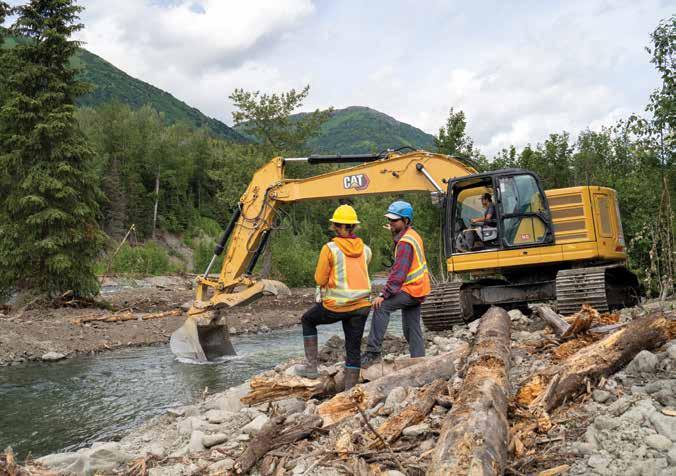
Phase II is building on that success. According to NOAA, the project includes restoring 2.3 miles of stream and 74 acres of floodplain habitat, constructing 8,500 feet of side channels, building log jams with more than 1,000 large trees, creating
gravel beds and pools tailored to the needs of multiple salmon species, and transplanting 21,000 willow trees.
Since restoration efforts began, the Forest Service has seen significant improvements in habitat quality and ecosystem function. Restored sections now include “deep pools, suitable spawning and rearing habitat, stable riffles, and more complex woody structures” that support all life stages of salmon, according to Forest Service hydrologist Angela Coleman. Reconnected floodplains have improved groundwater exchange and created side channels, backwaters, and off-channel rearing areas that were previously absent.
Biologists have documented increased spawning utilization
and use of restored habitat almost immediately after construction in many sections. “We’re also seeing broader ecological benefits: improved riparian vegetation growth, better sediment distribution, and increased habitat opportunities for other species, from aquatic invertebrates to birds and mammals,” says Coleman, who is stationed at the Chugach National Forest Glacier Ranger District office in Girdwood. “The stream is functioning much more like a natural system again.”
While restoring historically mined streams is imperative, many communities may not realize the urgency of doing so. That’s because impacts to salmon and salmon streams often occur gradually over a long period of time. “It’s almost never a here-one-day-gone-the-next situation,” Williams says.
He adds: “With Resurrection Creek, many of the impacts occurred so long ago nobody is left to remember how things used to be. This makes it incredibly important to share the story of Resurrection Creek and its restoration. Multiple times each year, we host community open house events, give project tours, or partner with local businesses to help spread the word.”
The Forest Service continues to play a central role in the Resurrection Creek Restoration Project. This includes planning, design oversight, permitting, contracting, implementation, and monitoring to ensure the work being done



aligns with long - term watershed and habitat objectives.
But the agency couldn’t do it alone. Coleman emphasizes, “Kinross Alaska, Trout Unlimited, as well as other partners, have been essential in the success of this complex project. Their financial contributions and support have helped fund major phases of the construction and habitat restoration. Trout Unlimited has also contributed scientific expertise, led community engagement, and provided additional capacity to support fieldwork and monitoring.”
Williams also highlights the collaboration between conservation groups and resource-extraction industries. “There’s simply no way this project ever could have gotten off the ground without such a strong
partnership behind it,” he says. “If we want to take on big projects like restoring Resurrection Creek, we need to build big partnerships that leverage the fact that we have a lot more in common than you might think at first blush.”
The Resurrection Creek project fits perfectly into Trout Unlimited’s broader strategy for restoring coldwater fisheries in Alaska for several reasons. “First, the Forest Service already had success restoring a smaller, upstream portion of Resurrection Creek that gave us confidence this project would succeed,” Williams says. “Resurrection Creek is also an incredibly popular and beloved fishery, where families and young kids often catch their first salmon. And lastly, numerous other partners—including the National
Forest Foundation and Hope Mining Company—were eager to help make the project a success.”
From the beginning, Hope Mining Company—which still holds active mining claims adjacent to the Resurrection Creek corridor— was integral to the restoration project. Hope Mining Company has collaborated with the Forest Service from day one, says president and owner Al Johnson. The company agreed to allow a 200- to 500-footwide corridor—spanning 74 acres—to be removed from its plan of operations to enable fullscale stream restoration.
Hope Mining Company also directed its miners to collect boulders, topsoil, and trees for the
Forest Service to use. “We had miners stockpile this stuff for them, so the Forest Service did not have to spend money on these items,” Johnson says.
Regarding the current restoration efforts, Johnson says, “They’re doing a good job.”
To lay the groundwork for a successful project, Hope Mining Company has worked to inform miners about the project, its purpose, and the importance of preserving environmental and topographic changes from the new corridor installation, according to Vice President James Roberts. The biggest impact has been with collaboration between the miners and the project contractors—Western Construction and Equipment—so that mining and restoration activities could take place simultaneously, safely, and without disruption of temporarily co-joined operations.
Moving and restoring a waterway is a herculean task initially requiring invasive heavy equipment and temporary, noisy disturbances. Initially, the public viewed the outward byproduct of restoration activities as destructive mining operations. Thus, efforts were made to inform the community about the restoration, its overall value, and the planning that went into its design, including considerations about air quality, noise, vegetation, and wildlife to heritage, social, and economic resources.
Supporting the collaborative project has been one of the most fascinating experiences of his life, Roberts says. “There’s a lot more to it [the restoration] than noise, dirt, and traffic,” he notes.
“Large restoration projects are challenging for any single agency to accomplish alone, and collaboration with industry, conservation groups, and local stakeholders is essential.”
Ange la Coleman H ydrologist US Fore st Service
The revitalization of Resurrection Creek will impact a wide range of life. For instance, returning salmon runs support Cook Inlet's ecosystem— including the endangered beluga whale—which faces prey shortages that increased salmon abundance may help solve.
Besides benefiting salmon and wildlife, the restoration project can also reduce flood risks and improve safety for the 160 residents of Hope, which is just 1.5 miles downstream from the restoration site. Reconnecting the creek to its floodplain disperses peak flows, protecting nearby homes and businesses.
Additionally, the project generates a significant economic boost for the region by creating multi-year
employment opportunities. Around $6 million is allocated to local equipment operators, construction workers, youth crews, and others. That money flows into the local community where the workers reside during the summer months.
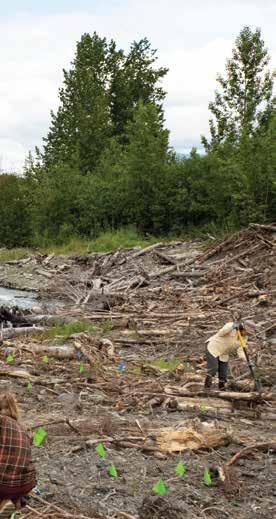
While much of the project has relied on heavy equipment, engineering, and specialists that must be hired out, Trout Unlimited’s members and community volunteers have played a significant role planting trees and shrubs to relegate and stabilize the stream banks.
“It’s great to see so much support from the community and people willing to spend their weekends helping to make this project a success,” Williams says.
Building on the success of the Resurrection Creek project, Kinross and Trout Unlimited are continuing their partnership through a second effort under the Alaska Abandoned Mine Restoration Initiative—the restoration of Cripple Creek. The project, located off Chena Pump Road in Fairbanks, will focus on reconnecting a historic creek channel that was rerouted during early gold mining operations.
Slated to begin this summer, it aims to restore natural drainage patterns and improve rearing habitat for Chinook salmon.
Restoring areas altered by early 20th - century placer mining poses engineering and ecological challenges. At Resurrection Creek, historical hydraulic placer mining had straightened the stream and
removed soil, vegetation, and natural floodplain features, according to Coleman. It also left behind tailings piles—waste material— that disconnected the channel from its valley. These conditions severely limited habitat complexity and reduced the stream’s ability to support all the salmon life stages, as well as terrestrial wildlife species.
“Our approach is focused on rebuilding the natural stream profile by reestablishing the channel, installing large woody structures, and reconstructing floodplain surfaces where they had been lost,” Coleman says. “Logistically, moving historical tailings and reshaping the valley floor required careful planning and heavy equipment work in a sensitive environment. The Forest Service addressed these challenges through detailed design, phased implementation, close contractor oversight, and continuous coordination with the local mining company and all of our partners.”
What lessons from Resurrection Creek might inform future restoration of historically mined streams in Alaska? A key insight is the value of taking a watershed - scale, long - term approach. “These systems require more than small fixes; they need comprehensive reconstruction to restore ecological processes,” Coleman explains.
Another lesson: Success depends on strong partnerships. Or, as Coleman puts it: “Large restoration projects are challenging for any single agency to accomplish alone, and collaboration with industry, conservation groups, and local stakeholders is essential.”
“Moving historical tailings and reshaping the valley floor required careful planning and heavy equipment work in a sensitive environment. The Forest Service addressed these challenges through detailed design, phased implementation, close contractor oversight, and continuous coordination with the local mining company and all of our partners.”
Ange la Coleman H ydrologist US Fore st Service
The partners also appreciate the importance of flexibility during construction. Coleman says, “As we open up old tailings piles or reconnect channels, field conditions can differ from what’s expected on paper. Being ready to adapt designs on site has helped us produce better ecological outcomes. Finally, early and ongoing monitoring is
critical. It allows us to measure results, adjust future phases, and share knowledge with others undertaking similar work.”
For its part, Kinross has learned that strong alliances are crucial. Restoration requires coordination among land managers, conservation groups, mining partners, and local stakeholders, Atchison says. Early collaboration helps ensure projects are both environmentally meaningful and logistically feasible. “Parts of Phase II are in active claims that the Hope Mining Company holds, so it was important to collaborate to ensure the 2.2-mile riparian habitat was restored in tandem with their operations,” she explains.
For Hope Mining Company, the project exemplifies the power of collaboration among entities that jointly use the shared resources—the people who enjoy it, the company that extracts minerals from it, and government managers. “The use of the resource may be different, but collaborating from the outset has made partners out of disparate entities—all of which are realizing the value of the incredible transformation that the success of this project brings to fruition,” Roberts says.
Roberts is hoping that Alaskans understand that mining is not just a carefully overseen and regulated industry but a prudent, environmentally responsible user of the state’s natural resources. He says, “Our hope is that Alaskans learn that miners are excellent stewards of the land and, when a need comes along to take specific environmental and restorative action, mining is an eager partner.”
We measure success not only by what we do but how we do it. Our team is dedicated to the safe and responsible development of oil, ensuring a healthy economy for future generations of Alaskans.
By Charles Fedullo

Th e snow in Alaska is long forgotten as the heat of the desert hits you the moment you walk off the plane. However, the work to make the National Center for American Indian Enterprise Development’s Reservation Economic Summit (RES) a success starts well before the winter weather, and even before summer sockeye runs hit the Last Frontier. Once at the conference, handshakes and hugs turn quickly into strategy discussions. Old relationships pick up where they left off, and new ones form with a clear sense of purpose. At RES, connection is not a side effect of the conference; it is where it all begins. The theme for the gathering in late March was “Rising Together.”
For Alaska Native leaders, business owners, and tribal representatives, RES has become one of the most important national stages to understand where Indian Country is headed—and where Alaska can learn and grow within it. Each year, RES brings together tribal governments, Native-owned businesses, federal agencies, and corporate partners from across the country. It is widely recognized as the largest Nativefocused business conference in the United States.
But more than its size (more than 5,000 registrations this year), RES is defined by its function: it is where economic opportunity turns the corner into new opportunity, business growth, and policy shifts. One day at
RES can feel like three anywhere else; there is so much to learn and so many people to see.
“RES gives us a window into Indian Country at a national level,” says Aaron Leggett, president of the Native Village of Eklutna (NVE) and head of the Eklutna Gaming Authority. “We get to see what’s working, where innovation is happening, and how tribes are building sustainable economies. That’s invaluable for Alaska.”
For most Alaska attendees, that national lens is critical. While the state operates in a unique geographic and regulatory environment, many similar economic pressures are
“At RES, you see how other tribes are tackling similar challenges… Whether it’s workforce development, food security, subsistence, or navigating federal programs, there are real lessons we can take home and apply to help our people.”
shaping Native communities across the country. It is a place to learn from other organizations’ successes and challenges. The formal agenda at RES is packed with panels, breakout sessions, and policy updates. But what distinguishes the conference is how quickly those conversations translate into action.
“Some of the most important conversations don’t happen behind a podium,” Leggett says with a chuckle. “They happen when people can speak honestly about what’s working, what’s not, and where we can go together.”
The ability to move from discussion to collaboration is what keeps Alaska Native entities returning year after year. That means not only learning from others, but identifying where the 49th State can lead.
One of the most visible examples of insight to action is Chin’an Gaming Hall. Owned and operated by NVE, the facility has quickly become a benchmark for tribally driven economic development in Alaska. “Chin’an is about creating opportunity for our people,” says Eklutna village council member Dustin Lorah. “It’s jobs, it’s revenue, and it’s something we can continue to build on.” The development of Chin’an was informed in part by lessons learned from tribes
across the country, many of them encountered through RES.
Leggett sat on a panel where he could highlight the economic impact and tribal member benefits that Chin’an Gaming Hall has provided. It was also a chance to share some of the challenges NVE has faced and still faces moving forward.
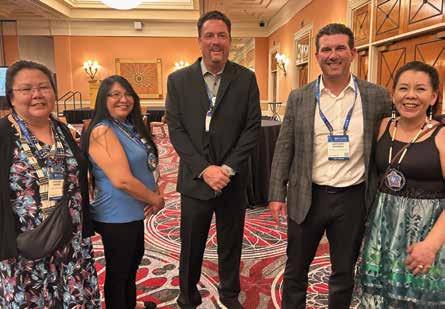
Leggett, along with other Eklutna village council members and Eklutna Gaming Authority members, met with a business mentor and looked for new ways to further help Eklutna tribal members and the surrounding community. They got an up-close view of the Marnell family of companies, a Las Vegasbased business with interests in property development and gaming. The family-owned company built the Bellagio hotel and casino in 1995, the
expansion of neighboring Caesar’s Palace in 2007, and is consulting with NVE on the next phase of Chin’an Gaming Hall. Leggett says, “We are proud to have partnered with Anthony Marnell and his family for more than a decade, who we now consider our family. What they do is inspirational, and Anthony’s involvement is helping us provide jobs, economic impact, and new opportunity for our people but also for our neighbors and our state.”
For NVE, the success of its Chin’an Gaming Hall gives a new lens to this conference. “For NVE it is about finding ways to help our members,” says village council member Angeleen Waskey. “You’re learning from people who are actively building businesses and solving the same problems we face. That’s something you can take
home and use to help our elders and our youth.”
For many attendees, RES is not just about gathering information, it’s about building relationships that lead to contracts, partnerships, and long-term collaboration. One of the defining strengths of RES is the diversity of experience in the room. Tribes from across the Lower 48 share lessons learned in industries ranging from gaming and energy to construction, healthcare, and technology. For Alaska participants, that exposure provides both validation and new direction.
“At RES, you see how other tribes are tackling similar challenges,” says Eklutna village council member Shirley Chilligan. “Whether it’s

workforce development, food security, subsistence, or navigating federal programs, there are real lessons we can take home and apply to help our people.”
That exchange of ideas is central to the mission of the conference, according to Chris James, president and CEO of the National Center for American Indian Enterprise Development. “RES is about bringing Indian Country together,” James says. “It’s about sharing best practices, understanding federal policy shifts, and creating pathways for Native businesses to grow and compete at every level.”
“We’ve learned from others who have been doing this for years,” Leggett says. “How they structure operations, how they manage growth, how they navigate
challenges. That kind of knowledge is incredibly valuable.”
For Leggett, the success of Chin’an Gaming Hall reflects a broader shift. “We’re seeing Alaska tribes step into new spaces,” he says. “It’s about economic self-determination and building something sustainable for the future.” At RES, those kinds of success stories are both shared and studied—creating a feedback loop of innovation across Indian Country.
Another defining feature of RES is the level of access it provides to federal leadership. Agency heads, program administrators, and policymakers engage directly with tribal leaders and business owners.
“Being able to have real conversations with federal officials
“RES is about bringing Indian Country together… It’s about sharing best practices, understanding federal policy shifts, and creating pathways for Native businesses to grow and compete at every level.”


is incredibly valuable,” says Eklutna village council member Amanda Adams. “You are asking questions, getting clarity, and understanding how programs actually work.”
Federal funding and regulatory frameworks often shape the viability of major projects in Alaska, so that access is critical. John Oceguera, a former Nevada legislator and, since January 2026, the CEO and owner of multi-state public affairs and communications firm Strategies 360, emphasizes the importance of translating those conversations into strategy. “RES brings decision-makers and practitioners into the same room,” Oceguera says. “That creates a level of clarity you don’t often get. It helps organizations understand not just what’s happening but how to position themselves.”
Across panels and conversations, several key trends are shaping the economic landscape for Native communities. “There’s a strong focus on diversification,” says Nathan McCowan, who chairs the Alaska Native Village Corporation Association. “Tribes and Alaska
Native corporations are expanding into new sectors and building more resilient economies.”
Thomas Mack, CEO of The Eyak Corporation, says economic development goes hand in hand with sustaining Native people. “Not just financially, but culturally. In Alaska, we have unique challenges— logistics, climate, remoteness,” Mack says. “But we also have unique strengths. Seeing how others are innovating helps us think differently about what’s possible.”
In recent years, Alaska’s footprint at RES has grown—not just in participation, but in influence. From gaming and tourism to infrastructure and energy, Alaska Native organizations are increasingly contributing to national conversations about economic development. “Alaska brings a unique perspective,” James says. “And that perspective strengthens the entire ecosystem.”
“It’s about being part of the conversation,” Lorah adds. “And making sure Alaska’s voice is represented.”
As RES concludes, the focus shifts from gathering information to applying it. Attendees return to Alaska with new contacts, new ideas, and a clearer understanding of where opportunities lie. “That’s the real work,” Leggett says. “Taking what you’ve learned and applying it in a way that makes sense for your community.”
Application requires adapting national strategies to local realities, but it also builds on something established at RES: relationships. In the end, RES is not just a conference; it is a catalyst, celebrating forty years of convening. It is where ideas become strategies. Where relationships become partnerships. Where information becomes opportunity.
For Alaska, the summit is a critical link to the broader landscape of Indian Country—a place to see emerging trends, engage with federal decision-makers, and identify new pathways for growth. When attendees return home, the snow may still be there, but the new ideas and the energy that created them provide fuel for creating new opportunities.
And, perhaps most importantly, summit attendees take pride in being a part of Alaska showing up—not just to listen, but to lead.
Charles Fedullo is a partner at Strategies 360’s Alaska office. His public policy and communications experience spans decades as a TV news anchor, journalism professor, and political aide to two Alaska governors.

Our shareholders are the stewards of our region, caretakers of our cultures, investors in the next generation, and the strength behind our corporation.
Together, we are determined to build a more resilient future. Bristol Bay Native Corporation, always more than a corporation.
By Christi Foist
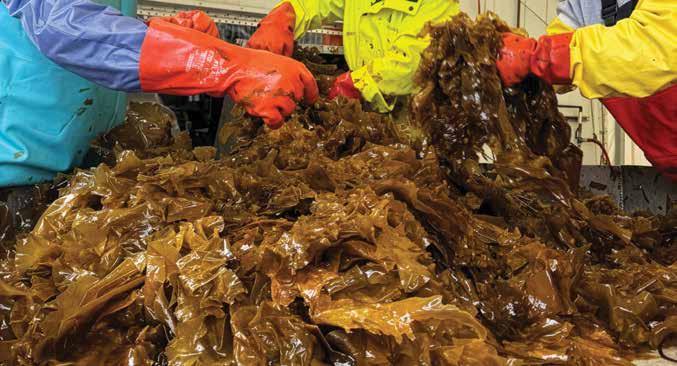
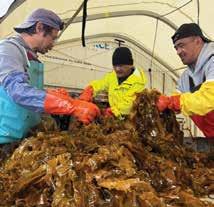
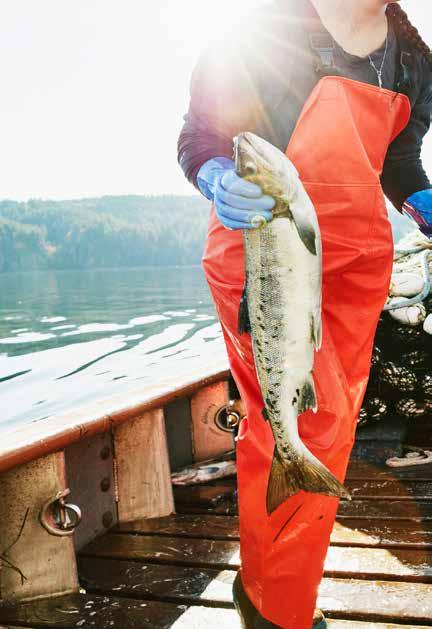
From fishing line to fertilizer, food to medicine, kelp has a long history of use in Alaska Native technology. The state’s much newer formalized kelp industry, however, is still finding its way. When a major mariculture grant program ends this year, the kelp industry will face one of its big gest tests thus far.
The 1988 Aquatic Farm Act introduced state permitting for cultivation of shellfish and plants (although kelp and seaweeds are technically algae), but not until 2016 did then-Governor Bill Walker launch the Alaska Mariculture Task Force.
“Shellfish and aquatic plants have historically been crucial to the subsistence and livelihoods of many Alaskans,” his order noted, yet the nascent industry had struggled to achieve more than modest profits. The stakes involved more than money; in the face of
“future environmental threats,” kelp “can produce healthy foods and supplements, increase and preserve habitat for fish and invertebrates, and assist with bioremediation efforts in areas that contain excess carbon loads,” he wrote.
A nearly $49 million matching grant provided another boost for the industry in 2022. Southeast Conference won funding for its Alaska Mariculture Cluster through the US Economic Development Administration as part of its Build Back Better Regional Challenge program.
“That has been a real motivator for a lot of people,” says Kathryn Carovano, one of the owners of Kachemak Kelp, an innovation collaborative in Homer. “It de-risks the involvement.” Challenges in the commercial fishing industry have also drawn people interested in other ways to supplement their income, Carovano adds, while allowing them to remain connected to the water.
The Alaska Department of Fish and Game (ADF&G) oversees both wild harvesting and farming of kelp. Both types require a permit, but the process to farm kelp also involves further input from the Alaska Department of Natural Resources and the Alaska Department of Environmental Conservation, among other entities. The three state agencies administer Alaska’s Aquatic Farm Program, but approval can also involve local, tribal, other state, and even federal entities such as the US Army Corps of Engineers.
“From a farm establishment perspective… Alaska is somewhere kind of in the middle… of difficulty to access mariculture business opportunities,” says Lindsay Olsen, a kelp farmer in Homer who also directs training and support for the mariculture-focused nonprofit GreenWave, based in Connecticut.
Farming kelp can involve up to three separate production stages: the
hatchery that produces a seed string; the farm that grows and harvests mature kelp; and the processor. A policy of ADF&G often called the “50-50 rule” dictates that hatcheries create seed strings from “broodstock parent plants [that] must consist of 50 unrelated individuals and be collected from within 50 km by water of the out-planting locations,” says Michelle Morris, permit coordinator for the aquaculture section in the commercial fisheries division.
“There’s a lot of debate whether it needs to be that diverse,” Carovano says of the parent plant requirements. Olsen says the industry has been pushing for changes. She compares the 50-50 rule to “a corn farmer being asked to go forage... and then send in corn kernels.”
In practice, farmers like Olsen often collect the samples themselves, which involves finding the right kind of kelp bed, scuba diving, and then plucking only kelp that has reproductive tissue. Once a diver gets enough of the right kind of samples, they submit them to the hatchery along with details of the collection process. As the permit holders for that part of the process, hatcheries must submit year-end reports to ADF&G that detail the total number of samples collected and where they came from.
After a hatchery—of which Alaska has seven, currently—creates the seed lines, farmers usually put them out in the water late in the year. Harvest time varies slightly by region, but it usually occurs in the spring.
it. “You basically have 24 to 48 hours to get it into a stabilized format before it starts to degrade,” Olsen says. This creates “a high need for regional stabilization capacity.”
Kelp stabilization methods can include drying, blanching, freezing, salting, and fermenting. These vary in terms of the equipment and storage required, as well as the processed
kelp weight. Processing capability also limits kelp’s end uses and farmers’ selling options. “Nobody really wants to buy wet seaweed,” says Matthew Perkins, CEO of California-based Macro Oceans, which makes seaweed-based biomaterials used in beauty, food, and other products. His company has been buying Alaska-grown sugar kelp for about four years.
Once farmers harvest kelp, they have a very short window to process

For farmers to work with a separate processor requires infrastructure that exists in only a few parts of the state. Olsen says processing “could happen on a very small scale,” like the deck of a boat, but that involves close coordination with buyers. “You have to know the exact recipe that you’re supplying before you’re stabilizing,” she says. Only some farmers choose to process the kelp themselves.
Others choose to work with a nearby processor like Kachemak Kelp. Carovano says its partners have chosen to focus on kelp research and processing, creating some products they sell directly and selling other forms of kelp to food manufacturers like Juneau’s Barnacle Foods. Kachemak Kelp buys its kelp from farmers.
Kodiak Island Wildsource mainly processes fish, but CEO Chris Sannito says the company started processing kelp about ten years ago, after different customers asked about it. “In the springtime, it’s good with the fisheries,” he says. “There’s usually a spring lag in the processing.”
Owned by the Sun’aq Tribe of Kodiak, Wildsource usually allocates about one month each year for kelp processing. Its current equipment mainly supports drying, blanching, and freezing.
Interest in using kelp for more products, however, has led Wildsource to partner with Macro Oceans on a new, separate facility that will solely process seaweed, the Kelp Primary Processing Platform. Perkins says KP3—as both parties plan to call the facility—will allow
Wildsource to generate products that Macro Oceans already makes at other facilities and sells to about 100 companies. The five products planned for the processing line include dried whole leaf or chopped kelp, plant biostimulants, liquid kelp bioactive extracts, and dried kelp pulp residue.
Currently, Macro Oceans buys seaweed that is transported as frozen blocks from Alaska to California.
“We’re paying to ship water from Kodiak,” Perkins says. “We want to move as much of that preprocessing as close to the farm as possible,” in order to ship concentrated extracts.
Once the new KP3 facility opens, he says it will “be able to move… thousands of pounds of kelp a day.” Macro Oceans will also be able to pay more for the extracts KP3 will produce than it would pay for raw kelp.
In 2025, Macro Oceans partnered with Koniag to secure a $2.3 million grant for the Sun’aq Tribe of Kodiak to cover most of the KP3 building’s equipment, and Wildsource is handling the building funding and construction. As of press time, Sannito says about half of the $3 million construction goal has been raised. Long-term, Perkins says the KP3 facility could provide a model that other communities could replicate.
Once KP3 gets up and running, it could make a big difference for an industry that has struggled to find markets. The impending end of the Build Back Better grant project on September 30 presents a test for the industry.
Morris says ADF&G has seen five kelp farms or hatcheries close already
in 2026, and she knew of at least three more planning to do so.
“The next few years will be very telling,” says Max Stanley, co-owner of Barnacle Foods, the Juneaubased maker of kelp sauces and pickles. “Hopefully all this money you put in for infrastructure and training and whatnot has really built a foundation… but I think there are some challenges with finding markets for kelp, especially as you have larger volumes of kelp to sell.”
Despite the closures, kelp farms and hatcheries drove a significant increase in aquaculture permit applications, Morris says. From 2016 to 2025, the state received 150 applications, almost two-thirds of these kelp related, versus 46 total applications from 2006 to 2015.
“Originally, I had hoped that [the industry] would be a lot further along than where it is now,” says Nick Mangini, who started the state’s first kelp-only farm in 2016. Mangini also serves as mariculture director for the Southwest Alaska Municipal Conference.
At first, much of the state’s kelp industry focused on foods, but even though Costco sells imported seaweed snacks and salad, “American don’t eat a lot of kelp,” Man gini says.
“Talk of kelp being the new superfood… didn’t seem to really materialize,” says Stanley. Barnacle Foods now sells food products in about 1,500 stores across the country and buys about 50,000–100,000 pounds of kelp a year. (The weight depends on sourcing, as wet kelp weighs much more than dried forms.)
Despite Barnacle Foods’ success, Stanley says the brand has downplayed the emphasis on seaweed over time. “It still has the same amount of kelp,” Stanley says, “but we’re selling the flavor, we’re selling the Alaska story, we’re selling sustainability.”
By this route, Barnacle Foods has proved to be one of the few food-related success stories in the Alaska kelp industry.
“There certainly was a period of, ‘OK, we can grow the kelp, now what are we going to do with the kelp?’”
“There certainly was a period of, ‘OK, we can grow the kelp, now what are we going to do with the kelp?’” says John Smet, founder of Ketchikanbased Pacific Kelp Company. Food is only one possibility.
Another answer echoes a longstanding Alutiiq use: gardening. In a 1991 interview, elder Natalie Simeon described the kelp beds of her childhood on Woody Island and how traditional gardeners used the seaweed as fertilizer.
Along the same lines, Pacific Kelp Company has seen similar success with a plant biostimulant called KelpEdge. “It’s not exactly a fertilizer,” Smet says, but a growing body of research shows its effectiveness at increasing plants’ stress tolerance. In 2025, the company received a $500,000 grant from Southeast Conference for field trials of the product in cooperation with Washington State University and Cornell University.

Service that you trust from people that you know.

The Washington State University study, done in 2025, looked at how KelpEdge applied to leaves and soil affected wine grapes grown in Washington and California. The two





Washington trials involved vineyards facing leafroll and water stress, while the one in California compared fruit from kelp-treated plants to a control. In all cases, the grapes from plants treated with kelp had more of the properties desired for winemaking.
This year, Pacific Kelp Company’s grant-funded field trials with Cornell University are looking at how seaweed affects turf grass soil health. Smet says one thing the study will look at is whether use of kelp yields the same greenness with reduced water and fertilizer use.
Macro Oceans’ products present another possible large-scale use of kelp. In the beauty industry, products have two main types of ingredients, Perkins says: functional and those providing “specific, targeted benefits,” like hydration. Functional ingredients provide things like structure or texture. “Kelp can do both those things,” he says.
On the benefit side, kelp’s polysaccharides (long-chain sugars) have “pretty well-documented benefits” related to hydration and reducing inflammation or redness, Perkins says. “These are all things which the kelp does naturally by itself in the water,” Perkins observes. “It’s trying to protect itself from all the sunshine [and] to heal itself from bumps and scrapes as it gets bashed around.”
Kelp also has applications as a functional ingredient. Perkins says seaweed cellulose can make something called a “rheology modifier.” Beauty brands can use it to replace synthetic thickeners. “Polymers are all synthetics made from petrochemicals and
“Hopefully all this money you put in for infrastructure and training and whatnot has really built a foundation… but I think there are some challenges with finding markets for kelp, especially as you have larger volumes of kelp to sell.”
M ax Stanley Co-owner, Barn acle Foods
petroleum, and a lot of people are trying to replace these because consumers increasingly see these synthetic polymers as microplastics,” Perkins says.
To meet broader demand for kelp, Alaska farmers will have to scale up operations, but “all the risk is on the farmer right now, and very little of the risk is on the market that promises to buy the kelp,” Mangini says. “Forecasting the needs of the actual market, year over year” continues to present challenges.
At the same time, a single farmer might not always produce enough kelp for a large order, so buyers might contract with several small farms. However, the work involved to communicate with several smaller farms versus a larger operation might discourage some buyers. To address that and other challenges, kelp farmers including Mangini recently formed the Kodiak Ocean Growers Cooperative. It might benefit newer farmers more than established ones like Mangini, but “in the end, we all saw the value of being able to fulfill larger orders, the insurance of having another farmer farm for the same order,” he says.
Depending on the type of kelp grown and on what products, farmers must also deal with the mismatch between harvesting season and when stores might want to stock something. That particularly affects agricultural products like KelpEdge.
Pacific Kelp Company won’t have the trial results until October—just months before a large distributor might want to have the product in its warehouse (for example, March, if customers would need it for April planting). “Timing with the kelp farmer production and the land farmer use, that is something that we think a lot about,” Smet says. Pacific Kelp Company mostly uses Alaska giant kelp, a variety with more yearround availability, but so far only a few farms produce it, Smet says.
“It takes a long time to get… the flywheel going,” says Perkins. “I’m very optimistic about the Alaska story because I’m out there, talking to brands every day. And they love the Alaska story.”
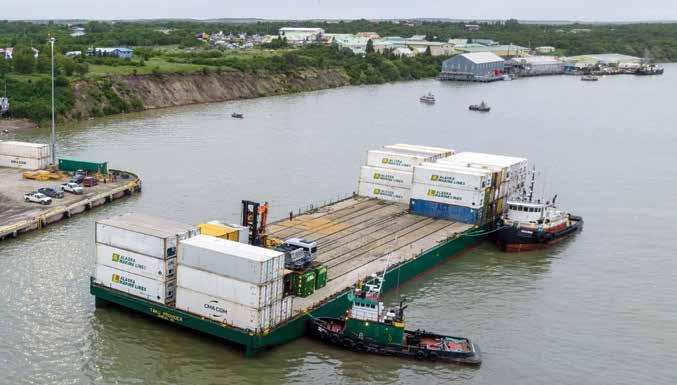
The Lynden family of companies prides itself on supporting Alaska’s seafood industry. Utilizing their vast array of transportation and logistics options—everything from barges covering the coastline of Alaska to Hercules cargo aircraft that reach even the most remote locations—they connect Alaska’s seafood to the world.
“We think of seafood logistics in two large components,” says Bret Harper, Vice President of Sales for Alaska Marine Lines, part of the Lynden family of companies. “Early in the year, fishermen and seafood
processors need to position their boats and supplies in Alaska, so they are ready for the season. We move a lot of supplies up on our barges and other Lynden equipment. The first Western Alaska barge of the season is full of fishing boats and a great sight to see!”
“Next comes moving the seafood catch from Alaska to market,” continues Harper. “We are very flexible and develop creative solutions to fit the ever-changing consumer preferences.”
Fresh seafood that needs to hit markets quickly is flown from remote locations using Hercules aircraft. Frozen or canned seafood moves
by barge or truck. Lynden’s air and ocean freight forwarding experts coordinate shipping Alaskan seafood to customers around the world.

By Katie Pesznecker

As Body Renew Alaska evolves into its next chapter under incoming owner Aaron Miller, its focus is less on expansion for expansion’s sake. Rather, the fitness franchise’s focus is on returning to what made it successful in the first place. That means continual grounding in a specialized business model that can be difficult to maintain but essential to successful outcomes: a personal connection with clients and their unique fitness goals and journeys.
“At one point there were five Body Renew locations,” says Miller, who grew up in Anchorage. “Body Renew started really small. It was really a personal training studio that happened to sell memberships, and that’s really what their core was. Over
time they expanded, they got bigger, they introduced more premium locations, and it transitioned to where it was just another gym, and it lost that personal touch.”
Today, Body Renew is intentionally recalibrating—blending the amenities and accessibility of a traditional gym with the individualized support of a training studio. The shift reflects both lessons learned from growth and a broader evolution in how fitness businesses define value.
Miller’s perspective on the business is shaped by his own path, one that began not in management but on the gym floor and the baseball diamond. He graduated from Service High
School before heading to the Lower 48 for college, where he continued playing baseball. Fitness, he says, was always a constant, and easy to fit into the life of a young athlete.
“Working out was a part of my life for as long as I could remember,” Miller says. “The reason I came on as a trainer at Body Renew was I didn’t know exactly what I wanted to do with my life, but I knew I liked the gym, that it was somewhere I liked to be. The plan wasn’t to be here forever, but that’s where life took me.”
That transition from athlete to trainer wasn’t without its challenges. Miller saw early on that one major obstacle to overcome is that new gym clients weren’t always coming in with his own lifelong love of workouts.
“In the athletic world, everyone typically liked the workout, and it was natural to build it as part of your lifestyle, to stay consistent,” he says. “But as you get older, fitting fitness into your lifestyle isn’t as easy as it used to be. When you’re younger you have so much time on your hands. As an adult, you feel like you have to fit activity into your life.”
Understanding the difficulty of establishing consistency now sits at the center of Body Renew’s approach to supporting its clients. At first glance, it resembles your average gym—there are free weights, weight machines, aerobic spaces, and saunas. But at its core, Body Renew is moving away from a traditional gym—where members pay dues, show up, and do their own thing—to a space defined by personalized plans and proven results. Its website is loaded with inspirational before-and-after photos of members who have reached th
“You know, a lot of gyms feel pretty transactional,” Miller says. “You sign up, you check in, you come when you’re motivated. We want to be more present than that. We want to make members feel like they’re a part of our community. We want them to know we’re going to reach out to them, not because a payment failed but because they haven’t checked in in a while. We want them to know we’re there when they
“I didn’t know exactly what I wanted to do with my life, but I knew I liked the gym, that it was somewhere I liked to be. The plan wasn’t to be here forever, but that’s where life took me.”

That shift is reflected in how the company now defines success. Outreach and communication with its membership is foundational to Body Renew’s customer service. Instead of focusing primarily on membership

The Alaska School Activities Association is a statewide nonprofit organization established to direct, develop and support Alaska's high school interscholastic sports, academic and fine arts activities. ASAA has over 200 member schools, over 35,000 student participants, and manages 52 championships!
ASAA can put the spotlight on your business in front of 100,000+ Alaskans at dozens of amazing high school championship events!

Baseball June 4-6


Softball June 4-6
If you would like to join the team and support students throughout Alaska during our 2025-26 interscholastic championships, please scan the QR code to contact Colin McDonald, Director of Marketing.




numbers, the Body Renew team tracks engagement metrics and outcomes: how often members show up, how they progress, and whether they achieve the goals that brought them in.
“We have a variety of metrics we look at,” Miller says. “Number one is pure member feedback. We check in with members to get their feedback about how their experience was in the gym. We track check-ins per member to make sure they aren’t dropping off.”
If there’s a single window that defines success at Body Renew, it’s the first month.
“We’ve found the first thirty days is super crucial,” Miller says. “Members who make it to the gym eight times in their first month, their success rate skyrockets. It’s all about building that initial routine. That’s our main point of emphasis: building something that you can consistently do. And we really go hard on that in the first thirty days.”
To support that effort, every new member is introduced to what Body Renew calls its “Starting Point” program, a structured onboarding process designed to remove uncertainty and create momentum. The staff conducts a body scan that measures body fat percentage, including breaking it down by segments of the body “so we know what areas of the body to work on,” Miller says. “We figure out what your fitness background is and what your goals are so we can design a program and a routine that’s going to match what your goal is.”
That personalization is key because no two members are the same. While one person may want to bulk up,
another may wish to slim down. “So we’ll break down what their goals are and we’ll take into account their lifestyle, which I think is one of the most unique things we do,” Miller says. “We don’t look at it in terms of ‘how to add this to your routine’ but how to build this into your routine.”
That distinction—building fitness into a routine rather than layering it on top—is central to Body Renew’s philosophy. The gym helps craft programs and goals that are achievable and realistic but also require individual commitment to reach that sweet spot of an established routine.
“People will overcommit and say, ‘I’m going to come in five days a week,’ and it sounds good, but for a lot of people that’s not realistic, long term,” Miller says. “So we’ll look at it in terms of, how can we break this down so it’s something you can do every week no matter what? Consistency is one of the most important things we talk about because if you’re consistent you’re going to make progress. Our ultimate goal is helping people build something that they can do consistently. Everyone has a different starting point, and we want to meet you where you’re at.”
For many members, that means starting from scratch. Many new members aren’t consistently working out, Miller says, so the goal is to create a plan that “eliminates the start/stop, start/stop, and make a plan that’s reliable where, if you’re following the plan you’re given, you’ll hit the goals you want to achieve.”
“We track check-ins per member to make sure they aren’t dropping off… Members who make it to the gym eight times in their first month, their success rate skyrockets. It’s all about building that initial routine.”
Aaron Miller, Owner, Body Re new Alaska






Body Renew’s membership structure is designed to support a range of needs. Memberships are available for purchase in two-week increments and at three different levels. The most minimal provides basic gym access during most hours of the day; the most comprehensive level allows for coaching, customized programming, and progress tracking.
This tiered approach acknowledges that most clients need something in the middle, Miller says: a full gym with coaching support and guidance, structure, and check-ins as they work toward defined goals.
“They need a plan, someone to help keep them accountable, and that’s what we strive for, especially with our signature membership. We provide all the answers you need. You just need to do it,” he explains.
One of the challenges in building a coaching-focused model is striking the right balance between support and autonomy: “Trying to support as much or as little as the member needs, because everyone’s different,” Miller says. “Our goal is a fine line where we don’t want to bug you. We know there are other things in life, but we want to find those sweet spots. We know you, and we know how your life works.”

Miller acknowledges that Alaska presents its own challenges when it comes to maintaining a fitness routine. Intense weather swings can prove discouraging. Glorious summer days may make going to the gym less desirable. Inclement road conditions during long, dark winters are literal barriers.
“It’s really tough to stay consistent, even for the most motivated people,” Miller says. “Our main goal is to take motivation out of the equation.”
This includes discussions and planning around how to maintain activity and workouts when reaching the gym isn’t an option. “We do have a lot of Slope workers and people who have irregular schedules,” Miller says. “Our goal is to support them even when they’re not physically in the gym. Let’s try to not go backward during those two weeks so we can keep making progress.”
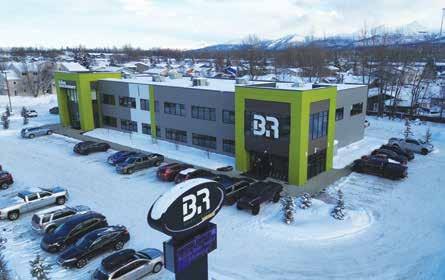
Today, Body Renew operates two locations in Anchorage: a southside location on Old Seward Highway near O’Malley Road and a gym on East Northern Lights Boulevard at Muldoon Road. While smaller than its previous five-store footprint, the company sees that as an opportunity to refocus.
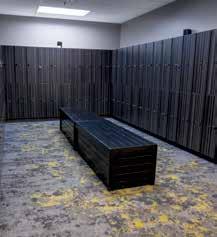
“We really wanted to bring that personal touch back,” Miller says. “Our biggest focus right now is continuously improving the member experience.”
Growth remains part of the longterm vision, particularly within the Anchorage market. The company is exploring potentially returning to Midtown, where a previous location once operated and remains missed by members.
Location, Miller notes, plays a critical role in member behavior: “The closer to home, the more likely you are to go. Sometimes five minutes versus ten minutes is the difference between going and not going to the gym.”
At the same time, the company is investing in its team. With a staff of approximately eighteen employees, Body Renew is focused on building a culture that supports both members and careers.
“We always want people who genuinely want to help,” Miller says. “That’s not super hard to find in the fitness world. A lot of people who come in, that’s what their goal is. One of my personal goals is to create a place where people can have a career in the fitness world. I’m looking for a team that will be here for a long haul.”
For logistics professionals, fall is a critical time. As you review your contracts and plan your shipping strategy for 2026, the question isn’t just about rates. It’s about creating custom solutions so you can serve your Alaska customers with faster, better, and more consistent service.
For logistics professionals, fall is a critical time. As you review your contracts and plan your shipping strategy for 2026, the question isn’t just about rates. It’s about creating custom solutions so you can serve your Alaska customers with faster, better, and more consistent service.
REACH AND RELIABILITY
REACH AND RELIABILITY
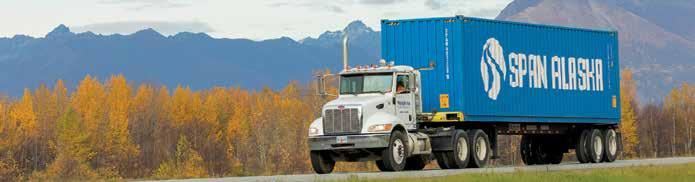
Span Alaska’s owned network of terminals and equipment provides direct access to ~80% of Alaska’s population. This infrastructure ensures reliable, flexible service with tight control over quality and transit times.
Span Alaska’s owned network of terminals and equipment provides direct access to ~80% of Alaska’s population. This infrastructure ensures reliable, flexible service with tight control over quality and transit times.
SINGLE-SOURCE SOLUTIONS
DESTINATION DIRECT™
Our direct, non-stop routing from our West Coast Service Centers to key hubs in Alaska improves transit times, minimizes handling, and reduces the risk of damage.
Our direct, non-stop routing from our West Coast Service Centers to key hubs in Alaska improves transit times, minimizes handling, and reduces the risk of damage.
FIRST MILE TO FINAL MILE
LTL, Chill and Freeze, Hazmat and oversized cargo? We handle it all, managing all modes of transportation—LTL, truckload, rail, ocean, and air—to provide a single chain of control for dispatch, shipping, tracking, and billing.
LTL, Chill and Freeze, Hazmat and oversized cargo? We handle it all, managing all modes of transportation—LTL, truckload, rail, ocean, and air—to provide a single chain of control for dispatch, shipping, tracking, and billing.
Leverage our logistics team to schedule pick up of your shipment from anywhere in the Lower 48 and schedule day-definite delivery throughout Alaska within our standard 1–2 days of vessel arrival.
Leverage our logistics team to schedule pick up of your shipment from anywhere in the Lower 48 and schedule day-definite delivery throughout Alaska within our standard 1–2 days of vessel arrival.



Mode switching is inevitable in transportation. Ask TOTE Maritime’s Alaska boss Corey Nichols about midnight delays in Tacoma, Washington; he talks about trucking up the Alcan. Can’t talk about highway maintenance without mentioning drone aircraft used in avalanche mitigation. When regional air carriers discuss aviation safety, part of the picture is ground equipment for efficiently loading cargo. Talk about electric snowmachines in Kotzebue, the discussion pivots to how vehicles are shipped over the water. Talk about the barge dock at Port MacKenzie, and the Alaska Railroad’s track extension arises.
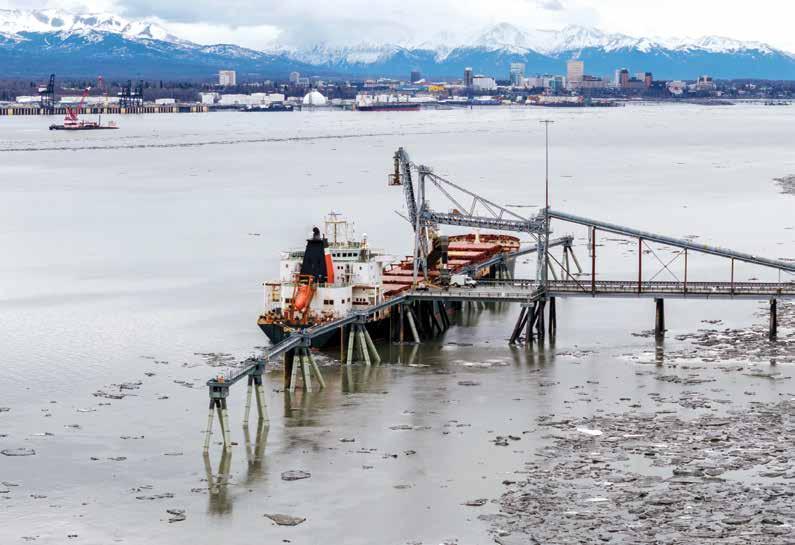
For a seemingly quiet little port about 40 miles from Wasilla, Port MacKenzie has a lot going on. From hosting participants in a military training exercise to being the jumping-off point for construction projects in western Alaska, the port maintains a hum of activity.
By Rindi White
With large projects looming in Alaska—including a possible LNG pipeline from the North Slope; the West Susitna Access Road that would open up state land west of the Susitna River; a possible coal mine near Skwentna and other, nearer-term critical mineral mining efforts in the West Susitna area; and the completion of a railroad spur line from the Houston area south to the port—supporters hope that hum will soon sound more like a steady roar of activity.
“The exciting thing about Port MacKenzie is that we’re, in many ways, a diamond in the rough,” says MatanuskaSusitna Borough Port Director David Griffin. “We’ve barely scratched the surface of our possibilities.”
Last year, during the international military training exercise Arctic Edge 2025, roughly 200 military members from the US Army, Navy, Air Force, Marines, and Coast
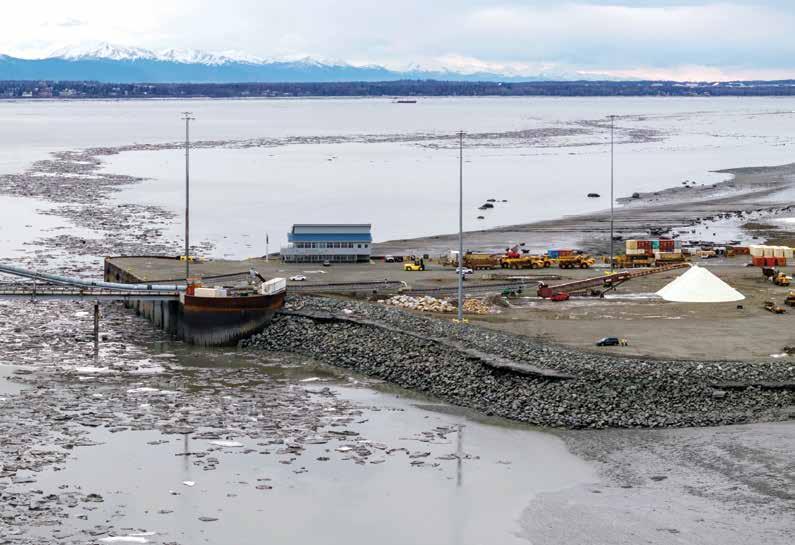
Guard camped at the port for about four weeks, Griffin says, training for disaster relief operations.
“This was sort of our highlight of the year. It was a big operation, and it was very successful,” Griffin told the Mat-Su Borough Assembly at a January 2026 meeting.
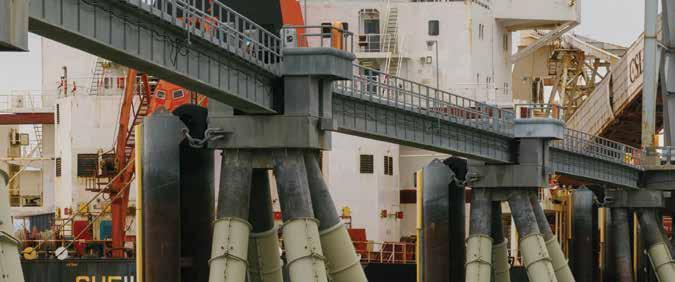
April brought a new record for the port: the largest ship ever docked there. The 720-foot self-unloading bulk carrier M/V Sheila Anne docked April 27 and offloaded 66,000 tons of salt from Mexico for Northern Gravel and Trucking as part of an Alaska Department of Transportation & Public Facilities (DOT&PF) winter road maintenance contract. Another ship is expected to dock in May, bringing 32,000 tons of cement from Vietnam to fill two warehouses leased by Alaska heavy civil construction titan QAP.
The port did not, in 2025, bring in any large ships, but it was a peak year for barge traffic, Griffin says. Ten new barge operators have docked at the port in the past two years. Several general contracting companies use the port as a loading/ offloading facility for barges that are loaded with equipment and materials and sent to western Alaska or elsewhere, including oil field, heavy civil, and infrastructure contractor Cruz Construction, which has been beginning and ending each construction season at Port MacKenzie for almost twenty years.
Jeff Miller, president of Cruz Construction, says there’s a bit of “supporting the home team” in Cruz’s choice to organize its yearly barges at Port MacKenzie. Cruz founder Dave Cruz is a longtime supporter of the port, having previously served
as a Port Commission member. The company uses other Alaska ports as well, having ship work done in Seward or Homer, and occasionally uses the Don Young Port of Alaska in Anchorage. But Port MacKenzie offers generous laydown space and port staff who genuinely want to meet Cruz’s needs.
“They’re so easy to work with,” Miller says.
Miller adds that a barge haulout ramp, similar to a typical boat loading ramp used at lakes, would be helpful. Indeed, that project is next on Port MacKenzie’s list to accomplish, Griffin says. Adding the ramp would allow Port MacKenzie to offer space for barge storage or service. The facility would be ideal for flat-keeled barges, but not for fishing boats, with v-shaped or b-shaped keels. The $7.8 million US
Kerry Tasker
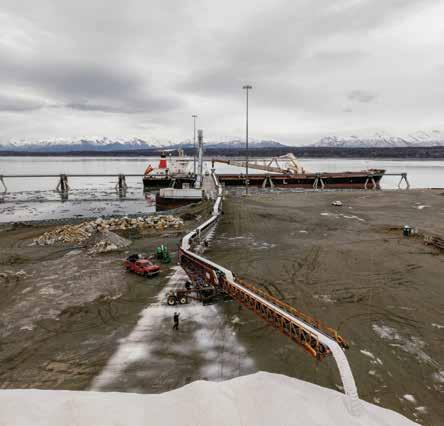
Department of Transportation Better Utilizing Investments to Leverage Development (BUILD) grant was awarded in 2025, and construction is planned for summer 2027.
Another recent user, Griffin says, is Cook Inlet Region, Inc. The Alaska Native corporation owns and operates the wind turbines on Fire Island and occasionally needs a staging area where turbine equipment can be laid out and then carried by barge. Although the Port of Alaska in Anchorage is closer (10 miles instead of 10.5), it’s also frequently busy, so the turbine equipment had been frequently shipped to Homer or Seward, then brought to Fire Island by barge. After realizing the proximity of Port MacKenzie to Fire Island and learning that Port MacKenzie offers low tariff rates for companies, in addition to having plenty of room for staging cargo, Griffin says Cook
Inlet Region, Inc. has become a regular user.
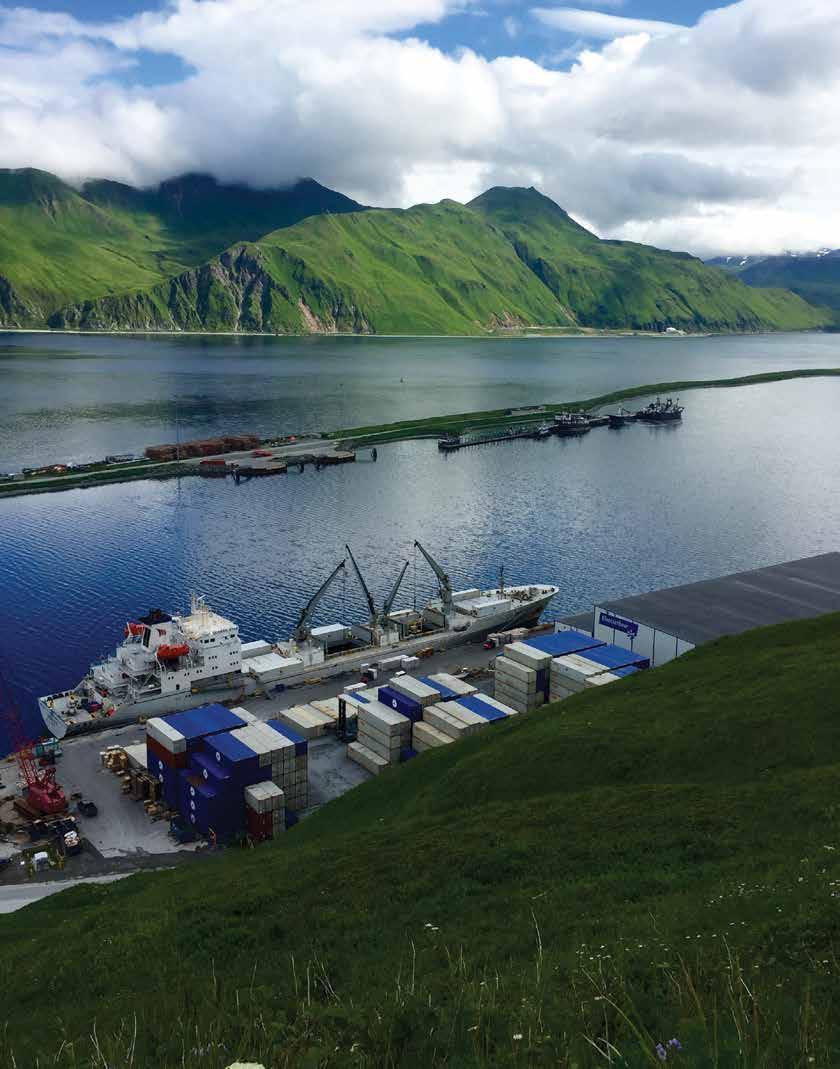
Two miles is all that separates the Mat-Su Borough-owned Port MacKenzie from Anchorage. Hotel Captain Cook, a landmark of the Anchorage skyline easily spotted from across the inlet, is closer to the Port MacKenzie dock (as the raven flies) than it is to Ted Stevens Anchorage International Airport. From the Port MacKenzie Terminal building, the city across the inlet looks almost close enough to toss a rock across.
The Port of Alaska is busy, with ships docking twice a week to deliver goods for store shelves, fuel tankers offloading, a few cruise ships each year, military use, and more. The port handled more than 5.5 million tons of freight and fuel in 2025. Handling more than half of the imported goods
coming into Alaska, it’s a keystone of the Alaska economy.
But on the edge of downtown Anchorage, the city-owned port is short on space. While 125 acres of cargo-handling space sounds like a sizeable chunk of land, there’s not a lot of laydown space for storing pipe or bulk materials or for processing raw materials, especially with the Port of Alaska now working on a multi-year facility modernization project that includes significant upgrades to the cargo berths used by primary shippers TOTE Maritime and Matson.
Mat-Su Borough officials have long touted the compatibility of the two ports: goods and containerized freight make sense at the Port of Alaska, while raw materials and other industrial needs are better handled at Port MacKenzie. With the current presidential administration’s emphasis on developing Alaska’s natural resources, Griffin says Port MacKenzie is a logical partner in that process.
Located on the west side of Cook Inlet, the port, which celebrates its 26th year of operations this year, boasts 8,000 acres of uplands and 1,000 acres of tidal and submerged lands. It consists of a 1,200-foot deep-water dock, a 375-foot barge dock, and 15 acres of gravel wharf. Also in its favor: the channel is deep on that side of Knik Arm, so it doesn’t require frequent dredging to maintain the depth, which is a constant struggle on the Anchorage side.
“In terms of natural resource development in the Interior, this port is the logical place to bring the
industrial type of bulk commodities that the state is in the process of developing, such as ore, coal, and timber. As the state grows and develops, this port is the logical location to move these commodities to market,” Griffin says.
The port also has a significant project on the horizon that could boost commodity use: a 32-mile rail extension project from the Alaska Railroad line near Houston south to Port MacKenzie. The rail project began in 2006, branching from a T-shaped intersection just south of Little Susitna River in Houston, but work stalled in 2016 during the state’s economic recession. The rightof-way fades into the woods across the street from the Point MacKenzie Correctional Farm.
Earlier this year, the Alaska Gasline Development Corporation (AGDC) revived the rail extension, integrating the port’s fortunes with the multibillion-dollar energy project. AGDC partnered with two Australian companies in creating Alaska Infrastructure Partners, a public-private partnership aimed at finally completing the project. The Alaska Railroad, DOT&PF, Alaska Industrial Development and Export Authority, and the Mat-Su Borough are stakeholders in the project.
Macquarie Capital, a division of Macquarie Group that is focused on financing development and infrastructure projects, and global rail developer Martinus are working toward finishing the predevelopment process, which includes identifying funding for the $275 million to $300
million worth of work remaining. Twenty-five miles of the 32-mile rail bed have been built, and six of seven bridges are in place, but the rail bed needs ballast rock, railroad ties, steel track, and fiber laid along it, along with finishing the last seven miles of the extension and five additional miles of siding and terminal track, adding a communications tower,
telecom lines, operational support facilities at the terminal, and a bridge over a roadway. Alaska Industrial Partners hopes to have the project shovel-ready by 2027.
Mat-Su officials have for years touted the port rail extension as a tool that could make mines in the Interior more feasible, providing a way for mining companies to bring
Some lawyers work documents, others know the docks.
We don’t just settle on knowing your industry. We live it.
Spotting trends and navigating turbulent waters can’t happen from behind a desk.
The insights come when we put on our hard hats and meet our clients where they are.
their commodities to tidewater, store them on site, and ship them when it makes sense to do so. AGDC sees Port MacKenzie as a place to land 42-inch pipe, equipment, modules, and other construction materials for a North Slope gasline.
The rail extension got a boost in April, when $34 million earmarked for Port MacKenzie was included among Alaska’s $115.4 million share of federal grants from the competitive Port Infrastructure Development Program. The grant will help pay for a 110-acre staging and laydown area, the one-mile rail loop, electric utility expansion, and barge dock improvements.
“This is big news and very exciting for the port,” Griffin says.
One industrial user is already making a home at Port MacKenzie. In March, workers with Australian mining company Nova Minerals were clearing land near the proposed onemile rail loop on the Port MacKenzie uplands, on a bluff overlooking the port. Griffin says Nova leased 42 acres for a processing site.
Nova, operating as its US subsidiary Alaska Range Resources, is mining the Estelle Project about 90 miles northwest of Anchorage in the Alaska range. Company leaders say the project ranks among the “world’s largest undeveloped gold assets” and offers the potential of near-term antimony production.
Nova is operating a year-round facility at the Estelle site that accommodates eighty people, with a 4,000-foot airstrip, helipad, and an onsite sample-crushing and splitting preparation laboratory. The company is exploring more than twenty potential gold prospects and seven antimony prospects on its lease.
Nova is pushing for construction of the West Susitna Access Road, which would provide road access to the site.
The company is working to become a “fully integrated US antimony producer,” as it says on the company website, and is using a $43.4 million grant from the US Department of War to buy processing equipment to begin processing and refining antimony at Port MacKenzie. Antimony is a chemical element used by the military primarily for lead-acid batteries and
in munitions, making it a critical mineral for national defense.
Nova CEO Christopher Gerteisen told shareholders in January, “Fueled by this funding, the company progressed the procurement of antimony key mining and processing equipment—with delivery expected in early 2026—and continued planning and permitting for infrastructure planning at the proposed Port MacKenzie refinery site. With industrial-zoned land secured, strong federal, state, and local government support, and established infrastructure in place, Nova is well positioned to advance toward first antimony production targeted for late 2026 to early 2027.”
Although Nova isn’t the only company pursuing antimony production in Alaska, it may be the first to have a refinery, which it could use to process other companies’ antimony, including re-processing old gold mine tailings, as the two minerals are often found together.
Another industrial permit holder at Port MacKenzie is Terra Energy
Center Corporation. The company has a permit on more than 1,000 acres around Lake Lorraine, above the port in the uplands, and it just secured a cooperative agreement with the Mat-Su Borough to run a two-year joint marketing effort aimed at bringing businesses with large power needs to Mat-Su, such as industrial users in need of a factory or a large data center.
plant,” Schleusner told the Matanuska Electric Association board at a 2025 presentation. “And when you compare that to LNG imports, it’s cleaner than LNG. When you add on carbon capture, it’s even cleaner than wind with natural gas backup.”
Like Nova's antimony and gold mine, Terra’s project depends on the West Susitna Access Road project to
move forward, in addition to securing an anchor tenant to soak up the extra gigawatt of electricity.
Port supporters have high hopes for one potential user currently considering setting up at Port MacKenzie: Crowley Fuels. With 350 employees, Crowley claims the



crown as the largest wholesaler of fuel products in Alaska, providing diesel, heating fuel, propane, gasoline, aviation and marine fuels, and packaged petroleum products around Alaska.
Griffin told the Mat-Su Borough Assembly in January that Crowley had signed an agreement for the potential use of 20 to 40 acres at Port MacKenzie. The company is considering using it for a fuel tank farm with storage for up to 20 million gallons of fuel, he reported. It’s a significant project, which would involve investing $20 million to $30 million in fuel lines and equipment to pump the fuel across the dock and up to fuel tanks on the bluff above the port.
“They want to have their own infrastructure,” Griffin told the Assembly. “They could rent or lease it and make some of the mo ney back.”
The signed agreement gives Crowley time to consider its options at the port. Griffin noted that the company hopes to reach a final investment decision in the fall, with the possibilities of fuel deliveries beginning in spring 2027.
David DeCamp, director of corporate communications for Crowley, says it’s too early to talk specifics about the project. “As a company with decades of service and a strong workforce in Alaska, we are committed to long-term growth in the state. As we consider the project, we’re focused on investing in infrastructure that strengthens fuel reliability, expands capacity and supports the communities and businesses we serve. We hope to
“In terms of natural resource development in the Interior, this port is the logical place to bring the industrial type of bulk commodities that the state is in the process of developing, such as ore, coal, and timber. As the state grows and develops, this port is the logical location to move these commodities to market.”
Dav id Griffin Por t Director
Matanuska-Susit na Borough
share more information on our plans later this year,” DeCamp says.
Hosting a tank farm could catapult Port MacKenzie into a new level of operations. Ports rely on repeat users, which not only pay dockage fees for using mooring space but also wharfage fees based on weight or type for cargo loaded or unloaded across a wharf. In this case, it would
be a per-gallon fee for fuel crossing the borough’s dock. And the fuel infrastructure, if owned by Crowley, would be available for use by other fuel companies. Central Alaska Energy, a branch of Vitus Energy, also holds a lease at Port MacKenzie, and it could use the Crowley fuel infrastructure as well, meaning more wharfage for the borough and use payments for Crowley.
Griffin says Borough Manager Mike Brown encourages him to think of the port like a baseball game. “At Port MacKenzie, we’re really focused on base hits. If we get a home run, that’s awesome. But we’re not always going to swing for the fences and strike out. We have to focus on getting on first, second, and third base,” he says.
The base hits in this scenario are securing regular port users, such as Cruz Construction, QAP, and Northern Gravel and Trucking. Nova, with its antimony processing facility, is a double or a triple, Griffin says. “Crowley would be a home run because that sets the stage for everybody else,” he says. “And obviously the rail would be a home run.”
Griffin and other Mat-Su Borough leaders are hoping the current emphasis on resource development will be enough to push key infrastructure projects the port’s future hangs on—the West Susitna Access Road and the Port MacKenzie Rail Extension—around the bases and home to development, springboarding Port MacKenzie into the thriving facility envisioned when it was created twenty-six years ago.
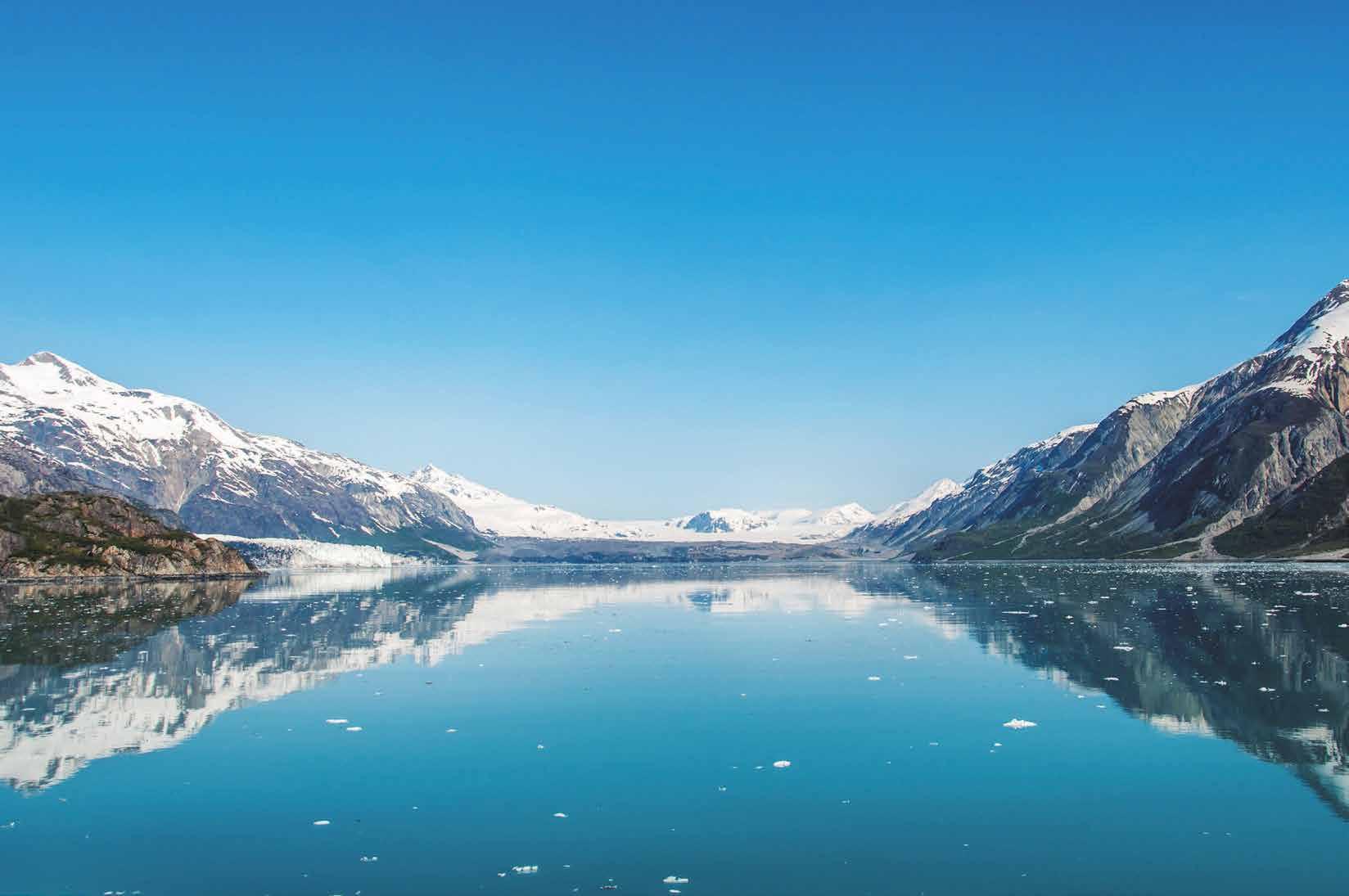









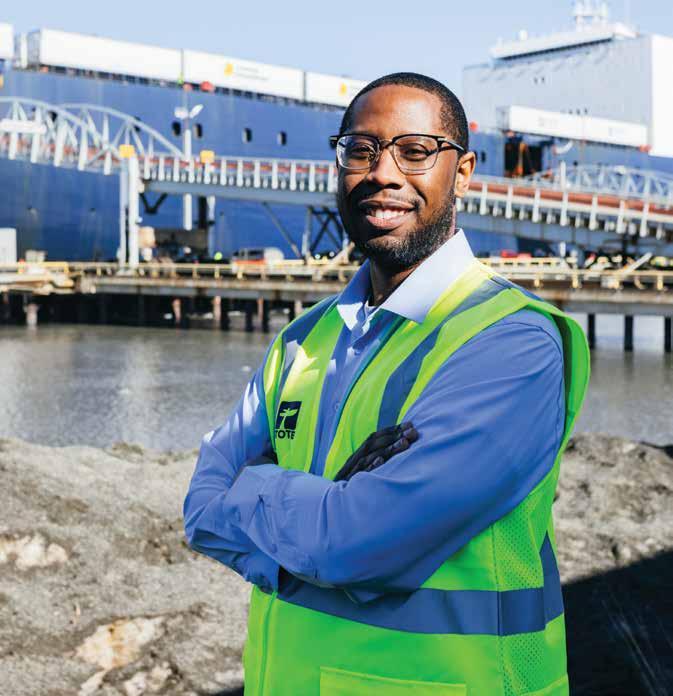
The retail journey of TOTE Maritime’s new Alaska boss
By Nancy Erickson
Co rey Nichols’ retail career has served him well—from Sam’s Club and Walmart to Amazon—and he brings that experience into his role as vice president and Alaska general manager for TOTE Maritime Alaska—a position he embarked on in December.
“I started in retail early in my career, and when a leadership
mattresses were flown there, but then I had to find someone with a snowmachine to take them to another hub and then find another person with a snowmachine to take them to the actual destination,” Nichols recalls. Realization set in: “There absolutely is no road system in the Bush during the summer! And in the winter, people

use frozen creeks and rivers to travel between villages.”
Because of high shipping costs to remote areas—the bulkier items being more expensive—Nichols compiled a list of the top three things villagers ordered from Sam’s Club: Tang (the powdered drink mix is



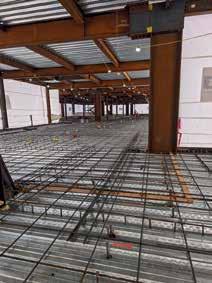

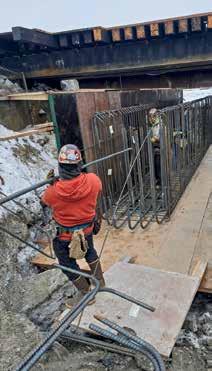
lighter than heavy liquids); Sailor Boy Pilot Bread (lasts a long time and is the main staple used as a sandwich); and Crisco for… well, not necessarily for baking or frying.
“Crisco was a huge item,” Nichols notes. “They would mix the Crisco with berries they had harvested or whatever else they had on hand and call it akutaq, or ‘Eskimo ice cream.’”
When Nichols took over managing Walmart’s Alaska supply chain in 2021, he began working with TOTE more directly.
“TOTE was a great partner and instrumental in helping me build out my strategy,” Nichols says. “When you work with a company as your vendor, you get a real sense of their values and how they work. When TOTE’s previous
Alaska GM and vice president took a promotion with the company and relocated to Tacoma, Washington, I knew it could be a good fit for my career and my vision for how I want to serv e Alaska.”
Nichols’ previous position segued smoothly into overseeing shipping operations with TOTE’s twice-weekly fleet of supply vessels between Tacoma and Anchorage.
TOTE Maritime Alaska has been serving Alaska for the past fifty years.
“We have unique roll-on/rolloff vessels with customized operations that are designed to support the unique needs of Alaska,” the VP explains of his new position. “As part of the Saltchuk family of companies, we’re backed
by an organization that takes a long-term, community-focused approach to doing business.”
Because Alaska doesn’t manufacture a lot of goods, Nichols’ retail experience taught him the importance of implementing an uninterrupted supply chain from the Lower 48. “I had to take complex situations and develop strategies that accounted for all the variables that Alaska brings,” he explains. “Whether that’s weather, trucking capacity, staffing, shortages at stores—essentially, I learned that you need end-to-end solutions to deliver the results.”
Both of those ends can entail various challenges.
For Nichols, it begins on the Tacoma side, where a wide range of supplies are loaded onto TOTE vessels

for shipment to the Don Young Port of Alaska.
“There are times that a customer is running behind—they have until 11 p.m. of the day the ship departs to get their cargo on board,” Nichols explains. “Sometimes they’ll call us and go, ‘Hey, we’re not going to be there until midnight.’ If we can, we’ll hold the ship. Otherwise, do we have it driven over the road on the Alcan Highway because it missed the departure? That’s just an example of things on the Tacoma side.”
On the Alaska side, the vessel crew can encounter a variety of issues, but two of the most concerning are upon final approach, within sight of the dock in Anchorage. Vessels must cope with Cook Inlet’s tides,
the second highest in the world, and with the Point MacKenzie Shoal. Nichols compares the shoal to an underwater mountain that creates a narrow pass through Cook Inlet. “So if we run into a storm on the water or something happens during operations and we arrive during low tide, we actually have to hang out until the tide rises so the ship has enough clearance,” he says.
TOTE’s cargo vessels normally operate on three of four engines, but they can utilize the fourth engine for an extra boost when needed. “Those are just some of the things we deal with week-to-week that are fairly normal,” he says.
“We’ve gotten so good at being reliable, a lot of people don’t even realize the shoal crossing is an element of our three-day transit
“My openness to relocate is essentially what propelled my career. Being willing to move anywhere in the US took me to Washington, Colorado, and ultimately, Alaska.”
Corey Nichols, Vice President and Alaska General Manager, TOT E Maritime
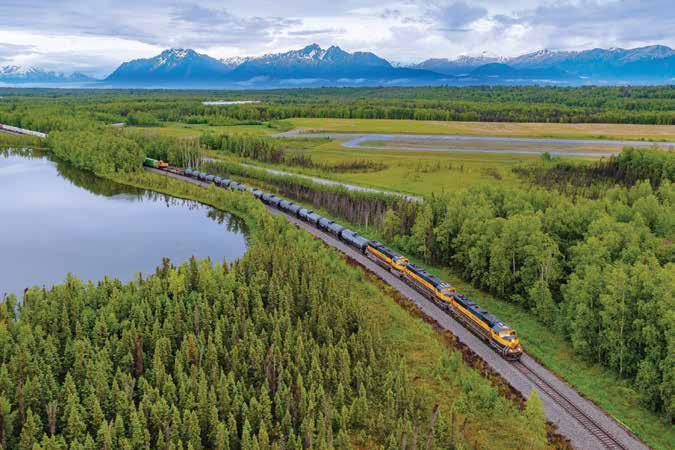
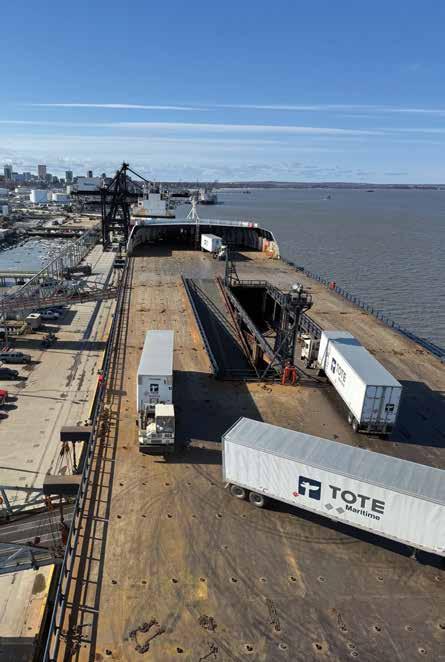
schedule,” Nichols adds. “The same way you would use your GPS to drive from point A to point B, our vessel team is constantly assessing the voyage, timing the crossing, and watching for inclement weather to make sure we can arrive safely and on time.”
According to Nichols, one learns pretty quickly that stability isn’t something to wait for; build for it.
“At TOTE, we focus on the things we can control. That starts with consistency in our service: keeping a reliable sailing schedule, investing in our vessels and terminals, and making sure our teams on both ends of the route are set up to operate efficiently,” he says. “When the outside environment gets unpredictable, our customers need to know they can still count on us showing up the same way every week.”
Nichols believes his responsibility is to serve Alaska—its customers and communities who rely on TOTE. “Whether that means making sure we have resilient port and contingency plans, ensuring we have reliable service and a best-in-class customer experience, modernizing our vessels to run on liquified natural gas, and looking to the future to adapt when things shift,” he says.
That is the exact goal Nichols’ position with TOTE allows him to accomplish. He observes, “Any commodity I purchase, any store I go into, there’s a good chance that item came to Alaska on a TOTE vessel, whether it’s a new vehicle, clothing, or groceries.”
As for his personal time, Nichols just likes hanging out at home.
“My three boys—ages 11, 8, and 5—basically their hobbies are my hobbies,” he says. The boys are involved in football and wrestling, so family weekends are spent traveling to sporting events.
Nichols says his wife and sons help take the pressure off any jobrelated stress.
“I do a lot of gardening. I have a big greenhouse. I have chickens. I love growing leafy greens, tomatoes, peppers,” he says. “That is my perfect day—just doing stuff in the yard.”
Food security for Alaska is his hobby, and it’s also his career. “We don’t produce much up here, so if it can’t come over the water, we could be in trouble,” Nichols states. “This is the most fulfilling, rewarding, and high-pressure job I’ve ever had.”

This fun business networking event will celebrate the Best of Alaska Business award winners with live music, games, food, and more!
TICKETS AVAILABLE FOR $35 EACH

JULY 16 2026 5PM TO 7PM



By Jamey Bradbury
In the aftermath of Typhoon Halong last fall, emergency management officials examined the storm’s damage in a swath from Kuskokwim Bay to Nelson Island, all without setting foot on the ground. From a thousand miles away they assessed the situation in western Alaska thanks to the deployment of drone aircraft.
“Instead of trying to get personnel out to assess all these areas, you have the drones that are able to assess all of this infrastructure in real time,” said Stan Caldwell, director of the US Department of Transportation’s Strengthening Mobility and Revolutionizing Transportation grants program. He added that evaluating damage to roads, bridges, and other infrastructure in harsh winter conditions took hours, rather than days, thanks to the use of drones.
The future is now when it comes to technological solutions for Alaska’s transportation challenges.
Government departments, researchers, contractors, and private companies are using new technologies to improve all aspects of transportation, including addressing the needs of and creating greater
connectivity among communities off the road system.

Using a village that has suffered devastating damage and has limited resources as an example, Christine Langley, division director of the Data, Modernization, and Innovation Office at the Alaska Department of Transportation and Public Facilities (DOT&PF), says, “It’s very important not to inundate those individuals. To bring twenty people into a community that’s recently suffered a loss, we’re not helping if we consume what’s lef t of the resources.”
On the other hand, operating a drone takes only two people. One pilot operates the drone, and a second pilot assists for safety reasons. Before additional personnel are deployed, decision-makers thousands of miles away can use information gathered by the drone to decide exactly how many emergency responders they should send to each affected area.
In the aftermath of Typhoon Halong, drones provided an upclose view of damage for specialists back in Anchorage by creating an
“orthomosaic,” a single, giant, highly detailed, high-resolution image.
This imagery and data created a “common operating picture” that DOT&PF and other state and federal agencies worked from to identify needs across the communities affected by the typhoon. Sharing a single, consistent understanding of the situation in western Alaska, Langley says, led to a significantly more rapid response than past disasters have seen.
“Ultimately, our people doing cost estimates from that data rolled up to the state receiving a disaster declaration… in a shockingly fast time, compared to the average,” she says.
Deploying drones in the wake of disaster also creates a permanent recording that provides a point of comparison, allowing researchers to track storm damage and the effects of climate change year to year. Being able to compare before-andafter images of a particular region or village can help the state mitigate against future disaster.
Drones are also making avalanche mitigation easier and safer. Last
winter, DOT&PF began using drones to remotely trigger avalanches in difficult-to-reach locations—becoming the first transportation department in the country to do so.
Prior to using drones, DOT&PF crews would drop explosives from helicopters to set off avalanches. Drone technology provides a cheaper and safer option and can be deployed in shorter weather windows than helicopters can.
To cause a controlled avalanche as a preventative measure, drones drop explosive canisters. Recently, DOT&PF succeeded in producing an “air blast” from its drones, activating an explosion roughly two meters above the ground to create a high-pressure shockwave that triggers a slide; prior to this, the explosive would only be detonated once it hit the ground. Air
detonation “moves a lot more snow in a hurry,” Langley says, and is ideal for targeting avalanches in remote places at high elevations.
For avalanche danger closer to Alaska’s roads, in the past DOT&PF relied on access to howitzer cannons on loan from the US Army. Today, crews can roll out a second type of technology: mobile Boom Whooshes that use a combination of propane and oxygen to blast air to trigger avalanches at lower elevations. This winter, Boom Whooshes were used in Thompson Pass and in Girdwood to prevent snow from burying highways and utilities.
Avalanche detection has also taken a leap forward, thanks to new uses of technology. Doppler radar, which visually tracks an avalanche’s path, and infrasound, which detects
avalanches based on sound waves, were both installed along the Seward Highway this year. Both methods can alert drivers to avalanche danger through an app on their phones. Future use will include an automated system of traffic lights that can warn drivers on the road, as well.
Radar can also improve safety for ground transportation in rural Alaska, according to Billy Connor, director of the UAF Center for Safety Equity in Transportation (CSET). Radars along established trails and ice roads have the potential to monitor traffic and indicate when a vehicle is stopped or in distress.
This technology could provide an alternative for transporting goods and people as air carrier prices grow




unaffordable. In places like Teller, people already use trail systems to reach Nome in the winter, but bad weather makes the trip dangerous.
“In Teller, a storm can blow in, and you’d better have all your safety gear with you,” Connor says. “We want to minimize that danger.”
CSET is funding radar technology along trails that will make terrestrial transportation safer in the winter. Some communities are also investing in the effort, creating greater connection between villages.
“This idea of being totally isolated is wearing thin, especially on the younger generation,” Connor observes.
Technology doesn’t always look like robots and computer imaging. For ground-level innovations, CSET is exploring new materials and methods
for stabilizing soil that might allow for construction of roads in Alaska’s remote locations.
“We can take the soils we have that are not quite good enough to build roads, treat them, and make them usable without having to haul [gravel] in,” Connor says. Such a breakthrough would be a game changer for enlarging Alaska’s road network.
A new form of insulation may be the solution for building roads over permafrost, he adds. Regular insulation guards against both cold and heat; in the summer, this means it only slows the rate of thaw, rather than keeping the permafrost frozen.
A patent-pending option, created by strategically drilling holes in the insulation to create air convection cells, can keep permafrost frozen throughout the year, allowing


construction of roads over permafrost that will not thaw.
“It’s kind of magic, but it works,” Connor says.
At Fairbanks International Airport (FAI), a robotic dog named Aurora is on standby for the moment disaster strikes. Small enough to crawl into spaces that might not be safe for a human to enter, Aurora has the potential to help with search and rescue in the event of a plane crash or building collapse. Thankfully, Langley says, DOT&PF hasn’t experienced a scenario that would trigger the department to use the robot in this way.
For now, Aurora has another job at FAI: wildlife mitigation. In 2024, the robot began patrolling for animals




on the runway. Every year, wildlife, especially waterfowl, cause incidents for aircraft landing and taking off from Alaska’s airports.
Last year, Alaska aircraft experienced ninety-four wildlife strikes, including ten at FAI. While most of them caused no damage to aircraft, the danger to wildlife can be significant. In 2017, the pilot of a Boeing 737 aborted a landing at Deadhorse Airport to avoid a caribou on the runway—but not in time to avoid striking and killing the animal with the aircraft’s landing gear.
Typically, people are employed to monitor runways and chase wildlife away. The robot dog, though, comes with distinct advantages: It never needs a break, can work around the clock, and if it encounters a surly bear or a spooked caribou, it’s
more likely to come out unscathed than a human.
Robots have another advantage over humans—they don’t need to breathe. A second type of robot, Archimedes, is aiding DOT&PF in monitoring Alaska’s docks and piers, allowing operators on shore to determine the condition of underwater infrastructure before sending a diver down for repairs.
“Even if we have a diver en route, we can send a remote-controlled robot down, and it allows us to see what the situation underneath is,” Langley describes. “That way, the diver is better prepared for what they’re about to experience.”
The More You Know Information is power—and Alaska now has more information about its
“We can take the soils we have that are not quite good enough to build roads, treat them, and make them usable.”
Bi lly Connor Director, UAF Center for Safety Equity in Tran sportation
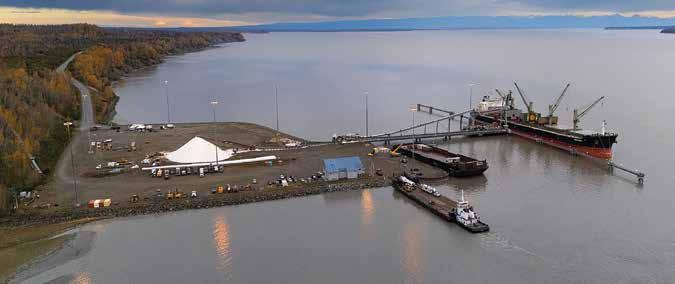
• 375’ Barge Dock (-20’ depth at MLW)
• 1,200’ Deep Draft (-60’ depth at MLW)
• Bow Ramp Berth
• 8,000-Acres of Uplands (Rent/Lease)
• Secure Laydown and Storage
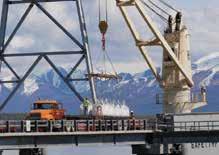
infrastructure, weather, traffic, and geography than ever before, thanks to advances in imaging and data gathering. With tools as simple as live video feeds that DOT&PF can use to assess real-time road conditions, or AI-aided tools that count vehicles and identify assets like crosswalks, guardrails, lanes, traffic signals and signs–collecting data has never been easier.
The question is, what to do with all this information?
“Innovation happens in a lot of non-Boom Whoosh ways,” Langley said during a presentation for the Alaska House Transportation Committee in March. She highlighted the digital tools DOT&PF is using to compile and share information among stakeholders and with the public.
One example she shared is the Alaska Statewide Transportation Improvement Program (STIP), the state’s four-year program for transportation system preservation and development. The STIP amounts to a 400-page document replete with valuable information.
But “it can be hard to read,” Langley admits. But thanks to DOT&PF’s expanded geographic information team, the STIP is now a digital tool that can organize data compiled from multiple sources. “If you want to look by a strategic investment area, if you’re interested in your particular district, if you want to know your community, if you’re after things that are on the Glenn Highway—you can search for all of that information and not only know what is coming but get a comparison of how the STIP changes over time.”
“Innovation happens in a lot of non-Boom Whoosh ways.”
Christine Langley, Division Director, Alaska DOT&PF Office of Data, Modernization, and Innovation
Other digital tools similarly make information transparent and useful to the public. DOT&PF’s 511 “Know Before You Go” website provides up-to-the-minute traffic and transit information for Alaska drivers based on reports from transportation personnel and from Road Weather Information System cameras.
The cameras also funnel information to the state’s winter operations dashboard, which tracks where maintenance vehicles have cleared roads and how fast traffic is flowing along specific corridors, an indicator of how comfortable drivers are in current conditions.
Other digital stockpiles of information are creating a more cohesive approach to construction and emergency response. A new DOT&PF permitting system released last year replaces a paper-driven system; along with a contract award dashboard, the permitting system provides greater visibility into the State’s contracting process. A Typhoon Halong “dashboard” provided a workspace for responders across sectors to share tools and collaborate in the response to the emergency in western Alaska.
The typhoon dashboard, in particular, demonstrated how technology can get disparate stakeholders on the same page, to the benefit of the communities in need of help in the storm’s wake.
“We were able to create a common operating picture for DOT and other agencies at a state and a federal level. And that allowed us to reduce resources across the state, but also to start identifying what were the needs,” says Langley. “By feeding that data in, our designers and the other people who were doing cost estimates could grab that information and start working with the State and FEMA.”
Two years ago, DOT&PF first established the Data, Modernization, and Innovation office, which Langley now runs, in an intentional effort to use the data gathered by advanced technologies. More information is out there and ready to be used. For instance, Lynden trucks outfitted with Starlink satellite internet connections have begun to contribute updates to DOT&PF’s 511 website. “Alaska Alerts” will create geofences that allow responders to send messages directly to cell phones in a specific area to message travelers about poor conditions or provide emergency assistance.
As additional technologies and new sources of information become available, Alaska has the potential to stay on the forefront of how these tools are being used, mus es Connor.
“We can do so much, and we’re still learning how to use the technologies that we have,” he says. “Our limitation is really only in our mind.”

By Rachael Kvapil
Co mmercial aviation is the safest way to travel— or so airlines have been saying since at least the ‘60s. But the industry has changed a lot since the advent of the Jet Age: it’s gotten orders of magnitude safer. By the late ‘90s, commercial carriers had less than one fatality per 2 billion miles flown, and rates continued to improve. From 2009 through 2024, there were zero fatal crashes of commercial passenger jets.
and using advanced technologies to reduce risks for everyone involved.
Inspectors ensure air carriers comply with FAA regulations.

Aviation is a key mode of transportation in Alaska, especially for 82 percent of communities not connected to the state’s main road system. Flight operations in Alaska require strict adherence to federal safety regulations to ensure that passengers and cargo reach their destinations. Moreover, air carriers go beyond Federal Aviation Administration (FAA) regulations by developing additional safety policies
Aviation safety is a mix of topdown regulation and company culture. Will Day, executive director of the Alaska Air Carriers Association (AACA), explains that the FAA establishes federal standards for aircraft maintenance, pilot training, flight operations, cargo handling, and safety management systems to ensure consistency and accountability nationwide. The FAA uses a riskbased regulatory framework derived from data analysis and industry input. The analysis is both proactive and reactive. The proactive portion considers what could happen and establishes regulations to mitigate potential hazards, while the reactive analysis looks at what has happened and establishes corrective regulations to prevent it from happening again.
Day adds that air carriers in Alaska also continuously analyze their daily operations to make further improvements. “Most operators go beyond just complying with regulations and establishing safety cultures across the industry because it’s mutually beneficial for all,” says Day.
A significant aspect of air safety is the FAA-accepted safety management system (SMS) through which carriers vet existing policies and proposed policy changes. There are four key components of the SMS: safety assurance, safety risk management, safety policy, and safety promotion. SMS is an aviation standard worldwide. The FAA formally adopted SMS in 2010 and, in 2015, required Part 121 operators (domestic, flag, and supplemental) to implement the system. In 2024,
the FAA expanded the requirements to Part 135 operators, which include charter airlines, commuter airlines, air tour operators, and certain aircraft manufacturers, who must also develop an SMS within one to three years, depending on the operation.
“This system enables us to proactively identify and mitigate risk, continuously improve procedures, and empower employees at every level to take an active role in safety,” says Matthew Stone, director of operations for Everts Air, which provides both passenger and cargo services to Alaska.
Tony Dimeglio, managing director of global cargo operations at Alaska Airlines, says his company assigns safety leaders to support each of the four SMS components, ensuring a focus on everything they do.
In addition to using SMS, Alaska Airlines regularly meets internally and with regulatory groups, conducts multiple layers of auditing, and solicits feedback from customers and employees. Dimeglio says the company’s dedication to risk mitigation is reflected in its five core values: own safety, do the right thing, be kind-hearted, deliver performance, and be remarkable.
“Much has changed over the last ninety-four years since Alaska Airlines was founded,” says Dimeglio. “But what hasn’t changed is our commitment to the communities we serve and our desire to deliver genuine, caring service to our guests and customers.”
Compliance with regulations and policies is the baseline for safety for both Everts Air and Alaska Airlines, which acknowledge Alaska air carriers
“Cargo safety in Alaska is just as critical as passenger safety because, a lot of the time, air carriers deliver things across the state that are critical to life, such as fuel, medication, and mail.”
Will Day Executiv e Director Alaska Air Carriers A ssociation
face additional challenges, including remote locations, rapidly changing weather, and limited infrastructure.
To overcome these challenges, all air carriers in the state require a heightened level of planning, training, and operational discipline, aided by advanced equipment. Likewise, collaboration with the FAA’s regional branch allows air carriers to tailor certain federal requirements to Alaska’s unique environment.
For instance, anyone working toward a commercial license must first obtain a private pilot certificate, which requires night training. Since most training occurs in the summer when it doesn’t get dark in Alaska, an exemption allows a private pilot to become certified as long as they complete nighttime training within
a year. Likewise, Alaska’s unique terrain has led to an instrument exemption allowing pilots to set the altitude alarm to 500 feet instead of 1,000 feet.
From a regulatory standpoint, Day says core requirements remain the same whether the flight carries passengers, cargo, or both. However, cargo has additional considerations, including loading procedures, cabin configuration, and cargo types, such as hazardous materials. In those cases, specific federal regulations govern how materials are packaged, handled, documented, and loaded to ensure the safety of everyone aboard.
“Cargo safety in Alaska is just as critical as passenger safety because, a lot of the time, air carriers deliver things across the state that are critical to life, such as fuel, medication, and mail,” says Day.
Dimeglio says cargo safety begins when a customer creates a booking, the moment when air carriers collect key information about weight and dimensions, piece count, required delivery time, and any special handling or restricted-item indicators. That information is validated against operational constraints, such as aircraft type or station capabilities. Alaska Airlines accepts cargo only if it can be handled safely and in compliance with the booked service level.
Once a booking is approved, Alaska Airlines uses proper staging to ensure loaders have the right freight, in the right configuration, at the right time. Employees complete additional operational checklists and compliance
safeguards to help ensure that regulatory and company standards are met before departure. Postflight, teams confirm each shipment’s receipt and condition, support pickup, and report any discrepancies.
“Our culture of owning safety and reporting exists at all levels and at every point in the process, empowering our employees to highlight any concerns and file safety reports as needed, so that we can take corrective action,” says Dimeglio.
Other safety measures are taken throughout the flight process. Stone says each Everts Air flight begins with detailed weather analysis, route assessment, aircraft status checks, and a formal risk evaluation to identify and mitigate potential hazards. During flight, crews maintain continuous oversight through their operational control system, which monitors flights in real time, allowing employees to track progress, respond to changing conditions, and support pilot decision-making. Finally, after each flight, procedures include aircraft inspections, documentation, and crew feedback as needed. Stone says this continuous feedback loop allows Everts Air to refine procedures and maintain the highest safety standards.
“Our teams are thoroughly trained in these requirements, and we have strict procedures in place to ensure full compliance,” says Stone. “This allows us to safely and efficiently carry both passengers and cargo while meeting all applicable safety standards.”
Passengers and shipping clients also have roles in helping air carriers meet safety standards. Stone says
“Modern aircraft design has also advanced… These advancements allow us to operate more safely, make better-informed decisions, and continually improve the level of service we provide.”
Mat thew Stone Director of Operations, Everts Air
passengers can increase their own safety by dressing appropriately for the Alaska environment, such as wearing layers, warm clothing, and sturdy footwear. In the unlikely event of a diversion or off-airport landing, being prepared for the environment can make a significant difference. Likewise, passengers should comply with all baggage regulations, particularly regarding restricted or hazardous items such as lithium batteries and flammable materials.
Day also emphasizes the importance of listening to the safety briefing each time passengers fly.
“I know it’s tempting to put in your AirPods and tune it out, but in case something did happen, there’s a lot of research about those who survive simply because they’re prepared,” says Day.
Shippers, too, can ensure the safety of cargo by learning what materials can and cannot travel by air and by accurately declaring their contents. Hazardous or dangerous goods should be properly packaged and labeled in accordance with federal regulations. Proper documentation, secure packaging, and clear labeling not only protect the cargo itself but also help crews handle and transport it safely, reducing risks during flight and delivery.
Equipment is a major component of any airline operation and plays a critical role in safety across both passenger and cargo operations. Everts Air operates an all-turbine fleet, as turbine engines are proven to be more reliable and better suited to Alaska’s demanding environment than piston-powered aircraft. Previously, the fleet included pistonpowered aircraft; however, Everts Air retired its last piston-powered aircraft in 2018 as part of its commitment to safety. Stone says the transition from piston-powered to turbine-powered aircraft was industry-wide, as air carriers recognized the performance and reliability advantages of turbine engines.
Since then, Everts Air has continued to invest in modern aircraft, including the recent procurement of a Cessna 408 SkyCourier, a twinengine utility plane designed for FedEx Express with safety, reliability, and versatility in mind, particularly for remote operations.
“Modern aircraft design has also advanced, and our addition of factory-new Cessna SkyCourier
Send more cargo than ever before with our expanding fleet and network.

Thanks to our growing fleet of 350+ aircraft, and nearly 1,500 daily flights to 141 destinations, you can ship almost anything to more places. That includes 29 international markets in the Americas, Asia, Australia, the South Pacific, and to and from 20 of our beloved Alaska communities. For more information, go to alaskacargo.com/contact-us. Or call us at 1-800-225-2752
aircraft reflects the latest safety and engineering standards tailored for rugged environments,” says Stone.
Everts Air’s fleet is also equipped with advanced avionics, including synthetic vision systems (cockpit display technologies that use 3D terrain, obstacle, and aeronautical databases, combined with GPS and inertial data, to create a clear computer-generated visual representation of the outside world) and modern weather radar, which provide pilots with enhanced situational awareness and better decision-making tools in challenging conditions. Connectivity is another key component. All Everts Air aircraft are equipped with satellite phones and use a commercial flight tracking system with satellite-based text communication, ensuring continuous communication and real-time monitoring even in the most remote areas. Stone says communication and tracking capabilities have improved dramatically. With satellite phones and real-time tracking systems, crews can maintain constant communication and operational visibility, even beyond traditional radar coverage.
“Together, these advancements allow us to operate more safely, make better-informed decisions, and continually improve the level of service we provide,” says Stone.
Dimeglio says the Alaska Airlines ground support equipment team keeps a robust program for acquiring the right equipment, maintaining it properly, and following a responsible schedule for retirement and replacement. The team also assists with policies on proper usage,
“Air cargo is subject to regulations and oversight to help ensure a safe and secure operation, as well as our own additional safety measures.”
Ton y Dimeglio Managing Director Global Cargo Operations Alask a Airlines
according to the manufacturer. Through the SMS process, Alaska Air Cargo ensures that equipment meets requirements and the air carrier’s own standards, and that crews have the right equipment to do each job as part of their safety operations. For example, Alaska Airlines buys and maintains equipment specifically suited to harsh conditions.
“Equipment has evolved significantly over the years, and those advancements have played an important role in improving cargo safety across the industry,” says Dimeglio. “Cargo loaders are capable of servicing larger widebody aircraft. Belt loaders can help safely move heavy cargo into bulk compartments and reduce the risk of employee injury.”
He adds that tools like the Required Navigation Performance protocol, a type of performance-based navigation that allows aircraft to fly specific paths with high precision,
including onboard navigation monitoring and alerting, have allowed Alaska Airlines to access remote communities with increasing safety and reliability. The company also invested in new air cargo container loaders at all Alaska Airlines-operated cargo stations in the state to reliably load and unload containers from freighter aircraft.
“Air cargo is subject to regulations and oversight to help ensure a safe and secure operation, as well as our own additional safety measures,” says Dimeglio. “Combined with fast delivery times and more efficient access to remote communities, air cargo is a compelling option for shippers around the world.”
Day says commercial aviation in the United States has layers of redundancy, oversight, training, and maintenance in place to create a measurably safe form of transportation. For instance, in addition to pre- and post-flight inspections, a commercial aircraft is required to undergo a 100-hour inspection, during which it is pulled into the hangar and thoroughly inspected to ensure everything is functioning properly.
The biggest contribution to airline safety in Alaska, as he sees it, is the dedication by AACA, its members, and other air carriers to bettering air travel.
“We have this unique perspective as the air carrier association, where we interact with every air carrier in the state and help them ensure they are continuously learning and improving,” says Day.


Fire beats cold. That elemental understanding explains the intuitive preference for internal combustion engines in Alaska’s climate. Combine that intuition with the observation that batteries, when stored in a freezer, lose their get-up-and-go, and Alaskans reasonably cast a skeptical eye on electric vehicles (EVs).
Furthermore, in communities where electricity prices are crushingly high, plugging in a two-ton appliance for daily recharging seems like madness.
“I certainly started with the presupposition that—in these rural, outlying Alaska communities like Kotzebue and Galena that rely on a lot of diesel generation for electric power and that get pretty cold in the winter—it might not be a good economic transition,” admits Michelle Wilber, a research engineer with the Alaska Center for Energy and Power, a laboratory based at UAF. “There might be a lot of energy used to keep the battery in the vehicle warm; very few people have warm garages to store
By Scott Rhode
their vehicles in; there would be a lot of energy, and that would translate into really high costs.”
To test that assumption, Wilber and a team of University of Alaska researchers began formulating a research question around 2019, and by 2025 they published a result that challenged her presupposition. Under the right circumstances, electricity beats fire.
Wilber and the research team partnered with local utilities, tribes, and others in Kotzebue, Galena, and Bethel to describe typical vehicle uses. They assessed fueling costs and greenhouse gas emissions involved in switching from internal combustion engines to EVs.
The study “Are Electric Vehicles a Solution for Arctic Isolated Microgrid Communities?” published in World Electric Vehicle Journal concludes that EVs can indeed reduce overall emissions and save costs, under the right conditions.
“Because people are idling gas vehicles a lot, like parking them outside the grocery store and keeping them running while they’re inside because it's cold,” Wilber explains, “it would make financial sense from a fueling standpoint to switch to an EV.”
The break-even point depends on electricity at $0.40 to $0.60/kWh. The statewide average is about $0.25, and some communities pay as much as $0.80/kWh, but Wilber says most of the typical uses did pencil out in favor of EVs. In only four out of twentyone use cases did net fueling costs increase, mainly in communities with less renewable energy and where vehicles were driven short distances (less than 31 miles in a day) and combustion engines needed less idling or fewer plug-in heaters to stay warm.
Researchers did recognize shortcomings of EVs in cold conditions. “EVs’ automatic battery thermal management systems may allow for less user flexibility and may actually lead to higher fueling
costs and emissions in certain boundary cases,” the study notes. “EVs currently available on the market will continue to use energy while parked in the cold to maintain battery health.” Furthermore, the fueling cost comparison depends on statesubsidized electricity, and charging an EV might push some households above the subsidy cap.
Thus, the study concludes, “It is likely that innovations in vehicles, power systems, and incentives will be needed to enable Arctic communities to fully and equitably participate in the transition to electrified transportation.”
The upward trend of EV purchases in Alaska began to slow after September 30, 2025. That’s when
the One Big Beautiful Bill Act ended federal tax incentives that offset the cost of new EVs by $7,500 and used EVs by $4,000. However, as demand dropped, prices fell slightly.
A report in April by the Alliance for Automotive Innovation tallied 152 EVs sold in Alaska in the last three months of 2025, or 2.56 percent of new light-duty sales. The previous quarter saw 3.64 percent, and it was 3.77 percent a year earlier, during the fourth quarter of 2024. For all of 2025, about 3.13 percent of new vehicles sold were EVs, putting Alaska near the bottom of the nation but ahead of twelve other states in terms of EV market share. The national rate was 9.6 percent of new light-duty sales in 2025.
Wilber observes, “We are late adopters in Alaska.” She compares
the state to Norway, with similar climate, geography, and lifestyle, where 96 percent of new passenger car sales in 2025 were EVs. Of course, although Norway is likewise endowed by oil wealth, its local electricity is nearly 90 percent from relatively cheap hydropower.
Norway as a whole, then, has more in common with Juneau. From nearly any corner in the capital city, it doesn’t take long for a Nissan Leaf or other EV to pass by. Steve Behnke, a founding member of advocacy group Renewable Juneau, estimates approximately one EV for every ten households in Juneau.
Behnke himself bought a used Nissan Leaf in 2017, and he considers himself a late adopter. Behnke says, “It works perfectly fine for my needs. I don't even pay attention to the cost
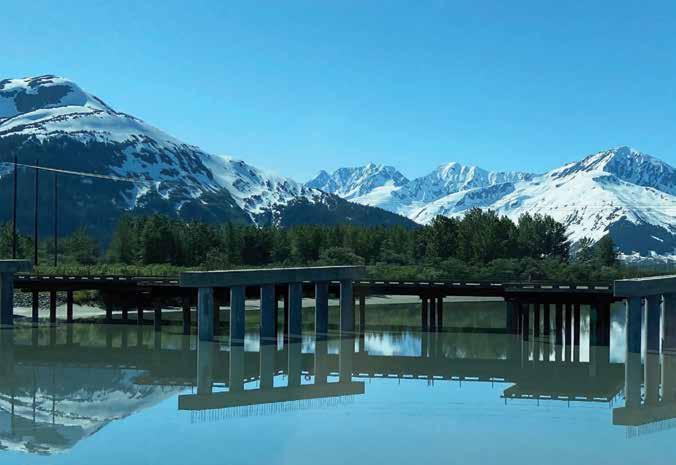


for electricity. It doesn't even register in terms of my electric bill.”
Will Juneau become Alaska’s first all-EV city? Behnke sees some competition. “Gustavus could beat us to it because it’s so small,” he says of the Glacier Bay community, which Alaska Power & Telephone supplies with 100 percent renewable energy from Falls Creek Hydro. Behnke notes that plugging in an EV is easier than shipping in fuel, even when electricity costs are relatively high.
Alaska has a lot of communities where there’s hardly anywhere to drive, completely avoiding the “range anxiety” that EV buyers must contemplate.
“For most people, they’re driving a handful of miles every day,” says Wilber. “There’s no range anxiety even in the coldest temperatures, as long as they can plug in and charge overnight or when they’re not using the vehicle. Home Level 2 chargers [240V, like an electric hair dryer] or some chargers at the grocery store are probably good enough for early adopters at this point.”
Cordova, where 83 percent of electricity demand comes from hydropower, is another example of a town with hardly anywhere to drive. “Everyone lives within 7 miles of town center,” notes Cordova Electric Cooperative CEO Clay Koplin. Gasoline is expensive while excess hydropower goes unused. Therefore, he says, “Use cases are general commuter transportation, forklifts in canneries/freezer plants, and more recently trucks for hauling boats, hybrids for transportation, and
maybe even tractor/mowers. Boating is gaining interest.”
Furthermore, offroad vehicles are welcome on the streets of Alaska’s smallest towns, and those showed the most robust net benefits of electrification in Wilber’s study.
To further define the benefits of offroad EVs, Kotzebue Electric Association is testing a battery powered snowmachine. “The electric snowmachine functions well here,” says Tom Atkinson, CEO and general manager of the coop. “Broader acceptance would hinge on two things: increased range (only about 60 miles now) and decreased weight.”
Wilber agrees that the weight distribution of the battery makes the snowmachine handle differently. “With a gas snowmachine, the tail end is really light, and you can pick up that track and put it back on at the trail,” she says. “But with the electric one, it’s a big battery all along the bottom. It’s equally heavy everywhere, so you need more people to actually get it back on the trail.”
Another glitch is shortcomings in local data infrastructure, as experienced by the Kotzebue tribe’s test of a second electric snowmachine. “There was a throttle error code that just needed to be cleared, but where they had it parked didn’t have WiFi, so the manufacturer couldn't make the connection and clear it,” Wilber reports.
Then there’s the question of maintenance. Wilber says researchers often heard, “Can we even change the tires on the car without shocking ourselves on the high voltage system?” Thus, the University of
Alaska spun off a rural intensive course on automotive electronics and EVs from its EV certificate training program to ensure locals can gain an understanding of the safe maintenance of high-voltage systems.
Wilber has been an EV driver for a while. “It’s an older [Chevrolet] Bolt, so it can only charge up to 50 kilowatts,” she says. “We bought it knowing we’re mostly just going to use it around Anchorage, so we’re very comfortable charging overnight at home.”
Leaving town is trickier. “Every time we want to do a road trip, we have to think about it a lot,” Wilber says, relying on apps to locate charging stations. “Even though I’m a researcher in this, it’s still that learning curve, and it’s big.”
For now, EVs are best for aroundtown trips, especially for high-mileage vehicles like delivery fleets and taxis. In off-road communities, “Having fast charging for the vast majority of people is not going to be necessary,” says Wilber. “There are some cab drivers and delivery drivers that drive many miles in a day, and they might not have too much downtime.”
Her study found that highmileage fleet EVs perform well in Arctic communities because they are constantly in use, mitigating the “cold soak” effect on the battery. The study calculates that Bethel, with its unique density of taxicabs, could see savings of roughly $2,000 to $4,000 per vehicle each year by switching to EVs.
One problem, though: Bethel has no local car dealerships. New EVs
must be shipped over the water, and that’s not so easy.
Last June, the cargo ship Morning Midas, carrying hundreds of EVs and plug-in hybrids, caught fire off the coast of Adak, burned for days, and sank. Matson, TOTE Maritime, and Alaska Marine Lines all opted out of carrying EVs due to the risk of fire in the lithium-ion batteries.
That’s horribly inconvenient for communities off the road system, including Juneau. Behnke acknowledges that, for shippers, it’s not just a financial risk; an on-board fire could disrupt the economic lifeline for Southeast. Renewable Juneau has been trying to work toward a solution, holding a panel discussion with shippers in February.
Alaska Marine Lines President Don Reid told the panel his company wants to be able to ship all vehicles, but based on the technology available today, shipping EVs is too risky.
That leaves the Alaska Marine Highway System, but EVs are limited to two per ferry. “That’s better than nothing, but it really put a crimp,” says Behnke. “Not only do you have people trying to bring vehicles up from down south; you also have our car dealers trying to bring up electric vehicles there.”
The state-run ferry system adapted by implementing new procedures: EV drivers are instructed to limit the charge in the batteries, and crew inspect the EVs with infrared cameras every hour while in transit. With the installation of more thermal cameras and fire extinguishers, the ferry
system is trying to accommodate the growing share of EV drivers.
On the Parks Highway corridor between Anchorage and Fairbanks, a designated charging corridor is officially complete. The Federal Highway Administration certified Alaska’s initial network built under the National Electric Vehicle Infrastructure (NEVI) program as having no gaps greater than 100 miles, as of this spring.
Alaska Energy Authority and Alaska Department of Transportation and Public Facilities received $41 million in NEVI funds from 2022 through 2024 to install charging stations in Fairbanks, Nenana, Cantwell, and Trapper Creek. The Phase 1 charging stations include at least four and







































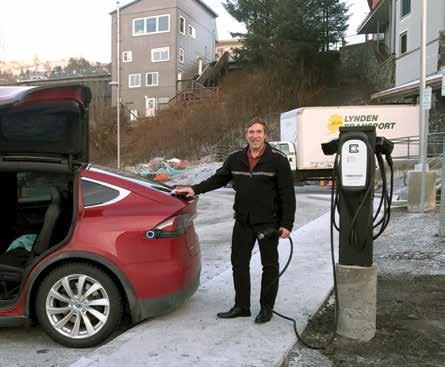
up to eight Combined Charging System ports, each capable of delivering 150 kw.
Although NEVI funding was temporarily paused in early 2025, Tesla moved forward with construction of its charging sites without NEVI funding. Alaska requested that these publicly accessible sites be recognized as NEVI-creditable installations.
The Alliance for Automotive Innovation ranks Alaska 29th among the 50 states for the ratio of EVs to public chargers. By the end of 2025, there were about 5,400 EVs on the road and 196 public charging ports, or 27 EVs for every outlet. That includes 89 DC fast chargers, with 25 net new chargers added in the last quarter of 2025.
The national ratio is 31 EVs for every charger.
With Phase 1 complete, the state may use available NEVI funds for
EV charging infrastructure on any public road or other publicly accessible locations, in compliance with federal requirements. Phase 2 focuses on expanding EV charging beyond the Anchorage-to-Fairbanks corridor to secondary highways, including locations along the Alaska Marine Highway System, the eastern Interior toward the Canadian border, and other urban and rural destinations.
Behnke is looking forward to some of that Phase 2 money coming to Juneau. “Even though we’ve got this high proportion of electric vehicles, the charger networks down here have all been very local,” he says. “Juneau’s charger network is basically a volunteer collaborative community effort with several different entities kicking money in.”
The 40 miles of road available around Juneau is at the edge of a Leaf’s capabilities, Behnke says, so more charging would be helpful. “One

of the things that our utility is quite interested in is how to incentivize and support EV charging for renters and people living in multifamily housing, which is 30-plus percent of Juneau,” he notes.
Cordova might not get a share of NEVI Phase 2 funding, but Koplin says his utility might partner with Southeast Conference to add some chargers.
Once the shipping obstacle is overcome—either thanks to new battery chemistry or if logistics companies or their insurance policies become more comfortable with EVs—electrified transport becomes a practical option for more Alaskans, whether on the road system or in its most remote communities.
“It’s probably inevitable,” Wilber says. “As the transition pulls Alaska along, we’re ready to take advantage instead of being disadvantaged by it. And this may be on the order of a couple decades; I’m not saying it's tomorrow.”
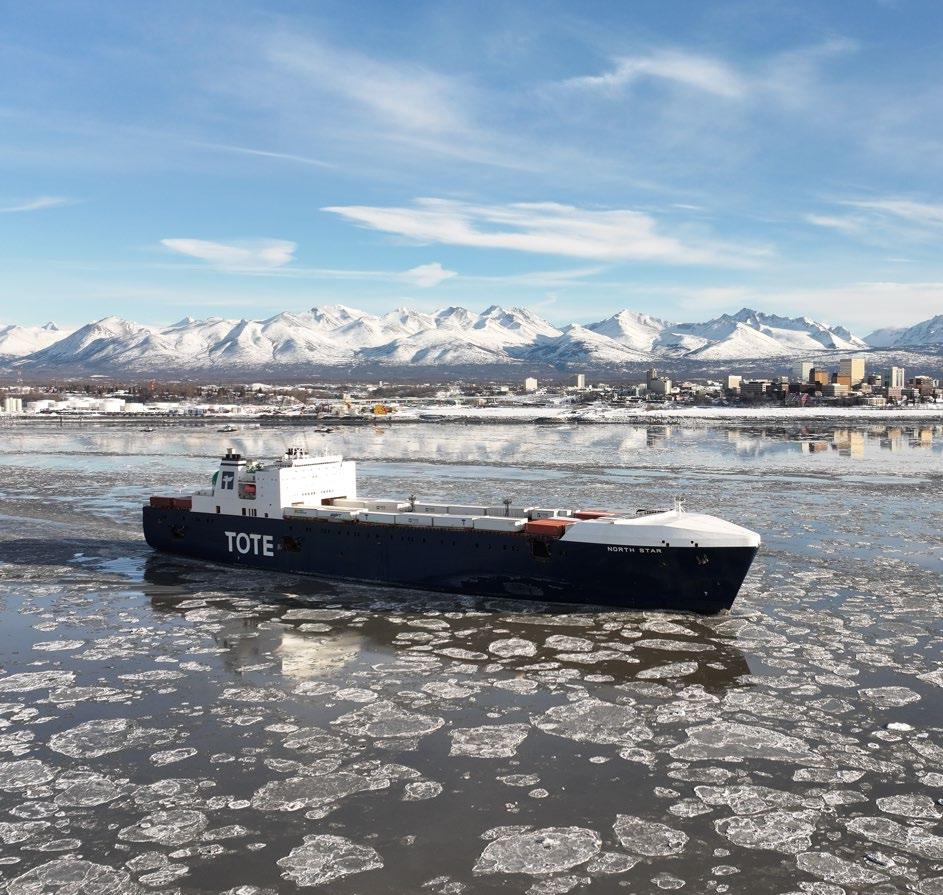
At TOTE, every shipment carries more than goods — it carries a promise. Since our beginnings in 1975 with a single ship, built to serve the unique needs of Alaska, we have been committed to the communities that rely on us. We’re proud to provide the critical shipping that keeps families supported, businesses running, and local economies strong. Because for us, excellence isn’t a goal — it’s a responsibility.
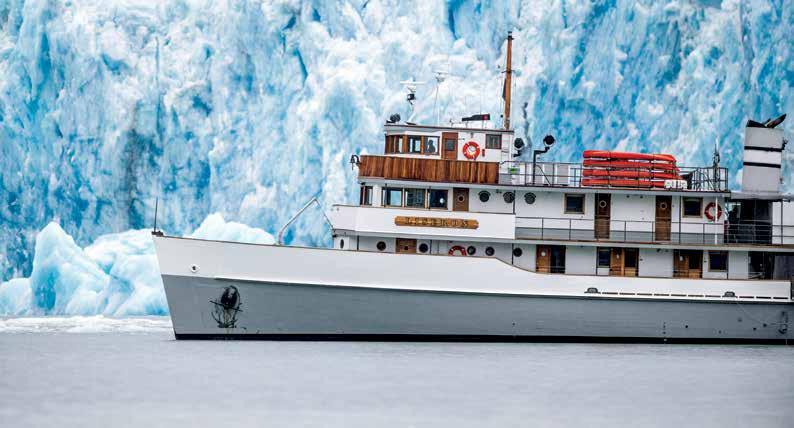
By Vanessa Orr
Wh ile many tourism companies talk about the importance of protecting Alaska’s pristine beauty for future generations of travelers, one company is walking the talk—or perhaps more accurately, floating the boat.
The Boat Company is a missiondriven, luxury eco-cruise operation that has been offering immersive wilderness experiences in the Tongass National Forest since 1979. Unlike other cruise offerings, however, The Boat Company is the only not-for-profit cruise company in the world.
“We are really a unicorn when it comes to the travel industry; people scratch their heads when they hear about us because they don’t
understand if we are a not-for-profit, a fishing tour operator, a cruise line, or a boat builder,” says Hunter McIntosh, president and executive director of The Boat Company. “At the end of the day, we’re a business. We’ve got to put heads in beds, otherwise, our not-for-profit work doesn’t exist.”
McIntosh notes that running a notfor-profit is a high-wire balancing act, as enough revenue has to come in to offset the costs of running and maintaining two boats while also funding the company’s conservation mission. The company has succeeded in both goals: its cruises are in high demand, and its contributions to environmental causes now total more than $30 million over the past fortyseven years.
While a lot of cruise operators ply Alaska’s waters, The Boat Company is different in many ways. Its two ships travel between Juneau and Sitka from mid-May through September and only carry between twenty and twentyfour passengers.
McIntosh’s father, Michael McIntosh, Sr., began the company after falling in love with Alaska while working on a fishing boat and at a cannery in the ‘60s. An avid environmentalist, in 1979 he and his wife joined several nongovernmental organizations on a two-week cruise through the Tongass to discuss protecting the area from clear-cutting.
“One of the passengers suggested that dad start a small cruise line, and
even though he had no experience in hospitality, he thought it was a great idea,” says McIntosh.
As part of The McIntosh Foundation, The Boat Company provides guests with an insider’s view of the Tongass and Southeast, anchoring up in small bays and coves and providing passengers with hands-on wilderness experiences. Each day, guests hike, kayak, fish, or search for wildlife, depending on what types of activities interest them. Passengers travel on the company’s two boats; the 145-foot M/V Liseron, a minesweeper built in 1952, and the 157-foot M/V Mist Cove
“No trip is ever the same,” says McIntosh. “In forty-plus years of taking these trips, I see something new every year. I thought I’d reached the limit last year, but then I saw a moose on our way into Juneau. I’d never seen a moose in the wild.”
Bill and Mary Blair of Wilmington, North Carolina, first began traveling with The Boat Company in 2008, and they are now preparing for their sixth trip.
“One time we rented the entire boat, and on another couple of trips we took our whole family and their spouses,” Bill Blair says. “Each trip has been fantastic; it’s better than advertised.”
He contrasts The Boat Company voyages against typical cruise ships. “And it’s not a National Geographic trip,” Blair adds. “It’s one of those trips into nature where you fish, hike, put down shrimp pots to enjoy [the catch] with a cocktail at night, and go to bed at 9 p.m. because you’re so tired. Then you get up in the morning and enjoy coffee while looking at bears in a fjord you’re
anchored in. It doesn’t get better than that.”
The Boat Company shares its environmental mission with guests in many ways. On the boat, conservation efforts include a machine that crushes glass bottles into a fine powder that can be poured overboard as sand. Naturalists lead hikes every day, educating guests on the importance of old-growth forests and the flora and fauna, and they offer onboard lectures on Alaska wildlife and the landscape. The company also encourages people to visit the Sitka Sound Science Center, Alaska Raptor Center, and Fortress of the Bear, among other conservation initiatives in Sitka.
“We do provide education, but we take a very soft approach to it,” says McIntosh. “We don’t want them to feel browbeaten; people get enough of that in real life. The discussions with our naturalists often lead to further questions about our conservation work and guests leave with a lot of knowledge. And they are amazed at what they’ve seen; the Tongass basically sells itself.”
Dave Arnold has enjoyed two trips with The Boat Company and was especially impressed with the company’s commitment to providing environmental education. “We started a small rafting company in 1977, which later became the largest outdoor adventure company in the US, so I’ve been around the block when it comes to adventure travel,” he says. “The Boat Company really impressed me.”
Arnold further applauds The Boat Company’s subtle environmental
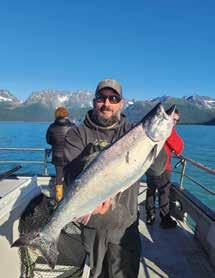


In March 2026, The Boat Company received a Global Vision Award for ecofriendly travel from Travel + Leisure.
Boat Company
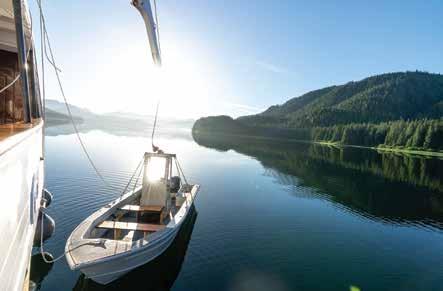
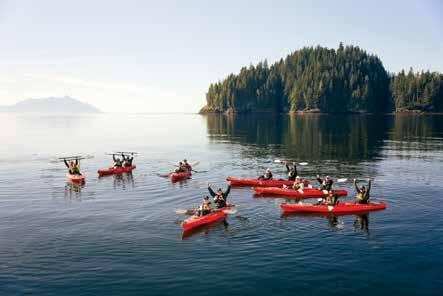
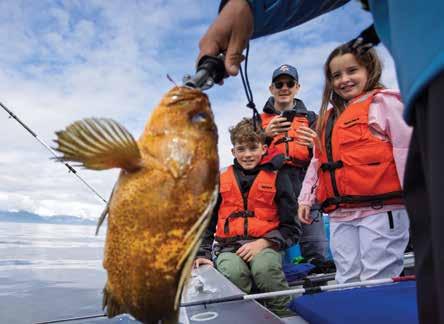
education. He says, “I know how hard it is to get your staff trained in nature and history, and it takes a real commitment by the owner. My company was good at it, but The Boat Company is even better.”
Bookings show that guests appreciate the experience; 75 percent of The Boat Company’s passengers are repeat customers, and another 10 percent of its business comes from recommendations from previous passengers. The remainder of its sales come through travel agents.
As a not-for-profit, a portion of guests’ tickets are tax deductible, and its tax status enables the company to reinvest into local non-governmental organizations such as the Fortress of the Bear, Sitka Sound Science Center, and Sitka Trail Works. The company also invests in conservation groups working on larger issues facing the Tongass such as deforestation and dwindling fish returns.
“I was first attracted to The Boat Company because of their story; not just the idea of Mr. McIntosh falling in love with Alaska while working at a cannery but also the idea of taking the trip on a wooden boat,” says Arnold. “Even though I made my living with boats, I didn’t know about minesweepers; imagine pulling one out of a junkyard and rebuilding it into a craft that transports people.”
With nearly fifty years of business experience since starting Class VI River Runners in West Virginia, Arnold has to laugh when he thinks of The Boat Company’s unique model. “The not-for-profit aspect was the craziest part of the story,”
he says. “I’m doing my taxes, and $1,000 has been donated to some environmental group in the Tongass. How cool is that?”
According to McIntosh, the benefit of being a public charity is that The Boat Company, as part of the McIntosh Foundation, can fundraise in off years when money going out may exceed the money coming in.
“On the downside, most people want to give to charities that
save lives from cancer,” he says. “Protecting trees in Alaska is not a high priority on anyone’s list.”
The company also partners with Orvis, an outdoor adventure company that promotes fly fishing trips all over the world, to increase awareness of the Tongass and conservation issues.
“They promote us as a company that shares the same values they do,” says McIntosh. “If Alaska becomes overfished, for example, there will
be nothing left for their customers to enjoy in the future. We try to partner with businesses that fit in our realm.”
According to McIntosh, over the years, the company has had to reinvent itself to make the not-forprofit thrive. “We take the not-forprofit hat off and put the business hat on,” he says. “Basically, we run as a small, luxury boutique hotel with a not-for-profit and conservation habit. It can be quite a challenge.”
“We do provide education, but we take a very soft approach to it… We don’t want them to feel browbeaten; people get enough of that in real life. The discussions with our naturalists often lead to further questions about our conservation work.”
Hunter McIntosh, President and Executive Director, The Bo at Company

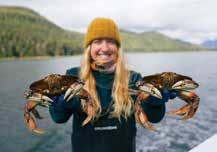
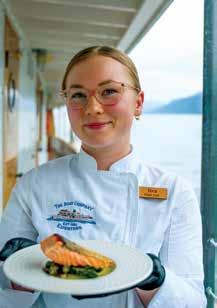
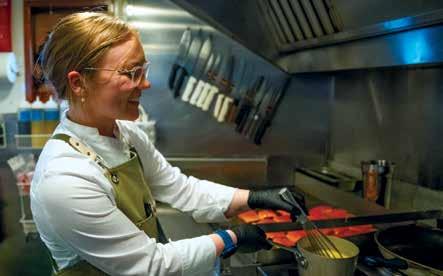
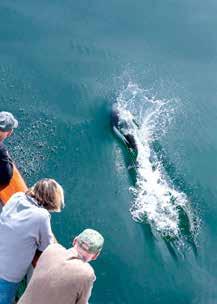

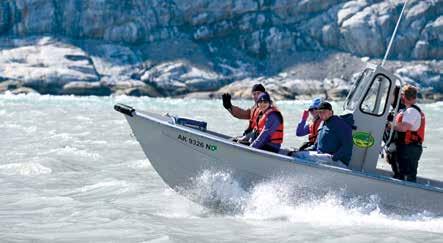
Whatever The Boat Company is doing must be working; in March 2026, it received Travel + Leisure ’s Global Vision Award for eco-friendly travel. The award recognizes organizations, products, destinations, and individuals that are sustainable travel i nnovators.
“That was wonderful news; we had no idea we were up for it,” says McIntosh. “It’s a very big deal for us. We’re just a small, two-boat operation that runs seventeen weeks out of the year in Southeast Alaska. To be recognized by them is an amazing honor and very much a happy surprise.”
While The Boat Company runs a fine line between conservation and cruising, McIntosh believes that having a core mission helps to offset the issues caused by running a tourism business in Alaska.
“Our philosophy is that if we can educate people on the environmental challenges happening in the region in a way that contributes to the local economy and affords us the ability to do the types of conservation work that we’ve done for more than fortyseven years, it balances out the fact that, in reality, we are a cruise line that runs on diesel engines until someone comes out with an amazing technology that allows us to operate our boats without diesel fuel, ” he says.
“I like to think that the balance falls on the side of conservation even though we’re using fossil fuels,” he adds. “That’s the reality of being a not-for-profit and a tourism bus iness.”
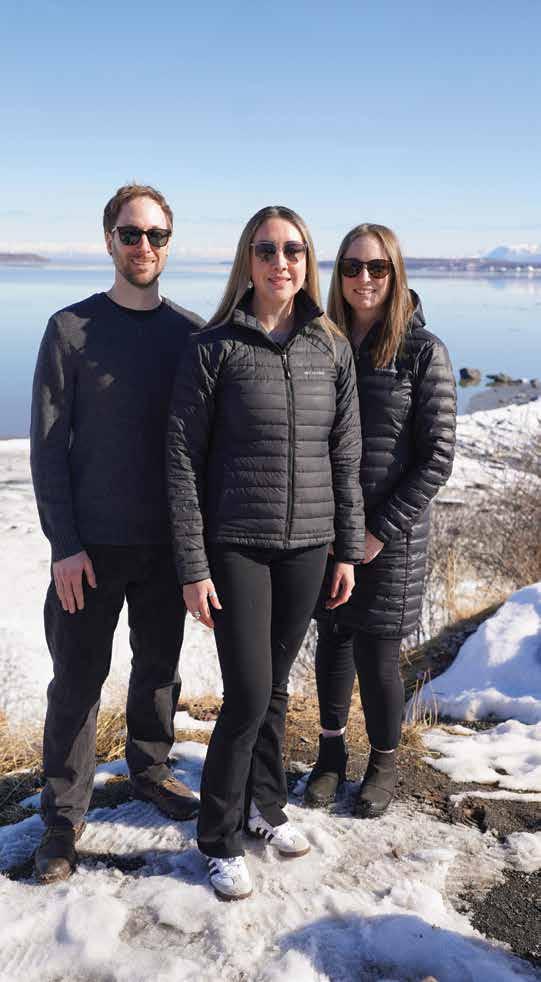
The Alaska Forum
February 1-5, 2027
1,400 participants
Estimated Economic Impact: $1,348,218
Heading into its 29th year as the state’s largest cross-sector gathering, the Alaska Forum connects community leaders, Tribal organizations, government agencies, professionals, and academics from across Alaska each February. Thanks to the efforts of organizers Amy Penney, Tanner Johnson, and Jacquoi Porter, the conference is able to bring rural and urban communities together in Anchorage to address issues shaping the state’s future.
Meeting Champions (L-R): Tanner Johnson, Community Programs Coordinator; Jacquoi Porter, Finance Director; Amy Penney, Deputy Director
Rooted in its mission to promote thriving communities through collaboration, communication, and education, the Forum drives substantive conversations on infrastructure, changing environments, energy innovation, and more. With the recent launch of a Job Training Certification track and a Career & Craft Fair, the event further highlights Alaskan workforce opportunity and artisanship.
By Amy Newman
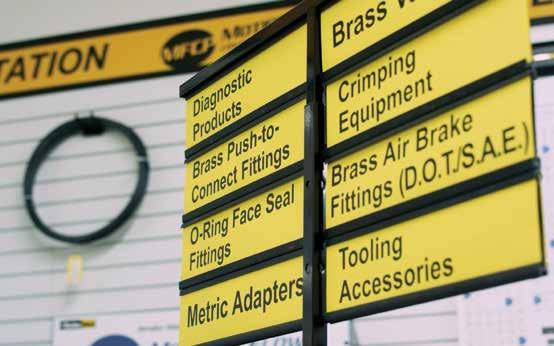
Mo tion and Flow Control Products (MFCP) was founded in 1960 and offers customers distribution, services, and manufacturing support for hydraulic, pneumatic, electromechanical, and other industrial applications. Its goal is simple: “We strive to be your fluid power consultative advisor and premier solutions provider.”
Over the past sixty-six years, the company has built partnerships with sixty-nine manufacturers, suppliers, and third-party vendors—including being a leading distributor of Parker Hannifin industrial products—to ensure MFCP can meet customers’ varied equipment needs. And MFCP consistently finds itself on Industrial Distribution ’s Big 50 list of the nation’s top industrial distributors, including as #39 in 2025.
Today, the privately held company has fifty-nine locations in eleven states across the Pacific Northwest, Western, and Rocky Mountain states, says Alaska
District Manager Neil Shibe. Though headquartered in Littleton, Colorado, MFCP’s Alaska branches are run locally, which means the company has deep operational roots and teams who understand the state’s unique environment and industry requirements.
“The team takes great pride in supporting the industries that power the state,” Shibe says. “Customer care is at the core of everything we do.”
MFCP’s Alaska roots date back nearly sixty years, making it almost as old as its parent company. Its three locations—one in Fairbanks and two in Anchorage—position the company to serve communities not just across Southcentral and the Interior but those in Southeast and the Aleutian Islands as well. The company’s March 2026 acquisition of Fairbanks hydraulic and industrial supplier Alaska Hose and Fastener Supply promises its customers even greater support and service.
“Alaska Hose and Fastener Supply has long been known for its deep customer relationships and commitment to service in a demanding market,” says MFCP CEO Ross Surratt. “This acquisition aligns perfectly with our strategy to grow alongside customers in critical industries while preserving the local expertise and hands-on support they rely on every day.”
The acquisition also enables MFCP to expand its local and national presence.
“Alaska represents an important market for MFCP, and this partnership allows us to build on a strong foundation,” says Ryan Rasmussen, EVP of corporate development for MFCP. “Alaska Hose and Fastener Supply brings experienced team members, local knowledge, and loyal customers. Together, we’re well-positioned to deliver even greater value while maintaining continuity and to build upon those already trusted relationships.”
As MFCP’s Alaska branch approaches its 60th anniversary, Shibe took some time to talk with Alaska Business about the company’s history, its priorities, and what the acquisition of Alaska Hose and Fastener Supply means for its future and its customers. (The interview has been lightly edited for clarity.)
Alaska Business: What is MFCP’s mission?
Neil Shibe: To be a dependable partner, offering fair pricing, timely deliveries, technical expertise, and exceptional service.
AB: Describe the products and services MCFP offers.
Shibe: Motion and Flow Control Products is a premier distributor
of industrial fluid power, motion, and process control products. We provide hydraulic, pneumatic, and industrial solutions across industries, such as construction, agriculture, marine, mining, oil and gas, power generation, transportation, and more. We sell parts in the box as well as custom-engineered products like hose assemblies, electrical control panels, and hydraulic power units, which are found in almost all industrial plants or operations. From an excavator on a mine site to a laboratory clean room, we supply various items that keep everything running smoothly.
AB: What does MFCP excel at?
Shibe: We are known for our technical expertise and broad solution offerings. Our capabilities
include full-service hydraulic repair and fabrication, custom tube and hose assemblies, system design, component repair, filtration solutions, and diagnostic services. Our teams blend hands-on capability with decades of industry experience.
AB: What is MFCP’s day-to-day priority?
Shibe: Our top priority is taking care of customers. We help keep their operations running smoothly by offering reliable service, expert advice, and quick turnaround time on parts, hose assemblies, and hydraulic repairs.
AB: Tell us about MCFP’s history in Alaska.
Shibe: Our first branch was in Fairbanks and has operated since 1967; it was originally known as


Jackovich Industrial Supply. During construction of the Trans Alaska Pipeline, contractors frequently brought equipment [to Jackovich] for maintenance and oil changes. Jackovich first established an office in Anchorage in 1978. The South Anchorage Parker store opened in 1993.
AB: How has the company evolved over the years?
Shibe: MFCP has evolved from primarily a parts supplier to a full solutions provider, offering engineering support, diagnostics, system design, and integrated monitoring technologies. The transition from Jackovich Industrial Supply to MFCP [in 2013] expanded product lines, enhanced capabilities, and strengthened Alaska’s service network.
AB: How many people do the three Alaska branches employ?
Shibe: We have seventeen employees across all three locations. The Alaska team’s average tenure is 9.6 years, with nearly half—47 percent—at 5-plus years, and a seasoned core reaching 20 to 30-plus years.
AB: What do you attribute that employee longevity to?
Shibe: Our work is interesting and always evolving, so it’s impossible to get bored. There are always changes
in the market and technology, but the job is rewarding. We have a lot of excellent vendors, customers, and co-workers who have become our friends and extended family.
AB: How long have you been with MFCP, and what brought you there?
Shibe: I’ve been with MFCP for twelve years. After graduating from the University of Idaho in 2010, I began a career in sales in other industrial distribution sectors, which brought me back to Alaska. After a few years, I found MFCP through an old friend and started work as a manager in training.
I joined in June 2014 as branch manager for the greater Anchorage area and served in that role for just over nine years. My responsibilities included daily operations oversight, customer relationship development, and guiding the team through periods of growth and change.
In July 2023, I became the Alaska district manager. I support all Alaska locations, with a focus on regional leadership, operational excellence, customer care, and ensuring branches have the resources they need to support Alaska’s unique industrial environment.
AB: What do you enjoy about working at MFCP?
Shibe: The best part of working for MFCP is helping customers
find solutions for their complex applications and the team I work with. It’s very rewarding to receive an inquiry from a customer and provide an answer using the resources MFCP provides from our engineering, manufacturing, and product experts.
AB: There are many challenges facing businesses that operate in the construction space. What are some of the recent challenges MFCP has encountered, and how is the company working through them?
Shibe: The industry has seen pressure from skilled labor shortages and supply-chain unpredictability. We’ve mitigated these challenges by leveraging our wide supplier network, investing in technical training, and offering repair and rebuild solutions that extend equipment life. This approach helps customers stay productive, even when new components face long lead times.
AB: What are some of the most interesting projects MFCP has been involved in over the years?
Shibe: We’ve done a lot of unique and exciting projects, but one that stands out is replacing 2-inch, 5,000-PSI hoses on a filter press for a gold mine with high-pressure piping to increase longevity and safety at the mine’s mill. What was unique was the tight quarters to work in, and the desired
routing was challenging. It was a specific application that required a lot of detail and craftsmanship to get the job done, and we were successful.
AB: What led to MFCP’s recent acquisition of Alaska Hose and Fastener Supply, and how did it align with the company’s overall business model?
Shibe: We had worked together on a few projects, and the timing came up for Alaska Hose to look at selling the business. Since we had a history of working together, the conversation grew and led us to the acquisition. We will be physically merging both operations this year.
The acquisition strengthens our presence in Alaska and enhances
availability, technical expertise, and local service capabilities. Alaska Hose and Fastener Supply has built a strong reputation for reliability and responsiveness across key industries, including mining, oil and gas, utilities, construction, hydraulic repair, and compressed natural gas.
We plan to continue operating the current Alaska locations to ensure a seamless transition for customers while investing in expanded inventory, resources, and technical support. Customers of Alaska Hose can expect uninterrupted service, with the same local team and enhanced access to MFCP’s broader product portfolio, engineering support, and supply chain capabilities.
Shibe: Our longevity stems from a strong commitment to service, fair pricing, timely delivery, and, most importantly, its people. When MFCP takes care of its people, they take care of customers. Our origins in multiple first-generation family businesses created a deeply embedded customer-first culture.
During acquisitions, we strive to preserve local relationships and strengthen capabilities rather than change the identity of established community-rooted businesses.
AB: Anything else you’d like to share?
Shibe: We remain committed to combining local knowledge, handson service, and national resources to help customers tackle challenges and
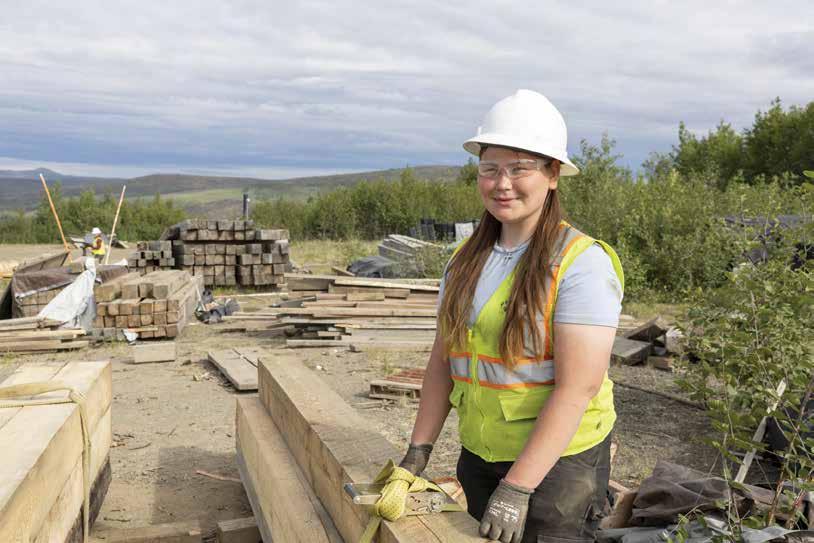
By Alexandra Kay
Long before any major mining company set foot in the Yukon-Kuskokwim region— where one of the world’s largest undeveloped gold deposits now sits—the gold was already known. Placer mining had been active in the area for decades, and the elders of the region’s Alaska Native corporations had taken note.
“Our elders specifically selected land in the hills above Crooked Creek because they knew gold was there,” says Andrea Gusty, president and CEO of The Kuskokwim Corporation, the Alaska Native village corporation that stewards the surface lands for ten villages along the middle of the Kuskokwim River’s course. “It was one of the priorities in land selections for the future of both our corporations.”
Beneath those surface lands, the mineral rights belong to Calista Corporation. Thom Aparuk Leonard, vice president of corporate affairs for the Alaska Native regional corporation, underscores the significance of the land claim. “By selecting the lands, the elders ensured that for any potential development, including the Donlin project, there would be direct oversight by the village corporation and the regional corporation,” he says.
Donlin Creek, a tributary of Crooked Creek that ultimately flows into the Kuskokwim River, attracted the attention of prospectors in 1909. Further exploration commissioned by Calista revealed a resource that, nearly a century after the initial
discovery, would justify building one of the world’s largest gold mines. After nearly three decades of exploration, ownership changes, and regulatory milestones, the Donlin Gold project is picking up momentum—driven by new ownership, strong drill results, and a community partnership built over generations.
The modern development of Donlin Gold began with a joint venture between NOVAGOLD Resources Inc. and a fellow Vancouver-based gold producer called Placer Dome, a pairing that Todd Dahlman, Donlin Gold’s general manager, describes as a productive combination of innovation
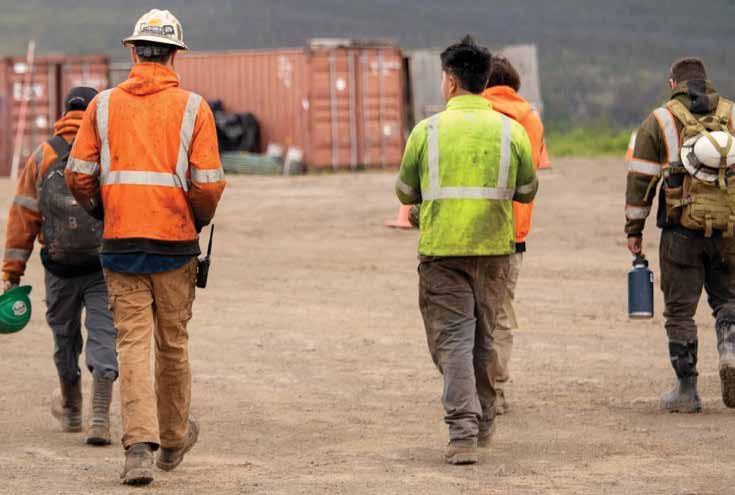
and exploration expertise. When Toronto-based Barrick Gold acquired Placer Dome in 2006, the new owner brought what Dahlman calls “deep bench strength” in technical expertise and project development.
But Barrick, with many large projects across its global portfolio, decided to exit Donlin Gold and focus elsewhere. That departure, completed in 2025, opened the door to a pivotal ownership restructuring. Hedge fund billionaire John Paulson acquired the majority of Barrick’s stake, while NOVAGOLD purchased the remainder, giving NOVAGOLD 60 percent ownership of the joint venture and Paulson 40 percent. The result is a joint venture unified behind a single objective: advancing the project toward production.
“Paulson has a history of bringing projects to life, taking them from late exploration into production,” says Dahlman. “NOVAGOLD has been the steady hand, keeping the project at the front of people’s radar. Bringing Paulson on at the project level has really shaken things … and pulled us out of the final stages of exploration and put us squarely into the core of developing Donlin Gold.”
From Calista’s perspective, protection of the land is paramount. “The agreements we have in place matters,” Leonard says. “Our priority is going to stay the same—that any development has to be done in a responsible way. We’re very much a subsistence people. We live off the land, the sea, and all of that must be protected.”
The Donlin Gold deposit is one of the largest undeveloped gold resources in the world, with approximately 40 million ounces in measured and indicated resources at grades roughly twice the industry average. That scale has direct and practical implications for how the mine would be built and operated.
“The quantity of gold really does affect the approach you take,” Dahlman explains. “With this one being on schedule for about a twenty-seven-year operation, that supports putting in the infrastructure required to process the ore on site: the power plant, the processing facility, the tailings storage facility. Rather than extraction and transportation, you’re looking at
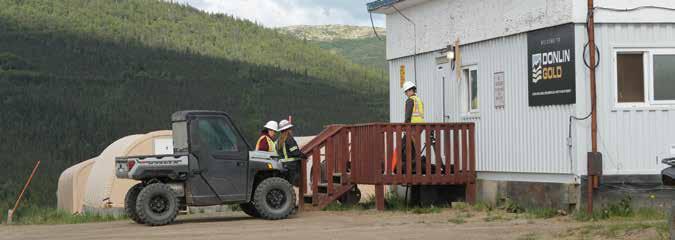
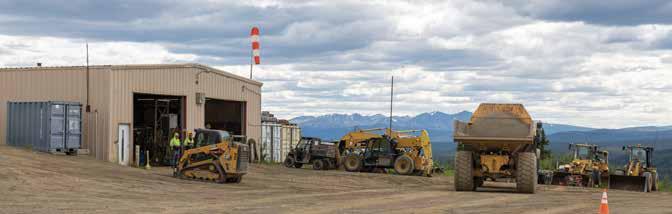
extraction, processing, and a nearfinal product.”
The capital investment required is substantial, but Dahlman is careful to note that the bankable feasibility study (BFS) now underway will produce improved estimates. What the scale changes immediately, he says, is the nature of the relationship with surrounding communities. “It’s a long-term relationship, and we need to develop a generational workforce. It’s not a three-to-five-year project where you’re in and you’re out.”
The 2025 drill program was designed primarily to confirm and strengthen the existing geological model. Dahlman says the results delivered exactly what the team was
looking for. “The results are consistent with our expectations, and the model we’re working with is extraordinarily robust,” he reports.
On the feasibility front, project activities are progressing nicely. Fluor has been selected as the primary contractor for the BFS, with four specialty contractors engaged for specific work streams. The BFS is targeted for completion in 2027.
“We looked at their history and experience doing projects of this scale in this remote type of location,” Dahlman says of Fluor. The Texasbased engineering firm is celebrated as the main contractor of Trans Alaska Pipeline System pump stations and the Valdez Marine Terminal. “Access to the site is limited to about 100 to 110 days a year—that’s when we can actually bring in infrastructure.
The logistics are equally as complex as the technical aspects. We also interviewed the people they proposed to put on the project. It was a thorough process.”
With the BFS on track and early engineering already being prepared, Dahlman has set a production target of 2031–2032. “It’s an ambitious goal. There’s no doubt about that. It is also an achievable goal.“
A foundational element of Donlin Gold’s position is that key federal construction permits were received in 2018, following a comprehensive Environmental Impact Statement process. That permitting foundation has since been reinforced by two additional milestones: the Alaska
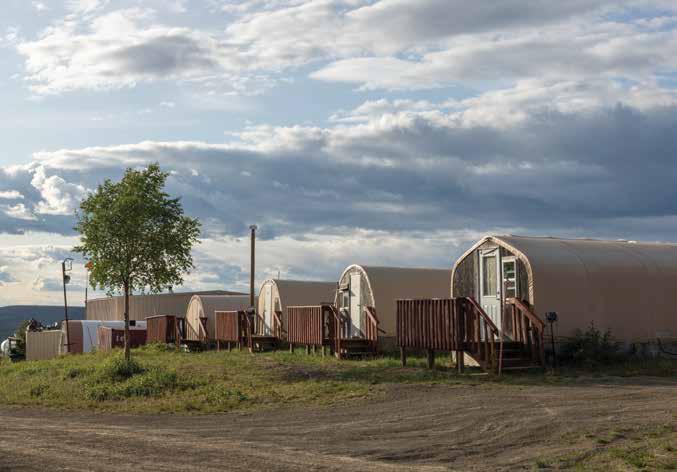
Supreme Court upholding Donlin Gold’s water rights and the rightof-way for its planned 316-mile natural gas pipeline, and the project’s acceptance in October 2025 into the federal Title 41 of the Fixing America’s Surface Transportation Act (FAST41) program, which coordinates interagency environmental review under a binding, transparent timeline.
Dahlman is careful to clarify what FAST-41 is and is not. “It’s not about cutting corners or reducing the work that needs to be done. The process takes all of the agencies that are involved, gets them together, builds a timeframe to do the work that’s required, and then commits them to the schedule. What that gives you is transparency and predictability—and a timeframe you can build around,” he explains.
The one outstanding item is a court-ordered Supplemental Environmental Impact Statement focused on the potential effects of a hypothetical large tailings release, now incorporated into the FAST-41 process with a final decision expected by May 2027.
Furthermore, Donlin Gold is exploring its opportunities with another long-sought megaproject. Donlin Gold recently signed a non-binding Letter of Intent with Glenfarne Alaska LNG, exploring natural gas supply for the mine’s power plant. That would entail a spur from Cook Inlet inland to the Middle Kuskokwim mine site. The pipe would be double the capacity required for the mine itself.
“Imagine going from New York City to Boston—just over 200 miles,”
says Leonard. “Now imagine that, but 50 percent more, and with no roads, no gas stations, no stores, no airports. That underlines the real challenges. But it also underlines the generational nature of the thinking. Having that extra room in the pipeline—can we use that to get additional power and heating to other villages nearby?”
Gusty adds a note of caution alongside the optimism. “There’s a feasibility study going on right now, funded by the Denali Commission and spearheaded by the Alaska Department of Natural Resources, looking at whether that excess gas could be generationally transformative for the region. There are no guarantees. But we are definitely looking to maximize any infrastructure built for this project to
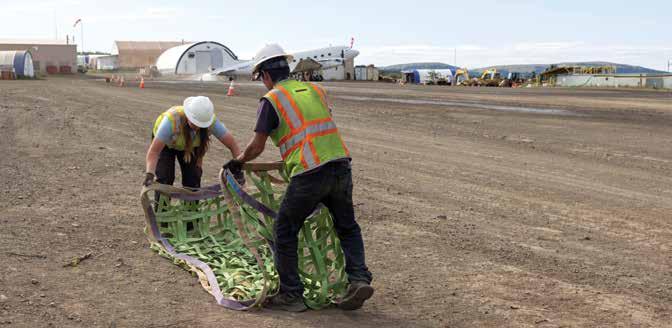
benefit our communities beyond the mine itself.”
Perhaps the most consistent thread running through every aspect of the Donlin Gold project is the centrality of community— not as a compliance obligation but as the foundation on which the entire enterprise rests. In recent years during exploration, Donlin Gold has maintained a 65 percent local employment rate, helped create a subsistence committee with members from surrounding communities, operates a technical advisory committee, and is developing a joint workforce program with The Kuskokwim Corporation and Calista.
Leonard draws on the examples of Red Dog, the zinc mine near Kotzebue operated in partnership with NANA Regional Corporation, as a benchmark. After twenty-five years of operations, a UAF study found that approximately 60 percent of Red Dog’s employees were Alaska
Native corporation shareholders from the region.
But Leonard sees further to go. “When we dove down into it, there weren’t a lot of shareholder managers. That’s been one of my personal focuses—not only having the people who are great with their hands, but we do have a lot of people who have the skilllset to be project managers,” he says.
Gusty offers a perspective that is both supportive and clear-eyed. She states, “This project has the potential of being very positive and creating generational opportunity, but with that level of opportunity also comes great risk. This is our land. This is our gold. These are our families. If this project gets developed, we have a real opportunity—but only if we get it right.”
She is equally direct about what a decision against the project would mean. Gusty says, “If this project isn’t developed, we’re still going to be here. We’re still going to thrive. We’re a strong people with deep cultural values that transcend any
development project. This is an opportunity, but it isn’t our only opportunity, and we have a bright future either way.”
Dahlman was hired as general manager last year to lead Donlin Gold into its next chapter.
What changed to make this the right moment after so many years? Dahlman points not to any single factor but to a convergence. Alaska is a robust legal jurisdiction. “The environment is right for developing projects. We have a favorable regulatory environment, both state and nationally… We have a supportive ownership structure, a strong relationship with our landowners and communities, and the technical and logistical aspects are being well resolved,” he says.
There are still many hurdles ahead, typical of a project nearing reality. Dahlman says, “Everything is coming together at the same time. It just makes this the right time to go forward.”








By Lincoln Garrick
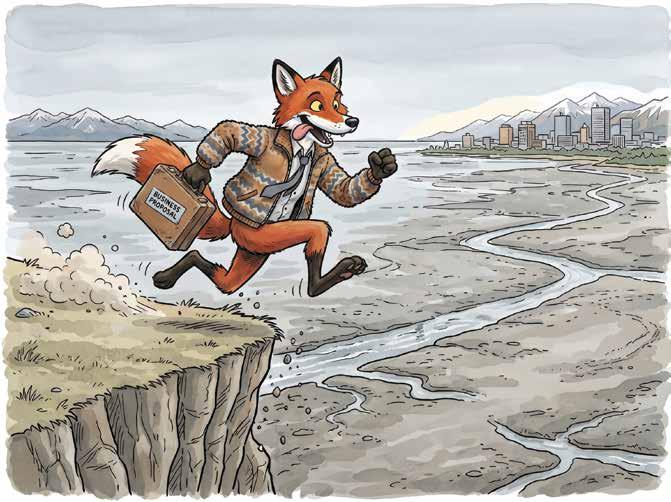
Pi cture it: an 800-mile engineering marvel traversing Alaska’s rugged wilderness. An immense zinc mine powering Northwest Alaska’s economy. Worldclass sustainable harvests feeding global markets with seafood.
The Trans Alaska Pipeline System, Red Dog mine, and the Alaska fishing industry: These massive ventures represent high-stakes investments in infrastructure and resources that have transformed Alaska into a powerhouse of global energy, minerals, and food. Today, we call these ventures inspired, but that label masks a fundamental nuance and common misconception: there is a distinction between the risky and the reckless.
That line between bold visionary and reckless gambler is usually written in ink only after the dust settles and the checks clear. Winners are often labeled as geniuses while thousands of leaders who made similar bets but went bust are ignored. When you see any winner in the marketplace, their strategy can look like a guaranteed blueprint for success. This is survivorship bias in action, obsessing over the frontrunners while ignoring the graveyard of those who made the same choices. Recklessness is a classic leadership trap, in part, because it is very easy to mistake good luck for repeatable strategy. Our brains are wired to find patterns in chaos, even when they don’t exist, and when a gamble
pays off, it is easy to invent a story to explain why it worked. This explains, in part, why high-risk behavior is often rebranded as “visionary” in the business world.
Understanding the mechanics of recklessness can help a leader spot the difference between a smart move and a predictable bad one. It is the contrast between a high-wire artist using a safety net and having practiced the route, versus one who just hopes they don’t fall. The first one is making calculated moves, and the second is wishing for the best.
There is a lot to unpack in the blind spot of a purely reckless leader: an
inflated ego fed by “main character” syndrome, a reliance on intuition as an infallible truth, and a dangerous all-in attitude that treats a safety net like a lack of commitment. These are red flags that signal a leader has stopped strategizing and started hoping for the best. Instead of using information and coworkers to find the best path, they selectively choose data that mirrors their worldview, and they view any contingency plan as a weakness. Purely reckless leaders ignore the cliff ahead and wish that blind luck or momentum will keep them airborne. In their world, the company’s entire future depends on everything going perfectly, leaving no room for the messy reality of the marketplace.
For most leaders, recklessness exists on a spectrum. While “main character” thinking is dangerous, there is an equal but opposite threat: the paralysis of an overanalyzing leader, where the cost of inaction can be higher than the cost of a failed experiment. If you swing too far toward safety, you are not actually eliminating risk; you are simply trading the risk of failure for the guaranteed risk of obsolescence. True leadership requires finding that narrow path between the two. You must have enough moxie to grab big opportunities before your more cautious competitors even get off the starting line while maintaining enough caution not to be purely impulsive.
The shift from calculated risktaker to gambler happens when you dismiss dissenting voices as slow or when you view contradictory data as
Recklessness is a classic leadership trap, in part, because it is very easy to mistake good luck for repeatable strategy. Our brains are wired to find patterns in chaos, even when they don’t exist, and when a gamble pays off, it is easy to invent a story to explain why it worked.
a nuisance. You may be able to spot these patterns by checking if your decisions rely more on the adrenaline of a possible big win than the logic of how it will work. If you’re cutting out safety nets because they feel like a drag, or if you’re doubling down on a failing bet to prove a point, you’ve crossed the line.
It is very hard to see into your own blind spot, especially when under a deadline or other pressure. Self-awareness is a depreciating asset during a crisis, which is why you have to institutionalize dissent
and hire for it before the stakes get too high. Staying visionary means acknowledging that today’s disruptive move becomes tomorrow’s disaster when you stop inviting the “no” people to the table.
To survive a move-fast-and-breakthings boss, you need to stop being a passenger and start being the anchor. Instead of just being the “no” person, which may get you sidelined, become a risk translator: when they pitch a wild pivot, don’t kill the idea—just show them the price tag in terms of what other projects will have to die to make it happen. You also have to act as a human shock absorber for your team: wait 24 hours before passing down a visionary whim to see if it’s still a priority by morning, and always keep a paper trail of sanity to document these fast-moving shifts. It’s about building a pre-mortem culture where you imagine the failure before it happens, allowing you to build the safety nets they’re too bu sy to see.
One of a leader’s most dangerous assets is unchecked luck. Avoiding the recklessness trap requires the discipline to stress-test convictions before the market does. To understand how this balance is maintained in the high-pressure world of international finance, I sat down with Rob Gillam, CEO of McKinley Management and thirdgeneration Alaskan.
Gillam’s firm is an investment and research powerhouse comprising McKinley Alaska Private Investment, which focuses on Alaska-relevant
companies;
Research Group, the state’s largest economic and policy research firm; and ownership stakes in Alaska Cargo and Cold Storage, Alaska Growth Capital, Inc., and Denali Advisors, the nation’s largest Alaska Nativeowned registered investment advisor specializing in quantitative public market strategies. It is safe to say he has been quite successful managing organizations that rely on rigorous data and institutionalized dissent to keep vision and strategy frontand-center.
Q: Recklessness is often defined only in hindsight. How do you define it?
Gillam: First, there is a big difference between risky and reckless. Reckless is always risky, but risky is not necessarily reckless... at least not in business… and certainly not in a portfolio of businesses. Every business—frankly, every person—has to take some risk to grow, learn new things, and challenge themselves. If we don’t try new ideas and take on some risk, our state is doomed to decline. There’s that quote attributed to Albert Einstein, “We cannot solve our problems with the same thinking we used when we created them.”
When managing risk, the key is to align the amount of risk you take with the intended goal you hope to achieve. We talk with our investors about risk tolerance. This generally means the more risk an investor is willing to accept, the more opportunity they have for growth. But increased risk also means more volatility and potential for a less desirable outcome. In general, I
believe risk is good and healthy as long as it’s well-communicated and outcome-managed.
As the leader of a business, my job is to put out guardrails ahead of time for employees to make sure we manage risk for both our firm and our investors. We know we can’t eliminate risk, but with strong processes and good policies and procedures, we can manage it.
Q: In many industries, “yes” is rewarded, and “no” is seen as a lack of ambition. How do you reward your team for spotting a reckless move and stopping it, as well as making sure the loudest voice isn’t the only one heard, and the team doesn’t mistake a previous run of good luck for a repeatable strategy?
Gillam: We use a team approach to business decisions, which helps make sure all viewpoints are heard and considered prior to making a decision.
I understand how easy it is to get stuck in a rut listening to yourself. It probably comes from my investment experience, but I think it’s important to look for, ask for, and really listen to other perspectives before making decisions. People trained in a different expertise or with different experiences might see things you don’t see. At the very least, they help you prepare for the question down the road because they aren’t the only ones who will ask it.
As an analytically based business, we have a deep respect for data and fact-driven decisions.
have in place at the leadership level to prevent narrative fallacies, where the team falls so in love with a potential outcome that they begin to ignore the data suggesting a reckless path?
Gillam: A disciplined process with clear policies and procedures helps us manage the more emotionally driven viewpoints you sometimes see. It’s important to encourage enthusiasm and passion in your team. However, it’s equally important to provide the structure to make sure this natural emotion is balanced with rigorous process and due diligence.
We believe a good idea has to be stress-tested against many variables to rise to the top as the right choice.
Q: When volatility spikes, the line between a visionary who is holding the line and a gambler who is doubling down becomes incredibly thin. How do you distinguish between fundamental signals and emotional noise during a drawdown? What are your hard-stops or non-negotiables, regardless of what your gut or your vision is telling you?
Gillam: Market volatility is simply a manifestation of a change of opinion by market participants. It can be beneficial in that it forces you to revisit your original investment thesis, which can result in scaling down, staying the same, or increasing your position. People fear volatility, and I think that’s wrong; volatility simply means a fear or a euphoria is being manifested in price, and investors have to guard against being swept up by either.
Q: Even the best quantitative analysts are human. What guardrails do you
The same is true of volatility in business. Fear or euphoria can occur in an organization when new
information is made available. I rely on a strong team with clear policies and procedures to block out the noise of fear and euphoria and instead focus on what can be learned from the volatility to either make a new decision or stay the course with the decision already made.
Alaska is on the verge of a significant industrial boom, with projects ranging from critical mineral mines and LNG pipelines to data centers and port expansions. Yes, these ventures carry inherent risks, but they don’t have to be reckless or haphazard.
The difference between recklessness and inspired triumph isn’t just the final outcome; it is the discipline to invite dissent and
stress-test assumptions early on. By building these safety nets into the foundation of a project—much like the resilient supports that still carry the Trans Alaska Pipeline System across the state—you transform a high-stakes gamble into a sustainable legacy.
Join us next month as we explore incompetence.
Lincoln Garrick is an associate professor, MBA director, and alumnus at Alaska Pacific University. He has decades of experience in business, marketing, and communications fields, providing public affairs and strategy services for national and Alaska organizations.
Throughout 2026, Garrick’s leadership series is exploring different ways for leaders to align their values with ethical conduct and create lasting positive impact.
“There is a big difference between risky and reckless. Reckless is always risky, but risky is not necessarily reckless... at least not in business.”
Rob Gillam CEO
McKinley Management
Each March, Alaska Business invites readers from across the state to participate in the Best of Alaska Business Awards survey, one of our most anticipated annual traditions. This initiative gives voters the opportunity to recognize outstanding companies in their communities across more than thirty-five categories, highlighting the companies that help Alaska thrive.
The winners of the 2026 Best of Alaska Business Awards will be announced in the July issue, and the celebration continues beyond the magazine with a summer event designed to bring the community together.
Join us on July 16 from 5 p.m. to 7 p.m. when Alaska Business will host the Best of Alaska Business Summer Celebration at the Wildbirch Hotel in downtown Anchorage. The event will welcome winners, finalists, and professionals from across industries for an evening of celebration and connection. Attendees will enjoy live music, delicious food, refreshing cocktails, and interactive games in an energetic atmosphere on the sunny outdoor terrace.
The Summer Celebration is a signature event that highlights the achievements of businesses statewide while offering a fun and engaging networking experience.
Tickets are available to purchase at akbizmag.com/the-best-of-alaskabusiness/ The price is $35 per ticket. Readers and guests are encouraged to save the date and celebrate the best of the best in Alaska!

Tiffany brings both expertise and energy to our team. She elevates our presence across social media platforms while leading exciting initiatives like giveaways, event appearances, and other creative campaigns. During tradeshow season, she loves connecting face-to-face.

TIFFANY WHITED 907-257-2910 | tiffany@akbizmag.com
Waffles and Whatnot
Anchorage restaurant Waffles and Whatnot is testing its franchise model by selling rights to the Muldoon location to its head chef and general manager. Kelvin Guzman has been working alongside Waffles and Whatnot since 2022, first retailing its foods at his Elim Café and, since that business closed, as a direct employee. Derrick Green, who started Waffles and Whatnot as a pop-up stand in 2016, developed what he calls a “proprietary system” to streamline restaurant operations and help franchise owners, so he wants to focus on growth by opening new stores. Green says he’s had requests for Waffles and Whatnot in Fairbanks, Juneau, Ketchikan, and Kodiak. wafflesandwhatnot.com
Great Harvest Bread Co.
Alaska’s third Great Harvest Bread Company location opened in Wasilla March 13, bringing breads and baked goods made with Montana wheat to Mat-Su customers. Great Harvest Bakery and Café franchisee Kelly Larson says she craved fresh bread while visiting Anchorage from Willow, so she and her husband decided to bring more to the Mat-Su. They set up in the former Salvation Army thrift store on the east side of Wasilla. greatharvest.com/locations/wasillaak
Arctic Slope Regional Corporation
Establishing financial solutions as a sixth core business segment for
the state’s largest Alaskan-owned company (by revenue), Arctic Slope Regional Corporation acquired Coinstar, operator of more than 24,000 kiosks across North America and Europe that convert cash and coins into digital funds. President and CEO Rex A. Rock Sr. says, “Adding Coinstar to our family of companies accelerates our progress toward resilient, diversified earnings.”
Coinstar is supported by a global team of more than 400 employees. asrc.com | coinstar.com
Alaska Nuna Adventures (ANA) is a new tourism subsidiary of Old Harbor Native Corporation. ANA is developing partnerships with cruise lines, expedition companies, and tour operators seeking authentic Indigenous experiences across Alaska. “We are excited that through these efforts, ANA is expanding opportunities for Tribal citizens, artists, culture-bearers, and local entrepreneurs to participate directly in the growing tourism sector,” says Jeffery Peterson, chief of the Alutiiq Tribe of Old Harbor.
oldharbornativecorp.com
The Alaska Native corporation for the Aleutian Islands region is standing up its environmental consulting team as a dedicated Alaska-based subsidiary. Aleut Environmental Consulting (AEC) had operated since 2021 as part of Aleut’s federal business arm.
AEC staff perform site investigation, remediation, spill response, waste management, and regulatory services. The corporation says the reorganization positions AEC to provide enhanced regional alignment while benefiting from Aleut’s overall strengths.
aleutcorp.com
TUGLIQ Energy USA
An arm of a Quebec-based utility developer is stepping in to build what is proposed to be Alaska’s largest solar farm. TUGLIQ Energy USA is taking over the stalled solar project from Renewable Independent Power Producers, which backed out last year, citing uncertainty in federal tax incentives. The Alaska Mental Health Trust Authority is offering to lease about 680 acres it owns in Nikiski, converting land into a revenue source. The initial phase would cover about 260 acres with roughly 79,000 solar modules, and later phases could cover the full property.
tugliq.com
For $310 million, GCI is acquiring Anchorage-based fiber optic company Quintillion from the private investment firm that bought it in 2023. The deal includes Quintillion’s 1,800 miles of subsea and terrestrial fiber and 1,500 miles of planned fiber expansion. Founded in 2015, Quintillion envisions a subsea cable from Asia to Western Europe via Alaska and Canadian Arctic. GCI itself
is under GCI Holdings, a wholly owned subsidiary of GCI Liberty, a spin-off of Colorado-based Liberty Broadband Corporation. The spin-off maneuver last year enabled GCI Liberty to trade stock separately under the Nasdaq symbols GLIBA and GLIBK. gci.com
The Hungry Robot Customers are complaining about wanting more from The Hungry Robot, which is a great problem for the Fairbanks pizza restaurant to have. Wait times surged this spring after Diners, Drive-Ins, and Dives host Guy Fieri named The Hungry Robot one of the top six pizzerias in the country, thanks to its unusual toppings like the famous Dilly Dilly pickle pizza. The recognition was
a follow-up to Fieri featuring the restaurant on the TV show in 2021, which forced a hasty conversion to dine-in service. With the new attention, owner Randy Bezdek says The Hungry Robot ramped up hiring new staff while keeping a lookout for a larger location with more seats. thehungryrobot.com
The Wrangell borough assembly approved a lease with JAG Marine Group to develop what could become the largest shipyard in Southeast. The Ketchikan shipyard operator is pursuing a feasibility study for reviving a defunct mill site. Meanwhile, the City and Borough of Wrangell and the City of Ketchikan adopted a joint resolution
to establish a Maritime Prosperity Zone to build upon their strengths— deepwater access, maritime industrial infrastructure, low-cost hydropower—when applying for federal development funds. jagmarinegroup.com
The Cordova Times
Ending a 112-year run as a printed newspaper, The Cordova Times switched to a digital-only publication this spring. The March 27, 2026, weekly issue was the last paper version. Owner and publisher Rachel Kallander calls the switch a “pragmatic economic business decision” due to high printing costs. However, she adds, “The Cordova Times is not going away.” thecordovatimes.com
The Seward Highway is officially one of the most scenic drives in the United States, but the 127-mile route is a drag when catching a late-night flight at the Anchorage airport. Natalie Norris decided in 2022 that travelers could leave the driving to her. She launched Red Eye Rides, operating shuttle buses and passenger vans from the airport to endpoints in Seward and Homer. Her ten drivers cover the scenic byway three times each day in summer and twice per day in winter, with discounted fares for round trips. Norris agrees it’s comparable to ridesharing apps crossed with the comfort of intercity bus service.


· The Alaska Native corporation for the Interior region has a new President and CEO for the first time in more than a decade. Dan Winkelman comes over from Yukon-Kuskokwim Health Corporation, where he was president and CEO, to take over for Aaron Schutt, who led Doyon, Limited since 2011. Winkelman is a member of the Shageluk Native Tribe and a Doyon shareholder. He holds a bachelor’s degree from the University of Oregon and earned a JD from the University of New Mexico. He joined Yukon-Kuskokwim Health Corporation in 2001 and had been CEO since 2014.
Alaska
Architects Alaska has new leadership.

· Kathleen Benoit becomes the first female President in the firm’s seventy-five-year history. Benoit has been with Architects Alaska for thirteen years. Benoit holds a bachelor’s degree in design from the University of Florida, College of Architecture.

· Diane Heaney-Mead has been named to Architects Alaska’s Board of Directors and serves as Vice President. Heaney-Mead joined the firm in 2006 while completing a master’s degree in architecture at Montana State University.

· Chrissy Gahm joined Architects Alaska as Controller in the firm’s finance and operations leadership team. Gahm holds a bachelor’s degree in accounting from the College of Charleston and a Master of Accountancy from the University of North Florida.

· With the departure of Chris Miller as President of Design Alaska, the Fairbanks-based engineering firm promoted Emily Winfield as his successor. Winfield had been leading the firm’s Mechanical Department. Winfield holds a bachelor’s degree in mechanical engineering from the University of Waterloo in Ontario, Canada. Before pursuing her engineering career, she earned a bachelor’s degree in political science and psychology from Saint Mary’s University in Nova Scotia.
Civil engineering, surveying, and environmental firm R&M Consultants promoted three employees into new roles.

· Courtney Maillet is now Accounting Supervisor, responsible for supervising the accounting team and managing the firm’s day-to-day financial operations. Maillet holds a bachelor’s degree in accounting from UAA and has been with R&M for fourteen years.

· Mikey Auza becomes Project Biller, after previously serving as an accounting coordinator during three years at R&M. Auza holds a bachelor’s degree in business administration from Colorado State University.

· Bryant Wright is promoted to Senior Planner, three years after joining R&M. A certified park and recreation professional, Wright earned a bachelor’s degree in art history and studio art from Trinity University in San Antonio, Texas, and he holds a master’s degree in natural resources management from UAF.

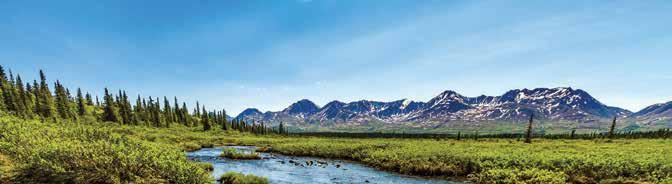

· The leadership team at Roger Hickel
Contracting now includes Kris Squires as Vice President. Squires joined the firm in 2014 as an estimator and project manager. He earned a bachelor’s degree in civil engineering at UAA and worked briefly as a civil engineer before transitioning into construction.
Bristol Bay Native Corporation (BBNC) added new hires at its corporate office.

· LaFewt Knox joins BBNC as Senior Director of Financial Planning and Analysis. Knox holds a bachelor’s degree in finance and economics from Eastern Washington University and an MBA from UAS.

· Ambriel Sandone joins BBNC as Associate General Counsel. Sandone holds a bachelor’s degree in economics and political science from Colorado State University and a JD from University of Oregon School of Law.

· Molly Webb joins BBNC as Vice President of Human Resources. Webb holds bachelor’s degrees in psychology and criminal justice from the University of Idaho, and she earned a master’s degree in business education from Alaska Pacific University.
During the first year under a new CEO at Alaska Regional Hospital, more new leaders have joined the administrative team.
· Melissa Butler is Alaska Regional Hospital’s new COO. She held key leadership roles with parent company HCA Healthcare at the Gulf Coast Division and at Corpus Christi

Medical Center in Texas, where Alaska Regional Hospital CEO Mark Roberts was posted before coming to Alaska in 2025. Butler earned a bachelor’s degree in business management from National American University and a master’s degree in management and leadership from Western Governors University.

· Yvonne Schofield has joined as Vice President of Operations. Schofield most recently worked alongside Butler and Roberts at Corpus Christi Medical Center as director of surgical services beginning in 2022. She holds a bachelor’s degree in nursing from McMurry University in Abilene, Texas, and a master’s degree in nursing leadership from HCA Healthcare’s Galen College of Nursing.

· Mike Davis is promoted to Alaska Regional Hospital’s new Vice President of Quality. Davis holds a bachelor’s degree in nursing from California State University, East Bay, and a master’s degree in nursing informatics from Western Governor’s University.

· Montana Miller joined Alaska Regional Hospital as Human Resources Vice President. She previously worked at North Star Behavioral Health and Aleut in HR leadership. Miller graduated from Utah Valley University.

· Garet Plantz is promoted to KeyBank’s Small Business Relationship Manager for Alaska, providing personalized expertise across deposit, lending, and merchant processing needs.
Plantz lives in Kenai and brings more than fifteen years of experience with KeyBank, most recently as a virtual business banker for clients in Alaska and Washington.












Flying has become a commonplace form of travel, yet it remains a modern marvel. Hundreds of parts and pieces, equipment and hardware, software and human direction, must all work in sync to launch an aircraft into the air, propel it some distance, and allow it to land. Improvements in aviation safety continue daily, from updating runways and lighting to improving communications or fuel economy.
But not everything goes to plan every time. The Federal Aviation Administration records incidents involving airborne craft regardless of their severity. For incidents that result in a crash, injury, or death, in-depth investigations investigate the how, where, what, why, and when to build an evolving database that informs policies, procedures, and regulations for the next flight.
In this edition of Alaska Trends, we looked at data provided by the Federal Aviation Administration in “Air Traffic by the Numbers” published in June 2025 and “Wildlife Strikes to Civil Aircraft in the United States, 1990 – 2024” and were pleased to find that, even though the number of incidents may be high, great strides in aviation safety mean the numbers of injuries and casualties are remarkably low.
165K+ flight plans were filed in 2024.
0.1% of flights ended with an incident report in 2024.
8,668
aircraft were registered in Alaska in 2024.
154 incidents reported involved amateur built
3 incidents reported were the result of a ptarmigan between 1962 & 2025
16 incidents reported were the result of a red fox between 1962 & 2025.
Total Incidents by Aircraft 1962-2024
9,085
What book is currently on your nightstand? The Wright Brothers by David McCullough. What charity or cause are you passionate about? Food insecurity. I’m on the board of Turnagain Community Services.
What’s the first thing you do when you get home after a long day at work? I change into sweatpants, and I check in on my family.
What vacation spot is on your bucket list? Thailand.
If you could domesticate a wild animal, what animal would it be?
My favorite animal is a whale… Humpbacks, fin, blue, and gray whales: I love them all.

Photos by Jovell Rennie
Aviation entered Sasha Swift’s life when she was an air traffic controller in the US Air Force, but she came to Girdwood in 2015 for the people. As a ramp agent for Alpine Air Alaska, she greeted guests, gave safety briefings, and loaded them into helicopters. She worked her way up to CEO when the company restructured its tourism and charter divisions.
“We do a lot of work all over the state with all the ‘ologists’ in remote locations,” says Swift of charter flights. Part of her job, too, is acting as a conduit between the operations team and maintenance team. Alpine Air Alaska fluctuates from about thirty year-round employees to about seventy in the summer.
Swift adds, “It’s mostly a people job, and the people are the most important thing to keep it running.”
Alaska Business: What do you do in your free time?
Sasha Swift: Hiking, skiing, camping. All the “ings” of Alaska.
AB: Is there a skill you’re currently developing or have always wanted to learn?
Swift: I really want to get better at snowmachining. I’m just lame… I wanna be able to sidehill and do all the cool stuff. My 7-year-old is almost cooler than me now.
AB: What’s the most daring thing you’ve ever done?
Swift: Skydiving or joining the Air Force.
AB: What are you superstitious about?
Swift: What goes around comes around, so I try to keep that in mind.
AB: What’s your favorite local restaurant?
Swift: Moose’s Tooth.
AB: Dead or alive, who would you like to see perform live in concert?
Swift: Dolly Parton.
AB: What’s your greatest extravagance?
Swift: Pedicures… [she laughs] Small but necessary.
AB: What’s your best attribute and worst attribute?
Swift: I’m really stubborn. It leads me to making things happen that may not have otherwise. But anybody close to me can tell you a story about me taking that too far, not asking for help.
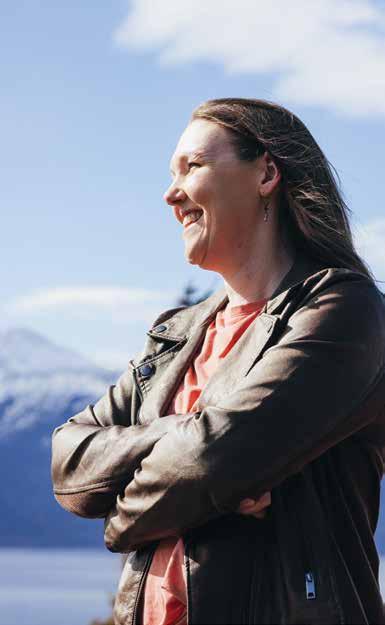
Airport Equipment Rentals ................ 99 airportequipmentrentals.com
Alaska Air Cargo - Alaska Airlines ........ 61 alaskacargo.com
Alaska Mergers & Acquisitions, LLC .....67 akmergersandacquisitions.com
Alaska Railroad .................................49 akrr.com
Alaska School Activities Association .... 31 asaa.org
Anchorage Convention Centers ......... 33 anchorageconventioncenters.com
Anchorage Sand & Gravel 77 anchsand.com
Bristol Bay Native Corporation .......... 23 bbnc.net
Chugach Alaska Corporation 13 chugach.com
ConocoPhillips Alaska ........................ 17 alaska.conocophillips.com
Conrad-Houston Insurance Agency............................. 54 chialaska.com
Construction Machinery Industrial 2 cmiak.com
Cook Inlet Tug & Barge Inc .................67 cookinlettug.com
Craig Taylor Equipment 43 craigtaylorequipment.com
Delta Constructors .............................. 9 deltaconstructors.net
Denali Commercial ........................... 63 denalicommercial.com
Donlin Gold ......................................79 donlingold.com
First National Bank Alaska 5 fnbalaska.com
Great Northwest Inc .......................... 11 grtnw.com
Haskell Corporation 54 haskellcorp.com
Highmark Marine Fabrication, LLC ............................... 25 highmarkmarine.com
Home Instead - HI Southern Alaska, Inc. .......................................20 homeinstead.com
JD Steel Co Inc 47 jdsteel.com
Joint Base Elmendorf-Richardson ....... 45 jberlife.com
Kinross Alaska................................... 19 kinross.com
Kloosterboer Dutch Harbor ..................
kloosterboer.us
.............................................29 lynden.com
lynden.com
matson.com
nac.aero