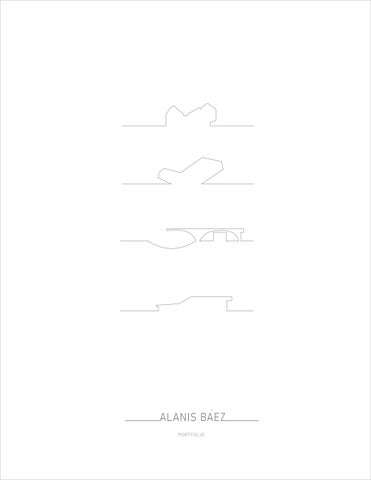
Portfolio 2026 - Alanis Baez

Page 1


ALANIS BAEZ

BETWEEN WALLS

Low-Rise Multifamily Housing

pg. 04-17

SULIS

Hydrotherapy Centre and Spa

LIVING EDGES

Environmental Education and Public Landscape

pg. 18-29

CALEA

Transit Station

pg. 30-39 pg. 40-47

Between Walls

Reimagining LA’ s Courtyard Typology

TYPE OF WORK

COURSE INSTRUCTOR PROGRAM

Academic - Studio Tech Core 401

Miroslava Brooks

Small-scale Housing

As Los Angeles continues to densify, this project explores how housing can grow without losing its sense of openness and community. Drawing from the familiar courtyard apartment typology and the spatial logic of the village, it proposes a new hybrid typology that redistributes density into softer, more porous forms. The result is a compact yet breathable environment that supports both privacy and collective life, offering a new vision for housing in the evolving urban landscape of LA.

This project organizes housing through a hybrid of the courtyard and village typologies. Instead of a single block, the massing is broken into smaller volumes arranged to create a porous network of paths, thresholds, and shared outdoor spaces. This approach introduces a more informal and walkable ground condition, where circulation becomes a social framework and residents move through layered moments of compression, openness, and visual connection.

At the center, a sunken courtyard acts as the communal heart of the project. Stepped and differentiated, it becomes an active landscape for gathering rather than a static void. By distributing density across fragmented forms, the proposal creates a compact yet breathable environment that balances privacy with collective life.

The units are organized as a series of single residences and duplexes, each structured around a central stair core that provides clarity and efficiency while reinforcing the fragmented massing strategy. This system allows each volume to operate almost as an individual home within the larger collective, supporting the project’s village-like character. The duplexes create vertical variation and density, while the single units maintain a more domestic scale and legibility.

The duplexes create vertical variation and density, while the single units maintain a more domestic scale and legibility. In the single units, the ground level is dedicated to bedrooms and primary bathrooms, while the upper level contains the main living spaces. Although unconventional, this organization prioritizes access to light, views, and shared outdoor terraces at the second level, where circulation and community overlap.

These elevated living spaces also take advantage of the pitched roof geometry, allowing for higher ceilings and a greater sense of openness. In elevation, this arrangement reinforces the balance between unity and fragmentation: from certain viewpoints the volumes read as a cohesive whole, while movement around the site reveals variation, porosity, and glimpses of shared life within.

Sulis

Therapeutic Hydrotherapy Center and Spa

TYPE OF WORK COURSE INSTRUCTOR PROGRAM

Studio / ACSA Steel Competition

Studio V: Senior Capstone

Daniel Brown

Public Spiritual Centre

Minerva Sulis: Celctic goddess of healing and sacred waters

Water has been known for centuries to posses physical and mental healing properties. Sulis Hydrotherapy Centre and Spa is a haven of tranquility dedicated to the physical and mental healing of humans by harnessing the power of water. The complex offers a variety of pools and spas, each carefully designed to cater to the different needs of the users, incorporating elements such as soothing acoustics and natural light. The therapies offered in the complex aim to harmonize the body, mind, and spirit, facilitating a deeper state of well-being.

AWARDS

SCAD Architecture Chair’s Senior Award

SCAD Outstanding Senior Project Award

IDA Gold - Health and Wellness

IDA Gold - Commercial Architecture

IDA People’s Choice Design Of The Year

Programmatic elements such as meditation rooms that use the sound of falling water, users will experience the calming and mental healing effects of water.

THE POWER OF WATER

PHYSICAL

The hydrotherapy center directly targets users looking for a holistic approach to physical healing through water. Water is used through the design as a means of energy and supply, creating a sustainable design, that will also heal the environment.

ENVIRONMENTAL

Nestled in the French Broad River Park, Ashville, North Carolina, Sulis intergrates harmoniously with its surrounding. Situated next to a flowing river, the building takes inspiration from the natural allure of water to create a sensory experience that fosters healing.

The site design aims to provide an inmersive journey where users of all ages are encouraged to engage and connect with water in diverse and captivating ways. From features such as a zen water garden to a river walk, it visitors to feel completely inmersed in the design before entering the building itself.

RIVER WALK VIEWING DECK

RIVER WALK SOCIAL STEPS

SECTION AA: ELEVATED PATH

SECTION AA: ELEVATED PATH

DISCONNECT
INTERACT
CONNECT
PRIVATE BATHS
ATRIUM
SOCIAL BATHS

A large central pool at the ground level serves as the heart on the facility, promoting a community centric space where users of all ages can enjoy the soothing waters and interact with eachother. This level also houses hydrotherapy pools where specialized treatments are available for those seeking physical therapies.

The upper levels within the cantelivered wings, are dedicated to more private spaces, creating a more intimate connection between the user and water. Here we can find private baths, where visitors can inmerse themselves in miniral waters and heal their mind through meditative therapies.

ONYX PHOTOVOLTAIC SKYLIGHTS

AQUAPORIN INSIDE WATER FILTRATION SYTEM

RAINWATER HARVESTING

The facade design was inspired by the fluidity and transparency of water, and its interaction with sunlight. Instead of completely concealing the robust steel exoskleton at the core of the design, the lightweight polyester fabric mesh that wraps the facade, allows the steel to visually shine through. The steel exoskleteon acts as a framework upon which the facade elements are anchored to, accentuating the fluidity and movement of the design. The goal was to establish a feeling of lightness while still expressing the strength and stability of the underlying structure.

As the time of day changes, so does the interaction of light and shadow with the facade, creating an ever-changing pattern, offering a visually stunning experience for both occupants and passerby.

Living Edges

Architecture in erosion

TYPE OF WORK COURSE

INSTRUCTOR PROGRAM

Academic - Studio AUD 413

This project reconsiders the Los Angeles River as a living system rather than a fixed piece of infrastructure. Instead of reinforcing the rigid concrete channel that currently defines the river, it proposes a more natural, erosion-based condition that allows water, sediment, and vegetation to shape the terrain over time. Architecture operates as a mediator between the urban fabric and restored riparian ecologies, establishing a gradient from a defined city edge to a porous and adaptive landscape. Through this approach, the work explores how design can support natural processes while creating resilient relationships between urban life and evolving ecological systems.

EXSISTING LA RIVER

RIPARIAN INTERVENTION
ERODED LA RIVER

Riparian zones are the transitional landscapes between land and water, where ecological, hydrological, and geological processes actively shape the terrain. This proposal introduces a series of constructed riparian conditions that guide the river toward a more natural pattern of erosion, deposition, and seasonal expansion. Rather than fixing the river in place, these interventions act as catalysts, allowing water to gradually reshape the ground and establish new ecological corridors. The ground is treated as a responsive surface, shifting in section to accommodate reservoirs, wetlands, and filtration basins informed by site topography and flow. Through these strategies, erosion becomes a design tool, framing a dynamic relationship between infrastructure, landscape, and time.

The project is organized by a modular roof grid that establishes order at the urban edge while remaining adaptable to changing ecological conditions. This continuous canopy provides shade, defines circulation, and frames the transition from city to riparian landscape. Because of its scale, the roof operates as ecological

infrastructure integrating living surfaces, solar panels, and a watercollection system that channels rainfall toward filtration and storage within the ground. As the architecture approaches the river, the grid loosens and fragments, allowing light, vegetation, and hydrology to shape the spaces below.

Under the canopy, the architecture breaks apart into smaller, dispersed volumes that form a porous field rather than continuous buildings. These pixelated massings allow circulation, light, and ecological processes to move freely through the site.

As the system approaches the riparian zones, built form recedes and the landscape becomes the primary organizing force. The result is an environment where architecture supports and frames the terrain, but never dominates it.

SECTION A

“UNROOFED” SITE PLAN
RIPARIAN AS EROSION
RIPARIAN AS GATHERING

DETAIL ENLARGED PLAN

Calea

|cah-leh-ah|: the way.

TYPE OF WORK COURSE INSTRUCTOR PROGRAM

Academic - Studio

Design Studio II: Site Context

Prof. Catalina Ogletree Transit Station

Calea’s design marries architecture with site context to create a place that serves as a beacon to guide locals and visitors by connecting the city of Sinaia, Romania to its train staton. The buildings thought through comb ination of both interior and exterior circulation aims to provided a clear path to fluidly guide users through and from their destinations. The architecture takes full advantage of the sloped site, letting it guide the design.

ensuring a graceful transition from one elevation to another. This thoughtful incorporation of the terrain not only unifies the city but also results in a building that effortlessly flows between different levels, enriching both its aesthetic and functional aspects. MAPPING

The architectural design of Calea draws its inspiration from the city’s rugged mountainous terrain and the paths that tie the city together. Embracing the natural contours of the land, the design aim to connect various parts of the city, much like the roads of Sinaia. The building’s own sloped site mirrors the surrounding landscape,

SINAIA, ROMANIA
ROAD MAPPING

The design intends to blend external and internal circulation, offering a unique experience to its users. The exterior circulation, designed as a gently sloping ramp, not only ensures accessibility for all, including ADA compliance and easy maneuverability for those with luggage, but also immerses individuals in a captivating environment. Lined with lush vegetation and framed by breathtaking mountain views, this exterior pathway transcends mere functionality, offering an enchanting journey that engages the senses and connects the interior spaces with the natural world.

EXTERIOR CIRCULATION

Exterior ramp allows people to get to and from the upper hotel level to the lower train station level without having to enter the building.

INTERIOR CIRCULATION

The interior features an open layout, allowing users to effortlessly navigate from one point to another with a clear and uninterrupted path.

LEVEL 1

1. RECEPTION / LOBBY

2. GIFT SHOP

3. CAFE

4. OUTDOOR DINING

5. TERRACE

LEVEL 2

1. MECHANICAL / STORAGE

2. OFFICE

LEVEL 3

1. TICKETING

2. WAITING AREA

3. LOCKER ROOM

4. RESTROOMS

CONCEPTUAL CIRCULATION DIAGRAM: “CLEAR INTERRUPTED PATH”

RECEPTION / LOBBY

WAITING AREA

CAFE

TICKETING

Portfolio 2026 - Alanis Baez by Alanis Baez Colon - Issuu