
![]()


Some rules are worth following. Like Rule #62:
No reset button is needed for your spring reset.
Enjoy quieter beaches, warm Gulf breezes, and mornings without alarms.
Make a break for Alabama’s Beaches.


BALDWIN EMC is a member-owned electric cooperative serving more than 93,000 accounts in Baldwin and Monroe Counties in southwest Alabama.
MAILING ADDRESS:
P.O. BOX 220 SUMMERDALE, AL 36580
PHONE: (251) 989-6247
ALABAMA LIVING is delivered to some 450,000 Alabama families and businesses, which are members of 22 not-for-pro t, consumer-owned, locally directed and taxpaying electric cooperatives. Subscriptions are $15 a year for individuals not subscribing through participating Alabama electric cooperatives. Alabama Living (USPS 029-920) is published monthly by the Alabama Rural Electric Association of Cooperatives. Periodicals postage paid at Montgomery, Alabama, and at additional mailing o ce.
ALABAMA RURAL ELECTRIC ASSOCIATION
AREA President
Karl Rayborn
Editor Lenore Vickrey
Managing Editor
Allison Law
Senior Graphic Designer
Sean Burnley
Art Director
Danny Weston
Advertising Director
Jacob Johnson
Graphic Designer/
Production Coordinator
Brooke Echols
ADVERTISING & EDITORIAL OFFICES: 340 TechnaCenter Drive Montgomery, Alabama 36117-6031
1-800-410-2737
For advertising, email: advertising@areapower.com For editorial inquiries, email: contact@alabamaliving.coop
NATIONAL ADVERTISING REPRESENTATIVE:
American MainStreet Publications
1-800-626-1181
www.AMP.coop
www.alabamaliving.coop

CHANGE OF ADDRESS:
For co-op members, contact your local electric cooperative. Non-members, send your address change to contact@alabamaliving.coop.


e popular blocks known as LEGO bricks are a favorite with all ages. Our readers were proud to send us snapshots of their best creations.
From Slapout to Fairhope and dozens in between, Alabama is blessed with towns and places with unusual and whimsical names.
Patrons of Gadsden’s 278 Restaurant keep coming back, the owner says, because “we’re not fast, but we do food right.”
Tom Hendrix spent 30 years building a milelong stone wall to honor his Yuchi great-greatgrandmother, who was forcibly relocated from Alabama to Oklahoma.
ONLINE: www.alabamaliving.coop
EMAIL: letters@alabamaliving.coop
MAIL: Alabama Living 340 Technacenter Drive Montgomery, AL

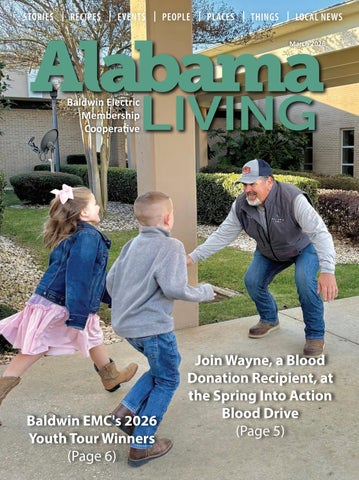
Wayne is a Baldwin EMC employee who unexpectedly had to have open-heart surgery. Following the procedure, he required three units of blood that helped save his life. Baldwin EMC will be hosting its annual Spring Into Action Blood Drive on March 26.


AtBaldwin EMC, the Board of Trustees believes one thing truly sets our cooperative apart: the voice of our members. As a member-owned and member-governed cooperative, Baldwin EMC exists to serve the people and communities who rely on us, and meaningful member engagement is essential to fulfilling that mission.
As Trustees, we are responsible for making highlevel decisions that guide the long-term direction of the cooperative. To do that effectively, we must understand the needs, priorities, and expectations of the members we represent. Member input helps ensure our decisions are informed, thoughtful, and aligned with what matters most to our communities.
One important way we are strengthening that connection is through the Community Leadership Council. Created with the Board’s full support, this program is designed to foster open dialogue and provide a structured, meaningful way for members to share their perspectives directly with cooperative leadership.
The Community Leadership Council is open to individuals ages 30 to 45 and includes four interactive sessions that offer a deeper understanding of the rural electric program and Baldwin EMC’s operations. Just as important, the program creates space for participants to offer ideas, insights, and feedback that help inform Board discussions and future decision-making.
In addition to the Council, Baldwin EMC continues to seek member input throughout the year through surveys, conversations, and other engagement opportunities. Together, these efforts help shape decisions, strategic priorities, and investments that support reliable service, community growth, and the cooperative’s future.

While Baldwin EMC powers homes, businesses, and schools, our true strength comes from the members we serve. This cooperative belongs to you, and through initiatives like the Community Leadership Council, your voice helps guide the decisions we make on your behalf. In February’s issue of Alabama Living, Baldwin EMC published an

Meet Wayne. In October 2025, he unexpectedly received life-altering news: he needed immediate open-heart surgery. Following the procedure, Wayne required three units of blood, an intervention that ultimately helped save his life.


In 1957, during the National Rural Electric Cooperative Association (NRECA) Annual Meeting in Chicago, Senator Lyndon B. Johnson shared a vision of giving young people the opportunity to visit the nation’s capital and gain a firsthand understanding of what it represents. That vision inspired the creation of the Youth Tour.
The Youth Tour was designed to bring together students from across the country for an up-close look at state and national government. Participants visit monuments, memorials and museums and meet U.S. senators and representatives, gaining a deeper appreciation for civic leadership and public service.
At its core, however, the Youth Tour is also about understanding the important role cooperatives play in their communities. The program introduces students to the cooperative model and its guiding principles, emphasizing how people working together can strengthen their communities.
This month, these four students will join peers from across the state for a trip to Montgomery. In June, they will take part in a week-long educational tour of Washington, D.C., alongside nearly 2,000 students from

Meet Kortlyn White, a junior at Elberta High School. Kortlyn is actively engaged at school and in the community, serving as Vice President of the Spanish Club, a Junior Ambassador, an AFC Board Representative, and on the HOBY Alumni Staff, all while balancing two jobs. She is also a member of the National Honor Society, the Junior Optimist Club, and a varsity volleyball player. After graduation, she plans to attend Auburn University and major in biochemistry. A fun fact about Kor tlyn is that she loves music and plays the guitar.
Meet Margaret Conyers, a junior at Fairhope High School. Margaret is passionate about academics and leadership, serving as a Student Government Association Representative, Key Club Officer, and Create for Kids Officer. She is a member of the National Honor Society, National Spanish Honor Society, and Mu Alpha Theta. Beyond the classroom, Margaret is a Dogwood Trail Court member, varsity cheerleader, and varsity track and field athlete. She credits her mother, who has shaped her into the person she is today, as her greatest influence.


Meet Cody Gardner, a junior at Baldwin County Virtual School. Cody is a scholar-athlete who has maintained a 4.0 GPA while working two jobs and competing with the Alabama High School Rodeo Association. He is a member of the National Honor Society and Future Farmers of America. Passionate about rodeoing, Cody dedicates hours to practice and caring for his horses. He is a State Champion Tie-Down Roper and a National Rodeo Qualifier. Cody believes his rodeo involvement has developed his strong work ethic and provided him with a supportive community.
Meet Farrah Lane, a junior at Bayside Academy. Farrah is committed to academics, athletics, and community involvement. She serves on the board of the National Charity League and is a member of the Youth Legislature and Mock Trial Team. She is a varsity and club volleyball player and an award-winning vocalist. Farrah has received multiple academic awards and attributes her development as a servant leader to the Bayside volleyball program. As a result, she looks for daily ways to serve others and strengthen her community.


Leadership begins with a question: what kind of leader are you? That question took center stage during the latest session of our LITES Leadership Program, where participants reflected on their leadership styles and how their strengths, values and communication shape the way they lead. LITES is a year-long leadership journey that helps employees grow individually and as a team. Through interactive sessions and real-world application, participants build essential skills, confidence and a shared commitment to leading with purpose.


Baldwin EMC is proud to congratulate Clayton Hudson on earning his journeyman lineman status, a significant milestone and the highest level of training for lineworkers. Achieving this designation requires years of hands-on experience, rigorous training, and an unwavering commitment to safety and excellence. Clayton’s dedication to his craft and to serving Baldwin EMC members reflects the values that keep our cooperative strong.
Baldwin EMC sent 51 employees to Oxford, Mississippi, to assist North East Mississippi Electric Power Association with power restoration efforts following Winter Storm Fern. The storm caused extensive damage, leaving up to 95% of the cooperative’s more than 30,000 meters without power at the height of the outages. “At the heart of the cooperative model is service. While our priority is always our members, the principle of Cooperation Among Cooperatives reminds us that our responsibility sometimes reaches beyond our own service area,” said Baldwin EMC CEO Hunter Robinson. "When a fellow co-op needs help, Baldwin EMC is committed to answering that call. We’re proud to deploy our crews and resources, knowing that this spirit of mutual support strengthens all cooperatives, today and when we’re the ones in need.”

Hello and welcome back! I can’t say it enough, but I am so grateful for each and every one of you who read this column each month. I hope you enjoy reading it as much as I enjoy writing it!
If you’re new here, welcome! Recently, I’ve been using this space to break down Baldwin EMC’s seven cooperative principles, the values that guide not only our co-op, but cooperative businesses everywhere.
If you’d like to catch up on the first principle I covered, Education, Training, and Information, you can find it in February’s issue of Alabama Living.
This month, I am going to be tackling Member’s Economic Participation. So, let’s jump in and… let’s talk about it.
Baldwin EMC exists because of you. That probably isn’t the first time you’ve heard that sentence. I know this might just seem like a nice line we say, but it’s true and it’s one of the things that makes a cooperative different from other utilities.
Baldwin EMC is owned by the people it serves. That’s you! So, each time you pay your power bill, you’re not just paying a bill, you’re helping support something you own.
Everyone contributes in a fair way, based on how much electricity you use, and the money
stays right here working for our community. Instead of profits going to shareholders, your dollars are used to maintain power lines, replace aging equipment, respond to outages, and plan ahead so the system stays reliable for years to come.
It’s about taking care of today’s needs while also preparing for tomorrow.
Of course, the cost of providing electricity doesn’t stay the same forever. Things like materials, equipment, and the cost of power change overtime, and as those costs change, the cooperative must adjust to make sure it can continue doing the job our members expect.
These decisions are never made lightly. That’s why your board of trustees is made up of local members who carefully review expenses and weigh different options, always keeping fairness, reliability, and the long-term health of the cooperative in mind.
That shared responsibility is what keeps our cooperative strong. When we all do our part, we’re able to continue providing safe, reliable power, not just for ourselves, but for future members as well.
Thanks for reading, let's do it again next month!
By: Katey Hornsby


In accordance with Federal civil rights law and U.S. Department of Agriculture (USDA) civil rights regulations and policies, the USDA, its Agencies, offices, and employees, and institutions participating in or administering USDA programs are prohibited from discriminating based on race, color, national origin, religion, sex, gender identity (including gender expression), sexual orientation, disability, age, marital status, family/parental status, income derived from a public assistance program, political beliefs, or reprisal or retaliation for prior civil rights activity, in any program or activity conducted or funded by USDA (not all bases apply to all programs). Remedies and complaint filing deadlines vary by program or incident. Persons with disabilities who require alternative means of communication for program information (e.g., Braille, large print, audiotape, American Sign Language, etc.) should contact the responsible Agency or USDA’s TARGET Center at (202) 720-2600 (voice and TTY) or contact USDA through the Federal Relay Service at (800) 877-8339. Additionally, program information may be made available in languages other than English. To file a program discrimination complaint, complete the USDA Program Discrimination Complaint Form, AD-3027, found online at http://www.ascr.usda.gov/complaint_ filing_cust.html and at any USDA office or write a letter addressed to USDA and provide in the letter all of the information requested in the form. To request a copy of the complaint form, call (866) 632-9992. Submit your completed form or letter to USDA by (1) mail: U.S. Department of Agriculture, Office of the Assistant Secretary for Civil Rights, 1400 Independence Avenue, SW, Washington, D.C. 20250-9410; (2) fax: (202) 690-7442; or (3) email: program.intake@usda.gov. USDA is an equal opportunity provider, employer, and lender.

Our 8-year-old son Jacob’s favorite hobby is putting together LEGO sets recommended for ages 18+ because they are more of a challenge. SUBMITTED by Terry and Alaina


Our


May theme: “High School Reunions” | Deadline: March 31
Submit photos at alabamaliving.coop/submit-photo or by scanning the QR code. Photos submitted for publication may also be used on our website and on our social media pages.


Identify and place this Alabama landmark and you could win $25! Winner is chosen at random from all correct entries. Multiple entries from the same person will be disqualified. Send your answer with your name, address and the name of your rural electric cooperative, if applicable. The winner and answer will be announced in the April issue.
Submit by email: whereville@alabamaliving.coop, or by mail: Whereville, 340 Technacenter Drive, Montgomery, AL 36117.


February’s answer: This pedestrian bridge at High Falls Park in Grove Oak provides a picture-perfect view upstream and downstream of Town Creek. The park offers hiking trails, pavilions, restrooms and a playground and is about 17 miles east of Lake Guntersville State Park. (Photo by Paula Langhurst of MarshallDeKalb EC) The randomly drawn correct guess winner is Steven Myers of Sand Mountain EC.
More than 250 linemen, safety staff and mechanics from Alabama’s rural electric cooperatives heeded the call to help restore power to seven sister co-ops in Mississippi after Winter Storm Fern blasted half the nation with heavy snow and ice in late January.
Co-op outages peaked at about 400,000 the last week of January. Mississippi co-ops were hit especially hard, with about 160,000 members without power as of Jan. 27. The storm affected 15 coops and 51 counties, and 1,100 additional personnel responded to the call for mutual aid.
The outages were so numerous that many of our co-ops sent second crews to relieve the first ones who’d been working tirelessly in the frigid cold. Ice accumulation was the biggest issue the crews faced; ice snaps power lines and poles and topples trees into wires, which cause outages that can last for days. As of press time, all of Alabama’s crews had been released and returned back home.

“This march will not continue.” These words, uttered into a megaphone by a lawman, crackled through the air at the foot of Selma’s Edmund Pettus Bridge on “Bloody Sunday.” Few months in Alabama history have been more consequential than March 1965.
Calls for a protest march from Selma to Montgomery came after years of civil rights organizing in the Black Belt, and in the days following the February murder of Jimmie Lee Jackson during a demonstration in Perry County. Martin Luther King Jr. suggested that Black Alabamians march to the State Capitol to demand justice for Jackson and equal voting rights for all.
They began on March 7, winding through Selma, 600 strong. At the bridge, a throng of law enforcement officers blocked their path. Footage of what followed soon reached into American homes: Scenes of peaceful protestors being beaten in a haze of tear gas.
Thousands answered King’s call to travel to Selma and continue the march. Boston Rev. James Reeb and Viola Liuzzo of Detroit were among them; both were murdered in the days that followed. The ongoing violence prompted President Lyndon Johnson to issue a forceful call for immediate passage of the Voting Rights Act. He signed the bill on Aug. 6, 1965.
Two weeks after Bloody Sunday, on March 21, King and 8,000 supporters crossed the bridge and continued on to Montgomery. They marched under the protection of 2,000 National Guardsmen and a federal court order preventing further state interference.
On the last day, March 25, 1965, King addressed a crowd of 25,000 from the Capitol steps. “All the world today knows that we are here,” he proclaimed, before returning to a familiar, sustaining refrain: “The arc of the moral universe is long, but it bends toward justice.”
— Scotty Kirkland

Letters to the Editor
E-mail us at: letters@alabamaliving.coop or write us at: Letters to the editor 340 TechnaCenter Dr. Montgomery, AL 36117
In the February 2026 article, “Alabama: A State of Symbols,” you refer to goldenrod as “nature’s sneeze machine.” I would like to disagree with you on that assessment.
Firstly, goldenrod rarely causes allergies as its pollen is too heavy and sticky to be airborne. The pollen must be carried by bees and other insects. Ragweed, on the other hand, has pollen that is airborne and is usually the cause of hay fever in the fall.
Secondly, goldenrod may have potential medicinal uses. It has been used traditionally as an anti-inflammatory, an antiseptic, and as an astringent for sores and small wounds. Also, the flowers are edible and can be used to make tea, sprinkle on a salad, or make a beautiful, honey-colored jelly. Henry Ford even used the rubber found in the plant to make the tires of at least one Model T.
It is a very common misconception that goldenrod causes allergies. I wish this wasn’t true as the flowers provide wonderful color in the fall as well as food for insects and some humans. Goldenrod ought to be Alabama’s state flower as it is native to the state and offers many benefits. Please consider writing an article for a future issue of Alabama Living about this wonderful plant.
Phillip Kent, Gordo
Kudos to Alabama Living. This (February 2026) is probably the best issue I have ever read. Everything was beautifully laid out, beautifully written, and every piece was relatable. Thank you.
Tanis Clifton, Red Bay
Are we making this contest too easy? More than 600 of you correctly found the hidden dingbat in February’s issue, a candy heart on the jacket of the fisherman on Page 40. “My only question is, did the fish oblige and kiss him?” Jennifer Sweatman of Central Alabama EC asked. Lori Faile of Pennington and her four sons were among those who found it: “My little boys and I have had so much fun looking for the dingbat and receiving the new issue so we could search again,” she writes. “Y’all hid it really well and my oldest said it was the best yet.” Eulene Berry of Elba was thrilled she found the dingbat for the second month in a row, something she hadn’t done before, after years of reading the magazine. Congratulations to our randomly selected winner, Renee Gentry of Clanton, who wins $25 from our sponsor, Alabama ONE Credit Union. If you find this month’s dingbat, the fourleaf clover pictured here, it might bring you a wee bit of luck! Remember: it won’t be in an ad or pages 1-8.
By email: dingbat@alabamaliving.coop
By mail:
Find the Dingbat
Alabama Living
340 TechnaCenter Dr. Montgomery, AL 36117

We’ve enjoyed seeing photos from our readers on their travels with Alabama Living! Please send us a photo of you with a copy of the magazine on your travels to: mytravels@ alabamaliving.coop. Be sure to include your name, hometown and electric cooperative, and the location of your photo. We’ll draw a winner for the $25 prize each month.


Joe and Ellen Marinaccio had this photo taken with the Monastery of the Holy Trinity, an Eastern Orthodox monastery in central Greece, in the background. “It is situated at the top of a rocky precipice over 1,300 feet high,” writes Joe. “This is where they filmed the opening scenes for the James Bond movie ‘For Your Eyes Only.’” They are members of Baldwin EMC.
Paul Forehand of Slocomb, a member of Wiregrass EC, took his copy along on a deep sea fishing trip aboard the Captain Anderson in Panama City Beach, Fla.


Sponsored by


PHOTO BY SEAN BURNLEY

BY JIM WINNERMAN
Did you know Alabama license plates were once fired in an oven and made of porcelain?
Vance George, 60, of Huntsville, and Paul Majerick, 82, of Montgomery, own several of those historic first state plates, which date to 1912. The men are two of 4,500 avid license plate collectors nationwide who belong to the American License Plate Collectors Association (ALPCA).
Majerick was only 15 in 1959 when he his father lent him the money to buy a Model “A” Ford Tudor, and the car piqued his interest in acquiring historic Alabama plates. By 17, he already had a sizable collection. Today the retired Army brigadier general estimates he has more than 2,000 Alabama plates.
George, a NASA contractor at Marshall Space Flight Center in Huntsville, says he and his brother Lance dabbled in collecting license plates for decades. They didn’t start collecting in earnest until 2015, when he acknowledges they “became addicted.” Since then, they have made up for lost time.


“I estimate we have over 5,000 plates,” he says, “and most are Alabama.”
The earliest plates in Alabama date to the years 1909, 1919 and 1911. “They were made of porcelain and issued by the cities of Montgomery, Mobile and Birmingham,” Majerick says. “The first Alabama statewide plates were cobalt blue and appeared in 1912 and were also porcelain, but by 1916 plates were being made of steel.”
Most Alabama collectors try to accumulate a complete “run,” or an example of one plate issued each year since 1912. In Alabama that can be more difficult than in most states. Alabama has only required one plate per car most years, so the supply of historic plates is diminished.
Specific plate years are more sought after than others, such as the 1955 tag. It was the only year to carry a simple heart emblem, symbolizing the “heart of Dixie.” Subsequent years have included the phrase and a heart.
Another popular plate is from 1937, which was one of several years when Alabama was issuing plates in pairs. One tag had the word “FRONT” stamped on it to prevent people from using the two tags in one set as separate plates on two different automobiles.
Plates issued before and during World War II are also scarce, as every bit of scrap steel was being collected for the manufacture of goods in support of the conflict.
Majerick searches for any plate issued by Alabama, which is extensive. In 2025, there were 394 different specialty plates, including those issued for special interest groups like amateur radio, mental health, wildlife rehabilitation, retired military, Farming Feeds Alabama, Save the Cahaba River, and many more. (Images of all current Alabama plates styles can be found at alabama.gov/license-plates/)
Since 2016, vintage plates can be registered and used on antique automobiles if the plate was issued before 1976 and matches the year the car was manufactured.
1 & 2) The only known pair of 1912 Alabama plates. All others were non-matching single plates.
3) This 1916 pl ate was the only plate issued without a year.
4) 1955 Heart of Dixie Plate.
5) Tag with “Front” to prevent using two plates on different vehicles.
6) National Guard specialty plate from 1957 featured an erroneous image of a jet fighter pointed downward instead of skyward. Above the plate is a collectible 1950s-era Redstone Arsenal plate topper.
7) Pl ate from the car of the “Big Jim” Folsom Sr., the 42nd Governor of Alabama.
Many collectors have associated collection themes which appeal to them, such as collecting only plates with errors, A popular Alabama error plate is the 1957 National Guard specialty plate with the silhouette of a soldier and a jet plane. “The direction of the plane was pointed steeply down, as if it were going to crash,” George says. “It was changed the next year, and every year since.”
Most license tag enthusiasts also collect “plate toppers,” which are small decorative signs once attached to the top of a license plate. Popular from the 1930s to the 1950s, they functioned as an advertisement for everything from gas stations and political campaigns to displaying where a traveler had vacationed.
“I have one that bolts to the top of a vintage plate that reads ‘Roosevelt for President,” Majerick says.
Eventually toppers were replaced by bumper stickers, printed license plate frames, and custom vanity plates.
“ There are almost as many focus areas as there are collectors, so the possible niches are as extensive as the imagination of the collector,” George says. “I also collect Alabama plates used on the governor’s cars with the numeral ‘1.’”
The hobby is well organized in the United States, with a myriad of regional meets taking place throughout the year. Organized by ALPCA, they provide a place where enthusiasts can swap or purchase plates. There is also an active market for plates on the internet, but they can still be found at flea markets and antique shops.
While many historic plates can be purchased from $5 to $50, a 1912 Alabama plate is among the most elusive. Out of the 3,500 issued, only 45 are known to exist. “Depending on their condition they can sell for up to $8,000,” Majerick says. “However, there are more dealers today who are only interested in buying and selling, and that has driven up the price for older plates.”
Lucky collectors can still discover plates nailed to a wall in an old barn or garage. When Majerick was 17 and just beginning to collect, friends told him of plates they had seen in someone’s garage. “I drove my Model A over and the owner said I could have them if I would clean out his garage,” he remembers. “I did. Those plates were 1920s and in perfect condition, and I still have them.”
Stories on the internet tell of historic plates discovered being used as shingles on a shed or being found in old trash disposal sites.


Despite the popularity of the hobby, there are no permanent “public” displays of plate collections in Alabama. “Collectors will create a display for themselves or to exhibit at a meet, but I do not know of any displays in a museum in the state,” George says.

Today the hobby is growing with more younger people collecting. “Everyone is welcome,” says Majerick, who would like to see more people in the hobby. “Most begin with a set of plates from each state issued the year when they were born, and then start on a specific state,” he says.
“ The Alabama license plate collecting hobby has been greatly enriched by several knowledgeable older-generation collectors, the foremost being Paul,” George says. “I call him “’‘the King’ of Alabama License Plates.”
Majerick says he hopes his grandchildren take up the hobby, and he has given them a good start. “I have a full run of Alabama plates waiting for each of them,” he says.
• The world’s first license plates were issued in Paris, France, in 1893
• In the early 1900s, car owners made their own plates from materials like leather or metal and displayed their initials.
• New York was the first state to require license plates in 1901.
• By 1918, all states had started issuing their own plates.
• Favorite collectible plates outside of Alabama include Tennessee, where plates from 1936 to 1956 were in the shape of the state.
• A standard 6-by 12-inch size was agreed upon by the U.S., Canada, and Mexico in 1956.
• Digital license plates are coming. Resembling a large cell-phone screen, they will enable plate renewals without a visit to the county license plate issuing office and messages to be displayed below the required numbers and letters.
BY EMMETT BURNETT
“What’s in a name?” said Shakespeare, in “Romeo and Juliet.”
“Plenty!” answered Alabama, the state with dozens of municipality, community, and bridge monikers – whimsical, curious, and slap out odd. Actually, ‘Slap Out’ is one of them. Let’s look at it and seven more.
A community of Holtville, Slapout, Alabama was named for a storekeeper who was not a very good one. The shop often had items out of stock on days ending in Y.
When customers requested to purchase a want or need, the storekeeper’s default mode was, “I’m sorry, we are slap out.”
“American Idol” TV star and Slapout native from early childhood Jessica (Jess) Meuse tells the story. “He would say, ‘I’m slap out of this and I’m slap out of that,” she recalls, about the hometown legend of the 1920s. Meuse adds, “Before you knew it, boom! that’s the name of the town and the name never went away.”
Despite Slapout’s name, according to the “American Idol” competitor, the people never lacked support. “They have been with me every step of my career,” she says. “When it comes to support, they were not slap out.”

Elba
Before there was Elba there was Bridgeville and then Bentonville. But the townsfolk wanted something different than the monikers bestowed upon their town. But what could they do? You can’t just draw a name out of hat.
Actually, that is exactly what they did. “Our town fathers assembled and each placed their name choice in a hat,” says Elba historian Nell Gilmer. She says that on Dec. 8, 1851, “The probate judge had recently read a book about Napoleon Bonaparte and his exile to the Mediterranean Island of Elba. Inspired by the book, the judge put Elba in the hat.”
His choice was drawn. Elba was the winner. The town incorporated on April 13, 1853. Napoleon died May 5, 1821, never knowing his tie to Coffee County’s hat selection.


The Elmore County community of Slapout was named, legend has it, for a storekeeper who couldn’t keep items in stock.
No one knows exactly the connection of Athens, Greece, to Athens, Alabama. A prevailing theory is offered by Limestone County archivists: “Our settlers were powerful and wealthy people from Virginia. One of the first things they did when coming here, was to build and open a school.”
They wanted the new land to be synonymous with education and culture. With a nod to ancient Greece, the Alabama settlers adopted Athens as its name.
But hold the baklava. Alabama’s city of Athens was incorporated in 1818. Greece’s City of Athens was incorporated in 1856. Though Athens, Greece, is 9,000 years old, Athens, Alabama incorporated first. Therefore, it is older.


Spanning six miles over the MobileTensaw Delta is perhaps the most misidentified overwater passage in Alabama. Officially, it is the General W.K. Wilson Jr. Bridge. Wilson was a chief of engineers with the U.S. Army Corps of Engineers and was honored for his service.
With much fanfare, ceremony, and celebratory ribbon-cutting, the bridge opened in 1980. Within days after its debut, somebody said what many may have been thinking, “This bridge reminds me of Dolly Parton!”
A nd forevermore the Delta throughfare with its two parallel arches would be dubbed the Dolly Parton Bridge.
Over the years, campaigns were launched, urging people to refer to the bridge by its rightful namesake. So far, the efforts have failed.
Mobile was not always in Mobile. Originally named Maubila by Spanish Conquistadors, Alabama’s oldest city established roots in the early 1700s as a French settlement, perched on Twenty-Seven Mile Bluff, at Lemoyne, overlooking the Mobile River.
A celebration of the city’s early beginnings is held onsite in January, once every 100 years. Citizens, including mayors, business people, ministers, and more, assemble at Twenty-Seven Mile Bluff. While there, they unveil a monument.
The Twenty-Seven Mile Bluff site, which is on private property, is almost as remote now as it was then. Markers note the group’s visits in January 1902 and January 2002. The next event is slated for January 2102. See you there.

On Nov. 15, 1894, on an Alabama eastern shore bluff, an exciting experiment in community living was founded. The small group was a single tax colony. Its corporation purchased a large tract of land which members leased as single tax parcels.
“We don’t know exactly who named the town, but we know the idea came from a meeting room,” says Gabriel Gold-Vukson, director of the Fairhope Museum. Encouraged by their innovative ideas, someone said the prophetic words, “We have a fair hope of success.” The mystery person was correct.
According to the latest U.S. Census, the town with 22,500 residents had a population increase of 50 percent in 10 years. People still seek the fair hope of Fairhope.


Twenty-Seven Mile bluff, the first settlement of what would become Mobile, is documented by two monuments that commemorate the 1902 and 2002 centennial anniversary ceremonies held at the remote site. PHOTO BY
In the early 1900s, the Dixieland Highway project was near completion. But a bridge over the Tombigbee River was vital for Alabama’s Marengo County piece of the project.
Local auctioneer Frank I. Derby had an idea to help raise money – “let’s auction roosters!” And so they did.
Word spread throughout Alabama and beyond. Auction roosters were donated from celebrities of the day, like Fatty Arbuckle, Mary Pickford, President
Woodrow Wilson, the King of Belgium, and the Prime Minister of England.
Helen Keller, the disability rights advocate from Tuscumbia, donated a blue hen which laid an egg. The egg was donated too.
The auction was held Aug. 14 and 15, 1919, in the Demopolis Public Square.
“Sadly, many bidders did not honor their poultry pledges,” says Kirk Brooker, with the Marengo County Historical Society. “After expenses, only about $40,000 profit was turned over to the project.”


In 1920, the overpass was built with federal, state and chicken money. It was named Memorial Bridge, but nobody called it that.
The name was officially changed by the Alabama State Legislature in 1959 to Rooster Bridge.
The structure was demolished in 1980 to make room for a new Tombigbee overpass, a mile upriver, also named Rooster Bridge.
Montgomery and Montgomery County
The Capital City of Montgomery is the county seat of Montgomery County, but they are named for two different Montgomeries.
The city is named for an Irishman, Richard Montgomery, a former soldier
with the British Army. During the Revolutionary War, he sided with American patriots and become a major general in the Continental Army. He died in battle Dec. 31, 1775, under the command of Maj. Gen. Benedict Arnold. Montgomery County is named for Maj. Lemuel P. Montgomery, the first soldier killed in the Battle of Horseshoe Bend. He died March 27, 1814. A statue of Lemuel Montgomery is on the grounds of the Montgomery County Courthouse in the city of Montgomery, which is named for the other Montgomery. These are eight of probably 80 more. From fledging communities to major cities and bridges long or short, Alabama is a land of titles of distinction, character, and at times, strangeness.
You name it.
Spend any amount of time staring at a map of Alabama, and you’ll find dozens of unusual town and community names. Some of them are incorporated and others have become essentially ghost towns, although they still can be found on maps. Here are just a few of the ones we spotted. Did we find your favorite? If we missed it, send it to us at contact@alabamaliving.coop.
• Scarce Grease (Limestone County)
• Chigger Hill (DeKalb County)
• Slicklizard (Walker County)
• Brilliant (Marion County)
• Ballplay (Etowah County)
• Blues Old Stand (Bullock County)
• Burnt Corn (on the border of Monroe and Conecuh counties)
• Cuba (Sumter County)
• Detroit (Lamar County)

Full Moon on 5th
March 6 • May 1
Downtown 5th Street

Meridian’s favorite block party!
Week of Wonder
March 9-13, 9am – 5pm (daily) Children’s Museum
STEAM-themed activities during spring break!

• Dodge City (Cullman County)
• Gamble (Walker County)
• Muscadine (Cleburne County)
• Phil Campbell (Franklin County)
• Smut Eye (Bullock County)
• Frog Eye (Tallapoosa County)
• Scratch Ankle, (Monroe County)
• Lick Skillet (Madison County)
• Boar Tush (Winston County)
• Possum Trot (Calhoun County)
• Coffee Pot (Limestone County)
• Gobbler’s Crossing (Walker County)
• Shinbone Valley (Clay and Cleburne counties)
• Pansey (Houston County)
• Scant City (Marshall County)
• Pull Tight (Marion County)
• Blow Gourd (Blount County)
• Needmore (Pike, Clay and Marshall counties)
Threefoot Arts Festival
April 18, 9am – 5pm
Downtown Meridian
Regional artists, food and live music.
Beethoven & Blue Jeans
April 25, 7pm
MSU Riley Center
Symphonic journey of Beethoven and The Beatles.
Bud N’ Boilin’ May 2, 1 – 5pm | Singing Brakeman Park
Live music, crawfish, and cold beer.


GSTORY & PHOTOS BY JENNIFER KORNEGAY
rowing up, Joel Moon would tag along with his dad as he worked to keep the multiple Burger King locations he owned in and around Gadsden running smoothly. Joel pitched in, picking up trash in the parking lot and pulling weeds from grassy areas. “I was cheap labor; I got paid in Whoppers,” he says.
With a front-row seat to watch how hard and how long his father worked, Moon considered other career options once he was grown. And yet today, he owns and operates Gadsden’s 278 Restaurant with his wife Teresa. And before that, the couple owned The Choice restaurant downtown. “For so long, I didn’t think I wanted anything to do with the restaurant business,” Moon says, “but I guess it’s just in my blood.”
It seems safe to assume the regulars who fill the dining room, starting at 6 a.m. for breakfast and continuing through lunch, are glad he’s got gravy and sweet tea running through his veins. Had Joel not followed in his


father’s footsteps, they’d miss out on meat and veggie plates piled high with fluffy sweet potato casserole, soft, silky butter beans, hearty meatloaf, and golden cornbread; juicy cheeseburgers or salads (like the popular strawberry salad packed with berries and candied pecans) followed by a slice of homemade peanut butter pie or scoop of peach cobbler.
Despite years of saying he wouldn’t work in restaurants, right after college Joel ended up helping his dad with the Dairy Queen his parents owned. And his dad also co-owned the 278 at that time. When his dad passed away, he ran the Dairy Queen for a bit and then sold it. He also sold his father’s half of the 278 Restaurant and turned his attention to taking over The Choice when its original owner retired. In 2018, the owners of 278 were ready to call it quits and called Joel to see if he wanted to buy it back.
He did, and since he and Teresa took over, business has boomed. Joel says the eatery’s success is no secret, just adherence to a simple mantra. “I look at things like this: If you’re going to do things, do them right,” he says. “So, we’re not fast, but we do food right. Everything is homemade, and items are cooked to order; we don’t have a warming lamp to hold things.”
Back in the kitchen, Teresa’s whipping up dishes and ensuring your bacon is freshly crisped, your handpattied burger gets cooked just right and comes out hot, and your fried-green tomatoes get dunked in hot

278 Restaurant
1700 Piedmont Cutoff, Gadsden, AL 35903
256-492-6868
facebook.com/p/The-278-Restaurant
Hours: 6 a.m.-2 p.m. Monday-Friday

oil right after you ask for them. “That’s why people come here — our commitment to doing the job well,” Joel says.
And it’s a family effort, a fact that Joel relishes. He handles the business aspects, and while Teresa cooks, their daughter Haley serves diners with a smile. “I love that my wife and daughter get to work together and be together every day; they really are best friends,” he says. “And Haley is great out front with our customers. She has the personality for it, and our service overall is friendly and welcoming. All our people love to chat and socialize with our diners.”
While Joel enjoys seeing new people discover 278, his loyal regulars light him up brightest. “We have the early morning crew that comes in, has breakfast and solves the world’s problems over coffee,” he says. Others do the same at lunchtime. “We’re kinda like the Cheers bar, where everybody knows everybody and has their special spot to sit.”
And continually satisfying those who come time and time again keeps him going when the days are as long and as hard as they were for his dad. “Restaurants are a tough job, but when folks take the time to come up to the kitchen window telling you, ‘Lunch was so good,’ or ‘I love coming here,’ or ‘Our waitress was so nice,’ that makes all of it worthwhile,” he says.
.
By Elijah Baker
AtAlabama’s community colleges, employees are the difference-makers who bring each campus to life. Whether tending to the landscape or helping students find their footing through unexpected turns, our culture is built on their commitment.
Sam Houston, a local pastor in Marion, spent two decades beautifying the historic grounds of Marion Military Institute as a professional contract landscaper. After putting his outdoor design talents to work on campus, he made a bold shift – leaving 20 years as an entrepreneur to join the college full-time.

MARION MILITARY INSTITUTE TRANSPORTATION MANAGER
Shortly after being hired as a driver for Marion in 2016, Houston stepped into the role of transportation manager. “I still drive students, wherever they need to go,” he said. Those 2 a.m. drives for medical emergencies and oneand-a-half-hour drives to the airport have become his mobile ministry. The driver’s seat is his pulpit, and when students face challenges, Houston lends an ear and helps them reason their way through problems and ease anxiety.
“Thank you for encouraging me.”
“Thank you for standing there.”
“Thank you for helping me press through,” are some of the words of gratitude Houston has heard over the years.
He said, “that’s the reward.”
Sometimes, the simplest words of encouragement can help remove life’s biggest barriers.
“Some students don’t know what classes to take or what to study. So I say, ‘Follow me. I’ll show you who to talk to,’” said Ortega.
Ortega once walked the halls of Northeast Alabama as an ESL student. She spent two days a week learning English and three days a week in GED classes.
“I feel good here because [Northeast Alabama was] the first school to open the door for me when I couldn’t speak English.”
At one point, Ortega enrolled in nursing school; but the load of working and studying was overwhelming for her. Years later, becoming a U.S. citizen transformed her life: Northeast Alabama Community College gave her a strong foundation to begin again. Her ESL and GED instructors stayed beside her—step by step—until she earned multiple credentials that reshaped her life and how she saw what was possible.
In 2018, Ortega earned her Certified Nursing Assistant credential, as well as phlebotomy and EKG health science certifications. In 2020, she crossed the stage at Northeast Alabama to receive an associate degree in medical assisting. While she worked a few years in healthcare, the college is where she felt most at home, regardless of what others expected her to do.
Marta Ortega
NORTHEAST ALABAMA COMMUNITY COLLEGE CUSTODIAN

“This is the advice I always give my kids,” said Ortega. “They ask, ‘Why don’t you work in the hospital? It’s better than cleaning bathrooms.’ I tell them: if you love your job and have respect for everyone, that’s the most important - not your position.”
For Ortega, there’s “dignity in honest work:” whether it’s done in a suit or overalls.
That same desire to support and encourage is at work across ACCS campuses every day. “I am upset with myself because I wish I had this mindset 20 years ago,” said Reid State assistant women’s basketball coach and recruiter Janice Henderson.
“I love basketball, I played in college, but I did not have the drive to rehabilitate myself after I injured my knee. Training the girls reignited that passion all over again.”- JANICE HENDERSON
Henderson left from her previous career because she felt called to mentor college students.
“I feel good here because [Northeast Alabama was] the first school to open the door for me when I couldn’t speak English.”
“My friends tell me that there’s a glow in my face,” said Henderson. “They say that I can sell sand to someone who lives in the desert.”
Whether it’s daytime in her recruiting office or pacing up and down the gym floor during evening basketball games, she takes joy in coaching students and promoting discipline and sound decision-making.

Janice Henderson
REID STATE ASSISTANT WOMEN’S BASKETBALL
COACH/RECRUITER
Houston, Ortega, and Henderson remind us that encouragement, strong work ethic, and mentorship are not just in the classroom. Our employees shine in hallways, and on sidewalks, in vans and on the field. Some have an office, others do not. When we look closely, we realize that some of our greatest role models are the ones who lead without a spotlight.


BY KATIE JACKSON
More than a decade ago, my husband and I made what we thought would be a quick stop just off the Natchez Trace National Scenic Byway in Alabama to see a wall. Not just any wall, though. It was the Wichahpi Wall, a mile-long, hand-built stone wall erected in honor of an extraordinary Native American woman named Te-lah-nay.
Two hours and many fascinating stories later, we reluctantly drove away from the Wichahpi Wall and its creator and story-keeper, Tom Hendrix, grateful that we had been able to spend time in a remarkable place with a remarkable man.
Hendrix, who was 78 at the time of our visit, had spent the previous three decades constructing the wall as a memorial to Te-lah-nay, his great-great grandmother and a member of the Yuchi (Euchee) tribe that once inhabited the Tennessee River region of northwest Alabama. In the late 1830s, she and her sister, both teenagers, were captured and forced to walk nearly 800 miles along the infamous Trail of Tears from their home in Lauderdale County to Indian Territory in Oklahoma.

Deeply homesick for her native land and for the voice of the Tennessee River — known by the Yuchi as the “Singing River” — Te-lah-nay managed to slip away from their Oklahoma camp and set off alone for home. Some five years later, she arrived back in Alabama where, though at risk for recapture or worse, she earned the affection and support of local white settlers who relied on her gifts as a healer and herbalist.
Hendrix grew up listening to his grandmother tell traditional Yuchi stories and the story of Te-lah-nay’s extraordinary journey and life. “She captured this little boy’s imagination a long, long time ago and she made me one of the most passionate old men that you’re ever going to run into in your life,” Hendrix told us on that first of what would become several visits to Wichahpi Wall, also known as “Tom’s Wall.” (Wichahpi is a Lakota word meaning “like unto a star.”)
Those stories stuck with Hendrix — called to him — and in the mid-1980s that calling led Hendrix to visit members of Oklahoma’s Yuchi community where he met Minnie Long, a tribal elder. “I told her (Long) I wanted
to do something to honor my great-great-grandmother,” Hendrix said.
“Well, listen to my words, Brother Hendrix,” Long replied. “Listen very closely. It’s going to change your life. We shall all pass this earth and only the stones will remain. We honor our ancestors with stone.”
“Boom! I knew I had it made because Lauderdale County has more rocks than any place I know of,” Hendrix said, though just how he could use them to create a monument was unclear. Long suggested he mull that over during his 780mile drive home from Oklahoma and by the time Hendrix pulled into his Alabama driveway, he had a vision for the project: “I’m going to build her two walls: one to honor her journey from Lauderdale County to the Indian Nations; the other for her journey back home.”
When Hendrix told Long about his plan, she gave him explicit directions: use no mortar, cement, or anything “foreign” in the wall; lay one stone at a time for each step Te-lah-nay made; and “work on it for the rest of your life.” cont. pg. 30
Three knives. ONE amazing price! Originally $249.
Limited time special offer ONLY $69!
All three blades in the Triple Play Knife Collection are made with genuine 440A stainless steel and measure an impressive 52-58 on the Rockwell scale for hardness. There’s the reliable lockback blade, designed to open up and never let you down. The two-blade trapper knife, engineered for those who trap small game, and a solid, simple, fine fixed blade measuring 9" in overall length, and the antler-textured handles on every knife complete the expert hunter look. Satisfaction Guaranteed or Your Money Back.
Triple Play Knife Collection $249* Offer Code Price Only $69 + S&P
Your Insider Offer Code: TPK252-01 You must use the insider offer code to get our special price.
® Rating of A+

14091 Southcross Drive W., Dept. TPK252-01 Burnsville, Minnesota 55337 | www.stauer.com
*Discount is only for customers who use the offer code versus the listed original Stauer.com price. California residents, please call 1-800-333-2045 regarding Proposition 65 regulations before purchasing this product.
What customers are saying about Stauer knives...
“First off, the shipping was fast and the quality is beyond what I paid for the knife. Overall I am a satisfied customer!”
— D., Houston, Texas

When you use your INSIDER

• 3-piece set: 9" overall fixed knife with 5" blade; 4 ¹⁄8" trapper knife with two 3 ³⁄8" blades; 4" overall lockback knife with 3" blade • Stainless steel blades with antler patterned resin handle • Comes in decorative display box Stauer… Afford the Extraordinary .®

BY MYLES MELLOR

MARCH 5-7
Florence, 29th George Lindsey UNA Film Festival, on the campus of the University of North Alabama. Festival celebrates independent filmmaking and features various categories for professionals, students and young filmmakers. It also honors its namesake, actor George Lindsey, and is Alabama’s longest-running film festival. Details will be noted on the website and social media channels. Lindseyfilmfest.com
MARCH 5-8
Selma, Bridge Crossing Jubilee, commemorating the 61st anniversary of Bloody Sunday, the Selma-toMontgomery March and the signing of the Voting Rights Act. Featuring educational events for young people, the 50-mile Peace Rally and Walk, public conversations, mass meetings, battle of the bands, cultural village, church services, Super Soul Sunday benefit concert and more. Selmajubilee.com
MARCH 7
Montgomery, 2026 Monster Truck Nitro Tour, 1:30 p.m. and 7:30 p.m., Garrett Coliseum, 1555 Federal Drive. 334-356-6866 or stop by the Coliseum.
MARCH 7
Evergreen, 10th annual Collard Green Festival, 9 a.m. to 5 p.m. at the Evergreen Airport. Car show along with vendors, the Steak Cookoff Association cookoff and collard green and corn bread cookoff. 251-578-1707.
MARCH 7-8
Gulf Shores, 12th annual Ballyhoo Festival, Gulf State Park. A juried fine art festival featuring 100 artists and $6,000 in awards. Additional focus is on cultural exchange, including presentations of the Poarch Creek Indians and live music on two stages, fiddle and banjo competitions and food vendors. Hands-on activities for children. Ballyhoofestival.com
MARCH 20-26
Montgomery, SLE Rodeo, Garrett Coliseum. The Southeastern Livestock Exposition supports youth who are involved in livestock in Alabama; proceeds benefit such programs as livestock shows, Alabama 4-H, youth rodeo associations and others. slerodeo.com
MARCH 21
Fort Payne, DeKalb County Master Gardeners 2026 plant sale, VFW Fairgrounds Post 3128, 151 18th St. Native plants, herbs and perennials from Master Gardeners’ own gardens. Pollinator and beekeeping information will also be available. 256-630-0979.
MARCH 21
Winfield, Area 51 performing at the Pastime Theatre, 7 p.m. The band brings a high-energy show of rock ’n’ roll classics from such groups as Styx, Journey, Van Halen, Boston and more. Tickets are $25 and available locally and online at itickets.com Search for The Pastime Theatre on Facebook.
MARCH 21
Prattville, Spinners Bunny Shop Hop, 390 West Sixth St., 9 a.m. to 5 p.m. Craft and vendor booths, food trucks, kids’ activities, live music, door prizes, a raffle for a quilt throw made by Spinners members and more. Free parking, no entry fee. Hosted by the Prattville Spinners community women’s group. Search for the event’s page on Facebook.
MARCH 20-21
Selma, 50th annual Historic Selma-Dallas County Tour of Homes. Featuring tours of Old Cahawba Archaeological Park, Sturdivant Hall Museum, Vaughan-Smitherman Museum and the Selma Art Guild on Friday and Saturday; a gala and silent auction on Friday evening; and the tour of homes on Saturday, featuring six historic residences and two family cemeteries. Adults $50, children 12 and under $25; tickets on Eventbrite.com. Follow the Selma-Dallas County Historic Preservation Society on Facebook and Instagram.
MARCH 27

Hanceville, poetry night at the Shirley Burden Public Library, 201 Commercial Street, 6 p.m. Local poets and writers are invited to read their own work.
MARCH 27-28
Furman, Wilcox Historical Society Tour of Homes, 10 a.m. to 5 p.m. Eight houses, two churches, a welcome reception and more. Guest speaker will be Charlie Hurt, opinion editor of The Washington Times and co-host of Fox and Friends Weekend. His presentation will focus on our nation’s founding fathers and early American history. Tickets available on Eventbrite.com
MARCH 27-28
Dothan, Wiregrass Master Gardeners will host their annual spring plant sale from 9 a.m. to 4 p.m. each day at the Dothan Area Botanical Gardens, 5130 Headland Avenue. There will be a large variety of all kinds of plants, such as flowers, bulbs, shrubs, vegetables, houseplants and trees. Sara.adams295@gmail.com
APRIL 11
LaFayette, 30th annual LaFayette Day for Valley Haven School. Arts and crafts, antique cars, children’s games and rides, a motorcycle ride, live family entertainment, food and more. Free. For information or to register for craft show or car show, call 334-756-2868 or 334-219-1890. Email valleyhaven@valleyhavenschool.org
APRIL 12-13
Loxley, Baldwin County Strawberry Festival, Loxley Municipal Park. 9 a.m. to 5 p.m. Car and tractor shows, a carnival, food, live music, more than 180 crafts vendors and of course, the famous strawberry shortcakes. All proceeds benefit Loxley Elementary School and the ARC Baldwin County, Inc. baldwincountystrawberryfestival.org
APRIL 18-19
Waverly, 25th anniversary of the Old 280 Boogie at Standard Deluxe, 1015 Mayberry Ave. A festival of art, food and Southern culture. Live music all day, with performances by Shovels & Rope, The Heavy Heavy, The Band of Heathens, The Last Jimenez and more. StandardDeluxe.com
APRIL 18-19
Guntersville, Art on the Lake, Guntersville Recreational Center. More than 80 fine artists and craftsmen from across the Southeast will display their unique creations. Food vendors, outdoor games and rides and a bake shop. $3 ages 13 and older. Artonthelakeguntersville.com
APRIL 18-19
Cullman, Bloomin’ Festival, St. Bernard Abbey and Prep School. More than 100 artists and craftsmen, music, demonstrations and festival food at this family-friendly event. Bloominfestival.com
APRIL 23-26
Union Springs, “Silent Sky,” Red Door Theatre, 101 N. Prairie St. In this play written by Lauren Gunderson, protagonist Henrietta Leavitt wrestles with the pull of family, love and ambition, while she maps the stars at the Harvard Observatory in the early 1900s. For information and tickets, call 334-738-8687 or email info@ reddoortheatre.org
To place an event, e-mail events@alabamaliving.coop. or visit www.alabamaliving.coop. You can also mail to Events Calendar, 340 TechnaCenter Dr., Montgomery, AL 36117; Each submission must include a contact name and phone number. Deadline is two months prior to issue date. We regret that we cannot publish every event due to space limitations.

Alabama Living on FB instagram.com/alabamaliving


The late Tom Hendrix, who spent more than three decades of his life building the Wichahpi Commemorative Stone Wall, was also a master storyteller. Known by many as the Stonetalker, Hendrix’s talks were filled with his obvious passion and reverence for his Yuchi heritage and also with his delightful sense of humor.


He set to work collecting sandstone and limestone rocks from the local landscape, and over the next three-plus decades, personally brought 8.5 million pounds to the memorial’s site, where he unloaded them into a wheelbarrow before carefully placing them into what would become the wall. In the process, Hendrix actually moved more than 25 million pounds of rock and, as he liked to say, “wore out three trucks, 22 wheelbarrows, 3,800 pairs of gloves, three dogs and one old man.”
Working without a blueprint, the memorial took shape as he worked and eventually became two beautiful, wooded pathways — a straight path on one side of the entrance representing Te-lah-nay’s journey to Oklahoma, and a winding, meandering path on the other side representing her walk home. Near where the two paths connect, Hendrix also built a prayer circle, which he created in four distinct rock layers to represent birth, life, death and rebirth.
A master storyteller, Hendrix loved sharing the wall and the prayer circle, encouraging visitors to walk the paths and sit in the circle in quiet meditation, “using your third eye,” he would say. He also happily regaled visitors with tales of Te-lah-nay and Yuchi culture, stories he also captured in his book, If the Legends Fade
Tom’s Wall, the largest un-mortared rock wall in the U.S., is regarded as one of the most sacred spaces in the state — perhaps in the Southeast and beyond — and attracts people of all religions and beliefs from around the world, many of whom bring their own commemorative stones, fossils and other tokens of remembrance to add to the wall. It is also considered an exemplary work of environmental and outsider art and is the only monument ever built to honor an Indigenous woman. Indeed, Hendrix wanted the wall to be a memorial not just to Te-lah-nay but to all women.


“
We shall all pass this earth and only the stones will remain. We honor our ancestors
with stone.
Tom remained dedicated to Te-lah-nay’s memory and to Long’s directive for the rest of his life, tending to the wall and sharing stories with visitors until his death at the age of 83 in February 2017. And that legacy continues still in the hands and heart of Tom’s son, Trace. Trace, who was in his 20s when Tom began working on the wall, helped his father collect and place stones. (In fact, Trace himself gathered at least another million pounds of stone for the site.)
Since his father’s death, Trace has become the wall’s primary caretaker and tale-sharer, encouraging visitors to see it with their third eye: “their heart,” Trace says.
“ This place recharges my battery,” Trace says. “If you’re open to it, this wall can really affect you.” And Trace has felt that and seen it happen to others, such as the veteran who visited the wall one day and brought along a rock he’d found during his first tour of duty in Vietnam. He told Trace that the rock represented all the “bad things” the veteran had brought home from the war, but after wandering the wall’s paths, he gave the stone to Trace saying, “I no longer have that problem. This place has taken care of that.”
It’s an experience that is available to anyone and free of charge. The gates to Tom’s Wall are open every day except Christmas and New Year’s from 8 a.m. to 4 p.m. It’s located on Lauderdale County Road 8 just 15 miles from Florence and a mere 150 yards off Natchez Trace Milestone 338. You’ll be glad you did and once will not be enough.
To learn more about Tom, the wall, and Te-lah-nay, visit natcheztracetravel.com and search for Wichahpi Wall.


Tom’s Wall is a testament to Hendrix’s engineering and design skills and his dedication to this deeply personal monument. Walking the two paths is an emotionally immersive experience but also one filled with delights and surprises left by visitors including arrowheads, fossils, a wide variety of mementos to honor their own loved ones and an entire section of face-like rocks that seem to keep watch over the grounds.


Mild food sensitivities and severe food allergies can make cooking and baking challenging for ourselves and the ones we love. This month, we hope you can try a new (accommodating) spin on a favorite recipe!

BY
2 tablespoons olive oil
½ pound sliced mushrooms
1/4 cup chopped onion
6 tablespoons flour
½ teaspoon salt
1⁄8 teaspoon pepper
14.5 ounces chicken broth
1 cup coconut milk

hether you are looking for healthier fare or to replace gluten-filled food in your life, we can show you how to make some simple swaps to make your favorite things. Our ovenfried pickles and homemade ranch use clean ingredients packed with so much flavor, you won’t feel like you are missing anything. For absolutely any and all gluten swaps, make sure you read your ingredient labels carefully! For more recipes like this one, visit us at thebutteredhome.com.
Oven-Fried Pickles with Homemade Ranch
Pickles:
2 jars dill pickle slices, drained and dried
½ cup almond flour
½ teaspoon smoked paprika
¼ cup grated Parmesan cheese
2 teaspoons dried parsley
¼ teaspoon salt
½ teaspoon chili powder
1 whole egg
1 egg white Avocado spray
Healthy Ranch:
1/4 cup sour cream

1/4 cup unsweetened Greek yogurt
1 tablespoon mayonnaise
1/4 teaspoon garlic powder
1/4 teaspoon onion powder
1 teaspoon dried chives
1/4 teaspoon dried dill
1/4 teaspoon pepper
1 teaspoon apple cider vinegar
1⁄3 cup buttermilk
For the Ranch, mix sour cream, yogurt, mayo, buttermilk, garlic powder, onion powder, chives, dill, pepper, and vinegar in a small bowl. Stir to combine, cover, and refrigerate for at least an hour. Drain the pickles, pat to dry. Preheat oven to 450 degrees F. Mix almond flour, smoked paprika, Parmesan cheese, salt, and parsley together in a medium bowl.
In a small bowl, whisk together egg, egg white, and chili powder. Dip pickle slices into the egg mixture and then flour mixture. Place in a single layer on a parchment paper-lined baking sheet that has been lightly sprayed with avocado oil. * For two jars, you will most likely need two sheet pans.
Lightly spray the tops of the pickles and bake for 7 to 10 minutes. Flip pickles and spray with more oil if needed. Bake another 5 to 7 minutes until crispy and golden brown.
Heat olive oil in skillet and add chopped onion and sliced mushrooms. Once slightly browned, add flour, salt and pepper. Stir constantly until flour is combined with onions and mushrooms. Add chicken broth and coconut milk and cook until desired thickness. If it becomes too thick, add a small amount of water to desired consistency. Linda Partin Montgomery
Why this substitution works: Coconut milk supplies fat for mouthfeel (tactile sensation in the mouth) while tomato acidity prevents coconut flavor from dominating.
2 tablespoons olive oil
1 onion, diced
3 cloves garlic, minced
2 cans crushed tomatoes
2 cups vegetable broth
1 cup coconut milk
Heat olive oil in a pot over medium heat. Add onion and cook until softened, about 5 minutes. Stir in garlic and cook for 30 seconds. Add crushed tomatoes and broth and bring to a simmer. Cook uncovered for 20 minutes. Blend soup until smooth if desired. Stir in coconut milk and heat gently before serving.
Recipe courtesy of ACES Human Sciences
2 ¼ cups gluten-free flour
1 tablespoon baking powder
½ teaspoon salt
1 cup smooth peanut butter (not the natural kind)
¾ cup granulated sugar
¾ cup brown sugar
1 teaspoon vanilla
2 ripe bananas, mashed
2 cups dair y-free chocolate chips
Preheat oven to 375 degrees. In a small mixing bowl, combine flour, baking powder and salt. In a large bowl, cream peanut butter, sugars and vanilla. Add mashed bananas and stir. Gradually add the flour mixture to the large mixing bowl. Fold in chocolate chips. Use a cookie scoop or make cookie dough balls. Place cookies on a lined baking sheet and bake for 9 minutes, or until edges are golden brown.
Cook’s note: The trick with gluten-free baking is not to treat gluten- free flour as a 1:1 ratio to regular flour. When measuring gluten-free flour, scoop with the measuring cup but don’t fill it all the way to the top of the cup. Leave about 10% of the measuring cup empty. It doesn’t have to be exact!
Matti Lambert
Joe Wheeler EMC
Nacho “Cheez”
2 potatoes, peeled and diced, (Yukon Gold are best)
2 cups carrots, peeled and diced
½ cup water
½ cup nutritional yeast
1⁄3 cup extra virgin olive oil
1 tablespoon lemon juice
1 teaspoon salt
½ to 1 teaspoon garlic powder
½ to 1 teaspoon onion powder
Cayenne pepper, to taste (optional)
Jalapenos, whole or chopped (optional)
Salsa (optional)
Place the diced potatoes and carrots in a medium pot and cover with cold water by about 1-inch. Bring to a boil, reduce the heat and simmer, uncovered, for about 15-20 minutes or until soft.
Drain potatoes and carrots, reserving the liquid, in a colander and run cold water over veggies; allow all to cool. Transfer to high-speed blender with all the remaining ingredients (except jalapenos and salsa), utilizing the reserved liquid for the water. Blend until smooth and serve immediately. Stir in jalapenos and/or salsa, if using. If the consistency isn’t quite the way you like it, try adding more water or oil. Oil makes it thicker, water makes it thinner.
Cook’s note: Best served warm. If wanting to use salsa, add after blending a little at a time, stirring after each addition, until you have the mix you want. Use this recipe as a dip or in place of cheese on pizza, in omelettes or other recipes that call for cheese (cheesy potatoes, cheese grits and pastas) by adding the cheese after cooking the main ingredients. Will keep in the refrigerator for a couple of days in an airtight container.
Christine Kilpatrick
Central AL EC
Why this substitution works: Ground flax absorbs moisture and provides binding while cornmeal maintains the expected crumb structure.
1 tablespoon ground flaxseed mixed with 2½ tablespoons water
1 cup cornmeal

1 cup all-purpose or gluten-free flour
1 tablespoon sugar
1 tablespoon baking powder
½ teaspoon salt
1 cup dair y-free milk
1/4 cup neutral oil
Preheat oven to 400 degrees. Lightly grease a baking dish or cast iron skillet. Combine ground flaxseed and water in a small bowl and allow it to sit for 5 minutes until thickened. In a large bowl, whisk together cornmeal, flour, sugar, baking powder, and salt. Add the flax mixture, dairy-free milk, and oil to the dry ingredients and stir just until combined. Pour batter into prepared pan and smooth the top. Bake for 20 to 25 minutes, until the center is set and edges are lightly golden. Allow to cool for 5 minutes before slicing.
Recipe courtesy of ACES Human Sciences
Why this substitution works: Cornstarch thickens coconut milk into a smooth custard-style pudding without eggs or dairy.
2 cups full-fat coconut milk
1/4 cup sugar
3 tablespoons cornstarch
1 teaspoon vanilla extract
3 ripe bananas, sliced Vanilla wafers, gluten-free if needed
In a saucepan, whisk coconut milk and sugar until smooth. Heat mixture over medium heat, stirring frequently. In a small bowl, dissolve cornstarch in a few tablespoons of cold coconut milk. Slowly whisk cornstarch slurry into the hot milk. Continue cooking, stirring constantly, until pudding thickens. Remove from heat and stir in vanilla. Layer pudding with bananas and wafers and refrigerate until set.
Recipe courtesy of ACES Human Sciences
Cook of the Month Prize!
June theme: Enter by April 3, 2026

WEBSITE: alabamaliving.coop or scan here:
EMAIL: recipes@alabamaliving.coop
MAIL: Alabama Living Recipes, 340 TechnaCenter Dr., Montgomery, AL 36117
Please include the name of your electric cooperative


In times of economic uncertainty—when inflation rises, markets fluctuate, and long-term financial stability feels less predictable—many investors turn to gold as a dependable store of value. By holding a portion of your wealth in gold, you can help safeguard your portfolio and preserve longterm financial security, even when broader economic conditions are unclear.
Since 2015, gold has surged over 400% — outpacing both the S&P 500 and the Dow during the same period.


• Free of dealer markup.
• Gold provides
• Gold offers financial cover during
• A strong portfolio diversifier.

spinach tolerate light frost and can be planted earlier. Warm season crops — including tomatoes, peppers, squash, beans, and okra — should wait until frost danger has passed.
Soil temperature matters more than the calendar
Beyond frost dates, soil temperature plays a critical role in successful planting. Cool soil slows germination and root growth — even when air temperatures feel warm.
In Alabama, spring rarely arrives on a set schedule. One week the soil feels cold and soggy, and the next you’re wondering if you should already have seeds in the ground. A little preparation now — whether you garden in the ground, raised beds, or containers — can make spring planting easier and far more successful.
Healthy vegetables begin with healthy soil, and many Alabama garden soils need improvement. Our soils are often compacted, heavy in clay, or low in organic matter. Researchbased gardening recommendations emphasize amending soil with organic materials to improve structure, drainage, and nutrient availability.
In early spring, work compost, leaf mold, aged manure, or finely ground pine bark into the top 6 to 8 inches of soil. These materials help loosen clay soils, improve moisture retention in sandy soils, and support beneficial soil microbes. Improving soil structure now helps crops better tolerate Alabama’s heat and heavy rainfall later in the growing season.
As discussed in a previous article, soil testing remains an important tool for guiding lime and fertilizer decisions. While those details won’t be repeated here, gardeners should keep

recent soil test results in mind as they prepare beds for planting.
Manure can be an excellent soil amendment, but gardeners should use it with care. Some manure may contain residual herbicides that were applied to hay or pasture grasses fed to livestock. These herbicides can pass through animals without breaking down and remain active in manure or compost.
When contaminated manure is applied to gardens, sensitive crops such as tomatoes, beans, peas, peppers, and potatoes may develop twisted leaves or stunted growth. To reduce risk, gardeners should learn the source of manure, avoid applying fresh manure directly to vegetable beds, and consider conducting a sample test by planting beans or tomatoes in amended soil before widespread use, as these plants will show damage very quickly.
Alabama’s long growing season is a major advantage, but frost timing still matters. Average last frost dates vary across the state, and planting warm-season crops too early can delay growth or damage plants.
In general, gardeners in north Alabama may need to wait until midApril to plant frost-sensitive crops, while those in central Alabama can often plant in late March or early April. Cool season vegetables like lettuce, peas, cabbage, broccoli, and
Cool season vegetables generally perform well once soil temperatures reach 45 to 50 degrees F. Warm season crops need warmer soil — typically 60 to 65 degrees F or higher — for proper establishment. An inexpensive soil thermometer takes the guesswork out of spring planting. Raised beds and dark mulches can help soils warm faster, especially in north and central Alabama.
Vegetables thrive in sunlight. Select a site that receives at least six to eight hours of direct sun daily and avoid planting near trees or shrubs that compete for water and nutrients. Good air circulation helps reduce disease problems in Alabama’s humid climate.
Container vegetable gardening is a good option for patios, porches, and small yards. Use containers with drainage holes and fill them with a high-quality potting mix, not garden soil. Containers warm faster in spring but dry out more quickly, so they require frequent watering and regular fertilization. Tomatoes, peppers, lettuce, herbs, and bush beans perform well in containers.
Before planting, remove old plant debris and weeds to reduce insect and disease issues. Plan crop placement and rotate plant families when possible. Once planting begins, mulch helps conserve moisture, suppress weeds, and moderate soil temperature. With attention to soil preparation, planting timing, and careful amendment choices, Alabama gardeners can start strong and enjoy a productive vegetable garden all season long.
Energy efficiency programs are funded through a variety of sources, including surcharges on customer utility bills, grants, and state and federal funding. Some states and regions are required by law to provide energy efficiency programs.
Energy efficiency rebates and incentives may help you use less energy, resulting in lower monthly bills.

One of the most common questions I get about energy efficiency rebate programs is, “Why would the company that sells me energy want me to use less of their product?” It’s a good question.
Rebates provide financial incentives for people to use less energy in their homes by reducing the costs of efficiency upgrades, such as insulation, new HVAC systems, water heaters or other appliances. This helps your electric cooperative save money by eliminating or delaying the need to buy additional power or build new power generation facilities. Using less energy also helps lighten the load on existing generation and transmission infrastructure that delivers power to your home through your electric cooperative.
Helping consumers save energy is a powerful tool for electric co-ops. Instead of building or paying for more power generation to meet rising needs in the local community, co-ops create programs that help people save energy in their homes and businesses.
Your cooperative and other local organizations may offer efficiency programs with special incentives for home upgrades, such as rebates paid after a project is completed. State and federal tax credits may also allow you to reduce the amount of taxes you owe for completing eligible home purchases or upgrades. Federal energy efficiency tax credits ended Dec. 31, 2025. If you completed any upgrades before that date, you can apply for credits on your 2025 federal filings.
If you are planning to purchase new appliances, equipment or complete an efficiency upgrade, do your research first. I recommend starting with your electric cooperative to see if they offer energy efficiency programs. Also check with your state energy office, which might have additional programs to help. The Inflation Reduction Act allocated federal funds to state-administered programs, including home efficiency rebates and home electrification and appliance rebates, to help residents with retrofits such as windows, insulation, air sealing, HVAC equipment and appliance upgrades.
There are also income-eligible programs available for energy assistance and weatherization, such as the U.S. Department of Energy Weatherization Assistance Program, typically administered by a local community action agency.
Once you identify a rebate, tax credit or financing option you’re interested in, review the criteria carefully. Criteria can vary by program, so make sure you know the eligibility requirements before making a purchase to avoid missing out on energy-saving opportunities.
Some programs require pre-approval before you begin a project. Proof of existing equipment or conditions may be required, such as insulation levels or window types. You may also need to schedule an energy audit conducted by a program representative or photo documentation.
Once you know your project meets the requirements of any available programs, you can proceed with installation. You will likely need to fill out an application and submit a final invoice to prove the project is complete. You may also need to submit pictures or have an inspection from a program representative.
Once approved, your rebate will typically be issued as a bill credit or check, depending on the source.
Participating in a rebate program can help you lower your energy use, save money and improve comfort in your home. It can also help your energy provider and the electric grid. Contact your local electric cooperative to learn more about available rebates and incentives.

Among the oldest, simplest and still most effective techniques for catching various species, a popping cork rig can put more redfish, speckled trout, flounder and other fish in the boat quickly.
“I use a popping cork rig all year long,” says Bobby Abruscato of A-Team Fishing Adventures on Dauphin Island. “It can work when nothing else does. Anyone can use it effectively for great numbers of fish.”
Simple to use, just cast to a likely spot and let it sit a few moments. Periodically jerk the rod to make the cork pop the surface and then let it sit again. When a fish pulls the cork down, set the hook. In the right spot, action can some fast.
A popping cork rig essentially consists of a float holding up an enticement. Some corks somewhat resemble an old topwater popper lure. When jerked, the concave cork disrupts the water like a fish striking prey on the surface. Other corks take a more traditional round or oblong shape, but create the same commotion.
“All of my popping corks have cup-shaped tops,” Abruscato says. “That top makes a sound more like a trout striking, almost like a topwater popper. A popping cork rig imitates fish striking bait. That brings them in closer. Then, they spot the bait or smell it if it’s natural or has some scent.”
Anglers can attach a float directly to the line about 18 to 36 inches above a hook, depending upon the depth they want to fish. Some anglers tie a swivel to the line and attach a length of fluorocarbon leader to the swivel. For added casting heft, some anglers add weight to the rig. Some companies sell pre-rigged packages that come equipped with a cork, leader, weight, rattles and plastic or metal beads that create additional noise and vibration.
“I make my own rigs,” Abruscato says. “I buy three-inch corks with cupped tops and use titanium wire for the stem because it doesn’t become misshapen like some other wires. I’ll slide a couple brass beads on the wire above the cork. I add extra weight to my popping cork rigs. By putting that extra weight on the rig, I can throw it much farther. Generally, the person who throws a bait the farthest catches the most fish.”


With popping corks, anglers can fish many types of live or other natural baits including minnows, small mullets, croakers, menhaden, fish chunks or crab pieces. However, most people use live or fresh shrimp. Hook a live shrimp under the horn. Carefully avoid hitting the black spot in its head, which could kill it.
Various artificial temptations like plastic shrimp, jigs and flies also work well with popping corks. When spooked, a live shrimp naturally flicks its tail to escape and frequently rises to the surface. When an angler pops a cork, a plastic shrimp flies up toward the surface and then slowly sinks again, just like a live shrimp.
Fish hear the commotion and think one of their cousins took a shot at a shrimp and missed. Then, they see the morsel sinking and run in to grab the meal before another fish eats it.
“I use both live and artificial baits on popping cork rigs,” Abruscato says. “For artificial baits, I prefer a Gulp! Shrimp in new penny color. I also like a Vudu Shrimp. In the spring, I typically use artificial baits until the summer when natural baits become much more plentiful for fish to eat. With any of those baits, anyone can catch just about anything in salt water.”
Popping corks generally work best in shallow water. Drift corks along weedy shorelines or over oyster reefs and other structures. Points make excellent places to fish popping corks for redfish, flounder and trout. Toss the rig so that the prevailing wind or tidal flow carries the bait across the point.
During a falling tide, the mouths of marshy drains make outstanding places to fish popping corks. Toss a cork as far upstream as possible and let the current carry the temptation down the tributary.
Although most people fish with popping corks in salty waters, the rig can also work great in fresh water. In brackish systems like the Mobile-Tensaw Delta, a bass can’t resist snacking on a live shrimp or a shrimp imitation. Bass also hit live minnows and other baitfish under a cork.


5:18 - 7:18 5:42 - 7:42 NA 12:09 - 1:39 Th 26 6:06 - 8:06 6:30 - 8:30 12:33 - 2:03 12:57 - 2:27 Fr 2 7 6:54 - 8:54 7:18 - 9:18 1:21 - 2:51 1:45 - 3:15
Sa 28 7:42 - 9:42 8:06 - 10:06 2:09 - 3:39 2:33 - 4:03
Su 29 8:30 - 10:30 8:54 - 10:54 2:57 - 4:27 3:21 - 4:51 Mo 30 9:18 - 11:18 9:42 - 11:42 3:45 - 5:15 4:09 - 5:39 Tu 31 10:06 - 12:06 10:30 - 12:30 4:33 - 6:03 4:57 - 6:27
APRIL A.M. PM AM PM
We 1 NA 12:06 - 2:06 FULL MOON 6:09 - 7:39 6:33 - 8:03
Th 2 12:30 - 2:30 12:54 - 2:54 6:57 - 8:27 7:21 - 8:51
Fr 3 1:18 - 3:18 1:42 - 3:42 7:45 - 9:15 8:09 - 9:39
Sa 4 2:06 - 4:06 2:30 - 4:30 8:33 - 10:03 8:57 - 10:27
Su 5 2:54 - 4:54 3:18 - 5:18 9:21 - 10:51 9:45 - 11:15
Mo 6 3:42 - 5:42 4:06 - 6:06 10:09 - 11:39 10:33 - 12:03
Tu 7 4:30 - 6:30 4:54 - 6:54 10:57 - 12:27 11:21 - 12:51
We 8 5:18 - 7:18 5:42 - 7:42 NA 12:09 - 1:39
Th 9 6:06 - 8:06 6:30 - 8:30 12:33 - 2:03 12:57 - 2:27
Fr 10 6:54 - 8:54 7:18 - 9:18 1:21 - 2:51 1:45 - 3:15
Sa 11 7:42 - 9:42 8:06 - 10:06 2:09 - 3:39 2:33 - 4:03
Su 12 8:30 - 10:30 8:54 - 10:54 2:57 - 4:27 3:21 - 4:51
Mo 13 9:18 - 11:18 9:42 - 11:42 3:45 - 5:15 4:09 - 5:39
Tu 14 10:06 - 12:06 10:30 - 12:30 4:33 - 6:03 4:57 - 6:27
We 15 10:54 - 12:54 11:18 - 1:18 5:21 - 6:51 5:45 - 7:15
Th 16 11:18 - 1:18 11:42 - 1:42 5:48 - 7:18 6:11 - 7:41
Fr 1 7 NA 12:06 - 2:06 NEW MOON 6:09 - 7:39 6:33 - 8:03
Sa 18 12:30 - 2:30 12:54 - 2:54 6:57 - 8:27 7:21 - 8:51
Su 19 1:18 - 3:18 1:42 - 3:42 7:45 - 9:15 8:09 - 9:39
Mo 20 2:06 - 4:06 2:30 - 4:30 8:33 - 10:03 8:57 - 10:27
Tu 21 2:54 - 4:54 3:18 - 5:18 9:21 - 10:51 9:45 - 11:15
We 22 3:42 - 5:42 4:06 - 6:06 10:09 - 11:39 10:33 - 12:03
Th 23 4:30 - 6:30 4:54 - 6:54 10:57 - 12:27 11:21 - 12:51
Fr 24 5:18 - 7:18 5:42 - 7:42 NA 12:09 - 1:39
Sa 25 6:06 - 8:06 6:30 - 8:30 12:33 - 2:03 12:57 - 2:27
Su 26 6:54 - 8:54 7:18 - 9:18 1:21 - 2:51 1:45 - 3:15
Mo 2 7 7:42 - 9:42 8:06 - 10:06 2:09 - 3:39 2:33 - 4:03
Tu 28 8:30 - 10:30 8:54 - 10:54 2:57 - 4:27 3:21 - 4:51
We 29 9:18 - 11:18 9:42 - 11:42 3:45 - 5:15 4:09 - 5:39
Th 30 10:06 - 12:06 10:30 - 12:30 4:33 - 6:03 4:57 - 6:27


The history and legacy of the Alabama Black Belt have always been mysterious. At the start of the Civil War, it was the wealthiest area in the country. Now it is the poorest. There are too many ghosts across the Black Belt. They still cast long shadows that can’t be escaped.
A February cold front has settled across the south. Yesterday, the wind chill was nine degrees. Just before dawn, the temperature is 17 degrees in Choctaw County. Bitter cold. The sun rises in a bright orange halo with a haze coming off the Tombigbee River, and frost hangs heavy on the young pines.
The fireplace is warm, but it is Sunday and I need to get home. I pack my things into my truck and see that tire ruts in the road are still frozen from last night. The red clay and gravel road turns to pavement as the heavy steel gate closes behind me. I turn on John Hiatt and his country blues. It seems right.
I pass a doublewide tucked into red clay banks and pine forests about a mile down from the gate where five cars are parked. Yesterday, when I passed, two men were working on one of the trucks. I wondered how they could hold the tools in the cold. Today, the truck looks good sitting in the yard.
I cross the Tombigbee River at Lavaca near Ezell’s Catfish House with its history of serving the boatmen working the boats for over 150 years. John sings, “All the Way to the River.”
Nanafalia comes and goes quickly. There isn’t much left here. A credit union in the area is named Nanafalia, but there isn’t a branch here. The mini-mall has been boarded up a while. A Baptist church looks active, but no one is praying there this morning. John sings, “My Old Friend.”
Sweetwater is next. A convenience store with six or seven cars, a bank and a gin. A welcome sign lists all the state football and baseball championships the kids of this crossroads community have won. Those memories are more than any community is entitled. John sings, “Long Time Comin’.”
I drive through the pine trees and across history and time. Trailers on blocks at the edge of fields are yesterday’s tar-papered shacks. Rusted-out cars sit beside new pickup trucks. Through Dixon Mills, Vineland, Pine Hill, the Alabama River and on to Camden. I take time to drive around town to look at the antebellum homes. They represent a time long gone, but they are a part of the present, too. Young couples and their kids bundled up in heavy coats headed to church give hope. Coast to Coast Furniture and the Pecan on Broad Restaurant look interesting, but they are closed. John sings, “Dust Down a Country Road.”
Gary Smith is President and CEO of PowerSouth Energy Cooperative.

From Camden on to Oak Hill with its country store that has welcomed so many faces in from the cold. I have passed here before and seen old black men standing close to a barrel fire to stay warm, but there is no barrel fire today. Either it is too cold even for a barrel fire or the old men don’t gather on Sundays. The Oak Hill Fire Department has outgrown its building. The nose of the firetruck sticks out of the building’s front. The churches are empty here, too. John sings, “The Open Road.”
On to Pine Apple where every house is named. The old girls’ school still stands. It has been empty for years. An antebellum mansion stands guard over City Hall, the Post Office, and a gazebo that could hold maybe a dozen people. Travelers from Pennsylvania are in the gazebo this cold morning, but I can’t imagine what they are doing. It is almost noon and another well-kept Baptist church is empty. John sings, “Thunderbird.”
The interstate at Greenville and back to the present. The Alabama Black Belt, with its antebellum legacy, slowly eases into memories. Hopefully, it will have a better future than its present. Hopefully, the young people in those Black Belt towns will win more championships, find work, build families, and turn hopelessness into happiness.
As I head south, John sings, “God’s Golden Eyes.”
I hope you have a great month.

Closing Deadlines (in our office): May 2026 Issue by March 25
June 2026 Issue by April 25
July 2026 Issue by May 25
Ads are $1.75 per word with a 10 word minimum and are on a prepaid basis; Telephone numbers, email addresses and websites are considered 1 word each. Ads will not be taken over the phone. You may email your ad to hdutton@areapower.com; or call (800) 4102737 ask for Heather for pricing.; We accept checks, money orders and all major credit cards. Mail ad submission along with a check or money order made payable to ALABAMA LIVING, 340 TechnaCenter Dr., Montgomery, AL 36117 Attn: Classifieds.
COVINGTON COUNTY ALABAMA RESIDENTS ONLY: Medical Scholarships available. Deadline March 31, 2026. Email healthservices@ centurylink.net, visit our weblink https://sites. google.com/view/andalusiahealthservices/ home or call (334)488-5990
PANAMA CITY BEACH CONDO – Owner rental – 2BR / 2BA, wireless internet, just remodeled inside and outside – (502)7777819, larrysusemichel@reagan.com, www. theroneycondo.com
GULF FRONT CONDOS – 2BR / 2BA and 1BR / 2BA. Balconies overlook the beach. amariewisener@gmail.com. (256)352-5721

Pet Friendly – Save $$$ by booking directly from Verified Owners. ALAVHR.com
ABSOLUTELY LOWEST PRICES ON THE BEACH! Affordable Beachfront & Beachside Vacation Condos – Sugar Beach Condos in Orange Beach, AL. Rent Direct from Christian Family Owners. –www.gulfshorescondos.com, (251)752-2366.
MILITARY / SERVICE DISCOUNTS on dozens of rentals. No Booking Fees. (251)333-6500, ALAVHR.com
OWNERS – Join the fastest growing regional site in Alabama. Low annual fee. Verified owners, no booking fees or commissions. Alabama Vacation Home Rentals. Locally owned and operated. (251)333-6500, ALAVHR.com
GULF SHORES / ORANGE BEACH / FORT
MORGAN – Choose from hundreds of beach houses and condos! Verified owners. No booking fees. ALAVHR.com
MENTONE, AL LOOKOUT MOUNTAIN COTTAGE RENTALS – Best brow views, River Front –cottagesofmentone.com, Call or text (504)4818666
FREE BIBLE CORRESPONDENCE COURSE – write to P.O. Box 52, Trinity, AL, 35673
FREE MATERIALS: When Church / Government Unite, Enforcing Sunday Law, The MARK OF THE BEAST is HERE! Don’t be deceived, be informed! Leave mailing address only – TBSM, POB 374, Ellijay, GA 30540 – TBSMADS@yahoo. com – (888)211-1715
GROW MUSCADINES AND BLACKBERRIES , half dollar size – We offer over 200 varieties of Fruit and Nut Trees plus Vines and Berry Plants . Free color catalog. 1-800-733-0324. Ison’s Nursery, P.O. Box 190, Brooks, GA 30205 Since 1934 www.isons.com
ARE YOU CHANGING YOUR ADDRESS? If you’re a member of an electric cooperative, please contact your local co-op office with your new address so you can keep receiving Alabama Living. If you’re not a member of an electric co-op, send your new address to contact@ alabamaliving.coop.


Alabama Living reaches over 455K homes and businesses each
and
models


I’m going to do something I haven’t done in a long time.
In fact, it’s been years. And to be perfectly honest, I’m not looking forward to it. Apparently, the situation requires it, and I don’t have a choice.
I’m going to wear a suit and tie.
We received a last-minute invitation to a charity event that contained two words which chilled me to the bone: “cocktail attire.” So, after about 10 years, it’s finally caught up with me: I must don a suit and tie. Until now, I’ve managed to get through funerals and all kinds of social events wearing a blue blazer, casual gray slacks, and a polo shirt. Occasionally, I have even gotten by with wearing jeans, a tweed jacket, a black T-shirt, and sneakers. Not this time.
As a result, I’m scrambling through my closet, digging through old pleated pants and paisley ties like a squirrel searching for a buried acorn.
When you begin rummaging through old clothes, you quickly discover how style has passed you by. My tie collection is a good indicator. Neckties are decidedly narrow these days, yet every tie I own is as wide as a dinner napkin. And my dress shirts, with their long pointed collars, aren’t exactly gracing the cover of GQ either.
The saddest part of all was trying on an old suit. My attempt to squeeze into my gray pinstripe was met with firm resistance from the fabric itself. It was a blunt reminder of how much weight I’ve gained since the last time I wore it. The coat fit so snug I felt like the Incredible Hulk before he bursts out of his clothes. Maybe that’s why he was so angry; his clothes were too tight. The only thing that could help me get into those pants is Weight Watchers. I was even afraid to bend over for fear the seat might split open, and that would not be a good look near the charcuterie board.

There was only one thing to do. We placed an emergency Amazon order: proper-fitting shirts, narrow ties, belts, pants and jackets. We ordered so much clothing that our bedroom looked like a mini TJ Maxx.
When I buttoned the top of my dress shirt, it felt like someone was choking me. Then I had to Google “how to tie a tie.” It’s been that long.
And my poor feet. For several years they have been languishing in the comfort of cushy sneakers. And now I am slipping them into the discomfort of hard-heeled, leathersoled dress shoes. When my wife asked me how my feet felt when I put the shoes on, I borrowed a line from my old comedy buddy Killer Beaz, and said, “shocked and surprised.”
Finally, I stepped in front of the mirror, and looking back at me was a 2XL man wearing XL clothes.

After more trial and error than I cared to deal with, we finally cobbled together a snug old suit, a shirt that fit, and a belt and tie that didn’t look like they were last worn during the Carter administration. I wasn’t comfortable, but it would get me through the few hours of the charity event.
Upon our arrival, I was shocked because I was the only person in a suit. And neckties are apparently not necessary to donate money or participate in a silent auction. I was greeted by my friend, wearing a sport coat, casual gray slacks, and a polo shirt. He shook my hand, and said, “I should have told you about the dress code. You could have ignored what was on the invitation.”
I smiled, and right in front of the charcuterie board, unceremoniously took off my tie, and stuffed it in my coat pocket. Maybe Amazon will give me a refund. And I’m still going to be extra careful when I bend over.


JAY COOK
Mortgage Production Manager (205) 247-4591
jaycook@alabamaone.org
NMLS 583338
MELISSA HILL
Mortgage Loan Officer (205) 974-0635
melissahill@alabamaone.org
NMLS 1751463
SHANNON BUTSON
Mortgage Loan Officer (205) 247-4590
shannonbutson@alabamaone.org
NMLS 442688
Mortgage Loan Officer (205) 562-2319
gingerpennington@alabamaone.org
NMLS 382550


