2026
|
THE AMERICA AT 250 ISSUE
ALABAMA NATIVES. ALABAMA NEIGHBORS.
For generations, Poarch Creek Indians have shared common goals and values with our neighbors. The desire to improve quality of life. The drive to contribute to economic vitality. Above all, we share a vision of brighter futures—for all our neighbors. Learn more at PoarchCreekIndians.org.
From the executive director Charles W. (Chuck) Holmes “If you look at the recording studios, they were humble shells. But what they contained was an empire that crossed race and creed and ethnicity. It was revolutionary.” – U2’s Bono on the legacy of Muscle Shoals, Alabama
Let’s consider the story of a revolution.
Photo: Beau Gustafson
This year, we are celebrating America’s 250th and the freedoms we cherish. Boston’s elegant colonial buildings come to mind. Independence Hall in Philadelphia. The monuments in D.C., of course.
The studios were inclusive; the sound transcended race. Early on, before word got out, artists traveling to Alabama to seek that soul groove were surprised to find that the house band, later dubbed The Swampers, were, in fact, an all-white rhythm section.
Pondering this, I am also thinking about an unremarkable two-story commercial building just off U.S. Highway 43 in Muscle Shoals. Unkempt blossoming crepe myrtles, fed by heavy summer rains, nearly obscure the building’s entrance. Yet music lovers worldwide know it as a pilgrimage site. In the 1960s and ‘70s, FAME Recording Studios became an unlikely magnet for local talent, and for artists from around the globe, looking to bathe in the undeniable spirit of the Shoals. Percy Sledge, Wilson Pickett, Clarence Carter, Aretha Franklin, Bob Dylan. Cher, Paul Simon, the Rolling Stones, and dozens of other names you know were (and are still) drawn to FAME and the nearby Muscle Shoals Sound Studio for their signature R&B vibes. On a recent work trip, I checked this item off my bucket list, along with a side trip to the 19th century Florence birthplace of W.C. Handy, a founding father of the blues. In truth, my reflections in this column about the Shoals have less to do with the American Revolution or even the mid-20th century revolution in American music. They have more to do with the essence of America, found in Alabama. Muscle Shoals is a story of unity and creativity and, well, the magic that happens when human beings appreciate each other as human beings. The music of the Shoals — bluesy, funky, soulful — emerged at a time when the nation was roiled by deep divisions, racial tensions, and civil unrest. FAME was started by a white entrepreneur born into a family of sharecroppers. In Alabama during the civil rights struggles, the place he founded propelled the careers of musicians black and white, many of whom likewise grew up poor.
The Shoals story is one of opportunity and audacity and innovation and prosperity. Let freedom ring. In these pages of Mosaic, you’ll find more stories of Alabama and America, in all their glory and complexity. We’ve asked Alabama writers to consider the Declaration of Independence, the lives of veterans long forgotten, and the meaning of patriotism, then and now. We also take a closer look at who was living in Alabama 250 years ago. Spoiler alert: Nations thrived here long before the United States was formed. This issue also includes profiles on our 2026 Alabama Humanities Fellows. And, yes, along with scholars of history, poetry, and law, you’ll also find musicians — the iconic Emmylou Harris, country legend Randy Owen, jazz great Fred Wesley, and the exceptional singer/ songwriter Will Kimbrough. Their Alabama roots and their storytelling are part of the mosaic of America, and help define us as a place and a people. After FAME founder Rick Hall died in 2018, The New York Times observed: “Whatever Hall conjured there — whatever he dreamt, and made real — is essential to any recounting of American ingenuity. It is a testament to a certain kind of hope." Risks taken. Coming together despite differences. Ingenuity. And hope. Sure sounds like America to me.
MOSAIC: The Magazine of the Alabama Humanities Alliance | 2026 3
Alabama inspires what’s within us. Museum, theatre, or gallery – whatever the venue, the arts and humanities bring out the best in all of us. In a similar way, Regions is inspired to provide personal service and to create banking products that promote financial confidence for our customers. We’ll never be on a stage, but we’re always there for you, waiting in the wings. Regions is proud to support the Alabama Humanities Alliance
regions.com | 1.800.regions
4 MOSAIC: The Magazine of the Alabama Humanities Alliance | 2026 © 2026 Regions Bank. Regions and the Regions logo are registered trademarks of Regions Bank. The LifeGreen color is a trademark of Regions Bank.
About us
Founded in 1974, the nonprofit and nonpartisan Alabama Humanities Alliance (AHA) serves as a state affiliate of the National Endowment for the Humanities. Through our grantmaking and public programming, we connect Alabamians to impactful storytelling and lifelong learning — and to the vibrant and complex communities we call home. We believe the humanities can bring Alabamians together and help us all see the humanity in each other. Learn more at alabamahumanities.org.
Board of directors
Chair: Robbie McGhee (Atmore) Vice Chair: Chandra Brown Stewart (Mobile) Secretary: Clay Loftin (Montgomery) Treasurer: Roger Williams (Florence) Executive Committee At-Large: Susan Yvette Price (Montgomery) Executive Committee At-Large: Chris Robinson (Huntsville) Diane Clouse (Ozark) Darrell Ezell, Ph.D. (Huntsville) Jason Isbell (Pike Road) Elliot A. Knight, Ph.D. (Montgomery) Nick Lawkis (Mobile) Barney Lovelace (Decatur) Joseph P. Messina, Ph.D. (Tuscaloosa) Col. Alan B. Miller, J.D. (Chelsea) Sidney James Nakhjavan (Auburn) Ansley Quiros, Ph.D. (Florence) Anne M. Schmidt, M.D. (Birmingham) Sam Todd, J.D. (Birmingham)
In this issue 8 AHA + America at 250 Semiquincentennial commemorations
15 2026 Alabama Humanities Fellows Profiles on this year's honorees
30 Future of the
Florence Mound Caring for one of Alabama’s most sacred indigenous sites
35 Many Voices, One Nation
Connecting Alabama's stories to America's
36 Revolutionary
travelers through Creek country
1775-1776 in the land that would become Alabama
Staff
Executive Director: Chuck Holmes Director of Administration: Alma Anthony Director of Partnerships and Outcomes: Laura C. Anderson Director of Communications: Phillip Jordan Grants Director: Graydon Rust Program Coordinator, Alabama History Day: Idrissa N. Snider, Ph.D.
41 250 talks Road Scholars on America at 250
42 Between promise
46 Healing history Examining the past, for the present
48 For which we stand Teaching civics in a Russellville classroom
50 Silent heroes Students highlight a pair of Alabama veterans
52 Colors
On the daily work of citizenship
66 At the soldier's grave A poem by Sam Calhoun
10 Humanities highlights 57 Year in review 58 Grants roundup 64 Donor honor roll Special insert: Americans exhibit guide
and fulfillment
The evolving meaning of the Declaration of Independence
On the cover:
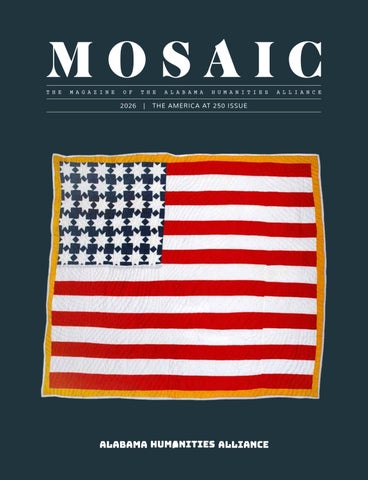
Flag Quilt by Mary Maxtion (American, 1924–2015), about 1996–1997, cotton and cotton/polyester blend. Courtesy of the Montgomery Museum of Fine Arts (MMFA), gift of Kempf Hogan in honor of Stewart and Susan Green, 2005.9.6. Flag Quilt was part of MMFA's America250 exhibition, "We the People ... " in the summer of 2026. Maxtion was a Black Belt quiltmaker whose work has been displayed in exhibitions and become part of museum collections across the country. She was born in Sumter County in 1924 and died in Boligee, in Greene County, in 2015. Above: Cloud Line Panorama, oil on gessoed paper, by Amy Feger.
MOSAIC: The Magazine of the Alabama Humanities Alliance | 2026 5
DISCOVER THE UNEXPECTED. Visit TROY’s International Arts Center Have you seen the world-renowned Chinese Terracotta Warriors? Uncover more than 200 life-sized replicas in a beautiful adjoining park, then explore the fascinating history of Xi’an, China, at Troy University’s Warriors Unearthed interpretive exhibit, where the remarkable story of the Terracotta Army and its discovery comes to life. Admission is free, and your visit includes access to the Nall Museum & Gallery, Huo Bao Zhu Gallery and Foyer Galleries, which showcase stunning exhibitions from regional and internationally acclaimed artists. Plan your visit to the International Arts Center and immerse yourself in history, culture and contemporary art. This interactive experience is designed for all ages. Hours of Operation Monday - Friday: 9 a.m. - 4 p.m. Saturday: 10 a.m. - 4 p.m. Sunday: 1 - 4 p.m. (Closed during the Summer Session)
r o y. e d u /Magazine i a c | 334-808-6412 A L LAlliance W AY S| 2026 REAL. 6 tMOSAIC: The of the Alabama Humanities
A LW AY S T R O Y.
Authors Caity Bell is an archivist who works with Landmarks of DeKalb County, among other groups statewide. She writes a profile of her fellow Fort Payne native, Randy Owen, in this issue. Donna Dahl & Andrea McCaskey are facilitators in AHA’s Healing History initiative. Together, their piece examines how we build bonds and cultivate hope. Kathryn H. Braund, Ph.D., is Hollifield Professor of Southern History Emerita at Auburn University. Her expertise lies in the intersection of Creek and early American history in the South, which she writes about in “Revolutionary Travelers through Creek Country.” Kate Campbell is an acclaimed singer-songwriter of the South. Here, she writes about fellow musician Will Kimbrough, a 2026 Alabama Humanities Fellow. Philip J. Carr, Ph.D., is an archaeologist specializing in the pre-history of the Southeast United States, and a professor at the University of South Alabama. He writes about “Alabamians, Americans, and American Indians” in our Americans exhibit guide. Anita Smith Hargett Flanagan, of Tuscumbia, is an enrolled member of the Eastern Band of Cherokee Indians and vice president of the Alabama chapter of the Trail of Tears Association. She writes the lead essay for our roundtable conversation on “The Future of the Florence Mound.” Wayne Flynt, Ph.D., is professor emeritus of history at Auburn University. In this issue, he profiles his longtime colleague, Kathryn Braund, Ph.D., who now joins him as an Alabama Humanities Fellow. Burgin Mathews is a writer, radio host, and founding director of Southern Music Research Center. For Mosaic, he writes a profile on funk and jazz legend, Fred Wesley.
Col. Alan Miller, J.D., is a retired colonel of the U.S. Marine Corps Reserve. He serves as CEO of American Village and is an AHA board member. His essay, “Colors,” explores patriotism, remembrance, and the daily work of citizenship. Allison Moorer is an award-winning musician, writer, and native of southern Alabama. In this issue, she writes a profile of musician Emmylou Harris, a 2026 Alabama Humanities Fellow. Anil A. Mujumdar, J.D., is assistant professor of law in residence at the University of Alabama Law School. For this issue, he examines the life and career of former Alabama Attorney General Bill Baxley, a 2026 Alabama Humanities Fellow. Callie Outlaw is a historian and educator who teaches in Tuscaloosa. For this issue, she writes about "Silent Heroes" and working alongside her students to uncover the lives of a pair of World War II heroes. Sam Calhoun is a Pushcart Prize-nominated poet, geoscientist, and nature photographer who lives in Elkmont. His poem in these pages, “At the Soldier’s Grave,” won the Expressions of Freedom state poetry contest, organized by the Alabama USA Semiquincentennial Commission. Brian Steele, Ph.D., is associate professor of history at UAB, specializing in early American intellectual and political history. His essay, “Between Promise and Fulfillment,” explores the evolving meaning of America’s Declaration of Independence. Jacqueline Allen Trimble, Ph.D., is poet laureate of Alabama and chair of Languages & Literature at Alabama State University. She contributes a profile of poet Ashley Jones, a 2026 Alabama Humanities Fellow.
Mosaic
Mosaic magazine is published annually by the Alabama Humanities Alliance. Editor: Phillip Jordan | Art Director: Liz Kleber Moye | Printing: Davis Direct Contributing artists: Jennifer Alasbrook-Turner, Carol Barksdale, Glen Barr, Heinrich Butler, Chad Edwards, Jonah Enfinger, Amy Feger, Augusto Ferrer-Dalmau, Beau Gustafson, Tabitha Markovich, Sena Nane, Callie Outlaw, Liz Ryan, Abraham Rowe, Bob Russo, Kat Villacorta, Willie Williamson. Contributing writers/editors: Laura Anderson, Caity Bell, LaDonna Brown, Isaac Cohen, Sarah Coleman, Brian Murphy, Adriana Peeples.
MOSAIC: The Magazine of the Alabama Humanities Alliance | 2026 7
1
2
AMERICA AT 250: AHA MOMENTS IN ALABAMA Throughout America’s Semiquincentennial, we’re helping Alabamians reflect on America’s founding principles and ideals, and inviting community conversations on our connections today. So far this year, AHA has brought a pair of Smithsonian traveling exhibits to the state, put on a special Alabama History Day state contest at American Village, offered 250-themed Road Scholar talks, and planned a Healing History convening to help bridge our past, present, and future. And all that doesn’t even include our grant offerings. This year, we’ve prioritized funding programs that examine our founding history and consider Americans’ collective efforts to make real the aspirations embedded in our Declaration of Independence. “Our AHA grant was instrumental in making our America’s 250th series possible here,” says Bathsheba Johnson, education specialist at Alabama Constitution Hall Park. “What pleased me most about the series was the meaningful conversation it sparked across our community. People of all ages and backgrounds came together to reflect on history and engage in thoughtful discussions about the people, events, and ideals that shaped our nation.”
Scenes from: (1) America at 250 Lunch ‘n Learn series, a grantee project with Hartselle Historical Society; (2) Many Voices, One Nation Smithsonian exhibit opening; (3) Alabama Authors Day at Historic Oakleigh House Museum in Mobile; (4) America’s 250th series at Huntsville’s Alabama Constitution Hall Park; (5) Threads of Memory, a year of art, history, and heritage, a grantee project with the Montgomery County Historical Society; (6) Alabama History Day state contest at Montevallo’s American Village; (7) Isaac Livingston, of Huntsville's Westminster Christian Academy, Alabama's Outstanding Affiliate Winner at National History Day for his project on "Yellowstone: A Wilderness Revolution"; (8) speakers panel at an America's 250th grantee program at Alabama Constitution Hall Park; (9) Americans, a Smithsonian traveling exhibit touring Alabama; (10) Florence Mound symposium, a grantee project with Auburn University; (11) Freedom School workshop in Elba, a grantee project with Higher Ground Society; (12) Local Museum Workshop, presented by AHA and partners, at Bevill State Community College in Jasper; (13) Road Scholar Mike Bunn delivers a talk on “The Forgotten Story of the Gulf South During the Revolutionary Era,” at Pelham Public Library; (14-15) at the Many Voices, One Nation exhibit openings in St. Stephens and Ozark; (16) Juneteenth Emancipation Proclamation at Mansion Blue, Huntsville.
8 MOSAIC: The Magazine of the Alabama Humanities Alliance | 2026 3
4
5
6
7
8
9
10
11 13
12
14
15
16
Humanities Highlights For all the latest AHA news, visit alabamahumanities.org/newsroom.
Alabama Humanities Honors: 2026 The Alabama
We’re back…
Colloquium
In 2025, AHA had to call off the Alabama Colloquium for only the second time in the event’s history, dating back to 1989. (You can blame the pandemic for the other interruption; we do.) The Colloquium is an annual affair honoring Alabamians who use the humanities to make our state (and world) a smarter, kinder, more vibrant place to live. AHA had to suspend the event last year after a DOGE-fueled cancellation of federal funding for all state humanities councils nationwide, including Alabama Humanities. Joyce Cauthen, 2026 Greenhaw Service to the Humanities Awardee.
This year, we’re making up for lost time: The 2026 edition of the Alabama Colloquium is a two-parter, honoring a larger slate of Alabamians given last year’s cancellation and this year’s Semiquincentennial. We're grateful for the support of our presenting sponsor, Blue Cross and Blue Shield of Alabama. On October 12, AHA presents “Considering America at 250,” a luncheon at American Village that highlights our honorees’ efforts to document, examine, and make real the promise embedded in America’s founding principles. Here, AHA will name three new Alabama Humanities Fellows, bestowing the highest humanities honor in the state upon attorney Bill Baxley, J.D., historian Kathryn Braund, Ph.D., and poet Ashley M. Jones. We will also honor the Alabama USA Semiquincentennial Commission with the AHA Champion of the Humanities Award, recognizing the Commission’s leadership in Alabama’s 250th commemorations. The Commission granted $675,000 to hundreds of municipalities, county commissions, and nonprofits — making America at 250 celebrations possible across all 67 counties. The 2026 Wayne and Sally Greenhaw Service to the Humanities Award will go to Joyce Cauthen. Cauthen served as founding director of the Alabama Folklife Association and is a renowned expert on folk music
traditions in Alabama. She has authored multiple books and is a founding member of AHA’s Road Scholars Speakers Bureau, presenting talks in communities across the state for nearly four decades. On October 19, AHA presents “A Celebration of Alabama Music,” a public event at the Lyric Theatre, celebrating the impact of Alabama music on American culture. Each honoree will share stories, and a selection of songs, from their careers. During the evening, AHA will name four musicians as Alabama Humanities Fellows: Emmylou Harris, 14-time Grammy winner and an iconic figure in the history of folk/Americana music; Will Kimbrough, acclaimed musician and songwriter, as well as a leader in the veterans initiative SongwritingWith:Soldiers; Randy Owen, legendary country musician who has spread Southern storytelling worldwide through the band ALABAMA; and Fred Wesley, renowned jazz and funk musician and educator, who was James Brown’s bandleader and lead trombonist with Parliament-Funkadelic.
Read full profiles on this year’s Fellows later in this issue, and learn more about the Alabama Colloquium at alabamahumanities.org/honors.
10 MOSAIC: The Magazine of the Alabama Humanities Alliance | 2026
Humanities Highlights
Alabama History Day at American Village On April 9, 2026, a new kind of history came to Montevallo’s American Village — made by students who came to present their own historical research at a special “America at 250” edition of AHA’s Alabama History Day state contest. These middle school and high school students came from Magnolia Springs and Mount Vernon, Athens and Madison, and from Auburn, Tuscaloosa, and many points in between. And they came prepared. Throughout the 2025-2026 school year, History Day participants chose their own topics — based on the year’s theme of Revolution, Reaction, Reform in History — and conducted primary research to shape new historical arguments. Students then transformed from historians into artists, filmmakers, actors, writers, and web designers, as they creatively shared their research. “That’s such a great part of this process,” says Ginger Golson, a history teacher at Fairhope High School. “Students like to be able to choose the things that they want to do and the way that they want to do it. And when they’re interested in what they’re studying, they’re more engaged and they produce better work. It gets them engaged in learning on their terms.”
For 2027, students will work with a theme of Innovation in History: Impact, Influence, Change. Schools are encouraged to host their own Alabama History Day contests and AHA helps teachers incorporate History Day directly into the classroom as a dynamic projectlearning tool. Walter D. Ward, Ph.D., is a professor and chair of History at UAB. At Alabama History Day, he served as both a judge and as a sponsor presenting UAB’s Civil Rights History Award. “Alabama History Day is such a positive experience for students,” Ward says. "Students don't get many opportunities to be experts. But on Alabama History Day, they were the experts and I was the student. Experiences like these give students confidence that they can do research and communicate what they learned. These are exactly the kinds of skills that will benefit them no matter what career they eventually seek.”
Learn more about the 2027 competition at alabamahumanities.org/alabama-history-day.
Left: Alabama History Day students present to AHD judge, Andrew S. Baer, Ph.D., assistant professor of history at UAB. Right: A pair of AHD state winners. Photos: Glen Barr
MOSAIC: The Magazine of the Alabama Humanities Alliance | 2026 11
Humanities Highlights
SPARK-ing conversations
Healing History convening
Host partners at the 2025 opening of SPARK! in Sylacauga.
At the 2025 Healing History convening in Montevallo.
In 2025-2026, AHA brought another Smithsonian traveling exhibit to the state, SPARK! Places of Innovation. More than 5,000 Alabamians engaged with local programming that accompanied the exhibit’s stops in Sylacauga, Dothan, Brewton, Uniontown, Athens, and Fort Payne. Innovate Alabama served as presenting sponsor of the tour.
On November 9, 2026, AHA will host its second annual Healing History: An Alabama Convening. The gathering caps AHA’s America at 250 programming as we move from past to future. The convening offers a day of imagination and inspiration — exploring how we can examine our past to bridge divisions today.
The exhibit’s theme sparked conversations about how innovative ideas, past and present, continue to shape Alabama’s towns and cities. In Sylacauga, for instance, SPARK! opened at the Isabel Anderson Comer Museum and Arts Center. During the exhibit’s time in town, more than 700 residents visited the museum; just 78 had done so during the same time the year before. Comer Museum visitors also learned about an innovative transformation happening in real time in their own town — the birth of EARTH (East Alabama Rural Training Center), an ambitious economic redevelopment project taking place on the grounds of the former Avondale Mills site that was once central to the Marble City’s identity and economy. “I cannot tell you how many people enjoyed the exhibit and started talking about the growth and innovation of rural towns,” says Judy Greer, director of the Comer Museum. “All these partnerships with EARTH and the Smithsonian and Alabama Humanities really got a lot of ideas flowing. Sylacauga surely has more to come and I can’t wait to see what’s in our future.” Read more in this issue on AHA’s current Smithsonian exhibits in state: Many Voices, One Nation and Americans.
Last year’s participants represented groups engaged in oral history projects; genealogy efforts among black and white descendants of former plantations; philanthropic community programs; explorations of indigenous, rural, holocaust, and Confederate histories; and much more. “Our goal is to bring folks together who are doing similar history-based work, but who might not be aware of others’ efforts in different parts of the state,” says Laura Anderson, AHA’s director of partnerships and outcomes. Last year, Edwin C. Bridges, Ph.D., director emeritus of the Alabama Department of Archives and History, closed his talk this way: “No one alive today is responsible for all these challenges we face from our history. But we are all responsible for what we can do today to make Alabama a better place. We have to be willing to talk with each other, learn from each other, and work together to overcome these barriers from the past that have pitted us against each other.” This year’s Convening takes place in downtown Birmingham’s Innovation Depot. Learn more at alabamahumanities.org/healing-history.
12 MOSAIC: The Magazine of the Alabama Humanities Alliance | 2026
Humanities Highlights
Upcoming Events September-October 2026 Legacy of our Founding Documents
October 12, 2026 Alabama Colloquium I: Considering America at 250
September 14, 2026 Americans: A Conversation
October 19, 2026 Alabama Colloquium II: Celebration of Alabama Music
Grantee program exploring how America’s founding documents continue to shape our shared institutions, national identity, religious freedom, and more. Osher Lifelong Learning Institute, Auburn.
Opening program for AHA’s premiere of Americans, a Smithsonian traveling exhibit that will visit Atmore, Wetumpka, Florence, Scottsboro, and Foley through June 2027. Encore at the Strand, Atmore.
Evening program, in song and in conversation, honoring musicians Emmylou Harris, Will Kimbrough, Randy Owen, and Fred Wesley. Lyric Theatre, Birmingham. November 9, 2026 Healing History: An Alabama Convening
September 16, 2026 In Solidarity: A Teacher Workshop
Grantee program for educators, led by Temple Beth-El, at the There is a Balm in Gilead: National Healing and Reconciliation Conference. Wynfrey Hotel, Hoover. September 27, 2026 Music on the Mountain
Luncheon honoring attorney Bill Baxley, historian Kathryn Braund, poet Ashley Jones, folklorist Joyce Cauthen, and the Alabama USA Semiquincentennial Commission. American Village, Montevallo.
Grantee program featuring music and living history vignettes that explore the musical traditions of rural Alabama. Burritt on the Mountain, Huntsville.
A day of inspiration and imagination, examining our shared past. Innovation Depot, Birmingham. Through 2027 Many Voices, One Nation
Locally curated Smithsonian exhibit touring Dale and Washington counties. In partnership with the Dale County Council of the Arts and Humanities and the Washington County Museum.
Meet AHA’s new board members Nick Lawkis, of Mobile, serves as vice president of government relations for the University of South Alabama, his two-time alma mater. Lawkis covers all aspects of local, state, and federal relations, including for the university's health system, USA Health. His wife Kim is chief operating officer of Feeding Alabama; together, some of their favorite family excursions around Mobile are the USS Alabama and Fort Gaines on Dauphin Island. “I love how alive those experiences become for our kids,” Lawkis says.
Barney Lovelace is a Brewton native and Decatur resident. He is senior partner at Harris, Caddell & Shanks, P.C., the oldest law firm in Decatur, and is a past president of the Morgan County Bar Association. He and his wife Noel are longtime supporters of the arts and humanities in Decatur. “I’m excited to join AHA’s board because I believe stories matter,” Lovelace says. “They’re how we know where we come from and how we figure out where we’re headed. Like the land and traditions we pass down, our history and culture need care if they’re going to last.”
MOSAIC: The Magazine of the Alabama Humanities Alliance | 2026 13
Advocating for healthier, happier communities. Blue Cross and Blue Shield of Alabama proudly supports organizations that make a meaningful impact in cities and towns across the state, helping all Alabamians live healthier, happier lives. It’s part of our commitment to making sure you always feel confident in your coverage and care. Learn more about how we can help Alabamians feel their best at AlabamaBlue.com/Happy
Meet our 2026 Alabama Humanities Fellows To say we are proud of the profiles that appear on the following pages would be a profound understatement. These essays are penned by an array of brilliant artists, historians, and scholars who know our 2026 Fellows well. Here, you’ll find: Law professor Anil A. Mujumdar, considering Bill Baxley’s courageous prosecution of Ku Klux Klan elements in Alabama; famed historian Wayne Flynt on his former Auburn colleague, Kathryn Braund, and her ability to shine a light on early America’s forgotten history; musician Allison Moorer on Emmylou Harris, steward of American music, equal parts “enthusiastic archivist and discerning creator”; Alabama Poet Laureate Jacqueline Allen Trimble on her predecessor, Ashley M. Jones, who “navigates the terrain of humanity with trepidation and hope”; Kate Campbell on fellow musician Will Kimbrough’s gift for finding the “delicate tension between beauty and brokenness, grace and grit, mystery and mischief”; archivist Caity Bell on her fellow Fort Payne native, Randy Owen, and the lifelong relationship between artist and the cherished land he still calls home; and music historian Burgin Mathews on the brilliance of Fred Wesley, who knows what it means to bring the joy, and the funk, to all who will hear. AHA’s 2026 Alabama Humanities Fellows will be honored at a two-part Alabama Colloquium series in the fall of 2026. Learn more on page 10 in this issue and at alabamahumanities.org/honors.
Photo: Liz Ryan
Bill Baxley | 2026 Alabama Humanities Fellow
LIBERTY AND JUSTICE FOR ALL By Anil A. Mujumdar Crafting a tribute to William Joseph “Bill” Baxley II — including his tenure as Alabama attorney general and his voluminous professional achievements over sixtysix years of law practice — in this compressed space feels almost Sisyphean. But despite its comparable difficulty, unlike pushing a boulder up a hill, my task is a meaningful, and happy, one. That’s because Bill Baxley’s life has much to commend. We’ll start with some of the better-known facts. Yes, he is proud of his Houston County roots and served his home county as its district attorney in his mid-twenties.
He won his party’s nomination for attorney general at age twenty-eight, and he was the youngest person in American history to serve as a state’s attorney general at the time of his election. He later represented Alabama as its lieutenant governor and became a member of the highly selective International Academy of Trial Lawyers. Baxley is also a veteran. He proudly served his country on active duty in the Air Force, Air National Guard, and then as a commissioned officer in the Judge Advocate General (JAG) Corps in the Army National Guard; he retired as a colonel after more than 30 years of service.
16 MOSAIC: The Magazine of the Alabama Humanities Alliance | 2026
Of course, Baxley’s most notable contribution in Alabama is surely his successful prosecution of Robert “Dynamite Bob” Chambliss for Chambliss’ role in the murder of four children (Denise McNair, Addie Mae Collins, Carole Robertson, and Cynthia Morris Wesley) attending a worship service at the 16th Baptist Church in Birmingham on the morning of September 15, 1963. The case fundamentally changed things in Alabama, as Chambliss was the first Alabamian associated with the Ku Klux Klan to be prosecuted by the state, and convicted, for the murder of black Alabamians. Also of great consequence, Baxley was the first attorney general to hire black lawyers to serve in the state’s Office of the Attorney General, including the likes of judges Myron H. Thompson, Vanzetta Penn McPherson, and Charles Price. Beyond the whats that demonstrate Mr. Baxley’s impact on our state, it’s also well worth exploring who Bill Baxley is. If you’ve ever encountered Bill Baxley at one of the innumerable events for which he is the keynote speaker, you could easily mistake him for an attendee rather than the guest of honor. At 85, Baxley still travels extensively to speak to audiences both large and small about a range of topics: the 16th Street Baptist Church Bombing, trial skills, civil rights history, wrongful convictions, and civic leadership (among other areas). Before an event starts, you are more likely to find him offstage — mingling among the people, greeting old friends, and making new ones — rather than onstage with other luminaries. He travels sans entourage and is somehow always on time but never in a hurry, sincerely engaging with anyone who wants to talk as he enters a room. His memory is as long as it is sharp. In small, private settings, whether he is mentoring young lawyers or encouraging civic engagement and public service, he is just as absorbing. It doesn’t matter if he’s on stage in a large auditorium addressing thousands of spectators or sitting at a small table visiting with one or two or people, he is the exactly the same — that is, himself, always interested in learning about other topics and other people. Bill Baxley epitomizes what a career invested in civics and jurisprudence looks like. When asked about the first thing he did after taking office as Alabama’s attorney general at age 29, he said: “[T]he night before I got sworn in, they had issued us a certificate of election and a badge and other credentials, including…a little card that had all the major cities in Alabama…and it had a phone number for each city. “I knew that I would be using that little card very
“[Baxley’s] act is a manifestation of an idea birthed with Cicero and advanced through the Renaissance, one of moral duty, a pillar of studia humanitatis. Simply put, it’s having the courage to do the right thing because it’s the right thing to do." frequently. So, I sat down and, in each corner of that little card, I wrote one of those little girls’ names that had been killed in the church bombing back in ’63. And that was one of the things I was determined I was going to try to solve. And so I wanted to be reminded every time I used that card that I wanted to try to, if I could, solve and prosecute the people that were responsible for killing those little girls.” This act is a manifestation of an idea birthed with Cicero and advanced through the Renaissance, one of moral duty, a pillar of studia humanitatis. Simply put, it’s having the courage to do the right thing because it’s the right thing to do. Today, we continue to benefit from Bill Baxley’s living legacy of service to others. And, whether we acknowledge it or not, we all owe a debt to him — as Americans and as Alabamians — for infusing true meaning, from aspirational to realized, into our shared pledge of “liberty and justice for all.” Anil A. Mujumdar is assistant professor of law in residence, and assistant dean for leadership and professional identity, at the University of Alabama School of Law. In addition to many other roles within and beyond the university, he teaches Anti Human Trafficking.
MOSAIC: The Magazine of the Alabama Humanities Alliance | 2026 17
Photo: Jonah Enfinger
Kathryn Braund | 2026 Alabama Humanities Fellow
TURNING ON THE LIGHT
By Wayne Flynt, Ph.D.
The further back into history we go, the dimmer the light is. That is one reason why most historians prefer more recent times, where memory is sharper and primary sources more numerous. Kathryn Braund chose the harder way with great success. Kathryn Braund was one of my favorite Auburn University historians. As anyone familiar with university
culture already knows, preening and posturing is just part of the academic game. It is amazing how many "scholars" spent more time weaving other scholars’ research into a "new paradigm of worldwide importance” than in the trenches digging for hard and fast evidence of something wholly strange and remarkable that no one else had noticed.
18 MOSAIC: The Magazine of the Alabama Humanities Alliance | 2026
As chair of Auburn’s History Department, I valued those new insights that moved history in directions not often explored. And that is where my friendship with Kathryn began. First, she was mapping an important part of American history that preceded "American history." How could that be? There was an America before Americans arrived? Yes! Though you wouldn’t have known it from the lack of strong scholarship at the time on the indigenous people of this very land. As our only such scholar at the time, I noticed that some senior faculty diminished the topic. But Kathryn waded right in, ignoring some of the senior “Americanists.” She was mature enough to ignore those who thought her work not “important enough,” or not focused on the “right subjects.” And she won them over with hard work, voluminous research, fascinating historical storytelling, innovative analysis, and a kind and sweet spirit. In the end, she became one of Alabama’s — indeed, the South’s — finest and most respected scholars of early America. And she taught Auburn’s History Department far more than the department taught her. Throughout her career, Kathryn has remained one of those rare academics whose humility is as large as her accomplishments. And that is saying something when you consider how sterling those accomplishments are, by any measure. Kathryn became the Hollifield Professor of Southern History at Auburn University, and has authored or edited some of the most important and accessible books on Creek-settler history in our region. Those works include Deerskins and Duffels: The Creek Indian Trade with Anglo-America, 1685-1815; The Attention of a Traveller: Essays on William Bartram’s Travels and Legacy; Tohopeka: Rethinking the Creek War and the War of 1812; and The Old Federal Road in Alabama: An Illustrated Guide. One of the most fascinating projects she’s authored is Mapping Conquest: The Battle Maps of Horseshoe Bend. In it, Kathryn analyzes a collection of a dozen hand-drawn battlefield maps created by soldiers in the aftermath of, arguably, the most consequential battle ever fought within Alabama’s borders. Brilliantly, the book doesn’t exist to evaluate war strategy; it exists to highlight the human response to war and examine how these conflicts — right down to the battle maps — shape our collective memory. Of course, I have long been impressed not only by the range and excellence of Kathryn’s scholarship but also by the human qualities she exhibits. Chiefly, her respect for others and her willingness to go out of her way to
“In the end, Kathryn became one of Alabama’s — indeed, the South’s — finest and most respected scholars of early America. And she taught Auburn’s History Department far more than the department taught her." help any student or colleague who was floundering and in need of guidance. The word “colleague” meant something to me that it did not always mean to others in academia. After all, we must "watch out for ourselves," or so many academics think for the sake of tenure, publication, and other feathers in our caps. Not Kathryn! She always had time for her students and for struggling faculty. She had a kind of moral grounding that pulled her outside herself. Speaking of outside herself, she also always sought to push her discoveries far beyond the halls of academia — to make her fascinating findings available and accessible to all. She is a frequent public speaker who continues to bring this history to life for anyone wise enough to listen. Yes, Kathryn knew what was required of her in terms of academics and administrators. But her sense of deepest responsibility has always been to her students, of all stripes. And her work ethic remains a model to every young (and old!) aspiring historian and lifelong learner — here at Auburn and far beyond.
Wayne Flynt, Ph.D., is professor emeritus of history and retired chair of history at Auburn University. He has also been a partner scholar with Alabama Humanities since its beginnings in 1974, including as founding editor of AHA’s Encyclopedia of Alabama.
MOSAIC: The Magazine of the Alabama Humanities Alliance | 2026 19
Photo: Kat Villacorta
Emmylou Harris | 2026 Alabama Humanities Fellow
By Allison Moorer
STEWARD OF SONGS
Mention the name Emmylou Harris in a room full of music lovers and faces instantly light up. Even before she sings a note, there is a collective reverence for her voice — a perfect mixture of tingling crystal and burning kerosene — and her prowess as an unrivaled sonic storyteller. To view Emmylou Harris through a humanities lens is to understand that singing is one of the ultimate human artifacts, an emotional primary text of its time and culture, and that albums are historical documents rather
than static statements. Never content to be categorized, Harris’ art, whether as a recording artist or live performer, is led by her gossamer soprano, her primary vehicle for exploring the fluid, liminal spaces between genres. And that’s on purpose: in 2013 she told The New York Times, “You must do things to try to jolt yourself.” Those jolts and their results are widely heralded. Even when mining old-time, traditional material, she brings an avant-garde spirit with her and opens doors few other artists knock on. Rooted in the “Cosmic
20 MOSAIC: The Magazine of the Alabama Humanities Alliance | 2026
American Music” she helped pioneer, her catalog is a big enough tent to draw in cowboys, hippies, folkies, and academics alike. When she covered both The Beatles’ “For No One” and Merle Haggard’s “Tonight the Bottle Let Me Down,” on Pieces of the Sky, her second studio album, she didn’t just sing the songs, she uncovered their shared DNA and made it sound like the most obvious thing in the world. As a vocalist, Harris translates complex psychological and emotional states into common conditions by turning her glorious instrument into a tool for empathy, shared narrative, and a multitude of perspectives. From her own “My Name is Emmett Till” to any number of classic, broken-hearted ballads, her voice is hypnotic; almost paralyzing in its ability to be earthy and ethereal all at once and still convey more in an utterance than most can in a verse. Her stewardship of songs is renowned; Harris is both an enthusiastic archivist and a discerning creator. She unearths ancient folk tunes and gives them timeless context just as easily as she champions uncompromising songwriters who write from the shadowland of the literary and the poetic. After 1995’s experimental and brilliant Wrecking Ball, she stepped away from interpreting and turned to her own pen, revealing a mature and restrained literary voice and yet another artistic rebirth. Harris wrote or co-wrote all but one song on the 2000 album Red Dirt Girl and followed suit on the subsequent Stumble into Grace and Hard Bargain, three albums on which she sails over the bar for songwriting she had long set. In one of my favorites of her compositions, the masterwork title track “Red Dirt Girl,” she tracks the tragic arc of her childhood friend Lillian from her Alabama girlhood to her Mississippi death in five verses that deftly explore what it means to be stuck, and what it means to be free. As the Alabamian’s Southern Gothic statement, it is a piercing commentary on lost potential in the American South. Her restraint makes her the ultimate collaborator — a formidable foil who builds community through her harmony singing. At her core, she’s part of the band. From her foundational, heartbreaking work with Gram Parsons, to her poignant duets with Don Williams, Herb Petersen, Buddy Miller, and a scroll of others, to the triumphant Trio albums and appearances on countless records, her voice ties together seemingly far-flung elements. She is as at home on a Mark Knopfler record as she is singing mountain music with Ralph Stanley or experimental indie rock with Conor Oberst.
“For over five decades, Harris has connected the dots between country and rock, bluegrass and folk, and between the preservation and evolution of roots music. Even when mining old-time, traditional material, she brings an avantgarde spirit with her and opens doors few other artists knock on." When Harris sings on a record, she elevates it beyond the sum of its parts. Her voice can wrap itself around almost anyone’s. It’s a skill, yes, but it’s also born of deep listening and a sense of artistic service. “You do whatever you can do to make the song work, because it’s not about showing off your voice. It’s about the song. It’s always about the song,” she says. As one of the primary architects of contemporary folk music, Harris remains a musical curator with deeply refined taste — in songs, in musicians, and in artistic choices. She offers a living masterclass in how to gracefully synthesize and evolve American roots music by approaching the past in as fresh a manner as she does the present. Allison Moorer is a renowned singer-songwriter who has been nominated for both a Grammy and an Academy Award. She was born in Mobile, raised in South Alabama, and today serves as a writer-editor for the Country Music Hall of Fame and Museum.
MOSAIC: The Magazine of the Alabama Humanities Alliance | 2026 21
Photo: Jennifer Alasbrook-Turner/ BANG Images
Ashley Jones | 2026 Alabama Humanities Fellow
A WOMAN OF TRUTH
By Jacqueline Allen Trimble
Ashley Jones follows the mantra of many an ancestor — if you do not see yourself reflected in the world, create the world that reflects you. That’s why, in 2018, she founded the Magic City Poetry Festival, a multigenerational, multi-venue series of literary/poetryfocused events held around Birmingham and designed to celebrate a breadth of poetic voices during the month of April. Year after year, the festival brings together
people from a wide swath of demographics to discuss, celebrate, and highlight the enduring power of words. While Jones was creating and nurturing this legacy institution, she never stopped working, reading, editing, teaching and writing, producing four books of poetry, one anthology, scores of essays and interviews, and a critical volume on black women poets.
22 MOSAIC: The Magazine of the Alabama Humanities Alliance | 2026
The word genius gets bandied about indiscriminately these days, but there is no other way to describe the Renaissance woman who is Ashley Jones. She is a visionary poet, writing about the good, the bad, and the ugly of Alabama and Southern environs with grace, clarity, and a nuanced understanding rarely seen. Her work is a masterclass in poetic craft, meticulous in its use of language and image, and she is an old soul with the vision of a wise woman who sees the extraordinary in everyday objects. Always, her poetry is a tangle of complications rooted in a Southern sensibility as lush as kudzu winding its way along road embankments. Unlike kudzu, however, Jones is native to this soil, laying claim to her various identities which are sometimes at war with expectations of what it means to be a Southerner. Though her love for Alabama is apparent, she never allows us to forget that we must always question the thing that we love. Unapologetically black, female, and intellectual, she magnifies the South both because of its history and despite it, calling out the region’s problematizing past at the same time she celebrates its beauty, its people, and its possibilities. In “All Y’all Really from Alabama,” she writes, this here the cradle of this here nation—everywhere you look, roots run right back south. every vein filled with red dirt, blood, cotton. Born and raised in Birmingham, and the product of the Alabama School of Fine Arts, she became the youngest and first person of color to be named poet laureate of the state of Alabama. No one was surprised. Her poetry unabashedly explores her vulnerabilities and self-doubts as she lays bare, as only a daughter of the South could, the preoccupations of our time, deploying history and her arsenal of poetic gifts as weapons and shields against the onslaught of despair. Even her most recent collection, Lullaby for the Grieving, inspired in large measure by the death of her father, moves beyond a personal meditation on grief to consider the world writ large with insight and hope. In the title poem, she writes, the slip of a rain-glazed rock against my searching feet. small steps, like prayers— each one a hope exhaled into the trees. please, let me enter. please, let me leave whole.
“This is what Jones does repeatedly: navigates the terrain of humanity with trepidation, but also prayer." Written near the Sipsey River, the poem aligns wilderness with uncertainty, and the speaker takes small steps down slick rocks, tentative in this unknown territory of despair. This is what Jones does repeatedly: navigates the terrain of humanity with trepidation, but also prayer. Though the path is slippery and the possibility of disaster ever present, there is always the hope of wholeness. We readers are pulled along as well, feeling our way through each poem, each word negotiating life’s perplexing moments with our poet guide helping us reach the angels, which in this case may be “the crown of light / atop the leaves.” Ashley Jones’ work is never simple, but always accessible. Perhaps this reflects her work as a teacher. After earning her MFA from the University of Alabama at Birmingham, she returned to the Alabama School of Fine Arts to teach creative writing and later returned to UAB to teach in the same honors program in which she was once a student. Even as she continues her own education as a Ph.D. candidate at Old Dominion, she persists in teaching us something — about history, the nature of loss, the nature of love, about how to love ourselves. That love for oneself is a form of resistance, too, as is all of Jones’ poetry. Resistance to erasure, to annihilation, to someone else telling her history. Jones is a truth teller. And the best part — with all she has done, all the awards she has won, all her accomplishments — she is just getting started. Alabama has been made more beautiful by her presence.
Jacqueline Allen Trimble, Ph.D., is poet laureate of Alabama (2026-2029). Among many other honors, she has won the Balcones Poetry Prize and a National Endowment for the Arts Creative Writing Fellowship. She lives in Montgomery, where she is professor of English at Alabama State University.
MOSAIC: The Magazine of the Alabama Humanities Alliance | 2026 23
Photo: Chad Edwards
Will Kimbrough | 2026 Alabama Humanities Fellow
FROM A PIECE OF WORK TO A WORK OF PEACE By Kate Campbell I first met Will Kimbrough in 2003, when I recorded Twang on a Wire, an album of country songs first made famous by women artists of the 1960s and 1970s. My friend in England, John Graveling, had suggested a stellar group of session players for the project: Jeff Finlin on drums, Kevin Gordon and Pat Buchanan on guitars, Dave Jacques on bass, and Will Kimbrough — who seemed able to bring the right sound to almost anything he touched. On that record, Will added guitar, dobro, mandolin, piano, accordion, Wurlitzer, banjo, and backing vocals. He also joined me for a duet on
Emmylou Harris’ “Boulder to Birmingham,” a fitting choice since Will is also from Alabama. After Twang on a Wire, Will became far more than a gifted player on one of my records. He became a friend, colleague, songwriting partner, and the producer of four of my albums. His role in shaping The Portable Kate Campbell was so central that I put his name on the front cover — a small acknowledgment of the depth of his influence and the trust I had come to place in his musical judgment.
24 MOSAIC: The Magazine of the Alabama Humanities Alliance | 2026
In one of his songs later recorded by Jimmy Buffett, Will unabashedly declares, “I’m a piece of work.” The phrase, borrowed from Shakespeare’s Hamlet, began as a meditation on the wonder and complexity of human creation, long before it became a modern idiom for someone difficult or exasperating. In Will’s case, the older meaning feels especially true. His songs are full of that delicate tension between beauty and brokenness, grace and grit, mystery and mischief. He writes as someone who understands that human beings are rarely one thing at a time. Whether he is writing about the futility and tragedy of war or composing songs alongside veterans, Will does not turn away from what James Carr once called “the dark end of the street.” He is willing to stand in the hard places — where grief, memory, and moral uncertainty gather — and listen long enough for a song to emerge. Yet his music never settles for despair. Again and again, he reminds us that “there is good in this world we can see,” if only we open our eyes and our hearts to it. As I reflect on our years of friendship and songwriting, two songs in particular come to mind. The first is “Alabama Department of Corrections Meditation Blues,” inspired by inmates who discovered peace through the practice of meditation. Being an Alabamian himself, Will knew the phrase “Alabama, here we rest” — a familiar translation of the state’s historical motto, rooted in a Choctaw expression. That understanding helped shape the song’s closing lines: Alabama, here we rest, Live in light and peacefulness. The second song grew from a few spare lines by Emily Dickinson: It’s all I have to bring today— This, and my heart beside—
Peace be still, Lord, come what may In this I will abide Rock of Ages, help me please Shine a little light
That is what Will Kimbrough does. Through his life and art, he shines a little light. From the Alabama coast to the quiet beauty of Chimayó, just beyond Santa Fe, to the rolling hills of Tennessee and every road in between, Will gives voice to the deep longing for peace we carry in our hearts, even amid struggle. His songs embrace both the wound and the blessing, the frailty of the human condition and the hope that endures beyond it. In doing so, he has become more than a piece of work. He has become a work of peace. And like a prayerful benediction, his music sends us onward with a simple, luminous wish:
Will was raised in Mobile in a home filled with books and literary conversation, especially the works of Southern writers whose cadences and storytelling traditions helped shape his own narrative songwriting. I knew he would be the ideal collaborator for a song that began with Dickinson’s spare offering of the heart: Together, we allowed her words to open into a meditation for peace:
“His songs are full of that delicate tension between beauty and brokenness, grace and grit, mystery and mischief. He writes as someone who understands that human beings are rarely one thing at a time."
“Peace come to all who hear.”
Kate Campbell is an acclaimed singer-songwriter known for mixing Southern history, culture, faith, and humor. Born in New Orleans, raised in the Mississippi Delta and Nashville, and daughter of a Baptist preacher, she has spent plenty of time in Alabama, recording albums at FAME Studios in Muscle Shoals and earning degrees from Samford University and Auburn University.
MOSAIC: The Magazine of the Alabama Humanities Alliance | 2026 25
Photo: Alyssa Cash/Jacksonville State University
Randy Owen | 2026 Alabama Humanities Fellow
AND FROM FORT PAYNE, ALABAMA... By Caity Bell “Where are you from?” A question I’d become quite familiar with in my first semester away, and one I initially answered expecting very little in response. I had entered college thinking that Fort Payne was a small town of, seemingly, very little note. “Wait, Fort Payne, Alabama? Where the band is from?” That was the first time someone I’d met had recognized my hometown but, as I’d come to learn over the years, it wouldn’t be the last. (Most recently, while on a trip, I had answered that same question only to have a random passerby begin to sing the last lines of “Christmas in
Dixie.”) Fort Payne, though a small city, is far from being one of very little note. As an archivist, I can tell you there have been several things that have put our town on the map throughout its history. But there is no doubt that our present place on the map of memory is due to the band ALABAMA and, especially, its lead vocalist and songwriter, Randy Owen. You can easily spot the bronze statues at City Park or spy the band’s handprints framed outside the DeKalb Theatre, but the true impressions, those that extend from a person’s actions like dominoes falling into the lives of others, aren’t as easily seen.
26 MOSAIC: The Magazine of the Alabama Humanities Alliance | 2026
“Folks know, if they’re fallin’ on hard times, they can fall back on, those of us raised up down home...” -“Down Home,” ALABAMA, Pass It On Down
As the face of one of the most well-known groups in country music history, Randy Owen could have easily left Fort Payne for greener pastures once the band finally took off in 1980 (after a slow start in 1973 as Wild Country before finding their footing as ALABAMA). While that would have been a predictable road to take, Owen instead chose a different route. This path, tied to his roots, found a “little dot on the state road map” sharing its stories with a wider world. Growing up here, I always felt that the music of the mountains was really just stories. Conversations, accompanied by instruments, that spanned generations, bearing within them an invitation to share in another’s life. Perhaps the popularity of Owen’s music comes from this sense of invitation that his songwriting offers to his audience. Owen’s lyrics invite you into the slice of life that a small rural town has to offer — a life woven by an elder’s wisdom, a neighbor’s helping hand, hard work and long days, and the inescapable connection to the earth beneath your feet. Yet you do not have to be from Fort Payne, Alabama, to connect with this music. This music, I believe, is a conversation, and it is one that invites us to reflect on the sense of community that these lyrics stir within us, wherever our homes may be found, and the ways in which we may contribute to them. As Owen stated in an interview with The Boot, in 2012, “as long as God lets me live, I want to do things that make a difference in the world besides play music.” Looking back, there can be little doubt that he’s done just that. His other contributions to his home state are, arguably, as extensive as his musical one. Back home, he has served on the board of trustees for Landmarks of DeKalb County, helping to preserve the history of the area he calls home. And those famed June Jams could have happened anywhere, but Owen and the band chose to hold them in Fort Payne, where the community could benefit from their success (and, when Fort Payne was no longer the “Sock Capital of the World,” it would be this that kept us on the map). He’s also given back to his alma mater, (where he earned an English degree that would encourage the writer within him to venture into short stories and poetry), by serving on the board of trustees for Jacksonville State University and playing a key role in completing JSU’s Little River Canyon Center (housing the field school and the National Park Service). Most recently, his legacy in the arts and humanities has been honored through the
“Owen’s lyrics invite you into what small rural town has to offer — a life woven by an elder’s wisdom, a neighbor’s helping hand, hard work and long days, and the inescapable connection to the earth beneath your feet." Randy Owen Center for the Performing Arts. The Center is intended to serve as an investment in the arts for JSU; it is also an investment for us all, as the next Randy Owen could pass through its doors. Beyond honoring Owen’s contributions to JSU, it will carry on the collaborative nature of the humanities by which Owen has lived his life, investing always in another. In another song, “Pass It On Down,” Owen calls us to care for our home at an environmental level, yet it always reminds me of the sentiment he (and others from our shared local history) has chosen to live his life by. Fort Payne, to me, is a place that is saved from obscurity by its people, who, time and again, upon finding unexpected success, choose to give back to their community. People recognize my home on the map because of the impact Randy Owen has made promoting our region’s history, traditions, and culture to the world. I am hopeful that, whoever places us on the map next, will follow the example Owen has set out in his songs — and held true in his life. “It’s only ours to borrow, let’s leave some for tomorrow. Let’s leave some and pass it on down.” -“Pass It On Down,” ALABAMA, Pass It On Down Caity Bell is an archivist and exhibit curator who works with Landmarks of DeKalb County in the hometown she shares with Randy Owen. She also serves on the board of directors of the Alabama Historical Association, the alumni board for the Department of Religious Studies at the University of Alabama, and on the education committee for the Scottsboro Boys Museum.
MOSAIC: The Magazine of the Alabama Humanities Alliance | 2026 27
Photo: Heinrich Butler
Fred Wesley | 2026 Alabama Humanities Fellow
DAMN RIGHT, HE'S SOMEBODY
By Burgin Mathews
In 1967, Fred Wesley Jr. got a call from a friend: James Brown needed a new trombonist and, if Wesley wanted it, the job was his.
dispute ended in drunken shouting and curses in the mud and rain outside a Tuscaloosa nightclub. Then the band fizzled out.
He wasn’t sure he did. Wesley was above all a jazz man, and he didn’t think much of Brown’s music: beneath the screaming and squealing and grunting and strutting, there just wasn’t any substance or complexity to it. Wesley’s own band, The Wesley-Davis Mastersound, had recently fallen apart, in large part thanks to a James Brown tune. His bandmates wanted to add Brown’s “Cold Sweat” to their act, but Wesley insisted the music was beneath them, unworthy of the sophisticated thing — that mastersound — they’d been building. The
Wesley had just accepted another job anyway, a delivery job for Barber’s Milk. He had a wife and baby to support, and the milkman gig was security. But he weighed the pros and cons and, in the end, music beat milk. In hindsight it’s hard to believe a milk route might have derailed the storied career that followed. But Vetta Wesley, Fred’s mother, was sure he’d made the wrong choice. A devoted civil rights worker, she herself had led the charge for a black milkman, and her son was set
28 MOSAIC: The Magazine of the Alabama Humanities Alliance | 2026
to be Mobile’s first. It wasn’t just a steady job; it was a community milestone, full of symbolism and honor. Wesley would soon contribute to the civil rights cause, all the same, even without the milk. His first recording session with Brown produced one of the era’s essential anthems, “Say It Loud — I’m Black and I’m Proud.” Other anthems of empowerment followed, like “Damn Right I Am Somebody,” released in 1974 by Fred Wesley and the J. B.’s, the group he directed for Brown. Wesley even warmed up to “Cold Sweat,” whose relentless groove he came to relish each night onstage. Over the next few years, he established himself as Brown’s bandleader, arranger, and chief composer. He helped oversee the transition from soul to funk, and emerged as one of the essential architects and patron saints of the new sound. He became a star soloist, spurred by Brown’s exhortations to “Hit me, Fred!” or “Cook, Fred, cook!” And he laid down his signature sound on cut after cut after cut: “Doing it to Death.” “The Payback.” “People Get Up and Drive Your Funky Soul.” Wesley had been steeped in music since the moment he entered the world. His grandmother was organist and choir director at Mobile’s Metropolitan AME Church, and she’d taught him some rudiments of classical piano. His father directed the high school band and choir, played a mean boogie-woogie piano, and led a swinging big band, the Rhythmic Sensations. By the time he was seventeen, Fred had played in the school band, in his father’s big band, and in a couple of jazz combos, the Sounds and the Esquires. He’d studied with his father’s friend and colleague, E. B. Coleman, Mobile’s music master. He’d played blues and R&B with a local nightclub act, and even worked a few times with the Excelsior Band, the historic marching ensemble at the heart of the city’s Mardi Gras tradition. But it was bandleader Ed Pratt’s Sunday night jams at Mobile’s Kings Club that truly expanded his universe, introducing him to the bebop that became his deepest love. This immersive, eclectic training would serve him well. After high school came college at Alabama State, then a stint with Ike and Tina Turner, a season in a worldclass, jazz-fueled Army band (based at Huntsville’s Redstone Arsenal), and his own first ventures into bandleading. Next came the call from Brown and his rise as a celebrated sideman. From there he graduated into the orbit of George Clinton, Bootsy Collins, and Parliament-Funkadelic, arranging and directing horns for a run of the funkiest, wildest, freest records ever made, beginning with 1976’s Mothership Connection.
“One of the most sampled artists on the planet, he’s widely embraced not only as a founding father of funk but as a key contributor to the sound and soul of hip hop." He started his own band, the Horny Horns. Then came a seat in the Count Basie Orchestra and a return to his jazz roots. Since then, Wesley has released numerous solo albums, from dance party classics to straight-ahead jazz. In the 1990s, he reunited with two other James Brown veterans, Maceo Parker and Pee Wee Ellis, to form the acclaimed JB Horns. In 2002, he published one of the great music memoirs, Hit Me, Fred: Recollections of a Sideman. He’s worked with student musicians in clinics, classes, camps, and colleges across the country. And now, in his eighties, he continues to record, continues to compose, and continues to tour the world with his band The New JBs and his Generations organ trio. One of the most sampled artists on the planet, he’s widely embraced not only as a founding father of funk but as a key contributor to the sound and soul of hip hop. He just recorded a solo for Dr. Dre. And he’s working, too, on an original funk symphony. “I could have been just another trombone player,” Wesley says today, at his home in Montgomery. “In fact, maybe I would have been just another trombone player if I had gone the jazz way.” Instead, he forged a unique and unexpected path, developing a voice that reverberates across the world. “I just have to be thankful,” he says, “for whatever it is that guides me — or drags me along with it,” he laughs. The rest of us are thankful, too. Burgin Mathews is a writer, radio host, and founding director of the Southern Music Research Center, a nonprofit that documents and preserves the many musical histories of the American South. His book, Magic City: How the Birmingham Jazz Tradition Shaped the Sound of America, won the 2025 Alabama Library Association Award for nonfiction.
MOSAIC: The Magazine of the Alabama Humanities Alliance | 2026 29
The future of the Florence Mound Opening essay by Anita Flanagan Photos by Abraham Rowe
Before Alabama became a state, the Tennessee Valley was part of a vast indigenous cultural landscape occupied by numerous Native nations over thousands of years. The area now known as Florence, Sheffield, Muscle Shoals, and the surrounding Tennessee River Valley lies within the ancestral homelands of Cherokee people and other Southeastern indigenous nations. For Cherokee people, the land itself is not merely geography; it is a living network of relationships connecting ancestors, communities, waterways, mountains, animals, and spiritual beings. Sacred among this landscape is the Florence Mound. Standing approximately forty-three feet high, it is one of the largest surviving platform mounds in the Tennessee Valley. Built between approximately 500 and 1000 CE, the mound predates the historic Cherokee Nation. However, across the Southeast, Cherokee towns frequently incorporated older mound sites into ceremonial and political life, demonstrating continuity between ancient sacred places and later indigenous communities. Many scholars and Cherokee cultural interpreters view ceremonial mounds as symbolic mountains. The mound rises from the earth toward the sky: Its base is rooted in the earth. Its summit reaches toward the Upper World. Ceremonial fires connect the community to spiritual forces. The mound serves as a sacred center connecting earth, sky, water, ancestors, and community. From a Cherokee homeland perspective, the Florence Mound is more than an archaeological monument. It is part of a living indigenous landscape shaped by thousands of years of human experience, ceremony, and connection to place. It reminds us that the Tennessee Valley was — and remains — a homeland where culture, history, spirituality, and geography are inseparable. Anita Smith Hargett Flanagan, of Tuscumbia, is an enrolled member of the Eastern Band of Cherokee Indians. Born on the Qualla Boundary in North Carolina, she moved to Alabama as a child. Today, she is vice president of the Alabama chapter of the Trail of Tears Association.
Grantee Spotlight: AHA-funded symposium sparks a conversation on caring for one of Alabama’s most sacred indigenous sites In February of 2026, the Alabama Humanities Alliance provided a grant in support of a public symposium, “Generative Care at the Florence Mound: New Practices for Land-Based Relations.” The gathering convened knowledge keepers, mound caretakers, scholars, archaeologists, and designers in conversations about the past, present, and future of the Mound. Auburn University’s School of Architecture, Planning, and Landscape Architecture was the organizing partner for the event. What follows is a roundtable conversation between several organizers of the symposium and members of the Florence Mound and Museum’s advisory committee.
the common goal of sharing the truth about the site, and are committed to preserving it and respecting the indigenous people who are connected to it….It was refreshing to have the broader community remind us that we are not alone; others will support us in sharing the truth of the site and sharing in the care of the site. ISAAC COHEN & SARAH COLEMAN, assistant professors of landscape architecture, Auburn University: Our biggest takeaway was the sheer range of perspectives and the depth of investment in the care of sites like the Florence Mound. It is rare to have the opportunity to convene individuals across such different fields, positions, and relationships to a place, including members of descendant indigenous communities, museum professionals, archaeologists, designers, and local stakeholders. What felt most significant was not just the diversity of voices, but a shared willingness to be in dialogue with one another. Throughout the conversations, there was a clear recognition that “care” is not a neutral or universally agreed-upon term. Acts of physical maintenance or preservation that are understood as responsible stewardship within one framework can be at odds with the values or priorities of another. The symposium made space for these tensions to be acknowledged openly….We will carry forward this model of sustained, careful dialogue — an approach that does not assume consensus, but instead builds relationships that can support mutual learning.
Workshop participants share ideas about care for the Florence Mound.
What was your biggest takeaway from the Symposium as, collectively, everyone works toward the best ways to preserve, honor, and interpret the Florence Mound and Museum? ADRIANA PEEPLES, museum educator, Florence Arts and Museums: I was so inspired by the sense of community that I felt even from people who had never attended our museum or the Florence Mound site before. It was inspiring to see that everyone had
This year, there are many explorations of America’s (and Alabama’s) founding history during the country’s 250th anniversary. How do you see the Mound's history within that narrative? LADONNA BROWN, director of anthropology, Chickasaw Nation: We mention in our presentations how pre-contact history in the U.S. is also American history. It is American history because it is tied to this land where our ancestors first lived. The civilization that was created and sharpened here helped to define the beginning structure of political organization for the United States. We are very much a part of the U.S., with an older story to tell.
MOSAIC: The Magazine of the Alabama Humanities Alliance | 2026 31
An AHA-funded symposium and workshops brought together knowledge keepers, mound caretakers, scholars, archaeologists, and more to consider the long-term stewardship of the ancient Florence Mound.
BRIAN MURPHY, director, Florence Arts and Museums: Indigenous sites like the Florence Mound are a reminder that the concept of "America" is much older than two hundred and fifty years. It is a reminder that other civilizations have thrived in the same exact spaces that America now occupies. ISAAC & SARAH: We see the Mound as expanding the narrative of America’s founding. It not only brings deeper histories into view but also asks us to reconsider how we care for the places we use to mark history. Work at the mound encourages us to see these sites not as inert relics, but as active and ongoing, places that shape how the past is understood and put to work in the present. Ten years from now, what is your biggest hope for how people will encounter and experience the Florence Mound and Museum? ADRIANA: My biggest hope is that the Florence Mound and Museum will represent resilience when people encounter the entirety of the site. I hope people think of the civilization who originally built the mound and the fact that it’s still with us today. It’s a lesson that, though obstacles and problems always arise, through the struggle comes growth. Sustainability is possible.
BRIAN: I hope the city and region can invest in preserving the site as a cultural center by connecting it to other resources in the area. As it stands, the mound is cut off from the river, from walkable trails, and from nearby cultural attractions. Reconnecting the site to the city and the river would help people understand the significance of this place. ISAAC & SARAH: We also hope the city more visibly demonstrates its commitment to the site through broader acts of care, including how the surrounding floodplain is considered and maintained. Restoring the mound’s relationship to the river — essential to how it would have been seen, understood, and utilized — is an important part of that commitment. LADONNA: Our dream is that, ten years from now, most people will understand what a mound is, who built them, and why. We hope they will understand that mounds are America’s monuments. Where Egypt has the pyramids and South America has the stone temples, the U.S. has these ancient mounds. Also, the artwork from the Mississippian period is as wonderful as items from Europe, the Middle East or even the Far East. I hope that people will visit the Florence Mound with the same intention of wanting to see pyramids or castles elsewhere.
32 MOSAIC: The Magazine of the Alabama Humanities Alliance | 2026
What does it mean to you, personally, to be a steward of this sacred and historic site?
What did AHA’s grant allow you to do that you might not have been able to otherwise?
LADONNA: We realize that our own relatives could have easily assisted with building the mound, designing it, stewarding it, or any other aspect that took place with the mound. When our people encounter such a place that our ancestors could have had a hand in developing, it is our obligation to take care of it. I am grateful to have this experience. I am also very appreciative that the staff of the museum and local, caring people are stewards of this major monumental earthwork.
ISAAC & SARAH: The support from the Alabama Humanities Alliance was critical in allowing us to convene a broader and more diverse set of voices than we otherwise could have. In particular, bringing in scholar Chadwick Allen, whose work frames contemporary indigenous scholarship on earthworks, helped establish a shared intellectual framework for the conversations.
BRIAN: It is an obligation to protect and care for the site not only for the city, but for the tribes whose homeland it is on. It is also imperative that we are in connection with other sites, museums, and tribes so that this network informs the work we do. ISAAC & SARAH: It’s both an honor and a humbling responsibility to be in conversation about a place with this kind of cultural and historical significance. As landscape architects, we find it meaningful to think about the mound not as an isolated site, but as part of a broader network of related sites, threaded together by cultural practices, histories, and ecological systems.
The Florence Mound is not analogous to an old building whose materials simply need repair; it is formed from the medium of the land itself: soils, trees, grasses, and the movement of people and animals. It is inseparable from the indigenous knowledge systems that shaped it and continue to give it meaning. The grant gave us the space to begin shifting that understanding, bringing together Tennessee Valley Authority staff, archaeologists, community members, museum professionals, and designers to develop a more expansive, shared framework. That has been essential in opening up a conversation that understands the mound not as a relic, but as an active cultural landscape requiring ongoing, relational care.
On eve of Revolution... STEP INTO WILLIAM BARTRAM'S 1775 JOURNEY THROUGH ALABAMA William Bartram and Alabama is a traveling exhibit exploring the adventures of America’s first great naturalist-artist. Plan your visit at bartramandalabama.org!
The Museum of Alabama
OUR STORIES LIVE HERE.
In the Museum of Alabama, visitors of all ages and backgrounds can explore Alabama’s history. Visit us, and find your story here. Admission is FREE!
Alabama Voices
Alabama Military Stories
Children’s Gallery
A new gallery, First Peoples of Alabama, will open in fall 2026! Museum of Alabama Open Monday–Saturday 8:30am–4:30pm
Celebrating 125 Years 624 Washington Avenue • Montgomery archives.alabama.gov
EBSCO Research Room Open Tuesday–Saturday 8:30am–4:30pm Closed on Federal & State Holidays
Many Voices, One Nation began as a permanent exhibition on display at the Smithsonian’s National Museum of American History, exploring how we became U.S. Now, Alabamians can see locally customized versions of the exhibit right here in our state. For America’s 250th, AHA helped secure “starter kits” from the Smithsonian for a pair of local communities to create Alabama editions of the exhibit. AHA selected two partners to take on the project: the Dale County Council of Arts and Humanities, in Ozark, and the Washington County Museum, in Chatom. Each group's volunteers tailored the exhibit for their own community, building it from the ground up in coordination with the Smithsonian.
“I love that the people coming to view the exhibit are visiting with each other while they’re here,” says Sheri Bush, curator at the Washington County Museum. “They’re talking about the things they know about local history. We are a rural county and everyone is connected in some way. We have already had repeat visitors who are bringing others back with them a second time!” In Ozark, Many Voices, One Nation: Voices of Dale County in the Wiregrass opened on June 28 at the Dowling Museum/Ann Rudd Art Center. As part of the opening, the community also celebrated an exhibition of artwork that’s featured in the new book, Spirit of Dale County: Celebrating Two Hundred Years, by Helen Taylor Andrews and Carol Luckfield.
“Especially right now, as “The exhibit we celebrate involved many America’s hours of research semiquinand execution centennial, by numerous this is a special volunteers,” says opportunity to Frank Thompson, see how the stories an artist, professor, of Alabama tie into Opening reception for the Many Voices, One Nation exhibit in Ozark. and chair of the the larger narrative Dale County Council of Arts and Humanities. “It tells a of American history,” says Chuck Holmes, AHA very memorable story about the many voices that have executive director. made this county, and area, the place it is.” Case in point: On June 26, the Washington County Museum and St. Stephens Historical Commission partnered to debut Many Voices, One Nation: Alabama’s First County, at the Old Washington County Courthouse in St. Stephens Historical Park. The exhibit addresses local and national themes of expansion, freedom, inclusion, equality, migration, negotiation, and transformation. It explores the history of the U.S., and Washington County, through the lens of the many people who have called it home.
Both exhibits will continue to tour their respective regions into 2027, with updated information posted on AHA's website. Developed by the Smithsonian’s Museum on Main Street and National Museum of American History, this project is made possible through the generous support of the Ford Foundation. Many thanks to our local sponsors, including the Alabama USA Semiquincentennial Commission, Wiregrass Foundation, ALA-TOM RC&D Council, and Wiregrass RC&D Council.
MOSAIC: The Magazine of the Alabama Humanities Alliance | 2026 35
Revolutionary travelers through Creek Country On the impact of America's War for Independence in the land that would become Alabama Bartram at Tukabahchi, by Carol Barksdale, of William Bartram sketching a Creek town on the Tallapoosa River, near modern Tallassee.
By Kathryn H. Braund On July 11, 1775, a caravan of sixty packhorses and twenty or so men crossed the Chattahoochee River, arriving at the town of Yuchi, in what is now present-day Russell County, Alabama. Accompanying this group of deerskin traders was Philadelphia naturalist William Bartram, who was traveling across the South in search of interesting and useful plants in the region — “original productions of nature." Yuchi, Bartram noted, was “populous and thriving, full of youth and young children.” The sizable town, of perhaps fifteen hundred souls, was one of nearly sixty that made up the Muscogee Creek confederacy. Creek land stretched from the colony of Georgia to the Tombigbee River, where Choctaw territory began. The Creeks claimed virtually all of modern Florida and Alabama, with the exception of a small strip of territory along the gulf coast: Great Britain’s colony of West Florida.
William Bartram portrait by Charles Willson Peale, circa 1808. Courtesy Independence National Historic Park Collection.
On the eve of the American Revolution, the land from which the state of Alabama would be carved was Creek country, home to an estimated twenty thousand people.
36 MOSAIC: The Magazine of the Alabama Humanities Alliance | 2026
Bartram, who later recounted his adventures across the South in his book, Travels, was impressed by Yuchi. Although the citizens spoke a different language than most of the Creek towns, the town shared architectural features that he would see repeatedly as he traveled through Creek country. The houses, “large and neatly built; the walls of the houses are constructed of a wooden frame, then lathed and plaistered inside and out with a reddish well tempered clay or morter which gives them the appearance of red brick walls.” Topped with cypress shingles, Bartram declared it a “beautiful town,” then moved downriver to Apalachicola, which Bartram, a devout Quaker, related was “the mother town or capital…and sacred to peace.” The peace town reference is poignant, because there was more than tourism on the minds of some newly minted American revolutionaries among the traders in Bartram’s traveling party. Bartram’s guide was almost certainly Benjamin Stedham, who carried earthshaking news of “troubles” that were spreading like wildfire across Britain’s Atlantic colonies. Stedham was, in fact, carrying a message from George Galphin, newly appointed by rebel governments in South Carolina and Georgia as Indian agent to the Creeks — a message intended to thwart royal authority. Along the Atlantic coast, rebellious crowds had spiked the cannon in Savannah to prevent any commemorative
Bartram's Travels, 1791. Courtesy Auburn University Libraries.
firing for George III’s birthday, liberty poles had been planted in both South Carolina and Georgia, and newly formed provincial governments were quickly replacing royal rule. More ominously for the Creek people, the British superintendent of Indian affairs — fearing for his life — had left his sickbed in Charleston for friendly British territory in Saint Augustine just steps ahead of Carolinians bent on his arrest.
Bartram’s hand-colored engraving of Oenothera grandiflora, or, more lyrically, evening primrose. Courtesy Sterling Morton Library, The Morton Arboretum.
The Creeks, always hospitable, entertained Bartram as he traveled through their towns along the Tallapoosa and Alabama rivers toward Mobile, then home to less than seven hundred and fifty inhabitants, half of them of mostly African descent, enslaved by the colony’s settlers. Bartram found Mobile “chiefly in ruins, many houses vacant and mouldering to earth; yet there are a few good buildings inhabited by French gentlemen, English, Scotch and Irish, and emigrants from the Northern British colonies.” The most impressive buildings were those of Swanson and McGillivray, merchants heavily involved in the deerskin trade. Bartram also enjoyed the hospitality of Major Robert Farmar and explored the Tensaw Delta. It was on a botanizing expedition from Farmar’s plantation that Bartram discovered one of his most impressive botanical finds, the largeflower evening primrose, native to the region around modern-day Stockton, Alabama. Bartram made a successful journey to the Mississippi River and back through the Creek towns, leaving in early January 1776. He recorded incredible vignettes of Creek life, describing, among other things, weddings filled with song and dance, solemn ceremonies in a Creek council house, and a visit to the home of a Creek “prince” whose enslaved African Americans brought the visiting botanist “excellent Coffee served up in China Dishes.” Underneath the apparent tranquility immortalized by Bartram, dark and dangerous currents were moving through these prosperous Creek towns.
MOSAIC: The Magazine of the Alabama Humanities Alliance | 2026 37
“For Spain and for the King, Gálvez in America,” by Augusto Ferrer-Dalmau. Painting of Bernardo de Gálvez and his Spanish troops during the 1781 Pensacola-Mobile campaign that defeated British forces.
The Creek’s economic lifeline to the outside world, carried on the packhorses of deerskin traders, was already crumbling. The traders themselves, many of whom had wives and families among the Creeks, were eager to get their deerskins to market to settle debts, which proved a near impossibility due to trade embargoes and export bans and nonimportation agreements imposed by colonial
rebels or the British establishment. As they navigated the new economic reality of the rebellion, these men also calculated the cost of political loyalty to a king or to rebel governments. Many, like Galphin and his two Creek sons, would urge Creek neutrality and risk the ire of rebel colonists who wished to raid Creek country and take more land. Creek leaders faced the same challenge. The question of whether to take the rebels “by the hand” — as alliance was euphemistically called — or stand firm with the British establishment tore the Creek leadership and its towns apart. There was no easy or right answer. And as one of the headmen of the Creek town of Cussita would reflect: “we like to have made a war among ourselves.” The American Revolution roiled Creek politics, economy, and culture. The old patterns of international trade with Britain — that brought access to the guns, ammunition, and myriad consumer goods that made them wealthy, secure, and fashionable — Bartram’s descriptions and drawings were largely done in the field. Pen and ink sketch by Bob Russo, courtesy Bartram Trail Conference.
were smashed by the war. Mobile and Pensacola shifted from British to Spanish hegemony with the fall of British West Florida to Bernardo de Gálvez's Spanish arms in 1780-1781. New people — many of them displaced loyalists — would seek a new start in Spanish Florida. Ethnic diversity jumped in Mobile and Creek country with the relocation of enslaved people to the Creek towns, particularly those owned by the Lachlan McGillivray family. Once the second-wealthiest man in the royal colony of Georgia, Lachlan McGillivray left his Creek children behind when, like many of those loyal to the crown, he sailed for Scotland. His son, Alexander, educated in the colonies, returned to his homeland as a representative of the crown in the early years of the war, successfully raising Creek men to fight Galvez’s invasion of West Florida and sending Creek warriors on a doomed mission to reach the King’s forces in Georgia. At the same time, Alexander and his sisters settled the McGillivray family’s slaves on ranches and plantations in Creek country. In the years that followed, Alexander McGillivray’s knowledge, diplomatic skill, economic connections, and political power derived from his Creek identity would see him rise as a leader of the Creek people. Meanwhile, in 1790, William Bartram finally published the account of his momentous journey across the South some fifteen years prior. His expertise and regard for the Creek people would play heavily in the development of America’s first Indian policy, the so-called “civilization policy” of George Washington’s administration. Based on his extensive travels in the South, he provided the U.S.
government with a position paper bolstering the notion that Indian culture could adapt to American cultural norms. The divergent paths of a pacifist Quaker who supported revolution (Bartram) and a Creek leader who fought ardently for a king (McGillivray) came together in 1790, when America’s great revolutionary hero and first president welcomed McGillivray to New York City to negotiate America’s first-ever treaty under its new Constitution. The Treaty of New York established an Anglo-Creek alliance and ushered in — at least for a time — the policies of inclusion and cultural change advocated by William Bartram. Those changes, however — designed to erase native culture and replace it with American norms — failed to achieve the desired ends. Instead, internal social and economic changes brought division and disruption to Creek people and, in no small way, led to civil war among the Creeks in 1813, as Creek leadership sought to balance American demands against their own cultural and sovereign authority. That war, which quickly became an American invasion of Creek country, ended with another treaty that transferred over twenty-one million acres of land to the United States as part of the Mississippi Territory — soon to be the new state of Alabama.
Kathryn H. Braund, Ph.D., is Hollifield Professor of Southern History Emerita at Auburn University, and a prolific scholar whose expertise lies in the intersecting threads of Creek and early American history in the South. She is a 2026 Alabama Humanities Fellow.
Lithographs of two Creek signers of the Treaty of New York. Images courtesy of the author. At bottom: Treaty of New York. Courtesy National Archives and Records Administration.
For more on what this Native land looked like, sounded, like, and felt like in 1776, read our bonus content online, featuring scholars Mike Bunn, Bill Finch, Bobby Horton, and more: alabamahumanities.org/mosaic.
MOSAIC: The Magazine of the Alabama Humanities Alliance | 2026 39
Earning your degree from the Richard and Sandra Cummings College of Arts and Sciences at the University of Montevallo can equip you for life as well as for varied career opportunities, all within the setting of UM’s stunning campus. Majors include: • Biology
• History
• Chemistry
• Mathematics
• Computer Science
• Political Science
• Criminal Justice and Sociology
• Psychology
• English
• Social Science
Scan to learn more.
• Environmental Studies montevallo.edu/cas | admissions@montevallo.edu | 205-665-6030
250 hits the road How communities are using AHA’s Road Scholars to consider America at 250 As 2026 dawned, the city of Pelham — like so many others — was eager to engage its residents in commemorations of America’s Semiquincentennial. Mayor Rick Walsh challenged city departments to come up with new events that would emphasize learning, history, and community connection, and that would appeal to all ages.
“Each program resonated with our audiences because the speakers shared subjects they clearly cared about and knew well,” Carden says. “Their passion and ability to make history relevant generated some meaningful conversations. They really helped our audiences connect more deeply with the stories and ideas explored throughout the series.”
Melanie Carden, MLIS, supervisor of the Pelham Public Library, says her thoughts immediately turned to AHA’s Road Scholars Speakers Bureau.
Of course, Pelham has been far from alone in availing itself of these new talks. At the Old Monroe County Courthouse Museum, author and director Mollie Smith Waters highlighted some of the final resting spots of Revolutionary War soldiers in Alabama. Christine E. Sears, Ph.D., chair of history at the University of Alabama in Huntsville, spoke at Arlington Historic House in Birmingham and — tongue firmly in cheek — shared about some audacious “female threats” to America’s early republic.
“The Speakers Bureau was instrumental in helping us develop a meaningful America at 250 series,” she says. “It gave us access to expert speakers and storytellers and helped us build a well-rounded series.” In the spring, Carden applied for, and received, an AHA grant to bring three Road Scholars to Pelham. She scheduled the speakers over three months, leading up to the Fourth of July. Author Mike Bunn, director of Historic Blakeley State Park, talked about the Gulf South’s forgotten role during the Revolutionary War. Michael Burger, Ph.D., a professor of history at Auburn University at Montgomery, highlighted how the U.S. Constitution draws on some medieval inspiration. And actressstoryteller Dolores Hydock capped things off with a presentation on one of the most iconic (and French!) symbols of American democracy, the Statue of Liberty.
And there’s plenty more ahead. You can hear folklorist Joyce Cauthen talk about Alabama fiddlers in the 1800s, the state’s first “pop musicians.” Gary Furr, a retired pastor and professor, examines the shape of our First Amendment when it comes to religious freedom, church, and state in America. And Tom Osborne dives into the Yazoo Land Scandal to discover what just may be the origin story of Alabama politics.
To learn more about AHA’s full lineup of Road Scholars, 250 and beyond, visit alabamahumanities.org/road-scholars.
MOSAIC: The Magazine of the Alabama Humanities Alliance | 2026 41
‘BETWEEN PROMISE AND FULFILLMENT’’ FULFILLMENT On memory, history, and the evolving meaning of America’s revolutionary founding document, the Declaration of Independence By Brian Steele When did the United States become independent? Today, every American schoolkid knows the answer. But when the Second Continental Congress voted on July 2, 1776, to approve Richard Henry Lee’s resolution that the united colonies “are and of right ought to be free and independent states,” no one did. As the reply of the British government to the American Declaration smartly suggested: “It is easy to declare independence but quite another to accomplish independence.” Americans, in other words, would have to fight to earn international recognition of their assertions. We celebrate 1776 as the birth year of our country, but we are able to do so only because the patriots won the war and forged a negotiated peace in 1783. And, so, the United States lived into itself; became, over time, what it had claimed itself, years earlier, to be.
History often works like this: What we do now shapes the meaning and significance of the past. If Americans had not won the war, the Declaration of Independence would be an interesting artefact of a failed colonial rebellion; full of inspiring ideas, to be sure, but likely read by only a handful of specialists on the British Empire (who might impose it on their students). As it turns out, American victory in the Revolution also elevated the significance of the Declaration beyond its immediate purpose and extended its life in our democratic culture well beyond anything its original drafters could have envisioned. Why we hold these truths Most Americans can recognize, if not quote, some of the Declaration’s most elegant phrases. The powerful section in paragraph two has become, in essence, our national creed: We hold these truths to be self-evident…”
42 MOSAIC: The Magazine of the Alabama Humanities Alliance | 2026
Historians — professionally obsessed with context and verisimilitude — have argued (compellingly) that the second paragraph was essentially irrelevant to the achievement of independence, which turned on recognition of its legitimacy by other states. This is why the Declaration appealed to the “opinions of mankind” and submitted “facts” — the list of grievances that might justify their revolt — to a “candid world.” Abraham Lincoln himself conceded in 1857 that the assertion that “all men are created equal” was of no practical use in effecting our separation from Great Britain.
were contending for” and we are grateful for what they did since our own “prosperity” is bound up with it. We remember that “we are historically connected with it” and celebrating it makes us “feel more attached the one to the other and more firmly bound to the country we inhabit.”
The United States, in other words, could have gained independence without the bit about human equality and pursuits of happiness. So, what’s it doing there? Augustine wrote in City of God that a people is constituted by “loved things held in common.” In other words, if you want to understand a people, pay attention to what it loves. The Declaration assumes that there is such a thing as an American “we” and tells us a story about what that people loves and most deeply values. Thomas Jefferson told James Madison in 1823 that when he wrote the Declaration he was not saying anything original: he was “merely the passive auditor of the opinions of” ordinary Americans, and he wrote what he assumed would always “command” their “assent,” such that their experience of reading it would not be surprise or revelation but recognition and affirmation. So the Declaration is, in this sense, designed to tell Americans — and the world — who they are and what distinguishes them from other peoples. But it’s different from traditional stories of peoplehood because it does not speak of bloodlines, ethnicity, or religious adherence — the sorts of things around which most other nationalisms coalesce.
Abraham Lincoln, June 3, 1860. Courtesy Library of Congress.
But Lincoln pointed out that many Americans were immigrants, not “descended by blood from our ancestors.” They cannot trace a connection to the founding if they look for it in history or bloodlines. But, Lincoln said:
As President Jefferson put it in 1801: It would be by our common devotion to the “principles of ’76,” that Americans — “we” — would “learn to rally & to recognize one another.” Jefferson, in other words, merged the civic components of national identity — rational and volitional adherence to law and rights — with the historical and emotionally resonant story of a peoplehood that could perpetuate itself into the indefinite future.
when they look through that old Declaration of Independence they find that those old men say that ‘we hold these truths to be self-evident,’ and then they feel that that moral sentiment taught in that day evidences their relation to those men, that it is the father of all moral principle in them, and that they have a right to claim it as though they were blood of the blood, and flesh of the flesh of the men who wrote that Declaration, and so they are.
Lincoln, who spent much of his political career encouraging Americans to realign themselves with this story, told a Chicago audience in 1858 that when we celebrate the Fourth, we look back and remember the founders, how they “fought for the principle that they
The Declaration, Lincoln said, was the “electric cord” that unifies Americans who can trace their ancestry back to the Revolution with those naturalized citizens (and their descendants) who cannot. It is this “electric
MOSAIC: The Magazine of the Alabama Humanities Alliance | 2026 43
cord” of the Declaration, not blood or ethnic descent or religious adherence, he contends, that “links” together “the hearts of patriotic and liberty-loving men,” who become the American people. The gulf between promise and fulfillment American history challenges this story, of course, sometimes exposing it as, if not quite a lie, hypocritical window-dressing. When we study history, we find that we’ve failed as often as we’ve fulfilled the claims Jefferson made about us. Jefferson himself certainly did so. But he also trusted that “our children” (that’s us) “will be as wise as we are and will establish in the fullness of time those things not yet ripe for establishment.”
career, he reaffirmed the Declaration’s standard: With the “signers of the Declaration of independence,” he asserted, “nothing was ‘settled’ that was not right.” With them, “justice and liberty and humanity were final, not slavery and oppression.” Not long thereafter, Lincoln also called out Americans for celebrating the Fourth of July while tolerating the expansion of slavery. As he told a friend in the wake of the Kansas-Nebraska Act: “the fourth of July has not quite dwindled away; it is still a great day — for burning fire-crackers!!!” (Emphasis, it should be noted, is Lincoln’s.)
And so our history is also, as he expected it would be, a history of cracking open the Declaration for truths not anticipated by the founders, as if the real meaning of the Declaration and American peoplehood will not be fully known until the future. If the sections relevant to independence appealed to world opinion, the creedal section’s audience is always us. This is why the Declaration is rarely an occasion for uncritical celebration and self-congratulation; it has instead always been the standard that finds us wanting when our practices and institutions betray its claims about who we are and what we love. As Frederick Douglass put it in his scathing 1852 speech, “What to the Slave Is the Fourth of July?”: “From the slave’s point of view,” Douglass said, “the character and conduct of this nation never looked blacker… than on this Fourth of July.” Americans, he said, were “false to the past.” To the slave, “your celebration is a sham; your boasted liberty, an unholy license; your national greatness, swelling vanity… your denunciations of tyrants, brassfronted impudence; your shouts of liberty and equality, hollow mockery.” From the earliest days of the country’s history, African Americans have turned the Declaration into our reverberating jeremiad, the site of our possible redemption from our ugliest history. Historian Mia Bay says that black Americans found in the Declaration’s text a “lingua franca that could express their aspirations for liberty,” thereby locating in the very “American Political Tradition” they might have been excused for rejecting, “a mandate for African American emancipation.” For Douglass, the “revolting barbarity” of slavery revealed “the hypocrisy of the nation.” But in the same speech he also spent more than half of his remarks admiring the nation’s founding. Indeed, throughout his
Images courtesy Library of Congress.
The Declaration, in other words, reminds us — in prophetic fashion — that there are things unworthy of us as an American people. Martin Luther King Jr., however memorably, was only continuing a long American tradition when he identified the “gulf between
44 MOSAIC: The Magazine of the Alabama Humanities Alliance | 2026
promise and fulfillment” and called upon Americans to change their practices and live out the “true meaning of [their] creed.” King took the words of the Declaration at face value. At the beginning of his famous “I Have a Dream” speech, King said: “When the architects of our Republic wrote the magnificent words of the Constitution and the Declaration of Independence, they were signing a promissory note to which every American was to fall heir. This note was a promise that all men — yes, black men as well as white men — would be guaranteed the unalienable rights of life, liberty, and the pursuit of happiness.”
mined its deepest truths. Catt’s critical stance, then — like Douglass’ and Lincoln’s and King’s — was a keeping faith with the Declaration’s imagination, which cannot be confined even to that of its original authors, whose co-authors we become as we live into it.
It is because of our embrace of Jefferson’s claims about Americans that we today find the founding generation’s (and certainly Jefferson’s own) racial prejudice and participation in slavery not only hypocritical but inconsistent with the founding itself, fundamentally un-American. Even as historical study reminds us that both were, arguably, as American as apple pie for long stretches of our story — for which we endure consequences and bear responsibility to this day.
If the United States became independent in 1776, but only retroactively, when do Americans become the people described in the second paragraph? The answer to that question is always open, never foreclosed as long as there is a United States of America.
Keeping faith with the Declaration’s imagination But speaking of apple pie… among the folksiest and most persuasive bits of wisdom about how the Declaration has worked in our political culture comes from Carrie Chapman Catt. President of the National Woman’s Suffrage Association, Catt insisted, two years before the passage of the Nineteenth Amendment, that “Woman suffrage became an assured fact when the Declaration of Independence was written.” On its surface, the claim is preposterous. As a matter of historical record, Jefferson “and his compatriots,” she wrote, hadn’t been thinking about enfranchising women. And by 1917, of course, the United States had a solid history of excluding women from formal political participation. But Catt brushed this aside as if it were a gnat buzzing around Independence Hall. Once Americans “get the hang” of the Declaration, she said, they will be unable to any longer deny women the right to vote. For her, taking the Declaration seriously cultivated a capacity for shame as well as pride, an openness to growth, to the possibility that our practice hitherto has been (suddenly is) “un-American.” Getting “the hang” of the Declaration, for Catt, involved the recognition that the Declaration calls us to go farther in our efforts to realize the meaning of American equality now, not remain shackled by what it could have meant then. Or, rather, that what it meant then would not be fully revealed until later, after generations of Americans had
Above: Carrie Chapman Catt. Below: Frederick Douglass. Images courtesy Library of Congress.
And, so, the Declaration is our history but also our future, because it always slips outside of the conditions of its emergence and crashes into ours; we fulfill its assertions about Americans by becoming the people it insists that we are. But this becoming always depends on what we do now, on our capacity to resist either complacence or cynicism, a refusal to turn appropriately profound disappointment with ourselves into what historian Hannah Arendt called “reckless” despair and, instead, to make new things out of our old stories so that they can speak as if brand new to the circumstances and challenges our democratic life faces today. In April 1859 — a particularly dark moment in American history — Lincoln wrote, “But soberly, it is now no child's play to save the principles of Jefferson from total overthrow in this nation.” Wherever we are in American history, Lincoln reminds us that it is always now.
Brian Steele, Ph.D., is associate professor of history at the University of Alabama at Birmingham, specializing in early American intellectual and political history. His first book, Thomas Jefferson and American Nationhood, was a finalist for the George Washington Book Prize.
MOSAIC: The Magazine of the Alabama Humanities Alliance | 2026 45
In 2025, Donna Dahl and Andrea McCaskey became members of AHA’s second inaugural Healing History cohort — an extended (eightmonth) version of AHA’s half-day Healing Circle sessions that help Alabamians to connect, share, and learn across differences. Both Donna and Andrea had recently retired when they entered the cohort. Donna did so after many years as an English Language Learning teacher in a variety of states and countries; Andrea after a career in human resources and leadership development.
Andrea McCaskey: I think we were drawn to the experience for much the same reason: to build community by discovering common ground.
Donna Dahl, left, and Andrea McCaskey. Photo: Kathy Boswell.
Healing History A conversation between two Alabamians on how examining the past can help us build community in the present.
AHA’s Healing History initiative aims to strengthen our communities, workplaces, and relationships by bringing Alabamians together. We do so across race, religion, politics, and all the supposed dividing lines that could keep us apart. The goal is to build trust, foster empathy, and grow community through conversations about our history and the sharing of our own stories with one another. In the conversation below, two Healing History participants-turned-facilitators share about the bonds they’ve established — and the hope they’ve cultivated.
Donna Dahl: I define common ground as the idea that we are one with many unique experiences, languages, backgrounds and races. But it always comes back to the fact that we are one. We both came to the sessions with the belief that humans are designed to live in community with one another. Andrea: It is the African word ubuntu that comes to mind — I am because we are. We both share a desire to be a part of creating a community of diverse individuals who can laugh together and talk about tough subjects and continue to love one another. At the first session Andrea and Donna attended, the cohort talked about the difference between willing and want. We may want the world to be different but not be willing to engage in actions that will make it different. Participants were asked what they were willing to do to create common ground in our cohort community. Answers included: take risks, be uncomfortable, suspend judgment. During one of the exercises in that first session, Andrea and Donna were paired together for the first time.
Donna: I shared that I want a better world for my grandchildren, who are biracial. Andrea: Her voice was pretty thick with emotion at that point. I wanted to respond with empathy, of course. But our facilitators explained that while the person was speaking, the listener was to remain silent, our faces void of expressions of affirmation or question. If the speaker finished before the allotted time was up, we were to both remain silent. Again, with no emotion showing on our faces. The goal was to learn to listen better. Listen, not prepare to respond, not lament or rejoice — just listen.
46 MOSAIC: The Magazine of the Alabama Humanities Alliance | 2026
Members of AHA's current Healing History cohort for 2026. Photo: Alma Anthony.
Donna: It was much harder than it sounds. It is like holding a mirror up to your face. But as the months went by, each time we were asked to listen and not respond became easier. Andrea: Our takeaways from the time with our cohort were similar and affirmed our beliefs about being created to be in community. We found some common ground and realized that it was just a starting point. Building community takes time and intention. We learned to move first to curiosity rather than judgment. Donna: While we knew this, the cohort gave us the opportunity to practice it and keep it top of mind and heart when in conversation with others. Especially those we may have differences of opinions with. The experience inspired Andrea and Donna to become facilitators themselves, trained to lead other groups in one-day versions of the Healing History cohort. They also learned to lead an accompanying simulation called Past Forward. The participatory experience walks participants through 150-plus years of federal policies, illustrating how decisions made in the past can carry forward — directly affecting our lives, livelihoods, relationships, and communities today. It’s a starting point for reflection and conversation.
Andrea: My decision to become a facilitator likely comes from the fact that I spent a large portion of my corporate career in learning and development, leading and facilitating workshops. I enjoy watching folks come to new insight and understanding. This particular work is important to me because I firmly believe the more
we share with one another, the more likely we are to understand one another. Donna: My motivation for becoming a facilitator goes back to my grandchildren and wanting the world they grow up in to be a better place. We don’t really have a concept of justice on our planet that includes every person and I’d like to be a part of changing that. At the end of my life, I want to know I’ve done all I can to impact the world for the better. Healing History opened my eyes to where my skills can be used for our common good. Andrea: I think our shared hope for the future lies in the fact that people continue to be engaged in this work. They are willing and courageous enough to engage in conversations that can be uncomfortable, for the purpose of moving our state, our city, our local communities forward. Donna: Our time with our cohort gave us hope, trust, and love for people who were mostly strangers when we first met. Andrea: As facilitators, if we can instill that same sense of caring with each group we meet with, the ripple effect can be the change we wish to see in the world. Fingers crossed, good juju sent into the universe, and prayers said that it will come to pass. To learn how you can engage with Healing History, visit alabamahumanities.org/healing-history. Our thanks to the Community Foundation of Greater Birmingham for its lead support of this initiative.
MOSAIC: The Magazine of the Alabama Humanities Alliance | 2026 47
For Which We Stand
How a Russellville teacher used her AHA Riley Scholarship to help students learn the rights and responsibilities of citizenship Story and photos by Phillip Jordan
Russellville Middle School serves a town of around ten thousand within Franklin County, in the rolling hillsides of northwest Alabama. The school’s population reflects the growing local community. Over the past few decades, Hispanic immigrants from Mexico and countries in Central America have arrived here, drawn by opportunities in the region’s agricultural fields and poultry production. These new residents have helped to revitalize Russellville’s economy and downtown community. Today, roughly two-thirds of the middle school’s students come from immigrant families. That mix of students has helped the school build a vibrant and close-knit student body, but it can also present a challenge for effectively teaching American history, civics, and democracy.
provides up to $2,000 in support of professional development opportunities or creative classroom projects that help students better learn history and civics. Ridge was one of four teachers selected as 2025 Riley Scholars statewide. She quickly got to work. Over the course of the 20252026 school year, the walls of Ridge’s classroom filled with copies of the Constitution, Bill of Rights, presidential photos, maps, and posters of defining moments in American history. Nearly an entire wall was overtaken by sticky notes from students brainstorming ideas for their books.
For Amanda Ridge, a sixth grade social studies teacher at Russellville Middle, that challenge sparked an idea — one that would help all of her students better connect with American civics, and help Ridge better address new state standards for the teaching of history. First, she envisioned her students studying For Which We Stand, a civics book for young learners that explains how U.S. democracy and government works — and how young people can engage with it in their own communities. Then, her students would work together to create their own series of books on the rights and responsibilities they each have. To their school, their town, and their country. Ridge knew she could build this as a replicable project for years to come. She just needed help paying for the books and materials needed to get it started. Enter the Alabama Humanities Alliance and AHA’s Jenice Riley Memorial Scholarship for K-8 teachers. A classroom democracy lab Ridge applied for a 2025 Riley Scholarship. The award
Amanda Ridge (holding check) with her students after receiving a 2025 Riley Scholarship from Alabama Humanities.
Her students read, discussed, and debated the rights and responsibilities of good citizenship. They worked collaboratively, with each student assigned a role as researchers, writers, editors, designers, illustrators, and fact-checkers. They created sections on symbols and imagery of their school, town, and country. And they explored what it means to be engaged and informed contributors in each of these communities.
48 MOSAIC: The Magazine of the Alabama Humanities Alliance | 2026
These classroom discussions became more important, and timely, than Ridge ever imagined. A heightened federal focus on immigration enforcement brought fear and confusion to many in Russellville’s population in 2025 and 2026. Ridge’s classroom civics project gave students a common language and common ground from which to better understand their country, their community, and each other. Especially during a time when civics-related phrases like citizen and citizenship became loaded with unexpected tension. “It’s been tough,” says Ridge. “I’ve been a counselor as much as a teacher recently. There have been a lot of deep conversations, a lot of tears, and a lot of love through this year. We’ve had families directly impacted by all this, and we have other students trying to understand what’s happening to their friends. “With this project, we’ve learned what it means to disagree with respect when people interpret rights and responsibilities differently. We’ve talked about what we owe to our country and also what we owe to each other in times like these.” Golden Patriots One of the highlights of the project came when a student wrote a section comparing and contrasting the school’s core values (respect, integrity, kindness, and more) with the country’s Bill of Rights.
One of Ridge's students at work on their class's book, What is a Golden Patriot?
“That student’s connection really made an impact on our books,” Ridge recalls. “He was showing, yes, you have the rights to freedom of speech and the right to assembly, but you also have the responsibility to use them respectfully. If you’re going to be a good citizen, a good neighbor, you can’t just go out in your school or community and say whatever you want. You’ve got to also have respect and kindness for others around you.” The students’ books came to be titled, What Is A Golden Patriot? The name plays off the school’s Golden Tigers nickname and the project’s civic focus. Today, each student has copies of their own book to share with family and friends. Additional copies are also available in every school and public library in town. Ridge’s students even created a “younger reader” version for elementary school students. “That was really exciting to know we’re making this book so that little kids can read it, too,” says a student named Alena. “Because this is important for everyone to read. The words in our core values and rights really mean something. They hold up our foundation together.”
Congrats to our 2026 Riley Scholars
2027 Riley Scholarships
Virginia Conerly Project: "Revolutionary Roll Call of 1776" School: Hampton Cove Elementary (Owens Cross Roads)
Alabama’s K-8 educators can now apply for a 2027 Riley Scholarship.
Abby Crews Project: "Reading Our Way Through Revolutions, Reactions, Reforms in History" School: Mulkey Elementary School (Geneva)
Full details at alabamahumanities.org/ jenice-riley-memorialscholarship.
SILENT HEROES
How a teacher and her students recovered the stories of a pair of World War II veterans from Alabama
Student Audrey Price reads aloud a eulogy for World War II veteran Addie Belle Raybon Bozeman, at Alabama National Cemetery. Photo: Callie Outlaw.
By Callie Outlaw Callie Outlaw, a history and English teacher at Tuscaloosa Academy, was selected as a researcher for National History Day’s 2026 Silent Heroes program: “Untold Stories from the U.S. Marine Corps in World War II.” This nationwide initiative is run by AHA’s partners at National History Day thanks to a grant from the Veterans Legacy Program at the U.S. Department of Veterans Affairs. The goal: Equip teachers, and their students, to tell the stories of America’s “silent heroes” of the past.
I was looking for professional development opportunities when I came across Silent Heroes. It seemed like someone had created the project in a lab to appeal to me. I love historical research and cemetery preservation, and I wanted to get better at incorporating original, real-world research opportunities for my students. This project certainly checked those boxes.
Students would write eulogies for each veteran and create a research profile for the National Cemetery Administration database. Another huge appeal of the project was the chance to work alongside my students as a collaborator, instead of being solely a facilitator. I was honored that my application was approved; Tuscaloosa Academy was selected to research veterans buried at Alabama National Cemetery in Montevallo. Eight girls from grades 10 to 12 signed on to the project, and we set about choosing the veterans we would profile. The first veteran we selected was Hubert Albert Awtrey, a Birmingham native. We were intrigued by Awtrey's rank of pharmacist's mate, second class. He was in the Navy but served alongside Marines as a combat medic since the Marines don’t have a medical branch. Awtrey served in several brutal campaigns in the Pacific, including Cape Gloucester, Peleliu, and Okinawa. After the war, he served in the Army Reserves,
50 MOSAIC: The Magazine of the Alabama Humanities Alliance | 2026
worked at a lumber company, was a firefighter with the Birmingham Fire Department, and eventually became a prominent home builder. He died in 2014, at 89. We also wanted to honor the service of a female veteran. We chose Cpl. Addie Belle Raybon Bozeman, a Bibb County native who served as a switchboard operator at the Marine Corps barracks in Washington, D.C., helping to manage crucial communication lines between the States and the war fronts abroad. Corporal Raybon, yet to marry, clearly thrived. Her commanding officer recommended her promotion to sergeant just before the war ended. She spent her post-war life working for the federal government in San Diego, California. Bozeman moved back to Alabama, in Hueytown, in 2009. She died a decade later, at 98. We discovered there was a vast difference in the amount of information available about each of them. Mr. Awtrey's life was well documented in newspaper stories, his military file, and even a book. The details for Ms. Bozeman were sparse. She was orphaned as a teenager, married only briefly, and had no direct descendants. Researching Mr. Awtrey taught the students how to wade through a deluge of information and find the most compelling pieces of a life to share. Researching Ms. Bozeman provided a more difficult lesson — sometimes
the information you want is simply gone, and no amount of digging can turn it up. Telling their stories The project culminated in a visit to Alabama National Cemetery, where we read aloud the eulogies that the students wrote. That was a powerful moment to experience. The cemetery was beautiful and serene. The girls' words were thoughtful. And the cemetery director — Mr. Herman Watkins, a U.S. Navy veteran himself — was an incredible guide. After months of focusing so closely on two individuals, our visit was also an important reminder of the scale of American sacrifice. The students were struck by the enormity of the grounds, as well as the diversity of belief emblems on the tombstones. And they were heartbroken by how many young veterans, far too young, are buried there. It was a moving occasion and one of the highlights of my teaching career thus far. I came away from the Silent Heroes project with a commitment to make this part of my curriculum moving forward. I can't wait to help another group of students uncover the legacies of other Alabama veterans whose stories deserve to be heard.
Search these veterans by name at nhdsilentheroes.org/gallery to read their Silent Heroes profiles and watch their eulogy videos. Callie Outlaw’s student researchers were Quale Beito, Gracie Brooks, Karis Langkawel, McCarley Moorer, Elle Nguyen, Quynh Nguyen, Audrey Price, and Stacy Rose.
MOSAIC: The Magazine of the Alabama Humanities Alliance | 2026 51
Colors
On patriotism, remembrance, and the daily work of citizenship
Left: "Morning Colors," postcard from Parris Island during World War I, 1918. Courtesy Library of Congress. Right: "Evening Colors," modern-day scene from Camp Pendleton. Photo: Sgt. Tabitha A. Markovich.
By Col. Alan Miller Every morning at 0800 (8 a.m. for the uninitiated), life on a military installation pauses. The bugle sounds. The flag is raised. Morning colors begins. It is a simple ceremony, repeated every day across U.S. bases and posts around the world. It is also one of the customs that quietly shape military life. When the call for colors sounds, everyone stops. No one keeps walking. No one keeps talking. Vehicle traffic comes to a halt. Service members turn toward the flag or the music and render the proper salute. Civilians pause and place their hands over their hearts. For a brief moment, the motion of the day gives way to something more important than whatever seemed urgent a few seconds before.
If we are honest, of course, the first thought is not always noble. Sometimes the ceremony feels inconvenient. I am in a hurry. I have somewhere to be. I have work to do. This tradition is in my way. But that is precisely the point. The ceremony interrupts us. It reminds us that even important work must be ordered toward something more significant than busyness. It asks us to stop long enough to remember the oath, the mission, the cost of freedom, and the nation whose Constitution we swore to support and defend. On some days, admittedly, we simply render the salute and move on. On other days, the pause does what it is intended to do. It restores perspective. It invites
52 MOSAIC: The Magazine of the Alabama Humanities Alliance | 2026
gratitude. It calls us away from urgency and back toward purpose. America’s 250th anniversary can serve in much the same way. Throughout 2026, Americans are rightly celebrating the Semiquincentennial with ceremonies, speeches, parades, concerts, conversations, fireworks, and public acts of remembrance. We should celebrate. A free people should take time to mark the extraordinary achievement of this republic. We should remember the courage of those who declared independence, the sacrifice of those who secured it, the wisdom of those who framed a Constitution, and the generations who have labored, fought, and sacrificed to make the American promise more real. But an anniversary, like morning colors, is not an end in itself. Its purpose is not merely to stop us for a moment. Its purpose is to return us to a more meaningful context of our work. Beyond 250 The great question after 2026 will not be whether we celebrated well. It will be whether we can remember well. It will be whether the celebration formed a deeper habit of citizenship in us. When the fireworks fade, the stages come down, and the commemorative banners are packed away, what then? What will we do the next morning? The next year? The Declaration of Independence gives us more than words for public ceremonies. It gives us a daily examination. Life, Liberty, and the pursuit of Happiness are not museum pieces. And the Declaration is not only a statement about what Americans were willing to risk in 1776. It is a mirror held up to each generation. It asks what we are doing with the inheritance they secured. That question can stir gratitude. It can also stir disappointment. Some look at our history and see hypocrisy more clearly than hope. A mature patriotism should not dismiss such disappointment. To love one’s country truthfully is not to pretend that it has always lived up to its ideals. But when America disappoints us, the answer is not to abandon the promise. The answer is to ask whether we are becoming the kind of people capable of fulfilling it. We must return more seriously to the work of citizenship. We the People is not a passive preamble to our Constitution. It does not allow us to speak of America as something outside ourselves. In a republic, the nation
is not merely an institution in the distance. It is the virtues, character, and courage of its citizens. If the country has fallen short of its ideals, then we must not ask what “America” has failed to do. We must ask where “we the people” have fallen short. If our efforts toward a better and more harmonious future are to bear fruit, we must return to the words of the Declaration itself. America rests on the claim that all are created equal, that we are endowed by our Creator with certain unalienable rights, and that governments are instituted Top: Students raising the flag to secure those at Alabama College (now the rights, “deriving University of Montevallo), in 1944. their just powers Bottom: At the March Against from the consent Fear, organized in 1966 to encourage black Southerners to of the governed.” register to vote. Images courtesy Beginning there Alabama Department of Archives gives us common and History. ground and reminds us that compromise is not surrender. It is the necessary foundation of responsible self-government. With those unifying principles in mind, the questions become clearer. Have we shaped our public life to reflect those foundational beliefs? Have we listened well? Have we served locally? Have we treated disagreement as an opportunity for engagement…or as evidence of another citizen’s moral defect? Have we asked what we owe to others…or only what we are owed? That kind of citizenship requires empathy. In our public life, we too often judge before we listen. We assume we know another citizen’s story, motives, or experiences before the conversation has begun. But if we are serious
MOSAIC: The Magazine of the Alabama Humanities Alliance | 2026 53
Real patriotism is harder. It asks us to love the country truthfully: to see its wounds without despising it, its achievements without becoming blind to its failures, and our neighbors as citizens whose dignity and hopes are bound up with our own. The republic is not kept only in capitals, courtrooms, or battlefields. It is kept in daily acts of responsibility: when we vote seriously, listen attentively, serve without applause, teach our children that freedom is not indulgence, and choose gratitude over grievance. That is why we need regular habits of remembrance. We need to pause, in gratitude and humility, and ask whether we are becoming worthy keepers of the republic we have been given. We do not necessarily need a bugle at 0800 or a flagpole in front of headquarters. But we do need some regular interruption that calls us back from hurry, resentment, distraction, and self-importance. We need some habit of remembrance that asks: What have I been given? What do I owe my fellow Americans? Am I helping my community become more worthy of the ideals we celebrate? The wisdom of morning colors is that it happens every day. The flag is raised. The day begins. The flag is lowered. The day ends. The ceremony repeats because the need repeats. “A Declaration of American Principles,” signed by guests during American Village’s Semiquincentennial celebration. Signers pledged to reflect on, and recommit themselves to, living the Declaration's principles more intentionally. Courtesy American Village.
about self-government, we must recover the discipline of seeking first to understand, then to be understood. Persuasion is slower than condemnation, but it is the lifeblood of a republic. Citizens who share power must also share ideas and, sometimes, enough humility to be changed by them. That is not weakness. It is the work. Real reflection, real patriotism That is why the country needs more than occasional patriotic display. Flags, songs, fireworks, and ceremonies help us remember. They give beauty and form to gratitude. But patriotism is not genuine when it gives us an easy way to feel righteous without requiring us to become better citizens.
America 250 should be a great national pause. We should celebrate it with gratitude and hope. But if the celebration does its work, it will leave us with something quieter and more durable than a memory of the anniversary. It will leave us with a renewed sense of duty.
The work is daily. At some point, the bugle sounds. The traffic stops. The hurried grow still. We look toward the colors. And we are asked, in our own time and in our own way, whether we will keep what has been entrusted to us.
Col. Alan Miller, J.D., is a retired colonel of the U.S. Marine Corps Reserve. He serves as CEO of the American Village Citizenship Trust and is a member of the board of directors for the Alabama Humanities Alliance.
54 MOSAIC: The Magazine of the Alabama Humanities Alliance | 2026
Great Experiences Are Meant To Be Shared! The University of North Alabama’s School of Humanities and Social Sciences hosts events throughout the year that are open to the public. Come see how big ideas come to life by attending a lecture by a renowned scholar. Or get inspired through a reading, performance, or film screening. In one of the nation’s best small college towns, the conversation extends beyond the classroom.
There has never been a better time to revisit America’s incredible history, and to inspire young people and adult citizens alike to value, cherish, and protect the ideals and principles of American liberty.
A NATIONAL TREASURE IN THE HEART OF ALABAMA INSPIRED BY SOME OF AMERICA’S MOST HISTORIC PLACES
Experience the power and drama of America’s struggle for independence, liberty and self-government.Visit with patriots who helped frame what America is today.
Designated Alabama’s Semiquincentennial Celebration Capitol. Group to urs welc ome!
www.AmericanVillage.org 3727 Hwy. 119, Montevallo, Alabama (30 minutes south of Birmingham)
2025 Impact
The humanities, for a better Alabama We see a future for a better Alabama by nurturing the best in us as people. Our work is a public service that promotes lifelong learning, strong communities, a healthy democracy, and prosperity for all Alabamians.
578,875
925
Alabamians reached statewide*
events and public projects*
36
371
grants awarded
humanities scholars sent to communities statewide*
2025 Highlights Alabama History Day
Engaged 2,500 students and teachers statewide in grades 6-12. The 2025 state contest took place at Troy University at Montgomery; our ‘26 contest is at American Village.
Bridging Divides
AHA hosted a Healing History convening in Montevallo and a Woven Together event in Birmingham, bringing Alabamians together across differences to discover all we share in common.
Museum on Main Street
AHA’s Smithsonian partnership brought another traveling exhibit to Alabama. SPARK! Places of Innovation visited Sylacauga, Dothan, Brewton, Uniontown, Athens, and Fort Payne.
Teacher Scholarships
Since 2003, our Jenice Riley Memorial Scholarship has now awarded $100,000 to Alabama teachers, supporting history and civics projects; ‘25 Riley Scholars came from Geneva, Florence, Russellville, and Huntsville. *AHA original programming and grantee programming combined.
MOSAIC: The Magazine of the Alabama Humanities Alliance | 2026 57
Grants Roundup From January through June 30, 2026, the Alabama Humanities Alliance awarded 31 Mini Grants to nonprofit organizations across Alabama, totaling more than $71,000. You can learn more about these grantees on the pages that follow. AHA’s grants help promote the understanding of our shared history, literature, culture, art, and more. These funded programs connect Alabamians to our past, to the world around us and, ultimately, to each other. AHA grant recipients often include libraries, arts centers, schools, museums, historical societies, universities, senior centers, chambers of commerce, cultural organizations, literacy groups, and more. In 2026, AHA has prioritized prioritizing grant applications that connect with America’s 250th anniversary — by either exploring our founding history and principles or by sparking community conversations about our past, present, and future. For more on AHA's current grant offerings — including the return of our Major Grants (up to $15,000 per project) — visit alabamahumanities.org.
A historical demonstration during the “America’s 250th" series at Huntsville’s Alabama Constitution Hall Park.
2026 Alabama Speaks Stillman College | Tuscaloosa The Alabama Speaks speaker series invites Tuscaloosa and the surrounding community to engage with a richly woven tapestry of stories, ideas, and perspectives that shape our shared experience. Rooted in the humanities — history, literature, philosophy, and culture — the series brings together Alabamacentric scholars, artists, and community leaders to spark meaningful dialogue on the
issues, traditions, and values that define Alabama while connecting us with our global community. AGS Summer Seminar Alabama Genealogical Society, Inc. | Statewide (Montevallo) "Roots, Resting Places and Revelations: How Genealogy Research Uncovers It All” is an America at 250-themed summer seminar for both novice and seasoned genealogists. This event takes place at American
Village and features talks on a broad range of topics that influence genealogy research — including, for instance, intelligence and counterintelligence during the American Revolution, as well as African American funeral traditions, the changing landscape of Alabama cemeteries, and more. America's 250th at Alabama Constitution Hall Park Alabama Constitution Village Foundation | Huntsville
58 MOSAIC: The Magazine of the Alabama Humanities Alliance | 2026
Alabama Constitution Hall Park has a monthly public speaker series in observance of America's 250th anniversary. Each monthly event addresses a distinct theme aligned with America 250 priorities and current best practices in public history. Programs feature historians, educators, and cultural practitioners, and incorporate discussion, primary-source interpretation, and live demonstrations to strengthen civic engagement and historical literacy.
America 250: Family Stories That Shaped a Nation Northeast Alabama Genealogical Society | Gadsden This is a one-day educational event designed to strengthen participants' research skills through expert-led instruction, comprehensive materials, and storysharing. The event title is part of Northeast Alabama Genealogical Society’s 27th annual genealogical seminar, which is themed around "Everyday People, Everyday Records: Genealogy from our Nation's Beginning." America's 250 Years of History: Civil Rights and Voting Rights Acts Tri-State Expo Juneteenth Affairs | Dothan The nation’s 250th freedom anniversary involves not only the victorious Revolutionary War, but multiple chapters in its historical, ever-evolving search for freedom. Two of those chapters of freedom were the 1960s movements for civil and voting rights in the South. This program evaluates the philosophies and tactics that challenged the definition of American citizenship and voting rights of the 1960s. Baldwin: Letter to My Nephew Southern DanceWorks | Birmingham Baldwin: A Letter to My Nephew is a multidisciplinary performance and community engagement project inspired by James Baldwin’s 1963 essay. Southern DanceWorks is partnering with the Magic City Poetry Festival to offer “Baldwin: Letter to My Nephew Reading Discussion and Workshop," focused on fostering an analysis and discussion of the essay, a historical examination of Baldwin's time in Birmingham, and communal
dialogue around Baldwin's wisdom and broader literary contributions. Civic Tapestry: Weaving History into Public Life Troy University | Troy Troy University’s Office of Civic Engagement is providing an opportunity for local youth to better understand the critical role of history in public life by exploring local and civil rights history through an intergenerational oral history initiative, as well as a visit to The Legacy Museum. Community Read: Theo of Golden Florence-Lauderdale Public Library | Florence The Florence-Lauderdale Public Library hosts a monthlong series of programs and activities based on themes from Allen Levi's novel, Theo of Golden. All events include activities for all ages, experts to discuss the book’s themes and meanings, and public programming at the library.
The Florence-Lauderdale Public Library hosted a 2026 community read of Theo of Golden, a novel about “the power of creative generosity, the importance of wonder to a purposeful life, and the invisible threads of kindness that bind us to one another.”
“We're thankful for the Alabama Humanities grant that allowed us to bring national humanities speakers to our AI Symposium, exposing our community to a broad spectrum of ideas and establishing the U.S. Space & Rocket Center, and Alabama, as a leader in the AI discussion.” —Nancy Noever, U.S. Space & Rocket Center (Huntsville) “AI Symposium 2025: Exploring the Relationship Between the Human Condition and Artificial Intelligence”
Cultivating Meaning and Identity Within Art History University of West Alabama | Sumter The University of West Alabama’s Department of Communications & Creative Arts invites undergraduates, graduates, and community members within Sumter County to explore the theme “Meaning and Identity Within Art History.” This experience includes four trips to Birmingham and Montgomery area museums and to Rural Studio sites in Greensboro. Alan Brown, Ph.D., a UWA English professor, presents a lecture correlating to this project theme. Emancipation Proclamation Jubilee United Federation of Artistic Minds | Huntsville This public-facing festival commemorates the legacy of the Emancipation Proclamation through community-centered interpretation, dialogue, and cultural expression. Anchored in Alabama’s
local history, the jubilee engages scholars, artists, and residents in examining the meaning of emancipation and its ongoing relevance. The project connects history to community life and encourages meaningful participation across diverse audiences. Freedom School 2026 Higher Ground Society | Statewide (Elba, York, Daphne) Inspired by the Freedom Schools of the 1960s, Higher Ground hosts three Saturday community education workshops in Elba, York, and Daphne — examining the omitted people, places, philosophies, and practices that have advanced social progress. Led by scholars with deep knowledge and experience with Alabama and its history, the Freedom School sessions draw connections between past and present social challenges within American society. Each session emphasizes history, community, and education.
MOSAIC: The Magazine of the Alabama Humanities Alliance | 2026 59
“The AHA grant award allowed us to offer meaningful, engaging experiences that would not have been possible otherwise — especially in a rural area with limited access to arts resources. AHA fills a critical gap in funding that we cannot find elsewhere.” —Kelly McKenzie, Monroe County Heritage Museum (Monroeville) “Monroeville Literary Festival"
From Denial to Access: Education and Freedom in the Blackbelt E&B Fields Community Service Programs | Akron A Juneteenth community roundtable honoring African American educators age 75 and older who attended segregated schools and later taught during desegregation in Alabama’s Blackbelt. Through guided conversation, they will share personal stories of resilience and the journey toward greater educational access, preserving local history for future generations.
Gee's Bend Oral History Project Sew Gee's Bend Heritage Builders | Boykin Francesca Charley, a fifthgeneration Gee's Bend quilter with a BA in Anthropology from the University of Alabama, is recording interviews with Gee’s Bend residents and artists like Loretta Pettway Bennett, John Adam Gragg, Annese Ross Jackson, Marlene Bennett Jones, and Tinnie Dell Pettway. A scholar partner for this project is Stacy Morgan, a UA professor who teaches African American
art history, American folklore, and popular culture. Recordings and transcripts will be shared online. Iron Hills Folk School Humanities Night Sand Mountain Cooperative Education Center | Birmingham The Iron Hills Folk School, a people-driven institution designed to foster lifelong learning, hosts a "Humanities Night,” featuring three scholars exploring the theme of belonging in an era of "social recession." This interdisciplinary panel will engage with the audience to investigate how to rebuild third spaces and communal identity through the lens of social history, psychology, and political economics. Judge Frank M. Johnson, Jr. Institute Oral History Project The Judge Frank M. Johnson Jr. Institute | Montgomery This project captures the stories, memories, and accounts of events from people who knew, worked with, or were affected by the rulings of Judge Frank Johnson in order to preserve these stories for future historical and educational use.
The objective is to preserve — on video, for future generations — stories from history as a resource on the life and times of Judge Frank Johnson and the constitutional civil rights cases that changed the course of America. Launching the AI Ethics “Iron Bowl” University of Alabama | Tuscaloosa Alabama’s historic rivalry meets civic dialogue on the role of artificial intelligence. This intercollegiate ethics debate brings together student teams from The University of Alabama and Auburn University to analyze and discuss real-world cases involving A.I., technology, and society. The public attends as observers and joins a moderated Q&A afterward, transforming the debate into a broader civic conversation. Lawrence County Chautauqua Lawrence County Chautauqua | Moulton A modern-day Chautauqua is an adult education and cultural movement that brings together lectures, performances, and historical reenactments to communities focusing on a specific theme. These events provide "living
Sacred Harp singing featured in an AHA-funded episode of the Alabama Folklife Association's podcast in 2025.
and cultural traditions of North Alabama through live performances and interpretation in Burritt’s historic park. Presented during Huntsville Music Month, the program connects visitors to regional history through folk music, storytelling, and hands-on experiences that highlight how music reflects community life and cultural heritage across generations.
Author Phyllis Biffle Elmore (at left) at a 2026 reading of her Sumter County-based memoir, Quilt of Souls, hosted at Hoover Public Library.
history" through scholars and actors portraying historical figures. The goal is to educate, entertain, enlighten, and empower the people of Lawrence County and the surrounding area. MAAFA Commemoration 2026 Culture Connexions | Montgomery The Montgomery community is invited to gather for the 15th Annual MAAFA Commemoration at Riverfront Park, along the Alabama River. MAAFA (MAH-AH-FA), derived from Kiswahili, means "great calamity." Introduced by scholar Marimba Ani, Ph.D., the term names the Middle Passage and the multigenerational legacy of enslavement also known as the African Holocaust. This commemoration invites participants to reckon with this history through an African lens. Maybe Something Beautiful Spring Camp National Hook Up of Black Women | Birmingham A five-day spring camp for K-5 grade students that uses literature and the arts to explore themes of community responsibility, creativity,
and collective well-being. Centered on the children’s book Maybe Something Beautiful, by Isabel Campoy and Theresa Howell, the camp engages students in reading, guided discussion, and collaborative art — "making" that highlights how learning and creativity can transform and uplift communities. Montgomery Photo Festival: 2026 Juror Talk Society of Arts & Crafts | Montgomery The Montgomery Photo Festival brings Carol McCusker, Ph.D., to jury its annual photo competition and present a free public talk in the Georgine Clarke Alabama Artists Gallery. Dr. McCusker speaks on the history of photography, beginning with examples from Daguerre in the early 1800s and citing examples from every era of major innovation in photography — up to the present day and including groundbreaking artists like Zanele Muholi. Music on the Mountain Burritt on the Mountain | Huntsville Music on the Mountain is a public humanities program at Burritt on the Mountain that explores the musical
Project Threadways Symposium: Echoes of the Forks of Cypress Project Threadways | Florence The annual Project Threadways symposium unites scholars, makers, students, and others to explore history, community, and power through the lens of fashion and textiles. The 2026 symposium will feature a screening of the film Echoes of the Forks of Cypress, created by Frederick Murphy. Following a screening at the Shoals Theatre, there will be a facilitated panel discussion with three descendants of the storied North Alabama plantation.
Race and Religion in Dialogue University of Alabama in Huntsville | Huntsville From the colonial period to present day, the U.S. has been deeply shaped by the relationship between race and religion. Michael O. Emerson, Ph.D., headlines a series of events on the 25th anniversary of his co-authored book, Divided by Faith. Dr. Emerson engages this public audience in conversation about our past and shared future through an interfaith dialogue, a seminar on the study of religion, and a guest lecture on religion, race, and culture. Senior Prom Reimagined Birmingham AIDS Outreach, Inc. | Birmingham Senior Prom Reimagined is a documentary film project exploring Alabama’s LGBTQ history through oral history interviews, archival imagery, and an immersive prom event. This film aims to capture, and preserve, the resilience, humor, heartache, and humanity of an older generation of Alabamians, whose stories can now serve as inspiration for younger generations.
“AHA helps us connect individual family stories to Alabama’s broader cultural history, while making it possible for us to deliver high-quality programs that preserve Alabama’s heritage and promote critical thinking in genealogical research.” —Lynn M. Schlick, Alabama Genealogical Society “Alabama Genealogical Society Summer Seminar” (Gadsden)
MOSAIC: The Magazine of the Alabama Humanities Alliance | 2026 61
Auburn University took home the inaugural AI Ethics Iron Bowl championship in 2026. This AHA-funded program brought together students from Alabama and Auburn to consider ethical decision-making in the age of artificial intelligence. Photo: Sena Nane.
Summer Blues Camp 2026 Alabama Blues Project | Tuscaloosa Summer Blues Camp 2026 is a one-week program that concludes with a free public concert. The camp is open to all students ages 6 to 18. Children get handson experience with both traditional instruments and handmade African instruments, learning about the histories associated with the instruments. Blues Camp not only introduces children to the Blues as an art form, but also teaches how it has influenced modern music and culture. Summer Workshop for Middle and High School Social Studies Teachers Auburn University at Montgomery | Montgomery AUM hosts up to 30 teachers for a one-day workshop that offers both content and examples of assignments and activities that teachers can use with their students. Topics include history, economics, political science, civic virtues, and geography, based on feedback from the workshop AUM held last year, with a focus on interactive and experiential learning. Priority is given to teachers from public schools in the
10 counties surrounding Montgomery. Sumter County Voices and Visions: Quilts, Songs, and Stories from Sumter County Southern Music Research Center | Birmingham The Southern Music Research Center is collaborating with a diverse network of local organizations to present author Phyllis Biffle Elmore in a series of three events devoted to the historic African American quilting and singing traditions of Sumter County, Alabama, where Elmore was raised. Events include a reading of Elmore’s memoir, Quilt of Souls; a community quilting and storytelling session; and a public conversation about Sumter County's significant musical legacies. Titusville Community Ambassadors Project Titusville Development Corporation, Inc. | Birmingham This project is helping to train docents for the Titusville community, preparing residents to conduct guided historical tours. A custom handbook and materials from the community’s cultural heritage program serve as
learning aids, along with field trips, a class project, and a public presentation. College students serve as project facilitators. The goal is to support community revitalization by restoring a sense of pride and contributing to the local tourism economy. Unearthing a Forgotten History: Life on the Land Before Bellingrath Bellingrath Gardens and Home | Theodore Bellingrath Gardens and Home is one of South Alabama’s most iconic public historic sites, yet the property's older history, including as Lisloy Plantation and Parker Place fish camp, remains underexplored. An archaeological investigation of the grounds is under way. AHA support is helping to translate findings into educational opportunities that give voice not only to the story of the landscape, but also to the lifescape of the people who lived and labored there. Voices from the Stacks: School Librarians’ Evolving Role in K-12 Generative AI Education University of Alabama | Tuscaloosa
62 MOSAIC: The Magazine of the Alabama Humanities Alliance | 2026
“Voices from the Stacks” brings together K-12 school librarians, educators, parents, and community members to explore the librarian's evolving role amid generative artificial intelligence. Through community conversations, a public lecture, a library display, a resource guide, and a public forum at the Tuscaloosa Public Library, the project shares practitioners' voices alongside scholarship on AI literacy, information ethics, and librarians' historic role in guiding information revolutions.
AHA’s 2025 Grantees Mosaic magazine did not publish in 2025, but we certainly took note of the community-enriching grantee projects that took place all across Alabama! Read all about our 2025 grantees at the QR code here.
Support
AHA Honor Roll | 2025-2026 “Thank you” doesn’t even come close. At times in 2025, following the unexpected loss of our federal funding, we didn’t know whether AHA would even be here in 2026. That we are is a testament to the outpouring of support we received from individuals and institutions in our moment of need. Your support transformed 2025 from a year that could have been a devastating one for the humanities in Alabama into one of resilience, community, and rebirth. But that’s not all. Your sustained dedication in 2026 has enabled us to help Alabamians commemorate our nation’s semiquincentennial, with grants and programs available through AHA: America at 250. We literally could not do this without you. Thank you, all. Below, a list of AHA donors from January 1, 2025, to June 30, 2026. To add your gift this year, visit alabamahumanities.org/support.
Individual Donors Michelle and Victor Adamo Lynne Adrian Joseph A. Aistrup James H. Alexander Laura Caldwell Anderson Nancy G. Anderson Rachel Arteaga Emma Atwood Martha and Jim Avery David Bains Carrie Banks Paul Barrett Michelle Bearman-Wolnek Jere Beasley Lynne Berry Stephan Bisaha Melissa Blair Graham Boettcher Sage M. Bolt Zanice Bond Martha Valencia Bouyer Alice M. Bowsher Bill Boyd Delores Boyd Janet Bronstein Chandra Brown Stewart Michael Burger Julian D. Butler Camille Butrus Cynthia Carter Alex & Logan Cate Shelly Cato Kathryn Chamberlain Heather Clancy Emily Clem Judy Collier Robert J. Collins
Lisa D. Columbia James Conely Cassandra Conroy Kathryn Corey Betty Cork Hugh F. Culverhouse Jr. Susan Darby James F. Davies Susan Day Armand DeKeyser Carolyn Delk Rylen Dempsey Samuel A. Denham David Doggett David Donaldson Matthew Downs Andrew Duxbury Jacquelyn H. Earnest Ginny Edwards Dana Ellis Beverly B. Erdreich Glenn T. Eskew Patricia Farr Ryan Susan Faulkner Jennifer Feltman Paul L. Forde Rita Foust Jack Geren Richard David Glasgow Jessica Goethals Nell Harrell Gottlieb Sally M. Greenhaw Juan Gutierrez Carla Hamilton Kelly Hamlin Maggie Hammond Reginald T. and Anne Hamner Judith Hayes Hand John Hardin Stan Hart
64 MOSAIC: The Magazine of the Alabama Humanities Alliance | 2026
Markell Heilbron Cecily Hill Laura Hill W. Bertram Hitchcock Ralph G. Holberg III Richard D. Holland Christopher Holmes Chuck Holmes Janice Howard Mary D. Hubbard Steve Hubbard Jim Hughey Philip Hyman Lance Ingwersen Sidney James Nakhjavan Norman Jetmundsen Ann B. Jimerson
Help create more "AHA Moments" statewide. Add your gift at alabamahumanities.org/ support. Thank you.
Kendall Jones Phillip Jordan Edward Journey William Keller Erin Kenney Nancy Kimberly Pamela King Thomas Kissko Joe Kleber Priscilla Kleber Martha Knott Jay Lamar Minnie Lamberth Nick Lawkis Clay J. Loftin Barney Lovelace Kerry Madden-Lunsford Cynthia Malloy Connie Marine Michael Markus Mary Anne Martin William Martin Mary and David Mathews Steven George McKinney Brad McKinnon Jimmy H. McLemore Patricia R. McRoberts Elizabeth Meads Alan Miller Imogene M. Mixson Ed Mizzell Liz Kleber Moye Ruth Moye Steve Murray Richard Myers Mark D. Nelson Margaret Norman Michael Orlofsky Thomas R. Osborne Karen Padgham Barbara Patterson Susie Paul J. Wray Pearce Debbie Pendleton Lisa and Mike Perez Martha Pezrow Lawrence Pijeaux Jr. Susan Yvette Price Catherine Randall Amelia Ray Seth Reno Linda B. Reynolds Ed Richardson Lynne A. Rieff George W. Roberds Guin Robinson W. Rong Ruth N. Scales Linda Schuppener Charles Scribner IV
Adrienne Seligman John Shelton Janet Sholes Daphne Simpkins Jody Singer Jerry Smith Margaret Smith Larry P. Spangler Ann Steves Mary S. Stewart Micki Beth Stiller Elizabeth E Swift Michael Sznajderman Charlotte C. Teague Cleophus Thomas Jr. Sharon Tinsley Andre M. Toffel Ashley Trawick Betty Traylor Jacqueline Trimble Sam and Pat Tumminello Samuel J. Tumminello III Peter Tyler Margaret Vann Elizabeth Vaughan James F. Vickrey Jr. David Walker Julia Walker Mike Warren Gregory Waselkov Jana Watson Kendal and Penny Weaver Andy and Lisa Weil Melissa Werner Marcia Wharton Barbara Wiedemann Beth Wilder Eric Wilkerson Shari L. Williams Susan Willis Claire Wilson Madelyn Wilson Karla Windham Mary L. Witherspoon George H. Wolfe Suzanne R. Wolfe Odessa Woolfolk Philip B. Young
Institutional Donors Alabama Power Foundation Argosy Foundation American Village Citizenship Trust Blue Cross and Blue Shield of Alabama The Caring Foundation
Falling Rock near Pea Ridge, Alabama. By Amy Feger.
Community Foundation of Greater Birmingham Daniel Foundation of Alabama Daughters of the American Revolution Rainbolt Mountain David Mathews Center for Civic Life EBSCO Industries Federation of State Humanities Councils Historic Huntsville Foundation Holle Family Foundation Innovate Alabama Interstate Character Council, Inc. J.F. Drake State Community and Technical College Leadership Alabama Luckie & Company Mellon Foundation Mike and Gillian Goodrich Charitable Foundation Pleiad Foundation Poarch Band of Creek Indians Protective Life Corporation Protective Life Foundation Regions Bank Reinhart Communications LLC Robert R. Meyer Foundation Stephens Foundation University of Alabama at Birmingham Vulcan Materials Company/Foundation William Wayne Smith Foundation Wiregrass Foundation
MOSAIC: The Magazine of the Alabama Humanities Alliance | 2026 65
At the Soldier's Grave By Sam Calhoun I press my feet in the fescue, green with every hope, clover like small vigils, the sun warm on my hand, I hear the clang of flag against pole, two hundred and fifty times now, like Morse code threading time, through the fabric it spanned. I wipe soil from the headstone, red as poppies in the field, red as cardinals in their nest, red as the sky to the east. As the day slips into evening, No words exist to convey, my thanks to those laid to rest beneath my feet. Now the night's striped with meteors, red like taillights, and every star is a star still, no matter how dim. And in the dark a song slips free from the trees, a game played as kids only in hymn: red clover, white clover, send the soldier on over, blue sky, night sky, bless you all, and goodnight.
Sam Calhoun is a Pushcart Prize-nominated poet, geoscientist, and nature photographer who lives in Elkmont. “At the Soldier’s Grave” won the poetry prize at the Expressions of Freedom state art contest, organized by the Alabama USA Semiquincentennial Commission. Image: "Liberty Uniting the Colonies," at the National Veterans Shrine in Montevallo, includes soil in its base from battlefields worldwide where American soldiers have died. Photo: Phillip Jordan
YOU HAVEN'T SEEN HISTORY LIKE THIS. Forget what you think you know.
Alabama Heritage brings you bold stories, fresh perspectives, and a richer way to experience the past.
www.AlabamaHeritage.com
SCAN TO SUBSCRIBE
SUBSCRIBE TODAY
P.O. Box 59143 Birmingham, AL 35259
Nonprofit Org. U.S. Postage PAID Permit #3379 Birmingham, AL
Exploring our past. Considering our future. Every year.
alabamahumanities.org @alabamahumanities ahanews@alabamahumanities.org Come and Go With Me (2026), by Willie E. Williams, Jr. Courtesy of the artist and Studio 2500.