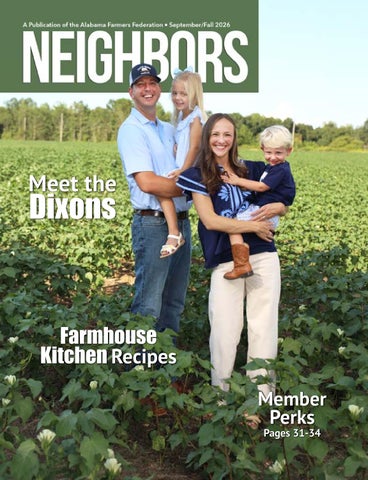
Meet the
Dixons
Farmhouse Kitchen Recipes Member Perks Pages 31-34
September/Fall 2026 | Volume 51 | Number 8 Marlee Jackson | Editor Maggie Gaddy | Associate Editor Laura Unger | Graphic Designer
ALABAMA FARMERS FEDERATION Paul Pinyan | Executive Director Jeff Helms | Director of Communications FEDERATION OFFICERS Jimmy Parnell | President, Stanton Mark Byrd | Vice President | North, Danville Jon Hegeman | Vice President | Central, Anniston Chris Carroll | Vice President | Southeast, Ariton Hope Cassebaum | Vice President | Southwest, Lillian Steve Dunn | Secretary-Treasurer, Evergreen DIRECTORS Dorman Grace | Jasper Charles Butler | New Hope David Bailey | Dawson Darrell Lee | Addison Will Gilmer | Sulligent Phillip Hunter | Birmingham Mahlon Richburg | Auburn Stewart Koon | Gordo Bill Cook | Montgomery Trip Horne | Louisville Mark Kaiser | Daphne Jerry Peak | Chancellor Lisa Lake | Vinemont Forrest Anders | Hartselle Neighbors (ISSN 0162-3974) is published monthly by the Alabama Farmers Federation, 2108 East South Boulevard, Montgomery, Alabama 36116 or (334) 288-3900. For information about Alabama Farmers Federation member benefits, visit the website www.alfafarmers.org. Periodicals postage paid at Montgomery, Alabama, and additional mailing offices. Printed in the U.S.A. POSTMASTER Send address changes to Neighbors P.O. Box 11000, Montgomery, Alabama 36191-0001 MEMBERSHIP AND SUBSCRIPTION CHANGES 800-392-5705, Option 4 or BWatkins@alfafarmers.org ADVERTISING REPRESENTATIVE Ben Shurett, (256) 997-7922 BenShurett.alfafarmers@gmail.com DISCLAIMERS: Advertisements in Neighbors do not represent an endorsement by the magazine or Alabama Farmers Federation. Editorial information from sources outside the Alabama Farmers Federation is sometimes presented for our members. Such material may, or may not, coincide with official Alabama Farmers Federation policies. Publication of information does not imply an endorsement by the Alabama Farmers Federation.
4
In This Issue 4 | Farmers Fellowship, Learn at Annual Conference
28 | In the Farmhouse Kitchen With Caleb and Katie Hicks
6 | Members Shine in Sewing, Photography Contests 12 | aTeam Ministries Hooked on Serving Families 14 | USA Peanuts Launches New Branding Campaign 16 | Alfa Foundation Awards
$100,000 in Scholarships
14
18
On The Cover
Garrett and Robin Dixon are Alabama’s Outstanding Young Farm Family in August. The Lee County cotton and peanut farmers are raising Chandler Jane and Cash in Salem. Photo By Marlee Jackson
28
www.AlfaFarmers.org
alfafarmers.org
September/Fall 2026 | NEIGHBORS | 3
FARM & LAND CONFERENCE
Mobile Bay Hosts Farmers for Summer Tours, Workshops
The Cassebaum family welcomed American Farm Bureau Federation President Zippy Duvall and Alabama Farmers Federation President Jimmy Parnell to their farm in Lillian.
John Gilbert gave landowners a tour of the Solon Dixon Forestry Education Center outside Andalusia.
By Tanner Hood
Land Conference Aug. 6-8. American Farm Bureau Federation President Zippy Duvall served as keynote speaker during a Saturday morning breakfast. He reminded farmers of their stories’ strength and the importance of sticking together. “What makes us different from other organizations? It’s you,” said Duvall, a Georgia beef cattle and poultry farmer. “Your story and engagement to build policy are the two things you bring to the table to make this organization
successful. We’re going to stand up and tell your story, and that’s what I take into the White House.” Duvall’s words of encouragement followed two days of state commodity committee elections, educational workshops and farm tours across southwest Alabama. “My hope comes from this: We’re American farmers who stand up tough and tall,” Duvall added. “We built this country, and we’ve kept it going for 250 years. The best days of American agriculture are in front of us, and we’re going to play a major role.” Those words encapsulated the purpose of the Federation’s summer conference, which began Thursday
against a backdrop of calm waters — Alabama’s Port City setting the stage for commodity and policy-related discussions. Educational sessions highlighted the strengths of Alabama agriculture while addressing current and upcoming issues. Federation Governmental & Agricultural Programs Department Director Mitt Walker said state commodity committee elections fit naturally in this year’s conference agenda. Federation commodity committees help guide education, promotion and research work for fellow producers. “Our farmers gathered from all parts of the state for commodity-related
Forester Tom Richardson presented on the state of the forest products industry during a workshop.
Austin and Heather White of Limestone County toured Laurie Farms with sons Eli and Ethan.
Tim Watkins of Tallapoosa County and Terry Landry of Mobile County toured specialty crop farms.
ore than 700 Alabama farmers M moseyed down to Mobile Bay for the Alabama Farmers Federation Farm &
4 | NEIGHBORS | September/Fall 2026
alfafarmers.org
Farmers visited with Alabama FarmPAC-endorsed candidate for Congressional District 1 Jerry Carl during the conference.
Madison County farmers Nathan Lasater and Caitlin Falkner attended Thursday evening’s Welcome Party.
Federation President Jimmy Parnell welcomed more than 700 farmers and industry supporters to Mobile for the Farm & Land Conference.
discussions and tours during this event,” Walker said. “We also held elections for state commodity committees. I am excited about the leadership that has stepped up to serve.” Farm tours reigned Friday. Farmers boarded buses bound for southwest Alabama cattle operations, row crop farms, mills, gins, agritourism sites, nurseries and a forestry center. Young Farmers rose to the occasion Saturday as competitors participated in Discussion Meet and Excellence in
Agriculture contests. Meanwhile, the State Women’s Leadership Committee welcomed ladies to a luncheon and awards program celebrating creative quilts and photographs. An Alabama FarmPAC reception later allowed endorsed candidates to mingle with constituents. Saturday closed with a banquet honoring Alabama Extension’s Dr. Jeremy Pickens and Dr. Scott Graham as Duncan Award and Rittenour Award winners, respectively. In addition,
the Discussion Meet Final Four and Excellence in Ag contest winner were announced alongside the 2026 Outstanding Young Farm Family. Walker echoed Duvall’s call for farmers to stand strong together. “This conference reminds us Alabama farmers are committed to making the world a better place, even during tough times,” Walker said. “They are constant reminders of what God can do through steadfast commitment to Him and each other.”
alfafarmers.org
September/Fall 2026 | NEIGHBORS | 5
WOMEN’S CONTESTS
Stitches, Snapshots Showcase Members’ Creativity
From left are Women’s Leadership Division Director Kim Earwood with Adult Division winners Janet Massey of Geneva County, Glenda Stewart of Geneva County, Pat Sexton of Crenshaw County, Hayley Walters of Lee County and Shelley East of Cherokee County.
By Maggie Gaddy
From left are Women’s Leadership Division Director Kim Earwood with Youth Division winners Alaina Knight of Lamar County, Ashley Wicks of St. Clair County, Elizabeth Knight of Lamar County and Luke Rashleigh of St. Clair County.
another’s talents.” New this year was a photography ver 100 vibrant quilts stitched contest that stretched artistic talents with care and striking snapshots beyond a needle and thread. Hayley showcasing life on Alabama farms took Walters of Lee County won the Adult center stage during Division farm animal photography Alabama Farmers contest. Walters said Federation Women’s it was a fun way to Leadership Division celebrate agriculture contests Aug. 8 at while showcasing the Farm & Land real-life farming. Conference in “It gives us a chance Haley Walters Mobile. to share the beauty, Lee County The competitions hard work and everyday Farm Animals, Adult recognize members’ moments that make artistic abilities while agriculture so special,” Janet Massey ty Geneva Coun ed Quilts preserving traditions said Walters, whose family Machine-Stitch that showcase Alabama grows row crops. “Pictures Adult agriculture and rural life. capture the little moments on Winners were selected the farm. Things that seem in quilting, sewing and normal to us now may be photography categories, some of the memories we with entries judged on treasure most one day.” craftsmanship, originality First-place winners and overall presentation. received $150, second-place To enhance the agricultural $100 and third-place $75. celebration, fabric entries Winners were: were made of cotton. n Machine-Stitched Quilt Adult “These contests have become a First — Janet Massey, Geneva County signature part of our events,” said Second — Lynn House, Monroe County Federation Women’s Leadership Third — Donna Buckley, Lamar County Division Director Kim Earwood. “The n Machine-Stitched Quilt Youth entries highlight our members’ creativity First — Alaina Knight, Lamar County and skill, but they also create a space Second — Trevor Wicks, St. Clair County for fellowship. Members gather to swap n Machine-Stitched Baby Quilt Adult tips, share stories and celebrate one First — Glenda Stewart, Geneva County
O
6 | NEIGHBORS | September/Fall 2026
Second — Jan Sanders, St. Clair County Third — Sandra Terry, Lawrence County n Machine-Stitched Baby Quilt Youth First — Ashley Wicks, St. Clair County Second — Hannah Grace Aldridge, Fayette County Third — Alaina Knight, Lamar County n Sewing – Cancer Patient Blanket Adult First — Pat Sexton, Crenshaw County Second — Glenda Stewart, Geneva County Third — Harriet Jones, Chambers County n Sewing – Cancer Patient Blanket Youth First — Elizabeth Knight, Lamar County Second — Isabella Rashleigh, St. Clair County n Photography – Farm Animals Adult First — Hayley Walters, Lee County Second — Pat Sexton, Crenshaw County Third — Donna Buckley, Lamar County n Photography – Farm Animals Youth First — Alaina Knight, Lamar County Second — David Thomas Aldridge, Fayette County Third — Ashley Wicks, St. Clair County n Photography – Everyday Farm Life Adult First — Shelley East, Cherokee County Second — Anna Marie Smith, Mobile County Third — Kristen Roberson, Marshall County n Photography – Everyday Farm Life Youth First — Elizabeth Knight, Lamar County Second — Isabella Rashleigh, St. Clair County n Photography – Farm Landscape Adult First — Ashley Morgan, Mobile County Second — Shelley East, Cherokee County Third — Georgette Owens, Winston County n Photography – Farm Landscape Youth First — Luke Rashleigh, St. Clair County Second — Abigail Grant, Butler County Third — Hannah Grace Aldridge, Fayette County alfafarmers.org
YOUNG FARMERS CONTESTS
Young Farmers Shine in Statewide Competitions
Garrett and Robin Dixon of Lee County are Alabama’s Outstanding Young Farm Family. From left are Federation President Jimmy Parnell, the Dixons with children Chandler Jane and Cash, and Federation Young Farmers Division Director Hunter McBrayer.
By Marlee Jackson labama young farmers were hailed for statewide success across three A contests during an awards presentation
Aug. 8 in Mobile. Outstanding Young Farm Family (OYFF), Excellence in Agriculture and Discussion Meet accolades were presented as part of the Alabama Farmers Federation Farm & Land Conference. Garrett and Robin Dixon of Lee County took top prize in the OYFF contest, which honors farm growth, civic service and Federation involvement. They grow row crops and raise cattle in Salem with their children, Chandler Jane and Cash. As OYFF, the Dixons score $40,000 toward a Ford vehicle courtesy of Alfa Insurance; a year’s lease on a John Deere tractor from John Deere, SunSouth and TriGreen; and a John Deere Gator from Alabama Ag Credit and Alabama Farm Credit. OYFF runners-up receive $500 from perennial sponsors Alabama Ag Credit and Alabama Farm Credit. Cade and Shelby Easterling of Barbour County were named first runners-up and net the year’s use of a Kubota tractor from Kubota. The poultry, cattle and small-ruminant farmers live
8 | NEIGHBORS | September/Fall 2026
From left are Federation President Jimmy Parnell, Excellence in Agriculture contest winner Austin Blankenship of Lawrence County and Young Farmers Division Director Hunter McBrayer.
in Blue Springs, where they are raising daughter Mary Jo. The OYFF second runners-up are Jacob and Misty Porter, who will receive a custom crop protection package from Corteva Agriscience. The Porters’ farm in Lineville includes poultry, cattle and hay. They have two sons, Olen and Asher. Leaders were also honored in the Excellence in Agriculture competition. Austin Blankenship of Lawrence County won the contest, which highlights those who are involved in agriculture but receive less than half their income from farming. An Extension agent who lives in Moulton, Blankenship competed via an application and presentation and will receive a zero-turn lawnmower from Corteva Agriscience. Kaitlyn Thacker of Marshall County and Jonathan Edgar of Elmore County were named first and second runners-up, respectively. Additionally, four Discussion Meet finalists were named. They are Madden Ragan, DeKalb County; Bryer Morrison, Etowah County; Hunter Rogers, Limestone County; and Ben Castleberry, St. Clair County. Discussion Meet simulates a committee meeting where participants discuss solutions to agricultural issues. The Final Four will compete during the annual meeting in December, and the
winner will receive a four-wheeler from First South Farm Credit. All finalists were presented a Turtlebox speaker from the Federation and Alfa Farmers Member Perks. The Dixons, Blankenship and the Discussion Meet winner advance to national contests during American Farm Bureau Federation Annual Convention in January in Charlotte, North Carolina.
Discussion Meet Finalists
Madden Ragan DeKalb County
Bryer Morrison Etowah County
Hunter Rogers Limestone County
Ben Castleberry St. Clair County alfafarmers.org
DUNCAN AWARD
Extension Efforts Earn Pickens Prestigious Award presents unique challenges because Alabama nurseries grow hundreds of species and cultivars, Pickens said. A close connection with growers drives Pickens’ work. Federation Greenhouse, Nursery & Sod Division Director Blake Thaxton said Pickens’ ability to combine research with hands-on service makes him especially deserving of the Duncan Award. “He’s a great researcher, but he also does the Extension side, which serves the growers,” Thaxton said. “He’s effective because of the interpersonal
Nominated by nurseryman Scott Poague, Dr. Jeremy Pickens is the 2026 Duncan Award winner. The annual honor recognizes exceptional Extension efforts.
By Maggie Gaddy r. Jeremy Pickens’ passion for plants D took root at a Mobile County palm tree nursery, where a high school job planted the seed for a career dedicated to helping nurserymen succeed. His commitment to serving Alabama’s green industry recently earned Pickens the Alabama Farmers Federation Duncan Award for Excellence in Production Agriculture & Forestry Extension. The award recognizes Extension professionals who develop practical solutions to problems identified by Alabama farmers. He received the award during the Federation’s Farm & Land Conference in Mobile Aug. 8. “I am very grateful for receiving this award,” Pickens said. “It means so much to me. It’s validation and affirmation that I am making an impact and helping people. Having farmers nominate me means way more than any other award I could ever get.” A Grand Bay native, Pickens knew by age 16 he wanted to attend Auburn University (AU) and return home to south Alabama. Today, he and wife Brittany live in Spanish Fort.
10 | NEIGHBORS | September/Fall 2026
Pickens earned bachelor’s and master’s degrees in horticulture at AU before completing a doctorate in aquaculture. Since 2016, he’s served as Extension’s nursery and greenhouse specialist, splitting time between research and outreach while working with growers across the state. He’s stationed at the Ornamental Horticulture Research Center in Mobile. Many of Pickens’ projects begin with conversations in the field. “A lot of my research is driven by what I see when I’m with growers,” Pickens said. “I love helping people. I really like figuring things out and solving problems.” His work focuses on improving nursery production through research on plant nutrition, fertilizer management and reducing plant stress. He helps growers diagnose diseases and insect problems while evaluating production practices under real-world conditions at commercial nurseries. A recent project found white nursery containers remain cooler than traditional black pots, improving fertilizer efficiency and giving growers another tool to increase profitability. Researching ornamental plants
From left are Federation President Jimmy Parnell, Dr. Jeremy Pickens and Federation Greenhouse, Nursery & Sod Division Director Blake Thaxton.
relationships that go beyond solving nursery issues.” The Duncan Award includes $5,000 for Extension programming. Pickens said he plans to use the funding to expand services for nurseries by increasing irrigation water testing in surrounding counties and monitoring container nutrition. The additional data will help growers make management decisions while supporting future research. While awards aren’t what motivate Pickens, his commitment to Alabama growers doesn’t go unnoticed. He is the first professional to receive both the Federation’s Duncan and Rittenour awards. The latter recognized Pickens’ research work in 2021. “I just want to make an impact,” Pickens said. “Looking back on my career, I want to know I helped people.” alfafarmers.org
RITTENOUR AWARD
Graham Nets Recognition for Cotton Insect Research
Dr. Scott Graham, right, netted recognition from the Alabama Farmers Federation for his work researching the invasive cotton jassid. He was nominated by Lee County farmer Garrett Dixon.
By Marlee Jackson r. Scott Graham is drawn to row D crops like moths to a flame — or, perhaps more appropriately, like insects to leafy cotton. “My first thought when I see a field is, ‘I wonder what’s in there?’” said Graham, an Alabama Extension cotton entomologist based at Auburn University. That curiosity, close relationships with cotton growers and consequential research trials recently earned Graham the Rittenour Award for Excellence in Production Agriculture & Forestry Research. Graham received the award from the Alabama Farmers Federation Aug. 8 during the Farm & Land Conference in Mobile. “Scott is well respected by Alabama farmers,” said Carla Hornady, the Federation’s Cotton Division director. “He’s not afraid to get in the field, tackle tough problems and really help our growers. His work ethic has especially been evident with emergence of the
alfafarmers.org
cotton jassid. Scott understands this is a real threat to farmers who are already dealing with slim margins. He is doing everything he can to help them make educated decisions.” Alabama farmers began battling the diminutive, devastating cotton jassid in late summer 2025. Graham said the growing season became a blur with frequent farm visits, countless phone calls and rapidly evolving spray recommendations aimed at reducing jassid populations, which could greatly hamper yield. Graham delivered presentations during a slate of winter meetings around the Cotton Belt. Graham said he will use the Rittenour Award’s $10,000 prize from the Alabama Farmers Agriculture Foundation to fund similar travels this year. A native of Grenada, Mississippi, Graham holds two degrees from Mississippi State University, plus a doctorate in cotton entomology from the University of Tennessee. “As soon as you think you have an insect figured out, something changes,”
Graham said. “It’s a very exciting, rewarding career.” While Graham isn’t a farmer, per se, his life follows the rhythms of the growing season. Family road trips with wife Ashlynn, 4-year-old daughter Mary Clare and 2-year-old son Scotty often include detours to hunt for insects. The Grahams even planned their wedding around his graduate research. “I knew, based on the year before, that the week of June 10 would be the one week I wasn’t busy. I could go on my honeymoon and not worry about someone else doing my research,” Graham remembered. “We were through the thrips window and before the plant bug.” Now working in the steamy Alabama heat, Graham gets to business identifying insects. He’s earned deep tan lines and even deeper credibility with growers — a quality he’s quick to credit to his predecessor. A household name in cotton entomology, Ron Smith earned the Rittenour Award’s counterpart honor just months after Graham joined Extension in 2020. “There was a quote Ron had when he won the Duncan Award that he started his career helping farmers and finished it helping friends. I remember thinking it would be cool to say that one day,” Graham said. “I feel like that’s where I am now. I have buddies who live all across the state.”
From left are Federation President Jimmy Parnell, Dr. Scott Graham and Federation Cotton Division Director Carla Hornady. September/Fall 2026 | NEIGHBORS | 11
Hooked on Hope Anderson Thrower enjoys a day on the water, pursuing his passion for fishing.
By Brooke Foster asting a line into calm water and C waiting for the tug of a trophy bass is where 18-year-old Anderson Thrower is often found. “Fishing is a passion of mine,” said Anderson, an award-winning student bass fisherman and Alfa Presidential Scholarship recipient. “A friend of mine took me fishing at a small pond in Birmingham when I was 14, and I caught a 6-pounder. After that, I was hooked. I joined my school’s fishing team freshman year, and it just took off from there.”
Today, Anderson is making a name for himself in the competitive bass fishing world — something he aspires to continue in Kentucky this fall as a member of Campbellsville University’s fishing team. Long before he cast lines, Anderson faced a battle far greater than any fish he could ever reel in. At 16 months old, he was diagnosed with Acute Lymphoblastic Leukemia (ALL). For parents Jan and Andy and older sister Avery, the diagnosis cast their family into uncharted waters, where hope became their anchor. “Anderson was diagnosed Jan. 6, 2009, and our lives changed forever,” Jan said. “After three years of treatment, he took his final dose of chemo in 2012.”
Throughout those years, Children’s Hospital of Alabama became a second home. Living in Birmingham spared the Throwers long-distance travel, but it couldn’t lessen the emotional toll of watching their young son fight for his life. Their faith and the support of family and friends carried them through the darkest days. “A good support system was critical throughout the process,” Jan said. As they spent countless hours at Children’s, they realized many families facing similar circumstances weren’t surrounded by that same support. “There were a lot of families around us that had literally no one,” Andy recalled.
2009
2026
Anderson’s 2009 diagnosis changed the Thrower family’s life forever.
Anchored by faith, they now bring hope to others through aTeam Ministries.
12 | NEIGHBORS | September/Fall 2026
alfafarmers.org
That planted the seed for something greater than their own story. In December 2009, the Throwers founded aTeam Ministries — a nonprofit dedicated to serving families facing pediatric cancer through rent-free housing, practical support and prayer. The ministry has since served more than 650 families, including Alabama
A dedicated angler, Anderson is a three-time Alabama Student Angler Bass Fishing Association (ASABFA) winner.
alfafarmers.org
Farmers Federation Area 4 Organization Director Steven Blackmon, wife Whitney and their son, Daniel. The Blackmons spent seven months in aTeam’s Home Away From Home Apartments, fully furnished, rent-free housing that eased one burden during young Daniel’s treatment. “aTeam Ministries has meant the world to my family,” Steven said. “The relationship we formed with Andy, Jan and the staff at aTeam Ministries is something Whitney and I will cherish forever. We can never thank them enough for our ‘little house,’ as Daniel liked to call it.” Today, the Throwers’ story has come full circle. Each family member contributes in their own way, including Anderson, whose love of fishing inspired the annual aTeam Ministries Bass Fishing Classic charity tournament at Lake Jordan. Anderson’s greatest legacy isn’t measured by the fish he catches but by the hope his family’s journey has inspired — a lifeline for hundreds of families and a community to lean on when they need it most.
The Throwers’ aTeam Ministries has served more than 650 families through programs designed to provide assistance, encouragement and hope.
“Going through something like cancer gives you a different perspective on life,” Jan said. “It changes what you value and reminds you how precious time really is.” Childhood Cancer Awareness Month each September serves as a reminder of their journey and the mission born from it: ensuring no family fights alone. Learn more at aTeamMinistries.org.
September/Fall 2026 | NEIGHBORS | 13
It’s Not Nuts. It’s Alabama Farmers Help Introduce New USA Peanuts Brand
Josh McCoy’s family peanut warehouse in Headland is featured in the new USA Peanuts branding campaign, which launched this spring.
By Peyton Woods
I
“ t’s Not Nuts. It’s Peanuts.”
With that tagline and the unveiling of a peanut-shaped logo sporting a hue dubbed Bright Harvest, the National Peanut Board
(NPB) ushered in a new era of peanut promotion this spring. The USA Peanuts branding campaign modernizes the industry’s image, seeks to strengthen demand and unites organizations under one identity, said NPB President and CEO Ryan Lepicier.
Greg and Mark Kaiser proudly present the USA Peanuts flag on their Baldwin County farm. The flag features the USA Peanuts logo printed on a background that sports a custom color called Bright Harvest. 14 | NEIGHBORS | September/Fall 2026
“May 18 was the day our entire industry came together as one,” said Lepicier, referencing the campaign launch. “This isn’t just a National Peanut Board brand. This is your brand. This is our brand as an industry.” The effort represents more than a new logo or advertising campaign, Lepicier added. It’s a coordinated strategy to elevate peanuts from a commodity to a consumer brand. That strategy has been successful across the U.S. — in part thanks to Alabama peanut farmers such as Thomas Adams. A member of the NPB who farms in Henry County, Adams and his son, Emery, were featured in photography for the campaign. They donned promotional merchandise which became available following the campaign launch to give growers and industry partners a consistent way to represent the new national brand. “At the heart of this campaign are America’s peanut farmers whose hard work and dedication make this crop alfafarmers.org
possible,” Adams said. “This brand gives us a chance to tell our story and remind consumers that every bag of peanuts starts with farm families like ours.” Alabama peanut farmer Josh McCoy also participated in the campaign. An alternate member of the NPB, McCoy helps operate his family’s peanut warehouse in Headland. That hulking facility now includes one of the campaign’s most recognizable features — a large USA Peanuts mural. The mural serves as a visible reminder of the industry’s unified branding effort and has become a landmark celebrating Alabama’s role in the campaign. Alabama peanut farmers have embraced the campaign by flying USA Peanuts flags on tractors and static flagpoles. The flag reminds consumers to eat more USA-grown peanuts while celebrating the farmers who proudly grow Alabama’s official legume. NPB’s Lepicier said research helped shape the campaign’s clear, relatable messaging that highlights what makes peanuts unique. Rather than emphasizing a single benefit, NPB showcases peanuts’ nutrition, power as a plant-based protein, wellness benefits and sustainability. Another plus? USA Peanuts are the ultimate convenient snack. The initial USA Peanuts campaign reached consumers through a nationwide marketing effort that included digital advertising, influencer partnerships, public relations initiatives and experiential activations.
To extend the campaign’s reach, NPB expanded its grassroots outreach through upcoming college campus tours and partnerships with state peanut organizations such as the Alabama Peanut Producers Association. Farmers across Alabama said they’re excited to see the USA Peanuts brand
fully develop. Mobile County peanut farmer John Allen Driskell said he is hopeful “It’s Not Nuts. It’s Peanuts.” will help market peanuts to the next generation. “I hope this campaign gets younger generations excited about peanuts and ultimately increases peanut and peanut butter consumption nationwide,” Driskell said. Learn more at usapeanuts.com.
From entrees and appetizers to desserts and drinks, consumers can scroll through 170 peanut-packed recipes at usapeanuts.com. alfafarmers.org
September/Fall 2026 | NEIGHBORS | 15
Alfa Foundation Awards $100,000 In College Scholarships T
he Alfa Foundation recently awarded $100,000 in scholarships to 100 students attending colleges and universities across Alabama. Recipients, who hail from 44 counties and attend 27 different academic institutions, each received $1,000 from the Foundation to use toward tuition, fees, books or supplies in the 2026-27 academic year. Since 2014, the Alfa Foundation has awarded $1.25 million to deserving students through its scholarship program, which is administered by Kaleidoscope. “On behalf of the Alfa Foundation, we are proud to support this outstanding group of students as they further their education within the state of Alabama,” said Alfa Insurance® President Jimmy Parnell. Scholarships were awarded based on grade point average, participation in school and community activities, honors, work experience and future goals. To qualify, students must be enrolled or planning to enroll in a full-time accredited program at a two-year or four-year college, university or vocational-technical school in Alabama. Listed by county, this year’s recipients are: Baldwin County Marissa Anderson, Coastal Alabama Community College (COACC) Cooper Long, Auburn University (AU) Barbour County Molly Cox, Wallace State Community College (WSCC) 16 | NEIGHBORS | September/Fall 2026
Maddie Dowling, AU Easton Kilpatrick, Troy University (TU) Sophie Seaborn, The University of Alabama (UA)
Bibb County Kaleigh Barrett, Jefferson State Community College (JSCC) Coleman Cottingham, Shelton State Community College (SSCC) Zeana Tew, AU Blount County Mackenzie Smith, TU Butler County Rileigh Rogers, AU
Calhoun County Ben Storino, Gadsden State Community College (GSCC) Cherokee County Melanie Studdard, AU Chilton County Brady Garmany, AU Marshall Thornhill, AU Clarke County Alexis Chapman, UA
Cleburne County Alivia Boyd, Alabama A&M University
Coffee County Anna Jane Lavender, Samford University (SU) Grady Patterson, Lurleen B. Wallace Community College (LBWCC) Laken White, AU
Colbert County Eli Miller, Northwest Shoals Community College Conecuh County Taylor Campbell, TU Genna Sullivan, LBWCC
Covington County Andy Shelander, UA
Cullman County Annalee Allen, AU Aubrey Mayfield, WSCC Stella Meyer, UA
Dallas County Kylie Calame, AU James Jones, Southern Union State Community College (SUSCC) Brooke Waters, SU
DeKalb County Jon-Parker Dennis, Northeast Alabama Community College (NACC) Elmore County Hayden Anderson, GSCC Kaylee Cochran, The University of Alabama at Birmingham Isabella Fuller, LBWCC Asher Justice, LBWCC Aubrey Newton, Huntingdon College Alexx Parrott, Marion Military Institute John Wingard, SUSCC Escambia County Carley Johnson, COACC Hale County Travis Baxter, SSCC
Henry County Will Parker, AU Trey Scott, AU
Houston County Colt Ingram, Wallace Community College (WCC) Sydney Love, AU Luke Meadows, WCC Addison Claire Thomley, UA
Jefferson County Caleb Banks, Central Alabama Community College (CACC) Brier Hight, UA AJ Luccasen, AU alfafarmers.org
Sydney Morris, SUSCC Jackson Stanford, GSCC
Lauderdale County Sydney Cornelius, AU Lee County Karlee Baker, NACC Landon Childree, SUSCC Karley Nelson, SUSCC Alex Simpson, SUSCC Kate Witten, AU
Limestone County Brylee Braden, The University of North Alabama Marissa Gonzales, AU Kennessy Rough, UA Lowndes County Grant Casey, LBWCC Madi Clarke, UA
Macon County Jeremy Borum, The University of Alabama in Huntsville Ragan Walker, AU Riggs Walker, AU
Madison County Hannah Kirkham, AU Christopher Caterina, Calhoun Community College Ethan Tomlin, AU Walker Williams, AU
alfafarmers.org
Marshall County Charlie Richey, UA Landen Smith, WSCC
Mobile County Anna Claire Rutledge, UA Monroe County Cayden Powell, COACC
Montgomery County Emilee Alexander, AU Katie Baldwin, SUSCC Gaines Burnham, UA Reed Daniel, AU Hunter Hodges, The University of South Alabama Mary Bradley Phelps, UA Ann Wilber, SU Morgan County Cedric Beavers, AU Pike County Britton Paul, TU
Randolph County Madison Nation, Jacksonville State University Shelby County Richie Poff III, UA
St. Clair County Tucker Brown, AU Brooks Laminack, Bevill State Community College
Talladega County Lillian Hodges, GSCC Maggie Forbus, CACC Emma Lackey, GSCC Kyla Shears, GSCC Brooks Turner, SUSCC
Tallapoosa County Cami Cook, GSCC Anna Beth Coon, The University of Mobile Becca Rasbury, AU Tuscaloosa County Mary Hayes Henderson, UA Will Mehlferber, SSCC
Walker County Caroline Roberts, Athens State University Washington County Trenton Turner, COACC Sarah Warrick, UA Wilcox County Trent Mims, COACC
Since 1946, Alfa Insurance has proudly supported the community through various programs, investments and donations. The Alfa Foundation seeks to promote education and support organizations that are making an impact in the communities Alfa® serves. Visit AlfaInsurance.com to learn more.
September/Fall 2026 | NEIGHBORS | 17
Dixons Dubbed Alabama’s Outstanding Young Farm Family
Dixon Farms is a playground of sorts for 4-year-old Chandler Jane and 2-year-old Cash.
As Alabama’s Outstanding Young Farm Family, Garrett and Robin Dixon will represent Alabama on the national stage in January. The Lee County farmers live in Salem with their children, Chandler Jane and Cash.
By Marlee Jackson hen the going gets tough, Garrett W Dixon gets going — digging in, doubling down and asking God for guidance on his Lee County farm. “I love farming in spite of its challenges because you see the fruits of your labor,” said Garrett, 35. “When you plant a tiny seed and then harvest a crop, it’s satisfying knowing you were with that crop every step of the way.”
18 | NEIGHBORS | September/Fall 2026
That tenacity helped Garrett and his wife, Robin, earn top honors in Alabama’s Outstanding Young Farm Family contest. The cotton and peanut farmers were recognized during the Alabama Farmers Federation Farm & Land Conference Aug. 8. “It truly is an honor to have been named the 2026 Outstanding Young Farm Family,” Garrett said. “This has been a long but fruitful journey that wouldn’t have been possible without the
mentors and friendships made through the Alabama Farmers Federation. We are better farmers, advocates and citizens because of the impact Alfa has had on us.” The OYFF contest gauges producers on farm growth, Federation involvement and civic service. The Dixons will receive $40,000 toward a Ford vehicle from Alfa Insurance; a lease on a tractor from John Deere, SunSouth and TriGreen; and a John Deere Gator from Alabama Ag Credit and Alabama Farm Credit. They’ll represent Alabama during American Farm Bureau Federation’s Achievement Award contest in January.
Planting Seeds
Robin and Garrett have been stalwart teammates since their early days as students at Auburn University. “Garrett is the most driven person you’ll ever meet,” Robin said. “That inspires me daily. He gets up every day alfafarmers.org
trying to get as much work done as possible.” She added, “He’s also goofy. Anyone who knows Garrett knows he will pick and mess and joke.” His farm, however, is no laughing matter. It’s a labor of love Garrett built from the ground up, starting with a few head of cattle in high school. He found his true passion for farming in the row crop fields of Salem — land his ancestors toiled since the 1800s. A skip-generation farmer, Garrett started with 100 acres of soybeans in college before switching to a rotation of peanuts and cotton. The crops are more suited for sandy soil and thrive in hot weather, Garrett said. “As a peanut farmer, I help feed Alabama,” Garrett said. “By growing cotton, we can clothe the world and state, too.”
Cultivating Success
In the last decade, Garrett has expanded acreage, installed irrigation and improved soil fertility while facing market and weather challenges. Garrett and Robin recently welcomed a new challenge by expanding the farm’s cattle herd. The cattle spend summer grazing peacefully in pastures; they’ll munch fields flush with cover crops this winter. The Dixons invest, too, in farmhands Chandler Jane, 4, and Cash, 2. They often visit Garrett at his shop, scout for bugs or hitch rides in the sprayer. This year, a sign sways in a field of cotton proclaiming CJ’s Pickin’ Patch. The handful of rows near Garrett and Robin’s home is a classroom of sorts for the Dixons’ daughter. “We’ll take some of those proceeds and give to her to use as she wants to teach her to be responsible, to tithe and to take some ownership, albeit a small slice, at a young age,” Garrett said. Robin’s sphere of influence extends beyond their home. As an agriscience teacher and FFA adviser at Smiths Station High School, she ties on-farm experiences into curriculum standards. Her students calculate sprayer alfafarmers.org
Garrett and Robin Dixon are Alabama’s 2026 Outstanding Young Farm Family. A skip-generation farmer, Garrett grows cotton and peanuts near his childhood home in Salem. The Dixons say their most precious moments are spent on their Lee County farm with children Chandler Jane and Cash.
formulas after watching footage of Garrett driving machinery, discuss animal husbandry while clicking through slides of the Dixons’ herd and even visit the farm to see agriculture in action.
Growing Grassroots
The Dixons live a life of service to their community through deep involvement in church, the political arena and grassroots organizations. Garrett chaired the State Young Farmers Committee in 2019, serves on the Alabama Peanut Producers Association board and is a Lee County Farmers Federation board member. He graduated from A.L.F.A. Leaders Class V and the Peanut Leadership Academy. Both Dixons have held roles in Lee County Young Farmers.
It’s an impressive track record of service, said Federation Young Farmers Division Director Hunter McBrayer. “Garrett really gets the importance of getting involved and staying involved in organizations like the Federation,” McBrayer said. “He’s not only grown his farm over the last decade; he’s grown his leadership skills, and that’s paying dividends on his farm, with his family and in his community. Robin has been there every step of the way. Folks like the Dixons make this organization special, and I’m excited to honor their faithful work.”
Scan to watch their story! September/Fall 2026 | NEIGHBORS | 19
Hope Horses: A Legacy of Hope
By Lydia East ore than a diagnosis. M That’s the heart of Hope Horses in Cullman County as children
t Scan to learn more about Hope Horses!
and young adults with special needs discover confidence and purpose through therapeutic riding. “Horses don’t see a child in a
wheelchair, on a walker or with a disability. They see a teammate,” said Kelsey Scott, executive director of Hope Horses. “I believe they know their job is to give kids peace.” For over a decade, Hope Horses has transformed lives through more than riding lessons. The nonprofit serves participants
Mariah Miles and Kelsey Scott give generously of their time and talents to help children and young adults with special needs grow, heal and learn at Hope Horses. 20 | NEIGHBORS | September/Fall 2026
Youth with special needs discover confidence and purpose through therapeutic riding at Hope Horses in Cullman.
ages 5-25 with physical, cognitive and emotional challenges, creating a place where students are encouraged to reach their full potential. “The whole vision was to serve Cullman County and have a place for kids with disabilities to find hope,” Scott said. “It’s eye opening to see the children God sent to us.” Smiles and laughter fill the barn as riders arrive eager to see their horses. Learning begins before even hopping in the saddle. Brushes sweep across dusty coats. Feed rattles into buckets. Halters fasten with careful hands. Every responsibility is intentional. “Our ultimate goal at Hope Horses is for students to be as independent as possible,” Scott said. “We push that it’s the child’s horse and their responsibility to take care of it.” That impact is felt by the students — and seen by community members. Citizen-advocates include members of the Cullman County Women’s Leadership Committee (CCWLC), which has donated time, talents and resources to Hope Horses. Other donors include the Alabama Farmers Agriculture Foundation. alfafarmers.org
“As a registered physical therapist, I see how Hope Horses facilitates and stimulates core and leg strength, balance, coordination and rhythm, plus cognitive and language skills,” said Lydia Haynes, who farms in Fairview and serves on the CCWLC. “It’s indeed an amazing program for special, amazing children and young people!” Those skills learned are paired with life lessons Scott has valued since childhood. Raised on a farm with laying hens, cattle and row crops, Scott knows agriculture is one of life’s greatest classrooms. Every chore teaches stewardship, responsibility and a deeper appreciation for agriculture. For students, ordinary tasks become extraordinary milestones. Riders who once questioned their abilities begin leading half-ton horses with pride, replacing years of “you can’t” with the quiet assurance of “I can.” “Confidence is a big advancement we see in kids,” Scott said. “It’s an honor to watch them leave proud of what they accomplished.”
alfafarmers.org
Art, equine decor and kid-friendly signage decorate Hope Horses’ tack room and stable. The nonprofit in Cullman has served over 140 students since it was founded in 2014.
Since 2014, Hope Horses has served over 140 students in eight counties while expanding community outreach through events like Experience Hope Tours, where supporters and local businesses witness firsthand how investments change lives. “Hope Horses is a community-driven organization,” Scott said. “The reason we are operating is because of the community.” Families also gather for the Hope
Horses annual horse show, where students proudly show off skills they spent months developing. Lining the fence, parents and guests watch quietly, knowing these moments are victories they never imagined possible. “The Lord has exceeded our expectations,” Scott said. “God put Hope Horses here for a reason, and He loves it more than we ever could.”
September/Fall 2026 | NEIGHBORS | 21
Small Birds,
Big Journeys:
Helping Hummingbirds Migrate By Allyson Shabel
fueling up for flight. Therefore, migrating hummingbirds are or many gardeners, more likely to share feeders than ruby-throated during breeding season. Scarlet Sage hummingbirds are a Migrating hummingbirds highlight of summer. look for any nectar source Mexican Bush Sage Watching acrobatic they can find, so consider stunts as they fight for planting fall-blooming nectar feeder space can be sources in large clumps that quite entertaining. are easy to see. These plants As fall approaches, the should measure at least 3 feet by show must come to an end in 3 feet. Alabama. Shorter days, cooler mornings Fall-blooming salvias, such as up their nectar and fewer nectar sources all cue scarlet sage, pineapple sage and intake to provide the hummingbirds that it is time to migrate Mexican bush sage, provide abundant enormous amount of energy needed south. nectar until the first frost. Agastache, to migrate. They also eat along the also known as hummingbird mint, is a migration route, stopping to seek out Flying Solo and Full full-sun perennial with tubular flowers nectar and insects to fuel their flight. Unlike species such as geese, that tip downward for easy access by ruby-throated hummingbirds do not Helping Hummingbirds hummingbirds. Cardinal flower is a migrate as a flock. Instead, they migrate In Alabama, ruby-throated native perennial with bright red blooms individually to prevent predation. hummingbird migration is on full that flowers in summer and fall. During the day, they fly low, just display in September, and gardeners Migration will end during fall. above treetops. At night, they rest. can help these thirsty birds. Leave feeders hanging for one to Flying 20 to 25 miles per day, it takes up Throughout the month, two weeks after seeing the last to four weeks to reach their wintering keep hummingbird hummingbird. Then, clean grounds in Mexico and Central America. feeders full. Use a feeders and store them Generally, males begin migration before dissolved mixture of indoors for the winter. females. four-parts water to Before taking them down, Before leaving, they work hard to one-part table sugar. make note of their exact pack on the pounds, increasing their During migration, location in the landscape. Agastache weight by 25% to 40% for the long male hummingbirds The ruby-throated journey ahead. The ruby-throated are less focused hummingbird will come hummingbird consumes insects such as on defending their back to the precise mosquitoes, aphids, spiders and gnats mating territory and spot next year looking for to increase protein intake. They ramp concentrate more on more.
F
The Alabama Gardener is provided by Alabama Extension’s Home Horticulture Team. Learn more at 22 | NEIGHBORS | September/Fall 2026
alfafarmers.org
Pioneering Pratt’s Global Ag Impact Rooted in Alabama
rom architecture to agriculture, Daniel Pratt’s global influence on Ffarming rose out of the heart of central
Alabama. Originally from Temple, New Hampshire, Pratt was born in 1799 on a family farm. He became an architect apprentice at 16 before moving to Georgia four years later to build homes. He then focused on cotton ginning. Pratt’s entrepreneurial spirit moved him and wife Ester westward to central Alabama, where he founded the Daniel Pratt Gin Co. in 1833. Five years later, Pratt purchased more than 1,800 acres on Autauga Creek, where he built a factory and founded what is now Prattville. By the 1850s, the factory complex supplied cotton gins all over the world. Pratt’s gins were at work in fields from Europe to South America, with the factory annually producing at least 1,500 gins by 1860. While Pratt hired local farmers to work in the plant, his influence on
24 | NEIGHBORS | September/Fall 2026
The recently refurbished Pratt Gin Co. factory stands as a testament to Alabama ag pioneer Daniel Pratt.
Alabama’s economy extended past agriculture. Pratt used locally produced iron in cotton gin manufacturing while promoting the state’s untapped mineral wealth, including coal. Pratt also entered state politics, serving in the Alabama House of Representatives from 1861 to 1865. Following the Civil War, Pratt’s focus expanded to iron and coal production and the railroad industry — all while maintaining his gin factory. Pratt passed away in 1873, but his legacy endures in the town that bears
his name. Gin production continued in Prattville into the 2010s, preserving the site’s industrial heritage for generations. Today, the historic mill has entered a new chapter. It was thoughtfully renovated into apartments overlooking the scenic Autauga Creek. Editor’s Note: This is the third in a four-part series highlighting agriculture’s role in U.S. history as America celebrates the 250th anniversary of the signing of the Declaration of Independence. Visit America250AL.org to learn more about the semiquincentennial.
alfafarmers.org
T
COUNTRY
he radio played George Jones at the barbecue joint where I ate lunch. I was eating St. Louis ribs. Overhead, George Jones sang “He Stopped Loving Her Today.” Whenever George sings the opening lyrics, a chill dances up my spinal column. I remember sitting in my father’s truck, wearing my Little League uniform, listening to the staticky AM station. If you and I don’t keep these timeless melodies alive, who will? As a boy, my family drove great distances to support Minnie Pearl and Roy Acuff. We paid good money to watch Roy tear up his apple-tree fiddle and crack jokes with Sarah Cannon. Ernest Tubb was making appearances at the Opry when I was a babe. Classic country is folk art. It is subtle lyricism based on a two-beat bassline, a steel-stringed rhythm section and bottled malt beverages. This music was the poetry of stick welders, sharecroppers and coal miners’ kids. When Loretta Lynn sang “Blue Kentucky Girl,” you weren’t merely listening to a radio. You were listening to one of your own take the microphone. This is why whenever Willie sang “You Took My Happy Away,” your daddy’s allergies acted up. New country is an embarrassment to my kind. Men like my father didn’t spend 12 hours welding column splices only to jump in the Ford and listen to someone sing about his sugar shaker. No way. We listened to Merle, Chet, Don Gibson and the Indelible Mister Jim Reeves. And we turned it up whenever George Jones uttered: “He said I’ll love you till I die…” Yesterday, I was in the supermarket and was assaulted with modern
alfafarmers.org
country-pop on the radio. I prefer the genuine stuff. No backup dancers. No music videos. We had out-of-tune pianos, twin fiddles and chicken-wire cages around the stage. One time, my cousin Ed Lee and I went to see a George Jones concert. We drove several hundred miles crammed in a pickup cab, surviving on a steady diet of Van Camp’s pork and beans. Another time, we traveled to Texas to see Randy Travis. The band wore full suits and neckties. There was a standup bass, a dobro, a flat picker and a fiddle. Pure class. Nobody shook any sugar shakers. Randy sang three or four Hank Williams tunes, then followed with “Walking the Floor Over You.” When they played “I’m So Lonesome I Could Cry,” hundreds flicked their lighters. Ed Lee couldn’t find a BIC lighter to wave in the air, so he waved his BIC pen instead. The effect wasn’t the same, but his heart was in the right place. The older I get, the more this world changes, and the further I get left behind. Minnie Pearl is dead. Merle Haggard is with his mama. And Merle Travis is forgotten. Every day I see people fighting about trivial things when they ought to do something constructive like volunteering for VBS. Dances have been replaced with dating apps, and nobody knows who Sadie Hawkins is. All this could depress me if I thought about it long enough. Instead, I ate my ribs and listened to a distant radio. I remembered riding in that F-100 with my old man. Him covered in iron soot; me in my first baseman’s uniform. Radio blaring. Anyway, that’s why I like George Jones. ■
It’s time to reserve strawberry plugs for October delivery! • 50 plugs per tray • Plugs have an intact root ball • Plugs establish quickly
Best of all Plant plugs in October and harvest sweet strawberries in the Spring!
FREE CATALOG
2026 ANNUAL MEETING DATES, TIMES & LOCATIONS Crenshaw | Thurs., Sept. 10 at 6:30 p.m. Alfa Service Center 357 S Forest Ave., Luverne Dallas | Tues., Sept. 8 at 5:30 p.m. Alfa Service Center 403 Broad St., Selma Hale | Thurs., Sept. 10, 11:30 a.m. The Catfish Center 529 S Centreville St., Greensboro Lowndes | Thurs., Sept. 17 at 6:30 p.m. Southern Sportsman Lodge 9022 US Hwy. 80 W, Tyler Marengo | Tues., Sept. 8, 6:30 p.m. Alfa Service Center 206 Shiloh St., Linden Monroe | Mon., Sept. 14 at 6:30 p.m. Monroe County Ag Center 334 Agriculture Dr., Monroeville Perry | Tues., Sept. 1 at 11 a.m. Alfa Service Center 406 Pickens St., Marion Winston | Thurs., Sept. 10 at 6 p.m. Looney’s Amphitheater Complex and Cultural Center 22400 US Hwy. 278, Double Springs
September/Fall 2026 | NEIGHBORS | 25
YOUR SOYBEANS ARE THE RIGHT FEEDSTUFF FOR
ANIMALS Alabama’s 2,500 family poultry farms are our state’s No. 1 agricultural industry. And they count on over 2.3 million tons of your soybean meal a year as a high-protein ingredient in their feed. That’s 98 million bushels of your soybeans every year. As your Alabama Soybean Checkoff, we’re working with the Alabama poultry industry to make sure this stays one good-looking figure. Learn more about the story of soy at unitedsoybean.org/hopper.
Sources: Alabama Poultry & Egg Association and United Soybean Board 2021 Soybean Meal Demand Assessment. ©2023 United Soybean Board. [62728-4 5/23]
Southern Ground Brings Alabama Extension Expertise to Listeners’ Earbuds “A lot of this material already exists through Alabama Extension; we’re just repackaging it as a podcast,” East said. “With Southern Ground, it’s easy and convenient for somebody to listen and learn as they’re driving down the road.” The podcast is designed for gardeners of all experience levels, from beginners planting their first garden to experienced growers exploring new crops or troubleshooting problems.
Reliable Recommendations
Commercial Horticulture Agent Chip East and Tallapoosa County Extension Director Shane Harris co-host the Southern Ground podcast, which releases new episodes every other Friday.
By Mary Wilson more than a century, gardeners Ffor orhave turned to Alabama Extension research-based guidance through
publications, educational events and one-on-one assistance. The Southern Ground podcast expands those resources with an on-demand option for timely advice tailored to Alabama’s unique growing conditions. Commercial Horticulture Agent Chip East and Tallapoosa County Extension Director Shane Harris co-host the podcast. The pair have more than 55 years of Extension experience helping Alabamians succeed with gardens, lawns and farms. “We host a lot of in-person educational sessions, but nowadays, people are busy, and it’s tough to make time to attend a meeting,” East said. “We wanted to start something
alfafarmers.org
that could reach more people. With a podcast, listeners can tune in and learn anytime they want.”
Timely Topics
Season One already includes more than 15 archived episodes. Topics range from fruit selection and starting seeds indoors to assessing tree health and growing tomatoes. “The questions we receive at our Extension offices inspire what we talk about in each episode,” Harris said. “We want to be timely. If you tune into the latest episode, we are discussing issues gardeners are dealing with at that time of year.” New episodes are released every other Friday. During autumn, listeners can expect shows about planting green fields, selecting trees for fall color, pecans and other seasonally appropriate gardening tasks.
A quick online search for gardening advice can provide countless links to podcasts, videos and articles. Weeding through those resources to determine which recommendations apply to Alabama can be a challenge. Southern Ground helps cut through the clutter, Harris said. “Nowadays, it’s tough to reach and educate people because there are so many sources and options,” Harris said. “With Alabama Extension, our roots are based in research. We are not just sharing opinions. We are going to tell you the right solutions and honest answers.” Additionally, the podcast avoids the product promotion that often accompanies other online gardening content. “It’s always important to consider the source,” East said. “With Alabama Extension, we are not trying to sell you anything. Our recommendations are unbiased, and the things we talk about are practices that work here in the South.”
Where to Listen
Access Southern Ground episodes at aces.edu/edu/go/SouthernGround. Listeners can also search for Southern Ground on Apple Podcasts or Spotify.
September/Fall 2026 | NEIGHBORS | 27
Dark Chocolate Chunk Brownies
This mo recipes sh nth’s ared by
By Maggie Gaddy beautiful, ancestral oak tree in A south Montgomery County has provided the Hicks family more than
shade through the years. Nestled on land that has been in the family for six generations, it’s offered a place to gather, share meals and celebrate a century of milestones. Birthday parties, Easter Sundays and family picnics have filled the space beneath its branches. That’s where Caleb Hicks made memories with his grandfather. It’s also where Caleb proposed to his now wife, Katie, and where the couple later exchanged vows. “I can’t put into words how special this place is to me,” said Caleb, a Montgomery County Farmers Federation board member and Young Farmers Committee chair. “We say it’s our family event center.” The tree remains at the center of life for Caleb and Katie as they raise children Mary Glenn
28 | NEIGHBORS | September/Fall 2026
Caleb & K atie Hicks and Jennings while growing Old Oak Creative. The floral, photography, decor and event business owes its moniker to the towering tree. The business is a natural extension of Caleb’s upbringing. Growing up in Ramer, he was surrounded by family members who catered weddings, owned restaurants, arranged flowers and snapped photographs. Those experiences came full circle after Caleb helped plan his and Katie’s October 2022 wedding. They launched the floral design component of Old Oak Creative in July 2023 and expanded into fall porch decorating this year to help families fill homes with holiday spirit. “It is hard work, but it is fun,” Caleb said. “It is rewarding to meet people and get to know them. They become a part of your life because you’re providing a service on a special day.” The couple’s creativity carries into their kitchen. Caleb loves juggling multiple components of a meal, while Katie’s
1 stick unsalted butter 2 ounces unsweetened baking chocolate 1 cup sugar 2 eggs, at room temperature 1 teaspoon vanilla extract 1 teaspoon salt 1/2 cup all-purpose flour 6 ounces dark chocolate chunks Heat oven to 350 F. In a small saucepan over medium heat, melt butter and baking chocolate. Remove from heat and stir in sugar, eggs, vanilla and salt. Whisk vigorously with wooden spoon until mixture is smooth and well combined. Stir in flour, then gently fold in dark chocolate chunks. Pour batter into an 8-inch-by-8-inch baking dish or a 10-inch cast-iron skillet. Bake 20 to 25 minutes, or until the top and edges are set but the center is still slightly gooey. Serve warm with whipped cream or ice cream.
cooking roots trace back to her mother and grandmother in Montgomery. Recipes range from more involved meals Caleb enjoys preparing (such as Shrimp & Grits) to practical, personal favorites such as Easy Veggie Muffins — a wholesome snack with a hidden vegetable. For Katie, however, those gathered in chairs around their table matter more than what fills the plates. “I want us to sit and have family dinner and reflect on our day,” she said. “Table time is your time to capture your kids’ attention.” Whether serving in the community through agricultural organizations, at church or through Old Oak Creative, Caleb and Katie said they feel called to give back. “We just love helping people,” Katie said. “It is fun. It gets our brain working and his creative side working. It’s something Caleb has always been passionate about. It is a fun thing for both of us to do together. The oak tree helps tie me to Caleb’s family, too.” alfafarmers.org
Southern Garlic Shrimp & Grits With Cajun Cream Sauce
Charcuterie Classics
Grits
Meats
6 servings quick grits 1 teaspoon salt 1 teaspoon pepper 4 tablespoons butter 3 to 4 garlic cloves, minced 1 cup shredded sharp cheddar 1/2 cup grated Parmesan Cook grits according to package directions. For creamier grits, substitute half the cooking water with milk. Stir in remaining ingredients. Continue stirring until cheeses melt and grits are smooth and creamy. Cover and keep warm over low heat, stirring occasionally. If grits become too thick, stir in a splash of milk before serving.
Vegetables 2 tablespoons butter 1 red bell pepper, thinly sliced 1 green bell pepper, thinly sliced 1 medium yellow onion, thinly sliced Salt and pepper, to taste Dash garlic powder Melt 2 tablespoons butter in a large skillet over medium heat. Add bell peppers and onion. Season lightly with salt, pepper and garlic powder. Cook 8 to 10 minutes, stirring occasionally, until vegetables are tender. Transfer to a plate and keep warm.
Shrimp 3 pounds large shrimp, peeled and deveined 2 tablespoons blackening seasoning 2 tablespoons butter Pat shrimp dry with paper towels. Toss with blackening seasoning until evenly coated. Using medium-high heat, melt butter in the same skillet used to saute veggies. Add shrimp in a single layer, cooking in batches if necessary. Cook 1 1/2 to 2 minutes per side, or until pink and cooked through. Remove shrimp to prevent overcooking.
Hard salami Pepperoni Prosciutto
Cheeses Cajun Cream Sauce 2 tablespoons butter 1 ripe tomato, seeded, peeled and crushed 1 (16-ounce) carton heavy cream 1 teaspoon garlic powder 1 teaspoon Cajun seasoning 1/4 cup grated Parmesan Salt and pepper, to taste Hot sauce, to taste Using the same skillet, reduce heat to medium and melt butter. Add tomato and cook 2 to 3 minutes, stirring often. Whisk in cream until smooth. Stir in remaining ingredients. Bring to a gentle simmer. Cook 8 to 10 minutes, stirring occasionally, until sauce thickens.
To Serve Ladle grits into bowl. Top with vegetables, shrimp and sauce. Garnish with chopped parsley and green onions. Enjoy with French bread.
Easy Veggie Muffins 2 cups all-purpose flour 2 teaspoons baking soda 1 tablespoon ground cinnamon 1 teaspoon salt 3/4 cup plus 2 tablespoons maple syrup 3 eggs, beaten 3/4 cup avocado oil 1 tablespoon vanilla extract 2 cups grated zucchini or carrots Heat oven to 350 F. Grease a muffin tin. In a large bowl, combine flour, baking soda, alfafarmers.org
Sharp cheddar Parmesan Soft cheese, such as goat cheese or Boursin
Pickled Vegetables Cucumbers Okra Pepperoncini
Seasonal Nuts and Legumes Assorted Crackers and Bread Spreads Jams Jellies Local honey
A simple charcuterie board isn’t limited to these ingredients. Add heartier options such as chicken salad sandwiches, homemade pimento cheese or a bread boule filled with spinach and artichoke dip. Finish with a favorite sweet treat for a well-rounded spread. The best charcuterie boards use ingredients you have on hand, making them perfect for planned gatherings and unexpected guests.
cinnamon and salt. In a separate bowl, whisk together maple syrup, eggs, avocado oil and vanilla. Add wet ingredients to the dry ingredients and stir just until combined. Fold in grated zucchini or carrots. Divide batter evenly among prepared muffin cups. Bake 12 to 15 minutes, or until a toothpick inserted into the center comes out clean. Chef’s Note: You can adapt this recipe for those who enjoy chocolate. Simply stir in 2 to 4 tablespoons cocoa powder with the dry ingredients, and fold in a handful of chocolate chips before baking. September/Fall 2026 | NEIGHBORS | 29