how enrollment decreases are affecting campus, programs
Page 4
February 13, 2026
Photo by Justyn Trejo
MADISON STAMAN
Co-Editor In Chief
YANITZEL SALAZAR
News editor
SILAS BAKER
Entertainment editor
JASMINE WOODS
Sports editor
JASMINE WOODS
S SALINAS
Opinions Editor
DEAN KNOWLTON
LIFE + STYLE editor
MICAELA RODRIGUEZ
Graphics editor
photo editor
COPY editor
The Eagle’s Eye is the official student newspaper of Akins High School. It is published six times a year, generally once per six weeks for the school’s students, staff and community. The Eagle’s Eye is an open forum for student expression. The Eagle’s Eye is not reviewed by school administration prior to distribution, and the adviser will not act as a censor. Content represents the views of the student staff and not school officials. The Eagle’s Eye will work to avoid bias and/or favoritism. We will strive to make our coverage and content meaningful, timely and interesting to our readers. Our articles will reflect our genuine objective of reporting news and will be held to a high standard of quality. We will make every effort to avoid printing libel, obscenities, innuendo and material that threatens to disrupt the learning process or is an invasion of privacy. We will avoid electronic manipulation that alters the truth of a photograph. Staff editorials represent the opinion of the editorial board arrived at by discussion and will not be bylined. Bylined articles are the opinion of the individual writer and do not necessarily reflect the views of the Eagle’s Eye staff or administration as a whole. The Eagle’s Eye welcomes reader Input. Please send any letters, articles, comments, or corrections to akins.journalism@gmail.com or mail them to 10701 South First Street Austin, Texas 78748 ir drop them off in room 223 with advisor David Doerr or an editor. Letters must be signed, and emailed letters will require verification before publication. We will not necessarily publish all letters received and reserve the right to edit for length and clarity.
The Eagle’s Eye Editorial Policy
MADISON STAMAN
RAMI KASHAKHI
EVER HAYNES
CLUBS + AWARDS
hard work pays off with awards
Akins FFA students shine at Travis County Youth Show
MADISON STAMAN CO-EDITOR-IN-CHIEF
In January, the Akins FFA chapter celebrated a week of remarkable success following the Travis County Youth Show held from Jan. 15 to 17.
After a year of tireless preparation and dedication, several students earned top honors across a variety of categories including livestock, horticulture, and creative projects.
The chapter’s sheep, goat, and swine exhibitors saw significant success in the show ring. Notably, Makayla McDonald placed 2nd and 3rd in her goat classes and 6th in sheep. Laina James took home 2nd place in the Duroc swine class, while Salvador Archundia secured 3rd in the Hampshire class.
Official Show Results
Sheep & Goats
Makayla McDonald: 3rd, 2nd and 6th
Justin Muniz: 4th
Kyla Hoang: 6th
Sky Ramos: 16th
Swine
Laina James: 2nd
Salvador Archundia: 3rd
Kyla Hoang: 5th
Makayla McDonald: 5th
Lilly Hernandez: 6th
Hannah Laky: 7th
Justin Muniz: 7th
Luna Mathias: 9th
Rabbits & Chickens
Sky Ramos: 23rd overall (Rabbits)
Kyla Hoang: Participation
Trinity Valdez: Participation
Youth Fair Blue Ribbon Recipients
“Our students worked incredibly hard all year long for that moment,” the chapter announced. “We ask that if you see any of these students in your classes or in passing, please congratulate them on their hard work and dedication to their projects and this program.”
Some of these students began raising their livestock projects in May of last year. McDonald, Justin Muniz, Luna Mathias, and Laina James will be taking their projects to the San Antonio Livestock Show in mid-February. McDonald and Hoang will continue to exhibit at Rodeo Austin in March. Students show their commitment to raising their projects and animals, working every day, even during freezing rain and blazing heat. Any student
that takes an agriculture science class is eligible to participate in FFA and the show.
Beyond livestock, Akins students demonstrated their versatility in the Travis County Youth Fair, with seven students earning Blue Ribbons for their entries. Agricultural Science Teacher Brandon Callis highlighted the diversity of talent on display.
“Additionally, we had several students exhibiting their art, plants, photography, and more at the Youth Fair,” Callis said.
Supporters of the program were able to view the students’ work firsthand at the Country Store and Bake Sale where select projects were available for purchase.
Hannah Laky, Makayla McDonald, Ali Mendoza, Kyla Hoang, Hailey Kyrish, Sky Ramos, and Lilly Hernandez.
Akins SHrinking
Student population declines
CINDY NGUYEN STAFF WRITER
From its 10-year high enrollment of 2,793 in 2021 to this year’s snap shot enrollment number in Oct. of 2,317, Akins High School’s enrollment has dropped more than 8.5% over the last 5 years.
And while Austin ISD School Board voted on Nov. 21 to finalize the closure of Bedichek Middle School, the fate of Akins High School’s attendance zone remains in limbo, leaving Akins’ future enrollment numbers pending.
The board moved forward with school closures set for Aug. 2026 but paused the controversial rezoning plan that proposed moving portions of the Akins attendance zone to Travis and Crockett High School’s
For a campus that has long operated at over 120% capacity, the pause offers a temporary overcrowding relief for Akins, but the looming threat of declining enrollment poses a new challenge: the potential loss of funding for the popular CTE and Fine Arts programs.
The proposed scenarios, released earlier this year, suggested shifting students from Akins’ northern boundary to Crockett and eastern boundary to Travis. While the vote on these specific lines has been delayed until the Fall of 2026, the district’s intent is clear: they aim to “right-size” enrollment across south Austin.
According to district data, Akins has been “over-enrolled as a campus for years,” relying on a sprawling set of portable buildings to house its student body. Interim Principal Carman DeLeon sees the potential reduction in students not as a loss, but as an opportunity to return learning to the main building.
“I think that the pros are that the aim will be to adjust enrollment numbers for our space,” DeLeon said. “It will be nice to have classes in the main building and not out
in the portables.”
DeLeon said she was optimistic about the changes awaiting the campus next school year.
“We are a resilient community and will adapt to any changes that occur,” she said.
For teachers, the prospect of lower enrollment brings mixed emotions: concern for the school’s future, but relief for daily classroom management. Social Studies teacher Adam Gorell describes his current situation where class sizes have become “unmanageable.”
“I routinely have a full roster with no empty desks available, and on at least three occasions
“
The fact remains that smaller class sizes have a direct correlation to incresed academic success.
- Adam Gorell, Social
Studies teacher
Downsizing
Portable classroom fill up the eastern section of the campus behind the cafeteria. The portable classrooms have been necessary as a temporary solution to overcrowding for more than 20 years. They might be removed if the enrollment continues to decline.
ken AC units.
“I have spent my own time and money to improve my classroom... including purchasing a portable AC when mine went out,” Gorell said. “I understand that the plan is to eventually move teachers out of the portables... but with the amount of staff that we have, there are not enough rooms to currently go around.”
“
have had 40 students assigned to my class when I only have 36 desks,” Gorell said.
He said that overcrowding has even affected dual-credit courses like OnRamps, which have a recommended cap of 25 students.
“While I sympathize with any student that will have to change schools, the fact remains that smaller class sizes have a direct correlation to increased academic success for students,” Gorell added.
However, Gorell also highlighted the deteriorating condition of the portables that currently house a significant portion of the staff. He cited issues ranging from “holes in the floors and ceilings” to bro-
While reducing overcrowding might solve space issues, it creates a new problem for Akins’ unique Academy-based structure. CTE programs rely on robust enrollment numbers to justify their funding and staffing. Recently, campus administrators announced the closure of the New Tech Academy and the loss of Audio/Video and Commercial Photography programs and that some other New Tech programs would be moving to other academies.
CTE department chair Jennifer
Segura expressed concern for students who are “looking for a specific pathway that may not be offered at another school.”
In an online survey conducted by The Eagle’s Eye, students expressed fear that redrawing boundaries would cut them off from the specialized programs that drew them to Akins in the first place.
If enrollment drops too steeply, Akins risks losing the “critical mass” of students needed to offer niche electives and advanced CTE certifications.
The district plans to bring a revised zoning plan to the School Board for a vote in the fall, giving the Akins community a few more months to advocate for their programs.
“The con is that with any change there is adjustment,” DeLeon said. “This personally affects our families and communities.”
Yanitzel Salazar
speaking out for those who can't
Fear, anxiety rise among students as ICE raids intensify
ALEGANDRO GAMEZ STAFF WRITER
The recent actions by Immigration and Customs Enforcement (ICE) across the country have instilled fear in many students here at Akins High School. From ICE being in national headlines and now local areas the atmosphere has changed within the community.
ICE operations have intensified recently, sparking protests across the country and creating a ripple effect that has reached Austin. Most recently, a protest was held outside the city hall on Jan. 20. The impact is being felt locally following reports of ICE agents operating in the Buda and Kyle areas and the detention of five AISD employees.
The reach of these operations has extended into the school system itself. According to the teacher’s union Education Austin, five AISD employees have been detained by ICE, including a teacher at Hart Elementary, Roberto Lopez Falcon. These detentions have rattled educators and students alike, bringing the reality of deportation into the classroom.
A recent survey conducted by The Eagle’s Eye revealed that the recent enforcement actions have deeply affected the student body’s sense of safety and trust. According to the survey responses, a vast majority of students reported a significant drop in their trust in federal law enforcement following recent news of ICE raids. Furthermore, nearly half of the respondents indicated they personally know someone—a family member, friend, or neighbor—who has been directly affected by deportations or detentions.
“My people feel more scared about ICE; they barely want to get out of their house because they don’t feel safe,” wrote one anonymous junior in the survey. “This is not okay, and it needs to stop.”
The fear extends beyond the home and into the workplace. One sophomore who works in the Buda area described receiving specific training on interacting with agents after several sightings at their store.
“We are only allowed to take their orders... no more than that,” the student wrote. “We recently went through a training because we’ve seen several ICE agents in our stores.”
For Senior Adeleah Cardenas, these headlines translate into daily anxiety.
“I have a lot of friends who are very scared to leave and go places, especially their parents, just cause of what’s going on,” Cardenas said. “I think that’s a very unfortunate situation.”
While she noted that they have not been
voices united
Akins students gather outside of the school on Jan. 29 after walking out of classes at 3 p.m. in response to a call for a walkout protest organized by students via an Instagram page that was created by fellow students a few days earlier.
Emily Keys
crusing with a message
Students drive down S. First Street, holding up signs during the Akins walkoutprotest against ICE on Jan. 29.
detained personally, the stress is unavoidable. Cardenas described the emotional toll of wondering if family members—a father, aunts, or uncles—might not come home after work.
The debate over immigration often centers on criminality, a narrative that Cardenas argues is deeply flawed. Critics of recent enforcement actions point out that many undocumented immigrants work essential jobs in farming and construction industries that rely
heavily on their labor.
“I feel like it is a very huge rumor that these people are criminals... but it’s really just people trying to have a better life for themselves,” she said. “There are a lot of people here who are here for a better future for their kids, who want the ability to work and to have a better life.”
The fear of family separation has been heightened by national cases, such as the recent detention of 5-year-old Liam Conejo Ramos in Minnesota, who was subsequently transferred to a facility in Texas. For the Akins student, seeing children detained strikes a nerve.
“My mom is a teacher, and she works with pre-k’ers, and currently she’s been under a lot of stress because a few of her students were caught by ICE,” the student shared. “It’s taken a very large toll on her.”
As protests continue—including a recent anti-ICE demonstration outside City Hall and protests at many schools in the area and farther—community members are looking for ways to support one another. For Cardenas, the first step is breaking the silence.
“The biggest thing you can do is to talk about it and spread awareness... because avoiding the fact of what’s happening is normalizing it,” Cardenas said.
A typical student takes their normal route from the upstairs Green Hall toward the portables. Already running behind, they pick up the pace only to find themselves standing at a locked gate with a long wait ahead of them.
While safety of students and staff has always been a top priority for campus administration, it has taken years for secure fencing to be installed at key entry points to restrict access to the campus. The Texas Legislature passed a law in 2023 and state rules were set in 2024 that establish the minimum safety standards for all Texas public schools, including that all schools must have a “secure perimeter” that meets specific height and material specifications.
While the fences have been visible for months, the “locked gate” policy represents a significant change in daily life for the Akins community.
To gauge the impact of these changes, The Eagle’s Eye conducted a survey of students regarding the new restrictions. The results suggest a wide gap between the administration’s safety goals and the student body’s daily experience.
When asked if the new fences and locked gates made them feel safer, 74% of respondents reported feeling “no difference.” Only 4% said they felt “significantly safer,” while the remaining 22% felt “somewhat safer.”
The logistical impact is where students expressed the most frustration. In the survey, 82% of students said they believe the new gate policy is worse than the old one.
One student noted, “It’s not efficient for students in Green Hall or the Fine Arts building to walk to the portables in five minutes. If the gate is locked, they have to walk all the way around and then
go to the office for a pass because the detour made them late.”
The policy is even affecting students’ health and comfort.
“I usually hold it [the bathroom] because there’s no point in wasting 10 minutes walking around the whole school just to use the restroom,” one student wrote in the survey. Another student characterized the shift as “well-intentioned but poorly executed.”
Tyson Williams, Assistant Principal for the Social Services Academy, oversees the area of campus most affected by the new gates. He acknowledges the difficulty but maintains that the goal is a safer environment.
“Every little thing that we can do to make the campus a little more safe is a good thing,” Williams said. “While it may be inconvenient at times for us as staff and us as students, at the end of the day, it’s for safety.”
Williams noted that while it is “more work” for staff to frequently manage the locking and unlocking of gates, the adjustment period is showing progress.
“I still see some students that leave the gated area just out of habit... they’ve been here for four years,” Williams said. “Slowly we’re getting those old habits to go away and creating new habits of walking a certain way inside the fence.”
For students frustrated by the “long walk,” Williams offers a simple strategy to avoid being locked out.
“I recommend just staying inside the gate and walking that path in between the cafeteria and the gym,” Williams said. “That way, there’s no chance you’re going to find yourself on the wrong side of a gate.”
Ultimately, Williams emphasizes that physical barriers are only one part of the equation.
“Physical security is very important, [but] it’s equally important that we take care of each other,” he said. “If you see something, say something.”
fence jumping
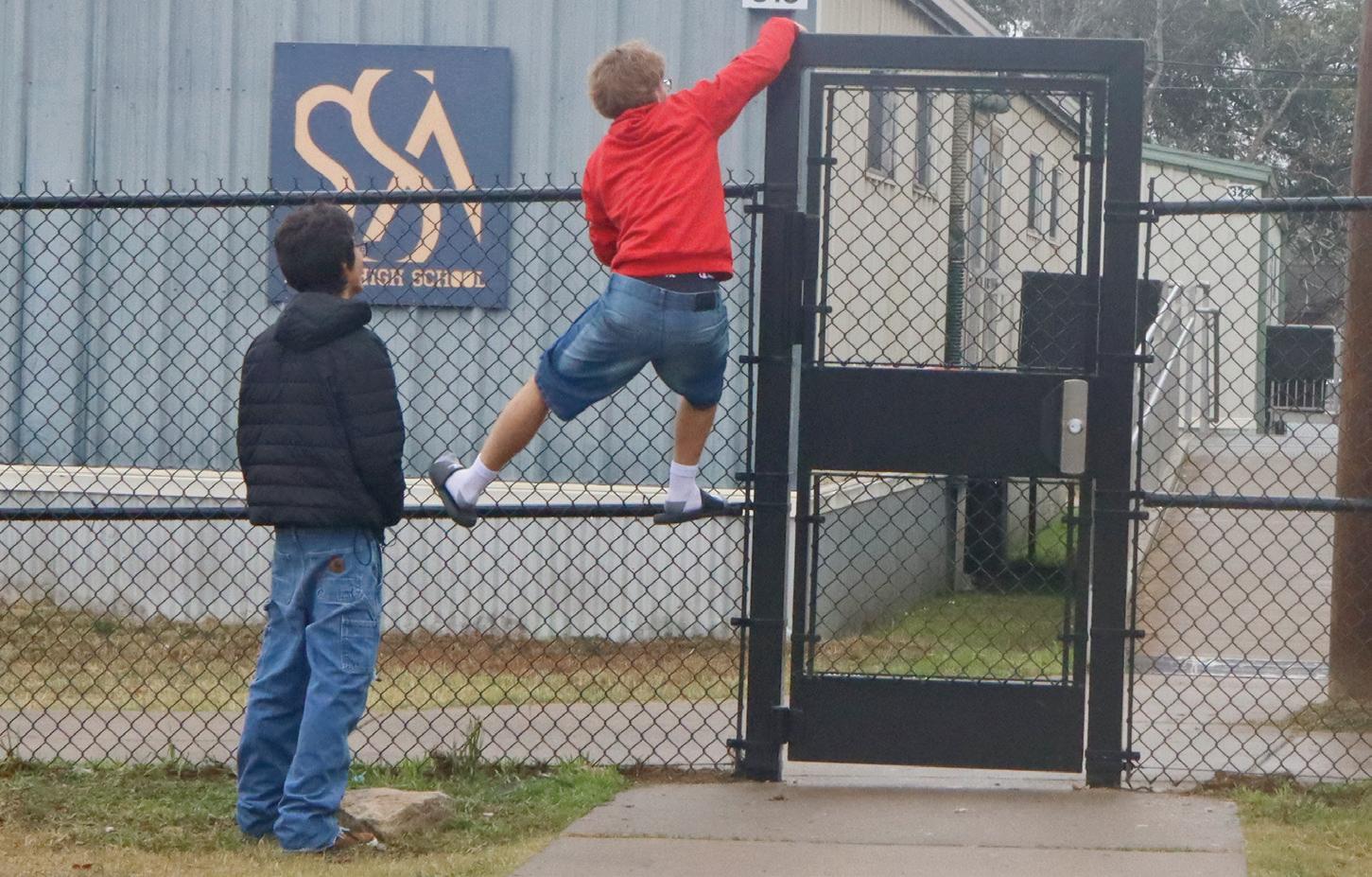
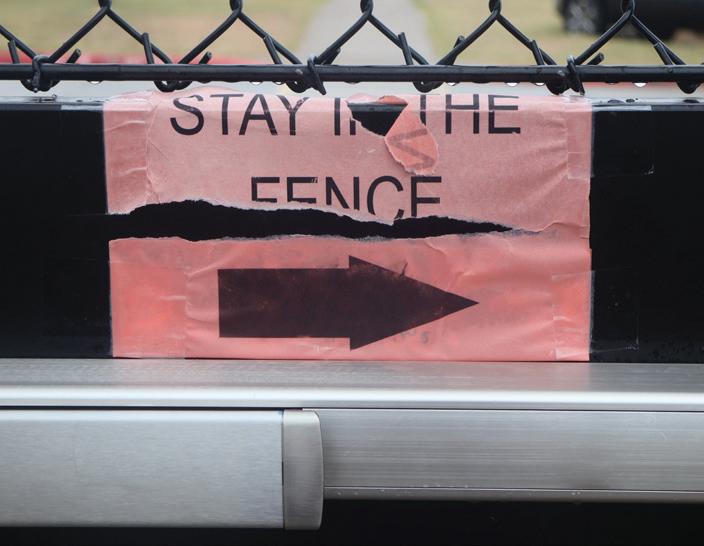
A student attempts to climb over the new fence near that encloses the area around the portables classrooms. A new law requires the school to lock the gates after fences were installed this summer.
QUICK FACTS:
Akins Gate Policy
◊ Texas state law (TEA)
• Now requires all public schools to maintain a secure perimeter with specific fencing to prevent unauthorized access.
◊ The Rules
• Passing Periods: Gates are open and monitored by staff.
• Class Time: All exterior gates are locked once the bell rings.
• Late Students: Must enter through the main front office.
◊ Student Feedback from online survey
• 82% feel the new policy is worse than the old one.
• 74% feel “no difference” in their overall safety.
• 39% have seen students open gates for other students
LOCKED OUT
Yanitzel Salazar
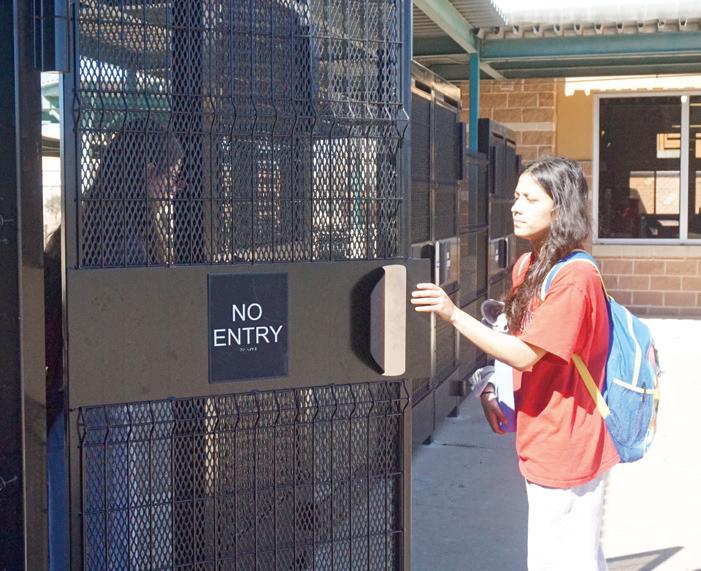
A student opens the gate between the cafeteria and the main building to let in a friend who is locked out of the campus. The new rule state that locked out students must go to the main entrance.
Recently installed gates were locked starting in Jan. making students walk a longer route to get between the portables and the main building.
Rebeca Guardado
Logan Rocha locked gates
akins ends new tech academy
Audio/Video, Commercial Photo programs canceled
JOSHUA TAYLOR STAFF WRITER
Students learned in January that the school will dismantle the New Tech Academy over the summer and cut two long-standing Career and Technical Education (CTE) programs: audio/video film and commercial photography.
The decision, which comes amid district-wide rezoning efforts and fluctuating enrollment numbers, marks the end of an era for a program that once defined the school’s approach to project-based learning. Interim Principal Carman DeLeon said the move has been under consideration for nearly five years.
“What drives programming is students,”
DeLeon said.
“When you all do choice sheets, whatever students choose determines what is popular at the time and what we continue with or don’t continue with.”
“
2013, the program underwent a major “redesign” to address issues with low enrollment and a lack of specific career pathways. At that time, school officials attempted to pivot the academy toward a focus on “New Media” and computer studies to distinguish it from the STEM academy.
The closure is also a response to Austin ISD’s rezoning plans. As boundaries shift, Akins is expected to see a decrease in its student population as some students are diverted to Travis and Crockett high schools.
While some New Tech pathways are being relocated, the complete elimination of the Audio/Video Film and Commercial Photography programs has left many students feeling a sense of loss. Audio/video teacher Kyle Monk expressed concern over how these cuts affect the diversity of the school’s offerings.
UNDER THE MARQUEE
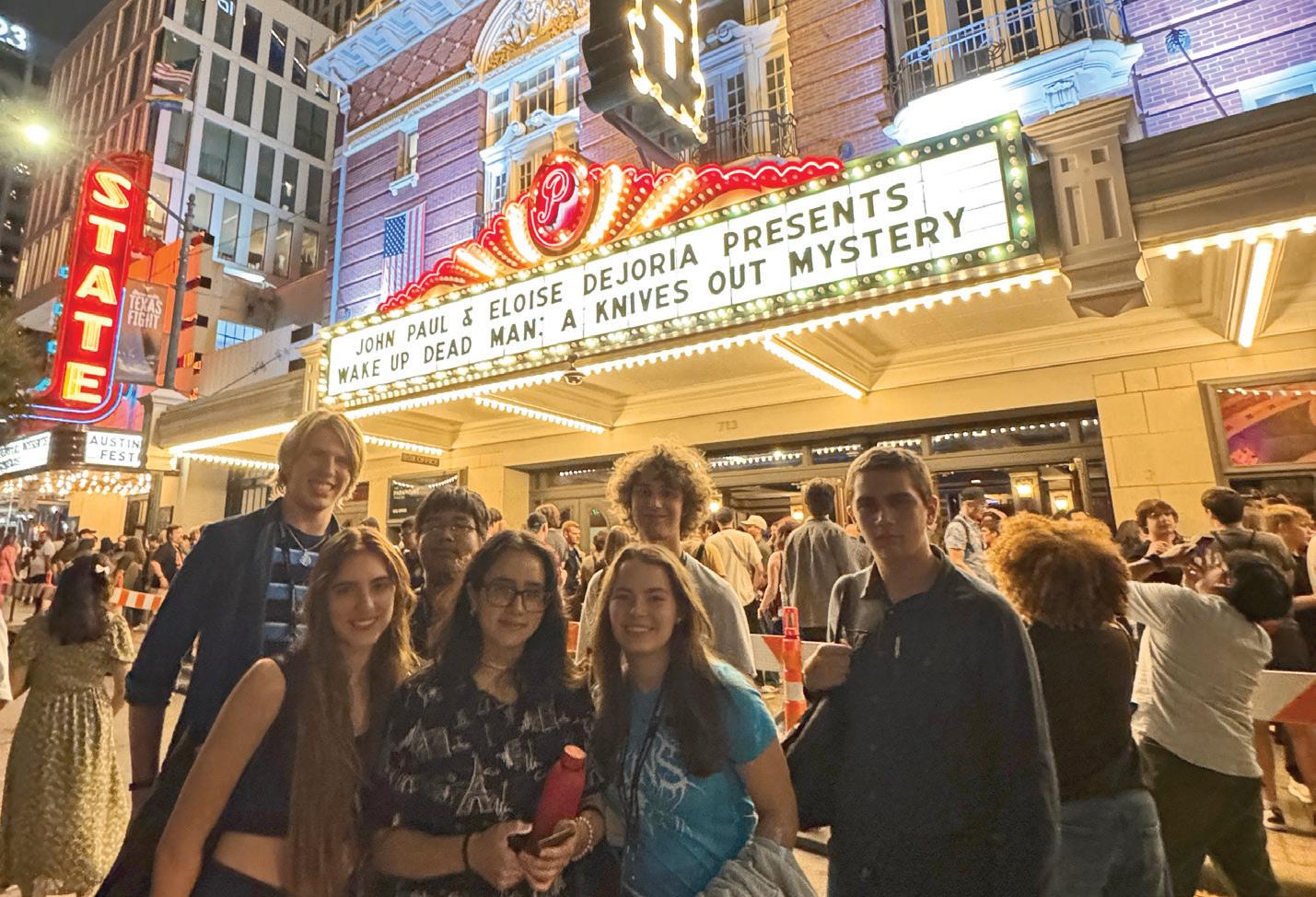
Akins film students enrolled in New Tech’s audio/video production classes take a group photo while attending the Austin Film Festival at the Paramount theatre in downtown Austin.
- Kyle Monk, A/V teacher
“ The variety of things offered here is what makes this school great. When you take away programs ... you risk losing that engagement.
DeLeon noted that student interest in New Tech’s specific pathways began to wane approximately five years ago. By last year, the administration noticed that many pathways were becoming redundant, overlapping with the STEM and Arts and Humanities (AHA) academies.
“As programming just got really similar, we started noticing... how are we going to make sure that classes make?,” she said.
The dissolution of the academy marks the final chapter of a program that has seen several identity shifts since its inception. Originally established at Akins in 2006 to mirror professional workplaces. However, the academy has faced hurdles over the years. In
“The variety of things offered here is what makes this school great,”
Monk said. “When you take away programs that students are passionate about, you risk losing that engagement.”
For many, the film and photography classes were the primary reason for choosing Akins. Senior Delaney Rios Lopez recalled falling in love with the school’s film program as an eighth-grader.
“I remember in eighth grade when I realized Akins had a film thing, I fell in love,” Rios Lopez said. “If this didn’t exist, I really would have felt very empty and very lost.”
Junior Daphne Foye echoed the sentiment, describing the program as a vital creative outlet.
“The idea of not having film next year, I just felt like one of my most creative outlets has been taken away,” Foye said. “There’s a piece of me that will never be fulfilled without getting to tell my story through visuals.”
Beyond the curriculum, students are mourning the loss of a specialized community. Junior Max Melton described the program as a “third place” for students who didn’t fit into traditional academic or arts molds like band or theater.
“It feels like I’ve been in this community of people, and this place that was specifically for kids like me,” Melton said.
“I never would have gotten into anything like editing and computer-related had New Tech and the classes within New Tech not existed.”
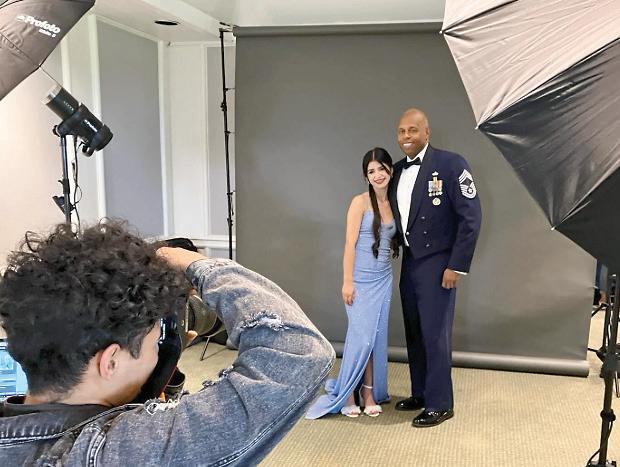
Commerical photography student takes photos at the JROTC Military Ball, providing a discounted service for a campus organization.
As the district moves toward a more budget-driven model for course offerings, students worry that the soul of the school’s creativity is being sacrificed. Senior Yuliza Castro-Hernandez noted the deep bonds formed in the program.
DeLeon emphasized that the administration is working to ensure students can still find relevant coursework within other academies. “We may not necessarily get rid of things; they might just be added to a different type of class,” DeLeon said.
Courtesy Silas Baker
Courtesy Akins Commercial Photo event photography
Madison EIC & PHOTO
Jasmine EIC & SPORTS
Yanitzel NEWS
S. Salinas OPINION Rami IN-DEPTH
Dean L&S Silas A&E
Micaela GRAPHICS Ever Copy Editor
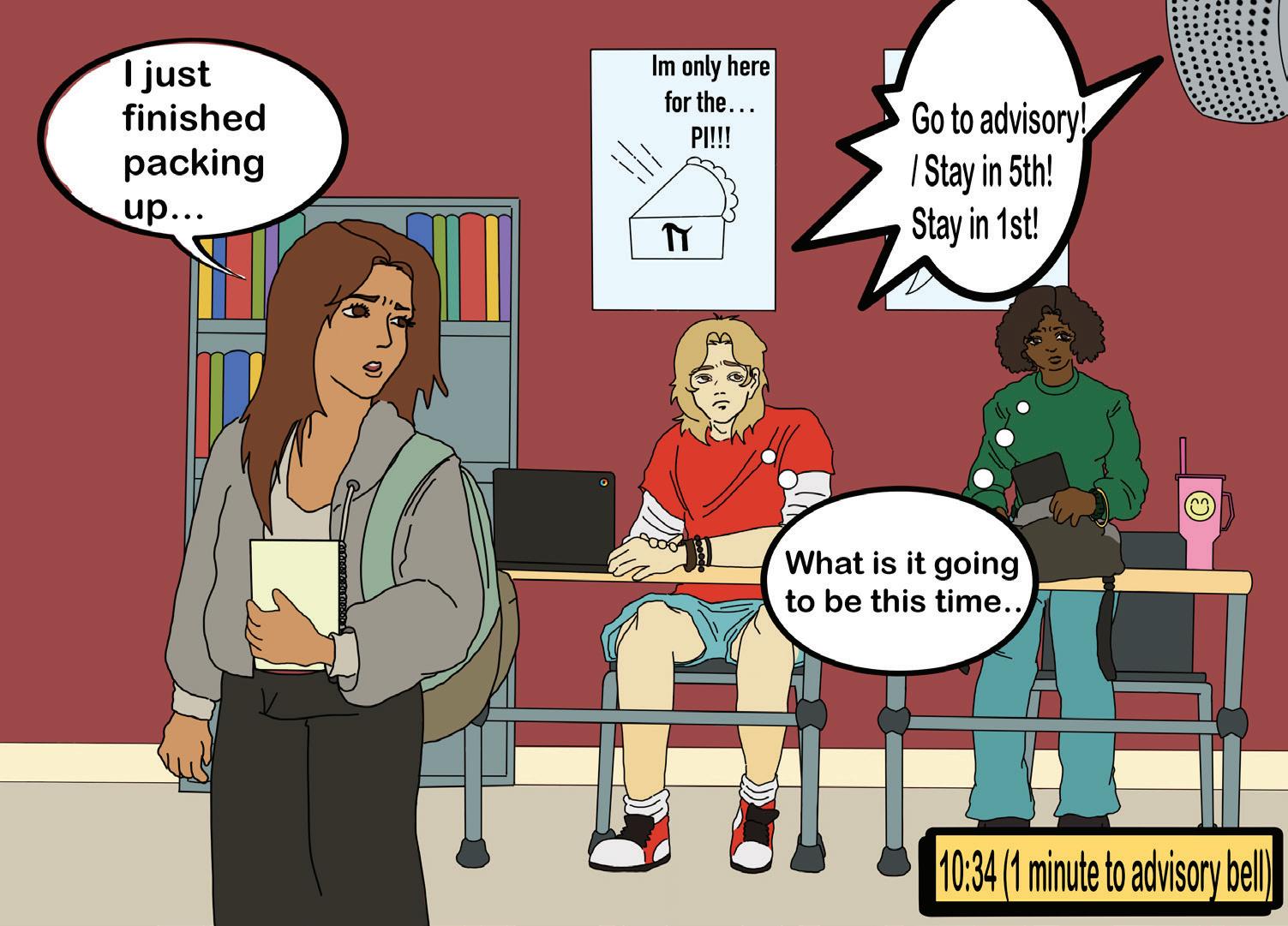
EDITORIAL: the advisory identity crisis
Constant advisory changes takes toll on student body
Every year—sometimes even every day—our advisory schedule changes. Confusion, frustration, and annoyance are just a few words that describe how we, and the majority of the Akins community, feel about this inconsistent class period.
Originally promised as a sanctuary for tutoring and catching up on assignments, advisory has instead become a primary source of stress for students and teachers alike. It often feels as though no one truly knows the plan for advisory until five minutes before the bell rings, leaving students with no room to plan their academic needs. This is not a new phenomenon. Advisory has been hectic and unorganized for years, swapping from rotating schedules to digital sign-up websites, to holding students in first and fifth periods, as well as the specific designated advisory teachers. A finalized, working plan is what this school desperately needs.
fying their own academic weaknesses.
As an editorial board, we believe that these inconsistent changes to advisory are significantly hindering student success. Without the ability to transition to another classroom to make-up work or follow up with a specific teacher, students are finding it impossible to keep pace with their academics.
In our view, the “Flexible Instruction Time” (FIT) model was the most effective variation of advisory this campus has seen, as it empowered students to decide exactly where they needed to be for those thirty minutes. It treated students as young adults capable of identi-
The current advisory system fails because it removes the very thing students need most: access. Students have lost the ability to receive timely tutoring, make up missed assessments, or meet with teachers before major deadlines.
In a survey by The Eagle’s Eye conducted last spring, 78.6% of students reported that the current “Eagle Time” format failed to provide them with the tutoring they required.
FIT, by contrast, offered a structure that actually worked. It allowed students to exercise agency, choosing whether they needed to take a retake, attend a tutoring session, or participate in clubs and UIL programs that currently cannot meet under the present restrictions. Rather than punishing the entire student body for the few who chose to misuse the sys-
WHAT IS AN EDITORIAL?
tem, the school should focus on refining FIT rather than replacing it entirely. A structured, improved version of FIT would restore student autonomy, reduce academic anxiety, and finally transform advisory into the helpful, purposeful period it was always meant to be.
However, we do not live in a perfect society, and there is no simple way to control the student body when a system is easily abusable. During the 2023-2024 school year, when we were able to select our FIT sessions, many students did not use the time for its intended purpose.
A large portion of the student body simply refused to sign up for sessions, leaving teachers with overcrowded rooms. Then there was the paramount issue: skipping. The prevalence of students leaving school grounds created a significant safety hazard. FIT was taken advantage of and it ultimately failed to serve the students who actually wanted to catch up.
While these chaotic tendencies led to the current restrictive “Eagle Time,” we believe the solution isn’t to lock students down, but to fix the management of FIT.
The school needs a middle ground—a system that offers the academic access of FIT with the accountability of the current model. Perhaps through better digital tracking or tiered privileges, we can find a way. Without it, advisory will remain nothing more than a wasted thirty minutes.
The Eagle’s Eye editorial board decides the postions taken in the staff editorial. The editorial board consists of the paper’s top section editors for the print edition. Editorials are not given a byline because they represent the collective opinion of the board. The topic of the editorial is discussed by the board and a position is voted on. When deciding on the position, majority rules so most opinions reflect the majority of the opinions of the board. Editorials do not purport to reprsent the official opinion of Akins Early College High School administration.
Micaela Rodriguez
OPINIONS
teacher shortage impacts learning
How lack of qualified teachers affect students
IAN RUIZ STAFF WRITER
The Austin Independent School District continues to face a teacher shortage that has affected campuses across the city, including Akins High School. While the issue exists district-wide, its effects are visible in Akins classrooms through long-term substitutes,
“Addressing the shortage is essential to ensuring students receive consistent, high-quality instruction
— Ian Ruiz
“
inconsistent instruction, and increased pressure on existing staff.
In some classes at Akins, permanent teaching positions remain unfilled for extended periods of time. As a result, students may spend weeks or months with substitute teachers rather than certified instructors. While substitutes help maintain classroom structure, the lack of a consistent teacher can disrupt lesson pacing, grading, and student engagement. The shortage has also placed additional strain on teachers who remain on campus. When positions are vacant, teachers may be asked to cover extra classes, assist students outside their assigned courses, or manage larger class
sizes. This can reduce planning time and contribute to burnout, making retention even more difficult.
Another important aspect of the teacher shortage at Akins is how it affects students’ confidence and preparation for the future coursework. When students move on to advanced classes without a strong foundation, they may feel discouraged or fall behind early in the semester. This can impact grades, standardized test performance, and students’ willingness to take challenging courses. In Akins there are a total of five permanent substitutes. In math, english, health, and even two admins. Each substitute teacher at least has three classes per day with an average of twenty five to thirty students, meaning a total around two hundred thirty-four students are affected.
Several students have expressed frustration about having to relearn material on their own or rely on tutoring to make up for the loss of instruction. While substitutes play a crucial role in keeping the classrooms running, many are not trained specifically in the subject they are teaching, which can limit how deeply lessons are explained.
Over time, these gaps can follow students through high school careers, making college readiness and academic growth more difficult to achieve. Addressing the shortage is essential to ensuring students receive consistent, high-quality instruction.
AISD has acknowledged that the teacher shortage is influenced by several factors, including rising housing costs in Austin, relatively low teacher pay, and increased stress following the COVID-19 pandemic. These challenges have
Short Take
◊ AISD has been experiencing a teacher shortage that has greatly effected both schools and students.
◊ A result of this is students spending several weeks or even months without a proper educator.
◊ This shortage not only affect a student’s academics but comprehension, understanding and even accountability in the classroom.
◊ A reason for this shortage consists of a multitude of factors such as rising housing costs, low teacher pay & increased stress following the pandemic.
◊ The group greatly impacted by this shortage are students from lower income areas, where a higher turnover rates are more common.
made it harder for the district to both recruit new educators and retain experienced ones, particularly in high-need subject areas such as math, science, and special education.
For students, the effects of the shortage can go beyond academics. Inconsistent instruction can lead to gaps in understanding, reduced accountability, and lower motivation in the classroom.
Courses without permanent teachers may move more slowly or rely heavily on independent work, changing the overall learning experience.
In my experience with having a substitute teacher for long periods of time was when Ms. Ramos left for maternity leave. She left for the rest of the school year and it felt like I was not learning anything and all we used to do was packet after packet even if the teacher tried to stay connected answering our questions via email.
The shortage also raises concerns about educational equity. Schools serving larger populations of economically disadvantaged students often face higher turnover rates, making it more difficult to
maintain stable learning environments. This can widen existing gaps in achievement and access to resources.
To address the issue, AISD has implemented measures such as recruitment incentives, district-wide job fairs, and alternative certification programs. While these efforts aim to bring more teachers into classrooms, longterm solutions depend on improving working conditions and making teaching in Austin more sustainable.
Despite ongoing challenges, Akins continues to operate through the efforts of substitutes, administrators, and teachers working to support students. However, the teacher shortage remains a significant issue shaping the daily experience of many students on campus.
As AISD works toward solutions, the impact at Akins highlights how staffing shortages are not just a district statistic, but an issue that directly affects classrooms, learning, and the overall school environment.
Nonnoy Partida
10 | FEB. 13, 2026
teens need mobility options
Austin is designed for cars instead of people
MICHAEL JARAVALERO STAFF WRITER
must be accommodated.
The ability to drive a car isn’t available to everyone. Some people aren’t able to drive a car due to plenty of physical or mental reasons. Maybe there is an inescapable fear when they’re behind the wheel, or some individuals are simply not at the age to own a car and their parents aren’t around to drive them places. It is just not a preferred choice or even an option to operate a giant metal vehicle to get everywhere. And it’s about impossible to find other reliable alternatives. Our community is failing the people that it is supposed to support.
“
A City Built for Engines, Not Humans Austin has been constructed around cars, rather than its own people. Many areas within Austin that could be used are taken up by the enormous space needed to accommodate parking lots and car garages. This is the reason why Texas is considered an unwalkable state. I’m sure it would be beneficial to everyone if the city provided more shelters and benches at bus stops, because people have needs that
Cars have definitely become unsafe with giant iPads that distract you from the road, blinding LED lights, and an increased size to the point where it’s hard to spot what is in front of you, all while persuading you that it’s a luxury to have such inconveniences. Most companies don’t care about you and your safety; you are simply a source of income—another number on their chart.
The Cost of Modern “Innovation”
◊ The ability to drive isn’t avaliable to everyone, whether that be due to mental or physical health reasons, a fear of driving or not being of age to own a vehicle.
◊ Many areas in the city of Austin have been taken up by cars which makes it unwalkable, with the space being accomodated for parking garages and parking lots.
◊ Cars can be seen as a threat or danger, with a lot of them having big screens that take over the dashboard, blinding headlights or even big enough to be dangerous towards small cars & children.
◊ Cars can be a financial burden, as they have to be constabtly looked at
“ Austin has been constructed around cars, rather than its own people.
— Michael Jaravalero
The iPads in the cars have a large chance to be the source of operating the whole vehicle; even opening the glove compartment requires you to take your eyes off the road just to access it. And like every other technical thing today, some require a subscription just to do the basic things that cars have always had. iPads are cheaper and easier for them to install compared to old physical buttons and knobs.
The increasing height of cars poses a danger to other smaller cars on the road or small children. Sure, it might be safer for the passengers within the vehicle, but others are at risk.
When on the road, I’m sure most have been put in a situation where the headlights of a passing car were too bright, and that is because the older lights are softer compared to the newer LED lights that are replacing them. It also doesn’t help that the new and giant cars have headlights that beam directly into the windows of smaller cars, whether they’re in front of them or behind.
Profit
Over People
They just want more and more money because it’s never enough; it has become increasingly obvious that these companies value profit over quality. So why sell you a car that works when they can have you come into the workshop every other month to supposedly fix whatever is wrong with your car until they’ve completely drained your bank account? They create new problems just to fix them afterwards and act like it’s a revelation because
they’re running out of cheap ideas to sell to the public. Insurance, roads, parking machine tickets to pay for spots, gas, cars themselves; all a market to take advantage of. Our lives revolve around cars to advance in life just like phones, so why not let these large companies choose who gets to drive?
A Path Toward Walkability
But the future is looking promising. There is a visible shift of projects being prioritized in this city of making Austin walkable, as seen with the increasing amount of sidewalks appearing, more shelters for bus stops, and the appearance of an electric train. Though there is always room for improvement, especially compared to other places outside of the United States, we should have the choice in how we live our life.
Michael Jaravalero
Short Take
OPINIONS
ice is out of control
We need reform now to stop abuses
by ICE agents
MICHAEL VALDEZ STAFF WRITER
In recent months, reports have surfaced of Immigration and Customs Enforcement (ICE) agents going door-to-door, entering homes without warrants, detaining individuals without due process.
From aggressive “dogpiling” tactics to reports of physical violence on the streets, the agency’s methods have shifted from law enforcement to what many perceive as a campaign of intimidation.
To understand the weight of these actions, we must look at the agency’s mandate. ICE was established in 2003 with the specific charge of enforcing immigration laws within the U.S. interior, distinct from the Border Patrol’s mission of monitoring the nation’s physical outskirts. While every administration since 2003 has utilized the agency, the current administration has radicalized its scope to an unprecedented degree.
President Trump has granted ICE extreme authority over the past few months, enabling a surge in aggressive tactics against both undocumented individuals and legal residents. This expansion of power is fueled by a significant increase in resources; according to recent federal budget reports, the administration’s latest funding bill makes ICE the most heavily funded law enforcement agency in the country.
This concentration of power is, quite frankly, absurd—especially given the agency’s track record of corruption. Time and again, ICE
has been accused of abusing its authority through unlawful detentions and actions that lead to permanent injury or even death, often with little to no justification. Consequently, public trust has eroded. A recent Pew Research Center study indicates that a majority of Americans now believe ICE’s presence makes their communities and neighborhoods feel
“
“ We need a fundamental shift in how we handle immigration—not just a reorganization.
— Michael Valdez
less safe rather than more secure. This sentiment is shared by high-level officials; Minnesota’s U.S. Senators recently argued that the agency is causing more harm than good and should cease operations within the state.
The administration’s current path also contradicts its own promises. The President vowed to prioritize the deportation of “the worst of the worst”—cartel members, drug dealers, and violent offenders. However, the data tells a different story. Analysis of recent
◊ ICE has been utitlizing aggressive methods towards citizens, which have shifted from law enforcement to intimidation
◊ ICE was established in 2003, with their original idea behind the establishment being to enforce immigration laws.
◊ President Trump has given the agency extreme authority over the past few months.
◊ The adminstration’s current path contradicts it’s original message of deporting criminals & has instead detained not only innocent civillians but veterans as well.
detention records shows that only 5% of those detained have actually been charged with a violent crime.
Perhaps most disturbing is the agency’s treatment of U.S. citizens and those who have served the country. There is an absurd trend of detaining citizens without due process, including war veterans and Purple Heart recipients. As reported by Military.com regarding a recent congressional hearing, veterans who have sacrificed for this country are being deported without even being given a fair chance to prove their status.
The lack of accountability is highlighted by the tragic death of Renee Good, a U.S. citizen. According to an investigation by Politico, an ICE agent shot Good in what was claimed to be “self-defense,” despite the agent intentionally placing himself in the path of a vehicle to create a life-threatening situation. The fact that an agency can get away with the killing of a citizen under such questionable circumstances proves that trust has been completely severed. Another devastating death caused by ICE is Wael Tarabishi.
Wael Tarabishi was a 30 year old who had an extremely rare genetic disease called the Pompe Disease. The Pompe Disease renders the inhabitant unable to breathe, move, and sustain bare minimum organ health. Usually, those who inherit it, barely live to see past year 2 of their lives. However, Wael’s father, Maher Tarabishi, was his primary caretaker and allowed Wael to live to 30 years old. Unfortunately, Maher was detained by ICE during a routine visit to a field office. Whilst Maher was detained, his son was unable to live without a caregiver and sadly passed away. Maher was legally allowed to remain in the US to care for his son, according to ABC News. After learning of his son’s death, he requested to have an emergency leave to visit his son’s funeral. These requests were denied.
We need a fundamental shift in how we handle immigration— not just a reorganization. Only by starting over can we hope to regain the trust of the American people ensuring that immigration forces actually protect the communities they serve.
Micaela Rodriguez
Short Take
Students Use their voices Akins seniors organize a walkout to protest ICE violence
MADISON STAMAN PHOTO EDITOR + EIC
On Thursday, Jan. 29, Akins students organized a walkout in order to protest against harmful and aggressive behavior from ICE agents in America. The walkout was peaceful, it was a way of showing solidarity with immigrant students and families. It sent the message that schools should be safe spaces, not places of fear, and that students have a voice in standing up for human rights and dignity.
Senior Adeleah Cardenas, one of the main organizers of the protest, gave a speech to rally up the students before the walk. She encouraged students to speak up.
“We should never be scared to voice our opinions,” she said.
She presses on issues with lack of funding to schools, erasing history, and the excessive violence used by ICE agents. Her speech resonated with our school, she had students cheering and yelling in agreement with her claims.
Senior Christopher Herard, who helped as an organizer, also gave a speech prior to the walk. His speech focused on how silence is “no longer an option” and standing up for people’s rights. Herard spoke on ICE’s violent actions, stressing that this is a peaceful protest, “I want no one else to get hurt,” he said.
The walkout showed that students won’t stay silent when our classmates and families are affected by ICE. It raised awareness, built solidarity, and proved that youth voices matter. It raised awareness, showed unity, and reminded people that immigration issues don’t just affect criminals, they affect real students and families in our schools.
Overall, the protest not only raised awareness within our local community but also strengthened connections among our students.
“Now, more than ever, we need to keep people together”, said Adeleah Cardenas.
STUDENT VOICES
A crowd of students hold signs while gathering outside of the school for a walkout protest that started at 3 p.m. on Jan. 29. The protest was organized by students via an Instagram account that was created to promote the walkout over the weekend ahead of the protest against recent actions by ICE.
Ximenna Arroyo GETTING A
LIFT
Senior Paola Garcia holds a protest sign while riding on the shoulders of Albert Banda. He kept her on his shoulders while walking along S. First Street during the protest. Drivers honked their horns in support of the student protesters and many other kids also joined by letting kids sit on their shoulders and hold posters higher.
students united
Senior Dariel Valdez claps and yells during the protest against recent actions by ICE. Students around him also yell encouragingly whilst speeches go on.
Lilian Crider
Lilian Crider
PHOTO ESSAY
speaking up
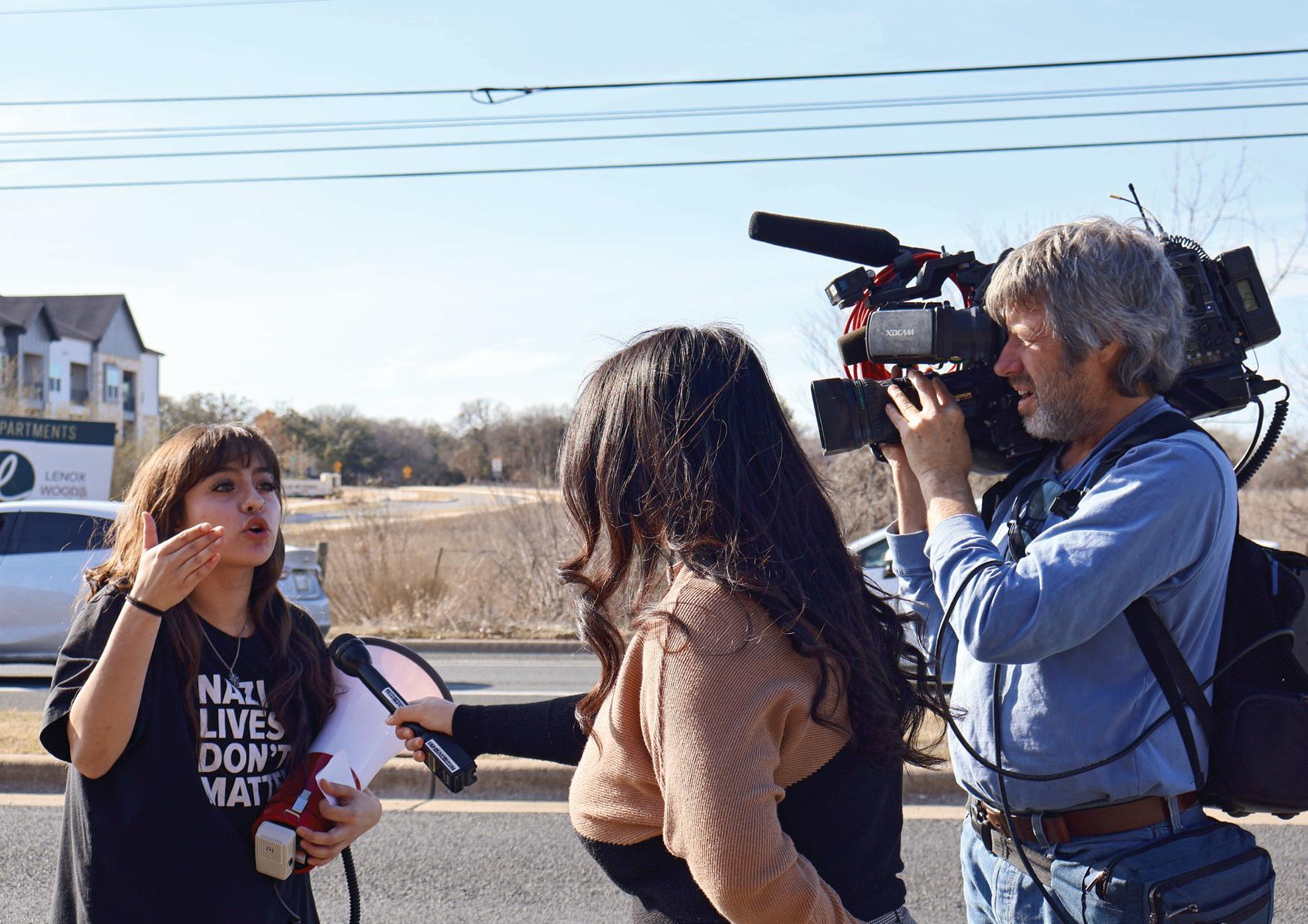
Senior Adelah Cardenas answers questions from a reporter from the KVUE television station who arrived during thet protest to interview students and take video of the walkout organized by students. Cardenas and several other seniors organized and promoted the protest against recent actions by ICE.
signs up
Akins students cruised down S. First Street in their vehicles waiving signs from a convertible during the protest. Although not walking, they contributted to the impact.
pickup protest
Many students hopped into the back of pick up trucks driven by students down S 1 st. However most protesters walked the whole way before returning to Akins.
The march
Akins students walked and drove down S. First Street almost two full miles before finally returning to Akins before the final bell of the day rang at 4:35. Hundreds of kids were seen crowding the streets in solidarity with vicims of ICE and immigrant families.
Senior Adeleah Cardenas stated that “people need to understand that just because they look different than other people, doesn’t mean they don’t have the ability to have a voice and speak out”.
Yanitzel Salazar
Lilian Crider
Nonnny Partida
Tomas Martinez
Justyn Trejo
Justyn Trejo
YOUR VOTE, YOUR TEXAS
Primary voting determines the ballot for November
JONATHAN BALDERAS WEBSITE EDITOR
While eyes are fixed on the general election in November, the real gatekeeping of Texas power happens much earlier, in the March primaries.
The primary is more than just a preliminary round; it is the moment where the policy path for the next decade is decided. From the cost of college tuition and the accessibility of healthcare to the craze of immigration, the candidates who survive this spring’s ballot will be the ones holding the pen on the laws that govern our future.
When voter turnout is low in the primaries, a small fraction of the population ends up deciding which names make it to the final ballot.
Akins teacher, Dr. Ellen Connor, warns that this kind of limited participation can shape the race in unexpected ways, noting that “low turnout… can impact things going forward, as far as getting sometimes more extreme candidates.” For a generation navigating a shifting economy and a complicated political landscape, staying home means letting others choose your options.
Republican Primary: A Three-Way Clash
The primary for the U.S. Senate is one of the most watched races this season. On the Republican side, incumbent Sen. John Cornyn faces a tough challenge from Texas Attorney General Ken Paxton and U.S. Rep. Wesley Hunt. Cornyn has been in Texas politics since 1999, serving as a district court judge, a Justice on the Texas Supreme Court, and a Texas Attorney General before joining the Senate in 2002.
Paxton, who has served as Attorney General since 2015 is positioning himself as a formidable challenger. Despite Paxton leading in some early polls, Cornyn holds a financial advantage, reporting a $3.36 million haul in the third quarter compared to Paxton’s $1.3 million.
Paxton’s campaign has been notably quiet on traditional media. A spokesperson for the Attorney General stated that they “feel good about the way they are spending their money when it’s necessary.”
Democratic Primary: Crockett vs. Talarico Dallas Congresswoman Jasmine Crockett is challenging state Rep. James Talarico of Austin, a matchup that offers voters two distinct styles of leadership. Crockett entered politics in 2020, winning a seat in the Texas House after working as a public defender and founding her own Dallas law firm. Motivated by criminal justice reform, she advanced to Congress in 2022 with the endorsement of the late Rep.
James Talarico, who has served in the Texas House since 2018, takes a different approach. A former middle school teacher, Talarico decided to run for office after seeing the daily struggles of his students. He is known for a more reserved, legislative focus rather than
The race created a divide among Democrats. “I’m a little worried for the Democratic Party. There’s this really big divide between Crockett and Talarico,” said senior Karlos Navarette. “Talarico isn’t as well known as I’d like to think he is, but I love that his campaign is people-led and that he isn’t receiving funds from
Recent polling from Emerson College shows Talarico leading with 47% to Crock-
2) REGISTER TO VOTE
The deadline to register for the Texas primaries in 2026 is Feb 2 Texas uses paper registration only Mail or deliver your form to your county voter registrar before deadline
3) RESEARCH YOUR Use NON-BIASED informati VoterTravis com, Texas Tribu and Ballotpedia are great so NOT allowed; print any note
4) KNOW YOUR PRIMARY
Texas has open primaries At the polling place, choose either the Democratic or the Republican ballot You can only vote in ONE party’s primary this cycle
5) BRING THE RIGH VOTING CENTER
Accepted IDs include: Texas Texas ID, U S passport, etc can vote at any center durin Election Day
6) VOTE EARLY OR ON MARCH 3
Early Voting: Feb 17-27, 2026
Election Day: Mar 3, 2026 (7 AM - 7 PM)
Review your ballot carefully before submitting
IN-DEPTH
ett’s 38%. While Talarico holds momentum with Hispanic (59%) and white (57%) voters, Crockett maintains a strong base with 80% of Black voters.
The Race for Governor Republican Party: Abbott’s 4th Term Bid
Governor Greg Abbott is seeking a record fourth term. He faces a field of five challengers, including State Board of Education member Evelyn Brooks, Arturo Espinosa (who previously ran for San Antonio mayor), and Army veteran Pete Chambers. Abbott remains a powerhouse, having won every re-election bid with nearly a million more votes than his Democratic opponents. With a reported $90 million budget, he enters the primary as the clear favorite.
Democratic Party: Austin’s Hinojosa Leads
R CANDIDATES
on: VOTE411 org, une Voter Guide, ources Phones are es you may need
TIC OR REPUBLICAN
s driver’s license, In Travis County, you ng Early Voting or
Top Issues: 81.8% of respondents cited housing affordability and property taxes as their top concerns.
School safety, gun reform, and border security followed at 45.5%.
Voter Loyalty: 57.1% of surveyed students said they would vote for the same person in the general election that they supported in the primary, while 42.9% indicated they might change their minds.
Voices from the Students For seniors Avery Elizondo and Marley Fuen tes, attending an anti-ICE rally made politics
AKINS PRIMARY ELECTION SURVEY RESPONSES
State Rep. Gina Hinojosa, an Austin Democrat who has served in the House since 2017, is currently leading the Democratic polls. Hinojosa has earned key endorsements from federal representatives Jasmine Crockett and Veronica Escobar. Also in the race are former U.S. Rep. Chris Bell, making his second bid for the office after two decades, and Bobby Cole, a former firefighter and farmer.
emphasized equal ity and opportunity. Fuentes, a firsttime voter, said “I’m hoping these elections finally flip Texas toward a more Democratic future, and I’m hopeful Gina Hinojosa can lead that change.”
Source: Online Survey by The Eagle’s Eye
Other students are motivated by legislation affecting their daily lives. Senior Bree Seaman said bills like SB-12 pushed her to get involved.
Youth and Government team, the choice is about progress. “I think that we should replace politicians like Greg Abbott and John Cornyn, because they’ve been in office long enough; it’s time for fresh ideas to be part of the government,” she said.
Many stress the need for stronger investment in education.
“Education is really important... it’s the future for our country,” Fuentes said. “They have to fund the next generations.”
And first-time voters want politicians to take young people seriously.
The Akins Perspective
A recent survey conducted by The Eagle’s Eye with the Akins community revealed that local issues are the primary drivers of student interest.
“One person will make a difference as long as you believe in your vote,” she said.
Seaman and classmate Michelle Garza now run a menstrual-health project on campus helping improve Akins healthcare.
Across Akins, students are stepping into civic life. From AustinCorps voter-registration ef-
“Why don’t you start with us, inspire our opinions, our beliefs... have us ready for the next election,” Elizon do said.
The Upside Down Falls Flat Stranger Things finale left fans questioning reality
EVER HAYNES + KARTIE SHELL STAFF WRITERS
Stranger Things 5 left many fans, including myself feeling disappointed. Some fans felt it was lacking so much that they deluded themselves into believing there was a secret last episode.
I’m sad to see it go but also glad because I’m not to sure of how I felt about the last season. I feel like the actors weren’t performing to the best of their abilities, compared to the caliber of acting displayed in previous seasons.
On December 31, 2025, it seemed the whole country was waiting at the edge of their seats for the highly anticipated finale of Stranger Things; however, what was to come wouldn’t live up to the expectations of fans.
The episode itself had a runtime of a whopping 2 hours and 8 minutes, longer than the average 90-120 minutes of a mainstream theatrical release. Even with all of this content, most fans seemed unsatisfied, leading to mass theorizing and criticism of the show and its creators.
Shortly after the episode dropped and everyone was taking in the events of the finale, an X (formerly Twitter) user by the handle of
@67gate tweeted something that seemed to change everything people thought they knew about season 5.
“lowkey does anyone not find it weird how every single character in the end turned into a conformed version of themselves”
At first the tweet reached its target audience–the small community of Stranger Things fans following the aforementioned user. Replies flooded in agreeing with the statement– they pointed out that a lot of the characters ended up like the things they hated most. Mike ending up like his father, Nancy dropping out of college, Robin turning into a more feminized version of herself despite previously presenting herself as more masculine– it all seemed to add up.
Some stated they thought the finale, and the final few episodes of season 5 in general, was actually just Vecna, the main antagonist, putting a curse over the viewer’s mind. It made more sense as people searched through the last episodes of the series for clues.
They called it Conformitygate; the -gate suffix meaning to signify a conspiracy theory. It only took a few days for the theory to spread internet-wide, primarily apps like TikTok. Major news outlets were reporting on the theory, and posts discussing new ‘evidence’ garnered millions of likes. The general audience took
this theory and ran with it, genuinely believing that the real finale to the show was going to premiere on January 7th, 2026, therefore making TV history.
However, as we all know, no episode actually dropped.
Not only did this disappoint fans of the show, but it made them realize that all of the ‘clues’ they had found that pointed to the theory being real were actually just plot-holes and errors made by the creators, the Duffer Brothers. Hate and criticism was sent their way, but it would be heavily amplified with the release of the two-hour-long documentary detailing the making of the final season. In the documentary, the Duffer Brothers didn’t exactly make themselves out to be the best directors. A shot showing the google document where the script was written had three ChatGPT tabs open in the background, leading people to believe that many of the errors in the final season were due to it being written by AI. It was also stated that they were already shooting the finale without it being fully written, so it was likely rushed. Considering the reported $400-480 million dollar budget of the final season, fans knew they could’ve done better.
While the season had some good moments, overall the Duffer brothers didn’t deliver the satisfying conclusion that fans hoped for.
Ever Haynes
ENTERTAINMENT
Orchestra plays radio station
DANIELLE CERVANTES STAFF WRITER
In a harmonious blend of talent and opportunity, the Akins High School Orchestra is preparing for a special performance at a local Austin radio station that will see students step into the roles of both performers and composers.
The upcoming event is part of “The Declaration” project, a national initiative led by renowned pianist Lara Downes in partnership with KMFA 89.5 and various institutions across the country. Marking the 250th anniversary of the Declaration of Independence, the project invites artists to reflect on the founding ideals of life, liberty, and the pursuit of happiness.
When Downes completes the national tour, the various contributions will be woven into a “living composition” to be displayed at the Kennedy Center in Washington, D.C. “The composer that is writing the entire piece has been working with three or four high schools across the country, and
we’re one of the high schools that she’s been working on,” orchestra director Thomas Mann said.
The performance is scheduled for Feb. 22 at the KMFA studios.
The Akins Sinfonietta will open the program with works by two American composers: Florence Price and Norman Dello Joio.
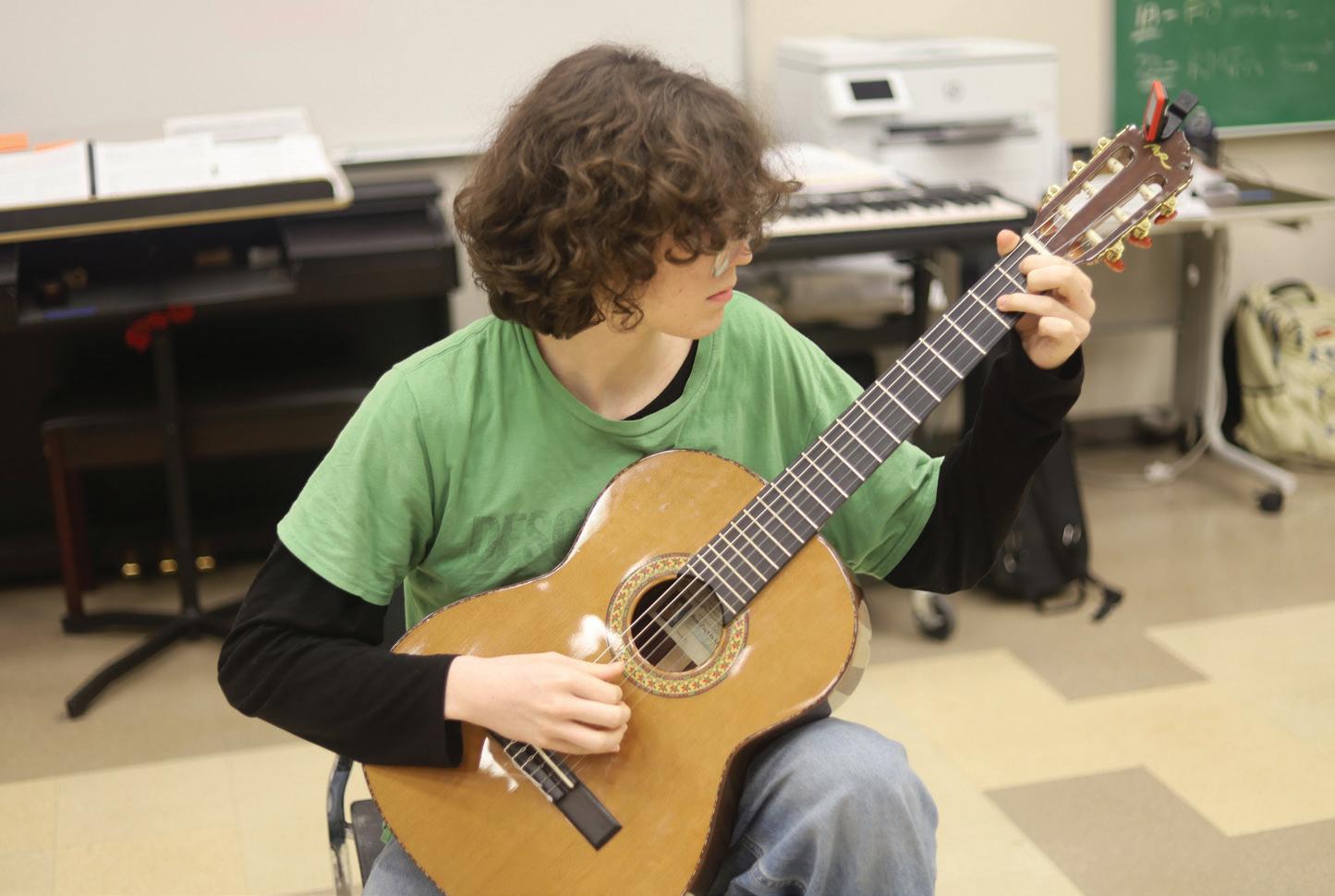
Following the string performance, the program will feature an original piece composed for the event by Mann and senior Jude Sigholz. Centered on the themes of life, liberty, and the pursuit of happiness, the piece will feature Mann on piano and Sigholz on guitar. Sigholz said he and Mann set out to write a song that is not only fun to listen to, but also to play. “I’m just excited to just show our creative process and our product,” he said. These high-profile performances allow the Sinfonietta to showcase the talents they have refined through daily practice. For many students, the radio broadcast is a significant stepping stone for those who plan to pur-
solo
Senior Jude Sigholz practices his guitar solo for an upcoming competition in front of his class.
sue music in the future. Even for those moving into other fields, the experience offers a unique chance to share perspectives and create
cinematic chaos
memories, letting the sounds of colliding strings create a song for the community to enjoy.
A24’s Marty Supreme delivers nonstop thrills
PERLA LEDESMA STAFF WRITER
In his solo directorial debut, Marty Supreme, Josh Safdie proves that even without his brother Benny, he is still the undisputed king of the “anxiety-induced” cinematic experience.
The film, loosely inspired by the life of table tennis legend Marty Reisman, carries the signature Safdie DNA: it is a frantic, closeup-heavy, and relentlessly loud odyssey through the 1950s underground. But while the directing is vintage Safdie, the movie’s heartbeat is a career-defining performance by Timothée Chalamet. Chalamet stars as Marty Mauser, a scrappy shoe salesman turned ping-pong phenom whose ego is as sharp as his backhand. From the opening frames, Chalamet propels the action with a twitchy,
live-wire intensity. Whether he’s manipulating his way into an international match or frantically pitching his signature orange ping-pong balls—designed for visibility but fueled by his desperate need for legacy—Chalamet never lets the mo mentum slow. He isn’t just playing a charac ter; he is embodying a “purpose.”
This performance marks a signifi cant pivot for the actor. As noted in Rolling Stone, Chalamet’s commit ment to the role was bordering on
the obsessive, mirroring the very ambition he portrays on screen. By training for seven years and even wearing prescription-blurring contacts to better understand Mauser’s visual perspective, Chalamet demonstrates that he isn’t just on his way to becoming one of the best—he is
The action of the film is like a 149-minute ping-pong match.
Much like Safdie’s previous work in Uncut Gems, the camera stays uncomfortably close, turing every bead of sweat and every flash of Mauser’s
manipulative charisma. Chalamet navigates this mindset with a ferocity that turns a table tennis into something as high-stakes as a heist.
He plays Mauser with a reckless ego that makes him unlikable, yet Chalamet’s inherent vulnerability keeps us tethered to his journey. He is the storm that the rest of the cast, including Gwyneth Paltrow, must try to weather.
Marty Supreme is a loud, unapologetic celebration of American exceptionalism and the “pursuit of a dream.” It’s a movie about the weight of being great, led by an actor who seems more than ready to carry that burden.
Marty Supreme is an incredibly thrilling and exciting piece of cinema. I highly recommend it to anyone who enjoys a fast paced and intense narrative.
Silas Baker
Guitar
Disney slop Streaming service allows users to generate AI content
JACK
GREENE STAFF WRITER
Disney has hit a new low following a statement from CEO Bob Iger in December, announcing a partnership with Sora and OpenAI.
“The rapid advancement of artificial intelligence marks an important moment for our industry, and through this collaboration with OpenAI we will thoughtfully and responsibly extend the reach of our storytelling through generative AI, while respecting and protecting creators and their works,” Iger said in an OpenAI press release on December 11.
The bottom line is that Sora will be able to generate short, user-prompted social videos that can be viewed and shared by fans, drawing on more than 200 Disney, Marvel, Pixar, and Star Wars characters. The agreement will make a selection of these fan-inspired videos available to stream on Disney+.
This may sound like a positive to some users, but many artists and writers feel betrayed. Those who created these iconic characters for Disney feel like the company spit in their faces with this announcement. Major animation companies are also concerned about this new
addition to the streaming service.
“Disney is getting lazy and thinks using AI will make a better outcome. It’s hurtful for those who’re choosing a creative path in the media. I’m against it, as it’s basically plagiarism starting to form, taking artificial intelligence answers as their own,” said sophomore artist Loryn Govea.
Even student artists and teachers feel disrespected. Animation teacher Benjamin Majerek argues that current AI development isn’t designed to help artists sharpen their skills or find efficient shortcuts; rather, it is designed to replace them entirely. While he acknowledges that AI could potentially improve specialized animation workflows, he remains skeptical of the current market’s direction.
“There’s some very specific instances where AI could be helpful in especially areas like 3D technology. The issue is that no one’s making those things,” Majercak explained.
He notes that instead of hiring professionals, companies are moving towards executives simply typing in a prompt to create content from scratch.
“I would be resistant if I were an artist working at Disney... I would probably be scratching my head
and looking at the bigger picture of the supremacy of AI and the wider financial world,” he said. This doesn’t mean Disney is letting just any company use their characters—for example, Midjourney. Disney is currently suing them for mass copyright violations, alleging that Midjourney is stealing the work of Disney’s artists. Similarly, Disney is suing Google, claiming Google’s AI models were illegally trained on Disney characters.
Many artists have since left Disney to join independent, AI-free animation companies like Glitch, an Australian indie studio.
Dana Terrace, the creator of The Owl House, left Disney following the company’s AI partnership. She joined Glitch to direct a new series.
...the only tools that AI companies are developing are tools to replace artists.
— Ben Majercak
“ “
Some are wondering if indie studios are the future of the industry. Based on the viewership and financial support Glitch has earned from its fanbase, the
answer appears to be yes. Disney is slowly losing its audience and is frequently called out by fans for an over-reliance on sequels and poor writing. Is this Disney’s way of admitting they’re out of ideas, by partnering with a tool that mocks the artists who built them? If you were hoping Disney would change course under a different CEO, that’s not going to happen. On Feb. 3, Iger announced that he would be stepping down and would be replaced by Josh D’Amaro. During an interview with ABC News, D’Amaro said the company would be embracing AI. “This is when the Walt Disney Company thrives, when technology intersects with brilliant people and creativity.”
Now it’s time for Disney to make a choice: will they keep spending money on AI partnerships, or will they actually listen to their fans and stop using “AI slop” to replace talented artists and writers?
Jack Greene
ENTERTAINMENT
arc raiders: survival of the fittest
DEREAN HORTON + HAYDEN TORRES
STAFF WRITERS
The world of ARC Raiders is a beautiful but brutal vision of the future. A cooperative third-person shooter, the game drops players into a landscape where humanity is fighting for survival against the “ARC”—a mysterious and relentless mechanical threat. While the machines are dangerous, we quickly learned that in this world, the players you meet might be even more lethal.
At its core, ARC Raiders is about growth and preparation. You start with a character you can customize, but the real depth lies in the skill tree. As you level up, you unlock attributes and upgrades that define your play-style. Serious players and streamers have already begun theory-crafting specific builds to maximize efficiency.
Everything revolves around your “Stash.” Any loot or materials you
successfully extract from a raid are stored here. However, space is a premium—with a limit (currently around 290 items), you have to be selective about what you keep. To speed up your progression, the game offers various challenges that provide the experience points needed to climb the skill tree and improve your gear.
My first solo attempt was over-
whelming; I was lost and confused. It wasn’t until a friend showed me the ropes that I had my first “proper” game. We dropped in and immediately checked the map to find a looting destination. Initially, I was just spraying bullets, doing almost no damage. My friend taught me the game’s first rule of combat: aim
for the weak points. By focusing my fire on the back thrusters, we sent the enemy crashing down. The tension of the game peaked as we filled our bags and headed for the extraction zone. In ARC Raiders, the game isn’t over until you’re safely back at base.
This leads to the “dark side” of the game. ARC Raiders allows for “free rein,” meaning you can choose to be a “legit” player who focuses on quests, or a predator who takes what they want from others. I’ve been on both sides.
ARC Raiders is a game of high stakes and memorable stories. It can be frustrating—nothing hurts more than being betrayed at an extraction point after a long raid—but that unpredictability is what makes it exciting. Whether you are hunting machines or watching your back for other players, it’s a thrilling experience that I highly recommend to anyone looking for a new cooperative (and competitive) challenge.
Jujitsu Kaisen returns
Popular anime series comes back with brand new season
BRENTON CHILDERS
STAFF WRITER
Jujitsu Kaisen is a critically acclaimed anime that’s taken the world by storm due to its fresh take on the genre, blending dark fantasy elements with impactful emotional moments. With the huge hype of the Jujitsu Kaisen fandom, people are excited and amazed with how much it has grown over the years, especially with the kickoff of season 3, now airing, with a new episode releasing every Thursday.
Jujitsu Kaisen is about high schooler Yuji Itadori, who joins a secret society of Jujitsu Sorcerers to fight curse—monsters birthed from negative human emotions. The series blends thrilling action, supernatural horror, and coming-
of-age themes as Yuji navigates the dark, but magical fantasy world.
Jujitsu Kaisen is primarily available to stream on Crunchyroll, which has all seasons and the movie.
The Main Character, Yuji Itadori’s main goal is to protect everyone he loves and kill all curses threatening the world.
Jujitsu Kaisen stands out for its blend of dark, mature themes with thrilling action, featuring a complex, psychology-based power system, morally gray characters with deep development, stunning animation, and subversion of typical Shonen tropes, all wrapped in a fast-paced narrative that keeps viewers engaged with mystery and deep lore. JJK features a dark, mature tone where characters
face death and lasting trauma.
Jujitsu Kaisen is primarily for teenagers and young adults. It appeals to fans of Shonen action but offers more mature content than typical shows in the genre. While the ending received mixed
reactions regarding its pacing, the final chapter offered a sentimental farewell to the core characters and left a door open for future, small-scale adventures in a changed world.
Embark Studios
MAPPA
PAGE 20 | FEB. 13, 2026
Printing money
Student turns 3D printing hobby into a business
DEAN KNOWLTON LIFE AND STYLE EDITOR
The standard bathroom pass has seen better days.
The passes used to be in less than great conditions, being crumpled, torn, ripped from the keychain loop often stolen. Or that is how it used to be before junior Jaxzen Perez had an idea. If he could take this idea and turn it into something better than anything the school had seen before.
He quickly went to the school Principal and showed him the product that would then solve the issue of the passes. Perez’s business did not start off in a boardroom, but with a Christmas present.
“I’ve always been in the engineering realm in my head,” Perez said. “I got a cheap, crappy printer for Christmas—it cost about $150—and I just kept going with it. I got addicted.”
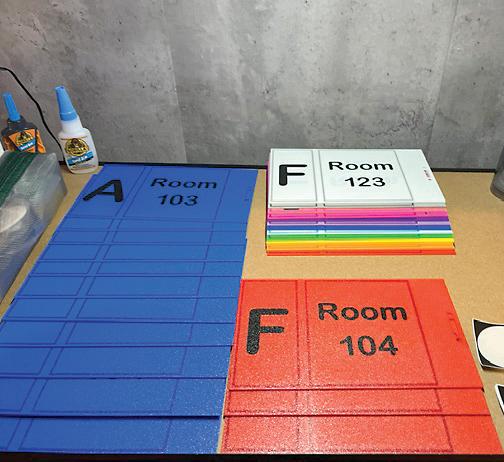
Perez presented a proposal to the Akins principal last year to make 3D printed bathroom passes made from hardened PLA plastic—a material chosen for its perfect balance of strength and cost—and the partnership was born.
“The first really major thing is whenever I first reached out to Akins, to the hall passes, that was probably the first thing where it gave me a really good payout, and that kind of jump started my business to be more noticeable,” Perez said.
He said the business has grown beyond Akins and now he makes passes for many other schools.
“I work with schools all over. I do Austin, Lockhart ISD. Those are the two actual ISDs. But then I do Lockhart and Pride Middle School, Lockhart Middle School.”
While Perez is operating by himself, he is not necessarily alone on his path. He found a mentor in teacher Keith Terry, who is a former businessman himself who helps Perez by giving him advice coming from his experience in the real world. Perez said that Terry’s role is more about giving him a
FINISHED PRODUCT
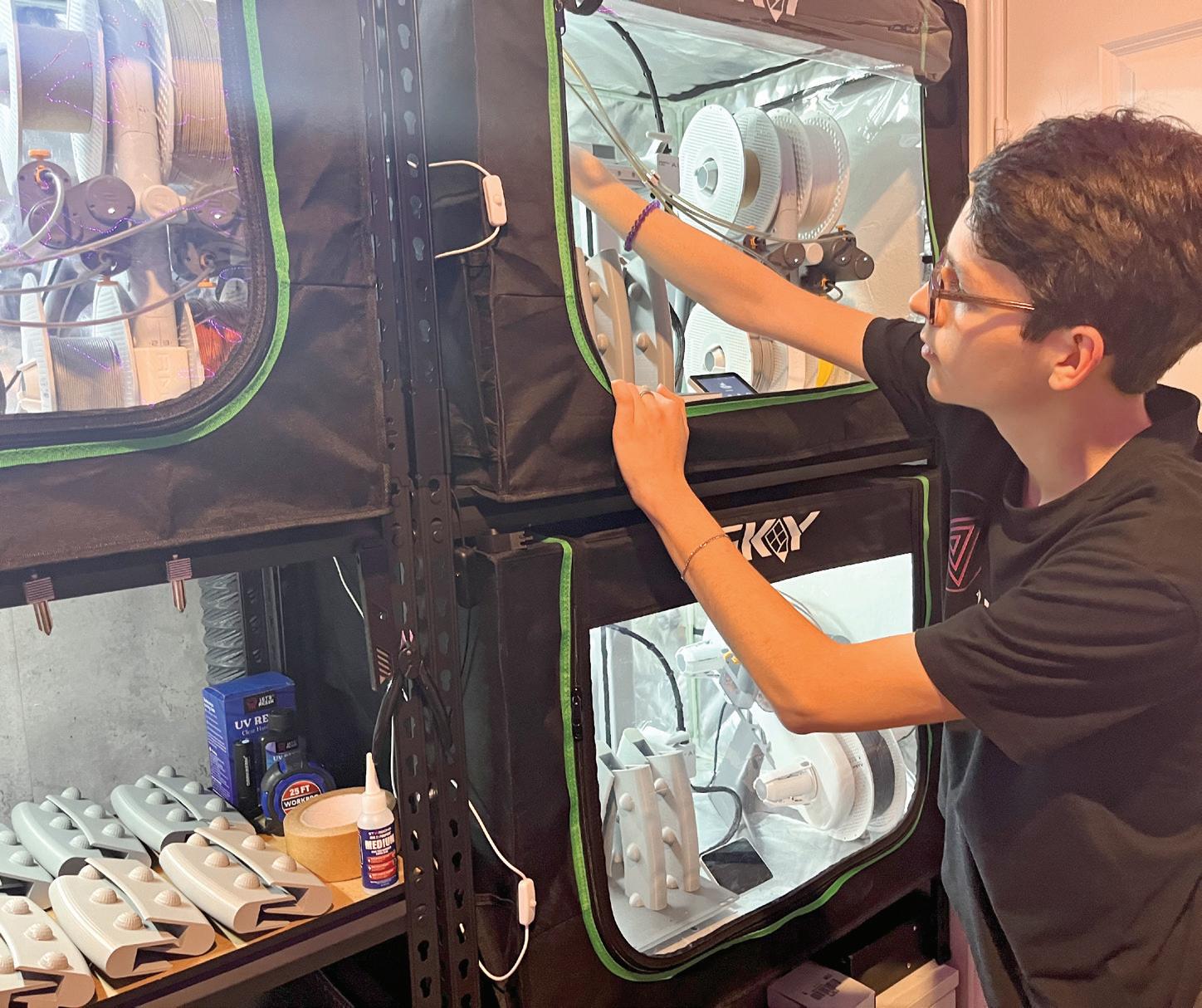
Jaxzen Perez stacks up finished bathroom passes that he prints at his home workshop. He’s been learning how to 3D print since he was in middle school.
guiding hand making sure that he’s on the right path.
“He’s a mentor I can go to and ask, ‘Am I doing this right?’ He’s always there to give me a second opinion that I can trust,” he said.
Terry’s transition from the business world to a public school classroom has given him opportunities to find student talent that goes beyond simple good grades and attendance. When Terry first saw Jaxzen’s equipment and business, he quickly realized that this was more then just a hobby but the early steps of a real entrepreneur, Terry said.
“Jaxson’s 3D idea fits a need, which is the key to any new business,” he said. “It helps it become Successful. My role was as an advisor; I provided technical advice and some guidance.”
Jaxzen3D’s work and projects extend far outside of just doing business with the school. Perez said he works with engineering firms such as DCI Engineers to create modes of building, providing hundreds of props for the Bat City Scaregrounds.
“It’s about a $2,000 order, and still going up in price,” he said. “They ordered a giant movie prop.
PLASTIC POWER
Student entreprenuer Jaxzen Perez fixes a 3D printer which he stated would jam frequently.
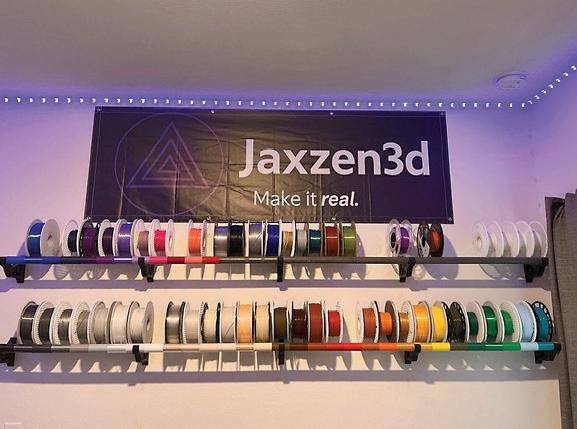
JAXZEN3d LOGO
Junior Jaxzen Perez designed a logo for signage and business cards that he uses to promote his 3D printing business.
It’s about six and a half feet tall. It’s the largest one I’ve done, second largest being six feet.”
The future is looking good for Perez as he grows closer to his 18th birthday. This will allow him to move on from word-of-mouth business but finally be able to sell on major platforms such as Amazon and Etsy without the large and meticulous workarounds. Whether he its a small $2 pass or a custom $80 hubcap that would’ve cost a thousand dollars at a dealership, his business is focused on the idea of solving people’s problems in a unique way.
Fast Facts
Jaxzen3D by the Numbers
◊ Current Fleet: 3 high-end printers running 24/7.
◊ Largest Prop: 6.5 feet tall (Current movie production order).
◊ Materials: Primarily PLA (Polylactic Acid) for durability and costefficiency.
◊ Territory: Serving Akins HS, Lockhart ISD, and various engineering/ production firms.
Courtesy Jaxzen Perez
Courtesy Jaxzen Perez
Courtesy Jaxzen Perez
The dangers of Ai relationships
Students deal with parasocial feelings with chat bots
EMILY KEYS STAFF WRITER
As of today, over 50% of people use artificial intelligence in their daily life. Some people use it for writing emails. Others use it for “help” with their homework. But there are some who have developed parasocial relationships with AI.
These one-sided emotional connections with what people see as fictional characters, celebrities, and social media influencers can cause people to struggle to find connections with actual people. AI is programmed to give the illusion of being a conscious person, stimulating empathy, engagement, and connection to make people feel like there is a mutual relationship with understanding companionship.
AI has grown rapidly from being a small field of research to simulate problem-solving human intelligence to a large part of everyday life with increased computing power, unrestricted access to large amounts of data, and learning abilities to understand and show human traits. This allows AI to generate conversations, images and decisions.
Navigating the Silent Social Crisis of AI Companionship
Addressing these relationships requires a multi-pronged approach:
People have been turning to AI chatbots and sources like ChatGPT, Google Gemini, and others for things like information, advice, emotional support, and even friendship that would all otherwise come from humans. When people are having these emotional connections with artificial intelligence, they don’t receive any repercussions from them, because the AI is intentionally programmed to agree with you to keep people happy and engaging on their platforms.
◊ Developer Transparency: AI companies must be clear about the limitations of their tech, avoiding marketing that frames bots as “friends” or “soulmates.”
◊ Digital Literacy: High schools are being encouraged to teach students the difference between simulated empathy (code) and genuine human connection (emotion).
◊ Personal Reflection: Students are encouraged to ask why they are turning to a screen for comfort instead of a trusted friend or counselor.
This can cause people to struggle with making human connections in real life where there is conflict, room for improvement. This raises the question about the consequences of this technology fabricating emotional attachments, trust, and mock-up human interactions.
How did we get here?
As AI has grown to be more personalized and always available at people’s fingertips, some have begun to interact with it in ways that are more social rather than using it for research and information. This has led some people down rabbit holes of parasocial relationships, where people form one-sided emotional connections and attachments with AI that feels supportive, empathetic, and trustworthy, despite its lack of consciousness and emotion. Why is this bad? While AI is convenient and accessible to almost anyone, giving immediate support, emotional validation, and a place where someone can feel they aren’t being judged, overdependence on it can discourage people from seeking real human connection, or professional help from someone who is licensed to deal with people’s situations. AI does not hold people responsible or shoot down bad ideas and decisions, validating whatever the user wants to be validated to keep them engaged. There is the risk of accidental harm from misinterpreted or just poor advice for a user’s mental health needs. Parasocial bonds with AI can cause people to view it
as a companion rather than a tool, growing emotional attachments to computers that have no genuine compassion or understanding. This can lead to isolation or unrealistic expectations for relationships with the people around them. There is also the risk of privacy with data collection without consent from users and the misuse of personal information, as well as data breaches exposing sensitive information, and the possibilities of identity theft. What can we do?
by providing transparency within AI sources, reinforcing healthy boundaries, and avoiding framing AI as a replacement for real human connection.
KEY TERMS: Parasocial Relationships:
◊ Definition: Traditionally, a one-sided emotional bond with a celebrity or fictional character.
◊ The Risk: Users may mistake programmed “agreeability” for genuine friendship or love.
◊ AI is a Mirror: It reflects your own desires and biases back to you.
◊ The Echo Chamber: Without pushback, users can become isolated in a loop of digital validation, potentially reinforcing harmful or radical viewpoints.
◊ Reality Detachment: Preference for “safe” digital bots over “messy” real-life commitments can lead to social withdrawal.
Addressing parasocial relationships with AI sources and chatbots requires responsibility, education, and self-awareness. Developers of Artificial Intelligence can help
Educators can provide proper ways to navigate AI safely and efficiently, as well as helping students understand what AI is and isn’t, so users are aware and engage appropriately. Individuals should reflect on why we turn to AI for connection and engage more in our real life relationships to stay connected and healthy,
preventing overdependence on AI. If used properly, AI can be a helpful tool for support and information, and should complement and support our human relationships rather than replacing them.
Emily Keys
Speculators in the Stands
Game-ified betting apps fuel rising addiction in schools
ALEX ENYART STAFF WRITER
The 4th period bell rings, and everyone in class is locked into their Chromebook working on important assignments. However, one senior is focused on discreetly watching a soccer game in South America, keeping a close eye on the scores and player stats. At this moment, that game is far more important than schoolwork for one reason, he bet $100 on the under. Despite the questionable legality of placing such a bet, beating the odds can run a serious check for some students.
“I don’t really feel anything about it, it’s just extra cash on the side,” said an anonymous senior, who admits to winning as much as $2,500 on the app Fliff, a popular sports app, # 16 on the app store as far as sports betting goes, and actually is a free to play sports gaming app. “Easy money. I have tons of sports knowledge,” portraying that to win the game, you have to know the game first. Meaning player stats, win rates, and keeping track of that sport, spending hours studying the players play patterns and teams consistent performance.
A Rapid Cultural Shift
He is just one part of a cultural shift regarding how we view sports betting. Up until as recently as 2018, sports betting was completely illegal in the United States. Following a U.S. Supreme court ruling ruled the ban unconstitutional, apps such as DraftKings and FanDuel began to serve adults as digital sports books. Now, even sports broadcasts advertise these apps, usually with a ticker showing the odds and potential winnings with links to websites encouraging viewers to bet. The American Gaming Association is expecting $1.76b in legal bets to be placed on the upcoming Superbowl by over 65 million Americans; analysts estimate growth of 25-30% year by year.
Showing a sharp reversal from just several years ago. The age verification has proven too easy to bypass for those underage. A survey conducted by The Eagle’s Eye found that 28% of student respondents either participated in or knew someone who participated in online sports betting. Some have even admitted to using a parent or siblings ID to gain access, as well as using a VPN to access offshore websites hosted in countries with relaxed gambling laws.
sures. Others pointed to “using a VPN for offshore sites,” effectively masking their location to access platforms hosted outside U.S. jurisdiction. This digital loophole has created a whole new demographic for this massive industry. According to market analysis by Zion Market Research, the U.S. online sports betting market was valued at approximately $14 billion in 2023 and is projected to hit nearly $33 billion by 2032. But the trend goes beyond just picking
gambling on the go
A student watches the AFC Championship 2026 Football game while monitoring the outcome of the game on PrizePicks.
Bypassing Digital Guardrails
For many students, these age restrictions are merely a suggestion, not a wall. While some apps require strict identity verification, students have found workarounds that range from surprisingly simple to sophisticated. “Usually AI or their parents’ IDs without them knowing,” one senior admitted in the survey when asked how students bypass security mea-
the winner of the Super Bowl. A new wave of “Prediction Markets” has turned current events into a digital casino, allowing users to bet on everything from election results to economic indicators and even popular media like YouTube videos and shows. From Gambling to “Investing” For a generation raised with volatile crypto schemes and rampant day-trading, this doesn’t feel like gambling
for some—it feels like investing. Platforms like Polymarket allow users to buy “shares” in an outcome rather than placing a traditional wager. It’s a subtle shift, but a profitable one; reports from the International Banker indicate that in 2025 alone, prediction market platforms generated a combined trading volume of over $37 billion.
The allure of the “big win”—like the senior’s $2,500 payout—is powerful. It fueled the purchase of a new car for one student mentioned in the survey, who “couldn’t believe his eyes” after winning $2,000. But for every success story, there are ten dealing with the “chase”—the desperate need to win back money lost on a bad bet.
The Hidden Cost of the Chase “I lost 40 dollars, it sucked,” one sophomore said in the survey. Another student noted a concerning pattern among peers: “They keep painting it after they lose,” referring to the habit of doubling down to recover losses, a psychological response to the emotional distress of losing money.
This behavior points to a growing “addiction gap” that experts are beginning to flag. While roughly 3% of the general population shows signs of problem gambling, a poll by Fairleigh Dickinson University found that number jumps to 10% for men ages 1830, a demographic known to be disposed to risk taking behavior. The odds of a bet are usually in plain text, the apps blur the line between a game of skill and a game of chance, hiding the risks behind bright colors and a clean UI. As apps like Fliff and PrizePicks continue to monetize the sports fandom, the line between spectator and speculator blurs. For the anonymous senior, it’s just a game of skill. But for the student body as a whole, the question remains: is this a harmless hobby, or a predatory tax on the youth?
Diego Munez,Andrew Ramierez, George Morales, Natan Salgado contributed to this article.
Photo Illustration Andrew Ramirez
LIFE+STYLE
MORE THEN A MILITARY PROGRAM Cadets take on JROTC leadership opportunities
AVERY ELIZONDO STAFF WRITER
Inside the halls of Akins High School, unit TX-20025 has developed a reputation for service that sets it apart. While the uniforms and drills might suggest a strict military focus, the heart of the Junior Reserve Officers’ Training Corps (JROTC) is built on a foundation of family and leadership. The unit follows a structured chain of command designed to maintain discipline and success. At the helm is Cadet Colonel Tran, the Core Commander, who leads the JROTC program. Working alongside her is Advisor Cadet Colonel Eynalith Nava, the previous year’s commander, who now focuses on mentoring the next generation. Supporting the staff’s daily operations is Cadet Chief Master Sergeant Devin McDonald, who ensures directives are executed efficiently. While instructors Col. Kerry Lewis and Chief Master Sgt. Andre Davis provides oversight, the program remains strictly cadet-led—a defining feature that forces students to take ownership of their roles. A Hidden Support System For those outside the program, JROTC can appear to be all about structure and rules. However, Cadet Col. Anh Tran says the most meaningful aspect of the unit is the support system that exists behind the scenes. “At the end of the day, we are like a family, we are like friends,” Tran said. She emphasized that during personal or academic hardships, the JROTC room serves as a sanctuary for students to be heard and understood. “On your hard days… you can come here and just take a break from school. We are here for you,” she said. Real-World Application The leadership skills cultivated in the
program are often put to the test in high-pressure environments.
Cadet Colonel Nava recalled her experience at the Cadet Leadership Course (CLC), a summer camp where she served as a Cadet Training Instructor for approximately 400 peers. Nava realized that the mentoring and communication skills she was teaching were the same ones she had mastered through her local unit. “CLC is basically about 400 cadets going to this camp to learn about leadership skills,” Nava said, noting that she found herself teaching “a lot of the skills that I was taught in JROTC… like leadership skills, communication skills, and a lot of mentoring too.” For Cadet Chief McDonald, the program’s value lies in its ability to teach “life skills” that aren’t found in a standard textbook. He credits the program with his growth in maturity and responsibility. “JROTC taught me a lot of life skills that no other class would teach me,”
COLLECTIVE COLLABORATION
Anh Tran, Eynalith Nava, and Devin McDonald, who are JROTC top leaders, plan out upcoming events for February. The program teaches leadership by empowering students to take charge.
McDonald said, specifically citing “how to talk to people… how to communicate with people and how to lead people.”
The Instructor’s Perspective Davis has watched these student leaders evolve firsthand. By placing them in situations that require critical thinking and quick decision-making, he helps them navigate the complexities of authority. “Being a leader is something that’s really hard and not programmed,” Davis said. Davis said one of the most difficult lessons for young leaders is learning to separate personal emotions from professional responsibility. He noted that he has seen Tran, Nava, and McDon-
ald grow through their ability to “make decisions on their feet” while upholding the program’s core values: integrity, service before self, and excellence in all they do. Beyond the Classroom As the unit continues its mission, it remains clear that TX-20025 is doing more than just training cadets—it is creating the leaders of tomorrow. Chief Master Sergeant Davis often reminds cadets to “Make your story to tell,” Davis said. It’s a message that reflects the program’s emphasis on accountability, growth, and self-leadership. For students at Akins, JROTC is not just a class—it is the foundation of who they choose to become.
Courtsey JROTC
Devin McDonald
Andre Davis
EYNALITH NAVA
ANH TRAN
Running without a track
Construction delays leave athletes without a place to practice
CAELYN DANSBY STAFF WRITER
The anticipation of a brand new track has been building at Akins Highschool. The project, which began last summer, was predicted to be finished by Jan. 31; however, as the track season arrives, the construction site remains unfinished, closed off, and silent. This leaves the school’s athletes without a proper place to train.
Instead of running on a smooth, measured surface, the track team now finds themselves practicing on the uneven grass, tennis courts, and at Parades. These temporary solutions have created challenges for both athletes and coaches.
“We have had to get creative with training locations. Our sprinters are currently practicing on the soccer practice field. This uneven surface is not ideal
and can be dangerous at times, especially when wet. We start with a plan and have to make adjustments each day based on conditions and availability of the practice field.” said Coach Flores, head girls track and head cross country coach.
The tennis courts and the field around it are not designed for running. Not only do they have holes, uneven grass, cracks, and hard cement; they do not have standard track distances. This makes it difficult for runners to accurately time themselves and is injury prone.
“Having to measure out the distance of the grass loops around the stadium makes it hard for field events, hurdles, and relays. Also the grass isn’t even and it makes me worried about injuries.” said Coach Brudnick, head boys track coach and football coach.
The Cost of Conditions
Unfortunately, these fears are not unfounded.
“I’ve fallen many times and one oFor junior Kolbe White, a 400-meter specialist, the lack of a proper facility has already had a physical toll.
“I’ve fallen many times, and one of them caused me to have to stop running for a few weeks,” White said.
Injuries ranging from tripped falls to chronic shin splints are becoming increasingly common as athletes’ bodies struggle to adapt to the hard, unforgiving surfaces of the tennis courts and the unstable terrain of the fields.
The space crunch isn’t just affecting the runners. The displacement has created a domino effect across the athletic department. With three football teams (Varsity, JV, and Freshmen) frequently sharing the remaining usable turf, the atmosphere is crowded and inefficient.
“It made it where there wasn’t as much field for the three teams to space out, and there was no space for drills,” Brudnick said.
Lost Preparation
The delays have also robbed the
hurdles for hurdles
Senior Amaya Jolivette practices her stride over during hurdles drills held on the tennis courts as a temporary training area. The track team has not had access to their regular track during the current school year because of construction delays for the bond projec to rebuild the Akins practice track and field.
team of the “pre-season,” a critical window for distance runners to transition from cross country to the track.
“The start of mandatory practices did not change, but not having a track directly impacted our ability to offer voluntary practices in the late fall and early winter,” Flores explained. “This transition time... is crucial to the preparation of our track and field athletes.”
While runners struggle with distance and footing, field event athletes are facing a total blackout of resources. Because the entire practice area is under renovation, throwers have no circles, long jumpers have no sand pits, and high jumpers have no mats.
“I’m worried that we will enter the season unprepared in our field events,” Flores said. “Not to mention our school record holder in girls’ hurdles has not been able to practice hurdling on a track as
she is entering her final season in high school.”
Looking Toward Spring
Sophomore Emma Graber summarized the general anxiety of the roster.
“You don’t really get the feel for a track, so we’re not as ready as we would’ve been last year when we had one,” she said.
As for a timeline, the finish line remains blurry.
“My prediction is that the track will be done by Spring Break,” Brudnick said.
If that prediction holds, the Eagles won’t step onto their home track until the very end of the competitive season. Until then, the team continues to adapt, clinging to the hope that when the gates finally open, they’ll still be fast enough to compete.
Courtesy Francisco Flores
Courtesy Francisco Flores courtyard Training
Akins track athletes run through the courtyard on a temporary track marked out by coaches to simulate the distance of their races.
'Look
good, play good'
Akins boys varsity team steps up with their social media
posts
Courtesy of instagram.com/akinsmensbb
SOCIAL GAME
Dylan Bell, a volunteer supporter of the Boys Varsity Basketball team, has worked to cultivate a stylish and fun vibe on the team’s Instagram.
ETHAN MORENO STAFF WRITER
The atmosphere around Akins men’s basketball feels different this year both online and in real life.
While the Eagles’ success is visible on the scoreboard—boasting a winning record ahead of district play—the real transformation is happening on the screens of thousands of Instagram followers.
This season marks a major turning point for the program, fueled by an active, professionalized social media presence that is reshaping how the team is perceived both inside and outside the locker room.
The Professional Lens
A key driver of this “new wave” is the addition of professional cinematography by Dylan Bell, who has a cousin on the team. By volunteering his time to provide high-level production, Bell has given individual players a platform typically reserved for college or professional programs.
“I think that it’s big already,” Bell said of the creative movement in high school sports. “People love to create. It will continue to grow and become bigger.”
This contribution has not gone unnoticed. His work has showcased the talents of play-
ers, providing them with crucial exposure to coaches and programs at the next level. This media push coincides with the emergence of the Akins Men’s Basketball Booster Club, which has worked to bridge the gap between the team and the Austin community through fundraising, outreach, and a significant boost in game attendance.
The Player Perspective
The impact of this professional branding is felt most deeply by the athletes themselves.
Junior Noah Loving, a point guard for the Eagles, views the organizational shift as a game-changer.
“I think the booster club is one of the best things to have ever happened to the program,” Loving said. “They do so much for us with sponsors, organizing team bonding, and fundraiser opportunities. I don’t know what we would do without them.”
Beyond logistics, there is a psychological edge to the high-end media coverage. In the world of sports, the mantra “look good, play good” holds weight. For point guard and Texas Lutheran University commit Darius Hedspeth, seeing himself featured in professional-grade posts reinforces his identity as an elite athlete.
“Yes, seeing yourself look like a college or pro athlete can boost confidence by reinforcing your mindset,” Hedspeth explained. “If
it makes you feel locked in and ready, that confidence can carry onto the court, especially when it’s backed by [the work].”
Exposure in the Digital Age
In an era where social media is the primary currency for recruiting, the quality of a player’s “tape” can be the difference between being scouted or overlooked. Hedspeth, who recently announced his commitment to TLU, believes professional content is a necessity for the modern recruit.
“Professional looking content helps you stand out and makes a strong first impression,” Hedspeth said. “It shows you take yourself seriously, which can make coaches more likely to watch, remember, and reach out.”
A Foundation for the Future
Head Coach Rashad Culver has watched this evolution from the sidelines, recognizing that high school sports are increasingly becoming a matter of “branding.” For Culver, the production value sets the Akins program apart from every other school in the district.
“Having this high level of production significantly benefits the program in many ways,” Coach Culver said. “Being able to showcase the individual talents of these young athletes and the program as a whole has brought recognition to the hard work this team puts in every day.”
redrwrawing the uil map
Akins to face Hays, Johnson; say bye to Westlake,
Lake Travis SPORTS
On February 2, 2026, the University Interscholastic League (UIL) officially released its new district alignments, confirming Akins High School’s place in Conference 6A for the 2026-2028 cycle. While the opponents may be changing, the mindset inside Akins athletes and coaches remains the same.
With Akins High School having a snapshot enrollment of 2,359 students—comfortably above the 2,215 threshold for 6A—this placement leaves the school in the 6A Division I bracket. The Eagles will once again find themselves competing at the highest level of Texas high school sports, but the landscape of District 26-6A will look significantly different.
The Big Swap
The most notable change is the “Big Swap”: state powerhouses Westlake and Lake Travis are exiting the district. In their place, I-35 neighbors Johnson and Hays high schools are moving in to join District 26. For Akins, this means a more localized schedule and, according to many on campus, a more balanced playing field. Fortunately, Akins isn’t focusing on numbers, classifications, or opponents but rather on preparation, growth, and the “Eagle Grind.”
Coaching Perspectives
Baseball head coach Tony Degelia made it clear that the new alignment doesn’t change his approach to the game.
“In my personal opinion, no. It doesn’t change what I do or how I prepare, because the game of baseball is the same wherever you go,” Degelia said. “No matter if you travel across the country, your backyard, or across the world, it’s still a round baseball with red laces.”
While previous districts included strong powerhouses like Westlake and Lake Travis—who combined for nine state football titles since 2000—the realignment gives Akins new opponents as other
NEW DISTRICT MAP
This map of our schools in the area shows the two new schools being added to the 6A District and it also shows the schools Akins normally goes against, Lake Travis and Westlake not on our schedules.
schools move up. To Degelia, the names on the new schedule don’t matter as much as the readiness of the team on game day.
“Regardless of who you play against, depending on the time of that day, if those kids are ready to play, it’s going to be whoever can play the best that day is going to win, and whoever is not ready is going to lose,” Degelia said.
Fast Facts
◊ What does this mean for Akins?
“I think that seeing the district without powerhouses that have gone to state year after year after year is really going to motivate our kids to put in the extra work to get better and compete with the teams that are now in our new district,” Thomas said.
◊ Reduced Travel: Fewer trips to North Lake Travis; more games along the I-35 corridor.
◊ Competitive Balance: While Hays and Johnson are strong, the departure of Westlake/Lake Travis opens up the district race.
◊ Division I Playoffs: Akins (2,359) will likely remain in the Division I bracket (large schools) for the postseason.
◊ The Rivalry Stays: The “South Austin Classic” against Bowie High School remains the cornerstone of the Akins schedule.
Thomas also emphasized that the “Eagle Grind” must remain a year-round commitment.
changes.
“I’m not too worried about the rivalries. I’m more concerned and focused on our kids’ growth,” De La Huerta said. “We can’t control the teams we play, but we can control the growth of our kids.”
Athlete Reactions
The shift in the district hierarchy is being felt by the players as well. Junior athlete Julian Martinez described his initial reaction to the revised list of opponents as pure excitement.
“My first reaction was that I was hype. That’s two more wins on the board for the Eagles,” Martinez said. “To us, it doesn’t change anything. We’re still going to work hard and do everything we can to win.”
Martinez noted that the team is feeling more confident heading into the off-season.
“The playing field is very evened out now,” he said. “It’s a new district for everyone and we’re ready to just really change the culture.”
Junior Joseph Gonzalez, who plays football and baseball, was equally confident about the upcoming season, particularly regarding the new competition from Hays and Johnson.
“I feel like football and baseball is going to make playoffs next season,” Gonzalez said.
Looking Forward
While the “South Austin Classic” against Bowie High School remains a cornerstone of the schedule, the addition of Johnson (enrollment 2,976) and Hays brings physical, rising programs to the 6A level.
“Show up for your kids,” Degelia said. “We need more fans in the stands regardless if we’re winning or losing... in games that are close, the fans can make a difference.” JASMINE WOODS
Volleyball coach Amanda Thomas, who is the Akins Athletic Coordinator, shared a similar sentiment, noting that the departure of perennial state contenders creates a fresh psychological spark for the program.
“Off-season, summer—it’s a year-round battle, but really starting now to get ready for next year,” she said. “Be the underdog, work hard, get bigger, get faster, show up and show out.”
Football Head Coach Jerry De La Huerta echoed the focus on internal development over external
The move is expected to reduce travel time, moving away from trips to North Lake Travis and focusing on the I-35 corridor. As the community prepares for the 2026 season, the message from the coaches to the fans remains simple: support.
HUMOR
Jack Greene
Jack Greene
To: Eddie Kennedy To: Annie Tran From: Emily
Keys
Thank you for being so amazing. You are very much appreciated and I love you.
From: Noah Rodriguez
Thank you for being amazing!! You work so hard and everyone sees that. You Dane beautifully and are so strong and independent. Super proud of everything you have accomplished and can’t wait for you to come.
To: Ms. Doerr
From: Mr. Doerr
Thank you for being the wonderful person you are and allowing me to work late with these crazy Graphic Design students to help them put out The Eagle’s Eye. Your support makes this newspaper possible. Love you!
LOVE NOTES
To: All Students
From: Sean Claes
It’s the season of giving. We’re going All In! Mention this Valentine and show that you bought a 2026 Yearbook and we will give you a free “Death Metal Akins” t-shirt in room 221. Akins Yearbook loves you... and we would love for you to have the Yearbook to remember this historic year. Buy at tinyurl. com/2026Akins