



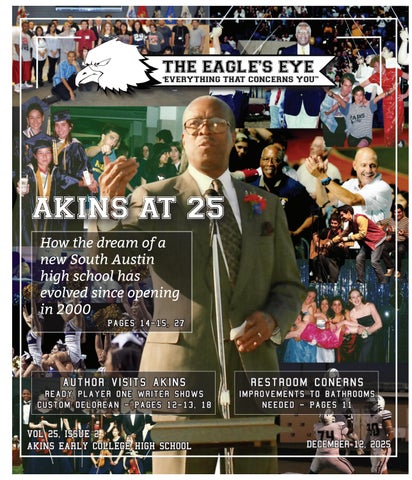
How the dream of a new South Austin high school has evolved since opening in 2000
Pages 14-15, 27
author visits akins
ready player one writer shows custom delorean - Pages 12-13, 18
VOL 25, ISSUE 2
AKINS EARLY COLLEGE HIGH SCHOOL

restroom conerns improvements to bathrooms needed - Pages 11
December 12, 2025

MADISON STAMAN
Co-Editor In Chief
YANITZEL SALAZAR
News editor
SILAS BAKER
Entertainment editor
JASMINE WOODS
Sports editor
JASMINE WOODS
Co-Editor In Chief
S SALINAS
Opinions Editor
DEAN KNOWLTON LIFE + STYLE editor
MICAELA RODRIGUEZ
Graphics editor
photo editor



The Eagle’s Eye is the official student newspaper of Akins High School. It is published six times a year, generally once per six weeks for the school’s students, staff and community. The Eagle’s Eye is an open forum for student expression. The Eagle’s Eye is not reviewed by school administration prior to distribution, and the adviser will not act as a censor. Content represents the views of the student staff and not school officials. The Eagle’s Eye will work to avoid bias and/or favoritism. We will strive to make our coverage and content meaningful, timely and interesting to our readers. Our articles will reflect our genuine objective of reporting news and will be held to a high standard of quality. We will make every effort to avoid printing libel, obscenities, innuendo and material that threatens to disrupt the learning process or is
ETHAN MORENO staff writer
As the holiday season approaches, the Akins Writing Club is hosting a book drive titled ‘Season of Stories’ to promote literacy in our local community. What is Writing Club?
English teacher and Writing Club advisor Grayson Hackney said that “Writing Club is an after-school club that creates a small community at Akins after hours.
Students can come to get peer review advice for their English classes, help with their ACC work, or just drop by for a snack and a quiet moment.” The club prioritizes a positive, inclusive, and helpful space for students. The Season of Stories book drive will run from December 1 to 19.
We asked the student and president of the Akins Writing Club, Isabella De Felice, what the purpose of the book drive is.
“The purpose of this book drive is to
expand literacy in our community and help provide books to all,” she said. The main goal of this event is to improve the community as a whole, through greater access to literacy.
“Our goal right now is to raise an estimated amount of 200 books” and to “make it a yearly and annual tradition” within our school.
With a target of collecting over 200 books, the Akins Writing Club is using various methods to reach this goal like involving our students and staff. How can people donate to this book drive?
Akins students can drop books off at the front of the library, by the main stairs or even at local coffee shops.
For Akins students and staff, there will be a red and white box outside the library where you can Austin’s Children’s Shelter, Foundation Commuinites, and the Prison Books Program. The Akins writing club hopes to inspire our local community and provide sports for our Akins eagles afterschool.

RAMI KASHAKHI staff writer
Akins High School students Bella Luna and Rami Kashakhi traveled to Salt Lake City, Utah, carrying the weight of Austin’s youth on their shoulders.
The Austin Youth Council, made up of high school students from across the city, promotes civic engagement, amplifies young voices in city policy, and serves as a new generation of leaders.
As part of Austin’s motive to electrify the teenage generation, the youth council appointed 10 students to represent Austin at the National League of Cities Summit Conference; Bella and Rami were among the few flown out. For four days, they weren’t simply
high schoolers, but delegates representing Austin’s rising voices.
Thousands of local politicians and hundreds of teenage leaders from across the United States came together to exchange ideas, tinker with policy, and imagine the possibility of American cities.
Questioning AI in governance with experts, or hearing about the rise in political divide from Governor Cox of Utah, Bella and Rami found themselves stepping into roles that demanded both curiosity and human responsibility.
“Championing urban policy and accessibility equity with teenagers and politicians country-wide truly grounded my belief that everyone deserves a say in politics,” said Rami.
“Our ambitions grew heavier with each step,” said junior Bella Luna, recalling her journey through Utah now that she’s back in Texas.

Valeria Herrera, a former student at Akins High School (class of 2016), is now one of three pediatric nurses at Austin’s Dell Children’s Medical Center.
To get where she is today was not an easy journey for her. She came to the United States from Mexico with her parents when she was just two years old. They settled in South Austin, where they have lived ever since. Due to the significant risks, Valeria’s mother enrolled her in the Deferred Action for Childhood Arrivals (DACA) program.
Herrera started attending Akins High School in 2012, the same year her mother helped her secure DACA.
“I loved my time at Akins. It was so fun, everyone I knew was super friendly and helpful,” Herrera said. ‘I was a cheerleader, homecoming queen one year, and played volleyball for two years.”
Amid the stress of graduating high school, Herrera shared her feelings about college ambitions.
“I really wanted to go to UT Austin, and I got into their nursing program, but because of my financial aid situation, I wasn’t able to attend. I ended up going to Concordia University because I received a merit-based scholarship to go there,” Herrera said. “It was a lot more affordable, but I remember being super upset junior year when I had to turn it down because my dream school was UT.”
Earlier this year, Herrera began featuring in major publications like the Austin American-Statesman, the Texas Tribune, and Popsugar. This exposure ties into her efforts to advocate for DACA,
DACA stands for Deferred Action for Childhood Arrivals. Think of it as a temporary protection, not a law or a path to citizenship.
◊ Who is it for? It’s a U.S. immigration policy for certain undocumented immigrants who were brought to the United States as children (often called “Dreamers”).
◊ What does it do? If you are approved for DACA, the government “defers” (pauses) any removal action (deportation) against you for two years.
◊ What does it give you? It allows you to apply for a work permit (Employment Authorization Document or EAD), which is also valid for two years and allows you to work legally and, in many states, get a driver’s license.
◊ Is it permanent? No. DACA and the work permit must be renewed every two years.
which provides her with temporary legal protection to work in Texas.
“We use DACA to both study and work. A lot of people who are against illegal immigration say that we’ve come to not work, benefit off the government, and I always make it a point to educate them,” Herrera said. “We can’t benefit from anything that you need to be a U.S. citizen or resident for. Hopefully, enough awareness is raised to where people feel strongly enough to vote in things that could benefit DACA Recipients.”
Gracy Lopez, the counselor at Akins College and Career Center, offers advice for DACA recipients and undocumented students.
“I want them to work just as hard on their education as anybody that’s a citizen or who they feel has more right than them, but they don’t,” Lopez said. “I want my students to know that we’re all the same and we’re all in this together. I don’t want them to think that one has more priority than the

Courtesy Valeria Herrera
Valeria Herrera, who graduated from Akins in 2016, has advocated over the last year to defend the Deferred Action for Childhood Arrivals policy, which helps her to stay employed as a pediatric nurse in Austin.
◊ June 2012: President Barack Obama creates the DACA policy through an executive memorandum, allowing eligible young undocumented immigrants to apply for protection from deportation and a work permit.
◊ September 2017: The Trump administration announces it is rescinding (ending) the DACA policy. This triggers multiple lawsuits across the country to stop the program’s termination.
◊ June 2020: The U.S. Supreme Court rules 5-4 that the Trump administration’s attempt to end DACA was “arbitrary and capricious” and violated the Administrative Procedure Act. This decisionthe program and re-opens it.
◊ July 2021: In a separate lawsuit led by Texas (Texas v. United States), U.S. District Judge Andrew Hanen rules that the original 2012 DACA policy was created unlawfully. He issues a permanent injunction blocking the government from approving any new, firsttime DACA applications. He allows renewals for current recipients to continue.
◊ September 2023: After the Biden administration issues a new rule to try and protect the program, Judge Hanen rules that this new rule is also unlawful, keeping the freeze on new applications in place.
◊ January 2025: The 5th U.S. Circuit Court of Appeals agrees with Judge Hanen that DACA is unlawful. It sends the case back to Judge Hanen to determine how to implement the ruling, leaving the status quo (renewals continue, new applications are frozen) in place for now.
person next to them, coming or coming in after them. I think we all have to take a stand for ourselves and who we are.”
While beneficial to thousands, the DACA program especially
helps people like Herrera. It gave her the chance to become a pediatric nurse here, where she can give back to the community that supported her education.
CINDY NGUYEN STAFF WRITER
Andrew Gonzales was a student at Akins 15 years ago. Recently, he returned home from an AISD board meeting to find his house in flames. The community has come together to support Gonzales and his partner, LaRessa Quintana, through a rough patch in their lives.
On Oct. 30, Gonzales and Quintana discovered that their house had caught on fire due to an insulation problem, according to the Austin Fire Department. All of their belongings and family artifacts were burned, including their three cats: Chat, Oliver, and Santi, who were still inside during the fire. The house was originally owned by his parents but was passed down to Gonzales, where he had lived his whole life.
He has a temporary place to stay with his partner, Quintana, who also serves on the school board. Gonzales’ brother set up a GoFundMe; their current goal is $60,000, and so far the community has raised $52,327. They plan to use the funds for temporary housing, food, basic expenses, insurance gaps, cleanup-related expenses, and replacing essentials they lost.
The Akins community has rallied to support Gonzales by sharing the GoFundMe page among staff and posting about it on their individual social media accounts.
CTE teacher
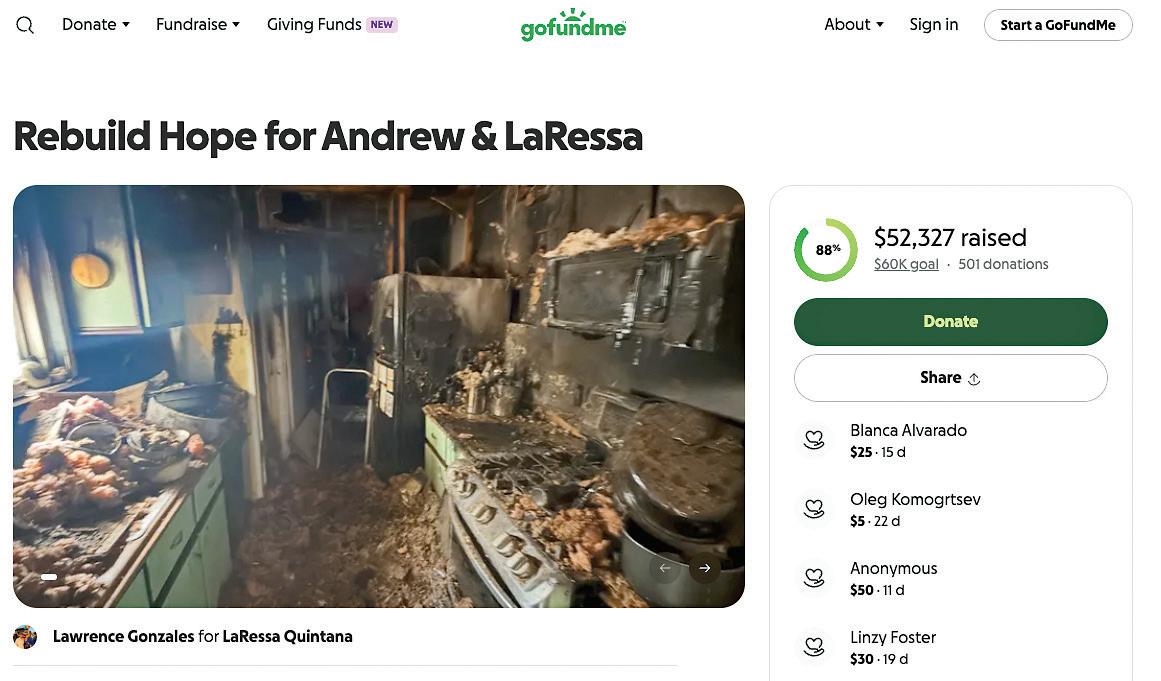
GoFundMe Screenshot
After Andrew Gonzales house burned down on Oct. 30, the Akins community contributed to raise money via a GoFundMe page set up by his brother. Gonzales graduated from Akins in 2010.
Akins band when she was a freshman and he was a senior.
“My reaction was I felt really sad that happened to him and his wife and losing loved animals from their families. I bet it’s very hard,” she said. “I felt like he does a lot for our community, so I was pretty heartbroken for them.”
“Andrew is humble, but he is a changemaker, the kind of changemaker that Dr. Akins inspires us all to be
– English teacher Rebecca RedlandSturzl
Loraine Tijerina was the first to share news about the fire and the GoFundMe through an email to the whole campus. Tijerina, who graduated from Akins in 2013, said she knew Gonzales from her time as a member of the
“Gonzales made history in 2022 when he was elected as the first Akins graduate to serve on the Austin ISD school board. Many teachers supported his campaign because he had worked as a teacher in Austin ISD for seven years before running for office.
Tijerina said he puts his whole heart into serving as a trustee and helping the community.
“I do think that he really cares about Akins, and the fact that he
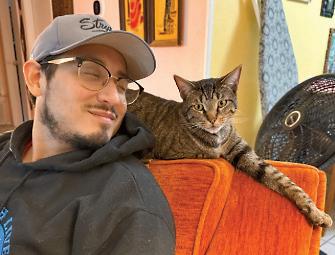
Gonzales lost three cats in the house fire, but his dog managed to survive.
was at a meeting (when the fire happened) for our community.
The trustee positions are not paid. And so he does that for free. I think that’s a huge task to take on is to be a trustee.”
English teacher Rebecca Redland-Sturzl, who was Gonzales’ AP English teacher at Akins, said she felt the need to help out her former student.
“I instantly felt the need to sup-
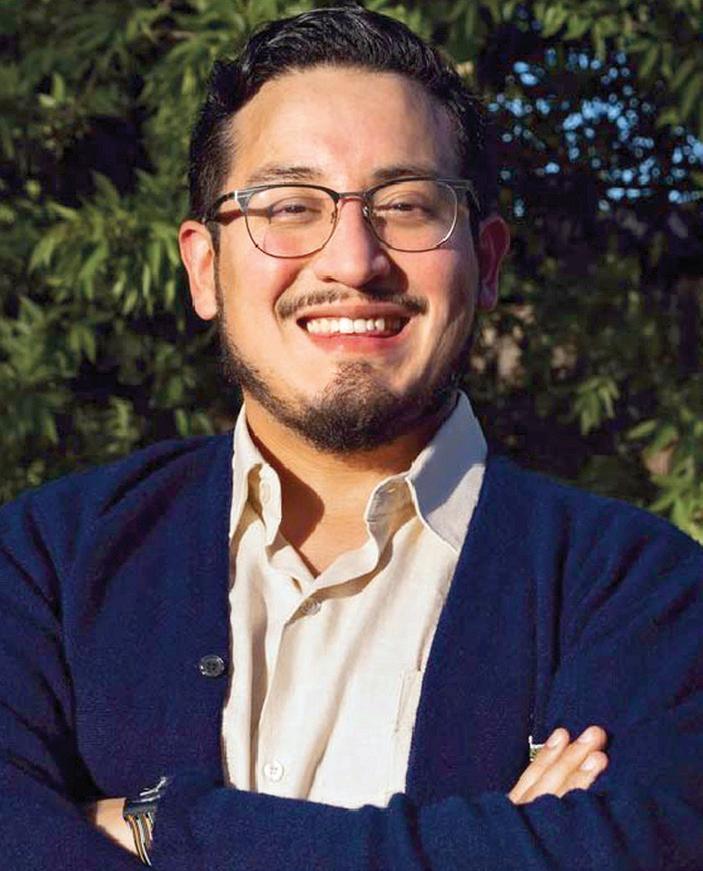
ABOUT ANDREW
◊ Andrew attended Williams Elementary School, Bedichek Middle School, and Akins High School
◊ Taught for seven years in the Austin Independent School District
◊ Andrew was awarded Teacher Change Maker of the Year
◊ Greater Austin Area by Generation Citizen in 2018
◊ Ally of the Year by the Young Women’s Christian Association in 2019
◊ Travis Early College High School Teacher of the Year in 2020. (history teacher)
port Andrew. I feel great sympathy for the loss of his beloved cats. I have two cats,” Redland-Sturzl said.
As a cat owner, Redland-Sturzl says that she felt great sympathy for the loss of their cats because she views her own as family.
Gonzales graduated from Akins in 2010 and left a lasting impression. He was known to be a humble, caring, and generous person during his high school years, Redland said.
“Andrew is humble, but he is a changemaker, the kind of changemaker that Dr. Akins inspires us all to be,” Redland-Sturzl said.
ANDREW RAMIREZ STAFF WRITER
While most high school seniors are navigating the stress of college applications and prom planning, a select group of students is already studying property law, analyzing housing markets, and preparing to become licensed realtors before they even graduate. Through the P-TECH program, these students are not just earning high school diplomas; they are working toward an associate’s degree from Austin Community College (ACC) and a professional real estate license.
Job Hammond, an Associate Professor and Assistant Department Chair of Real Estate & Finance at ACC, has observed the transformation students go through in the program.“I do see a notable difference in the students who enter the program during their freshman or sophomore year compared to the capable young adults they become by their senior year,” Hammond said.
John Rodriguez, the Akins Real Estate program coordinator, has witnessed this growth firsthand, especially in students who start off shy but find their voice through the curriculum.”There are a few seniors, for example, that when they started freshman year, they were really quiet. They blossomed as seniors,” Rodriguez said. “They’re very outspoken, they advocate for themselves, and I’ve seen them being able to interact with adults.” The curriculum is demanding. To meet the Texas Real Estate Commission (TREC) requirements for licensure, students take at least five specific courses, including Real Estate Principles, Law of Contracts, and Real Estate Finance. However, the program emphasizes that technical knowledge is only half the battle.
“Soft skills are essential for most functions in the real estate profession,” Hammond said. “The
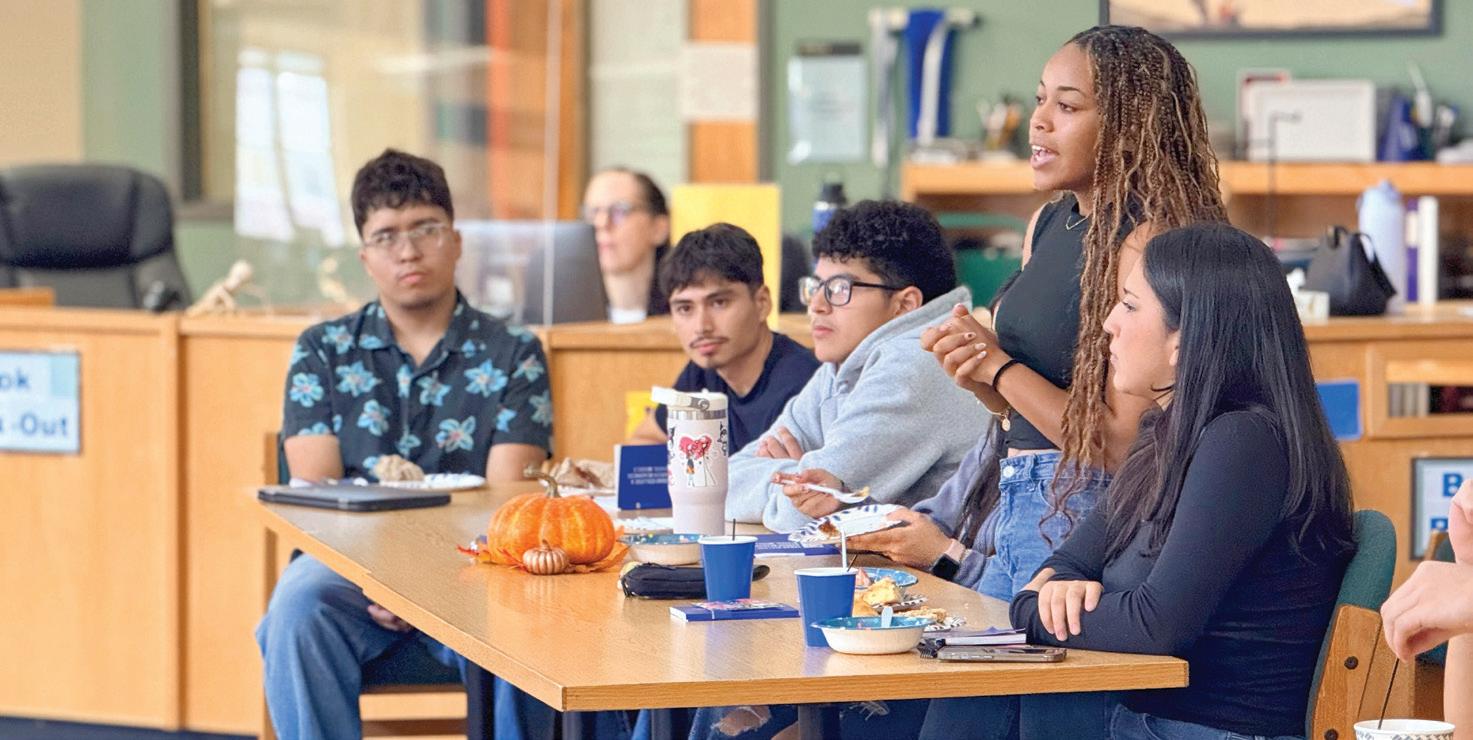
Leading by example
Senior Lannisia Salas-Edmonson and other real estate students leads a panel and answer questions related to P-TECH programs, services, and their experiences in the four-year industry program.
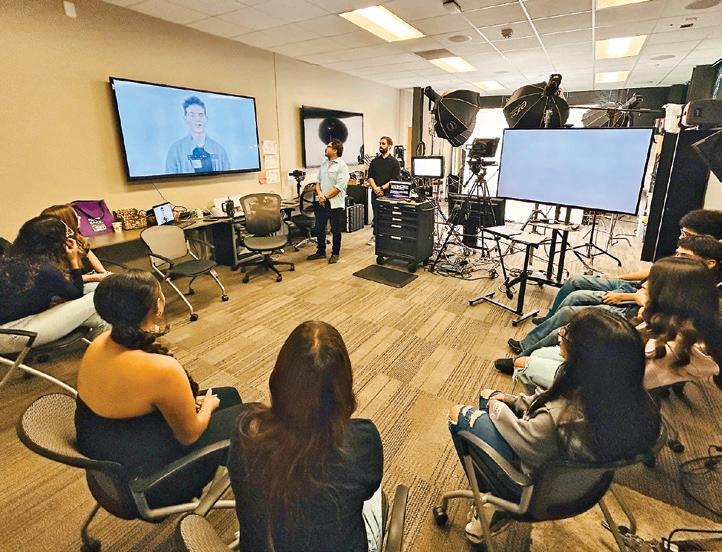
PTECH Real Estate students attend a work-based learning mini workshop day at the Austin Board of Realtors Headquarters.
way you communicate with others and how others perceive you will either help or hinder your career growth.”
For Rodriguez, this focus on soft skills is what distinguishes the program from standard high school courses.
“It’s about skills, skills, skills— not just memorizing what’s on an algebra test or memorizing what’s on a history test,” Rodriguez said. “They need to understand that there’s life outside high school.”
To bridge the gap between the
classroom and the workforce, the program partners with ACC to offer a course called “Strategies for Today’s Jobs,” where students learn to craft resumes and master interview techniques. Rodriguez also ensures students get off-campus experience, organizing field trips to new housing developments and downtown Austin to study gentrification.
“Now we have a nice, healthy balance of Austin Community College work, industry-based, workbased learning experiences where they go into the field and learn from experts,” Rodriguez said.
For sophomore Leisy Tonche-Lira, the program has been a lesson in professionalism and the stark realities of the industry. She noted that many peers come in with misconceptions about the field.
“Some misconceptions that I’ve seen in the program are that a lot of people think that being in the real estate industry is easy money, but in reality, it all depends on what you sell and when you sell it,” she said. “You could go months without making money.”
Sophomore Genesis Johnson said her favorite topic so far has been the Realtor Code of Ethics. She said it has reshaped her understanding of agents’ responsibili-
ties. She described learning how to handle sensitive situations, such as clients requesting homes in neighborhoods based on demographics—a request that violates fair housing laws. “There are a lot of things that you can do or say that could potentially... offend a customer,” Johnson said. Like, there could be times when a customer will ask you to find a location where, for example, Hispanics could be located, but you can’t purposefully find a location where they are... and you could get your license taken away.”
This depth of understanding is Hammond’s goal. He admits that the gap between learning the concepts and legally practicing them can be tough for high schoolers. “You simply cannot pretend to be a real estate agent until you actually are one,” Hammond said.
To address this, he encourages students to engage early by building a social media presence, attending conferences, and networking. The aim is to ensure that whether students start selling homes or transfer to a four-year university, they are prepared.
“No matter what path a student chooses, they should know that the real estate department at ACC is here to help,” Hammond said.
For Johnson, the path is clear. She plans to take her license with her as she moves forward, seeing the program as a solid foundation for her career. If you are good with customers and can sell with a personality, that will make you a lot of money,” Johnson said. “I think it would be a good start to a professional career.”
For Hammond, watching students like Johnson succeed makes his job worthwhile. “This job, supporting the Akins students, is the most personally rewarding thing I have ever done,” Hammond said. “What I love to see is students making real progress toward their own personal goals, whether that be earning a certificate, getting a degree, transferring into the university they want, or entering
RABECA GUARDADO + ANNAVEAH RANGEL
In 2022, Austin ISD launched a district-wide initiative with a clear goal: students would have one fewer school supply to worry about. The district invested around $85,000 to install dispensers for free sanitary pads and tampons in middle and high school restrooms, aiming to eliminate the anxiety and stigma surrounding menstruation.
However, three years later, students at Akins High School say the reality looks much different. Between empty restroom dispensers and the bureaucratic hurdles of Texas Senate Bill 12 (SB 12), obtaining basic hygiene products has become increasingly difficult.
Now, seniors Michelle Garza and Briana Seaman are launching a “Speak Up, Speak Out” civics project to advocate for a solution.
The “Empty Box” Reality
For Seaman, the inspiration to act came from witnessing the struggle in the school restrooms.
“I looked around, and I see my friends complain, or I see that the nurse doesn’t have a basket outside her door anymore, or the boxes are empty,” Seaman said. “I hear girls shout sometimes while I’m washing my hands, ‘Does anybody have a pad?’ And then I realize it is something that we need as much as we need toilet paper.”
While the 2022 initiative was intended to save students money and stress, the dispensers in Akins restrooms currently sit empty. According to Garza and Seaman, administrators have cited concerns over budget constraints and potential vandalism as reasons for not restocking the stalls.
“She said that there’s nothing in them because people would vandalize it,” Garza said, recalling a conversation with the administration. “And that makes you think, why would a woman vandalize something of her own health needs?”
The problem is worsened by SB 12, a state law requiring parental consent for students to receive medical treatment or medication at school. This law has caused confusion over what school nurses can provide without a signed form on file.
Principal Carman DeLeon acknowledged the complexity the new law has introduced.
“That’s been an interesting one because with a new (law) and the requirements for the nurse to get that filled out... It’s a big challenge,” DeLeon said.
Previously, nurses often left baskets of supplies available for students to take discreetly. Now, those resources are restricted. School nurse Fallon Rhoade said “requested all staff pick up supplies when able, so students are supported when they have a need,” but many staff members reportedly remain unaware of this directive.
“I feel like the SB 12 law, a lot of people didn’t even know that there was a paper required that you had to sign to be able to receive help from the nurse,” Garza said. “If we’re required to be in an educational building, then the nurse should be able to help us regardless if we signed a consent form or not.”
Data Driven Advocacy
To show that this is a widespread issue, Garza and Seaman conducted a survey as part of their civics project.

School restroom dispensers found labeled ‘EMPTY” with no menstrual products available students in almost every bathroom on campus.
Students in the Speak UP, Speak Out project surveyed 86 students responses across AISD and surrounding districts, highlighting a significant gap in care:
◊ 87% of respondents said they do not believe schools provide enough menstrual products.
◊ 95% said menstrual cramps affect their ability to focus during class.
◊ 80% felt that schools do not teach enough about periods in health class.
“It just makes you think, why is it that a place where a student is forced to be... for the entire day, most of the week, does not have the supply of menstrual products?” Seaman asked. “It proves that the district doesn’t care.”
Garza noted that the lack of access has a direct impact on attendance and education.
“In my freshman year, I would go home nearly every single month... because the cramps were
just so bad, and there was no help I could get on campus,” Garza said. “My education got impacted since I had to leave a lot.”
Garza and Seaman are proposing a pilot program to restock the restrooms on a trial basis to test whether vandalism actually occurs. They argue that high school students are mature enough to handle the resources responsibly.
“I feel like people would be more grateful to have access to menstrual products in the restrooms instead of having to ask their teachers,” Garza said.
Beyond logistics, the seniors aim to tackle the stigma surrounding menstruation. They plan to visit middle schools in January to educate younger students and are pushing for a cultural shift where male students also understand that menstruation is a normal bodily function.
“I feel like a little bit in the perfect world, nobody would have issues in this period,” Seaman said. “But it is obviously something that everybody deals with, whether they want to or not.”








Food is political. The simple act of eating until one’s belly is full— something so human, so essential—is a right. And it is a right millions of Americans are on the verge of losing. To be fed should not be a luxury, but a human right. Yet in the wake of a historic government shutdown, that right has been shaken, revealing the fragility of our food system and leaving families to wonder whether tomorrow’s meal will be certain or a question.
A sigh of temporary security surfaced as the U.S. government reopened, but relief is escaping with the “One Big Beautiful Bill Act,” rewriting the laws for who is and who isn’t given food assistance (SNAP). Across the country, households are being forced to reduce the quality or quantity of their food, to endure hunger, or even to go days without eating

We, as a paper, believe that every American should have the right of having food on their table. Food is not only a necessity but a human right that, regardless of socioeconomic status, every citizen should have access to. A list of qualifications should not determine one’s right to food, as it is necessary for survival. There are families in the United States who have had to compensate for the lack of benefits available, they have had to stretch out their food supply in order to not go hungry. There should be no reason for this, not when
food is such an important part of human life, parents should not have to worry about when’s the next time they are able to feed their children, children should not have to ask when their next meal is. These groups of individuals are not the only ones impacted by the loss of SNAP benefits, but they are some of many who rely on these benefits and deserve to have the human right to food.
On Oct 1 our government failed to come to a consensus on funding issues, therefore leading to a government shutdown. This meant that all federal employees would be unpaid for the foreseeable future, and programs like SNAP would cease functioning. This led to a lot of uncertainty in our nation, with people not knowing if they or their children would be able to eat for the month of November– especially with thanksgiving right around the
corner. The shutdown did end on Nov 12, marking the longest government shutdown in American history. Although food is a necessity, we must also consider that one’s need for SNAP only applies if they cannot afford it, as taking advantage of the government deprives those who truly need it. There should be no over-reliance. People who don’t make an attempt to work if they are able should not recieve these food assistance
benefits. There is and should be no justification for denying food resources to anyone who asks. We have enough food for everyone yet we pick and choose who will be able to eat a meal. Everyone should be able to receive it. It should not be limited to arbitrary restrictions and the government makes it difficult to bypass those prerequisites. We, as a country, need to ensure that all of our citizens have access to essentials such as food, no matter how wealthy or poor they may be. We need to encourage our lawmakers to put their politics aside and look after the people that really need help. Being able to eat is a basic and essential human right that shouldn’t be taken away for any reason whatsoever. Ripping away one’s sustenance will only make matters worse as it further divides the nation.
The Eagle’s Eye editorial board decides the postions taken in the staff editorial. The editorial board consists of the paper’s top section editors for the print edition. Editorials are not given a byline because they represent the collective opinion of the board. The topic of the editorial is discussed by the board and a position is voted on. When deciding on the position, majority rules so most opinions reflect the majority of the opinions of the board. Editorials do not purport to reprsent the official opinion of Akins Early College High School administration.

IIXE HERNANDEZ STAFF WRITER
Character AI, MidJourney, GauthAI, and ChatGPT; AI websites all students at Akins have at least heard of. But do the same students that use these AI plat-
“AI is not only stealing people’s work but it is also stealing wayer from underprivileged or lower income neighborhoods
— Iixe Hernandez
forms know how dangerous this technology can be? These AI generators are not only environmentally unsafe, but the effects of its use can be mentally damaging. An Austin ISD elementary school teacher has even been arrested after he used AI to create explicit material using photos of students in his classroom. “It is horrific how common this is becoming, that it is spreading”, said Sen. Tan Parker, vice-chair of the Senate Criminal Justice Committee in response to the arrest. If you’ve noticed, AI is even being used at our school. Posters around the halls that have been generated by AI have been spotted on the campus, when there are plenty of perfectly capable artists or graph-
ic designers willing to work for the school. It’s disgusting to know that because of generative AI, disgusting people who believe they have the right to do such things with AI have started to humiliate and become cruel to so many children and women, all for their own sexual gain. If you aren’t disgusted, I wonder what has become of you, and if you still are truly human. AI is not just stealing people’s work, but it is also stealing water from underprivileged or lower-income neighborhoods. Data centers use a lot of energy and water, and people who are neighbors of existing facilities have already reported health issues from the air and noise pollution. Data centers, which are what generative AI uses to run, require extensive cooling systems to prevent the servers from overheating. People are outright seeing the effects of these data centers for AI taking water and land and resources and power, and ultimately, it’s gonna kill people. Generative AI is a huge environmental toll on us, mainly on our water, which is being used to cool the equipment in these Data centers. Data centers can use 500,000 gallons of water a day, which is basically 4,000 people’s water. Anyway, AI generators are just catastrophic for our resources as living people, as beings who need at least a gallon of water a day, during an era where robots are using 6.6 billion m^3 by 2027.
The servers and routers in data centers generate not just disgusting photos of children and women and stolen artwork with no soul, but also a lot of heat. To cool them down, data centers use large amounts of water – in some cases, over 25% of local community water supplies. In 2023, Google

Short Take
◊ I am against generative AI, for the following main three main reasons:
◊ Harassment and Abuse: AI is a dangerous tool for harassing women and children. People use it to create fake, explicit “deepfake” images, which has severe real-world consequences, forcing victims to upend their lives.
◊ Artistic Theft: AI “art” is a form of theft. Models are trained by “scraping” (stealing) billions of images from human artists without their permission or payment, devaluing their work and hurting them financially.
◊ Flawed Defenses: The author refutes common pro-AI arguments, stating that an AI “copying” data is not the same as human inspiration and that it’s not “too late” to fight back.
◊ Environmental Harm: AI data centers have a “catastrophic” environmental toll, requiring massive amounts of energy and water (often over 500,000 gallons a day) for cooling, which can steal resources from local communities.
reported consuming over 6 billion gallons of water (nearly 23 billion liters) to cool all its data centers. It also means less commissions for people who might be freelance artists like me, because instead of commissioning art like people normally would, people might decide to just get out the easy way, without having to pay for the work. This actively harms artists, especially now with the current state of the job market. In the end I cannot understand
why people want to live in such a world, where a romantic partner might rather text chatGPT about their life rather than them, where people will generate explicit and humiliating images of women and children, and where artists are having their work stolen and communities filled with people who don’t respect the grind or love for real art. Why would you want to live in a world where some people don’t know what it means to be human?
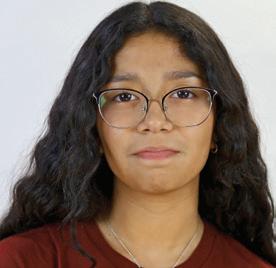
DANIELLE CERVANTES STAFF WRITER
An overachiever is someone who exceeds expectations. We all know an overachiever. Every school has them, whether it’s your friends, siblings, classmates, or even you. Have you ever wondered, Why? Why do these types of people work so hard in school? Doing extra credit work, achieving straight A’s, and never missing a class. Well, there are several reasons for this dedication to excel in school. I applaud overachievers for working as hard as they do, but I feel like it’s not always just a good thing. I always find it intriguing how they maintain the high grades and perfect scores on tests. But I always wonder if they stop working so hard and take a moment to relax, enjoy their high school years, and take time to destress.
The pros
“
Some feel dissatisified with their work instead of feeling proud when they achieve something
— Danielle Cervantes
“

Michaela Rodriguez
Most people do the bare minimum in school, just making sure they pass their classes, but these people go above and beyond. They work the hardest in the class, ensuring they use their time productively and stay on task. I’ve always
wondered how people have the motivation to put in 100% every day in school. Most overachievers work exceedingly hard in school to better themselves and their future. There is a feeling of purpose and a “dopamine rush” or “high” tied to reaching goals and completing tasks above expectations. Overachievers often make the most of their time and become proficient at multitasking, which can result in more free time, even though they might just fill this free time with additional work. They most likely have a dream job and/or dream college they would do anything for, or even have high expectations from their parents to maintain such high academic standards. Colleges view overachievers positively for their drive and potential success, but they are also wary of the “insecure overachiever” who may be motivated by fear of failure and external validation. Being an overachiever can even make you feel good about yourself, that you’re so on top of all your work. It can also show that you
are self-disciplined and have strong potential when it comes time to search for college and or a lifelong career.
The cons
But there can be some downsides to being an overachiever and holding yourself to such a high standard. Being an overachiever can often cause a lot of stress, depression, and even anxiety as you strive to be the best and accomplish everything you need to be the best. Even if they set very high standards for themselves, they still don’t seem satisfied with
Short Take
think about how they didn’t do good enough and could have done better. Students perceive their peers not as collaborators, but as competitors for limited spots while applying for college. Research shows that students who are higher achievers in school struggle more with mental issues, 7-8 times higher than average. Around 40% of Non-overachieving high school students report persistent feelings of hopelessness or sadness, so imagine the percentage is for overachieving students. Burnout is prevalent
◊ A lot of overachievers experience psychological distress stemming from prefectionism/fear of faliure
◊ the overachiever believes that their work will fill an emotional void and that they are defined by it
◊ some overachievers experience imposter syndrome
◊ the “superstar paradox” is common in over achievers
the effort they’ve put in. Feeling like there’s a spotlight on you always to exceed expectations, especially if the reason you work so hard is to appease your parents, because it’s what they expect of you. The idea of failure and disappointing your parents or teachers is something that overachievers fear, or even the fear of inadequacy. Some feel dissatisfied with their work, and instead of feeling proud when they achieve something, they may feel relieved that they didn’t fail or
in overachievers and even students in general, and it’s very important to take care of your mental state while working so hard. I think it’s important to appreciate those who always work tirelessly in school. If you yourself are an overachiever, I think it’s crucial to take time to hang out with friends and family, not stress so much over grades, and make sure to take care of yourself alongside your work.
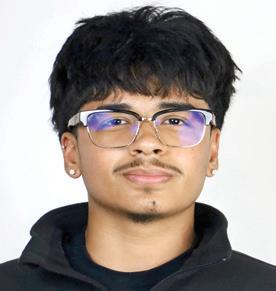
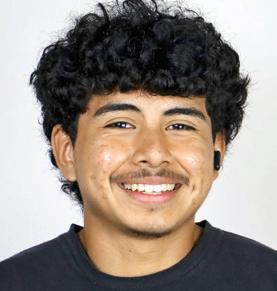
HAYDEN TORRES
ALEX RAMOS STAFF WRITERS
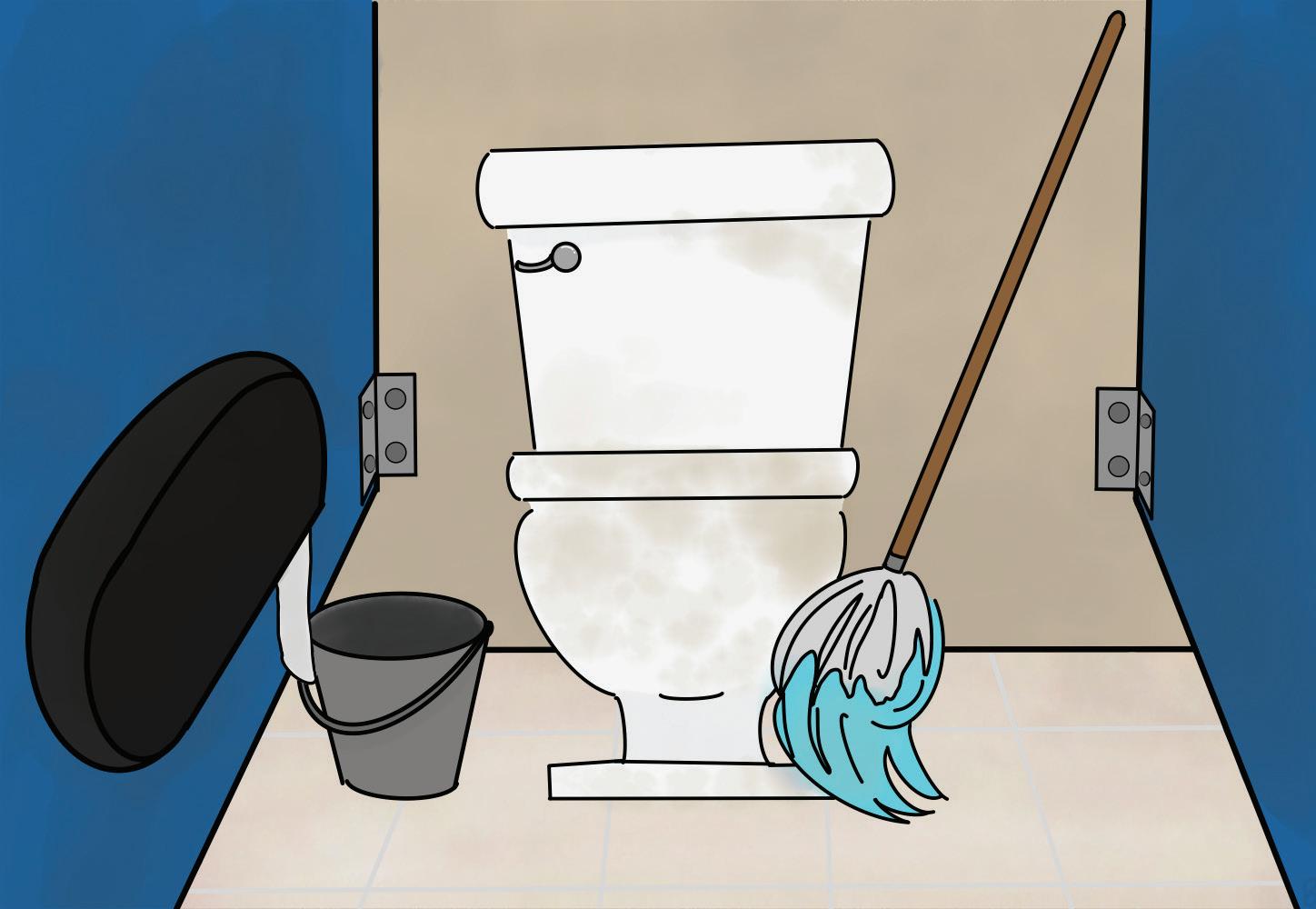
The restrooms at Akins High School are in dire need of improvement, particularly in terms of cleanliness and expansion to accommodate the growing student population on campus.
Now, not all the restrooms are bad, like the one in front of Akins. The only area that could be improved is the restroom space. Now, most of the restrooms are either missing something from them or are broken. Some items, including toilets, sinks, and soap dispensers, need to be replaced –ideally with a better material so they won’t break easily. It doesn’t seem like too much for students to easily be able to wash their hands after using the restroom to stay clean and hygienic.
The amount of space in the restrooms is pretty small compared to the number of students at Akins. There are more than 2,500 students enrolled at our school.
The reason I think this needs to be improved is because of the 5-minute passing period and lunch time. We say this because there is usually a line at the restrooms,
Short Take
and the fact that some stalls are locked or some toilets don’t work doesn’t help the case at all. It causes students to be tardy to class. We, in fact, have been late because of how packed the restrooms are, and when We want to wash my hands, We either have to go to another restroom that has a working sink and be late, or just don’t end up doing so. We decided to create a Google survey to gather students’ opinions about the restrooms in our school. There are a total of nine restrooms, each rated on a scale of 1 to 5 stars, with 1 being dirty and 5 being super clean. Overall, the restrooms did not receive a rating higher than 2 stars. The majority of respondents rated them 2 stars, with 7 students voting for 2 stars and 5 students voting for 1 star.
Regarding the functionality of the bathrooms, including paper towels, soap dispensers, and properly working toilets, the ratings also did not exceed 2 stars. Most respondents gave 2 stars for functionality. Additionally, we provided an open-ended section for students to express their thoughts instead of just voting.
The question we asked was, “If you could change one thing about
◊ a google survey was created to record student’s ratings of the bathrooms at akins
◊ there is a total of nine bathrooms, students were asked to rate them on a scale of one through five, one being super dirty and five being super clean
◊ the bathrooms did not recieve a rating higher than two stars
the school bathrooms, what would it be and why?” Many responses echoed similar concerns, such as “Fix the soap dispensers” and “Keep paper towels stocked.” A few responses attributed the issues to certain Akins students who misuse the restrooms, with comments like, “If I could change one thing about the restrooms, I would reduce the number of kids who use them at specific times” and “Remove students who are vaping, fighting, and breaking things.”
“
It
is not impossible to enhance the restrooms for our community. it is a necessary change that will benefit the entire Akins community.
— Alex Ramos
“
We also inquired about students’ uncomfortable experiences in the restrooms, and one response stood out: “The stalls don’t lock properly, especially upstairs in the red hall. You can frequently find people vaping. Sometimes, there’s no soap or paper towels, and a few sinks don’t work. People use the toilets and don’t flush, leaving it for others, or pee on the floor. We feel very bad for the custodial staff who have to clean that up. I think the school is taking a passive approach, only dealing with the aftermath instead of preventing the issues and punishing those responsible.”
Many responses mirrored this sentiment, with complaints about large crowds that “camp” in the restrooms, making it difficult for students to use them—some even referred to it as a “fight club.” We asked students if they use the school restrooms, and 10 students said they only use them in emergencies, while 2 to 1 students said they avoid them due to the conditions they encounter daily. Finally, we asked how important it was for students to have clean and comfortable restrooms, rating it on a scale from 1 to 10. The responses were as follows: 6 students voted 10, 4 voted 9, and 1 student voted for 8, 7, or 6. These are the reasons why We believe the restrooms need improvement. It’s not just for ourselves; it’s for everyone who uses these facilities. The main issue is financial, but there are ways to resolve this, such as a bond program to fund construction or fundraising efforts. Therefore, it is not impossible to enhance the restrooms for our community. It is a necessary change that will benefit the entire Akins community.
MADISON STAMAN PHOTO AND EIC
Author Ernest Cline is a well-known owner of a DeLorean DMC-12, which he purchased using the proceeds from his successful novel Ready Player One. He brought this car with him on his visit to Akins during an event arranged by English teacher Alan Brooks. Brooks has been working to arrange a presentation by Cline, who lives in Austin, for the last five years. This year, Brooks was finally successful in setting up the event, which featured a question and answer session with the author.
Brooks’ English class students were invited to the library, where Cline spoke about his journey as an author and answered questions about the book, which they were assigned to read in Brooks’ classes. After the author’s speaker session, Cline invited Akins students outside to check out his customized DeLorean.
The car is tricked out with various scifi-inspired gadgets and displays many Easter eggs from both the movie and other movies that Cline personally loves. He’s stated that he’s wanted to own a
DeLorean since he was a child, a dream made possible after selling his first novel, where the protagonist also drives the iconic vehicle.
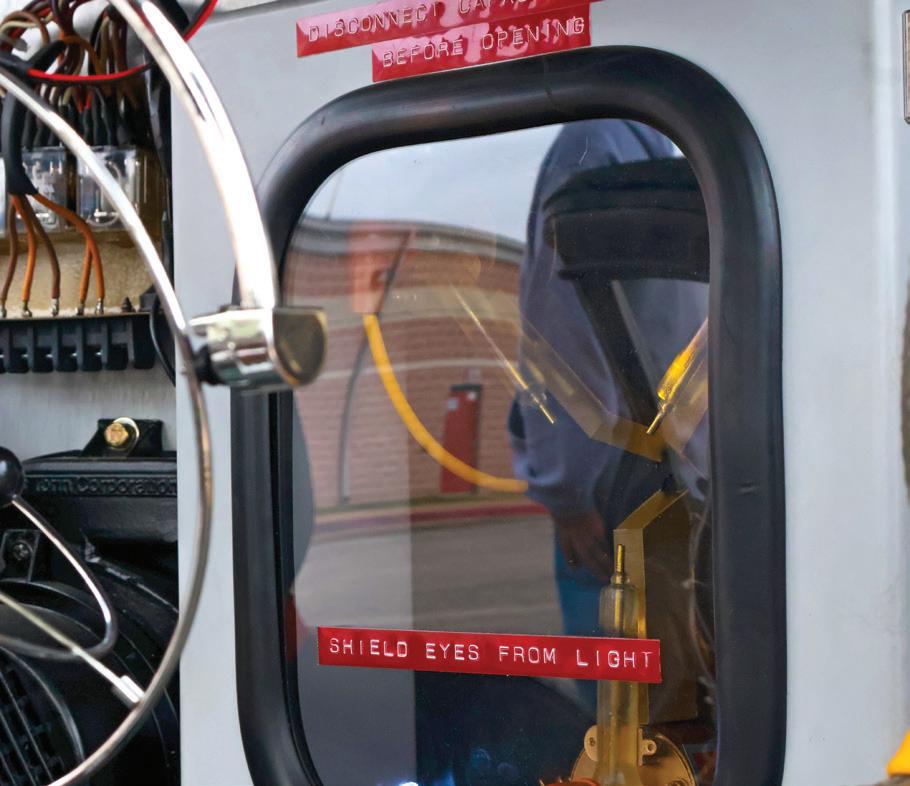
“I’ve wanted to own a DeLorean since I was 10 years old, but it always seemed like a silly daydream. Like owning the ‘A-Team’ van or something.” said Cline. His car features numerous customizations, including a screen-accurate flux capacitor replica, dangling gold dice, like those in the Millennium Falcon, a light bar from Knight Rider, and a proton gun from Ghostbusters.
These special editions are what makes this car a must-see for many movie lovers. This is also the reason Cline used the car for a nationwide book tour to promote Ready Player One.
“Probably the geekiest vehicle in history. I love it,” Cline said while describing the car.
Cline drives this car to each event he attends about Ready Player One, noting that it’s quite hard to drive with the steering wheel.
He also said he’s been pulled over more than once so that cops could nerd-out about the car.
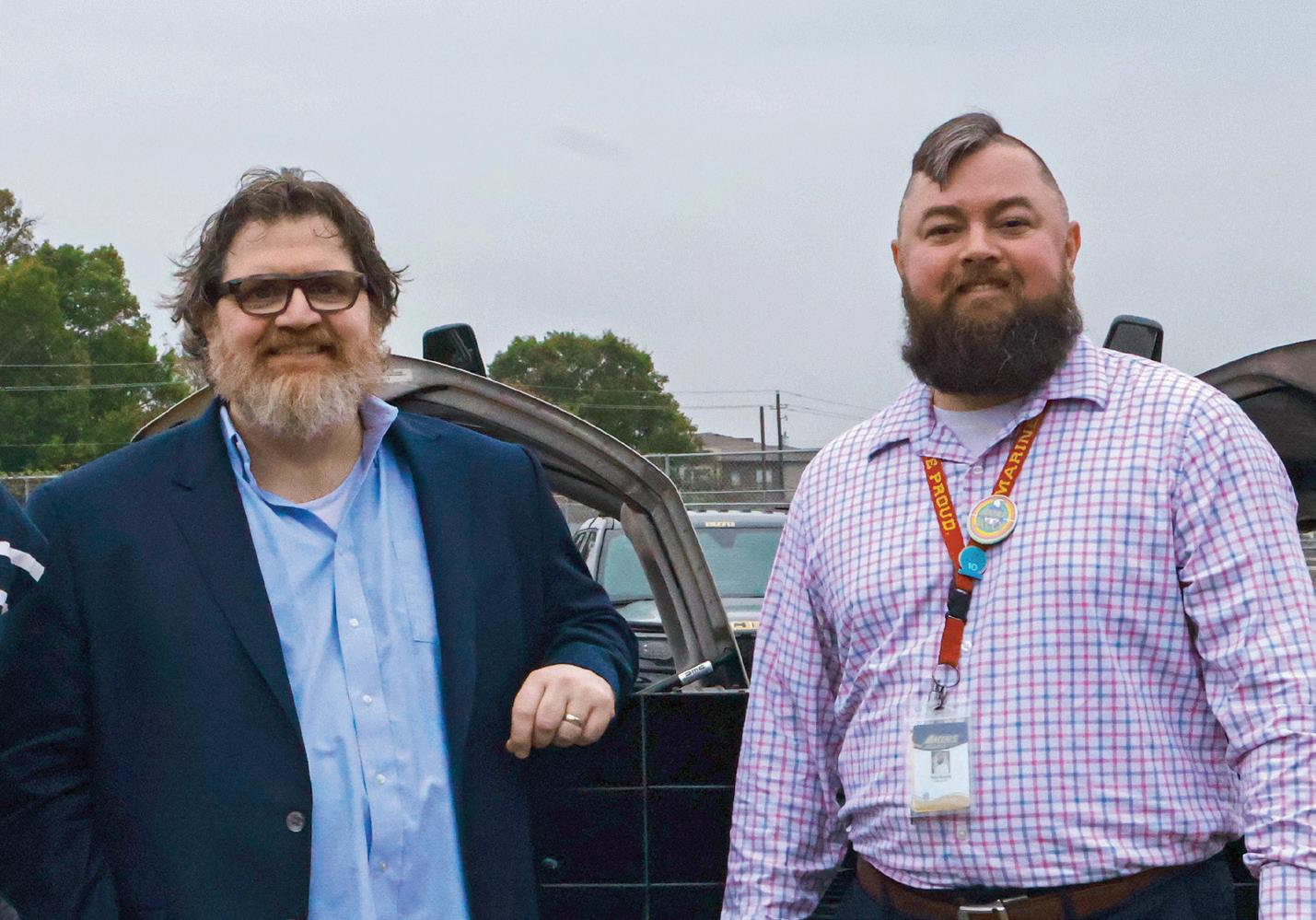
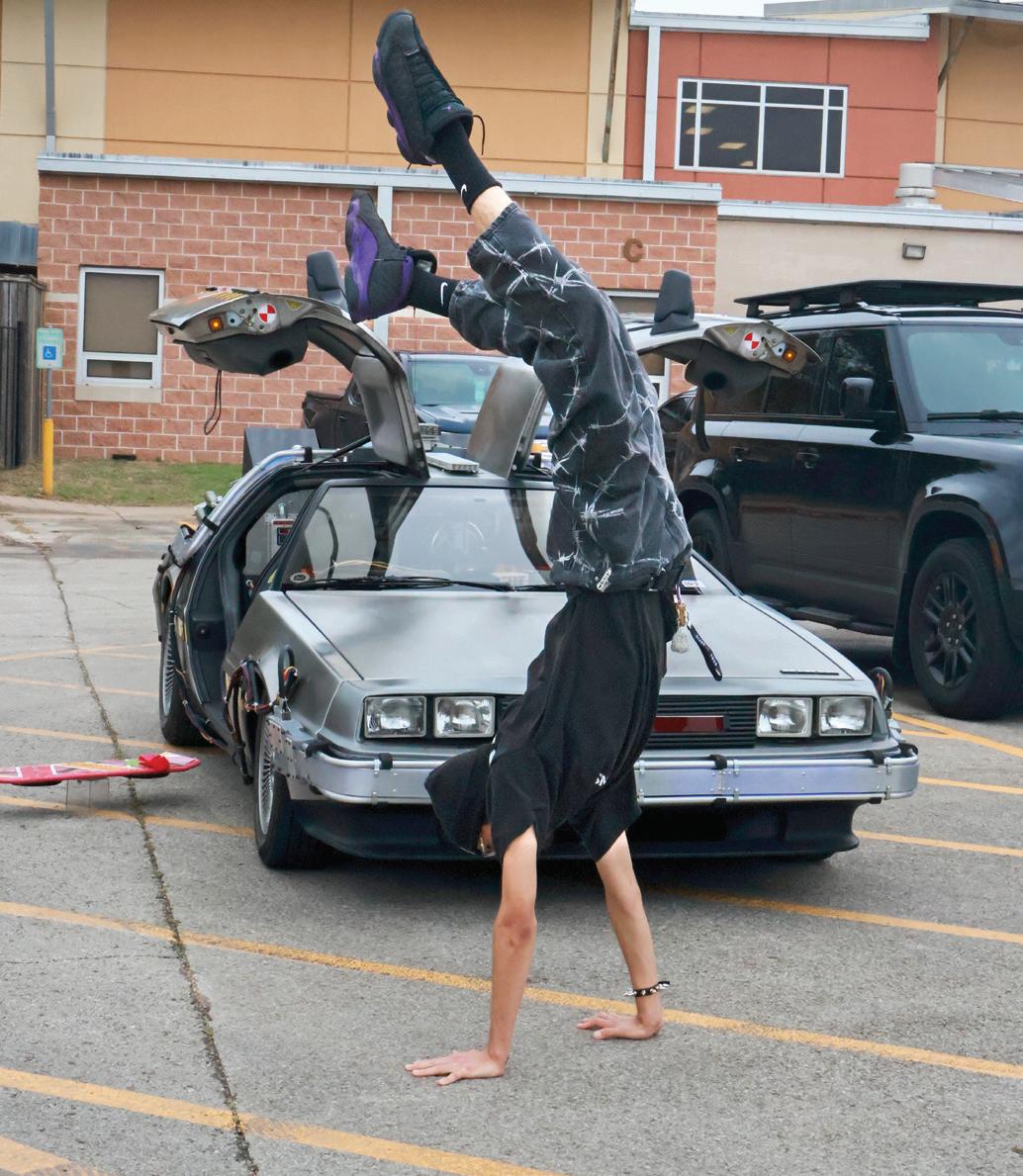
Senior Antonio Almanza performs a handstand in front of the DeLorean, showing off his excitement for the author’s visit to Akins.
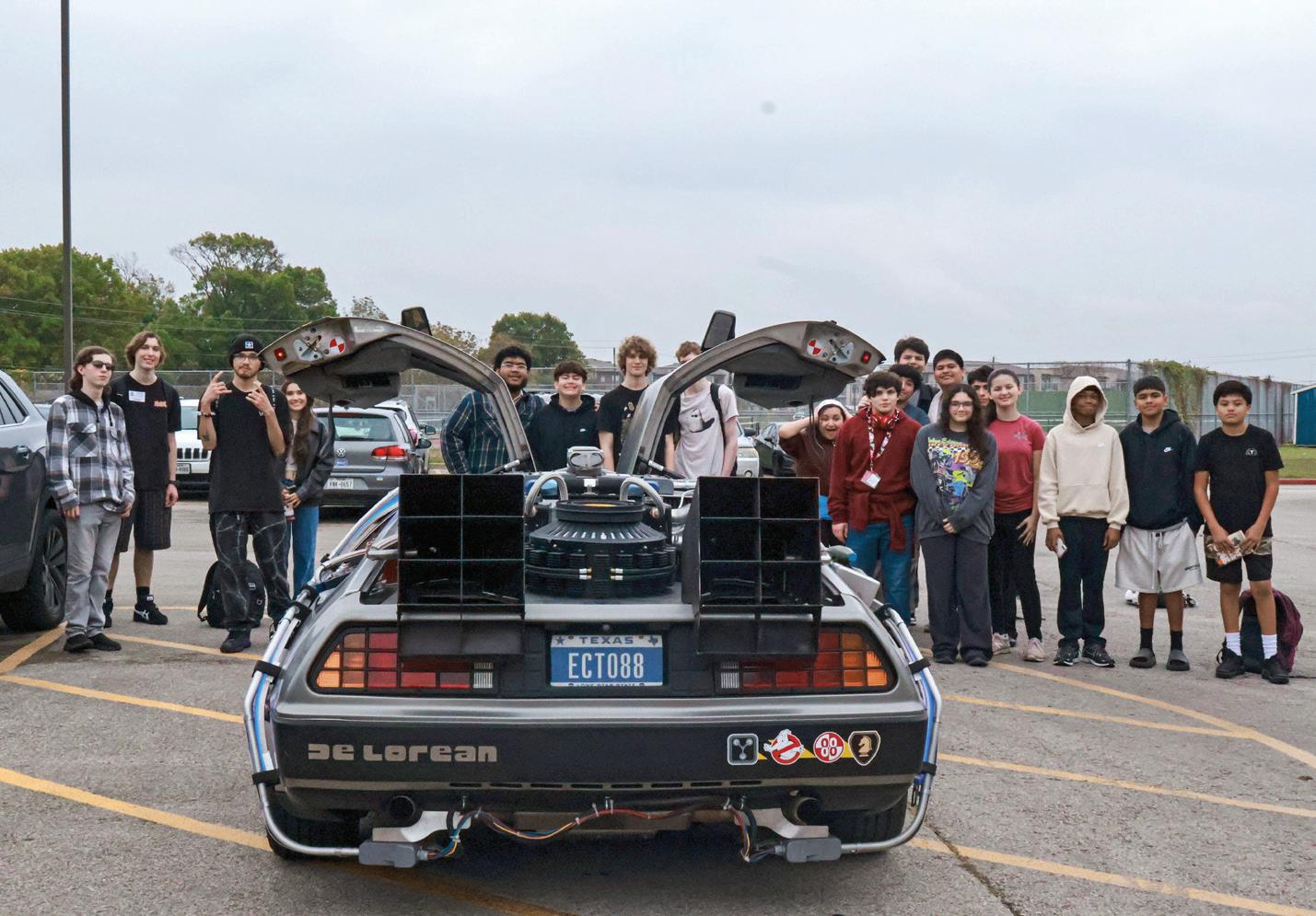
Students check out the customized DeLorean owned by author Ernest Cline. The author drove the vehicle to many of his speaking engagements to promote his book Ready Player One.


Madison Staman Bright Lights
The back of the car includes more of those wires wrapping around the car, with the license plate reading ‘ECT088’, a reference to the “Ghostbusters” movie and even includes a small Ghostbusters logo. He nicknamed the car Ecto-88 for this exact reason, and even noted in an interview that the dream of owning his own DeLorean is what lead to having his main protagonist owning one as well.

The intenior, like most of the car, is built just like the movie. It includes things like a screen-accurate, light up, and humming flux capacitor replica (top image) and the time-travel reader on the inisde of the car (bottom image).
Joshua Taylor staff writer
“I’m proud to be an eagle.” “Eagles soar, and they do great things, so the students here at Akins High School will do great things. In only four and a half months, haven’t we accomplished a lot in such a short span of time?”
Dr. Akins’ words, at the dedication ceremony in 2000, commemorated the first year Akins High School opened.
Decades later, August 2025 marked the twenty-fifth anniversary of Akins since opening its doors to students in Austin.
Since then, Akins has earned statewide success stories in art, science, debate, and sports, building a diverse community of high-flyers.
To understand the spirit of the school, one must understand the man whose name is etched in stone at the front entrance. Born on November 9, 1932, in Austin, Texas, William Charles Akins lived a life defined by breaking barriers. He came of age in a segregated Austin, attending Blackshear Elementary, Kealing Middle School, and L.C. Anderson High School. It was there, inspired by educator W.B. Campbell, that Akins decided to dedicate his life to schools. By 1962, he was voted Teacher of the Year at his alma mater. When the Austin Independent School District eventually desegregated, Akins became the first African American teacher in an integrated high school in the district’s history. Throughout his career, he championed the idea that every student, deserved excellence. It was fitting that when Austin needed a new educational hub, it was named for the man who had already taught the city so much about character.
Those who walked the halls during the inaugural years recall an environment that was chaotic, exciting, and crowded. When the doors opened in August 2000, the building wasn’t just home to high schoolers.
“We only used half the school,” recalled Michael Welch, a member of the founding generation who attended from 2000 to 2004. “Small Middle School used the other half while their school was finish-
ing being built. We used the Red Halls; they used the Green Halls. There were class bells going off all the time! It was nuts.”
Amidst the growing pains of sharing a campus, Akins received an unexpected dose of glamour. In 2001, the campus served as the set for the teen comedy, The New Guy.
“Our school was used for the movie. They changed the name of the school temporarily, and we had fake parking signs for the ‘head cheerleader’ during filming,” said alumna Leah Tung. For a brief moment, Akins was a Hollywood set, cementing its place in pop culture history before it had even graduated its first senior class.
Although the start of Akins was going well, a major event shook not just the United States but the world: the attacks of 9/11.
Led by the terrorist group Al-Qaeda, the attacks caused the collapse of the World Trade Center towers, dam age to the Pentagon, and the crash of a passenger plane. Thousands of innocent lives were lost, and the tragedy changed the nation.
“After that day, we all saw how ugly the world we were about to venture into
Dr. W. Charles ing ceremony School in January rendering of the photo below captures with the ceremonial

could be. We looked at each other differently. Treated each other differently,” recalled Akins alumna Jenma Sager.
Former teacher Debra Squires said, “I remember watching the 9/11 attacks on TV in my classroom. It was a time when it felt like everyone shared an experience.”
A Legacy of Activism and Voices for Change
Dr. Akins passed away on March 29, 2017, but he lived long enough to see his students become the leaders he envisioned. He saw them not just excel in tests, but in civic engagement.
Charles Akins speaks at the groundbreakfor the construction of Akins High January 1999. e sketch above shows a the school before construction. e captures the revolutionary moment ceremonial rst shovel-full of dirt.

Students also faced challenges closer to home. Jessica L. Sanchez, a former Akins student and writer for The Eagle’s Eye, reported, in an older article written in 2002, that gang recruitment often began on the first day of school, leading to fights over territory and membership. She noted that gangs were spread across Austin, leaving their marks on buildings throughout the city.
The Turning Point: “Big, Bold, Blue, and Gold”
Due to gang violence and other activities in the Akins area, people outside the school believed that the students at Akins didn’t have potential to accomplish major achievements.
In a documentary about the Akins Eagles Band, Gary Faust, the band director at that time, stated that “many detractors believed that Akins could not be the best because of the neighborhoods the school draws its students from.”
In 2006, Faust led the band to state finals, and to celebrate, he tattooed the words, “Big+Bold, Blue+Gold” on his leg.
Since overcoming doubt, the Akins band and student body have continued to win and earn recognition at various levels.
Pioneering the Academy Model
One of the defining features of Akins was its academies, designed to guide students toward career paths that matched their passions. Alumni and staff agree this was a turning point. “When we became a smaller learning community and broke off into academies, it was probably the biggest impact,” recalled David Lopez, a former Criminal Justice teacher.
During the politically turbulent year of 2016, Akins students staged a walkout to protest immigration policies. While controversial to some, it demonstrated that the student body was engaged and willing to stand up for their beliefs.
Then-Principal Brandi Hosack addressed the campus with a message that bridged the gap between activism and education: “Education is the one thing that someone can’t take away from you. That is what Dr. Akins believes, as do other adults in this building... I want you to be engaged with learning, and I want you to do it with class.”
Surviving the Pandemic
Years pass, and the global pandemic COVID-19 not only disrupted academics but also muffled many high school traditions, from prom to homecoming.
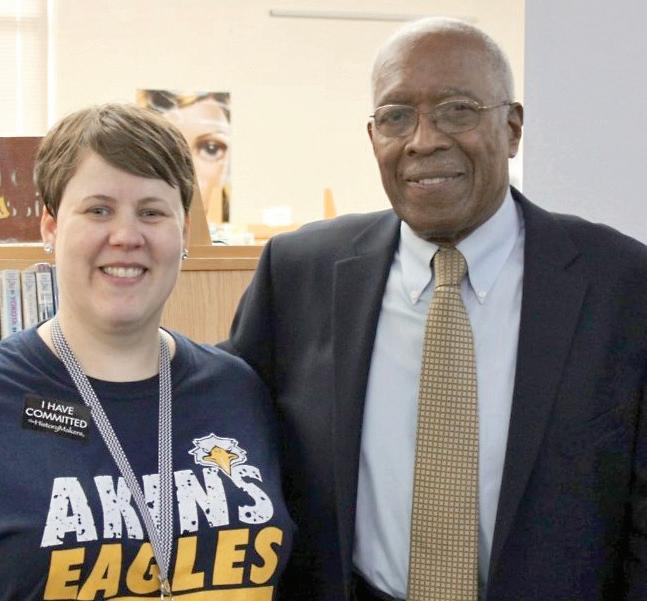
Dr. William Charles Akins with Katie Delmore at the annual “History Makers” event in the Akins Library, September 27, 2013. Students, teachers, and community members gathered as Dr. Akins reflected on his life, inspirations, and legacy.
The academies were introduced under Akins’ second principal, Mary Alice Deike, remembered by faculty as “the guiding principal and visionary that transformed Akins into the first academy-structured high school in AISD.” The first five academies opened early, with STEM and New Tech added later, expanding opportunities even further.
These academies gave students more than classes; they offered hands-on skills, real certification, and a direct path to future careers. For many, it was the moment Akins stopped being just a school and started becoming a launchpad.
Akins has built programs that last. AustinCorps, launched in 2013, more than a decade later, it’s still giving students hands-on experience with city government to thrive.
English teacher Alex Vasquez reflected, “The changes in schedules and the toll on mental and physical health have been even harder for students, teachers, and parents.”
Former student Karen Vasquez shared, “My grades slipped during online school because I didn’t feel the same responsibility, and being at home was distracting.”
By 2021-2022, students returned in person, determined to revive the traditions and connections that define high school.
The Next 25 Years Today, standing at the 25-year mark, Akins High School is no longer a scrawny bird in the district. It is an established institution with a rich history.
Named in honor of Dr. W. Charles Akins, whose legacy embodies leadership and opportunity, Akins High School holds historic significance.
From sharing a building with a middle school, to marching in state finals, to navigating national tragedy and global pandemic, Akins has grown through every challenge.
Its students, past and present, define what it means to be an Eagle: resilient, and determined to rise above expectations.
As Dr. Akins said 25 years ago, “Eagles soar, and they do great things.”
A quarter-century later, the legacy of Akins High School proves that he was right.
Akins band incorporates metal in halftime show
the volume of his practice sessions.
The hot Texas sun beat down on the football stadium as dozens of band trailers sat in the parking lot and hundreds of band students from across Texas watched. Akins High School was up for a preliminary run, and a student behind the front ensemble adjusted a red sequin suit.
His Ibanez Jem 77 BRMR mirror-finish guitar shimmered under the lights. The announcer called for Akins to begin their show, and junior Sam Martinez waited for his moment.
In the show’s fourth movement, he emerged from under a prop, lifted his guitar, and played his solo — a variation of Metallica’s “Master of Puppets” adapted for the marching program.
“You just get a different sense of confidence,” Martinez commented later. “It felt like the best thing that could have happened to me this year.”
Martinez’s walk onto the field became a defining moment of the show. In a marching performance that featured metal over orchestral music, he delivered a guitar solo to the largest audience of his life.
“I think so, a few hundred people,” he said regarding the crowd size.
Although electric guitars don’t have a section in a marching band, the moment came together naturally, earning high ratings from judges and audience members alike.
From Practice Room to Spotlight
Before the spotlight, Martinez was known for something else:
“Somebody commented to me that I’m really loud in the practice rooms. I didn’t realize I was being that loud,” he admitted.
Martinez first got involved with the band through the jazz band class.
“ “
...
how cool would it be to have like a metal guitar solo in the show?
— Sam Martinez

Junior Sam Martinez shreds Metallica’s “Master of Puppets” guitar solo during a halftime show at Akins football game.
“I was in jazz band just… I hate to use this word, but shredding,” he said.
The band directors took note of his skill and invited him to join the marching band for a solo spot.
“They were in their office, and they told me to come in,” he said. “They invited me to be a soloist.”
The directors had been planning a metal-themed show for some time before they met Martinez.
“When we came up with this idea of ‘Metalmorphosis,’ we were like, man, how cool would it be to have like a metal guitar solo in the show? And as soon as we heard Martinez play, we’re like, oh, that’s perfect,” assistant band director William Kimmel said.
Keeping Tempo
For Martinez, the hardest part of the solo was keeping in tempo
with the rest of the band.
”I struggled with putting a solo into the band’s choreography,” he explained.
“At first it was too fast, then we slowed it down, then sped it up again. We managed to put it all together.”
Martinez said the struggle made the final product more meaningful.
“
It felt like the best thing that could have happened to me this year.
By the season’s final performance, Martinez had accomplished something he was truly proud of. “I felt like I had to give it everything for everyone out there,” he said.
— Sam Martinez
“
Each run of the show was cleaner, more together, and more impactful as the band learned to lock in with his tempo.
Conclusion Though the marching season is over, Martinez plans to stay involved with the marching program. He’s looking forward to other opportunities, including planning to form his own band outside of school.
KARTIE SHELL STAFF WRITER
After many years of watching this show, it’s finally coming to an end. Stranger Things has been around since July 2016, and most of us have grown up with it. As many people’s favorite show, it will be sad for many since it’s finally coming to an end with the finale episode set to air on Dec. 31. Stranger Things is such a big show for almost all of us. Many of us have been watching it since it first aired, and despite the challenges of COVID-19, the mix of science fiction, horror, and mystery has kept us engaged and interested in watching all the new seasons. This show has become such a big deal that merchandise is everywhere, including online and in-store. There’s even a Broadway play entitled “Stranger Things: The First Shadow.”
Senior Rawan Al-Janabi, who has

been watching Stranger Things since she was about 12 years old, says, “Stranger Things impacted my life so much; it became my favorite show ever since I started watching it, and I’ll be truly sad when the final episodes start to come out since I have been watching it since almost the beginning.”
When we first saw Stranger Things, most of the actors were
around our age or portraying characters our age in the show, with some of them being around 12 years old. Many of us were that age or nearing it when Season 1 premiered, and since then, we have grown up with the actors as each season went on. There has been significant development for this show in many ways.
With Season 5 releasing in three
different volumes, the story will unfold gradually. The first volume has been action-packed, revealing more of the Upside Down and what is really happening with the military. It also reveals Venca’s plans.
This final season hasn’t been like the others, as it hasn’t been rushed; everything just gets straight to the point with no filler. We have seen a lot of change with Will, and his character development, and it’s been a major change from what we have seen of him in past seasons.
After Stranger Things finally ends, we won’t necessarily stop watching. Many will rewatch it or even share it with others who haven’t seen Stranger Things to show them the amazing experience of how great this show has been to many of us. It will live on in the minds of us all for many years to come.
BRENTON CHILDERS
STAFF WRITER
Set in a vast, mysterious ringshaped world suspended in space, the story of Halo: Campaign Evolved unfolds across alien landscapes that blend ancient architecture with wild, untamed beauty. The action in fierce and tactical gunfire echoes through metallic corridors and open valleys as humanity clashes against relentless alien forces. Halo: Campaign Evolved, developed by Halo Studios, is a first-person shooter that redefined the genre through its immersive storytelling, dynamic combat, and sweeping sci-fi world. The game follows the super soldier Master Chief as he battles against the alien Covenant on a mysterious ringworld, uncov-
ering secrets that could determine the fate of the galaxy. It will soon be the first Halo game on PlayStation.
This marks a historic moment in gaming, symbolically ending the two-decade-long rivalry between PlayStation and Xbox. Once the banner franchise of Xbox’s identity, the game’s announcement on PS5 represents a bold new era of gaming where creativity and shared experiences outweigh platform exclusivity. By bringing one of gaming’s most iconic campaigns to both consoles, with cross-play and unified progression, Microsoft, Halo Studios, and Xbox’s legacy games now stands as a bridge, not a boundary.
But now The popular PC gaming software just announced their new devices that could lead to a
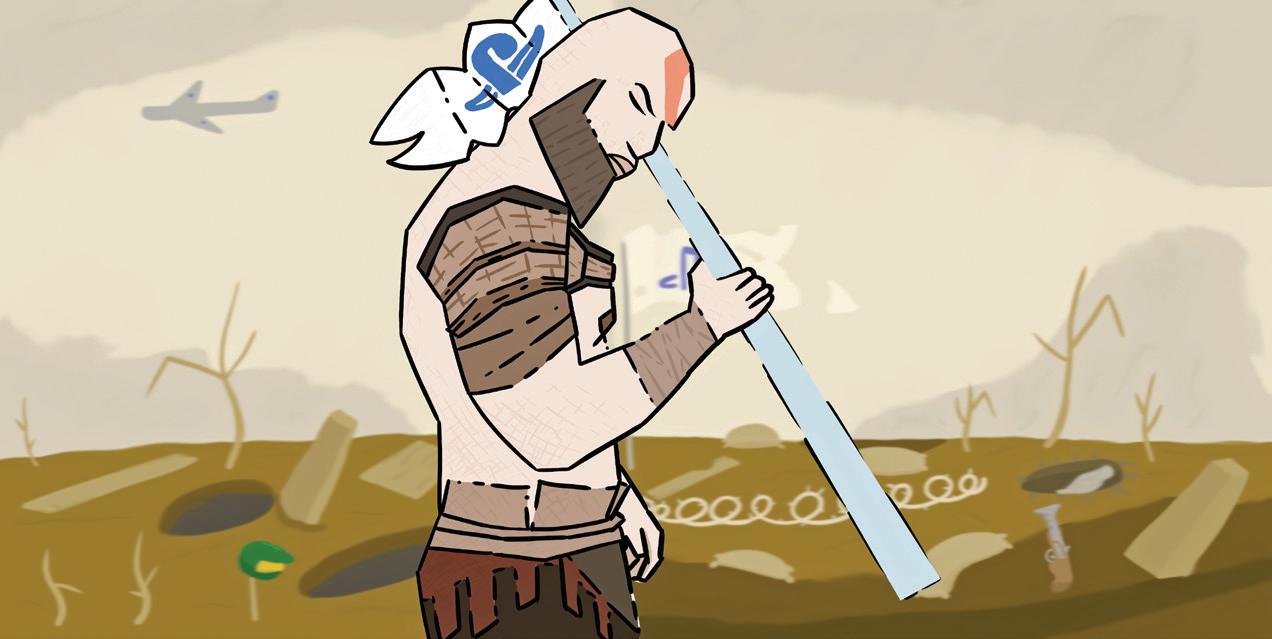
whole new generation of PC/console gaming: The Steam Machine, Steam Frame, and the new Steam Controller. These could forever change the gaming experience.
The Console Wars between Xbox and PlayStation has been going on for 2 decades and they’ve been making their own exclu-
sive games for years, but at the Halo World Championship, Xbox announced their remastered version of the 1st Halo game called Combat: Evolved. It will be the 1st Halo game coming to PlayStation. Many say this ending of console exclusivity finally marks the end
YANITZEL SALAZAR NEWS EDITOR
For English teacher Alan Brooks, the quest to bring author Ernest Cline to Akins High School was a marathon, not a sprint. After six years, Brooks finally succeeded in bringing the Ready Player One author to Akins.
Cline recently spoke with students who had read his novel in Brooks’ classes, answering questions about the writing, the film, and his advice for writers.
The Eagle’s Eye (EE): Do you draft scenes visually, like a movie; or verbally, like dialogue first?
Ernest Cline (EC): I’ll do an outline. We just have like plot points, but not really dialogue.
EE: What’s your biggest inspiration overall, and specifically for Ready Player One?
EC: Man, the writer Kurt Vonnegut. [I’m a] big fan of his. [For Ready Player One specifically], Neuromancer by William Gibson and Snow Crash by Neal Stephenson. Those are two big cyberpunk books that are inspiring. EE: How do you overcome writer’s block?
EC: I watch a lot of movies or listen to music to get inspired. If I try to write a certain kind of movie or story, I’ll watch a bunch of those to get ideas. All the best writers steal from other people. So just watch a bunch of stuff
to steal from.
EE: What was the single greatest challenge in creating such a vast and complex world?
EC: Just writing it all down. It was easy to imagine it, but articulating and writing it down was the hardest part.
EE: IOI represents a large corporation trying to commercialize art and culture. Is that a theme you feel is still relevant to the internet today?
EC: Yeah, definitely. Well, corporations have total control over the internet, and now they’re like, flooding it with their crappy AI. It’s easy to imagine... the commodification and commercialization of the internet was already happening.
EE: The Oasis feels both like an escape and a dystopian trap. Which of these two concepts is more important for you when writing the book?
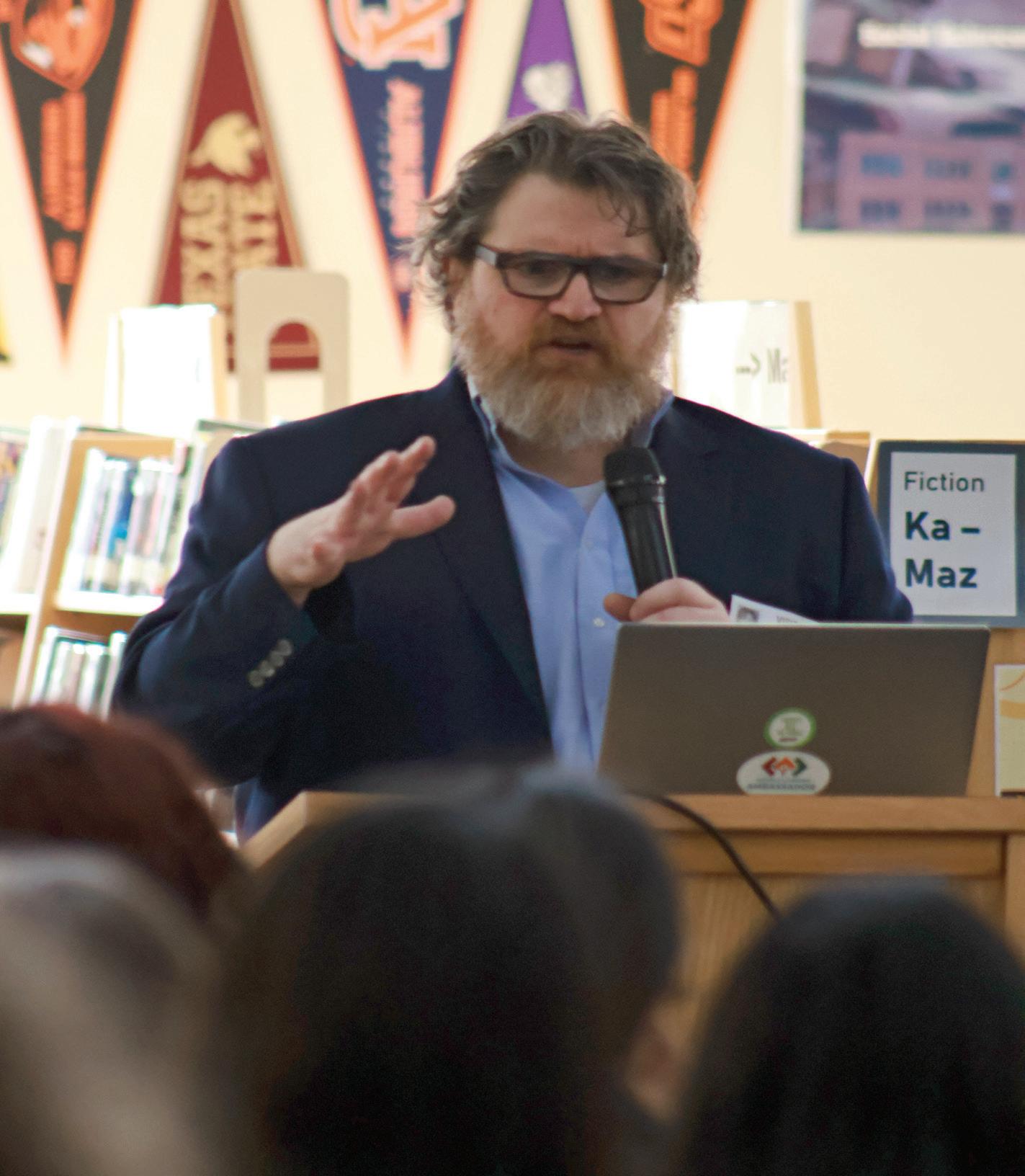
Cline's lecture
Author of Ready Player One,, Ernest Cline speaks to Alan Brooks’ English class in the Akins library.
ern games?
If I can ever help out schools in Austin, I always want to help out.
— Ernesst Cline
EC: I wanted to explore both of them, because it’s like the internet. The internet can be a trap, and you can spend way too much time on [it], and it can poison your mind and your mood, but you can also get amazing stuff done and do amazing research, and it gives you access to the whole world. So it’s like all forms of technology. I try to show there’s a good side and a bad side, and it all depends on how you use it.
EE: Did you have influences from mod-
EC: Yeah, I’m a huge Valve fan, and I played the hell out of HalfLife. I’m still waiting for Half-Life 3... But also all the games, Atari and Adventure. Adventure was the big one, because that had the very first Easter egg.
EE: What surprised you about Spielberg’s version of your story?
EC: Just how lost I got in my own story, seeing his version of it. Just like any other Steven Spielberg movie, I got swept away by it. So it was weird to have that happen with a story that I had written. But yeah, the whole process surprised me. It’s the weirdest thing ever happened to me.
EE: What advice would you give to a high school student who struggles with the commitment needed to write a full novel?
EC: Try writing screenplays first
or short films and work your way up to writing a novel. That’s what I did. I started out screenwriting... It was easier to write a novel than it was to make a movie, you know, in some ways... But just write what you know and write about what you love. If you’re not having fun with what you’re writing, no one’s gonna have fun reading it.
EE: Why specifically did you choose to come to Akins today?
EC: His teacher [Alan Brooks] stalked me, and I guess he’d been trying for six years to get a hold of me, and he finally got a hold of me. Teachers have a big effect on me and my writing career, and they inspire me. I had some great teachers... So if I can ever help out schools in Austin, I always want to help out. So when he got hold of me, I’m like, “Yes, I will do that.” Especially since he had made you guys all read my book.
EMILY KEYS STAFF WRITER
When James Hoag, the musical director at Akins High School, was looking for the next big production for the theatre department, he looked back to his own roots. Growing up in a church choir, he found a personal connection to the music and meaning of Sister Act.
“I saw meaning and connections to my personal life, and it was a huge motivator for me,” Hoag said.
That motivation transformed the Akins stage into a collision of two worlds: the gritty underground of crime and the holy sanctuary of a convent. Sister Act, an American comedy musical, tells the story of Deloris (Keira Caldwell), a singer in a nightclub. Her boyfriend, Curtis Jackson (George Whitehurst), gives her

Deloris sings
Keira Caldwell, performs one of her opening songs in Sister Act musical.
a poor gift. When she attempts to return it, she witnesses Curtis shooting an informant, causing him to try to murder her as well. Police Lieutenant Eddie Souther (Jack Robison) puts her in witness protection and brings her to a convent, allowing her to hide there as a nun with Monsignor O’Hara’s (Jack Culbertson) conviction.
Playing the Villain
For George Whitehurst, stepping into the shoes of the antagonist, Curtis Jackson, required a complete personality shift.
“[I had to] get into a more cocky and crueler

Sweaty eddie
Jack Robison has his shirt torn apart as he performs one of his solos.
“When I pulled my provocative moves out for the first time, I traumatized a lot of people, and had a lot of fun.
— George Whitehurst
“attitude which is the opposite of me,” Whitehurst said. “It was weird and fun getting out of my comfort zone... I just had to work on the song.”
Whitehurst noted that the most challenging part of the production was maintaining the mindset of a character he fundamentally disagreed with.
“I expect the audience to kinda be disgusted at the character, but think he’s weirdly funny,” he said. “Of course, he’s not a good person, but people in that role are somewhat charming, overall disgusted, but weirdly intrigued.”
Despite the dark nature of the character, Whitehurst found joy in the performance, specifically a musical number involving some provocative dance moves.
While the actors brought the drama to the stage, the technical crew worked tirelessly to ensure the magic happened seamlessly. Draven Barerra, who typically performs as an actor, took a different approach for this production, working the flyrail.
“I didn’t choose, I chose light and sound when I tried, but Mr. Hoag put me on the flyrail,” Barerra said.
Having spent six or seven years in theatre, largely on stage, Barerra offered a unique perspective on the transition from cast to crew.
“I chose to do tech cause I’m tired of being an actor, it was fun having more time to eat, and I had extra time to myself,” said Barerra.
However, Barerra noted that the pressure on technicians is distinct and unforgiving.
A Director’s Vision
“I was excited to use that production with our musical theatre talent,” Director Le Easter said.
However, the ambitious nature of the show presented logistical hurdles. Easter noted that building the numerous set pieces required for the various settings was the most challenging aspect.

Villainous curtis
Curtis Jackson (George Whitehurst) portrays controversial role.
For Hoag, the biggest challenge was scheduling, with conflicts causing absences at nearly every rehearsal. Yet, seeing the final product made the struggle worthwhile.
“The first time we ran through the whole show, it was very messy and very fun, and I saw it click for all the actors and technicians,” Hoag said. “I think Sister Act is my favorite show that I’ve worked on... [I’m] incredibly proud of it.”
PAGE 20 | DEC. 12 2025
IAN RUIZ STAFF WRITER
At Akins Early College High School, Baile Folklórico is defined by more than just colorful skirts, fast footwork, and traditional music. It is a living connection to culture, identity, and home.
For many students, the dance brings back memories of places left behind, while for others, it offers a chance to learn about traditions they were never raised with. As the program grows, it is helping students celebrate their heritage and build a community that keeps long-standing Mexican traditions alive on campus.
For senior Ximena Arroyo, joining the group was a way to reclaim a part of her childhood. “I was always interested in Baile Folklórico, actually, since I was little, I used to participate in it,” Arroyo said. “When I moved, I had to leave it behind, but I always wanted to dance Folklórico.”
Arroyo danced from first through fourth grade, but the transition of moving halted her practice. Now, in her final year of high school, she returned to the art form to reconnect with her roots.
“What inspires me is being able to represent my culture in such an important dance that many people can know,” Arroyo said. “In my last year, I decided to join it again to feel like I’m a part of it again.”Fernanda Sillero, the Ballet Folklórico sponsor, sees this desire to connect as the heart of the program. While she handles the logistics—organization, finances, and getting the girls ready behind the scenes—she understands the deep emotional weight the performance carries for her students. “I tell my students to keep dancing because many people here in the U.S. don’t have the opportunity to go back to their home countries,” Sillero said. “When the girls perform, it brings them a little piece of home. Through dance, they keep history and culture alive— and hopefully pass it on to the

facing tradition
Students wear traditional facepaint to prepare for their role in the Baile Folklórico.

group effort
Members of the Akins Baile Folklórico group perform during the 2024 Cinco de Mayo Show in the Akins theatre.
next generation.”
The group focuses on dances from three specific regions of Mexico: Jalisco, Sinaloa, and Veracruz. According to Sillero, Baile Folklórico represents how each region sees music and dance, showing the diversity within Mexican culture.
“Sinaloa is upbeat, fast, and flirty,” Sillero explained. “Jalisco is also upbeat and happy, but the skirt work is higher and more energetic. Veracruz is more mellow
and calm.”
Beyond the steps and the music, the program serves as a bridge between different groups of students. Sillero notes that the program is inclusive, welcoming students regardless of their background.
“I also love that we have students who aren’t Mexican joining us,” Sillero said. “They join because they enjoy dancing and appreciate the culture. Ballet Folklórico is open to everyone.”

show
An Akins student’s dress flows fluidly as the dancer shows off her moves during the 2024 Cinco de Mayo Show.
The practice sessions provide a respite from the academic grind, allowing students to step out of their routines and build friendships across grade levels.
“First, they have to learn how to dance together,” Sillero said. “That means students from different grades and friend groups get to connect.”
For Arroyo, the camaraderie is just as important as the performance.
“My favorite memory from practicing is when I’m with my friends and we talk,” Arroyo said. “I really like to do moves with the skirts, and I get to learn new dances and learn new songs.”
As the group looks toward the future, the goal remains to grow the program, attract more dancers—including boys, who are currently underrepresented in the group—and perhaps enter competitions. But ultimately, the mission is preservation.
“Especially in moments when our history sometimes feels overlooked, it’s important to show that we’re still here,” Sillero said. “Baile Folklórico is a way to make sure our culture isn’t erased.”
TOMAS MARTINEZ STAFF WRITER
While most teachers spend their summer breaks grading papers, planning curriculum, or simply recharging in the air conditioning, Jeff Schafer is somewhere in the northern Nevada desert, swinging a sledgehammer in the heat.
Schafer, an Akins High School teacher, leads a double life. During the school year, he helps students navigate their education. But come summer, he is a bona fide gold miner, owning two active mines where he digs, crushes rock, and hunts for the precious metal that has captivated humanity for centuries.
His interest wasn’t sparked by the allure of wealth initially, but by family tradition.
“My grandfather got me interested in minerals and fossils and digging up cool stuff when I was a little kid,” Schafer said. “And it just never stopped. I’ve been digging holes in... I mean, boys dig holes, you know.”
That childhood curiosity has evolved into a serious operation. Schafer currently owns two mines in Nevada: “Grandpa’s Gold,” a placer mine where gold is sifted from loose gravel in waterways, and “Copper Point,” a hard rock mine that requires breaking up boulders to extract gold trapped inside.
For Schafer, the transition from the classroom to the mine is drastic. He lives off-grid in a 10-by-6-foot camper he built himself, relying on solar power and hauling his own water. The days are long and physically demanding.
“The most challenging part, I would say, is being disciplined to spend, you know, at least six hours working a day in the desert heat,” Schafer said. “Just the discipline of getting up every day and going out there. Not taking a day off because I want one. I only have so many days in Nevada and every day is important.”
The work is grueling, involving sledgehammers and rock crushers, but the rewards can be literal nuggets of joy. Schafer recalls a specific moment at Copper Point when his luck changed. While walking through an area known for pretty blue and green copper rocks, he spotted something different.
“This year I saw an ugly black rock,” Schafer said. “I picked it up and I looked at it and said, ‘That’s gold.’ And I
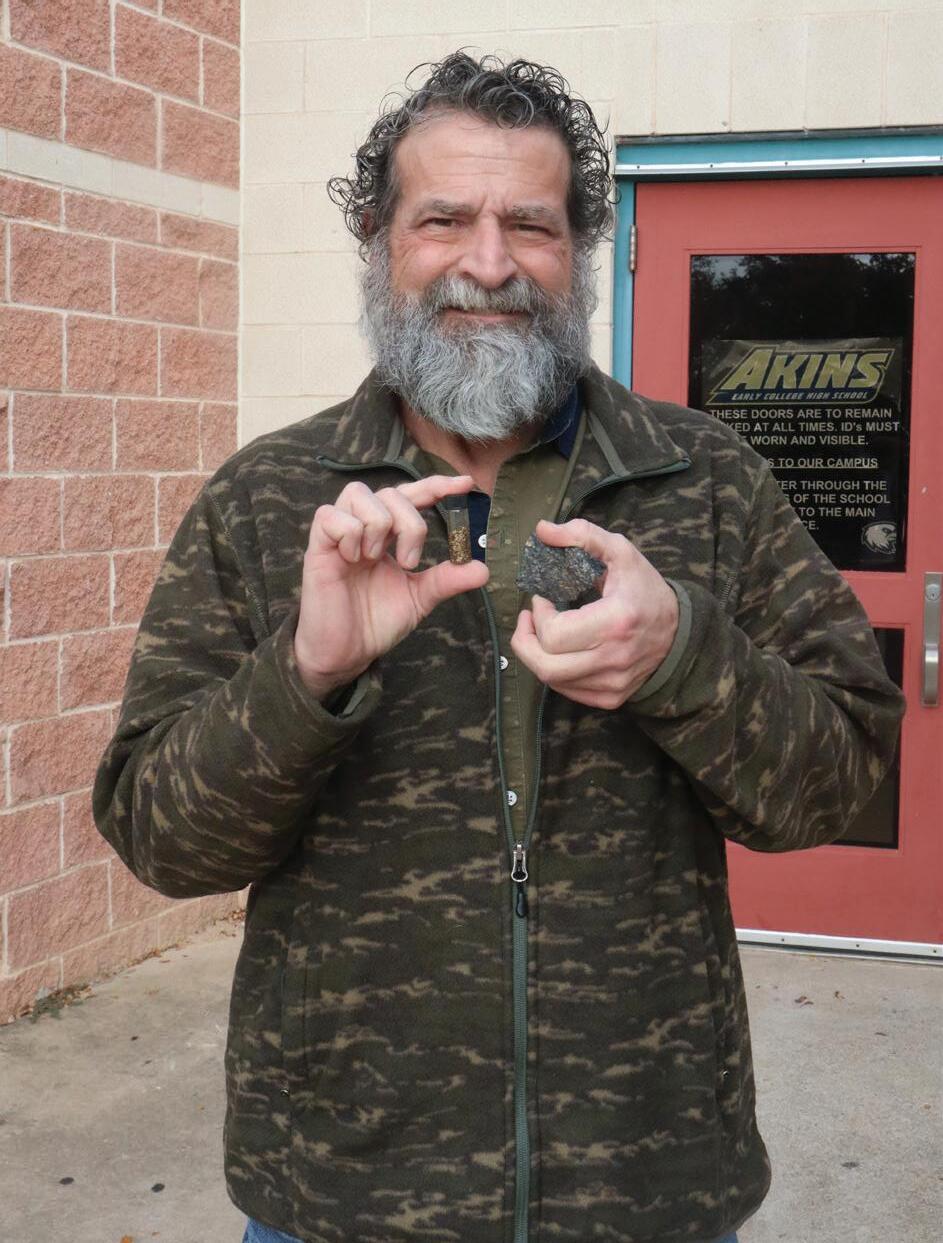
Teacher Jeff Schafer shows off a vial of gold flakes and a hunk of ore with embeded gold. Schafer spends his summer mining gold in Nevada. He often carries these items in his pocket at work, ready to show students and colleagues the tangible rewards of his labor.
put it in my pocket.”
The find was so surreal that it took him five hours to even mention it to his roommate and mining partner.
“It was unreal, you know? Like the thing your dream comes true and it’s not... it doesn’t feel real at first,” he said.
these discoveries. Schafer often carries a rock with visible gold flakes and a small vial of gold pieces in his pocket, ready to show students and colleagues the tangible rewards of his labor.
Despite the physical toll and the isolation, Schafer hopes that one day his summer gig could become his full-time retirement plan. He holds onto the dream of finding a legendary “potato-shaped” nugget, similar to those found by settlers in the region years ago.
For now, he is content with the hunt, the solitude, and the unique satisfaction that comes from pulling treasure out of the earth.
“Every time I pick up a rock with gold in it, I smile,” Schafer said. “And I’m like, yeah, another rock with gold in it.”
While the prospect of striking it rich is a major motivator—Schafer openly admits, “I’m

Teacher Jeff Schafer brought back ore to Texas to process in his garage.
Everybody’s like this piece of gold. You got something really good inside of you and you got some other stuff to get rid of in life.”
– Jeff Shafer, teacher
“
Sometimes, the gold turns up in unexpected places. Schafer brought back a ton of ore to Texas to process in his garage. While breaking up the rocks, a significant piece—a seven-gram nugget—went flying into his driveway, only to be discovered the next day.
“That was the most exciting piece of gold I’ve ever found,” Schafer said.
He isn’t shy about sharing
a gold miner for the money”—he also sees a poetic parallel between his hobby and his profession as a teacher. He often uses mining as a metaphor in the classroom to encourage his students.
“I talked to the kids all the time about how each of us is like a hunk of ore and we’re all working on refining our gold and becoming better and better,” Schafer said. “Everybody’s like this piece of gold. You got something really good inside of you and you got some other stuff to get rid of in life.”
RICARDO RAMOS STAFF WRIT-
Walking the corridors of Akins High School, the letters G-L-O-W have become a familiar, if somewhat mysterious, sight. Emblazoned across hoodies in stark black and white or muted beige and green, the brand operates like a uniform for the in-the-know.
To the casual observer, GLOW might just be another trend catching fire on Instagram. But to Luthor Lagoman, a Class of 2024 Akins graduate, the name is a specific call to action.
“GLOW means to me that you get to shine in your own way,”
Lagoman said. “When people say ‘Happy Glow Day,’ usually it’s referring to their birthday. But why can’t you GLOW every day?”
What began as a digital storefront in January 2023 has officially crossed the threshold into the physical world. This past Black
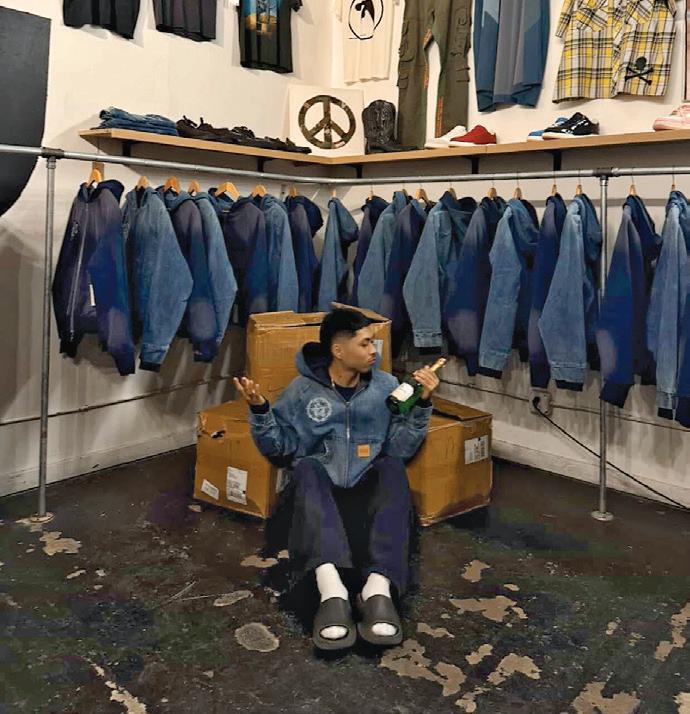

Friday, Lagoman marked a major milestone for his young brand by hosting his first in-person pop-up at Yomme Studios in East Austin. For Lagoman, the journey from
student to CEO was fueled by a desire to think about the “bigger picture.” Long before the hoodies dropped, he was experimenting with making his own hoodies
and shirts, eventually teaching himself the technical side of web design to launch his online store.
Drawing inspiration from industry disruptors like Clint419, owner of the UK streetwear giant Corteiz, Lagoman focused on building exclusivity—creating a brand that people would “run for.” It worked. Seeing his classmates and now strangers wearing his designs offers a validation that grades never could.
Lagoman said he sees his brand becoming a success and growing while using the exclusive drop sales technique.
“Yeah, really, when you mix exclusivity with a significantly lower price point, people tend to buy into what you’re selling,”
Lagoman is no longer balancing homework with shipping labels. He is reinvesting every dollar back into the business to take GLOW nationwide.
CAELYN DANSBY STAFF WRITER
Behind every successful team is a group of dedicated student-athletic trainers.
Their role is vital, offering valuable insights into both healthcare and teamwork while ensuring athletes’ safety on the field. Student trainers are essential at football games, providing crucial support to the players. Coach Lerma, one of the football coaches said “They are a constant presence and consistent.” The trainers are always ready to assist with hydration and emergency situations. Their dedication ensures that athletes can perform safely and confidently, making student trainers an indispensable part of every football game.
For many, the program is also a
stepping stone to a future career.
“I want to go into healthcare after high school, and I really enjoy how hands-on it is and getting to help others,” said sophomore Sophia Sigafoos, who balances her role as a student trainer with being an athlete herself.
Another example is Laylah Taylor, a veteran trainer who hopes to go into sports medicine after high school.
This passion for helping people is what draws many to the sidelines, but the position requires both commitment and compassion.
Balancing the rigorous demands of being a high school student and a trainer can be challenging, but Cindy Nguyen, a student trainer, finds the schedule manageable thanks to supportive leadership.
“Usually, we’re able to schedule our availability with the coaches,
so it makes it easier for me to be able to train while also managing my schoolwork,” Nguyen said.
Long hours, Friday night games that stretch late into the evening, and early morning practices are part of the routine.
“I would say my least favorite part is the late nights and then having to get up early the next day,” Sigafoos said.
However, the rewards often outweigh the lost sleep. Sigafoos didn’t hesitate to share what she enjoys the most.
“My favorite part is getting to be there for our athletes, supporting them, and getting hands-on experience,” she said.
For those considering joining the program, confidence is key.
“Be confident in yourself, and ask frequent questions to the trainers,” Nguyen advised.
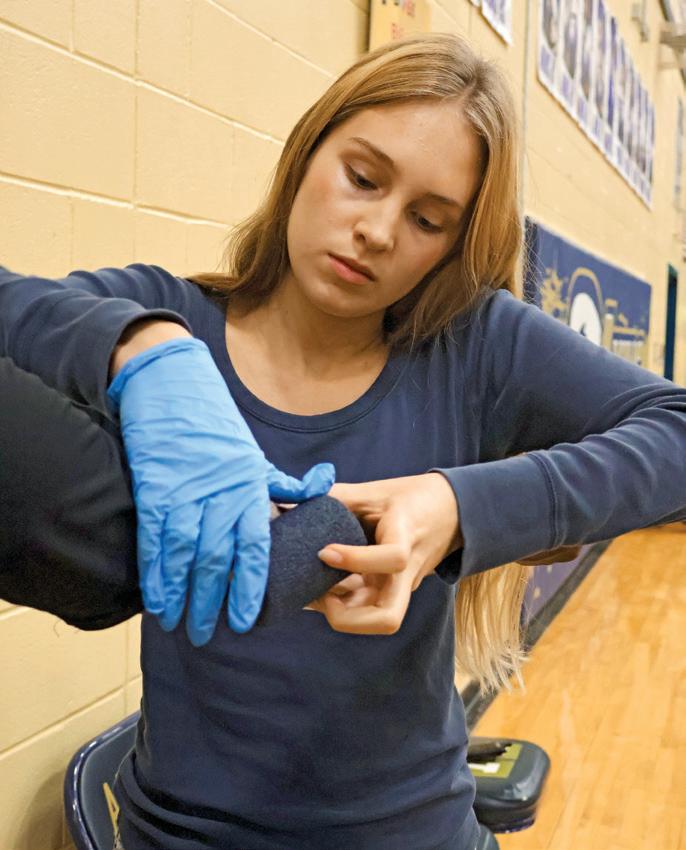
When you think of Texas barbecue, you think of the heat, the smoke, and the long lines of people waiting for a taste of brisket. But when I clock in at work, I’m thinking about something else entirely: the Michelin star hanging over our heads. I work at la Barbecue, an East Austin institution that has always been famous for its long lines and even longer list of accolades. But everything changed in late 2024 when the Michelin Guide arrived in Texas and awarded us one of its coveted stars. Suddenly, my after-school job wasn’t just flipping briskets or ringing up sodas; it was working on the front lines of one of the most prestigious kitchens in the world.
A Different Kind of BBQ Joint
Barbecue in Texas is often painted as a “boys’ club”. la Barbecue has always defied that stereotype. Founded in 2012 by LeAnn Mueller and Alison Clem, it carved out a niche as a female-owned, LGBTQ+led powerhouse in a male-dominated field.
Their determination to showcase culinary excellence over tradition built a legacy that set the stage for our current success. Today, under Clem’s leadership, following Mueller’s passing in 2023, the restaurant remains a testament to doing things differently.
The Michelin Effect I’ve been working at la Barbecue for about a year and a half, starting a few months before the Michelin announcement. I thought I knew what “busy” looked like. I was wrong.
Before the star, a 20-minute wait on a Tuesday was standard. Now,

Fransisco Saucedo, the pitmaster at the Michelin Star restaurant la Barbecue, poses with the Michelin man after the restaurant was recognized for keeping the prestigious award a year after originally winning it.

a two-hour wait is considered a lucky break. From my spot at the register, I have a front-row seat to the global obsession with our food. I meet tourists from New York, California, Tokyo, and London who have planned their entire vacations around eating our beef ribs. Many tell me they saw us on TikTok or read the Michelin guide on the plane.
It’s a strange feeling to tell a customer who has waited in the Texas heat for 120 minutes that we are sold out of sausage, or to recommend a platter to someone who traveled 4,000 miles just to stand in front of me. But despite the wait, the excitement is palpable. When they finally get their tray, they don’t look tired—they look victorious.
While the accolades are intimidating, the heart of the restaurant feels like family—literally. My uncle, Francisco Saucedo, is the pitmaster. In the world of barbecue, the pitmaster is the quarterback, the captain, and the rock star all rolled into one. While I’m managing the chaos at the front of the house, he’s in the back managing the fires.
He’s a local celebrity in his own right. Customers constantly ask for photos with him, treating him with the reverence usually reserved for athletes. We don’t get to hang out much during the rush, but those brief moments before the doors open are my favorite
part of the day.
I asked him recently how the Michelin star changed things for him. In true pitmaster fashion, he kept it humble.
“It’s cool, but we still do the same thing every day,” Saucedo said. “I just like making food people get excited about.”
When I pressed him on what it’s like to have his high school nephew working the register, he laughed. “You’re alright,” he said. “You don’t mess up too much.”
The Pressure and the Pride For a high school student, the pressure is unique. Most teenagers worry about getting an order wrong because a customer might complain. At la Barbecue, there’s a subconscious feeling that the whole world is watching. We aren’t just serving lunch; we are maintaining a standard of excellence recognized by the highest authority in the culinary world. Yet, it’s also incredibly fun.
I get to see a side of the restaurant industry that few people my age ever experience. I’m learning that a Michelin star isn’t just about the food on the tray; it’s about the consistency, the culture, and the grind that happens long before the doors unlock.
Working at la Barbecue is exhausting, loud, and smells permanently of post oak smoke. But when I see the line wrapping around the block, I know I’m part of something special.
ANDREW COPELAND + JASMINE WOODS STAFF WRITER + SPORTS EDITOR
As the winter sports season kicks off, the Akins High School varsity basketball teams are hitting the court with a renewed competitive spirit. But for the seniors on the roster, this season carries a different kind of weight—it is their “last dance” as high school athletes.
For these players, the season is about more than just the scoreboard; it is about leaving a legacy, mentoring younger teammates, and cherishing the camaraderie of the locker room one last time.
The Eagle’s Eye caught up with seniors from the Boys’ Varsity and Lady Eagles squads to discuss their origins in the sport, their goals for the playoffs, and the bittersweet emotions of their final year.
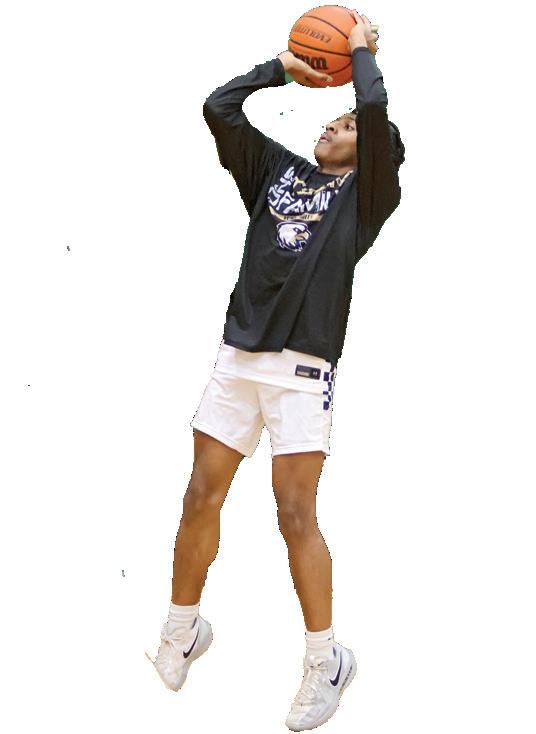
EE: When did you get into basketball, and what is your favorite thing about it?
Morrow: I got into basketball at three or four. My favorite thing about it is just competitiveness and being on a team that wants to win.
EE: What are some emotions you have knowing it’s your last year playing?
Morrow: It’s definitely a sad feeling because it is the last year you want to be able to keep playing, but there’s also some excitement to it. Things to look forward to.
EE: What are some goals you have for the team this year?
Morrow: The main goal for the team is we’re gonna try and make the playoffs, that’s every year, but also we do want to win games and win tournaments.
EE: What will you miss most about playing high school basketball? Morrow: What I will miss most is just spending time with my teammates, all the practices, all the memories we create.
EE: When did you get into basketball, and what is your favorite thing about it?
Parkhill: I got into basketball around the 3rd grade. My favorite thing about basketball is how fast you have to forget about your mistakes. There’s no time in the game to dwell on mistakes; you have to focus on the next play. For example, if I miss a shot but then get a steal on the next play, the missed shot does not matter. It has translated to real life, too; it has taught me to get back up and try even harder after a mistake.
EE: What are some emotions you have knowing it’s your last year playing?
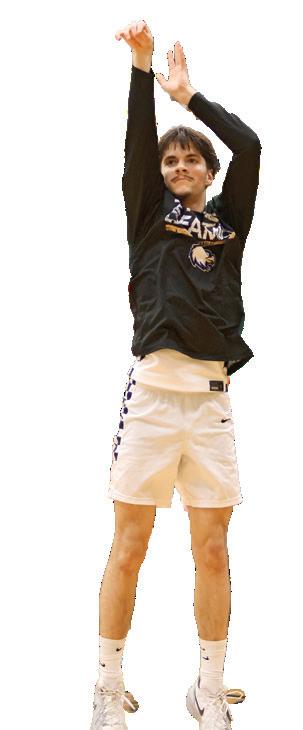
Parkhill: It’s bittersweet. I feel sad because basketball has always been a huge part of my life, but I am also excited to enter the next chapter of my life.
EE: What are some goals you have for the team this year? Parkhill: Be a top 4 team in the district and make a run in the playoffs.
EE: What will you miss most about high school basketball?


Parkhill: My teammates and coaches. Being part of a team that feels like family almost. Hearing the crowd say “boom” when I make a three.
EE: When did you get into basketball and what is your favorite thing about it?
Hedspeth: I started playing basketball when I turned 7
EE:What are some emotions you have knowing it’s your last year playing?
Hedspeth:I’m kinda sad that it’s my last year playing high school ball and knowing I’m leaving my team is tough but I’m also happy to be able to play at the next level next year.
EE: What are some goals you have for the team this year?
Hedspeth:The goals I have this year is to be better than last year, make each other better everyday and make the playoffs this year.
EE: What will you miss most about high school basketball?
Hedspeth: I will miss the relationships that were built over the years with coaches and players and bring up our culture.
Jiana Lopez, Power Forward
EE: When did you get into basketball? And what is your favorite thing about it?
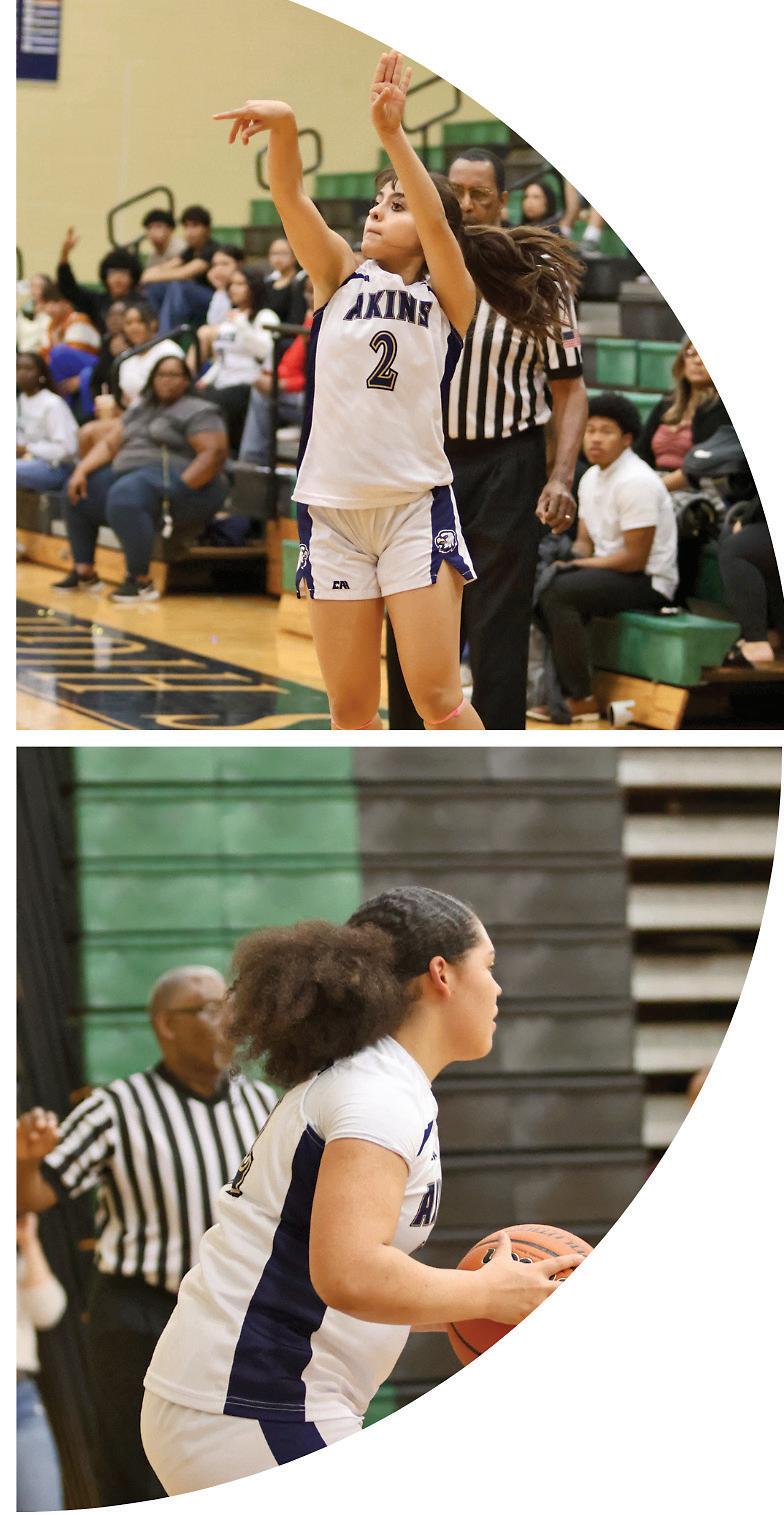
Lopez: I started when I was like, in fourth or fifth grade, and my favorite thing about basketball is how close we are. My favorite moment... It’s probably just like going around the school at away games. That’s probably the best moment.
EE: What are some emotions you have knowing it’s your last year playing?
Lopez: It’s very, very bittersweet.
EE: What are some goals you have for the team this year?
Lopez: Working together on the court, communicating, not arguing all the time, and having less attitude on the court as well.
EE: What will you miss about high school basketball?
Lopez: What will I miss most about high school basketball is being with my teammates, the younger classmen, knowing like we’re all close with each other and the coaches and everybody around.
EE: When did you get into basketball? And what is your favorite thing about it?
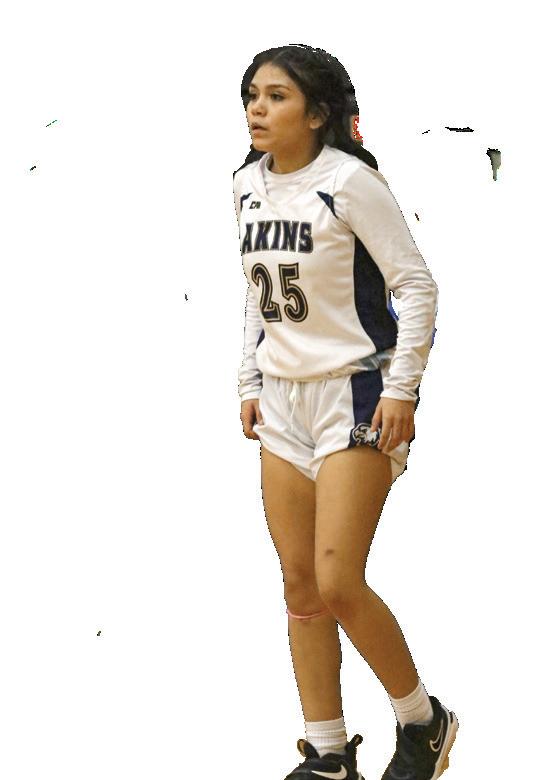
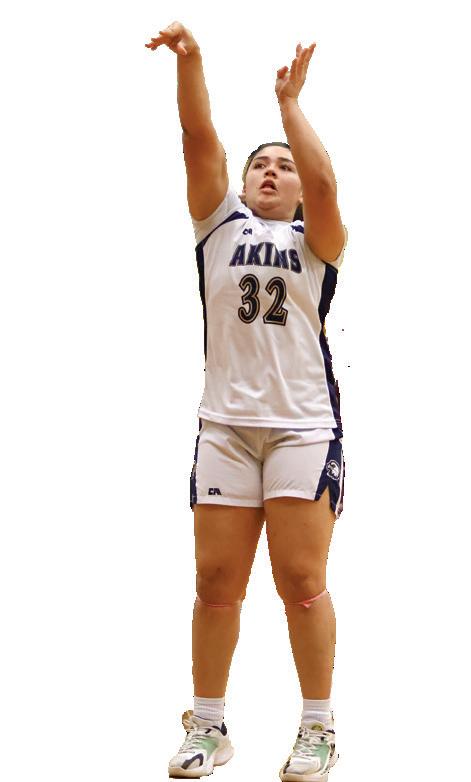
Martinez: I would say I got into my actual eighth-grade year of middle school, and my favorite thing about it is learning the new stuff and meeting new people.
EE: What are some emotions you have knowing it’s your last year playing?
Martinez: Some emotions I have knowing it’s my last year playing are that I’m sad and happy also, because I’m ready to get out of here, but knowing I’m gonna miss the team and what we’ll do.
EE: What are some goals you have for the team this year?
Martinez: Some goals I have for the team this year are that I would want us to hopefully do better than what we started off doing in our communication, and to be stronger on the court.
EE: What will you miss about high school basketball?
Martinez: What I miss about high school basketball is probably just the team and how close this team actually was this year. It felt like a second family.
EE: When did you get into basketball and what is your favorite thing about it?
Cardenas: I started playing basketball when I was in the 4th grade because my mom told me I was too short to play. Obviously being stubborn from that day on I was committed to proving her wrong. Good for me basketball ended up being one of my biggest passions and one of my favorite things in the world.
EE:What are some emotions you have knowing it’s your last year playing?
Cardenas: I’m honestly very sad because basketball has always been such a big part of my life that to let it go it’s going to be very hard for me. Iv had such a great opportunity to make so many friends and so many new memories, i will forever be grateful. I will say I’m very excited to make the most out of my season and put in my all for my last year
What are some goals you have for the team this year?
Cardenas: I think for all of us to have a good team bond. We are all really good friends off the court, literally never fail to laugh around them. Having great team chemistry on the court is just as important and I’m hoping we can take our off-court energy onto the court for some more wins this season!
What will you miss most about high school basketball?
Cardenas: Everything. Basketball is such a big part of my life that it’s not to miss. Long days, early mornings, all the running, I’ll even miss complaining. Most of all I think I’m going to miss the many friends I have made over the years.
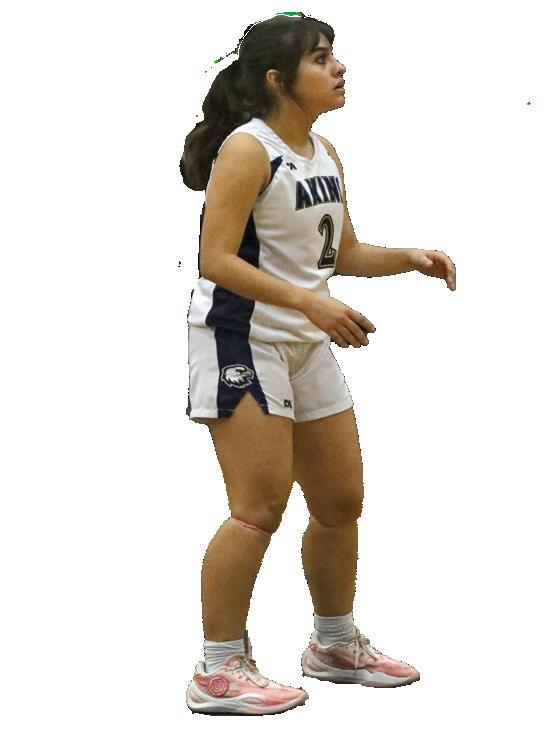
As the seniors from both the Boys’ Varsity and Lady Eagles squads reflect on their journeys, one theme rises above all others: gratitude. Whether they picked up a ball at age three or found the sport later in middle school, each athlete carries a deep appreciation for the lessons, friendships, and unforgettable moments basketball has given them. Their final season is more than a countdown to the playoffs, it is a celebration of growth, resilience, and the bonds built through early mornings, long practices, and the shared desire to make their school proud.
While the scoreboard will fade and the routines of high school life will soon shift, the impact of this “last dance” will stay with them. These seniors step into their final games not just as athletes, but as leaders leaving behind a legacy of hard work and heart. And as they move on to new chapters, the Eagle community will remember them not only for the points they scored, but for the passion and spirit they brought to the court.
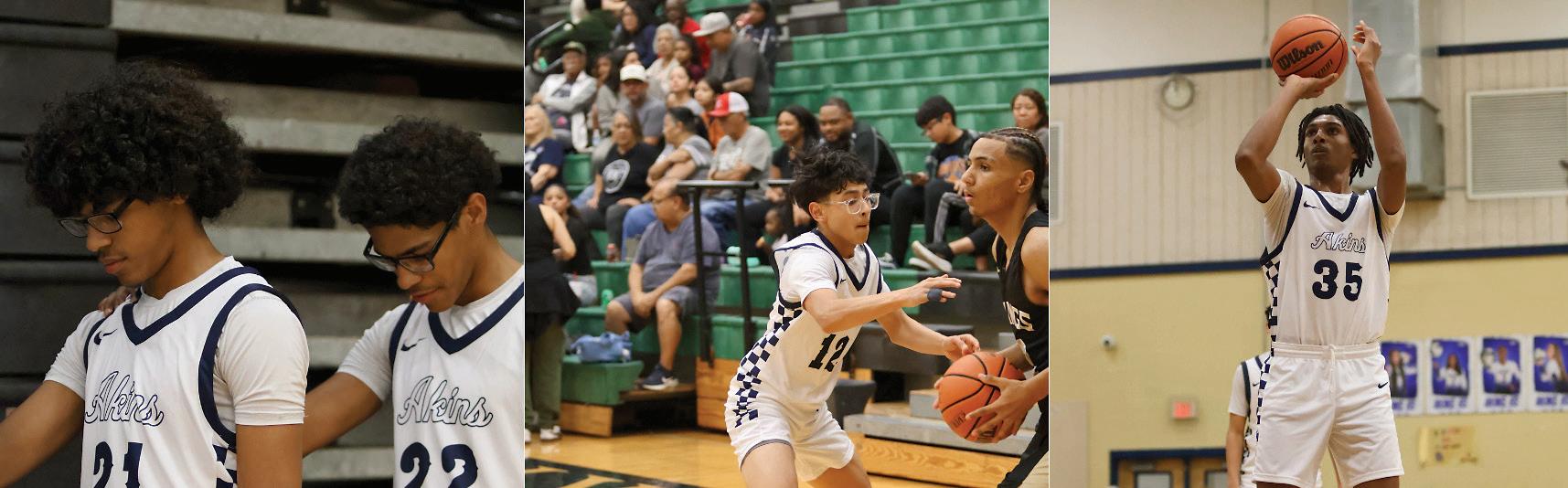
GEORGE MORALES STAFF WRITER
In the world of 6A high school basketball, varsity rosters are typically dominated by seasoned juniors and seniors—players who have spent years physically maturing and adjusting to the speed of the game. It is a rarity to see a freshman crack the starting lineup, let alone the roster.
But this season at Akins High School, the varsity boys basketball team has defied convention.
The Eagles have welcomed not one, but four freshmen to the varsity squad: Noah Hall, Andrew “Dru” Maldonado, and twin brothers Dante and Cross Emelue. This infusion of young talent is reshaping the team’s dynamic and setting the stage for the program’s future. For these young athletes, the opportunity to compete at the highest level of high school sports is both a blessing and a challenge they are ready to meet.
For Noah Hall, stepping onto the varsity basketball court wasn’t his first taste of Friday night lights—or their gym equivalent. Hall transitioned directly from the varsity football turf to the hardwood, as he dominated both the field and the paint.
Despite the grueling schedule, Hall considers the court his home. Rather than taking other sports as a chore, he takes it as a personal challenge.
“Basketball is my main sport, so I’m always excited about playing and practicing,” Hall said. “I’m always looking forward to games.” Hall views his multi-sport background as an advantage rather than a distraction. He be-
lieves the skills learned, he can use to translate his strengths to cover his different weaknesses in other sports.
“Every skill that I learn helps in another sport,” Hall said. “So it’s always helping another thing and I can hopefully turn that into something positive in the future.”
Managing the dual workload requires a maturity beyond his years. For Hall, it isn’t about finding motivation, but maintaining a strict routine. He believes that you do what you do because you have to, not because you feel like you should, and doing those things takes sacrifices setting away the bad influences or throwing away what you have to achieve more.
“It’s not really about what motivates me. It’s about being disciplined, so I find that discipline within myself,” Hall said. “You gotta really set away distractions, sacrifice some things that you wanna do and to do things that you should do in order to be successful.”
Coming from a line of college athletes, among the four freshmen are Dante and Cross Emelue, twin brothers who share a jersey color and a support system. For both, their mother has been the driving force behind their basketball journey, pushing them to ball since they were jits.
Cross credits his mother for introducing him to the sport in the sixth grade. Since then, the game has become a central part of his life. When asked how it feels to compete at the varsity level so young, his answer was simple.
“It feels great,” Cross said. “It’s a blessing.”
Dante shares his brother’s sentiment, putting their thanks and faith to God but Dante has his eyes set on a specific, ambitious horizon.
“I feel like it’s a big opportunity,” Dante said.
“I’m doing this... until I make it to the NBA.” Dante and Cross list their place of origin as Kuwait but coming into Texas, fresh out of middle school with d1 chemistry. They list each other and their mother as their biggest supporters. Off the court, they are typical teenagers, unwinding with video games and music, balancing the pressure of varsity sports “little by little,” as Cross puts it.
Rounding out the freshman quartet is Andrew “Dru” Maldonado. For Maldonado, making varsity wasn’t just about skill; it was about the environment. He credits the older players for helping him adapt to the speed and physicality of the varsity game.
“The players around me are helping me, pushing me to like, do more,” Maldonado said. Inspired by his uncle to pursue the sport seriously, Maldonado sees the varsity experience as a chance to constantly improve.
“It’s a good experience,” he said. “Always just pushing to be better than others.”
When he isn’t on the court, Maldonado trades the fast-paced action for the patience of the golf course, a hobby that perhaps teaches him the focus needed for high-stakes games.
While having four freshmen on varsity is unusual, it provides the Akins program with a unique advantage: time. These four players will have three more years to develop chemistry, refine their skills, and lead the team.
For now, they are focused on the current season, making new friends, and proving that age is just a number when you have the talent and discipline to compete.
I created the first internships in (the criminal justice) program. Convincing board members and Travis county officials to allow high school students in a jail setting was not easy. To my understanding it’s still going strong.
— David Lopez criminal justice teacher 2004-2015
The PALS program (under the leadership of Debra Squires) was incredibly impactful for me. It was a second family of wonderful peers. PALS provided experiences that led me to choosing a career in education.
— Megan Meyer Akins Graduate, Class of 2009 2005-2009
“I’m proud to be an eagle.”
“Eagles soar, and they do great things, so the students here at Akins High School will do great things.
— Dr. Charles Akins
Graduation, homecoming, senior breakfast, and teacher prep week were never the same after Dr. Akins passed away. I looked forward to his beginningof-the-year pep talk and his speech at graduation every year. I still miss his presence.
— Katie Delmore social studies teacher 2005 to present
Mary Alice Dieke was a wonderful principal who embraced the move to smaller learning communities and empowered teachers as leaders to shape that work.
— Amber Rinehart CTE Teacher 2002-2010 and again since March 2024
Mr. Sharp. He was was English teacher that helped open the school and was there my 3 years. He also wrote the school song and is still currently an aisd employee. Mr. Akins also was alive and would show up at some assemblies.
— Alisha Williams Akins Graduate, Class of 2003 2000-2003
For more content about the 25 year history of Akins High School, visit www.akinseagleseye.com
Mrs. Garcia, the Bilingual teacher always brought culture to students. She always had an idea to make students life more fun. Cinco de Mayo show was a hit. I spent my 4 years being part of Latinos Unidos and to this day I keep those moments in my heart.
— Azul Beltran Akins Graduate, Class of 2015 2011-2015
MADISON STAMAN
PHOTO AND EIC
Today’s teenagers use a constantly changing mix of slang that often leaves adults confused. A big part of this trend is something many teens jokingly call brainrot.
Brainrot emerged from excess use of social media, also known as doom scrolling. The heavy intake of online content allows you to get references to specific or ‘niche’ videos. Teen slang spreads incredibly fast because of platforms like TikTok, Instagram, and YouTube. A new phrase can become popular overnight, and suddenly everyone is using it.
Words like “rizz,” started as kids slang that would appear in conversations at school, in group chats, and even at home. However, the word got so popular even adults know what it means now, and has caused kids to cringe at the old and overused word. For teens, slang works almost like a social code, small niche references create inside jokes within friend groups. Brainrot isn’t only about slang, though. It also describes the constant stream of online jokes, sounds, and trends that teens absorb every day. The more recent one has been the uprising of ‘italian brainrot’.
This follows a string of AI generated characters with an Italian name. Some of the popular ones are Tung Tung Tung Sahur, Trippi Troppa, Tralalero Tralala, Bombardiro Crocodilo, and Chimpanzini Bananini. This has caused an uproar in
AI generated memes and the start of a new popular game.
Steal a Brainrot is a new game surrounded by these AI generated characters. The game released in May this year and the concept of the game is to try and steal and collect brainrot characters to gain in-game currency. They have these ‘events’ where you can get special limited-time characters. These events tend to be chaotic because there are multiple different brainrot events and everyone is rushing to collect them.
Junior Noah Loving said he has “watched kids play in the bathroom” and knows some friends who are “obsessed” with the game. When brainrot interferes with school, is where the issues arise. There were many videos arising on social media with parents posting their kids screaming over this game due to something they got or because they lost a brainrot. This is the point where many said it got “too far” and the game and Italian brainrot meme lost traction. With this new day in age, things become popular so quickly and then fall off just as fast. Something that everyone is saying one day might be considered “cringe” just the next day. That’s where this rise of doom scrolling has come from, you don’t want to be the only one still saying old jokes. For many, Italian brainrot has already hit its peak and is now on the road to falling off. Soon it will be just another trend sent to the archives to be replaced by the next trending joke.