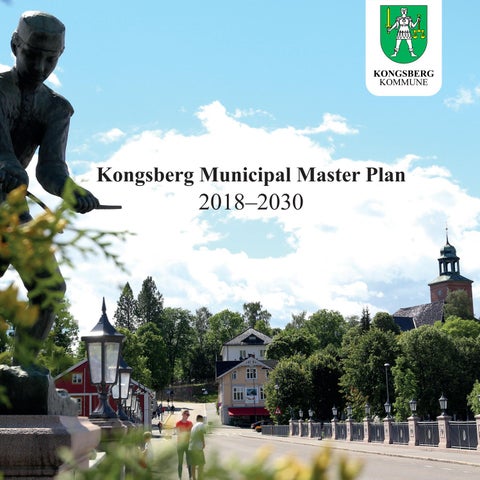
Kongsberg Municipal Master Plan
2018–2030
1
2
Preface The new municipal master plan builds on development work carried out in 2016 and 2017. This input period provided lot of material to the plan. Residents, commerce, regional organizations, teams and associations, schools and the city council contributed valuable input. Young people were especially encouraged to contribute, as they are the ones who will be living in Kongsberg in the future. Residents and the business community are concerned with the social development in our municipality, which is a strong foundation for our continued work. In a time of change and adaptation, the municipal master plan can contribute to everyone in the Kongsberg community pulling in the same direction. The work that has gone into this plan will also help us manage the changes that have yet to come. The plan focuses on key areas of development for the Kongsberg community in light of the demands and expectations that wider society places on us. The city council has selected four key areas of priority: commercial development, growth and attraction, climate, and changes in municipal services. These are topics that will require extraordinary efforts in the time to come. The development strategy is important for the work in these priority areas and is therefore integral to the community section.
goals and strategies, as well as priorities in terms of means and resources. The entire process concerning Kongsberg 2030, including input, supporting documents and debates, are available at: www.kongsberg.kommune.no/ kommuneplan. In order to get the complete picture, the municipal master plan must be seen in the context of the actions, theme plans, knowledge base, and other steering documents of the city council. Priorities and measures for execution will be found in actions, as well as in theme and sector plans. Performance monitoring will be included in the annual report.
Kongsberg 2018 Kari Anne Sand, Mayor
The municipal master plan is part of the council’s governance system, where theme plans and actions further detail 3
4
Contents
1. Opportunities in Kongsberg
p. 6
2. Vision and values
p. 11
Future snapshot of Kongsberg 2030 3. Goals and strategy for priority areas
p. 12
3.1. Commercial development
p. 12
3.2. Growth and attraction
p. 16
3.3. Climate
p. 20
3.4. Changes in municipal services
p. 22
4. Development strategy
p. 28
5
1.Opportunities in Kongsberg The Kongsberg community is a safe community where our residents have access to quality welfare services. The citizen survey conducted in the spring of 2017 shows that people on the whole are very satisfied with the services provided by the city. Kongsberg has had a steady population growth. From 2001 through 2017, Kongsberg’s population rose by 21 %, from just below 22,500 residents to approx. 27,200. Kongsberg has had a higher growth rate than the country as a whole, which had a growth rate of just below 18 % in the same period. The growth rate was particularly high in the period 2007-2014; growth is largely tied to development in industry and job opportunities. Circumstances external to us indicate that our local community should consider making some changes. This includes taking steps to ensure that Kongsberg remains a good place to live. National population growth is stagnating. The population is getting older, with fewer people of a working age. Climate change leads to increased needs to improve cabling networks locally and for preventive measures against other natural disasters. Industry efficiency is increasing and there is some uncertainty with regards to oil and gas production. This, in turn, affects the number of jobs available and tax revenue for the municipality. The municipality may find itself in a situation where its responsibilities must be solved with lower revenues. In order to maintain high-quality welfare services, we must seek to find new solutions for our responsibilities as a local community. Technology and digitalization, co-creation, resident involvement and volunteer work provide opportunities. However, it will require investments and expertise to implement such changes. 6
Social differences are increasing, even locally. In Kongsberg, we have a long history of prioritizing preventive work, early measures, and public health to limit exclusion. Kongsberg is home to an internationally-oriented industry greatly affected by global change. This industry is the cornerstone of Kongsberg’s economic activity. As a result, we are affected by fluctuations in international business cycles and strong international competition. The diagram shows the development of the number of people employed with Kongsberg as their place of work. There has been a 22 % overall growth in the number of jobs in the period from 2000 2016. 2013 was a peak year, with 16,809 people employed in Kongsberg. In the years 2014 2016, this number decreased by 1,082. This decrease is related to the fall in international business cycles.
Technology, digitalization and co-creation provides opportunities. 7
Kongsberg has a highly educated population, which makes us well prepared to meet the need for change. Competence, though, must be developed and adjusted to changes in society and in commerce. Close collaboration between employers and educational institutions at all levels can secure this. Basic education, vocational education, higher education and a high degree of student completion are important factors for success. Urbanization and centralization are strong trends in Norwegian society. The public sector is subject to rationalization, and units and service providers are merging. Businesses consolidate and are often located in larger cities with good public transport solutions. People move to the cities and prefer places with city life attractions. These trends affect Kongsberg and pose challenges, both for the municipality as a whole and for the various “districts� within the municipality. Regionalization is another strong trend in Norwegian society. The new Viken region has been established. Kongsberg is situated on the outer edge of the Oslo region. This must be taken into account in our development strategies; faster and more frequent communication to and from Oslo could make Kongsberg better integrated in the property and employment market in the Oslo region. Kongsberg will celebrate its quadricentennial in 2024. This anniversary is an opportunity to market the city and its attractive initiatives. Norway and Kongsberg are changing. Changes come quickly and unexpectedly. A community that is able to handle rapid and unforeseen change, will have advantages toward 2030.
8
Resident: “Create a lovely shopping street from Krona to Berja senter.�
9
Resident: “The municipality prioritizes local community initiatives. This is invaluable for us as residents and a major contributor to the municipality being a great place to raise children.�
10
2. Vision and Values - Kongsberg 2030
Vision and Values - Kongsberg 2030 KONGSBERG — A CITY OF TECHNOLOGY - Growth through competence and culture
The Kongsberg community in 2030 • • • • • • • • • • • •
An attractive municipality with bustling, open urban areas, framed by inviting natural landscapes creating a sense of well-being, safety and belonging. Residents experience a good quality of life and engage in cooperation and volunteer work. Kongsberg is a place of growth — young adults want to move here to build a life. Kongsberg’s diverse commercial life makes the municipality a place where both local and international companies choose to grow and develop. Kongsberg is best in Norway at successfully converting business ideas into reality. Competence and education are cornerstones of the Kongsberg community. Kongsberg is a renowned and popular student city. Students apply here due to the high academic quality and thriving student community, as well as the strong connection to working life. Kongsberg is known for its active, open and trusted collaboration between business and industry, research and education, and national and regional authorities. Kongsberg is an early adopter of new technology. Technological innovations are used to create new opportunities within service, city and commercial development. Kongsberg is a pioneer in terms of implementing environmentally-friendly solutions. In 2030 the municipality is close to being a zero-emission community. Kongsberg is recognized as one of the country’s most important cultural scenes, with several major national cultural events, and an abundance of local cultural attractions. Kongsberg is a safe place to live and a municipality where residents and visitors feel secure as a result of our continuous preventive work toward greater civil protection.
Values: Our core values are pride, transparency, innovation and generosity. 11
3. Goals and strategies for the priority iareas Kongsberg 2030 3.1 Commercial development Objectives •
In 2030, the Kongsberg community is an attractive and forward-leaning host for both national and international companies developing high-tech products, systems and services.
•
By 2030, various services, such as trade, tourism and conference activities, have increased. These business areas strengthen Kongsberg’s national and international attractiveness for new enterprises and investments.
Strategy The Kongsberg community will: :
The Municipality of Kongsberg will::
•
•
Be an active partner to schools and businesses, establishing and maintaining and contribute with collaboration arenas for relevant partners.
•
Facilitate for sufficient access to appropriate office space for start-ups and expanding businesses.
•
Develop a tourism strategy for Kongsberg, stepping up efforts to boost tourism.
•
Develop an agricultural plan for increased entrepreneurship, increased value creation and new employment opportunities in the industry, stepping up efforts to boost agriculture.
•
The Municipality of Kongsberg will be a pioneer of effective and customer-friendly digitalization of public services.
•
Work to retain and attract new regional and public employment opportunities. Identify public institutions and agencies that may be candidates for relocation.
•
•
12
Contribute to maintaining attractive operating conditions for businesses—promoting profitable development and growth for businesses who choose to be located in Kongsberg. Be a driving force in ensuring that Kongsberg’s educational and research activities are of a high international standard within disciplines in high demand by the industry, leading the way to the future and building on Kongsberg’s advantages as a city of technology. Support activities that promote new industry and business initiatives, emphasizing opportunities created by new, sustainable technologies and business models. Prioritize small and medium businesses.
•
Strengthen Kongsberg’s national and international standing as an attractive place for both private and public investments in existing and new businesses.
•
Strengthen public transportation services to and from Kongsberg, with a particular focus on a modern rail service with frequent departures.
Kongsberg will put social innovations into action. 13
Youth Council: “Kongsberg needs more varied employment opportunities.�
Current situation and development
Industry is the dominant sector in Kongsberg, in terms of both volume and growth. For other sectors, including trade, service provision, tourism and construction, employment shares are lower than for the country as a whole. From 2000 to 2012, the employment growth rate in Kongsberg was almost 20 % higher than the rest of the country. After 2012, this trend has been far 14
weaker. These large fluctuations can largely be attributed to industry employment. Private sector employment outside industry has declined steadily throughout this period. The table below shows the development after 2010. Kongsberg has great opportunities for renewed growth and development given its advantage in technology. Our global companies are strong in their respective markets. Kongsberg as a brand has strong credibility nationally and
internationally, which is valuable to new endeavours. One example is autonomy in new and local investments in sea transport and maritime industries, as well as land and air transport. The situation is, however, vulnerable, due to strong international competition. Kongsberg’s university and technical colleges are ambitious, aiming to become the preferred providers of expertise to meet the future needs of both regional and national businesses. There is also a close
and strong collaboration between Kongsberg’s primary and secondary schools and local businesses. Examples include K-tech and Industrial Technology in year 2 of upper secondary school, where parts of the instruction are conducted in the workplace. Kongsberg is currently being challenged as a hub for international technology companies as a consequence of changes in ownership, changes in important markets and disappearing jobs. As a host, the municipality must be aware of key localization criteria, so that the community can take the steps required for companies to choose Kongsberg and invest in our community. Significant new developments in technology and digital solutions are bringing forth great change. Meanwhile, there is a major restructuring taking place in the petroleum industry. These industry changes have a considerable ripple effect on all other commerce in the region. Industry is still a market leader in technological fields developed 30–40 years ago through significant innovation and R&D efforts. At the same time, there is a need for new and younger forces, with innovative ideas and the drive to develop and execute change. Kongsberg needs to foster young entrepreneurs to bring forth the next generation of industry.
new growth. We can use this position to attract new people to Kongsberg who can develop, renew and establish businesses in new business areas. Kongsberg has the potential to become a centre for industrial innovation in Norway by providing attractive career opportunities to young talents, both in education and in business. This can be achieved by facilitating for the commercialization of new ideas. In the ongoing technology shift lies the potential for significant social innovations, for both private and public services, and at a local, regional and national level. The Municipality of Kongsberg can become a driving force for this development by actively leveraging development contracts, including with local business partners. The potential of such publicprivate partnership is considerable. One key success factor is to make room for young people who want to create something new. Norway’s central authorities has established a framework for this for this through various schemes, including Innovation Norway and their focus on smart societies through private-public innovation. There are opportunities here for both technology and service industries. Public incentives could stimulate such development.
Given Kongsberg’s position in a global systems industry, the Kongsberg community has every opportunity for
Industry Retail, accommodation and service Other private business Agriculture, forestry, fisheries Public Other Total
Table. Employment by sector in Kongsberg. Source: Statistics Norway
Fig. Employment in Kongsberg and nationwide, by sector. Source: Statistics Norway, Kongsberg, Nation
15
3.2 Growth and attractiveness Objective •
The Municipality of Kongsberg facilitates for long-term population growth. The municipality attracts young residents.
Strategy
16
•
Take steps to attract young adults, aged 18–35, youths and students.
•
Organize for increased and more varied employment opportunities.
•
Ensure sufficient access to commercial properties and housing, especially housing in demand by the relevant target groups.
•
Facilitate for the further development of urban areas, with more activity and additional meeting places.
o Zoning and land use that supports and stimulates urban activity.
o Upgrade the river park and offer more activities.
o Further development of institutions of knowledge and culture—both existing and new.
o Prioritize the city centre—upgrade urban spaces and streets.
o Improve conditions for pedestrians and cyclists in the city centre.
•
Contribute to the development of several large cultural events to strengthen the municipality’s position as a recognized cultural scene in the national context.
•
Offer high-quality education at all levels. Kongsberg schools shall serve as a national beacon of collaboration across levels and with a wide range of partners.
•
Further develop Kongsberg as an attractive city to study in by facilitating for: o Better access to student housing o Meeting places for students o Adequate space for the university college and associated activities such as research, development and student facilities on the city campus.
•
Promote increased quality in education and a wider range of study options USN.
•
Be a driving force for less expensive, more universally accessible and environmentally-friendly public transportation. Promote better public transport connections to Oslo and Oslo airport, reducing travel times to maximum one hour.
•
Actively work to increase the number of people moving to Kongsberg, both for commuters to and from Kongsberg and as an attractive place to live for people working in the Oslo region.
•
Develop the Kongsberg region’s collaborative networks and strengthen its ties to the Oslo region. Offer regional services to Central and Upper Telemark and Central Buskerud.
•
Make Kongsberg known as a city for important decision-making, and work to give Kongsberg influence to be heard in all important national forums.
Current situation and development Population growth is a prerequisite for securing future welfare services and jobs for our residents, as well as for maintaining a good cultural variety and private services. The municipality’s revenues are tied to population growth through block grants and taxes paid by residents. Kongsberg now has ample capacity in its social infrastructure, such as schools and kindergartens and can handle a growing population without further significant investments. Kongsberg’s population growth has been stable and positive since the year 2000. Net domestic migration is the biggest contributor to Kongsberg’s population growth. This has a direct correlation with the growth in employment opportunities. Population projections for Kongsberg toward the year 2030 show differing trends for different population groups. The age group consisting of children and youths (0–19 years) will grow the least, estimated at a rate of 4 % toward 2030. The age group consisting of residents of working age (20–66 years) will grow steadily throughout the entire period and increase by approx. 11 % toward 2030. This age group are largely responsible for the production of products and services and contribute the majority of the municipality’s tax revenue. The eldest age group (67 years and older) will increase the most, by approx. 33 %. This projected shift in the population age distribution is not unique to Kongsberg. The same trend can also be seen at the national level and can be attributed to a waning population growth in Norway. One consequence of an aging population is that there will be fewer working residents to care for an increasing number of elderly people. This will be a challenge, especially toward the end of the period covered by this municipal master plan. The highest growth is projected for the population groups that are most dependent on municipal services. Currently, there are 13.6 residents of working age per resident who is 80 years old or older. This ratio is likely to be reduced to 9.2 by 2030.
Population growth is a prerequisite for securing future welfare services and employment opportunities for our residents. 17
By reinforcing Kongsberg’s reputation as an attractive city to study, work and live in, young people have incentive to move to, and remain in, the municipality. That will provide a better balance between the age groups and a more sustainable community. As a consequence of a lower national growth rate in the future, competition for domestic migrants will increase. Kongsberg is located at the outer edge of the Oslo region, and will only benefit marginally from any growth in this region. The municipality must rely on other means to attract such migrants. Population growth closely correlates to the attractiveness of a location as both a place to work and a place to live. Improved public transportation services benefit both the housing market and the employment market. Broad and diverse employment opportunities provide offer choice, thus increasing attractiveness. A good city centre with meeting places, activities and short distances is important, especially for target groups. Good education opportunities, including higher education, and a good student environment further propmotes attractiveness. Youths and students, as well as residents looking to start a family (18–35 years), are important target groups for Kongsberg. Youths may move back. Students are instrumental in increasing the number of people with a connection to Kongsberg. A citizen survey shows that the younger population groups are the least satisfied with Kongsberg’s service offering. Increasing the number of young adults will establish a greater market foundation for a wider range of private sector services in the community. Provided that Kongsberg maintains its historic population growth, there will likely be a little more than 30,000 residents in Kongsberg in 2030. Increased attractiveness may can generate increased population growth—perhaps upwards of 32,000 in 2030? There is considerable uncertainty associated with the population growth projections, because they are affected by both national and local conditions 18
Youths and students, as well as residents looking to start a family, are important target groups for Kongsberg.
19
3.3 Climate Objectives •
In 2030, Kongsberg is a low-emission community.
•
In 2030, our infrastructure can withstand flooding and storm water.
•
In 2030, Kongsberg has a city district characterized as an “eco/green village”.
Strategy •
Plan for land use and infrastructure to contribute to reducing the community’s energy consumption. Short travel distances and environmentally-friendly transportation options take priority. In urban areas, transportation growth will be resolved by pedestrian, cycling and public transport options. In surrounding areas with a poor public transport communication, low-emission vehicles and car sharing are viable options.
•
Increase the use of energy-efficient construction technology, emission-neutral energy sources and wood as a primary construction material. For municipal buildings, wood shall always be the preferred construction material wherever this is technically possible.
•
Facilitate for the re-use, recycling and reduction of waste from private households.
•
Become early adopters of technological solutions and sharing schemes that reduce greenhouse gas emissions.
•
Become a leading municipality in prioritizing environmentally-friendly acquisitions, both in our own organization and by the municipality’s employees maintaining a strong environmental focus in working towards becoming a low-emission society.
•
Ensure that buildings and infrastructure are designed to handle climate change. Prevent problems with storm water problems by opening streams and improving drain networks.
•
Grant subsidies, etc. to stimulate the choice of climate-friendly solutions.
•
Inspire residents and businesses to contribute to reduced greenhouse gas emissions.
Current situation and development Norway is committed to ambitious goals of reducing greenhouse gas emissions, and making Norway a zero-emission society by the year 2050. Locally, the city council has decided to reduce greenhouse gas emissions by 50 % compared to the 1990 level by the end of 2019. If we succeed, the Kongsberg community is well on its 20 way to becoming a low-emissions community in
the short term and a zero-emissions community in the long term. Local greenhouse gas emissions in Kongsberg largely come from the transportation sector, consumption, agriculture and heating. Emissions from local industry are low. At the present time, separate figures for the municipality are not available. The figure below shows the distribution of emissions by source for Buskerud County, which is the most relevant as comparative figures for the Municipality of Kongsberg.
Becoming a low-emissions/zero-emissions community entails considerable social changes and restructuring for Kongsberg. The business community plays a role in developing “green� products. Residents must work on reducing their consumption. The municipality primarily functions as a regulatory authority and can help shape the community through its land use and parking policies. If the municipality is to reach its ambitious climate objectives, effective means have to be employed. Climate change entails significant challenges for Kongsberg’s physical infrastructure as well. Our infrastructure is not designed to handle the intense rainfall we have experienced in recent years. Kongsberg prepared a risk and vulnerability analysis in 2016, which showed that Kongsberg is largely a safe community. Of our natural vulnerabilities, storm water is a major concern. Many systems and sewers are undersized. Consequently, major upgrades are needed for existing facilities, and this risk must be taken into account in the planning of new systems. Flooding tributaries and clay and land slides pose less serious risks. These are known challenges, and prevention is well incorporated in the administrative process.
21
3.4 Changes in municipal services Objectives •
In 2030, Kongsberg has community active residents who contribute to shaping their own future by getting involved.
•
In 2030, the Municipality of Kongsberg has an effective and innovative organization capable of rapid restructuring. Services are developed in collaboration with users, volunteers, academia and industry.
•
In 2030, the Municipality of Kongsberg and its residents have shared expectations for municipal services.
Strategy
22
•
Promote a diverse community that encourages success and co-creation across age groups and life situations. Create public rooms that build community.
•
Foster a culture of continuous renewal across the municipal organization.
o Competence development.
o User focus. Increased involvement of relatives, volunteers, teams and associations.
o New and varied partnerships (volunteers, academia, industry).
•
Utilize possibilities in existing and future technology, both to ensure good learning processes and to further develop effective and high-quality services.
•
Ensure the municipality has sound fiscal policy.
•
Ensure the municipality becomes an extroverted “yes-municipality” with solution-oriented administrative procedures.
Current situation and development
No other countries in Europe have delegated such a large proportion of its welfare services to local authorities as Norway. Cost increases are considerable and municipalities have limited economic freedom. Demographic changes in Norway and Kongsberg demand major restructuring. Most OECD countries experience the same need to find new solutions for their welfare services. There are fewer workers for every non-working individual (children, the disabled and the elderly). Co-creation between the public sector and volunteers is a favoured solution, both at home and abroad. Municipality 3.0 is a concept that is becoming increasingly common in discussions of the future of municipal services. The concept involves both residents and the municipality coming together to decide on what they want to achieve. Everyone has resources they want to contribute to the local community, both for their own benefit and for the benefit of the community. Municipal employees help locate these resources and bring people together where they can support and assist each other. This shift means that each and every one of us must assume greater responsibility, not only for our own health, but also for the health and well-being of our neighbours. That way, we can ensure that local authorities even in the future will have the necessary human and financial resources to assist residents who need professional care to ensure their welfare. Those who require professional help from the Municipality of Kongsberg in the future can rest assured that they will have it.
Qualified labour
As an employer in the years leading up to 2030, the Municipality of Kongsberg will face two key challenges. The first concerns the access to qualified labour. Municipal services are expanding in scope, both due to population growth and an aging population and due to new rights and types of services. In order to meet the future need for qualified labour, it is absolutely crucial that the Municipality of Kongsberg is an exciting and attractive employer. The municipality must be able to attract new employees, and its labour reserves must be mobilized and included in working life.
23
The ability to restructure, evolve and innovate
The other key challenge concerns the municipality’s ability to restructure, evolve and innovate. Society is changing rapidly, and the municipality is affected by external conditions, including international economics and technological innovations. Kongsberg must adapt its activities and evolve its services in response to changing realities. We must therefore develop the capacity for restructuring and change. Increased productivity can be linked, among other things, to technological, knowledge and organizational advancements. Automating communication and administrative processing within and between municipal agencies, as well as between municipal agencies and residents and businesses, may prove to be a key strategy. Welfare technology may reduce the need for manual assistance for the elderly and people with special needs, and may also contribute to increased quality of life for the individuals concerned. To a large extent, digitalization is about change and innovation in services, processes and methods. Leadership, culture and attitudes are essential in this context. In order to maintain some economic latitude, the municipality must focus on technology in combination with competence. Changes in working life also affects the future of Norwegian compulsory education. NOU 2015-8 “The School of the Future — Renewal of subjects and competences” recommends guidelines for the renewal of school subjects. In order for children and youths to succeed on the labour market of the future, the Norwegian school must improve their education in four different areas: • • • •
Subject-specific competence Competence in learning Competence in communicating, interacting and participating Competence in exploring and creating
In an ever more knowledge-intensive society, pupils must be able navigate a jungle of data to select relevant information. As human beings, we learn from each other, and we must therefore interact, not just nationally, but globally as well. The ideals of the industrial society have been replaced by the ability of the individual to innovate. 24
As human beings, we learn from each other, and we must therefore interact. 25
Success in extracting ever more from the resources at hand is a critical factor in our future service oering. 26
A long-term perspective for the municipal economy The most important driving force in providing highquality welfare services, is that we succeed in extracting ever more from the resources at hand. For that reason, it is critical that the municipality maintain an investment programme that promotes efficient operation of municipal service—beyond the four years of each fiscal cycle.
The Municipality of Kongsberg has three financial indicators: • Net interest and instalments • Net operating profit/loss • Annual loan instalments
Financial targets from the financial strategy, which are included in the annual budget resolution, must inform fiscal priorities, promote a sound fiscal policy and maintain the municipality’s financial flexibility in the long-term. The Municipality of Kongsberg shall continue its work on establishing internal criteria to secure a fair distribution of resources between the different service areas. Good models for resource allocation will also provide a better foundation for financial management and control and will facilitate evaluation of the effects of implemented measures.
27
4. Development strategy The physical development strategy is one of the municipality’s foremost tools for meeting our objectives in priority areas. The development strategy is also the foundation for future work on the land-use part of the municipal master plan.
Objectives •
In 2030, Kongsberg has a physical development pattern in line with climate challenges.
•
In 2030, Kongsberg has a wide range of plots and types of housing available.
•
In 2030, Kongsberg has a physical development pattern that promotes growth and contributes to a healthy municipal economy.
•
In 2030, the municipality has attractive urban areas where historic building traditions are preserved.
Strategy
28
•
Further develop Jondalen and Efteløt as community centres, Hvittingfoss as a local centre and Kongsberg city as a regional centre. Berg/Heistadmoen to be evaluated as possible new community centres.
•
Develop good local communities within the municipality, with physical and social meeting places that promote community and diversity.
•
At all times, maintain construction-ready residential areas for various housing environments and sizes, ensuring a wide range of available housing.
•
Avoid the use of cropland for development purposes. This land can be used for the production of food.
•
Continue to develop an urban centre, while maintaining a small-town atmosphere. Facilitate for urban activities and meeting places.
•
Maintain active ownership in municipal development enterprises in order to meet the objectives outlined in the municipal master plan.
•
Adapt land use, parking and infrastructure in such a way that increased transport needs can be met by pedestrian, bicycle and public transport solutions.
•
Prioritize the order of housing development projects.
•
Promote low-density housing developments outside urban areas.
•
Develop an aesthetic plan for historic city districts.
Current situation and development
Kongsberg has a relatively compact structure and its urban centres are developing rapidly. This is a good foundation for other local developments in the municipality. Kongsberg City will have public and private services serving the entire region and is a regional public transportation hub. The municipality’s other centres, Efteløt, Jondalen and Hvittingfoss, have good schools and kindergartens and thriving communities. Berg/ Heistadmoen is being evaluated as a potential new community centre. Construction-ready housing options are only partially available in these centres, and the municipality must make this a priority. The municipality has set aside land for development, capable of servicing a population totalling up to 40,000 residents in the land-use part of the current municipal master plan. The plan also includes significant land reserves, both residential and commercial, far beyond than the projected need in the years leading up to 2030. A considerable part of it is privately owned. Kongsberg kommunale eiendom KF and Kongsberg Tomteselskap AS are municipal developers responsible for special-purpose buildings and adaptation of residential and commercial land, respectively. The municipality and these companies own relatively few plots, especially land zoned for residential and commercial purposes. Strategic property acquisition is
Resident: “We want the best of both worlds—access to both urban activities and nature, which is entirely possible in Kongsberg.”
29
one instrument that can be used in order to reach the objectives of the municipal master plan. Kongsberg has an excellent starting point for urban development. The citizen survey indicates that many welcome urban developments and want to be consulted. Residents request a more active city centre and putting the areas along the river to good use. The municipality must upgrade its urban areas and streets and facilitate for housing, job opportunities and recreational activities. This triggers the needs for municipal investments and increased maintenance of streets and squares. A diverse population in the city centre is important for establishing a profitable business community. Housing preferences of young families with children are closely linked to quality, price and location. Short travel distances in everyday life, proximity to the city centre and access to safe outdoor areas are important. Traffic safety, having inviting places to meet and proximity to schools and kindergartens are key qualities for families with children to choose to live in the city centre or centrally located housing. The distribution between various means of transport in Kongsberg shows that many people cycle few people take the bus. Car travel accounts for approx. 60 %, which is comparable other nearby municipalities. One key condition for developing environmentallyfriendly transportation options, is to make sure the development plan takes this factor into account. People’s preferred means of transport can be influenced by prioritizing environmentally-friendly transportat in infrastructure and by employing targeted parking policies. However, maintaining high-quality bus services in areas with low-density housing and a weak market foundation is costly. 30
Outside of urban areas, private cars will remain an important means of transport. Car sharing should be encouraged, and bus services associated with school transport can be improved. In the land-use part of the municipal master plan adopted in 2014, areas of conservation value have been designated as zones requiring special consideration (570). These are characteristic cultural environments fit to document the city’s history. Local open-air areas around the city have been designated as outdoor/city commons consideration zones (530). The municipal development pattern does have an impact on the municipal economy. The development pattern affects capacity requirements in primary and lower secondary education, maintenance costs for technical infrastructure, school transport costs and road maintenance. Without effective utilization of social and technical infrastructure, municipal costs will increase. In all new residential developments, municipal costs for road and play area maintenance increase. New housing developments with single-family houses mean high annual maintenance costs with regards to physical infrastructure, as opposed to areas where there is surplus capacity in existing infrastructure. In a situation where restructuring is required for fiscal and climate policies, the order of priority for developments, taking into account greenhouse gas emissions, transport solutions and municipal maintenance costs, should be future-oriented. The transport sector is changing rapidly. Information technology, sharing solutions and autonomous vehicles are under development and will become locally available. The municipality should take this into consideration in its adaptation of infrastructure.
Development trends aect the municipal economy. 31
Akari AS 2018
Municipality of Kongsberg Kirkegata 1, P.O. Box 115, 3602 Kongsberg Telephone: 32 86 60 00 www.kongsberg.kommune.no post@kongsberg.kommune.no Kongsberg Municipal Master Plan 2018–2030 Adopted by the city council 09.05.18
Read more | www.kongsberg.kommune.no/kommuneplan 32